WINTER 2010
C
urrents
In This Issue... Major Buzz
The extraordinary things that students do
Grand Tour
Inside the Integrated Wellness Complex
Satellite View
Professor’s images track oil spill
A Publication of Winona State Univer sity
Fine Dining Winona State students were welcomed with a new and improved Jack Kane Dining Center this fall. It’s not the cafeteria you may recall from your undergraduate days. There are multiple dining options with an emphasis on healthy choices. You won’t see the familiar trays, either. They’ve been eliminated with sustainability in mind. The Jack Kane upgrade is part of the university’s initiative to provide a healthy and enriching environment for students.
c o n t e n t s Major Impression . . . . . . . . . . . . . . . . . . . . . . . . . . . . . . . . . . . . . . . . . . . . . . . 10 Five students and the stories behind their majors Sneak Peak . . . . . . . . . . . . . . . . . . . . . . . . . . . . . . . . . . . . . . . . . . . . . . . . . . . . . 14 Get an insider’s view of the Integrated Wellness Complex Big Picture . . . . . . . . . . . . . . . . . . . . . . . . . . . . . . . . . . . . . . . . . . . . . . . . . . . . . 16 Professor Mingrui Zhang uses images to track Gulf oil spill Everybody Wins . . . . . . . . . . . . . . . . . . . . . . . . . . . . . . . . . . . . . . . . . . . . . . . . 20 Athletic training program offers best of both worlds News & Highlights.................................................................................... 4 Athletic News........................................................................................... 7 Scholarship News.................................................................................... 8 Philanthropy News................................................................................... 9 Alumni Relations.................................................................................... 22 Class Notes............................................................................................ 23 Current People: Jason Meszaros........................................................... 30
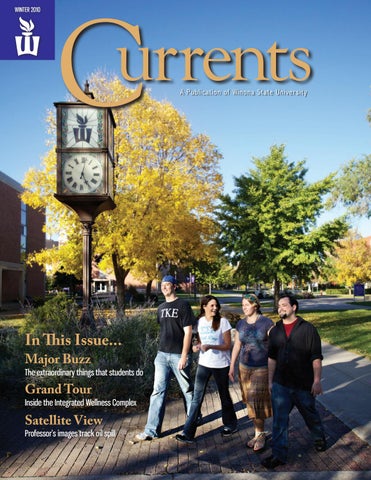
On the Cover STUDENT MAJORS There are “major” stories behind the academic pursuits of students Casey Kane, Katie Bur, Kelly Coyle, and Alex Jung. Find out what they’re doing, beginning on page 10. (Photo: Peter Boysen)
C
urrents
Winter 2010
Winona Currents is published by Winona State University’s Division of University Advancement and is distributed to more than 46,000 alumni and friends of Winona State University.
Currents is copyrighted material. Articles may be reprinted with permission. Comments on this publication should be directed by mail to: WSU-University Advancement, PO Box 5838, Winona MN 55987-5838; by email: currents@winona.edu; online: www.alumni.winona.edu.
POSTMASTER: If undeliverable as addressed, please send Form 3579 to Alumni Relations, PO Box 5838, Winona MN 55987-5838. Winona State University is an equal opportunity educator and employer.
Photo credit:Xxxx Xxxx
Photo: John McKeith
Address changes and Class Notes should be directed by mail to the Alumni Relations Office, PO Box 5838, Winona MN 55987-5838; by email: alumni@winona.edu.
This document can be made available in an alternative format to individuals with disabilities by contacting the magazine staff at the address above.
WSU on the web:
www.winona.edu
NEWS&HIGHLIGHTS
Highly Regarded
WSU continues at top of national rankings Rankings of the country’s universities are out for 2010-11, and Winona State continues to compare well with its peers. WSU is ranked second among public universities in Minnesota in the category of “Best Regional Universities” in the 2011 edition of “Best Colleges” by U.S. News Media Group.
Steady as She Goes Enrollment figures remain positive
With the Class of 2015 well into its first year, Winona State continues to experience stable enrollment. Figures taken on the tenth day of the fall semester show a total student headcount of 8,543, the second highest in university history. WSU-Rochester continues to experience enrollment growth as well, reporting an increase of almost nine percent in undergraduate students and an increase of almost one-and-a-half percent in total student headcount, with 784 undergraduate and graduate students registered this fall. Online enrollment is also strong at WSU, with 886 seats in courses delivered entirely online this fall, up from 606 in fall 2009. 4
Winona Currents • Winter 2010
According to Connie Gores, vice president for Student Life and Development, the university’s strategy for growth centers on student success. “Retention is a strong indicator of student satisfaction, and our first-year retention rates continue to increase.” Approximately 75 percent of the 2009 new entering freshmen returned this fall. This year marks the first year of even more selective admissions standards for the university. This fall’s new incoming freshmen were required to have both an ACT of 21 or better and rank in the top two-thirds of their high school class. The result is one of the strongest academic classes in university history, with more than 40 percent of the 1,633 new incoming freshmen graduating with a high school grade point average of 3.5 or higher.
The university remains ranked eleventh among public universities in the Midwest and ranked among the top-50 public and private institutions in the Midwest, claiming the 49th spot in the “Best Regional Universities” category. The annual ranking is available for review online at: www.usnews.com/ colleges. For the fifteenth consecutive year, Winona State is among America’s 100 Best College Buys. Institutional Research and Evaluation ranks the value and quality of colleges and universities across the nation. The report profiles the schools that are the highest rated academically, but also have the greatest value as a function of academic quality, cost of attendance and financial aid available. Winona State University is one of only two Minnesota schools included in the report of America’s 100 Best College Buys.
Nursing students train at the NCPTC’s mock house.
Expanding Good Works
Proposal supports NCPTC funding The National Child Protection Training Center (NCPTC) announced legislation has been introduced proposing $20 million in federal funding over a four-year period to expand the center’s work. Authorization of the funding will be considered in the upcoming session of Congress. Funding would be used to sustain the work of the NCPTC as well as to establish three regional centers, including one already being developed in Arkansas. The new legislation will also provide funding to assist colleges and universities in their adaptation of the Child Advocacy Studies minor, which was originally developed in collaboration with WSU professors and the NCPTC. Ten colleges and universities in eight states have already adapted the Child Advocacy Studies minor.
Faculty Highlights Bruno Borsari, biology, presented “Biomass yields for pellet production from reconstructed prairie patches in Southeastern Minnesota” with Daniel Wilson, WSU biology graduate, at the North American Prairie Conference held in August at the University of Northern Iowa. A second paper, “Bird communities of restored prairies and old-field habitats in agricultural and urban areas of Winona county, Minnesota,” was presented by Neal Mundahl, biology, and co-authored by Bruno Borsari and Naomi Corey, WSU biology graduate.
Emmanuel Brako, professor of biology, presented his abstract, “Interaction of Garlic (Allium sativum) and Antibiotics Used in Treating Opportunistic Infections Associated with HIV/AIDS,” at the Fourth Global Summit on HIV/AIDS, Traditional Medicine and Indigenous Knowledge, held in West Africa in August. Jennifer Chernega, assistant professor of sociology, was elected to the American Sociological Association’s section council on Sociological Practice and Public Sociology. Kent Cowgill, emeritus professor, won the 2010 Robert Traver Writing
Linda D’Amico, professor of global studies and world languages, presented her research in the paper, “Environmental Governance and Democracy In Intag, Ecuador,” at a conference sponsored by the United Nations Institute for Research and Training and the Yale Law School. Michael Delong, professor of biology, gave the presentation “Trophic Niche Dimensions of Fish Communities as a Function of Historical Hydrological Conditions of a Plains River” at a special joint meeting of the American Society for Limnology and Oceanography and the North American Benthological Society in Santa Fe, N.M.
NEWS&HIGHLIGHTS
Award for his short story “Two Men in a Museum,” which is featured in the autumn issue of Fly Rod & Reel.
Charissa Eaton, social work, along with co-author Hee Lee, received a Rose Dobrof Honorable Mention Award for the article “Financial abuse in elderly Korean immigrants: Mixed Analysis of the role of culture on perception and help-seeking behavior” that was published in the Journal on Gerontological Social Work in 2009. Eaton has also been selected as a Grantmakers In Aging Fellow for 2010 Diane Forsyth and Cindy Scherb, nursing, published the article, “Disseminating evidence-based practice projects: poster design and evaluation,” in Clinical Scholar’s Review. Phyllis Gaspar and Tracy Wright co-authored the article. Jeanne Franz, chemistry professor, along with colleagues at the United States Geological Survey Upper Midwest Environmental Sciences Center had the paper, “Chronic toxicity of diphenhydramine hydrochloride and erythromycin
winona.edu/currents
5
NEWS&HIGHLIGHTS
thiocyanate to Daphnia magna in a continuous exposure test system,” accepted for publication in the Bulletin of Environmental Contamination and Toxicology.
support final steps in preparing the manuscript, “Fancy Work: Dakota Women’s Work and Survival in the 19th Century,” for publication as a book.
Tom Grier, associate professor of mass communication, published an article, “Jobs in Mass Communication: Changing, Not Disappearing,” in the Summer 2010 edition of Mass Communication and Society News. Grier’s article on Winona State’s Catalpa trees was published in the Spring 2010 issue of Woodlands and Prairies Magazine. In addition, Grier also published his photograph, “Princess Wenonah Fountain” as the cover for the City of Winona Comprehensive Financial Report.
Vernon Leighton, chairperson of Library and Information Services, published “Evidence of influences on John Kennedy Toole’s A Confederacy of Dunces,” including Geoffrey Chaucer. It is published on the web at: www.winona.edu/library/staff/vl/ toole/.
Kurt Hohenstein, associate professor history, contributed a chapter to the book September 11 and Popular Culture. The chapter titled “‘Cryin’ from the Ground’ or ‘A Boot in Your Ass:’ Personal Pain and Political Conflict in the Musical Aftermath of 9-11.” In addition, Hohenstein was awarded a grant from the State Historical Society of Iowa to look at Milo Reno and the history of the Farmers’ Holiday Movement of the 1930s. For the coming year, Hohenstein has been appointed a Visiting Scholar at UCLA School of Law. Drake Hokanson, mass communication, had his book Purebred and Homegrown: America’s County Fairs featured in USA Today. The book was also honored by the American Association of School Librarians Best Books for Special Interests and the Public Library Association Best Books for General Audiences. It reveals the county fair as an important institution that helped define the U.S. as a nation of free thinking, self-reliant, community-focused people.
6
Colette Hyman, professor of history, was awarded a Minnesota Historical and Cultural Heritage Grant to Winona Currents • Winter 2010
Chun Lok Mah, assistant art professor, was featured for his artistic accomplishments on regional PBS station KSMQ. View the video at: www.youtube.com/watch?v=nr6KT9Q SvFk&feature=channel. Gloria McVay, accounting, and Rita Rahoi-Gilchrest, communication studies, collaborated on the paper “The Effects of Compensation Scheme, Source Credibility, and Receiver Involvement on the Organizational Budgeting Process,” which was selected for presentation at the 10th Find more Winona State news Want to know the latest about Winona State? Between issues of Currents, you can find university news, highlights, and events using several platforms: • WSU Newsroom: www.winona. edu/communications/newsroom • WSU official Facebook page: www.facebook.com/WinonaStateU • WSU YouTube channel: www.youtube.com/user/WinonaU • WSU Photo Gallery: www.flickr.com/photos/winonastate • President Ramaley’s bookshelf: www.winona.edu presidentsbookshelf
Global Conference on Business and Economics in Rome. Todd Paddock and Brian Aldrich, sociology, along with Emily Kittelson, WSU sociology graduate, published the paper “Massively Multiplayer Online Games: Cyborg Societies within the Global Civil Society.” It is a revised version of a paper presented at the World Congress of the International Institute of Sociology in Budapest in June 2008. Nancy Peterson, director of Grants & Sponsored Projects, had her chapbook “Belated Remembrance” published by Finishing Line Press. The poems are the voices of characters in the true story of her great-great uncle Arne Kulterstad, who was convicted of murder in Norway and had his life saved through an editorial campaign. Chuck Ripley, assistant professor of English, co-authored and edited the volume Editing Blake, published by Romantic Circles. Nick Ruiz, professor emeritus, was awarded the Paul Wellstone Legacy Award from the Minnesota School Counselors Association. It is awarded to an individual or organization that engages in high standards of public service. Ralph Townsend, dean of the College of Liberal Arts, has been named president-elect of the International Institute for Fisheries Economics and Trade (IIFET). IIFET is the worldwide association for economists who work on fisheries economics and management. John Vivian, mass communication professor, wrote an edition of the textbook The Media of Mass Communication. Publisher Pearson Education will build the book into its first iPad Mass Communication edition.
P
re-game tailgates. Halftime shootouts. Giant video screens. An inflatable “best seat in the house.” Pep bands, fight songs, and painted faces singing along.
Think you’re at an NBA game? Just tuned in to a primetime matchup on ESPN? Try again: it’s just another Saturday at McCown Gym or Maxwell Field. Winona State athletic contests crackle with energy. It’s noisy, buoyant, and exciting; purple is omnipresent. The competition is pretty good, too. The Warriors’ fourteen sports are highly successful in the Northern Sun Intercollegiate Conference, perhaps the most competitive league in NCAA Division II. “It’s more than just a game,” says Travis Whipple, assistant athletics director. “We’ve worked hard to build a positive, family-friendly atmosphere.” Video screens in McCown broadcast player profiles and highlights, as well as features on past players and teams. Before and after the game, students and alumni follow along to the words of the Winona State fight song and alma mater. Viewing a game from the giant, purple “Best Seat in the House” earns a few lucky fans in-game pizza delivery. “Purple Fridays” and “Whiteout Saturdays” fill the stands with waves of color. Themed plastic ducks, tossed out during time outs and halftime, have become the Warriors’ version of coveted and collectable bobbleheads.
Photo: Andrew Nyhus
ATHLETIC NEWS
Something for Everyone
Women’s basketball coach Scott Ballard thinks the support gives his team a home court advantage. “The student body combined with the community creates an exciting atmosphere for our players and a great challenge for our opponents.” “We’re always amazed at how our regional alumni and the local community take part,” says Kelsey Homewood, assistant athletics director and senior women’s administrator. “We have a great mix of fans at our games that creates a one-of-a-kind atmosphere that you may not see at other places we play.” A number of facilities up-grades, such as the new Integrated Wellness Complex, the recent renovations to Verizon Stadium and Maxwell Field, and new softball and track and field complexes, means a even better experience for Warrior backers. For example, the Integrated Wellness Complex has transformed McCown Gym. There are new amenities such as concessions and ticketing areas, along with a state-of-the-art “Walk of Fame” that honors Winona State’s athletic legacy. “People love to come here, our student-athletes love to play here,” says Whipple. “There’s something for everyone.” Watch WSU athletics director Larry Holstad as he describes the Warriors’ fan experience: www.diicommunity.org/ gameenvironment. Find out everything you need to know about attending a Warriors’ game at www.winonastatewarriors.com.
winona.edu/currents
7
Photo: Angela Kronebusch
SCHOLARSHIP NEWS
Deep Roots By Sarah Certa ’10 Growing up on a farm in Byron, Minnesota, Deb Bond remembers helping out the neighbors whenever they asked, whether it was to lend a hand, a tool, or a cup of sugar. It was simply a part of everyday life.
She remembers the struggles some of these students faced. “Many international students are here without their families and additional assistance,” Bond said.
Now Bond, a WSU-Rochester alumna and office manager for the Nursing Department on the Rochester campus, is extending the kindness she grew up with to Winona State students. She is establishing the Bond Family Global Outreach Scholarship, an annual award available for international students seeking a degree through WSU-Rochester.
After graduating from WSU-R in 1984 with a bachelor’s degree in business management, Bond took on the position of RCTC’s learning resources coordinator and founded the student computer lab. There, Bond formed close relationships with the international students she hired to work in the lab. “My first two friends at RCTC had escaped from Vietnam with just the clothes on their back,” Bond recalled.
Bond’s desire to support international students is rooted in her academic and professional experiences. In 1977, while taking classes at the Rochester Community and Technical College, Bond joined and became president of the International Relations Club, where she first met students who came to the U.S. seeking new opportunities. 8
Winona Currents • Winter 2010
part-time, Bond worked two jobs to pay for tuition, including a full-time job as an assistant manager at a local restaurant, and a student help position for the WSU-R Nursing Department.
Deb Bond extends kindness with the Global Outreach Scholarship
Bond also wants to help students alleviate financial stress. She remembers her own journey to earning a degree, which was not an easy trek. While taking classes
But most students who come to the Rochester campus have limited options for on-campus employment, said Bond. “They really have less opportunity for jobs here because there aren’t as many offices to work in,” she said. Bond has enjoyed being an active member of WSU-Rochester’s growing community, and her experiences have moved her to help encourage students to continue in their pursuit of an education. “It’s like when the neighbors used to come to my father’s farm – we just helped,” Bond said. “It’s just what you do.”
A
lot of numbers went into the completion of the Integrated Wellness Complex: 400 tons of structural steel; 31 miles of cables; a quarter-million bricks; 250,000 pounds of recycled demolition materials The number that counts more than any other? The hundreds of benefactors, with gifts both large and small, who made Winona State’s newest and most innovative building a reality. The Integrated Wellness Complex was formally dedicated on September 17, and many of those who made a difference with their gifts were on hand for the ceremony. Early arrivals saw a building humming with activity, with students running on treadmills, lifting weights, playing badminton, and walking around the elevated track.
combination of public, student, and private support; and the first Winona State campus building constructed with private funds. YOU MADE IT HAPPEN. Because you believe in Winona State University, the Integrated Wellness Complex is a reality. More than 7,000 people – from all corners of our community – have joined together to support the Integrated Wellness Complex and the other two initiatives of Light the Way, student scholarships and the National Child
Protection Training Center. They’ve brought us to more than 90 percent of our $10 million goal. They’ve also made a powerful statement: Winona State educates people who are improving the world. And that Winona State of worthy of their – and your – support. Make your statement. Find your own path to light the way, whether through your time, treasure, or talents. Follow our progress and make an immediate gift at www.winona.edu/lighttheway.
PHILANTHROPY NEWS
Making a Difference
“An extraordinary collection of treasured partners, inspired by the vision of lifelong wellness: the WSU Donor Wall.”
There’s more going on in the complex than just recreation and fitness. The health promotion room brings faculty and staff together with students, where together they design personal wellness programs encompassing everything from physical fitness to nutrition to mental health. Turn the corner and you’ll see a student health clinic and pharmacy operating in partnership with Winona Health. Mornings may find faculty, students, and healthcare professionals working with cardiac rehabilitation patients. The Integrated Wellness Complex opens a new way of thinking about how to prepare students with the tools for lifelong wellness. Funding for the building also took a trailblazing path. It’s the first Minnesota State Colleges and Universities facility built through a
winona.edu/currents
9
Majo Impressio By Brett Ayers “What’s your major?”
I
The big questions Michael Pilla
physics courses would feed his cr find answers. Professors readily a his questions. The area was beaut
Unlike larger research universitie Winona Statephysics is not known for it How does the son of a minister develop an interest in theoretical advanced physics or mathematics and mathematics? programs. Pilla, however, says he gottenour everything “Dad was interested in the big questions: God, theology, place in he needs to pre graduate school and a career as a the universe,” says Michael Pilla, a senior physics and math major from He recruited Monticello, Minnesota. “Growing up, I became interested in thefellow big majors to tak general relativity course under An questions, too.” Ferstl. He regularly discusses hig physics with Ferstl and Nathan M He chose to find answers through science. “The origins of the universe, andcan math Eric Errthum. where did we come from, these fundamental questions bewith answered through physics and mathematics.”
“The opportunities are here to mo Pilla. Pilla speaks precisely and, as one might expect of a things,” scientist,says he has
carefully thought through his ideas. But the way he found Winona State For the past two summers, Pilla h and how he’s pursuing his double major have been unconventional. opportunities for Research Exper for Undergraduates (REU), spon He started out at North Hennepin Community College. When his father by of themy National Science Foundat died unexpectedly, Pilla spent “the most difficult year life,” working 2009, he worked with to help his family. His interest in math and physics drove him to return tomath profe at the State. University Tennessee. school, and he found what he was looking for at Winona Mathofand Last summer, he studied quantum
t’s a question college students hear a few – or a few hundred – times during their undergraduate years. And one that’s typically answered without much elaboration: accounting, English, biology, computer science. Then it’s on to the next question about grades, roommates, career plans.
10
Winona Currents • Winter 2010
Photo: Angela Kronebusch
Among Winona State’s 8,500 students, there are hundreds of young women and men who are doing extraordinary things within their fields of study. Here are the stories of five of them.
PHOTOS : Peter Boysen
For most students, there’s more behind the usual one or two-word response to that commonplace question. That holds for Winona State University students, too. Dig a little deeper and you’ll find that, through their majors, WSU students uncover a thrilling mix of awakening and discovery, capability and talent, ambition and purpose, and a hint of future success.
es, ts s e’s epare for physicist. ke a ndrew gh-level Moore,
ore
has won riences nsored ion. In essors
m
entanglement at Indiana University. Pilla is splitting interests again this year. He’s spending his first semester in Budapest studying math with other North American students. In the spring, he’s off for a WSU travel-study program in physics at the University of Hong Kong.
villages as part of a mobile clinic providing basic medical care. Coyle, interested in both Africa and global health, researched and arranged herself an internship with ICODEI, a volunteer organization that provides HIV/AIDS education and primary school education in western Kenya.
Kelly Coyle
After graduation from WSU, Pilla plans to pursue a doctorate in theoretical physics. Where he will, no doubt, continue to ask the big questions.
Coyle and her colleagues travelled in a van, setting up in towns and villages to provide treatment and education about basic healthcare, such as washing hands or proper nutrition.
Unconventional path Kelly Coyle
“We saw the extremes of things,” says Coyle. “A child with a 106-degree fever from malaria. A woman carrying her child, who was dying from dehydration. Infections that would be preventable with proper hygiene.”
Only when she was there, on the front lines, could Kelly Coyle understand the enormous impact of AIDS and HIV on East Africa. A nursing major from St. Michael, Minnesota, Coyle spent last summer in western Kenya, visiting small
A trip to a remote village hammered home the cascading effects of HIV/ AIDS
Michael Pilla
aving to answered tiful.
winona.edu/currents
11
for Coyle. Forced by rough terrain to walk the last half mile, Coyle found a village populated by more orphaned
Casey Kane
children than she had previously seen during her time in Kenya. Some were carrying smaller children on their backs. Others were fetching water or preparing meager meals. Most not always got enough to eat. None went to school. “I realized then how AIDS affects everything, not just those who have it,” says Coyle. “Now that I had seen this, I thought that I can’t not do something.” Coyle’s experiences convinced her that she wants more than a typical nursing career in a hospital. She hopes to enter a master’s program in global health, and is thinking about how to get back to Africa. “I learned a lot from this, it raised such emotion in me. I want to do more.”
Legal eagle Casey Kane Casey Kane thought he would make a good lawyer. It was a profession he could get excited about. He knew he could do the work. He just wasn’t sure about how to get there. Homeschooled and from a small Wisconsin town, Kane at first struggled with the structure of class schedules and major requirements when he landed at Winona State. He managed to find his way with the help of a few key mentors. A class on American Legal History, taught by Kurt Hohenstein, gave Kane his first taste of the law and confirmed that it was a profession he could enjoy. Hohenstein, a history professor and lawyer, encouraged him to consider the Law and Society major. He also talked with Alex Hines, director of Inclusion and Diversity and advisor to Kane’s fraternity. “Both Kurt and Alex got me thinking I could do it,” says Kane. 12
Winona Currents • Winter 2010
Katie Bur Kane dove into the Law and Society major with heart and soul. An interdisciplinary program that enables students to study law and legal culture from many perspectives, majors can take a variety of electives beyond required courses.
He has chosen to take the most challenging courses, the most demanding professors. “I know how I learn, and I know how I get motivated,” says Kane. “And that’s from working hard and pushing my limits.”
r
Kane will graduate this spring. He’s spending his senior year preparing for the LSAT and applying to law schools. The University of Texas is his first choice, and after that Kane wants to be a trial lawyer. It seems that he finally knows how to get where he wants to go.
made me think, ‘I can do this.’”
Brainpower Katie Bur
Putting on a show Alex Jung
One of Katie Bur’s earliest memories is her grandfather, lost in a nursing home, not recognizing his closest friends and family members.
“I was terrified of majoring in theatre,” says Alex Jung of his arrival at Winona State.
Bur’s grandfather died from the effects of Alzheimer’s disease when she was five years old. Her memories led to her interest in neurogenetic disorders and her major in psychology and biochemistry. “I had never heard of biochemistry before I came here,” says Bur, a senior from Door County, Wisconsin. She quickly realized, however, that biochemistry could help her understand how chemical processes affect the body and, when connected with psychology, human behavior. Bur knew that she wanted to do research – “I like that you see results in the lab, see discovery” – and found an independent study opportunity with psychology professor Richard Deyo. Bur is investigating how Coenzyme Q10, a vitamin-like substance, affects cell death in the brains of mice. While her experience in the lab has been formative, she says other activities at Winona State have been just as important. She joined the crew club and United Nations Club when she first came to campus, and has been active in her sorority, Sigma Sigma Sigma. Through her academic work, Bur has also been able to present at conferences and seminars. “Extracurricular activities helped me with confidence and leadership,” says Bur. “It
Bur, a senior, plans to go on to graduate school and wants to be a researcher. “I still remember snapshots of my grandfather’s illness. I’d like to find a breakthrough in curing Alzheimer’s.”
Although Jung had gotten hooked in high school, he saw little future in the stage. “It’s tough to make a career of it. I didn’t think there was enough money in it to survive.” Just three days into his freshman year, Jung had decided there wasn’t anything else he wanted to do. And the theatre and arts administration major has never looked back. Jung expresses his talents not through acting, but through technical production and direction – lighting, sound, set design. “I don’t have the self-control to be an actor, but I still wanted to be part of the show,” he says. His career goal is to work in lighting design, where he realizes he’ll likely travel the country as a “mercenary” before establishing his reputation. That grounded outlook comes from the real-life experiences Jung has pursued during his time at Winona State. As other majors do, he helps stage university Theatre Department productions. He lights shows for the Theatre du Mississippi, a community theatre group in Winona, and the Great River Shakespeare Festival, a professional repertory held each summer on the WSU campus. In addition, he’s the self-described “instigator” of a series of Shakespeare in the Park productions at
Alex Jung his old high school, Champlin Park in the Twin Cities area. Jung is focused on the hands-on of creating and manipulating light, but he is exploring places that he ordinarily could not go. “It’s like getting into a room and having a conversation about everything you can think of. Art, architecture, history, physics.” “That’s what theatre represents. That what I do.”
winona.edu/currents
13
A New Era Opens Innovative in the way it functions. Innovative in how it was funded. The Integrated Wellness Complex opens a new era of health and wellness on the Winona State University campus. The Integrated Wellness Complex was dedicated on September 17. It’s more than a recreation center. The 90,000-squarefoot building incorporates teaching, research, wellness promotion, fitness, recreation, and athletics under one roof. The IWC’s funding mechanism was unique, too. Winona State students funded $7.5 million of the cost; the State of Minnesota $8.1 million; and private gifts from thousands of benefactors will provide $3.5 million.
14
Winona Currents • Winter 2010
1
2
1. There’s a 10laps per mile running track on the third level. 2. Open workout areas handle large groups. 3. Count ‘em! More than 60 fitness machines, and at 5 p.m. most are in use!
3
4
4. More than 275 students at one time can work out using weight and fitness equipment. 5. The distinctive main entrance is covered by 4,000 square feet of glass.
7
5
6. Student Health Services has a new, student-friendly home. 7. Services now include a fullservice campus pharmacy, operated in partnership with Winona Health.
6
8. Athletics is also part of the game, with new areas for ticketing, concessions, and spectator amenities.
9
9. Health promotion is a big part of the building: students can develop lifelong physical, mental, and spiritual health plans.
8
Learn more about how the Integrated Wellness Complex is changing campus wellness at: www.winona.edu/wellnesscomplex. See more at www.winona.edu/lighttheway.
winona.edu/currents
15
Big Picture By Brian Voerding
W
hen Mingrui Zhang heard news of the BP oil spill, he immediately contacted his longtime friend and collaborator, professor Chuanmin Hu. “My instinct told me he must have access to those satellite images. And he did.” That instinct begins the story of how one Winona State University professor is
16
Winona Currents • Winter 2010
building technology that could fundamentally change how oil spills are identified, tracked, and managed — all while living about as far from any ocean as he can get. Mingrui Zhang loves looking at both computer screens and the world’s largest bodies of water: he has degrees in both computer science and oceanography. Though it isn’t fair to say he’s a strident environmentalist. Nor to say he’s married to his
PHOTO: Contributed
Computer science professor’s imaging technology contributing to ocean research
computer. He’s just a guy who seeks problems to solve with his particularly unique set of tools. “I’m really intrigued by the challenges,” he says. “We in computer science want to know how much we can help out to preserve the environments of coastal areas.” Zhang has capitalized on a groundbreaking shift in the intersection of environmentalism and technology; namely, the
ability for the first time in human history to study nature from a perch much farther removed from, say, the view of a river from a bluff. He specializes in the area of remote sensing, which in his case means stitching together satellite photos to study large ecosystems and environments. That currently means photos of the oil spill in the Gulf of Mexico.
Here’s how it works: Currently, researchers painstakingly study satellite photos of the ocean, manually outlining hot spots like red tides or oil spills. Satellite photos aren’t received in real-time and they’re only helpful when clouds aren’t in the way. That’s a problem, because it means the work is largely reactive, limiting the ability to predict and respond. Zhang’s program uses artificial intelligence to scan photos and automatically outline areas, providing a quick turnaround that allows opportunities to track movements and coordinate responses.
WSU professor Mingrui Zhang uses reflectance to measure and track oil spills like the BP disaster in the Gulf of Mexico.
Their program, when first applied to red tides, was so successful that it was adopted by agencies around the world, including the European Space Agency. Several current graduate students at South Florida studying red tides continue to use the program, and
PHOTO: Petre Boyson
He collaborates most frequently with Hu, a professor at the University of South Florida, and has for over a decade. Their first work was in so-called red tides, large algae blooms in oceans that can wreak havoc on marine and coastal wildlife and ecosystems. It was during that research they created the technology they’re now honing to identify oil spills.
the U.S. Naval Research Laboratory later contracted Zhang and his collaborators to develop a program to study water quality along the coasts. In 2008, when Zhang and Hu used the program to search for red
winona.edu/currents
17
tides in the Gulf of Mexico, they discovered several unidentified spots on the satellite photos. When they asked around, they learned the spots represented naturally occurring oil slicks. “The discovery was purely by accident,” Hu says. “I was looking for red tides but found oil.” He and Zhang began revising their program to identify oil on the ocean’s surface, but eventually set it aside without completing it.
they searched for reflectance: sunlight reflects surface oil much differently than water. Zhang hopes to have the program ready by year’s end. When completed, it will track surface oil spills in near real-time and be at least 80-percent accurate, meaning that while it will require human eyes to verify results, it’s plenty reliable to turn a reactive technology into a proactive one. Once it’s finished, they’ll turn it over to several major agencies that Zhang and Hu have worked with in the past, including the National Oceanographic and Atmospheric Administration.
Researchers around the world recognize his work as something to use and build on. “At the time we just looked at some images and didn’t think it could be a very big project,” Zhang says. “But then all of a sudden (the oil spill) happened, and we started to consider it seriously.” Zhang took on the new project, using satellite photos that Hu provides on request. He works with Alex Corcoran, a Winona State undergraduate student, and Michelle Morgan, a graduate student in Jamaica who once studied with Zhang. With red tide, they searched for color. Here,
Zhang expects that the program, much like the once that identifies red tides, will be refined and improved by other researchers once released to the global community of ocean researchers. To him, that’s the definition of success: having researchers around the world recognize his work as something strong enough to use and build on. He also sees future applications with the program for the general public, including integration with technologies like Google Maps. He envisions an interactive map of
the ocean, where users could view historical and current images of oil spills, red tides, and other elements his programs detect. Zhang never figured he’d be a leader in identifying and tracking oil spills. He just saw a new problem to tackle with his tools. He knows that, unfortunately, it’s a problem likely still looming. “It was a disaster. We don’t want to see it happen. But it does happen. And in the future, it may happen again.” Zhang lives in the middle of the country but has never considered searching for a location closer to his research. Given today’s technology, it doesn’t much matter. He says that all things considered, he’d rather be in an office in Winona than standing on a beach in west Florida. “The nice thing about this technology is that you see everything you need to see, you have the idea and the vision about what’s going on over there,” he says. “If you go down to the Gulf of Mexico, if you get in a boat and go out to the ocean, you won’t be able to see a thing.”
PHOTOS: Contributed
Zhang’s real-time images, such as these, may enable quicker responses to oil spills.
18
Winona Currents • Winter 2010
A Few Minutes With
Diminishing State Funding
Sally Johnstone
State cut to WSU budget, 2010-11 biennium: t Our goal is a gradual reduction in our overall cost of operations, while maintaining academic quality and staying true to our mission. t Within that framework, decisions about change have to be made at the level where people are doing the work, at the level that it affects. We are trusting in the creativity and expertise of faculty and staff to find solutions, and they are.
M
any public institutions, including colleges and universities, are facing enormous fiscal challenges. For the past two years, the State of Minnesota has cut its appropriation for Winona State by approximately $4 million. The university has found ways to weather the storm, but faces tough decisions as further cuts loom. Sally Johnstone, vice president and provost, is the senior academic administrator for the university. She is a key member of the team developing new strategies to maintain academic programs and opportunities for student success. Johnstone discusses how Winona State is adapting to a new budget environment. t Three things are aligning that affect our budget: (1) a smaller pool of traditional students in our region for at least the next decade; (2) a public policy push to have more students begin at 2-year schools; and (3) diminishing public funding. t This won’t change anytime soon. It’s not good news for the traditional, 4-year university budget model. t Winona State has been ahead of the curve. For the past three years, we’ve been planning to not only survive, but to be a stronger than ever.
t An example is the Math Achievement Center. It’s a faculty-designed program based on activities at other universities that will increase the likelihood of success in mathematics for our students. They will repeat courses less often; they’ll be better prepared for upper level classes. They will be more skilled for the workforce. The math faculty accepted the challenge. t Nursing faculty redesigned their curriculum to remove redundant topics. It aligns better with needs of the work world. Courses have been aligned with what we know about how students learn. Students will complete their degrees with fewer courses. t We’re also using resources in new ways. Clinical Lab Science is offered in partnership with St. Paul College and Allina Hospitals and Clinics. We’re attracting students that we ordinarily would not. We’re taking our program to working adults instead of requiring them to come to us. t Winona State has always adapted to the needs of society and our students. The difference now is the pace and complexity of change.
A comprehensive public uni
3.65 million
$
Projected cut, 2012-14 biennium: $
5 million
State funding for WSU operating budget, 1991:
73
%
State funding for WSU budget, today:
23
%
Changing Demographics
3Minnesota high school graduates, 2004-05: 63,949 (actual)
3 Minnesota high school graduates, 2010-11: 61,744 (projected)
3 Minnesota high school graduates, 2014-15: 57,812 (projected)
3Decline in Midwest high school graduates, 2014-15: 3%
versity
• Number of campuses: 3 (W inona
main, Winona west, Rochester)
• Number of students: 8,500 (undergraduate and gradua te] • Number of academic pro grams: 90+ • Number of full-time faculty : 345 • Number of staff: 1,175
winona.edu/currents winona.edu/currents winona.edu
191919
Everybody Wins A
By Margaret Cox
Athletic Training Education Program good for students and the community
sk any athlete who has suffered an injury, and they’ll tell you that athletic trainers play a crucial role in helping them get back in the game.
Certified athletic trainers work with high school, college, and professional level teams, often serving as the first point of contact for injured athletes. They evaluate injuries, provide treatment, and develop rehabilitation programs designed to help athletes return to their sport. And as many thankful athletes will attest, an athletic trainer can make an enormous difference in their recovery, health, and wellness. To fully prepare students for this challenging career, Winona State University boasts an extraordinary Athletic Training Education Program that goes well beyond the classroom and literally onto the field. During their sophomore year, students in the program are paired with certified athletic trainers at sporting events in Winona and at surrounding area schools or “clinical sites,” where they can apply their classroom knowledge in real-life settings.
PHOTO: Chops Hancok
“As a senior it is rewarding to be able to work with athletes under the supervision of the certified athletic trainers,” says current student Hannah Okerberg. Students gain invaluable hands-on experience, while area schools, athletes, and parents appreciate their expertise during games. The result is a win-win for WSU and the community.
20
Winona Currents • Winter 2010 - 11 Stacey Czaplewski works with injured player.
Suiting up
Building one of the finest athletic training education programs in the Midwest is no small feat, and Shellie Nelson has
been there from the start. As program director and chair for Health, Exercise, and Rehabilitative Sciences, she has fostered the program from inception into a nationally accredited program. “When I started in 1988, it was just me,” says Nelson. “Eventually, we added staff to take care of the athletes, build the curriculum, and supervise the students. Today, we have eight certified athletic trainers: three who teach in the classroom, a head athletic trainer, and four assistant athletic trainers to care for the athletes and supervise students in the field.” Through an innovative partnership with Winona Health, which employs three of the program’s staff members, WSU educates nearly 100 students and services more than ten clinical sites each year. For the staff, maintaining the quality of the educational experience can be a challenge because of the steady increase in the number of interested students. “To some degree the number of clinical sites dictates how many students can enter the program,” says Nelson. Head athletic trainer Stacey Czaplewski adds that practical experience is key to the students’ success. “They get to spend time with different certified athletic trainers and see that the work can be performed differently by every trainer.
an athletic trainer. Fellow student Kayla Block met an athletic trainer following knee surgery, an experience that inspired her to pursue athletic training as a career. “I have been very active in sports throughout my life and wanted to continue that involvement,” says Block. “I like the hands-on learning of the athletic training program. Even though it’s timeintensive, this program has given me much experience and has prepared me for my future.”
program also work in careers such as chiropractic medicine, physical therapy, and orthopedic sports medicine. ”After graduation I am planning on attending chiropractic school,” says senior Carrie Belleson. “I hope to one day work in a chiropractic clinic that is specific to sports medicine.” Regardless of their chosen career path, students and alumni alike share a common understanding of athletes and a love for sports.
What does the future hold for graduates of the program? Not only are they eligible to take the national certification exam, these students are well equipped to launch their careers in any number of directions.
Streiff sums it up best with his nononsense explanation for pursuing a career as an athletic trainer: “I want to help athletes get back to doing what they love to do: playing.”
In addition to working as athletic trainers at the high school, college and professional levels, alumni of the
With the Athletic Training Education Program at WSU, there’s no doubt he and his classmates will accomplish this goal.
Paying it back “The greatest compliment is when alumni send students to our program,” says head athletic trainer Stacey Czaplewski.
“Working with different philosophies and personalities allows the student to grow, as well. We make sure that we give our students the best practical education and that happens by working with the most qualified medical personnel in this area.”
Alumni can also assist by contributing to the WSU Alumni Athletic Training Scholarship
Love of the game
Fund. For more information, PHOTO: Chops Hancok
The program’s popularity stems in part from societal focus on health and wellness, but for Winona State students, it’s often more personal. Justin Streiff, a junior in the program and avid baseball player, became interested after recovering from a shoulder injury with the help of
please contact Shellie Nelson at snelson@winona.edu, or the WSU Foundation.
Hands-on experience is invaluable for student trainers.
winona.edu/currents
21
ALUMNI RELATIONS
Awards of Distinction 2010 Each year Winona State University recognizes individuals for their outstanding commitment to the university and its mission of improving our world. Following are the 2010 Distinguished Alumni honorees. Distinguished Alumnus: Tom Healy ’65/’68
education and curriculum and instruction, professor emeritus Howard Munson received two Fulbright awards. He is remembered as a favorite professor by his students and known for his work with the Phelps School.
Athletic Hall of Fame
Tom began his career as an elementary teacher before becoming a professor and administrator, retiring as vice president for government relations at Indiana University.
The Athletic Hall of Fame honors three individuals and one team for exceptional ability in intercollegiate athletics and their success in life.
Distinguished Alumnus: Mike Rivers ’70
1985 Gymnastics Team
Mike translated his incredible work ethic into a successful career in real estate development, which includes several awards from Holiday Inn. Mike is also a major supporter of the Warriors. Distinguished Young Alumna: Tracy Coenen Schaefer ’98
With a 25-3 record, the 1985 Gymnastics Team won the NAIA National Tournament. Three gymnasts won individual championships, two were second, and two were third. They qualified for the NCAA Championships and finished third, with Tracy Harvey becoming the Warriors’ first NCAA All-America.
Darrell Krueger As president of WSU, he brought a new era of academic and athletic success to Winona State. Athletic scholarship support quadrupled, a greater emphasis was placed on academic performance, and facilities were up-graded. Travis Walch ’98 A key to the teams that brought new highs to Warriors football, Walch led WSU to five conference titles and three post-season berths. A performance and academic AllAmerica, he stayed on as a WSU assistant coach and now assists at St. Thomas University. Bruce Zellmer ’64 A standout defensive back, Zellmer captained Winona State to a conference title in 1962. He was a three-time allconference player and was drafted by the Detroit Lions. He spent two seasons in the NFL before moving to the business world with 3M Company as a research chemist.
Tracy was a leader in developing the Laptop University program. In 2003, she was Minnesota City Manager Assistant of the Year and now manages projects through her company, Schaefer Consulting. Distinguished Service: Karen Fawcett ’83 A nursing graduate, Karen has served on numerous committees and she and her husband, O.J., are members of the Cornerstone Society. Distinguished Service: Mark Patterson ’73 Mark’s service to Winona State spans decades, beginning when coach Gary Grob charged him with finding baseballs on the railroad tracks. He helped re-organize the Warrior Club and for 25 years was chair of the Warrior Club Holiday Basketball Tournament. Distinguished Faculty: Ken Gorman He has held many different positions, including dean of the College of Business, dean of International Studies, and associate vice president for Academic Affairs. Recently retired, he is held in high regard for his leadership and dedication to Winona State. Distinguished Faculty: Howard Munson
22
After completing academic work in science Winona Currents • Winter 2010
A new Athletic Hall of Fame welcomed the Warriors class of 2010.
1950s
Maynard “Mo” Weber ’50 (Luray, Va.), the longtime baseball manager and coach, has retired. The “time was simply right” according to information provided by the New Market Rebels, where Mo was hitting coach. He began his career at Winona State in 1946 and coached for 64 years at nearly every level of baseball. Horst Radtke ’51 (Red Wing, Minn.) has been inducted into the Red Wing Baseball Hall of Fame. He was an outstanding baseball and football player while a student at Winona State and is credited with hitting one of the longest home runs ever witnessed at Red Wing Athletic Field.
1960s Harry Sieben ’65 (Hastings, Minn.) was selected for inclusion in The Best Lawyers in America. He was recognized for work in personal injury litigation. He served for 14 years in the Minnesota Legislature and was Speaker of the House, one of the most powerful positions in the state. Sieben is a partner in the firm Sieben, Grose, Von Holtum & Carey. Robert “Bob” Judge ’68 (Lakeway, Texas) was inducted into the Cotter High School (Winona) 2010 Hall of Fame. A football, basketball, and track and field standout at Cotter, Bob was a successful teacher and principal. He
Know a potential Winona State student? The WSU Alumni Society offers a formal admissions referral program to bring new members into our university community. WSU Admissions will send information to the student you refer. Best of all, your student will be eligible to apply for an Alumni Society scholarship! Click “Refer a Student” at www.alumni.winona.edu or call Alumni Relations at 800.342.5978 ext. 5027.
went on to serve in various capacities in the Texas Education Agency. He now evaluates and monitors teachers.
1970s
John Haugan ’70 (La Crescent, Minn.) was selected as a Lancer Wall of Excellence honoree by the La CrescentHokah School District. Now employed by the Hiawatha Valley Education District, John worked as a teacher, coach, and administrator in La Crescent for 25 years. Rick Starzecki ‘70 (Colorado Springs, Colo.) has been inducted into the Winona Cotter Athletic Hall of Fame. A standout football and basketball player in high school, he starred in the same sports at Winona State. He was all-conference and all-region in football and team MVP in basketball. He is a member of the WSU Athletic Hall of Fame and was named to WSU’s All-Century football team as a defensive back. Thomas Rand ’71 (La Crosse, Wis.) has earned the Lifetime Achievement Award from the Wisconsin Association of Homes and Services for the Aging. Executive director of Bethany St. Joseph Corporation, Rand has spent 38 years improving health delivery for seniors and persons with disabilities. He earned his bachelor’s at Winona State and master’s at the University of WisconsinMadison. Harley Heyer ’74 (Dakota, Minn.), who earned his degree in mathematics at Winona State, now operates a family farm. Called Out on a Limb Orchard, Harley, his wife Esther, and their 12 children grow a variety of produce including apples, berries, pears, and vegetables. George Horihan ’75 (La Crescent, Minn.) has been added to the La Crescent-Hokah School District Foundation Wall of Excellence. He joins fellow alum John Haugan ’70. George earned his master’s at Winona State and was head baseball coach at La Crescent from 1974 to 2001. He won more than 400 games and three state titles.
We Want to Hear Your News! We want to hear your news! Submit class notes, baby photos, and other news at the Currents website: www.winona.edu/currents. Keep up with friends and classmates at www.alumni.winona.edu. Submit information by email to: currents@winona.edu, or alumni@winona.edu.
CLASS NOTES
Class Notes
Still using mail? Send your notes to: Alumni Office P.O. Box 5838
Winona, MN 55987 Fred Beseler ’76 (La Crosse, Wis.) has won the Wisconsin Airport Management Association’s Blue Light Award. The award recognizes Fred for excellence in journalism and reporting on Wisconsin aviation. He is a writer and editor at Trane in the La Crosse area and is a regular contributor to several publications. Fred also proudly reports that he and Jane are first-time grandparents with the arrival of “Little Freddy” in June. Kay M. Palan ’76 (Boone, Iowa) assumed the role as dean of the Western Michigan University Haworth College of Business on July 1. She was formerly associate dean at Iowa State University and has an extensive background in marketing, the healthcare industry, and managing entrepreneurial programs. She earned her bachelor’s in nursing at WSU and doctorate at Texas Tech University. Dean Swenson ’76 (Buffalo Center, Iowa) displayed his mixed media paintings at North Iowa Community College in October. He retired last year after teaching for 33 years in the North Iowa Community School District in Buffalo, and was also an adjunct faculty member at NIACC for 14 years. Jim Ridenour ’77 (Stillwater, Minn.) has joined Piper Jaffray as managing director of the fixed income middle market sales team. He has more than 25 years of fixed income sales experience
winona.edu/currents
23
CLASS NOTES
and most recently managed the middle market income group at RBC Wealth Management. Dorene (Olson) DeVine ’79 (Alma, Wis.) and her husband recently sold their house and now live aboard their boat. They’ll head south to Florida in mid-September. She invites everyone to follow her travels via Facebook.
1980s Paul Burmeister ’83 (West Bend, Wis.), associate professor of art at Wisconsin Lutheran College in Milwaukee, was recently appointed chair of the School of Fine Arts. Paul continues to show his artwork in regional juried and invitational exhibitions. Patricia (Lindesmith) Clow ’84 (Brevard, N.C.) has retired as founding director and professor of teacher education at Brevard College. She began her career at Central High School in La Crosse, Wis. She moved to K-12 and administrative positions in Wisconsin before moving into higher education and earning her doctorate at the University of WisconsinMadison. She lives in North Carolina. Linda Hunsinger ’84 (Chicago, Ill.) has joined IES Client Services in the role of project manager. Linda earned her bachelor’s in paralegal studies at WSU and graduate certificate at Roosevelt University. She previously worked as a litigation support consultant and senior paralegal with several Fortune 100 law firms.
Patricia McGrath ’85 (St. Paul, Minn.) is the new executive director of the St. Croix Valley YMCA in Hudson. She earned her recreation and leisure studies degree at WSU and was previously executive director at Southeast Area YMCA in Woodbury. Mary Cappel ’87 (Winona) has been named the Minnesota Association for Health, Physical Education, Recreation and Dance 2010 Elementary School Physical Education Teacher of the Year. A WAPS teacher since 1987, Mary was nominated for her outstanding efforts to instill fitness and wellness in her students and to partner and cooperate with her teaching colleagues and the community.
1990s Kevin Rust ’90 (Rochester, Minn.) has retired after more than 30 years as a high school tennis coach. He coached Lourdes High School since 1982, where he was also a teacher. He coached 11 state championship teams and 16 individual or doubles champs. He plans to continue his job as tennis pro at the Rochester Athletic Club. Kevin received an accounting degree at WSU. Kimberly Boyle ’95 (Rochester, Minn.) and Timothy Voth were married in October. Kimberly is financial officer at SEMAA in Rochester. Tim works at Mayo Clinic and FedEx. Trish Johnson ’95 (Winona) was named coordinator of the Winona Farmers’ Market in May. A French major at
Wee Warrior Maddie Marie Wee Warrior Maddie Marie joined the family of Scott ’04 and Kara (Kothbauer) Weiss ’04 on June 3. Maddie joins her big brother, Mason. The Weiss family lives in Farmington, Minnesota. We enjoy all of your baby photos, but due to the number received we select one for publication in each issue of Currents. View more photos at www.alumni.winona.edu. Submit your photos at the Alumni Relations website, or email your photos to alumni@winona.edu.
24
Winona Currents • Winter 2010
Winona State, Trish is active in the local foods scene, also serving on the Bluff County Coop board as well as the EDA Local Foods Committee. Shannon Cisewski ’97 (Eden Prairie, Minn.) was hired in March 2009 as assistant professor at Saint Mary’s University for its EdD in Leadership program. Shannon graduated from WSU with a degree in business administration. Faith (Oberlander) Smith ’97 (Joliet, Ill.) and husband Jeff welcomed their second child, Ruby Rose Maxine, on November 19, 2009. Ruby has a 5-yearold brother, Rodney Wayne. Faith is corporate director of human resources for Meadowbrook Manor. Lisa Walters ’98 (Minnesota City, Minn.) is the new director of La Crescent Montessori Academy, which serves 53 students from kindergarten through ninth grade. She earned a degree in elementary education at Winona State. Joe Connors ’99 (North Prairie, Wis.) has been appointed principal at Cuyuna Range Elementary School in Crosby, Minn. He moves from his assistant principal position at Morgan Butler Middle School in Waukesha, Wis. Douglas ‘99 and Emily Jazdzewski ‘03 (Rochester, Minn.) welcomed Madelyn Ann Mae on July 30. Both Douglas and Emily are employed at Mayo Clinic Rochester.
2000s
Katie Sohler ’00 (Prior Lake, Minn.) is now a Certified Integrated Manual Therapy physical therapist. She is clinic director for BenchMark Physical Therapy in Chattanooga, Tenn. She is one of only two CIMT therapists in Tennessee. Katie earned her BS in biology from Winona State. Angela Rohweder ’01 (Brookings, S.D.) married Joel Wagner on May 29. Angela works for the USDA Agricultural Research Service in Brookings. Joel works for 3M in Brookings. Carson Walch ’01 (Montreal, Canada) has accepted a professional football coaching position with the Montreal Alouettes in the Canadian Football
Bluff Middle School in Red Wing. Dana (Sotir) Fagley ’06 (Marriottsville, Md.) is a Spanish teacher at Century High School in Carroll County and was nominated for 2010 Outstanding Teacher of the Year. On May 14, she married Jonathan Fagley. Dana is also in graduate school at Saint Louis University at its Madrid campus where she is two summers away from getting a master’s in Spanish literature and language.
Josh Bergman ’02 (Inver Grove Heights, Minn.) married Sarah Zirbes on September 18. Josh is an outsource manager for I.G.H. Solutions; Sarah is a recreational therapist at the Federal Medical Center in Rochester. Becca (Nawikas) Thomas ’02 (Green Bay, Wis.) and husband Adam had their second child, Quinn Thomas, on June 18. A recreation and leisure studies graduate, Becca works in member services for the Green Bay YMCA. Tonya Fish ’03 and Scott Ratajczyk ’09 (Winona) were married on March 26. She works for Olmsted County; he for Fastenal. Melanie Squillace ’03 (San Antonio, Texas) is engaged to marry Ian Shaw on March 12, 2011. Melanie is a fourthgrade teacher in San Antonio. Joanne Huisinga Ericson ‘04 (Lansing, Iowa) and husband Dave had a baby girl, Allia Joy, in April. She joins big brother Isaac. Joanne and Dave own and operate Ericson Land Surveying LLC. Ryan Krumrie ’04 (Green Bay, Wis.) joined Hager, Dewick & Zuengler SC as an associate attorney. He earned his undergraduate degree at WSU and law degree at Hamline University School of Law. He practiced law in Minneapolis and is licensed to practice in both Wisconsin and Minnesota. Michael Kycek ’04 /’10 (Rochester, Minn.) has joined the team at Winona Health Urgent Care Clinic. A certified family nurse practitioner, he served as manager of Inpatient Services at Winona Health. He earned both his BS in nursing, summa cum laude with honors, and MS in advanced practice nursing at WSU. Karin Ballstadt ’05 (Birmingham, Ala.) published her first novel last year under the pseudonym, K.B. Hoyle. The Gateway Chronicles, Book 1: The Six is the first in a planned fantasy series for teens. The second, Book 2: The Oracle, is due out this fall. Find the books at Amazon or major chain booksellers. She
Michael Gephart ’07 (Eagan, Minn.) and Kristin Giles married in August. Mike Peng ’91 (McKinney, Texas) recently published Global Business (2nd edition), a leading international business textbook that is used in 30 countries. He also published a Spanish version of the book, which has been previously translated into Chinese and Portuguese. Mike is Provost’s Distinguished Professor of Global Strategy at the University of Texas at Dallas. He is regarded as an influential scholar in the area of global strategies; both the United Nations and World Bank have cited his work in major publications. lives with her husband, Adam ’04, in Birmingham where they have two sons. Karin is also a history and Bible teacher at Evangel Classical Christian School. Adam works for Regions Bank. Dan Chies ’05 (Apple Valley, Minn.) received his teaching license in 2009 and was hired to teach fifth and sixth grade at Green Isle Community School. He’s now an avid triathlon competitor and raced the first two Trinona Triathlons in Winona; he plans to keep the race on his calendar for many years! Rachel ’05 and Nathan ’05 Strauss (Lino Lakes, Minn.) welcomed son Henry Michael Strauss to their family on July 18th, 2009. Jonathan Urbick ’05 (Winona) married Michelle Foerster on June 24. John works for Minnesota City Custom. Michelle works for Vision Design Group. Brian Cashman ’06 (Red Wing, Minn.) is teaching seventh-grade science at Twin
CLASS NOTES
League. He played for the Warriors from 1996-99 and in the Arena League in 2000. He coached at WSU from 2000-02 and again from 2007-09.
Chris Kautza ’06 (Antigo, Wis.) has been named director of group sales for the Duke University Athletic Association. After earning his bachelor’s at WSU, Chris received a master’s in sports leadership from Virginia Commonwealth University. Katie McNish ’06 (Eau Claire, Wis.) and Nate Simonson were married on October 9. A special education teacher, she is pursuing a master’s at the University of Wisconsin-Eau Claire. Wes McRaven ’07 (Rushford, Minn.) and Kelly Ellinghuysen were married on August 7. Therese Miller ’06 (Elmwood, Wis.) and Derrick Schaffner were married on September 18. She works at Kostner, Koslo and Brovold LLC. He works for Schaffner’s Plumbing and Heating. Lisa Niedzielko, ’06 and Kristopher Hammes, ’08 (Independence, Wis.) were married in June. Lisa works at Aquinas Middle School in La Crosse as band and strings director. Kris works at Holmen High School as ESL instructor. Alison Paulseth ’07 (Esko, Minn.) and Caleb Bautch married on August 28. She is a marketing analyst for Minnesota Power in Duluth. Caleb is a maintenance electrician at Louisiana-Pacific in Two Harbors. Brenda Rose ’06 (St. Paul, Minn.) and Ryan Hightshoe were married Aug. 14. She works for Behavioral Medicine Associates. He works for Augustana Health Care. Dustin Sadnick ’06 (St. Paul, Minn.) has been promoted to account executive
winona.edu/currents
25
Class Notes
in the business practice at Kohnstamm Communications, where he manages public relations campaigns. He joined Kohnstamm in 2008 from Karwoski & Courage Public Relations. Shannon Schonrock ’06 (Winona) and Colby Swanson were married on August 14. Shannon is assistant basketball coach for the Warriors; Colby teaches in Arcadia, Wis. Waseca. Johanna Schwieder ’06 (St. Charles, Minn.) and Nathan Carlson were married on July 31. She works at May Clinic; he is self-employed. Thomas Siebenaler ’06 (Chatfield, Minn.) is now teaching second grade at Fillmore Central School after an adventure in Alaska. He and his wife have one child, with another on the way. Sarah Speckel ’06 and Derek Hudyma ‘06 (Vermillion, Minn.) were married in August. Laura Schoen ’07 and Jeremy Lilla ‘07 (Champlin, Minn.) were married on March 27. She received her master’s
of social work degree from Augsburg College in 2009 and is currently employed at Meridian Services. Jeremy is currently employed at ING. Brandon Stromer ’07 (Johnston, Iowa) has joined Simpson College as assistant men’s basketball coach and recruiting coordinator. He played on the Warriors’ 2006 national championship team and served for three years as an assistant at Drake University. Jennifer Yahnke ’07 (Winona) gave birth to a baby boy on August 25, named Sean Anthony. Katelynn Rudberg ’08 (St. Charles, Minn.) and Michael Nelton were married on August 21. She works at Mayo Clinic. He is a graduate of Minnesota State College- Southeast Technical and works for Kimo’s Pumping. Ryan Seipp ’08 (Onalaska, Wis.) married Lindsey Hanson on July 24. Ryan works at Gundersen Lutheran Hospital and is an on-call firefighter for the Onalaska Fire Department. Lindsey is a counselor for the Winona Area Public Schools.
RAs Ruinite
Make history! The Athletic Hall of Fame wants your vintage Winona State athletics memorabilia for its new display cases. To add your item to the Hall of Fame, contact Larry Holstad at 507.457.5212 or lholstad@ winona.edu. Anna Johannsen ’09 (Austin, Minn.) and James Jerome Doyle wed in June. Anna works at Rochester Arts and Sciences Academy and is pursuing her master’s in teaching. James works in information technology at Hormel Foods. Samantha Duellman ’09 (Fountain City, Wis.) accepted an audit position with Hawkins, Ash, Baptie & Company, LLP in La Crosse. She has previous accounting and auditing experience with Merchants Bank, Fastenal, and Marine Credit Union. Heather Koehler ’09 (Wabasha, Minn.) and Andrew Grigg were married on September 4. She works at Primrose School of Rochester. He works at Saint Elizabeth’s Medical Center. Caroline Nettestad ’09 (Alexandria, Minn.) and Kyle Chan were married on July 24. Caroline is cold drink account manager for Viking Coca-Cola in Alexandria. She also assists with Special Olympics Minnesota. Kyle works at Tradesmen Construction and also farms. Kelly Sherburne ’09 (Rochester, Minn.) and Jake Waugh were married on September 18. Kelly works at Home Federal in Rochester; Jake at Al Barker Custom Homes in Rochester. Tanya Smith ’09 (Stewartville, Minn.) married Richard Waugh on August 28. Tanya is a medical secretary at Mayo Clinic. Brent Stinson ’09 (Winona) has joined Kingsland Intermediate School as a reading instructor. He also coaches football and basketball at Kingsland.
Two roommates and fellow resident assistants got together after more than 40 years: Sharon Sobraske Reed ’67 (Carpinteria, Calif.) and Sharon Drwall Dendurent ’67 (Mt. Vernon, Iowa). They found each other through the Internet and met in Oxnard, California to remember old times at Winona State.
26
Winona Currents • Winter 2010
Ashley Turkua ’09 and Alan Hotzler ’10 (Freemont, Neb.) married in October. Ashley is a staff accountant for Hormel Foods. Alan is a production supervisor with Hormel.
Kathryn Mauel ’10 (Onalaska, Wis.) joined the Red Wing School District as a special education teacher. Heidi Pearson ’10 (Red Wing, Minn.) is teaching fourth-grade special education
at Burnside Elementary School in Red Wing. Tori Zimmerman ’10 (Wabasso, Minn.) began teaching third grade at Fulda Elementary School this fall. She is also
In Memoriam 1930s
Kathryn Olson ’39 (Fergus Falls, Minn.) passed away on August 3 at the age of 100.
1940s
Anastasia (Ann) Warthesen ’40 (Theilman, Minn.) passed away on September 7. She earned a degree in elementary education and taught for five years. After marrying her husband, Ralph, she became a homemaker and they lived their entire life on a farm in Highland Township. Ann enjoyed gardening, quilting, woodworking, family photography, scrapbooking, painting, and carving. Bernice (Brevig) Tompte ’42 / ’67 (Rochester, Minn.) passed away on July 23. She began her teaching career at age 19 and after receiving her two-year degree at Winona State, Bernice taught in St. Charles and Rochester. She earned her bachelor’s in 1967 while teaching first grade at Holmes School and later Gage School, both in Rochester. She retired in 1978. Grace Brand ’43 (Columbus, Neb.) passed away on January 22. Betty Gessner Routier ’44 (Alpharetta, Ga.) passed away on August 16. Beth Tooker Gossard ’47 (Redmond, Wash.) passed away on July 17. Charles Reps ’47 (Spring Valley, Minn.) passed away on September 13. His education was interrupted by World War II, where he served in Germany. He returned to WSU and was captain of the football and basketball teams. He went on to earn a master’s at Iowa State University. He initially taught in Dodge
Center before moving to Spring Valley, where he taught and coached for 40 years. He was athletic director at Spring Valley for 35 years and after his retirement in 1987, the football field was named in his honor. Constance Fox ’49 (Marion, Iowa) passed away on July 18.
1950s
Victor L. Arnold ’54 (Alma, Wis.) passed away on September 11. He taught at various schools in rural Minnesota and while teaching, attended night school at Winona State and earned a master’s degree. Victor was a very active and faithful member of the Alma Lions Club and Alma United Methodist Church, and for the past eight years volunteered his time as a guardian angel at St. Elizabeth Medical Center.
1960s
Lucille A. Burmeister ’62 (Caledonia, Minn.) passed away on July 1. She earned her bachelor’s degree in education at Winona State. She taught for more than 30 years and retired from the Spring Grove schools. Lucille was a lifelong member of the MEA and NEA. Thomas James ‘Tom’ Thaldorf ’64 (Apple Valley, Minn.) passed away on July 15 after a long illness. Ralph Ervin Leistikow ’64 / ’70 (St. Charles, Minn.) passed away on July 27 following a courageous battle with cancer. Ralph earned his bachelor’s and master’s at Winona State. He taught physical education in St. Charles from 1967 until 1999. He was inducted into the Winona County Fair Association Hall of Fame in 2006 and the Minnesota Softball Hall of Fame in 2008.
Jeffry A. Wolfert ’64 (Cortlandt Manor, N.Y.) passed away on July 27. He earned his degree in business administration at Winona State and proudly served in the U.S. Army, attaining the rank of first lieutenant. He worked for Fiduciary Trust Co., where he served as vice president.
Class Notes
Andrea Hanson ’10 (Austin, Minn.) is teaching fourth through sixth grade science at Kingsland Middle School.
Sister Joan Blank ’67 (Rochester, Minn.) passed away on September 21. She entered the Sisters of Saint Francis in 1949 and received her BS in elementary education at the College of St. Teresa and MS in elementary school administration at Winona State. Sister Joan served as an educator and principal for 32 years in southeast Minnesota. She also had administrative responsibilities at Tau Center in Winona before retiring in 2002. Garen L. Gossman ’68 (St. Michael, Minn) passed away on May 10. He earned his degree in accounting and worked as an accountant for 25 years at Unisys Corporation. He enjoyed all sports, particularly golf and fishing. Thomas Braun ’69 (Lake City, Minn.) passed away on August 4. He began his teaching career in 1970 and taught in area schools until he retired due to illness in 1997. He was an avid outdoorsman and especially enjoyed teaching others to experience the outdoors. He also enjoyed woodworking and spending time with family and friends. Gregory Staples ’69 / ‘86 (Adams, Minn.) passed away on September 22. A longtime educator, he loved hunting, fishing, and traveling during his spare time. He was a four-time member of Who’s Who Among American Teachers.
winona.edu/currents
27
In Memoriam
1970s
Virginia Esse ’71 (Austin, Minn.) passed away on June 22. She taught for many years in the Elkton and Southland Public Schools. Byron “Bill” Hall ’71 (Canton, Minn.) passed away on August 29. He earned his business degree and worked as an accountant in Summit County, Colorado, for a number of businesses, including Keyston Ski Resort. Bill returned to Canton, where he owned and operated the Canton Coffee Shop and Canton Mini-Mart for many years. He also had a catering business. He especially enjoyed following the Twins and Vikings. Sherman Toensing ’72 (Rochester, Minn.) passed away on July 27. Raised in Atwater, he served in the U.S. Navy. He received his master’s at Winona State and taught geography, social studies, and drivers education at Stewart, Pine Island, and Rochester Mayo. He was a woodworker and was generous with his time and talents. Donald B. Wilder ’72 (Rochester, Minn.) passed away on August 31. Margaret Miller ’73 (Winona) passed away on June 12 after a two-year battle with cancer. She is survived by husband, Jim, and five children including Tim ’83 and Chris ’92.
Loretta Berglund ’74 (Rochester, Minn.) passed away on February 6. Sister Joan Connors ’77 (Rochester, Minn.) passed away on June 27. She earned her undergraduate degree at the College of St. Teresa and master’s in guidance and counseling from Winona State. She was a longtime teacher before working at St. Teresa and St. Anne Hospice in Winona. In addition, she worked with Catholic Charities as a neighborhood coordinator and branch manager, and in Bogota, Columbia as a consultant and alumnae director at Colegio Santa Francisca Romana. She retired in 1996.
1980s
Roger Klimpel ’81 (Rochester, Minn.) passed away on July 10. A teacher and administrator in Rochester, he earned an education specialist degree at Winona State. He was a member of Kappa Delta Pi Honor Society in Education and recognized by Phi Alpha Theta in 1971. Roger retired in 2000. Barbara (Wood) Condon ’87 (Rochester, Minn.) passed away on June 25 at her home. She earned her nursing degree
at WSU and worked at Saint Mary’s Hospital until her death.
1990s
Mary Volker ’92 (Mazeppa, Minn.) passed away on June 11 following a short illness. She taught English and loved the beauty of the outdoors and all animals.
2000s
Ryan Hatch ’00 (Lakeville, Minn.) passed away on July 8. John Thomas Misgen ’04 (Owatonna, Minn.), better known as “Tom” or “Tucker,” passed away on August 3. He was self-employed as a driver for Misgen Trucking. He was known as a great storyteller and loved to sing. Kevin Hoffman ’09 (Redwood Falls, Minn.) passed away on September 8 from complications of a genetic condition. He was a Student Senator at Winona State. Isaac Bera ’10 (Rochester, Minn.) passed away on June 22. He moved from the Dominican Republic with his family to St. Charles and earned his history degree last spring. Isaac loved history and was voracious reader who loved to talk politics with his grandfather.
Faculty, Staff, Students, Friends Harold Cada, Jr. (Winona) passed away on May 30. He was employed at WSU in maintenance. Charles Evans (Parma, Idaho) passed away on August 3. He earned degrees at the College of Idaho and the University of Montana. After teaching in South Dakota, he moved to Winona State where he was head of the Art Department. He later returned to Idaho and built an art studio on the farm on which he was raised. His artwork has been shown domestically and internationally and many pieces remain in permanent collections. Gordon Holte (Winona) passed away on June 23. He completed his studies at the University of Minnesota after serving
28
Winona Currents • Winter 2010
in the U.S. Army Air Corps during World War II. He began a career in journalism as sports editor of the Winona Republican-Herald and worked in a number of editorial positions. Virginia “Jenny” Kiekbusch (Winona) passed away on March 25. She attended Winona State and graduated from Winona Area Vocational Technical College in 1968. She was employed at WSU as a secretary and retired in 1984. Mary Reider (Eyota, Minn.) passed away on July 20 after a long fight with cancer. An economics professor at Winona State, she is remembered for running for Congress in both 1996 and 2000. She earned her PhD at Iowa State University and worked as a WSU professor until her
retirement, except for a one-year leave in 1979 when she was a senior economist for the Department of Health, Education and Welfare. She was a beloved teacher at Winona State and served as associate vice president for academic affairs, acting dean of the library, director of WSU-Rochester, and acting MnSCU Chancellor. In addition to her academic and political work, Reider was economic advisor to Representative Tim Penny and a member of the Minnesota Council of Economic Advisors. Jasper Youngren (Carlton, Minn.), a Winona State student, passed away on September 12 following a climbing accident near Fountain City, Wis. He was a graduate of Carlton High School and joined the WSU community this fall. Jasper lived in Prentiss Hall.
PHOTO: Big Guy Photography
Cal Fremling H
A man of the river and a man of the people.
e never saw the two as separate. He understood that because people exist, all environments — particularly his baby, the Mississippi River — need people to survive and thrive. He knew that to live the life of the river meant to share it. “He cared about people,” said Dennis Nielson, former dean of the Winona State College of Science and Engineering. “He cared about leaving a legacy for the future. There are takers and givers in this world, and there’s no question Cal was a giver.”
Cal, who died on August 12 at age 80, taught biology at Winona State for 32 years, retiring only so he could write Immortal River, a history of the Mississippi. As a professor he drew He made poor students good. He made all of students from other his students and friends care. He was, in their schools, other words, enthusiastic, excited, joyful, curious. disciplines, students who had no idea what they wanted with their lives. He made poor students good. He made all of his students and friends care. He was, in their words, enthusiastic, excited, joyful, curious. He was always available, whether for coffee, advice, a walk in the woods, or all three. “He taught from the heart,” said Marilyn Bayer, a longtime friend who, along with her husband, Tom, founded Winona State’s Geoscience Department. “He never missed a year.” When Tom Bayer first interviewed for a job in 1963, Cal decided to get to know him the way he knew best: “He put me in his boat and said, ‘Let’s go.’ And away we went.”
Cal believed in showing, not telling. Instead of talking to students about nature he’d collect them in a caravan, sometimes a hundred deep, and lead them to it. His personal beliefs were simple: no waste, no whining. If the field trip started at 5 a.m., you better not be late. If it rained, so be it. That was something to study, too. “His enthusiasm was written all over him,” said Paul Watkins. “He exuded it to the students.” When he wasn’t teaching or giving river advice to anyone who asked, from DNR officials and city council members to neighbors and friends, he loved to fish and hunt. In pretty much every photo he’s holding something, and the smile tells you he’s about to eat just about every part of it. He liked company on his trips, and couldn’t help narrating the nuances of his environment once within it. “There was never quiet time,” Nielson said. “He would see something and start talking, and then say, ‘That reminds me,’ and off he’d go.” One of his students, Mike Kennedy, wrote a poem he recited at Cal’s funeral. It read, in part:
“The river was his friend the river was his tutor she never had such a dedicated suitor. “Learning her story was a job made for him teaching it was glory for his students and their kin.” (Story: Brian Voerding)
winona.edu/currents
29
CURRENT PEOPLE
Jason Meszaros By Brian Voerding
S
“Soldiers have a unique perspective and a unique story we can tell,” he says. “Our power doesn’t come from our political affiliations, but from the fact that we’ve been there.”
Jason Meszaros ‘94 was no stranger to the lifestyle when he boarded a plane to Afghanistan in early 2004. The U.S. Army Reserves captain had a decade of experience in intelligence and psychological operations, having worked with the CIA and at the Pentagon and Guantanamo Bay.
In 2008 Meszaros published a book on his experience, Interrogation of Morals, a defense of his work and the war. “There was such an uproar about how interrogation was a widespread manipulation, everybody was abusing prisoners, when in reality the abuse was isolated,” he says. “There’s a lot of interrogation going on that doesn’t step over that moral line. The line was drawn in the sand and I didn’t step over it.”
ecret missions. Top-secret security clearance. Aliases. A military task force whose existence was denied.
Sound like the plot of a spy novel? Try memoir.
In Afghanistan Meszaros served on an elite, topsecret task force, living within a prison’s walls and interrogating prisoners of war for battlefield intelligence. He joined Navy SEALs on the front lines when they took high-value targets, searching for documents and questioning combatants. When Meszaros left later that year, the task force had aided in the capture of several Taliban leaders, and he knew his continuing work was essential to the war. But he Interrogation was frustrated with the increasingly of Morals critical light cast on interrogations, as well as what he perceived as politics driving military operations. He resigned from the Army the following By summer, having discovered two Capt Jason Meszaros outlets for those frustrations: writing and advocacy. 30
Winona Currents • Winter 2010
That same year he led a campaign to get veterans — regardless of political stripe — out to the polls, and led Minnesota’s chapter of the Vets For Freedom organization. A year later he took a job as chief information officer at the state’s Department of Veterans Affairs, leading significant technology upgrades that reduced barriers to veterans care. Recently, Meszaros moved on from veterans’ advocacy to work at a sustainability resource planning company. The 39-year-old has a wife and two young daughters, and seeks a quieter civilian life. Still, he looks back fondly on his time in the Army. “The fact that I can call myself a spook, or an ex-spook as case may be, is a cool little thing. Very few people can experience that world. Once you’re in, you get drawn in. It engulfs you.”
On the Mark Winona State students have a new place to call home. Two residence halls, New Center and New Hall, welcomed upperclassmen at the start of the fall semester. With brick and copper cladding, the suite-style residence halls have created a striking presence along Mark Street. Both energy-efficient buildings feature open great rooms, full kitchens, and study spaces. New Center also has conferencing facilities. Coming soon: a pedestrian underpass beneath the railway that runs behind the two buildings.
winona.edu/currents
31
Non-Profit Org. U.S. Postage PA I D Winona, MN 55987 Permit 192
Alumni Relations P.O. Box 5838 Winona, MN 55987 www.winona.edu/currents/ www.alumni.winona.edu 800.DIAL.WSU
Recycling improves our world
The oldest member of the Minnesota State Colleges and Universities System
WSU Grandparents University A lifetime of memories
Winona State debuts Grandparents University, a fun-filled taste of college life for grandparents and grandchildren ages 8-14. • Thursday and Friday, June 23-24, 2011 • Declare one of six “majors” Business – Engineering – English – Geoscience – Health, Exercise & Rehabilitative Sciences – Physics
• Learn together from WSU professors, in WSU classrooms • Experience campus life in new residence halls
SU W r o f e n i l n o s u it Vis y it s r e iv n U s t n e r a Grandp n o i t a r t is g e r d n a , details, majorsrmati o n: i nfo nt s e r a p d n a r g / u d .e a www.wi no n mail: E .edu a n o n i w @ s t n e r a p d gran 900 3 4 7 4 7 0 5 : l l a or c
etiree d the WSU R Relations an ni funded m is lu A d an om ppor ting ogram fr pr su e lftiv se ra is bo ity A colla s Univers Grandparent Center. WSU n fees. tio ra st ugh regi entirely thro
GRA WSU NDP ARE UNI NTS VER SIT Y
REGISTRATION IS LIMITED. General registration begins online December 1, 2010.