July 2000
The monthly newsletter for people who live, work or play on the Upper Mississippi River
Aghaming Park more than mosquitos and poison ivy
H
the elegant, but crumbling old Wagon Bridge from Latsch Island. Even the name Aghaming (pronounced Ahh'-gahh-ming) is mysterious. It's rumored to be a Winnebago word for either "poison ivy" or "mosquitoes," both of which a!Jound in the park. Seemingly wild, Aghaming is an area that has seen extensive human
$2.75
A Wild Meal on the River, Part 2
By Trudy Balcom
idden away in a tangle of swampy backwaters, tall cottonwoods and old railroad dikes is an enigma called Aghaming Park. Isolated and undeveloped, Aghaming Park is an 1,800-acre chunk of semi-wild bottomland that belongs to the City of Winona, Minnesota, but sits across the Mississippi in Wisconsin.
Vol. 8, No. 7
By Mi Ae Lipe-Butterbrodt
I
n the summer and fall, the river and its backwaters offer a cornucopia of wild edibles. Arrowhead is a common backwater plant whose tubers are delicious boiled, drained, boiled again, and peeled. The luminous yellow blooms of the American lotus are soon replaced by its distinctive pods, yielding seeds that are edible raw or cooked when immature, and when brown and fully ripe, can be roasted like nuts or ground into flour. The young leaves of the lotus can also be cooked as a green, and the roots prepared like sweet potatoes. Yel-
.
(Wild Meal continues on page 4)
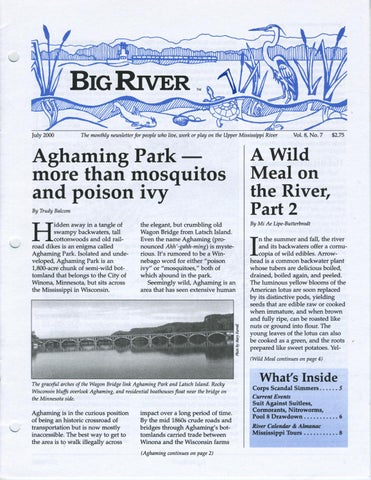
The graceful arches of the Wagon Bridge link Aghaming Park and Latsch Island. Rocky Wisconsin bluffs overlook Aghaming, and residential boathouses float near the bridge on the Minnesota side.
Aghaming is in the curious position of being an historic crossroad of transportation but is now mostly inaccessible. The best way to get to the area is to walk illegally across
impact over a long period of time. By the mid 1860s crude roads and bridges through Aghaming' s bottomlands carried trade between Winona and the Wisconsin farms (Aghaming continues on page 2)
What's Inside Corps Scandal Simmers . ..... 5 Current Events
Suit Against Suitless, Cormorants, Nitroworms, Pool 8 Drawdown ........... 6 River Calendar & Almanac
Mississippi Tours ........... 8
(Aghaming continued from page 1)
and villages via ferry. The Turtle, who's name was said to match its pace, operated on a route from the downtown levee to Latsch Island and on to the Wisconsin shore until the High Bridge was built in 1892. Two sets of railroad tracks were built across the bottomlands at about the same time. In the early 1900s a forward thinker by the name of John Latsch saw the beauty in the swamps and meadows of Aghaming, purchased the land and gave it to the city (see "John Latsch, River Philanthropist," Big River, May 1997).
infraction. It is common to see hikers, dog-walkers, anglers, and bikers there, but since the area is so isolated, it's not unusual to have the place to yourself. The crisp temperatures of spring and fall make exploration on foot inviting. In winter, backwater ice provides a platform to explore areas not accessible in other seasons. Good snow cover
form. Illicit off-road vehicles have damaged several areas in the park, before they were recently blocked from the bridge by a substantial concrete barricade. And before the bridge was closed to car traffic, the roadsides in Aghaming were frequently used for illegal trash dumping.
--,-
Aghami ng Park •
connecwd land area
~
!
~
Habitat Transformation Aghaming was a bottomland prairie in the days of the Turtle. The dikes supporting the railroad and highway beds through Aghaming isolated free-flowing water into ponds. In the 1930s, the lock-anddam system changed the ecosystem of the park again by raising the water level. Now the area hosts a mature forest of cottonwood, silver maple, white oak and river birch sprinkled with a few small, open meadows. The woods provide excellent bird habitat, and one can see many varieties of woodpeckers, Baltimore orioles, ducks and plenty of redwinged blackbirds. The cerulean warbler and the red-shouldered hawk, both on Minnesota's list of Special Concern Species, as well as the prothonatary warbler depend upon the mature bottomland forest habitat at Aghaming for nesting and feeding. From March to October great blue herons fly overhead, between feeding areas and a nearby rookery. Bald eagles are common, and osprey have nested here. Whether or not you are a bird watcher, Aghaming is a great place to visit throughout the year. Locals walk around the barrier blocking the entrance to the closed bridge, and the city overlooks this minor
2
~ §
a" "
"'
~ ~
~,,...,--.c..,O()
.!,;
" j~
-~i !i
MINNESOTA
a
b.t IOD
IOO
1000
1IOO
JODO
2100 ~
--=
Aghaming Park stretches along the Main Channel opposite from the east side of Winona. Detail below shows Latsch Island and the Wagon Bridge.
makes for excellent snowshoeing or cross-country skiing. In summer, the thick undergrowth, mosquitoes and poison ivy favor canoe exploration. Some of the deeper backwater channels provide good fishing year round. Members of the Winona Boat Club have particularly good access to fishing areas in the park from their small, private boathouse marina there. The isolation of Aghaming has also made it an inviting place for another kind of wild life. Since the land lies in Wisconsin, the Winona police have no jurisdiction there, a fact not lost on the less law-abiding members of the community. Teens have always used "Bud Beach" at Aghaming for underage beer parties and the railing of the Wagon Bridge as a daredevil diving plat-
Big River
The Future of Aghaming and the Wagon Bridge In 1996 inspectors discovered that the Wagon Bridge's wooden pilings were badly scoured, making the bridge unsafe. So they closed it. Since the Wagon Bridge was declared dangerous, the City of Winona has looked for ways to restore access to Aghaming. The search has been hampered by a snarl of at least seven local, state and federal agencies with authority over the area, plus private interests, such as the Burlington Northern Santa Fe Railroad and the Winona Boat Club, which maintains a leased private harbor within the park. Plans have included building an access road along the busy rail corridor, repairing old Wisconsin Highway 54 and repairing the Wagon Bridge.
July 2000
,.
Further development of Aghaming came closer to the top of the city's agenda this year when the city council voted to adopt the proposal for development of the park. "Aghaming Park: A Community Resource Plan," produced by the Resource Studies Center at St. Mary's University, faculty from Winona State University and concerned citizens, calls for limited development of the park as a nature preserve. Development proposals include a floating visitors' center with boat docks moored off of Latsch Island, raised deck interpretive paths, observation platforms and canoe trails, but the great majority of the area would be undisturbed and protected. Another prominent aspect of the plan is the creation of a link between Aghaming and the Great River State Trail; the trailhead of which lies about four miles northeast of the park near Bluff Siding, Wisconsin. Local cycling activists are also working to connect Winona to the Root River State Trail to the south of Winona. Aghaming could provide an interstate junction between the two extensive trail systems. If all of these plans come to fruition, Aghaming would become the wild gem of the Winona city park system and a tourist attracRed-shouldered hawk tion offering biking, hiking, canoeing, fishing, photography and nature study. At the same time, it could become an important link in the recreation and conservation complex of the region because it borders the Upper Mississippi River National Wildlife and Fish Refuge to the west, and property to the east, which now belongs to Dairyland Power, is soon to be added to the adjacent Trempealeau
July 2000
National Wildlife Refuge. At this point, all development plans for Aghaming hinge upon the restoration of the Wagon Bridge. The Wagon Bridge, built in 1917, is an remnant of the former High Bridge crossing at Winona. It was designed by Louis P. Wolfe, an eminent bridge engineer of the period, and cost the city $119,000. A steel span bridge would have been cheaper, but Wolfe convinced the
If all of these plans come to fruition, Aghaming would become the wild gem of the Winona city park system. city that concrete would last longer and produce a more beautiful structure. Originally, the bridge consisted of arched concrete spans that connected with the High Bridge at · Latsch Island. A portion of the bridge was dismantled and a ramp to Latsch Island was created in 1945 aftE!r the new Winona highway bridge was built just west of the original crossing in 1943. Until recently the bridge's future looked dim, due to a $1.8 million price tag to renovate it. Most of the money ($900,000) is needed to shore up and rip-rap its wooden underwater pilings. The cost of tearing down the bridge's graceful arches is only slightly less, an estimated $1.4 million. The Wagon Bridge has its friends, however. An anonymous group of Winona citizens offered the city $1 million dollars to save it. This offer has accompanied a flurry of grant applications submitted by the city to various state and federal agencies for matching money. Winona will spend about $250,000 from its facilities fund for repairs. If grant money is not forthcoming, a community fundraiser is likely.
Big River
The future of Aghaming Park looks brighter, but is not yet assured. Many hurdles must be overcome before Cerulean warbler tourists step over the threshold of a new visitors center or school kids study frogs in backwater ponds. An opportunity now exists to take some of the mystery away from Aghaming (if not the poison ivy) and give it back to the community. It can once again become a crossroads, a place where we experience the intersection of human and natural activity. Trudy Balcom is associate editor of Big River. Her last article for Big River was "Living in a Community of Floating Homes " (May 1995). Illustrations © 2000, www.arttoday.com
Big River™ Big River (ISSN 1070-8340) is published
monthly by Riverwise, Inc., 111 Riverfront, Suite 204, Winona, MN 55987; (507) 454-5949; fax: (507) 454-2133; email: editors@big-river.com; web site: www.big-river.com Reggie McLeod editor/publisher Molly McGuire assistant editor Mi Ae Lipe-Butterbrodt associate editor Trudy Balcom associate editor Kathy Delano design/marketing Mary Feathergill office manager Subscriptions are $28 for one year, $50 for two years or $2.75 per single issue. Send subscriptions, single copy orders and change-of-address requests to Big River, PO Box 204, Winona,
MN55987. Second-class postage paid at Winona, MN. POSTMASTER: send change-of-address requests to Big River, PO Box 204, Winona, MN
55987. Big River, Volume 8, Number 7, copyright July 2000. Reproduction in whole or in part without written permission of the publisher is prohibited. Printed on recycled paper.
3
(Wild Meal continued from page 1)
low pond-lilies also have edible roots and seeds that can be fried like popcorn. In addition to providing shelter and building material for wildlife, the cattail offers a variety of foods to human · Y beings. . Wild food enthusiast Euell Gibbons dubbed it 't'1- "the supermarket of the r;-;",'i...,Ji":/i'u'f' /. swamps." Its . early springtime shoots an be oked like asparagus, its immature flower --- - ~·- spikes are tasty boiled
y:
Cattail
Before You Gather • Arm yourself with a reliable, up-todate, well-illustrated field guide, and never pick or consume any plant unless you are certain of its identity. Learn about poisonous look-alikes. For instance, the waterparsnip and water-hemlock appear almost identical, yet a mouthful of the latter can kill. The eastern and central North America edition of Peterson Field Guide: Edible Wild Plants illustrates the differences between edible and poisonous look-alikes common along the Upper Mississippi. For more leisurely reading, Euell Gibbons's Stalking the Wild Asparagus (1962) is a classic. • Just because part of a plant is edible, never assume that the rest of it is safe. Many plants contain poisons in their leaves or roots but not in their fruit, or vice versa. Some plants must be cooked to render their poison harmless, and others are edible only as young shoots. Use a reliable field guide.
4
nibbled like corn on the cob, and the golden pollen gleaned from the cattails makes a nutritious flour. In late fall, winter or early spring, the roots swell with starch, which you can extract by peeling and crushing them in water. After the starch settles to the bottom, pour off the water and you have a white flour for baking. Wild rice reigns as a king of wild foods. It was a staple for Native Americans living in the Great Lakes states, and today some tribes still make a living selling the crunchy, nutty seeds. Wild food expert Ken Salwey says the wild rice around the Upper Mississippi is a substrain of that found in the northern lakes of Wisconsin and Minnesota. Called "needle rice," its seeds are smaller and narrower, but the plants grow much taller. Wild rice is an "iffy" plant, says Salwey, who has reaped precious crops in Wisconsin backwaters. "Sometimes it comes up and some years it doesn't. It all depends on where the water levels are in June
• Avoid eating plants that may have been exposed to pesticides or pollution. Roadsides am! areas cleared for power lines are often sprayed to keep "weeds" down, so check before gathering. Aquatic plants, such as watercress, should not be eaten if they may be from water contaminated by runoff from manure or agricultural and industrial chemicals. Even if you think they grew in clean water, it is still a good idea to rinse them well to avoid unforeseen contamination - from a leaky septic system, for instance. • Don't gather plants designated endangered by federal or state laws. A species may be protected in one state and not in another. Other plants should be left alone just because they are scarce from overgathering, such as wild ginseng and trilliums. Check the regulations in your area. • Numerous mushrooms make delicious eating, but go collecting with an experienced friend or use a book dedicated to identifying edible fungi and not a regular
Big River
- if the water is high, the plants will be dormant." This frustrates many who depend on wild rice as a cash crop, for the seeds can remain dormant for up to 10 years. If you are lucky enough to find lush stands of this grain, harvesting it is hard work, warns Salwey. Gathering it takes time, patience, a canoe and traditionally at least two people (one to maneuver the canoe through the thick stands and another to sweep the seeds into the boat).You may also have trouble getting to it before blue-winged teals, red-winged blackbirds and other migratory birds. "You should harvest it by canoe like the Indians do," says Salwey. "Their method flattens a lot of stalks just by breaking a trail with the canoe, which is good for seeding the next year." In mid summer and fall, wild fruits come into season. Raspberry, blackcap and blackberry canes bend under the weight of glistening ripe fruit, beckoning the forager ever further into their prickly depths. Tendrils of wild grapes climb over
plant field guide. One excellent resource is Edible Wild Mushrooms of North America by David W. Fischer and Alan E. Bessette
(1996), published by University of Texas Press, Austin. • Regulations vary on federal and state lands. On private land, with permission, you can gather whatever you like. On most federal lands and state parks, you are allowed to gather renewable items, like nuts, berries and mushrooms for personal use, but snipping leaves, cutting off any portions of a plant, digging up tubers and roots, or otherwise disturbing plants is prohibited. On the Upper Mississippi River National Wildlife and Fish Refuge, berry picking and mushrooming are permitted. Of course, all federal- or state-protected plants are off-limits. Some state parks allow you to pick common greens, such as dandelions and thistles, but others do not. Check with officials to find out the rules in your area. §
July 2000
fenceposts and up trees, crossing back onto themselves to form tangled mats. Smaller and more sour
t
(:
f
Raspberry, blackcap and blackberry canes bend under the weight of glistening ripe fruit, beckoning the forager ever further into their prickly depths. than their cultivated cousins, these grapes make excellent jelly. In early summer, the young leaves of the wild grape are good boiled and used as wrappers for rice or meat. A warm autumn breeze may carry the rank scent of elderberries. The feathery, flat-topped flower heads make good fritters, but the berries are prized for making jelly or juice. Some folks also make a spicy homemade wine from the berries, and the fruit can also be dried and reconstituted for muffin mixes or pie filling. Large, pale-yellow fruits of May apples appear in the fall, yielding a pulp that is tasty raw, made into jelly or squeezed for juice. Wild gooseberries are wonderful made into jam and jelly. Although all gooseberries and their close cousins, the currants, are edible raw, gooseberries should be cooked to remove their spines. When nuts and acorns fall in the fall, you can compete with squirrels, birds and mammals for the spoils. White oak acorns taste sweet enough to be eaten raw. Red oak acorns, however, must be shelled and boiled in several changes of water to leach out their bitter tannins. Once processed, they can be roasted whole or ground into a flour that makes excellent muffins and breads. Black walnuts, hickories and butternuts frequent bottomland forests
July 2000
along the Upper Mississippi; all three bear choice nuts that take some work to shell, but are worth the effort. Most people are familiar with the deep flame-red autumn leaves of the sumac, which grows as small trees or shrubs. But many are unaware that its fruits make a refreshing drink that tastes like lemonade. To make a sumac beverage, rub the fruit clusters to bruise the berries, then cover in cold water for 15 minutes. Strain the liquid through a cheesecloth, sweeten to taste and chill. Make an anise-flavored goldenrod tea, by steeping the fresh or dried yellow flower heads in hot water for 10 minutes. If goldenrod makes your eyes itch and nose run, you may want to consider the disputed theory that consuming small amounts of allergens will eventually build up your immunity to them. Be warned, however, that individual reactions vary, and the regimen may not be effective for all sufferers. Some Native Americans reportedly ate the leaves of poison ivy to build up their resistance to the plants' irritating oils. They first ate a sfngle small leaf, then gradually increased their intake by one leaf a day for a week until they felt they'd sufficiently built up their resistance. It's an interesting idea, but as Ken Salwey says, "I wouldn't recommend it." Mi Ae Lipe-Butterbrodt is associate editor of Big River. Her last article for Big River was "A Wild Meal on the River, Part 1. "
The Big River website (www. big-river.com) lists links for more information about many of the stories in this issue.
Big River
Corps Scandal Simmers By Reggie McLeod
contrnve,sy ove, the Anny Corps of Engineers' Upper Mississippi River-Illinois Waterway Navigation System Feasibility Study (Navigation Study) has focused on efforts to reorganize the Corps. Three Republican senators are pushing legislation that would prevent the Corps from reorganizing. The Department of Defense attempted to create civilian control and more accountability in the Corps last spring (see "Corps Reformed and Unreformed," Big River, May 2000). At "River of Dreams," a Corps sponsored "Mississippi River partnering conference and listening session," June 15 to 17 in St. Louis, environmental groups refused to partner with the Corps until it is under civilian control and more accountable to the public. Protestors accused the Corps of acting on behalf of the shipping industry. On June 20, ABC World News Tonight summarized the Navigation Study scandal and interviewed Donald Sweeney, the Corps economist who says his bosses told him to change economic data in the $54 million Navigation Study to support expanding the lock-and-dam system. ABC News claimed that in internal documents the Corps characterized itself as a proponent for the inland shipping system and , warned that the Navigation Study should not include any "limp wristed" conclusions. In June, Lt. Gen. Joe N. Ballard, the head of the Corps, postponed his retirement, including the scheduled parade and farewell luncheon, until later in the summer, according to the Washington Post (6-19-00). The delay lessens the likelihood that the Clinton Administration will appoint Ballard's successor. ~ Reggie McLeod is editor of Big River.
5
By Trudy Balcom
Suit Against Suitless Madison, Wis. - Wisconsin Christians United has teamed up with Ruth and Harvey Bender, owners of a canoe rental business, to file a $100,000 suit against the State of Wisconsin for damages to their business and property values stemming from nude bathing at nearby Mazomanie Beach on the Wisconsin River. The couple wants the state to enforce existing indecency laws. Pastor Ralph Ovadal sent a mailing to about 6,500 homes near the beach last March, according to the Black Earth News Sickle-Arrow (3-2300), warning of moral dangers. "What we're going to see here is how committed the state of Wisconsin is ... to protecting this sexually perverse elite who want to have this little beach-front brothel," Ovadal said, according to the La Crosse Tribune (6-6-00). Claudette Richards, a naturist and former coordinator of Friends of Mazo Beach, views the situation differently. She says they are ordinary people, like those you would find at a shopping mall, and mostly middle-aged. Richards says most middle-aged and older Wisconsinites are hardly a sexy group to look at.
Barges or Walleyes Dubuque, Iowa - City Island in Dubuque is popular with area anglers as a good spot for walleye. But the waters off the island may soon serve as a barge fleeting area for American River Transportation (Artco ), according to the Dubuque Telegraph Herald (5-30-00). The current fleeting site, adjacent to the planned Riverwalk waterfront redevelopment, may be moved. Anglers and others have complained loudly to the city council
6
about the possible use of City Island as a fleeting site. River lovers want barge fleeting to be moved south of the city. But Artco, a subsidiary of Archer Daniels Midland, rejects this idea as inefficient and costly. The company has studied several possible sites, and rejected all but City Island because the water is deeper and the channel there is wide enough for both barge and recreational traffic. A recommendation may come before the city council this summer.
Drawdown Rescheduled St. Paul, Minn. - Boaters in Pool 8 may find low water levels later this summer - but not because of a drawdown. The Corps of Engineers has postponed the planned drawdown of Pool 8 until next summer. A drawdown simulates natural low water levels common on the river before the installation of the lockand-dam system. Low water levels stimulate plant growth, which benefits fish and wildlife. The drawdown was postponed due to lower than normal river discharges (despite recent rains) and drier than normal weather predictions for late summer.
Gobies Go by Barrier Illinois - An uninvited guest from the Black and Caspian seas is headed for the Mississippi. The round goby is a fish that feeds aggressively, defends itself capably and breeds prodigiously; making it a serious threat to native fish. Gobies arrived in the area through Lake Michigan, and are spreading south and westward through the Illinois Waterway system. They are now downriver as far as as Joliet. In an attempt to slow or prevent the dispersal of exotic species the Corps of Engineers and the U.S.
Big River
Fish and Wildlife Service (FWS) will build an electrical barrier at Romeoville, Illinois, upstream from Joliet, as a demonstration project. Pam Theil, an FWS project leader, says "Even though the gobies are past the barrier site, their numbers are still relatively low. The barrier will help slow the downstream spread of the higher upstream populations."
Room with a Rumble Moline, Ill. - A six-acre site east of the 1-74 bridge in Moline is the likely site of a new six-lane 1-74 bridge, to the dismay of the developers who own the property. Mike Whalen, owner of more than 20 hotels in the Midwest, and fellow developer Oscar Ellis, have plans for a hotel, restaurant, retail and office space and even a small marina at the site, according to the Quad City Times (5-26-00). The location was formerly home to the Frank Foundry. Whalen and Ellis have demolished the buildings and cleaned up the site. While the exact location of the new bridge won't be determined until at least next spring, Whalen is concerned that his plans and investment may have come to a dead end. "You can't stick a nice hotel on the riverfront only to find out there's going to be a six-lane bridge running right next to it," he said. "We're stuck."
Wilder Again Wolves and bears are slowly returning to the Upper Mississippi area. Two to three timberwolf packs have been confirmed in Wisconsin's Eau Claire and Jackson counties, about an hour's drive from the Mississippi, according to the Winona Daily News (6-11-00). Black bears were once common on the upper river, but were elimi-
July 2000
nated below the Twin Cities by hunting and habitat loss. Now bears are being spotted in southeastern Minnesota (most recently south of Rochester) and western Wisconsin. Hunters have reported seeing bobcats in Great River Bluffs State Park. For a sighting to be confirmed a carcass or a photo is necessary. Whether these animals will be any more welcome in the area than in the past remains to be seen.
Cormorants Blamed Washington, DC -The population of double-crested cormorants is rebounding since the late 1960s, when the bird was nearly eliminated by DDT. But some anglers and resort owners see them as competitors for game fish. Now Minnesota Congressman Colin Peterson (D, 7th Dist.) thinks they should be hunted, according to the Associated Press (68-00). Peterson and Representative John McHugh (R-N.Y.) have introduced a bill to allow cormorant hunting. "If the Fish and Wildlife Service does not act swiftly to manage and control this destructive bird, the Congress will," said Peterson. "Personally, if the cormorants were wiped out, I would not think that was such a bad thing." Apparently, some Michiganders feel the same way. According to the U.S. Fish and Wildlife Service (FWS) over 500 nesting cormorants were found shot to death on Little Charity Island in Saginaw Bay on Lake Huron on May 30. Cormorants are protected under the Migratory Bird Treaty Act, and the incident is under investigation by the FWS and the Michigan Department of Natural Resources.
Orphan Raft Winona, Minn. - If you see a large, funky raft made of scrap plywood and recycled styrofoarn floating down the river this summer, don't be alarmed, it's only the Floating Neutrinos. These adventurers with a social conscience are
July 2000
taking their raft, the Vilma B, from Minneapolis to New Orleans to raise money to build a floating orphanage for street kids from South America. Sounds kooky? In 1998 the Neutrinos built a raft from scrap from the streets of New York City and took it across the Atlantic. In fact, they intend to grow the Vilma B into the orphanage vessel on its way down to the Gulf. Currently it is 38 feet long and 15 feet wide, and houses a crew of four humans, a rottweiler and a kitten.
EMP Boost Washington, DC - The Environmental Management Program (EMP) on the Upper Mississippi may get a $2.9 million funding boost from Congress. A House subcommittee has recommended $21 million in funding for the program, according to the La Crosse Tribune (6-15-00). The EMP, funded through the Corps of Engineers and administered by the Fish and Wildlife Service, conducts habitat restoration projects. The EMP had a budget of ¡ $18.1 million in 1999, but river advocates have been requesting $25 million. Wisconsin Congressman Ron Kind (D-La Crosse) has worked to increase EMP funding.
Septic Trouble Madison, Wis. - Six citizen and environmental groups joined forces to file a lawsuit against a Wisconsin Department of Commerce rule to allow new kinds of septic systems in environmentally sensitive areas. The rule would allow new technologies to supplant conventional septic systems in areas where groundwater or bedrock is too close to the surface. Opponents, which include a wide variety of citizen and environmental groups, including River Alliance, say the new technologies are untested and would spur development on 8.9 million acres of vulnerable land.
Big River
Nitroworms Minnesota - Fishing may not be the most fashionable sport, but green is the big color for worms this season. Ken Robb of Specialty Worms Inc. worked with a Canadian chemist for three years to develop a process that turns night crawlers an eye-catching chartreuse green, according to Outdoor News (6-15-00). The crawlers carry the brand name Nitroworrns. Other green worm products are being sold as well. "The rule of new products in this industry is the first year you catch fishermen, and the second year you catch fish," said Robb. "We've had both happening in the same year."
Grant Money Awarded Minnesota - Four Minnesota municipalities will share a pot of $126,000 awarded by the National Park Service from the Mississippi National River and Recreation Area for resource protection and enhancement. The largest award went to the city of Dayton ($94,000), for the development of Cloquet Overlook Park along an undeveloped stretch of the Mississippi.
Icky Fish, Big Prizes Coon Rapids, Minn. - The Carp Festival is back. First held in 1983 to mark the 100th anniversary of the carps' introduction to Minnesota, it was cancelled in 1993 during construction on the Coon Rapids darn, according to the Minneapolis Star Tribune (6-18-00). The highlight of this year's June 17th festival was the fishing contest, which drew 290 anglers of all ages. The winning carp, a 16.45-pounder, was caught by Bryan Newman of St. Paul, using corn dipped in strawberry Jell-O. Bryan took home a new 14-foot fishing boat, motor and trailer. Neeshia Castrodale entered the contest with her two kids. "It's nice to come out here and get a little fun and catch icky fish," she said.
=
7
Special Events & Festivals July Through 4 Riverfest, La Crosse, Wis. Through 4 Taste of Minnesota, Minneapolis. Through 4 Steamboat Days, Wmona, Minn. Through Sept. 21 Saturday mornings and Thursday evenings, Buckthorn-BeGone work parties, Twin Cities, (651) 665-9500. 1-2 La Montagne qui trempe a' l'eau Rendezvous et Celebration, 9 a.m. - 4 p.m., Perrot State Park, Trempealeau, Wis., (608) 534-6409. 1-2 Mississippi Blues Festival, Davenport, Iowa, (319) 32-BLUES. 1-4 Harpers Ferry Days, Harpers Ferry, Iowa, 1-800-896-0910. 1-4 Riverboat Days, Clinton, Iowa, 1-800359-7277. 2 Stars & Stripes River Day, Guttenberg, Iowa, (319) 252-2323. 3 Fireworks Spectacular, Dubuque, Iowa, (319) 588-5700. 4 Parade, 2 p.m., Stone Arch Bridge to Nicollet Island, Minneapolis. 4 Mississippi Mile Fireworks, 10 p.m., Minneapolis, (612) 673-5123. 6-8 Heritage Days, Bellevue, Iowa. 7-9 Catfish Days, Trempealeau, Wis. 8 Swingfest, Dubuque, Iowa. 12 Birding Boat Cruise Along the Mississippi, 10 a.m., departs from Boom Island, Minneapolis, (651) 290-4160. 14-16 Rivertown Days, Hastings, Minn. 14-23 Aquatennial, Minneapolis, Minn. 15 Art Fair, Stockholm, Wis. 15-16 Twin-O-Rama, Cassville, Wis. 15-16 Missisippi River Celebration, West River Road, Minneapolis. 20-23 Bix Beiderbecke Memorial Jazz Festival, Davenport, Iowa, (319) 3247170. 21 Canoe the Mississippi, 9:30 a.m.- 3 p.m., Trempealeau, Wis., (608) 2648548. 22 River Blast, 7 p.m., Boom Island, Minneapolis. 22 U. S. Catfish Tournament, Quincy, Ill., (573) 395-9904. 22-25 John Henry Weber Rendezvous, Bellevue, Iowa, (319) 872-5830.
8
28-29 Riverboat Days, Wabasha, Minn., 1800-651-4158. 29 Bird Walk, 8 a.m., Effigy Mounds National Monument, Harpers Ferry, Iowa, (319) 873-3491. 29 Great River Roll, Minneapolis, Minn., (612) 825-2200.
Meetings & Hearings July 13 Lower Wis. Riverway Board, 5 p.m., Community Building, Blue River, Wis., 1-800-221-3792 or (608) 739-3188.
Mississippi Tours Friends of the Mississippi River Pre-registration required, (651) 222-2193.
July
August 20-24 American Fisheries Society annual meeting, Adam's Mark Hotel, St. Louis, Mo., (301) 897-8616, ext. 212.
Workshops & Conferences July 31-Aug. 4 Rivers Project of Southern Illinois University, teacher training, Edwardsville, Ill., (618) 650-3788.
September Sept. 8-9 Mississippi River Basin Alliance Annual Conference and Membership Meeting, Memphis Marriott, Memphis, Tennessee, (612) 870-3441. Sept. 15-17 Audubon Society Conference and Celebration of the Upper Mississippi, Sinsinawa (Wis.) Mound Conference Center, (651) 290-1695. ;;;:;;
8 Swede Hollow Walk and Talk, 2:30 p.m. 4:30 p.m., St. Paul. 22 Mississippi River Canoe Adventure, 8 a.m.- 2 p.m., Minneapolis and St. Paul.
Check the Big River website (www.big-river.com) for additional calendar information.
Almanac By Kenny Salwey The hot sun was blood red as it cleared the trees along the crest of the river bluff. Without a breath of a breeze, you could drop a feather on a toadstool from ten feet up. My old, battered, 16-foot canoe - the Queen Mary - was tied to a snag tree jutting into a slow backwater slough. There was a tremendous emergence of mayflies last night. Some left their nymphal skins before their wings dried to flounder on the water's surface briefly before being slurped by fish. The table was set, the dinner bell rung and every fish seemed to hear it. Soon my imitation mayfly and fly rod delivered a mixed catch: white bass, crappies, sunfish and - holey moley - a couple of good-sized channel catfish. Around mid-day, I drifted down the slough. Mayfly cadavers piled up against the bank where mama mallard and her half-grown brood scooped them up. Around a sharp bend, I scared a family of otters away from their work (or is it play)? Bits of fish were strewn about. The whirring of mayfly wings filled the air as they finished shedding in the bushes. July is the peak of their cycle. Tomorrow, the survivors will lay eggs in the water. The nymphs will hatch and feed on bits of flesh and plants. Later, they will have their day in the sun. Until next month, keep your paddle in the water my friend. sa
Big River
July 2000