[
June 2000
The monthly newsletter for people who live, work or play on the Upper Mississippi River
Vol. 8, No. 6
$2.75
A Wild Meal on the River, Part 1
Peregrines Return
By Mi Ae Lipe-Butterbrodt
By Pamela Eyden
I
P
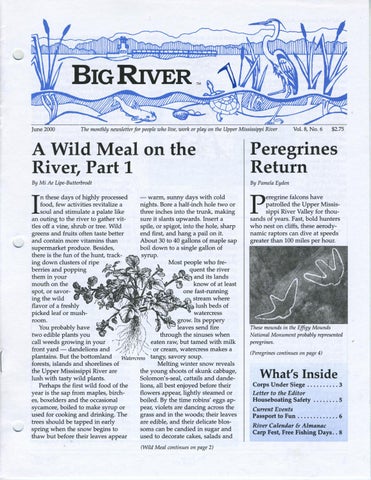
- warm, sunny days with cold n these days of highly processed food, few activities revitalize a nights. Bore a half-inch hole two or soul and stimulate a palate like three inches into the trunk, making sure it slants upwards. Insert a an outing to the river to gather vittles off a vine, shrub or tree. Wild spile, or spigot, into the hole, sharp greens and fruits often taste better end first, and hang a pail on it. and contain more vitamins than About 30 to 40 gallons of maple sap boil down to a single gallon of supermarket produce. Besides, there is the fun of the hunt, trackMost people who freing down clusters of ripe quent the river berries and popping them in your "'--""--..~=• and its lands mouth on the know of at least spot, or savorfast-running ing the wild stream where flavor of a freshly lush beds of 1 l . watercress picked leaf or mush11 room. ·'( .., · _ grow. Its peppery You probably have , leaves ~end fire 1~ : , two edible plants you /r/~ I through the smuses when call weeds growing in your ' ·-r){,i'/;-~,;(.\j~ eaten raw, but tamed with milk front yard - dandelions and ./}'(~ (i /\ - or cream, watercress makes a /2 I ' \ -, plantains. But the bottomland Watercress tangy, savory soup. Melting winter snow reveals forests, islands and shorelines of the Upper Mississippi River are the young shoots of skunk cabbage, lush with tasty wild plants. Solomon's-seal, cattails and dandePerhaps the first wild food of the lions, all best enjoyed before their year is the sap from maples, birchflowers appear, lightly steamed or es, boxelders and the occasional boiled. By the time robins' eggs apsycamore, boiled to make syrup or pear, violets are dancing across the used for cooking and drinking. The grass and in the woods; their leaves trees should be tapped in early are edible, and their delicate blosspring when the snow begins to soms can be candied in sugar and thaw but before their leaves appear used to decorate cakes, salads and
f \ -, . ~"t·
(Wild Meal continues on page 2)
eregrine falcons have patrolled the Upper Mississippi River Valley for thousands of years. Fast, bold hunters who nest on cliffs, these aerodynamic raptors can dive at speeds greater than 100 miles per hour.
These mounds in the Effigy Mounds National Monument probably represented peregrines, (Peregrines continues on page 4)
What's Inside Corps Under Siege .......... 3 Letter to the Editor Houseboating Safety ........ 5 Current Events Passport to Fun ............. 6 River Calendar & Almanac Carp Fest, Free Fishing Days . . 8
(Wild Meal continued from page 1)
beverages. them into a nourishing soup. NetIn late April and May, that solitles are best early in the spring, betary, secretive species known as the mushroom hunter plies woods and floodplains in search of morels. These cone-shaped fungi with pitted caps are equally furtive in the underbrush, hoping to avoid the People are often eyes of the hunsurprised to gry mycophagist. Once located and learn that ushered into the stinging nettles kitchen, morels are a special treat, make delectable sauteed in butter and nourishing or stuffed with leeks and bacon. greens, rivaling People are often surprised to spinach. learn that stinging nettles make delectable and nourishing greens, fore their leaves and stems toughen, rivaling spinach. The French make but you can eat them throughout
Before You Gather • Arm yourself with a reliable, up-to-date, well-illustrated field guide, and never pick or consume any plant unless you are certain of its identity. Learn about poisonous look-alikes. For instance, the water-parsnip and water-hemlock appear almost identical, yet a mouthful of the latter can kill. The eastern and central North America edition of Peterson Field Guide: Edible Wild Plants illustrates the differences between edible and poisonous look-alikes common along the Upper Mississippi. For more leisurely reading, Euell Gibbons's Stalking the Wild Asparagus (1962) is a classic. • Just because part of a plant is edible, never assume that the rest of it is safe. Many plants contain poisons in their leaves or roots but not in their fruit, or vice versa. Some plants must be cooked to render their poison harmless, and others are edible only as young shoots. Use a reliable field guide.
2
• Avoid eating plants that may have been exposed to pesticides or pollution. Roadsides and areas cleared for power lines are often sprayed to keep "weeds" down, so check before gathering. Aquatic plants, such as watercress, should not be eaten if they may be from water contaminated by runoff from manure or agricultural and industrial chemicals. Even if you think they grew in clean water, it is still a good idea to rinse them well to avoid unforeseen contamination - from a leaky septic system, for instance. • Don't gather plants designated endangered by federal or state laws. A species may be protected in one state and not in another. Other plants should be left alone just because they are scarce from overgathering, such as wild ginseng and trilliums. Check the regulations in your area. • Numerous mushrooms make delicious eating, but go collecting with an experienced friend or use a book dedicated to identifying ed-
Big River
the year if you blanch them first. Their sting disappears with cooking, and some people pluck them without gloves, believing that the more tentatively you touch them, the more they sting. "Grab them like you mean business," advises nature expert Ken Salwey. Nonetheless, if you get stung, relieve the pain by crushing the juice from the watery leaves and stems of the touch-me-not, or jewelweed, onto your skin. They also reputedly combat the itch of poison ivy. Once you've completed your first aid, you can boil the jewelweed greens in a couple changes of water and eat them, too. Discard the cooking water, don't drink it. Thistles also make delicious greens after a quick peeling to remove their thorns. Their stems and leaves have a delicate flavor reminiscent of artichokes, to which they
ible fungi and not a regular plant field guide. One excellent resource is Edible Wild Mushrooms of North America by David W. Fischer and Alan E. Bessette (1996), published by University of Texas Press, Austin. • Regulations vary on federal and state lands. On private land, with permission, you can gather whatever you like. On most federal lands and state parks, you are allowed to gather renewable items, like nuts, berries and mushrooms for personal use, but snipping leaves, cutting off any portions of a plant, digging up tubers and roots, or otherwise disturbing plants is prohibited. On the Upper Mississippi River National Wildlife and Fish Refuge, berry picking and mushrooming are permitted. Of course, all federal- or state-protected plants are off-limits. Some state parks allow you to pick common greens, such as dandelions and thistles, but others do not. Check with officials to find out the rules in your area.
June2000
are related. The silvery-gray leaves of lamb's quarters and sturdy, succulent stalks and leaves of green amaranth are also choice potherbs. Tiny red flowers and kidneyshaped leaves herald wild ginger, whose spicy-smelling roots can be dried and rolled in sugar syrup to make "backwoods candy." And to add an anise flavor to candy, salads, and baked goods, bruise the roots and green fruit of sweetcicely. The rampant growth of summer delivers more greens, flowers and fruit. Daylilies escaped from flower gardens brighten roadsides with their riotous orange and yellow blossoms. All parts of the daylily are edible, from its asparagus-like shoots to its crisp tubers, but its blossoms and flowerbuds make the choicest delicacies, especially when swiftly deepfried, tempura-style. Early June marks the beginning of wild strawberries, and you are truly lucky if you can find enough of the tiny, exquisitely fragrant fruit to fill a bowl. The trick is finding them before the birds and squirrels, but if the vines are stripped bare of these red jewels, the leaves make a pleasant tea rich in vitamin C. Clovers are plentiful and a good protein source. The leaves are best cooked rather than raw, and the dried flowers make a healthful tea when mixed with other teas. The dried seeds and flowerheads can be ground into flour. Milkweed is another edible plant commonly found along roadsides and in meadows. The young shoots, top leaves and flowerbuds should be cooked in several changes of water to eliminate their bitterness. Bring each change of water to a rapid boil before adding the milkweed, for cold or lukewarm water tends to fix the bitter flavor. The milkweed becomes a mild, pleasant vegetable, and the flower heads can
June 2000
be made into fritters. The juicy stems and leaves of purslane make an interesting vegetable or potherb that may not be to everyone's liking, for they become somewhat slimy. Keep track of where the fivepetalled pink blossoms of wild roses ramble, for in the fall they bear cherry-sized orange fruits called hips, which are one of the richest natural sources of vitamin C. Some people like to make tea from the hips, or gather the flowers to make rose-petal jam or to sprinkle raw in salads. When the calls of red-winged blackbirds hang in the heavy, humid summer air and dragonflies seem to wilt in the F',;="--,,__,,~~""'= heat, it's time to take a cooling .,· dip in the back_:: waters and look for summer and fall. We'll explore them in the next issue. Mi Ae Lipe-Butterbrodt is associate editor of Big River.
Illus!rations © 2000, www.arttoday.com.
Big River™ Big River (ISSN 1070-8340) is published monthly by Riverwise, Inc., 111 Riverfront, Suite 204, Winona, MN 55987; (507) 454-5949; fax: (507) 454-2133; email: editors@big-river.co,n;
web site: www.big-river.com Reggie McLeod editor/publisher Molly McGuire assistant editor Mi Ae Lipe-Butterbrodt associate editor Trudy Balcom associate editor Kathy Delano design/marketing office manager Mary Featlzergill Subscriptions are $28 for 011e year, $50 for two years or $2.75 per single issue. Send subscriptions, single copy orders and change-of-
address requests to Big River, PO Box 204, Winona, MN 55987. Second-class postage paid at Winona, MN. POSTMASTER: send change-of-address re-
quests to Big River, PO Box 204, Winona, MN 55987.
Big Rive,; Vol11me 8, Number 6, copyright June 2000. Reproduction in whole or in part witho11t written permissio11 of the publisher is prohibited. Pri11ted 011 recycled paper.
Big River
Corps Under Siege By Reggie McLeod
T
he case against the Army Corps of Engineers' $54 million Navigation Study gained credibility and momentum in May, when a panel of three independent economists and an economist for the Corps claimed the study used flawed data. In February Corps economist Donald Sweeney filed a whistleblower suit claiming that his bosses replaced him as head of the economic part of the study when he refused to pump up figures to justify expanding the lock-and-dam system on the Mississippi River. In May, Richard Manguno, Sweeney's successor on the study, told Senate investigators that his boss, Col. James Mudd, commander of the Corps' Rock Island District, directed him to change the study' s economic data in order to justify expanding the system. Months before the scandal broke, the Northeast Midwest Institute, a Washington, D.C.-based, nonpartisan, environmental and economic research institute, asked three economists to evaluate the economic section of the Navigation Study. The economists, Steven Berry, Yale University; Geoffrey Hewings, University of Illinois; and Charles Leven, Washington University, have no connections to the Corps, shipping interests or groups opposed to lockand-dam expansion. The panel found the economics study to be deeply flawed: "Our findings suggest that there is no compelling reason for this project to move ahead at this time. First, demand projections provided by the USACE [Army Corps of Engineers] seem to be seriously at (Corps continues 011 page 5) 3
(Peregrines continued from page 1)
The Native Americans who lived along the river in Iowa, Wisconsin and Minnesota must have admired these birds. They carved falconshaped petroglyphs into cave walls. They built falcon-shaped mounds on the bluff tops. Several of these mounds remain at Effigy Mounds National Monument, near Marquette, Iowa. Experts estimate there never were many more than 20 pairs on the upper river. In the 1950s and 60s, peregrines here and across the continent were nearly wiped out by the pesticide DDT. The last wild one was seen on a cliff near Effigy Mounds National Monument in 1964. After successfully breeding captive peregrines and releasing dozens of birds at nesting boxes on power plant smokestacks for 20 years, Bob Anderson, director of the Raptor Resource Project (RRP), wanted to try getting the birds back on the bluffs where they belong. Not everyone thought it was possible. Adult peregrines are fierce hunters, l;iut the young are prey for great horned owls and raccoons. In the summer of 1998, Anderson and other RRP volunteers rapelled down a cliff to a nesting box, or "hack box," attached to a cliff at Effigy Mounds National Monument and set young birds into a protective new home. Volunteers returned every day to feed them dead quail and monitor their progress, staying hidden behind a special blind to prevent the young birds from imprinting on humans. This lab0r of love took about five hours a day: a one-hour drive to the site; a onehour hike to the cliff; one hour watching the birds; and another two hours to get out and go home. They watched nervously for signs of owls or raccoons near the box. All nine of young birds survived the early rigors of learning to fly and hunt on the cliff. A year later one young male was found dead at the foot of a cliff in La Crosse, Wis., most likely struck by a car. This
4
year one of the birds released in 1998 built a nest at Queen's Bluff in Blufflands State Park, about 10 miles downstream from Winona, Minn. In May, Anderson surveyed all the bluffs from the Twin Cities to Marquette, Iowa, at an altitude of 500 feet from a helicopter provided by Dairyland Power Company. He rated each cliff as a potential peregrine nest site. "We discovered that we're not missing any. Twenty years of hiking around and watching has showed us all the likely spots." Peregrines may now be nesting on many cliffs along the river, including John Latsch State Park (10 miles north of Winona, Minn.); Lansing, Iowa; and Alma, Cassville and Maiden Rock, Wis. "Last year we had no nesting on the cliffs. This year we have five!" Anderson said. Anderson hopes to visit the Queen's Bluff nest one day to find newly hatched young. Then, in his words, "The peregrine will be back on the Mississippi, for sure, forever!" But is it the same Mississippi? The river has changed in countless
"The peregrine will be back on the Mississippi, for sure, forever!" ways since the early 1960s. The water is less polluted, but islands and forests have diminished. Many migratory songbirds, a seasonal food source for peregrines, are in decline, but pigeons, an easy prey, are more plentiful. Raccoons, a predator of eggs and nestlings, are also more plentiful; they're not trapped as heavily as they were in the 50s and 60s, when pelts were worth $50. Researchers are testing for increased levels of heavy metals in peregrine habitat, especially near power plants. One very important thing has not changed a bit: the
Big River
craggy, steep dolomite and sandstone cliffs that peregrines nest on. Humans who live in the valley, too, are glad to see the return of this amazing bird to the blufflands. Watch for peregrines along the river and call in your sightings to the toll-free number 1-877-575-2860 or email them to the Raptor Resource Project rrp@salamander. com. Pamela Eyden lives in Winona, Minn. Photo by Allan Zarling, courtesy Effigy Mounds National Monument. Peregrine illustration Š 2000, www.arttoday.com.
Where to Watch Cohasset, Minn Minnesota Power & Light Monticello, Minn. Northern States Power plant. Minneapolis Northern States Power plant. St. Paul Northern States Power plant. Eagan, Minn. Northern States Power plant. Prairie Island, Red Wing, Minn. Northern States Power plant. Red Wing, Minn. Cargill grain elevator. Lake City, Minn. Cargill grain elevator. Alma, Wis. Dairyland Power plant. Winona, Minn. cliffs 10 miles downriver. Genoa, Wis. Dairyland Power plant. Lansing, low.a Alliant power plant. Cassville, Wis. Alliant power plant. Used with permission from the Raptor Resource Project website.
June 2000
(Corps continued from page 3)
odds with recent evidence and projections provided by other specialists. Thus, the presumption of future congestion seems not to be substantiated. Further, there seem to be growing possibilities for diverting grain to other uses (potentially creating more value-added for the region) or diverting grain for export to other ports using alternative transportation systems." In another development, the U.S. Fish and Wildlife Service (FWS), put the Corps on notice that the lock-and-dam system and shipping jeopardizes two endangered species, the Higgins' eye pearlymussel and the pallid sturgeon. The Corps must work with the FWS to relocate Higgins' eyes to environments where they can survive and restore habitat for pallid sturgeons. The Corps will also have to reduce damage to several other threatened and endangered species, including the bald eagle, winged mapleleaf mussel, least tern and Indiana bat. The Army Corps of Engineers is
Letter to the Editor
l
I
Writer Al Holecek offered sound advice in "A Houseboater's Primer," in the May, 2000 issue of Big River. As another 25+ year houseboater on the Mississippi and St. Croix Rivers, I would add to his fine advice. Before leaving the slip, brief guests on how to use the head and what can and cannot be flushed. All recreational boaters should know how tows navigate the rivers. Courses from the U.S. Coast Guard Auxilary or the U.S. Sail and Power Squadrons (USSPS) are an excellent way to develop your boating skills. A safety warning to houseboats with davits bolted through the stern deck or the transom: If thunder storms are likely, drop your dinghy and secure it to the shore or beside your houseboat. Otherwise, strong winds and waves may fill the dinghy until the weight tears off the davits and sinks
June 2000
a branch of the Army, which is part of the Department of Defense and thus part of the executive branch of the government. When Sweeney's
Corps critics claim that the Corps is a major conduit for pork-barrel projects that Congress wants to protect. whistle-blower suit brought to light problems in the Corps, the Pentagon and Army began reorganizing the Corps to increase its accountability. Three Republican senators, Armed Services Committee Chairman John W. Warner (R-Va.), Environment and Public Works Committee Chairman Robert C. Smith (R-N.H.) and Appropriations Committee Chairman Ted Stevens (RAlaska) told the Army not to reorganize the Corps. Then Stevens and Energy and Water Subcommittee Chairman Pete V. Domenici (RN.M.) introduced a rider to a farm
your boat. (A 36-foot houseboat did sink with me and my wife aboard due to t}ze dinghy filling.) Writer Holecek stated he preferred to tie a line from his boat cleat to a tree on shore rather than using anchors. In my opinion this is safe in a calm anchorage, without towboat and recreational boat wakes. Otherwise, I recommend three anchors, not lines tied to trees: two anchor lines in the wet sand from either the stern, mid-cleat or bow cleats (the later with the boat floating in two to three feet of water off the shore). An anchor line tied to a tree may burn and break, but a proper anchor in the wet sand will dig deeper as tows pass. The popular stainless steel stick anchors are fine for day beaching in calm weather. They are useless in heavy winds and/or high wakes and should not be used overnight. If a storm is coming, set a stern anchor 50 to 100 feet on the upstream
Big River
budget bill to prevent the Corps from reorganizing in the future, according to the Washington Post (513-00). The rider says: "None of the funds made available in this or any other Act may be used to restructure, reorganize, abolish, transfer, consolidate or otherwise alter or modify the organizational or management oversight structure; existing delegations; or functions or activities applicable to the Army Corps of Engineers." Corps critics claim it is a major conduit for pork-barrel projects that Congress wants to protect. An Associated Press story from mid May reports that Corps and Army officials told a Senate subcommittee that Congress has given the go ahead, but not the funding, for $38 billion of navigation, flood control and other water construction projects. The Corps gets about $1.6 billion a year for these projects.
=
Reggie McLeod is editor of Big River.
side of the boat and tie the bitter end to the downriver stern cleat, to avoid being blown into the shore. And finally, the USSPS Port Captain program publishes the names and contact information of port captains for each area, for its members. These volunteers can answer questions about launching areas, where to cruise, beaching areas, rules on overnighting, restaurants, marinas and safe anchorages. I also recommend that every boater purchase the Army Corps of Engineers' Upper Mississippi River Navigation Charts, available from Big River and most boating supply stores. Sincerely, Donald B. Anderson Golden Valley, Minnesota Past Commander St. Paul Sail And Power Squadron Port Captain USSPS
5
By Trudy Balcom
Lowdown on Drawdown St. Paul - "Maybe not" is the consensus of the River Resources Forum on whether to conduct a drawdown on Pool 8 this summer. Dry weather conditions prompted the Corps of Engineers (Corps) to revisit the plan to reduce the water levels in Pool 8, between La Crosse and Genoa, Wisconsin, by 1.5 feet in order to encourage the growth of aquatic plants important to wildlife. Drawdowns simulate the natural low water levels seen on the river before the installation of the lockand-dam system. Recent rains have improved river levels, but the longrange forecast still predicts a dry summer. According to Gary Palesh, of the Corps, a meeting was held on May 5 to consider the drawdown, but no decision was made. During a subsequent meeting on May 10, a recommendation was made to postpone the drawdown for one year; a final decision will be made on June 1. This decision must be reviewed and accepted by the River Resources Forum members: the Corps, the departments of natural resources of Minnesota and Wisconsin, the Fish and Wildlife Service and the Park Service. Palesh noted that the drawdown should be conducted when conditions favor its success, even if that requires a one-year wait.
Passport to Fun Twin Cities - Parents looking for fun and educational summer activities for kids should check out the Mighty Mississippi Passport. The passport is a 33 page booklet that lists 62 activities for families and kids who want to enjoy the river this summer. Activities include birding hikes, fishing, canoeing, visiting historic
6
sites and environmental activities. All activities are free, and groups are welcome to pre-register for most events. Kids who attend collect stamps in their passports to send in for a free pin or entry in a grand prize drawing in the fall. The program is a joint project of Wilderness Inquiry, Target Stores and the McKnight Foundation. Passports are available by calling (612) 676-9444, or check the links on the Big River website.
Park Developments Koch Petroleum Group, which was fined $7 million in civil penalties last year for pollution and contaminants found at their Rosemont, Minn. refinery near the Mississippi River, has donated 43 acres of riverfront land to the City of Hastings for a park. According to the St. Paul Pioneer Press (4-21-00), the area is the site of a former petroleum tank farm and will cost $3 million to renovate. Plans for the park would restore native ¡vegetation and build a trail system and a picnic area. Last year Koch gave a total of $1 million to eight environmental projects in the area as part of the settlement agreement, (see "Fine for the Environment," Big River, September 1999). Across the river from Hastings, in Prescott, Wis., plans are underway to remodel Freedom Park. The park sits on a bluff overlooking the confluence of the St. Croix and Mississippi rivers. The plan includes two new overlooks, new picnic shelters and a playground, and eventually the construction of a Learning Center. The plan aims to balance the needs of the community with attracting visitors. In Winona, Minn., anonymous donors have offered the city $1 million to help refurbish the 83-year-
Big River
old Wagon Bridge (Winona Daily News, 5-5-00) to provide access to Aghaming Park, a tract of 1,800 acres of wild bottomland forest. An additional $1 million will be needed for the bridge project, plus additional funds for trails, observation docks and a floating visitors center. Downriver, in St. Donatus, Iowa, Pat Kennedy has an ambitious plan to convert 325 acres of bluffland into a major park attraction, according to the Dubuque Telegraph Herald (4-28-00). Kennedy is not planning to create an ordinary park, but a "non-consumptive recreation complex" to include cabins, eight miles of trails, a bird sanctuary and an operating replica of a 19th century river ferry, among other ideas. Kennedy will need cash to put his plans into motion: $1 million to buy the property and about $10 million for development.
Shared Values Washington, DC - The Environmental Defense Fund polled 1,000 people on their environmental attitudes, and found many similarities between members of the Baby Boom generation (45 to 55) and the Internet generation (18 to 25). Members of both age groups believe that environmental problems are worse than they were 30 years ago, and that individual action and public education are "powerful methods of tackling environmental problems." Both groups agreed that environmental organizations are the most likely to do the right thing for the environment, and that Republicans are the least likely to do the right thing. In addition, a majority of the people polled from each group have participated in Earth Day Activities. Older respondents worried more
June 2000
about toxic waste than did the younger group, (79%, 63%). The only area where the younger group exhibited more concern was about endangered species, (56%, 49% ). Check the Big River web site for a link to the entire survey, including questions and results.
No Luck, No Vice Davenport, Iowa - The President riverboat casino is awash in over $70 million in debt, and may be for sale. Its parent company, President Casinos Inc., posted $10.6 million in losses last year, according to the Quad City Times (3-5-00). The company has met with potential buyers. Still it seems likely that the boat, even if sold, would remain in Davenport since it is the company's most profitable location. In addition to financial troubles, the President's dockmate, the Vice President, is headed for St. Louis. The boat's presence at the foot of the Government Bridge proved unwelcome according to the Quad City Times (4-15-00) because it sat unused and covered up, blocking the view of the river for nearby hotel patrons and riverfront visitors. Ironically, the boat may need to return in a few months to act as a stand-in for the President, which will return to Louisiana for a hull inspection in the fall.
Safe Passage Rock Island/Davenport - A cantilevered bike and pedestrian pathway addition to the Government Bridge-Arsenal Island crossing is planned, pending funding from an Illinois Department of Transportation (DOT) grant. Cyclists and pedestrians can cross the bridge now, but face dangerous traffic conditions according to the Quad City Times (4-13-00). The $1.22 million plan includes ramp approaches on both the Illinois and Iowa sides, and a cantilevered, 10-foot-wide pathway attached to the causeway bridge over Sylvan Slough. A decision on the $801,440 grant request is
June 2000
expected this month.
Swan Song Indeed Alma, Wisconsin - The U.S. Fish and Wildlife Service (FWS) and the Wisconsin Department of Natural Resources (DNR) may introduce a tundra swan hunting season in Wisconsin. In a letter in the Spring 2000 issue of the Alma Tundra Swan Watch newsletter, Swan Song, Upper Mississippi River National Wildlife and Fish Refuge Complex Manager, James Fisher, asks Jon Bergquist of the Wisconsin DNR to discuss the matter with the FWS. The letter, dated March 21, raises several concerns about a possible hunt. If conducted, the hunt would likely occur on FWS lands, since those are the areas where the birds concentrate during migration. Fisher's primary concern is balancing the benefits of only a few hunters with those of thousands of people who enjoy observing the swans. According to Fisher, the number of swan watch visitors to Alma numbered over 20,000 in 1999. Pressure to open new bird species to hunting appears to be increasing. Wisconsin residents attending statewide spring fish and wildlife rules hearings in 1999 approved the concept of a limited sandhill crane hunt. Just two months ago at the same hearings, a hunt of mourning doves, the Wisconsin state bird, was approved. The results of Wisconsin fish and wildlife hearings are taken under consideration by the Wisconsin Conservation Congress, which advises the Wisconsin Natural Resources Board.
Sewer Tax Moline, Ill. - Home owners will soon see a modest rise in their property taxes to finance a renovation of Moline's storm sewer system, according to the Quad City Times (4-26-00). The improvement will bring it into compliance with new federal laws regulating pollution in storm sewer runoff.
Big River
While the city's sanitary and storm sewers are separate, the aging storm sewers are causing some damage to city streets. Taxes for the new sewers are not based on property value, but on property size. Quarter-acre lots, which make up about 70 percent of residential properties in the city would pay an increase of $16 per year.
¡Sky-Tinted Waters St. Paul - Although the word "Minnesota" means "sky-tinted waters," the Minnesota River is more than sky-tinted these days; its a major source of pollution for the Upper Mississippi. The Minnesota River drains 10 million acres of land moslty dotted with farms and small towns, not smoke-belching factories. The pollution from these areas add up to a heavy load of phosphorus, sediment, fecal coliform bacteria, nitrogen and other harmful substances. A new plan to reduce pollution in the Minnesota has been relased by the Minnesota Pollution Control Agency (MPCA). The draft Minnesota River Basin Water Quality Plan sets forth a simple yet challenging goal: "To protect, restore, and maintain the chemical, physical and biological integrity of the water in the Minnesota River Basin." To attain this goal, the plan outlines seven subgoals with objectives and some measurable outcomes to achieve lower levels of a number of specific pollutants. The plan is in its draft form, and the specifics of how it will be pu into action and many details remain incomplete. The plan is currently being reviewed at a series of public hearings. =
The Big River website (www.big-river.com) lists links for more information about many of the stories in this issue.
7
Special Events & Festivals June 3 Bay City Daze, Bay City, Wis. 3 St. Anthony Park Arts Festival, St. Paul, Minn. 3-10 National River Cleanup Week, free information and trash bags for groups, register, (865) 558-3593.
23-25 Water Ski Days, Lake City, Minn.
Meetings & Hearings
24 Bird Walk, 8 a.m., Effigy Mounds National Monument, Harpers Ferry, Iowa, (319) 873-3491.
June 8 Lower Wis. Riverway Board, 5 p.m., Rhinelander Cabin, Mazomanie, Wis., 1-800-221-3792 or (608) 739-3188.
30-July 2 Mississippi Valley Blues Festival, Davenport, Iowa. (319) 32-BLUES.
15-17 River of Dreams, Mississippi River Partnering Conference, Army Corps of Engineers, St. Louis.
30-July 4 Riverboat Days, Clinton, Iowa, 1-800-895-7277.
Workshops & Conferences
4 Wis. State Parks Open House Day 9-11 Jesse James Wild West Days, Marquette, Iowa, 1-800-896-0910. 9-11 Felix Adler Days, Clinton, Iowa, 9-12 Illinois' Free Fishing Days, (217) 785-8955. 10-11 Take A Kid Fishing Weekend, Minn. State Parks, 1-800-657-3929. 10-11 Art & River Festival, Winona, Minn., (507) 452-2272. 10-11 Tour of Historic Homes, Galena, Ill., 1-800-747-9377. 12-17 Spass Tag Festival, St. Cloud, Minn., (320) 252-6822.
June 3 Boating safety course, Arsenal Island, Rock Island, Ill., (309) 794-5338.
Mississippi Tours Friends of the Mississippi River Pre-registration required, (651) 222-2193
6 Profiting from Wildlife Tourism, 8:30 a.m., Minnesota River Valley National Wildlife Refuge, Bloomington, Minn., register, (651) 296-6157.
June 10 Prairie Wildflowers and Birds, 8:30 a.m. 10:30 a.m., Grey Cloud Dunes Scientific and Natural Area, Cottage Grove, Minn.
July 31-Aug. 4 Rivers Project of Southern Illinois University, teacher training, Edwardsville, Ill., (618) 650-3788. §§
July 8 Swede Hollow Walk and Talk, 2:30 p.m. 4:30 p.m., St. Paul, Minn. 22 Mississippi River Canoe Adventure, 8 a.m.- 2 p.m., Minneapolis and St. Paul, Minn.
Check the Big River website (www.big-river.com) for additional calendar information.
14 Mermaid Festival/Ice Cream Social, Bellevue, Iowa, (319) 872-5830. 15-18 Rendezvous, Prairie du Chien, Wis., 1-800-732-1673. 17 - September 21, Saturday mornings and Thursday evenings, "BuckthornBe-Gone" Work Parties, Twin Cities, (651) 665-9500. 17 Mississippi River Carp Festival, 8 a.m. - 4 p.m., Coon Rapids Dam Regional Park, Brooklyn Park, Minn., (763) 4764663. 17 Summerfest, Maiden Rock, Wis., 1800-474-3723. 17 Art in the Park, Clinton, Iowa, (319) 243-4054. 17 Steamboat Saga 2000, noon to dusk, Pepin, Wis., (715) 442-2248. 17-18 Stone Arch Festival of the Arts, Minneapolis, Minn. 19 Take a Dad Fishing, free launching, Camp LaCupolis, Minn., (651) 5654318. 20-21 Solstice River, 8:30 p.m., performance at the Stone Arch Bridge, Minneapolis, Minn. 22-25 Catfish Festival, Dubuque, Iowa, (319)583-8535. 22-25 Wheels, Wings, & Water Festival, St. Cloud, Minn., (320) 252-6822. 23-24 Riverfest, Moline, Ill.
8
Almanac By Kenny Salwey River kids migrate from schoolhouse classrooms to those of the outdoor variety. Pencils, textbooks, calculators and book bags are exchanged for fishing poles, canoe paddles, outboard motors and new swimming hole ropes. The Main Channel is busy with towboats, pleasure craft, fishing and excursion boats. Wing dams are the summer haunts for catfish, walleyes, sauger, sheepshead and smallmouth bass. The backwater plants stand lush and dark - pickerelweed, cattails, softstem bulrush, waterlily, arrowhead and lotus, homes for schools of minnows, largemouth bass, sunfish and dogfish. Painted turtles, softshells, rare Blanding's turtle and the old mossback snapper all live here. This month they sometimes travel quite a ways to their sandy, high-ground nesting areas. Egrets, great blue, night and green herons stroll leisurely about their secret fishing holes until a flock of cormorants converge to compete with their wading kin for the finny bounty. Critter youngsters are growing fast. The exuberance of youth is evident in skunk, possum and raccoon as they search these placid places for frogs, fish and turtle eggs. . June brings feelings of adventure and freedom to all - young or old, human or critter. It brings a freshness to the air. The sun seems brighter, the sky bluer. More things to do and more time to do them.
=
Big River
June 2000
.,