April 2000
The monthly newsletter for people who live, work or play on the Upper Mississippi River
Vol. 8, No. 4
$2.75
Tackling the River's Toothiest Predator
A Toe in the River &
By Tom Dickson and Rob Buffler
a Tow- on
S
cott Miller doesn't fish for gar along the Mississippi River, but he's seen dozens. As the owner of Lees Taxidermy in the rivertown of Prescott, Wis., he hears from any local angler who catches something unusual. And gar are certainly that. "The kids catch them all summer long from the docks fishing for bluegills," Miller says. "The biggest
hotspot. The toothy fish show up from Minneapolis to New Orleans. Three species of gar swim in the Mississippi: longnose, shortnose and alligator. Looking like an armored tube, the longnose has a cylindrical body and a long, narrow snout that resembles the beak of cormorant. Longnose average about two feet long and a few pounds, but can reach six feet in length and
the Roof By Marc Hequet
T
he Science Museum of Minnesota has moved closer to ¡ the Mississippi River, both in terms of its location and focus. Now the river is the $100-million facility's premier outdoor exhibit, coursing just across Shepard Road. The bond between museum and river will tighten later this year when the Mississippi River National Center opens in 2,000 square feet adjacent to the main lobby of the Science Museum. (See "River Information Center.") The view from the new museum presents a sweeping river vista that (Science Museum continues on page ?)
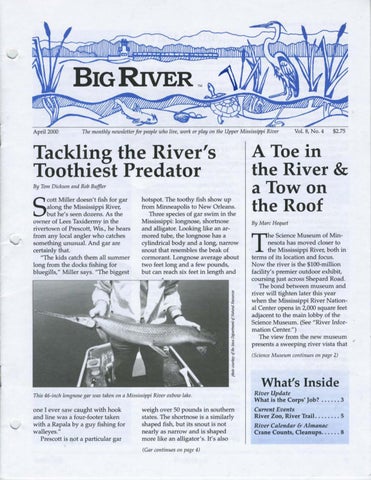
What's Inside This 46-inch longnose gar was taken on a Mississippi River oxbow lake.
River Update What is the Corps' Job? ...... 3
one I ever saw caught with hook and line was a four-footer taken with a Rapala by a guy fishing for walleyes." Prescott is not a particular gar
Current Events River Zoo, River Trail . ....... 5
weigh over 50 pounds in southern states. The shortnose is a similarly shaped fish, but its snout is not nearly as narrow and is shaped more like an alligator's. It's also (Gar continues on page 4)
River Calendar & Almanac Crane Counts, Cleanups . ..... 8
~
(Science Museum continued from page 1)
takes in the looming bluffs opposite nary trip from Lake Itasca, the um admission, of course. Adjacent and three downtown St. Paul source of the Mississippi in northto the facility are 10 acres of outbridges, all against the backdrop of ern Minnesota, to Pool 8 above the door parks with picnic tables and valley and channel, upstream and lock and dam at Genoa, Wis. space for performances. downstream. Another 3.5 acres of outThe new museum's warm .si door riverfront, accessible brick facade hugs the bluffs on ~ only through the museum, ~ the north side of the stream. 'c- will host outdoor exhibits. Most of the building is below "We hope to emphasize downtown St. Paul's street lev- ' ~ how the river is an ecologiel, just across Kellogg Boulecal system," says museum vard from the new hockey are~ planner Hamilton. "We na where the Minnesota Wild, mean to challenge people to a National Hockey League exj understand the complexities pansion team, will begin play of the river rather than just this autumn. ¡_;;_.c.:a-=:i ~ looking at the pieces." One new exhibit features a A combined ticket for exretired towboat sitting on a hibits and an Omnitheater This drawing shows the Minnesota Science Museum from the museum terrace well above the bluff top overlooking the river in downtown St. Paul. pass costs $11 for adults and river. The decommissioned 30$8 for those age four to 12 foot dredge-tender Charles E., built or older than 65. Exhibits only cost A 13-by-30-foot diorama depicts in 1944, was acquired from Robers Lake Itasca, and includes the actual $7 for adults and $5, respectively. Dredge Co. of La Crosse, Wis. Parking for an additional fee is red pine marker that stood at the The first exhibit visitors enavailable in the 812-space connected headwaters for 15 years. counter inside the museum is a ramp. § At the Twin Cities section of the 5,000-square-foot room parading gallery, a mural shows what the Marc Hequet is a writer who lives in St. area looked like 10,000 years ago as Paul and sometimes writes for Time. His glacial meltwater poured through last article for Big River was "Grey "We mean to challenge in a mile-wide torrent. Cloud's Future Cloudy," January 2000. A stream table models the river's people to understand the behavior at Lake Pepin, where silt complexities of the river from the Chippewa River backs up the Mississippi into the long lake. rather than just looking at River Information Center Soft-sculpture effigies of river fish the pieces. " in coolers wait for kids to pop them The Mississippi National River onto a scale nearby. They should and Recreation Area will open an the Mississippi's history, from milehave no problem lifting the 10information center within the new wide glacial torrent 10,000 years pound walleye, but hoisting the Science Museum of Minnesota latago to contemporary working river. record, 94-pound sturgeon requires er this year. It will offer informaa team effort. "We actually spent quite a bit of tion and materials about the Mistime trying to figure out how to tell sissippi National River and RecreAt the Virtual River Pilot, your the story of the Mississippi River," ation Area - the stretch from last stop in the River Gallery, you says Mississippi River Gallery dican navigate an electronic version Dayton to Hastings, Minn., which rector Patrick Hamilton, who biked of a towboat through a working includes the Minneapolis-St. Paul the river when he was in graduate model of a lock and dam. metropolitan area. school at the University of MinThe museum's Omnitheater gets The Park Service also plans to nesota, in Minneapolis. create a Mississippi River Educainto the Mississippi River act as "We had to decide what piece of tion Center across the river from well. "Great Migrations," the first the story we're going to tell," the museum at Harriet Island Refeature on its 70-foot spherical Imax Hamilton adds. "Were we doing to screen, includes remarkable footage gional Park. The Science Museum from the Beef Slough near Alma, of Minnesota, the City of St. Paul, go from Itasca to the Gulf of MexiWis., and extraordinary images of and other partners plan to proco, or focus on the Upper Mississippi?" tundra swans and Canada geese vide programming about the river Planners decided to be provintaking off and in flight. for groups visiting the education cial. The 5,000-square foot River You can visit the riverfront near center. m Gallery takes visitors on an imagithe museum without paying muse-
I
j
!
r
2
Big River
April 2000
.,
The Rest of the Museum Aside from its River Gallery, the Science Museum of Minnesota has the familiar exhibits - stuffed polar bears, triceratops and tyrannosaurus skull - but it also has new exhibits. And some of the old have a twist - visitors can articulate the T. Rex jaws with a hydraulic tool that opens and shuts the massive snappers. Count your fingers when you're finished. Among the new: the brainsurgery video and the full-spectrum light-therapy panel. And don't miss the titanothere coprolites - 35 million year old petrified poop from an elephant-size rhinoceros. It's a family museum, but some parents will find at least two exhibits a little uncomfoitable to explain. In the Body Image area, your teens, and toddlers, can click on a computer screen for an interactive video on body piercing, tattoos, eating disorders and other things you can do to yourself. You may squirm a little explaining another exhibit to your kids: A d isplay of four body casts - moldings of undraped human torsos made from live models - includes a female torso with only one breast. You will even find some political controversy - at least if you don't take a strictly scientific view of the optical-illusion demonstration. The exhibit features an image of Minnesota Gov. Jesse Ventura, the colorful ex-wrestler. No one is calling Gov. Ventura himself an optical illusion, mind you. The exhibit designer has merely used a Ventura portrait to illustrate a point about your eyes playing tricks on you. m
April 2000
What is the Corps' Job? By Reggie McLeod
Scrutiny and criticism of the Army Corps of Engineers has increased steadily since details of a whistleblower's claims became public in February (See "Did the Corps Cook the Books?" Big River March 2000). The National Science Foundation will review the Corps' Upper Mississippi River, Illinois Waterway Navigation System Feasibility Study (Navigation Study). The Pentagon is investigating how the study was conducted. The Office of Special Counsel has found sufficient cause to proceed with the whistleblower suit. (Last year the office investigated only 15 of the 400 complaints it received.) In March the Taxpayers for Common Sense and the National Wildlife Federation ranked expansion of the Mississippi River lock-and-dam system as the third most wasteful Corps pork barrel project. Much of the Corps' current work is repairing environmental damage caused by earlier Corps projects. These repairs often cost more than the original project and involve another massive layer of construction. One Corps study proposed spending $7.8 billion to save the Everglades, which are disappearing because an earlier Corps project drained land to create new orange groves. The repairs call for massive pumps and underground water storage, rather than returning the orange groves to their previous state. Donald C. Sweeney, the Corps economist who accused the Corps of fabricating economic data to justify expanding the lock-and-dam system, also said the Corps has set out to increase its funding by $100 million a year. We need to step back and look at the big picture. Could we move grain to New Orleans more cheaply without the lock-and-dam system?
Big River
Could we gain more economic advantage by processing the corn in the Midwest? If the shippers had to pay for the entire system without a tax subsidy, what would they do? The Army Corps of Engineers was originally created to assist with military operations, such as building roads and bridges in theaters of war. Today the Corps performs military operations; conducts economic studies; builds massive domestic projects; conducts transportation studies; regulates water resources; issues construction permits; and builds environmental repair pro-
Much of the Corps' current work is repairing environmental damage caused by earlier Corps projects. jects. Maybe the Corps would be more effective if it focused on its military responsibilities and turned over its other responsibilities to the Department of Transportation, Department of the Interior, university researchers, General Accounting Office and other organizations. Unfortunately the current scandal will cast many honest, hard working Corps employees in a bad light. In fact, Sweeney's affidavit recounts how he and other economists working for the Corps resisted pressure from higher ups to fudge economic data. Ultimate responsibility for the scandal rests with Congress. Reportedly, many people in the Corps were unhappy with the way Congress set up the study in 1992. And Congress probably did what it did to boost campaign contributions from the large grain exporters and shippers. The whole mess highlights an array of problems, but the biggest problem was caused by Congress creating the huge, grab-bag agency that the Army Corps of Engineers has become. m Reggie McLeod is editor of Big River. 3
(Gar continued from page 1)
smaller, with the world record weighing less than six pounds. The alligator gar, which ranges only as far north on the Mississippi River as the St. Louis area, is like a short-
Gars have even been known to live more than 24 hours completely out of water. nose on steroids, reaching over 300 pounds and eight feet long. The bodies of all gar are armored with interlocking, diamond-shaped plates that bend and flex as the fish move. Hard as tooth enamel, gar "scales" were once used by some American Indian tribes to tip arrows. Early settlers covered the edge of their wooden plows with gar skin. Like the bowfin, a gar can actually breathe air to absorb oxygen through its swim bladder, allowing it to survive in water practically devoid of oxygen. Gars have even been known to live more than 24 hours completely out of water. Longnose gars stick to warm, slow-moving water where they spend sunny days eating young carp and other minnows. Shortnose prefer a little current and can be found along riprap and wavewashed shores. Alligator gar prowl backwaters and oxbow lakes.
Hooking a Gar Though anglers catch gar throughout the year, the best time seems to be midsummer. To find longnose gar, scout Mississippi backwaters and oxbows. On hot summer afternoons, look for the trademark snout of the longnose stretching one-sixth its body length - break the surface as it gulps air and then submerges. Keith Sutton, an outdoors editor from Arkansas, fishes for gar using live bait. Because the gar he catches run 10 to 15 pounds, he uses a 1 / 0
4
treble hook (baited treble hooks aren't legal in some states) baited with a three- to six-inch shiner minnow hooked in the mouth. Then he clips on a big bobber about six inches up from the fish. "I'll cast the rig upstream and let the bobber float the shiner down toward where I'm seeing gar breaking," Sutton says. "Gar seldom make a hard hit. Usually, the bobber will slowly go underwater as the fish takes off slowly with the minnow in its mouth." Alligator gar anglers use the same techniques, only with bigger bait and stouter gear. They often use a coat hanger to thread a wire leader through the anus of a shad or other bait fish and out its mouth. A treble hook - where legal - is tied on and pulled tight from the tail against the face of the minnow.
Anglers lose far more gar than they land. The bony mouth can thwart all but the sharpest hooks. Then they ~ling the bait into known gar water and wait. Anglers lose far more gar than they land. The bony mouth can thwart all but the sharpest hooks. Let the gar swallow the bait so the hook gets down in its softer throat. "Waiting until they stop to swallow the bait has really improved my catch rate," Sutton says. Though gar will take crankbaits and other minnow imitations, the hooks need to be sticky sharp. One of the most interesting gar lures is the rope fly. Thread a hook onto a four-inch piece of nylon rope, just like hooking a nightcrawler. Use a lighter to melt the rope where it touches the hook to keep it from coming off. Then unravel the rest of the rope. When a gar bites into the lure, its teeth will become tangled in the strands. Fly anglers can tie a
Big River
smaller version of this lure that can easily be cast with a fly rod. Painting clear enamel on where you wrap the rope into the hook, then sprinkle glitter onto the wet finish to create a more lifelike fly. Anglers who eat gar say the meat is delicious. You'll need a tin snips to open one up for cleaning. An easy way to cook a gar, especially when camping, is to gut it and throw the whole fish, skin and all, onto hot coals. Turn it over every five minutes or so for a half-hour (longer for big gar). Cut the skin with snips and peel it back like you would the husk of a corn cob. The white fillets will peel out easily. ~
}
l
Tom Dickson and Rob Buffier are coauthors of Fishing for Buffalo, a guide to the pursuit, lore, and cuisine of buffalo, carp, mooneye, gar and other "rough" fish.
Check out our web site at www.big-river.com for links to resources from this issue of Big River.
Big RiverTM Big River (ISSN 1070-8340) is published
monthly by Riverwise, In c., 111 Riverfront, Suite 204, Winona, MN 55987; (507) 454-5949; fax: (507) 454-21 33; email: editors@big-river. com; web site: www.big-river.com Reggie McLeod editor/publisher Molly McGuire assistmll editor Mi Ae Lipe-Butterbrodt associate editor Trudy Balcom associate editor Pamela Eyden guest editor Kathy Delano design/marketing office manager Mary Feathergill Subscriptions are $28 for one year, $50 for two years or $2.75 per single issue. Send subscriptions, single copy orders and change-of-
address requests to Big River, PO Box 204, Winona, MN 55987. Second-class postage paid at Winona, MN. POSTMASTER: send change-of-address requests to Big River, PO Box 204, Winona, M N
55987. Big River, Volume 8, Number 4, copyright April 2000. Reproduction in whole or in part without written permission of the publisher is prohibited. Printed on recycled paper.
April 2000
"
By Mi Ae Lipe-Butterbrodt and Trudy Balcom
River Zoo
('
l
I
~ JI
La Crosse, Wis. - A small, aging zoo near the Mississippi River might get a facelift as a river ecopark. The Myrick Park Zoo currently houses about two dozen species of animals in unrelated exhibits. La Crosse city officials, working with the Myrick Park Zoological Society and Zooplan & Associates of Wichita, Kansas, want to redesign the zoo to take advantage of nearby marshes and trails, and to reflect river environments and fauna. "Most people don't appreciate or understand what they have, or how special it is," said J. Michael Rice, a Zooplan and Associates representative who worked on the master plan. "In fact, many zoos around the country have spent a lot of money on creating the habitats that already exist in La Crosse." The master plan calls for a focus on Wisconsin natural resources. Animals with a local connection, like otters, will replace some current exhibits. Aquatic displays will give visitors an underwater peek at native Wisconsin turtles, frogs, salamanders and fish. A nocturnal exhibit will feature raccoons, owls, bats and flying squirrels. A smallscale model of the Mississippi River and a bird of prey exhibit are also possibilities, according to Mike McCormick, park maintenance supervisor. Zoo officials hope to phase in the ecopark over the next 10 years at a cost of about $2 million, with most of the money coming from private sources and none from taxpayers. Admission to the zoo will continue to be free.
)
April 2000
Reducing Run-off Washington, D.C. - U.S. Representative Ron Kind hopes his new bill will improve water quality in the Upper Mississippi River. Kind, DLa Crosse in Wisconsin, says his Upper Mississippi River Basin Conservation Act would create a water quality monitoring system to gather the data needed to reduce soil erosion and nutrient loss in the river. Kind unveiled his plan at the Upper Midwest Environmental Sciences Center in La Crosse on February 28 (La Crosse Tribune, 2-29-00). The bill has yet to pass Congress and the Clinton Administration, but environmental advocates and government officials alike hail the legislation as desperately needed. "Rep. Kind' s proposal addresses the single greatest threat to rivers in the heartland and across the nation: polluted run-off from farms and city streets," said Jeff Stein, Mississippi River regional representative for the environmental group American Rivers. Run-off of nitrogen is not only harmful to fish and plants in the Mississippi, it represents about a $300 million loss to farmers every year. A 15-person citizen's council would coordinate the Conservation Act, with three members from each of the five participating states (Wisconsin, Minnesota, Iowa, Illinois and Missouri). The U.S. Geological Survey (USGS); U.S. Department of Agriculture Natural Resource Conservation Service and Farm Service Agency; Army Corps of Engineers; Environmental Protection Agency; and the National Aeronautics and Space Administration would develop comprehensive, cost-effective methods to reduce sedimentation and fertilizer run-off. A grant program will demonstrate new landuse practices, and the USGS would
Big River
develop the water quality monitoring network.
Refuge Office Moves Thomson, Ill. - The Upper Mississippi River National Wildlife and Fish Refuge has moved its office from Savanna, Ill. to Thomson. The office is located at 70-71 Riverview Road on Highway 84. The 4, 100square-foot building, named the Ingersoll Wetlands Learning Center, houses the administration office, visitor center and education center. A dedication ceremony is planned for May 13.
Marina Stays Open St. Paul, Minn. - Amid controversial plans by St. Paul Mayor Norm Coleman to close Watergate Marina, a 121-slip city-owned marina on the Mississippi River, the city has agreed to let a private company take over managing the marina. Allied Resources also manages Tally's Dockside on White Bear Lake, Minn. The marina has lost money the past five years, and its manager and mechanic were recently fired for allegedly misusing city property by running an independent boat repair service using the marina's resources.
Marsh Views La Crosse, Wis. - You will be able to watch the La Crosse River marsh close up this spring, thanks to the carpentry skills of volunteers and the sponsorship of the nearby Hixon Forest Nature Center. Several 12-by-26-foot platforms will float close to shore at the end of a spur in the southeast part of the marsh. They will be connected by a flexible ramp, allowing easy access by children, adults, students and handicapped people. (La Crosse Tribune 36-00).
5
Closing the Gaps Hampton, Ill. - Bicyclists, runners and others still hope that two gaps in the Great River Trail between the Quad Cities and Albany will be filled by the end of the year. In a March 4 news conference, advocates of the trail publicly pressured the Illinois Department of Transportation (DOT) and the I & M Rail Link, blaming state bureaucracy and a lack of cooperation for holding up the final link. Illinois Senator Denny Jacobs, DEast Moline, said a 300-yard-gap in Illiniwek Park is being held up not because of a lack of funds, but because the DOT requires local officials to get an easement on railroad property before state funds can be used to build that portion. Leases with the railroads used to be acceptable, but now easements are required. A four-mile stretch between Cordova and Albany is still open because the I & M Rail Link does not want to give up its lease because of potentially lucrative business with a grain elevator (Quad City Times 3-4-00). Confronting gaps in the trail, bicyclists and runners now take the more hazardous U.S. 84. U.S. Representative Lane Evans, D-111., hopes to get parties together to discuss a resolution.
Corps Revises Permit Washington, D.C. - Environmental groups are cheering about the Army Corps of Engineers' replacement of a controversial permit. On March 9, the Corps released final replacement permits for NWP (Nationwide Permit) 26, which expires on June 5. The new permit allows destruction of only a half acre of wetlands, rather than the previous three acres. It also requires that the Corps be notified of any wetland destruction over 0.1 of an acre, rather than one-third acre.
Return to the North Winona, Minn. - An early ice out on the river spurred the start of the
6
navigation season for tows, geese, ducks and other river-goers. The Corps officially opened the Mississippi to navigation on February 25. On March 3, the Prairie Dawn moved upstream past the Big River office at Winona to become the first St. Paul-bound tow of the year, according to Jim Auer of Lock & Dam 4 at Alma, Wis. Canada geese, sandhill cranes, red-winged blackbirds, bluebirds and robins also arrived in the Upper Mississippi during late February.
River Cable Cars St. Paul - With the loss of the Centennial Showboat to a devastating fire, a new idea has emerged in the St. Paul riverfront spotlight: cable cars. The City of St. Paul is investigating an idea to spend $3 to $4 million to install a cable car system over the Mississippi, running from Harriet Island to the top of the RiverCentre parking ramp adjacent to the new Science Museum, according to the St. Paul Pioneer Press (2-10-00). "Imagine crossing high in the air, swinging over the magnificent river, a view up and down ... the city's neighborhoods," commented Mayor Norm Col.eman. If it clears regular channels of review, the cable car plan could be reality by the summer of 2001.
Resilient Rivers Degraded and polluted rivers from the Chicago River to the Missouri and the Mississippi are showing signs of powerful resilience. The Chicago River, a former dumping site for industrial waste, stockyard run-off and sewage (It was even dyed green every St. Patricks Day.) is making a comeback. According to an Associated Press report, the river now hosts 60 species of fish, including sport fish, such as smallmouth bass and bluegills. The Friends of the Chicago River sponsor walking, canoeing and bicycle tours. Upscale restaurants now line its banks.
Big River
Further evidence of resilience has come to light on a stretch of the lower Missouri River, in which the flood of 1993 created a chute-islandsandbar habitat, the first the river has been allowed to produce in more than 50 years. The river is now producing pallid sturgeon, a federally listed endangered species, that can grow six feet long, weigh 100 pounds and live 60 years. It is considered an excellent sport fish. "The most significant aspect of this ... is that it clearly demonstrates that we can use the river's energy to restore habitat for the benefit of ... declining fish species," said Jim Milligan, of the Fisheries Resource Office in Columbia, Missouri, according to the U.S. Fish and Wildlife Service . The U.S. Geological Survey (USGS) examined the impact of river drawdowns on fish. Drawdowns simulate the natural low water levels in the Mississippi during summer months before the installation of locks and dams. Dr. Joseph Wlosinski of the USGS Upper Midwest Sciences Center, and Elmer Atwood of the Illinois Department of Natural Resources analyzed minnow seining data from pools 24, 25 and the Melvin Price Pool. They found very little difference in either quantity or species diversity between high and low water periods. The authors acknowledge that low water levels may have significant impacts on individual species.
Corps Hoards Funds St. Paul - In January, the acting Regional Director of the U.S. Fish and Wildlife Service (FWS), Marvin Moriarty, asked Major General Phillip Anderson, Commander of the Mississippi Valley Division of the Army Corps of Engineers, for more money to run the Environmental Management Program (EMP). The EMP was established in 1986 to restore sections of the Mississippi damaged by the lock-anddam system for Habitat Rehabilitation and Enhancement Projects (see
April 2000
Eco Report Cards Washington, D.C. -The League of Conservation Voters has released the National Environmental Scorecard for the first session of the 106th Congress. Of the 17 congressmen and senators whose districts border the Mississippi from Coon Rapids, Minnesota, to the Quad Cities, eleven had environmental voting scores above SO percent and six had scores below SO percent. Both Senator Richard Durbin (D-Ill.) and Senator Russ Feingold (D-Wis.) achieved scores of 100 percent. Iowa Representative Jim Nussle had the lowest score, 0 percent, with Representatives Gil Gutknecht (R-Minn.) and Donald Manzullo (R-Ill.) tied at 6 percent.
I
Illinois Senators Durbin (D) 100% Fitzgerald (R) 44% Representatives 94% Evans (D, 17th Dist.) Manzullo (R, 16th Dist.) 6% Iowa Senators 11% Grassley (R) Harkin(D) 89% Representatives Boswell (D, 3rd Dist.) 50% 0% Nussle (R, 2nd Dist.) Minnesota Senators Grams (R) 11% 89% Wellstone (D) Representatives Gutknecht (R, 1st Dist.) 6% 88% Luther (D, 6th Dist.) Ramstad (R, 3rd Dist.) 75% Vento (D, 4th Dist.) 94% Wisconsin Senators Feingold (D) 100% 67% Kohl (R) Representative 81% Kind (D, 3rd Dist.)
"EMP Report to the Congress-Flowing into the 21st Century," Big River July 1998). The program's funding was increased in 1999 from $19 to $34 million annually. Although the Corps is supposed to transfer the necessary funds to the FWS, which adminis-
April 2000
ters the program, money has not been forthcoming. (See "Where's the Money?" Big River October 1997.) "The Service requests reinstatement of EMP funds which were withdrawn several years ago," Moriarty said in his January letter. A representative from Major General Anderson's public relations office said the Corps will respond to the letter soon.
PWCWaves Muscoda, Wis. - Like many people up and down the Mississippi, the Lower Wisconsin State Riverway Board is concerned about the use of personal watercraft (PWC). The Board spent months "researching the issue and soliciting public input." Their work culminated in five recommendationsto the Wisconsin Department of Natural Resources (DNR). Reccomendations included one for new legislation requiring PWC users to obtain boating safety certificates, and another for more conservation wardens to patrol the ¡ Lower Wisconsin. Dan Schutte, a Wisconsin DNR Riverway Recreation Specialist, said the¡DNR does not have the funding or the staff to act on the recommendations at this time, as the level of impact and complaints from PWC use is greater on the Mississippi and many inland lakes. The board said it was "frustrated" by the DNR's response.
Hogging the Park Davenport & Bettendorf, Iowa Davenport's LeClaire Park will be hog heaven on Father's Day weekend this year, as the site of the Sturgis on the River motorcycle festival. This turn of events disappointed River Action, organizers of the Ride the River bicycle tour, which has used the park as a staging site on the same weekend for the past 15 years. City aldermen said "their hands were tied," as the Sturgis group reserved the park in advance,
Big River
in accordance with city rules. The bicycle tour will start from the parking lot of the Lady Luck casino in Bettendorf this year, according to the Quad City Times (211-00).
Towjackers Pool 23 - Recent tow hijackings have put river pilots and Coast Guard officials on edge this year. A team of hijackers overwhelmed the crew of Little Piggy after it locked upriver through Lock 23 at Niles, Iowa, in the early evening of February 30. Lock employees radioed the Coast Guard buoy tender Anaconda, which pursued the tow through the gathering gloom until it lost sight of the 15barge tow near Hidden Slough. The tow was bringing com from Argentina to Coon Rapids, Minn., for processing. A week later, hijackers in a stolen marine services boat forced their way onto the Paul Bunyan in Pool 23 and put the crew ashore on Massacre Island before heading downriver with six barges of nails. Nobody was hurt in either incident. Neither of the boats or their cargos have been recovered. ~
Make sure Big River is on your mailing list for riverrelated activities and press releases.
7
Special Events & Festivals April 15 Midwest Crane Count, 5:30 a.m.-7:30 a.m., county by county, (608) 356-9462. 22 March for Parks: Celebrate Earth Day, 1 p.m., Mines of Spain Recreation Area, Dubuque, Iowa, (319) 556-0620.
22 Earth Day 2000 Celebration, Effigy Mounds National Monument, Harpers Ferry, Iowa, (319) 873-3491. 28 Wisconsin State Parks Centennial Tree Planting, check with individual state parks, (608) 266-2181. 28-30 Root River Bird Festival, Lanesboro, Minn., 1-800-428-2030. 29 Ecological Cleanup of the Mississippi River Bluff, St Paul, Minn., (651) 6659500. 29 Field trip, Audubon of Minneapolis, Coon Rapids Dam, Brooklyn Park, Minn., (612) 929-1976. 29 Arbor Day Celebration, Arboretum & Botanical Gardens, Dubuque, Iowa, (319) 556-2100.
13 Spring Birdathon, Dubuque Audubon Society, Dubuque, Iowa.
June 3-10 National River Cleanup Week, free information and trash bags for groups, register, (865) 558-3593.
Meetings & Hearings
13-14 Mississippi River Research Consortium Annual Meeting, Radisson Hotel, La Crosse, Wis. 17 and 19 Mississippi River Bluff Restoration Project, information meetings, 7 p.m., Merriam Park Community Center, 200 S. Anthony Ave., St. Paul. Minn., (651) 645-6766.
April 4 La Crosse (Wis.) Crane Count Oganizational Meeting, 7 p.m.-8 p.m., Hixon Forest Nature Center, (608) 784-2464.
29 Buckthorn removal kick-off meeting, St. Paul, Minn., (651) 665-9500.
4 River Monitor's Youth Congress, Walker, Minn., (218) 547-7263.
April 19-20 Asian Carp Workshop, Westport Holiday Inn, St. Louis, Mo., (573) 8761911.
13 Birds of the Mississippi, 7 p.m.-9 p.m., Mississippi Dunes Golf Course, Cottage Grove, Minn., (651) 290-4160, ext. 221. Also at American Legion Post #600, Champlin, Minn., (651) 290-4160, ext. 221.
Workshops & Conferences
May 3-5 Fillmore Mississippi Heritage Conference, Rive~ entre, St. Paul, Minn, (612) 625-0347.
May 6 Migratory Bird Count, 8 a.m., St. Paul (Minn.) Audubon Society, (651) 4548994. 6-7 85-mile Garage Sale, 9 a.m.-5 p.m., 13 towns around Lake Pepin. \ 7,.. 11 Minnesota Fishing opener, 1-888-6466367. \;?;\;.. 13-14 Take-A-Mom Fishing weekend, Minn. State Parks, 1-800-657-3929. West Coon Rapids Dam Programs Brooklyn Park, Minn., (763) 424-8172.
April 18 Walk When the Moon is Full, 8 p.m., reservations. 23 What's in a Rotten Log?, 1 p.m.-3:30 p.m. 30 Earth-friendly Lawns, 1 p.m.-3:30 p.m.
May 6 All About Osprey, 1 p.m. 7 Early Bike Hike, 8 a.m. 7 A Bird in the Hand, 1 p.m.-3:30 p.m. 14 Time for Turtles, 1 p.m.-3:30 p.m. 18 Walk When the Moon is Full, 8:30 p.m. reservations. 21 River Bugs Tell a Story, 1 p.m.-3:30 p.m.
8
Almanac By Kenny Salwey A robin sings its rain song at dusk, while a pack of coyotes howls and yips its approval of the bird's forecast for the night. The frogs banter and argue among themselves over ideas and subjects only they can understand. A couple of raccoons chitter and chatter in the surrounding woods. From a nearby hunting tree comes the barred owl's question,"Who cooks for you?" In the gathering darkness momma mallard and her cousins, Mr. and Mrs. Canada Goose become noisy neighbors. As I lie in my cozy wooden bunk watching fire shadows dance across the ceiling, I hear the first raindrops begin to fall. Soon the April showers become a steady pitter patter when they land upon Big Lake Shack's tin-covered roof. My eyelids grow very heavy. I think I should go out to pick earthworms and nightcrawlers. Aw ... maybe not. Next morning I go down to stand on the rickety old dock to watch the Whitman swamp rub the sleep from its eyes. A pair of sandhill cranes trills in the distance. Soon they clear the treetops to fly directly overhead. How graceful, how stately these huge birds are. I think of the eagles' nest on the north end of Long Lake. I must go there to witness the pair's bonding rituals. Soon my canoe is underfoot and the whispering paddle carries me past green cattail shoots, opening buds of willow, river birch and prickly ash. I think of Spring Hollow's skunk cabbage, marsh marigolds and emerging horsetails ... maybe this afternoon. There is no sweeter smell than that of a morning after April showers. All wild things are beginning life anew. April is the beginning of nature's new year - a child of spring. Aren't we all? Happy New Year, my friend! m
Big River
April 2000
,,