February 2000
The monthly newsletter for people who live, work or play on the Upper Mississippi River
When the Northwoods Flowed Downriver By Dean Gabbert
T
he last lumber raft arriving at Fort Madison, Iowa, in 1915, marked the end of the Upper Mississippi River's biggest and most lucrative enterprise. For 73 years, rough-and-tumble raftsmen ruled the rivers of the north, delivering what seemed to be an inexhaustible supply of logs and lumber. First they floated the rafts and then they towed them with steamboats down the Minnesota, St. Croix, Red Cedar, Wisconsin, Black, Chippewa and Mississippi rivers. Two remarkable rivermen, Capt. Stephen Hanks and Capt. Walter Hunter, personified the era. Hanks
was on the crew of the first lumber raft to reach St. Louis in 1842, and two years later he piloted a log raft on another perilous trip from Stillwater to St. Louis. Hunter was captain of the Ottumwa Belle when she delivered the last raft to the S. and J. C. Atlee mill in Fort Madison on July 14, 1915.
Captain Stephen Hanks First as a pioneer raftsman and later as a steamboat pilot, Hanks was in a class by himself. He was Abraham Lincoln's first cousin, and (Rafting continues on page 2)
Vol. 8, No. 2
$2.75
The Invasion Continues More Exotic Fish Coming By Mi Ae Lipe-Butterbrodt
F
isheries biologists worry that at least a couple of new, exotic fish species are poised to invade the Mississippi River. The Mississippi Department of Agriculture will allow the black carp (Mylopharyngodon piceus) in that state's catfish production ponds to help control parasites that infect fingerling catfish, according to the Mississippi Interstate Cooperative Resource Association (MICRA). The decision will affect not only waters in Mississippi but also the entire Mississippi River Basin. Exotic fish species have a tendency (Invasion continues on page 4)
-
~
What's Inside Trumpeter Freezeout. ........ 4 Current Events River Theater, Savanna Depot Access, Bikers vs. Bikers ..... 5
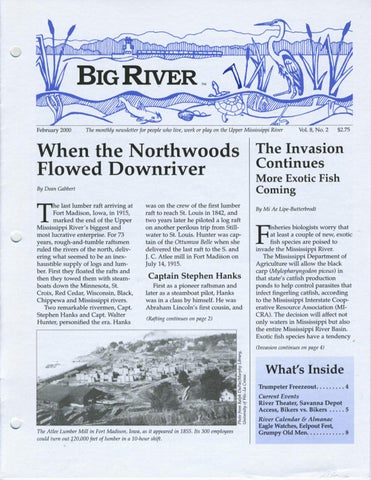
The Atlee Lumber Mill in Fort Madison, Iowa, as it appeared in 1855. Its 300 employees could turn out 120,000 feet of lumber in a 10-hour shift.
River Calendar & Almanac Eagle Watches, Eelpout Fest, Grumpy Old Men............ 8
(Rafting continued from page 1)
like Lincoln, he was born in Kenable method of steering a free-floata sternwheeler with beefier engines tucky and spent most of his life in ing lumber raft. Large sweep-oars and four rudders for greater steerIllinois. At 19, he accepted a job in a were no match for a contrary wind ing control. The introduction of bow-boats Minnesota logging camp at the gothat could pin the raft against the ing wage of $200 a year. He had to bank or even drive it upstream. made it possible to safely handle walk more than 300 miles from his Because they could be built larger rafts. A bow-boat was atthicker and carried no waste, lumhome in Albany, Ill., to get there. tached to the head of the raft, at He cut timber in sub-zero weathber rafts were more efficient than right angles to the raft boat at the er, dodged hostile Indians, survived stern. Responding to signals from log rafts, but it was easier and faster snowblindness and battled ice to bring logs to the sawmills that the pilot, the bow-boat would move gorges and floods. In 1842, Hanks sprung up like mushrooms on the forward or backward, swinging the helped build the first long-distance Upper Mississippi. Much of the head of the raft to the left or right. lumber raft at the head of Lake St. Croix, on the St. Croix River. The basic unit was a crib, 16 feet wide and 32 feet long. It contained 24 layers of one-inch lumber - with alternate layers running at right angles. Crewmen soon learned that the 640-by-96-foot raft had a mind of its own. Laying against the bank, it was almost impossible to move; when the current was strong, it was almost impossible to stop. They wrestled the raft to St. Louis in 43 days. In 1845, Hanks set up his own business, delivering both log and lumber rafts The Ottumwa Belle (upper left) made history in 1915 when it brought down the last raft, shown here to St. Louis. He did well for passing Fountain City, Wis. Note the timbers and lath stacked on top of this lumber raft. nine years only to be wiped out by a disastrous flood in 1854. new lumber was loaded onto trains The basic unit of a log raft was a His flotilla of four rafts broke up "brail" 600 feet long and 45 feet bound for frontier towns. By the near New Boston, Ill. His loss exmid-1850s, log rafts outnumbered wide. The largest logs were used to ceeded $10,000. When he finally lumber rafts about 10 to 1. build a frame around the brail. paid off his creditors in 1855, he Three brails, joined side by side, In 1863, Capt. George Winans had $75 left. was the first to use a boat to push a made a half-raft, or what some raft below Lake Pepin. Problems crewmen called a piece. Joined toThe Rafts men's Craft gether, two pieces made a raft 600 developed and he gave up after onAs the number and size of rafts ly 10 miles. A year later Capt. Cyrus feet long and 270 feet wide. A finincreased, so did the fearsome repuishing crew built the butting block, Bradley learned from Winans' mistation of their crews. According to takes and pushed a raft from Read's a king-sized log chained to the midhistorian Charles Russell, Black RivLanding, Minn., to Clinton, Iowa. In dle of the raft's stern that the boat er raftsmen were the worst of all. 1869, Capt. Sam Van Sant, of Le pushed against. When the boat was "With them, according to general Claire, Iowa, designed and built the on the block, the lines were run: belief, rafting was but a diversion, first successful raft boat, the J. W. first the head lines, then the breast lines, the guy lines, the "A" lines, the real business of their souls was Van Sant. They called him Captain battle, murder and sudden death ... Pluck, and at age 25 he revolutionthe corner lines and finally the When a Black River raft was sigized the rafting industry. Recognizmonkey lines. Now the raft was nalled, the Widow Fowler invariing that the single-ruddered sideready to go, all laced up in its corset ably hid her spoons." wheelers in use were both underof rope. Most rafts were built in Beef No one ever devised a dependpowered and hard to steer, he built
2
Big River
February 2000
Slough, a 12-mile channel at the mouth of the Chippewa River above the town of Alma, Wis. At the peak of the era, 600 million feet of logs passed through Beef Slough. During the 1873 season, 680 rafts passed under the Davenport-Rock Island bridge. Eighteen rafts were
Eighteen rafts were counted on June 5 and again on June 6 - an estimated 54 acres of raft per day.
.
counted on June 5 and again on June 6 - an estimated 54 acres of raft per day. How big were the biggest rafts? The Saturn, commanded by George Winans, brought down the largest lumber raft from Lake St. Croix to St. Louis in 1901. It was 26 layers deep and measured 270 feet wide and 1,450 feet long, containing 9 million board feet (A board foot is the equivalent of a 1-inch by 1-inch by 12-inch board.) of lumber, ineluding the top load. The largest log raft was towed by the F.C.A. Denkmann with the H.C. Brockman as her bow-boat. Capt O.E. McGinley brought the raft from Lynxville, Wis., to Rock Island in 1896. It was 270 feet wide and 1,550 feet long, containing about 2,250,000 logs. In the meantime, Capt. Hanks had established himself as one of the upper river's best pilots. For 20 years he served as pilot on most of the packets of the Minnesota Packet Co. and the Diamond Jo Line. His piloting feats were legendary and his peers knew the secret of his suecess: as a veteran raft pilot, he knew the river better than anyone else. He returned to rafting for a few years in the 1870's, then he spent 15 years as chief pilot of C. Lamb and Sons, a large Clinton lumber firm that operated its own fleet of raft-
February 2000
boats. He spent his 50th and final year as a pilot aboard a Le Claire boat, the Joe Long, in 1892.
The Trees Run Out J.C. Atlee came to Fort Madison in 1837 and entered the lumber business in 1853. The Atlee mill grew to be one of the largest on the Upper Mississippi with 300 employees. At its peak, the mill turned out 120,000 feet of lumber, 150,000 shingles and 28,000 lathe during a 10-hour shift. Atlee had a fleet of several raftboats, including the Sam Atlee, the Ottumwa Belle and the Pathfinder. By the beginning of the 20th century most of the pine forests in Minnesota and Wisconsin were harvested. The rafting era ended officially in 1915 when the Atlee Company cut the last stand of pine that it owned above St. Paul. Normally, the logs would have been rafted downriver, but a large part of the company's facilities at Fort Madison had been flooded by the closing of the Keokuk dam. So the logs were floated over the Falls of St. Anthony and rafted to Prescott, where the St. Croix enters the Mississippi. From th~re they were towed 17 miles upstream to Hudson, Wis., where they were sawed at the Central Lumber Co. mill. Millions of logs were floated down the St. Croix River, but this might be the only time they were moved upsteam.
Captain Walter Hunter Capt. Hunter of Winona, Minn., felt right at home when the Ottumwa Belle headed downriver from Hudson on July 1, 1915, on its historic run to Fort Madison. He became master of the Belle in 1906, serving until the Atlees halted regular rafting operations. Hunter took leave from his duties as pilot of the packet Morning Star to make the 14day trip. The last raft was 28 layers deep, 128 feet wide and 1,150 feet long. It contained 3,500,000 feet of lumber,
Big River
plus about 1,000,000 feet of top load consisting of timbers, lumber and lathe. The Pathfinder served as bowboat and a third Atlee vessel, the little steamer J.M., made the trip hitched alongside the raft. Capt. Hunter, who had a fine sense of history, arranged for Stephen Hanks, the rafting pioneer, to board the Ottumwa Belle when she passed the captain's home af Albany, Ill. Capt. Hanks, then 94, probably rode the steamer as far as Davenport. Capt. Hunter spent 62 years on the river before retiring in 1945. He began as a deckhand on the rafter Penn Wright at the age of 15. He received his pilot's license at 24 and
By the beginning of the 20th century most of the pine forests in Minnesota and Wisconsin were harvested. served as master of the Isaac Staples for 12 years before going to the Ottumwa Belle. After service on the Morning Star, he piloted the Mark Twain, a Federal Barge Line towboat, and the W. J. Quinlan, Rock Island ferryboat. Capt. Hanks died Oct. 7, 1917, at his home in Albany, two days short of his 96th birthday. Capt. Hunter, who spent his later years at Bellevue, Iowa, died there Nov. 11, lQ.62, at the age of 94. The careers of these two notable rivermen totaled an astounding 135 years. A version of this story appeared in the Spring 1999 newsletter of the Midwest
Riverboat Buffs. Dean Gabbert writes about the river from his home on its banks in Nauvoo, Ill., (river mile 378.6). He is the retired publisher and editor of The Fairfield (Iowa) Ledger. His last story for Big River was "Board Volunteer" (October 1998).
3
(Invasion continued from page 1)
to travel beyond their ponds. Stocking the black carp's Asian relatives - the silver, bighead and grass carps - mainly in Arkansas aquaculture ponds, started full-scale invasions by these species of the Missouri, Upper Mississippi and the Des Moines rivers. "The bighead carp has become so abundant at some locations in this state's large rivers that commercial fishermen can't even lift their nets, they are so full of bigheads," said Norm Stucky, Missouri's Chief of Fisheries. Not only is the bighead crowding out native fish, but, unlike other carp species, people don't even find it good to eat. All three Asian carps compete with native species for habitat and food, and they can survive and breed in degraded environments shunned by native fish. Also, native mussels, many of which are already threatened by the exotic zebra mussel, may be doomed by invasions of black carp, which eat small shellfish and mussels. Catfish farmers in Mississippi who are approved to stock black carp are urged (but not required) to use triploid fish, which are thought to be sterile. Nonetheless, given the past history of the black carp's Asian relatives, it seems inevitable that soon this species will swim freely in the Mississippi. And yet a native species, the redear sunfish or shellcracker (Lepomis microlophus), also eats the parasite and could be used as an alternate species, but is not favored by the industry because it is not readily available. However, Missouri is not approving the stocking of black carp but is supplying limited numbers of shellcrackers to catfish farmers instead.
Around the Fence Meanwhile, another exotic threatening the Mississippi River, round gobies, may have already bypassed the site where an electric barrier is being built to stop their spread.
4
According to biologist Pam Thiel of the U.S. Fish and Wildlife Service, last fall's "Annual Goby Roundup," conducted in the CalSag ship canals near Chicago, turned up one goby below the barrier site, on the Illinois River about a quarter mile above where the Des Plaines River joins the Chicago Sanitary and Ship Canal. The barrier is scheduled for completion by June 2000 and is expected to slow the movement of gobies and other exotics from the Great Lakes into the Mississippi River Basin (see "The Gobies are Coming" in Big River, November 1999).
Two-way Street While environmentalists bemoan invasions of round gobies and black carp in the Mississippi River, the emperor of Japan worries about bass and bluegill displacing his country's native fish. Bluegill and largemouth bass now make up 99 percent of the fish populations in eight of the 13 moats surrounding the Imperial Palace. The bluegill eat the eggs of the native haze, goby and stubby, while largemouth bass find goby minnows a delicacy. Nobuo lchihara, deputy superintendent of the Environment Agency, pronounces the moats "a symbol of Japan" and says "It's scary to think what may happen if we do a survey in five years - the native species may be all gone". While Ichihara's agency has been collecting the foreign fish, Japanese experts worry that the invaders' aggressive breeding habits will thwart any permanent solutions, according toMICRA. Some officials believe that Emperor Akihito may have inadvertently caused the invasion when he brought a bluegill, a gift from Chicago mayor Richard J. Daley, to Japan in 1960. Mi Ae Lipe-Butterbrddt is associate editor of Big River.
Big River
Swan Freeze Monticello, Minnesota - Hundreds of trumpeter swans may be forced to migrate in mid-winter, if normally warm waters freeze over when a power plant shuts down. Northern States Power's (NSP) plant at Monticello shut down January 6 for scheduled maintenance, which should take about a month. The site, on the Mississippi upriver from the Twin Cities, is not a natural wintering site for trumpeters, notes Steve Kittelson of the Minnesota Department of Natural Resources (DNR), but a "combination of open water and available food supplies has caused the development of this swan wintering site over the past 12 years." Over 400 swans were counted along the Mississippi in the Monticello area this winter. The swans are offspring from stock originally released by Hennepin Parks in the late 1960s and from 270 swans released by the Minnesota DNR in the past dozen years. The DNR swans sport numbered orange wing tags and federal leg bands. Report sightings of these swans to the DNR at 1-888-MINNDNR or email steve.kittelson @dnr.state.mn.us.
]
l
Big River™ Big River (ISSN 1070-8340) is published mont/1ly by Riverwise, Inc., 111 Riverfront, Suite 204, Winona , MN 55987; (507) 454-5949; fax: (507) 454-2133; email: editors@big-river.com;
web site: www.big-river.com Reggie McLeod editor/publisher Molly McG11ire assistant editor Mi Ae Lipe-Butterbrodt associate editor Kathy Delano desig11/markeli11g Mary Feathergill office manager Subscriptions are $28 for one year, $50 for two years or $2.75 per single issue. Send subscriptions, single copy orders and change-of-
address requests to Big River, PO Box 204, Winona, MN 55987. Second-class postage paid al Winona, MN. POSTMASTER: send change-of-address requests to Big River, PO Box 204, Winona, MN 55987.
Big River, Volume 8, Number 2, copyright February 2000. Reproduction in whole or i11 part without written pennission of the publisher is prohibited. Printed 011 recycled paper.
February 2000
]
By Mi Ae Lipe-Butterbrodt
~ fri>
River Theater Minneapolis, Minn. - The prestigious Guthrie Theater may move to a new Mississippi riverfront home in downtown Minneapolis by 2004. On January 10, the Guthrie's board approved a future move to a site bounded by Chicago Avenue, West River Parkway and Second Street South. The theater has outgrown the Loring Park area it shares with the Walker Art Center. The cost of the expansion is estimated at $60 to 70 million. The Guthrie board is seeking legislative support for the new building. So far, the city and Guthrie officials have not negotiated land arrangements. The land was originally pegged for a new stadium for the Minnesota Twins, but the Minneapolis City Council unanimously voted to offer the site to the Guthrie.
Careful Steps
l
Savanna, Ill. - Several state and national agencies wonder why the Army permits public access in some areas of the Savanna Army Depot while restricting wildlife research in those same areas because of safety hazards from unexploded ordnance, or UXO. The Savanna Army Depot encompasses over 13 miles of Mississippi riverfront, large areas of islands and backwaters, and 68 miles of railroad track (see "From Bombs to Prairie Flowers," Big River, August 1997). When the depot closes in March, the Army will face the monumental task of cleaning up environmental hazards, including
uxo. The Army plans to transfer depot land to other agencies, including the U.S. Fish and Wildlife Service
February 2000
(FWS) and the Illinois Department of Natural Resources (DNR). The DNR and FWS have chosen three spots that they believe are especially important to clean up and open to the public, which include Primm's Pond, Batey Creek and a boat landing and bottomlands. But when the FWS and the DNR sought approval to do wildlife research in these areas last spring, the only places the Army allowed unlimited access to were the roads, because the three spots were contaminated with UXO. Yet the Army allowed more than 140 people to hunt and fish last fall in the potential UXO areas. The Army also plans to open public access to the boat landing and bottom lands. "It seems as though the Army is applying a double standard with regard to risk," said Randy Nyboer, regional administrator for the Division of National Heritage of the DNR. Ed Britton of the FWS asks, "Wh.en people can go in there with firearms, why are we restricted to the roads?" Arlen Dahlman, base transition coordinator for the Army, said the Army restricted but did not prohibit agency access to the off-road areas; the agencies could have asked to do wildlife surveys in any area. But Britton says the FWS was advised in April that "our activities should be limited to those areas outside the UXO. Then, in May, we were restricted in all areas of the depot." The restrictions cost the FWS an entire summer of study, according to Britton, and the DNR about $20,000 in grant money. The Army currently has no plans to clean up a path along the access roads to the proposed public sites, or to fence the roads on both sides. Primm' s Pond and Batey Creek will
remain off-limits, but controlling traffic in the bottomlands will be very difficult. Further complicating the matter: the Army and Environmental Protection Agency do not agree on UXO testing standards, and even if the Army finds UXO, it may not have sufficient money to clean it up. Cleanup costs up to $10,000 per acre and up to 6,000 acres may be affected (Dubuque Telegraph Herald 12-28-99).
Panfished Out Minnesota - Ice anglers may be catching too many panfish from the Mississippi River, according to a Department of Natural Resources (DNR) study in 1997-1998 on 16 backwaters. Based on harvest and population estimates, the study found that 84 and 90 percent of bluegill larger than seven inches were harvested from backwaters in Pools SA and Pool 5, respectively. In a creel survey, nearly 80 percent of 1,358 anglers said they would support bag limit restrictions if it would improve panfishing. The survey also showed that angling pressure increased nearly 17 percent from the 1997-1998 season to 1998-1999 and that the number of fish caught per hour increased 18 percent. The DNR held public meetings in January to discuss potential regulation changes and how to improve the Mississippi River backwater fishery.
Fort Snelling B&B St. Paul, Minn. - Twenty-eight vacant but historic buildings are up for grabs at Fort Snelling. The Minnesota Department of Natural Resources (DNR) is seeking new uses for the buildings, which overlook the Minnesota and Mississippi Rivers near the MinneapolisSt. Paul International Airport.
Big River
5
__,
Backers of three proposed schools are looking at some of the buildings, but about 380,000 square feet in the remaining buildings are available on the 141-acre Upper Bluff site. The DNR would grant long-term leases on acceptable uses, which might include schools, a conference center, an environmental learning center, government offices, museums, recreational facilities or bed and breakfast lodges. Anyone interested in the buildings should contact the DNR' s Bill Weir at (651) 772-7994, or Lee Markell at (651) 297-7481 by February 11.
Not Frog Fertilizer Corvallis, Or. - Levels of nitrates and nitrites that the Environmental Protection Agency deems safe enough for human drinking water can kill some species of frogs and salamanders, according to a new study at Oregon State University. Scientists found that even very low levels of the nitrogen-based compounds that form and accumulate in runoffs from farms where large amounts of artificial, nitrogen fertilizers are used, resulted in physical deformities and death in tadpoles and young frogs. The study showed that nitrates are not very toxic, but when they are reduced to nitrites, health risks soar. This study's confirms that a combination of factors are probably responsible for the recent worldwide decline in amphibians and a increase of frog deformities, including chemical compounds formed from agricultural fertilizers, acid rain and even exposure to ultraviolet light.
Lower than Zero Missouri and Wisconsin - Water levels continue to be low on the Mississippi River, especially in St. Louis, where one reading reached its lowest in six years. The gauge at Eads Bridge on January 6 read minus 0.6 feet, more than half a foot below the arbitrary "zero" on the gauge. At this level,
6
the Main Channel was only about 12 feet deep, with the river level 50 feet lower than its record flood crest stage of August 1, 1993. The low water led the Coast Guard to temporarily limit the size of tows heading downstream from St. Louis (St. Louis Post-Dispatch 17-00). Since then, rain and warmer temperatures have elevated the level above zero again, according to The Waterways Journal, (1-10-00). If the river is low this spring, plans for the Pool 8 drawdown in the Upper Mississippi could be affected. The Army Corps of Engineers has approval to reduce pool levels by 18 inches at Lock and Dam 8 this summer and 6 inches at the La Crosse gauge, with a stipulation that it first dredge some shallow areas. In April, river managers will decide if this will be a good year for the drawdown, which is scheduled to begin June 15.
Urban Geese The U.S. Fish and Wildlife Service (FWS) invites the public to comment on Canada goose management in a -series of meetings in February and ~arch. Canada geese in urban areas occasionally refuse to migrate, preferring instead to live year-around in public parks built around ponds. As more birds congregate in these areas, their droppings damage lawns and could contaminate municipal water supplies. Potential collisions between geese and commercial aircraft also pose a safety hazard, causing dangerous takeoff and landing conditions and costly repairs. The FWS hopes to ease conflicts between humans and Canada geese by issuing special permits that allow state wildlife agencies to design management programs and for specific goose populations without having to seek a separate permit for each. People are encouraged to notify the FWS of their intent to speak at a
Big River
particular meeting by writing to the Chief, Office of Migratory Bird Management, U.S. Fish and Wildlife Service, Department of the Interior, ms 634 ARLSQ, 1849 C St., NW, Washington, D.C. 20240. Written comments should be submitted by March 30, 2000, and can be sent electronically to canada_goose_eis@fws.gov. For the meeting information, see the Calendar in this issue.
Missouri Tows In a time when the Army Corps of Engineers is under fire for suggesting that locks and dams be expanded to support increased barge traffic on the Mississippi River, some economists question the need for barges on the Missouri River as well. In a report commissioned by Environmental Defense (formerly the Environmental Defense Fund), agricultural economists Dale Anderson at the University of Nebraska-Lincoln and Michael Babcock at Kansas State University point out that the Missouri River is too narrow and shallow and has too short a shipping season. The report, "Does Barging on the Missouri River Provide Significant Benefits?," challenges long-held beliefs that competition from barge traffic holds down railroad freight prices, contrary to arguments from barge terminal op. erators and farmers. The report echoes a 1998 report, also commissioned by Environmental Defense, authored by Philip Baumel, an Iowa State University agricultural economist, that also questions the economic logic of barge shipping on the Missouri. Both reports can be ordered or downloaded from the Environmental Defense website (www.edf.org).
DM&E Landlocked Winona, Minn. - Officials of the Dakota, Minnesota and Eastern Railroad (DM&E) recently lost some credibility when they claimed to have worked out access to Winona's
February 2000
,,
shipping port during talks with the city. The DM&E wants to eventually ship 100 million tons of coal annually from Wyoming east to the Mississippi River. The new route could increase rail traffic through Winona from a few trains to 37 daily. Union Pacific owns 3 miles of rail in Winona and controls a key grain shipping terminal on the Mississippi, an extremely valuable area for DM&E' s plans. But John Bromley, spokesman at Union Pacific's headquarters in Omaha, Neb., first heard the news of DM&E talks with the city on January 4, when he received a December 28 clipping from the Winona Daily News. "We haven't talked to them [DM&El," said Bromley, "and we have no plans to talk to them." Currently DM&E freight destined for barges or industries along the riverfront are parked at a Union Pacific yard, and DM&E pays Union Pacific an access fee. Further complicating matters, Canadian Pacific Railroad also owns track through the city and hands freight over to Union Pacific for river shipping (Winona Daily News 1-6-00).
Bikers on the River Davenport, Iowa - Motorcyclists won out over bicyclists in a battle over who could use Davenport's Le Claire Park this Father's Day weekend. Davenport aldermen voted for "Sturgis on the River," a motorcycle gathering, which they say properly booked the park. Even though Le Claire Park was the marshaling point for the "Ride the River" bicycling event for the past 16 years, Alderman Bill Sherwood says its organizer, River Action, Inc., never formally applied to use the park and never objected to other groups using it until Sturgis held its first rally there last year (Quad-City Times 120-00). Last year, the Sturgis event was held Friday and Saturday, and Ride the River on Sunday. But parking
February 2000
for Sturgis made it difficult for Ride the River participants to pick up their registration packets on Saturday, and piles of trash from Sturgis awaited bicyclists on Sunday, said Kathy Wine, executive director of River Action. Aldermen hoped the park could accommodate both groups on the same weekend, but the motorcyclists won a seven-to-three vote. Wine says River Action may look elsewhere, perhaps Bettendorf, which has been courting the group.
Bridge Impasse Stillwater, Minn. - Federal agencies may decide the future of the historic Stillwater lift bridge, since local and state agencies remain at an impasse. Local, state and national agencies have fought over the Stillwater bridge for years. The National Park Service nixed plans for a new, obtrusive, four-lane bridge to replace the deteriorating lift bridge because the Lower St. Croix is a National Scenic Riverway. In 1997, the preWorld War II lift bridge landed on the National Trust for Historic Preservation's list of the 11 most endangered historic places. Now the department of transportation hopes to offset the effects of the proposed four-lane bridge with a package of solutions, one of which calls for the lift bridge to remain operating for 10 years after the new bridge opens or until it doesn't work. Local representatives say plans to tear down the lift bridge at a definite time are unacceptable. Nevertheless, transportation officials feel their proposal is a compromise that the Park Service would approve. The new bridge, built south of downtown Stillwater, would likely open in 2004. Minnesota transportation officials say they will ask the Advisory Council on Historic Preservation to settle the issue. The council advises the president and Congress (St. Paul Pioneer Press 1-13-00).
Big River
Whose Game? Wisconsin - The Conservation Congress is out of step with the times, according to State Rep. Du Wayne Johnsrud, referring to the furor over an anti-hunting activist elected to it last spring. The congress advises the Department of Natural Resources on outdoor sporting issues. After Madison animal protectionist Patricia Randolph was elected in Dane County to the congress, the chairman, citing a bylaw, told Randolph she would be either censured or removed from the position if she spoke out against hunting. "Whenever you invoke your affiliation with the Congress," Steve Oestreicher said, "you are required to present and promote the positions of the congress, which are to promote hunting, fishing and trapping." Randolph retorted that the bylaws also say members have "an obligation to represent your county's directions and wishes on all stated resources and environmental issues." And because she was elected by people who are anti-hunting advocates, she is "representative of Wisconsin citizens" (Wisconsin State Journal, 1-11-00). Johnsrud says this shows how out of touch the congress is with modern trends in natural resources management. He says his request for the Legislative Council to study the congress is not related directly to the Randolph controversy.
Namewise
.
You may have heard about The Mississippi Riverwise Partnership, a coalition of environmental, conservation and sustainable agriculture groups that is searching for ways to end the "dead zone" in the Gulf of Mexico. We hope the name does not cause any confusion. Riverwise, Inc., publisher of Big River, is not related to this partnership or involved in its activities.
7
Special Events & Festivals February Weekends through March 26, Eagle Watch, 1 p.m. - 3 p.m., Wabasha, Minn., staffed city deck, (612) 5654989, (651) 290-1695. 1-6 Winter Carnival, St. Paul, Minn., 1888-488-4023. 2 Lion's Ice Fishing Derby, 11 a.m. - 3 p.m., Lake Onalaska, Onalaska, Wis., 1-800-873-1901. 3-6 La Crosse Winter Rec-fest, La Crosse, Wis., (608) 789-7533. 5 B-rrry Scurry, Clinton, Iowa, (319) 2447001. 5-6 Winter Fest, Lake City, Minn., (651) 345-4123. 6 Lion's Club Fishing Contest, Pepin, Wis., (715) 442-3011. 11-12, 18-19 Maple Syruping, Fort Snelling State Park, St. Paul, Minn., (651) 726-1171.
Plan, 7 p.m., Minn. Valley National Wildlife Refuge Visitors Center, 3815 E. 80th St., Bloomington, Minn.
Workshops & Conferences February 13-17 International Zebra Mussel and Aquatic Nuisance Species Conference, Toronto, Canada, 1-800-868-8776. 16 Profiting From Wildlife Tourism Workshop, 8:30 a.m., St. James Hotel, Red Wing, Minn., $30, register, 1-888MINNDNR or (651) 296-6157.
For the most up-to-date calendar information, visit the Big River web site at big-river. com.
24-26 State of the Rivers, Rivers Council of Minnesota, Hamline University, St. Paul, public invited, (218) 547-3583.
March 28-30 Watershed Approach to Improving Water Quality: Fact or Fiction?, Convention Center, La Crosse, Wis., (515) 281-3845, (651) 296-1277. ~
11-13 International Eelpout Festival, Walker, Minn., 1-800-833-1118. 12 Candlelight Ski/Stroll, 6 p.m. - 9 p.m., Wyalusing State Park, Bagley, Wis., (608) 996-2261. 16-20 Greater Northwest Vacation Show, Minneapolis Convention Center, Minneapolis, Minn., (612) 943-2002. 18-20 Sportsmen Show, Civic Center, St. Cloud, Minn., (612) 755-8111. 18-21 Great Backyard Bird Count, to report use link on Big River website, or call 1-800-326-4928 or 1-800-8432473. 26 Grumpy Old Men Festival, Wabasha, Minn., 1-800-565-4158.
March 4-5 Eagle Watch, evening program Saturday, bus trip Sunday, Winona, Minn, 1-800-657-4972. 10-19 Northwest Sportshow, Minneapolis Convention Center, Minneapolis, Minn., (612) 943-2002. 25-26 Soar With the Eagles, Wabasha, Minn.
Meetings & Hearings February 10 Lower Wisconsin Riverway Board, 5 p.m., Kratochwill Memorial Building, Muscoda, Wis., 800-221-3792, (608) 739-3188.
22 Resident Canada Goose Management
8
Almanac By Kenny Salwey February is an unusual month. Maybe this is due, in part, to the way it begins - Ground Hog Day! I'm not so sure, in this upper big river country, that a wild ground hog has ever had the slightest notion of sticking its head out of its burrow on the second day of this month. Yet, I'm always watching what the weather is on Ground Hog Day because there are some critters and birds thinking "Spring!" Red foxes, gray foxes, coyotes, squirrels and raccoons are paired up and mating now. Flocks of horned larks are migrating. Late in the month Canada geese begin to do the same. The spring courtship songs of the cardinals and chickadees can be heard by month's end. Some February days seem long, with sun, mild temperatures and gentle breezes. Overnight, certain stretches of the big river and heavily currented backwater sloughs free themselves from winter's icy grip, but it is usually a brief reprieve. The short, gray, windy, snow-filled days of Old Man Winter always seem to be lurking just beyond the horizon. Mild days and cold days all seem to come and go with the whim of the wind. It is a month of paradoxes and contradictions. Some critters hibernate, others mate. A few birds sing springtime songs and nest while the rest act very "wintry." February is the shortest month, yet at times it feels like the longest. For me, the only thing certain about February is that for as long as the mighty eagle soars above our big river, I will have one eye fixed upon a ground hog den, the other on the weather and my mind will be thinking spring. Hey, it's just around the next bend in the river, my friend.
Big River
February 2000