--
January 2000
The monthly newsletter for people who live, work or play on the Upper Mississippi River
Ice Harbor Heats Up By Mary Nevans-Pederson
V
isitors to Dubuque's Ice Harbor today will be hard pressed to recognize it in a few years. The harbor will be transformed from a former industrial site to a world-class interpretive center for the Upper Mississippi
Making River History With its ideal location midway between St. Louis and St. Paul, Dubuque has long been an important stop for river traffic. In 1835, 10 steamboats ran between St. Louis and Dubuque, but by 1854 there
Vol. 8, No. 1
$2.75
Grey Cloud's Future Cloudy By Marc Hequet
U
pper and Lower Grey Cloud Island seem out of place just 30 minutes from downtown St. Paul. "You almost feel that you've just driven 200 miles north," says Eileen Weber of Cottage Grove, Minn., a registered nurse and founder of Friends of Grey Cloud Island. "It's so quiet and serene and beautiful - and it's right in the m etropolitan area." True, but the islands also have an open-pit grav el mine and are prime targets for residential development. Grey Cloud - divided into upper an d lower islands w h en Lock and Dam 2 at Hastings raised the (Grey Cloud continues on page 4)
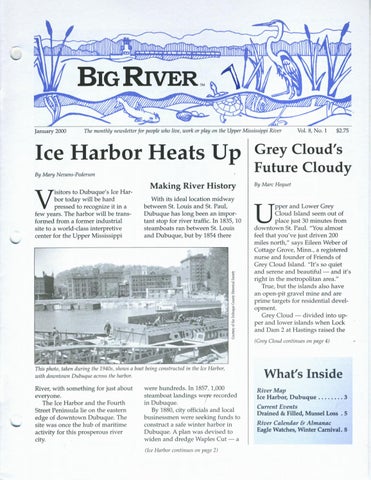
This photo, taken during the 1940s, shows a boat being constructed in the Ice Harbor, with downtown Dubuque across the harbor.
River, with som ething for just about everyon e. The Ice Harbor an d the Fourth Street Peninsula lie on the eastern ed ge of d owntown Dubuque. The site was once the hub of maritime activity for this prosperous river city.
were hundreds. In 1857, 1,000 steamboat landings were recorded in Dubuque. By 1880, city officials and local businessmen were seeking funds to construct a safe winter harbor in Dubuque. A plan was devised to widen and dredge Waples Cut - a (Ice Harbor continues on page 2)
What's Inside River Map Ice Harbor, Dubuque .. . . .. . . 3 Current Events Drained & Filled, Mussel Loss . 5 River Calendar & Almanac Eagle Watches, Winter Carnival. 8
.,
(Ice Harbor continued from page 1)
shallow ship canal formed in 1852 - to make a harbor large enough for 50 barges and 20 steamboats. Congress footed the bill and the Ice Harbor was completed in 1885. It was the only protected harbor between St. Louis and St. Paul. The popular harbor soon became one of the premier boat building sites along the river. Boat building had flourished in Dubuque before then. Iowa Iron Works, founded in 1851, created the Clyde, the first iron-hulled steamboat built for the Upper Mississippi; built an iron yacht for the King of Siam and manufactured the Queen, a popular excursion boat which floated on Iowa's Lake Okoboji until the 1960s. The company relocated to the Ice Harbor in 1895 and continued to produce a plethora of boats: the Sprague, the largest sternwheel towboat in the history of the Mississippi; giant raftboats to push rafts of logs to sawmills; railroad ferries; and torpedo boats for the SpanishAmerican War. In 1904, the company re-formed into the Dubuque Boat and Boiler Works and continued to manufacture tows, barges, dredges, submarines chasers, mine layers and Coast Guard cutters in the Ice Harbor. In 1944, Congress approved money to deepen the harbor to accommodate newer, larger boats. After World War II, production shifted to pleasure crafts and excursion boats, but declining business forced the company to close in 1972. To protect flatlands nearby, huge flood gates were constructed in 1973 at the mouth of the harbor. These are closed when the river level reaches 16 feet.
Links to the Past The largest boat to pass through the gates was the William M. Black, which is now a permanent resident. It was one of the last great steampowered sidewheelers used for dredging on the Mississippi. Dubuque was awarded the boat after its retirement in 1979 to use as a
2
New projects on and near the Ice Harbor along with older attractions, such as the Shot Tower and Council Ring, are expected to draw many visitors to the river.
museum. In order to squeeze the mammoth mrft through the 75-foot flood gate, the starboard paddlewheel and 15 feet of deck were removed. Today, a number of attractions bring visitors to the Ice Harbor. The Mississippi River Museum includes the Woodward Riverboat Museum, the National Rivers Hall of Fame, the award-winning short film, River of Dreams, an historical exhibit about Dubuque and two gift shops. The Diamond Jo gambling casino anchors a large complex on the north side of the harbor and the Spirit of Dubuque offers sightseeing and dinner cruises. The remainder of the harbor remains starkly industrial. A Coast Guard station and rusted hulls of large boats rest along the south side while the rest of the harbor is lined with riprap and unkept vegetation.
Big River
However, standing on the harbor walls, one can easily see why there is so much interest in the site. The harbor is framed by the graceful Julien Dubuque Bridge, Illinois' massive limestone cliffs above the Mississippi and the mansiontopped hills of Dubuque.
Big Plans The $27 million project, named "America's River," is a public and private-partnership between the Dubuque County Historical Society, the Dubuque Area Chamber of Commerce and the City of Dubuque, with scores of other federal, state and local agencies and organizations involved. These are the major components of the complex: • Mississippi River Discovery Center: four major river aquariums featuring fish and wildlife native to
January 2000
the Upper Mississippi River (including fish, otters, turtles, ducks and plant life); 10 smaller aquariums; interactive stream tables; a 19th-century boat shop; a riverboat museum; the National Rivers Hall of Fame; the William M. Black steamboat (where students can stay overnight in the staterooms); and the Discovery Wetland (see sidebar). The U.S. Fish and Wildlife Service recently agreed to a partnership with the Mississippi River Museum to create and maintain the center. • River's Edge Plaza, a 5,000square-foot landscaped plaza and pavilion on both sides of the north flood wall that links the Ice Harbor and the Mississippi. Curving steps will cascade down to the river's edge, where the Delta Queen and the Mississippi Queen excursion boats tie up. • Star Brewery Amphitheater, a public amphitheater with seating for 1,000 and a 7,500-square-foot plaza on the levee at an historic brewery. • Mississippi Riverwalk, a 2,000foot riverfront promenade atop the flood wall, along the edge of the
Fourth Street Peninsula between the River's Edge Plaza and the amphitheater, with decorative paving, historic lighting, overlook stops and landscaping. • Harborwalk and Boat Dock, a 500-foot walkway across the Ice Harbor from the Iowa Welcome Center to the U.S. Coast Guard station, past the William M. Black. It will include transient boat docks. • Heritage Trail Riverfront System, an 18-mile extension of the popular Heritage Trail between Dubuque and Dyersville that will link the Ice Harbor to the original trail and perhaps eventually to the Mines of Spain State Recreation Area. The River's Edge Plaza construction began on October 30. This first phase should be completed next year. The entire complex is scheduled to be completed in 2002.
A Big Partnership Funding for the $27 million complex is coming from a wide spectrum of public and private sources. Local utility companies pl~ged · hundreds of thousands of dollars, and the Muscatine, Iowa-based Roy
J. Carver Charitable Trust gave half a million for a hands-on laboratory where kids can test river samples for nitrates, touch live mussels and
The company relocated to the Ice Harbor in 1895 and continued to produce a plethora of boats: the · Sprague, the largest sternwheel towboat in the history of the Mississippi; giant raftboats to push rafts of logs to sawmills; railroad ferries; and torpedo boats for the Spanish-American War. study microscopic river life. The City of Dubuque pledged nearly $2.5 million. The Iowa Department of Economic Development's new Community Attraction and Tourism Devel(Ice Harbor continues on page 5)
Building a New Wetland The new, one-acre wetland to be installed in Dubuque's Ice Harbor will pack a lot into a small space. Applied Ecological Services, Inc. of Broadhead, Wis., is designing the site. They will recreate a typical Mississippi slough, according to John Larson, senior ecologist with the firm.
The wetland community will consist of several terraces in a bowl-like configuration with a 10-foot elevation change. Since the water quality in the harbor is poor (due to a large casino boat and several excursion boats docked there), the wetland will not be connected directly to the harbor. The water level of two to three feet can be raised or lowered as needed. Lowland hardwood forest plant communities will be installed (including sunning logs for turtles and duck nests) and whatever wildlife is attracted to it will be allowed to stay. • The lowest terrace will feature water lilies, wild rice, arrowhead and trees such as silver maples, river birch and elderberry with understory plants like wild iris, red-stemmed
January 2000
dogwood and pickerel weed. • In the next level, such plants as New England asters, blazing stars, and marsh milkweed will be planted. • The highest terrace, representing land that would not naturally flood as often, will contain spring flowering wil9flowers, such as columbine, Jack-in-the-pulpit, wild ginger, wild geranium and late flowering goldenrod. Trees will include hackberry, basswood and swamp white oak. Applied Ecological Services designs about 100 wetland or prairie communities each year and installs about half of those. At the International Crane Foundation center in Baraboo, Wis., the firm created interpretive wetlands with an amphitheater. Currently, the company is working on many wetland mitigation banking projects, in which land developers must replace wetlands they have destroyed with new wetlands. In addition, the firm is helping to restore a 7,000-acre site near Gary, Indiana, for the Nature Conservancy. m
Big River
3
(Grey Cloud continued from page 1)
level of the Mississippi River six feet in 1929 - is at the crux of a four-way development fight among residents, park advocates, miners and developers. Apart from mining and scattered homes, the islands remain in a woody, watery condition pleasing to nature lovers. Grey Cloud, a three-mile-long wedge athwart the Mississippi just southeast of St. Paul, is one of the largest islands on the river. It's the land mass you see from Scharr's Bluff upstream from Hastings, Minn., on the west bank, where towboats struggle through a tight Scurve between the islands fringing Baldwin Lake to the north and Spring Lake to the south. Washington County and the Metropolitan Council, a regional-government authority, plan to create a 1,440-acre park on the lower island after Camas, a mining company, excavates sand and gravel, then reclaims the mined areas, leaving behind a string of artificial lakes not pristine, but acceptable to park backers. A park would mean access to the river in a wild area close to the city. "This is the best access point to the river in the whole metropolitan area," says park advocate Weber, "and we could lose that if it's sold for private use." The Cottage Grove (Minn.) City Council approved a comprehensive development plan on December 1 that pleases park backers. When Camas recently acquired another 140 acres at the east tip of the lower island near where it proposes to conduct backwater mining, opponents of residential development breathed a sigh of relief. That area is zoned rural residential, says former Cottage Grove council member Rod Hale, a lower-island resident, and "it could have been developed overnight." On the lower island, a park may make a better neighbor for a sand and gravel mine, because of the noise, dust and traffic. Nevertheless, miners and residents meet reg-
4
ularly and cooperate. When Camas proposed to take down a tangled 13-acre stand of virgin wood, the largest remaining stand on the island, residents asked that the trees be removed slowly, to give them time to re-seed. Camas relented. Despite the lower island's rustic beauty, nature lovers must take care where they gaze. The open-pit mine on the lower island is only thinly screened by a line of evergreens. For all the lower island's wild appearance, Camas controls more
Developing Grey Cloud for residential sites nevertheless remains a tempting prospect. than half its 2,000 acres. Nature has paid a price: Once thickly wooded, the island has lost many of its trees to the sand and gravel mining.
Island Suburbs Developing Grey Cloud for residential sites nevertheless remains a tempting prospect. Cottage Grove attorney R. Gi,rdon Nesvig has 600 acres on the upper island on which he wants to build 1,000 homt;s, Nesvig's plan doesn't conflict with the proposed park on the lower island - but it riles residents of Grey Cloud Township, which includes the upper island. Regional planners, Nesvig notes, predict the Twin Cities will need 350,000 new homes by 2020. The prime development targets are tracts adjacent to areas already served by municipal sewer and water lines. Grey Cloud Island is such a place. The upper island nestles between suburbs St. Paul Park and Cottage Grove. The lower island is already part of Cottage Grove. Both St. Paul Park and Cottage Grove have passed resolutions in favor of Nesvig's development plan for the upper island. Grey Cloud Town-
Big River
ship, which includes the upper island, formally opposes it. Upper island residents who oppose development argue that, on an island, linking with the municipal sewage system in adjacent Cottage Grove won't be easy. Moreover, taking a 600-acre slice out of the township could reduce its tax base beyond where it can afford to function as a government entity. On the other hand, if the township stands firm against development, the state may simply order annexation. Upper island residents "have a vested interest in looking at things more realistically," says attorney Nesvig. "Up to now they they've been running on emotions."
~
Dunes and History Grey Cloud Island offers a lot to be emotional about: The islands are replete with natural beauty woods and winding roads, marshes and bluffs. On the upper island, Richard Mullen, the 76-year-old township clerk, has found pottery shards the local archaeologist has dated to 2,000 years ago. The islands' varied vegetation attracted Indian healers. The tree circus includes interlopers such as beech and ironwood. The variety resulted from the island's straddling the Mississippi migratory bird flyway. Passing fowl passed scads of seeds as they headed elsewhere. The island was named after a Dakota Indian woman. Two hundred Indian mounds marked the remains of early inhabitants. Later residents lie in a cemetery on the upper island where most of the graves are unmarked. "We're very careful," says Mullen, "where we dig a new grave." The islands' mineral resources attracted lime processors as well. A 35-foot high lime kiln with fourfoot-thick walls dating at least to the Civil War still stands on the shore across the channel from the upper island. Its last batch of processed lime still lies abandoned
January 2000
,
j )
(Ice Harbor continued from page 3)
l
1 1
in its belly. Grey Cloud Dunes Scientific and Natural Area sprawls along the east bank of the Mississippi, overlooking Grey Cloud Channel, away from the development fight. The 237-acre protected area is the largest intact prairie system in the
Grey Cloud Dunes Scientific and Natural Area sprawls along the east bank of the Mississippi, overlooking Grey Cloud Channel, away from the development fight. Twin Cities area. Elm, silver maple, cottonwood and box elder proliferate around a wetland and a half mile of river bank. Species that flourish in the dry, sandy setting include little bluestem, penstemon, prairie dropseed, sand reed grass, gramma grass and silky prairie clover. A Department of Natural Resources (DNR) Web site suggests looking for rare sea-beach needlegrass nestle in the blowouts, purple sand grass on bare sand areas, Illinois tick trefoil, long-bearded hawkweed, Louisiana broomrape and Hill's thistles. In winter, stroll, ski or snowshoe from the parking lot at Hadley and 103rd Street South to the crest of the hill. There, says Bob Djupstrom, supervisor with the DNR's state natural areas program, you will begin to perceive the extent of Glacial River Warren ¡at full flood. Warren is the extinct stream that drained glacial runoff 10,000 years ago. Below Djupstrom's suggested vantage, the land falls away in natural terraces that the great river left behind as the water receded. To protect the delicate sand prairie, no vehicles are permitted and no ski trails are groomed. But
January 2000
Djupstrom says occasional skiers won't harm the area. He suggests skiing or snowshoeing the threequarters of a mile to the crest of the bluff for your own version of Djupstrom' s Winter Dunes Moment: At the top of the bluff, overlooking the natural terraces in the protected dunes area, 10 below, no wind, full moon and snow cover. To get there, take U.S. 61 to Cottage Grove, then Jamaica west, toward the Mississippi. Turn right on 100th Street South and then left on Hadley. Stop at the sharp right turn about 100 yards in. Turn left into the parking area to hike in to the protected dunes area. Or follow the right to the view from the bridge to the lower island and public access open in the summer. In autumn, the stand of maples to the northwest is superb. Marc Hequet is a writer who lives in St. Paul. His last article for Big River was "Bicycling the Urban River," October 1999.
Big River™ Big River (ISSN 1070-8340) is published monthly by Riverwise, Inc ., 111 Riverfront, Suite 204, Winona, MN 55987; (507) 454-5949; fax: (507) 454-2133; email: editors@bigriver.com; web site: http://www.big-river.com Reggie McLeod editor/publisher Molly McGuire assistant editor Mi Ae Lipe-Butterbrodt associate editor Kathy Delano design/marketing Mary Feathergill office manager Subscriptions are $28 for one year, $50 for two years or $2.75 per single issue. Send subscrip-
opment program earmarked $4 million in August for the America's River complex. The recently approved federal budget includes $3.1 million for the project. If it includes another $2 million next year, the state will match with another $1 million. The McKnight foundation; the Dubuque Racing and Gaming Association and the Diamond Jo Casino are also helping to fund the project. In addition, several agencies are providing in-kind support for the project. The U.S. Coast Guard is offering guidance about Ice Harbor improvements; the Iowa Department of Transportation has provided funding for design, engineering and construction specifications for various aspects; the Army Corps of Engineers has been involved in much of the design work; and the Dubuque Museum of Art (with a grant from the Iowa Department of Cultural Affairs) will install a giant mural facing the river on the massive floodwall at the River's Edge Plaza. "Fundraising will probably continue into 2001, both regionally and nationally. We hope that all those up and down the length of the river who treasure it as we do will have an opportunity to support this project," said Jerry Enzler, director of the Mississippi River Museum. Mary Nevans-Pederson is a reporter for the Dubuque Telegraph Herald. This is her first story for Big River.
tions, single copy orders and change-ofaddress requests to Big River, PO Box 204, Winona, MN 55987. Second-class postage paid at Winona, MN.
POSTMASTER: send change-of-address requests to Big River, PO Box 204, Winona, MN 55987. Big River, Volume 8, Number 1, copyright January 2000. Reproduction in whole or in part without written pennission of the publisher is prohibited. Printed on recycled paper.
Big River
5
By Mi Ae Lipe-Butterbrodt
Peregrines Proliferate Dubuque, Iowa - Most of the peregrine falcons from the largest single release ever in the United States have survived, according to the Dubuque Audubon Society newsletter (Pileated Drummings, November 1999). Of the 20 juveniles and one rehabilitated adult bird released in Dubuque last summer, at least three have died and five are missing. One of those five may have been spotted late this past fall. Researchers were concerned about the youngsters' welfare, as they had no adults to teach them how to fly and hunt. Some of the older birds, however, have acted as role models and helped train the younger birds. The Upper Mississippi River used to be home to native populations of peregrines until the pesticide DDT killed most of the birds by the late 1950s. Local releases, such as the one in Dubuque, are restoring these magnificent raptors, among the fastest in the bird kingdom, to the rocky cliffs and open skies along the Mississippi.
Drained & Filled Wisconsin, Minnesota and Louisiana - Five environmental groups went to court on October 29 to fight for Wisconsin wetlands threatened by special exemptions that bypass the usual environmental regulatory process. One of the areas is a 14-acre wetland owned by Ashley Furniture Industries, next to the Trempealeau River near the city of Arcadia, Wis. Normally before anyone can fill a wetland they must file an application with the Department of Natural Resources (DNR), which reviews
6
the request. Ashley never formally made such a request, but instead got the go-ahead from a special exemption in the Wisconsin budget, signed on October 27. The Wisconsin Wetlands Association, Sierra Club-John Muir Chapter, the River Alliance of Wisconsin, 1000 Friends of Wisconsin and Wisconsin's Environmental Decade contend that this exemption is a "private bill" that cannot be legally included in a state budget bill, according to Article 4, Section 18 of the Wisconsin Constitution. The suit seeks to eliminate these special exemptions and also asks for a temporary injunction to prevent Ashley from filling the wetlands while the lawsuit is pending. The Wisconsin DNR says the proposed Ashley fill site contains "high-quality wetlands" and that the agency would likely not issue a permit had Ashley formally sought one. According to Caryl Terrell of the John Mtiir Chapter of the Sierra Club, "These unconstitutional provisions put people's lives and property at risk. We know that the loss of seven to eight acres of wetlands represents 8 million gallons of flood storage, or eight acres covered with one foot of water. The loss of the wetland acres at the Ashley site will exacerbate flooding downstream on the Trempealeau River and contribute to the cumulative impact of flooding on the Mississippi River" (Sierra [Coulee Region Group], November 1999). • Stiff fines and penalties may await a Rochester, Minn., soil and gravel company that drained a wetland and altered a creek. The Environmental Protection Agency (EPA) ordered Rochester Topsoil, Inc., to restore 1.8 acres of wetland and 1,000 feet of Willow
Big River
Creek it altered in violation of the Clean Water Act and the Wetlands Conservation Act. According to the EPA order, Rochester Topsoil owner Bryce Prow, along with Don Prow, used a backhoe in December 1998 to fill in a wetland with 7,568 yards of dredge spoil. Rochester Topsoil may also face state penalties in addition to the EPA penalties. Violation of the EPA order to restore the wetland and creek banks could add up to $11,000 per day to a maximum of $137,500. The waters of Willow Creek eventually flow into the Zumbro River, which joins the Mississippi River at Kellogg. • Finally, a developer in New Orleans who illegally filled in and built up 45 acres of wooded wetlands was fined $620,000 and ordered to donate a conservation easement for over 373 acres of wetlands. The defendants, Rathbone Land Company, Inc., and Willowridge Estates L.L.C., both of Harvey, La., agreed to these key terms in a proposed consent agreement announced by the U.S. Army Corps of Engineers, EPA and U.S. Department of Justice. "Pave the bayou is what these companies literally did. They built streets and developed a subdivision in a swamp of bottomland hardwoods, such as oak, and also including some bald cypress," said Col. Thomas Julich, commander of the Corps' New Orleans District (The Waterways Journal, November 22, 1999). Over 200 lots are 80 percent complete in the Willowridge Estates subdivision, with streets and utilities 100 percent finished. The site is near the town of Boutte in western St. Charles Parish, a New Orleans
January 2000
.
,,
suburb. The unauthorized activities were discovered during November 1998 field inspections of emergency levees during the hurricane season.
Swan Switch .,,.
.,;,~
Avid birdwatchers have long considered Rieck's Lake, in Alma, Wis., a prime spot to view migrating tundra swans (see "Watching the Swans," Big River, December 1999), but this year large numbers of swans also rested in an area near La Crosse, Wis. During an aerial waterfowl survey on November 15, nearly 5,500 swans were counted on the Minnesota side of the Mississippi River along Highway 26, just south of Brownsville, Minn., according to Bill Thrune, refuge operations specialist of the Upper Mississippi River National Wildlife and Fish Refuge, La Crosse District. Over 8,000 swans were counted in this stretch on a November 8 flight. A viewing platform right off the highway was a popular spot to watch the swans. Swan travel on the Mississippi is increasing. Over 22,000 birds rested and fed on the refuge during the peak of migrations in late November of 1998, compared to 12,000 to 16,000 in the past. Most of these birds stopped on the stretch of river between Alma and Lynxville, Wis., on their way from their nesting grounds in the Arctic tundra to their wintering grounds in Chesapeake Bay and other East Coast estuaries.
Parking Lot Tax
•
Davenport, Iowa - The owner of the President Riverboat Casino is suing the city of Davenport over real estate tax bills and assessments on parking lots that it leases from the city. The Connelly Group, L.P. (TCG) wants to void the bills, contending that the descriptions of the property were imprecise and that TCG was not given a chance to dispute the assessments. The lawsuit states that
January 2000
TCG learned of the 1998 tax bills, which total $145,824, and the assessments on September 24, 1999, with the first payments due September 30 (River Cities' Reader, December 1-7, 1999). City officials believe that since TCG leases the parking lots for visitors to the President Riverboat Casino and they are not open to the public, they are taxable private property.
Parked Barges Washington County, Minn. - Two marine services have applied for permits to place barges on the St. Croix River. Wolf Marine, Inc., wants to put a barge measuring 120 feet long and 10 feet wide in the St. Croix from December to April near the marina
Over 22,000 birds rested and fed on the refuge during the peak of migrations in late November of 1998, compared to 12,000 to 16,000 in the past. by Browns Creek. The barge would deflect ice flows away from the marina, which has suffered winter ice damage since the mid-1980s. Two spud poles, one at the bow and one at the stern, would anchor this barge, which would be moved to dry dock for the rest of the year. Max Toda Marine Services, Inc., applied for a permit to place a 54foot by 34-foot barge along the shoreline about a mile south of the Stillwater Bridge. Secured by spud poles, the barge would remain yearround to moor a tugboat and provide local harbor service.
Mussel Loss Prairie du Chien, Wis. - Zebra mussels are quickly killing off na-
Big River
tive mussels in an area that has been called the mother lode of mussel beds in the Upper Mississippi River. According to Ruth Nissen of the Wisconsin Department of Natural Resources, as many as 30 different mussel species have been counted in this site, located in the East Channel near Prairie du Chien . Even as of 1996, 27 species still made this bed home. But the exotic zebra mussels have reduced this number to seven, according to a 1999 survey by the Army Corps of Engineers. This bed, which extended bank to bank for about 3.5 miles, was the best-known habitat for the endangered Higgin's eye pearly mussel. At one time native mussels were so plentiful that, in some spots, the river bottom was covered with two to three feet of their accumulated shells. Native mussels have tremendous commercial value in Japan, where plugs cut from the shells serve as foundations for cultured pearls. Native mussels are sensitive barometers of the river's health, filtering and cleaning water and providing food for fish and other wildlife. But scientists fear that invasive zebra mussels are sounding the death knell for many native species, especially rare ones whose reproductive cycles are no match for the proliferous zebra.
Still Low The Upper Mississippi continues to be low in many spots. Less than an inch of rain fell at Lock and Dam 4, at Alma, Wis., in November, compared to the normal 1.86 inches, and no rain had fallen there as of mid-December. Below Lock and Dam 10, at Guttenberg, Iowa, which received 2.31 inches of rain in November, water levels are higher, according to the Army Corps of Engineers' St. Paul District. Below St. Louis, some stretches are seeing the lowest water in decades.
7
Special Events & Festivals January 15-16 River Winterland Celebration, Red Wing, Minn., (651) 385-5934. 19-23 Boat Show, Minneapolis Convention Center, Minneapolis, Minn., (612) 827-5833. 19-23 Sportsmens's Boat, Camping & Vacation Show, RiverCenter, St. Paul, Minn., (651) 224-9627, (651) 265-4800. 28 - Feb. 6 Winter Carnival, St. Paul, Minn., 1-800-488-4023.
February 5-6 Winter Carnival, Winona, Minn., (507) 452-3441.
13 Lower Wis. Riverway Board, 5 p.m., Kratochwill Memorial Building, Muscoda, Wis., 800-221-3792, (608) 7393188.
February 10 Lower Wisconsin Riverway Board, 5 p.m., Kratochwil! Memorial Building, Muscoda, Wis., 800-221-3792, (608) 739-3188.
Workshops & Conferences February. 24-26 State of the Rivers, Rivers Council of Minnesota, Hamline University, St. Paul, Minn., public invited.
=
Corrections In the December 1999 Big River story, "Watching the Swans," we didn't give credit to Blanche Schneider, who assisted Harry and Katie Buck in starting the Swan Watch. Schneider has served as a volunteer since the watch's inception. The Swan Watch donated $500, not $5,000, to the Upper Mississippi River Tundra Swan Study. -
6 Pepin Lion's Club Fishing Contest, Pepin, Wis., (715) 442-3011. 11-13 International Eelpout Festival, Walker, Minn., 1-800-833-1118.
Eagle Watches & Programs Through March, Wabasha, Minn., city deck staffed Saturdays and Sundays, 1 p.m. - 3 p.m., (612) 565-4989, (651) 2901695.
January 2 Mississippi Valley Welcome Center, 1, 2, & 3 p.m., Le Claire, Iowa, (319) 2893009. 2 Lock & Dam 13 near Alton and at Albany, Ill., 8 a.m. - 4 p.m., (815) 2593628. 2 Albany, Ill., Boat Landing, 8 a.m. noon, (815) 259-3628. 2 Clinton Community College, Clinton, Iowa, 9 a.m. - 3:30 p.m., (815) 2593628. Jan 8 Cassville, Wis., (608) 725-5800. 8 Lock & Dam 11 and Marshall School, Dubuque, Iowa, 1-800-798-8844. 8-9 Expo Center, Rock Island, Ill., (309) 788-5912.
Meetings & Hearings January 6 Lower Chippewa River State Natural Area informational hearing, 2 - 4 p.m. and 5 - 7 p.m., Pepin County Government Center, Durand, Wis., (608) 6856222.
8
Almanac By Kenny Salwey Sometimes, at a summertime cookout someone mentions the word "January," and a great chill envelopes me from head to toe. January has brought me my fair share of hardships, like chopping through two feet of solid ice from dawn 'til dusk on a trapline, only to find a weak spot and take an unexpected bath on the way back to camp. Our wintry big river country teems with wild things. The neighborhood's "backyard soup kitchens" are filled with juncos, goldfinches, chickadees and nuthatches. Cottontail rabbits clean up the spoils on the ground. You might even see a Cooper's hawk try to make lunch out of a songbird at your feeder. Pine, gray and fox squirrels are fun to watch. Our neighbor saw a bald eagle nab a gray squirrel. But when the eagle flew up, the squirrel fell from its grasp and escaped. Later, we saw that squirrel sporting large scars on its back, so we named it "Lucky". If you locate a "black hole," an open spot in the ice caused by springs or current, you've found a great place for watching ducks, geese and occasionally a great blue heron. River otter, mink, muskrat - and on warm days, coon and possum all make good use of these "food pantries." Beaver begin mating in late January so you might see them as well. This is one of the finest months of the year for watchable wildlife. So next time I hear the word January, I won't shiver quite as much. -
Big River
January 2000
j