November 1999
The monthly newsletter for people who live, work or play on the Upper Mississippi River
The Gobies are Cotning By Mi Ae Lipe-Butterbrodt
W
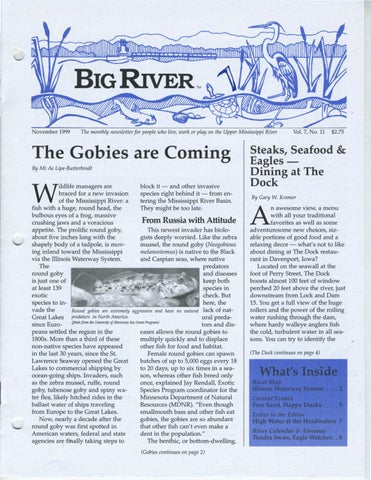
ildlife managers are block it - and other invasive species right behind it - from enbraced for a new invasion of the Mississippi River: a tering the Mississippi River Basin. fish with a huge, round head, the They might be too late. bulbous eyes of a frog, massive From Russia with Attitude crushing jaws and a voracious appetite. The prolific round goby, This newest invader has biologists deeply worried. Like the zebra about five inches long with the shapely body of a tadpole, is movmussel, the round goby (Neogobious ing inland toward the Mississippi melanostomus) is native to the Black via the Illinois Waterway System. and Caspian seas, where native The predators round goby and diseases keep both is just one of at least 139 species in exotic check. But species to inhere, the vade the Round gobies are extremely aggressive and have no natural lack of natGreat Lakes predators in North America. ural preda(photo from /he University of A/i1111esola Sea Gran/ Program) since Eurotors and diseases allows the round gobies to peans settled the region in the 1800s. More than a third of these multiply quickly and to displace non-native species have appeared other fish for food and habitat. in the last 30 years, since the St. Female round gobies can spawn Lawrence Seaway opened the Great batches of up to 5,000 eggs every 18 Lakes to commercial shipping by to 20 days, up to six times in a seaocean-going ships. Invaders, such son, whereas other fish breed only as the zebra mussel, ruffe, round once, explained Jay Rendall, Exotic Species Program coordinator for the goby, tubenose goby and spiny water flea, likely hitched rides in the Minnesota Department of Natural Resources (MDNR). "Even though ballast water of ships traveling from Europe to the Great Lakes. smallmouth bass and other fish eat Now, nearly a decade after the gobies, the gobies are so abundant that other fish can't even make a round goby was first spotted in American waters, federal and state dent in the population." The benthic, or bottom-dwelling, agencies are finally taking steps to (Gobies continues on page 2)
Vol. 7, No. 11
$2.75
Steaks, Seafood & EaglesDining at The Dock By Gary W. Kramer
A
n awesome view, a menu with all your traditional favorites as well as some adventuresome new choices, sizable portions of good food and a relaxing decor - what's not to like ¡ about dining at The Dock restaurant in Davenport, Iowa? Located on the seawall at the foot of Perry Street, The Dock boosts almost 100 feet of window perched 20 feet above the river, just downstream from Lock and Dam 15. You get a full view of the huge rollers and the power of the roiling water rushing through the dam, where hardy walleye anglers fish the cold, turbulent water in all seasons. You can try to identify the ,, (The Dock continues on page 4)
(Gobies continued from page 1)
populations in Michigan's St. Clair made up of interconnecting canals round gobies are extremely aggresand natural rivers in the Chicago sive and territorial. They can surRiver, and other species that may be area, has long served as a convevive in poor-quality water and feed vulnerable include the logperch and nient passageway for both commerin total darkness, giving them an lake sturgeon. Biologists fear that cial shipping and exotic species, inedge over native fish. They grow round gobies may eventually threaten endangered darters and cluding zebra mussels, traveling four to 10 inches long, are grey with from the Great Lakes to black and brown blotches the Mississippi River. over their bodies and have Initially Chicago's wadorsal fins that may be ters flowed into Lake tinged with green. The Michigan, until a lethal front dorsal fin has a disdisease outbreak in the tinctive large round black Windy City in the late spot. Round gobies look 1880s was traced to very similar to native sewage contaminating sculpin, but gobies have a { Chicago's drinking wafused pelvic, or bottom, to ter supply from the fin, whereas sculpins sport ]- lake. The canal system, two separate pelvic fins. ca built early this century, In the Great Lakes and reversed the flows of Chicago waterways, where the Des Plaines and gobies have been quickly Calumet Rivers spreading in the 1990s, washing pollution and these fish have already unwanted flora and changed the angling scene. fauna down the Illinois "Kids are now catching to the Mississippi River. gobies where they used to The canals of the Illinois Waterway System connect Lake Michigan with the Illinois River. catch lake perch," said Biologists hope to other benthic fish in the Mississippi stop or slow the gobies' spread with Rendall. "It's hard to catch anything an electrical barrier in the Chicago else in some places because they're River. Gobies may also pass along large levels of concentrated contamSanitary and Ship Canal. so aggressive. Once, in fishing tests This spring, participants in the inants from zebra mussels to the to obtain specimens for toxicology Fourth Annual Goby Roundup disstudies, 850 gobies were caught in a game fish that eat them. covered gobies in the Cal-Sag Chanfour-hour period along a 50-foot In some parts of the world, peonel, about 30 miles from Lake stretch of Chicago shoreline. Based ple also consiaer gobies as a delicaMichigan. "Between June 1998 and cy. Goby risotto is a springtime treat is in Venice. Round gobies are comJune 1999, the gobies traveled about 15 miles further inland," said mercially harvested and eaten in Female round gobies can Pamela Thiel, a U.S. Fish and their native Russia and Bulgaria, Wildlife Service (FWS) biologist but pollution is taking a drastic toll spawn batches of up to who directed the roundup. "At this on European populations. 5,000 eggs every 18 to 20 point they are about seven miles In an experiment, the staff at the from the site of the proposed elecIllinois Natural History Survey predays, up to six times in a trical barrier." pared gobies several different ways season, whereas other fish The barrier will consist of a grid and said they tasted like smelt. of wires recessed at intervals along breed only once Colonizing the Lakes the canal's bottom and sides. The wires create an electrical field that Since they were first spotted in intensifies over a 50-foot area. The on what's happened in Lake Michithe St. Clair River (which connects electrical barrier, which was chosen Lake Huron to Lake St. Clair) in gan and Duluth, gobies are now the over other possible strategies, is predominant angling fish onshore 1990, round gobies have quickly scheduled for completion downand near the shore." spread through the Great Lakes. stream of Romeoville in the ChicaGobies can consume up to 80 zeThey were found in the Calumet go Sanitary and Ship Canal portion bra mussels a day, but also feed on River in southern Lake Michigan in of the waterway by next summer. insect larvae and the eggs and 1993 and sighted in the Duluth-SuSome researchers are skeptical. young of native fish. The round goperior Harbor area in 1995. "By the time the barrier is put into The Illinois Waterway System, by has already hurt mottled sculp
2
Big River
November 1999
~
,...
J
.
place, it will probably be too late "The Reclamation District is opsimilar to the spiny water flea . the gobies will be in the Mississippi posed to treating and aerating their Political Can of Worms by then," said Rendall. "And that's waters to control the spread of too bad, because we started talking these invasive species. When we The potential problems created years ago about the urgent need for by the goby infiltrating the Missisbring up long-term solutions, they a permanent barrier, but nobody sippi River basin are so serious that get very defensive - they say did anything, because the gobies 'Don't even mention the Water Apsome federal and state agencies and weren't moving very fast at the conservation groups are pushing propriations Act or shutting down time." for short-term measures before the our canal waters from the MissisHe also quessippi, or even touch on those istioned the barrier's sues.'" /low to /dent(/)' a Round Goby 1.1,1u1t ,1]l,,1111 effectiveness, statDifficult for Rendall, too, is the ing that they repel ~ lack of participation by the entities Frog• like raised eyes and kill fish upf that would be most affected by an stream better than " invasion of round gobies and other ~ downstream. ~ exotics - the Mississippi River Thiel says the 1:; Basin states. "Many state and reelectrical methods gional groups are not getting suffiPro;ect {)/the Crt'al lakel Grant Ner,,. orl< and are 90 to 95 percent Sea 'o> cient say in what's at stake here, or U.S. Fish and Wifdli/t: Servia successful at ret are even getting informed of the depelling gobies in cisions going on pertaining to the laboratory tests, _[ Illinois waterways." and believes the In addition to his position at the barrier should go in MDNR, Rendall also chairs the anyway. "The best Aquatic Nuisance Species Committhing we can do is slow them tee for MICRA, the Mississippi Inbarrier is built next year. Among down, because we've never been terstate Cooperative Resource Assothe possibilities, the use of baylisuccessful in containing an exotic ciation, a conservation group based cide, a fish poison, seemed the most species once it's here," she admitlikely. in Bettendorf, Iowa. ted. "Even if some gobies are al"The latest word I've heard was It's too soon to say what will ready downstream, the barrier will that the Environmental Protection happen if - and when - the still slow down the mass that's Agency (EPA) has decided against round gobies enter the Mississippi. headed this way." Rendall isn't sure how much they using baylicide because it is not registered for that use, and the EPA will threaten game fish, such as The barrier was initially prowalleyes, but he is certain they'll afposed not because of the goby, but cannot approve anything that soon to control ruffe and other invaders fect native fish and anglers on the anyway," said Rendall. "Also, there Mississippi River. Between the are logistic problems in using this chemical because it belongs to the Great Lakes and Mississippi River "The best thing we can do Great Lakes Fishery Commission, basins, gobies may eventually infiltrate over 30 states. Already in and they're unwilling to give up is slow them down, their supplies or commit staffing some rocky areas of Calumet Harbecause we've never been support." bor, there are over 20 gobies in an Rendall, frustrated by political isarea the size of a bathtub. successful in containing an sues stalling progress, is searching Although scientists believe that exotic species once it's for other methods to control the gothese ecosystems will eventually by' s spread before it's too late. develop natural mechanisms to here," warned Pam Thiel, a "One idea is to use the Clean moderate destructive exotics, such U.S. Fish and Wildlife Water Act, since waterways are a as gobies and zebra mussels, in the point source and a candidate for bimeantime these critters may do irService biologist. ological treatment," he said, but he reversible damage to native flora notes the Metropolitan Water Reclaand fauna.~ yet to come. But Rendall believes mation District of Greater Chicago, Mi Ae Lipe-Butterbrodt is associate editor the barrier won't have any effect the entity controlling Chicago' s waof Big River. terways, has been very uncooperaagainst the latest threat recently found in the Great Lakes, the pretive, especially toward the other datory fishhook water flea, which is Mississippi River Basin states.
l j
...
November 1999
Big River
3
(The Dock continued from page 1)
tows coming out of the lock across the river as they slide by a wooded area on the south tip of Arsenal Island. This wooded area provides some of the best bald eagle roosting in the Quad Cities in the winter, because it's so close to their feeding area below the dam. The Dock even supplies binoculars so you can watch eagles from your table. Sunday brunch (from 10 a.m. to 2 p.m.) provides prime viewing from December to March. Priced at $12.95, the brunch is one of the largest and most popular in the area. The restaurant occupies the first floor of the American Legion building, which hosts bingo upstairs on
This wooded area provides some of the best bald eagle roosting in the Quad Cities in the winter, because it's so close to their feeding area below the dam.
Wednesday night. The building was completely flooded in 1965. Later some college students turned the lower level into what became a very popular club. It was eventually replaced by a restaurant, then another named The Dock. The Rusty Pelican took over for a while, then in 1993, a new owner re-established the restaurant as The Dock. The tasteful, comfortable interior is finished with solid, stained cedar walls and ceiling. Bamboo chairs add to the warm, relaxing atmosphere. The expanse of glass from table to ceiling dominates the main dining room and separate smoking area, offering an excellent view from almost anywhere in the room. You can make reservations, but window seating is first come, first
4
served. That's why some folks sit for a spell in the cocktail lounge, The Crow's Nest, to wait for a riverside table. The Dock opens for dinners and Sunday brunch. Steaks and seafood are its specialty, but it also features chicken, steak-seafood combos, and of course, Iowa pork. Hors d'oeuvres range from $5.95 to $9.95. On a recent visit, my wife and I sampled the Spicy Lobster Salsa and blue tortilla chips. It's an unusual twist for lobster lovers, and we were pleased with the interesting and excellent combination. Entrees range from $16.95 to $25.95 for the one-pound Porterhouse or the crab leg-prime rib combo. All entrees are served with your choice of potato or wild rice blend, a vegetable and either a Caesar or tossed salad that's mixed tableside with your choice of ingredients and dressing. This, along with the sourdough bread that comes with three different spreads, alerts you that dining here is a robust eating experience. On the night we visited, we skipped our favorites to sample some unfamiliar entrees: the Bow and Stern, a combination of coconut fried shrimp and shrimp tempera, and the Scarlet Snapper, red snapper with pecan crust and pecan crab relish. The snapper was served on a bed of wild rice and presented on a triangular plate. There was no hint of a fishy taste, and the large portion looked more like a slab of beef than a dainty helping of fish. I can't really describe it as mouth watering, but I enjoyed its unusual flavor and seasoning. The coconut shrimp came with a chili marmalade sauce that had a bit of a bite. Three of these satisfied my wife. Being the ultimate researcher, I polished off the other three, with the Creole cocktail sauce, which was more zesty and flavorful than typical shrimp sauce. The service was great. Thomas, our waiter, was attentive without
Big River
hovering and answered all our questions, in a straightforward, unaffected manner. The Dock bills itself as a restaurant for casual, fine dining. Folks were wearing everything from jeans to suits and ties and fancy dresses, but it really tends to be more of a dress-up place. It's best for leisurely dining, which takes longer than just eating. But with the moon hanging over the river, the lighted Centennial Bridge and the night lights of downtown Rock Island bo¡. mcing off the water, why not make the evening last? Contact The Dock at (319) 3225331 or www.thedockrestaurant. com. -
)
Gary W Kramer is a boater and a part-time freelance writer who lives in Rock Island, Ill.
His last article for Big River was "Great River Tug of War" (August 1999).
,,
] J
November 1999
By Madelon Wise
[
Koch Fined Again
1
Rosemont, Minn. - The Environmental Protection Agency has billed the Koch Petroleum Group for its leaky ways. Koch's Rosemont refinery, which supplies about half of Minnesota's gasoline, must pay an $8 million fine in a federal pollution case. This whopping fine follows a $6.9 million state fine for many of the same violations. The penalties against Koch arise from the discovery of gasoline seeping into a backwater wetland along the Mississippi River in August 1997. Two Koch employees reported the leak to the Minnesota Pollution Control Agency (MPCA), which claims it was conducting an "extensive investigation" of the facility. According to the St. Paul Pioneer Press (9-29-99), between 200,000 and 600,00 gallons leaked from 34 holes in the bottom of an aviation-fuel tank. Koch knew about these holes as early as February 1992, but failed to report them. Koch also admitted it circumvented reporting requirements to avoid reporting high levels of ammonia in its wastewater. As a result of the federal enforcement action, Koch must clean the wetland petroleum seep, clean other spills at the facility, and prevent any future leaks, spills and overfills. Koch will pay a $6 million criminal fine - the largest federal environmental fine ever levied in state history - and more than $1 million in restitution to the Dakota County park system - which is being set aside for environmental projects, such as a trailhead building, an outdoor classroom, a scenic overlook, an interpretive trail, picnic shelters and restroom buildings. Meanwhile, the litigious Koch brothers are suing one another as they head to federal court with alle-
1 1
November 1999
gations that Koch Industries stole oil from the Indians and independent producers. In this case, Bill Koch is suing the company that his father built and his brother Charles now runs. The lawsuit alleges that Koch Industries underreported the amount of oil it collected from producers.
city police departments. "Meth" has become a very common illegal drug in the Midwest, because of the easy access to a key ingredient, anh:/drous ammonia. Meth labs, according to the Minnesota DNR, are constantly on the move, and "a fish house makes a perfect spot for a quick cook."
Free Sand!
Barge Sinks
Rock Island, Ill. - The Army Corps of Engineers is giving away sand dredged from the Mississippi and Illinois rivers. The Corps has stockpiled large amounts of sand at various locations along the two rivers: Burlington, Iowa; Palmyra, LaGrange and Canton, Mo; and Peoria, Ottawa, Morris, Marseilles and Beardstown, Ill. For more information, contact Michael Cox at (309) 794-5558, or ¡ write the U.S. Army Corps of Engineers, Rock Island District, Clock Tower Building, Rock Island, IL 61.204-2004.
Le Claire, Iowa - A grain barge pushed by the towboat Crimson Glory took on water and sank to the bottom of the Mississippi River just below Lock and Dam 14 on October 7.
Meth Fry Wright County, Minn. - More than fish was cooking last winter in a remote fish house on Waverly Lake, 30 miles northwest of downtown Minneapolis. Two first-year Minnesota Department of Natural Resources conservation officers received a Special Award of Honor for discovering a methamphetamine lab in a run-down fish house a quarter mile from the nearest paved road. The officers, Jim Tischler and Cory Palmer, followed up on a tip complaining about litter, waste of fish and the frequent presence of a vehicle at the site. When the officers checked the fish house, they encountered a telltale odor of solvent and ammonia, which Palmer recognized from his days working with
Big River
Healthy Plants, Happy Ducks Wisconsin - Good weather for plants means good eats for wildlife. The Wisconsin Department of Natural Resources reports that aquatic plants, such as arrowhead, wild celery and wild rice, grew very well in 1999. Last year was a tough one for the plants, when storms uprooted and damaged many of them. The reappearance of these plants in parts of the river where they haven't been seen in large quantities for years is good news for fish, animals and migrating birds. The recent success of these plants, however, must be viewed in perspective. Aquatic plants that were abundant in the 1980s disappeared after droughts in that decade. Today's recovering beds of aquatic plants are less than half as abundant as they were in the early 1980s. Emergent plants, such as cattail, arrowhead, bur-reed, bulrush and sedges, also important wildlife food, have not fared so well in 1999. To thrive, emergent plants need an environment that dries out occasionally - which no longer hap-
5
pens since the locks and dams were built.
Stream Monitors Minnesota - A Big River reader, Paul Rohowetz of Wabasha, Minn., told us about a program that he thinks will enable him to "get really intimate with a stream through all the seasons." Paul is monitoring Snake Creek near his home as a volunteer in the Minnesota Pollution Control Agency's new Citizen Stream Monitoring Program. Director Laurie Sovell reports that 1999 was the first full season to combine the efforts of volunteers and the expertise of the agency to determine the condition of Minnesota's streams. Two hundred volunteers covered every major river basin this year. The greatest number of volunteers are from the lower Mississippi River basin, the second greatest from the upper Mississippi River basin. Volunteers measure once a week and more frequently after rain, so they can compare the baseline background against rainfall measurements. They pay a one-time, $20 fee to cover the cost of the equipment to measure transparency, appearance, recreational suitability, precipitation and stream stage. Any person or group can volunteer. The program works with water planners in every district, watershed groups and soil and water conservation agencies, according to Sovell. The monitoring season runs from April through September. Sovell stresses that April readings are particularly important, because they capture data from the spring melt and runoff. The 1999 volunteers submit their data by November 1. For information contact: Laurie Sovell, Environmental Outcomes Division, Lakes and Streams Unit, Minnesota Pollution Control Agency, 1230 South Victory Drive, Mankato, MN 56001; 1-800-6573864, (507) 389-1925. http:/ /www.pca.state.mn.us/wa ter / csmp.html
6
Harried Hormones Scientists have found new clues in the mystery of deformed frogs (see Big River December, February ar,d March 1998). Since 1995, twisted croakers have been found in Minnesota, Wisconsin, Vermont, Oregon, California and Quebec, and two new studies implicate pesticides. Toxicologist Douglas J. Fort of Stillwater Okla., headed a study in which the Stover Group, a private research and development firm, collected samples from Minnesota and Vermont lakes. Half of the embryos collected were raised in water from sites in the two states where frogs were normal; half were raised in water from "hot spots" with high malformation rates. The frogs exposed to water from the hot spots formed many of the same deformities observed of amphibians in the field: bent spines; malformed jaws and legs; and too few or too many eyes, according to Science News (102-99). Fort and his colleagues emphasized that the hot spot lakes had a mix of many pollutants, particularly pesticides. Fort suspects that, because some of the tadpoles in the hot spot watcr failed to metamorphose, the pollutants may be interfering with their endocrine systems. He said that the chemicals suspected of causing deformities appear to have one similarity: They affect the thyroid, the primary gland responsible for growth, maturation and development in most animals, including humans. In the experiments, additional thyroid hormone reduced the number of deformed hind limbs. Fort's findings reinforce the study done by Martin Ouellet of McGill University in Montreal. Ouellet spelling says, "Our epidemiological data clearly show amphibian deformities occur only in sites subjected to pesticides." Both Ouellet and Fort's studies found that no single agent can explain all of the malformed frogs worldwide.
Big River
Another study by the National Institute of Environmental Health Sciences (NIEHS) in Research Triangle Park, N.C., also experimented with water and sediment samples taken from Minnesota ponds, half of which had produced malformed frogs. The NIEHS researchers did not rule out other potential causes of deformities, such as ultraviolet radiation or parasites, nor did they conclusively point to a cause of the deformities or whether humans might be affected. According to the US Declining Amphibian Populations Task Force, (10-1-99), the coauthor of the NIEHS study reported one particularly unusual finding. Biochemist Jim Burkhart of the NIEHS said that the some of the compounds appear to be more toxic in natural waters in Minnesota than in the solutions prepared in the labs. Compounds segregated and mixed with lab water produced deformities, according to Burkhart, but the deformities were much worse when these compounds were mixed with clean pond water.
Corps and Cranberry You can tell the Army Corps of Engineers what you think about turning wetlands into cranberry beds. The Corps proposes to reissue GP014-WI, a permit that authorizes it to create just such cranberry marshes by using dredged materials for expanding, modifying, rehabilitating and creating cranberry beds. The Corps has requested comments from interested parties. To receive a detailed listing of the waters in question, contact the St. Paul District, Attention: Regulatory Branch, 190 Fifth Street, East, St. Paul, MN 55101-1638. The public notice and draft general permit can be seen at http://www.mvp.usace.army.mil.
Extinction Warning The most endangered species in North America are those living in fresh water, according an article in Conservation Biology (October 1999).
November 1999
A Canadian study by Anthony Ricciardi of Dalhousie University, Halifax, and Joseph Rasmussen of McGill University, Montreal, warns that freshwater species are dying out five times faster than those on land, and the US could lose most of these species in the next century. The scientists identify the killers as alien species, pollution and dams. Ricciardi and Rasmussen say that freshwater species are becoming extinct at a rate equal to species extinction in the rainforest. The study states: Although larger absolute numbers of species are at risk in the topics, the elimination of even a few species in temperate habitats can promote further extinctions and disrupt ecosystem functioning. At least 123 North American freshwater fishes, mollusks, crayfishes, and amphibians have already gone extinct since the beginning of the century." The scientists say their estimate of the loss of freshwater diversity "is probably conservative" because some species are likely to have become extinct without anyone ever knowing that they had existed. 11
Huge Drum Winona, Minn. - Veteran angler and river rat Dick Rolbiecki of Winona broke Minnesota state records with the huge (35 pound, 3.2 ounce) freshwater drum he caught in early October. The Winona Daily News (10-7-99) reports that Rolbiecki was casting below Lock and Dam 5 in the Mississippi River when he felt the immense fish tug on his line. "It took me about an hour to get the darned thirg in," Rolbiecki said. "I thought I had a big (catfish) on because he hugged the bottom so much." The Lake City Department of Natural Resources confirmed that the drum, at 36 inches long and 31 inches around the middle, was a record catch. Rolbiecki said he will probably mount the fish and display it at home.
November 1999
Plucky Buckthorn Minnesota - A pretty but invasive shrub officially became a noxious weed in Minnesota in September. Common (Rhamnus cathartica L.) and glossy (Rhamnus frangula L.) buckthorn are now listed by the Minnesota Department of Agriculture as restricted for sale and transport so they cannot be commercially propagated in the state. According to the Department of Natural Resource's Susan Wieseler, common buckthorn, along with glossy and columnar buckthorn, were once promoted for hedgerows. Buckthorn's competitive edge in the wild also makes it a hardy horticultural plant: the very aggressive plant maintains green leaves over a long growing season, leafing out before many native shrubs and remaining green into late October or even November. Several native American buckthorns occur in the eastern United States, but once the Eurasian species were planted and allowed to seed, birds spread them throughout the northeastern two-thirds of the US and southeast Canada. Prescribed fires, cutting and herbicides are the best methods of control. • For more information on buckthorn, contact Susan Wieseler in Rochester, Minn., at (507) 285-7420 or Sue Wieseler@dm.state.mn.us.
Working Falcons Now that the peregrine falcon is off the endangered species list, falconers in many states want one. The Fish and Wildlife Service announced peregrine falcon management plans that will protect the birds and satisfy the falconers. The plans, which will be managed cooperatively by the states and Fish and Wildlife, will provide overall guidance for falconers wanting to capture young birds. For further information, contact the Office of Migratory Bird Management at (703) 358-1714. (Current Events continued on page 8)
Big River
Letter to the Editor: High Water at the Headwaters I just received the October issue of Big River. I am writing to comment on
the article "Low Fall." The drought has affected large parts of the United States, but in the Mississippi Headwaters region we have had the opposite. The statement "The entire Mississippi River, from the headwaters down to St. Louis, is definitely lower than normal," is not exactly correct. After heavy rains last fall and a large snow fall last winter, we had continued heavy rains throughout the summer. The wetlands are completely saturated and the groundwater has risen three to seven feet in some areas. With all the water draining to the lakes and the streams, we have had high water in the entire region all summer and fall . Some counties were granted federal disaster status to help with flooding after the July 4, 1999, storms. The headwaters reservoir dams have been running wide open all summer, but are not large enough to release the amount of water needed to balance that which continues to drain into the lakes and river system. The Army Corps of Engineers is holding public meetings this month [October] to inform people that the dam tenders may not be able to draw down the reservoir lakes to a safe level for freeze up. This could cause serious problems with ice damage when the ice breaks up in the spring. And if we get the heavy snowfall they are predicting for this winter, there will be flooding in northern Minnesota in the spring. Of course, most of the non-reservoir lakes and tributaries are also high and will have the same problems. Thanks for the opportunity to share this information. I realize most people don't think this far north - except for the actual headwaters at Lake Itasca when they talk about the Mississippi River! Sincerely, Theresa Eclov, Office Manager/Planner Mississippi Headwaters Board Walker, Minnesota
7
Special Events & Festivals November 1-Dec. 15 Big River Journey Art Contest artworks display, Fort Snelling, St. Paul, Minn., (612) 725-2724. 6-7 Swan Watch Weekend, Winona, Minn., (507) 452-2272, 1-800-657-4972. 7 St. Donatus Pancake Breakfast, Bellevue, Iowa, 1-800-653-2211. 14 Holiday Tour of Homes, Prairie du Chien, Iowa, 1-800-732-1673. 26 Old World Christmas, Savanna, Ill., (815) 273-2722. 26-28 Holiday Open House, McGregor, Iowa, 1-800-896-0910.
Ongoing Bird Watches Through November Tundra Swan Watch, daily staffed observation deck, spotting scopes, Rieck's Lake, Alma, Wis., (608) 685-4249. Through March EagleWatch, Saturdays and Sundays 1 p.m. - 3 p.m., staffed platform, spotting scopes, Wabasha, Minn., (612) 565-4158.
Meetings & Hearings
(Current Events continued from page 7)
Deadly Addiction Viroqua, Wis. - When Michael T. Olson was arrested for illegal hunting, just months after serving a term for poaching, he claimed: "I'm addicted to it, I'm addicted to hunting." According to the Wisconsin State Journal (9-14-99), Olson was recently charged with committing 10 criminal misdemeanors in the 1998 deer season. After being in the Richland County jail from March to December 1997 for illegal hunting, Olson headed for the woods again in 1998. Game wardens received several tips that Olson was hunting without a license. They subsequently seized a mounted buck in Olson's trailer home. Olson is being charged as a repeat
offender and could serve jail terms of up to three years on each of the 10 counts."""
November 9-10 Midwest Area River Coalition 2000 (MARC 2000), annual meeting, St. Louis Airport Marriot, (314) 436-7303. 11 Lower Wis. Riverway Board, 5 p.m., Public Library, Lone Rock, Wis., 800221-3792, (608) 739-3188. 13 The Ecological Status of the Upper Mississippi River, 10 a.m., JoCarroll Electric Co-op, Elizabeth, Ill., (815) 777-2637. 16-18 Upper Mississippi River Basin Association Fall Quarterly Meeting, St. Louis Airport Hotel, St. Louis, Mo., (651) 224-2880.
.,,
December. 9 Lower Wis. Riverway Board, 5 p.m., Kratochwill Memorial Building, Muscoda, Wis., 800-221-3792, (608) 7393188.
Workshops & Conferences November 13 Bird Conservation Network conference, Prairie State College, Chicago Heights, Ill., (733) 539-6793.
December 5-8 Midwest Fish and Wildlife Conference, Sheraton Chicago Hotel and Towers Cityfront Center, Chicago, ill. ~
8
Big River
November 1999