September 1999
The monthly newsletter for people who live, work or play on the Upper Mississippi River
Vol. 7, No. 9
$2.75
Ora-wing Do-wn the Pool Save Taxes & the River
By Amy Mako
B
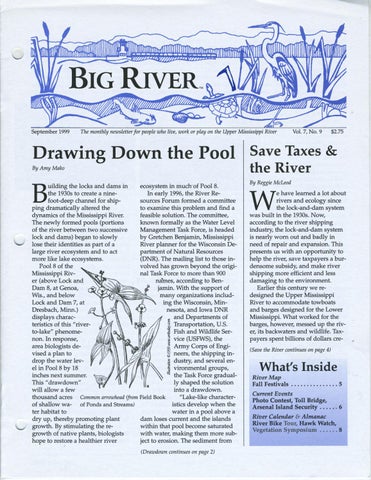
uilding the locks and dams in the 1930s to create a ninefoot-deep channel for shipping dramatically altered the dynamics of the Mississippi River. The newly formed pools (portions of the river between two successive lock and dams) began to slowly lose their identities as part of a large river ecosystem and to act more like lake ecosystems. Pool 8 of the Mississippi River (above Lock and Dam 8, at Genoa, Wis., and below Lock and Dam 7, at Dresbach, Minn.) displays characteristics of this "riverto-lake" phenomenon. In response, area biologists devised a plan to drop the water level in Pool 8 by 18 inches next summer. This "drawdown" will allow a few thousand acres Common arrowhead (from of shallow wa- of Ponds and Streams) ter habitat to dry up, thereby promoting plant growth. By stimulating the regrowth of native plants, biologists hope to restore a healthier river
ecosystem in much ¡of Pool 8. In early 1996, the River Resources Forum formed a committee to examine this problem and find a feasible solution. The committee, known formally as the Water Level Management Task Force, is headed by Gretchen Benjamin, Mississippi River planner for the Wisconsin Department of Natural Resources (DNR). The mailing list to those involved has grown beyond the original Task Force to more than 900 names, according to Benjamin. With the support of many organizations including the Wisconsin, Minnesota, and Iowa DNR .; and Departments of 1 Transportation, U.S. j Fish and Wildlife Service (USFWS), the ~ Army Corps of Engi~ neers, the shipping inJi dustry, and several enj vironmental groups, \a; the Task Force gradually shaped the solution into a drawdown. "Lake-like characterField Book istics develop when the water in a pool above a dam loses current and the islands within that pool become saturated with water, making them more subject to erosion. The sediment from
l
(Drawdown continues on page 2)
By Reggie McLeod
W
e have learned a lot about rivers and ecology since the lock-and-dam system was built in the 1930s. Now, according to the river shipping industry, the lock-and-dam system is nearly worn out and badly in need of repair and expansion. This presents us with an opportunity to help the river, save taxpayers a burdensome subsidy, and make river shipping more efficient and less damaging to the environment. Earlier this century we redesigned the Upper Mississippi River to accommodate towboats and barges designed for the Lower Mississippi. What worked for the barges, however, messed up the river, its backwaters and wildlife. Taxpayers spent billions of dollars cre(Save the River continues on page 4)
What's Inside River Map Fall Festivals ............... 5 Current Events Photo Contest, Toll Bridge, Arsenal Island Security ...... 6 River Calendar & Almanac River Bike Tour, Hawk Watch, Vegetation Symposium ...... 8
(continued from page 1)
on: muck dried out; vegetation the islands then becomes suspendvides important cover for young breathed; and seeds germinated. ed and begins filling in the deep ducks and shorebirds, as well. "Controlling the water level has bamain channels that are normally Submergent plants will also bensically caused the plants to drown," present in a large river system," efit from the lower water level, Benjamin said. As the islands begin Simon said. when the sun penetrates the Missisto erode away, vegetation also disDuring the summer of 2000, the sippi's muddy, but shallower, waappears, creating a wide, open Corps plans to use dams 7 and 8 to ters. reduce the water level in Pool 8 by The aquatic plants that scientists space lacking wind breaks - islands, trees, vegetation, etc. Wind blowing across the pool begins to mimic the wind patterns in a desert. A negative feedback cycle results when the wind causes more erosion, reducing the islands and wind breaks, leaving a wider space for more wind which, in turn, causes more erosion until the pool ends up shallow and muddy, like the lower portion of Pool 8 today. These combined factors make the pool Last summer a drawdown at Pecks Lake, at Blackhawk Park, on the Mississippi River downriver from Genoa, Wis., less hospitable to both submer- stimulated heavy plant growth. gent (growing completely under water) plants and emergent 18 inches. They will begin reducing hope will respond to the drawdown (rooted in the water, but with part the level by 2.4 inches a day in midinclude broadleaf arrowhead (Sagitof the plant above the water) vegeJune, which should give most fish, taria latifolia), sessile fruit arrowtation. mussels and other water critters head (Sagittaria rigida), rice cuttime to escape to deeper water. grass (Leersia oryzoides), cattails Too Much Water They will then maintain the draw(Typha latifolia), broadfruit burreed Locks and dams create the ninedown until mid-September, if the (Sparganium eurycarpum), bottlefoot Main Channel mandated by weather cooperates, explained Benbrush sedge (Carex comosa Boott), Congress for towboats. Locks and jamin. hummock sedge (Carex spp.), and dams, however, also deny the river The drawdown will dry approxismartweed (Polygonum spp.). its natural flood cycles, according to mately 2,575 acres of shallow water The drawdown will only be sucSol Simon, Mississippi River Recessful if the summer water flows habitat, promote plant growth and vival and Task Force member. "The create a "normal" discharge at Lock reestablish some of the ecosystem river used to follow a general patpresent before the locks and dams. and Dam 8, which is approximately tern before the locks and dams that 40,600 cubic feet per second accordBack to the Roots ing to Bill Richardson, U.S. Geological Survey and Task Force member. Encouraging a healthy aquatic "Controlling the water level The drawdown will drop the water plant population will enhance the entire ecosystem within Pool 8, aclevel about 18 inches near Lock and has basically caused the cording to Benjamin. Submergent Dam 8; however, the level will only plants to drown," Simon decrease about six inches on the upand emergent aquatic vegetation help stabilize the river bottom and per end of the pool, near Lock and said. surrounding banks. The plants also Dam 7. This uneven distribution is a result of the way Pool 8 is regulatprovide a hospitable environment was high water in the spring, low in for many aquatic insects, cover ed at Lock and Dam 8. As water is the summer and high again in the from predators and shelter for removed from the pool, the entire fall. Now it's like spring all year young fish. The fish also feed on the water surface "tips" toward the with no drought period." insects living among the vegetation. lower end of the pool, according to In the past, water levels that fell The seeds and roots of the plants Richardson. during the summers provided a provide food for many migratory If the weather provides a norwindow of opportunity that emerwaterfowl. The dense foliage of mal-flow year, the drawdown will gent aquatic vegetation depended definitely work, according to Keith emergent aquatic vegetation pro-
2
Big River
September 1999
,,.
Beseke, USFWS and Task Force member. "Saying whether or not the drawdown is successful is putting a black and white label on something that is not black and white," Beseke said. "What we are really talking about is the degree of success, be-
dredging, about 500 yards where there are a bunch of houseboats. If I don't, the boats will be right on top of the houses," said Ed Wilson, owner of Lawrence Lake Marina and Bait Shop, Brownsville, Minn. During the period of low water level, much of Lawrence Lake will
cause if we pull water out of the pool, there will be a response in vegetation growth ... predicting to what degree is difficult." The USFWS has been using drawdowns in refuges for years, according to Beseke. "It will be a great tool to have in our bags ... for water level management of other pools," he said.
likely be inaccessible, according to Wilson. "I sell a lot of bait, tackle and gas to boaters that aren't going to make it in here ... and I'll never get that business back again," he said. Other businesses seem to be taking this project in stride. "It's just a one-year deal, so we'll just have to deal with it. I would be more worried about business if this [water reduction] was permanent," said Bud Pretasky, owner of Pettibone Campground, La Crosse, Wis. Dredging out the harbor at Pettibone is his main concern for next summer since that is the only river access point at the campground. The excursion boat Island Girl is going to need some help from the Corps, according to Al Poser, Skipperliner Marine Group, La Crosse, Wis. "We are working with the Corps contractors to get the South Bay behind Skipperliner dredged out," he said. Poser also expressed concern for a possible drop in retail sales if customers assume the waters aren't boatable next year. "It's hard to say what might happen," he said. Dredging will not be necessary at Goose Island Campground, La Crosse, Wis., according to manager
Channeling The Task Force chose an 18-inch drop in Pool 8 so that tow traffic will not be interrupted. "If everything takes place with the parameters that have been suggested, I don't see any major impact on the barge industry," said Kent Pehler, Brennan Marine Inc. Pehler has been a member of the Task Force since its development. "I have enjoyed working with the Corps finding ways to overcome possible problems .. . When all the players are involved, we can come up with a win-win situation," he said. The average depth of Pool 8 is between four and five feet; therefore the drawdown will most likely require dredging certain areas to maintain boat access and navigability for several businesses around the pool. 'Tm going to need to do some
September 1999
Big River
John Zahn. "We are going to see a problem with some of the backwaters drying up and people coming through here at 35 to 40 miles per hour in water that was deep enough last year. They'll be hitting stumps, wing dams, and other obstacles," Zahn said. He expects his rental i:! boats to get knocked -.c!: around more than usual ) during the drawdown. ~ If all the variables fall if.5 into place next summer, l the drawdown should pro'& duce dramatic results in ~ a Pool 8. "After the drawt down, Pool 8 will hopeful~ .E' ly look much greener, es.is 1~ pecially in the lower part of the pool," Beseke said. ~ The now vast open space will be replaced with both emergent and submergent vegetation. "It will probably look like it did back in the 1970s." ~ Amy M. Mako is a senior at Winona State University majoring in biology and journalism.
Big River™ Big River (ISSN 1070-8340) is published monthly by Riverwise, Inc., 111 Riverfront, Suite 204, Winona, MN 55987; (507) 454-5949; fax: (507) 454-2133; email: editors@bigriver.com; web site: http://www.big-river.com Reggie McLeod editor/publisher
Molly McGuire Madelon Wise Kathy Delano
assistant editor associate editor associate editor design/marketing
Mary Feathergi/1 Amy M . Mako
office manager intern
Mi Ae Lipe-Butterbrodt
Subscriptions are $28 for one year, $50 for two years or $2.75 per single issue. Send subscriptions, single copy orders and change-ofaddress requests to Big River, PO Box 204, Winona, MN 55987. Second-class postage paid at Winona, MN. POS1MASTER: send change-of-address requests to Big River, PO Box 204, Winona, MN 55987. Big River, Volume 7, Number 9, copyright September 1999. Reproduction in whole or in part without written permission of the publisher is prohibited. Printed on recycled paper.
3
(continued from page 1)
ating the system and millions trying to repair the damage it causes. The lock-and-dam system divided the Upper Mississippi River into a series of lakes. Since then, backwaters have filled in with sediment and islands have eroded away. Many fish species declined or van- ·· ished, especially migratory ones, like skipjack herring and paddlefish, which are blocked by dams. Many of the water plants that used to provide food and shelter for wildlife have disappeared. This spiral of decline will probably continue. Unfortunately, the Army Corps of Engineers, under pressure from MARC 2000, the shippers' lobbying organization, wants to increase the taxpayer subsidy to expand the current, outdated system at the expense of a healthy river. Before the 1930s, the Army Corps maintained a six-foot shipping channel. The nine-foot channel created by the new dams allowed deeper draft vessels to reach the Twin Cities. Now the vast majority of river shipping takes com from the Midwest to New Orleans, where it is loaded onto ocean-going ships and exported to be processed or fed to livestock. Most towboats push 15 barges (five barges long and three wide) on the Upper Mississippi. The 600-foot locks at all but two of the dams will only hold nine barges or a towboat and six barges, so the entire tow has to lock through in two pieces, a process that takes two hours or more. MARC 2000 is lobbying to build more 1,200-foot locks. Currently a tax on the diesel fuel for towboats pays only about half of the cost of the lock-and-dam system; taxpayers pay the other half. The tow industry has not offered to pay for expanding the locks. When a draft federal budget in 1993 raised the diesel tax to pay a larger share of the system's cost, the towboat industry fought it tooth and nail, claiming that if it had to shoulder more of the system's cost, then shipping by barge would cost as
4
much as shipping by rail. The industry argued, in effect, that the system is not worth its cost. Months earlier, at the end of 1992, the lame-duck Congress ordered the Corps to conduct a $50 million study of the Upper Mississippi River and the Illinois River Waterway to devise ways to speed up the existing shipping system
The industry argued, in effect, that the system is not worth its cost. over the next 50 years. (The study was originally scheduled to be completed this fall, but it will be delayed for at least a year.) Many accused Congress of stacking the deck, because the study did not ask: l. Would processing more com in the Upper Midwest, rather than shipping it, create more jobs in rural communities and increase com prices paid to farmers? 2. What is the total environmental cost of the existing lock-anddam system, and what will it be during the next 50 years? 3. Can we design a modem river shipping system that operates efficiently in a six-foot channel with a minimal impact on the river environment?
Boats that Fit the River Towboats must carry large crews to handle the difficult and dangerous work of locking through. Tows spend much of their time locking through or waiting to lock through. Other boaters on the river also wait for the tows. Before the locks and dams were built the Corps maintained a sixfoot channel. New tows and barges designed to fit a six-foot channel would eliminate the need for locks and dams. Smaller crews could make more trips during the shipping season, because they would not have to spend nearly half their
Big River
time at locks. Facilities could be built in St. Louis - below the last lock and dam - to quickly unload the smaller barges and send them on their way upriver again. River levels could fluctuate naturally, fish could easily migrate and dams would no longer trap sediment. The river would be healthier, boaters could travel more easily and taxpayers could·save billions of dollars. In the long run, shippers would also benefit from a more efficient and sustainable system. Perhaps the new system could be phased in over several decades. As the channel depth is gradually decreased from nine to six feet, dams could be opened up one at a time. Tow companies would have plenty of time to phase in new equipment. The U.S. economy is strong because of our skill at figuring out ways to work more efficiently and productively. If Congress and taxpayers want to subsidize a system that cannot pay its own way and is destroying the nation's greatest river, so be it, but let's have an honest discussion of the situation and make a deliberate decision. However, we can probably design a system that fits the river and pays for itself. If we cannot, we should ship by train or process the com in the Midwest. It is unfair to blame the Army Corps of Engineers and the workers in the river shipping industry for the current situation. Many of them love the river and have watched the signs of its decline. The large grain exporters, Cargill and Archer Daniels Midland, gain taxpayersubsidized shipping for what it costs them to lobby Congress and underwrite elections. They should devise a better system that will pay for itself and restore the river. It's up to the taxpayers and voters to tell Congress, Cargill and Archer Daniels Midland that we do not want to pay for the destruction of the Upper Mississippi River. ~ Reggie McLeod is the editor of Big River.
September 1999
Big River Festivals
Husking Bee Oliver Kelly Farm,
Fall 1999
Downtown Oct. 23-24 Hoedown, Sept. 9; Elk River Millstream Arts Festival, Sept. 26 Taur, , Oct. 19-21 ST. CROIX RIVER ~'<,'1-..
"
sc'~ 'le'Hast! g Prescott Prescott Daze, Sept. 10-12 i\¥<¥<£ Main St. Festival, Sept. 18; · Harvest Fest, Sept. 26 ' · • Bay City River Bend Banes & Blues Fest, Sept. 24-26; Red Wing • • Maiden Rock Fall Festival of Arts, Oct. 9-10 Frontenac epin Laura Ingalls Wilder Days, Sept. 18-19 Johnny Appleseed Days, Oct. 2-3 Lake City • Eaglewatch, Nov.-March Wabasha· • Alma Swan Watch, late Oct.-Nov. Watermelon Fest, Sept. 10-12 Kellogg· B ff 1 c·ty Minneiska• u aO 1 Fo tain City Minnesota City• Victorian Fair, Sept. 18-19;Winona Swan Watch, Nov. 6-7 Dakota . . Dresbacli
Oktoberfest, Oct. 1-7
Applefest, Sept. 16-19
Minnesota Tourism Info
Wisconsin
1-800-657-3700
Tourism Info
NewAlbin• ■------------------------Iowa
1-800-372-2737
Tourism Info
Hawk Watch,
1-800-345-4692
Effigy Mounds National Monument, Sept. 25-26 Marquette• Prairie du Chien Villa Louis Carriage Classic, Sept. 11-12; Shihata Orchard Fest, Oct. 2-3; Holiday Tour of Homes, Nov. 14 .Bagley
Leaf Arts & Crafts Festivals, Oct. 2-3; Oct. 9-10; McGregor•· IN RIVER Lumbetjack Fest, Sept. 4-5 wrscoNS German Fest, Sept. 24-26 Guttenberg.
I
·,.
~
.
Cassville St. Charles Fall Festival, Sept. 19
Riverfest, Sept. 10-12; • Potosi Masonic Fish Fry, Oct. 9 Int1. Dragon Boat Festival, Sept. 10-12 - - - - - - - - - - Dubuque•• East Dubuque Fun Day, Sept. 26 • Galena Tour of Homes, Sept. 25-26; Autumn Craft Fair, Oct. 9-10 Art Along the River, Oct. 3 Bellevue• "
0
Taste of Savanna • Savanna Oct. 9_10
C:
g ~
~
•Thomson Melon D,Pys Sept. 4-6 Living History Day, Sept. 18 Clinton• ·Fulton Fall Festival Camanche filbany Oct. 9-10
't,,
t" 8
~
l
Princeton Cordova
Applefest, Oct. 10 Le Cl.iire • Port Byron Oktoberfest, Sept. 24-25 Bettendort Riverfront Pops Concert, Sept. ll; Davenport, oline Riverssance Fine Arts Festival, oc land Erin Feis, Sept. 19
l
Sept. 25-26
Illinois
Tourism Info 1-800-223-0121
Victorian Fair, Winona, Minn.
September 1999
Published by Big River, P.O. Box 204, Winona, MN 55987, (507) 454-5949. All rights reserved.
Big River
5
By Mi Ae Lipe-Butterbrodt
Time's Toll St. Paul, Minnesota - Massive corrosion threatens Minnesota's last remaining toll bridge, which spans the Mississippi River between St. Paul Park and Inver Grove Heights. The J.A.R. Bridge (named for its owners Joan and Al Roman of Chicago) closed in June for repairs that were to take a few weeks. Routine inspection revealed more problems, and the bridge may close permanently unless its owners can come up with a half million dollars for additional repairs (St. Paul Pioneer Press, 8-6-99). The 105-year-old bridge swings open to allow boats to pass, while about 2,000 vehicles drive it daily, each paying 75 cents to avoid Interstate 494. Officials from Washington and Dakota counties, and the state transportation department say it's unlikely they will pay to repair or buy the bridge.
Best Shot Minnesota and Wisconsin - The Bob Pohl Chapter of the Friends of the Upper Mississippi River Refuges is looking for entries for its second annual photography contest. Professional and amateur photographers are eligible for cash prizes, and youth winners will receive ribbons. Photographs must be taken in or around the portion of the Trempealeau National Wildlife Refuge or the Upper Mississippi River National Wildlife and Fish Refuge between the Wabasha, Minn., bridge to Lock and Dam 6, at Trempealeau, Wis. Categories include refuge landscapes and wildflowers, people on the refuges, and birds and other wildlife. Photos may be color or black and white, with a limit of four
6
entries per photographer. Entries must be submitted to the Winona District office by September 15, 1999. For more information, contact the office at (507) 454-7351.
Landing Closed Trempealeau, Wisconsin - The Round Lake Landing near Trempealeau, Wis., has closed while crews install a new boat ramp, a disabled-accessible transfer dock and fresh parking lot gravel. The work is expected to take several months, according to the U.S. Fish and Wildife Service.
Fine for the Environment Dakota County, Minnesota - Over $1 million in Koch Refinery fines will help fund eight environmental projects in Dakota County, Minn. Almost half the money will help create trails and environmental education programs in a Mississippi River Trail project in Rosemount, Inver Grove Heights and Hastings. Other projec'l:s include a $350,000 grant to the Lebanon Hills Regional Park; $75,000 to the Dakota County Fairground Outdoor Trail Facility; $75,000 for the Chub Lake acquisition project; $35,000 to the Caponi Art Park and Learning Center; $20,000 to the High School of Environmental Studies; and $15,000 to the Vermillion River Watch Program and Tributary Plan in Apple Valley (St. Paul Pioneer Press 8-1199). The fines resulted from a 1998 enforcement agreement between Koch and the Minnesota Pollution Control Agency, after contaminants from Koch's Rosemount, Minn., refinery were discovered near the Mississippi River. Koch agreed to pay $7 million in civil penalties and $40 to $80 million for environmental improvements (see Big River,
Big River
February, March and May 1998).
Defiant Logger Muscoda, Wis. - For the first time in its 10-year history, the Lower Wisconsin State Riverway Board will prosecute a logger who cut excessive timber without a permit and constructed logging roads that violated Riverway regulations. The logger, Dave Potter, got a warning in October 1998 for his activities on the Grant County property of an absentee landowner. Mark Cupp, Executive Director of the Riverway Board, noted that the logging roads Potter constructed on the property were extremely steep, with grades of up to 60 percent. Riverway law requires logging roads to be 10 percent or less. The warning required Potter to repair the site's serious erosion problems, but Potter either incorrectly installed or failed to install erosion control structures or to reseed or replant any areas. At a Riverway Board meeting on July 8, Potter said he refused to repair the site any further. He said that he did not believe in the Riverway law and was willing to go to court. The board unanimously approved Cupp's recommendation to request further enforcement. Cupp said a penalty for failing to comply with Riverway law could result in fines of up to $1,000 a day for each violation. The Riverway Board will solicit public input on jet ski use on the Lower Wisconsin River at its next meeting, on Sept. 9 in Spring Green, Wis. Executive Director Mark Cupp says the "Riverway Board has no direct regulatory control over jet ski use on the Lower Wisconsin River; however, the board is authorized to advise the state legislature and De-
September 1999
.
partment of Natural Resources on conflicts between recreational use and the Riverway's mission of protecting and preserving the scenic beauty and natural character of the Lower Wisconsin River Valley. Recent comments and correspondence regarding problems associated with personal watercraft use on the river have caused the board to seek additional input from the public regarding the matter." Folks may attend the Board's September meeting (see the Calendar in this issue for time and location), send written statements to Cupp at P.O. Box 187, Muscoda, WI 53573, or call the Board at 800-2213792 or (608) 739-3188.
Barely Standing
...
Washington, D.C. - A new report just released by the Environmental Policy Project at Georgetown University Law Center says that a series of recent U.S. Supreme Court decisions limits citizens' access to the courts to enforce environmental laws and expands the potential for polluters to challenge the application of the laws. The environmental movement of the 1970s enabled citizens and environmental groups to bring private lawsuits against polluters. Since then, hundreds of suits have been filed under citizen-suit provisions of the Clean Water Act, Clean Air Act and other environmental laws (see "A Hard Act to Follow" in Big River, December 1998, and "Enforcing Enforcement," February 1999). In the report, "Barely Standing: The Erosion of Citizen 'Standing' to Sue to Enforce Federal Environmental Law," authors John D. Echeverria and Jon T. Zeidler contend that over the past 15 years, U.S. Supreme Court Justice Antonin Scalia has aggressively argued and acted in favor of limiting this citizen access to the courts in environmental cases. The report also documents recent standing decisions of the lower court, including ones that go beyond Supreme Court rulings
September 1999
in limiting citizen access. You can obtain copies of the report by contacting the offices of the Environmental Policy Project or from the EPP web site at www.envpoly.org .
Everglades Replumbed Florida - In the 1950s and 1960s the Army Corps of Engineers built canal and levee systems that dramatically disrupted the 60-milewide sluggish river known as the Everglades. Now it is proposing a $7.8-billion, 20-year project to restore some of the flow to the environmentally damaged area. The plan calls for removing more than 240 miles of levees and dikes as well as pumping up to 1.6 billion gallons of fresh water a day into underground storage zones where it would float above denser salt water in the aquifer. During dry periods the water would be pumped to the surface, according to an article in Scientific American, August 1999. The plan would be simpler if sugar growers were willing to part with more of the 750,000 acres of fields created by draining the Everglades. The government was able to purchase only 60,000 acres from wtlling sellers. Scientists skeptical of the plan have convinced Interior Secretary Bruce Babbitt to create an independent panel to review it.
Who Goes There? Rock Island, Ill. - Beware if you're cruising on the Mississippi River near the U.S. Army Rock Island Arsenal - you may get a spotlight on your face and a chat with some soldiers. Citing heightened security concerns, the Army established a 200yard, vessel-free security zone along the left descending bank at Mile 484 on the Upper Mississippi. Army security also requests vessel operators to not use searchlights to illuminate buildings or residences on the Rock Island facility. Lt. Joe Snowden of the U.S. Coast
Big River
Guard Marine Safety DetachmentQuad Cities said, "The security zone is part of a Department of Defense force protection directive to ensure that certain key Army personnel and property are protected. The Army pushed for this during the Kosovo crisis because it feels the best defense is distance." The zone, which became effective July 12, restricts all recreational and commercial craft within the vicinity of Arsenal Island. Signs are posted and all vessel operators should avoid pushing into the bank within the zone until further notice (The Waterways Journal 7-19-99).
Twin Cities Sued Minnesota - Three environmental organizations are suing the cities of Minneapolis and St. Paul for failing to meet federal storm water requirements of the Clean Water Act. The Mississippi River Revival, Mississippi Corridor Neighborhood Coalition and the West Side River Watch charge that both cities continue to pollute the Mississippi River even though the Minnesota Pollution Control Agency (MPCA) required them to apply for Storm Water Permits in the early 1990s. Neither Minneapolis nor St. Paul have implemented applications they submitted to the MPCA in 1992 and 1993, respectively. Both applications committed the cities to monitor storm water pollution, issue contaminant ordinances and institute pollutant management practices, but neither city has ever received a Storm Water Permit or implemented the storm water management programs outlined in their applications. "St. Paulites deserve more than just a pretty riverbank - we deserve clean water. So much is being spent on riverfront development; we need to spend some moeney on the river itself," said David Boyce, of West Side River Watch. 1ยง
7
Special Events & Festivals September 4 Maxwell Street Heyday, Savanna, Ill. 4-5 Lumberjack Festival, McGregor, Iowa. 4-6 Flea Market, Marquette, Iowa. 4-6 Melon Days, Thomson, Ill. 4-6 Labor Day Celebration, Stoddard, Wis. 5 Candlelight Stroll, 7:30 p.rn. - 9 p.rn., Perrot State Park, Trempealeau, Wis., (608) 534-6409. 5 St. Joseph Pork Roast, Bellevue, Iowa. 9 Downtown Hoedown, St. Cloud, Minn. 9-12 Watermelon Fest, Kellogg, Minn. 10-12 Prescott Daze, Prescott, Wis. 10-12 International Dragon Boat Festival, Dubuque, Iowa. 10-12 Dubuque Riverfest, Washington Park, Dubuque, Iowa. 11 Great River State Trail Walks, 8 a.rn. - 6 p.rn., meet at the Onalaska Convention and Visitors Center, Onalaska, Wis., (608) 534-6409. 11 Riverfront Pops Concert, Davenport, Iowa. 11 Mill Day, Pickwick Mill, Pickwick, Minn. 11-12 19th Annual Carriage Classic, Villa Louis, Prairie du Chien, Wis., 1-800-7321673. 12 St. Paul Classic Bike Tour along the Mississippi, (612) 882-3180. 13-19 River Rendezvous, Pond-Dakota Mission Park, Bloomington, Minn. 16-19 Apple Fest, La Crescent, Minn. 18 Main Street Festival, Hastings, Minn. 18 Living History Day, Clinton, Iowa. 18-19 Victorian Fair, Winona, Minn. 18-19 Wild Wings Fall Festival, Lake City, Minn. 18-19 Laura Ingalls Wilder Days, Pepin, Wis. 18-19 European Oktoberfest, Minneapolis, Minn., 1-800-445-7412. 19 St. Charles Fall Festival, Cassville, Wis. 24-25 Oktoberfest, Bettendorf, Iowa. 24-26 River Bend Bones and Blues Festival, Colvill Park, Red Wing, Minn. 24-26 German Fest, Guttenberg, Iowa. 25-26 Fall Tour of Hornes, Galena, Ill., 1-800-747-937. 25-26 Riverssance Festival of Fine Arts,
8
Davenport, Iowa. 25-26 Hawk Watch, Effigy Mounds National Monument, Marquette, Iowa, (319) 873-3491. 26 Fun Days, East Dubuque. 26 Harvest Fest, Hastings, Minn. 26 Millstream Arts Festival, Riverside Park, St. Cloud, Minn.
October 1-7 Oktoberfest, La Crosse, Wis. 2 Sap to Syrup, Stonefield Village, Cassville, Wis., (608) 725-5210. 2-3 Flea Market, Marquette, Iowa. 2-3 Shiliata Orchard Fest, Prairie du Chien, Wis. 2-3 Johnny Appleseed Days, Lake City, Minn. 2-3 Arts and Crafts Festival, McGregor, Iowa. 3 Art Along the River, Bellevue, Iowa. 9 Greening Project Celebration and tree planting, St. Paul, volunteers register by Sept. 10, (651) 224-9885.
Meetings & Hearings September 9 Lower Wis. Riverway Board, 5 p.rn., Public Library, Spring Green, Wis., 1800-221-3792, (608) 739-3188.
October 15-16 Midwest Riverboat Buffs annual meeting, Keokuk, Iowa.
Workshops & Conferences September 21-22 Vegetation of the Upper Mississippi and Illinois River System: Status, Management and Ecology, La Crosse, Wis., (608) 785-6503. ~
Almanac By Kenny Salwey September is a kindred spirit to April. In April, winter grudgingly gives way to spring. In September, summer gradually dissolves into autumn. Leaves on the river birch begin to yellow. Great hordes of blackbirds descend upon the backwater rice fields with reckless abandon. Migrating blue wing teal and locally hatched wood ducks and mallards gorge their gizzards as they dip in the shallow backwaters, cleaning up the spoils their feathered kin left behind from feeding among the tall stalks protruding above the waters. Other feathered ones are already well on their way to their winter homes. We must wait a half a year or more to hear their lovely springtime songs again. In some years, Jack Frost paints his handiwork upon the big river valley this month. A bit early to suit most folks - but then as Mark Twain said, "Everybody talks about the weather, but nobody does anything about it." The critters don't just talk about it, they are busy preparing for autumn and winter. Squirrels and .chipmunks, muskrats and beavers, field mice and woodchucks are all busy gathering food and securing shelter. Fish travel toward their ancient wintering grounds. Insects spin cocoons and attach themselves to logs and rocks. The big river begins to free itself from summer's rainswept silt - a freer, clearer river of life. ;;;
Big River
September 1999