[ August 1999
The monthly newsletter for people who live,_work or play on the Upper Mississippi River
Vol. 7, No.8
$2.75
Wings Over the River Great River Swallows of the Upper Mississippi
Tug of War
By Thomas V. Lerczak
By Gary W. Kramer
T
T
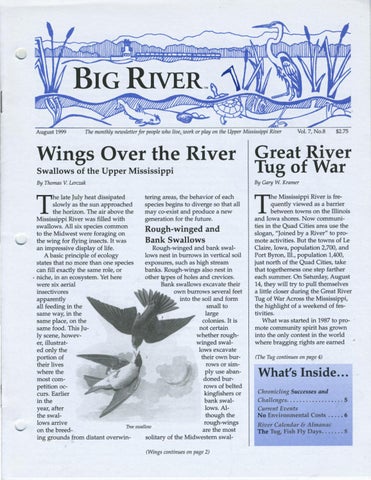
he late July heat dissipated tering areas, the behavior of each slowly as the sun approached species begins to diverge so that all the horizon. The air above the may co-exist and produce a new Mississippi River was filled with generation for the future. swallows. All six species common Rough-winged and to the Midwest were foraging on the wing for flying insects. It was Bank Swallows an impressive display of life. Rough-winged and bank swallows nest in burrows in vertical soil A basic principle of ecology states that no more than one species exposures, such as high stream can fill exactly the same role, or banks. Rough-wings also nest in • niche, in an ecosystem. Yet here other types of holes and crevices. Bank swallows excavate their were six aerial insectivores own burrows several feet apparently into the soil and form all feeding in the small to large same way, in the colonies. It is same place, on the same food. This Junot certain ly scene, howevwhether rougher, illustratwinged swallows excavate ed only the portion of their own burtheir lives rows or simwhere the ply use abandoned burmost competition ocrows of belted curs. Earlier kingfishers or bank swalin the lows. Alyear, after the swalthough the lows arrive rough-wings Tree swallow are the most on the breeding grounds from distant overwinsolitary of the Midwestern swal(Wings continues on page 2)
he Mississippi River is frequently viewed as a barrier between towns on the Illinois and Iowa shores. Now communities in the Quad Cities area use the slogan, "Joined by a River" to promote activities. But the towns of Le Claire, Iowa, population 2,700, and Port Byron, Ill., population 1,400, just north of the Quad Cities, take that togetherness one step farther each summer. On Saturday, August 14, they will try to pull themselves a little closer during the Great River Tug of War Across the Mississippi, the highlight of a weekend of festivities. What was started in 1987 to promote community spirit has grown into the only contest in the world where bragging rights are earned (The Tug continues on page 4)
What's Inside ... Chronicling Successes and Challenges . ................. 5 Current Events No Environmental Costs ..... 6 River Calendar & Almanac The Tug, Fish Fly Days . ...... 8
(continued from page 1)
nests of mud atlows, sometimes ~ ~ they nest on the tached to edge of a bank cliffs, the unswallow colony. dersides of bridges and buildWe might expect the more numerous ings. Because of this, cliff swallows bank swallows to drive out the rough-wings, do not compete with but both species bank and roughseem to tolerwinged swallows for nesting sites. Probably ate each other. because they nest under Bebridges, their range is Barn swallow cause expanding. A very predalarge colony, for example, nests under the tors are less likely US 136 bridge to to attack Keokuk, Iowa, directnests near the ly over the Mississippi River. Cliff swallows in groups spend less time edge of the colony, perhaps looking for predators and are more bank swallows benefficient at gathering mud than lone efit, but how do the rough-wings swallows. Breeding is highly synbenefit? chronized within the colony, and members lead each other to food There are many disadvantages of nesting in large colonies. One study sources. The highly social cliff swallows, in Michigan by John L. Hoogland and Paul W. Sherman showed that however, compound the disadvanas the colony size increases, competages of nesting in a colony. A fetition for nest sites, nest materials male may not only lay eggs in anand mates increases. Parents are alother cliff swallow's nest, but may so less likely to recognize their own first toss out the host's eggs. Infesstill-dependent fledglings after the tations of fleas and bugs at cliff swallow colonies can defy the young aggregate into large groups. imagination. In an intensive, longParents might then partially raise another pair's young at the expense term study in Nebraska, Charles R. of their own. Another disadvantage Brown and Mary Bomberger Brown of colonies is that as colony size infound as many as 2,500 swallow creases, fleas and swallow bugs (a bugs in some nests. Nestlings in wood tick-sized, bloodsucking bedhighly infected nests did poorly bug) are more easily transmitted. So compared with those in cleaner again, why should rough-winged nests. Bug infestations can actually swallows accept all of the disadvanbe so bad that cliff swallows may tages and locate themselves on the not use a colony site every year, edge of a bank swallow colony? presumably to allow the bugs to Even though large colonies have die. many disadvantages, and they can actually attract the attention of Barn Swallows predators, colonies are highly effecAlthough groups of barn swaltive at detecting and harassing low nests are referred to as predators. "colonies," the species is much less social than bank and cliff swallows. The birds seem to go about their acCliff Swallows tivities alone, not exhibiting the soCliff swallows are even more colonial and social than bank swalcial qualities of the tightly knit cliff lows. They build gourd-shaped or bank swallow colonies. Barn
2
Big River
swallows, as the name implies, build their bowl-shaped nests of mud pellets mainly on artificial structures, such as buildings and bridges. In the past, nesting sites may have been limited to cave entrances and cliffs. So, like the cliff swallow, barn swallows increased with the advance of roads and buildings across the landscape. Barn swallows tend to forage low over the water or following the contours of the ground. Cliff swallows, in contrast, may fly to considerable heights in close-knit flocks following swarms of insects rising on warm air. This small difference in foraging style may be enough to reduce niche overlap so that both species can co-exist in an area. But actually, cliff swallows are more aggressive than barn swallows and may usurp barn swallow nests. The barn swallow is the only Midwestern swallow that regularly has two broods in succession. The energy for a long fall migration to South America must be tremendous, a second brood notwithstanding. Some barn swallows I observed
Cliff swallows
August 1999
nesting in an abandoned boathouse on the Illinois River were very fortunate. The river and its backwaters produce a prodigious number of insects. One evening on the sandy bank of the Illinois River opposite the confluence of the Spoon River, I watched thousands of newly emerged mayflies hovering as much as 10 to 15 feet above the shore, but not very far out over the river. Every once in a while a fast flying swallow plowed through the delicate cloud. That same evening, clouds of midges seemed to dance about over the surface of the river. There are always insects over the river. And the swallows take full advantage.
Tree Swallows Tree swallows, even more than barn swallows, are attracted to the Mississippi River Valley, by the great number of flood-killed trees on the bottomlands. Tree swallows nest in dead trees and snags, in holes and in cavities made by other species, such as woodpeckers. They also use artificial nest boxes. This is a major difference between tree swallows and the bank, cliff, barn and rough-winged swallows - although rough-wings may occasionally use tree holes. Snags tend to be haphazardly spread across the landscape, so tree swallows are solitary nesters. In areas where snags are abundant, such as a beaver pond or a flood-killed bottomland forest, tree swallows attempt to nest as far apart as possible. In fact, a study by Wallace B. Rendell and Raleigh J. Robertson in Canada showed that tree swallows set up and defend territories around nest sites, where each territory may include several suitable nesting cavities. Competition for cavities also occurs between tree swallows and other species. The aggressive house wren is very abundant in floodplain forests, and probably is a formidable competitor for nesting cavities. Arriving on the breeding grounds
August 1999
as early as possible is one way to win nest sites, but insect-eating birds must wait for warmer weather. Unlike other swallows, however, tree swallows can push their spring arrival earlier by foraging on berries and seeds in addition to flying insects. Tree swallows and rough-winged swallows on average migrate less far than other swallows. Some tree and roughwinged swallows winter along the Gulf of Mexico, while the other swallow species migrate from as far as South America. Even so, aggressive, non-native house sparrows and starlings, around all winter, undoubtedly claim many cavities early in the season.
Purple Martin The purple martin is the largest Midwestern swallow. Like tree swallows, purple martins used to ne~t mainly in tree holes or other cavities. Today, though, purple martins in the Midwest build nests mostly in the familiar martin apartment houses. They are probably not naturally a very social species. It is likely that purple martin nests were once scattered over the landscape much like tree swallow nests. Undoubtedly there must have been some competition with tree swallows for cavities, but the martin is much larger and would need bigger cavities. In flight, purple martins regularly soar much more than any of the other species. Watching midsummer flocks of mixed swallows over the Mississippi River, the few purple martins clearly stood out. Soon after sunrise during the breeding season, the Mississippi River Valley is saturated with bird songs, including those of numerous
Big River
Purple martins
swallows. The drive to reproduce must be one of the great forces of nature, a goal of life to be met at all costs. What other force could drive these birds to migrate hundreds or even thousands of miles, set up and defend a territory, choose a mate, build a nest, rear young, return to wintering areas, and then turn around and do it all over again? Why not simply stay in the tropics - single and carefree? Thomas V. Lerczak is natural areas preservation specialist for the Illinois Nature Preserves Commission, a director of the Illin~is Audubon Society (IAS) and president of the Emiquon Audubon Society, an IAS chapter based in Mason County, Illinois. He lives north of Havana, along the Illinois River. His last article for Big River was "The
Gizzard Shad in Nature's Economy" (December 1995). Bird illustrations by John James Audubon, Š 1999 www.arttoday.com.
3
(The Tug continued from page 1)
by winning a series of tugs of war across the Mississippi. During the first year, the tugs had to start and stop to allow tows through. Since then, the U.S. Coast
Competition is fierce. In 1996 it took nine tugs before Illinois won by only eight inches.
Guard has closed the river for two hours - 1 p.m. to 3 p.m. - to allow uninterrupted tugging. Each town has ten teams of 20 tuggers, so a total of 400 people participate. The rope is 2,400 feet long, one inch in diameter and weighs 680 pounds. Once river traf-
rently leads the series 7-6 but Iowa won last year and both, of course, predict victory this year. Competition is fierce. In 1996 it took nine tugs before Illinois won by only eight inches. Teams depend on a combination of strength, teamwork and strategy. Each side has a tug master who formulates strategy and provides motivation. Because tuggers can tire themselves just pulling in slack, the tug master relies on a "spy" with a spotting scope to tell him what the other side is doing, so he can orchestrate counter moves. The tugging is exhausting, so paramedics stand by.
A Busy Weekend Both towns celebrate all weekend. Port Byron starts its celebration with barrel painting. Armed with paint, brushes and dressed in smocks, children are encouraged to
---
that will out-sparkle any previous effort. Although not as bitter as the feud between the Hatfields and McCoys, the Great River Tug qualifies as first-class rivalry. Both sides may talk about how pulling against each other helps pull them together. But during the tug, don't expect folks with Iowa Hawkeye hats on to say kind things about those sporting the Orange and Blue of the Illini. And vice versa. If you go by boat: Both towns have limited public dock space and their public ramps are closed all weekend, but there is river access in nearby towns. Hundreds of boats anchor out of the channel for the fireworks on Friday, and many spend the night and/ or the weekend and go ashore in small craft.
l
••• For more information: Send email inquiries to:
\\\
--.;::::_
... :. ·. ., .....,. ~ ·...-.;:·. . .. ... . ...•...
~ fie is halted, the rope is quickly strung from one shore to the other and work begins to stretch as much slack out of it as possible. Scoring the events requires precision because the elasticity of the rope allows both sides to gain ground. So two judges from each town go to the opposite shore and tie a bright red marker on the rope. Then they measure from the marker to a fixed spot. When each threeminute tug is over, the judges measure again and the side that has pulled in the most rope wins. To prevent a five-to-five tie, the last tug is a women's exhibition, which is not counted. Illinois cur-
4
paint whatever they want on 55gallon, fiber drums that will serve as garbage cans for the weekend. Iowa kicks off activities Thursday, August 13 with carnival rides. Activities in both communities feature a parade, a climbing wall, a basketball tournament, a SK walk/ run, lots of live entertainment and a golf tournament on Sunday. A "Rumble on the River," used to feature dueling firework displays, with both sides taking turns shooting off fireworks over the river until they joined together for a grand finale. Now, the towns have pooled their funds to provide what they feel will be a Friday night display
Big River
Tugfest@Yahoo.com or call Angie Mapes at (319) 289-3946 or Don Johnson at (309) 523-3734.
=
,, Gary W. Kramer is a boater and a part-time freelance writer who lives in Rock Island, Ill. His last article for Big River was "Draw-
down Cancelled" (September 1998). Illustration by Mi Ae Lipe-Butterbrodt.
l "
August 1999
Chronicling Successes and Challenges By Dean Rebuffoni
It won't be a best seller and its title is definitely boring, but a new paperback, Ecological Status and
els for 60 years. Agricultural levees separate the river from its floodplain. Farm fields, cities and industries dump pollutants into the river. Toxic chemicals persist in the sediment. Aliens, such as carp and zebra mussels, compete with native species for food and habitat. There's also good news, too. The
Trends of the Upper Mississippi River System 1998, is a must read for anyone interested in the fate of the nation's premier river. The 240-page federal report summarizes 12 years of painstaking research by dozens of scientists as part of the Long Term Resource Monitoring Program. Federal taxpayers anted up roughly $60 million for the program, and ought to know what they got for their money. This report tells them. What it clearly tells them, from this conservationist's perspective, is that the overall health of this vast ecological system is declining. The Upper Mississippi is not in the de-
It's high time we shifted our focus from trying to engineer solutions to the river's woes, many of which were caused by the locks and dams and other engineering, to seeking more natural solutions. plorable condition of the Illinois River, which the scientists also scrutinized, but it definitely has deteriorated from what it was as recently as the early 1960s. An influx of sediment clogs the river's rich backwaters, reducing their life-giving functions. The locks and dams built to create a barge channel have maintained unnaturally high-water lev-
August 1999
Upper Mississippi's overall water quality has improved because of huge taxpayer investments in better . sewage-treatment plants. Fish and wildlife habitat was restored or enhanced in some areas through the ¡ Env!ronmental Management Program (EMP), for which taxpayers have shelled out roughly $140 million (the Resource Management Program is part of the EMP). Farmers in some areas are doing a better job controlling the soil erosion that leads to sedimentation of the backwaters. Still, at least for conservationists intent on reversing the bad news, the report is maddeningly tentative. Scientists really never finish their research, but we simply cannot wait if we want to reverse the disturbing ecological trends. It's high time we shifted our focus from trying to engineer solutions to the river's woes, many of which were caused by the locks and dams and other engineering, to seeking more natural solutions. For example, we could allow the river to regain a big chunk of its
Big River
floodplain, and allow a more natural ebb and flow of its waters. Without denigrating the fine work of the scientists who contributed to this report (indeed, many of them would probably agree with me) I believe that Aldo Leopold - scientist, conservationist, author, father of The Land Ethic - gave us the answer to the Upper Mississippi's woes more than 50 years ago: "A thing is right," Leopold wrote, "when it tends to preserve the integrity, stability, and beauty of the biotic community. It is wrong when it tends otherwise." To obtain a copy of the report, call the U.S. Geological Survey 's Upper Midwest Environmental Sciences Center at (608)-781-6251. The address is 2630 Fanta Reed Rd., La Crosse, WI 54603. Or download pdf files from their website: http://www.umesc.usgs.gov/ reports_publications/ status_and_ trends.html Dean Rebuffoni is Midwest Regional Representative for the Sierra Club's Mississippi River Protection Program. His last article for Big River was "Big, New Dike at L&D 3" (March 1999).
Big River™ Big River (ISSN 1070-8340) is published
monthly by Riverwise, Inc., 111 Riverfront, Suite 204, Winona, MN 55987; (507) 454-5949; fax: (507) 454-2133; email: editors@bigriver.com; web site: http://www.big-river.com Reggie McLeod editor/publisher Molly McGuire assistant editor Mi Ae Lipe-Butterbrodt associate editor Kathy Delano design/marketing Mary Feathergill office manager Madelon Wise associate editor Amy M. Mako intern Subscriptions are $28 for one year, $50 for two years or $2.75 per single issue. Send subscriptions, single copy orders and change-ofaddress requests to Big River, PO Box 204, Winona, MN 55987. Second-class postage paid at Winona, MN. POS1MASIER: send clumge-of-address m,uests ro Big River, PO Box 204, Winona, MN 55987. Big River, Volume 7, Number 8, copyright August 1999. Reproduction in whole or in part without written permission of the publisher is prohibited. Printed on recycled paper.
5
By Mi Ae Lipe-Butterbrodt
Island Remodeling St. Paul - If you picnic at Harriet Island this summer, you might have to munch your sandwiches to the din of bulldozers and jackhammers. After several delays, a long-awaited $13-million park redevelopment project began in mid-June. Scheduled for completion by May 2000, the project includes the creation of a new Riverwalk and other river's edge improvements; construction of new access roads, parking lots and docks for the Jonathan Padelford boats and the University of Minnesota Showboat; and renovation of the Clarence Wigington Pavilion (The Riverview Times 6-18-99 to 7-15-99).
Trailing the River The Mississippi River Trail from Minneapolis to New Orleans is among the first 16 National Millennium Trails designated by First Lady Hillary Rodham Clinton and U.S. Secretary of Transportation Rodney Slater on June 26. The Millennium Trails initiative is part of the White House Millennium Council efforts to encourage national and local interest in America's past and future. "Through the Millennium Trails Project, we are building and maintaining trails that tell the story of our nation's past and will help to create a positive vision for our future," said Clinton. "Transportation is about more than asphalt, concrete and steel it's about people," said Slater. "The National Millennium Trails connect our nation's landscape, heritage and culture, and demonstrate our national commitment to improving the quality of life for all Americans." A press release states that the Mississippi River Trail is envisioned "as a bicycling route that will touch upon the cultural, historic and nat-
6
ural and habitat richness of the Mississippi River Valley," allowing Americans to experience "first-hand what Mark Twain described as the 'body of the nation."' Other designated Millennium Trails include the Underground Railroad, the route Lewis and Clark followed in their 1804 expedition, the Iditarod National Historic Trail in Alaska and a marine trail in the Pacific Northwest that formerly served as a Native American water trade system.
River Centers Dubuque and St. Paul - Federal and private dollars are flowing into river projects in Dubuque, Iowa, ¡ and the Twin Cities in Minnesota. The Alliant Energy Foundation donated $250,000 toward the construction of a riverfront amphitheater in Dubuque that will be part of the America's River project, a larger effort that will feature a Mississippi River Discovery Center with 14 aquariums, a demonstration wetland, a children's museum and a river walk. And, for the first time, both houses of Congress are proposing funding for the construction of the Upper Mississippi River National Wildlife and Fish Refuge Interpretive Center at Dubuque in their appropriations bills. The bills, however, must still pass full House and Senate appropriations committees and the full House and Senate. A final bill must be voted on by Sept. 30, the end of the fiscal year. Public and private contributions to the America's River project now amount to nearly half of the $24.5 million goal (Dubuque Telegraph Herald 7-14-99). The National Park Service has awarded $100,000 in Resource Protection and Enhancement Grants to
Big River
four Twin Cities communities within the Mississippi National River and Recreation Area (MNRRA). Local funding will match the awards, which go toward enhancements of River Park iri. Brooklyn Park, a pedestrian/bicycle connection between University Avenue and the Stone Arch Bridge in Minneapolis, trail connections between the Mississippi River and city parks in St. Paul Park, and construction of trailhead parking and a rest area in South St. Paul. A lack of funding halted plans for the Mississippi River National Center, which is supposed to share the lobby of the new Minnesota Science Museum in St. Paul. The Museum is scheduled to open in December, but the future of the $2 million, 2,000-square foot center, the crown jewel of the Mississippi National River Recreation Area (MNRRA), remains uncertain. Last October a Republican-controlled Congress refused to fund the project. Now National Park Service officials and Minneapolis Democratic Congressman Martin Sabo are exploring alternate funding to continue the center, (The Riverview Times 6-18-99 to 7-15-99).
More Peregrines Wisconsin and Iowa - Peregrine falcons are swooping over the Mississippi River valley once again, with a new brood of chicks in Genoa, Wis., and the release of more young falcons in Effigy Mounds National Monument in Harpers Ferry, Iowa. A towering smokestack at a Genoa power plant is again home to peregrine falcon chicks. As part of a program to restore endangered peregrines to the Mississippi Valley, researchers tagged four chicks who were just 25 days old, bringing
August 1999
them down to the ground from their box nest. Blood samples were also taken to test for harmful metals ' in their environment (Associated Press 6-6-99). The Genoa population now has at least seven birds, after one chick died last year in an electrical storm. A peregrine that hatched in Genoa last year was spotted last fall in Mexico, but the birds return north for the summer, often near their original breeding spot. In 1998, nine falcons were released at Effigy Mounds National Monument, the first cliff-fledged peregrines to soar the Mississippi River bluffs since 1964. Twelve more captive-bred falcons will find freedom in Effigy Mounds this summer, and the coordinator of the Raptor Resource Project, Robert Anderson, hopes the surviving birds will set up territories along the cliffs next spring.
No Environmental Costs The Army Corps of Engineers wants public input this summer on expanding the lock-and-dam system. However, it will not offer any data on the environmental costs of expansion alternatives. It has also come up with new data on the costs and benefits of expansion alternatives, but has not published any explanation of how it arrived at the economic conclusions that it will present to the public. The Corps was scheduled to complete its Navigation Study of the Upper Mississippi River and Illinois Waterway this fall, but it postponed it to December 2000. The study is looking at how to speed barge traffic and accommodate increased shipping for the next 51 years. The Corps will present its incomplete findings at a series of seven meetings during late July and early August (see River Calendar). The Corps' "Preliminary Economic Evaluations," released late in the fall of 1998, offered details of how the economic costs and benefits of expansion options were being
August 1999
measured. That study showed an economic benefit from only the least expensive options. The new figures that the Corps is using at meetings claim an economic benefit for every construction option. The Corps, according to Gary Loss, project manager for the Corps' Rock Island District, does not have any ready documentation to explain how it arrived at its new figures.
Biodegradable Blinds The U.S. Fish and Wildlife Service (FWS) is seeking public comment on a proposed change in regulations on waterfowl hunting blinds on the Upper Mississippi River National Wildlife and Fish Refuge. The proposed changes address the fact that hunters are building more and more permanent duck blinds on the refuge, and leaving behind increasing amounts of human-made materials after the waterfowl hunting season has closed. The proposal would prohibit the construction on Pools 4 through 11 of permanent hunting blinds using human-made materials, which include wooden pallets, railroad ties, fence posts, wire, nails, staples, tarps and lumber. Any humanmade blinds or human-made materials used in building the blind left on the refuge after each day's hunt would be subject to immediate destruction and removal. Hunters could still build blinds entirely from natural vegetation and biodegradable twines, and such blinds can be left on the refuge to be removed by ice or high water. For more information, contact the Winona, McGregor or La Crosse FWS offices. Comments must be received by August 13, 1999.
Musseling the Ducks The little diving ducks known as scaup or, more affectionately among hunters, as bluebills, may be declining because of zebra mussels and global warming. In a time when populations of other duck species are booming,
Big River
scaup numbers have been falling since 1985. Waterfowl experts from across the continent who met last year to discuss the bluebill decline believe that predation, habitat loss and overhunting are not the likely culprits, but instead perhaps global warming and bluebills' fondness for zebra mussels. The latter theory springs from¡ the fact that not all bluebill populations are affected, just those that breed in the western boreal forest in Canada, an area considered a hot spot in the global warming trend. Zebra mussels harbor more contaminants than other mollusks, and biologists have measured higher contaminant levels in bluebills than in other ducks. Scaup consume so many zebra mussels that they have shifted their migration routes to areas where zebras thrive, including the Great Lakes (St. Louis Post-Dispatch 7-22-99).
Boating Drunk Bayport, Minn. - Owners of both boats that collided in a deadly accident that killed them and three passengers on July 3 on the St. Croix River had blood alcohol levels more than twice the legal limit for drunken driving. Owners Scott De Ville of Dresser, Wis., and Michael Flamang of Apple Valley, Minn., and passengers Quentin Thell of Woodbury, Wis.; Karl Ludvigson of Osceola, Wis.; and Steven Langer of Apple Valley were all legally intoxicated. DeVille's boat apparently collided with Flamang's craft at a 45-degree angl~ and then ran over it (Minneapolis Star Tribune 7-22-99). Investigators don't know how fast DeVille's boat was going, but its throttle was three-quarters open, according to Washington County Sheriff Jim Frank, and the boat had a top speed of 70 miles per hour. Numerous empty and sealed beer cans littered the two powerboats, which collided at about 1:30 a.m. near Bayport. _
7
Ii
Special Events & Festivals
August 1-26 Audubon Ark, stops at Upper Mississippi river towns, St. Paul to the Quad Cities, Iowa and Ill., (651) 290-1695. 4 Taste of Dubuque and Audubon Ark, Ice Harbor, Dubuque, Iowa (651) 290-1695.
5-8 Great River Jazz Fest, La Crosse, Wis. 6-8 River City Days, Red Wing, Minn. 7-8 Catfish Festival, Potosi/Tennyson, Wis.,canoe race, Saturday, 7 a.m. 8-9 Upper Mississippi Bike Festival, Harpers Ferry, Iowa. 13-15 Fish Days, Lansing, Iowa. 13-15 Riverfront Summer Blast, McGregor, Iowa. 14 50-year Birthday Celebration, Effigy Mounds National Monument, Marquette, Iowa, (319) 873-3491. 14 5th Annual Four Mounds Blues Fest, Dubuque, Iowa, 1-800-798-8844. 14-15 Fall Festival, Fountain City, Wis. 14-15 Good Old Nelson (Wis.) Days. 14 The Great River Tug of War, 1 p.m. - 3 p.m., Port Byron, Ill. and Le Claire, Iowa, (319) 289-3946. 15 Prairie Day, Great River Bluffs State Park, Dakota, Minn., (507) 643-6849. 20-22 Dragon Boat Festival, Dubuque, Iowa, 1-800-798-8844. 21 Watershed 100, storm-drain stenciling, 10 a.m - 2 p.m., Hidden Falls Park, St. Paul, (651) 222-2193. 22-24 Fish Fly Days, De Soto, Wis. 28 Birdwalk, 8 a.m., Effigy Mounds National Monument, Marquette, Iowa, (319) 873-3491. Stories of the Mississippi: Charlie Maguire, Singing Ranger, (651) 2904160. 3 6:30 p.m. - 8:30 p.m., Grandview Park, South St. Paul 6 7:30 p.m., Lake Harriet Bandshell, Minneapolis. 12 7 p .m., Nicollet Island Amphitheater, Minneapolis September 4-6 Labor Day Celebration, Stoddard, Wis. 5 Candlelight Stroll, 7:30 p.m. - 9 p.m., Perrot State Park, Trempealeau, Wis., (608) 534-6409.
8
10-12 Dubuque Riverfest, Washington Park, Dubuque, Iowa. 10-12 Prescott Daze, Prescott, Wis. 11 Great River State Trail walks, 8 a.m. - 6 p.m., meet at the Onalaska Convention and Visitors Center, Onalaska, Wis., (608) 534-6409. 11-12 19th Annual Carriage Classic, Villa Louis, Prairie Du Chien, Wis. 18-19 Laura Ingalls Wilder Days, Pepin, Wis. 25-26 Hawk Watch, Effigy Mounds National Monument, Marquette, Iowa, (319) 873-3491.
Meetings & Hearings August 4 Mississippi River RiverForum, 7 p.m. - 9 p.m., Becker Community Center, Becker, Minn., (651) 297-4951. 11-15 Mississippi River Parkway Commission Annual Meeting, Brainerd, Minn., (612) 212-2560. 12 Lower Wis. Riverway Board, 5 p.m., Wyalusing State Park, Bagley, Wis., 1800-221-3792, (608) 739-3188.
16-19 Upper Mississippi River Basin Association, Nav study and quarterly meetings, Rock Island, Ill., (651) 224-2880. September 9 Lower Wis. Riverway Board, 5 p.m., Public Library, Spring Green, Wis., 1800-221-3792, (608) 739-3188.
Workshops & Conferences August
Upper Mississippi River - Illinois Waterway System Navigation Study public workshops, 6 p.m. 10 p.m., (309) 794-5266. 3 Des Moines, Iowa 4 La Crosse, Wis. 5 Inver Grove Heights, Minn. 5-8 Midwest Environmental Educational Conference, Stillwater High School, Stillwater, Minn., (612) 854-5900. 6-8 North American Native Fishes Association Annual Convention, West Terre Haute, Ind., (812) 535-4175. ~
Almanac By Kenny Salwey Whoa Nelly! Did those cool clear waters ever feel good as they swirled and gurgled between my bare overheated toes. Was I dangling and swishing my feet in the mighty Mississippi? Well, yes and no, the answer' d have to go. After a full August day of exploring the big river backwaters, I had beached my canoe on a muddy sandbar at the confluence of a trout stream and the river. This is always a great place to watch wildlife. Small flocks of shorebirds - killdeers, rails, snipes and plovers - were dipping, bobbing and weaving their way back and forth across this small delta. As I trudged on up the channel that the trout stream had carved into the mud flats, I passed among patches of arrowhead, pickerel weed and blooming water lotus, their yellow flowers brilliant against plate-sized green leaves and blue waters. About 100 yards from the canoe the creek banks were higher and drier. Here I found milkweed, yarrow, mullein and bergamot, some still in bloom. Several humming birds and quite a few monarch butterflies flitted about- it's their month to migrate. I took a seat under.a small willow tree and hung my feet in the water. The sun began to set, tainting everything with a rosey, yellow hue. Life ain't half bad along the big river in August.
.ii.
Big River
August 1999