June 1999
The monthly newsletter for people who live, work or play on the Upper Mississippi River
Deciding the Future of the Urban River By David Hennessey
R
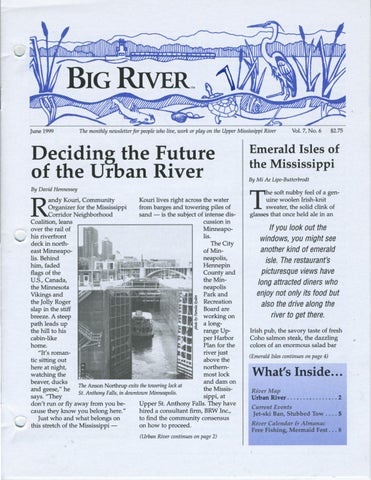
andy Kouri, Community Kouri lives right across the water Organizer for the Mississippi from barges and towering piles of Corridor Neighborhood sand - is the subject of intense disCoalition, leans cussion in over the rail of Minneapohis riverfront lis. deck in northThe City east Minneapoof Minlis. Behind neapolis, him, faded Hennepin flags of the County and U.S., Canada, the Minthe Minnesota neapolis Vikings and Park and the Jolly Roger "' Recreation ~ Board are slap in the stiff <ยง: "-E' working on breeze. A steep path leads up a longthe hill to his range Upcabin-like per Harbor home. Plan for the "It's romanriver just above the tic sitting out northernhere at night, watching the most lock beaver, ducks and dam on The Anson Northrup exits the towering lock at and geese," he the MissisSt. Anthony Falls, in downtown Minneapolis. says. "They sippi, at don't run or fly away from you beUpper St. Anthony Falls. They have hired a consultant firm, BRW Inc., cause they know you belong here." to find the community consensus Just who and what belongs on this stretch of the Mississippi on how to proceed.
t
t
(Urban River continues on page 2)
Vol. 7, No. 6
$2.75
Emerald Isles of the Mississippi By Mi Ae Lipe-Butterbrodt
T
he soft nubby feel of a genuine woolen Irish-knit sweater, the solid clink of glasses that once held ale in an
If you look out the windows, you might see another kind of emerald isle. The restaurant's picturesque views have long attracted diners who enjoy not only its food but also the drive along the river to get there. Irish pub, the savory taste of fresh Coho salmon steak, the dazzling colors of an enormous salad bar (Emerald Isles continues on page 4)
What's Inside ... River Map Urban River ............... . 2 Current Events Jet-ski Ban, Stubbed Tow .... 5
River Calendar & Almanac Free Fishing, Mermaid Fest . . . 8
"
.I (Urban River continued from page 1)
By August, the City Council could consider a plan to transform this area during the next 20 to 30 years. Though still taking shape, the plan could create 90 acres of parks, 15 miles of trails, 2,400 units of housing, 1,000 jobs, 1.7 million square feet of light industry and $14 million a year in property tax revenues.
I
Bayport
2
Hudson
St. Croix Beach
•
Terminate the Terminal? Key to the discussion is what to do with the Upper Harbor Terminal (UHT), a city-owned facility on 41 acres. "The city is, to a certain extent, subsidizing the terminal with little direct benefit locally," says Bob Scroggins, project coordinator with the Minneapolis Community Development Agency. "Our position is to keep it running but pick some future date, say, 10 years from now, to shut it down." Steve Durrant, BRW director of planning and urban design, emphasizes that the terminal would remain open for a period to help businesses make the transition. Phasing out the UHT would affect barge traffic in Minneapolis, though observers differ as to how much. BRW suggests the traffic might fall off so much that the three locks above St. Paul may not be needed. Others disagree. "BRW says that if the city shuts down the UHT, the rest of the harbor will shut down, too," says Dick Lambert, Director of Ports and Waterways for the Minnesota Department of Transportation (MNDOT). "But I dispute their assumption." He says his projections indicate the four river-based industries now in Minneapolis would continue to ship more than one million tons annually, even without the UHT. One million tons of shipping would keep the three locks between St. Paul and Minneapolis operating. ''We need about a million tons annually to break even on operational costs," says Dennis Cin, chief of operations, Technical Support Branch
__.,
Stillwater
MINNESOTA
Hastings Closing the Upper Harbor Terminal may eventually lead to the abandonment of river shipping upriver from Lock and Dam 1.
at the Army Corps of Engineers. "If shipping fell below the break-even point, the Corps would have to look
"The city is, to a certain extent, subsidizing the terminal with little direct benefit• locally, " says Bob Scroggins, project coordinator with the Minneapolis Community Development Agency. closely at the costs and benefits of lock operations." He says that about two million tons move through the locks now. Shippers do not pay directly for using the locks. A tax on their diesel fuel pays some of the costs of operating the system. Currently, Cin says, the three locks - Lock and Dam 1 and the locks and dams at Upper and Lower St. Anthony Falls - ship almost two dollars in commodities for every one dollar spent in operating
Big River
them, including the cost of maintaining the nine-foot river channel. By Corps standards, Cin says, "That's very cost effective." Even so, the three locks in this section of the river are much smaller than all others downstream. On the rest of the river, towboats routinely push 15 barges. When they reach a lock, they divide the load into two rafts of 9 and 6 barges each, locking them through in two stages. But with the three smaller locks at St. Paul and upriver, the boats can only take two barges through at a time, which means a maximum raft size of just four barges. "The whole upper lock project never really lived up to its initial billing," says Whitney Clark, executive director of the Friends of the Mississippi River. "It was an economic development dream Minneapolis once had to bring a port to the city." John Anfinson, district historian at the Army Corps of Engineers says "since the 1850s Minneapolis wanted to be the head of navigation" on the river. They jealously eyed the bustling port of St. Paul,
June 1999
"
which logged 1,000 steamboat clockings in 1857. After more than a century of discussions, false starts and lobbying Congress, Minneapolis finally brought navigation above St. Anthony Falls on September 21, 1963. Ironically, less than a decade later the groundwork for today's Upper Harbor Plan was already being laid. "This (Upper Harbor) plan basically goes back to the early 70s," says Judd Rietkerk, senior project planner at the Minneapolis Park and Recreation Board. "The city did a study then looking at the central and upper riverfront." Now, the city is considering cutting back the shipping it once worked so hard to obtain.
Lock the Locks? Russ Eichman, executive director of the Upper Mississippi Waterways Association, an industry group, says the river-based industries are feeling left out of the planning process. "I don't think anybody faults the City of Minneapolis or any city from looking at land use," he says. "That's their job. But there's no understandable process to it." He says his members have been especially frustrated because no written plan yet exists for them to respond to. BRW' s Durrant admits the process is fluid but defends it as a way to build community consensus. "The reason we have nothing in writing is that we are bringing it to the community while we are doing the research, analysis and writing. We feel it has been open and inclusive. We refine the recommendations week by week and communicate them by newsletters and other documents." Lambert at MNDOT worries about the effect of shutting down the locks on the region's transportation system. He calculates 1.8 million tons of commodities now carried by barge - such as sand, gravel, aggregates, cement, fertilizer,
June 1999
salt, coal, steel, twine - would have to move approximately 17 miles by truck between St. Paul and Minneapolis. For such high-volume, low-value commodities, he says, trucking is nearly 10 times less efficient than barging. He estimates that shipping by truck would cost almost $1.1 million more a year - for increased
Lambert at MNDOT calculates 1.8 million tons of commodities now carried by barge - such as sand, gravel, aggregates, cement, fertilizer, salt, coal, steel, twine - would have to move approximately 17 miles by truck between St. Paul and Minneapolis. fuel consumption, road wear and air emissions. He also notes increased congestion from more than 800.truck trips per workday and 2.3 additional property accidents per year. However, in a preliminary unpublished report, BRW economists came up with radically different figures. They say that shipping the commodities by truck will cost $4.3 million less per year than shipping by barge. The discrepancy seems largely because the BRW calculations, unlike Lambert's, include the cost of operating the locks and the projected tax revenues the city will lose if it does not convert the Upper Harbor Terminal land to other uses.
Facing the Riverfront At least portions of any plan the City Council adopts will have to be reviewed by other agencies, such as the state Department of Natural Resources and the Metropolitan Coun-
Big River
cil, a regional planning agency. "We would expect the city to provide for the needs of existing river-based industries," says Sandra Pinel, on the staff of the Metro Council. "They would have a regional impact on transportation, on the river and on other cities." Out on his deck, Randy Kouri gestures across the water to a fleet of white city garbage trucks parked on the shore. "The city doesn't clean up sites like that one, which they own," he says. "If they aren' t cleaning up, putting vegetation back, why should any of the other businesses do it?" he asks, waving in disgust toward mounds of scrap metal upriver. Then he points directly across the river to the barges, elevators, conveyer belts and sand of CAMAS Minnesota, Inc. "I sincerely think we can make this both a working river and a beautiful river," he says. "We've started working with businesses like CAMAS. They're willing to do clean up efforts on their land. I think the main problem is nobody's asked them before." David Hennessey is a freelance writer who lives in St. Paul.
Big River™ Big River (ISSN 1070-834v1 i, published monthly by Riverwise, Inc., 111 Riverfront, Suite 204, Winona, MN 55987; (507) 454-5949; fax: (507) 454-2133; email: editors@big-river.com;
web site: http://www.big-river.com Reggie McLeod editor/publisher ,, Molly McGuire assistant editor Mi Ae Lipe-Butterbrodt associate editor Kathy Delano design/marketing Mary Feathergill office manager Subscriptions are $28 for one year, $50 for two years or $2.75 per single issue. Send subscriptions, single copy orders and change-ofaddress requests to Big River, PO Box 204, Winona, MN 55987. Second-class postage paid at Winona, MN. POS1MAS1ER:send change-of-address ,equests ta Big River, PO Box 204, Winona, MN 55987. Big River, Volume 7, Number 6, copyright June 1999. Reproduction in whole or in part without written permission of the publisher is prohibited. Printed on recycled paper.
3
(Emerald Isles continued from page 1)
and the splendor of the mighty Mississippi nestled between steeply angled bluffs -you'll find it all at Ed Sullivan's Restaurant in Trempealeau, Wisconsin. No, not the Ed Sullivan of the variety show fame, but Edward Sullivan, who was born and raised in La Crosse, Wis., as was his wife Sally. "We had had no previous experience in food service whatsoever," recalled Sally, who taught second grade before she and Ed, an operating engineer, bought the current building. When Ed and Sally opened their doors in 1968, they had 56 seats and the first salad bar in the tri-state area. Now Sullivan's is so popular that regulars make reservations several years in advance for special occasions, like Mother's Day, Christmas and, of course, St. Patrick's Day. Ed Sullivan's Restaurant is very Irish - from the dark green linen napkins to the leprechauns peeking from the mantels. A nine-foot-high stained glass window of St. Patrick keeps watch over the salad bar. The 1895 window was rescued from a Catholic church tom down in Caledonia, Minn., and the saint's painted face, hands and feet were crafted using a technique now extinct in America. If you look out the windows, you might see another kind of emerald isle. The restaurant's picturesque views have long attracted diners who enjoy not only its food but also the drive along the river to get there. Sullivan's sits between Lock and Dam 6 in Trempealeau and Perrot State Park. During a meal you can watch speedboats, canoes and maybe even an excursion boat plying the river. Kids and train watchers alike enjoy spotting the Burlington Northern Santa Fe engines that rumble right past the restaurant, as well as the Canadian Pacific trains snaking along the Minnesota shore. Folks who arrive a little early or have to wait a few minutes for a
4
table can browse the Emerald Isles gift shop, which carries hand-knit Connemara woolen sweaters, Donegal porcelain, Celtic jewelry, mohair scarves and Irish souvenirs. But if the warm Irish atmosphere, the gift shop, the river and bluffs aren't enough, there is the food, including one of the biggest salad bars around. "We have over 30 items in our salad bar," said Sally, "and we make most of them from scratch, including dressings." With so much to choose from, some folks make a meal just from the salad bar. But for those seeking heartier fare, Sullivan's offers steak, fish (including catfish), shrimp, ribs, pork and lamb chops, and combination plates. Portions are huge, and all
During a meal you can watch speedboats, canoes and maybe even an excursion boat plying the river. Kids and train watchers alike enjoy spotting the Burlington Northern Santa Fe engines that rumble right past the restaurant, as well as the Canadian Pacific trains snaking along the Minnesota shore.
rude or inattentive service. Their quality reveals itself in the smallest details, even in their bread. Instead of the usual plain hard rolls, the breadbaskets feature a treasure trove of garlic toast, thick-cut white bread and Sullivan's own Irish brown bread muffins. Ed Sullivan's is located near Highway 35 in Trempealeau (take a right at the end of Main Street and follow the river about a mile), and about a quarter mile southeast of Perrot State Park. Diners traveling by boat can dock at the Trempealeau Marina and call Sullivan's for a ride to the restaurant. Sullivan's seats 130 in the main dining room and 50 in the Blarney Room near the gift shop. Smoking is permitted in the bar and the outdoor deck, but not in the dining rooms. The restaurant opens at 5 p.m. Monday, Tuesday, Thursday, Friday, and Saturday, and 11:30 a.m. on Sunday, and closes when there are no more people left to serve. Sullivan's is closed on Wednesdays, New Year's Day and Thanksgiving. Because the restaurant is so popular, it's wise to call ahead for reservations at (608) 534-7775, especially on holidays and St. Patrick's. Even so, it may be difficult to get in on weekends. Mi Ae Lipe-Butterbrodt is Big River's associate editor.
the fish and meat are top quality. If you're watching your calorie and fat intake, Sullivan's offers lighter meals, such as steamed shrimp, and tips and mushrooms. Entrees come with the all-you-can-eat salad bar, potato and choice of beverage - all for reasonable prices that average $12.
In the nine years I have been dining at Sullivan's, I have never once eaten a poor meal or encountered
Big River
June 1999
l
J
Monument near Marquette, Iowa, is celebrating its 50th anniversary with various activities this summer and fall, including raptor exhibits, a symposium on Indian culture, a moonlight hike and a special birthday celebration on August 14. Watch the Big River Calendar for dates and details. To evaluate the health of the Up-
By Mi Ae Lipe-Butterbrodt & Molly McGuire
Jet-ski Ban Minnesota - Based on an overwhelming response from park users, personal watercraft (PWC) are no longer allowed in Voyageurs National Park, on the MinnesotaOntario border. Voyageurs Park superintendent Barbara West received 217 responses and two signed petitions favoring the ban (St. Paul Pioneer Press 55-99). The ban in Voyageurs is part of a National Park Service policy introduced last summer that directs park superintendents to prohibit the use of the controversial machines until a permanent, systemwidCe _p_olicyf 1p·sWesCtablishehd. hin ntics o s say t e mac · es are noisy and often used in confined areas, bothering people and wildlife and destroying aesthetic pleasures, such as solitude. In April 1999, the Park Service announced plans to ban PWCs on the St. Croix National Scenic Riverway, effective May 15.
Anniversaries on the River Minnesota and Iowa - Looking for something to do on the river this summer? Celebrate the Mississippi by hopping on an excursion boat or swapping ideas about the river. The National Park Service is celebrating the 10-year anniversary of the Mississippi National River and Recreation Area (MNRRA) with two cruises aboard the paddleboat Anson Northrup on Thursday, June 10. The free cruises depart at 1 p.m. and 7 p.m. from Boom Island, in Minneapolis. Reservations are required. To sign up, call the MNRRA office no later than June 4 at (651) 290-4160, ext. 238. The Effigy Mounds National
June 1999
per Mississippi River and commemorate the anniversary of its namesake refuge, the National Audubon Society will send a houseboat on a month-long tour of the river this summer. The Audubon Ark will travel over 370 miles of the river and stop at 37 community riverfronts from Minneapolis, Minn., to the Quad Cities
q~
-!!!
ij
j f
§
!
These anglers are wearing the new, Coast Guard-approved life vests.
Safe Investment Minnesota - If you know you ought to wear a life vest when you go fishing, but you don't enjoy bulking up like a football player, take heart, a new lightweight vest now makes safety more comfortable. Instead of the clumsy, inflexible vests of the past, the new Coast Guardapproved vests consist of two narrow, lightweight strips that rest on your shoulders and fit over your torso. They are designed to be comfortable enough for even the hottest summer days, according to Tim Smalley, a boating safety specialist for the Minnesota Department of Natural Resources (DNR). Other DNR boating safety tips: Make sure your navigation lights work and that they aren't blocked by equipment, motors or passengers; carry a fire extinguisher, which will put out a gasoline-fueled fire better than water; carry a hand- or power-operated whistle (a little-known legal requirement on boats 16 feet or longer); bring along spare parts, tools, cash and a cell phone or marine radio for emergencies; and last, but not least, don't drink alcohol while you're fishing- it's unsafe and it'll cost you lots of money if you're caught operating a boat while under the influence. For more information on Minnesota's boat and water safety laws, call (651) 296-6157 or 1-888-646-6367 and ask for a copy of the Minnesota Boating · Guide, or check the DNR web site at www.dnr.state.mn.us
Big River
5
(Rock Island and Moline, Ill., and Bettendorf and Davenport, Iowa). Audubon staffers and volunteers will ask local citizens, river scientists and resource managers what the river means to them and seek advice on the river's ecological health. The Audubon staff will also take trips with them to backwaters, side channels and islands to document river habitat conditions. When the Ark visits river towns, it will set up displays about the river and encourage the public to join the Auduboners for riverfront picnics and storytelling. Information gathered from the tour will be included in a December 1999 report on how the river has changed in the last 150 years and speculate on its ecological future. The tour starts on July 30 with a noon celebration at the riverfront in La Crosse, Wis. The day will be devoted to celebrating the 75th anniversary of the Upper Mississippi River National Wildlife and Fish Refuge, including a 5 a.m. backwater birding trip for the national and local media. For a detailed schedule or to volunteer to help with the Ark tour, contact the Audubon Society's Upper Mississippi River Campaign Office at (651) 290-1695.
Cormorant Slaughter Syracuse, N.Y. - Ten men, who claimed they were fed up watching cormorants destroy a Lake Ontario fishery while the state did nothing about it, have pled guilty in the slaughter of up to 2,000 of the federally protected birds. Three fishing guides and seven anglers could receive up to six months of home confinement and be ordered to pay fines of up to $2,500 and a collective donation of $27,500 to the National Fish and Wildlife Foundation when they are sentenced August 11. Nine men admitted to shooting the birds on Little Galloo Island, where the cormorants' principal colony of 7,500 nesting pairs resides. The tenth man
6
hid the weapons. The men wounded hundreds of birds, which were left to die along with their hatchlings, who starved to death. Lake Ontario fishermen and guides have long contended that the cormorants destroy their livelihood by voraciously eating prime game fish. A state study released in December reported that the birds ate 87.5 million fish from eastern part of the lake in 1998, including 1.3 million smallmouth bass. In April 1999, state officials announced a plan to reduce the Little Galloo population to 1,500 nests in five years by killing adult birds and spraying eggs with oil to suffocate the embryos. But the state's inaction frustrated the defendants, who decided to act "as vigilantes," said John Cahill, state commissioner of environmental conservation. The defendants' attorney maintains that his clients saw the birds ruining their livelihoods and hurting the local economy, and "they waited and waited ... until finally they did something about it" (Associated Press 5-2-99).
Fertilizer Spill Clinton, towa - A leaking underwater pipe released over 1,600 tons of fertilizer into the Mississippi River in Fulton, Ill., forcing officials to notify three Iowa cities that draw surface water from the river. About 300,000 gallons of urea ammonium nitrate leaked into the river at the Burlington River Terminal's barge loading area. The leak, which started on April 29 but was stopped the following day, will likely kill wildlife and fish nearby, according to the Whiteside County Sheriff's Department. Iowa Department of Natural Resources spokesman Kevin Baskins said the leak would not have a serious effect, but Iowa municipal water officials in Davenport, Burlington and Keokuk were alerted (Associated Press 5-5-99). The state of Iowa has filed a lawsuit against Hy-
Big River
dro Agri North America of Florida and the Burlington River Terminal over the spill (KZEG-KCLN News 5-17-99).
Stubbed Tow La Crescent, Minn. - When high spring flows of the Mississippi River played mischief with a southbound towboat, it veered into a wall at Lock and Dam 7 and lost four runaway barges. At about 4 p.m. on May 15, the Kathy Ellen, a tow owned by Alter Barge Lines of Bettendorf, Iowa, miscalculated its approach to the lock, according to Pat Duval, head lock operator. Four of the 12 barges broke loose from the impact and drifted into the dam and roller gates. A towboat from Brennan Co., of La Crosse, rescued the barges and returned them to the Kathy Ellen (Winona Daily News 5-27-99). Duval said the barges were double-hulled and did not leak. The lock and dam was not damaged and no one was injured.
Tow Guide Ahoy towboat watchers! The third edition of the popular Little TowWatcher's Guide is fresh off the press. This new edition includes information on marine radio channels that tow pilots use, lots of new photographs and a story about the dangers of working on a towboat. This is an indispensable guide for anyone interested in the big white boats that push the big barges on the Upper Mississippi. See the Big River Catalog for ordering information, or give us a call at 1-800-303-8201.
Super Model A hydraulic computer model of the Mississippi River developed by the Army Corps of Engineers won honors as one the "Seven Wonders of Engineering in Minnesota for 1999 ." The Mississippi Basin Modeling System, or MBMS, models the river from Anoka, Minn., to the Gulf of Mexico. It can be used to forecast
June 1999
.,
I
f
seasonal and flood water levels for the locks and dams on the Mississippi and Illinois Rivers, as well as helping to gather information for day-to-day regulations (The Waterways Journal 5-3-99). The Corps developed the model following the 1993 flood, in re?ponse to Congress' request for studies on flood control and floodplain management. At the time, there was no system-wide, unsteady flow model of the Mississippi and Missouri Rivers. The MBMS's accurate forecasting allowed the Corps' St. Paul District to conduct flood activities during the spring of 1997 and operators along the river to anticipate higher water levels in the Chippewa River basin after a significant rainstorm in 1998.
Pork or Prize? Dubuque, Iowa - A Washingtonbased citizen's group that lobbies against frivolous government funding has named a federal grant for an Upper Mississippi museum a "pork barrel" project. Citizens Against Government Waste (CAGW) included an $800,000 Community Development Block Grant toward the establishment of the Upper Mississippi National Wildlife and Fish Refuge Interpretive Center in its Pig Book, a publication listing over 2,800 of what it considers pork barrel projects in the fiscal 1999 budget. The interpretive center is part of a major expansion of an existing museum complex on the Dubuque riverfront that includes the Mississippi River Museum, a reconstructed wetland and a steamboat that will serve as an overnight bed and breakfast for school children. It will feature 14 aquariums that will illustrate some of the impacts of human development on the river's habitats, wildlife and_ecological future. An editorial in the Dubuque Telegraph Herald (4-14-99) states that some federal pork barrel projects "promise limited public benefit and
June 1999
rely heavily on taxpayers' money to exist. The Mississippi River project is neither. .. the [CAGW's] criticism is off the mark." Teri Goodmann, development director of the Mississippi River Museum, told Big River that "the definition of pork is in the eyes of the beholder," and that CAGW's designation is "offensive. All but $1.7 million of a total of $24.5 million necessary for the project is private dollars," said Goodman. "The $800,000 in this federal grant is a drop in the bucket."
Big River Picnic
Big River Catalog Now Available! The Little Tow-Watcher's Guide 1999 Edition $8.50 ( +$1.00 shipping)
Big River Mug $5.00 ( +$2.00 shipping) $28.00 set of six ( +$5.00 shipping)
Big River Turtle T-shirt $14.95 (+$2.75 shipping)
Winona, Minn. - The first annual Big River potluck picnic will be on Saturday, July 24, from 2 p .m . until 6 p.m. on Latsch Island, across the Main Channel from Winona, Minn. All Big River readers, contributors, friends and interested parties are invited to come and bring a dish to pass. Big River will provide soda and juice. Come, kick back and enjoy the river with us. Coming from Minnesota, go through Winona, cross the Interstate Bridge and turn right immediately. From Wisconsin, take Highw,py 35 and watch for the Latsch Island turnoff. Turn left at the bottom of the hill and follow the road to the white tent near the Wagon Bridge.
Big River Turtle Sweatshirt $28.60 (+$2.75 shipping)
Big River Reader $15.95 (+$1.50 shipping) Native fish of the Upper Mississippi River poster $11.00 (+$1.50 shipping) Upper Mississippi River Navigation Charts $15.00 (+$2.00 shipping)
Henry Bosse Photo Notecards Twin Cities Scenes or Scenes from Twin Cities to St. Louis $ 10.00 for one set of 10 ( + $ 1.50 shipping) A Postcard Journey Along the Upper Mississippi $16.95 (+$2.00 shipping)
Loosestrife Patrol La Crosse, Wis. - That mean old invasive alien purple loosestrife is so pretty that it has insinuated its way into many perennial gardens with a little human help. Now, under a grant from the National Fish and Wildlife Foundation, gardeners around La Crosse, Wis., can get a free replacement perennial for voluntarily removing loosestrife from their gardens. Folks interested in helping with this Plant Replacement Program by visiting gardens and verifying loosestrife can call Mary at (608) 783-8403.
TERMS
• • •
Minnesota residents add 6.596 Sax, Winona residents add 796, except on clothing. $6.00 maximum shipping charge . Please pay by check, VISA or Mastercard.
TO ORDER write: Big River, PO Box 204 Wiooaa, MN 56987 fax: (507) 454,.21"' call:
l-800-303;.&201
=
Big River
7
Special Events & Festivals June 5 Bay City Days, Bay City, Wis. 5-6 Free Fishing Weekend, Wis. 5-11 Mermaid Festival, Bellevue, Iowa. 6 Minnesota State Parks Open House. 6 Wisconsin State Parks Open House. 6 Grand Old Day, St. Paul, Minn. 7 Cookout to celebrate Upper Miss Refuge 75th Anniversary, 11:30 a.m. - 12:30 p.m., Refuge Office, Onalaska, Wis., (608) 783-8405. 10 River Cruise, Mississippi National River and Recreation Area anniversary, 1 p.m. - 3 p.m., and 7 p.m. - 9 p.m., Minneapolis, Minn. Reservations by June 4, (651) 290-4160. 11-13 Indian Heritage Festival, Effigy Mounds National Monument, Marquette, Iowa, (319) 873-3491. 11-13 Jesse James Wild West Days, Marquette, Iowa, 1-800-896-0910. 12-13 Art & River Festival, Winona, Minn., 12-13 Tour of historic homes, Galena, ill., 1-800-747-9377. 12-13 Civil War Weekend, Historic Fort Snelling, St. Paul, Minn .. 17-20 Prairie Villa Rendezvous, Prairie du Chien, Wis., 18 Exhibit opening, Scenes of the Upper Mississippi and Trempealeau National Wildlife Refuge photos, 7 p.m. - 8:30 p.m., Art Center, Winona, Minn. 19 River cleanup, Winona, Minn., (507) 457-0393. 19 Summerfest Day, Maiden Rock, Wis., 19 Art in the Park, Clinton, Iowa 19-20 Stone Arch Festival of the Arts, Minneapolis, Minn. 24 Moonlight Hike, Effigy Mounds National Monument, Marquette, Iowa, (319) 873-3491. 24-27 Wheels,Wings, and Water Festival, St. Cloud, Minn. 24-27 Catfish Festival, Dubuque, Iowa. 25-27 Sesquicentennial Celebration, Brownsville, Minn. 26 Bird Walk, 8 a.m., Effigy Mounds National Monument, Marquette, Iowa, (319) 873-3491. 26-28 Riverfest, Moline, ill. 27-29 Water Ski Days, Lake City, Minn.
8
29-Jul. 4 Steamboat Days, Winona, Minn. 30-Jul. 4 Riverfest, La Crosse, Wis. July 2-4 Mississippi Valley Blues Fest, Davenport, Iowa, 1-800-747-7800. 2-5 Riverboat Days, Bellevue, Iowa. 3 Stars & Stripes River Day, Guttenberg, Iowa. 3 Independence Day, Cassville, Wis. 3 Fireworks Spectacular, Lock & Dam 11, Dubuque, Iowa. 3 Family Day and Great Cardboard Regatta, 7 a.m. - 5 p.m., Rock Island, ill. 3-4 Heritage Days, Bellevue, Iowa. 3-5 July Fourth Celebration, Marquette, Iowa. 8-10 Summerfest, Rock Island, Ill. 9-11 Showboat Days, Minneapolis, Minn. 9-11 Catfish Days, Trempealeau, Wis. 10 Summerfest, Savanna, Ill. 10-11 Gramercy Park Blues & Jazz Fest, East Dubuque, Ill.
16-25 Aquatennial, Minneapolis, Minn. 17 Art Fair, Stockholm, Wis. 22-23 Field Trip, The Mississippi River: Lore, Mystique & Management, Trem- . pealeau, Wis., reservations, (608) 5346409. 24 Big River Potluck Picnic, 2 p.m. - 6 p.m., Latsch Island, Winona, Minn. 30 Audubon Ark Kickoff, noon, Riverfront Park, La Crosse, Wis.
Meetings & Hearings June 10 Lower Wis. Riverway Board, Black Hawk Unit, Mazomanie, Wis., 1-800221-3729.
Workshops & Conferences July 8-11 Mississippi River Basin Alliance Conference, University of Missouri, St. Louis, Mo., (612) 870-4846. ~
Almanac By Kenny Salwey June is a good month for marriage. Clear, star-studded nights bring cool, dewladen mornings when countless spiderwebs merge in the tall meadow grasses to form a seemingly endless sparkling display in the early morning sun. Spring and summer become one. Almost without notice, the longest day of the year comes and goes. The plants take full advantage of the extra daylight. The fruits of the trees begin to form and the big river is lined with lush foliage. The cottonwood trees begin to sing their lovely lullabies. Turtles seek their traditional egg-laying grounds - most fairly close to where they were born - sunny, sandy spots close to the backwaters. The trilling, croaking and snoring of frogs and toads along the backwater ponds can be deafening and soothing at once. June is a good month to look for arrowheads, especially after a hard rain. A prime spot for artifact searching is on flat, bench-like areas close to their former highways - the big river and its major tributaries. Of course there is also the negative - mosquitos, gnats, and deer flies all appear in force! But then that's a small price to pay, agreed my friend? II
Big River
June 1999
,,