March 1999
The monthly newsletter for people who live, work or play on the Upper Mississippi River
Big, N e-w- Dike at L&D 3 By Dean Rebuffoni
B
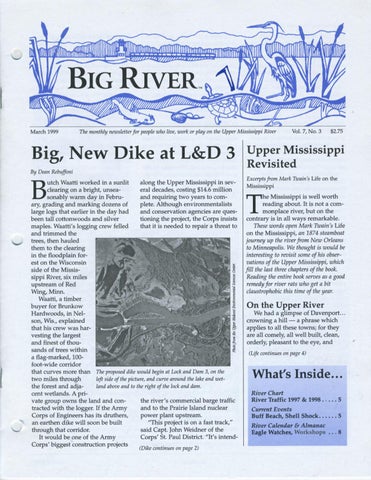
utch Waatti worked in a sunlit along the Upper Mississippi in sevclearing on a bright, unseaeral decades, costing $14.6 million sonably warm day in Februand requiring two years to comary, grading and marking dozens of plete. Although environmentalists large logs that earlier in the day had and conservation agencies are quesbeen tall cottonwoods and silver tioning the project, the Corps insists maples. Waatti's logging crew felled that it is needed to repair a threat to and trimmed the trees, then hauled them to the clearing in the floodplain forest on the Wisconsin side of the Mississippi River, six miles upstream of Red Wing, Minn. Waatti, a timber buyer for Brunkow Hardwoods, in Nelson, Wis., explained that his crew was harvesting the largest and finest of thousands of trees within a flag-marked, 100foot-wide corridor that curves more than The proposed dike would begin at Lock and Dam 3, on the two miles through left side of the picture, and curve around the lake and wetthe forest and adjaland above and to the right of the lock and dam. cent wetlands. A prithe river's commercial barge traffic vate group owns the land and contracted with the logger. If the Army and to the Prairie Island nuclear Corps of Engineers has its druthers, power plant upstream. an earthen dike will soon be built "This project is on a fast track," through that corridor. said Capt. John Weidner of the Corps' St. Paul District. "It's intendIt would be one of the Army Corps' biggest construction projects (Dike continues on page 2)
Vol. 7, No. 3
$2.75
Upper Mississippi Revisited Excerpts from Mark Twain's Life on the Mississippi
T
he Mississippi is well worth reading about. It is not a commonplace river, but on the contrary is in all ways remarkable. These words open Mark Twain's Life on the Mississippi, an 1874 steamboat
journey up the river from New Orleans to Minneapolis . We thought is would be interesting to revisit some of his observations of the Upper Mississippi, which fill the last three chapters of the book. Reading the entire book serves as a good remedy for river rats who get a bit claustrophobic this time of the year.
On the Upper River We had a glimpse of Davenport .. . crowning a hill - a phrase which applies to all these towns; for they are all comely, all well built, clean, orderly, pleasant to the eye, and (Life continues on page 4)
What's Inside ... River Chart River Traffic 1997 & 1998 ..... 5 Current Events Buff Beach, Shell Shock . ..... 5 River Calendar & Almanac Eagle Watches, Workshops ... 8
,,
(Dike continued from page 1)
ed to restore a sense of integrity, to restore reliability, to the existing dike system at Lock and Dam 3." The Corps' assessment of the project's potential environmental effects should be ready for public review and comment in April. It hopes to begin construction this autumn.
Questioning the Need In the fall of 1997 an independent tax-payer watchdog group, Taxpayers for Common Sense, challenged the project's value in its report "River of Subsidy" (see Big River, November 1997). The project does not appear to have raised local grassroots opposition. Although stressing that they need to review the plan and environmental assessment before formally commenting, the Wisconsin and Minnesota Departments of Natural Resources (DNRs) and environmental groups are skeptical. Some critics even suggest that the proposed dike may be part of a piecemeal effort to expand the river's shipping system without thoroughly evaluating its effects on the river's health. "The existing dikes at Lock and Dam 3 have worked for over 50 years, and both DNRs have questioned the need for a new dike of this scale," said Sol Simon, director of the Mississippi River Revival, an environmental group based in Winona, Minn. "Our group is very concerned about the effects of such a dike on the river's ecosystem. This project would divide a big floodplain forest and backwater into two separate areas. Many ecological studies have shown that two halves do not make a whole." Weidner said the dike would correct a complex erosion problem that threatens two old systems of earthen and rock dikes at the proposed project site, which is one of the premier private hunting preserves along the Upper Mississippi. As part of the construction of Lock and Dam 3 in the late 1930's, 2
the Corps built 10 low, earth-androck dikes along the Wisconsin shoreline. Those spot dikes block low areas and side channels that connected the Mississippi to backwaters. They help maintain the nine-foot channel necessary to accommodate barge traffic upstream. The other existing dikes are owned by the Diamond Bluff Association, a group of mostly wealthy people who own about 1,500 acres of Wisconsin bottomland, which includes the Corps' proposed project area (see photo on page 1 and map below this.). It is used largely for waterfowl hunting. The earthen dikes allow the Association to maintain and regulate water levels in two large, shallow lakes, Marsh and Gantenbein, on its property.
A Domino Effect The problem, the Corps says, is that wave action has slowly but severely eroded the narrow strip of
forested shoreline separating the river from Gantenbein Lake. The 118-acre lake is normally six feet higher than the river. If the narrow strip is breached, the lake would empty into the Mississippi. In turn, water pressure would increase on the earthen dike separating Gantenbein from the 900-acre Marsh Lake wetland complex. Eventually, that dike would be breached, draining Marsh Lake. Then pressure would increase on the Corps' spot dikes. If they are breached, much of the river's flow would bypass Lock and Dam 3 by surging across the Diamond Bluff Associates' land. To prevent property damage, the Corps would have to lower the navigation pool above the lock and dam. That could block barge traffic and force Northern States Power Co. (NSP) to shut down its Prairie Island nuclear plant. NSP agrees, and favors the
::. ..·••:.. ........ ..._·
~~ •
·..... : •.:. :· 4
,,,., .
•
•
~ ·-::_,_·.?:;~·...~ ~...:·. ~-: ". ; ..:: '.,.
~ -"--✓~i1/;\:.· '
:
'-,}\:.~,,: . J.\•,•:-•·
-.
..
.-'.;••-... •
•✓
'
This map shows the three existing dike systems on the Wisconsin side of the Mississippi River, near Lock and Dam 3. The proposed dike would roughly follow the route of the Lower Dike, highlighted with a thick solid line.
Big River
March 1999
Corps' project. NSP spokesmen said that if the water level drops, the plant couldn't draw enough cooling water to continue generating electricity, although there would be enough to keep its two nuclear reactors safe. "It's kind of a domino effect," Weidner said. "If we allow the river to bypass Lock and Dam 3, we'll
It would be one of the Army Corps' biggest construction projects along the Upper Mississippi in several decades, costing $14.6 million and requiring two years to complete. need millions and millions of dollars to repair the damage." That, at least, is the Corps' prediction. However, conservation agencies have challenged earlier and less ambitious - versions of the proposal, saying the Corps overstated its case. For example, in a 1994 letter to the Corps, the Minnesota DNR noted that the existing system of dikes had survived several major floods without causing the catastrophic scenario painted by the Corps. The DNR said it would prefer continuing inspection, maintenance and repair of those dikes rather than the new mega-dike scheme. The Corps needs to complete research to determine whether it would still need to maintain the spot dikes on the upstream side of the bottoms if it builds the new dike on the downstream side. The Corps will schedule additional public meetings in the area as more details of the project are completed.
Environmental Effects To build its dike, the Corps would have to cross 12,000 feet more than two miles - of the DiaMarch 1999
mond Bluff Associates' property. Army engineers would have to clear a swath of up to 100 feet through the floodplain forest, toppling many of the trees that remain after Waatti's crew completes its work. Although Waatti' s company bought the biggest and best trees within the corridor in anticipation of the project going forward, the Corps has not yet made a formal proposal either to buy or acquire an easement on the 35 linear acres needed for the dike. It cannot make an offer until it completes an environmental assessment. About half of the dike's length would follow the Associates' existing dike; the remainder would be along the riverbank. The 35 acres in the corridor includes some small ponds and nine acres within the Mississippi itself. The two DNRs and the U.S. Fish and Wildlife Service (FWS) are concerned about the impact on walleyes that migrate from the river to spawn in Gantenbein and Marsh lakes, and bald eagles that forage in the area. Gretchen Benjamin, a Wisconsin DNR biologist, said the rock riprap that would cover part of the prop.osed dike would block passage of frogs and turtles. Teri Alberico, a Corps biologist, said steps would be taken to prevent harm to fish spawning areas and any eagles that might nest in the project area. As for the amphibians, she said, "They might or might not be able to get over the riprap [on the dike]." However, rather than try to directly prevent any such harm and to compensate for the loss or harm to 35 acres of natural habitat, the Corps would enhance or restore 48 acres of similar land nearby. "We're proposing what we think is the route with the least environmental impact and the least cost," Alberico said. The project doesn't appear to threaten any federally listed endangered species, said Gary Wege, a FWS biologist. Big River
"The issue here is how the Corps would adequately compensate for the loss of [35 acres] of bottomland forest habitat," Wege said. "It's easy to say, 'We'll compensate,' but it's difficult to do when you're talking about those big old trees and the aquatic habitat in the river that would be affected. If the Corps has to plant replacement hardwoods well, it takes 100 years to grow such trees. "We're losing a lot of these big backwaters in other pools on the river because of sedimentation. But this area is still in great shape, largely because of the dike system that separates and protects it from the river's floods and sediment." = Dean Rebuffoni, formerly an environmental reporter for the Minneapolis-based Star Tribune, lives in Minneapolis and Hay Creek, Minn.
Big River™ Big River (ISSN 1070-8340) is published
monthly by Riverwise, Inc., 111 Riverfront, Suite 204, Winona, MN 55987; (507) 454-5949; fax: (507) 454-2133; email: editors@big-river.com; web site: http://www.big-river.com Reggie McLeod editor/publisher assistant editor Molly McGuire Mi Ae Lipe-Butterbrodt associate editor Kathy Delano design/marketing Mary Feathergill office manager
Subscriptions m-e $28 for one year, $50 for two years or $2.75 per single issue. Send subscriptions, single copy orders and change-ofadllress requests to Big River, PO Box 204, Winona, MN 55987. Second-class postage paid at Winona, MN. POS'1MAS7ER: send c:lumRe-ol-aMmis m,uests to Big River, PO Box 204, Winona, MN 55987.
Big River, Volume 7, Numl1er 3, copyright M.arch 1999. Reproduction in whole or in part without wriffffl pmni,sion of the publisher is J'l'Ohibited. Printed on recycle4 paper.
3
(Life continued from page 1)
cheering to the spirit; and they are all situated upon hills. Therefore we will give that phrase a rest ... Opposite Davenport is the flourishing town of Rock Island, which lies at the foot of the Upper Rapids. A great railroad bridge connects the two towns - one of the thirteen which fret the Mississippi and the pilots, between St. Louis and St. Paul. The charming island of Rock Island, three miles long and half a mile wide, belongs to the United States, and the Government has turned it into a wonderful park, enhancing its natural attractions by art, and threading its fine forests with many miles of drives ... We move up the river - always through enchanting scenery, there being no other kind on the Upper Mississippi - and pass Moline, a center of vast manufacturing industries; and Clinton and Lyons, great lumber centers; and presently reach Dubuque, which is situated in a rich mineral region. The lead mines are very productive, and of wide extent ... We noticed that above Dubuque the water of the Mississippi was olive-green - rich and beautiful and semi-transparent, with the sun on it. Of course the water was nowhere as clear or of as fine a complexion as it is in some other seasons of the year; for now it was at flood stage, and therefore dimmed and blurred by the mud manufactured from caving banks. The majestic bluffs that overlook the river, along through this region, charm one with the grace and variety of their forms, and the soft beauty of their adornment. The steep verdant slope, whose base is at the water's edge is topped by a lofty rampart of broken, turreted rocks, which are exquisitely rich and mellow in color - mainly dark browns and dull greens, but splashed with other tints. And then you have the shining river, winding here and there and yonder, its sweep interrupted at intervals by clusters of wooded is4
lands threaded by silver channels; and you have glimpses of distant villages, asleep upon capes; and of stealthy rafts slipping along in the shade of the forest walls; and of white steamers vanishing around remote points. And it is all as tranquil and reposeful as dreamland, and has nothing this-worldly about it - nothing to hang a fret or a worry upon ... We passed Prairie du Chien, another of Father Marquette's camping-places; and after some hours of progress through varied and beautiful scenery, reached La Crosse. Here is a town of twelve or thirteen thousand population, with electric lighted streets, and with blocks of buildings which are stately enough, and also architecturally fine enough, to command respect in any city ...
Legends and Scenery We added several passengers to our list, at La Crosse; among others an old gentleman who had come to this north-western region with the early settlers, and was familiar with every part of it. Pardonably proud of it, too. He said 'You'll find scenery between here and St. Paul that can give the Hudson points~ You'll have the Queen's Bluff - seven hundred feet high, and just as imposing a spectacle as you can find anywheres; and Trempeleau Island, which isn't like any other island in America, I believe, for it is a gigantic mountain, with precipitous sides, and is full of Indian traditions, and used to be full of rattlesnakes; if you catch the sun just right there, you will have a picture that will stay with you. And above Winona you'll have lovely prairies; and then come the Thousand Islands, too beautiful for anything; green? why you never saw foliage so green, nor packed so thick; it's like a thousand plush cushions afloat on a looking-glass - when the water's still; and then the monstrous bluffs on both sides of the river - ragged, rugged, dark-complected ... 'Ten miles above Winona we Big River
come to Fountain City, nestling sweetly at the feet of cliffs that lift their awful fronts, Jovelike, toward the blue depths of heaven, bathing them in virgin atmospheres that have known no other contact save that of angels' wings ... 'Next we have the Lion's Head and the Lioness's Head, carved by nature's hand ... and then anon the river widens, and a most charming and magnificent view of the valley before us suddenly bursts upon our vision; rugged hills, clad with verdant forests from summit to base, level prairie lands, holding in their lap the beautiful Wabasha, City of the Healing Waters, puissant foe of Bright's disease, and that grandest conception of nature's works, incomparable Lake Pepin ... 'Then Frontenac looms upon our vision, delightful resort of jaded summer tourists; then progressive Red Wing; and Diamond Bluff, impressive and preponderous in its lone sublimity; then Prescott and the St. Croix; and anon we see bursting upon us the domes and steeples of St. Paul, giant young chief of the North ...
}
)
Conclusions We reached St. Paul, at the head of navigation of the Mississippi, and there our voyage of two thousand miles from New Orleans ended. ... The town stands on high ground; it is about seven hundred feet above the sea level. It is so high that a wide view of river and lowland is offered from its streets ... Minneapolis is situated at the falls of St. Anthony, which stretch across the river, fifteen hundred feet, and have a fall of eighty-two feet - a waterpower which, by art, has been made of inestimable value, business-wise, though somewhat to the damage of the Falls as a spectacle, or as a background against which to get your photograph taken ... Near St. Paul and Minneapolis are several points of interest - Fort (Life continues on page 8)
March 1999
,
J
By Mi Ae Lipe-Butterbrodt
f
1
Second Commissioner
difference for him is that he will be protecting fish, birds and wildlife instead of humans" (St. Paul Pioneer Press 2-2-99). Garber, who was police chief of suburban Champlin near the Twin Cities, did not apply for the job. The previous DNR commissioner, Alan Horner, resigned after coming under fire for previous hunting and fishing violations. Garber heads a 2,500-employee agency, with a $441 million budget that must sort out conflicting interests,affecting the environment, agriculture, hunting, fishing, mining, Indian treaties, logging, tourism and recreation.
Minnesota - Following the resignation of the first commissioner of the Minnesota Department of Natural Resources (DNR) appointed by Governor Jesse Ventura, former FBI agent Allen Garber accepted the position on February 1. Garber is best known for heading the investigation into the disappearance of Jacob Wetterling and for organizing the Minnesota Fugitive Task Force. He does not hunt and rarely fishes, has indulged in outdoor recreational activities only occasionally in recent years and has no previous experience in natural resources. Governor Ventura defended his choice, citing that he "wanted someone who could come in and do this job from the perspective of no previously held agenda. The only
Fighting the Exotic Washington - In the fight against exotic species, President Clinton signed an executive order directing
River Traffic 1997 and 1998: Lockages by Lock and Dam
0
+--t--+------+--+-~----f--~---l--+----+-~~-~_J___~
Upper & Lower 1 St. Anthony Falls
Twin Cities
2
3
4
5
Sa
Red Wing
7
8
Winona La Crosse
Recreational traffic from the Twin Cities to Lock and Dam 3 increased in 1998 over 1997, while tow traffic declined. Recreational traffic drops below commercial traffic on the lower locks and dams. "Commercial" traffic is mostly tows, but
March 1999
6
9
10
11
12
13
14
15
16
Lock & Dam
Dubuque
Quad Cities
includes passenger boats, dredges, buoy tenders and other large working boats. The information for this chart was compiled from summaries provided by the St. Paul District and the Rock Island District of the Army Corps of Engineers.
Big River
agencies to slow their spread and minimize their effects. The order creates the interagency Invasive Species Council, which i1). the next 18 months will develop a plan of attack. The proposed budget also calls for spending $29 million on research to restore damaged ecosystems. Agriculture Secretary Dan Glickman, Interior Secretary Bruce Babbit and Commerce Secretary William Daley will chair the new council (Associated Press 2-3-99).
Shell Shock Iowa and Tennessee - Clamming can be profitable business, but at least two U.S. companies are shelling out big bucks for illegally harvesting and exporting freshwater mussels. A five-year federal and state investigation ended in Muscatine, Iowa, when seven people charged with illegal commercial clamming were sentenced to fines and restitution totaling over $380,000, jail terms and lifetime prohibitions against clamming. Indicted in the case were Darwin Lee "Butch" Ballenger and his wife Cheryl, president and vice president, respectively, of the Mississippi Valley Shell (MVS) Company, and five others. Darwin Ballenger received a 24-month sentence and was ordered to pay $40,000 in restitution, while Cheryl was fined $7,500. The single largest fine, $250,000, was assessed against MVS. All the defendants were placed on probation for terms of two to five years (U.S. Fish and Wildlife Service 2-1-99). In a separate case, the nation's largest shell buying and exporting company must pay a million dollars in restitution for purchasing tons of freshwater mussels illegally har5
vested in Michigan, Ohio, Kentucky and West Virginia. The Tennessee Valley Shell Company will hand over the largest restitution ever paid in a federal investigation into the illegal, commercial exploitation of wildlife resources. Twenty individuals were indicted in the Tennessee Valley case with 136 counts of violating the Lacey Act, which prohibits interstate commerce of protected wildlife. The restitution money will be paid to the National Fish and Wildlife Foundation to establish the Freshwater Mussel Conservation Fund for mussel research and recovery.
Taps & Reveille Minnesota and Illinois - A $2,000 reward is being offered for information leading to the arrest and conviction of whoever killed and mutilated five federally protected trumpeter swans found on January 24 at Carlyle Lake in Fayette County, Ill. An anonymous tip led the officers to the birds' remains on the east side of the lake. Special Agent Tim Santel of the U.S. Fish and Wildlife Service (FWS) said the swans, four of which were decapitated and had their breasts cut out, were probably mutilated to remove identification devices. Anyone with information on the Carlyle Lake killings should contact the FWS Law Enforcement Offices in Springfield, Ill., (217) 793-9554; St. Peters, Mo., (314) 441-1909; or the Illinois Turn In Poachers hotline 1-800-236-7529. On a positive note, more than 500 trumpeters are flying Minnesota skies, thanks to Minnesotans donating to the Nongame Wildlife Checkoff on their state tax forms. This year more than 50 pairs nested and hatched at least 200 young, a modern record. Over 360 swans were observed wintering along the Mississippi River in the Monticello area, and another 166 swans were counted along open water sites near Fergus Falls and western Otter Tail County. Taxpayers are the key to the sue6
cess of the Department of Natural Resources (DNR) Nongame Wildlife Program, according to Steve Kittelson, DNR Nongame Wildlife Swan Restoration Project leader. "We're asking Minnesotans to remember the checkoff when they prepare their state income and property taxes."
Gnawing Gribbles New York, NY-Something's gnawing at the Big Apple these days - gribbles, which are tiny shrimplike crustaceans that burrow into and eat submerged wood. Also known as Limnoria, gribbles are consuming the wood pilings that hold up Franklin Delano Roosevelt Drive, part of which runs over the East River along Manhattan's eastern edge. According to Department of Transportation spokesman Alex Dudley, the gribbles are not a safety threat, but their presence is triggering a $6-million study by the city (Reuters 1-28-99). The gnawing of gribbles can cause wooden structures, like wharf pilings, to collapse. In the past, gribble infestations were discouraged the city's polluted water. But the Clean Water Act of 1987 sparked a gribble population explosion.
Boatload of Water Washington, D.C. - After being confronted with proposals over the past 40 years to transport Great Lakes water to other states and overseas, the United States and Canada recently agreed to jointly study whether they have water to spare. Both countries are hesitant to consider the Great Lakes a commodity to be sold on the open market. Canada, which is fighting an American company's demand for $100 million compensation for being denied permission to ship supertankers loaded with British Columbia water to California, recently announced a plan to ban large-scale water exports. Since the 1950s, numerous pro-
Big River
posals were floated to divert Great Lakes water to Nebraska, Kansas, Oklahoma, Texas, California, the Southwest and even Mexico. Last year, Ontario-based Nova Group got a permit to export up to 158 million gallons of Lake Superior water annually. The company had no buyer, but aimed its proposal at drought-stricken Asia (Minneapolis Star Tribune 2-10-99) . The international study is scheduled to produce a draft plan in six months that covers all border waters from Alaska to Maine.
Cave Brewery St. Paul. - Some test digs in an area slated for a riverfront housing development recently uncovered a bit of St. Paul history - an underground cave brewery. Crews doing preconstruction work on the site uncovered a 12inch opening that led to a "big boiler mysteriously out in the middle of nowhere" and a network of tunnels into cave areas (The Riverview Times 1-15-99). The caves are probably part of the old Melchoir Funk Brewery, which operated from 1865 to 1901, said Gary Brueggemann, a local brewery historian. The brewery at its peak produced about 2,000 barrels of "Funk's Fighting Beer" annually and was one of several breweries in the West Seventh St. area near the Mississippi. The breweries used to store and chill beer in the limestone caves of the river bluffs, and even used the sandstone from carving out storage areas to make glass for their bottles, according to Brueggemann. The area has been reburied for safety reasons, and development officials will consult with architects and contractors about the impact of the cave on this spring's scheduled groundbreaking.
Dam Intervention Minneapolis - Friends of the Mississippi River, the Mississippi River Whitewater Park Development Corporation and the Rivers Alliance of
March 1999
,,
Wisconsin are filing for the right to intervene in the relicensing of a Northern States Power (NSP) hydroelectric facility on the Mississippi River at St. Anthony Falls. The river groups argue that the Mississippi's use shouldn't be limited for private gain, and charge that NSP has not adequately paid for its use of the river according to The Rivers Advocate (Winter 1999). NSP incurs little cost in running its St. Anthony Falls operations, which produce a small fraction of the power the company needs to serve its customers.
Buff Beach Muscoda, Wis. - Too many folks are flocking to the Mazomanie Wildlife Unit on the Wisconsin River, popularly known as the Mazomanie Nude Beach, according to the Department of Natural Resources (DNR). As many as 500 cars often park there on summer weekends. The wildlife area's resources and the river "experience" has deteriorated from overuse, according to DNR supervisor Tom Howard. The DNR plans to curtail the area's use by building a parking lot for only 100 to 120 cars; restricting the access road to allow foot traffic only; closing the area between 11 p.m. and 6 a.m.; and prohibiting camping on state-owned properties, including islands and sand bars.
Endangered BAC Minnesota and Wisconsin - The Minnesota-Wisconsin Boundary Area Commission (MWBAC) teeters on the brink of extinction, after governors of both states recently proposed shutting it down. Minnesota Governor Jesse Ventura said the commission is "an unnecessary duplication of effort." He also recommended the elimination of the Citizens' Council on Voyageurs National Park. Both organizations provide the public opportunities to influence regional and often controversial border issues. The Boundary Area Commission often provided a forum for agencies and citizens from both states to discuss issues affecting the Mississippi and St. Croix rivers. The MWBAC consists of five citizens each from Minnesota and Wisconsin who advise on how to protect the land and river along the states' common border. Its $350,000 annual budget is split equally by the states. "I'm just amazed that this small . agency that has done so much and has been the glue that has held these two states together and has done such a great job protecting the river would be targeted for extinction," said Senator Gary Laidig, RStillwater (Minneapolis Star Tribune 1-31-99). Buck Malick, MWBAC executive director, said that Wisconsin Gover-
nor Tommy Thompson's office did not notify him until the day before the budget became public. Ventura's budget provided $70,000 to close the office, but Thompson's offered nothing. The Commission needs funding from both states to continue.
More 55 Controversy Minneapolis - Opponents of the Highway 55 bypass project are at odds once again with state agencies and officials, this time over archeological studies at a site scheduled for road construction this summer. In early February, road opponents turned.away crews from a national archaeological firm hired to look for Indian burial remains near Minnehaha Park. The state contracted with the firm last year, and in January Hennepin County District Judge Peter Albrecht ordered the Minnesota Department of Transportation and other state agencies to complete the study. But road opponents want a say in how and when the study is conducted, and which archaeologists will do it. Federal mediations over this and other issues began in midFebruary (St. Paul Pioneer Press 2-999).
• camping • carp • ducks • eagles • flood • herons • cattails • lock • barges • otters • gizzard shad •
~
~
Share your love of the river...
~
Enjoy the river every month of the year from the comfort of your easy chair. And when you're on the river, you'll remember the stories you read in Big River.
~
I
Give yourself, a friend, relative, library or school a subscription to Big River.
]
1 year - $25.00 2 years - $50.00 write: Big River, P.O. Box 204, Winona, MN 55987-0204 call· (800) 303-8201 fax: (507) 454-2133 email: editors@big-river.com
~
•
-ji
We'll send a gift card and begin your Big River subscription immediately.
• s8oJj • stvoq.taaJ.t • s1voqrno1 • 8uJUtUtJrns • qSJ./Jro • SJUV.tow.to:J • a1<fvw .wavs • uonn11o<f
March 1999
Big River
~
§
~
[
~-
i
~ ~ c;,;
~ ~
~ • 7
Special Events & Festivals March 5-7 Nature photography seminars, Wabasha, Minn., (651) 565-4989. 5-7 Minnesota Resort & Campground Show, State Fair Coliseum, St. Paul, Minn., (651) 222-7401. 13 Landowner Appreciation Day, 9:30 a.m. - 12:30 p.m., Eagle Bluff Environmental Learning Center, Lanesboro, Minn., 888-800-9558.
Eagle Watches March
Workshop, Environmental Ethics: In Leopold's Footsteps, 8 a.m., Macalester College, St. Paul, Minn., e-mail: mna@mtn.org
16 Design and Construction of Trails through Sensitive Areas, Minnesota Valley Fish and Wildlife Refuge, Bloomington, Minn., (651) 290-4160, ext. 221.
25 Protecting River & Stream Water Quality, North Branch, Minn., (651) 6744417.
26-30 International Zebra Mussel and Aquatic Nuisance Species Conference, Duluth Entertainment Convention Center, Duluth, Minn., 800-868-8776. m
April Workshops on Habitat Restoration and Protection of the Upper Mississippi River System, 7 p.m. - 8:30 p.m., (309) 793-5800, ext. 522 or (651) 2901695. 13 City Hall, Rock Island, Ill.
Through 28 Wabasha, Minn., city deck staffed Sundays 1 p.m. - 4 p.m., (651) 565-4989.
14 Carnegie-Stout Library, Dubuque, Iowa.
7 Winona, Minn., 1 p.m. - 4 p.m., (507) 452-2272 or 800-657-4972.
19 Huckleberry's Restaurant, Prairie du Chien, Wis.
21 Soar With The Eagles, noon - 5 p.m., National Eagle Center, Wabasha, Minn., (651) 565-4989.
20 Public Library, 800 Main St.,La Crosse, Wis.
Meetings & Hearings
(Life continued from page 4)
Snelling, a fortress occupying a river-bluff a hundred feet high; the falls of Minnehaha, White-bear Lake, and so forth. The beautiful falls of Minnehaha are sufficiently celebrated - they do not need a lift from me ...
=
21 Public Library, Red Wing, Minn.
March 9-11 Upper Mississippi River Conservation Committee 55th Annual Meeting, Radisson Hotel, La Crosse, Wis., (608) 267-9426.
,.
10 Upper Mississippi River Master Plan Implementation, 6 p.m. - 8 p.m., Northeast State Bank, Minneapolis, Minn., (612) 661-4863. 25 Preserving the History of the Mississippi, Cottage Grove, Minn., (651) 2904160, ext. 221. 30 River Monitor's Youth Congress, Camp Ripley, north of Little Falls, Minn., (218) 547-7263.
April 6 Preserving the History of the Mississippi, Anoka, Minn., (651) 290-4160. 22-23 Mississippi River Research Consortium Annual Meeting, Yacht Club Resorts, La Crosse, Wis., (309) 298-1553.
Workshops & Conferences March 5-6 Midwest Organic Farming¡Conference, Sinsinawa, Wis., (715) 772-6819. 9 Managing Erosion to Protect Water Quality, Wyoming, Minn. City Hall, (651) 674-4417. 9-10 Using Ecosystem-Based Processes to Restore our Communities, Rochester, Minn., (612) 920-9326.
Almanac By Kenny Salwey I'm in a quandary! February's weather behaved mostly like March. Will March be like February or more like April? Nevertheless, this sometimes wild, sometimes docile month is one of my favorites. Firsts include red-winged blackbirds, wood ducks, migrating bald eagles by the hundreds, peregrine falcons, robins, great blue herons and woodcocks. Late in March one hears the strange "peent, peent" of mating woodcocks in lowlands. These little migratory birds with long, probe-like beaks and large eyes are a delight to watch. The grass, skunk cabbage, watercress and marsh marigolds begin to green up. The life blood of the largest plants of all - trees - begins to pulse. Sap drips steadily from recent wounds. It's maple syrup time. The first frogs can be found in backwater marshes. An early emerging turtle or a grass, bull or water snake might venture out in a sheltered, sunny spot. Near a muskrat breeding log or grass hummock, the smell of their namesake musk hangs heavy in the air- a sweet smell from two thumb-sized glands at the base of the male's tail. Northern pike, the first fish to spawn, patrol shallow, weedy sloughs. The first towboat ventures up the river. So quandary or not, I'm glad to be enjoying March in this beautiful valley. 11111
19 Minnesota Naturalists' Association
8
Big River
March 1999