February 1999
The monthly newsletter for people who live, work or play on the Upper Mississippi River
Hard Water Fishing By Roger Lacher
T
he valley seems gripped stiff in winter's fist, but a river runs through it. Freeze up on the Mississippi signals the beginning of an odd sort of sport: fishing through the ice. When the thin line between man and fish becomes thick enough to hold up the
well into spring and summer. Some might be traded for another territory's goods. This sort of fishing required hardiness and techniques unique to the North. The same simple principles apply . to angling today: Make a hole through the ice, offer the fish some-
111.nb C.
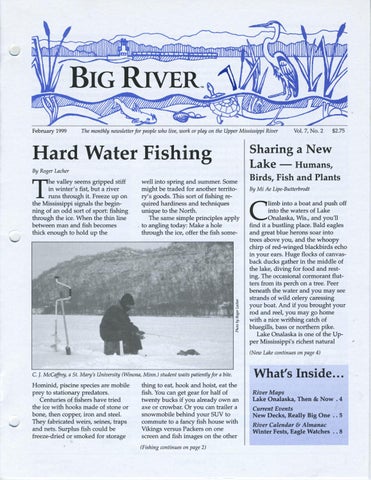
J. McCaffrey, a St. Mary's University (Winona, Minn.) student waits patiently for a bite.
Hominid, piscine species are mobile prey to stationary predators. Centuries of fishers have tried the ice with hooks made of stone or bone, then copper, iron and steel. They fabricated weirs, seines, traps and nets. Surplus fish could be freeze-dried or smoked for storage
thing to eat, hook and hoist, eat the fish. You can get gear for half of twenty bucks if you already own an axe or crowbar. Or you can trailer a snowmobile behind your SUV to commute to a fancy fish house with Vikings versus Packers on one screen and fish images on the other (Fishing continues on page 2)
Vol. 7, No. 2
$2.75
Sharing a New Lake - Humans, Birds, Fish and Plants By Mi Ae Lipe-Butterbrodt
C
limb into a boat and push off into the waters of Lake Onalaska, Wis., and you'll find it a bustling place. Bald eagles and great blue herons soar into trees above you, and the whoopy chirp of red-winged blackbirds echo in your ears. Huge flocks of canvasback ducks gather in the middle of the lake, diving for food and resting. The occasional cormorant flutters from its perch on a tree. Peer beneath the water and you may see strands of wild celery caressing your boat. And if you brought your rod and reel, you may go home with a nice writhing catch of bluegills, bass or northern pike. Lake Onalaska is one of the Upper Mississippi's richest natural _. (New Lake continues on page 4)
What's Inside ... River Maps Lake Onalaska, Then & Now . 4 Current Events New Decks, Really Big One .. 5
River Calendar & Almanac Winter Fests, Eagle Watches .. 8
(Fishing continued from page 1)
via sonar. Red-hot heaters, blue movies, global positioning systems, shag carpet. The sky is the limit, although in this inverted world, the bottom of the river sets the stage. Ice fishers don't look up much.
The Jig is Down A camouflage pickup parked along the Great River Road sports a bumper sticker declaring, "It's not how deep you fish, it's how you wiggle your worm." Where panfish are the popular quarry, live bait is indeed the ticket, but typically impaled on a jig. A jig is a small weighted hook, decorated to be effective by itself or to add flash to bait. Never in the history of marketing has a retailer advertised "WEIGHTED HOOKS, PAINTED." Try Purple Twerpler, Rat Finkie, Marmooska, Widow Maker Binkle, Big Beaver's Ant Hattie, Rapala Pilkki or Swedish Pimple. The patent office doesn't care who gets caught by what. Crappies, sunfish and perch are plumbed with a variety of organisms adding scent or movement to
Try Purple Twerp/er, Rat Finkie, Marmooska, Widow Maker Binkle, Big Beaver's Ant Hattie, Rapa/a Pilkki or Swedish Pimple. The patent office doesn't care who gets caught by what. the business end of a hook. Red worms, mousies, spikes, night crawlers, waxies, leeches, goldenrod grubs and fish eyes join five sorts of minnows in a bait shop's menagerie. Such a zoo needs maintenance. Crawlers can't get too cold, minnows may need oxygen, wax worms mature and fly away as bee moths. Old-timers recommend stuffing chilled mousies under your lip like snuff so they'll thrash
2
around more down by the bluegills. To add to the maggot's action, the fisher jerks the line in a twitch measured in inches or fractions. Timing, too, is important. You can jig steady like a chronic neurological condition or tantalize in spasms when you're sure the fish can't stand the tension anymore. Minneapolis Star Tribune columnist Ron Schara says, "Jigging will at least keep your mind occupied."
With luck, the fish's teeth don't scratch the paint on the decoy and, by golly, it's one from Grandpa, worth real money. Like lots of fishing memorabilia, decoys can command surprising prices. Sotheby' s in New York auctioned one for over $18,000 in 1991. Modern artists carve whimsical minnows that will never see water, and surely somewhere there's a garage sale with a tackle box full of treasure.
Fishing Indoors
Generations
Mitch Loesel of Gilmanton, Wis., offers, "Been here since seven." It's sundown and the windchill out on the Alma ice approaches minus 50. But inside the propane-fumed nylon shelter, he and friends smile over a few smallish sunnies and perch frozen flat at their feet. They're jigging two holes each, as the law permits. Regulations also mandate licensing and labeling the tiny tent. March 1 is the last date it can stay overnight on Minnesota-Wisconsin border waters - February 20 along Iowa. But portable rigs are legal on a daily basis until rotting ice and a surfeit of boredom force the fisher back to shore for the season. Upper rixer laws also allow the atavistic practice of dark-house spearing. This solitary sort of ice fishing mirrors Ojibwa techniques of impaling large predator fish, especially northern pike. A slot is cut down to water, a lure dunked as easy prey, and a cover draped to block out the light. Then the fisher hunkers there, arm cocked like a heron's neck, barbed spear waiting for the right thrust. The lure in this case has no hooks. It is a decoy, a fish mimic big as a hand, store-bought or home-made, realistic or fanciful. Poised like a sniper, the spearer patiently anticipates a Mississippi Moby Dick's shadow approaching the hapless facsimile dangled in the shallows. With luck the barbs poke past the ribs and the pike is pitchforked up and out.
Will interest in ice fishing carry on into the next millennium? The sport seems similar to a slow-motion video game frozen in time. Hand-eye coordination is critical to
Big River
"Sure, it's exciting! Like aiming a gun up your chimney and waiting for a duck to fly over." set the hook when the bobber bobs. But when hours may separate bites, can future generations stand the tedium? One kid's uncle quipped, "Sure, it's exciting! Like aiming a gun up your chimney and waiting for a duck to fly over." But the tradition is indeed carrying on. Maybe a hole in the ice serves as safety valve in a highpressure world. Since brawn, cash and expertise play a minimal role, Lady Luck is a great equalizer for fishergirls and boys. Ethel Long, proprietor of the Bait Shack in Winona, Minn., for years, is optimistic about Mississippi Valley fishing and plans to pass the business on to her daughter. "I see five and ten year olds in here with their dads. I encourage them to catch and release and, you know, they get the idea."
Breaking the Skin While an early flood, "ice out," may sweep bergs down the Main
February 1999
,
Channel, die-hard fishers still risk the backwater sloughs. One octogenarian who still ventures after bluegills says, "The last time I fell in, a buddy reached out with a tree branch. Man, first you lose your breath ... just gasping, then the numbness sets in." It seems every fisher gets wet sooner or later. Ron Anderson of Pepin unzips his shelter to talk about the days when shack or shanty meant heavy with a door you could knock on. Of course many of them shifted, settled or sank in spring. His listed south overnight once, then west by noon. He hurried home for a boat and rope and slid that puppy to shore just in time. His neighbor's tent is scrawled "Stockholm" and sits the requisite minimum ten feet away. These fishers must be of Nordic ancestry. He sounds like he has nothing to say, didn't walk out here on the Wabasha ice to visit. The yellow snow by the entry is not from sunnies. How do Grumpy Old Men get that way? Gary Eddy of Homer, Minn., declares it's all physics. Obviously, wet and cold add up to crankiness if not rigor mortis. He's a volunteer with a regional Dive and Rescue team and has plenty of respect for
the elements. Underwater in winter can be grisly business for the emergency crew. They rarely dive for a survivor. Eddy recommends fishers always wear "hand claws" strung around the neck like mittens. The metal spikes enable a drenched victim to climb out and pick across to safety. Patrons at the Dam View tavern, in Alma, Wis., argue about gunning your snowmobile to out-skim failing ice, opening windows and skipping seatbelts before trucking on the river, and how your wife might react to the $1,000 it costs to fish out a vehicle. The vast half of fishing revolves around the stories. Cynics may claim Bubba of Baton Rouge is born again upstream as Bjorn of the North. The "blood sports" are a philosophical can of worms to many modern Americans. What motivates a Midwesterner to walk on water, contemplate navel all day, speak against a north wind and carry a small stick, stand waiting for the light until boots freeze to surface, fish the East Coast one day, West the next?
Big River™ Big River (ISSN 1070-8340) is published
monthly by Riverwise, Inc., 111 Riverfront, Suite 204, Winona, MN 55987; (507) 454-5949; fax: (507) 454-2133; email: editors@big-river.com; web site: http://www.big-river.com Reggie McLeod Molly McGuire Mi Ae Lipe-Butterbrodt Kathy Delano Mary Feathergill
editor/publisher assistant editor associate editor design/marketing office manager
Subscriptions are $28 for one year, $50 for two years or $2.75 per single issue. Send subscriptions, single copy orders and change-of-
address requests to Big River, PO Box 204, Winona, MN 55987. Second-class postage paid at Winona, MN. POSIMASTER: send change-of-address requests to Big River, PO Box 204, Winona, MN 55987. Big River, Volume 7, Number 2, copyright February 1999. Reproduction in whole or in part without written permission of the publisher is prohibited. Printed on recycled paper.
Roger Lacher writes from headwaters of the Root River upstream of Hokah, Minn.
• camping • carp • ducks • eagles • flood • herons • cattails • lock • barges • otters • gizzard shad •
~
]
~ •
Share your love of the river. ..
•
Enjoy the river every month of the year from the comfort of your easy chair. And when you're on the river, you'll remember the stories you read in Big River.
Give yourself, a friend, relative, library or school a subscription to Big River.
•
1 year - $25.00 2 years - $50.00 write: Big River, P. 0. Box 204, Winona, MN 55987-0204 call: (800) 303-8201 fax: (507) 454-2133 email: editors@big-river.com
•
We'll send a gift card and begin your Big River subscription immediately.
• sfio.tj • s7voq.wa7.1 • s7voqmo7 • fiuJututJms • qsJ,jjm • s7uv.1out.1o:J • a7dvut .wavs • uonn11od
February 1999
Big River
•
3
(New Lake continued from page 1)
areas, but ironically it is a product of human intervention, both in its origins and the continuing projects that restore habitat and manage wildlife. The lake is a prime example of a delicate ecological mechanism, a world where every species counts, and respect for all its inhabitants, not just the ones we find beautiful, noble or tasty, is crucial to its health.
Drought and Die-off Prior to 1938, the area that later became Lake Onalaska was a network of farms, fields, dense forests and a swampy area east of the Mississippi River. Lock and Dam 6 at Dresbach, Minn., built in the late 1930s, forced the waters of the Mississippi and the nearby Black River to rise and form the lake. In its first four decades, the lake grew into a lush, fertile haven. Beneath the lake's surface was a jungle. "The wild celery beds were so dense that a boater could not motor forward 10 feet," says Lara Hill, a wildlife biologist with the U.S. Fish and Wildlife Service (FWS). Lakeside residents and some boat owners complained about the wild celery, or Vallisneria, getting tangled in their boat propellers and preventing them from moving about freely. By the late 1980s, the lake was in trouble. Severe droughts in the Upper Midwest caused the lake's flow to stagnate. The lake's sluggish waters lost oxygen and darkened with sediment stirred up by boat traffic, and vegetation that previously filtered the water died. By that time, decades of wind and wave action, or fetch, had eroded many of the existing islands, shrinking protective habitat for fish and aquatic vegetation. Sediment blocked some backwaters, while dissolved oxygen levels plummeted in a major fish wintering area near Rosebud Island, on the far east side of the lake. In 1980, 174 plants flourished in the average square meter of lake bottom; by 1993, only two per
4
calm water for warmth in the winsquare meter survived. Biologists ter," says Mark Endriss, a fisheries were alarmed by this catastrophic biologist with the Wisconsin Dedrop because canvasback and other diving ducks eat the nutritious Valpartment of Natural Resources, lisneria winter tubers, and the plant "and the dredging has moderated beds provide protective cover for the lake's flow." Today Lake Onalasthe young of many fish species. A ka is nationally recognized as one lack of small fish means a lack of food for larger fish and birds. The wild celery is now coming back on its own and thriving, with 45 plants per square meter. The result is that during the first week of November, 30 percent of the entire world's population of canvasbacks are sitting on three pools This map of the area that became Onalaska was created in 1890s. of the Upof the best spots to catch panfish, per Mississippi. such as bass, crappies, bluegills, perch, walleye and sunfish. Restoring the Balance Fred Funk, a longtime lakeside In 1989, the Army Corps of Engiresident, also believes the lake's neers began constructing several health improved drastically since habitat rehabilitation projects in the habitat projects. "Lake Onalaska Lake Onalaska. Over 170,000 cubic has always been a dynamic lake for yards of sand were dredged from fish and wildlife, but the fact that nearby channels to build three 3.5acre, crescent-shaped islands (Arthe lake is coming back stronger than ever is encouraging." Funk rowhead, Broken Gun and Cormorant) in the middle of the lake. should know - he has enjoyed the Channels dredged behind Rosebud river since he was a young boy, served on the Minnesota-Wisconsin Island provided oxygenated water Boundary Area Commission and to the fishery area, and Rosebud itself was expanded. Finally, the three been past chairman of the Lake Onalaska Protection and Rehabilitation small islands were covered with topsoil and seeded. District. "Bluegill and bass need relatively
Big River
February 1999
.,
It Takes All Sorts
r
l
Some folks take a dim view of species that they think interfere with their own favorite recreation. Some anglers accuse the cormorants who feed and nest on the lake of eating all the prime panfish. And
Lake Onalaska as it appears today.
I l
some boaters regard the voluntary avoidance area signs posted on the lake in the fall as a nuisance, and motor right through spots where migrating waterfowl are attempting to feed and rest. "Cormorants are smaller birds, and thus they tend to eat only smaller fish, or smaller sizes of larger species," notes Endriss. "Game fish need to be five years old to be of legal size anyway, so the cormorants are not interfering. But there's one group of people who don't want to set even a little bit aside for nature - they want it all for themselves." Red Edmunds, who runs Schafer's Boat Livery on the north
February 1999
end of the lake, believes the lake is big enough for all the wildlife, including the cormorants. "They don't really compete with us for fishing, because they live and fish mainly in the middle of the lake, where people don't go." Others believe the cormorants are actually destroying the environment with their droppings. "That happened with Cormorant Island on the lake - all the vegetation died off there before the habitat projects restored the plants," says Funk. "We can't let one species dominate the river to the point they cause substantial damage." Funk maintains that tundra swans, which are returning to the lake in growing numbers, may become a pest. "They compete with the ducks and geese for food; with their method of feeding, they uproot 10 times the amount of weeds the same number of ducks would." Biologist Lara Hill disagrees. "Everything is competition to people," she says. "Some people think the swans are eating all the vegetation because as soon as the swans appear, the plants are gone. It just happens that the Sagittaria [arrowhead] dies back at the same time the swans are out there." Because the lake is such an important staging area for migrating
Big River
ducks and geese, a voluntary waterfowl avoidance area (VWAA) was established in 1986 by several groups, including the Upper Mississippi River National Wildlife and Fish Refuge and the Lake Onalaska Protection and Rehabilitation District. Boaters are encouraged, but not required, to avoid traveling through the VWAA, which is marked by buoys, from October 15 through mid-November. Canvasbacks are particularly wary ducks, and tend to flee from the slightest sign of boating or hunting near their feeding and resting grounds. The fat built up from these stops may mean the difference between life and death during their long trip south.
Getting Back to Nature Fortunately, most humans on Lake Onalaska keenly appreciate the lake's natural beauty and rich resources, and treat it with respect, according to Funk and Edmunds. "Most of the 138 people who reside along the lake realize how lucky they are to be actually living inside a wildlife refuge area," says Edmunds. "Of course, there will always be the complainers who say the algae and weeds are clogging their boat docks. But you need weeds to have fish, and you need fish to have birds, and so on. It's just that simple." Funk particularly enjoys spending a quiet morning floating in the backwaters and taking the six-mile trip upstream to Trempealeau, Wis. "It's so nice to get out and be by ., yourself," he says, "savor the beauty of the land and water surrounding you, and maybe see only two or three people in that entire trip." In a fast-paced world increasingly cluttered by the toys, noise and accessories of civilization, taking that extra step to respect and preserve these natural treasures becomes even more important.
=
Mi Ae Lipe-Butterbrodt is associate editor of Big River.
5
By Mi Ae Lipe-Butterbrodt
New Decks Wisconsin and Minnesota - Two new wildlife observation decks are open to the public on Pool 8: one is four miles south of Brownsville, Minn., on Highway 26, and the other is on Goose Island, south of La Crosse, Wis. The Brownsville deck overlooks a part of Pool 8 slated for a future Environmental Management Program project that will restore islands and lost fish and wildlife habitat. Folks can access the Goose Island deck by taking a nature trail that starts behind the gate south of the flagpoles. If you are interested in adopting one of these new decks, contact Mary Stefanski at the La Crosse District office of the Upper Mississippi River National Wildlife and Fish Refuge at (608) 783-8405.
Bridge Reconstruction Twin Cities - Construction will begin in April 2000 on an $8.3 million renovation of the Ford Bridge, which links Minneapolis and Saint Paul. The project, known as Option 2A, will widen the bridge by 14 feet, allowing for four lanes of traffic, six-foot shoulders and eight-foot sidewalks. Viewing balconies will also be built on each side of the bridge, as well as aesthetic improvements to recapture some of the bridge's original appearance, according to Ramsey County project manager Jim Tolaas (Riverview Times 12-14-98). The project, which was approved in its first public hearing, was the least expensive rehabilitation project presented. It will extend the bridge's life for at least 50 years. In response to neighborhood concerns, two lanes of the bridge will remain
6
open during the 12- to 18-month construction period. Many of the forum-goers' concerns during the November 19 public hearing revolved around sidewalk and bicycle pathway designs, and relocations of peregrine falcons who nest on the Ford Bridge.
Enforcing Enforcement Tough laws to protect the nation's land and water don't do any good unless government agencies enforce them. This is a problem faced by agencies as diverse as the Minnesota Pollution Control Agency (MPCA) and the Army Corps of Engineers. The MPCA - once considered a national leader in environmental protection - has lagged in its inspections since the mid-1990s. It has also taken little or no action against many companies that repeatedly violated water-quality laws, according to a report by the Minneapolis Star Tribuns (12-13-98). The Tribune reported that the MPCA enforcement actions dropped more than two-thirds since 1994, while the number of wastewater discharge violations has risen about 30 percent. In recent years the MPCA has been accused of getting "too cozy" with big industry, backing down to job-producing companies or in politically delicate situations and acting only when pressured by environmentalists, whistle-blowers, other government agencies or the media. Nearly half the lakes assessed by the MPCA contain phosphorus levels too high for safe swimming. "It's a really bad pattern of just coddling the polluters of the state," said Marie Zellar, state director of the environmental group Clean Water Action Alliance of Minnesota (La
Big River
Crosse Tribune 12-15-98). Meanwhile, in Florida, some current and former Corps employees charged the Jacksonville District of allowing illegal construction projects on Florida Keys wetlands. A former Norfolk, Va., regulator accused her district engineer of approving a Motorola Corp. semiconductor plant on an important wetlands area without submitting the proposal to agency review or public hearings, as required (Anchorage Daily News 11-2-98). "Many regulatory employees are constantly running up against the fact that this is essentially a military and public works agency," said Todd Robins, a public-interest lawyer from Washington, D.C. And the Iowa Department of Natural Resources (DNR) has been accused by several environmental groups of not enforcing the federal Clean Water Act. Representatives of the Mississippi River Revival (MRR), the Iowa Chapter of the Sierra Club and the Environmental Advocates issued 10 "citizen enforcement notices" to Iowa cities and businesses in late January. If they do not comply with clean water standards in 60 days, private citizens and the environmental groups can sue them. The Flying J Travel Plaza in Davenport is the only business near the Mississippi River on the list, although the other nine are on tributaries of the river. Half of the 1,709 cities and industries that discharged sewage into Iowa waters last year violated their federal clean water permits, according the MRR. "The DNR is not only harming Iowa's water quality by letting polluters break the law, they are also effectively punishing the one half of
February 1999
Iowa's industries and communities that are doing the right thing," said Sol Simon, executive director of the group, which has several chapters in Iowa (see "A Hard Act to Follow" Big River, December 1998).
"It would be a huge deal" if most of a mammoth skeleton could be recovered from that site, according to Jim Gallagher, executive director of the center. Mammoths died out about 10,000 years ago.
Harold E.Craig
Eagle Accidents
La Crosse, Wis. - Former Minnesota-Wisconsin Boundary Area Commission chairman Harold E. Craig died in La Crosse on Christmas Eve. He was 70. Craig dedicated himself to many causes furthering the Upper Mississippi River. Craig was twice appointed to five-year terms on the 10-member MWBAC by Wis. Governor Tommy Thompson. He chaired the commission in 1991 and 1997, and was selected to serve as chair a third time in 1999. In 1996, he and his wife, Mary, received the Environmental Stewardship Award. In 1997, he led a major commission initiative in Washington, D.C. to promote Congressional commitments to the long-term management of the Upper Mississippi River. Jim Fitzpatrick of Hastings, Minn., who had been elected vicechair, succeeds Craig as commission chair in 1999.
Prairie du Sac, Wis. - Even though the Wisconsin Department ofMotor Vehicles hasn't issued many driver licenses to bald eagles lately, more and more of the birds are dying in auto accidents. A Department of Natural Resources (DNR) census shows that, in a 12-month period between 1997 and 1998, 61 eagles were injured and 39 killed by collisions with objects or vehicles. Randy Jurewicz, staff biologist with the DNR's Bureau of Endangered Species, says that 18 eagles were struck by cars (Associated Press 1-12-99). Many eagles are hit while eating road-killed animals, which are an easy meal when their fishing grounds are frozen over.
A Really Big One La Crosse, Wis. - A La Crosse man who found a seven-inch mammoth tooth in the Mississippi River plans to return to the same spot in the spring to search for more prehistoric treasures. Gary Kidd was diving when he found the tooth in the side of an underwater ledge in the Wisconsin side of the river between Prairie du Chien and Lynxville last September. After the Mississippi Valley Archaeology Center at the University of Wisconsin-La Crosse told Kidd what he had found was a mammoth tooth, he returned to the site in mid-December and found another object that could be either a rock or part of a mammoth bone (Associated Press 12-29-98).
February 1999
Boating 10,000 Lakes Minnesota - The number of Minnesota boating deaths in 1998 is the second lowest on record, according to the Department of Natural Resources (DNR). Thirteen people died, down eight from 1997. The record low was 12 deaths in 1996. Kim Elverum, DNR Boat and Water Safety Program coordinator, reported that only two of the 13 victims were wearing life jackets, alcohol was involved in 46 percent of the accidents, and none of the accidents were from personal watercraft use. The DNR also reported 153 nonfatal boating accidents with injuries or property damage exceeding $500 in 1998. Collisions between two boats were the most common accident, and 36 of the 153 non-fatal accidents involved at least one personal watercraft.
Big River
Bridge Troubles Over Stillwater, Minn. - A compromise on the location for the planned Stillwater Bridge may have broken up a legal log jam. The Minnesota Department of Transportation (DOT) has retracted an appeal of a U.S. District Court decision blocking it from building the bridge across the St. Croix River from Oak Park Heights to Houlton, Wis., according to department spokesman Bob Mcfarlin. "It just didn't seem to be a reasonable or appropriate course of action to have litigation on the old design pending while we're working on a new design," he said (St. Paul Pioneer Press 1-9-99). Opponents claimed the original design would be an aesthetic and environmental blot over the St. Croix, which was one of the first rivers accepted into the National Park Service's Wild and Scenic Rivers program. The new design entails a $123 million steel deck bridge that will be built less than a mile south of the existing lift bridge in Stillwater. The new bridge is shorter and lower than the original design. The fate is uncertain for many of Minnesota's other spans, including six deteriorating bridges over the Mississippi River. Far more trucks than expected are crossing these bridges. The increased weight and traffic has created fatigue cracks in many. The Minnesota DOT says these bridges must be replaced or renovated within the next 20 years, which could temporarily close some and reduce load-limits on trucks. The six affected Mississippi River bridges listed by the DOT are the I35W in downtown Minneapolis, the Lexington Avenue span into St. Paul, the Lafayette bridge in downtown St. Paul, the Wakota in South St. Paul, the Hastings span and the 1-90 bridge at Dresbach near La Crescent.
7
Special Events & Festivals
Meetings & Hearings
February Through 7 St. Paul (Minn.) Winter Carnival, (651) 223-4710 or 800-488-4023.
February 14 Dubuque (Iowa) Audubon Society, 7 p.m., American Trust & Savings Bank.
Through 7 Winter Rec-Fest, La Crosse, Wis.
17 Upper Mississippi River Basin Association, quarterly meeting, St. Louis, Mo., (651) 224-2880.
1 Landscaping for Wildlife, 6:30 p.m. - 8 p.m., Hixon Forest Nature Center, La Crosse, Wis., (608) 784-0303. 6 Candlelight Cross Country Ski, 5 p.m. 8 p.m., Perrot State Park, Trempealeau, Wis., (608) 784-9047 or (608) 526-6699. 6 Learn about Woodpeckers Walk, 2 p.m., West Coon Rapids Dam, Brooklyn Park, Minn., (612) 424-8172. 6-7 Winter Fest, Lake City, Minn., 800-3694123. 7 Winterfest, Great River Bluffs State Park, Dakota, Minn., (507) 643-6849. 8 Landscaping for Wildlife, 6:30 p.m. - 9 p.m., Hixon Forest Nature Center, La Crosse, Wis., (608) 784-0303. 13 Sweetheart Candlelight Ski/Hike, 6 p.m - 9 p.m., Wyalusing State Park, Bagley, Wis., (608) 996-2261.
17-18 Environmental Management Program Coordinating Committee, St. Louis, Mo., (651) 224-2880. 20 Clean Up our River Environment (CURE), annual meeting, Granite Falls, Minn., (302) 269-2105. 24-26 Upper Mississippi River Summit, Minneapolis, Minn., (202) 347-7550.
March 9 Managing Erosion to Protect Water Quality, City Hall, Wyoming, Minn., (651) 674-4417. 9-10 Using Ecosystem-Based Processes to Restore our Communities, Rochester, Minn., (612) 920-9326. 25 Protecting River and Stream Water Quality, North Branch, Minn., (651) 6744417.
30 Minnesota River Monitor's Youth Congress, Camp Ripley, Little Falls, Minn., (218) 547-7263.
Workshops & Conferences February 6, 11, 20 and 25 Big River Workshops for educators, river-related learning activities, St. Paul, Minn., (651) 290-4160, ext. 231. 16-17 Minnesota Organic Conference, Kelly Inn, St. Cloud, Minn., (507) 2375162. 9-11 Upper Mississippi River Conservation Committee, Radisson Hotel, La Crosse, Wis., (608) 267-9426. 26-27 State of the Rivers, 9 a.m. - 4 p.m., Friday; 9 a.m. - 1 p.m., Saturday; Law and Grad School Conference Center, Hamline University, St. Paul, Minn., (651) 676-1745.
March 5-6 Midwest Organic Farming Conference, Sinsinawa, Wis., (715) 772-6819 . ..a
17-21 Greater Northwest Vacation Show, Minneapolis Convention Center, (612) 943-2002. 19-21 Sports and Travel Show, St. Cloud (Minn.) Civic Center, (612) 755-8111 or (320) 255-7272. 27 Grumpy Old Men Festival, Wabasha, Minn., 800-565-4158. 28-Mar. 5 Elderhostel courses, river birds and the river woodsman, Winona State University, Winona, Minn.
March 5-7 Minnesota Resort & Campground Show, State Fair Coliseum, St Paul, Minn., (651) 222-7401.
Eagle Watches Through Feb. 14 Mississippi River Visitor's Center, Rock Island, Ill., (309) 794-5338. Through Mar. 28 Wabasha, Minn., city deck staffed Sundays 1 p.m. - 4 p.m.; special program Mar. 21, (651) 5654989. Mar. 7 Winona, Minn., 1 p.m. - 4 p.m., (507) 452-2272 or 800-657-4972.
8
Almanac By Kenny Salwey In February many of us could use a little cheering up. The other day I was staring out the window counting snowflakes when my wife, Mary, told me, "If your lower lip hung down any further you'd step on it! The signs of spring are already out there, go check it out!" I was barely out the door when a cardinal's spring love song - "hey cheer, cheer" found my ears. Awhile later a flock of migrating horned larks took flight from a weed patch. A pair of great horned owls perched on a huge hollow red oak tree. Yep, the early bird might catch the worm, but these early birds lay the first eggs. At the springs below Big Lake shack, about 30 to 40 robins flitted about. Four or five squirrels performed aerial acrobatics in the nearby trees - aha, mating time! In a field, two fire engine red foxes lay side by side in the snow. Near a well-used deer trail a small shed antler stuck out of the snow. The patches of open water in the Main Channel and larger sloughs grow bigger each day. In February one can enjoy the pleasures of late winter and discover the telltale signs of spring. Not a bad combination, aye my friend? ffl
Big River
February 1999