October 1998
The monthly newsletter for people who live, work or play on the Upper Mississippi River
Vol. 6, No. 10 $2.75
Fall Birding Spots on Board the Upper Mississippi Volunteer By Dean Gabbert
By Pamela Eyden
O
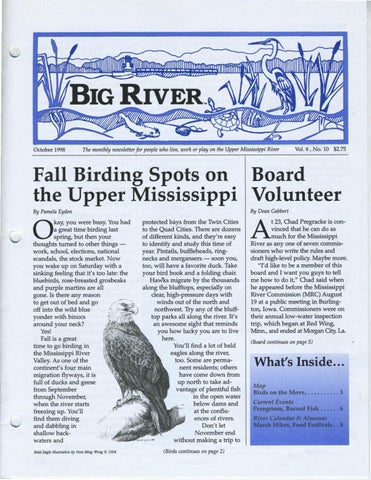
kay, you were busy. You had a great time birding last spring, but then your thoughts turned to other things work, school, elections, national scandals, the stock market. Now you wake up on Saturday with a sinking feeling that it's too late: the bluebirds, rose-breasted grosbeaks and purple martins are all gone. Is there any reason to get out of bed and go off into the wild blue yonder with binocs around your neck? Yes! Fall is a great time to go birding in the Mississippi River Valley. As one of the continent's four main migration flyways, it is full of ducks and geese from September through November, when the river starts freezing up. You'll ,:-/ find them diving and dabbling in shallow backwaters and Bald Eagle illustration by Vera Ming Wong Š 1994
protected bays from the Twin Cities to the Quad Cities. There are dozens of different kinds, and they're easy to identify and study this time of year. Pintails, buffleheads, ringnecks and mergansers - soon you, too, will have a favorite duck. Take your bird book and a folding chair. Haw'ks migrate by the thousands along the blufftops, especially on clear, high-pressure days with winds out of the north and northwest. Try any of the blufftop parks all along the river. It's an awesome sight that reminds you how lucky you are to live here. You'll find a lot of bald eagles along the river, too. Some are permanent residents; others have come down from up north to take advantage of plentiful fish in the open water below dams and at the confluences of rivers. Don't let November end without making a trip to (Birds continues on page 2)
A
t 23, Chad Pregracke is convinced that he can do as much for the Mississippi River as any one of seven commissioners who write the rules and draft high-level policy. Maybe more. "I'd like to be a member of this board and I want you guys to tell me how to do it," Chad said when he appeared before the Mississippi River Commission (MRC) August 19 at a public meeting in Burlington, Iowa. Commissioners were on their annual low-water inspection trip, which began at Red Wing, Minn., and ended at Morgan City, La. (Board continues on page 5)
What's Inside ... Map Birds on the Move. .......... 3
l (Birds continued from page 1)
see the tundra swans, which stop to rest and feed here on their way from the Arctic to the Chesapeake
Students of migration have a word for the migratory restlessness that comes over birds this time of year "zugunruhe." Bay on the East Coast. Groups of these great white birds can be found almost anywhere from Lake . Pepin to Ferryville, Wis., but for large numbers go to Rieck' s Lake near Alma, Wis.
Trumpeter swans, the largest waterfowl in the world, are a striking sight on the upper river, and can be found year round at several Hennepin County parks in the Twin Cities. The weather in fall is more unpredictable and variable than at any other time of the year. Birds know it. Their excitement is audible and visible, from the anxious twittering of the last goldfinches on the sunflowers, to the miles-long rivers of blackbirds streaming over the fields, to the hypnotic conversations of ducks, geese and swans in the marshes. Students of migration have a word for the migratory restlessness that comes over birds this time of year - "zugunruhe." Even captive birds show it and I think (the smartest) people do, too.
=
Trumpeter Swan Cygnus buccinator Wingspan: 72-80 inches Weight: 13-18 pounds Length: 52 inches Characteristics: l.) They are the largest waterlowl in the world. 2.) Alarge black beak with a red border on the lower mandible, and no spots. 3.) Adult birds are all white, juveniles all grey. They are larger than the Snow Geese they sometimes fly with, who always have black wing tips. 4.) Just as they become airborne they will pull their
necks into a shallow "S" curve for a few wingbeals. s.) They are often, but not die last birds fD a lkdtolalrefltgld.
Sites to See Chippewa National Forest, Grand Rapids, Minn. The Mississippi headwaters has the largest nesting population of bald eagles in the lower 48 states. Many stay all year; others migrate south in late fall. Check out the river and the larger lakes in the area - Cass, Reeds and Winnibigoshish. Monticello to Elk River, Minn. This 10-mile stretch of the river stays ice-free all winter because of warm water flushed from the nuclear power plant. Last year 280 trumpeter swans arrived in November and stayed until March. Eagles hang around, too. Coon Rapids Dam Regional Park, Anoka, Minn. Watch for bald eagles below the dam, and for golden-eyes, which arrive in November and stay all winter in between the islands. Minnesota Valley National Wildlife Refuge This refuge near the confluence of the Minnesota and Mississippi Rivers is worth returning to several times in the fall, because the population of migrants changes constantly. Battle Creek Regional Park, St Paul On the east side of the Mississippi River across from downtown St. Paul, this wooded ravine provides protection for late-flying migratory birds. The Minnesota Ornithological Union sponsors a tour there in late September. Bay City and Stockholm, Wis. Late fall bring5 thousands of common mergansers to Lake Pepin to rest and feed. Keep your eyes peeled for these striking black-and-white-headed birds. Rieck's Lake Observation Deck, Alma, Wis. Staffed on weekends by volunteers equipped with knowledge, enthusiasm and spotting scopes, this small wayside park offers close-up views of the great white tundra swans in the marsh at the confluence of the Buffalo River and the Mississippi. Buena Vista Park, Alma Abluff-top park that lifts you several hundred feet closer to the hawks that migrate with favorable winds out of the north. (If the winds are out of the south, stay home. The hawks will, too.) Kellogg Weaver Dunes Scientific and Natural Area, Kellogg, Minn. The Weaver Dunes and the McCarthy Lake Wildlife Management Area together make up thousands of acres of sand prairies, oak savannas and wet meadows bordering the Mississippi southeast of Wabasha - good hunting grounds for hungry hawks migrating in late September (Birds continues on page 4)
Illustration by Vera Ming Wong Š 1988
2
Big River
October 1998
,,
.,
~
autumn
==t998 Monticello
Tundra Swans, fonnerly called whistling swans, fly with necks out straight. They summer on south Baffin Island and the northern Arctic seacoast, then fly a dog-leg course to the Mississippi River Valley wintering grounds in Chesape·ake Bay and New Mexico. An estimated 15,000 birds rest and feed in the Upper Mississippi in the fall between Alma and Genoa, Wis.
Elk River
reek Regional Park
Semipalmated Sandpiper. Watch for sandpipers in mudflats or in sandy shallow-water marshes. They migrate in flocks of 20 to 100 from their nesting grounds in the High Arctic to their wintering places in Panama and South America.
Osprey, also called fish-hawks, are fastflying diving birds that migrate like other hawks along the bluff tops. They spend the winter in Chile and northern Argentina.
~re~~e~~e~~ _ Long Lake Canoe Trail Onalaska
Minnesota
Canvasback Ducks nest in the prairie marshes and potholes of the Dakotas, and spend winters in the lower Mississippi Valley. During migration, watch for them in Lake Onalaska and Pool 9, where they feed on the stillplentiful aquatic plant, wild celeiy.
Tourism Info 1-800-657-3700
Turkey Vultures are eagle-sized birds with "fingered" wing tips. They often begin migrating in August, but may still be here as late as November, depending on the weather.
Iowa ■---------------- Tourism Info
New Albin·
1-800-345-4692
The Snow Goose is nicknamed the blue goose because the young have remarkably blue-gray feathers. Their breeding grounds are· on Baffin and Southampton Islands in the Arctic. Most spend the winter in Louisiana's coastal marshes. Watch for them feeding in shallow pools of the river.
Wisconsin Tourism Info
Turkey - - ' River Bottoms
Dubuque-
Trumpeter Swans, the largest waterfowl in the world, were once common in Minnesota and all of North America. Hunting, then DDT, nearly did them in by the 1960s. Now they're making a comeback. Find them all year at parks in the 1\vin Cities (call Hennepin County Parks for specific infonnation). They sometimes also migrate with other waterfowl, especially tundra swans.
Double-crested Cormorants resemble big black ducks with longish necks. They nest on the Upper Mississippi and migrate as far south as west central Mexico, the Bahamas and the Greater Antilles. They fly in groups, sometimes right above the surface of the water.
·---------1-800-372-2737
Illinois
Tourism Info 1-800-223-0121
,
Clinton• ·Fulton 'Albany
Broad-winged Hawks, with their boldly striped black-and-white tails, are easy to identify. They migrate in great numbers down the Mississippi River Valley, preferring days with north or northwesterly wlwinds to push them along. They ascend in thennals, spiraling up together in a kind of whirlwind of hawks called a kettle, and then glide smoothly along the ridgetops until finding another thennal. They mass in southern Texas, then continue on to Central and South America. October 1998
Big River
3
(Birds continued from page 1)
through October and cover for a mix of sparrows and other migratocy birds. Prairie Island, Winona, Minn. Saved by the local bird club from its sorcy status as an unofficial town dump, this restored prairie is now a great place to see eagles, osprey and migrating waterfowl, warblers and sparrows (chipping, clay-colored, field, fox, grasshopper, Lincoln's, savannah, song, swamp, tree, vesper, white-throated and white-crowned) . Tr,1mpealeau National Wildlife Refuge, Tr,1mpealeau, Wis. Na.ned one of the world's most important bird areas by the American Bird Conservancy, this refuge has a new visitor center and an observation deck with spotting scopes that make it easy to watch great numbers of ducks, geese, cormorants and tundra swans, as well as bald eagles and osprey. Long Lake c.anoe Trail, south ofTrempealeau, Wis. This four-mile trail includes quiet backwater sloughs, dense wooded islands and a bit of the Main Channel. Autumn bird-watching is excellent, but canoeists should avoid disturbing the rafts of waterfowl that may be gathering in the Big Marsh. Watch for cormorants! Hixon Forest Nature Center, La Crosse, Wis. Tcy the River-to-Bluff Trail, which starts at Riverside Park on the Mississippi, traverses the great La Crosse River Marsh and then up the bluff, all without crossing a single street.
Yellow River State Forest, Harpers Ferry, Iowa Alarge forest with several accessible units, including the Paint Creek Unit on Big Paint Creek and the Luster Heights Unit where the Little Paint Creek enters the Mississippi. These wooded lands are nesting grounds of hawks and also shelter migratocy birds of all kinds. Effigy Mounds National Monument, Marquette, Iowa Great views of the river valley below and a great place to watch for hawks. Wyalusing State Park, south of Prairie du Chien, Wis. The park's bird list cites flycatchers, a variety of sandpipers and the rufous-sided towhee as autumn visitors, besides screech, horned and barred owls. The canoe trail offers a chance to see lots of waterfowl. The bluffs are good places to check for red-shouldered hawks and other migrating raptors. Turkey River Bottoms, south of Guttenberg, Iowa Fall visitors include wood ducks, green- and bluewinged teal, black ducks, mallards, shovelers, wigeons, canvasbacks, ring-necks, lesser scaups, common goldeneyes, buffleheads, and hooded and comon mergansers. Nelson Dewey State Park, Cassville, Wis. This park occupies the steep bluffs above the river and is a good place to watch migrating hawks, eagles and turkey vultures.
Goose Island Park, La Crosse, Wis. The canoe trail is closed from Oct 1 to Nov. 15 because so many ducks, geese and shorebirds stop here to rest and feed. But you can hike the trails and watch from shore. (Watch out for poison ivy, which is at its most potent this time of year.)
Bertom Lake, near Cassville Depending on how high or low the water is, you can hike quite a ways in from the road at the Bertom Lake area, south of Cassville. One of the few places where you can get into the refuge on foot. (Watch out for poison ivy!)
New Albin, Iowa Army Road leads to a boat landing and is surrounded by marshes and protected sloughs likely hide-outs for migratocy waterfowl.
Eagle Point Park, Dubuque, Iowa This park has precipitous views of the river and spacious lawns upon which to lie, watching for migrating eagles, raptors and turkey vultures. Mines of Spain State Park, Dubuque, Iowa Alush, protected stopover for migratocy birds.
Black Hawk Park, De Soto, Wis. This large park is vecy busy on weekends, but the two boat ramps give direct access to a complicated set of islands, sloughs and backwaters. Hwy. 35 between Ferryville and Lynxville, Wis. Canvasbacks used to disperse all along the river on their way south, but now they concentrate in, Pool 9 because their favorite food, wild celecy, is plentiful. There are pull-overs on the highway and an observation deck at the south end of Ferryville. Beginning in late October, hundreds of tundra swans rest and feed in Pool 9, also.
4
Lock and Dam 14 Eagle Area, Bettendorf, Iowa Eagles stay all year in this eight-acre Nature Conservancy preserve. Eagle count map is available.
Environmental Scorecard The League of Conservation Voters scores representatives and senators from 0 to 100% based on their votes on several key environmental bills. Representatives in our area along the Upper Mississippi with the best record for 1997 (first session of the 105th session) are Minnesota's Bill Luther (88%),Jim Ramstad (81%) and Martin Sabo (81%); Wisconsin's Ron Kind (88%); and Illinois' Lane Evans (88%). Ramstad is listed as one of the most improved since the 104th session, jumping from 54%. Minnesota's James Oberstar has dropped from 65% to 31%. High-scoring senators are Paul Wellstone, Minn., (100%), Russ Feingold, Wis., (100%), Herb Kohl, Wis., (86%), Carol Moseley-Braun, Ill., (86%) , Paul Simon, Ill., (100%) and Tom Harkin, Iowa (86%). Feingold's opponent, Mark Neumann, is on the League's "Dirty Dozen," based on his 29% House lifetime score. Wisconsin's 3rd District environmental score has improved since Ron Kind (88°/o) took Steve Gunderson's place in Congress (23% in 1996).
=
For the area congressional scores after the 1st 104th session, see Big River, June 1996. For the full Environmental Scorecard, write LCV, 1707 L Street NW, Suite 750, Washington, DC, 20036, or call (202) 785-8683, or dial up their website through the link on Big River's home page: www.big-river.com.
Big River™ Big River (ISSN 1070-8340) is published
monthly by Riverwise, Inc., 111 Riverfront, Suite 204, Winona, MN 55987; (507) 454-5949; fax: (507) 454-2133; email: editors@big-river.com; web site: http://wunv.big-river.com Reggie McLeod Molly McGuire
editor/publisher assistant editor
Mi Ae Lipe-Butterbrodt Kathy Delano Nancie L. McCormish
associate editor
1
Pamela Eyden is a contributing editor for Big River. Her last story was "Great Blue Herons Lonely Hunters, Tenement Dwellers" (April 1998).
Big River
.,
October 1998
(Board continued from page 1)
Meetings were held aboard the Mississippi IV, the Army Corps of Engineers'
1
241-foot towboat (see "North Meets South on the Mississippi" Big River, September 1997). Pregracke looked very uncomfortable when he stepped to the microphone in the crowded hearing room. He wore a worn baseball cap and his hands were shoved into his pants pockets as he stood stiffly before the head table. Facing him were four commissioners - including a two-star Army general and a Navy rear admiral - all seated in high leather chairs. The commissioners knew this slightly-built young man, at least by reputation. For the past two years he has worked full time cleaning up
He and his helpers have pulled an estimated 100 tons of assorted trash from the Upper Mississippi River. the river he loves. Little by little, his efforts have been recognized and his amazing story told by the media (see "Roll Out the Barrels" Big River, November 1997). A year ago he appeared before the commission at a similar meeting held at Rock Island, ill., when one of the members commented that the commission needed someone like him. That sparked his desire to become a member. "You guys have as much power as the river," Pregracke said, warming up to his subject. "I think I can
he said. "Whenever I get up like that to talk, I always choke up." Pregracke is a resident of the Quad Cities area. For a time he lived on river islands and worked as a shell diver and a commercial fisherman. "Then I got sick of all the trash and decided to do something about it." He and his helpers have pulled an estimated 100 tons of assorted trash from the Upper Mississippi River. Whatever you can name, chances are they have found it on the river bottom. So far, the largest c, object they've fished out was a Ford ยง. [ van. Pregracke' s only financial support comes from a few industrial firms, but it's never enough. "Not when you try to work six people and three boats," he said. Chad Pregracke stands at the Burlington Two companions, Rachel Carlin, landing after addressing the Mississippi River 18, and Rodney Shaw, 30, accompaCommission aboard the Mississippi IV. nied Pregracke to the public meeting. "Rachel's the glue of this operhelp you. I don't represent any speation and Rodney is the muscle cial group, just the river. I'll even man," he said. bring my own leather chair," he ofThe three were working from a fered, bringing laughter from the houseboat tied up below Burlington. audience and putting grins on the Before the hearing, they spent three faces of the commissioners. days gathering trash off shore from a General Phillip Anderson, MRC Lee County (Iowa) Conservation president, explained that members Board site. "We got 146 tires and are appointed by the president and some other junk," Pregracke said. coRfirmed by the Senate. "You mean all I have to do is see Dean Gabbert writes about the river from Bill Clinton?" Pregracke asked. When his home on its banks in Nauvoo, Ill., (river the laughter subsided, he told the mile 378.6). He is the retired publisher and commission he was totally serious. editor of The Fairfield (Iowa) Ledger. His "We are impressed with your last story for Big River was "Julia Belle sincerity," Gen. Anderson said. "We Swain Brings Grace & Charm to the appreciate your efforts." River" (August 1996). After the hearing, Pregracke gave himself low marks. "I blew it,"
Big River Awards Send in your nominations for our 1998 Big River Awards, designed to recognize the best - and worst - examples of human activity on the Mississippi River every year. Nominations close Nov. 1. The Open River Award will be given to a person, group or project that has made the river more accessible, worked to improve the river as a natural resource or has increased our understanding of the river. The Golden Sandbag will be given to an egregious, wasteful or downright silly and misguided plan or activity that has the effect of keeping the river out of people's lives, obscuring our understanding of it or damaging the river ecology or economy. Judging will be done by a panel that includes our staff and three other river folks. Alist of nominations will be posted on our web site and finalists will be announced in December. Our January 1999 issue will announce the winners.
October 1998
Big River
Send your nominations to: Big River Awards Big River PO Box 204 Winona, MN 55987 email: editors@hig-river.com or fax: (507) 454-2133
5
By Mi Ae Lipe-Butterbrodt
Saved by the Jacket Were you ever saved by wearing a life jacket? Both the Minnesota and Wisconsin Deparhnents of Natural Resources (DNR) want to hear about it. The National Safe Boating Council will use selected testimonials in its 1999 "Saved by the Jacket" safety campaign. "We generally only hear about the fatalities, the accidents where the victims weren't wearing their life jackets," said Tim Smalley, Minnesota DNR boating safety specialist. "We're interested in hearing about watercraft accidents with happy endings, too." Include details in your stories: the location; the conditions and, if possible, the type of personal flotation device. Minnesota residents should send their stories to DNR Boat and Water Safety, 500 Lafayette Rd., St. Paul, MN 551554046; Wisconsin residents to Bill Engfer, DNR boating law administrator, PO Box 7921, Madison, WI 53707. The DNRs will forward the testimonials to the National Safe Boating Council.
Creek near Plainview has proven more elusive, as laboratory tests have tentatively ruled out viruses and parasites. DNR biologists estimate that more than 4,000 trout were killed, according to a DNR press release. Water samples from the kill area contained low dissolved oxygen levels and elevated phosphorus, ammonia and chloride levels. "It's very difficult to pinpoint an exact cause of the kill from pathology and water test results," said Tim Schlagenhaft, a Lake City area fisheries manager. Anyone with information should call Turn In Poachers at 1800-652-9093. Meanwhile in St. Paul, a pipe under the Mississippi near the Wabasha Street Bridge leaked several hundred thousand gallons of wastewater into the Mississippi River. The Pig's Eye wastewater treatment plant reported the leak, which began August 24 and was sealed four days later. The MPCA said the wastewater was diluted by the huge volume of water in the river, and no dead fish or other evidence of environmental damage was found (St. Paul Pioneer Press 9-10-98).
More Spills Minnesota - The Minnesota Department of Natural Resources (DNR) and the Minnesota Pollution Control Agency (MPCA) are investigating two August fish kills in southeastern Minnesota. One was traced to a 100,000-gallon manure spill in Houston County near the Iowa border. The manure apparently contaminated Waterloo Creek in Iowa. The MPCA is investigating the hog operation where the manure was stored, according to the St. Paul Pioneer Press (8-29-98). The cause of another fish kill in a 1.9-mile stretch of West Indian
6
"Now I've got him!" Late summer anglers are catching record fish in the Mississippi River. Jim Hendrickson, who lives near Brownsville, Minn., fought a 43-inch flathead catfish for nearly an hour with a IO-pound test line until a neighbor threw him a larger landing net. The catfish had a 28-inch girth and weighed about 45 pounds. Just a few miles downstream, at Genoa, Wis., Kathy Morrisson of Waterloo, Iowa, caught a sevenpound, five-ounce shovelnose sturgeon that set a world record, con-
Big River
firmed by the National Freshwater Fishing Hall of Fame in Hayward, Wis. The sturgeon topped the previous record by several pounds, according to the La Crosse Tribune (9-398 and 9-17-98). Big fish and stubbornness is a dangerous combination. In Ljubljana, Slovenia, an angler drowned when he tried to reel in a fish so large it dragged him under. Franc Filipic hooked a sheatfish (a type of catfish), and simply refused to let go, reported state-run news agency STA. According to a friend, Filipic's last words were "Now I've got him!" Filipic's body, but not the fish, was found two days later. The friend swore the fish was over six feet long and weighed 110 pounds (Knight-Ridder 8-25-98). And finally, two men after catfish on the Mississippi caught a two-and-a-half-foot-long alligator near Gladstone, Ill. (Associated Press 9-17-98). The reptile was taken home, where it has been feasting on hot dogs and live crawdads. A local pet store plans to take it in. The pet store owner believes the gator was an abandoned pet.
On the Comeback After decades of hovering near extinction, the peregrine falcon is once again flying high toward recovery. On August 25, U.S. Dept. of Interior Secretary Bruce Babbitt announced that the U.S. Fish and Wildlife Service (FWS) may remove the raptor from the endangered species list. "We have proved that a strong Endangered Species Act can make a difference," he said. The bird, one of the world's fastest animals, can hit 200 miles an hour in a dive. It nearly succumbed to the pesticide DDT after World
October 1998
War II. Recovery efforts in both the United States and Canada boosted populations to over 1,500 breeding pairs, well above the recovery goal of 631 pairs, according to the FWS. Some of these breeding pairs nest in the Upper Mississippi River Valley, including the Twin Cities metro area and at the Effigy Mounds National Monument, near Marquette, Iowa. The FWS will decide whether to take it off the list by the end of the year, but the bird will continue to be protected under the Migratory Bird Treaty Act. You can send comments until November 23, 1998, to the Field Supervisor, U.S. Fish and Wildlife Service, Ventura Fish and Wildlife Office, 2493 Portola Road, Suite B, Ventura, CA 93003. Wild celery beds in Lake Onalaska, Wis., are also coming back after almost disappearing after severe droughts in the 1980s. Wild celery is a vital food source for waterfowl, especially canvasback ducks, who dive for the plant's starchy tubers. Thanks to the resurgence, over 67,000 canvasbacks were counted in Lake Onalaska in November 1997, and over 192,000 on Pool 9 of the Mississippi River (from Genoa to Lynxville, Wis.), according to the Wisconsin Department of Natural Resources. The abundant growth also helps panfish, which spawn and hide from predators among the plants.
J
/
Wired Swans Madison, Wis. - Schoolchildren won't be the only ones toting backpacks this fall; 10 trumpeter swans will also be carrying them. A $25,000 donation to the Natural Resources Foundation of Wisconsin will fund a project to outfit the swans with small backpacks containing satellite/ radio-telemetry equipment, according to the Wisconsin Department of Natural Resources. Trumpeter swans are endangered in Wisconsin, but are slowly recov-
I
October 1998
ering. The backpacks will transmit information every other day while the birds are on wintering grounds and every fourth day on breeding grounds for up to one-and-a-half years. The units will indicate each bird's position about three to five times daily per "on" day to within 150 to 1,000 yards. The information will be posted on the World Wide Web. Hunters sometimes shoot a trumpeter they mistake for a Canada goose or a snow goose. The mistake may cost over $2,000 in fines and restitution; intentional shootings can cost $4,000.
Busy Port St. Paul -The No-Wake Cafe and the Padelford Packet Boat Co.'s Mississippi fleet will soon have new neighbors and competition. Owner and operator of River Boats Inc., Eugene Cassidy, was initially rejected from docking his restaurant boat, ReJoyce, at the Watergate Marina when the city backed out of a tentative agreement in 1995, according to the St. Paul Pi~ oneer Press (9-3-98). Charging that he was treated differently than the Padelford company, .Cassidy filed a lawsuit against the city and won. The settlement includes a 15-year lease to dock the ReJoyce at Harriet Island Park, where it will house a restaurant and fast-food window, and also a 5-year agreement to dock at least one excursion boat at the Watergate Marina. The city will also pay Cassidy $25,000.
Shell Smugglers The nation's largest shell-buying company will soon be shelling out $1 million to the National Fish and Wildlife Foundation as part of a plea bargain for illegally purchasing mussel shells and shipping them to Japan, where mussel shell fragments are used to induce the growth of pearls in oysters. The Tennessee Shell Company
Big River
knowingly bought shells harvested illegally in several states, according to United States Attorney Veronica Coleman (UMRCC Newsletter July/ Aug. 1998). After an investigation by special agents of the U.S. Fish and Wildlife Service working with state conservation officers in Tennessee, Kentucky, West Virginia, Ohio, Michigan, Alabama and Louisiana, 20 individuals were indicted on 136 counts of violating the Lacey Act. In Davenport, Iowa, two men indicted in illegal commercial clamming activities with a Muscatine shell company are agreeing to plea bargains. Harry Schultz of Muscatine and Craig Smith of the Quad City area pleaded guilty in connection with a case involving the Mississippi Valley Shell Company, which knowingly purchased illegally harvested mussels (KCLN-KLNT News 9-10-98). The company's owners Butch Ballenger and his wife Cheryl were also indicted.
Runway Refugees Twin Cities - After two years of negotiations, the Metropolitan Airports Commission agreed to pay at least $20 million in a deal with the U.S. Fish and Wildlife Service (FWS). A new runway at the Minneapolis-St. Paul International Airport will send planes over the Minnesota Valley National Wildlife Refuge at elevations as low as 500 feet. The 10,000-acre refuge, which runs along the Minnesota River from Fort Snelling to Jordan, is home to many species of waterfowl, songbirds and mammals. The FWS argued that the runway will make the refuge less effective as a bird sanctuary and open-air classroom. The money will be used to replace refuge land, facilities and programs, according to the St. Paul Pioneer Press (9-22-98).
=
7
Special Events and Festivals October Through 23 Fall Color Tours, Julia Belle Swain, La Crosse, Wis., 1-800-815-1005. 2-4 Mid-America Waterfowl Expo, Peoria, Ill., duck calling contest, (217) 785-8955. 2-8 Oktoberfest, La Crosse, Wis. 3 Duck season opens, Wisconsin and Minnesota. 3 Nahant Marsh Cleanup, Davenport, Iowa. (319) 322-2969.
11 Applefest, Le Claire, Iowa. 11 Harvest Festival, Cassville, Wis. 17-18 Husking Bee, Oliver Kelley Farm, Elk River, Minn. 17-18 Love It or Leaf It, Sabula, Iowa. 20 La Crosse River Marsh hike, Monitor St. and Lang Dr., La Crosse, Wis., 5 p.m., (608) 784-8030. Also on the 23rd.
8 Minnesota-Wisconsin Boundary Area Commission, 10 a.m., Phipps Center, Hudson,Wis., (715) 386-2305.
20-22 Candlelight Tour, Fort Snelling, St. Paul, Minn.
15 Upper Mississippi Waterway Association, Decathlon Athletic Club, Minneapolis, Minn., (651) 776-3108.
24-25 Wildlife Art Expo, Winona, Minn., (507) 454-4064.
3-4 Arts and Crafts Festival, McGregor, Iowa.
24-25 Husking Bee, Oliver Kelley Farm, Elk River, Minn.
3-4 Johnny Appleseed Days, Lake City, Minn.
26-27 Oktoberfest, Bettendorf, Iowa.
4 Art Along the River, Bellevue, Iowa. 4 River Bluffs History Center Open House, Bay City, Wis.
October 3 Rivers Council of Minnesota, annual meeting, University of Minnesota Forestry Center, Cloquet, (612) 676-1745.
3-4 Flea Market, Marquette, Iowa.
3-4 Guided Hikes Along the Mississippi, 9 a.m. on Sat., 1 p.m. on Sun., West Coon Rapids Dam Park, Brooklyn Park, Minn., (612) 420-4300.
Meetings and Hearings
29-30 Hixon's Haunted Hollow hike, 5:30 p.m. - 8:30 p.m., Hixon Forest Nature Center, La Crosse, Wis., reservations, (608) 784-0303.
20-21 Minneapolis Riverfront Master Plan public meetings, 6 p.m. - 8 p.m., 20th at Logan Park Community Center; 21st at North Regional Library, Lowry at Fremont. Call (612) 661-4863 for copy of Park Board plan. 27 Coulee Region Sierra Club and Audubon Society, 7 p.m., U. S. Fish and Wildlife Office, Onalaska, Wis.
=
November 3 North-South Highway referendum, La Crosse, Wis. 7-8 Swan Watch, Winona, Minn.
5 Walk When the Moon is Full, 7 p.m., West Coon Rapids Dam Park, Brooklyn Park, Minn., (612) 424-8172. 6 La Crosse River Marsh hike, 5 p.m., Monitor St. and Lang Dr., La Crosse, Wis. (608) 784-8030. 8-10 Muck Minnow the Gill Boy, Billy Curmano's Swimmin' the Mississippi show, 8 p.m., Intermedia Arts, Minneapolis, Minn., (507) 864-2716. 9-11 Sheep Dog Trials, Red Wing, Minn. 10 Mississippi River Canoe, 10 a.m. - 3 p.m., Hennepin County parks, Minneapolis, Minn., (612) 559-6700. 10 Mississippi River Landscape Painting Series, noon - 3 p.m., Oliver Kelley Farm, Elk River, Minn., (612) 290-4160. 10 Hog Roast, Lynxville, Wis. 10 Fish Fry, Potosi, Wis. 10-11 Taste of Savanna, Savanna, Ill. 10-11 Fall Festival, Fulton, Ill.
Almanac By Kenny Salwey In October things are falling all around us. A sudden gust of wind brings a rainstorm of multicolored leaves tumbling to earth. I've often sat on the river bank and watched a particular leaf fall into the water, then I've followed it as far as I could and wondered, where will it go? What will it "see"? Falling acorns, hickory nuts and walnuts rap, knock and rattle their way through a maze of forest limbs. Most plants have fallen back to the earth. Walnut, and basswoqd me$ stand nabd, ad . a .touch of darlc
asn
10-11 Love It or Leaf It, Sabula, Iowa. 10-11 Flea Market, Marquette, Iowa. 10-11 Arts and Crafts Festival, McGregor, Iowa. 10-11 Apple Festival, Hastings, Minn. 10-11 Fall Festival of the Arts and Woodcarvers Show, Red Wing, Minn.
October 1998
Big River
8