July 1998
The monthly newsletter for people who live, work or play on the Upper Mississippi River
Volunteering for New Experiences On The River
- Knowing the Fish and the Law By Bill Jacobs
C
B
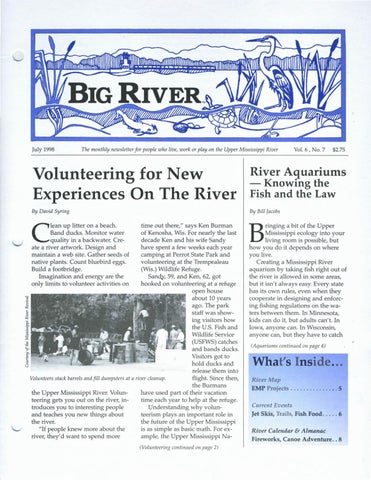
time out there," says Ken Burman of Kenosha, Wis. For nearly the last decade Ken and his wife Sandy have spent a few weeks each year camping at Perrot State Park and volunteering at the Trempealeau (Wis.) Wildlife Refuge. Sand,y, 59, and Ken, 62, got hooked on volunteering at a refuge open house about 10 years ago. The park staff was showing visitors how the U.S. Fish and Wildlife Service (USFWS) catches and bands ducks. Visitors got to hold ducks and release them into flight. Since then, Volunteers stack barrels and fill dumpsters at a river cleanup. the Burmans the Upper Mississippi River. Volunhave used part of their vacation teering gets you out on the river, intime each year to help at the refuge. troduces you to interesting people Understanding why volunteerism plays an important role in and teaches you new things about the river. the future of the Upper Mississippi is as simple as basic math. For ex"If people knew more about the ample, the Upper Mississippi Nariver, they'd want to spend more (Volunteering continued on page 2)
$2.75
River Aquariums
By David Syring
lean up litter on a beach. Band ducks. Monitor water quality in a backwater. Create a river artwork. Design and maintain a web site. Gather seeds of native plants. Count bluebird eggs. Build a footbridge. Imagination and energy are the only limits to volunteer activities on
Vol. 6, No. 7
ringing a bit of the Upper Mississippi ecology into your living room is possible, but how you do it depends on where you live. Creating a Mississippi River aquarium by taking fish right out of the river is allowed in some areas, but it isn't always easy. Every state has its own rules, even when they cooperate in designing and enforcing fishing regulations on the waters between them. In Minnesota, kids can do it, but adults can't. In Iowa, anyone can. In Wisconsin, anyone can, but they have to catch (Aquariums continued on page 4)
What's Inside ... River Map EMP Projects ............... 5 Current Events Jet Skis, Trails, Fish Food . .... 6 River Calendar & Almanac Fireworks, Canoe Adventure . . 8
"
(Volunteering continued from page 1)
tional Wildlife and Fish Refuge includes 260 miles of river reach and 200,000 acres, while the total refuge staff, divided among four districts, stands at 28 permanent employees and about a dozen seasonal workers. By comparison, the Ozark Scenic Riverway, also managed by the USFWS, covers 134 miles of river and
The refuge has too much ground to cover with too few bodies, says the Friends of the Upper Mississippi Refuges. 80,000 acres with a permanent staff of 70, and 50 seasonal workers. More than three million people visit the refuge each year as compared to 1.5 million visitors to the Ozark Scenic Riverway. The refuge has too much ground to cover with too few bodies, says the Friends of the Upper Mississippi Refuges, a group that grew out of Bob Pohl's work in the early 1990s [see story page 3]. The group started meeting last year and currently lists over 120 members in two chapters - the Bob Pohl Chapter in Winona, Minn., and the Coulee Region Chapter in La Crosse, Wis. Members hope other chapters will form as local interest grows. "The group is designed to support the refuge as only community members or volunteers could," says Coulee Region President Phil Junghans. The emphasis of each chapter varies with local priorities, but work includes helping with refuge tasks, including biological surveys and regeneration efforts; increasing public awareness of the refuge and its importance; informing government officials about refuge concerns; and helping volunteer organizations get grant money for projects to improve the refuge. Jim Eddy, president of Winona's Bob Pohl Chapter, says recent activities for his group included planting grass seed at the Trempealeau Wildlife Refuge, seeding wildflowers
2
near Kellogg, Minn., and assisting Fish and Wildlife Service employees during the national "Take a Kid Fishing" day held on June 6. Future projects will be discussed at the next chapter meeting in September.
Many Opportunities The staff of Big River adopted a beach about a mile below Lock and Dam 6. We clean it up at least once a month from May through September, which provides a good excuse for a canoe trip, picnic and a little fishing. It's also a good way to study a little piece of the river. Volunteering opportunities abound in every stretch of the river. Most communities sponsor river cleanups each year. Schools often need help with river field trips, and welcome speakers such as towboat pilots, commercial fishermen and others who want to talk about their work on the river. Local hunting, fishing and environmental groups sometimes undertake river projects, too. The Brice Prairie (Wis.) Conservation Association, for example, gathered and planted hundreds of swamp white oak acorns to improve
"When-people found out we were volunteers, not park employees, and that we were doing this for our vacation, they looked at us like we were crazy" habitat on the backwaters of Lake Onalaska and turned over a thousand used Freon canisters into wood duck and merganser houses. In the Quad Cities area, River Action, a nonprofit group that promotes sustainable development, public access and the protection of natural resources on the river, has several ongoing volunteer projects. One is marking Quad Cities storm drains with plaques that read, "Don't Dump. This drains into our
Big River
river." A River Action art project on the tip of Arsenal Island includes an iron railing, built with volunteer help, decorated with cutout shapes of the plants and animals of the Upper Mississippi. Another project, near Sunset Park in Rock Island, Ill., will include a "Mississippi Tree of Life" highlighting the circle of life on the river. A third project, in East Moline, Ill., features sculptures depicting the "working river." Kathy Wine, president of River Action's board, says community members help plan, design and complete projects. Other regional groups and parks need volunteers to help with events that bring people to the river. Coon Rapids (Minn.) Regional Park asks volunteers to help with special events such as its portion of Hennepin Parks' "Star of the North" games held at the park on June 21 this year. Volunteers helped out at the "fish printing" booth and other games, and also explained interpretive displays about turtles, mussels and other river critters. Volunteers there also help with the "Walk When the Moon is Full" program. People who want to volunteer at Coon Rapids can contact the volunteer coordinator of Hennepin Parks. Volunteers get training and learn more about the park system's resources. Meanwhile, another Twin Cities group, Friends of the Mississippi (a different group than Friends of the Upper Mississippi Refuges) can use help with a July 25 river canoe trip during the Aquatennial. Office manager Gabe Ormsby says this canoe trip will be the first river event held during the Aquatennial, an annual festival that usually focuses on the Metro area's many lakes. "We wanted to include a river focus this year," says Ormsby.
A Slice 0ÂŁ Volunteer Life At its best, volunteering mixes everyday tasks with interesting projects that offer new experiences.
July 1998
.,
B
ob Pohl dreamed up the idea for a Friends of the Upper Mississippi Refuge while volunteering for the National Forest Service in North Carolina. For Pohl, a lifelong organizer of volunteer groups, dreams led to action. In 1991 he moved with his wife, Pat, to Wmona, Minn., specifically to form a friends group. "What you need in any volunteer organization is someone who will dedicate the time and energy to be a leader," says Rick Frietsche, manager of the Trempealeau Wildlife Refuge. "It's a rare individual who can do that, and that was what was so important about Bob - his ability and desire to be a leader. He was good at it, and he took the time to make it happen." Pohl, who volunteered for many groups throughout his life, including a stint as superintendent of state parks for Illinois, drafted a constitution and bylaws for the group. He also started the process of getting nonprofit standing for the Friends before his death in 1996. Many people think his work is important to the river's future. "The way resources are today, volunteerism is probably going to be more necessary in the future," says Terry Moe, work unit manager of the La Crosse office of the Wisconsin Department of Natural Resources. "It may become more and more important for getting local work done." In the tradition of Will Dilg, founder of the Izaak Walton League, Pohl got the energy flowing to meet the needs of the river and its people.
July 1998
"We tend to do things they can't get other people to do," Ken Burman says about the work he and Sandy do at the Trempealeau Wildlife Refuge. Those things include routine maintenance such as mowing grass and spreading gravel. Once the Burmans spent an entire day setting four-inch by four-inch posts to mark out a parking area. "When people found out we were volunteers, not park employees, and that we were doing this for our vacation, they looked at us like we were crazy. But we also get to do some of the fun stuff, the kinds of things that everybody wants to do." The Burmans have helped take water samples, worked as docents on the observation deck, protected habitat for the endangered Bell's vireo by fencing out deer, built wheelchair-accessible nature trails and completed many other jobs that the refuge staff simply could not do alone. "Without volunteers helping us, we couldn't provide the services we do, nor continue the biological programs we have," says Trempealeau Refuge manager Rick Frietsche. The refuge hosts 60,000 to 70,000 visitors a year, he says. "Sometimes I've suggested we go to Vegas or on a cruise," says Ken. "But Sandy really likes helping there [at the Refuge]. And I do too, I have to admit. You can be standing out there working on something when a fox walks by, or a heron or other wildlife. We enjoy that." For the Burmans, volunteering at the refuge provides the right mix of vacation, wildlife and the satisfaction of doing good work. "They treat us right. We like the wildlife. We like the river. We like the satisfaction of doing something for the area," says Ken. "What more can I say?"= David Syring is associate editor of Big River. His last article for the newsletter was "EMP Report to Congress" (February 1998).
Big River
Volunteer Opportunities •Friends of the Upper Miss. Refuge: Coulee Region Chapter; Phil Junghans; (608) 781-3012. Bob Pohl Chapter; Jim Eddy; (507) 452-9271. • Brice Prairie Conservation Assoc.; Marc Schultz (swamp white oaks); La Crosse County Extension; (608) 7859593; Leif Marking (wood duck houses); (608) 781-0323 . • River Action, Quad Cities; Kathy Wine; (319) 322-2969. •Hennepin County Parks; Deb Vosler; (612) 559-6704. • Friends of the Mississippi; Gabe Ormsby; (612) 322-2969. •Trempealeau Wildlife Refuge; Lisa McCurdy; (608) 539-2311. • Mississippi River Revival (1-800957-4837) sponsors river cleanups in several communities each year. •Upper Mississippi Wildlife and Fish Refuge, (507) 452-4232. •You can "Adopt-a-Beach" or "Adopta-Landing" to keep clean. Contact state parks, refuge managers, local governments and state DNRs for locations.
Other places to volunteer: •Local schools, hunting, fishing and environmental groups ~ Local chapters of groups such as Audubon, the Izaak Walton League, Ducks Unlimited, etc.
Big River (ISSN 1 monthh, by Rivffll,{ge, me;, 204, Winonll, MN 55987, (5071
, (507) 454-2133; email: edi~.com; web site: http://www.big-river.com Reggie McLeod editor/publisher Molly McGuire assistant editor Mi Ae Lipe-Butterbrodt ass«iate editor David Syring associate editor Bill Jacobs associate editor Kathy Delano graphic design Pamela Eyden contributing editor Mary Feathergill office manager Subscriptions are $28 for one year, $50 for two years or $2.75 per single issue. Send subscriptions, single copy orders and change-a/address requests to Big River, PO Box 204, Winona, MN 55987. Second-class postage paid at Winona, MN. POSTMASTER: send change-of-address requests to Big River, PO Box 204, Winona, MN 55987. Big River, Volume 6, Number 7, copyright July 1998. Reproduction in whole or in part without written permission of the publisher is prohibited. Printed on recycled paper.
,
3
(Aquariums continued from page 1)
their aquarium fish with a hook. In Illinois, anyone can take home river fish, but if they're game fish, all length limits apply. "The regulations were set up to manage a sports fishery," said Tom Solin, a Wisconsin Department of Natural Resources (DNR) staffer who studies commercialization of wildlife resources. Even so, all states have made some concessions for people who like to watch as well as catch fish. In Minnesota, for instance, where adults aren't allowed to take fish from a river or lake and put them in an aquarium, the law allows kids under 16 to collect some species and keep them in a glass cage. Even though Wisconsin and Minnesota try to keep their laws similar, Wisconsin has different rules. Adults in Minnesota have another way to get native fish for aquariums: In 1992, the Minnesota legislature began allowing pet stores to sell native Minnesota fish for aquariums. Pet store fish, of course, don't look any different than river fish, so, warns a DNR enforcement officer, keep your receipt. You can get and keep bait species, mostly minnows, in all states, but there are limits on how you can net them. Buying from bait shops gets you only a few species. In Iowa, for instance, most bait shops buy stock from Minnesota dealers, and that stock is almost all flathead minnows.
Aquarium Care Not a lot of people have taken up the river aquarium hobby, apparently, but it is becoming more popular. Around the Twin Cities, reports the DNR, sturgeon are becoming popular in aquariums. They're slow growing, and, like the ubiquitous plecostamus in traditional aquariums, they help keep their glass homes clean. With their plate-like scales, they look almost prehistoric, too, always a conversation starter. Also popular are crappie, bluegill and orange spotted sunfish.
4
Even where creating a river fish aquarium is legally allowed, it may not be a good idea unless the aquarium owner has lots of time, say people who maintain river aquariums. "You want to be real careful," said John Whitney, a laboratory technician at the U.S. Fish and Wildlife Service's Fish Health Center in La Crosse, Wis. Ten, one-inch carp in a 30-gallon tank, he said, will turn into pretty big fish pretty fast. Whitney is an aquarium aficionado, so he likes his volunteer chore of taking care of the exhibit aquarium at the center. His main job is certifying the health of fish in federal, tribal, state and private hatcheries. "We
.. .people like the idea of native fish gracing their living rooms, and aren't always prepared for the inevitable growth and behaviors of wild fish. got two 150-gallon tanks, went and got some pea gravel, put undergravel filters in there, and got a collection permit," he said of the process of putting the fish exhibit together. Like other states, Wisconsin allows exceptions-to fish possession rules for educational exhibits. Even Whitney's exhibit takes a lot of maintaining, though. One tank is currently broken down, and the fish often get too big for even those 150gallon tanks. He feeds some of the fish commercial fish food, the kind people buy for their goldfish. The bass get nightcrawlers in the summer and feeder goldfish in the winter. The bluegills and sunfish eat the fish food pellets sold by pet stores. The Iowa State Aquarium at Guttenberg, next to Lock and Dam 10, has exhibited river fish since it was built in the 1930s. It was operated by the federal government until 1974, when the state took over. It has three big tanks, including one devoted to turtles, and seven smaller tanks. One of the big tanks is out of service, which means the other big tank is a
Big River
little crowded, with shortnose and longnose gar, shovelnose and lake sturgeon, quillback carpsucker, freshwater drum, bigmouth buffalo and carp swimming around. The seven smaller tanks hold the largemouth and smallmouth bass, trout, walleye, catfish, sunfish, crappie and white and yellow bass. By the time those species are in the tank for a while, they begin to look a little ragged. Fungus blots their scales, and their fins take a beating. That's a common problem, says John Huber, fisheries manager for the Minnesota DNR's station at Altura. "River fish are among the most difficult to keep," says the 25-year veteran of fish keeping. "You can't move them into an aquarium and let them take care of themselves." An example: the DNR's fish exhibit at the Minnesota State Fair. "By the end of the fair, and that's just two weeks, the fish from the river will look bad," he says. "They grow fungus, they get red sores." Well, how about non-game species? "Shad, mooneye, those fish are .even tougher," he said. "You can't even haul shad, they're so sensitive," he said. "Even the easiest fish - sunfish, largemouth bass, northern pike, sauger - you have to keep the water cold, do routine chemical treatment. We encourage people to get fish from aquarium people who raise them for that." Still, people like the idea of native fish gracing their living rooms, and aren't always prepared for the inevitable. "They're voracious eaters," points out Roy Johannes, fisheries program coordinator at the Minnesota DNR, "and when those oneinch fish get to be six or seven inches, people call and ask us what to do with them." It's against the law to toss the toobig fish into the first body of water you can find. "We don't want people stocking the public waters," Johannes explains. Bill Jacobs is associate editor of Big River. His last article for the newsletter was "Spanning the River" (June 1998).
July 1998
,
EMP Projects on the Upper Mississippi Spring Lake Peninsula, WI (C) Island stabilization, riprap
\
Spring Lake Islands, WI (D) Island creation Small-scale drawdown, MN/WI (C) Backwater drawdown, pumping
Rice Lake, MN (C) Levee, channel
Indian Slough, WI (C) Channel, dam
Trempealeau Refuge, WI (C) Dike, pool, riprap
Long Meadow Lake, MN(F)
WISCONSIN
Long Lake, WI (F) Channel, culvert Pool 8 Islands - Phase I, WI (C) Island, dredging, riprap, rock groins Lake Onalaska, WI (C) Island, channel
Gate, closure
Pool 8 Islands - Phase II, WI (C) Island, riprap
Finger Lakes, MN (C) Culvert
Blackhawk Park, WI (C) Channel, culvert
Whitewater River, MN (F) Dike, island, channel closure
----------------
Pool Slough, IA/MN (D) Dike, wetlands
Lansing Big Lake, IA (C) Side channel modification
~:~-:::b: 1:~:~i~~' (F_)_ _ _ _ _ _ _ _ _ _ _ _ _____ dike, dredging Bertom & McCartney Lakes, WI (C) Island, dredging, rock closing structures
Harpers Slough, INWI (D) Island restoration and stabilization - - - - - - - - - - - ~
Pool 11 Islands INWI (D) Island, dike, dredging
Bussey Lake, IA (C) Island, dredging, water control structure Guttenberg Waterfowl Ponds, IA (C) Ditch excavation, water control structure Peosta Channel, IA (F) Dam
Pool 12 Overwintering, IA/IL (F) Backwater lake, slough
Spring Lake, IL (C) Water control structure, lake division, marsh
IOWA
Pleasant Creek, IA (F) Brown's Lake, IA (C) Levee Levee, channel improvement, - - - - - - - - - - - ~ sediment redistribution Princeton Refuge, IA (Q Soil removal, dike, water control structure, trees
Big Timber, IA (C) Channel dredging, Lake Odessa, IA (F) pothole, dam Channel dredging, water control structure _ _ _ _ _ _ _ _ _ _ _ __,, Huron Island, IA (F) Lake and slough dredging, trees, closing structure - - -
- - -- - - -- - - -- ---
Potters Marsh, IL (C) Potholes, dredging, wetlands
Andalusia Refuge, IL (C) Levee, ditch, dredging, pumping
ILLINOIS
MISSOURI Habitat Rehabilitation and Enhancement Projects (HREPs) are designed to restore sections of the Mississippi River damaged by human-made modifications, such as the lock-and-dam system. The federally funded Upper Mississippi River System Environmental Management Program (EMP) manages the HREPs, and the Army Corps of Engineers - with cooperation from various federal
July 1998
(C)
and state agencies - designs and implements the projects. For further information on how the river is changing as a result of HREPs and other modifications, see "Remodeling the River" (Big River January 1998). The information on this map was collected and compiled by the Rock Island District of the Army Corps of Engineers.
Big River
(D)
(F)
0
Under construction or constructed General design underway Future opportunities Lock & Dam sites 25
50
•
MILES
100
•
5
~-
Current Events;\ •c
•••)i!
"•
New Watercraft Laws National park officials have been tightening regulation of personal watercraft, like Jet Skis, at the same time the U.S. Coast Guard is pushing for laws that would require people in boats to wear life jackets, not just have them available. In Minnesota, personal watercraft won't be allowed on the Upper St. Croix National Scenic Riverway north of Taylors Falls after August 1. The National Park Service could ban the craft in other places. States are also wrestling with ways to control the use of personal watercraft and to deal with complaints about them. Minnesota added rules this spring forbidding personal watercraft operation before 9:30 a.m. or after an hour before sunset, and forbidding them from jumping a wake within 150 feet of the boat that produced it. The new rules require personal watercraft to run at five miles per hour or less within 150 feet of non-motorized boats, docks, swim rafts or shore. Most states have similar restrictions, according to a survey of laws by the Safe Boating Council. Personal watercraft operators must wear life jackets in most states. Now the Coast Guard wants to extend that requirement to all boats. The Coast Guard doesn't oversee many boating venues, however, so the effort won't have much effect on most boaters. Boating on the Mississippi River is covered by the laws of the states along the river, and state laws vary; some require children, but not adults, to wear life jackets, for instance. However, state rules are often written to match federal rules.
More Great River Trail Illinois - Mississippi River towns Albany and Fulton, Ill., have officially celebrated the opening of portions
6
of the Great River Trail, which runs through those communities on its way from the Quad Cities to Savanna, 64 miles upriver. Fulton's trail will have an added attraction. The city now has the $640,000 it needs to have a windmill built in the Netherlands and shipped to Fulton. It will be assembled there as a museum and visitors center and will sit alongside the trail overlooking the Mississippi River. Albany's portion of the trail runs through the Indian mounds for which the town is famous. No one is guessing when the rest of the trail will be completed. Between Albany and the Quad Cities it could be done as early as next summer, but getting it built from Fulton north to Savanna could take a long time. Much of the trail would run through federal land, and jurisdictional clashes could arise. Besides, sparsely populated Carroll County doesn't have the money to keep up with the project, notes Whiteside County development officer Sally Heffernan,.who coordinates the trail project for her county. In the meantime, she suggests hikers and bikers who want to make the trek between Savanna and the Quad Cities use less traveled roads between trail sections. Call the Illinois Department of Transportation at (217) 782-0834 for the Illinois Official Bicycle Map.
Grants Roll Down River Making good on its promise to increase support for conservation on the Mississippi, the McKnight Foundation approved a $1.05 million grant to the Iowa Natural Heritage Foundation (INHF) over the next three years. The INHF will oversee the grant for the Bluffland Alliance, a consortium of nonprofit groups in Iowa, Minnesota, Wisconsin and Illi-
Big River
nois. The Alliance works with landowners - using trusts, conservation easements and other tools to protect farmland, habitats and scenic bluffs on the Upper Mississippi (see Big River, March 1997). Other groups receiving grants include the Rivers Council of Minnesota, to fund work on local river issues; the Environmental Support Center in Washington, D.C., to fund training for Mississippi River conservation groups; Standing Cedars Community Land Conservancy, to help create a greenway along the St. Croix River; Delta Land and Community in Almyra, Ark., to fund sustainable rural development in the Mississippi Delta; and two community groups in Louisiana working on conservation and reduction of toxic emissio~s into the Mississippi River.
Hemp Cats Kentucky - Soybean meal must be boring even for catfish, but that's not why researchers at Kentucky State University are testing hemp as a replacement for soybean meal in commercial catfish feed. Carl Webster, who, with Laura Tiu, has been feeding 150 blue catfish hemp meal with added vitamins and minerals, said the catfish appear to like hemp meal. Trouble is, it costs about $1,200 a ton, compared with about $170 a ton for soybean meal and about $600 a ton for fish meal. After raising some fish on the straight hemp diet, Webster and Tiu are testing a mixture of hemp meal and other ingredients to create feed closer to commercial formulations. Webster said he isn't worried about the costs; he's just trying to find out if hemp makes good catfish food. He said catfish farmers use about 800 million pounds of feed every year raising about 400 million
July 1998
,,
pounds of channel catfish.
Rookery Disaster The high winds of the May 30 thunderstorms knocked almost all of the young chicks out of their nests at the Minnesota River Valley heron rookery, near Shakopee, Minn. The 500-plus dead nestlings, along with downed nests, represented virtually all of this year's hatch at the rookery, one of the state's largest, according to the St. Paul Pioneer Press (6-6-98). Besides great blue herons, the dead chicks included doublecrested cormorants, great egrets and back-crowned night herons. According to Christine Culver of the Upper Mississippi Science Center, herons probably will not lay more eggs if their young have already hatched. Culver flew over the Smith's Slough rookery in Pool 8 and saw no obvious damage there. The Pig's Eye rookery near the Twin Cities had some damage, but was expected to recover, according to the Pioneer Press. Tony Batya of the U.S. Fish and Wildlife Service remembers a large rookery on the Zumbro River that has shown very little activity since a major windstorm in 1996. The Nelson-Trevino bottoms lost a rookery a few years ago, some think because of noise disturbance by lowflying military aircraft. Losing a rookery does not necessarily mean a loss in the general heron population. Heron colonies shift around, and whole rookeries may change location (see Big River, April 1998).
Sorted Tourney La Crosse, Wis. - The Red Man All-American Bass Fishing Championship raised over $1 million for the La Crosse, Wis., area at the end of May, but also raised questions about Wisconsin fishing rules. After the tourney, many citizens complained to the Wisconsin Department of Natural Resources (DNR) that tournament anglers
July 1998
threw out smaller fish as they caught larger ones. Wisconsin fishing rules do not allow sorting, or culling, of fish. The DNR is considering fining the winner of the tournament, Kim Carver. Many anglers largely ignore the culling rule and regard it as archaic, since it was written when more fish were caught on live bait, thereby increasing the chances of injuring fish while removing a deeply set hook. Fish caught on artificial lures are usually hooked in the lip and stand a better chance of surviving. The Red Man tournaments use only artificial lures, and use special chemicals and procedures to increase the chance that fish will survive when they are returned to the water. Three anglers were ticketed for culling in the last 12 months, according to the La Crosse Tribune (64-98). Wisconsin State Rep. Mark Meyers has asked if the DNR rule should be changed altogether, or possibly just for tournaments. Meetings in 1994 showed that citizens objected to different rules for tournaments. Fishing tournaments have played a role in rule changes in Minnesota and Iowa (see Big River, September and October 1997). <::overage of the tournament will be broadcast on ESPN later this fall and organizers in La Crosse hope it will bring more anglers to the area. The Red Man tournament is scheduled to return to the La Crosse area again next year, and an Operation Bass spokesman said that the culling rule probably won't preclude having the tournament again in Wisconsin, but anglers would simply risk getting caught, according to the La Crosse Tribune. If ticketed, a culling fine is less than $200. First prize netted $100,000. Sponsors of the tourney will not revoke Carver's prize if he is fined.
A Log Rolling Off La Crosse, Wis. - Plans are off for this year's Log Boom in La Crosse. Organizers hope to resume the pop-
Big River
ular festival next summer with more financial help from local supporters. Log Boom started in 1992 in Pettibone Park on the river and quickly grew. National television stations have covered the lumberjack competitions, and it is a favorite bus trip destination.
Koch's Troubled Image Rosemount, Minn. - Apparently Koch Refining Co. will need more than an expensive public relations campaign featuring soaring eagles and smiling employees to get out of its current troubles. It failed the first toxicity test of water discharged into the Mississippi River from its treatment plant since it agreed to a $6.9 million penalty this spring, according to the St. Paul Pioneer Press (6-18-98). The refinery's air quality permit is also being delayed while the Minnesota Pollution Control Agency re-examines data about health risk to neighbors from the plant's air emissions, citing a "loss of trust based on the company's behavior," according to an Associated Press story (6-20-98). The oil refinery is just south of the Twin Cities.
Heritage Rivers The Upper Mississippi River is among the 10 rivers that could become American Heritage Rivers, if President Clinton adopts the advisory committee's recommendations. Heritage river communities would have easier access to federal backing for riverfront projects. Parts of the Upper Mississippi may not be included in the designation. None of the communities between Hastings, Minn., and Trempealeau, Wis., applied, and U.S. Rep Gil Gutknecht, R-Rochester, maintains that towns along the river in his district don't need federal help - or money - to deal with the river. That may simply make more help available to the other river communities. -
7
kc
River Calendar =f~ ,, ~,;,
Special Events and Festivals July 1-5 Steamboat Days, Winona, Minn. 1-5 Riverfest, La Crosse, Wis. 2-4 Mississippi Valley Blues Festival, Davenport, Iowa. 2-5 Riverboat Days, Clinton, Iowa. 3 Fireworks, L&D 11, Dubuque, Iowa, (319) 588-5700. 3-4 Heritage Days, Bellevue, Iowa. 3-5 Craft Show, Marquette, Iowa, under the bridge. 4 Old Fashioned Fourth, Bettendorf, Iowa. 4 Stars & Stripes River Day, Guttenberg, Iowa. 4 Rockin' on the River, Prescott, Wis. 9-11 Summerfest, Rock Island, Ill. 9-12 Wheels, Wings and Water Fest, St. Cloud, Minn. 10-11 Perrot State Park camping trip, Trempealeau, Wis., (608) 266-1430. 10-12 Catfish Days, Trempealeau, Wis. 11 Moonlight Hike, Effigy Mounds National Monument, Marquette, Iowa, reservations needed, (319) 873-3491. 11-12 Town and Country Jamboree, Prairie du Chien, Wis. 12 Summerfest, Savanna, Ill. 17-19 Rivertown Days, Hastings, Minn. 18 Art Fair, Stockholm, Wis. 18 Heron Pond Field Trip, 9 a.m., Dubuque Audubon Society. 18-19 Twin-O-Rama, Cassville, Wis. 21 Great River Road Ramble, vintage vehicles, Red Wing, Minn. 23-26 Bix Beiderbecke Jazz Fest, Davenport, Iowa. 24-25 Riverboat Days, Wabasha, Minn. 25 Bird Walk, Effigy Mounds National Monument, Marquette,Iowa, (319) 8733491. 25 Mississippi Canoe Adventure, 8 a.m. - 2 p.m., Twin Cities, (612) 222-2193. 25 Bird Walk, 8 a.m., Effigy Mounds National Monument, Marquette, Iowa, (319) 873-3491. 25-26 John Henry Weber Buckskinner Rendezvous, Bellevue, Iowa. 25-26 Catfish Dinner, Genoa, Wis. 26-Aug. 1 Great River Rumble canoe trip, Wis. Dells to Prairie du Chien, PO Box 3408, Dubuque, Iowa 52004. 31-Aug. 2 River City Days, Red Wing, Minn., 1-800-498-3444.
August 1 Festival of Lanterns, Riverside Park, La Crosse, Wis.
8
1 Mississippi River Canoe Day Trip, 10 a.m., West Coon Rapids Dam Regional Park, Mpls., Minn., (612) 559-6700. 7-9 The Tug, Le Claire, Iowa, and Port Byron, Ill. 8-9 Good Old Nelson (Wis.) Days. 8-9 Catfish Festival, Potosi, Wis. 9 Prairie Day, Great River Bluff State Park, Dakota, Minn. 14-16 Fish Days, Lansing, Iowa. 15-22 Elvis Cruise, American Queen, 1-800543-1949. 21 Great River Road Ramble, vintage vehicles, La Crosse, Wis., 1-800-658-9424. 22-24 Fish Fly Days, De Soto, Wis. Stories of the Mississippi River, National Park Service, Mississippi National River and Recreation Area, (612) 290-4160, ext. 230. July 19 Fishing on the Mississippi, 6 p.m. - 9 p.m., Harriet Island, St. Paul. August 4 Lawn Concert with the Singing Ranger, 6:30 p.m., Grandview Park, South St. Paul. August 10 Lawn Concert with the Singing Ranger, 7 p.m., Nicollet Island Amphitheatre, Minneapolis.
Meetings & Hearings July 9 Lower Wisconsin State Riverway Board, 5 p.m., Blue River. Canoe tour preceding meeting, public invited, (608) 7393188 or 1-800-221-3792. 23 Quad Cities Propeller Club, Mississippi Belle II, (319) 324-0418.
currents curl gen
August Upper Mississippi meetings, Moxie's, La Crosse, Wis. 18 Army Corps Navigation Study, Economics Committee, 9 a.m. - 2 p.m.; Governors' Liaison Committee, 3:30 p.m. - 6:30 p.m. 19 Upper Mississippi River Basin Association Qtrly, 9:30 a.m. - 3 p .m .; pre-EMP meetings, 3:30 p.m. - 5:30 p.m. 20 EMP Coordinating Comm., 8 a.m. 3p.m.
Workshops & Conferences July 5-9 Balancing Resource Issues, Soil and Water Conservation Society, San Diego, Cal., (515) 289-2331. 8-10 Journey North Summer Institute, using the Internet to study wildlife migrations, Hamline University, St. Paul, Minn., (612) 523-2419. 9-12 Mississippi River Basin Alliance Conference, St. Louis, Mo., charter bus from the Twin Cities, (612) 870-3441. Exploration of the Mississippi River, hands-on teacher's workshops. July 8-10 Wyalusing State Park, Prairie du Chien, Wis., (319) 872-4945. Rivers Curriculum Project teachers workshops, (618) 692-3359. July 19-24 Chicago, Ill. August 2-7 Edwardsville, Ill.ยง
them, linger for a moment, then
er over a
wing dam. Critters, too, appear less hurried: their young are growing up; food is abundant; and the weather is mellow. Our finny friends are mostly feeding topside - sucking, slurping and swimming about, sampling the insect hatches. At times touching bushes and high grasses near the river launches small clouds of mayflies, with a loud whirring of wings. In the "old days" mayfly hatches were so huge that snow plows were sometimes used to remove them from roads. It's good to see them coming back, for the mayfly is an indicator of the river's health. I lean back against a rickety seat in an old flatbottom boat to gaze up at the silver maple umbrellas, where a robin reminds me of an overheated little old bowlegged man with his mouth open holding his overcoat apart. A little water leaks into the boat. A fly lands on the tip of my fishing pole. I smile contentedly. Life is good on the big river in July. 5
Big River
July 1998