March 1998
The monthly newslet:er for people who live, work or play on the Upper Mississippi River
Vol. 6, No. 3
$2.75
Library Collects River Lore Treasures
Connecting a Community with the River
By Mi Ae Lipe-Butterbrodt
By Gary W. Kramer
S
oon the Louisiana's narrow corridors will vibrate with the voices and footsteps of passengers and crew preparing for another picturesque river tour. But for now all is quiet, as the boat's twin stacks ooze smoke into the early morning air and the factories beyond the
Department of Murphy Library on the University of Wisconsin-La Crosse campus. Besides holding the nation's largest file of inland river steamboat photographs, Murphy Library has another 100,000 pictures depicti!).g life and history in La Crosse and other Wisconsin and
A
ll roads lead to the river, warns River Action, Inc. ¡ The Quad City group wants to make sure the community understands that anything that goes into storm drains winds up in the Mississippi, including motor oil, herbicides and other pollutants. The program provides educational activities for schools and community groups to build awareness, pride in community involvement and a long-term commitment to keeping the river clean. To high-
(Drains continued on page 4)
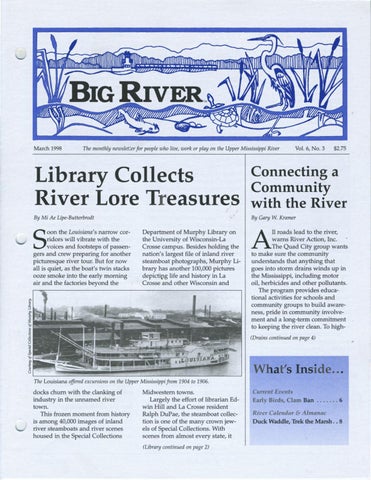
What's Inside ... The Louisiana offered excursions on the Upper Mississippi from 1904 to 1906.
docks churn with the clanking of industry in the unnamed river town. This frozen moment from history is among 40,000 images of inland river steamboats and river scenes housed in the Special Collections
Midwestern towns. Largely the effort of librarian Edwin Hill and La Crosse resident Ralph DuPae, the steamboat collection is one of the many crown jewels of Special Collections. With scenes from almost every state, it (Library continued on page 2)
Current Events Early Birds, Clam Ban ....... 6 River Calendar & Almanac Duck Waddle, Trek the Marsh . . 8
,
(Library continued from page 1) features inland river steamboats on rivers across the United States, but emphasizes the Upper Mississippi and its tributaries, with 25,000 images of steamboating on the Mississippi, Ohio, Missouri and Columbia rivers. The photos are organized by steamboat name. Most of the steamboat images date from the late 1800s. The oldest picture in the collection, a glass stereoview of the New Orleans riverfront in 1860, was acquired last year.
]
i
1...,,:: ~ .E' .E 0
E'.
Edwin Hill "Steamboats existed before photography, so many early boats were never photographed," says Hill. "Photography came to the United States in 1839, and the 1860s brought a minor surge in river pietures. The 1870s and 1880s were a major time for river steamboat photography." Besides steamboats, the collection contains images of showboats, peddlers' boats, raft building and dam construction. River scenes inelude locks and dams, levees, waterfronts, boating, clamming, fishing and other views of life on the river. In addition to the photographs, the collection includes 300 books on river history and inland steamboating, as well as river- and steamboat-related documents, such as pilots' logs and steamboating magazines.
2
Fire and Water The collection began, not with lore of steamboats, but with La Crosse firefighting. In the early 1970s, Hill wanted to compile the history of fires and fire stations in the La Crosse area, and he knew of Ralph DuPae's expertise on the subject. Together they gathered about 800 pictures for this collection. About that time, some antique glass negatives of La Crosse scenes were discovered in the vaults of a La Crosse factory that was being torn down. The factory owner, recognizing their historical value, offered to turn the plates over to the university. This donation gave Hill the idea to begin a river collection, since Murphy Library was the state university library closest to the Mississippi River. DuPae, however, was skeptical, but several acquaintances, including a former Delta Queen captain, an Army Corps engineer and the head of the Winona County Historical Society, encouraged him to pursue the project. DuPae, an engineer with Northem Engraving Corporation, got approval from the company to combine business travel and field collecting. In 2~ years of collecting, DuPae has met over 200 people, ranging from steamboat captains to antique dealers, and traveled to every state except Alaska, logging 40,000 to 50,000 miles annually. As word of the Murphy collection spreads, libraries, museums and historical societies all over the
It contains 25,000 images depicting steamboating on the Mississippi, Ohio, Missouri and Columbia Rivers. nation have contributed, many wanting their pictures and records duplicated and stored in another location, as insurance against fire or other damage. Steamboat captains
Big River
frequently referred DuPae to other captains and friends with archives. Antique dealers who encounter stereoview shots of rivers and steamboats often let Hill or DuPae duplicate them before auctioning them off. Organizations have helped too, such as the Sons and Daughters of Pioneer Rivermen and the Midwest River Buffs. About half of the people who become involved in DuPae's searches have become "scouts." "They'll send pictures and negatives to La Crosse, where we'll check them
"There was an argument of whether the Lee was stripped down to make it lighter for winning the race, and this picture clearly shows the Lee was not." against current holdings for duplicates and quality," says DuPae, who has scouts operating in all the river states and Canada. Does DuPae have a favorite steamboat image? "There have been so many pictures, but one of the most commented on is an exceptionally clear picture of the Rob't E. Lee running the race with the Natchez in 1870. There was an argument of whether the Lee was stripped down to make it lighter for winning the race, and this picture clearly shows the Lee was not." (See "Racing for the Horns," Big River, April 1996.) In addition to its river-related materials, Special Collections also houses extensive collections of rare books, Wisconsiana, Midwestern private press publications, oral history, university archives and historical maps.
,
Invaluable Resource Who uses the collection?" Absolutely anybody is welcome to use it," says Hill, who believes the loca-
March 1998
,
by doing this sort of thing are remarkable. I'd recommend this for someone who doesn't want to sit in front of the TV all day." Hill plans to retire this year, which, along with DuPae's age, has concerned some steamboat buffs and collectors who worry about the collection's future. But Hill says Murphy Library's administrators recognize the immense historical value of the river collection and "are fully committed to its future growth and preser~ ~ ~ ~ ~ - - - - - - - - - - ~ ~ - - - - - - - - - ~ - - ~ vation." The City of Parkersburg offered excursions on the Ohio River from 1916 to 1918. tion of Special Collections - in a university campus library and in a section where people must be buzzed in to gain entrance - discourages casual visitors. The department frequently hosts group tours and historical societies. Hill and his staff handle 300 to 400 steamboat-related requests a year. Many requests are from businesses or news agencies using steamboat or river images for advertising or journalism. "These requests vary widely," says Hill, "but often they are for very specific themes. For instance, a business might request a picture showing a calliope player or Christmas tree atop a steamboat." Hill says demands for information are increasing. "Many folks want genealogical information; they tell us their relatives were steamboat captains, and they are trying to track down when and where they worked." Because Special Collections does not handle extensive genealogical research, these requests are usually farmed out by Murphy to private researchers who charge their own fees. "This one-on-one research is labor-intensive," says Hill, but he and his staff find their work highly satisfying. "One of the most rewarding aspects of the job is to help peo-
March 1998
ple find what they want, whether it's an ancestor or information about a company or steamboat, or an immigration record." Funding for the collection comes largely from private grants and donations. "Very few taxpayer dollars are spent," says Hill. The primary grantor is the J. Mack Gamble Fund, administered by the Sons and Daughters of Pioneer Rivermen organization. The La Crosse Foundation and the Elmwood Founda-
In 1997, Murphy acquired 1,216 steamboat and river history pictures. tion have provided smaller grants. Grant support pays for field collection travel and copying pictures. Other financial support comes from research fees and fees for rights on pictures used for commercial purposes, as well as fundraising activities, such as concerts. The collection continues to grow. In 1997, Murphy acquired 1,216 steamboat and river history pictures. Health problems have recently slowed down DuPae's travels, but he continues collecting. DuPae, 73, says this venture has been "fun, and the people you come to know
Big River
Using the Collection Copies for personal, educational and research purposes can be made of virtually any photo in the collection. Prints for personal use start at $7 for 5-by-7 and 8-by-10-inch prints. Prints for business and commercial use are subject to copyright and donor restrictions, with fees starting at $15 per image. Research fees are $7 an hour. The Special Collections Department is located on the first floor of Murphy Library on the University of Wisconsin-La Crosse campus. When school is in session, Special Collections is open weekdays 10 a.m. to 5 p.m, Wednesday evenings 7 p.m. to 9 p.m. and Saturdays 1 p.m. to 4 p.m. Between sessions and in summer, it's open weekdays 1 p.m. to 4:30 p.m. The department can be contacted at (608) 785-8511; email hill@mail.uwlax.edu; or regular mail, Edwin Hill, Special Collections Librarian; Special Collections Dept., Murphy Library, University of Wisconsin-La Crosse, La Crosse, WI 54601. Mi Ae Lipe-Butterbrodt is associate editor of Big River.
3
(Drains continued from page 1)
light the effort, volunteers paint River Action, Inc., is a non-profit bright yellow messages on storm group founded in 1984 to focus on drains: "Don't Dump! This drains protecting the river's natural reinto our river." sources and promoting public acRiver Action adapted the process and multi-use development. gram from one used in the ChesaOne of its early projects, "Ride the River," features a 26-mile, riverpeake Bay area and last spring began working with conservation edge bicycle ride on Father's Day to groups, Scouts, church groups and promote and raise funds for riverjunior and senior high students. front trails. Last June more than Chuck Oestreich, a retired teach6,000 riders of all ages pedaled er, developed an educational prealong the river. sentation called "The Sane Drain" River Action also played an inteprogram for younger children. It ilgral role in raising funds to install lustrates the connection between lights on the Centennial Bridge bestorm drains and clean water. Children work with activity sheets that illustrate the path from the drains to the river and the connection beti tween pouring pollutants into them E and poisoning the river environs:~ ment. Then the students - outfiti:> G ted with orange safety vests spray paint the stenciled message on storm drains in their neighborhoods. River Action keeps track of the painted areas on a master map and hopes to cover the entire Quad City area. tween Davenport, Iowa, and Rock Schools frequently use the activiIsland, Illinois. In 1995 it launched ty for environmental or river educathe Channel Cat, a water taxi service tion. Some junior and high school that ferries between Illinois and Iowa communities. River Action commissione1 and bought the boat, One of its early projects, "Ride then turned over its operation to the River," features a 26-mile, the Quad City Transit Authority. Currently operating with the river-edge bicycle ride on help of a $300,000 challenge grant Father's Day to promote and from the McKnight Foundation, it with Quad City Arts to proraise funds for riverfront trails. joined mote six, river-focused, communityLast June more than 6,000 based art projects in the last two One of the current projects is riders of all ages pedaled along years. an effort to interpret the history of the river. the river at Credit Island in Davenport. The project will mimic the students receive credits for particiGeorge Seurat painting, "Sunday pating. When Oestreich was preAfternoon on the Isle of La Grande paring his program, he discovered Jatte." The Victorian Era recreation that river education is rarely taught. will feature ten, life-sized, carved When it is, the curriculum varies wooden figures. widely from school to school. So The group also created Riverhe's gathering information about Way, a "way finding" system that river education programs to share uses directional and informational with other teachers. signs on the river. Twenty river-
4
Big River
mile markers were placed in river communities in the Quad Cities area to help people relate their location to the yardstick that river pilots use. It has also begun installing 16foot-high gateways marking riverfront access points. It is also setting up kiosks with maps, community bulletin boards and local history. River Action applied to have the Upper Mississippi in the Quad Cities area designated as an American Heritage River. Its application included signatures of 12 mayors, county board members from both states, both governors and all the U.S. senators from both Iowa and Illinois. Over the years the group's influence has increased with its community involvement. It now finds itself being called on for advice and assistance on river-related matters from a variety of public and private agencies and groups. F Gary W. Kramer is a boater and a part-time freelance writer who lives in Rock Island, Ill. His last article for Big River was "Roll Out the Barrels."
Big RiverTM Big River (ISSN 1070-8340) is published monthly by Riverwise, Inc., 111 Rivtr(wnt, Suite 204, Winona, MN 55987; (507) 454-5949; fax: (507) 454-2133; email: editors@big-river.com; web site: <http://www.big-river.com>
Reggie McLeod Molly McGuire Mi Ae Lipe-Butterbrodt
editor/publisher assistant editor associate editor
Kathy Delano Pamela Eyden Dawn Bulson
graphic designer contributing editor researcher
Mary Feathergill office manager Subscriptions are $28 for one year, $50 for two years or $2.75 per single issue. Send subscriptions, single copy orders and change-a/address requests to Big River, PO Box 204, Winona, MN 55987. Second-class postage paid at Winona, MN. POSTMASTER: send change-of-address reqitests to Big River, PO Box 204, Winona, MN 55987. Big River, Volume 6, Number 3, copyright March 1998. Reproduction in whole or in part without written permission of the publisher is prohibited. Printed on recycled paper.
March 1998
-
Current Events -; "~t
~~~l/b
By Mi Ae Lipe-Butterbrodt, Molly McGuire and Reggie McLeod
Study the Flow The Army Corps of Engineers has begun a flow frequency study of the Upper Mississippi, Lower Missouri and Illinois rivers. This new research will determine the probability of major floods at specific locations, and consequently adjust the boundaries of the 100-year floodplain. The last study was done in 1979. This one will incorporate new technologies and data, including information from the 1993 flood. The study may result in a call for more or higher levees, and change floodplain insurance and zoning regulations for some areas, according to the Upper Mississippi River Conservation Committee newsletter (Winter 1997 /98). For information on the citizens' involvement group or the study's newsletters, call George Gitter at (309) 794-5387, or email him at GeorgeF.Gitter@usace.army.mil.
Warden Tickets Self Spooner, Wis. - A Wisconsin Department of Natural Resources game warden who forgot about a shortened woodcock season, arrested himself after he shot three of the birds three days after the season closed last fall. Widely known for his aggressive enforcement of hunting and fishing laws, T. J. Edwards wrote himself a ticket when a co-worker pointed out his error. He paid a fine of $198.80 and said it was about the most embarrassing thing he ever did, according to Country Today (121-98.)
Early Birds Birdwatching along the Mississippi
March 1998
River has been predictably different this warm winter, with bald eagles hanging around open water farther north, unusual species overwintering and spring arrivals showing up early. • The Clinton, Iowa, Eagle Watch, January 3, was a qualified success, with more than a thousand people and five to 10 eagles participating. About 2,700 people turned out to see 20 to 25 birds at Dubuque's Eagle Watch on January 10. • In mid-February, ospreys, robins and bluebirds had started returning to the Twin Cities, and great-horned owls were on the nest. People were spotting as many as 500 eagles on a drive from Minneapolis to Winona, Minn., according to the Minneapolis Star Tribune (2-18-98). • Carol Schumacher, Winona, spotted three pintail males in early February, many song sparrows in mid-month and heard reports of field sparrows, which usually return·around April 11. She recently saw two eastern meadowlarks sporting their spring colors. The Christmas bird count turned up red-winged blackbirds, grackles, and a yellow-rumped warbler. Many birds may have overwintered here, but big flocks this time of year usually indicate an early migration.
Capturing Mercury Minnesota - The Minnesota Dental Association (MDA) and the Metropolitan Council Environmental Services (MCES) are teaming up to test new technologies that filter dental amalgam from wastewater. Amalgam (silver fillings), which contains mercury, is currently collected for recycling. But wastewater from dental clinics often contains amalgam particles that can reach
Big River
treatment plants and may release mercury into the environment. Mercury accumulation has already triggered fish consumption advisories for many Minnesota lakes·and rivers. However, most mercury contamination comes from coal-fired power plants. A panel will advise MDA and MCES on testing and evaluation procedures of amalgam filtering technologies. The panel includes representatives from the Minnesota Pollution Control Agency (MPCA), Minnesota Office of Environmental Assistance, the American Dental Association's Council on Scientific Affairs, University of Minnesota School of Dentistry, Recyclights (a mercury recycler) and the Western Lake Superior Sanitary District (WLSSD). MCES will provide analytical and technical support, while MDA dentists will voluntarily test new equipment. This study is part of several cooperative efforts by MCES, MDA, WLSSD, MPCA and dental groups in MPCA' s Mercury Contamination Reduction Initiative. The initiative has resulted in extensive research and the creation of a voluntary program for additional amalgam collection and recycling, according to an MCES press release (1-22-98).
,
River Reprieve Minnesota - The most polluted river in Minnesota - and a major source of pollutants in the Mississippi - will soon be getting protection under a joint state-federal program that will retire at least 100,000 acres of land along its banks. On February 20, Minnesota Governor Arne Carlson and U.S. Deputy Agriculture Secretary Richard Rominger signed the Minnesota River Watershed Conserva-
5
tion Reserve Enhancement Program. The voluntary program offers farmers and landowners who idle property for at least 35 years guaranteed compensation both up front and annually over the first 15 years. Annual payments will likely range between $50 and $100 an acre, depending on the value and location of the land. Land under the program will initially be enrolled in a 15-year contract through the federal Conservation Reserve Program (CRP), followed by permanent or long-term easement under the state Reinvest in Minnesota (RIM) Reserve Program. Permanent easements will receive priority and maximum bonuses. Officials hope to eventually increase the land commitment to 190,000 acres, according to the St. Paul Pioneer Press (2-19-98). Enrolled land will remain private, but potentially river-harming activities will be prohibited. The hope is that land taken out of production and perhaps replanted with native grasses and trees will create a buffer that halts agricultural runoff into the river. The program will also reduce flooding and improve wildlife habitat. Total payments for all 100,000 acres are projected to be $223 million, with $163 million coming from federal sources (including the USDA) and $60 million from state funding. Applications will be accepted beginning April 1. "Everyone wins from this proposal," Carlson said. "The federal government gains because the program extends the environmental benefits of the Conservation Reserve Program, and the state benefits because it will be able to further protect environmentally sensitive land along the river." But farmers are unlikely to go for permanent easements, according to David Haugo, a Waubun, Minnesota, farmer who chairs a state USDA advisory committee. The program could still work "as long as the option is there for less than a perma-
6
A map highlighting the Mississippi River states in a Japanese tourism trade journal.
nent easement," he said. Minnesota is the second state to take part in the federal Conservation Reserve enhancement program, following Maryland, which launched its program last fall to help protect Chesapeake Bay.
Far East to Midwest Japan -Those who live and work on the Mississippi may take the river for granted, but the river attracts folks from the other side of the world, tha-0-ks in part to tourism efforts that bring Japanese visitors to river-related destinations in the United States. Organizations such as the Greater Minneapolis Convention and Visitors Association, the Mississippi River Country U.S.A. program and Japan Amenity Travel hope more Japanese who land at Minneapolis/St. Paul International Airport will stay in Minnesota or travel to Mississippi River states instead of changing flights to destinations like New York or Orlando. According to Bill DeeÂŁ, director of tourism for the Greater Minneapolis Convention and Visitor's Association, "Sometimes the Japanese say, 'Minneapolis ... Is that in Greece?' The megamall [Mall of America] and the Mississippi River are the most familiar features that
Big River
Japanese associate with Minnesota. Their eyes kind of light up when you mention those two," according to the St. Paul Pioneer Press (2-8-98). "The Japanese recognize the Mississippi River from the writings of Mark Twain, which are popular in that country," said Yuko Gosda, Japan sales and marketing coordinator for the Minneapolis Convention and Visitor's Bureau. "Because they associate the Mississippi with the Deep South, they are surprised to discover that the river exists in Minnesota and other Midwest states." Steamboats are a major attraction. "They are one of the older, more traditional things that the Japanese like, and they capture Twain's nostalgic image of life on the river," said Gosda. Mississippi River Country U.S.A. figures show that overseas visitors to the 10 Mississippi River states have increased 46 percent, compared to 18 percent for the nation as a whole since the program began in 1986.
Clammer Changes Plea Des Moines, Iowa - A Brownsville, Minnesota, man charged with transporting illegally harvested mussels across state lines, into Iowa, has pleaded guilty to one of the 14 counts he faced. The other 13
March 1998
,
counts will probably be dropped when he is sentenced. Gregory Meyers faces up to five years in prison on the federal charge (see Big River, February 1998). His wife, Lisa Ann Meyers, faces three counts. Her case is expected to go to trial in April.
Ultraviolet Amphibians Philadelphia, Penn. - Ultraviolet light is causing the deformities and population declines in amphibians, according to two scientists who studied salamander reproduction last spring. Joseph Kiesecker, of Yale University, presented his findings to the American Association for the Advancement of Science, in February. He and Andrew Blaustein, of Oregon State University, compared embryos of long-toed salamanders shielded from sunlight and embryos not shielded. Ninety-five percent of the shielded embryos hatched, compared to 14.5 percent of the unshielded embryos. Only 0.5 percent of the shielded embryos that hatched suffered deformities, while 91.9 percent of the unshielded embryos had deformities. The embryos exposed to the ultraviolet light were also more likely to be infected by a pathogenic fungus, according to the EnvironLink Network (2-18-98). Amphibian populations around the world have been declining for unknown reasons. Meanwhile, the ozone layer, which shields the earth from most of the sun's ultraviolet radiation, has been thinning out. Last year scientists induced deformities in frogs by raising their embryos in water from Minnesota sites where frogs suffered from high rates of deformities.
Eco Detective Wanted Red Wing, Minn. - A newly formed environmental organization is offering a $7,500 reward for information on the Hay Creek fish kill last August. About 7,500 brown trout died in
March 1998
two miles of the stream below a secluded bridge. Authorities suspect foul play, because fish above the bridge were unharmed. The creek flows into the Mississippi at Red Wing. The Minnesota Chapter of Trout Unlimited offered $500 for information on the fish kill, but some folks formed a new organization to up the ante. Citizen's Environmental Reward Fund (CERF) offered a $7,500 reward for information on the fish kill and also offered a $1,000 reward for information leading to the arrest of whoever killed a wolf with a snowmobile on Birch Lake in northern Minnesota this winter, according to The Rivers Advocate (Winter 1998). Report information to the TIP (Turn In Poachers) line, (612) 4368667. Send contributions to CERF, PO Box 264, Afton, MN 55001.
Natural Resources Commissioner Rod Sando asked the state legislature to limit the use of the cameras. "The underwater video camera is an example of a device that may appear to simply be another tool for anglers, but could have very negative impacts on fish populations," said Sando. "This device would allow anglers to target trophy fish or specific species, with the potential for an unknown impact on the populations." A new group, the Minnesota Outdoor Technology Advisory Committee, will review new technologies that may threaten fish and game resources. The new, 12-to-20member committee will include hunters, anglers, equipment manufacturers, resort owners and biologists. Nominations for the committee can be submitted to the commissioner's office until March 31, 1998.
Spilling the Beans
Clam Ban
Rosemount, Minn. - The Koch refinery, which paid $2.2 million in fines in 1989 to resolve lawsuits charging it with dumping pollutants directly into the Mississippi, may be in trouble with the Environmental Protection Agency, according to an article in the Minneapolis Star Tribune (2-22-98). An employee and a former employee claim that the company intentionally concealed discharges of contaminated water into the Mississippi. If the company violated the Clean Water Act, it may face substantial fines and company officials may face prison sentences. The company recently announced that it will invest $80 million in environmental improvements (see Big River, February 1998). The refinery is downriver from the Twin Cities.
Wisconsin - The commercial harvest of washboard mussels in Wisconsin will probably be banned as of the first of April. The Department of Natural Resources proposed the ban. The State Senate held hearings, but did not ask for any changes, so, barring unexpected intervention, the ban should go into effect on schedule. Iowa is still considering banning the harvest of washboards. Clammers harvest washboards and other mussels in the Mississippi, except for the stretch upriver from the Iowa-Wisconsin border. Plugs cut from the shells are used to "seed" the clams that produce cultured pearls in Asia. The populations of immature and harvestable washboards are very low. Nearly all of the washboard population is mature or maturing, but not yet large enough for harvest (see Big River, February 1998).
That's Show Biz St. Paul, Minn. - Close on the heels of the announcement of a new video system that will let anglers watch their prey on a close circuit camera, Minnesota's Department of
Big River
And the Winner Is ... After compiling ~ata and holding (Current Events continued on page 8)
7
River Calenda~i,¡ ,',J
s
Special Events and Festivals
Workshops & Conferences
March
March
6 No School Day for kids, 8:30 p.m.-noon, Hixon Forest Nature Center, pre-register, (608) 784-0303. 7-8 Eagle Watch, Winona, Minn., bus field trip, 1-800-657-4972 or (507) 452-2272. 12-15 St. Paul Sports and Travel Show, Civic Center, St. Paul, Minn. 14 Trek to the Marsh, 11 a.m.-12:30 p.m., Hixon Forest Nature Center, pre-register, (608) 784-0303. 15 Soar With The Eagles, 1 p.m. - 3 p.m., St. Felix Auditorium, Wabasha, Minn. 27-Apr. 5 Northwest Sportshow, Convention Center, Minneapolis, Minn. 28 Duck Waddle, Green Island Wildlife Refuge, Dubuque, Iowa. 28-29 Trader's Jubilee, Harpers Ferry, Iowa, (319) 873-2387. 28-29 Eagle Watch, Stillwater, Minn., (612) 430-1938.
4 Aquatic nonindigenous nuisance species, Houston, Texas, Gulf of Mexico Sea Grant, 1716 Briarcrest, Suite 702, Bryan, TX 77802. 6-8 Freshwater Mussels: Conservation, Captive Care, and Propagation, Holiday Inn-Worthington, Columbus, Ohio, (614) 645-3400. 9-10 National Waterways Conference budget summit, Holiday Inn Capitol, Washington, D.C., (202) 296-4415. 16-19 International Zebra Mussel and other Aquatic Nuisance Species Conference, Sacramento, Cal., 1-800-8688776; profedge@renc.igs.net. 20-21 Midwest Declining Amphibians Conference, Milwaukee Public Museum, (414) 278-2766. 25 Investing in Minn. Agriculture: Transportation Infrastructure, Minn. AgriGrowth Council, U of Minn., (612) 8541665.
Meetings & Hearings March 2 Open House/Open Mike, 4:30 p.m. - 8 p.m., American Legion, Kellogg, Minn., Minn. - Wis. Boundary Area Commission, (612) 436-7131 or (715) 386-9444. 4 Hiawatha Valley Audubon Society, 7 p.m., Lake Park Lodge, Winona, Minn. 5 Minn. - Wis. Boundary Area Commission, Mississippi River Regional, 10 a.m. - 2:30 p.m., Red Wing Public Library, (612) 385-3673. 9-10 Upper Mississippi River Summit, Blackhawk Motel, Davenport, Iowa, (202) 547-6900. 10 Izaak Walton League, Will Dilg Chapter, 7 p.m., SMU, Winona, Minn. 11-12 Navigation Environmental Coordination Committee, UMR Navigation Study, Holiday Inn, Moline, Ill., 1-800872-8822. 12 Dubuque Audubon Society, 7 p.m., American Trust and Savings Bank. 17-19 Upper Mississippi River Conservation Committee annual meeting, Holiday Inn, Moline, Ill. 24 Zumbro Valley Audubon Meeting, 7:30 p.m., Rochester, Minn.
April 23-24 Mississippi River Research Consortium, annual meeting, Yacht Club Resorts, La Crosse, Wis.
8
May 15-17 Becoming an Outdoors Woman, Eagle Bluff Environmental Center, Lanesboro, Minn., 1-800-MINNDNR or (612) 296-6157.
June 23-25 Catfish 2000 Symposium, River Center, Qavenport, Iowa, (309) 5825613.
July 8-10 Exploration of the Mississippi River, teacher workshop, sponsored by Wis. DNR, Iowa DNR, UMRCC, (608) 7859005. ~
(Current Events continued from page 7)
several public meetings, the multiagency task force charged with deciding which Upper Mississippi pool will be drawn down in the year 2000 has recommended Pool 8, between Genoa, Wis., and Dresbach, Minn. The water level of the pool, which includes La Crosse, will be lowered for a while in the summer to allow vegetation to root in soil that is usually underwater. The River Resources Forum, the Army Corps of Engineers and the public still need to approve the pilot project, according to The Resource Volunteer (February 1998.) For more information, call Gretchen Benjamin at the Wisconsin Department of Natural Resources, (609) 785-9000.
Correction The last sentence of the caption on the map on page two of the February 1998 issue of Big River should read "Southwestern Wisconsin and northwestern Illinois were never covered by ice and are known as the Driftless Area."
Byl(ennj~ Sufferm' succotash! It's March! Spring is here, or it will be tomorrow. Red.winged blackbirds, robins, ducks and shorebirds are back. Pairs of geese are staking out nest sites. A few green things are taking a peek at the world above ground. Towboats should have one of their earliest starts on record. River folks are saying "High water? Don't look like it this year." The winter has been very kind. Those who lived under the ice fared wonderfully; very few frogs, fish or turtles are floating belly up. White-tailed deer, wild turkeys and other woods dwellers found good pickin's this winter. Far as I can tell, the only critters who took heavy losses were the "marsh bunnies," or as most folks call 'em - muskrats. It was such a warm winter, their houses and bank dens didn't freeze solid on the outside. This allowed minks and raccoons to dig them open and eat their fill. What they didn't catch crawled out on the open ice to become a meal for eagles, owls, hawks, foxes or coyotes. What's good for some is bad for others. That's the way it is in the Circle of Life, I guess. ¡
Big River
March 1998
.,