May1997
The monthly newsletter for people who live, work and play on the Upper Mississippi River
Vol. 5, No. 5 $2.75
John Latsch, River Philanthropist
Where's the Ark?
by Ken McCullough
By Pamela Eyden
I
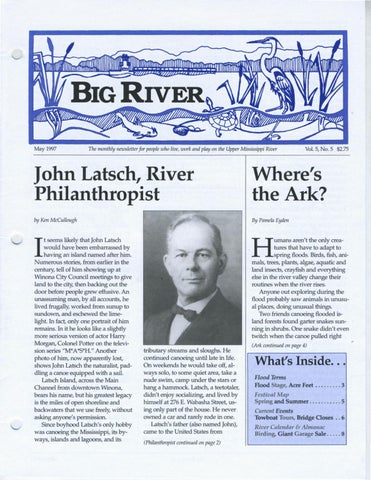
t seems likely that John Latsch would have been embarrassed by . having an island named after him. Numerous stories, from earlier in the century, tell of him showing up at Winona City Council meetings to give land to the city, then backing out the door before people grew effusive. An unassuming man, by all accounts, he lived frugally, worked from sunup to sundown, and eschewed the limelight. In fact, only one portrait of him remains. In it he looks like a slightly more serious version of actor Harry Morgan, Colonel Potter on the television series "M*A*S*H." Another photo of him, now apparently lost, shows John Latsch the naturalist, paddling a canoe equipped with a sail. Latsch Island, across the Main Channel from downtown Winona, bears his name, but his greatest legacy is the miles of open shoreline and backwaters that we use freely, without asking anyone's permission. Since boyhood Latsch's only hobby was canoeing the Mississippi, its byways, islands and lagoons, and its
.
tributary streams and sloughs. He continued canoeing until late in life. On weekends he would take off, always solo, to some quiet area, take a nude swim, camp under the stars or hang a hammock. Latsch, a teetotaler, didn't enjoy socializing, and lived by himself at 276 E. Wabasha Street, using only part of the house. He never owned a car and rarely rode in one. Latsch's father (also named John), came to the United States from (Philanthropist continued on page 2)
H
umans aren't the only creatures that have to adapt to spring floods. Birds, fish, animals, trees, plants, algae, aquatic and land insects, crayfish and everything else in the river valley change their routines when the river rises. Anyone out exploring during the flood probably saw animals in unusual places, doing unusual things. Two friends canoeing flooded island forests found garter snakes sunning in shrubs. One snake didn't even twitch when the canoe pulled right (Ark continued on page 4)
What's Inside.
• •
Flood Tenns Flood Stage, Acre Feet ......... 3 Festival Map Spring and Summer . .......... 5 Current Events Towboat Tours, Bridge Closes .. 6 River Calendar & Almanac Birding, Giant Garage Sale ..... 8
(Philanthropist continued from page 1)
Switzerland in 1854. He travelled the country for awhile, taking a steamboat in 1856 up the Mississippi from New Orleans heading for St. Paul. When ice stopped the boat at Dakota he hopped off and made his living for several months cutting cordwood for the riverboats. He moved across the river to Trempealeau County, married, started teaching school and farming. During the Civil War he served with Sherman, then in 1867 moved the family a few miles upriver to Winona, where he became a partner in a wholesale grocery business, buying out his partner in 1892. John A , who started working for the company at age 13, took over when his father died in 1909. The younger Latsch was 49, and the business had become the most prosperous wholesale grocery in the Midwest.
Everybody's River The story of how Latsch began buying and giving away vast tracts of land was probably perpetuated by Captain Frank Fugina, Latsch's longtime friend and business associate. One weekend in June, Latsch took his canoe from the Winona Boat Livery at the foot of Lafayette Street, paddled across the river to Boat House Slough, then upstream toward Box Dam. His supplies were most likely a box of crackers, a jug of buttermilk and a bunch of newspapers. When he reached Camp Glory (now Bass Camp), he noticed a storm brewing, pulled his canoe to high ground, turned it over, and crawled underneath to wait out the squall, and peruse the newspapers he hadn't yet read. In those days, the understanding was that anyone could pull ashore and camp anywhere along the river, but the owner of this stretch, a farmer named John Schamong, did not subscribe to this ethic. He and his guard dog shooed Latsch off the land into the downpour. This had a profound effect on Latsch. Many years later he remembered the exact epithets Schamong had hurled at him. The next morning, Latsch instruct2
LATSCH & SON CO.
lMPO U TERS A ND '\VJl OLl<!SALE GROOERS L a rge •t S1 o .-J.: In Sou theru :,nnne,mto t o Se le<-t Fro m •r en .. Colfer• Oll{nrs Fr uit>< L eve e Pnrk, Cen ter an d Secorul St><. '\'\' In o nu, M~:1_!•
From the 1925 Winona City Directory.
ed Frank Fugina to purchase Camp Glory and the surrounding bottomland so this kind of abuse would never happen to anyone again. Thus Latsch began purchasing the bottomlands, not for himself, but to preserve them so future generations could enjoy them as he had. The land would never be barred from public use because of private ownership, wildlife would be protected and trees would grow back.
Latsch's Legacy In all, Latsch deeded over 18,000 acres to Minnesota, Wisconsin and the City of Winona. To his home state of Wisconsin, he gave Perrot State Park (including Trempealeau Mountain), Merrick State Park and much of the bottomlands and islands from Fountain City to Buffalo City. To Minnesota, he gave Latsch State Park and much of the prime area of Whitewater State Park. To Winona he gave more than 7,000 acres of river shoreline and islands - most of the 20mile stretch between Minneiska and Homer. Many of these islands were flooded when the Corps of Engineers built the 9-foot channel in the 1930s. The Corps compensated the city for Big River
this loss. Over 70 percent of the area of present-day Winona occupies land given by Latsch. Early on he donated a public beach and bath house on Latsch Island. The bath house, erected in 1907, originally faced the East Channel of the river, but was moved in 1923 to face the Main Channel when the East Channel had become unfit for swimming. He gave an addition to Bluffside Park, the land for Westfield golf course, Athletic Park, the East End baseball field and athletic park, 20 blocks of park land known as Union Athletic Field, Agaghming Park, Gamehaven Boy Scout Camp, much of Latsch Island and a number of buildings in Winona (the rents from which went back into the city coffers). When the city became interested in a river terminal, Latsch purchased the frontage at the foot of St. Charles Street for this purpose. The Latsch Trust started a city forest nursery on Prairie Island. During the Depression, Prairie Island was opened to the poor so that they could cut firewood. Indeed, Latsch donated much of the money used to support the poor of Winona during the Depression. He contributed generously May 1997
,
to Central Methodist Church, Winona General Hospital, Woodlawn Cemetery and the Margaret Simpson Home. Latsch arranged for his business to continue for 20 years after his death to guarantee his employees' livelihoods. If you poke deeply enough you will find that John Latsch helped out many individuals in a wide variety of circumstances.
Big Plans Latsch was good friends with Will Dilg, a Chicago businessman who fished for bass in the Winona area. When Dilg learned of plans to drain and farm the great Winneshiek marsh area along the Mississippi above McGregor, Iowa, he gathered 53 of his
In all, Latsch deeded over 18,000 acres to Minnesota, Wisconsin and the City of Winona.
73. He had no descendants, but all of us who enjoy the Upper Mississippi River are his heirs. When I looked for his portrait in Winona's City Hall, a number of people I talked to asked, "John Latsch?" But I'm sure that's the way he'd want it. The Dacotah people, who were among Latsch's boyhood playmates, considered a man rich when he died based on how much he had given away, not on how much he had kept for himself. They would probably hold John Latsch in high regard.= Ken McCullough's most recent books of poetry are Travelling Light (1987), and Sycamore• Oriole (1991). Walking Backwards is scheduled for publication in Jail 1997. He has received numerous awards for his poetry including the Academy of American Poets Award, a National Endowment for the Arts Fellowship, a Pablo Neruda Award and the Capricorn Book Award. Coffee House Press will publish his translations of Cambodian poet U Sam Oeur, in 1998. McCullough lives with his family in Winona, Minnesota.
business cohorts to form the Izaak Walton League to block this ecological disaster. When asked by Chicago industrialist George Scott, one of the "54," how he was going to accomplish this, Dilg said "Get the government to do like that man Latsch did at Winona, turn the whole river bottomlands into a great bass refuge." Through the influence of the Izaak Walton League, Congress established the Upper Mississippi Wildlife and Fish Refuge in 1924, which extended from the foot of Lake Pepin to Rock Island, Illinois - some 261 miles and 200,000 acres. Latsch was very much in favor of this refuge, but he strongly objected to the tracts he had donated coming under the administration of the refuge. He wanted the area to remain open for hunting and fishing - a permanent place of recreation. If John Latsch were to canoe through his familiar haunts these days, he would likely feel satisfied with his legacy. Latsch died in 1934 at the age of
May 1997
Big River"', Big River (ISSN 1070-8340) is published monthly by Big River, 70112 East Fourth Street, Suite 203, Winona, MN 55987; (507) 454-5949; fax: (507) 454-2133; email: bigriver@aol.com; web site: <http://www. big-river.conz> Reggie McLeod editor/publisher Molly McGuire assistant editor David Syring associate editor Pamela Eyden contributing editor Jayne L. Stokke graphic artist Mary Feathergill bookkeeper Joshua Jacobs systems analyst Subscriptions are $28 for one year, $50 for two years or $2.75 per single issue. Send subscriptions, single copy orders and change-of-address requests to Big River, PO Box 741, Winona, MN 55987. Second-class postage paid at Winona, MN. POSTMASTER: send change-of-address requests to Big River, PO Box 741, Winona, MN 55987. Big River, Volume, 5, Number 5, copyrightŠ May 1997. Reproduction in whole or in part witlzout written permission of the publislier is prohibited. Printed on recycled paper.
Big River
Flood Terms Here is a sampling of flood terminology from the Army Corps of Engineers: acre-foot: describes the volume of water in a reservoir. An acre-foot of water equals one acre covered to a depth of.one foot, or 43,650 cubic feet, or 326,700 gallons. bankfull stage: maximum height to which a river can rise at a specific location before overflowing or causing significant damage. design flood: maximum amount of water for which a flood control project will offer protection. Selection is based on engineering, economic and environmental concerns. discharge: rate at which a volume of water passes a given point. drainage area: total land area from which water drains into a point on a river. The Mississippi River drainage . area makes up 41 percent of the land area of the lower 48 states. flash flood: flood with a very rapid rate of rise that occurs shortly after a storm begins, often with little warning. flood plain: the part of a river valley that has historically been covered by a river during floods. The Corps of Engineers encourages local governments to zone flood plains to prevent development, and therefore avoid property damage and reduce obstacles to flood water flow. flood stage: gauge height defined as the stage where significant damages begin to occur. The National Weather Service works with local communities to designate flood stage. Many communities set flood stage height as an early warning alert, prior to the onset of significant damages. In these cases, damages may not begin until river levels climb several feet above flood stage. Conditions along (Terms continues on page 7)
3
(Ark continued from page 1)
alongside. Was it tired or trying to warm up and dry out? One cool, gray morning in early April, when floodwaters were rising a foot a day, my sister, niece and I took
"The mammals are pretty much pushed to their limits," said Eric Nelson, U.S. Fish and Wildlife Service biologist. "You find them in odd places sometimes." a walk near the river, looking for birds. The trees were bare, with a few buds coming out. The forest floor was carpeted with dead leaves beneath several inches of cold water that was trying to run every direction at once. We picked our way quietly through the forest toward a watery clearing, then stood still, listening. We heard a goose, then a crow - nothing else, not a sound. Suddenly, there was a soundless explosion of movement and color right in front of us, as a large animal with reddish brown fur jumped out of a dark stump and ran along a fallen tree trunk. Its hind leg slipped in haste, but it kept running, then leaped, landed with a splash and ran off through the watery forest. "A fox!" I said. "A pregnant fox," my sister guessed. "A cold, wet, pregnant fox," my niece concluded. Cold water up to our ankles meant cold water nearly to that fox's knees. We regretted startling her out of her dry place and wondered where she would go, with the highway and river on one side, and sloughs on the other. Foxes build their dens in sandy banks, often at the edge of the floodplain. They can swim, but a flood puts a lot of stress on them, especially when they are trying to raise young pups. "The mammals are pretty much pushed to their limits," said Eric Nelson, U.S. Fish and Wildlife Service biologist. "You find them in odd places 4
sometimes." Nelson saw muskrats trying to swim over the Lock & Dam SA spillway, for reasons he couldn't guess. There was just as much water on one side as the other. Muskrats often build their dens in the riverbanks. When the water comes up, they have to evacuate, as surely as people do. "A lot of muskrats must have had their dens flooded," Nelson said. "They've just had their first young of the season and their food sources are slim now anyway in early spring. It must be a critical time for them." Karen Kobey, naturalist at the Coon Rapids Dam Visitor Center, said when she took a group of students out to watch birds, they watched blue-winged teal paddle around underneath bluebird boxes. Geese were swimming down the hiking trail into the woods. "I guess you could say the trail has turned into an ephemeral pond," she said. A flood in the forest means deer, raccoons, opossums and other animals move to higher ground outside their normal territory and into the territory of dogs, coyotes, trucks and caÂŁs. Mice and voles crowded together in a few high, dry places are easy prey for owls. Lots of little invertebrates, the aquatic and land insects, also crowd together in dry or shallow places - easy pickings for predators. Crayfish may get washed away from their homes and have to start a new one somewhere else. Of course, fish do well in high flood years. When the new territory opens, it's a free-for-all for carp, gizzard shad, northern pike, sunfish and bass. There are lots of algae and unsuspecting inv~rtebrates to eat, the grassy places provide good cover, and there are fewer predators per square foot to worry about. Fish often spawn in newly flooded Big River
areas. Northern pike especially like spawning in grassy places. This is good, as long as the floodwaters stay high. But if it dries out too soon, the young are suffocated or stranded. Other fish move fast when the dam gates open, so they can migrate up and down river, like they did before the dams were built. Paddlefish, for instance, often swim through two or three pools in the spring. Eagles can have trouble finding fish, because they aren't concentrated in the usual places. Hungry eagles might tum to alternative sources for food. Eric Nelson said that in Iowa eagles are known to go inland as far as the hog farms, where they will scavenge carcasses and even carry off young pigs. Herons and egrets don't stay in a flooded river, either - it's too deep. These waders head for smaller streams and places where the water is less than heron-leg deep. Ann Pronschinske at Trempealeau National Wildlife Refuge said a lot of dabbling ducks, coots and geese have moved into the refuge pools, which
s:::
"' ~ ~
11"'
~
-5' ~
a
i:l':;
are separated from the Mississippi by a railroad dike, because water levels are stable, and they can find food. Some creatures take advantage of the crisis, others just have to run for it. It all depends on their equipment - fins, fur, lungs, gills, cold blood, warm blood - and how they make a living. Pamela Eyden is contributing editor o/Big River.
May 1997
,
Festivals on the River Spring and Summer 1997 St. Cloud,. Mississippi Music Fest, May 4; Wheels, Wings, and Water Festival, July 10-13
urth of July Celebration, July 4
Minneapolis •Anoka Stone Arch Festival of the Arts,• • St. Pau j Rice Street Festival, July 30-Aug. 3 June 14-15; Coon Rapids Dam Celebration, July 12
Wisconsin Tourism Info 1-800-372-2737
. Min~esota R. • • Prescott, Rockin' on the River, July 4 Hastmgs, R1vertown Days, July 18-20 Bay City, Ethnic Days, May 17-18; Bay City Days, June 7 • • Maiden Rock, Summerfest Day, June 21 Red Wing, River City Days, August 2-3 • • Stockholm, Art Fair, July 19 •Pepin, Laura Ingalls Wilder Days, Sept. 20-21 Lake City, Water Ski Days, June 27-29• •Nelson Good Old Nelson Days August 8-10 Wabasha, Riverboat Days, July 25-27 • • ' ' Kellogg •Alma, Polkafest at the Silver Moon, July 4; Mark Twain Days, Aug. 30-31 • Cochrane-Buffalo City • Fountain City Winona, Art & River Festival, June 21-22; • .Trempealeau, Catfish Days, July 11-13 Steamboat Days, July 1-6 Black R . Dakota• • Onalaska, Sunfish Days, May 22-25 La Crescent• • La Crosse, Riverfest, July 2-6; Log Boom, Aug. 1-3 Minnesota
Tourism Info 1-800-657-3700
Iowa Tourism Info 1-800-345-4692
Lansing, Fish Days, August 8-10 •
Wisconsin R.
Marquette, Fie/I Market, May 24-26; National Hobo Music & Poetry Festival, June 6-_8
.
McGregor, Arts & Crafts Festival, May 24-26
/
•Prairie du Chien, Rendezvous, June 12-15; Town & Country Jamboree, July 12-13
Guttenberg, Stars & Stripes River Days , July 5 •
•Bagley • Cassville, Old-Fashioned Independence Day Celebration, July 5 • Potosi, Catfish Festival, August 10
Dubuque, Dubuquefest, May 16-18; • Catfish Festival, June 26-29
• East Dubuque • Galena, Tour of Historic Homes, June 14-15
Bellevue, Heritage Days, July 3-4 • • Savanna, Summerfest, July 23 •Thomson, Melon Days, Aug. 30-Sept. 1 Riverboat Days, July 3-6 • •Fulton, Dutch Days, May 2-4 Le Claire, The Tug, Aug. 1-2 • •Port Byron,The Tug, Aug. 1-2 Bettendorf, Old Fashioned Fourth, July 4• Davenport, Mississippi Valley Blues Fest, July 3-5; •• •Moline, Riverfest, June 27-29 Bix Beiderbecke Jazz Fest, July 24-27 Rock Island, Summerfest, July 10-12
May1997
Big River
5
. '*I
Current Events
'~
By Molly McGuire, Reggie McLeod and David Syring
Plugging the Mississippi New Orleans, La. - Ocean-going ships will have a tough time getting up the Mississippi to New Orleans until at least September, because a channel, the Southwest Pass, is clogged, according to an article from Knight-Ridder /Tribune Business News (4-20-97). Much of the silt and sand was swept into the Ohio River in the spring floods, then carried down the Mississippi. The Army Corps of Engineers spent $25 million last year and budgeted $37 million this year to dredge the pass. However the Corps has already used up this year's budget, and may need another $15 million to clear out a 45-foot channel by September. The Corps has only 11 hopper dredges, five of which are working to clear the pass. Most of the barges travelling down the Upper Mississippi are carrying com to New Orleans. Most of the com is then loaded onto ships and exported.
Hunting and Fishing Fees Increase Wisconsin - Hunters and anglers might not be happy about the first bill of the Wisconsin legislative session signed into law by Governor Tommy Thompson, but game farms and wildlife managers will be. The new law raises the cost for resident and nonresident hunting and fishing licenses for the first time since 1991 and saves state wildlife programs from substantial funding cuts. Inland trout stocking, fish surveys, habitat development, game farm support and new fishing pier construction all depend on licensing fees. The new bill also di-
6
rected the Department of Natural Resources to study alternative funding sources to reduce these programs' reliance on fees. Fees for inland trout, Great Lakes trout and salmon stamps; disabled anglers and hunters; wild turkey and pheasant hunters; and juvenile small game hunters (ages 12-17) did not change. All other hunting and fishing activities will require fishing out a few extra bucks.
Flood of Money According to a survey by the Mississippi River Parkway Commission (MRPC), the 120 counties along the Mississippi River collected $15.5 billion in direct travel expenditures in 1995.
Fire Commendations Hastings, Minn. - Two recent Public Service Commendations (PSC) by the U.S. Coast Guard suggest Hastings, Minn., is not too bad a place for a towboat fire. The Coast Guard awarded a PSC to l:he Hastings Fire Department in recognition of exemplary service during a fire on the Elizabeth Beesecker on November 15-17, 1996 (see Big River, Dec. 1996). The department logged 797 workhours fighting the blaze and, despite poor weather and random on-board explosions, avoided a potential 47,000-gallon diesel fuel spill by keeping the boat afloat. The Coast Guard also commended Upper River Services Inc., Lametti & Sons Inc. and Olympic Marine Co. for their roles in salvaging the towboat to keep it from sinking and spilling diesel fuel.
Drawdown Demos The Army Corps of Engineers plans two, small-scale drawdowns this summer to enhance vegetation in two ponds on the Upper Mississippi. The
Big River
J
~ro88M
~
@%
ÂŁtk1,ro
drawdowns will affect 52-acre Lizzy Pauls Pond (Pool 5), near Buffalo City, Wis., and 19-acre Peck Lake in Blackhawk Park near Victory, Wis., (Pool 9). Drawdowns, when the water level is lowered for a short time, give plants a chance to germinate and improve wildlife habitat. Experiments further downriver show drawdowns benefit vegetation and wildlife without hurting shipping (see Big River, Nov. 1996). The Corps will temporarily close outlet culverts to the ponds, and use pumps to lower the water levels in both sites by at least two feet. The drawdown will begin in late June 1997 and run through mid September. According to the project proposal, Lizzy Pauls Pond currently has good vegetation, while Peck Lake has almost no plant growth. The Corps expects both areas to benefit from the drawdown.
Twilight Towboat Tours Galena, Ill. - If watching towboats power by on the river from a distance is not good enough, try a two-day tour on the Twilight between Le Claire, Iowa, and Galena, Ill. The towboat, operated by River Cruises, leaves Le Claire on Sundays, Tuesdays and Thursdays from May through October. Contact: River Cruises, PO Box 406, Galena, IL 63106; (800) 331-1467 or (815) 777-1660.
Bridge Closes Sabula, Iowa & Savanna, Ill. - With the Mississippi's flood crest headed south, residents of Sabula, Iowa, and Savanna, ill., are again using the bridge connecting the two rivertowns. The departments of transportation for both states closed the bridge on Wednesday, April 17. It was the only Mississippi River bridge closed during the spring flood. High waters did
May1997
.,
not affect the main bridge, but a lower bridge on the approach to it, on the east edge of Sabula, barely remained above the current for a few days. The six-day closing created a 40-mile detour for commuters traveling between Sabula and Savanna. According to city clerk Ron Flemming, Sabula, which is the only Iowa city located entirely on an island, experienced few problems from this year's surge. The water peaked at 19.8 feet, 3.8 feet above flood stage, which was much lower than predicted.
Simpler Permits Minnesota - It will be a little easier to get the permits for some projects that would affect Minnesota wetlands, if Army Corps of Engineers modifies an existing rule. Because state and federal rules for many small projects are identical, the Corps allows some projects to proceed with a permit from a local unit of government. The modifications of GP-17 would probably free fewer than 20 more projects a year from the need for a permit from the Corps.
Swing Bridge on Hit List La Crescent, Minn. - A railroad swing bridge across the Mississippi near La Crescent, Minn., has the dubious honor of a spot in the top-five list of accident-causing bridges - in 7,500 miles of waterways throughout 22 states. According to the I.a Crosse Tribune (4-23-97), boats hit the structure 560 times between 1972 and 1995, making it number four on the "hit list." Towboat operators have long identified the 95-year-old bridge as a problem spot, both because the navigation opening only allows about 150 feet of clearance for the 105-foot-wide tows, and because of a tight turn in the Main Channel just south of the bridge. Landowners near the bridge complain about the erosion caused by the burst in propeller power needed for pilots to make the turn. A public hearing held on April 23 in La Crescent explored the possibility
May 1997
of replacing the bridge. A St. Louis towing company representative, Bob Aldrich, argued that the bridge, built in 1902, should be replaced with a new structure that meets current navigation needs. Confusion about the purpose of the meeting brought several people to complain about the bridge's clearance over the road on shore, too. The seven-foot, over-head clearance causes problems with access to some houses, and created a delay when fire trucks tried to respond to a house fire there in mid-April.
Resources The Minnesota Department of Natural Resources (DNR) is a source of information for many outdoor pursuits: • In southeastern Minnesota call 1888-646-6367 for Root River State Trail maps, state canoe routes and current river conditions, and popular trout stream maps. • What to do about nuisance geese on your property? Call 1-800-766-6000 or (612) 296-6157 in the Twin Cities for a helpful brochure. (Tip: fences, mylar tape and dogs help; swan decoys and noisemakers don't.) • DNR hydrologists can advise you about permits required for water and shoreline projects. In southeastern Minnesota call (612) 345-5601 from Houston and river border counties, or (507) 285-7423 inland. • The Waterways Journal website will keep you informed about the navigation industry at <www.waterwayj.com>. Correction: the Wisconsin DNR's free calendar of wildlife watching events can be ordered by calling (608) 264-8528. Big River published the wrong number last month.
Meetings? Celebrations? Send us your special calendar events. Mail to: Big River, PO Box 741, Winona, MN 55987, or e-mail to: bigriver@aol.com.
Big River
(Terms continued from page 3)
some rivers have changed since gauges and flood stages were set, so flood stage at any particular place may or may not cause actual flooding. "Feet above flood stage" cannot be compared between different locations; stages are site-specific. Most locations measure stages in feet, although, some have switched to elevation above mean sea level (msl). floodway: designated land left clear of development for the passage of flood waters. freeboard: vertical height between water surface and the top of a dam, levee or floodwall. hundred year flood: more accurately referred to as a "one percent chance flood," a flood of a magnitude which, according to historical statistics, has one chance in 100 of occurring in any given year. Similar statistics are used to define a "200-year," "300-year," or greater flood. This does not mean that once such a flood occurs, a river won't flood again for another 99, 199 or 299 years. runoff: water from rainfall or melting snow which is not absorbed into the soil, but flows along the ground surface until it reaches a stream. saturation: condition in which all space between soil particles is full of water. Saturation occurs after prolonged rainfall or snow melt, and forces any additional rainfall to run into streams. Also occurs in earthen levees during floods, sometimes weakening levee structures. spillway: a dam feature, usually functioning only in large floods, which allows water to pass without overtopping the dam. stage: a site-specific measurement of river level referenced as the height in feet above a designated zero reference point at the site. Since each gauge was established independently at each location, the stage reading is good for that location only and cannot be compared to other locations, unless they are first converted to mean se_a level (msl). watershed: see drainage area. ~
7
River Calendar Special Events & Festivals May 2-4 Dutch Days Festival, Fulton, Ill., (815) 589-2129. 3 Birding by canoe, Trempealeau Refuge, Coulee Region Sierra Club, (608) 9899845. 3 Spring tree planting, Mississippi River Valley, downtown St. Paul, 8:30 a.m. noon, (612) 224-9885. 3 Archaeology Day at Silver Mound, Hixton, Wis., (608) 785-8454. 3-4 85-mile sale, 12 Lake Pepin villages. 4 Mississippi Music Fest, St. Cloud, Minn. 7 Walleye Tournament, Genoa, Wis., 8-10 Louis Bellson Jazz Fest, Quad Cities, (309) 762-0736. 10 Boat safety classes, 8 a.m. - 4:30 p.m., Arsenal Island, Rock Island, Ill., pre-register, (309) 794-5338. 10 Bike tour, Trempealeau, Wis., (608) 5326780. 10 International Migratory Bird Day. Contact local bird clubs for census taking info. 16 Grand opening, archaeology exhibit at Perrot State Park, 2:30 p.m., Trempealeau, Wis., (608) 534-6409. 16-18 Dubuquefest, (815) 777-2309. 17-18 Ethnic Days, 1-5 p.m., Bay City, Wis. 22-25 Sunfish Days, Onalaska, Wis., (608) 783-1110. 24-26 Arts & Crafts Festival and Flea Market, Marquette/McGregor, Iowa, (800) 896-0910. 25 Candlelight Walk, 8 p.m., Perrot State Park, (608) 534-6409. West Coon Rapids Dam Visitor Center, (612) 424-8172. 11 Plants and animals of the Mississippi. 17 Mayfly hunt. 18 River insects and water quality. 29 Natural history for adults.
June 1 Rededication of passenger pigeon monument, Wyalusing State Park, Bagley, Wis., (608) 996-2261. 1 Minnesota State Parks Open House. 6-8 National Hobo Music & Poetry Festival, Marquette, Iowa. 7 Julia Belle Swain Welcome Home Party, 10 a.m. - noon, Riverside Park, La Crosse, Wis., 1-800-815-1005. 7 Boat safety classes, 8 a.m. - 4:30 p.m., Arsenal Island, Rock Island, Ill., pre-register, (309) 794-5338. 7-8 Free fishing weekend and open house
8
J·
:;''®!''~~ ,:_
(8), Wyalusing State Park, Bagley, Wis. 12-15 Rendezvous, St. Feriole Island, Prairie du Chien, Wis. 13-15 Felix Adler Days, Clinton, Iowa, (319) 242-7895. 14 Garden Walk, 9 a.m. - 3 p.m., Moline and Rock Island, Ill., (309) 794-0991. 14-15 Art in the Park, Clinton, Iowa, (319) 259-8308. 14-15 Tour of Historic Homes, Galena, Ill., (815) 777-9129. 14-15 Stone Arch Festival of the Arts, Minneapolis. 15 Ride the River festival and bike ride, 6 a.m. - 6 p.m., Davenport, Iowa, River Action, (319) 322-2969. 20-22 Midwest Renewable Energy Fair, Amherst, Wis. 21 Summerfest Day, Maiden Rock, Wis. 21 Moonlight hike, Effigy Mounds, Marquette, Iowa, (319) 873-3491. 21-22 Art & River Festival, Winona, Minn., (507) 452-2281/8621. Hixon Forest Nature Center birding weekend tours, $100, (608) 784-0303. May 17-18 Migrants. June 21-22 Heron rookery and pelicans.
River Cleanups May 10-17 National River Cleanup Week, (423) 558-3595 . • 17 Minneapolis, 9:30 a.m., St. Anthony Falls north to city limits, five locations, sponsored by Mississippi Corridor Neighborhood Coalition, Lois at (612) 379-3814. 17 Anoka, Minn., 10 a.m., Peninsula City Park, Bill at (612) 506-6362.
June 21 Wmona, Minn., sponsored by Mississippi River Revival, (608) 687-8152.
Meetings & Hearings May 3 Advisory Committee, Winona County / La Crescent Area Common Visions, 9 a.m. - 3:15 p.m., Central United Methodist Church, Winona, Minn., public invited, (507) 643-6765. 13-14 Environmental Management Program Coordinating Committee, Mpls./St. Paul, (612) 224-2880. 21 Upper Mississippi River Basin Association quarterly meeting, St. Louis, (612) 224-2880. June 12 Minnesota-Wisconsin Boundary Area Commission, Prairie du Chien, Wis., (612) 436-7131.
Workshops & Conferences May 17-19 Minnesota Environmental Education Conference, Duluth Entertainment Convention Center, $105 by May 9, 1-800-6573843. 31 Take me to the River, Twin Cities riverfront neighborhoods, 12:30 p.m. - 5:30 p.m., Harriet Island, St. Paul, (612) 228 1395 July July 10-13 Mississippi River Basin Alliance, St. Louis, (314) 822-4114. Bus ride, $50, (612) 645-6159. §§
Almanac By Kenny Salwey After a flood some of us river folk go on daily treasure hunts, picking up barrels, lumber and such, but the most precious treasures are the wild, natural ones. In the merry month of May the natural world explodes into new lush growth. Snow waters from the North made the big river angry and restless, but now it's starting to relax and enjoy its joumey in the warm sunshine. The trees, which stood in silence - pregnant with new buds in April - now play us a lovely lullaby. The wind is the musician, the lush new leaves are its instruments. Baby foxes, beaver, muskrat, raccoon, possum, skunk and others are out and about for their first glimpse of the world. Goslings and ducklings look like little yellow puffballs floating behind their parents. May is a good month to travel upstream on the big river's tributaries in search of trout and morel mushrooms. But lay awhile in a grassy meadow under the warm sunshine next to rippling waters and the mind turns to more intellectual pursuits, with questions like, "How long has this stream flowed in this valley?" ""Yill this same water ever flow here again?" "Are all rivers really round?" ~
Big River
May 1997
I