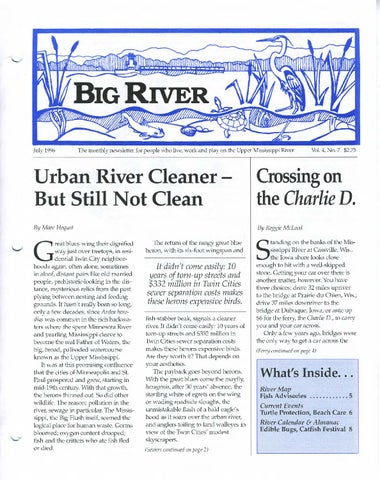
July 1996
The monthly newsletter for people who live, work and play on the Upper Mississippi River
Vol. 4, No. 7 $2.75
Urban River Cleaner But Still Not Clean
Crossing on the Charlie D.
By Marc Hequet
By Reggie McLeod
G
reat blues wing their dignified way just over treetops, in residential Twin City neighborhoods again, often alone, sometimes in aloof, distant pairs like old married people, prehistoric-looking in the distance, mysterious relics from the past plying between nesting and feeding grounds. It hasn't really been so long, only a few decades, since Ardea herodias was common in the rich backwaters where the spent Minnesota River and yearling Mississippi cleave to become the real Father of Waters, the big, broad, palisaded watercourse known as the Upper Mississippi. It was at this promising confluence that the cities of Minneapolis and St. Paul prospered and grew, starting in mid-19th century. With that growth, the herons thinned out. So did other wildlife. The reason: pollution in the river, sewage in particular. The Mississippi, the Big Flush itself, seemed the logical place for human waste. Germs bloomed; oxygen content drooped; fish and the critters who ate fish fled or died.
The return of the rangy great blue heron, with its six-foot wingspan and
It didn't come easily: 10
years of torn-up streets and $332 million in Twin Cities sewer separation costs makes these herons expensive birds. fish-stabber beak, signals a cleaner river. It didn't come easily: 10 years of torn-up streets and $332 million in Twin Cities sewer separation costs makes these herons expensive birds. Are they worth it? That depends on your aesthetics. The payback goes beyond herons. With the great blues come the mayfly, hexagenia, after 30 years' absence, the startling white of egrets on the wing or wading roadside sloughs, the unmistakable flash of a bald eagle's hood as it soars over the urban river, and anglers toiling to land walleyes in view of the Twin Cities' modest skyscrapers. (Sewers continued on page 2)
S
tanding on the banks of the Mississippi River at Cassville, Wis., · the Iowa shore looks close enough to hit with a well-skipped stone. Getting your car over there is another matter, however. You have three choices: drive 32 miles upriver to the bridge at Prairie du Chien, Wis.; drive 37 miles dowmiver to the bridge at Dubuque, Iowa; or ante up $6 for the ferry, the Charlie 0., to carry you and your car across. Only a few years ago, bridges were the only way to get a car across the (Ferry continued on page 4)
What's Inside.
• •
River Map Fish Advisories . ........... 5 Current Events Turtle Protection, Beach Care 6 River Calendar & Almanac Edible Bugs, Catfish Festival 8
(Sewers continued from page 1)
Not Clean, Cleaner Sewer separation, designed to clean up the seven-county, 72-mile stretch of river that courses through the metro area, became a way of life in the Twin Cities. Commuters and residents alike grumpily coped with a decade of closed streets, piled dirt and diverted traffic. Now the sewer daze is all but done, and the misery appears to have been worth it for river lovers. Counts of fecal coliform bacteria, once washed amply with sewage into the river when heavy rain or snow melt overflowed storm sewers into sanitary lines, have dropped 72 percent. Fewer microbes mean more oxygen for river life. "Everybody can claim victory in this," says Eric Macbeth, technical director with the MinnesotaWisconsin Boundary Area Commission. All right, the river is cleaner, but the Mississippi is no pristine babbling
American Rivers, the conservation group, upgraded the Mississippi's condition this year only from "endangered" to "threatened," which still leaves it among the 30 dirtiest U.S. rivers. brook American Rivers, the conservation group, upgraded the Mississippi's condition this year only from "endangered" to "threatened," which still leaves it among the 30 dirtiest U.S. rivers. Many stretches of river from Minneapolis to the Gulf of Mexico still carry enough fecal coliform to exceed federal limits set to protect swimmers. Fecal coliform bacteria, found in human intestines, indicate raw sewage in river water, and may also signal the presence of dangerous pathogensthatcausesalmonella, hepatitis, dysentery and typhoid fever. A five-year, U.S. Geological Survey study blames excess microbe levels on incomplete sewage treatment
2
along the river. Moreover, the Minnesota River, which V's through the southern third of the state's much-fertilized and ditched farm country, brings its own problems to the Mississippi. Listed by American Rivers among "threatened" streams for the second year, the Minnesota probably fouls the Mississippi more than any stream above the murky Missouri, near St. Louis. All this leaves river dwellers downstream from the Twin Cities with mixed feelings about the success of sewer separation. "For me, the bottom line is whether the river's swimmable, and I don't think it is swimmable yet," says Mary Anne Wise, a self-employed rug maker who lives with her husband on 150 acres near Stockholm, Wis. "I have a five-year-old who I really don't think I want swimming in the river every day. Maybe a couple of times a season and then bathe right away."
Political Will Progress in the Twin Cities metro stretch is, nevertheless, noteworthy. The story begins with what could have become a minor war between the states, but turned into a model of administrative etiquette. The project won a 1996 community service award from Partnership Minnesota, an organization of public employees that promotes cooperation among the checkerboard of jurisdictions that constitutes modem government. To begin at the beginning: Wisconsin filed a lawsuit to force the Twin Cities to clean up its discharge, with the support of both Minnesotans and WISconsinites downstream. Before litigators went to the trenches, Minnesota Governor Rudy Perpich seized on the issue, vowing to accelerate the planned separation of metro-area sewers, which had begun already but wasn't to be complete until 2025. In a July 1984 riverfront news conference, Perpich and then Wisconsin Governor Anthony Earl announced an agreement to push for faster cleanup of the Mississippi River. Big River
Construction began in 1986 and now is nearly complete in all three cities, Minneapolis, St. Paul and South St. Paul. Ultimately, the federal government, the Minnesota Legislature, the Twin Cities Metropolitan Council and the three cities authorized $332 million to separate hundreds of miles of older combined sewers. In a combined sewer system, still used in 1,200 U.S. cities, the sanitary sewer acts as a safety valve for the storm sewer. In normal weather, rain and snow melt runoff stays in the storm sewer on the way to rivers, lakes or holding ponds. So-called sanitary sewer lines, which carry human waste, run in parallel conduits that lead to a sewage treatment plant. During heavy rain or rapid snow melt, storm sewers in combined systems overflow, commingling storm runoff with raw sewage and sending it all to a river or lake. In years past, the sanitary sewer overflow option seemed like a reasonable one given the alternatives - sewage in wet weather backing up into homes and businesses, or overloading the treatment plant.
Dead River With all Twin Cities sewage and storm runoff gurgling directly into the Mississippi, by the tum of the century the river was substantially killed off as far down as Lake Pepin. Until 1938 no Twin Cities sewage was diverted to the treatment plant at Pig's Eye Lake, the first major municipal treatment facility on the river. The Pig's Eye plant helped, but the Mississippi was still in deep doo-doo. By 1984, with storm sewers overflowing into sanitary sewers on average of every three days, an estimated 4.6 billion gallons of untreated sewage and storm water defiled the river each year. Perpich, the mayors of the three cities and other civic leaders stayed the course, even after federal funding dried up in 1992. Minnesota legislators continued to grant bonding authority to the cities to raise money for separating sewers, and the cities' July 1996
A cleaner river has brought more riverMississippi River at Four Metro Area Sites front development, March - October, 1976 - 1995 By Decade 600 ~------------------------~ including marina construction and a douBelowMpls. bling of the number of o~____A_ b o_v_e_s_i_.P_a_u_I _ _ _ _ __ ---< 500 ,___ _ _ _ __ _ _s_o_ 489 slips in the metro area. Boaters and anglers who had many other choices in lake-rich Minnesota long 1976-1985 regarded the dirty old Mississippi with dis• 1986-1995 dain. That has changed. "When I was a kid we thought, 'Put a boat on the river? You've got to be kidding. There are 10,000 lakes within driving distance'," recalled Jeff Anoka (872) Ford Dam (848) Robert St. (839) Grey Cloud (827) Syme, senior commuMississippi River Monitoring Site (River Mile) nications specialist from the Metropolitan Council with Metropolitan ~--------------------------------------~ Council Environmental Services. "Now you sewer construction crews kept digand more, mostly went to a treatment can't even find a slip and a ramp." ging up streets. plant. Now it goes into the river. Score this one as a win for river Minneapolis endured 458 sewer Other cities with combined sewers lovers. The problem was traced and separation projects to eliminate its will have trouble duplicating the solved, inconvenience and expense estimated 900 million-gallon annual Twin Cities' fortuitous circumstances, notwithstanding. Worth it? It is if you untreated sewage and storm water like the river. Could it happen else"When I was a kid we discharge. Hilly St. Paul, with more where along the Mississippi? Stay runoff and with its sewer separation thought, 'Put a boat on the tuned. not so far along as Minneapolis, lived river? You've got to be kidMarc Hequet is a writer who lives in through 194 digs to divert its estiSt. Paul, Minn. ding. There are 10,000 lakes mated 3.7 billion-gallon discharge. within driving distance'," The results after a decade: less oxyrecalled Jeff Syme, senior gen-gulping bacteria in the river and Big River (ISSN 1070-8340) is published 111011thly communications specialist more oxygen left for other creatures. by Big River, 70112 East Fourtl1 Street, Suite 203, The number of fish species in the Wi11011a, l'v1N 55987; (507) 454-5949; fin: (507i with Metropolitan Council 454-2133; e-mail: bigrivcr@aol.cmn; u;cb site: metro area is up to 25 from just three Environmental Services. l1ttp://www.l11111i11et.11ct/-bigri11fr. before the separation, and the MinReggie McLeod editor/publisher "Now you can't even find a Pn111e/a Eyde11 nssist1111t editor nesota Department of Natural slip and a ramp." Molly McGuire nssi.stnnt publislicr Resources now allows walleye catchMary Fmthergill bookkeeping and-release in the metro stretch. /nync L. Stokke gmpl1ic artist Growing fish populations attracted especially without Washington's supS11bscriptio11s arc $28.for one year, $50 jlir two years or $2.75 per si11glc issue. Send subscriptions, sineagles and great blue herons, the port. A powerful political boss, Pergle copy orders a11d change-of-address requests pich, was able to take the lead as goveagles hunting along the urban river to Big River, PO Box 74"1, Wi1101111, MN 55987. Seco11d-clnss postage paid nt Wino11n, MN. ernor. Two mayors, Don Fraser of and great blues lumbering their POSTMASTER: send change-of-address restately way between shallow backwaMinneapolis and James Scheibel of St. quests to Big River, PO Box 747 , Wi1101111, MN ters. Paul, eventually declined to run for 55987 Big Rie>er, Vo/11111e, 4, Number 7, copyright Š f1d11 re-election - which made them less Case closed? Hardly. Before the 1996. Reprod11ctio11 i11 wlio/c or in part without separation, street runoff with its odiwary of the voters' wrath during the writtrn per111issio11 of the 1'11/Jlisher is prohibited. ous soup of gasoline, fertilizer, salt digging. Printed on rec11cled w ver.
Mean Fecal Coliform Count
D
Big River
July 1996
Big River
3
(Ferry continued from page 1)
river, but in 1988, after two years of lobbying and organizing, a group led by Charles Dietrich talked the federal government and the Wisconsin Legislature into chipping in 50-50 to buy a ferry for Cassville. It was renamed the Charlie 0. in recognition of Dietrich's efforts. The ferry operates from May 1 (if the river is not too high) until late
stretches along the river shore. When the whistle blows, locals stay in their cars, noses buried in newspapers, while first-time passengers line the railing to watch the shore recede. By the time you get a good look at the historic buildings in downtown Cassville and the large homes in the wooded hills outside of town, the 15to 20-minute crossing is nearly com-
Cars disembark from the Charlie D. at Cassville.
October. In May, September and October it operates only on weekends. The rest of the summer it runs
By the time you get a good look at the historic buildings in downtown Cassville and the large homes in the wooded hills outside of town, the crossing is nearly complete. every day, from 9 a.m. to 9 p.m. The short ride costs $6 for a car, $25 for a milk truck or semi, $1 for a pedestrian or a rider with a bicycle and $3 for a motorcycle. Frequent crossers can buy a $35 punch card good for 10 trips. The mile-long river trip has a certain charm, especially in fine summer weather. The ferry loads on the upriver end of the city park, which 4
plete. The ferry docks, you drive off and find yourself at the end of a long dirt road that crosses a floodplain to Millville, Iowa. The ferry is a floating platform that can hold nine average-size cars or 11 compact cars. It is pushed by a switch boat, or harbor boat, powered by two, 200-horse power diesel engines. The boat is attached to the side of the ferry platform by two tongues that pivot, so while the ferry is docked the boat can swing around and face the opposite shore for the return trip. In the early 1980s the ferry connected Marquette, Iowa, and Prairie du Chien while the bridge was being rebuilt. It operated in Cassville for a couple of years, then worked on the Illinois River before returning, according to Dietrich. The Cassville Harbor Commission Big River
operates the ferry with the money it earns from fares, although government funding helped them buy the ferry in the first place. An engine has had to be replaced and insurance rates have increased 73 percent, which seriously set back the budget. "We're still catching up," notes Dietrich, who chairs the Harbor Commission. The Charlie 0. carried 56,000 people across the river last year. Many were tourists or locals going for a visit, a golf game or an evening out. The ferry also carries logs, semi trucks and a milk truck across on a regular basis. Dietrich is still lobbying for some government help to operate the ferry. The state Department of Transportation operates Wisconsin's only other river ferry; on the Wisconsin River at Merrimac. "We were supposedly in line to get a bridge in 1985," he said. However, the low-lying land on the Iowa side would have necessitated a bridge between two and five miles long, depending on the design. The road that connects the Iowa landing to Highway 52 is often underwater in the spring, frequently delaying the start of the ferry season. "I've been trying to get them to raise the road over there," Dietrich said. Three pilots take turns operating the ferry. Dietrich helps out to keep costs down. "I'm on that boat almost every day," said Dietrich, who is 75. "I do maintenance work. As much as I can do, I do." From the late 1940s until the 1980s Cassville was without a ferry. Dietrich remembers when a canning company's ferry carried cabbage, sweet com and peas across the river from Cassville in the 1930s and 40s. For information on the Cassville ferry schedules, call (608) 725-5180.
ill
Iii
...
Reggie McLeod is editor of Big River.
;JJ
"'
July 1996
Which Fish to Eat State by State
River Map Little Falls to Monticello ~ Do not eat carp +20 ". Limit walleye, smallmouth bass, northern pike to once/week.
WISCONSIN
Monticello to St. Anthony Falls Do not eat channel catfish +15". Limit walleye + 15 " to once/month.
Monticello St. Anthony Falls to Ford Dam (Pool 1) Do not eat carp + 15". Limit walleye +20" to once/month.
Minnesota
Ford Dam to Red Wing (Pools 2-3) Hastings • • Prescott Do not eat carp +15", channel catfish +15" , walleye 20-25" , white bass. L&D 3 Limit walleye under 20", smallmouth bass Red Wing· 5-20" , and northern pike +25" to once/month. Red Wing to Kellogg (Pools 4-5) Do not eat carp 20-30", channel catfish 15-25", walleye + 15", northern pike +25" , white bass. Limit smallmouth bass+ 15" and carp up to 20" to once/month.
Prescott through Lake Pepin (Pools 3-4) Do not eat white bass +13" , buffalo +18" (Pool 3), buffalo +20" (Pool 4) , channel catfish +23", flathead catfish +30", carp +21 ". Women & children should not eat channel catfish + 16" from Pool 3 (Prescott to Red Wing), or +21" from Pool 4 (Red Wing to Alma) . Lowest health risk: drum, walleye, sauger, white bass to 13", flathead catfish to 30" , channel catfish to 16" (Pool 3) channel catfish to 21" (Pool 4) and carp to 21". Below Alma to Trempealeau (Pools 5-6) Do not eat channel catfish over 25".
Chippewa R .
L&D 4 * * Alma
Kellogg
Women and children should not eat carp +24" or channel catfish +21 ". Lowest health risk: carp up to 24", channel catfish up to 21 ", walleye, sauger, white bass, buffalo, drum, flathead catfish.
. fountain
c·1ty
Kellogg to La Moille (Pools 5A-6) Do not eat channel catfish +15". Limit walleye +20" and white bass to once/month . La Moille to Reno (Pools 7- 8) Do not eat channel catfish +20". Limit walleye + 15" and largemouth bass to once/week.
Trempealeau to Dubuque (Pools 7-11) Women and children should not eat *Genoa channel catfish +24". Lowest health risk: buffalo, walleye, crappie, flathead catfish, drum , channel catfish to 24" , white bass, carp.
Wisconsin R. All states measure and rate health risks in fish differently. Consult state guidelines for complete descriptions.
/
* Prairie du Chien
IOWA
Wisconsin: Its most recent Health Guide was issued by the Department of Natural Resources and the Division of Health in 1994. The women and children advisory refers to women of childbearing age, and children less than 15 years old. Minnesota: These Minnesota listings are incomplete. Consult the 1996 Minnesota Fish Consumption Advisory from the Department of Health for a complete listing.
L&D 12
ILLINOIS
Iowa: Information from the Department of Natural Resource's
1996 Iowa Fishing Regulations. Quad Cities area (Pool 15) Do not eat carp or carpsucker.
Illinois: Information from the Department of Natural Resource's
1996 Illinois Fishing information.
L&D 13
* Fulton
Davenport
• • Fulton to Alton L-&-D-1-5+-_,, (Pools 14-26) L&D 14 Unlimited carp and channel catfish consumption.
Most of the health risks in Upper Mississippi river fish are due to PCB contamination, which appears to be declining in the general environment. Mercury is a health danger in lakes and rivers farther north. To reduce PCBs, remove skin and trim fat from top, sides, and belly of fish.
m
Created by Molly McGuire
July 1996
Big River
5
::'6
Current Events By Pamela Eyden, Molly McGuire and Reggie McLeod
Family Boating More than 76 million people went boating last year, making it the top family sport in the U.S. According the U.S. Coast Guard, we operated 16.7 million boats last year. The 10 states with the most registered boats are: l. Michigan 898,265 2. California 838,541 3. Minnesota 738,029 4. Florida 698,795 5. Texas 602,375 6. Wisconsin 526,973 441,897 7. New York 385,206 8. Ohio 9. Illinois 360,979 10. S. Carolina 333,218
Shooting the Mississippi Minneapolis, Minn. - With about $3-million worth of work a section of the otherwise serene Mississippi may be converted into a 1,000-foot whitewater kayaking course. The Mississippi Whitewater Park Development Corp. is trying to raise funds to study a site on the east bank of the river between the Stone Arch Bridge and the Interstate 35W Bridge, according to an article in the St. Paul Pioneer Press (6-12-96). Northern States Power operated a hydroelectric plant near the site until it fell into the river in 1987. The course would require digging a shallow channel along the shore, installing a head gate and perhaps extending a dike into the river to lengthen the channel.
Where's the Com? Record high com prices may cost com growers billions of dollars, thanks to complicated derivative contracts, called "hedge-to-arrive" contracts. The contracts have helped farmers in the past by locking in prices for a crop before it is harvested. However, higher exports and grain 6
prices have disrupted the usual seasonal fluctuation of com prices and left many growers and grain elevators without the com or cash needed to fulfill contracts. Large farmers face bills of hundred of thousands of dollars, while some predict the biggest farm crisis in decades. Farmers have joined lawsuits claiming that the contracts were illegal and that the risks of the contracts were never disclosed. Grain shippers and processors Archer Daniels Midland Co. and Cargill Inc. are the two biggest targets of the suits.
Clean Barge, Dirty River Dubuque, Iowa - A federal grand jury has indicted a marine services firm and three company officials for violating the Clean Water Act. Dubuque Barge & Fleet, doing business as Newt Marine Service, is accused of committing the offenses between June 1, 1991, and August 30, 1994. The indictment claims the company cleaned empty barges that had carried coal, fertilizers, pig iron, scrap iron, salt and grains, then swept the waste into 55-gallon drums or directly into the river, according to a article in The Waterways Journal (6-3-96). Two of the officials face a maximum penalty of three years in prison and $50,000 for each day that the offense occurred. The third faces a one-year sentence and a $25,000-perday fine. Newt Marine Service could be fined $50,000 for each day an offense occurred.
Beach Care Upper Mississippi Refuge - Last year 380,000 people used the beaches on pools 7 and 8 of the Mississippi River (between Trempealeau and Genoa, Wis.), according to the U.S. Fish and Wildlife Service. You've probably noticed that there are no lifeguards or groundskeepers on the islands, with a few exceptions, Big River
r so it's pretty much up to us to clean up after ourselves. Some groups, such as the Mississippi River Revival, sponsor river cleanups each year. Some individuals and families bring work gloves and an extra garbage bag with them on river expeditions, so they can leave the beach cleaner than when they came. In addition to common sense and good manners, some rules do apply to use of the beaches: • Primitive camping and boat mooring are allowed on beaches for up to two weeks at a time. • Only dead wood or charcoal can be used for campfires. Pallets should not be burned, because they leave nails in the sand. • Burying coals or ashes is not permitted. • Dogs must be kept on a leash, except retrievers during the hunting season. • Motorized vehicles, fireworks and firearms are not allowed on the beaches. • Large groups and organized events require a Special Use Permit from the Upper Mississippi River National Wildlife and Fish Refuge. • People are also strongly encouraged to avoid Voluntary Closed Areas, which are posted to protect nesting birds and other wildlife.
Turtles Need Protection Wisconsin - Turtle populations in parts of the state have declined dramatically and larger turtles are all but impossible to find, turtle trappers report. Proposed rules aim to restore the turtle populations. "For decades turtle harvest in Wisconsin has been essentially unregulated from the standpoint of protecting turtle populations," said Bob Hay, a herpetologist with the Department of Natural Resources. Softshell and snapping turtles have been overharvested in recent years, often by out-of-state trappers who July 1996
export the meat to Europe, where it is considered a delicacy. "We had one report of a trapper who trapped more than 500 pounds of soft-shelled turtles in one day," said Hay. Three of the 11 species found in Wisconsin are illegal to take or possess without a special permit: the ornate box, Blanding's and wood turtles. Currently the turtle season on the Wisconsin side of the Mississippi is open year round, and legal snapping turtles must be at least 10 inches long. There is no bag limit there or in the rest of Wisconsin, where the season is only closed from June 1 through the 15th, when most turtles lay eggs. There are no size limits inland from the Mississippi. Proposed rules would shorten the harvest season from July 15 to November 30; allow harvest of snappers only between 12 and 16 inches long, statewide; define legal harvest methods and traps; set bag and possession limits to 10 snappers on the Mississippi and three inland, five softshell on the Mississippi and three inland and five for all other harvestable species on the Mississippi and inland. The proposed rules were hammered out during an extensive public input process that included trappers, ecologists and other interested parties.
River Resources • Barging into the 21st Century is an eight-minute video on the environmental, safety, and economic advantages of barge transportation. According to the Wate1Ways Journal it is designed to "enhance the industry's image" by educating opinion leaders and the public about the industry. Published with the help of a $40,000 grant from the U.S. Maritime Administration, the video is available from the American Waterways Operators, 1600 Wilson Blvd, Suite 1000, Arlington, VA 22209, or (703) 841-9300. •River pilot/singer/songwriter John Hartford has a new album, July 1996
No End of Love. It is available from him at P.O. Box 443, Madison, TN 37116. • Volksmarch hikes at Minnesota state parks offer non-competitive activities for the whole family. For a booklet of dates and locations, call the Minnesota DNR at 1-800-766-6000. • Information aboyt the Wisconsin Legislature, Department of Natural Resources and other state agencies is available on Wisconsin's Badger server at http:/ /www.state.wi.us. Check the web site for updated addresses, news on pending legislation, schedules, and agency reports. • To order tips on environmentallyfriendly lawn care and on ways to become involved in revitalizing the Mississippi in Minneapolis-St. Paul, call 1-888-55-RlVER toll-free.
Zebras Not Welcome Madison, Wis. - Law enforcement officials on the Wisconsin side of the St. Croix River now have more authority to stop boaters from spreading the zebra mussels into the river. A new law prohibits a boat owner from placing a vessel in the Lower St. Croix River if the owner "has reason to believe" the boat, trailer or related equipment has zebra mussels attached. Law officers can ask boat owners to remove zebra mussels before placing their vessels in the water or to order a vessel removed if zebra mussels may be a concern. Senator Brian Rude (R-Coon Valley) and Rep. Sheila Harsdorf (RRiver Falls) co-authored the bill. Minnesota already has a similar law on the books.
Corps Restructured
switch from the Lower Mississippi Valley Division to the Omaha district. The restructuring, which will begin August 15, will cut costs and reduce the number of Corps districts.
New Dock for Harriet St. Paul, Minn. - A new, 500-foot dock is designed to attract picnickers, anglers, boaters and strollers to Harriet Island Regional Park, according to an article in the St. Paul Pioneer Press (6-8-96). The $1.3 million, two-tiered dock floats along the Mississippi River shoreline across from downtown St. Paul. The dock includes cleats for boats to tie up to, picnic tables and easy access for anglers. A river celebration will be held there on July 20 (see River Calendar).
Landing Closed Dresbach, Minn. - By mid to late August the Lower I-90 Landing will reopen with improved paving, a stairway, lighting and easier access. Meanwhile, boaters are asked to use the Upper I-90 Landing, while the U.S. Fish and Wildlife Service completes the repairs and improvements.
Airport Needs Wetlands St. Paul, Minn. - A proposed plan to expand the St. Paul Airport at Holman Field requires filling 20.4 acres of wetlands near the Mississippi River. The Metropolitan Airports Commission has applied to the Army Corps of Engineers for a permit to fill the wetlands. The proposal includes plans to restore about 13 acres of wetlands in the metro area and at least 7.4 acres of wetlands in Nobles County. ~
·ver
Chicago, Ill. - The Army Corps of Engineers North Central Division office in Chicago will close soon and the St. Paul (Minn.) and Rock Island (ill.) districts will be transferred to the Omaha, Neb. based Upper Mississippi and Missouri Valley Division. The St. Louis (Mo.) District will Big River
7
f!.
--....-
River Calend-~~~-- ~~"-(~~~=
Special Events & Festivals July 1-4 Mississippi Valley Blues Festival, Moline, Ill. 3 Fireworks at Lock & Dam 11, Dubuque, Iowa, (319) 588-5700. 3-7 Riverboat Days, Clinton, Iowa. 3-7 Riverfest, La Crosse, Wis. 3-9 Steamboat Days, Wmona, Minn. 4 Rockin' on the River, Prescott, Wis. 5 St. Anthony Heritage Days, Hennepin Bluff Park, Mpls., 2 p.m., (612) 627-5433. 5-6 Pepin Open, Lake City Yacht Club sailboat race, (507) 356-4930. 5-7 Mississippi Valley Blues Fest, Dubuque, Iowa. 5-7 Flea Market, Marquette, Iowa. 6 Let the Eagle Scream, Cassville, Wis. 11 Polkafest & Ice Cream Social, Patton Park, Lake City, Minn. 11-13 Summerfest, Rock Island, Illinois. 11-14 Wheels, Wings, and Water festival, St. Cloud, Minn. 12-14 Catfish Days, Trempealeau, Wis. 12-21 Aquatennial, Minneapolis. 13 Lakota music & dance, children's program, Ft. Snelling State Park, 7 p.m., (612) 726-9247. 13 Summerfest, Savanna, Illinois. 13-14 Town & Country Jamboree, Prairie du Chien, Wis. 19-21 Rivertown Days, Hastings, Minn. 19-21 Buckskinner's Rendezvous, Bellevue, Iowa. 20 Art Fair, Stockholm, Wis. 20 Riverboat Rendezvous, Harriet Is., St. Paul, 2 p .m. - 10 p.m., (612) 266-6361. 26-28 Riverboat Days, Wabasha, Minn. 28 Outdoor Concert, Hastings, Minn., 7 p.m., Charlie Maguire and friends, (612) 437-4127. 31 Archeology tour, 10 a.m. - 3 p.m., free, Perrot State Park, Trempealeau, Wis., (608) 785-8454. August 2-3 The Tug, Le Claire, Iowa. 2-4 Log Boom, La Crosse, Wis. 2-4 River City Days, Red Wmg, Minn. 4 -17 Iowa 150 Mississippi canoe trip, border to border (319) 652-5229. 4 - 7 Mississippi River Revival community celebrations, 1-800-957-4837. 4 Lansing 5 Guttenberg 6 Dubuque 7 Bellevue
8
5 Flotilla celebration, McGregor, Iowa. 7 Taste of Dubuque, Ice Harbor, 4 p.m. 9:30 p.m., (319) 588-4400. 9 Art Festival, Sabula, Iowa. 9-11 Fish Days, Lansing, Iowa. 9-11 Good Old Nelson (Wis.) Days. 10 Bluesfest, Dubuque, (319) 556-1908. 10-11 Catfish Festival, Potosi, Wis. 24 Outdoor skills day; Wis. State parks, (608) 266-2182. 24-26 Fish Fly Days, De Soto, Wis. 31- Sept. 1 Mark Twain Days, Alma, Wis. 31-Sept. 2 Melon Days, Thomson, Ill. John Hartford concerts 4 Julia Belle Swain, Lansing, Iowa. 5 The Pink Elephant, Marquette, Iowa. West Coon Rapids Dam programs, Brooklyn Park, Minn., (612) 424-8172. July 4 Turtles of Minnesota, 1 p.m. - 4 p .m. 7 Birds in the floodplain, 8 a.m. 7 Backyard birds, 1 p.m. - 4 p.m. 8 River rats day camp, 9 a.m. - 4 p.m., $100, reservations 21 Waterbirds, 1 p.m. - 4 p.m. 28 Mosquitoes, 1 p.m. - 4 p.m. 30 Full moon walk, 8:30 p .m., $2, reservations. August 3 Edible insects (come hungry) 1 p .m. 10 Canoe to Minneapolis, 9 a.m., $8. Effigy Mounds National Monument, Harpers Ferry, Iowa, (319) 873-3491. Through Sept. 2 Fire Point hikes, daily, 10:30 a.m. and 2 p.m. July 6, Aug. 3 Moonlight hikes, 7:30p.m. July 20, Aug. 17 Bird walks, 8 a.m.
Wis. DNR Field trips, reservations, (608) 266-1430. July 13 Mississippi backwaters, La Crosse, 7:30 a.m. or 9:30 a.m. July 20 Goat prairie hike, Hager City; 9:30 a.m. - 1 p .m. July 27 Merrick State Park, Buffalo County, 10 a.m. - 4 p.m. Iowa Fishing Clinics July 13 Dubuque, (319) 582-9395 Aug. 17 Maquoketa, (319) 652-3783 Meetings & Hearings July 11 Lower Wis. State Riverway Board, Blue River, 5 p.m., (608) 739-3188. Workshops & Conferences July 10 Cannon River Summit, Faribault, Minn., (507) 332-0488. 12-13 Spirit of Survival, annual Mississippi River Basin Alliance Conference, St. Louis, (314) 822-4114. 22-25 and 28 - August 2 Archeology Field School, Perrot State Park, Trempealeau, Wis., (608) 785-8454. August through 16 Archeology camps and teacher workshops, Mississippi Valley Archeology Center, (608) 785-8454. August 4-9 Rivers Curriculum, teacher training, Southern Illinois University at Edwardsville, (618) 692-3788. August 13-15 Exploration of the Mississippi River, Project WILD workshop, Wyalusing State Park, Prairie du Chien, Wis., $40, (515) 747-2200.
Almanac By Kenny Salwey, Pool SA July on the big river brings visions of fireworks displays, rivertown celebrations and sandbar picnics. Hot sunny days and warm humid nights. Bikinis and sunburned bodies. Mosquito dope and suntan lotion. Boat rides and water-skiing. Anglers prowling riprapped banks for catfish, armed with nightcrawlers or gobs of stink bait. The critter kids are out and about. You may spot baby muskrats and beavers in the backwaters. Broods of ducks and geese swim contentedly about gabbling among themselves. Young songbirds hop along river banks in search of insects. No problem, every 24 hours seems to produce a new hatch - anything from mayflies to deerflies. I always say you ain't lived til you done been deerfly bit. It's akin to being stuck with a hypodermic needle - a dull one at that. Find an old rope hanging from a cottonwood branch over the water, and you'll soon find a group of kids, with black boot-suckin' Mississippi mud squishing up between suntanned toes and sticking to soles. Guess anybody who grew up on the river knows that black mud sticks to both kinds of souls for a lifetime. Aye, my friends?
Big River
July 1996