December 1995
the monthly newsletter for people who live, work or play on the Upper Mississippi River
Vol. 3, No. 12
$2.50
The Gizzard Shad in Big River Flows Nature's Economy through Cyberspace by Thomas V. Lerczak [Editors note: This story looks at the role of the gizzard shad in the Illinois River, but the shad plays a similar role in the ecology of the Mississippi.] One cold winter day while walking along the Illinois River near Havana, I noticed thousands of fish swimming in the clear water near shore. Most of them were gizzard shad,
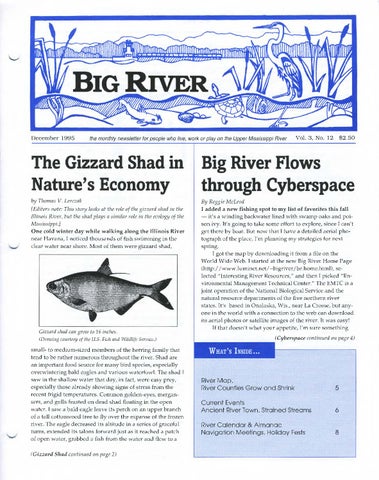
Gizzard shad can grow to 16 inches.
By Reggie McLeod I added a new fishing spot to my list of favorites this fall - it's a winding backwater lined with swamp oaks and poison ivy. It' s going to take some effort to explore, since I can't get there by boat. But now that I have a detailed aerial photograph of the place, I'm planning my strategies for next spring. I got the map by downloading it from a file on the World Wide Web. I started at the new Big River Home Page (http: / /www.luminet.net/ -bigriver/br.home.html), selected "Interesting River Resources," and then I picked "Environmental Management Technical Center." The EMTC is a joint operation of the National Biological Service and the natural resource departments of the five northern river states. It's based in Onalaska, Wis., near La Crosse, but anyone in the world with a connection to the web can download its aerial photos or satellite images of the river. It was easy! If that doesn't whet your appetite, I'm sure something (Cyberspace continued on page 4)
(Drawing courtesy of the U.S. Fish and Wildlife Service.)
small- to medium-sized members of the herring family that tend to be rather numerous throughout the river. Shad are an important food source for many bird species, especially overwintering bald eagles and various waterfowl. The shad I saw in the shallow water that day, in fact, were easy prey, especially those already showing signs of stress from the recent frigid temperatures. Common golden-eyes, mergansers, and gulls feasted on dead shad floating in the open water. I saw a bald eagle leave its perch on an upper branch of a tall cottonwood tree to fly over the expanse of the frozen river. The eagle decreased its altitude in a series of graceful turns, extended its talons forward just as it reached a patch of open water, grabbed a fish from the water and flew to a
(Gizzard Shad continued on page 2)
WHAT'S INSIDE ...
River Map, River Counties Grow and Shrink
5
Current Events Ancient River Town, Strained Streams
6
River Calendar & Almanac Navigation Meetings, Holiday Fests
8
2
BIG
(Gizzard Shad continued from page 1)
RivER
December 1995
Energy-Flow Pattern
silver maple tree to feed. Of no surprise to me, the fish in the eagle's talons was a gizzard shad. From those simple observations, it was easy to see the relationship between gizzard shad and the fish-eating birds. But it made me wonder about the shad themselves. What do they feed on? And what aspects of the shad's life history and behavior explain its importance as food for other animals?
Top
Carnivores
Examples
Bald eagle, kingfisher, mergansers , great blue heron
Gizzard shad < 1 inch , certain zooplankton, young fish of most species
Food Relationships In the late 1890s, Charles A. Kofoid of the Illinois State Laboratory of Natural History took water samples from the Illinois River near Havana in west central Illinois. Passing the water through very fine filters showed that the river water was teeming with a large variety of microscopic life. The organisms he found in the water are called "plankton," from the Greek planktos meaning "drifting or wandering." The animals of the plankton are called "zooplankton;" the plants are called "phytoplankton." There are a variety of types and sizes of zooplanktons, from one-celled protozoans invisible to the unaided eye to minute crustaceans that one can barely see darting about below the water's surface. These are small animals. Indeed, over a four-year sampling period, Kofoid found on average about 64,000 crustaceans per cubic meter of water. Phytoplankton are generally even smaller than zooplankton; Kofoid determined there were about 23 million per cubic meter of water. These small organisms are a major component of a gizzard shad's diet, although the proportion of zooplankton or phytoplankton in the diet changes with age. Below a length of about one inch, a young shad looks and behaves like a carnivore. Its mouth is lined with small teeth and is farther forward than on the body of an adult features that facilitate the capture of live prey. The digestive tract of shad at this stage is short, a reflection of the easier digestibility of animal versus vegetable matter. At this immature life stage the shad compete with the young of other fish species for the same prey, which is mainly zooplankton. Most fish species switch to other prey as they grow older. Young shad travel about in schools to increase foraging efficiency and to protect themselves from larger predators. One reason shad school is to confuse predators with complicated motion - much as birds in a flock. When a young shad grows to about one inch long, its body goes through a major transformation, and its diet gradually begins to include more plant material. The digestive tract becomes long and twisted, due to the longer time required to digest plants. In addition, the teeth are lost and the mouth gradually moves slightly toward the bottom side of the fish, reflecting its new, nonpredatory nature. Adult gizzard shad feed heavily on phytoplankton and a variety of dead, decaying animal and plant matter collectively called "detritus." They also ingest mud and attached algae, which are simple plants that grow on solid objects in water clear enough for sunlight to filter through. Adult shad are, therefore, plant eaters, or herbivores, as well as detritivores.
Herbivores
Plants
Adult gizzard shad, certain zooplankton
Phytoplankton, attached algae
~
Sunlight Energy flow pattern from sunlight to top carnivores for typical ecosystems.
Adult shad forage by filter-feeding, as opposed to actively pursuing zooplankters as they did when young. They do not, however, passively filter the water while moving slowly forward with their mouths agape, as one might imagine; instead, they actively pump-filter the water by drawing a definite volume into the mouth cavity. Food particles and minute organisms are then strained from the water by special structures called "gill rakers" at the back of the mouth cavity. Because each food particle filtered from the water contains only a small amount of energy, large volumes of water must be ingested and filtered. The ability to acquire energy from such diffuse resources as phytoplankton and detritus hints at the important role played by shad in the riverine environment.
l
Energy Flow The diagram on this page summarizes feeding relationships in terms of energy flow through a typical ecosystem, a term that refers to the community of all living organisms, more or less, within a definite area, plus their habitat. Sunlight is the driving force, and, needless to say, without it the system would eventually run down. Plants are the primary producers; they combine carbon dioxide with sunlight and water through photosynthesis to make sugar, a form of stored energy. The plants, whether eaten directly by herbivores or as dead plant material in detritus, form the base of the ecosystem's food chains, of which there are many. Midlevel carnivores (e.g., ten-day-old shad) may feed on zooplankters that in turn have fed on plants. Top carnivores, in the strictest sense, do not feed on plants; but if we look at the food of their prey and so on, eventually we come to
),
December 1995
BIG
plants. For example, a largemouth bass might eat a warmouth sunfish, which ate an aquatic insect that grazed on plant material. The warmouth may also have fed on a crayfish that ate mostly plant detritus, or may even have scavenged on a dead largemouth bass. Where does the gizzard shad fit into this picture? We have seen that it holds many roles in the riverine ecosystem, beginning life midway up the food chain as a carnivore, then settling down in adulthood closer to the bottom. Food chains, in fact, are so interwoven that all of the food chains in an ecosystem can be referred to as a food web. As energy moves up a food web, from plants to top carnivores, most of it is lost due to the inefficiency of transfer from one level to another. Because of the inevitable energy losses with each level up a food web, the closer an animal can feed to the base of the web (the plants), the more energy will be available. This is where the gizzard shad plays a significant role. To be sure, there are many other fish species in the river, but no other species that feeds at the base of the food web is as abundant, widespread, and easily available as a food resource for carnivores. The rapid growth of shad (to about four inches in length after the first growing season) ensures a minimum of d elay and energy loss in transferring energy from the sun through the shad's plant foods into animal life that can be utilized by such large carnivores as the bald eagle.
Reproduction The gizzard shad belongs to a general category of organisms of diverse kinds whose life strategies include high reproductive potential with little or no parental care of its young. At the other extreme are organisms that invest much time, care and resources into raising only a few young. Birds belong to this second category, an extreme example of which is the California condor, which lays only one egg and may not breed every year. Between these two extremes are many variations. Sunfish, for example, lay many eggs, but actually construct nests and protect the eggs and newly hatched young from predators. Gizzard shad in the Illinois River probably spawn in backwater areas, sloughs or quiet coves beginning in April or May when rising water temperatures are between 50° and 70°F. They may continue through June. A spring flood in the river is beneficial to the shad because the greater volume of water increases the available spawning and rearing habitat. When spawning, females release thousands of eggs into the water column. The eggs, each about three quarters of a millimeter in diameter, are fertilized by the males, then sink and become attached to any solid object. They hatch about four days later. About five days after hatching the young shad begin actively feeding. The high reproductive output of the gizzard shad is one reason w hy the population can endure winter die-offs and heavy predation. Even so, their populations tend to vary considerably from year to year. This is illustrated in data gathered on a fish population monitoring program conducted by the Illinois Natural History Survey.
RrvER
3
Catches of gizzard shad declined from the early 1960s to the mid 1970s, and then seemed to have entered a cyclic phase. If the cycle continues, shad populations should be on the rise for the rest of this century.
A Web of Interactions The changes in shad populations from year to year must surely affect other riverine life. For instance, more shad might mean more food for bass, allowing for greater bass survival to larger sizes and possibly better r eproduction from healthier individuals. Then, more and larger bass might result in greater predation on other fish species, including shad. More shad would also result in greater predation on plankton. One might imagine many other similar scenarios. In 1869, John Muir wrote that "when we try to pick out anything by itself, we find it hitched to everything else in the universe." It is a concept worth thinking about when watching an eagle forage for gizzard shad. The concept might even make it easier to appreciate life in the depths of a murky river or a community of aquatic plants and animals invisible to the naked eye. It might even help us to understand where we humans fit into the big picture, in the world's great food web. Such an ecological perspective is necessary today more than ever, as the human population continues to grow and demand a greater share of the earth's natural resources. Thomas V. Lerczak is a research scientist for the Illinois Natural History Survey. This story is reprinted with permission from Illinois Audubon, where it appeared in the Summer 1995 edition.
BIG RIVER Big River (ISSN 1070-8340) is published monthly by Big Rtver, 70 112 East Fourth Street, Suite 203, Winona, MN 55987; (507) 454-5949; E-mail: bigriver@aol.com
Reggie McLeod
editor/publisher
Pamela Eyden
assistant editor
Molly McGuire
circulation and marketing manager
Seth Urion
layout and design
Subscriptions are $24 for one year, $44 for two years or $2.50 per single issue. Bulk subscription discounts are also available. Send subscriptions, single copy orders and change-of-address requests to Big River, PO Box 741, Winona, MN 55987. Second-class postage paid at Winona, MN. POSTMASTER: send change-of-address requests to Big River, PO Box 741, Winona, MN 55987. Big River, Volume 3, Number 12, copyright © December 1995. Reproduction in whole or in part without written permission of the publisher is prohibited.
A Printed on recycled paper.
BIG RlvER
4
December 1995
(Cyberspace continued from page 1)
•lilJ
else you can find through the Big River Home Page will. We're excited about the possibilities that might open up with this new medium. The Big River web site will: • share river-related information and stories from Big River; • point out other river-related resources; and • offer a forum for people to discuss river issues and interests. (If it gets a lot of traffic we will subdivide it into forums on specific subjects.) As soon as we get up to speed, we'll update the online calendar every week, publish an index of the back issues of the newsletter and offer some of our own Big River maps. So, check it out and tell your friends about it. If you know of new links and other interesting river resources, let us know by phone, mail or e-mail. There's a world of inform a ti on and insight to exchange! Not to mention fishing spots.
'"'lm!Md»m Bmu•llt ~~ lUh!IO -pa
Artideo> fr<..mJ:>ack i~ .~B~R•n ~;llt;iiil'~.~
o Iht Birdu!ia{ "'·'' Matty *mlgrM;nt• bUdl doo't o i-Qa1!! lmt¥W 'irsn"Dozen• come to meetings to cr1t1c1.,, the Attny Corps of EngMoers' Naigation Study Corpe xepom of the rueetm.S"' ignored them.
,For mc"'I ~lll<UO!! O'! B!f·R.wu. e-mail u. at !?1griwr8apl cga '"·
Q't
•t•
···--;;;~.-:··::·::~-
>nail-m>i! us
RiNr PO Box 741 "1t'locma, MN S5987
or Ollll -.a. at (5071 454-5949 @
November 19"5, Big Rtver
Here are some other interesting river-related resources.
-:Dono.
• f&nja "Cl!!'C]tal MaPiS"P'!K Tgho&&al Cepter - ~r~·l ttlid $3telhte photoi of 1ille UpPer MiMillippi,. bioloJical data • fl!lajt.fJgt:. - L"Gl oonc•, 1torie•, -rch photos, «c. •
NICI GqrasiAY. and G!S l!emt• - ln:c.dred; oflink> to illeJUPh? "'"""'" ~'lheworld
• GQBP Bebmr &soqmio Q!l tlpr lpgmpc - iflll an mrything frorrt carp to tuna, rod•, hooks, trips and clubs
e
Rimyjftitm11 -1 gr~r r1eighb1)rhood paper !tom west St . P<lul Minnesota,
-1aca1 tlvet """'"·
¢
,. '.;2lro-n1.0ont.
From the Big River Home Page you can choose "Interesting River Resources," then choose the "Environmental Management Technical Center" web site, where you can download aerial photographs of the river.
December 1995
BIG
/
80-90 +19.8% 90-95 +8.3% 80-95 +26.8%
RlvER
5
River Counties Grow and Shrink Population changes since 1980 80-90 +24.3% 90-95 + 12.3% 80-95 +39.6%
80-90 +28.4% 90-95 +21.5% 80-95 +56.1%
I
8o-9o +9.8% 90-95 +5.2% 80-95 + 15.5%
Wisconsin 1980-90 +4.0% 1990-95 +4.3% 1980-95 +8.4%
80-90 +5.5% 90-95 +4.6% 80-95 +10.3% 80-90 +17.0%/ 90-95 +12.7% 80-95 +31.9%
I
80-90 -5.3% 90-95 +1.4% 80-95 -4.0%
>---------
/ 80-90 +9.7%
/
90-95 +2.0% 80-95 + 11.9%
80-90 -4.9% 90-95 +2.9% 80-95 -2.1%
/
80-90 -3.4% 90-95 +2.0% 80-95 -1.5%
80-90 +41 .6% 90-95 + 12.9% 80-95 +59.9%
Minnesota 1980-90 +7.3% 1990-95 +4.9% 1980-95 +12.6%
/
80-90 +5.2% 90-95 +3.4% 80-95 +8.8% 80-90 +2.1% ------90-95 +4.1% 80-95 +6.2%
0
/
80-90 +7.5% 90-95 +3.6% 80-95 +11.3%
~
e
80-90 +3.2% 90-95 +0.8%/ 80-95 +4.1%
(j
s
80-90 +0.54% / 90-95 +3.8% 80-95 +4.4%
Houston
' k'Z-~iZAi.M ~-------------0ffifil!Zi0WffiffiiM@fil\Wf~-"'4;;;;:,:: ._
_ _,
Vernon
D Overall Loss D Growth < 15% Growth 15% to 35% Growth> 35%
___,
80-90 0.0% 90-95 +4.7% 80-95 +4.7%
/
80-90 -4.6% 90-95 +1.0% ,.,- 80-95 -3.7% 80-90 -9.5% 90-95 -1.6% 80-95 -10.9%
di Growth, 1980 - 1995
_
80-90 -4.2% 90-95 +2.5% ----- 80-95 -1.8%
80-90 -8.0% 90-95 0.0% 80-95 -8.0%
Iowa 1980-90 -4. 7% 1990-95 +2.0% 1980-95 -2.8%
_
80-90 -7.2% 90-95 +1.4% 80-95 -6.0%
Clayton
I
80-90 -7.8% 90-95 +2.2% 80-95 -5.8% ----
80-90 -10.6% 90-95 +0.6% 80-95 -10.1%
80-90 -11.1% 90-95 +1.5% 80-95 -9.8% 80-90 -10.7% 90-95 -0.4% 80-95 -11.0% ----80-90 -5.6% 90-95 +3.4% 80-95 -2.4% --------
Carroll Clinton Whiteside
80-90 -1.2% 90-95 +3.5% 80-95 +2.2% '----
The Twin Cities Metro Area continues to draw hoards of new residents, while rural counties, especially in Iowa, lose population. (Compiled with data from the U.S. Census Bureau and Sales and Marketing Management 1995) (Illustrations by Seth Urion)
6
CURRENT EVENTS By Pamela Eyden, Molly McGuire and Reggie McLeod
D
Ancient River Town
r. James Stoltman, University of Wisconsin-Madison anthropologist, recently went public with news of his crew's discoveries near the Mississippi River this summer. Not only did they find a many-layered village site dating back to 700 B.C., which is far older than any other similar site in the Upper Midwest, but they also happened upon a common grave where 29 people were buried. Potsherds, arrowheads and deer bones in the village established that it was once inhabited by people of the mound-building Hopewell Culture. In an interview on Wisconsin Public Radio (11-21-95), Stoltman declined to locate the village, for fear of attracting vandals.
D
Dikes in the Refuge
ump trucks, dozers and dredges will be busy at Trempealeau Wildlife Refuge from now till 1999, and portions of the refuge may be closed to the public. The J.F. Brennan Company of La Crosse, Wis., just received a $3.7 million contract from the Army Corps of Engineers to build more than three miles of dikes, and stabilize current dikes and shorelines with rock. The new dikes will contain three pools with pumps to control water levels. The purpose of the project is to preserve, restore and enhance habitat for marsh plants and animals, and provide a resting and nesting place for migratory birds. Let's just hope the wildlife doesn't seek refuge elsewhere while the construction work continues.
Watching Out for Wetlands
D
December 1995
BIG RIVER
r. Susan Galatowitsch of the University of Minnesota is developing assessment techniques to determine the status and health of wetlands around the state. With help from the Minnesota DNR, the Board of Water and Soil Re-
sources, and the Nature Conservancy, Galatowitsch will sample 18 wetlands, then create biological profiles based on their plants, birds, amphibians and invertebrates. The profiles, called Indices of Biological Integrity, will guide wetland mitigation standards and monitoring programs. Meanwhile, the DNR has created "WetNet," teams of diverse people from local government, interest groups and agencies who will develop proposals for a state wetlands conservation plan by 1996.
I
Strained Streams
f wholesale commercial bait companies in south central Wisconsin don't stop fishing all the minnows out of the streams, there won't be any game fish left. John Welke, Wisconsin Department of Natural Resources warden, said that about a half-dozen large bait wholesalers converged on the streams along the Wisconsin River this fall and set seine nets to catch river shiners, small fish just two to four inches long that are a favorite food of game fish. They also caught everything else in the stream. Charges are pending against one commercial bait operator for going away and leaving one net full of fish, including game fish, according to a report in the Baraboo News-Republic (11-3-95). Ifs legal to net minnows in any quantity, but game fish must be removed from nets immediately.
P
Villa Louis Renovation
rairie du Chien' s Villa Louis will soon get a $1-million restoration. The project will restore the interior of the mansion and the nearby office building to their 1893 appearance. Some exterior work will also be done, according to a press release from state Senator Brian D. Rude, R-Coon Valley. "More than 85 percent of the original furnishings and accessories are currently on exhibit," noted Rude. Villa Louis is a state historic site. The project will be funded by a $670,000
donation from the Jeffris Family Foundation, Janesville, Wis., and the Wisconsin State Building Commission.
I
Socioeconomic Biology
n October the Wisconsin Natural Resources Board voted against adding 34 animals and plants to the 208 species already on the state's Endangered and Threatened Species lists. According to the Wisconsin State Journal (10-27-95) and The Country Today (11-1-95), the board wanted more information about the socioeconomic impact of adding the species, and the potential for lawsuits by landowners, highway builders and others. Proposed for the endangered list were: snowy egret, red-veined prairie leafhopper, black redhorse dragonfly, warpaint emerald dragonfly, Hine's emerald dragonfly, Lake Huron locust, prairie moonwort, smooth-sheathed sedge, Schweinitz' s sedge, neat spike-rush, wolf spike-rush, fly honeysuckle, mat muhly, Louisiana broomrape, western Jacob's ladder, Lapland buttercup, satiny willow, fire pink and purple false oats. Proposed for the threatened list were: northern goshawk, Henslow's sparrow, yellow rail, spruce grouse, Butler dragonfly, spatterdock darner dragonfly, prairie leafhopper, dwarf milkweed, large water starwort, cliff cudweed, flat-leafed willow, plains ragwort, snowy campion and clustered bur reed.
T
Mussel Muscle in PdC
he interests of grain shippers and environmentalists clashed in Prairie du Chien, Wis., again this fall when Didion, Inc., decided to load more than its quota of 135 barges, according to an AP story in the La Crosse Tribune (11-2295). The quota was agreed on to protect nearby mussel beds containing a rich variety of species, including the endangered Higgins eye (see Big River, August 1994 and August 1995). Because of the good grain harvest Didion filled its quota early in the season and started turning away grain trucks. When it asked permission to load an additional 50 barges, the Sierra Club and Marian Havlik, a freshwater mussel researcher from La
December 1995
Crosse, filed a petition opposing the move. Then in early November Didion decided to resume shipping grain and pay the resulting fines, according to the article.
Navigation Open Houses
W
hen the Army Corps of Engineers hosts a series of open houses on its Navigation Study, the Sierra Club and Mississippi River Revival will be nearby, providing another, more critical view of the study (see River Calendar, page 8). Last fall, when the Corps held the first public meetings on the study, a broad variety of anglers, river residents and environmentalists took the podium to express their skepticism and opposition. The study, which began in 1992, looks like an attempt to expand barge traffic on the Mississippi and Illinois rivers at taxpayers' expense (see Big River, June 1995). Official Corps reports on the meetings marginalized or ignored the people who objected to the study. The environmental groups accuse the Corps of using its public events to sway public opinion in favor of expansion rather than to solicit input and engage river users in a dialog about the river's future.
T
River Stuff
he Sea Grant Institute is offering a free zebra mussel resource catalog, Aquatic Exotic, full of posters, videos, maps, fact sheets, all sorts of educational aids. Find out how to rent Zelda the zebra spokesmussel. Call (608) 263-3259, email lecampbe@seagrant.wisc.edu, or write Communications Office, UW Sea Grant Institute, 1800 University Ave., Madison, WI 53705-4094. Teachers: check out the Zebra Mussel Traveling Trunk for classroom activities. Call (217) 333-9448, or write Robin Goettel, Illinois-Indiana Sea Grant, U. of Illinois., 65 Mumford Hall, 1301 W. Gregory Dr., Urbana, IL 61801. On The River, a new 348-page cookbook and inside look at life on the river by towboat cook and Waterways Journal food columnist Sharon Runsick, is avail-
BIG RrvER
able to Big River readers at a discount until Christmas. Selling price to our readers is $15.95 (usually $18.95) plus $3.00 shipping and handling. Send orders to Sharon at Rt.1 Box 171, Evening Shade, AR 72532, and remember to mention Big River. Call (501) 266-3273 for more info. This bridge book is really about bridges: Climbing the Mississippi River Bridge by Bridge includes illustrations, descriptions, and histories of spans from Louisiana to Lansing, Iowa. The author, Mary Charlotte Costello of Davenport, visited and sketched 86 bridges. $24.95 softcover /$39.95 hard, in bookstores, or call 800-678-7006. Trailside Botany: 101 Favorite Trees, Shrubs, and Wildflowers of the Upper Midwest by naturalist John Bates is recommended in Minnesota's Nature Conservancy fall newsletter. Published by Pfeifer Hamilton of Duluth, $12.95 at bookstores.
A 21-minute video about the ecology and culture of the river is available from the Upper Mississippi River Conservation Committee. The Mississippi River - A Balance of Integrity is $10 from Jon Duyvejonck, UMRCC Coordinator,
7
(309) 793-5800, 4469 48th Ave. Ct., Rock Island, IL, 61201.
American Queen Goes Online
T
he big beautiful American Queen proved too big for the Upper Mississippi just after midnight on October 28, 1995, when one of her smokestacks knocked over 60-foot power lines south of Genoa, Wis. Cruising regally downstream on her way to St. Louis, the Queen had successfully passed under the first set of lines beyond Lock & Dam 8, only to snag the next set. The 161,000-volt lines lost power before hitting the water, but the impact apparently gave onlookers a light show they'll never forget. The hinged stacks, which can be lowered, were upright, according to the Waterways Journal (11-13-95). There were no injuries reported on the boat, but the mishap caused a power outage that affected thousands of people in the area. In a statement to Waterways Journal, the Delta Queen Company said it offered its "complete cooperation and assistance to repair any damage." The new $65-million Queen endured other ignominies earlier in her inaugural season, such as running aground and cracking the shaft of her 50-ton paddlewheel.
LETTER FROM THE EDITOR Dear Readers, This issue marks the completion of three years of publishing Big River. We've covered a lot of ground - and water - in those three years. We've improved the newsletter steadily, and will continue to do so. We're happy with the encouragement you've given us. Our renewal rate is very good and rising. A high percentage of the people who forge river policies read Big River, as do many people who enjoy a long-time passion for the Mississippi. Even though we get a good response from people after they've read a few issues, finding new subscribers is still a problem. To put it simply, we need more subscribers in order to put the newsletter in the black, but it costs a lot of money to find new subscribers. In fact, it costs more than the price of a subscription. Therefore, after much scrutiny and debate, we decided to raise the price of subscriptions to $28.00 for a one-year subscription and $50.00 for two years, beginning on January 1, 1996. You can renew at the old price until that date, even if your subscription doesn't expire until later next year. This is also a good opportunity to give gift subscriptions. We will continue to work hard to bring you a dynamic and diverse range of river stories every month. Thanks for your support. m
BrG RlvER
8
RIVER
cALENDAR
December Special Events & Festivals 1 Old Fashioned Christmas, Wabasha, Minn., 800-565-4158.
Riverside Park, La Crosse, 800-6589429. 85 Miles of Christmas Lights, Mississippi Valley Partners, twelve villages around Lake Pepin.
1-2 Old Fashioned Christmas Walk, luminarias along the river, Fulton, Ill., (815) 589-4545.
through March Eagle Watch, Wabasha, Minn., city deck staffed Sundays 1 p.m. - 3 p.m., 800-565-4158.
1-3 St. Paul Winter Sports Show, St. Paul Civic Center, 800-451-8360.
Meetings
1-3 Victorian Christmas, Stillwater, Minn., (612) 439-4001. 2 Mississippi Reflections, slides by ecologist Mike Davis, 2 p.m. - 5 p.m., sponsored by The Nature Conservancy, Minnesota Valley Nat. Wildlife Refuge, Bloomington, $5, reservations, (612) 331-0767. 2 Old Fashioned Christmas, Trempealeau, Wis., (608) 534-6780. 2-3, 9-10 Home for the Holidays, Villa Louis, Prairie du Chien, (608) 3262721. 2-3 Country Christmas, Stockholm, Wis., (715) 672-5709. 2-3 Home Town Holidays, Pepin, Wis., (715) 672-5709. 3 Holiday Tour of Homes, Marquette and McGregor, Iowa, 800-896-0910. 3 A Pioneer Christmas, Walnut Grove, Quad Cities, (319) 285-9903.
4 Wis. Mississippi River Parkway Commission, 1 p.m. - 3:30 p.m, State Capitol, Madison, (608) 786-0710. Report on Mississippi River Heritage Corridor Study, public participation encouraged. 6-7 Minnesota-Wisconsin Boundary Area Commission planning retreat, followed by meeting, AmericINN Motel, Red Wing. Both open to the public, (612) 436-7131 or (715) 3869444. 7 Award-winning Conceptual River Corridor Plan presentation, Upper River Citizens Advisory Committee, 7 p.m., Bottineau Park, Mpls. Mississippi Corridor Neighborhood Coalition encourages attendance in support of this river development plan. 16 Mississippi Corridor Neighborhood Coalition, 9 a.m., Bottineau Park.
December 1995
Army Corps of Engineers Navigation Study Open Houses, 1 p .m. - 4 p.m. and 6 p .m. - 9 p.m, (309) 794-5399, 800-872-8822 or (612) 290-5247. The Corps will explain small- and largescale measures to address locking delays. 4 Prairie du Chien, Huckleberry's, 1916 Marquette Road South. 5 Bettendorf, Jumer's Castle Lodge, 900 Spruce Hills Drive. Sierra Club public Navigation Study Open Houses, 1 p.m. - 4 p.m. and 6 p.m. -9 p.m. 4 Prairie du Chien, Quiet House Suites Best Western Motel, two doors south of Huckleberry's, (608) 257-4994. 5 Bettendorf, Jumer's Castle Lodge, (319) 289-4274.
Workshops & Conferences 1-3 Upper Midwest Community Supported Agriculture, sponsored by Land Stewardship Project, Madison, $50, (612) 653-0618 or (608) 256-6312. 9 & 11 Intro to the Internet workshops, Mississippi River Environmental Training School, The Minnesota Project, Minnetonka, John Lamb, 800-366-4793.
River Resources: Mississippi Headwaters Board e-mail: 0999mhb@InforMNs.kl2.mn.u s Home Page: www .mhbriverwatch.dst.mn. us
3 German Christmas Fair, Fountain City, Wis., (608) 685-6209. 3 Candlelight House Tour, Winona, (507) 454-2723.
ALMANAC
8-10 Ice Fishing Show, St. Cloud Civic Center, (612) 255-7272. 9-10 A Civil War Christmas, Ft. Snelling, St. Paul, (612) 726-1171. 14 River Watch benefit, Bemidji, Paul Metsa in concert, Chief Theatre, 7 p.m., $10 and $5, (218) 547-7263. 16 Christmas in Stonefield, Cassville, Wis., (608) 725-5855. 16 Luminaria on the Levee, Galena, 800-747-9377. 31 Fireworks over the river, St. Anthony Falls, Minneapolis, (612) 6735123. Christmas lighting displays, all through Jan. 1 Louis Murphy Park, Dubuque, (319) 557-9200.
Nearly all the swans have left. Ice is creeping out of the backwaters toward the Main Channel as towboats hurriedly push the season ' s last loads of grain south. Eagles gather near shrinking patches of open water. Ice fishermen venture farther and farther out onto the thickening ice as the days get darker, shorter and colder. You may not notice it, but the river water becomes more viscous, or sticky, as it chills - slowing down fish and increasing the river's ability to move chunks of the river bottom around. Visit the river, and enjoy the holidays with your friends and family. _
~