The Newsletter of the Wisconsin Society of Science Teachers Excellent science learning for every student! Fall 2026 Vol. 68, #1
WSST Conference 2027 Rock’n the Bay!
From the President WSST President, Terry Schwaller
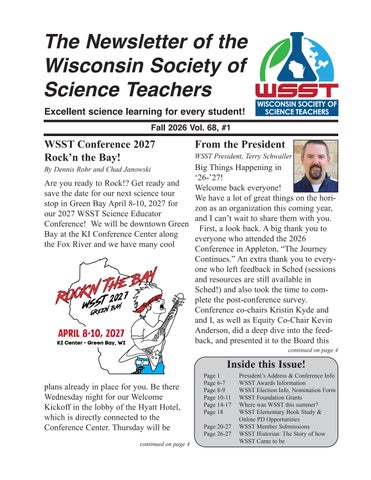
Big Things Happening in ‘26-’27! Are you ready to Rock!? Get ready and Welcome back everyone! save the date for our next science tour We have a lot of great things on the horistop in Green Bay April 8-10, 2027 for zon as an organization this coming year, our 2027 WSST Science Educator and I can’t wait to share them with you. Conference! We will be downtown Green First, a look back. A big thank you to Bay at the KI Conference Center along everyone who attended the 2026 the Fox River and we have many cool Conference in Appleton, “The Journey Continues.” An extra thank you to everyone who left feedback in Sched (sessions and resources are still available in Sched!) and also took the time to complete the post-conference survey. Conference co-chairs Kristin Kyde and and I, as well as Equity Co-Chair Kevin Anderson, did a deep dive into the feedback, and presented it to the Board this
By Dennis Rohr and Chad Janowski
continued on page 4
Inside this Issue! plans already in place for you. Be there Wednesday night for our Welcome Kickoff in the lobby of the Hyatt Hotel, which is directly connected to the Conference Center. Thursday will be continued on page 4
Page 1 Page 6-7 Page 8-9 Page 10-11 Page 14-17 Page 18 Page 20-27 Page 26-27
President’s Address & Conference Info WSST Awards Information WSST Election Info, Nomination Form WSST Foundation Grants Where was WSST this summer? WSST Elementary Book Study & Online PD Opportunities WSST Member Submissions WSST Historian: The Story of how WSST Came to be
Page 2
Fall WSST Newsletter
The Wisconsin Society of Science Teachers
WSST Directory, 2026-2027
Our Mission: WSST provides a welcoming collaborative network, useful resources, and professional learning to support all Wisconsin science educators in delivering high quality instruction.
Dennis Rohr, Past President @wsst.org
Our Vision: All Wisconsin students engage in meaningful and relevant three-dimensional science learning that prepares them to use valid evidence to make sense of the world and solve current and future problems.
WSST Newsletter Archive
Terry Schwaller, President president@wsst.org
Marcia Gardner, Secretary secretary@wsst.org Chad Janowski, Chief Financial Officer finance@wsst.org Tammy Dymesich, Chief Operating Officer coo@wsst.org
Andy Pokwinski, District 1 (CESA 11 & 12) district1@wsst.org Thomas Davies, District 2 (CESA 9 & 10) district2@wsst.org Sarah Klingbile, District 3 (CESA 7 & 8) district3@wsst.org Megan Sprague, District 4 (CESA 3 & 4) district4@wsst.org Patrick Mootz, District 5 (CESA 2 & 5) district5@wsst.org Teri Dillenberg, District 6 (CESA 6)
Visit www.wsst.org/newsletter to download district6@wsst.org past issues of the WSST newsletter. Available from WSST’s founding in 1958, Stacey Strandberg, District 7 (CESA 1) district7@wsst.org newsletters are as PDFs.
Fall WSST Newsletter
Page 3
WSST Committees Awards/Recognition Miranda Dahlke (co-chair) Laura Ramthun (co-chair) Tom Davies Michelle Howe Karen Messmer Sue Whitsett Megan Sprague Document Review Stacey Balbach (chair) Dave Bergerson Chad Janowski
Sue Whitsett
Elementary Education Shelly Petzold (co-chair) Leah Aubert (co-chair) Melissa Wimmler Teri Dillenberg Dawn Brenner Equity and Access Kevin Anderson (co-chair) Claire Bernatz (co-chair) Zach Pratt Kristin Michalski Karyl Rosenberg Sara Krauskopf Kelly Steiner Sarah Ratelis Michelle Mallonen Finance Chad Janowski (chair) Matt Lindsey Sue Whitsett
Terry Schwaller Tammy Dymesich
Foundation Brian Bartel (President) Denise McCulley (1st Vice-President) Carol Ochsner (2nd Vice-President) Dale Basler (3rd Vice-President) Tracy Swedlund (Treasurer) Ray Scolavino (Secretary) Higher Education Adam Schafer (chair) Ray Scolavino Mark Olson
Joel Donna Kevin Anderson
Membership Michelle Griffin-Wenzel (chair) Ray Scolavino Tracy Swedlund Deanna McClung Matt Lindsey New Teacher Network Jamie Lauer (co-chair) Stephanie Ruder Terry Schwaller
Sonja Gasper (co-chair) Megan Sprague
Nominations and Elections Stephaine Baker (chair)
Professional Development Jamie Groark (chair) Kevin Anderson Shelley Petzold Stacey Strandberg Andrea Christianson Sonja Gasper Tom Davies Communications Brian Bartel (co-chair) - Newsletter Editor Julie Fitzpatrick (co-chair) - Website unfilled (Social Media) Sarah Adumat (Copy Editor) Karyl Rosenberg (Historian) Tracy Swedlund Dan Nelson Strategic Planning Kevin Anderson (chair) Dennis Rohr Kevin Niemi
Ray Scolavino Kristin Michalski
WESTA Shannon Previte (chair) Dennis Rohr Michael April Megan Luedtke
Chad Wilkinson Jonathan Baker Tomara Whiteaker
WSELA Kevin Niemi (co-chair)
Kevin Anderson (co-chair)
WSST Conference Director WSST Vendor Coordinator WSST Conference Chairs Dennis Rohr and Chad Janowski Jamie Lauer and Megan Sprague
Ray Scolavino Rodney Dymesich Green Bay - 2027 Middleton - 2028 Stevens Point - 2029
Page 4
Conference
Fall WSST Newsletter
continued from page 1 Vendor Hall will close. At 4pm, the
WSST Town Hall meeting will happen filled with unique sessions, workshops and a few field trips to local and nearby with even more door prizes from all of locations. Don’t miss our Vendor Social our Vendors and the evening tops off with our incredible membership Milton Pella at 4pm where you can meet all of the Awards Banquet where there will also be amazing vendors; it is also when the a famous local Keynote speaker, Dr. John Rock Raffle will happen in the Vendor Hall. Later, enjoy our Membership Social Luczaj of UW-Green Bay! The conference will conclude Saturday with many door prizes and fun events from our host, President Terry Schwaller morning with more excellent presenta(locally known as Schwalldog to his stu- tions and sessions, and you are always dents), and we will culminate with a live welcome to our WSST Spring Board professional rock band, Milwaukee’s own meeting at 12pm. The Hyatt Regency Hotel is an amazing One Louder, who bill themselves as the facility with suites for their regular Ultimate 80’s Experience! rooms, glass elevators, and open foyer area for the hotel. They also have a connected parking garage with a second story enclosed walkway that makes getting to and from your car a breeze. There is also a Hampton Inn Green Bay Downtown hotel which is located just to the west of the KI Conference Center, in case we need overflow for hotel rooms. We cannot wait to see you there! So find the big hair, vintage music tour shirts, and bring your rock’n energy!
President
continued from page 1
summer. We appreciate all of the positive feedback, but we really dug into the Friday will bring more excellent sesreflections on how we could make the sions, workshops, and a few field trips conference experience better for everythat will showcase local area places. one. We shared these thoughts, and came Savvas is sponsoring our Friday lunch up with some creative ideas for future Keynote speaker with nationally conferences. renowned author and scientist, Kenneth Our next conference will be in Green Miller. Don’t miss the Exploratorium on Bay April 8-10, 2027. Co-chairs Dennis Friday at 1pm in the Vendor Hall and Rohr and Chad Janowski, along with their make sure you talk to the many incredible conference team, are hard at work on vendors before 3pm on Friday, when the
Fall WSST Newsletter
Page 5
making this conference a success. Make think deeply about a science topic, and sure you add those dates to your calendar, have a chance to win a cash prize! They and start making plans to join us! are also organizing a series of one-night Another piece of survey feedback we events called “Practical Applications for heard loud and clear was about offering Elementary Science.” Co-Chairs Leah more opportunities for WSST members Aubert and Shelley Petzold, along with outside of the conference. In response, we their amazing committee members, are are planning a lot of opportunities for this working hard to support all of our eleupcoming school year. If you need some mentary educators. Be watching for more PD hours or simply want to engage in information! some great conversations around science New this year, WSST is working with education, we will have many opportuni- the American Modeling Teachers ties for you in ‘26-’27! Association (AMTA) to bring you a Our District Directors are going to be series of webinars this year. Those webihosting a few virtual sessions this year. nars will be hosted by AMTA along with Welcome to WSST Science Chat: local modeling instruction leaders, to Curiosity Unleashed! These virtual gath- cover topics of energy in physical science erings will offer members an opportunity and life science. The webinars will last to connect with our Directors and the fan- for about an hour, be fully interactive and tastic people within our membership. engaging, and be open to all current Some pre-planned discussion topics will members of WSST for free (but it does get the ball rolling, and then people in require advance registration). The plan is attendance will have the opportunity to for them to be held on the second bring up ideas they’d like to discuss. It’s Wednesday of October, December, and been a few years since we did these virtu- February at 6:00 PM. This online opporal hangouts, but it’s a great opportunity to tunity will hopefully lead to in-person network and build connections with sci- workshops at the conference in Green ence educators around the state! Bay. If you are interested in learning Kevin Anderson will be organizing a more about developing and using models book study around the book Surfacing with your students, this is a great opporBrilliance Through Meaningful Science tunity. Look out for information and regAssessment. Our Elementary Ed istration in your emails and our WSST Committee will also be organizing a book social media. study again this year, Productive Higher Ed Committee Chair Adam Uncertainty in Science Education. So be Schafer will be hosting two communities on the look-out for information on both of of practice throughout the year: Learning those book studies. Environments Anchored in Phenomena Our Elementary Ed Committee will also (LEAP) and the Science Teacher be organizing another writing contest this Preparation and Development continued on page 22 year. This is a chance for your students to
Page 6
Awards and Recognition
Fall WSST Newsletter
Frank Zuerner New Science Teacher WSST is the largest membership organi- The Frank Zuerner New Science Teacher $500 scholarship (up to 3 awardees) goes zation in Wisconsin focused on the to an elementary, middle, or high school advancement of science education. We are currently seeking nominations for our science teacher who is in the first 5 years of service (preference given to first 3 awards recognizing excellence among educators, administrators, and friends of years of service), and has been recommended as outstanding by at least one science education within the state. We know that there is great work being done other science teacher who has direct knowledge of applicant. in science education in Wisconsin, and we want to recognize it! Administrator Award The Administrator Award acknowledges Our committee awards recognition in 5 the superior K-12 Principals, Vice different areas: Principals, Curriculum directors and Ron Gibbs Award District Superintendents who promote, The Ron Gibbs Award is given annually showcase and support science education. to honor a person who has made outstanding contributions in science educa- Nominations can be submitted through tion over a long and distinguished career our website at any time at www.wsst.org/awards You are also able to in Wisconsin. This is our most prestiexplore the page and see some of the gious award. resources and opportunities WSST has to Excellence in Science Teaching offer, including grant opportunities for The Excellence in Science Teaching teachers! Nominations to be considered Award (up to 3 awardees) is given annu- for this year are due by Friday, December ally to persons who have made outstand- 4, 2026. ing contributions to the improvement of Please consider nominating a deserving science education in Wisconsin. This colleague or peer for recognition of their would include elementary, secondary or outstanding work. Also, please forward college teachers, and any other active this information to anyone that may be supporters of science education. interested in nominating someone as well! Friend of Science Education The Friend of Science Education Award recognizes outstanding contributions to the support of science teachers by individuals, groups, corporations, foundations, etc., outside the science education community.
Page 8
Fall WSST Newsletter
WSST VOTING DISTRICTS AND CESA CORRESPONDENCES
WSST District 1 (CESAs 11 & 12): Ashland/Turtle Lake WSST District 2 (CESAs 9 & 10): Tomahawk/Chippewa Falls WSST District 3 (CESAs 7 & 8): Green Bay/Gillett WSST District 4 (CESAs 3 & 4): Fennimore/West Salem WSST District 5 (CESAs 2 & 5): Whitewater/Portage WSST District 6 (CESA 6): Oshkosh WSST District 7 (CESA 7): Peewaukee Don’t know your CESA? Find out here: https://apps6.dpi.wi.gov/SchDirPublic/home
!""#$%&&'()*$+$,-.*/$0-1'2.3'-2$4-*1$ !"#$%&''&()$(*$+,,!$&'$-($./(%(-#0$'1..(/-$2)3$&%./(4#$'5&#)5#$#3152-&()$&)$-"#$'-2-#$(*$+&'5()'&)6$!"&'$-27#'$52.289#$ 2)3$7)(:9#3;#289#$9#23#/'"&.6$+,,!$"2'$;/(:)$&)-($2$92/;#$2)3$&)*91#)-&29$;/(1.0$:"&5"$&'$2$:()3#/*19$-"&);$*(/$,5&#)5#$ <3152-&()0$81-$2)$(/;2)&=2-&()$(*$-"&'$'&=#$"2'$5"299#);#'6$>)#$5"299#);#$&'$&3#)-&*?&);$9#23#/'"&.6$!"#$""%#&'(#-($ )(%&)2-#$-"('#$:"($'"(193$8#$5()'&3#/#3$*(/$(**&5#6$<25"$.#/'()$?(1$)(%&)2-#$:&99$8#$'#)-$2..9&52-&()$%2-#/&29'6$@'$2$ ./(*#''&()29$5(1/-#'?0$:#$2'7$-"2-$?(1$9#-$-"#$.#/'()$:"(%$?(1$)(%&)2-#3$7)(:$-"#?$2/#$8#&);$5()'&3#/#3$A2)3$2)$ #)5(1/2;&);$:(/3$5(193)B-$"1/-CD6$!"2)7$?(1$*(/$52/&);$#)(1;"$28(1-$+,,!$-($-27#$-"#$-&%#$-($3($&-$)(:6$,(%#-&%#'$&-$ ()9?$-27#'$8#&);$2'7#36$ $ +#$2'7$?(1$-($.2''$29();$-"2-$&)*(/%2-&()$-($-"#$E(%&)2-&()'$2)3$<9#5-&()'$F(%%&--##$8?$-27&);$-"#$-&%#$-($'#)3$&)$2-$ 9#2'-$()#$>**&5#/$E(%&)2-&()$G(/%$A%27#$5(.&#'$2'$)##3#3D6$)*"+,"#-.$,/%"0#1.20,"*34# $ 56/,#-.7/$8#1"+09#:;<;=>#?"#?/**#"*"-@#%/0"-@.0,#3.0#A/,@0/-@,#B9#C9#+$%#=9#+$%#+#)0",/%"$@DE*"-@F#@'$2$/#%&)3#/0$-"#$-#/%$ (*$H&'-/&5-$H&/#5-(/$&'$-"/##$?#2/'0$2)3$-"#$I/#'&3#)-$&'$2$*(1/J?#2/$-#/%6$$@99$#9#5-#3$8(2/3$%#%8#/'$:&99$)##3$-($2--#)3$ -"#$'1%%#/$8(2/3$%##-&);$&)$K1)#0$-"#$*299$8(2/3$%##-&);$>5-LE(4$A32-#$-($8#$3#-#/%&)#3D0$$2$'"(/-$%##-&);$2-$-"#$#)3$ (*$-"#$2))129$5()*#/#)5#0$2)3$%()-"9?$4&/-129$8(2/3$5"2-'6# # 56+$G#1.2$*(/$-27&);$-"#$-&%#$-($&%./(4#$+,,!$8?$)(%&)2-&);$2$5(99#2;1#6$M-$&'$()9?$-"/(1;"$?(1/$#**(/-'$-"2-$:#$52)$ (**#/$-"#$8#'-$.(''&89#$'92-#$*(/$#9#5-&()'6$ $ )*"+,"#H/0-*"#'$"I# # A/,@0/-@#B# A/,@0/-@#C# A/,@0/-@#=# )0",/%"$@DE*"-@# $ $ E2%#$(*$E(%&)##$NNNNNNNNNNNNNNNNNNNNNNNNNNNNNNNNNNNNNNNNNNNNNNNNNNNNNNNNNNNNNNNNNNNNN$ $ @33/#''$(*$E(%&)##$NNNNNNNNNNNNNNNNNNNNNNNNNNNNNNNNNNNNNNNNNNNNNNNNNNNNNNNNNNNNNNNNNNNN$ $ <%2&9$233/#''$(*$E(%&)##$NNNNNNNNNNNNNNNNNNNNNNNNNNNNNNNNNNNNNNNNNNNNNNNNNNNNNNNNNNNNNNN$ $ I"()#$E1%8#/$(*$E(%&)##$NNNNNNNNNNNNNNNNNNNNNNNNNNNNNNNNNNNNNNNNNNNNNNNNNNNNNNNNNNNNNN$ $ E2%#$(*$E(%&)2-(/$NNNNNNNNNNNNNNNNNNNNNNNNNNNNNNNNNNNNNNNNNNNNNNNNNNNNNNNNNNNNNNNNNNNNN$ $ @33/#''$(*$E(%&)2-(/$NNNNNNNNNNNNNNNNNNNNNNNNNNNNNNNNNNNNNNNNNNNNNNNNNNNNNNNNNNNNNNNNNNN$ $ <%2&9$@33/#''$(*$E(%&)2-(/$NNNNNNNNNNNNNNNNNNNNNNNNNNNNNNNNNNNNNNNNNNNNNNNNNNNNNNNNNNNNNN$ $ I"()#$E1%8#/$(*$E(%&)2-(/$NNNNNNNNNNNNNNNNNNNNNNNNNNNNNNNNNNNNNNNNNNNNNNNNNNNNNNNNNNNNN$ $ ,&;)2-1/#$(*$E(%&)2-(/$NNNNNNNNNNNNNNNNNNNNNNNNNNNNNNNNNNNNNNNNNNNNNNNNNNNNNNNNNNNNNNNNNN$
! !
"##!$%&'$"('%$)!&*)(!+,!)*+&'((,-!+.!/"$*"0.!123!4546! )789:;!;<!;=>!$<9:?@;:<?A!B<99:;;>>!@;!!"#$!%&$"!'()''&*"+,! %C!A789:;!<?D:?>!@;E-=;;FAEGGH<C9AIJD>GKF7B$>17LMBB$.N=6-
Page 10
Fall WSST Newsletter
WSST NEWS WSST Foundation to Fund Thousands in Grants by Brian Bartel, WSST Foundation President
grant, however the following order of preference is used to award the grant: teacher or school is north of Highway 8, Science World/Science Futures/WINGS teacher participant, Science World/ Science Futures/WINGS staff member, or any WSST member with a worthy project.
Do you have a project in mind that requires more money than is in your budget? Do you need help with costs for education, conference attendance or a field trip? WSST offers members five grant opportunities that can be applied for Founders Grant This $1000 grant can be used to reimonline now at www.wsst.org burse costs of professional development The Founder’s Grant ($1000) can be used for expenses related to professional beyond the WSST Conference (including graduate coursework, professional develdevelopment beyond the WSST Conference, the Byerly Grant ($500) and opment fees at other science conferences, materials, or other costs related to a Pella Grants (up to $1000) can each be used to improve the classroom experience member's professional learning. for students, and the Foundation STEM Foundation Stem Grant Grant (up to $1,000) can be used to Foundation grants, up to $1,000 each, are improve STEM learning. to be used to improve STEM (science, Please see the WSST webpage for more technology, engineering or maths) learninformation about the grants and the ing for science students through the purapplication process. The deadline is chase of innovative technology, hardware December 1st at midnight. Take the time or other STEM equipment tied to a speto apply now! cific project or curricular topic. Any WSST member is eligible for this grant. Milton Pella Grant Proposals need to be tied to a specific Milton Pella grants support the profesproject or curricular topic. sional activities of our members. Each grant can have a value of up to $1000 to defer costs of attending conferences, pay for technology, start an after school program or implement that awesome curriculum idea you always wanted to pursue.
Byerly Grant The Byerly grant, in the amount of $500.00 can be used to improve the science classroom experience for students. Any WSST member is eligible for this
Apply today online! www.wsst.org/grants Foundation Grant applications are due December 1, 2026
Fall WSST Newsletter
Page 11
Back to School Science Grants from the WSST Foundation They're back! The WSST Foundation will be opening applications for "Back to School Science Grants" in October. Back to School grants can fund 10 x $200 ideas for a project that you'd like to implement within your science classroom at the start of the school year. Ideas should showcase innovation in the classroom with an eye on inquiry. Applications will open on the WSST website starting Friday, October 2, 2026 and will close on Sunday, October 11, 2026. The application must be 500 words or less and showcase innovative ideas that enhance three-dimensional science learning. Selected grants will be announced and awarded by the end of October and checks will be sent out in November. Listen to Lab Out Loud Prepare your grant now, and check the Listen to WSST Website to complete your applicaWisconsin’s own tion starting October 2. Brian Bartel and Dale Basler discuss science news and science education with leading scientists, researchers, science writers, and other important figures in the field. A selection of links and notes accompanies each episode, enabling the listener to dig deeper into the topics discussed. Listen to and download episodes of Lab Out Loud at www.laboutloud.com
WSST’s Digital Presence
www.wsst.org
Questions, comments or suggestions should be submitted via laboutloud.com/contact/
Page 12
Fall WSST Newsletter
Nominate a Colleague for a WSST Award Today! Do you have a colleague you wish to nominate? Nominations for the coming year are accepted at any time through the first Friday in December of each year. See the WSST website for links to nominate at www.wsst.org/awards
We NEED YOU! Don’t forget to nominate someone (or yourself)! WSST promotes, supports, and improves science education. How do we do it? With a team of dedicated members! Nominate yourself or others to become leaders in YOUR organization.This coming year (2027), we will elect directors for Districts 5, 6, and 7, as well as President. For more information, see the article in this Newsletter or contact the Nominations Committee at: nominations@wsst.org Or access the form directly at: https://forms.gle/jpuCNe1ukcCCNY3h7 Nomtions are due January 15, 2027
Back to School grants from the WSST Foundation
Apply for a $200 Back to School grant with an innovative idea to support three-dimmensional science learning in your classroom! Apply online at www.wsst.org/special-grants Friday, October 2 - Sunday, October 11
Page 14
Where was WSST this Summer?
WSST Summer Board Meeting, Kickapoo Valley Reserve
WSST Baseball, Appleton
Fall WSST Newsletter
Fall WSST Newsletter
EAA Teacher Day, Oshkosh
Page 15
Green and Healthy Schools
WINGS ‘26 Professional Development at Lowenwood in Land O’Lakes
Page 14
WINGS 2026: Growing Science Educators, Building Community, and Inspiring Classrooms By Jamie Groark
Fall WSST Newsletter
informal conversations, and plenty of laughter. Those connections matter. Wisconsin science educators are doing incredible work, but it can sometimes feel isolating. WINGS provides a network of colleagues who understand the challenges of science education and are willing to share ideas, resources, encouragement, and sometimes simply say, “I’ve been there too.”
This July, science educators from across Wisconsin gathered at Lowenwood for the Wisconsin Institute for Next Generation Science (WINGS)—a week designed to challenge, connect, and inspire educators while giving them More Than a Week of PD something difficult to find during the Perhaps the best way to describe WINGS school year: time to learn, reflect, collabis that it sits somewhere between a proorate, and simply be together as science fessional learning experience, leadership educators. institute, and science teacher summer WINGS 2026 brought together firstcamp—and that combination is intentiontime participants, returning alumni, and al. teacher leaders for a week centered on There is serious professional learning. NGSS-aligned science instruction, senseThere are challenging conversations. making, inquiry, leadership, and commuThere is reflection. There is collaboranity. Educators explored how phenomena, tion. There is also time to laugh, explore, student questioning, Science and play, build friendships, and remember Engineering Practices, and Crosscutting why being part of the science education Concepts can create classrooms where community can be so much fun. students do the thinking and figuring out WINGS 2026 reminded us that investrather than simply receiving information. ing in teachers means more than providAsk WINGS alumni what makes the ing instructional strategies. It means creexperience special, and the answer quickating spaces where educators can learn, ly moves beyond the sessions. recharge, take risks, build relationships, It is the community. Meals together and recognize themselves as leaders become conversations about classrooms. capable of influencing science education Evening activities create opportunities to beyond their classrooms. connect with someone from the other side As participants return to their schools of the state. Discussions about science and put their WINGS experiences into instruction evolve into conversations practice, the impact will reach far beyond about leadership, students, challenges, Lowenwood. It will show up in new lessuccesses, and why we continue this sons, questions, collaborations, and— work. most importantly—in the experiences of Throughout WINGS 2026, participants students across Wisconsin. intentionally built relationships through That is ultimately what WINGS is about: shared meals, recreation, team activities,
Fall WSST Newsletter
supporting great science educators so they can continue creating great science experiences for Wisconsin students.
Page 15
mer. Teachers expressed appreciation for these options! The day of learning also incorporated some learning approaches to engage folks Interested in WINGS? Watch future WSST communications for differently than a typical conference. Topics for two roundtable sessions were information about upcoming WINGS determined by questions put on a opportunities. Whether you want to strengthen your NGSS practice, connect “Wonder Wall” through the day in an with science educators across Wisconsin, “unconference” type format. Our committee selected and coached session facilitagrow as a teacher leader, or rediscover the excitement that brought you into sci- tors to guide more interactive learning ence education, we hope you’ll consider than many conferences typically include. Some sessions specifically showcased spreading your WINGS with us. classrooms lessons with participants experiencing them as students. Wisconsin Summer Science Different formal learning aspects Huddle (WiSSH) weren’t the only shift in the day. The Wisconsin Society of Science Educators could participate in optional Teachers piloted a new summer conferkayaking and dinner events at the end of ence this year, “The Wisconsin Summer the day on the Milwaukee River. We had Science Huddle (WiSSH).” Members of puzzles and games on several tables for WSST’s Higher Ed, New Teacher, Equity informal collaborative work and chatting, and Access, and Professional particularly within an extended lunch Development committees all supported hour. Additionally, we had a snack table the effort. seating area and the planetarium available Some teachers cite school policies, travall day as chill zones for a mental break el distance, lack of subs, and/or daycare or finding new connections. needs as reasons they cannot access proWith 35 attendees, our group felt it went fessional learning, such as the annual well for a pilot program and plan to host WSST conference. The WiSSH event it again next year. As one educator noted, worked to alleviate those issues by “It was different, but I liked it. It was including a science day camp for kids, smaller, easier to socialize and connect. I sharing a carpool sign-up, hosting in the met more people.” We hope to see you all MKE area, and scheduling it in the sumat WiSSH next summer!
Join Our Online Book Study TURN YOUR CLASSROOM INTO A PLACE OF MESSY, WONDERFUL, AND REAL SCIENTIFIC FINDS.
MARK YOUR CALENDARS! DATES (7 p.m. Google Meet): ● January 11th ● February 8th ● March 8th And in-person, April 8- 10 at the WSST Conference.
SIGN UP:
GET YOUR BOOK:
●
Join colleagues across Wisconsin to read Productive Uncertainty in Science Education by Eve Manz. Discover how to transform classroom hesitation into a powerful tool for deep conceptual understanding.
● ● ● ●
Learn actionable research-backed strategies Help students navigate authentic scientific puzzles, discourse, and feel confident in their work. Build supportive classroom norms and student-led investigations. Empower students to think, fail, and grow exactly like professional scientists.
Purchase your own or FREE book for WSST members
Sponsored by
By Oct. 30 @ forms.gle/5UAqB xZrC4QQPgH39
JOIN WSST FOR ADDITIONAL BENEFITS: (Membership is $30) ● Science teaching Newsletters ● Student writing contest ● Networking ● leadership opportunities ● grant opportunities ● other professional development ● invite to the state conference
Wisconsin Society of Science Teachers
Questions? Contact: Shelley Petzold and Leah Aubert elementary@wsst.org
Page 18
Fall WSST Newsletter
WSST MEMBER SUBMISSIONS Who Are Your Scientists? Spotlight on Ynes Mexia 1870-1938 | Botany and Plant Collection by Sarah Ratelis, Equity and Access Committee. 8th Grade Science Teacher, Kenosha Unified School District Is there an age when it’s too late to start learning something new? Ynes Mexia was born in 1870 in Washington, D.C., the daughter of a Mexican diplomat. She moved constantly, Ynes Mexia, c1920. The Bancroft Library, ran a ranch in Mexico after her father Public domain, via Wikimedia Commons died, and married twice. Eventually the stress led to a breakdown, and in 1909 she traveled to Alaska, Ecuador, and she moved to San Francisco for help. Peru, and spent two and a half years naviThat move changed everything, but not gating 3,000 miles of the Amazon by right away. In San Francisco, Mexia start- steamship, canoe, and balsa raft. She ed hiking with the Sierra Club, mostly became the first botanist to collect plants just to clear her head. On those hikes she in what is now Denali National Park, began noticing the plants around her and often traveling alone or with local guides, wondering what they were called and at a time when married women could not why they grew where they did. For years even get their own passports. this was just personal curiosity, taught to Mexia collected more than 150,000 plant herself a little at a time, long before she specimens and discovered over 500 ever set foot in a college species that had never been recorded by classroom. Eventually that curiosity out- scientists before. That means she was the grew what she could teach herself. Mexia first person to ever officially identify enrolled at UC Berkeley at 51 to study those plants. Two plant genera and entire botany formally. Most people think of groups of related species were named in their fifties as a time to slow down. her honor, a rare honor in botany. Even Mexia started over as a beginner instead. so, some male colleagues still called her a Her first collecting trip to Mexico “collector” instead of a scientist, as if brought back 500 plant specimens, the gathering the evidence didn’t count as same number Charles Darwin collected real science, like calling a professional on his entire voyage on the Beagle. She chef a home cook. That label mattered. It funded her expeditions by selling speci- meant less credit and less recognition for mens to museums. Over the next 13 years discoveries that were hers. Her collec-
Fall WSST Newsletter
Page 19
tions are still studied by researchers today. Students’ Sense of Wonder Even as a professional, Mexia kept By Kevin Anderson learning. Every expedition meant new terrain, new plants, and new people to learn When I review our state vision for science education, my favorite phrase has from. She found her purpose slowly, through hikes and quiet curiosity. If you always been the first one, “all students have some appreciation of the beauty and think you’ve already missed your wonder of science.” I hope for our stumoment, she’s proof you haven’t. dents to always be curious about the Learning is a life-long adventure. world around them. As a freshman in college, I can still Building Your Classroom Library: vividly remember the first time I looked Hispanic Heritage Month Four books covering Hispanic and Latino through the 30” telescope at Fremont Peak State Park in California. scientists for students Mario and the Hole in the Sky by Elizabeth Rusch. The story of Mario Molina, Nobel Prize winner who discovered the hole in the ozone layer. Strong chemistry and environmental science connection. (Grades 1-4) The Astronaut with a Song for the Stars: The Story of Dr. Ellen Ochoa by Julia Finley Mosca. First Hispanic woman in space, covers engineering and space science. (Grades K5-5)
http://apod.nasa.gov/apod/ap040511.html
Hidden Heroes in Medicine by Dionna L. When the amateur astronomer, our guide Mann. Covers Hispanic and other under- for the evening, said we’d be looking at a represented scientists in medicine, includ- globular cluster, I had no idea what she ing Helen Rodriguez-Trias. (Grades 3-6) meant. A pinprick of 300,000 stars greeted me, and M13 took my breath away. Magnificent Minds: 16 Pioneering Years later, my students loved field trips Women in Science and Medicine by to visit that observatory. Edward, a stuPendred Noyce. Covers diverse women dent who connected to me at first largely scientists across multiple heritage month because I could ride a skateboard, came categories. (Grades 7 and up) back to visit me several years after he completed 8th grade. He had been a stuQuestions or resources to share? Reach dent I worried about, with a consistent 0.5 out at science@ratelis.com. GPA and multiple suspensions. Now a student in a computer tech program at the
Page 20
Fall WSST Newsletter
local two-year college, he asked: “Do you be a three-panel science-ish project using still take students to that observatory? outdated notions of the “scientific That was really cool.” method”; instead, it would be their opporMany of my students came back to visit. tunity to make sense of something they One of my “brightest” students came find interesting in the world around them, back on a day we were talking about sub- perhaps with a local mentor supporting atomic particles. She couldn’t remember them in their work. any of them or their charges. Perhaps I On my desk I have a framed photo didn’t teach it well? She did want to talk Professor Jim Stewart gave me at the end about the anchor project she had done of a seminar he led on cultivating a sense during several months of the year and of wonder in science. It constantly whether my demos ever lit the carpet on reminds me what’s most important in scifire again (who puts a chemistry teacher ence teaching! in a room with carpet?). Subatomic particles weren’t high on her list. In a past visit to a Wisconsin high school, I noticed that freshman science equaled a series of packets. Asking whether the students devised their own experiments and investigated their own questions, the teachers responded that they didn’t have time. They had to cover the content. If that reason has ever held you back, please reconsider! With all the authority I have as the DPI science consultant (noting that I really have none), I would encourage you consider engaging students in meaningful science practice and thinking as a higher priority than covering particular content. Higher education faculty Equipment Adoption Online consistently tell me their learning priority and at the Conference is students who can think. by Sarah Klingbile I would enjoy going to a school where Do you have equipment and resources the students consistently have opportuniyou no longer use in the classroom, but ties to apply their learning to semesterare still in good shape and working conlong passion projects. They would have dition? Are you in need of equipment and opportunities to explore a topic of interest wish you could share your “In Search of and present it as a significant part of their List” with other teachers around the state final assessment. Notably, this wouldn’t that might have extras to spare? Check
Fall WSST Newsletter
Page 21
out WSST’s new Equipment Adoption Free Resource for K–5 Website: sites.google.com/wsst.org/equipEducators: “Family mentadoption/home. Engineering: An Activity & The Equipment Adoption website is a digital science flea market extravaganEvent Planning Guide” za. All items are free for the taking (and Looking for low-cost, engaging ways to you are not limited to how much you bring hands-on engineering to your eletake). You do not need to bring something mentary students and families? Physical to take items. Simply contact the person copies of Family Engineering: An listed under the item you’d like to arrange Activity and Event Planning Guide are a pickup time. currently being made available to educaEquipment Adoption will also return to tors, STEM specialists, and informal the WSST Conference in the spring. The learning coordinators completely free of Equipment Adoption website aims to charge — including free shipping (while redistribute usable lab equipment to supplies last). Modeled after Family Math extend its life and reduce waste, helping and Family Science, this guide was limit the number of items discarded developed by Michigan Tech’s College of between conferences. We ask that only Engineering, ASEE, and the Foundation working, non-hazardous materials be for Family Science & Engineering under offered for adoption to ensure safety and a grant from the National Science usability for all participants. WSST is not Foundation. It contains turnkey, budgetliable for any issues, disputes, or damages friendly activities designed to build 21starising between adopters and adoptees in century inquiry, teamwork, and problemconnection with the adoption of lab solving skills through family STEM equipment. Questions? Email: equipnights, after-school programs, or classment@wsst.org. room use. Request Individual classroom copies or bulk sets for schools/districts while supply lasts (2,500 total copies). Sample Resources: Family Engineering Blast Off Challenge Card OR Family Engineering Blast Off Sample Activity How to Request: Fill out the brief request form via the following link to secure your copy: Request your free Family Engineering Guidebook at forms.gle/o1hzkDYcRe9KcYPQA
Page 22
President
Fall WSST Newsletter
continued from page 5 the lookout for WINGS 2027 information
later this year! Community (STPDC). LEAP is a place Which reminds me, if you are a for educators to get together and learn new/early-career educator and need some from a featured educator about some of their best practices, where they will share help and support, please reach out to our New Teacher Network! Co-Chairs Sonja and discuss productive ideas from their own classroom. STPDC is a place to dis- Gasper and Jamie Lauer and their team are ready to assist you! Reach out to cuss teacher preparation programs, and shape how we engage with those educa- newteacher@wsst.org and get connected! WSST is always working to provide you tors coming into the classroom. More with great opportunities to network, coninformation is available at tinyurl.com/SciTeachCommunity-Interest nect, and grow as science educators. ‘26This summer also marked the fifth year ’27 is shaping up to be an amazing year for science educators! Have a great year of the Wisconsin Institute for Next everyone! Generation Science (WINGS). What a fantastic event! We were joined by nearly 20 first-time attendees, and about a dozen WINGS alumni at Lowenwood (formerly the Conserve School) in Land O’ Lakes, WI in July. Attendees participated in sessions covering NGSS, assessment, model design and usage, AI, student discourse, Claim-Evidence-Reasoning writing, and leadership development. We also had lots of time to engage in extracurricular activities like wolf howling with Chad Practice ACT Science with Janowski (the wolves howled back from campus!), owl hooting with Susan Thurn, FreeTestPrep.com Wisconsin students take the ACT star gazing with the Northwood Explorers, kayaking/canoeing, and more statewide, and ACT Science is the section with the least free practice material anyboard games than you can imagine! where. FreeTestPrep.com can help fill If you have never attended WINGS, I cannot recommend it enough. Besides all that gap with 15 free ACT Science drills of the professional development content covering data representation, research you learn, it is the connections with peo- summaries, and conflicting viewpoints, plus 37 AP Biology drills and full ACT ple that make it all worthwhile! As I English, Math, and Reading practice. All shared with this year’s WINGS group during our closing session, no matter how original questions, no account or login. much content you learn or pick up, peo- Find out more at freetestprep.com/act/science/ ple are your greatest resource. So be on
Page 24
The Story of how WSST Came to be
Fall WSST Newsletter
of the UW School of Education was the leader of this group, and with the help of DPI staff, teachers from the PSCP group, By Karyl Rosenberg and others from the UW staff developed a WSST Historian constitution and nominating committee As we enter the 68th year for a new organization called the of WSST’s existence, it is Wisconsin Society of Science Teachers. worthwhile to look at how our organiza- The first organizational meeting of the tion began. The world of the late 1950’s new organization was held on September is part of fewer of our membership’s 26-27, 1958 in Stevens Point. Based on memories, so let’s take a look at what the dues and registration structure in happened back then to better understand place, it appears that about 60 teachers what took place. attended (the newsletter does not state The National Science Foundation was where the meeting took place in Stevens created as an independent agency in 1950 Point). The original constitution was with the goal of supporting scientific adopted and officers were elected. In enterprises across the country. It was not addition, a representative of Wisconsin heavily involved in K-12 education until Bell Telephone Company presented a 1956, when the Physical Science demonstration of some classroom tools Curriculum Project (PSCP) was develsuch as a millisecond timer, a solar cookoped at Yale University for use in high er and a super microphone. Finally, Dr. schools. There was a group of Wisconsin John E. Willard, dean of the UW teachers learning about that project at Graduate School, discussed ways in UW-Madison during the 1957-58 school which content area steering committees year. It was within that group that the could help the teachers in each area idea for an organization of science teach- (Biology, Chemistry, Elementary Science, ers to serve and support them was born. It General/Physical Science and Physics) as is important to recall that the Soviet well as improve communication between Union had launched Sputnik 1 into orbit K-12 and higher ed educators. Eight speduring October 1957, which spurred a cific objectives for the organization were sense of urgency in the United States to also developed. light a fire in science education. That A follow up meeting for newly elected urgency resulted in Congress passing the officers and directors was scheduled for National Defense Education Act in early November 6, 1958 at the Milwaukee 1958 making available significant fund- Public Schools Administration Building ing to improve the math and science edu- at 2 pm. In addition, Wisconsin Bell cation of American students. Telephone Company asked to meet with The PSCP teachers wanted Wisconsin those leaders to set up a schedule for the teachers to be prepared to take advantage company to share its teaching aids around of these coming changes. Dr. Milton Pella the state.
Fall WSST Newsletter
Page 25
Thus, a new organization was born! I No. 1. It covers my summary of the birth encourage you all to check out the first of WSST in much more detail and proNewsletter which is posted in the vides a view into the world of science Resources section of the WSST website. education during the late 1950’s. Choose Newsletters, Archive, then Vol. 1,
WSST Newsletter 2019 Technology Way, STE 145 Green Bay, WI 54313
ADDRESS SERVICE REQUESTED
Volume 68, No. 1 Published in Appleton, Wisconsin Editing & Layout: Brian Bartel Publisher: Chad Janowski
DUES EXPIRE ON DATE PRINTED
Submissions to the Newsletter If you wish to contribute to the WSST Newsletter or place an advertisement, please forward items to Newsletter Editor, Brian Bartel, Morgan Building, 120 East Harris St, Appleton, WI 54911. The preferred method of submission is by e-mail at newsletter@wsst.org. Please send as text or Microsoft Word Document.
WSST Calendar Fall/Winter Board Meeting October 17 Central Wisconsin Environmental Center WSST Conference 2027 Green Bay
April 8-10
For advertising rates, visit www.wsst.org/newsletter.
Join us or check your account Stay informed and get connected with the largest professional society for teachers of science in Wisconsin. Regular Membership in WSST is only $30 per year, Retired teacher annual membership is $15.00, and Student annual membership is $10.00. Visit www.wsst.org/join to join today. To check on your WSST account, change your address or school, visit www.wsst.org and click on My Account.
2026-2027 Newsletter Deadlines Fall: Friday, August 21, 2026 Winter*: Friday, November 13, 2026 Spring*: Friday, January 22, 2027 Summer*: Friday, April 16, 2027 *These will be digital issues only
More WSST Information can be found at www.wsst.org