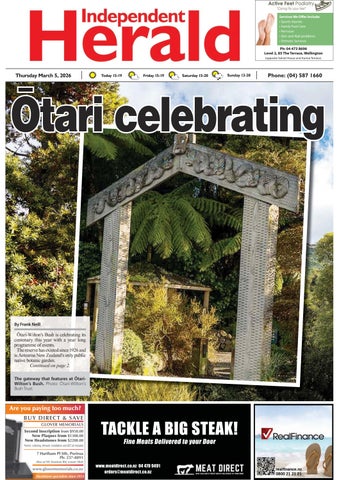
tari-Wilton’s Bush is celebrating its centenary this year with a year long programme of events.
The reserve has existed since 1926 and is Aotearoa New Zealand’s only public native botanic garden. Continued on page 2. The gateway that features at ŌtariWilton’s Bush. Photo: Ōtari-Wilton’s Bush Trust.
How to reach us
Phone (04) 587 1660
www.independentherald.co.nz
REPORTER
Frank Neill
herald@wsn.co.nz 027 490 3916
NATIONAL
SALES
Les Whiteside
les@wsn.co.nz 021 360 008
SALES
Steve Maggs steve@wsn.co.nz 027 765 8303
SALES
Brenda Ingram-Johnson brenda@wsn.co.nz 021 640 152
CLASSIFIED SALES
classifieds@wsn.co.nz
A living collection of unique native plants
Continued from page 1.
It is a living collection of unique native plants and forests, a place where conservation, education and recreation take place.
The reserve’s genesis goes back much earlier however.
One of the settler farmers that arrived in Wellington in the 1800s, Job Wilton, chose not to clear seven hectares of original forest.
He then fenced it for protection.
In 1906 the forest Job Wilton had protected, along with adjoining land, was established as the tari Scenic Reserve.
Wellington City Council took over its management in 1918.
In the early 1920s eminent botanist Dr Leonard Cockayne voiced his dismay at the destruction of New Zealand’s native forests and flora.
In order to reduce the loss Dr Cockayne had a vision of bringing as many original native forest plants as possible into one “open-air plant museum”.
He selected tari as the place for the “plant museum” and the tari Open-Air Native Plant Museum opened in 1926.
He and the Director of Wellington Parks and Reserves, J G McKenzie were at tari’s helm.
They developed a four point vision, to:
from all over New Zealand;
at tari;
plants and advocate their use in gardens; and tari.
Their vision remains a blueprint for tari-Wilton’s Bush today.
More than 1,200 native plant species, hybrids and cultivars are now at tari.
They were collected from as far afield at the Kermadec Islands in the north to Campbell Island in the south.
Reaching 100 years is an extraordinary milestone to celebrate, says tari team manager, Tim Park.
“This place carries the stories of the land, the dedication of countless people and the resilience of our native plants.
“Our centenary is not just about looking back, it’s about inspiring the next generation to protect and cherish Aotearoa’s unique biodiversity,” he says.
Mr Park leads a team of nine (part time and full time) Wellington Gardens’ staff who are based at tari. Most focus on developing the gardens and restoring the forest. Two conservation scientists work in the Lions tari Plant Conservation Laboratory.
The centenary programme is being delivered by Wellington City Council in partnership with tari-Wiltons Bush Trust.
The tari-Wilton’s Bush Trust was established to support the
Council.
preservation of tari-Wilton’s Bush, and to build public awareness about the unique plant diversity found both at the reserve and throughout New Zealand.
The centenary programme began this week with the first of the tari Seminar Series on 3 March.
This series runs on the first Tuesday of each month until November and features talks from conservationists, researchers and community leaders.
Other tari centenary events are:
tari Walk Series – held on the fourth Sunday of each month from March to November. These guided walks will explore the ecology and history of tari and Aotearoa. The first walk on 22 March is entitled “the flies of
Aoteearoa and the spiders who love them”.
night tours through the forest to discover titiwai/glowworms and other nocturnal wildlife. They will take place on Saturdays 18 April; 16 May; 13 June; 14, 15, 16 and 18 July; 15 August and 12 September.
TŪwhera ki tari | tari Open Day will be held on Saturday 19 September from 10am to 2pm. This will provide a behind the scenes look at the people, plants and projects shaping tari.tival in October and November, where visitors will walk through tari’s remarkable journey, from forest and farmland to internationally recognised native botanic garden.
Movin’ March has arrived
Tamariki throughout the Wellington region are currently taking part in the 17th annual M ehe Manawa Ora Movin’March.
Movin’March is a month-long initiative encouraging tamariki in Years 0 to 8 to walk, wheel or bus to and from school throughout this month.
Run by Greater Wellington, Movin’March helps tamariki build healthy travel habits while learning how everyday choices, like how we get to school, can support wellbeing and reduce emissions.
Last year, more than 35,541 students from 134 schools took part in the programme, turning the school run into a fun, social and active part of the day.
Greater Wellington Councillor Yadana Saw says while students are the stars of Movin’March, teachers are its unsung heroes.
“Movin’March is supported by Greater Wellington, but it’s teachers and school staff who really make it happen,” Cr Saw says.
“They’re out early welcoming tamariki and helping them build skills that set them up for healthy, confident and independent travel.
“It’s also a great way for kids to build confidence in their neighbourhoods and how they get around.”
Greater Wellington Travel Choice team leader Hilleke Townsend says the programme’s challenges and classroom activities are designed to spark curiosity and conversation.
“Kura Kete learningresources highlight key benefits of active travel, and use tools like Te Haerenga o Ng Tamariki (located at https://tamariki.gw.govt.nz) to anonymously record travel data and show why active travel is a positive choice.
A young tamariki taking part in Movin’March. Photo: Greater Wellington.
“This year, trips to school can be recorded on a classroom wall chart so the class can work together to win prizes like Micro scooters and MyRide bike gear, or class tripsto Zealandia or Staglands.”
Registered schools receive posters in English, M ori and Pasifika languages, classroom activities and jam-packed prize packs filled with colouring pencils, notebooks, pens and socks. To learn more, visit https://schooltravel. gw.govt.nz/walk-or-wheel-programmes/ movinmarch/.
Part of the Ōtari-Wilton’s Bush landscape. Photo: Wellington City
Open days on restoring birds to Glenside Reserve
By Frank Neill
One of the two open days on restoring birds to the Glenside Reserve will include a presentation by Mountains to Sea Wellington.
The open days are to gather community input into a project entitled the “Safe Haven for Birds in Glenside Reserve”.
The open days will take place at Halfway House, 245 Middleton Road, Glenside, on Thursday, 5 March and Saturday 7 March. People can drop in any time between 10am and 3pm.
Mountains to Sea Wellington is hosting a freshwater talk and water quality monitoring training session.
It will be held from 1pm to 2:30pm on Saturday 7 March.
The”Safe Haven for Birds in Glenside Reserve” project aims to restore the local ecosystem for native fauna and flora as well as improve recreational usage of the area for the community to enjoy.
The open days are “a great opportunity for people who love fresh water fish, insects, lizards, butterflies and birds to share their thoughts with the planners,” says Claire Bibby, who is the President of the Glenside Progressive Association and who leads the team of Heritage Gardeners, who tend Halfway House’s gardens.
“The key questions we are asking the community are:
natural wildlife? to hear?
natural habitat for birds?
“The area currently locked up for horse grazing will be made accessible on the open days as we would like people to go for a walk over the land, and take a look at the stream, the pond and the viewing
points, and discuss their thoughts with the planners at the Halfway House community rooms,” Claire days.
Wildlife Management International Ltd, an internationally renowned bird restoration
company, have been funded to develop the strategy and landscape plan for the reserve in a community led partnership between the Glenside Progressive Association and Wellington City Council.
Multicultural festival at Karori West Normal School
A multicultural food and fun festival will be held at Karori West Normal School on Friday 27 March.
Hosted by the Friends of the School, the festival will run from 4pm to 6pm.
It will be the school’s major fundraiser for the year and will be run in lieu of a school gala/fair.
The festival will celebrate Karori’s diverse
community through food and family activities to raise funds for the school’s ground and hall improvements.
The event will include food stalls, games and sideshows, bouncy castles, face painting, raffles and silent auctions, music and prizes. Cash and EFTPOS will be available. For more information contact fos@kwns. school.nz.
The main section of the Glenside Reserve. Photo: Supplied.
Karori Kaitiaki enhancing Birdwood Reserve
Birdwood Reserve is the Kaiwharawhara stream gully stretching from the entrance to Zealandia to the corner of Birdwood and Chaytor streets.
Karori Kaitiaki volunteers have been working over the past 7 to 8 years in and around this corner especially the carpark area.
Initial work on this site included the clearing out of rubbish including bottles, advertisement boards blown down the gully, rusted car-parts and plastic materials. Trailer-loads of rubbish have been taken to the landfill. Karori Kaitiaki also cleared invasive weeds like tradescantia, blackberry and banana passionfruit and gorse.
This, as always, is an ongoing job which the group is continuing with.
Sunday 1 March saw another successful working bee at the reserve, with the help of Karori Kaitiaki’s regular volunteers, Rotary members and an energetic team of young people from
the Victoria University Tramping Club.
The club members were instrumental in collecting more rubbish and ancient bill-boards from the gully, to a collection point, from where it would be easier to bring the rubbish up to the car-park area for disposal at the landfill.
Others were busy weeding at the carport area and surrounding banks.
Karori Kaitiaki, in partnership with Rotary, has been working on an exciting new walking track from the Chaytor/ Birdwood intersection, within the Birdwood Reserve, towards Zealandia.
Much of the work on this Wellington City Council approved proposed track must be done by professional contractors.
Work includes steps to go down the bank and a bridge over the Kaiwharawhara Stream. Fundraising has been under way for a while. While Karori Kaitiaki has raised some, more is needed.
A Quiz event (the group’s second) is planned for Sunday 15 March at the Karori Tap House from 6pm to 8:30pm.
The cost is $25 per person and there will be tables of 6. To enter contact karori. kaitiaki@gmail.com or go to www. birdwoodreserve.com.
Funds raised
for bowel cancer
Nicole Lewington has just raised more than $2,000 for bowel cancer by walking laps of Karori Park.
Nicole pledged to walk 100km last month as a fund-raiser.
“I managed to smash out 150km,” she says in a post on the I Love Karori Facebook page, posted on 1 March.
“Thank you to everyone who helped out.
“It means the world and I know mum would be proud,” Nicole’s post said.
Her mother, Vicki Lewington, who worked in the office at Karori Normal School for 22 years, had bowel cancer. She passed away in October.
People can still donate by visiting Nicole’s “Move Your Butt” page at www.moveyourbutt.org.nz/fundraisers/nicolelewington/move-your-butt
This page showed that Nicole’s initiative had raised $2,228 by 3 March.
“You can still donate and I’ll still be walking,” Nicole says.
A group from Karori Kaitiaki at their Birdwood Reserve working bee. Photo: Supplied.
Nicole Lewington walking laps of Karori Park to raise funds for bowel cancer. Photo: Supplied.
Adventure and magic at libraries
Adventure, magic, prophecy and quests will be taking place at Te M hanga Karori Library from 2pm to 3pm on Saturday 7 March.
This will all happen during an exploration of “Bravepaw” with Lili Wilkinson. People attending will be welcomed to the world of “Bravepaw”, where a gallant mouse is a loyal hero.
In this interactive session, Lili will show young readers behind-the-scenes of this best-selling series beloved by new readers. How did the legend of Bravepaw arrive? And what about Titch? How does the author evolve her ideas? And what about those amazing illustrations?
This will be an unmissable opportunity to meet one of Australia's favourite writers. This event is recommended for rangatahi aged 7 to 12 with their caregivers.
This event is part of theAotearoa New Zealand Festival of the Arts, with special thanks toVerb WellingtonandMarsden Books.
People have the opportunity to celebrate Wellington Pride at two local libraries with a range of very special events.
Rainbow dress-up storytime will be held on Friday 6 March from 11am to 11:30am at Te TakapŪ o Patukawenga Tawa Library and on Thursday 12 March from 10:30am to11am at Waitohi Johnsonville Library.
Join the library for stories and songs about being kind, inclusive and expressing yourself however you choose.
Through stories and play, children learn how to express themselves and understand the world around them.
Dress up in your favourite outfit and bring the whole wh nau.
This event is for tamariki of all ages with their caregivers.
Let's Go LEGO: make a rainbow will be held on Friday 6 March from 3:30pm to 4:30pm at Waitohi Johnsonville Library and on Wednesday 11 March from 3:30pm to 4:30pm at Te TakapŪ o Patukawenga Tawa Library.
This will give people the opportunity to put their creative skills to the test to design and build rainbow masterpieces.
This event is for tamariki aged 5 and older with their caregivers.
CRAFT(erschool) with Pride will be held on Tuesday 10 March from 3:30 to 4.30pm at Waitohi Johnsonville Library.
This is an opportunity to create a special craft project that tamariki will enjoy.
Arrive by 4pm so you have time to complete the craft.
This event is for tamariki aged 5 and older with their caregivers.
HIVE Tour and Takeover for Teens will take place on Wednesday 11 March from 3:30pm to 4.30pm at Waitohi Johnsonville Library.
Learn more about the library’s makerspace, T ū hura - The HIVE, then spend a relaxing afternoon painting the colours of your favourite Pride flag on to a wooden creature fresh from the laser-cutter!
For young people aged 13 to 18.
Registrations are required as spaces are limited.Register through the 'Sign Up' button on the events page at wcl.govt.nz. Each individual attending needs to submit a separate registration.
Nau mai r t tou katoa. Everybody is welcome.
Wellington City Libraries HIVE Tour and Takeover. Photo: Supplied.
Karori’s premier event
By Frank Neill
Karori’s premier event, the Karori Karnival, attracted a huge crowd of more than 2,000 to Ben Burn Park for the live entertainment, games, rides and the quality shopping opportunity from the many stalls on 22 February.
The 55th Karnival the Karori Lions have run, it also featured stalls by community groups, including the Red Cross, the Karori Community Patrol, the Karori Lions book stall and their barbecue.
“Karori Lions are very appreciative of the
help they received from various quarters at the Karori Lions Karnival,” says The Karori Lions Club Membership Director Trevor Anders.
This is, he says. “their biggest annual event, indeed the biggest annual public event in Karori.
“The Lions were very grateful to the Red Cross, who not only provided an ‘air shelter’ for the popular book stall, but set it up early in the morning and broke it down after the event.
“This replaced the daunting task of erecting the large tent belonging to Girl Guiding Wellington which had been in use for previous
International Women’s Day is a moment to celebrate women’s achievements while confronting the inequalities that still shape daily life. It highlights how much progress has been made in rights, leadership, and opportunity, yet also how uneven that progress remains across countries, workplaces, and communities. The day’s power comes from that mix of pride and pressure: honouring the women who have pushed boundaries, and insisting that the world push further still. It’s less a commemoration than a reminder that equality is a direction, not a destination.
Karnivals.”
Alan Stevens, a volunteer for the New Zealand Red Cross Disaster Welfare and Support Team, says that alongside providing the shelter, the event was a great opportunity for Red Cross to connect with the community.
of mind.
To make a booking or discuss your requirements, call Shirley today.
Our Drivers chose this business because they love being around people and our regular customers love knowing exactly who will be driving them around. We are often told ‘it’s like driving with a friend’. Your companion driver can take you wherever you need to go – not just for medical appointments, but for shopping, visiting friends or if you simply want to go for a drive and maybe a coffee. We are very competitively priced and accept total mobility cards. Contact Shirley today on 021 256 6902 to discuss your requirements.
“The Karnival was a great setting for us to meet locals and have a chat about what we do and our role in supporting communities before, during and after emergencies,” Alan says.
“We also shared information about our Good and Ready programme which outlines simple, practical steps people can take to be better prepared if a disaster does happen.”
“Without the help of others, including vari-
ous non-Lion volunteers and past members, the club of 33 members would struggle to put on an event of this size,” Trevor says.
“The Lions organisation is all about serving the community.
“The more pairs of hands we have the more we can do for our community and help those in need.
“We are always looking for communityminded people to join us and experience the fulfilment of working with like-minded people in a supportive environment to do good things.”
People who are interested or would like more information can text Trevor at 021454-056.
Some of the stalls at the Karori Karnival. Photo: Frank Neill.
A view of Ben Burn Park on Karnival day. Photo: Frank Neill.
Four young children enjoying a ride. Photo: Frank Neill.
Three boys enjoying riding the mini cars at the Karnival.
Photo: Frank Neill.
Driving Miss Daisy is NZ’s number 1 friendly
companion driving service. We’ll give
back
independence
peace
Local history –Wakefield Centre
By Felicity Wong
Wastelands of concrete car park testify to failed plans to build grand schemes.
The amenity and landscape for citizens is so much worse.
In March 1991 the BNZ objected to the redevelopment and expansion of the Johnsonville mall.
It had lent money on the “Wakefield Centre” in Wellington’s CBD and there were insufficient customers for two big profitable malls.
The City Council agreed that retail and offices should concentrate in the CBD so the Johnsonville plan failed.
Only a portion of the Westfield Centre was built (now the derelict Reading Cinema complex) and its nearby Tory Street Carpark building, (since demolished as unsafe).
The Chase Corporation specialised in demolishing Main Street buildings for “redevelopment” and got approval in 1987 for the Wakefield Centre.
“Scheme A” demolished the area bounded by Courtenay Place, Taranaki Street and Wakefield Street for a huge new complex.
The buildings were above the then 15m and 30m height limits, and planned more than 60,000 m2 of floor space in three parts.
Central Plaza buildings would be on 202-230 Wakefield Street and 80-118 Courtenay Place, a West Wing on 31-37 Taranaki Street and a Carpark building at 16A-34 Tory Street.
The Council approved demolition of all the existing buildings, where 600 people worked in a variety of businesses, including the grandly impressive Todd Motors showroom on Courtenay Place.
Only the art deco building on Taranaki Street remains.
The plan included a large basement Foodtown/Progressive supermarket and car parking; a retail plaza with restaurants, fitness centre, bars, public toilets, office foyer and landscaped atrium with access to Courtenay Place, Wakefield Street and the car park building.
There was also a huge six level podium for “warehouses, showrooms, private clubs and office space”, and a hotel.
On Taranaki Street there would be an eight storey building with large floors for retail and offices.
The Tory Street building had 1,040 car parks with suspended planter boxes creating a “cascading green screen” over it.
The Wakefield Street frontage would have “large specimen trees” with “shrub areas”, and the inside would “feature large specimen trees” and "luxuriant tropical planting” with a water feature and coloured lighting under glass floor tiles.
All buildings would have a “rich and polished” finish, promised Chase.
Several groups appealed the Council's decision to the Planning Tribunal.
Most of the land was zoned industrial and among the objectors was competitor supermarket Foodstuffs (New World and Pak ‘n Save brands).
Foodstuffs argued the scheme “was not good planning” as “a basement supermarket will not satisfy or meet the needs of the shopping public”, and demanded that a study be done of the “need for such a facility and where it might properly be located”.
Some years later Foodstuffs opened its Chaffers New World supermarket further along Wakefield Street.
A “Save Our City Campaign” also objected because of the effect of the enormously bulky and high complex on the Courtenay Place precinct.
Local residents pointed out the impact of the development on harbour views from Mt Cook.
In the meantime, a gigantic asset bubble burst and the global stock market crashed in October 1987.
A generation of Kiwis put their savings into rental houses instead.
By December 1987 the hotel and convention centre aspect had been withdrawn in an alternative “Scheme B” application.
The Regional Council strongly supported the Westfield Centre on the basis of “crude data” employment estimates.
Noted was the Wellington trend away from manufacturing towards a service economy of “data processing, business services, real estate and legal services.”
The Regional Council noted the trend was caused by “Government policies to deregulate the economy, together with technological change and changes in the international economy flowing through to the domestic economy.”
The City Council was assured Wellington’s future was bright as “New Zealand's financial capital”, and Scheme B was approved.
By July 1989 Chase Corporation was in receivership.
The large empty site fronting Courtenay Place became a derelict eyesore for more than a decade.
A black hole of negative amenity was a civic reminder of failed dreams.
In 2001 the lower rise (now itself derelict) Reading Centre cinema complex opened on the site.
The (useful) car park building was subsequently demolished as unsafe.
There were no trees and all the plants died.
Neither the hotel/convention centre and office tower (above a podium and atrium), nor the West Wing were ever built.
The Johnsonville Mall scheme was not implemented either. To counter the depressing amenity blight of huge concrete areas trees are desperately needed.
Positive feedback to roadside drug tests
Since the Police implemented roadside drug driving testing in mid-December 2025 more than 300 screening tests have been completed.
“Overall, there has been positive and valuable feedback from the public across the Wellington region and from our frontline staff involved with roadside drug driving testing,” says Superintendent Steve Greally, Director of Road Policing.
“The operational insights gained since December have been beneficial, and will feed into the national rollout which starts in April this year.
“We will be testing across New Zealand by mid-2026.
“National drug driving testing will further bolster our policing efforts in making roads safer for all, and deterring drivers who are impaired, whether by drugs or alcohol, from endangering the lives of others.”
Testing remains ongoing in locations spanning the broader Wellington region, from K piti, Porirua, Wellington City, Hutt Valley and all the way through to Masterton.
“Drivers cannot use a prescription or medical note at the roadside to stop them from undergoing a test or to dispute a positive saliva screening test result.
“The message is still the same for drivers who drive impaired by drugs – don’t take drugs and drive,” says Superintendent Greally.
“You need to know what you are taking and how it might affect driving and any period of time where it is unsafe to drive.
“If you intend to get behind the wheel after consuming impairing drugs, you will be caught.”
Staying safe
A Staying Safe refresher driving course will be held at the Khandallah Town Hall on Wednesday 6 May. The course runs from 10am until 2pm with lunch provided.
Staying Safe is a free refresher workshop for senior road users. The workshop aims to maintain and improve safe driving practices and increase the knowledge of other transport options available to help senior road users remain safely mobile.
Age Concern runs the workshops in partnership with NZTA/Waka Kotahi. Registration is required. To register visit www.acwellington.org.nz/events/ staying-safe or phone 04 499 6646.
Mon - Fri: 7am to 4pm Sat - Sun: 8am to 4pm
Todd Motors building, which once stood where the derelict Reading cinema complex is now. Photo: digitalnz.org.
Grave of first All Black try scorer to be marked
The New Zealand Remembrance Army is working towards erecting a headstone on the grave of the first All Black try scorer, Harry Roberts.
Harry (1862 to 1949) currently lies in an unmarked grave at Karori Cemetery.
The Remembrance Army is working alongside Wellington Rugby to secure a suitable headstone, ensuring the first All Black try-scorer and one of the founders of New Zealand’s Rugby legacy is properly recognised.
A half back, Harry represented Wellington and Canterbury at provincial level and was selected for the first-ever New Zealand national side in 1884.
The unmarked grave of Harry Roberts, the first All Blacks try scorer. Photo: Supplied.
He played seven matches on the team’s pioneering tour to Australia.
In the opening fixture – a preliminary match against Wellington – Harry scored the first try ever by a New Zealand representative side. While the name “All Blacks” would come
later, Harry can rightly be regarded as the first All Black try-scorer.
Despite his light physique, Harry was praised by contemporaries for his tigerish play, versatility across the backline and sharp rugby intelligence.
He was also a capable first-class cricketer, representing Wellington in the summer months.
Rugby ran deep in the Roberts family. His son Ted (Teddy) Roberts was selected as an All Black halfback in 1913, making them the first father-son representatives in All Black history. Two other sons represented Wellington and a grandson later appeared for a New Zealand XV.
WOW winner speaking at Wellington Quilters
Fifi Colston will speak at the Wellington Quilters March meeting.
Fifi is a veteran of The World of Wearable Arts.
She has been a finalist and award winner over the years with 30 finalist entries in World of Wearable Art shows, culminating in her 2025 piece ‘Meine Erste Leibe’ winner of the Open Section and Runner-Up to the Supreme Award.
She is also a costumer, novelist, children’s book illustrator and creator of more than 50 published and award-winning titles.
Fifi has worked with Weta Workshop, 3 Foot 7 Productions, Pukeko Pictures, Tomorrow Rain and The Production Shed in the New Zealand TV and film industry in costume and props, as a puppet maker, illustrator and trainee scriptwriter.
Fifi is excited to showcase her 30 year journey through the World of Wearable Art and the making of ‘Meine Erste Leibe’, her 2025 Award Winning entry.
She will share her inspirations, design process, techniques and materials and answer any questions people have about creating a piece for WOW.
It promises to be a fun evening that will leave
those who attend buzzing. Wellington Quilters will host Fifi at their meeting on Monday 9 March at 7:30pm at the Johnsonville Uniting Church, Dr Taylor Terrace.
World of Wearable Art winner Fifi Colston. Photo: Supplied.
Harry Roberts, the first All Black try scorer. Photo: Supplied.
Cable Car lit up for Rare Disorders Day
The Cable Car was lit up on Saturday night 28 February to show Wellington’s support for international Rare Diseases Day.
Marked on the last day of February each year, Rare Diseases Day is a global day of solidarity for people living with rare disorders.
Around the world, significant buildings and landmarks illuminate to create a chain of lights in support of those affected and their families.
As well as the Cable Car, the Michael Fowler Centre and the Queen’s Wharf Sails were also lit up in Wellington.
In New Zealand, the day also marks the beginning of Rare Disorders Month, which runs throughout March.
Alongside the landmark light-ups, the month focuses on increasing visibility and raising awareness of people living with rare disorders.
In Aotearoa, around 300,000 people live with a rare disorder, more than half of them children. It is not rare to have a rare disorder.
Supporters are echoing Rare Disorders
New Zealand’s call to “Glow Up and Show Up” this March, with events taking place in Wellington and across the country.
Wellingtonians can also get involved in the Rare Beer Challenge, with a satellite event at The Malthouse from 20 to 27 March, giving the chance to purchase a rare beer brewed from across the country.
The annual fundraiser invites craft breweries from around the motu to compete for the title of Rare Beer Champion by creating their own interpretation of a “rare beer”, using unusual ingredients and brewing techniques.
Those wishing to donate in support of the rare disorder community can do so via Raisely at www.glowupforrare.raiselysite. com/donate.
Well-being workshop in Khandallah
By Frank Neill
An emotional and mental well-being workshop will be held at the Khandallah Town Hall, 11 Ganges Road, on Tuesday 31 March.
The workshop, which runs from 10am to 12:30pm, focuses on strenthening the emotional and mental well-being of adults who are adapting to experiences of change,
Major public health challenge
Wellington Free Ambulance and Hato Hone St John have released the latest annual Out of Hospital Cardiac Arrest Report.
This report highlights that out-of-hospital cardiac arrest (OHCA) remains a major public health challenge in Aotearoa New Zealand.
The report shows that for the period 1 July 2024 and 30 June 2025 2,466 people were treated for cardiac arrest by ambulance officers across the country – almost seven a day.
While 24% of patients survived to hospital arrival, only 12% survived 30 days after the event. Only 6% received defibrillation before an ambulance arrived.
The report emphasises that improving OHCA survival in New Zealand requires a coordinated, equity-focused strategy centred on universal CPR literacy, automated external defibrillator (AED) training, targeted AED deployment and maintenance of a national registry, strengthened community responder systems and optimisation of cardiac arrest care.
Jon Moores, Deputy Chief Executive –Clinical Services at Hato Hone St John, says improving survival from out-of-hospital cardiac arrest remains a critical priority for the ambulance service, wider health system and communities across Aotearoa.
“Improving cardiac arrest survival is an organisation-wide goal for Hato Hone St John and reflects our commitment to saving lives and improving health outcomes for the communities we serve.
“Working in close partnership with Wellington Free Ambulance, our funders, other health providers, Fire and Emergency New Zealand and local communities, we are focused on strengthening every link in the chain of survival through our Cardiac Arrest Survival Improvement Strategy.
By improving each stage of the chain — from early recognition and CPR, through to rapid defibrillation and advanced clinical care — we can give more New Zealanders the greatest possible chance of surviving cardiac arrest.”
While it is encouraging that 81% of cardiac arrest patients receive CPR from a bystander, Mr Moores says building community confidence and capability remains essential.
Early defibrillation by a bystander more than doubles a person’s chance of survival, and CPR is a skill anyone can learn.
“While bystander CPR rates are high, access to publicly available defibrillators (AEDs) remains limited,” Jon says.
“Increasing the availability of AEDs and the wider development of CPR skills and awareness, remain critical to moving the dial.
The data also highlights persistent equity gaps.
Inequities in both cardiac arrest incidence and survival continue for M ori and Pacific peoples, as well as for people living in rural and higher-deprivation communities.
Female patients have lower odds of survival (50%) and are approximately 60% less likely to receive community defibrillation than male patients.
Dr Erica Douglass, Executive Medical Director at Wellington Free Ambulance, says WFA continues to be deeply committed to training people across its region in CPR and how to use an AED through The Lloyd Morrison Foundation Heartbeat CPR Training programme.
“Last year close to 10,000 people across Greater Wellington and Wairarapa learnt this lifesaving skill.
“This training is free of charge thanks to cornerstone partner Julie Nevett and The Lloyd Morrison Foundation who fund this essential programme,” Dr Douglass says.
“The data in this report shows us the positive impact bystander CPR and AED use has for chances of survival in a sudden cardiac arrest, and we encourage everyone to undertake training, know where their closest AED is and be ready to assist if needed.”
The full OHCA report is at https://www. stjohn.org.nz/news--info/our-performance/ clinical-audit-and-research/cardiac-arrest-annual-report/.
Reform needed, but not Combined Territories Boards
Bypassing plans for a Combined Territories Board (CTB) has been recommended by Greater Wellington Regional Council in its submission on the Simplifying Local Government proposal.
The regional council also agreed to establish a regional joint working group with other councils to examine options, including amalgamation, for future local governance.
“We support reform but reject wasting time and money on a CTB,” says Greater Wellington Chair Daran Ponter.
“Councils across the Wellington region have heard the reform message from the Government and are actively organising to put forward a reform proposal to the Local Government Commission,” Cr Ponter says.
approach to reform designed by elected officials in partnership with wh nau, hapŪ, and iwi, as well as full protection of our partnership commitments.”
The submission argues that well designed, and enduring reform of local government is best achieved by democratically elected councillors working together with mana whenua and communities.
“The smart move for our region is to cut straight to stage two of the proposal – Regional Reorganisation Plans,” says Greater Wellington Deputy Chair Adrienne Staples.
loss and grief in their lives.
The initiative is collaboration between Age Concern Wellington Region and Catholic Social Services.
Spaces are limited and registration is required and a donation of $15 from people attending is suggested to help cover the costs of materials.
People can register at www.acwellington. org.nz/events.
“Many other regions are doing the same, well ahead of when CTBs are supposed to come into effect.”
Deputy Chair of Greater Wellington’s Te Tiriti o Waitangi Komiti, Shamia Makarini, says CTBs are incompatible with Te Tiriti and the council’s mana whenua partnerships.
“Enduring reform must be Te Tiriti consistent.
“The regional joint working group will be tasked with coming up with affordable options that deliver a local government system, fit-for-purpose for the Wellington Region as a whole,” Cr Staples says.
“We need to think outside the square and design a model that works for our diverse region and can handle the challenges in front of us all; improve efficiency and support growth, while enhancing the region’s reputation as a place of opportunity and innovation.”
“CTBs remove M ori representation, and risk undermining binding Treaty settlement redress and resource management arrangements,” Cr Makarini says.
“We’re calling for a Te Tiriti based
Greater Wellington agreed the working group will develop the next steps for public engagement to generate discussion and debate on the future structure of local government in the Wellington region.
The Cable Car lit up for Rare Diseases Day 2026. Photo: Rare Disorders New Zealand.
ON... WHAT’S
The Community Noticeboard is for non-profit organisations. For $15.00 you can publish up to 25 words. No AGMS, sporting notices or special meetings. Community Notices must be pre-paid. phone (04) 587 1660 or email classifieds@wsn.co.nz
Bus and train fares rising
Metlinkpublictransport fares will increase by 3.1% from15 May, withdiscounts applied tooff-peak faresbeing reduced from 30% to20%.
The decision to adjust fares follows Greater Wellington’s Annual Fare Review, a policy requirement that ensures public transport fares keep pace with inflation and operating costs.
The review helps ensure passengerscontribute abalancedandsustainable share toward running and improving the network alongside ratepayers, and other funding partners,includingtheNewZealand Transport Agency (NZTA).
Greater Wellington Public Transport Committee chair, Cr Ros Connelly, says the decision was carefully considered.
“This was a difficult but necessary callfor the Council to make.
“We have to balance fiscal responsibility and funding constraints with what people can reasonably afford,” CrConnelly says.
“We know the cost of living is challenging for many households, but wemustensure ourfare revenueis sufficientto meet our fundingandrevenuetargetssetbyNZTAas wellasmaintain the services people rely on every day.”
From 15 May,the cost ofathree-zone trip will increase by 14 cents, bringing thepeakadult Snapper fare to $4.67for those travelling to the CBD from Miramar or Karori.
Cr Connelly says councillorsarecommitted to keepingpublic transportaffordable.
Metlink Senior Manager of Strategy and Investments, Tim Shackleton,notedthe
needtoaddressa projected revenueshortfallexpected to be$3million for the current financial year.
“Ouroperating costscontinuetogrow, and patronage, particularly on rail, remains a challenge.
“Thismeansthe gapisgrowingbetweenrevenuewe earn fromfaresandthecosttooperatepublic transportservicesacrosstheregion,” Tim says.
“Weneed toaddressatleast some of thesecostswith fare increasesto ensurecouncilcostsremainfinancially sustainable.”
Oncetheseadditional paymentoptions areavailable, Metlink willstart tophase outthe use ofcash on board buses and trains over the next 12 months.
Tim says Metlink is also preparing to introduce new contactless payment options for full-fare-paying adults, ahead of the region’s transition to the national ticketing system Motu Move.
Adults will be able to tap on and off Metlink buses and trains using a debit or credit card, smartphone or smartwatch, through the existing Snapper systemfrom 12 April.
Why is the left lung smaller than the right lung?
The left lung is slightly smaller than the right lung because 2/3 of the heart is located on the left side of the body. The left lung contains the cardiac notch, an indentation in the lung that surrounds the apex of the heart. Each lung consists of several distinct lobes.
Stuntman,(9).
British P.M.1976-79, James (9)
Rough wool fabric. (5)
Baffle. (7)
Terra ... , dry land. (5)
Unwanted. (8) 17. Excluded from society. (10) 18. Auspicious occassion, ... -letter day. (3) 20. Whirlpool. (4) 22. Loss of memory. (7)
Wellington band The Warratahs coming to the Wairarapa Events Centre
A mind-blowing 38 years since they first took to the stage in Wellington, The Warratahs are returning to the Wairarapa Events Centre on Saturday, March 21st.
Inducted into The New Zealand Music Hall of Fame in late 2025, this sought-after award is in recognition for the band’s nationwide popularity, their live performances and the memorable songs from lead singer and guitarist Barry Saunders. It’s been a while since Carterton has
played host to this landmark among New Zealand groups. Don’t miss the chance to turn up to the gig, put your hands together and your dancing shoes on the floor for this iconic band.
International Cocktail Festival
This autumn, Greytown invites visitors to travel the world — one cocktail at a time.
From 20 March to 19 April, the Festival will shake and stir the village with a hospitality.
Over the course of a month, the Wairarapa town will come alive with themed drink menus, intimate tastings, cocktail workshops, special dinners, lively parties and relaxed afternoons on the Green.
Festival highlights include The Notorious Wairarapa Bootleggers’ Run, Cricket on the Green, Lawn Bowls & Highballs and High Tea, the Molewood Orchard Apple Harvest Festival, The Gin Supper, and signature menus across Greytown’s bars, cafés and restaurants.
While gin-based events have become ubiquitous in recent years, the Greytown
International Cocktail Festival broadens the focus to celebrate everyone’s favourite classics, from espresso martinis through to thoughtfully crafted non-alcoholic cocktails. Visitors can even sharpen their skills at handson workshops, including a session dedicated to mastering the perfect espresso martini at home.
The full programme has been launched, and event info and tickets can be found at https://www.greytownvillage.com/
Private trail and accommodation
If you’re looking for a few days getting back to nature why not visit The Last Resort Walk to the Wairarapa’s rugged east coast, between Tora and White Rock and back.
Ben and Georgie Lutyens, owners of Riversdale Station (a working cattle station where The Last Resort Walk is based) have a long history in the Wairarapa, with Ben’s family connection stretching back six generations. The walk also has a bike and horse trekking option, an addition to their existing heavenlyhorestreks.co.nz providing opportunities for groups to tailor their visit.
The trail is 11km to The Last Resort accommodation, comprising “The Roost” and “The Old Place”, returning the following day via a loop track. Visitors can add a 7-10km track heading down to the beach and back, and stay for a second night.
Ben and Georgie wanted to create a different kind of experience, “our land is rustic and charming, and we wanted to share that. The Walk is mostly through bush. The 360-degree view from the top, or the sunrise from your bedroom makes this quite special” says Ben.
Perhaps the most unique aspect of The Last Resort is that bookings are exclusive, meaning visitors have the trail and accommodation all to themselves, ideal for family get togethers or groups of friends.
The Last Resort is self-catered. Ben together in the fully equipped kitchen “it’s a homely way to finish the day” says Ben.
“We like to make visitors feel at home, so when we take their luggage and food up in our Can-Am vehicles, we pop beverages in on the hot tub under the stars - everything is ready for when they arrive” says Georgie.
You can see more about The Last Resort at www.lastresortwalk.co.nz
Finding out about the life and times in the early Wairarapa
Find out about William Hastwell, the man who got Wairarapa moving, in our new exhibition.
What must it have been like to make sure the mail got through the hazardous ranges through rivers and howling winds?
Our recently installed exhibition tells the story of how he built the biggest transport business in the lower North Island in the late 1800s.
You can see the original stables and the cobbles that were the foundation of his business and get your photo taken in the Glass Coach or the replica stagecoach.
The history really does come alive at Cobblestones but why not also bring
in our extensive gardens.
Explore the old one-classroom school, the ori-
ginal church, built and shared by all the different denominations, the tiny cottage that was home to
a family with ten children. Find out about shearing and the in the 170 year old
woolshed. You can even ride the 1955 Fire Engine on open days.
ing our heritage.
LOCAL TRADES
TRUST A LOCAL
Plumbing.
Spouting.
Rates capping risks undermining regional services
The delivery of critical services and infrastructure – like public transport and flood protection – will be compromised in the Wellington Region unless the Government reconsiders its proposed rates capping model, Greater Wellington Regional Council (GWRC) says.
In its submission on the proposal, the regional council warns the model does not reflect the cost realities of local government.
Its recommendations include:
council cost drivers and circumstances. local government inflationary and financing pressures. -
tion as a core economic indicator.
transparency and flexibility into a sustainable rating model.
or allowing rates increases aligned with New fund public transport operations, to reflect mandated cost drivers and minimise the need for recurring variation or exemption processes.
“This model will ultimately harm the very communities it seeks to protect,” GWRC Chair Daran Ponter says.
“While we understand its intent and support the need for lowering the rates burden on our communities, the model does not reflect the environments councils operate in.
“Our region faces unique challenges, from major infrastructure renewals, like the T hono trains programme, to building resilience from natural hazards, including RiverLink for which Greater Wellington has committed $295 million so far.
to protect our communities and deliver the essential services they need.”
The submission argues that the model’s benchmarks, the Consumer Price Index (CPI) and Gross Domestic Product (GDP), are poorly aligned with council cost drivers, which include construction inflation, insurance premiums and financing costs – factors that routinely rise faster than consumer inflation.
The submission also warns that the proposed 4% maximum cap would constrain the region’s ability to deliver major projects
gi / RiverLink, which alone represents approximately 7% of projected future rates increases.
To increase affordability, local government needs different funding tools and shared funding from Government.
“The benchmarks don’t align with the inputs councils actually use to plan responsi-
Committee Chair Yadana Saw says.
“We all know that using the wrong tools can lead to costly or dangerous consequences.
“In this case, ever expanding funding gaps will expose communities to harm from natural hazards like floods and slips, as well as economic decline through the degradation of public transport.
“CPI and GDP may be useful macro-metrics, but they bear little resemblance to the costs we face renewing infrastructure, complying with national standards and delivering services.
“The model proposed by the government needs a lot of refining by experts within local government if it is to succeed,” Cr Saw says.
Rather than a model that sets rigid limits, the submission proposes a transparent and flexible rating system with independent oversight, that recognises asset condition as a core economic indicator.
It calls for lessons to be learned from investment and administrative burdens, and points to more balanced regulatory models such as the framework overseen by the
GWRC Public Transport Committee Chair Ros Connelly says public transport should be exempt from the model, or affordable rates increases to fund Metlink operations should be allowed.
“Public transport makes up around 63% of our operating expenditure and is largely set by national funding agencies and market forces, meaning we have limited ability to control this cost,” Cr Connelly says.
“Public transport is critical infrastructure that allows cities to grow and businesses to thrive.
“It provides a low carbon transport solution, while allowing individuals who cannot or choose not to drive to travel and participate in our community.
tween service cuts, pushing more costs onto users and creating more reliance on cars.
“None of these are acceptable choices for community wellbeing, economic health, or climate sustainability.”
Greater Wellington Regional Council Chair Daran Ponter. Photo: Supplied.
Our services include home renovations, alterations, kitchens, bathrooms, maintenance and repairs. No job is too small.
Outright victory for Onslow Cricketers
By Frank Neill
Onslow’s premier Cricketers scored a convincing outright victory over Petone Riverside in their Cricket Wellington division one two-day match on 28 February.
The win saw Onslow with two victories from its first two twoday matches this year, having beaten Victoria University both outright and one the first innings in round one.
Onslow’s encounter with Petone Riverside was very evenly poised following the first innings.
Batting first on the Petone Recreation Ground, Petone Riverside was all out for 113 on 21 Februry.
Onslow just crept ahead of the home team and lead by just four runs after they were all out for 117.
They then bowled Petone Riverside out for 200 and cruised to victory with a score of 200 for the loss of three wickets.
Elliot Seddon took three of the Petone wickets to fall at a cost of 38 runs.
Micah Conroy took two wickets
for 27 runs, and followed this up by scoring 30 not out in Onslow’s second innings.
Matthew Scoble took two wickets for 39 runs and Yash Vagadia one wicket for 16 runs. Yash then followed this up with the bat when he scored 48 runs.
Devan Vishvaka batted outstandingly for Onslow, scoring 77 from just 72 deliveries.
With its latest victory Onslow now leads Cricket Wellington’s division one table on 82 points, eight points ahead of Hutt Districts.
Onslow’s next match is against Eastern Suburns at Nairnville Park on 7 and 14 March, starting at 10:30am.
Karori did not have such a good day in their division one match against Victoria University.
Batting first on Karori Park, Karori was dismissed for 203.
Victoria University then declared their first inning at 205 for nine wickets, before bowling Karori out for 245 on 28 February.
Victoria scored the winning runs for the loss of eight wickets
in what was an evenly matched battle, and they finished with 244 for eight wickets.
Louis Ayres performed outstandingly with both the bat and the ball for Karori.
After scoring 37 runs in the first innings, he scored 77 in the second innings and took two Victoria University second innings wickets for 45 runs.
Oscar Wilson also featured with both the bat and the ball, scoring 38 runs and taking one wicket.
Wilkie Proudfoot remained not out on 28 when the Karori innings ended.
Karori’s next match is against Upper Hutt United at Trentham Memorial Park’s Barton Oval on 7 and 14 March, starting at 10:30am.
The Johnsonville women’s premier team won their division one match against Upper Hutt United on 28 February.
Batting first on Trentham Memorial Park’s Barton Oval, Upper Hutt was bowled out for 93.
Johnsonville took just 14 overs
Capital Football’s new multicultural role
By Frank Neill
Karl Moresi has joined Capital Football in the new role of Federal Development Officer –Multicultural Communities Lead.
Karl will begin his new role on 9 March.
Through his involvement with the Waterside Karori Football Club as well as the Petone Football Club, Karl has deep connections with the multicultural landscape, including through his church networks and participation in numerous initiatives across the community.
His new role will focus on engaging multicultural, migrant and former refugee communities across the Capital Football region.
He will work closely with the Football For All programme to create accessible and inclusive football pathways.
The position represents Capital Football’s commitment to diversity and inclusion, recognising that football should be accessible to all communities.
“It’s a privilege to have been chosen for this position and I look forward to combining my passions for football and community engagement to create opportunities that are impactful and positively influence people’s lives,” Karl says.
“We are thrilled to have Karl joining us in this new position at Capital Football,” Federation
Development Manager Steeve Sharpe says.
“He has lived experience in the multicultural space.
“Along with his infectious personality it makes him a great fit for this role.
to win the match with a score of 94 for three wickets.
Cara McCully and Aesha Sukhu took three wickets each, Cara at a cost of 19 runs and Aesha at a cost of 26 runs.
Mira Patel took two wickets for 20 runs, Kacey McCully one wicket for five runs and Anvi Verma one wicket for six runs.
Anvi followed that up with an outstanding batting display, finishing on 50 not out.
Johnsonville’s next match is against Petone Riverside at the Petone Recreation Ground on 7 March, starting at 11am.
Johnsonville’s premier men’s team drew with North City at Alex Moore Park on 28 February, but lost on the first innings.
Batting first on 21 February North City was all out for 303. They then bowled Johnsonville out for 213 and scored 103 for four wickets by stumps on 28 February.
Lewis Jeffreys batted outstanding for Johnsonville, notching up a half century and going on to score 59 not out.
Micah Conroy, who featured with both the bat and the ball in Onslow’s victory over Petone Riverside on 28 February. Photo: Supplied.
Samuel Hunter scored 40 and Reece Edgecombe 32.
Brett Edgecombe took two North City wickets at a cost of 19 runs and Maximus Petrie took two wickets for 43 runs.
Johnsonville’s next match is against Naenae Old Boys at Naenae Park’s Ewen Chatfield Oval on 7 and 14 March, starting at 10:30am.
Waterside Karori gains TDP accreditation
The Waterside Karori Football Club has achieved full Talent Development Programme (TDP) accreditation.
After running as a provisional TDP through 2025, Waterside Karori has successfully achieved the New Zealand Football criteria and, following the appraisal process, has been officially approved.
“We are extremely proud to achieve full TDP accreditation,”
“This represents a significant milestone in the continued development of our youth programme and aligns strongly with our long-term strategic vision as a club.
“I would like to sincerely acknowledge the dedication, professionalism and sustained effort of our coaching staff and volunteers over recent years.
“Their commitment has been fundamental to reaching this im-
portant achievement and strengthening the development pathway for our players.”
Capital Football Federation Development Manager Steve Sharpe, congratulated Waterside Karori on the achievement.
“It is great to see Waterside Karori fully accredited as a TDP club again,” he says.
“A great deal of work goes into ensuring a club can operate to the standards associated.
“We thank all of those involved from the club in making this happen again and offer a fantastic pathway opportunity to all their youth players.”
Waterside Karori has joined Miramar Rangers, Western Suburbs, Island Bay United, Upper Hutt City, Petone, Stop Out, Te Kotahitanga, Onslow/North Wellington and Wellington Olympic as the tenth TDP club in the Capital Football region.
“We have been excited by the impact of the Football for All programme this past couple of years and look forward to this role further building on our work with communities that might otherwise not be playing the game.”
Karl Moresi, who is taking up a new multicultural communities role with Capital Football. Photo: Supplied.