





By Frank Neill
Onslow College held its unique Onslow Festival, an all day event that is highly popular with students, on 10 March.
Four years ago the school decided to replace its athletcs day with the festival, as the athletics day was catering for so few students. It held the first day in 2022 and it has been an annual event since. Continued on page 2.
One of the Onslow College students all dressed up for the festival day.
Photo: Supplied.
















Phone (04) 587 1660
www.independentherald.co.nz




REPORTER
Frank Neill
herald@wsn.co.nz 027 490 3916
NATIONAL
SALES
Les Whiteside
les@wsn.co.nz 021 360 008
SALES
Steve Maggs steve@wsn.co.nz 027 765 8303
SALES
Brenda Ingram-Johnson brenda@wsn.co.nz 021 640 152

CLASSIFIED SALES
classifieds@wsn.co.nz
Continued from page 1.
“This event is unique to Onslow, and speaks to our focus building community,” the college’s Tumuaki/Principal Jono Wyeth says.
The Onslow Festival “is unique in that we want to make it a really accessible and fun day for everybody,” the college’s Acting Deputy Tumuaki/Principal Ben Rogers says.
“It’s way more powerful than finding out who is the best high jumper.
“It’s much more effective than [the students] doing it as individuals.”
Everyone in the school having a fun time “is the success criteria, rather than ‘we’ve got the top three high jumpers in the school’.”
When the school held athletics days they were “really poorly attended,” Ben says.
That was because they catered for only a small number of students. “Less than 1% of students will go into athletics when they leave high school.”
The Onslow Festival “is about people wanting to come along, have a good time and build up energy in the school.
“It’s a concept that brings people together like family,” Ben says.
In doing so it helps enhance one of the college’s values –wh naungatanga (relationship, kinship, family connection).
“I think it is really cool,” Ben says, with the festival vibe and with the music.
During the day the students


work together in their Ako classes (similar to house classes).
They become involved in a range of activities, including puzzles, arts, dance, relays, competitons and the inflatable obstacle course.
Many of the students and teachers also dressed up for the day.
At lunch time the students were treated to ice
cream from two Mr Whippy trucks, which were very popular, as well as food from a number of stalls. “So there is something for everybody to get excited about,” Ben says.
Most schools still have an athletics day, however some schools are moving away from that day and following the model Onslow College has established.




I recently hosted a meeting which included local property developers and representatives from the City and Regional Councils. The background for the meeting was the need to ensure all people involved in providing more housing in our electorate, whether it be those building them or those regulating and permitting that building, understand the issues which govern the ability to build the houses everyone agrees we need.
There are essentially two types of development; greenfields and brownfields. Greenfields means building on currently undeveloped land, typically ex farmland on the edges of current urban areas, where infrastructure like sewers, water supply and other essential services don’t exist are usually built by the developer.
Brownfields development means rebuilding on existing sites, and there has been considerable discussion in recent times around how much intensification should be allowed in existing suburbs, especially changing of height limits to allow for more apartments.
Both have their advantages and disadvantages; the Regional Council in particular see their role to prevent more
The issues which worry locals as I get around Ōhāriu, are unemployment, cost of living, and health. None of these things are improving and combined with the worries of older folks, in particular that their kids and grandkids are leaving Wellington, often for overseas, we are all looking for better times, or at least a belief that better times are coming. Of course, what is happening in the wider world, particularly Iran at present, also has the potential to make things worse, as energy prices go through the roof. New Zealand was in the process of trying to limit our reliance on overseas oil and gas, especially by growing the electric vehicle fleet, along with policies on household solar rebates. After all, we
runoff and other material ending up in our harbours, especially the Porirua harbour in the case of development north of Johnsonville and Newlands. The Wellington City Council are concerned that the existing infrastructure cannot handle the pressure it comes under when new housing areas are developed. Existing infrastructure is aging and needs upgrading across our city, as evidenced by recent pipe failures. An advantage of intensification of existing areas means more people, therefore more ratepayers to pay for those upgrades.
have abundant supplies of renewable energy here. The incoming government removed the incentives to get into electric and hybrid vehicles, so unsurprisingly, the uptake of both has slowed considerably, something New Zealanders will really notice as petrol prices soar and supply becomes doubtful.
Developers of course need to make a profit, and wish to keep their compliance costs as low as possible. Many believe the Resource Management Act is too cumbersome. We as government for our part have undertaken to rewrite that act.
The feedback was good, but the success will be when there are sufficient affordable houses to meetdemand. That is certainly my goal as your MP.
That, and of course having a vibrant and functioning Johnsonville Shopping Centre we can all be proud of.
There’s plenty to be getting on with.
Now is the time to focus on what is important in our lives, and it comes back to health, cost of living, and a decent job and income. As we get into autumn, and the days get cooler, a warm, dry home becomes a necessity, something else we want to know is being addressed by the government of the day. The question we need to ask is, are these things improving? If not, why not?
By Frank Neill
Keeping rates rises and Wellington City Council’s finances under control are the top priority in the Council’s Triennium Plan, Mayor Andrew Little told the “Independent Herald” on 9 March.
Mayor Little released the Triennium Plan last week.
Keeping rates rises and Council’s finances under control is “very important,” the Mayor says.
The second priority is establishing an urban development office.
“The benefit of that is we get more coherent support for developers and people who want to modify thier house or build a new house.”
By drawing people who are already working in urban development “we can get some coherence. We have to do that,” the Mayor says.
His third main priority is initiatives on economic growth and development.
“We have some very strong sectors in Wellington beyound the public service – things like IT, financial technology, gaming technology alongside our creative arts industry, the media industry and so on.
“It’s about promoting and developing these.”
These three are among more than 70 initiatives outlined in the Triennium Plan, which is available at www.andrewlittle.nz/policy/ triennium-plan.
“Wellingtonians sent a clear message at the election: they want serious leadership and real change at Wellington City Council,” Mayor Little says.
“The Triennium Plan delivers on that expectation.
“The commitments in the Triennium Plan strive to make a more affordable city and keep rises as low as possible, prevent blow outs like we’ve seen with the town hall and sludge plant, and still prioritise services and community facilities, jobs and the economy and environmental protection.
“Every Councillor and Pou Iwi knows Wellington households are under real financial pressure.
“We cannot do everything we might like to do, nor everything at once.




“We’ve all shown good faith and a willingness to compromise to agree a plan that has board support around the Council table.
“We will support our Chief Executive to give effect to the Triennium Plan, and will publicly report on progress through an
annual Mayor’s Accountability Report,” the Mayor says.
A significant majority of Councillors and Pou Iwi have pledged to approve the Triennium Plan at formal Council meetings that take place today, 12 March, Mr Little adds.
The 36th New Zealand Fringe Festival came to an end on Saturday 7 March in classic fashion – bangers and mash ups.
A Jukebox Singalong gave an electrified performance at The Hannah Playhouse, closing the festival with unmatched energy.
This was a fitting end to another year of creativity, innovation and the rise of emerging talent from P neke, across the motu, and beyond.
For the past three weeks, the city has come alive with events spanning theatre, dance, cabaret, circus, comedy, music and more.
More than 20,500 tickets sold across 590










performances generated over $395,000 in ticket income for artists.
Forty performance spaces, including the new The Gods Paramount, as well as 27 international productions were also highlights of this year.
Fringe also awarded $91,000 in grants given directly to artists, along with 22 awards.
The 36th year of NZ Fringe was buzzing with a huge array of talent that attracted both new and veteran audiences.
The NZ Fringe thanks every single person who has been a part of the festival. “We could not do [it] without you.”






























Wellington City Council is drafting some changes to the noise rules in the Wellington City District Plan to support local events, manage construction noise and other small fixes.
“We would like to understand community views on these changes before we formally notify the changes for public submissions,” the Council says.
The Council is looking at five key areas: construction vibration standard;
People are asked to send their feedback to the Council by 5pm on 10 April. For more information and to provide feedback visit www.letstalk.wellington. govt.nz/noise.
Wellington’s beloved street festival, CubaDupa, is set to transform the Cuba Precinct into a kaleidoscope of music, performance, kai and colour on Saturday 28 and Sunday 29 March. The programme sets the tone for a weekend where Cuba Street becomes the stage: alive with discovery, play and surprise.
CubaDupa will feature more than 210 acts, 70 food vendors, 220 performances this year, welcoming thousands of visitors into the heart of Wellington across the weekend to celebrate creativity in all its forms – from street music and theatre to dance and immersive, participatory experiences.
Newly announced programme highlights include, Paige, NOÉ, Reiki Ruawai (Raglan), Star Time (Wellington), LEAO (Auckland), Tahini Bikini (Wellington) and Imani-J (Nelson), alongside other works and activations such as BODYFX Makeover Mayhem presented by W t Workshop, and Decant by Footnote New Zealand Dance and Friends.
The full lineup can be found on the festival website cubadupa.co.nz/festival-programme.
The festival’s first lineup announcement in November revealed an eclectic mix of exceptional talent including RIIKI REID, MOKOMOKAI, Dick Move, Lou’ana, Aro, Jeff Parsnips and Tom Knowles, alongside CubaDupa’s first international act for 2026, Gut Health (Naarm/Melbourne).
That initial reveal also introduced the evolu-





Door Sales Available cash or EFTPOS-Debit card only sgcnz.org.nz




tion of CubaDupa’s street theatre programme, developed in partnership with the New Zealand Fringe Festival and Cuba Street Summer Series (supported by Wellington City Council), helping artists grow to full-scale street works that began life at Fringe or during the Summer Series, including Dad Brigade, Clown Pope and Hausdown.
That street-led creative pipeline continues to be a defining feature of the 2026 festival.
Where else can you get a taste of the cuisine from around the world but at the iconic CubaDupa
Street Feast? Experience an offering and adventure with some of the city's most awarded restaurants and food trucks, featuring special menus both indoors and out on the street, right throughout the Cuba precinct.
This second artist announcement showcases musicians shaping the sound of today. It spans pop, R&B, hip hop, electronic and genreblurring club energy, all grounded in strong local identities and global influence.
One the stars of Aotearoa, leading the second and full lineup announcement, is Paige (Auckland), a rising M ori artist whose powerful live presence and genre-bending sound


continues to captivate audiences nationwide. Paige and the rest of the talented lineup are all a part of a huge programme that celebrates bold local talent alongside emerging voices from across Aotearoa and beyond, reflecting CubaDupa’s signature blend of boundarypushing creativity and big-stage energy. Another incredible local talent is NOÉ (pronounced “noi”), a multi-talented Wellington artist whose genre-fluid sound draws from global influences while remaining deeply rooted in the evolving music culture of Aotearoa.
He first gained international attention through early support from T-Pain, before forming a long-standing creative relationship with Ta-ku, collaborating across multiple projects and appearing on Ta-ku’s debut album Songs To Come Home To.
CubaDupa will transform streets, parks, laneways and venues into a free, accessible festival for all ages.
Produced by Creative Capital Arts Trust, the festival celebrates community, creativity and the unique spirit of Wellington and invites audiences to discover something unexpected around every corner.




The popular Blue Dragon Book Fair will be held in the Ngaio Town Hall on the weekend of 18 and 19 April.
Trustees are accepting donations of good-quality books, puzzles and board games from Saturday 21 March until 5pm on Tuesday 14 April.
This is the 16th annual Blue Dragon Book Fair.
All proceeds go to the Blue Dragon Children’s Foundation, a charitable trust working with Vietnam’s poorest children to break the poverty cycle and to stop child trafficking.
Trustee Iona McNaughton says that this year the organisers can no longer accept donations of CDs, DVDs and records. Nor can they accept travel guides, self-help books, business books and textbooks, andfood and
gardening books published before 2020.
“We’re very grateful for all the donations we’ve received over the years but the space in the hall is tight and the selected items don’t sell very well but take up a lot of space,” Iona says.
“However, we absolutely welcome your donations of all other books, puzzles and board games in good condition.
“We're especially pleased to see how popular the children's books are."
Donations can be left at Kennards Storage at the bottom of Sar Street (19 Hutt Road) from 21 March to 14 April.
Visit the Blue Dragon website (bluedragonnz.org.nz) or email Iona (iona.mcnaughton@ gmail.com) for more details or if you want to help.
Gill Percy will talk about how her Anglo-Indian relations came to New Zealand. at the next meeting of the Wellington Branch of the NZ Society of Genealogists.
The meeting will start at 7:30pm on Wednesday, 18 March atthe Johnsonville Bowling Club, 34 Frankmoore Avenue.
From 1908 to 1938 130 Anglo-Indian young people migrated from Rev Dr John Graham's Residential Homes, sited in the tea plantations of Kalimpong Northern India, to New Zealand.
Dr Graham was a Scottish Presbyterian minister and missionary. He set up the homes in 1900 to care for the illegitimate and abandoned mixed race children of tea planters.
His aim was to give them a stable home, a British education and, eventually, a new life in a distant British colony.
Mixed race children were not accepted by the English or Indian communities at

The Tawa Community Patrol has a new patrol vehicle.
The patrol took delivery of the new vehicle on Thursday 5 March.
The day was “a big day” for the patrol, the patrol’s Acting Operations Co-ordinator Ross Armstrong says.
“Thanks to the support from Mark Munkittrick, Dealer Principal Mexted Motors Tawa and Mitsubishi NZ a new Mitsubishi Eclipse PHEV is now part of our team.
“A group of current and past patrollers
and our Police Liaison Officer Shane Reid attended the hand over of the vehicle by Mark to TCP Chair Aaron Johnson.
“A grant from Lottery Wellington plus support from locals organisations i.e. The Masonic Club, Tawa Rotary and Lions Clubs has meant we could achieve this result.
“This is a major upgrade from our now 10 year old previous vehicle and the Eclipse PHEV will mean lower running cost for our future,” Ross says.
that time.
New Zealand was chosen as a destination because it offered employment opportunities and accepted mixed race immigrants.
Many of these young people kept their fascinating story hidden by choice as they settled into their new lives in New Zealand. It has only fully emerged as their descendants explored their family histories.
Gill’s family (and friends) are part of this history.
Visitors are very welcome at all the Wellington branch’s meetings.
Arrive at 7pm for coffee, tea and biscuits, and a chance to chat with the friendly and helpful members.
People who would like some help with their family history search can ask at the pre-meeting discussion which starts at 6pm. The main meetingshould finish between 8:30pm and 9 pm.
For more information visit www.wellingtongenealogy.org.



By Frank Neill
Firetown Design has opened a shop in the Johnsonville Mall, selling items such as clothing, bags, scarves and backpacks.
Zoran Nesic has set up the new business, and it is one that not only serves local shoppers, it also helps a very good cause.
It sells ethically made boutique items imported from Local Women’s Handicrafts (LWH) in Nepal, which Zoran discovered on a trip he made to that country.
LWH was founded by Nasreen Sheikh, a survivor of modern slavery, to provide employment opportunities for Nepalese women who have escaped situations like slavery, dometic violence and poverty.
Nasreen’s goal was to lift artisans up who have been exploited in the fashion industry, to provide them with dignified
jobs that give them opportunity, skills and independence.
LWH honours sustainability, human rights and dignity.
“People like the story behind the products,” Zoran says.
Zoran immigrated to New Zealand from Serbia, and the name “Firetown” is a direct translation into English of the name of his home town in Serbia – Požarevac.
The city of Požarevac is the administrative centre of the Brani evo Districtin eastern Serbia.
Business has been all right since he opened Firetown “but it will take some time for people to find out about us,” Zoran says.
“Everyone is used to shops closing in the mall, not new ones opening,” he adds.
He decided to open the new shop after working for 26 years in programming, which “I got sick of,” he says.



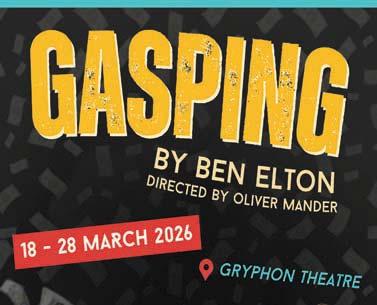
Wellington Repertory is celebrating 100 years this year, and begins its celebration with its first 2026 production, ‘Gasping’.
Written by Ben Elton in 1990, ‘Gasping’ is a satire about corporate greed and environmental exploitation.
At its heart is a brilliantly absurd premise: what if clean air could be bottled and sold for profit?
The play is written in the typical Ben Elton mould – fast-paced, biting and cuttingly funny, the production’s Director Oliver Mander, says.
“The audience is constantly im-
mersed in the action on stage. The pace is a feature we are accentuating with this production.
“’Gasping’ highlights the importance of balance in any successful market,” Oliver says.
“In reality, companies operate with legislation or regulation that set boundaries for what they can or can’t do, and also have to balance the long-term needs of investors with short-term profitability.
“’Gasping’ highlights a world where there is no check or balance, where actions are taken to an extreme.”
Performed by a cast of five, ‘Gasping’ is a brilliantly funny, highenergy ride through boardroom spin, marketing madness and the unstoppable pursuit of profit. With Elton’s trademark wit and rapid-fire dialogue, ‘Gasping’ skewers corporate culture in a way that is both hilarious and uncomfortably close to home.
The production opens on Wednesday 18 March and runs to Saturday 28 March at the Gryphon Theatre, 22 Ghuznee Street. Tickets are available at www.wellingtonrepertory. org.nz.
The Johnsonville Business Group says Wellington City Council’s new Triennium Plan signals several positive opportunities for businesses, particularly around economic growth, procurement and stronger engagement with the business community.
Mark Kirk-Burnnand, Urban Strategy and Greenspace Lead for the Johnsonville Business Group, says the plan introduces several mechanisms that could help support Wellington’s business environment during the next three years.
“The new Triennium Plan puts a much stronger focus on measurable economic growth and structured engagement with the business community,” Mr Kirk-Burnnand says.
“It proposes expert business advisory groups, a dedicated programme of work to support economic growth and a review of Council procurement policy that prioritises opportunities for local businesses.”
The procurement review could be particularly significant for businesses
operating in suburban centres such as Johnsonville, Mr Kirk-Burnnand says.
“When councils review procurement settings with the aim of increasing opportunities for local suppliers, that has the potential to create real benefits for businesses across the city, including those operating in centres like Johnsonville.”
The plan also signals a stronger focus on business access and engagement.
It includes a review of transport and parking policy that specifically considers access to businesses, as well as a direction for WellingtonNZ to consult businesses on initiatives aimed at attracting more visitors and economic activity to the city.
The Triennium Plan also references Johnsonville as an example location for potential improvement initiatives linked to a proposed Urban Development Office trial, including the Johnsonville Shopping Centre (the mall) area and the Johnsonville Recreation Centre.
While the plan does not commit to specific projects in those locations, it is encouraging to see Johnsonville recognised as part of the city’s future development conversations, Mr KirkBurnnand says.
“Johnsonville is an important commercial hub for Wellington’s northern suburbs and a key service centre for surrounding communities.
“Seeing the Johnsonville Shopping Centre and Recreation Centre referenced in the plan signals that our town centre remains part of Council’s thinking as it looks at future improvement initiatives,” he says.
The Johnsonville Business Group says it will be engaging constructively with Council as the plan is implemented to ensure local businesses have opportunities to contribute to the city’s economic future.
“We look forward to working with Council and partner organisations to make sure the perspectives of suburban centres like Johnsonville are part of Wellington’s economic development conversations.”
By Frank Neill
The Kelburn-based Malagan Institute is running a fundraiser next month to fund the final phase of its CAR T-cell therapy trial.
The trial is a critical step towards making a life-changing cancer treatment available in New Zealand, the institute says.
The fundraiser, named “Go the Distance” asks people to take on a distance challenge – walking, running, cycling, swimming or moving in some other way people choose – and fundraise as they go.
“Every kilometre completed and every dollar raised will support the Malaghan Institute’s ENABLE-2 trial, a vital step toward making CAR T-cell therapy available through New Zealand’s public health system,”
The Malaghan Institute says.
“CAR T-cell therapy is transforming cancer treatment around the world, but in New Zealand it remains out of reach for most people due to cost and accessibility.
“Right now, New Zealanders with aggressive blood cancers have to travel thousands of kilometres overseas for a chance at life-changing CAR T-cell therapy, that is if they have the means to and are well enough to travel.
“Many can’t. Some miss out entirely.
“At the Malaghan Institute, we’re working to change that –building the research, expertise
and infrastructure needed to bring CAR T-cell therapy to New Zealand hospitals and to pave the way for future therapies.
“With your support, we can accelerate this work and bring life-changing immunotherapy closer to home,” the Malaghan Institute says.
The Malaghan Institute launched New Zealand’s first clinical trial of CAR T-cell therapy in 2019.
This one-off treatment works by reprogramming a patient’s own immune cells to seek out and destroy their cancer, harnessing the power of their own immune system to fight back.
“Our phase 1 trial proved what’s possible: doors were opened, hope was sparked –and New Zealanders who had run out of options were part of something ground-breaking,” the Malaghan Institute says.
“Now we are in phase 2, treating more patients earlier in their cancer journey, building the capability and gathering the evidence needed to embed CAR T-cell therapy as a standard of care in our public health system.
“This is our final push towards Kiwis getting access to this life-changing treatment here at home, without the crushing costs or barriers.
“But we can only make it possible with your support.”
People can sign up to join Go the Distance by visiting donate. malaghan.org.nz/event/go-thedistance.
Zampelles, the very popular café in the Johnsonville Mall, will be closing for almost two weeks this month for renovations to take place. It will be closed between 16 and 29 March and will re-open on Monday 30 March.
Zampelles will be undergoing a “light reno to bring the cafe into the current decade,” the café’s owner Noah Pronk says. The café will be closed while they fix up the floor, fix up the roof, fix up the lighting and

put on a fresh coat of paint. Two new cabinets will also be installed
This will see Zampelles keep its “classic charm”, but give it some much needed love, Noah says.
Following the renovations Zampelles will be adding lunch options, including paninis, croissants and cheese rolls. Otherwise “we will be keeping our same selection,” Noah says.
“Everyone will be able to find something they can enjoy.”

Australasia’s queen of boogie piano, Jan Preston, is returning to Wellington this month.
She will be performing at the Vogelmorn Upstairs in Brooklyn at 5pm on Saturday 21 March and at The Shed in Lower Hutt at 3:30pm on Sunday 22 March.
Tickets to the Vogelmorn Upstairs show are available at Humanitix and for The Shed show at Hamanitix or at The Shed in person.
Jan has created her own blues/boogie style trademarked by exceptional piano playing together with her vibrant singing and songwriting over the last 50 years.
She also composes soundtracks, including music for her sister Dame Gaylene Preston’s films.
Together with her drummer Mike Pullman, Jan’s boogie
groove is magnetic. People attending the concerts will need to prepare to move and tap their feet.
Her shows on this visit will highlight the recent 50 Years In Pianoland album. Herethe irrepressible Preston comes clean on her longstanding and sometimes bumpy road to piano stardom.
Jan will spin yarns from dives in Manhattan to the concert halls of Europe, from her early days in Wellington’s Red Mole Theatre Troupe to a pop hit with Auckland rock band Coup D’Etat, relocating to Sydney, and her enduring 50 year career as a piano player, singer/songwriter and composer.
Jan’s duo will perform her original songs and compositions, providing a perfect counterpoint to her story.





Rainbow youth nightwill be held at Te M hanga Karori Library on Saturday 21 March from 5pm to 8pm.
Celebrate Wellington Pride with a slightly more than usual rainbowthemed youth night.
The library is open after hours for rainbow and takat pui youth (and nonadult friends) to socialise, have fun, and chat to a librarian about your favourite queer literature.
As usual, there will be pizza, gaming, movies, badge-making, other crafts, and quiet spaces to chill out in.
The youth nights are totally free, pizza included. Those attending need to be 14 years and older, and still at secondaryschool, so arrive prepared to show your school ID.
“Once you’re in, our spaces are yours,” the library says.
Mystery in the library will take place at Te M hanga Karori Library on Thursday 26 March from 6pm to 7pm.
TheNgaio Marsh Awards, in association with Wellington City Libraries, invites booklovers to a fascinating and fun evening of criminally good conversation featuring five terrific kiwi writers.
Two-time Ngaio Marsh Awards winner Jennifer Lane,chairs past Ngaio finalistHelen Vivienne Fletcher, 2025 Ngaio Marsh Award for Best NonFiction winner James Hollings, Verb Festival founder and authorClaire Mabey and acclaimed local cosy mystery writerRodney Strongin a thrilling conversation about how they craft memorable characters and page-turning storylines, and infuse their tales with
deep insights into people and society.
This is a free event.
It’s happening! Te Matapihi ki te Ao Nui Central Library is officially reopening on Saturday 14 March.
“Come and celebrate the return of our much-loved library and the reopening of Te Ng kau Civic Square,” Wellington Libraries says.
There will be exhibitions, live jazz, taonga puoro, storytelling and waiata on offer, as well as demos and tours of the new spaces from 10am to 5pm on Saturday 14 and Sunday 15 March.
Over the weekend, visitors can explore New galleries, Makerspaces – with 3D printing, sewing, woodworking, and more, Recording studio, T T tou P neke (new home for Wellington City Archives ), N ku te Ao Capital E ’s play space, OnTV, and Media Lab, Rawa (commissioned artwork) as well as all the books!
All regular library services will be operational from Saturday, and the full collection will be available for browsing and borrowing – from books, magazines, comics, DVDs, CDs, and vinyl to board games and local heritage items. The new ground floor café, Central Ground, will also be open from 10am to 4pm.
The opening weekend will also be the first chance to explore the revitalised plaza area of Te Ng kau Civic Square, with new landscaping, seating, play areas, and water features.
“It might get busy at Te Matapihi ki te Ao Nui over the opening weekend, so please be patient if there is a queue,” Wellington Libraries says.
A panel talk, entitled ‘Kiwis in Climate: Voices for Climate Solutions’ will take place on Monday 16 March at Te Matapihi ki te Ao Nui.
A panel of four highly respected, leading experts in the field of climate change communications, will discuss one of the most pressing issues of our time: climate change, and how it affects us and what we can do about it at this inaugural event.
“The event is constructed around newly released book, ‘Kiwis in Climate’ – a book that presents practical solutions to the situation we find ourselves in,” Wellington Libraries says.
“Join us for this discussion which will bring together a diverse range of voices advocating for climate solutions in Aotearoa.
“This panel talk, featuring Martha Jeffries, John Lang, Marc Daalder and Pip Wheaton, brings together a diverse range of voices advocating for climate solutions in Aotearoa.
“Our panellists will discuss bold and practical visions for Aotearoa and how Aotearoa can lead on climate solutions, with an emphasis on how best to communicate.
The event takes place at 5:30pm on Monday 16 March in the Ng Pou Ruahine room, Te Matapihi ki te Ao Nui.
This is a free event, and all are welcome.
“No bookings are required, though we expect this event to be popular and seating is limited. We advise arriving early for a seat.”
This event is sponsored by Rewiring Aotearoa.
By David Binning*
With the increased threat of greater climatic extremes and the threats of a major seismic incident, the Onslow Community Residents’ Association (ORCA) has concerns about the effects any such disaster will have on this community together with that of Ngaio which uses the services and access routes our distinct joint areas encompass.
A new initiative is therefore under way to address a real concern to residents served by ORCA.
From all evidence available it is clear that should a catastrophic natural event occur, this area will likely be cut off and become remote from the city and adjoining areas.
Residents only need to look at the instability of the vertical slopes of Onslow Road, Ngaio Gorge, Ngauranga Gorge and Black Rock Road to appreciate the threat we need to accept will inevitably occur either from a weather-related event or seismic shock, which is predicted from evaluation of all known timelines as being overdue.
The initial work ORCA has undertaken shows that a plan is urgently needed to provide guidance and help to the residents of our area.
It is worth remembering that ‘resilience’ comes from our ability to be ‘connected up’ as a community.
We have little chance of addressing the important issues of preparedness and responses if we are not working together.
To that end we are working to connect up as many entities in the community as possible.
For example we have identified, in Khandallah alone, around 45 clubs and community groups who can play a role in getting connected with each other and contributing to the whole community’s resilience.
Furthermore, an early aspect identified is the need for a more
robust communications network to link all known and accessible groups in our area to a focal base which allows information to be shared across these websites in the area, using a single common IT connection which provides a link to all sites which have become part of a common base.
To that end we have set up a new website at orca.hono.org.nz.
The resilience work will be done in steps and will not require any additional IT development work other than in linking every known organisation in the area to a single base which can provide information to every resident who has access to a website or is involved with any established group with a website in our area together with Police and all available emergency services.
The new ORCA website is a place where anyone can access useful information about preparedness and resilience.
ORCA will be posting regular updates and insights.
In addition this is a unique and ground-breaking benefit.
The website automatically allows a feed of information resources and insights from national and regional experts and, over time, a network of hyperconnected websites will share this information through many websites.
I accept that some are switched off from the threat of a civil emergency, but when one considers that our communities may well be without food, water and sanitation for days, or maybe weeks or months, it’s an issue we must talk about and address.
We seek to bring the “strands of the rope together” so that we work towards something much better, where the separate elements of the community are pulling in one direction.
* David Binning is the retiring chair of ORCA, which encompasses the areas Khandallah, Broadmeadows and Kaiwharawhara.







By Felicity Wong
It’s just possible to get six chairs into the foyer of the Petone jail, with its timber lined historic cells at 274b Jackson Street.
Its a museum, visitor centre and office from which Petone’s commercial and historic businesses are promoted.
Built in 1908, the jail is free for the public to enter, and these days to leave as well.
It was originally built in Elizabeth Street where the Petone Police Station was the centre of Hutt Valley policing.
In the 1950s the jailhouse and old police station were shifted to behind Petone’s old courthouse at 13 Elizabeth Street.
The courthouse was used as offices and the jail was used as a lock up until 1978. Mostly its residents were drunk and disorderly, needing an overnight dry out.
Petone Central School shifted from Jackson Street and the Police built a new station there. The old jail lay empty.
Police considered moving it to a museum somewhere.
The old courthouse was also left in a bad state of disrepair but was recently restored and adapted as a stylish home.
In 1991 Roy and Sue Cox, a Petone florist, started a project to keep the old jail in Petone. They were involved with the “Jackson Street Programme" (JSP), a local business promotion trust.
The Coxs worked with Chief Inspector Sherwood Young, Jack Harris and Senior
Sergeant Terry O’Neill.
Roy Cox bought the land on Jackson Street next to the newer Police site.
The unemployment rate in Petone at the time was 12.7% with a high level of youth unemployment.
A condition of the Police providing the building was that local young people be taught practical skills.
Ten young folk, nominated by Police, were successfully involved for a year in restoring the old jail.
Petone’s burglary rate dropped from 30 per week to five.
The young folk sanded and restored the rich native timber lined interior.
The iron hinges and sliding peep hole windows are impressive.
The cells have a single high window with bars to see the sky, something prisoners miss these days.
With lotteries and Police help, the jail was relocated and restored for a total of $161,500 (including the land).
Over time the JSP paid the Coxs back for the land.
The buildings were opened to the public in 1993 and are part of Petone’s wider historic area which reflects Wellington’s earliest settlement and industrial history.
The initial era of M ori settlement as “Pito-one” was followed by the first wave of European settlement in 1839-40.
It was briefly the site of the Wakefields’ new settlement of “Britannia”.
The new exhibition in the outdoor Courtenay Place light boxes is ‘Pahemata’ by Northland artist Hendrix Hennessy-Ropiha(Ng tiKahungunu, Ng ti Raukawa).
Named after his Nan who raised him and had passed away 10 years prior, thistitleand ideagrew to include wh nau and friends who were also no longer with us.
“I started to think about these types of moments as hints towards the presence of something else in this urban landscape,” Hendrix says.
“ The focus of these images isn’t the physical buildings themselves, but the contrasting light and shadows passing through them, something which is different each day, something we are unable to touch or hold and that is only visible to us under certain conditions.
“A moment, a glimpse, a memory of someone who is no longer here.
“Each of theeightphotographs included here, split among the 16 lightboxes,are named after friends and wh nau who have passed in my lifetime, their names a prompt that we may be looking at more than is

Northland artist Hendrix Hennessy-Ropiha in Courtenay Place. initially visible.
“These black and white images of light and shadow are presented here, nearby to where they were taken.”
The Courtenay Place light boxes are a highly visible public outdoor exhibition space, located at 77-97 Courtenay Place.

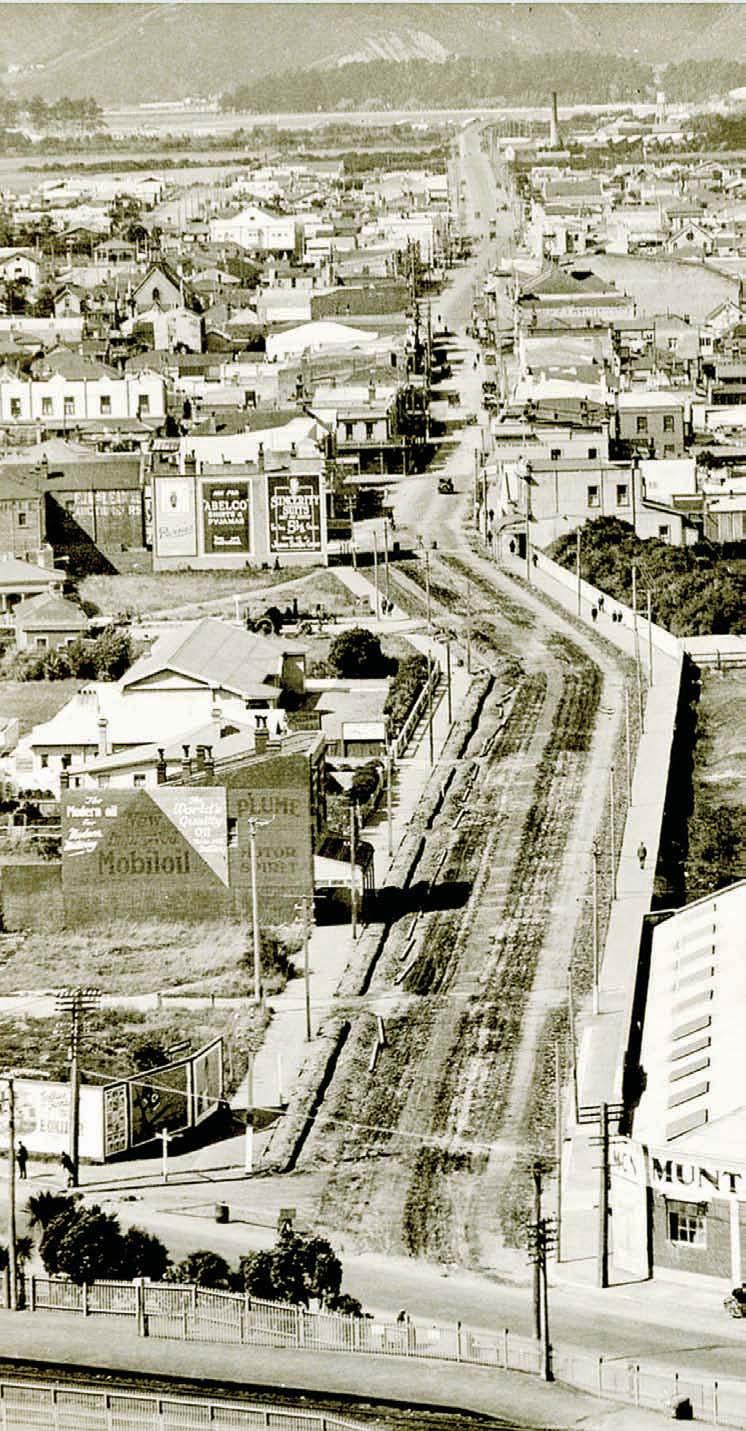
Serious flooding from nearby Hutt/ Heretaunga River led settlers to shift to Port Nicholson/Poneke which subsequently became Wellington city.
Petone developed slowly with its first shop opening in 1876 and a post office two years later.
The Petone Railway Workshops were set up in 1878-79 (moved to Woburn in 1928) and they started a period whereby Petone became a major manufacturing and distribution centre.
Wellington Woollen Mfg Co’s mill followed and the Gear Freezing Works opened in 1882.
Petone’s historic wharf dates from 1907.
The local economy was boosted in the early twentieth century with car assembly plants and associated workshops.
General Motors set up in 1926 and Todds in 1935.
Levers soap manufacturing started in 1919. Employment was plentiful and sports teams abounded.
New Zealand sporting heroes emerged from Petone’s many sports clubs.
The athletes are honoured by a sports walk of fame with numerous footpath plaques recording their achievements.
The woollen mill closed 1968; Gear Meat
in 1981; NZ Motor Corp in 1983, and General Motors in 1984.
Economic deregulation took a toll and jobs shifted overseas.
The distribution industries later shifted elsewhere and now Palmeston North’s open flat landscape supports large operations in its regional distribution role.
In the meantime, Petone’s political independence until its merger with Lower Hutt in 1989 ensured it retained its historic identity.
While many of the buildings of the Historic Area are Victorian or Edwardian, most are of inter war “Striped Classical” style and date from the time when Petone was an important industrial hub.
These days from inside the jail the Jackson Street Programme lobbies Hutt City Council in support of businesses which oppose mandatory parking charges.
Free parking at Lower Hutt’s Queensgate Mall detracts from Petone’s retail opportunities.
The interesting character of the small town remains strong with independently owned stores and restaurants and a very different vibe to the Australian chains of elsewhere. Petone retains an historic charm for shopping, eating and movies.












Mental health and wellbeing are increasingly recognised as critical issues
Industries can be demanding, with long hours, high-pressure environments, and a culture that has historically discouraged open conversations about stress or
For women, these challenges can be compounded by working in a traditionally male-dominated environment where experiences such as isolation, discrimination, and balancing work and family responsibilities can place
Research also shows that women in construction may be more vulnerable to mental health challenges than their male found women were four times more likely to report experiencing a mental illness than men, highlighting the need for targeted support and open conversations about
From NAWIC’s perspective, supporting
mental health is about more than individual resilience it is about building a culture where women feel supported, connected, and able to thrive throughout
in this by creating spaces where women can share experiences, access resources,
“Through initiatives such as webinars, events and member networks, NAWIC provides opportunities to explore topics including wellbeing, workplace culture,
Upcoming webinars focused on mental health and resilience will continue these conversations, offering practical insights and peer support” says Kirsty Hopewell
NAWIC, members become part of a community committed to supporting the wellbeing, advancement, and long-term success of women across
Diet plays a huge role in our health with foods that offer specific health Cherryvite’s Montmorency tart cherries
As one of nature’s richest sources of your body’s free radicals, and support heart health and joint mobility, reduce Montmorency tart cherries are warmed and pressed to remove thecentrated to 68° Brix by removing additives, preservatives or colouring



If you or a loved one are living with a prostate cancer diagnosis and treatment, there is an established support network in Wellington ready to help you navigate your journey.
Contact: Mobile:
Email: Graeme Coutts & Bill Guthrie 022 674 7832 / 027 247 5427 lowerhutt@prostate.org.nz
Seeking advice or information, or just someone to listen. We are here to help, we understand, we’ve been there too.




Hand Therapists use splinting, casting and taping to support and protect injured
Exercises are used to regain range of mo-
Hands on treatment and education help you know what you’ve injured, what you should do and what you should avoid to get back to your normal tasks as quick as
Let us help you get back to doing what you love after injury to your hand,











online or call our reception team to make an appointment
Alison Derbyshire is a New Zealand Registered Hand Therapist with 24 years of experience treating hand, wrist and elbow conditions.





Dr. Tim Halpine DPM Caring for your feet
Ph: 04 473 8696
Level 2, 85 The Terrace, Wellington 6011 (opposite Solnet House and Aurora Terrace).
Email: Tim.Halpine@xtra.co.nz
www.activefeetpodiatry.com
Retirement homes like Tasman District’s Wakefield Homestead are a good example of how the owners, Hilary and Margaret Bird, incorporate wider welfare care into their family-atmosphere retirement home. Hilary and Margaret grew up in the Wakefield community, and are committed to the further development of the Wakefield Homestead, with the desire to make it a friendly and supportive rest home and care facility everyone will love.
You’re welcome to drop in at any time during the day for a visit. No appointment is necessary.

Visitors are asked that you be mindful of the health of their residents and staff, and if you feel unwell or have any flu-like symptoms that you delay your visit until you’re feeling better.
There are a number of conditions and situations that are red flags for having your feet assessed and treated by a Podiatrist.
First on the list is Diabetes. Timely care by a Podiatrist can help prevent some serious
problems that can develop in patients with Diabetes.
and feet a risky proposition.
A fourth issue is lack of flexibility, a tendency for feet to get further away! This is not due to your legs getting longer (if only!) but our suppleness and ability to get down to our feet and safely attend to them becomes limited.



An annual check up is a bare minimum. A second category of necessary care is for patients with diminished circulation Folks with limited blood flow are at higher risk if an infection enters the body via a wound or break in the skin on the feet or toes.
A third category is anyone with impaired eyesight which can make self-care of nails

All of these situations, plus any pain you may suffer in your feet, are plenty good reason to make a booking to have your feet under the care of a Podiatrist.


Our Drivers chose this business because they love being around people and our regular customers love knowing exactly who will be driving them around. We are often told ‘it’s like driving with a friend’. Your companion driver can take you wherever you need to go – not just for medical appointments, but for shopping, visiting friends or if you simply want to go for a drive and maybe a coffee. We are very competitively priced and accept total mobility cards. Contact Shirley today on 021 256 6902 to discuss your requirements.








Samuel Marsden Collegiate School has announced Fleur Wickes as its 2026 Artist in Residence.
Established in 1999, Marsden’s Artist in Residence Programme gives visual art students the opportunity to experience the working process of a practising artist by working alongside them.
Each year Marsden selects an emerging or established artist from New Zealand or Australia working across disciplines including painting, printmaking, sculpture, photography and design.
Fleur Wickes is a New Zealand artist who has been making art since 1989.
Her multidisciplinary practice spans drawing, painting, photography and text, using pared-back language and bold visual form to explore universal experiences of tenderness, grief, joy, love and resilience from a distinctly personal perspective.
After studying professional photography at what is now Massey University Wellington, Fleur built a successful two-decade career as a portrait photographer.
Alongside this, she wrote short stories and poetry, with work published in respected literary journals and featured in national anthologies.
In 2008, she began drawing the words she was writing, allowing language itself to become an emotional landscape — a pivotal shift that established the distinctive integration of text and image that defines her work today.
Her critically acclaimed exhibition ‘This Is Where I Live’ transformed her own home into a self-portrait in word, object and image, establishing a format she has returned to repeatedly: presenting work within environments that either are, or feel like they are, domestic.
Fleur has exhibited widely throughout Aotearoa, including a solo exhibition ‘Let It All Come Undone’ at Te Manawa Museum of Art and Science in Palmerston North. Her work is held in private collections across New Zealand and internationally. More recently, in 2025, Fleur collaborated with Phantom Billstickers on a high-profile street campaign featuring her work ‘It’s beautiful here’.



Her text-based artwork ‘We share the same sky you and I’ was also featured on a prominent Cuba Street billboard, fulfilling a long-held ambition to take her deeply personal work beyond galleries and into public space.
Reflecting on her approach, Fleur describes her work as grounded in deeply personal emotional inquiry, investigating internal worlds through mark-making and paint.
Her art seeks to communicate lived experience through a visual language where words and images are felt as much as they are read.
Kathryn Cotter, Head of Visual Art at Marsden, says the residency programme provides a valuable opportunity for students to engage directly with contemporary artistic practice.
“We are delighted to welcome Fleur to Marsden as our 2026 Artist in Residence,” Kathryn says.
“Her work is thoughtful and conceptually rich, and her multidisciplinary approach will offer our students a powerful insight into the creative process.”
Marsden offers its Artist in Residence a stipend, dedicated studio workspace and opportunities to work alongside students through workshops and critiques.
Fleur’s residency will run for six weeks, beginning on Monday 16 March. At the conclusion of the residency, an exhibition of work created during her time at Marsden will be presented at a Wellington gallery.
The programme also extends beyond the school community.
As part of the residency, Fleur will lead a special workshop for local primary school students on 1 May, sharing her creative practice with young learners from across the Wellington region.
For Marsden’s Visual Art students, the residency provides a rare opportunity to observe the creative process up close, from early experimentation and idea development through to the completion and exhibition of new work.
Working alongside a practising artist encourages students to think deeply about their own artistic work and see how creative ideas evolve in a professional context.















The Communit y Noticeboard is for non-profit organisations. For $15.00 you can publish up to 25 words No AGMS, sporting notices or special meetings. Communit y Notices must be pre -paid. phone (04) 587 1660 or email classifieds@wsn.co nz
By Heather Baldwin
William Wallace (Wally) Simmers, a devoted champion of the Karori community, passed away on 17 December 2025, aged 94, after more than 40 years of dedicated community service to Karori.
Born in Christchurch, Wally attended Wellington College and was head boy in 1948.
He then studied at Lincoln College and worked in farming.
St Anne’s Northland, Corner Northland/ Randwick Roads, SATURDAY 21 MARCH, 9.30 - 1.00. Books, Craft, Plants, Pre-loved, Deli, Preserves, Baking, BBQ, Refreshments, Raffle. Eftpos available
Ngaio Repair Cafe, free, open Saturday 21 March 10am to 1pm, Ngaio Union Church, corner Kenya Street and Crofton Road.
In 1977 he and his wife Margot returned to Wellington and moved into a home in Monaghan Avenue in Karori – where they lived for the next 40 years.
In the late 1990s Wally became Chair of the Karori Community Centre, playing a pivotal role leading and managing initiatives that improved local’s lives and inspiring others to contribute to Karori.
As a key member of Wellington City Council’s ‘Heart of Karori’ working group in 1999-2001 Wally played a significant role in negotiations between Wellington City Council and the Methodist Church to secure land on the corner of Campbell Street and Karori Road for community use.
He also oversaw the transformation of the New Venture Centre into the Karori Community Centre and shaped how the facility

evolved to meet the community’s changing needs.
Wally supported young people, establishing a dedicated youth space in the community centre, and founded the Karori Youth Awards to recognise and encourage community service by young people.
nity Hall Committee and became inaugural chair of the Karori Community Hall Trust that was responsible for the fundraising and development of the Karori Event Centre. He remained a committed member of the trust until his death and was determined to see the Event Centre completed and open for community use.
His service was further recognised in 2016 with the Queen’s Service Medal for his enduring impact in Karori.
The citation highlighted his unwavering support for Karori, his ability to unite people around meaningful causes and his enduring impact on local organisations and facilities.
An active Rotarian in Karori, Wally served in several club roles and was honoured with a Paul Harris Fellowship for outstanding service.
Wally and Margot’s ashes now rest on the Simmers’ family farm at Waikiokio cemetery, West Otago.
Wally’s legacy carries on in the community he helped build, and in the hearts of all who knew and loved him. Few people selflessly give so much to their community.
He will be remembered as a humble leader, a passionate advocate for community development, and a true friend to Karori.







In 2001 Wally received the Absolutely Positively Wellingtonian Award (now the Poneke Civic Awards) for his leadership, vision and determination.
In 2005, Wally led the Replacement Commu-

Distinguish(from). (7)
Cook slowly. (6)
Feverish. (6)
Pack train (7)
Set of breeding horses. (4)
Actress, Farrow. (3)
Proper. (3)
34. Goulash (4)
35. Dcument holder, ... case.(7)
36. Cavalry soldier. (6)
39. To lie snug. (6) 40. Cowboy movie. (7) 42. Musical work. (4)
46. Fraudulent. (9)
48. Genuine. (9)
50. Highest part of road. (5)
51. Mechanic. (7) 52. Spendour. (5)
Exploit. (11)
Rapture. (7)
1. Dispute. (5)
2. Style. (7) 3. Not mature. (6) 4. Religious assembly. (8) 5. Disorderly. (7) 6. Requires. (5) 7. Of a horse. (6)
8. Opening. (8)
9. Punctilious. (11)
10. Hornless cow. (5)
16. U.S. president(1963-69) Lyndon ...(7)
18. Extend. (5)
20. Suffers. (7)
21. Border. (3)
22. Lout. (3)
24. Butter muslin. (11)
THURSDAY




U.S. spy agency(abbr) (3)


By Frank Neill
Karori’s premier Cricketers finished day one of their two-day match against Upper Hutt United well on top on 7 March.
Batting first on Trenthan Memorial Park’s Barton Oval, Karori declared their first innings closed at 428 runs for eight wickets.
They then restricted Upper Hutt to just 72 runs for five wickets.
Two Karori players notched up centuries.
Oscar Wilson was in sublime form, scoring a rapid 162 runs from only 134 balls.
Karori’s other centurion, the team’s Captain Kevin Weerasundara, also batted rapidly and scored 126 from 111 balls.
Louis Ayres came close to scoring a half century, but was out for 47 runs after facing only 37 deliveries.
Wilkie Proudfoot was 28 not out when Karori declared.
The wickets were fairly evenly shared among the Karori bowlers.
Ralph J took two wickets for 12 runs, Louis followed up his good batting by taking one wicket for 12 runs, Puvin Anthony took one wicket for seven runs and Yashraj Kalsi took one wicket for 10 runs.
Onslow’s premier Cricketers were rapidly heading towards first innings points on day one of their two-day match against Easterrn Suburbs on 7 March.
After bowling Eastern Suburbs out for 214 on Narinville Park, Onslow had reached 163 for the loss of three
Onslow College is hosting a Volleython to fundraise for its teams attending the New Zealand Secondary Schools Volleyball Championships in Palmerston North at the end of March.
Both Onslow’s Senior A girls and Senior A boys are planning to travel.
The Volleython will be held in the Onslow College Gym on Saturday 14 and Sunday 15 March.
The Senior boys event will take place from 1pm to 9pm on the Saturday, and the Senior girls event from 9am to 4pm on the

wickets at stumps in the division one match.
Ryan Tsourgas bowled outstandingly, and came close to a five wicket bag when he took four wickets for 38 runs.
Oscar Jackson also bowled very well, taking three wickets for 57 runs, while Elliot Seddon took two wickets for 24 runs and was very economical in his 14 overs.
Devan Vishvaka was in great form with the bat, scoring 72 runs at a fairly fast rate, as he faced only 73 deliveries.
Micah Conroy will resume his good innings on 14 March after he reached 24 not out at stumps.
Onslow’s Captain, Sam French, scored 28 runs and William Julian also contributed well with 27 runs.
The Johnsonville premier men’s team finished day one of their division 2 two-day match against Naenae Old Boys well on top on 7 March.
After bowling Naenae out for 89 on Naenae Park’s Ewen Chatfield Oval, Johnsonville had reached 214 for the loss of four wickets at stumps.
Maximus Petrie was in stunning form with the ball, taking a five wicket bag and going on to take seven wickets for 30 runs from his 16 overs and one ball, with an outstanding economy rate of 1.85.
Three Johnsonville bowlers each took one wicket.
Connor Lusty conceded just two runs from his five overs while taking one wicket, Damien Aitken took one wicket for 12 runs and Reece
Edgecombe took one wicket for 22 runs.
Johnsonville’s premier women’s team did not have such a good day on 7 March, losing to Petone Riverside in their division one match.
Batting first on the Petone Recreation Ground, Johnsonville scored 73 for the loss of nine wickets. Petone Riverside lost just two wickets in reaching 74.
Anvi Verma was the best of the Johnsonville batters, retiring on 12 not out.
Arna Dixit took one Petone Riverside wicket for 8 runs and Kacey McCully took one wicket for 15 runs. Johnsonville’s next match sees them play City Suburbs at Alex Moore Park on 14 March, starting at 11am.
Sunday.
“This is your chance to test your strength, get some extra training in before champs, or simply have a great hit with friends,” Onslow College says.
“All teams welcome. If you’re short on players, let us know. We’re happy to help fill teams.”
The cost is a donation of $10 per player for one hour of game time (six players minimum per team).
To register or for any queries email volleyball@ volunteer.onslow.school. nz