THE WASHINGTON CPA
SPRING 2026
www.wscpa.org • memberservices@wscpa.org
Tel 425.644.4800
170 120th Ave NE Ste E101 Bellevue, WA 98005
BOARD OF DIRECTORS
Joel Williams Chair
Kelly Nelson Vice Chair
Liz Redmond Treasurer
Richard Burger Mackey Secretary
Sarah Funk Immediate Past Chair
Kimberly D. Scott President & CEO
Jenny Cravens
Benjamin Hall
Jamie Hueners
Michaela Kay
Ursula Perkins
Andrew Prather
Jillian Robison
Scott Rodgers
Rachel Ross
David Togami
MAGAZINE PRODUCTION
Jeanette Kebede Editor
Jennifer Johnson Art Direction
The Washington CPA is published by the Washington Society of Certified Public Accountants for its members. Views and opinions appearing in this publication are not necessarily endorsed by the Washington Society of CPAs.
The products and services advertised in The Washington CPA have not been reviewed or endorsed by the Washington Society of Certified Public Accountants, its board of directors, or staff.
The Washington CPA is published semi-annually by the Washington Society of Certified Public Accountants, 170 120th Ave NE Ste E101, Bellevue, WA 98005.
Cover Graphics: ©iStock/Blueastro, ©iStock/Nuthawut Somsuk
POSTMASTER:
Send address changes to The Washington CPA, c/o WSCPA, 170 120th Ave NE Ste E101, Bellevue, WA 98005.





WSCPA Circle has officially launched, and members are beginning to connect, share ideas, and start meaningful discussions. Come on in, take a look around, join a group, and jump into the conversation. Log-in with your WSCPA credentials at wscpa.org/circle
Questions? Message memberservices@wscpa.org for additional help.
Tap Together Thursday Series
Enjoy great beer, delicious appetizers, and meaningful conversations with fellow WSCPA members and accounting peers. These informal gatherings are happening across the state in spring 2026 at breweries/brewpubs ready to welcome you.
THURSDAY
Happy Hour Events TOGETHER TAP

April 30 | Seattle
May 7 | Spokane May 14 | Tacoma May 21 | Everett
Register at wscpa.org/together

WSCPA members receive 10% off their first year’s subscription! Learn more about this new benefit at wscpa.org/qualitypro
Building a Lasting Legacy: The Cycle of Trust and Belonging in Our Profession
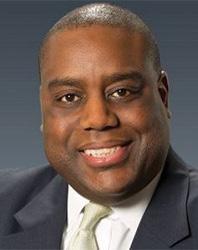
by Joel Williams, CPA
It was a quiet moment during a campus event when a young man approached me. He was a first-generation college student who had never considered accounting as a viable path. After discussing possible career paths during a subsequent meeting over dinner, he realized for the first time that accounting could be his career. He could belong here. As he shared his hope and excitement, I felt a surge of pride. This young man, with so many avenues open to him, had chosen the CPA path.
I love our profession for many reasons, one being that we welcome talent from all walks of life. The doors are open, not just to those with connections or privilege, but to anyone with the curiosity, drive, and integrity that accounting demands.
This man’s story is not unique. It echoes the journeys of countless future CPAs across Washington. These individuals might never have pictured themselves in this field until someone showed them what was possible. Each time a student steps into our world, it challenges us to reflect on what we are handing forward. Our legacy as CPAs is not just about technical excellence or financial stewardship; it’s about ensuring that the profession is accessible, welcoming, and meaningful to the next generation.
That legacy rests on a foundation of trust. Trust is the very heart of our profession and the cornerstone that makes CPAs so essential to the nation’s economic vitality. From global enterprises to family-owned shops, businesses rely on us to act with integrity, to provide clarity in complex situations, and to serve their interests with undivided honesty. But trust is not a given. It must be earned. It’s built over time, through ethics, diligence, and the small, everyday decisions that define our work. Whether advising a startup or auditing a nonprofit, we know that every interaction is an opportunity to reinforce the trust that underpins our community’s wellbeing.
Equally important is our responsibility to each other. Mentorship has always been a hallmark of the CPA profession, a quiet but powerful force that shapes careers and, by extension, the quality of service we provide. When we make it a priority to support emerging professionals, especially those from backgrounds historically underrepresented in accounting, we’re doing more than just offering guidance. We’re expanding the diversity of our pipeline, ensuring that our profession reflects the full
spectrum of communities we serve. CPAs lift one another up, creating a culture where shared values like ethics, excellence, and inclusion are lived out every day.
The twin responsibilities of our profession, trust and mentorship, form a virtuous cycle. When we invest in mentoring, especially in those who are underrepresented in our profession, we strengthen the public’s trust in the profession. In turn, the trust we earn from the public obligates us to continue opening doors and supporting those who follow. This cycle sustains us, generation after generation, and ensures that our legacy will endure.
As my term as WSCPA Board Chair comes to a close in June 2026, I find myself reflecting on the privilege it has been to represent CPAs across Washington, in public practice, industry, government, nonprofit, and education. I know I am not alone in these reflections. Many of our colleagues who are nearing retirement are also considering the mark they will leave. What we pass on is not just a profession, but a promise: to serve, to mentor, and to uphold the trust that is our highest calling.
As my term as board chair comes to a close, I find myself filled not with nostalgia, but with hope. Hope for the students who are just discovering this profession and seeing themselves in it for the first time. Hope for the dedicated CPAs across Washington who continue to lift each other up through mentorship, generosity, and a commitment to expanding the pipeline. And hope for the public we serve, knowing that every act of integrity, every decision grounded in ethics, and every effort to welcome new voices into our ranks strengthens the trust that defines us. Our legacy will not be measured by the challenges we faced, but by the profession we chose to build together — one that is more inclusive, more resilient, and more prepared for the future than ever before. And for the privilege of contributing to that shared future, I am deeply grateful.


The Future of WSCPA: Your Feedback Guides
Us Forward
by Kimberly Scott, CAE
The accounting profession is at an inflection point. How CPAs learn, connect, and build careers is changing rapidly, and the expectations of current and future members are evolving just as quickly. The Washington Society of CPAs leadership believes this moment calls for decisive action—not incremental change.
Our purpose is clear: WSCPA is a community of CPAs and financial professionals cultivating authentic relationships, unique learning experiences, and purposeful advocacy for our future. This purpose guides every decision we make. It also demands that we continually evolve to meet members where they are and where they are going.
During the past year, we have taken a hard look at the sustainability of our business model, the rapidly evolving business climate, the shifting marketplace for education, and the needs of a new generation of professionals. Just as importantly, we have deeply and intentionally listened to you, our members, former members, students, firm leaders, educators, and professional partners across the state. We asked what you need to succeed
in your careers and businesses and what you want and value from WSCPA. We engaged more than 300 individuals at our 2025 Membership Summit, convened 80 members and professional leaders in focused discussions, and partnered with an external research firm to provide industry insights and to survey members, prior members, and students statewide. We also met directly with firm leaders and educators across Washington. Your insight shaped our vision for the future.
The WSCPA Board of Directors is looking at making a strategic investment during the next two or three years to support this transformation. This will be a long-term investment, and the return will be measured in near-term financial results and also in long-term relevance, engagement, and impact. Our goal is to sustain WSCPA and to ensure it thrives in a more complex and competitive environment.
This transformation aligns with our strategic pillars:
Connection & Community
We are strengthening the ways you will connect with other members. Through in-person experiences, local engagement opportunities across the state, and new cohort-based models that foster authentic relationships, we will create spaces where you can, regardless of your career stage, feel that you truly belong. You made it clear that a strong peer community is not a “nice to have” but is central to your professional fulfillment and resilience.
We are investing in more effective ways to reach you as members, tell your stories, and recognize your professional growth. We will be meeting you where you are and celebrating your contributions to the profession.
Professional Development
We are reimagining our educational offerings and leveraging technology to deliver learning that is more personalized, experiential, and relevant to where you are in your career. We aim to support your lifelong development, and meaningful skill-building, not simply to help you remain in compliance with your licensing requirements. Our goal is to empower you to grow and lead in this changing workplace.
Advocacy
We will continue to elevate our role as a trusted voice for CPAs in Washington, ensuring you as members understand the impact of this work, and are meaningfully engaged in shaping the profession’s future.
Sustainability
The work and investments we make now are to ensure WSCPA remains strong, relevant, and adaptable in a continually evolving business climate. This transformation is about building an organization that can serve you today and for decades to come.
We also recognize that this work requires urgency. The pace of change in our profession will not slow, and waiting for perfect solutions is not an option. Our commitment is to move forward thoughtfully, learn quickly, and continuously improve, guided by your feedback and anchored in our purpose.
We are grateful for your trust, your involvement, and your partnership as we live out the WSCPA’s purpose and build the future of the profession together.
Kimberly
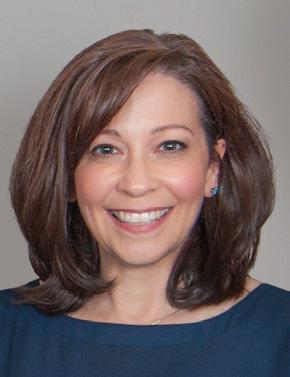
Scott, CAE, is WSCPA President & CEO. Contact Kimberly at kscott@wscpa.org.
What to Expect from WSCPA
1. Education That Fits Your Career (Not Just Your CPE Tracker)
Imagine being able to access personalized learning pathways, connect to the right education at the right moment in your career, and even uncover education beyond technical skills (like communication, leadership, and workplace effectiveness).
Expect education that feels less like compliance and more like information to fuel your career.
2. More Connection. More Community. More “I Belong Here.”
Expanded in-person and local engagement opportunities across the state, including low-pressure, easy-to-join gatherings that fit various personalities and lifestyles.
New ways for you to connect with fellow members through cohorts and small groups, especially for those early in their careers or new to industry.
3. Learning That’s Experiential (and Actually Sticks)
Say goodbye to eight hours of sitting and listening. And hello to more hands-on, discussion-based, real-world learning, where you try things, talk through your challenges with peers, and walk away with skills you can use the next morning.
4. Advocacy That Works for You (Even If You Do Not Have Time to Follow Policy)
Get ready for new ways of being informed about the impact of advocacy efforts and opportunities for firm leaders to be engaged more directly. And we’ll continue advocating for policies that protect the profession and the public.
5. Meeting You Where You Are (Yes, That Means Less Email)
Instead of more email, expect more member stories via short-form videos, more personalized messaging, and new ways for you to connect with each other, including the newly-launched Circle community with more opportunities for you to connect and share in a secure, member-only space.

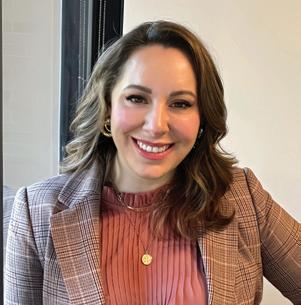
KAIRI ROBERTS, CPA Director
Term: 3 years
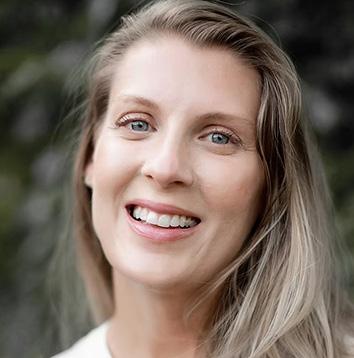
Kairi Roberts, CPA, serves as President of Anderson Lampe, P.S., where she strives to provide steady tax guidance and strategic insight through meaningful relationships with both business and individual clients. She values connection, leadership, and building a profession that supports clients, other professionals, and the next generation of CPAs. A Gonzaga alum and licensed CPA since 2018, Kairi has been an active member of the WSCPA Spokane Chapter Board since 2020, serving in a variety of roles during her tenure. She has been a WSCPA member for nearly eight years and is deeply invested in the future of the CPA profession and the impact it has on local businesses and communities. Outside the office, she enjoys time with her family and a lively household full of beloved pets.
If you could instantly master any hobby tomorrow, what would it be and why? Painting. It would be fun to create something beautiful without needing to reconcile it first.
What’s one skill every future professional should start building now? Relationship and communication skills. Technical expertise is essential, but the ability to connect, collaborate, and build trust is what sustains a long and meaningful career.
What’s a piece of advice you once received that changed how you work? During an internship early in my career, someone told me, “Always be the person people love working with.” That advice stuck with me. I’ve tried to be the colleague who is helpful, responsive, and supportive, and I truly believe that mindset has shaped my career more than any technical skill.

REMAINING ON THE BOARD
The following members currently serve on the Board and will continue serving in 2026-2027:
Chair: Kelly Nelson, CPA
Immediate Past Chair: Joel Williams, CPA
President & CEO: Kimberly Scott, CAE
Directors:
Benjamin Hall, CPA, MPAcc
Jamie Hueners, CPA
Michaela Kay, CPA
Ursula Perkins, CPA
Andrew Prather, CPA
Scott Rodgers, CPA, MSTax
Rachel Ross, CPA
WSCPA Board Transition Announcement
Jenny Cravens, CPA, MAC , has tendered her resignation, effective May 31, 2026, from the WSCPA Board of Directors. We extend our sincere thanks to Jenny for her dedicated service and contributions to the Board, and we are grateful for the insight and leadership she brought to the organization.
In accordance with WSCPA Bylaws (section 2.11), the Board of Directors has appointed Ed Ramos, CPA, shareholder of DP&C in Tacoma, Washington, to fill this vacancy, effective June 1, 2026 through May 31, 2028. We are pleased to welcome Ed back to the Board, where he previously served from 2022-2025. Ed remains actively engaged in the profession and currently serves at the national level as a member of the AICPA Council.

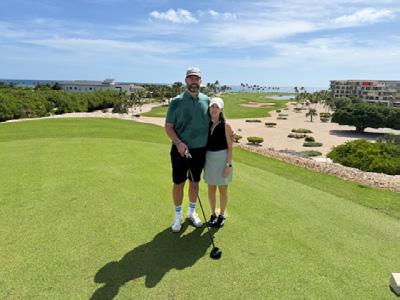
On vacation and at a golf course in Punta Cana, Dominican Republic.

The New ROI: Return on Involvement
by Monette Anderson, CAE
As of 2024, investors have poured nearly $1.6 trillion into artificial intelligence (AI)1. Global capital expenditures are projected to approach $700 billion by 2026. The investment is massive, but the success rate is sobering: nearly 95% of generative AI corporate pilots fail to deliver measurable ROI, according to a 2025 MIT report2
The disconnect isn't technical. It is a failure of the human systems required to integrate these tools. While technology is remarkable at scaling efficiency, it also scales whatever culture already exists.
Think of AI as a mirror. If your organization’s culture is siloed and burnt out, AI will only automate the silos and accelerate the burnout.
• AI boosts performance only in highly collaborative teams, according to Microsoft Work Trend Index 20253
• As automation increases, uniquely human capabilities, such as collaboration, adaptability, and judgment, become more valuable, not less, explains Deloitte’s “State of AI in the Enterprise: The untapped edge” report4
• Firms with engaged employees and strong cultures dramatically outperform those that treat AI as a purely technical upgrade, found McKinsey in its 2025 Global Survey on the state of AI5
The data points to a clear conclusion: the limiting factor in AI adoption is not the technology. It is the human system around it. Authors in the Harvard Business Review6 have repeatedly emphasized that “weak [social] ties” (the broader network of professional acquaintances beyond one’s immediate circle) are what drive innovation. AI doesn't replace the need for these ties; it increases the importance of the trust and culture that a robust network provides.
Why Return on Involvement is your Competitive Advantage
During WSCPA firm visits across the state this year, we heard a recurring tension that stems from the talent scarcity in our profession: many organizations remain cautious about encouraging their staff to increase their external visibility. We heard broad concern that exposing top talent to the broader profession creates a poaching risk. However, other firms take a different view with one firm saying, “If our staff leave for a competitor from attending an industry event, shame on us.” Another firm leader recently shared that he often tells his staff, “CPA stands for Certified Public Accountant. If we’re not in the public, we’re missing the point.”
"Community is not a distraction from the work; it is the framework that makes the work sustainable."
When professionals engage beyond the four walls of their own firm, the organization gains an operating advantage through:
• Perspective under pressure: Exposure to how peers are navigating AI, succession, and regulatory change in real-time.
• Leadership maturity: Structured environments where professionals test ideas, compare strategy, and develop decision-making capacity.
• Professional Ecosystem Literacy: Understanding the legislative intent of a new regulation while it is still in committee rather than reacting after it has passed.
• From “Job” to “Profession”: Professional embeddedness can be a primary driver of staff retention. When work ceases to be a series of tasks and becomes a career, it creates a shift in identity that acts as a powerful deterrent to burnout.
From Engagement to Design
What if in response to this, the most groundbreaking strategy is to design external exposure intentionally? This means moving beyond seeing professional community as a "calendar activity" and instead treating it as a core business function. In practice, this design can take many forms:
• Dedicated professional development stipends earmarked specifically for staff to engage within the profession
• Structured participation in peer cohorts and cross-firm roundtables to stress-test internal strategies
• Encouraging staff to serve on committees and advisory groups that shape the professional standards staff must eventually follow
• Creating space for staff to speak, publish, and contribute publicly, elevating the firm’s brand through the expertise of its people
The WSCPA does more than host events; we build the type of community that supports this engagement. We serve as the laboratory where your team can develop the professional grounding and ecosystem literacy that your internal systems may not provide alone.
Whether it is through our Committees and Resource Groups for real-time peer troubleshooting and building learning engagement at conferences, our Advocacy teams protecting the profession's interests, or our Emerging Leader Committee designed to connect professionals regionally through networking and service projects, we are here to help you scale your human systems alongside your technology.
Community is not a distraction from the work; it is the framework that makes the work sustainable.
How is your firm designing exposure this year? Need help plugging in on an individual or firm-wide scale? Reach out to me or fill out a committee interest form to be plugged in.
Sources:
Monette Anderson, CAE, is WSCPA Vice President of Membership and Education and Executive Director of the Washington CPA Foundation. Contact Monette at manderson@wscpa.org.
1. Elias, Jennifer, “Tech AI spending may approach $700 billion this year, but the blow to cash raises red flags,” CNBC, https://www.cnbc.com/2026/02/06/ google-microsoft-meta-amazon-ai-cash.html.
2. The GenAI Divide: State of AI in Business 2025. MIT. https://mlq.ai/media/ quarterly_decks/v0.1_State_of_AI_in_Business_2025_Report.pdf.
3. Microsoft Work Trend Index 2025: https://www.microsoft.com/en-us/ worklab/work-trend-index/2025-the-year-the-frontier-firm-is-born.
4. The State of AI in the Enterprise: Deloitte’s 2026 AI report tracking adoption and impact, https://www.deloitte.com/content/dam/assets-zone3/us/ en/docs/services/consulting/2026/state-of-ai-2026.pdf.
5. The State of AI in 2025: Agents, innovation and transformation: McKinsey https://www.mckinsey.com/capabilities/quantumblack/our-insights/ the-state-of-ai
6. Bojinov, Iavor, et al. “Which Connections Really Help You Find a Job.” Harvard Business Review, https://hbr.org/2022/12/which-connectionsreally-help-you-find-a-job, 1 Dec. 2022.
photos: ©iStock/miniseries, ©Shelly Oberman Photography
Have you joined our new online community platform? Jump in today at wscpa.org/circle
individual’s property. Property taxes are required by the State Constitution to be uniform and capped at 1%. If income were to remain to be considered property, this tax would be limited by those restrictions. Many proponents of the tax hope that the current State Supreme Court will overturn the past precedent that income is property, which would allow for non-uniform progressive income taxes in the future.
These political and legal challenges will take time to work out. If the tax is upheld, there would likely be a push to restructure many of the other taxes in our state to align with an income tax system. Notably, this could include transitioning from the B&O tax to a corporate income or margin tax. It could also include restructuring the capital gains excise tax as a true addition to an income tax, which is how every other state with such a tax operates.
The state’s budget issues would not be solved should this tax be upheld. With the passage of the millionaire’s tax, a surplus is projected at the end of the state fiscal biennium in June 30, 2029. However, those projections are based on the assumption that state expenses will only increase 2.2% during that biennium. For the past decade, the average growth for state spending has been about 15%, with the lowest biennial growth rate being 11.3%. If state spending were to increase at 11.3%, the budget
would still be many billion dollars short when legislators adopt a new biennial budget.
With all of these changes and challenges, there will be many administrative and technical issues that the state will need to address, either with these existing taxes or new tax systems. The WSCPA Government Affairs Committee has many dedicated state and local tax (SALT) CPAs who will compile recommendations and feedback on all of these issues and more in the future.
Learn More
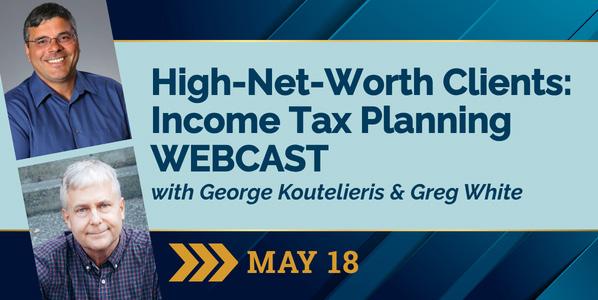
• May 18: High-Net-Worth Clients: Income Tax Planning Webcast: This course delivers a comprehensive and strategy-driven approach to income tax planning for high-net-worth clients. Register at wscpa.org/worth
• May 20: Washington State Tax Conference: Register now at wscpa.org/wa-tax

Mike Nelson is WSCPA Manager of Government Affairs. Contact Mike at mnelson@wscpa.org.
illustration: ©iStock/VladSt, photo: ©iStock/cosmonaut
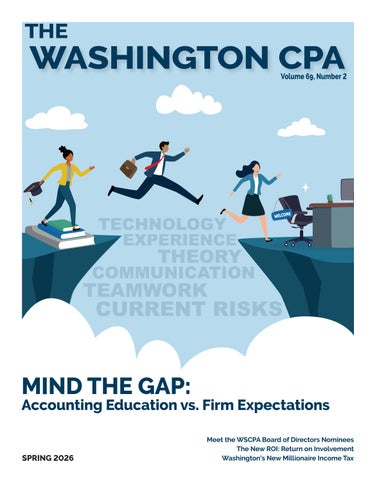
TECHNOLOGY EXPERIENCE THEORY COMMUNICATION TEAMWORK CURRENT RISKS
Mind the Gap: Accounting Education vs. Firm Expectations
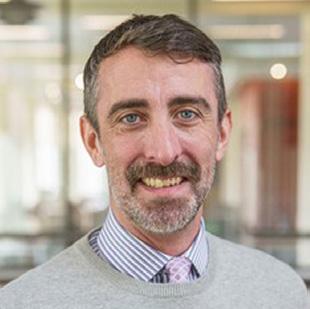
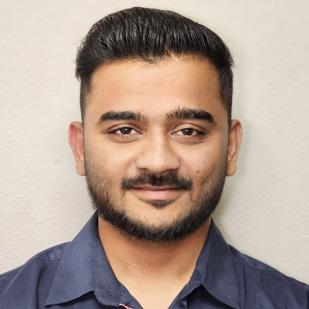
by Dr. Gabriel Saucedo, PhD, and Vikram Parihar, Master of Science in Accounting & Analytics
The multitude of undergraduate- and graduate-level accounting students soon to enter the workforce across the state and country are at an interesting intersection (i.e., gap but not “GAAP”) between the demand skillset employers desire and the supply skillset universities and colleges advance to the workforce.
At the same time, the profession itself is undeniably changing quickly. The evolution of the CPA certification is reshaping the exam to embed information systems and data analytics into the core, while also adjusting experience requirements. AI and automation tools are becoming part of everyday work in audit, tax, and advisory. And firms are feeling the pressure of a talent shortage while client expectations keep rising.
For CPAs in Washington, this moment is both a challenge and an opportunity. The way we engage with universities and students today will shape the future of the profession. This article and the following crafted pillars are our way, through the lens of a student in the pipeline, to identify gaps clearly so that we can address them, together, and with intention.
The Six Pillars of the Education–Expectation Gap
1. Technology Skills Gap: Knowing the Rules, Not the Tools
Most accredited accounting programs still provide strong coverage of technical content: GAAP, auditing standards, tax law, and ethics. However, students may progress through their degrees with only limited exposure to the tools that dominate daily work in practice, including but not limited to Alteryx, Power Bi, Tableau, and ERP systems. This deficiency of sorts is not from lack of desire though, but more so to limited credit hours in academic programs.
In contrast, firms operate in environments where technology is deeply embedded in every engagement. Entry-level staff may be expected to work with large, unstructured data exports, build complex spreadsheets with nested formulas and pivot tables, design dashboards for internal and client use, and navigate multiple software platforms within a single project. Increasingly, they also interact with AI-enabled tools for tasks like document ingestion, anomaly detection, and automated workpaper preparation (Intuit QuickBooks, 2024, 2025; Wolters Kluwer, 2025).
This mismatch creates a subtle but significant barrier. Students who are extremely comfortable with rules-based reasoning can feel clumsy when working with new tools, especially under time pressure. Firms, for their part, may interpret this discomfort as a lack of initiative or curiosity, when it is often the result of structured learning environments that have not required repeated, hands-on practice with real systems.
2. Practical Experience Gap: Textbook Problems vs. Messy Reality
It is common for academic cases and problems to be designed so intentionally that they are solvable within a class period or a single homework assignment. Transactions are clearly labeled; data is clean and complete; and there is frequently (but not always) a single correct answer that can be checked against an instructor’s key.
In professional practice, information rarely arrives in this form. Documents are missing, client records are incomplete, and data is scattered across emails, legacy systems, and spreadsheets of varying quality. Staff must learn to reconcile versions, question assumptions, and tolerate ambiguity.
Internships and part-time roles may bridge this gap. However, the attainment of an internship is understandably not a promise. The result is that many graduating students have seen relatively few real bank statements, contracts, or reconciliations. They may understand the theory of designing a control or testing a balance but have never had to work through a large volume of messy underlying evidence within a tight deadline.
3. Focus of Learning: Theory vs. Real World
Course curricula and academic learning objectives often may be oriented toward examinations, accreditation standards, and CPA pass rates. At the same time, course designs may also emphasize structured problems and multiple-choice questions aligned with the CPA exam blueprint (Becker, 2023).
In firms, however, performance is evaluated less on “getting the right answer” and more on exercising sound judgment, managing risk, and communicating recommendations under uncertainty. Staff members encounter ill-structured problems: incomplete audit trails, conflicting client explanations, or rapidly changing facts. In these scenarios, there may not be a single correct solution, but rather a range of reasonable responses. The CPA Evolution model, with its “core plus discipline” structure and greater emphasis on technology and analytics, is an acknowledgement of this reality (AICPA and NASBA, n.d.; Becker, 2023).
Yet the translation from exam reform to day-to-day teaching practice is gradual. Students can still progress through programs primarily by excelling on traditional exams, without engaging extensively in open-ended tasks that require them to define the problem, select appropriate methods, and defend their reasoning. This gap between theory and real-world application can lead to misaligned expectations. Students may assume that providing the correct technical answer is sufficient, while supervisors expect them to prioritize issues, flag uncertainties, and propose practical next steps.
4. Communication Skills Gap: From Technical Jargon to Business Language
Classroom audiences, professors, and classmates usually share a common vocabulary and background knowledge. Assignments are graded primarily on technical accuracy, not on whether a non-specialist would understand the explanation.
In professional settings, the audience is more varied. Audit committees, small business owners, department managers, city officials, and non-profit boards may each have different levels of familiarity with accounting concepts. They are less concerned with the mechanics of a standard and more concerned with its implications: liquidity, compliance, reputation, and longterm viability.
Research from Wiley suggests that firms consistently rate new graduates lower than students rate themselves in communication, presentation, and teamwork skills (Wiley, 2021). This mismatch can be seen in everyday interactions: emails that are overly technical or vague, presentations that dwell on procedural detail without highlighting key risks, or memos that identify issues but stop short of suggesting options. The communication gap is not simply a matter of “speaking plainly.” It involves learning to structure information, anticipate stakeholders’ questions, and calibrate tone. It also has a cross-cultural dimension, especially
in diverse regions like Washington, where clients and colleagues may bring different communication norms and expectations to the workplace.
5. Soft Skills Gap: From Individual Grades to TeamBased Work
Another gap concerns soft skills, or what might also be called professional skills. University assessments largely emphasize individual performance: exams, quizzes, and solo assignments. Group projects exist, but students may experience them as logistical challenges rather than as opportunities to practice teamwork and leadership.
In firms, by contrast, almost all meaningful work is team-based. Engagements require coordination across roles, across levels of seniority, and often across locations. Staff must manage their calendars, ask for help early, respond to feedback, and adapt to changing priorities. This has become even more complex as hybrid and remote work arrangements have expanded.
Surveys repeatedly highlight soft skills, problem solving, flexibility, teamwork, and professionalism, as among the most difficult attributes to find in new hires (Wiley, 2021; Wolters Kluwer, 2025). Yet these skills are also harder to teach and measure in classroom environments than technical knowledge.
6. Industry Awareness Gap: Yesterday’s Cases vs. Today’s Risks
The sixth and final gap involves an awareness of the broader environment in which accounting operates. Many courses may still rely heavily on historical frauds and legacy cases to teach ethics and professional skepticism. While these are valuable, they do not fully capture the current risk landscape.
Today, firms are increasingly dealing with ESG reporting and assurance, cybersecurity and data privacy in finance functions, crypto assets and digital payments, remote-work tax implications, and governance around the use of AI tools (Intuit QuickBooks, 2025; Wolters Kluwer, 2025). Washington companies are not exceptions; they face pressures from regulators, investors, donors, and citizens to manage these emerging areas responsibly.
However, students may encounter these topics only briefly, perhaps in elective courses or isolated class sessions. Their regular reading may consist more of textbooks than of professional publications such as the Journal of Accountancy, AICPA and WSCPA materials, or industry research.

Bridging the Gap: A Shared Agenda for Washington
Taken together, these six pillars describe a systemic education–expectation gap rather than a shortcoming of any single stakeholder group.
• Universities must balance limited credit hours with broad technical coverage and strong CPA exam performance.
• Firms are rapidly implementing new technologies while navigating a constrained domestic pipeline and rising client expectations.
• Students are trying to decide where to invest their energy, often with incomplete information about what practice will require five or ten years from now.
The most promising response to bridging any of the aforementioned gaps involves collaboration rather than isolated efforts. For example, advisory boards with substantive input from firms; co-designed assignments that integrate theory, tools, and judgment; stackable micro-credentials signaling baseline technology skills; and shared storytelling through professional platforms to highlight successful partnerships.
If the education–expectation gap is left unaddressed, we risk losing potential CPAs who feel unprepared, overwhelmed, or drawn to professions that appear more aligned with the future of work. If, however, we collaborate and engage actively among firms, educators, and students, and the WSCPA, this gap can become more of a bond and source of strength, creating a pipeline of CPAs who are relevant, resilient, and innovative.
Selected References
Vikram
AICPA and NASBA. (n.d.). CPA Evolution initiative and model curriculum.
Becker. (2023). What is CPA Evolution?
Intuit QuickBooks. (2024). Accountant Technology Survey 2024.
Intuit QuickBooks. (2025). 2025 Accountant Survey: AI and Strategic Advisory. Wiley. (2021). Skills gaps and work strengths of the incoming accounting cohort. Wiley Efficient Learning / Wiley Newsroom.
Wolters Kluwer. (2025). Future Ready Accountant Report 2025.
Dr. Gabriel Saucedo is an Assoc. Professor and Chair of the Accounting Department at Seattle University. Prior to completing his PhD at Virginia Tech, he earned his undergraduate business admin. degree from Gonzaga University and worked at KPMG-Seattle in the audit practice. Contact Gabriel at saucedog@seattleu.edu.
Parihar received his Master’s in Accounting & Analytics (MSAA) from Seattle University 2025. He currently works as a Budget Analyst for DATA-LINC GROUP in Issaquah, Washington. Contact Vikram at vparihar@seattleu.edu.
Faster payments. Easier billing.
Get paid faster and simplify billing with 8am CPACharge, trusted by 25k+ accounting professionals.
Purpose-built for accounting professionals
Faster reconciliation with next-business-day deposits
Preferred by AICPA and 30+ state CPA societies


Built for accounting. Trusted by CPAs.
©iStock/artis777
WSCPA Hosts Student Leadership Symposium for Future CPAs
by Monette Anderson, CAE
For many accounting students, the path to the CPA profession begins in the classroom. Yet the experiences that truly shape confidence and career direction happen when students connect directly with practicing CPAs. Future CPAs are enabled to see their place in the community when they engage early on with the profession, develop leadership skills, and build meaningful relationships with CPAs.
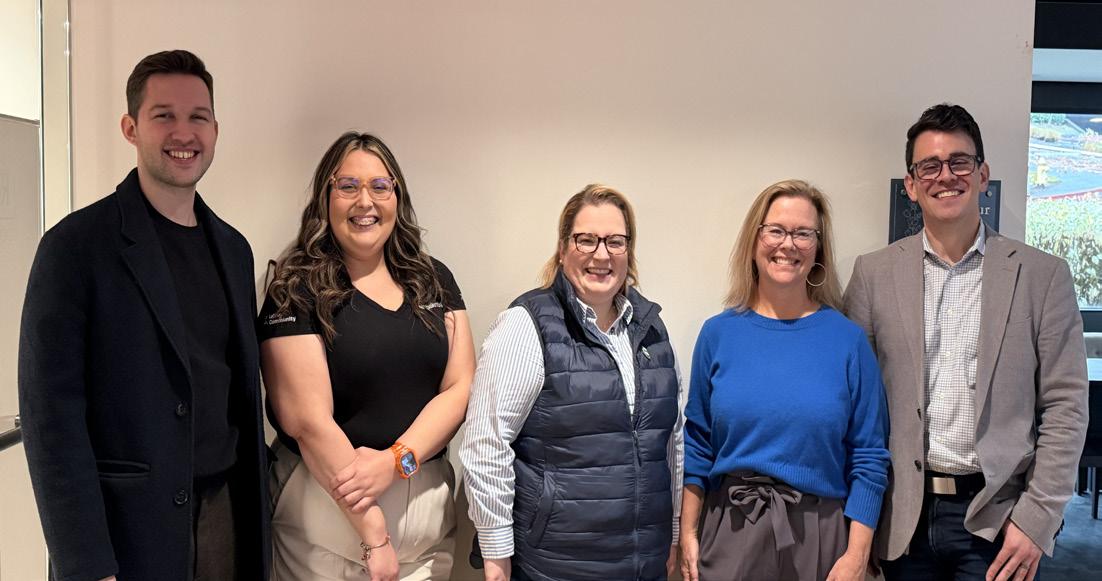
Last November, early-stage accounting students from across Washington attended the first WSCPA Accounting Opportunities Symposium, a day focused on leadership development, professional connection, and career exploration.
Twenty-five students attended the inaugural event, including many recipients of scholarships awarded through the Washington CPA Foundation. The symposium was designed to complement the Foundation’s financial support by providing students an opportunity to engage directly with CPAs and begin building their professional networks.
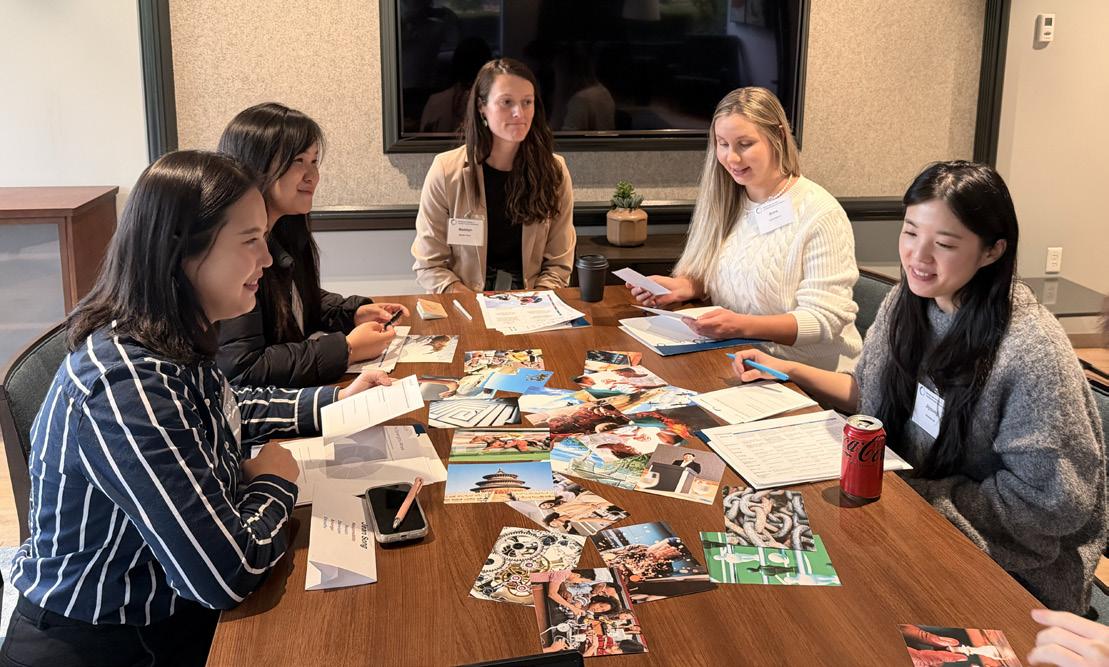
The program centered on strengths-based leadership, beginning with a workshop helping students identify and understand their Gallup CliftonStrengths top five talent themes. Through guided exercises and discussion, students explored how their natural talents influence communication, decision-making, and collaboration.
For many participants, the experience offered a new perspective on leadership development. Jean Song said, “This event was truly impactful — it gave me new motivation, direction, and energy for my career journey. I’m grateful for the guidance, the conversations, and the reminder that I’m moving in the right direction.” Rather than focusing primarily on weaknesses, students reflected on how leaning into their natural strengths can help them contribute more effectively to teams and navigate their early careers with greater confidence. Jen Bixby noted, “One of the highlights for me was learning more about the Gallup CliftonStrengths assessment. Seeing a leader who also leads with Relationship Building was particularly inspiring and reinforced the idea that there are many paths to leadership — we are most powerful when we show up as our authentic selves.”
illustration:
Following the workshop, students heard personally from professionals during a panel discussion on strengths and perspective in the accounting profession, where practitioners shared how their own strengths have shaped their career paths and leadership styles —whether they naturally excel at building relationships, thinking strategically, driving execution, or influencing and inspiring others.
In the afternoon, students gathered in small groups with professionals to discuss how to navigate the transition from college to career, keys to build relationships within firms and organizations, and ways to identify opportunities for growth early in their professional journeys.
The event reflects WSCPA’s broader commitment to supporting the long-term strength of the profession in Washington. Kimberly Scott, President and CEO noted, “One of the most important things we can do for the future of the profession is invest in emerging leaders early. When professionals understand their strengths and connect with a supportive community, they are better equipped to grow into confident and impactful leaders.” While the Washington CPA Foundation provides scholarships that help students pursue accounting degrees, programs like this student leadership symposium help students develop the confidence, connections, and leadership skills that will shape the profession’s future.
As WSCPA continues expanding its student engagement efforts, the goal is simple: ensure that the next generation of CPAs not only enters the profession prepared but also feels connected to a professional community invested in their success. In scholarship essays and thank-you notes, students often reflect on how encouraging it is to know that the profession is supporting their path forward. This student leadership symposium builds on that support by creating opportunities for students to connect directly with the people and community behind it.
Student Leadership Symposium at a Glance
• 25 accounting students attended
• Participants represented multiple Washington colleges and universities
• About half were Washington CPA Foundation scholarship recipients
• Program included strengths-based leadership training, professional panels, and networking with firms
Monette Anderson, CAE, is WSCPA Vice President of Membership and Education and Executive Director of the Washington CPA Foundation. Contact Monette at manderson@wscpa.org.

FIRMS
Baker Tilly
Clark Nuber PS
Deloitte LLP (Seattle)
EY (Seattle)
Hellam Varon & Co Inc PS
HKP Advisors
Johnson & Shute PS
KPMG LLP (Seattle)
Thank You, Contributors!
With your generous contribution to the Certified Public Accountants PAC we have continued to provide a strong voice for the profession and develop vital relationships with legislators.
As the only professional association advocating for CPAs in Olympia, your contribution ensures that the profession has a seat at the table as legislation moves forward. As many WSCPA members are tax policy experts, we have also provided a valuable resource to legislators as they consider the implantation and impacts of various tax proposals.
These contributors donated to the CPAPAC between March 2025 and February 2026.
PwC LLP (Seattle)
Tamarack Tax and Consulting LLC
AMBASSADORS CLUB $500+
Randy A. Howard, CPA
Raquel R. Nelson, CPA
Rachel S. Ross, CPA
photo:
ADVOCATES CLUB $100-$499
Anna W. Au, CPA
Bryan Avery, CPA
Bob R. Berntson, CPA
David A. Brown, CPA
Richard F. Burger Mackey, CPA, CIA, CFE
Anthony J. Cook, CPA
Wesley L. Delaney, CPA
Sarah K. Funk, CPA, CGMA
Benjamin D. Hall Sr., CPA, MPAcc
Daniel Hall
Rica Herrera
Mark A. Hugh, CPA
Kathryn L. Lapin, CPA
Seth A. Milleson, CPA
Bea L. Nahon, CPA, CGMA
Kristine T. Nelson, CPA, MPAcc
Ursula A. Perkins, CPA
Jillian M. Robison, CPA
CPAPAC MEMBER $50-$99
Todd S. Arkley, CPA
Pat L Bohan, CPA, CGMA, CGF
Christine B. Brunner, CPA
Gordon R. Craig, CPA, CFE, CIA
Jay F. Cramer
Jennifer B. Cravens, CPA, MAC
Joseph P. Deacon, CPA
Zenaida D. Fletcher, CPA, MBA, CFP
Bert R. Golla, CPA
Rick H. Graham, CPA
William J. Graham, CPA
Monty L. Harmon, CPA, CFF
Patricia A. Hernandez, CPA, CGMA, MBA
Donald J. Hess, CPA
Marc S. Hutchinson, CPA
Cindy L. Isaacson, CPA
Michaela D. Kay, CPA
Bruce I. Mitchell, CPA, MBA
Thomas P. Nicholas, CPA
Douglas M. Oord, CPA
Valerie A. Pickens, CPA, CIA
Elizabeth L. Redmond, CPA
Christopher J. Rieke, CPA
Donald L. Rodman, CPA, MBA
CONTRIBUTORS $1-$49
William A. Braunberger, CPA
Clifford M. Frederickson, CPA, CGFM
Carrie A. Martin, CPA
Ralph Siegel, CPA
Hiroto Takagi, CPA
ADVOCACY VOLUNTEERS
We'd like to extend a special thank you to these individuals who went above and beyond to assist with PAC and Hill Day efforts.
Emily Alvarez
Anna Au
Haliunaa Baterdene
Michele Bertone
Richard Burger Mackey
Art Campbell
Lindsey Chuang
Tony Cook
Adam Cline
Nancy Duffy
Dani Espinda
Sara Funk
Jasara Gribble
Edith Hopper
Mark Hugh
Writu Kakshapati
Michaela Kay
Darcy Kooiker
Lowel Krueger
Adalayda Lopez-Santillano
Carina Luo
Elizabeth Masnari
Susan J. Sanders, CPA
Kimberly D. Scott, CAE
Julleen J. Snyder, CPA, CGMA
Charity B. Stegmeier, CPA, MHA
Duy-Linh Ta, CPA
David H. Togami, CPA
Marianna J. Willey, CPA
Joel H. Williams, CPA
Craig S. Ruthford, CPA
Daniel J. Schroeder, CPA
Leslie A. Sesser, CPA
Jay T. Shilhanek, CPA
Michael D. Sweeney, CPA
Susan L. Thomson, CPA
Carol A. Woo, CPA
Pete Miller
Bea Nahon
Tom Neill
Kelly Nelson
Ursula Perkins
Rachel Roberson
Jillian Robison
Scott Rodgers
Shelly Rogers
Rachel Ross
Leslie Sesser
Julleen Snyder
David Togami
Bob Underhill
Alexis Vergara
Ali Williams
Brandt Williams
Joel Williams
Mckayla Yang
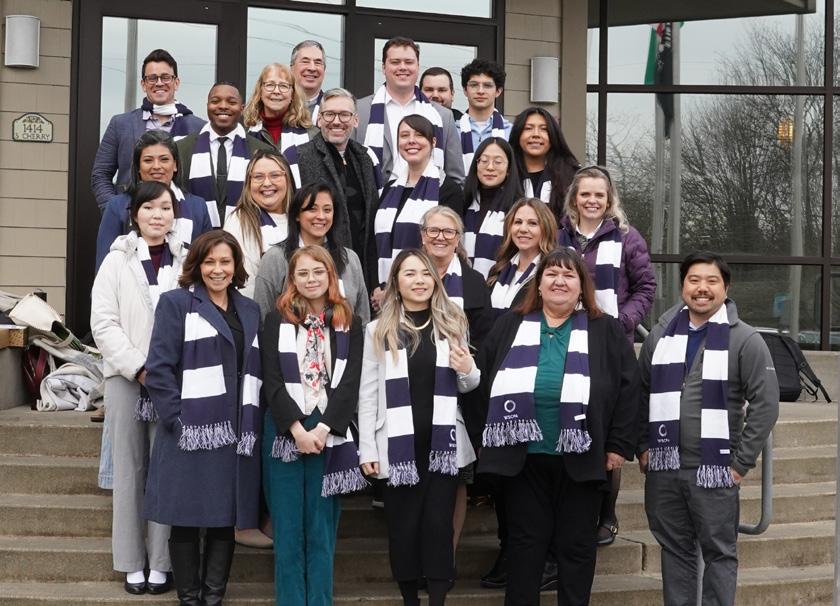
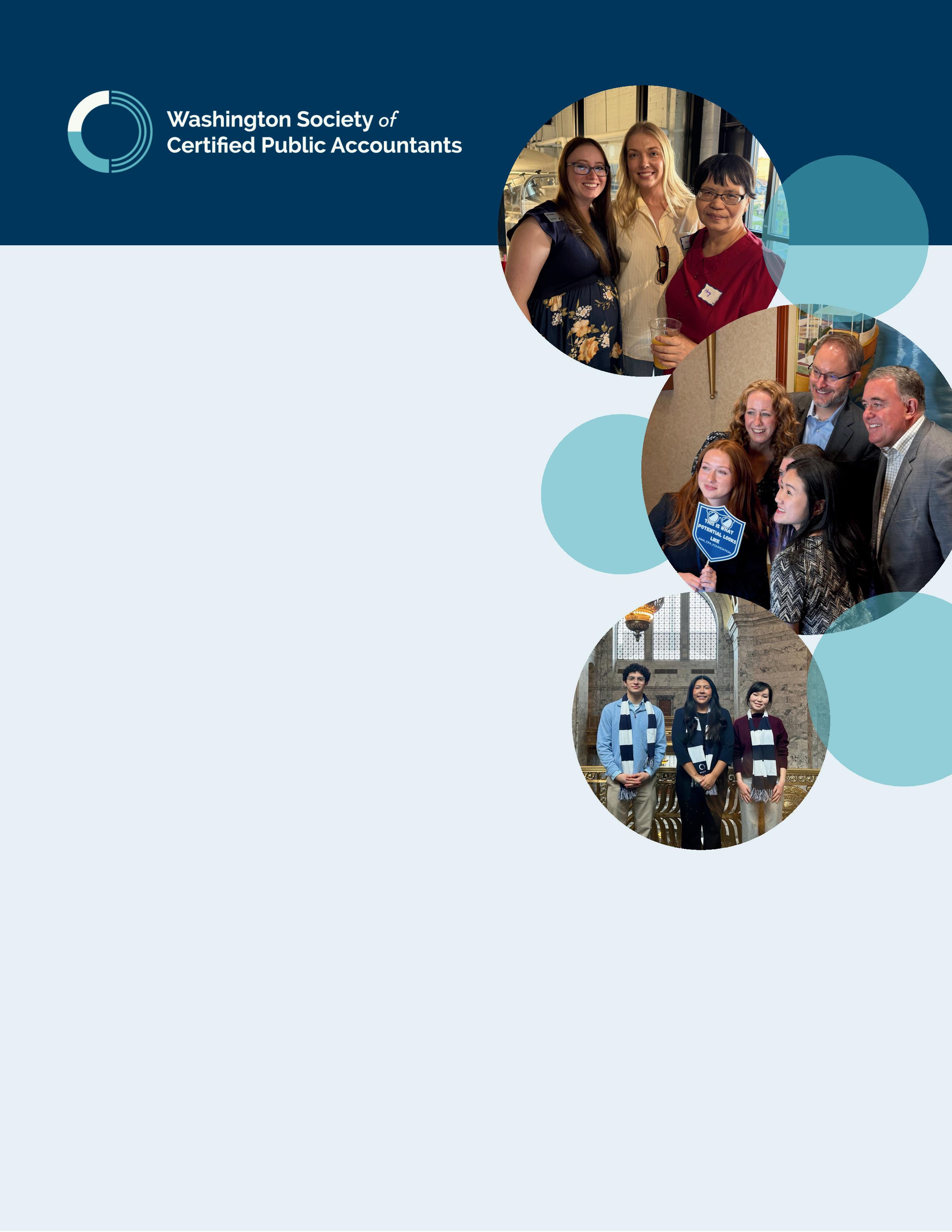
A group of advocacy volunteers attended Hill Day 2026 in Olympia.
Investing in the Future of the CPA Profession
The CPA profession has long been built on a foundation of integrity, expertise, and a commitment to lifelong learning. Accountants know that financial statements reflect a story behind the numbers.
They capture where we’ve been and where we’re going; just like the future of our profession, which is shaped by those who step up to support aspiring CPAs.
In recent years, we’ve seen continued challenges facing students and aspiring CPAs: rising education costs, the evolving demands of the profession, and a competitive job market that can make it difficult to attract and retain top talent. Despite these hurdles, our community of professionals continues to rise to the occasion, providing vital financial support, mentorship, and opportunities that empower future CPAs to succeed.
Through the generosity of our Foundation donors, we are building a strong pipeline of future leaders who will carry this profession forward. Your contributions help ensure that talented, driven individuals can pursue their CPA dreams without financial barriers standing in their way.
On behalf of the WSCPA and the future CPAs whose lives you’ve impacted, thank you for investing in the next generation. Your commitment makes a difference—not just today, but for years to come.
NAMED SCHOLARSHIPS & ENDOWMENTS
$5,000+
Baker Tilly LLP Accounting Scholarship
Clark Nuber Accounting Scholarship
EY Accounting Scholarship
George J. Waterman Memorial Scholarship
KPMG LLP (Seattle)
PwC Accounting Scholarship
Roy J. Polley Memorial Endowed Scholarship
Sambataro Family Foundation
FIRM CONTRIBUTIONS
Newman Town PLLC
Paulsen Megaard & Co PS
Ranta CPA & Associates
SENIOR EXECUTIVES
CIRCLE
$1,000-$2,500
Jennifer B. Cravens, CPA, MAC
Jacqueline L. Davidson, CPA, CGMA
David L. Dierst, CPA
Leonard J. Heritage, CPA, JD, CGMA, MBA
Jamielyn R. Hueners, CPA
Eaon J. Roberts, CPA, CFE
EXECUTIVES CIRCLE
$500-$999
Pat L. Bohan, CPA, CGMA, CGF
Richard F. Burger Mackey, CPA, CIA, CFE
Dani L. Espinda, CPA, CGMA
Richard D. Greaves, CPA
Kris L. Lambright, CPA, CGMA
Arthur D. Miles, CPA
Dr. Gerhard G. Mueller, PhD
Jillian M. Robison, CPA
Rachel S. Ross, CPA
Kimberly D. Scott, CAE
Joel H. Williams, CPA
LEADERS CIRCLE
$250-$499
Anna W. Au, CPA
Zenaida D. Fletcher, CPA, MBA, CFP
Sarah K. Funk, CPA, CGMA
Benjamin D. Hall Sr., CPA, MPAcc
Mark A. Hugh, CPA
Ursula A. Perkins, CPA
Elizabeth L. Redmond, CPA
David H. Togami, CPA

Washington CPA Foundation Awards $50,000 in Grants to Strengthen the Accounting Pipeline: The Washington CPA Foundation continues its mission to strengthen and expand the accounting profession by investing in programs that inspire and support the next generation of CPAs. Find out which organizations were chosen on our blog at wscpa.org/blog
SENIOR CONTRIBUTORS $100-$249
Alex T. Anderson
Erica M. Ash, CPA, MBA
Bob R. Berntson, CPA
David A. Brown, CPA
Claire E. Brunhaver, CPA
Anthony J. Cook, CPA
Gordon R. Craig, CPA, CFE, CIA, CI
Bonnie L. Curran, CPA
Wesley L. Delaney, CPA
Todd H. Hangen, CPA
Wayne E. Hays, MBA
Jacqueline J. Henry, CPA
Patricia A. Hernandez, CPA, CGMA, MBA
Michael J. Holmes, CPA
Marc S. Hutchinson, CPA
Sheila R. Lozan, CPA
John F. Lynch, CPA
Louis H. Mills, CPA
Kristine T. Nelson, CPA, MPAcc
Jack B. Person, CPA
Susan J. Sanders, CPA
Gabriel D. Saucedo, CPA
SUPPORTING CONTRIBUTORS $1-$99
Leonard L. Almo, CPA, MBA
Todd S. Arkley, CPA
Allison Benabente, CPA
Gregg W. Blodgett, CPA
Christine B. Brunner, CPA
Jay F. Cramer
Joseph P. Deacon, CPA
Robert J. Erickson, CPA, JD
Clifford M. Frederickson, CPA, CGFM
Bert R. Golla, CPA
Robert B. Gulrajani, CPA, CGMA, CFP
Sandra J. Heffernan, CPA
Donald J. Hess, CPA
Cindy L. Isaacson, CPA
Raad T. Kattula, CPA
Michaela D. Kay, CPA
Jo A. Kelly, CPA
Madeline Kling
Carol M. LaMotte, CPA
Carrie A. Martin, CPA
Bruce I. Mitchell, CPA, MBA
Annette M. Moore, CPA
Thomas P. Nicholas, CPA
Valerie A. Pickens, CPA, CIA
Stephen J. Reddaway, CPA
Christopher J. Rieke, CPA
Leslie A. Sesser, CPA
Janis H. Simpson, CPA
Joseph C. Smith
Julleen J. Snyder, CPA, CGMA
Cynthia J. Spencer, CPA, CGMA
Peter J. Stirling, CPA
Leonard C. Sweet, CPA, ABV
Benjamin J. Warren
Simeng Yu, CPA
Craig S. Ruthford, CPA
Jay T. Shilhanek, CPA
Stacy A. Short, CPA, CGMA
Cathy L. St John, CPA
Dianne J. Stoehr, CPA
Michael D. Sweeney, CPA
Hiroto Takagi, CPA
Susan L. Thomson, CPA
Richard A. Volk, CPA
Dorothy R. Wagsholm, CPA
Valerie J. Weller, CPA
Azucena A. Wingard Haifeng Xu

Upcoming CPE
A small sampling of WSCPA CPE events scheduled May - June are listed.
To view all of courses and complete details, please visit the CPE & Event Catalog at wscpa.org/cpe.
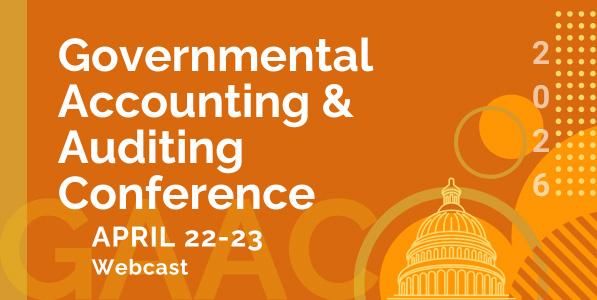
Governmental Accounting & Auditing Conference and Community Mixer (Day 1)
April 22-23 | Webcast | 16 CPE Credits
Keep up with new standards, as well as current trends affecting local government agencies. Experts will provide essential guidance to help you stay in compliance with standards and share advice on the latest technologies. Prepare to make great strides in governmental A&A. Attend the Community Mixer on the first day.
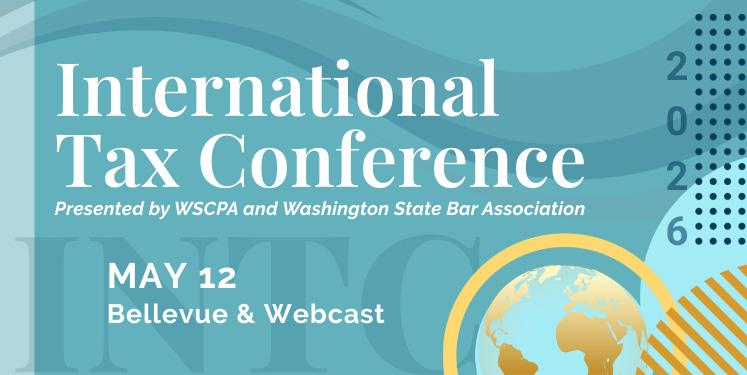
International Tax Conference and Community Mixer
May 12 | Bellevue & Webcast | 8 CPE Credits
Some say the world is shrinking due to technology and globalization. The world is also becoming more complex. The International Tax Conference will highlight the new laws, rules and trends affecting your international tax practice. Recognized experts in this field will share practical information that CPAs, tax advisors, attorneys, financial officers, and other tax professionals need to know to advise clients in today's global economy.
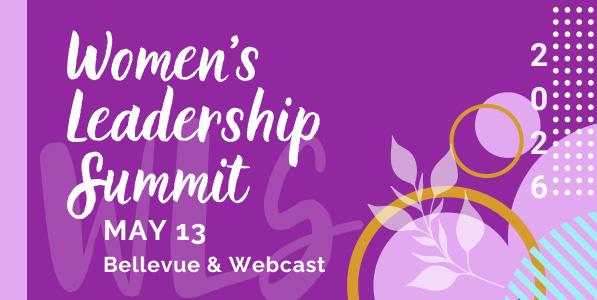
Women's Leadership Summit and Community Mixer
May 13 | Bellevue & Webcast | 8 CPE Credits
Empower women, empower others. Walk away from the Women's Leadership Summit inspired, connected and equipped with new leadership tools. Current and future leaders will engage on the topics that matter to professional women.
Washington State Tax Conference and Community Mixer
May 20 | Redmond & Webcast | 8 CPE Credits
Boost your knowledge of Washington State and local tax topics and gain updates from top-level speakers and tax experts. The WSCPA Washington State Tax Conference provides critical new information that every business advisor needs to share with their clients or employer. This conference is a must for state and local CPAs and other financial professionals.




WSCPA Blue Ribbon CPE
SOME THINGS WORK BETTER TOGETHER.
Just like a good peanut butter and jelly sandwich, insurance and risk management work better together.
When you purchase CAMICO’s Accountants Professional Liability insurance, you are not just insuring your business. You also have access to CPAfocused risk management services and resources — such as unlimited guidance from in-house specialists, education and training, an online library of loss prevention resources (sample letters, articles, archived issues of CAMICO’s newsletter, alerts, and much more), and proactive claims support. With 40 years of experience protecting CPAs there is very little that CAMICO’s team of experts hasn’t seen.
Visit www.camico.com to learn more.
What CPAs say about CAMICO.

Thank you for being a WSCPA member!
Don't miss out on all the exciting things planned as the WSCPA begins another new chapter. Renew your membership today by visiting WSCPA.ORG/DUES
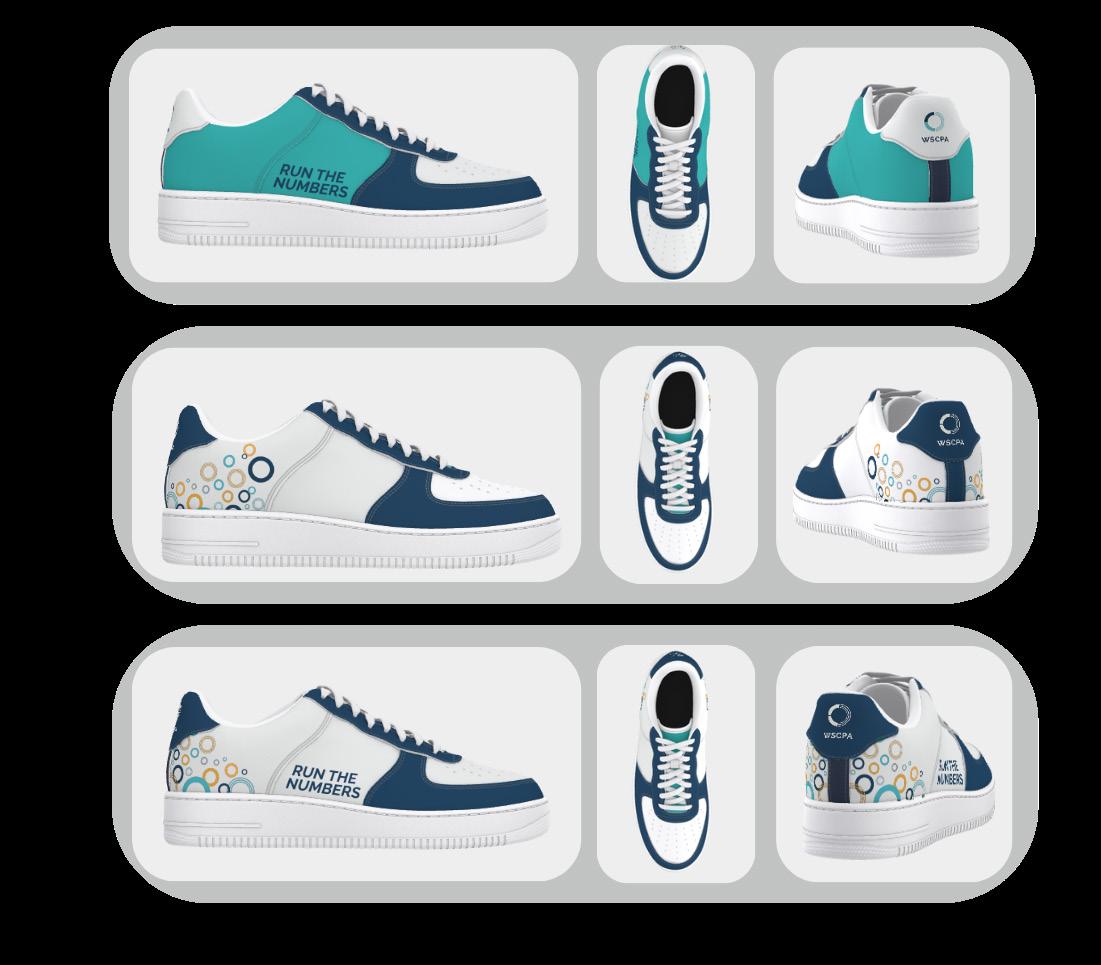
WSCPA Membership Renewal Dues for Shoes Giveaway!
STEP 1: Log in to wscpa.org/circle with your WSCPA credentials to vote for your favorite custom shoe design.
STEP 2: Renew your membership by June 1, 2026, to be entered into the 2026 "Dues for Shoes" drawing at the Membership Summit on June 3.
The winning, limited-edition, custom shoe design will be ordered in the winner's size. $130 value!
Questions about renewing or your member benefits? Contact us at memberservices@wscpa.org or 425.644.4800.
Sales & Mergers
IBA Sells Privately Held Companies: Do you represent a client who is ready to retire or has taken a company as far as they want to or can? IBA is the Pacific Northwest’s oldest business brokerage (M&A) firm. We are professional negotiators with over 4,300 completed transactions. Please contact us if we can be of assistance at 425.454.3052, 509.907.9406, or www.ibainc.com.
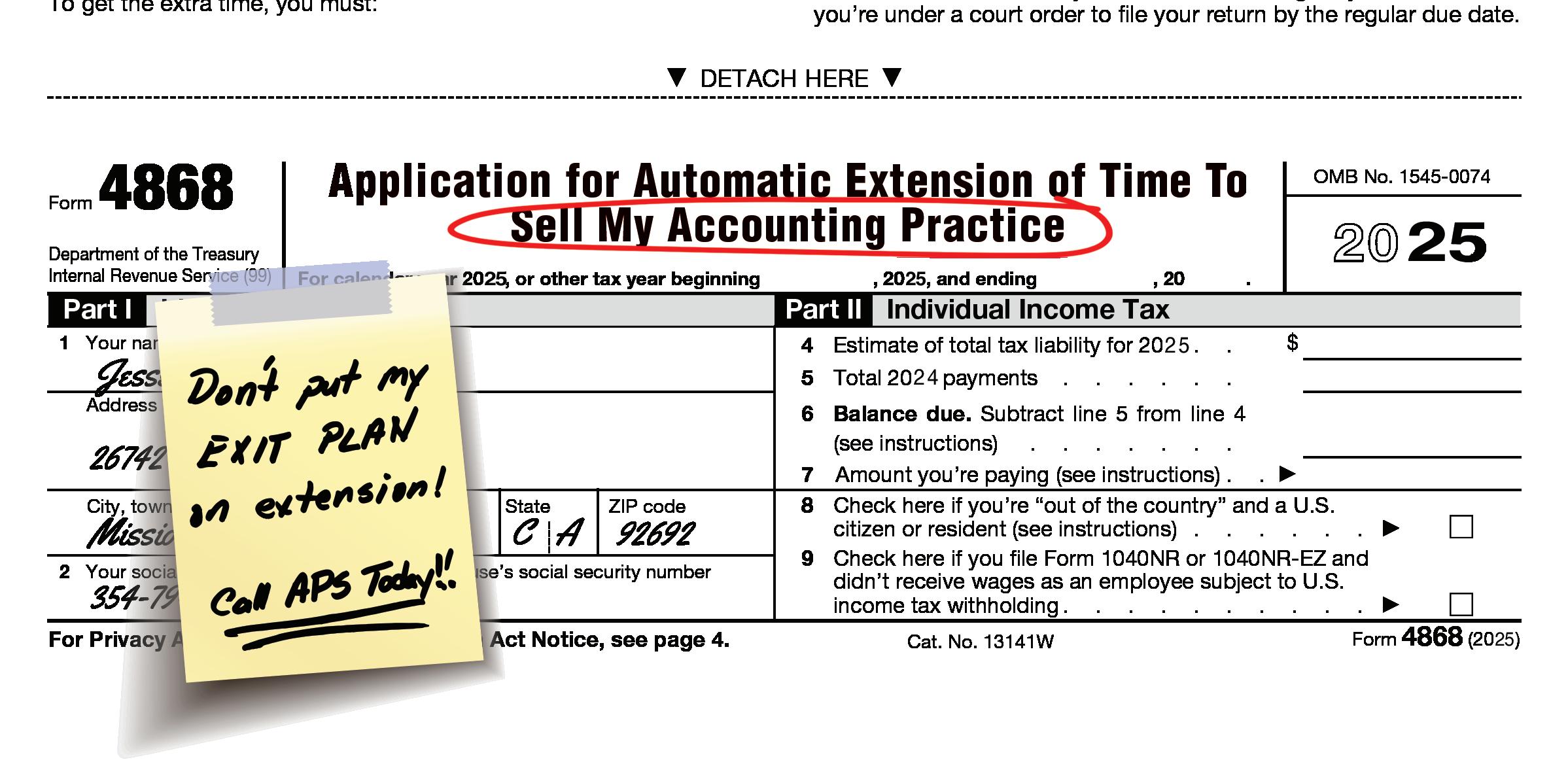
Have a Client/Owner Ready to Explore the Business Sale Process? We help owners confidentially explore the sale process. Transaction expertise, market knowledge, and results. 100% performance based fees - owners pay only at closing. Business owners are experts on their business. We are experts on the process of selling a business. Call 206.703.3555 for a confidential, no commitment consultation. Check out resources and learn more at wabusinessbrokers.com. Put our experts to work for you!
CPA Seeking to Acquire Tax & Accounting Practice ($200K-$600K): Licensed CPA seeking tax and accounting practice, $200K–$600K revenue, Washington or virtual. Flexible on deal structure—seller financing welcome. Happy to support 3–12 month transition. Your clients will be well cared for. Let’s talk confidentially. Contact Roxana Forghani, CPA roxana@accountaholics. com or 206.841.4655
Experienced CPA Seeking to Acquire a CPA Practice: Highly experienced CPA seeking a CPA firm in the greater Seattle area with a deep tax and advisory experience serving HNW individuals, closely held businesses, and related trust/estate matters. Also, extensive experience working withof-state clients, particularly California residents. I’m flexible on structure (full purchase or multi-year transition) and prioritize a smooth handoff for clients. I already have a small book of business. Contact dkg.wacpa@gmail.com

Established Portland Metro Tax & Accounting Firm (OR 1241): Over the past 7+ years, this thriving Portland-based firm has built a strong reputation for delivering comprehensive tax and consulting services to a wide-ranging client base. Operating under the innovative 'Practice Forward' model, the firm has redefined its identity as an advisory-first practice, providing all new clients with a bundled, year-round service package—including monthly accounting, quarterly strategic tax planning, business and personal tax preparation, and proactive business advisory. As of January 2026, the firm proudly supports approximately 285 active clients, showcasing consistent performance and client loyalty. The 2025 revenue by service breakdown was—63% Tax Preparation, 22% Accounting/Bookkeeping, and 15% Planning/Advising. In 2025, the Practice brought in $1,026,839 in gross receipts, a YoY
Renton CPA Practice for Sale: Established CPA practice serving the South King County area since 1975, providing seasoned accounting and financial management services for businesses and individuals. Average gross receipts for the last four years are $760,000 annually - 80% individual tax returns and 20% accounting and tax returns for corporations, partnerships, estates, trusts and not-for-profit organizations. The seller will provide transition support to ensure continuity and client retention. Professional office location in downtown Renton, WA with 22 parking spots as well as street parking. Interested parties should contact admin@ mccorklecpa.com
Open to Selling Your Payroll Book of Business?
ADP is always looking to buy payroll book of businesses all over the country. I come out to CPA firms, help them fill out a form to submit to my team, and ADP comes back with a valuation/ offer of their payroll book of business. If someone decides to sell their book of business we have the necessary resources to ensure a smooth process. Contact Daniel Cordova, Daniel.cordova@adp.com or 971.325.8900.
Cross-Border Business & Trusts/Estates: Nicol Law Offices (Calgary/Seattle) provide Canadian, US, and cross-border legal services with lawyers licensed in WA, MA, NY, Alberta, and Ontario. From business formation to trusts and estates, we provide high-quality, service-focused client experience at fair prices. Connect with us at nicol. law | jocelyn.wang@nicol.law
Office Space Available
Office Space Available
Seattle/Northgate: Complete built out with three offices, reception/administrative office, and waiting room at 850 sf at $18/sf NNN. On site free parking. Signage available on 5th Avenue. Move-in incentive with tenant improvement allowance. Call 206.660.4965 for showing or email: northgatepcsue70@gmail.com
increase of over 4%. Its success is driven by a skilled and dedicated 7-person team committed to operational excellence and client service, with one owner who seeks to remain as an active partner to support future growth and continuity. This is an excellent opportunity for a like-minded firm to expand into the vibrant Portland market by acquiring a turnkey operation with an established client base, a trusted team, and a future-ready advisory model. To take advantage of this exciting business opportunity, call us at 253.509.9224 or send an email to info@privatepracticetransitions. com with “1241 Established Portland Metro Tax & Accounting Firm" in the subject line.
Highly Profitable Oregon Tax Practice (OR 1254):
With a trusted reputation spanning more than 57 years, this Oregon-based Practice delivers comprehensive tax services to both businesses and individuals. As of September 2025, the Practice proudly serves approximately 850 active clients. The estimated 2024 revenue breakdown was 98% Tax, 1.5% Bookkeeping, and 0.5% Compilations. Over the past three years (2022–2024), the Practice has averaged gross annual revenue of ~$1.2M. The team consists of five (5) dedicated professionals, including the two Owners, who are committed to supporting a smooth transition. They are willing to assist with goodwill transfer, business development, and mentoring for an
VOLUNTEER OPPORTUNITIES VOLUNTEER OPPORTUNITIES
Are you interested in using your CPA skills to make an impact in your local community, or do you know of a non-profit organization needing help from a CPA? Find or submit an opportunity at wscpa.org/ volunteer-opportunities
• Yellow Wood Academy - new
• Bainbridge Island Japanese American Exclusion Memorial Association - new
• Highline Soccer Associationnew
• Community Carrot - new
• Invest in Youth – new
Reach Your Target Audience
Advertise with the WSCPA Learn more at: wscpa.org/classifieds
agreed-upon period. The Practice’s long-term success is built on its established brand, loyal client base, and consistent delivery of trusted services. To learn more, call 253.509.9224 or email us with “1254 – Highly Profitable Oregon Tax Practice” in the subject line.
Highly Profitable Multi-Location Tax & Accounting Practice (HI
1249): Founded in 1994, this thriving firm has built a stellar reputation providing comprehensive tax, audit, bookkeeping, and specialty services across three locations. As of May 2025, the Practice serves approximately 1,445 active clients and employs a team of 39, including the Owners. Service revenue is well-diversified: 48.1% Audit & Review, 23.8% Bookkeeping & Accounting, 23.4% Tax, 4.5% GET Billed, and 0.1% Other. The Practice reported $5.83M in gross receipts for 2024 and $5.96M for the August 2025 TTM period, showcasing consistent growth. Its longstanding success is driven by a trusted brand, loyal client base, and experienced team. The Owners are committed to a smooth transition and are open to assisting with goodwill transfer, business development, and mentorship for an agreed-upon period to support buyer success. To take advantage of this exciting business opportunity, call us at 253.509.9224 or send an email to info@privatepracticetransitions. com.

WSCPA PEAK FIRMS
CURRENT PEAK FIRMS
NEW PEAK FIRMS

The WSCPA Peak Firm program recognizes and awards special benefits to firms that sign up 100% of their eligible staff for WSCPA membership. Being a Peak Firm establishes you as a leader in the profession and provides an array of discounts and benefits.
Learn more and enroll your firm at wscpa.org/peak-enroll
Exclusive Benefits Include:
• Membership Dues Stay With Your Firm – Traditionally, WSCPA memberships remain with an individual, even if they leave your firm. When a member leaves a Peak Firm, we’ll honor your previous investment by providing FREE membership for the remainder of the membership year to your new hire.
• Easy Billing – Don’t get lost in paperwork—we’ll provide you with a single membership renewal invoice for all your employees.
• FREE In-House Training - Get 2.5 hours of personalized in-house training (valued up to $2,000), customized to meet the specific needs of your organization.
• FREE WSCPA Room Rental – One room per year, up to $1,200 value, subject to availability.
• FREE Job Listings – Up to two free listings on the WSCPA Job Board per year, additional listings at discounted member rate. Up to $200 value.
• FREE Passport Corporate Cards – All staff, members, and support staff/ nonmembers; up to 30% of paid membership.
• Recognition – Your firm will be listed as a Peak Firm on the WSCPA website and social media, as well as in our magazine, The Washington CPA
• Receive a Peak Firm Logo – Display on your website to recruit staff and clients.
All benefits are for the membership year, June 1 - May 31.
Affinity Group CPAs & Consultants
Alegria & Company PS
Baker Tilly LLC
BPM LLP
Brantley Janson Yost & Ellison
Clark & Associates CPA PS
Clark Nuber PS
Cook CPAs and Consultants, PLLC
Cordell Neher & Company PLLC
DP&C
Eide Bailly LLP
Falco Sult & Co
FBCPA Group PS Inc
Finney Neill & Co PS
Gonzaga University Accounting
Greenwood Ohlund PS
Hellam Varon & Co Inc PS
Hunt Jackson PLLC
Hutchinson & Walter PLLC
Jacobson Jarvis & Co PLLC
James Russell PLLC
Johnson & Shute PS
Johnson Stone & Pagano PS
Kovarik & Kim PLLC
Larson Gross PLLC
Ledgerly Consulting LLC
LightUp Tax LLC
Lodder CPA PLLC
Martin Bircher Thompson PC
McDevitt & Duffy CPAs
Newman Town PLLC
Norris Lutkewitte PLLC
Northwest CPA Group PLLC
Opsahl Dawson PS
Paulsen, Megaard & Co. PS
Rekdal Hopkins Howard PS
Ryan Jorgenson & Limoli PS
Shannon & Associates LLP
Smith & DeKay PS
Starr & Leaf CPA Group PLLC
Sweeney Conrad PS
Tamarack Tax and Consulting LLC
The Myers Associates PC
Vine Dahlen PLLC

Walker Garrett Bourn LLP
Werner O'Meara & Co PLLC
Your Financial Solutions LLC
Photo:
170
Register for a Conference! wscpa.org/spring26

Register for an Event! wscpa.org/together
ATTEND A CONFERENCE
April 22-23 | Governmental Accounting & Auditing Conference
May 12 | International Tax Conference
May 13 | Women's Leadership Summit
May 20 | Washington State Tax Conference
All spring conferences include a community mixer reception.
June 3 | Membership Summit 2026
TAP TOGETHER THURSDAY SERIES - Casual, local events
Apr 30 | Seattle
May 7 | Spokane
May 14 | Tacoma
May 21 | Everett