PACIFIC ISLANDS FISHERY NEWS Newsletter of the Western Pacific Regional Fishery Management Council / Winter 2026 ISSN 2151-2329 (PRINT) ISSN 2151-2337 (ONLINE)
Rebuilding Lahaina The Capitol of the Hawaiian Kingdom For centuries, Lahaina has been a place of profound cultural, political, economic and maritime significance. Once the capital of the Hawaiian Kingdom in the early nineteenth century, Lahaina served as a center of governance, trade and diplomacy, and is the final resting place of Queen Keōpūolani, wife of Kamehameha Nui. Lahaina has also long been a fishing community. In the heart of the town, buried under Malu‘uluolele Park, is the site of a historic fishpond called Mokuhinia and a little island named Moku‘ula that served as a royal residence of the Kamehameha line. During the sugar plantation era, water was diverted before it could reach the pond, which was eventually filled and leveled, sealing this important cultural and aquacultural site in place. Even without the pond, Lahaina’s nearshore waters and offshore fishing grounds continued to sustain generations of Maui families. To this day, fishing is central to the town’s economy and identity. Lahaina also grew to become a hub for agriculture and mari time commerce, a role shaping its multicultural community. On Aug. 8, 2023, Lahaina burned in hours, but the work of caring for its recovery has taken every day since. In the first chaotic weeks, community members moved supplies by boat, organized food and clothing drives, and created makeshift housing so families could stay close to home as they navigated loss and uncertainty. Just as urgently, cultural practitioners stepped forward to ensure this revival respected the survivors, the place and those who were lost. In that early surge of response, another need became clear: the government’s scale of operations, necessary as it was, should not override cultural priorities in a place where ʻiwi kūpuna (ancestral remains) and moʻokūʻauhau (genealogy) are inseparable from the land. One such group, Nā ʻAikāne o Maui, helped manage the influx of people into sensitive areas by setting guidelines, providing security and keeping a watchful presence as outside assistance arrived,
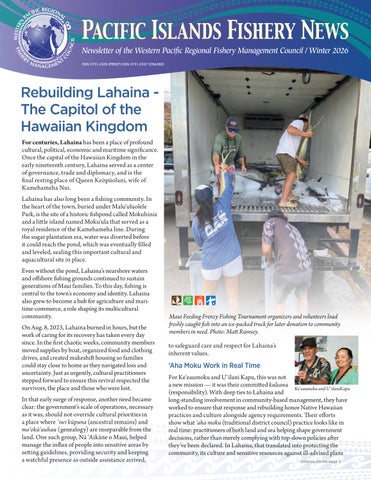
Maui Feeding Frenzy Fishing Tournament organizers and volunteers load freshly caught fish into an ice-packed truck for later donation to community members in need. Photo: Matt Ramsey. to safeguard care and respect for Lahaina’s inherent values.
‘Aha Moku Work in Real Time For Keʻeaumoku and Uʻilani Kapu, this was not a new mission — it was their committed kuleana Keʻeaumoku and U‘ilaniKapu (responsibility). With deep ties to Lahaina and long-standing involvement in community-based management, they have worked to ensure that response and rebuilding honor Native Hawaiian practices and culture alongside agency requirements. Their efforts show what ʻaha moku (traditional district council) practice looks like in real time: practitioners of both land and sea helping shape government decisions, rather than merely complying with top-down policies after they’ve been declared. In Lahaina, that translated into protecting the community, its culture and sensitive resources against ill-advised plans CONTINUED ON PAGE 2