evergreencircle SUMMER 2026
Our Loyal Evergreens
The Evergreen Circle honors the Western Pennsylvania Conservancy’s loyal supporters who have made annual gifts for at least 15 of the last 20 years. Thank you! You are making an incredible impact in Western Pennsylvania.
Evergreen Circle Profile: Kimberly Donovan and Bruce Hazen
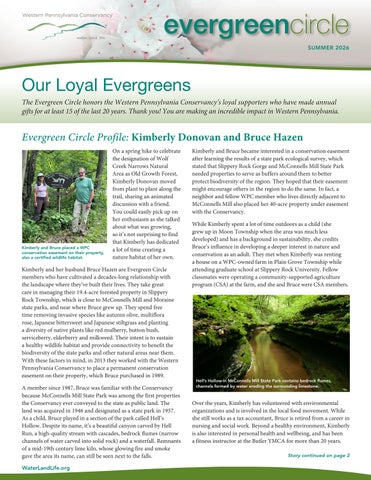
Kimberly and Bruce placed a WPC conservation easement on their property, also a certified wildlife habitat.
On a spring hike to celebrate the designation of Wolf Creek Narrows Natural Area as Old Growth Forest, Kimberly Donovan moved from plant to plant along the trail, sharing an animated discussion with a friend. You could easily pick up on her enthusiasm as she talked about what was growing, so it’s not surprising to find that Kimberly has dedicated a lot of time creating a nature habitat of her own.
Kimberly and her husband Bruce Hazen are Evergreen Circle members who have cultivated a decades-long relationship with the landscape where they’ve built their lives. They take great care in managing their 19.4-acre forested property in Slippery Rock Township, which is close to McConnells Mill and Moraine state parks, and near where Bruce grew up. They spend free time removing invasive species like autumn olive, multiflora rose, Japanese bittersweet and Japanese stiltgrass and planting a diversity of native plants like red mulberry, button bush, serviceberry, elderberry and milkweed. Their intent is to sustain a healthy wildlife habitat and provide connectivity to benefit the biodiversity of the state parks and other natural areas near them. With these factors in mind, in 2013 they worked with the Western Pennsylvania Conservancy to place a permanent conservation easement on their property, which Bruce purchased in 1989. A member since 1987, Bruce was familiar with the Conservancy because McConnells Mill State Park was among the first properties the Conservancy ever conveyed to the state as public land. The land was acquired in 1946 and designated as a state park in 1957. As a child, Bruce played in a section of the park called Hell’s Hollow. Despite its name, it’s a beautiful canyon carved by Hell Run, a high-quality stream with cascades, bedrock flumes (narrow channels of water carved into solid rock) and a waterfall. Remnants of a mid-19th century lime kiln, whose glowing fire and smoke gave the area its name, can still be seen next to the falls. WaterLandLife.org
Kimberly and Bruce became interested in a conservation easement after learning the results of a state park ecological survey, which stated that Slippery Rock Gorge and McConnells Mill State Park needed properties to serve as buffers around them to better protect biodiversity of the region. They hoped that their easement might encourage others in the region to do the same. In fact, a neighbor and fellow WPC member who lives directly adjacent to McConnells Mill also placed her 40-acre property under easement with the Conservancy. While Kimberly spent a lot of time outdoors as a child (she grew up in Moon Township when the area was much less developed) and has a background in sustainability, she credits Bruce’s influence in developing a deeper interest in nature and conservation as an adult. They met when Kimberly was renting a house on a WPC-owned farm in Plain Grove Township while attending graduate school at Slippery Rock University. Fellow classmates were operating a community-supported agriculture program (CSA) at the farm, and she and Bruce were CSA members.
Hell’s Hollow in McConnells Mill State Park contains bedrock flumes, channels formed by water eroding the surrounding limestone.
Over the years, Kimberly has volunteered with environmental organizations and is involved in the local food movement. While she still works as a tax accountant, Bruce is retired from a career in nursing and social work. Beyond a healthy environment, Kimberly is also interested in personal health and wellbeing, and has been a fitness instructor at the Butler YMCA for more than 20 years. Story continued on page 2
Continued from page 1
Evergreen Circle Profile: Kimberly Donovan and Bruce Hazen
Every yard supports a little world: Planting for Pollinators
They also support the Audubon Society, and their property has been certified as an Audubon Society Wildlife Sanctuary since 1997. Kimberly said that they have learned a lot from WPC’s Director of Land Stewardship Andy Zadnik, who works with property owners to recommend the best means of caring for their land. Andy considers these easement relationships as partnerships, and recognizes the commitment that Kimberly and Bruce have as environmental stewards of their land. Similar to the idea that placing an easement on their land might motivate neighbors, Kimberly feels that if the public knew more about the depth and breadth of the Conservancy’s work, it would inspire more people to get involved. It’s not surprising that the aspect of the Conservancy’s mission that she connects with the most is the protection of the diversity of native species throughout Western Pennsylvania, linking it with her own intention: “When our time on this earth is at the end, we hope to have developed a diverse habitat of native species on this land to provide resilience in our changing climate.” Kimberly and Bruce care for their own part of the world with such attention that it benefits the biodiversity and health of the region at large, now and into the future. We’re grateful for their support of the Conservancy as loyal Evergreen Circle members and their commitment to caring for and improving their land.
WaterLandLife.org
A hummingbird visiting a buttonbush shrub, a Pa. native, at Bear Run Nature Reserve
It’s a rare person who isn’t mesmerized by the appearance of a hummingbird. Isn’t it astonishing that they fly thousands of miles across continents during migration, and somehow end up visiting your hanging flower basket? Each day, a hummingbird eats half its body weight in insects and nectar, visiting 1,000 to 2,000 flowers, pollinating as they go. Those flowers on your patio might have just provided a life-saving meal after a very long journey.
Hummingbirds are stunning ambassadors of pollinators, which include many species of birds, bees, wasps, butterflies, bats, moths, beetles and flies that are crucial to many plant species. Plants and pollinators participate in a mutualistic relationship to survive: plants supply nectar, pollen, seeds and fruit for wildlife, which, in turn, pollinate the flowers and help disperse the seeds, helping to grow more food for themselves. You’re probably aware of the challenges pollinators face, including habitat degradation and loss and impacts from pesticide use, pollution and climate change, among others. The system is struggling to stay in balance, and this affects all of us directly: while insect pollinators are responsible for about one-third of our food crops, more than one in five native North American pollinators are at an elevated risk of extinction. Don’t underestimate what you can do to help! Even if you have just a tiny patch of yard, porch, balcony, or only a window box, what you offer in the form of plants and flowers can enrich pollinators as micro-feeding stations, especially in urban and suburban areas where food can be scarce. A variety of flowers clustered in the right space can be the exact stepping stone that insects and birds require to sustain them. Add a shallow saucer of water, and it will help get them through dry spells.
Plant Choices Matter
If you have outdoor space, native plants are the best option to support biodiversity and are also easier to maintain. Native plants and animals rely on each other in specific and complex ways for food, shelter and reproduction. These specialized relationships are the foundation of biodiversity in our region. According to Penn State Extension, recent research shows that 90% of our native insects feed on three or fewer families of plants. Examples of specialized relationships include the monarch butterfly, whose caterpillars feed solely on milkweed leaves, or the spicebush swallowtail caterpillar that feeds on spicebush or sassafras.
A monarch butterfly feeds on a coneflower in a WPC community garden
While some pollinators can be picky, native plants support a diverse abundance of wildlife throughout their life cycle, even throughout the seasons. Popular garden flowers like purple coneflower and bee balm attract insects while in bloom and also provide food for birds into winter. In fact, it’s the native plants that best sustain bird populations over winter with late fruits, nuts and dried seeds. Native grasses, asters, blazing star, goldenrod and ironweed are a few more that provide food for winter foragers. If your outdoor space is large enough, consider planting a native shrub or tree. Good choices for small spaces in Pennsylvania include Eastern redbud, serviceberry, pagoda dogwood and native viburnums. For a list of native plants for all yard types, visit pa.gov/agencies/dcnr/conservation/wild-plants/landscaping-with-native-plants.
While it’s most beneficial to choose native plants as often as possible, it’s important to avoid adding plants that are invasive to your region. Invasive plants can outcompete or suppress natives by propagating quickly, growing bigger leaves earlier to crowd competition, or even emitting toxic chemicals into the soil to prohibit the growth of other plants. Invasives may also lack local pests, disease or predators to keep their population in check. Plant nurseries are prohibited from selling specific noxious plants in Pennsylvania like burning bush, Japanese barberry and the recently listed Callery (Bradford) pear, but you may still see some popular plants that are actually invasive, such as English ivy, butterfly bush, periwinkle and Japanese spiraea, for sale at your local big box store. Progression of a perennial garden that WPC and community partners planted in 2024 in Kittanning along the Armstrong Trail, featuring rudbeckia and cardinal flowers.
Volunteer!
If you are looking to get your hands dirty and don’t have a place of your own, there are many volunteer opportunities to help our pollinators. Each spring, the Western Pennsylvania Conservancy needs thousands of volunteers to help plant and maintain 125 community gardens in 19 Western Pennsylvania counties. These annual and native perennial gardens are islands of color planted to attract pollinators, capture rainwater and to simply beautify our towns and cities. Additionally, WPC needs volunteers each spring and fall to help plant street trees in neighborhoods throughout the region. Our land stewardship team also hosts volunteer days at some of our 47 nature preserves throughout the year. Staff and volunteers maintain trails and restore habitat by removing invasive plants like garlic mustard and multiflora rose and adding native vegetation. Ultimately, whether you help plant community gardens or trees, fill your yard with multi-season native plants or just set a pot of annual blooms on your doorstep, the decisions you make can enrich your surroundings and also make life a little easier for a hard-working pollinator.
Visit the Conservancy’s website WaterLandLife.org for more resources. These WPC webinars can help you make good choices for your garden: • PA Invasive Replace-ive • Pollinator Habitat: Built It and They Will Come • Green Isn’t Always Good: Invasive Species and Native Garden Alternatives Find a WPC community garden near you: waterlandlife.org/community-flower-gardens Learn more about volunteering with WPC: waterlandlife.org/events-volunteer-opportunities
In defense of weeds If you have a lawn, it helps to let it grow a little wild, especially in the spring. A monoculture turf grass lawn is a food desert for pollinators, and it’s also high-maintenance for property owners. Turf grass lacks diversity and also has shallow roots that require frequent watering that are also not as helpful with stormwater absorption. These grasses don’t contribute to the soil microbiome, and often require fertilizer. HOAs aren’t fond of “No Mow May,” but the benefit of early blooms for pollinators is crucial. If you’ve ever noticed a patch of “weedy” lawn in the spring, it is probably literally buzzing with activity as early flowers like dandelion, blue violets and clover are among the first blooms for bees as they emerge from their hives after winter. You can foster a neighborfriendly “eco-lawn” by forgoing weed and fertilizer treatments and allowing dense, low-growing ground cover to intermingle with the grass, such as white clover, common blue violet, narrow-leaved blue-eyed grass and Pennsylvania sedge. While not all of these plants are truly native, they have become naturalized in the region and are amenable to pollinators, droughttolerant, can handle mowing and will help to enrich the soil. Caitlin Waddington, WPC’s community horticultural coordinator, points out a specific benefit: “One of my favorite things about native spring lawns is the shelter that they provide for pollinators. Think about the firefly, which needs humid undisturbed conditions to become prolific. The increase in popularity of No Mow May and native lawns has also resulted in an uptick of fireflies out each summer.” It’s encouraging that some property ordinances are coming around to accepting a more pollinator-friendly landscape. For example, the City of Pittsburgh now allows residential property owners to register their native, pollinator or rain garden to allow plant growth over 10 inches tall.
WaterLandLife.org
800 WATERFRONT DRIVE • PITTSBURGH, PA 15222
NON PROFIT US POSTAGE PAID PITTSBURGH PA PERMIT NO 2504
Save the dates for these fall events!
Look for your invitations in the mail.
Loyal Donor Day at Bear Run Nature Reserve September 28 | 10 a.m. to 2 p.m.
Join us for a guided morning hike or explore Fallingwater’s landscape on your own, have lunch and learn about WPC’s connection to the Laurel Highlands Hiking Trail, celebrating 50 years on September 28.
Fall Members’ Hike Sunday, October 25
Join us for a hike along one of the scenic sections of the Laurel Highlands Hiking Trail — details to follow.
Be Intentional About Your Legacy Planning for the future is one of the most meaningful ways to care for the people and causes you love, yet nearly two-thirds of American adults do not have a will. A will helps ensure your wishes are honored, eases the administrative burden on your loved ones and ensures that your plans will be carried out as you intend.
Leave a Lasting Legacy
As you create or update your estate plan, consider including the Western Pennsylvania Conservancy. A charitable bequest, whether a specific dollar amount or a percentage of your estate, will contribute to the Conservancy’s financial strength and ability to conserve our region’s most spectacular land, water and wildlife, and to preserve Frank Lloyd Wright’s masterpiece, Fallingwater. Getting started is easier than ever. Trusted online tools like FreeWill allow many people to create a legally valid will at no cost in about 20 minutes. By doing so, you can protect your loved ones, gain peace of mind and consider creating a legacy that will have a lasting impact. For more information, visit our website by using the QR code or contact Julie Holmes, senior director of development, at 412-586-2312 or jholmes@paconserve.org. The falls at Hell’s Hollow, McConnells Mill State Park
Please reach out to us with your questions or comments! members@paconserve.org | 412-288-2777 | WaterLandLife.org