FALLINGWATER CELEBRATES 90 YEARS
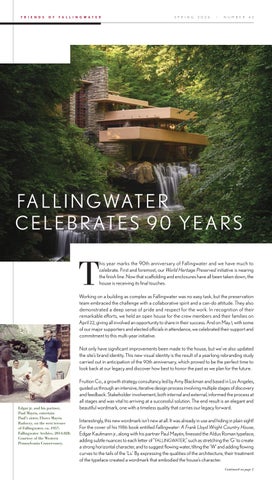
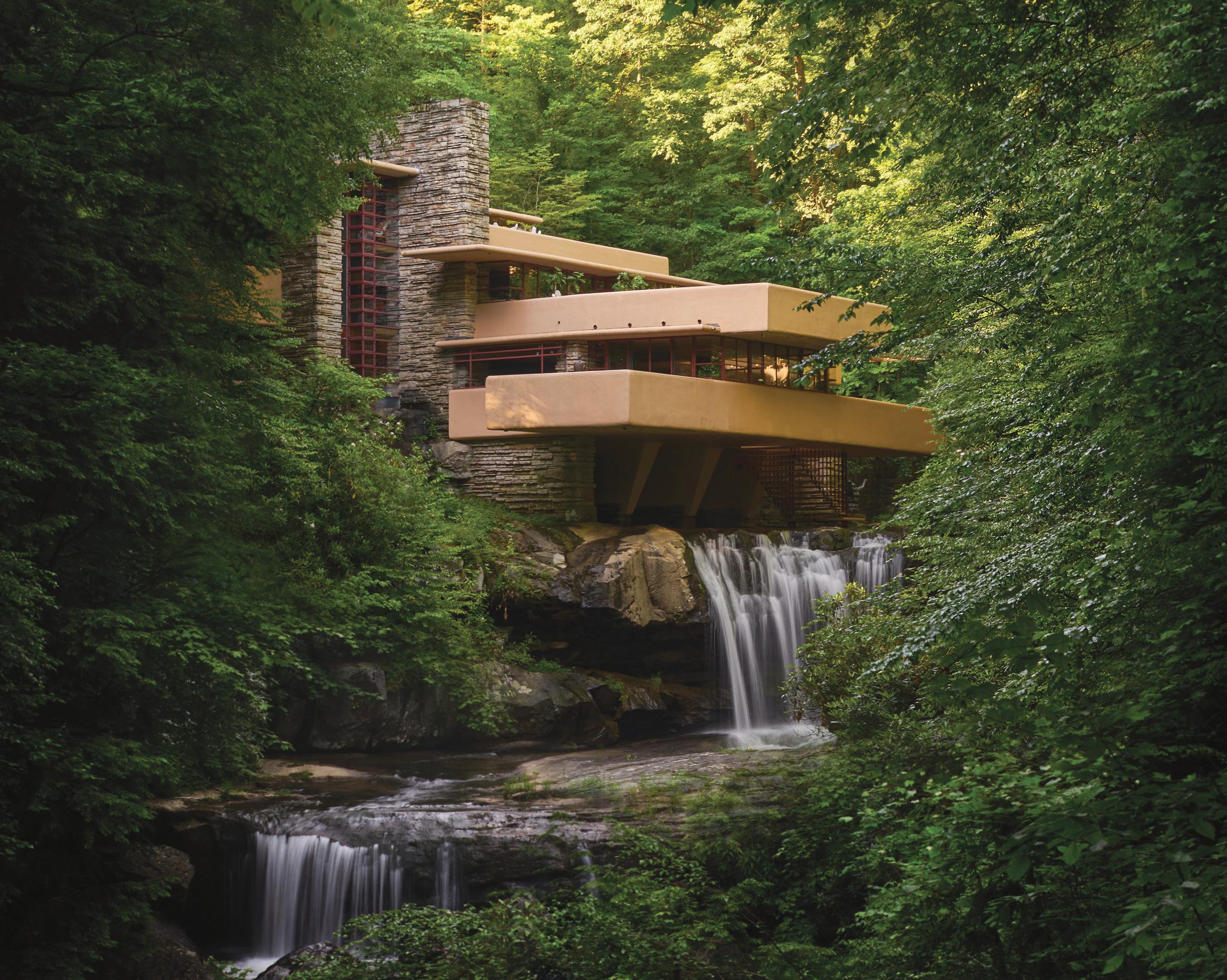
This year marks the 90th anniversary of Fallingwater and we have much to celebrate. First and foremost, our World Heritage Preserved initiative is nearing the finish line. Now that scaffolding and enclosures have all been taken down, the house is receiving its final touches.
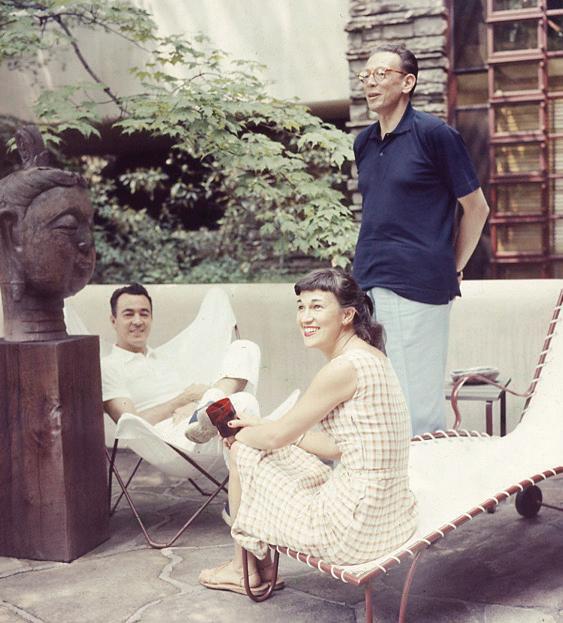
Edgar jr. and his partner, Paul Mayén, entertain Paul’s sister, Flores Mayén Radoczy, on the west terrace of Fallingwater, ca. 1957. Fallingwater Archive, 2014.028. Courtesy of the Western Pennsylvania Conservancy.
Working on a building as complex as Fallingwater was no easy task, but the preservation team embraced the challenge with a collaborative spirit and a can-do attitude. They also demonstrated a deep sense of pride and respect for the work. In recognition of their remarkable efforts, we held an open house for the crew members and their families on April 22, giving all involved an opportunity to share in their success. And on May 1, with some of our major supporters and elected officials in attendance, we celebrated their support and commitment to this multi-year initiative.
Not only have significant improvements been made to the house, but we’ve also updated the site’s brand identity. This new visual identity is the result of a yearlong rebranding study carried out in anticipation of the 90th anniversary, which proved to be the perfect time to look back at our legacy and discover how best to honor the past as we plan for the future.
Fruition Co., a growth strategy consultancy led by Amy Blackman and based in Los Angeles, guided us through an intensive, iterative design process involving multiple stages of discovery and feedback. Stakeholder involvement, both internal and external, informed the process at all stages and was vital to arriving at a successful solution. The end result is an elegant and beautiful wordmark, one with a timeless quality that carries our legacy forward.
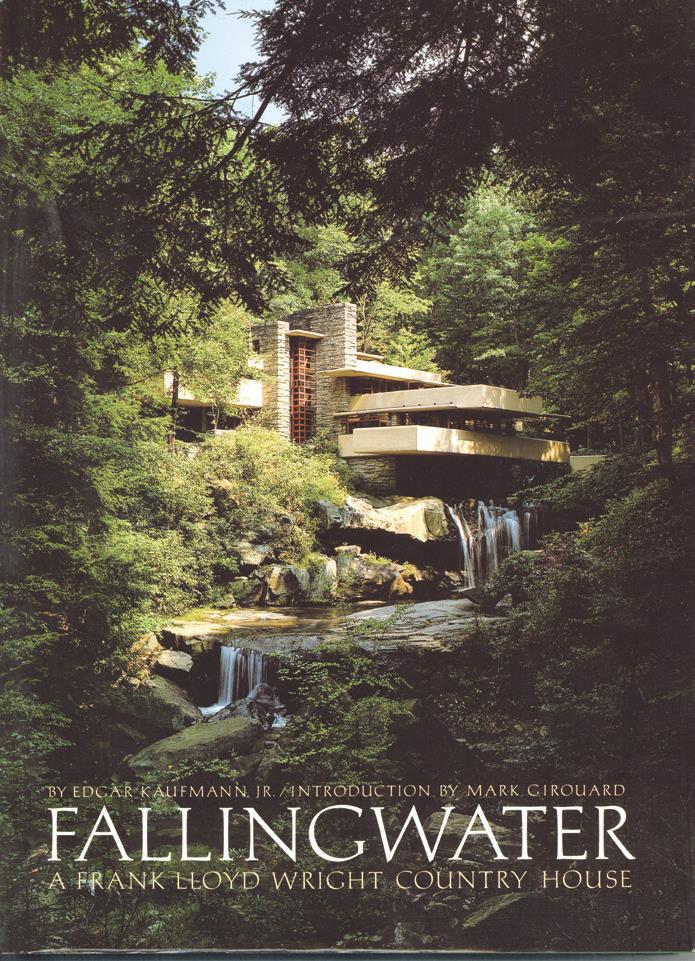
Interestingly, this new wordmark isn’t new at all. It was already in use and hiding in plain sight! For the cover of his 1986 book entitled Fallingwater: A Frank Lloyd Wright Country House, Edgar Kaufmann jr., along with his partner Paul Mayén, finessed the Aldus Roman typeface, adding subtle nuances to each letter of “FALLINGWATER,” such as stretching the ‘G’ to create a strong horizontal character, and to suggest flowing water, tilting the ‘W’ and adding flowing curves to the tails of the ‘Ls.’ By expressing the qualities of the architecture, their treatment of the typeface created a wordmark that embodied the house’s character.
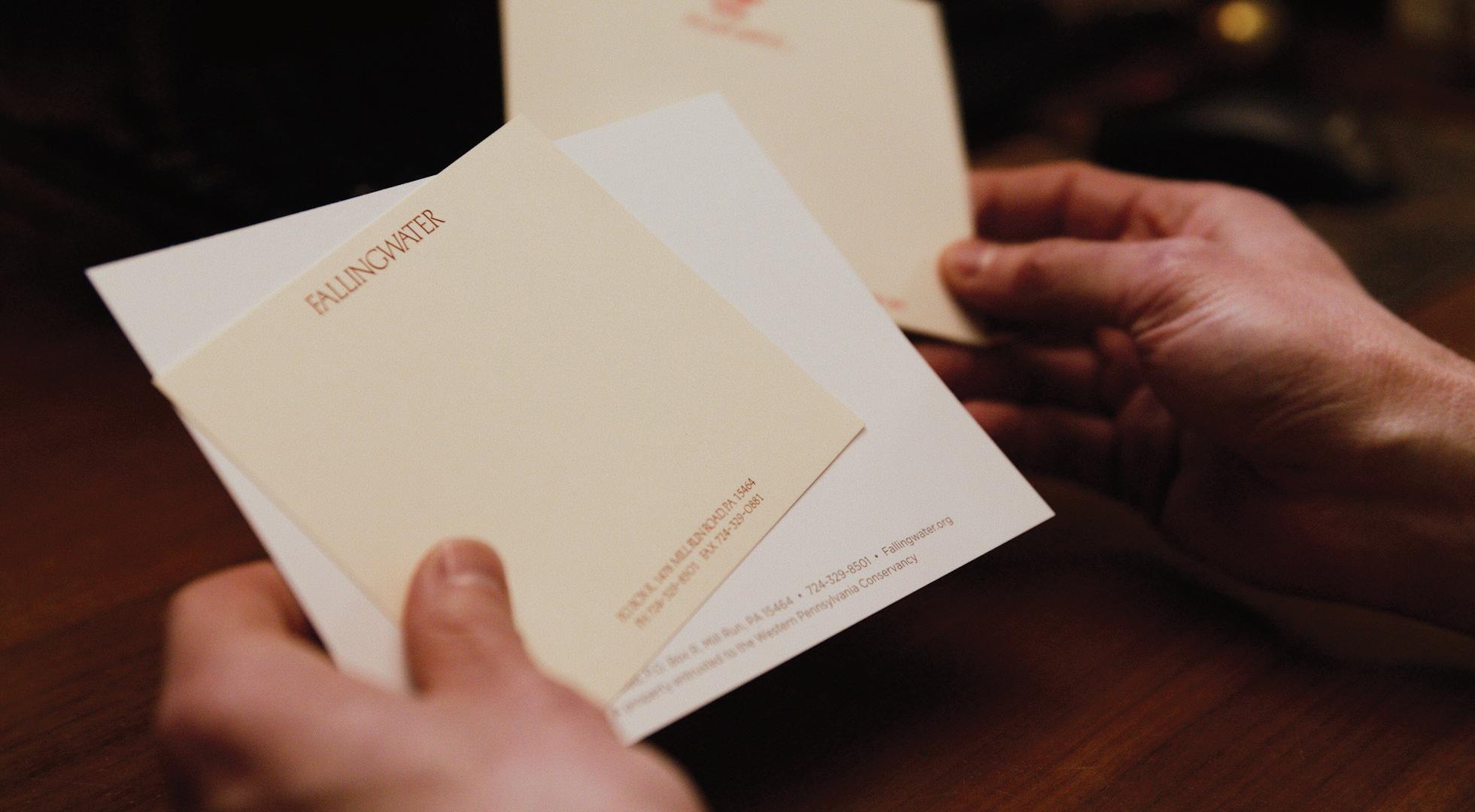
During the discovery process, we also learned that Edgar Kaufmann jr. never thought Fallingwater should have a graphic logo. He always viewed the iconic photograph of the house floating over the falls as Fallingwater’s primary visual identity and felt a logo would compete rather than complement this image. By embracing his original vision and adopting this wordmark as our brand identity, we now have an effective signature that stands well with or without the iconic view. When shown together with the house, it serves to reinforce the qualities of the design. And when alone, it serves to evoke that image in our minds. We unveiled this new wordmark at the start of the tour season in March, and you can now find it on all branded collateral and museum store products.
For our anniversary, we are also offering our most ambitious lineup ever of residency programs and workshops, further strengthening Fallingwater’s relevance as a leading educational institution. These immersive learning experiences for high schoolers, college students, and adult learners, all offered through the Fallingwater Institute, strengthen participants’ appreciation for art and nature and deepen their understanding of how to live harmoniously with the natural world. Thanks to the generosity of The Heinz Endowments, a quarter of the participants will receive need-based scholarships, greatly enhancing the accessibility of our programs for all audiences.
Finally, in recognition of the 90th, Fallingwater is hosting special events throughout the year,
ranging from informative lectures to unique food events and live music. In addition, our Fallingwater Fireside series will welcome architectural historian Alastair Gordon and celebrated architect Charles Renfro. Webinars held seasonally will include discussions on architects Carlo Scarpa and Bruce Goff, textile designer Jack Lenor Larsen and a panel discussion on World Heritage Preserved. The celebrations culminate with our 90th Anniversary Gala on August 29, which is sure to be an enchanted summer evening with delicious food, the sounds of jazz and the twilight beauty of Wright’s unforgettable architecture.
We hope to see you at our programs and events as we commemorate 90 landmark years and celebrate Fallingwater’s future as an enduring symbol of art and nature in harmony.
FALLINGWATER’S CAFÉ
A Menu Inspired by Landscape and Legacy
Above: Edgar jr. and Paul Mayén finessed the Aldus Roman typeface to embed elements of the renowned architecture directly into the word Fallingwater.
Left: Edgar jr.’s 1986 book, Fallingwater: A Frank Lloyd Wright Country House
Fallingwater is known for its organic architecture, cantilevered design and iconic placement atop a waterfall in the woods. More than 100 , 000 people from all across the globe visit this UNESCO World Heritage Site annually, and now, Fallingwater’s Chef Kyle Zaccagni will ensure they remember more than just the house.
Growing up in Bellefonte, Pa., Zaccagni ventured out west to Denver, Co. and got his professional start working for James Beard award-winning chef, Jen Jasinksi, progressing from line cook to sous chef. After years of being away, Zaccagni found his way back to Pennsylvania where he spent nine years at Nemacolin Resort in their renowned restaurant, Lautrec, eventually becoming the chef tournant, training other chefs.
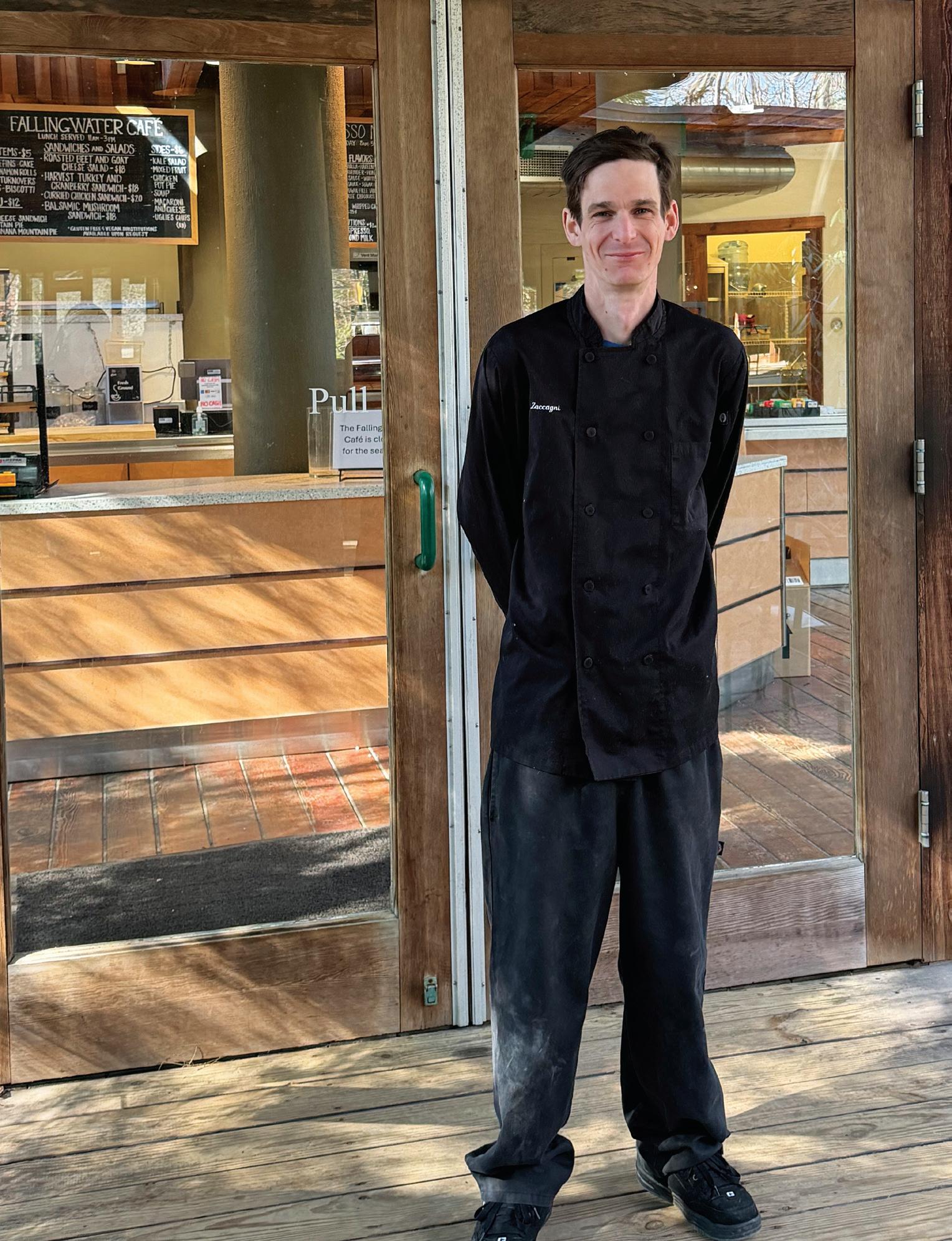
Zaccagni started with Fallingwater in August 2025 and notes, “I have been fortunate enough to work in great places with great chefs throughout my career and this opportunity to work at a world-renowned site is truly an experience that makes all the effort I’ve put into my career worth it.”
Scan this QR code for more information about Fallingwater’s 90th Anniversary event lineup.

Zaccagni is focused on one thing this tour season: using his food to tell Fallingwater’s story. He and his team are carefully considering how menu items can highlight the house and its surrounding landscape. By connecting food to the story of the site and the people who came before, he aims to leave visitors with a lasting impression. With that, what can you expect next time you visit Fallingwater and reach for a bite at the café?
First, entrees and sandwiches that feature fresh ingredients from local farmers and purveyors. He has been pulling inspiration from the Fallingwater Cookbook and is most excited to present an updated version of Liliane Kaufmann’s chicken salad on a croissant.
Secondly, freshly baked pastries are made in-house completely from scratch. Try our signature Fallingwater salted chocolate chip cookie our most popular item from last tour season. Or, if you prefer something inspired by the landscape, the smores chocolate tarte features a spruce-infused marshmallow to mimic the spruce trees in the forest that surrounds Fallingwater.
As the seasons change in Mill Run, so will the menu. If you’re wondering if Zaccagni will be foraging Fallingwater’s surrounding landscape, the answer is a resounding yes. He’s hoping the June will bring berries, late July, chanterelle mushrooms. Sumac can be harvested in August and black walnut throughout September and October.
Next time you visit Fallingwater, make sure to stop in the café and try his newest site-inspired creation.
Fallingwater’s Chef Kyle Zaccagni is focused on using his food to tell Fallingwater’s story.
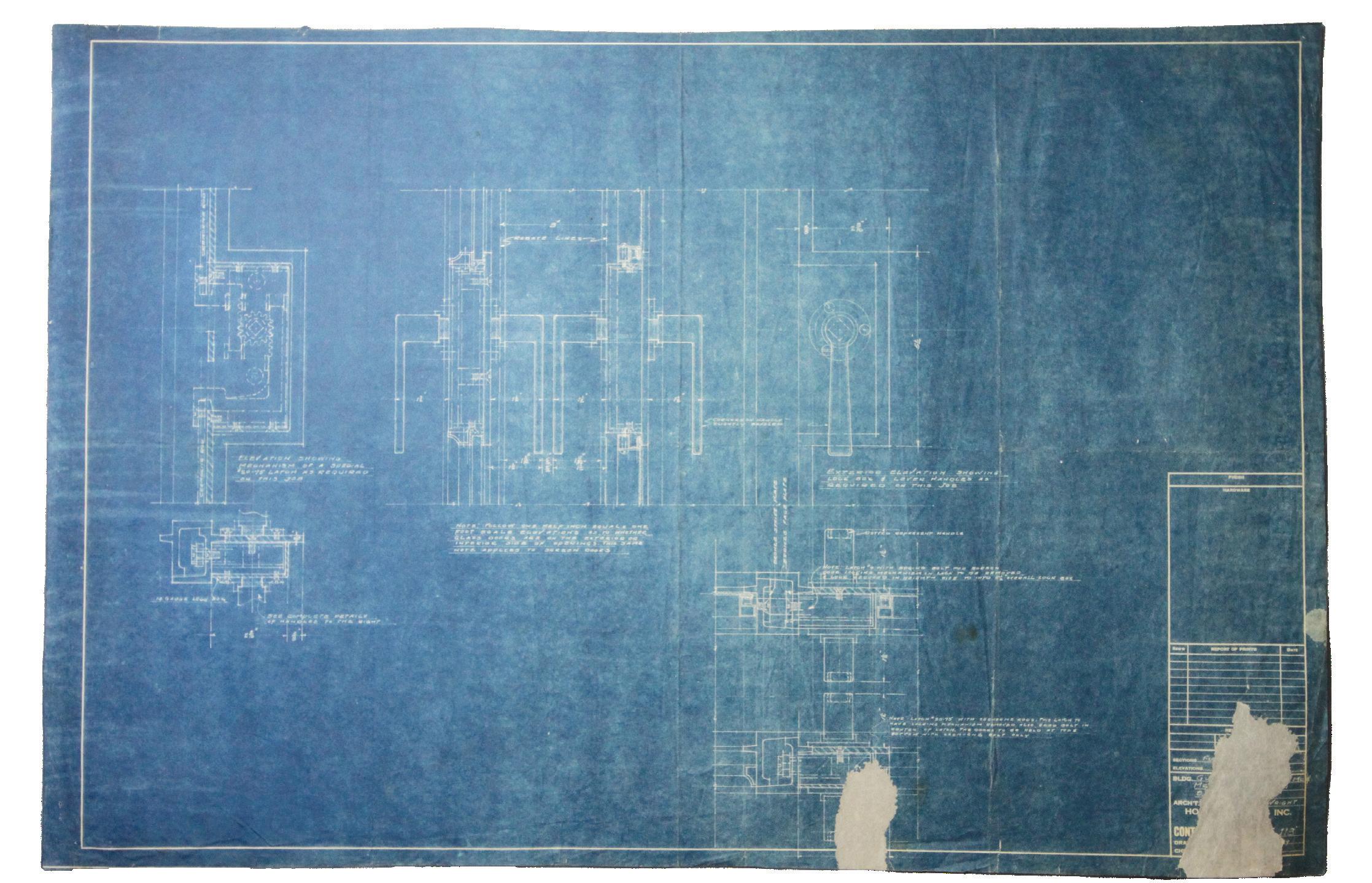
Conservation complete, this architectural drawing of furniture will be permanently housed in the Fallingwater Archive. Gillen Woodwork Corporation, Drawing for Second Floor Wardrobes, Tables, and Bed Boards (detail), cyanotype print, 1939. FWA2024.46
CONSERVING ARCHIVAL TREASURES
Every item in the Fallingwater Archive tells a story, including a series of recently conserved historic architectural drawings. Among them were engineering drawings for the house’s steel reinforcement by the firm Metzger-Richardson of Pittsburgh; details of the guest house’s steel-framed doors, windows and custom brass hardware fabricated by Hope’s in New York; and cabinetry drawings by the Gillen Woodwork Corporation of Wisconsin for Fallingwater’s built-in and freestanding furnishings designed by Frank Lloyd Wright. Before these were accessioned into Fallingwater’s collection, many of the 47 drawings were damaged by rodents and the effects of poor environmental conditions.
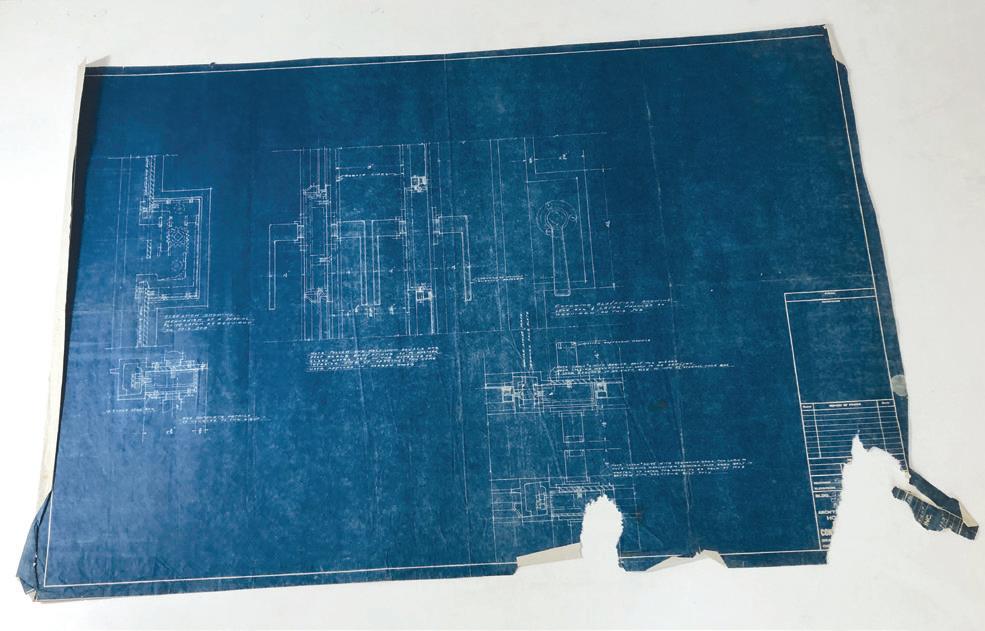
Since then, they have been safely housed and stored at Fallingwater until conservation was possible.
While the Hope’s drawings were donated to Fallingwater more than 15 years ago by the estate of Fallingwater’s contractor Walter Hall, the Gillen drawings were among nearly 50 boxes of archived documents dating from the 1960s to the 1990s that were pulled from an offsite storage facility. As these documents were being considered for potential accession into the archive, 24 oversized blueprints—some as large as 48 by 84 inches—were discovered to be the shop drawings from between 1937 and 1939 for Wright’s built-in cabinetry and furniture pieces. While these drawings were, overall, in better condition than Hope’s drawings, they exhibited the effects of age and wear.
The importance of these drawings cannot be overstated.
“These are original prints made by two of the ‘behind-thescenes’ craftspeople working on objects within Fallingwater,” according to Scott Perkins, senior director of preservation and collections. “They are also hand-drawn artifacts, with details like erasure marks that, if created today by computer, would have been deleted, removing all evidence of their maker.”
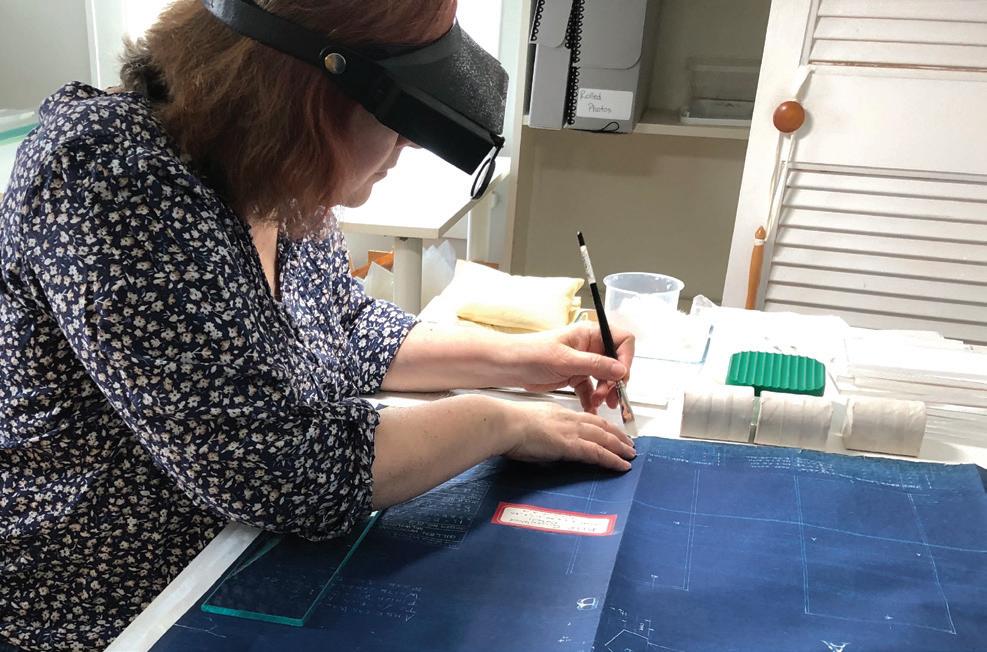
Thanks to a grant from the Decorative Arts Trust, and its Dean F. Failey Fund, Fallingwater contracted with its paper conservator, Jayne Girod Holt, to assess and repair the collection items. Once in Girod Holt’s studio, the drawings were carefully humidified and flattened to remove creases and crumpled edges. The blueprints were cleaned and all
1. Drawings had been damaged by rodents and torn along the corners and edges that were exposed while rolling prior to being added to Fallingwater’s collection.
2. Conservator Jayne Girod Holt making a repair to the torn edge of a drawing, using wheat paste and Japanese mulberry paper.
“ They are also hand-drawn artifacts, with details like erasure marks that, if created today by computer, would have been deleted, removing all evidence of their maker.”
adhesive tape was removed. Following these procedures, tears were mended and losses filled with Japanese mulberry paper affixed with wheat starch paste.
Finally, working with volunteers in our archive, Collections Manager and Archivist Hannah Ciocco, scanned drawings that were able to fit through the archive’s drum scanner. Twenty-one drawings were unable to be scanned in-house due to size and were digitized by two different firms, one of which now employs our 2021 Judy Cheteyan Collections Intern.
“The project has allowed us to fully understand the design and construction of three components of the house steel reinforcement, custom furnishings and details for window hardware,” shares Perkins.
“Regarding the Gillen drawings, they offer our woodwork conservator, Sean Fisher, an in-depth representation of Wright’s designs for the built-ins cabinetry, shelving, freestanding tables and chairs, and lighting.” Fisher especially found that being able to see notations and specifications written on them has allowed him to “read the mind” of a Gillen craftsman during the time the 170 pieces were fabricated.
The conservation and digitization of these rare architectural drawings has benefitted our understanding of Fallingwater’s elements greatly. Having digital files (or later, paper reproductions) to easily access information found on the drawings will ensure the originals are kept in the best condition.
LILIANE’S WARDROBE
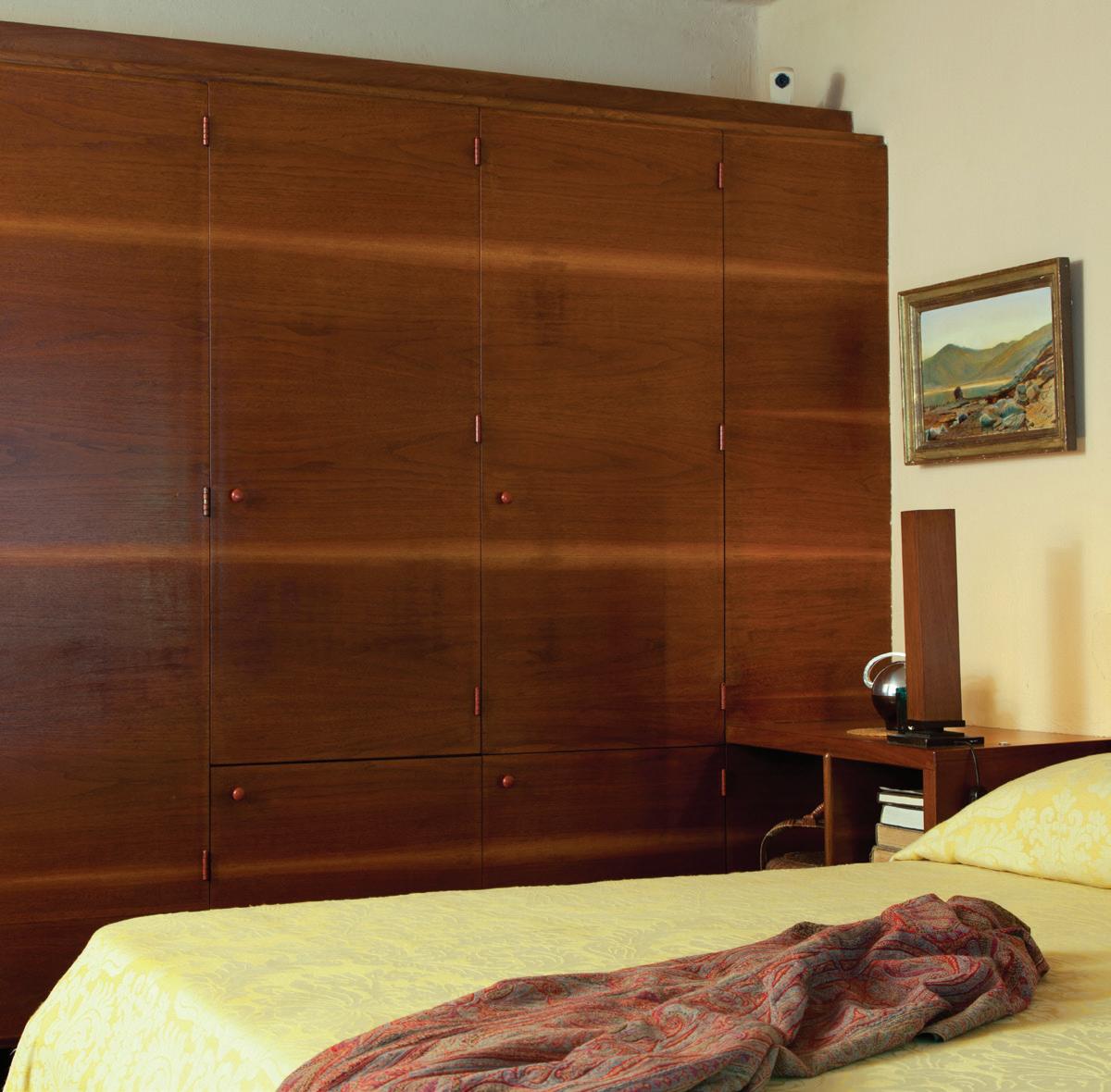
Liliane’s walnut wardrobe was one of nearly 170 pieces designed by Wright, all expertly crafted by Gillen. The beauty of the walnut veneer, especially the inclusion of sapwood to strengthen the horizontal line of the graining, make all of the wood furniture pieces special. In her recollections of the house, written in 1940 for the Museum of Modern Art, Liliane Kaufmann gave a frank, yet revealing, response to how Fallingwater had changed her:
“For the past three years, I have been learning to live in a Frank Lloyd Wright house. It has been an eye-opening experience and a constructive lesson in deletion…The matter of closet space was a revolution to me—I had grown up in a household where pile upon pile of linens, blankets, and personal clothing was a sign and symbol of good housekeeping. I have learned the reverse is true…For the first few weeks my country clothes, sweaters, and coats, filled two units of hanging space and two units of sliding shelves. By a delightful process of elimination, which involved keeping only the ones I liked and really wore, I find one entire unit of shelf space as bare as Mother Hubbard’s cupboard.”
Wright’s design for the wardrobes was tailored for each bedroom occupant. In the case of Liliane’s wardrobe, shallow shelves were angled for the easy display of shoes, while others were wider and slide outward for ease, their woven cane inserts allowing for air circulation. A tilting drawer provided a place for dirty clothing, a nod to the work of her housekeeper, and eliminated the unsightliness of a separate hamper. The efficient design made an impression: “I began to glory in the sense of space and peace with which my room fills me,” Liliane remembered. “I resent the smallest addition to the beautiful simplicity of my room.”
Liliane’s wardrobe was designed by Wright specifically to meet her needs.
A MAJOR PRESERVATION EFFORT COMES TO COMPLETION
After three years of consistent preservation work on Fallingwater’s Main House and Guest House, we are wrapping up World Heritage Preserved , the most comprehensive preservation effort since the early 2000s. This initiative came to life shortly after Fallingwater’s inscription onto the UNESCO World Heritage list in July 2019, and is rooted in our longstanding commitment to uphold the highest preservation standards at this historic site. While the pandemic impacted our original plans to begin this work in 2020, we were able to hit the ground running in 2023 with a plan to complete the preservation work over three years’ time. Since then, Fallingwater’s preservation team has coordinated the schedules of architects, engineers, contractors—all accompanied by Fallingwater’s own skilled maintenance staff—who set about their plans to repair or upgrade every major building system and the effects of long-term water infiltration upon them.
Phased work over the past three years has seen repairs to deteriorating concrete, repointing stone masonry and the injection of nearly twelve tons of liquid grout into walls. A new waterproofing and roofing membrane system
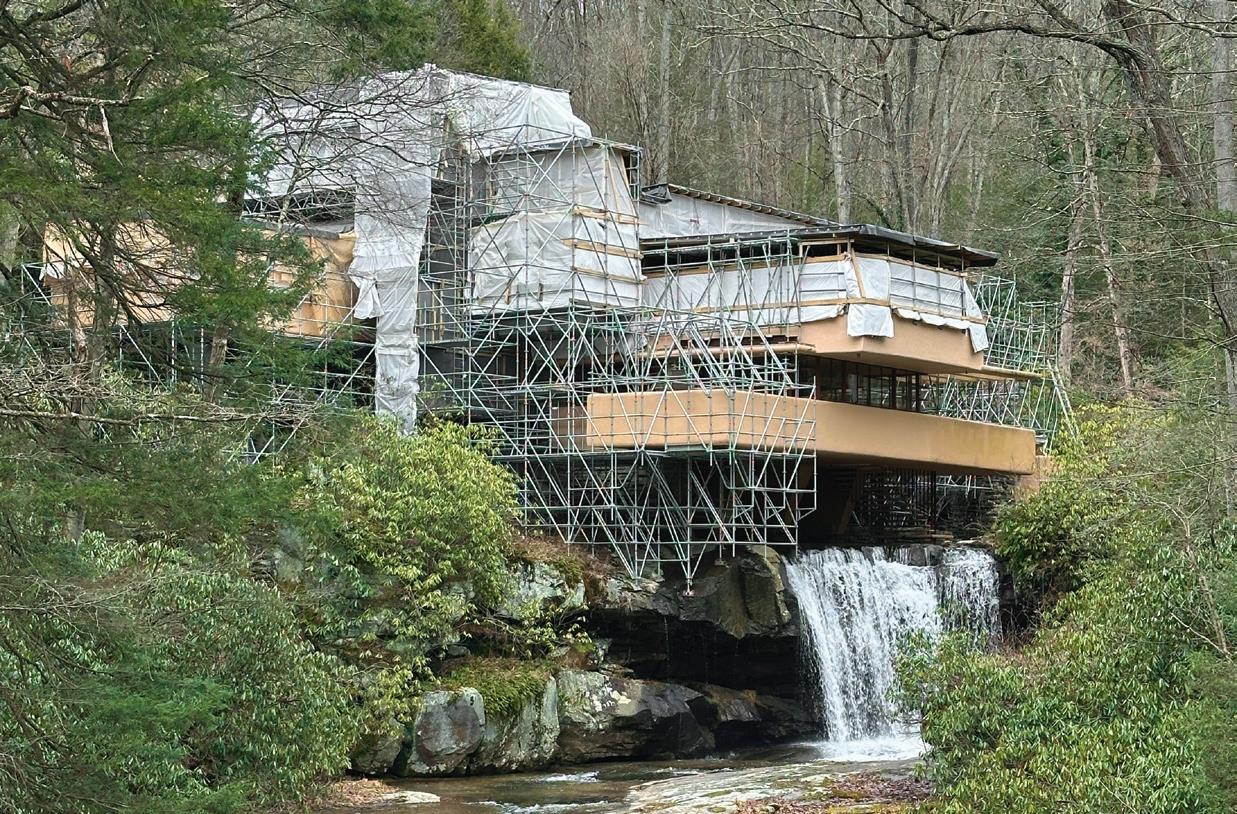
allowed us to address water leaks coming through the flat roofs and terraces, and the erection of scaffolding during the past two winters has provided access for steel conservators to reach our most precarious window and door frames.
This past winter, work was confined largely to the south and west elevations of the house, and roofing was replaced on the largest of Fallingwater’s roofs—that over the second floor—which extends the entire length of the house. Smaller roofs, such as the one over Edgar Kaufmann jr.’s third-floor study, were easier to complete. Liliane Kaufmann’s Terrace and Edgar Kaufmann, Sr.’s Terrace, both located on the second floor, had their flagstones lifted and safely stored before new waterproofing membranes were applied and new drains fabricated. Fallingwater’s team
then reset and repointed the flagstones on each, and directed water toward the new and improved drains.
The project benefitted from new materials and preservation methods that didn’t exist when Fallingwater last underwent a major preservation effort 25 years ago. For the team of preservation architects and structural engineers, this meant developing mockups and testing areas on the building itself to provide the necessary information for practical things like product curing times, especially in the realm of concrete and grouting. The new liquid applied roofing membrane system, for example, was applied to the entirety of the roof roll edges, not just the top surface as in years past, and color matched to Fallingwater’s ochre color.
“Over the past three years, we’ve learned a lot about the materials and methods that went into the initial construction of Fallingwater,” says Scott Perkins, senior director of preservation and collections.
“This historic information, along with documenting new materials and systems, will allow us—and those after us—to care for Fallingwater well into the future. The World Heritage Preserved initiative reflects the level of attention needed to effectively care for an historic building with global importance.”
We’re grateful for the many individuals and foundations that supported this effort, along with the Commonwealth of Pennsylvania and Governor Josh Shapiro, who provided financial assistance through the Redevelopment Assistance Capital Program.
It Took a Village
ARCHITECT AND ENGINEER
Architectural Preservation Studio, DPC
Matteo Ferran Structural Engineers, PLLC
CONTRACTORS
Advanced Caulking Services, Inc.
Allegheny Roofing and Sheet Metal Company, Inc.
BrandSafway Industries
Case Technologies
Graciano Corporation
HP Steel Window Restoration and Repair, Inc
Masonry Solutions International, Inc.
Steel City Scaffolding of Pittsburgh, LLC
FALLINGWATER INSTITUTE
Fallingwater Institute draws inspiration for its educational mission from those who champion human expression, in all its richness and diversity of forms. Through an architecture that harmonizes with nature and challenges conventions, Fallingwater Institute seeks to change perceptions of what is possible.
Join us for personal enrichment, restorative practice and professional development at Fallingwater Institute.
2026 Highlights
INSIGHT/ONSITE: CREATING & COLLAGING FROM MEMORY WITH JAMEELAH PLATT
August 21–23
Join Fallingwater Institute Artist-in-Residence, Jameelah Platt, for a series of guided studio explorations designed to energize your creative practice.
INSIGHT/ONSITE: PHOTOGRAPHY WORKSHOP WITH DAVE BRYCE
October 6–8
Photographer Dave Bryce invites a small group of fellow photographers to join him for an exclusive three-day workshop at Fallingwater where you will slow down, look deeply and photograph with intention.
INSIGHT/ONSITE: WRITING NATURE & PLACE WITH SHEILA SQUILLANTE
October 23–25
Poet and essayist, Sheila Squillante, will lead a reflective and restorative weekend of writing at Frank Lloyd Wright’s architectural masterpiece and UNESCO World Heritage Site.

Scan this QR code for more information and to register.
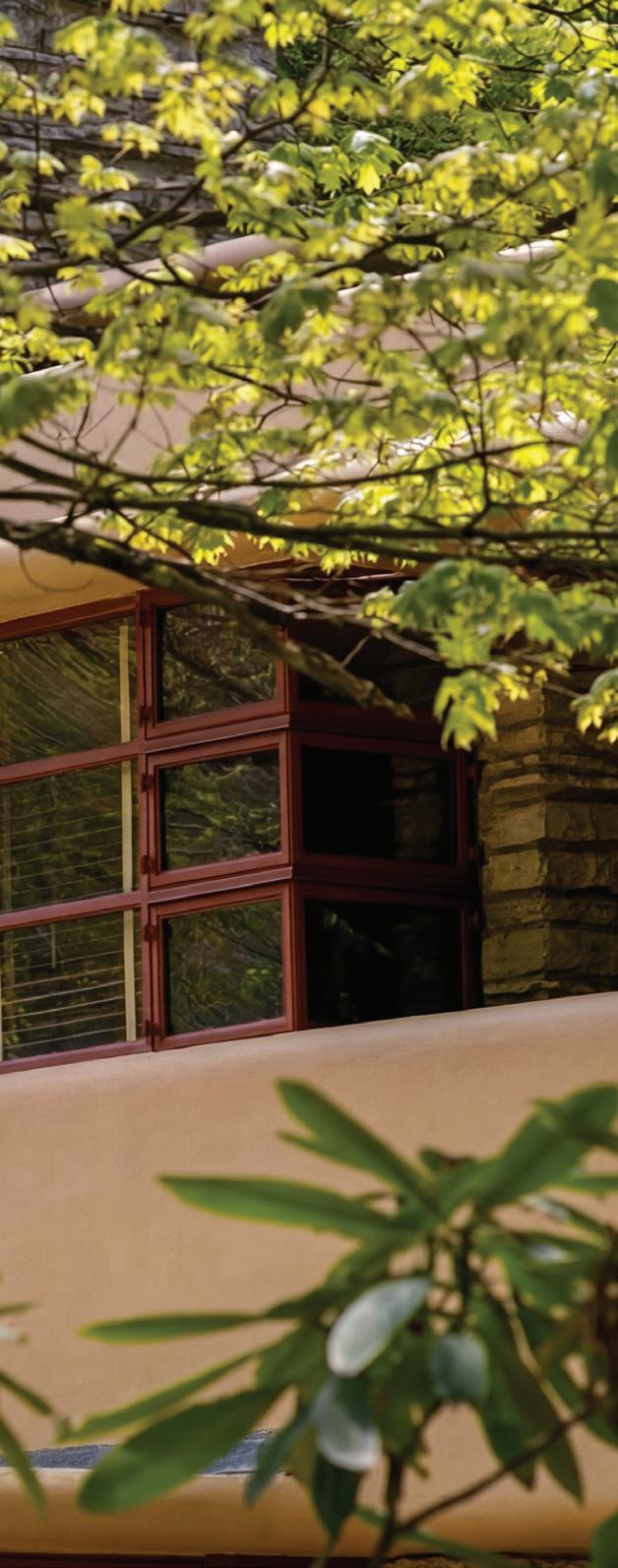
Scaffolding and enclosures, which were removed in April, were necessary to undertake repairs to terraces and rooftops. Confined mainly to the house’s south and west elevations, it also allowed for access
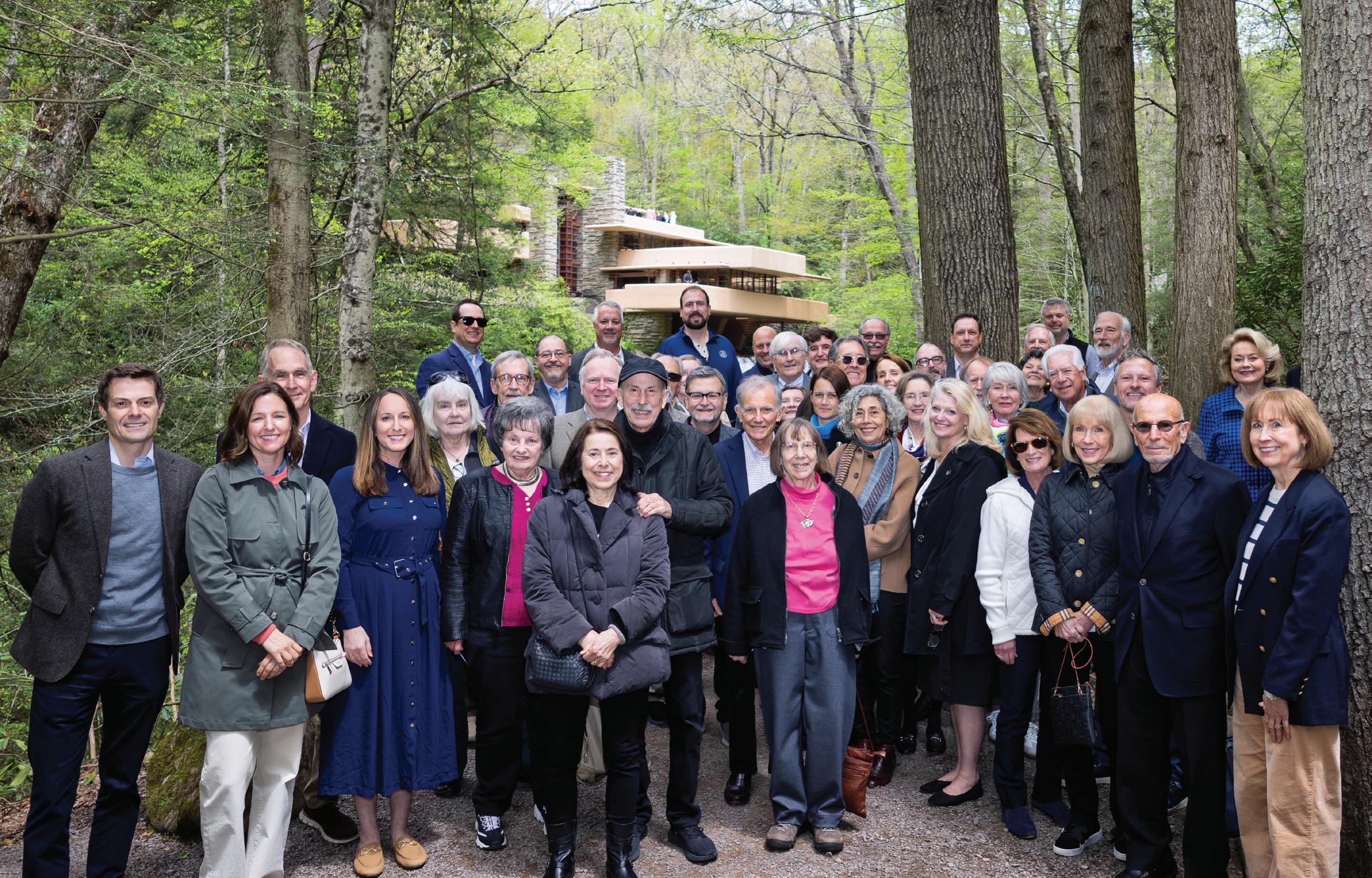
Major donors to World Heritage Preserved, along with government officials and members of Fallingwater’s preservation team, celebrate the initiative’s success.
Western Pennsylvania Conservancy
800 Waterfront Drive, FL 2
Pittsburgh, PA 15222
412-288-2777
WaterLandLife.org Fallingwater.org
MUSEUM STORE
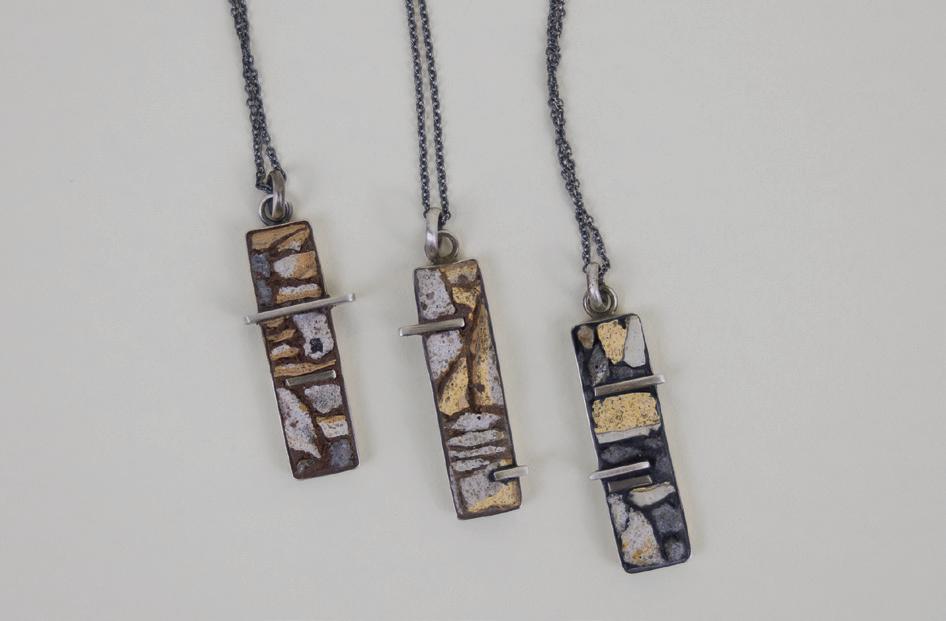
Sculptural Pendants: Pieces of Architectural History
In an exclusive collaboration, local artist Aileen Lampman has created one-of-a-kind pendants that transform architectural history into wearable art. Each pendant is meticulously handcrafted and features original fragments of concrete from Fallingwater, collected during the recent preservation efforts. The concrete is delicately set into custom metal bezels and “cemented” in place. Handmade locally in the U.S.A.
Price: $300.00 +
Fallingwater Advisory Committee:
David Barensfeld
Linda McKenna Boxx
Cynthia Carrow
Michael D. Cheteyan, II
Carrie S. Cox
David G. DeLong, member emeritus
Steven G. Elliott
Christopher Fromboluti
Felix Fukui
Anthony Wolf Greenberg
Austin Hill
Henry P. Hoffstot, III
Donna Holdorf
Laura Howard
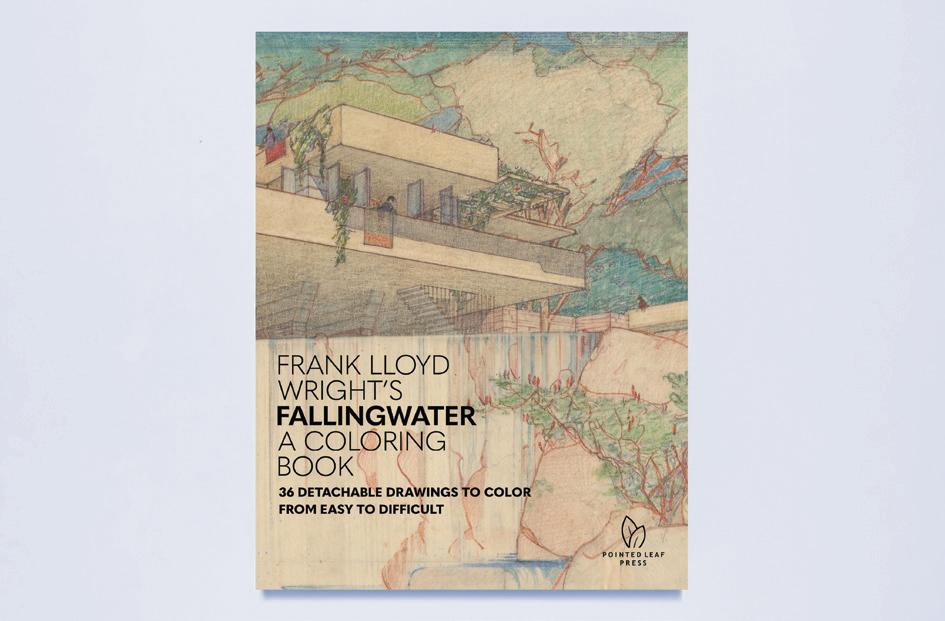
Frank Lloyd Wright’s Fallingwater: A Coloring Book
Frank Lloyd Wright’s Fallingwater: A Coloring Book offers architecture enthusiasts and creative minds a chance to engage with the celebrated site through detailed illustrations, a historical introduction and informative captions. Accompanying the 36 detachable black-andwhite drawings by David Wallace Crotty are special archival images from the building’s construction to its completion, as well as photographs showcasing Fallingwater’s distinctive interior design, art, furnishings and surrounding landscape.
Price: $34.95
William Kolano
H. Lewis Lobdell
Richard Longstreth
Dennis McFadden
Jack H. Millstein, Jr.
Leslie Nutting
Max Protetch
Aldo Radoczy
Toby Smith
Alexander C. Speyer, III, chair
Michael Strueber
Lynda S. Waggoner, director emerita Marigil M. Walsh
Photo by Michael Savisky