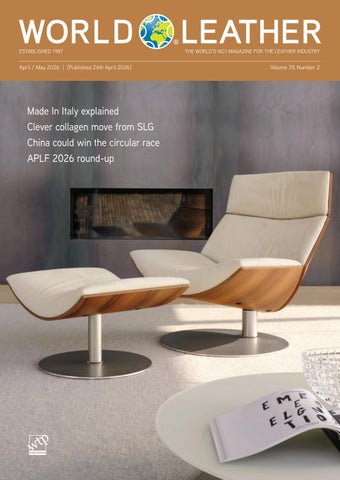
Made In Italy explained Clever collagen move from SLG China could win the circular race APLF 2026 round-up
News
2 News map News highlights from around the global leather industry.
4 Industry & Innovation New technology, new ideas from leather industry suppliers and service providers.
6 Leatherscene People from around the industry and famous lovers of leather who have made the headlines in recent weeks.
8 Backtrack Headlines from www.leatherbiz.com, the industry’s best and most complete news website. Leatherbiz has been comprehensively covering the global leather sector for 25 years now. You can read about almost everything that has happened in the industry this century on leatherbiz. No other news archive comes close.
Leather Leaders
10 Doors are opening The new chairman of India’s Council for Leather Exports, Ramesh Kumar Juneja, says the industry there sees “new opportunities” as a result of lower tariffs on shipments to the US and free-trade agreements in other key markets.
Special Report
12 Time of transition Amid wider uncertainties, conversations at APLF 2026 in Hong Kong centred on collaboration, sustainability and leather’s long-term value.
Technology
14 Clear path The industry in Japan has developed two new certification programmes to strengthen transparency and accountability in sourcing, with early industry uptake beginning to take shape.
17 Fruits of the earth Automotive leather supplier Pangea is upcycling huge volumes of discarded leaves from the agave plant and stones from avocados to generate biopolymers for use in its tanning processes.
Leather and the Circular Economy
20 Thought Leadership: Carbon neutral Documented cases of leather with net-zero emissions have already come to light in the work UNIC and Spin 360 have done to build a new data-collection and supply chain collaboration programme.
24 Thought Leadership: Circular race The European Union’s new Circular Economy Act will see the light of day this year. Circular-economy guidelines and their impact on manufacturing also feature in China’s latest Five-Year Plan. The race is on to see who can turn policy into practice first.
26 Circular Stories: Groundwork will pay off Another successful Salone Del Mobile in Milan makes Italy’s furniture manufacturers optimistic about the future, including in the Middle East, where the sector has built positive partnerships that it aims to pick up again quickly when war comes to an end.
30 Circular Stories: New use for collagen SLG has established a new biofoam division to help make the fullest possible use of the hides it sources, and to confirm its status as a single, vertically integrated supplier of seating solutions.
34 Circular Stories: Steady supply The Turkish footwear sector’s commitment to leather is taking it as far as Brazil in its search for reliable suppliers.
Beast to Beauty
36 Kering confusion Luxury group Kering insists that leather is central to its identity and its quest for higher revenues, but at the same time reveals that it thinks it should decouple growth from its dependency on the material.
40 Essential reading IBC Advertisers’ index
The World Leather team has been publishing a series of original, dynamic podcasts since 2019. The whole series is available on Anchor, Spotify, Apple Podcasts, Google Podcasts, Pocket Casts, Overcast and other podcasting platforms. Just search for the World Leather Podcast on the platform you prefer.
The world’s best leather industry magazine is now available to download on iPad from www.leatherbiz.com
@WTPworldleather
@WTPworldleather
linkedin.com/showcase/wtpworldleather
@WTPworldleather
World Trades Publishing Ltd 2026. Contributions: The editor welcomes news items, articles and photographs for consideration and possible publication but no responsibility can be accepted for the loss or non-publication of such material. Opinions expressed by individual contributors do not necessarily reflect the view of the editor or publisher.
• Whilst every effort is made to ensure accuracy in reproduction, no responsibility can be accepted for the technical content or for claims made by manufacturers for product performance that are published. Publication in World Leather cannot be construed as an endorsement for a claim or product by the publisher.
• World Leather is published 6 times per year by World Trades Publishing, The Old Stone House, Teeton, Northampton NN6 8LH UK. Price UK £90, ROW: £150 per year (six issues).
Graphic origination by WTP. Print by Bishops Printers, Walton Road, Portsmouth, Hampshire PO6 1TR, England. All rights reserved. ISSN 0894-3087
World Trades Publishing 2026: All rights reserved. No part of this publication may be reproduced, stored in a retrieval system or transmitted in any form or by any means mechanical, electronic, recording, photocopying or otherwise, without the written permission of the publisher. World Leather®, Tannery of the Year® and Nothing to Hide® are
Cover image: Furniture in focus. The Kara armchair made by Italian furniture brand Désirée. The 2026 Salone Del Mobile in Milan was sold out, once again, and the Italian furniture sector is hopeful about the future.
The World of News
UK The McQueen brand will close half of its stores worldwide in the course of 2026. Parent group, Kering, shared the information at its capital markets day in Florence in mid-April. The total number of stores the brand has worldwide is around 130, including 22 in China. Kering said its aim was “right-sizing” the number of stores the brand has. It said it wanted the London-based brand to “reconnect with its essence”, with leathergoods and shoes also reflecting “the bold McQueen identity and its uncompromising spirit”.
GERMANY
FRANCE The chief executive of Parisbased brand Jacquemus, Sarah Benady, has said leather apparel was one of the elements of a brand elevation strategy that has proved most effective. She said the most high-end components of its collections, “especially leather ready-towear”, was what had driven the business in recent months, adding that leather clothing items had sold out quickly. She went on to say that leathergoods now accounted for almost half the brand’s revenues.
ITALY Automotive company Automobili Pininfarina has launched a new initiative with car designer Walter De Silva. The partners are calling their new programme Unicum. Clients will place a request for an exclusive car. The Walter De Silva Automotive Studio will design it and Pininfarina will craft each unique car. Each result will be “a masterpiece of automotive culture”, Pininfarina said.
PORTUGAL Portugal’s national leather industry body APIC has celebrated the recent appearance of ‘made in Portugal’ labels on some Louis Vuitton leathergoods. APIC said that the Paris-based luxury brand’s decision to produce some of its leathergoods in Portugal and to highlight and celebrate the fact on its labels “cemented the country’s status as a centre of excellence”.
Four people have died following an accident at a tannery in Runkel, north-west of Frankfurt, according to officials in the state of Hesse. Three died at the scene and one later in hospital. One other person was injured and taken to hospital. Authorities said the exact cause of the incident at the Beuleke tannery was not yet clear but that exposure to chemicals, possibly hydrogen sulfide, was a possible explanation. At the time of writing, the names of the people who died had not been made public.
SPAIN The Futurmoda exhibition attracted 4,100 visitors to its fifty-fifth edition, which took place in Elche in March. The organisers said this number of visitors confirmed Futurmoda’s ability to attract buyers and sellers from the leather, footwear components and machinery sectors. Exhibitors at the event told the organisers they were pleased by the high quality of visitors. As well as from Spain, there were industry professionals from Italy, Portugal, France, Germany, the UK, the Netherlands, Turkey and China in attendance.
SUDAN The country has announced plans to revive its leather sector in a bid to reduce significant annual losses caused by wasted animal hides and weak processing capacity. Local reports say more than half of available hides are lost due to smuggling, limited tannery capacity and poor coordination between authorities. Sudan processes about 22 million hides each year but exports fewer than 7 million, despite having a large livestock herd.
EGYPT Head of the Leather Export Council of Egypt, Mahmoud Sarg, has said Roubiki Leather City is increasingly well-positioned to act as a regional centre for tanning and the leather trade. His comments came during a visit to the site by industry minister, Khaled Hashem. Mr Sarg said Roubiki’s infrastructure and specialised technology centre give it the capability to serve wider regional markets, adding that he expects international promotion and investment support will continue.
PERU High demand for leather backpacks was part of the motivation for a recent design course at the Centre for Technological Innovation in Leather, Footwear and Related Industries (Citeccal) in Trujillo. Citeccal said the course had helped people running leathergoods businesses to reinforce their skills, learn new design techniques as well as cutting, assembly and finishing skills specifically aimed at making “highvalue products” such as backpacks.
BRAZIL Brazil’s exports of hides, skins and leather in the first quarter of 2026 had a total value of $267 million. This is down by 10.6% compared to the same threemonth period last year. Tanning industry representative body CICB said China was the most important market for Brazil’s leather exports in the quarter, with its investment in the material down only slightly, while purchases from customers in the US and Italy showed heavier falls.
The World of News
US Outdoor clothing and accessories brand The North Face has announced a special edition of its Base Camp duffel bag, using leather instead of synthetic materials. Duffel bags have been around for centuries. The North Face introduced its Base Camp version in the 1980s to provide outdoor enthusiasts with a durable product for carrying camping and climbing equipment. Since the millennium, the Base Camp has been a popular piece of mainstream luggage.
VIETNAM The Vietnamese province of Dong Nai has announced a plan to grow its supply chain business for the footwear, textiles and car industries. The local government said it will focus on technology and automation in production and to build business parks to attract international funding. Supporting industries are expected to account for a quarter of the province’s total industrial production by 2030, with the aim of supporting around 1,200 manufacturing businesses.
• Footwear and accessories group Stella International reported full-year revenues for 2025 of just under $1.6 billion, an increase of 1.6% compared to the previous year. Among 2025 highlights, the group listed its acquisition of “a high-end handbag factory” in Vietnam in the second half of the year. It said: “We are committed to establishing our handbag and accessories manufacturing business as a core growth driver. The new facility will elevate our craftsmanship, product quality and research and development capabilities in this category.”
SOUTH KOREA South Korea’s consumer agency has identified 53 instances of unfair advertising in which synthetic products had labels that used the term ‘leather’ or claimed to be ‘nature-friendly’, without evidence of environmental benefits. The investigation, covering six major domestic online markets, found misleading claims across clothing, bags, and furniture. The agency has advised consumers to assess environmental claims carefully.
CHINA Final figures for 2025 showed that China’s leather industry brought in export revenues of $82.7 billion, which the China Leather Industry Association said was a fall of 10.9% compared to the previous year. Together, Chinese manufacturers imported lower volumes of raw, semi-finished and finished hides, falls of 4.7%, 6.1% and 15.6% respectively. The falls in the value of this material were even steeper: 15.8%, 19.1% and 15.7% respectively.
• Luxury leathergoods brand Hermès has opened a new store in Beijing. This is its fourth store in the Chinese capital; it opened the first in 1997. The new store is in the city’s Sanlitun district. It stands five storeys high and has an open-plan layout inside. Hermès’s equestrian collection is on the first floor, with shoes featuring on the second floor and leathergoods on the third.
AUSTRALIA Heavy steer prices in Australia rose to one of the highest levels in history in mid-March. Liveweight prices at the end of trading on March 12 reached an average of 465.29 cents per kilo. This is higher than the recent peak of 464 cents per kilo, which the market reached in November 2025. The record price for heavy steers in Australia is 471 cents per kilo, which the market reached in October 2021. Meat and Livestock Australia (MLA) has said high processor demand for finished cattle, especially well finished grass-fed animals, was driving a “surge in prices”.
Industry & Innovation
Italy deals can put Kenya on the global leather stage
Assomac, the body that represents Italy’s tanning and footwear machinery companies, has signed strategic agreements with the Kenya Association of Manufacturers and with financial institution Equity Bank Kenya.
These agreements, which include tanning industry body UNIC and leather chemicals association UNPAC, aim to aid the development of the leather value chain in Kenya through the use of Italian products and know-how.
The signing of the agreements took place in Nairobi in late March at a leather sector meeting that ran during the wider Kenya International Investment Conference. The agreements have the support of Kenya’s ministry of investment trade and industry, the Kenya Leather Development Council and the Kenya Investment Authority.
Afterwards, the partners said their aim is to create a set-up that will allow Kenyan manufacturers to compete in the global leather production chain.
Equity Bank Kenya’s involvement will give local buyers access to finance facilities for acquiring machinery and other products from Italy. The partners have said Kenyan manufacturers view this as a way for them to make leather and leather products that meet international standards and earn them a share of export markets.
After signing the agreements, Assomac president, Mauro Bergozza, commented: “This project will support the development of a structured manufacturing system in Kenya in which Italian machinery and technology will play an important part.” He said Kenyan leather and leather products can become “a strategic asset” for the global leather industry.
“Made In Italy does not just mean excellent products. It also signifies the ability to transform raw materials into products with high value-add,” Mr Bergozza continued. “We want to use this heritage to help strengthen the potential that Kenyan companies have to be part of international markets. We want to help build up sustainable, competitive production ecosystems across the world.”
Chicago to host ALCA Congress
The American Leather Chemists Association (ALCA) will hold its 2026 Congress in Chicago from May 19–22, bringing together members of the leather science and tanning sectors for technical presentations and industry meetings.
The technical programme will include a keynote address by president and CEO of Nuti Ivo Group, Fabrizio Nuti, who is also president of UNIC and vice president of COTANCE. His presentation will focus on developments and perspectives from the global tanning industry.
Other presentations include Cromogenia Units Leather Division presenting research titled “Blood Veins: Origin, resistance &
control strategies”, which examines structural aspects of leather and approaches to process control and performance improvement.
The congress will also include events marking the 120th anniversary of ALCA, with an evening gathering held at Wrigley Field on May 20.
Nitrogen cycles keynote at Leather Days
FILKFreiberg has announced Prof Dr Thomas Scholten, professor of physical geography at the University of Tübingen, as the keynote speaker for the 14th Freiberg Leather Days, which will take place in Münster on July 1 and 2.
His address will focus on nitrogen cycles and their influence on livestock farming. Prof Dr Scholten, who leads the university’s working group on soil geography, is internationally recognised for his research on nutrient fluxes, sustainable land use and carbon and nitrogen cycles.
The keynote will examine the effects of nitrogen dynamics on agriculture, animal husbandry, and the environment, emphasising their relevance to the leather industry and the opportunities they present for sustainable raw material sourcing and production.
AI on the agenda
Sustainability and artificial intelligence (AI) in the leather supply chain were central topics at the 2026 CICB Sustainability Forum, which took place in Novo Hamburgo in March. The conference was part of the Brazilian Leather project, a partnership between tanning industry representative body CICB and the country’s export promotions agency ApexBrasil.
CICB sustainability advisor Ricardo Andrade spoke first, stating that the proportion of Brazilian leather manufacturers that hold environmental certifications had increased from 60% in 2018 to more than 90% now.
Academic Rafael Martins compared AI to “a kind of magic lamp”. He said the most important skill today is knowing “how to ask”. He insisted that AI is not replacing human capabilities, but amplifying them.
The founder of technology provider Hidexe, Jo Gilet, then presented a 3D scanning system that can inspect 300 hides in 10 seconds and identify imperfections with a higher degree of accuracy than the human eye. The event concluded with a panel discussion bringing together the speakers to debate the future of the sector amid the growing use of AI tools.
Expansion for PrimeAsia
Leather manufacturing group PrimeAsia has signed a manufacturing partnership with Ecco Indonesia to produce PrimeAsia leathers at the footwear group’s location in Surabaya, which will enable it to meet growing demand in Indonesia.
PrimeAsia Vietnam will also complete two major R&D and sample expansion projects in 2026. The first, scheduled for completion in the near future, will add 19 drums, increasing the retanning and colouring capacity by 30%. Later in the year, another 24 drums will be added. This will enable more than 900 sample runs per week.
It has also completed the rooftop solar installation at the Vietnam facility, working towards a target of 100% renewable energy at its facilities by 2040.
Assomac president, Mauro Bergozza (left), with the managing director of Equity Bank Kenya, Moses Nyabanda.
Group CEO Jon Clark said: “We are moving forward with strength by investing in our facilities to meet the growing needs of our customers, delivering greater reliability, speed and efficiency, while maintaining strong focus on resource management, risk mitigation and cost control.”
Boost for Africa
Executive director of the Africa Leather and Leather Products Institute (ALLPI), Nicholas Mudungwe, has outlined a multipillar strategy to strengthen the industry across the continent.
Speaking at the open session of the International Council of Tanners meeting in Hong Kong in March, he said the programme will focus on building staff capacity, supporting enterprises and upgrading internal systems.
Communication and visibility are also central, with the institute aiming to counter negative perceptions and highlight the value the sector creates.
Environmental and public-management systems are being reinforced within the institute itself, setting an example for enterprises in the region. “Seeing is believing,” Mr Mudungwe noted, explaining that industry players are more likely to adopt good practices when they see them implemented at institutional level.
The institute is also working to establish national representation in all countries where it operates, ensuring stronger policy engagement and wider impact.
Deal on track
The proposed merger of JBS Couros and Grupo Viva is on course and should be complete before the end of this year.
When the merger is finalised, the companies will form JBS Viva, which will be the biggest leather manufacturing group in the world. The new set-up will comprise more than 30 production sites around the world and approximately 11,000 employees.
Speaking to World Leather at the APLF exhibition in Hong Kong, the chief executive of JBS Couros, Guilherme Motta, said the deal, which is subject to regulatory approval, was progressing well. He added that it would definitely be in place this year.
Factories in focus
The International Labour Organization (ILO), supported by the Government of Japan, has launched a one-year initiative to support a more sustainable and resilient leather, textile and garment sector in Ethiopia.
Implemented under the ONE ILO Siraye Program, the project will work with 40 factories across key industrial hubs to
Industry & Innovation
improve resource efficiency, reduce waste and energy use, and strengthen occupational safety and health through digital monitoring tools.
The initiative also includes a Women’s Leadership Development Program and will support policy dialogue to align sector development with climate targets. It runs from March 15, 2026, to March 14, 2027.
Half century
Leather chemicals developer Codyeco is celebrating its fiftieth anniversary in 2026. The company, which launched in Santa Croce sull’Arno in Tuscany in 1976, produces a full range of leather chemicals, including wet-end, finishing and beamhouse products. It became part of Smit & Zoon in 2017.
The company will release a series of videos to celebrate the anniversary. In the first of these, one of its senior people, Patrizia Barsotti, says that at the time of the company’s launch, its founder, Donato Berini, was determined to provide the tanning industry with something different.
“At that time,” Ms Barsotti says, “leather chemicals companies limited themselves to selling their products. Donato Berini realised that this was not enough. He realised that tanners needed someone at their side, day by day, someone who would help them face challenges and make good decisions.”
ESG audit complete
The Sustainable Leather Foundation (SLF) has completed its first Environmental, Social and Governance audit for a leather chemical company, following an assessment at Rolfes Leather in Boksburg, South Africa.
The audit extends SLF’s ESG framework beyond tanneries and manufacturers to include upstream suppliers. Development of the adapted methodology began in January 2022, with input from chemical companies including Silvateam, Leder Chimica and Royal Smit & Zoon.
Founder and managing director, Deborah Taylor, said it was a “meaningful step forward” in the evolution of SLF standards. Managing director of the tannery Quintin Marais, described the milestone as part of building “a sustainable future”.
Good target practice
Leather chemicals manufacturer Zschimmer & Schwarz has submitted a commitment letter to the Science Based Targets initiative, signalling its intention to align company-wide greenhouse gas reduction targets with the 1.5°C objective of the Paris Agreement.
The move commits the company to defining near-term emissions reduction
targets in line with SBTi criteria. These will cover scope 1 and 2 emissions, as well as scope 3 impacts across the value chain.
Chief executive officer Dr Christoph Riemer said the transition towards sustainable and circular chemical production is a central part of the company’s strategy, adding that emissions reduction targets will be developed accordingly.
The company said it aims to complete its target-setting process by the end of this year, combining reduction pathways, energy efficiency measures and product carbon footprint tracking, while also advancing biodegradability and the use of renewable raw materials within its portfolio.
On trend
TFL has released its autumn-winter 2027–2028 colour trends for leather garments, footwear, accessories and upholstery.
The palette is split into “Wearing” and “Living”. The “Wearing” section features nubuck and reptile prints in deep burgundy, wine tones, blues, emerald greens and purples with a futuristic edge.
The “Living” section focuses on interior leathers, with nappa and micro-printed surfaces in caramel shades, taupe neutrals and earth and spice-inspired tones.
AI-powered risk assessment
Sustainability
and supply chain intelligence platform Worldly has launched a new AI-powered supplier compliance management solution designed to help consumer goods brands manage social audits and supply chain risk.
The platform consolidates audit data from third-party assessments, brandspecific evaluations and the Higg Index. It uses artificial intelligence to map findings to brand codes of conduct and recognised labour standards.
Progress report
Royal Smit & Zoon has published its 2025 Sustainability Report, marking the company’s 12th annual update on progress towards its 2030 ESG targets.
The report outlines advancements linked to its strategy to “create a sustainable leather value chain” with a focus on measurable impact across operations and the wider industry.
Among the headline achievements, the company reported that 92% of its product range is now ZDHC Level 3 certified across all production sites, while all locations hold ISO 9001, ISO 14001 and ISO 45001 certifications. In addition, its EU operations are powered by renewable energy or compensated natural gas, contributing to a global figure of 72%.
Leather scene
Training academy plans for Kering in Italy
Luxury group Kering is launching a new academy set-up in Italy to train newgeneration talent in leathergoods manufacturing and other artisan skills. Kering said it had taken the decision to set the new academy up because the luxury sector is undergoing what it called “a profound transformation”. A first group of students will start their training in September.
The group said it had chosen Italy as the location for its new academy because it wanted to play a role in the renewal of the country’s “cultural and industrial excellence”. It said it wanted newgeneration craftspeople to learn traditional techniques, but also to learn to interpret luxury “for their own times” and shape the future of the industry.
The academy will have a base in Milan but will operate across multiple sites and centres of expertise in different parts of Italy. Kering said the new initiative would “consolidate and strengthen” training programmes that its brands have already set up. It said the new model would allow it to increase the number of new skilled artisans it can train to 1,000 per year, with this number increasing over time to 2,000 per year.
Chief executive, Luca De Meo, has said the academy will be open to candidates already working at Kering, to people working in its supply chain and “even to competitors”.
Artisan intelligence in demand
The chief executive of luxury brand Prada, Andrea Guerra , has said industrial artisan skills are the keystone of Made In Italy. Speaking to business newspaper Il Sole 24 Ore, Mr Guerra claimed that by 2028, Italy’s luxury goods sector will need 75,000 workers and that, at current levels, companies will only be able to call on half that number.
Asked what he would do to bridge the gap, the Prada chief executive said: “I see in young people a desire to have a different, better life, a life in which they feel less cut off. It’s up to us to create working conditions that can offer them this.”
Mr Guerra explained that companies involved in making high-end products must show young people that the work their craftspeople do is about much more than assembling parts. “It is about being part of a team,” he said, “a group in which they will find a whole set of different attitudes. It is about working in an environment in which the thing that is of greatest value is the human touch, human ingenuity.”
David Buirski retires
Wesay a fond farewell to consultant editor, David Buirski, who is retiring from his role after working on the magazine for exactly one-third of a century.
Mr Buirski studied law in his native city, Cape Town, before pivoting into marketing and public relations. This change of career changed his life. He moved to London, met his wife, Lyn, and stayed.
His work included in-depth involvement in communications projects for prominent fashion brands and the fashion industry’s representative bodies in the UK. This, in turn, brought him into contact with World Leather. When the magazine needed a new editor in March 1993, the knowledgeable and well connected Mr Buirski was the ideal choice.
A trip to Hong Kong for that year’s APLF exhibition followed immediately and he began building strong connections to influential figures in the global leather industry right away. With typical modesty, he attributes a large share of his early success to the group of expert contributors World Leather had at the time: Walter Landmann, Richard Daniels and Hubert Wachsmann
As parent company World Trades Publishing expanded its number of titles, David Buirski’s role diversified too, ending with his becoming consultant editor across the company. Chief executive, Simon Yarwood, said: “We will all miss David and wish him a very happy retirement. His ever-sharp eye, patience, generous advice and gentle encouragement have been an unshakeable support to me and to our entire team.”
Upheaval at Dolce & Gabbana
Co-founder of luxury brand Dolce & Gabbana, Stefano Gabbana, has left his role at the company, according to reports from Bloomberg . Milan-based business daily Il Sole 24 Ore has also reported the story.
The reports say Mr Gabbana has already left his role as president of the company he and Domenico Dolce launched in 1985 and that Mr Dolce’s brother, Alfonso Dolce, has replaced him.
This change comes at a time when, according to the reports, the company is about to enter restructuring talks with banks. Bloomberg said property deals, similar to those Paris-based group Kering has negotiated in recent months, could be part of the discussions.
First Lady continues her support
The First Lady of France, Brigitte Macron , formally opened a new campus of an employment initiative in the centre of Bordeaux on March 31.
This initiative, LIVE (L’Institut des Vocations pour l’Emploi), launched in 2019, with Brigitte Macron as its president and co-founder, with luxury group LVMH. The Bordeaux opening takes the total number of LIVE campuses to seven. There are other sites in Marseille, Reims, Le Havre, Roubaix, Valence and at Clichy-sous-Bois.
These facilities help people over the age of 25 who have been out of work for a year or more. LIVE offers them a platform for enhancing their skills, restoring their selfconfidence and building a new career.
LVMH said the Bordeaux campus would provide this support to two cohorts of 50 or 60 people per year, taking the total number of places available through the programme to 700 per year.
Senior appointments at TFL…
Leather chemicals supplier TFL has announced that chief executive André Lanning has stepped down from his role after deciding to pursue a new professional opportunity. His last day with the company was March 10.
The board has been working on succession planning and is moving toward the appointment of a new CEO to guide its long-term strategy. In the interim, chief commercial officer Samer Al Jabi has been named interim CEO. Mr Al Jabi, who joined TFL in 2025, has played a key role in shaping the company’s five-year strategic plan and global commercial initiatives.
TFL said it remains fully committed to its long-term strategy and to delivering value for customers, partners and shareholders. The board thanked Mr Lanning for his leadership and contribution to the company
In a separate move, TFL has also appointed Sandra Schneider as its chief operating officer. Ms Schneider brings more than 20 years’ experience in operations, business development, and supply chain management, primarily within the chemical and pharmaceutical industries.
Before joining TFL, she was head of operations and supply chain additives at Clariant, and previously held senior roles at Evonik, Wacker Chemie, and the AIT Austrian Institute of Technology.
Interim CEO, Samer Al Jabi, said her expertise in operational excellence, production optimisation, and process improvement would support TFL’s ongoing global development and performance enhancement.
…and at Smit & Zoon
Wilfred Buijs has been appointed chief operating officer of Royal Smit & Zoon, succeeding René Weltevrede, who has retired after more than 40 years in the leather industry, including two decades with the company.
Mr Buijs, who previously held senior roles at Kemira and Lanxess, has completed a global induction, visiting operations in China, India and Europe. Discussions with regional teams and partners provided insight into operational challenges, opportunities and the importance of collaboration across the value chain.
Acknowledging Mr Weltevrede’s legacy of trust, consistency and dedication, Mr Buijs said his focus will be on driving performance, making targeted strategic decisions and strengthening collaboration across the company’s global network.
Board move at LWG
Adidas’ senior director of product development at adidas, Catherine Lee , has joined the Leather Working Group board.
She brings extensive experience in sourcing operations and material development, with strong expertise in aligning strategic sustainability goals, regulatory requirements and operational readiness, said LWG.
It added: “We would also like to express our sincere thanks to Jon Hopper, senior director of materials supply at VF Corporation, for his dedicated service as an outgoing board member, and for his invaluable contributions to LWG’s work over the past eight years.”
Bader hosts students
German
leather manufacturer Bader has hosted a group of transportation interior design students for an in-depth
seminar and factory tour, offering insight into leather production and design.
The visit brought 20 students and their professor, colour, material and finish lecturer Katharina Jose, from Reutlingen University to the company’s sites in Ichenhausen and Göppingen.
At the Ichenhausen tannery, the group explored processes related to wastewater treatment, sustainability and animal welfare. The programme then continued at Bader’s Göppingen headquarters, where students were introduced to production methods and design possibilities across the leather value chain.
The seminar included a focus on CMF design, with practical sessions covering cutting, development and colour assessment. Students also visited the company’s innovation centre, where technologies such as laser processing and digital printing were presented.
The visit concluded with a design presentation demonstrating a range of leather applications. Bader said initiatives of this kind form part of its commitment to supporting and engaging the next generation of designers.
Anniversary celebration
Chief executive of the Bata Shoe Group, Panos Mytaros, has marked the 150th anniversary of the birth of the company’s founder, Tomas Bata . The Czech industrialist was born in the city of Zlin in April 1876. He founded his now-famous footwear company in 1894 at the age of 18.
Today the company has a presence in 56 countries worldwide and around 4,300 stores. It sells around 130 million pairs per year. Panos Mytaros said he was proud to celebrate the founder’s birth and to be part of a company with such a long heritage.
Six workshops for Aquitaine
French leathergoods brand Hermès has inaugurated a new leathergoods workshop in Loupes, marking its 25th production site in France. The facility will eventually employ 260 artisan saddlerleatherworkers, trained through the École Hermès des Savoir-faire. It is the company’s sixth leathergoods workshop in the Nouvelle-Aquitaine region. Artisans at the site will produce established models such as the Kelly and Constance bags, as well as contributing to new product development.
Departure at Dr Martens
Dr Martens chief product officer Adam Meek has left the brand after four years, during which he led global product merchandising, design, development and innovation. Mr Meek previously held senior
Leather scene
Farewell to Gustavo
March
31 was Gustavo GonzálezQuijano’s last day at COTANCE. He has stepped down as secretarygeneral of the leather industry’s main representative body in the European Union after almost 40 years in the role. In a farewell message, Mr GonzálezQuijano said he was grateful for the trust, collaboration and support he had received from colleagues in the leather industry across the decades.
He said working in partnership with people in all parts of the leather sector had made the experience “enriching and memorable”.
He added that his intention is to continue to have Brussels as his base and, after a break, continue his work in the field of advocacy.
COTANCE had already announced Edoardo de Paola as his successor in the secretary-general role.
roles at Canada Goose, Sperry, Nike and Lacoste. Dr Martens thanked him for his contribution to the product team and industry collaborations.
British creativity
UK-based leathergoods brand Mulberry has appointed designer Christopher Kane as the new creative director of its women’s ready-to-wear collections. It said this would help advance the brand’s ‘Back to the Mulberry Spirit’ strategy, which focuses on British creativity, craft, and culture. Mr Kane, a Central Saint Martins graduate, has won the Vogue Fashion Fund award and four British Fashion Awards, including womenswear designer of the year. His first Mulberry collection will debut in September.
Backtrack
World Leather’s publishing cycle and limitations on space make it impossible for us to run more than a carefully selected sample of news from across the industry. However, we publish hundreds more stories on leatherbiz.com. The site is updated every day with news from every continent and every part of the industry, making leatherbiz.com one of the most comprehensive archives of news anywhere on the web for the global leather industry.
We list below just a few of the headlines that have appeared on the site in recent weeks and can still be accessed.
24 April 2026
BFA appoints new chief executive Hubert Védrine to open Sustainable Leather Forum
23 April 2026
China reports growth in export and import of leather bags
Positive start to the year for leather exports from France
Bentley Home notes shift towards material authenticity
22 April 2026
FILK announces 14th Leather Days program
21 April 2026
Italian trio signs Kenya growth pact
20 April 2026
China’s leather garment exports double in value
European partners to collect tanneries’ social and environmental data
17 April 2026
Footwear exports up, imports down for China
Pasubio adds textile specialist Luilor to UNICA group
16 April 2026
Hide exports from France fall in value in 2025
Q1 revenues up for Stella International
15 April 2026
More raw hides, less wet blue and finished leather imports for China
Mixed bag in Q1 but fundamentals remain a strength, Hermès says Bentley publishes responsible sourcing policy
14 April 2026
US wet-salted hide exports down in Q1, wet blue holds its own
Middle East conflict impacts LVMH sales
10 April 2026
Porsche reports 15% drop in Q1 sales
09 April 2026
Strong growth for electric car orders in Germany
Brussels meeting hears leather’s EUDR case once again
08 April 2026
Dr Martens shifts to consumer-focused GM structure
07 April 2026
End of the road for leathergoods brand
China challenge remains for US beef exports
Workers return to JBS plant following strike action
European car producers navigate problems to remain on track
02 April 2026
Fourth Hermès store opens in Beijing
New Kering property deal worth more than €1 billion
Tanning group IT specialist completes book project
AI chatbot among solutions to emerge from ‘Learning Factories’
Leather groups call for removal from EUDR scope
24 March 2026
Former Gucci creative director says ready-to-wear is dead
Roadshows underline US importance for Italian furniture
China and Africa seek to boost trade
Australia beef production to set new record
23 March 2026
Danese integrates Zwaans to strengthen technical capability
Record year for Lamborghini despite ‘challenging context’
20 March 2026
Turin’s turn to host LVMH careers tour
Minerva reports record 2025 results
19 March 2026
Handbag factory in Vietnam among 2025 highlights for Stella International Caleres beats Q4 estimates
Rolls-Royce extension adds £3.1 million into local economy
18 March 2026
Market volatility hits Lanvin Group figures
JLIA unveils company and material-level leather certifications
Footwear supply chain stalls as tariff uncertainty continues
17 March 2026
AI appointment at Kering
FILK extends call for papers deadline for Leather Days
Porsche’s new CEO accelerates ‘repositioning’
16 March 2026
The path is clear for climate-positive leather, UNIC president says
Workers at JBS plant in Colorado go on strike
Leather Naturally updates branding and promotes World Leather Day
Africa debates intracontinental livestock policy
Leather Leaders: Ramesh Kumar Juneja
Leather has its own value
India’s Council for Leather Exports (CLE) appointed Ramesh Kumar Juneja as its new chairman in the early part of this year. The business group he runs, Kolkata-based JC Group, includes divisions that manufacture and export leather, leathergoods and footwear.
Can you please sum up the current situation of the leather sector in India? Please say how many squaremetres of finished leather tanners are producing.
According to the information we have available at the moment (April 2026), leather manufacturers across the country produce around 2.5 billion square-feet of leather per year.
What percentage of the leather India manufactures is going for export at the moment and how much is going into finished products that Indian factories are making?
From this total, we export around 500 million square-feet per year. At the same time, finished product manufacturers are importing a further 500 million square-feet of leather each year. Therefore, we have around 2.5 billion square-feet of leather available for use in India.
It would also be interesting to know, in percentages, how much of this leather goes into footwear, accessories, garments, automotive, furniture, and so on.
It would be difficult to state what percentage of this leather goes in to each product category, but I can say that we use it in finished products that go for export and for products sold in the domestic market.
Council for Leather Exports chairman, Ramesh Kumar Juneja.
India’s leather industry leaders at the opening ceremony for the 2026 IILF exhibition in Chennai. ALL CREDITS: WTP
How many footwear factories are there operating in India today? How many pairs of leather shoes and boots is India producing? What percentage of this footwear is for export and what percentage for the domestic market?
We do not have information on the number of footwear factories operating in India. According to external industry statistics, India produced 3 billion pairs of footwear during 2024 and was the second-largest producer in the world, after China. Of this total, more than 2.7 billion pairs were sold in the domestic market. The rest, 266 million pairs, were exported. From this you can see that about 92% of the footwear produced in India is sold in the domestic market. Besides, India also imported about 124 million pairs of footwear during 2024. The total consumption of footwear in India during 2024 was more than 2.8 billion pairs. India has a population of nearly 1.5 billion people.
How would you describe the current attitude of consumers in India to leather as a material?
At present, the value of footwear and leathergoods in the domestic market in India is estimated at $19 billion per year. We estimate that sales of footwear have a value of $17 billion. Though the majority of the footwear sold in India is in the nonleather category, leather has its own value and the leathergoods and leather footwear market is bound to grow in India in the coming years.
In terms of export revenues, what figure, in US dollars, did the overall Indian leather sector achieve in the financial year that ended in March 2026? If full-year figures are not available yet, please give the most figures you have.
As per the data we have available, exports from the Indian footwear and leather sector had a value of nearly $4.7 billion in the period from April 2025 to January 2026. This figure represents growth of 0.08% compared to the same months in the previous financial year.
How would you sum up the effect of the tariff disputes that began in 2025 on the leather industry in India? With regard to tariffs, we saw some more optimistic messages from some Indian leather manufacturers at the start of 2026. Has this optimism continued?
The reduction of additional US tariffs to 10% has created good prospects for increasing India’s exports to the US market. On top of this, India has recently signed free trade agreements with the European Union, New Zealand, Oman and the UK. These agreements have still to come into force, but being able to ship to those markets with 0% duty will create opportunities for significantly enhancing our market share in these places. Thus, we are confident that with the new opportunities being created, we will be able to achieve sustainable export growth in the coming years.
At the end of March 2026, India officially raised its longterm climate targets, committing to deeper emissions cuts and more extensive use of renewable energy. What impact do you think the new targets will have on manufacturers of leather and leather products?
The leather industry is fully complying with the regulations of the government and is committed to adopting eco-friendly measures and technologies, in line with the objective of meeting long-term climate targets.
Leather industry in transition: insights from Hong Kong
The 2026 APLF exhibition in Hong Kong carried a purposeful, focused atmosphere, building on optimism from earlier shows in Milan and Chennai. Visitors and exhibitors recognise its potential to set the course for the global leather sector, even as questions remain about how far it can influence future trends. Conversations centred on collaboration, sustainability, and leather’s long-term value. Amid wider uncertainties, the event provided a space to shape business, strengthen relationships, and explore leather’s evolving role in a circular bio-economy.
For a few years now, World Leather reports covering various shows have commented on the standard width of exhibition hall carpets and how it was becoming increasingly obvious that space was being stretched, with bare concrete creeping in at the edges of the aisles suggesting a deliberate illusion of fuller halls. Perhaps it is an attempt by organisers in general to make a show appear busier. This year, however, entering APLF on the first floor, long regarded as the exhibition’s emotional home, the immediate realisation was that such aisle carpets had vanished entirely. The reason remains unclear, though exhibitors and visitors speculated freely: some called it a cost-saving measure, others felt it dulled the edges and lowered the tone. Vast swathes of concrete drew comparisons to airport runways or multilane freeways. One minor upside noted was the ease of wheeling travel cases along the unbroken floors.
Returning to the first floor, the show’s spiritual heart, it was also impossible to ignore how small the overall exhibition has become. The widened aisles and cordoned-off side and back walls meant the leather industry occupied barely twothirds of the space, with materials and fashion accessories filling the remainder. With 503 officially registered exhibitors, down from 600 in 2025, 700 in 2024, and far below the boom years of 1,200-plus in the 2010s, the initial impression was flat. For an event on which the industry pins its hopes for positivity, momentum, and the setting out of future business,
it was not the most encouraging start.
However, in the broader context of the industry, amid geopolitical instability and the war in the Middle East, some explanation for the lower turnout can be found. Travel plans were cancelled or altered at short notice, and the appetite for international trips was undoubtedly affected. There was hope, nevertheless, that the optimism seen at earlier shows this year – IILF in Chennai and Lineapelle in Milan – would also be reflected in Hong Kong. First-day footfall was reasonable, but nothing remarkable, and the usual expectation that day two would see higher numbers largely went unrealised.
That said, the evolution of what a trade show represents today remains clear. Back in 2009, when the Hong Kong show recorded 30,000 visitors, many exhibitors could be described as busy fools, entertaining “tyre kickers” and hosting meetings with some attendees who were simply in town for the experience. Nowadays, visits are more purposeful: relationships are maintained, and project discussions are continued face to face. There is much to be said for the ability to read nuance and phrasing in person, which can so easily be lost in an email.
The overall consensus was that the show, as with other shows around the world this year, was cautiously optimistic. Organisers’ figures for registered visitors ahead of the event may have been optimistic, but the quieter turnout was hardly in their control, particularly when a major travel hub closed just
days before the show. Exhibitor numbers were noticeably reduced, reflecting the state of the global industry. China, as expected, accounted for the largest contingent with 113 exhibitors, followed by Italy with 104. Notably, Pakistan contributed only 18 exhibitors, compared with over 70 a decade ago, perhaps indicating a decline in government support.
There was no mistaking the diversity of the industry. Conversations were forward-looking, and while the rumour mill around company consolidations, mergers, layoffs, and closures was active, a common thread was one of collaboration and shared purpose. Attention to legislative matters such as EUDR, chrome VI limits, and bisphenols seemed, for the moment, to have receded slightly, though there is hope that some positive developments in these areas might emerge in the not-too-distant future.
The organiser’s view
At the international press conference, vice president of Informa Markets Asia and APLF director Ms Janice Lee reflected on the challenges of 2025 and outlined the industry’s prospects for 2026. She described the past year as one of adjustment, shaped by economic headwinds, shifting market dynamics and increasing complexity across the global leather supply chain. Entering 2026, she said, the sector is adopting a pragmatic approach centred on collaboration, operational efficiency and long-term sustainability, with Hong Kong continuing to serve as a stable gateway to China and Southeast Asia. Despite wider geopolitical uncertainty, the organisers reported minimal disruption to attendance with exhibitors and visitors demonstrating strong commitment to the show, reflecting continued confidence in APLF and the wider leather industry. ASEAN continues to show robust growth, with countries including Indonesia, Vietnam, Thailand, Malaysia, and Philippines increasingly important as both production and consumption markets for leather. Organisers said that these developments reinforce the value of APLF as a platform for dialogue, trade and market insight across the region.
During the Q&A session, organisers addressed questions about the ASEAN-focused initiatives and confirmed that their regional event will remain in Jakarta following this year’s first foray in the region. The decision reflects Indonesia’s growing significance as both a manufacturing hub and consumer market, supported by its large population — some 287 million — and expanding leather industry. Organisers said that future locations are guided by participant feedback, particularly where previous regional exhibitions have demonstrated tangible benefits for local industry development. Earlier editions in Bangkok were cited as examples of how a welltargeted localised show can stimulate regional markets while enhancing participation at the main Hong Kong event. Looking ahead, organisers announced that the 2027 Hong Kong edition will take place later than this year, from March 31 to April 2. The shift reflects the complexities of scheduling around overlapping holidays, including Chinese New Year, Easter, and Ramadan, as well as broader considerations such as global market cycles and logistics. They described scheduling as an increasingly delicate balancing act, requiring careful coordination to optimise both exhibitor and visitor participation.
Value isn’t just financial
At the Leather Naturally breakfast meeting, Dr Kerry Senior, director of Leather UK and secretary of the International Council of Tanners (ICT), outlined a paradox in the global hide and skin market: material supply remains stable, yet value across the sector is under pressure.
Data presented by Dr Senior confirmed that livestock populations continue to grow modestly. In 2024, the global cattle herd reached approximately 1.58 billion head, goats increased by 2.2%, and sheep by 0.4%. Global bovine hide output rose by around 3% to just under nine million tonnes, with goat skins slightly up and sheepskins declining marginally. Regional variations illustrate stress points: the United States cattle herd is at its lowest in seventy-five years, Europe’s herd continues a long-term decline, and Brazil is in a herd rebuilding phase, affecting the supply of premium hides.
The presentation showed that the challenge for the industry is not scarcity but insufficient demand to sustain value. Hide export values fell by roughly 12% in 2024, continuing a trend from previous years. Finished leather exports, after sharp contractions in 2021–2023, showed modest volume recovery in 2024, yet this did not translate into higher pricing, highlighting structural price compression.
Dr Senior attributed the weakening commercial environment to multiple factors. Economic softness has limited discretionary spending, while footwear and fashion brands continue to manage inventory overhangs. Cost pressures from brands are increasing substitution with lower-priced alternatives, while synthetic and novel materials gain attention through messaging that emphasises cost, convenience or “claimed sustainability advantages”.
Despite these pressures, he presented areas where leather continues to demonstrate strong potential, particularly when value is considered beyond financial terms. “We need to store value in material...value is more than just financial,” he said, noting that transparency and clear communication on raw materials could position leather well under changing regulations. On the EU bio-economy strategy, he added: “Leather is a prime example of a circular material that should not be overlooked in the rush for new technologies.” He also stressed the importance of keeping brands and customers informed, illustrating the role of industry organisations in sharing accurate information.
The mild improvement in finished leather export volumes suggests contraction may be slowing, yet the ongoing fall in values indicates a period of structural adjustment. Dr Senior concluded that the industry must focus on restoring value rather than solely increasing production. Leather’s durability, longevity, circularity, and repairability align with growing consumer and regulatory emphasis on sustainable, highperforming materials. Strengthening supply chain transparency, proactive communication of these strengths, and countering misleading claims from alternative materials are crucial to re-establishing market confidence.
The global hide and skin market is entering a transitional phase. While raw material availability is stable, the sector’s commercial resilience depends on effectively communicating leather’s measurable advantages, asserting its role in the circular bio-economy, and aligning with evolving market and regulatory expectations.
Shinki Hikaku, a Japanese tannery that specialises in producing horse leather and cordovan, has received Japan Eco Leather certifications, indicating compliance with Japan’s environmental standards for leather production.
CREDIT: SHINKI-HIKAKU CO. LTD
Japan unveils dual leather sustainability certifications
The Japan Leather and Leather Goods Industries Association (JLIA) has introduced two certification programmes aimed at strengthening transparency and accountability in leather sourcing, with early industry uptake beginning to take shape across global supply chains.
Announced at the APLF exhibition in Hong Kong, Japan’s two initiatives – JLIA Sustainable Certification and Japan Eco Leather Certification – are designed to work in tandem, offering assurance at both company and material level.
JLIA Sustainable Certification, that was launched last year, focuses on environmental, social and governance (ESG) performance at company level. Its scope includes corporate governance, labour and human rights, occupational health and safety, environmental management, ethics and product responsibility. Certification is granted following document reviews and on-site audits conducted by independent evaluators, with oversight from a third-party committee.
Alongside this, Japan Eco Leather Certification addresses the environmental performance and chemical
compliance of leather materials. Established in 2009 and regularly updated, it includes requirements for wastewater and waste management, raw hide traceability and compliance with defined substance limits, verified through accredited laboratories.
The association said the two schemes are intended to provide a dual layer of assurance, enabling buyers to assess both supplier systems and the compliance of the materials they source.
Interest in the programmes is already emerging across the supply chain, although uptake varies between the two. According to JLIA, Japan Eco Leather Certification has attracted attention from brands, tanneries and manufacturers, particularly in export markets, and has already been adopted by a number of high-end brands.
“ Our goal is to make leather sustainability practical, credible and usable in real supply chains.”
MS NORIE SHIMAOKA, JLIA
By contrast, the newer JLIA Sustainable Certification is still in its early stages. “Since the JLIA Sustainable Certification was only launched in 2025, interest to date has been strongest among tanneries and manufacturers, and we are currently working to further raise awareness among brands,” says Ms Norie Shimaoka of JLIA.
Initial participation figures reflect this early phase. Ms Shimaoka confirmed that four companies are currently engaged in the certification process, with one already certified, one in the final stage and two preparing for audit.
JLIA indicated that it expects uptake to grow as awareness increases and as brands begin to integrate the framework into their sourcing strategies.
Verification and credibility are central to both schemes.
JLIA stated that assessments are carried out by independent appraisers with expertise in leather production and certification systems. In addition, testing by accredited thirdparty laboratories is required, particularly under the Japan Eco Leather Certification, where chemical compliance forms a key component.
The association also notes the importance of aligning with international expectations. The Japan Eco Leather Certification criteria are regularly reviewed to ensure consistency with global regulations on chemicals used in leather production. For the newer ESG-focused scheme, development is ongoing, with an initial focus on establishing a robust and credible structure.
“While topics such as carbon footprinting and LCA are important, we are considering how these elements may be incorporated in the future in a practical and effective manner,”
Ms Shimaoka says, indicating that further expansion of the framework remains under consideration.
From a procurement perspective, the association sees the two certifications as complementary tools that can help simplify sourcing decisions. The combination of companylevel ESG verification and material-level compliance is intended to provide clearer, independently verified information for buyers navigating increasingly complex sustainability requirements.
Looking ahead, the association said that its priority is to ensure that certification frameworks are not only aligned with global standards but also workable in day-to-day industry conditions. “Our goal is to make leather sustainability practical, credible and usable in real supply chains,” Ms Shimaoka states.
As pressure grows around material choices, traceability, and environmental impact, JLIA’s two-tier certification approach shows how the leather industry continues to further enhance its focus on clearer, more reliable sustainability standards that work across complex, global supply chains.
Automotive leather developed using agaveand avocado-based retanning materials.
New biopolymer pathways for automotive leather
The leather industry is increasingly seeking ways to incorporate waste-derived materials without compromising performance. Working with local chemical partners and agricultural communities in Mexico, automotive leather manufacturer Pangea Made has developed biopolymer products that address this challenge by transforming agave leaves and avocado stones, both Mexican agricultural by-products, into retanning agents for chrome and chromefree automotive leathers. The company has launched these materials under its Advanced Product line as Ecoda Agave, Ecoda Avocado, Vendura Agave and Vendura Avocado.
Agave harvesting yields approximately 2.4 million metric tons of piña hearts annually. The term piña refers to the starchy, pineapple-shaped core remaining after leaf removal, with up to 46% of the total biomass discarded as waste. Avocado processing generates an estimated 530,000 metric tons of pit and peel residues per year. These agroindustrial by-products can be subjected to mechanical milling, enzymatic or acid hydrolysis and controlled chemical modification to produce biopolymer blends that function as retanning agents and can be integrated into conventional leather manufacturing processes.
It is reported that 1 kg of agave leaves yields around 1.5 kg of biopolymer mixture, with a single piña providing sufficient material to retan approximately 80 hides, while avocado pits generate roughly 1.4 kg per kilogram processed.
The chemical profile of these biopolymers varies considerably depending on their agricultural origin. As the
company’s North America Wet Hub senior manager, Salvador Salinas, points out, the agave-derived material consists “primarily of water-soluble saccharides, cellulose, hemicellulose and lignin”, noting that “after hydrolysis and stepwise separation, lignin, an inherently polyphenolic biopolymer, becomes the dominant functional component in the recovered mixture”.
This transformation is more than a simple separation step. According to Mr Salinas, hydrolysis not only exposes key phenolic hydroxyl groups but also introduces additional carboxyl functionalities, increasing the material’s affinity for collagen within the leather matrix.
In contrast, avocado-derived biopolymers are rich in condensed tannins, similar to those found in traditional vegetable tannages such as mimosa and quebracho. Mr Salinas explains that hydrolysis releases and partially depolymerises these tannins, increasing the availability of
CREDIT: PANGEA MADE
New biopolymer pathways for automotive leather
phenolic hydroxyl and carboxyl groups. These functional groups interact with collagen through hydrogen bonding, electrostatic interactions and hydrophobic associations, enhancing grain tightness and fullness. Despite differences in composition, both agave- and avocado-based polymers operate through similar chemical mechanisms, allowing them to deliver comparable structural and aesthetic properties in the finished leather.
Roger Pinto, director of sustainability and innovation at Pangea, highlights how these interactions translate in retanning: “Despite their different chemical compositions both materials interact with collagen through the same fundamental mechanisms. Because these interaction pathways are shared, both biopolymer systems perform similarly in retanning applications and are fully compatible with chrome-tanned and chrome-free leather substrates.”
Processing with these biopolymers requires no major deviations from standard wet-end procedures. Mr Salinas notes that the materials “perform effectively within the normal sequence of neutralisation, penetration and fixation steps used in chrome-tanned and chrome-free leathers.” Their performance relies on a controlled ionic environment, ensuring that the polyphenolic functional groups are optimally aligned to interact with available collagen sites. This controlled-charge approach supports consistent penetration, uniform distribution and reliable anchoring within the leather matrix.
Maintaining consistency across batches is particularly important given the agricultural origins of the feedstocks. Quimica Stoever, a local chemical manufacturer and a strategic partner of Pangea for this exclusive development, addresses variability through drying, milling, homogenisation and filtration, followed by tightly controlled extraction and polymer modification steps. This processcontrol strategy ensures consistent charge density, molecular distribution and polyphenolic activity, enabling dependable behaviour in the wet-end despite the inherent variability of agricultural raw materials.
Environmental footprint
From an environmental perspective, Pangea reports that the use of agave- and avocado-derived biopolymers alters the nature of the organic load in the retanning float. According to the company, replacing part of the conventional syntan system with these materials introduces a higher proportion of natural polyphenolics, which are inherently more biodegradable, while maintaining strong exhaustion in the bath. The biopolymers are said to perform in a similar way to anionic synthetic retanning agents, contributing to fullness and grain tightness.
In terms of wastewater, chemical oxygen demand levels are said to be typically similar or slightly lower compared with conventional systems. This is attributed to comparable fixation and exhaustion, combined with the more oxygenated and biodegradable nature of the polyphenolic components when compared with aromatic sulfonates found in many syntans. The company also reports an increase in the BOD₅/COD ratio, suggesting improved biodegradability of the effluent. As both agave- and avocado-derived biopolymers are themselves biodegradable, their contribution at standard retanning dosages is described as significant for downstream biological treatment processes.
Leather properties
In terms of finished leather properties, Mr Pinto explains that the biopolymers primarily influence the crust substrate, enhancing wet-end aesthetics such as fullness, grain tightness and a more uniform fibre structure. “The use of agave- and avocado-derived biopolymers does not fundamentally change the durability or aging performance of the finished automotive leather,” he says. Chrome-tanned leathers retain their high shrinkage temperature and hydrolysis resistance while chrome-free leathers maintain their characteristic metal-free performance profile. Long-term durability, including abrasion resistance, flex endurance, colourfastness and lightfastness, is largely governed by the finishing system applied after retannage.
Beyond technical performance, sourcing and processing local agricultural by-products supports circular economy objectives and generates economic opportunities for rural communities. Mr Pinto describes the initiative as “merging cultural heritage with modern science to transform waste into high-quality leather solutions.”
With the launch of Ecoda and Vendura variants, Pangea aims to demonstrate that biopolymers derived from agave and avocado can be incorporated at scale in automotive leather production. According to the company, the combination of chemical functionality, controlled processing and compatibility with existing tannages allows leather manufacturers to enhance crust aesthetics and structural quality while supporting environmental and social objectives.
After harvesting the agave heart, nearly half the plant can be left as byproduct. Finding innovative uses for this material could offer opportunities for the leather industry.
CREDIT: RUDY PRATHER ON UNSPLASH
PASSION FOR LEATHER
Leather
and the circular economy
Credit: WTP/Flaticon
Carbon-neutral leather is here
There are now “documented cases” of tanners producing carbon-neutral leather. There are leather manufacturers who have the numbers and the analysis to show that the leather they produce, and the supply chain activity upstream of their operations, absorb more carbon dioxide than they emit. These are among the key findings of a new approach that tanners in Italy have led, working in partnership with Milan-based consultancy Spin 360. They say the work they have done and are continuing to do can be of benefit to the whole of the global leather industry.
Large, public-facing companies have openly declared ambitious-sounding emissions targets. Adidas wants to reduce its emissions by more than 40% by 2030. Nike says it will reduce its emissions by 65% by the same year. At luxury group LVMH, the stated goals are to halve greenhouse gas emissions across scopes one and two by the end of this year and reduce its emissions “per unit of added value” by 55% across scope three by 2030. As a reminder, scope-one emissions are direct emissions from company-owned and -controlled resources. Scope two covers indirect emissions from the energy an organisation consumes in its own facilities. Scope three expands this to indirect emissions from upstream and downstream supply-chain partners. Kering has a target of reducing the total amount of greenhouse gas the group emits, by 40%, but it is giving itself until 2035 to achieve this. In automotive, BMW has said it will cut its emissions by at least 60 million tonnes of CO2-equivalent by 2035. Toyota is aiming to cut vehicle use emissions by 50% by the same date.
A new programme of data collection and supply chain collaboration can help leather make a fresh impression on brands.
One voice
Leather manufacturers are going beyond this today. They are producing material that is climate-positive. Others in the industry can follow suit and offer high-quality, traceable, circular leather to brands.
This was the clear position of Fabrizio Nuti, the president of Italy’s national tanning industry body UNIC, in opening remarks he made at a presentation at APLF in Hong Kong in March. Speaking to senior leather industry figures from all parts of the world, Mr Nuti said UNIC and its technical partner, Spin 360, have already put together “documented cases of zero emissions” in their work on a supply chain collaboration programme that they are calling Leather Leaders. “And with leather there is the potential to go below zero,” Mr Nuti said. “With synthetic materials, that potential is not there.”
Science and data are the keys to achieving and demonstrating climate-positive leather, Mr Nuti explains. He adds that new science emerging on biogenic carbon will help
uses renewable raw materials
from other sectors (meat and dairy) is the input for making leather
Use of leather aids the battle against marine pollution, also part of the SDGs
The leather industry opens up pathways into the circular economy for companies of all sizes, including many thousands of small and medium enterprises
Leather content fulfils finished product manufacturers’ desire to use recycled material
Finished products made from leather will meet criteria for green tax relief and for green procurement exercises
the global leather industry present itself in a positive light. This is based on the fact that emissions from natural materials such as wool, mohair, cashmere and leather are different from those that come from the production of synthetic alternatives.
Use of fossil fuels puts into the atmosphere carbon that had been stored for millions of years. With biogenic carbon, living organisms, including livestock, absorb carbon from the plants they eat and return a high proportion of it to nature for it to be reabsorbed. Mr Nuti supports moves for developers and suppliers of natural fibres to “speak with one voice” on the importance of the distinction between emissions from fossil fuels and biogenic carbon. He also says there is a growing acceptance that commonly quoted lifecycle assessment figures underestimate the environmental impact of synthetic alternatives and, at the same time, some momentum is building up behind the easy-tounderstand idea that calculations of a product’s impact ought to take into account the longevity of the material it is made from. “The only credible path to sustainability is for brands to buy materials that science and data prove are better,” he concludes.
Spin 360’s founder and chief executive, Federico Brugnoli, confirms that 13 tanners are already involved in the Leather Leaders programme and that leather chemicals suppliers support the initiative. He is keen for more to join them. The 13 tanners, whom he describes as the programme’s pioneers, are Nuti Ivo, Gruppo Dani, Rino Mastrotto, Gruppo Mastrotto, Montebello, Volpi, Incas, Masoni, Deviconcia, Antiba, BCN, Settebello and Russo di Casandrino.
Brand requirements
He views the work this group has done so far in a positive light. This is welcome, and in his view there is much for the leather industry to be positive about even if, as he puts it, many luxury brands are restructuring and are in waitand-see mode. “Some sports brands,” he adds, without naming names, “bought more leather than ever in 2025.”
Consumer opinion matters, but Mr Brugnoli says brands matter more because it is brands’ purchasing teams, pushed by their design colleagues, who choose the materials they put into their products. For Leather Leaders, 20 brands are going to form an advisory
Credit: APLF
group and will approve a roadmap for taking the programme forward.
The names of the 20 brands are not yet in the public domain, but the roadmap is already in place, at least in draft form. It contains 29 criteria. Tanners can use data they collect from their supply chain partners and from their own manufacturing activity to show they comply with these 29 points.
“We think it is complete,” Mr Brugnoli says, “and we have introduced it to the brands, but with 20 different brand headquarters involved in the approval process, it was always going to take time to reach agreement.”
What the roadmap will lead to, he hopes, is a clear method for showing that leather manufacturers can meet the challenges of regulation.
Passport requirements
There is no turning back on regulation, Mr Brugnoli argues. Nor is this a challenge solely for companies working in or trading with the European Union (EU). He points out that China may activate measures such as digital product passports faster than the EU. This would be a historical first, he notes (please see article on this question on page 24). Digital product passports will make details of a product’s materials, origin and environmental impact
accessible to buyers. In the EU, digital product passports are part of a wider programme, the Ecodesign for Sustainable Products Regulation (ESPR). This came into force in July 2024, but, in typical fashion, roll-out is gradual. Leather, for example, will be part of wider digital product passport rules for textiles. Detailed rules might come this year, but will probably take until 2027. Compliance in the EU may not come into effect until late 2028.
Timelines are one thing. The Spin 360 founder points out that, sooner or later, action will be necessary and that supply chain partners are going to have to learn to share data better than they have done traditionally. “There are specific needs of retailers and brands that require a huge amount of data,” he says.
Changing landscape
The work will be hard, but the landscape is changing and many of the changes are favourable, according to the programme team. Federico Brugnoli has been working on methods for calculating leather’s carbon footprint for the best part of two decades now. He insists that the way the world measures environmental impact is undergoing significant change. He explains that planetary boundaries, a series of processes that define a safe operating
UNIC president, Fabrizio Nuti (left), at the event in Hong Kong. Spin 360 founder, Federico Brugnoli (right), argues that it is very much in the leather industry’s interests to invest in making a positive impression on brands.
space for humanity, encompass more than carbon emissions. In fact, they cover nine different areas, including land-system change and ocean acidification as well as climate change. “Planetary boundaries are playing a big role in universities now,” he says. “This is important. One of the nine areas of focus is called ‘novel elements’, which refers to humans putting into the environment substances whose longterm consequences we do not know. This includes microplastics. This is relevant for us because natural fibres don’t normally produce microplastics.”
In the land-system change area, the rise of regenerative agriculture is helping leather’s cause, improving the value of farm properties, producing good food and good materials. The Leather Leaders programme sees great potential in connections between the food industry and the sectors that use the natural fibres their farms generate.
As mentioned, climate change is part of the planetary boundaries model, too. Federico Brugnoli says something else that will help the leather industry is last year’s finding from Cologne-based think-tank nova-Institute that there has been “a major underestimation” of methane emissions from oil and gas. “The scientific evidence is still building,” he says, “and, in this case, it is satellite imaging that is helping us.”
The nova-Institute specialises in defossilisation and renewable carbon. It carried out analysis that shows global methane emissions from oil production are likely to be 15 times higher than the International Association of Oil & Gas Producers (IOGP) has claimed. For natural gas, the institute said emissions are up to 3.8 times higher in key producing countries than IOGP has estimated. It says downstream products such as polyethylene, polypropylene and polyethylene terephthalate, which are all types of plastic in use in consumer products, should now carry carbon footprints that are between 20% and 30% higher than previous lifecycle assessment figures have suggested. “Tanners want to take their share of responsibility, but we have to be fair,” Mr Brugnoli comments.
Next steps
What will happen next is that a pilot phase will launch, with all indications pointing to the middle of this year for it to begin. The 13 pioneering tanneries are
A more accurate assessment of biogenic carbon, compared to emissions from fossil fuels, can make a big difference to brands’ perception of leather.
Credit: SLG
those who will take part in the pilot. It will not have escaped readers’ notice that all 13 of them operate in Italy. “What we want from the pilot is to be able to assess whether or not we are on the right track,” the Spin 360 chief executive explains. “The pilot will focus on Italy, but after that we will be able to scale. There is a lot of interest in this from tanners outside Italy, indeed from tanners outside Europe.” The idea is for leather manufacturers to gain certification under the Leather Leaders banner.
For them to qualify, they will have to meet customers’ demands for the quality of their finished leather while fulfilling the rest of the programme’s 29 criteria. These include chemical compliance, environmental management, health and safety, traceability, animal welfare, durability and corporate social responsibility.
Consumer impact
It will be up to brands to work out how best to share progress on this with consumers. Most consumers want to respect the environment and live responsibly, but Federico Brugnoli wonders out loud how much they really care about the detail behind a label claiming sustainability or circularity.
“The point is that we are in businessto-business (b2b),” he explains, “not in business-to-consumer. And brands really
do care. What we want here is to create an opportunity to communicate well in the b2b context. If we had a budget of, say, $1.5 million and tried to use it to connect to consumers, the money would run out in half a day. But you could do a lot of b2b communication with that amount of money.”
Buy better
Summing up the programme, Fabrizio Nuti says its aim is to strengthen the scientific foundation of the leather sector through reliable, measurable, comparable methodologies. It is in Leather Leaders’ work on this so far that cases have come up showing that the upstream environmental impact of hides is zero, he insists, and, through calculating biogenic carbon accurately, it can be less than zero.
“You have to keep in mind that 90% of the environmental impact that brands report derives from purchased goods,” Fabrizio Nuti says. “This means the materials they are buying. Buying better, and using science, data and supply chain collaboration and transparency to establish what really is better, is the only credible and sustainable way forward for brands. With Leather Leaders we are taking an important step, shaping a new strategy and a new, science-based approach for our sector.”
A symphony of NATURAL LEATHER SOLUTIONS
Since 1920, NTE Mimosa has used wattle mimosa to create a comprehensive range of sustainable, environmentally-friendly tanning products for the world’s finest leather.
Act of faith
The European Union (EU) is tireless in presenting itself as a world leader in developing policies to support a transition to a circular economy. Commissioner for the environment, Jessika Roswall, is still intent on presenting a formal Circular Economy Act before the end of this year. The new act, the Commission says, will enhance the EU’s competitiveness while promoting circular economy business models, sustainable production and decarbonisation. This act will build on the EU’s second circular economy action plan. It is now six years since the action plan became public. We at World Leather are grateful because it led us, in 2020, to start this series of long-read articles that claim and justify leather’s place in any discussion about the circular economy. But six years is a long time.
Years in the making
There has been no shortage of talk about the changes that a circular transition requires of governments, companies and consumers. Brussels-based public affairs consultancy Publyon has said that one of the aims of the new act will be to double the use of “circular materials” in goods production in Europe by 2030. This sounds promising, but doubling the figure, if it happens, will take circular materials’ share to 24%. This means that, six years on from the publication of the second circular economy action plan, only 12% of the materials companies are using in their manufacturing in the EU are circular.
At the time of writing, the most recent public comments Jessika Roswall has made about what we can expect from the Circular Economy Act were in a speech in Luxembourg in March. She said: “In his new book ‘The Growth Story of the 21st Century’, [economist] Nicholas Stern says that there is no horse-race between climate action and economic development. They go hand-in-hand. I couldn’t agree more. We see this potential in the circular economy.”
Later this year, the European Commission will publish a new Circular Economy Act. Meanwhile, China’s most recent FiveYear Plan suggests that a shift to circular models of production and consumption could happen there more quickly.
She went on to say that every tonne of raw material we save and all products or materials we reuse or recycle, will strengthen Europe’s economic resilience, boost competitiveness and reduce environmental consequences. She also talked about enhancing “resource efficiency” and reducing EU economies’ dependence on imported raw materials. Dare we hope for support and recognition for the EU’s beleaguered tanners? They are, after all, making available to finished product manufacturers one of the most circular raw materials imaginable.
Investment gap
Ms Roswall highlights the need for investment. She quotes a figure that the European Commission recently announced in a joint statement with the European Investment Bank. They looked at the amounts of money currently going into circular projects in Europe and the amount they think will be required for the EU to meet its targets on circularity. This comparison has resulted in what the Commissioner for the environment calls a circular-economy investment gap of more than €80 billion per year.
The Geely EX2, a pure electric hatchback, is currently China’s top-selling car.
Credit: Geely Auto
Within this, she earmarks €5 billion per year as the investment gap for textiles, clothing, leather and footwear (TCLF). She views “private investment” as the most likely source of any extra funding, but seems to accept the need for the European Commission to “deploy all tools” to help secure this private investment. She comes across as confident that the investment will be forthcoming and she insists that the new act will accelerate the transformation to circularity.
Publyon’s view is that the Circular Economy Act will bring a new level of emphasis on waste prevention, reuse, repair and product longevity. The public affairs consultancy adds that there could also be greater clarity on public procurement criteria and targets for recycled content. These aspects, too, would give encouragement to leather manufacturers. We will know soon enough. It may take longer for us to know if the policies the act outlines are able to drive meaningful change for manufacturing companies.
Five-Year Plan
Something else happened in March that is likely to have an effect on the move to a circular economy. Almost at the same time as Jessika Roswall’s speech in Luxembourg, the National People’s Congress, China’s top-tier policy-making body, met in Beijing and gave official approval to the country’s newest Five-Year Plan. This, the fifteenth Five-Year Plan that China’s central government has drawn up since the 1950s, emerged in October 2025. It is a guide to the policies that will come into force in the period between now and 2030.
The new guidelines are explicit when it comes to the circular economy. “We should promote green and low-carbon transitions in industry, urban and rural development, transportation, energy, and other key sectors,” the plan says. “The systems for resource consumption control and resource conservation should be improved. Refuse sorting and recycling should be stepped up to boost the circular economy. Incentives for eco-friendly consumption should be boosted, and green and low-carbon lifestyles should be promoted.”
Eligible for upgrade
In the plan, China’s central government says it wants to establish systems for assessing and managing the
carbon footprint of companies, projects and individual products. New technologies and new regulation methods will be part of this landscape. China has made it clear that it wants not just to keep its manufacturing base but to upgrade it. “We should promote technological transformation and upgrading to shift toward digital and intelligent development in the manufacturing sector and develop smart, green, and service-oriented manufacturing,” the plan says. Among the “key industries” that the Five-Year Plan mentions as being in line for upgrading is the sector it refers to as light industry. China’s globally important leather industry fits into this sector. In fact, the president of the China Leather Industry Association, Yu Lizhong, is also the vice-chairman of the China National Light Industry Council.
Track improvements
The history of China’s progress in the 2020s so far suggests that it could well make faster circular-economy advances than the EU. The International Union of Railways (UIC) identifies high-speed rail services as those on which trains will reach speeds of 200 kilometres per hour (although many services are faster). China’s system stipulates 250 kilometres per hour for services to have a highspeed classification.
Before 2008, China had no highspeed rail services, but built one that year to coincide with the Beijing Olympics. It has not looked back. By 2020, according to the national railway operator, China’s high-speed rail network covered 37,900 kilometres. By the end of 2025, the network covered 50,400 kilometres, an increase of 33% in the first half of this decade. This progress will continue. Ongoing improvement of transportation systems is part of the new Five-Year Plan.
The EU’s high-speed rail network in 2020 ran for 11,500 kilometres. Late last year, the European Commission gave 12,128 kilometres as a more up-to-date figure, an increase of 5.4%.
At the wheel
Electric cars give us another example. In 2020, the EU was ahead of China in the sales of battery electric vehicles (BEVs). That year, BEVs had a 5.3% share of the EU market and a 4.7% share of the market in China. These figures come from a report published in late March this year by the European Federation for Transport and Environment, a Brussels-based advocacy group that campaigns for clean transport and energy. It quotes a number of sources for its statistics, including the European Automobile Manufacturers’ Association, Bloomberg Intelligence and the International Energy Agency
The report, which has the title ‘The State of European Transport 2026’, goes on to give year-by-year statistics for this decade, closing with figures for 2025. Last year, according to Transport and Environment, BEVs had a 17.4% share of the EU market and a 31.2% share of the Chinese market. In a recent book, a prominent economist said: “In the EU, automotive companies have consistently dominated research and innovation spending. Now the European car industry has serious problems, in large measure because the future is in electric vehicles and Chinese firms have a substantial lead.” Like the quote Jessika Roswall picked out, this is from ‘The Growth Story of the 21st Century’ by Nicholas Stern.
He goes on to say: “China recognises its major role in world emissions, its own vulnerability to climate change and the vulnerability of poorer countries. It recognises, and is taking, the great national and global economic opportunities in the green transition.”
European commissioner for the environment, Jessica Roswall, speaking at a meeting of the Women Climate Leaders Network in Luxembourg in March.
Credit: European Union/Mathieu Cugnot
No shortcuts
The Made In Italy phenomenon is a source of great pride for the country’s manufacturers of leather and finished products that use leather. The same is true for companies in all sectors of the economy, for the government and for the entire country. It is so fundamental to the economy that the ministry that has responsibility for industry, commerce, productivity and economic development has officially been known, since 2022, as the ministry of enterprises and Made In Italy. In Italian, its name is ‘Il Ministero delle Imprese e del Made In Italy’.
There is an irony in the term for celebrating the excellence of Italian design and manufacturing being in English, but no one seems to mind too much. In an essay called ‘The Barbarians’, Turin-based writer Alessandro Baricco argues that many of the changes in our use of language in this century are about shortcuts, about conveying an idea with speed rather than going into the idea in depth.
The furniture sector is an important piece in the Made In Italy jigsaw.
Another sold-out Salone del Mobile exhibition in Milan in April, in spite of the state of the world, is good news for the leather sector.
Very specific combination
Here, there is further irony because, apart from linguistically, Made In Italy is the opposite of a shortcut. “Made In Italy is about a very specific combination of factors rarely found together at the same level elsewhere,” says Maria Porro in the busy build-up to the 2026 Salone del Mobile
High-end, leather-upholstered Italian furniture in a business lounge in Riyahd.
Credit: Salone Del Mobile
furniture exhibition in Milan. Ms Porro has been the president of Salone del Mobile since 2021. She is the first woman to hold this position and the youngest in the history of the exhibition, which is often described as the largest event of its kind in the world.
As usual, exhibition space at the 2026 edition of Salone del Mobile was sold out well in advance of the gates opening on April 21. Furniture, lighting, kitchen and bathroom design companies occupied a total of 169,000 square-metres of space at the Rho exhibition centre. Over the six days of the exhibition, organisers were expecting hundreds of thousands of visitors to attend. Maria Porro believes that Made In Italy is one of the factors that brings design professionals and members of the public to the Salone Del Mobile year after year.
Close connections
“First, there is the strength of the supply chain,” she explains. “In Italy, design, production and material sourcing are closely interconnected. This allows for direct control over the entire process, but more importantly, for a continuous dialogue between designers and manufacturers.”
Secondly, there is what she calls a deep-rooted design culture. She lives and breathes this because, in addition to her role at the Salone, she is a senior executive of her family’s furniture company. Based in the Brianza area, a furniture manufacturing hub north of Milan, the company, Porro Spa,
was founded by her great-grandfather 100 years ago. It specialises in tables, chairs, sofas, bookcases and other products that blend, the company says, a range of upholstery materials, including leather, with the woodworking techniques of the past. “In Italy, design has never been only about form,” Ms Porro continues. “It has always been about function, innovation, material research and the ability to interpret how people live and evolve. This leads to products that are intelligent and durable.”
A third aspect is what she calls “the capacity for transformation”. Unpacking this, she expresses the view that the Italian furniture industry has the ability to start from simple raw materials (wood, glass, aluminium, leather) and turn them into “objects of great aesthetic and functional value, designed to last over time”. There are no shortcuts to this. If there were, everyone would be able to do it.
How to create value
Ms Porro continues: “This is made possible by careful control of production processes, the transmission of artisan know-how and continuous investment in technology. Even traditional materials, often ancient and natural, can be constantly reinterpreted through innovation and sustainability. Italian manufacturers create value through their ability to transform raw materials into something that carries identity, performance and longevity. It is not simply that Made in Italy adds value as a label. It adds value because it represents a system in which culture, industry and craftsmanship work together.”
Salone Del Mobile president, Maria Porro.
Credit: Salone Del Mobile /Guido Stazzoni
In recent comments, the president of the Salone del Mobile has put a figure of €52 billion on the annual value of the furniture value chain in Italy. This includes all the hard work that goes on in furniture manufacturing companies, but also in producing some components and materials, as well as in sub-contracting and specialised services. She makes it clear to World Leather that the value of the leather that furniture companies consume is not included in the €52 billion.
National tanning industry association UNIC calculates that 15% of the leather its member companies produce goes to customers in the furniture sector, but, clearly, not all of these are in Italy. “We do not monitor leather as part of our calculations,” Ms Porro says, “but the figure you mention, of around 15% of leather going into furniture, is consistent with the cross-sector nature of the Italian production system. Leather serves multiple industries. This ability to operate across sectors is one of the strengths of our industrial model.”
On the road
This capacity for serving different markets while keeping quality levels high is also one of the reasons for the appeal of Made In Italy in export markets, she believes. The country’s furniture sector brings in around half of its revenues from customers in other countries. The organisers of the Salone
Del Mobile are keen to keep promoting the event among furniture buyers in key export markets as a means of helping the sector grow.
To this end, they organised a series of roadshow events to promote the show to US designers and buyers earlier this year. They describe the US market as one of the most important export destinations for Italian furniture manufacturers, with revenues of €1.9 billion in the first 11 months of 2025. This puts the US second only to France in terms of value. The roadshow events took place in Los Angeles, Chicago and New York. “In markets like the US, these initiatives are essential in helping us build direct relationships with companies, architects, developers and buyers,” Ms Porro says. “They create opportunities for understanding local needs better and for positioning Italian design more effectively within those contexts.” She also points out that these roadshows allow the Salone to operate as more of a year-round platform, rather than as a single annual event.
They produce results, she insists, in the immediate and, especially, the longer term. The organisers of the Salone Del Mobile say they will notice a boost in the number of visitors to the exhibition in Milan and also in the quality of the connections Italian furniture brands are able to establish with them. The US is among the top-ten countries of origin of visitors to the exhibition.
“But the most important outcomes develop over time,” the president says, “with new projects, collaborations and business opportunities.” Again, it is not about trying to take shortcuts. “The Salone acts as a catalyst,” she continues. “The roadshow initiates the dialogue, the Salone concentrates and amplifies it and then the process continues well beyond that. It is part of a broader strategic cycle.”
Middle Eastern eye
Similar roadshow events have taken place recently in other parts of the world, too, including in New Delhi and Mumbai. And as part of this effort to increase interest in exciting export markets, the Salone and Italy’s high-end furniture brands have been working hard to build new connections to the architects, designers and other customers in the Middle East. At the end of 2025, they worked with the ministry of culture in Saudi Arabia to launch Red In Progress, a roadshow in Riyadh in which 38 Italian furniture brands took part.
This was before war broke out in the region at the end of February. Strikes on Gulf States have included drones and missiles hitting Saudi Arabia. Maria Porro remains convinced that, if ceasefires can hold and the war stops, this can still be “one of the most dynamic regions” for Italian design. The example of Saudi Arabia, where there are already pilot projects involving Italian furniture companies, is particularly significant. They are working with local partners who are developing new hotels, for example. Figures she has seen suggest that more than 160,000 new hotel rooms, all of which will need furniture, will become available in Saudi Arabia between now and 2033. “Design is part of a broader transformation there, affecting urban, economic and cultural life,” she adds.
She concludes that when geopolitical conditions stabilise, these relationships will resume “relatively quickly”, precisely because they are built on strong foundations. There is a clear complementarity, she insists. On the one hand, there are markets with strong investment capacity and ambitious development plans. On the other, there is Made In Italy, which offers quality, expertise and reliability. “Of course, continuity and cultural sensitivity will remain essential, but the groundwork is already in place,” she says.
The Salone Del Mobile has been working hard to build links to the Middle East, including in a special event in Saudi Arabia at the end of 2025.
Credit: Salone Del Mobile
SLG has established a new biofoam division to help make the fullest possible use of the hides it sources, and to confirm its status as a single, vertically integrated supplier of seating solutions.
Foam from home
Foam to fill seats and leather to cover them. SLG is now a vertically integrated supplier of what transport companies need in their seating systems.
All Credits: Scottish Leather Group
Scottish Leather Group (SLG) is expanding its production of BioPRO, the protein-based foam it launched in 2025. The specialist aviation leather part of the group, Muirhead, was the first to supply customers with the new foam for use in seats on aircraft. It has described the new product as naturally fire-resistant, a quality it achieves thanks to the protein-based content. The biofoam is made from hydrolysed collagen, which comes from the hides the group uses for leather production. This development earned Scottish Leather Group a nomination in one of the categories at the 2025 Earthshot Prize, a sustainable innovation competition that awards funding of £1 million to winners in each of five categories. To earn a nomination is an important accolade.
Now the group’s specialist automotive leather division, Bridge of Weir, has begun offering BioPRO as seating foam to customers in the car industry, which include Aston Martin, McLaren, JLR and Polestar. It says the product will provide a
lower-impact alternative to traditional automotive seating foam, which is mostly developed from polyurethane (PU). Group chief commercial officer, James Muirhead, says that, for decades, Bridge of Weir has been an enthusiastic supporter of its automotive partners as they work to reduce the environmental impact of their interiors. SLG calculates carbon intensity at 8 kilos of CO2-equivalent per kilo of finished leather it produces, adding that this figure is independently verified. For years now, it has been presenting this to the market as the lowest carbon-intensity leather in the world. “BioPRO is the next step on that journey,” James Muirhead says.
Appetite for protein Collagen content makes up 20% of the foam’s composition. SLG says it is “intercepting” the protein from cattle hides near the start of its leather manufacturing process and subjecting it to hydrolysis. It insists its biofoam can replace melamine,
bromine, titanium phosphate, graphite and per- and polyfluoroalkyl substances (PFAS), as well as PU, in the foam materials that its customers have been using until now.
In a summary of the benefits, the group says that choosing BioPRO instead will help automotive and aviation customers reduce their use of fossilderived content, improve circularity and lower environmental impact. It also says it is a recoverable, “truly circular” and sustainable material. Tests suggest that, at the end of a car- or aircraft-seat’s life, the foam can be recovered through an easy-to-carry-out acidolysis process and reused, which means circular thinking has been part of this project from the outset. In addition, the foam can be moulded to an exact specification each time, eliminating, the group states, the material waste associated with conventional cut foams, which often require multiple cut parts. This can also help reduce weight.
Natural comfort
Head of biofoam projects, Andie Burrows, says the research that SLG has done shows that the protein in the foam “possesses remarkable properties”. He explains that traditional, flexible-PU foam is only able to achieve the safety standards that aviation and automotive customers require by adding the fossilfuel-derived retardants and absorbent mineral fillers mentioned above. Airlines and car companies can tell a greener, cleaner story, he argues, if they choose to use this “wonderful natural product” in their seats instead.
This is a project SLG’s head of innovation and sustainability, Dr Warren Bowden, has led. “Collagen is the first thing produced in the making of leather,” he explains, “and when it is hydrolised it forms gels and foams. Through its natural chemistry, it is also flameretardant. What we have done is create a new chemistry. We have impregnated collagen into a urea-urethane polymer structure. The protein is an integral part of the chemistry. It has additional layers of bonding and perhaps this explains why the foams we are making in this way have a different feel. They feel more comfortable and lighter in weight.”
Weight loss
Figures that Andie Burrows shares with customers give a weight of 47 kilos per cubic-metre for the biofoam SLG is able to make, compared to 55 kilos for
foam from conventional suppliers. Seats account for a substantial proportion of the weight of an aircraft (before passengers sit in them). Even a small weight saving, multiplied across the whole fleet of a major airline, can make an important difference to fuel burn and to carbon emissions. In this case, though, the weight saving is not small; it is a reduction of 14.5%.
This matters in automotive, too, Mr Burrows explains. Original equipment manufacturers are focusing more and more on electric vehicles and are working hard to extend battery range. Any weight saving in the interior can help them in the quest to increase the number of kilometres a vehicle can run on a single charge.
Then there is the advantage of being able to precision-mould BioPRO, which is important because customers use different moulds for different types of seating. With BioPRO, dimensional stability will be the same, from one mould to another. In contrast, because flexible PU foams are made in blocks, which are then cut down into smaller blocks, human input, inefficiency and waste are unavoidable.
Carbon savings
Returning to the question of compliance with the strict safety regulations that apply to seating in aircraft and cars, SLG explains that one important benefit of its new product is that it does not burn in the same way as foams
constructed without protein. “Almost anything will burn eventually,” Warren Bowden says, “but BioPRO has the ability to quench the gas phase. It will carbonise on the surface and form a carbon char layer, which doesn’t combust. It resists flaming and, as a result, it is, basically, self-extinguishing.” Other foams use graphite particles to slow the spread of flames and achieve compliance.
SLG’s view is that its biofoam can beat these competitor products on durability.
“The graphite that normal foam contains is highly abrasive,” Dr Bowden continues. “It destroys the matrix it is sitting in. This abrasion means those foams will lose their integrity over time, giving them a comparatively low service life. The service life of BioPRO is far longer. The protein delivers the flame-retardancy that other foams need graphite to achieve. Because BioPRO is a gel-like material, it contours, it springs back into shape and does not abrade itself during its service life.” He describes this as “quite a step” in challenging the conventions. In comparison to graphite moulded foam, BioPRO’s construction means it has only around 50% of the embedded carbon footprint. In addition, the new biofoam offers customers important carbon savings in the use phase. The combination of the saving in weight and additional durability suggest a saving of more than 480 tonnes of emissions for each aircraft over a span of 10 years of use. SLG says this figure comes from an independent estimate.
SLG’s Dunn Street site in Glasgow, home to the group’s new biofoam production facility.
Years in the making SLG’s direct work on this began in January 2021 in partnership with a third party with expertise in moulds. It is part of a longer-running strategy. It announced ten years ago that it would invest and innovate to help its customers in transportation develop “the sustainable seat of the future”.
Explaining BioPRO’s contribution to this, Warren Bowden says: “In this case, the functionality that the collagen has is the key driver. It has allowed us to create something that out-performs the conventional fossil-fuel-derived PU, which has been around for 90 years.” He adds that the foam immediately seemed to be a product with great potential, although it took two or three years “to unravel exactly what we had managed to achieve”. SLG viewed this reverseengineering as a necessary step before bringing its innovation to market.
The first prototypes emerged in 2023 and the group applied for a patent for what it refers to as the “novel chemistry and novel methodology” involved in the product. This included “several clever bits and pieces at the front end of the process” to make the material solubilise and emulsify before reacting. The patent application met with no objection but it still took until February 2025 for it to be granted.
And now that it has a full understanding of how the product works and its international patent in place, the group has set up a new biofoam division, working out of its site on Dunn Street in the east end of Glasgow. It describes this as a way of diversifying its business and of helping it use to the fullest extent possible the hides it sources for leather manufacturing
If you take an average hide of the type SLG works with, from cattle fed on grass in the UK and Ireland, Andie Burrows says that 11.25% of it, by weight, becomes finished leather. More than half, 51.25% goes towards energy production at the on-site thermal energy plant the group installed at its Bridge of Weir site more than 15 years ago. This, too, is an innovation that Warren Bowden pioneered. He explains that one 40-kilo hide can yield two litres of oil “with an enormous calorific value”. The remaining 37.5% is what Mr Burrows refers to as ‘co-products’, some of which, from now on, will be used to make BioPRO. Using collagen from cattle hides to produce in-demand foam material strikes SLG as a natural step.
At every stage
“One of the things that is often overlooked is that we, as leather manufacturers, are one of the biggest processors of collagen,” Dr Bowden continues. “It is right for us to look at new applications for collagen as well as for hides. We can account for the entirety of the hide. We can add value at every stage. There are markets for all of it.”
The foam production facility will share the space at Dunn Street with the group’s cabin engineering team, which works on the design of prototypes for aviation, automotive, rail and bus applications. There are also extensive testing facilities at the site. Taking the discussion back to the initial idea of “the sustainable seat of the future”, SLG says it can now serve its customers as a single, vertically integrated supplier of everything they need.
The message is clear. Tanners need to make the fullest possible use of the hides they source
BioPRO is protein-based foam for automotive and aviation seating. The natural properties of collagen deliver the functionality customers need to meet strict safety standards.
President of the Turkish Footwear Industrialists’ Association, Berke Içten, inspecting Brazilian leather at Inspiramais in Porto Alegre. All Credits: Inspiramais
Raw material quest
Analysis of the leather industry in Turkey makes it clear that footwear is the most important market for the sector. However, the ongoing strong performance of shoe companies in Turkey has coincided with a contraction in domestic leather production. As a result footwear companies are now looking beyond the country’s borders to supplement the supply of their key raw material. And, as we shall see, they are now willing to spread their search quite widely.
At the start of 2026, a peer-reviewed academic publication in Turkey, the Journal of Innovative Engineering and Natural Science, published in-depth research into the domestic leather sector. The paper’s author was Kemal Kilinç an academic based in Bolu, close to Gerede, one of Turkey’s main leather-producing centres. The paper includes analysis of leather-sector exports over the first years of this century. Footwear exports average 58% of the total share of the wider
Leather’s appeal remains strong for Turkey’s footwear industry, in spite of important changes in the domestic supply landscape.
industry’s export revenues across that period. This compares to 21% for leathergoods, 12% for finished and semi-finished leather, and only 9% for a segment Turkey is particularly renowned for, leather garments. The most recent year that the Kilinç paper gives a value for is 2022, when footwear exports brought in $1.3 billion.
“Factories need raw material; it makes sense for the industry in Turkey to cast its net a bit more widely,”
SERGIO DULIO, UITIC
Volume yes, quality no
A second set of statistics deals with the raw material from domestic sources that Turkish tanners have had available to them. Broadly, the figures show increases in the volume of hides and skins over the period, culminating in 2023, the most recent year the Bolu-based researchers examined, with cattle hides numbering 5.8 million, sheepskins reaching 25.4 million and goatskins 6.7 million. Compared to 2019, these figures represent rises of 20%, 60% and 44% respectively.
These increases may appear encouraging in theory, but the paper makes the point that around 30% of the annual total of hides and skins accrue as the result of the livestock slaughter that takes place during the Eid al-Adha festival. This results in millions of hides and skins coming out of abattoirs over the course of just a few days.
Hot streak
There is a shortage of good equipment, of skilled staff and of sanitary conditions in many community abattoirs, the paper makes clear. Also, there is a dearth of awareness of the importance of good preservation techniques and a shortage of facilities for storage. Compounding this, in recent years, the days of the festival have fallen at some of the hottest times of the year in Turkey: July 31 in 2020; July 20 in 2021; July 9 in 2022; June 28 in 2023; June 16 in 2024; June 6 in 2025. This year, the festival will begin on May 27. “This leads to a loss of quality and high waste rates,” it says. “In some cases, the hides and skins are completely unusable.” The net result for leather manufacturers in Turkey, according to the paper, is that they are having to import 40% of all the cattle hides they use and 75% of sheepskins. This is for quality reasons, not because of any lack of domestic raw material.
Figures that Kemal Kilinç quotes put the country’s leather manufacturing capacity at around 80 million square-metres of finished leather per year. The paper says there are 450 registered facilities for processing hides across Turkey, most of them small operators. It says a large part of total capacity “remains unused”.
Leather
landscape changes
For example, in late 2024 details emerged of leather manufacturers renting out facilities at the Tuzla tanning cluster to logistics companies and manufacturers in other sectors. Tuzla is close to Istanbul and the space is in demand. Some leather manufacturers have found the money on offer from renters too good to turn down. It is true that, in some cases, they have increased production of leather at the Bursa cluster, 100 kilometres away.
Then, in 2025, one of Turkey’s biggest and best known tanning groups, Sepiciler, announced that it had taken the decision to stop producing its own leather. Instead, the group is now sourcing leather from partner tanneries to continue to supply customers. Sepiciler had operated tanneries since 1930. It won the Tannery of the Year award for Europe in 2013. Sepiciler was also one of the first leather manufacturers
in the world to embrace Silvateam’s Biocircular concept for making leather that is recoverable at end-of-life for use in applications such as fertilisers.
The search widens
These changes have made the part of Turkish footwear manufacturers’ lives that involves sourcing leather more challenging. A delegation of senior representatives of the leather and footwear sector in Turkey travelled to Porto Alegre in January this year to inspect leather and other materials at the Inspiramais exhibition. Buyers’ delegations from Mexico, Colombia, Ecuador, Peru, Chile and other places in Latin America are always present at Inspiramais. This was the first time a delegation from Turkey had attended. It was led by the president of the Turkish Footwear Industrialists’ Association, Berke Içten.
The group has confirmed to World Leather that the footwear sector in Turkey is serious about sourcing increased volumes of leather from Brazil. Mr Içten says Turkey currently has the capacity to produce 550 million pairs of shoes and other footwear per year. His calculation for 2025 is that manufacturers were operating at 80% of capacity and produced around 450 million pairs.
He insists Turkey still has good domestic production of leather, but argues that the “steady volumes and good prices” of material from Brazil will complement this well.
The president of the International Union of Shoe Industry Technicians (UITIC), Sergio Dulio, says he thinks it makes sense for Berke Içten and his colleagues to have travelled to Brazil to hold in-depth discussions about sourcing leather from tanners there. He thinks a strong Turkish presence at the most recent edition of the Micam exhibition, which took place in Milan in February, is indicative of “a good growth trajectory” for footwear manufacturers in Turkey. Around 50 Turkish footwear companies took part. “Their factories need raw material,” Mr Dulio explains. “It makes sense for the industry to cast its net a bit more widely.”
Industry leaders: Turkey’s Berke Içten (left), with the president of Brazil’s Abicalçados, Haroldo Ferreira.
Beast to Beauty
Luxury group Kering held a capital markets day in Florence this April. It set out to present its vision for the future of the group and its brands. The message to suppliers and buyers of its leather products was mixed.
S Mixed message
even months into his tenure as Kering chief executive, Luca De Meo says the time has come for him to set out a plan for the years ahead. He came into the role in September (after being announced in February 2025) and has carried out, with senior colleagues, “a brutal diagnosis” of the way the group and its brands work. Decisive actions, spelled out in great detail at a capital markets presentation in Florence in April, will follow. These will affect the way Kering sources and uses leather. Some of the messages about this are positive from the leather industry’s point of view, but others are a source of serious concern. Kering loves and needs leather, but seems to wish it didn’t. Mr De Meo says the measures and targets he and his team have come up with are in keeping with what he calls the entrepreneurial spirit that Kering has always had. In his opinion, the group, founded by the Pinault family in 1962, can tell “one of the most remarkable entrepreneurial success stories in Europe”. The Pinaults began as Breton timber merchants, but moved into retail at the end of the 1980s, specialising first in furniture, then department stores, then books and electronic gadgets. Important early acquisitions included Conforama, Printemps and FNAC. In 1999, the group, then known as PPR, acquired a controlling stake in Gucci. That same year, it purchased 100% of Yves Saint Laurent. Investment in Bottega Veneta and Balenciaga followed soon after and the group became a major player in the luxury sector. It changed its name to Kering in 2013.
Luca De Meo says Bottega Veneta is “the ultimate symbol of luxury craftsmanship in leathergoods”.
CREDIT: SHUTTERSTOCK
“ We want to reduce our dependency on constrained resources; we want to decouple growth from leather dependency, ”
Luca De Meo
Risky business
“Twenty-five years ago we were a French retail group,” the new chief executive says. “Today, we are a global, luxury powerhouse. This transformation did not happen by chance. It happened because the Pinault family dared to take risks, to believe in creativity and to scale it.”
Revenues grew steadily and reached a peak of €20 billion in 2022, with Gucci contributing €10.5 billion towards the total. These figures fell to €19.6 billion and €9.9 billion in 2023, then to €17.2 billion and €7.7 billion in 2024, and to €14.7 billion and €6 billion last year. It was on the back of this that the group brought in Mr De Meo, most of whose career until then had been in the automotive sector. He says that he was fully aware of the challenges Kering faces when he took the role, insisting that he remains convinced of the strength of its brands and of the group’s ability “to reinvent itself”.
Turning point
What this reinvention of Kering will involve and what the group and its products will look like at the end of the process is what Luca De Meo has now laid out. “Even the strongest stories reach turning points,” he explains. “Today we are at one of those turning points.”
He thinks this applies to the whole sector. After what he calls “a decade of exceptional growth” the entire personal luxury industry now faces a reset. The market has been flat since 2023, or even trending in a “slightly negative” direction, he says. The market in China has contracted by 20% over the same period, and the longed-for rebound
has not yet materialised. But he also accepts that Kering has been “more severely impacted” than most of its peers.
“The financial consequences have been significant,” he adds. Reasons that he has identified for this heavy impact include an over-reliance on attracting “aspirational customers” and the group’s brands being too “designer-led”.
In his opinion, luxury is a perception. The word he uses to sum up what truly matters to him is excellence. “Excellence is a discipline,” he explains. “Excellence must be earned every day, in every detail, across the entire value chain. At Kering, excellence will mean creativity, but also flawless execution. It will mean exceptional products, excellence in craftsmanship, quality, service, sustainability, technology and decision-making.”
The chief executive argues that it is excellence that “legitimises luxury”. What he means is that brands and retailers can apply the term luxury to any product, from breakfast cereal to soap. For consumers
to accept that the label, and the increase in price it is likely to lead to, are justified, you have to offer excellence.
Kering’s model for putting this into practice is no longer effective, and he and his colleagues have come to the conclusion that a new, streamlined group platform is necessary. This will be structured around five hubs: industry, customers, technology, sustainability and support functions. Perhaps these are selfexplanatory, but it is worth adding some extra information.
AI’s role
The technology hub will make extensive use of artificial intelligence (AI). In March, Kering recruited Pierre Houlès as its new chief digital and IT officer. For the last ten years, Mr Houlès has held senior digital transformation roles in automotive, working alongside Luca De Meo. At Kering, he will also have the role of chief AI officer.
AI will help streamline operations and enable what Luca De Meo calls
New Kering chief executive, Luca De Meo, has spent his first months in the role carrying out “a brutal diagnosis” of the business and its brands. CREDIT: SHUTTERSTOCK
“productivity insights”. The information Kering teams gather from AI will support better decision-making, he says. For example, AI will have a role to play in helping the group manage inventory. It began an inventory reduction exercise last September and is aiming to reduce its unsold stock by €1 billion in value within 12 months. This is not going to be a one-off, the chief executive continues, but the launch of “a complete change in the strategy for how we manage inventory”. Gucci, for example, has already reduced the range of products it offers by roughly 20%, Mr De Meo says. AI’s role will be to help with forecasting demand sooner in the process so that the group’s inventory management can be “leaner and more productive”, as well as more sustainable.
Non-negotiable
Sustainability is an aspect of the business that the chief executive describes as “non-negotiable across all disciplines”. This includes sourcing. Simplifying the way the business organises itself will bring clarity, help the balance-sheet, restore resilience, give more accountability and accelerate decisionmaking, he continues. However, all of the group’s brands will remain responsible for their own creative direction, product development, go-to-market strategies and “brand expression”. The group ended 2025 with 1,719 stores across its own retail networks. This year, there will be 100 net closures, at least. City by city, the strongest stores will remain; others will close. There will be, according to Mr De Meo, “fewer doors, but better doors and higher productivity”. There will be openings, too, with serious investment going into flagship stores, including one for Bottega Veneta in Bangkok, and in the Gucci flagship on the Avenue de Montaigne in Paris.
Leathergoods will continue to feature prominently in these stores but, as mentioned above, Luca De Meo’s messages about leather are mixed. Yes, he says he wants to build “a more iconic leathergoods offer” across the Kering portfolio of brands. This will be driven by “a strengthened Gucci proposition”, for example, and by an expanded high-end offering at Saint Laurent and Bottega Veneta.
The group has set out pathways for all of its brands. A full account of the planned renaissance at Gucci will feature in the next issue of World Leather. A taster, though, is that the brand’s most iconic bags will become more and more important. These products represent around 10% of all Gucci leathergoods today; this should increase to 20% by 2030. The corresponding target for Saint Laurent is for its most iconic bags to contribute 30% of the brand’s total leathergoods revenues by 2030. “Leathergoods is a strategic, key pillar for Saint Laurent,” Luca De Meo says.
On Bottega Veneta, his comment is that it is one of the most desirable luxury brands “among those who truly know”. Its next chapter will be about scaling this desirability, but without compromising the essence of Bottega Veneta. This essence, he explains, is to have an ethos of discretion, restraint and selfconfidence and still to be “the ultimate symbol of luxury craftsmanship in leathergoods”.
He describes Balenciaga as a brand that has particular relevance for Gen Z. This generation will account for 20% or 25% of the global luxury market by 2030, the Kering chief executive says, compared to 14% today. “Leathergoods is quickly becoming one of Balenciaga’s most powerful engines for growth and its importance will continue to increase,” he
What leather means to Kering brands
Kering says leather is central to its identity. It also says it wants to decouple growth from its dependency on leather and to accelerate the development of next-gen materials.
CREDIT: LINEAPELLE
adds. Year-to-date in 2026, leathergoods revenues at Balenciaga are already up by 20%. The brand will double its leathergoods business by 2030.
Evolving client expectations
All of this sounds like good news for the leather industry, but there is a painful flip side. This is partly because the number of suppliers Kering works with is going to reduce. There will be winners and losers. The group calculates that it has 4,200 direct suppliers, but also that 98% of the products and services it buys comes from just 25% of those suppliers. This creates complexity, cost and risk, Mr De Meo says. Instead, it will now put in place a new sourcing set-up, built on a preferredsupplier model. It will select these preferred suppliers by their ability to meet all quality requirements while complying fully with social and environmental standards. They must also have agility and the capacity to innovate. The aim, he explains, is to move away from “short-term, transactional relationships” towards multiyear partnerships.
The really confusing part of Luca De Meo’s message is that, even as he repeats that leather will remain “central to Kering’s identity”, the group intends to diversify its material portfolio and to achieve a reduction in something it calls “leather intensity”. The chief executive explains: “We will measure this intensity as the number of square-metres of leather Kering purchases for each €1 million in revenues it brings in from leathergoods and shoes.”
If we understand this correctly, he means that he wants Gucci, Bottega Veneta, Saint Laurent, Balenciaga and other Kering brands to achieve growth in their revenues, including (even, especially) their revenues from leathergoods and shoes. But he wants them to achieve this while consuming less leather. He wants this leather intensity to reduce by 30% by 2028.
It could meet this target by putting its prices up by 30%, or by reducing the size of its brands’ bags by 30%. After all, if, say 1,000 square-metres of finished leather makes x bags that sell for y, Kering could source the same amount of leather, but alter the number of bags it makes from the
Rinascimento. Kering’s turnaround plan includes what it calls the renaissance of its biggest brand, Gucci. CREDIT: SHUTTERSTOCK
material to x plus 30%. This would bring in revenues of y plus 30%. Job done; leather intensity reduction target achieved. But this is not how Luca De Meo presents the idea.
Worryingly, what is behind it seems to be “evolving client expectations, client pressure and animal welfare considerations”. Concern over this leads the chief executive to say: “This requires us to broaden our material universe. We want to reduce our dependency on constrained resources. We want to decouple growth from leather dependency.”
Perhaps Luca De Meo has not seen the facts and figures that show the leather industry can have no influence on how many head of cattle farmers raise. Perhaps he has not heard that demand for leather is down while hundreds of millions of hides continue to accrue anyway, or that letting
hides go to waste instead of turning them into leather creates millions of tonnes of extra, unnecessary greenhouse gas emissions. Perhaps no one has told him that the value that skilled tanners and craftspeople can add to a hide is more than 5,000%. Perhaps it has not occurred to him that leather is the very antithesis of a constrained resource.
Kering has its own material laboratory. It intends to use this resource to accelerate “next-gen materials”. Perhaps some new material will emerge, one that is renewable, natural, sensual, repairable, durable, longlasting, sustainable, versatile, biodegradable, affordable and made from raw materials that will continue to accumulate whether Kering’s suppliers use them or not. And if not, perhaps it will decide that it really does love leather after all.
World Leather
The world’s leading magazine for the leather industry. (6 issues per year)
World Leather & £270 per year
Leatherbiz (Digital)
World Leather (Print) £300 per year & Leatherbiz
Footwearbiz
All you need to know to assist you in the global footwear market. (4 issues per year)
Footwearbiz (Digital) £100 per year
Footwearbiz Premium (Print) £140 per year
Sportstextiles
The international technical trade magazine for innovative and responsible materials. (2 issues per year)
Sportstextiles (Digital) £100 per year
Sportstextiles Premium (Print) £120 per year
Inside Denim
Keep up to date with denim developments from raw material to finished product with in-depth coverage of advances at fibre and fabric level. (2 issues per year)
Head Office
The Old Stone House, Teeton, Northampton NN6 8LH, UK Tel: +44 151 928 9288 E-mail: wl@worldtrades.co.uk
Editor Stephen Tierney
Deputy Editor Clare Grainger
Commercial Manager /Technical Editor Matthew Abbott
Consultant Editor David Buirski
Graphic Designer Tim Button
Subscriptions John Collins
Administration Lisa Fabian-Smith
Publisher
Worldwide Sales Offices
India: S Sankaran, 106 Vepery High Road, Periamet, Madras 600 003 Tel: 91 44 25386566 Fax: 91 44 28343685
E-mail: indianleather@yahoo.com
Indonesia: Niran Raphi BSc., Gedung Cahaya Palmerah 3rd fl, #307
Jl.Palmerah Utara III No.9 Jakarta Barat 11480 Indonesia Tel: +62 021 5329343 / 5329014 Fax: +62 021 5329344
E-mail: esdekatraco@centrin.net.id
Pakistan: Abdul Rab Siddiqi, Office M – 2, DADA Garden, Jamaluddin Afghani Road, Sharfabad, Karachi 74800 Tel: 021-34893095 Mobile: 0333-2323166