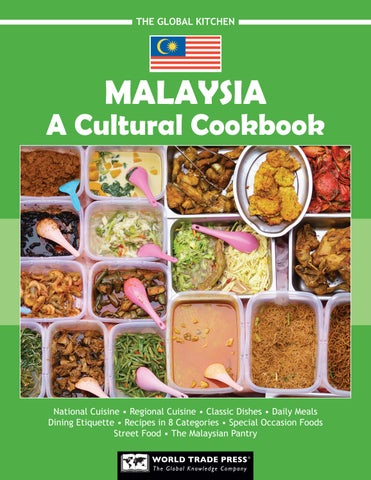
Dining Etiquette • Recipes in 8 Categories • Special Occasion Foods Street Food • The Malaysian Pantry
Recipes in The Global Kitchen series are provided for informational and cultural purposes only. Results may vary due to differences in ingredients, equipment, and individual cooking experience. Always follow safe food-handling practices and exercise caution with sharp utensils and hot surfaces. Check all ingredients for potential allergens before use. World Trade Press has not independently tested every recipe and assumes no responsibility for the outcome, safety, or accuracy of any recipe or information presented.
No part of this publication may be reproduced, stored in a retrieval system, or transmitted in any form or by any means, electronic, mechanical, photocopying, recording, scanning, or otherwise, except as permitted under Section 107 or 108 of the 1976 United States Copyright Act, without the prior written permission of the Publisher.
For information about permission to reproduce selections from this report, please contact Permissions: permissions@worldtradepress.com
For information about special discounts for bulk purchases, please contact Sales: sales@worldtradepress.com
ISBN: 978-1-60780-048-4
www.TheGlobalKitchen.com www.worldtradepress.com
World Trade Press, 616 E. Eighth St., Ste. 7, Traverse City, MI 49686
MALAYSIA
A Cultural Cookbook
Gen S. DuMonde
LIST OF RECIPES
Acar Awak (Pickled Vegetable Salad) ...................46
Yee Sang (Prosperity Tossed Salad) ......................66
FOREWORD
Welcome! This cookbook presents a structured and research-informed exploration of Malaysian cuisine, built upon more than 30 years of culinary documentation and cultural study. Developed from our reference datacooks, chefs, and food historians. It is not a personal narrative but a contextualized account of how Malaysian food has developed and what it reveals about the nation’s layered cultural and historical identity.
Malaysian cuisine is often associated with dishes such as nasi lemak and satay, yet its roots extend far deeper. For centuries, the Malay Peninsula and Borneo stood at the crossroads of maritime trade routes linking
on rice, coconut, and aromatic herbs, formed the foundation. Indian traders introduced curries and spices; Arab, Portuguese, Dutch, and British contact added further layers of complexity. The result is a cuisine both coexist and blend in distinctive ways.
alongside preparation. From rendang and laksa to char kway teow, roti canai, and kuih, each dish is situated contemporary reinterpretation.
As with all books in this series, the tone is analytical rather than anecdotal. The goal is to offer readers a prac-
NATIONAL CUISINE
Satay (also spelled sate
ketupat (rice cake), cucumber, and onion, with peanut sauce especially common in many regions and settings. Nasi lemak is often described as a national dish: coconut milk–steamed rice scented with pandan (daun pandan), typically accompanied by sambal and a mix of sides that may include egg, peanuts, cucumber, fried anchovies, and additional dishes depending on time and budget. Other widely recognized staples vary by region and community and may include rice-and-curry traditions such as nasi kandar; Indian-origin breads and griddle items such as roti canai; and a large range of noodle dishes, including multiple laksa styles. Malay, Chinese, and Indian repertoires also overlap in everyday ingredients while remaining distinct in technique, seasoning patterns, and customary pairings.
country’s diverse ingredient traditions. Bananas, coconut, pineapple, guava, papaya, and mangosteen are widely available, and durian is prominent in seasonal eating and desserts. Fruit is eaten in many ways: as snacks, in beverages, in salads such as rojak, and sometimes as dessert at the end of a meal. Common dessert foundations include cocogula melaka), and starches such as sago; sweet cakes, steamed puddings, and layered confections vary by region and community. In Sarawak, the intricate layered cake known as kek lapis Sarawak is strongly associated with festive seasons and celebratory visitingniques within Malaysian baking culture.
Fruit stall at Chow Kit market, Malaysia
Malaysian Satay
REGIONAL CUISINE
The Northern Region: Penang, Kedah, Perlis
Penang is widely recognized for a highly developed hawker culture and a repertoire of dishes that are both locally distinctive and widely popularized across Malaysia. A key northern signature is Penang asam laksa that is distinct from coconut-based curry laksas found elsewhere. Kedah and Perlis are often associated with rice cultivation and rice-centered meals, those areas. The North’s proximity to Thailand can and ingredient overlap, though the region’s foods are not uniformly spicy or rich, and many northern dishes emphasize brightness and fragrance as much as heat.
The Southern Region: Johor, Melaka, Negeri Sembilan
Johor is known for dishes that signal regional identity, including laksa Johor, which is commonly
Melaka is often introduced through Peranakan (Nyonya) cuisine, which developed from longstanding interactions between Chinese and Malay communities and is closely tied to port-city history. Melaka is also known for localized forms of widely recognized dishes, such as chicken rice balls, an adaptation of Hainanese chicken rice presentation. Negeri Sembilan is frequently associated with
feature chile heat and coconut, including masak lemak cili api, though household versions vary in color and intensity.
Penang laksa is especially popular in the city for which it is named.
Melaka is known for its chicken rice balls.
DAILY MEALS
Breakfast
Eggs, buttered toast, and soft buns are common, especially in urban settings, alongside porridges such as bubur served in sweet or savory forms. A typical Malaysian breakfast also includes hawker and kopitiam foods, including roti canai and nasi lemak. Nasi lemak (coconut rice served with anchovies, hardboiled egg, peanuts, cucumber, and sambal) is widely eaten at breakfast and is also common at other meals.
Dinner
Dinner is often a communal meal and may be assembled from several dishes eaten with rice, although noodles and Indian breads are also common in many households and restaurants. Popular noodle dishes include char kway teow and regional forms of laksa such as curry laksa. Meat dishes frequently include satay and slow-cooked stews such as rendang, and meals are often accompanied by condiments such as sambal and multiple styles of soy sauce. A common group dining format is “steamboat,” in which diners cook ingredients in a simmering broth at the table and may drink the remaining soup at the end.
Rice is a dominant staple in Malaysia, but Indian breads, Chinese-style noodles, meat, seafood, and fresh fruit commonly appear in everyday meals. Many eating patterns include snacks between meals, and lunch selections often depend on what is available at nearby stalls and restaurants. Lunch may feature dishes such as nasi goreng or mee goreng,
Roti canai is a typical Malaysian breakfast dish.
A steamboat dinner in Melaka
DINING ETIQUETTE
Eating Out: Common Restaurant Types and Norms
Common places to eat include kopitiam (traditional coffee shops), warung (small eateries or food stalls), and mamak restaurants or stalls (Tamil Muslim-run eateries known for late hours and wide menus that often include rice-and-curry options as well as breads and noodles). Ordering etiquette depends on the group: in hosted meals, the host may order for the table, while in casual settings individuals may order for themselves, especially at hawker-style venues. Payment customs also vary; a host may offer to pay in formal or business contexts, while friends may split the bill or take turns. Service charges are common in many full-service restaurants, and tipping is generally not expected, though small rounding or a modest tip may occur depending on the situation. Alcohol availability depends on the establishment; halal or Muslim-run venues typically do not serve pork and often do not serve alcohol, while other restaurants may. Public drinking norms also vary by location and context, and visitors are best served by observing local practice and following venue rules.
Inside a kopitiam in Kuala Lumpur
SPECIAL OCCASION FOODS
BIRTHDAYS
In Malaysia, birthdays are celebrated with family and friends, where traditional foods such as nasi lemak (coconut rice served with a chile pepper sauce called sambal, fried anchovies, a fried or hardboiled egg, cucumber, and roasted peanuts), mee goreng (fried noodles), and satay (grilled meat skewers) are commonly served. A birthday cake, typically Westernstyle, is the highlight of the celebration, but trakuih lapis (layered cake) and pulut panggang also may be included. The food during birthday
the occasion, with meals shared to bring loved ones together in celebration.
KAAMATAN (Sabah Harvest Festival)
Kaamatan, celebrated in Sabah, is a thanksgiving festival honoring the rice harvest. Traditional dishes such as hinava bosou (fermented meat), and tuhau (wild ginger) are commonly eaten. Lihing (rice wine) also is enjoyed during the Kadazan-Dusun community’s deep connection to agriculture and the land, with meals that celebrate the successful harvest and foster communal bonds.
Cultural and Regional Festivals
HARI GAWAI (Harvest Festival)
Hari Gawai, celebrated by the Dayak people of Sarawak, marks the end of the rice-harvesting season. -
ing. Central to the celebration are foods prepared using a traditional cooking method of the Indigenous Dayak people called pansoh food inside a hollow bamboo stalk lined with banana
These dishes, often referred to simply as pansoh, include manok pansoh (seasoned chicken cooked in bamboo) and lemang (a mixture of glutinous rice, coconut milk, and salt cooked in bamboo). Rice wine, known as tuak in the Sarawak region, also is consumed.
the rice harvest and the connection to the land, with meals that celebrate abundance and community.
STREET FOOD
KUIH SERI MUKA
Kuih seri muka is a two-layer steamed dessert with custard top, and it is commonly sold as part of mixed kuih assortments. The dessert stands out for its conlayer and a set custard layer that is smooth when properly steamed. Vendors may vary sweetness level and custard thickness, and the pandan layer can range in eaten at breakfast or teatime and is widely available in markets and at stall counters.
APAM BALIK
Apam balik is a popular Malaysian street food pancake is typically cooked on a shallow griddle, folded in half,nuts, and sometimes sweet corn or butter. The batter includes yeast or baking powder, which gives the pancake its characteristic airy texture. Vendors often adjust thickness, with thinner, crispier versions and thicker, more cake-like styles both widely enjoyed. Apam balik is commonly found at night markets, roadside stalls, and hawker centers across Malaysia.
PISANG GORENG
Pisang goreng are banana fritters made by coating slices of banana or plantain in a batter and deepfrying them until golden. They are often served plain or with a sprinkle of sugar. When made with the addition of cheese, this treat is called pisang goreng keju. Other variations include dipping the fritters in chocolate or serving them with ice cream. Pisang goreng is widely available as a snack at street food stalls and hawker centers, especially in the mornings and afternoons.
ONDEH-ONDEH
Ondeh-ondeh
with melted palm sugar and coated in grated coconut. Flavored with pandan leaves, this treat is known for its green color. Variations might include adding
Peranakan (Straits Chinese) sweet treat is a favorite at markets and street vendors, especially in Penang and Malacca.
DID YOU KNOW?
In many Malaysian households, ingredients such asvor and for their place in everyday wellness beliefs. These ideas often operate as culinary common sense rather than as formal medical claims, and they vary by family and community tradition. The overlap between cooking and home remedies is frequently expressed through choices about warming foods, cooling foods, and ingredients thought to be strengthening. This theme appears in multiple communities and is not limited to one regional cuisine.
Peranakan cooking often relies on spice pastes commonly referred to as rempah, which are made by pounding or grinding aromatics and chiles into a cohesive base. Many modern kitchens use blenders or food processors, while some cooks prefer a mortar and
pestle for texture control and aroma development. Rempah formulations vary by household and dish, and they are often treated as a key source of individual style within the cuisine.
Common bases frequently include dried and fresh chiles, garlic, and shallots, with additions that may include belacan, ginger, turmeric, lemongrass, tamarind, and candlenut.
Because Islam is the majority religion in Malaysia, halal dietary practice strongly shapes the public food environment in many areas, including restaurant
time, Malaysia’s multi-religious population means that non-halal foods and establishments also exist, particularly in certain neighborhoods and communi-
eaten but also how food is prepared and served in public settings.
For visitors and writers, the main risk is treating any one set of rules as universal across all Malaysian households.
Acar awak is a Malaysian mixed-vegetable pickle commonly served as a condiment or side dish alongside rice dishes and festive spreads. The preparation is closely associated with Peranakan and Malay foodways, where pickling developed as an everyday method for extending the usefulness of vegetables in a tropical climate. Its
As home cooking traditions moved into restaurants and catering, the dish became a familiar component of celebration meals and buffet-style gatherings. In Malaysian cuisine, acar awak remains a practical and recog-
Within Malaysian street food culture, popiah basah developed as a moist, freshly assembled variation of the broader popiah tradition brought by Hokkien and Teochew migrants. This style emphasizes a softer texture,
Historical accounts from market districts show that vendors favored this preparation because it allowed forning markets and neighborhood stalls where customers sought lighter, customizable snacks. In these settings, popiah basah
Two Malaysian dishes share the name hokkien mee, and the Penang version is widely regarded as the older preparation linked to early Fujian immigrant broth-making methods. Its signature technique involves frying prawn shells and heads before simmering to build a concentrated stock, a practice documented among early Penang hawkers. The Kuala Lumpur version developed later as a stir-fried noodle dish and represents a separate culinary path. Penang’s preparation preserves traditional Chinese-Malaysian elements, including sambal, fried shallot oil, pork ribs, and layered broth construction.
Kerabu pucuk paku is a Malay salad built around pucuk paku, the tender tips of an edible fern commonly eaten in Malaysia. The dish is often associated with east-coast and northern kerabu styles, where fresh greens are alongside other dishes rather than as a stand-alone plate. In Malaysian foodways, kerabu sits alongside ulam traditions that favor bright, punchy dressings over heavy sauces. Variations are common, but the dish remains recognizable as kerabu by its tossed presentation and sour-spicy dressing.
Asam pedas is strongly associated with Melaka and Johor, where it is treated as a regional marker as much as a household staple. The name is descriptive: asam refers to sourness and pedas
ingredients and tastes through maritime trade across the Straits of Malacca. Served as part of a rice meal, it is typically framed as a practical, everyday dish that still reads as distinctly “southern” in Malaysia. In many bunga kantan and daun kesum, both used as signature fragrances rather than as bulk ingredients.
Nasi dagang is a rice dish strongly associated with the East Coast of Peninsular Malaysia, particularly the state of Terengganu, where it holds a longstanding place in local food culture. Its characteristic texture comes from the use of regional rice varieties and careful steaming methods that produce a slightly glossy, tender grain. Historical references suggest that coastal trading communities played a major role in shaping the dish by introducing spices and preserved foods that accompanied it. As the preparation spread beyond its place of origin, families continued to serve it for breakfast, festive gatherings, and major celebrations. Within Malaysia, nasi dagang endures as a symbol of east coast culinary identity grounded in tradition and regional history.
Acar awak is a Malaysian mixed-vegetable pickle commonly served as a condiment or side dish alongside rice dishes and festive spreads. The preparation is closely associated with Peranakan and Malay foodways, where pickling developed as an everyday method for extending the usefulness of vegetables in a tropical climate. Its
As home cooking traditions moved into restaurants and catering, the dish became a familiar component of celebration meals and buffet-style gatherings. In Malaysian cuisine, acar awak remains a practical and recog-
In Malaysian mamak eateries, roti tisubreads. Its development is linked to the creative adaptations made by Tamil Muslim vendors who experimented with thinner doughs and dramatic presentations to appeal to late-night crowds. The paper-thin sheet is cooked until crisp, folded into tall cones or spirals, and often served as a light dessert or shared treat. As as for its delicate texture. Within Malaysia’s diverse culinary scene, roti tisu stands out as a playful expression of mamak innovation and showmanship.
KAYA TOAST
(COCONUT JAM TOAST)
Prep Time: 10 minutes Rest
Recipe Servings: 2
Dietary Considerations: Vegetarian, Kosher, Halal
Traditional kopitiam culture in Malaysia helped make kaya toast one of the most recognizable elements of the national breakfast table. The dish grew from early 20th-century coffee shops where Hainanese cooks adapted kaya, a coconut-egg jam cooked slowly until centers expanded, the toast spread to train stations, markets, and modern cafés, retaining its association with culinary rhythms of Malaysian morning life.
GALANGAL
Galangal is a knobby, woody rhizome in the family Zingiberaceae. An underground root, galangal has a or orange skin.
Origin
Galangal is native to Java, Indonesia, and is widely cultivated in Southeast Asia. In the United States, it is mainly grown in Florida and California.
Varieties
The four species commonly called galangal are:
• Greater galangal (Alpinia galangal);
• Lesser galangal ( );
• Aromatic or sand ginger (Kaempferia galanga); and
• Boesenbergia rotunda).
Galangal is peppery and piney with strong notes of citrus.
Galangal has trace levels of iron and the vitamins A and C. It contains the phytochemicals galangin, emodin, beta-sitosterol, and quercetin.
Preparations
Galangal is a widely used seasoning in Thai, Lao, Vietnamese, and Indonesian cuisine. Galangal is commonly used in soups, curries, and stir-fries, and is often paired with ginger. Powdered galangal also is
it is less preferred than fresh galangal. The Polish
Season
Powdered galangal is available year-round. Fresh galangal is harvested in the early winter.
Did You Know?
• Galangal has a long history of use as both a spice and medicine. Once common in European cuisine, dried galangal was worn in the belief that it would ward off evil spirits and increase virility.
ABOUT WORLD TRADE PRESS
World Trade Press is a publishing and information products company specializing in country-based information company’s mission is to strengthen mutual understanding across cultures by lowering the information barriers that prevent individuals and organizations from succeeding in the international arena. World Trade Press clients include academic and public libraries, universities, global businesses, government agencies, global logistics
Databases
World Trade Press has developed and maintains more than a dozen large-scale online databases of country and city information covering business, culture, food, import/export, local living, and travel for 174 world countries and 201 world cities.
World Trade Press has published multiple editions of more than 100 physical reference books, country business guides, books for international trade and logistics, world atlases for travel and logistics, and world and country wall maps.
Professional Reports and E-Books
World Trade Press has developed and maintains more than two dozen professional-level country e-reports and e-books for each of 174 countries. These products cover topics such as business culture, cost of living, demographics, education, environment, holidays and festivals, government, money and banking, music, quality of life, religion, security, social indicators, and more.
Contributors
editors, and cartographers and more than 100 external subject-matter experts to create world-class security, and travel. To view a partial list of contributors to titles in The Global Kitchen series, go to TheGlobalKitchen.com/world-trade-press.
Learn more about World Trade Press and its products at www.WorldTradePress.com.
For more recipes, updates, and global food inspiration, follow The Global Kitchen on Facebook and BlueSky. Facebook - www.facebook.com/wtpglobalkitchen