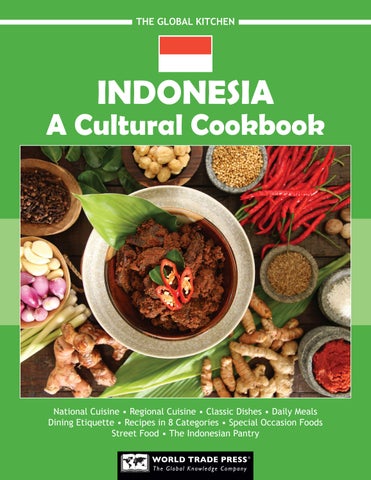
Dining Etiquette • Recipes in 8 Categories • Special Occasion Foods Street Food • The Indonesian Pantry
Recipes in The Global Kitchen series are provided for informational and cultural purposes only. Results may vary due to differences in ingredients, equipment, and individual cooking experience. Always follow safe food-handling practices and exercise caution with sharp utensils and hot surfaces. Check all ingredients for potential allergens before use.
World Trade Press has not independently tested every recipe and assumes no responsibility for the outcome, safety, or accuracy of any recipe or information presented.
No part of this publication may be reproduced, stored in a retrieval system, or transmitted in any form or by any means, electronic, mechanical, photocopying, recording, scanning, or otherwise, except as permitted under Section 107 or 108 of the 1976 United States Copyright Act, without the prior written permission of the Publisher.
For information about permission to reproduce selections from this report, please contact Permissions: permissions@worldtradepress.com
For information about special discounts for bulk purchases, please contact Sales: sales@worldtradepress.com
ISBN: 978-1-61840-002-4
www.TheGlobalKitchen.com www.worldtradepress.com
World Trade Press, 616 E. Eighth St., Ste. 7, Traverse City, MI 49686
INDONESIA
A Cultural Cookbook
Gen S. DuMonde
LIST OF RECIPES
Asinan Bogor (Pickled Fruit and Vegetable Salad).........98
Tempeh Kecap (Tempeh in Sweet Soy Sauce) ..............192
Tempe Mendoan (Lightly Fried Tempeh) ......226
Urap Taugeh (Mixed Vegetables with Coconut) ........114
FOREWORD
Welcome! This cookbook offers a structured and research-informed exploration of Indonesian cuisine, drawing on more than 30 years of culinary documentation and cultural study. Developed from our reference database,sian home cooks, chefs, and food historians. It is not a narrative of personal experience but rather a contextualized account of how Indonesian food has evolved and what it reveals about the country’s diverse cultural foundations.
Indonesian cuisine is among the most varied in the world, shaped by geography, trade, and cultural exchange across more than 17,000 islands. Indigenous foodways rooted in rice cultivation, coconut, spices, and tropical fruits provide the foundation of daily life, while regional traditions developed distinctive specialties—Sumatra’s rich curries, Java’s noodle and rice dishes, Bali’s ceremonial feasts, and Sulawesi’s seafood stews. Centechniques, and layered sweets. Later, Dutch colonial rule added breads, pastries, and dairy elements that mingled with local traditions, further diversifying the culinary landscape.itizes cultural and historical context alongside method. From nasi goreng and rendang to satay, gado-gado, and klepon, each entry is positioned within its broader narrative—whether rooted in ancient rice agriculture, spice trade networks, regional ceremonial practices, or contemporary adaptations shaped by globalization and diaspora communities.
As with all books in this series, the tone is informational rather than anecdotal. The goal is to offer readers a practical yet culturally grounded understanding of Indonesian cuisine—not only what is eaten, but how and why. In doing so, the collection illuminates a national food identity that is simultaneously regional and colthrough variety.
NATIONAL CUISINE
An Indonesian dining tradition that comes from the island of Java is the large banquet-style feast called selametan. (The Dutch call it rijsttafel, which means “rice table.”) Many courses are arrayed around one or several cone-shaped mounds of steamed rice called tumpeng, including vegetable dishes (sayur-mayur), meat or seafood, soups, and egg recipes. From these communal dishes, each diner uses common serving utensils to spoon portions onto their plate. Selametan holds spiritual importance in seeking blessings and expressing gratitude, and also symbolizes social unity, with the ritual feast important to the Javanese, Sundanese, and Madurese people.
Fruits and Spices
Tropical fruit is plentiful in Indonesia. Banana, coconut, papaya, pineapple, and durian—the famously malodorous fruit—are used extensively in desserts and salads. Fruits also are eaten fresh as snacks or squeezed into juices. Fruit chips made from dehydrated banana and jackfruit are a traditionally popular snack, and commercial producers in Malang now make chips from a wide variety of fruits.
Indonesia’s reputation as the “Spice Islands” is well deserved, and its cuisine is enhanced with the many aromatic spices that grow on the islands. Nutmeg, galangal, allspice, and cloves are all important native spices. Turmeric, lemongrass, coriander, tamarind, and cinnamon came from India and ginger, scallions, and garlic came from China so long ago that they are all practically native spices.
Peanuts were introduced by Portuguese merchants only in the 16th century, but a peanut-based chili sauce called sambal kacang is now central to Indonesian cuisine. It has many variations and is used as a dip for saté skewers, a base for curries, dressing for Indonesian gado-gado salad, and sauce for cooked or raw vegetables. Made properly, sambal kacangture that is not overly thick as is the common Thai variety.
Tumpeng is a cone-shaped rice dish that originates from Javanese cuisine.
REGIONAL CUISINE
JAVANESE CUISINE
Java is Indonesia’s most populous island, home to over half of the nation’s approximately 280 million inhabitants. The central and eastern regions of Java are home to the Javanese, the largest ethnic group in Indonesia. Central Javanese cuisine tends to be quite sweet due to the use of palm sugar and sweet soy sauce, while eastern Javanese foods are saltier and spicier, as the region is a major producer of salt. In addition to fresh and saltwater
ular protein, as this fermented soy product was invented in Java.
Tumpeng. Declared the national dish of Indonesia by the Indonesian Ministry of Tourism and Creative Economy, tumpeng is a feast dish of a towering cone of rice surrounded by meats and vegetables at the base. The rice cone is said to depict Java’s volcanic landscape, surrounded at the base with abundant plant and animal life, as represented by various dishes of meat, vegetables, poultry, and seafood. Due to the bounty it depicts, the dish is associated with celebrations marking gratitude and thanksgiving, particularly the large banquet-style Javanese feast called selametan.
Asinan Betawi. This vegetarian dish of brined vegetables includes cabbage, tofu, Chinese cabbage, bean sprouts, and lettuce, with a hot peanut sauce and deepfried cracker called krupuk.
Rujak Juhi. Rujak is a traditional sweet and tangy fresh fruit and vegetable salad eaten throughout Indonesia, but the Betawi version is famous for its Chinese-
egg noodles, fried potato, and peanut sauce.
Nasi Keblui. This spicy, steamed rice dish cooked in broth made with goat meat and milk includes ghee and -
lar to Indian-style biryani rice dishes and includes a fragrant spice mix of garlic and ginger with pepper, cloves, coriander, cardamom, nutmeg, and cinnamon—spices indigenous to both India and Indonesia.
Asinan Betawi
Tumpeng
REGIONAL CUISINE
Dengke Mas Na Niura andaliman. It is served with sambal as well as fresh herbs and spices.
Pagit-pagit. This celebratory dish has some typical Batak ingredients, using pork or beef combined with cassava leaves and sometimes coconut milk, though the sauce gets a thick consistency from partially fermented cow’s cud (a semi-digested mix of food).
Babi Panggang. Babi panggang refers to various Indonesian grilled pork dishes. This grilled dish includes pork belly and is served Batak style with a dipping sauce of spiced blood, though westernized versions substitute blood with tomato sauce. It is typically served with steamed rice.
PADANG CUISINE
The cuisine of West Sumatra is known as Padang, named after the capital city of the province. (Within Indonesia it is known as Minang cuisine.) This coastal region’s long-standing trade ties with the Dutch, and
local cuisine in the form of desserts and baked goods, spices, and curry dishes, respectively. The main ethnic group is the Minangkabau, a predominantly Muslim people whose commercial activities took them around the archipelago, helping to make West Sumatran foods a visible component of the national cuisine.
pers, coconut milk-based sauces, and steamed rice as the meal’s foundation. Water buffalo is a traditional protein source though now is reserved primarily for rendang and ceremonial dishes. Beef is most common in everyday cooking, as well as halal meats such as
Rendang. This is a chunky beef stew in a coconut-milk broth, slow-cooked and reduced until dry. The tender meat is a traditional dish at celebrations. Rendang is considered a dry curry, as Indonesian curries tend to have rather liquidy sauces.
Saté Padang. Saté is eaten throughout Indonesia, and the Padang variety is characterized by its small skewers of with spices and lots of chile pepper.
Lemang. Cooked in a hollowed-out bamboo stick atop an lemang is a popular snack and side dish of sticky
eaten to break the fast on Muslim holidays.
Beef Rendang
Sate Padang
CLASSIC DISHES
MAIN DISHES
Bakmi – A noodle (mi) dish that has adapted to different styles and regions, bakmi is the Hokkien Chinese term for “meat noodle.” Many major cities have versions of bakmi named after them: bakmi Bandung, bakmi Medan, bakmi Makassar, and bakmi Bangka.
Beef Rendang – The rendang style originated with the Minangkabau ethnic group. The main ingredient is slowly cooked in coconut milk and spices for several hours until the meat is coated in the spices. While traditionally made from beef, rendang can also be made with chicken, mutton, water buffalo, duck, young jackfruit, or cassava.
Cap Cai – From the Hokkien Chinese term for a mixture of various vegetables, this dish is a vegetable stir-fry that sometimes includes chicken, shrimp, beef, or pork.
Nasi Goreng – Nasi means “rice,” and goreng means “fried.” The fried rice dish may come with meat, vegetables, or egg.
Tempeh Kecap – In this recipe, tempeh is coated in a spicy-sweet sauce. Tempeh, made from fermented soybeans, can also be made from other beans, wheat, or a mixture of beans and grains.
SIDE DISHES
Kare Ikan
Sambal Kacang – This is a widely popular spicy peanut sauce that is synonymous with Indonesian cuisine. Sambal has many variations and is used as a condiment for saté, a base for curries, a dressing for gadogado, and as a sauce for cooked or raw vegetables.
Sambal Oelek – Oelek sambal translates to “ground chile sauce.” This hot sambal is often paired with meat and poultry.
Bakmi
Beef Rendang
Sambal Oelek
DINING ETIQUETTE
Table Etiquette
In Indonesia, everyday meals are most commonly eaten with a spoon and fork. The spoon is held in the right hand and used for eating, while the fork is held in the left hand mainly to push food onto the spoon; knives are usually not set at the table because meats and vegetables are typically cut into bite-size pieces during cooking. In restaurants and homes that serve communal dishes, it is polite to use the right hand when handing items to others or when taking food, and many Indonesians avoid using the left hand for eating, passing dishes, or giving and receiving anything. This custom is tied to longstanding hygiene norms (the left hand is traditionally reserved for personal hygiene), and even left-handed diners often make an effort to eat with the right hand in formal or mixed company.
Eating with the hands is also common, especially in certain regional traditions and in casual settings such as Sundanese restaurants, Padang-style eateries, and many seafood and street-food stalls. When eating
the right hand and shape small portions into manageable bites. A kobokan (a small bowl of water, sometimes with a slice of -
gers before and after the meal; it is for washing, not drinking. As in many communal dining cultures, guests generally wait until the host or an older family member invites everyone to begin (often with a phrase such as silakan), and elders or hon-
the best pieces. Current etiquette emphasizes not wasting what you take—small secwhat you put on your plate.
In Sumatra and Java it is common to eat with one’s hands.
SPECIAL OCCASION FOODS
BIRTHDAYS
In Indonesia, birthdays are celebrated with family and friends, where traditional foods such as nasi tumpeng (a cone of rice surrounded by various side dishes of meat and vegetables) and mie goreng (stir-fried noodles) are commonly served. A birthday cake is often the highlight of the celebration, but traditional sweets, including kue lapis (layer cake) and bubur sumsum (sweet rice pudding), also may be offered.
the joy of the occasion, with meals that bring loved ones together to celebrate life and prosperity.
Roti buaya (crocodile bread) is a traditional bread
in wedding ceremonies of the Betawi (the Indigenous ethnic group of Jakarta). The bread is shaped like a crocodile and is a key element in Betawi weddings, often given as part of the dowry. Roti buaya represents loyalty and faithfulness, as crocodiles are believed to mate for life. The bread’s presence at the wedding symbolizes the hope for a long-lasting and faithful marriage between the couple. Typically, the bread is made from sweet dough, though it is not necessarily eaten during the ceremony. Instead, its importance is symbolic. In Betawi culture, two loaves of roti buaya are often presented—one large and one smaller—signifying the groom’s hope for prosperity and the couple’s commitment to a lifelong partnership.
GALUNGAN
Galungan is a major Balinese festival that celebrates the victory of dharma (good) over adharma (evil). The day is marked with offerings, prayers, and feasting. Traditional Balinese foods such as lawar (a mixture of vegetables, coconut, and minced meat), babi guling (spit-roasted suckling pig), and nasi kuning (yellow turmeric rice) are central to the celebration. Accompanying side dishes may include sambal matah (raw shallot and lemongrass sambal). Sambals are pastes or sauces typically made from chile peppers and various other ingredients. The food during Galungan symbolizes gratitude for blessings and the victory of good over evil, with meals shared in a spirit of joy and celebration.
STREET FOOD
DADAR GULUNG
Dadar gulung is a rolled pancake made from green sweet, grated coconut cooked with palm sugar. Variaor banana. Dadar gulung is often sold at street food markets and during traditional celebrations.
ES PISANG IJO
Es pisang ijo is a popular dessert made from bananas wrapped in green dough served with shaved ice, syrup, and condensed milk. Variations might include different types of syrups or fruit toppings. Es pisang ijo originated in Makassar and is especially popular during Ramadan.
GETUK
Getuk, also spelled gethuk, is a traditional Javanese snack or dessert made from boiled and mashed cassava mixed with sugar. It is sometimes enriched with grated coconut before being shaped into squares, rolls, or circles. Other variations might include adding palm sugar syrup, using food coloring, and topping them with additional grated coconut. Getuk is commonly found in Java and sold at street markets.
ES TEH MANIS
Es teh manis is a simple, refreshing iced sweet tea brewed from black jasmine tea leaves, variations Es teh manis is one of the most popular street beverages in Indonesia, commonly found at food stalls and restaurants.
DID YOU KNOW?
Sambal is a spicy chile sauce or paste that is a staple condiment in Indonesian kitchens. It is typically made fresh. There are thought to be about 300 varieties of sambal in the country. The ingredients can vary sigchile peppers—the primary ingredient—and an assortment of secondary ingredients that often include shrimp paste, garlic, ginger, shallot, scallion, palm sugar, and lime juice.
Known as the “king of fruits,” durian is extremely popular in Indonesia. The fruit is used in various dishes both sweet and savory, from ice cream to soup and a creamy texture, though the sulfurous scent when raw is off-putting to many.
Herbal Medicine
Many Indonesian dishes incorporate ingredients such as turmeric, tamarind, and ginger, which are not onlyditional herbal medicine.
Street Food Scene
Street food is popular in Indonesia. From fried foods and a variety of soups, salads, and sates (seasoned, skewered, and grilled meat) to various rice and noodle dishes, most palates should be pleased with the wide variety of offerings.
TEA CULTURE
Popular Varieties
Most of the tea plantations in Indonesia produce black tea, although a small percentage of the crop is made up of green tea. Indonesian tea is among the highest-ranked in the world for quality, equal to the best teas produced in Japan and China.
Most people in Indonesia prefer their tea black, strong, and heavily sweetened with sugar—a remnant of British
pot before the hot water is added and allowed to accumulate at the bottom of the pot without stirring.
There are many regional variations on the basic tea tradition, however, in part due to economic constraints. For instance, the Javanese in central Java generally take tea with sugar; the region is jam-packed with sugar plantations, making it readily available. By contrast, Sundanese communities living nearby in West Java usually do not serve tea with sugar because it is less accessible.
served with additives such as ginger, lemon, milk, or lemongrass. Some even add a whisked raw egg. Both adults and children drink tea in Indonesia, often multiple cups per day. In some communities, tea is served at the beginning and the end of the day. Often, it’s the women in the family who are responsible for preparing tea.
Tea produced in Indonesia is known to have the highest levels of the natural antioxidant, catechin, in the world. In addition to traditional tea derived from the Camellia sinensis plant, Indonesia has a strong history of herbal medicine that includes a number of infusions to treat different ailments. One of these is jamu, a medicinal mixture that combines roots, spices, herbs, and sometimes sweeteners. Jamu recipes vary widely, and in some specialized preparations, ingredients such as honey, eggs, or milk may also be added. The mixture is often sold in dried form, which is dissolved in hot water to make a tea. It is drunk to address a very broad variety of ailments.
Harvesting Tea Leaves on Java
BAKSO (MEATBALL SOUP)
Recipe Servings: 4
Dietary Considerations: Dairy Free, Kosher, Halal
Bakso are tender meatballs that some consider Indonesia’s national street food. The name can refer to both the meatball and the dish in Indonesia. As a complete meal and as in this recipe, bakso consists of a stock with noodles, meatballs, and vegetables. The meatballs are light, spongy, and delicately seasoned—the ultimate bakso, and regional variations exist. One of the most widely eaten foods in Indonesia, street vendors knock on doors to sell their bakso.
Indonesia is a food lover’s paradise for exotic tropical produce, with the word asinan referring to a pickled vegetable or fruit dish. Some versions include both fruits and vegetables. In this toothsome salad called asinan sayur, fresh vegetables are on display and enhanced by ground peanuts, sugar, and chile pepper. Asinan buah is the fruit salad version that is made with shrimp paste and a spicy sauce.
ROTI JALA (LACE PANCAKE)
Prep Time: 15 minutes
Recipe Servings: 8-10 pancakes
Cook Time: 20 minutes
Total Time: 35 minutes
Dietary Considerations: Vegetarian, Kosher, Halal
Roti jala, meaning “lace pancake” or “net bread,” is a crepe-like food popular in Sumatra, Riau, and the through a special perforated cup or mold in a circular motion. Roti jala is typically served as an accompaniment to savory curries to absorb the sauce. Though rooted in Malay cuisine, it has become a favorite festive food in Indonesia, often appearing during Eid celebrations and family gatherings.
MIE AYAM (CHICKEN NOODLES)
Prep Time: 20 minutes
Cook Time: 30 minutes
Recipe Servings: 4
Total Time: 50 minutes
Dietary Considerations: Dairy Free
Mie ayam, or chicken noodles, is one of Indonesia’s most popular street foods, often sold from small carts and noodle stalls. The dish consists of wheat noodles topped with savory diced chicken that is simmered in mie ayam is often enjoyed as a quick meal across Java and beyond. It typically is served with a light broth, greens, and fried shallots.
NASI GORENG (FRIED
RICE)
Prep Time: 15 minutes
Cook Time: 45 minutes
Recipe Servings: 4
Total Time: 1 hour
Dietary Considerations: Halal
Believed to have Chinese origins, this is a mixed fried rice dish, traditionally made from leftover rice. Nasi goreng, which means “fried rice” in Indonesian, can be served as a main course or a side dish. This famous dish is considered by many to be Indonesia’s national dish. Nasi goreng is traditionally served with a fried egg and a side of fresh vegetables, often simply wedges of tomato and cucumber.
Kolak pisang is one of Indonesia’s many desserts that highlight its tropical fruits. Kolak pisang is essentially a banana compote that also contains jackfruit, pandan, and coconut milk. This popular dessert and Ramadan treat often served during iftar to break the day’s fast can be served warm or cold. Variations on this recipe include the omission of banana for a basic kolak, or the addition of sweet potato and cassava for kolak ubi. Kolak labu is a version that includes pumpkin.
ROTI BAKAR
(GRILLED AND FILLED BREAD)
Prep Time: 10 minutes
Recipe Servings: 2
Cook Time: 5 minutes
Total Time: 15 minutes
Dietary Considerations: Vegetarian, Kosher, Halal
Roti bakar, literally meaning “grilled bread,” is one of Indonesia’s most popular street snacks. Originating during the Dutch colonial era, when bread became more widely available, roti bakar evolved into a distinctly Indonesian comfort food, commonly sold in the evenings from roadside stalls and cafés. It’s made by toasting chocolate, cheese, or banana slices.
CHILE PEPPER
Description
Chile peppers, known as aji in Spanish, are members of the nightshade family ( Solanaceae) and the genus Capsicum. They are grown all over the world. They produce red, yellow, green, orange, brown, and purple fruits. Chile peppers can be large and oblong, or long, thin, and tapered, while the heat level can range from mild to extremely spicy.
Chile peppers originated in the Americas and spread throughout the world via explorers and traders after European discovery of the New World.
Varieties
There are numerous varieties and cultivars of chile peppers. Most of these can be divided into the fol-
• Capsicum annuum, which includes jalapeño, bell, cayenne, wax, and chiltepin peppers.
• Capsicum frutescens, which includes Tabasco, piri piri, Thai, and kambuzi peppers.
• Capsicum chinense, which includes some of the hottest varieties such as Scotch bonnet, habanero, Datil, and naga peppers.
• Capsicum pubescens , which includes rocoto peppers.
• Capsicum baccatum, which includes aji peppers.
When young, chile peppers tend to be green and tart
more complex and peppers may be sweet, fruity, or smoky. Chile peppers can range from mildly spicy to so hot they cause serious pain and even burns.
Eating some of the hotter varieties of chile peppers can cause watery eyes, runny nose, excess saliva, upset stomach, and blisters on the inner lining of the mouth and throat.
Chile peppers contain capsaicin, which gives them their heat. In addition, they are an excellent source of vitamin C and vitamin B6. They also are moderate sources of iron, magnesium, and potassium.
Preparations
Chile peppers can be eaten fresh or dried. Milder varieties, such as ancho or chipotle chile peppers, are
dishes. They also can be roasted, grilled, pickled, or chopped up raw and used in salsas. Spicier peppers are usually incorporated into sauces or salsas in extremely small amounts.
Season
Different types of chile peppers ripen at different times, but pepper plants usually bear fruit from summer to fall.
Did You Know?
• Discoveries suggest that chile peppers may have years ago in Mexico.
• Only mammals experience the heat of chile peppers. Birds are immune to capsaicin.
SHRIMP PASTE
Description
Shrimp paste is made from fermented shrimp that has been ground and combined with salt. It is sold as a soft, wet paste or as bricks that have been dried in the sun. It is usually pale grey-pink or dark pinkish red in color.
The practice of preserving seafood through fermentation is ancient and found throughout Southeast Asia and parts of southern China. Shrimp paste in particular may have originated in Thailand; the earliest example dates from the 700s CE, when people in coastal Thailand used shrimp paste in their cuisine and shared it with travelers from Indonesia, Cambodia, Vietnam, and Malaysia.
Varieties
There are many different kinds of shrimp paste, based on the region where it is made, type of shrimp, and other ingredients used. Some common varieties include:
• Becalan, a Malay version made from krill;
• Terasi, which is from Indonesia and is often bought in solid blocks;
• Bagoong alamang, which is found in the Philippines and is often eaten on top of green mangoes;
• Kapi, a Thai version used in spicy dips, sauces, and curry paste; and
• Hom ha, a Chinese version that is usually lighter in color than Southeast Asian varieties.
are sweet.
Shrimp paste is generally low in calories and high in sodium. It contains small amounts of protein, calcium, and iron.
Preparations
Shrimp paste is usually mixed into South Asian dishes to give them a strong, savory taste. It is a common ingredient in shrimp pad Thai, pork satay, curries, soups, stews, and fried rice. It also can be used as a
Thai curry pastes.
Season
Shrimp paste is a processed product that is available year-round.
Did You Know?
• Anna Forbes, wife of British naturalist Henry Ogg Forbes, once accused her cook of trying to poison her when she was served a dish containing shrimp paste.
ABOUT WORLD TRADE PRESS
World Trade Press is a publishing and information products company specializing in country-based information company’s mission is to strengthen mutual understanding across cultures by lowering the information barriers that prevent individuals and organizations from succeeding in the international arena. World Trade Press clients include academic and public libraries, universities, global businesses, government agencies, global logistics
Databases
World Trade Press has developed and maintains more than a dozen large-scale online databases of country and city information covering business, culture, food, import/export, local living, and travel for 174 world countries and 201 world cities.
World Trade Press has published multiple editions of more than 100 physical reference books, country business guides, books for international trade and logistics, world atlases for travel and logistics, and world and country wall maps.
World Trade Press has developed and maintains more than two dozen professional-level country e-reports and e-books for each of 174 countries. These products cover topics such as business culture, cost of living, demographics, education, environment, holidays and festivals, government, money and banking, music, quality of life, religion, security, social indicators, and more.
Contributors
All World Trade Press products—from our databases and e-content reports to our physical books, maps, and atlases—are created through the collaboration of a dedicated internal staff of researchers, writers, editors, and cartographers and more than 100 external subject-matter experts to create world-class security, and travel. To view a partial list of contributors to titles in The Global Kitchen series, go to www.TheGlobalKitchen.com/contributors.html.
Learn more about World Trade Press and its products at www.WorldTradePress.com.
For more recipes, updates, and global food inspiration, follow The Global Kitchen on Facebook and BlueSky.