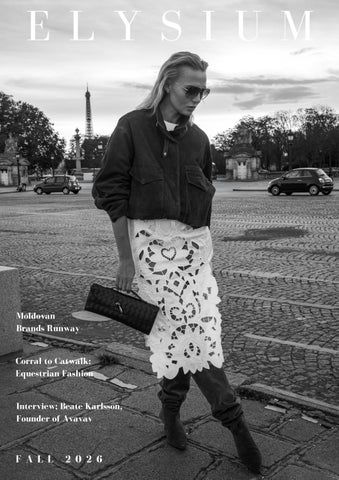
E L Y S I U M
Moldovan Brands Runway
Corral to Catwalk: Equestrian Fashion
Interview; Beate Karlsson, Founder of Avavav
F A L L
2 0 2 6
ELYSIUM Jesse Scott EDITOR-IN-CHIEF, DIRECTOR OF DESIGN Leroy Velasquez DIRECTOR OF PHOTOGRAPHY Diana Huk CONTRIBUTOR June Roberson CONTRIBUTOR With special thanks to the Moldovan Brands Runway team
“Style is wearing an evening dress to McDonald’s, wearing heels to play football. It is personality, confidence, and seduction.” John Galliano
Letter from the Editor
B
eauty is in the eye of the beholder. Similarly, aesthetic judgments often tell you less about their subject and more about the gaze perceiving it.
Both statements cycled through my mind as I put together what I view as a particularly exciting issue of Elysium. Self-identity is the central theme, in permutations ranging from national to cultural to socio-economic to careerrelated. In examining this theme through the lenses of the writers and designers that fill these pages, I find myself struck by two main observations: 1) Self-identity is profoundly subjective. 2) Members of fashion’s next generation are deconstructing it to ask difficult questions...the result being honest critiques which could change sartorial and social landscapes from the core out. This paradigm is far from universal (indeed, it is extremely rare within the industry). But it unites this issue’s brave protagonists. And if gives me a tremendous source of newfound optimism for our fashion world. This past March, I had the great pleasure of visiting Chisinau, Moldova for the 6th edition of Moldovan Brands Runway. Moldova, as you’ll discover in our opening feature, exists at a particularly unique cultural and temporal crossroads.
It’s one that the next generation has fully embraced, honouring tradition while simultaneously building a hotbed for innovation and contemporary self-expression. From Emil Ciornîi, who finds hope in a neo-dystopian future, to Natha Sannat, who winks at her Post-Soviet childhood, to Darya Golneva and Denis Caunov, who blend rural motifs with Japanese minimalism, Moldova’s designers are poised to translate inspired sartorial visions to the world. I also sit down one-on-one with Beate Karlsson. Founder of one of fashion’s hottest and most subversive brands, Avavav, Karlsson challenged the fundamental structure of the runway show last season by sending guests down the catwalk while models spectated. She joined me to talk the “female gaze,” how her Scandinavian identity may or may not influence her work, and disrupting traditional roles in our industry. Meanwhile, in our long read, June Roberson examines the historic relationship between the fashion and equestrian spheres. A lifelong equestrian, but from a very different world than the one in Hermès ads, Roberson studies her own self-identity while finding surprising parallels between life in the corral and on the catwalk. Wishing you all a great fall, and some precious moments of introspection along the way.
Photo: Leroy Velasquez Cover Photo: Leroy Velasquez Cover Talent: Kateryna Shchurenko Back Cover: Leroy Velasquez
TABLE OF CONTENTS 5 Moldovan Brands Runway: City on the Verge 11 Vyaz 19 Diabolica 21 Altezza by L. Storojuc
39 Interview: Beate Karlsson, Founder of Avavav 45 Dior 53 Georges Hobeika 61 Loro Piana
23 Starchak
69 Junya Watanabe
25 Interview: Three Generations of Moldovan Fashion
73 Noir Kei Ninomiya
29: Corral to Catwalk: The Dual Nature of Equestrian Culture in Fashion
77 Pierre Cardin
CITY ON THE VERGE: MY EXPERIENCE IN CHISINAU AT MOLDOVAN BRANDS RUNWAY WORDS: JESSE SCOTT PHOTOS: ANGELINA FRANK, ANN SHERBATIUK, ALEXANDRU VENGHER, & NIKITA GRIMOVICH
PATRU
VYAZ
Chisinau, Moldova is a city on the verge. A post-Soviet capital positioned at a unique cultural and historical crossroads (Russian and Romanian can be heard almost interchangeably here), Chisinau has a fraught history, an unshakeable spirit, an atmosphere of infectious optimism, and an unquestionably bright future. Nowhere is this more evident than among my generation, which in recent years has built a vibrant and exponentially growing arts, fashion, dining, and nightlife scene. And at no time is this better showcased than during Moldovan Brands Runway, a biannual fashion week which was launched less than three years ago yet already stands as one of the most memorable I have covered. During the four day program, which ran from March 18-21, 2026, I attended fifteen shows and over twenty-five events. A diverse range of styles was showcased and many of the designers proved exceptionally talented. But far more remarkable than any one event was the overall atmosphere: one defined by collaboration rather than competition, resilience in the face of adversity, and the seamless synthesis of tradition and modernity. There is a warmth, composure, and quiet confidence surrounding Moldovan Brands Runway that belies the youth of the event and its players while indicating that this is just the beginning of a meteoric rise through the fashion world. As a veteran of over thirty fashion weeks (including, of course, countless seasons at “The Big Four”), I can say that this was among the best-organized I have ever attended. “Professionalism, composure, and preparedness” are all tenets that are deeply important to me and were exemplified by the Moldovan Brands Runway team. Fashion weeks are a stressful marathon, and whether it’s shows starting an hour late, doors being chaotic, transport strikes and traffic wreaking havoc, or press shuttles dropping you off at the wrong location (yes, this has happened to me in Paris twice), expecting and reacting to the unexpected is de rigeur for success. The exception: Moldova. From the opening cocktail to the final runway show, the events ran like a well-oiled machine. Whether key organizers such as Nata and Julia Mitereva, stylists and make-up artists backstage, or student volunteers running the doors, everyone at Moldovan Brands Runway displayed impeccable poise throughout. That’s not a fluke phenomenon or a case of remarkable individual performance - it’s a winning culture instilled from the top down and maintained from the bottom up. 7
PATRU
AUTHOR IN MASK BY VYAZ
VYAZ
Emerging brand Diabolica provided the week’s defining quote. “We are the descendants of catastrophe,” a voice boomed across the runway to set the stage for a series of neo-dystopian looks. “And we’ve learned to wear it as strength.” The words were a profound metaphor for Moldovan fashion as a whole. Most of the country’s leading designers were born in the decade following the Soviet Union’s collapse. They grew up in a transitional time amidst severe economic challenges and seismic cultural shifts. With a maturity beyond their years, they embraced it all with an inspired defiance. At the risk of over-simplification, one could argue that three sensibilities define modern Chisinau: 1) the Moldovan heritage and traditions of our parents’ and grandparents’ generations, 2) the Soviet principles that shaped the city’s physical, cultural, political, and emotional landscapes alike, and 3) an influx of post-Soviet influences, largely from the global West, that have seen those landscapes redefined in a flurry of creativity and innovation. My generation, along with the one coming of age currently, is becoming the caretakers for all three legacies. Rather than erasing certain elements of Moldova’s past, as children of social revolutions are often prone to do, they have engaged with them as indispensable parts of the country’s deeply nuanced cultural fabric. Take Denis Vang of Vyaz, who presented a show aboard a Soviet train in Chisinau’s practically abandoned railway station. Meanwhile, Nata Mitereva and Evgenia Gruzdeva of Patru showcased traditional embroidery and pieces handmade by local artisans in a modern industrial setting reminiscent of Berlin. Natha Sannat reflected on her early 2000’s childhood in a nostalgic yet contemporary collection entitled Avantgardian Child. And many of the country’s leading creators and celebrities proudly wear the custom designs of Casa Cristea, a purveyor of traditional Moldovan clothing. Chisinau is a hotbed for innovation and creativity. But even for the twenty-somethings at the forefront of this movement, heritage is COOL So too is collaboration. In this cutthroat industry, and especially within small markets vying for attention from major fashion capitals, fierce competition amongst young talent is the norm. Yet in Moldova, a culture of mutual support has replaced rivalry. Institutions such as ZIPHOUSE, a creative innovation hub serving as an incubator for the country’s best young design talent emphasize collaboration as a foundational principle.
9
And designers, models, and stylists - even with diametrically opposed personal tastes - spent fashion week building each other up instead of tearing each other down. The talented Alexei Sorochin presented his own runway show on Thursday; he then modeled in several other shows over the course of the weekend and could be seen running around backstage assisting colleagues wherever needed. Meanwhile, at the “fashion hub,” Diabolica designer Emil Ciornîi selflessly took time away from his own booth to serve as translator between his contemporaries and foreign journalists. And in the wee hours of the morning, as afterparties devolved into nightcaps at Chisinau’s vibrant cocktail bars, the stars of Moldovan Brands Runway mingled as friends. There was no pretense, no ego, and no social jockeying - fake niceties were replaced with genuine connection. Perhaps this, more than anything, convinces me of Moldovan fashion’s bright future. And it gives me hope for our industry as a whole. Leaving Chisinau at the conclusion of a fashion month marathon that also took me through London, Milan, and Paris, I felt energized rather than exhausted; inspired rather than drained. Moldova’s time in the creative spotlight is coming. It’s time that the world takes notice.
ALTEZZA BY L. STOROJUC
DIABOLICA
VYAZ TRANSFORMS SOVIET TRAIN INTO RUNWAY WORDS: JESSE SCOTT PHOTOS: ALEXANDRU VENGHER & NIKITA GRIMOVICH
Arriving at the Chisinau railway station for the show of Denis Vang’s Vyaz, we expected a degree of Soviet nostalgia and industrial grunge. But we could not have imagined that both our seats and our backstage interviews would be on a functioning train! Vang devised one of the most creative show settings of the entire fashion season; guests found their front row seats in Soviet train carriages which didn’t look a day removed from 1991. Meanwhile the models, navigating a formidable runway with flying colours, stalked down the aisle in quirky, irreverent looks that combined military details with gothic grunge and elements of the Berlin sensibility endemic to the brand. Bold platform shoes, dramatic eyelashes, and whimsical handcrafted headwear gave every look a unique personality. And while a certain romantic melancholy pervaded both the collection and the setting, it was not intended to be taken overly seriously. With hints of the youthful rebellion and playful impudence that define Alessandra Marchi’s Aniye Records and Alessandro dell’Acqua’s Numero Ventuno in Milan, Vang curated a wardrobe for a modern Moldovan youth which navigates unique cultural and intergenerational tensions in their everyday lives.
12
DIABOLICA: DYSTOPIAN FANTASY WORDS: JESSE SCOTT PHOTOS PROVIDED BY HOUSE “We are the children of catastrophe, and we have learned to wear it as strength.” This voiceover, a metaphor for modern Moldovan fashion, set the stage for the week’s first runway show - Diabolica. The brainchild of visionary young designer Emil Ciornîi, Diabolica is best described as a neo-dystopian brand that combines both nostalgic and futuristic influences in assembling armour for modern warriors. Diabolica’s sartorial language is one of resilience and bravery - indelibly shaped by the universal challenges facing a post-industrial world and the brutalist sensibilities that inform the local postSoviet landscape both architecturally and emotionally. The seven-look handcrafted collection possessed a visceral, primordial ferocity. Envisioning a world ravaged by pollution, Ciornîi presented mutant protagonists equipped for one goal: survival. Jet-black looks, the color of slick petroleum, conjured images of primitive life forms, World War II gas masks, and modern hazmat gear alike. The models lurched, rather than strutted, down the catwalk, bodies staggering with the dogged determination of military heroes on their last legs (one might recall Boromir’s death scene from Lord of the Rings). The final bow saw Ciornîi emerging from a smoky plastic bubble in the center of the runway, removing his own mutant headgear, and standing in defiance as the only model unmasked. The charismatic Ciornîi, still at the very beginning of his career, is a man with a vision and a message. Infusing his designs with an unapologetic daredevil spirit, and confidently locating his brand at the intersection between the commercial and the conceptual, he is poised to lead a meteoric “rise of the mutants.” 20
ALTEZZA BY L. STOROJUC: TURBO-CHARGED WORDS: JESSE SCOTT PHOTOS: NIKITA GRIMOVICH While avant-garde designs and classical elegance dominated Moldovan Brands Runway, designer Liudmila Storojuc redefined power dressing for the modern woman with the presentation of her Altezza line. In collaboration with Lotus Cars, Moldova’s first and leading luxury auto brand, Storojuc put a sportscar on the runway for a high-octane show soundtracked by pulsing techno beats. Broad-shouldered blazers, power pinstripes, and statement sunglasses emerged on the runway with a Wolf of Wall Street swagger…but a 2026 Wolf of Wall Street in which women dominate the boardroom and social media scions such as Xenia Tchoumitcheva, Isobel Lorna, and Olivia Ferney prove that it is possible to “have it all.” Storojuc winked at our current flashpoint. For example, one model walked down the runway filming herself (landscape, 0.5, stay tuned for the “day in the life of an entrepreneur” YouTube vlog). Another emerged from the sportscar with the savoir faire of a camera-prepped red carpet arrival. And unique details, such as cheeky cutouts on an architectural blazer, playful fringes on a classic suit, and mismatched bichromatic lapels, gave the collection a degree of bold self-expression even while retaining its refinement. Being a businesswoman has never seemed more fun.
22
STARCHAK: FROM LVIV WITH LOVE WORDS: JESSE SCOTT PHOTOS: NIKITA GRIMOVICH Based in Lviv, Ukraine, Maria Starchak’s eponymous brand took Moldova by storm this season. Resilience is in the brand’s DNA, as evidenced when Starchak herself traveled over 24 hours by bus to transport her collection from Lviv to Chisinau for the show. Having emphasized upcycling since the brand’s inception in 2019, Starchak repurposes textiles into creatively deconstructed pieces that function as wearable art. This collection saw eco-leather take center stage, with a patchwork trench, a fierce burgundy corset, and a wide-collared emerald jacket standing as my favourite pieces. Leather was creatively used even when not the outfit’s protagonist; for example, the classic white-shirt black-tie combo was paired with a cheeky leather skirt whiel a playful blazer-dress was given a pop of colour by striking leather sleeves. Meanwhile, traditional Ukrainian motifs appeared on belts, necklaces, and fringes, effectively synthesizing heritage with modernity in a paradigm that echoed throughout the week.
INTERVIEW: THREE GENERATIONS OF MOLDOVAN FASHION WORDS: JESSE SCOTT PHOTOS: PROVIDED BY HOUSE UNLESS SPECIFIED
Moldovan fashion is truly an inter-generational affair. From heritage brands such as Casa Cristea to global powerhouses like Julia Allert to rising young stars like Sannat and OK Kino, the past, present, and future are converging in Chisinau to define a vibrant creative scene. Prior to this March’s fashion week, I sat down with four of Moldova’s most influential sartorial voices, each representing a unique generational niche, to discuss their personal stories, how their country’s fashion landscape has changed over time, and what the future might hold. Maria Cristea founded Casa Cristea in 1994. Thirty-two years later, what started as a personal project has now become a national symbol of excellence. Maria and her team of local women produce custom traditional clothing, all handmade, for Moldova’s best and brightest from their welcoming Chisinau atelier. Julia Allert is the first Moldovan designer to achieve broad global recognition. The charismatic Julia combines traditional feminine elegance with modern sensibility and signature floral motifs in designs that are sold in over 65 countries worldwide. Darya Golneva and Denis Caunov combine Japanese minimalism with Moldovan tradition for their emerging brand OK Kino. Known for architectural silhouettes, precise, intentional tailoring, and primarily monochromatic palette, the pair exhibits the exceptional attention to detail that is a Japanese hallmark. Natha Sannat, founder of eponymous brand Sannat, is a standard-bearer for the next generation of Moldovan designers. Situated between the conceptual and commercial, and informed by both Natha’s post-Soviet childhood and her passion for theatre, the brand offers a playful, irreverent, and intimate window into modern Moldova. JS: How did your fashion journey begin? Maria Cristea: So I actually have a background in mathematics and cybernetics, but when I was raising my children I was doing embroidery and crocheting to sell and help take care of my family. At the time I was using my grandmother’s sewing machine. Eventually, after my kids were grown, it grew into this.
25
MARIA CRISTEA
JULIA ALLERT
Maria Cristea: We were able to buy an old house in downtown Chisinau and turn it into our atelier and store - using only proceeds from sales! The team works upstairs while all our fabric is stored downstairs. And it’s meant to feel like a home. 80% of our orders are for custom pieces. So our clients can come in, see all of our options, and do measurements. [JS: The experience is indeed very homey. I was offered tea and the best Moldovan chocolates as soon as I entered the atelier].
OK KINO
Julia Allert: I have a background in international relations and was working in an absolutely different field from fashion for five years before launching my brand. But the creative brain can survive in all spheres and eventually I wanted something different. This was a very small atelier at the beginning; we had only two people. And we didn’t believe in ourselves that much, so we were creating collections for other European brands. [JS: Moldova was a major textile center for the USSR; after its fall, luxury British, French, and Italian brands flocked to the country for its high quality fabrics and relatively low-cost production]. In 2012 or 2013 I slowly started making capsules for my own brand. Darya Golneva (OK Kino): My love of fashion came from my grandmother. She had all of these really old sewing machines and fabrics from the Soviet Union. So throughout my childhood, we would sew dresses together for me to wear to school, on holidays, to the theater. I started my formal fashion education in Chisinau and then won a scholarship to go study fashion design in Como, Italy. I’m really proud of this! Meanwhile, my colleague Denis has always liked to work with shapes and ended up studying architecture. Fashion and architecture are very similar. The main difference is that in architecture it’s a very long process to go from the first sketch to the final project; meanwhile fashion is wearable architecture that can be created quite quickly. So it’s a natural partnership. Natha Sannat: When I was a little girl, I was thinking to become an interior designer. But when I considered the field more substantively, I understood that I was more passionate about clothes and styling. I went to fashion school in Chisinau for two years and learned pattern marking, but I didn’t finish the program to be honest…I just started to practice, practice, practice. I do everything for Sannat by myself - from the idea to sketching to pattern-making. This is my seventh collection now and I’m feeling more self-confident in what I’m doing. JS: Describe your aesthetic for readers who are unfamiliar. What are some of your major inspirations? Julia Allert: We are for women who want to be different…who are confident, independent, and who lead rather than following the crowd. Elsa Schiaparelli is my favourite designer historically. For her fashion wasn’t just fashion; it was the “art of being and living.” And that’s the way I view the industry as well. More specifically, we love playing with small details on classic, feminine designs. And we have our signature floral motifs!
NATHA SANNAT
Darya Golneva (OK Kino): I’ve always loved the idea of the uniform and I’m particularly inspired by uniforms in Japan. Students, electricians, gardeners, construction workers…they all have their own specific uniforms which are worn with pride. Even in the smallest villages, where nobody sees you or cares how you look, the bus drivers are wearing beautifully pressed white shirts with cufflinks. In Moldova, we don’t have this; when you take the bus from Chisinau to Bucharest and it’s hot out the driver will often go without a tee-shirt! So this was such a surprise for me, and it actually made me very emotional. I’ve adopted my own uniform for working days (white or black trousers with a comfortable shirt), and the uniform is something that we really explore in this collection. We also weave traditional Moldovan motifs, such as stone flowers, into our designs. Denis was lucky and spent a lot of time with his grandmothers and grandfathers in the villages growing up. They have a very particular style of dress, with dots and a lot of floral patterns. So that has informed some of our work. Finally, I’m really inspired by the ballerina Maria Plisetskaya, one of the most famous dancers from the Soviet Union. Her performance in Maurice Ravel’s Bolero, which she gave over the age of 50, was particularly amazing. Natha Sannat: My designs are very conceptual. I’ll create functional garments with familiar silhouettes, but they’ll always have an unexpected twist. For me fashion is a process in which you are analyzing and playing at the same time. I’ll start with a small object or detail, and then ask myself: “What does this mean to me?” “How can I change it?” “How can I play with it?”
OK KINO
For last season’s collection, I was inspired by the plays of Eugène Ionesco, who helped pioneer the “Theatre of the Absurd” movement. I had some friends performing one of his works at our Luceafăraul Theater, so I asked them if they wanted to collaborate with Sannat and presented my fashion show as a play. JS: How has the Moldovan fashion scene evolved in recent years? And how has this evolution created challenges or opportunities for your brand? Maria Cristea: Twenty years ago the younger generation wasn’t interested in traditional clothing. It was seen as oldfashioned, gauche. But now the youth are embracing it! Influencers, politicians, celebrities, and TV personalities are all wearing Casa Cristea; they’re patriotic, proud of their heritage, and promoting local traditions. It was so exciting to present at Moldovan Brands Runway last season. Even people that grew up seeing these designs had never imagined them on a catwalk before. They were curious, asking questions, and were so interested to hear that everything is handmade. And a lot of big folk dancers are wearing Casa Cristea when they perform abroad. We’re very enthusiastic about what’s happening. 27
SANNAT
Julia Allert: People don’t pay attention to this but textiles is actually the third-biggest industry in Moldova. It’s a huge part of our economy. Moldova is also a very creative nation; you will find all the types of fashion, for any taste and any age, whatever you’re looking for, within the range of Moldovan designers. So we have the production and we have the specialized talent. But our problem, and this has historically been a problem, is that we have not had the opportunities or skills to advertise ourselves. When you are talking to an agent or a marketplace they are often not ready to accept you because they have no conception about Moldovan fashion and whether it is good. I’m so thankful for organizations like Wolf & Badger that believed in us. But you still need to prove all the time that you can compete with other international brands,
JULIA ALLERT
I was the first designer here who went into e-commerce, which was exciting but also complicated because there was no legislation in place to govern it. And nowadays a major challenge is logistics. For example, we don’t have DHL here; we have a Moldovan company franchised by DHL Global and their prices are not competitive at all. Natha Sannat: Growing up in Moldova, it was not very common for kids to have an interest in fashion. But I found my fashion community, and we all worked on finding a new style of self-expression through clothing. My style is not what you could call traditional or classic…it is darker, more raw, more avantgarde. That said, I always looked up to Julia Allert. We have similar DNA (for example, we love dark colours and playing with small details) but a different way of presenting it to the world. Community is really important for me. I make a lot of custom designs for clients, which is a great responsibility. If a person comes to me to design something, it’s up to me to understand them and build a relationship based on kindness and respect. I like to create an intimate connection between the customer and the product. JS: What’s next in your fashion journey? Julia Allert: I have a lot of secrets in my mind, and a lot of hard work ahead! Hopefully this year we will enter three new marketplaces. For Moldova as a whole, I see a lot of opportunities for this next generation. They have more knowledge and broader access to the fashion community than we did twenty years ago. So hopefully they will be much, much more successful than we were. There are so many creative people in our country and I hope that they can showcase this creativity globally. Darya Golneva: Our first goal would be to build a bigger team. Aside from me and Denis, we only have our seamstress Tatiana, our knitwear specialist Irina, our intern Melis, and someone to help with the administrative work. So we would like to grow our team with people who are also passionate about our brand.
Photo by Nikita Grimovich
Currently we are selling mainly in concept stores with whom we share common values. We have a very strong presence in Japan, even in small towns there, and in Paris! But we would like to continue our international growth as well. Natha Sannat: I would like to start selling abroad and open a physical shop. And I think that small brands like mine are the lucky ones these days. As designers, we have the opportunity to truly express ourselves and even to change the rules. We offer a specific experience: an emotion that you can choose to feel and wear. People are seeking that out instead of fast fashion or brands that chase trends season after season. So it’s our time right now.
28
CORRAL MEETS CATWALK: EXAMINING THE DUAL NATURE OF EQUESTRIAN CULTURE WORDS: JUNE ROBERSON
Were you raised in a barn? I'm going to go out on a limb and assume the answer is no. As for me, it's a little more complicated. Though it’s maybe a stretch to say I lived in one, I would definitely argue I was raised there. My childhood consisted of 5 a.m. wake up calls, holidays spent shoveling horse manure before opening gifts or doing Easter egg hunts, a seventh birthday learning how to muck a horse stall (a rite of passage I’d dreaded since my sister’s three years prior), and weekends where nights spent out past curfew were welcomed by an 8-hour work day. Not once did I identify this routine as something glamorous and I can honestly say I never quite understood the equestrian lifestyle portrayed in Hermès storefronts. Still, although my experiences were far from custom Voltaire and caviar, I would be lying if I said they were without irreplacable moments. I had basically traveled the continental U.S. by the time I was fourteen and tempted truancy like my life depended on it, though I would argue that what I lacked in attendance I made up for in character building, or something like that. Weekend road trips to horse shows usually ended by pulling in the driveway at 6 a.m. and choosing between a shower or a Navy-SEAL style power nap before my 7:30 call time to fifth grade homeroom. I usually opted for the shower since social studies would handle the nap. Combine this all-work mentality with a family that treated recreational travel as an oath, and you get an unquenchable desire to do everything, everywhere, all at once. Or at least by the time I turned 22. Still, that rhythm didn’t end in childhood; it simply matured with me. Now imagine for a moment that this person is you. You’re an average show girl, complete with horse, trainer, weekly lessons, and a burning desire to get out and start competing. Here's what happens when show day finally arrives. Expected arrival is a minimum of three hours before your class is scheduled to start…you wake muffin from his sleep and cross-tie him in the middle of the aisle-way to start grooming (even better if you remain completely oblivious to anyone else who also needs to get ready). You play pit crew currying, brushing, and shining every square inch of his coat. The fake tail goes in, his hooves are polished, and those white socks are sprayed until they practically glow. Once you’ve scoured for dirt one last time, it's on with the tack and back to the stall with a quick prayer that he won’t lay down in his $15,000 attire.
Now it’s your turn. I’m talking pageant level hair and makeup, the process of which doubles as watch-duty. You sit, caboodle in your lap and hold your mirror in hand just high enough to shoot muffin a “don’t you dare” kind of look if he starts to get sleepy. Next it's recruiting at least two people to help you into your skims and 20,000-crystalfrosted show-shirt without scathing the full-glam. Then on with dry-cleaned show pants, boots only used for this class, and a beaver hat that cost more than your car payment. You check the schedule: your class is next. Time to go. The goal is to arrive at the arena clothing intact, horse clean, and trainer in tow. You place muffin in a silver-plated show bridle and begin the trek. Halfway there two things happen. First, he nudges you: cute sometimes, less cute when the nose covered in black face grease rakes the pristine crystal coat you’ve just spent thirty minutes putting on. As you turn to shout, you notice his ears look empty. That’s right: you’ve forgotten his ear plugs and we all know that hearing the announcer at full volume is the difference between life and death. You make some calls, mutter the curses of all things good and right, and arrive at the arena just as your trainer, or in my case mother, arrives to save the day.
30
You borrow someone's mounting block (surely they don’t mind) and as soon as chaps meet saddle, you’re besieged by 70 people engrossed in their own five-minute intensive training sessions before showtime. Full transparency…these makes no difference when the unplanned pigeon lands in the pen in the middle of your round. 20,000 hand placed crystals have become 1.4 million and each galloping disco ball offers a nice welcoming death glare as they ride past. It’s nothing personal. It’s a madhouse, a shark tank, and it's absolutely electric. It’s the competition before the competition, the holding pen for hierarchy and the moments that predetermine whether you will be someone to worry about that day. Is your headstall Blue Ribbon or Harris? Did you buy a new show jacket or is that the same one you wore last season? Starting to sound familiar? Somewhere in that warm-up arena, the hobby becomes an identity. That's what’s always fascinated me about the equestrian world, and it's what I would eventually recognize in fashion. Previously I mentioned that luxury editions of the equestrian barely resonated, but that’s not to claim that they don’t exist. In fact, many of my closest friends and toughest competitors sit comfortably in the tax bracket we typically imagine for the sport. It is, for many, a rich woman’s hobby, indeed likely the sport with the smallest true return on investment. I would be lying to say you don’t need the money to play. I mean who considers spending a few hundred thousand on four legs with a mind of their own and the survival instinct of a suicidal chicken just for little blue ribbons and bragging rights? Is it ludicrous? Absolutely. But absurdity is why it’s so attractive (your financial advisor breaks a sweat every time you call). If there’s one truth I’ve discovered in my long and wise twenty-two years, it’s that the only thing people love more than wanting something they can’t have is having something that other people can’t obtain. To be fair, what better way to build a superiority complex than having enough disposable income to buy a small island and playing Heartland with it instead? I’m sure you’re thinking this whole article seems fatuous for a sport as un-serious as riding around in circles and hoping some guy in a suit gives you first prize. “People are dying, June.” Rest assured, measured against most of life's actual hardships, the entire enterprise feels a little ridiculous, even to those of us engulfed by it. Yet its supposed frivolity is precisely what makes it fascinating. For something so trivial, people care an awful lot.
The politics feel real. The hierarchies feel real. The victories feel real. Somewhere along the way, a hobby becomes an identity, and once identity enters the equation, reason tends to leave the room. Identities can be bolstered, attacked, gained, and lost, and when the determining factors are almost entirely subjective, volatility becomes the default. I’ve been on a horse since I could crawl and to say there weren’t days where I did it for vailidation as much as ambition would be a lie. What began as recreation becomes a referendum on who we are. As a trainer's kid, I never had the $300,000 horse, most of my show clothes were secondhand and many weekends ended with a lesson in frustration rather than a blue ribbon. I spent years convinced that hard work could never override money, politics, and luck. Then at one miserable show at seventeen, after another class where things had gone sideways, I sat crying in the barn aisle while my sister listened patiently. "Can you control the politics of the industry?" “No.” "Can you control your horse spooking?” “No.” "Can you control yourself?" I rolled my eyes. “Obviously.” "Then stop throwing yourself a pity party and be so good they can't deny it." 32
101
The advice was almost offensively simple. Yet it changed everything. For the first time, I stopped obsessing over what other people had that I didn’t and focused on what I could build. It’s not an act of nobility to have less money, same as it is not an indictment to have a lot, but the status I had desired appeared shallow when I realized how futile success seemed without sacrifice. The trophies eventually came but by then, to my surprise, they mattered less than the process that produced them - a lesson in accountability that still informs everything I do. I vividly recall long nights running a pattern over and over, entire shows fueled by four hours of sleep and a cappuccino, and the honour of my parents being at the center of it all. Okay, so now we’re all hypothetical horse girls, you’ve read a stranger’s mini-sports memoir, and my fashion colleagues still aren’t really sure why they care. Stay with me. I have always adored fashion. I watched Victoria Secret’s “Road to the Runway” episodes religiously and spent hours strutting, winking, and pointing at my raving fans (the kitchen cabinets and chairs). I played dress-up in my mother’s heels and raided my father’s closet. My purse collection reached the double digits before I was a teen and I gawked at every luxury store my parents shuttled me past at the mall. Still, I was far from a fashion pioneer. I planned outfits days in advance only to default to whatever my friends were wearing (usually some variation of “jeans and a cute top”). Runway practice was often cut short as the back door squeaked open and I risked being seen...I would never admit that my passion went far deeper than the love for purses and shoes that my family teased about. That is, until I went to Paris for the first time (original, I know). It was the summer after my senior year of high school, when I was on passport number three and no stranger to leaving the country. My senior trip was to include Italy, Greece, and France as the grand finale. In a nutshell, I loved Italy’s people and culture, Greece gave me my all-time favorite bag, and France opened the door to a world I had longed to be a part of.
Doing my best to play unbothered nepo-child, I gathered my courage and walked through the 6’5” fashion bouncer and small yet intimidating female agent. I noticed that no more than 7 garments hung from any single rack and I wondered if the dressing rooms were purely ornamental. Shortly into my search, dry glares from the staff (sending flashes of crystal jackets through my mind) convinced me I’d already overstayed my welcome. As I exited, doing my best to uphold my assumed social status, I spotted a black mini skirt with small tennis-style pleats, a thin built-in belt, and a dainty Prada logo hardly visible at the base. It was the only thing I dared to touch; though nothing profound, its simplicity was oddly my favorite part. I imagined myself wearing it, perhaps paired with Chanel earrings and Jil Sander slingbacks, or maybe just a casual white tee and sneakers. Before I could decide which of my imaginary days to dress, the female attendant began to approach. I flicked the skirt away and offered a cordial grin before turning to leave. But as I walked away, replaying the instance in my mind, I found myself carrying a strange sense of urgency I couldn't yet place.
The precise moment came while strolling through the Galeries De Lafayette. FBI-like security complete with dark suits and ear-pieces guarded storefronts as if employed as a sort of sartorial secret service. Garments were curated perfectly for display without a price tag in sight. I strolled by most as if unimpressed, but after 3-5 passes by Prada security, I had to go in.
34
101
As I moved into fashion more consciously, I began to recognize how easily these parallels emerged. I hadn’t been stepping into something foreign so much as learning to read something already familiar. This jog down memory lane wasn’t really about entitled pre-teens in a warmup arena or a thesis on sports psychology, but the nuances of perception vs experience. It’s a silent game, one all of us in fashion understand far too well, that starts with realizing the real performance doesn’t begin in the ring or on the runway but long before you enter and long after you leave it. The logic doesn't change; it just looks a little different in each world. Recall the days before ever setting foot in a showroom, or receiving a show invitation in your inbox. Maybe polyester made up most of your closet; you knew fast fashion was bad but cared more in theory than practice (and after all, Galliano was at Margiela, not Zara). Textiles from countries you couldn’t place on a map felt superfluous. And you couldn’t imagine why oversized jeans and a white button up brought at least four guests to tears at your first runway experience. (It’s okay; they didn’t know why they were crying either).
Years after my Prada-skirt moment, I sat in my favorite coffee shop in my Oklahoma college town scouring show notes post–Fashion Week and examining Tagwalk images like crime-scene photos. This fashion world, I realized, didn’t feel as unfamiliar as I expected. Sure, I still had much to learn - my favorite designer still resided in New York but the industry wasn’t so different from the one I already knew. It had never really been about the Prada skirt, or even whether I could afford it. I never felt I needed a logo to make a look. My trip to Paris showed me a world where people dressed exactly as they pleased, and even did it for a living. I had walked the Champs Élysées envying every girl whose outfit screamed, “I don’t give a f*ck!” and began wondering why I had cared so much what Oklahoma thought about my style choices. It was the same feeling I had experienced in the equestrian world all if those years but never recognized outside of this particular context. Growing up around any industry shapes what feels normal until you forget there are other ways of seeing it.
Fashion has spent decades borrowing the visual language of equestrian culture. Trends cycle, designers revisit inspirations, and like clockwork the riding craze returns. The problem isn’t a recycled trend, per se, but more so the fact that it rarely evolves. Riding boots are unscuffed, helmets protect models from an unlikely 3 foot fall, and the occasional wild rag or fringe-lined vest can’t wait to play dress-up while spectating a rodeo, if it even makes it that far. It’s not that brands are simply building looks from equestrian influence; they're selling the lifestyle associated with them. We keep returning to equestrian culture because horses are one of few things that offer two fantasies at once, and the idea that you can choose either at will. One version is a symbol of old money, exclusivity, and inherited elegance. Imagine gazing into a Grand Prix ring from VIP where the dress code is always Kentucky Derby, the bar is open, and conversation has a tax bracket. The second sells quite the opposite. Fringe signifies freedom, cowboy boots build self-reliance, and the landscape offers escape from the “more hat than cattle” crowd. These visions have very little in common beyond the horse itself, yet for some reason they satisfy a similar longing. The wealthy Connecticut horse girl and the lone ranch rider may be completely different archetypes, but both communicate authenticity, competence, and a life that feels less artificial. 36
The world has gone digitized and in our overstimulation, the invaluable has started to wear a price tag, authenticity rewired as something that can be bought. Equestrian culture and fashion are meeting more than eve before. Indeed, it’s not a stretch to imagine steeds prancing the runway soon (a threshold that Stella McCartney and Juana Martin came close to this past season). Jacquemus is pairing riding crops with looks suited for walking Le Marais; meanwhile, Longines is making Giorgio Armani inseparable from the annual Versilia horse show. The two industries permeate each other, and both seem equally excited about it. Is the relationship truly symbiotic or is one industry simply leveraging the benefits of the other? For fashion houses, selling an equestrian lifestyle at the right time will send market shares through the roof and establish luxury horse girls as another social rank. For equestrians, what better crowd to secure than a demographic with too much money and a quick trigger finger for anything purporting to sell the identity they want? I could harp on nuances for hours, but the bottom line is that the relationship is profitable for those involved and inspiring for those it is marketed to. That said, it is still only partially understood. I struggle to recognize the world I grew up in within the current discourse on the fashion-equestrian matrix. They say that mimicry is the highest form of flattery, but fashion often misunderstands the source of the elegance it admires and constantly tries to reproduce. Growing up with animals, no matter the kind, means building work ethic from a young age, taking accountability, and suffering the consequences of a lack thereof. Fashion has allowed us to believe that elegance can be purchased. If you have enough money you can play like you have done the hard part, and within some crowds, this act will work. Unfortunately, money will never replicate poise derived from repetition, style built from competence, and composure that accompanies failure. The same is true of the most compelling brands, brilliant designers, and yes, your fashion idols. We discover virtue through experience, depth and perspective by earning it through discipline, and identity through a relationship with something larger than yourself. In this context elegance has never been the goal; it is simply the byproduct.
37
PHOTO REFERENCES: 1: Ralph Lauren A/W 26, 2: Jacquemus A/W 26, 3-6: the author at competitions over the years, 7: Hermès A/W 26, 8: Stella McCartney A/W 26, 8-9: Juana Martin Couture S/S 26, 10: Tod’s A/W 26, 11: Schiaparelli A/W 25 June Roberson graduated from Oklahoma State University, having won four Big 12 equestrian championships and earned All-American honours, in May 2026. A fashion journalist and part-time model, she is moving to Paris this fall to pursue a graduate degree at SKEMA.
INTERVIEW: BEATE KARLSSON, FOUNDER OF AVAVAV, ON THE FEMALE GAZE WORDS: JESSE SCOTT PHOTOS PROVIDED BY HOUSE I walked for Avavav Autumn/Winter 2026. So did my assistant, my close friends, photographers, influencers, stylists, celebrities, and well…every single person, from every sector of the industry, who attended the show. Avavav’s founder and creative director Beate Karlsson has been a subversive force in fashion ever since she took Milan by storm (with a show where models intentionally tripped and fell on the runway) four years ago. I have always admired the passion, bravery, and immense creativity with which Karlsson makes poignant tongue-in-cheek statements about our industry, but A/W 2026 may have been her best season yet. Entitled the Female Gaze, the collection completely inverted all expectations for runway shows - and forced us to question the way we as guests observe them. Each invitee took the catwalk themselves, rows of models staring at us stone-faced and presumably judging. Here observation became performance and performance became observation; archetypes were reversed, and we all were inspired to ponder the ways in which we enact and are shaped by expected roles within a regimented industry. In the wake of the highly emotional show, I went one-on-one with Karlsson for an exclusive interview to discuss the female gaze, how her Scandinavian roots may or may not influence her designs, and empowering models in an industry where they are often exploited. Read the full transcript below. Jesse: We talk about the male gaze a lot, but the term “female gaze” did not exist in my lexicon until this show. What does the term mean to you and how did you represent it on the runway today? Beate: Excellent question! I’d have a much easier time telling you what the male gaze is. As for the female gaze, I’m still trying to figure it out and that’s part of what inspired the show. It’s really interesting for me to have a collection where I can really dig into a thing that has been a part of my life since I've become an early teenager and discovered womanhood. It’s a very personal collection. Also, I think it's really interesting that the fashion industry is so heavily focused on women. Women’s wear is the focal point, the most business comes from the female consumer, and most of the people going into or studying fashion are women. But the female perspective is still extremely underrepresented.
Beate: Womenswear has historically been shaped by male designers. And who better to talk about this than women? This is not meant to be an angry statement or political…I think it's just a paradigm that is really fascinating and that I’m still trying to figure out. Jesse: Was there one specific moment of inspiration when you decided to bring this concept [of guests walking and models observing] to the catwalk? It seemed like a very empowering moment for the models.
Jesse: Your social commentary is so poignant and biting season after season. One show that particularly resonated with me was “No Time to Design,” which was held at a point when many designers and consumers were experiencing exhaustion with seeing four or even six collections for a brand per year. How would you describe the fashion industry in three words? Beate: Dark, reflective, and needing change.
Beate: I've been working on this collection for almost a year now, and I knew I wanted to do some kind of community presentation of it. Me and my partner were just playing around and wondering how we can physically reconstruct the idea of the female gaze. I think it’s interesting how models are heavily romanticized and put on a pedestal like gods…but at the same time they’re judged, vulnerable, and the audience has all the control. So I thought this show was symbolic. And the guests had the experience of what it’s like on the other side…the vulnerability and exposure with every model just looking at them. It’s my hope that it was empowering for the models. Jesse: What music were you vibing to as you designed this collection? Beate: That's such a good question. I started listening a lot to Rihanna, the “Work” album, but then got sick of it after a few months. I've also listened to meditation music to keep me grounded, and lots of Neil Young. Lots of variety, because it’s been a year-long process! Jesse: Let’s go back in time a little; I want to talk to you a bit about your Swedish heritage. When we think about Scandinavian fashion right now, it's in stark contrast to the innovative avant-garde concepts that you're pushing forward. How has your Scandinavian heritage influenced your designs, or, to word it differently, not influenced your designs? Beate: It’s done both. In one sense, I’m uninspired by Scandinavian culture and the fact that it’s quite minimalist and performative. But at the same time, there’s a certain Swedish melancholy, darkness, and roughness, which I like. There’s a lot of Japanese-style culture in my work as well right now, with references that are very far from what we consider to be Scandinavian. The environment definitely plays a part in my work, but I wouldn’t say that it’s a big inspiration. Jesse: You’re a revolutionary in the fashion industry. What would you say to detractors who suggest you’re playing for shock value with your shows? Beate: I don't care, to be honest. I used to care. We’re a business, and a lot of brands are really only doing things for marketing reasons. But from my perspective, it’s such a digital world, and creating a physical experience within this is super important. We’re not making any money off the show…it’s just a cultural moment for us. So no, I don’t care. 42
DIOR’S PERFECT PARISIAN AFTERNOON WORDS: JUNE ROBERSON PHOTOS PROVIDED BY HOUSE If fashion capitals represent days of the week, Paris will always be our Sunday best. Having inspired generations of work from Monet and Hemingway to Coco Chanel and Christian Dior himself, the city became an essential character in Jonathan Anderson's Autumn/Winter 2026 show. From the iconic green chair invites to the runway floating quaintly on the Tuileries pond, Dior wrote itself into a perfect Parisian afternoon - one where sunlight ricochets between Haussmannian buildings in a golden glow that could thaw even the most frigid Frenchman. One might wonder with whom Anderson had struck a deal to land such a day in the unseasonable city, especially during this week of the year, but no matter his efforts, not one was in vain. The 11-minute show saw the Tuileries awakened by the pulse of its halcyon days, nostalgic for a time spent serving royalty and determining social capital. But although the garden has long since surrendered its exclusivity, its curated flowerbeds and shortly trimmed grasst still possess the secret to the city. To this day, les flâneurs lay picnics and read for the sake of knowledge here...because joie de vivre is found through cheese, wine, good debate, and good company. The garden epitomizes sharpness without rigidity, carelessness without being unkempt, and effort not shown by force but with presence. These are the very sensibilities that Anderson seems most interested in preserving. 46
Inaugurating Anderson’s tour de force was a cropped cardigan-style variation of the house's bar jacket (which recurred in several looks). Shimmering threads intricately traced the chunky knit, which cinched at the waist before relaxing into hefty pleats. The skirt was a Chantilly lace cotton ball. It appeared as though the bottom half of Christian’s Junon ball gown had been ripped above the knee, leaving only a gossamer-like tail twirling between a pair of polka dot pumps as proof of its former length. This mix of historical references with contemporary twists and a particular playfulness teased the collection to come. Another favourite look paired a doublebreasted, shin-length trench with a cherry blossom pant that unfastened just enough to reveal another pump in this season's polka dot collection. Ostrich feathers traced the hemline of each coat pocket and curved from one lapel to the very base, animating the ensemble as if threatening to take flight. Look 25 appeared as if Pierre Auguste Renoir’s Boating on the Seine had pulled a Mary Poppins and placed us into an oil painting turned real life. The ensemble floated down the runway as if in a Tuileries daydream, as a multicolored pastel frock complete with feathers and peplum swirled in brushstroke jacquard print. Feathers, which had served as mere accents thus far, took full form at the base of the dress, their weight tugging slightly at the halter-like neckline of the top as it swung just above a pair of lavender sandals. Gem-encrusted garlands formed in delicate half-moons in an ingenious nod to denim wear. In many looks, floral accents were full-sized, as if freshly plucked and gently attached at the occasional shoulder or hip. And polka dots consistently prevailed. 47
Carbon black also became a grounding note for the collection, providing several sophisticated yet relaxed interruptions to the daytime reverie. Although most of the looks belonged to the sunshine, Anderson is not one to forget the importance of a well-dressed night. Eveningwear arrived near the end of the presentation, some pieces embedded with tiny gems mirroring the stars of the midnight sky (the sort of display that can only really be appreciated in the country…when in Paris, you just wear it instead). To wear Dior is to transcend seasons and even sex; the masculine and feminine merge to form a bridge that invites their wearers to meet. For example, fllorals were omnipresent in both menswear and womenswear this season, as if menswear arranged a freshly picked bouquet and womenswear lingered in its perfume. With this, Anderson has begun what few designers have done before, merging the two sides of the maison into a romance where one becomes intricately woven into the other. Perhaps Dior will build an entire family, kids and pets included, but for now it's starting with the love story one that begins with Adam's shirt becoming Eve's hand-pleated frock. The collection excelled not only in its looks, but in its ability to translate panache into objects—be it a handbag or a pair of life-sized floral earrings Shoulder totes spelled DIOR in all caps, each letter forming a hinged metal strap, while side panels featured the house’s monogram in miniature print. Clutches arrived in shades of pink and green or took on playful textures through sequins and fur, while slouched handbags resisted that dreaded break-in stage of a new bag.
48
As for your dream earring stack, Look 10 argued that you need only a statement piece and a dream; earrings blossomed from the model’s earlobes secured by a long green stem that cascaded from the back. The standout, however, was a green frog clutch. Complete with a soft velvet shell, rounded silver legs, and a dainty bow, this playful, ambiguous character seemed to have leapt straight from the lily pads and onto the runway. Rarely can one fit so much personality into a single palm-sized bag, but what’s an it girl without a signature purse as arm candy? As for me, I’ll be wearing it on my arm whether or not a dreamy Dior man accents the other. Anderson, who fills his London life with furniture, Flemish paintings, contemporary art, and Galliano memories rarely struggles to articulate his personal taste. He approaches fashion as curation much larger than clothing, arriving at the house far less as a preservationist than as a collector and assembling his collections from obsessions rather than mere references. “I don’t mind Dior, in the future, becoming a little camp, a little bit performative,” he pondered in a recent interview, “…I think John opened the door to that. And Dior himself built the door.” If one thing is certain, it’s that Paris has always had a dress code, one that Anderson not only understands, but is at the heart of defining. It’s not informed by modesty or single style cues, but rather by an expectation to be original, the most base requirement for taste. It is about what you wear and how you wear it (the essential accessory is panache), and if all else fails: try not to look like you woke up in America. Camp only works if taste does the groundwork, and this season Anderson built from Jean Paul Gaultier’s excess without sacrificing restraint. 49
There was a time when the Tuileries were proprietary. Simply standing in the gardens was proof that you were someone worth seeing, and there was a widely-held belief that life should be enjoyed rather than documented (a virtue clearly lost on the several dozen photographers fighting for "the shot.") Still, Dior A/W 2026 wasn't nostalgic for aristocracy. It was nostalgic for a way of living where afternoons unfolded without urgency and elegance belonged to the everyday. This sort of elegance appears effortless only because so much care rests just beneath its surface. It’s al underlined understanding that panache isn't a silhouette or a handbag, but an attitude cultivated quietly over afternoons spent reading in the Tuileries, lingering too long over lunch, or dressing beautifully without needing a reason. If Paris remains fashion's capital, it isn't because it invented luxury. It's because it continues to remind us that style is a way of living before it is a way of dressing. For eleven minutes, Jonathan Anderson compelled flowers to bloom out of season, sunshine to filter through barren trees, and this version of Paris to exist once again.
59
GEORGES HOBEIKA WORDS: JUNE ROBERSON PHOTOS PROVIDED BY HOUSE
Each season, Georges Hobeika sets the standard for timelessness and opulence across both couture and ready-to-wear… but the designs are only a portion of the legacy the Lebanese maison has built. Milan and Paris are reputable as the longest and largest reigning fashion weeks, yet their milieu remains almost anarchic. Fashion month is rigorous, and even our finest don’t escape unscathed. Editors become triathletes just to make showtimes, stylists are slicing shoe bottoms and securing garments with bobby pins, and the backstage crew just desperately needs a drink. The glory is the battle: who’s had less sleep, less caffeine, less time to even think about brushing their hair (insert a disheveled French twist and eye bags that could summon Tim Burton), because if you have time for nourishment or extra hygiene, you clearly aren’t doing it right. The question is, do we have to glorify this shambolic fashion “torture,” or can the mayhem be repurposed as a reminder of why we’re here? Hobeika’s answer has always been the latter. Whether sneaking a peek backstage or simply scanning the room, there is something distinct, and quietly familiar, about a Hobeika show. Rarely is the same level of craftsmanship carried from couture into ready-to-wear, yet the Hobeikas accoomplish this in a way that feels instinctual. The father-son duo has long treated elegance as a familial oath, passed down from Georges’ late mother to Georges and now to his son, Jad, as proof that even sewing skills can be inherited. 54
We all know what happens with great minds, and this season, floral muses proved the mental meeting point for several maisons. They were romance and reverie for Dior and gothic rebellion for Dries Van Noten, while for Hobeika they arrived, as expected, both regal and delicate. Though last year was a mournful one for the house, with the designers grieving the loss of their mother/grandmother, ttragedy inspired artistry in its rawest form in melancholic Autumn/Winter 25/26 offerings. This year, however, set its sights on a far more oneiric escape, one both welcoming and reserved, within a utopian afterlife. Champagne slip dresses offered an elegant welcome as rules became obsolete and rigidity fell away beneath delicate silhouettes. Flowery decals shaped ornate rosettes alongside quatrefoil and filigree decorated corset tops, sheer maxi skirts, slip dresses, and eveningwear with an arabesque touch. The collection portrayed an idyllic reality where femininity was as foundational as nature itself. Pastel hues emerged in satin and semi-gloss finishes, glistening like sunlight catching drops of morning dew. Weightlessness allowed each fabric to contour the figure as a second skin while pearl embroideries and gossamer draping suspending fleeting moments of time in their shape. The collection recalled a flower blooming just as the sunlight penetrates it, signaling that its beauty remains partial if left unopened. Scintillating sea moss green, gentle lilac, light terracotta, cool slate blue, rosy pink, black, and nude all traded opacity for something more diaphanous, rendering metaphorical transparency as entirely literal.
55
Sheer fabrics returned as a seasonal essential, occasionally sacrificing the bosom or losing integrity just below the waist. If there was a way to make public indecency elegant, Hobeika has found the code. Silhouettes emerged A-line and fitted, although most commonly favoring a mermaid cut. There were also a series of two-piece sets, many of which starred contoured pantsuits complete with plunging necklines. Dresses remained elongated, hardly shortening above the knee, aside from a semi-erotic little black dress, grounded only by a velvet wrap at the neckline and hem. One floor-length taupe gown, both sleeveless and feather-trimmed, combined avian notes with crystalline stringing and veil-like accents as though suspended in a liminal state. Its cleverly placed embellishments quietly suggested that "full coverage" may have varying definitions come fall. Still, the crescendo of the collection arrived in a matrimonial dress near the end of the show. Miniature flowers and wheat-like adornments were crafted in petite pearls along the front of a satin corset top. Beneath it, the floor-length skirt appeared as a repurposed veil, accompanied by billowing sleeves that would serve splendid theatrics in a rainsoaked scene between Heathcliff and Catherine. The collection was an exchange of tenderness, fragility realized by beadwork and crystal inlays that evoked the celestial beauty of the Lebanese landscapes the Hobeikas once called home. As the final walk began and thousands of intricately placed gems coalesced into a fleet of couture-level ready-to-wear, sixty individual looks dissolved into a single mirage that beckoned from the runway yet remained just out of reach. 56
60
The air was warmer. French colonial architecture was present, but beside cosmopolitan boulevards, and with a salty Mediterranean breeze. You found yourself in Beirut—the Paris of the Middle East and the pride of Lebanon itself. This was the dreamscape that informed every gem and animated each detail, leaving guests a little lighter, suspended somewhere between the Levant and the Occident. Hobeika's Autumn/Winter 2026 did not draw from a singular inspiration but rather was a meditation on preserving an industry built on exhaustion. The designs are ethereal from conception to execution, But the house’s artisanship has never felt patronizing, and it endures because Georges believed in it, because his mother did before him, and because that reverence runs far deeper than any market share ever could. When you return home from a holiday, the kitchen is warmer because people are cooking in it, the living room rings with genuine laughter, and ease accompanies any room built on a sense of belonging. This is what Hobeika brings to fashion week. Values that run deeper than showooms and feel more personal than a backstage crew who barely knows one another's names. It is a family reunion of both the living and the remembered, carrying an intimacy that radiates even through the backstage images captured over the years. Someone brings you coffee (they even know you're dairy-free). The seasoned model hugs the new girl and offers a reassuring wink. The design team beams as each look comes together. In a dog-eat-dog industry where interns are paid in networking opportunities and designers rarely have time to enjoy their own work, Hobeika allows people the space to remain people. A reminder that chaos is not the only indicator of excellence, and that preserving humanity is craftsmanship in itself.
60
LORO PIANA’S NOMADIC REVERIE WORDS: JUNE ROBERSON PHOTOS PROVIDED BY HOUSE Last season, Loro Piana looked to the mountains, embracing a cooler vision of summer within the landscapes that supply its prized fibres. For Autumn/Winter 2026, the house continues that spirit of exploration, though this time the journey feels less geographical than temporal. The Corta Della Seta, a Napoleonic cavalry barracks turned luxury showroom, played host to the Maison’s most recent sartorial history lesson. The house explored a journey rather than the destination, paying tribute to intellectuals, poets and a time in which life’s background music was more Beethoven’s Concerto No. 5 than Coldplay. Each memory came panelled in glossed mahogany, adorned wtih brass-brushed handrails, and tinged with the residue of sweet cigars that had permeated both. The collection called for something nomadic, reverent, a version of ourselves that in the digital age we often wonder how to find. Perhaps it's putting down that damn phone, intellectualizing a Wes Anderson film, or letting a fashion house take you on an imaginary train ride through time, where transitional poems suggest your very skin can cause a season to linger. Having explored the first two, Loro Piana Autumn/Winter 2026 delved into the third. Moments made tangible, craftsmanship reserved for those who seek to understand it, and a train ride down memory lane that I will absolutely be on. 62
First and foremost, Loro Piana is not a “fashion brand” in the conventional sense of the term. Spinning out elongated silhouettes and retro motifs like clockwork each year, the maison clearly values tradition far more than any fleeting trend. As for this collection, the tradition of choice was paisley, imagined in a variety of fonts and scales and even engulfing entire looks. The Persian motif has circulated as a symbol of life and fertility since arriving in Europe through Kashmiri shawls, later finding renewed significance during the hippie movement of the 1970s and continuing into the present day. Alhough Loro Piana can hardly claim the pattern as its own, the motif's history mirrors the collection's fascination with movement, memory, and the passage of time. It decorated harem-style trousers, oversized headwear, and a particularly notable Mongolian faux-fur trench paired with matching fur-wrapped gutals. The palette was rich with earthy tones: ochre, marigold, and terracotta cloaked, accessorized, and combined in a largescale plaid overcoat, ankle-length straight-leg trousers, timeless head caps, and even slightly heeled loafers. Across 45 looks, layering never ceased, nor did our need for it (although one look’s indecisiveness between cream and terracotta fur ended with a Gregory Corso-style decision to just wear both). Paired with a fitted green cap rolled into a fitted beanie headcap, a fringed shag shoulder bag, and drawstring trousers, it's safe to say this double-furred look would not survive the sun. Then again, seasons are becoming a construct and fashion vs. comfort is a delicate duet. A particularly festive look paired drawstring ultra-high-rise joggers with layered cardigans fastened just below the bust. 63
Yet another combined pleated paisley gauchos with a matching blouse and scarf to transform separate garments into one cohesive movement. Though at face value these looks seemed prepared to ebb and flow to traditional Mongolian dance, the emergence of pink-andorange striped sock boots from beneath the pants suggested our performer had escaped a Dr. Seuss tale and decided to play dress-up in the twenty-first century. Denim appeared only briefly for a twolook feature. Perhaps this was an olive branch for democratic appeal or to buffer the superiority complex that inevitably accompanies a wardrobe built solely from cashmere and ultra-fine merino. Still, what caught my eye was neither decked out in paisley nor buried beneath the double fur coats of my morning indecisiveness. Instead, it arrived in a full-body midnight-blue ensemble. This look had Angel Eyes written all over it. Perhaps it's the incognito country girl who resurfaces every so often, or a lifelong fondness for western films, but the bolero hat and gentrified wild rag left me thoroughly satisfied. As for the final looks, they carried neither Dr. Seuss nor Western charm, instead dressing for the moment when our journey gives way to destination, as our train slows towards the station and we emerge wearing fine clothing and nostalgia. No matter the era about whcih you speak, Loro Piana suggests that taste, experience, and, at the risk of sounding cliché, life itself are not things to be put on once you've arrived. It should be worn in the in-between moments before the ninety percent struggle becomes the ten percent reward.
64
And “IT” is not the dress purchased for a special evening, but the extra hours worked, the money saved, the purchase itself, and the dependable trousers that accompanied you, unassumingly, through it all. Loro Piana's men and women aren’t here for a statement piece (though nearly every hat in this collection would certainly qualify); they are building wardrobes that endure mundane moments. As much as the buyer elects to become a Loro Piana man or woman, the Maison almost as carefully selects its buyer. They order a dry gin martini at their favourite hotel bar simply to enjoy the ritual of asking for it, they’re never short of a freshly imported Cuban cigar, and their energy is almost arrogant until the next round is on them and you feel like old friends meeting for a weekly drink. It’s a kind of extraordinary ordinariness that could eliminate a small nation's debt, yet feels inclusive all the same. In that sense, Loro Piana's greatest luxury may not be cashmere at all, but the ability to make life's ordinary passages feel worthy of preservation. The train ride, the conversation, the third round of drinks when you promised only one, and the innumerable moments in between.
JUNYA WATANABE: BURNING MAN TAKES PARIS WORDS: JESSE SCOTT PHOTOS PROVIDED BY HOUSE To call Junya Watanabe’s A/W 26 extravaganza a fashion show seems almost reductive. Part theatre, part performance art, and part sculptural exhibition, presented on a black-and-white checkerboard runway adorned with a singular bistro chair, it was a euphoric celebration of grit, glam and do-it-yourself self-expression that both transcended and recycled eras. To say that the models “walked” would also be reductive. The legendary Pat Boguslawski was brought on as the show’s movement director. Eugene Souleiman and Ismaya Ffrench added high drama to the hair and make-up respectively. And from Irina Shayk to Maggie Mauer, each model proceeded down the runway with distinctive flourishes, some stopping to swan at the audience, others arching like a hissing cat, and all possessed with the particular self-assurance that comes with youthful rebellion. Junya Watanabe was the opening show of Saturday of this Paris Fashion Week and for many in the crowd, the days were likely starting to blur together. But all sat riveted as Watanabe changed the lens through which we view upcycling and pushed the boundaries of how garments can be constructed in increasingly imaginative ways. The show was defined by sculptural silhouettes. Irina Shayk opened the show by strutting onto her runway and casually tossing a simple black coat over the bistro chair, revealing a look that elevated collage to a whole new level. 70
Armour for a warrior equipped to combat the robots of the (not-so-distant) future, the dress had halters recalling ski boot straps, a silhouette recalling ice hockey pads, and a plethora of gloves seemingly sewn into the exoskeleton. This was not the only look with a sporting edge. As a hockey player, I recognized my own equipment in Looks 5, 8, and most noticeably 23. Indeed, with gear increasingly being manufactured as high-tech and high-performance weapons, companies like Bauer would do well to take note of Junya’s oversized yet still flexible silhouettes! Bags and shoes were not necessarily bags and shoes on this runway. A black drawstring and shimmering silver purse adorned Look 17’s dress. Meanwhile, Look 22 saw highheeled boots fashioned as de facto sleeves. And those are just two examples. Walking through the re-see the following day, each outfit was found to be a Pandora’s Box of assembled items combined with the vision of a mad artist and technical precision of an engineer. Black leather and fur dominated, with Look 16 proving one of the collection’s best examples of texture play. But there were also no shortages of vivid colour, whimsical gestures, and pop art glam. In some senses, the collection felt like a journey through decades of nightlife and rave culture - a scrapbook commemorating Burning Mans past. Look 10 featured a shimmering image of Marilyn Monroe, a prize ribbon, what looked like two of my grandmother’s carpets, and a large sign proclaiming “Que a Paz prevaleça no Mundo” (may peace prevail in the world). Look 13 saw oversized stuffed animals - from sharks to penguins combined into a stole. Meanwhile, Look 11 was fashioned from a gold thermal blanket - with cheetah print shoes on the shoulders because why not? As a colleague quipped to me: “Are you not entertained?” Based on the concept of radical self-reliance, Burning Man sees people from around the world construct elaborate DIY camps, caravans, costumes and effigies for ten days in the Nevada desert each year. The founding principles of the festival, which include decommodification, communal effort, civic responsibility, participation, and immediacy, profoundly resonate with Watanabe’s ethos. In true “Burner” spirit, the designer proved this season that social responsibility, designing a better future, and yes, unadulterated fun, can go hand-in-hand. Upcycling has never been more chic.
72
NOIR KEI NINOMIYA: OF BIRDS AND BEASTS WORDS: JESSE SCOTT PHOTOS PROVIDED BY HOUSE Noir Kei Ninomiya took us on a delightfully dark journey through the birds and the beasts for A/W 26. Foxes, felines, and wolves danced upon dramatic headpieces to highlight a collection that employed precise craftsmanship and technological innovation to tell open-ended tales oscillating between reality and dream worlds. It was, in short, the Brothers Grimm gone feral. The collection felt slightly darker than we’ve seen in recent seasons. Looks seemed to have leaped out of ancient fairy tales - not the Disney versions but the Brothers Grimm originals. This was a show for dark forests and primal instincts. Statuesque bears fought atop Looks 5 and 11, a wolf howled down the runway from Look 25, and a feral ferret-like creature lunged at guests, mouth snarling and eyes bulging demonically, from 29. What big teeth you have, grandmother! Meanwhile, Looks 12 and 13 saw models cocooned in voluminous skull images that leered at guests. The skulls, somewhat ethereal, seemed comprised of evergrowing tendrils of black moss and red fog respectively. For me, they recalled J.R.R. Tolkien’s novels, where evil grows in abandoned forests and threatens to consume everything around it. In Look 30, which brought the show towards its dramatic conclusion, the model was completely fenced in by a gravity-defying web of black branches. 74
Yet she pounded down the runway with cold determination: whether she faced a certain but brave death or ultimate liberation was, like many questions with Noir shows, dependent on the beholder and their level of cynicism. Personally, in this show, I think that darkness triumphs. Even aside from the animal imagery, the headpieces and sculptural wigs were remarkable. They appeared ceremonial, although whether their utility is for pagan sacrifice rituals, wholesome harvest feasts, or a twisted Midsommar combination of them both is anyone’s guess. Somehow rustic, many of them painted a delightful contrast with the collection’s more futuristic ensembles; for example Look 8 with its transparent spiked breastplate and Look 16 with its full face covering that conjured images of BDSM dungeons despite being paired with (check notes) a knit sweater vest. The clean girl era is officially over; the fashion world is craving feral fun. That’s precisely what Noir Kei Ninomiya delivered this season. Even on one of the busiest days of Paris Fashion Week, the show immediately sparked editorial fantasies around the globe. And even a week later, when recapping the monthlong New York to Paris circuit over drinks at the (fittingly named) Bar Sauvage with friends, it was Noir that inspired one of the most long, passionate, and thought-provoking conversations. These woods may well be haunted…but I’ll plunge in anyway.
PIERRE CARDIN’S FUTURIST VENETIAN FANTASY WORDS: JUNE ROBERSON PHOTOS PROVIDED BY HOUSE Those who spent the final Tuesday of Paris Fashion Week with Pierre Cardin found themselves imagining an infamous sinking city through a distinctly futuristic lens. “Venice 59” served as an homage to the house’s founder’s Italian birthplace, as well as a revival of the 1964 “Cosmocorps” collection, with references of its Venetian influence extending far beyond garments alone. Staged within the walls of Pierre Cardin’s historic Paris flagship at 59 Rue du Faubourg Saint-Honoré, the presentation unfolded beneath projections of hypersaturated, AI-generated imagery. The visuals portrayed an archaeological future where Venice hears whispers of Thonis-Heracleion and Port Royal as it joins them at the seafloor. The city appeared preserved within glass walls and through a water-filtration technology that is yet to exist—a sort of shipwreck sealed inside a bottle. Pierre Cardin has never asked us to fit their imaginative runway ensembles into our everyday lives. Most of us are perfectly content with good jeans and a fun bag rather than dressing for the Star Trek crew. Instead, Cardin builds an entire universe where its designs already belong, one that feels grounded in fantasy rather than practicality and often leaves guests with at least one improbable anecdote to close Fashion Week. Between cosmic costumes and astronaut tailoring, the house remains essential viewing for the casual space age enthusiast or the editor who grew up imagining a future of flying cars and civilization on Mars. Fashion is always obsessed with tomorrow, but few maisons have remained as devoted to a vision of the future, or maybe one imagined decades ago, as Pierre Cardin. 78
For Autumn/Winter 2026, the house returned both to Venice and to Cardin’s Space Age imagination, posing a curious question: what happens when the future finally arrives looking nothing like we expected? Many looks transported us to the Venice Carnival, or at least the version that might exist several hundred years from now. The jester wears a balloon-style dress hung with individual ribbons of orange, blue, and red from a gilded shoulder cap. Bauta masks are plentiful. Yes, Carnival mischief is alive and well, and leveraging whatever freedom a concealed identity might still afford. One of the collection’s more peculiar adaptations came in the form of arm holes, often offered in a greater number than most of us could biologically justify. The most memorable was a black lampshade-style dress fitted with no fewer than six openings jutting from the waist, the model resting her hands inside the two frontmost purple compartments. Odd, perhaps, but potentially a more socially acceptable solution to freezing in underheated restaurants than disappearing into your sweatshirt sleeves. Whether intended for function or fantasy, these looks transformed otherwise familiar silhouettes into something delightfully absurd. Eveningwear proved equally compelling. A striking black ensemble paired a sheer cape with a shimmering bodice and understated striping, the cape secured at the shoulders by a single band that became the meeting point between translucent drapery and a sumptuous gemstone two-piece. And a bi-tone asymmetric shawl featured a popped collar and circular mirrored sunglasses whose mystery left you wondering “red pill or blue pill” (see The Matrix). 79
Hair remained neatly slicked, allowing spherical headpieces and sunglasses to prepare for a future where the sun burns a few degrees hotter. Even so, it was cloaks, capes, and ponchos that became the collection’s defining gesture. Arriving somewhat cropped, asymmetric, and full opera length alike, the cloaks anticipated changing seasons on Earth 2.0. Anchored by the house’s signature black bodysuits and Venetian iconography reimagined through a Space Age lens, each look felt simultaneously centuries old and decades ahead. What determines design that is truly advanced, as opposed to design that simply visualizes our predictions of the future? Is there even a meaningful difference between the two? Pierre Cardin occupies a visual language built on modularity and geometric silhouettes, echoing the radical optimism of early-60s Cardin and Courrèges challenges to inherited ideas of how clothing ought to evolve. The post-Cold War space race filled the 20th century with extraordinary projections for the new millennium. Yet, since flying cars are still absent, personal jetpacks still impractical, and life on Mars still confined to science fiction, you begin to wonder how accurately we can imagine a tomorrow that consistently diverges from the one we inhabit. We tend to construct our vision of the future from ephemeral trends and linear innovation, but Cardin suggests we do the opposite. Yesterday’s imagination becomes tomorrow’s nostalgia, and old ideas quietly shape our understanding of what still feels new. Pierre Cardin Autumn/Winter 2026 didn’t imagine a new future; it simply dressed the one we’ve been waiting for all along.
80