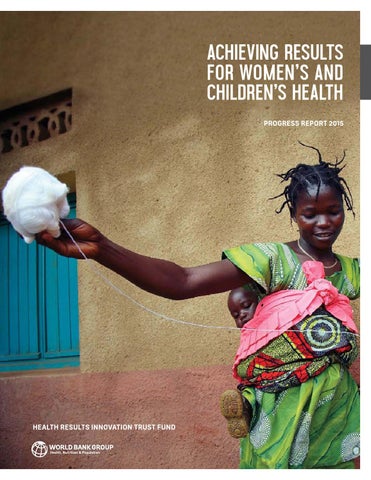
ACHIEVING REsults foR WomEN’s ANd CHIldREN’s HEAltH PRoGRess RePoRt 2015
HealtH Results InnovatIon tRust Fund
ACRONYMS & ABBREVIATIONS ANC
Antenatal Care
CPG
Country Pilot Grant
HMIS
Health Management Information System
HNPGP
Health, Nutrition and Population Global Practice
HRITF
Health Results Innovation Trust Fund
IDA
International Development Association
IE
Impact Evaluation
K&L
Knowledge and Learning
MCH
Maternal and Child Health
MDGs
Millennium Development Goals
M&E
Monitoring and Evaluation
NGO
Non-Governmental Organization
PBF
Performance-Based Financing
RBF
Results-Based Financing
RMNCAH
Reproductive, Maternal, Newborn, Child, and Adolescent Health
TA
Technical Assistance
WBG
World Bank Group
DISCLAIMER // The findings, interpretations, and conclusions expressed herein are those of the author(s) and do not necessarily reflect the views of the Board of Executive Directors of the World Bank or the governments they represent. The World Bank does not guarantee the accuracy of the data included in this work. The boundaries, colors, denominations, and other information shown on any map in this work do not imply any judgment on the part of the World Bank concerning the legal status of any territory or the endorsement or acceptance of such boundaries. ŠWorld Bank Group. September 2015
contents 1 Achieving Results for Women’s and Children’s Health 2
2
Country Perspectives
Cameroon
4
Zambia
8
Benin
12
Nigeria
14
Zimbabwe
16
3
Making an Impact around the World
18
Map: HRITF Global Country Program Portfolio
4 About the Health Results Innovation Trust Fund
20
Financial Overview
22
Building Country Capacity and Knowledge
24
Supporting the Design and Implementation of RBF
26
Assisting the Evaluation of RBF Programs
28
Disseminating RBF Knowledge and Evidence
32
“We all know there is much more work to do, and many more hurdles ahead. Too many mothers and children in poor countries die needlessly: The child mortality rate in low-income countries is more than 15 times higher than in high-income countries. And maternal mortality is nearly 30 times higher. Together, we can and will do better.� World Bank Group President Jim Yong Kim At the Third International Conference on Financing for Development Addis Ababa, Ethiopia, July 2015
ACHIEVING Results for Women’s and Children’s Health Although there has been unprecedented progress made in improving the lives of women, adolescents, and children over the past two decades, there remains considerable unfinished work. The Health Results Innovation Trust Fund supports the design and implementation of Results-Based Financing approaches in the health sector to help accelerate progress towards the millennium development goals for women’s and children’s health. RBF is an umbrella term for financing mechanisms where a cash payment or nonmonetary transfer is made to a national or sub-national government, manager, provider, payer or consumer of health services after pre-agreed results are achieved and independently verified. The RBF approach shifts the focus of governments and health systems from inputs to results. It often also facilitates a level of community involvement, which acts as an accountability mechanism. In RBF programs, various types of interventions work at different levels of the health system. For example, conditional cash transfers target the demand-side through beneficiaries, performance-based financing targets the supply-side through service providers, and cashon-delivery intervenes at the national level by targeting governments. While RBF designs are context-specific, they all explicitly link financing to results based on the delivery and rigorous verification of a package of reproductive, maternal, newborn, and child health services. RBF aims to increase autonomy, strengthen accountability, and empower frontline providers and health facility managers to make health service delivery decisions that best meet the needs of the women and children in the communities they serve. This report shares lessons and results from HRITF-funded RBF projects through five country perspectives; and provides an update on the trust fund’s activities over the past year. // 3
COuNTRy PERSPECTIvES
CAmERooN
Increasing Service Provider Accountability through a Results Focus
In 2011, Cameroon launched a Performance-Based Financing pilot in Littoral with the goal to improve the utilization and quality of maternal and child health services. The pilot has expanded twice since its initial implementation, first in June of 2012 to an additional three regions (North-West, South-West and East) and again in 2015 to another three regions (Adamaoua, North, and Far-North) with new financing from IDA and HRITF. Currently, the pilot is being implemented in approximately 400 public, private and faith-based organization facilities across 26 districts in the initial four regions and will add 17 districts in the northern regions by the end of 2015 to cover approximately 5.4 million people in total across 43 districts.
Health care providers and regulatory bodies are paid based on their performance. Service providers and purchasers sign contracts formalizing the financing arrangement. The new, additional financing approved in 2014 added a community-based PBF component to address the lack of qualified health workers, demand-side barriers, and to strengthen the existing community health worker (CHW) network. CHWs will be contracted to provide preventive, promotional and curative care. In addition, the PBF project will link with the World Bank’s Cameroon Social Safety Nets project, which supports the development of a basic national safety net system and a pilot conditional cash transfer program targeted to the poor and vulnerable.
“We have noticed that in the health districts where PBF has been implemented, hospitals are clean and well managed. Many people go to this hospital and the medical staff is motivated. Hospitals thus generate more resources directly and patients receive quality health care and pay a fair price for this.” andRé MaMa Fouda MINISTER OF PuBlIC HEAlTH OF CAMEROON
4 // HEAlTH RESulTS INNOvATION TRuST FuND
evaluatIon The ongoing impact evaluation seeks to: (i) identify the impact of PBF on maternal and child health service coverage and quality; (ii) identify key factors responsible for this impact; and (iii) assess cost-effectiveness of PBF as a strategy to improve coverage and quality. It includes a midline qualitative component, conducted in 2014, which sought to understand the key stakeholders’ experiences in implementing the PBF pilot program during the first few years. In early 2014, 112 in-depth interviews and 16 focus group discussions were conducted. Respondents included health care providers and administrative/regulatory bodies such as the district and regional medical teams. At the conclusion of the pilot PBF program, an end line qualitative component will be conducted to further analyze the results of the impact evaluation. An impact evaluation of the community PBF project will be launched in October 2015, with the baseline survey to be conducted in August 2015. This evaluation will examine whether facility-based PBF increases the quantity and quality of maternal and child health services, whether contracting community health workers through the community-based PBF model increases the quantity and quality of care at the community and facility level relative to just facility-based PBF, and whether community monitoring of community health workers and health facilities improve community health worker and health facility performance relative to CPBF and PBF without community monitoring. Public ceremonies will be conducted to randomly select facilities to be included in the evaluation.
7
regions >
43 districts >
400+ facilities >
5+ million people
// 5
KeY leaRnInG Trends in operational data indicate that since the RBF program was implemented in 2012, the coverage of key health services such as institutional delivery, antenatal care, family planning, and immunizations has increased. Free outpatient care for the poor and vulnerable has also increased. The quality of care, as measured by the average total quality of care score increased from 43 percent to 64 percent between 2012 and 2015.
drug provision has been broken; and the frequency of under the table payments from patients to providers have been reduced. The study also identified obstacles. The most common obstacles encountered were (i) initial reluctance and adjustment of health facility staff to the program requirements; and (ii) obtaining initial buy-in for PBF and support of government health officials and health facility managers, particularly prior to the first payment of PBF subsidies when participants questioned if the Government would actually be able to implement the program as intended. PolICY IMPaCts
2012 2015
There are several important policy impacts resulting from innovations in the design and financing of the PBF pilot in Cameroon.
+ Private sector facilities, including private for-profit Increase in Average Total Quality of Care Score: 2012-2015 64%
43%
and faith-based facilities, have signed PBF contracts along with the more traditionally included public sector facilities. As a result, private facilities now offer preventive/promotional services such as vaccination, family planning, and PTMTC. In addition, the quality of care has improved in all facilities, and there is improved coordination, communication and collaboration across levels of the health system.
+ the management of the PBF contracting, verification Key findings from the midline qualitative study indicate that both service providers and regulatory agents have a strong desire for the implementation of the PBF program to continue. Specifically, the study found that PBF has resulted in increased collaboration among the various stakeholders; whether it be between regional/ district supervision teams and health facilities (in particular private health facilities), or between health facilities and the community members they were serving. In addition, management tools and procedures used in PBF (such as quarterly business plans, the “outil indice� for balancing expenditures and revenues, and individual performance evaluations of facility staff) led to enhanced transparency and accountability in resource management. These positive effects also contributed to increased satisfaction among both providers and patients. The PBF program has also had a positive impact on service delivery: facilities are cleaner, more organized and better managed; staff are motivated; utilization and quality of services has increased while the price for services has reduced; drugs are more readily available, indicating that the public sector monopoly on
6 // HEAlTH RESulTS INNOvATION TRuST FuND
and payment process transitioned from international nGos to local structures with legal authority and a positive history and relationship with the Ministry of Health (MOH). As a result, overhead costs have been reduced, and the local structures have been integrated into the national system. The transition occurred over a 12-month period through a multi-step process involving six months of training and shadowing of the international NGOs, resource transfers and signing of subsidiary agreements with the MOH, and finally, evaluation of the transfer and recommendations for a national model and scale up.
+ after two years of the pilot (2011-2013) the Government
of Cameroon decided to begin financing PBF directly through domestic resources. Starting in 2014, the MOH financed RBF through direct budget support in the littoral region through the regional Public Treasury. Recently, the MOH requested support to explore the current budget to identify opportunities for channeling resources that are currently being wasted or poorly spent towards the RBF budget line.
COuNTRy PERSPECTIvES
ZAmBIA
Improving the Delivery of Maternal and Child Health Services
In April 2008, Zambia launched a pilot Results-Based Financing project to catalyze efforts to reduce maternal and child mortality in 10 districts in the country. A 24-month pre-pilot implemented in Zambia’s Katete District between 2009 and 2011 provided an opportunity to test and refine the RBF model in a real-world setting, strengthen the health system, and improve the quality of health care delivery and health outputs. Evaluations of the pre-pilot showed a positive impact on service uptake in both incentivized and non-incentivized indicators between 2009 and 2010. The increase in the incentivized indicators ranged from 7 to 54 percent, while the increase in the non-incentivized indicators ranged from 6 to 53 percent. In addition, the accuracy of routinely reported Health Management Information System data improved and misreported data declined significantly. Lessons learned from the pre-pilot stimulated policy dialogue between the Zambian government and its partners and guided the revision of the model’s design before roll-out of the pilot.
The pilot project began in April 2012 and is now operational in 11 rural districts* (including Katete) representing nine provinces out of a total of ten, 204 health facilities, and a total catchment population of nearly 1.7 million. The Zambian RBF model was designed to help address various health system challenges including an insufficient and poorly motivated human-resource base; an erratic supply of essential medicines and medical supplies; limited autonomy in decision-making at decentralized levels of the health system; weak monitoring and evaluation systems; and poor quality of service delivery. As one of the few examples of the
government “contracting-in” through the public health sector, the RBF program in Zambia links performance payments to the delivery of nine facility-based Maternal and Child Health and HIv/AIDS indicators under a fee-for-service model. Performance payments are determined by multiplying the volume of services delivered by a specified fee for each indicator, and by a quality score. In addition to the performance framework at the facility level, there was also one at the district level based on a set of indicators focused on better management of health inputs and supportive supervision to health facilities. evaluatIon The Zambia RBF program is designed for evaluation against two alternative models of health service delivery: control group 1, which receives additional funding in an amount intended to be equivalent to the RBF program but cannot be used for incentives to individual workers and must be used for maternal and child health-related interventions; and control group 2, which is the “business-as-usual” model. Health facilities in 10 of the 11 RBF districts were evaluated against 10 control group 1 districts, while 10 other districts served as a second control (business as usual). In the 2014 Annual Report, interim lessons based on the process evaluation and changes in service utilization using administrative data were reported. This year, lessons are based on the
8 // HEAlTH RESulTS INNOvATION TRuST FuND
* Note that Zambia now has 10 provinces. At the start of the project it was 8/9 but later 9/10.
9
provinces (out of a total of ten) >
11
rural districts >
204 health facilities >
1.7 million total catchment population
// 9
Months at first ANC RBF Baseline (2011) RBF Endline (2014) Control Baseline (2011) 4.55 Control Endline (2014)
4.47
4.11
4.46 Months at first ANC
preliminary results from the impact evaluation and focus on the results comparing the RBF program with control group 2. The baseline data was collected from October 20 to November, 2011. The endline data was collected from September to November 2014. Analysis on the RBF program compared to the enhanced financing arm (control group 1) is being finalized and will be included in the online version of the Annual Report to be released in October. PRelIMInaRY Results Preliminary results from the impact evaluation indicate that RBF significantly increases utilization of select MCH services, such as early antenatal care (ANC)-seeking behavior and in-facility delivery when the RBF districts are compared to the districts operating as “business as usual”—women from health facilities in the RBF districts sought ANC about three weeks earlier than women receiving care in non-RBF districts (Figure 1) and the rate of in-facility deliveries increased by almost 13 percent (Figure 2). Performance on some post-natal care measures increased in RBF districts. PNC coverage and immediate breastfeeding increased by nearly 10 percent and 14 percent, respectively, and were statistically significant.
FIGuRe 2 4.55 RBF Baseline (2011) RBF Endline (2014) 4.47 Control Baseline (2011) Control Endline (2014)
4.11
4.46
In-facility delivery RBF Baseline (2011) .69 RBF Endline (2014) .59 Control Baseline (2011) .58 Control Endline (2014) .55 .69
In-facility delivery
.59
However, there were .58no relative gains in other MCH related RBF Baseline (2011) measures. For example, the percent of women receiving any ANC RBF Endline (2014) and satisfaction with delivery increased (Figure 3) but neither Control Baseline improvement was statistically .55 (2011) significant. Control Endline (2014)
FIGuRe 1 RBF Baseline (2011)
FIGuRe 3 Satisfaction with delivery RBF Baseline (2011)
RBF Endline (2014)
RBF Endline (2014)
Control Baseline (2011)
Control Baseline (2011)
Control Endline (2014)
Control Endline (2014)
Months at first ANC
2.70 2.60 2.69
2.51
2.70 2.60 2.69
2.51
Satisfaction with delivery
4.55 4.47
4.11
4.46
RBF Baseline (2011) RBF Endline (2014) Control Baseline (2011) Control Endline (2014) 10 // HEAlTH RESulTS INNOvATION TRuST FuND
.69
In-facility delivery
A health facility survey also showed that in RBF districts, select MCH equipment was more available, there were fewer stock outs of select drugs such as DMPA, ACTs, oxytocin, and ORS, clinical protocols were displayed and adhered to with more fidelity (as assessed through patient exit interview), and health workers were more satisfied with their work conditions and operated with higher autonomy. However, the impact of RBF on worker knowledge was minimal and impacts on both staff motivation and client satisfaction were inconclusive. Based on the experience so far, the new IDA-funded Health Services Improvement Project will continue to support a results focus for women’s and children’s health in Zambia.
COuNTRy PERSPECTIvES
BENIN
Impact of PBF on Health Worker Performance
The impact of a Performance-Based Financing pilot program launched in public and not-for-profit facilities in eight of Benin’s 34 health districts in March 2012 is currently being evaluated. To facilitate comparisons, half of these facilities (around 100) were randomly assigned to a treatment group in which bonuses were conditional on achieved performance. The other half (around 100 facilities) was assigned to a control group in which bonuses were unconditional. A second control group of 50 facilities located outside the eight PBF districts received no bonuses. In 2011, a baseline survey, comprised of both a health facility survey and a household survey, was conducted prior to the pilot’s implementation.
evaluatIon As part of the impact evaluation, Benin is using a mixedmethods survey to explore the impact of PBF on health worker performance. It is examining, inter alia, the impact of PBF on different dimensions of health worker performance, including clinical productivity (i.e. absenteeism, average time per patient, reduction of slack, etc.), quality of care and responsiveness to patients. It also is examining reasons for change, namely an improvement in “can-do” skills and knowledge, working environment and/or “will-do” attitude (motivation/effort) or contextual factors (level of management autonomy). In 2015, a follow-up survey was implemented in 135 facilities that focused specifically on the performance of 433 health workers (i.e. doctors, midwives and nurses). Several quantitative and qualitative survey instruments were used to compare outcomes over time and across treatment and control groups. These included: (a) a facility survey to measure staff absenteeism, the degree of management autonomy and the availability of drugs and equipment; (b) a time-and-motion study; and (c) a Health Worker Survey to measure job satisfaction, earnings and performance. To inform findings, in-depth interviews were also carried out with district managers and health workers. PRelIMInaRY Results The preliminary results show that the PBF intervention in Benin improved some aspects of health worker performance. They indicate a positive impact on quality of care and responsiveness
12 // HEAlTH RESulTS INNOvATION TRuST FuND
towards patients but no significant impact on clinical productivity. For example, a comparison between PBF treatment and control groups highlights:
+ Improvements in the quality of antenatal care in PBF facilities, with increases in the quality of physical examinations conducted, history-taking and advice given by a health worker (measured through Direct Clinical Observations), as compared to both control groups.
+ Increased consultation time with almost 4 additional minutes for anC in PBF facilities compared to facilities with no intervention.
+ Increased responsiveness of health workers towards patients in PBF facilities, with pregnant women receiving ANC visits and patients getting curative care being respectively more satisfied with staff attitude and staff competence (as measured through Direct Clinical Observations and exit patient interviews).
+ a significant impact of PBF on the politeness of staff during ANC visits. The absence of impact on clinical productivity can be explained by the strong focus of PBF in Benin on the quality of care, so even indicators linked to quantity require qualitative aspects to be validated. For example, a 4th ANC visit is only counted if a qualified health worker provides it and if all relevant aspects of the service, such as the provision of anti-malarial drugs and immunization, are provided.
COuNTRy PERSPECTIvES
nigeria
From Small Pilot to Expansion
In 2011, Nigeria launched a small Results-Based Financing pilot, covering a population of 500,000 across three Local Government Areas (LGAs). The pilot states of Adamawa in the North East, Nasarawa in the North Central region and Ondo in the South West showed early promising results. Based on the lessons learned, the full scale Nigeria State Health Investment Project (NSHIP) was developed with $150M IDA funding and a $20 million HRITF grant. Project roll out began in December 2013 and today RBF in Nigeria covers over 900 facilities in 50 LGAs with an estimated population of about 14 million as illustrated in Figure 4.
eaRlY Results FRoM tHe PIlot and exPansIon PHase
70 60 PERCENT
uptake of services has been very encouraging, with utilization of core maternal and child services like immunization, deliveries in facilities, and family planning, showing much improvement. Figure 5 shows an immunization coverage increase in pre-pilot facilities from 5 percent to 44 percent; an increase from 14 percent to 44 percent in the first phase scale up facilities; and showing promise in the most recent scale up facilities.
FIGuRe 6 Post-sCale uP IMMunIzatIon CoveRaGe InCRease
50
Adamawa
40
Nasarawa
30
Ondo
20 10 0
PERCENT
FIGuRe 5 IMMunIzatIon CoveRaGe InCRease In PRe-PIlot FaCIlItIes 2012 - 2014 60
Pre-pilot
50
Scale up Phase 1
40
Scale up Phase 2
30 20
Scale up Phase 3
10 0
1
2 3 2012
4
1
2 3 2013
4
1
2 3 2014
4
QUARTER
Similarly, at state levels, Figure 6 shows an increase in immunization coverage from 31 percent to 51 percent in Adamawa State, 29 percent to 59 percent in Nasarawa and 42 percent to 48 percent in Ondo State, since completion of scale up in December 2014.
14 // HEAlTH RESulTS INNOvATION TRuST FuND
JAN
FEB
MAR APR 2015
MAY
JUN
QUARTER
Moreover, data show that quality of services also improved, along with the increases in coverage. A quality checklist applied on a quarterly basis found that structural and process quality measures saw rapid and sustained improvements. A recalibrated checklist with a stronger focus on processes of care was introduced in January 2014. Finally, PBF facilities achieved good patient satisfaction, with ratings of 80 percent in Nasarawa State and 95 percent in Ondo State. It is worth highlighting that these results have been achieved at a marginal additional cost of $0.8per capita per year. In February 2014, NSHIP funded the launch of an intensive internship program, implemented by the National Primary Health Care Development Agency, to increase the number of PBF Independent verifiers in the three PBF pilot states.
FIGuRe 4 nsHIP estIMated PoPulatIon CoveRaGe 2011-2015
900
16,000
800
14,000
700
12,000
600
EXPANSION 3
10,000
500 8,000 400 6,000 300 4,000
EXPANSION 2
200
2,000
100
0
0 4 2011
1
2
3 2012
4
1
2
3
4
2013
1
2
3 2014
4
1 2015
Health Centers Catchment Pop. (’000)
// 15
COuNTRy PERSPECTIvES
Zimbabwe Reducing Financial Barriers to Accessing Health Care
The RBF program in Zimbabwe was launched in 2011. Rural health centers are paid based on the quantity and quality of 16 maternal and child health services delivered; and hospitals are paid based on five emergency and obstetric services. The impact evaluation compares outcomes in districts with and without RBF—before (2008-2010) and after (2012-2014) the RBF program was implemented. In addition, there were repeated rounds of process monitoring and evaluation of the project through a mixed-methods approach. The results described in the 2014 Annual Report indicate that there were substantial improvements in the quantity and quality of services delivered in RBF districts, when compared to their non-RBF counterparts.
Results uPdate Additional analyses of Zimbabwe’s RBF program impact evaluation data highlight findings in new areas.
+ RBF has positive implications for equity: the impact of RBF on the likelihood of delivery by a skilled provider and delivery in a facility is greater among households below median wealth than among households above median wealth. Those services which were not incentivized under the RBF program, such as treatment for acute respiratory infection and diabetes, do not appear to have decreased after the RBF program was implemented.
+ Results from the qualitative component of the impact
evaluation indicate that when the RBF program is implemented as intended and planned, it triggers and facilitates changes in the facility staff’s performance; and it influences the performance of health facilities, and the motivation and satisfaction of staff at these facilities.
Early evidence from Zimbabwe’s impact evaluation informed the Government’s decision to develop the next phase of the RBF program with a focus on innovative ways to reward for performance on clinical quality of care.
16 // HEAlTH RESulTS INNOvATION TRuST FuND
+ RBF facilities have more effective monitoring and
reporting mechanisms, and better staff coordination than non-RBF facilities. Results from the PME indicate that improving feedback mechanisms along with supervision improves the quality of services.
Making an Impact around the World Supporting countries to design and implement RBF programs for women’s and children’s health is at the heart of HRITF’s work. To date, HRITF has committed $396 million for 36 RBF programs in 30 countries, linked to $2.2 billion in financing from IDA—the World Bank’s fund for the poorest.
Kyrgyz Republic Armenia
Chad Nigeria Benin Burkina Faso Senegal Haiti
The Gambia Sierra Leone Liberia Ghana Cameroon Congo Central African Republic
CPG Approval Year by HRITF * FY12 (or earlier) FY13 FY14
* A circle denotes a country with multiple RBF projects, with related year(s) of approval indicated by the corresponding color.
18 // Health Results Innovation Trust Fund
Tajikistan Afghanistan Pakistan India
Republic of Yemen Djibouti
Lao People's Democratic Republic
Ethiopia Kenya Burundi
Rwanda Democratic Republic of Congo
Zambia Zimbabwe
Lesotho
// 19
About the Health Results Innovation trust fund The Health Results Innovation Trust Fund was established in 2007 as a World Bank-managed multi-donor trust fund to support RBF approaches. Through country program grants (CPGs) HRITF supports resource-constrained countries with efforts to accelerate progress towards achieving the health-related Millennium Development Goals, primarily MDGs 1c (nutrition), 4 (child mortality), and 5 (maternal health). Impact evaluation grants support stand-alone impact evaluations of non-HRITF-financed programs, to contribute to global RBF evidence and knowledge. HRItF works to: +
Support the design, implementation, and evaluation of RBF mechanisms.
+
Develop and disseminate evidence on implementing successful RBF mechanisms.
+
Build countries’ institutional capacity to scale up and sustain RBF mechanisms within the national health strategy and system.
+
Attract additional financing to the health sector.
This year HRITF continued to support ongoing work in its portfolio of 36 RBF projects in 30 countries. // 21
ABOuT THE HEAlTH RESulTS INNOvATION TRuST FuND
financial overview As of July 15, 2015, the total contributions to the trust fund are $482.4 million equivalent from Norway and the United Kingdom. A total of $396 million in trust fund resources has been committed for 36 RBF programs in 30 countries, linked to $2.2 billion in financing from IDA—the World Bank’s fund for the poorest. Since inception the trust fund has disbursed $231 million—with sixty percent disbursed over the last two years when the majority of HRITF-funded RBF programs began implementing.
FIGuRe 7 HRItF dIsBuRseMents BY CalendaR YeaR
120
100
US$ MILLION
80
60
40
20
0 2008
2009
2010
2011
2012
2013
2014
2015
2016
2017
2018
2019
2020
2021
Actuals Projections
1 Donor contributions are made in the contribution currency of the donor and are converted into uS$ based on current exchange rate and historic value of the paid contribution. As of July 15, 2015, the united Kingdom has committed GBP 114 million (uS$180.9 million equivalent) and Norway has committed NOK 2.086 billion (uS$ 301.5 million equivalent).
22 // HEAlTH RESulTS INNOvATION TRuST FuND
FIGuRe 8 HRItF FundInG alloCatIon BY ReGIon
South Asia
Midde East & North Africa
Latin America & Carribean
Europe & Central Asia
East Asia & The Pacific
8%
4%
5%
4%
1% Africa
77%
// 23
ABOuT THE HEAlTH RESulTS INNOvATION TRuST FuND
Building Country Capacity and Knowledge HRITF supports activities to build RBF awareness, capacity and knowledge through learning opportunities that range from technical training workshops to peer learning, as well as knowledge products and other tools. Some of this year’s highlights are detailed in this section.
RBF e-leaRnInG CouRse
GaMInG FoR RBF leaRnInG
Following its successful pilot in 2014, the RBF E-learning Course was conducted for a second time and reached development practitioners around the world. 168 Participants successfully completed the course, representing an increase of 124 percent compared to its pilot. The course provides practitioners a virtual learning classroom to share high quality RBF knowledge and build RBF implementation capacity. The course is based on materials that were developed over the course of several years for the delivery of face-to-face RBF learning events. It provides participants with background knowledge on RBF and its different approaches, introduces core RBF principles for health and provides some country examples of RBF for health in practice.
Over the last few years, learning games have moved beyond targeting children and are now being used by organizations to enable knowledge and learning. The first digital game on RBF design and implementation was developed with support from the Engagement lab at Emerson College, in the united States. The game, aimed at policy experts and health professionals, allows players to explore the fictional country of Zariba. They travel the country and engage with locals with the goal of assessing health policy in order to create an RBF design that achieves specific goals. In the second phase, players are told of challenges during RBF implementation, such as over-reporting or lack of medicines to cater for an increased number of clients and they’re tasked to take corrective action to attain the best health results.
”Thanks for developing a wonderful online course. It is very informative and easy to navigate with a good mix of real examples and concepts. The course helps us to understand a complex topic like RBF, especially for people who have not been practically exposed to RBF.”
WRIte sHoPs In BuRundI and CaMeRoon to enaBle RBF IMPleMenteRs to sHaRe tHeIR leaRnInG Workshops were conducted in Burundi and Cameroon using the writeshop methodology, a highly participatory process designed to help RBF implementers develop knowledge products while building their capacity to share knowledge and results. Each 5-day workshop, led by the Royal Tropical Institute, identified interesting practices, lessons learned and promising experiments to activate and inform the documentation process. Over subsequent months, through peer reviews and with supportive inputs, six articles were finalized on the RBF experiences in Cameroon and Burundi, and published on the RBF website. sHaRInG RBF KnoWledGe tHRouGH seMInaRs and ConFeRenCes
anuJ KuMaR sRIvastava REGIONAl MANAGER (ASIA) PARTNERSHIP AND RESOuRCE DEvElOPMENT, MICRONuTRIENT INITIATIvE
24 // HEAlTH RESulTS INNOvATION TRuST FuND
HRITF participated in several events and hosted several seminars throughout the year to share RBF knowledge and learning. At the Third Global Symposium on Health Systems Research 2014, the HRITF program partnered with the PBF in Africa Community of Practice for a day of learning and sharing their experiences with evaluating the impact of RBF programs. Several seminars were hosted during the year on topics such as the review findings of qualitative research on 20 HRITF-financed RBF projects and the role of vouchers in serving disadvantaged populations.
ABOuT THE HEAlTH RESulTS INNOvATION TRuST FuND
supporting the design and Implementation of RBf HRITF continued to provide critical project design and implementation support to countries, as they further established and scaled up performance-based projects, explored other forms of RBF. The following sections detail some of the main areas of work that HRITF carried out.
suPPoRt to RBF CountRIes Building on early results, RBF programs have expanded rapidly, particularly in Africa (Figure 9). There are currently 30 countries implementing RBF, including several countries with nationwide programs. Operational support to country teams, along with the sharing of lessons, evidence and knowledge are central functions of the World Bank’s Health, Nutrition and Population global practice. HRITF support has been critical for strengthening implementation, including through the following aspects that are most appreciated by RBF project teams:
+ standardizing design requirements for effective RBF:
HRITF input has been useful for focusing the design of core RBF elements including the contractual relationships between purchasers and providers, verification and counter verification and transparency and institutionalization of RBF within government structures.
+ supporting implementation and responding to needs for demand-driven technical assistance: Portfolio reviews helped track performance and draw generic lessons that strengthened RBF implementation. As the number of RBF projects under implementation have grown, so have the technical support requirements of Bank operational teams. To meet those requirements efficiently, a Technical Assistance Support for the RBF Implementation (TASRI) resource center has been established. TASRI works to standardize knowledge-provision and implementation support to Bank operational teams.
+ drawing global lessons for new countries implementing RBF: Working papers on themes that include quality of care, sustaining RBF and using RBF for supply chain, which are central to RBF implementation, were developed to distill global knowledge among RBF country teams.
26 // HEAlTH RESulTS INNOvATION TRuST FuND
+ strengthening data use: RBF programs rely on the
availability of good data to assess performance during implementation, for better project outcomes and to provide valuable lessons for implementers and policy makers. Several countries including Nigeria, Cameroon, Democratic Republic of Congo and Benin have developed publicly available on-line dashboards to track performance. An initiative is also underway to bring greater alignment between the DHIS 2 and RBF data platforms.
dIveRsIFYInG Results-Based aPPRoaCHes Some countries, like Burundi and Cameroon, have opted for national RBF expansion. Others, however, like Zambia, laos and Tanzania are adopting the principles, operational lessons and tools from their PBF pilots to inform new Cash on Deliveryoriented, Disbursement-linked Indicators/Program-for-Results approaches as they develop new projects. For example, the new project in laos:
+ Maintains the financing for results and the unilateral focus on what investments should achieve;
+ Continues to use the results-based financing approach, which makes payments to provinces based on results achieved;
+ Focuses on data for tracking results and relies on monitoring and verification of outputs through third party mechanisms so that only real results are paid for; and
+ Focuses on service delivery quantity and quality metrics. The new project also uses tools like the supervision checklist to pay for quality.
FIGuRe 9 InCReased use oF RBF aPPRoaCHes FoR HealtH In aFRICa
2006
2015
National Scale Up Ongoing Pilots Advanced Planning Under Discussion Impact Evaluation
// 27
ABOuT THE HEAlTH RESulTS INNOvATION TRuST FuND
Assisting the Evaluation of RBf Programs In line with the growth of RBF country programs financed by HRITF, our evaluation portfolio has doubled in the last year, to 33 impact evaluations (29 quantitative and with mixed methods and 4 qualitative), 5 program assessments and 5 enhanced program assessments.
country teams are at the early design stage due to the recent increased growth of the portfolio, about a quarter are at a stage when results on RBF could be generated and shared in the next two years (Figure 10).
The range of evaluation and learning activities has also greatly diversified the scope of activities, shifting from a strong focus on Performance-Based Financing programs to broader RBF schemes, such as demand-side RBF (vouchers, conditional cash transfers, etc.), but also to PBF programs that better meet the needs of country contexts. As a result, and through the management of the learning agenda, the portfolio of evaluations of RBF has also diversified its main outcomes of interest—for example: supplyside RBF payments in countries including Afghanistan, liberia and Senegal, RBF for quality of care in countries like Armenia, Cameroon and Tanzania; and interventions evaluated—including for example: quality and utilization maternal and child health outcomes in Haiti, India and Tajikistan, family planning outcomes in the Republic of Congo and Rwanda, adolescent outcomes in lesotho, and nutrition outcomes in Burundi and the Gambia.
Over the past five years, the HRITF has built capacity for impact evaluations amongst country teams and teams are progressing towards producing results. Figure 11 highlights the expected timeline of results from the impact evaluations (excluding the program assessment and enhanced program assessments). While new results are expected every year, nine impact evaluations could produce results in an 18-month timeframe. In the next five years, nineteen are expected to produce results. The fifteen remaining impact evaluations are those at early design stage, for which the timeframe still is to be confirmed, and also for which there are opportunities to drive the learning agenda on RBF more proactively.
Impact evaluations funded by HRITF are at different stages, from early design to end-line analysis and dissemination. While many
FIGuRe 10 HRItF Ie PoRtFolIo tIMelIne
35
NUMBER OF IEs (CUMULATIVE)
30 25 20 15
29
28 23 17
28
22 16
16
12 10
10
7
5
2
0
7 2
0
0 FY12
FY13
FY14
HRITF Approvals (net of cancellations) Approved design Baseline data collected IE Completed 28 // HEAlTH RESulTS INNOvATION TRuST FuND
FY15
Figure 11 Number of countries expecting impact evaluation results disseminated by 2018
8
7
6
5
4
3
2
1
0 2014
2015
2016
2017
2018
// 29
ABOuT THE HEAlTH RESulTS INNOvATION TRuST FuND
suPPoRtInG IMPaCt evaluatIon desIGn and IMPleMentatIon As part of the work program, a number of workshops were organized to promote capacity building with country teams and to build stakeholder knowledge of and interest in impact evaluation. One such workshop was held in the Gambia, where an impact evaluation of the Maternal and Child Nutrition and Health Results project is underway. tHe GaMBIa: exPloRInG tHe sYneRGY BetWeen deMand- and suPPlY-sIde InCentIves The Gambia’s RBF program IE is exploring the synergy between demand- and supply-side incentives. The principal strategy for the evaluation is to compare changes in communities reached early by the interventions (treatment group 1) to changes in communities reached in later phases of the project (treatment group 2). Baseline, midline and endline data will be collected, and a mixed methods approach with an embedded process evaluation will aim to measure impact and to explain how and why the intervention worked. To support the evaluation, efforts to engage a wide range of stakeholders and to build capacity were undertaken. Including a RBF and impact evaluation workshop with the participation
from stakeholders at national and sub-national levels. The workshop presented methods of impact evaluation and facilitated discussions and peer-to-peer learning between participants. The exchanges set the stage for the evaluation design and identification strategy with broad understanding among stakeholders. A couple of months after the workshop a public ceremony was held, whereby government counterparts randomly selected health facilities and communities, assigning them to one of the two treatment groups. In addition, an IE Advisory Panel (comprised of key stakeholders) was formed to (i) provide guidance to the impact evaluation team on policy relevance, country context and other country-specific issues, and (ii) encourage buy-in from stakeholders on the IE design and implementation. The baseline survey data collection and analysis have been completed. An in-country dissemination workshop is planned for October 2015 to share the baseline survey results and discuss next steps for preparation of the mid-line survey. nIGeRIa state HealtH InvestMent PRoJeCt IMPaCt evaluatIon BaselIne Results WoRKsHoP The Nigeria State Health Investment Project IE includes a prepost design with a comparison group using data from large-scale household and health facility surveys. For baseline assessment, the health facility survey was carried out by the National Bureau of Statistics (NBS). The household survey by the National Population Commission (NPC) under the leadership of the Department of Planning, Research and Statistics within the Federal Ministry of Health (FMOH) in Nigeria, with technical assistance from the university of South Carolina and the World Bank. The baseline surveys were completed between October 2013 and April 2014.
pICtuRED // Damien de Walque, a senior economist in the World Bank’s development research unit, also moderated a debate in which a panel of three—Dr. Gerald Gwinji, the Permanent Secretary for Health, Zimbabwe, Bruno Meessen, health economist, Institute of Tropical Medicine, Antwerp, and Mead Over, senior fellow, Center for Global Development—brought their perspectives to the question: Is there still a need for impact evaluations [on RBF] and [if so,] what form should they take?
30 // HEAlTH RESulTS INNOvATION TRuST FuND
The university of South Carolina organized a workshop for key members of the impact evaluation core team from FMOH, NBS, NPC and the World Bank, to analyze the baseline survey data, in Columbia, South Carolina. The main objectives of the workshop were to finalize an analysis plan and outline of a final report, including a list of indicators and templates of tables to be presented, as well as to describe the process of statistical analyses using STATA, to the participants. During the ten days of the workshop, participants were also shown analyses of and findings from other evaluations conducted by the World Bank. The workshop concluded with participants agreeing upon a list of key indicators, including composite ones for measuring quality of care, discussing preliminary findings presented by uSC and writing introductory sections of the baseline survey report.
Pictured // Highlights this year included the daylong Transforming Health Systems through Results-Based Financing: Learning from Implementation and Early Evidence of Impact event at the Third Health Systems Research Global Symposium, in Cape Town. The session, organized in partnership with the PBF in Africa Community of Practice, attracted participation from health specialists, economists, academics, and policymakers for a vibrant exchange evaluating RBF projects. Teams from Argentina, India and Zimbabwe shared results and experiences.
ABOuT THE HEAlTH RESulTS INNOvATION TRuST FuND
disseminating RBf Knowledge and evidence This year, efforts to strengthen the online presence and capacity of RBF Health matured and evolved into a solid eco system of digital channels that complement traditional knowledge sharing activities with a greater reach and engagement with global audiences.
usInG data to dRIve GloBal RBF evIdenCe and KnoWledGe dIsseMInatIon By leveraging the analytical data available through the program’s digital channels—Facebook, Slideshare, Twitter, and the Website—our content strategy was more proactive and responsive to audience needs. The number of followers on Twitter increased by 60 percent as data analysis helped the program understand the type of content that resonates with the community. On Facebook, the number of fans increased by 24 percent. Analysis of platform data also helped identify the types of content that drove higher engagement. For example, audience engagement was at its highest last September when the HRITF 2014 Progress Report was published. An analysis of Website data provided a deeper understanding of audience preferences and interests. The three blog posts with the highest all time view rates demonstrated that it’s not the newest content that’s the most popular but rather the content that provides the most value for RBF practitioners through learning and useful tools. These blog posts discussed the Impact Evaluation Toolkit, the use of new technologies in RBF and the use of qualitative research to help refine the Gambia RBF design. By packaging content for sharing across different social media channels, we were able to drive audience attention to topics that were relevant, useful or newsworthy. This allowed us to use Facebook, Twitter and the RBF Bulletin email newsletter to publicize upcoming events and drive attendance in person and participation online via Webex. This approach also contributed to the dissemination of publications and reports from the World Bank, WHO, Save the Children, and other credible sources, in support of our donor mandate to be a source of timely and credible information on RBF and related topics. usInG onlIne PlatFoRMs to BuIld and sustaIn a ConveRsatIon WItH tHe GloBal HealtH and RBF CoMMunItY Perhaps the most important development this year has been the maturity of RBF Health’s relationship with its online communities. The previously passive audience engagement transformed into a
32 // HEAlTH RESulTS INNOvATION TRuST FuND
respectful discussion with mutual learning and knowledge sharing that accelerated content sharing within the RBF Health online community. For example, we engaged the authors of an article series (on lessons learned from RBF programs in Cameroon) in advance of our planned social media dissemination process. The authors then actively shared the pieces through their own channels, which boosted organic engagement with the original posts. A Facebook post applauding Dr. Goverwa-Sibanda, a Provincial Maternal and Child Health Officer, for a successful presentation of new results from the RBF program in Zimbabwe (at the Health System Research Symposium in Cape Town), generated the most organic engagement—with 29 comments. By sharing the post from her personal Facebook profile, Goverwa-Sibanda enabled a far greater reach into her highly relevant network than RBF Health could otherwise have achieved. Finally, follower feedback on Twitter and Facebook demonstrated the community’s growing confidence in the quality of conversations we host on each channel and showed that they are increasingly comfortable discussing RBF content, sharing their perspectives and expertise and sometimes acting as editors, by providing clarifications and corrections through comments and direct messages. Dan Abiola @emailbiola Is Performance Based Financing rewarding both the value and the volume of care equally? Or one over the other? @RBFhealth RBF Health @RBFhealth @emailbiola, on Q3, @GFritsche responds: “Absolutely! See Chapter 3 openknowledge.worldbank.org/handle/10986/1... Dan Abiola @emailbiola Does Performance Based Financing link incentives to patients centered care?? @RBFhealth RBF Health @RBFhealth @emailbiola, on Q1, @GFritsche responds: “Systems approach boosting quality & coverage of essential services.” Intro wrld.bq/QtGaC
FIGuRe 12 leadInG tHe WaY onlIne WItH ResouRCe sHaRInG and KnoWledGe exCHanGe
presentations
publications
toolkits
videos
MoRe InFoRMatIon
www.rbfhealth.org
JoIn tHe GloBal RBF ConveRsatIon
RBFhealth@worldbank.org @RBFhealth RBFhealth