World Business Times INSIGHT: Egypt
2
The perception problem Egypt reboots its economy with FDI up $3.3bn.
4
World Business Times is a leading provider of global business intelligence
6
Healthcare sector needs a booster shot Soaring costs create turmoil whilst the government addresses concerns by bolstering medical tourism.
Inside Egypt
The Six by Six plan Egypt’s Minister of Tourism, Yehia Rashed, explains his plan to revive the country’s battered tourism sector.
www.world-businesstimes.com
22 August 2017
WORLD BUSINESS TIMES INSIGHT REPORT DISTRIBUTED BY THE DAILY TELEGRAPH
President Sisi gambles on economic overhaul By floating the pound, agreeing to the IMF’s terms, and imposing VAT, Egypt goes all in, leveraging substantial risks to gain huge rewards and get the economy back on track. Last year, Egypt faced stark economic realities, including the Central Bank’s dwindling foreign currency reserves, a sizable budget deficit, and low growth rates. In November, President Abdul Fattah El-Sisi implemented stringent reforms to address long-standing economic issues. “It is crucial to recall that Egypt has passed through an acute crisis since January 2011 [i.e. the Egyptian Revolution],” said Mr Sisi, in an exclusive interview with World Business Times. He continued, “The economic challenges that I confronted as the elected president in June 2014 were enormous and I had to come up with an effective and credible plan with a package of programs and projects to put the economy back on course and alleviate the suffering of the Egyptians”. Mr Sisi sees a clear path forward under his leadership: “I was elected President with a clear mandate to usher Egypt into a new era of stability and development, and to lay the political and economic foundation
of a modern, democratic, and prosperous state that can fulfil the aspirations of the Egyptian people and the next generation for a better tomorrow.” The floating of the Egyptian pound has been the most significant move so far. The pound has lost more than half its value since liberalisation, which caused increased production costs and reduced buying power. The cessation of fuel subsidies and the introduction of value-added taxes (VAT) added to the woes of Egyptian producers and consumers alike. Industries like real estate and the construction sector have been the most impacted. The rising cost of building materials, especially cement and steel products, collectively threaten the viability of specific projects as well as entire firms. The IMF directed Egypt’s economic reforms after approving a $12 billion loan to revive Egypt’s economy. Experts confirm that while the reforms may aggrieve consumers and producers in
the short term, they will have long-term benefits including foreign investment. Mr Sisi expressed hope that the long-term benefits of these reforms will outweigh the short-term burdens: “In recounting the achievements of the past two years, it is equally important to emphasize that our plan cannot bear fruit overnight.” He added that, “economic transition is never easy, and creating a new model of economic growth takes time”. Mr Sisi’s economic scheme has also been complicated by ongoing development for New Cairo Capital City, a key mega-project in Egypt’s bid to woo foreign investment. The China State Construction Engineering Corporation (CSCEC) signed a Memorandum of Understanding worth $3 billion for the development of government buildings in the new city. However, CSCEC withdrew its support from the project in early 2017 following disagreements over pricing,
throwing Egypt’s emerging partnership with China into doubt. Local contractors will now build the governmental facilities, but most analysts still believe China Fortune Land Development Company (CFLD) will bring $20 billion of support to the project, though no agreement has been signed. Despite these challenges, Egypt is faring relatively well in the region. It ranked highest in Moody’s economic strength assessment for the Middle East and north Africa. But as Egypt finds its economic footing, it must also address its recent past, and current sectarian divisions. Former President Mohamed Hosni Mubarak was recently released from prison after Egypt’s top appeals court cleared him of any responsibility for the scores of protestor deaths during the 2011 uprising. The move is seen by some as the final resolution of the Arab Spring, and the return of the military’s dominance in Egyptian politics. However, with the 2018 presidential election approaching, what matters most is delivering tangible benefits to the Egyptian people.
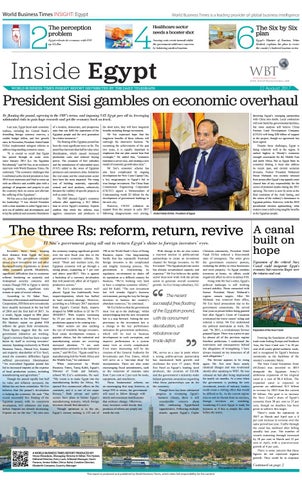
Abdul Fattah El-Sisi, President of Egypt
The three Rs: reform, return, revive El Sisi’s government going all out to return Egypt’s shine to foreign investors’ eyes. Investors have been keeping their distance from Egypt for over six years. The government recently issued a new investment law and other business-friendly regulations to restart stable economic growth. Meanwhile, significant difficulties due to economic reforms bordering on austerity and widespread security concerns still remain.Though FDI to Egypt is slowly regaining traction, significant risks remain in spite of recent reforms. According to Dr Sahar Nasr, Minister of Investment and International Cooperation, FDI from new investments have steadily increased in the last half of 2016 and the first half of 2017. As a result, Egypt surged to fifth place from fifteenth in the Financial Times’ fDi Markets report on global FDI inflows for green field investments. These figures suggest that the new government initiatives are working. Egypt’s currency float has been a major factor by itself in reviving investors’ interest. Speaking exclusively to World Business Times, Ahmed Ezz, founder and majority shareholder of Ezz Steel, noted the economic difficulties Egypt suffered pre-currency liberalisation: “An overvalued Egyptian pound has led to increased imports at the expense of local production sectors, including manufacturing and agriculture.” Though the pound rapidly lost half its value and inflation increased, the fallout has not been calamitous. Mr Ezz believes that the pound’s devaluation is helping the economy. He said: “The recent successful free floating of the Egyptian pound, with its concurrent devaluation, will rebalance our trade deficit. Imports are already decreasing. Exports are on the rise.” He also sees
the economy reaping significant growth over the next fiscal year due to the government’s economic reforms. He noted: “Short and medium term, the Egyptian economy will go through a strong phase, expanding at 7 per cent and above post-2017. This is against a backdrop of a currency devaluation that will positively affect all of Egypt’s productive sectors.” Mr Ezz’s optimism seems well placed. Egypt has traditionally been import-dependent, which has fuelled its hard currency shortage. However, according to a February 2017 statement from Egypt’s Central Bank, imports dropped by $800 million in Q1 for FY 2016/2017. With exports increasing by 25 per cent in January, Mr Ezz’s predictions appear to be coming true. Other sectors are also catching the eye of would-be foreign investors. Real estate development remains a popular choice, but the industrial and manufacturing sectors are receiving increased attention. “I see such opportunities primarily in the industrial sector,” said Mr Ezz. “Egypt could be a manufacturing hub for North Africa and the Middle East,” he continued. When interviewed by World Business Times, Tareq Kabil, Egypt’s Minister of Trade and Industry, echoed Mr Ezz’s sentiments. He said: “My vision is to make Egypt into the manufacturing facility for Africa. We opened five commercial offices on the continent, and it is one of our major focuses.” Both private and public sectors have plans to bolster Egypt’s manufacturing industry, which foreign investors should find attractive. Though optimism is in the air, Egypt’s current ranking is 122 out of
190 in the World Bank’s Ease of Doing Business report. One long-standing hurdle that has repeatedly frustrated foreign investors is the complicated and lengthy licensing process. The government is restructuring its regulatory environment to shake off its reputation as a difficult country for business. “We’re working very hard to have a complete economic reform,” said Mr Kabil. “The new investment law will remake Egypt’s business environment, paving the way for foreign investors to harness the country’s abundant resources,” he continued. Mr Ezz believes that the government must ‘rise up to the challenge,’ whilst acknowledging that the new investment law is a step forward. Among the new provisions in the investment law is a change to the key performance indicators for government authorities, which will be tied to business development to curb corruption, and improve performance in a system many view as overly complicated. Even more interesting will be the creation of the General Authority for Investments and Free Zones, which will serve as a ‘one-stop shop’ for incorporation. There are also some encouraging fiscal amendments, such as the reduction of customs rates from 5 per cent to 2 per cent for tools, equipment, and machinery. These fundamental reforms are an encouraging first step; however, to tempt FDI to return, the government will need to follow through with timely and consistent modifications that embrace change. Otherwise, wary investors could decide that promises of reform are simply not worth the risk.
With change in the air also comes a renewed interest in public-private partnerships to create an investment channel for foreign investors. As Mr Ezz noted: “The Egyptian private sector has already accumulated capacity and expertise.” Mr Ezz believes the public sector must now work with the private sector to generate overall economic growth. An Ezz Group subsidiary, EZ-
The recent successful free floating of the Egyptian pound, with its concurrent devaluation, will rebalance our trade deficit DK, serves as a case in point where a strong public-private partnership has maintained both growth and resilience for over 17 years. With Ezz Steel as Egypt’s leading steel producer, the creation of EZ-DK and the government’s minority stake helped generate awareness regarding what these partnerships can do for the economy. Though there has been substantial progress in revamping Egypt’s business climate, there is still considerable concern about fully embracing Egypt-based opportunities. Following multiple attacks against Egypt’s Coptic
Christian community, President Abdel Fatah El-Sisi ordered a three-month state of emergency. The order gives the government extensive powers, including the ability to close businesses and seize property. As Egypt combats terrorism at home, its efforts could negatively affect its drive to attract FDI. Along with Mr Sisi’s order, Egypt’s political landscape is still working toward stability. Those connected with former President Hosni Mubarak’s regime remain targets. After Mr Mubarak was removed from office, Mr Ezz faced prosecution due to his government connections. He served four years in prison before being granted bail after Egypt’s Court of Cassation overturned the lower courts’ ruling and ordered a retrial. Mr Ezz understood the political motivation at work. He said: “In 2011, a revolutionary fervour gripped Egypt. There was a price to pay by almost all of the previous regime frontline politicians. I understand the motivation and consequences behind the allegations of wrongdoing. I have always insisted on my innocence of all such allegations.” The fervour appears to be rising again. Mr. Ezz now faces nearly identical charges and was re-arrested shortly after speaking to WBT. He was released on bail after being imprisoned for nearly six months. At a time when the government is pushing for new investment, arrests of industry leaders could create a chilling effect that would be difficult to fix. As the current regime tries to sort its friends from its enemies, foreign investors are watching, wondering if a new Egypt is ready for business or if this is simply the calm before the storm.
A WORLD BUSINESS TIMES REPORT PRODUCED BY: Vesna Obradovic, Managing Director & Editor; Tim Hydari, Editorial Director; Kerry Luck, Editorial Manager; Gavin Parsons, Senior Editor; Dhruv Bahri, Creative Director; Elizabeth Campero, Country Manager This report is produced and published by World Business Times, which takes full responsibility for the content
The modern Cairo skyline
A canal built on hope Expansion of the critical Suez Canal could invigorate Egypt’s economy but concerns linger over the returns and cost.
Expansion of the Suez Canal
Forming the foundation of the main trade route linking Europe and Southern Asia, the Suez Canal sees 7 to 10 per cent of all yearly global seaborne trade, and is recognised by Egypt’s business community as the backbone of the country’s economic future. The Suez Canal Economic Zone (SCZone) was unveiled in 2015 alongside the Egyptian Army’s ambitious expansion of the original canal at a cost of $8.4 billion. The expanded canal is expected to generate an additional $13 billion in revenue by 2023 from the current $5 billion. The goal is to increase the Suez Canal’s share of Egypt’s economy from 30 per cent to 35 per cent, though no deadline has been given to achieve this target. There’s room for optimism in 2017 as March and April saw a 4 per cent increase in revenue over the same period last year. Traffic through the canal has stablised after falling steadily last year. The number of vessels transiting through increased by 28 per cent in March and 22 per cent in April, with a year-over-year growth of 4 per cent. There is some concern that these figures do not represent organic growth. They could be in response
Continued on page 2
2 EGYPT
The perception problem Economic turmoil and political upheaval have left Egypt’s global reputation battered. Does the government have what it takes to reform the public’s perception?
Key economic indicators $1.92 billion (April 2017)*
Capital and financial account surplus $7 billion in Q1 2017**
Foreign direct investment
$3.3 billion in Q2 2017**
Unemployment rate
12% in Q1 2017*
Source: * Egypt's Central Agency for Public Mobilization and Statistics ** Central Bank of Egypt
Muizz Street, Cairo
People think Egypt has collapsed and will eventually go bankrupt, so why bother investing partnership. The investor may have to present financial statements and other information to prove he will be a stable partner. But there is a problem if the government cannot prove its stability to the investor,” explained Dr Ghabbour. The perception that Egypt is incapable of being a good partner is devastating for foreign investment. With some investors skeptical of recent government overhauls, the idea of partnering with Egypt could prove unpalatable. How did Egypt earn its reputation problem? The 2011 revolution, extremism, currency devaluation, and now a three-month emergency order all have eroded investor confidence. However, Dr Ghabbour also suggests the government has not yet embraced modern business. He said: “The problem is the government is not entrepreneurial because they are employees of the public, and have to answer to public opinion. That limits the desire to try any new or innovative initiatives.” Though there are almost routine calls for the government to do more, it is actively pursuing methods to rehabilitate the country’s image. In March 2017, the government engaged PR firms Weber Shandwick and Casey & Associates to work on its reputation in the United States. The firms will promote Egypt’s ‘strategic partnership’ with the US and work on message development, stakeholder mapping, research, and communications. The total cost of these contracts is $2 million, not a small sum for a country instituting stinging subsidies cuts. Additionally, in September 2016,
Continued from page 1: Case Story – Suez Canal Economic Zone
Suez Canal expansion by numbers
$5 billion in current revenue $13 billion increase in revenue by 2023 $ 8 billion for total project costs
Trade deficit
Since 2011, Egypt has suffered from regular unrest. With three presidents over a six-year term, brazen terror attacks, economic reforms, and high-profile criminal cases against charity workers and journalists, the country’s global reputation has been hit hard. As a result, foreign investors and tourists have kept their distance, adding insult to the country’s already injured economy. The government must tackle this growing perception problem, if it truly wants to move the economy out of recession. Egypt has long been considered a relatively stable bulwark in the Arab world, managing a complicated relationship with Israel and Gaza to the east and Libya to the west. The country has also enjoyed a close relationship with Saudi Arabia, which exports critical oil reserves to Egypt, as well as provided international support with various institutions, including the World Bank, IMF, and United Nations. However, since 2011 Egypt’s reputation as a calm harbour (at least compared with its neighbours) has taken a battering. This problem affects the country across all sectors, and on the global stage. Both foreign investment and tourism withered after a series of terror attacks. Even interest in joint ventures based overseas has disappeared. Dr Raouf Ghabbour, CEO of GB Auto (S.A.E.), Egypt’s largest automobile manufacturer, spoke to World Business Times about GB Auto’s negotiations with a Chinese company to join manufacturing forces. He said: “I travelled to China to finalise the Memorandum of Understanding. Unfortunately, our Chinese partners were too worried about Egypt’s security and economic situation to continue.” For Dr Ghabbour there’s no issue with Egyptian companies. Instead, it is the country’s beleaguered reputation that has foreigners keeping their distance. He is fond of saying that Egypt has a ‘serious perception problem.’ Investors fear Egypt is now an unstable state that cannot fulfil its economic obligations. “When you invest in a country, it’s a partnership between the investor and the government. Each partner must be ready to enter into and support the
22 August 2017
World Business Times is a leading provider of global business intelligence
the government announced the launch of a new tourism campaign aimed at Europeans, a once lucrative market that has all but vanished. Wary Europeans have stayed away, dismayed that Egypt may be facing the same fate as its more troubled neighbours. For $70 million, the campaign will play over three years, and focus on luring Europeans tourists, especially the French, back to Egypt. During the new campaign’s launch, tourism minister Yehia Rashad noted: “Unfortunately, Europe is our largest market, and the goal of 11 million visitors in 2016 was not met.” Whether investing in a new campaign can reverse this tide, and convince Europeans that Egypt is stable, remains to be seen. The government is also reaching out to strengthen relations with the US, Saudi Arabia, and Germany, among others. President Abdel Fattah El-Sisi’s meeting with President Donald Trump was largely considered a success. Mr Trump’s comments calling Mr Sisi ‘a strong leader’ could mean the former general, who seized control from the democratically elected ex-President Mohammed Morsi, is at the beginning of his transformation from military strongman to respectable statesman. Such a shift would go a long way in building a positive global perception of Mr Sisi’s legitimacy and Egypt’s stability. Despite these positive steps, the government must continue to address investor concerns before it can expect to see a sustained improvement in foreign investment. As Mohamed Abou El Enein, chairman and founder of Cleopatra Group, noted in an exclusive discussion with World Business Times, “Egypt has a very bad image in the international business community. People think Egypt has collapsed and will eventually go bankrupt, so why bother investing?” This perception has made investors reluctant to consider Egypt in favour of supposedly safer markets. Egypt’s business elite is divided over how the government should promote its refurbished business climate. Sameh el-Sadat, cofounder of Springboard Investment Management Ltd., appeals directly to possible investors by noting that Egypt is rich with opportunities that
must be seized before the market becomes saturated. He noted: “Egypt is a big market, and is a door to Africa, and most of the Arab countries. Our trade agreements open up even more markets that would be difficult to reach elsewhere. There are a variety of opportunities available now. This is the right time to invest.” On the other hand, Dr Ghabbour thinks the government needs to change its mindset. He said: “The government needs to become business savvy. Right now it reacts too slowly, and although it sincerely wants to make the right decisions to attract investments, there is always the kind of fear about doing something new.” There is room to hope that the perception of Egypt as an unsafe, unstable, and business-adverse country is showing signs of waning. However, the government will have to demonstrate sustained dedication to true reform before views change, and capital truly begins to return. Until then, as Dr Ghabbour noted: “This part of Africa is an undiscovered treasure.”
to the Suez Canal Authority’s discounts and rebates, some as large as 75 per cent, which can be applied to the steep tolls paid by transiting ships. Some experts have noted that once these special incentives cease, traffic may drop, which would again raise questions about the cost of the canal expansion. There have been murmurs that the funds allocated to these projects would have been better used elsewhere. To address these concerns, Ahmad Sultan, a former advisor on maritime transport to Egypt’s Minister of Transportation, said: “The expanded Suez Canal is a project for the future. Its goal is to increase the canal’s absorptive capacity to keep pace with the expected increase in global maritime traffic in the mid-term.” 2016 also saw a downturn in global shipping traffic, which could account for the canal’s low ship and freightage numbers. Transport fees, though valuable, should not be the only revenue from the Canal. Experts believe that a new service-oriented infrastructure for the ships that pass through Egyptian waters is where the biggest gains will be made. The SCZone will allow the government to develop a city for business around the Suez Canal that could generate considerable revenue. “We have a brilliant location … and we have streamlined procedures to assure ease of doing business,” said Dr Ahmed Darwish, chairman of the General Authority for the SCZone. “We are adapting the concept of what you would call an ‘industrial developer.’ Someone can take two to four million square metres of land, and we provide electricity and water. The General Authority leases land to industrial developers, but they can build to suit,” he added. Dr Darwish is optimistic that foreign companies will choose the SCZone as the perfect location to set up their new enterprises. To date, Siemens has committed to establishing a turbine maintenance facility, and General Electric will manufacture wind turbines in the SCZone. “We are reaching out to multiple sectors to show that the economic zone has a competitive edge
Capital gains despite hesitation After a period of subdued activity and cautious monitoring, Egypt’s private equity field looks ready to return in 2017. After a slump following the 2011 revolution, foreign funds are returning and private equity deals are once again closing across Cairo and Alexandria. Egypt’s large domestic market and its geographic position make investment in the country attractive, despite lingering concerns about political and economic stability. Investor apprehension is something Mohamed Younes, founder and chairman of Concord International Investments Group, LP, knows all too well. “There’s a gap between the perception and the reality of Egypt,” he told World Business Times. Concord deals with this gap regularly. With a particular strength in Egyptian securities, Concord also works with key institutional players, including JP Morgan, and individual foreign investors. Its New York and Tokyo offices promote Egyptian investment options with the Cairo office providing critical research. Concord has also launched mutual funds, which will open up untapped investment opportunities. Still, investors are hesitant, claiming a lack of certainty and protection. However, as Mr Younes noted, “Our capital market law is quite sophisticated. A number of high-profile New York law firms consulted on these laws, and we have a strong regulatory authority, so there is no reason to be concerned with Egypt’s
stock exchange”. Mr Younes may be on to something. Last year, Egypt was among the top 10 emerging markets of the future. Foreign funds are returning, with Egypt’s main index climbing during Q1 2017, ending with a 5.2 per cent rise overall. About 30 per cent of the Egyptian Exchange’s transactions originate outside the country. Private equity firms have been amongst the top gainers with optimistic forecasts for Q2 2017. Additionally, Egypt’s Eurobond tranche grew from its initial target of $2.5 billion to $4 billion. Investors flocked to the offering, which was heavily oversubscribed, generating more than $15 billion in total subscriptions and a surge in confidence in Egypt’s economy. Emerging private equity deals show that Egypt has the opportunities and cash to support the sector. “The Egyptian economy is very strong, despite everything stated by the international media,” Mr Younes said. Media sources support the myth that Egypt is a poor
Mohamed Younes, Chairman of Concord International
EGYPT
Suez Canal
with an ideal location for easy transport,” he said. It appears that Dr Darwish’s efforts are paying off. The zone is set to launch 30 projects, including an oil refinery, a petrochemical facility, a solar cell manufacturing complex, and factories producing electrical appliances and foodstuffs. To support industries interested in the SCZone, Dr Darwish recently announced that the General Authority is establishing dedicated ‘cities’ for certain sectors. The city for marble and granite rests on one million square metres. Cities for refining gold and manufacturing pharmaceuticals are under development, as is an integrated health resort. The government has also slashed corporate tax rates in the SCZone. At a third of the national rate, the move should entice foreign investors. Egypt’s government has declared its intention of turning the SCZone into one of the world’s leading economic zones by 2035. However, there are still hurdles to clear on the way to this lofty goal, including a changing global economy. As Jeffrey Donaldson, the United Kingdom’s trade envoy to Egypt, stated: “We want to be a strong investor in the Suez Canal Economic Zone. Egypt is one of the fastest growing populations in the world, but this is also a big challenge. Many young people join the workforce every year, not only for economic prosperity but also as a social priority. We recognise the SCZone as a vital project.”
Dr Ahmed Darwish, Chairman of SCZone
country with few options for international business. On this issue, Mr Younes noted: “The country is not as poor as it’s portrayed in the media. With a population of over 90 million, over 300,000 marriages per year, and 28 per cent of the population under 30, all sectors have strong, pent-up demand. This will fuel growth on all levels over the coming years.” Whilst hope grows in Egypt, political and economic stability still seems fragile. For Mr Younes, one step toward a brighter future is combating negativity in the media. “When I am in New York and there is an article in a newspaper or magazine about Cairo, there is always a picture of two men and a donkey or a camel. We don’t need any more of that. What we need is reporters digging for facts. Otherwise, it’s all superficial,” he said. For those looking to other regional financial hubs, Mr Younes put Egypt’s market in perspective: “You can take Abu Dhabi, Dubai, Kuwait, Beirut, and lose them in the scale of Cairo’s market.”
EGYPT 3
www.world-businesstimes.com
Looking into the distance Although well on its way, financial revival is still a long-term prospect.
A weakened Egyptian pound and increased inflation are affecting the country’s financial future
Economists believe that Egypt’s economy will take a beating in 2017 due to fundamental fiscal reforms whilst the weakening Egyptian pound erodes local purchasing power even further. The government’s austerity measures could also continue to affect Egypt’s financial landscape well into 2018. Along with floating the pound, the government scrapped subsidies, increased tariffs on high-end consumer products, and introduced a new value added tax of 13 per cent. All of these reforms aim to rein in a runaway deficit, and control the damage inflicted by a plummeting tourism sector.
Calls for bold action are unsurprising given the stark financial figures. Reuters economists predict a decrease in the 2017 to 2018 growth rate at 3 per cent, instead of the 5 per cent projected by the finance ministry. Additionally, Egypt’s inflation rate has hit a multidecade high at 31 per cent. For 2018, inflation is forecast to fall to an average rate of 14 per cent. Urban consumer prices in February increased 3 per cent over the previous month as a result of the flotation of the pound. Egyptian officials and businesses believe that long-term planning will eventually pay off as the developing
Banking and capital markets prepare for new era
economy continues to struggle with a budget deficit, unemployment, and inflation. However, these issues should not deter investors who have the opportunity to see steady growth as the government focuses on long-term strategies. Finance minister Amr El-Garhy said he is looking to reduce the budget deficit from 11 per cent to a single digit figure during FY 2017/2018. “The current economic environment is a direct result of the 2011 revolution and its fallout. We faced a financial crisis with a budget deficit of 11 per cent and debt to GDP ratio of almost 100 per cent. We’d like to control all these
Mohamed Omran, chairman of the EGX, explained the exchange’s role: “We will position the exchange as the place where a company can capitalise on its resources, whether its stateowned, a mega-project, or an SME.” Investors are turning to EGX in their search for a rewarding exchange. The EGX has maintained a steady flow of initial public offerings (IPOs), making it one of only two markets in the region to push back against suppressed IPO activity. Both Egypt and Saudi Arabia emerged as IPO generators whilst other MENA exchanges saw reduced activity over FY 2016. Now the Ministry of Investment and International Cooperation is reviewing amendments to Egypt’s Capital Markets Law to improve governance and transparency standards. However, Dr Omran is placing his faith in the market itself, rather than legislative overhauls: “You can spend a couple of years redrafting rules and regulations, and it might not be what’s needed for growth. In fact, if you look at any report on the matter, the only economic barometer that experienced significant movement was related to Egypt’s capital markets.” Investors will ultimately decide if any new laws mean Egypt is modernising to compete with other markets. Egypt’s banks and capital markets
As Egypt comes to terms with its new fiscal reality, investors and industry insiders can expect seismic shifts. Though Egypt’s currency floating has taken centre stage, the continuing fallout and its impact on Egypt’s banks and capital markets will send shockwaves through 2017. According to the IMF, Egypt’s economy will require one to two years to adjust to the currency de-pegging and its effects. Meanwhile, the population is dealing with increased inflation whilst costs correct in line with new market realities. Despite hits to consumer confidence, the currency adjustment has already initiated some positive changes. Imports have decreased and exports have increased as the former become too costly and the later provide value to foreign markets. Overall, Moody’s forecasts Egypt will decrease its longstanding fiscal deficit from 13 per cent of GDP in FY 2016 to 11 per cent in FY 2017 and 8.5 per cent by FY 2019, which would bring a stabilising effect to the overall economy. Even more critical to Egypt’s long-term economic development is increasing flagging currency reserves. Mohamed Eletreby, chairman of Banque Misr, noted in an interview with World Business Times, “Our main problem is foreign currency. Right now, we need investors to come to Egypt and invest with their own currency”. It looks like that’s starting to happen. By the end of March 2017,
foreign currency reserves increased to $28.5 billion, reaching their highest level since 2011. Currently, Egyptian expats send approximately $20 billion to the country, but an unregulated black market exchange has taken hold. “If people don’t think the Central Bank of Egypt [CBE] can defend the currency, then they will go to the parallel market,” Mr Eletreby observed. Even with the Central Bank of Egypt undergoing internal restructuring, he said, “We didn’t fix the foreign currency problems because we had confidence the market would handle it”. To combat unregulated operations, Banque Misr has created a number of products with appealing rates and guarantees, but consumer appetite has remained flat. This is the first step toward re-establishing traditional banking’s place in the market, but as Mr Eletreby noted, “Egypt first needs to regain investors’ confidence.” Egypt’s main index, the Egyptian Exchange (EGX), mirrored the region-wide downturn due to lower oil prices and serious concerns about government stability. However, in H2 2016, the EGX pulled ahead of other markets, following the approval of IMF funding. By Q4 2016, market capitalisation in the EGX reached $31.9 billion. Entering into Q2 2017, it climbed to $38 billion. Speaking with World Business Times, Dr
Dr Mohamed Omran Chairman of EGX
have seen positive movements, but the challenges from reforms are not over. Each move toward a new economic reality will mean massive readjustments for institutions, investors and industry insiders. So far, all parties seem committed to seeing the project through, though the question remains: will the changes prove too much to absorb? After the banks resolve the foreign currency issue and the Capital Market Law amendments pass, investors will be in a much better position to find an answer. Until then, all must be patient until the next shift comes.
figures, level them off, and then we start reducing them,” he stated. Though these cutbacks are necessary, Mr El-Garhy voiced concern about how such macroeconomic changes will affect the less fortunate. He has also emphasized the need to build infrastructure, and identified several ongoing projects to improve public service, including improving the metro and railway, ‘things that will touch the people immediately.’ “It is the right time to invest in Egypt because Egypt is going into a long-term plan of growth, not just about figures of GDP, but growth of projects and a 2030 vision that is very positive,” said Mohamed Khoudeir, head of the General Authority for Investment and Free Zones (GAFI). Mr Khoudeir believes that apprehension about Egypt’s economic potential is misplaced, and those choosing not to invest are ‘missing a great opportunity.’ In March GAFI reported establishing 1,741 companies, equalling investments of $199 million. Ashraf Ghazaly, CEO of NI Capital, owned by the National Investment Bank, thinks the government should make publicprivate partnerships a central part of its financial rejuvenation plans. “If we’re serious about reforms we need to bridge the gap between the public and the private. This can only be done if the government has some skin in the game, and co-invests with the private sector,” he added. NI
Capital provides investment advice to the Egyptian government and links the state with the private sector. With Parliament’s recent approval of a new investment law, experts expect foreign investors to embrace the changes. Among other points, the law will open up more activities for foreign-owned companies, and replaces GAFI with the General Authority of Investment (GAI). The GAI will use a new electronic incorporation system to streamline bureaucratic processes. The final implementation of the new law is still an open question, but it looks like the government is committed to creating a more welcoming
business environment. Investors will surely be watching closely when the new law is put into action. While a rapid financial revival would be ideal, Egyptian government officials and business insiders understand that true reform requires dedication and commitment. So far, the government has demonstrated that it will honour its pledge to stablise and renew the economy. With a new sense of cautious optimism, Egypt is ready for investors who want to be there for its regeneration.
Amr El-Garhy, Egypt’s Minister of Finance
Supporting vibrant start-ups Companies dedicated to providing knowledge and assistance to entrepreneurs could prove key to realising sustained growth. Egypt’s vibrant start-up market is poised for a more dominant position within the economy with the ready availability of talent, resources, and a large youth population looking to create new opportunities. Despite numerous challenges, the sheer size of the Egyptian market generates many successful start-ups, particularly when compared to other markets in the region. The growing Egyptian start-up scene has also triggered the launch of a new generation of investment management companies that are ready to support Egyptian entrepreneurs and guide them through their next phase of growth. With these developments reshaping the market, the time has come for foreign investors to take notice of the potential for growth in Egypt’s startup economy. One company championing homegrown start-up talent is Springboard Investment Management Ltd. (SPBD). Headed by co-founders Sameh el-Sadat and Gamal Guemeih, SPBD provides much-needed human and financial capital to investee companies to give young entrepreneurs the logistical and financial resources required to kickstart new and growing businesses. In an exclusive interview with World Business Times, Mr Sadat expressed his optimism about Egyptian entrepreneurs’ potential. “The resources are here, and the foundation is very strong - everyone sees it,” he stated. Mr Guemeih sees Egypt’s affordable natural resources as a great advantage for start-ups. “You have raw materials. You have the local market that can absorb it, and the export market that can support it further to grow regionally. All you need to do is produce more value added products for the local market and work on exporting them,” he said to World Business Times.
SPBD has mainly focused on uniting several successful elements to generate maximum value for companies. Since its inception, SPBD has also focused on creating investment opportunities instead of chasing existing startups. “The Egyptian start-up ecosystem’s inherent challenges have led to potential investors crowding around a handful of start-ups that are in the limelight. However, a proper understanding of the market, coupled with the preferential access to entrepreneurship networks, will unearth greater opportunities,” added Mr Guemeih. One popular local start-up, The Bakery Shop (TBS), shows the chance for growth in the country’ SME sector. TBS quickly grew from a single shop to a nationwide operation with 42 stores across the country. Most shops are owned and operated by the company with a reputation for excellent bakery goods and service. When TBS decided to diversify their product range, they turned to SPBD for help. SPBD identified another homegrown favourite, The Four Fat Ladies, a Cairo-based pastry shop specialising in American-style pasteries, as a potential partner. SPBD
advised TBS on its acquisition of the bakery, and adding its pastry line to its business. The new products have boosted TBS’s already-robust bottom line and it continues to expand throughout Egypt with two new stores under construction. Fruit Republic is another example of SPBD’s value creation philosophy in action. The company produces ‘Squeeze,’ Egypt’s first bottled branded fresh juice to be sold in supermarkets and food outlets. SPBD combines hands-on strategic and operational support during the company’s first year with funding to create a foundation for Fruit Republic’s future growth. SPBD recently concluded its exit from the company after it created its space in the juice market with a unique, unmatched product segment. For Mr Sadat and Mr Guemeih, there’s no doubt that Egypt, and SPBD, can succeed because, “[w]e are programmed to work in challenging environments,” according to Mr Sadat. With talent and resources already in place, Egyptian entrepreneurs and SPBD could be on the brink of launching a fresh start for the country and its economy.
Gamal Guemeih (L) and Sameh El-Sadat (R), Co-founders of Springboard Investment Management Ltd.
4 EGYPT
World Business Times is a leading provider of global business intelligence
22 August 2017
Healthcare sector needs a booster shot Soaring costs create turmoil for the pharmaceutical industry, whilst low standards of care continue as the government aims to nurse the sector back to health by bolstering medical tourism.
The Egyptian healthcare sector is facing a harsh reality in 2017. With rising inflation across the country, which in healthcare alone stood at almost 33 per cent by the end of 2016. Patients face escalating outof-pocket spending whilst medicines are increasingly unaffordable. Many public hospitals and clinics are in disrepair, lacking welltrained nursing staff and doctors. The medical black market is on the rise, trading in high-demand pharmaceuticals. Egypt’s healthcare system seems to be disintegrating. “The healthcare system in Egypt needs major restructuring, not quick fixes,” said Emad Ghaly, CEO of Siemens Egypt. According to the World Health Organisation (WHO), the system is fragmented, with an overly complex network of management, financing, and provision of care spread amongst various entities, along with multiple ministries, including the armed forces, private healthcare, and religious charities added to the mix. “What you see in Egypt is typical of a healthcare system that has been neglected by the government. And this is not since yesterday or since the revolution. This has been happening for the last 20 or 30 years,” said
What you see in Egypt is typical of a healthcare system that has been neglected by the government Egypt’s former WHO representative, Henk Bekedem. Egypt spends only 3 per cent of its GDP on healthcare, well below the global average of nearly 10 per cent. Per capita, that amounted to just $151 per person in 2013, compared with the global average of $1,038, according to WHO’s latest figures. Whilst healthcare spending has increased in monetary terms over time, particularly over the past decade, the share of healthcare spending as a percentage of GDP has been decreasing, and is still a fraction of what is required. At the same time, resources and services are shrinking whilst chronic illnesses are on the rise. The latest World Bank data note that in 2012 Egypt had 0.5 hospital beds per 1,000 people whereas in comparison, Brazil had 2.3, China 3.8, and Mexico 1.5. Overall, public sector healthcare expenditure has dropped as a percentage of Egypt’s general healthcare expenditure (46.5
Only 3% of GDP allocated for healthcare in FY 2016/2017**
15%
of the adult population has Hepatitis C*
Healthcare inflation grew to 32.9% by the end of 2016****
An estimated 19 million Egyptians suffer from obesity***
Hypertension affects an estimated
17.6% of the
adult population*
Pharmaceuticals account for
33% of all
* Egypt Demographic Health Survey 2015 ** Egyptian government's proposed budget for FY 2016/2017 *** New England Journal of Medicine
healthcare spending*****
**** Egypt's Central Agency for Public Mobilization and Statistics *****Egypt’s Ministry of Health and the World Health Organisation
per cent in 1995 to 38 per cent in 2014). Non-communicable diseases (e.g. cancers, diabetes, obesity, and chronic respiratory diseases) have been on the rise in recent years, and account for an estimated 82 per cent of all deaths. Obesity alone affects an estimated 19 million Egyptians. An increase in spending would seem to be one answer. Loans from the World Bank should foster job growth, including in the primary healthcare sector. However, Doctors Syndicate Secretary General, Mona Mina, is wary of increasing the financial allocation to the healthcare sector if it isn’t being spent correctly. “We are cautious when talking about increasing money without addressing regulation, and preventing that money from being wasted because we are seeing large sums squandered,” she said. Speaking specifically about Ismailia General Hospital, with an estimated budget of $6.6 million, she said: “The hospital’s development plan garnered $22 million — a three-fold increase compared to the cost of setting
Mega-projects dominate landscape Egypt’s new developments hope to build on a history of grandeur, resolving on-going housing problems and ushering in a new dawn.
Artist depiction of New Cairo Capital City’s skyline
With a population of over 90 million and the World Bank’s projection of 2.2 per cent for yearly population growth,
An estimated
inhabitable areas and commercial developments are badly needed. The Egyptian government has embarked
up the entire hospital. The development plan includes changing the gas network, painting, and laying groundwork. How could this happen at a time when the hospital suffers from a significant lack of medication and medical supplies?” Mr Gahly noted: “After restructuring, identifying the problematic areas and where we need to invest further – and then let’s invest. But to inject funds into a system which needs to be completely revamped, in my personal opinion, this is not the right thing to do […] It’s a long-term investment, much more than infrastructure projects and it will take time […] You will not be able to revamp the sector in a couple of years. It needs at least a decade.” With the absence of well-organised and reasonably priced universal public healthcare, private hospitals now outnumber public facilities. Some see the private sector’s increasing involvement as a promising way of improving standards. The Abraaj Group, for example, will invest approximately $145 million in
upgrading the Cleopatra Hospital and the Cairo Medical Centre. However, Egyptians who use private healthcare can still face overpriced and inefficient care. A 2016 working paper prepared by the Economic Research Forum confirmed earlier WHO findings that Egypt has the highest out-of-pocket payments at 58 per cent of total expenditures, compared to an average of 46 per cent across the rest of the MENA region. Coupled with a high prevalence of hepatitis C (15 per cent of the population), soaring obesity rates, and increasing hypertension (18 per cent of the adult population), out-ofpocket expenses can prove crippling, even for wealthier Egyptians. The pharmaceutical sector has also faced significant difficulties. Egypt’s drugs market is well-represented by multinational corporations, including Pfizer, Merck, Novartis, GlaxoSmithKline, and Sanofi, which make up 40 per cent of the market, whilst domestic
companies account for 60 per cent. Following the floating of the pound, pharmaceutical companies, especially local entities, struggled to import vital materials, which made it almost impossible to produce the generic medications millions of Egyptians use. Ashraf El-Khouly, corporate affairs and communication director for Pfizer Egypt, said, “The main challenge is the pricing of pharmaceutical products, taking into consideration the devaluation of the Egyptian pound, as well as intellectual property rights and data exclusivity”. The Ministry of Health and Population responded by raising the price cap on medicines that cost up to $1.59 by 20 per cent. Ultimately, 2,010 pharmaceutical products saw price hikes, with 619 of these medications used to treat chronic diseases. It is the local manufacturers that are hit most by the price increases, having previously relied on producing and selling generic medications at
on several projects, fostered by robust public-private partnerships with key real estate developers. The outcomes of these developments could help Egypt stabilise its economy and encourage investment, but questions linger regarding timescale and fiscal feasibility. The New Cairo Capital City is Egypt’s dominant mega-project. With 21 planned residential districts, and 25 ‘dedicated districts,’ the new capital will relieve Cairo’s congestion, and create a new administrative home for the Egyptian government. The development will be Egypt’s first smart city with a park twice the size of New York City’s Central Park, artificial lakes, solar energy parks, a new international airport, and a theme park. The project has faced criticism, specifically about its location in a largely
undeveloped area over 45 kilometres from Cairo. However, Ibrahim El Missiri, CEO of Soma Bay, noted in an interview with World Business Times, “Regarding the new capital, the reality is we can all debate the location. We’re not going to get consensus”. Critics argue that the project will take shape in a bare desert where supporting infrastructure will have to be created from the ground up. As Mr Missiri noted, in the face of Egypt’s swelling population, there are precious few other options. He said: “We need to go into the desert, divide it up, and give it to the masses. But who gives out land? The reality is that somebody has to do it. The decision to establish a new capital is necessary. When the state says we have to get going in three years, if every two years there are two million more people, in three years,
that’s Lebanon.” Several other mega-projects are in process or being readied. In the commercial and retail sector, Majid Al Futtaim’s Mall of Egypt opened in March 2017. With over 165,000 square metres of gross leasable space and an indoor ski slope, the $700 million project represents long-term confidence in Egypt’s commercial and retail real estate market. The mall is part of the company’s larger Cairo Festival City development, which will see several hotels, and residential and commercial units. Many Egyptians wish the government would focus on more fundamental megaprojects. “To me, the number one megaproject would be electricity. People ignore that, and focus on the Suez Canal, or the new capital. But I think at the end of the day, the government will not spend
a reduced cost. Millions of poorer Egyptians rely on many of these generic medications, which they can no longer afford. As a result, counterfeit pharmaceuticals, containing almost no active ingredients, have flooded the market. For many Egyptians, this situation means essential, even lifesaving, medicines either remain out of reach or contribute to on-going poverty. With 33 per cent of health spending on pharmaceuticals, 85 per cent of which is out-of-pocket, many Egyptians are turning to herbal alternatives. Local spices and herbs cost a mere $0.27 to $0.53 per kilogram, but the efficacy is unknown. Egypt’s Health Insurance Organisation (HIO) administers a social insurance system that covers 60 per cent of the population, but it does not pay for the majority of clinical services. Currently, only 6 per cent of health expenditures are covered by the HIO. President Abdul Fattah ElSisi directed the government to consider offering contracts to civil societies and private companies for administration or ownership of fullservice hospitals in underserved areas. Dubbed ‘Takamol hospitals,’ these are large clinics in densely populated rural areas, created to ease the strain on local and public hospitals. However, according to Mr Bekedam, “The market does not invest in the poor[…][and it] doesn’t invest in safety and quality unless it gets a return”. Many healthcare insiders are now placing their hope for improved standards in Egypt’s burgeoning medical tourism industry. Government-supported promotional campaigns throughout Europe and the Middle East aim to make Egypt the top destination for hepatitis C treatment. Programs involve medical examinations in top Egyptian hospitals, medication administration, and a one-week rehabilitation vacation, after the four-month treatment program. Phone consultations and potential re-admission can also be included. These packages cost a fraction of the price of treatment in many European and Middle Eastern countries. Medical tourism does appear to be a long-term project, with Egypt’s Minister of Trade and Industry, Tarek Kabil, announcing that an Indian healthcare company will be building a $1.6 billion medical city in Egypt. With these steps toward creating a flourishing medical tourism industry, there is reason to hope that improving standards will slowly make their way through the private sector to generate better healthcare for some Egyptians. However, with plans for universal healthcare shelved for now, Egypt’s poor still face a difficult decision between a public medical system unable to meet their needs, and private providers that are priced well out of range.
that much money on these projects. It’s going to be developers,” said Mr Missiri. The government partnered with Siemens to unveil three 4.8 gigawatt turnkey combined cycle power plants and 12 wind farms. The project was connected to the grid on 2 March 2017. The overall goal is to reduce the strain on Egypt’s existing infrastructure whilst providing consistent power. The capacity of the entire system, once connected to the power grid, is so great that an unnamed Siemens spokesman boldly stated, “We consider the massive capacity problems as solved after the finalization of the mega-project”. Still, Egyptians will wait until the final brick is placed before celebrating the country’s mega-project ambitions.
EGYPT 5
www.world-businesstimes.com
Persevere and prosper
Although changing peoples’ perception remains an uphill battle, project management firms like Hill International show that the real estate market continues to grow and promises major gains.
Exterior / Interior of Cairo International Airport’s Terminal 2 in operation, completed by Hill International Traditionally, Egyptian real estate is considered a safe bet for investment with the vast majority of the market favouring cash transactions over mortgages. Egypt’s economic downturn has impacted the real estate market, but it has also shown remarkable resilience. Recent years have been more difficult, admitted Waleed Abdel-Fattah, senior vice president and North Africa regional manager for leading project management firm Hill International. However, conditions have improved and pent-up demand has ensured that business remains strong. Hill International manages investment projects worth billions of dollars and has held on to market gains. “The message for the investor is that the market is more than promising,” Mr Abdel-Fattah said. “Even between 2011 and 2016, during the most economically challenging time, the real estate market advanced substantially, and that is amazing. Despite complications and challenges, the country continues to grow,” he added. Part of the company’s success is its
long-standing reputation, which has served it well over these past years. “When investors come to Egypt and find familiar names they’re used to seeing around the globe, they feel very comfortable,” Mr Abdel-Fattah noted. The 40-year-old firm established its Cairo office in 2007 and now manages $12 billion worth of mega-projects, spanning residential developments, hotels, Cairo International Airport’s second terminal, a 1000-bed National Cancer Institute, and the highly anticipated Grand Egyptian Museum. This combination of brand strength and continued market vitality has also given confidence to many companies’ foreign employees. Hill International hosts over 50 expat families in Cairo, Mr Abdel-Fattah added. “In 2013 we found expats very supportive and they wouldn’t leave the country. Just knowing that our head office is in Cairo with working expats from over 50 families reassures people all over the globe that the country is stable and secure,” he said.
However, the key is the investment opportunity. Hill International manages many major developments currently underway and is confident of more projects in the future. One of Hill International’s most prominent projects is the new National Cancer Institute. Located in Giza, the nine million square foot campus will be the largest comprehensive cancer institute, not only in the Middle East and Africa, but compared to facilities in Europe as well. It will combine a teaching hospital and outpatient facility with a research centre, conference hall, training institutes, a hotel, and housing. Construction is due to begin this year. The firm also just completed the $436 million expansion and renovation of Cairo International Airport’s Terminal Two, which will increase passenger capacity by approximately eight million people. The project, backed by the World Bank, was temporarily delayed in 2011 but recently welcomed its first passengers. Additionally, the first phase
of the Grand Egyptian Museum is due to open in 2018. It will be the world’s largest archaeological museum and has been a coup for the firm. Mr Abdel-Fattah conceded that perceptions about the country’s instability have created some financial difficulties, over-costs, and project delays, but momentum has continued and is growing. Growing investor confidence has been so steady that project management firms are responding to a flurry of inquiries from established and emerging markets. Hill International has plans to dedicate a division of its Cairo office to assisting investors from sub-Saharan Africa. With interest in Egypt’s real estate market swelling, investors can look forward to a promising future.
Waleed Abdel-Fattah, Senior VP & North Africa regional manager
Constructing optimism Secon CEO Darwish Hassanin says the construction of thousands of new homes and hotels in Egypt will be the foundation for reviving the economy.
Concord International Investments Group New York Cairo Tokyo www.concordus.com
22 Years
Operating in Egypt
US$ 520
Of which
Million Under Management
US$ 240
As of May 31st, 2017
Million Invested In Egyptian Equities* As of May 31st, 2017
US$ 150 Million Total Size
of the Egyptian Mutual Funds Market** (Excluding Money Market and Fixed Income Funds) As of March 31st, 2017 * Open and Closed Ended Funds and portfolios, ** Source : EIMA
The number of construction cranes intersecting a city’s skyline is often an indication of an economy’s overall health. For the past two years, this picture has been Egypt’s backdrop, with real estate projects worth tens of billions of dollars in the works. Darwish Hassanin, CEO of Saudi Egypt Construction Company (Secon), said it is the perfect time to be a developer as Egypt pushes to revive the economy. “I think we are running towards one of the best investment times for Egypt,” he stated. He is confident in the progress already made and the promise of more to come by President Abdul Fattah El-Sisi. As a long-standing pillar of Egypt’s construction sector, Secon is well positioned to spearhead the country’s real estate resurgence. Established in 1975, Secon is a 50/50 joint venture between the governments of Egypt and Saudi Arabia. Amid the steadily improving investor environment, Secon significantly increased its capital to $318 million in 2015 with a $243 million cash injection provided by Saudi Arabia’s government and land given by the Egyptian government. Secon plans to tackle larger scale projects within the next five years. For now, the company is currently working on ‘Secon Nile Towers,’ a landmark project that includes the first five-star hotel on the Corniche El Maadi to be managed by Hilton. The development will also include an extravagant 19-storey residential tower, located in the same affluent district in south Cairo. Other Secon projects include a 68-acre, full-service compound in New Cairo with 120 residential buildings, a 17-acre tourism project in New Damietta with a fourstar Hilton Garden Inn, and multiple seaside residences. Mr Darwish is quick to point out that Secon is also working to address the country’s dire need for affordable housing. “What is highly needed now is [affordable homes for the] middle class and working class,” he noted. The company is building 460 residential units for middle-income owners in
Secon Nile Towers New Assiut and has already received reservations from interested buyers. Egypt needs approximately 3.5 million housing units, according to the Egyptian Center for Economic and Social Rights (ECESR). Under Mr Sisi, several publicprivate partnerships for major real estate developments have been announced, offering many opportunities to solve the housing shortage. Of course, not all developments
are running according to plan, but Mr Darwish said the country’s property market is so vast that investors continue to do well. He noted: “I can say, for any investors, come to Egypt, you will find a good atmosphere for investment better than any time before - and you will feel that there is a real effort to improve and to meet [the requirements] of investors.”
6 EGYPT
22 August 2017
World Business Times is a leading provider of global business intelligence
The Six by Six plan Egypt’s Minister of Tourism, Yehia Rashed, explains his plan to revive the country’s battered but vital tourism sector. After the 2011 revolution, tourism in Egypt collapsed as the country struggled with multiple disasters, including a war in the Sinai, a terrorist insurgency, the downing of EgyptAir Flight 804 and Metrojet Flight 9268, and the suspension of flights from the United Kingdom and Russia to Sharm El Sheikh. Speaking with World Business Times, Yehia Rashed, Egypt’s Minister of Tourism, revealed his thoughts on the future of the tourism sector, and his plan to put Egypt back on the international tourist’s mustsee list. “When we talk about the tourism outlook, we are talking about repositioning, branding, and confirmation of what the real image of Egypt is,” Mr Rashed stated. He also explained: “We have a product for everybody - a pleasure guest, a business guest, a culture-orientated guest – and a story we want to share with the world. Our target audience is the world population.” Despite Mr Rashed’s optimism, Egypt has a long way to go to restore tourism to pre-revolution levels. According to the World Bank, 15 million tourists visited Egypt in 2010; however, 2015 saw only nine million visitors.
As of November 2016, only four million tourists travelled to Egypt, according to the Ministry of Tourism. Mr Rashed has developed a strategy to convince the world to return to Egypt after years of turmoil. The ‘Six by Six Plan’ will focus on six pillars to rebuild the country’s tourism sector within six months. The plan’s first pillar is a comprehensive and interactive website that brings together tourists, hotels, airlines, travel agents, and tour operators. Available in 14 languages, it will tie in with social media, and cover all the major tourism destinations to serve as an all-inclusive website for everyone involved with the country’s tourism sector. To offer tourists as many opportunities as possible to explore Egypt, the site will also host a constantly updated calendar of events. “For our valuable customers it is not just a matter of going to Luxor and Hurghada, and spending all your day just touring, or on the beach. What are you going to do after 6pm? We want you to
be occupied,” said Mr Rashed. The second pillar of Mr Rashed’s sixpoint plan is connectivity. Working with airlines around the world, he is pushing to establish as many flight connections with Egyptian tourist resorts as possible with the lowest possible ticket cost. In particular Egypt wants to reinstate connections with Russia and the UK, both of which cancelled national airline travel to Sharm El Sheikh in the wake of the downing of the Egypt Air flight over the Sinai in 2015. “We are going to enlarge capacity and facilitate [travel] to make it easier for people to reach a destination directly - Luxor, Marsa Alam, Sharm El Sheikh, North Coast and so on - from wherever you want to bring tourists from,” he explained.
When we talk about the tourism outlook, we are talking about repositioning, branding, and confirmation of what the real image of Egypt is According to Egypt’s Central Agency for Public Mobilization and Statistics, the official government statistics bureau, the number of Russian tourists declined by 54.9 per cent in the first six months of 2016 compared to the
same period in 2015, the biggest drop among all nationalities visiting Egypt. The plan’s third pillar is developing infrastructure, a prerequisite to attract tour operators and customers, as well as an important step to ensure investors get the maximum return on their investment. “We want to create an experience for the customers so that not only do they want to come once, but many times to experience many things that they don’t find elsewhere. We must be more competitive, which means opening the door to new ideas,” he said. Examples of the kind of infrastructure that needs to be developed include hotel rooms. Egypt currently has approximately 240,000 and another 200,000 are now under construction. New bridges, roads, theatres, and shopping malls are also necessary to entice tourists. “We are thinking out of the box to bring a real experience to wherever the customer is. Michelinstarred restaurants, for example. There are not any now, but we are looking at it,” he said. Another possibility would be a ‘Cairo Eye,’ a giant Ferris wheel on the Nile like the popular attraction in London. “If you want to be innovative and creative, there is plenty of space and plenty of ideas here,” Mr Rashed stated. The plan’s fourth pillar is improving products and services, both of which have suffered during the downturn. This covers a broad range of projects, from renovating hotels and developing human capital, to helping smaller investors with development
plans and financing. Mr Rashed said: “Helping them see the light at the end of the tunnel is extremely important, as when people have hope and can see the prosperity you will be wondering
message to the world that we care about the environment,” said Mr Rashed. The final pillar of the tourism revival plan is increasing foreign direct investment, which in turn will boost the
Yehia Rashed, Egypt’s Minister of Tourism
how far they can go.” The fifth pillar is green energy. Initially this would mean building smallscale solar power projects in a handful of hotels in Sharm El Sheikh and Hurghada, then increasing until all tourist destinations in Egypt depend on green energy to some extent. “Hopefully within the next five to seven years all the tourist destinations will be green, and hopefully that will be a good
economy, and bring in much-needed hard currency. Mr Rashed admitted his vision may seem ambitious, but tourism in Egypt has been down many times before and always bounced back. Given the importance of the sector to the overall health of the economy, it is crucial that the revival comes about as soon as possible.
see what it is about the renovated RitzCarlton that still attracts so many visitors. “There were high expectations. Everyone was waiting to see what the Ritz-Carlton will bring,” he said. It turned out, he added, to be “a huge success. The hotel’s great history is its strength and we leverage that strength and continue the legacy of creating memories.” Indeed, Elizabeth Taylor and Frank Sinatra are just some of the celebrities who chose the hotel for their stays in Cairo. Mr Sirtikirmizi is ready for the Ritz-Carlton to continue providing an opulent experience for local and foreign guests. “As a brand we are about creating memories, which fits very well with the culture and legacy of the hotel,” he noted.
“We are ladies and gentlemen serving ladies and gentlemen,” he said, referring to his staff using Ritz-Carlton inhouse terminology. He continued: “We train all our ladies and gentlemen so that if they have a problem they own the problem and resolve the problem.” Mr Sirtikirmizi, a strong advocate of Egypt’s tourist potential, listed off some of the main attractions that his guests come to enjoy: 7,000 years of history, the pyramids, the King Tut exhibit, the Nile, the Red Sea, the North Coast, the abundant sunshine, the warm welcome, and the friendliness of the Egyptian people. Speaking about the eclectic mix of people coming through his doors he says there is one perception - or
misperception - he is actively trying to counter: that Egypt is still not a safe place to visit. “It is safe and over time more and more people will come to understand that. The government and President Sisi, have done a great job on security,” he said. The Ritz-Carlton flag flying over the heart of Cairo, and neighbouring Tahrir Square, the epicentre of the revolution back in 2011, reinforces this message and sends a clear signal to the world that Cairo is back on the list of luxurious holiday destinations. “Our strategy, in the short and long term, is just to continue taking care of our guests and creating memories” said Mr Sirtikirmizi.
almost 30 dead, including children, have threatened to chill efforts to increase tourism. The past two years have witnessed a modest upturn in Egypt’s tourism revenue, but not at the rate industry players had hoped, and nowhere near the 15 million visitors the country attracted in 2010. Hisham Ali, head of the Tourism Investors Association in Sinai, does not believe that Russian flights to the region will resume before 2018, and is unsure about the industry’s immediate future. At the time of the airliner attack in 2015, Russian visitors accounted for 40 per cent of tourism to Egypt. Today, Russian tourists have been choosing the United Arab Emirates instead.
In 2016, amidst assurances about safety, Egypt had set its eyes on new markets to promote the country as a hotspot for cultural tourism with China, and the neighbouring Arab countries providing the largest pool of new visitors. Tourism companies and airlines want to create a more enabling environment for Chinese visitors by increasing the number of flights between the two countries. A tourist exchange agreement with China aims to increase the number of travellers from 180,000 in 2016 to over one million by 2020. Those involved in the industry are now juggling multiple strategies in the hopes of hitting upon a way to revive tourism to the country. Ideas as disparate as turning Second World
War military cemeteries into tourist sites, selling ancient artefacts locally and internationally, and organizing international sporting events have been floated by media outlets, government ministries, and private companies in an attempt to bring back the tourists. Still, there is no denying the fact that Egypt offers a unique tourism experience. With the right assurances in place from the government, private enterprises can focus on using Egypt’s unmatched cultural history to bring back visitors. The hope is that the slow trickle of travellers will build in momentum as those apprehensive about traveling to Egypt see tourists enjoying the country, safely and securely.
Elegance reigns at The Ritz Cairo’s historic hotel welcomes to tourists and locals following massive refurbishment. When The Nile Ritz-Carlton, Cairo opened its doors in October 2015 after a major refit, tourism in Egypt was languishing at an all-time low. But just over a year and a half later, director of operations Kemal Sirtikirmizi is optimistic that more guests will soon be returning. In practical terms one way the RitzCarlton established itself so successfully, according to Mr Sirtikirmizi, was by becoming the premier wedding venue for Cairo’s gilded elite, hosting parties for up to 1,500 guests from all over the world. The list of people who have been married here over the years reads like a ‘Who’s Who’ of the Egyptian upper class. Another successful strategy has been to establish the Ritz-Carlton as the preferred hotel with the growing Gulf Cooperation Council tourist market. GCC tourism has rebounded over the
Culina - All day dining last two years, boosted by a call from King Salman of Saudi Arabia in April to support Egypt. Today Mr Sirtikirmizi says Kuwaitis, Saudis, and Emiratis make up a ‘big part’ of the hotel’s clientele. However, some types of tourist, the kind of European and North American traveller who used to spend two or three nights in a luxurious central Cairo hotel on a classical tour, are still reluctant to return. “Unfortunately, that is not
happening, and we don’t see that that is going to come any time soon,” said Mr Sirtikirmizi. He added: “But when it comes, there is going to be a lot of pentup demand and then they will come suddenly in droves.” The next step for the Ritz-Carlton is the opening of a new casino expected any day now. In the longer term, Mr Sirtikirmizi has his eye on the Asian market. “For us still the untapped opportunity is the China market. They have started to come to Egypt but not in any great numbers. Once it happens there will be a great influx of these important travellers,” he said. From the twelfth floor, guests can see the Nile snaking into the distance through the heart of the great Egyptian metropolis or enjoy refreshments in the ritzy club lounge. It was not hard to
Pool and patio deck
Travelers trickle in Tourists are cautious in light of ongoing security concerns but Egypt’s marvels keep calling.
Egypt’s archaeological treasures alone cannot tempt tourists to return
Once one of the world’s most popular travel destinations, security concerns have caused an unprecedented decline in Egypt’s tourism industry. The government and business community are tirelessly trying to revive a sector that once accounted for 11.4 per cent of the country’s economy. Egypt’s historic sites have so far been unable to pull in many visitors since political upheaval in 2011 left two presidents deposed. A number of terrorist attacks have also raised concerns about safety and security. Numerous IS attacks, including twin bombings at Coptic churches that killed over 40 people, and a massacre in May of Coptic Christians in a bus on the way to a monastery that left
The legendary hotel on the banks of the Nile
EGYPT 7
www.world-businesstimes.com
Black gold still shines New finds and innovative technology boost Egypt’s hydrocarbons production. As Egypt marches forward with reforms, and plans to entice foreign investors to return, one key industry ready for economic revival is the country’s oil and gas sector. As the largest non-OPEC oil producer in Africa, insiders and investors around the world have been watching Egypt’s oil and gas industry for signs of a return. The country has historically swung between being a net exporter and net importer, but it has remained as the latter since 2011. With new gas fields ready for exploration, and older ones producing more with better technology, Egypt’s oil and gas sector is positioning itself for a revival. However, the government will also have to stand by its commitment to cut the country’s bloated fuel subsidies, and pay back dues owed to foreign oil companies if it wants investors to embrace what Egypt has to offer. Egypt is moving forward with ambitious new oil and gas projects in spite of a common industry-wide belief that its reserves have been fully developed. Speaking with World Business Times, David Chi, region vice president and general manager for Apache Egypt, stated: “People say that Egypt is very mature. It is, but it isn’t. We’ve tripled our production. We bought some 20-year-old assets from BP, and we doubled production with those assets in just a few years. There’s real potential here.” That potential is also taking shape in exciting new gas field finds. In 2015, the Italian firm Eni discovered the massive Zohr gas field offshore from Egypt. Eni followed this discovery with another in the Nile Delta in 2016, as did BP. On the back of these finds, in February Egypt’s Ministry of Petroleum signed an agreement with
START OF PRODUCTION
OPERATOR
MARCH 2017
ENI
TAURUS AND LIBRA GAS FIELDS (WEST NILE DELTA DEVELOPMENT)
ZOHR GAS FIELD CAIRO
ESTIMATED GAS IN PLACE
1.5 BILLION CUBIC FEET
ESTIMATED GAS IN PLACE
30 TRILLION CUBIC FEET START OF PRODUCTION
Q4 2017
Egypt’s new gas fields by the numbers
BP and Eni to develop the Zohr gas field. The total investment will reach approximately $16 billion with an expected output of 2,700 million cubic feet by 2019. The Zohr gas field, and the new fields in the Nile Delta should surpass the current domestic demand early in development. These are only some of the agreements the Ministry has been aggressively pursuing. As the largest oil and gas producer in Egypt, Apache has shown the country still has valuable onshore resources. “We are probably the most active driller in the country. We’ve drilled the deepest well in the Western Desert. And as a technology leader, we are the first company to use 3D seismic and hydraulic fracking,” noted Mr Chi. Apache is also moving
ahead with horizontal drilling in the Western Desert’s Apollonia field. Mr Chi said: “We operate Apollonia, and we have a five-year plan to develop those assets by applying the right technology. We will do that with our team of top geophysicists, and with horizontal drilling.” Though new discoveries are fuelling exploration and new technology is regenerating older fields, concerns linger over the government’s reputation for delayed payments. Outstanding dues stand at $3.5 billion, and the IMF made repayment of these dues to foreign oil companies a condition of Egypt’s recent loan. The government has made it clear that repayment is a priority. Minister of Finance Amr
El-Garhy has issued statements to reassure foreign oil companies that the government will make good on its arrears. The payments will be funded by loans from the World Bank and African Development Bank. Industry insiders have noticed a change in direction from the government. “The government is working very hard to resolve the past dues situation. They know they need to reverse the reputation of non-payment, and they are reversing it. They have plans to pay back those arrears, and doing that will make investors feel better,” said Mr El-Garhy. Even with the outstanding dues situation, Mr Chi is clear that the problem comes down to perception versus reality. He stated: “The government puts
forth their best effort to pay us. It is a relationship between Apache and the Egyptian government. They treat us well, but at the same time, we have to face our investors. A lot of them don’t understand Egypt well. We need to address that so they feel comfortable with us growing and expanding here.” However, paying long-outstanding dues is only one step toward regaining investors’ confidence. The government must also stand by its cuts to fuel subsidies. With a population of over 90 million, Egypt’s fuel subsidies have forced the country to import foreign oil to meet the demand. With the government’s new fuel subsidies cuts, Egypt could regain its exporter status and leave importing oil and gas in the past. In November, the government slashed fuel subsidies
as part of its deal with the IMF for a $12 billion loan. It’s a move Mr Chi thinks shows President Abdul Fattah El-Sisi’s administration is ready to update its business environment, “This government is serious about reform. It’s not easy to change a country with over 90 million people. The subsidies need to be reformed, which isn’t easy because of the initial effect on the people.” For Egypt and its people, reform could also mean the renewal of its oil and gas industry. Low global oil prices have hit production worldwide, but Egypt has had to face additional issues. “There are some historical inefficiencies in Egypt that high-ranking officials are trying to improve. For example, the government is working on faster decision-making, rather than just focusing on low costs. There are also challenges with the economic situation and lack of hard currency,” Mr Chi said. However, even with these challenges, Mr Chi is quick to point out that, “In Egypt, there are still a lot of opportunities. We feel we have a good partner in our host country”. With promising new fields and development agreements as well as new advancements to maximise output from current projects, like the Taurus and Libra gas fields, Egypt’s oil and gas industry is ready for investors who can recognise its potential. Though it’s not only the natural resources, but also Egypt’s human resources and geographic location that have it poised for growth. Mr Chi said: “Investors need to think about the long term. Egypt has a young, educated, growing population and it’s located within easy reach of Europe, the Middle East, Africa, and Asia is not far away. The Suez Canal makes transport fairly straightforward. Investors should start looking at Egypt now, before more competition arrives.”
8 EGYPT
22 August 2017
World Business Times is a leading provider of global business intelligence
Egypt’s retail sector is ready for growth
Missing the mark
As the country continues to recover from 2011’s political turmoil, the retail market is providing cautious optimism for potential investors. The country’s political stability, coupled with a growing population (estimated to reach 100 million by 2020) and a shift towards modern trends has turned Egypt’s retail market into a long-term opportunity for foreign investment. At least that’s the view of A.T. Kearney’s. Egypt made it into the group’s Retail Development Index 2016 for the first time since 2011. Now the country is looking to woo potential investors to realise the full potential of this sector. Egypt boasts the second largest economy in the Arab world, behind Saudi Arabia. Such a large market offers significant opportunity for retail development in a country that, until recently, favoured more traditional markets and stalls. Established investors in the region, such as Baraka Group and Majid Al Futtaim, are investing heavily in retail projects. They anticipate longterm growth due to optimistic growth forecasts, and Egyptians’ changing shopping habits. Specifically within retail, the country has seen a steady increase in growth over a sustained period. Retail sales grew by a compound annual growth
rate (CAGR) of 6.3 per cent between 2013 and 2015, despite the challenging economic conditions of rising inflation and currency overvaluation. Consumer behaviour is also changing, with Egyptians moving away from traditional outlets and towards discounted supermarkets, hypermarkets, and malls. Despite this shift, modern retail currently only makes up 18 per cent of the retail market with this figure predicted to reach 29 per cent by 2019. Egypt also also has an ‘unseen economy,’ particularly in retail. These unlicensed sellers deal only in cash and supply Egyptian consumers with a range of goods. The unseen economy can also serve as an unofficial testing ground for new products. Speaking exclusively to World Business Times, Ahmed Ragab, CEO of Baraka Group, noted: “What you see is only 25 per cent of the economy. 75 per cent is unseen. The country is very solid when it comes to cash reserves. People have the money to spend if you sell them the right thing.” A number of new malls and shopping districts are now under construction, thanks to a $2.5 billion investment by Majid Al Futtaim. Mall
of Egypt opened in early 2017, and Almaza City Centre Mall is under construction, along with a number of other shopping outlets around greater Cairo. With the country’s middle class rising (from 19 per cent in 2015 to an estimated 34 per cent by 2019), several international brands are looking to cash in on the underdeveloped retail sector, anticipating an increase in consumer disposable income. Mr Ragab said that he believes the Central Bank of Egypt’s focus on increased regulatory efficiency, along with the country’s wealth of resources, will create long-term growth. He said: “Whoever will be able to overcome 2017 will gain a huge boost.” He continued: “After this, the rough sea of the Egyptian economy is clear. I’m very positive about the second half and final quarter of 2017.” He also noted that: “Egypt is on the right track for fundamental growth. The economy has what it needs to move forward.” There is still potential for investors to establish significant market share within the country, but only by acting quickly to establish a firm foothold before the field becomes too crowded.
More Egyptians are choosing malls and hypermarkets over traditional markets for everyday purchases
Banking on SMEs
Planned improvements to Egypt’s education system offer hope, but major investment is vital to meet the needs of the country’s growing population. February saw a much-needed change in Egypt’s education sector when Dr Tarek Shawki replaced the much-criticized El Hilaly El Sherbini as education minister. The challenges Dr Shawki faces are significant. Unicef reported that 53 per cent of grade eight primary school students did not have basic mathematical knowledge, and in 2012 less than 10 per cent of schools met national standards for quality education. Egypt’s primary education quality ranked 116 out of 140 countries in the 2015-2016 Global Competitiveness Report by the World Economic Forum. Many issues stem from chronic underfunding. Last year’s report by the Egyptian Centre for Economic and Social Rights (ECESR) reported that the 20162017 governmental budget put education spending at 3 per cent for primary and higher education, far less than the 6 per cent stipulated in Egypt’s updated 2014 constitution. Teachers’ wages make up 82 per cent of the allocated amount and only 10.5 per cent is designated to build desperately needed new schools. Overcrowding is particularly acute in rural areas where classroom sizes reach 100 students. Over 2,000 villages have no primary schools and 537 municipal units have no secondary schools, according to Yoursy Abdallah, head of the Education Ministry’s General Authority for Educational Buildings. Mr Abdallah estimates that over 52,000
new classrooms are required to reduce class sizes to 45 students. Dr Shawki has questioned whether the government can meet its constitutional obligations to provide a free high-quality education. During an interview on AlNahar TV station, he stated: “The question now is, who will spend on education?” For now, Egypt is turning to the private sector to resolve some longstanding problems. In November 2016 the Egyptian government announced a public-private partnership to build 20,000 classrooms by the end of 2017. The first stage, which already has 190 investors, will include 200 newly built schools with classes limited to 35 students. The hope is that an influx of affordable private education will ease some of the public schools’ burdens. Whether these new schools, predominantly based in and around urban areas, will have an impact on the overall system remains to be seen. Higher education also faces serious issues. Speaking exclusively to World Business Times, Dr Sameh Farid, President of the New Giza University, said: “Due to the huge number of students and the limited capacity of spaces in university, the facilities are unable cope.” To combat this situation, New Giza University partnered with the United Kingdom-based UCL University and private investors from the Middle East. Dr Farid urged the government to provide more support
A look at rates
Interbank Rate
As Egypt recovers from an economic slump, financial institutions look to harness the potential of small and medium enterprises. The World Bank’s figures provide promise for Egypt with its GDP doubling since 2011, rising to 4 per cent, and remittances increasing by 20 per cent year-on-year in the three months following the Egyptian pound’s liberalisation. However, growth continues to be hampered by a large budget deficit and growing public debt. With the unemployment rate hitting a worrying 12 per cent in 2016, the economy could certainly benefit from the kind of stimulus successful SMEs might provide. Most small enterprises in Egypt are in the manufacturing sector, but have not yet broken into the export market. That means there is plenty of room for growth by investing in SMEs, of which only 50 per cent currently use some form of financing.
SMEs could be a potential game changer for a country that is inching forward. The government views SMEs as the key to accelerating economic growth in Egypt’s recovering market. According to a November 2016 report issued by the U.S. Agency for International Development (USAID), SMEs represent a staggering 95 per cent of Egypt’s private enterprises and provide 80 per cent of private sector jobs, but most cannot access many mainstream financial resources. Despite their contributions to the economy, SMEs have so far found it difficult to access funding due to a lack of credit history records and inadequate financial reporting. However, the Central Bank of Egypt moved in January last year to make funding SMEs part of all commercial bank portfolios, with 20
per cent of all loans reserved for SMEs by 2020. The country’s leading financial institutions, economists, and industry experts have been meeting to discuss what changes in banking laws and government policies are required to allow SMEs to obtain funding and become part of Egypt’s plans for economic revival. The European Bank for Reconstruction and Development (EBRD) has pledged $1.5 billion to support SMEs over the next four years, and experts believe that the government needs to do even more to fund emerging business enterprises and startups. Some financial institutions are ready to see what they can do for SMEs. In March 2017, the International Financial Corporation released a $100 million loan to Egypt’s Arab African International
for higher education, “You need to get support from the country, regulations, finance, taxation. Education is not a commodity. You are forming the future of the country”. Additionally, President Abdul Fattah El-Sisi has highlighted the link between extremism and a lack of quality education. Speaking at the Arab League in late March 2017 he commented: “Facing terrorism necessitates military determination as well as economic and human development. We further need to counter extremist thought through education.” But with a substantial youth population, 31 per cent of whom are unemployed, a crumbling education system, unemployment and few economic opportunities, Egypt’s current conditions seem like fertile ground for growing extremism. Many Islamic scholars echo Mr. Sisi and urge the government to invest in education as an essential part of the country’s future. A well-educated population alone does not remove the potential for extremism. An ambitious and educated population frustrated at the inability to achieve upward economic mobility are also vulnerable to ideological radicalization. Moving forward, Egypt must ensure it has a quality education system and a growing, barrier-free economy to support its young people in order to combat extremism and build long-term economic stability.
Three month rate is 9.3% for Q2 2017*
18.75
9.3
Interest Rate Current interest rate is 18.75%*
19.75
Lending Rate Lending rate is 19.75%*
* Central Bank of Egypt Bank (AAIB) solely for SME financing. The move could help boost confidence in Egypt’s banks to extend finance services to more SMEs. The hope is that more embrace the perspective of AAIB’s CEO and vice chairman, Hassan Abdalla, who said: “Small and medium enterprises are at the heart of driving economic growth, so we are delighted to be able to continue to expand our lending to these businesses.” Central Bank of Egypt, Cairo
Egypt’s new bankruptcy law could also be a step in the right direction. In January 2017 the Cabinet approved the country’s first, and long-awaited, bankruptcy law. Whereas companies used to have to appeal to the courts on a caseby-case basis, the new law aims to reduce the courts’ involvement and simplify postbankruptcy procedures. Banks will also receive a more preferred creditor status, and imprisonment for insolvency has been
removed. The bankruptcy law should ease banks’ fears about lending to SMEs as well as encourage entrepreneurial efforts. With a new focus on SMEs, now is the time for investment and growth. Now that the government has committed to supporting the sector and the doors to traditional financing are finally opening, 2017 may be the time Egypt’s SMEs emerge as a powerful player in the country’s economy.