Design Software • Tugboats • Eastern Shipbuilding ®
IN BUSINESS ON THE COASTAL AND INLAND WATERS
Lifting Action
OCTOBER 2026
Equipment investments expand shipyard capacity.
Content
October 2026 VOLUME 83, NO. 10
FEATURES 14 Cover Story: Hauling Out Equipment investments lift U.S. shipyard capacity.
20 Vessel Report: Push and Pull Bigger ships, new terminals drive tugboat market.
26 In Business: Eastern Shipbuilding
20
Family-owned company celebrates 50 years in business.
30 Final Word: Todd Hornbeck The head of Hornbeck Offshore Services discusses his company’s merger with Helix Energy Solutions.
BOATS & GEAR 10 On the Ways New parallel-hybrid whale-watch boat has green credentials • West Virginia fire department adds Lake Assault fireboat • Michigan-built vessel will aid fisheries research • New Pacific Industrial secures first vessel orders from American Marine Corp. • Sterling Shipyard delivers first of 13 tugs to Gulf operator • C&C wraps four-boat series for Canal Barge • Eastern Shipbuilding cuts first steel for Washington State Ferries • Maryland orders research vessel from Lyman-Morse • Nichols Bros. scores San Francisco station boat order • Marine Group Boat Works newbuild to support naval weapons testing.
24 The Virtual Vessel Software is changing the game for naval architects.
AT-A-GLANCE 4 On the Water: Water isn’t always enough to keep you hydrated. 4 Credentialing Insight: Relief for mariners. 6 Insurance Watch: Does your coverage travel with your crew? 6 Health, Safety, and Environment: Hidden dangers in assuming. 8 Legal Talk: Have you had prior injuries?
www.workboat.com • OCTOBER 2026 • WorkBoat
24 DEPARTMENTS 2 Editor’s Watch 34 Port of Call 40 Advertisers Index ON THE COVER
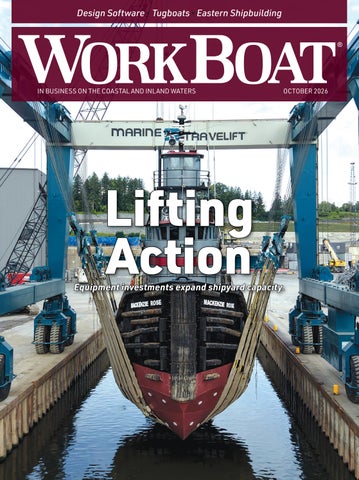
Carver Marine Steel Works’ 820-ton mobile boat hoist lifts the 96' tugboat Mackenzie Rose in a custom-built cradle. The vessel is operated by Carver Marine Towing Co. Credit: Carver Marine Steel Works
1
EDITOR'S WATCH
Tools of the Trade
Eric Haun, Executive Editor ehaun@divcom.com
O
ften, selecting the right tool for the job makes all the difference. A correctly sized drill bit can mean the difference between a screw that sits flush and one that’s stripped. Proper iron selection can help land a ball on the green instead of the rough. Sometimes the right tool unlocks new possibilities altogether. For U.S. shipyards, newly installed hoists and cranes are expanding capacity and allowing yards to take on work they simply couldn’t have handled before. Carver Marine Steel Works in Coeymans, N.Y., is a good example. Five years ago, the yard bought an 820-ton mobile boat hoist to look after its own fleet of 10 tugs and 50 barges. Previously, about 90% of the work moving through Carver was the company’s own. Today, outside customers account for roughly 80% of it. One machine transformed a fleet-maintenance operation into a commercial repair business.
The hunt for the right tool extends well beyond a travel lift slip. Much industry attention has been turning toward nuclear power aboard commercial vessels, moving the technology past the conference-panel stage in a serious way. In May, the Maritime Administration issued a request for information on a commercially viable small modular reactor concept for the marine transportation system. Since then, the agency has signed cooperation agreements with the Port of Long Beach, the Port of Corpus Christi, and Core Power, whose response laid out a seven-year plan to get a U.S.-flagged nuclear-powered commercial ship into regular service. And Hornbeck Offshore Services, which in September merged with Helix Energy Solutions Group, has invested in and will partner with Deployable Energy, a compact nuclear reactor company, eyeing applications from inland waterways to offshore platforms and power barges. Notably, Deployable’s 1-MWe Unity microreactor is intended to be installed aboard existing vessels, vastly expanding the potential for adoption. None of this authorizes anyone to build anything yet. The licensing, insurance, and crewing questions are wide open, and they’re most likely more difficult than the engineering. But we are seeing operators, ports, and a federal agency all working the same problem at the same time, which is more than this idea has had going for it in 50 years. We could soon see the industry add a new tool to its workbench.
EXECUTIVE EDITOR: Eric Haun / ehaun@divcom.com SENIOR EDITOR: Frank McCormack / fmccormack@divcom.com SENIOR ASSOCIATE EDITORS: Ben Hayden / bhayden@divcom.com Steve Mosco / smosco@divcom.com Kirk Moore / kmoore@divcom.com CONTENT PROJECT MANAGER: Carley Milligan / cmilligan@divcom.com CONTRIBUTING WRITERS: Tim Akpinar • Capt. Alan Bernstein Stephen Blakely • Dan Bookham G. Allen Brooks • Bruce Buls Denielle Christensen • Capt. Eric Colby Michael Crowley • Jerry Fraser Nate Gilman • Pamela Glass Capt. Arnie Hammerman • Ken Hocke Craig Hooper • Joel Milton • Peter Ong Richard Paine Jr. • Chris Richmond DIGITAL & PRINT PROJECT MANAGER: Doug Stewart / dstewart@divcom.com ADVERTISING ACCOUNT EXECUTIVES: Kristin Luke / kluke@divcom.com Jordan Randall / jrandall@divcom.com Krista Randall / krandall@divcom.com Danielle Walters / dwalters@divcom.com ADVERTISING COORDINATOR: Wendy Jalbert / wjalbert@divcom.com Producers of the International WorkBoat Show and Pacific Marine Expo
Vice President: Wes Doane, wdoane@divcom.com Publishing offices: 2 Portland Sq., Suite 200, Portland, ME 04101 Tel 207-842-5608 | Fax 207-842-5609 Subscriptions: cs@e-circ.net / 978-671-0444 Mon–Fri, 10 a.m.–4 p.m. ET
WORKBOAT® (ISSN 0043-8014)
is published monthly by Diversified Communications Two Portland Square, Suite 200, Portland, ME 04101
Annual Subscription Rates: U.S. $39; Canada $55; International $103. 3 When available, extra copies of current issue are $5. For subscription customer service call (978) 671-0444. The publisher reserves the right to sell subscriptions to those who have purchasing power in the industry this publication serves. Periodicals postage paid at Portland, ME. Circulation Office: Two Portland Square, Suite 200, Portland, ME 04101. From time to time, we make your name and address available to other companies whose products and services may interest you. If you prefer not to receive such mailings, please send a copy of your mailing label to: Printed in USA
2
WorkBoat’s Mailing Preference Service, PO Box 7437, Portland, ME 04112 POSTMASTER: Send address changes to WORKBOAT, P.O. Box 1792, Lowell, MA 01853.
Copyright 2026 by Diversified Communications
© Diversified 2026 | Printed in the U.S.A. To update your WorkBoat account, change your address, or manage your subscription, visit WorkBoat.com.
www.workboat.com • OCTOBER 2026 • WorkBoat
Thrusters You Can Rely On.
Engineered for Maximum Efficiency. Built for Performance. Discover the latest from Sleipner, a global leader in commercial marine thrusters for more than 40 years. Always committed to relentless innovation.
• AC, DC & Hydraulic Thrusters • Now with Tunnels up to 29” • Efficient Design for Maximum Water Flow • Less Noise & More Thrust • Solutions to Fit a Wide Range of Vessels
See the full range of Sleipner thrusters at Imtra.com
Bringing you the best.
Find Your Ideal Solution at Imtra.com or Call Our Product Experts at 508-995-7000
AT-A-GLANCE
On the Water Water isn’t always enough BY JOEL MILTON Joel Milton works on towing vessels. He can be reached at joelmilton@yahoo.com.
T
he need to hydrate is absolute. The fact that plain water may be insufficient is also. But do you need an electrolyte drink mix? Maybe. Sometimes. The harder we exert ourselves, the more essential electrolytes (primarily magnesium, potassium, and sodium) we lose via sweat. And gradually we become thirsty from the fluid loss. Drinking a lot of water to replace that fluid and satisfy the associated thirst initially feels good but doesn’t replace those crucial minerals. An imbalance results, with a variety of negative physiological consequences that increase in severity as the imbalance grows. Some electrolyte loss also occurs through urination, so drinking more water flushes away still more electrolytes. So hard work, especially in the heat (including engine
Credentialing Insight Mariners receive credentials relief BY NATE GILMAN
Nate Gilman, president of MM-SEAS USCG Licensing Software, uses his hawsepiping experience to support mariners and workforce development. Connect on LinkedIn.
T
he Coast Guard has issued new relief for mariners whose credentials have expired while they are still working on open-book exams or correcting errors in the professional qualifications section of their renewal applications. If that is you, you are getting 120 more days to keep working while you finish. If you completed your renewal application correctly, have sailed more than 360 days in the last five years and are simply waiting in line, this relief does not apply to you. The Aug. 27 bulletin, “Relief for Mariners with Pending Merchant Mariner Credential Applications,” provides temporary authorization to work under an expired MMC. To qualify, three things must be true: your MMC with national endorsements expired between Jan. 1 and July 31, 2026; your renewal application was submitted before the credential expired and no later than Aug. 26; and your pending renewal has an Awaiting Information letter or an Open Book Take Home Renewal Exam Approved to Test letter. An Awaiting Information letter means something in the application is missing, such as sea service, training 4
rooms), should be considered activity where electrolyte replacement is important and is, in fact, a genuine safety issue. Dehydrated people with a developing electrolyte imbalance start to lose a step, physically and mentally, and this worsens as dehydration increases, especially when working in extremes of heat or cold. Thinking slows, eventually becoming cloudy. Judgment is affected. Slips, trips, falls, and accidents in general become more likely. Mistakes, often avoidable ones, get made. There is no part of our jobs that we perform better while dehydrated and low on electrolytes. Prevention is always better than some attempt at a cure. Avoiding dehydration and maintaining proper electrolyte levels is the better choice, compared with trying to dig yourself out of a dehydration hole while you’re working. Drinking small amounts at regular intervals heads it off. I call it maintenance hydration, and it is the way. I’ve found that significantly diluting the powders (which tend to contain around 1,000 mg of sodium) works well when higher temperatures mean you’ll want to drink more water. Rather than one packet in the usual 12–16 oz. of water, I go right to 32 oz., and sometimes even 64. Adjust as needed. certificates, a renewal Towing Officer Assessment Record, or proof of vessel ownership. An Approved to Test letter means sea service didn’t fully cover the renewal requirement, so the mariner must complete an open-book exam. Either way, mariners get 120 days from the letter’s issue date to finish the requirements without losing the ability to work. Act quickly: the bulletin states that failure to satisfy renewal requirements will not result in additional temporary authorization. Mariners must carry their expired credential and authorization letter while working. The authorization covers national endorsements only — not STCW endorsements or medical certificates. For the estimated 10,000 to 14,000 applications pending at the National Maritime Center (NMC), processing remains first-in, first-out, with a four-month estimate for complete applications. Processing has improved as the team works through the program’s largest-ever backlog, caused partly by May’s partial government shutdown, and many mariners are receiving credentials ahead of schedule. If your renewal isn’t in yet, submit it now — a complete, accurate application is the fastest path through. If your credential expired between Jan. 1 and July 31 and your application is still pending, note that the Update 3 blanket extension ended Aug. 31; after that, you cannot work until your new MMC is issued. Discuss your status with your employer before your next hitch, and employers should review their crew lists for pending renewals. Contact the NMC Customer Service Center at 1-888IASKNMC (427-5662), or at IASKNMC@uscg.mil (include “Status” and your reference number in the subject line). www.workboat.com • OCTOBER 2026 • WorkBoat
AT-A-GLANCE
Insurance Watch Does your coverage travel with your crew? BY CHRIS RICHMOND Chris Richmond is a licensed mariner and marine insurance agent with Allen Insurance and Financial. He can be reached at crichmond@allenif.com or 800-439-4311.
Y
our shipyard does a variety of jobs, often at different locations. You want to be able to tell your customer, “Yes, we can do that for you.” But keep in mind that your insurance policy can have a narrow set of coverages, and if you stray outside those boundaries, you might not be covered. The following are just a few of the areas to think about when trying to expand your insurance coverage. Should you have occasion to send your employees to work on a boat at a location other than the one listed on your current policy, the Traveling Workmen Endorsement is a smart addition. It adds to your existing Marina Operations Legal
Health, Safety, and Environment The hidden dangers in assuming all operators are the same BY RICHARD PAINE JR. Richard Paine Jr. is a licensed mariner and certified maritime safety auditor with more than 25 years of maritime industry experience. He can be reached at rjpainejr@gmail.com.
O
ver the years, I’ve spoken with mariners, maritime agencies, and management positions from the boiler room to the boardroom, and one interesting observation is tied to workforce expectations and assumptions. Two areas have stood out: (1) management’s expectations of crew knowledge across different sectors of the industry, and (2) operators’ expectations on crew knowledge in shared waterways. Both assumptions can be dangerous when not fully understood. Through years of investigations, interviews, audits, and root-cause analyses, it is not uncommon to hear an honest “I didn’t know” from an operator or manager, which may be truthful, but not knowing the differences in operations can still lead to hidden dangers and catastrophic accidents. 6
Liability (MOLL) coverage and extends its limits to the vessel you are working on, whether at sea or in any port within the United States, while your employees are on board for the purposes of repair or alteration. MOLLs are designed to cover operations related to boatbuilding and repair. They can also cover fueling, docking, and hauling. The work that your yard does is listed and covered on the MOLL. But what about the rare job you may take on, or the favor for a neighboring business? Are these covered? By including the phrase “and other similar boatyard operations,” you may have a chance. This catch-all phrase can help provide coverage where there may have been none. Do you have a workboat used by your employees? You may have a coverage gap if an employee is injured operating the boat without crew coverage included. The burden is on the employee to prove in federal court that he is a seaman. While the rule of thumb is that a third of his time must be spent in service to the vessel, that threshold has been lowered in certain cases. Adding crew coverage extends your protection and indemnity coverage and avoids a painful gap. Help prevent a sharp lesson in marine insurance by discussing with your agent what your yard is doing and the coverages that will protect it. Remember, once a claim occurs, it is too late to make the changes you need.
Numerous operations, tonnage, equipment, and services make up the maritime industry. Deep-draft containerships, tankers, tugboats, towing vessels, barges, water-taxis, small passenger vessels, fishing boats, sailboats, and others share the same navigable waterways. Each brings its own specific requirements and expertise needed to operate safely. Those differences make the maritime industry more complex than other modes of transportation and the workforce serving them. For example, the position of captain, or master, is revered across all sectors of the industry, built around authority, knowledge, and competence. I’ve found there’s sometimes a disconnect among both management and operators as to significant differences in training, certification, sea-time, and salary-scale across the position. A captain in one area of the industry can be fully capable of working on Vessel “A” that operates in the local bay or harbor, and at the same time unauthorized to work on Vessel “B” that may be only 250' away in that same body of water. Job requirements necessary to operate equipment vary drastically too. A captain may be navigating the vessel by hand or may be giving helm commands or monitoring a pilot or autopilot, just as one example. As common as job titles may be across the industry, vessel types, operations, and safety parameters vary considerably. Hopefully, this background can serve as a friendly public service announcement, so that next time you won’t have to say, “I didn’t know.” www.workboat.com • OCTOBER 2026 • WorkBoat
AT-A-GLANCE
Legal Talk Have you had prior injuries? BY TIM AKPINAR Tim Akpinar, based in Little Neck, N.Y., is a maritime attorney and former marine engineer. He can be reached at t.akpinar@verizon.net or 718-224-9824.
J
ob applicants must regularly deal with the question of prior injuries. Although the question is simple on its face, the difficult part is sometimes wondering, “They probably don’t mean that minor ER visit from 20 years ago. That’s irrelevant to handling this job’s duties.” This reasoning is understandable. But past medical history could surface in accident investigations. A recent federal case from the Eastern District of Louisiana illustrates this point. The case involved a deckhand on a 140' multipurpose offshore vessel who experienced shoulder pain after pulling on a line early into his shift on a January morning in 2024. He reported the pain to the captain, who thought he may have pulled a muscle and advised him to take some Tylenol. The deckhand took Tylenol and worked until his shoulder pain returned. Unknown to the captain, the deckhand had suffered a heart attack about ten years earlier in 2014.
When the deckhand applied for employment in 2021, he had a preemployment physical and answered two medical questionnaires. He had checked “no” in response to questions about high blood pressure, heart disease, or being a patient in a hospital. However, the 2014 heart attack involved a three-day hospitalization and high blood pressure. Additionally, the deckhand had answered “no” to questions about high blood pressure and heart surgery on his Coast Guard Form CG-719K. The deckhand’s lawsuit was based on negligence, unseaworthiness, and maintenance and cure (living expenses and medical expenses, respectively). The problem was that maritime law does not allow maintenance & cure if a seaman knowingly fails to disclose a material health fact. There is even a name for this, known as the McCorpen defense (see McCorpen v. Central Gulf Steamship Corp., 396 F.2d 547 (5th Cir. 1968) named for a seaman who had failed to disclose relevant medical history. The McCorpen defense is based on three elements: intentional concealment or misrepresentation of a medical condition, relevance of the undisclosed information to the hiring process, and a “connection” between the undisclosed condition and the injury at hand. This defense does not destroy other parts of a claim, such as the Jones Act case itself.
GRIDCOOLER® KEEL COOLER
BUILT SMARTER TO WORK HARDER
BUILT TO TAKE IT ON
1.906.863.5553 | fernstrum.com/wb
The management system governing the manufacture of this product is ISO: 9001:2015 certified. © 2026 R.W. Fernstrum & Company. All rights reserved. FERNSTRUM® and GRIDCOOLER® are registered trademarks of R.W. Fernstrum & Company. All other trademarks cited are the property of their respective owners.
8
www.workboat.com • OCTOBER 2026 • WorkBoat
McDermott Light & Signal
Portable Barge Navigation Lights Solar or battery powered barge navigation lights for unmanned barges per UL1104
Solar Marker Lights
1 meter
Dredge Lights
1 to 3 mile visibility for aids to navigation and applications such as buoys, docks, barges, and temporary lighting
Meets 2 mile requirement for marking of dredge pipelines
Regulatory Buoys
Available for all applications
Navigation Lights Platform Marker Lights
*Available with or without lighting*
For vessels greater or less than 50 meters Certified to meet UL 1104 and Subchapter M
Permanent mount LED lighting for bridges, docks, and barges
Certified Portable Anchor Lights Portable and long lasting
Peep (Steering) Lights AC/DC LED Floodlights
Constructed for rugged marine and commercial environments.
Available with AC/DC connection, solar or battery operated
718-456-3606 | www.mcdermottlight.com workboat@mcdermottlight.com
ON THE WAYS CONSTRUCTION ACTIVITY AT WORKBOAT YARDS
The El Escudo, a whale-watch and harbor cruise vessel built by All American Marine for Harbor Breeze Cruises, can run a two-hour harbor cruise on battery power alone.
F
or the past 50 years, Dan Salas has watched the impact commercial vessels have had on the environment in his home ports of Los Angeles and Long Beach, Calif. He grew up in Wilmington, Calif., and started working as a deckhand on a fishing boat at 11. “I remember my lungs hurting as a little kid,” said Salas, now a captain and the founder and CEO of Harbor Breeze Cruises in Long Beach. “When we fished in the harbor, we never got a nibble.” This summer, Salas’ company took delivery of the new 108'x32'6" whalewatch and harbor cruise vessel, the El Escudo (The Shield). Its hybrid dieselelectric propulsion system allows the vessel to operate on battery power alone without producing emissions, exceeding EPA Tier 4 and California Air Resources Board (CARB) commercial harbor craft air quality requirements. “The Port of Los Angeles and the Port of Long Beach have really done some work over the last 20 to 30 years,” Salas said. “I said, ‘Let’s help out the port and show the state of California that we can put our best foot forward.’” Built by All American Marine, 10
Bellingham, Wash., the aluminum vessel is the result of multiple collaborations. Teknicraft Design handled the design, and the hybrid driveline is built around a first-of-its-kind Reintjes gearbox supplied by Karl Senner LLC. To help fund the project, Salas partnered with CARB and the Los Angeles Marine Emission Reduction (LA MER) Project, administered by the Port of Los Angeles. “There were some CARB grants coming up,” Salas said of his decision to pursue a zero-emissions vessel. “This is a true demonstration project. I want to show the good, the bad, and the ugly of this technology.” The LA MER Project was supported by a $31 million CARB grant and $30 million in project partner matching funds. The El Escudo and a second demonstrator vessel — a Catalina Express highspeed ferry being built by Marine Group Boat Works in Chula Vista, Calif. — are estimated to reduce emissions by more than 60 tons annually. As part of the grant, the Port of Los Angeles and the Port of Long Beach each committed $250,000 to a technology
All American Marine
Hybrid whale-watch boat has green credentials
evaluation study of harbor-craft. Each port will also fund at least 50 excursion trips on the zero-emissions-capable vessels over the 12-month demonstration. What sets the El Escudo apart from other hybrid vessels is its parallel-hybrid configuration. In a serial system, the diesel engine never connects directly to the inboard driveshafts; it only generates electricity. The parallel arrangement lets the operator run on electric power alone, on the diesels alone, or on both together. The diesels are twin MAN D2862s supplied by Northern Lights, rated at 2,400 hp combined and certified to EPA Tier 4. They burn R99 renewable diesel and are fitted with selective catalytic reduction systems and diesel particulate filters that significantly reduce emissions. On the electric side, a BorgWarner 588kW lithium-battery energy storage system and traction motors producing 300 kW per side provide enough power to run a two-hour harbor cruise silently. When the diesels are driving the boat, they can recharge the batteries underway. “With one button, I can go from diesel to hybrid to full electric,” said Salas, who brought in experts from ABB and its partner ComAp to get all of the El Escudo’s equipment working in harmony. “The projects are new and, in this case, it was the first-of-its-kind vessel,” said All American Marine President Ron Wille. “We had a number of operating modes and had to work with our suppliers to come up with exactly how it would all be implemented and operated.” Teknicraft is known for high-performance vessels, and Wille said the firm applied what it has learned from designing fast boats to make the El Escudo’s monohull more efficient. The boat is rated for 500 passengers on near-shore outings, with reduced capacity when Harbor Breeze Cruises heads farther offshore for whale watching. Stadium-style seating serves whale-watch trips, and the main deck offers interior and exterior gathering spaces for larger parties. The vessel carries a crew of six. The helm, on the second deck, features a full suite of Furuno navigation electronics spread across eight screens, including onboard camera views, chart-
www.workboat.com • OCTOBER 2026 • WorkBoat
plotters and radar. During the vessel’s maiden voyage, Salas had one more partner at the helm: his son Chris, who has held a captain’s license since he was 17 and has taken a key role in deciphering the boat’s complex electrical and computer systems. When Chris fired up the boat and put it in gear, Dan said, “It was one of those moments when our jaws dropped. The only way we knew the boat was moving was when I went aft and looked at the propwash. To hear those things go silent and hear that hum like a Tesla, it’s like, ‘Wow.’” Chris will be the El Escudo’s primary captain, working with Capt. Stan Jackson, a retired Long Beach firefighter who trained local fireboat operators. — Capt. Eric Colby
W.Va. fire department adds new fireboat
Charleston Fire Dept.
ON THE WAYS
The Charleston (W.Va.) Fire Department’s new 32' fireboat, J.W. Cabell, enhances the department’s firefighting, dive, search-and-rescue, and water-supply capabilities on the Kanawha and Elk rivers.
ing for outboards system. Nicholson said the joystick system helps firefighters with varying levels of boat-operating experience maneuver the larger vessel, particularly when docking or operating in confined areas. “Most of my guys are much more comfortable operating this big boat than they were operating the smaller boat,” he said of the joystick controls. A gasoline-powered Westerbeke 5-kW generator supplies power and runs the cabin air-conditioning system.
A diesel furnace provides heat during winter operations. The enclosed cabin also has a chemical and biological airfiltration system. Charleston sits in West Virginia’s Chemical Valley, where the fireboat can serve as an emergency water-supply platform for riverside industrial facilities. One nearby plant draws river water for its fire-suppression system and has installed a standpipe connection so the department’s boat can supply the facility if the plant’s pumps fail.
T
he Charleston (W.Va.) Fire Department has placed its new 32'x10'6" fireboat, J.W. Cabell, into service. Built by Lake Assault Boats, Superior, Wis., the vessel is named after the first Charleston firefighter killed in the line of duty, in 1906. The aluminum V-hull replaces a 2004, 25' SeaArk Marine Little Giant that the department had outgrown. Assistant Chief Matthew Nicholson told WorkBoat that the department’s former boat lacked the space and climate controls needed for year-round dive and rescue operations, with the J.W. Cabell now featuring a full cabin with heating and air conditioning. “To run a dive operation in it, we were literally stacking dive gear on the roof of it,” Nicholson said of the previous boat. “We had no climate control with it. Around here, we tend to have cars go in the river in the middle of January, so we’d be freezing to death out there on it. During our big events in the summer, we were just sweating in a tin can.” The new boat is powered by twin 350-hp Mercury SeaPro outboards equipped with Mercury’s joystick pilot-
At All American Marine, we push the boundaries of research vessel design and performance. UNCW’s new 73-foot R/V Osprey is a multi-mission platform engineered for demanding missions and long-term performance. Built for discovery. Proven on the water. Scan to explore the vessel.
www.workboat.com • OCTOBER 2026 • WorkBoat
11
ON THE WAYS “Their fire-suppression system is a loop system where they pump water out of the river,” Nicholson said. “They actually put in a standpipe system for us to come in should their pumps fail.” The fireboat’s pumping system is powered by a 6.2-liter GM LS gasoline engine and supplies two TFT Flex RC monitors, one on the cabin roof and another at the bow. The pump is rated at 1,500 gpm based on an elevation of 10' above the waterline, but since the pump itself sits below the waterline, it can achieve higher flows. Though the department has not conducted a full flow test, Nicholson said the bow monitor flowed 2,247 gpm at 100 psi through a 2.75" tip, while the roof monitor simultaneously added another 1,000 gpm — in excess of 3,000 gpm combined. The electronics package includes two 12" Garmin multifunction displays, radar, conventional sonar, LiveScope sonar, AIS, chartplotting, and a Teledyne Flir thermal-imaging system. The department’s former boat carried only a basic Lowrance fishfinder and sonar unit. Rigid light bars positioned around the boat support nighttime firefighting, diving, and rescue operations. The fireboat’s primary operating area covers the Kanawha and Elk rivers within Charleston. Its missions include firefighting, search and rescue, dive operations, water supply, and
12
patrol duties during major events, including the Charleston Sternwheel Regatta, when more than 300 recreational boats can gather in one area of the Kanawha River. The department acquired the vessel with funding from the Port Security Grant Program and purchased it through HGACBuy, a nationwide cooperative purchasing program operated by the Houston-Galveston Area Council. Charleston began with Lake Assault’s standard LC32FB design but customized much of the vessel, Nicholson said, selecting larger outboards, joystick controls, pump, navigation and sonar equipment, lighting package, cabin systems, and paint scheme to meet its operating requirements. “It’s really multipurpose for us, for everything on the water,” Nicholson said. — Ben Hayden
New vessel aids fisheries research In mid-August, Moran Iron Works Inc., Onaway, Mich., delivered a new 66'x18'3" research vessel to the Michigan Department of Natural Resources (DNR). The new Steelhead replaces a converted 62'6" commercial trawler of the same name — which the agency operated for 58 years — marking a major step up in technology and comfort. “It’s probably the most unique, one-of-a-kind vessel,” said Tom Moran, owner and CEO of Moran Iron Works, describing the recent build. “Technology has come so far forward. And with the amount of equipment that Michigan DNR required jammed into it, it’s a floating piece of technology.” Moran said his yard won the job with the lowest bid and worked closely with the DNR to meet the agency’s needs, including reengineering a desk to fit around a large ice machine. “We had to hand-make the wet lab and dry lab stainless steel cabinets and dissecting counter,” he said. Among the vessel’s more modern features are a remoteoperated crane, wet and dry labs, and comfortable crew quarters. Computers are mounted in overhead cabinets, and all note-taking is done through voice commands and computerized dictation. “The heating and cooling system is even computer-controlled,” Moran said. “If this boat isn’t a Cadillac, it’s definitely a Buick.” Funding for the new vessel came through the state legislature, and Capt. Patrick O’Neill, the Steelhead’s primary helmsman, described the boat as “a long time coming.” The newbuild is stationed at the Charlevoix (Mich.) Fisheries Research Station. In early August, O’Neill was running sea trials and hoping to begin fisheries research in the field by the end of the month. “With the new boat, we have a more fluid workspace,” he said. “The net result is that it’s going to save us in time and our backs through the years.” The research team conducts frequent net surveys, and the remote-operated crane from Hawboldt Industries spares the crew from hauling fish aboard by hand. Designed by Boksa Marine Design Inc., Lithia, Fla., the boat has a steel hull and an aluminum pilothouse to save www.workboat.com • OCTOBER 2026 • WorkBoat
ON THE WAYS
BOATBUILDING BITTS
tartup shipbuilder New Pacific Industrial, Vancouver, Wash., has landed its first new construction program, a pair of 122'x37' oceangoing tugboats for American Marine Corp., Honolulu. Designed by Glosten, Seattle, the 6,000-hp tugs will be the first newbuilds in American Marine’s history, with the lead vessel scheduled for delivery in 2028. Sterling Shipyard, Port Neches, Texas, has delivered the Laguna Gulf, the first tugboat in a 13-vessel construction program scheduled to run through 2029. Designed by Robert Allan Ltd., Vancouver, British Columbia, the 99'x43' tractor tug was delivered to Gulf LNG Tugs of Brownsville LLC, a joint venture comprising Bay-Houston Management LLC, Moran Towing Corp., and Suderman & Young Towing Co. The joint venture and its affiliates are contracted to provide marine services at five LNG terminals along the U.S. Gulf Coast. Eastern Shipbuilding Group, Panama City, Fla., has begun construction on Washington State Ferries' first new vessel in 11 years. Washington’s contract with Eastern covers two 160-vehicle, 1,500-passenger hybrid-electric ferries, with an option for a third. At a steel-cutting ceremony marking the start of construction, it was announced that Gov. Bob Ferguson is exercising that option. Designed by Elliott Bay Design Group, Seattle, the vessels will measure 409'6"x83'2"x24'6" with a draft of 16'6".
weight. It draws 5'10" and carries a Seakeeper 18 gyroscopic stabilizer to keep it steady on rough days. Twin 250-hp Cummins diesels turn 32" Michigan Wheel 5-bladed propellers through ZF Marine reverse-reduction gearboxes, and a Thrustmaster bowthruster improves maneuverability. A 30-kW Northern Lights generator supplies auxiliary power, and a 29-kW Cummins generator handles house power, along with a John Deere hydraulic power unit. Solar charging backs up the electrical system to keep everything running. The steering wheel from the previ-
C&C Marine and Repair
Glosten
S
The Maryland Department of Natural Resources has contracted Lyman-Morse Workboats, Thomaston, Maine, to build a 59'x19' aluminum research vessel for year-round scientific operations on Chesapeake Bay and near-coastal Atlantic waters. Designed by Chartwell Marine, Southampton, U.K., the vessel will support waterquality monitoring, habitat research, sampling, buoy work, and other field operations. Nichols Brothers Boat Builders, Freeland, Wash., has won a contract from the San Francisco Bar Pilots Benevolent and Protective Association to build the pilot organization’s next station vessel. The 110'2"x28'2" vessel was designed by Seattlebased Glosten and will be built at Nichols Brothers’ Whidbey Island shipyard. C&C Marine and Repair, Belle Chasse, La., has delivered the final vessel in a four-boat series of 2,600-hp inland towboats to New Orleans-based Canal Barge Co. The final vessel, the Mimsy H. Lindner, follows the Al Sloss, the Deborah H. Valentine, and the Cabby H. Boone — all delivered since January. Marine Group Boat Works, Chula Vista, Calif., has delivered a new aluminum range support vessel to the Naval Air Warfare Center Weapons Division for use at the Point Mugu Sea Range in Southern California. The vessel will support offshore weapons testing and evaluation operations. Its missions will include deploying and recovering specialized surface and aerial targets.
ous Steelhead was carried over to the newbuild and is now mounted to a hydraulic helm alongside a joystick and two remote operating stations. Furuno electronics handle navigation, with TZT chartplotters at each station, and Kongsberg/Simrad components handle fish finding. Because ice can form quickly on the Great Lakes, Moran built the Steelhead to handle pack ice. “We can survey more of the late fall-spawning fish that occur in December,” O’Neill said. The vessel’s work includes researching fish stocks and taking inventory of species in the lakes through experi-
www.workboat.com • OCTOBER 2026 • WorkBoat
mental gillnetting and a bottom-trawl survey. Once fish are dissected and processed, “gut tubes” carry the remains directly overboard. Another major project is a prey fish survey. The boat’s fishfinder detects and targets fish, and the crew counts them using a midwater trawl, with the computer system configured to calculate the biomass in kilotons. The boat’s custom retractable 3'x10' stern platform has 4' of travel and can support up to 1,500 lbs. “It lets us get more access to the water,” O’Neill said, noting the platform will support manoverboard recovery. — E. Colby 13
COVER STORY
Haul Out By Ben Hayden, Senior Associate Editor
A
round the country, shipyards are taking advantage of renewed investment in American shipbuilding to acquire equipment that increases capacity, improves efficiency, and opens the door to larger projects. Cranes as well as mobile boat hoists, also known as travel lifts, are central to that expansion. Though the machinery requires significant investment, its effect can extend throughout a yard’s operations. Dave Matsuda, president of the Small Shipyard Grant Coalition, described large travel lifts as transformative investments that open shipyards to larger vessels while allowing yards to place more boats ashore at once. The machines do far more than haul vessels for maintenance or launch completed boats. Shipyards use travel lifts to move vessels between production areas, place hulls inside buildings, join structural sections, and flip hulls during construction. 14
Carver Marine Steel Works’ 820-ton Marine Travelift holds the 96' tug Mackenzie Rose in a custom-fabricated lifting cradle.
Overhead and crawler cranes move plate, machinery, deckhouses, and other heavy components through busy facilities. Federal support is accelerating that investment. In August, the U.S. Maritime Administration (Marad) awarded $35.18 million to 45 shipyards in 24 states and the U.S. Virgin Islands through the fiscal year 2026 Small Shipyard Grant Program, up from $8.75 million in each of the previous two rounds. Other yards are purchasing equipment directly. From a used 600-ton hoist being assembled on the Gulf Coast to an 820-ton lift that helped turn a Hudson River fleetmaintenance facility into a commercial repair yard, the investments are changing what shipyards can build, lift, and service.
MORE WEIGHT, MORE WORK
At Steiner Shipyard, Bayou La Batre, Ala., a used 600-ton Marine Travelift arrived by barge after a nine-day tow around www.workboat.com • OCTOBER 2026 • WorkBoat
Carver Marine Steel Works
U.S. investment in vessel hoists expands capacity of American shipyards.
Bayonne (N.J.) Dry Dock & Repair’s Cimolai mobile boat hoist, added in 2022, has a lifting capacity of 1,280 tons and can accommodate vessels up to 50' wide.
crews raise and reposition the structure incrementally, transferring the load among temporary lifting points. That capability can reduce the need for large rental cranes. Marshall said Steiner recently required two 500-ton cranes to turn a roughly 300-ton hull. Steiner also acquired a 220-toncapacity crawler crane about 18 months ago, expanding its ability to turn hulls, position deckhouses, and perform other heavy lifts.
WORK SHIFT
At Carver Marine Steel Works, Coeymans, N.Y., an 820-ton Marine Travelift purchased new five years ago
Steiner Shipyard
the Florida Keys. Steiner purchased the lift from Safe Harbor Rybovich, West Palm Beach, Fla. The lift is the same width as Steiner’s existing 400-ton machine, allowing the shipyard to add 200 tons of capacity without immediately making extensive infrastructure changes. The yard is building a new travel-lift slip, which will eventually allow it to handle vessels up to 43'6" wide, with Steiner considering widening the machine to between 48' and 50'. Gregory Marshall, project manager at Steiner Shipyard, told WorkBoat the lift will support new construction and repair work. The yard is completing two 130'x35' towboats for Florida Marine Transporters, one with a conventional pilothouse and the other with a retractable pilothouse. The additional capacity gives the yard more options as it pursues larger projects, particularly azimuth stern drive (ASD) tugs. Steiner has built three ASD tugs, but the weight of larger vessels can force yards to install engines after launching to remain within a lift’s capacity. “It just opens up a lot of these vessels that have always been on the teetertotter edge of ‘Can we do them? Can we not do them?’” Marshall said. Steiner also uses its travel lifts to assemble hull sections and turn hulls during construction. For a hull flip,
Eric Haun
COVER STORY
Steiner Shipyard uses its travel lift and crawler crane to turn a hull during construction at its Bayou La Batre, Ala., facility.
www.workboat.com • OCTOBER 2026 • WorkBoat
has helped transform an internal maintenance operation into a commercial repair facility. Carver initially acquired the lift to support its fleet of 10 tugs and 50 barges. The company previously had relied on airbags and a ramp-style arrangement that limited haul-outs primarily to smaller hopper barges. Maintenance was often reactive rather than preventive. As Carver’s fleet grew, the company needed a faster, more predictable way to remove vessels from the water, said general manager Philip Gallo. The lift can operate on grades up to 7% and accommodate vessels as wide as 60'. Initially, almost all its capacity was devoted to Carver equipment. About three years ago, around 90% of the yard’s work was internal, Gallo said. After bringing its fleet up to standard and establishing a preventivemaintenance schedule, Carver began marketing the yard to outside operators. External customers now account for approximately 80% of its work. “The biggest part of that was honestly picking up overflow from yards in the city being packed out, and also people learning that we’re here and we’re capable,” Gallo said. Turnaround time is another advantage. A travel lift can remove a vessel and place it on blocks within hours. The lift can then return to the water for 15
COVER STORY another job rather than remain occupied throughout the repair. Gallo said the machine’s width created a challenge when Carver hauled the company-owned 96'x33'x17'9" ocean tug Mackenzie Rose. “With the design of our lift, it being so wide, the sling angle can actually hurt us on vessels like tugs because they’re narrower, right? We’ve lifted barges that are in the 800-metric-ton range, but the Mackenzie being lightship around 520 with a shorter keel, it was the largest tug [hauled to date].” Carver fabricated a lifting frame in-house to eliminate the angle. The structure can serve as a cradle beneath the vessel or an overhead gantry, allowing the travel lift to use its fully rated capacity, Gallo said.
YARD EFFICIENCY
tighter spaces and position boats closer together. “You can size your machine to pick your biggest-beam vessels,” said Brock Rubens, senior sales manager at Marine Travelift. “But your smaller ones, once you come off the pier, you can actually spin the wheels at 90 degrees, and you can shorten the machine up.” Rubens said one hurricane-storage operation increased the number of boats it could place ashore by 40% without adding land. Capacity is also increasing. Marine Travelift has delivered machines rated up to 1,000 tons and is working with prospective customers on 1,200- and 1,500-ton projects, Rubens said. Where 35- to 100-ton machines once represented much of the company’s regular business, its active range is increasingly 75 to 200 tons.
As travel lifts increase in capacity, their size creates another problem: A machine wide enough for a barge or broad-beamed vessel can consume valuable space when moving smaller vessels around a crowded yard. Marine Travelift, Sturgeon Bay, Wis., is addressing that constraint with a variable-width option. A telescoping top beam allows the machine to widen for a vessel at the lifting well and retract after reaching land. The operator turns the wheels 90º and narrows the machine around the vessel, allowing it to enter
Marad’s Small Shipyard Grant Program is helping yards fund equipment purchases as the federal government emphasizes domestic shipbuilding capacity. Matsuda and Erika Young, director of the Small Shipyard Grant Coalition, said the larger appropriation enabled Marad to support more capital-intensive projects capable of changing how a yard operates. Matsuda credited the Trump admin-
GRANT SUPPORT
istration’s proposal to fund the program at $105 million with changing the congressional discussion, even though lawmakers ultimately appropriated about one-third of that amount. “We’d love to see them get to 105,” he said, but allowed that increasing the grants from just under $9 million to over $35 million was transformative and would show what large travel lifts can do for a shipyard. “We know that this industry can spend the money wisely,” he said. Greater haul-out capacity is particularly important when operators need unplanned repairs, Matsuda said. A shortage of available drydock or travel-lift capacity can extend downtime and require vessels to travel farther for service. The 2026 awards included several of the equipment projects Matsuda described. Pacific Shipyards International, Honolulu, received approximately $1.53 million toward a 120-ton truck crane, while Fincantieri Bay Shipbuilding, Sturgeon Bay, Wis., received funding for a 100-ton roughterrain crane. Delta Marine Industries, Seattle, received an award toward the purchase of a 620-ton Marine Travelift. “This round, we saw more of those kinds of transformational projects,” Matsuda said. “And I think at $105 million, you’ll certainly see even more of those.”
Doug Stewart
STRONG DEMAND
Master Boat Builders in Coden, Ala., uses heavy-lift yard cranes and specialized marine launch infrastructure to handle modular tugboat construction.
16
Marad received 172 applications requesting approximately $162.7 million during the latest funding round, according to the coalition. Matsuda and Young said even that gap understates demand because yards tend to scale their applications to the amount Congress makes available. “Everybody likes to point to the demand as proof that there’s actual demand for these funds,” Matsuda said. “But that is so understated, because people only write for what they think they can get.” When annual funding fell below $9 million, applicants often requested grants closer to $500,000 because they
www.workboat.com • OCTOBER 2026 • WorkBoat
Push more. Pull harder. Run longer. When the work never stops, your engines can’t either. That’s why commercial operators choose Cummins engines. Built for long days, heavy loads, tight schedules, and zero tolerance for downtime, our engines are designed for longevity. With proven low‑maintenance requirements and no midlife overhaul, you save both time and money. Every component is engineered for uncompromising durability, every system tuned for maximum uptime, and every engine backed by a support network that understands the stakes. From tugs and push boats to service and transport vessels, our diesel platforms deliver the torque, fuel efficiency, and reliability that keep your fleet moving forward. Choose Cummins. Don’t compromise. Scan now to speak with a marine expert
©2026 Cummins Inc.
understood that larger proposals would face long odds. “In this round, they’re writing for larger grants, because they know more money is there,” he said. “If $105 million were made available, you would see folks say, ‘We have projects in the $4 million range.’ But they’ve never really been considered for this program before, because it hasn’t been funded enough.” “We heard from at least a handful of different yards that they sat out the last two rounds because they [said] it’s not going to be enough money to pay for this piece of equipment, even with our match,” Young said. The program generally provides up to 75% of a project’s cost, with the recipient contributing the remaining 25%. “So we know when the pot’s larger, we’re going to see more competition, we’re going to see better project ideas,” Young said. “We’ll see some of the holes plugged, like, sometimes a larger travel lift or drydocks are popular when people can scale them correctly for the amount of money available.” Matsuda encouraged yards to apply even when competition is strong. An unsuccessful application can demonstrate broader demand for the program and give a yard an opportunity to receive feedback before submitting again. “If you’ve got a project that you’re going to apply for next year, why not put in this year too?” he said. “You know, you get two bites at the apple. You can help show that there’s
Brix Marine
COVER STORY
Brix Marine uses an overhead crane to flip a vessel hull on the shipyard’s production floor.
demand for these funds.” The latest grants, which reached shipyards across the country, included first-time awards in Vermont and the U.S. Virgin Islands. Young said that geographic reach helps demonstrate that the program supports a national industry, even though shipbuilding and repair activity is concentrated in coastal and
YOUR PARTNER ON THE WATER. HELPING YOU NAVIGATE EVERY WATERWAY.
Whether you’re powering an offshore service vessel, a passenger vessel, or an inland pushboat, Louisiana Cat has the right engine for your hard working fleet. We focus on you, the customer, and the reliability, safety and profitability of your business. Let us help you navigate every waterway. Visit us online to request an engine quote for your next project: www.LouisianaCat.com/Marine.
18 WorkBoat Mag 2022.indd 1
2/3/2022 10:44:36 AM www.workboat.com • OCTOBER 2026 • WorkBoat
COVER STORY inland-waterway states. “I think the distribution of projects demonstrates that it is a national program,” Young said. “And that’s the point of having Congress fund it as opposed to an individual state.” That distribution can also help sustain congressional backing for annual appropriations, Young said.
from the facility to the waterfront. The arrangement shows how lifting equipment affects the entire shipbuilding process. Crane and travel-lift capacities and travel paths influence building dimensions, production-line spacing, material flow, and assembly sequences. For Steiner, the immediate results are
an additional 200 tons of lifting capacity and access to vessels previously at the edge of what the yard could handle. At Carver, an 820-ton machine helped convert a fleet-support operation into a yard where outside customers provide most of the work. At Brix, four bridge cranes will shape two production lines before the factory opens.
BUILDING FROM ABOVE
Brix Marine received fiscal year 2026 small shipyard grants for four 10-ton bridge cranes and a CNC press brake for its planned aluminum boat factory at Port Angeles, Wash. The builder had already committed to the facility and would have pursued the equipment even if the grant program had remained near its previous funding level, said Perry Knudson, Brix Marine’s general manager. “We would have thrown that Hail Mary no matter what,” Knudson said. “Even if it didn’t get awarded, we’d still be procuring this equipment.” Knudson said the bridge cranes address three needs: “capacity, efficiency and safety.” Brix’s current facility has one 10-ton overhead crane covering approximately half its production space. Elsewhere, the yard uses a carry-deck crane that must travel around vessels under construction, occupying floor space and requiring crews to repeatedly establish restricted areas. The new facility will have two parallel production lines with two 10-ton cranes on each set of rails. Workers will have access to an overhead hook throughout the production area without maneuvering a crane between hulls, equipment and personnel. “That more than doubles our capacity in terms of what we can physically do,” Knudson said. Brix is targeting the fourth quarter of 2027 to begin operating from the new factory. Launching will be integrated into the building. A 75-ton travel lift owned by the Port of Port Angeles will have direct access to the production floor, allowing completed aluminum vessels to move
a subsidiary of BioMicrobics, Inc.
Longest Lasting, Best Performing MSD’s
PERIOD!
www.SciencoFAST.com solutions@sciencofast.com
www.workboat.com • OCTOBER 2026 • WorkBoat
Proudly made in the U.S.A.
19
VESSEL REPORT Tugboats
Push and Pull Bigger ships, new terminals, cargo trends drive tugboat market. By Frank McCormack, Senior Editor
THE LNG FACTOR A key driver in the South is liquefied natural gas and the liquefaction terminals where LNG is loaded onto vessels for export. Gulf Coast terminals include Plaquemines LNG on the Mississippi River and Calcasieu Pass LNG and CP2 LNG on the Calcasieu River, owned by Venture Global; Sabine Pass Liquefaction and Corpus Christi Liquefaction, owned by Cheniere; Cameron LNG and Port Arthur LNG, owned by Sempra Infrastructure; Golden Pass LNG, a joint venture of QatarEnergy and ExxonMobil; and privately held Freeport LNG. Several additional terminals — including Woodside Energy’s forthcoming Louisiana LNG near Lake Charles, La. — and terminal expansions are in various stages of planning. Beyond the Gulf Coast, Cove Point LNG, owned by Berkshire Hathaway Energy, is an import and export facility on the Chesapeake Bay near Lusby, Md. As LNG terminals ramp up produc20
Master Boat Builders launched the tugboat Titan at its Coden, Ala., shipyard in May. In August, E.N. Bisso & Son announced it had chartered the tugs Titan and Marauder from Maritime Partners. Master Boat is building eight tugboats for Maritime Partners.
tion and global energy markets rely more heavily on U.S.-sourced natural gas, increased LNG carrier traffic is translating into greater demand for tugs. “LNG terminals create increased tug demand because LNG carriers require specialized support during arrival, transit, standby, docking, and departure when requested,” said Ron Droop, senior vice president of Moran Towing Corp. “These operations may require additional assets with qualified crews to meet the safety and operational requirements of the terminal and vessel.” It’s not just the sheer size of LNG carriers. In some cases, tug availability may be factored into an LNG terminal’s permit application or a requirement of the channels where LNG carriers operate. “LNG carriers have different shipassist considerations than containerships or conventional tankers,” Droop said, “because there may be designated
escort requirements during portions of a vessel’s transit, particularly in areas with regulated safety zones or where the consequences of an incident are considered significant. “Docking and undocking also require highly maneuverable, powerful tugs capable of performing to pilot requirements,” Droop added. In many cases, tugboat construction projects are directly tied to LNG terminals. C&C Marine and Repair in Belle Chasse, La., is amid an eight-tug build program managed by Harbor Docking & Towing (HDT). Four of those tugboats will support Woodside Energy’s forthcoming Louisiana LNG terminal. Woodside signed a $300 million contract with Green Tug Towing, which will provide towing services for LNG carriers calling on Louisiana LNG under a 20-year agreement. Green Tug is a joint venture between HDTow-
www.workboat.com • OCTOBER 2026 • WorkBoat
Master Boat Builders
D
eepened channels, new or expanded LNG and cargo terminals, and the massive ships that call on them may garner many of the national headlines related to the maritime industry, but behind all those vessel movements are the tugboats that help maneuver and escort ships throughout the deepwater ports and waterways of the United States. To meet market demands, the nation’s tugboat fleet is changing, whether through newbuilds, acquisitions, or repowers. With regional market pressures determining individual fleet dynamics, builders, owners, and operators generally agree that the near- and long-term outlooks for the nation’s tugboat fleet are strong.
ing and Saltchuk Marine Terminal Services. Tony Cibilich, president of C&C Marine, said the eight tugboats for HDT and Green Tug Towing will break new ground for the shipyard’s portfolio. “We’ve built diesel-electric vessels before, but these will be our first dieselelectric escort tugs,” Cibilich said. “They’re Robert Allan-designed vessels with 88 metric tons of bollard pull, accommodations for six, ABS escort tug classification, and FiFi 1 firefighting capability.” Cibilich added that the hybrid system aboard the Woodside vessels will allow them to operate in four different power modes based on demand. “It’s a more complex system than a traditional towboat, but we’re comfortable building complicated vessels,” he said. “It gives our team a chance to apply what we already know while expanding into a new part of the market.”
Governor Jeff Landry's office
Tugboats
Louisiana Gov. Jeff Landry welded four coins into the keel — one representing each project partner — C&C Marine and Repair, the state of Louisiana, Woodside Energy, and Green Tug Towing.
BIG SHIPS, BIG NEEDS And while several operators and shipbuilders acknowledged that LNG terminals are a significant driver for tug demand today, that’s only part of the picture. New container and general cargo terminals, the overall growth of cargo ships, and the aging tugboat fleet
www.workboat.com • OCTOBER 2026 • WorkBoat
are other factors translating into newbuilds and fleet acquisitions. “It’s a confluence of all those factors,” said Beau Berthelot, senior vice president of corporate affairs for Maritime Partners, Metairie, La. “As we understand it, the LNG terminals want reliable, dedicated ship-assist and escort
21
VESSEL REPORT Tugboats
— Ron Droop, Moran Towing
services, and there is a safety factor embedded as well. There is also the general phenomenon that ships have increased in size over time, and the tugs built 20, 30, or 40 years ago do not have the same power capacity, maneuverability, fuel efficiency, and reduced environmental impact as modern tugs.” Maritime Partners, founded in 2015, specializes in maritime financing, leasing, and bareboat charters. While the company focused initially on the towboat and barge industry, Maritime Partners has expanded into the Jones Act tanker fleet and the tugboat market. The company owns two tugs on charter with Signet Maritime in Ingleside, Texas, and is building a series of eight tugboats with Coden, Ala.-based Master Boat Builders. To date, Master Boat has delivered two of those vessels, the Marauder and Titan, which are on charter with E.N. Bisso & Son, New Orleans. The vessels in the series from Master Boat Builders measure 88'x43' and feature twin Caterpillar 3516E engines that each produce 3,500 hp at 1,800 rpm. The main engines drive Steerprop Z-drives from Karl Senner LLC. The tugs provide more than 90 metric tons of bollard pull and have a top speed of around 13 knots. Garrett Rice, president of Master Boat Builders, said the combination of Caterpillar main engines and Steerprop thrusters — relatively new for tugboats in the United States — meets a need for modern, higher-horsepower, and higherbollard-pull tugboats in the fleet. “The market conditions are there,” Rice said of his long-term outlook on the demand for new tugboats. “The fleet is still aging. China and Korea are still building larger oceangoing containerships and tankers at a rate faster than we’ve ever seen it. International com22
merce by water is as high as it’s ever been. Every container terminal or tanker terminal is trying to move ships in and out of there faster. They need and want bigger tugs, and they want more of them where it’s economically feasible.” Droop echoed that market assessment. “The market is not simply asking for more tugs,” he said. “Larger vessels require modern assets with the increased bollard pull and maneuverability to safely and efficiently control, stop, and guide them.” Since 2021, Moran has been pursuing a newbuild program and modernizing its fleet, adding 22 vessels while also expanding through acquisitions, most recently by taking on 11 vessels from Bisso Towboat. “That investment allows us to address both sides of the equation: having the capacity to support growing port and terminal activity, while also having the capability to safely handle larger and more complex vessels,” Droop said. “Ultimately, harbor deepening, terminal expansion, and larger vessels are creating a long-term need for tug operators to invest, not just in fleet size, but in fleet capability.”
NEW LIFE FOR OLD BOATS In certain circumstances, operators are opting to extend the life of existing vessels in their fleets through repowers. That approach is attractive in the present high-inflation market, especially if the existing vessel is already meeting an operational need, said Steve Shaver, president of Portland, Ore.-based Shaver Transportation Co. “A new ship-assist tug is pushing $20 million, whereas you can redo one of the older ones, put in new drives and new engines, for maybe $5 million,” Shaver said. “It makes a lot of sense to upgrade older vessels, and that’s what we’re doing right now with two of our boats. We’re putting Z-drives and Tier 4 engines in both of them right now.” Shaver compared it to putting a new LS engine into an older Corvette. Shaver Transportation also has newer vessels at work in the Pacific Northwest, with the Samantha S, built by Diversified Marine Inc., Portland, Ore., in 2018, offering 8,400 hp, more than 100 tons of bollard pull, and a square bow for facing up with ships. The company’s Heather S, also built by Diversified Marine, debuted last year. It features 7,000 hp and 100 tons of bollard pull. John Buchanan, president of Lake Charles, La.-based Harbor Docking & Towing, said his company is doing the same, though a repower isn’t always feasible. “The challenge is finding equipment that can be modernized effectively,” Buchanan said. “A conventional twin-screw
A pair of Shaver Transportation tugs maneuver the bulk carrier Ansac Reverence on the Columbia River.
www.workboat.com • OCTOBER 2026 • WorkBoat
Shaver Transportation
“Ultimately, harbor deepening, terminal expansion, and larger vessels are creating a long-term need for tug operators to invest, not just in fleet size, but in fleet capability.”
tug cannot simply be upgraded by adding thrusters. Its beam and draft often do not support [azimuth stern drive] conversions and may create stability concerns for ship-assist work.” Choosing between a newbuild or a refurbishment depends on a vessel’s market and long-term operational needs, Droop said. “Newbuilds give us the greatest ability to design a tug around the exact capability and mission we need,” he said. “We can specify the horsepower, bollard pull, propulsion, technology, emissions systems, and crew accommodations from the beginning. That makes newbuilds particularly attractive when we have confidence in long-term demand. The tradeoff is that they are capital intensive, and today’s vessels are increasingly complex to design and build, which can mean longer construction timelines and higher costs. “Refurbishment can be attractive when you have a fundamentally sound hull and a platform that still has useful life,” Droop added. “It can allow us to extend the life of a vessel, improve its capabilities, and make targeted investments without the cost and timeline of a completely new vessel. But there is a point where you have to recognize that you are putting too much money into an older platform. As the cost of machinery, propulsion, regulatory upgrades, technology, and maintenance increases, there can be a point where a newbuild provides better long-term value.”
JONES ACT CONCERNS Owners, operators, and shipbuilders across the board expressed confidence in the long-term demand for the tugboat fleet from coast to coast. One vector of concern they expressed, though, was the ongoing Jones Act waiver. “The Jones Act creates a demand floor to maintain domestic shipbuilding capabilities and maintain a pool of merchant mariners,” Berthelot explained. “When the law that creates this floor is compromised or called into question, capitalists react accordingly — pausing, reevaluating, and in some cases, redirecting investment. The longer the waiver continues, the worse this uncertainty becomes.” “For C&C,” Cibilich said, “it really comes down to confidence in the future. Shipbuilding decisions are made years before a vessel enters service. An owner signing a contract today has to believe the rules will still be the same two or three years from now. When domestic trade can suddenly be opened to foreign vessels through executive action, it creates uncertainty and makes the decision to invest in new U.S.-built vessels more difficult.” While the full impact of recent Jones Act waivers on the tug industry remains unclear, Droop said he worries about the precedent they set for the broader U.S. maritime workforce. “What concerns me is the idea of waivers becoming a routine tool rather than the exception,” Droop said. “If that happens, it doesn’t stay contained to one type of vessel. It works its way through the domestic maritime supply chain and ultimately affects the American mariners, shipyard workers, and other professionals whose livelihoods depend on a strong domestic fleet.” www.workboat.com • OCTOBER 2026 • WorkBoat
Charting New Horizons, We’re Here For It. Work with our maritime experts to secure the capital you need. TAILORED SOLUTIONS INCLUDE: • Harbor services • Inland and river coastal • Coastwise transportation • Manufacturing and repair • Port and infrastructure • Offshore energy services
MEET OUR TEAM wintrust.com/marine
Wintrust Commercial Finance is a division of Wintrust Asset Finance Inc. Banking products provided by Wintrust Community Banks.
23
BOATS & GEAR Design Software
The Virtual Vessel How digital tools are changing vessel design and construction. By Steve Mosco, Senior Associate Editor
24
td .
nL
lla
tA
Software has not eliminated naval architecture’s tradeoffs. Changes in hull form, fuel, machinery, weight, and arrangement can affect performance, stability, structure, and maintainability. Hays described the design spiral as repeated passes through competing requirements, with higher-fidelity tools entering
er
EARLIER IN THE SPIRAL
sooner while choices remain open. “What all of this does is [take] friction out of the design process,” Hays said. “Anytime we can not only shorten that time and take friction out, that improves the design process. But along the way, we can also provide insights to the naval architect that he or she might not have gotten just by going through the process repeatedly, even if it’s faster.” At HydroComp Inc., Newmarket, N.H., technical director Donald MacPherson approaches the vessel from the performance side. NavCad 2026 and PropElements support resistance, propulsion, and propeller analysis. “We’re making answers more precise,” MacPherson said. “We’re evaluating broader design spaces, which is great for the product, and it allows us to find optimizations and eliminate risk.” Earlier analysis can narrow the choices that later reach physical testing. Orca3D’s marine CFD tools can compare hull variations, inspect pressure distribution and flow, and narrow alternatives before model testing. Repair brings different constraints. During the repower of the 77' Edith Foss, Darren Monzingo, president of engineering firm Faro Industrial, Friendswood, Texas, had to fit modern propulsion and Tier 4 emissions equipment into a tug built in 1980 with virtually no unused machinery space. Adding diesel exhaust fluid storage meant sacrificing some fuel capacity. “We used ORCA 3D to test out different tank partitioning strategies,” Monzingo said. “Once we were satisfied with those partitioning boundaries and volumes, we could immediately proceed to basic stability analysis to determine what, if any, penalties it created for intact stability or vessel trim.” Ro b
F
or generations, naval architects worked at the drafting table, where lines on paper slowly gave shape to a vessel that did not yet exist. Hull form, stability, structure, machinery, and mission requirements were worked through, revised, and worked through again until the drawings were ready to move into a shipyard. Though the drafting table has largely disappeared, the design spiral remains. These days, what has changed most dramatically is how much of the vessel can be modeled, analyzed, reviewed, and prepared for production before the first piece of steel or aluminum is cut. “Our competitor was paper and pencil and drawing boards,” said Bruce Hays, a naval architect and cofounder of marine design software developer Orca3D, Annapolis, Md. “We were really trying to educate people about the benefits of moving off of the drafting table and onto the computer for the purposes of hull modeling and fairing and lofting.” Today’s tools go further. Naval architects can model hull geometry, calculate stability, track weight, run computational fluid dynamics, assess resistance and powering, coordinate onboard systems, and produce information that moves directly into fabrication. That gives owners, yards, class societies, and production teams a chance to resolve issues while the vessel is still digital. “It is more efficient and cost effective to resolve those items while it is a virtual boat,” said Lawren Best, director of business development at naval architecture firm Robert Allan Ltd., Vancouver, British Columbia, “instead of steel being cut and assembled in a shipyard.”
A CFD visualization of Robert Allan Ltd.’s ART 90-32W tug design shows simulated flow around the hull and propulsion system during performance analysis.
www.workboat.com • OCTOBER 2026 • WorkBoat
Design Software
FROM MODEL TO PRODUCTION The digital vessel becomes more consequential in production. Juan Nunes Prieto, regional manager, Americas, at Cadmatic’s North Vancouver, British Columbia, office, said the model can carry structural, piping, electrical, and outfitting information together and feed production machinery. “The biggest change is that software used to be a tool mainly for producing drawings,” Prieto said. “Increasingly, the tool is becoming a single source of truth that holds the vessel together, with the drawing as just one output of that model.” At Silver Ships, Theodore, Ala., naval architect Clay Danielson said the boatbuilder develops a functional model and extracts CNC-ready parts and assembly information as the design matures. “3D modeling at the level we’re doing it is essentially building the boat first with the software and analytical design tools that we use,” Danielson said. “In that process we have the opportunity to optimize the boat for equipment layouts, ergonomics, for production, et cetera, and also to find and fix conflicts where they arise.” Silver Ships is applying that approach to a patrol boat under construction for Calcasieu Parish, La. Its digital model combines vendor equipment with components modeled from drawings and technical information, allowing the yard to examine arrangements before fabrication reaches those portions of the build. Best said earlier shipyard participa-
tion similarly reduces the gap between a naval architect’s design and how a particular yard will build it. “You’re getting something designed that is going to be far closer to the end product, and you’re getting that product faster,” Best said. “Everyone is on the same page and can make those agreements so there are no surprises down the road.” Production personnel at Silver Ships can also access the model on workstations and tablets. “We’re developing the model in the engineering department, but it’s being referenced and used as a build tool for all production stakeholders inside the company as a supplement to the construction drawings,” Danielson said. Prieto said the digital twin can continue after delivery, updated during repair and supplemented with operational information to give owners and yards a current representation of the vessel. “The idea is that this model shouldn’t stop being used at delivery,” Prieto said. “It should continue to represent the vessel throughout its operational life.”
IN THE LOOP Digital tools do not relieve naval architects, builders, or operators of responsibility for design decisions. Every tool works within assumptions, and
www.workboat.com • OCTOBER 2026 • WorkBoat
every optimization affects the vessel. “Software is not a replacement for expertise,” MacPherson said. “It takes expertise and provides it to a larger community, but that larger community needs to have some minimum level of understanding and appreciation of the discipline.” Larry Leibman, an Orca3D cofounder and naval architect, said software can compare alternatives, but human experience remains central to design decisions. “The human comes into play, especially humans with vessel design experience,” Leibman said. “They’re going to guide the decisions that have to be made. The human is still in the loop during the most critical portions of the design optimization process.” Best said Robert Allan Ltd. is testing AI for efficiency, but not entrusting it with design, and still puts designers aboard vessels and into shipyards. Danielson said experience remains central. “Our designers are professional boatbuilders with decades of experience in the boatbuilding trades, who learned the software and 3D modeling component of the business,” Danielson said. “There is no software tool or AI platform that can replace the knowlDigital modeling enabled Silver Ships to explore arrangements for a new patrol boat ahead of fabrication.
Silver Ships
Orca3D
Orca 3D software allowed naval architects to maximize space available for repowering the 77' tug Edith Foss without sacrificing stability.
edge and experience they build into their designs. The software and digital tools that we use to create the designs ultimately serves our purpose to support production, and to support the boatbuilders and craftsman who build each boat by hand.” 25
IN BUSINESS Eastern Shipbuilding
Fifty Years and Counting A family legacy built in steel.
Brian D’Isernia, left, and Joey D’Isernia represent the first and second generations of leadership in family-owned Eastern Shipbuilding Group.
W
hat began in Panama City, Fla., in 1976 as a yard building commercial fishing vessels has become a three-yard operation taking on hybrid-electric ferries, hopper dredges, escort tugs, and sophisticated government shipbuilding work. Fifty years in, Eastern Shipbuilding Group has grown into all of it. For Joey D’Isernia, CEO and chairman, reaching the half-century mark also reflects the long view afforded by a family-owned-and-operated company. “We’re not one of those businesses that has to show a certain thing in the next quarterly report to investors,” D’Isernia said. “That gives private, family-run businesses a lot of flexibility to do smart things.” Much about Eastern has changed over five decades. D’Isernia believes the values behind the company have not. “We’re a different company, and our company leadership has transitioned 26
largely over to the second generation,” he said. “But the values remain. We’re the folks that are always going to be ready and willing to roll up our sleeves, sit down around a table with our customers, partners, and vendors, and figure something out.”
BUILT THROUGH CHANGE Eastern was founded in 1976 by Brian R. D’Isernia, who led the company for decades and now serves as chairman emeritus. Brian’s son Joey joined the company full time in 2003, just before Eastern began another period of rapid growth. Beginning around 2004, Eastern pushed heavily into the inland pushboat market. Brian challenged the yard to deliver a 90' pushboat every four weeks for Florida Marine Transporters, a pace Joey said Eastern sustained over a string of 75 vessels. He managed the construction of dozens of them.
The next major production surge came after the Deepwater Horizon disaster in 2010 and the federal moratorium on deepwater drilling that followed. D’Isernia recalled activity roaring back in 2011 and 2012, when Eastern took on contracts to build diesel-electric platform supply vessels for Hornbeck Offshore Services and a Brazilian customer. This time, the challenge was to build and deliver a 300'-plus diesel-electric supply vessel roughly every eight weeks. As the vessels moved through the shipyard, Eastern expanded around them. Launchways grew, outfitting areas and docks expanded, launch basins were enlarged, and the company added construction positions to keep pace with the work. “I remember when those came down the pipeline, they were daunting,” D’Isernia said. “We had to figure out what we needed to do facilitieswise, resourcewise, and
www.workboat.com • OCTOBER 2026 • WorkBoat
Eastern Shipbuilding
By Steve Mosco, Senior Associate Editor
Eastern Shipbuilding photos
Eastern Shipbuilding
An archival aerial view of the original Sherman Boat Yard, offering a look at the smaller-scale waterfront operations associated with Eastern’s early history in Panama City.
Eastern Shipbuilding Group’s Allanton, Fla., facility illustrates the scale Eastern reached over decades of commercial shipbuilding and yard expansion.
personnelwise, and how to arrange the shipyard to make all the pieces work,” he said. “To be a part of that and see us do it successfully was really rewarding.” Then came a test that had nothing to do with production. In October 2018, Hurricane Michael struck the Florida Panhandle, devastating Eastern’s facilities and the surrounding community. D’Isernia was serving as president when the storm hit. The destruction reached beyond damaged buildings and equipment at the shipyard. Employees lost homes, including longtime workers who had spent decades with Eastern and suddenly had to decide whether rebuilding their lives in the area was possible. “We all rallied around each other. We all helped each other,” D’Isernia said. “And we did it one day at a time. And days turned to weeks, weeks turned to months. And eventually, you got water and you got power and life started to get back to normal a little bit.”
Eastern rebuilt while continuing to grow its workforce, and the recovery changed parts of the company that were less visible from the waterfront. D’Isernia said Eastern used the opportunity to redesign the architecture of its information technology systems, building in greater resiliency and multiple backups. It also changed what the company knew about itself. “Coming out of that, we were a much stronger company,” D’Isernia said. “The kind of things I know we can endure and that our people have endured, it’s not that we want to do it again by any means, but it was incredible to see the resilience our company, our people, and our community have.”
ACROSS THE DIVIDE Eastern’s growth eventually carried it into another kind of transition, from a shipyard identified primarily with commercial vessels into one capable of working in both commercial and major government shipbuilding. The similarities between those businesses can end quickly
D I G I TA L S H I P B U I L D E R S D E S I G N . B U I L D . C O N S U LT.
BOOTH 2408
incatcrowther.com
Co-Located with:
www.workboat.com • OCTOBER 2026 • WorkBoat
27
once the work moves beyond the fundamentals of cutting, fitting, and welding. “They’re wildly different,” D’Isernia said. “The requirements are on two opposite ends of the spectrum. And it really drives significant differences in just about every facet of shipbuilding.” The Coast Guard selected Eastern in 2016 for the detail design and construction phase of its Offshore Patrol Cutter program. The program, D’Isernia said, gave Eastern the opportunity to establish many of the management processes and certified business systems associated with major government acquisition programs. D’Isernia pointed to Eastern's federally certified contract award and finance management systems: a Defense Contract Audit Agency-certified finance system and Defense Contract Management Agencycertified earned value management and procurement systems. Building those systems, assembling the teams to support them, and maintaining the certifications required years of investment. “Those certified business systems are not something you typically see in a Tier II shipyard,” D’Isernia said. “And it’s one of the things that makes us unique. We have those capabilities.” Developing them also required Eastern to decide where government requirements belonged across the company and where they did not. A process appropriate for a major government program could add cost or complexity to commercial construction if it became a companywide standard without a reason. “There’s a reason why you don’t see many shipyards that play in both spaces,” he said. “It does take a lot of effort, energy, and investment to learn those various differences and to be able to understand them, properly account for them, and then execute on the government side while at the same time still remaining competitive on the commercial side.” Eastern is now applying some of that experience through a distributed shipbuilding initiative run by defense shipbuilder Huntington Ingalls Industries (HII). The companies entered into an agreement for Eastern to produce outfitted structural units for the Navy’s Flight III Arleigh Burke-class destroyers, 28
Eastern Shipbuilding
IN BUSINESS Eastern Shipbuilding
Steel cutting begins for Washington State Ferries’ hybrid-electric ferry program, marking the transition from engineering into physical construction.
building on an earlier pilot effort. HII reported this summer that units fabricated by Eastern as well as Gulf Copper in Port Arthur, Texas, and Galveston, Texas, had been incorporated into grand blocks erected on the future USS Thad Cochran (DDG 135) at HII’s Ingalls Shipbuilding in Pascagoula, Miss. D’Isernia said participation requires a yard capable of understanding the standards, materials, and certifications involved in combatant construction, even when another shipyard provides the design. “It’s not just a hit the button and go. There’s a learning curve there,” he said. “And we have that.” Eastern also works with HII on planning and material flow between the yards, a relationship D’Isernia sees as evidence of the management capabilities the company has developed alongside its construction skills. “They can rely on us to be a seamless part of their team and a force multiplier rather than a vendor that they have to babysit,” he said. “So I think that speaks volumes about us and our capabilities, not just on the construction side, but on the management side as well.” The same push toward more sophisticated management extends across Eastern’s commercial work. D’Isernia pointed to engineering, 3D modeling, and the integration of data among different parts of the company as increasingly important
as the yard takes on a wider range of vessels and more complex systems. Keeping track of that work, measuring it, and moving information efficiently through the company has become part of the job. So has finding ways to turn institutional knowledge into something that can be repeated from project to project. “There was a time and a place when everything was in between everybody’s ears,” D’Isernia said. “And that’s great. But as time goes on and things get more and more diverse, and the overall skill level of the shipbuilding industrial base and all of its support vendors has eroded over time, to be consistent, you really need to try to establish processes and procedures and have workflow.”
HANDS BEHIND THE WORK None of those systems can build ships without people. D'Isernia considers the shortage of skilled labor the largest constraint facing U.S. shipbuilding, the product of a workforce erosion he said has been visible throughout his 23 years in the industry. There is no single program capable of reversing it. Eastern recruits through high schools, colleges, vocational and technical programs, and other local and regional talent pipelines while training workers on site and through apprenticeship programs. The company has also been working with Gulf County and regional partners
www.workboat.com • OCTOBER 2026 • WorkBoat
on a maritime training academy tied to its Port St. Joe, Fla., operation, while a marine electrician apprenticeship launched with Tom P. Haney Technical College in Panama City combines classroom instruction with on-the-job training at Eastern. Recruitment, D’Isernia said, only begins the process. “You have to retain them by treating them right, paying them well, and making sure they understand that they’re appreciated and they belong to something,” he said. Eastern also makes a point of including employees’ families in company events, an approach D’Isernia ties to the culture of a family-owned business. Behind a shipbuilder coming to work each day, he said, is often a family supporting that career. Workforce development has also become part of a larger national conversation about rebuilding U.S. shipbuilding capacity. D’Isernia said progress will require a consistent demand signal and
Eastern Shipbuilding
Eastern Shipbuilding
The company said developing and retaining skilled workers remains one of the biggest challenges facing U.S. shipbuilding.
continued attention across administrations and sessions of Congress, because developing skilled workers and strengthening the industrial base will take years. “If you don’t have a healthy industrial base, shipbuilding industrial base, you
www.workboat.com • OCTOBER 2026 • WorkBoat Workboat October Half Page 2026 Beier.indd 1
cannot defend your shores in times of need,” he said. “And we’re there again.” For Eastern, the longer view comes back to the values Brian D’Isernia established and the second generation is now responsible for carrying forward. The vessels will change again, along with the technology, customers, and demands placed on the yard. Eventually, another generation will decide what to carry forward from the one before it, and D’Isernia already has a measure in mind for whether his generation did its part. “I hope that they see that we took a lot of time to try to make sure that we put in place things that would scratch the itch for today and tomorrow, that we were forward thinking, and ultimately that we were doing it all because we’re proud of this company and we’re proud of the legacy that it represents,” D’Isernia said. “And if they have that same level of pride and they have that same level of desire to carry on that legacy and carry on that tradition, then I think we’ve done our job.”
8/26/26 3:30 PM
29
FINAL WORD Todd Hornbeck we perform for the U.S. government. Combining these assets lets us package things together that no one else can. We give customers a better solution and more efficiency while improving the margins of the company. This is not a merger of like-kind assets where you are only looking at [general and administrative] synergies. It is a different business model than anything else in the marketplace, and we are looking for explosive growth, organically and acquisitively.
Why is now the right time? If you look out through the windshield at all three areas we operate in, the lines are crossing pretty fast on the macro. The drill bit is going to start turning. It has been delayed somewhat by conflict in the Middle East, but as that clears itself up, the majors and the state-owned oil companies are focused on expanding output through the drill bit. That bodes well for us, because drilling begets development, subsea construction, and well intervention. We think the period between now and 2030 to 2032 is going to be a strong market, particularly for the company we have just put together.
Todd Hornbeck
President and CEO, Hornbeck Offshore Services
Did you consider other combinations?
By Eric Haun, Executive Editor
Hornbeck Offshore Services photo
WorkBoat sat down with the head of Hornbeck Offshore Services days after the Covington, La., company completed its all-stock merger with Houston-based Helix Energy Solutions Group and began trading on the New York Stock Exchange under the ticker “HOS.” The combination creates an integrated offshore services company with about 85 vessels working across the U.S. Gulf, Latin America, the North Sea, West Africa, and Southeast Asia. This interview has been edited for length and clarity.
How did this deal come together? For a long time — probably the last five years — we had been looking at Helix. As the market started to change and the oil field started to come back from about eight years in the desert, we approached Helix President and CEO 30
Owen Kratz about two years ago about combining the two companies. We always thought the assets complemented each other and that together they would differentiate us in the marketplace: a more sophisticated company with global reach, dealing with the most complex problems in the marine space, whether that is oil and gas, renewables, ultradeepwater, or the specialized services
We did, over the last six years. We sold about 18 vessels — the first deepwater boats we were building in 1997 and 1998, the DP1 vessels — and we upgraded the fleet while we were private. We made four or five acquisitions, expanded our military operations and entered renewables domestically, taking oil field assets that were oversupplied and putting them to work in the wind market until customers came back with the drill bit. We analyzed everyone. The other transactions just weren’t as compelling on a go-forward basis. You have to weigh the long-term sustainability of the company, what is best for shareholders, and what is best for customers together,
www.workboat.com • OCTOBER 2026 • WorkBoat
Todd Hornbeck because if you focus on just one, it can mess you up in the future. Acquiring to acquire is not what Hornbeck is about.
Can you give an overview of the combined fleet? And how does the merger change your footprint? We have 85 vessels now, and they are all highly specialized — the largest in each class. They can be worked against our three core industries: defense, renewables, and ultra-deepwater oil and gas. We can move them between service lines and customers pretty efficiently, using the same platform, without having to build new boats all the time. Our bread and butter is the most difficult jobs in the world in the marine space. We are not a commodity player. We are a specialty player, and that is a different type of operation to run than simply owning a very large fleet. Hornbeck was mainly focused on the Americas. We have worked all over the world with our specialty assets, but boots on the ground, we focused on cabotage markets. Big in the U.S., big in Mexico, and big in Brazil. There wasn’t a lot of overlap in this deal — none in Mexico, very little in Brazil, and very little in the U.S. — so we are growing
our presence in those markets. Helix also works in West Africa in a big way, along with the North Sea and Southeast Asia. That opens all of those markets to our equipment.
Where do you see the greatest opportunities coming out of the gate? Our customers have been calling since the day we announced. We couldn’t have in-depth conversations until we closed, but on day one they got it. They are asking for a suite of assets on a total project. We are not an engineering, procurement, installation, and commissioning contractor. We are a day-rate company, but we can bring all those pieces to bear. If we are doing a plug and abandonment with the big Q-class vessels, we can now P&A an entire field, picking up the flowlines, the pipeline end terminations, and pipeline end manifolds, all of the infrastructure that has to come out, with our multipurpose support vessels, and servicing the project with our supply vessels at the same time. It is the same with the military. We can put together a collection of assets that a customer would otherwise have to contract from multiple different companies. It is a one-stop shop, more efficient and less
www.workboat.com • OCTOBER 2026 • WorkBoat
friction cost for them and a higher margin and day rate for us. That is the secret sauce. The real synergies are not in G&A. They are in the bundling and in the margin and utilization we pick up across the board.
Government work is a significant piece of Hornbeck’s business. What do the Helix capabilities bring to it? It is not really the Helix boats. It will be the Hornbeck iron, plus their robotics capability and the project management and engineering behind those robotics. We have a naval architecture firm inside Hornbeck and always have. We design our own equipment and have the shipyards build it. Helix has engineering skills we don’t have, in robotics and in well intervention. We can take those three disciplines, combine them, and organize the iron around them. For defense, that means bringing all of that engineering and all of those specialty tools — the plows, the trenchers — into that market. And on the other side, Helix really wasn’t focused on oil and gas as much as you might think. It was more renewables in Europe, so there is opportunity there, too.
31
FINAL WORD Todd Hornbeck Do you see room for more consolidation? Is Hornbeck eyeing other targets? We are always analyzing and reviewing. Now that we have these distinct service lines, we will look at renewables, not in the U.S., but in Southeast Asia and other areas where it is picking up, organically and acquisitively. On defense, just read the newspapers and you will know where we are focused. We do highly specialized marine solutions on projects with the U.S. armed forces, and only a few companies can participate in that type of work. That is our cornerstone, and it drives the returns of the company.
Hornbeck is testing vessel autonomy and nuclear power. Why are these important? We have always been a technology company, from day one. When we started building the first deepwater boats, that was the frontier. Deepwater was 2,500 feet then. As it evolved, we evolved our fleet through six newbuild programs, each more sophisticated — 200-class vessels first, then 240s, 260s,
280s, and the 300-class. We are building two new MPSVs now that will be the largest and most advanced under U.S. flag. They will work in 12,000 feet of water, with four wires that can go down to that depth. No one in the world can really do that right now, and that capability is attractive for our defense work as well. AI and autonomy are the next step. We test these technologies in phases on equipment that is operating with customers today, which cuts down our R&D cost.
Where does the nuclear investment stand? We invested in Deployable Energy, a small nuclear reactor company, and we have a partnership with them. The reactor just passed criticality. Now it has to be put in service and proven. We also have to build the engine room of the future, with all of the after-circuit cooling that goes with it. It is a totally different type of engine room, and we are going after zero emissions. The reactor produces 1 MW of power for five years, condensed into less than a 20-foot container. It is intrinsically safe and seawater cooled, and it uses very low-grade uranium, so
THINK YOU KNOW
ORCA3D? Hull Design & Fairing
Hydrostatics & Stability
ü Easy to use.
Speed & Power
Weight & Cost
ü Accurate results.
it is never weapons grade. The thought is that we can build more efficient vessels with no carbon footprint and very low residual waste. If you can do that for five years, that is remarkable technology. We will probably be one of the first companies to put small nuclear reactors into commercial service. We have not determined yet which vessel will get one.
Are Jones Act waivers affecting your business, and does Hornbeck have a position on the situation? We are a Jones Act player. Remember, the Jones Act is a defense bill and an infrastructure bill. A lot of countries have their own version; they just don’t name it after a person. This is domestic trade, not international trade, and I think it is here to stay because it is such a big security issue for the United States. You are seeing the effects of neglect. The U.S.-flag fleet in the deep-draft space really hasn’t grown since World War II, and the shipyard infrastructure has suffered, which affects our military services as well. That is why you have seen the SHIPS Act and things of that nature come about.
THERE’S A LOT MORE BENEATH THE SURFACE.
Advanced Stability
Marine CFD Analysis
ü All inside Rhino®.
EXPLORE ORCA3D
Scan to explore Orca3D and start your FREE 15-Day Trial
NEW IN ORCA3D VERSION 3.2
New tools for Advanced Stability & Marine CFD www.Orca3D.com/workboat
32
www.workboat.com • OCTOBER 2026 • WorkBoat
EQUIPPING AMERICA'S MARITIME & SHIPBUILDING INDUSTRIES Supplying ports coast-to-coast with the equipment rentals, leases, and expertise to stay on schedule.
MOVING OPERATIONS FORWARD Red-D-Arc works closely with shipyards, including private and government shipbuilders, to build lasting relationships and help achieve project goals. With a massive north american footprint, our network of experts is ready to help you navigate challenges and work with you to develop solutions that keep you moving forward.
WE RENT, LEASE & SELL •
•
•
Welding Equipment Welders for any process, including MIG, TIG and stud welding
•
Weld Automation Positioners, manipulators, and turning rolls to increase productivity
•
Diesel Generators Reliable dockside power generation and distribution to keep your equipment running
•
Heat Treating Self-performing heat treating equipment for pre- and post-weld heat treatment Orbital Welding Automated precision for repeatable, high-quality tube and pipe welds Dry Ice Blasting Effective, non-abrasive solution for surface prep and critical cleaning projects
WHY WORK WITH RED-D-ARC? Flexibility & Availability — Projects change. Tides turn. We offer rental, lease and purchase options to ensure you have the right equipment exactly when and where you need it, anywhere in the country. Expert Solutions — Our team provides personalized recommendations to optimize productivity and meet strict standards across all vessel types. Maintenance & Support — Beyond equipment, we offer maintenance services and hands-on support. "We find value in Red-D-Arc through their ability to plan and deliver when we go to upscale our equipment needs... They were a key part when replacing 80 tonnes of structure steel." — Gary B., Department Head, Bay Shipbuilding Company
Ready to deploy? Scan to request your quote today.
1-866-733-3272 reddarc.com
rentals@airgas.com
PORT OF CALL Employment, Equipment & Services
We Are HAS IMMEDIATE OPENINGS! Derrick Barge Deck Foreman Leadermen Rigger Derrick Crane Operator Deck Crane Operator Tower Operator Welding Foreman Welder (6 GR Certified) Clerk Chief Engineer Chief Electrician Mechanic Oiler Electrician Steward Night Cook Galley Hand Tug Boat Captain Able Body Seamen QMED/OILER
VANUATU FLAGGED TUG CREWS: Able seafarer deck–II/4 or II/5 Chief engineer—III/3 Able seafarer engine—III/4 or III/5 All deck officers must hold valid Vanuatu GMDSS– General Operator’s Certificate (GOC) (IV/2)
Minimum 2 years offshore experience onboard a derrick barge required. Applicants must have a valid TWIC card.
Email resume to:
jobs@shoreoffshore.com
ELECTRICIAN N CAPTAINS AB'S & ENGINEERS Mobro has an opening for Experienced Marine Electrician With Extensive Knowledge Of Marine Electrical And Land Based Systems. Candidate Must Live In The Jacksonville FL. Area Also seeking Captains, Able Bodied Seaman & Engineers. Experience required for inland and offshore East Coast US, Gulf of America & Caribbean. Excellent benefits & competitive wages
Contact Mike Rodriguez (904) 305-2502 mrodriguez@mobromarine.com
34
Growing
LICENSED MARINER POSITIONS ARE AVAILABLE
JOIN OUR TEAM
Join our amazing team!
Deck & Engine Personnel
APPLY TODAY www.gandhtowing.com/work/
OFFSHORE WORKERS NEEDED! Cooks, Utility Hands, Galleyhands, Riggers, Tank Cleaners, Firewatch & Pump Operator All applicants must have: TWIC card Water Survival T Huet & Safe Guard certification. Positions require travel and set schedules. Send resume to
tandnb16@gmail.com
WE ARE
Unit Tow Captains Towline Captains Offshore Captains Mate/Pilots Tankerman Deckhands More Information
985-385-4649
www.centralboat.com
To place a port of call ad! wjalbert@divcom.com
Golden Alaska Seafoods has open positions on the M/V Golden Alaska Wheelhouse positions: Captain, Mate, Purser er
HIRING!
Engine Room positions: Chief Engineer, 1st Assistant, 2nd Assistant, Oiler, Fishmeal Technician Galley positions: Chief Steward, Cook,
UTILITY HANDS & TANK CLEANERS
Prep Cook, Galley Assistant, Housekeeper Deck positions: Bosun, Deck Boss, Deckhand, d, Deckhand Trainee
Must have:
Factory positions: Baader Technician, Surimii
TWIC Card PEC T HUET
Technician, Quality Control, Foreman, Factory ory r ry Mechanic, Processor
Resumes must be emailed to: tmcthawk0619@gmail.com
Benefits: Medical, Dental, Vision, 401(k) EOE and Drug Free Company
Please apply online at:
www.goldenalaska.com
www.workboat.com • OCTOBER 2026 • WorkBoat
PORT OF CALL Employment, Equipment & Services
SEEKING QUALIFIED & EXPERIENCED PERSONNEL to work on our subsea construction fleet.
AVAILABLE Master Chief Officer Sr.Chief Officer 2nd Officer Bosum Crane Operator Able Seafarer (Deck) Crane Operator Pipelay Operator Medic Admin Officer Chief Engineer 2nd Engineer 3rd Engineer 4th Engineer Able Seafarer (Engine) Instrument Technician T chnician Te Electrician
POSITIONS
Materials Coordinator Offshore Construction Manager Sr. Offshore Construction Supervisor Offshore Construction Supervisor Offshore Support Field Engineer Deck Supervisor Rigging Supervisor Lead Rigger Rigger Rigger / Welder Chief Pipelay Engineer Reel-Lay Technician Supervisor Reel-Lay Technician Electrical Reel-Lay Technician Hydraulic Reel-Layy Technician Mechanical
Send rresumes to:
Reel-Lay Technician T chnician PLC Te Crane Technician T chnician Te Deck Mechanic HSE Advisor Offshore Administrator ROV Superintendent ROV Sr. Supervisor ROV Supervisor ROV Sr. Pilot Technician T chnician Te ROV Pilot Technician T chnician Te Chef Manager Chief Cook Cook Lead Steward Steward
Send resumes to: : offshorevesselj offshorevesseljobs@technipfmc.com l obs@technipfmc.com lj offshorevesseljobs@technipfmc.com WE ARE HIRING
ALL POSITIONS ABOARD OUR FLEET!
CAPTAINS & MATES LIC. ENGINEERS QMED, AB & OS
Port Operations Guantanamo Bay, Cuba
FOR IMMEDIATE HIRE ASSISTANT MARINE ENGINEERS & DESIGNATED DUTY ENGINEERS (DDE)
EMAIL APPLICATION OR RESUME
The Jamestown-Scotland Ferry located between Surry & Williamsburg, VA
Curtis Hardison 757-651-9394 curtis.hardison@usfacilities.com
Naval Station Guantanamo Bay, Cuba – GTMO
FERRY AND HARBOR TUG CRAFTMASTER Operating the base Ferry Point to Point transportation- personnel, vehicles and cargo.
Operating Single Screw Navy YTB towing, twisting, mooring, berthing, docking, streaming, shifting, assisting, pulling, and escorting vessels, barges, submarines, crafts, hulls, sleds, derricks & lighters.
NOW HIRING!
Cooks & Galleyhands For Offshore in U.S. Gulf of Mexico TWIC Required
Transfer of pilots and Goverment Personnel Tug emergency support services
All applicants must possess valid MMC, Medical Certificate and TWIC credential
Housing/Transportation Provided, More M Mo orre e In IInfo: nffo o:: Comprehensive Health+1++123-456-7890 & Benefits, 401K 12 23 3--4 45 56 6--7 78 89 90 0 and Paid Leave hello@reallygreatsite.com hello@reallygreatsite com h lll l l
Apply online:
Full job description &www.reallygreatsite.com to apply go to:
www.dannmarinetowing.com/employment
https://thtbc.com/careers/
(985)-851-0727
5450 West Maine St., Houma LA 70360
WM RESOURCES STAFFING L.L.C.
Seeking Offshore Positions Experienced Utilities, Preps, Bakers, Cooks & Painters for Offshore. Must have T.W.I.C. Miniumum 2 years offshore experience. Must pass drug test. Email Resumes to:
wmresource206@yahoo.com Superintendents Foreman Leaderman Mechanics Crane Operators Barge Clerks
Dive Supt. Dive Supervisor Divers Tower Operators Riggers Welders
Cooks Galleyhands AB/Bosun Dive Tenders SAT Tech Life Support Tech
DO YOU KNOW A RETIRED MERCHANT MARINER WHO COULD USE SOME HELP?
OFFSHORE EXPERIENCE REQUIRED BENEFITS INCLUDES HEALTH, DENTAL, VISION, DISABILITY/LIFE AND 401K MUST BE ABLE TO PASS A PHYSICAL AND DRUG SCREEN
Email Resume: employment@morrisonenergy.com
Apply online at www.morrisonenergy.com EEO M/F/D/V
36
The Sailors’ Snug Harbor charity helps retired career mariners in financial need. Contact us: 646-465-8585
iinfo@thesailorssnugharbor.org www.thesailorssnugharbor.org
www.workboat.com • OCTOBER 2026 • WorkBoat
PORT OF CALL Dann Ocean Towing
Coast Guard & State Pilotage License Insurance License Defense & Wage Loss Group Coverage Available
NOW HIRING! As our fleet continues to grow, we are looking for experienced wire boat:
- Captain - Mates
- Engineers - AB Deckhands
We Offer: A company committed to safety Competitive Day Rates Equal Time Opportunities Paid Travel
Apply online: www.dannoceantowing.com Email: hiring@dannoceantowing.com Phone: (813) 251-5100
Offshore Positions Wanted Experienced Utilities, Preps, Bakers, Cooks, Painters & Riggers for Offshore. Must have T.W.I.C. Miniumum 2 years offshore experience. Must pass drug test.
JPADD RESOURCES STAFFING Email Resumes to:
j.padd@yahoo.com
JOIN OUR TEAM
Agent - MOPS Merchant Officers Protective Syndicate
R.J. Mellusi & Co.
(212) 962-1590 - FAX (212) 385-0920
29 Broadway, Suite 2400, New York, NY 10006
BOOST YOUR HIRING SUCCESS
TWIC card required. SafeGulf/RigPass & Water Survival preferred.
Don't Miss Out! Advertise Your Open Positions in Our next Issue Today!
Email resumes to: dispatch@baileyss.com
Apply Today!
REACH THOUSANDS WITH WORKBOAT
WorkBoat classifieds make it easy and affordable to help you find the right people to fill your open positions.
NOW HIRING!!!
Need To Fill All positions aboard DP2�Construction Support Vessel
Wendy Jalbert 207-842-5616 wjalbert@divcom.com
TOGGLE RELEASE Standard design for shackle release. Models from .65 to 600 ton SWL.
Standard Series
LM Series
sales@seacatch.com
Email at: jhoffman@watertaxi.com
SERVING THE MARINE INDUSTRY SINCE 1959 SERVICES: Naval Architecture Marine Engineering Design Outfitting Regulatory
904-221-7447
Offshore Stewards, Cooks and Galley Hands For offshore in the Gulf of Mexico
DIRECTOR OF ENGINEERING OPERATIONS DIRECTOR OF OPERA RAT RA ATIONS
FOR FULL JOB DESCRIPTIONS GO TO: https://www.workboat.com/resources/jobs -marketplace/watertaxi-join-our-team
NOW HIRING!
INFO@LAYPITMAN.COM
WWW.LAYPITMAN.COM
www.workboat.com • OCTOBER 2026 • WorkBoat
LM Series for release of line or cable.
• MASTER—STCW II/2 Master 3000 Tons and Unlimited DP Certificate • CHIEF MATE—STCW II/2 Chief Mate 3000 Tons and Unlimited DP Certificate • MATE—STCW/OICNW II/1 and Unlimited DP Certificate • CHIEF ENGINEER—STCW IIl/2 CE 3000KW/ 4000HP • ASSISTANT ENGINEER—STCW lll / 1 OlCEW • DECK FOREMAN —3+ Yrs experience in deck supervisory role • BOSUN—STCW II/4, II/5, VI/2, VI/6 AB Unlimited • ABLE SEAFARER DECK—STCW II/5, STCW II/4 AB Unlimited • ABLE SEAFARER ENGINE—STCW ll/5 , STCW II/4 Oiler/Motorman • CRANE OPERATOR—API Operator License � Knuckle Boom • Wiper � OS License • OS/RIGGER—Qualified Rigger API RP2D or Equivalent • COOK—Food Safety Certificate • GALLEY HAND —Food Safety Certificate • ELECTRICIAN—Minimum 5 Yrs Mechanical/ Electrical Experience on all Vessel Types (DP2 & Conventional) • CONSTRUCTION SUPERINTENDENT– 5 + Yrs Industry Experience– Current Offshore Certifications • ROV SUPERVISOR—5+Yrs Industry Experience with 360+ Days In Senior Pilot Tech Role and Current Certifications • ROV PILOT TECH—150�hours Piloting Experience/180+ Days Offshore as Pilot with Current Certifications
Must have DP�2 DSV experience, current mariners’ credentials, certifications & physical. Send resumes & copies of credentials to:
ssr2�jobs@hydrasubsea.com 37
PORT OF CALL Employment, Equipment & Services
Homer is the #1 Alaskan Port
Choose Homer for Your Boat Work
www.homermarinetrades.com
SIMPLE. RUGGED. RELIABLE. KIENE Cylinder Pressure Indicators for measuring diesel engine firing pressures...
• Easy to use—simple and reliable. • Reduce maintenance costs. • Improve engine availability. • Use to balance cylinders. • Pinpoint engine problems. • Optimize fuel consumption. • Fits any standard indicator valve. • Recommended and used by
major engine builders.
• Minimal investment to monitor
engine condition..
Call or e-mail for info! 1-800-264-5950 info@kienediesel.com www.kienediesel.com
38
www.workboat.com • OCTOBER 2026 • WorkBoat
PORT OF CALL
Your One-Stop Shop or Your Marine rive Needs
A17, A19, A22 and A22HS Propeller Shafting Bar Stock lengths up to 36’ C.N.C. Machined Propeller Shafting Precision Propeller Shaft straightening & repair
Custom Machined Shaft Couplings up to 30” diameter Michigan Wheel Propellers Propeller Repair
WORLD LEADER IN BOAT SHAFTING World's Largest Stocking Distributor of AQUAMET
33475 Giftos Dr., Clinton Township, MI 48035 n PH. 586-791-8800
www.marinemachining.com - www.aquamet.com
Discover the Power of Rustibus®
rustibus.com
MARINE MACHINING & MANUFACTURING
Rustibus® specializes in the removal of rust and paint from steel surfaces, designed exclusively for the maritime sector.
houston@rustibus.com Ph: 832 203 7170
Become a Certified and Accredited Marine Surveyor
Fishing Vessel Qualified. Complete course and examination for all vessel types and uses. 1-800-245-4425 or navsurvey.com
www.workboat.com • OCTOBER 2026 • WorkBoat
39
PORT OF CALL Employment, Equipment & Services 36-inch Diameter Modular Plastic Pontoons
Keel Coolers
The Best Idea Since the Indian Canoe
Trouble free marine engine cooling since 1927!
Uses: Pontoon boats, house boats,
workboats—replace old steel or aluminum pontoons Heavy Duty: Molded from sturdy, medium density polyethylene (MDPF) and filled with polyurethane foam for increased stability Modular: Each bow, middle and stern modules are 10 ft. in length
THE WALTER MACHINE CO, INC Tel: 201-656-5654 - Fax: 201-656-0318
www.waltergear.com
Displacement at full submersion:
Bow module supports gross weight of 3,100 lbs. and middle/stern each supports 4,200 lbs.
10207 Napier Drive Rosharon, TX 77583 Phone: 419-675-0002 info@wilsonpontoons.com
ADVERTISERS INDEX All American Marine . . . . . . . . . . . . . . . . . . . . . . . . . . . . . . . . . . . . . . . . . . . . . . . 11 Beier Radio . . . . . . . . . . . . . . . . . . . . . . . . . . . . . . . . . . . . . . . . . . . . . . . . . . . . . . . 29 Cummins Marine . . . . . . . . . . . . . . . . . . . . . . . . . . . . . . . . . . . . . . . . . . . . . . . . . . 17 engines, inc. . . . . . . . . . . . . . . . . . . . . . . . . . . . . . . . . . . . . . . . . . . . . . . . . . . . . . CV3 Gilbert Associates Inc. . . . . . . . . . . . . . . . . . . . . . . . . . . . . . . . . . . . . . . . . . . . . . 21 Hamilton Jet . . . . . . . . . . . . . . . . . . . . . . . . . . . . . . . . . . . . . . . . . . . . . . . . . . . . . . . .7 HDKits - IESC Diesel Corp. . . . . . . . . . . . . . . . . . . . . . . . . . . . . . . . . . . . . . . . . . 31 Howmet Fastening Systems . . . . . . . . . . . . . . . . . . . . . . . . . . . . . . . . . . . . . . . . . .5 Imtra Corp . . . . . . . . . . . . . . . . . . . . . . . . . . . . . . . . . . . . . . . . . . . . . . . . . . . . . . . . . .3 Incat Crowther . . . . . . . . . . . . . . . . . . . . . . . . . . . . . . . . . . . . . . . . . . . . . . . . . . . . 27 Karl Senner, LLC . . . . . . . . . . . . . . . . . . . . . . . . . . . . . . . . . . . . . . . . . . . . . . . . . CV4 Laborde Products Inc . . . . . . . . . . . . . . . . . . . . . . . . . . . . . . . . . . . . . . . . . . . . . CV2 Louisiana Cat . . . . . . . . . . . . . . . . . . . . . . . . . . . . . . . . . . . . . . . . . . . . . . . . . . . . . 18 McDermott Light & Signal. . . . . . . . . . . . . . . . . . . . . . . . . . . . . . . . . . . . . . . . . . . .9 Orca3D LLC . . . . . . . . . . . . . . . . . . . . . . . . . . . . . . . . . . . . . . . . . . . . . . . . . . . . . . . 32 Red-D-Arc. . . . . . . . . . . . . . . . . . . . . . . . . . . . . . . . . . . . . . . . . . . . . . . . . . . . . . . . 33 Robert Allan Ltd . . . . . . . . . . . . . . . . . . . . . . . . . . . . . . . . . . . . . . . . . . . . . . . . . . . 12 R W Fernstrum & Company . . . . . . . . . . . . . . . . . . . . . . . . . . . . . . . . . . . . . . . . . .8 Scienco/Fast Systems . . . . . . . . . . . . . . . . . . . . . . . . . . . . . . . . . . . . . . . . . . . . . 19 Taylor Marine Construction, Inc. . . . . . . . . . . . . . . . . . . . . . . . . . . . . . . . . . . . . 19 Transport Products and Service Enterprises, Inc.. . . . . . . . . . . . . . . . . . . . . . .8 Wintrust Financial Corporation . . . . . . . . . . . . . . . . . . . . . . . . . . . . . . . . . . . . . 23
40
Toll Free: 877-456-2531
www.plasticpontoon.com SMITH BROTHERS, Inc.
TUGS/BARGES FOR RENT
Barges sized from 8’ x 18’ to 45’ to 120’. Also “Shugart sectional barges. “Truckable Tugs” here.
www.smithbarge.com Galesville, MD 20765 - (410) 867-1818 Keith Aschenbach keitha@mcleancontracting.com
To place a port of call ad! wjalbert@divcom.com
www.workboat.com • OCTOBER 2026 • WorkBoat
AA NEW NEW ERA IN ERA IN
POWER POWER (870)268-3700 | WWW.ENGINESPOWER.COM
+1 (504) 469-4000
KARLSENNER.COM
“When Curtin Maritime, Corp. decided to repower the tug Elizabeth C, we worked with Karl Senner, LLC to furnish a pair of WAF-675L reduction gears, and the experience was outstanding from start to finish. Their team demonstrated exceptional technical expertise and took the time to fully understand our operational requirements. The quality of the gears exceeded expectations—reliable, durable, and clearly built for long-term performance. From initial consultation to delivery and installation guidance, Karl Senner’s responsiveness and attention to detail were top-notch. The fact that the gears were already in stock in Kenner, LA, made this choice even easier. I wouldn’t hesitate to recommend Karl Senner, LLC to anyone in the marine or industrial sector looking for trusted, high-quality power transmission solutions.” ANDY TAYLOR | CURTIN MARITIME
Optimizing Propulsion, Performance, Safety, and Reliability.
PROPELLING EXCELLENCE