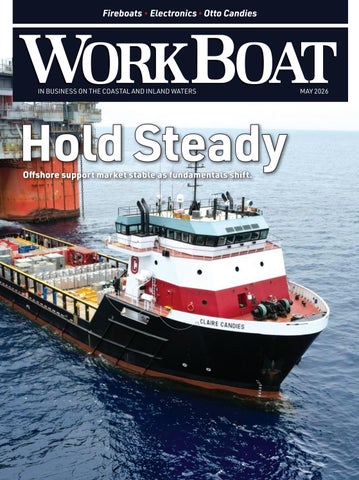
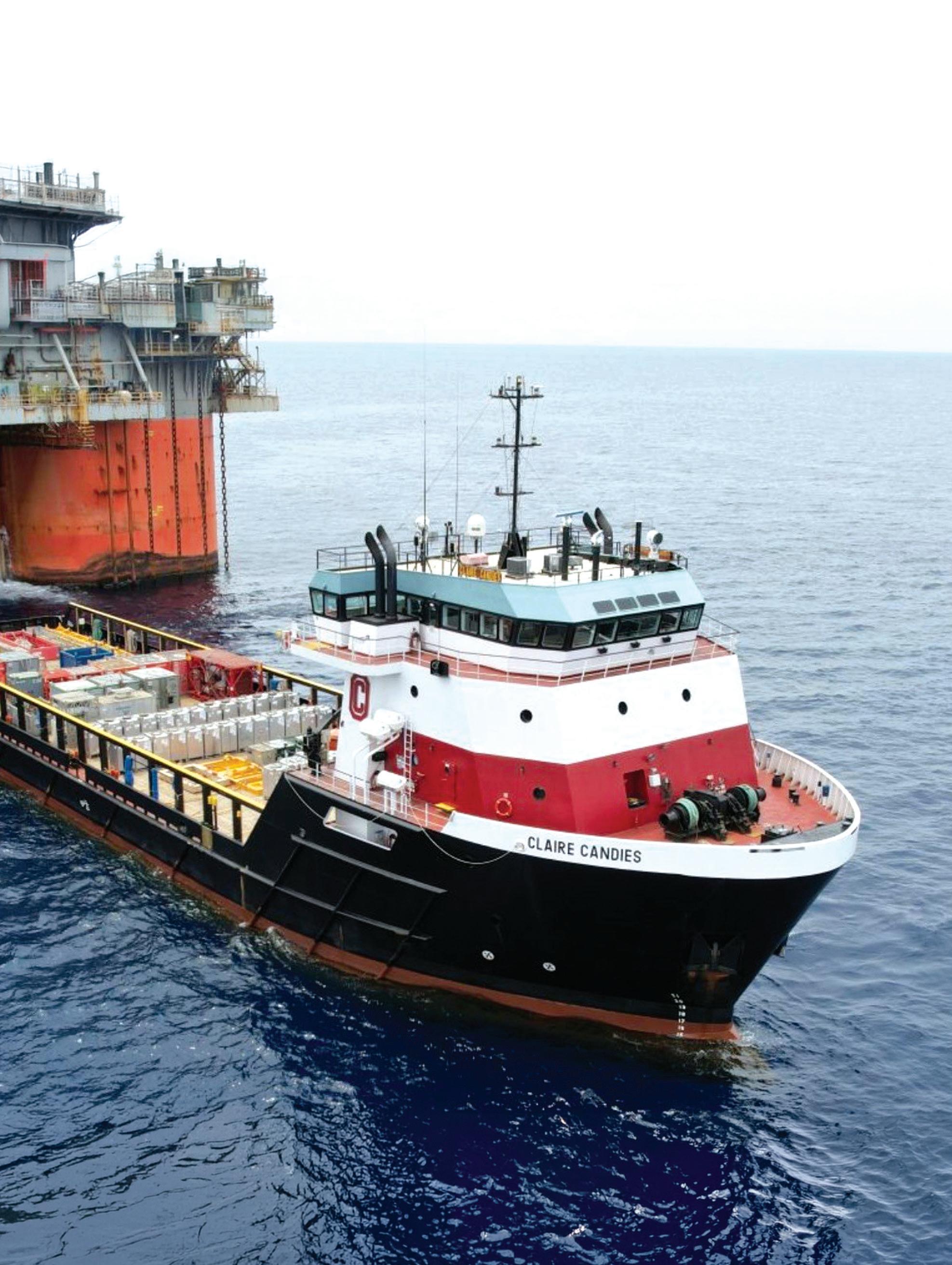
Hold Steady
Offshore support market stable as fundamentals shift.




Maritime Solutions You Can Trust



Located in Northeast Florida, two nautical miles from the Atlantic Ocean on the St. Johns River, BAE Systems applies competence, efficiency, and integrity to your projects. For multiple decades owners and operators have trusted BAE Systems for unwavering excellence, security and transparency.
Now is the time to consider BAE Systems Maritime Solutions.
baesystems.com/maritimesolutions




FEATURES
16 Cover Story: Holding a Turn
Offshore support vessel market remains stable as tonnage ages and pro ts shrink.
22 Vessel Report: Fighting Fires
Demand holds steady as reboat builders push multimission designs.
32 Final Word: Otto Candies III
The third-generation shipowner talks offshore support vessel fundamentals.
BOATS & GEAR
8 On the Ways
Master Boat launches rst of eight tugs for Maritime Partners • Blessey christens its rst Tier 4 towboat • Delaware oil spill response group unveils fast-response skimmer • American Cruise Lines' new riverboat heads west for maiden voyage • New tug delivered for Gulf LNG • Eastern launches second of four tugs for Saltchuk • Keels laid for three waterways commerce cutters • All American begins building Texas research vessel • Maine Maritime training ship delivered • C&C hands tank barge to Colonial Towing.
28 On Their Radar
From the tried and true to the leading edge.
AT A GLANCE
4 On the Water: Lint, re, and false con dence.
4 Credentialing Insight: Medical certi cates by mail.
5 Captain's Table: Spring start-up re ections.
5 Insurance Watch: Simple, repeatable, and safe.
6 Legal Talk: Strict timetables for limitation of liability.
6 Health, Safety, and Environment: Managing mental health.



All of the Above Energy

Eric Haun, Executive Editor ehaun@divcom.com
If you stick around long enough, you will nd that working in the offshore oil and gas industry can be a roller-coaster ride.
Not long ago, “prolonged industry downturn” was a phrase I seemed to be writing daily while covering offshore oil and gas. That downturn, which followed a period of exceptionally good times for the industry, took more than its fair share of prisoners. Companies downsized, rigs were stacked, and experienced workers left the industry, many never to return. Recently, the market has been mostly stable (knock on wood) after bouncing back from the historic lows of the Covid-19 pandemic.
Still, shifting market dynamics, geopolitical tensions, and political forces remain at play, and the entire offshore supply chain, from the oil majors to marine service providers, is on its toes. There is no telling what the future will bring, and this sector knows well that the only certainty is uncertainty.

For now, the Gulf of Mexico, which President Trump renamed the Gulf of America by executive order, is seeing a largely favorable political climate for offshore oil and gas, a stark contrast to the Biden years. In pursuit of “American energy dominance,” the Trump administration has been working to unwind regulations that have hindered oil and gas producers, expanding leasing, accelerating permitting, and rolling back safety and environmental rules.
The roller-coaster metaphor extends to offshore wind on the East Coast, where projects have faced no shortage of twists, turns, ups, and downs. Approved, canceled, uncanceled, and canceled again. It’s an unsustainable and frankly ridiculous state of affairs. Developers have sunk years and billions of dollars into projects, only to watch them unravel under shifting political winds — sometimes literally overnight. Wouldn’t a nation seeking “energy dominance” favor an all-of-theabove energy strategy? The jobs, the investment, and the infrastructure that offshore wind creates shouldn’t vanish simply because the political winds have shifted.
No matter who is next to take of ce in the White House, I’d wager that the offshore energy industry, including hydrocarbons and wind alike, is by and large hungry for a more stable and predictable regulatory environment. A long-term energy strategy that transcends election cycles could go a long way to help ease the pain of boom-andbust whiplash.


EXECUTIVE EDITOR: Eric Haun / ehaun@divcom.com
SENIOR ASSOCIATE EDITORS: Ben Hayden / bhayden@divcom.com Kirk Moore / kmoore@divcom.com
CONTENT PROJECT MANAGER: Carley Milligan / cmilligan@divcom.com
CONTRIBUTING WRITERS: Tim Akpinar • Jonathan Barnes • Capt. Alan Bernstein • Stephen Blakely • Dan Bookham • G. Allen Brooks • Bruce Buls • Denielle Christensen • Capt. Eric Colby • Michael Crowley • Jerry Fraser • Nate Gilman • Pamela Glass • Capt. Arnie Hammerman • Ken Hocke • Craig Hooper • Joel Milton • Steve Mosco • Peter Ong • Richard Paine Jr. • Chris Richmond
DIGITAL & PRINT PROJECT MANAGER: Doug Stewart / dstewart@divcom.com
ADVERTISING ACCOUNT EXECUTIVES: Kristin Luke / kluke@divcom.com Krista Randall / krandall@divcom.com Danielle Walters / dwalters@divcom.com
ADVERTISING COORDINATOR: Wendy Jalbert / wjalbert@divcom.com
Producers of the International WorkBoat Show and Pacific Marine Expo
Vice President: Wes Doane, wdoane@divcom.com
Publishing offices: 2 Portland Sq., Suite 200, Portland, ME 04101 Tel 207-842-5608 | Fax 207-842-5609
Subscriptions: cs@e-circ.net / 978-671-0444 Mon–Fri, 10 a.m.–4 p.m. ET

S12R S12R

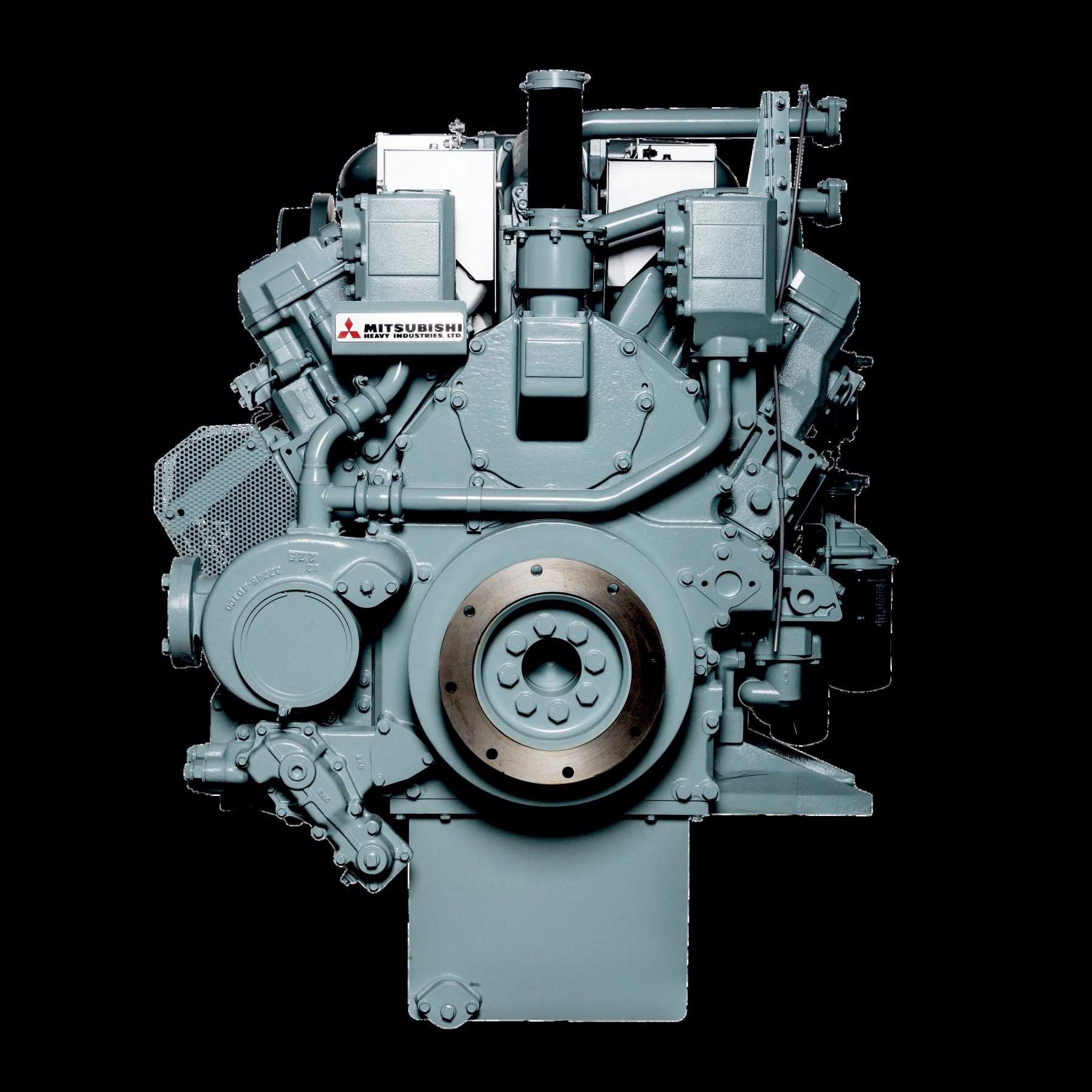

TIER 3
1100HP @ 1600RPM
1100HP @ 1800RPM
1260HP @ 1600RPM
1350HP @ 1600RPM
1350HP @ 1800RPM
TIER 4
1260HP @ 1600RPM
On the Water
Lint, fire, and false confidence
BY JOEL MILTON
Joel Milton works on towing vessels. He can be reached at joelmilton@yahoo.com.
Weare very prone to blindly trusting and taking for granted all kinds of modern amenities and conveniences without considering whether more thought should be given to them. Home appliances of all kinds, and the electric or gas utilities that power them, are at the top of the list. We treat them as fully tame — even benign — draft animals that do our bidding without issue. But therein lies the danger: we usually don’t fully understand how things really work, or the risks they pose.
According to the National Fire Protection Association, every year there are 15,000 to 16,000 fires in homes caused by washing machines and dryers. Of that total, more than 90% involve clothes dryers, and more than 50% of those were caused directly by dust, fiber, and lint accumulations within the machines, ducting, vents, or the clothes themselves. It
Credentialing Insight
Medical certificates by email
BY NATE GILMAN
USCG Licensing Software, uses his hawsepiping experience to support mariners and workforce development. Connect on LinkedIn.
The Coast Guard National Maritime Center has made a long-needed change. From April 1 onward, medical certificates are delivered electronically to a mariner’s email address on the day they are issued.
The timing could not be more important. As of early April, the NMC remains closed due to a government shutdown. Testifying before the House Homeland Security Committee in March, the vice commandant of the Coast Guard confirmed the backlog had surpassed 16,000 merchant mariner credentials and was growing by more than 300 applications per day. He noted it takes the NMC two-and-a-half days of processing to recover from every single day of shutdown, meaning if the shutdown ended March 30, the NMC would not be caught up until July 3.
When the NMC reopens, any improvement that gets credentialed mariners back to work faster will matter. Email delivery of medical certificates eliminates a week or more of unnecessary mailing time. No more waiting on the postal service. No more weekend delays if your certificate is issued
turns out that lint burns readily and burns well. Also, we’re kind of lazy.
Translation: people fail to perform the routine basic maintenance specified by appliance manufacturers, or they casually and routinely violate safety protocols — overloading the machine, for example, or drying clothes that have absorbed flammable products such as petroleum-based lubricants, fuels, paint thinners, grease, solvents, or even plant-derived cooking oils. And before you even get to that point, dryer vent systems are often not designed and installed properly in the first place. Why? The perception that doing it right costs too much, is too difficult, or both.
Step onto any workboat with laundry facilities and you will likely find precisely the same appliances you would expect to see in any home in North America. The ducting and venting are also likely to be done in the same standard, shabby household way. But the average home does not pitch, roll, heave, sway, and yaw as seagoing vessels do — or pound and vibrate intensely. These machines are not designed to handle the additional g-forces from those motions, which are at times quite violent. And the engine room of a working tug is a very tough environment.
But it’s all good, right?
on a Friday. The moment it is issued, it is in your inbox.
Here is what mariners need to do:
Verify your email address is current. Contact the NMC Customer Service Center via live chat, Monday through Friday, 8 a.m. to 5:30 p.m. EST, and confirm the email address on file is correct and one you actively use.
Sign your certificate as soon as it arrives. Certificates must be signed to be valid. Print it, sign it, and keep a copy for your records.
If you don't receive a certificate you’re expecting, check the NMC’s online status tool first. If it shows as issued, contact the NMC Customer Service Center and ask them to resend it. No new application or affidavit is required.
Note that this initial rollout covers medical certificates without medical waivers. Electronic delivery for certificates that include waivers is in development and expected to follow shortly after launch.
The maritime community has been asking for something like this since April 2023, when MSIB 06-23 temporarily allowed mariners to work off a digital verification for their MMC but never extended that same flexibility to medical certificates. That gap has frustrated mariners and employers for years. This change finally closes it.
This change did not happen on its own. Patrick Parsons at the American Waterways Operators (AWO) has been a persistent and dedicated advocate for extending digital delivery to medical certificates, and his efforts deserve recognition. The maritime industry is better served when organizations like AWO push consistently for practical improvements like this one on behalf of the mariners who depend on them.
Nate Gilman, president of MM-SEAS
Captain’s Table
Spring start-up reflections
BY CAPT. ALAN BERNSTEIN

Alan Bernstein, owner of BB Riverboats in Cincinnati, is a licensed master and a former president of the Passenger Vessel Association. He can be reached at 859-292-2449 or abernstein@bbriverboats.com.
Spring is when many passenger vessel operators gear up after a long winter hiatus. With that comes numerous factors influencing pressing financial and operational decisions.
Managing increasing costs has always been a challenge, but now it is worse than ever. Nearly everything in the marine industry, from parts to electronic equipment, costs more and takes significantly longer to procure. Maintenance has always been a major expense, but operators today cannot afford to stockpile inventory, as tying up cash on storeroom shelves creates additional financial strain.
Marine insurance can also be unpredictable and is often very expensive. Even operators with favorable loss histories are finding that premiums continue to rise. Many point to global catastrophic events as contributing factors.
Insurance Watch
Simple, repeatable, and safe
BY DAN BOOKHAM

Dan Bookham is a vice president with Allen Insurance & Financial. He specializes in longshore, offshore and shipyard risk. He can be reached at 1-800-236-4311 or dbookham@allenif.com.
Spend enough time around vessels and shipyards and a clear pattern emerges: the safest operations aren’t always the largest or most sophisticated. More often, they’re the ones that do the basics consistently and well. The difference is often replicable procedures that people actually follow.
In an industry where conditions change by the hour, procedures can feel like paperwork. In reality, they’re a practical tool for protecting people, vessels, and facilities.
Overly complex procedures tend to break down — forgotten, misunderstood, or bypassed when work speeds up. Simple procedures that can be explained quickly and remembered under pressure endure. Used consistently across shifts, projects, and vessels, procedures become second nature and prevent small mistakes from turning into serious incidents. Safety discussions rightly focus on preventing injuries, but good procedures protect far more than individuals. Clear, consistent practices also help safeguard vessels by reducing the risk of fire, flooding, or equipment damage; facilities, through effective control of hot work, confined spaces, and
Food costs are also on an unsustainable upward trajectory for those of us who operate dinner cruise vessels. Nearly every food item costs more while customer pricing has only so much elasticity. Portion control and waste management have become critical factors in running our businesses efficiently.
Hiring employees, especially mariners, remains a concern. Many young people we hire lack basic workplace skills, and finding qualified mariners continues to be a struggle, due in part to an apparent lack of interest in maritime careers. At BB Riverboats, we train and promote from within, but finding people who meet basic work expectations is a challenge.
Finally, government regulation at all levels remains a burden. Coast Guard inspector skill levels vary by region, and the resources needed to manage a complicated marine transportation system seem to have diminished. Compounding this, many government officials lack an understanding of how their policies and decisions impact our businesses. Educating regulators about the nuances of operating commercial passenger vessels is a constant challenge.
Despite all of this, I remain optimistic about the outlook for the passenger vessel industry in the coming months. Demand is strengthening, sales are expected to increase, and operators are preparing for a period of greater activity and opportunity.
hazardous materials; schedules, by avoiding incidents that shut down operations; and reputations, by demonstrating professionalism to owners, regulators, and insurers.
Repeatable procedures reduce variability. In maritime operations, fewer surprises almost always mean lower risk.
A common reason procedures fail is that they’re written far from the job site. A thick office manual doesn’t help the rigger, welder, or deckhand making decisions in real time.
Effective procedures tend to share a few traits. They reflect how work is actually done, focus on high-risk moments, use plain language, and make responsibility clear. When procedures align with reality, they stop feeling like enforcement tools and start functioning as standard operating practice.
Replicable procedures also build trust and fairness. Whether a worker has decades of experience or just joined the crew, expectations are the same. That consistency creates a shared understanding of “how we do things,” which is the foundation of safety culture.
For operators managing multiple vessels or projects, replicable procedures also allow lessons learned in one place to apply everywhere else. Near misses don’t stay local — they drive improvement across the operation.
Finally, procedures only work when they’re lived. The most effective organizations reinforce them through short, regular refreshers, visible leadership involvement, and feedback loops that allow crews to suggest improvements. Just as important, they’re willing to revise procedures when conditions change.
Maritime safety doesn’t come from doing everything, but from doing the right things, the same way, every time.
Legal Talk
Strict timetables for limitation of liability
BY TIM AKPINAR
Tim Akpinar, based in Little Neck, N.Y., is a maritime attorney and former marine engineer. He can be reached at t.akpinar@verizon.net or 718-224-9824.
Limitation of liability is a maritime law concept that commonly arises in serious accidents on the water. It came up in the 1912 sinking of RMS Titanic, the 2003 accident involving the Staten Island ferry Andrew J. Barberi, and more recently, the containership Dali hitting the Francis Scott Key Bridge near Baltimore in 2024. Here is a somewhat simplified outline of maritime limitation law. If a vessel owner is sued for damages after a collision, crew injury, passenger injury, or similar event, it may be possible to limit the claimant’s award to the post-accident value of their vessel. To succeed, they must show they didn’t have control over the factors causing the incident.
Limitation law recently arose in a Fifth Circuit case involving a tankerman injured while attempting to throw
Health, Safety, and Environment
Managing mental health
BY RICHARD PAINE JR.
Richard Paine Jr. is a licensed mariner and certified maritime safety auditor with more than 25 years of maritime industry experience. He can be reached at rjpainejr@gmail.com.
Today’s maritime industry faces more mental health challenges than ever before. May is Mental Health Awareness Month, but this awareness is a necessity every day of the year. Mental illness, digital overload, and the stress of navigating today’s complicated world all weigh heavily on our daily lives and job performance. Recognizing these challenges daily puts our businesses, operations, and society in the best position to support our mariners, employees, and teams — and their families and friends — during tough moments.
No two people are the same, and neither are their mental health experiences. Some live with daily challenges such as anxiety or depression, while others encounter situations and acute stress that disrupt routine tasks. In some cases, those mental challenges and distractions can lead to catastrophic outcomes if not properly identified or addressed — especially for mariners operating on the water.
Over the years, I’ve encountered employees and crewmem-
mooring lines to secure barges during docking in Mt. Airy, La. He filed a lawsuit in state court in December 2021. Three years later, in December 2024, the vessel owner/employer filed a limitation lawsuit in federal court, attempting to limit liability to the $12.5 million value of the tug and two barges.
The tankerman’s attorneys argued that the attempt to limit liability was late under 46 U.S.C. § 30529(a), because maritime law allows a vessel owner six months to file for limitation after receiving written notice of a claim. However, the employer argued that the December 2024 limitation action was timely because it was made within six months of receiving the plaintiff’s demand for $22 million in August 2024. The district court ruled in favor of the plaintiff, holding that the vessel owner had more than six months’ reasonable notice that the claim could exceed the vessel value. On appeal, the decision was upheld in favor of the tankerman.
In 1851, Congress introduced limitation of liability to promote a strong mercantile fleet by protecting shipowners from ruinous claims. If shipowners knew a loss could be capped at the value of their vessel, they would be more likely to engage in trade. Critics of limitation law argue that shipowners today no longer face the uncertainties that square-rigged clipper ships rounding Cape Horn faced in the nineteenth century.
bers battling mental health issues on a few occasions. From a management perspective, the best approach is to assess the individual situation and determine whether the person needs immediate help, a supportive conversation, or simply some personal time off. I’ve seen captains going through devastating personal circumstances — a messy divorce, for example — and I’ve had to make the difficult managerial decision to temporarily relieve a captain who I beleived could not safely operate the vessel. If crewmembers need mental health support, leadership must be aware, because without help, an unstable mental state can have serious — sometimes tragic — consequences. Mental distractions, much like distractions from a phone or device, can lead to the same problems.
So what do we know? We know we can’t prevent all stress from entering the workplace. We know everyone goes home to their own situation, and everyone handles things differently. We know mental health challenges exist on a wide spectrum.
What we don’t know is what someone is going through — unless we ask and listen, without judgment. Only then can we begin to offer meaningful support. A simple, sincere “How’s everything going?” can make all the difference.
We use the word “safety” often when talking about how our industry should operate. But there is an important human element not found in any safety policy: empathy. I encourage everyone to use more of it when working with crews and employees.
Sometimes it’s hard to ask for help. Be the one to ask first. It might just be the most important question you ever ask.


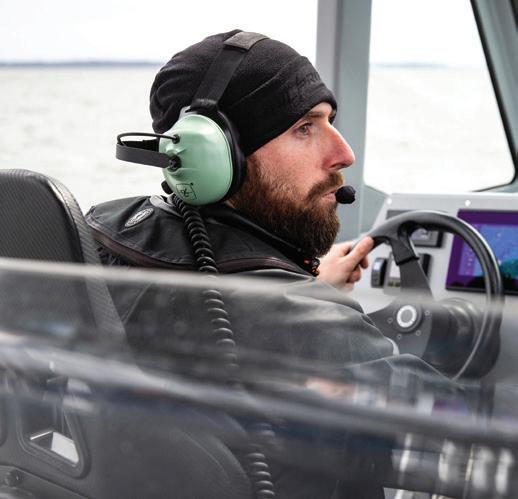
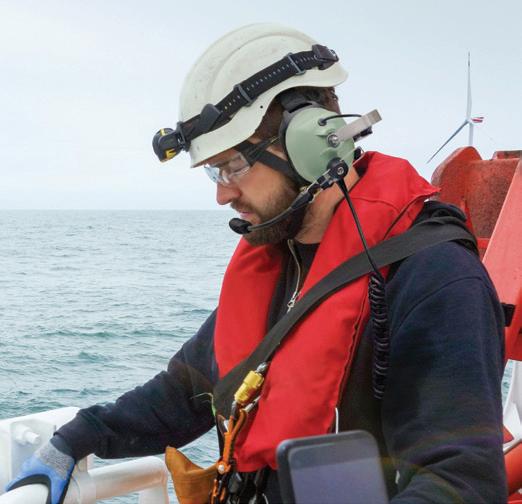
Experience a Sea Change in workboat crew communications


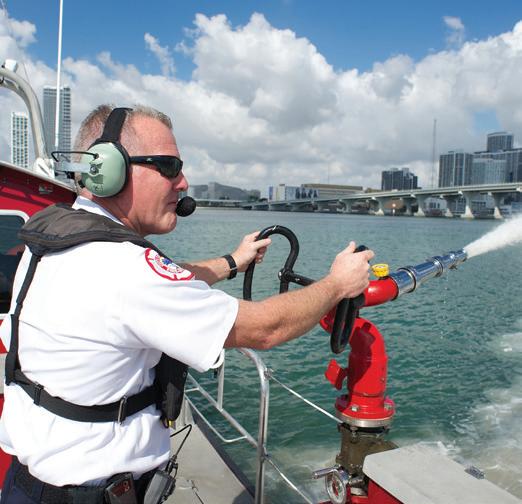
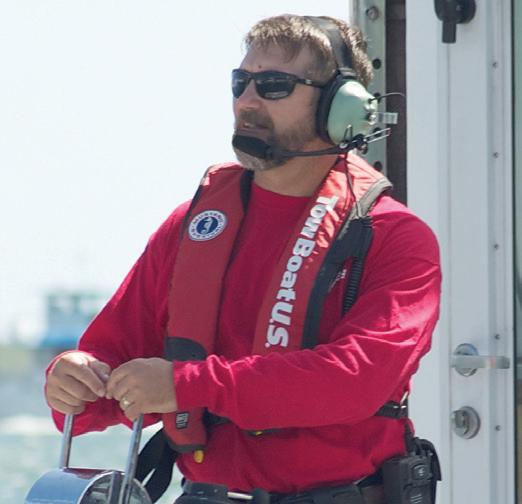
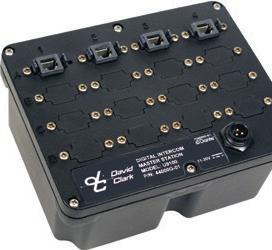
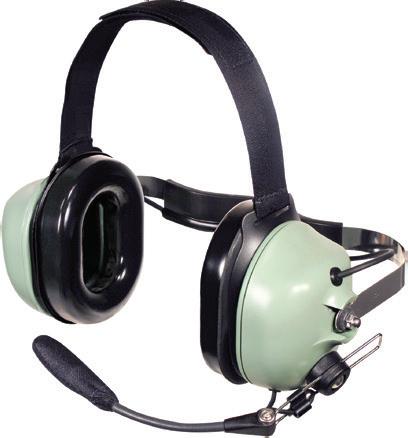
David Clark Marine Headset Systems
Crews on board harbor vessels, patrol boats, fire/rescue craft, offshore service vessels, tugs, and other workboats must perform a variety of complex operations. Wind noise, loud engines and pounding through rough waters can make boat crew communication extremely challenging.
David Clark Marine Headset Systems offer clear communication and rugged reliability in the harshest marine environments, while enhancing the safety and situational awareness of boat crew members.
Call 800-900-3434 (508-751-5800 Outside the USA) to arrange a system demo or visit www.davidclark.com for more information.





ON THE WAYS
CONSTRUCTION ACTIVITY AT WORKBOAT YARDS
First of eight tugs launched for Maritime Partners
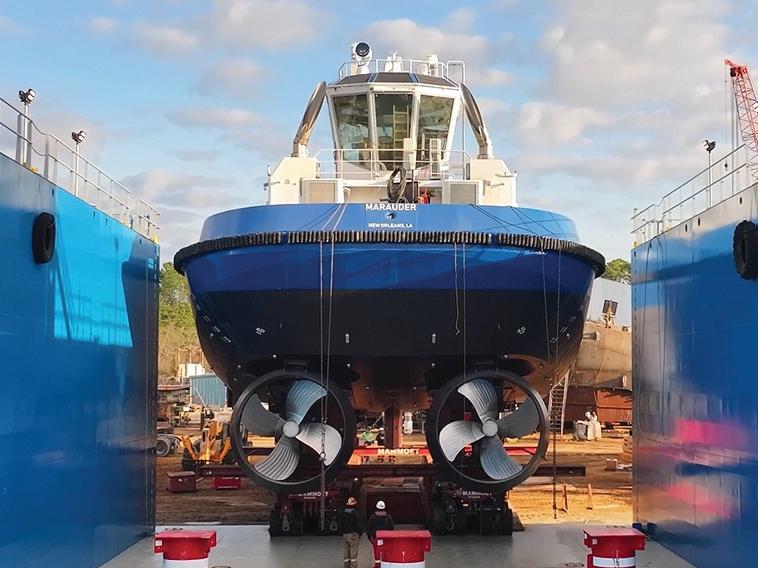

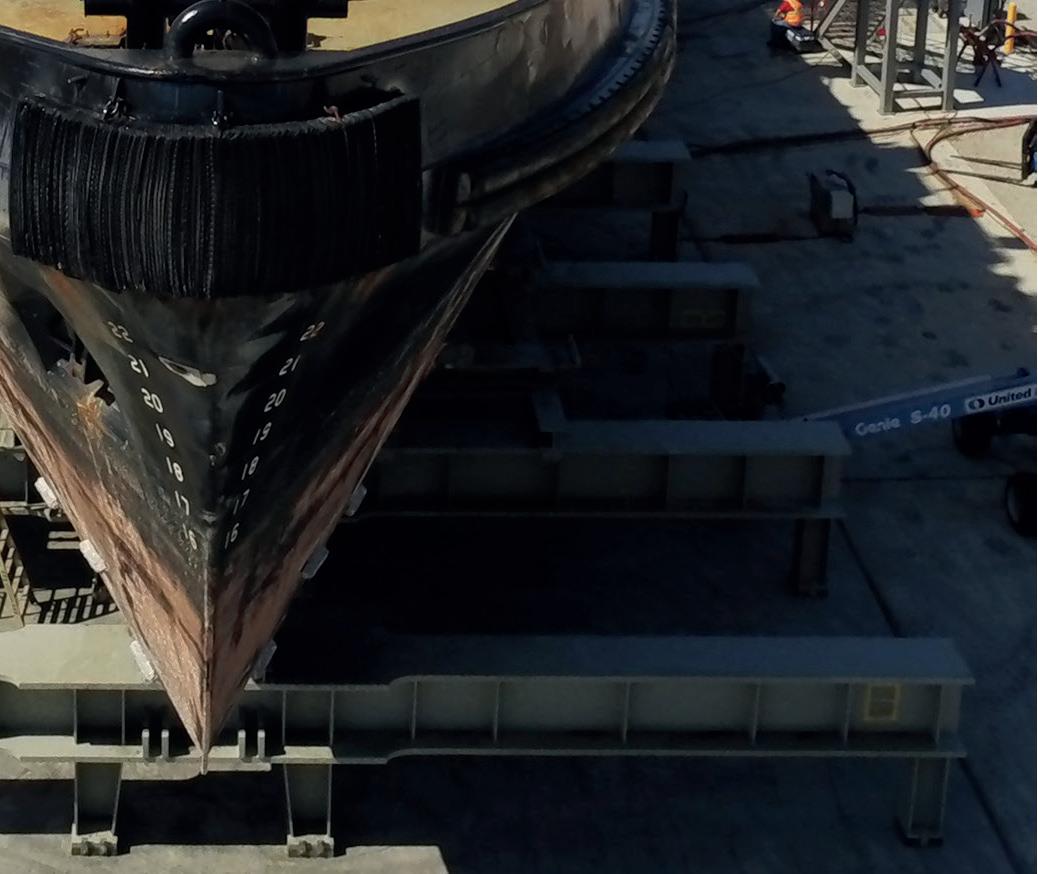
Master Boat Builders, Coden, Ala., launched the Marauder, the rst in a series of eight harbor tugs being built for Maritime Partners LLC, with delivery targeted for May. The eightvessel program is expected to see the yard deliver a tug approximately every six weeks through 2027.
The new tug was designed from the outset to be highly versatile, capable of performing escort work in major ports while still handling traditional harborassist duties in smaller ports, according to Master Boat Builders President Garrett Rice.
“We tried to design this as an extremely versatile tug,” Rice said. “It could do escort work in Houston or ship-assist in Norfolk or Miami or San Diego — wherever it needed to go. The balance of the stability and escort performance meets in the middle of all the requirements that any customer could have.”
The design allows exibility in out tting, including the option to install either a 75-hp or 100-hp winch. Ultimately, Maritime Partners selected 75-hp winch-
es for the series, and all vessels will also be equipped with re ghting systems.
The 88'x43'x16'6" tug Marauder, with a 19'6" draft, is a Robert Allan Ltd. RApport 2700-MP ship-assist and escort tug designed to handle large vessels during docking, undocking, and harbor maneuvers. The tug will feature bollard pull exceeding 90 metric tons, making it one of the highest bollard-pull tugs built by the yard to date.
Main propulsion will be provided by twin Caterpillar 3516E engines with an intermittent “D” rating of 3,500 hp at 1,800 rpm. The tug will be equipped with Steerprop Z-drives supplied by Karl Senner LLC, with 3,000-mm fixed-pitch monoblock 4-bladed propellers constructed of CF3 stainless steel. A Markey Machine DEPCF-52 75-hp electric Class II hawser winch will be installed, with the option for a Markey DESF-48A 100-hp electric Class III escort winch.
Ship’s service power and onboard systems will include Beier Integrated Systems electronics and control
integration. The tug will have a top speed of approximately 13 knots and accommodations for a crew of six. Tank capacities will include approximately 24,000 gals. of fuel, 2,000 gals. fresh water, and 1,500 gals. diesel exhaust fluid.
The vessel will be classed by ABS with A1 Escort Tug, Towing Vessel, AMS, UWILD, FFV1, BP, and LEV (US) notations and complies with applicable U.S. Coast Guard Subchapter M regulations and international standards. Delivery is scheduled for May.
Rice emphasized that early collaboration between the shipyard, designer, and Maritime Partners played a major role in keeping the project on schedule and re ning the design before construction began.
“That early collaboration between the shipyard, the design agent, and the customer gives you the best result — the best quality boat and the smoothest timeline,” he said. “We worked together early on to eliminate a lot of the potential problems we’ve seen in the past.”
A unique aspect of the Maritime Partners tug series is how the vessel speci cations were developed. Because Maritime Partners is primarily a vessel leasing company rather than a tug operator, the company relied on the shipyard’s experience building vessels for multiple tug operators across the U.S.
The yard drew on lessons learned from building tugs for operators such as G&H Towing, Moran Towing, Seabulk, and others, incorporating features and preferences from different operators into a single design, Rice said.
“Every tug operator has their own preferences and their own way of doing things,” Rice said. “We’ve built for a lot of different operators over the years, and we’ve learned a ton from all of them. With this project, we were able to take the things that made sense from different operators and blend them into one speci cation.”
This approach allowed the vessel to avoid being tailored to a single operator’s preferences and instead resulted in a more exible design that could be chartered to operators in different ports and service pro les.
Master Boat Builders
Maritime Partners’ tug Marauder sits in drydock ahead of being launched at Master Boat Builders.
“We look at this as having the best of other operators that we’ve built for all blended into one package,” Rice said.
Because the Maritime Partners project involves a series of eight vessels rather than a one-off build, Master Boat Builders invested heavily in engineering early in the project to improve production ef ciency and reduce surprises during construction. The rst vessel was launched on schedule, and the yard expects delivery within a week of the original contract delivery date set two years earlier. In March, the shipyard began construction on the seventh boat in the series.
“We did a lot of engineering early to make sure ef ciencies are recognized throughout the project and to move decisionmaking earlier in the process, so there are fewer surprises during fabrication and commissioning,” Rice said.
He said the design could in uence future harbor tug construction due to its combination of power, versatility, and design standardization.
“I think that this is going to be one of the best, most technologically advanced, highest-powered bollard-pull tugs in the country. We think this will set the new standard of what a harbor tug is going to look like going forward,” he said. “It’s extremely versatile. And I think that’s the key. It can do almost any job that’s required — it’s got the power to do it, but it’s not so large that it can’t work in smaller ports.” — Ben Hayden

Blessey christens its rst
Tier 4 towboat
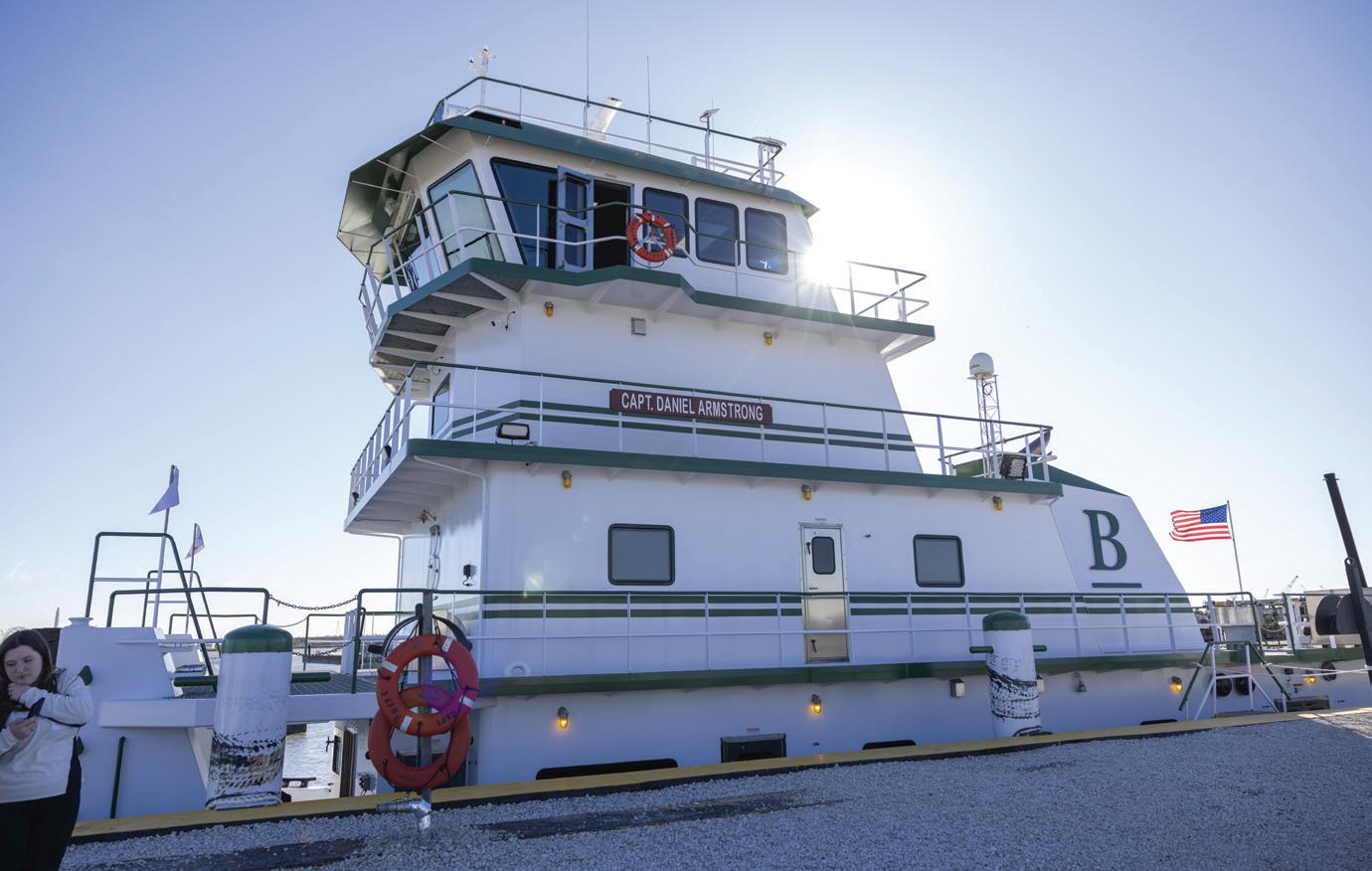
Atowboat christening ceremony held Jan. 14 in Channelview, Texas, marked the beginning of a new era for Blessey Marine Services Inc., Harahan, La. The vessel that was celebrated, the 2,600-hp Capt. Daniel Armstrong, is the rst EPA Tier 4 towboat in the company’s 85-vessel eet.
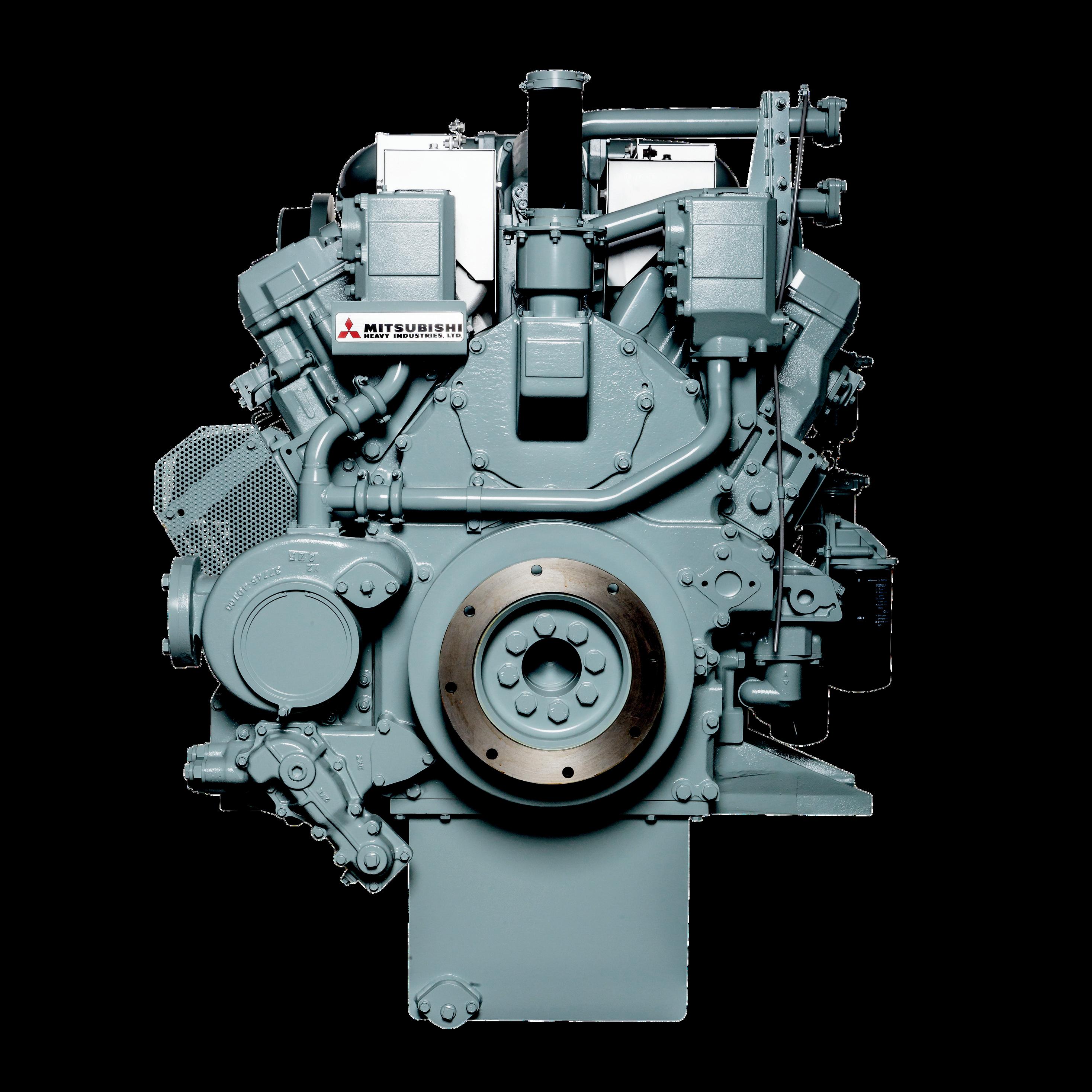
The 84'6"x32'x11', twin-screw towboat was designed and built by Vessel Repair Inc., Port Arthur, Texas. It is powered by twin 1,260-hp Mitsubishi S12R engines supplied and supported by Laborde Products. It is also equipped with a 99-kW John Deere 4045AFM85 auxiliary generator supplied by Marine Systems Inc.
The vessel is part of a four-boat newbuild series that includes a pair of jack-up wheelhouse vessels and two conventional towboats, according to Clark Todd, president and CEO of Blessey Marine Services.
“The previous vessels that we built this past year and a half, two years, were all vessels that we had previously laid keels for and [that] we had previously purchased engine packages [for],” Todd said. “Once we exhausted our keels and our engine packages, obviously, we were forced to build a Tier 4 vessel.”
“[The Capt. Daniel Armstrong,] with its new Tier 4 engine






















ON THE WAYS




package, will reduce carbon emissions and our footprint. We’re glad to be a part of the Tier 4 community and doing what we can to limit our emissions on these vessels,” Todd said. “It’s a huge milestone for our company, and I think for our industry to continue to build these more environmentally friendly boats.”
The new towboat joins the Blessey eet as the company expands into the Houston bunkering business, Todd said.
The Capt. Daniel will replace one of two vessels on the Mississippi River that were restationed to pair with two new 30,000-bbl. bunker barges built by Arcosa in Ashland City, Tenn.
The Capt. Daniel features 8" shafts from R.C. Schmidt & Sons Inc., Thordon TG 100 seals and Rivertough bearings, 4-bladed 85"x60" wheels from Baumann Propellers LLC, Reintjes WAF 665 reduction gears supplied by Karl Senner LLC, a Sim Vue engine alarm from Baton Rouge Marine Electric, and an electric-hydraulic steering system from Custom Hydraulics
Fendering was supplied by M&M Bumper Service LLC, Seahorse Manufacturing supplied the wastewater treatment system, and Christie & Gray provided engine vibration isolators. The boat’s Hempel paint was provided by Coating Systems Inc. On deck are two winches and a capstan.
Electronics and communications equipment was provided by Raymarine Inc. and Wood River Electronics. They


include Raymarine Path nder radars; Furuno AIS, satellite compass, depth sounder; and Standard Horizon VHF radio.
Tankage includes 15,077 gals. of fuel, 377 gals. lube oil, 1,571 gals. diesel exhaust uid, and 3,105 gals. potable water.
The towboat is named in honor of Capt. Daniel Armstrong, who addressed the crowd during the christening ceremony and affectionately described the vessel as “The Beast of the Waterways,” referencing both its power and presence on the river.
“We are always thrilled to name a vessel after one of our great captains, and Daniel Armstrong has grown with us from the deck all the way up to the wheelhouse.” Todd said. “Anytime we name a vessel after an employee, it’s a very special moment. And frankly, I’d say half of our eet is probably named after employees.” — Eric Haun
Delaware oil spill response group unveils fast-response skimmer
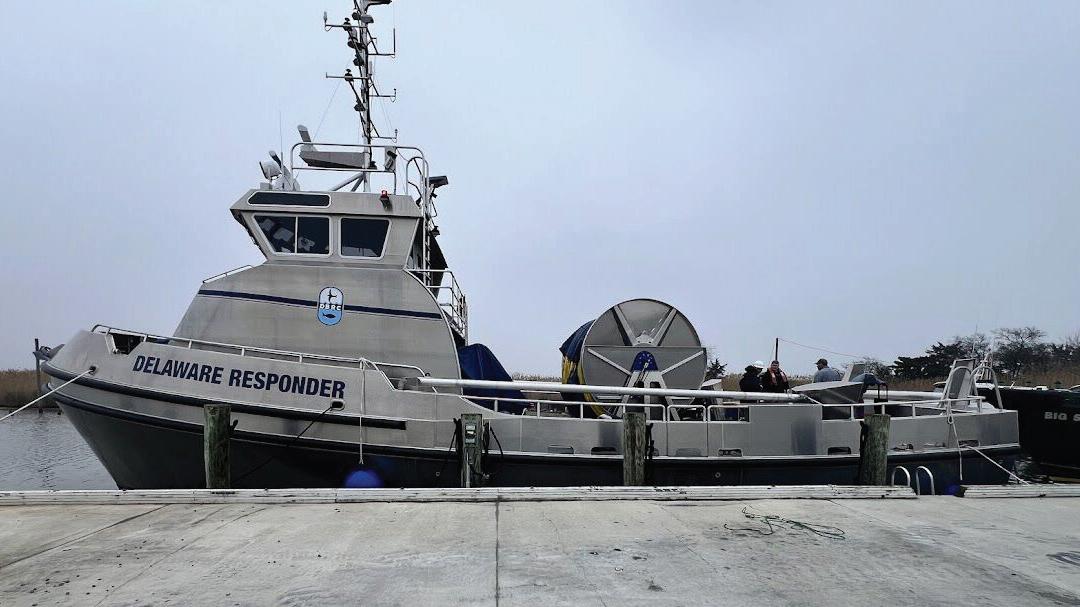
The Delaware Bay and River Cooperative (DBRC) in February took delivery of a new 65' fast-response skimmer vessel, the Delaware Responder. Built by Rozema Boat Works,
Mount Vernon, Wash., the new aluminum vessel replaces the Delriver, a converted offshore supply boat that was christened in 1991. It has since been sold to an owner in Haiti.
After the Delaware Responder was completed, the boat was loaded onto a transport ship in Victoria, British Columbia, that transited the Panama Canal and arrived in Fort Lauderdale a month later. The fast-response skimmer was then of oaded and Capt. Andrew Cofey from DBRC took command and ran the boat to the cooperative’s headquarters in Lewes, Del.
DBRC is an oil spill response cooperative that operates in the Delaware River and Bay. The mission of its new boat is to be on station when a tanker is of oading fuel and to contain a spill if one occurs. Virtually every company that stores or transports petroleum in Delaware is a member of the organization, which handled its last big spill response in 2003, according to Bob Poole, president of DBRC. He said that his organization had heard about Rozema Boat Works prior to this project, as the company has carved out a niche building fast-response skimming vessels.
Measuring 70' LOA with a 23' beam, the Delaware Responder looks like a straightforward working boat. Below the waterline, however, it has a complex system of doors and tanks that can separate oil from water, contain the pollutant, and pump clean water back out.
“To the untrained eye, it’s a pretty normal-looking boat,” said Dirk Rozema, who owns Rozema Boat Works with his brother Jason. “The back door opens suicide-style, and the boat has a sixty- ve- to seventy-foot-wide swath that works like a combine through the water. It pulls the oil and water into the vessel and as it moves forward, the oil is contained in the tank and the clean water goes out the front door.”
The price for a 65' fast-response skimmer ranges between $6 and $7 million, Rozema said.
On deck, the Delaware Responder is equipped with a 2,000' Elastec retractable boom that self-in ates as it’s extended. Tankers range in size from
Merit
Media
The Capt. Daniel Armstrong is the first EPA Tier 4 towboat in Blessey Marine Services’ 85-vessel fleet.













ON THE WAYS
700' to 900', and the boom is designed to contain both vessels if a transfer goes wrong and causes a spill. The Delaware Responder has two different skimming systems, a Lamor three-brush unit for heavier liquids like crude oil and an Elastec disc-style version for lighter uids like gasoline or kerosene.
The ship is on station at the cooperative’s headquarters and can respond when a call goes out with a top speed of 25 knots, thanks to a pair of 1,450hp MAN inboards that are EPA Tier 4 compliant. Twin Disc MGX-6620RV Vdrive transmissions have a reduction of 2.73:1 and are engineered to let the boat run at speeds as slow as 2 knots during a skimming operation.
“The slow speed is necessary to skimming oil,” said Rozema. “If you go too fast, the water and oil can escape out the back.”
To reduce light-ship draft to 72", the boat’s bottom has twin tunnels for the

propellers. Oil-containment tanks can carry 215 bbls. of oil, and fuel capacity is 2,500 gals.
To give a captain operating location options, the Delaware Responder has four helm stations equipped with Twin Disc electronic controls. Three stations are in the pilothouse with an aft station
on the exterior deck. All the stations include power-assisted hydraulic steering, throttle and shift, and controls for the hydraulic bowthruster. The hydraulic system also powers the deck crane, anchor winch, washdown pump, skimmers, off-load pump, skimmer- ow thruster, and skimmer doors.

Rozema Boat Works
The Delaware Responder is the first 65' fast-response skimmer vessel on the U.S. East Coast.
Workboat Engine
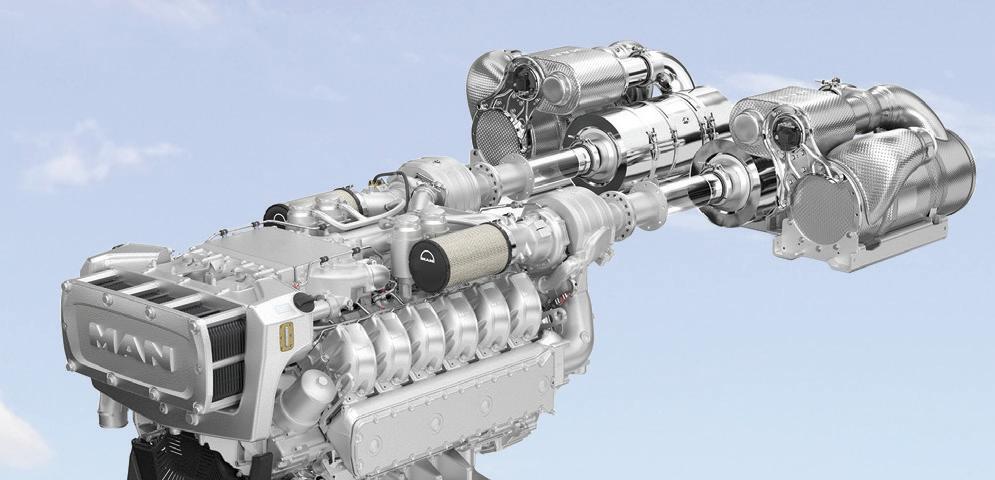
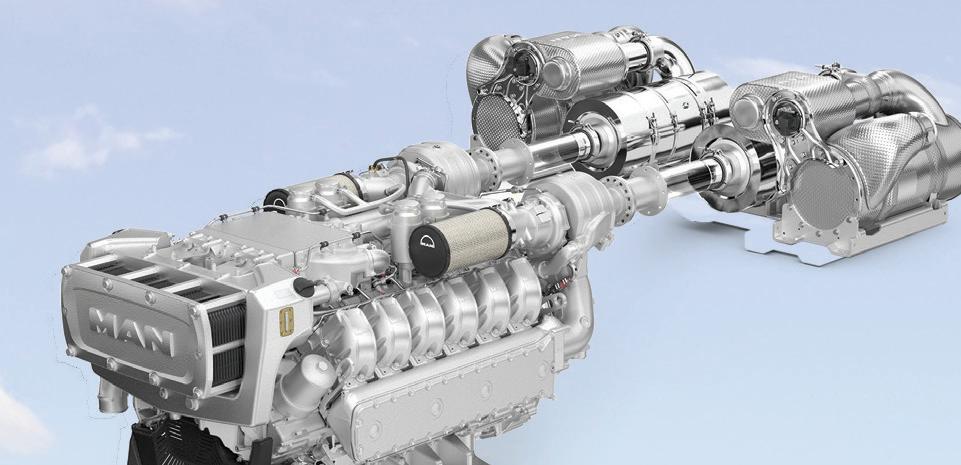
MAN D3872 LE V12
30L displacement available with SCR or DPF+SCR system
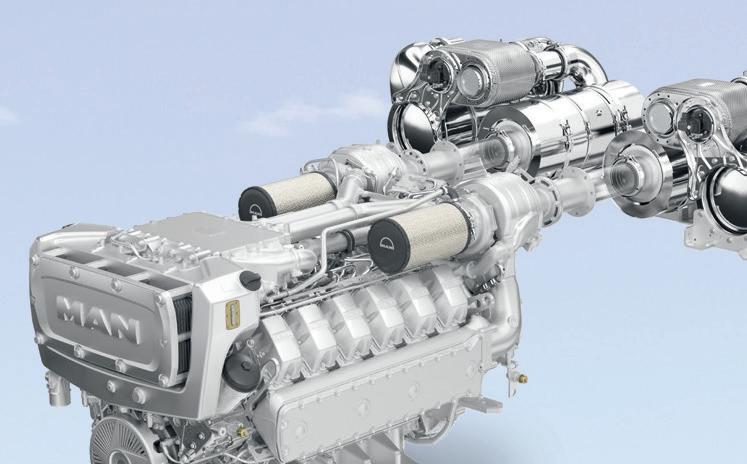
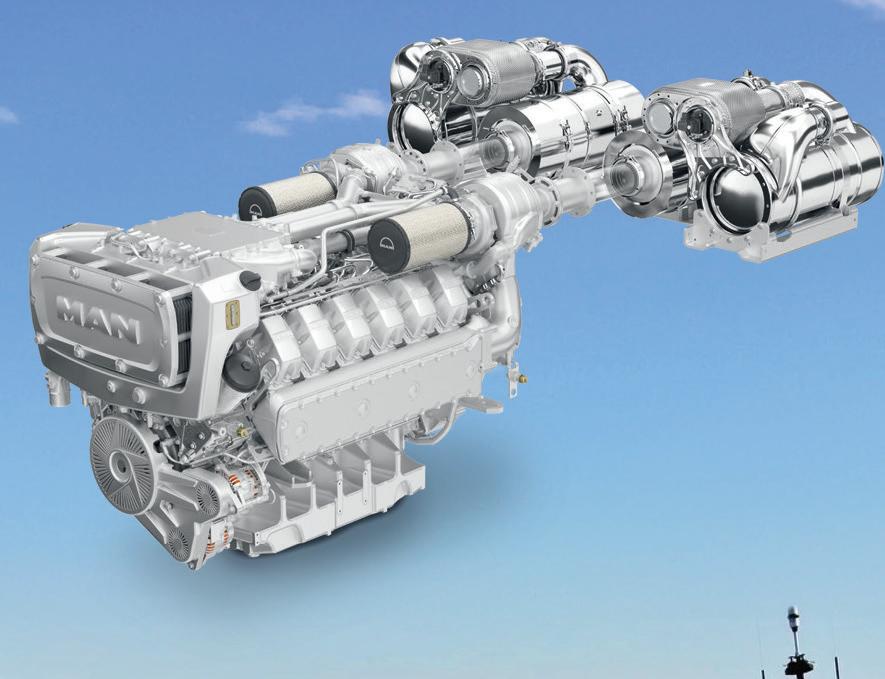
Workboat Engine

MAN D2862 LE V12
24L displacement available with SCR or DPF+SCR system



UNMATCHED & SUSTAINABLE POWER RANGE
Reliable Power. Built for the Job.
Our marine engines deliver dependable performance across a wide horsepower range—perfect for tugs, crew boats, and work vessels of all kinds. Designed for tough conditions, they offer maximum uptime, fuel efficiency, and low emissions without sacrificing power. Sustainable. Durable. Ready when you are. For more details, explore www.manengines.com, www.man-engines.com, or www.performancediesel.com.
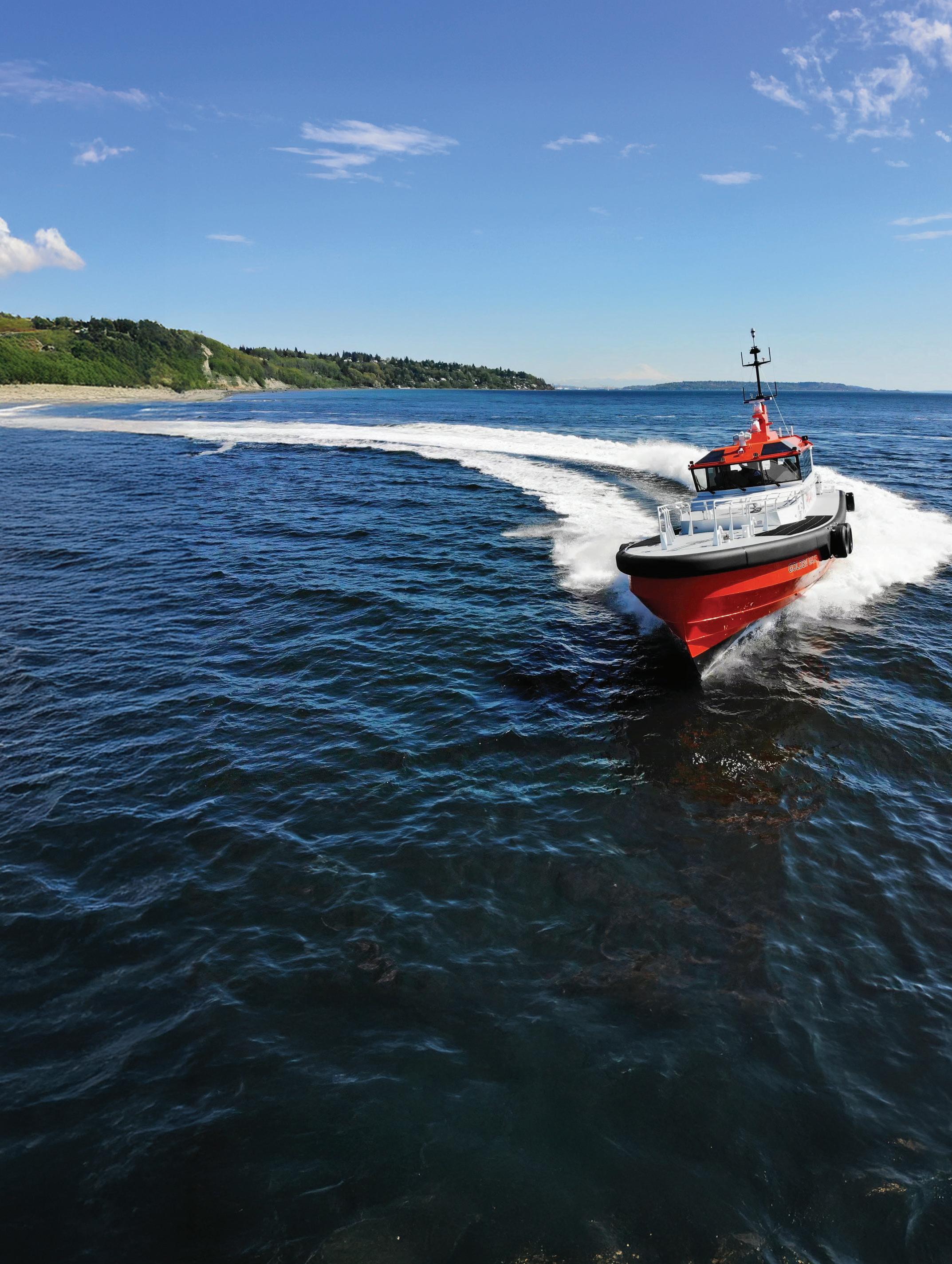
*Golden Gate Pilot Boat powered by MAN D2862LE SCR engines.

ON THE WAYS
A Furuno electronics suite includes one Navnet TZtouch XL chartplotter on a 19" color LCD monitor, 96-nautical mile radar, and a 200-watt solid-state doppler radar with target analyzer and fast target tracking. To track spills, the system has Furuno’s Foil 200 Oil Navigation Radar. A Furuno SC-70 satellite compass backs up the chart plotter, and there’s an FA170 AIS transponder. Communications are handled with two ICOM M510 VHF marine radios and a Furuno LH-5000 loud hailer. For onboard communications,
there’s a Zenitel intercom system.
Electrical power is provided by two 24-kW Kohler generators that are EPA Tier 3 compliant. Four 8D (deep cycle) batteries provide starting power for the engines, while two 4D units are dedicated to the generators, and three 4Ds power the house systems.
Accommodations include four separate staterooms with a single bunk in each. There is a mid-level head with a shower stall. The galley is also positioned mid-level with a stainless-steel sink, a
BOATBUILDING BITTS
Anew 269'x56' riverboat built for American Cruise Lines, Guilford, Conn., is making its way to the Columbia and Snake rivers in the Pacific Northwest. The 180-passenger vessel American Encore departed Chesapeake Shipbuilding, Salisbury, Md., following sea trials in March and began its passage west. The vessel’s sold-out inaugural season will begin May 5 and conclude in mid-November.
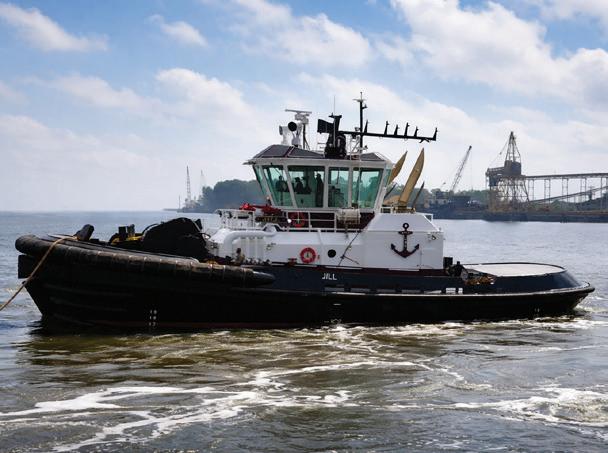
Master Boat Builders Inc., Coden, Ala., has delivered the tugboat Jill for Gulf LNG Tugs of Port Arthur LLC, a joint venture comprising Bay-Houston Management LLC; Bay Towing LLC; Moran Towing Corp.; and Suderman & Young Towing Co. The 92'x40' Rapport 2800 tug, designed by Robert Allan Ltd., has a bollard pull of more than 85 metric tons.
Eastern Shipbuilding Group, Panama City, Fla., has launched the second of the four 84'x42'x14' escort tugs for Saltchuk Marine, Seattle. The four Robert Allan Ltd.-designed RApport 2600 ship-assist/escort tugs, which will have 18'7" drafts, are part of Saltchuk’s long-term fleet renewal initiative. Upon delivery, they will support ship-assist and escort operations across the West Coast, Hawaii, and Alaska.
The Coast Guard authenticated the keels for three waterways commerce cutters (WCC) during a March 6 ceremony at Birdon America Inc., Bayou La Batre, Ala. The future cutters Allen Thiele, Fred
refrigerator/freezer, four-burner Summit Professional electric range with oven, and a microwave oven. A settee seats four.
The Delaware Responder is the first 65' fast-response skimmer vessel on the U.S. East Coast, according to Rozema. The company has several of its 47' response boats in the area.
The DBRC fleet includes a total of 20 vessels ranging from Jon boats to the group’s new flagship, the Delaware Responder. — Eric Colby
Permenter, and Samuel Wilson are the first vessels in a planned class of 30 WCCs that will replace the Coast Guard’s aging inland buoy tender fleet, which is responsible for maintaining aids to navigation on the nation’s rivers and waterways.
All American Marine, Bellingham, Wash., has started construction on a 78'x26'8" aluminum catamaran research vessel for the University of Texas Marine Science Institute, Port Aransas, Texas. The vessel is based on a Teknicraft Design multipurpose research platform and will support scientific, survey, and academic missions throughout the Gulf of Mexico, including operations up to 150 nautical miles offshore.
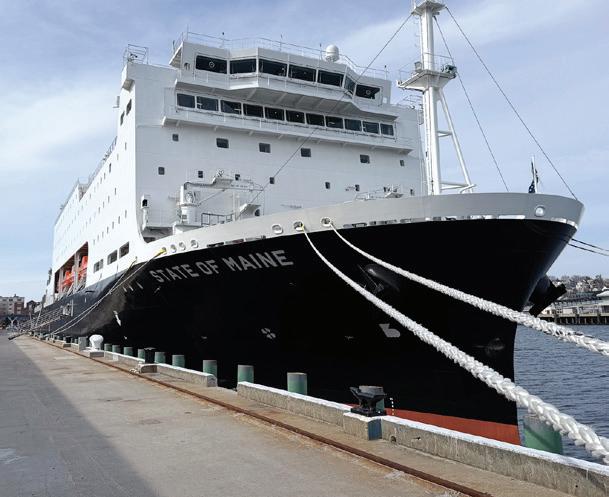
The 525'1"x88'7"x21'4" National Security MultiMission Vessel (NSMV) State of Maine was formally delivered to Maine Maritime Academy on March 30. The NSMV program, which includes five new training ships for the nation’s state maritime academies, is led by the Maritime Administration, with vessel construction at
Hanwha Philly Shipyard, Philadelphia, managed by TOTE Services
C&C Marine and Repair, Belle Chasse, La., announced the delivery of CTOW 330, a newly constructed double-hull tank barge for Colonial Towing, a subsidiary of the Colonial Group Inc., Savannah, Ga. Built to bunkering requirements across lakes, bays, and sounds service routes, the 297'6"x54'x16' barge has a nominal cargo capacity of about 28,000 bbls.
Doug Stewart
MARINE LUBRICANTS WITH THE POWER TO PROTECT YOUR VESSEL YOUR EQUIPMENT AND THE ENVIRONMENT
Lubriplate is committed to providing you with the right lubrication for your vessel and other equipment affected by (VGP) Vessel General Permit regulations. Designed specifically for use in harsh marine conditions, these high performance, Environmentally Acceptable Lubricants (EAL)s deliver all the performance and protection you need, while maintaining compliance with regulations protecting the environment.

ATB BIOBASED EP-2 GREASE
• This versatile grease meets U.S. EPA Vessel General Permit (VGP) requirements.
• Passes U.S. EPA Static Sheen Test 1617 and U.S. EPA Acute Toxicity Test LC-50.
• ECO-Friendly and Ultimately Biodegradable (Pw1) Base Fluid – 75.2%.
• Designed for use on Articulated Tug Barge (ATB) notch interface, coupler ram and drive screws, above deck equipment, rudder shafts, wire rope, port equipment, cranes, barges and oil platforms.
BIO-SYNXTREME HF SERIES HYDRAULIC FLUIDS
• These fluids meet U.S. EPA Vessel General Permit (VGP) requirements.
• High-performance, synthetic polyalkylene glycol (PAG)-based formula.
• Non-Sheening – Does not cause a sheen or discoloration on the surface of the water or adjoining shorelines.
• Provides long service life and operating reliability, lower maintenance costs, and reduced overall downtime.
• Excellent anti-wear performance - rated as anti-wear (AW) fluids according to ASTM D7043 testing and FZG testing.
• High flash and fire points provide safety in high temperature applications.
• All season performance – high viscosity indices and low pour points.
• ECO-Friendly and Readily biodegradable according to OECD 301F.
• “Practically Non-Toxic” to fish and other aquatic wildlife according to the U.S. Fish and Wildlife Service hazard classification.

COMPLIANCE STATEMENT LUBRIPLATE ATB BIOBASED EP-2
and BIO-SYNXTREME HF SERIES HYDRAULIC FLUIDS are Environmentally Acceptable Lubricants (EAL)s according to the definitions and requirements of the US EPA 2013 Vessel General Permit, as described in VGP Section 2.2.9

MARINE LUBRICANTS
Newark, NJ 07105 / Toledo, OH 43605 / 800-733-4755 To learn more visit us at: www.lubriplate.com


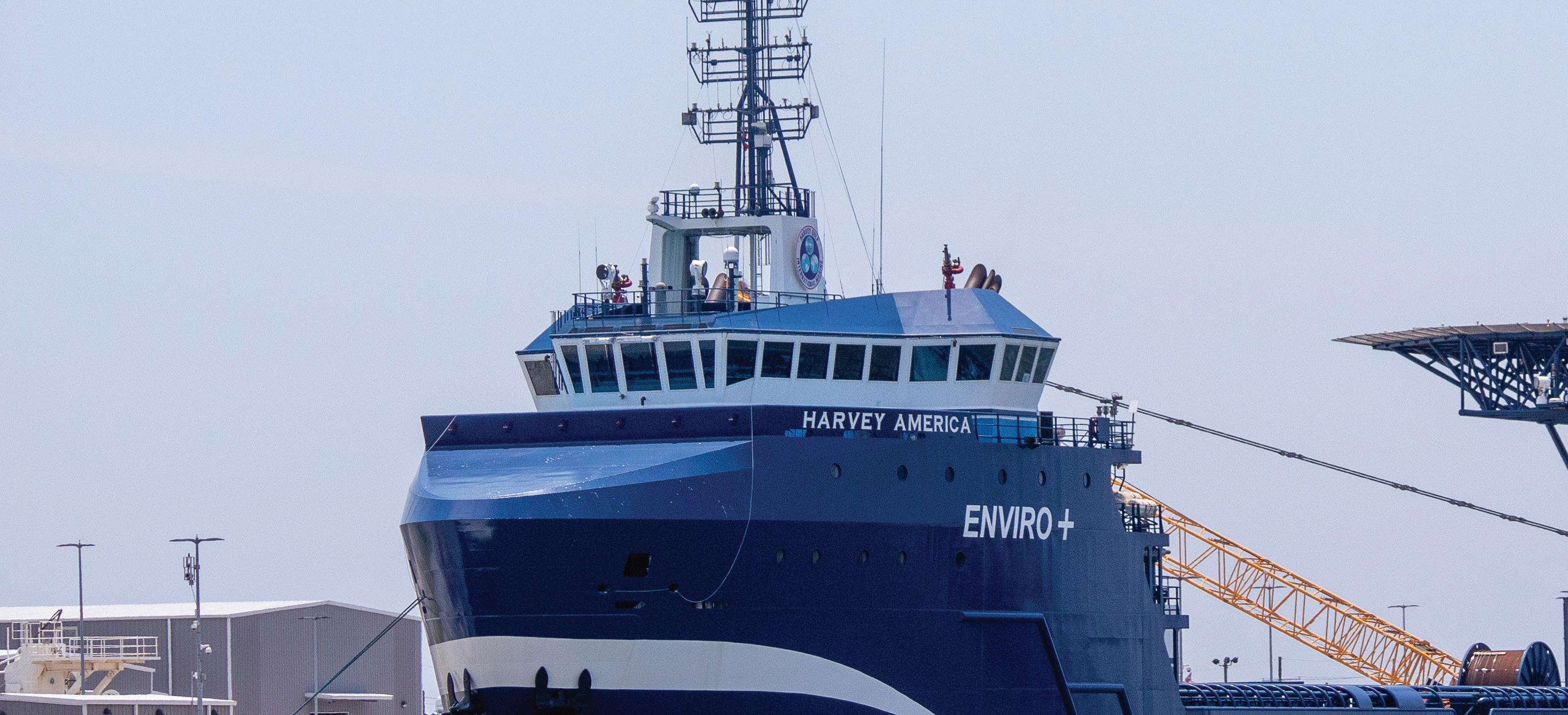
Holding a Turn
OSV market stabilizes as tonnage ages and projects shrink.
By Steve Mosco, Contributor
After several years of recovery, the U.S. offshore support vessel (OSV) market has settled into a steadier phase.
Activity across the Gulf of Mexico (renamed by the Trump administration as the Gulf of America) remains consistent, with vessels supporting drilling campaigns, subsea work, and ongoing maintenance programs. Compared with the prolonged downturn that de ned much of the previous decade, conditions are meaningfully stronger, but the engine driving that strength has changed.
For a time, the driver was a backlog of work built up during the Covid-19 pandemic. As that backlog cleared, activity crested around 2023 and has since leveled off. What remains is a market running on its underlying fundamentals rather than deferred demand.
Those fundamentals, however, are shifting. Offshore energy developers are gravitating toward smaller, incremental developments. Fewer large-scale projects are being sanctioned. And the eet supporting that work is aging in place, with essentially no newbuild activity to refresh it.
The oor has held. The ceiling has not moved.
POST-COVID SURGE
In the years immediately following the pandemic, offshore operators moved quickly to complete work that had been delayed. “They were in a rush to execute what had not been car-

ried out,” said Jean-Baptiste Rougeot, market intelligence lead at maritime data provider Spinergie. “Operators were booking vessels on both short- and long-term contracts to complete deferred work.”
That push created a temporary surge in demand, driven less by new investment and more by the need to catch up.
As those projects were completed, activity settled into a more normalized pattern. The backlog that sustained the recovery has largely worked through the system, and the market is no longer bene ting from the same surge of deferred work.
Simultaneously, investment in new large-scale offshore developments has remained limited. Fewer nal investment decisions, particularly in deepwater projects, have narrowed the pipeline of future work.
PROJECT MIX
The change is most visible in the type of offshore work now moving forward. Large developments once requiring sustained vessel support are giving way to smaller projects that can be brought online more quickly. In particular, tieback developments, which connect new wells to existing infrastructure, have become a larger share of activity.
“A tieback can require 10 times fewer vessels than a large green eld project,” Rougeot said.
Work continues across the Gulf, but jobs are often shorter in duration and less vessel intensive. The number of major deep-
water developments moving forward each year has declined, reducing the volume of work that typically supports long-term vessel demand.
As new construction stalls and project scopes narrow, operators are relying on existing vessels to meet demand.
That shift does not reduce activity outright. It changes how much support activity is required and, in turn, the types of vessels operators are prioritizing. Work tied to shorter-duration projects is increasingly aligned with vessels capable of subsea support rather than large-scale construction, a trend re ected in recent eet investments across the Gulf.
HIGH-SPEC DEMAND
On paper, the OSV market still appears to have available capacity. A signi cant portion of the eet is either off-hire or working intermittently, based on vessel activity tracked across the year. That suggests additional vessels could be brought back into service if demand increases. According to Spinergie, roughly 25% of the global OSV eet was off hire in 2025, with additional vessels laid up.
In the U.S. Gulf, much of that available capacity is constantly moving between on- and off-hire status. “The U.S. Gulf is a spot market,” Rougeot said. “Vessels move in and out of work depending on short-term demand.”
The result is a supply picture that looks exible but is less reliable in practice. Not every vessel labeled as technically available is ready to return to service or suited to current project requirements.
Availability and usable capacity are not the same. As work becomes more specialized, that distinction becomes more important. Much of the activity now moving through the Gulf requires higher-spec vessels equipped for subsea operations, survey, and inspection, limiting how much of the existing eet can realistically step into active roles, according to Rougeot.
AGING FLEET
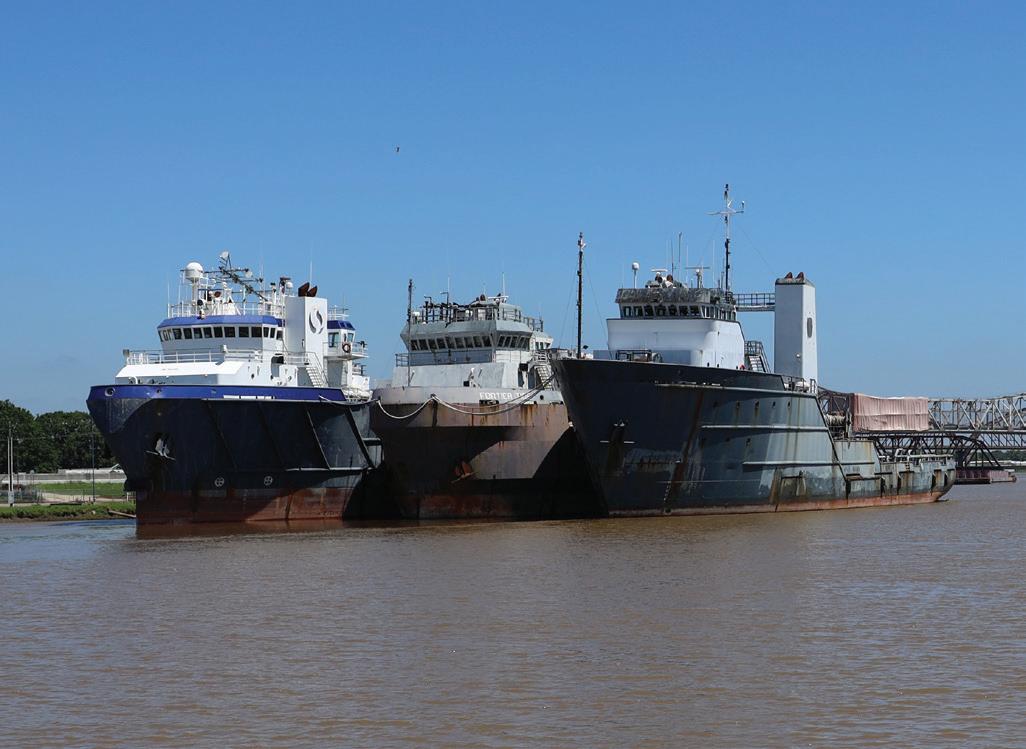
The most signi cant pressure on the OSV market is not on the demand side. It is the condition of the eet itself, Rougeot said. In North America, Spinergie data shows more than 60% of OSVs are now more than 15 years old, approaching or exceeding what is typically considered a 15- to 20-year operational life, though Jones Act vessels have routinely proven useful well beyond that threshold. “The eet is aging, and that will be the main challenge in the coming years,” Rougeot said. While older tonnage can get the job done, aging vessels are more dif cult to maintain, less ef cient to operate, and harder to bring back into service after being laid up. The industry has long relied on stacking and reactivation to manage swings in demand, which becomes less effective as vessels get older.
Doug Stewart photos
Older offshore support vessels sit stacked along the Atchafalaya River in south Louisiana. Many aging assets remain sidelined as offshore demand shifts toward higher-spec tonnage.
“A vessel that is stacked will age faster than one that is operating,” Rougeot said.
The constraint limits how much of the existing eet can realistically be reactivated, even if demand increases. In response, operators are investing in vessels that can meet evolving technical requirements. Morrison, Houma, La., for example, recently added a dynamically positioned dive-support vessel (DSV) to expand its ability to operate in deeper water and on projects requiring stationkeeping without mooring systems, a move driven by client demand for more advanced capabilities, the company said.
NO NEWBUILDS
Under normal conditions, an aging eet would trigger a new cycle of vessel construction. That cycle has not materialized across the U.S. offshore eet, and there is little sign it will anytime soon.
“Today, you don’t have the market conditions to build at a decent, pro table cost.”
— Jean-Baptiste Rougeot, market intelligence lead at Spinergie
Construction costs have risen sharply, and charterers, meanwhile, are not committing to the kind of large, long-term deals that typically support newbuild investment. “Today, you don’t have the market conditions to build at a decent, pro table cost,” Rougeot said.
The scale problem compounds this further. U.S. operators typically cannot place the volume of orders needed to drive down unit costs, while international competitors building in larger batches can spread expenses across multiple hulls. Without a clear return on investment, capital has shifted toward acquiring and upgrading existing vessels rather than commissioning new ones, a trend Rougeot said re ects both cost pressures and a lack of sustained demand. The industry is expected to rely on existing tonnage for the foreseeable future.


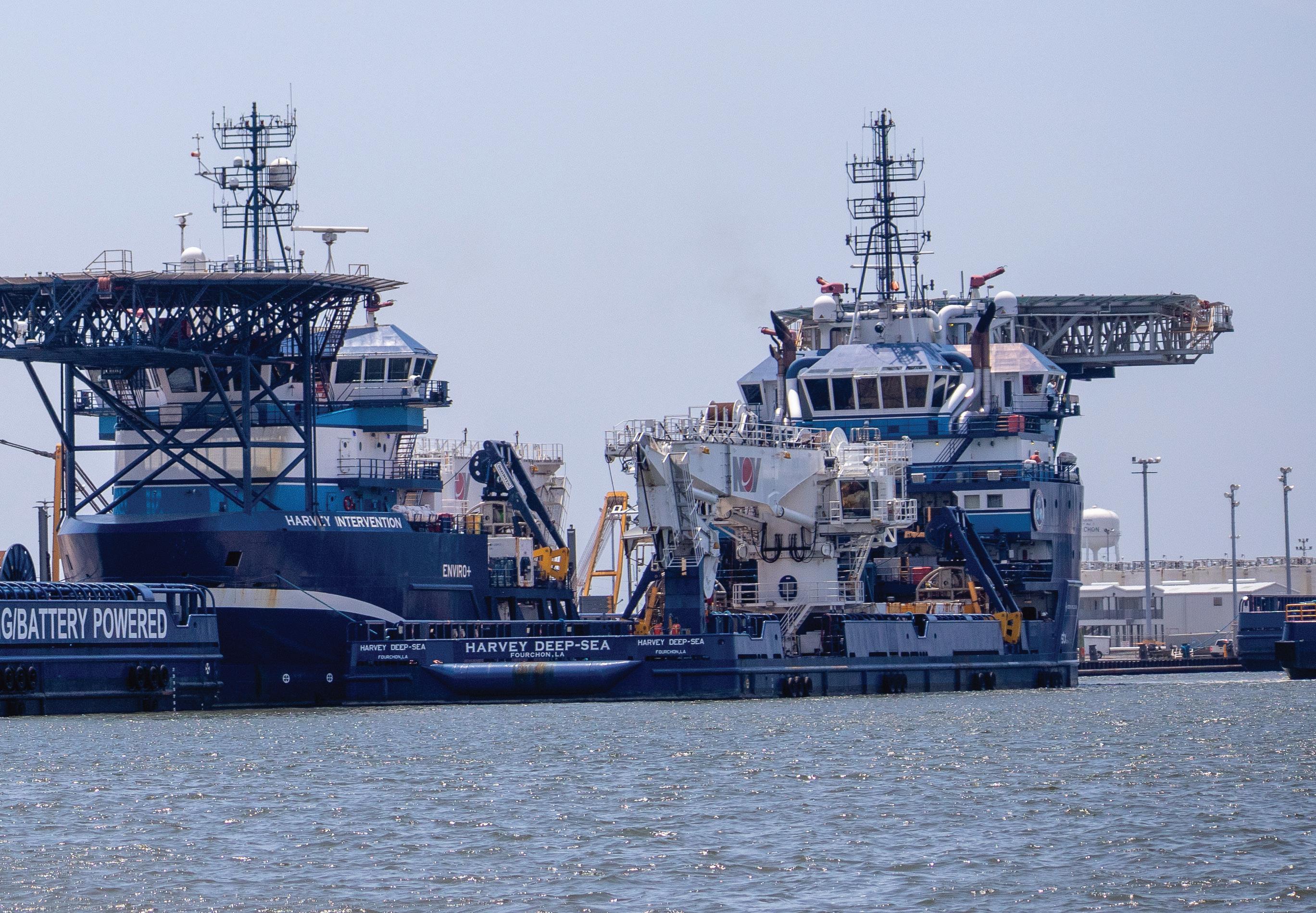
The vessels — renamed Blue-Sea, SubSea, Deep-Sea, and Intervention — were built between 2012 and 2017 and were secured at a price below current replacement cost. This highlights the gap between asset values and the cost of building new tonnage, which is shaping investment decisions across the sector, with operators able to acquire relatively modern, high-spec vessels at a fraction of what new construction would require, as Otto Candies executives noted in discussing the transaction.
Other operators are following a similar approach. Subsea services provider Aqueos Corp., Broussard, La., acquired the DSV Kelly Ann Candies after several years under charter, bringing a proven subsea asset into its eet and reinforcing the value of vessels with established roles in construction and inspection work, according to the company.


With OSV sector capital now owing to acquisitions and upgrades, investments are focused on higherspec assets that can support more complex work.
Recent transactions in the Gulf re ect that shift. Otto Candies LLC, Des Allemands, La., acquired four multipurpose support vessels from Harvey Gulf International Marine, New Orleans, in a deal valued at just under $500 million.
Upgrades are also extending the life and capability of existing vessels. Morrison expanded its dive-support eet with a dynamically positioned vessel for deeperwater operations, while Oceaneering International Inc., Houston, upgraded its Ocean Intervention II to support autonomous survey missions, allowing the vessel to carry out multiple survey functions simultaneously and improving ef ciency across subsea operations.
The focus has shifted from adding vessels to drawing more out of the ones already in service.
OFFSHORE WIND
Offshore wind has introduced new activity into U.S. offshore markets, but its impact on OSV demand remains limited.
According to Spinergie, offshore wind accounted for the equivalent of 16 full-time OSVs in 2025, based on vessel utilization across the year. Even when expanded to include the broader offshore construction and service eet, the total reaches 71 vessel equivalents.



























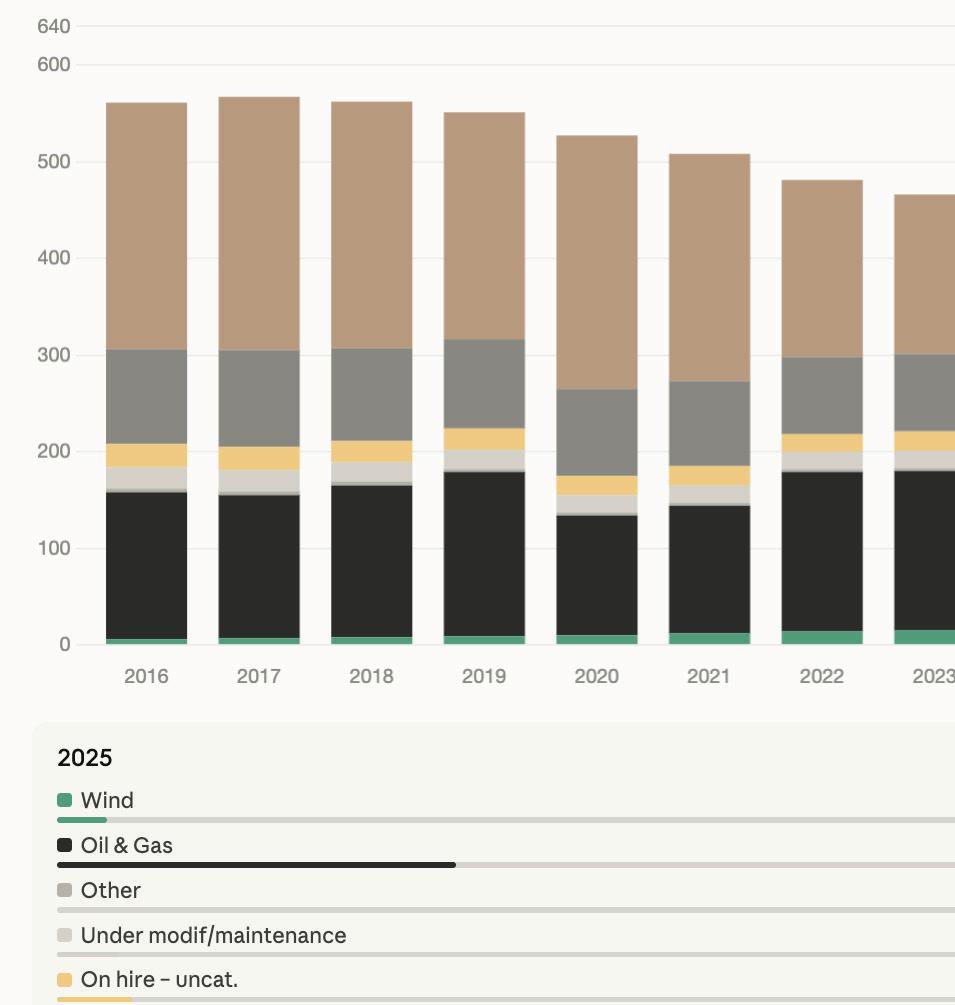

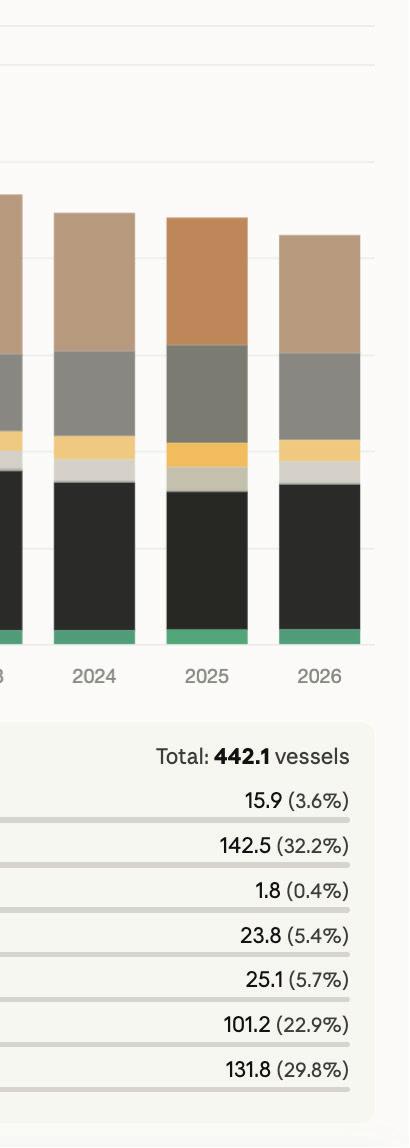
OSV utilization climbed sharply after 2020 before easing again, reflecting a post-pandemic surge that has since leveled off.
“Offshore wind has increased its share of activity, but it is still not the majority,” Rougeot said. “The OSV market remains anchored in oil and gas. We are not expecting wind to pick up in the short term.”
Some vessels continue to move between oil and gas and wind projects, particularly as project timelines shift, with subsea and construction vessels deployed across both sectors.
Policy uncertainty and project delays have limited offshore wind’s ability to generate sustained vessel demand. For now, it remains a supplemental source of activity rather than a primary driver of the OSV market.
PROJECT INFLUENCE
With fewer large-scale developments moving forward, each project carries more in uence.
The number of major offshore projects sanctioned in the U.S. has declined in recent years, reducing the volume of work that typically supports long-term vessel utilization. The market has shifted from several large developments annually to roughly one major project per year.
That change increases sensitivity to delays, cost pressures, and shifting investment priorities.
“The key question is whether new deepwater project investment returns,” Rougeot said. “We are watching whether new projects are sanctioned and whether exploration wells are successful, because that is what will drive future activity.”
Several developments remain under watch, including new exploration programs and potential nal investment decisions tied to recent lease sales. The success of those efforts will determine how much new work enters the system.
Without a broader pipeline, gaps between projects become more likely, and their impact on vessel demand becomes more immediate.
AGING PLATFORMS
One area where activity is expected to grow is decommissioning. In the Gulf’s shallow-water elds, aging infrastructure is reaching the end of its operational life. Hundreds of platforms are approaching removal, creating a steady pipeline of work tied to plugging, abandonment, and subsea operations.
Those projects require vessel support for inspection, heavy lifting, diving, and related services. Vessels like the Kelly Ann Candies are already positioned for this type of work, supporting pipeline installation, inspection, and subsea construction activities that closely align with decommissioning demand.
“Decommissioning will become a more important part of the market as infrastructure ages,” Rougeot said.
Decommissioning work tends to be smaller in scope but more consistent in frequency, favoring operators with specialized vessels already positioned in the market rather than those relying on broader eet availability, a pattern re ected in recent subsea-focused acquisitions and upgrades.
The Chouest Group, Cut Off, La., is among companies eyeing expansion into the sector. In March, it announced a deal to acquire Champagne Energy Solutions, Houma, La., a U.S. Gulf provider of decommissioning, plug and abandonment, and environmental services that operates a eet of four DSVs and a pipelay barge. In announcing the acquisition, Chouest said, “Additional strategic acquisitions [are] expected in the near term as the company builds a fully integrated platform in this space.”
“We see decommissioning as one of the most important and fastest-growing segments of the offshore energy market,” the company’s executive vice president, Dino Chouest, said in a statement.
POISED FOR CHANGE
The U.S. OSV market is holding its position, but it is no longer expanding in the way it once was. Demand remains steady, but it is more selective. Supply exists, but much of the eet is aging and not all of it can be readily returned to service. Operators are adjusting by extending the life of existing vessels, upgrading capabilities, and concentrating on assets that can support more specialized work.
What comes next depends on whether new deepwater projects move forward and whether the industry can continue to operate within the limits of the eet it already has in service.

Spinergie


FROM COASTAL PATROL TO OFFSHORE OPERATIONS
Mercury delivers the diesel torque and SeaPro™ durability government and commercial operators rely on.

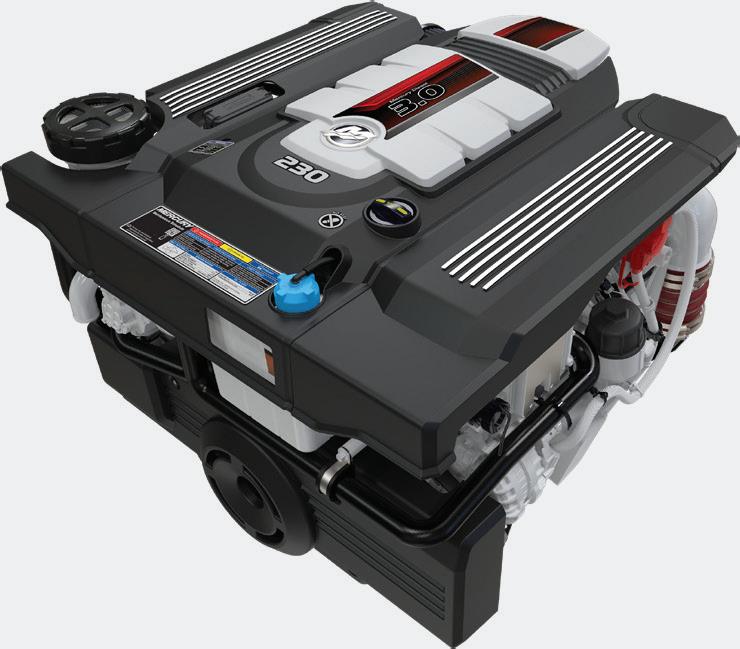

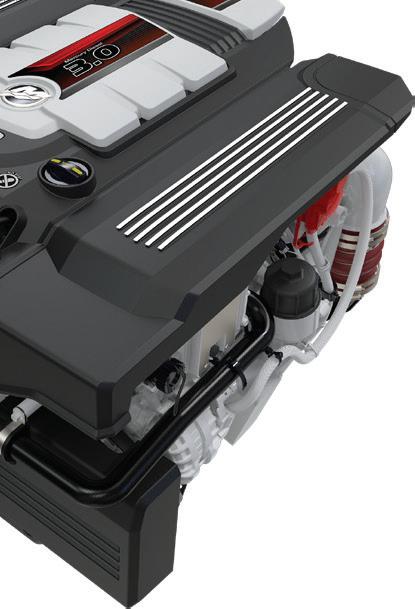

The New Standard in Diesel Performance
The 3.0L Mercury Diesel engine delivers high torque housed in lightweight design. Available in 150hp to 270hp, with advanced common-rail fuel injection and 50-state emissions compliance, it’s quiet, clean, fuel efficient and ideal for extended patrol cycles.

SCAN TO LEARN MORE



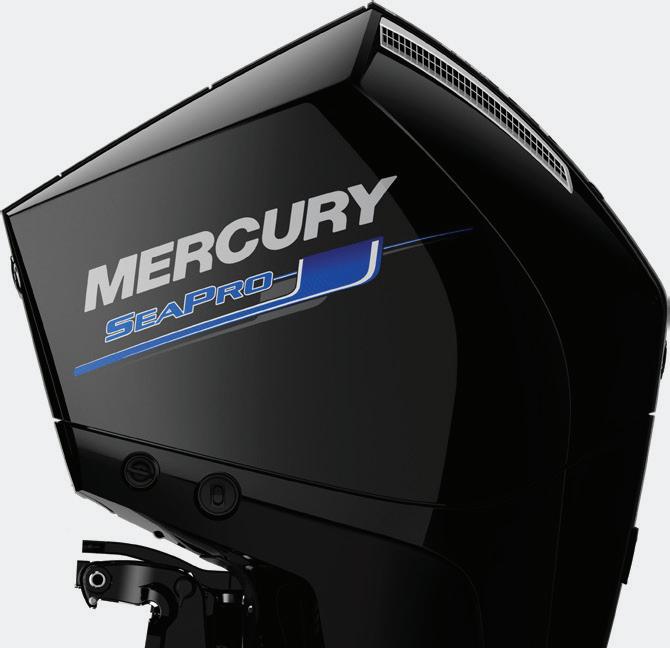
Uncompromising Power for Saltwater Environments
Built for the rigors of professional use, SeaPro outboards feature heavy-duty components and enhanced corrosion resistance to maximize uptime, minimize maintenance and keep your team on the water no matter what.

SCAN TO LEARN MORE
VESSEL REPORT Fireboats
Fighting Fires
Demand holds steady as reboat builders push multimission designs.
By Ben Hayden, Senior Associate Editor
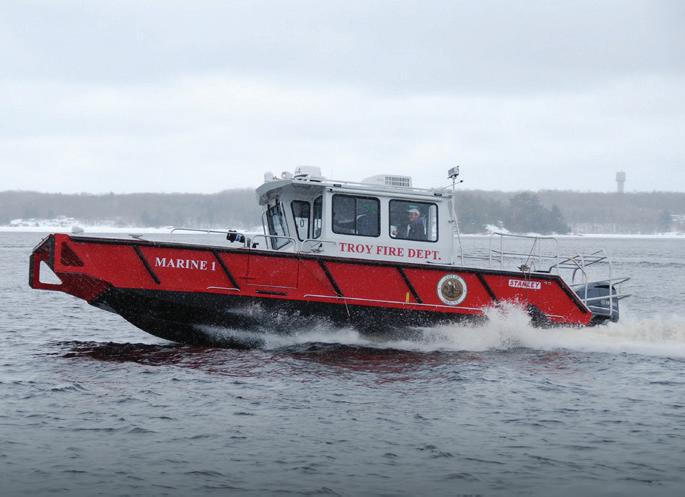
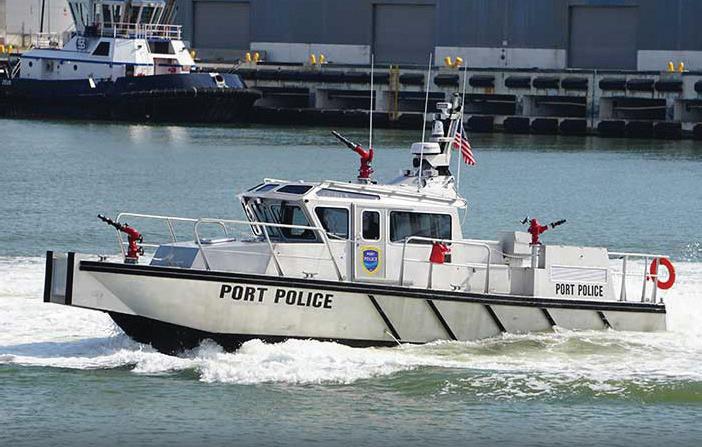
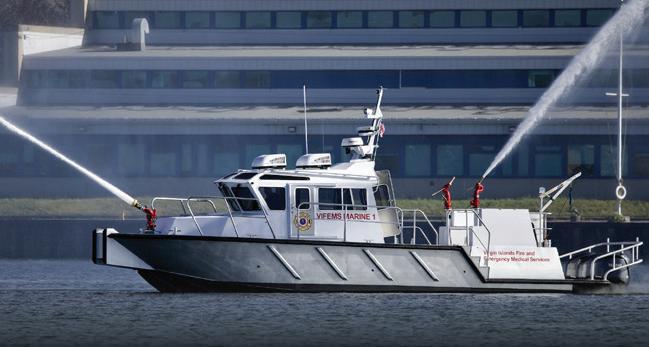
Fireboats are a critical part of port and waterfront emergency response, providing re ghting capability where land-based equipment can’t reach. From vessel and waterfront facility res to bridge and shoreline incidents, reboats serve as both primary responders and mutual-aid platforms for municipal re departments, port authorities, and industrial operators.
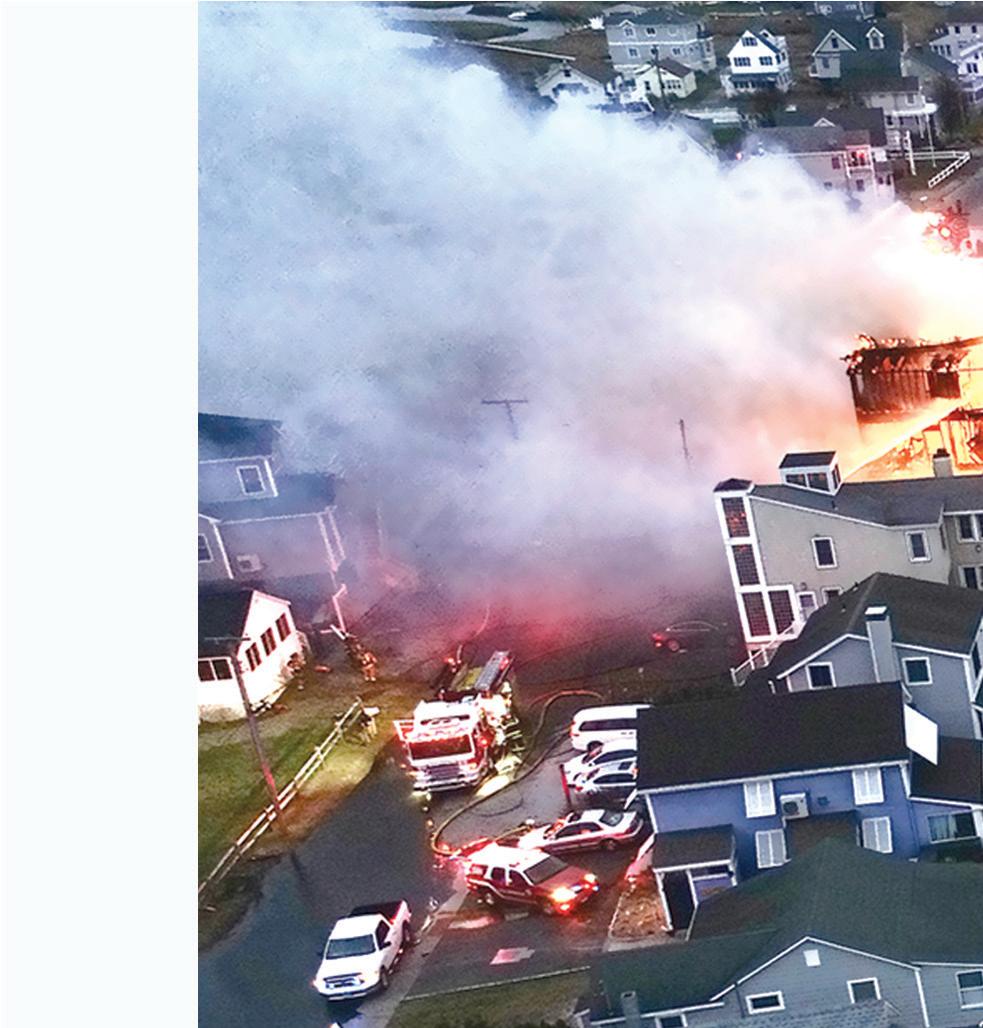
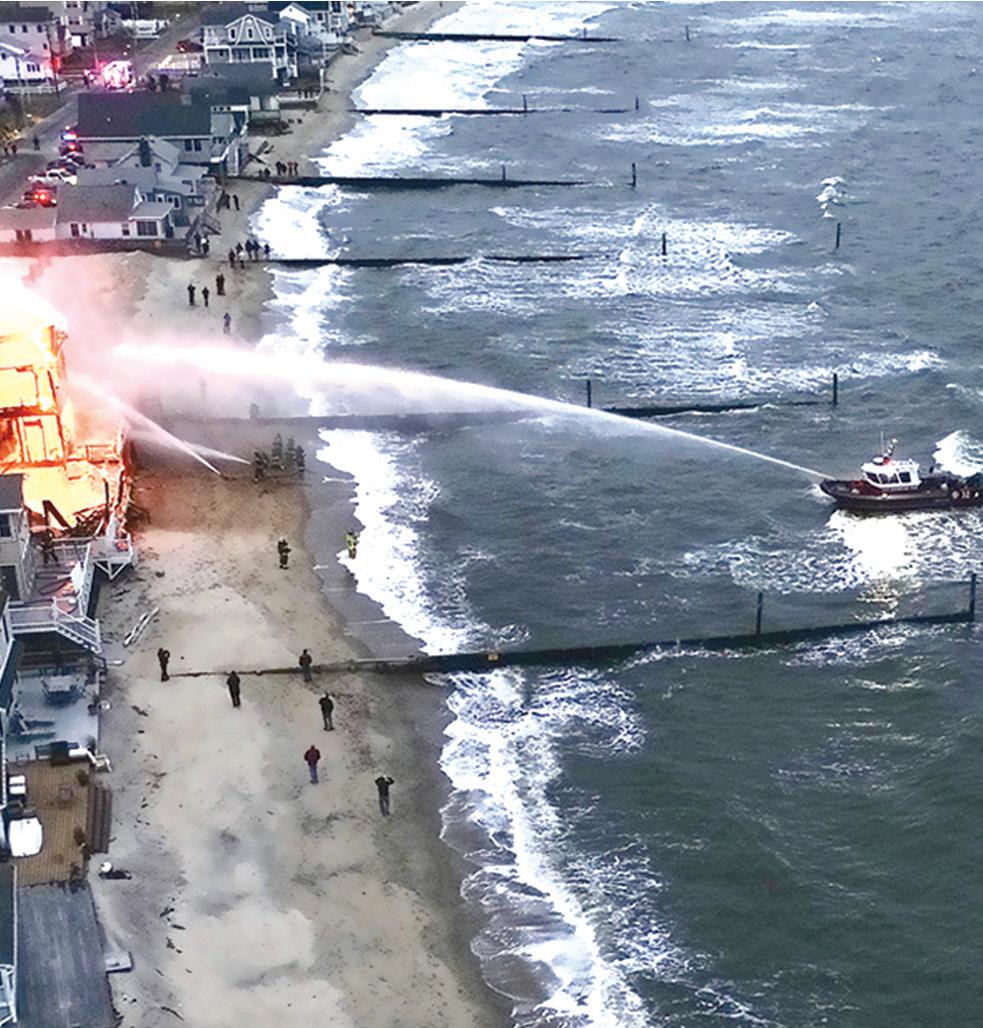
Recent incidents, like a barge re on Delaware Bay and a towboat re near Pittsburgh, continue to highlight the need for dedicated marine re ghting assets capable of delivering large volumes of water while maintaining maneuverability in con ned waterways.
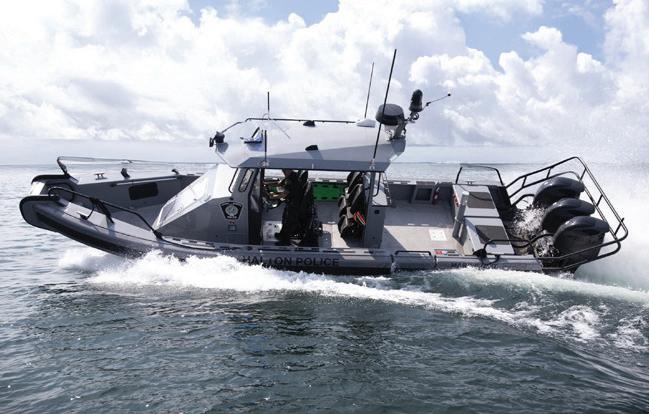
Modern reboats are increasingly being designed as multimission platforms. In addition to re ghting, many are equipped for search and rescue, emergency medical services (EMS), towing, dive operations, and law enforcement support. Builders report steady demand driven by aging municipal eets, expanding port infrastructure, and increasing safety requirements at energy terminals and cruise facilities. The following builds highlight recent reboat activity and market trends from several U.S. builders.
METAL SHARK
Metal Shark, Jeanerette, La., has built a substantial position in the reboat market over the past decade, producing its Deant hull series in sizes ranging from 21' to 100'. The builder’s reboat business began gaining traction around 2012 and has been a consistent part of its portfolio since a more focused push into the market in 2015.
Dean Jones, vice president of sales, said the company typically has a couple dozen reboats on order at any given time, spanning various stages of production. Of those, roughly 70% are replacement boats for aging eets, about 20% are for departments upgrading or expanding existing programs, and around 10% are for entirely new programs.
“There’s not a lot of new startups,” Jones said. “A lot of times it’s departments that had a boat in the past, shut the program down for funding reasons, and are now reopening it.”
That pattern of lapsed and relaunched programs speaks to a broader tension in the reboat market: demand is broadly understood to exceed supply, but municipal budgets often force departments to suspend marine operations until a crisis or an opportunity for grant funding brings programs back online.
At Metal Shark, the design process starts with mission
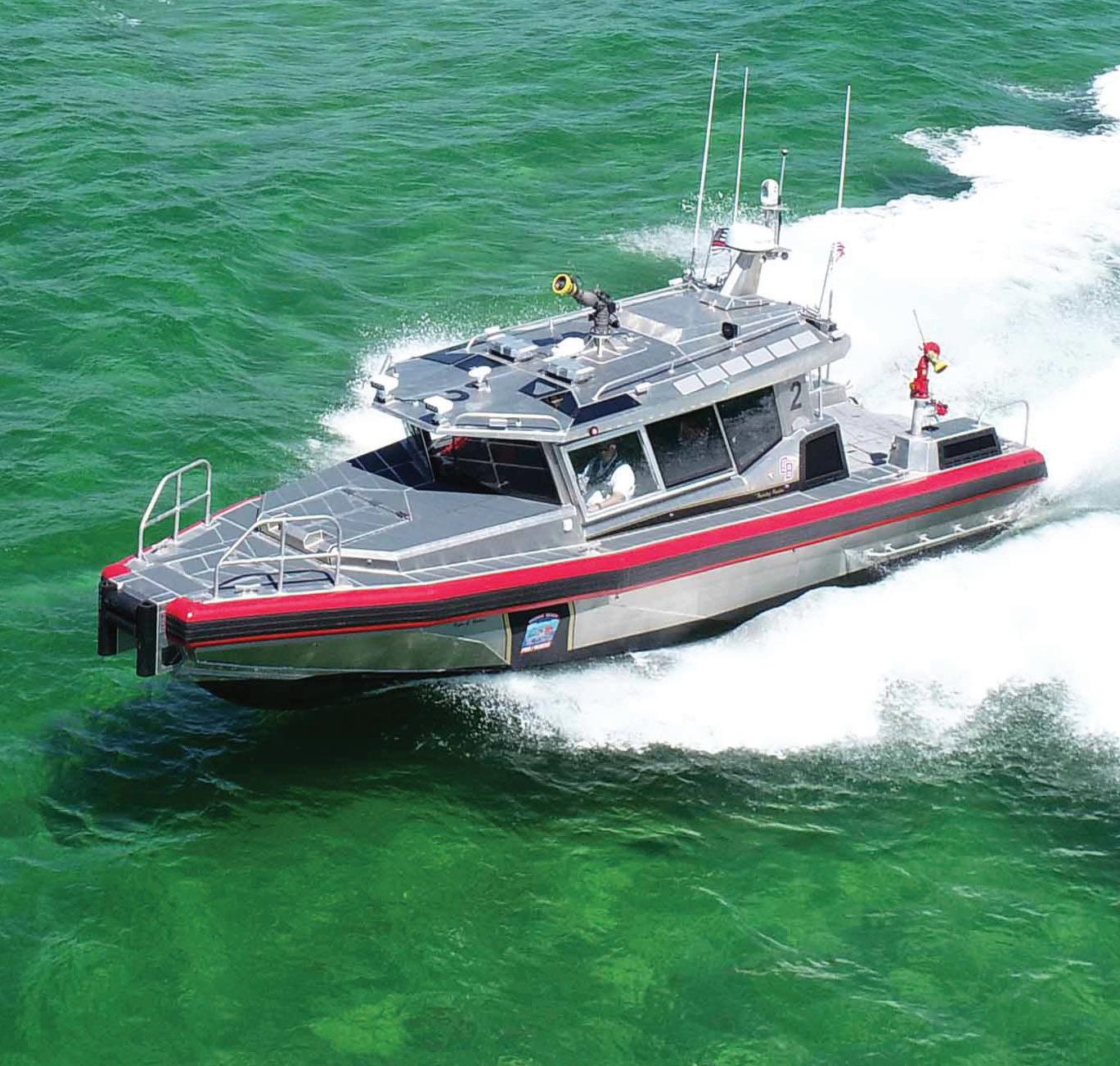

de nition, Jones said. The company works with prospective customers to identify primary, secondary, and tertiary missions before settling on hull size, propulsion, or pump con guration. Because many reboats are deployed more often for rescue and EMS response than for re ghting, the builder is careful not to put oversize re pumps on smaller hulls.
“Build the boat around what it’s going to do most, then include the other ancillary things that it might do as long as they don’t hinder or get in the way of the things it’s going to do most,” Jones said.
Even neighboring departments can end up with very different vessels depending on their operational areas. Jones noted Miami-Dade County and the City of Miami as an example — two departments operating in close proximity whose reboats serve different missions, with differences playing out in layout, equipment storage, medical gear, and crew work ow. The goal, he said, is a vessel con gured so clearly that crews can focus entirely on the incident rather than on managing the boat.
“If it’s set up the right way and the proper equipment is there, then they don’t have to think about how to do what they’re going to do. They can just do it,” he said.
Metal Shark’s most common platform is its 38' De ant,
Metal Shark
Metal Shark delivered the first of two 38' Defiant NXT fireboats to Tampa (Fla.) Fire Rescue. The second is currently in production.
available in inboard or outboard congurations. Inboard propulsion supports larger pumps and higher ow rates, while outboards offer speed, lower cost, and simpler maintenance — attributes that attract departments whose primary focus is rescue and EMS rather than large-scale re ghting. Jones noted that the price difference between the two con gurations can prove decisive for smaller municipalities working within tight capital budgets.
Jones said funding remains the central constraint on how quickly the national reboat eet can modernize. Many departments rely on grants or special programs, and nancing options for marine re apparatus remain limited compared with land-based equipment. “The primary responder for safety on the water is a reboat,” he said. “There’s a big disparity between how many we need and how many we have.”
MOOSE BOATS
Moose Boats, Vallejo, Calif., has delivered multiple reboats over the


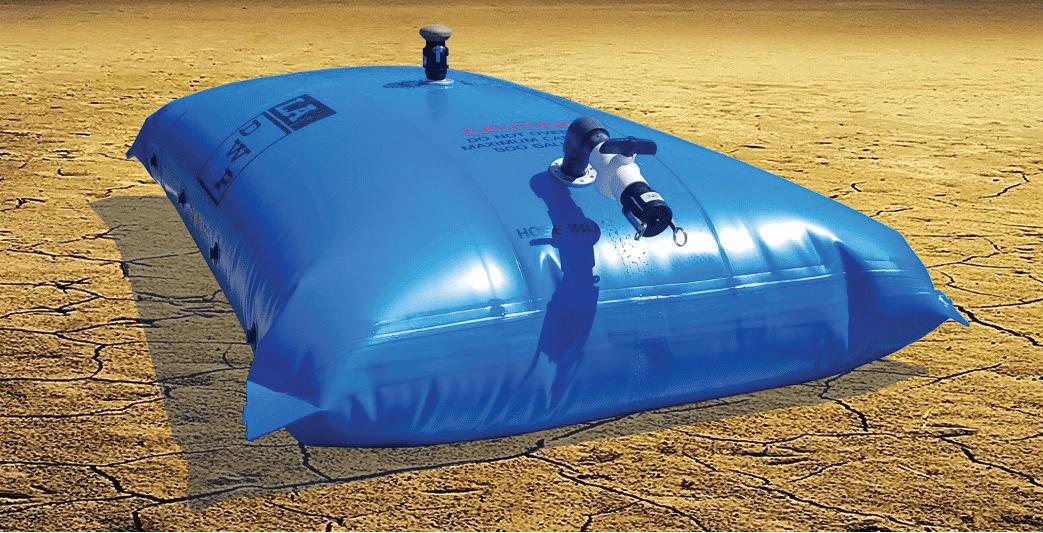




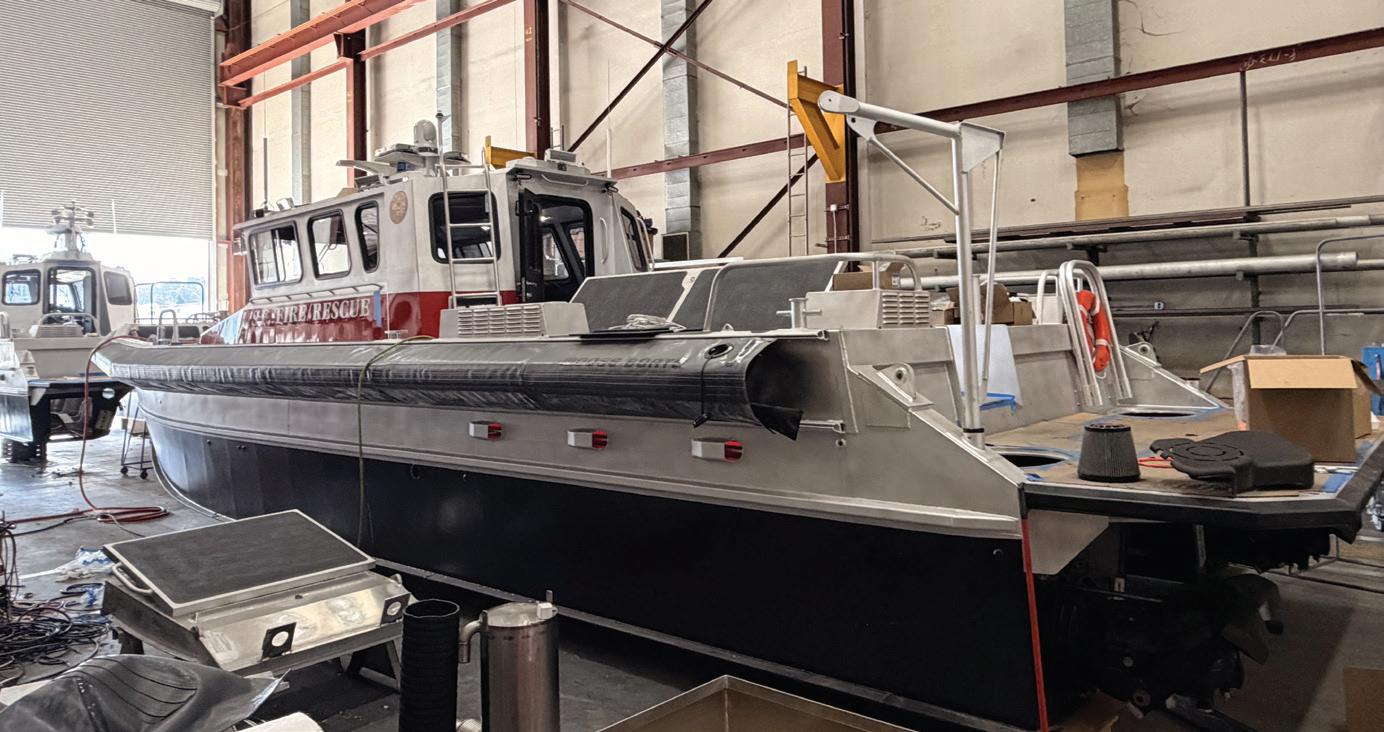

past year and continues work on several specialized response vessels, according to Ken Royal, vice president of sales. The builder has carved out a distinct position in the market through its catamaran hull designs and adoption of re pumps that are driven by power takeoff (PTO) systems, he said.
Among recent deliveries is a reboat for the Santa Barbara Harbor Patrol, completed in March 2025, followed by an M2-38 reboat for the Boston Fire



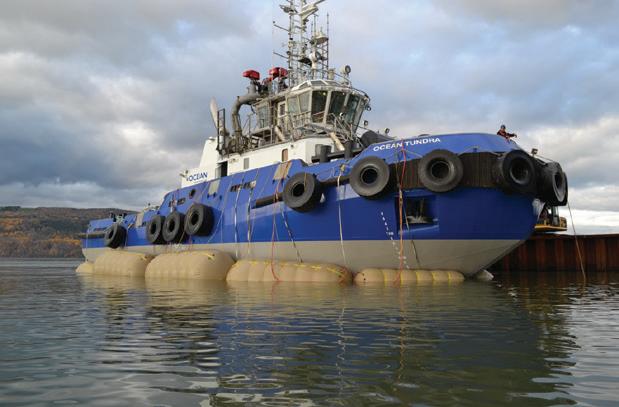









Department later in the year. The Boston vessel is powered by twin 425-hp Cummins QSB 6.7-liter engines equipped with two 1,500-gpm re pumps producing a combined ow of roughly 3,800 gpm, driven through a PTO system connected to the propulsion engines rather than a dedicated pump engine.
Royal said the PTO-driven approach reduces weight and maintenance by eliminating a separate engine for the re pump. Under the arrangement, most en-










Moose Boats
A 46' catamaran under construction at Moose Boats, designed for airliner rescue response at San Francisco International Airport.
VESSEL REPORT Fireboats
gine power is directed to the pump while enough remains for propulsion to hold position during re ghting operations.
A 46' catamaran that Moose is constructing for the San Francisco Fire Department is one of the more missionspeci c builds in the company’s portfolio. “The primary use of that vessel is speci cally to act in the capacity of a rescue vessel in the event of an airliner down,” Royal said. To be stationed at
San Francisco International Airport, the vessel will be equipped with a 1,200gpm re pump and will also carry approximately 50 ten-person life rafts for mass rescue operations.
SAFE BOATS
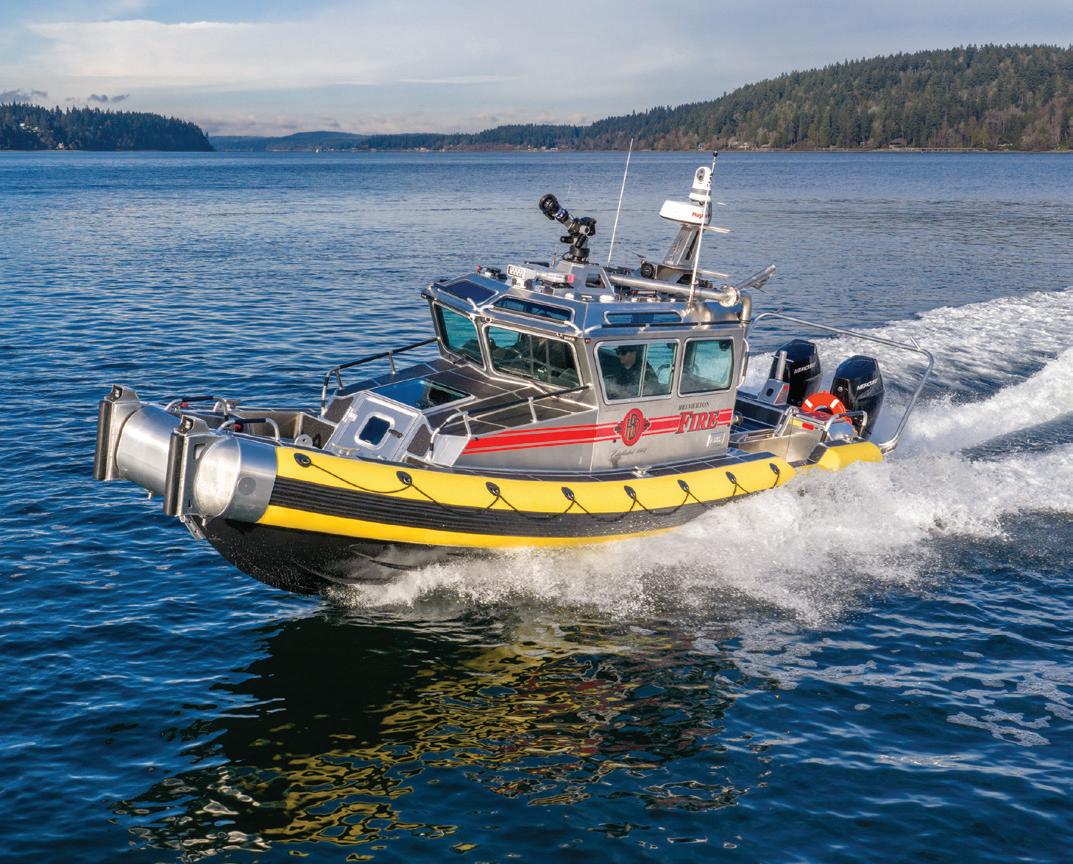
SAFE Boats International, Bremerton, Wash., continues to see steady demand for municipal reboats and emergency response vessels. A recent
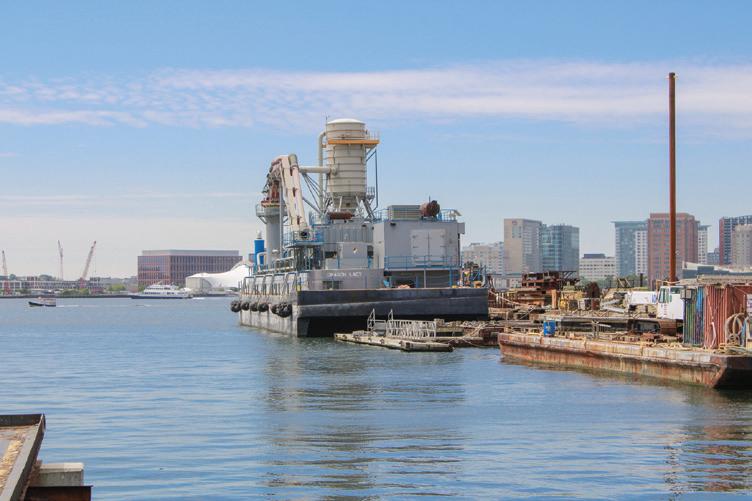
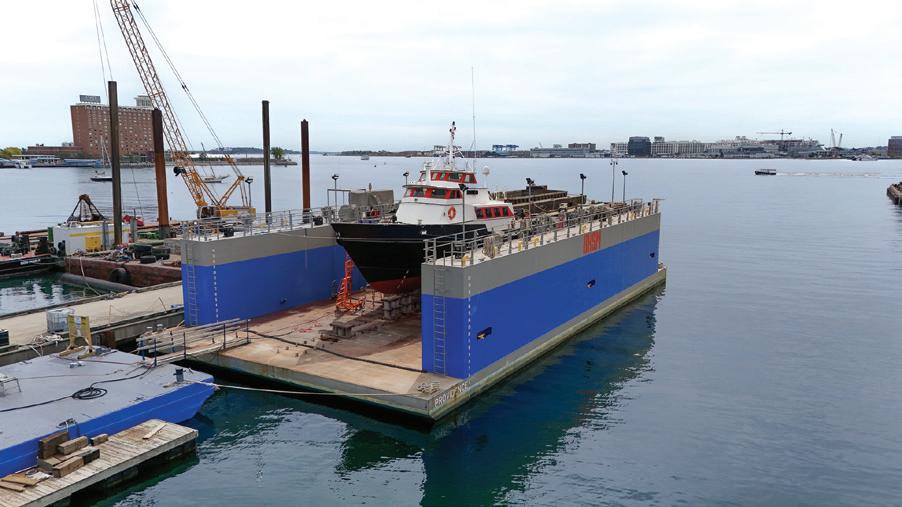
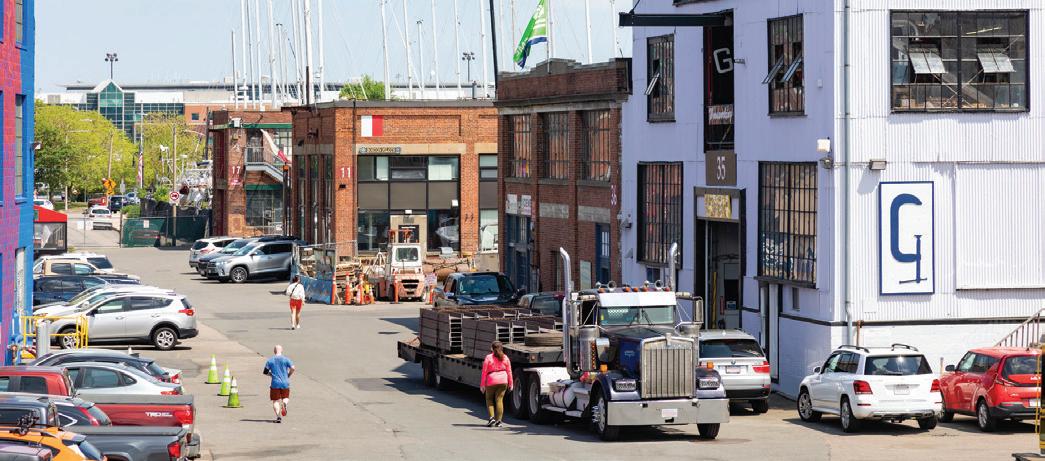
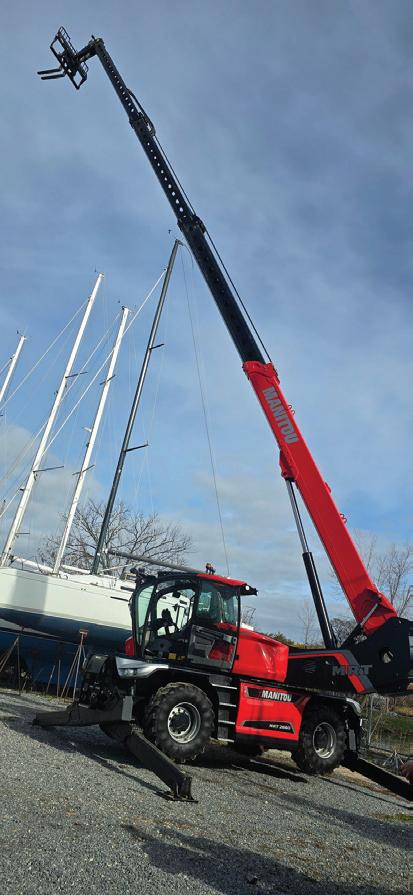
BOSTON’S
MARINE FACILITY
delivery to the Bremerton Fire Department illustrates the company’s approach to the customization demands that make reboats more complex than standard patrol boats.
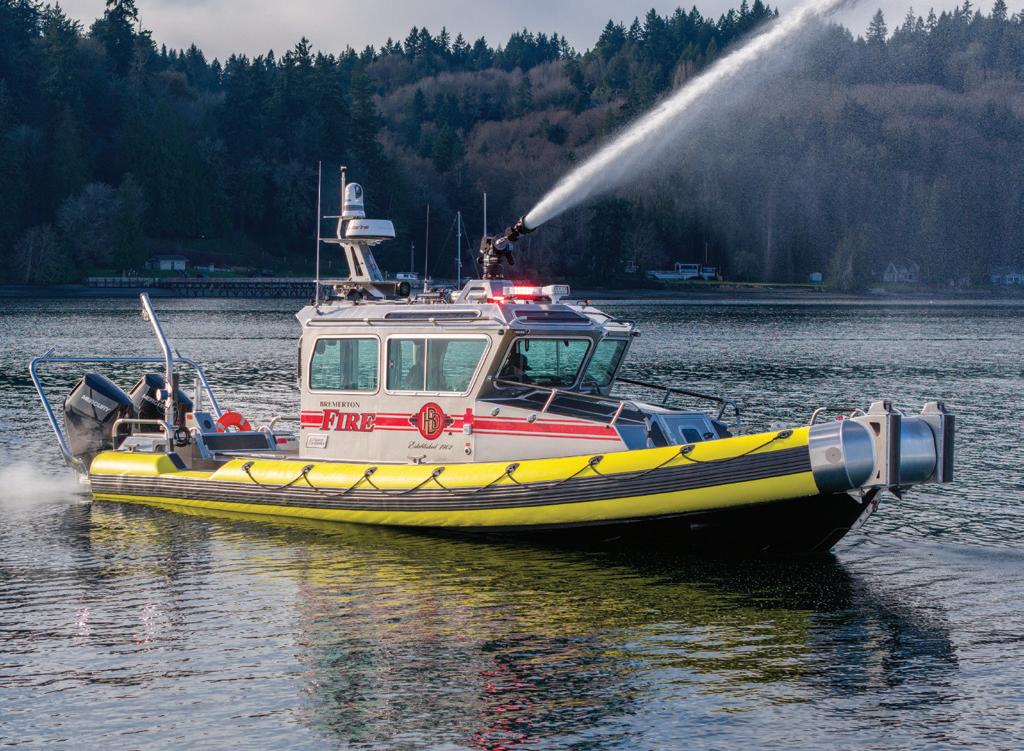
The 33' full-cabin vessel features a 1,000-gpm re pump positioned in an aft locker rather than the bow to preserve cabin space, a reinforced engine compartment deck for heavy gear, a dropdown bow for shore access along undeveloped coastline, and a davit for search-and-rescue operations.
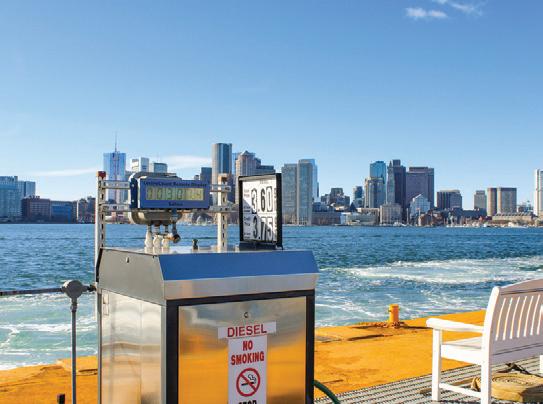
Fireboats require considerably more stakeholder involvement than police boats, which tend to carry similar equipment across agencies, according to Scott Clanton and Cole Christianson, who do business development for SAFE Boats. Fireboat designs are built around speci c operational pro les, with equipment combinations ranging from bow, roof, and aft monitors to re pumps between 500 and 1,500 gpm, a level of customization that demands extensive front-end engineering.
One notable trend is a continued shift toward outboard propulsion, Clanton said. Modern high-horsepower outboards offer maneuverability comparable to the inboard engines and waterjets, while simplifying maintenance, reducing downtime, and freeing up interior space, he said, noting this provides a practical advantage for agencies that cannot afford extended out-of-service periods.
SAFE Boats builds a range of re pump con gurations, including a commonly used 500-gpm Darley pump installed in a transom locker that integrates across multiple platforms without signi cantly affecting deck layout. The company also builds EMS and searchand-rescue vessels, which are becoming more common as departments shift toward rescue and medical response missions.
Current projects include a 38' reboat for the Broward County Sheriff’s Of ce out tted with multiple re monitors and an articulating mast that lowers to pass under bridges.
“The re department guys, they ask for everything and the kitchen sink,” Clanton joked, noting that re ghters
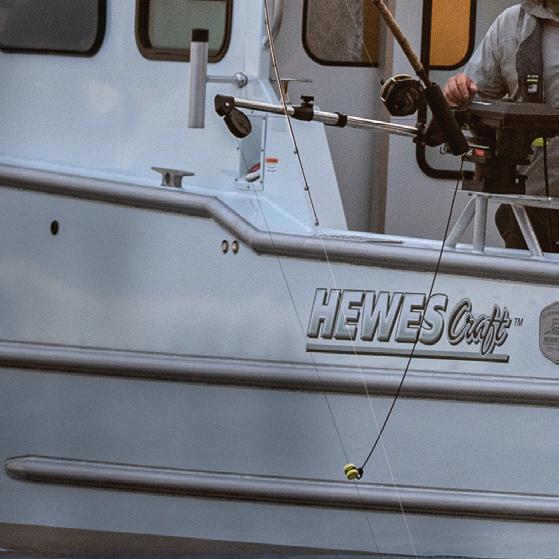
THE BEST WARRANTY ON THE WATER JUST GOT BETTER.
























WHILE



OTHERS



WATER DOWN THEIR WARRANTIES, WE’RE EXPANDING OURS.
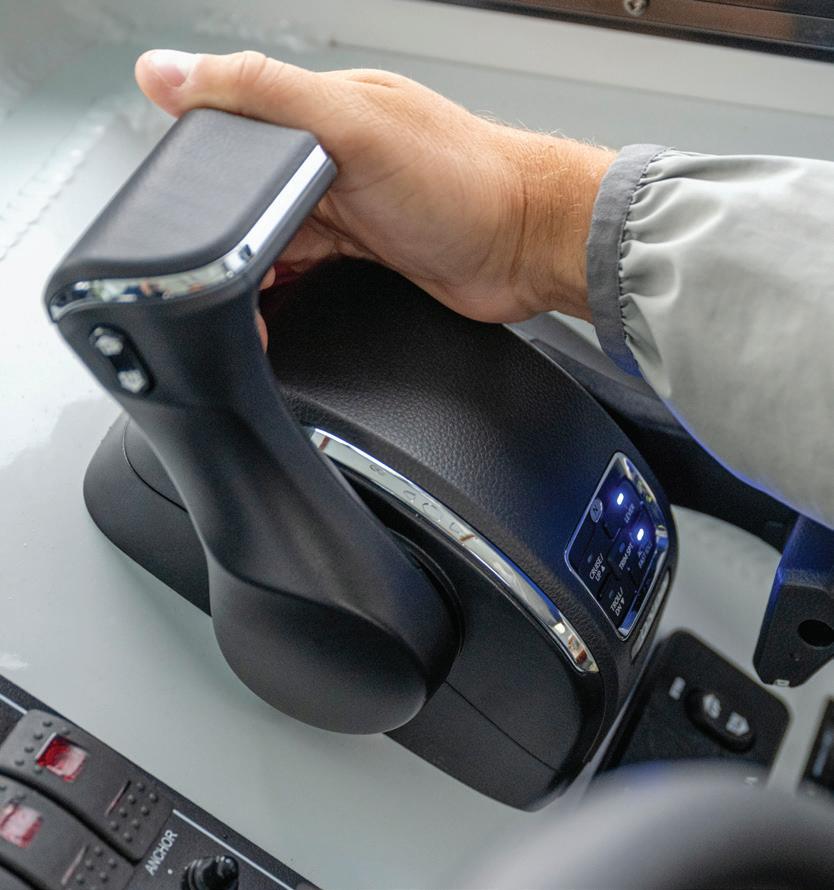
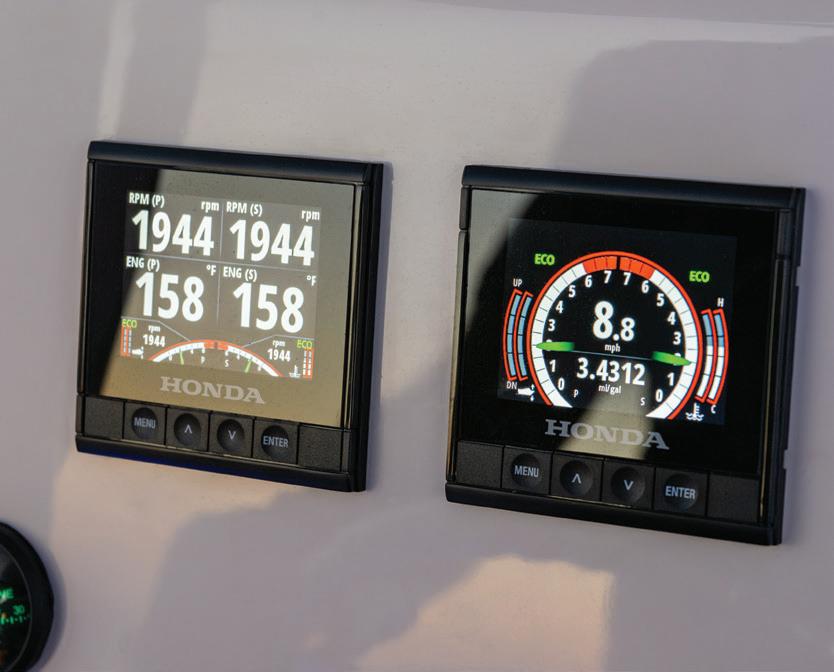
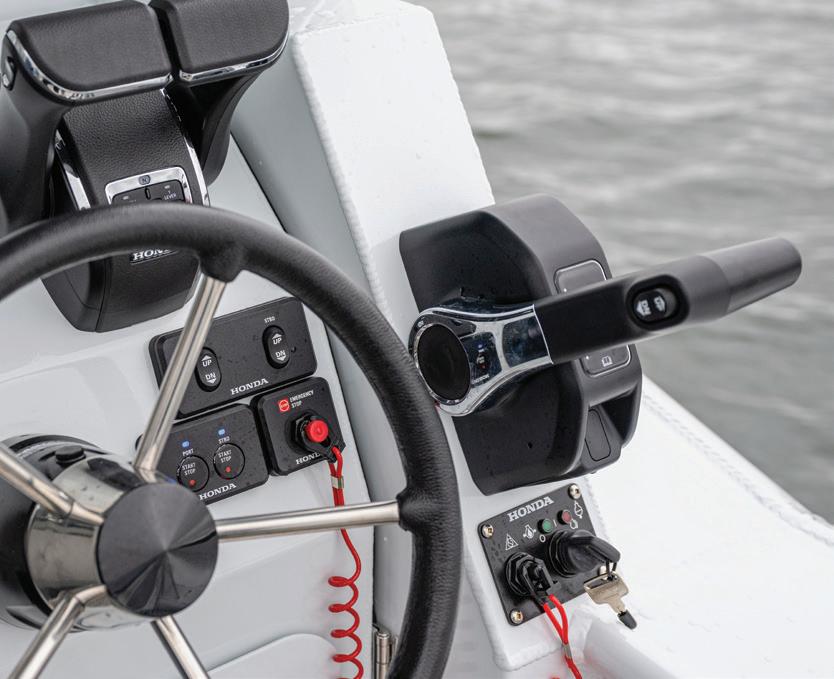
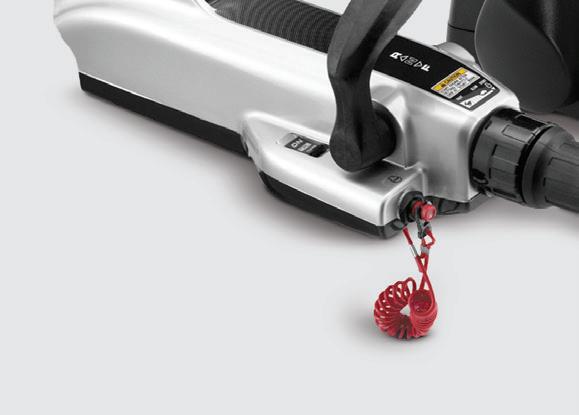
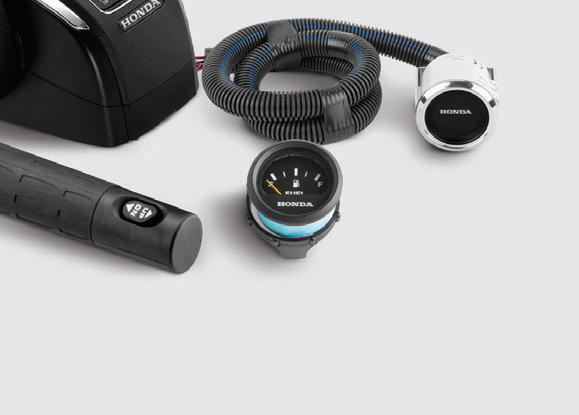
Introducing Honda Marine True 5 Limited Warranty expanded rigging coverage. The industry’s best warranty now provides five full years of peace-of-mind protection on Honda Marine rigging components and systems for new package boat sales and repowers.* Rigging coverage includes controls, control cables, gauges, switches, tiller handles, displays, and more.
True 5 is a factory-direct warranty, fully backed by Honda Marine. There’s no pro-rating that decreases coverage over time, and it’s fully transferable. So, get more coverage wherever the water takes you with Honda Marine True 5 Limited Warranty expanded rigging coverage. It’s the next wave in warranty protection.




*Applicable





VESSEL REPORT Fireboats


are accustomed to having extensive equipment and amenities on a fully outtted retruck. “A lot of times you have to start pulling them back away from, it’s got to oat rst and operate, you know.”
METALCRAFT MARINE
MetalCraft Marine, whose reboats and patrol boats earned WorkBoat’s Boat of the Year honors in 2020 and 2022, continues to see steady demand across its reboat product lines, particularly in the municipal and port markets.
MetalCraft Contracts Manager Bob Clark said the company continues to see strong demand for its FireStorm series vessels, noting their “best big boat seller is the FireStorm 4344.”
The boatbuilder is running approximately 18 months out on new reboat builds, re ecting steady demand from re departments and port authorities.
Clark said a recent trend has been



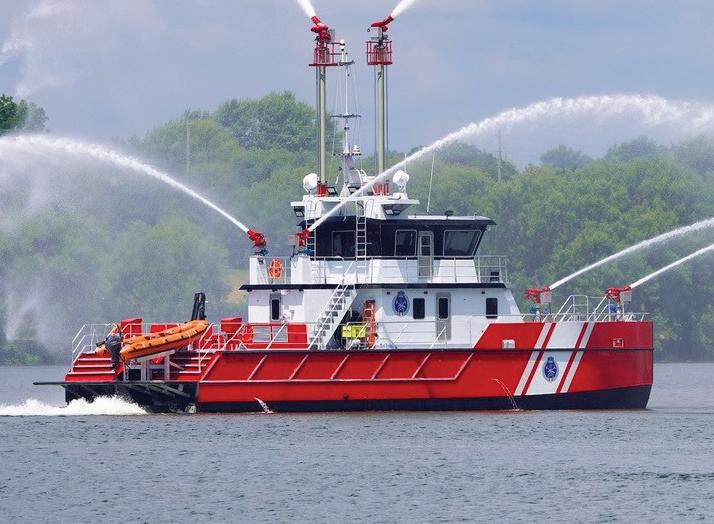

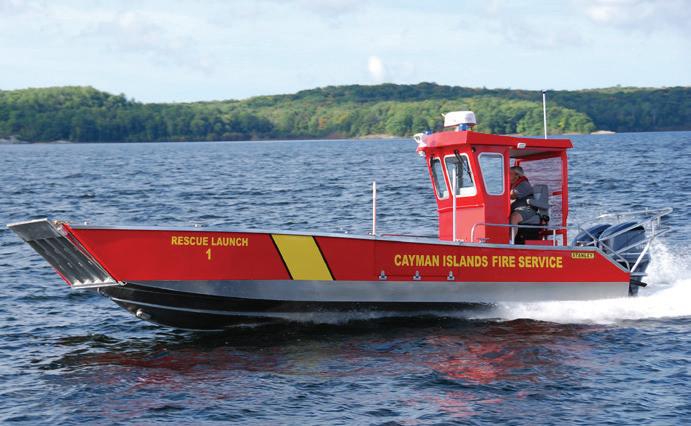
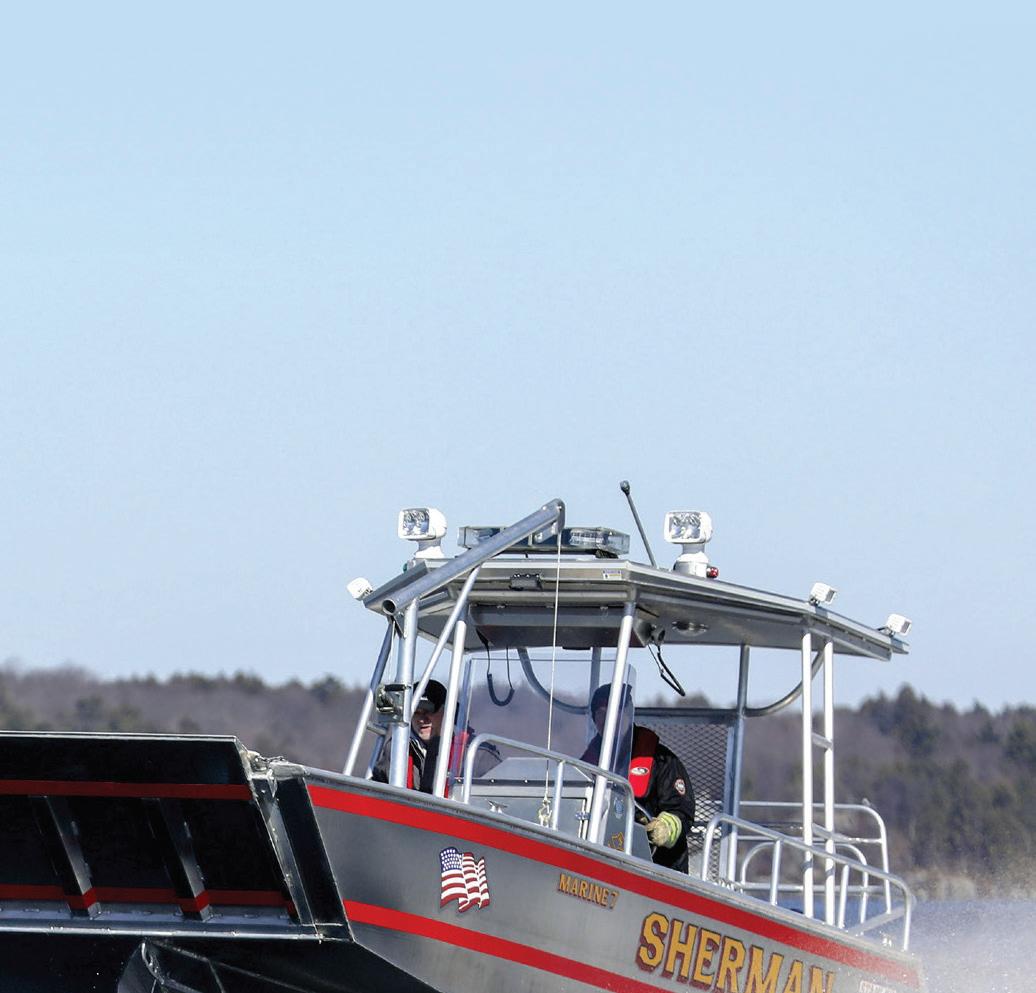
the use of landing craft bow designs on re-rescue boats, though the conguration is appropriate only in certain circumstances. “The landing craft thing is a very unique boat, and it really ts certain shorelines,” he said. “If you’ve got any kind of sea state, that’s not the best thing to go with. But in rivers, beachfronts, and urban waterfronts, it works very well.”
With larger builds, Clark pointed to major ports as the primary drivers of demand for high-capacity reboats. Jacksonville, Fla., operates a mix that includes Firestorm 50' and 70' vessels alongside landing craft-style rerescue boats and smaller conventional reboats. In Texas, the ports of Corpus Christi and Houston represent the kind of industrial reboat customers who require vessels capable of delivering enormous volumes of water to support petrochemical facility operations.
Clark cited a re nery re in the
Houston area where multiple large reboats pumped water continuously for several days through large-diameter hoses to supply land-based crews after the facility’s built-in re ghting systems were destroyed by explosions. “These big boats can move massive amounts of water,” he said. “You’re talking about 15,000 gallons per minute. That’s hard to conceive.”
MetalCraft’s most popular reboat size remains its 43' to 44' platform. San Diego, for example, is replacing older 36' reboats with new 44' vessels that offer greater re ghting capacity and expanded mission capability.







Speed is another factor reshaping procurement decisions. Historically, some ports operated large displacement reboats capable of high pumping volumes but limited to speeds of around 10 to 12 knots. Clark said response time has become a major variable in purchasing decisions, and some departments that opted for slower vessels in the past are now reconsidering after observing how delayed response affects outcomes. “The thing about time and a re is if you take too long and it gets fully engulfed, then you can’t put it out,” he said.
Across builders, the picture that emerges is a market driven by aging eets, port infrastructure expansion, and rising operational expectations but constrained by the realities of municipal nance and procurement timelines. The vessels being built today are more capable, more versatile, and often faster than what they are replacing.
MetalCraft Marine
roudl made in the U.S. .
MetalCraft’s 85'x26'x12' aluminum firefighting, rescue, and patrol boat won WorkBoat’s Boat of the Year in 2022. The boatbuilder has several of this design in production.
SAFE Boats recently delivered a 33' full-cabin fireboat to the Bremerton (Wash.) Fire Department powered by twin Mercury 400-hp outboards.
SAFE Boats
The Huck BobTail® R delivers the same vibration-resistant, maintenance-free strength you expect from Huck—now with a twist: it's fully removable.
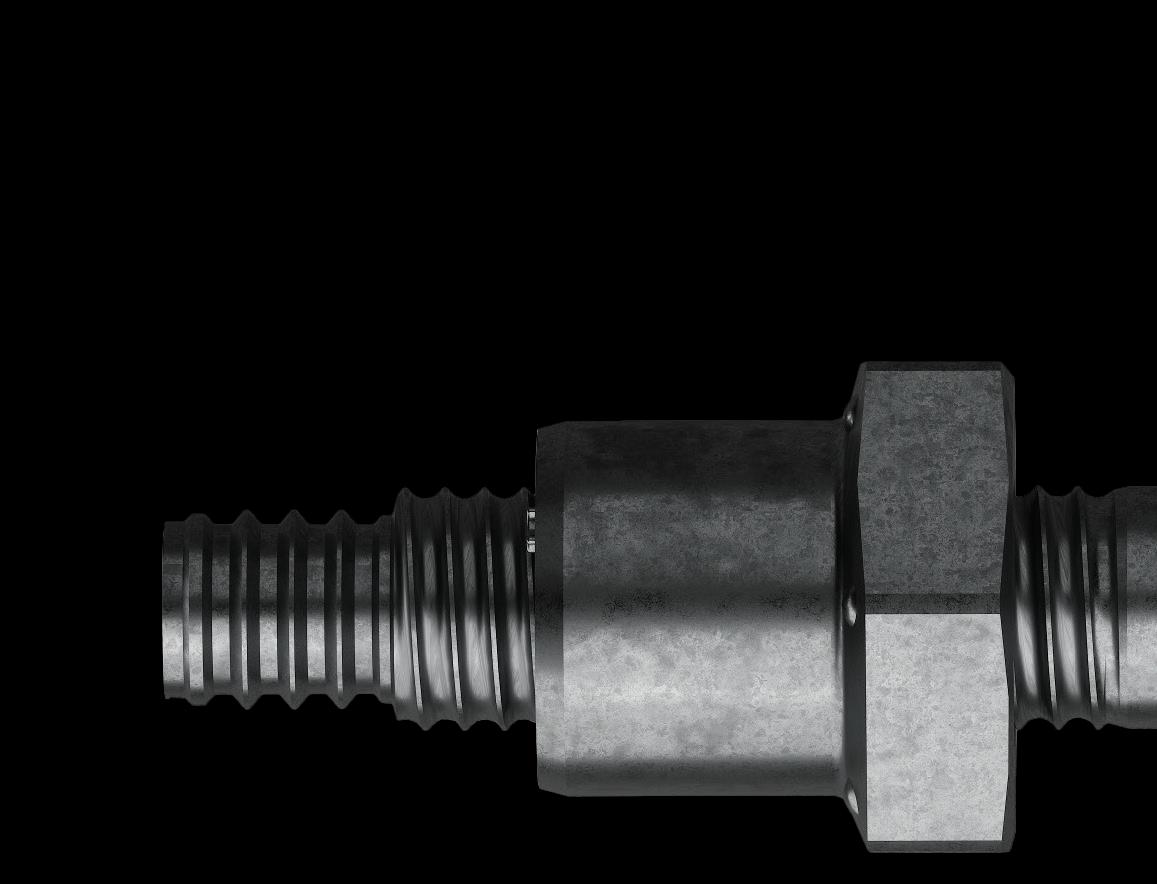


Built for heavy-duty applications that demand both staying power and future serviceability, the BobTail® R is your no-weld, no-loosen solution that’s easy to install and just as easy to take apart. No heat. No sparks. No nonsense.
+ Vibration-resistant, maintenance-free joint
+ Easy removal with standard torque-type tooling
+ Installs in seconds—no re-torquing, no retightening
See how the BobTail® R can power your next build. Visit hfindustrial.com
BOATS & GEAR
IOn Their
From the tried and true to the leading edge.
n 2025, the operator of Shinnecock/Moriches on New York’s Long Island was having a problem with the radar on one of his boats. The unit was a Koden, which is supplied by Si-Tex Marine in nearby Riverhead.
“He had one of our T-180 radars on his boat, and it’s his favorite radar,” said Allen Schneider, vice president of sales and marketing at Si-Tex. “He said, ‘The picture is fading out.’”
Si-Tex hadn’t sold that radar since the 1990s, but Schneider said he would

look at it. He had a replacement magnetron for the unit in stock and installed it. “He took it back and called me and said, ‘It’s like when it was brand spanking new.’ That’s at least a 30-year-old product,” said Schneider.
That, in a nutshell, is the dilemma faced by marine electronics suppliers and dealers in the workboat and commercial vessel market. While marine electronics seem to be constantly evolving with new technology, many operators and small-company owners either resist learning new technology or can’t afford to upgrade every three to ve years.
“Some older guys who’ve been running boats forever don’t want to learn new stuff,” said Kevin Smith, vice president of Smith Shipyard, Curtis Bay, Md.
The company runs a eet ranging from smaller crewboats in the 25' range to Subchapter M tugboats in the 60' range. Regarding new technology, he said, “It’s cool when it works, but it seems like you need to spend so much time tuning it.”
Added Chris Sullivan, head of sales, marketing, and strategic partnerships for Navtronix in York, Maine, “You can tell the age of who’s running the boat by the number of screens. Old-school guys still like dedicated displays for a given function. With standalone radar, the odds of losing more than one are slim and none.”
ESTABLISHED NAMES
While Garmin and Raymarine are arguably the most popular electronics suppliers for the recreational side of the marine industry, for the workboat crowd, Furuno and Si-Tex/Koden are most often seen in the pilothouses.
“When we get a request for a commercial boat, it’s usually Furuno,” said Sullivan. “That’s what the guys know.”
The brothers who founded Furuno in Japan started on commercial shing vessels. To earn a captain’s trust, they would go shing with him and bring their gear. Once they proved their equipment was successful at locating sh and could hold up under offshore conditions, word of mouth took it from there.
Raymarine
Blessey Marine is installing Raymarine Pathfinder radars across its towboat fleet.
“They went boat to boat proving their technology could do what they said,” said Bart Disher, commercial business development manager at Furuno USA, Camas, Wash. “We’ve proven our commercial products could withstand the harshest environments, that they will be serviceable, and parts will be available.”
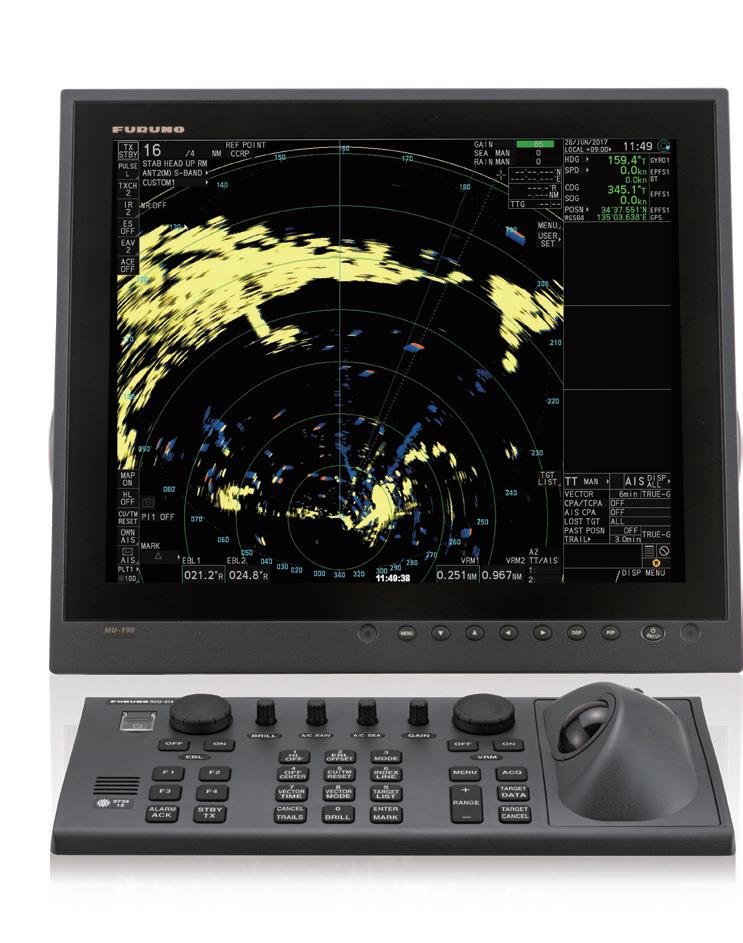
New Furuno products for the workboat market focus on radar and electronic chart display and information systems (ECDIS).
When paper charts were phased out, vessel operators needed to have updated information for their ECDIS systems. Until recently, a customer would need to use a CD or flash drive to upload updates. Now the updates take place automatically online through a chart server.
Among Furuno’s most popular radar systems is the FAR2127, an X-band unit that was introduced around 2005 and has been sold worldwide for 20 years. “That’s a radar I can still service and I have spare parts for,” said Disher. “If you came to one of our facilities, you would find racks and racks and racks of spare parts.”
Most operators use two radar units for redundancy. In many cases, the electronics are not networked into one or two displays.
Furuno’s Risk Visualizer is integrated into its radar systems and provides 360°, real-time representation of potential collision risks around a vessel.
“It’s been out for about one and a half years, and it’s under-marketed,” said Sullivan. “It knows where it’s going to be in the next X number of minutes, and anything that comes into its circle, it’s sending an alert.”
Within the workboat segment, Furuno has carved a niche among towing and push vessels. “We love that there is a repeatable and known package because the Subchapter M has specific requirements,” Disher explained.
The requirements include X-band radar with an open array, a specified display screen size, an AIS system, a transmitting heading sensor, a satellite compass, a means to display depth, a pilothouse alert system and a bridge navigation watch alarm system and more.
To help an owner or captain keep track of the health of a Furuno system, the company developed HermAce, a black-box-style tool capable of detecting, diagnosing, and predicting errors. For a company operating 12 vessels, four engineers can be responsible for three ships each, with a dashboard for each vessel on his/her computer that shows the status of onboard Furuno systems. If a warning sounds, it notifies the engineer, who communicates with the ship to schedule maintenance as soon as it arrives at its next destination. This allows the owner to plan ahead, rather than waiting for the ship to arrive in port and forcing the crew to scramble to find a repair service.
it’s an hours-long trip between ports, so scheduling maintenance in advance can keep downtime to a minimum.
NEW RELEASES
Si-Tex Marine Electronics is a subsidiary of Koden Electronics Co. Ltd., which is based in Japan. In the United States, Si-Tex products are sold through marine dealers and suppliers, and Koden products are only sold to approved servicing dealers.
At the International WorkBoat Show last December, Koden introduced its Information Display System, a series of small screens that connect in a strip above a boat’s windshield. They show course, speed, rate of turn, and righting in one location. “They just have to glance up, and they’re looking at it,” said Schneider.
This year, Koden introduced an International Maritime Organization (IMO)approved GPS, the KGP 922, that also meets the U.S. Coast Guard requirements for electronic charting systems. Also new, Koden’s KRS solid-state radar series has a 6' open array, and the power rating is equivalent to 12 kW. The new models have 110 watts of output power and radar range from 0.125 to 96 nautical miles. Available screen sizes range from 16" to 24".
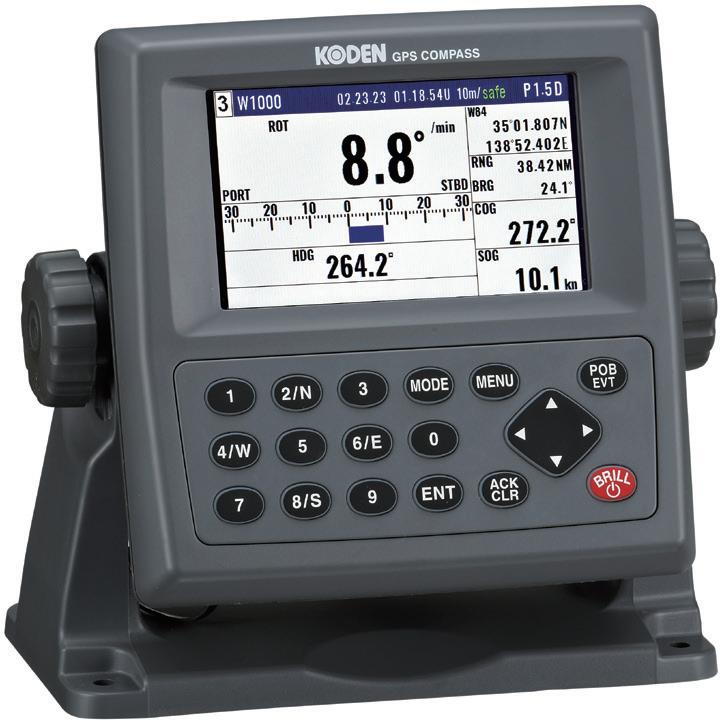
Schneider said that Si-Tex/Koden satellite compasses are also popular because they don’t need to be calibrated. They are accurate as soon as they are installed. Commercial fishermen also like the CVS-126 fishfinder, which tugboat operators sometimes use as a depth sounder.
“This is especially true on rivers with workboats,” said Disher. On some rivers,
Later this year, Koden will be introducing AIS search-and-rescue transmitters and emergency personal indicator radio beacons.
While mainstream electronics suppli-
Koden
The Koden KGC-300 is an IMO-certified GPS Compass and GPS Navigator.
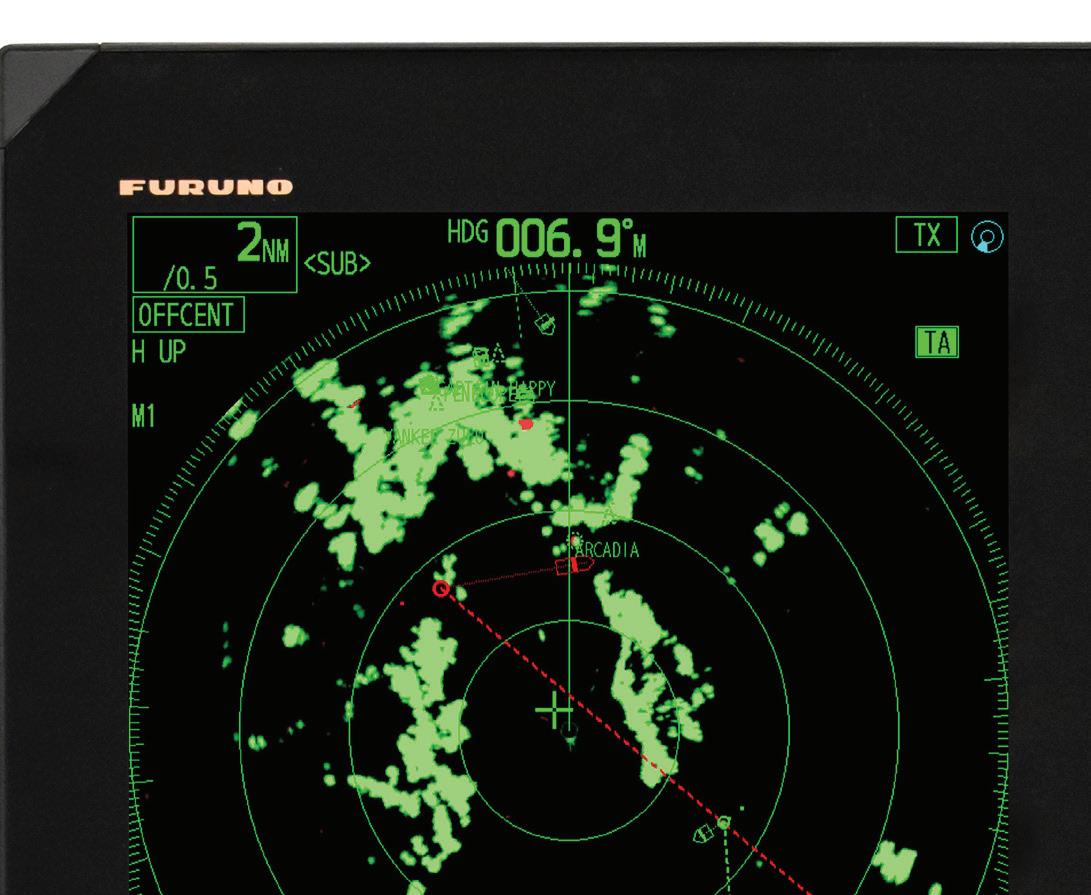
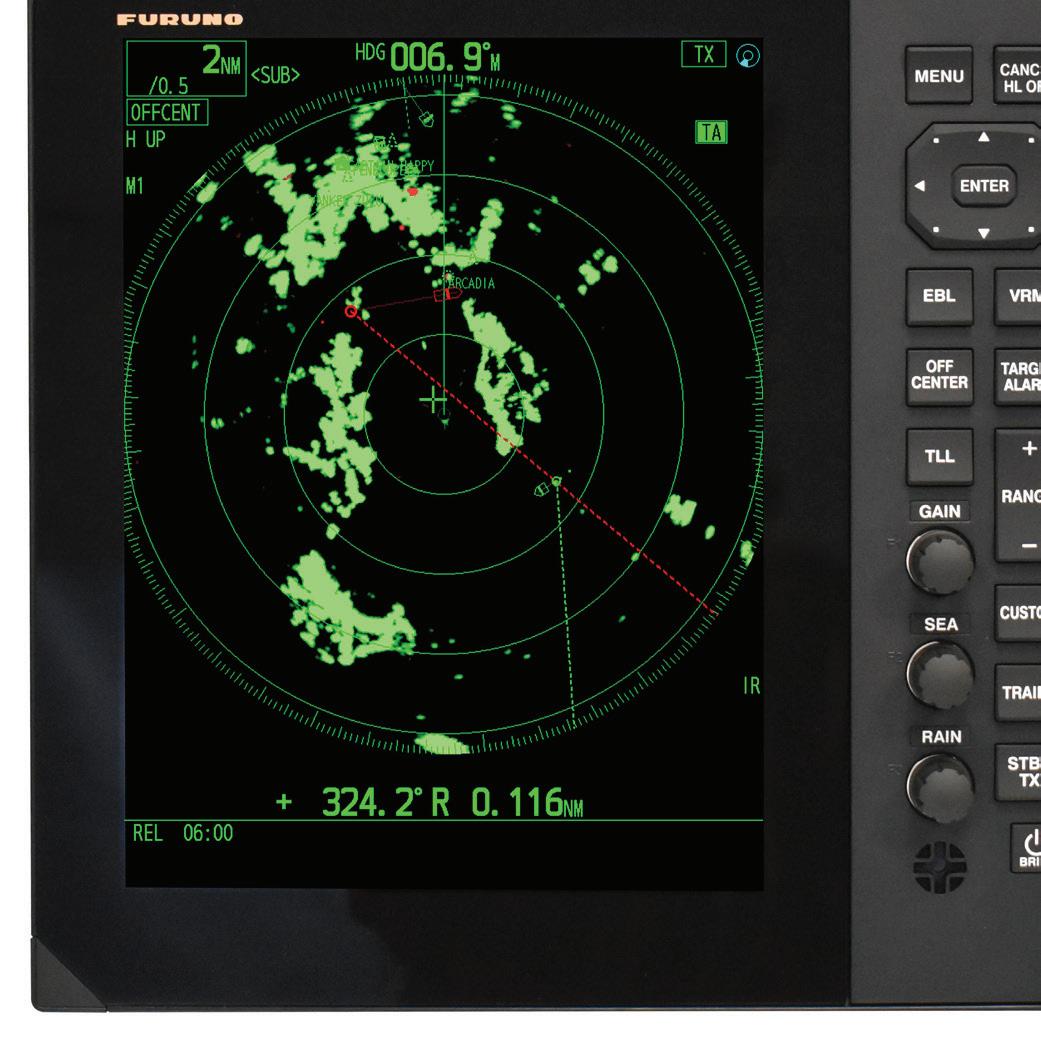
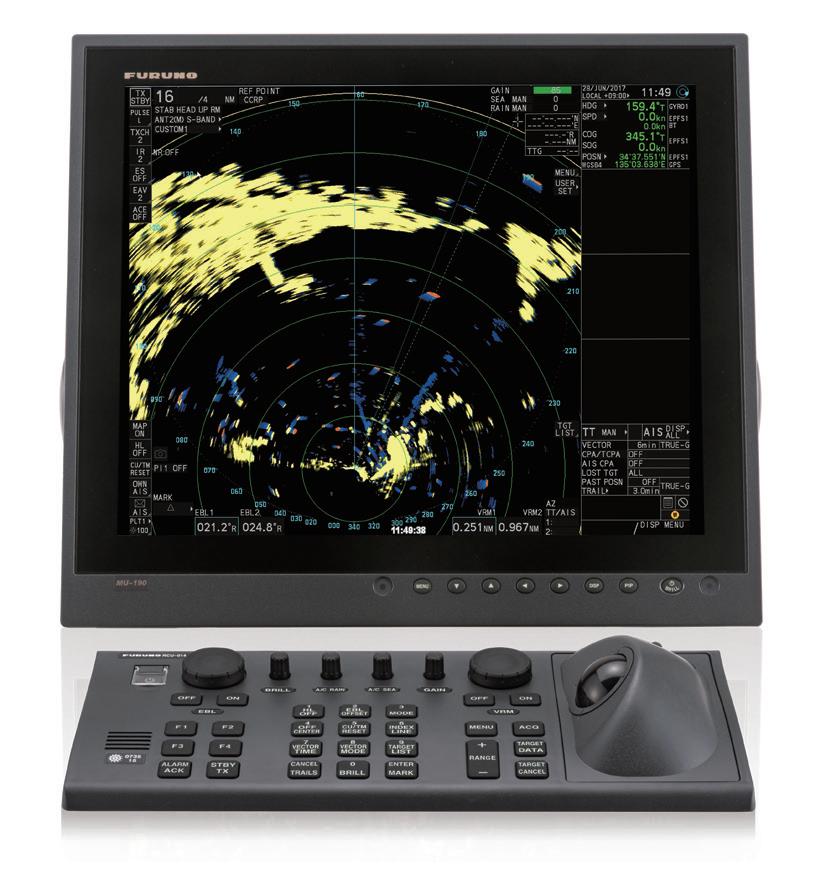
New Furuno offerings for the workboat market include radar and ECDIS products.
Furuno
BOATS & GEAR Electronics
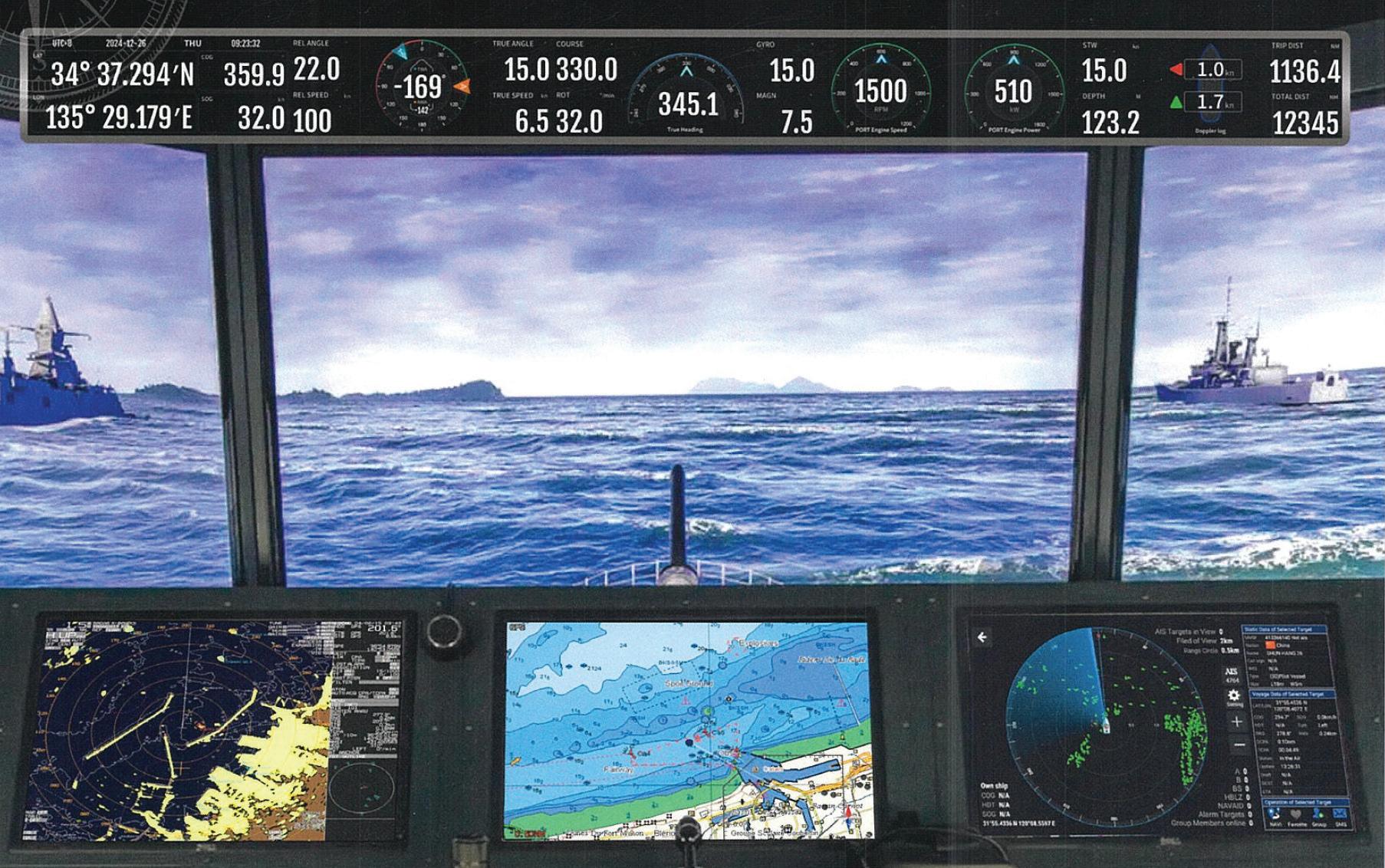
ers like to network numerous components into a single display, Si-Tex/ Koden caters to operators who prefer stand-alone devices. “We don’t do much networking,” said Schneider. “The commercial guys prefer that most of the time.”
Like Furuno, Si-Tex/Koden has an extensive collection of spare parts for older units on hand in Riverhead.
MAKING INROADS
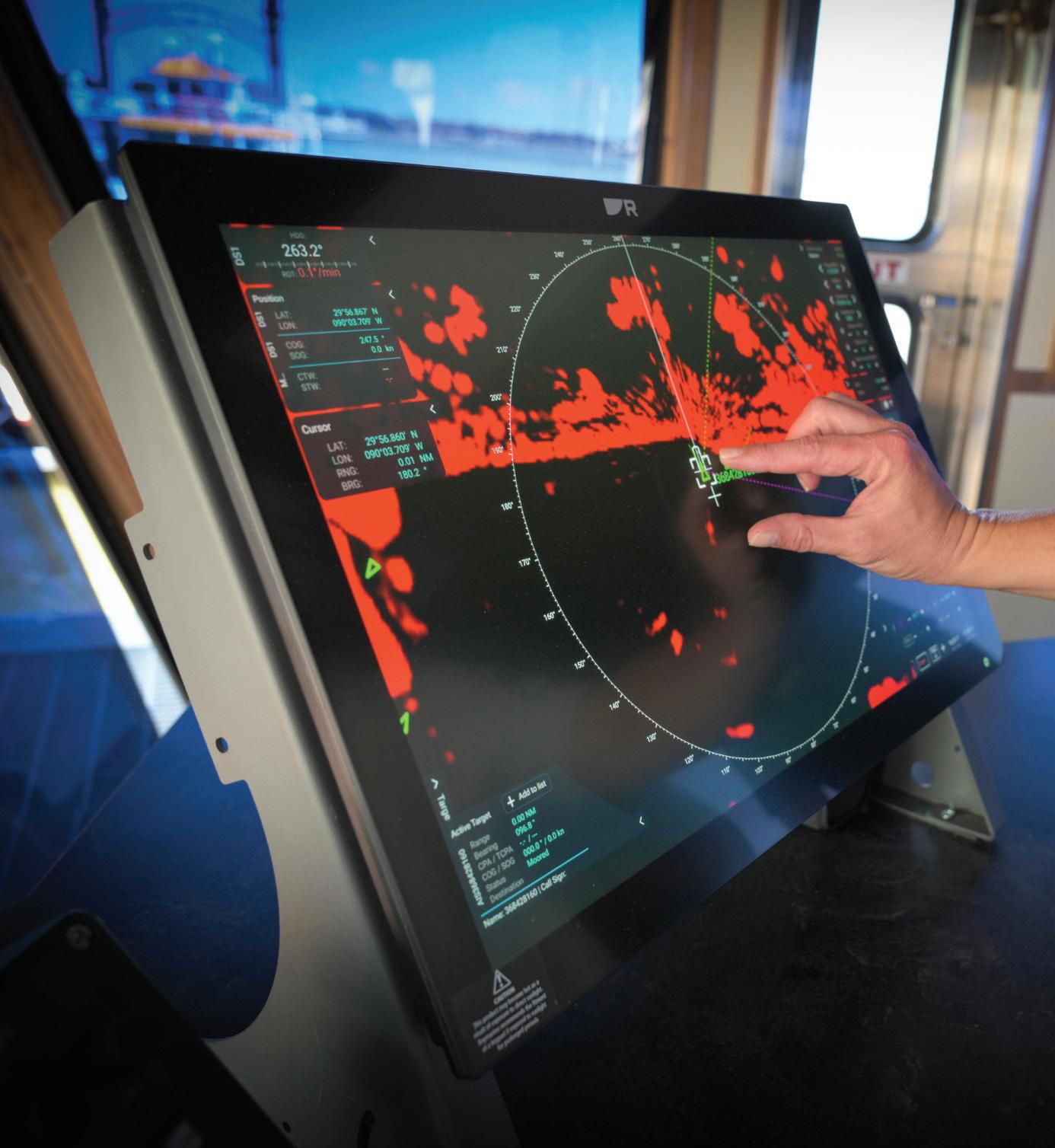
Two years ago, Raymarine brought back a name that it had previously used for commercial marine radar. The Pathfinder radar has a solid-state transmitter instead of a magnetron unit and operates in vessels in the SOLAS 1, 2, and 3 categories.
“We had been out of the commercial space for quite some time,” said Jim McGowan, Americas marketing manager for Flir and Raymarine. “We didn’t have a commercial presence until about two years ago when we decided to get back in.”
Pathfinder units come with a 4' or 6' antenna and a solid-state 110-watt transmitter. Range extends to 96 miles. At the end of last year, Raymarine partnered with Blessey Marine, a towboat operator in Elmwood, La., that works on the Mississippi and Ohio rivers. The company has 80 towboats and has ordered two Pathfinder radars per vessel.
Raymarine’s parent Teledyne in 2023 acquired a German company called Chartworld International Ltd., an ECDIS subscription service. “Instead of a shipowner buying an ECDIS and maintaining and upgrading it, [the company] can subscribe, and Chartworld provides them the charts they need,” said McGowan.
Raymarine has upgraded the Chartworld hardware and expanded the footprint to include SOLAS and nonSOLAS systems. The new electronic chart system complies with Coast Guard Radio Technical Commission for Mari-
time Services regulations.
Another product that helped Raymarine gain commercial business is a platform the company developed for the Coast Guard called Scalable Integrated Navigation System II (SINS). The Coast Guard is encouraging law-enforcement agencies, fire departments, and similar organizations to adopt the technology.
AIS SINS II can send encrypted data for secure vessel-to-vessel messaging. If the Coast Guard is coordinating a rescue or similar situation, it can securely send tasks and orders to cooperating agencies. One area where it’s already been adopted is New York Harbor.
For larger mapping projects, Teledyne offers Caris software that is used for taking oceanographic data and processing it for charts. They use sonar and lidar — remote sensing using laser — to create marine surveys and charts.
For cameras, Flir’s most popular products in the workboat realm are the M364C and M300C, which can also commonly be found on patrol boats and ferries. They are dual-axis stabilized cameras that can pan-tilt and zoom. The M364C has a 30x optical zoom and ultra-low-light capability. If it’s night and a crewmember is working on deck, the camera only needs starlight to be able to show the person on camera. The M364C adds thermal vision as well.
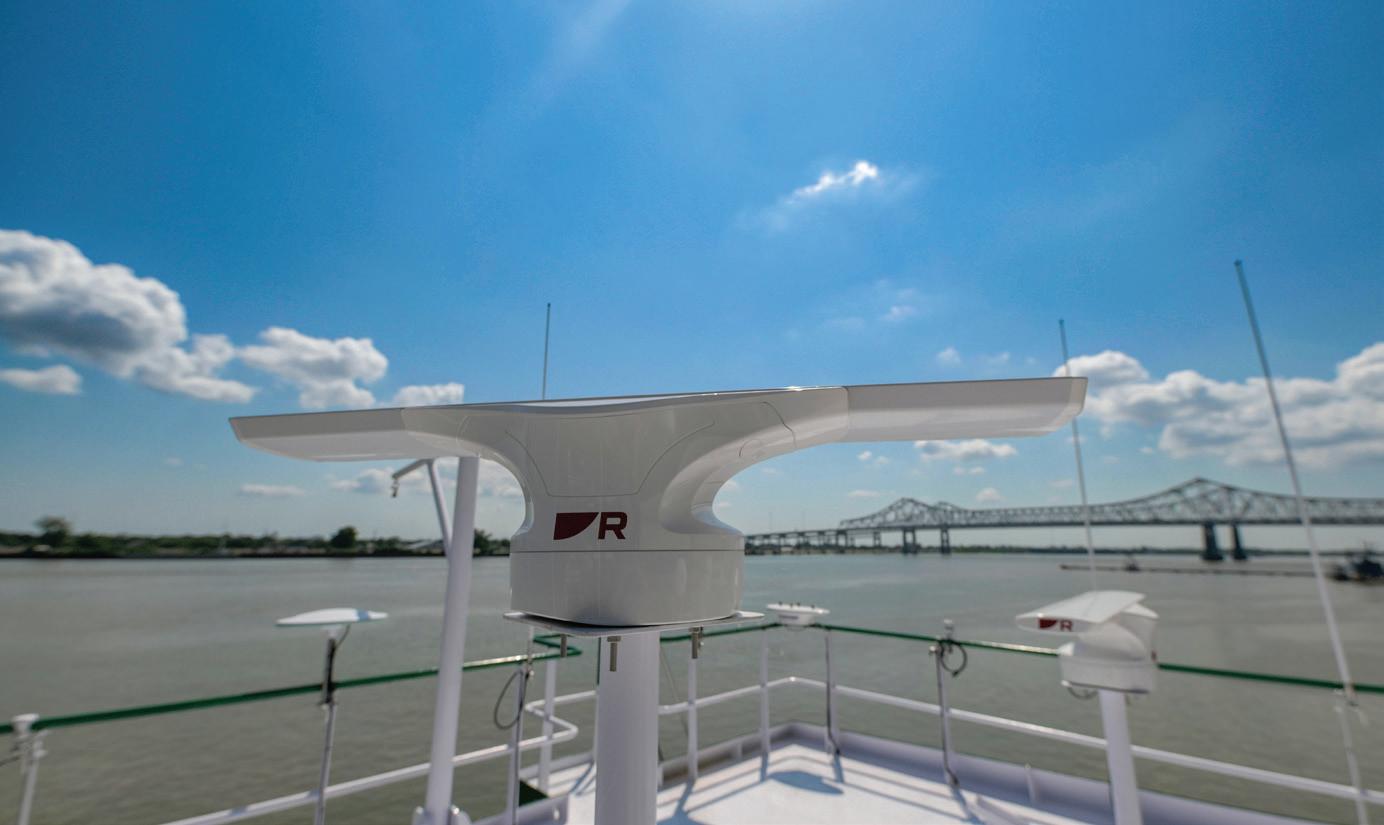
Koden's new Information Display System consists of a series of small screens that connect in a strip above a boat's windshield, keeping key information easily visible.
Blessey Marine, which has more than 80 towboats operating on the Mississippi and Ohio rivers, has ordered two Raymarine Pathfinder radars per boat as part of a fleet upgrade program. The radars reach 96 miles with a solid-state 110-watt transmitter, according to the manufacturer.
Koden
Raymarine




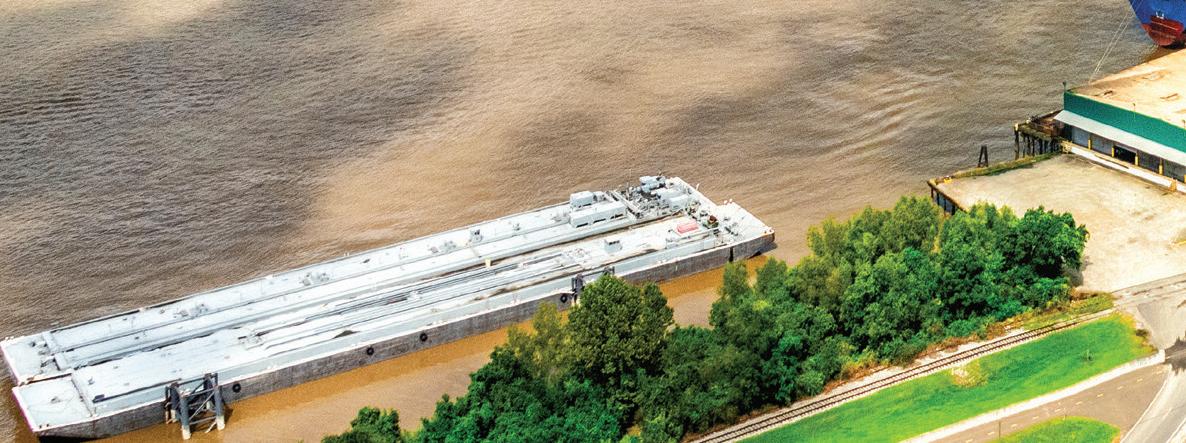
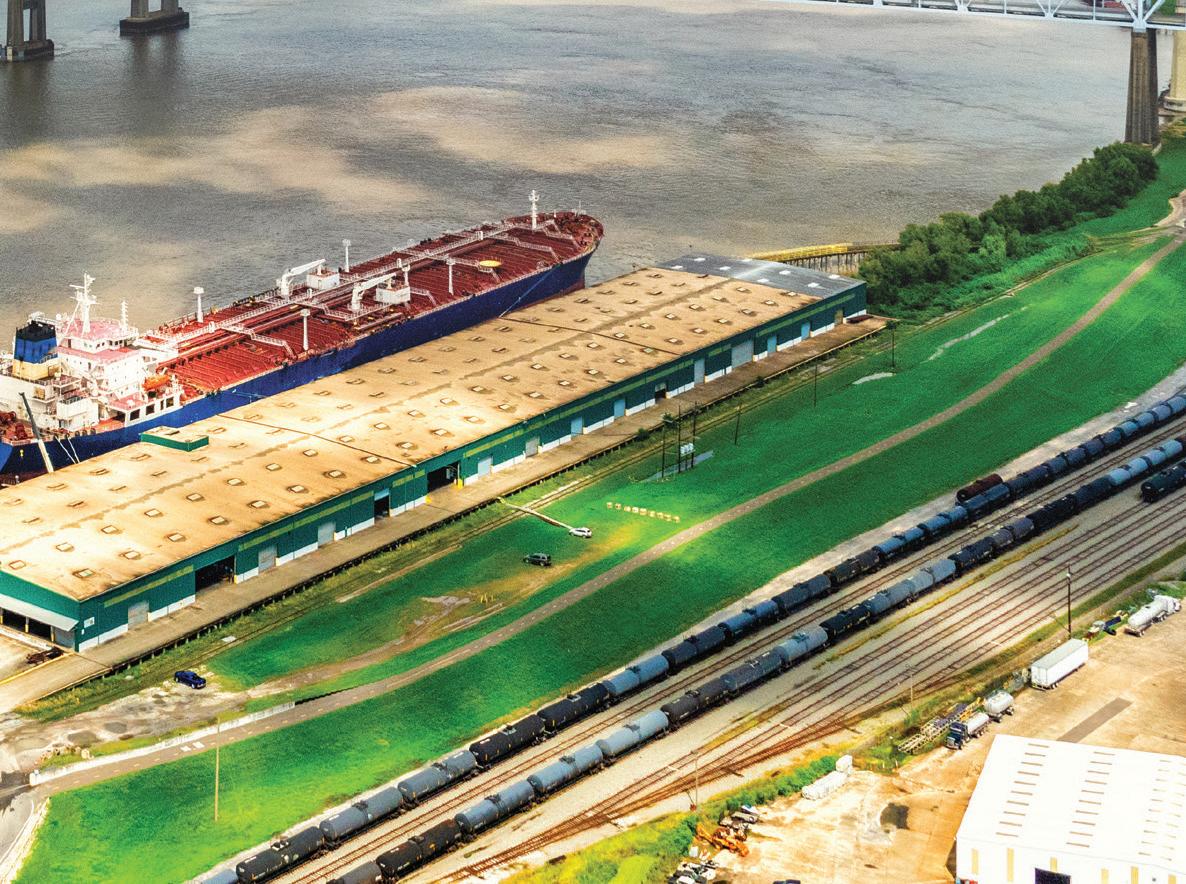

Otto Candies III CEO and Chairman of the Board, Otto Candies LLC
By Eric Haun, Executive Editor
WorkBoat sat down with Otto Candies III, CEO and chairman of the board at Otto Candies LLC, to discuss how the Des Allemands, La., company has evolved over more than eight decades from a small bayou operation into a diversified offshore marine services provider. Candies reflects on the family values and operational discipline that have guided the company through multiple industry cycles and shares his perspective on the Gulf market and the future of offshore wind. This interview has been edited for length and clarity.
Can you walk through the history of the company and how it’s evolved?
My grandfather, the original Otto Candies, started the company in 1942, doing simple work, clearing water lilies and bringing supplies on the local
bayous in South Louisiana. Over the generations, it developed through several different types of equipment. We had tugs and barges, crewboats, offshore supply vessels (OSV), and now inspection, maintenance, and repair (IMR) vessels. We’ve evolved with the industry. I’m third generation, and we now have
seven members of the fourth generation here in the company. Our approach has always been to compete at the upper end of the industry with new technology and bigger boats. At that end, you tend to have more disciplined competition and higher barriers to entry. That’s always been our focus.
No matter how the industry changes, the basic principles of having good equipment, good people, and being straightforward and honest with clients and vendors, that’s always been our philosophy. When your name is on it, you take pride in that. You want the industry to equate your name with quality and dependability. My grandfather only went to the seventh grade. Back then, people had to go to work and times were tough. But he always had core principles of honesty and integrity. That’s the core of what we do today.
Can you give an overview of your eet and the markets you serve?
We have two main lines of business. Our OSV eet — six vessels — services clients here in the U.S. Gulf. Then we have our 10-vessel IMR eet, with crane capacities ranging from 100 to 250 tons. We’re servicing the traditional oil and gas market in the Gulf, and we’re also active in offshore wind development on the East Coast. At any given time, three or four vessels are working in the wind market, with the balance in oil and gas. We also own one large 400'x126' oceangoing deck barge.
How do you see the Gulf market right now?
Demand has been pretty steady the last couple of years in both segments. The OSV side is showing a bit softer in ’26, but still steady. The IMR market is tighter; there’s not as much equipment in that space, and several boats from competing companies have gone to work in renewables, which has tightened things up. We have several IMR vessels with contracts extending into ’28 and ’29, so our clients clearly see the trend as steady
Otto Candies III is the third generation to lead family-owned Otto Candies LLC.
for some time to come. We felt con dent enough to spend a lot of money acquiring new equipment, and we feel good about that market going forward.
How close are we to a newbuild period in the Gulf?
The Jones Act eet is aging, de nitely, across both IMR and OSV categories. There’s been no real eet replacement in quite some time, and honestly, I think that’s a good thing. Our industry has a tendency to overbuild when the market is good, and then you end up with big surpluses and a lot of problems. I’m quite happy that we’ve shown some discipline there.
The problem with any newbuild program right now is cost. When you get quotations and compare them to today’s rate structure, it just doesn’t support new construction. Until that ratio changes, I don’t see it making sense for us or our competitors to pursue major eet replacement. We’d need to sit with clients and work out longer-term charter commitments that give you enough security and the nancing basis to build. We’re not at the point where we need to start eet replacement yet, but those conversations will need to start.

When assessing vessel acquisitions, what do you look for?
We’re always keeping our eyes and ears open. With our recent acquisition, we saw an opportunity to pick up highquality existing tonnage that had solid contracts already in place — contracts with clients we had already done business with — so we were able to transfer over and keep those arrangements pretty seamlessly.
Our number one criterion is asset quality. We’ve always prided ourselves on maintaining a modern, dependable eet. We’re not looking to acquire things that are at the end of their life. Second is contracts — either ones already in place or ones
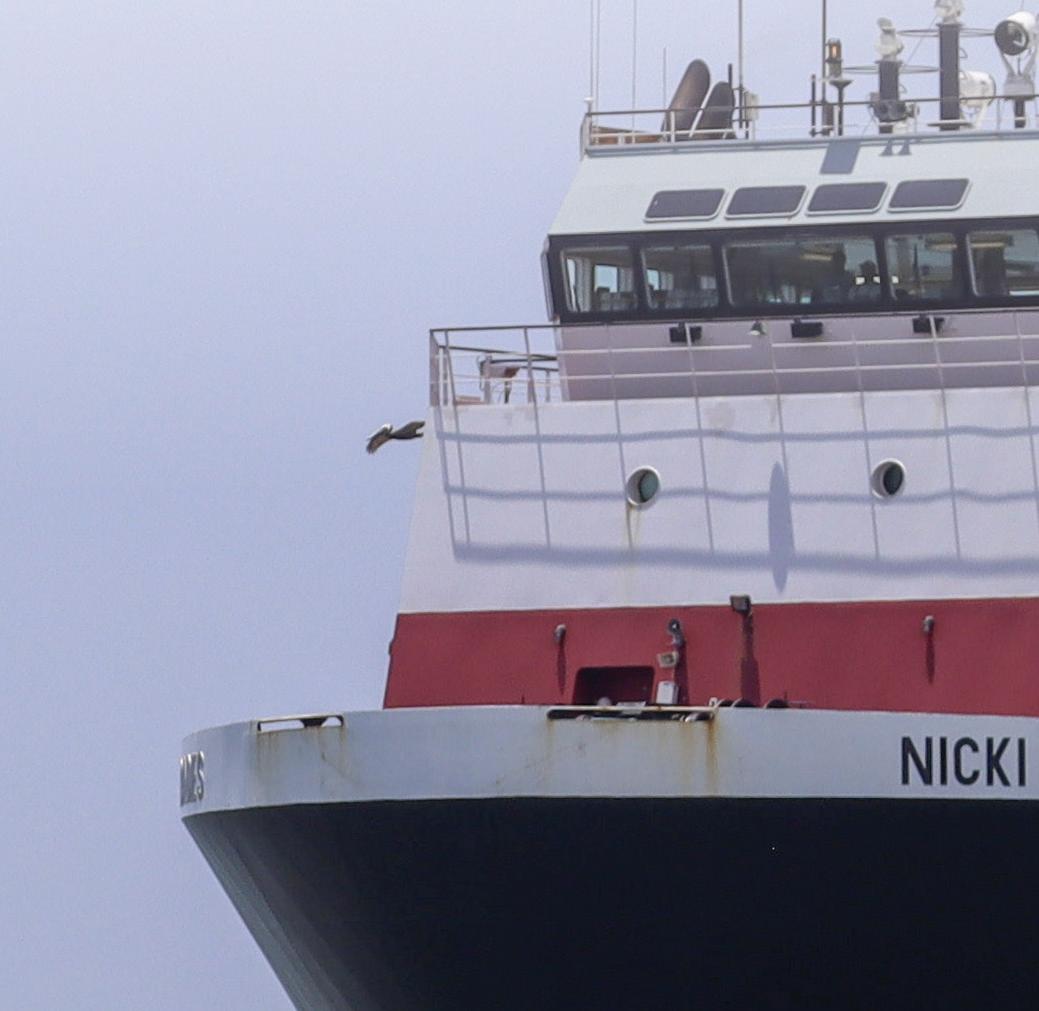
we’d be con dent putting in place going forward. We don’t have anything currently in the works, but we’re always looking.
You were early movers in offshore wind. How do you see that market?
The current administration is not a fan and is putting up as many obstacles as possible. But speaking with our clients, they’re taking a long-term view. The infrastructure already in place has to be maintained regardless, and the vessels we have are largely working on that maintenance and upkeep side. We’ve been able to keep those boats on their contracts without issues.
I’m a supporter of an all-of-the-above approach to energy. Oil and gas is our bread and butter and will be for quite some time, but our country should be looking at whatever sources are available to diversify energy supply. We’ve demonstrated that you can take existing tonnage and, with relatively minor modi cations, put it to work in the wind industry. If that market stabilizes and continues to develop, it would be great to have the additional avenue for our assets.
How would you describe your leadership philosophy?
Integrity and honesty are fundamental. Beyond that, we’re not a big company, so we can’t afford people who say, “That’s not my job.” We need exibility. We like people who buy into our philosophy. While the owners are all family by blood, we consider everyone who works here part of that family. We do our best to treat them that way and, in turn, we get loyalty back. We’ve kept people here for a long time because of that.
We’re collaborative, not dictatorial. I’m not the type who lays down ve things you have to do today. We set big goals and empower our people to go accomplish them.
What keeps you up at night?
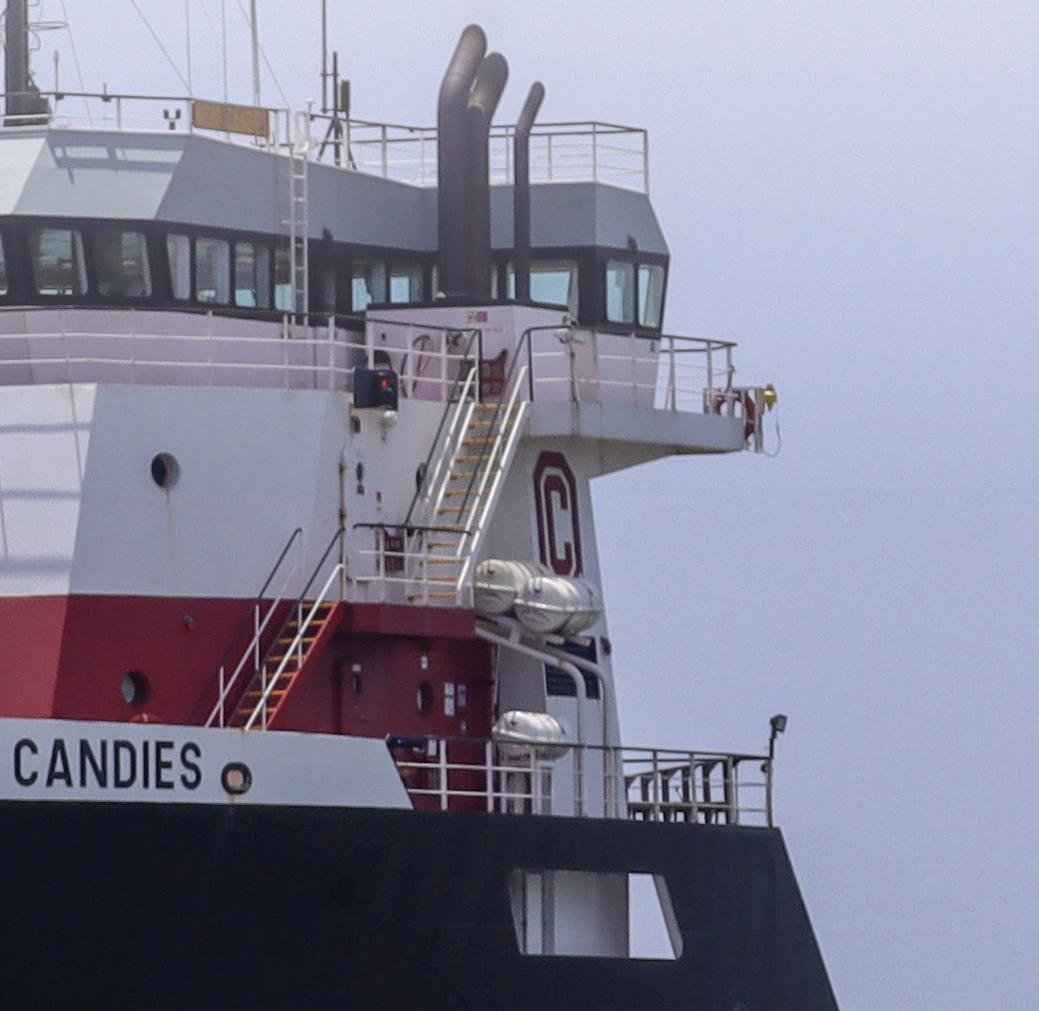

We work in markets where events beyond our control can drive things overnight; that’s what’s dif cult to plan for. What keeps our whole management team focused is making sure we manage the business in a way that we can navigate whatever comes. We’ve had a lot of cycles over 80-plus years, some extremely good, some extremely bad, and we’ve never had a default, a bankruptcy, or a missed payment in that entire history. Our goal is to stay structured so that not everything has to go perfectly for our plan to succeed. There have to be fail-safes.
Honestly, though, I sleep pretty well. I’m not a worrier. If you come in and address your business and do things the right way, you can go ahead and sleep at night.

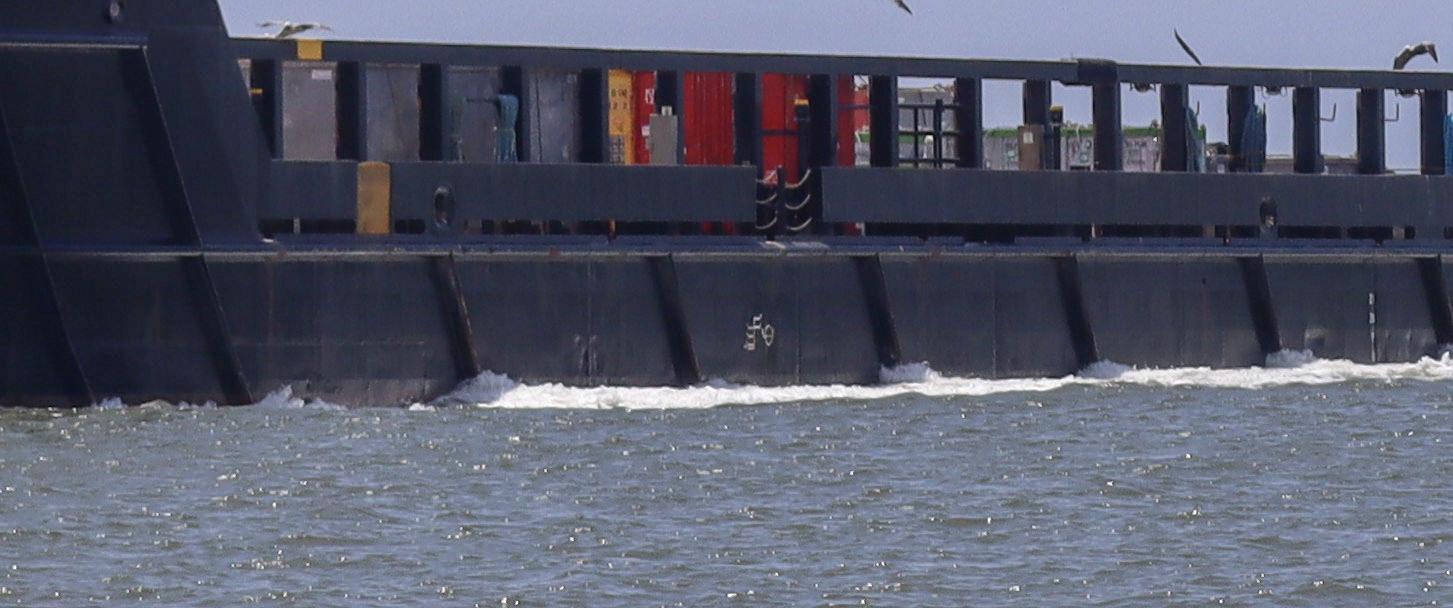


Doug Stewart



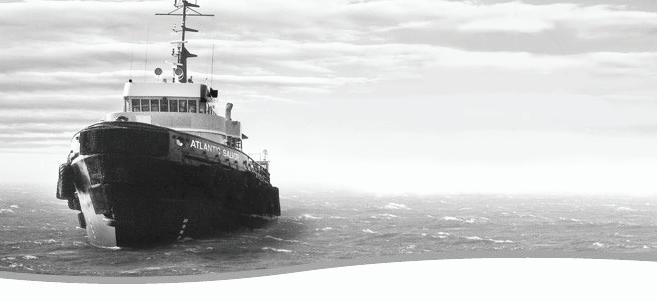














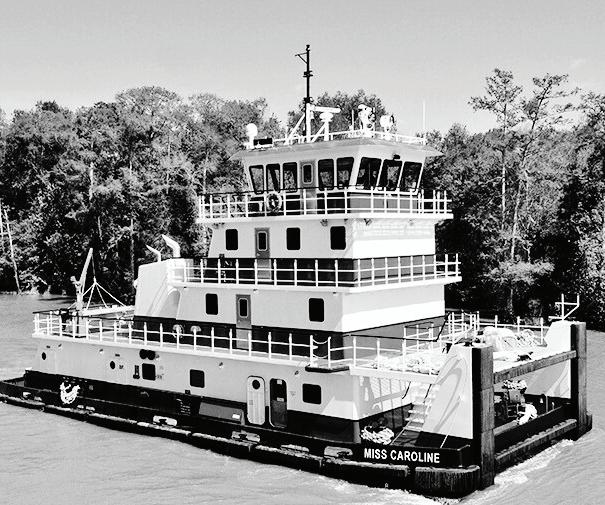
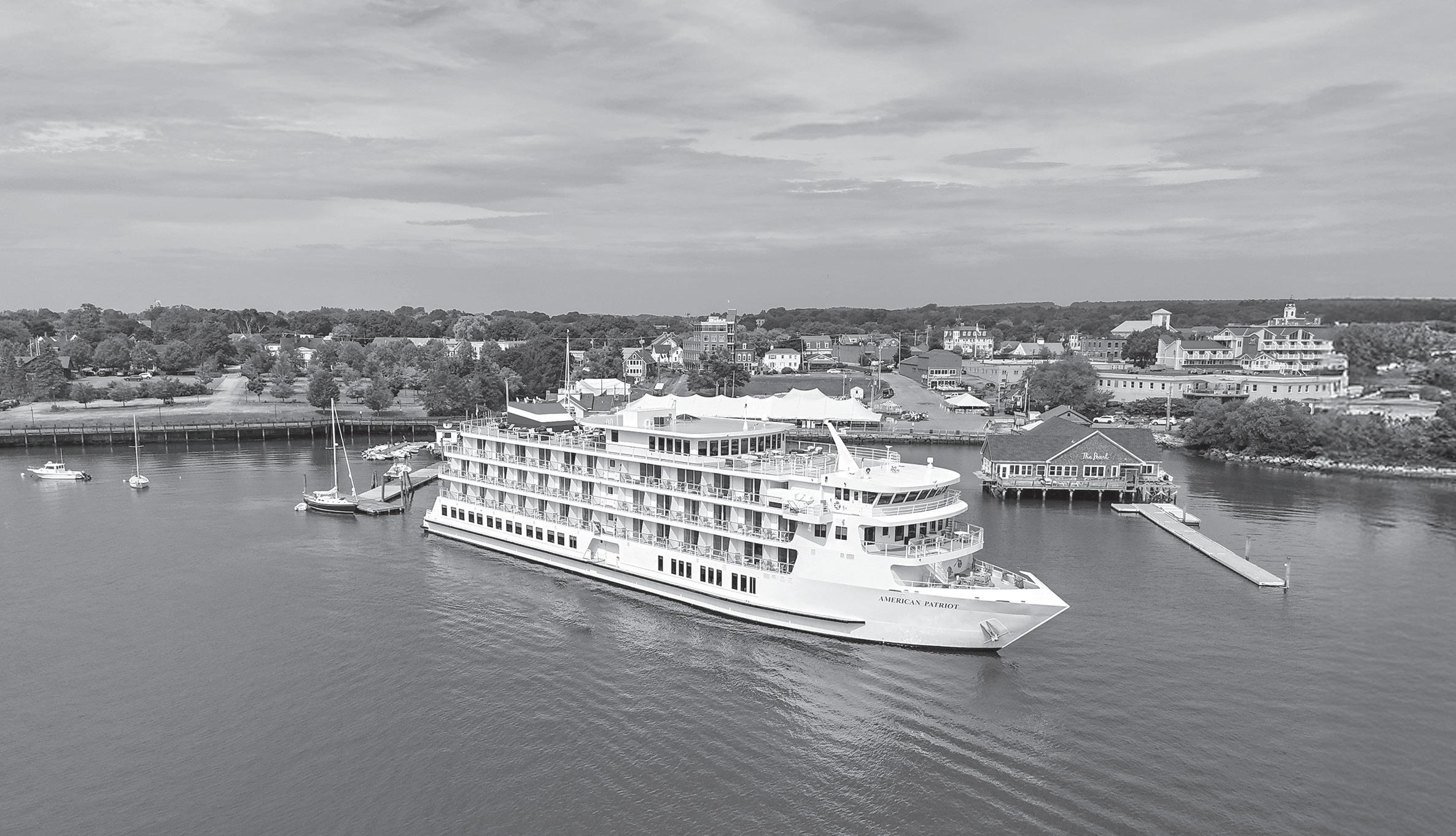


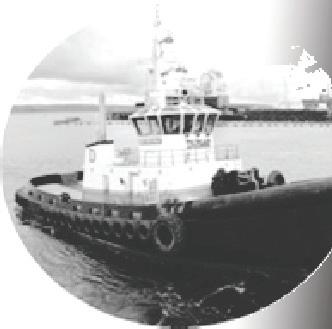


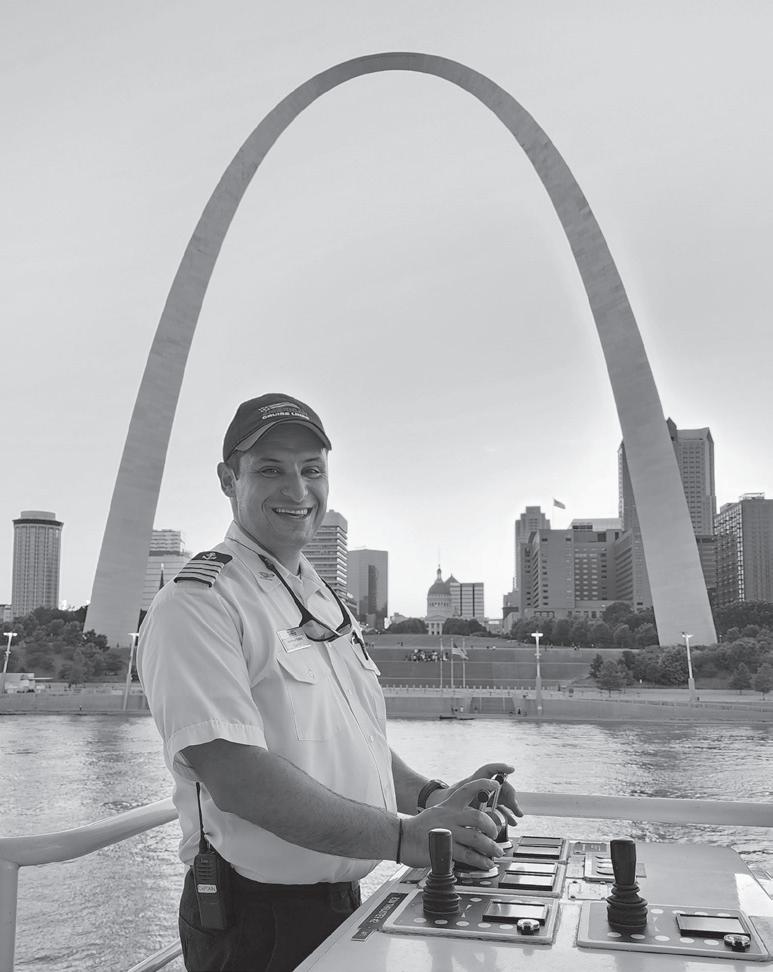
CAPTAINS
CAPTAINS
Overnight vessel experience along Inland, Coastal, and Great Lakes regions of the U.S. required
Overnight vessel experience along Inland, Coastal, and Great Lakes regions of the U.S. required
BENEFITS
Set Schedule & Rotations
All American Fleet of Small Ships
Set Schedule & Rotations
State-of-the-Art
All American Fleet of Small Ships
State-of-the-Art
Simulator Training
Sail on America’s Most
Simulator Training
Opportunities for Advancement

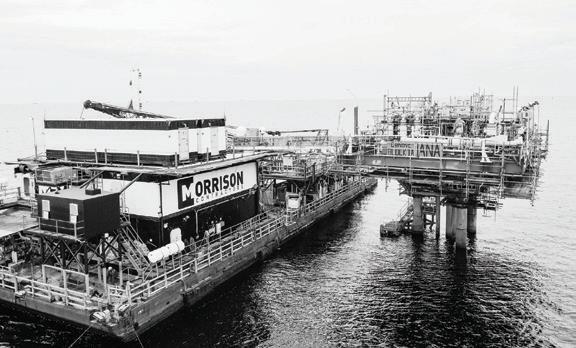


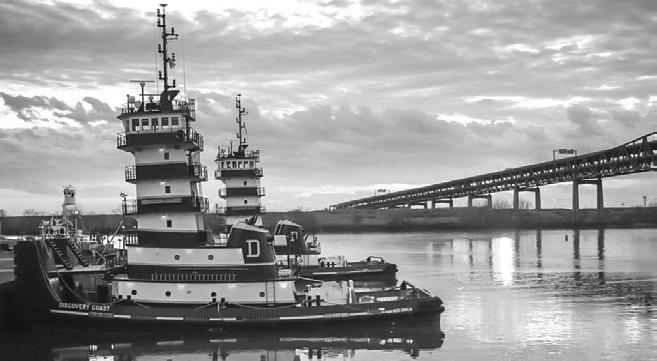





























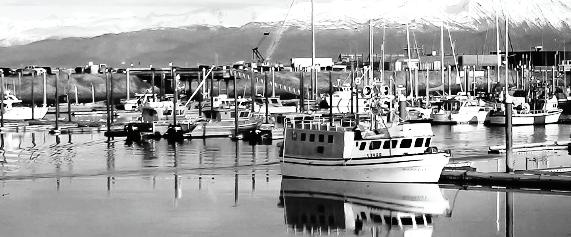


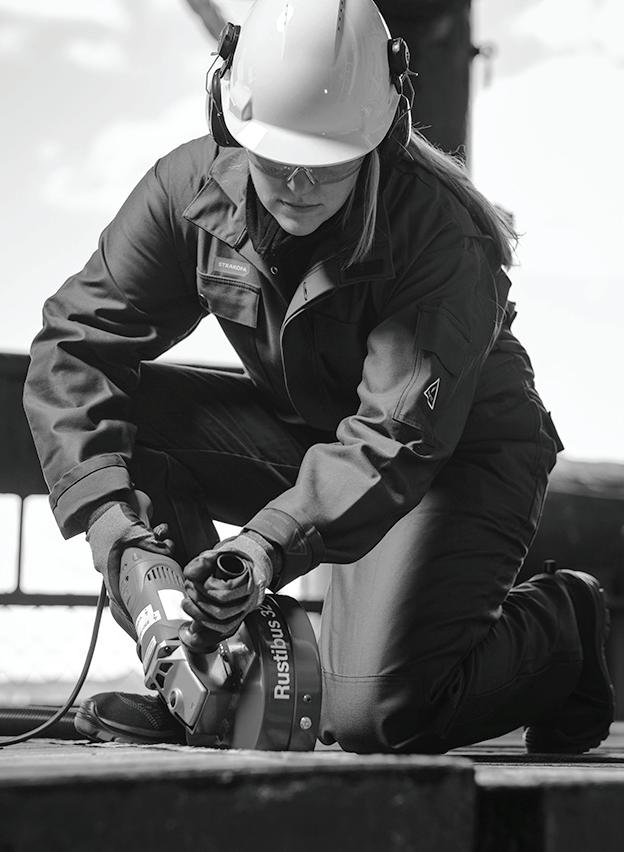



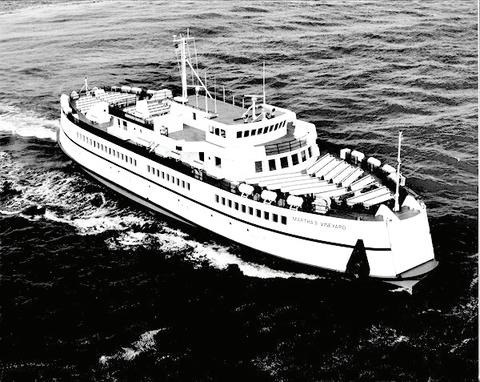



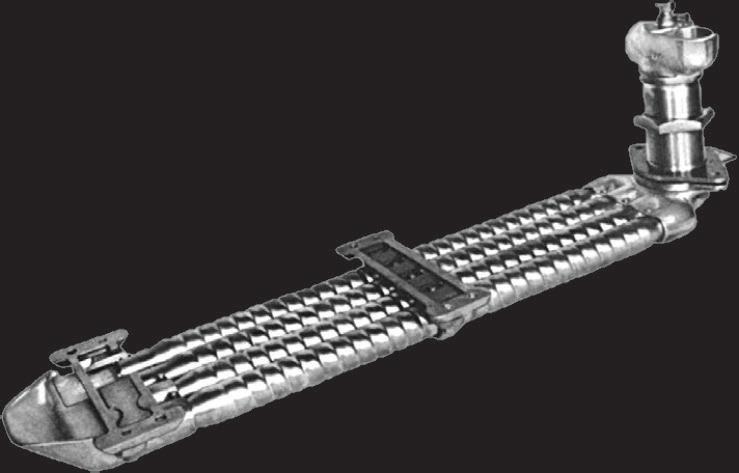




The New Jersey Maritime Pilot and Docking Pilot Commission
The New Jersey Maritime Pilot and Docking Pilot Commission is seeking applicants for the state docking pilot apprenticeship program. The program, which is a prerequisite to a New Jersey license, is open to any United States citizen who meets the requirements listed at N J A C 16:64-5 3 Full details on the program and the requirements will be included with the application form. The form may be obtained without charge by writing to: The New Jersey Maritime Pilot and Docking Pilot Commission
Attn: Andre Stuckey Gateway Center, 18 Floor, Newark , NJ 07102 th or emailing to astuckey@njtransit .com
Applications shall be filed by USPS or email no later than June 12, 2026.
Selection of apprentices, as needed, will be made from an approved list of qualified applicants authorized and maintained by the Commission for a two-year period. The list will be developed on the basis of qualifications provided in the application, interview process and under the applicable laws and regulations of the State of New Jersey. Selections will be made without regard to race, creed, color, national origin, ancestry, marital status, sex, or liability for service in the Armed Forces of the United States This program shall be operated on a non-discriminatory basis

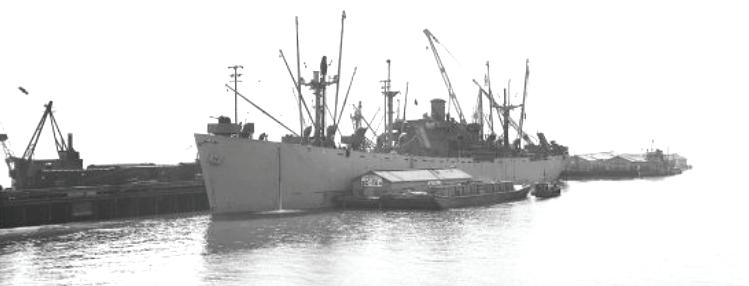





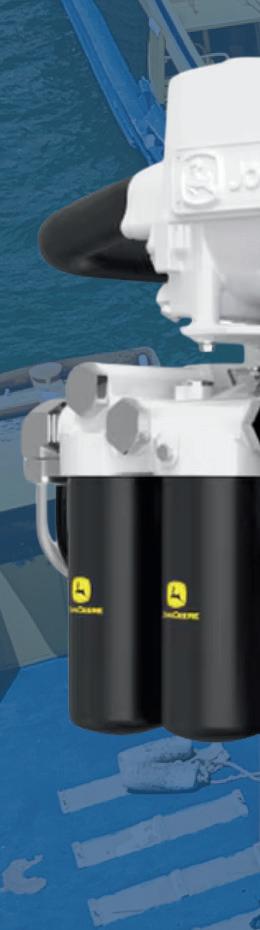





















“We have relied on Karl Senner, LLC for years, and their commitment to quality and support continues to prove itself where it matters most — at sea.
Our vessel, RACHEL, recently completed a 9,200-mile tow to McMurdo Station, Antarctica. In one of the harshest operating environments on the planet, our REINTJES gears performed above expectations without a single issue.





about the engineering and durability behind their products.

As an owner, you sleep a little better knowing the Senner family has your back. Their 24-hour support and hands-on commitment to customers provide confidence that goes far beyond the equipment itself. Karl Senner, LLC doesn’t just supply marine gears — they stand behind them.
We couldn’t be more confident in our partnership and look forward to many more successful miles ahead.”