Fuels & Lubricants • RIBs • Design Partners ®
IN BUSINESS ON THE COASTAL AND INLAND WATERS
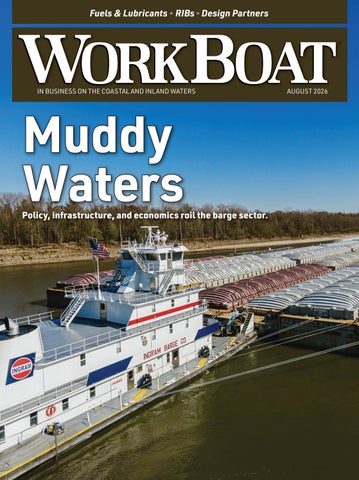
Muddy Waters
Policy, infrastructure, and economics roil the barge sector.
AUGUST 2026
EVERY ENGINE RUNS ON DAY ONE. WE'RE HERE FOR EVERY DAY AFTER. Laborde Products, part of your crew.
LabordeProducts.com
Content
August 2026 VOLUME 83, NO. 08
FEATURES 12 Cover Story: Navigating the Bends How policy, infrastructure, and economic factors are impacting the barge sector.
20 Vessel Report: Strategy Shift The Navy is changing the way it buys RIBs.
26 In Business: Teknicraft Design and All American Marine
20
A global partnership that delivers.
30 Final Word: Deb Calhoun Looking back on a career as a voice for the inland industry.
BOATS & GEAR 8 On the Ways Oregon dredge tender enters service • Tractor tug launched for McAllister Towing • Data center barge concept unveiled • United States’ first subsea rock installation vessel delivered • Two towboats under construction for Terral RiverService • New tug delivered to Suderman & Young • Passenger/vehicle ferry goes to work in Florida • American Cruise Lines christens its latest small cruise ship • Fireboat delivered for San Francisco airport • Research vessel hits the water on Long Island Sound • Construction begins on Hy-Line Cruises’ ferry.
26
24 Fluid Situation Fuel and lubricant choices take on larger roles.
AT A GLANCE 4 Insurance Watch: Avoiding toxic culture helps safety. 4 All Hands: Where AI fits (and doesn’t) in workforce training. 5 Legal Talk: Legal standard for experts. 5 Inland Insider: DOT bets big on barges. 6 On the Water: Battery fires don’t play by old rules. 6 Health, Safety, and Environment: Commercial operators’ burden.
DEPARTMENTS 2 Editor’s Watch 33 Port of Call 40 Advertisers Index ON THE COVER
The Ingram Barge Co. towboat Camille B. Barrett pushes a large tow on the Mississippi River. Credit: Ingram Marine Group
www.workboat.com • AUGUST 2026 • WorkBoat
1
EDITOR'S WATCH
Locks and dams
Eric Haun, Executive Editor ehaun@divcom.com
I
’ve been thinking a lot about infrastructure. If I were to mention this to friends outside of the maritime industry, I’m certain they would be puzzled. “Why?” they might ask, if not, “Is everything all right?” Infrastructure is often top of mind for anyone working in the U.S. maritime industry, especially for those in the barge sector. Inarguably, the United States possesses the best network of navigable waterways in the world, and there’s not even a close second. The system, which encompasses 12,000 miles of inland navigation and 11,000 miles intracoastal channels, is what enabled the U.S. to rise to superpower status, according to geopolitical analyst Peter Zeihan. The barge industry, which moves $158 billion of goods across the system annually, understands this. The problem is that Washington doesn’t seem to fully grasp the concept.
Much of the infrastructure on America’s inland waterways is showing its age. A staggering 80% of the nation’s lock and dam infrastructure exceeds its 50-year design life, according to the American Society of Civil Engineers (ASCE), which grades each segment of U.S. infrastructure, from aviation to wastewater. The group gave waterways a grade of C- for 2025. The Army Corps of Engineers manages major rehabilitation and new construction projects for inland waterways, which are funded through federal general funds and revenue from the Inland Waterways Trust Fund. Although federal funding has increased in recent years, a $7.5 billion backlog for construction projects remains, according to the ASCE report. Meanwhile, ongoing lock closures and delays persist, causing expensive transportation interruptions that ultimately raise prices for U.S. consumers and diminish American competitiveness in the global marketplace. While the path to securing funding is not always straightforward, the math on return on investment is clear. Over the past few years, each dollar invested in inland waterways has returned $1.39 to $1.83 in economic benefits, the Department of Transportation outlined in its most recent National Freight Strategic Plan. It’s time for lawmakers to act on what those in the barge industry already know. Persistent and sufficient federal funding for waterways infrastructure is a no-brainer.
EXECUTIVE EDITOR: Eric Haun / ehaun@divcom.com SENIOR EDITOR: Frank McCormack / fmccormack@divcom.com SENIOR ASSOCIATE EDITORS: Ben Hayden / bhayden@divcom.com Steve Mosco / smosco@divcom.com Kirk Moore / kmoore@divcom.com CONTENT PROJECT MANAGER: Carley Milligan / cmilligan@divcom.com CONTRIBUTING WRITERS: Tim Akpinar • Capt. Alan Bernstein Stephen Blakely • Dan Bookham G. Allen Brooks • Bruce Buls Denielle Christensen • Capt. Eric Colby Michael Crowley • Jerry Fraser Nate Gilman • Pamela Glass Capt. Arnie Hammerman • Ken Hocke Craig Hooper • Joel Milton • Peter Ong Richard Paine Jr. • Chris Richmond DIGITAL & PRINT PROJECT MANAGER: Doug Stewart / dstewart@divcom.com ADVERTISING ACCOUNT EXECUTIVES: Kristin Luke / kluke@divcom.com Krista Randall / krandall@divcom.com Danielle Walters / dwalters@divcom.com ADVERTISING COORDINATOR: Wendy Jalbert / wjalbert@divcom.com Producers of the International WorkBoat Show and Pacific Marine Expo
Vice President: Wes Doane, wdoane@divcom.com Publishing offices: 2 Portland Sq., Suite 200, Portland, ME 04101 Tel 207-842-5608 | Fax 207-842-5609 Subscriptions: cs@e-circ.net / 978-671-0444 Mon–Fri, 10 a.m.–4 p.m. ET
WORKBOAT® (ISSN 0043-8014)
is published monthly by Diversified Communications Two Portland Square, Suite 200, Portland, ME 04101
Annual Subscription Rates: U.S. $39; Canada $55; International $103. 3 When available, extra copies of current issue are $5. For subscription customer service call (978) 671-0444. The publisher reserves the right to sell subscriptions to those who have purchasing power in the industry this publication serves. Periodicals postage paid at Portland, ME. Circulation Office: Two Portland Square, Suite 200, Portland, ME 04101. From time to time, we make your name and address available to other companies whose products and services may interest you. If you prefer not to receive such mailings, please send a copy of your mailing label to: Printed in USA
2
WorkBoat’s Mailing Preference Service, PO Box 7437, Portland, ME 04112 POSTMASTER: Send address changes to WORKBOAT, P.O. Box 1792, Lowell, MA 01853.
Copyright 2026 by Diversified Communications
© Diversified 2026 | Printed in the U.S.A. To update your WorkBoat account, change your address, or manage your subscription, visit WorkBoat.com.
www.workboat.com • AUGUST 2026 • WorkBoat
Push more. Pull harder. Run longer. When the work never stops, your engines can’t either. That’s why commercial operators choose Cummins engines. Built for long days, heavy loads, tight schedules, and zero tolerance for downtime, our engines are designed for longevity. With proven low‑maintenance requirements and no midlife overhaul, you save both time and money. Every component is engineered for uncompromising durability, every system tuned for maximum uptime, and every engine backed by a support network that understands the stakes. From tugs and push boats to service and transport vessels, our diesel platforms deliver the torque, fuel efficiency, and reliability that keep your fleet moving forward. Choose Cummins. Don’t compromise. Scan now to speak with a marine expert
©2026 Cummins Inc.
AT-A-GLANCE
Insurance Watch Avoiding toxic culture helps safety BY DAN BOOKHAM Dan Bookham is a vice president with Allen Insurance & Financial. He specializes in longshore, offshore and shipyard risk. He can be reached at 1-800-236-4311 or dbookham@allenif.com.
I
n shipyards and workboat operations, strategy often gets the spotlight. Leaders devote significant time to growth plans, safety initiatives, modernization efforts, and customer commitments. Yet many organizations quietly struggle to execute those strategies — not because a plan is flawed, but because the culture does not support it. As the saying goes, culture eats strategy for breakfast. In maritime environments, that truth shows up every day. Strategy defines where an organization is going; culture determines how it gets there. A shipyard may set a strategic goal to improve safety performance, reduce rework, or increase throughput, but if the culture rewards speed over precision, discourages speaking up, or tolerates inconsistent standards, that strategy will stall. Alignment means the behaviors expected on the job are consistent with stated priorities. If leadership says safety is the top goal, then supervisors must enforce standards even when schedules are tight. If efficiency is a priority, then communication, training, and accountability must support it at every level. When culture and strategy pull in different directions, employees default to what is socially rewarded. The first step toward alignment is making culture tangible. Leaders should clearly define the behaviors that support strategic goals and communicate them in operational terms.
All Hands Where AI fits (and doesn’t) in workforce training BY DENIELLE CHRISTENSEN Denielle Christensen is founder, executive director, and CEO of WaveWorks Alliance, a national nonprofit dedicated to expanding access to careers in the ocean economy.
A
rtificial intelligence is rapidly entering education and workforce training, often promoted as a solution to instructor shortages and rising demand for skilled workers. In the maritime and ocean economy, where technical knowledge is specialized and experienced trainers are already stretched thin, the appeal is clear. The more important question, however, is not whether AI can be 4
For example, “quality” might mean documented checks at specific project milestones, while “respect” might mean stopping work when concerns are raised without retaliation. Importantly, supervisors are the cultural transmission points. In shipyards and aboard vessels, crews take cues from how frontline leaders act under pressure. Consistency between what leaders say and what they tolerate is key. Toxic cultures rarely form overnight. They develop when poor behaviors go unchallenged, shortcuts are rewarded, or fear replaces trust. Signs often include high turnover, recurring incidents, chronic blame-shifting, and reluctance to report problems. Changing such a culture starts with honest assessment, including worker feedback and management willing to confront uncomfortable truths. Leadership must be explicit about which behaviors are not acceptable and follow through with action, even when high performers are involved. Accountability is critical. Toxicity persists when there are no consequences for undermining the organization’s values. Equally important is recognizing and reinforcing positive behaviors that align with the desired culture. Cultural change is an ongoing process. Regular reinforcement through training, performance reviews, promotion decisions, and daily operations is essential. Procedures, safety programs, and operational systems should reflect the culture the organization is trying to build. Most importantly, leadership must remain visible and engaged. Crews quickly detect when attention shifts elsewhere. For shipyards and workboat operators, alignment between culture and strategy is not a “soft” concept; it’s a practical necessity. When culture supports strategy, safety improves, productivity increases, and trust grows. When it doesn’t, even the best plans fail. The strongest maritime organizations understand that changing outcomes starts by shaping culture, one decision and one behavior at a time. used, but how it should be used to strengthen, not dilute, workforce preparation. The ocean economy faces a distinct challenge. Shipyards, vessel operators, ports, offshore energy companies, and marine manufacturers all depend on a steady pipeline of skilled workers. At the same time, many of the most qualified trainers are fully occupied running operations. As technologies evolve, from automation to alternative fuels and digital navigation systems, training demands increase while instructional capacity remains limited. Used well, AI can help address this imbalance. It can take on foundational educational tasks that consume valuable time, support career awareness for students and families unfamiliar with maritime paths, and provide consistent guidance on skills, certifications, and career progression. For learners in inland and rural regions, where exposure to the ocean economy is limited, this kind of access can help close awareness gaps. www.workboat.com • AUGUST 2026 • WorkBoat
AT-A-GLANCE AI can also support educators who lack deep maritime backgrounds, helping translate complex concepts into classroom-ready material and keeping instruction current. This lowers barriers for schools while preserving the role of instructors as teachers, mentors, and evaluators. But maritime work is safety-critical. Competence requires judgment, situational awareness, and accountability,
qualities that cannot be replicated by AI. It cannot replace hands-on training or certify readiness. Its role must remain clearly defined. The opportunity is not to replace human expertise, but to extend it. When applied with purpose, AI can expand access, support educators, and reinforce the human-centered training that maritime careers depend on.
Legal Talk
Inland Insider
Legal standard for experts
DOT bets big on barges
BY TIM AKPINAR
BY PAMELA GLASS
Tim Akpinar, based in Little Neck, N.Y., is a maritime attorney and former marine engineer. He can be reached at t.akpinar@verizon.net or 718-224-9824.
Pamela Glass is the Washington, D.C., correspondent for WorkBoat.
She
reports on the congressional committees and federal agencies that affect the maritime industry, including the Coast Guard, Marad, and Army Corps of Engineers.
T
he role of the expert can be a decisive factor in a maritime lawsuit. A medical expert can help prove why a tankerman’s illness is linked to certain cargoes. An expert on naval architecture can help prove that a vessel capsized due to water from firefighting efforts, not deficiencies in its design. As one might expect, the use of experts must follow strict legal standards. A recent federal court case from the Eastern District of Louisiana may help illustrate this. The case involves a roustabout injured in December 2023 while disconnecting a jet line hose aboard a jack-up rig operating in the Gulf of Mexico. He hadn’t known the hose was still pressurized, and it struck his hand. This caused a “gamekeeper’s fracture,” an injury involving the ulnar collateral ligament at the base of the thumb. When the roustabout sued, the rig’s operators hired a petroleum engineer as an expert. The expert noted that although the accident report recommended improved procedures for jet hose removal, it did not state that proper, safe hand placement would have prevented the injury. Attorneys for the roustabout filed a motion to challenge the opinions and testimony of the petroleum engineer, requesting that his testimony be excluded. They argued that the methodology of his opinions was speculative and conclusory. The court ruled in favor of the oil rig interests and denied the request to exclude the engineer’s testimony. The court referred to Rule 702 of the Federal Rules of Evidence. This rule sets the legal standard for expert witnesses. It says that expert witnesses who are qualified by their specialized knowledge may present their expert opinion when (a) the expert’s specialized knowledge will help the court understand the evidence, (b) the testimony is based on sufficient facts, (c) the testimony is the product of reliable principles; and (d) the testimony ties those principles to the case at hand. Keep in mind, just because an expert is permitted to remain on a case, the battle isn’t over. Experts can come under fire from the other side and have their theories challenged during cross-examination.
www.workboat.com • AUGUST 2026 • WorkBoat
T
he Department of Transportation (DOT) has released an updated National Freight Strategic Plan, refreshed every five years, offering a road map for federal, state, and local investment in freight movement, with a strong focus on agricultural goods. Trucks still dominate, hauling 2.2 billion tons of farm freight in 2025, compared with 265 million tons by rail and 126 million tons by barge. But the report emphasizes how critical waterways and rail remain: 60% of U.S. grain exports move by barge down the Mississippi River System to the Gulf, while another 60% of wheat exports travel the Columbia-Snake River System. Rail carries 24% of domestic grain shipments and 39% of grain exports. Weather is a wildcard. Low water levels on the Mississippi in 2022 cut barge capacity by up to 27% and drove up rates, while harvest-season surges strain rural roads and barge availability alike. Infrastructure age is a growing concern; 80% of the nation’s lock and dam structures had exceeded their design life as of 2024, raising the risk of unplanned closures. A single 14-barge tow carries as much cargo as 1,050 trucks or 216 rail cars, underscoring what’s at stake if locks fail without alternatives nearby. The plan calls for better real-time shipment visibility, including a 90-day demand dashboard, along with stronger multimodal coordination between trucks, rail, and barges. It also pushes for resilience funding, potentially through the Army Corps of Engineers or programs like the Port Infrastructure Program, to keep waterways navigable across a wider range of conditions. The payoff could be substantial: each dollar invested in inland waterways has returned $1.39 to $1.83 in economic benefits by easing highway congestion. DOT projects farm freight will grow 1.5% annually over the next two decades, with truck, rail, and barge tonnages rising 44%, 50%, and 49% respectively by 2050. 5
AT-A-GLANCE
On the Water Battery fires don’t play by old rules BY JOEL MILTON Joel Milton works on towing vessels. He can be reached at joelmilton@yahoo.com.
T
he tactics for fighting a lithium battery fire differ from conventional protocols, and the effectiveness of standard fire-extinguishing agents on those fires is more nuanced than a simple, “it works or doesn’t.” With the exception of the large battery banks used on the new hybrid-electric tugs now coming into service, the batteries crews typically deal with are generally very small: mobile devices, handheld radios, EPIRBs, power tool batteries, and the like. A small battery or battery bank (whether Li-ion or polymer) that has entered thermal runaway is very unlikely to be fully subdued with a standard ABC dry-chemical or CO2 extinguisher, since neither is capable of significantly cooling it or halting the chemical chain reaction at the root of the fire.
Health, Safety, and Environment
If the fire isn't too advanced, though, they can temporarily knock down and extinguish flames on the battery’s exterior — though reignition is still likely. They remain effective, however, on surrounding materials the battery fire has ignited. This can buy the time needed to separate and move those materials away from the battery, or better still, to separate the battery from the flammable materials altogether. Getting the battery outside and onto a nonflammable surface, where it can burn itself out relatively safely, is the preferred method. Water is very effective at containing and cooling these fires if caught early. Once the flames have been extinguished, by whatever means, submerging the battery in a steel bucket of water will keep it contained until it can be disposed of ashore. Keeping a pair of dedicated heavy-duty welding gauntlets on hand for handling a hot battery is wise, and a steel, militarystyle ammo can is a great alternative to a bucket for smaller batteries. Firefighting technology hasn’t stood still. The newest industry standards for combating battery fires are F-500 Encapsulator Agent and Aqueous Vermiculite Dispersion extinguishers, both of which cool the battery and break the chemical chain reaction.
I
those same navigable waters with them. Licensed mariners are trained on the rules of the road, operating at a safe speed, and how to properly communicate bridge-to-bridge. But in many states, recreational boaters may need only a vehicle driver’s license, or less, to take their boat or craft onto those same navigable waters. It would be foolish to expect the average boater to have the same knowledge as a seasoned licensed mariner. But because of that, licensed mariners must expand their own knowledge to stay aware of this gap. I fully believe that our waterways should be shared by all, yet countless incidents and near misses occur every year throughout the waterways, involving both recreational boaters and commercial operators. So what is the realistic solution? In a perfect world, everyone on the water would be educated on how to be there safely, but that will never fully be the case. Instead, there are a handful of solutions that can better support each side. The best solutions I’ve been part of involve education and outreach campaigns. I have worked on informational training videos with large associations and alliances that share the commercial operator’s point of view. I’ve also sat down with local communities to understand recreational users’ concerns and feelings. The upside is that everyone wants the same thing: to safely use the water for their own needs and desires. But until greater government oversight enters the conversation, my biggest takeaway remains that licensed operators must recognize the gap in navigational knowledge between themselves and many recreational boaters sharing the same waterways. For licensed operators, that recognition remains their responsibility.
6
www.workboat.com • AUGUST 2026 • WorkBoat
The commercial operators’ burden BY RICHARD PAINE JR. Richard Paine Jr. is a licensed mariner and certified maritime safety auditor with more than 25 years of maritime industry experience. He can be reached at rjpainejr@gmail.com.
’ve always enjoyed being on the water, and it’s no surprise why so many enjoy their time there. There is something special about it, from the specks of saltwater in the air, to the sun shining down and reflecting off the water, to the cool breeze running across your face, all while being away from the noisy streets and congested traffic patterns found on shore. However, there is a massive difference between being a licensed officer working on the water and your average recreational boater, and that difference places an unfair, but true, burden on commercial operators. I believe it comes down to two major factors: knowledge and responsibility. For anyone who works aboard or operates a commercial vessel — from the smallest water taxi to an ultra-large container carrier and everything in between — professional mariners are tasked with safely operating in all navigable waters. What is not always clear is who else is operating on
ON THE WAYS CONSTRUCTION ACTIVITY AT WORKBOAT YARDS
New Oregon dredge tender works harder and quieter
T
he Port of Portland in Oregon in December took delivery of the Cowlitz, a 69'x27'8" dredge tender, constructed at Nichols Brothers Boat Builders, Freeland, Wash. While developing the vessel, the design team at Glosten, Seattle, worked to include feedback from the tugboat’s future operators. That included letting the helmsmen don virtual reality goggles so they could see what their view would be from the helm and throughout the boat. “It gave us a first glance at what the vessel was going to look like and how the operators would feel,” said Chet Thomas, engineering manager for the Port of Portland. The port had “some lofty goals” for reducing noise in occupied spaces, Thomas said. With assistance from Glosten subsidiary Noise Control Engineering LLC (NCE), Billerica, Mass., decibel levels were limited to 65 dBA in the day room and 62 dBA in the pilothouse. To achieve those low levels, the Cowlitz was designed and built with various noise control treatments. Pyrotek Decidamp SLC (self-leveling compound) and SP-150 damping and adhesive
8
Glosten
The Cowlitz was built to support dredging operations on the Columbia River.
coatings were strategically applied to bulkheads and decks in various compartments. The SLC material is poured on the deck and then covered by a constraining layer such as a steel plate or poured concrete, while SP-150 can be sprayed on. Fiberglass and mineral wool insulation was used on bulkheads and overheads to reduce the amount of sound transferred from the engine compartment to the day room. Propulsion equipment, HVAC fans, and engine compartment ventilation fans were also isolationmounted, and larger, “hospital-grade” diesel exhaust silencers were used to produce more sound attenuation. NCE president Jesse Spence said his engineers see isolation mounting as a necessary step even though it adds work. “[The equipment] can now move so you need to have flexible connections on whatever you’re mounting,” he said. “The important part on our end is identifying how noise is getting from point A to point B and putting the appropriate treatments in their appropriate locations,” said Troy Cantalupo, an NCE engineer who was project manager for Cowlitz. “This is important in areas
where we’ve added a noise-control treatment to the deck, so we are arresting the noise radiating off the deck.” Spence highlighted the importance of collaboration in early-stage design efforts. “This project was a success in part because of the noise assessments performed in the preliminary design phase,” he said. “If you wait too long to implement noise control into the vessel design, your options become limited.” The 87-gt Cowlitz, which can be described as a compromise between a tugboat and a pushboat, was designed to meet Subchapter M requirements. The vessel’s pram bow allows it to have functional push knees, and the hull transitions to double chines as the lines run aft. The pusher tug is powered by twin 715-hp, EPA Tier 3 Caterpillar C18 diesels linked to straight inboards through a reduction gear in Twin Disc transmissions. They turn 60"-diameter, 4-bladed propellers. The Cowlitz replaced the 1959-built W.L. Williams, which was purchased at auction by a yard on the Columbia River. The Cowlitz’s mission is support for the dredge Oregon, a pipeline cutter suction dredge that maintains navigation channels on the Columbia River. The new vessel joins a pair of A-frame-style workboats in the Port of Portland fleet. “It’s a multipurpose tug,” Thomas said. “It can do a little bit of everything.” For example, the new boat has a bow roller if it needs to move the dredge’s anchors and the A-frame vessels can’t do the job. Although previous vessels used break-and-friction style or hydraulic units, the Cowlitz is equipped with four Markey electric variable-frequency drive winches. The boat has redundant generators that can power the winches. The Cowlitz carries a crew of three, including the captain, and the teams work three shifts around the clock, six days a week. There are no overnight accommodations. The tug has a day room, a small galley, and a head. Operators steer the boat with a choice of joystick or a follow-up lever that moves the rudder. — Capt. Eric Colby
www.workboat.com • AUGUST 2026 • WorkBoat
ON THE WAYS Another tractor tug launched for McAllister Towing
The Mary McAllister was launched in June and is expected to be delivered in September.
W
McAllister Towing
ashburn & Doughty Associates Inc., East Boothbay, Maine, in June launched the Mary McAllister, the sixth vessel in a series of new tugboats for McAllister Towing and Transportation Co. Inc., New York. Scheduled for delivery in September, the 6,770-hp tractor tug features twin EPA Tier 4 Caterpillar 3516E engines that power Schottel SRP 490 FP Z-drive units, offering a bollard pull of 84 metric tons. It is classed by the American Bureau of Shipping as an A1 Maltese Cross Low Emissions Vessel. The 93'x38' tug has a 17' loaded draft. It is equipped with 99-kW John Deere 4045 AFM85 EPA Tier 3 generators,
Markey Machine winches on the bow and stern, as well as a CAT C18 fire pump and two Fire Fighting Systems monitors with 12,000-gpm foam injection capability. Capacities include 30,000 gals. of fuel oil, 4,000 gals. potable water, and 500 gals.
aqueous film-forming foam. The 293-grt newbuild is the sixth vessel in a seven-tug series built by Washburn & Doughty for McAllister Towing. All the vessels have been built in the yard's climate-controlled facility, away from the elements.
GRIDCOOLER® KEEL COOLER
BUILT SMARTER TO WORK HARDER
BUILT TO TAKE IT ON
1.906.863.5553 | fernstrum.com/wb
The management system governing the manufacture of this product is ISO: 9001:2015 certified. © 2026 R.W. Fernstrum & Company. All rights reserved. FERNSTRUM® and GRIDCOOLER® are registered trademarks of R.W. Fernstrum & Company. All other trademarks cited are the property of their respective owners.
www.workboat.com • AUGUST 2026 • WorkBoat
9
ON THE WAYS
10
Data center barge concept unveiled
A
naval architecture firm has introduced a solution to the community pushback that has stalled data center projects across the country. Hockema Group Inc., Seattle, has developed a concept design for a “good neighbor” floating data center. Basically, it’s a data center on a barge, and because it’s located on water, the facility would be self-sufficient, generating its own power and cooling with water in harbors, bays, and rivers. “Data centers are expanding on land, and in many cases, they’re burning their bridges,” said Eric Blumhagen, senior principal naval architect at Hockema Group. “Many of the onshore ones feel like a cartoon villain going in with a briefcase full of money to buy a farm.” Community sentiment on data centers seems to have soured. In Monterey Park, Calif., a permanent ban was passed in June. San Marco, Texas, became the first city in the state to prohibit data centers by updating its land development code. Virginia Beach, Va., voted to reject future large-scale projects after a wave of community opposition, and Denver residents said they wanted a year to study the impacts of new AI data center construction. Putting a self-sufficient data center on the water is an answer to community
concerns over excessive power and water usage, Blumhagen said. “Here’s a way we could approach this as a concept design and do enough of our due diligence that this is a plausible thing,” he said. “We can have one installed in a much more reasonable way than screwing up farmland or taking people’s power.” The steel barge would be 340'x105' and draw 18' with capacity for 340,000 gals. of diesel fuel with an option for natural gas. Data floor space would be 20,000 sq. ft. and data power capacity would be 25 MW. The Hockema team would be able to make the barge compliant with Coast Guard regulations, Blumhagen said. “We have a clear understanding of what the rules are,” he said. “You can put this into a reasonable port as long as you have rivers or tidal flow.” The barge could be placed in a saltwater or freshwater harbor, and Hockema engineers have developed ways for the water-based data center to reclaim waste heat from cooling the chips to create energy. Power generation would also come from diesel generators or gas turbines. The hull would be built with piping for the cooling circuit to supply clean fluid to the server cabinets. A data center consists of sets of server cabinets. Each one has a series of processing units similar to a computer’s motherboard. These are typically water cooled with a clean circuit. Each cabinet would measure roughly 3'
Engineers at the Hockema Group have designed a floating alternative to on-land data centers.
www.workboat.com • AUGUST 2026 • WorkBoat
Hockema Group
The series’ five previous vessels, the Eileen McAllister, Jane McAllister, Grace McAllister, Isabel McAllister, and Gerard McAllister, have been delivered within the past two years, and the seventh tug, the Cathy McAllister, is slated for launch in February 2027. “It’s good to have a series. It’s good to have a class of boat, and that’s what we’ve done,” said Marty Costa, McAllister Towing’s lead engineer for the newbuild program. “It’s the same equipment on all the boats, so spare parts are a lot easier to get.” Every time McAllister considers adding new vessels, the company targets improved maneuverability and crew comfort, Costa said, noting that the Washburn & Doughty series was built to a proven design from the shipyard. “We’ve made subtle changes — nothing earth-shattering,” Costa said. “Bruce [Washburn] designed a good boat. It’s well laid out. It does a very good job for us.” For maneuverability, the tugs feature a cutaway keel on the stern. “There’s a window in the aft end of the keel so that it doesn’t restrict the movement of the tug,” Costa said. “When you’re mated up to a ship, you can get in tight with no problem at all.” Crew comfort is enhanced by quiet, mini-split air conditioning units, satellite TV, and three heads. In the engine room, rubber underneath the deck plating reduces rattling. “It’s a comfortable boat,” Costa said of the series. “The crews like them.” The Mary McAllister features Rose Point navigation and Starlink internet connectivity. The newbuild is the first of the series with full firefighting capabilities, Costa said. McAllister has not yet determined where the Mary McAllister will operate, but Costa said the full firefighting capability gives the company more options. “For a lot of contracts, especially for LNG, customers want to see firefighting,” Costa explained, “so it gives us the flexibility of putting these boats where they’re needed.” — Eric Haun
ON THE WAYS
H
Eastern Shipbuilding Group
Hanwha Philly Shipyard
anwha Philly Shipyard Inc., Philadelphia, has delivered the subsea rock installation vessel Acadia to Great Lakes Dredge & Dock Co. LLC, Houston, placing the first vessel of its type in the U.S.-flag fleet. The 461'x112' Acadia is engineered to transport and install up to 20,000 metric tons of rock on the seabed, providing scour protection for subsea cables, oil and gas pipelines, telecommunications infrastructure, and offshore wind turbine foundations. The Acadia’s first offshore wind project is intended to be Equinor’s Empire Wind 1, followed by Orsted’s Sunrise Wind, both located off the coast of New York. Intercoastal Iron Works, Houma, La., is building two inland towboats for Terral RiverService, Lake Providence, La. Designed by Farrell and Norton Naval Architects, Newcastle, Maine, the twin-screw conventional towboats will each measure 78'x30' with an 8' draft. Master Boat Builders Inc., Coden, Ala., delivered the Saturn for Suderman & Young Towing Co., Houston, as the first vessel in a new series of four Robert Allan Ltd.-designed Rapport 3000 escort tugboats. At 98'x43', the 7,000-hp tug delivers a bollard pull capacity of more than 90 metric tons. Eastern Shipbuilding Group Inc., Panama City, Fla., has delivered the vehiclepassenger ferry Falcon to the Fisher Island Community Association. The vessel has entered service on the route between Fisher Island, Fla., and mainland Miami.
wide by 4' long and 6' to 10' tall. Each cabinet has a connection for power cooling, with space in between for maintenance and air flow. The most cost-effective way to keep the climate consistent is by using evaporative cooling with a set of towers that evaporate water to cool the circuits. Blumhagen said the most logical location for a floating data center would be next to a pier. Customers interested in higher security might consider
Designed by Elliott Bay Design Group, the 152'x52' Falcon has a molded depth of 12' and an 8' draft. The steel-hulled vessel is certified under 46 CFR Subchapter T and can carry approximately 30 vehicles. American Cruise Lines, Guilford, Conn., christened its new small cruise ship American Maverick in Newport, R.I., during the vessel’s inaugural nine-day New England Islands itinerary, sailing round-trip from Providence. The 243' Patriot-class vessel is the latest in the cruise line’s expanding fleet of U.S.-flag small cruise ships designed for domestic itineraries. It was built by Chesapeake Shipbuilding, the company’s affiliated shipyard in Salisbury, Md. Moose Boats, Vallejo, Calif., has delivered a new M1 (diesel waterjet catamaran) model 46' fire-rescue boat to the San Francisco Fire Department’s airport division, expanding the agency’s emergency-response capabilities for the waters surrounding San Francisco International Airport. It is the second Moose-built M1 vessel assigned to the airport, allowing the department to maintain continuous response capability while one vessel undergoes maintenance. The Connecticut Department of Energy and Environmental Protection christened its new research vessel Sound Outlook, built to support water quality monitoring and scientific surveys in Long Island Sound. Built by Brix Marine, Port Angeles, Wash., the 44'x16' aluminum catamaran is designed to provide stability and shallow-draft capability. Construction is underway at Midship Marine, Harvey, La., on a new 157'7"x34' aluminum catamaran ferry for Hy-Line Cruises. Designed by Incat Crowther, the vessel is slated to serve Hy-Line’s routes between Hyannis, Mass., and the islands of Martha’s Vineyard and Nantucket, supporting both commuter and tourism traffic. Built to U.S. Coast Guard regulations under 46 CFR Subchapter K, the ferry will carry up to 493 passengers and is scheduled for delivery in 2028.
anchoring a barge offshore. “My vision is that it goes into an industrial port,” he said. “You could put it in the back of a container port. It’s not going in the beautiful part of a waterfront.” The data servers and cabinets would be in the bow of the barge with the generators in the stern with the fuel below. If a barge were to be positioned offshore, a helipad could be placed on the aft above the generators. The barge is not self-propelled.
www.workboat.com • AUGUST 2026 • WorkBoat
Brix Marine
BOATBUILDING BITTS
It would be towed into position and anchored. To answer noise concerns, the builders would use extra insulation in the engine and generator rooms, and exhaust would be quieted with hospitalgrade silencers. “We’re keenly aware that noise is one of the complaints from neighbors,” said Blumhagen. The estimated cost of a good neighbor barge would be $80 million to $100 million plus the processing units. — E. Colby 11
COVER STORY
Navigating the Bends How policy, infrastructure projects, and economic factors are impacting the barge industry. By Frank McCormack, Senior Editor
T
he lead news story for much of the year has been the war between the United States and Iran, and understandably so. The conflict has had far-reaching impacts on the world, notably because of the prolonged disruption to shipping in the Strait of Hormuz, through which 20% of the world’s supply of oil typically moves. Shortly after the war began on Feb. 28, crude oil prices climbed from around $65 per barrel to more than $110 per barrel. Prices fell back to near pre-war levels in the summer as ceasefire negotiations took place, although volatility remains, both with the war and conditions in the strait.
JONES ACT WAIVERS For those in the U.S. maritime industry, one of the top stories for the year is a related one: the ongoing waiver to the Jones Act, the nation’s maritime cabotage law that requires vessels transporting goods or passengers directly 12
between American ports to be built, owned, and crewed by Americans. The Department of Homeland Security issued an initial 60-day waiver to the Jones Act on March 17, citing energy supply disruptions and rising fuel prices. The waiver was later extended to Aug. 16. The lengthy Jones Act waiver has evoked widespread opposition from the U.S. maritime industry, including from those who operate in the inland market. “The reason the industry has been so up in arms over this waiver is because it is the longest and broadest Jones Act waiver that’s ever been issued,” said Jennifer Carpenter, president and CEO of the American Waterways Operators (AWO), a trade association for the towboat, tug, and barge sectors. It’s not unusual for the federal government in the wake of a natural disaster to waive certain fuel standards or the Jones Act. Those types of waivers are typically short in duration and narrow in scope. “What is really new, unprecedented, historic about this www.workboat.com • AUGUST 2026 • WorkBoat
“The Jones Act waiver has thrown cold water on the enthusiasm of domestic operators to go out and spend money on new ships in U.S. yards.” — Matt Woodruff, VP of public & government affairs, Kirby Corp.; chairman, AWO
waiver is it was just an opening of the barn door,” Carpenter said. While previous waivers to the Jones Act were granted on a case-by-case basis, the existing waiver, Carpenter said, covers more than 650 commodities. “That has been profoundly destabilizing to the industry in a way that a one-off approval for a vessel to move X from here to there is not,” she said. “Even when those waivers have not been strictly necessary, it’s perceived
as episodic. This waiver is like pulling the rug out from under the market.”
INLAND IMPACTS Inland operators have been whipsawed by optimism surrounding the Trump administration’s Maritime Action Plan (MAP), released in February, and the perceived mixed signal of the Jones Act waiver barely a month later. “The Jones Act waiver has thrown cold water on the enthusiasm of do-
www.workboat.com • AUGUST 2026 • WorkBoat
mestic operators to go out and spend money on new ships in U.S. yards,” said Matt Woodruff, vice president of public and government affairs for Kirby Corp., Houston, and chairman of AWO. “To the extent that a goal of the MAP is to stimulate American shipbuilding, the Jones Act waiver is doing just the opposite.” The waiver, Woodruff said, isn’t just impacting bluewater shipping. It’s taking a toll on inland and coastal cargo carriers as well. “The coastal and inland barge industry has been directly impacted by the waivers. If you look at the Maritime Administration data, you will see a number of moves that are commonly made by coastal ATBs,” he 13
U.S. Army Corps of Engineers / Charles Delano
The Excell Marine Corp. towboat Elizabeth Ann waits to lock through McAlpine Locks and Dam in Louisville, Ky.
Cygnus 4+ Ultrasonic Thickness Gauge
Designed for Ship Surveys. Andriy Blokhin / Shutterstock
Simple, reliable through-coat readings for fast hull checks.
Inland and coastal cargo carriers, including Kirby Corp., said the Trump administration’s Jones Act waivers are taking a toll.
Order now & SAVE $250* USE CODE: WB26 *Valid when ordering direct from Cygnus
LIMITED TIME OFFER
Trade in ANY subsea gauge &
SAVE
20% OFF
Cygnus Underwater Ultrasonic Thickness Gauge with our trade in offer code UWTI26. cygnus-instruments.com Offer ends 31.12.26 | see website for details
14
said, referring to articulated tug and barge units. “Jones Act critics almost always ignore this fleet in their discussions, but it is the backbone of the domestic coastwise fleet. “Equally troubling are the cross-channel and coastwise moves along the Gulf Coast that normally would be made by inland barges,” Woodruff added. “Alcohol from Galveston to Houston. Multiple feedstock moves. These are the bread and butter of the inland tank barge industry, and this business is being lost to opportunistic foreign vessels and shippers who are trying to maximize their profits. Operators are seeing idle equipment, contracts terminated in favor of foreign vessels, and pressure on rates.” Beyond current operations, Woodruff said he believes the waiver is affecting decisions about future fleet investment. “My view is those long-term decisions simply will not be made until the Jones Act waiver is behind us and people have confidence in the future of the act,” he said. “That will probably track with the resolution of the Middle East crisis.” Thanks in part to an outspoken social media campaign and careful articulation from representatives of the maritime industry, more than 50 members of Congress closed out the month of June with a letter calling on the president to allow the Jones Act waiver to expire Aug. 16. “We are urging the administration, ‘If you’re serious about American maritime dominance, which we think you are and we strongly support, this waiver is exactly antithetical to that,’” Carpenter said.
INFRASTRUCTURE The status of the country’s maritime cabotage law isn’t the only factor impacting the inland operators. Rising operating costs impact day-to-day business, and factors like high steel prices have driven up vessel construction costs. Locks throughout the system have a direct impact on the efficient movement of cargoes, and several lock construction projects are at critical stages. www.workboat.com • AUGUST 2026 • WorkBoat
W
NE
Workboat Engine MAN D3872 LE V12
Workboat Engine MAN D2862 LE V12
30L displacement available with SCR or DPF+SCR system
24L displacement available with SCR or DPF+SCR system
UNMATCHED & SUSTAINABLE POWER RANGE Reliable Power. Built for the Job.
Our marine engines deliver dependable performance across a wide horsepower range—perfect for tugs, crew boats, and work vessels of all kinds. Designed for tough conditions, they offer maximum uptime, fuel efficiency, and low emissions without sacrificing power. Sustainable. Durable. Ready when you are. For more details, explore www.manengines.com, www.man-engines.com, or www.performancediesel.com. *Golden Gate Pilot Boat powered by MAN D2862LE SCR engines.
West Coast Distributor
East Coast Distributor
U.S. Army Corps of Engineers Pittsburgh District
COVER STORY
U.S. Army Corps of Engineers, Nashville District
The Imperial River Transport towboat Miss Ivy Brynne pushes 15 barges, most filled with coal, on the Ohio River toward the Montgomery Locks and Dam in Monaca, Pa.
The Chickamauga Lock chamber is seen under construction in Chattanooga, Tenn. Cranes and heavy equipment are in place as work progresses on the U.S. Army Corps of Engineers project to replace the aging lock and improve navigation on the Tennessee River.
Along the Gulf Intracoastal Waterway and the Lower Mississippi River, the Corps of Engineers’ New
Orleans District recently released its final report on replacing the 103-yearold Inner Harbor Navigation Canal
a subsidiary of BioMicrobics, Inc.
Longest Lasting, Best Performing MSD’s
PERIOD!
www.SciencoFAST.com solutions@sciencofast.com 16
Proudly made in the U.S.A.
lock with a shallow-draft 900'x110' chamber. A 30-day comment period on the final report runs through Aug. 10. The New Orleans District estimates the cost of the lock, an associated bridge replacement, and community mitigation to exceed $7.5 billion. Elsewhere on the system, Congress will soon have to approve cost escalations at both the Kentucky Lock and Chickamauga Lock. On a positive note, though, the House Fiscal Year 2027 Energy and Water Development Appropriations Bill would send $250 million for the new lock project at Lock and Dam 25 on the Upper Mississippi River and $166 million for new chambers at Montgomery Locks and Dam on the Ohio River in Monaca, Pa. “The $250 million earmark represents the largest of all 12 appropriations bills, and inland waterways projects represent 17% of the total Corps construction account,” said Tracy Zea, president and CEO of Waterways Council Inc., a trade association that advocates for a wellmaintained inland waterways system. Those are positive signals that dovetail with the Corps’ recently unveiled “Building Infrastructure, Not Paperwork” initiative that puts an emphasis on starting and completing waterway infrastructure projects. Typically, representatives from the towboat and barge industry, which contributes 29 cents per gallon of diesel to the Inland Waterways Trust Fund, would sit down with Corps officials throughout the year to advise and track Corps infrastructure projects. However, the Inland Waterways Users Board (IWUB) has been suspended since last year. “Unfortunately, there is no movement on the IWUB,” Zea said. “It is stuck somewhere within the Department of War.” Woodruff, who served on IWUB until it was disbanded, said he’s frustrated with the slow pace of reconstituting the advisory committee. “Congress intended that it play a vital role in ensuring the users who help pay for these investments have a say in how our system is
www.workboat.com • AUGUST 2026 • WorkBoat
Thrusters You Can Rely On.
Engineered for Maximum Efficiency. Built for Performance. Discover the latest from Sleipner, a global leader in commercial marine thrusters for more than 40 years. Always committed to relentless innovation.
• AC, DC & Hydraulic Thrusters • Now with Tunnels up to 29” • Efficient Design for Maximum Water Flow • Less Noise & More Thrust • Solutions to Fit a Wide Range of Vessels
See the full range of Sleipner thrusters at Imtra.com
Bringing you the best.
Find Your Ideal Solution at Imtra.com or Call Our Product Experts at 508-995-7000
COVER STORY recapitalized,” he said. Surveying the infrastructure landscape, Woodruff said he has optimism, at least on the appropriations side. “I am very pleased at the numbers we see in the House bill,” he said. “Chairman [Chuck] Fleischmann is a great friend of the waterways. He understands what needs to be done and is doing his best to get us there. The daunting challenge is that each time we think we are there, the Corps moves the goalposts and says they need more money for projects they previously said were funded to completion.”
BUSINESS DECISIONS All those factors affect investment decisions, and many companies are opting for enhanced maintenance of existing fleets rather than replacement. “It’s no secret that current prices are having a negative impact on new equipment construction, and we are not immune to these market pressures,” said Aaron Barrett, president and chief operating officer of Ingram Marine Group, Nashville, Tenn. “Ingram has been an industry leader for decades in how we maintain our assets, which leads to longer useful asset lives and helps offset some of the impacts of these increased costs today.” Barrett said that business-wise, he isn’t seeing “major
trend spikes” in the near term. Over the past decade, though, Barrett said inland operators have seen dramatic change in market dynamics. There’s been a shift to more spot or shortterm business, a decline in predictable annual business (like coal), changing dynamics in the agriculture space (storage capacity growth, demand for biofuels, and global pressures), and increased demand for domestic industrial development, like infrastructure projects and LNG export facilities. Those factors have been positive for some sectors, like steel, cement, and aggregate. But they have also introduced some question marks for operators. “These changes have resulted in a more volatile business environment, which when coupled with significant cost increases, make the capital investment case more challenging,” he said. “Operators with assets are bearing a greater portion of risk and cost associated with ensuring capacity exists to meet ever-changing market needs.” Rather than fleet capitalization projects, Ingram is focusing on a pair of infrastructure projects. The company is upgrading and renovating all eight of the terminals in St. Louis that were part of Ingram’s acquisition of SCF in 2024. In addition, Ingram is building out its Ashland City River Port, a multimodal facility on the Cumberland River in Ashland City, Tenn.
THE U.S. DREDGE REPORT The definitive resource for the U.S. Federal Dredging Market
SCAN
HERE TO LEARN MORE
18
www.workboat.com • AUGUST 2026 • WorkBoat
McDermott Light & Signal
Portable Barge Navigation Lights Solar or battery powered barge navigation lights for unmanned barges per UL1104
Solar Marker Lights
1 meter
Dredge Lights
1 to 3 mile visibility for aids to navigation and applications such as buoys, docks, barges, and temporary lighting
Meets 2 mile requirement for marking of dredge pipelines
Regulatory Buoys
Available for all applications
Navigation Lights Platform Marker Lights
*Available with or without lighting*
For vessels greater or less than 50 meters Certified to meet UL 1104 and Subchapter M
Permanent mount LED lighting for bridges, docks, and barges
Certified Portable Anchor Lights Portable and long lasting
Peep (Steering) Lights AC/DC LED Floodlights
Constructed for rugged marine and commercial environments.
Available with AC/DC connection, solar or battery operated
718-456-3606 | www.mcdermottlight.com workboat@mcdermottlight.com
VESSEL REPORT RIBS
USMI’s 11-meter Naval Special Warfare RIB airdrop variant. The company developed the aircraft-deployable configuration in partnership with the Navy for special operations.
Strategic Shift Navy’s $650 million IDIQ opens the field for RIB builders.
T
he U.S. Navy has long relied on rigid-hull inflatable boats as the jack-of-all-trades of its small boat fleet — moving personnel, conducting search and rescue, enforcing maritime security and putting special operations forces on target. This spring, it fundamentally changed how it buys them. In May, Naval Sea Systems Command (Navsea) awarded a 10-year, indefinite-delivery/indefinite-quantity (IDIQ) multiple-award contract (MAC) to eight boatbuilders for the construction of composite RIBs in 7-, 9- and 11-meter (23', 29'6", 36') hull sizes. The base value is $325.9 million; if all options are exercised, the total ceiling reaches $650.1 million. Up to 474 boats could be procured under the agreement, which also covers the explosive ordnance disposal mobile expeditionary response craft (EOD MERC), used by Navy EOD units for locating and recovering submerged ordnance and conducting expeditionary salvage operations. The Navy said annual procurement quantities will continue to be driven by fleet requirements. “Each year, the Navy sets its procurement plan for boats which dictates the demand signal,” a Navy spokesperson told WorkBoat. “This signal is for both new growth and for replacements.”
20
The awardees are Asis Boats USA LLC (dba Ocean Craft Marine), Annapolis, Md.; Brig USA LLC (dba Fluid Marine Response), Franklinton, N.C.; Ghostworks Marine Inc., Holland, Mich.; Ribcraft USA LLC, Marblehead, Mass.; St. Johns Ship Building Inc., Palatka, Fla.; Structural Composites Inc., Melbourne, Fla.; United States Marine Inc. (USMI), Gulfport, Miss.; and The Whiskey Project Group USA LLC, Edenton, N.C. The contract drew 15 offers, and each awardee receives a $1,000 minimum guarantee. The Navy said the MAC is part of a broader shift in how it plans to acquire small boats. “The U.S. Navy is shifting its procurements to two large-scale, MAC IDIQ contracts: the composite boats MAC (a small business set-aside) and the approximately $3.5 billion service craft and boats MAC,” the Navy said. “This new approach establishes a prequalified pool of contractors, allowing competition for individual delivery orders with greater speed and agility.” The Navy said the strategy is intended to “dramatically reduce acquisition cycle times, increase competition at the order level, and significantly lower the government’s administrative burden.” Officials added that the structure also gives industry, particularly small businesses, “wider access to opportuniwww.workboat.com • AUGUST 2026 • WorkBoat
U.S. Marine Inc.
By Ben Hayden, Senior Associate Editor
RIBS ties and a clearer signal of the Navy’s long-term requirements, fostering a more resilient and competitive maritime industrial base.”
CURRENT VENDORS For roughly the past decade, Navsea awarded single-vendor IDIQ contracts for specific hull sizes — one builder locked in for five years with no pricing flexibility. It was predictable for the Navy, but it left builders exposed and competitors shut out. Matthew Velluto, chief operating officer of Ribcraft, has watched that model evolve across four separate Navy IDIQ contracts. “The way the IDIQ contract worked was that the government would award a contract that had five ordering periods or option years with a defined purchase price for each option year that the builder would be locked into for the www.orca.eu life of the contract. The builder would never ultimately know how many boats
the government would [order],” Velluto said. “On one level, it was great for a builder because if the government had a need for a certain boat, you were going to be the one they’d buy it from.” The Covid-19 pandemic exposed the downside. Supply chain disruptions and inflation drove material costs up, but builders locked into fixed-price contracts had no recourse. “Builders were seeing 40, 50 percent increases in costs, but the government was unable to make adjustments to the contract,” Velluto said. “So, it was a real double-edged sword.” The Navy says that under the new approach, each delivery order will still be subject to competitive bidding, but only among eight pre-qualified contract holders who will vie for delivery orders. According to the Navy, each delivery order will still require a formal request for proposal and award process, “but without the administrative pre-work as it has been standardized across the IDIQ.” Officials added, “Competition
is not eliminated; instead, it is shifted to the delivery-order level, where it is faster, more agile, and encourages consistent performance from the industrial base.” Barry Dreyfus, CEO of USMI, credited Navsea for “hard work and out-of-the-box thinking,” with respect to IDIQ contracts. “We believe the acquisition strategy of the overall [multiple award] contract will really streamline acquisition in the future and the ability for the government to act more quickly and get contracts to www . industry,” he said. USMI’s president, Tim Hunt, compared prequalification to a hunting license. “You can go out and hunt,” he said. “Don’t mean you’re going to shoot anything.”
RIBCRAFT USA Ribcraft has supplied the Navy for PROFESSIONAL / MILITARY RIB more than two decades and is currently the sole active builder of the Navy’s
www.orca.eu
PROFESSIONAL / MILITARY RIB
www.orca.eu www.pennelusa.com +1 843-881-9026
PROFESSIONAL / MILITARY RIB
INFLATABLE SHELTER
DEF
INFLATABLE SHELTER
DEFENSE
INFLATABLE SHELTER
DEFENSE DEFENSE
ENGINEERED FABRICS ENGINEERED TO PROTECTFABRICS MAN, TO PROTECT MAN, EQUIPMENTS AND ENGINEERED FABRICS EQUIPMENTS AND MAN, TO PROTECT THE ENVIRONMENT THE ENVIRONMENT
UV
WEATHER WEATHER RESISTANCE RESISTANCE ULTRAVIOLET LIGHT RESISTANCE
FIRE RESISTANCE
UV
WEA RESI
UL TRAVIOLET LIGHT RESISTANCE
UV UV
FIRE RESISTANCE
FLEXIBLE OIL TANK
FLEXIBLE ENGINEER OIL TANK TO PROT EQUIPM THE ENV
EQUIPMENTS AND THE ENVIRONMENT
ULTRAVIOLET ULTRAVIOLET LIGHT LIGHT RESISTANCE RESISTANCE
FLEXIBLE OIL TANK
MECHANICAL AND ABRASION
HIGH LOW HIGHAND AND LOW TEMPERATURE TEMPERATURE RESISTANCE
RESISTANCE
WEATHER RESISTANCE
HIGH AND LOW TEMPERATURE RESISTANCE
FUEL AND CHEMICAL
FUEL AND MECHANICAL RESISTANCE RESISTANCE CHEMICAL AND ABRASION FIRE MECHANICAL RESISTANCE FUEL AND RESISTANCE RESISTANCE
AND ABRASION RESISTANCE
CHEMICAL RESISTANCE
www.workboat.com • AUGUST 2026 • WorkBoat
HOVERCRAFT HOVERCRAFT HOVERCRAFT FIRE AIRCRAFT LIFTING BAG RESISTANCE
MEC
AIRCRAFT LIFTING BAGAND RESI
AIRCRAFT LIFTING BAG
21
VESSEL REPORT RIBS one. When you get with somebody that proves they can do it, keep buying from them.”
Ribcraft USA
OCEAN CRAFT MARINE
RIBCRAFT’s 11-meter expeditionary RIB is fitted with a stern davit for launching and recovering unmanned underwater vehicles during counter-mine operations.
7- and 11-meter RIBs under existing contracts with ordering periods now closed, but deliveries still running. The company’s 11-meter expeditionary RIB, fitted with a stern davit for deploying unmanned underwater vehicles, supports counter-mine measures, a mission set growing in relevance given tensions in the Persian Gulf. The Massachusetts boatbuilder is currently delivering multiple boats per month, though Velluto said he was unable to share exact figures due to the sensitive nature of the contract. On the MAC, his enthusiasm was unguarded. “We’re excited about it from a company standpoint. It’s a great opportunity. We’re honored to have gotten it. And that’s not just an official answer — we legitimately are.” Taken together, Velluto’s and Dreyfus’ remarks suggest that the two boatbuilders with the most experience under the Navy’s prior single-vendor IDIQ contracts are, so far, the ones speaking most favorably about the shift to the new MAC structure.
The yard also holds a Navsea contract for the 11-meter Naval Special Warfare RIB in its airdrop variant, developed at the Navy’s request to let SEAL teams deploy the craft from an aircraft when carrier or shore-based launch isn’t possible. USMI funded and engineered the system with Navsea and has since delivered it to multiple foreign military sales customers. For the MAC, Hunt said the company intends to respond to any delivery order for boats it currently builds, with decisions on other hull classes based on resources and existing commitments. “The name of the game is once you have a production line, sustain it as long as you can,” Hunt said. Dreyfus spoke to the boatbuilder’s track record of carrying zero debt with no outside financial backers or venture capital. “Past performance is number
Ocean Craft Marine brings more than two decades of RIB experience through its Dubai-based parent company, Asis Boats, which has supplied military and rescue craft to about 80 countries. The Navy MAC is the company’s first major U.S. contract vehicle. The company is establishing domestic production through a new South Carolina facility, expected to open within 12 to 16 months, while using an existing Florida operation in the interim. The South Carolina build-out will include aluminum fabrication capability, positioning the company for the aluminum vessel MAC contract Navsea is expected to issue next, which representatives described as even larger in scope than the RIB contract. CEO Roy Nouhra said the company has an international footprint, established global service network, mature supply chain, and operational experience supporting boats worldwide. “The fact that we sell to 80 countries around the world means you have experience in shipping, servicing, and supporting,” Nouhra said. “The true lifesupport of the vessel. And these Navy boats are going all around the world.” Ocean Craft Marine expects its 9.5-meter (31') RIB to be a leading contender for task orders that let contractors propose their own designs. Ryan Salus,
22
Ocean Craft Marine’s 9.5-meter RIB is one of the designs the company expects to offer under the U.S. Navy’s new composite boat multiple-award contract.
www.workboat.com • AUGUST 2026 • WorkBoat
Ocean Craft Marine
USMI USMI brings one of the deepest Navy track records to the MAC pool, having been the sole builder of the Navy’s 9-meter EOD MERC since winning the original five-year IDIQ contract for that hull in 2016, with 83 boats delivered to date and a follow-on contract for 25 more underway.
the company’s business development director, said the platform has been configured for missions including firefighting, search and rescue, boarding operations, diving support and explosive ordnance disposal. “An overarching goal of Project Perfect Storm” — a collaborative boatbuilding innovtion project led by Ocean Craft Marine — “was to help influence the mindset of this Navy procurement where they’ve been owning these designs for several decades,” Salus said. “It was to prove to them that industry and the innovation that’s occurred over the last several decades has passed them by.” That influence is visible in the MAC’s design-open provisions, which will allow builders to propose new hull concepts rather than build to legacy government drawings, Nouhra said. “We have a proven superior vessel that has stood the test of international waters, and we are now bringing that to the U.S. for all domestic and homeland defense uses,” he said. For Nouhra, the award is personal. “To take care of the U.S. Navy operators, for me, that’s the biggest thing I could achieve.”
STRUCTURAL COMPOSITES Structural Composites Inc. (SCI) occupies a unique position among the eight awardees as it is not a production boatbuilder in the conventional sense. Its president and co-founder, Scott Lewit, describes SCI’s role in the MAC as something more foundational: “the boatbuilding center of excellence” and “the developmental arm of the IDIQ.” Lewit started the company in 1987 out of Florida Tech, where he earned degrees in oceanography and ocean engineering before working in Panama City supporting Navy SEAL teams and underwater vehicle programs. SCI’s Prisma preform technology, developed in the 1990s to replace wood and core materials with foam preforms that function like structural Legos, is now used by 76 OEM boatbuilders. SCI’s path to the Navy RIB market ran through a Universal Studios stunt-boat contract requiring a craft that could launch up a ramp, pass through a wall of fire and “belly-flop” into the water without injuring performers. That work led to a suspended deck concept, a floating, shock-decoupled crew platform, that SCI later brought to combatant craft development. In 2009, SCI won a Small Business Innovation Research Program contract to develop an advanced RIB, combining its shock-mitigating structure with outboard power at a time when the Navy’s shipboard RIBs were largely powered by diesel inboards. The result, an 8.5-meter (28') prototype with twin 225-hp Evinrude E-TEC outboards, weighed 3,600 lbs. fully rigged and reshaped the program’s direction. The company also developed CoCure, a proprietary resin coating and adhesive that allows composite structures to flex without the gel coat cracking, reducing weight while improving durability, Lewit said. After the technology was commercialized through a partnership with trailer manufacturer Wabash, the company incorporated it into a Navy rapid innovation fund project pairing its shock-mitigating hull designs with heavywww.workboat.com • AUGUST 2026 • WorkBoat
Structural Composites
RIBS
Prisma preform parts are laid into the mold dry before infused resin runs through a network of arteries and tributaries. This process control distributes the compound evenly throughout the vessel.
fuel propulsion systems. Lewit sees the IDIQ as a platform for continuous modernization: a pathway toward “tri-mode” boats that can operate manned, remotely piloted or autonomously, and a potential conduit for composite metal-hybrid hull technologies that the military has not yet deployed. “We don’t want to have a boat that’s branded Structural Composites,” he said. “We want to support the ecosystem.
POWER YOUR MARINE BUSINESS NOV 19-21, 2026 SEATTLE, WA Seattle Convention Center Arch Building
Produced by:
23
BOATS & GEAR Fuels & Lubricants
Fluid Situation Fuel and lubricant choices take on larger roles for workboat operators. By Steve Mosco, Contributor
A
NYC Ferry
ferry operator can test a new fuel, swap a lubricant, or update a maintenance protocol, but the vessel still has to make the next run. That is the practical test behind every change to the fuels, lubricants, and related fluids used across the U.S. workboat sector. Engine oils, hydraulic fluids, gear oils, greases, coolants, and environmentally acceptable lubricants all have to fit into maintenance programs built around reliability, equipment protection, environmental rules, and operating cost.
Those decisions remain central to the maintenance planning for Hornblower Group, which operates NYC Ferry and other passenger vessel systems. “As the operator of the nation’s most reliable and complex commuter ferry systems, Hornblower takes a continuous, comprehensive look at the ways we can reduce waste, limit emissions, and increase environmental and financial sustainability without ever sacrificing safety, reliability, or customer service,” said Timothy O’Brien, senior vice president of ferries and concessions at
The NYC Ferry vessel Seas the Day operates in New York Harbor, where reliability, maintenance planning, and vessel uptime are key considerations for ferry operators.
24
Hornblower. Hornblower said fuels, lubricants, and related fluids “continue to be key components” of its operations and maintenance planning. The company said uptime, equipment protection, fuel quality, environmental requirements, and service intervals all matter because ferry operations depend on both longterm system sustainability and the rider waiting at the dock. Hornblower has put that approach into practice with new fuel testing. Alongside New York City Economic Development Corp., the company completed a renewable diesel pilot at NYC Ferry before any broader fleet transition. The pilot program was designed to make sure the new fuel type “did not negatively impact system performance or damage equipment and machinery.” Suppliers see a similar focus from the product side. Mike Guggenheimer, president of BioMax, said rising costs have pushed more operators to look beyond the initial price of a lubricant and think instead about total cost of ownership. “Operators are looking for technologies that will last longer,” Guggenheimer said. “Equipment will last longer, the oil will last longer, whether it’s longer drain intervals or sealing materials, or even wear of parts.” BioMax is being positioned as a standalone brand under the Lubrication Engineers (LE) umbrella after a series of acquisitions. Lubrication Engineers acquired the Royal Purple Industrial brand from Calumet, including the BioMax environmentally acceptable lubricant product line. LE also acquired RSC Bio Solutions, and the company is combining RSC Bio Solutions with BioMax under the BioMax brand. The combination brings together two product lines with deep experience in environmentally acceptable lubricants (EAL) while also tying into Lubrication Engineers’ broader service and asset reliability capabilities, Guggenheimer said. “When we combine the BioMax product line and RSC Bio Solutions, essentially you have a brand platform that
www.workboat.com • AUGUST 2026 • WorkBoat
Lubrication Engineers
has the broadest array of performance environmentally acceptable technologies,” he said. The workboat application is not necessarily replacing a fleet’s main engine oil supplier. Guggenheimer said many operators already have a supplier for main-grade oils. BioMax is focused more on specialty and auxiliary products, including EALs, greases, hydraulic fluids, and lubricants used in propulsion and deck systems. Those products matter most where performance, water exposure, and environmental rules overlap. Under the EPA’s Vessel General Permit (VGP), covered vessels must use EALs in all oil-to-sea interfaces unless technically infeasible. The Vessel Incidental Discharge Act (VIDA) is expected to replace the current vessel discharge framework once EPA and Coast Guard regulations are final, effective, and enforceable. On workboats, Guggenheimer said the most obvious EAL applications include stern tubes, thrusters, and controllable pitch propellers. Other systems can also come into play, including deck machinery, hydraulics, greases, gear oils, and equipment used in offshore energy work. “There are two types of applications,” Guggenheimer said. “The first would be any application where there’s either a high likelihood that it’s ending up in the
Lubrication Engineers
Fuels & Lubricants
“I think people assume environmental technologies means it’s going to cost more and not work as well.” — Mike Guggenheimer, president of BioMax
environment or the water, or if it did, it would be a big problem.” Propulsion equipment has a direct interface with the water. Deck machinery creates a different kind of exposure. Guggenheimer said crew safety and the potential for lubricants to reach the water make those systems critically important. “A lot of people don’t realize that the VGP regulation does require deck
Lubrication Engineers is combining BioMax and RSC Bio Solutions as part of a broader push into specialty lubricants, environmentally acceptable technologies, and asset reliability support.
www.workboat.com • AUGUST 2026 • WorkBoat
machinery to use an environmental lubricant,” he said. “The VIDA update is going to clarify that and enforce that, and so I think looking at deck machinery is important.” The issue becomes more visible in offshore energy markets, where vessels may carry tools with significant hydraulic and grease demands. Guggenheimer pointed to pile drivers and grabbing equipment as examples. “They have lots of hydraulics and lots of grease,” he said. “It’s a big deal.” Regulation started much of the EAL conversation, but it is no longer the only driver. Guggenheimer said customer expectations and bid requirements are pushing operators to pay closer attention, especially in offshore oil and gas and offshore wind. “Their clients now are demanding it,” he said. “Sometimes sustainability and environmental acceptance is part of the bid process, so it can be a differentiator.” That is where Guggenheimer sees a role for specialty suppliers. A workboat operator may not need a new commodity oil supplier but may need help understanding regulations, customer expectations, and the best fit for specific vessel systems. “What a workboat operator sometimes needs is a partner that can guide them through all that,” Guggenheimer said. “It doesn’t replace the sort of traditional commodity oil supplies. It’s all about how do you chart a pathway.” EALs still carry a perception problem. Some operators continue to assume environmental products cost more and perform worse than conventional lubricants. Guggenheimer said the products have matured, and the comparison is no longer that simple. “I think people assume environmental technologies means it’s going to cost more and not work as well,” he said. “But I think there are definitely applications where there is a performance benefit.” He cited hydraulic fluids with full synthetic-type performance and waterresistant extreme-pressure grease for Continued on page 32 25
IN BUSINESS Teknicraft Design & All American Marine ORIGINS
Designed and Built A global partnership that delivers. By Capt. Arnie Hammerman, Contributor
H
All American Marine
ull designs from Teknicraft Design Ltd., Auckland, have been proven over many years to be reliable and efficient when used in a variety of commercial applications. In the United States, All American Marine Inc., Bellingham, Wash., has an exclusive agreement to build Teknicraft’s designs. This long-term partnership between the New Zealand-based design house and an established U.S. commercial boatbuilder has been fruitful, with more than 75 vessels completed and placed in service over the past 25 years, and multiple builds currently underway.
26
Teknicraft’s hull design is modern, even though the basic concept was developed over 30 years ago. In the mid-1980s, young engineer Nic de Waal and some associates were dabbling in powercat racing when they were tasked to design a catamaran patrol boat that could run at high speeds in severe conditions. That ahead-of-its-time design was the basis of the now wellproven Teknicraft hull form. South Africa, where de Waal started, was severely isolated by global sanctions at the time, which inhibited international investment. Lacking resources, the company built its own scale hull models and test tank. An engine-driven propeller pumped recirculating water over a flat surface. By adjusting rpm, the team could set the speed of the water and watch the flow as it interacted with the stationary hull. “You could beautifully observe how everything was working, unlike in a tow test where the model moves,” said de Waal, now Teknicraft’s managing director. “You could just put your finger on and push it down and change the true angle and the center of gravity. So, we built a lot of models and used that as our development tank. We came up with this design, which at that stage was a [65'] catamaran.”
COMPLEX HULL FORM The testing helped minimize drag on the Teknicraft hull while improving overall seakeeping, de Waal said. “We ended up with half-round semiboards, half-round on the outboard side with vertical insides,” he said. “That formed the basis of what I’m still doing today with a lot of refinements over the years. “The half-round outboard deadrise gives you the almost perfect shape for low vertical accelerations and improved seakeeping,” de Waal added. “The vertical inside gives us a dry tunnel, which reduces the drag. It also splits the water since it’s an asymmetric hull. It splits the amount of wave that goes between the hulls and what goes on the outward side so that we don’t have tunnel slap-
www.workboat.com • AUGUST 2026 • WorkBoat
KIWI DESIGN IN USA Teknicraft’s design proved exceptional and continues to serve as the basis for many modern hulls currently in service or under construction. The complexity of hulls that combine contoured exterior surfaces with flatter sections in the tunnel, along with multiple chines, makes them difficult to build. This is one of the reasons why maintaining a strong construction partner is so important. Two and a half decades ago, Teknicraft signed an agreement that made All American Marine the exclusive builder of its designs in North America. “They design just for us in this region,” said Ron Wille, All American Marine’s president and COO. “Over many years, we’ve built a lot of boats. It’s been something that’s been really beneficial for both of us. We know how they design boats, and we’re good at building them.” De Waal agrees, stating All American Marine has the right methods and processes in place. “I don’t have to keep an eye on them,” he said. “I go there two or three times a year, mostly to attend sea trials of some of the more interesting boats. I’ve got 100% faith and trust in them. They do a fantastic job.” The partnership continues to be prolific with multiple Teknicraft-designed
Teknicraft Design’s patented hydrofoil-assisted hull design, like the one featured on the passenger vessel Lady Swift for Kitsap Transit, is engineered to be highly efficient with a low-wake wash energy signature.
builds underway at All American Marine’s 57,000-sq.-ft. production facility. The versatility of the fast catamaran design drives production. It works well on a wide variety of commercial vessels, which can be propelled by shafts, pods, or jets. All American Marine has delivered numerous purpose-built passenger excursion vessels, patrol and police boats, research vessels, and fast ferries using the proven hull design. Multiple applications also allow for different power sources, which include diesel, hybrid-electric, full-electric, and even hydrogen fuel cell. “A lot of the boats that we have built and deployed over the years have been
high-speed, high-performance boats, which really helps us when it comes to building all kinds of boats,” Wille said. “Because we focus so much on energy efficiency and efficiency overall, it really equates well for what we’re doing now with the fully electric, battery-powered boat currently under construction.”
FOILING Teknicraft has been at the forefront of foiling technology in commercial vessels. Always focused on speed and efficiency, the company discovered as early as 1990 that incorporating a fixed foil — the standard at the time — into a modified version of their hull design de-
All American Marine
ping. Nor do we have a hold-up of the waves which creates drag. Steep curves inside the tunnel increase water deflection, and we’ve incorporated chines and things to further improve waterflow.” The complex shape of the hull enhances efficiency, speed, and rough-water capability. The original racing hulls were totally asymmetric, but that design didn’t work well on commercial boats, which frequently operate in rough conditions. Asymmetry impedes steering control, especially in following seas. “We made the bow sections perfectly symmetrical,” de Waal said. “And then some 25% after the stem of the boat, we’ve got a step there, and it changes from symmetrical to asymmetrical at that point.”
All American Marine
Teknicraft Design & All American Marine
All American Marine is the exclusive builder of Teknicraft designs in the United States.
www.workboat.com • AUGUST 2026 • WorkBoat
27
livered enhanced performance. When de Waal moved to New Zealand in 1996, he began focusing on foils in earnest. “We started concentrating on and spent a lot of effort and time to refine the foil system — to make it adjustable, to make them much stronger, more robust, and reliable,” de Waal said. “I worked a lot on different foil profiles — a lot of [computational fluid dynamics] at the time to create the most optimal foil shapes.” That early work on foils paid off, and many of today’s Teknicraft hulls feature advanced technology, including fixed and dynamic/variable foils, depending on vessel size, speed, and loading. Wille relates the benefits of foiling to some of the builder’s current and recent projects. “The hydrofoil provides lift,” he said. “As it picks up speed, the foil raises the boat higher out of the water. This translates to less water resistance, which equates to less fuel burn and higher efficiency.”
ROBUST ORDERBOOK The international cooperation between Teknicraft and All American Marine continues to drive the production of some sophisticated commercial vessels for North American operators. A rare monohull designed by Teknicraft, a 108', 350-passenger Subchapter K vessel named El Escudo, recently entered service for Harbor Breeze Cruises, Long Beach, Calif., which operates the parallel-hybrid aluminum tour and excursion boat in Southern California. Zero-emissions harbor operation is achieved using two 300-kW traction motors and a 588-kWh BorgWarner energy storage system backed by twin MAN D2862 EPA Tier 4 diesels. Delivered to Los Angeles Port Police, a 65'x24' fixed-foil aluminum catamaran dive and patrol vessel is powered by twin Cummins QSM11-715s driving shafts. The vessel cruises at 20 knots with a top speed of 25 knots and is certified to Subchapter T. “The L.A. port police boat we launched has a fixed foil on it,” Wille 28
All American Marine
IN BUSINESS Teknicraft Design & All American Marine
The Teknicraft-designed El Escudo is a parallel-hybrid tour and excursion vessel built by All American Marine for Harbor Breeze Cruises, Long Beach, Calif.
said. “They wanted to stick with that because they don’t have a lot of changes in weight on their boat.” Adjustable foils suit passenger vessels that operate with large weight variances, such as an 84'6"x30'8" quadwaterjet tour/excursion boat being built for Phillips Cruises & Tours LLC, Anchorage, Alaska, Wille said. “They might go out with 50 people one day and 150 people the next day,” he explained. “Allowing a small adjustment in the angle of attack of that hydrofoil lets them put it at the most efficient setting.” Expanding on the design of the Chugach Express, delivered to Phillips Cruises in 2025, the operator’s new 150-passenger Subchapter T-certified tour boat will be powered by Scania DI 16 082M engines (800-hp each) driving Marine Jet Power 350X waterjets. Cruising speeds are expected to reach 33 knots. The efficient, adjustable-foiling hull and 1,200-gal. fuel tanks will provide an extended range. A similarly sized vessel with no foils destined for the Orange County (California) Sanitation District will be a series hybrid. Dockside and generator power will charge 588 kWh of battery storage powering electric motors. This will meet the California Air Resources Board’s emissions standards. A 73' catamaran research vessel for the University of North Carolina, Wilmington, powered by twin Tier 3,
Scania DI 16 diesels (800-hp each) will cruise at 20 to 24 knots fully laden. Two 24-kW Kohler generators are self-paralleling for load sharing. The vessel is configured for both student day trips and overnight voyages. A WASSP multibeam wideband compressed highintensity radiated pulse echosounder and Kongsberg acoustic doppler current profiler are among sensors on board. A similarly sized research vessel slated for the University of Texas will be powered by a pair of Caterpillar C18 engines. Both vessels feature adjustable foils. In addition, San Francisco’s Water Emergency Transportation Authority has ordered an all-electric 100'x26' aluminum catamaran for San Francisco Bay Ferry operations. This vessel, slated for completion in early 2027, will run at 24 knots. With shorter distances between stops, no foil is necessary.The partnership between Teknicraft and All American Marine is thriving as de Waal and his New Zealand-based team continue to produce advanced designs for fast, efficient commercial vessel operations. “The partnership with All American Marine is so important,” de Waal said. “They have over 25 years’ experience executing this design, so they know how to build them properly.” “It’s been a really great partnership over the years,” Wille said. “All the different refinements that we’ve worked on with Teknicraft allow us to keep delivering better and better vessels.”
www.workboat.com • AUGUST 2026 • WorkBoat
FINAL WORD Deb Calhoun
Waterways Council Inc.
naval nuclear submarine colleague, Joe Farrell, president of AWO at the time, was seeking a public affairs director. I went in for the interview in my 1990s uninspired navy-blue suit “uniform” (we all wore those for interviews back then!) and briefcase to review my experience. Joe told me to just tell him what my hobbies were and what my favorite joke was. He wanted to be sure I would fit in with the AWO staff, and he was confident he could teach me about the inland waterways industry. He was right, because I learned from some of the best in the early days. Berdon Lawrence, Joe Pyne, Bobby Guthans, Charlie Lehman, Ken Wheeler, Steve Little, and on and on. I left AWO when my oldest son was born in 1995 to start a maritime communications consultancy practice that represented the marine salvage, offshore, international shipbuilding, and port sectors, as well as Waterways Work!, which preceded Waterways Council Inc. Naturally, Waterways Work! and WCI became my favorite clients, and I decided to work for them full-time in 2003. I was named senior vice president in 2016, appointed to interim president and CEO in 2020, and returned to my role as senior vice president when Tracy Zea became president and CEO.
Deb Calhoun
Senior Vice President, Waterways Council Inc. By Frank McCormack, Senior Editor
For more than three decades, Deb Calhoun has been a voice for the inland industry, from her early days at the American Waterways Operators to her long tenure with Waterways Council Inc. As she prepares for retirement, she reflects on the people who shaped her career and an industry that, as she puts it, got into her blood and imprinted itself on her heart. This interview has been edited for length and clarity.
You and I first met in 2015, but you were a leading voice for the industry long before. How did you get your start? I began my career in the maritime industry in 1991 when I served as director of public affairs for the American Waterways Operators. I came to AWO from the aerospace and telecommunications sectors, serving in communications and public affairs. My boss at the Aerospace Industries Association told me that his former 30
This industry has a way of getting into your heart. How did that happen for you? The people in this industry are what make this a fact. I worked as passionately as I have over the years for this industry because of the people. The people who own or work at the companies, who live on and operate the boats, who cook the food, who work in the offices, who educate lawmakers and advocate for good policy, who perform the many roles that keep it functioning day to day are the industry’s lifeblood. There has never been a time I needed help that someone from this industry didn’t drop everything to be of service to me and for the overall cause. It is a special place
www.workboat.com • AUGUST 2026 • WorkBoat
Deb Calhoun to work and is certainly in my blood and imprinted on my heart.
What is an episode or season during your career that stands out as particularly special or impactful? I am most proud of the work we have been able to accomplish within the national news media to educate audiences about the criticality of the inland waterways and its infrastructure. Never wasting a crisis, during the drought of 2012, when the Mississippi River nearly closed before the rock pinnacles at Thebes, Ill., were removed by the Corps to allow for barge transiting, the inland waterways were featured in every single newspaper in America and around the world. The idea that America’s most iconic and important river system could shut down to shipping was the subject of editorials and commentaries every single day, and it highlighted the importance of the system in the U.S. and globally. Before and after that event, we have met with hundreds of editorial boards and media outlets around the country extolling the many benefits — often out of sight and mind — of our amazing inland waterways system, to educate audiences about the intrinsic value of the rivers to our U.S. economy, the environment and our quality of life. I believe it truly has been the third cornerstone, an essential pillar that has supported WCI’s legislative advocacy and member stakeholder work that has led to success.
Your husband is also a longtime industry leader. How did you meet? More broadly, talk about the importance of relationships in this industry. As an employee of AWO and a consultant to Waterways Work! and
WCI, Rick’s company, Cargill, was a member of all these organizations, so I was familiar with him. I didn’t really get to know Rick until the aforementioned drought of 2012, when I would call and email him constantly to speak to the news media about the impacts of that near catastrophe. He was always an amazing sound bite, and reporters wanted to hear about the potential impacts of a major transportation artery from an international shipper. Rick was that guy. At the heart of this industry are relationships, family, and colleagues who feel like family. It’s special in this regard, and I am so thankful to have been a part of it.
Looking back on your career, what’s stayed the same? I think everyone still understands that reliability and safety will always be key, but we also need partnerships (with the Corps of Engineers, Coast Guard, Congress, industry, labor, etc.) to be successful. We need recapitalization and investment to remain efficient. And we need a belief in the tenet that this system is an indispensable national asset that serves a multitude of beneficiaries.
What’s changed? When I joined the industry 30 years ago, we spent a lot of time explaining why inland waterways mattered. Today, I think policymakers recognize our rivers are essential to the nation’s freight network. I think the challenge has shifted from proving our value to ensuring that investments are made wisely so the system is ready for the next generation.
What would you say are some industry priorities moving forward?
www.workboat.com • AUGUST 2026 • WorkBoat
I think strengthening the workforce, addressing weather changes, solidifying partnerships, and utilizing new technologies will continue to be key areas of focus ahead.
How has the task and role of communications within the inland industry changed over the years? Communicating about this industry has shifted a bit because the news media has changed. As an entity, the media has consolidated, shrunk, and some newspapers that we always dealt with have closed. Social media has taken a larger role in educating audiences about what we do and why it matters, but again, there is no AI bot or replacement for human advocates who can underscore the importance of this system. There is no better cheerleader for the inland waterways system than the people who keep it moving forward.
How can individuals and companies do a better job telling their story? It will always be essential to share your story about why this industry and your company matter to those lawmakers and community leaders that can further the goal of modernizing the system and keeping it reliable and available to operators, shippers, and all beneficiaries. WCI makes it easy to reach out to members of Congress through our action alerts on policy issues, and we promote our members and the industry through social media. Every one of us has an opportunity — and a responsibility — to help others understand why this system matters and why continued investment is so important. I think message consistency builds credibility and trust with our audiences, and it helps to make policymakers understand this isn’t just one company’s issue. It’s a national priority. 31
BOATS & GEAR Fuels & Lubricants
wire rope. In that kind of application, a more expensive grease can stay on the rope longer while also bringing biodegradability and lower toxicity. Attitudes are changing as operators gain experience with the products. “The norm probably is more understanding the regulations and recognizing that the latest technologies do different things,” Guggenheimer said. “There are really good technologies out there today that are better for the environment, check boxes our clients are asking for, and actually perform very well.” Performance is where broad environmental claims meet the daily conditions of a workboat. Lubricants may face heavy loads, heat, water ingress, long operating hours, frequent starts and stops, and tight maintenance windows. Guggenheimer said operators expect an environmental product to match or beat the conventional lubricant it replaces. For stern tubes, thrusters, and similar systems, that means the right extremepressure characteristics, thermal stability, and hydrolytic stability, which is the ability to resist breaking down in the presence of water. “As vessels get bigger, as applications get bigger, they’re seeing a lot of heat, they’re seeing more water ingress,” Guggenheimer said. “That’s important.” Water stability can affect how often a crew must drain, top off, or otherwise manage oil. A product that breaks down faster in the presence of water can turn a compliance decision into a maintenance burden. “Operators don’t want to have to comply with the regulation and then have some kind of operating headache that comes along with it,” Guggenheimer said. “They want something that just drops in, and they don’t have to worry about it.” Compatibility is part of the same discussion. Fluids have to work with existing oils, seals, and equipment. Guggenheimer said future fuels will only add to that concern as engines and propulsion systems change. “I don’t want to change seals, I don’t 32
Lubrication Engineers
Continued from page 25
Testing and lubricant performance data are becoming more important as operators evaluate products for heavy loads, water exposure, seal compatibility, and longer maintenance intervals.
want to worry about it mixing with the fuel the wrong way or other oils,” he said. “That is an often-overlooked aspect of performance, this compatibility issue.” One mistake, Guggenheimer said, is treating EAL as a single technology. It is a category with different chemistries and performance profiles. Seal compatibility shows why the distinction matters. Some EAL technologies may not work well with certain seal materials, especially natural rubber, while others may be compatible without forcing a broader changeout. OEM approvals remain important, he said, but they do not make every product equal in every application. “Just because it has an OEM approval does not always mean it is equivalent or better to what they’re used to,” Guggenheimer said. For Hornblower, testing, analysis, and partner support are all part of its operating approach. “Hornblower works with our various partners to identify the best marine fuels, fluid programs, and propulsion technologies to serve each system’s unique characteristics and long-term goals to ensure exceptional system reliability,” a company spokesperson said. That same discipline is expected to matter more as new fuels and propulsion systems enter the workboat market. Guggenheimer said dual-fuel and
multifuel engines create more pressure on lubricant compatibility with different fuels and seals. Over the coming years, operators should focus first on the differences among EAL technologies, Guggenheimer said. They should also watch the expansion of EALrelated attention into deck machinery and hydraulics, along with the way lubricants may complement future fuels and energy-efficiency goals. Today, it’s the VGP and understanding the difference in the technologies, Guggenheimer said. “Tomorrow, or right around the corner, you should be looking at deck machinery and the opportunities there. And then the third is the engine oil category and combining with future fuels.” For ferry operators, the standard remains systemwide performance. For Hornblower, every new fuel, fluid, and protocol must be evaluated across the vessel and the larger operation. “Implementation of any new technology, protocol, or fuel/fluid should be done with consideration of the potential impact across vessel components and the larger ferry system,” the company stated. “Hornblower’s success evaluating and using new fuels, fluids, and propulsion methods is built on considering all factors and keeping safety, reliability, and performance at the fore.”
www.workboat.com • AUGUST 2026 • WorkBoat
with
SAVE
THE
DATE
DEC 2-4, 2026 NEW ORLEANS
Morial Convention Center, Halls B, C, D, E, F, & G
STAY CONNECTED For more information on the 2026 show, visit workboatshow.com
Produced by
Presented by
PORT OF CALL Employment, Equipment & Services
We Are HAS IMMEDIATE OPENINGS! Derrick Barge Deck Foreman Leadermen Rigger Derrick Crane Operator Deck Crane Operator Tower Operator Welding Foreman Welder (6 GR Certified) Clerk Chief Engineer Chief Electrician Mechanic Oiler Electrician Steward Night Cook Galley Hand Tug Boat Captain Able Body Seamen QMED/OILER
VANUATU FLAGGED TUG CREWS: Able seafarer deck–II/4 or II/5 Chief engineer—III/3 Able seafarer engine—III/4 or III/5 All deck officers must hold valid Vanuatu GMDSS– General Operator’s Certificate (GOC) (IV/2)
Minimum 2 years offshore experience onboard a derrick barge required. Applicants must have a valid TWIC card.
Email resume to:
jobs@shoreoffshore.com
Growing
LICENSED MARINER POSITIONS ARE AVAILABLE
JOIN OUR TEAM
Join our amazing team!
Deck & Engine Personnel
APPLY TODAY www.gandhtowing.com/work/
OFFSHORE WORKERS NEEDED! Cooks, Utility Hands, Galleyhands, Riggers, Tank Cleaners, Firewatch & Pump Operator All applicants must have: TWIC card Water Survival T Huet & Safe Guard certification. Positions require travel and set schedules. Send resume to
tandnb16@gmail.com
More Information
985-385-4649
www.centralboat.com
To place a port of call ad! wjalbert@divcom.com
Golden Alaska Seafoods has open positions on the M/V Golden Alaska
join our team
PORT ENGINEER NEER
Unit Tow Captains Towline Captains Offshore Captains Mate/Pilots Tankerman Deckhands
Wheelhouse positions: Captain, Mate, Purser er Engine Room positions: Chief Engineer, 1st Assistant, 2nd Assistant, Oiler, Fishmeal
OSV MATE
Technician Galley positions: Chief Steward, Cook, Prep Cook, Galley Assistant, Housekeeper Deck positions: Bosun, Deck Boss, Deckhand, d, Deckhand Trainee
Valid MMC with Mate 4000 GT or Manage the upkeep and repair of marine power plants, propulsion systems, machinery, and all associated subsystems. Oversee the maintenance, repair, and replacement of deck and safety equipment.
For job description & application go to:
www.bios.asu.edu/careers Email: bios.hr@bios.asu.edu
34
Factory positions: Baader Technician, Surimii
greater National and STCW Endorsement Valid Medical Certificate Valid DP Unlimited Certertificate Valid TWIC
Competitive C ompetitive Wages - Terrific Benefits APPLY AT: https://www.joollc.com/careers/ EMAIL: careers@joollc.com
Technician, Quality Control, Foreman, Factory ory r ry Mechanic, Processor Benefits: Medical, Dental, Vision, 401(k) EOE and Drug Free Company
Please apply online at:
www.goldenalaska.com
www.workboat.com • AUGUST 2026 • WorkBoat
PORT OF CALL Employment, Equipment & Services
SEEKING SEEKING
Dann Ocean Towing
NOW HIRING! As our fleet continues to grow, we are looking for experienced wire boat:
- Captain - Mates
- Engineers - AB Deckhands
We Offer: A company committed to safety Competitive Day Rates Equal Time Opportunities Paid Travel
Apply online: www.dannoceantowing.com Email: hiring@dannoceantowing.com Phone: (813) 251-5100
WM RESOURCES STAFFING L.L.C.
Seeking Offshore Positions Experienced Utilities, Preps, Bakers, Cooks & Painters for Offshore. Must have T.W.I.C. Miniumum 2 years offshore experience. Must pass drug test. Email Resumes to:
wmresource206@yahoo.com
36
TUG TU UG M MATE ATE
((MOTOR MOTOR VESSEL CAPTAIN)
RIVEE R B O A T RIVERBOAT CCAPTAIN APTAIN PART-TIME PART TIME
The Department of the Navy is seeking a skilled and safetyminded maritime professional to lead daily deck operations and safely pilot our yard tugboats.
Safely and efficiently operate a passenger vessel in accordance with all applicable regulations and company policies. Ensure the safety and well-being of passengers, crew and the vessel.
FOR FULL JOB DESCRIPTION AND TO O APPL APPLY GO TO: TO:
FOR FULL JOB DESCRIPTION AND TO O APPL APPLY GO TO: TO:
https://www.usajobs.gov/job/858509400 https:// ttps:///www ttps:// www.usajobs.gov/job v v/job /858509400
www.gatewayarch.com/jobs/ www.gatewayarch.com/j / obs/ /j
Hiring? Get your listing in front of maritime professionals. Place an ad — email wjalbert@divcom.com
www.workboat.com • AUGUST 2026 • WorkBoat
PORT OF CALL
PORT ENGINEER
NOW HIRING!
West Coast
We have an immediate opening with our California-based fleet. Responsibilities include ensuring vessel readiness and safety while planning and executing shipyard and maintenance projects.
Offshore Stewards, Cooks and Galley Hands For offshore in the Gulf of Mexico
TWIC card required. SafeGulf/RigPass & Water Survival preferred.
FOR IMMEDIATE HIRE ASSISTANT MARINE ENGINEERS & DESIGNATED DUTY ENGINEERS (DDE)
EMAIL APPLICATION OR RESUME
Apply Today!
Email resumes to: dispatch@baileyss.com
www.VaneBrothers.com/land-based
“VIEW OPEN POSITIONS” POSITIONS S”
WE ARE HIRING
ALL POSITIONS ABOARD OUR FLEET!
The Jamestown-Scotland Ferry located between Surry & Williamsburg, VA
Curtis Hardison 757-651-9394 curtis.hardison@usfacilities.com
CAPTAINS & MATES LIC. ENGINEERS QMED, AB & OS
NOW HIRING!
Cooks & Galleyhands For Offshore in U.S. Gulf of Mexico TWIC Required All applicants must possess valid MMC, Medical Certificate and TWIC credential
(985)-851-0727
5450 West Maine St., Houma LA 70360
Apply online: www.dannmarinetowing.com/employment
Offshore Positions Wanted Experienced Utilities, Preps, Bakers, Cooks, Painters & Riggers for Offshore. Must have T.W.I.C. Miniumum 2 years offshore experience. Must pass drug test.
JPADD RESOURCES STAFFING Superintendents Foreman Leaderman Mechanics Crane Operators Barge Clerks
Dive Supt. Dive Supervisor Divers Tower Operators Riggers Welders
Cooks Galleyhands AB/Bosun Dive Tenders SAT Tech Life Support Tech
OFFSHORE EXPERIENCE REQUIRED BENEFITS INCLUDES HEALTH, DENTAL, VISION, DISABILITY/LIFE AND 401K MUST BE ABLE TO PASS A PHYSICAL AND DRUG SCREEN
Email Resumes to:
j.padd@yahoo.com
Coast Guard & State Pilotage License Insurance License Defense & Wage Loss Group Coverage Available
Agent - MOPS Merchant Officers Protective Syndicate
Email Resume: employment@morrisonenergy.com
R.J. Mellusi & Co.
EEO M/F/D/V
29 Broadway, Suite 2400, New York, NY 10006
Apply online at www.morrisonenergy.com
www.workboat.com • AUGUST 2026 • WorkBoat
(212) 962-1590 - FAX (212) 385-0920
37
PORT OF CALL Employment, Equipment & Services
Homer is the #1 Alaskan Port
Choose Homer for Your Boat Work
www.homermarinetrades.com DO YOU KNOW A RETIRED MERCHANT MARINER WHO COULD USE SOME HELP?
SERVING THE MARINE INDUSTRY SINCE 1959 SERVICES: Naval Architecture Marine Engineering Design Outfitting Regulatory
904-221-7447
INFO@LAYPITMAN.COM
WWW.LAYPITMAN.COM
NEW KIENE COOL RUNNING INDICATOR VALVE! • Unique design keeps
temperature well below SOLAS and Subchapter M limits.
The Sailors’ Snug Harbor charity helps retired career mariners in financial need. Contact us: 646-465-8585
• Safe, easy to use. • Long life due to reduced
iinfo@thesailorssnugharbor.org www.thesailorssnugharbor.org
temperatures.
• Near-straight through flow path provides accurate cylinder pressure readings.
Hand wheel operated COOL RUNNING Indicator Valve
• Available now for EMD engines!
• Available with pressure
sensor port - for continuous pressure monitoring.
• Hex nut and hand wheel operated versions are available.
Call or e-mail for info! 1-800-264-5950 info@kienediesel.com www.kienediesel.com
38
www.workboat.com • AUGUST 2026 • WorkBoat
PORT OF CALL
Your One-Stop Shop or Your Marine rive Needs
A17, A19, A22 and A22HS Propeller Shafting Bar Stock lengths up to 36’ C.N.C. Machined Propeller Shafting Precision Propeller Shaft straightening & repair
Custom Machined Shaft Couplings up to 30” diameter Michigan Wheel Propellers Propeller Repair
WORLD LEADER IN BOAT SHAFTING World's Largest Stocking Distributor of AQUAMET
33475 Giftos Dr., Clinton Township, MI 48035 n PH. 586-791-8800
www.marinemachining.com - www.aquamet.com
Discover the Power of Rustibus®
rustibus.com
MARINE MACHINING & MANUFACTURING
Rustibus® specializes in the removal of rust and paint from steel surfaces, designed exclusively for the maritime sector.
houston@rustibus.com Ph: 832 203 7170
Become a Certified and Accredited Marine Surveyor
Fishing Vessel Qualified. Complete course and examination for all vessel types and uses. 1-800-245-4425 or navsurvey.com
Keel Coolers
Trouble free marine engine cooling since 1927!
THE WALTER MACHINE CO, INC Tel: 201-656-5654 - Fax: 201-656-0318
www.waltergear.com
www.workboat.com • AUGUST 2026 • WorkBoat
39
PORT OF CALL Employment, Equipment & Services
ADVERTISERS INDEX American Marine Corporation . . . . . . . . . . . . . . . . . . . . . . . . . . . 18 Cherokee Barge and Boat . . . . . . . . . . . . . . . . . . . . . . . . . . . . . . . 29 Cummins Marine . . . . . . . . . . . . . . . . . . . . . . . . . . . . . . . . . . . . . . . . 3
SMITH BROTHERS, Inc.
Cygnus Instruments Inc . . . . . . . . . . . . . . . . . . . . . . . . . . . . . . . . . 14 engines, inc. . . . . . . . . . . . . . . . . . . . . . . . . . . . . . . . . . . . . . . . . . .CV3
TUGS/BARGES FOR RENT
Howmet Fastening Systems . . . . . . . . . . . . . . . . . . . . . . . . . . . . . . 7
www.smithbarge.com
Imtra Corp . . . . . . . . . . . . . . . . . . . . . . . . . . . . . . . . . . . . . . . . . . . . . 17
Barges sized from 8’ x 18’ to 45’ to 120’. Also “Shugart sectional barges. “Truckable Tugs” here.
Galesville, MD 20765 - (410) 867-1818 Keith Aschenbach keitha@mcleancontracting.com
International WorkBoat Show . . . . . . . . . . . . . . . . . . . . . . . . . . . 33 Karl Senner, LLC . . . . . . . . . . . . . . . . . . . . . . . . . . . . . . . . . . . . . .CV4 Laborde Products Inc . . . . . . . . . . . . . . . . . . . . . . . . . . . . . . . . . .CV2 MAN Engines & Components Inc . . . . . . . . . . . . . . . . . . . . . . . . 15 McDermott Light & Signal. . . . . . . . . . . . . . . . . . . . . . . . . . . . . . . 19
TOGGLE RELEASE Standard design for shackle release. Models from .65 to 600 ton SWL.
Pennel USA . . . . . . . . . . . . . . . . . . . . . . . . . . . . . . . . . . . . . . . . . . . . 21 Standard Series
LM Series
sales@seacatch.com
40
Pacific Marine Expo. . . . . . . . . . . . . . . . . . . . . . . . . . . . . . . . . . . . . 23
LM Series for release of line or cable.
R W Fernstrum & Company . . . . . . . . . . . . . . . . . . . . . . . . . . . . . . 9 Scienco/Fast Systems . . . . . . . . . . . . . . . . . . . . . . . . . . . . . . . . . . 16 Springfield Marine Co. . . . . . . . . . . . . . . . . . . . . . . . . . . . . . . . . . . . 9
www.workboat.com • AUGUST 2026 • WorkBoat
AA NEW NEW ERA IN ERA IN
POWER POWER (870)268-3700 | WWW.ENGINESPOWER.COM
Karl Senner, LLC is proud to equip the M/V Marauder with two Steerprop SP 450T Azimuth Thrusters.
This is the first delivery of the 8-vessel series for Maritime Partners at Master Boat Builders. VESSEL OWNER:
MARITIME PARTNERS, LLC
SHIP YARD:
MASTER BOAT BUILDERS, INC
NAVAL ARCHITECT:
ROBERT ALLAN LTD.
+1 (504) 469-4000
KARLSENNER.COM