BROADBAND:
HELPING YOU WORK
Network COMMUNITY
MAY/JUNE 2020
LURING THE BRIGHT LIGHTS A film commission promotes the Bluegrass
GROWING TREND
MAKING A CONNECTION
Farmers markets are a popular weekend stop
Broadband links home and work to the world
INDUSTRY NEWS
Rural Connections By SHIRLEY BLOOMFIELD, CEO NTCA–The Rural Broadband Association
Staying well, staying connected
I
t’s late March as I work on my thoughts for this issue. Knowing that the magazine won’t reach your mailbox for another four weeks, I asked myself, “What will the world look like in late April to early May?” So much has changed in just the past two weeks, it’s hard to imagine what the immediate future holds. There are, however, a few things I know with great certainty. In this time of crisis, community-based broadband providers across America have stepped up their already deep commitments to keeping you connected. As Americans are increasingly compelled to work or study from home, use telemedicine, and lean on virtual tools to connect with loved ones, the work of your local broadband company has become more essential than ever — for you and for the national economy. Working with one voice through NTCA, these providers have been on top of national issues such as adopting the FCC’s “Keep Americans Connected” pledge, communicating with Congress on the importance of the “Keeping Critical Connections Act,” and advocating for support to help small broadband providers ensure internet connectivity when it’s extremely critical. Locally, providers like yours are balancing employee safety with their commitment to keeping networks functioning. In times of crisis, we see more strongly than ever that these providers’ investment in building resilient networks — and in the people who operate them — is foundational to our society. Stay well, stay healthy and stay connected. We will get through this together.
2 | May/June 2020
WE WERE HERE when our communities needed a modern, reliable communications network.
WE ARE HERE
to help you stay connected during this time of national crisis.
WE WILL BE HERE
supporting the recovery through a broadband network that builds businesses, creates jobs and drives the economy.
PROUD TO BE YOUR COMMUNITY-BASED BROADBAND PROVIDER
Unlocking the potential of rural businesses Story by NOBLE SPRAYBERRY
B
y turning to digital technologies, more than half of small businesses in rural areas expanded their customer base not only locally but also throughout their state, and about one-third grew their market in neighboring states. In fact, about 16% of rural businesses even used digital resources to expand into international markets.
Those were only a few findings from a study Amazon commissioned from the U.S. Chamber Technology Engagement Center that showed how broadband has the potential to further benefit the economy in rural communities and the nation as a whole. What’s the possible upside of improving access to digital tools such as broadband? Rural small businesses have the potential to be critical blocks in the foundation needed to strengthen the nation's economy. Increasing the number of businesses adopting online tools and digital services could support thousands of jobs. Businesses with revenue of less than $100,000 have the greatest potential to benefit. Increased adoption of technology could be responsible for generating billions of dollars of revenue, and Southern states have the most room to grow. Results of the study released in 2019 were compiled from a survey sent to more than 5,000 rural small businesses across the country. And the report made three policy recommendations that could help make the projections a reality.
TRAINING There should be a goal of increasing the talent pipeline of candidates trained in digital skills, such as the use of cloud computing and digital marketing. Such a workforce could offset the existing shortage of IT professionals in rural areas.
DIGITAL TOOLS Increasing the adoption of digital training and digital tools by rural small businesses will allow them to better scale their operations. This study highlights two points: the positive benefits for rural small businesses effectively utilizing digital tools to sell online and the potential for businesses currently underutilizing those digital tools to grow. Strongly Agree
Somewhat Agree
Technology helps rural businesses to grow the customer base Conducting business online is an opportunity for small business Conducting business online puts existing business at risk
55.2% 46.3%
39.5% 38.2%
17.9% 7.6%
Source: Unlocking the Digital Potential of Rural America, A U.S. Chamber Technology Engagement Center study commissioned by Amazon.
CONNECTIVITY Selling online depends on internet and mobile phone service. About 27% of rural residents lack access to high-speed internet, compared with 92% of all Americans who can access faster services. The private and public sectors should continue to identify opportunities to expand connectivity through initiatives such as the creation of new infrastructure.
NEW POLICIES COULD EASE CONCERNS OF RURAL SMALL BUSINESSES 66% of rural small businesses say poor internet or cellphone connectivity negatively impacts their business.
38% of rural small businesses say they can’t hire the talent with the right digital skills in their area.
Nearly 41% of rural small businesses agree that policymakers should create incentive programs that make it easier for rural small businesses to incorporate digital technology into their daily operations. May/June 2020 | 3
FROM THE GENERAL MANAGER
Essential services? Look at broadband
E
arly in 2020, we didn’t necessarily have any reason to consider what the “essential” goods and services were in our lives. As we know, that all changed this spring when many “nonessential” workers were sent home and we were urged to only leave home for “essential” trips.
JEFF EATON General Manager
Amidst this strange season we’re in, two things have become crystal clear for me: 1. Broadband and communications services are essential for our community and, 2. When our community counts on our team at SCRTC, our employees shine. I would like to thank all SCRTC employees for their willingness to help during this unprecedented time for our cooperative. I would also like to sincerely thank the medical personnel, grocery store workers, civic leaders and others who are still working tirelessly to keep all of our communities running.
Network COMMUNITY
MAY/JUNE 2020
VOL. 5, NO. 3
The SCRTC Community Network is a bimonthly newsletter published by South Central Rural Telecommunications Cooperative © 2020. It is distributed without charge to all customers of the cooperative. South Central Rural Telecommunications Cooperative is a member-owned corporation dedicated to delivering advanced telecommunications technology to the people of Central Kentucky, including Adair, Allen, Barren, Green, Hart, LaRue, Metcalfe, Monroe and Nelson counties. South Central Rural Telecommunications Cooperative, Inc. 1399 Happy Valley Road • P.O. Box 159 Glasgow, KY 42142-0159 270-678-2111 www.scrtc.com SCRTC BOARD OF TRUSTEES Ralph J. Thompson, District I Bonnieville and Munfordville exchanges
ESSENTIAL CONNECTION
Part of the reason our team continues to work so hard is we realize what a broadband connection means to members of our communities. Very early on in the coronavirus crisis, we saw government officials, school administrators, pastors and even entertainers embrace digital content. Some of that information was critical to help students continue learning and keep people safe. In other instances, it may have been purely for entertainment. But I believe that when we were asked to remain in our homes, having access to all of the quality entertainment options broadband provides was a blessing. The industry statistics I’ve seen certainly indicate people are putting communication networks to work. National carriers reported seeing a 25% increase in voice phone call activity and a 15% rise in call duration during the first couple of weeks after leaders began encouraging people to stay home. At that same time, estimates indicate web traffic grew between 13% and 40%. At your home, that increase may have been children taking virtual field trips or accessing school resources. Worshippers all across our region went online on Sunday mornings to stream church services. Many people worked from home over their broadband connection — teleconferencing platforms saw a 300% increase in traffic, according to reports in Wired Magazine. Maybe you called a friend or family member to catch up, instead of visiting in person. From an entertainment standpoint, networks like ours also saw a surge. Nielsen, the company famous for its TV ratings, said that people staying home leads to an almost 60% increase in the amount of TV we watch. Traffic to Netflix reportedly increased by between 54% and 75%, and online gaming sites reported a 400% increase in traffic. I don’t bring all of this up to bore you with statistics, but I wish to underscore a point. The communication network we provide is an essential service both when times are dark and in the brighter days I know are coming soon.
4 | May/June 2020
Billy Smith, District II Canmer and Horse Cave exchanges Jerry Polson, District III Cave City and Hiseville exchanges Ronnie Tucker, District IV Center, Edmonton and Summer Shade exchanges Stanley Greer, District V Glasgow and Temple Hill exchanges Zack Kender, District VI Fountain Run, Gamaliel and Lucas exchanges Robert E. Thompson, District VII Buffalo and Magnolia exchanges Jeff Eaton General Manager Bobby H. Richardson Attorney Produced for SCRTC by:
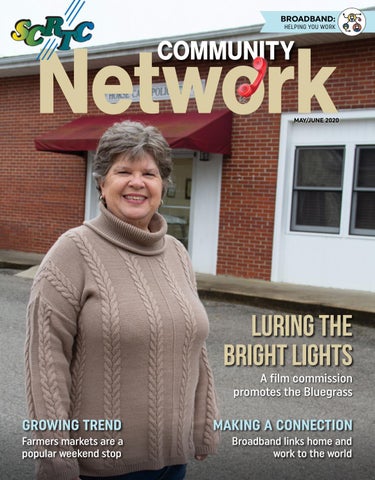
On the Cover: Coni Shepperd, president of the Southeastern Kentucky Film Commission, at the Horse Cave set for “Disturbing The Peace.” See story Page 8.
SCRTC NEWS
Become a Wi-Fi
wizard How to keep connection speeds high and frustration low
As smartphones, laptops, gaming consoles, streaming players and other devices get more advanced with new features and capabilities, the need for a strong and steady Wi-Fi connection is getting more important all the time. While SCRTC technical support staff members are always happy to help, here are a few common problems you can troubleshoot on your own: EXTENDING THE SIGNAL’S REACH Adding a router to your internet connection extends the power of broadband throughout your home by turning the signal into radio waves, which devices pick up. And remember, the location of your router affects the functionality of your Wi-Fi. RUNNING INTERFERENCE Router interference can come from some of the strangest places, including metal objects positioned near the router. The metal mesh embedded in plaster walls in some older homes can limit the signal. Even household items that aren’t connected to the internet can affect your Wi-Fi performance, such as the microwave, fluorescent lights, cordless phones and some external computer monitors. Bluetooth devices like your keyboard, mouse and headset can also have an effect. CLOSENESS MATTERS The location of the router really does matter. Make sure your router is close enough to the device you want to use. The farther away you get from your router, the weaker the Wi-Fi signal will become. SYSTEM OVERLOAD? Every device connected to your Wi-Fi network shares your home’s total bandwidth. So, when your family is using several connected devices, some users may experience slower performance or buffering when streaming. To work through this issue, you may need a Wi-Fi mesh system or a higher broadband package. Contact SCRTC at 270-678-2111 or visit us at scrtc.com to find out more about higher-speed packages.
Employee spotlight Tara Spradlin is a service dispatch technician, a role that involves sending service orders and trouble tickets to the technicians in the field and managing billing for those orders. She says she has especially enjoyed interaction with SCRTC’s members during her 22 years with the cooperative, starting right after graduating college when she was 22. “This is a wonderful company with wonderful employees who truly care for one another and for all of the members,” Spradlin says. “With nearly 50 technicians in the field, we work throughout the day to answer customer calls regarding service orders,” she says. “I’ve always thought it was one of the most exciting departments to work in. It’s such a fast-paced environment with a lot of multitasking involved. And we are continuously learning new things.” Spradlin and her husband, Chris, have three adult sons: Luke, Trevor and Travis. Their dog, Roxie, is the only girl in the family.
South Central Rural Telecommunications Cooperative
May/June 2020 | 5
Rest, relax
and rejuvenate
A vacation does not necessarily require a plane ticket, hotel room or even a tank of gas. In fact, whether you’re on a budget or just looking for a way to unplug from the stresses of day-to-day life, there are plenty of relaxing options if you never leave home. After all, any break is a good break, so here are a few resources, suggestions and tips for those interested in unwinding without heading out.
e r o l p x E S
n Are you a burgeoning birder? iBird, Peterson Birds of North America, the Audubon Society and others have created apps to help both the novice and experienced birder. Apps may include photos, artwork and birdsongs to help you identify birds where you live. You can even earn an online certificate from birdercertification.org.
n Backyards are meant for play and family barbecues, but take a closer look. Grab a magnifying glass and learn what’s out there beyond the grass. Create a nature trail for kids and learn about the plants, insects and animals living in your backyard.
n Arborday.org offers an online database for identifying trees across the U.S. along with its “What Tree Is That?” pocket field guide. Snap a photo of a leaf and the website will help identify it.
n Geocaching is a good old-fashioned treasure hunt with a twist. Try the app from Geocaching.com and get out in nature to find “treasures” others have left. You’ll also learn some handy navigation skills.
n
6 | May/June 2020
l u f y a l Get p
S
n Coloring isn’t just for kids. It can help adults reduce stress and anxiety, improve vision and focus, and even sleep better! Best of all, coloring supplies are inexpensive and available at stores and online retailers everywhere. n Piece together a pretty picture and flex your mental muscles at the same time. Family jigsaw puzzles use a combination of small, medium and large pieces so everyone can join in on the fun. Try puzzlewarehouse.com for a giant selection of puzzles for all ages.
c i s u m d n a s k oo B S
n Did you know there’s a free digital library of classic books? Project Gutenberg offers digital downloads of titles ranging from “Pride and Prejudice” to “Peter Pan.” Just visit gutenberg.org. n If you need help selecting a book to read, do a quick Google search for Time magazine’s All-Time 100 novels. If mysteries are your thing, visit theedgars.com for a list of the latest award winners. And for sci-fi fans, pop over to nebulas.sfwa.org.
l a u t r i v o G S
n Pull the board games out of the closet and dust them off. It’s time for a family-friendly faceoff. Traditionalists may prefer games like Monopoly, Life or Scrabble, but conservative estimates count tens of thousands of available board games. n Discover your inner Monet with an online art class. A quick internet search for online art classes yields results of everything from basic drawing to comic book art to figure drawing and more!
n For those who believe “all the world’s a stage,” playbill.com offers a range of resources, including guides to finding streaming videos of stage performances. n Check with your local library about e-book selections using apps such as SimplyE and Libby.
n Consider a virtual tour, and begin with a visit to google.com/earth. Search for one of the 31 virtual visits to national parks such as Acadia, Everglades and Joshua Tree. They’re fantastic. n Check out Virtualiteach.com for a guide to online tours of places such as the Louvre, the National Museum of History, the Metropolitan Museum of Art and other popular venues across the world. n Many zoos offer entertaining live webcams, particularly if the viewer catches the animals at just the right time. A great first stop is the San Diego Zoo: zoo.sandiegozoo.org/livecams.
n And don’t miss artsandculture.google.com for tours of The Modern Museum of Art, the CERN laboratory and much more. Seriously, this is a must-visit.
May/June 2020 | 7
The crew for “An Uncommon Grace” prepares to shoot a sequence.
Lights, camera... A local film commission brings the ‘action’ to Kentucky Story by LAZ DENES
G
litz meets grits whenever the Hollywood film industry sets up shop in mostly rural Southern Kentucky, a favorite stopping point for more than half a century among producers, directors and location managers. Since the creation of the Southern Kentucky Film Commission in 2016, movie and television projects have become more common than ever throughout the lower half of the Bluegrass State. And that activity brings national and even worldwide attention, along with significant economic benefits for one of the most scenically diverse regions in all of North America. A friendship between Hart County Judge Executive Terry Martin and longtime actor and producer Branscombe Richmond brought about the idea of a regional film commission to formalize the process of luring movie and television projects to Southern Kentucky. The state had incentives in place that offered between 30% and 35% in tax credits for qualifying in-state movie and television projects. “Kentucky’s tax incentives being one of the best in the United States, our location being in the center of the state was prime,” Martin says on the Kentucky Film Office website.
8 | May/June 2020
Movie producers have set their sights — and cameras — upon rural Kentucky as the backdrop for numerous films in recent years.
Richmond, whose list of credits includes the motion pictures “Commando,” “Action Jackson” and “Hard to Kill,” was completing a six-week shoot in Hart County when the idea of forming the film commission came about. “I think we’re pretty good,” South Central Rural Telecommunications Cooperative
“The Silent Natural” producer Branscombe Richmond, left, had a role for Coni Shepperd as an extra in the baseball bio-pic set in the 1800s. He was also an actor in “Disturbing the Peace.” Both movies were filmed locally in recent years.
Richmond, who is an advisory member of the Southern Kentucky Film Commission, says on the Kentucky Film Office website. “I think we’re strong in a field of many states and countries that come to Hollywood and say, ‘Please spend your dollars, please film in our state, country or county.’” Tax incentives aside, the selling point for the film commission includes Southern Kentucky’s vast array of location options. The region is home to one of the most diverse rivers in North America and the longest cave system in the world. It offers the popular Corvette Museum in Bowling Green and one of the nation’s oldest racetracks, along with Civil War battlefields, historic neighborhoods, countless square miles of scenic farmland, large manufacturing plants and small cottage industries. The payoffs for the residents and small businesses of Southern Kentucky are significant with every film project that comes to the region. “The average local spend when a production company comes to town is about $500,000,” says Coni Sheppard, Southern Kentucky Film Commission president and executive director of the Munfordville Tourism Commission. South Central Rural Telecommunications Cooperative
“The film commission was formed because we wanted our towns and counties to get that kind of money — $500,000 is a lot of money for any small town,” she says. “We started asking the neighboring counties to join, and that’s how it all grew. All of the commissioners are tourism directors. We set up our booth each year at the American Film Market convention out in Southern California where location managers come from all the big production companies. We tell them about our area and everything we have to offer. Between that and our website, it’s been very successful.” Sheppard says most every county in Southern Kentucky has reaped the benefits of having a production company in the area. “One of them was called ‘Mail Order Monster,’ and it was shot right here in Munfordville,” she says. “They filmed at the local school and used 85 kids. They built this huge monster, and the kids had a really good time. We’ve had a couple in recent years down in Glasgow and some in Oak Grove and Hopkinsville. Branscombe Richmond and his company shot one about a motorcycle gang, and it used a lot of local people. All of the production companies who come through have been really nice.” In turn, the production companies tend to enjoy the local residents and their Southern hospitality, and they patronize local business in most every sector, Sheppard says. Whether the production is a feature film, television series, commercial or music video, the commission serves as liaison, helping to make community connections to find the services and resources needed to make every project a success. “It’s exciting for everybody when the production companies are in the area,” Sheppard says. “The hotels and restaurants are full, the food services people buy their groceries locally, the props coordinators use local sign shops and other local business. The list is endless. They also use the services of local law enforcement, fire departments and paramedics. They come with their phones from out of town, and we work with SCRTC to help get them local phones and internet access.” Richmond, a huge fan of the region, is helping open a full-functioning movie studio in Horse Cave. The local film industry will use it as a base of operations for out-of-town production companies, and the studio will be able to ship needed equipment anywhere in the state, saving producers the hassle of bringing it in all the way from Southern California or other faraway places. “There is a community of talented filmmakers, musicians, writers and people behind the camera that are trying to continue their vocational trade in Kentucky,” Richmond says in a Bowling Green Daily News article about the studio’s official groundbreaking last August. “Southern Kentucky has seen probably more movies and video projects shot here than just about anybody around,” Sheppard adds. “But we work really, really hard to get them here.”
southernkentuckyfilmcommission.com May/June 2020 | 9
BROADBAND: HELPING YOU WORK
A trusty solution Broadband creates a key resource
A
ccess to fast internet service is an increasingly important resource, a realization playing out in large and small ways for rural communities across the nation. And state and local governments are striving to make it easier for residents to take advantage of new communications resources.
For many, the benefits created by access to broadband are deeply personal, and the choices made by one Tennessee family illustrate the possibilities. Aaron and Becca West lived in Spring Hill, a Nashville suburb, when a national communications provider brought highspeed internet to their neighborhood. Aaron West took advantage, working from home and eliminating his 45-minute commute to a software company. Also, the new technology allowed him to grow his own business, an audio and visual consulting company serving churches. When the family opted to relocate to the more rural area of Crossville, Tennessee, they did not leave behind the opportunities made possible through broadband. The local telephone cooperative, Ben Lomand Connect, provides 1 Gbps internet service
through a fiber optic network. And the couple took advantage. “I’ve had the company for about nine years, but I couldn’t operate it the way I can operate it now,” West says. “The fiber was so huge for the contract work. It was so much easier to communicate. When we were looking for homes here, we immediately ruled them out if they didn’t have high-speed internet access.” Broadband has also helped the career of Becca West, a teacher by training. She connected with a program called GoGoKid, allowing her to use the internet to teach English to Chinese students. The arrangement also made it easier for her to home-school the couple’s two daughters. While fast internet access improves their connectivity to the world, the family also experiences its capacity to create a deeper connection with each other. “We’re all here together, and we’re very intentional about doing things together,” Aaron West says. “We’re able to go to parks and libraries. We’re freed up to focus on our family instead of it being career first and family second.”
UNTAPPED POTENTIAL
Becca West teaches English to Chinese children via the internet. 10 | May/June 2020
Stories such as that of the West family are only the beginning. The full potential of broadband remains untapped, and states nationwide can benefit as fast networks reach rural areas. Last year the U.S. Chamber Technology Engagement Center released results of a study commissioned by Amazon that found Texas could add as many as 23,433 jobs in rural communities over three years.
Aaron West, a Tennessee resident, in his home office.
And hitting that mark could generate an additional $6.6 billion in annual sales and $963 million in annual wages. While the Lone Star State leads all states in potential gain from broadband growth, both Ohio and Mississippi could also see significant gains. The study emphasized that achieving the potential growth would require investments such as an increase in rural broadband and cellphone access, as well as growth of the number of people with digital skills necessary for these jobs. With so much potential at stake, local communities are incentivized to promote broadband-based jobs, even if that means updating local regulations, as one Wisconsin county has done in recent years.
EMBRACING OPPORTUNITY Once, home-based businesses in Wisconsin’s Bayfield County were required to secure permits to operate. Now, the county takes a more common-sense approach as the description of a home-based worker evolves. “We’ve recognized the direction of business in America today and around the
world,” says Rob Schierman, director of planning and zoning for Bayfield County. “We created some breathing room for when a business would need a permit and when it doesn’t. We’re creating opportunity while still protecting the integrity of neighborhoods.” The area was one of the first to receive the state’s Telecommuter Forward! Certification, one step in promoting work-from-home jobs and taking advantage of the internet network of Norvado, a telecommunications cooperative in Cable, Wisconsin. “We’re providing a means to try to stimulate some of that employment activity coming to Bayfield County and to take advantage of the fiber optics that we have here with Norvado,” Schierman says. The issue is personal for Schierman and his wife, Jennifer, who understand the benefits of telecommuting.
Her employer is based in Minneapolis, but she works from home. The need for highspeed internet connectivity is a necessity. “We connect via phone, and we hold meetings on Skype,” she says. “It works. It’s very slick.” Like other telecommuters, she enjoys the freedom to get up and move, to go walk the dog or to pitch in a load of laundry. “It definitely makes life easier,” she says. Rob Schierman says that freedom is part of the draw for telecommuters who live in Bayfield County or those considering relocating there. “The younger workforce doesn’t like to be married to a desk or a location,” he says. “They’re a little bit more fluid in their lifestyle and like to be where they can hop on a bike trail or go fishing or go kayaking. They can take advantage of the resources in Bayfield County — we’re uniquely situated along Lake Superior and close to a lot of undeveloped areas where recreation is still plentiful.”
Jennifer Schierman telecommutes to the city. May/June 2020 | 11
Homegrown in the Bluegrass
Farmers markets thriving across the area Story by JOHN CLAYTON
Farmers market vendors Brenda King and Darrell Enos bring bushels of veggies each weekend.
F
armers markets across Kentucky are in full swing with the arrival of May and the fresh produce that comes along with spring and summer. According to the Kentucky Department of Agriculture, more than 160 successful farmers markets operate in 110 counties across the commonwealth. More than 2,700 vendors participate in the markets, putting fresh produce and other goods in the hands of customers. Three of those markets are in Barren, Hart and Metcalfe counties. Each of those is part of the Kentucky Proud program, which markets, highlights and supports agritourism and local small businesses and farmers. While Kentucky Proud and other agencies and programs have been pivotal in the successes of local farmers markets, Ken Childers, chairman of the Metcalfe County Farmer’s Market board of directors, says it starts at home. “What’s done this is dedication by our vendors,” he says. “Our vendors have good, quality produce and a good variety of produce. It’s been an effort, really, by a lot of different people to pull this thing together.”
BOUNTY OF THE BARRENS On Saturday mornings from the end of April through October, the Glasgow Public Square teems with activity, thanks to the Bounty of the Barrens Farmers Market. “During our peak summer season, we’re averaging over 500 customers a day,” says Bounty of the Barrens Market Manager Josh Johnson. “All of our vendors set up around the courthouse on the square, and it’s a nice kind of community event. We have local musicians and a gazebo that’s sort of a stage for the music, and people can come in and listen to music for a couple of hours. It’s a nice way to spend a Saturday morning.” While the musicians are a popular attraction for marketgoers, the produce and other products local farmers sell are the real stars of the show in Glasgow on Saturdays from 8 a.m.-noon. Sustainable Glasgow, a nonprofit organization made up of local farmers, artisans, craftsmen and producers, supports Bounty of the Barrens. The vendors come together to create one of the state’s largest and best farmers markets, according to several websites, such as OnlyinYourState.com. Shoppers can find everything from fresh meats to fresh-cut flowers and fresh fruit and vegetables. “In the spring, we have folks who actually bring plants for sale, so people can set them out in their gardens themselves,” Johnson says. This past year, Bounty of the Barrens also hosted a winter market that operated indoors every other Saturday at the Barren County Extension Office.
HART COUNTY FARMERS MARKETS The Hart County Farmers Market built on more than a decade of success when it opened a satellite market in Horse Cave to go with its established market in Munfordville.
12 | May/June 2020
South Central Rural Telecommunications Cooperative
Both markets began their 2020 seasons in April. The Munfordville market, located in the parking lot of the former Sullivan Building, is open on Tuesdays and Fridays. The Horse Cave market, which debuted last year, is open on Wednesdays. Both markets are open from 7:30 a.m. until around 1 p.m. or until all goods are sold. Janey Cline, the University of Kentucky extension manager for Hart County, says the markets usually host about eight vendors between them, including participation from Horse Cave-based Dennison’s Roadside Market in 2019. “We have pretty much any fruits and vegetables you might want,” Cline says. “We do have some vendors who do the jams and jellies with breads and things like that as well.” Cline says the markets have provided an important service and better nutrition to the people of the county, especially those who may be in need. The markets accept both senior vouchers and WIC vouchers for the federally funded supplemental nutrition program for economically disadvantaged women, infants and children. “Those are probably our main markets for seniors and those who are disabled,” Cline says. “That’s one of the reasons we opened the Horse Cave market — the senior population in the area and the number of people in the WIC program.”
“Four years ago, we had about two vendors and less customers,” says Childers, chairman of the market’s board of directors. After coming on as chairman, Childers says a cadre of local supporters helped turn around the market with new ideas and new blood. “We got it reorganized and got some new blood and new people interested,” he says. “My thought was if we provide quality produce and quality vendors and advertise, people will come to us, and that is what has happened.” The number of vendors has grown to 20, and around 150 customers routinely come to the market on Fridays from 8 a.m. to 1 p.m. April through October and on Tuesdays from 2 to 5 p.m. June through September. It is located at the pavilion a block off the Edmonton Town Square across from the Kentucky Extension Office on East Street.
In addition to some of the area’s best produce and other products, such as local honey and syrups, the market also often features local musicians. Around 350 people attended Customer Appreciation Day this past October. As a Kentucky Proud member, the market receives state funds to help seniors and low-income customers buy products there. Through sponsorships, the market offers “double dollars,” meaning customers can spend twice the worth of their vouchers. “This is our way of giving back to the community and putting the produce where it is needed,” Childers says.
METCALFE COUNTY FARMER’S MARKET The Metcalfe County Farmer’s Market in Edmonton has come a long way in the four years since its reorganization.
Sunflowers add beauty to the weekly Bounty of the Barrens Farmers Market. Jordan Crump, owner of Linda & Neva Fresh Flowers, arranges wildflowers.
South Central Rural Telecommunications Cooperative
Families stock up on farm-fresh produce and free-range eggs.
May/June 2020 | 13
SOUTHERN KITCHENS
(
Farm fresh
LOCAL INGREDIENTS MAKE A DIFFERENCE
F
arm-to-table dining isn’t a flash in the pan. “It isn’t a trend,” says Tommy Hines, executive chef at Pursell Farms in Sylacauga, Alabama. “It’s here to stay. I look forward to sourcing locally and cooking with the seasons.” When it comes to food philosophies, few are as straightforward as the farm-to-table movement. Simply, it’s food sourced as close to home as possible — if not from a personal garden then from a farm close enough that whatever is harvested one day can be on your plate the next, if not sooner. In addition to being more healthful, with no added ingredients, the farm-to-table philosophy supports the local economy, so it’s a win-win for food purveyors, cooks and diners. Hines, a native of New Orleans, grew up and honed his culinary skills in a part of the country where farm-totable is a way of life, with a warmer climate that allows for year-round produce and within easy reach of the fruits of the sea. “We cook with the seasons, using foods that are out our back doors,” he says. “We use Creole tomatoes when they’re in season. We use Louisiana peaches when they’re in season. And the fresh seafood in the Gulf and the foods that are at your back door. Everything that’s available to you. That’s just how I learned to cook, and
14 | May/June 2020
Tommy Hines, executive chef at Pursell Farms in Sylacauga, Alabama, finishes a plate of vegetables with boiled peanut hummus.
I think that’s the best way to cook. “Why cook something that’s not from your area?” Hines says. “First of all, you’re going to pay more money, but it’s not as good quality. You know, you pick up a tomato in December, and it’s nothing like those wonderful tomatoes you can get in July and August.” When Hines started at Pursell Farms in the fall of 2019, he began a relationship with farmers and other food producers in the Sylacauga area. And his menus at the resort’s two dining venues, Old Tom’s Pub and Arrington, reflect the partnership between chef and farmers with dishes that change according to the season. In cooler months you may find crab au gratin, kale and brussels sprout salad, or chicken and sausage gumbo.
But when the weather warms, you’ll find dishes featuring the bounty of summer, such as Hines’ heirloom tomato and peach salad with olive crumble or the strawberry-rhubarb shortcake with whipped mascarpone. Hines likes to think of farmto-table eating as something that comes full circle — from the ground to the plate and, if you compost, back into the ground again. “I think people should be eating what they have the ability to grow or get from their local farmers markets,” he says. FOOD EDITOR ANNE P. BRALY IS A NATIVE OF CHATTANOOGA, TENNESSEE.
Heirloom tomato and peach salad with olive crumble 4 large heirloom tomatoes (about 2 1/2 pounds) 2 medium yellow peaches Fleur de sel or kosher salt Freshly ground black pepper 1/4 cup torn fresh basil leaves, plus whole leaves for garnish 1/4 cup extra-virgin olive oil 3 tablespoons chardonnay vinegar 4 (2 1/2 ounces each) rounds burrata cheese 2 tablespoons black olive crumble (instructions follow) Cut the tomatoes and peaches into wedges and place them in a large bowl. Sprinkle them with fleur de sel and pepper, add the 1/4 cup basil and olive oil, and mix well. Let stand at room temperature 30 minutes to 1 hour, stirring occasionally. Place 1 burrata cheese round in the center of each plate. Fan the tomatoes and peaches around the cheese, dividing equally, and drizzle with the dressing left in the bowl. Garnish with olive crumble and whole basil leaves. To make olive crumble: Place 1 cup pitted black olives on a wire rack with a tray underneath and roast in the oven at 175 F until dry, about 2 1/2 hours, or until semicrispy. Pulse in a food processor to a consistency of coarse crumbs.
Strawberry-rhubarb shortcake with whipped mascarpone For the filling: 1 pound medium-size strawberries, hulled and quartered 3/4 cup granulated sugar, divided 1 tablespoon balsamic vinegar 1 tablespoon Grand Marnier 1 1/2 cups chopped fresh rhubarb (about 2 stalks) Pinch kosher salt Biscuits: 2 cups sifted all-purpose flour, plus extra for work surface 1 tablespoon baking powder 1/2 teaspoon table salt 2 tablespoons granulated sugar Freshly grated zest of 1 orange 1 cup heavy cream, plus extra for brushing biscuits Coarse or granulated sugar Unsalted butter (for baking sheet) Whipped mascarpone: 1 cup mascarpone 3 tablespoons powdered sugar 2 tablespoons heavy cream For the filling: Mix berries with 1/4 cup sugar, vinegar and Grand Marnier in a medium-size bowl. Toss gently and set aside. In a small saucepan, combine rhubarb, remaining 1/2 cup sugar and salt. Cook over medium heat, stirring, until sugar melts and liquids are simmering nicely, 8 to 10 minutes. Remove from heat and cool to room temperature. Rhubarb will soften as it sits. Add berries and stir. Set aside. For the biscuits: Preheat oven to 400 F. In a large bowl, whisk together flour, baking powder, salt, sugar and orange zest. In the bowl of a standing mixer, whip cream until it forms firm peaks. Fold the whipped cream gently into the flour mixture until the dough begins to come together. (Add another 1 or 2 tablespoons of unwhipped cream, if needed.) Gently gather the dough into a ball and turn it out onto a floured surface. Press to form a disk about 3/4 inch thick. It will be slightly crumbly. Using a biscuit cutter 2 ½ inches wide, cut out the biscuits and lay them on a baking sheet greased with unsalted butter. Brush them with extra cream and sprinkle on the coarse or granulated sugar. Bake until golden, 15 to 17 minutes. Cool on racks. For the whipped mascarpone: Combine all ingredients in the bowl of a stand mixer fitted with the whisk attachment. Beat, starting on low speed and gradually increasing speed, until the mixture is light and fluffy, about 1 minute. Refrigerate in an airtight container until ready to use, up to 3 days. To plate: Split each biscuit horizontally. Spoon berry-rhubarb mixture on the bottom half, top that with mascarpone and cover with the top half of the biscuit. Garnish with powdered sugar.  May/June 2020 | 15
Presort STD US Postage PAID Permit #21 Freeport OH
1399 Happy Valley Road P.O. Box 159 Glasgow, KY 42142-0159
Share the best with your bestie in 2020!
REFER A FRIEND AND GET $20 FOR YOU AND YOUR FRIEND! Step 1
Your name Your phone number
Step 2 Give this form to a friend who deserves fast, reliable internet service! Friend’s name Friend’s phone number Friend’s address
Step 3 Submit this completed form at the SCRTC office in Glasgow, Greensburg, Hodgenville or Munfordville during regular office hours when ordering service.
A $20 BILL CREDIT FOR YOU! A $20 BILL CREDIT FOR YOUR FRIEND!
270-678-2111 scrtc.com