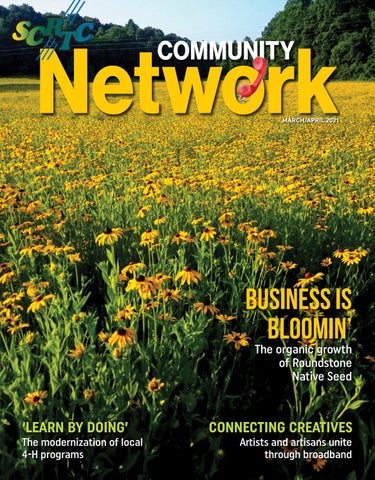
Network COMMUNITY
MARCH/APRIL 2021
BUSINESS IS BLOOMIN’ The organic growth of Roundstone Native Seed
‘LEARN BY DOING’
The modernization of local 4-H programs
CONNECTING CREATIVES Artists and artisans unite through broadband
INDUSTRY NEWS
Rural Connections By SHIRLEY BLOOMFIELD, CEO NTCA–The Rural Broadband Association
Here’s to hope in 2021
T
he pandemic has made it clear that every American needs broadband to thrive. We need it for work, for school, for health. And we need it for accessing government services, for growing businesses and for building communities. If there is a silver lining to 2020, which was a hard year for so many, it’s that more people are now acutely aware of the essential nature of broadband services. The new year brought new challenges, many of them playing out at our Capitol, a building I’ve had the honor of visiting many times to talk to members of Congress about the need to support broadband for all of America. But I choose to have hope that better angels of our nature will guide us to rebuild, and I believe NTCA and our members have an opportunity to help that rebuild with the work that we do supporting broadband connectivity and other critical services for rural communities. The hard-working members of NTCA have made so much progress in the past decade toward solving the rural broadband challenge. There is much work yet to do, but I have hope in the progress they are making. Through federal and state funding programs, coupled with local investments by providers themselves, we are on our way as a country to connecting everyone. There is a day in our future when we can say that everyone who needs or wants a broadband connection has access. That day is coming, sooner than later. I have hope.
2 | March/April 2021
How fast is broadband? Industry leaders encourage the FCC to reconsider the definition of ‘broadband’ By STEPHEN V. SMITH
We as a nation need to rethink what is considered true broadband connection speeds. That’s the message telecom industry leaders recently sent to the Federal Communications Commission. NTCA–The Rural Broadband Association joined with the Fiber Broadband Association in sending a letter to the FCC in December addressing the definition of broadband. The letter came as the FCC prepares its next report to Congress on the state of broadband deployment in America. For the past five years, the FCC has considered any connection speeds of 25 Mbps download and 3 Mbps upload to be the benchmark for broadband. “By any measure, this benchmark does not reflect what American consumers need today, let alone tomorrow,” wrote NTCA CEO Shirley Bloomfield and Fiber Broadband Association President and CEO Gary Bolton. In urging the FCC to redefine what speeds are considered broadband, Bloomfield and Bolton wrote that “while all Americans would be best
served by the Commission adopting a gigabit symmetric benchmark … it should at least raise the minimum broadband performance benchmark for the Sixteenth Broadband Deployment Report to 100/100 Mbps.” Raising the definition, a benchmark that impacts funding decisions and technology choices, would put the country on a path toward ensuring all Americans have broadband access that actually meets their needs, the letter states. With millions of people using broadband at home to work, participate in school and attend doctor appointments, broadband has become essential to everyday life. Bloomfield and Bolton further concluded that redefining broadband would allow the FCC to “keep pace with broadband service that Americans both need and want,” while providing “a benchmark the Commission can then use to ensure that we build our networks right the first time by driving investment in future-proof broadband infrastructure.”
To hear an interview with Gary Bolton on this and related topics, visit www.RuralBroadbandToday.com, or search for “Rural Broadband Today” on your favorite podcast app, Spotify or Amazon Music.
The price of entertainment
C
onsumers can tap into a rushing stream of content delivered across devices ranging from TVs to smartphones. Sports, news, movies, comedies, dramas, music — the list of options is seemingly endless. But there is a cost. And for many consumers that price increases each spring. If you have it handy, take a moment to review a bill for your TV programming from three years ago. Compare it to today, and in most cases the difference is obvious — television programming is pricier. The increases are not limited to traditional cable TV providers either. Streaming services have seen prices spike, too. When Google launched YouTube TV, the monthly price was about $35. Now, it’s $65. In cases such as Google, as well as other providers, adding new, desirable content channels helps drive the increases. For traditional networks, investment in higher-quality programming has become essential to compete with streaming services like Netflix, Amazon and HBO Max. Those costs are then passed on to cable providers and their customers. But more content is not always the root
cause of the higher prices. In fact, for many providers, such as the rural communications companies serving much of America, the increasing cost of content is an annual struggle to hold prices down. It’s not a push to increase profits, and their efforts to control prices illustrate the give and take behind what you see on your bill. For these companies, only a small portion of a monthly television subscription fee goes to personnel costs, equipment upgrades and tasks such as equipment maintenance. So, where does all the money go? Much of the cost is wrapped up in agreements allowing TV providers to bring content to you. Networks like ABC, NBC, CBS and Fox regularly renegotiate these agreements. In many cases, these are annual negotiations. A 2019 analysis of cable TV rates by Consumer Reports found that while advertised rates generally increased by 3% to 4% annually, fees for the major networks and channels airing live sports climbed between 8% and 10% each of the previous four years. How are those rates determined? Essentially, the TV provider must pay
networks a fixed fee for each subscriber of the service. But each year there are fewer traditional TV subscribers to carry that load. In 2020 alone, about 6.3 million people dropped their cable or satellite TV service, according to investment research firm Moffett Nathanson. Without an expanding subscriber base to offset these increasing costs, TV providers often pass the expense on to consumers in the form of fees added to advertised prices, according to the FCC’s 18th Annual Video Competition Report. When it comes to these hidden costs, there is one bright spot for consumers. The Television Viewer Protection Act passed at the end of 2019 requires cable and satellite companies to disclose the total monthly price of subscribers’ TV bills, including all individual fees and charges, when they sign up. That transparency won’t make your bill any lower. But it will give you an accurate picture of the full cost of your monthly TV bill.
March/April 2021 | 3
FROM THE GENERAL MANAGER
Equipping and enabling vibrant rural communities The 2020 census data will be coming out this year — and despite what the headlines may say, I’m here to tell you that rural America is alive and well.
A
s you may remember, I urged everyone to participate in the 2020 census. The population counts go a long way in determining our representation in Congress and the statehouse, as well as funding for state and federal programs.
According to the 2020 census website, 2020census.gov, the census will shape the future of our community for the next 10 years. While that timeframe may be a bit of an overstatement, there’s no doubt that an accurate population count is critically important. While census numbers will contribute to the allotment of funding and political clout, they will also help to tell the story of rural America. The 2020 census should provide definitive evidence of the trends shaping communities like ours. But as you probably know, I’ll be the first to say that whatever trend lines on a graph from JEFF EATON the U.S. Census Bureau suggest, parts of rural America are more General Manager vibrant and offer more opportunities today than ever. Some communities have no doubt fallen on hard times. But many others, including ours, are very much alive. According to experts at places like the USDA and the National Council of State Legislators, about one-third of rural counties are growing, one-third are stable and one-third are shrinking. Researchers point to 2016 and 2017 as years where many rural areas began showing growth after many years when the number of residents diminished. Will all the news and research taken from information contained in the census be positive for everyone in rural America? Most likely, it will highlight some of the challenges communities like ours face. Events such as the pandemic, though, have left some city dwellers intrigued by the many benefits of living in rural areas. We’ll know for sure once the data is released, but the 10-year scope of the census may well show a continuation of the gradual, decades-long shift to fast-growing cities and suburbs from small towns and rural areas. It’s possible statewide and national news outlets will use a broad brush to highlight this demographic trend as they cover the census statistics over the next few months. A few troubling statistics, however, should not be sufficient to raise concerns about the future of rural America and our small-town way of life. Census numbers — a comparison across decades that may not fully acknowledge recent positive changes — do not tell the whole story. In many ways, the people of rural America have more opportunities now than ever before for business, education, health care, entertainment and overall quality of life. And I’m proud to say broadband makes many of those chances possible, although I’m not sure how much coverage they’ll see. In fact, our confidence in that vitality and belief in the future is why we’ve invested millions of dollars into improving the telecommunications infrastructure in our communities. You’ll never find a stronger group of advocates for our communities than our team here at SCRTC. We’re proud of the rural areas and small towns we connect to the world — and we work hard every day to make our communities even stronger.
4 | March/April 2021
Network COMMUNITY
MARCH/APRIL 2021
VOL. 6, NO. 2
The SCRTC Community Network is a bimonthly newsletter published by South Central Rural Telecommunications Cooperative © 2021. It is distributed without charge to all customers of the cooperative. South Central Rural Telecommunications Cooperative is a member-owned corporation dedicated to delivering advanced telecommunications technology to the people of Central Kentucky, including Adair, Allen, Barren, Edmonson, Green, Hart, LaRue, Metcalfe, Monroe and Nelson counties. South Central Rural Telecommunications Cooperative, Inc. 1399 Happy Valley Road • P.O. Box 159 Glasgow, KY 42142-0159 270-678-2111 www.scrtc.com SCRTC BOARD OF TRUSTEES Ralph J. Thompson, District I Bonnieville and Munfordville exchanges Billy Smith, District II Canmer and Horse Cave exchanges Jerry Polson, District III Cave City and Hiseville exchanges Ronnie Tucker, District IV Center, Edmonton and Summer Shade exchanges Zack Kender, District VI Fountain Run, Gamaliel and Lucas exchanges Robert E. Thompson, District VII Buffalo and Magnolia exchanges Jeff Eaton General Manager Bobby H. Richardson Attorney Produced for SCRTC by:
On the Cover: Roundstone Native Seed is a generational family farm, in Upton, growing wildflowers and native grasses that are sold worldwide. See story Page 8.
SCRTC NEWS
A JOB
well done!
The employees of SCRTC congratulate a few of our dedicated co-workers as they begin their retirement. Through the years, these individuals have helped our cooperative grow and modernize to meet the needs of members and our local communities.
Corporate Executive Assistant Tina Harlow has worked at SCRTC for 40 years, five months and 11 days. She spent most of those years in accounting. “I appreciate the diversity of that area, in that no two days were alike,” she says. Harlow is trading her seat at the office for a captain chair, plotting new adventures in an RV. She plans to start with short trips, eventually take cross-country voyages and pick up a few hobbies along the way. “I will be forever grateful for my time at SCRTC,” she says.
Outside Plant Engineer Orval Brooks worked at SCRTC for 42 years. While the industry has changed significantly during his career, he still appreciates the customers he served and the people he worked with. “SCRTC has always been good to me and my family,” Brooks says.
Regulatory Manager Brad Thomas spent 29 1/2 years at SCRTC. “I’m looking forward to a lot more time for deer and turkey hunting,” he says. “I’ll enjoy getting out with my friends riding side-by-sides through the country.”
South Central Rural Telecommunications Cooperative
Outside Plant Engineer Mitchell Pedigo retires with 27 years of service. “Working at SCRTC has given me the opportunity to connect with so many wonderful people and to provide the best possible service to the customers,” he says. “Serving the community has been an awesome, rewarding experience.” Pedigo plans to do more fishing and golfing. He also wants to visit Yellowstone National Park.
Computer Operator Bonnie England retires after 23 years. “It’s been an honor and privilege to work for a cooperative where customers are also friends,” she says. England plans to take beach trips with her husband and enjoy more time with her grandchildren.
March/April 2021 | 5
TRAVEL
A rider navigates the Tunnel Trail in Sumter National Forest.
TAKE PRIDE IN YOUR RIDE How to safely blaze the ATV trails
I
n coming weeks, ATVs and other off-road vehicles will come out of hibernation, and riders will be hitting the trails more than any other time of year. There’s something about early spring that makes for great riding — cool mornings, mild afternoons, pleasant evenings, new growth appearing all around you. They all come together to make an ideal day as you ride trails through the forests of the South. “I think the best part about riding is getting to see so much of the forest and so many different habitats in a short period of time,” says David Baldwin with the U.S. Forest Service at South Carolina’s Francis Marion National Forest. There’s one main thoroughfare, the Wambaw Cycle Trail, that’s 40 miles long with two different loops — one north and the other south. “Within a 19-mile section of the north section, you’ll witness Carolina Bay trees, hardwood ponds, longleaf pine stands and a variation in terrain that is rare in the low country,” Baldwin says. But if you’re new to the sport, how do you know which all-terrain vehicle is best for you? Alice Riddle, an outdoor recreation planner at Sumter National Forest, says it’s important to ride vehicles that are age- and size-appropriate. One size does
6 | March/April 2021
not fit all. ATVs come with a warning label, clearly stating the minimum age of the rider. Not sure where to look? The label is affixed so riders can easily read it when seated in the proper operating position. If you’re new to the sport, talk with local shops and other riders, and do your homework ahead of time. The internet is a good resource, Riddle says. There are also training courses for both ATV and dirt bike riding. Check with your local bike shop. It may seem as though the sounds of motorized vehicles are incongruous with
Choosing an ATV properly fitted to you is a key for safety.
Story by ANNE P. BRALY
the peaceful sounds of nature, but it’s all part of the plan the Forest Service offered when the trails first went in, says Riddle. “National forest lands provide a wide variety of recreational opportunities,” she says. “Motorized trails are one of these opportunities. There are many hiking trails or general forest areas that one can go to in order to find a peaceful hike or solitary experience. Motorized trail bikes are only allowed on designated trails for motorized use on National Forest Lands. With national forests encompassing many thousands of acres, there are opportunities for all to enjoy.”
SAFETY FIRST On nice days, trailheads can fill up quickly, says David Baldwin with the U.S. Forest Service. The Forest Service maintains the trails in South Carolina’s two national forests. And since there are different loops and trails that riders can take, they do not get terribly congested, he adds.
TOP TRAILS There are two national forests in South Carolina open to the public with wellmaintained trails: Sumter National Forest in the Piedmont region offers a gently sloping topography with elevations up to 400 feet, and Francis Marion National Forest in South Carolina’s low country — a flat sandy environment with many bogs that the trails skirt. Both offer trails for different levels of ability.
MAP IT
One of the primary rules for off-road safety is carrying a trail map with you. You’ll find maps for Sumter and Francis Marion National Forests online at fs.usda.gov.
Here are some additional rules of safety and etiquette to be considered when riding the trails. • Keep in mind that there are going to be riders of all different skill levels around you. So, whether you are a seasoned professional who is training for your next race or a first-time rider who is learning to ride, everyone shares the trail.
• Cedar Springs Trail at Sumter is 11 miles long and offers moderately challenging trail loops. • Parsons Mountain Trail at Sumter is 10.3 miles long and easy — a good one for beginners. • Francis Marion has one main trail — the 40-mile Wambaw Cycle Trail — with two loops. The north loop has more technicality in terrain and is best for more advanced riders than the south loop. On each of the loops, riders will approach signage where the trail forks and have the ability to choose to continue on or head back to the trail head.
Keep in mind, though, the trails are not race tracks. “Riders need to be aware there could be hazards that occur along the trail, and they need to be ready to stop on a moment’s notice,” warns Alice Riddle, an outdoor recreation planner at Sumter National Forest. “Riders must be in control of their bikes at all times. They are responsible for their safety and others. All trails have passing areas, so wait for those opportunities and don’t create new impacts to the trail. If it’s your first visit to a trail, start off with the loops closer to the parking area until you become familiar with the trail system.”
• Do not ride above your ability. This practice prevents you from getting injured and keeps other riders safe, as well.
Volunteers groom trails by pulling a cluster of tires to flatten the path.
• There are spots on the trails where other riders may pass if they need to, so slow down, let them pass, or pull over if need be. This safety rule keeps the trail flowing nicely during busier days.
March/April 2021 | 7
Roundstone Native Seed finds niche sales & conservation
Randy Seymour, left and his son John conduct botanical research in a preserved native prairie of Liatris Spicata, or commonly known as Spiked Blazing Star, in Grayson County.
Story by JOHN CLAYTON
J
ohn Seymour owns and operates the family business, Roundstone Native Seed, but more than that he is the keeper of the family tradition started by his father, Randy Seymour in the woods and fields around the family farm in central Kentucky.
Roundstone harvested fields of black eyed Susan, left, and little bluestem in Hart County. Roundstone Native Seed’s main office is located in Upton.
“He kept me in the woods when I was little,” John Seymour says of his father, who is now retired but still drops by the once small family business that has grown into one of the largest seed providers in the eastern U.S. over the past two decades. “I always had a passion for conservation, but he kept me in it. He taught me about it and the ethics of being conservationists — how we can make a difference. “Even when we farmed, we farmed as much for the wildlife as we did to make a living off our cattle and tobacco and things. He always taught me to try and do a little good in the world and not do any harm.” Now, John Seymour’s own children — Carly Simms, Carson Seymour and Devin Oldham — are all part of the family business.
What was once a small family farm that was not out of the ordinary in size, scope or crops has evolved over the years into Roundstone Native Seed with 32 full-time employees. Roundstone sells its meticulously harvested seeds to everyone from individuals looking to beautify and enhance their own properties to large farms and other conservation efforts. In some cases, they sell truckloads of seeds to farmers and conservationists for government-sponsored programs to enhance or fortify local ecosystems, while also selling small seed packets to individual buyers. “We’ve worked with the U.S. military in places like Fort Knox and Fort Benning in Georgia, and we’ve worked with national forests,” Seymour says. “We’ve always felt like everybody can be involved in conservation in their own small way if they’ve got a couple of acres of land. In the end, we try to help those folks along by helping them plant something whether it’s butterfly friendly plants or whatever might help preserve and help their local ecosystem.”
WORKING THE FIELDS For each harvest needed, the old 1952 Allis Chalmers All Crop 66 combine creaks to life, and that is often. For bigger jobs, it might take a huge Case 2188 combine or even a team of mules to harvest the seeds propagated and sold by Roundstone Native Seed. 8 | March/April 2021
South Central Rural Telecommunications Cooperative
“Sometimes it’s more precise and specific,” says Seymour. “Some things like a cardinal flower, I have to hand pick — and when I say hand pick, I mean take two fingers and pull each bud. It has around 10 million seeds per pound. It’s like bug dust. It’s microscopic. Some things like Eastern Gamagrass are the same size as a kernel of corn. With over 250 different species, you’re talking about some things that are 11 feet tall and some things that we have to vacuum off the ground with modified leaf blowers. It’s everything in between — some things I have hundreds of acres of and some things, a half-acre would be all I need for the whole year.” Roundstone harvests an average of about 2,000 acres per year. That acreage is spread out beyond its home base in rural Upton. Roundstone leases acreage to grow seeds in different regions that are native to those areas. Seymour also harvests “wild lands,” areas with specific plant life in places such as Eglin Air Force Base in Florida. “I do a lot of specific harvests,” Seymour says. “I’ll go there for a specific reason off of a specific area.” The work starts long before the harvest. Seeds are developed through planting first in a nursery and then grown in smaller fields before heading to the larger fields and eventually to harvest and customers. It is all part of a long process. “We go into different regions, and we look around and do a botanical survey and see what was there in nature in an undisturbed area,” Seymour says. “We want to mimic that. We’ll raise all the seeds in a monoculture in separate fields, which I have to do by state and federal law.”
Carlie Simms, left, the horticulturist and assistant production manager, is also the daughter of Roundstone President John Seymour, right.
Grain bins are used for drying native seeds before processing.
GROWING MORE THAN SEEDS Early on, Roundstone was a small family business that was as much about conservation and education as profit. Most people learned about the seed company through word of mouth. Then the information highway and the Seymours found each other. “I was starting to do jobs for the National Park Service and the Nature Conservancy, and I was farming on the side,” Seymour says. “I was doing the seed business to make a little extra money. Once we advertised online, it hit us faster than we could react to it, so that was both good and bad. It allowed me to reach a broader area and more people. I have good technical people who work on our websites, and it allows us to see what’s changing, what’s selling and not selling and what’s needed.” Locally, utility companies such as Eastern Kentucky Power, solar farms and other utility companies have become some of Roundstone’s bigger customers due to their conservation efforts. Roundstone’s highest quality seeds make their way to customers, big and small — and for all the right reasons, Seymour says. “The majority of the seeds we sell go to individual landowners. They’re doing it because they want to — maybe it’s because they love plants or because there’s been a revival in pollinators like bees, honeybees or the Monarch butterfly,” he says. “That’s been a big driver for it. With a small patch in somebody’s backyard or a small corner in a field, you can make a profound difference.”
South Central Rural Telecommunications Cooperative
Freshly cleaned and bagged seed in Roundstone’s temperature- and humidity-controlled warehouse.
Roundstone Native Seed RoundstoneSeed.com 888-531-2353 or 270-531-3034 9764 Raider Hollow Road, Upton, KY
March/April 2021 | 9
Creative spaces
Artists and craftspeople find community online Story by DREW WOOLLEY
Jessica Sanders, left, and Addie Moore keep ETX Creatives running along with Lisa Horlander, who is not pictured.
The online community is home to 350 artists and creatives.
A
ddie Moore just wanted to know a schedule for local art shows. A mixed media artist and art teacher at Chapel Hill High School, she and her friends knew there was a need for better communication among creatives in Tyler, Texas, and beyond. “I heard it enough times that eventually I realized, ‘OK, I guess I have to do it,’” she says of her commitment in 2018. “Our first meeting we just went out for a beer and decided to make a Facebook group.” That group became ETX Creatives, an online community of artists and artisans throughout East Texas. Today, the curated Facebook group is home to 350 creatives who use the space to share their work, offer inspiration and encouragement, or share news about upcoming exhibitions. “We’re a largely rural area, so you have your friends from high school, church or that you’ve met over time. But it tends to happen in pockets,” says Moore. “There aren’t a lot of public spaces, so the internet provided a space for us to connect, express what we’re doing artistically and to let people know you’re not alone in Edom or your small town. You have a community.”
BREAKING THE BLOCK ETX Creatives welcomes artists and visitors at in-person events.
10 | March/April 2021
Having a community of people who understand the struggles of the creative process has been especially important over the last year when artists and creatives have been hit hard by the economic challenges of the coronavirus pandemic. “It’s a great place for us to say, ‘I’m having some creative block,’ or ‘How are you staying positive during this
time?’” says Moore. “I think having this creative community that knows what we’re going through and can give suggestions if we’re stuck or having trouble with a particular process has been a great support.” ETX Creatives also hosts a blog on its website, etxcreatives.com, where visitors can find updates on the latest events and shows across East Texas. The site also allows promotion of items ranging from handmade ceramics and jewelry to clothing and one-of-a-kind paintings. The group also produces the “ETX Creatives Podcast” to showcase local artists and to delve into the creative process. Before the pandemic, ETX Creatives hosted in-person exhibitions and workshops where hundreds of visitors from throughout the state could try their hand at printmaking or creating their own T-shirts. While those meetups have been put on pause, the group has continued to raise funds for local artistic projects. And the best may be yet to come. Along with her ETX Creatives partners Jessica Sanders and Lisa Horlander, Moore is working to organize their informal group into an official nonprofit. Once established, they can raise money for their own space, where they aim to continue hosting public events, have a permanent gallery and provide studio space for short-term artist residencies. “My ultimate goal is to influence an economy among the creative community so people want to buy from local artists,” says Moore. “It can create appreciation and community support beyond just a space for us to talk to each other.”
The future
of art When it was founded in 1961, the Kentucky Guild of Artists and Craftsmen promoted local creators with a traveling “Guild Train” that exhibited their work across the state. The Guild Train no longer runs, but the organization still brings artists, craftsmen, collectors, galleries and other interested parties together.
In recent years, the guild’s transformation has seen it harness the power of the internet to build social media communities and host online collections, where visitors can view and purchase work from member artists. Greg Lakes, who joined the guild after he and his wife opened the Clover Bottom Bed and Breakfast in McKee, hopes organizations like the guild continue to see the value of online communities for their members. “Those places are where you have to be now to be viable as a selling artist,” he says. “We have a lot of great artists in the area who come to the guild, and I think the groups that are going to survive are the ones who develop their online presence.” For more information, visit kyguild.org.
Creative voices Access to fast internet services creates fresh opportunities for creators in rural communities throughout the nation.
I’ve never had to advertise. I just use Facebook to let people know when the classes are, and people usually use that to save a spot. — Tammie Franklin, owner and teacher at Tammie’s Treasures Painting Classes in River, Kentucky
It helps us stay connected, and we reach a larger audience. It’s one of the best ways we have to spread the word about what we do. — Debra Ruzinsky, director of the Appalachian Center for Craft in Smithville, Tennessee March/April 2021 | 11
STILL GOING STRONG 4-H teaches today’s youth old and new lessons Story by JOHN CLAYTON
M
etcalfe County High School sophomore Claudia Bell has found herself on stages all over the area as a performer with a variety of organizations. For the past two years, that ever-growing list has included the Kentucky 4-H Performing Arts Troupe and Leadership Board. A Performing Arts Troupe is perhaps an unusual departure for a national organization with its roots steeped for decades in agriculture, but it’s part of a new generation of 4-H activities that aim to draw more youth to the organization. “When people think of 4-H, they think of livestock and boots and jeans — stuff like that,” Bell says. “That’s a big part of 4-H, but I also think it has expanded so much with the Performing Arts Troupe and some of the other activities that go on, like 4-H camp. I think 4-H is a leadership-based program, so it’s not all about livestock. It’s about practicing your leadership skills and being able to go out and be a leader and work on teamwork and having a strong work ethic.” The Performing Arts Troupe is a statewide part of Kentucky 4-H that culminates each year with performances at the Kentucky State Fair, 4-H Summit, 4-H Teen Conference and Kentucky Volunteer Forum, among others. Bell has been involved in 4-H as long as she can recall. Her father works with Metcalfe County’s Kentucky Extension Service, which partners with 4-H. The family has long had show goats and has been involved in the statewide country ham competition, a ham curing contest. But when she was in the eighth grade, Bell tried out and made the Performing Troupe roster for
12 | March/April 2021
her freshman year of high school. “It’s a really great experience, and I just love sharing my talent with all those other people that have the same talent and passion as me,” she says.
CLUBS IN THE CLUB All across Kentucky, 4-H clubs operate under the auspices of county extension offices and the University of Kentucky. Students can join 4-H beginning in the third grade. Many counties also offer a program called Cloverbuds for younger children, ages 5 to 8, so there’s a little something for everyone from kindergartners to high school seniors in Metcalfe, Hart and Barren counties. In Metcalfe County, around 1,600 children and youth are involved. Each county has a long list of options that include more traditional 4-H fare, like an equestrian club, along with archery and shooting sports. The local 4-H clubs also try to fill in school system gaps with clubs that emphasize 21st-century learning in subjects like robotics and rocketry. “We have our leadership programs, and one of the big things we do is science, engineering and technology. We call it SET in the school system,” says Amy Branstetter, Metcalfe County extension agent for 4-H youth development. Branstetter works with public, private and home-school students, introducing them to all things 4-H. The communications program is the most popular club in Metcalfe County, though some opt for the more traditional 4-H route with livestock and horticulture. Each club has at least one certified volunteer teacher who works with the 4-H members. South Central Rural Telecommunications Cooperative
Metcalfe County 4-H members teamed with Clifty Farms for a project last year.
From horseback riding to building small-scale robots to cleaning up a hypothetical beach spill to sewing on a button, most of the students get hands-on experience through their 4-H-sponsored clubs. “I had one of my Cloverbud moms send me a picture of her 5-year-old daughter,” Branstetter says. “She allowed her to sit at the kitchen table and sew on her button, and that mom said it had been amazing for hand coordination and for her daughter to master and complete something. That’s what we’re trying to do. We try to touch all ages.”
REACHING OUT During a school year interrupted, Branstetter and her colleagues across the state have moved into the virtual realm to keep in touch with members and introduce the club to new audiences. Branstetter began hosting two virtual clubs this past year — one locally and one for the entire state called “Udderly Amazing Adventures,” which, of course, involves dairy cattle. “We’ve been able to reach some youth in Lexington and other areas, and some of them really didn’t know where milk came from,” she says. South Central Rural Telecommunications Cooperative
“We kind of went into feeding the animals and doing those types of things. “Doing things virtually has been a big challenge for me because I do like people being in front of me, but we decided to kind of step back and look at a different way of teaching right now,” Branstetter says. “I think everybody in education has had to do that over the past year.” Virtual learning has allowed the statewide 4-H program to reach more students in urban and suburban areas who may not be as familiar with the club as are rural students in places like Hiseville, Horse Cave and Edmonton.
Claudia Bell, left, sang during the Kentucky 4-H Performing Arts Troupe. She is with Amy Branstetter, county extension agent.
The online efforts have given these students a new experience with dairy cattle, a subject that has long been synonymous with 4-H. “They don’t get the smell and all that kind of stuff, but they can see the cows and see them coming in and out of the parlors,” Branstetter says. “There are just different aspects, and I think it’s really neat.”
4-H Metcalfe County extension agent Amy Branstetter holds one of the Go-bags members created for students during the pandemic. March/April 2021 | 13
SOUTHERN KITCHENS
Sunny side up? Mix it up in the morning
H
am and eggs just go together — you rarely think of one without picturing the other. And they are so often seen together on an Easter menu.
But what do you do once the Easter lunch is over and you’re faced with leftover ham and lots of eggs? For starters, make sure that you’ve handled all the food safely. With a lot of cooks in the kitchen prepping so much food, sometimes safe food handling practices fly out the window. Make sure you’re preparing — and storing — food properly, so all of your guests leave with a full tummy and not a sick stomach. 14 | March/April 2021
While you’re boiling eggs to dye for Easter, boil some extras, and make sure you keep them in the refrigerator until you’re ready to use them. Don’t serve or eat any eggs that have been at room temperature for more than two hours. As for your ham, if it’s ready to eat then, you simply have to warm it up. But if you have to roast it yourself, make sure the internal temperature reaches 145 F. FOOD EDITOR ANNE P. BRALY IS A NATIVE OF CHATTANOOGA, TENNESSEE.
HAM AND EGG CASSEROLE 2 medium cooked potatoes, peeled and sliced 4 hard-boiled large eggs, chopped 1 cup diced fully cooked ham 1/2 teaspoon salt 1/4 teaspoon pepper 1 large egg 1 1/2 cups sour cream 1/4 cup dry bread crumbs 1 tablespoon butter, melted
In a large bowl, combine the potatoes, eggs, ham, salt and pepper. Combine the raw egg and sour cream. Add to potato mixture and gently toss to coat. Transfer to a greased 11-by-7-inch baking dish. Toss bread crumbs and butter. Sprinkle over casserole. Bake, uncovered, at 350 F for 20 minutes or until bubbly and cooked through.
CREAMED HAM AND EGGS 3 3 1/2 1/4 1/8 2 1/4 1 4 4
tablespoons butter tablespoons flour teaspoon dry mustard teaspoon salt teaspoon ground black pepper cups milk cup diced cooked ham hard-boiled eggs, chopped biscuits
Melt butter in a large saucepan over low heat. Stir flour, mustard, salt and pepper into butter until mixture is smooth and bubbly. Remove from heat and add milk. Return to heat and bring to a boil, stirring constantly. Boil until mixture thickens — about 1 minute. Stir ham and eggs into milk mixture and cook until heated through. Spoon creamed ham and eggs onto biscuits and serve.
PUFFY HAM AND EGG QUICHE 1 (17 1/3 ounce) box frozen puff pastry 8 ounces ham, chopped 4 hard-boiled eggs, sliced 8 ounces mozzarella cheese, shredded 1 beef bouillon cube 1/4 cup evaporated milk, warm 1 tablespoon parsley, chopped 2 eggs, beaten 4 tablespoons Parmesan cheese, grated Preheat the oven to 375 F. Roll one sheet of puff pastry into a pie dish. Sprinkle ham on the bottom of the pie. Add a layer of sliced hard boiled eggs and a layer of the mozzarella cheese. Dissolve the beef bouillon in the warm milk and mix with parsley, beaten eggs and Parmesan cheese. Pour over ham, eggs and cheese. Cover the pie with the second puff pastry. Bake for 45 minutes or until golden brown. Let it sit for 5 to 10 minutes before cutting and serving.
Hard boiled eggs benedict 4 2 4
hard boiled eggs English muffins (split half) slices ham Chopped parsley (optional)
Hollandaise Sauce: 4 large egg yolks 1 tablespoon lemon juice 1/2 cup butter (very slightly softened, cut into 5 pieces) Pinch of salt Dash of cayenne pepper (optional) Prepare hollandaise sauce by placing a heat-proof bowl over a pan of gently simmering water (about 1 1/2 inches of water). The bottom of the bowl should not be touching the water. Alternatively, a double boiler set can be used. Add egg yolks and lemon juice to the bowl and whisk vigorously until the mixture becomes shiny/glossy and thickens. Whisk in
one piece of butter until fully incorporated into mixture. Repeat with remaining pieces, one at a time. Whisk in a pinch of salt and a dash of cayenne, if using. If mixture is too thick, whisk in a bit of warm water, a tablespoon at a time. Remove from heat and use immediately. In a hot skillet, over medium heat, heat the ham. Toast the English muffins until lightly browned. Cut each hard-boiled egg into fourths. Assemble by placing an English muffin half on a plate (cut side up), topping with 1 slice of ham, 1 egg (cut into fourths), and drizzle with 1/4 of the hollandaise sauce. Topped with chopped parsley, if desired, and serve warm. Alternately, to make this dish a little easier, buy an envelope of Knorr’s hollandaise sauce mix and follow package directions.
March/April 2021 | 15
Presort STD US Postage PAID Permit #21 Freeport OH
1399 Happy Valley Road P.O. Box 159 Glasgow, KY 42142-0159
Heading out THE DOOR? Make sure your home is secure
so you can rest easy!
Simply Secure Basic Package ✓ ✓ ✓ ✓
LYNX 5000 Series Touch Screen 3 Door/Window Sensors Internal Motion Sensor Key Fob
270-678-2111 | scrtc.com