BROADBAND:
HELPING YOU FARM
Network COMMUNITY
JULY/AUGUST 2020
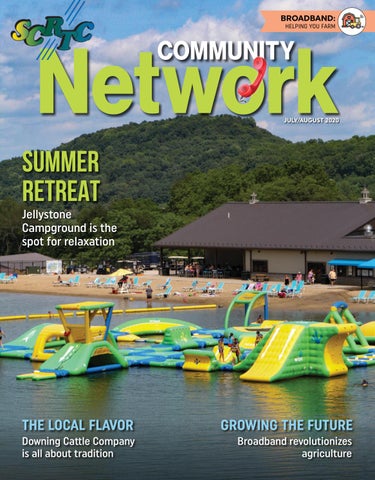
SUMMER RETREAT Jellystone Campground is the spot for relaxation
THE LOCAL FLAVOR
GROWING THE FUTURE
Downing Cattle Company is all about tradition
Broadband revolutionizes agriculture
INDUSTRY NEWS
Rural Connections By SHIRLEY BLOOMFIELD, CEO NTCA–The Rural Broadband Association
Taking the rural broadband story to the Senate
AMERICA’S RURAL BROADBAND PROVIDERS
I
n mid-May, I appeared before the Senate Commerce Committee to discuss the status of broadband during this time of crisis that has so many Americans working, learning and socializing from home. I have never been more proud of the broadband providers we represent, watching them move quickly and think outside the box to get the job done for their customers. It was a privilege to share with senators that NTCA’s community-based broadband providers were well prepared to keep Americans connected during a crisis — thanks to their community commitment, their entrepreneurial spirit and the support of Congress, the FCC and RUS. NTCA members have led the charge in building future-proof broadband networks for years and are doing all they can to keep everyone’s internet lights on. But I reminded the committee that to do that, these providers need to keep their own lights on as well. First, I reminded senators how important it will be to pass the “Keeping Critical Connections Act” to create a temporary emergency fund to keep Americans connected during the pandemic. Moving forward, Congress should adopt a “Forever Connected” perspective when it comes to promoting broadband. No American should get second-class broadband service, or worse yet, no service at all. I appreciated the opportunity to share with senators the story of NTCA members, the Smart Rural Communities they are helping to build, and what support they need to write the next chapter.
2 | July/August 2020
Keeping you connected in a changing world
Broadband Enabled. Locally Driven. Globally Connected.®
A Program of:
Visit ntca.org/smart
The six-second commute Work from home policies boost productivity Story by KALEIGH COX
A
ccording to a 2017 Gallup poll, 43% of employed Americans have spent at least some time working remotely. U.S. census data released in 2018 revealed that 5.2% of American workers are based entirely at home. Many employers, however, are reluctant to get on board with remote work. They worry that distractions at home and a lack of oversight could decrease productivity. But are those worries unfounded? One Stanford professor decided to find out. In 2015, Nicholas Bloom conducted research as a Chinese travel agency tested a new work-from-home policy with half of its call center employees. Bloom found that productivity actually increased by an average of 13% thanks to fewer interruptions, shorter breaks and fewer sick days. With just a six-second commute to their laptop, employees were also less likely to start work late or leave early. Little bits of time saved here and there added up to a big difference. Each employee completed roughly one extra shift’s worth of work. And they were happier, too. Employee attrition, formerly a big problem at the company, decreased by an astounding 50%. The company in Bloom’s study cut back on its office space in an expensive city and saved $2,000 per employee. Working from home is great for employers and employees alike, but there are challenges to keep in mind. At the end of the study,
over half of the work-from-home employees decided they wouldn’t want to work from home 100% of the time, citing isolation as a challenge. Fortunately, there are several ways remote companies can help employees overcome isolation and reap the benefits of working from home: b Use technology to stay connected. Video meetings allow for face-to-face time and are more engaging than audio-only conference calls. Platforms like Slack encourage steady communication, even between meetings. b Consider flexible policies. Working from home doesn’t have to be all or nothing. Some companies opt for a mix of in-office and at-home days or start new employees in the office for smoother onboarding. The key is to consider the unique needs of the team and experiment with creative options as needed. b Encourage team bonding. A sense of community can combat feelings of isolation and encourage team cohesion. Non-workrelated, group bonding activities — whether virtual or in person — can help teams feel connected and united even as they work from home. Working from home can save companies time and money, improve employee satisfaction and improve retention rates — as long as they find ways to keep employees connected and engaged from wherever they call home.
Stay focused with the Pomodoro Technique Named after the creator’s tomato-shaped kitchen timer, the Pomodoro Technique is a simple time-management strategy widely used by work-from-home employees who need help staying focused. Here’s how it works: » Select a task to focus on. » Set your timer for 25 minutes and work until you hear the “ding.” » Take a short five-minute break to stretch or grab a coffee. » Repeat three more times, then take a longer break of 15-30 minutes. Even large tasks feel manageable when you only have to focus for 25 minutes at a time. Set a kitchen timer, use your phone’s timer or download a Pomodoro app to try this “time-tested” technique for yourself. July/August 2020 | 3
FROM THE GENERAL MANAGER
Thank you to our farmers
T
here are many ways this year’s pandemic is going to change the way America thinks about things. One of those ways, I hope, is that we remember those who keep our society running.
Last issue, I outlined how broadband has provided an essential service during the pandemic for the millions of people who’ve had to adjust to working or attending school online. But in this issue, we’re focusing on something even more essential: the farmers, ranchers and other agricultural producers who put food on our tables, lumber in our houses and clothes on our backs. A steady supply of food and other agricultural products at the store is something many of us frequently took for granted. But the spiking demand and supply chain disruptions this year have made JEFF EATON me appreciate when there is chicken in the meat case, fresh vegeGeneral Manager tables in the produce department and stocked shelves on the paper products aisle. I think our nation’s farmers — including those right here in Kentucky — have become some of the most underappreciated but absolutely critical people in this country. So in light of that, I want to take this space to say thank you. Thanks to the dairy workers for getting up early for milking. Thanks to the row crop farmers for long days of plowing, planting and harvesting. Thank you to all the fruit growers and pickers in the orchards. A sincere thank you to those raising and butchering our beef, poultry and pork. Thank you to all of those growing and cutting timber. Thank you to all of the beekeepers tending to their hives, the hay farmers storing their bales, the egg farmers in their chicken houses and the grape growers in their vineyards. Thank you to all of the extension agents who help share knowledge between all of those groups. Whether they’re producing beef or beans, cotton or canola, pumpkins, or peanuts, our agricultural producers deserve our appreciation. Every growing season they risk their financial future, and they must pray for the right weather and good yields. But they’re also adapting to changing demands and industry trends. For anyone who hasn’t been out on a farm lately, you might be surprised to find how much technology is in the fields and barns. Farmers use sensors to check soil and moisture conditions, watch temperatures in chicken houses, monitor levels of chemicals in their tanks, order seeds and parts, keep up with commodity prices and find new markets to sell their products. In this issue, we’re happy to highlight the hard work farmers put in to keep America moving and the growing role technology plays in helping their operations run smoothly. It’s important to remember that many of the founders of our cooperative were farmers who realized the need for telephone technology, just as they appreciate the need for broadband today. I’m thankful for all of the members of our local agriculture community and proud to still be their technology partner.
Network COMMUNITY
JULY/AUGUST 2020
VOL. 5, NO. 4
The SCRTC Community Network is a bimonthly newsletter published by South Central Rural Telecommunications Cooperative © 2020. It is distributed without charge to all customers of the cooperative. South Central Rural Telecommunications Cooperative is a member-owned corporation dedicated to delivering advanced telecommunications technology to the people of Central Kentucky, including Adair, Allen, Barren, Green, Hart, LaRue, Metcalfe, Monroe and Nelson counties. South Central Rural Telecommunications Cooperative, Inc. 1399 Happy Valley Road • P.O. Box 159 Glasgow, KY 42142-0159 270-678-2111 www.scrtc.com SCRTC BOARD OF TRUSTEES Ralph J. Thompson, District I Bonnieville and Munfordville exchanges Billy Smith, District II Canmer and Horse Cave exchanges Jerry Polson, District III Cave City and Hiseville exchanges Ronnie Tucker, District IV Center, Edmonton and Summer Shade exchanges Stanley Greer, District V Glasgow and Temple Hill exchanges Zack Kender, District VI Fountain Run, Gamaliel and Lucas exchanges Robert E. Thompson, District VII Buffalo and Magnolia exchanges Jeff Eaton General Manager Bobby H. Richardson Attorney Produced for SCRTC by:
On the Cover: Jellystone Campground offers an escape for quintessential summer fun and family camping experiences. See story Page 8.
4 | July/August 2020
SCRTC NEWS
Keeping you connected in several ways SCRTC and Bluegrass Cellular have long enjoyed a mutually beneficial partnership, but did you know SCRTC was an important part of the birth and early history of Bluegrass Cellular? SCRTC was one of the five companies that banded together in 1990 to enter a federal auction for cellular licenses for 34 counties in South Central Kentucky. Those five companies won the auction and created Bluegrass Cellular. SCRTC’s former general manager, Clint Quenzer, served on the original board of Bluegrass Cellular. Quenzer and SCRTC were instrumental in locating and procuring land for one of the first cell sites built for Bluegrass Cellular. The site was on a knob in Cave City, Kentucky, overlooking Interstate 65. The board of Bluegrass Cellular met in the boardroom of SCRTC in the early days, and SCRTC was one of the first Bluegrass Cellular Authorized Agent locations to sell the service. Headquartered in Elizabethtown, Kentucky, Bluegrass Cellular has operated in the state for over 29 years with 19 company-owned retail locations and more than 20 authorized agent locations, including SCRTC. A pioneer in the wireless field in the state’s rural areas, Bluegrass was the first to offer digital cellular service to Central Kentucky in 1998 and one of the first rural carriers to offer highspeed 4G LTE service. Bluegrass offers a diverse portfolio of wireless products such as smartphones and tablets from Apple, Samsung, LG and Motorola. It also offers IoT and machine-to-machine products for business customers, as well as competitively priced national and international service plans. SCRTC, which was there at the birth of Bluegrass, continues to provide leadership and direction as an owner of Bluegrass Cellular. For more information on Bluegrass Cellular and for local store hours and information, visit bluegrasscellular.com or call 1-800-928-CELL.
Employee spotlight Orval Brooks has served SCRTC members for 42 years. As the outside plant engineer, he enjoys talking to people and taking on new challenges each day. He often uses the Google Earth app for project planning. His motto in life is, “Always treat people like you would want to be treated.” Brooks and his wife, Reeda, have two children, Leslie Williams and Kirk Brooks. They also have six grandchildren: Coy, Ty and Lily Williams and Dalee, Lawsyn and Will Davis Brooks. They have one stepson, Bradley Anderson. Brooks is an outdoorsman, often camping and deer hunting, and likes going to classic car shows. He most admires Jesus Christ for watching over us every day. “He’s blessed my life so much more than I can ever thank him for,” Brooks says.
SCRTC WISHES YOU A
happy Fourth of July! In honor of Independence Day, the SCRTC office will be closed on Friday, July 3.
South Central Rural Telecommunications Cooperative
July/August 2020 | 5
Sweet & Simple
Gerbera daisies are a colorful burst of sunshine
T
hey start out so colorful and add such a happy touch to your outdoor setting, but with the heat of summer, gerbera daisies begin to lose their appeal. Their healthy, green leaves brown as the heat rises. But all is not lost — your daisies can come back to life with a little love and flower power on your part. Gerbera daisies are a popular flower for both the home and garden. You can cut them and make a stunning, multicolored bouquet. They put on quite a show with their rainbow of colors, which is one of the most distinctive qualities of gerberas. They range from beautiful reds, cheery yellows, bright pinks and vivid whites to perfect purples, soft peach and more. And while you may see blue and green gerberas, those are most likely victims of artificial coloring. “They really are a customer favorite,” says Cole Webster, general manager of The Barn Nursery in Chattanooga, Tennessee. “They’re bright, fun and an iconic bloom. When I think of summer and warm weather, I think of gerbera daisies.” With proper care, though, these blooms can last well past spring and through the heat of summer — and possibly through the cold of winter.
6 | July/August 2020
HERE ARE SOME TIPS WEBSTER OFFERS TO ENSURE THEIR SURVIVAL: \ Gerbera daisies should be watered every couple of days. It’s easy to tell if they’re desperate for a drink. The leaves sag, and the blooms wilt. “I like telling people to water them whenever you think about it,” Webster says. \ The best time to water is in the morning. But if you forget, water in the afternoon. Don’t wait until the next day. If you’re thirsty, you don’t tell yourself you’ll wait until tomorrow to get something to drink. \ Fertilize every three weeks. For container plants, Webster recommends a product like Scotts Super Bloom or some other plant food that has a high phosphorus level to help promote big blooms. If you plant your daisies in the ground, a slow-release fertilizer is your best bet. \ Gerberas are sun-loving plants, but sun is too much of a good thing when temperatures climb to 90 degrees and higher. This is the time of year you should limit
their sunning to mornings, moving them into the shade in the heat of the afternoon. \ Gerbera daisies can come back next year if you winterize them. In the South, particularly those areas where mild winters prevail, mulch the daisies well, and they’ll reappear next spring. In areas that suffer through freezing winter temperatures, bring the daisies inside and place them in a bright window or greenhouse, watering and fertilizing as needed. Note, however, gerberas are more likely to come back and rebloom if they are planted outdoors. They can last for two to three years. \ Use gerberas in an arrangement for a stunning, colorful showpiece. Their stems are hollow, allowing a wire to be inserted into them if needed for stability. \ If you plan ahead, you can start gerberas from seed, but it will take about six months for them to reach maturity. Plant seeds around Thanksgiving for spring blooms.
A few things you might not know about gerbera daisies
Not only are gerbera daisies among the most popular flowers, but they also have an interesting history. They enjoy longevity, have medicinal uses and are made up of a surprisingly complex structure. \ Dutchman Jan Frederic Gronovius wished to honor a German botanist and physician, Traugott Gerber, when naming the genus Gerbera in the 1700s. \ Gerberas can last in a waterfilled vase for two weeks, making them among the longest-lasting cut flowers. \ The plant is also believed by many to have health benefits, pulling carbon dioxide and other toxins found in the air and discharging oxygen. Some people even place gerberas by their bedsides. \ The structure of the gerbera is complex. At first, the flower seems to be a single flower head with many small petals. However, the gerbera flower actually consists of a huge cluster of hundreds of tinier flowers. \ Scientific researchers have examined the daisies as they study the formation of flowers. And the flower is resistant to fungal diseases. \ Similar to sunflowers, gerber daisies track the sun. The flower turns as the light moves from east to west. \ About 40 documented species of gerberas exist. Source: flowerweb.com
July/August 2020 | 7
Karst Beach features an inflatable sport park on the water for hours of family fun.
Homegrown family fun Jellystone Park Mammoth Cave keeps families connected
Story by PATRICK SMITH
J
ellystone Park Mammoth Cave becomes a vacation home to create family memories, enjoy the great outdoors and have fun for nearly 50,000 guests each year. Plus, you never know who might show up to swipe a “pic-a-nic” basket at this home away from home, which has visits from the classic characters Yogi Bear, Boo-Boo, Cindy Bear and Ranger Smith. With more than you could ever do on an overnight stay or three, Jellystone Park Mammoth Cave offers the same amenities as big-name attractions farther south but at a cheaper rate and nearer your backyard. Beyond its cabins and campgrounds, there’s an epic 300-foot water slide, pools, a mini golf course and a lake complete with a sandy beach and a massive Wibit floating sports park — think huge, inflatable balloons on the water — and much more. “For some families that visit, we’ve
8 | July/August 2020
won their vacation choice over Disney, Myrtle Beach, Great Wolf Lodge and more,” owner Bill Pott says. “You’ll have some fun. We’re here to help you create family memories.” The hard work put in by Pott; his wife, Kay; and their staff has paid off. The Cave City facility was named the National Association of RV Parks and Campgrounds’ 2019 “Park of the Year,” and it was the 2019 Jellystone Park “Camp-Resort of the Year.” A community treasure once known as the place for overflow camping from nearby Mammoth Cave National Park, Jellystone Park is now becoming a well-known destination itself. “We’ve worked to build a park that shows we care about our guests. We put everything we can back into the park,” Pott says. “To win the awards and know that our peers think that much of us — it’s really humbling, and we’re honored.” South Central Rural Telecommunications Cooperative
EXPANDING THE PARK Mammoth Cave, the fourth park to open under the Jellystone Park franchise, began as a 40-acre park in 1973. Pott, who’s owned the park since 2004, eventually decided he needed to buy more land to grow. Now, with a total of 250 acres, about 90 of those developed, the park is set for the next 40 years and beyond. The $10 million expansion included adding the land, more campsites, the beach area, an administration building and ranger’s station, a gift shop, a Nathan’s Famous Hot Dogs stand, and more. “We were happy with where it was, but when we had the opportunity to expand, we knew we had to take the chance,” says Pott. “Revenues are up, and people really love the new additions to the park. It’s fantastic.”
ROUGHING IT, POWERED BY BROADBAND Whether park guests are on YouTube trying to find a video explaining how tent poles go together or they’re looking for other community attractions, high-speed broadband from SCRTC is essential. “For us, fiber is mandatory,” Pott says. “Today,
Young girls flock to the Cindy Bear character while at the beach.
you have to offer fast internet for campers. When we started in 2004, maybe two families out of 10 would need internet. Today, families come, and they have five or more devices apiece. The bandwidth demand is phenomenal.” Free Wi-Fi is available throughout the park for visitors who need a reliable, fast connection. And reservations can be made online, which eases the strain on both guests and staff. “Roughly 45% of reservations came through online,” Pott says. “People like the convenience, and that’s 45% of our guests that we don’t have to spend time with to make the initial reservations. It saves us time, money and manpower.”
MAKING AN IMPACT LOCALLY While the majority of guests come from Kentucky, many also travel from nearby states like Tennessee, Ohio, Indiana and Illinois. In Pott’s time, there have also been international visitors from Russia, China, Korea and elsewhere. The park employs about 100 locals, returning more than $1 million to the community each year with its payroll. That’s up from about $150,000 for payroll
in 2004. “Mammoth Cave National Park is the draw for the area,” Pott says. “That’s what gets people here in the first place. If we can get them to Jellystone, we’ll bring them back, because they can’t do everything in one trip. There’s so much our community has to offer. No one business needs to take it all. We can all grow together.” More improvements, such as an enhanced mini golf course and updated pool, are on the way, but in the meantime, the family fun won’t slow down. From toasting s’mores around the campfire, to endless karaoke, family movies, arts and crafts, and much more, there’s no shortage of entertainment for guests. “This is the place to make memories with the whole family, and they get to be here with Yogi Bear,” Pott says. “The smiles, the joy you see on guests’ faces, the positive comments — it makes all the hard work worthwhile.”
Please call for information on how the Covid 19 guidelines may have affected park activities.
The park’s dedicated leadership team includes, from left, Sarah Young, assistant general manager; Emily Moss, vice president of operations; Bill Pott, CEO and co-owner; and Kay Pott, president and co-owner.
Families unroll their sleeping bags and unwind for a weekend of camping. South Central Rural Telecommunications Cooperative
July/August 2020 | 9
BROADBAND: HELPING YOU FARM
Technology in the growing field Innovations in automation help farmers work more efficiently Story by LAZ DENES
N
ever has technology been more important to the agriculture industry than it is today. As farmers and ranchers face challenges such as diminishing sustainable farmland, rising costs of supplies and equipment, workforce shortages, and ever-changing consumer preferences, they must find ways to produce more without breaking the bank.
10 | July/August 2020
Fortunately, technology enables farmers to shave hours, days and even weeks off some of the most time-consuming tasks to make their operations more efficient than ever. Corey Poss, an agronomist with the Rutherford Farmers Cooperative in Murfreesboro, Tennessee, oversees an operation that offers satellite and drone technology to help map, monitor and analyze crop fields. Another solution is a forecasting tool that can predict the yield of a particular crop to within 10% — before seeds are even planted. “Crop ground is getting swallowed up every day, and we’ve got more people to feed, so we have to apply technology everywhere we can to be as efficient
as possible and not waste time and money,” says Poss, who is in his sixth year with the Rutherford co-op after graduating with an agribusiness degree from Tennessee Tech University. “A lot of our larger growers are participating with us free of charge,” he says. “The technology originated in the Midwest — the Corn Belt. I don’t ever have to step in the field. We can get a much more accurate look from above. We can identify problems with water, nutrient deficiency and disease on a wide scale, and we can advise the farmer so he can apply his fertilizer accordingly. With our satellite and drone technology, we can cover as much as 1,000 acres a day.”
Bonanza Bean, which processes millions of pounds of product, relies on broadband to aid in sales and marketing.
Andy Hacker serves as operations manager for Bonanza Bean in Morris, Minnesota.
PRESCRIPTION FOR SUCCESS Poss and his crew of four agronomists use the fast fiber optic network at their Woodbury and Smithville locations to process analytics that farmers then load into their automated equipment to enable a precise distribution of fertilizer, pesticides and nutrients on every square inch of a growing field. It’s a practice called “writing prescriptions,” something with which Texas farmer Spence Pennington has become all too familiar. Five years ago, he returned to his family farm in Raymondville after serving as an Air Force aircraft maintenance officer. He and his family grow cotton, grain sorghum, corn, sugarcane and sesame seed. They also raise Brangus cattle in Willacy, Cameron and Hidalgo counties in the Rio Grande Valley. Pennington appreciates the ability to pinpoint the varying requirements of his family’s farmland through technology. “I have 10 to 12 systems — my tractors and all my equipment — and I can link them all together to make them all sync, thanks to the broadband at my house,” he says. “I can run my agriculture systems, security systems, monitor my equipment. I can literally see the water temp in the radiator of one of my tractors, all from home. When I’m at home, I’m still connected to my farm.” Pennington and his wife, Emily, an Iowa native he met while on active duty in Ramstein, Germany, also rely on broadband technology to help them stay
on top of their continuing duties as Air Force reservists. Pennington is a lieutenant colonel and commander of the 433rd Maintenance Squadron at Lackland Air Force Base in San Antonio. His wife, a nurse practitioner at a local regional hospital, still serves as an Air Force major. Stationed at Scott Air Force Base near St. Louis, she is the chief nurse of the 932nd Aeromedical Evacuation Squadron. “We live multiple lives, and we have to cover a lot of ground,” Pennington says. “After working 12 to 13 hours a day on the farm, I come home and have to take care of business as commander of my unit. I’m responsible for 250 people remotely, and I’m logging into a very encrypted system. “Having fast internet has literally changed our lives, and we’ve gotten so much family time back,” he says. “No more headaches, and everything is so much quicker. We’ve been married just over three years, and we have two kids now, so we can really appreciate being able to take care of our military duties that much more quickly and efficiently.”
MAKING THE GRADE Reliable broadband service also is a valuable tool for the Bonanza Bean farming operation headquartered in Morris, Minnesota. The company processes black beans and three varieties of kidney beans and sells to national and international companies from its state-of-the-art facilities in Minnesota and Arizona.
Drone technology allows Corey Poss, of the Rutherford Farmers Cooperative, to monitor fields.
The company touts its magnetic dirt separator, which uses magnets to remove dirt with high concentrations of iron from the beans. It also sells a state-of-the-art, infrared-camera technology for sorting that can differentiate a black bean from a dirtball. “That machine has really changed our industry,” says Andy Hacker, Bonanza Bean operations manager. “The needle machine picks out anything that has a sprout or a skin defect or anything that we can catch with a needle. At Bonanza Bean, we never let anything leave our facility that doesn’t make USDA Grade No. 1. With our cleaning facility, we’re able to accomplish that.” About 60 million pounds of beans roll through its processing plants each year, with particular emphasis on international sales. Broadband service allows its sales staff to monitor up-to-the-minute market data and communicate with its vast array of customers. July/August 2020 | 11
BROADBAND: HELPING YOU FARM
Jeff and Melinda Downing
Five generations build Downing Cattle Co.
A
Story by JOHN CLAYTON
little more than a decade ago, Jeff Downing and his family decided to give raising their own cattle a second chance, and there have been no regrets. Downing works alongside his wife, Melinda; their son, Will; and his wife, Bethany. His daughter, Jenna, and her husband, Jeremy Yokley, also help out. “You have to make money, but a lot of your pay is getting to do what you want to do every day,” Downing says. “It’s a great way of life, but you’ve got to really love it because sometimes there isn’t a lot of money.” The Downings’ five grandchildren are also fixtures on the farm and represent the family’s fifth generation of Downings there. The couple says that’s a bonus that can’t be measured in terms of dollars and cents. “I’ve got friends whose grandkids are miles and miles away, but I get to see mine every day most of the time,” Melinda Downing says. The business has evolved since Jeff Downing’s great-grandfather started raising beef cattle on about 100 acres in Fountain Run, Kentucky. Downing Cattle Co. still operates on that land but has grown to encompass 900 acres — each generation adding acreage little by little over the years. “When a family works together, you’re not always going to agree, but we always get along,” Downing says. “We can discuss things. We have the same goals and the same worldview, really. The Lord has really blessed us.” From 1990 until the Downings switched things up with a new business model in 2009, they kept clients’ cattle on the farm. “We’d lost money farming, and I thought this would be another opportunity for us — another way to make a living,” Downing says. “In ’08, we lost money because we had all our eggs in one basket.”
GOOD TIMING Located on a fourth-generation farm, Downing Cattle Company has rendered cattle and hogs for over 40 years.
12 | July/August 2020
Even though the U.S. was in the midst of a recession when the current incarnation of Downing Cattle Co. was born, the family picked a good time to begin raising their own beef cattle once again. South Central Rural Telecommunications Cooperative
Jeff Downing sows grass seed with a tractor after rain softened the soil.
“People wanted to know where their meat comes from, and there was a lot of talk about buying local,” Downing says. With the equipment to open and run its own butcher shop still on-site, Downing Cattle Co. was soon supplying meat for friends and neighbors. Its products also appealed to customers from farther away who were interested in organically raised beef. “It’s all natural, and that’s the way we sell it,” Downing says. “We’re not bashing anyone who raises their cattle the other way at all. We don’t see anything wrong with that. But we’re in a niche where if natural is what you want, we have it. We Thin or thick, packages of pork chops sell quickly at Downing Cattle Company.
South Central Rural Telecommunications Cooperative
Downing Cattle Company keeps an average of 250 “mamma cows” on the farm.
feel like farmers need every source we can find to feed the world.” For the Downings, feeding the world starts in their own backyard and goes from there. Regular customers visit the butcher shop frequently, leaving with locally grown pork and the Downings’ beef. “We have people who will drive 45 minutes to an hour from Bowling Green, and they’ll get 2 pounds but they’ll come every week,” Downing says. “And they’ll tell their friends and neighbors.” This past February, Downing Cattle Co. went well beyond the pastures for its local customers looking for something special for Valentine’s Day. “We have fresh-cut steaks, pork chops, wild-caught salmon, crab legs and more for a special Valentine’s dinner,” the farm’s Facebook post read. Melinda Downing says the company advertises very little, relying instead on old-school word of mouth and new-school social media, including Facebook and Instagram, to reach and stay in touch with customers. “Facebook has been great because I can post when we’re having a sale or let people know when we have something special going on,” she says. “I get a lot of orders now through Facebook Messenger.”
ON THE ROAD AND AT HOME The Downings take the delivery truck and make the 80-mile trip from Fountain Run to Nashville. They say the folks on their regular stops in bustling Nashville have become like family after 12 years of deliveries. The company also makes regular deliveries to several stores and restaurants in areas within a 90-minute radius of the farm, such as Bowling Green and Glasgow. But Jeff Downing enjoys it most when customers visit the farm and butcher shop, where he likes to take a few extra minutes and give them a little tour. “A lot of people these days don’t get to spend time at a farm like I did with my grandfather,” he says. “So I like to show them around if there’s time. As farmers, we need to tell our story and let people know how we do things.”
July/August 2020 | 13
SOUTHERN KITCHENS
Chillingly delicious
No one can resist ice cream
T
here was a time when ice cream came in just a few flavors — primarily chocolate, vanilla and strawberry. But step inside It’s All So Yummy Cafe in Knoxville and you’ll find that the quintessential summer treat we all know and love has gone rogue. Watermelon Chip, Roasted Golden Beet and the popcorn-flavored Movie Night certainly don’t sound like ice cream flavors, but they’re among the many Kim and Wade Wilcox have created since buying the cafe eight years ago. The menu features sandwiches, salads and other foods typical of most cafes. However, with the purchase of the eatery came an ice cream machine, and the couple decided to use it. But there was a learning curve. After they had been making ice cream for several years on a smaller scale than they do now, Wade Wilcox decided to learn more — so he went back to school. He didn’t enroll in just one of many online courses, though. He took part in Penn State’s prestigious ice cream course, an intense, weeklong program that draws people from around the world, teaching them all about the manufacturing of commercially sold ice cream. “It gave me a more rounded, in-depth knowledge of the chemistry that goes into making ice cream,” he says. “And it gave me a good chance to make contact with other people in the industry and share ideas.” The Wilcoxes, originally from Iowa, have lived in Knoxville for 23 years. They started out selling about 30 flavors of ice cream. Now, that number has risen to well over 50, but not every flavor is available every day. “Many of them are seasonal that we only do at certain times of the year,” Kim Wilcox says, adding that making these
14 | July/August 2020
types available once in a while “keeps people wanting them more.” For example, during Girl Scout Cookies season, they’ll make ice cream with the treats right after the cookies are delivered. When it’s gone, it’s gone. Popular year-round varieties are Death by Godiva Chocolate and Butterfinger. “My personal favorite?” she says. “I don’t know that I have one. My favorites change all the time, but I do like all of our coffee-based ice creams.” Ice cream sold at It’s All So Yummy Cafe goes by the name Hilton Head Ice Cream, and there’s a story behind it. Years ago, the man who first opened the cafe went to Hilton Head and fell in love with the ice cream at the shop Hilton Head Ice Cream. He liked it so much, he convinced the owner to let him open a store in Knoxville. “Part of the deal was that he needed to call it Hilton Head Ice Cream, and that’s how Knoxville has always known it,” Wilcox says. “We use the same process that the original Hilton Head Ice Cream shop uses.” Now an expert in the field of frozen delights, she offers one important tip for those less skilled in the making of ice cream: “Don’t be afraid to experiment with flavors. Ice cream should be fun.”
Kim Wilcox and her husband, Wade, created the It’s All So Yummy Cafe in Knoxville, Tennessee.
FOOD EDITOR ANNE P. BRALY IS A NATIVE OF CHATTANOOGA, TENNESSEE.
LET’S GO TO THE FAIR
Sundae
G
otton candy (available in many C stores — or at the fair!) Vanilla ice cream M&M’s Chocolate syrup Sugar wafer cookie Rainbow sprinkles Whipped cream Maraschino cherry with stem Make a bowl out of the cotton candy. Put the ice cream in the bowl. Working quickly, add M&M’s, chocolate syrup and sugar wafer cookie. Top with whipped cream, sprinkles and a cherry on top. Serve immediately. Makes one sundae.
PUMPKIN WHOOPIE PIE ICE CREAM SANDWICHES 3 1 1 1 2 1 1 2 1 3 2 1/2
cups flour teaspoon salt teaspoon baking powder teaspoon baking soda tablespoons cinnamon teaspoon ground ginger teaspoon ground cloves cups packed dark brown sugar cup vegetable oil cups pure pumpkin puree large eggs teaspoon pure vanilla
Suggested ice cream flavors: pumpkin, French vanilla, butter pecan, cinnamon or dark chocolate. Heat oven to 350 F. Line two baking sheets with parchment paper. In a large bowl, whisk the flour, salt, baking powder, baking soda, cinnamon, ginger and cloves. Set aside. In another bowl, whisk the brown sugar and oil until well combined. Add the pumpkin puree and whisk to combine. Add eggs and vanilla until well mixed. Add the flour mixture 1/2 cup at a time, and stir until combined. In 1/3-cup scoops, put the cookie dough
on the baking sheets. They will spread a little, so leave some space between them. Bake for 11-13 minutes or until a toothpick comes out clean. Remove from the oven and let cool before removing from the pan. Once cooled, wrap them individually and freeze. When ready to serve, take one cookie and place a big scoop of your favorite ice cream on it. Then, top with another cookie and enjoy.
SALTED SESAME CARAMEL A mouthwatering topping for most any ice cream. 1 3 1/4
cup sugar Pinch of cream of tartar tablespoons water cup tahini
2 2/3 1/4 3/4
tablespoons butter cup heavy cream cup toasted sesame seeds teaspoon kosher salt
Bring sugar, cream of tartar and water to a boil in a medium pan over medium-high heat, stirring to dissolve the sugar. Boil until the sugar begins to caramelize in spots. Stir with a heatproof spatula and cook until the color of honey, 5-7 minutes. Reduce heat to medium low and cook, stirring occasionally, until caramel is a deep amber color, about 5 minutes. Remove caramel from heat and whisk in the tahini and butter. Then add cream, sesame seeds and salt. Cool before serving. This sauce may be made ahead of time and refrigerated. July/August 2020 | 15
Presort STD US Postage PAID Permit #21 Freeport OH
1399 Happy Valley Road P.O. Box 159 Glasgow, KY 42142-0159
ENJOY YOUR OWN — CONNECTED — SPACE! Upgrade your Wi-Fi home network
THE ANCHORS
THE ROAMERS
THE ANCHORS
THE ROAMERS
A standard router will keep you connected, but it may not reach all your rooms. #DigitalDilemma
Expand your range with a Wi-Fi home network and connect throughout your home to fully enable your mobile devices. #SmoothStreaming #RoomtoRoam
Calix GigaCenter is $5 monthly. (Residential only) Additional mesh network hub is $3 monthly. Call 270-678-2111 or visit scrtc.com to learn how to upgrade your network. Internet speed availability is best available in all areas.