BROADBAND:
HELPING YOU THRIVE
Network COMMUNITY
JANUARY/FEBRUARY 2020
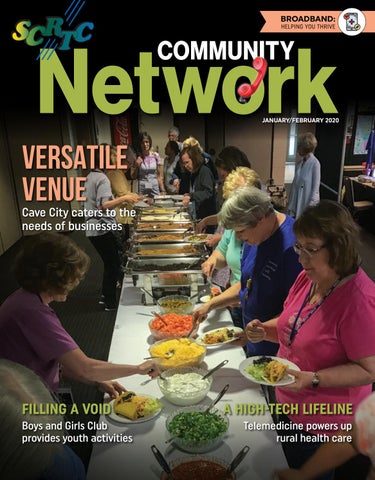
VERSATILE VENUE
Cave City caters to the needs of businesses
FILLING A VOID Boys and Girls Club provides youth activities
A HIGH-TECH LIFELINE Telemedicine powers up rural health care
INDUSTRY NEWS
Rural Connections By SHIRLEY BLOOMFIELD, CEO NTCA–The Rural Broadband Association
A good way to start the New Year
N
TCA members make a real difference in their communities, and in the lives of the people they serve. I was reminded of this a few weeks ago when the Foundation for Rural Service announced it had awarded $100,000 in FRS Community Grants to groups throughout the U.S. FRS is the nonprofit arm of NTCA that supports rural telecom companies, consumers and policymakers with educational information, products and programming. Each year, community organizations apply for FRS grants to help them tackle challenges ranging from accessing technology and improving educational offerings to providing telemedicine and first-responder services to rural areas. Applications are sponsored by their local telco. It was also exciting to see the USDA award several ReConnect grants and loans to NTCA members toward the end of the year. This program represents yet another option for rural broadband funding, as well as an example of public/private partnerships at work to extend broadband to unserved communities. After all, investments by federal and state agencies, coupled with the commitment of rural broadband providers, are key to our nation’s progress in connecting the millions of citizens still without access to fast, reliable internet service. These programs, as well as the engagement we saw among policymakers at our Telecom Executive Policy Summit in November, provide a strong start to 2020 and give me great hope for a strong new year for rural broadband. 2 | January/February 2020
Are you ready for a telehealth future? Story by STEPHEN V. SMITH
T
he presence of reliable broadband service holds great promise for rural America. While it touches many facets of life, broadband’s greatest impact may very well be in the area of health care. Consider this statement from the Federal Communications Commission: “Advances in telemedicine are transforming health care from a service delivered solely through traditional brick and mortar health care facilities to connected care options delivered via a broadband internet access connection directly to the patient’s home or mobile location.” While reliable access to a broadband network is still out of reach for millions of rural Americans, hundreds of cooperative and independent telecommunications companies across the country are delivering world-class internet service, often over a fiber connection. If you received this magazine in the mail, your local telco is one of those leading-edge providers. If access to broadband is becoming less of the challenge to telehealth’s widescale availability, what is the greatest challenge? The FCC recently tasked the Intergovernmental Advisory Committee with studying and reporting on telehealth barriers and incentives. The report stated that “people-based” issues offer the most significant challenges to telehealth adoption. While this includes many factors, such as policy and licensing, broadband adoption is a leading concern. In other words, the technology is there. Now, people need to embrace it. “Increasing support must be given to rural and disadvantaged communities so that digital literacy and adoption does not exacerbate the digital divide,” the IAC report states. Quite simply, the presence of broadband doesn’t mean patients and doctors are ready to put it to use as part of their health care program. Are you ready? Do you understand the implications of telehealth? What steps can you take toward enjoying its benefits? Begin by asking your doctor what programs are available. This could include connected medical devices in your home or something as simple as remote monitoring via an app on your smartphone or tablet. Of course, access to telehealth starts with subscribing to broadband service that will support this life-changing technology. And once in place, broadband has the potential to enhance your life in many other ways as well.
Knowledge is power
Does your digital know-how stand up?
Story by NOBLE SPRAYBERRY
C
onvenience and power. Internet services bring both. Online bill pay eliminates a tedious task. Social media can keep family ties strong or reconnect you with old friends. Streaming services bring a wealth of music, books and more. But when it comes to digital tools, knowledge is power, and the Pew Research Center’s recent “Americans and Digital Knowledge” report found that a majority of adults in the U.S.
Q
If a website uses cookies, it means that the site … A: Cookies allow websites to track user visits and site activity. They are common, and you are often tracked across the websites you visit.
forms. Often advertising is personalized to you by information gathered from not only your activities on a social media site but also your actions on other websites.
Q
Q
Q
Q
Where might someone encounter a phishing scam? A: Phishing scams can occur on social media, websites, email or text messages. Each form of communication offers an avenue for exploitation. For additional tips to improve your online security, visit FCC.gov/consumer-guides. What is the largest source of revenue for most major social media platforms? (Several possible options were listed.) A: Advertising is the largest source of revenue for most social media plat-
could not correctly answer half of the survey’s 10 multiplechoice questions. Questions touched on security and a general understanding of technology. Here are a few of the queries, edited for clarity, focused on security and privacy — good information to know. The answers do include additional context and tips not included in the report.
When a website has a privacy policy, it means that the site … A: Privacy policies are contracts between websites and users about how those sites will use their data. Often long and legalistic, the agreements may outline how your private information can be used to target advertising or whether or not your information can be shared with other companies. What does it mean when a website has “https://” at the beginning of its URL, as opposed to “http://” without the “s”? A: “https://” in a URL means that
Want to see the entire report?
information entered into the site is encrypted. Look for “https://” before completing any financial transaction on a site.
Q
Many web browsers offer a feature known as “private browsing” or “incognito mode.” If someone opens a webpage on their computer at work using incognito mode, who will be able to see their online activities? A: Private browsing mode only prevents someone using the same computer from seeing one’s online activities. In most cases, your internet provider, including your phone wireless provider, can see all digital traffic passing from your device to the internet.
Do a Google search for “Pew Research Center and Americans and Digital Knowledge.” January/February 2020 | 3
FROM THE GENERAL MANAGER
We’ve arrived in the future
W
elcome to 2020! I sincerely hope you and those close to you had a superb holiday season and that this new year is off to a wonderful start.
Something about starting not only a new year, but also a new decade makes 2020 feel like a year especially full of promise. For so long, the 2020s have seemed like the distant future. Now, we have arrived! It’s entertaining to look back and see what Hollywood, science fiction authors and big thinkers predicted for the future. While I’m still waiting on the flying car and weekend trips to the moon that science fiction promised us, I catch myself from time to time thinking about how some of the things we take for granted JEFF EATON every day would seem so futuristic to us just 20 or 30 years ago. General Manager Here in the future, all of us carry around personal communication devices in our pockets that allow us to make video calls with people all over the world. We can instantly download practically any book, movie or song in the world right to our tablets. While we don’t exactly have Rosie from “The Jetsons,” we do have robots that vacuum our floors, manufacture products and even help perform surgeries. We have software that can share photos around the world, alert us to emergencies and order almost anything we need for home delivery. Our watches can help detect heart problems. Our cars can give us directions to anywhere we want to go. And our homes can turn on lights, lock doors and change the temperature with just the sound of our voice. Many of these things are becoming a normal part of our daily routine, but the 1980 or 1990 version of myself would have seen them as straight out of science fiction. For those of us at SCRTC, it’s rewarding to know our network is what brings the future to our part of Kentucky. Whether it’s our broadband service at your home or our network providing vital infrastructure to businesses, we’re right at the heart of all of this futuristic technology. We worked hard to make that network and our company even better in 2019. It was certainly a year of meaningful accomplishments and noteworthy milestones for us. • Increased fiber optic service so that 58% of customers have been cut over to fiber. • Launched a new and improved website at scrtc.com. • Began offering internet service plans that did not require phone service. Turning the page to 2020, we have one major goal in mind that will demand most of our focus and resources in the year ahead: expanding our network so three quarters of our customers can be moved over to fiber optics. Knowing that the only thing certain about the future is change, I think SCRTC is primed to accomplish these things and more. We’re thankful for the opportunity to serve you in 2020 — and in the future.
4 | January/February 2020
Network COMMUNITY
JANUARY/FEBRUARY 2020
VOL. 5, NO. 1
The SCRTC Community Network is a bimonthly newsletter published by South Central Rural Telecommunications Cooperative © 2020. It is distributed without charge to all customers of the cooperative. South Central Rural Telecommunications Cooperative is a member-owned corporation dedicated to delivering advanced telecommunications technology to the people of Central Kentucky, including Adair, Allen, Barren, Green, Hart, LaRue, Metcalfe, Monroe and Nelson counties. South Central Rural Telecommunications Cooperative, Inc. 1399 Happy Valley Road • P.O. Box 159 Glasgow, KY 42142-0159 270-678-2111 www.scrtc.com SCRTC BOARD OF TRUSTEES Ralph J. Thompson, District I Bonnieville and Munfordville exchanges Billy Smith, District II Canmer and Horse Cave exchanges Jerry Polson, District III Cave City and Hiseville exchanges Ronnie Tucker, District IV Center, Edmonton and Summer Shade exchanges Stanley Greer, District V Glasgow and Temple Hill exchanges Zack Kender, District VI Fountain Run, Gamaliel and Lucas exchanges Robert E. Thompson, District VII Buffalo and Magnolia exchanges Jeff Eaton General Manager Bobby H. Richardson Attorney Produced for SCRTC by:
On the Cover: With banquets, business meetings and more, the Cave City Convention Center serves up a range of events for the community. See story Page 8.
SCRTC NEWS
Employee Spotlight As the accounts payable accountant, Faith Swift works closely with the SCRTC warehouse team to purchase the equipment necessary for SCRTC’s network. She is a full-time employee of 15 years. “I’m very thankful to be employed with SCRTC, and I love my job and co-workers,” Swift says. “It’s my home away from home.” Swift and her husband, Jamie, have two girls, ages 5 and 2. “They keep us on our toes, but they also bring us so much joy.” What spare time there is, Swift spends having fun with friends and family. Her favorite quote is by Joyce Meyer, “A positive attitude gives you power over your circumstances, instead of your circumstances having power over you.”
Lifeline Service LIFELINE IS A FEDERAL PROGRAM TO HELP LOW-INCOME AMERICANS PAY FOR PHONE OR BROADBAND SERVICE
You are eligible for Lifeline benefits if you qualify for and receive one of the following benefits: • SNAP • Medicaid • Supplemental Security Income (SSI) • Federal Public Housing Assistance • The Veteran’s Pension or Survivor’s Pension benefit. Additionally, consumers at or below 135% of the Federal Poverty Guidelines will continue to be eligible for a Lifeline program benefit. (State determinations of income will no longer be accepted.) There are no changes to the eligibility criteria for Tribal programs. NOTE: Some states have additional qualifying programs, allowances and stipulations. Check with your local telecommunications provider for information about benefits that may be available in your state.
South Central Rural Telecommunications Cooperative
DO YOU QUALIFY? Apply today! To find out whether you qualify for Lifeline assistance, please visit www.lifelinesupport.org or call your local telecommunications provider. For more information: Lifeline Support Center P.O. Box 7081 London, KY 40742 NOTE: Your telephone company is not responsible for determining who qualifies for these programs or who receives assistance. Consumers must meet specific criteria in order to obtain assistance with their local telephone and/or broadband service, and qualifying is dependent upon government-established guidelines.
January/February 2020 | 5
TRAVEL
Take the ride
Follow the Hank Williams Trail Here are some trail highlights T Story by ANNE BRALY
he road between Georgiana and Fort Payne along the Hank Williams Trail is a journey lovers of country music should make at least once in their lifetime. It tells a story of one of Alabama’s most famous sons, from his beginnings as the child of a railroad engineer who was mostly absent from his son’s life to the glamour of stardom and Williams’ tragic demise at the young age of 29. Over the span of Hank Williams’ life, he recorded more than 165 songs. Though he could not read a note of music, he was a wordsmith when it came to writing hits that have become part of the American songbook. The trail is a 250-mile trip through history that includes a visit to Williams’ boyhood home and ends at a barber shop where he made one of his last stops before dying in his car in West Virginia on his way to perform at a concert in Ohio. “The Alabama Tourism Department has done an incredible job with the Hank Williams Trail, and it’s a great way to experience some of my dad’s life story,” says his daughter, Jett Williams.
6 | January/February 2020
GEORGIANA
Thousands of newspaper clippings, photos of family and friends, record albums and 45s, royalty receipts, clothes, one of Williams’ early guitars, the old wooden bench he stood on to sing at Mount Olive Baptist Church in nearby Greenville, Alabama — there are too many items to list, and it will take a couple of hours to take in the scope of the collection at the Hank Williams Boyhood Home & Museum. Williams lived here from 1931 to 1934. It was in this house at 127 Rose St. that he played his first guitar, having bought it by selling peanuts and shining shoes at the town depot. Among the more unusual items in the small house is a stage light used in the Municipal Auditorium for the show “Louisiana Hayride.” The Hank Williams Festival is on the grounds the first Saturday each June. Online: www.hankmuseum.com
MONTGOMERY Montgomery is ground zero for Hank Williams. He called it home from 1937 to 1948 and moved back in 1952. He lived there at the time of his death.
LAKE MARTIN, ALEXANDER CITY Hank Williams’ Cabin on Lake Martin is a small, white frame affair where Williams and Fred Rose, his friend and a giant in the music publishing business, wrote blockbusters “Kaw-Liga” and “Your Cheatin’ Heart.” The cabin is now on the property of Children’s Harbor, a camp for sick and disabled children. The two-bedroom building is available for rent. Online: childrensharbor.com Chris’ Hot Dogs, 138 Dexter Ave. This shotgun-style eatery is the oldest restaurant in the city and was Williams’ favorite place to eat — and drink. “He’d order two hot dogs all the way — mustard, sauerkraut, onions and Chris’ famous chili sauce — and a Budweiser and a shot of Jack,” a server said when asked about Hank Williams’ favorite dog. Williams’ seat isn’t marked, but it was one of 12 stools along the counter. There are also booths and tables, so it’s not hard to find a seat and eat where the Hillbilly Shakespeare once dined. Online: www.chrishotdogs.com D’Road Cafe, 121 Montgomery St. This cafe, the former location of the Elite Cafe, is worth at least a drive-by to see where Williams made his final public performance just four days before he died. The Elite opened in 1911 and was a Montgomery institution before it closed in 1990. Now reopened as the D’Road Cafe, the restaurant allows visitors to sit in the place where Williams last performed. Online: droadcafe.com Hank Williams Museum, 118 Commerce St. This museum is the tell-all of Williams’ life — both public and private. The collection includes thousands of pieces of not only his, but also of his wife’s, Audrey’s, past — furniture from their house in Nashville and suits, including several handmade Nudie suits. There are guitars, bills and other receipts, and artwork. The collection is massive, but its crowning jewel is the baby blue 1953 Cadillac in which Williams died. It’s on loan from his son, Hank Williams Jr. Take your time touring the museum, but when you’re done, browse the gift shop — ticket and shop sales and private donations fund the museum. Online: hankwilliamsmuseum.net
Kowaliga Restaurant, 295 Kowaliga Marina Road This restaurant, now serving a menu of cheeseburgers and catfish, sits at the water’s edge of Lake Martin. Inside, a carved statue of the Indian Kowaliga, whose story was the inspiration for Williams’ song “Kaw-Liga” guards the entrance. Online: www.kowaligarestaurant.com
BIRMINGHAM The Redmont Hotel, 2101 Fifth Ave. N., is the place where Hank Williams spent his last night in 1952 and is also the oldest hotel in Alabama still in operation. Remodeling a few years ago reconfigured many of the guest rooms, but Williams’ room was on what is now the third floor, somewhere around what is now room 304. Step off the elevator on the third floor and you’ll see a wooden plaque with four of Williams’ records. This is the only floor displaying any Hank Williams decor and is a silent tribute to one of the hotel’s most famous guests. Online: www.redmontbirmingham.com
FORT PAYNE On the eve of his death, Hank Williams stopped by Carter’s Barber Shop for a haircut and a shave from barber Howard Simpson. He also had a sip or two or three — maybe more — of moonshine while there. When Simpson died, he left the chair that Williams sat in to local barber Alton Beason, who opened his shop at 1719 Gault Ave. It’s now on display in a corner of the shop, carefully roped off for all to see but not sit in. Carter’s Barber Shop in Fort Payne, Alabama.
Chris’ Hot Dogs in Montgomery, Alabama.
Hank Williams Gravesite, 829 Columbus St. On your way out of town is Oakwood Cemetery. It’s here, high atop a hill, that Hank and Audrey Williams are buried. Inscriptions at the base of Hank’s headstone remind visitors of his most well-known songs, such as “Kaw-Liga,” “I Can’t Help It” and “Jambalaya.”
January/February 2020 | 7
Center of attention
Cave City Convention Center’s versatility an asset to area
Story by JOHN CLAYTON
T
he nine expansive caves in Cave City, including famed Mammoth Cave, draw visitors from across the country, but the Cave City Convention Center has become an above-ground destination for tourists and locals alike. The 30-year-old facility has been the home to business and social functions of all types and can host as many as an estimated 1,000 people for concerts and similar events. Cave City Convention Center Director Greg Davis says the center’s adaptability has made it a gem for the region. “Definitely, the versatility we have is important,” Davis says. “We’ve done everything in there from conferences to family reunions and other things that may come along. The thing you have to remember is that every time there’s an event, a lot of those folks come in and stay
8 | January/February 2020
overnight, so it helps everybody — the motels and the restaurants.” The convention center staff keeps track of monthly and yearly economic impact figures from events like annual gun and knife shows, a Bassmaster show for fishing enthusiasts, Christmas shows and gospel singings.
helps,” Davis says. “Our business just draws other businesses, and maybe at some point, if we get a sports complex in the area, then I’m sure we will have another motel, because that’s the only thing we’re lacking right now.”
ECONOMIC ENGINE The staff estimates that the convention center contributed about $190,000 in economic impact to the local economy from January to September of 2018 – significant numbers for a city of around 2,400 and for Barren County with its population of around 44,000. But Davis says there are other advantages the convention center brings that are harder to quantify, including a measure of civic pride. “As we get other things in the area, it
Cave City Convention Center director Greg Davis oversees many events, from weddings to corporate trade shows, each year.
South Central Rural Telecommunications Cooperative
The convention center was built to help attract people to the area when the tourism business that depends on Mammoth Cave and the massive cave system surrounding it slows down, Davis says. Though the facility is now more than 30 years old, it continues to accomplish its mission.
MULTIPURPOSE In addition to the auditorium, the center has its Kentucky Room for smaller meetings, and its West Hall can be used at full capacity or be partitioned off for smaller gatherings. The 462-squarefoot Sun Room is perfect for more intimate meetings. The center’s high-speed internet capabilities include enough bandwidth for up to 200 devices. “The beauty of what we have and can offer is
all those breakout rooms, because you can have the main auditorium, and you can have as many as five additional meeting rooms for smaller groups if you want to break out for separate meetings,” Davis says. The center also offers in-house catering, provided by Diane White, who creates specific menus through Diane’s Catering on-site. “The new has kind of worn off from what it was, but we still attract quite a number of overnight visitors,” Davis says. “Above and beyond that, I think it’s wonderful that we’ve got a facility in the area that can accommodate, for instance, the Glasgow-Barren County Chamber or some of the larger groups that may need a facility like we have for whatever reason.”
Catering business still cooking Diane White’s catering business took off quickly in Barren County after she started it 14 years ago, and it has since become a stalwart at the Cave City Convention Center. “I cater everything that requires food that is done at the convention center,” White says. She earned the center’s catering contract 10 years ago and averages 10 to 12 events each month there in addition to the events she caters outside of the center. White says she had 14 events booked with the convention center over the first three weeks of December. That followed a busy November during which she and her staff catered a dinner for 400 in the facility’s main hall. “For events like that, we have about 20 people we’ll call in as servers, but my husband and I do all the cooking ourselves,” White says. Her husband, Jimmy, retired from his job a couple of years ago. “He works for me now,” White laughs. When the Whites aren’t working out of the convention center kitchen, they work from a 1,300-squarefoot commercial kitchen next door to their home. South Central Rural Telecommunications Cooperative
Cave City Convention Center advantages: • 10,000 square feet of meeting space • Free parking • Flexible facilities to accommodate groups up to 500 • Six individual meeting rooms for groups from 25 to 300 • Auditorium seating up to 600 • Banquet seating from 25 to 450 • Alcohol service • State-of-theart audiovisual capabilities • Meeting space internet bandwidth allowing up to 200 technical devices • Professional events staff
Diane White says there isn’t one particular menu item she is famous for, but her versatility stretches beyond the menu at times as she works with customers to make sure they’re happy. For instance, the Kentucky Goat Producers Association brought along a variety of goat meat, including goat bacon and ground goat for meatballs, to put White’s culinary skills to the test. “They had the recipes, so we were able to do it for them,” White says. She also notes that her husband suggested that she start the catering business as a parttime side job. She was working another job at the time, but a year into her new business venture, White became a full-time caterer. “We talked about it a lot, and we prayed on it a lot,” she says. “We were kind of on the fence about me leaving the other job, but when I did, our prayers were answered and we got the contract with the convention center.”
• 4,000-square-foot outdoor pavilion with electric service and restroom facilities • Convenient location less than 95 miles from Louisville and Nashville airports • Area lodging establishments accommodating up to 1,000 people • More than 14 nearby eating establishments • 1.25 miles from exit 53, Interstate 65
January/February 2020 | 9
BROADBAND:
HELPING YOU THRIVE
Telemedicine changes the health care landscape Broadband makes a difference daily
I
magine a world with greater health care accessibility, as convenient as contacting a physician from your home. Or consider a medical system where rural communities can easily connect in real time with specialists based dozens, if not hundreds, of miles away. Broadband technology provides the key link between you and medical providers needed to make those innovations and others possible. That more convenient, healthier world is becoming a reality for rural communities across the nation. The systems are not yet what they one day may become, but every day more and more people are receiving the benefits of telemedicine. And the results are often profound.
Kentucky veterans have easier access to important care. Changing laws in states such as Texas allow greater access to telemedicine. Telestroke programs in Minnesota and North Dakota save vital minutes when patients most need care. And those are just a few examples of broadband technology changing health care for the better.
KENTUCKY VETERANS In rural Kentucky, getting to and from an appointment at any medical specialist can often require hours of travel. But when you’re a veteran trying to get to a Veterans Administration Medical Center in a metropolitan area, travel times can increase even more. And a veteran might need multiple doctors and have multiple appointments scheduled on different days. An innovative pilot program in a mountainous section of eastern Kentucky is helping to change that. The Virtual Living Room program, which started in 2017 in McKee, offers vets a comfortable and private room in their local library complete with high-speed internet access to visit with VA health care providers located more than an hour’s drive away.
The program, available for setup at other qualifying sites, not only illustrates the potential of telemedicine but also shows the efforts being made to create a system capable of benefiting as many people as possible. The McKee Virtual Living Room is a collaboration among four organizations: the VA, NTCA–The Rural Broadband Association, the rural telecom provider Peoples Rural Telephone Cooperative and the Jackson County Public Library. The VA has provided telehealth services for several years, but it can’t happen if vets don’t have access to high-speed internet connections either in their homes or nearby. “The rest of the country, like us, really admires our veterans,” says Keith Gabbard, chief executive officer of PRTC. “Before the project, we saw veterans spending the day in a waiting room at the hospital, and when they live an hour and a half away, it’s pretty much an all-day event for a veteran to get health care.” Fast fiber optic internet networks make telemedicine a realistic option for more and more communities, and the cooperative was a leader in establishing the Virtual Living Room at the Jackson County Public Library. “We’ve done a lot to promote it, and the library staff and the veterans are really proud of it,” Gabbard says. “It’s a source of pride for our community, and it continues to grow. The Virtual Living Room is a beautiful area where veterans, even From left, Veterans Donald Barrett, Jim Bryant, Mike Montgomery, Bobby Lakes and Danny Robinson attend the ribbon cutting for Virtual Living Room in McKee, Kentucky.
10 | January/February 2020
if they don’t have a doctor’s appointment, can go and read a book. It feels like it’s their home.”
CHANGING LAWS While faster internet may provide the foundation for telemedicine services, the legal and regulatory framework of each state can play a role in determining the effectiveness of the programs. In May 2017, Texas Gov. Greg Abbott signed a bill into law that leveled the playing field for telemedicine physicians and doctors who work in traditional office settings. In part, the law eliminated a requirement for a patient to first visit a physician in person before receiving care through telemedicine. “The bill removed a lot of barriers, and we’ve seen an increase in queries about telehealth,” says Becky Bounds, program manager for the TexLa Telehealth Resource Center in Lubbock, Texas. The federally funded center works to provide resources and technical assistance to telehealth programs in Texas and Louisiana. Bounds says the internet-based tools offer key services. For example, Lubbock is home to the Timothy J. Harnar Regional Burn Center, which often receives patients injured while working in the industries of West Texas. After treatment and returning home, follow-up visits to Lubbock could require drives of five to six hours. However, a telemedicine-equipped clinic on the campus of Texas Tech University Health Sciences Center in El Paso allows patients to virtually visit with specialists in Lubbock. “About 12% of the state’s population lives in West Texas, and telehealth matters,”
Bounds says. “We are producing cotton, beef, oil and more, and we need health care for the workforce producing those products for the rest of the state and the nation.”
THE GOLDEN HOUR When it comes to treating a stroke, doctors have a saying: Time is brain. It’s a reminder that every minute that passes between the event and treatment can lead to irreversible damage. Fortunately, telemedicine technology already gives doctors a fighting chance to begin treating patients before the critical “golden hour” passes. One of the leaders for this technology in the Midwest is Essentia Health, which established telemedicine capabilities in each of its 17 hospitals, 70 clinics and eight nursing homes throughout Minnesota and North Dakota. With its telestroke program, emergency medical technicians can identify stroke patients on the way to the hospital and even begin treatment. Essentia Director of Telehealth Services Laurie Hall recalls an ambulance picking up a rural patient nearly 90 minutes from the nearest hospital. In the past, serious brain damage would have been a near certainty for such a patient. But thanks to telestroke technology, EMTs diagnosed a stroke and began treatment about 45 minutes after the stroke occurred. “The goal is to shorten that window from the time the patient has the event to the time they actually get those
clot-busting medications or the clot is removed,” Hall says. “Getting that done so quickly is profound when you think about the injury that could happen from just those few extra minutes. It helps these patients get out of the hospital much quicker and to get on with their normal lives.” January/February 2020 | 11
Tucker Britt, left, Brandon Taylor, and Liam Britt enjoy an educational game.
FOR KIDS’ SAKE
Boys & Girls Club of Glasgow-Barren County serving vital need Story by JOHN CLAYTON
T
he number of young people who belong to the Boys & Girls Club of Glasgow-Barren County is a testament to the club’s success and its important role in the community. The Boys & Girls Club serves about 130 young people ages 6 to 18, offering after-school programs during the academic year and afternoon summer camps during summer breaks. “We have a little over 200 kids who are registered, which means some of those kids can kind of fluctuate in and out, but for the most part our average daily attendance is very consistent with the same kids coming,” says Mallie Boston, executive director for the Boys & Girls Club
12 | January/February 2020
of Glasgow-Barren County. “That being said, we’ve got binders on top of binders with names. If a whole group of kids left tonight, we could fill back up within the afternoon. “We have this wonderful building that’s fairly new, and it serves the kids that we have, but we’re always looking for ways to grow, because the need is not going to go away anytime soon,” Boston says. The annual fee for memberships in the nonprofit Boys & Girls Club is $45, which includes study time for homework, mentoring and tutoring, and after-school meals. “When you look at the community, there is no other place in Barren County
that you can pay $45 for an entire year and have your child get a hot meal every afternoon,” Boston says. “They get oneon-one tutoring, and adults in our community mentor here, which means your kid can not only have the staff here at the Boys & Girls Club, but members of the community come to see them and work on specific things with them.”
BOSTON CALLING Boston began working as a volunteer at the Boys & Girls Club while she was a high school student. Now 24, the Glasgow native grew up seeing the challenges facing young people in the area. She wasn’t just someone helping the South Central Rural Telecommunications Cooperative
youth of the area, though. She was one of them. When she was an undergraduate at Western Kentucky University, Boston continued to volunteer and work part-time at the club, doing practically every job on the list and inventing a few of her own. “After classes, I kept coming back to Glasgow and working here,” Boston says. “A couple of years ago, I moved back to Glasgow and decided that this was something I wanted to do. I knew my passion for it had been pretty consistent. I wanted to continue to be a part of it, and I could see that there were things within our organization that I wanted to change and make better for our youth. So, yeah, this is definitely something that is passion-driven.” Since taking over the role as the club’s executive director, Boston has returned to familiar stomping grounds, working with teachers and administrators in the Glasgow school system and her alma mater, Glasgow High. “It’s been really exciting to get to work with my school and the teachers that I used to have and partnering with our kids to work on college applications and different things like that,” Boston says. “It’s been really neat to see the other perspective of all the great things that Barren County Schools offer, as well as seeing that there’s a really good balance. I’m in a great spot to be the middleman, working with these kids and getting them what they need.”
FINDING THE ‘WHY’ At a relatively young age, Boston has found her “why” — the reason behind the life she lives and the job she does. She says she asks her staff at the Boys & Girls Club to do the same thing. “If you don’t have that, you’re not going to start with the kids correctly,” she says. Founded locally in 2006, the Boys & Girls Club focuses on character and leadership, academic success and healthy lifestyles. Quite often, Boston says, those things can be in short supply in homes. “I lived in a household that dealt with a lot of the same problems that most of the households in Kentucky in general deal with,” she says. South Central Rural Telecommunications Cooperative
Boys & Girls Club
FAST FACTS
f Membership fee for the year, which starts July 1 and runs to June 28 of the following year, is $45. f Yearly membership includes afterschool programming from 2 to 6 p.m. during the school year. Afternoon snack is included. f The club provides transportation from all Glasgow city schools, Red Cross Elementary, Eastern Elementary, Temple Hill Elementary, North Jackson Elementary, Barren County High, Trojan Academy and Barren County Middle School. There is limited van transportation from North Jackson Elementary.
After several years of involvement with the Glasgow Boys and Girls Club, Mallie Boston became the executive director in 2019. Director Mallie Boston checks in with the kids during lunch.
f In-club summer camp programming is from noon to 5:30 p.m., with lunch and afternoon snack included.
Most of the time, the children at the Boys & Girls Club have no control over the things going on around them, and sometimes parents are not equipped with the tools they need for successful parenting. Grandparents or extended family members are raising some of the children, and poverty and addiction are too often challenges facing the adults in the region. All of those things make the mission of the Boys & Girls Club even more vital in Boston’s eyes. “There are a lot of children that are being taken out of their homes, and when it gets down to it, a lot of the reasons are because of their parents not having the resources that they should already have from their community,” she says. “We as a community have to do better at identifying and humanizing issues like alcohol and drug abuse and lower-income families who didn’t necessarily have the proper education on how to take care of household budgets to court standards. We’ve got to find a way to keep these kids in our homes and to make sure that mom and dad have what they need.”
A game room allows the teenage members of the Glasgow Boys and Girls Club a chance to unwind and socialize.
Boys and Girls Club members enjoy access to a computer lab, where they can tackle homework or have fun with educational games.
January/February 2020 | 13
SOUTHERN KITCHENS
Ooey gooey chewy —
Pizza
Warm up a cold day with a perfect slice
Here are some helpful hints for home pizza cooks:
P
izza is one of those foods where when a craving hits, nothing else will do. It’s been an American favorite for decades. And now, people in the Rising Fawn area of Lookout Mountain, Georgia, are satisfying those cravings at Lookout Mountain Pizza Company. A pilot for American Airlines for 32-plus years, Chris Stone jettisoned himself into a new career as a pizza maker. And it’s not just any pizza. It’s the artisan pizza that brings people from as far away as Atlanta and Birmingham, and as close by as Chattanooga and Mentone, Alabama. “It’s really become a little destination place,” Stone says. When asked how he jumped from piloting to pizza, Stone says he’s always loved to cook. “Before 9/11, I was based in Washington, D.C., but after 9/11, I ended up in New York for about five years, and one night, I ended up taking a pizza class.” He was hooked then, although he waited to turn it into a career. “It took me about 10 years to figure out exactly what I wanted to do with it,” he says. Stone continues to fly European routes weekly Monday through Wednesday. On Thursdays, he’s home to open his pizzeria with the help of a well-trained staff. They know how to make the pizza dough from scratch and heat up the wood-fired pizza oven to
14 | January/February 2020
Chris Stone and Andrea Clark make the Lookout Mountain Pizza Company a dining destination.
its optimum heat: 750 F at its base and 1,000 degrees at its dome. The oven bakes pizza to perfection in under two minutes. The class he took in New York, under renowned bread baker Jim Lahey, owner of Sullivan Street Bakery, taught the art of making Roman-style pizza crusts. On his many trips to Europe — Italy is on his route — he learned about Neapolitan pizza and began working with the dough at home. “I ended up building a pizza oven in my kitchen at home,” he says. In 2016, he found a location for his pizzeria, an old building that had housed an art shop, church and mechanic’s shed at different times through the years. After spiffing the place up with some paint, a new roof and other renovations, he opened Lookout Mountain Pizza Company in July 2017, and it quickly became the place for pizzas that feature quality ingredients like wheat flour from Naples, Italy, along with canned tomatoes from a town near Italy’s Mount Vesuvius and Wisconsin cheese. “It’s not the cheapest pizza to make, but you need to use good ingredients to make a good pizza,” Stone says. The dough is a simple mixture of flour, water, salt and a little yeast. The pizza sauce is made from scratch. Onions roast in the wood-burning oven and function as a topping for pizzas named after Italian women. Sophia is the house favorite, with
● Use a good flour, such as King Arthur. “Some people use bread flours with plain flour and stuff like that, but I’ve found it really makes no difference. But you’ll need to add a little oil to the dough to get it to brown up,” Stone says. ● Do not overwork the dough. You want the dough to “pop,” and overworking it will make it tough. You want the dough to be airy. Pizza dough is a very dynamic thing. It changes with the humidity and temperature. The texture won’t be the same from one day to the next. ● Get your hands on a copy of Lahey’s book, “My Pizza: The Easy No-Knead Way to Make Spectacular Pizza at Home,” and watch some of his cooking videos on YouTube.
wood-roasted onion tomato sauce, fontina cheese, Italian sausage and Peppadew peppers. The Maria, with pepperoni, onions and portobello mushrooms, is another top seller. All pizzas are 13 inches and have a marvelous crispy, blackened edge to the dough that softens as you reach the center. FOOD EDITOR ANNE P. BRALY IS A NATIVE OF CHATTANOOGA, TENNESSEE.
Artisan Pizza Artisan Pizza
Though this is not Lookout Mountain Pizza Company’s recipe, it’s a good one for beginners. 3 cups plus 3 tablespoons lukewarm water (100 F or below) 1/3 cup olive oil 1 tablespoon granulated yeast 1 1/2 tablespoons kosher salt 7 1/2 cups unbleached all-purpose flour Combine warm water, olive oil, yeast and salt in a 5-quart bowl, preferably a lidded, but not airtight, plastic container. Measure the flour using a “scoop and sweep” method. Reach into the flour bin with your measuring cup, scoop up a full measure all at once, and sweep it level with a knife. Mix until all of the
flour is incorporated (kneading is not necessary) using a wooden spoon or a food processor with a dough attachment. Cover with a non-airtight lid. Allow to rise at room temperature for 2 hours. Do not punch down. You want to retain as much gas in the dough as possible. A reduction in gas will make your pizzas and flatbreads dense. Refrigerate and use over the next 14 days. Refrigerate at least 3 hours before using. To make: A half-hour before you’re ready to bake, place a pizza stone in the bottom third of the oven and heat it at your oven’s highest temperature. Prepare and organize your toppings. Dust a pizza peel or a large cutting board/flat cookie sheet with enough flour or cornmeal to easily transfer the pizza over to the hot stone. Pull up and cut off a
1/2-pound (orange-size) piece of dough. Using a little flour (enough so it won’t stick to your fingers), stretch and shape the dough into a ball. Sprinkle your work area with a little flour. Using your hands or a rolling pin, roll out and stretch the dough until it is approximately 1/8-inch thick and 12 inches wide. Place the finished dough onto the prepared pizza peel. Then, add the toppings of your choice. Carefully slide the pizza onto the hot stone. If it isn’t sliding, sprinkle more flour or cornmeal between the pizza and the pizza peel until the pizza moves. Check for doneness after 8-10 minutes — it may take a few minutes longer. Turn the pizza around if one side is browning faster than the other. Allow to cool slightly on a wire rack before serving.
Lookout Mountain Pizza Company is located at 203 Scenic Highway, Rising Fawn, Georgia. January/February 2020 | 15
Presort STD US Postage PAID Permit #21 Freeport OH
1399 Happy Valley Road P.O. Box 159 Glasgow, KY 42142-0159
play!
FREE POINT A SLAM DUNK OF A TV DEAL TO START THE YEARÂ Get one month free when signing up for Sports or Family packages. Sports package - 10 channels Family package - 23 channels
Call 270-678-2111
or visit scrtc.com.
Offer ends Feb. 28. Packages must remain active for a minimum of three months.
Wildcats and Cardinals fans, sign up for the Sports and/or the Family Package before March Madness arrives.