Connected MARCH/APRIL 2018
Teaching Tykes
Crossville Pre-K featured in Harvard documentary
BIRTHDAY CELL-EBRATION
TRUTH ABOUT TV
Happy 45th to the modern mobile phone
FTC battles broadcasters for fair rates
INDUSTRY NEWS
Rural Connections BY SHIRLEY BLOOMFIELD, CEO NTCA–The Rural Broadband Association
Rural youth are the future
Create the next great app! FRS seeking students to take the App Challenge
A
t NTCA and the Foundation for Rural Service, we believe an investment in our rural youth is an investment in the future of rural America. That’s why we are committed to making those kinds of investments. Each year, our partners at FRS award $100,000 worth of scholarships to assist rural students in attending college or technical school. FRS also coordinates a trip each year for rural youth to visit Washington, D.C., and learn about the way our government works. I am thrilled about the launch of the FRS Rural Youth App Challenge and excited to see the bright ideas that come from the minds of our rural youth. I believe deeply in the importance of these programs, but for NTCA members like your local provider, support for our rural youth goes much deeper. Your broadband provider works hard to bring a reliable internet connection to students’ homes — and often their schools — to get the education they need. They make sure teachers can connect to the resources and research needed to provide quality instruction. And once these young men and women graduate, it will be your broadband provider whose service enables them to apply for jobs, start a business or work remotely. I’m proud of the investments NTCA, FRS and our member telcos have made and will continue to make in the future of rural America.
2 | March/April 2018
A
pps play a big role in making life easier. They are often the fastest and easiest way to access social media, check the weather forecast, pay bills, listen to music, shop and access just about anything imaginable on the internet. That’s why the Foundation for Rural Service created the FRS Rural Youth App Challenge. Students will develop a concept for a mobile app that addresses a problem or improves a process in their rural community, or anywhere in rural America, says Jessica Golden, executive director of the Foundation for Rural Service. “Youth engagement is a huge part of what we do,” she says. The FRS is the charitable arm of NTCA–The Rural Broadband Association and has been involved in scholarships, youth tours in Washington, D.C., and many other programs geared toward engaging the youth of America, Golden says. It’s all part of the emphasis on the importance of broadband, which is becoming a vital thread in the American fabric. “We want all our youth to see themselves as a gamechanger and a voice of the rural communities,” she says. “We want them to think outside the box.”
The App Challenge will judge students based on how well-researched and wellpresented the app is. While the idea can be similar to an existing app, it must be an original idea. The program launched Jan. 23, and the deadline for submissions for the contest is April 20. Students in grades 7-12 are eligible. Either a single student or groups with as many as five participants may enter. A parent of at least one student in the group must be a member of a cooperative that is an NTCA member. Winners will be announced in mid-tolate May. The winning team will receive $1,000 in gift cards and Codecademy scholarships. The first 10 student applicants with complete applications will also receive a subscription to Codecademy-PRO, worth about $84.
FOR MORE INFORMATION: Go to frs.org, send an email inquiry to foundation@frs.org, or call 703-351-2026.
Hey
telemarketers:
DO NOT CALL!
T
he Federal Trade Commission and the Federal Communications Commission established a National Do Not Call Registry. Joining this registry can drastically reduce the number of telemarketing calls you receive. JUST THE FACTS ABOUT DO NOT CALL: • Once you’ve registered, telemarketers have 31 days to stop calling your number. • Register as many as three non-business telephone numbers. You can also register cellphone numbers — there is not a separate registry for cellphones. • Your number will remain on the list permanently unless you disconnect the number or you choose to remove it. • Some businesses are exempt from the Do Not Call Registry and may still be able to call your number. These include
It’s Easy! Add your number to the
Do Not Call Registry
political organizations, charities, telephone surveyors and businesses with whom you have an existing relationship. Strict Federal Trade Commission rules make it illegal for telemarketers to do any of the following, regardless of whether or not your number is listed on the National Do Not Call Registry: • Call before 8 a.m. • Call after 9 p.m. • Misrepresent what is being offered • Threaten, intimidate or harass you • Call again after you’ve asked them not to
Register online at
www.donotcall.gov or call 888-382-1222. For TTY, call 866-290-4236. You must call from the telephone number you wish to register.
Attention local business owners: Make sure you follow the Do Not Call rules No matter if you’re a one-person shop or a beloved company, local business owners should remember that National Do Not Call Registry rules and regulations apply to you. After all, you don’t want to upset a loyal customer, or frustrate potential new customers, with unwanted phone calls. If you are a company, individual or organization that places telemarketing calls, it is very important that you familiarize yourself with the operations of the National Do Not Call Registry. Unless you fall under one of the established exceptions, such as telemarketing by charitable organizations or for prior business relationships, you may not make telemarketing calls to numbers included in the National Do Not Call Registry. For information regarding National Do Not Call regulations, visit the National Do Not Call Registry at www.telemarketing. donotcall.gov. You can find the Federal Communications Commission and Federal Trade Commission rules governing telemarketing and telephone solicitation at 47 C.F.R. § 64.1200 and 16 C.F.R. Part 310, respectively. OFFICIAL NOTIFICATION: The Do Not Call initiative, regulated by the Federal Trade Commission (FTC) and the Federal Communications Commission (FCC), requires telephone service providers to notify customers of the National Do Not Call rules and regulations.
March/April 2018 | 3
FROM THE GENERAL MANAGER
Let’s clarify net neutrality
T
opics of immense national prominence sometimes demand a change of plans. Last issue, I promised to further discuss initiatives we are undertaking to serve you better. But for the benefit of all, I would like to briefly explain a vital issue — net neutrality. I will attempt to do so without any color of political preference, just the facts.
Prior to 2015, the public internet was, for all practical purposes, entirely unregulated. Most authorities on the subject attribute the rapid expansion of the internet and all that derives therefrom in large measure to this lack of regulation. The FCC, with clear encouragement from the Obama administration, took the position that comprehensive government regulation of Broadband Internet Access Service (BIAS) was necessary to guard the public interest. Most often noted by the proponents of regulaFRED JOHNSON tion as an example of the danger was the specter of a large provider Executive Vice President and General Manager — such as AT&T, Verizon or Comcast — throttling or blocking internet traffic it didn’t like or giving network preference to someone such as Google if they offered to pay for such preference. The FCC subsequently reclassified BIAS as a communications service under Title II of the Communications Act and subjected it to significant regulation encompassing a host of areas from consumer privacy to restrictions on blocking or paid prioritization. Just this past December, the FCC, now with a Republican majority of three commissioners, reversed itself in large measure by rolling back a number of the privacy rules and restoring the classification of BIAS as an information service under Title I of the Act, where it resided since the public internet first became available. This has prompted an uprising of concern from those who believe this will mean the “death of internet freedom” at the hands of large providers who connect consumers to the public internet. Conversely supporters argue strongly that putting the internet squarely under the purview of government regulation is the greatest threat of all to true internet freedom. I will let you decide where you stand politically. Now, what does this mean to FTC’s customers from a practical perspective? Well, first I am sure you all realize that if the public internet were to crash as a result of the FCC’s action, as some folks apparently fear, there wouldn’t be much a small company like FTC could do about it. Personally I don’t think that is likely and here is why: Consumers just like you are actually quite powerful. If your provider didn’t allow you to use the internet the way you want, you would look for a provider that would. If large carriers actually attempt to do what many fear, there will be a public backlash like nothing you’ve ever seen. It they attempt collusion among themselves in that effort, there is a firm base of federal law to prevent it. But still, what is FTC’s official position? Here is the best I can offer.
MARCH/APRIL 2018
VOL. 22, NO. 2
Connected is a bimonthly magazine published by Farmers Telecommunications Cooperative, © 2018. It is distributed without charge to all customers of FTC.
FTC is a member-owned corporation dedicated to providing communications technology to the people of Northeast Alabama. The company has more than 15,000 access lines, making it the state’s largest telecommunications cooperative.
Farmers Telecommunications Cooperative, Inc. P.O. Box 217 • 144 McCurdy Ave. N. Rainsville, AL 35986 Telephone: 256-638-2144 www.farmerstel.com
BOARD OF TRUSTEES Randy Wright, President Flat Rock Exchange Garry Smith, Vice President Fyffe Exchange Danny R. Richey, Secretary Geraldine Exchange Lynn Welden, Treasurer Bryant Exchange Kenneth Gilbert Pisgah Exchange Gregg Griffith Henagar Exchange Randy Tumlin Rainsville Exchange Produced for FTC by:
On the Cover:
PAID PRIORITIZATION FTC does not currently prioritize, throttle or block any lawful internet traffic on our network, either for pay or otherwise, and has no plans to do so. The only exceptions are for authorized network management practices or when required by law in instances such as a response to piracy or copyright infringement. See General Manager, Page 5 4 | March/April 2018
Connected
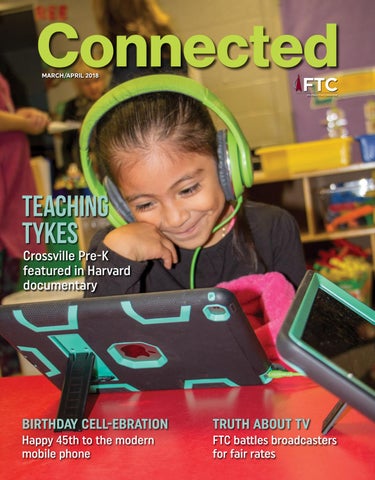
Videographers from Harvard Graduate School of Education captured scenes like this one of Miley Villa at Crossville Pre-K as part of a documentary about Alabama’s pre-K program. See story Page 12.
CPNI:
Follow us on
Understanding your rights
Social Media!
How FTC protects your personal information
@farmerstel
Important notice to subscribers regarding your Customer Proprietary Network Information FARMERS TELECOMMUNICATIONS COOPERATIVE, INC. FARMERS TELECOMMUNICATIONS CORPORATION Farmers Telecommunications Cooperative, Inc. and Farmers Telecommunications Corporation (collectively, “FTC”) want you to understand your rights to restrict the use of, disclosure of and access to your Customer Proprietary Network Information, or CPNI. You have a right and FTC has a duty, under federal law, to protect the confidentiality of your Customer Proprietary Network Information. WHAT IS CPNI? It is the information that FTC obtains that relates to the quantity, technical configuration, type, destination, location, and amount of use of the telecommunications service you subscribe to from FTC. It includes the information that is found in your bills, but it does not include subscriber list information (name, address and telephone number). Examples of CPNI would be the telephone numbers that you call, the times you call them, the duration of your calls or the amount of your bill. USE OF YOUR CPNI CPNI may be used by FTC to market services that are related to the package of services to which you currently subscribe, when providing inside wiring installation, maintenance and repair services, and when marketing “adjunct to basic” services, such as call blocking, call waiting and caller I.D. CPNI may also be used for the provision of customer premises equipment (“CPE”) and services like call answering and voice mail or messaging, and to protect Company property and prevent fraud. A carrier may use CPNI to bill and collect for the services you receive from FTC. FTC offers additional communications-related services. We seek your approval to access your CPNI so that FTC can provide you with information on new services and products that are tailored to meet your needs or may save you money. IF YOU APPROVE OF OUR USE OF YOUR CPNI AS DESCRIBED ABOVE, NO ACTION IS NECESSARY ON YOUR PART You have the right to disapprove this use of your CPNI by contacting us in writing at P.O. Box 217, 144 McCurdy Avenue N., Rainsville, Alabama 35986, or by telephone at 256-638-2144 or toll-free at 866-638-2144, within thirty-three (33) days after this notice is sent to you. Our drop box located at 144 McCurdy Avenue N., Rainsville, Alabama, is accessible twenty-four (24) hours a day, seven (7) days per week. If you disapprove our use of your CPNI, you may not receive notice of new services or promotions, but your existing services will not be affected. If you do not notify us of your objection within thirty-three (33) days, we will assume you do not object and will use your CPNI for these purposes. You have the right to notify us at any time to object to the use of this information. Your election will remain valid until you notify us otherwise. Farmers Telecommunications Cooperative
General Manager, continued from Page 4
PRIVACY RULES When the FCC strengthened its privacy rules, Farmers Telecommunications Cooperative conformed its policy to those rules. When the FCC relaxed those rules last year, Farmers Telecommunications Cooperative left its practices in place and now has tighter privacy rules than many other carriers.
FEDERAL TRADE COMMISSION OVERSIGHT The FCC’s transfer of BIAS consumer practices back to the Federal Trade Commission is of no concern to FTC. We are already subject to the Federal Trade Commission’s Red Flag Rules. The Commission may, in fact, be better suited to this purpose.
FCC REGULATION OF INTERCONNECTION This is, potentially, the most troubling development. In reclassifying BIAS as a Title I, Information Service, the FCC could conceivably step back from being the “Cop on the Beat” for regulatory oversight of interconnection between carriers. In theory, that could create problems for companies like us who must depend upon other carriers to interconnect with the backbone of the public internet. In summary, I will leave it to you to render judgment on the soundness of the FCC’s public policy. In the meantime, I hope you see that FTC is about keeping you connected and not about dictating to you what you do with that connectivity. March/April 2018 | 5
TRAVEL
TAKING IT LOW AND SLOW
ON THE TRAIL FOR
BY ANNE BRALY
O
ther regions of the country have certainly tried to imitate, but none have been able to duplicate the barbecue found in states across the South. Some restaurants have different sauces, while others are known by the type of wood they use for smoking. But all are known for the magical spell they put on the grill. Just follow the smoke from state to state on this road trip around the South to get your ’que on.
6 | March/April 2018
Owensboro, Kentucky — Moonlite Bar-B-Que Inn 2840 W. Parrish Ave. It once said, “Bahhh,” but your taste buds will say, “Ahhh,” when you bite into the barbecued mutton that put Moonlite on the map. Order it by the plate, on a sandwich or by the pound, and don’t forget an order of the famous Kentucky burgoo. There’s a barbecue buffet serving lunch and dinner and a dine-in menu with traditional pork or beef barbecue, catfish and chicken.
Memphis, Tennessee — Central BBQ 147 E. Butler Ave., 2249 Central Ave. and 4375 Summer Ave. Memphis is in the heart of the barbecue belt, so it’s hard to visit and not find a good pit. Central, though, is consistently ranked in the top three and always comes home from competitions with a trophy. So when you want to pig out on ribs, pork, chicken, turkey, brisket, sausage and even bologna, Central can’t be beat. No sauce meets the meat until the latter comes out of the smoker, and even then, not until you order. The spice mixture has been a deeply held secret since the first Central opened in 2002. Now, there are three locations, all of which have been featured in national publications, and it’s a favorite stop for TV food personalities, too.
3139 N. State St. This joint puts a spin on barbecue with its barbecue chicken tacos and pork belly corn dogs, while also offering traditional favorites like pulled pork, smoked brisket and barbecued chicken. It gives a nod to other regional cuisines, too. There are Asian smoked wings and fried boudin balls, a Louisiana favorite served with beer mustard and housemade breadand-butter pickles. The menu may sound outlandish, but the food is a hometown favorite that’s picked up awards, including best barbecue in Mississippi by firstwefeast.com.
7115 Lone Oak Road Southern Living named Carolina BBQ as the best barbecue joint in the state, a reputation built on finger-licking ’cue: St. Louis-style ribs, hickorysmoked chicken and turkey, brisket and pulled pork. Brunswick stew is made from scratch, and you won’t shut up about the chocolate hush puppies. The red slaw is known as some of the best in the business, and you’re welcome to take home a bottle of the barbecue sauce for yourself.
-B-Que.
Photo co urtesy of
ibson Bar ig Bob G
Moonlite utton made m d e cu e The barb , famous. nsboro, Ky. BBQ in Owe
Photo
Spartanburg, South Carolina — Carolina BBQ and More
Big Bo b for its ’s Bar-B-Qu e is fa smoke m d with w hite sa chicken ser ous bottled ve uce so it. good t d hey
-Que Inn.
Jackson, Mississippi — Pig & Pint
sa s., put n, Mis es such o s k c h Ja ith dis Pint in Pig & barbecue w n dogs. r n spin o ork belly co p as its
onlite Bar-B courtesy of Mo
3605 Thompson Bridge Road When you envision a barbecue shack, the building housing The Hickory Pig is what comes to mind. From the stack of wood out front, to the giant pig in the parking lot, to the ramshackle building, it’s a place with pure Southern smalltown charm. And the food? Just bite into a fork-tender rib and you’ll see why it’s a favorite in the north Georgia area for barbecue. The Brunswick stew is not to be missed.
Hickory P
ig BBQ.
Gainesville, Georgia — The Hickory Pig
urtesy of B
2702 Main St. In a state known for its barbecue, Pecan Lodge was named one of the top four barbecue joints in the world — that’s a pretty big deal. But owners Justin and Diane Fourton say they weren’t out to set the world on fire, just the seasoned woods they put in the pit to smoke their mouthwatering brisket, among other meats. It’s well worth the hour-long wait you might encounter. Order the brisket on a sandwich or by the pound, or have it piled into a salt-crusted sweet potato with cheese, spicy sour cream, butter and onions. It all smacks of Southern comfort.
Photo co
Dallas, Texas — Pecan Lodge
Phil Be a of The ubien is the Hickor owner shack y in Gain Pig barbecu esville , Ga. e
Pint.
1715 Sixth Ave. S. and 2520 Danville Road SW Cross the Alabama border and ask for a good barbecue place and chances are you’ll be directed to the town on the banks of the Tennessee River just south of the Tennessee border where Big Bob started cranking out the ’cue back in 1925. Gibson created his empire from smoked chicken smothered in white sauce, a recipe that’s appeared in numerous publications, as well as in bottles sold online and in the restaurant. The menu expanded over the years to include every kind of smoked meat you may crave — pork butts, turkey breasts, whole chickens, brisket and ribs. And don’t forget a slice of peanut butter pie.
of Pig &
2516 Cantrell Road; 12111 W. Markham St.; and 5107 Warden Road, North Little Rock It’s no small feat to garner a win in the esteemed Memphis in May World Championship Barbecue Cooking Contest, but Whole Hog has done it three times with two second-place wins for its ribs and a first-place for its whole hog. What began as a food truck in a parking lot in Little Rock has now spread across the nation, but its heart belongs in Little Rock, where you can order a simple pulled pork sandwich or get a taste of it all with the Ultimate Platter, which includes pulled pork, smoked beef, smoked chicken, ribs, three sides and dinner rolls. Hungry yet?
ourtesy
Decatur, Alabama — Big Bob Gibson Bar-B-Que
Photo c
Little Rock, Arkansas — Whole Hog Cafe
March/April 2018 | 7
THE COST OF TV
FTC fights to keep your prices down
Live TV is a great value: sports, cooking, singing, drama, comedy and more. There is likely something for you all day, every day. But it’s not perfect. For example, FTC subscribers sometimes question why they must pay for rarely watched channels to get a few favorites. And prices have increased. Here are a few key points to remember: Since 2013, the local broadcast stations for ABC, CBS, NBC and FOX have increased the rates FTC pays by 253 percent. In 2013, FTC paid these stations about $5 per month per subscriber. Now FTC pays over $12 per subscriber even after losing WZDX-FOX and WTVC-ABC. Content providers require FTC to buy a bundle of less popular channels for the rights to broadcast two or three of the most popular channels.
YOUR TV BILL, BY THE NUMBERS
Do you wonder where the money from your bill for television service goes?
78% 16% 6% 8 | March/April 2018
To national programmers such as ESPN, Disney, Fox News and Sports, A&E Networks, Discovery, AMC, CBS College Sports, NBC Universal and more. To local broadcast stations such as WAAY (ABC), WHNT and WDEF (CBS), WAFF and WRCB (NBC), and WHDF (CW). To FTC operating costs, including maintaining equipment worth millions, set-top boxes and similar equipment, employee costs, and other expenses needed to provide quality service.
Providing FTCtv subscribers great programming requires ongoing negotiations with national broadcasters that have no vested interest in our community. FTC does not strive to make a profit on television, but it must cover expenses while maintaining affordable TV packages with the channels you want. Remember, almost all of a monthly television bill is allocated to fees FTC pays to networks, leaving only a tiny sliver for personnel costs and equipment.
YOU HAVE OPTIONS AT FTC
FTC still believes that it offers a strong lineup at an affordable price but also understands that not every budget allows for our main offering. However, FTC works diligently to provide options that work for its members. Here’s how: ViewLocal is an easy, affordable way to access some of your favorite local channels utilizing your FTC broadband connection. FTCtv service is not required. See our backpage ad for more information. For the first time, catch your favorite local channels over the internet. Cable television service is not required. FTCtv also offers smaller packages — Expanded Basic Lite and Limited Basic — which still offer local channels at a reduced price. Visit farmerstel.com for more information about these programs. Farmers Telecommunications Cooperative
Navigating a changing TV landscape A message from FTC Executive Vice President and General Manager Fred Johnson I wish to discuss recent changes in the FTCtv lineup, the loss of Channel 54 in Huntsville and Channel 9 in Chattanooga. Please understand that while local broadcast stations across the country are given franchises by the federal government to offer their programming over the air free of charge, they are also given the right to demand payment from any TV provider, such as FTC, who wishes to distribute their signal via its network. In fact, federal regulations require us to negotiate in good faith for that right if the station so elects. If we cannot come to terms with a station, arbitration by the FCC is possible. In addition to local broadcast programming, FTC must also negotiate for the rights to carry the national content we provide, such as Fox News and ESPN. We do this through a national cooperative to maximize purchasing power. As of Jan. 1, 2018, FTC pays about $60 monthly per customer for this national content and over $12 monthly for the local broadcast stations. Had we not been aggressive in reacting to the initial demands of these content providers, our cost of content would have increased by nearly $18 monthly per customer. The local broadcast stations initially sought to almost double their fees. FTC does not try to make a profit on its TV business. We merely seek to recover our cost. Unapologetically, we are not willing to saddle customers who do not take TV service from us with the cost incurred for those who do.
We were successful in containing the rise in the cost of national content by moving a number of channels that very few people watch to a service tier for which we can charge. We were also successful in negotiating acceptable prices for most of our local broadcast stations. With minor exceptions, we do not believe those prices are necessarily fair, but at least they were acceptable. Still, to avoid an unacceptable increase in monthly rates, we knew we would likely have to drop some content. Based on Channel 54’s last offer, we would have likely had to drop all the Chattanooga stations to carry 54 without a significant price increase. We were unwilling to do that. We are able to measure the number of people who watch each channel, and the highest number we have recently observed watching Channel 54 was approximately 600. It is usually less than 350, as opposed to thousands watching ABC, NBC or CBS content. This is unfortunate for NFC pro football fans, but we must remind you that the content is still available free of charge over the air. It will be of little comfort to those who value this content, but FTC falls back to logic in making these decisions. As Star Trek’s Commander Spock famously said, “The needs of the many outweigh the needs of the few.” It isn’t perfect, but it is the best we can do.
MEDIA POWERHOUSES In 1983, 50 companies owned 90 percent of American media. At the beginning of 2018, the number was down to six companies. And possible mergers could shrink the number further.
WHAT DOES THAT MEAN FOR YOU? A few companies have great bargaining power, and they’re driving up the cost of programming. That means higher TV prices for you.
Comcast
Walt Disney Co.
Time Warner
21st Century Fox
CBS
Viacom
Key Brands: NBC, Universal Studios, MSNBC, The Weather Channel, USA Network, Oxygen, Telemundo, Golf Channel, MLB Network, NHL Network, Syfy
Key Brands: ABC, Freeform, ESPN, Disney Channel, A&E, History, Lifetime, FYI, Disney Jr., SEC Network, Viceland, Military History
Key Brands: HBO, Cinemax, CNN, TBS, TNT, CW Network, Cartoon Network, TNN, TCM, Turner Sports, Boomerang, HLN
Key Brands: FOX, Fox News Channel, FX, National Geographic Channel, Fox Sports, MyNetwork TV, FXX, Nat Geo Wild, Baby TV
Key Brands: Showtime, CBS, CBS Sports Network, AXS TV, The Movie Channel, Flix, Smithsonian Channel
Key Brands: BET, CMT, Comedy Central, MTV, MTV 2, VH1, Nickelodeon, TV Land, TeenNick, Nick Jr
Farmers Telecommunications Cooperative
March/April 2018 | 9
Mobile phones turn 45
Wireline technology makes cellphone popularity possible BY PATRICK SMITH
W
hile you’ve likely heard of Steve Jobs, the influential entrepreneur and one-time leader of Apple, you probably don’t know of Martin Cooper, a Motorola employee who made the first cellular phone call on April 3, 1973. Jobs’ achievements with the iPhone, along with much of Apple’s recent success with the device, wouldn’t be possible without Cooper. When Cooper stood in midtown Manhattan and placed a call 45 years ago, he forever changed how we communicate. Known as the father of modern cellphones, Cooper successfully connected to Bell Labs headquarters in New Jersey, calling on what would become the world’s first commercial cellphone. Much like Jobs’ success was dependent on Cooper, today’s cellular technology is dependent on a wired copper
10 | March/April 2018
and fiber optic backbone to connect wireless communications. Wireless technology needs a hardwired foundation to operate. Without wireline technology, cellphones would neither be able to make calls nor use internet data.
THE WIRELINE BACKBONE When it comes to cellphones and the wireline technology they need to operate, think of the concept like the wireless router in your home. A wired connection runs from the wall to your router so it can broadcast and receive a signal. The same principle applies to the fact that cellular phones need a wired connection to operate. Copper and fiber lines running overhead and underground play a crucial role in carrying signals between more than 300,000 cell sites across the country. When you use your cellphone to make
a call or access the internet, your connection spends part of its journey on the same network that makes landline calls and internet connections possible.
RURAL TELCOS PLAY A VITAL ROLE Telecommunications companies provide an essential service by keeping cellular callers connected in rural areas. Many rural telco providers supply wireline copper or fiber service to large cellular towers. These lines keep people connected when they are making cellular calls in rural regions, whether they’re traveling through the area or residing there.
3G SPEEDS AND BEYOND As fiber optic connections become more common, they also help to lay the groundwork for faster cellular speeds. The blazing-fast speed of fiber not only means faster upload
and download speeds for area homes and businesses, but it also means faster cellular data speeds. Mobile data service — 3G, 4G and 4G LTE — relies on fast connections from telecommunications providers to cell towers, so users can have dependable mobile access to the internet. While a release date has not been set, developers are working to create a new 5G technology, which could offer data speeds as fast as 10 Gbps. Peak 4G LTE speeds top out at about 50 Mbps today, making 5G potentially about 200 times faster. And while it’s impossible to predict the future and the developments that newer, faster cellular technology will bring, it’s clear that progress isn’t possible without a strong base of copper and fiber wireline technology to connect our calls and provide highspeed mobile data.
TECHNOLOGY IN THE GOLDEN YEARS
Gadgets for the golden years
L
os Angeles Times Publisher Ross Levinsohn once said, “The speed at which technology evolves affects everyone; we repeatedly hear that constant innovation is overwhelming for consumers, who struggle to keep pace.” I couldn’t agree more with that statement. It seems like as soon as I learn a new piece of software, or how to use the latest technology gadget, it becomes outdated and replaced with a newer version. If it gets overwhelming for me — a professional who works with technology daily — I can just imagine how overwhelming it is for someone who considers themselves non-techie. I want to take a bit of the guesswork out of researching technology and point out a few gadgets that I think are good starter items for those adopters in their golden years.
your eyes. If you have trouble reading small print, you can make the font larger so that it is easier to read, even without your reading glasses.
Tablet: Amazon Fire
Gadget for a Non-Techie: Pix-Star Wi-Fi Picture Frame
The Amazon Fire is a great starter tablet for a couple of reasons. It is reasonably priced, coming in under $100. It’s great for watching movies or TV shows, checking email, playing games and, of course, reading books. The Fire even has a blue light filter that makes reading on the tablet less strenuous on
If you are looking for a great gift for a parent or a grandparent, this is a good one. The picture frame is connected to Wi-Fi and has an email address. The system makes it very easy to add updated photos to the frame. Family and friends can simply email photos directly to the frame.
Medical Tech Gadget: MedMinder Pill Dispenser Never worry about remembering to take your medicine at the right time each day. MedMinder can help you remember your meds by calling, texting or emailing you. Multiple features and differing models ensure the right style for different needs.
Voice Control Gadget: Amazon Echo Show
remember. My favorite feature of this device is the ability to “drop in” on loved ones to see how they are doing. Just by answering a call with your voice, you can see and hear the people you care about the most. The best way to learn how to use the latest in tech gadgets is to give them a try. You never know; you may find you enjoy using them!
Once the Amazon Echo Show is set up, you can get the information you want easier. Ask the built-in helper, Alexa, for the temperature, score of the game, or a fact you can’t
CARISSA SWENSON IS A TRAINING AND EDUCATION CONSULTANT FOR CONSORTIA CONSULTING.
To learn more about the gadgets mentioned in the article, visit the following websites: gg www.amazon.com/fire
gg www.pix-star.com
gg www.amazon.com/echoshow
gg www.medminder.com
March/April 2018 | 11
Calen Richey, left, gets help to start a video from classmate Jaden Guthrie in a pre-K class at Crossville.
Matt Ziegler, a videographer from the Harvard Graduate School of Education, captures scenes from a pre-K class at Crossville School. From left are students Grayson Garlinger and German Diego.
THE BEST OF THE BEST A documentary showcases Alabama’s pre-K program in Crossville BY LISA SAVAGE
A
4-year-old boy pulled the headset over his ears, ready to watch an educational cartoon. But, he couldn’t get the movie to start on the tablet computer. “Let me show you,” a classmate said, leaning over the boy’s shoulder. As the two figured out the technology, two girls pretended to prepare a meal in the play kitchen. Meanwhile, the teacher sat on the floor, reading to two other students, while another stood and quietly moved blocks on a magnetic board. It’s a typical day in the pre-K classroom at Crossville Middle School, one captured by videographers from the Harvard Graduate School of Education in Massachusetts. Crossville Pre-K is one of several Alabama classes to be featured in a documentary funded by the Saul Zaentz Charitable Foundation on behalf of the Harvard Graduate School of Education.
12 | March/April 2018
Why Alabama? It’s simple, says Elliot G. Steinberg, a director of the foundation. “It’s a fabulous program, and I believe the rest of the country needs to learn from this,” he says. “The whole idea is a level playing field for all children. That needs to be the goal of education in America.” Alabama’s pre-K has topped national rankings for 11 years, and it is a program Steinberg believes can be duplicated across the country. The first pre-K program in the state started in 2000 with one classroom, and now there are more than 1,000 classrooms. “It’s expanding based on the results of its success,” he says. “Everyone can learn from Alabama’s model.” The documentary is one way to spread the message. The Saul Zaentz Charitable Foundation invests in programs that support poor and minority
residents in the United States. Many of the programs focus on education.
A GOOD START While prekindergarten students sometimes learn to identify letters and numbers, the Alabama pre-K program focuses on social and emotional skills, such as learning how to line up for lunch, how to keep one’s hands to oneself, and how to get along with other children. “It’s not teaching in a conventional way,” Steinberg says. He explains that it’s about executive functioning, which is teaching mental control and self-control. A child’s brain isn’t fully developed until they are 5 years old, so Steinberg says reaching the 4-year-olds is so impor-
tant. “If they haven’t learned these things by then, they fall behind,” he says. Last fall, Steinberg and the team from Harvard visited pre-K programs at schools in Crossville, Mobile, Wilcox County, Madison and a faithbased program in Birmingham. They were accompanied by Jeana Ross, secretary of the Alabama Department of Early Childhood Education. The state’s Early Childhood Education department administers the pre-K program and operates separately from the Alabama Department of Education, which is responsible for kindergarten through grade 12. Pre-K teachers must have a bachelor’s degree in early childhood education. Farmers Telecommunications Cooperative
How to enroll
DeKalb County Schools Superintendent Dr. Jason Barnett and Jeana Ross, secretary of Alabama’s Early Childhood Education department, share reports showing how well students who attended a pre-K program do in elementary school.
Crossville Pre-K was chosen because it’s in a rural, diverse community with a large number of students who speak Spanish. “This just shows that regardless of demographics, we can overcome many obstacles to better educate our children,” Ross says. The pre-K teaching method is proven, which is evident in the classrooms daily, says Jason Barnett, superintendent of DeKalb County Schools. “We have an excellent program, and it’s very exciting to have a prestigious college such as Harvard highlighting our success.”
PRE-K PROGRAMS IN ALABAMA AND DEKALB COUNTY The Alabama pre-K programs are available through a grant from the state Department of Early Childhood Education. Class sizes are limited to 18. Student selection is random, similar to a lottery drawing, Farmers Telecommunications Cooperative
and a requirement of the grant. Only 28 percent of Alabama’s 4-year-olds can participate because of space and funding constraints. The state has invested more than $3 million in DeKalb County, says Mary Crosby, director of the pre-K program for DeKalb County Schools. The county’s first pre-K class began in 2013 at Plainview Elementary. Other classes were added as resources and funding became available. Sylvania Elementary lacks the class space and is the only school without a pre-K program in the county. The grant for each class is $120,000 for the first year, but the school system provides for resources like electricity, classroom space and playgrounds. The grant amount varies after that. Two pre-K classes were added in 2016 at Crossville Middle School. The prekinder-
garten students are in a central area, separated from the older students. The success of the pre-K program at Crossville is evident once those students begin kindergarten. For example, 47 percent of pre-K students beat the state average on math scores. Of those who did not attend pre-K, only 20 percent exceeded the state average. Similarly, only 18 percent of the students who attend pre-K have below average scores. But 44 percent who did not attend pre-K score below average. The program prepares students to hit the ground running once kindergarten begins, while still allowing them to use their imaginations and to act like 4-year-olds, Crosby says. “I hope that one day more 4-year-olds will have an opportunity to participate in this wonderful program. It is truly an investment in the future of our state,” Crosby says.
Registration is from 8 a.m. to noon March 14 at all schools that have pre-K programs. Acceptance to the program is through a random selection process. Applicants must meet residency requirements. Students must be 4 years old by Sept. 1, 2018. Children will not be denied based on income, sex, race, color, national origin or disability.
WHY HIGH-QUALITY PREKINDERGARTEN? Numerous studies have shown that students who participate in highquality prekindergarten programs: Are less likely to repeat a grade, require remedial education, or be placed in special education. Score higher on achievement tests. Are more likely to graduate from high school and go on to college. Get higher paying salaries as adults. Are more likely to stay out of prison and off welfare.
March/April 2018 | 13
SOUTHERN KITCHENS
Baking for spring
with Jason Smith
S
pringtime baking means shedding the heavy ingredients of winter: “All that butter and those heavy chocolates,” says Jason Smith. Smith, a resident of Grayson, Kentucky, once a cafeteria manager at Isonville Elementary and also a florist and caterer, was the 2017 Food Network Star. Just months before that win, he won Food Network’s “Holiday Baking Championship,” followed by a victory on “Holiday Baking: Adults vs. Kids.” In less than a year’s time, he baked his way to three major wins, making more than 50 dishes to impress the judges. Smith’s successes in the food competitions came as no surprise, says Felicia Green, who served as a teacher and a principal at Isonville Elementary for 27 years before retiring in November 2016. “He always went the extra mile,” she says. “I remember he was always making things for us to put in the teachers lounge. And on TV, his personality is so genuine.” In the past year, Smith has also been a judge for Food Network’s “Best Baker in America.” He now has a show of his own in the works, which he hopes to make “very dessert heavy.” Smith’s earliest memories of cooking go back to a hot day on his family’s tobacco farm
14 | March/April 2018
Jason Smith was a school cafeteria manager in Kentucky before winning the Food Network’s “Holiday Baking Championship.”
BLACKBERRY-GRAPE PIE
in Laurel County, Kentucky. “I decided I didn’t want to be outside hoeing tobacco, so I went inside and asked my grandmother if I could stay and help her in the kitchen,” he recalls. On the menu that day? Fried chicken, fresh corn on the cob, potatoes and strawberry shortcake made with berries from the garden, along with biscuits left over from breakfast that morning. Smith says his grandmother saw something in him that day that others had dismissed. “She always told my mom about how much I loved to be in the kitchen, whether it was to wash the dishes or peel potatoes,” he says.
Cookbooks are one of Smith’s hobbies. He collects them and enjoys reading the stories behind the recipes. “I’ve taken so many recipes and switched things around to give the recipes new life,” he says. That’s a trademark of his as evidenced by recipes he shares.
FOOD EDITOR ANNE P. BRALY IS A NATIVE OF CHATTANOOGA, TENNESSEE.
Dough for double-crust pie 2 pints fresh blackberries 2 cups green grapes 2 tablespoons cornstarch Zest from 1 small lemon 1 teaspoon freshly grated ginger 1 1/2 cups sugar Heat oven to 350 F. Spray an 8-inch pie plate and place 1 sheet of dough in it, allowing edges to hang over. In a large mixing bowl, toss the berries and grapes in the cornstarch, lemon zest, ginger and sugar, stirring to coat. Pour into pie shell. Place other sheet of dough on top, and crimp the edges of the 2 sheets of dough together. Then, using a sharp knife, make 4 slits in middle of top to let steam escape. Brush with egg wash (one egg whisked with a little cold water) and place pie on cookie sheet. Tent pie with a sheet of aluminum foil and bake 30-45 minutes. Remove foil and bake a few more minutes to brown the top.
CARROT CAKE WITH COCONUT FROSTING
Lemon Chiffon Cake with Blueberry Mousse ;•;
LEMON CHIFFON CAKE WITH BLUEBERRY MOUSSE 1/4 cup vegetable oil 2 unbeaten egg yolks 1/4 cup plus 2 tablespoons cold water 2 teaspoons lemon extract 2 teaspoons lemon zest 1 cup plus 2 tablespoons sifted cake flour 3/4 cup white sugar 1 1/2 teaspoons baking powder 1/2 teaspoon salt 2 teaspoons fresh thyme, minced 4 egg whites 1/4 teaspoon cream of tartar Blueberry mousse: 2 cups heavy cream 1/4 cup powdered sugar 2 pints fresh blueberries 1 teaspoon vanilla extract 1 cup finely chopped or grated/ shredded white chocolate Heat oven to 325 F. Mix together oil, egg yolks, water, lemon extract and lemon zest. Sift dry ingredients together, then mix into the wet ingredients in a stand mixer until smooth. In another large bowl, combine egg whites and cream of tartar,
beat with a mixer until stiff peaks form. Pour batter over the beaten egg whites and gently fold with a figure-eight motion until all streaks disappear. Pour into a lined 13-by-18-inch sheet pan or rimmed cookie sheet and bake for 25-30 minutes or until a toothpick stuck into middle comes out clean. Take out and let cool; cut into 1-inch squares. Meanwhile, make the mousse: Place the cream and sugar in a large bowl and whip into stiff peaks. Then fold in the vanilla and half the blueberries. To assemble: Place 1/3 of the cake cubes and then 1/3 of the mousse in a trifle bowl. Then sprinkle a few blueberries and some of the white chocolate over the top. Repeat layers until all the cake, mousse, berries and white chocolate are used. Make sure to save a few berries for the garnish. You can also garnish with fresh thyme sprigs on top. Refrigerate for 8 hours or overnight before serving. Serve with strawberry sorbet if desired.
2 1/4 cups all-purpose flour 1 teaspoon baking powder 1 teaspoon baking soda 1/2 teaspoon salt 1 teaspoon cinnamon 1 teaspoon allspice 1 3/4 cups packed light brown sugar 3/4 cup vegetable oil 4 large eggs 2 teaspoons vanilla extract 3/4 cup tomato soup 1 cup buttermilk 1/2 cup grated fresh carrots
Coconut frosting: 4 tablespoons butter, divided 2 cups shredded coconut 1 (8-ounce) package cream cheese, room temperature 2 teaspoons milk 1 teaspoon vanilla extract 3 1/2 cups powdered sugar Heat oven to 350 F. Spray a 10-cup tube pan. In a bowl, sift together the flour, baking powder, soda, salt, cinnamon and allspice. Place brown sugar, oil and eggs in stand mixer and mix till fluffy; add the vanilla extract and tomato soup and mix in. Then add the dry mixture. Turn the mixer on low and slowly drizzle in the buttermilk until combined, and then stir in the carrots. Pour into pan and bake for 30-35 minutes or until a toothpick inserted in the middle comes out clean. Let cool and frost with coconut frosting. Coconut frosting: Melt 2 tablespoons butter in a skillet and add the coconut; toast until lightly brown, then place on a paper towel to cool. Cream the rest of the butter and cream cheese till fluffy in a stand mixer; mix in milk and vanilla extract, then slowly add the powdered sugar, mixing well. Fold in 1 3/4 cups of the cooled coconut. Frost cake and sprinkle remainder of coconut on top. î‚š March/April 2018 | 15
Presort STD US Postage PAID Permit #21 Freeport OH
P.O. Box 217 • 144 McCurdy Ave. N. Rainsville, AL 35986
Introducing
›› ›› ››
The local channels you want The price you want The convenience you want Live local programming delivered over your broadband connection
for less than a dollar a day! FTCtv6 FPTV CBS-WHNT WHNT2 Antenna TV ABC-WAAY NBC-WAFF
Only
Bounce GRIT The CW PBS NBC-WRCB CBS-WDEF
$25 per month
No contracts • No installation Use your own device — compatible with Android, iOS, Roku and web browsers.
Call FTC and get started today! Search for the ViewLocal app in your device’s marketplace on iOS, Android or Roku, or visit viewlocal.tv.
256-638-2144 • farmerstel.com