Hope Blooms

By Shirley Bloomfield, CEO NTCA–The Rural Broadband Association
This column is different than the others I’ve written over the years, because it’s my last as CEO of NTCA. When I began working at NTCA nearly 40 years ago, “broadband” wasn’t a household word. “Universal service,” while a longtime national goal, was a concept more than a mission. And “rural America” was too often an afterthought in conversations about connectivity.
Over the course of my career, I have watched the industry transform and a movement grow, powered by NTCA’s small, community-based providers. These providers are determined to bring advanced broadband to the communities they call home, even in places where the maps say it couldn’t be done and the economics didn’t work. Every day they do the extraordinary, proving what is possible when community comes first.
I’ve been honored to witness that perseverance firsthand. I’ve seen providers work through the night after storms so families could reconnect with loved ones. Thanks to their hard work building Smart Rural Communities, students in small towns can access educational opportunities far beyond their county lines. Farmers, small businesses and entrepreneurs use their fiber connections to grow, compete and thrive—without leaving the places they love.
Broadband is about more than technology. It’s access to health care, education, safety and economic opportunities. It’s the ability to stay rooted while reaching outward. And at its core, it’s about people, the NTCA members who make connectivity possible and the customers they proudly serve.
When I reflect on my many years with NTCA, I think about all of the people who shaped not only my journey, but the story of rural America itself. The CEOs who started out on construction crews or at finance desks, the family-owned companies now in their fourth generations, co-op boards that hold community meetings in gymnasiums, NTCA staff who pour every ounce of passion into serving members and the federal partners who understand what makes rural broadband so special.
As I step into my next chapter, I do so with deep gratitude, for the providers who serve with heart, communities that refuse to settle for “just good enough” and Americans who know that high-quality connectivity is not a luxury, but a necessity.
Thank you for reminding me every day why this work matters.
NTCA–The Rural Broadband Association works to build a better broadband future for rural America, representing about 850 independent, family-owned and community-based telecommunications companies. The tenure of Shirley Bloomfield, named CEO in 2010, highlights a time of significant industry achievement.
Shirley Bloomfield joins NTCA
Congress passes the Telecommunications Act of 1996, codifying “universal service.”
Congress passes the American Recovery and Reinvestment Act, investing over $7 billion to expand high-speed internet access. NTCA ramps up advocacy efforts as the Federal Communications Commission unveils its National Broadband Plan.
USDA creates the ReConnect Loan and Grant Program.
Congress passes the Infrastructure Investment and Jobs Act, investing $65 billion into broadband.
NTCA members join the Keep Americans Connected Pledge to ensure Americans retain connectivity during the COVID-19 pandemic.
The Supreme Court rules the Universal Service Fund is constitutional, following lengthy defense by the FCC, NTCA and others.

Story by MELANIE JONES
People who take just one pill a day may find it easy to remember. Adding in a few supplements makes the process a little more complicated. It’s not hard to understand how individuals who take multiple prescriptions may need some help keeping up with it all.
It isn’t simply a matter of remembering to take the pills or administer the injection. Some medications need to be taken at certain times of the day, while others require multiple, precisely timed doses. Certain drugs should be taken before eating, other treatments are taken with a meal, and still others instruct patients to take them on a full stomach.
Managing medications correctly is vital to staying healthy and living life to the fullest. Fortunately, there are digital tools that can help. Many of these apps also allow users to keep track of their vital signs and make notes about changes they notice in their health. With all this information at hand, doctor appointments can go much more smoothly.
Several free apps are available that not only remind users when to take their medicine but also offer information on how different drugs interact, track symptoms and even prepare a report for doctors. One warning—because they are free, some apps ask permission to share your data with drug companies so they can research drug compliance and effectiveness.
The My Therapy app has attracted attention in the last year, including being featured on ABC and in Wired magazine. The app allows users to set reminders, log when they’ve taken medicine or skipped it and track weight, blood pressure, blood sugar and other health indicators.
In addition to tracking prescriptions, schedules and health indicators and warning about potential drug interactions, Medisafe users can name a “Medifriend,” someone who will be notified if a dose is
missed. Users can also keep tabs on their children’s or other dependents’ medication information separately from their own. When adding medications to their Medisafe profiles, users can specify the shape and color of the drug, helping them keep straight which pill or capsule is which.
For people who have multiple medications to take at different times of the day, Dosecast may be the best choice. The app assigns a sound to each medication, so users receive prescription-specific reminder notifications. It also keeps track of when it’s time to order refills. Like the other apps, Dosecast also allows users to track key health indicators.
All these apps are on Google Play or Apple’s App Store. They also can interact with the health apps built into phones to provide a better overall picture of your health.
There’s something about all the seasons I enjoy, but the change from winter to spring is always special to me as it signals the start of baseball season.
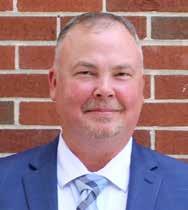
PAUL HIGDON Chief Executive Officer
I, like many of you, am a sports fan. The purity of youth sports competition—where one’s name, social standing and what you wore or drove to school that day were irrelevant— has always appealed to me. All that mattered was your team’s collective capacity to compete for the community you represented on the fields and courts that dot our service area. Much of what I learned in youth and high school athletics translates well to the business playing field and particularly to FTC.
Just as the best sports teams spurn individual accolades in favor of team goals, cooperatives require individuals to align their personal interests for the success of the group. FTC was formed 74 years ago this month by a group of people with a common objective—to bring a modern telecommunications system to our area. Those men and women weren’t motivated by fame or fortune. Rather, they recognized that our area’s economic viability depended on having access to the same communications services more urban areas had, and they worked together to make it happen. Admittedly, I was not around to see it at that time, but I have witnessed a commitment to investment, growth and service that correlates directly with those shared values since. The collective good of those we serve still underlies every major decision that is made here.
In many of today’s arenas, both sports and business alike, shared goals, collective success and community focus fall victim to selfish motivation, stock price and investors’ whims. I am thankful to be a part of something different at this cooperative and for the opportunity to play for FTC’s team. I’m equally thankful for you, our members and subscribers, for your continued support in making FTC what it is today.
Good luck to your team this spring and, as always, let us know if we can be of service to you.

FTC is the state’s largest member-owned provider of telecommunications services. It serves Northeast Alabama with a robust broadband network using world-class optical fiber technology.
Telecommunications Cooperative, Inc.
P.O. Box 217 • 144 McCurdy Ave. N. Rainsville, AL 35986
256-638-2144 farmerstel.com
BOARD OF TRUSTEES
Randy Wright, President Flat Rock Exchange
Garry Smith, Vice President Fyffe Exchange
Danny R. Richey, Secretary Geraldine Exchange
Lynn Welden, Treasurer Bryant Exchange
Kenneth Gilbert Pisgah Exchange
Gregg Griffith Henagar Exchange
Randy Tumlin Rainsville Exchange

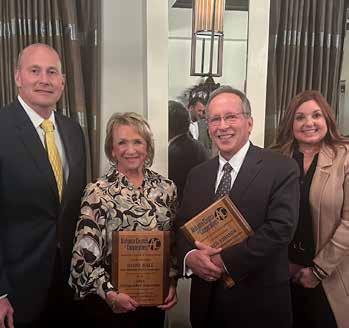
In November, former Farmers Telecommunications Cooperative CEO Fred Johnson received the Alabama Distinguished Cooperator Award from the Alabama Council of Cooperatives. Presented annually at the council’s reception and dinner, the award recognizes individuals whose leadership and commitment have made lasting contributions to agriculture, cooperatives and rural communities across Alabama.
Fred was honored for a career of more than four decades, as he strengthened rural utilities and telecommunications, advanced cooperative governance and championed community-focused innovation. His leadership at FTC and service on state and national boards exemplify the cooperative principles of education, stewardship and service.
Diane Hale, of Sand Mountain Electric Cooperative, was recognized and awarded the Alabama Distinguished Cooperator Award for her dedication to serving on the Alabama Council of Cooperatives board of directors for many years.
FTC congratulates both Fred and Diane on receiving these prestigious honors.
Farmers Telecommunications Cooperative, Inc. and Farmers Telecommunications Corporation (collectively, “FTC”) want you to understand your rights to restrict the use of, disclosure of and access to your Customer Proprietary Network Information, or CPNI. You have a right, and FTC has a duty under federal law, to protect the confidentiality of your Customer Proprietary Network Information.
It is the information that FTC obtains that relates to the quantity, technical configuration, type, destination, location and amount of use of the telecommunications services you subscribe to from FTC, including broadband internet access service (“BIAS”). It includes the information that is found in your bills, but it does not include subscriber list information (name, address and telephone number).
Examples of CPNI would be the telephone numbers that you call, the times you call them, the duration of your calls or
the amount of your bill. Certain information relating to your use of our BIAS will also be considered CPNI and subject to additional privacy protections and use restrictions, including your broadband service plans, geographic location information, MAC and IP addresses, domain name information, device identifiers, traffic statistics, port information, application headers, usage and payload and certain consumer devices capable of connection to broadband services, such as smartphones, tablets, computers, modems and routers.
CPNI may be used by FTC to market services that are related to the package of services to which you currently subscribe, when providing inside wiring installation, maintenance and repair services, and when marketing “adjunct to basic” services, such as call blocking, call waiting and caller ID.
CPNI may also be used for the provision of customer premises equipment (“CPE”) and services like call answering and voicemail or messaging, and to protect company property and prevent fraud. A carrier may use CPNI to bill and collect for the services you receive from FTC.
FTC offers additional communicationsrelated services. We seek your approval to access your CPNI so that FTC can provide you with information on new services and products that are tailored to meet your needs or may save you money.
YOUR CPNI AS DESCRIBED ABOVE, NO ACTION IS NECESSARY ON YOUR PART. You have the right to disapprove of this use of your CPNI by contacting us in writing at P.O. Box 217, 144 McCurdy Ave. N., Rainsville, AL 35986, or by telephone at 256-638-2144 or toll free at 866-638-2144, within 33 days after this notice is sent to you. Our drop box, located at 144 McCurdy Ave. N., Rainsville, is accessible 24 hours a day, seven days per week.
If you disapprove of our use of your CPNI, you may not receive notice of new services or promotions, but your existing services will not be affected. If you do not notify us of your objection within 33 days, we will assume you do not object and will use your CPNI for these purposes. You have the right to notify us at any time to object to the use of this information. Your election will remain valid until you notify us otherwise.

Story by LAURA MCGILL
Located in the foothills of the Blue Ridge Mountains with unique urban views and abundant natural hues, Greenville, South Carolina, offers plenty of ways to set your own pace. Enjoy a laced-up, fresh-air visit when you create your personal walking itinerary with choices for foodies, art lovers, sports fans, history buffs and nature enthusiasts.
Perfect for a stroll, the wide and welcoming sidewalks of Main Street invite
visitors to explore the local scene. Start at NOMA Square and fuel up with a hearty breakfast at Roost Free Range Kitchen. Then it’s time to start walking. Venture south to Falls Park on the Reedy to enjoy an urban waterfall. Get the best views from Liberty Bridge. Look up to appreciate the bridge’s unique single-suspension construction. Be sure to check the schedule for the Greenville Drive, the High-A affiliate of the Boston Red Sox. They play home games on Main Street’s Fluor Field, which is modeled after Boston’s famous
complete
With design and etiquette guidelines to safeguard children and those with mobility challenges, the Prisma Health Swamp Rabbit Trail provides 28 miles of natural beauty for all fitness levels. Take a casual walk, a jog or a bike ride to discover area parks, attractions, shops and eateries. Didn’t bring a bike? No problem. Greenville has several bike rental options.


Plan to spend several hours at Cleveland Park, home to the Greenville Zoo, Rock Quarry Falls and the Vietnam Veterans Memorial. Treat yourself to a scratchmade pastry and a craft coffee at Swamp Rabbit Cafe & Grocery, a popular spot along the trail.
Celebrate scientists, chefs, pitmasters and painters. On April 4, iMAGINE Upstate STEAM Festival spotlights science, technology, engineering, arts and math. Remember to grab extra napkins to savor the dishes at Southern
Roots: A BBQ Reunion on April 11. The culinary experiences continue April 16-19 at Spring Fest with a series of foodie events. Catch your breath and get ready for Artisphere, May 8-10, featuring the works of visual artists representing many different mediums.

strenuous hiking challenge.

Within an hour’s drive from downtown Greenville, enjoy the beauty of six more waterfalls. Easy views can be found at Wildcat Wayside Falls, a roadside pulloff. The middle portion of those falls is an easy hike, while the upper section calls
Greenville-area waterfalls are part of the Blue Ridge Escarpment, a geological feature where the Blue Ridge Mountains dramatically drop 2,000 feet to the Piedmont below. In total, the area is home to more than 50 waterfalls.
Plan your Greenville, South Carolina, trip at visitgreenvillesc.com or on Facebook @visitgreenvillesc.
Story by MELANIE JONES
When Ashley Rogers answers the phone at work, she knows that sadness is on the other end. It may be a parent who doesn’t understand what the doctor has to say about their child’s brain tumor. It could be a mom trying to cope with the idea that her child is going to die. Or it might be a dad looking for hope in an experimental treatment that could extend his child’s life.
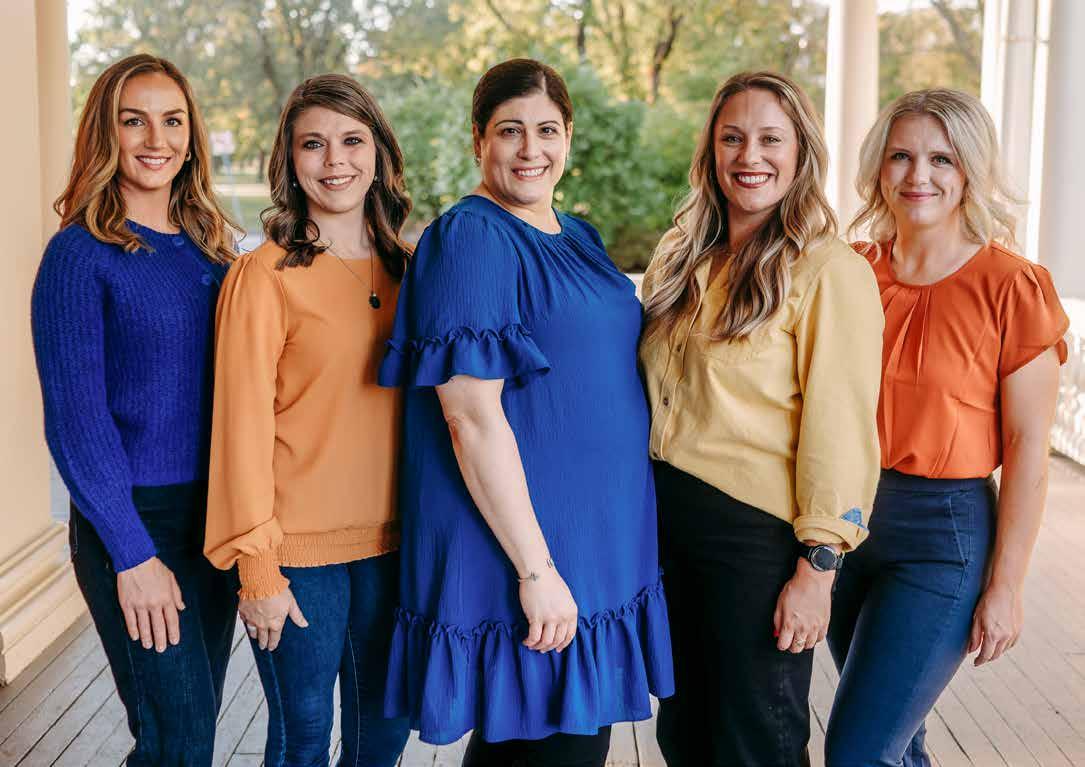
Ashley is a nurse navigator with the ChadTough Defeat DIPG Foundation.
The foundation was formed by the merger of two groups founded by parents who lost their children to a rare brain tumor that primarily affects 5- to 10-year-olds. The organization began as a fundraising vehicle for research into diffuse intrinsic pontine glioma, or DIPG for short. Now it also offers the services Ashley provides.
“Most people have never heard of DIPG,” she says. “Most people don’t understand what they’re being told. They don’t understand clinical trials, and they
don’t understand the treatments and things like that. And so, we’re here to help educate, give them information, support them, answer what questions they have and do that throughout the journey.”
This job isn’t Ashley’s first to deal with such a heavy topic. Previously, she was a pediatric oncology nurse practitioner at St. Jude Clinic in Huntsville, dealing with life-and-death issues every day. When she
found this job while searching for a new position that wouldn’t require a threehour total commute, she wasn’t sure she wanted to apply.
With her experience working in pediatric oncology, Ashley had seen DIPG before and knew that it’s fatal for every patient. But after some consideration, she applied anyway. “I decided, you know what, this is why I went into pediatric oncology, to help people and make a horrible situation a little more tolerable for them. To make it better, a little easier and to help however I could,” she says.
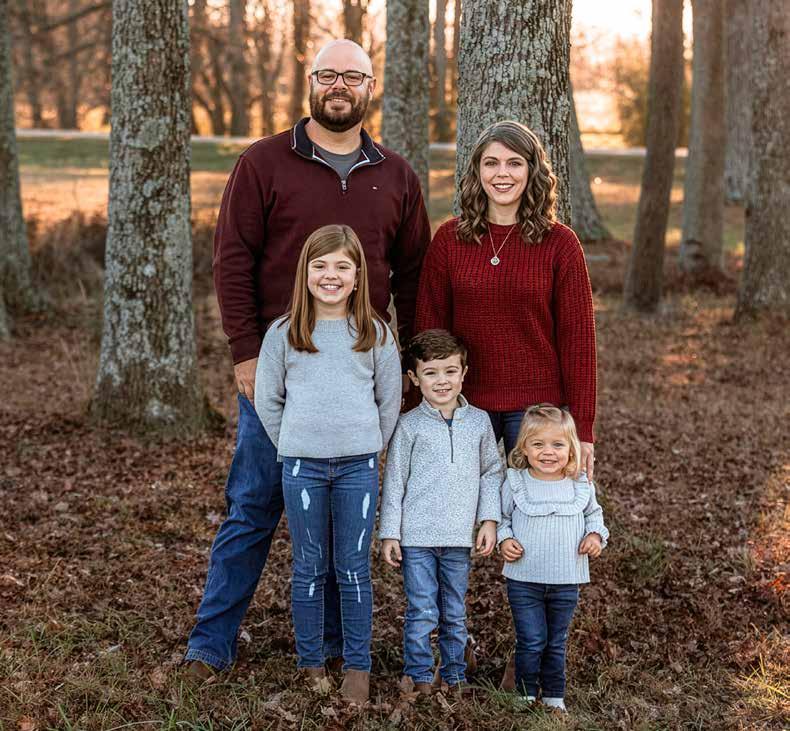
Today she works from home in Geraldine with the help of fiber internet from Farmers Telecommunications Cooperative. At first, Ashley wasn’t sure if she would like working remotely, but now, she loves being able to spend more time with her family instead of getting home every night after dinner.
When she got the job with ChadTough Defeat DIPG, she and her husband switched internet providers from Spectrum to FTC because they knew they could get a faster, more reliable connection for all of her video calls and email. “That is my whole job, basically,” Ashley says of the online world.
Ashley was one of 800 people who applied for the job and one of only two who were hired when the foundation launched the My DIPG Navigator program. The foundation’s director once worked as a nurse navigator for a different agency. It was her job to hire the nurses, and Ashley and her cohort took it from there.
“The first several months of being employed, we were writing everything that was on the website. We were developing
everything from scratch,” Ashley says. “They basically just gave us a blank slate and said, ‘Make it what you want.’ It turned out to be a really good thing, it was just very different than what I had ever done for nursing.”
Ashley says it’s still a work in progress, but over the course of three and a half years, ChadTough Defeat DIPG has gone from two nurse navigators to five plus a social worker. “We’ve worked with over 550 families,” Ashley says.
Families are able to access all sorts of resources through the nurse navigators. Ashley and her co-workers explain how clinical trials work and help families contact officials running trials across the country that their children would qualify for. “I try to help them prepare for the inevitable but also give them hope that there are clinical trials out there now and they’re making huge strides,” she says.
When Ashley first started working in pediatric oncology 10 years ago, the only treatment for DIPG was radiation and steroids to keep the child as comfortable as possible. The prognosis was bleak. “They’ve gone from within six months to now we actually have kids that are living two years with this diagnosis,” she says.
That change is huge, Ashley says, but it’s still difficult. “It’s so hard for parents to understand,” she says. “So, my job is to help them understand what they’re facing, what they’re being told.”
One way she does that is by talking to families after doctor’s appointments to explain what the doctor said in plain language. “It’s things that either they don’t feel comfortable asking the doctor or, a lot of times, the doctors just don’t have time to sit down and talk with them and spend the time the families need,” Ashley says. “So, our goal is to spend however long we need to with each patient until they understand.”

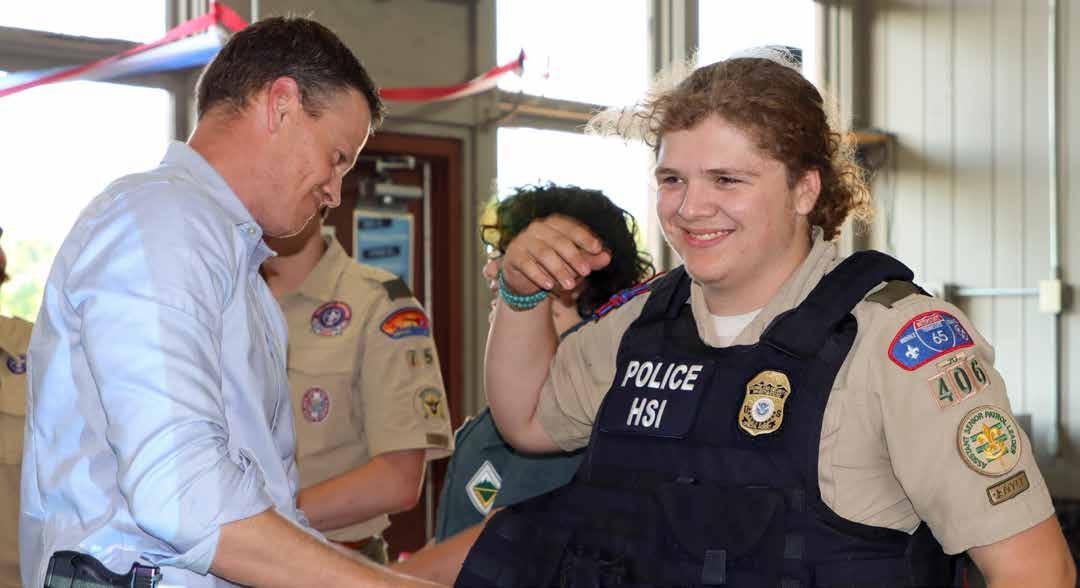
Dozens of Scouts attend a Department of Homeland Security event about online safety.

Story by DREW WOOLLEY
In his days as a Scout, Justin Williams was always drawn to outdoor skills. He excelled at building fires and tying knots. He struggled more with identifying plants, and, even today, he says he still hasn’t picked up the knack for it. But as he got older, the leadership skills he was learning every step of the way stood out to him.
“Those are all important skills, but the thing we’re really coaching is how to work within a team, be good citizens for the future and make good, ethical decisions,” he says. “I thought I was just having fun. But I was really learning a lot of leadership skills that have benefited me throughout my life.”
Today, as scout executive for Scouting America’s Palmetto Council in South Carolina and den leader for a group of second graders, Justin is amazed at the technology available to young children. There’s even technology that could have helped him identify plants as a Scout.
As a result, while Scouting America, formerly the Boy Scouts of America, still emphasizes the importance of getting outside and working with others, the organization is increasingly recognizing the need to meet kids where they are with technology.
Just last year, it introduced its first merit badges for cybersecurity and artificial intelligence. Others, like the Know2Protect badge, are specifically aimed at teaching Scouts about the importance of personal safety online.
“While we know there are a lot of benefits to technology, we also know that, unfortunately, there are people online who do not have our kids’ best interest at heart,” Justin says. “We need to help our kids recognize who is an ally, who is trying to do them harm and what to do when they encounter those types of people.”
For Scouting America’s Chief Safeguarding Officer Glen Pounder, that work starts with the adults around each Scout. His office in Irving, Texas, provides training for all Scout leaders around the threats kids may face online—from cyberbullying and body image issues to pornography and sexual exploitation.
“One of our key mottoes is be prepared for life. There’s no life these days without the online space,” he says. “Our new normal as an organization is we have to be comfortable always looking for what is next, particularly with technology. I think it’s about landing the message in a way that is not creating fear. That this is just part of preparing for life.”
Starting from kindergarten, Scouting America encourages parents of new Scouts to have their own conversations with their children about general safety practices. As kids earn their annual ranks, they must complete six core components, one of which is additional safety training. Starting in fourth grade, that training includes lessons on what information they should not give out in online settings.
In addition, Scouting America partnered with the Department of Homeland Security in 2024 to build an awareness campaign about the risks kids face online. Scouts and their families can join in-person training sessions and activities or online presentations to learn how to prevent and report online abuse, earning them an exclusive Know2Protect patch.
Glen’s hope is that more widespread awareness and training within Scouting America troops can even help protect kids who are not part of the program.
“There’s a ripple effect outside of scouting. Each Scout has
friends, siblings and other non-Scouts around them that they share things with,” he says. “So, if you’ve got a million trained Scouts out there it makes it much harder for anyone who’s thinking about abusing their position of trust to get away with it.”
While preventing these abuses from happening in the first place is the top priority, Glen emphasizes it is just as important for kids to feel comfortable speaking with an adult, whether it’s a parent or a Scout leader, if they do find themselves in one of these situations. If not, the outcome can be tragic.
Justin cites the example of an Eagle Scout in Spartanburg , South Carolina, in the last few years who took his own life. He had connected with someone online and shared compromising photos, only to have those photos used to exploit him.
“He didn’t think there was any other option, so he decided to take his own life,” Justin says. “When you think about the perfect kid, this is the kid that would come to mind. So, this isn’t something that only targets dysfunctional families. Criminals are getting smarter every day, and we just can’t take anything for granted.”
For Glen, that comes down to preparing kids for dangerous situations, trusting them to use the tools available to them and offering understanding if they find themselves in trouble.
“If we haven’t empowered these kids correctly, then the fear stays with them. We need to take that fear away,” he says. “Our focus is on prevention first. But then, if something happens, take a breath and then we’ll move forward. We know what to do, we’re going to get there. You’re not alone in this.”
Scouting America badges aren’t just for archery and pioneering anymore. Here are a few tech-savvy badges and patches today’s Scouts are collecting.
Cybersecurity Merit Badge
Introduces Scouts to various cyberthreats, including viruses, worms, social engineering and denial-of-service attacks. They learn to protect themselves with strong passwords, firewalls, antivirus software and encryption.
Artificial Intelligence Merit Badge

Helps Scouts explore what AI is, different types of AI and how to use it in everyday life. They are also challenged to discuss issues around data privacy, bias in AI systems and the ethics of this new technology.
Know2Protect Patch
Serves as a symbol of the Scout’s commitment to online safety and digital citizen ship through participation in the Department of Homeland Security’s Project iGuardian training. The training provides knowledge and skills to protect themselves against online abuse.


Story by MELANIE JONES
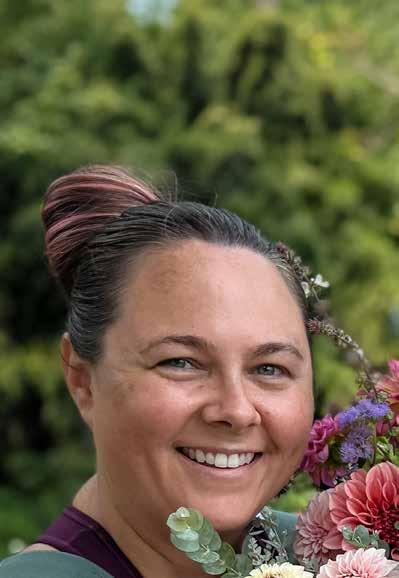
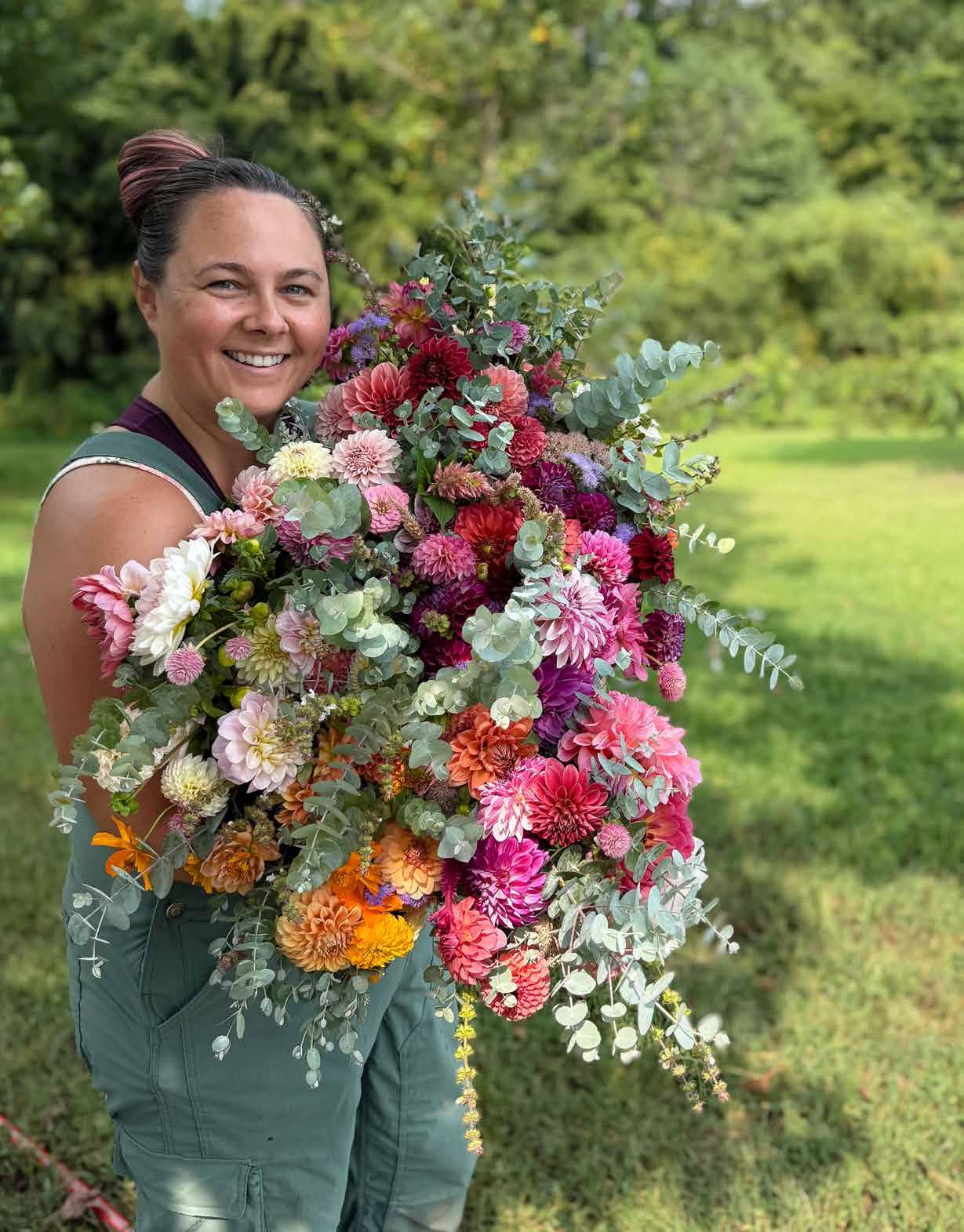
Whitney Baugh has a green thumb. A few years ago, she decided to try her hand at growing tomatoes. She planted a tray of tomato seeds and ended up with about 100 plants. “I was just amazed that the seeds grew,” she says. “Then I found Floret seeds and ordered those. And then, just as soon as the seeds sprouted, I knew this was my thing now.”
Her “thing” turned into Breezy Acres, a farm where she grows both flowers and hope.
Life hasn’t always been easy for Whitney. In 2014, her newborn daughter was
very sick. Thankfully, the baby survived, but it was a difficult time for the family. Shortly thereafter, Whitney lost her father.
A few years ago, Whitney started a new path. She needed something to bring her joy again. And, thanks to gardening and therapy, she found exactly what she needed.
“In 2021, I started my first seeds, and later that fall, I actually started therapy. They went hand in hand,” she says. “I know people say gardening is therapy, and it is, in a sense. But also, therapy is therapy, and I think I personally needed both.”
As Whitney began to heal, her gardening plans began to grow.
Whitney began growing plants by the acre. Now, she often can be found discovering grace in fields of color. It’s become more than a hobby. It’s more than therapy. It’s business.
Starting Breezy Acres Flower Farm in 2021 wasn’t exactly a breeze. It was slow in the beginning. Farmstands may be commonplace now, but Whitney says that wasn’t the case when she started. “Nobody had heard of it, and even my own family was kind of like, ‘What is she doing?’”

Things really picked up in 2024 and 2025. “Not only our local community but the Huntsville community of florists started buying from me,” Whitney says. “But it was not an overnight thing for sure.”
At the flower farm, Whitney and Justin work hard to keep flower shops and locals supplied with beautiful blooms. There, she grows flowers she wholesales to florists and sells straight to individuals at her farm stand. For retail customers, she has a variety of arrangements. But among the most popular are her buckets of flowers. For $100, customers can buy a bucket in one of two color schemes. They have premium blooms, accent blooms, smaller blooms and some foliage. “That was a big hit this past year,” she says. “A lot of people want DIY, and I don’t necessarily like designing, so that works for both of us.”
Whitney’s favorite crop is also the most difficult to grow—dahlias.
“They are divas and a whole lot of work, but those are my favorite flower,” she says. She grows zinnias and cosmos and is adding other varieties. She and Justin also started growing perennials, like hydrangeas.

One of Whitney’s favorite things is seeing her flowers go out into the world. “I love seeing them in weddings and showers and the celebrations,” she says, joking that she stalks customers’ photos online so she can see the results. “I really love the weddings. I have really bad impostor syndrome, so the first time a florist tagged me and my flowers were in a wedding, I was just, ‘Oh my gosh!’”
While the couple runs the farm together, it’s not entirely a family affair. Justin builds the beds, then Whitney does most of the planting. Justin is also building Whitney a studio and a grow room, which they’re calling the “bloom barn,” so she doesn’t continue taking over the guest room and the dining room table. But their children— Bryson, 17, Bella, 15, Brynlee, 12, and twins Beau and Bryar, 7—haven’t taken to farming. Whitney doesn’t force them to work in the gardens, though she hopes they’ll enjoy it someday.
whitney@breezyacresflowerfarm.com
breezyacresflowerfarm.com
Find Breezy Acres on Facebook and Instagram.
In the meantime, Whitney wants to keep growing, both as a gardener and an advocate for therapy and gardening therapy.
“Sharing that message is the most important part for me,” she says. “Even if people don’t buy flowers from me, I would like for them to try to grow them.”
The process is therapeutic to Whitney because she plants the seeds then sees them rise above obstacles. It’s like saying goodbye to the sadness by planting it, then seeing something beautiful grow in its place. “Our story is really rough and really long, but we made it,” she says. And flowers made that possible.

For many Americans, going to the grocery store can be stressful since prices don’t seem to be coming down. But we still want to have our cake and eat it too. So, it’s nice—and entirely possible—to treat ourselves to something sweet at the end of the meal without breaking the bank. There are some tricks to keep in mind to help you stay on budget while still satisfying your sweet tooth. For example, if a recipe calls for pecans, walnuts, a less expensive alternative, can be substituted. And use store brands whenever possible—a cost-saving practice that always saves pennies.
Food Editor Anne P. Braly is a native of Chattanooga, Tennessee.
1/2 cup butter 1 cup sugar
egg 1 teaspoon vanilla 1 1/2 cups mashed banana
1 1/2 cups flour
Preheat oven to 350 F.
teaspoon baking powder

teaspoon baking soda 1/2 teaspoon salt 1/4 cup baking cocoa powder 1 cup chocolate chips

Mix the butter, sugar, egg, vanilla and banana. Then add the flour, baking powder, baking soda and salt. Put half of the mixture into a separate bowl and add the cocoa powder.
Grease the bottom of a 9-by-13-inch pan and pour in the cocoa mixture. The mixture will be thick, just try and spread a thin layer across the bottom. It will rise and make a beautiful, thin bar. Use a smaller pan if you want a thicker bar, however, it will need to bake longer to get the middle done.
Spread the rest of the batter on top of the cocoa mixture. Sprinkle the top with as many or as few chocolate chips as you like.
Bake for about 30 minutes or until the top is browned and a toothpick comes out clean.
2 cups white sugar
1 cup butter, softened
2 eggs
1 cup sour cream
1 teaspoon vanilla extract
1 cup plus 10 tablespoons all-purpose flour
1 teaspoon baking powder
1/4 teaspoon salt
1 cup fresh or frozen blueberries
1/2 cup brown sugar
1/2 cup pecans
1 teaspoon ground cinnamon
1 tablespoon powdered sugar for dusting
Preheat the oven to 350 F. Grease and flour a 9-inch Bundt pan. Beat sugar and butter together in a large bowl with an electric mixer until light and fluffy. Add eggs, one at a time, beating well after each addition. Beat in sour cream and vanilla extract. In another bowl, combine flour, baking powder and salt. Stir into butter mixture until just blended. Fold in blueberries.

Spoon half of the batter into the prepared pan. Combine brown sugar, pecans and cinnamon in a small bowl. Sprinkle half of the mixture over the batter in the pan.
Spoon remaining batter on top, then sprinkle on remaining pecan mixture. Use a knife or thin spatula to swirl the mixture into the cake.

Bake until a toothpick inserted into the center comes out clean, about 1 hour to 1 hour 15 minutes. Let cake cool in the pan for 15 minutes before inverting. Invert carefully onto a serving plate. Dust with powdered sugar just before serving.

2 cups frozen pineapple chunks
4 ounces pineapple juice

2 scoops vanilla ice cream
Combine all ingredients in a blender and blend until smooth. If it’s too thick, add a bit more pineapple juice. Scoop into bowls and, if desired, garnish with additional chopped pineapple and a dollop of whipped cream. Serve immediately. Makes 3 servings.
1 prepared 9-inch pie shell, graham cracker or pastry crust, baked and cooled
1 8-ounce package cream cheese, softened 1/3 cup granulated sugar
1/2 teaspoon almond extract
1 cup whipped topping, thawed
4 cups fresh strawberries, washed, hulled and halved 1/2 cup semisweet chocolate chips
1 tablespoon shortening
Bake crust at 350 F for 15 minutes or until light golden brown. Cool completely.
In a large bowl, beat the softened cream cheese until it is fluffy. Gradually add the sugar and almond extract, beating until fully combined. Gently fold the whipped topping into the cream cheese mixture until smooth.
Spread the cream cheese mixture evenly into the cooled pie crust. Arrange the strawberry halves, cut side down or pointed side up, over the filling.
In a small, microwave-safe bowl, combine the chocolate chips and shortening. Microwave in 30-second intervals, stirring in between, until the chocolate is melted and smooth. Drizzle the melted chocolate over the top of the strawberries and cream filling.
Refrigerate the pie for at least 1-2 hours or until it is set and chilled before serving.