MARCH/APRIL 2022
CONNECTION
The story of us
Monkey Dumplins tells Clay’s tales
A YEAR AFTER THE FLOOD RULES OF THE ROAST
INDUSTRY NEWS
Rural Connections By SHIRLEY BLOOMFIELD, CEO NTCA–The Rural Broadband Association
Strengthening ties Rural internet providers gain ground
N
o matter the challenges, NTCA members have a long history of stepping up to extend fast internet service to rural America, allowing residents to work, learn and engage with family and friends online. Recently, we released our 2021 Broadband/Internet Availability Survey Report, reaffirming the commitment to rural broadband as the industry stands on the cusp of once-in-a-generation investment to bring connectivity to all Americans. NTCA members responding to the survey indicated that nearly 76% of their customers can receive downstream speeds of at least 100 Mbps. That’s up from 67.8% in 2020. Similarly, 55.4% of customers have access to gigabit downstream speed, up from 45.1% in 2020. A year earlier, 28% of respondents subscribed to services with 100 Mbps broadband or better. Last year, that number was 37%. These gains appear throughout the communities NTCA members serve, including in critically important broadband service to libraries, community colleges, state universities and extensions. There are 911 call centers and medical facilities that benefit, as well as nearly all primary and secondary schools, along with police and fire departments. Despite the successes, NTCA members continue to face pandemic-related supply chain issues, leading to slowdowns in installing services for customers and delayed network construction. Still, these companies serving rural America continue to put your needs first, building networks that can change lives and communities for the better. As the 2021 Broadband/Internet Availability Survey Report shows, they’re making a difference. 2 | March/April 2022
Back it up It’s as easy as 3-2-1
The reliability of technology, from computers to smartphones, is steadily increasing, which is good because we depend on it more now than ever. From personal photo libraries to essential financial records, digital archives have replaced physical filing and storage systems. In fact, this information is so important, consider taking a lesson from corporations and data-intense industries — back it all up with multiple copies in strategic locations.
3 2 1
Your goal should be to have at least three copies of your important data — but you’ll put each copy in a different location.
Two copies of your data should be stored at your home or office. Separate them, though. Keep one copy on a device such as a computer. But keep the second version on an external hard drive. Prices begin at less than $100 and then go up, based on the amount of data you need to store.
Send the final copy to the cloud, which can be both convenient and a hedge against a disaster damaging your home or business. Apple, Google, Microsoft and many other companies offer cloud-based storage solutions. For a few dollars a month, you can get digital peace of mind.
Coordinating those steps is also easier than ever. Modern computer operating systems offer options to automate most of the details.
Are blue light glasses hype or help?
A
ccording to the American Optometric Association, the average office worker spends seven hours a day in front of a computer — and that’s only when they’re on the clock. In our off-hours, we’re often squinting at our smartphones, using tablets to catch up on the news or following the twists and turns of the latest best-seller on an e-reader. After so much time staring at screens, many people experience digital eye strain, also known as computer vision syndrome. Symptoms can include everything from dry and tired eyes to blurry vision, neck pain, headaches and more. Some folks are turning to blue light-blocking glasses for relief. Available in a variety of styles and a wide range of prices, these glasses purport to reduce eye strain by filtering out the blue light emitted by digital screens. But are these lenses really all that they’re cracked up to be? According to experts, maybe not.
WHAT IS BLUE LIGHT? All visible light contains the entire spectrum of wavelengths, from red to violet, and each wavelength has its own specific energy level. Blue light has the highest energy level in the visible spectrum. The sun is the source of most of the blue light we encounter, but blue light is also emitted by fluorescent and incandescent light bulbs and the screens of electronic devices. However, no measurable harm done by the light from digital devices has been documented. Studies have shown that it’s not the screens themselves that are causing eye strain but, rather, how we use them. We blink less frequently when looking at screens and we tend to hold electronic devices, particularly mobile phones, much closer to our eyes than paper documents. Also, glare, reflections and existing uncorrected or undercorrected vision problems can contribute to discomfort, as does focusing on screens for extended periods of time.
So, if blue light glasses won’t help, what will? Believe it or not, taking breaks. Most symptoms of eye strain will resolve themselves when you stop using the computer. When you have to be in front of a screen for an extended period of time, experts like those at the American Academy of Ophthalmology recommend the 20-20-20 rule — after every 20 minutes of continuous screen time, look at something 20 feet away for 20 seconds.
BLUE LIGHT AT BEDTIME While there isn’t scientific evidence that blue light is responsible for digital eye strain, experts say there isn’t any harm in wearing blue light glasses, and they may help at bedtime. Blue light affects the body’s natural waking and sleeping cycle, known as circadian rhythm. During daylight hours, blue light wakes us up and keeps us alert. But when it’s time for bed, the blue light from screens can stimulate the brain just when you’re trying to wind down for the night. This is why many devices have nighttime settings to minimize blue light exposure after dark. Experts recommend limiting screen time two to three hours before bed, but if you must use your devices in the hours leading up to bedtime, blue light glasses could help ensure a solid night’s rest.
March/April 2022 | 3
FROM THE CEO
Better connected
Why rural broadband outshines the big guys
A
high-tech web threads its way throughout our region, extending to homes, businesses, government offices, medical facilities and more. PRTC is at the center of that web as the hub linking you to the power of the internet. Together — because you’re very much a part of this success — we’ve created an amazing resource. But have you ever wondered how we stack up against other service providers? Our entire network is based on fiber optic technology, an industry standard so robust it’s often considered futureproof. As we grow, we will bring that resource to more communities. Also, no matter how remote, every location can access gigabit speeds unheard of in most cities. When you consider the technological wonder of it all, it really is amazing. A global system of computers shares digital information ranging from things like streaming movies to a few lines of text in a social media post. Physical cables link the servers, and some cables KEITH GABBARD Chief Executive Officer even run beneath the ocean. PRTC is the local stop on this system, and we maintain the networking equipment needed to tap those massive streams of information. Then, we provide you access through the lines we’ve installed across the community — our community. The differentiation between us and those national companies accelerates as we translate that amazing infrastructure into packages of services you can obtain. As you can see, there are plenty of moving parts, but we work hard to boil all of that down into straightforward, understandable service plans. Here’s one example. Our fiber optic internet network is designed to allow you to upload information as fast as you can download it, a balance that’s so important for how we communicate. Maybe you work from home and share files with the office or often rely on videoconferencing. Or perhaps you’re a gamer who wants an edge on the competition. In both cases, that two-way speed is essential. Can performance vary at times? Certainly. Wi-Fi router settings and other variables in the home and at work can make a difference, but our network is designed to serve your needs as consistently as the technology allows. Can all the national companies say the same thing? It can be easy to promise one thing and deliver another. When you do business with PRTC, we strive to provide what we promise. We want you to take full advantage of our services, and we do not put a cap on your use. Many of the corporate-owned companies do not work that way. In fact, it’s common for those national plans to either slow down service or charge additional fees to customers who exceed usage limits. That’s just not how we do business. While we enjoy the advantages of living in a rural community — and there are many — rest assured you have access to a communications network comparable to that of most metropolitan areas. In fact, many people living in cities would be envious, not only of the internet services available to you, but also the friendly customer support and honest communication PRTC provides. In the end, we are neighbors helping neighbors, and that makes all the difference.
4 | March/April 2022
CONNECTION MARCH/APRIL 2022
VOL. 10, NO. 2
The PRTC Connection is published by Peoples Rural Telephone Cooperative, ©2022. It is distributed without charge to all members of the cooperative.
is your member-owned cooperative serving Jackson and Owsley counties in East Kentucky. The cooperative is dedicated to using technology to keep its members connected through high-speed broadband internet, digital and HD television, wireless 4G phone service, local and long-distance calling and beyond.
Send address corrections to: Peoples Rural Telephone Cooperative P.O. Box 159 McKee, KY 40447 606-287-7101 • 606-593-5000 www.prtcnet.org
BOARD OF DIRECTORS Kendall Norris President Wendell Gabbard Vice President James Gary Cornett Secretary Nelson Bobrowski Treasurer Donald Barrett Armel Davidson Pat Henderson
Produced for PRTC by:
On the Cover:
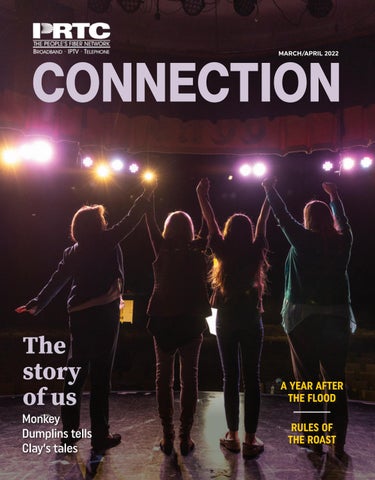
Vanda Rice, Beverly Stevens, Kaley Beth Roberts and Amy Dunzweiler, of Monkey Dumplins Storytelling Theater, take a bow. See story Page 12.
Happy Easter!
PRTC NEWS
PRTC wishes you a joyous Easter holiday. Our offices close at Noon on Good Friday.
Peoples Rural Telephone Cooperative
March/April 2022 | 5
TRAVEL
© lukeruk/Adobe Stock
Muscle Shoals a musician’s mecca A
Story by ANNE BRALY
’s h
ow wn o t the s a mall Alabam
jor a dm e t ac attr
recording
artis ts
labama is steeped in music history with greats like W.C. Handy, Jimmie Rodgers, Nat King Cole, the band Alabama and Hank Williams, who all left their marks on the state’s list of native sons. But those names became just a drop in the bucket when a group of musicians got together in the small Northwest Alabama town of Muscle Shoals and charted a course that would explode on the music scene and have a huge impact on American music. Spencer Coats, a young musician and tour guide for FAME studios in Muscle Shoals, says back in the 1950s and ’60s, many of the local musicians didn’t care about giving live concerts, focusing more on jamming and, a little later, recording. Now, the recording industry in North Alabama reads like a playlist of the legends of music, and it all started with three hometown men — Rick Hall, Billy Sherrill and Tom Stafford. Hall and Sherrill were in their teens when they recorded their first song in the back of a bus station in Florence, Alabama. One of their songs, “Sweet and Innocent,” became a hit, primarily ere around North Alabama, but
H 6 | March/April 2022
it struck a chord with Stafford. After hearing it, he built a recording studio above City Drugs in Florence and, to make a long story short, went into the recording business with Hall and Stafford, creating Florence Alabama Music Enterprise. The business quickly took root, and Stafford soon picked up stakes and moved to what he thought were greener pastures in Nashville. Big mistake. Hall became the driving force behind Florence Alabama Music Enterprise. He was soon forced out, but he never looked back. He took the name with him — eventually shortening it to FAME — and opened a new studio at 603 Avalon Ave. in Muscle Shoals. The sign above the door as one enters Studios A and B says it all: “Through these doors walk the finest Musicians, Songwriters, Artists, and Producers in the World.” Chase Brandon is a tour guide at Muscle Shoals Sound.
Hit
Studio A at Florence Alabama Music Enterprise, or FAME, hosted some of music’s biggest recording stars.
Hall’s new venture began producing a string of hits, with artists like Otis Redding, Percy Sledge and Aretha Franklin, that would become known as the “Muscle Shoals Sound.” Hall soon brought in a house band that consisted of bassist David Hood, guitarist Jimmy Johnson, drummer Roger Hawkins and keyboardist Spooner Oldham, later adding keyboardist Barry Beckett to the mix. The group would become known as the Muscle Shoals Rhythm Section, or The Swampers, as mentioned in Lynyrd Skynyrd’s “Sweet Home Alabama.” History lesson over. Today, FAME Recording Studios is one of two recording studios in the Muscle Shoals area. Muscle Shoals Sound Studio in Sheffield is the other, and Cher made its address popular after recording her hit album, 3614 Jackson Highway, there. Tours of the studios take visitors back in time. Photos of musicians who have recorded there line the walls. “If only these walls could talk,” Coats says, pointing to a photo of Gregg Allman, who, with brother Duane, recorded at FAME. Tours of both studios allow guests to see many of the instruments, spaces
and iconic items used during recording of so many familiar songs. The green sofa where the Rolling Stones sat down for a break while recording “Wild Horses” still remains at Muscle Shoals Sound. Next to it hangs the original bill for the studio’s services: Dec. 4, 1969 — $1,009. One can just picture the mood in the studio at Muscle Shoals Sound when Aretha belted out her hit “I Never Loved a Man the Way I Love You.” Or when Percy Sledge recorded “When a Man Loves a Woman.” But what is it about The Shoals area that attracted these artists when there were bigger studios in larger nearby cities like Nashville and Memphis? Coats thinks the vibe along the swamps of North Alabama may have played a part. “The same magic wouldn’t have happened elsewhere like it did here,” he says. Both FAME and Muscle Shoals Sound remain active studios with artists coming in to record several days a week. Would-be visitors to Muscle Shoals Sound Studio can make reservations for tours by calling 256-978-5151 or visiting muscleshoalssoundstudio. org. Make FAME tour reservations at famestudios.com.
RECORD
The South is a haven for recording artists who take to studios in towns large and small. Probably the best known of these are in Muscle Shoals, home of Rick Hall’s FAME Recording Studios. Nearby Florence, Sheffield and Tuscumbia have also witnessed an explosion of talent, but some other studios beyond The Shoals where artists tell their story through song include: • Royal Studios in Memphis, where artists including Al Green, Ann Peebles and Mark Ronson, in collaboration with Bruno Mars, recorded their hits. • Sun Studios in Memphis, where Elvis Presley recorded hits including “That’s All Right” and Johnny Cash cashed in on “Folsom Prison Blues.” • Quad Studios in Nashville — a onehit wonder that saw the recording of “Margaritaville.” • Miami’s Criteria Recording Studios, which produced such hits as “Layla” for Derek and the Dominos, James Brown’s “I Got You (I Feel Good)” and the Bee Gees’ “Nights on Broadway.” • Stax Records headquarters in Memphis, which turned out hits from Otis Redding and Isaac Hayes, but today also features the state-of-the-art Museum of American Soul Music. • RCA Studios A and B in Nashville, where the Everly Brothers recorded “All I Have To Do Is Dream” and Dolly Parton immortalized “Jolene.” • PatchWerk Recording Studios in Atlanta, which, though not a familiar name, has produced big sounds, including Usher’s “You Make Me Wanna.” • American Recording Studio in Memphis, which flies under most radar but produced such major hits as Elvis’ “In the Ghetto,” Dusty Springfield’s “Son of a Preacher Man” and Neil Diamond’s “Sweet Caroline.” • Sea-Saint Studios in New Orleans, which became a major player in the recording industry with Patti LaBelle’s “Lady Marmalade” and Paul McCartney’s “Listen to What the Man Said.”
March/April 2022 | 7
ONE YEAR Beattyville continues its recovery from historic flood Story by JEN CALHOUN
THREE FORKS The historic flooding across the region went on to produce evacuations, closed businesses, outages, and infrastructure and property damage, the financial impact of which public officials are still calculating, says Jon Allen, director of Lee County’s Department of Public Safety and Emergency Management. “I pray that I never see this happen again,” Allen says. “It was the most stressful week of my life.” At least 49 counties issued disaster declarations after the flood, and Lee County was one of them. In Beattyville, where the three forks of the Kentucky River meet, the downtown area was covered with 6 to 7 feet of water, Allen says. People were rescued from their homes, 8 | March/April 2022
Downtown Beattyville in March 2021.
Lee County Department of Public Safety and Emergency Management
T
om Hollon got the call around 5:30 a.m. on March 1, 2021. Heavy rains had caused the Kentucky River to rise into downtown Beattyville, and it was inching closer to the Main Street building where Hollon had practiced law for more than 40 years. “My brother was on his way to work, and he said I needed to get down here,” Hollon remembers. By the time he arrived at 6:30, it was still dark. The water had made it to Main Street, but the area around Hollon’s office was still dry. After moving some office equipment and checkbooks to a high counter in a nearby car dealership, he and a few other downtown business owners could only watch as the street flooded. “You could see it coming down the street, faster and faster,” he says. “It was like watching water run into a bathtub.”
and a nursing home was minutes from being evacuated, as school buses and other vehicles stood waiting. At one point, a cow floated away, and its carcass ended up stuck at the top of a 40-foottall tree. Allen remembers one particularly terrifying situation where an elderly woman in Heidelberg was stranded in her home as the waters rose around her. “Her family was calling us,” he says. “We couldn’t get to her. It was the toughest call I’ve ever had to make, but it wasn’t safe.” They sent a helicopter to keep an eye on her, and they watched with binoculars to make sure she was safe. When the waters receded the next day, they rescued her. “The water was literally 2 feet high in this lady’s house,” Allen says. “She said she knew she couldn’t go anywhere, so she just laid down in bed and prayed for the good Lord to take care of her.”
Lee County Attorney Tom Hollon watched the flood overtake his downtown office.
FACEBOOK LIVE Allen used Facebook Live video posts on the Lee County Department of Public Safety/Emergency Management page to keep residents informed with the latest information during the flooding. The posts earned him thousands of views from a public desperate for the most up-to-date news. Peoples Rural Telephone Cooperative
LATER “Social media was huge for us,” Allen says. “We were constantly updating our page with things going on. It helps me get the truth out there. If you don’t get the truth out there fast, some people might make up their own stories without all the facts.”
AFTERMATH Lee County and Beattyville are still recovering even a year after the flood. Some businesses have closed or moved to higher ground while others have stayed in place. Hollon says he’s staying, but he worries another flood could be tough on him. “I’m 66 years old,” he says. “I’ve got no place to go. I got it remodeled back in pretty good shape. The furnace is the last thing I really need. It’s been an adventure.” Allen says the county was still trying to get power restored to the courthouse annex as late as October. The basement of the annex had flooded, wiping out the ambulance base, the coroner’s office, a meeting room and the building’s electrical panels.
GO TO THE SOURCE The Facebook page for Lee County Department of Public Safety/Emergency Management offers some of the most up-to-date information on weather-related problems in the county. Subscribe and like for updates.
“We didn’t lose anything as far as materials, but they couldn’t operate because of the electrical issue,” Allen says. “That same electrical panel controlled all the phone systems for our circuit clerk’s office.”
Jon Allen is the director of the Lee County Department of Public Safety and Emergency Management.
RISING ABOVE THE FLOOD But even with all the destruction, Lee County residents won’t be kept down, Allen says. Downtown Beattyville had already been revitalizing its downtown to bring more people to the city and boost the morale of local residents. Within months of the flood, they kept going, warding off blows from the flood and the pandemic to hold the Woolly Worm Festival and the town’s newest event, the Beattyville Bourbon & Moonshine Festival. “These people are pretty tough and resilient. They don’t like being told they can’t do something. They’ll prove you wrong every time if you tell them that,” Allen says. “I think there’s a strong desire to bring Main Street back better than it was.”
Repairs are ongoing in the lobby of Beattyville’s Citizens Bank & Trust Co.
Beattyville’s downtown continues to move forward despite last year’s historic flood.
“IT WAS LIKE WATCHING WATER RUN INTO A BATHTUB.” — Lee County attorney Tom Hollon on the Beattyville flood in March 2021
Peoples Rural Telephone Cooperative
March/April 2022 | 9
HIT
e h t
TRAIL
These apps can help you plan your next outdoor adventure
L
ooking for new adventures this spring? A good internet connection can come in handy when you’re planning your next excursion into the great outdoors. From discovering your next destination to sharing every step of the journey, these digital tools make it easier than ever to get out there and start enjoying our world.
Yonder
AllTrails
Recreation.gov
Yonder helps people find nature-rich destinations off the beaten path. Search the more than 20,000 locations across the United States to find your new favorite hidden gem. Each listing puts just as much focus on the experiences guests can expect during their stay as it does on the price tag. Those experiences can include trekking through a canyon, sampling grapes off the vine or enjoying nearby views. Travelers can book online or in the Yonder app available for iOS and Android.
You might be surprised how many great trails there are right in your own community, and AllTrails can help uncover them all. Whether you’re looking for a relaxing hike, an invigorating trail run or a challenging, off-road bike ride, you’re bound to find something that fits your needs. Browse nearby trails based on their length, difficulty and popularity to find exactly what you’re looking for. You can even search for trails that are dog-friendly, have great views or are suited to a fun family outing. You can download the app in iOS or Android.
For those seeking an extended stay in the wild, Recreation.gov is a great starting point. The site and its official app are both built to help travelers find and reserve campsites at national parks, forests and other federally designated properties across the country. Browse amenities and nearby activities for each site, as well as ratings and reviews from those who have stayed there.
Tripcast
Star Walk
Share more than just the highlights of your trip with the people who matter most. With Tripcast, available on iOS and Android, you can add friends and family to an interactive photo album that puts every traveler’s pics in one place. Post notes, photos and real-time updates that are all automatically added to a trip map. Make your trip public or only invite those who want to share in every step of the journey.
Make a night under the stars even more exciting with this augmented-reality star chart that tracks over 200,000 celestial objects. Open the app and point your phone at the night sky to see constellations traced right before your eyes and learn about the mythology behind them. Track planets or the International Space Station, and even get notifications for major astronomical events on iOS and Android devices.
10 | March/April 2022
Find your Little Free Library
An online map guides readers to book boxes Take a book. Leave a book. That’s the simple, powerful idea behind more than 100,000 Little Free Libraries scattered across the globe. Todd H. Bol, who created the first Little Free Library in 2009, founded a nonprofit of that name to help people access books at no cost, no matter where they live. A key goal of the Little Free Library organization is the promotion of literacy. The effort is driven by volunteers who build small, waterproof library boxes, find the libraries a home in their yards or other appropriate spots, and seed them with books. You don’t have to share a book before taking one, and you don’t even need to return the book you take. It’s all on the honor system. But, please do consider contributing a book or two, because that’s how the library system grows. Do you want to find a Little Free Library near you? For a searchable map, visit littlefreelibrary.org/ourmap.
E-READERS Are you the type of avid reader who enjoys keeping a couple, or maybe even a couple dozen, reading options handy at all times? E-readers were made for you. E-readers’ screens are more eye-friendly than those of do-everything tablets like iPads. And there’s another key advantage to e-readers — fewer distractions. There are no notifications, social media, games or email. While the screens of phones and tablets emit light to create bright, clear images, those of e-readers, such as the Kindle, direct light toward the screen instead of sending it outward. Eye strain is lessened, and the e-readers typically are easy to view even when in direct sunlight. Amazon remains the e-reader leader. The company is on the 11th version of the Kindle Paperwhite, which was updated late last year. The price is about $140, with slightly more expensive and less pricey versions also available. With a Kindle, you can tap into the Amazon library to purchase and store online books. While companies such as Apple offer bookstores, those are not available on Kindle devices. There are also non-Kindle e-readers, like the Clara HD by Kobo. The company has its own e-book store. You can’t reach the Amazon bookstore through a Kobo device, but you can get books through software such as OverDrive, which is used by many library systems. A Clara HD is available for about $118 from online sites such as Walmart.
Bonus tip: Do you ever want to read the classics, for free? Project Gutenberg makes it possible, providing digital versions of books whose copyrights status allows free distribution. Visit gutenberg.org for details and to browse the library.
March/April 2022 | 11
Tellin’ tales Monkey Dumplins gives new life to a county’s past Story by JEN CALHOUN | Photography by MELISSA GAINES
V
anda Rice speaks in stories. Whether she’s discussing her beloved Clay County or telling an insurance agent about that time she climbed her couch to clean a window, fell back and rolled to the floor, she’s happy to entertain.
It’s the same when she talks about the beginnings of Clay County’s Monkey Dumplins Storytelling Theater Troupe, a group she helped start. “It all began when Dr. Vaughn Grisham came here and met with some townspeople,” Rice says, relaxing into storytelling mode. Grisham is the founder of McLean Institute for Community Development. He is also a former professor, the author of several books and an expert in helping people revitalize their communities. His words delivered a blow to the audience that day, Rice recalls. “He told us that if we didn’t do something, our town — Manchester — was going to die,” she says. “It was like I felt a scream go off inside of me. Lots of times, you have to have that scream before anything gets done.”
HISTORY IS HERE Vanda Rice is the director of Monkey Dumplins Storytelling Theater Troupe. 12 | March/April 2022
Grisham’s words helped to launch Stay in Clay, a nonprofit organization that fosters tourism in the county, and to boost
residents’ pride, Rice says. “We came away from that fired up,” she says. “We came home ready to change the world, but we wanted to start in Manchester.” Formed in 2012 during the Brushy Fork Leadership Institute at Berea College, the group coordinates various projects and special events that restore and highlight the county’s past and present, including the restoration of several of the county’s historic swinging bridges and the creation of promotional murals. The group also established the Monkey Dumplins Storytelling Theater Troupe. Rice and her group knew money would be a problem, so they focused on what they did have. “We have streams and mountains and people and stories and swinging bridges,” she says. “Mountain people, by nature, are storytellers. Joy Jinks, with the Swamp Gravy theater group, told us that every town needs a symbol, a story and a song.”
THE STORY They soon met up with Richard Geer, co-founder of Story Bridge, an organization that helps communities improve by using stories and theater. “We began having community meetings where we would gather stories — real stories,” Rice says. “And in 2013, we put on our very first performance called Monkey Dumplins. We named our theater group that, too, because we wanted our name to be a story.” Peoples Rural Telephone Cooperative
Monkey Dumplins member Kaley Beth Roberts performs a monologue on the Clay County High School stage.
The story takes place in the 1940s during a visit from a traveling circus. “A mischievous boy opened the monkey cage, and the animals scattered,” Rice says. “They couldn’t find them all, so they left one of the monkeys behind.” Soon after, a local hunter spied what he thought was a big squirrel. He shot it, took it home and processed it. But the meat was so tough, his wife could only boil it and make a pot of dumplings. “He called in the preacher and all his neighbors to come eat it,” Rice says. “And that’s the story of Monkey Dumplins.”
TALES FROM HOME The theater group has had about 13 performances since it began, with the latest this spring. Anyone can join, and everyone is welcome. There are no auditions, and troupe members can often pick the roles they’d like to play. Performances are usually at Clay County High School, and tickets typically cost between $5 and $8. “None of our stories are scripted,” Rice says. “It’s called rehearsed improvisation. We have several ways we can Peoples Rural Telephone Cooperative
present a story. Some are acted out, and the performance runs like one big story. Some might be a long monologue. We don’t use props, either. We want characters to speak for themselves.” The stories can be about most anything, too. “We’ve done stories about ghosts and goblins, families, drug addiction — you name it,” she says. “Some are funny, and some are sad. It’s why the audience identifies.” The goal is for Clay County residents to tell their own stories, Rice says. “Back in 2013, an article in a national newspaper came out saying our county was the hardest place in the country to live,” she says. “Well, we wiped our tears, drank a glass of wine and said, ‘Heck, no.’ Every grant we’ve written has included that article. We’re turning it into a positive.” Besides, she says, people from Clay County don’t have to live up to other people’s perceptions. Telling their own stories on their own terms is one way to break free. “We want to change the narrative,” she says. “We want to own the narrative and show them who we are.”
Story time
Members of the Monkey Dumplins cast include Beverly Stevens, Vanda Rice, Amy Dunzweiler, Dan Chambers, Kaley Beth Roberts and Donnie Stevens.
Monkey Dumplins is a storytelling theater group that tells the stories of the people of Clay County while also teaching locals the art of storytelling. Co-founder Vanda Rice says the project is possible only because a group of people came together to do something and believed in the power of stories. Find the next Monkey Dumplins show or event by visiting the Monkey Dumplins Storytelling Theater Troupe Facebook page. To find out more about joining the troupe or to donate, visit claycountykentucky.org or email them at stayinclay2012@gmail.com.
Members of Monkey Dumplins tell stories on the stage. March/April 2022 | 13
SOUTHERN KITCHENS
Roasting
can yield the perfect taste and texture Explore the nuances of a common cooking technique
PERFECTLY ROASTED RIB-EYE
A
perfectly roasted cut of beef is a thing of beauty. A deliciously roasted chicken surrounded by colorful roasted vegetables is Instagram worthy. But how do you get these cuts of meat to reach these levels of perfection? Roasting is an age-old culinary technique that takes relatively tough cuts of meat and, like magic, turns them into tender, mouthwatering bites. It all has to do with cooking low and slow. There’s a marked difference between roasting and baking. Baking transforms liquid — batter — into solids like cakes and cookies. Roasting does the opposite, taking meats and vegetables and breaking down their sinewy fibers into a near-gelatinous state. Here are some simple tips to consider when roasting. Bring food to room temperature before roasting: Tempering food is a simple but critical step that involves bringing an ingredient to room temperature so that it cooks more evenly. When roasting whole chickens, turkeys, Cornish hens and other birds, keep in mind that white and dark meat are best cooked to different temperatures.
14 | March/April 2022
1 (4- to 5-pound) rib-eye roast Olive oil, optional 1 tablespoon kosher salt 1-2 teaspoons black pepper, crushed or ground To ensure your bird is roasting properly, position different parts toward hotter or cooler parts of the oven, or cover the breast with foil. It’s important to rest meat after roasting, particularly larger cuts that continue to cook after you take them out of the oven. Letting the meat rest for 10 to 20 minutes is usually sufficient. Rested meat will cut more easily. Remember that size matters: When roasting vegetables, cut veggies into pieces of the same size to ensure even cooking. The best meats to roast are large, tough cuts, such as pork shoulder. Don’t roast thinner, less fatty cuts of meat such as boneless, skinless chicken breasts — they’ll dry out. Good vegetables to roast are the heartier ones like beets, carrots, potatoes, squashes, cauliflower, Brussels sprouts and sweet potatoes.
FOOD EDITOR ANNE P. BRALY IS A NATIVE OF CHATTANOOGA, TENNESSEE.
Before roasting, bring the meat to room temperature. Preheat the oven to 325 F. If the roast is very lean, you may want to drizzle 1 to 2 tablespoons of olive oil over it. Sprinkle salt and pepper over the roast, then place it on a wire rack on a baking sheet. Keep in mind that your cooking time depends on the size of your roast. Bake for approximately 25 to 30 minutes for every pound of meat for the roast to be cooked to medium. Adjust accordingly for your preferred level of doneness. You should use a meat thermometer to determine when the roast is done. Push the thermometer all the way into the center of the roast. The ideal temperature for medium is 140-145 F, and the meat may become tough if cooked to well done, which is 155 F and above. Remove the meat from the oven when the inside temperature is about 10 degrees less than your desired level of doneness, because it will continue to cook as it rests. Let the roast rest for at least 15 minutes, tented in aluminum foil to keep it warm, before carving to serve. Makes about 10 servings.
GARLIC BUTTER ROASTED CHICKEN 1 (4-pound) whole chicken, at room temperature, giblets and neck removed from cavity 1/4 cup unsalted butter, melted 3 tablespoons olive oil 1/2 cup dry white wine 1 lemon, halved Salt and freshly ground pepper, to taste 2 tablespoons fresh chopped parsley 4 garlic cloves, minced 1 whole head of garlic, roughly peeled and cut in half horizontally through the middle crosswise 3 fresh whole rosemary sprigs Preheat the oven to 425 F. Line a baking tray with foil, or lightly grease a roasting pan. Pat the chicken dry with paper towels. Pour the melted butter, olive oil, wine and juice squeezed from one of the lemon halves over the chicken, under the skin and inside the cavity. Season the chicken liberally with salt and pepper on the outside and inside the cavity, then sprinkle the parsley over it. Rub the minced garlic over the chicken, mixing all the ingredients together over the chicken and under the skin. Stuff the garlic head into the chicken cavity, along with the rosemary sprigs and the squeezed lemon half. Tie the legs together with kitchen string. Place the chicken, breast-side up, onto a baking sheet or roasting pan and roast for 1 hour and 15-20 minutes, basting halfway through cooking time, until its juices run clear when you pierce the chicken thigh with a skewer.
Roasted Vegetable Medley 3 3 1 1 8 1 1 1 1 1
zucchini squash, cut lengthwise into fourths, then sliced into bite-sized pieces yellow squash, cut lengthwise into fourths, then sliced into bite- sized pieces red bell pepper, cut into 1-inch pieces red onion, cut into wedges ounces whole mushrooms garlic clove, minced tablespoon olive oil tablespoon balsamic vinegar, or more to taste tablespoon rosemary leaves teaspoon kosher salt
Preheat the oven to 450 F. Spray a large baking sheet with cooking spray. Mix all of the cut-up vegetables and garlic in a large bowl. Add olive oil and balsamic vinegar. Toss until all the vegetables are covered. Add rosemary leaves and salt, and toss again. Roast the vegetables for 30-40 minutes, stirring once, until they are brown on the outside edges and tender on the inside. Makes 6-8 servings.
Baste again, then turn on the broiler to high and broil the bird for 2-3 minutes or until the skin is crisp and golden. Keep an eye on this process, because it can burn quickly. Remove the chicken from the oven, cover it with foil and allow it to rest for 10 minutes before serving. Drizzle it with the pan juices, and serve it with the remaining lemon half cut into wedges or slices.
March/April 2022 | 15
1080 Main St. S. McKee, KY 40447
MONEY FOR
!
COLLEGE Deadline is April 14. PRTC offers $2,000 scholarships annually to help people in our community reach their academic and career goals.
• Reduce your financial burden • Make your resume stand out • Follow your dreams
Apply now! Visit PRTCnet.org for more details Applicants must live within the PRTC service area, be a member of the cooperative, and/or have one or more of PRTC services. Applicant must be a graduating senior and must enroll full time in a post secondary institution, vocational or trade school in the fall of the award year.