BROADBAND: EDUCATION EDITION
CONNECTION SEPTEMBER/OCTOBER 2019
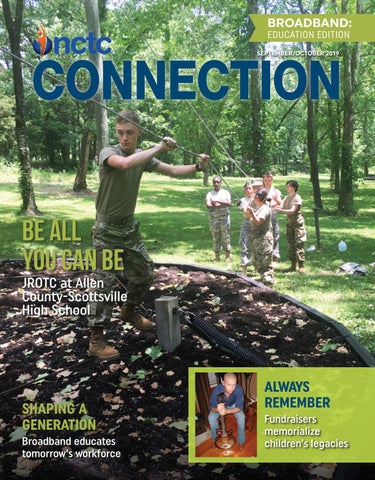
BE ALL YOU CAN BE
JROTC at Allen County-Scottsville High School
SHAPING A GENERATION Broadband educates tomorrow’s workforce
ALWAYS REMEMBER Fundraisers memorialize children’s legacies
INDUSTRY NEWS
Rural Connections BY SHIRLEY BLOOMFIELD, CEO NTCA–The Rural Broadband Association
Program helps small telcos with cybersecurity Our lives are impacted in countless ways by broadband internet access. With such connectivity, however, comes threats that must be guarded against, including cyber-attacks targeting network operators. Local, community-based providers such as your telco do a great job protecting against cyberattacks, despite not having the resources of the big, nationwide companies. But there is more we can do, and NTCA is excited to work with our members and the Department of Homeland Security on the Cyber-Threat Information Sharing Forum for Small Network Operators. While there are other programs for sharing cyberthreat information, these generally do not meet the unique needs of small telcos. Our pilot program provides a trusted environment for small network operators to share information about cyberthreats, vulnerabilities, best practices and mitigation activities. Further, it is bolstered by connections to network defenders across the globe, including federal resources. During this summer’s pilot phase, participants exchanged information via a variety of online platforms, participated in weekly virtual meetings to share cyber intelligence and heard from guest speakers. They also collaborated with their peers and received daily open-source and weekly technical reports created by NTCA’s pilot support team. This is yet another example of how local telcos like yours all across America are working together to ensure you have the best broadband experience possible in today’s connected world.
Home prices boosted by faster internet BY NOBLE SPRAYBERRY
A
ccess to speedy internet service increases the market value of homes, according to a first-of-its-kind study reported online by the Daily Yonder.com. The study evaluated 887 “remote rural” counties, which are those not adjacent to a metropolitan area. And it evaluated data such as median housing value, housing characteristics, income growth, employment and more. Speeds of 25 Mbps or less can make a dramatic difference in overall home values. A 10% increase in the percentage of residents with access to at least 200 Kbps — far slower than the speeds now offered by many rural telcos — would raise the average housing value by $661. “These may not seem like massive numbers, but when applied to the average number of households in each county, they add up to significant increases in property values, which would likely have meaningful impacts on county property tax collections,” wrote the study’s authors, Brian Whitacre, of Oklahoma State University; and Steven Deller, of the University of Wisconsin-Madison. The authors pointed out additional benefits of increased broadband adoption, including residents who become more civically engaged, reduction of social isolation and even income generation.
BY T H E N U MB E R S : BROADBAND IN RURAL REMOTE COUNTIES
94%
of the houses had access to download speeds of 200 Kbps.
9%
had access to 1,000 Mbps.
63%
had access to 25 Mbps, the FCC’s definition of broadband.
38%
had access to 100 Mbps.
6%
, on average, of houses had no fixed internet availability beyond dial-up.
Source: “Broadband’s Relationship to Rural Housing Values,” a study by Steven Deller and Brian Whitacre 2 | September/October 2019
Be aware A dose of skepticism and care will foil phone and online scammers
H
elpful pop-up messages frequently appear on computer screens, including weather notifications, news alerts or reminders to update software. Not all pop-ups, however, are benevolent. In fact, some consumers have learned tough lessons about trust in the digital age. The Federal Trade Commission (FTC) describes one form of grift as “tech support scammers.” A pop-up window appears on a computer screen, complete with well-known technology company logos and a phone number for help
solving a problem with a balky operating system, computer virus or similar woe. The end goal for these scams is to have someone wire money or to provide gift cards to the scammers. And the pitches and patter from the scammers are polished — people are fooled. There are many variations, including offers to help someone recover a refund. Fraud is certainly not limited to computers. Telephone scammers target the elderly with phone calls in which the scammer pretends to be the grandchild or another
relative. The scammer may even claim to be a lawyer or police officer, increasing the urgency, according to the FTC. The scammer paints the picture of an urgent situation, asking for money to be sent immediately through a service such as UPS, whose terms and conditions for use state that it does not agree to ship cash. As a result, UPS, which does work with law enforcement on such cases, is not liable for the loss, says Matt O’Conner, senior manager of public relations for the company.
TIPS FOR AVOIDING FAKE EMERGENCY SCAMMERS If you receive a call you suspect is a fake emergency scam, follow a few simple steps toward safety. Check out the claim by looking up the phone number of the friend or family member the scammer claims is in need. Call that person, even if the scammer requested that you do not. Do not pay. Anyone who requests you to wire money, send a check, overnight a money
order, or pay with a gift card or cash reload card is always, always, always a scammer. These payment methods are nearly untraceable. If you sent money to a familyemergency scammer, contact the company you used to send the money and tell them it was a fraudulent transaction. Ask to have the transaction reversed, if possible.
Please report such calls or messages to FTC.gov/complaint.
TIPS FOR AVOIDING TECH SUPPORT SCAMMERS PHONE CALLS: If you get a phone call you didn’t expect from someone who says there’s a problem with your computer, hang up. POP-UPS: Do not act on pop-ups appearing on your computer that request you to call a number. Real security warnings and messages will never ask you to call. WEB-BASED ADS: If you’re looking for tech support, go to a company you know and trust. Scammers will try to trick legitimate websites into posting ads for bogus companies. For additional tips, or if you feel you’ve been scammed, visit consumer.FTC.gov and search for tech support scam.
September/October 2019 | 3
FROM THE CEO
Our cooperative mission gives us purpose
B
usiness gurus often urge executives to ensure the company they’ve been entrusted to lead is “mission-oriented” or “mission-focused,” and that the organization’s mission should drive progress and establish values.
“A mission statement is not something you write overnight,” said famed organizational thinker Stephen Covey. “But fundamentally, your mission statement becomes your constitution, the solid expression of your vision and values. It becomes the criterion by which you measure everything.” If experts like Covey turned their attention to communications cooperatives like NCTC, I believe they would be pleased to see that the original founding mission of our cooperative remains such a focus of what we do daily. With October being National Cooperative Month, it’s an imporJOHNNY MCCLANAHAN tant time to celebrate that founding mission and our unique legacy CEO as a cooperative. NCTC was founded in 1951 by local people who wanted to bring a modern communications network to our area. These bold, forward-thinking people were not telecommunications experts — they were people dedicated to our community. People determined to open opportunities for their friends, families and neighbors. People committed to building the foundation our region needed to thrive. The convictions they held when they formed our cooperative live on today as the foundation of our mission. And taking a page from the business experts, we use that mission to drive our progress and establish our values.
DRIVE PROGRESS
Another favorite idea among the business gurus is that businesses must continually move forward to avoid falling behind. I think there’s a lot of truth to this, but I also think it’s important to let the cooperative’s mission drive that progress. Delivering the best possible communications service to residents in our region is what drives us to work hard every day. It’s also important for that mission to provide perspective for our progress. If we overextend our resources, we put our future in jeopardy. And if our future is put into question, so are the communications services on which many in our community rely. Rest assured that as we move forward, we do so with our mission in mind.
ESTABLISH VALUES
A telco cooperative has a different set of values than a publicly traded company like the big corporate providers that dominate our industry. Those providers exist to enrich their stockholders and are driven by Wall Street’s quarterly performance measurements. This is why, in most cases, those big, corporate providers only build and upgrade service in profitable metropolitan markets. That profit-driven mission defines their values as a company. NCTC is different. Since our cooperative was founded to improve the quality of life in the areas we serve, we are focused on bettering our community. This means taking care of our customers and employees. This means we value the relationships our cooperative has with other organizations. And above all, it means we value the opportunity to continue meeting your communications needs today and in the future.
4 | September/October 2019
CONNECTION SEPTEMBER/OCTOBER 2019
VOL. 6, NO. 5
The North Central Connection is a bimonthly newsletter published by NCTC, © 2019. It is distributed without charge to all member/ owners of the cooperative.
North Central is a member-owned corporation dedicated to delivering advanced telecommunications technology to the people of Northern Middle Tennessee and Southern Kentucky, including Macon County, Tenn., Allen County and Warren County, Ky. NCTC also serves portions of Sumner, Trousdale, Smith and Clay counties in Tennessee. North Central 872 Highway 52 Bypass, East P.O. Box 70 Lafayette, TN 37083 Telephone: 615-666-2151 www.nctc.com BOARD OF DIRECTORS Glen Hardcastle Chairman of the Board Scottsville Exchange West Randy Harston Vice Chairman of the Board Scottsville Exchange East Martha Bowser Westmoreland Exchange Kevin Dickerson Defeated/Pleasant Shade Exchanges Donnie Steen Lafayette Exchange East Jeff Flippin Lafayette Exchange West Chad Evitts Hillsdale/Green Grove Exchanges Calvin Graves Bethpage/Oak Grove Exchanges Chad Owens Red Boiling Springs Exchange Johnny McClanahan President/CEO Guy Holliman General Counsel
Produced for North Central by:
On the Cover: Allen CountyScottsville High School’s JROTC program makes leaders every day. See story Page 12.
School channels are consolidating
Plan to attend the
All school-focused TV channels are going to be consolidated into one — Channel 97. Allen, Macon, Smith, and Sumner County School information can all be found on this channel.
New NCTV NOW channels available This is an alternative to NCTC’s basic TV package. Using the NCTC internet connection and a Roku device, you can access even more great programming, all for just $27.95!
ANNUAL MEETING NCTC’s annual meeting is Nov. 2 at 1 p.m. at the Macon County Junior High School. Entertainment begins at 12 noon.
Call to sign up and see how you can receive a month FREE! 615-666-2151 Lafayette 615-644-6282 Westmoreland 270-622-7500 Scottsville 270-936-7444 Bowling Green
ABC NBC CBS Fox NCTC 6
NCTC 15 NCTC 97 Hallmark Cartoon Network Boomerang
RFD WNAB CW WGN PBS COZI
INSP History MeTV Antenna TV GritTV
Tennessee Telecommunications Association renamed Tennessee Broadband Association
At their annual meeting in June, members of the Tennessee Telecommunications Association unveiled the organization’s new name: Tennessee Broadband Association. “At any of our meetings, conventions or conference calls, it’s broadband, broadband, broadband that we are discussing,” says Levoy Knowles, executive director of the association. “It’s been that way for years, and I think our board made the right decision at the right time to put this flag in the ground and say we are the rural broadband experts in our state.”
— EMPLOYEE ANNIVERSARIES — Ashley Harper, customer service manager — five years Denisha Presley, customer service representative — five years Johnny McClanahan, president and chief executive officer — 30 years
North Central
As a member of the Tennessee Broadband Association, NCTC remains committed to the principles of growing our community and improving the quality of life through technology. And as the industry evolves, the cooperative is more dedicated than ever to ensuring all Tennesseans experience the possibilities of a connected world. September/October 2019 | 5
TRAVEL
Taking ‘City Farmhouse’ BY JOHN CLAYTON
B
efore an alphabet soup of cable television channels like HGTV and DIY began delivering tips and advice for home decor and remodeling, Kim and David Leggett were finding dusty treasures and building their City Farmhouse brand. That part of the business — the hunt for the rusty and the rustic — has remained the same for the Leggetts since they started the business 25 years ago in Franklin, Tennessee. But City Farmhouse evolved as trends changed, venturing into “pop-up fairs” and “pop-up shops,” terms now part of the lexicon as antiques and decor items move beyond the four walls of the traditional retail space. “The pop-up fairs and pop-up shops are becoming a popular way all across the U.S. for people to sell all kinds of things,” Kim Leggett says. “It’s not just relating to antiques. They’re extremely popular in New York and California, where people are selling everything from jewelry to fashion.”
6 | September/October 2019
on the road
The Leggetts began their City Farmhouse Pop-Up Fairs in 2012 in Franklin. Shoppers and vendors from across the country have attended. In 2017, the couple licensed City Farmhouse fairs in Baton Rouge, Louisiana, and Medina, Tennessee. While Kim Leggett has been putting her touch on her own City Farmhouse brand for more than two decades, her fingerprints are now all over a series of Country Living Fairs. As program director for the 2019 fairs, sponsored by the popular Country Living Magazine, Leggett is coordinating presenters for the main and kitchen stages. “The goal is to bring Country Living Magazine to life,” Leggett says. “Visitors will learn from top-notch influencers in the industry, while enjoying vendors with antiques, home decor, food, crafts, clothing — everything you might see in an issue of Country Living Magazine.”
Kim and David Leggett have curated the City Farmhouse style for over two decades.
A family business by the book Kim Leggett says the pieces she discovers, buys and sells can come together to create a home that makes memories. “We don’t always know the whole story behind a piece, but when it goes to another home, it becomes part of another story, and we have that going forward,” she says. To Leggett, connections between past and present are at the essence of what has become the “city farmhouse” style of decor, which she promotes with shows and her Franklin, Tennesseebased business. She authored “City Farmhouse Style,” a 2017 book about a design movement that features urban homes decorated in farmhouse style. The work includes photography by Alissa Saylor. “Farmhouse style is time-tested. It has staying power. You can bet the farm on it,” writes Country Living Editor-in-Chief Rachel Hardage Barrett in the book’s foreword. A love for antiquing and decorating is part of Kim Leggett’s family heritage. “My grandmother, who raised me, and my aunt — she was at our house all the time — went to auctions and local flea markets like the ones in every little small town,” she says. “So you could say I was raised in the business. My grandmother wasn’t actually a seller, but she would buy things, and when she got tired of something, she would sell it to a neighbor.” Leggett was hooked, going to the auctions and first buying “blind boxes” filled with surprises. “There would just be all kinds of interesting little things in the box,” she says. Soon enough, she began buying with purpose, teaming with her husband to create City Farmhouse and applying knowledge gained through the years to bring a country style into households across the country.
CITY FARMHOUSE AT THE COUNTRY LIVING FAIRS Sponsored by Country Living Magazine The first fair this year was in Rhinebeck, New York. The final two 2019 events are set for Columbus, Ohio, Sept. 13-14 and Atlanta, Georgia, Oct. 25-27. In addition to hundreds of vendors from more than 25 states, this year’s fairs will feature a City Farmhouse Pop-up SHOP. This special section of the Country Living Fairs will include unique finds from the Leggetts, along with curated sellers and popular vendors from other City Farmhouse events.
“People in farmhouses were very eclectic, especially people who didn’t have a lot of money,” Leggett says. “They used whatever they could find, and maybe there was a craftsman in their backyard who was a cousin or a neighbor and they could make some wonderful things inexpensively.” Leggett has introduced these relics — and their stories — to cabins, cottages, mansions, homes of celebrities and even restaurants across the country. From national design awards to features in national magazines, Leggett is recognized for her passion and efforts in sharing a decorating style that connects people with the past while writing a new story for their future.
Other antique events
ANTIQUING ROUND TOP AND SURROUNDING AREA This Texas event increases the tiny hamlet’s population of 90 exponentially as thousands from around the state and nation descend for the spring and fall dates. Round Top’s 2019 Fall Antiques Week is set for Sept. 30-Oct. 5. You can find City Farmhouse at Booth BD1 at the Marburger Farms Antique Show in Round Top. It happens in the spring and fall, Oct. 1-5 this year. September/October 2019 | 7
Paying it forward
H
Local mom continues a tradition started by her late son
BY JEN CALHOUN
ayden Shrum was fishing with his friends in 2009 when he slipped at the edge of a pond and scratched his wrist. It was just a little thing, really — a tiny scrape. Nothing anyone would think to be concerned about for someone like him — an athletic and outgoing 22-year-old. But days later, Hayden’s wrist grew swollen and red streaks spread down his arm. Tylenol didn’t help, nor did antibiotics prescribed by a doctor. Bloodwork found that Hayden suffered from acute myeloid leukemia, a type of cancer that starts in the bone marrow and tends to spread quickly. “How life can change in a matter of minutes,” says Fellisha Adams, Hayden’s mother and one of the founders of Haydenfest Cancer Foundation. The nonprofit foundation organizes Haydenfest, an annual benefit to raise money for area families dealing with cancer.
Also check out these foundations and events:
Hayden Shrum with his little sister, Halle, who donated bone marrow for his transplant. Halle’s bone marrow was a perfect match for Hayden. Fellisha Adams visits Winding Stairs Park, a site that her son Hayden often visited before battling leukemia.
THE JOURNEY For a full year, Hayden underwent various treatments, including chemotherapy that led to pneumonia, which led to lung surgery. After that, he took on more chemotherapy and eventually a bone marrow transplant, with the marrow donated by his youngest sister, who was 9 years old at the time. “Everything went great,” Adams says. The results were so good, in fact, that Hayden — a big music lover — decided to organize a music festival to thank the community for the help and support they showed. He called the event Mayfest, and it took place on May 7, 2010 — a year after he was diagnosed. But days later, doctors at Vanderbilt called to say the cancer cells had returned, and that Hayden would need more chemotherapy and a second transplant. After the first round of chemotherapy, Hayden contracted sepsis and died on May 26, 2010. He was 23. The next year, 8 | September/October 2019
Giving their all
Adams decided to continue holding an annual music-oriented festival. In honor of her son, she and the board of directors renamed the event Haydenfest, which this year is expected to occur in late fall. Donations are accepted all year long, and the proceeds go to help cancer patients with daily living expenses while undergoing treatments. “Cancer does not mind taking your health, all of your money, your job, your sanity and even your life,” Adams says. “We must come together and help each other.”
Easton Goad Foundation: An annual 5K run/walk in honor of Easton Goad, who was diagnosed with a rare form of liver cancer at 8 months old. Easton died in 2015 a little after his first birthday. The event takes place on Saturday, Oct. 19, in Red Boiling Springs, Tennessee. For more information, visit the Easton Goad Facebook page or eastongoadfoundation.com.
The Jordan Hackett Foundation: An annual 5K run/walk in honor of Jordan Hackett, who died in 2002 at the age of 4 months after contracting a blood infection following surgery to repair his heart. The event takes place the first Saturday in May in Carthage, Tennessee. For more information, visit The Jordan Hackett Facebook page or jordanhackettfoundation.org.
For more information on Haydenfest, visit hayden fest cancer-foundation on Facebook. North Central
Victory march
Highland Rim Marching Invitational pulls out all the stops BY JEN CALHOUN
The Westmoreland band spent the day at Universal Studios after representing Tennessee in the Citrus Bowl Parade.
W
estmoreland may be a quiet town, but its marching band action is fierce. One of the reasons is because the town plays host every year to the popular Highland Rim Marching Invitational, a competition that offers the community a chance to see performances from some of the best high school bands around. This year, the event takes place on Saturday, Sept. 28, at Westmoreland High School and features more than a dozen bands, big and small. “It’s a great, great environment,” says Jennifer Peterson, director of bands for Westmoreland, Tennessee. “It’s nonstop bands, including show bands and traditional, straight leg, corps-style bands. You can see all different kinds of performances.”
FUN FOR ALL The event, which is open to the public, also features concessions and vendors. Attendees enjoy attractions from games and food to snow cones. “It’s been growNorth Central
ing every single year,” Peterson says. “Last year, we were up to 15 bands total.” But the competition is more than just a spectacular spectacle, she says. It’s also a way for students from different schools to get together, cheer one another on and show what they can do. “The great thing that makes our competition stand out is that we’re very big on helping students get college scholarships,” Peterson says. Peterson created a Facebook page for seniors from all the participating bands in the competition to link with college scouts. On the site, students upload videos
of themselves performing a two-minute piece of music, along with an introduction and a run-through of their scales. Once the videos are in, Peterson gives scouts access to the page so they can review films. “Sometimes, college scouts will send me scholarship offers for the students,” she says. “Sometimes, they’ll come to the competition in person with the offers.”
BANDING TOGETHER Last year, the competition page helped broker more than $180,000 in scholarships for students, Peterson says. “The really great thing, though, is that these kids are supporting each other. Everybody cheers everybody on, even though it’s a competition. Once, we even had everybody in the stands doing the chicken dance. It’s just a great event with so much good energy.”
Join the fun! The Highland Rim Marching Invitational offers a day of music, excitement, food and games in a festival atmosphere. The event is at Westmoreland High School, 4300 Hawkins Drive, on Saturday, Sept. 28, beginning at 1 p.m. The competition features more than a dozen bands from all over the region, including show bands. Event admission is $10. Children ages 2 and younger get in free. Concessions and multiple vendors will be on-site. Visitor parking for the invitational is in front of Westmoreland Middle School, in front of the south wing gym.
September/October 2019 | 9
THE IMPACT OF BROADBAND: EDUCATION EDITION
ONLINE opportunities Broadband internet takes education to another level
T
omorrow’s workforce may appear very different from today’s due to an expected increase in the number of science, technology, engineering and math jobs. And the market for jobs requiring more education than a high school diploma but less than a college degree is also expected to grow. But with the opportunities a changing workforce represents, challenges also appear. Fast broadband internet services, however, can help by providing rural communities access to the educational tools to make those career paths a reality. A report by NTCA–The Rural Broadband Association found that improved access to broadband internet allows communities to better provide critical training. Many small, rural communications providers offer fiber-based broadband services that can support distance education, and many also work closely with educators and industry to develop opportunities for students to acquire STEM — science, technology, engineering and math — and middle-skills jobs. Students like Nathaniel Treadaway develop skills that increase economic opportunities in rural areas through worktraining programs, apprenticeships and classroom instruction. Treadaway grew up in Kuttawa, Kentucky, with aspirations to teach music. But after studying music education at the University of Kentucky for a short time, he quit. “I decided the teaching field wasn’t for me,” he says. So he started working at a bank.
10 | September/October 2019
He soon realized the need to combine technology and his job, and he decided to go back to college. He enrolled at West Kentucky Community and Technical College in Paducah to pursue an internet technology degree. He got an internship at a major Paducah corporation that provides customer network support, and now he works there full time while continuing his education online. He expects to graduate this year. At 29, Treadaway is part of a growing number of students attending college while continuing to work. “This is a rural area, and I’m thankful we have these opportunities,” he says. “It’s vital for those of us who want to stay here.” West Kentucky Community and Technical College continues to address the problem of young people across rural America leaving for the bigger cities. “In the past, some of the younger generation felt like they had to leave the area to make a good living and raise their families, but they’re itching to come back,” says David Heflin, vice president of academic affairs at the college. “We want to find employment that can provide that opportunity for them. We can’t allow the ‘brain drain’ to continue taking our kids from this area. We have to provide opportunities so they have a reason to stay.”
DISTANCE LEARNING Broadband internet leads the way in the industrial revolution, and it’s a driving force in education and jobs. Not only does broadband impact technology in jobs, but also manufacturing plants often rely on high-tech tools such as robots and cobots, which are computer-guided devices that assist a person. Partnerships among industry and educators are a growing trend to ensure that schools are offering courses that meet the requirements for these and other jobs. Using technology to partner with other high schools and postsecondary institutions, high school administrators can create programs that help students prepare for guided postsecondary education, according to the report. Partnerships with other area institutions can help students prepare for regional job markets. For rural community colleges, distance education plays a big role. Often, there’s not enough enrollment to support a local classroom, and online classes can fill a gap. It’s a growing trend. At Collin College in Texas — with locations in Frisco,
McKinney and Plano — online classes now account for about 40% of the enrollment. When Glenn Grimes, a Collin College professor of computer science, first started teaching 17 years ago, all the classes were face to face. “Back then, people didn’t have the bandwidth necessary to drive the audio and video needed to do online classes,” he says. Students now have the ability to pick and choose topics they wish to study from campuses all over the world. “It’s a huge benefit for students,” Grimes says. “It gives them so many more options.” Rural broadband providers are playing vital roles, leveraging their networks and working closely with local educational institutions, the NTCA report states. Rainbow Communications of Hiawatha, Kansas, provides fiber connectivity to Highland Community College, the oldest college in the state. The network allows the school to offer numerous courses at various sites. Career and technical education courses at HCC include building trades and medical coding. The college also supports the agricultural industry through such courses as precision agriculture and diesel mechanics, areas of study which are necessary as farms increasingly rely on precision agriculture that blends traditional mechanical equipment with analytical tech and GPS-guided systems. In Brainerd, Minnesota, Consolidated Telecommunications Co. works with Bridges Career Academies & Workplace Connection, which brings together high schools, local colleges and businesses to provide career guidance and training. The effort focuses on building local career opportunities. Nex-Tech in Lenora, Kansas, works with local charitable foundations and public utilities to support high school and college internships. Students earn at least $10 per hour and are offered technical and nontechnical career experiences in areas like agriculture, economic development, automobile restoration, medical services, computer technology, art, banking, legal and others.
Broadband and its impact on education • Youth who live in areas with broadband are found to have earned higher scores on college entrance exams such as the SAT or ACT. • More than 70% of NTCA–The Rural Broadband Association members can provide 25 Mbps and higher broadband to their customers. • A 2005 study found no significant difference between the writing skills of on-campus and off-campus students utilizing distance learning. • Distance education can help address the lack of specialization possible in small, rural schools that can’t provide as broad a range of courses as larger schools because of affordability or demand. • Distance education can also assist in early college attendance for high schoolers, particularly in rural areas that lack resources to support the increased expenses of college. • Broadband-enabled distance education allows all eligible students who have access to broadband to participate. • Distance education can also provide flexibility for working students and accommodate ongoing family obligations. Source: Rural Broadband and the Next Generation of American Jobs, a report of NTCA–The Rural Broadband Association.
September/October 2019 | 11
THE IMPACT OF BROADBAND: EDUCATION EDITION
leading the way Junior ROTC prepares students for the future BY JEN CALHOUN
W
hen former Col. Ron Turner retired in 2011 after 29 years in the Army, where he served several deployments to war zones and traveled from post to post, he never expected to start the next chapter of his life in a high school classroom. But that’s just what happened. Now, Turner helps lead more than 150 students each year through Allen County-Scottsville High School’s U.S. Army Junior Reserve Officers’ Training Corps. Junior ROTC is a classroom-based curriculum that offers everything from leadership training to lessons in history and civics. “I really think it was a God thing for me,” says Turner, who runs the program alongside retired Army Sgt. Maj. Joey Simpson. “I really didn’t see it coming, but now I know that this is what I was supposed to do — to be here and to do this. It’s been such a blessing for me to be able to work with these kids.”
SOMETHING FOR EVERYONE The high school’s program is one of more than 1,700 junior ROTC programs around the world. The Army handles most of the operation and funding. Despite the name, however, the program is more about character development than recruitment, Turner says. “We make it clear that it really has nothing to do with joining the military,” 12 | September/October 2019
Junior ROTC Cadet Maj. Katie Carver from Allen CountyScottsville High School rappels during an exercise.
he says. “It’s really just about making the students better people. So, we don’t want people to think, ‘I don’t want my kid in junior ROTC because they’re trying to get them in the military.’ That’s the furthest thing from the truth. We may expose them to some aspect of the military, but the program is set up to motivate them to become better people.” Turner describes junior ROTC as a course students can choose to sign up for during the school year that also offers competitive activities and teams. The curriculum teaches ideas relating to citizenship, patriotism, military history, leadership and health, to name a few. Students, or cadets as they’re called in the program, learn to give speeches, train in various skill sets and take on leadership roles. Those who finish three years and make a certain score on the Armed Services Vocational Aptitude
Battery test receive a college and career technical certificate. Activities offered through the school’s JROTC program include an air rifle competition team, Patriot Raider athletic teams, an orienteering team and a drilland-ceremony team. The junior ROTC also maintains an academic and leadership board, and some cadets attend the organization’s Leadership Challenge Camp in the summer. Since the school founded the program in 2011, two leadership teams and one academic team have won all-expensespaid trips to Washington, D.C., to compete against other high schools in the JROTC Leadership & Academic Bowl. The Allen County-Scottsville High program is adding more activities, too. “Our kids just built a robot,” Turner says. “So, we’re going to work on that as a team sport, too.” North Central
MOVING FORWARD And while the JROTC program isn’t focused on recruitment, some students join because of the military connection. That’s OK, too, Turner says. The program averages about 10 students a year who join the military. If a student is interested, Turner and Simpson can offer guidance and advice before they make a decision. “If someone in the program does want to join the military after high school, we can help,” Turner says. “We know what it can do for you and what it can do to you. We don’t push it, but we do help our kids if they decide that’s what they want. We can kind of watch over them and make sure they’re getting the best deal.”
Allen County-Scottsville High cadets attend a junior ROTC Cadet Leadership Challenge & STEM camp. JCLC events include rappelling, team-building, water survival training, boat operations and more activities.
SERVING THE COMMUNITY Junior ROTC cadets participate in other ways, too. On Memorial Day, they planted nearly 600 flags on the graves of former military service members. “The outpouring from the community was amazing,” Turner says. “Everybody just loved it.” Cadets also joined forces with art and agricultural students to build beds for community members. “We learned that there were kids in our county that didn’t have beds to sleep in at night,” Turner says. “So, the kids raised the money and did the work. And holy smokes, it was just amazing to go out and give those beds to people. I mean, that’s life-changing for people on both sides of it.” But for Turner, the greatest accomplishment of all has been watching his cadets grow their characters, their minds and their confidence. “There’ve been tons of amazing success stories,” he says. “I won’t mention names, but I’ve seen kids that would tear up or cry when they had to give a speech. Then, I see that same kid four years later get up and give a speech, and I start crying. It warms my heart so much to see how far that kid’s come. I think, ‘Wow. The sky’s the limit for this kid. They can do anything.’”
North Central
Cadet Capt. Zach Emberton rappels during an event.
Junior ROTC instructor Col. Ron Turner, Cadet Sgt. Maj. Justin Spearman, Cadet Maj. Cole Charlton, Cadet Lt. Col. Ethan Miller and Command Sgt. Maj. Joey Simpson during a recent banquet.
what is junior rotc?
Local junior ROTC cadets help build beds for children in need.
The junior ROTC program at Allen County-Scottsville High School is a class that students can select. The curriculum includes coursework that promotes the capacity for lifelong learning, critical thinking, good citizenship and respectful treatment of others. Coursework includes the following: • Leadership • Civics • Geography and global awareness • Health • Wellness • Language arts • Life skills • U.S. history
September/October 2019 | 13
SOUTHERN KITCHENS
Fall squash
T
rees tower over the twolane road, its dividing line faded with wear and age. As you approach Grandaddy’s Farm, however, the road widens and a rainbow of colors appears in hues of the autumn season — orange pumpkins, gourds of green, golden butternuts and the reddish tinge of One Too Manys. “The farm is beautiful in the fall,” says Andrew Dixon, who lives on the property once owned by his grandfather, Charles Dixon. “The fields are dying back and giving way to the colors of all the different winter squash varieties.” Hayrides are one of the most popular activities the Estill Springs, Tennessee, farm offers, taking families afield to pick the perfect pumpkin. Since the Dixon family became involved in agritourism, this is one of several things visitors can now do to learn more about farm life and growing in the Volunteer State. But offering pumpkins and winter squashes for decorating is just one thing Grandaddy’s Farm does. The Dixons also encourage folks to cook with them by offering free recipes at the farm store. “You can use them as table decorations, and then you can turn around and use the same ones for cooking, so you’re not throwing it away,” Dixon says, adding that it’s only been in the past six or seven years that he’s seen more people in the South
14 | September/October 2019
Enjoy a versatile, beautiful taste of the season
Grandaddy’s Farm is made possible with the help of family, including, from left, Philip Dixon, Ann Thomas, Lacey Thomas, Nancy Dixon, Karen Dixon, Steve Dixon and Andrew Dixon.
interested in cooking with winter squashes. “Before that, it was more of a Northern thing,” he says. “It’s taken us a little longer when the only squash we grew up with was yellow squash — and we fried that.” The farm offers 15 varieties of squash and gourds. Winter squash planting takes place in late June. Harvest begins in early September, and the farm opens to the public later that month on Fridays from 1:30-9 p.m. and Saturdays from 9 a.m.-9 p.m. Dixon’s personal favorite squash is butternut, a versatile variety that can be used in place of pumpkins for pies. “Butternut squash is so much easier to use,” he says. “Pumpkins have so many seeds and
stuff. There’s so much to hollow out. A butternut squash is all meat. It’s much more efficient to cook with.” Butternut squash is also a good choice in casseroles, smoothies, soups and salads. “Any winter squash can be used for cooking, but some are better than others,” Dixon says.
Here are some recipes from Grandaddy’s Farm. FOOD EDITOR ANNE P. BRALY IS A NATIVE OF CHATTANOOGA, TENNESSEE.
RANDADDY’S FARM SPEEDY G SPAGHETTI SQUASH 1 spaghetti squash Butter Parmesan cheese Wash squash and place it on a cutting board. Cut squash in half lengthwise and scoop out seeds. Place squash halves cutside down on a plate with a little water in the bottom and microwave on high 5-8 minutes or until tender. Fluff the insides of the squash with a fork, and it will begin to resemble spaghetti. Place “noodles” on a plate and top with butter and parmesan cheese to taste. Note: Meat sauce also goes well over the squash noodles, and the noodles go well in a mock pasta salad with the addition of zesty Italian dressing and your favorite pasta salad ingredients (onions, green pepper, hard salami, capers, etc.).
APPLE-STUFFED ACORN SQUASH 2 apples, peeled and cut into slices 2-3 tablespoons butter, melted 1 acorn squash Honey Add apple slices to frying pan with melted butter. Saute apples until fork tender. Set aside. Place squash on cutting board, slice it in half lengthwise and scoop out seeds. Place halves cut-side down on a plate with a little water in the bottom. Microwave on high for 3-6 minutes until the inside is tender. Place squash halves on plates, fill with sauteed apples and drizzle with honey.
PUMPKIN (SQUASH) PUREE
‘PUMPKIN’ PUREE SMOOTHIE
1 large butternut squash
Wash squash and place it whole in an ovenproof pan. Roast squash at 350 F for 1 to 1 1/2 hours or until you can insert a fork easily into the squash. Remove squash from oven and let cool. Slice the squash lengthwise and scoop seeds out gently, taking care to leave the meat intact. Scoop out all of the meat, place it in a blender or food processor, and puree until smooth. Use the puree as the base for pumpkin pie, smoothies or any other recipe that calls for pumpkin. Tip: You can freeze the puree for several months. At Grandaddy’s Farm, the Dixons freeze puree in quart bags in the amount called for in their recipes, and they thaw it as needed.
1 frozen banana 1/2 cup vanilla Greek yogurt 1/4 teaspoon ground cinnamon 1/4 teaspoon pumpkin pie spice 1/2 cup skim milk 2 tablespoons pure maple syrup 2/3 cup butternut squash puree 1 cup ice
Add all of the ingredients to a blender in the order listed. Blend on high for at least 3 minutes or until smooth. This may take longer if your blender isn’t very strong. Scrape down the sides of the blender as needed. Add more milk to thin out if the mixture is too thick. Add a couple more ice cubes for a thicker texture if desired. Add more spices to taste, if desired. Makes 1 smoothie.
September/October 2019 | 15
Presort STD US Postage PAID Permit #21 Freeport OH
P.O. Box 70 Lafayette, TN 37083
Stream just about anything with NCTV NOW !
New NCTV NOW customers receive the first month for FREE!*
Get your first month of NCTV NOW FREE! With the Roku device you use to stream NCTV NOW, you can also stream hundreds of channels and have access to more than 350,000 movies and TV episodes. *Restrictions may apply. A 12-month agreement is required. Offer ends Oct. 31. Roku device required.
615-666-2151 | NCTC.com