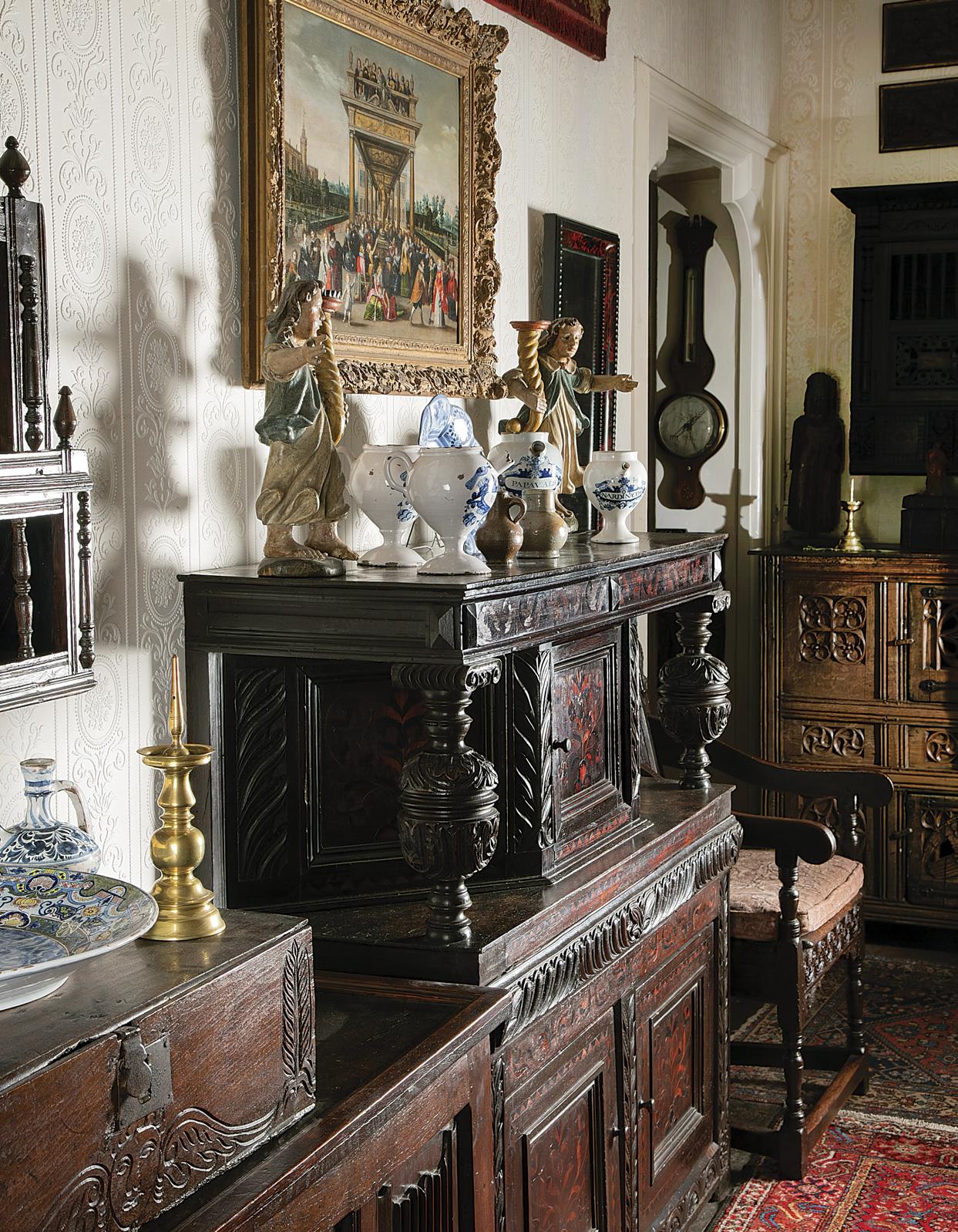
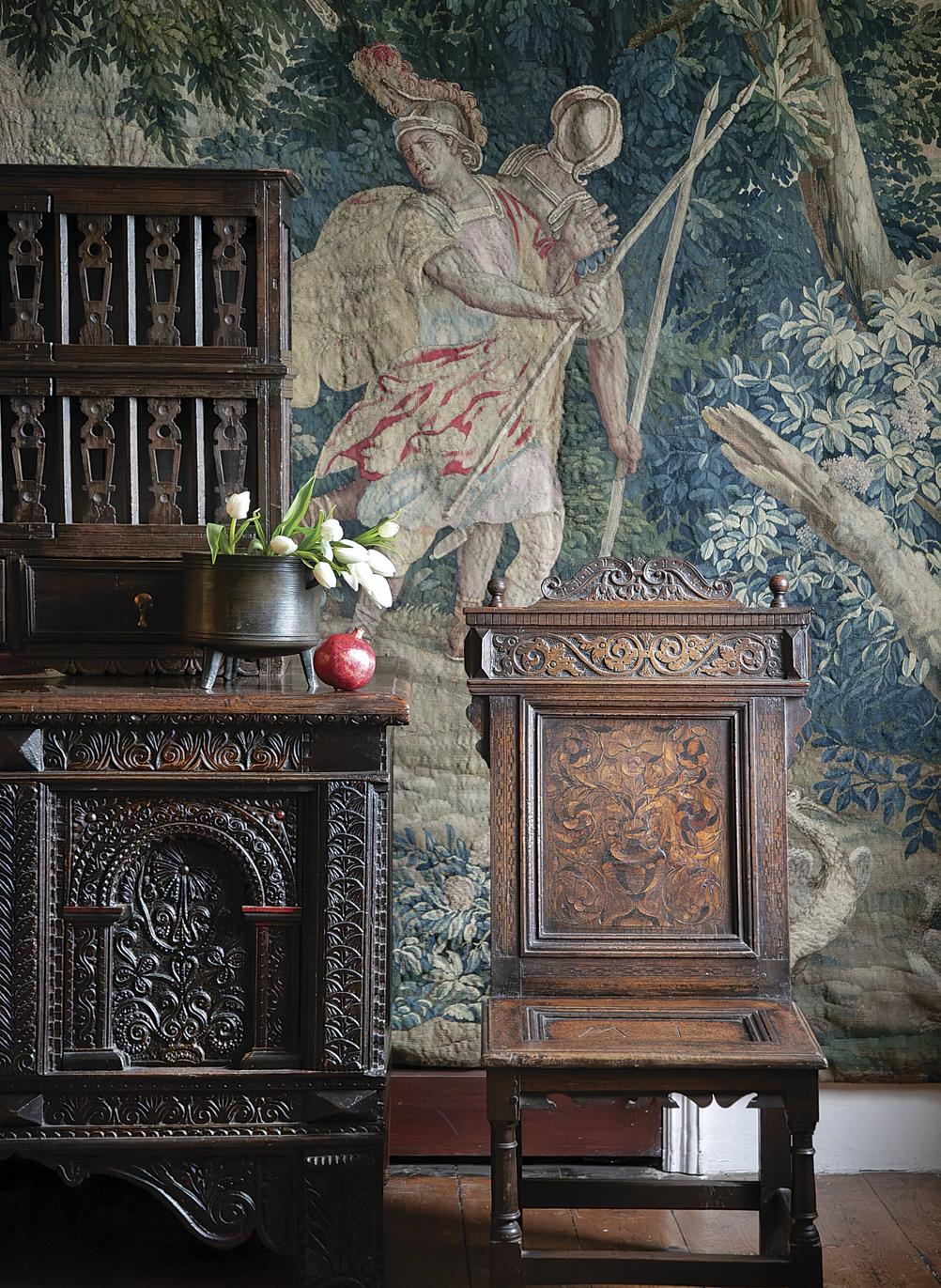
TUESDAY 10TH & WEDNESDAY 11TH MARCH 2026
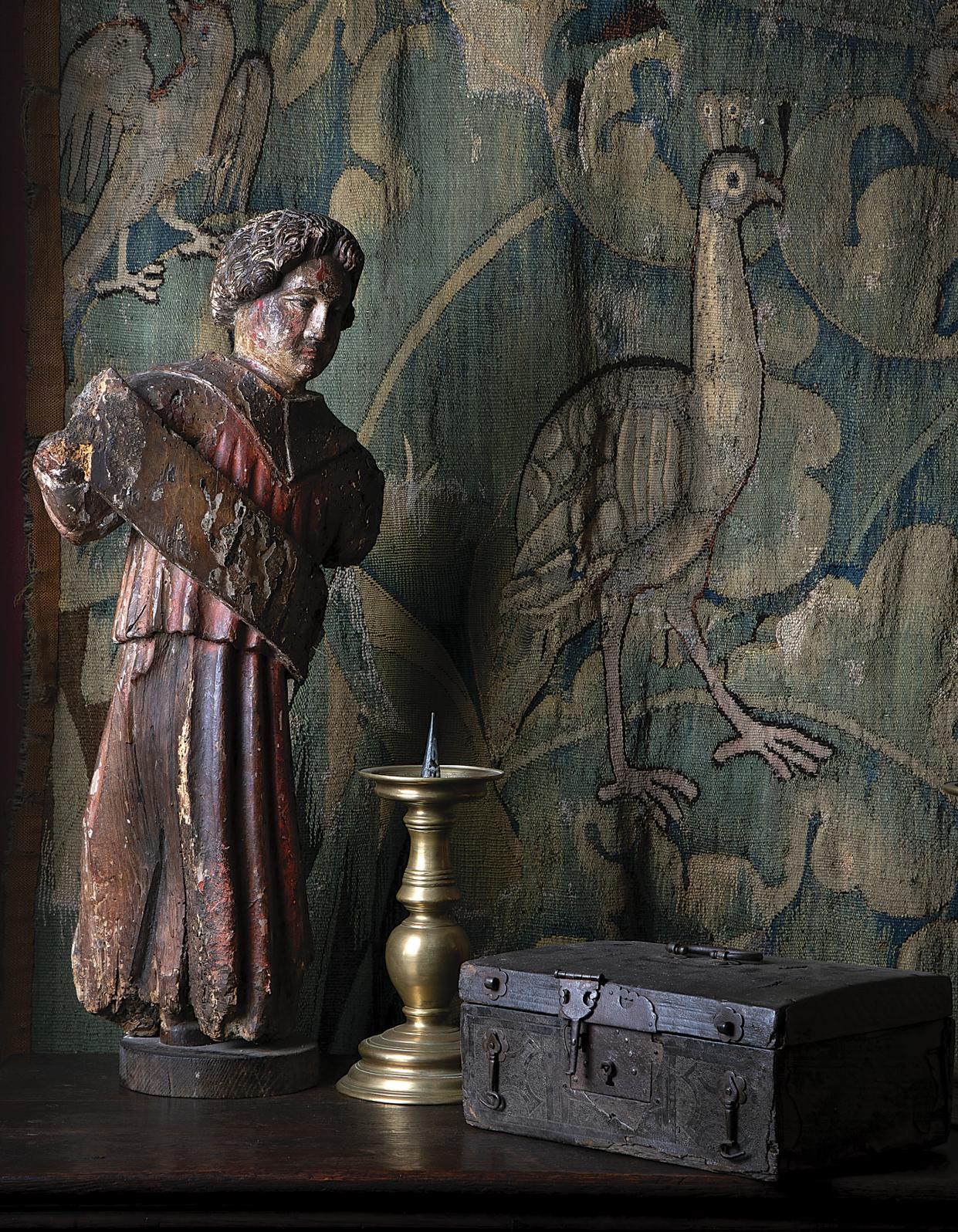
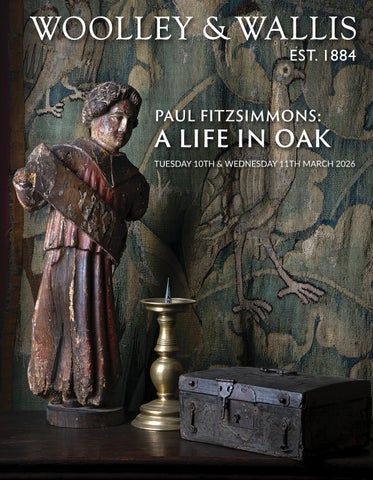
TUESDAY 10TH & WEDNESDAY 11TH MARCH 2026
AUCTION AT OUR CITY CENTRE SALEROOMS 51-61 CASTLE STREET, SALISBURY, SP1 3SU
TUESDAY 10TH MARCH 2026
AT 10.30AM | LOTS 1-350
WEDNESDAY 11TH MARCH 2026
AT 10.30AM | LOTS 351-707
VIEWING:
OLD SARUM GALLERIES
UNIT 1B, CASTLE GATE BUSINESS PARK OLD SARUM, SP4 6QX
Saturday 7th March 10am – 4pm
Sunday 8th March 10am – 1pm
Monday 9th March 10am – 4pm
Tuesday 10th March 10am – 4pm
Wednesday 11th March By Appointment
THE AUCTION ON THE 10TH & 11TH MARCH WILL TAKE PLACE AT OUR CITY CENTRE SALEROOMS 5161 Castle Street, Salisbury, SP1 3SU
VIEWING AT OUR OLD SARUM GALLERIES
Unit 1B, Castle Gate Business Park, Old Sarum, Salisbury, SP4 6QX
Client Parking Available
BUYER’S PREMIUM
Each lot is subject to a Buyer’s Premium of 27% (+VAT) on the first £20,000 of the hammer price. reducing to 26% (+VAT) up to £500,000, and 20% (+VAT) thereafter.
CONDITION OF LOTS
Buyers are advised to obtain a full condition report prior to bidding, as descriptions do not necessarily list all faults.
EXPORT AND CITES LICENCES
Some lots will require export or CITES licences in order to leave the UK or Europe, please refer to the department for guidance.
bid.woolleyandwallis.co.uk


Instagram: @woolleyandwallisfurniture @woolleyandwallissalerooms
Facebook: Woolley & Wallis
Pinterest: Woolley and Wallis
IMPORTANT NOTICE TO ALL PURCHASERS REGARDING STORAGE AND COLLECTION OF LOTS
WE ARE PLEASED TO OFFER TWO WEEKS FREE STORAGE FOR ALL LOTS PURCHASED FROM THIS SALE. HOWEVER, OWING TO A BUSY SCHEDULE, ALL LOTS NOT COLLECTED BY 4PM ON THURSDAY 26TH MARCH 2026 WILL BE TRANSFERRED TO SACKVILLE-WEST MOVING AND STORING (ANDOVER SP10 3SA), WHERE THEY WILL BE AVAILABLE FOR COLLECTION FROM TUESDAY 31ST MARCH. LOTS WILL BE UNAVAILABLE FOR COLLECTION FROM THE 27TH MARCH TO THE 30TH MARCH AS THE ITEMS WILL BE IN TRANSIT. PLEASE NOTE, HANDLING AND STORAGE CHARGES WILL BE APPLIED FROM 8AM ON TUESDAY 31ST MARCH 2026. FOR FULL DETAILS, PLEASE REFER TO ‘AUCTION INFORMATION’ UNDER THE ‘PAYMENT AND CLEARANCE’ SECTION AT THE BACK OF THE CATALOGUE AND ON OUR WEBSITE.

Mark YuanRichards Furniture, Works of Art & Clocks 01722 411854 myr@woolleys.live

David Houlston Oak Consultant 01722 339161 furniture@woolleys.live

Neil Grenyer Ceramics & Glass 01722 446974 ng@woolleys.live

Jim Gale Furniture, Works of Art & Clocks 01722 339161 jg@woolleys.live

Victor Fauvelle Paintings 01722 446961 vf@woolleys.live

Richard Kay Paintings 01722 446964 rk@woolleys.live
For general enquiries about this auction, please email the department administrators:

Sarah Stone
Email: furniture@woolleys.live

Suilven Hunter
Absentee and telephone bids: 01722 446974
Photographer: Andrew Butler, Exeter
I
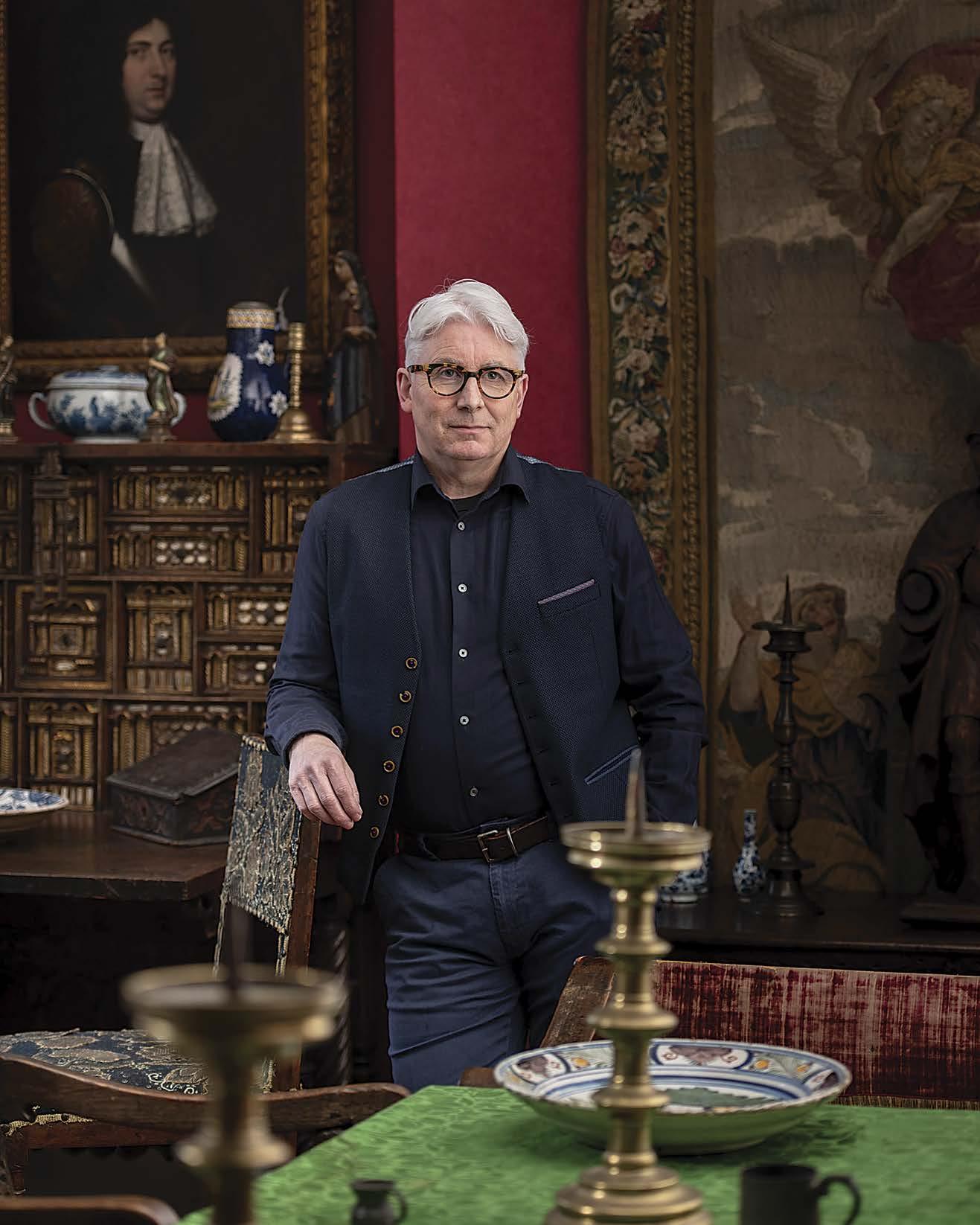
first met Paul over twentyfive years ago at his home, near Exeter. As a leading, notable oak dealer, he had kindly invited me as an established, respected, oak specialist. From the outset it was obvious we were both obsessed with oak. The term ‘oak’, was a label devised in the 20th century, helped in no small way, by Percy Macquoid. In 1904 Macquoid categorised furniture by the timber used, under four volumes, one of which being ‘The Age of Oak’. The term became a kind of verbal shorthand to denote all furniture, works of art, metalware and textiles from the Medieval and Renaissance periods, through to the Restoration of Charles II and a little beyond.
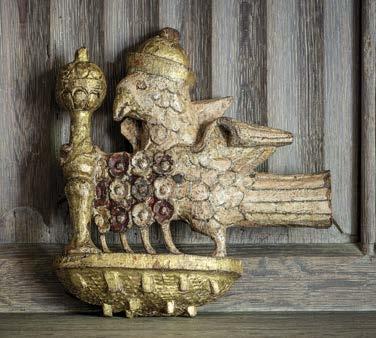
Paul is unlike anyone in the ‘oak world’ I have ever met. His insatiable enthusiasm, curiosity and drive are unparallelled; he has been likened to a bloodhound in his approach. This talent, and dedication to the hunt, has led to his making several remarkable discoveries, to give items back the significance and visibility they deserve. A wonderful example, (not part of this sale), is a carving of Anne Boleyn’s falcon badge. Initially made for Hampton Court in 1533, (and normally displayed on long term loan there), it is currently part of an international exhibition at Hever Castle, the doomed queen’s family home.
Paul and I talked for hours that first day, with my notes reflecting not simply a dry record of ‘form and function’ and the allimportant estimate, but the wider context of the pieces that made each one interesting and unique. This meeting led to a congenial, close and fruitful working collaboration; one which set a personal career record for a work of oak sold on the rostrum: a Henry VIII panel, circa 1545, £184,900 … Perhaps in this sale that figure will be surpassed!
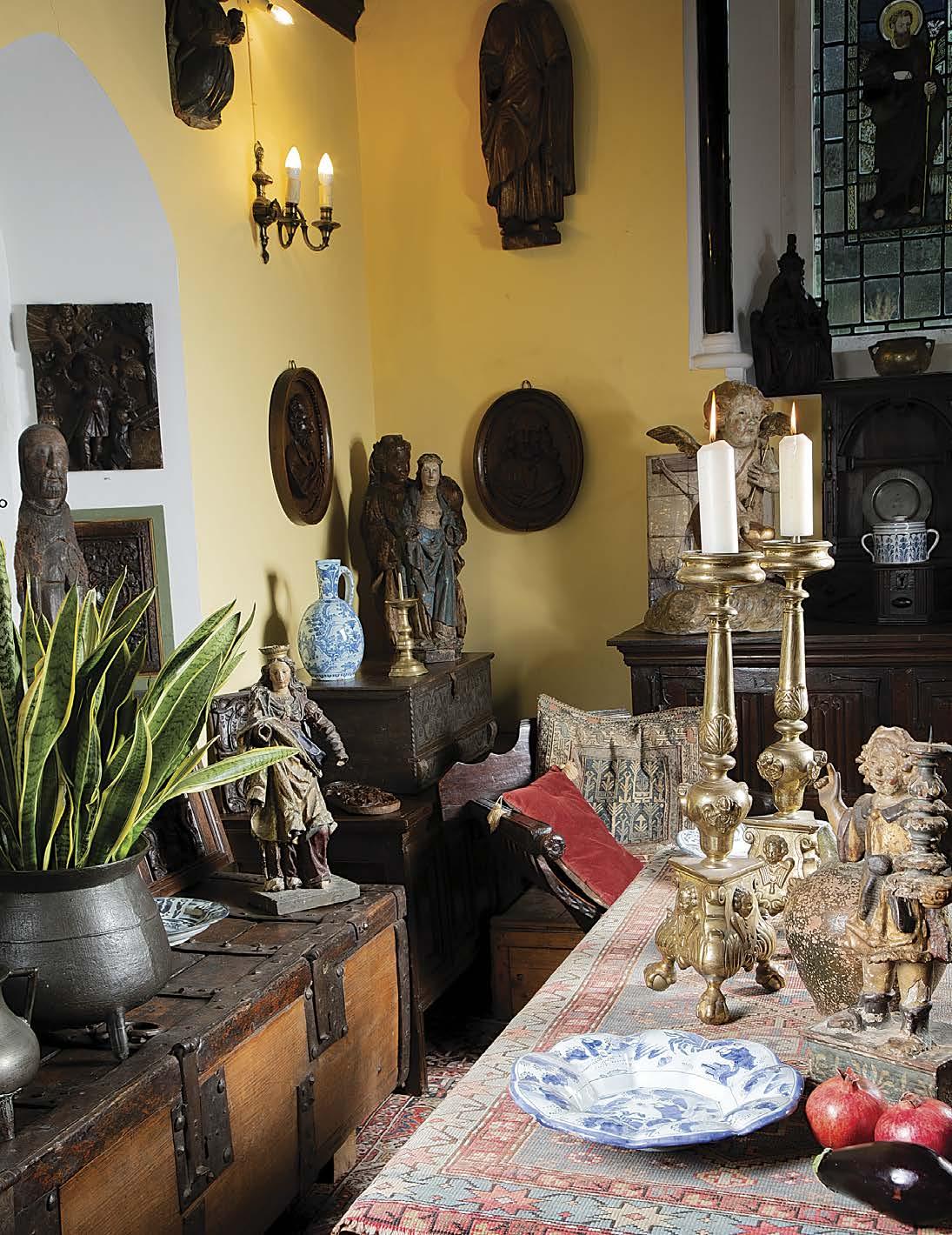
I was thrilled when Paul contacted me to handle the auction of his lifetime collection. I could justifiably use many clichéd words like ‘passion’ and ‘curated’ in describing this group of over 700 lots, but I really feel they speak for themselves. What I can emphasise is that the sheer volume, along with the rarity and quality offered here, does not happen overnight or by luck. It takes years of experience, (some bad, some good!), a dedication to research, scholarship and a dogged determination to find the rarest and the most fascinating pieces: everything a successful dealer strives for. Here can be found an interest in regional form, with a strong leaning to Devon, not only Paul’s home county, but one strongly associated with quality and excellence during the English Renaissance. Due to Exeter’s port trade links and proximity to Europe, the area was vibrant with new ideas influencing craftsmanship in all aspects of decoration (Lot 122). One can also find several documented pieces; items recorded in various noted books on ‘oak’ (Lot 558). There are items with provenance, previously in acclaimed locations, including Exeter Cathedral and College (Lot 225); or private collections; or having passed through the hands of eminent dealers. One can find the exceptional, two tapestries of the highest quality (Lots 84 & 85); a preReformation processional cross (Lot 370) and of course, the Lambert table (Lot 500), the finest example of Elizabethan furniture, unsurpassed in the UK auction market for decades.
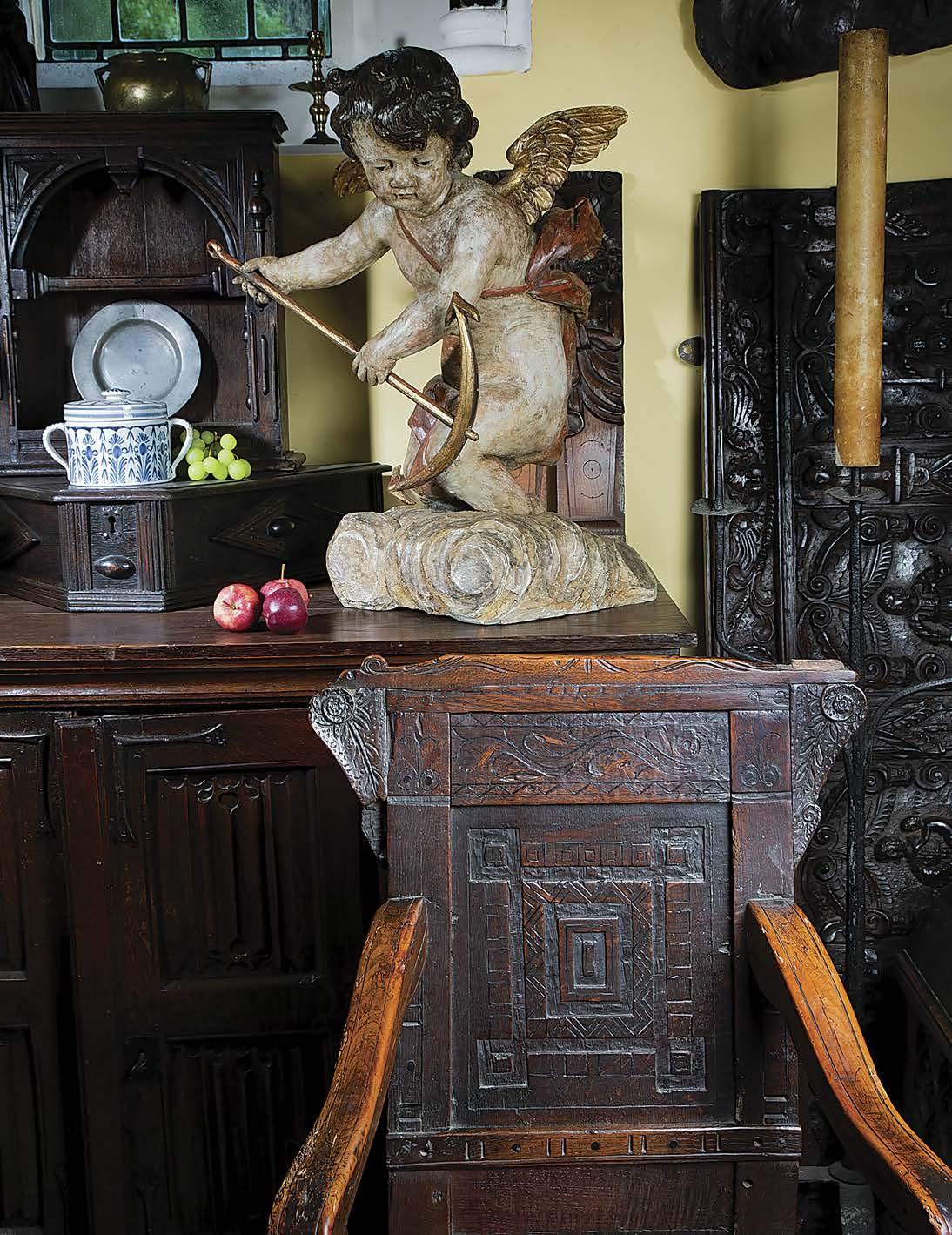
But most of all, you will find variety: furniture of every form, from the practical (a side table, Lot 293), to the more decorative and lavish (a Vargueno, Lot 92); complementary paintings, and period works of art. The category of figural carving is particularly strong, with lifesize statement pieces (Lot 360) to the highly personal, private devotional, examples (Lot 127). There are carved panels, metalware and delftware, all core foundations of ‘The Oak Interior’. The range here is enough to furnish a whole period home, add to an established collection, or make a brandnew foray into this absorbing collecting genre. The estimates range from under £100 to £100,000, making this a universally appealing sale.
I have described Paul as a man with an insatiable appetite for oak, to which I hear the ringing question: ‘why is he selling it all then?’. Every business owner, at some point, wishes to make some changes in focus and operation. And, when you’ve been devoted to oak for 7 days a week for 35 years you might want to ease up a little. I know he’s certainly not stopping (that’s out of the question) but rather creating space to consider new, exciting directions.
To the person behind ‘Marhamchurch Antiques’, Paul Fitzsimmons, I offer my heartfelt appreciation for sharing your knowledge, experience, and for giving me the opportunity to handle and auction such exceptional pieces. When I went in my own new direction, a little over five years ago,
I’ll never forget that you were my first customer…not I think, that I might have overlooked something, but because you understood too well the world I was about to enter…a world where if you are prepared to give it your all (with the exception of family) and strive for excellence, you can have a tremendous amount of pleasure and fulfilment from a life spent handling the most wonderful historic objects.
David
Houlston, 2026
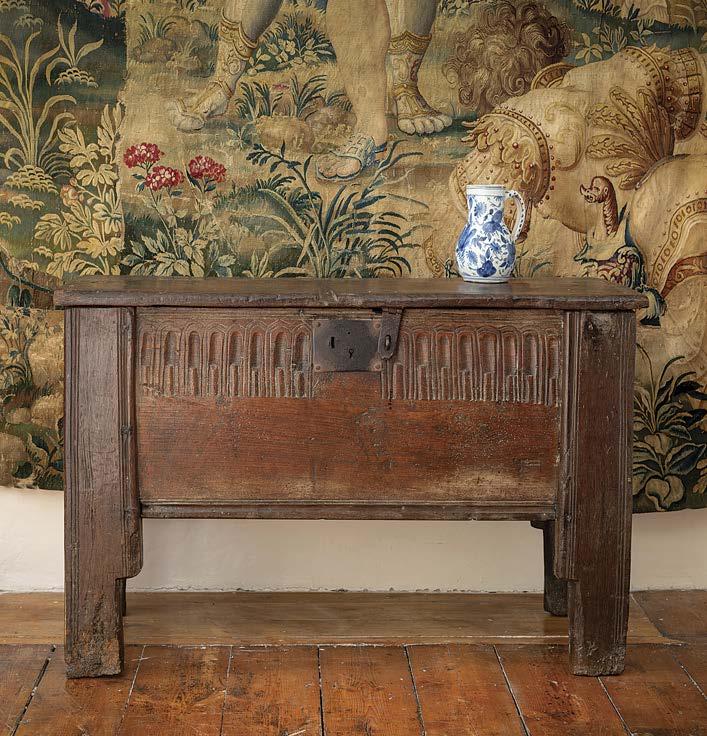
A Henry VII/VIII oak ‘clampfront’ chest, Black Mountains, Southeast Wales, circa 150040
Constructed of thick oak boards, within runmoulded stiles terminating in cutaway feet, the front is carved with a continuous nulled frieze, the lid retains its iron fittings, the present lock plate appears to be a period addition, probably added later in the 16th century to enhance security.
Chests of this kind were fundamental to domestic life in Tudor Wales, serving as secure storage for clothing, textiles, and/or valuables, while also embodying permanence and status within the prosperous household. Their rarity today lies in both their age and their authenticity of survival.
For comparable examples and discussion of the Black Mountains group, see Richard Bebb, ‘Welsh Furniture 1250–1950’, Vol. 1, pp. 146–147.
Provenance: Pat Morley Collection, Warwickshire.
H72.5cm, W 113cm, D 49.5cm
£8001,200
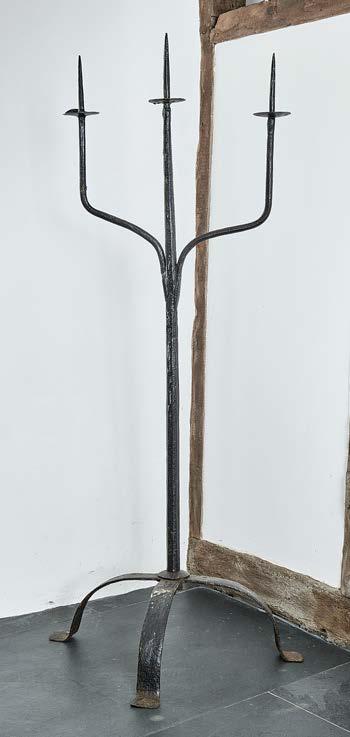
A wroughtiron floor standing pricket candlestick, probably English, possibly circa 1600
The stem forged in one with three tapering branches, each terminating in a large pricket with driptray, above a sturdy tripod base with arched legs and curled feet.
Such monumental lighting was intended for use in churches, great halls, or refectories, illuminating large spaces before the widespread adoption of lanterns and wall sconces. The clean, architectural design reflects a more restrained English ironwork tradition, contrasting with the more elaborate European forms.
H 139.7cm, W 61cm, D 30.5cm
£200300
4
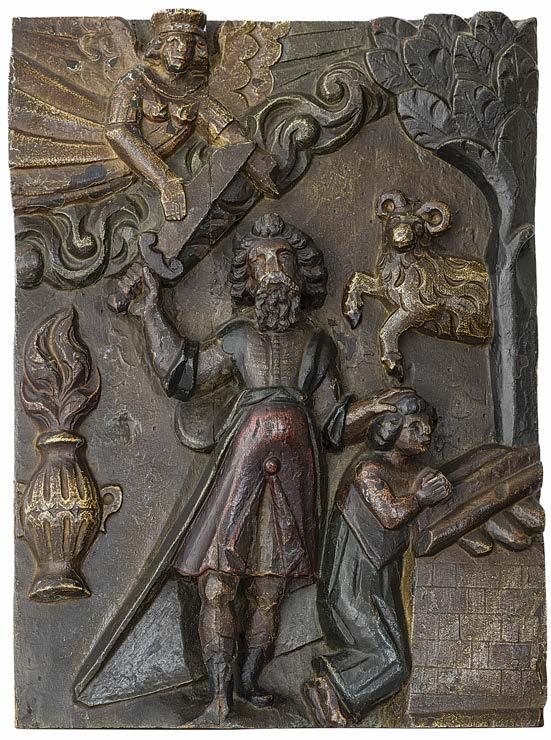
A good Elizabeth I carved oak and fullypolychromed panel, West Country, circa 15801600
Deeply carved and retaining its original decoration, the panel vividly depicts the dramatic biblical episode of Abraham’s obedience in preparing to sacrifice his son Isaac (Genesis 22:1–13). Abraham stands centrally, knife raised, while Isaac kneels in prayer. Divine intervention is shown in the angel descending from heaven to stay Abraham’s hand, and the ram caught in a thicket represents God’s providential substitute. To the left, a flaming urn symbolises ritual sacrifice and divine presence.
The survival of complete Elizabethan decoration on oak is exceptionally rare; most panels of this period have lost their surface colour completely or partly through later stripping or decay. Here, the bold paintwork conveys a striking immediacy, reflecting how such imagery was intended to impress, instruct, and inspire.
The subject of Abraham and Isaac was particularly resonant in Protestant England, symbolising faith, obedience, and divine grace. This panel encapsulates the moral and devotional character of Elizabethan religious art, while offering a rare glimpse into the original appearance of Tudor interiors.
Provenance: John Fiske and Lisa Freeman Private Collection, Ipswich, Massachusetts, USA.
H 42cm, W 30.5cm, D 5cm
£1,5002,000
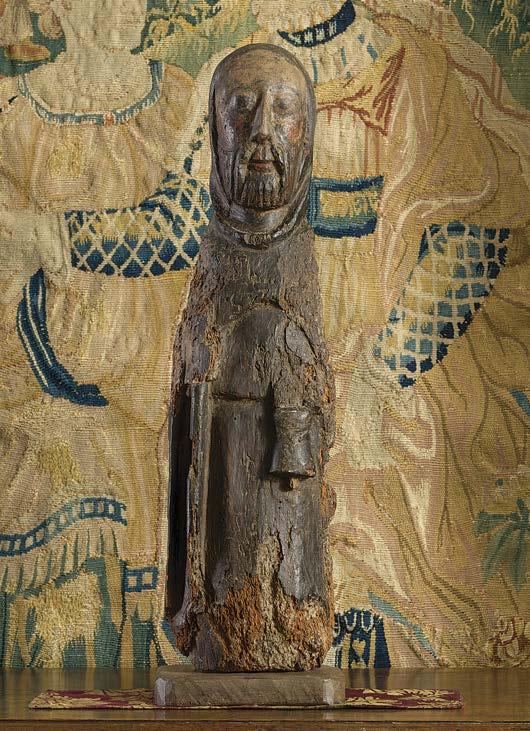
A rare 12th century Romanesque carved oak and polychromedecorated figure of a Monk, Possibly St Anthony Abbott, North Italian, Lombardy/Alpine Region, circa 11001200
Conceived as a compact vertical block, with a cylindrical torso, heavy cowl and closehugging habit that descends in long, schematic folds, the head (large in proportion to the body) with a tight beard and almondshaped eyes under a flattened brow, retains vestiges of the original flesh tones and red to the lips. In his proper right hand, he holds a small, roughly cylindrical object, plausibly a handbell, the most frequent attribute of St Anthony Abbot (together with a tauheaded staff and, in larger ensembles, a pig).
Historic surface wear has simplified the form, and no animal companion survives, therefore a cautious identification is prudent. The work may depict another early abbotsaint for example, Benedict or Romuald. The presence of a bell, if correct, however, aligns strongly with Anthony’s latemedieval cult as healer of “St Anthony’s Fire” (ergotism), widely venerated across Northern Italy. The carving method of broad planes, sharply cut edges to the hood and sleeves, shallow, parallel pleats to the habit, all have parallels to 12thcentury wood and stone sculpture in the Po valley and western Alps (Lombardy, Piedmont, Aosta). Furthermore, figures from this region often share monumental frontality intended for distant viewing in dim interiors; an economy of modelling, reserving detail for the visage and hands; expressive heads with incised pupils and schematic beards.
H 63.5cm, W 17.2cm, D 11.5cm
£2,0003,000
5
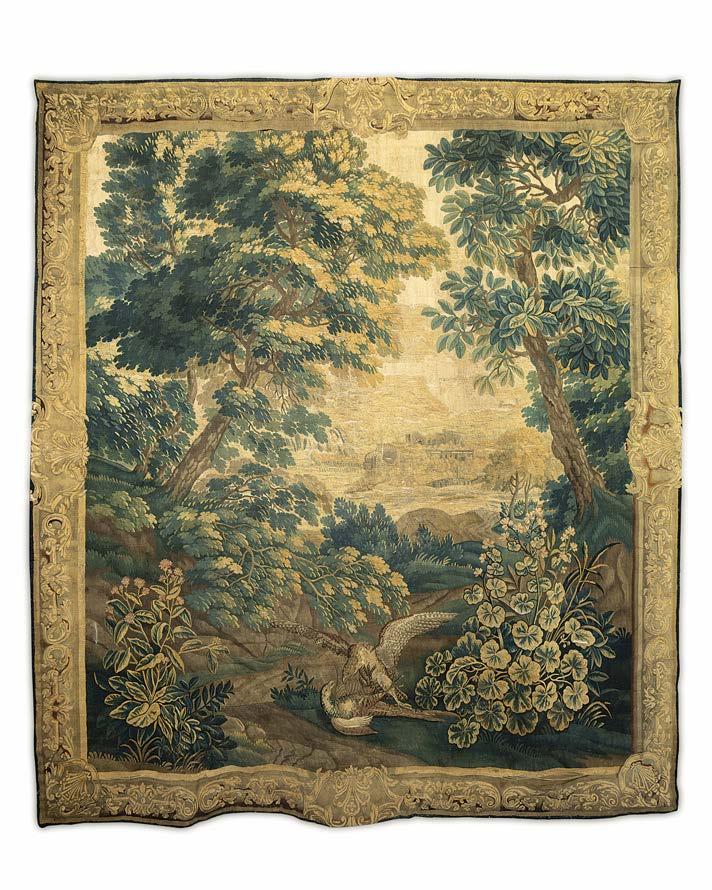
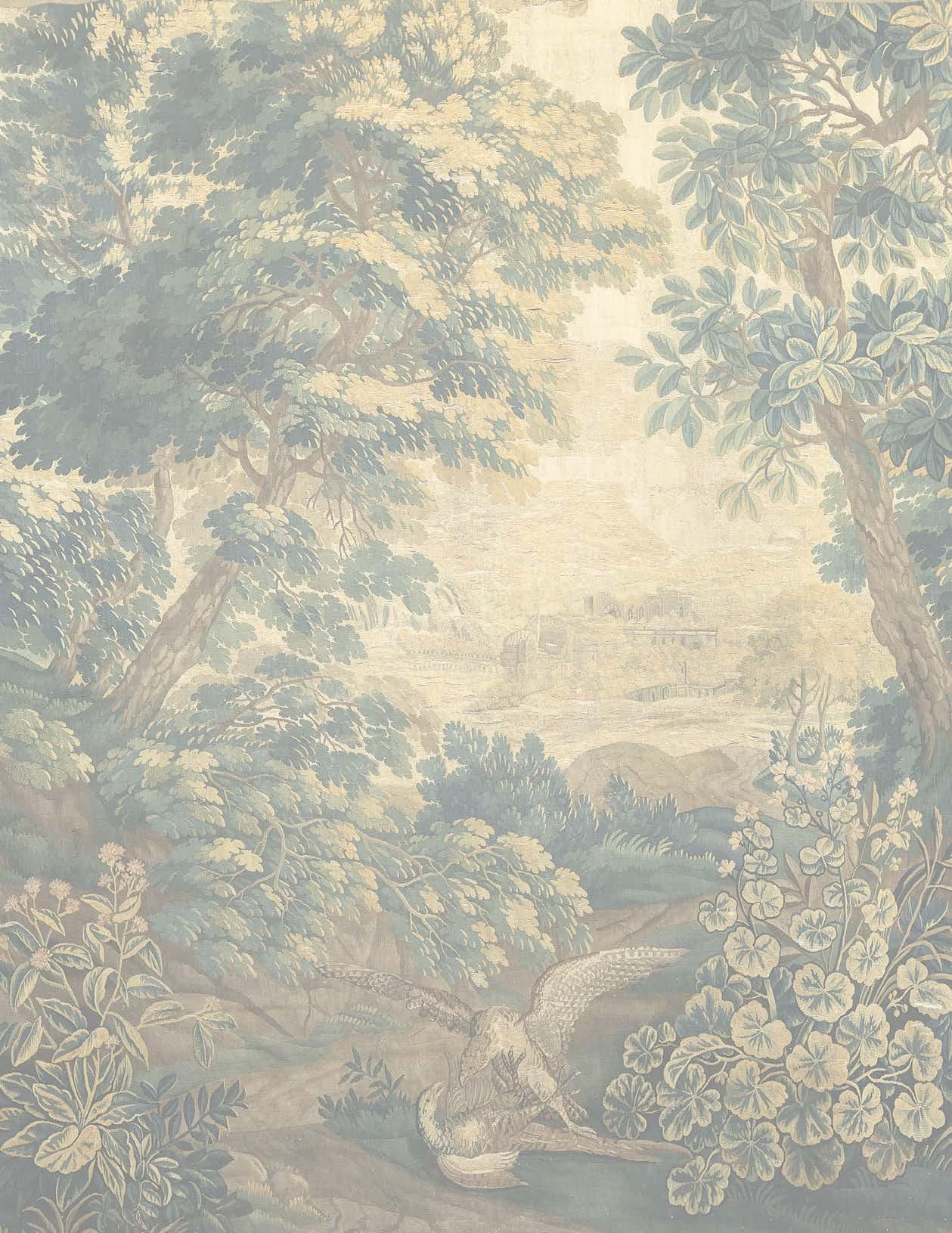
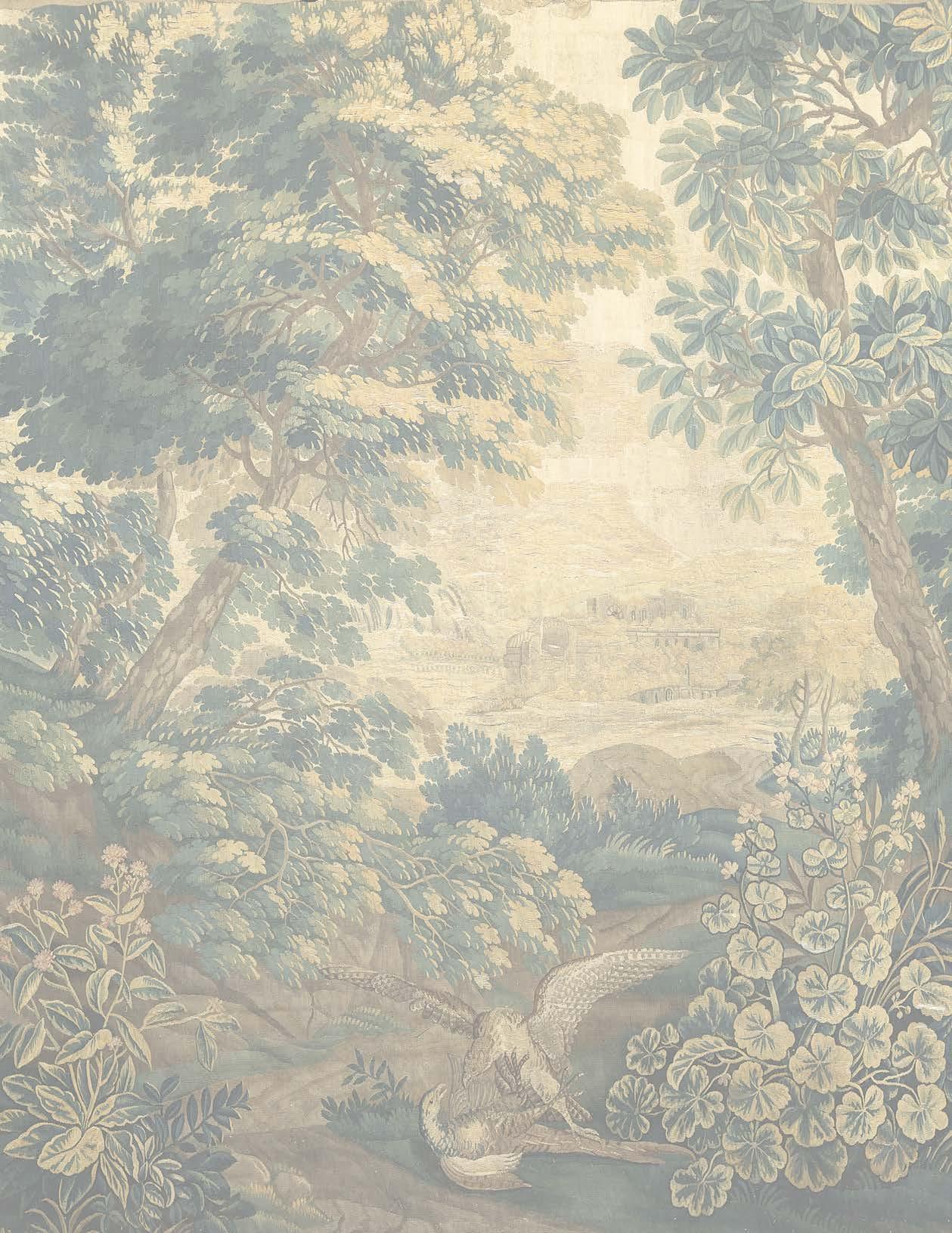
A large late 17thcentury Aubusson verdure tapestry panel, French, circa 16801700
Woven in wool and silk, depicting a richly wooded landscape with tall, leafy trees framing a distant view of architectural buildings set amidst rolling hills, in the foreground a dynamic hunting vignette unfolds; a hawk descends upon a game bird, probably a pheasant or peahen, amidst abundant flowering plants and verdant foliage, the outer border of scrolling acanthus leaves and foliate strapwork, enriched with classical ornament.
This tapestry exemplifies the celebrated verdure tradition of the Aubusson workshops, whose productions were prized throughout Europe in the late 17th century for their atmospheric evocations of nature, often balanced with narrative and/or allegorical detail. The careful graduation of greens, yellows, and blues reflects the subtle shading techniques developed by Aubusson weavers, creating depth and perspective, while the inclusion of architectural elements in the background adds a sense of grandeur and idealised landscape.
H 291cm, W 251.5cm
£600800
5
6
A mid16th century brass alms dish, Nuremburg, Germany, circa 1550
Having a central boss encircled by bold lobed and foliate decoration, within an inscribed band of ‘Gothic’ script, the rolled outer rim with a finely punched repeating floral motif.
Dia 40.5cm
£150200
A mid17th century bronze cauldron, South German, circa 164060
Of bulbous form, with everted rim and angular lug handles, on three robust rounded and splayed legs.
H 28cm, W 33cm
£100150
8
A group of four Victorian pewter footed measures, halfpint, Birmingham, circa 186265
Each having a straightsided drum with slightly flared rim, and hollow single strap handle, on a circular spreading foot, various verification marks to rim, all stamped T & J Birch (PS713) together with four pieces of pewter sadware including a plain rim dish, in the 18th century manner, a single reed example, English, circa 1750, a plain rim plate and a European singlereed bowl, with touchmarks, circa 1700. (8)
Dia 40.6 cm largest
£80120
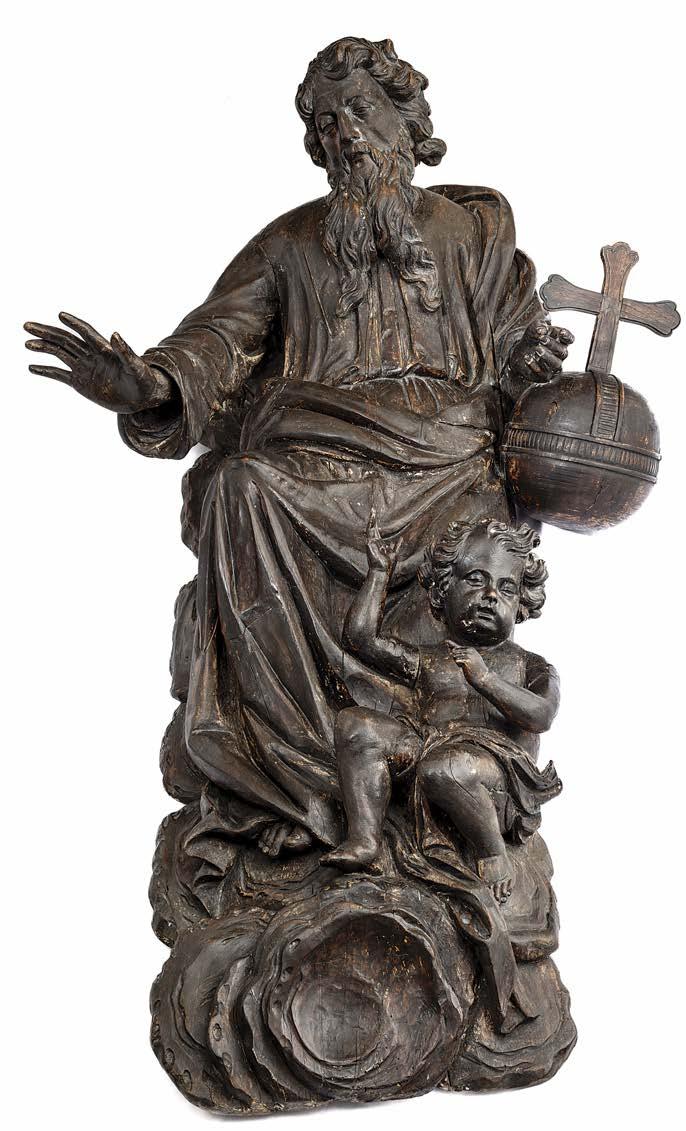
A monumental and impressive limewood mural figure of God the Father, Flemish, circa 160050 Modelled to hang on a wall, seated amidst swirling clouds, carved with majestic scale and expressive naturalism, His right hand raised in blessing, while his left holds the globus cruciger, the orb and cross symbolising divine sovereignty over the world. At his feet sits a child figure, likely representing the infant Christ or an allegorical soul, linking the work to the iconography of the Throne of Grace (Gnadenstuhl), where God the Father presents or supports Christ within the Holy Trinity.
The deep folds of the drapery, flowing beard, and commanding gesture reflect the monumental sculptural language of late Renaissance, early Baroque, Flemish church carving. Executed in limewood, a favoured material for largescale ecclesiastical figures due to its fine grain and lighter weight, this figure was almost certainly created for a major religious setting, possibly crowning an altarpiece or positioned high within a chapel interior.
H 141cm, W 76.2cm, D 43.2cm
£2,0003,000
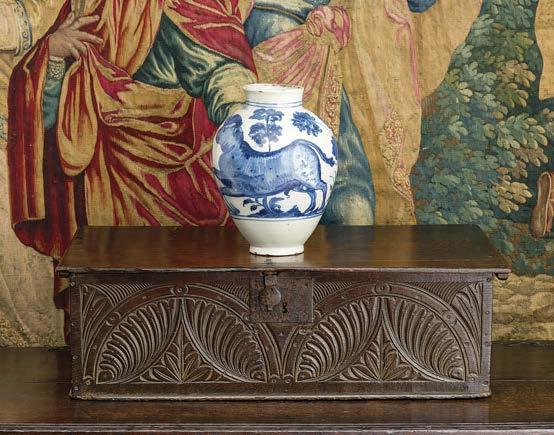
A Charles II carved oak boarded box, Somerset, circa 1670
The front boldly carved with paired lunettes, each filled with radiating foliate motifs, iron lockplate, the hinged lid with simple moulded edge.
H 23.5cm, W 76cm, D 40.6cm
£200300
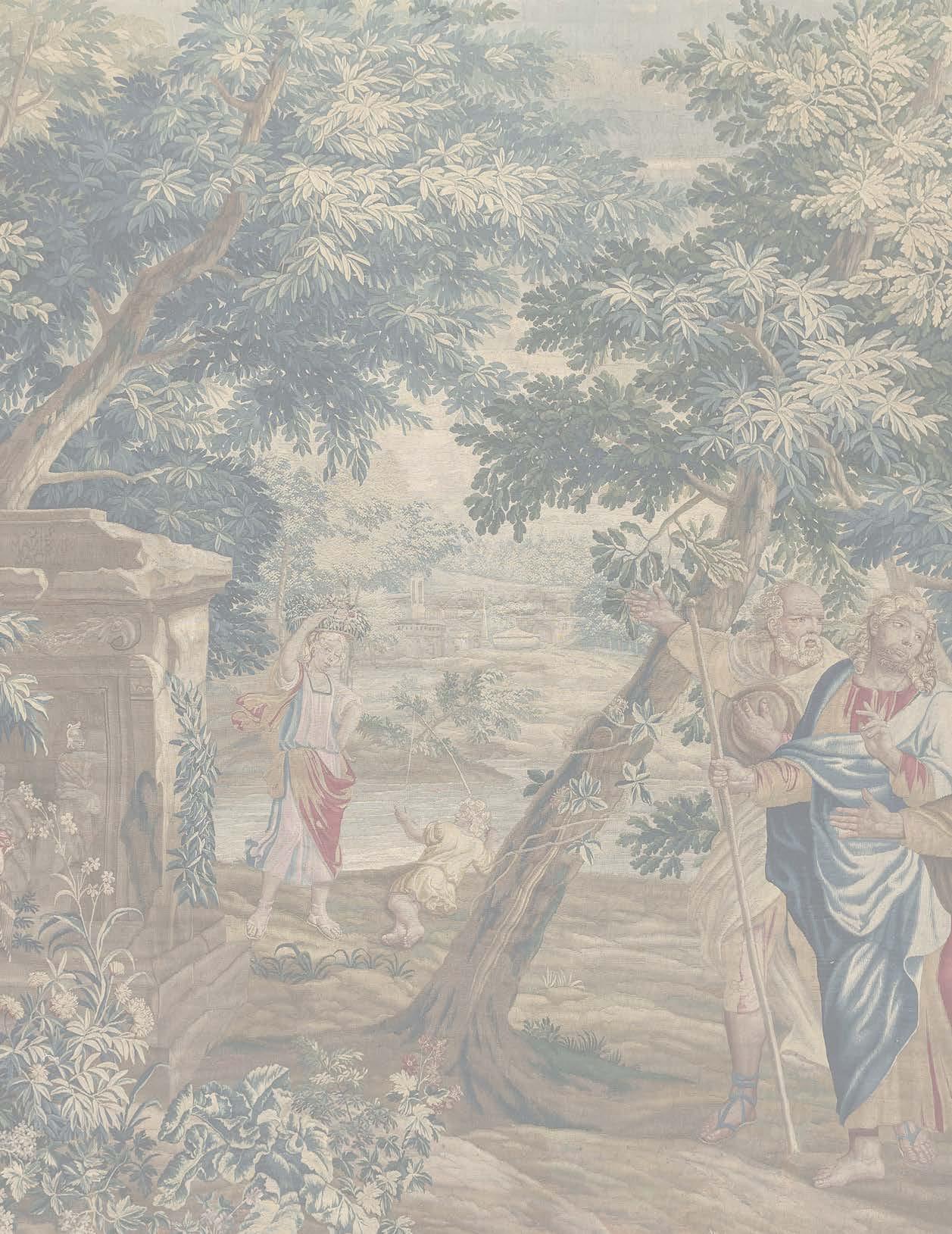
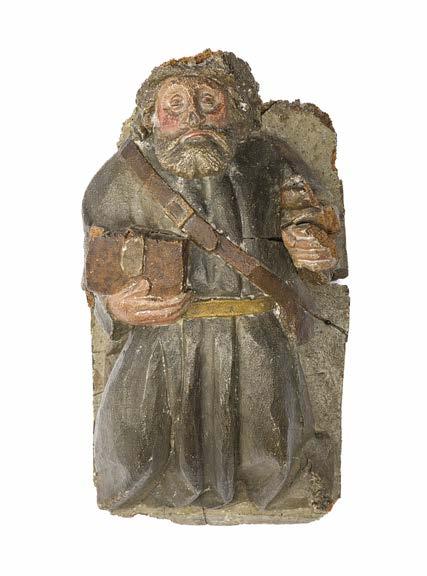
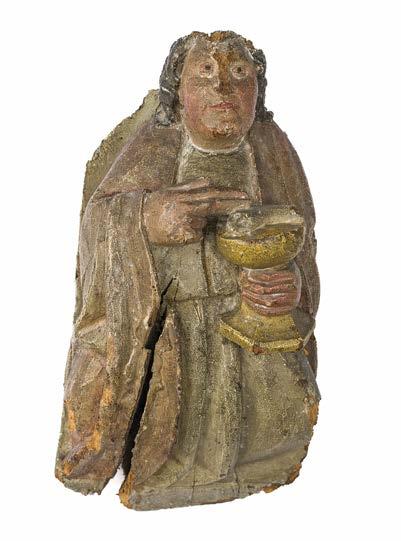
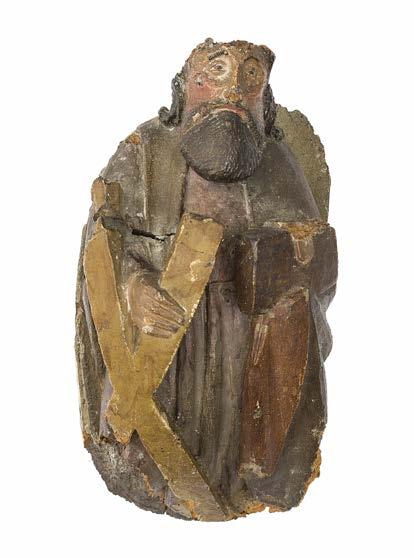
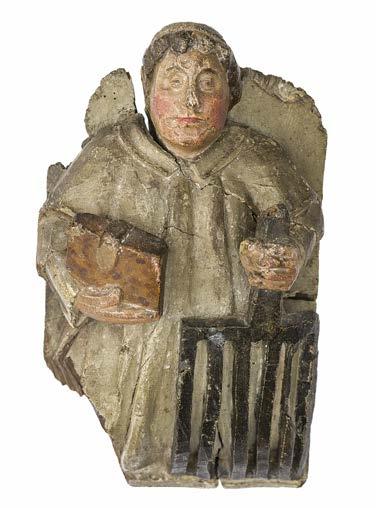
An important set of four 15th century oak and polychromedecorated figural corbels, East Anglia, circa 14501500
Carved as individual saints St James the Greater, shown with pilgrim’s staff and book; St Andrew, with the diagonal saltire cross upon which he was martyred; St John the Evangelist, shown with the chalice from which a serpent emerges, symbolising both his endurance of attempted poisoning and his role as witness to the mysteries of the Eucharist; and St Lawrence, recognised by his gridiron, the instrument of his martyrdom in Rome under Emperor Valerian. Each figure is rendered in halflength relief, designed to project architecturally as structural or decorative corbels within a sacred space, most likely a church choir or chapel. Stylistically, the corbels embody the late Gothic naturalism of the 15th century, with expressive faces, strongly modelled drapery, and bold attributes carved to be clearly visible from below. (4)
The iconography reflects the central themes of pilgrimage, martyrdom, evangelism and the Eucharist — the very pillars of late medieval Christian devotion. Their survival together as a complete set is of particular importance, as most English Gothic sculpture was lost or defaced during the Reformation and subsequent iconoclasm of the 16th and 17th centuries.
H 38.8cm, W 19cm, D 20cm
£8,00012,000
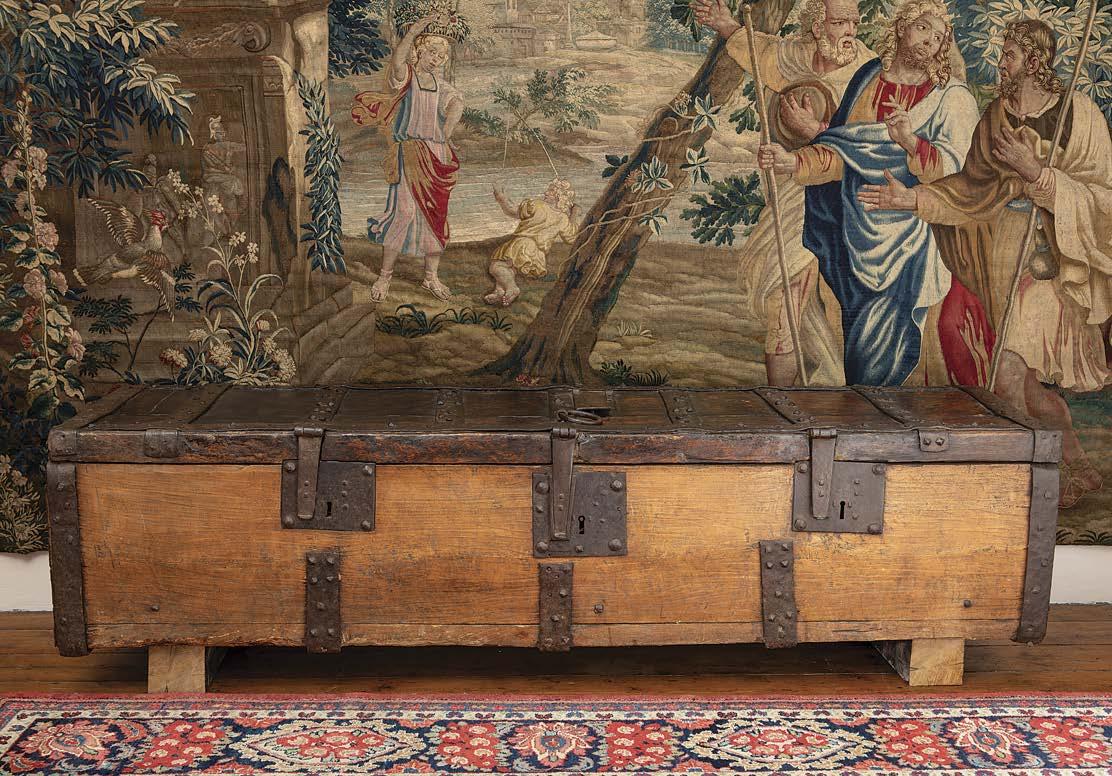
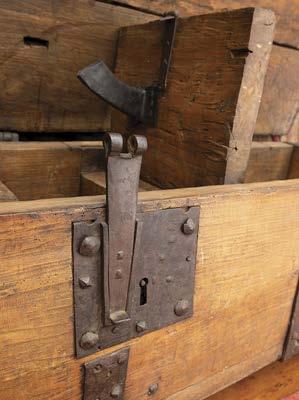
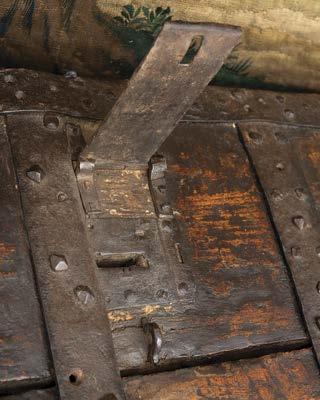
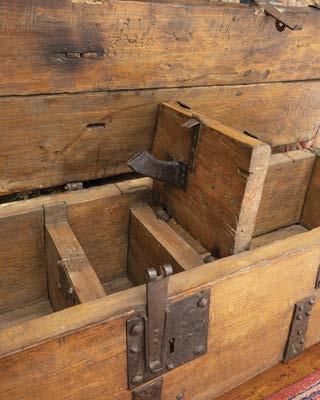
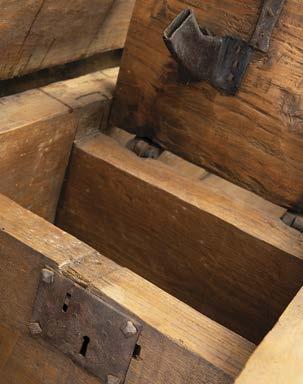
A very rare Medieval boarded elm and iron bound chest, English, circa 1300
The timbers being an impressive 6.3cm thick throughout, and bound with heavy wrought iron straps and mounts, the lid is hung on five large iron strap hinges and further strengthened by ironwork across the boards, centred by a large wrought iron ring handle, three lock plates are positioned across the front, allowing multiple custodians to hold separate key, ensuring security and accountability. The interior retains its central compartmentalised till with hinged lid, iron lock and money slot, an original feature for the secure storage of coins and smaller valuables.
The robust boarded construction and extensive ironwork suggest the chest was designed for institutional or communal use, such as in a Church, Guild Hall, or Monastic Treasury. Comparable examples are recorded at driptray St Bartholomew’s Church, Munsley, Herefordshire (dugout 13th century), Cradley Church Herefordshire and Messing Church, Essex.
Chests such as these were among the most important and prevalent forms of medieval furniture, serving as secure containers for vestments, sacraments, alms, and crusade funds. Constructed from oak or elm and rendered almost immovable by their size and weight, they provided security against thieves and vermin. Wealthy households also entrusted their valuables to such chests, believing the sanctity of the church would safeguard their contents.
Provenance: Parisian collection for the last 50 years.
H 48.2cm, W 217.2cm, D 55.9cm
£8,00012,000
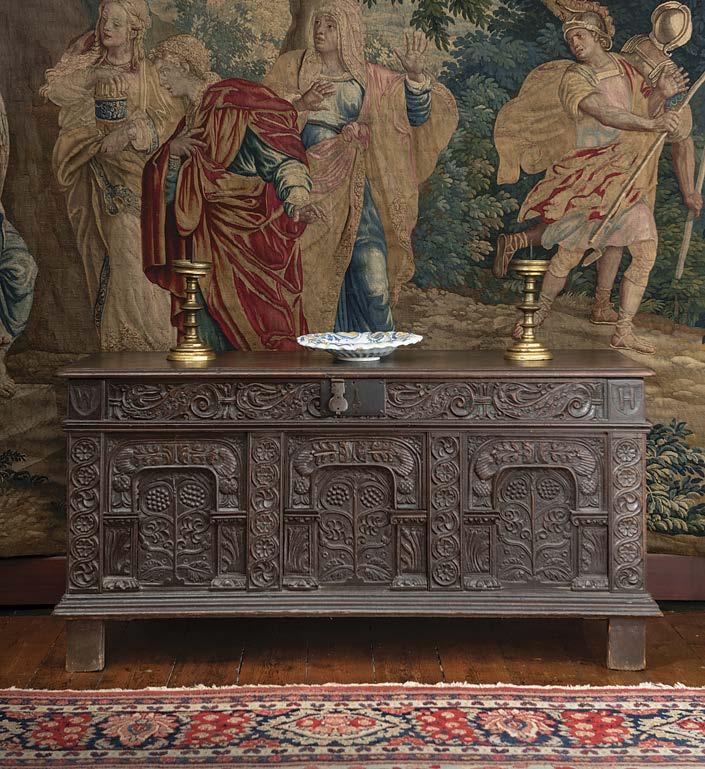
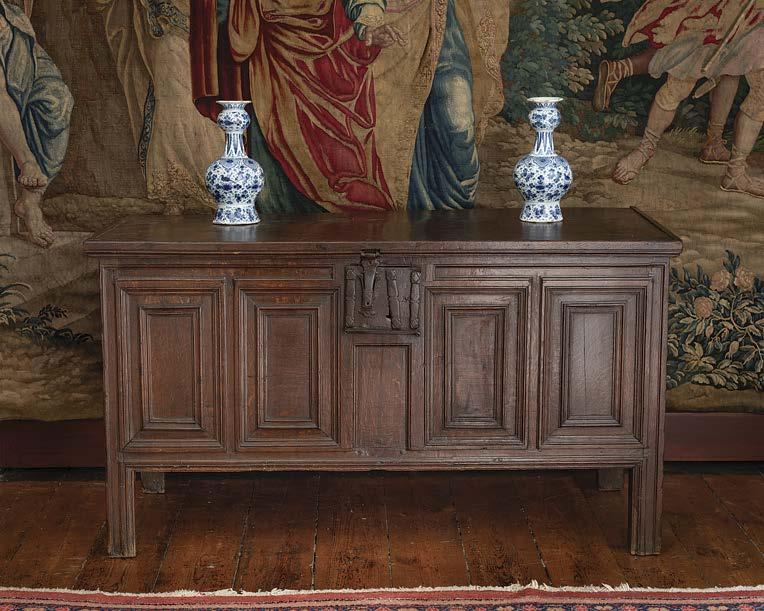
A Charles I joined oak and richly carved coffer, Gloucestershire, circa 1640
The front of three arcaded panels, each enclosing bold botanical motifs, with guillochecarved stiles, the frieze top rail profusely carved with scrolling dragons and foliage, extending to the sides, the lower rails are set with applied mouldings, the initials ‘W H’ crisply cut into the upper corners, suggesting a direct commission for a prominent Gloucestershire household.
This chest exemplifies the distinctive decorative vocabulary of early 17thcentury Gloucestershire workshops, often centred in the Severn Valley and Forest of Dean. The exuberant dragons, guilloche, and arcaded panels are typical of the region.
H 77.8cm, W 157cm, D 61cm
£600800
14
A mid16th century joined oak coffer, English, circa 1550
The singleplank lid having a moulded front edge and original iron hasp staple, the front composed of a series of rectangular fields within ovolomoulded muntins and rails, centred by an original wroughtiron lockplate of Gothic outline with pierced and chiselworked detail, secured by roseheaded nails, on extended stile supports.
H 73.6cm, W 132cm, D 54.6cm
£600800
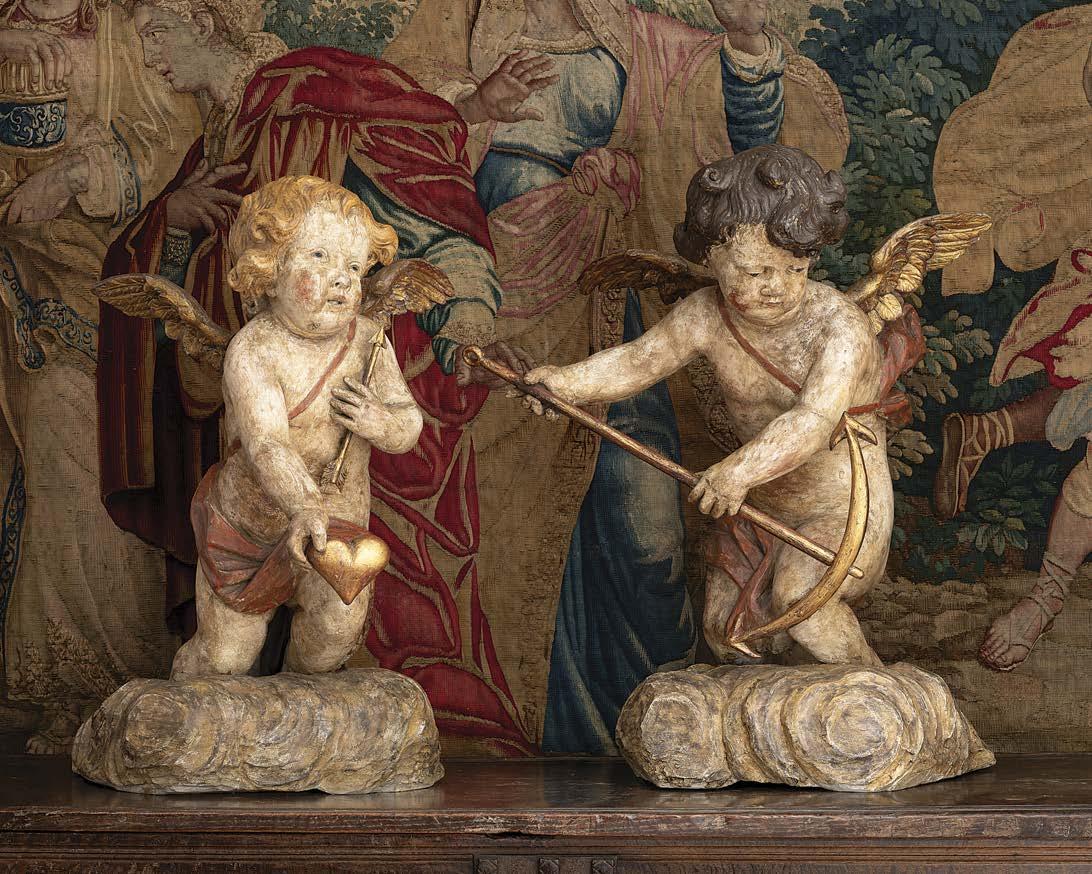
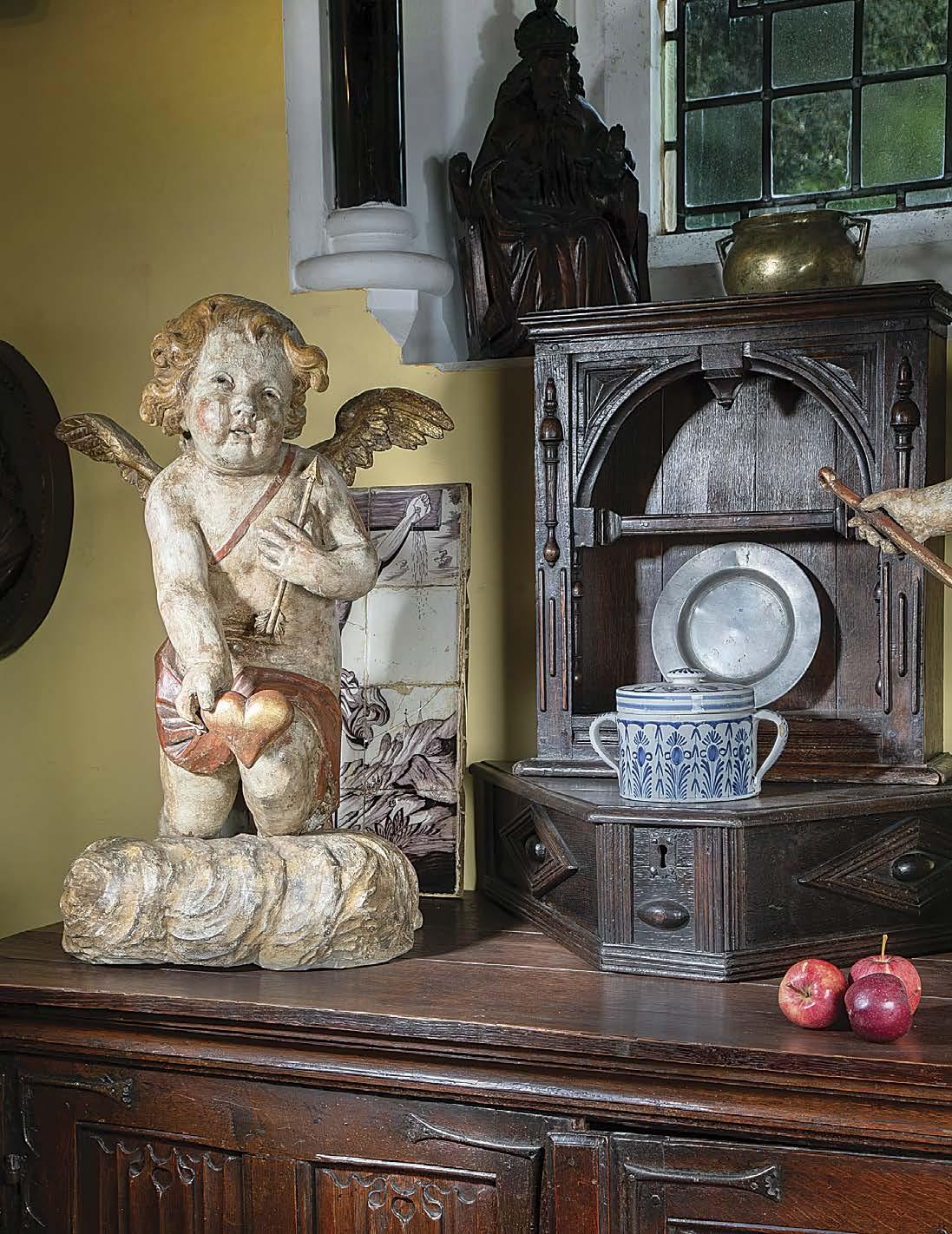
A monumental pair of 17th century polychromedecorated and gilded putti, Italian, circa 164070
Each depicted standing upon naturalistic cloud bases, their carved and gilded wings outstretched. One, a blondhaired putto, holds a gilded heart and arrow; the other, with dark hair, supports a large anchor, both wear reddraped loincloths and retain extensive areas of original polychrome and gilding. (2)
These imposing sculptures reflect the exuberant Baroque language of the 17th century, when angelic figures of this scale were commissioned for major ecclesiastical settings, most likely as components of a larger altarpiece, tabernacle, or funerary monument. Their attributes identify them with two of the Theological Virtues Charity (the heart) and Hope (the anchor). Such allegorical imagery was central to Catholic CounterReformation art, intended to inspire devotion through vivid, monumental personifications of core virtues.
H 73cm, W 43.2cm, D 40.6cm
£3,0005,000
A substantial pair of 19th century giltmetal pricket candlesticks, in the Baroque manner
Each with flattenedurn shaped drippan and tall pricket, the leafwrapped tapering stem above a bulbousknop enriched with winged cherub masks, on a triform base, again with cherub mask decoration, on paw feet. (2)
H 70.5cm, D 20cm
£100200
17
A Karabagh runner, South Caucasus, circa 1910
The steel grey field with diamond medallions enclosed by ice blue borders and floral guard stripes.
L 170.5cm, W 97cm
£80120
18
A Karabagh runner, South Caucasus, circa 1900
The field of ‘Memling’ guls enclosed by borders of stellar devices and barber poles.
L 295cm, W 88cm
£100200
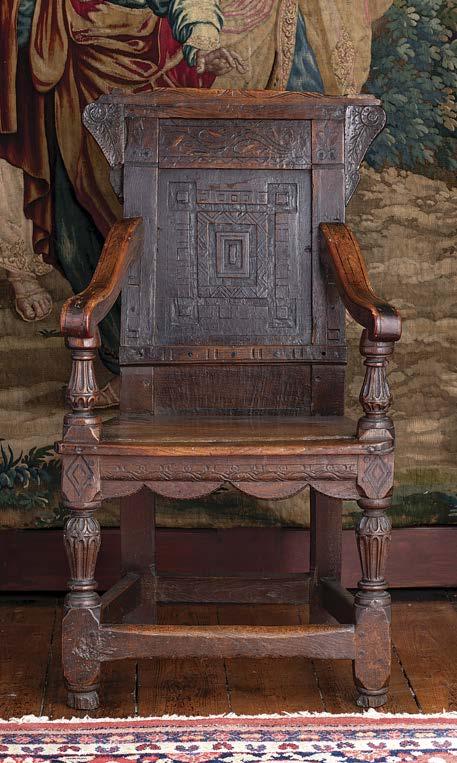
An Elizabeth I oak and fruitwood inlaid open armchair, circa 1580
The back carved with bold geometric panels and strapwork, topped by a scrolled cresting, the fruitwood shaped arms on carved and turned supports with elongated gadrooning, repeated on the front legs, all seat rails, including the rear, of cusped profile, inlaid decoration to the back top rail and inlaid lozenges to the front leg blocks, the reverse side of the back top rail is carved with gadrooned ornament, demonstrating the chair was intended to be admired from all angles, standing on block feet joined by stretchers.
H 113cm, W 62.2cm, D 43.2cm
£1,8002,200
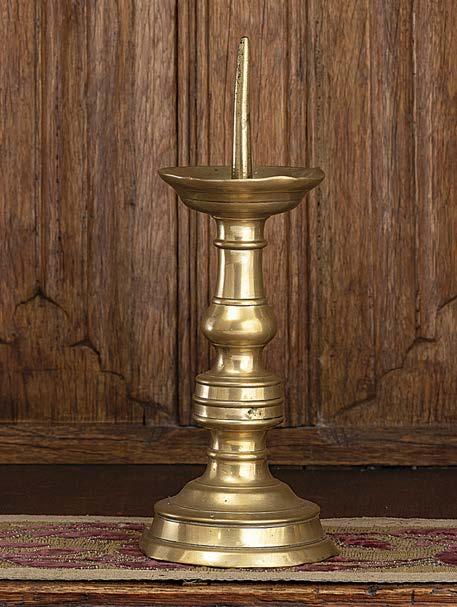
A 16th century brass pricket candlestick, Nuremburg, circa 15501600
Having a stepped circular base, bold balustroid and ringed stem and broad drippan supporting a tall pricket.
Candlesticks of this type were used in both ecclesiastical and domestic settings, their solid construction and balanced proportions ensuring stability when supporting tall beeswax candles.
H 29.2cm, W 11.4cm
£400600
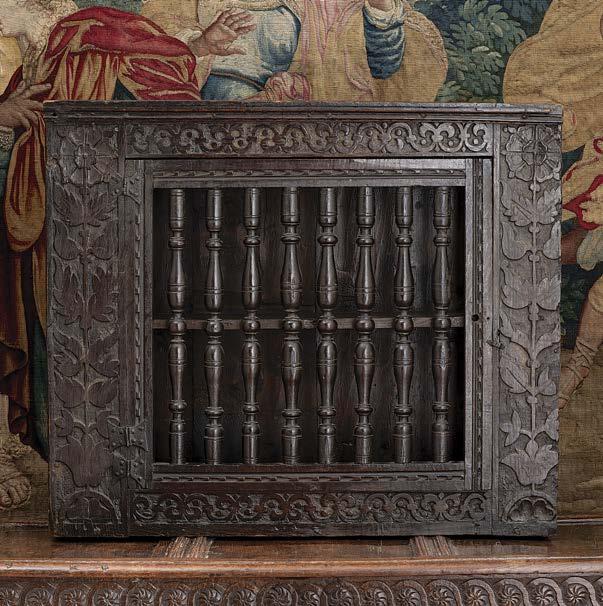
A Charles I boarded oak and spindlefilled livery wall cupboard, West Country, circa 1640
The single door with eight balusterturned spindles, within a gaugecarved frame, each end upright carved with a single flowering stem, single interior shelf.
H 75.5cm, W 90cm, D 19.5cm
£1,8002,200
A delftware polychromedecorated lobed dish, Dutch, circa 170050
Painted in blue and yellow, centred by an exotic bird and large floral stems, the shaped rim with alternate stylized flowerheads, including tulips, all executed in a distinctive naïve hand.
Dia 35cm
£200300
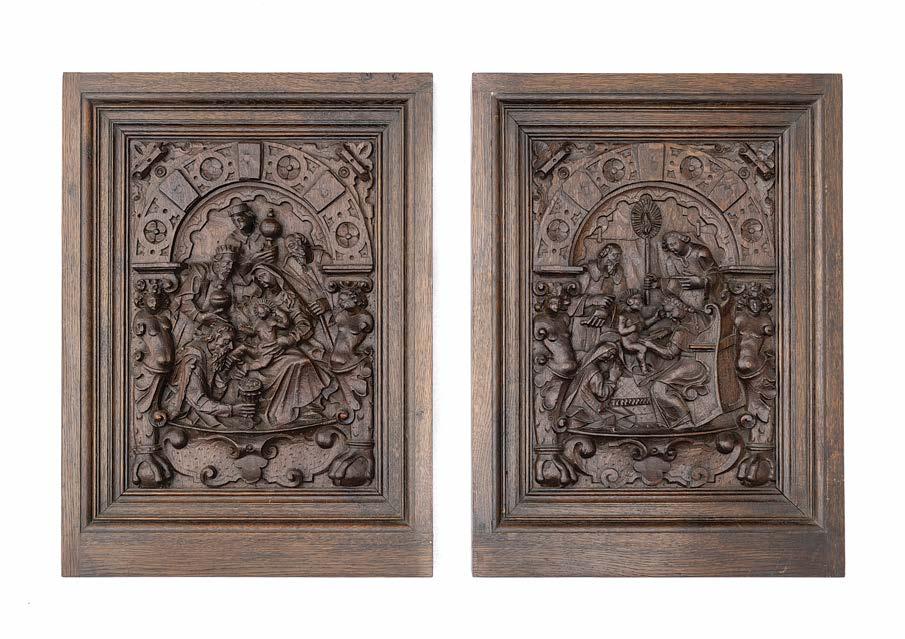
A good pair of mid16th century carved oak panels, Flemish or Dutch, probably Antwerp or possibly Mechelen, circa 154060
Each rendered in exceptionally high relief, depicting a biblical scene beneath a finely detailed arched niche, one the ‘Adoration of the Magi’, the other ‘Presentation in the Temple’, both framed by exuberant strapwork, volutes, and caryatid terms, framed. (2)
The scenes recall the contemporary ornament prints of Cornelis Floris de Vriendt (1514–1575) and Hans Vredeman de Vries (1527–1606).
The high technical refinement, subtle undercutting, and expressive modelling align these works with the production of the Antwerp workshops, whose reliefs were exported across Europe for integration into domestic furniture, choir stalls, and devotional cabinets. Comparable panels are held in the Rijksmuseum, Amsterdam, and the Museum Mayer van den Bergh, Antwerp, with many attributed to the circle of Jan van Steffeswert and the Floris School.
Provenance: Wernigerose Castle, Harz Mountains, SaxonyAnhalt, Germany.
H 54.4cm, W 44cm, D 2.5cm
£600800
24
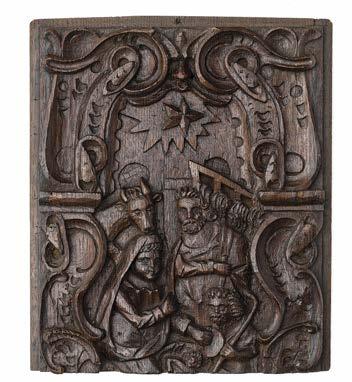
A late 16th century carved oak panel, The Nativity, Netherlands or Northern Germany, circa 15801600
At the centre the Virgin Mary is shown kneeling in adoration beside the Christ Child, accompanied by Joseph, with the ox and ass in the background, above shines the Star of Bethlehem, guiding the shepherds who gather in witness, the scene is framed by bold Renaissance scrollwork enriched with foliate ornament, lending a sense of architectural grandeur to this intimate devotional subject.
This panel could be produced for private devotion, often forming part of domestic altarpieces or triptychs. The present example retains a remarkable level of detail and iconographic clarity, reflecting the enduring popularity of the Nativity as a focus of Christian meditation and worship.
Provenance: Wernigerode, Harz Mountains, SaxonyAnhalt, Germany.
H 31cm, W 26.5cm
£100200
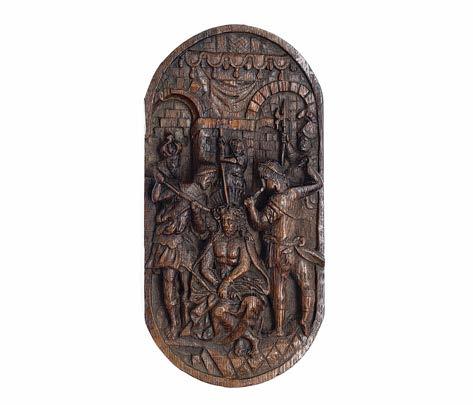
A late 16th century carved oak panel, Flemish, circa 15801600
Depicting the Mocking of Christ, seated at the centre Christ is crowned with thorns and draped in a robe, while Roman soldiers taunt him with a reed sceptre and blows to the head, the architectural backdrop of brickwork arches and draped canopy enhances the theatricality of the scene.
This episode from the Passion narrative, in which Christ is derided as ‘King of the Jews’, was central to late medieval and Renaissance devotion. Believers were encouraged to meditate upon Christ’s humiliation and endurance, recognising in the reed sceptre and crown of thorns a profound paradox — symbols of mockery that simultaneously affirm his true kingship.
Provenance: Wernigerode Castle, Harz Mountains, SaxonyAnhalt, Germany.
H 29.2cm, W 14.6cm
£300400
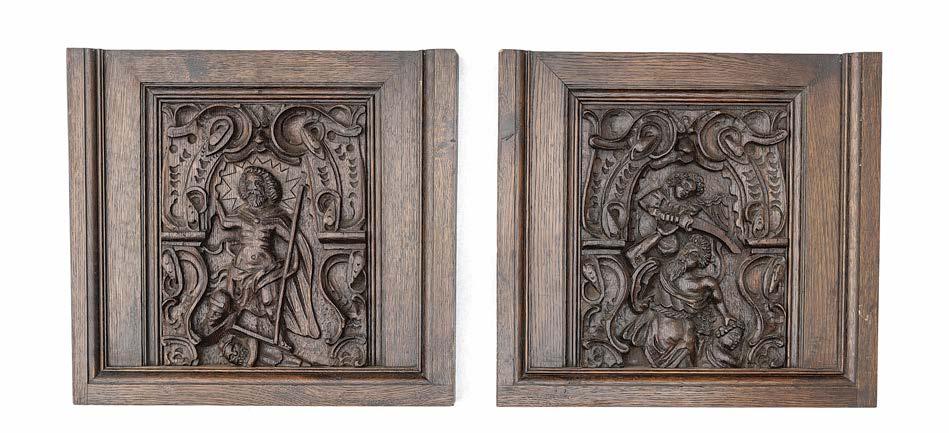
A pair of 16th century carved oak panels, Antwerp or Northern Netherlands, circa 15501600
Relief carved on quartersawn oak, set within an early but later moulded frame, the animated narrative scenes contained by dense strapwork and foliate grotesques in the full Northern Renaissance manner. One depicts the Resurrection of Christ, the nimbate Christ holding the vexillum (crossstaff with banner), steps from the tomb while two sleeping/overthrown soldiers lie beneath. The other depicts an Old Testament hero in combat (probably Samson; compare the muscular bearded figure and attendant putto) overcoming an adversary. (2)
The vigorous modelling, crisp drill work to the ornament and the characteristic amalgam of figure subject with scrolling auricular and strapwork ornament points to a Netherlandish workshop in the second half of the sixteenth century.
Provenance: Wernigerode Castle, Harz Mountains, SaxonyAnhalt, Germany.
H 40.7cm, W 44.5cm
£400600
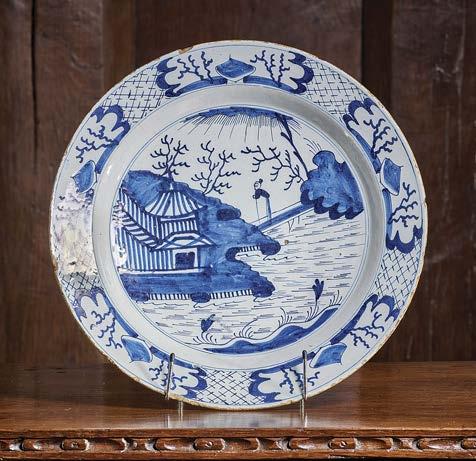
A mid18th century delftware charger, Dutch, circa 174060
Painted in cobalt blue with a chinoiserie riverside scene, at the centre a pavilion stands beside a rocky outcrop, with trees in bloom and a figure crossing a narrow bridge, the rim decorated with alternating diaper trellis panels and stylised foliate motifs, all inspired by contemporary Chinese kraak porcelain.
Dia 34.5cm
£100200
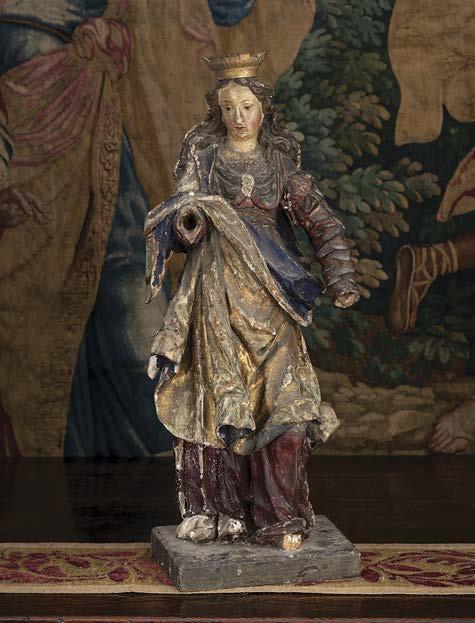
A 17th century carved polychromedecorated figure, The Crowned Virgin Mary, Spanish, Castile or Seville, circa 165080
Standing with a graceful sway, the Virgin’s elongated proportions and flowing drapery emphasize both dignity and movement, the rich polychrome of contrasting gilded folds with deep blues and reds highlights her dual role as Queen of Heaven and intercessor for the faithful.
The crowned Virgin was a central theme in Spanish Baroque sculpture, shaped by the dictates of the Council of Trent, which encouraged vivid and accessible imagery to inspire devotion. Figures such as this would originally have occupied niches in parish retablos or convent settings, where they provided a focus for prayer and veneration.
Her crown, though simply executed, affirms her status as Regina Coeli (Queen of Heaven), while the expressive handling of her garments and her gentle, idealised features link her to the Sevillian and Castilian workshops of the mid17th century.
H 61cm, W 22.3cm, D 16cm
£300500
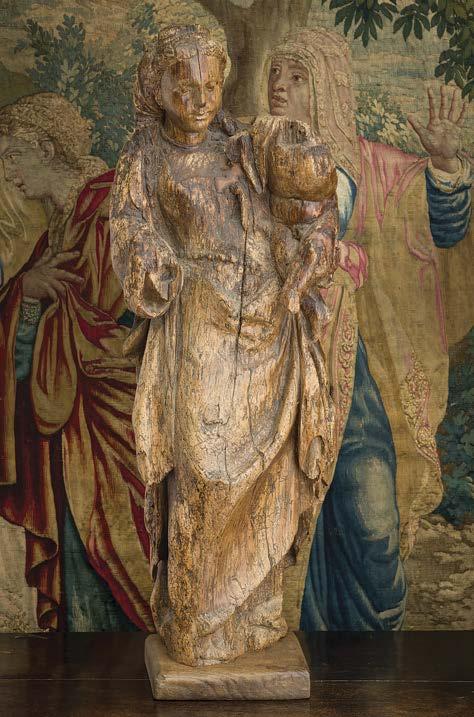
A late 15th century large oak figure, The Virgin and Child, French, circa 1500
The Virgin is shown standing in contrapposto, her figure enveloped in flowing drapery which falls in heavy, angular folds. She supports the Christ Child upon her left arm, the infant’s form nestled close to her body in a gesture that emphasises both maternal intimacy and sacred symbolism.
The softened contours of the Virgin’s face, the delicate treatment of her hair, and the rhythmic fall of her robe are characteristic of the transition from the austerity of earlier Gothic to the gentler, more humanised devotional imagery of the early Renaissance.
Works such as this would have stood in parish churches or private chapels, serving as the focus of Marian devotion. As the most popular devotional subject of the period, embodying both theological meaning, the Incarnation of Christ, and an accessible image of maternal care and protection.
Comparable examples of French Gothic Madonna’s, particularly from Burgundy and the Loire Valley, display the same emphasis on naturalism in the drapery and tenderness of the motherandchild grouping.
H 97.8cm, W 33cm, D 20.3cm
£8001,200

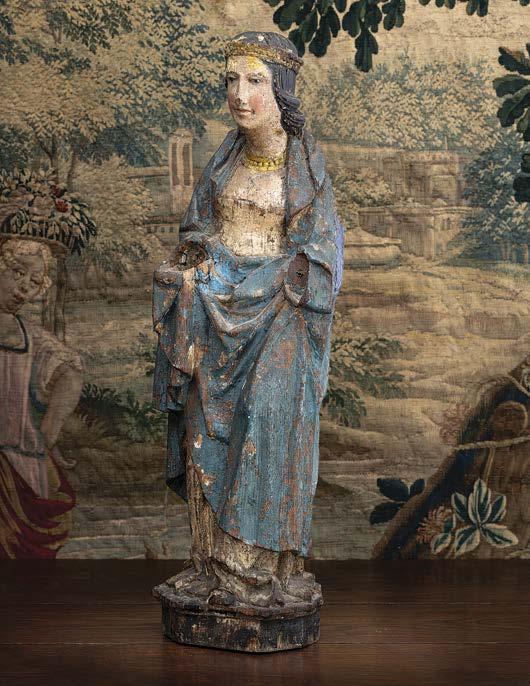
A late 15th century carved oak and polychrome figure, Netherlands, circa 14801500
Designed as a crowned female saint standing upon a circular base, wearing a long mantle painted in blue over a gown formerly enriched with gilding, her serene expression framed by softly curling hair beneath a gold crown, lacking hands.
The presence of a crown suggests an identification with one of the virgin martyrs of noble birth, most plausibly St Catherine of Alexandria, but also possibly St Barbara or St Margaret.
Possibly produced as part of a larger altarpiece, this carving demonstrates the refined naturalism of Netherlandish Gothic art in the decades around 1500, where an emphasis on elegance of pose and delicacy of expression was combined with a richly polychromed surface to heighten devotional impact.
H 75.5cm, W 90cm, D 18.5cm
£8001,200
31
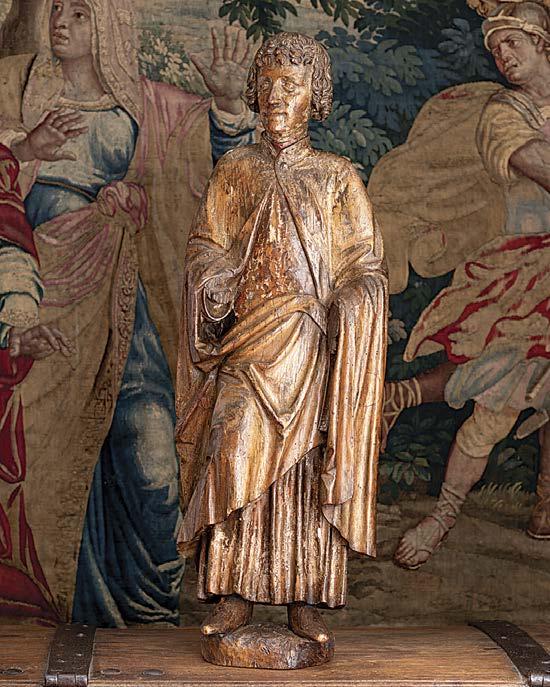
A large walnut figure, St John the Evangelist, Netherlands, circa 14801500
Retaining traces of original polychrome, the youthful apostle is depicted cleanshaven, with curling hair and long flowing robes, his right hand raised as if to hold a chalice or book, both traditional attributes associated with his role as Evangelist and visionary author of the Apocalypse.
This imposing figure was likely created for an altarpiece or church setting, where it would have formed part of a larger group of Apostles. The rhythmic folds of the drapery, the sensitive modelling of the face, and the elegant contrapposto stance reflect the refinement of Netherlandish carving at the transition from the Gothic to the early Renaissance.
H 89.5cm, W 29.9cm, D 12.7cm
£600800
32
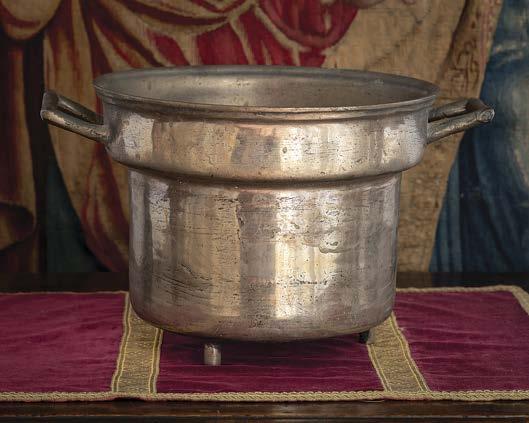
A large bronze cauldron, circa 17001800
Of deep cylindrical form, with a broad everted rim and slightly waisted body, on three integral ‘peg’ feet and fitted with heavy, rectangularsection handles. Near one handle is a cast monogram probably ‘RM’.
H 24.8cm, W 31.2cm
£100200
33
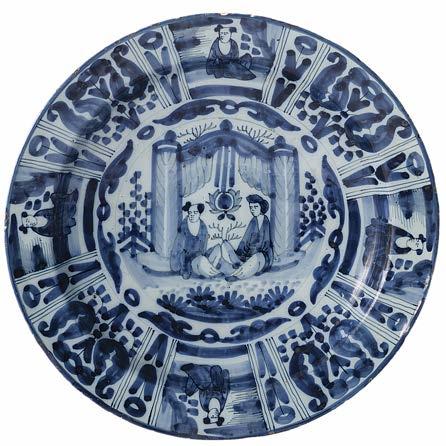
A delftware charger, Dutch, circa 16801720
Decorated in cobalt blue in imitation of Chinese Kraak porcelain of the Wanli period (1573–1620), designed with two seated figures within an architectural setting composed of paired columns beneath a draped canopy, stylised foliage and lotuslike motifs between them, the rim divided into radiating panels, alternately painted with small figural reserves and stylised vegetal motifs.
Following the collapse of direct imports from China during the mid17th century, Dutch potters at Delft adapted the segmented decorative schemes of Ming porcelain to their own medium of tinglazed earthenware. Whilst closely echoing Chinese wares, the figures themselves are interpreted with a more European sensibility.
Dia 33.5cm
£100200
34
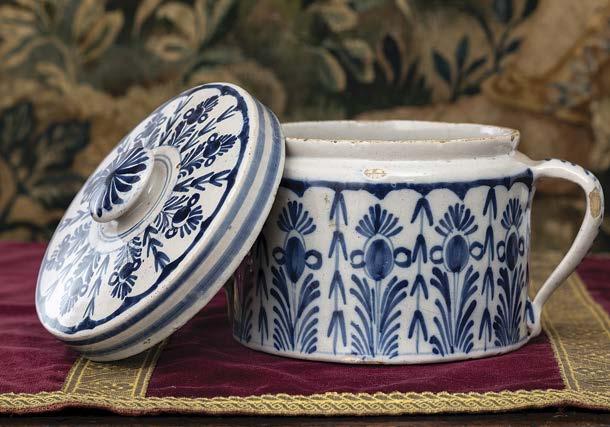
A delftware covered pot, Dutch, circa 17001720
Of cylindrical form with single loop handle and knopped domed lid, decorated in vertical repeats of stylised floral sprays with oval medallions, with a scalloped arcaded border. Such covered pots were versatile domestic vessels, used at table for serving small dishes, custards, or possets.
H 14cm, W 22.4cm
£100150
35
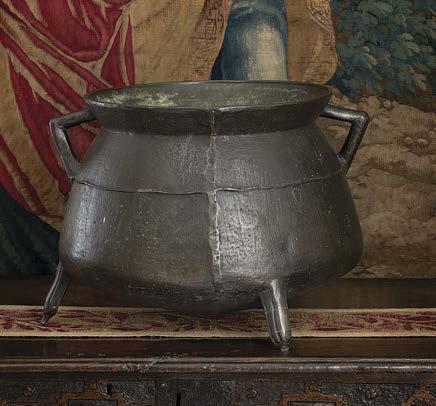
A large Charles I leaded bronze cauldron, attributed to the Sturton Foundry, South Petherton, Somerset, circa 1640
Cast with upright angular handles, bulbous body, and three splayed feet. This cauldron bears the characteristic seam lines and proportions typical of Sturton production in the mid17th century. The Sturton family were among the most prolific provincial founders of the period, their products distributed widely across the West Country and beyond as noted by Roderick Butler and C.Green in ‘English Bronze Cooking Vessels and Their Founders’, p.101.
H 33.6cm, Dia 45.7cm
£200300
36
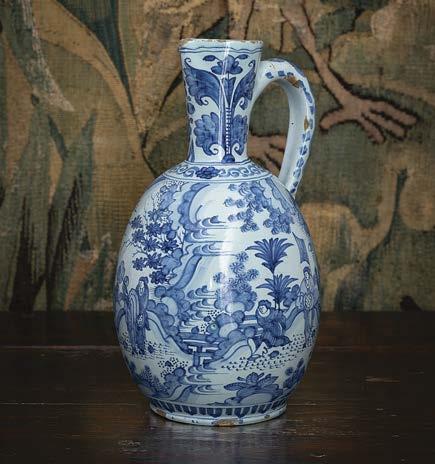
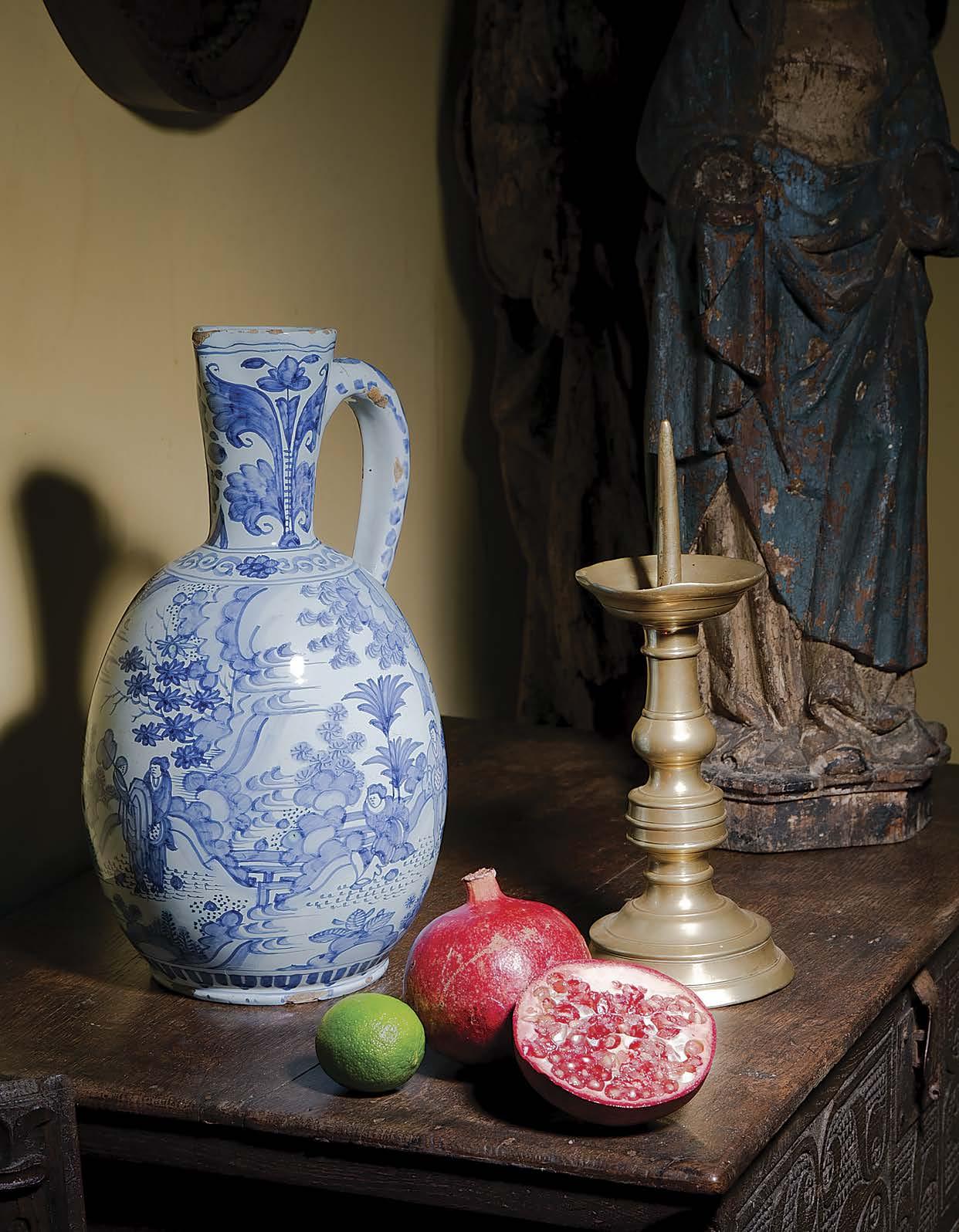
A large delftware ewer, Dutch, circa 17001750
The tinglazed earthenware painted in cobalt blue, of elongated pearshape, with tall neck and loop handle, decorated with a continuous Chineseinspired garden scene, showing figures amongst rocks, trees, and pavilions, beside a flowing river and stylised waterfall, bordered at the base with vertical lappets and around the neck with a floral and scrollwork frieze, the handle painted with dotted foliate motifs.
H 33.6cm, W 17.8cm
£400600
37
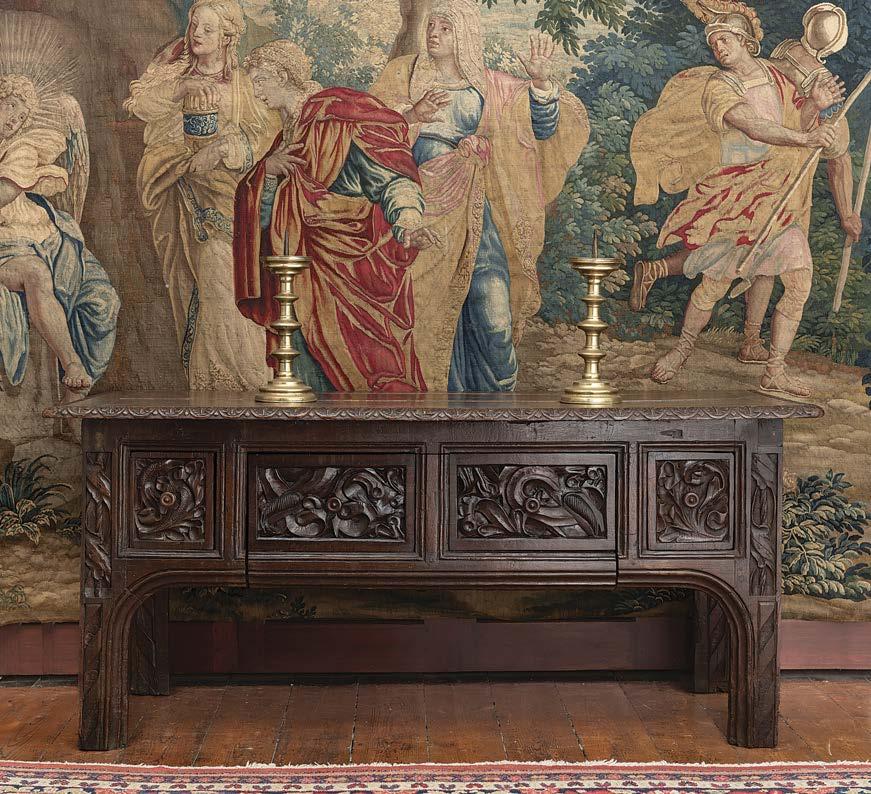
A Henry VIII counter table, circa 152040 and later Carved on both the front and reverse with bold scrolling foliage executed in high relief, with linenfold side panels to the ends, the table retains its original carved panels and stiles, the top replaced in the 19th century, almost certainly at the same time three drawers were introduced to the front, cut directly from the original framing and panels, the underside shows grooves where the original base boards were set.
H 78.1cm, W 172.7cm, D 77.5cm
£8001,200
38
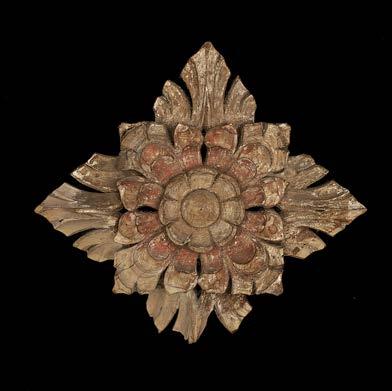
A rare Henry VII/VIII limewood roof boss, probably Exeter, circa 14851520
Finely carved and retaining vestiges of the original painted and gilt surface, modelled as a naturalistic Tudor rose, the dynastic emblem of Henry VII and the unification of the Houses of York and Lancaster.
Provenance: By repute removed from Exeter Cathedral following bombing during 1942, after which many fittings and fragments were dispersed.
H 33cm, W 32.5cm, D 5cm
£500800
39
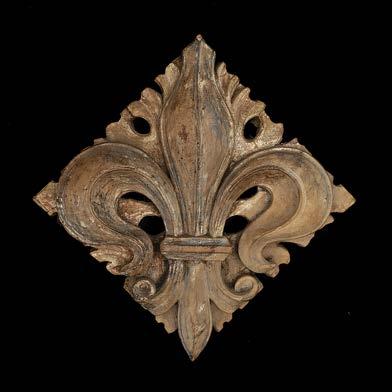
A rare Henry VII/VIII limewood roof boss, probably Exeter, circa 14851520
Finely carved and retaining vestiges of the original painted and gilt surface, modelled as a fleurdelys, emblematic of The Virgin Mary and long associated with the Royal Arms of France, a device still quartered by the Kings of England during this period
Provenance: By repute removed from Exeter Cathedral following bombing during 1942, after which many fittings and fragments were dispersed.
H 33cm, W 32.5cm, D 5cm
£500800
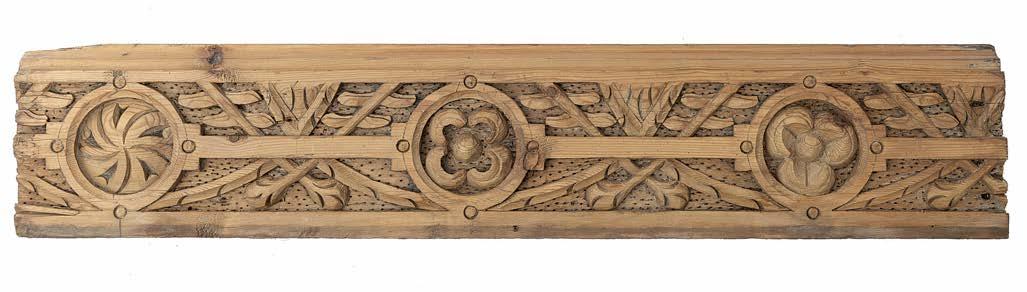
40
An Elizabeth I carved pine architectural frieze section, Exeter, circa 15801600
Carved in low relief with a repeating design of circular roundels enclosing stylised floral motifs, linked by scrolling foliage and strapwork, the ground with punchdecoration to add depth and texture.
Almost certainly removed from an important Exeter building, possibly from an overmantel, screen or upper wall panelling.
H 19.7cm, W 98.4cm, D 3.2cm
£100200
41
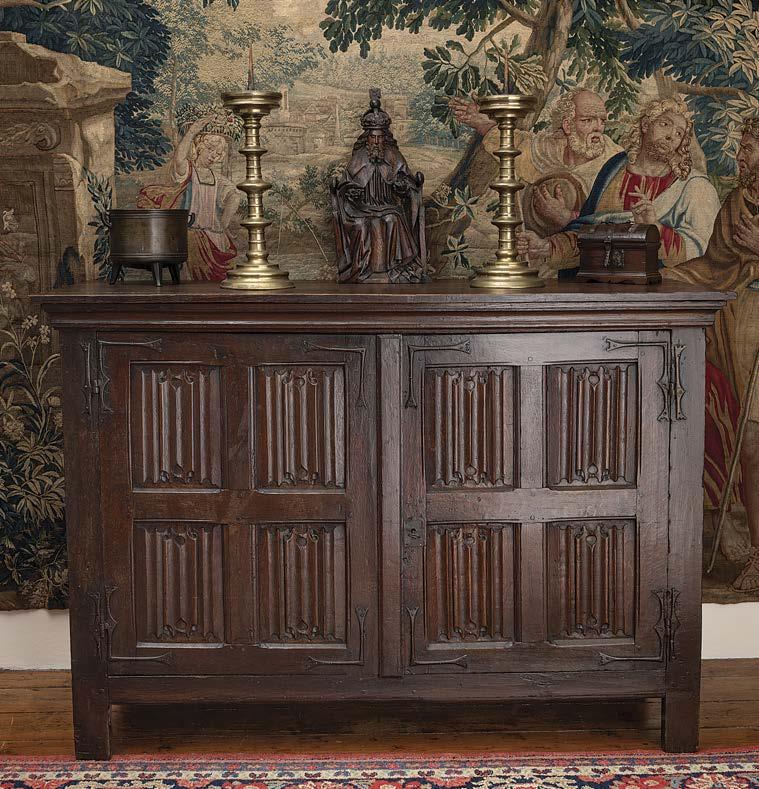
An oak linenfoldcarved cupboard, Bruges, Belgium, circa 1500
The front with two large doors, each set with four deeply carved linenfold panels, the sides with a further eight panels arranged in pairs, all panels framed within moulded rails with dust chamfers, with original heavy wroughtiron strap hinges and brackets.
Such cupboards were typically used in monastic or patrician settings for the storage of vestments, linen, and important household textiles.
Although the top has been replaced in keeping with the original period design, the carcass survives in a rare state of authenticity. The construction is of thick quartersawn oak, jointed with pegged mortiseandtenon, displaying the robustness associated with Bruges craftsmanship at the turn of the 16th century. A nearidentical example survives in the Museum SintJanshospitaal, Bruges.
H 110.5cm, W 159cm, D 65.4 cm
£2,0003,000 42
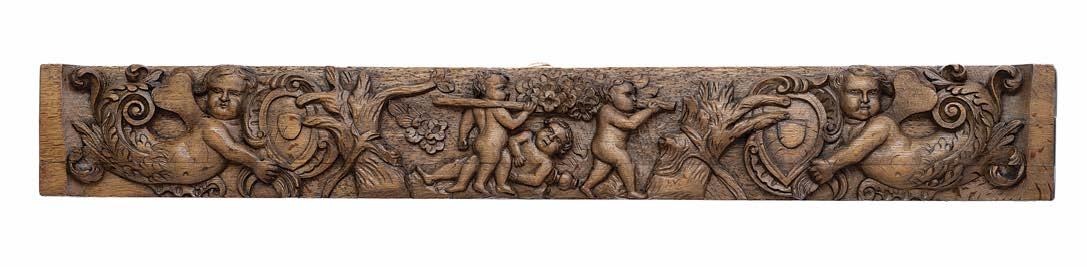
An early 17th century carved oak frieze, Dutch, circa 162040
Centred by a lively procession of putti carrying branches and foliage, emblematic of fertility and abundance, at either end mermaid inspired figures frame the scene, each supporting a cartouche within leafy volutes.
The combination of playful infant figures and fantastical marine grotesques reflects the decorative vocabulary of early 17thcentury Dutch Mannerism, indebted to the engravings of Cornelis Floris and the influence of Antwerp ornament prints.
H 17.8cm, W 132cm, D 5cm
£200300
43
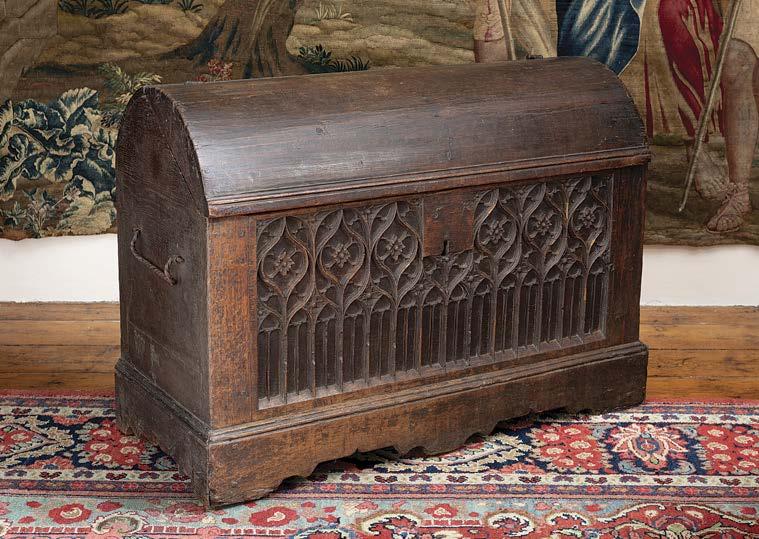
A late 15th century oak coffer en bahut, Northern French, circa 14801500
Of boarded construction with a domed lid, the front carved with a series of blind Gothic tracery arches, enriched with floral detailing, the sides retain original wrought iron carrying handles, and the interior preserves its two original storage compartments and back shelf, on a plinth base.
This form, known as a coffer en bahut, was characteristic of late fifteenthcentury France, serving both as secure storage and as a travelling chest. Its domed form, designed to deflect water in transit, reflects its practical role, while the elaborate tracery front echoes contemporary ecclesiastical architecture and aligns with the international Gothic taste that remained prevalent in France on the eve of the Renaissance.
Literature: Collections Bruno Perrier, Deuxieme vente, Haute Époque MoyenAge RenaissanceVlle’, 7 December 1993, p.62, no.43.
A similar example sold Sotheby’s, London, Château de Cornillon, France, 31 October 2006, lot 58 (£22,800).
H 73cm, W 102cm, D 45cm
£1,8002,200
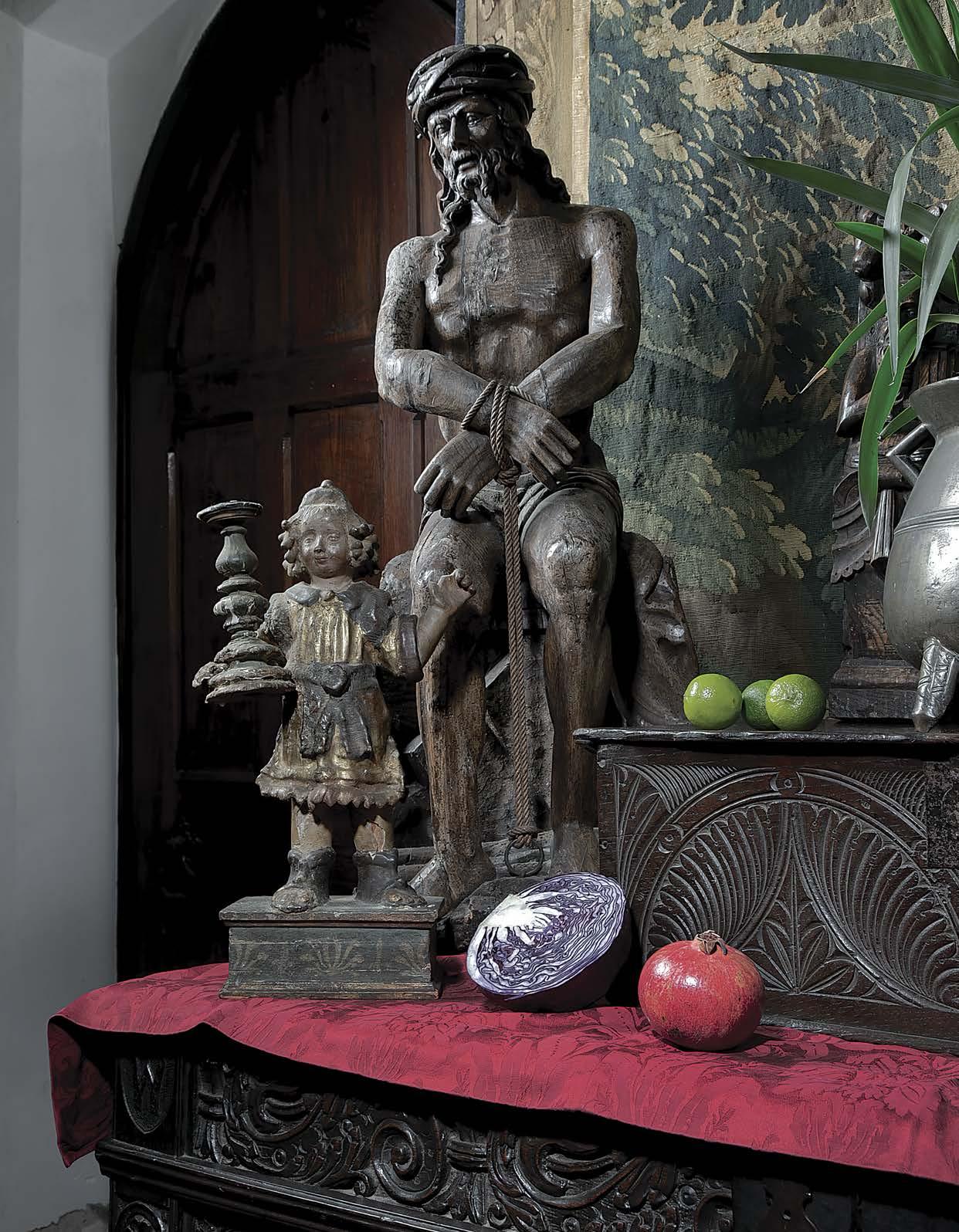
44
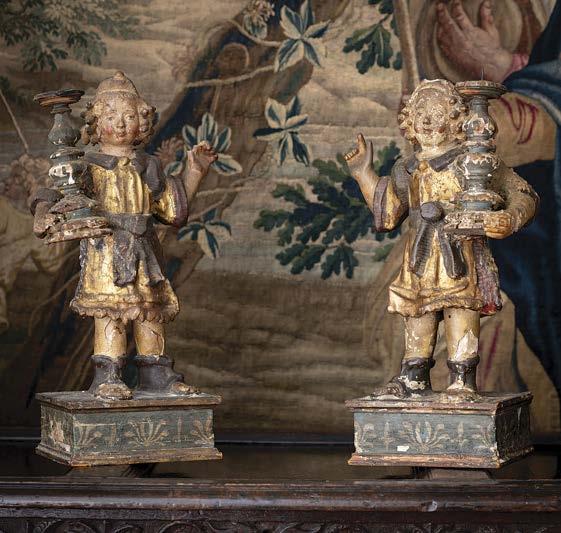
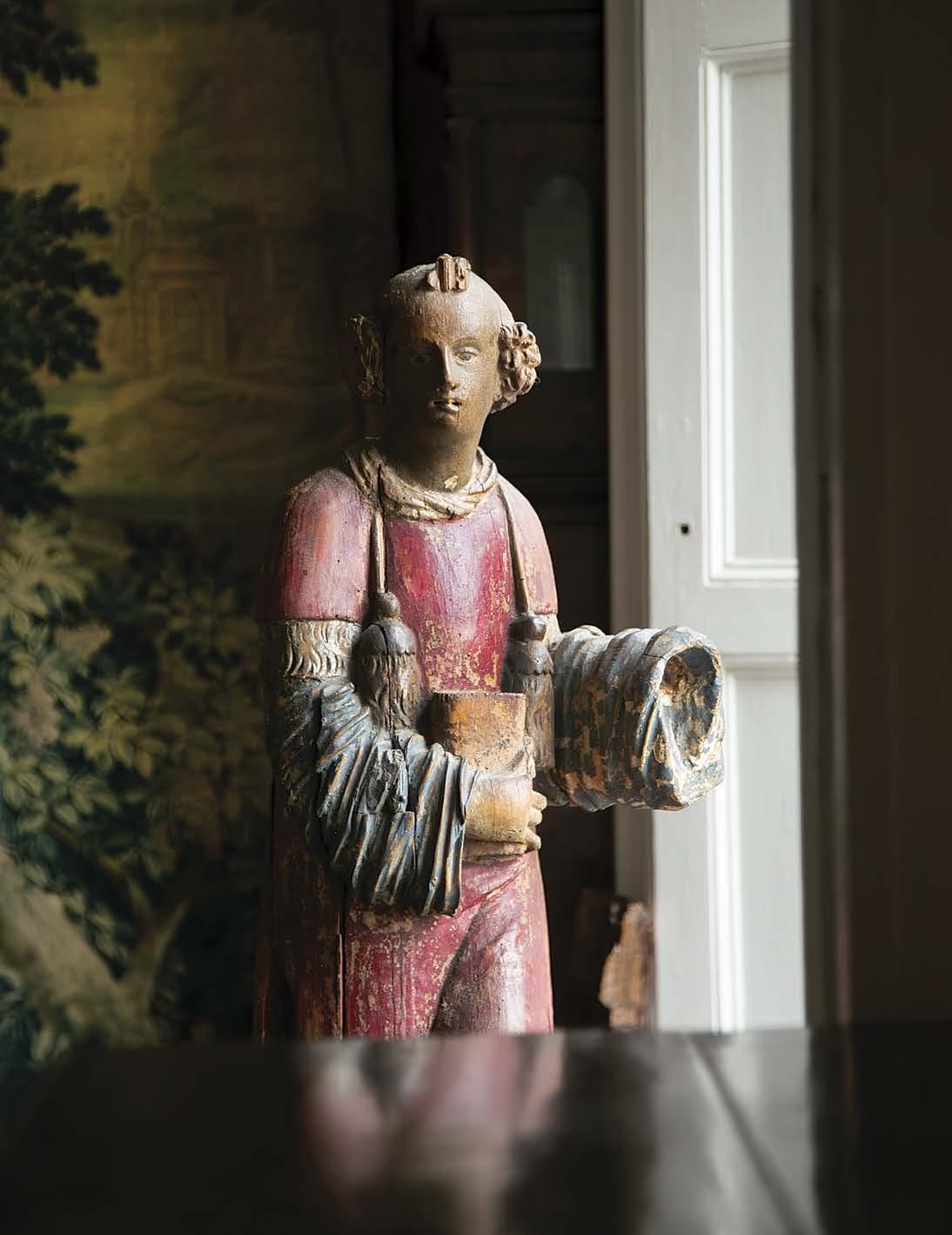
A pair of polychrome and giltdecorated figural candleholders, Italian, circa 1580
Designed as youthful attendants holding balusterform pricket candlesticks, each standing figure dressed in a short, belted tunic with boots, their curly hair framing delicately modelled faces, on an integral square plinth with painted foliate motifs. (2)
These candleholders were produced for placement on or beside altars, tabernacles, or reliquaries. Their scale and lively, almost playful manner, distinguish them from liturgical acolytes, aligning them more closely with the decorative and symbolic tradition of putti in Renaissance sacred art. H 46cm, W 23cm, D 17.7cm
£1,5002,000
45
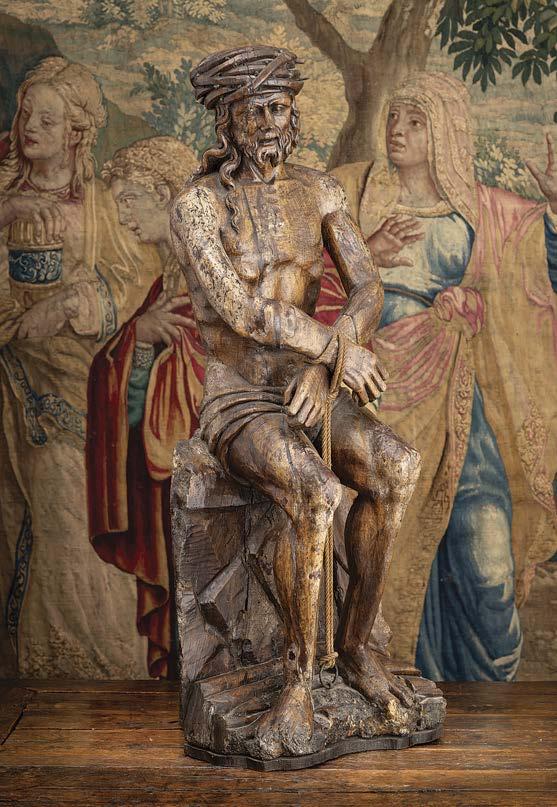
A late 15th century carved walnut figure, Christ on the Cold Stone, Antwerp, circa 1500
Christ is shown seated on a block, crowned with thorns and bound with ropes, his hands resting before him in a gesture of submission, his torso is rendered with taut musculature and finely detailed anatomy, while his expressive face and downcast gaze capture both physical suffering and spiritual resignation.
This subject, also known as the Man of Sorrow, was especially popular in the Low Countries at the turn of the 16th century. Antwerp workshops particularly produced powerful devotional images emphasising Christ’s humanity and sacrifice, providing the faithful with a vivid focus for meditation on the Passion.
Provenance: A label on the reverse identifies it as formerly in the Collection Vecht, Amsterdam (A. Vecht & Co., noted Dutch dealers in sculpture and fine art).
For a comparable figure, attributed to Netherlands/Lower Rhine, circa 150020, see the V&A Museum, London, acc.no.A351921.
H 94cm, W 37.5cm, D 28cm
£1,8002,200
46
A pair of James I oak and ash terms, circa 1615
Male, each with one hand touching their long beard, their other hand folded through a sash draped over their shoulder, topped by stylised fruit and foliage, symbolising fertility, prosperity, and divine abundance, the pedestal base carved with fabric swags. (2)
H 51.5cm, W 10.7cm
£200300
47
A pair of carved oak figural terms, Flemish, circa 160020
A male and female, each with expressive facial features and stylised hair, with a sash over their naked torso, a folded arm tucked inside, topped by basketform capitals carved with crosshatching and floral detail, on later pedestal supports. (2)
H 63.5cm, W 11.4cm, D 2.5cm
£80120
48
A mid to late 17th century bronze cauldron, English
Possibly by a member of the Sturton family of South Petherton, Somerset
Of typical belliedform with flared rim, above a decorative medial line, a pair of robust angular handles beneath the rim, raised on Dshaped and linear cast outswept feet.
Literature: M. Finlay ‘English Decorated Bronze Mortars and their Makers’ (2010), p. 117. The author notes eight members of the Sturton family are recorded as founders from 1630 until the early 18th century.
H 27.9cm, Dia 34.3cm
£200300
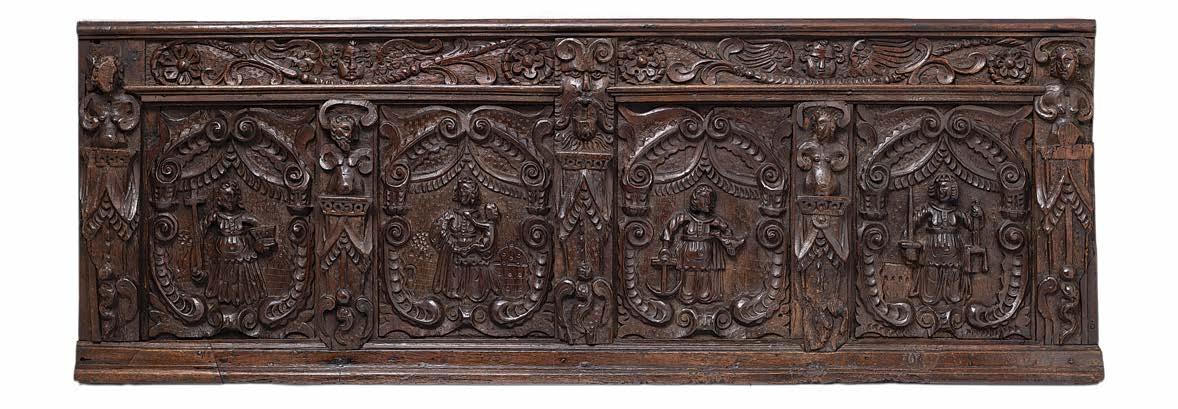
A richly carved oak coffer front, Dutch, circa 1600
Of four cartoucheframed panels, each depicting a saint beneath a draped canopy, the figures set within scrolling foliage and flanked by pilasters of carved busts and angels, the frieze rail ornamented with a procession of winged angel heads and interlacing floral designs. Panel one, possibly St Michael in his guise as defender of the faithful, or a martyred saint bearing the sign of salvation; panel two, St Christopher, carrying the Christ Child, a powerful emblem of safe travel and divine guardianship; panel three, St Clement of Rome, grasping an anchor, his traditional attribute recalling his martyrdom by drowning; (also a broader symbol of steadfast faith and hope); panel four, St Michael the Archangel, depicted with scales, weighing souls at the Last Judgement, a reminder of divine justice and eternal salvation.
H 61cm, W 173.4cm, D 3.8cm
£8001,200
50
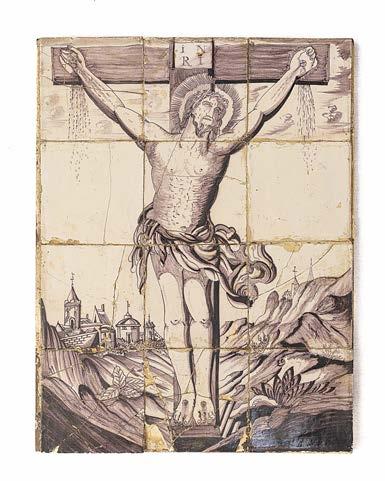
A delftware tile panel, Dutch, circa 170030
A devotional tile panel composed of twelve tinglazed earthenware tiles, painted in manganese with the Crucifixion. Christ is shown affixed to a simple wooden cross beneath the titulus INRI, his body rendered with strong Baroque modelling and expressive anatomical tension. Below, a rocky mound and sparse vegetation leads the eye towards a stylised walled city and distant hills, elements derived from Flemish engraved sources widely circulated during the late 17th century.
H 52.7cm, W 39.4cm
£200300
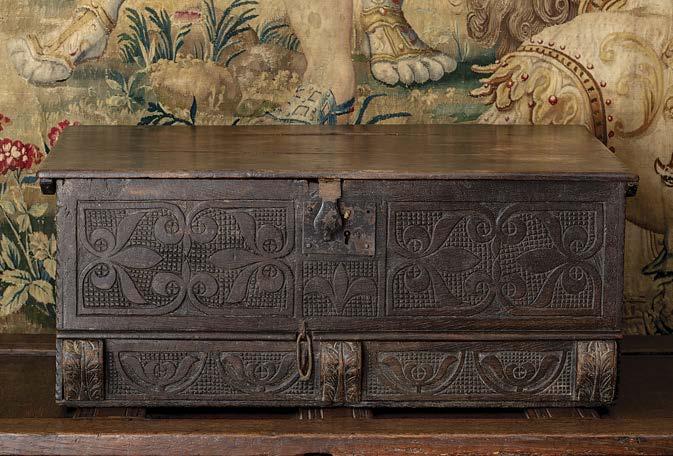
A Charles II oak boarded box with drawer, Somerset, possibly Taunton, circa 1670
Carved to the front with panels of scrolling leafy volutes set against a hatched ground, the central lockplate flanked by repeated foliate motifs, the lower section incorporates a fitted drawer, enriched with applied leafy corbels.
H 29.8cm, W 74.3cm, D 48.3cm
£200300
52
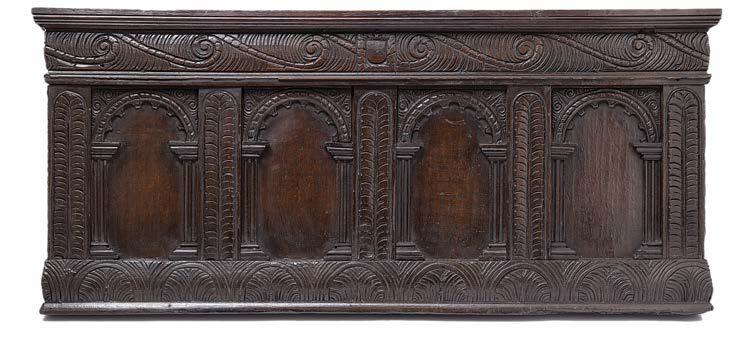
An Elizabeth I carved oak coffer front, West Country, circa 1600
Repurposed as an overmantel, of four arcaded panels, with applied pilasters, and spandrels enriched with stylised palm leaves and feathered ornament, the top rail with a continuous frieze of scrolling foliage terminating in volutes and centred by a small shield, the lower rail carved with a rhythmic series of lunettes.
The arcaded treatment, with its repeated architectural forms, recalls contemporary plasterwork and stone decoration, while the vigorous gougecut ornament situates it firmly in the West Country carving tradition.
H 64.8cm, W 148cm, D 8.9cm
£100150
53
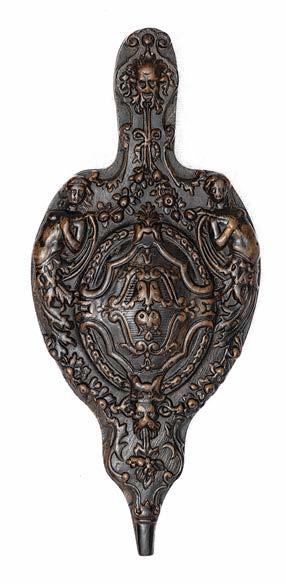
A finely carved walnut fire bellows front board, Italian, circa 15501600
Carved in high relief with rich ornamental detail, having a stylised coat of arms within a scrolling cartouche, flanked by paired grotesque figures, their bodies entwined with strapwork, surmounted and supported by leonine masks.
The carving displays the vigorous plasticity characteristic of mid–late sixteenthcentury Italian decorative woodwork, where grotesque ornament was adapted from Roman wallpainting and disseminated through engravings by artists such as Enea Vico and the school of Giulio Romano. See the V&A Museum, London, acc. no. 42791857, for comparable complete bellows.
H 39.5cm, W 16.5
£200300
54
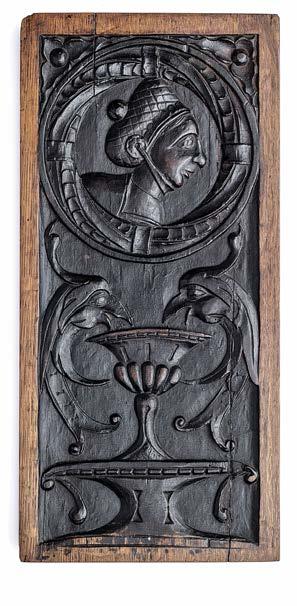
A Henry VIII carved oak portrait panel, circa 1540
Deeply carved with a male profile bust within a classical roundel, wearing a cap and tunic, below an urn flanked by scrolling foliage and stylised dolphins demonstrating the strong influence of imported Italianate ornament on early 16thcentury English carving.
Portrait panels of this type were highly fashionable in the reign of Henry VIII, reflecting the king’s adoption of Renaissance taste at court through his patronage of Italian artists and craftsmen. Such images often adorned furniture and architectural settings in the houses of the nobility, serving both as decoration and as coded affirmations of humanist values — learning, lineage, and personal identity.
H 47cm, W 22.3cm
£200300
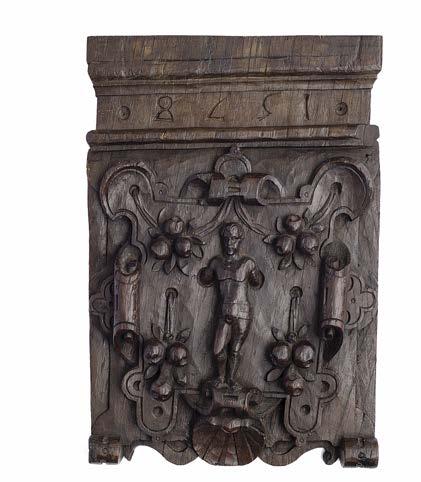
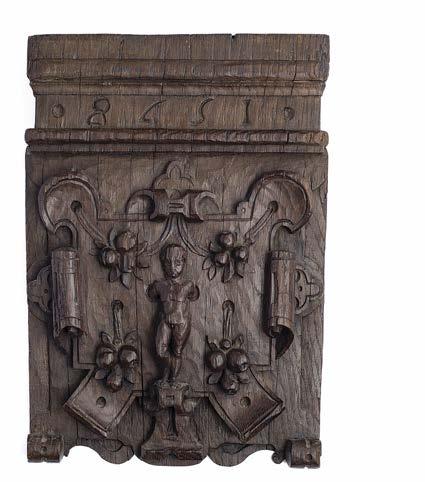
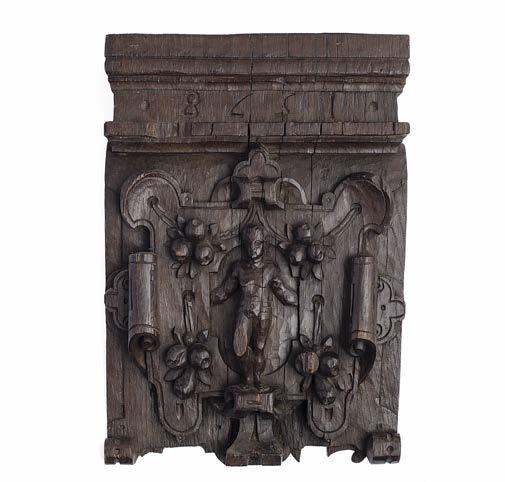
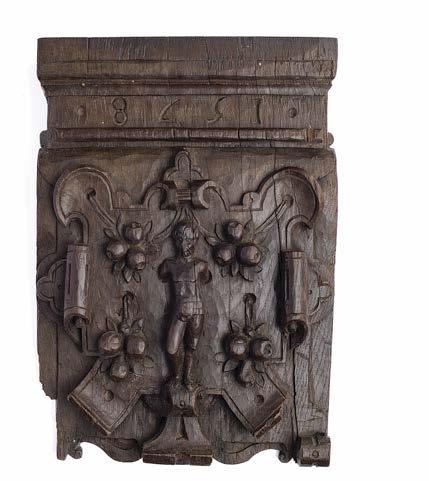
A rare set of four Elizabeth I carved oak capitals, Devon, probably Exeter, dated 1578
Each boldly carved with a Renaissance cartouche, enclosing a standing putto, flanked by scrolling foliage, each capital carved with the date ‘1578’ (idiosyncratically executed upside down). (4)
For a set of 16th century oak capitals to survive together is rare and extant dated architectural fragments from this period is exceedingly scarce. Their design reflects the influence of European Renaissance ornament, introduced to England through pattern books and court commissions during the reign of Elizabeth I. Here the designs are translated into robust vernacular oak carving. Putti, long associated with classical rebirth and divine protection, embody both humanist and sacred overtones, making these capitals as much symbolic as decorative.
Provenance: Robert and Rachel Byles Collection.
H 43cm, W 31.5cm, D 7.5cm
£1,0001,500
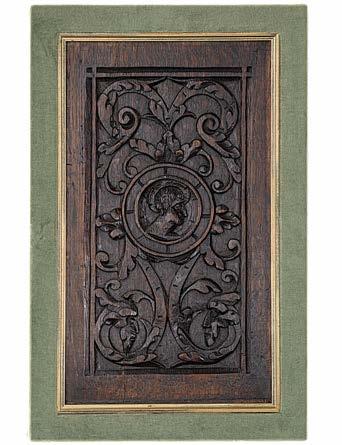
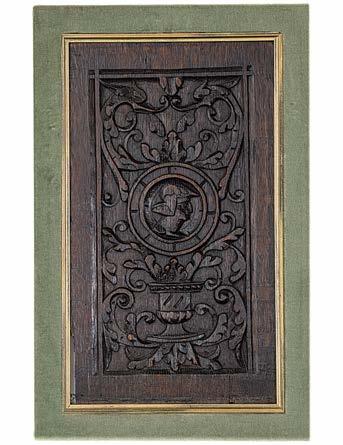
A pair of mid16th century carved oak panels, Flemish, circa 1550
Each centred with a portrait medallion of a male profile bust, carved in the manner of classical coinage or medals, evoking the Renaissance fascination with antiquity, the bust set within elaborate scrolling foliate ornament, with urns, acanthus, and grotesque forms, typical of the Netherlandish Renaissance vocabulary that drew inspiration from Italian engravings. Set in sympathetic later green velvet frames. (2)
Panels such as these likely originated from choir stalls, domestic panelling, or a cabinet of humanist display. The combination of portraiture with luxuriant vegetal ornament encapsulates the Renaissance ideal of the rebirth of classical knowledge within a Christian framework.
Provenance: Wernigerode Castle, Harz Mountains, SaxonyAnhalt, Germany.
H 47cm, W 30.5cm
£300500
57
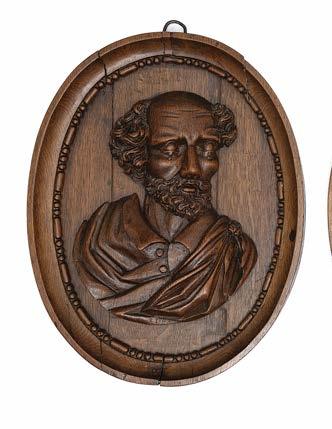
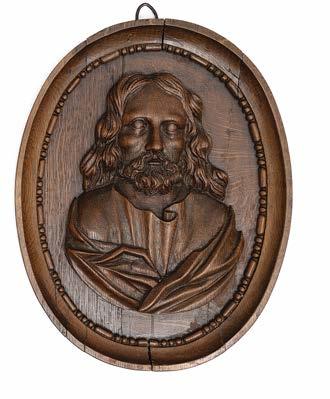
A pair of 17th century oval portrait panels, Dutch, circa 165080
Of Christ and St Peter, each bust presented in high relief within a moulded and beaded oval frame, Christ is shown with long hair, a full beard, and draped garments, his gaze calm and frontal, conveying serenity and divine presence. St Peter is depicted with balding curly hair and a short beard, clad in a simple tunic and cloak, most poignantly the sculptor has rendered tear tracks on his cheek, a rare and deliberate detail referencing the Lacrimae Petri (Tears of Peter), symbolising his bitter weeping following the denial of Christ (Matthew 26:75). (2)
The panels reflect the devotional culture of the Dutch Republic in the mid17th century, when smallscale relief carvings were produced both for ecclesiastical settings and for private devotion within Catholic households. The restrained composition and naturalistic treatment of the faces are consistent with Northern European Baroque carving of the period, balancing piety with a humanising realism.
Provenance: Wernigerode Castle, Harz Mountains, SaxonyAnhalt, Germany.
H 46.4cm, W 36.2cm
£200300
58
An 18th century delftware lobed dish, probably Frankfurt, circa 1750
Painted in blue, with a central octagonal reserve depicting a chinoiserie garden scene, a seated oriental figure beside a fence amid stylised rockwork and foliage, beneath flying birds, the broad rim divided into alternating petalshaped panels, each filled with scrolling foliate ornament, echoing the lobed shape.
The lobed form itself derives ultimately from Chinese kraak porcelain, while the central figure follows the European taste for chinoiserie imagery.
Dia 34.3cm
£100200
59
A mid18th century delftware lobed dish, Dutch, circa 1750
The deep octagonal well and scalloped rim painted in cobalt blue, the central reserve depicts Chinese figures in garden settings among stylised rockwork and foliage, enclosed by radiating panels of similar imagery alternating with floral sprays.
The shape closely imitates imported Chinese porcelain dishes of the Wanli period, while the freely brushed blue decoration demonstrates the confident hand of Dutch Delftware painters of the mid17th century.
Dia 34.3cm
£100200
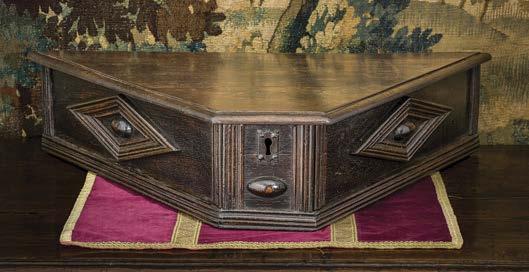
A rare Charles II boarded oak triangular hat box, circa 166080
Of distinctive trapezoid form, the front and sides decorated with applied mouldings and raised bosses, centred by a large iron keyhole escutcheon. This type of box was specifically made to house the fashionable broadbrimmed beaver hats of the Restoration Court. The triangular form allowed for the folded storage of such headwear. The surviving examples are extremely scarce, reflecting their specialised purpose, and speak directly to the material culture of fashion, status, and domestic life in 17thcentury England. This example is notable for its excellent colour and patina.
H 17cm, W 76cm, D 38.5cm
£300500
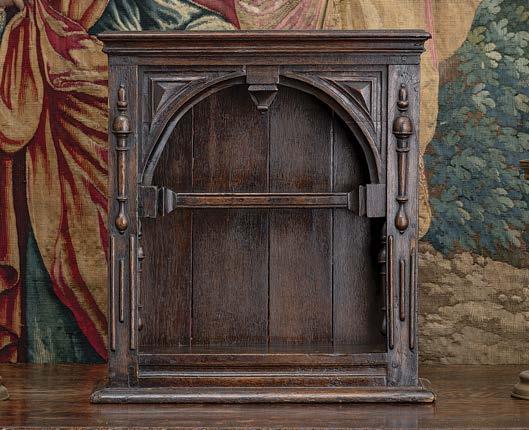
A small Charles II oak open mural cupboard, probably London, circa 166080
In the Laudian manner, the front with a moulded arch framing an open recess, flanked by applied split turnings, surmounted by a projecting cornice, plain sides, the back of vertical pitsawn boards secured with wrought iron nails, with visible oxidation.
The arch enriched with a central cusp and moulded spandrels, is in the Laudian taste which consciously revived classical motifs, in pursuit of order and uniformity in the mid17th century. The term is named after William Laud, Archbishop of Canterbury under Charles I. It tried to avoid the extremes of Catholic and Puritan design.
H 81.3cm, W 49.5cm, D 15.2cm
£300500
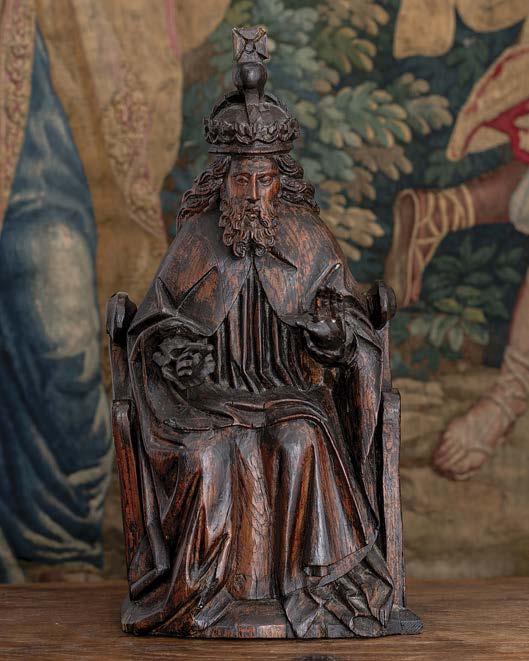
A late 15th century oak figure, Christ Enthroned as the King of Heaven, Netherlands, circa 14801500
Seated upon a monumental highbacked throne with linenfold and tracery panels, the figure conveys both majesty and authority. Christ is depicted wearing an Imperial Crown surmounted by an orb finial, with his left hand raised in blessing, three fingers extended, and his right hand resting upon the Book of Life, the figure embodies Christ as Salvator Mundi — Saviour of the World. Unlike many Netherlandish Gothic figures carved only in halfround for altarpiece niches, this work is fully carved, with the throne articulated on all sides. Its threedimensional form indicates it was conceived as a freestanding devotional image, designed to command presence within a chapel, monastic choir, or smaller ecclesiastical setting. The sculptor has given close attention to the flowing beard, the rhythmic folds of the drapery, and the rich architectural detailing of the throne.
Comparable Flemish oak figures of Christ enthroned, produced in Brabant workshops in the late 15th century, were exported widely across Europe.
See the V&A Museum, London, acc. no. 4111889, for a comparable carving dated to circa 1380.
H 50.8cm, W 25.4cm, D 13.4cm
£1,8002,200
63
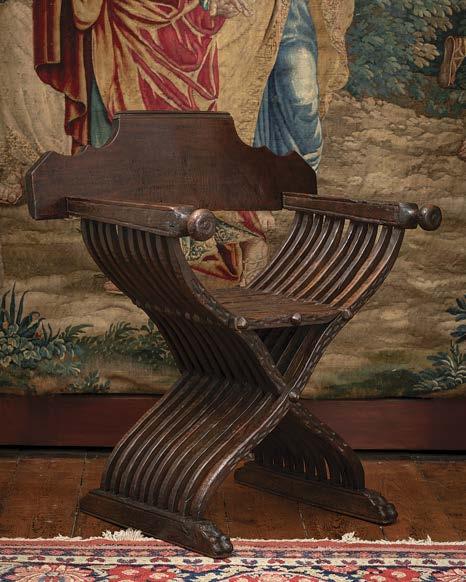
A good late 15th century walnut Savonarola, Central Italy, possibly Florence, circa 14701500
Of Xframe form, the curving staves intersecting to form scissoraction supports, united by turned pivots, and terminating in broad plank feet, the arms carved with scroll finials, and the high backrest is formed from a shaped and moulded board, pegged into the uprights, the seat constructed from narrow, shaped slats. Folding chairs of this type, were widely used in Italy from the late 15th century onwards, drawing inspiration from classical Roman curule seats, symbols of authority and civic status. Their folding design made them practical as well as prestigious, allowing them to be moved easily between chambers or transported on progress.
The present example, with its robust walnut construction, shaped back panel, and pawlike feet, accords closely with surviving examples in major Italian collections, including the Museo Nazionale del Bargello, Florence (acc. no. 193045), and the Palazzo Davanzati
See Daniela Parenti, Il Mobile del Rinascimento in Italia (Milan, 1990), pp. 120–125, for further related Savonarola chairs.
£1,0001,500
64
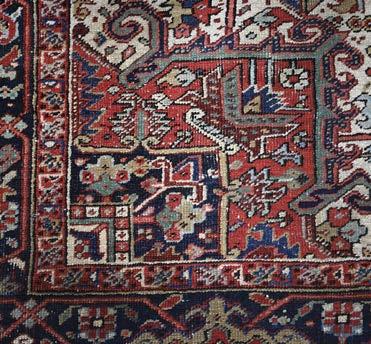
A Heriz carpet, North West Persia, circa 1920
The raspberry field centred by an indigo medallion framed by spandrels and borders of samovar motif.
L 377cm, W 316cm
£8001,200
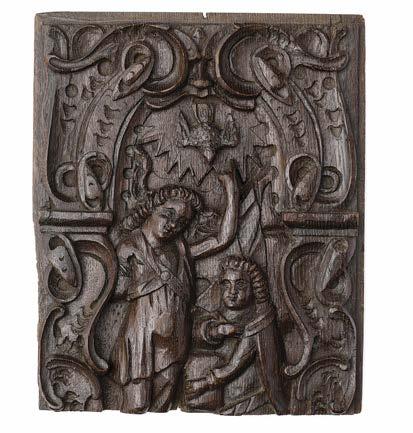
A late 16th century carved oak panel, The Annunciation, Netherlands/North German, circa 15801600
The Archangel Gabriel is shown raising his hand as the Virgin Mary humbly bows in acceptance of the divine message, above the Holy Spirit descends in the form of a dove radiating light, underscoring the mystery of the Incarnation, the figures are framed within an elaborate cartouche of scrolling Renaissance ornament, balancing sacred narrative with decorative grandeur.
Panels of this type were produced often for private devotion as part of domestic altarpieces.
H 31cm, W 25.5cm
£100200
66
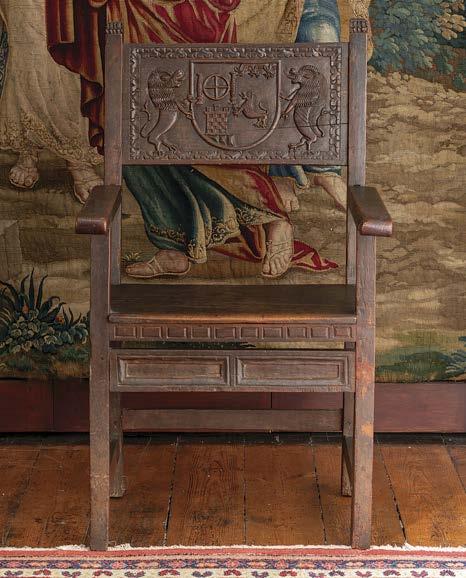
A 16th century walnut armorial carved open armchair, Spanish, circa 15801600
The back rest panel carved with a family armorial, with mythical beast supporters, flat open arms on rectangularsection supports, boarded seat, the high forerail carved to simulate paired elongated panels, on rectangularsection legs joined by plain stretchers.
H 109cm, W 64.1cm, D 56.5cm
£300400
69
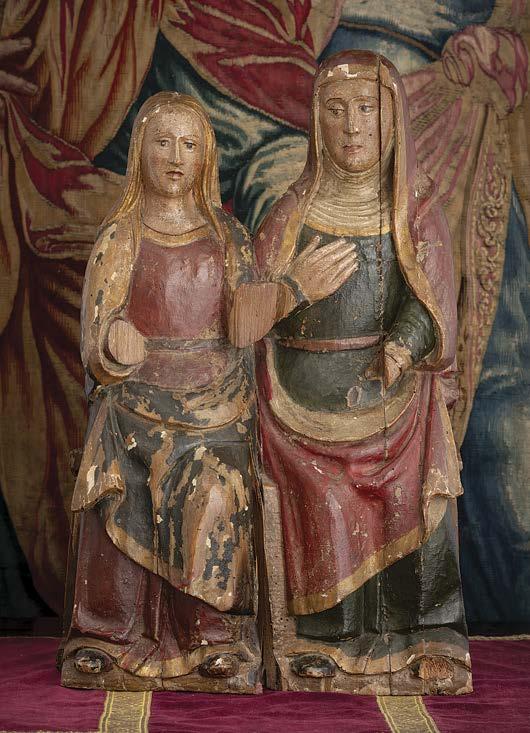
An arresting mid15th century carved oak and polychromedecorated figural group, St Anne Teaching the Virgin to Read, FrancoFlemish, circa 145080
Having a flat back for placement against a niche, retaining extensive original polychrome and gilding, St Anne is shown as a mature woman, in wimple and veil, her right hand (now lost) formerly holding a book, beside her the young Virgin, longhaired, turns attentively towards the lesson.
Their garments with broad, rhythmic hems with underfolds, and angular shoes, together with the slight blockstyle depiction are characteristic of mid15thcentury FrancoFlemish workshop practice in Picardy/Artois and Flanders.
H 54cm, W 34.3cm, D 13.3cm
£1,0001,500
68
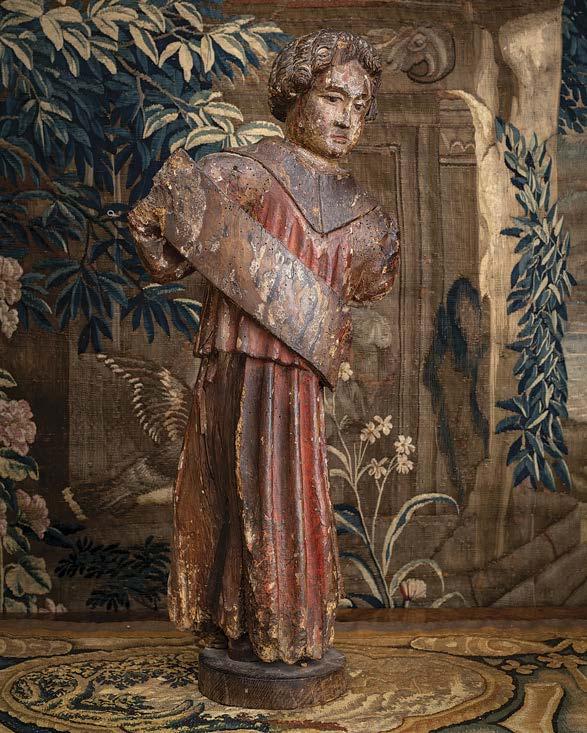
A 15th century carved oak and polychromedecorated Angel, English, circa 14501500
The ‘messenger’ angel is shown holding a banner across his chest, his long robe with deeply carved vertical folds painted in red, the face with softly modelled features framed by short curling hair, on a later base.
Angels holding banners, inscribed with religious text, are a hallmark of English rood screens and choir screens of the 15th century, particularly in East Anglia and the West Country. The robust treatment of the drapery, the rounded modelling of the face, with restrained naturalism, point towards an English rather than Netherlandish origin.
H 72.4cm, W 30.5cm, D 15.2cm
£1,5002,000
A tin glazed lobed plate, probably Dutch, mid18th century
With scalloped rim, painted in cobalt, with a stylised floral roundel to centre, enclosed by a radiating foliate border, the rim with repeating floral motifs.
Dia 33cm
£6080
70
A delftware lidded posset pot, probably Dutch, circa 170050
Of circular, lobed form, decorated in cobalt blue, with floral bands, the gently domed cover with knop, the ornate loop handles with dash decoration, banded borders.
H 13cm, W 22cm
£100200
71
A delftware lobed plate, Dutch or German, 18th century
Painted in pale cobalt, the central octagonal panel designed with a figure in a wooded landscape, the scallop edged rim with radiating panels of alternate diaper patterns and landscapes, after Wanli period Chinese porcelain, blue painted ‘6’ to the base.
Dia 29.5cm
£100200
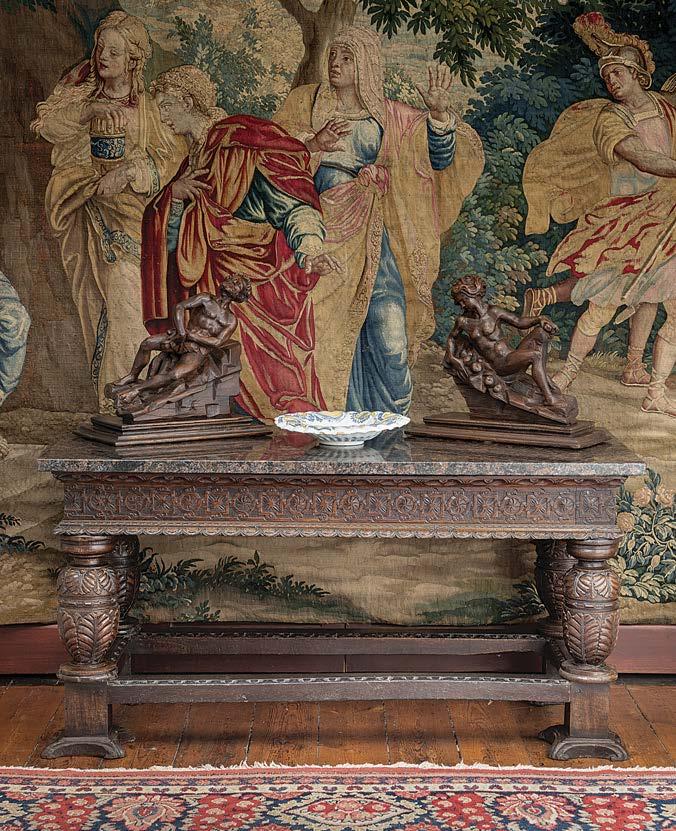
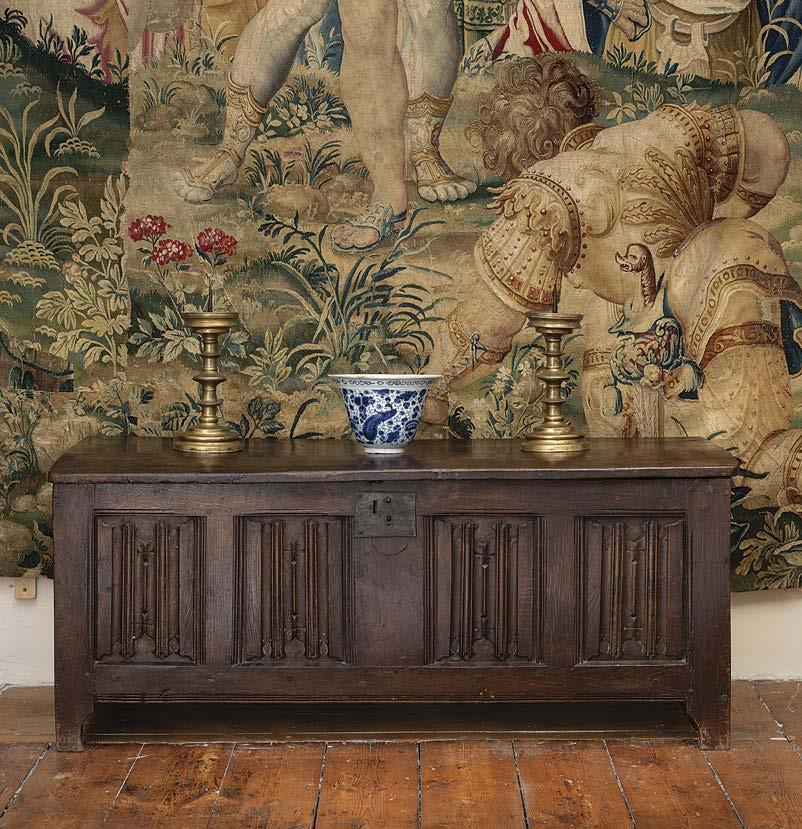
An Elizabeth I joined oak centre table, with later granite top, circa 15801600
The table base of architectural form and richly ornamented with classical Renaissance motifs, the robust cupandcover legs boldly carved with acanthus leaves, jewelled enrichment and gadrooning, rising from block feet with concavesided carved base, the frieze rails carved with a continuous chainlink and guilloche strapwork design, with egganddart upper moulding, the latter design repeated on the stretchers.
Comparable Elizabethan tables had costly imported stone or marble slabs, and many carried substantial oak tops. To stabilise and display the frame, it has been fitted with a sympathetic singlepiece modern granite top.
For a comparable table, documented in the Lumley inventory of 1590, see M. Jourdain, ‘English Decoration and Furniture of the Early Renaissance 1500–1650’, p. 195, fig. 266.
H 73.7cm, W 144.8cm, D 71.1cm
£400600
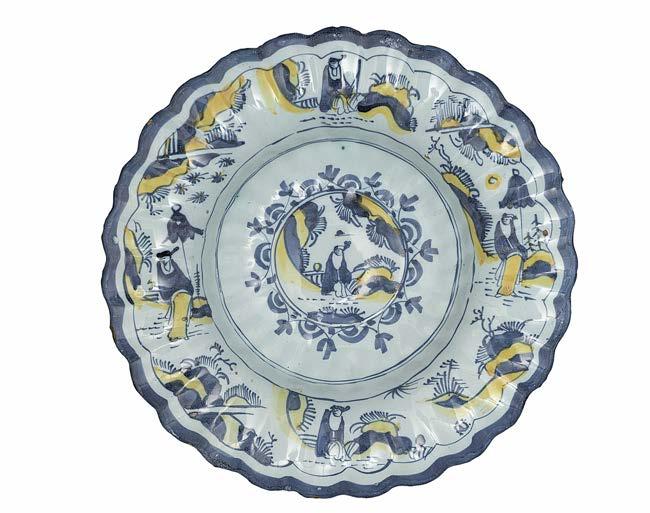
A delftware polychromedecorated lobed dish, Dutch, circa 170050
Painted in blue, manganese and ochre with chinoiserieinspired decoration, centred by a figure beneath stylised foliage, framed within a floral border, the shaped rim with repeated scenes of figures, rocks and plants, all executed in a distinctive naïve hand.
Dia 35cm
£200300
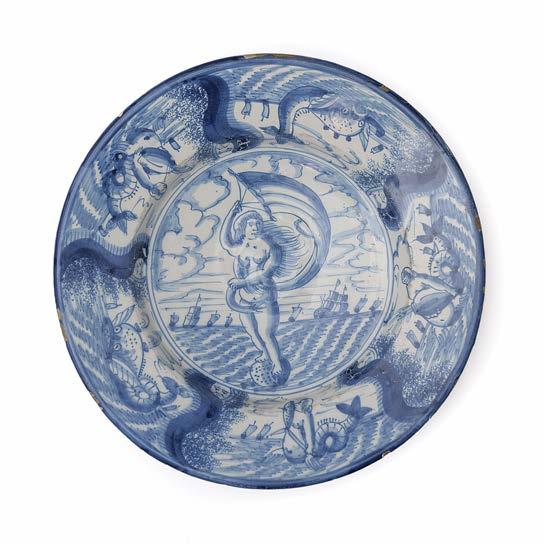
A good delftware plate, probably Dutch, circa 170050
Extensively painted in pale cobalt blue, centred by Fortuna, nude and balancing on a globe and holding a billowing sail, set before a choppysea with a convoy of ships and a cloudladen sky, the rim freely executed with seamonsters, tritons and marine trophies, separated by bold, undulating swathes of wash. The central subject, Fortuna on the Globe with Sail, derives from widely circulated Northern Mannerist prints after Maarten de Vos / Hendrick Goltzius, a theme favoured by Delft decorators in the midseventeenth century to advertise virtuoso figurepainting. The lively marine marginalia, part sketchbook, part pattern book, allows personal repertoire and artistic practice.
Dia 32.5cm
£8001,200
75
A Henry VIII oak linenfoldcarved coffer, circa 153040
Of hybrid construction, combining boarded construction to the sides and back with a joined and panelled front, the latter with four deepcut linenfold panels, centred by crossshaped devices, broad central muntin rail, later iron lock plate.
The combination of native oak and hybrid construction distinguishes this chest from the lighter Baltic oak imports frequently used in urban centres, anchoring it firmly within the traditions of English provincial furnituremaking of the 16th century.
H 53.3cm, W 128.3cm, D 44.4cm
£8001,200
76
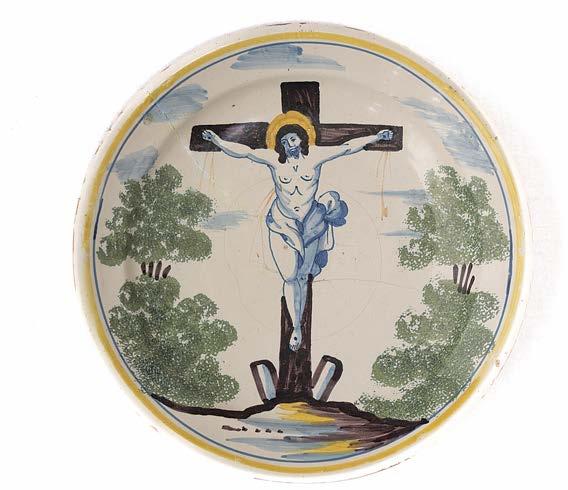
A delftware polychrome charger, Dutch or English, early 18th century
decorated with a Crucifixion scene, the figure of Christ flanked by stylized trees, with schematic cloud forms, together with a maiolica charger, 19th century, painted in yellow, orange, cobalt blue, green and manganese with an interlace rosette centred on a small square device, the scrolls interspersed with stylised foliage.
Dia 35cm and 32.5cm
£100150
77
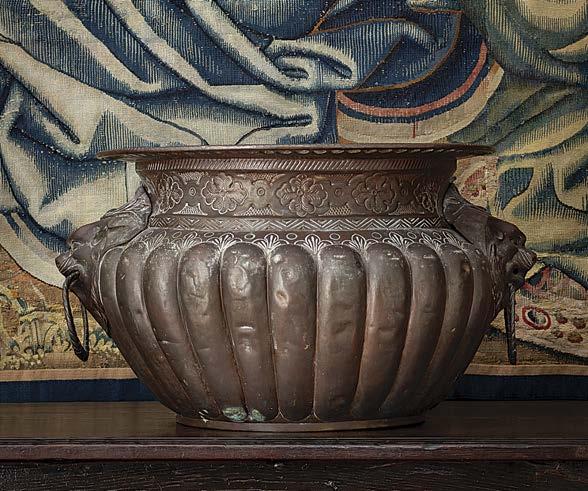
A large copper wine cistern, Flemish/North Italy, in the 17th Century manner
Of oval gadrooned form, the hammered and repoussé decorated sheetcopper joined at the rear by a vertical seam, the broad rim engraved with a continuous frieze of fullpetalled rosettes between chevron and punch borders, applied to each side a boldly modelled Renaissance lion mask ringhandle, removable liner dropping beneath the rim, shaped to the internal profile.
H 32.4cm, W 55.9cm, D 47cm
£300500
78
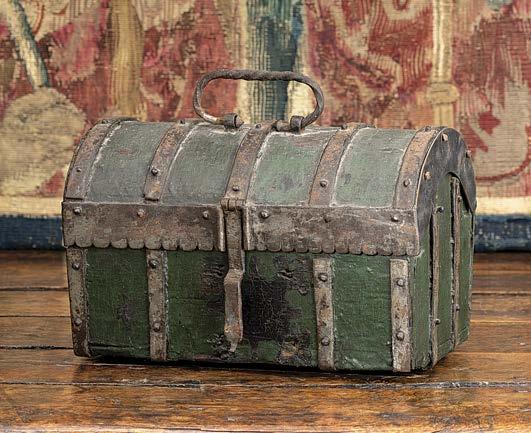
A small oak and ironbound domelid casket, German, circa 1500
Bound with wrought iron straps and fitted with a carrying handle, lacking its lock, the exterior later painted green some time ago.
This portable casket was intended for personal valuables, documents, or devotional items, and its heavy iron binding provided both practical security and symbolic assurance of protection. The domed form is characteristic of late 15thcentury German workshops.
H 15.9cm, W 23.5cm, D 15.2cm
£500800
79
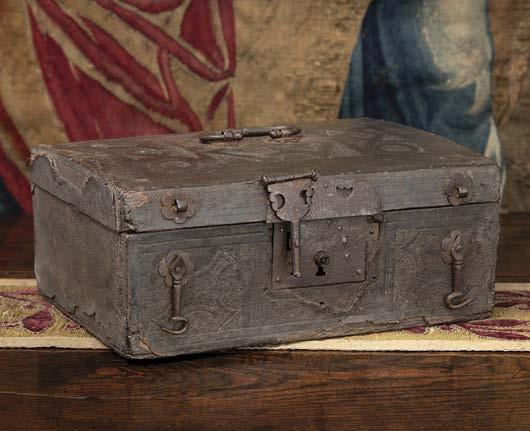
A late 16th century tooled leather casket, Spanish, circa 15801600
Of rectangular form, covered in leather decorated throughout with stamped and incised patterns, imitating strap and diaper work, enriched with stylised foliate and geometric motifs, with wrought iron lockplate, hasp, carrying handle, and front hooks.
The tooled decoration reflects the influence of Mudéjar skilled traditions which persisted in Iberian design well into the 16th century, blending Gothic geometries with Renaissance ornament. A comparable example can be found in the V&A Museum, London, (acc. no.21801855).
H 14cm, W 31.1cm, D 22.9cm
£500800
80
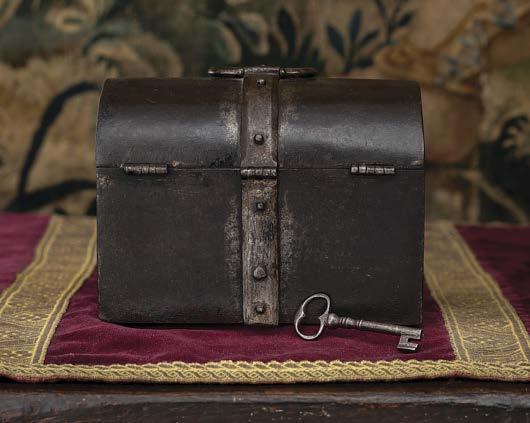
An iron messenger casket, French, circa 160050
Of compact domed form, with riveted construction, the couriercasket is secured by a sophisticated locking mechanism, namely the second lug of the righthand hinge (as you view the casket) pulls down to release the hasp and reveal the keyhole.
H 12.7cm, W 15.2cm, D 10.2cm
£400600
81
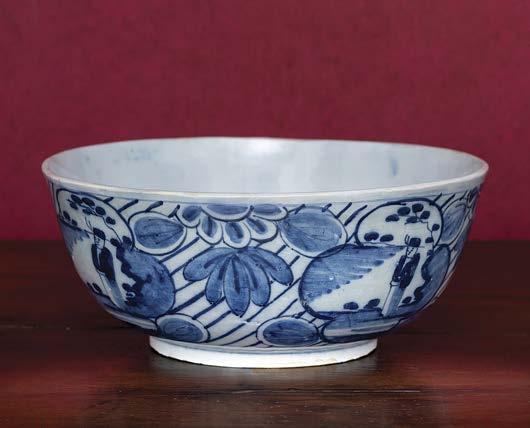
An 18th century delftware punch bowl, Dutch, circa 1750
Decorated in cobalt blue, with tapering straight sides and slightly flared rim, on a footring, the exterior is painted with alternating figural vignettes, separated by foliate motifs on a diagonal line ground, the interior with a central floral spray beneath a continuous wavescroll border.
Dia 26.7cm, H 11.4cm
£300400
82
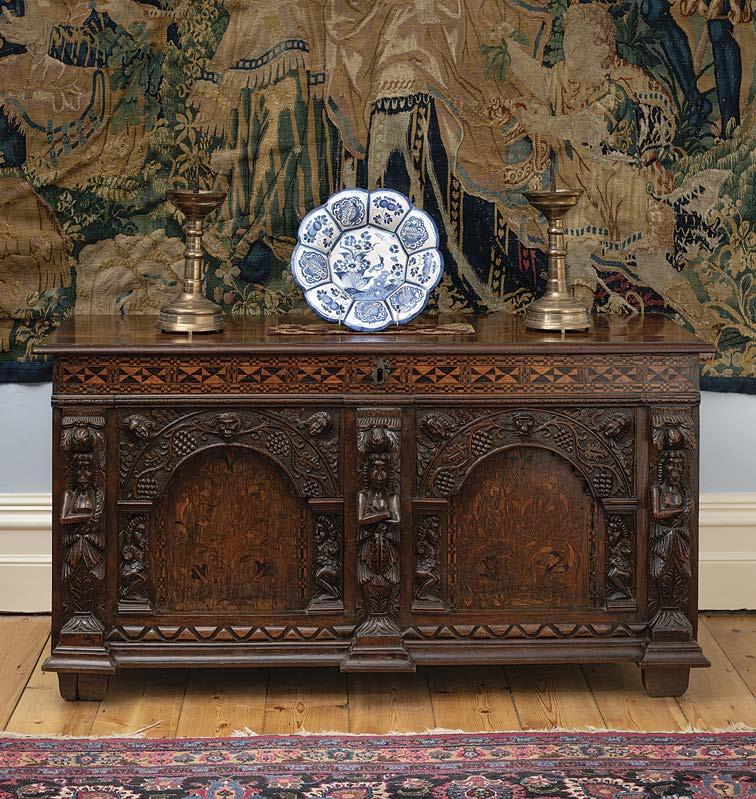
A striking Elizabeth I oak and inlaid coffer, circa 1580
The front with two broad panels inlaid with stylised floral sprays, set within applied arcades enriched with trailing vines and grotesque masks, on figural supports and with winged angel spandrels, the muntin rails applied with terms, the top rail is finely inlaid with a geometric chequer pattern, while the lower moulded rail is a later replacement, the boarded lid with ovolomoulded edge.
H 71.1cm, W 135.9cm, D 61cm
£8001,200
83
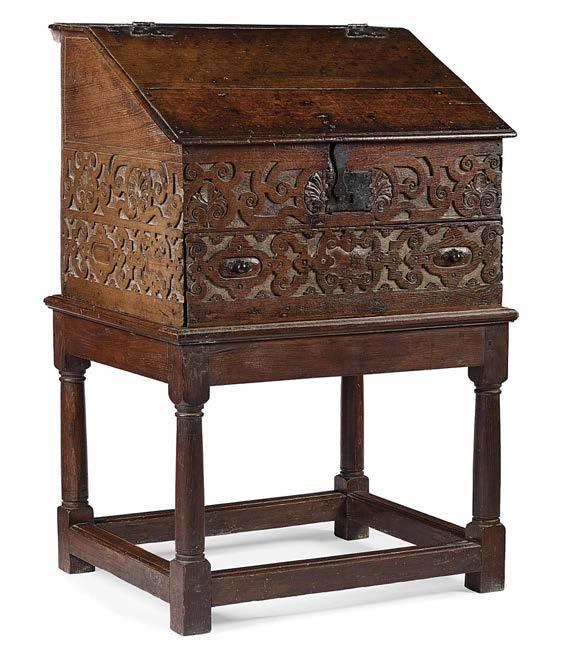
A large James I oak boarded box, on stand, Exeter, circa 1610
Fitted with a base drawer, the front and sides carved with bold, ornate strapwork, in two registers, the sloping hinged lid enclosing a fitted interior, the stand with columnarturned legs joined by plain stretchers all round.
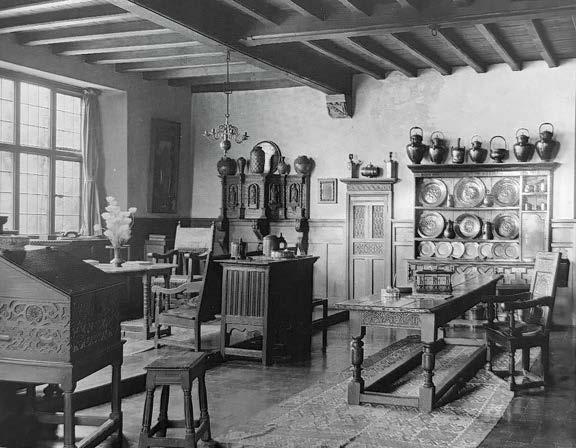
Provenance: H. Avray Tipping Collection, author and architectural Editor of ‘Country Life’ magazine for 17 years.
Literature: Illustrated in situ at Tipping’s house, The Oak Parlour, Mathern Palace, Monmouthshire. The boxonstand is also recorded in an article by John Carnforth, ‘The Search for Style’, Country Life.
H 180.5cm, W 80cm, D 65cm
£1,0001,500
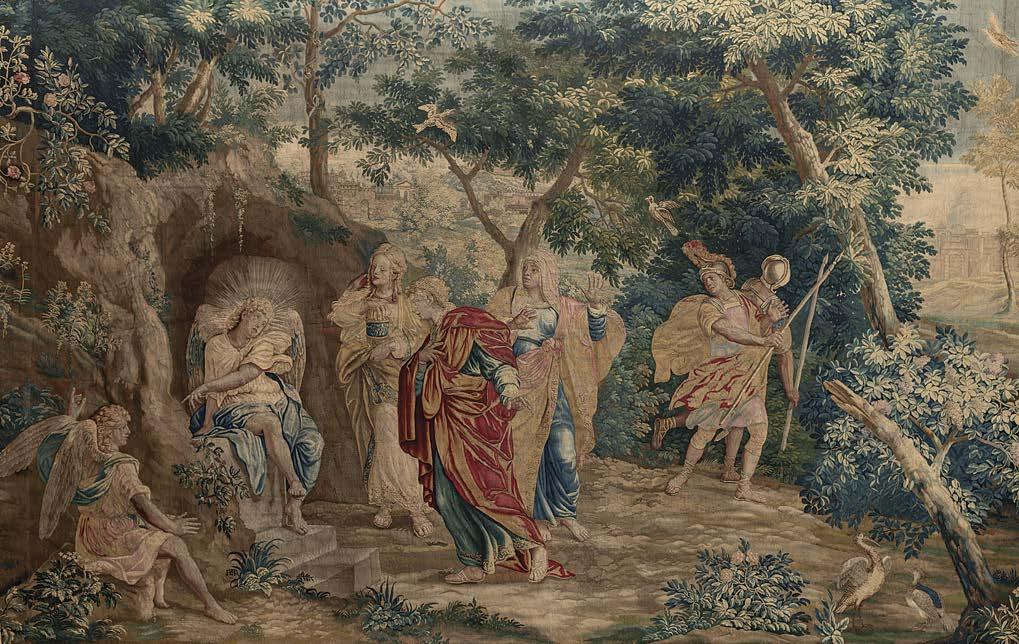
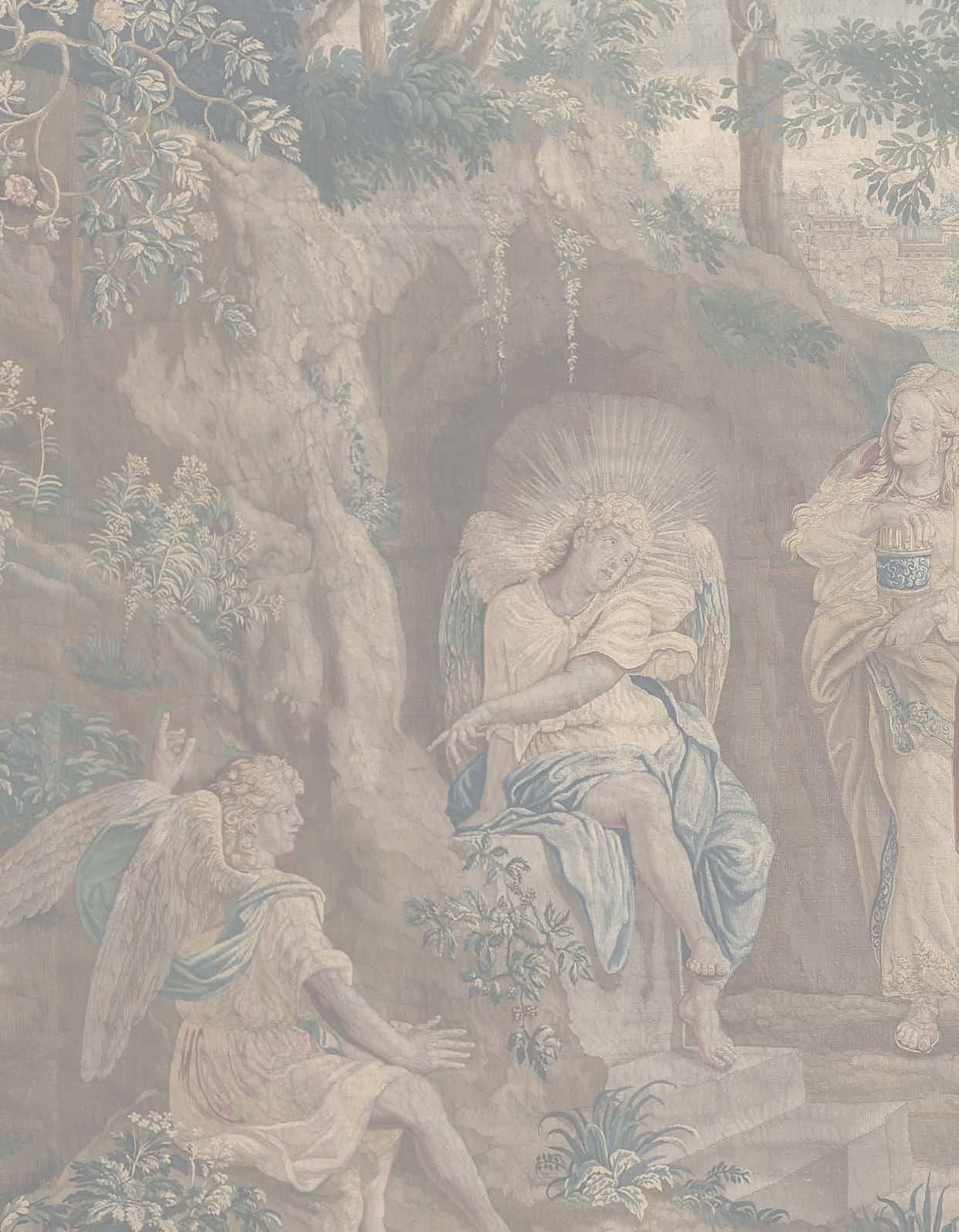
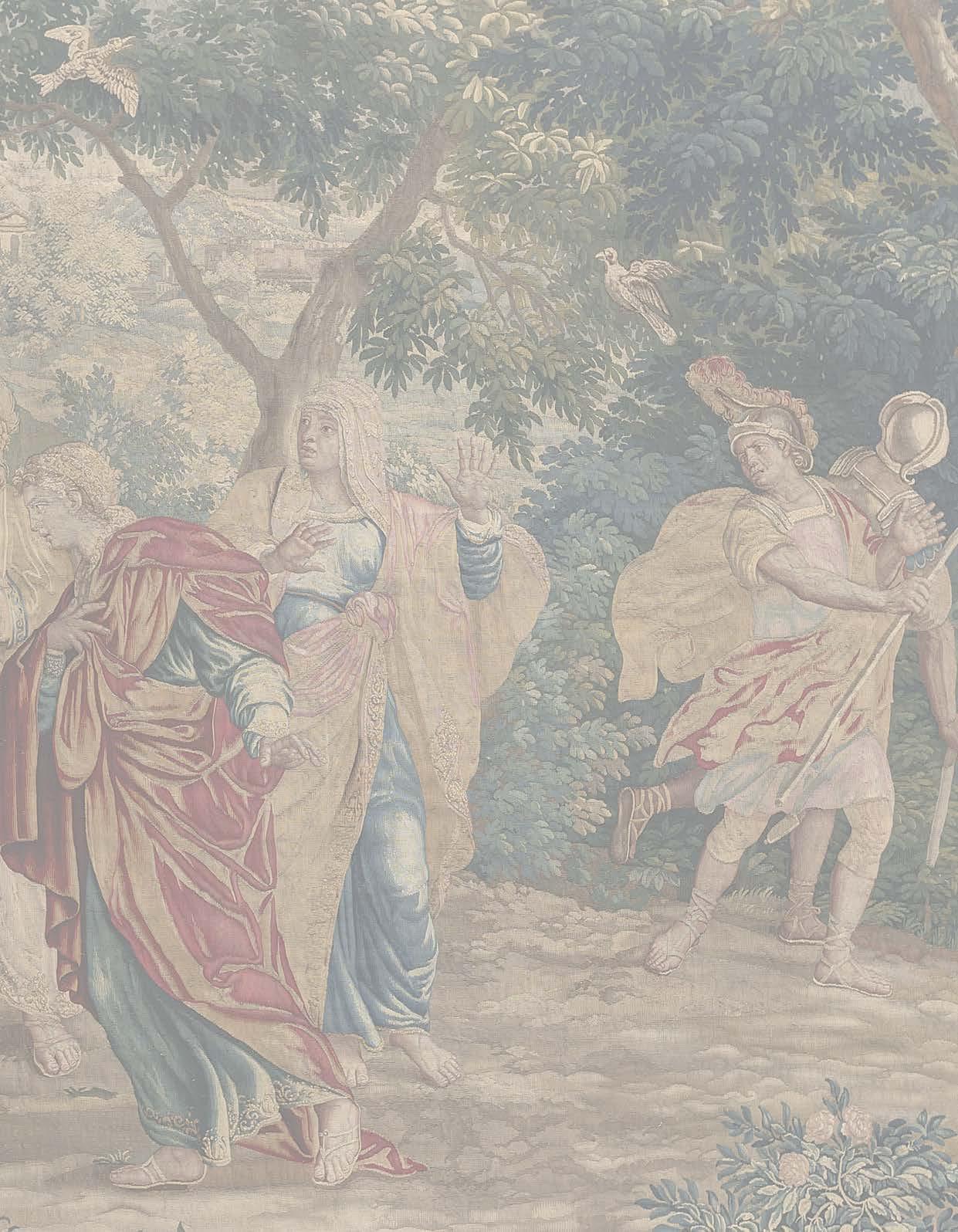
A monumental and fine mid17th century tapestry, The Three Marys at the Tomb, Brussels, circa 1650
Finely woven in wool and silk, the scene interpreted from Mark 16:1, describes when three women, traditionally identified as Mary Magdalene, Mary of Clopas and Salome visit Christ’s tomb. The three women are shown approaching the tomb, bearing an ointment jar, intending to anoint Christ’s body. Instead, showing astonishment, they discover an angel, radiant with divine light, seated upon the empty tomb. A further angel is seated nearby, and two soldiers are also in attendance. The composition is set within a verdant wooded landscape with rocky grotto, enlivened by birds, animals, and distant architecture. The richly robed Marys, with their flowing draperies and animated gestures, exemplify the refined artistry of Brussels workshops at this period. The use of silk threads heightens the luminosity of the angel’s radiance and the vibrancy of the women’s garments, demonstrating the technical mastery for which Flemish weaving of this period was renowned.
The Resurrection was one of the most important subjects for 17thcentury ecclesiastical and princely patrons, intended to proclaim both the central tenet of Christian faith and the triumph of divine truth. It also emphasizes the role of women as the first messengers of the Gospel.
Ensuite to the following Lot 85
H 274.3cm, W 421.6cm
£6,0008,000
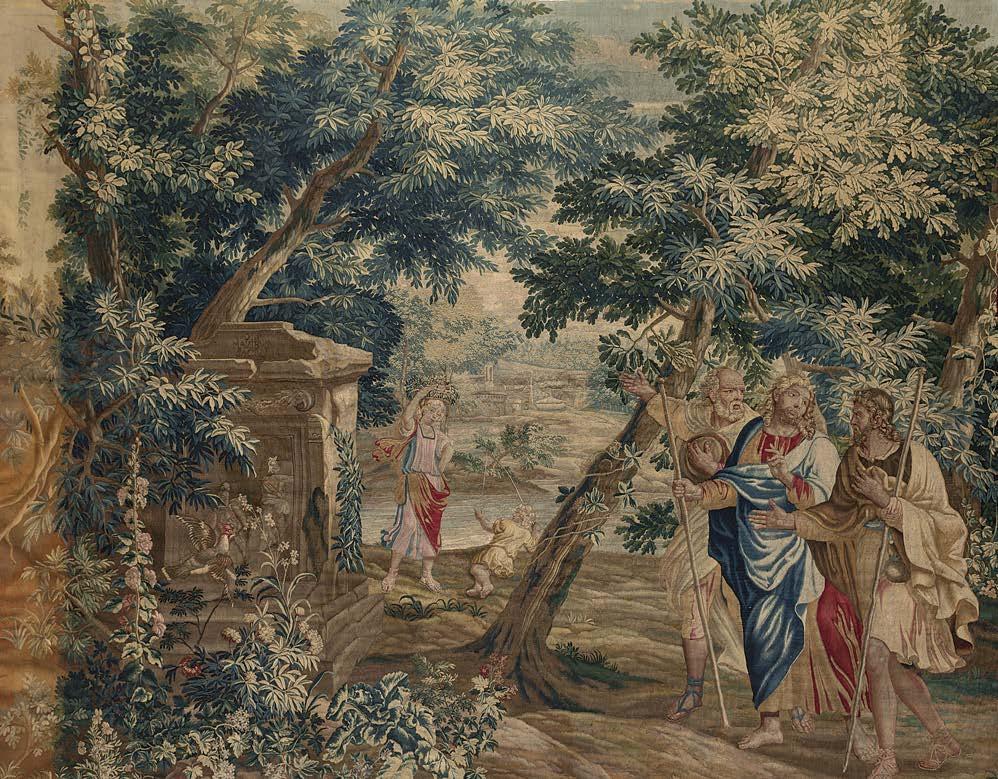
A monumental and fine mid17th century tapestry, On the Road to Emmaus, Brussels, circa 1650
Finely woven in wool and silk, the scene (from Luke 24:13–35) describes two disciples, troubled and disheartened after Christ’s crucifixion walking to the village of Emmaus, when the risen Christ joins them, unrecognised. Christ, richly robed in blue and red, gestures as he explains the meaning of the scriptures to them, while the disciples listen intently. The composition is set within a richly wooded landscape, with abundant foliage, flowering plants, and architectural ruins. To the left, a cockerel, a subtle allusion to Peter’s denial and the fulfilment of Christ’s prophecy, while in the distance further figures animate the background, adding narrative depth. The careful modelling of the figures, the expressive drapery, and the harmonious balance of colours are characteristic of Brussels weaving of this period, with silk highlights enhancing the luminosity of the scene.
Ensuite to the preceding Lot 84.
H 274.3cm, W 335.3cm
£5,0008,000

87
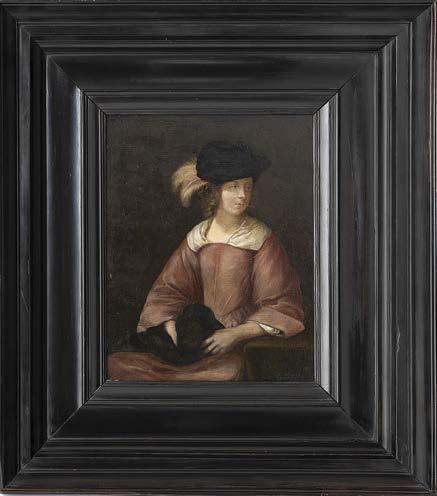
After Gerard ter Borch (Dutch, 16171681)
Portrait of a Lady
Seated three quarter length, wearing a russet dress, with a black plumed hat, a black cloak in her lap.
Oil on cradled panel
28 x 20.5cm; 11 x 8in
£300400
86
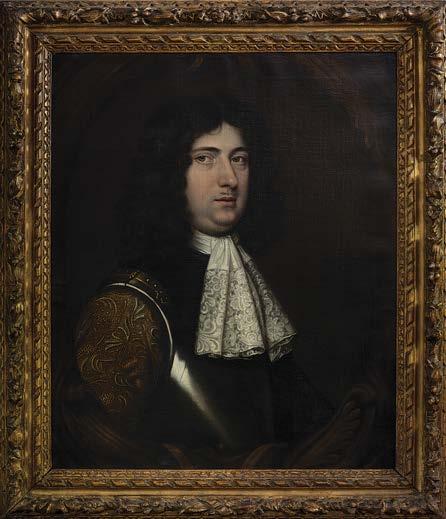
Circle of John Closterman (German, 16601711)
Portrait of a Gentleman
Quarter length, wearing an armour breast plate, brocaded tunic and white lace jabot.
Oil on canvas, within a painted cartouche
76 x 63cm; 30 x 24 3/4in
£1,2001,800


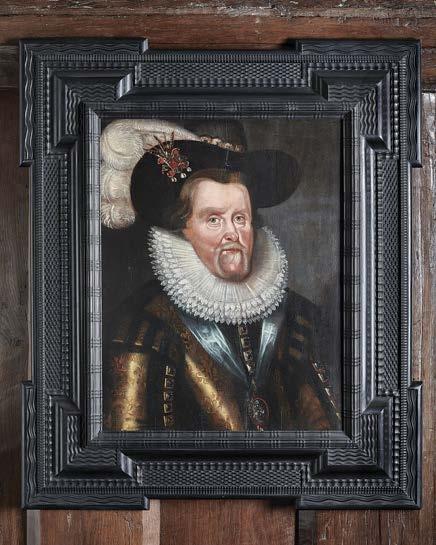
88
Follower of Adam de Colone (Dutch, circa 15721651)
Portrait of King James VI of Scotland and I of England (1566–1625)
Quarter length, wearing gilded armour, ruff and plumed hat.
Oil on panel
69.5 x 53cm; 27 1/2 x 21in
Provenance: Inscription to rear refers to collection of Sir Walter Scott of Abbotsford (1771–1832), the celebrated Scottish novelist, poet, and antiquarian. Scott was deeply invested in preserving the history and iconography of the Stuart dynasty, amassing a collection of relics, portraits, and manuscripts at Abbotsford that reflected his Romantic vision of Scotland’s past.
£1,0001,500
89
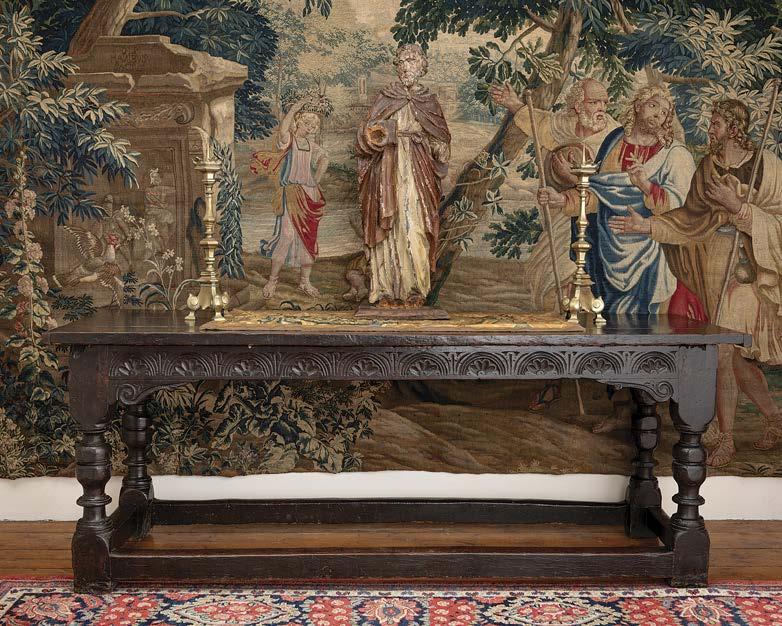
A Charles I joined oak refectorytable, circa 1640
Having a heavy boarded top, above a proficient lunettecarved front rail with scrollcarved spandrels, on robust balusterturned legs, with pronounced bulb and reel legs, joined all round by plain stretcher rails.
H 78.7cm, W 205cm, D 70cm
£8001,200
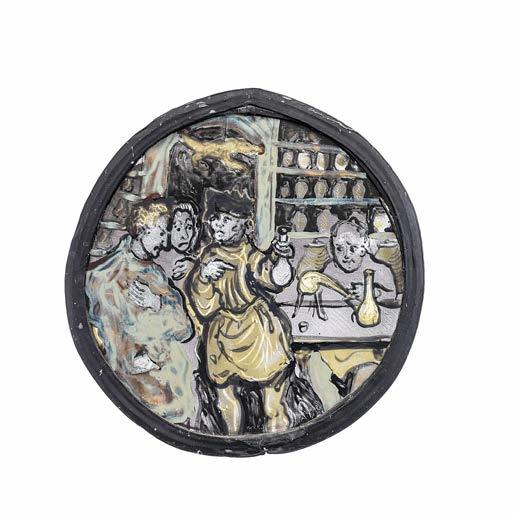
A 19th century stained glass roundel, German or Swiss
Painted with a Medieval alchemical scene, with three figures gathered around a table, whilst a seated figure attempts to transform base metal into gold, using purifying flasks, executed in grisaille to create a monochromatic design.
The figures are rendered with characterful expressions and strong linear definition, drawing on 16th and 17th century Germanic and Swiss glasspainting traditions revived during the 19th century.
Dia 22.5cm
£5080
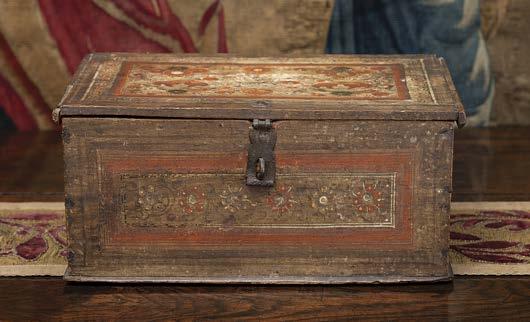
A late 16th century limewood and polychromedecorated casket, Swabian, German, circa 15801600
Rectangular in form, finely decorated on all sides with its original polychrome, the top designed with concentric rectangular bands enclosing stylised floral motifs in red, white, and green, the pigments deriving from bismuthbased preparations typical of Upper Swabia in the late 16th century, each side similarly painted with scrolling floral sprays framed within red borders, the interior retaining traces of original green ground, the lid with iron straphinges and hasp.
Closely comparable painted boxes survive in the Bayerisches Nationalmuseum, Munich, and the Germanisches Nationalmuseum, Nuremberg.
H 13.3cm, W 29.8cm, D 20.3cm
£500800
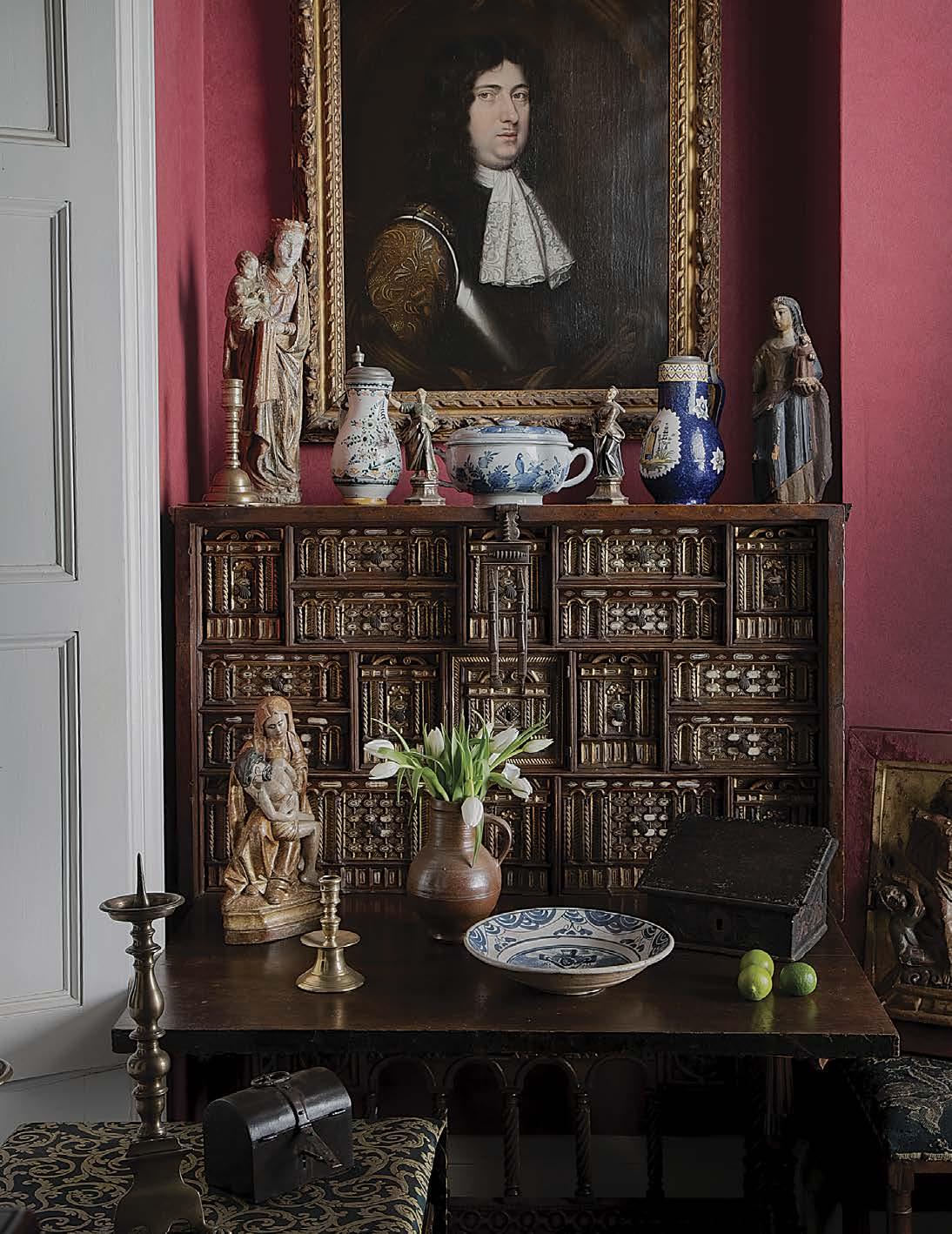
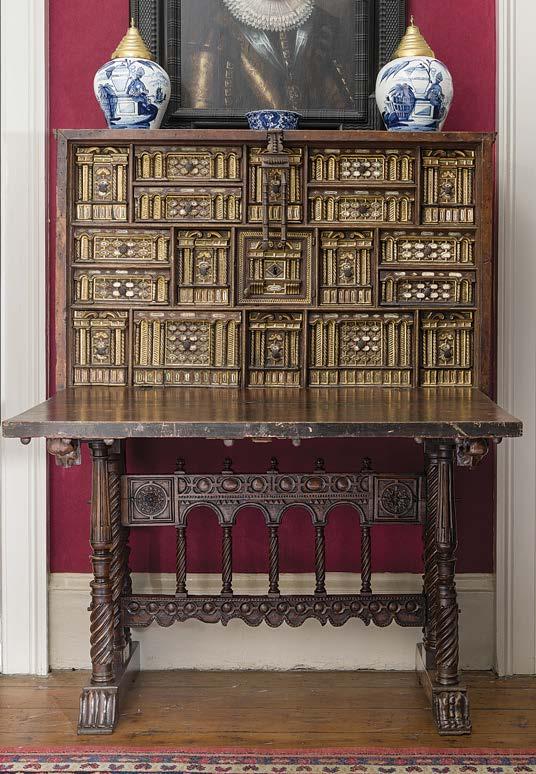
A fine 17th century walnut, parcelgilt, and boneinlaid Vargueño on stand, Spanish, circa 1650
The fallfront opens to reveal a fantastical interior arranged in three reserves of small drawers, each drawer of architectural form with spiral columns and geometric strapwork decoration, several drawers fitted with concealed compartments, ingeniously designed for the safekeeping of precious objects, centred by a small lockable door, further adorned with architectural framing and enclosing additional drawers and secret recesses, reinforcing the cabinet’s dual role as both a safekeeping treasure house and a stage for dazzling craftsmanship, the front of the fall having decorative pierced iron mounts, with red velvet beneath, and matching lockplate, on a 19th century sympathetically designed stand, with fluted and spiral turned legs, joined by a bold arcaded stretcher, on sledge feet.
Portable, yet opulent, these cabinets were conceived as displays of wealth and artistry, their façades echoing the Moorish architecture of Renaissance Spain. As objects of status and ceremony, they housed jewels, coins, manuscripts, seals, and other valuables, while their elaborate façades proclaimed the owner’s refinement and authority
H 152.4cm, W 113cm, D 47cm
£3,0005,000
93
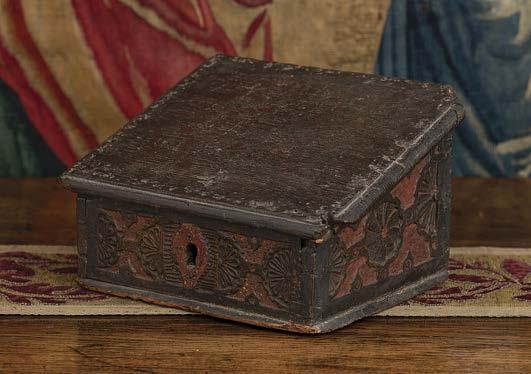
A rare and small 17th century oak and polychromed desk box, probably New England, North East, United States, circa 1670
The front and sides enriched with carved rosette strapwork panels, retaining original red and black polychrome, the sloping onepiece lid with moulded edge, enclosing a fitted interior with lidded till.
The decoration on this box reflects the persistence of European ornament in the 17th century American Puritan Colonies. Comparable polychromed desk boxes survive in major collections, including the Winterthur Museum and Colonial Williamsburg, where they are regarded as among the earliest surviving examples of painted furniture in New England. See also Victor Chinnery, ‘Oak Furniture: The British Tradition’ (2016), p.316, fig 3:380c. An example sold Christie’s, New York, 25 September 2013, Lot 2, ($20,000).
H 16.5cm, W 26.7cm, D 20.3cm
£2,0003,000
94
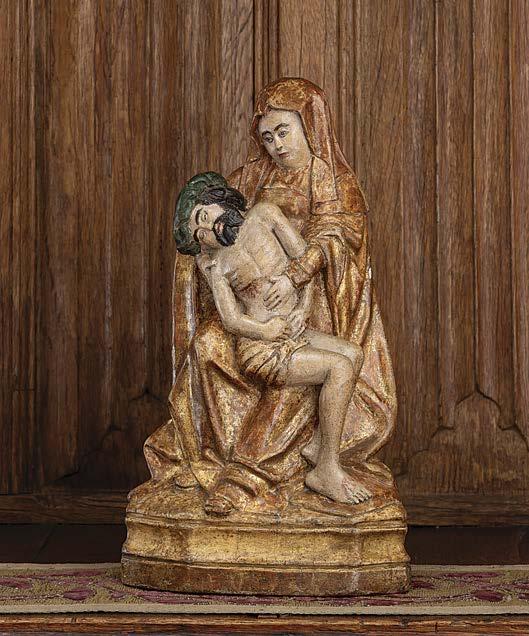
A 15th century carved oak and polychromedecorated figural group, The Pietà, Dutch, circa 1500
Showing the seated Virgin Mary cradling the body of Christ, Mary’s mantle painted in gilded tones with green and red highlights, while the emaciated body of Christ rests heavily across her lap, marked with the wounds of the Passion, on a socle base, some paint retouching,
The Pietà was among the most affecting devotional subjects of the late Middle Ages, encouraging meditation on both Mary’s compassion and Christ’s suffering. This intimate example was likely intended for private devotion.
H 36.8cm, W 21cm, D 8.3cm
£500800
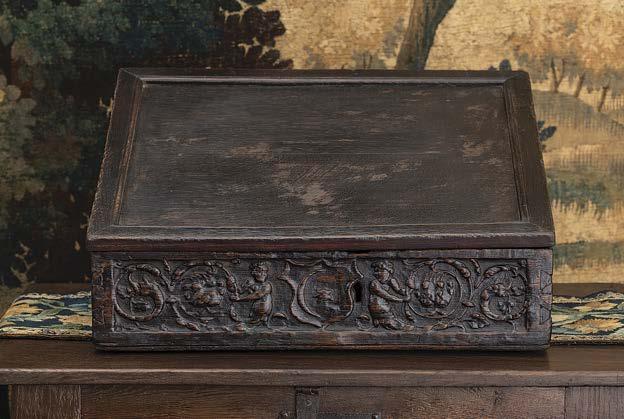
95
A carved oak desk box, AngloFlemish, circa 154060
Richly ornamented to the front with grotesque scrolls enclosing a central shield, flanked by paired putti amidst scrolling foliage and roundels, the sides similarly carved with grotesque ornament, the hinged sloping lid with applied moulded frame, opening to reveal a fitted interior with compartments and drawers for writing implements.
The ornament relates to designs by Cornelis Floris de Vriendt (c. 15141575) and the Antwerp school of printmaking, whose designs influenced the Renaissance style across the Low Countries and Germany through the 1540s60s.
H 28cm, W 52.7cm, D 43.2cm
£300500
96
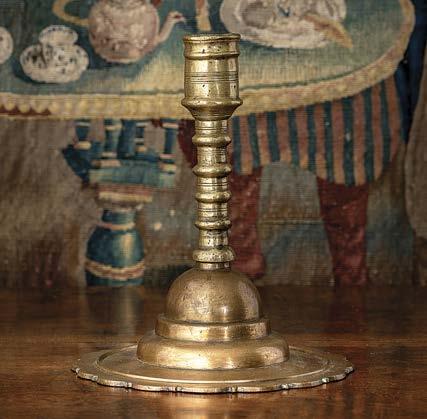
A substantial brass candlestick, Low Countries, circa 15501650
Having a bold cylindrical socket, the stem with four equally spaced, rounded discoids, atop a pronounced domed base with scalloped edge.
H 21.6cm, Dia 18.1cm
£200300
97
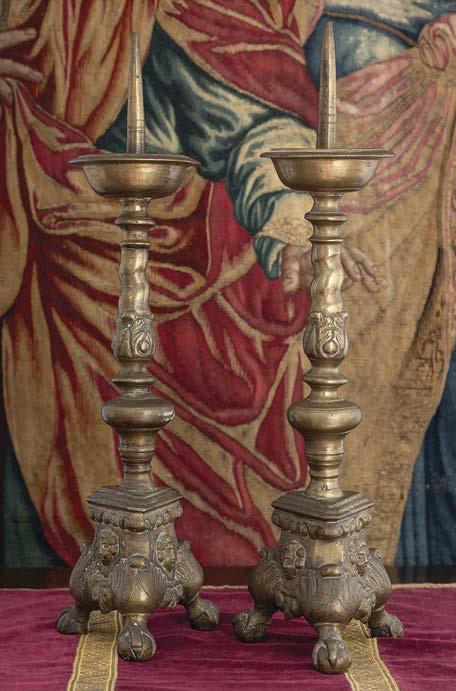
A pair of brass pricket candlesticks, Flemish, circa 1650
Of Baroque design, each with a cup driptray and tall brass pricket, atop a leafwrapped spiral over acornknop stem, the triform base cast with humanface mask sides, on ball and claw feet. (2)
H 53.3cm, W 15.2cm, D 15.2cm
£400600
98
98
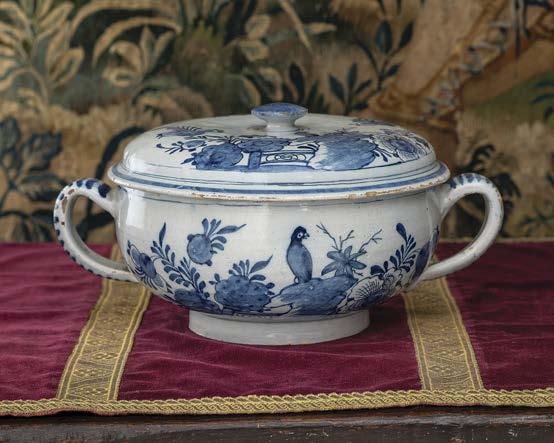
A delftware lidded broth bowl or milk tureen, probably English, circa 1720
Decorated in underglaze cobalt blue with flowering plants and perched birds amid stylised rockwork, the domed cover with knop finial, twin strap handles boldly modelled and decorated with blue striping, integral interior strainer.
H 15.9cm, W 30.5cm, D 24.1cm
£100200
99
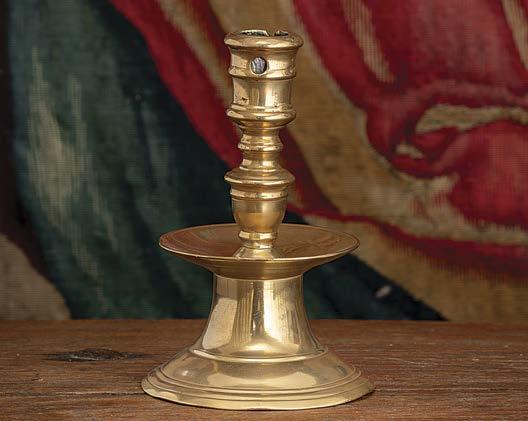
A late 16th century brass candlestick, Dinant, Belgium, circa 1580
Of compact size, the slightly flared socket with midfillet and circular extraction hole, on an acorn knop stem, above a broad and dished drippan and capstanstyle base.
Literature: See L’Or Des Dinandiers, p.117, nos. 220 and 221 and Ter Kuile, ‘Onne, Koper 7 Brons’, Rijksmuseum, Amsterdam, Staatsuitgeverij s’gravenhage, 1986, p.107, no. 148 for comparable examples.
H 15.9cm, Dia 10.2cm
£200300
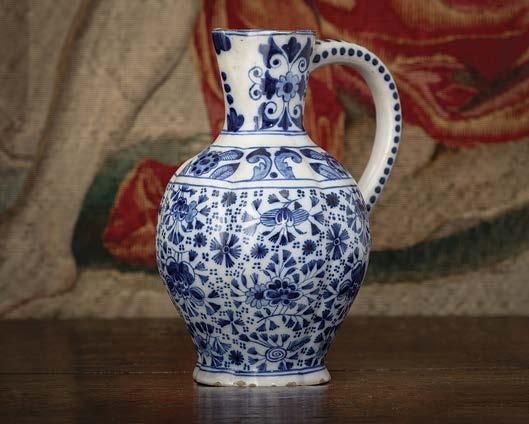
A delftware jug, Dutch, early 19th century
Of ovoid form, with flared cylindrical neck, and strap handle, painted in cobalt blue with an allover floral design to body, the neck with foliate ornament and the handle with dots, simple footrim, APK monogram to the base.
H 20cm, Dia 12.5cm
£100150
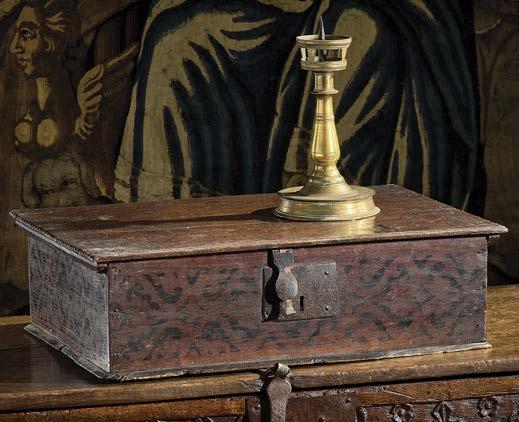
A Charles II oak boarded box, with stencilled decoration, West Country, circa 1660
The front and sides retaining traces of original stencilled decoration in dark pigments, composed of rhythmic double Sscrolls and interlaced motifs, with a hinged lid and applied iron lockplate.
Painted furniture from this period very seldom survives, as surfaces were vulnerable to wear, overpainting, or stripping. Such stencilling was a distinctive West Country decorative practice in the mid17th century, most closely associated with Exeter and surrounding areas, where craftsmen used paints applied through handcut stencils to ornament otherwise plain boarded forms.
H 16.5cm, W 55.9cm, D 40.6cm
£200300
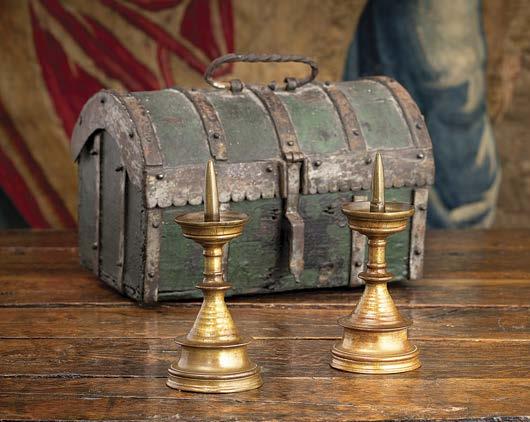
A matched pair of 15th century style small brass pricket candlesticks
Each with a central pricket above a shallow drippan, raised on a turned conical and baluster stem, and resting on a moulded circular base. (2)
H 14cm, Dia 6.4cm
£200300
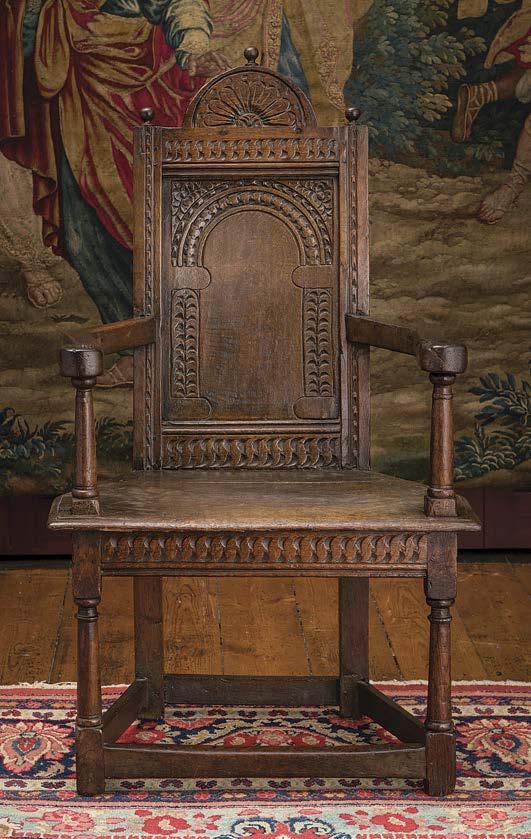
An Elizabeth I/James I joined oak caquetoire armchair, Salisbury, circa 15801620
The tall back panel enriched with a single stiffleaf arcade, beneath an integral arched cresting and top rail, carved with a fan and gauge chaincarving, and embellished with ball finials, the outsplayed angular arms on columnarturned front supports, the trapezoidshaped seat on chaincarved rails, the columnarturned forelegs joined by plain stretchers all round.
Chairs from this regional group, Salisbury, are amongst the most distinctive survivals of Elizabethan and Jacobean joinery, with their consistent construction and ornament placing them firmly within the same regional workshop tradition.
Literature:
See Victor Chinnery, ‘Oak Furniture: The British Tradition’ (2016) pp.405413 for a full discussion of the Salisbury group workshops and similar examples, in particular p.410, figs 4:68 & 4:68a. And Tobias Jellinek, ‘Early British Chairs and Seats 1500–1700’ (2009), for further examples p.108 & p.109.
H 122.6cm, W 70.5cm, D 50.8cm
£4,0006,000
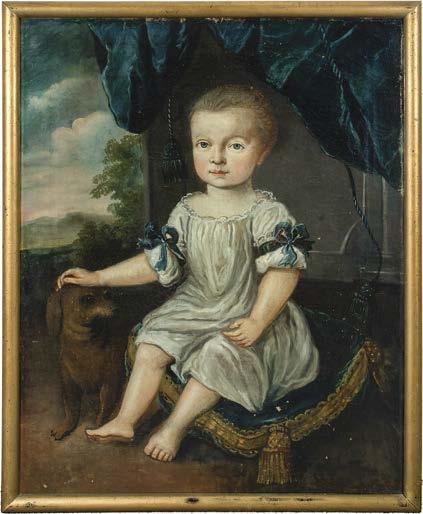
Manner of Caspar Netscher (Dutch, 1635/61684)
Portrait of a Child
Seated full length upon a blue cushion, wearing a white dress with blue ribboned sleeves.
Oil on canvas
84 x 66cm; 33 x 26in
£300500
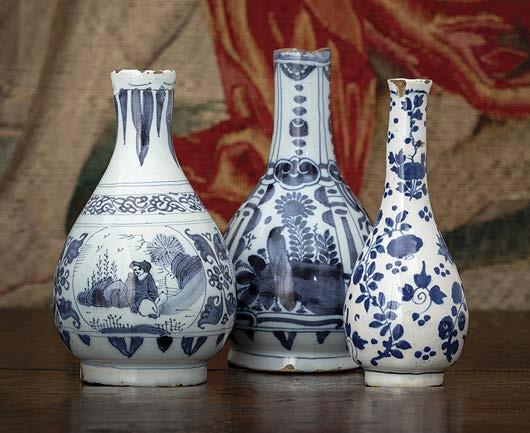
A group of three delftware vases, Dutch, circa 1700 and later
Their design inspired by Chinese Kraak porcelain, each of baluster form, with narrow flared neck, two painted with figural/landscape panels, the smallest with scattered floral designs. (3)
H 17cm (tallest), Dia 10cm
£200300

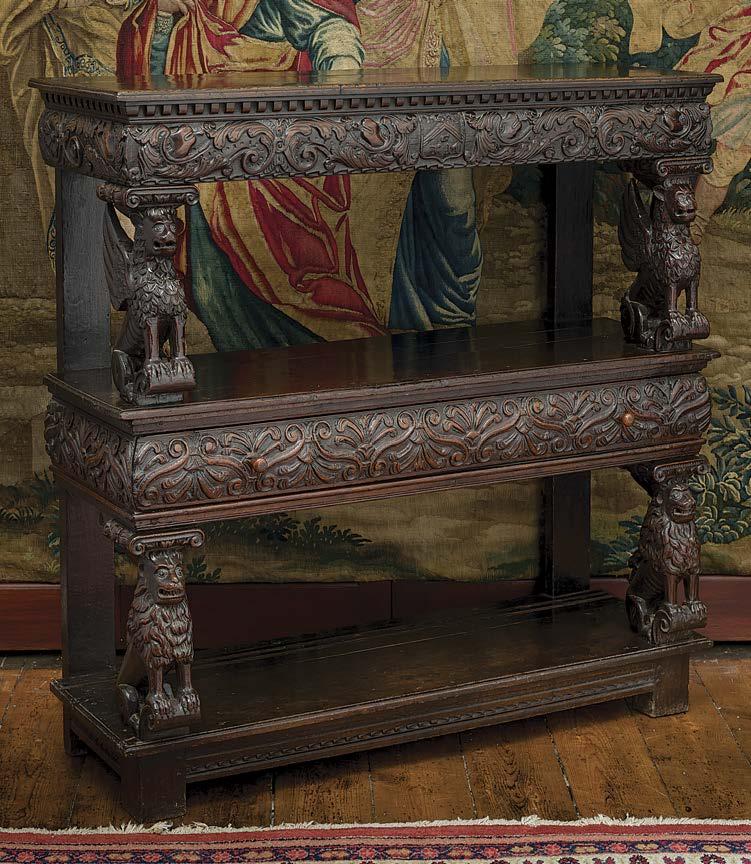
A rare and good Elizabeth I joined tiered court cupboard, possibly Gloucestershire or Home Counties, circa 15801600, albeit dated ‘1628’
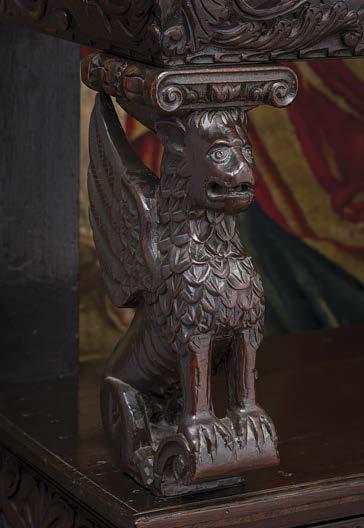
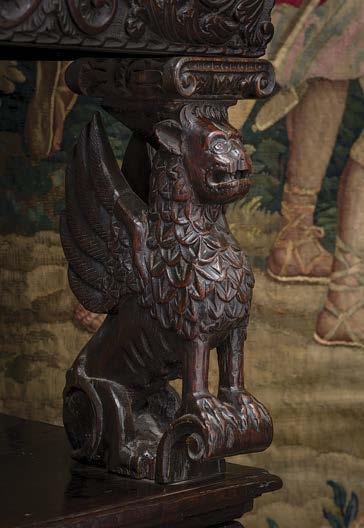
The lower section is supported by finely carved lions, each surmounted by Ionic capitals. Lions, long emblematic of courage and authority, were frequently adopted as guardians within domestic and ecclesiastical settings, their upright posture here reinforcing both strength and vigilance. Above, a central drawer is enriched with flowing Sscroll ornament, the upperstage raised on griffin supports, also capped with Ionic capitals, their winged bodies symbolising guardianship and vigilance, making their use on a cupboard, intended to display and safeguard prized plate and vessels particularly apt. The top rails are carved in deep relief with scrolling dragons, their entwined forms a potent symbol of power and protection. At the centre, a shield bears the initials TGM and date‘1628’, almost certainly added later, possibly to commemorate an event/marriage, as the overall design is undoubtedly Elizabethan.
Provenance: Sold Sotheby’s, 26 April 1985, Lot 34.
Literature: For a closely related example see Victor Chinnery, ‘Oak Furniture: The British Tradition’ (1979), p. 388, fig. 4:33, confirming the type within the corpus of documented Elizabethan cupboards.
H 124.5cm, W 123cm, D 43.8cm
£8,00012,000
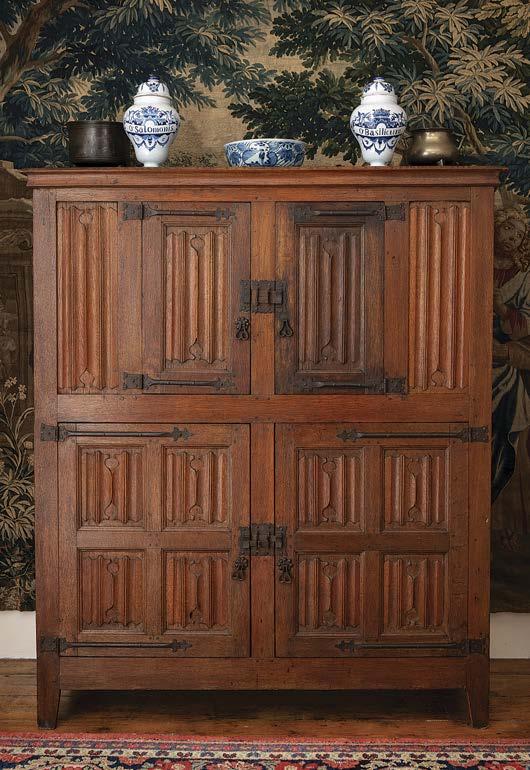
A 16th century oak linenfoldcarved high cupboard, Low Countries, circa 154060
Designed in two reserves, to the upper a pair of narrow doors, flanked by fixed panels, atop a pair of quadruplepanelled doors, all front panels and six side panels linenfoldcarved, with a series of narrow vertical pleats and finishing in small ‘keyhole’ heads to centre, on extended stiles. The carcass is completely joined and pegged, with unobtrusive moulded rails and stiles, the four doors hang on shaped pierced iron hinges and closed to the centre with wrought clasplocks. The repetition of the same panelling scheme to the sides confirms that the cupboard was conceived as a display piece in a wellappointed interior.
H 167cm, W 141.6cm, D 52.7cm
£8001,200
A near pair of 18th century delftware tobacco jars, Dutch, circa 174060
Of ovoid form, with stepped giltbrass covers, each painted in cobalt blue with a seated figure smoking a long clay pipe, flanked by tobaccofilled barrels and a pedestal urn, inscribed respectively ‘Nagelgeur’ and ‘Toskaanse’, large arching tobacco plants rise above the scene, reinforcing the commercial purpose of the jars as both storage vessels and pictorial advertisements, painted blue marks to the base. (2)
The inscriptions here denote popular tobaccos: Nagelgeur (clovescented) and Toskaanse (Tuscan). The imagery of a ‘Native American’ pipesmoker, a European invention rather than an ethnographic likeness, was intended to evoke distant origins and the global networks capability of the Dutch Republic’s trade, particularly under the auspices of the VOC (Dutch East India Company).
The stepped giltbrass covers appear original, adding both practical function and visual splendour.
H 36.2cm, Dia 20.3cm
£500800
109
A 17th century bronze cauldron, French, circa 1650
Of deep, cylindrical form with slightly everted rim, with twin lug handles, on three triangular splayed legs, paired raised lines to rim and base, a characteristic device of French foundries in the Loire Valley.
H 19.7cm, W 10cm, D 21cm
£300400
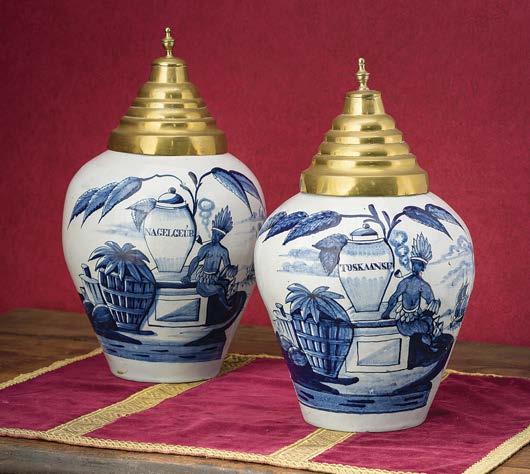
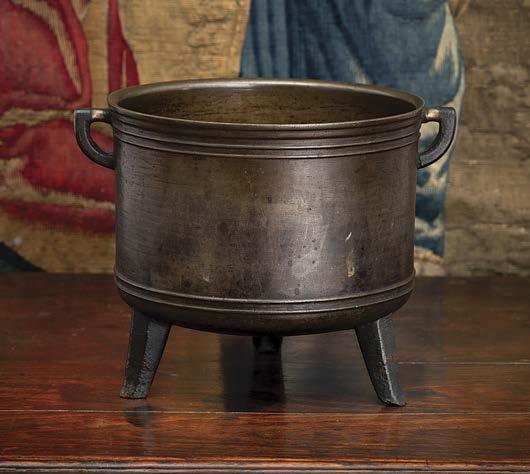
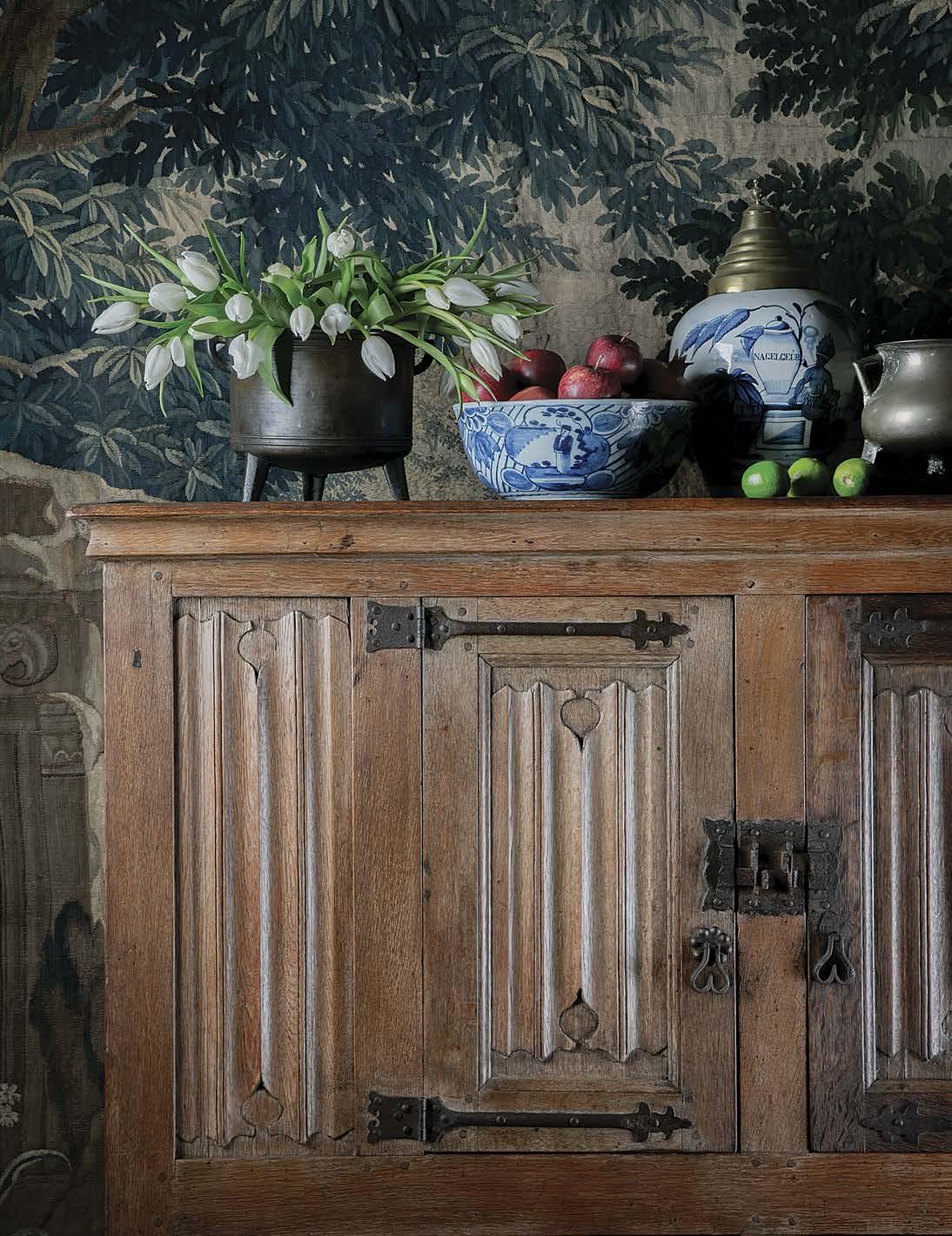
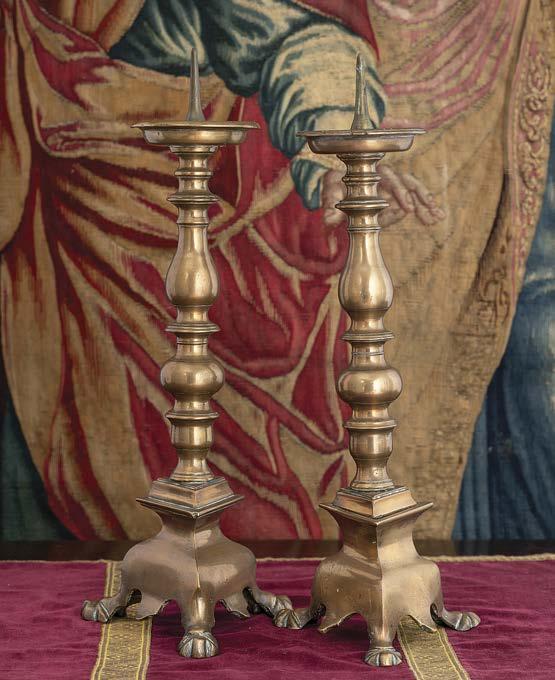
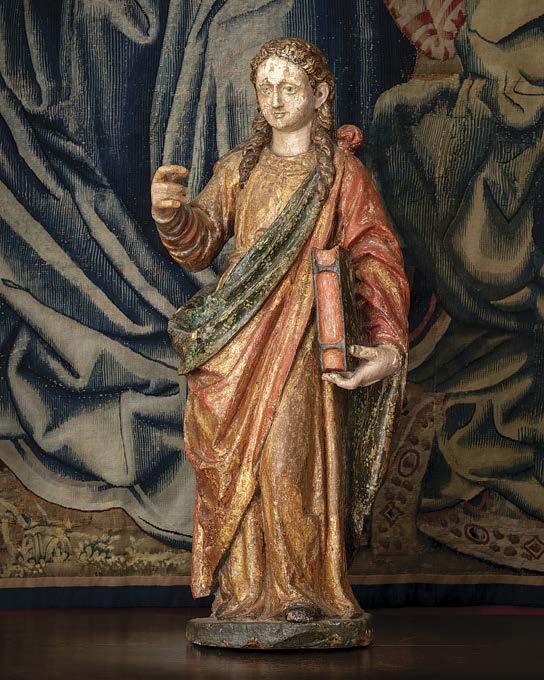
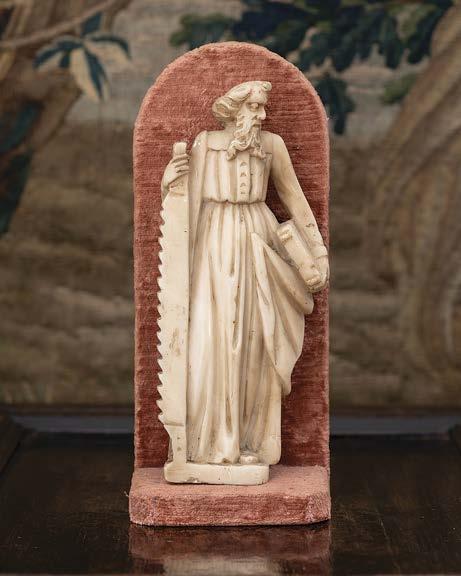
A pair of 17th century brass pricket candlesticks, Flemish or Italian, circa 16501700
Each with a bold baluster and knopped stem, supporting a flatbase driptray with integral pricket, on a triform base with splayed ogeeprofiled sides, on paw feet. (2)
The profile of the shaft, with alternating knops and compressed balusters, reflects the growing Mannerist taste for elegant vertical proportion, while the heavy, sharply faceted bases recall the Flemish liturgical brasswork of Antwerp and Mechelen, as well as related North Italian altar prickets produced in Milan and Bologna.
H 44.5cm, W 16.5cm, D 16.5cm
£400600
A 16th century limewood, polychrome and gilddecorated carving, Female Saint, South German or Alpine, circa 15501600
Carved in the round but with a more summarily finished reverse, the youthful female saint, most likely one of the early Christian virgin martyrs, stands in quiet contrapposto, weight placed upon her left leg, holding a closed book against her hip, her right hand raised, and originally holding a palm leaf. The saint is richly clothed in a gilded gown over which falls a mantle painted in vermilion red with traces of green lining, her long hair is rendered in carefully tiered curls, framing a face with almondshaped eyes, a small, pointed chin, and the faintest of smiles.
The figure may possibly refer to Catherine of Alexandria, Tatiana or Agnes.
H 82cm, W 33cm, D 26.7cm
£8001,200
A 16th century alabaster sculpture, circa 1500
Designed as St Simon the Zealot, one of Christ’s Apostles, shown standing frontally, with long flowing drapery falling in stylised pleats, his head turned to one side in quiet contemplation, in his true righthand he holds a long saw, the instrument of his martyrdom, in his other hand a book, a symbol of his role as an evangelist, mounted on a velvetcovered stand with arched backplate.
H 24.8cm, W 10.2cm, D 3.8cm
£600800
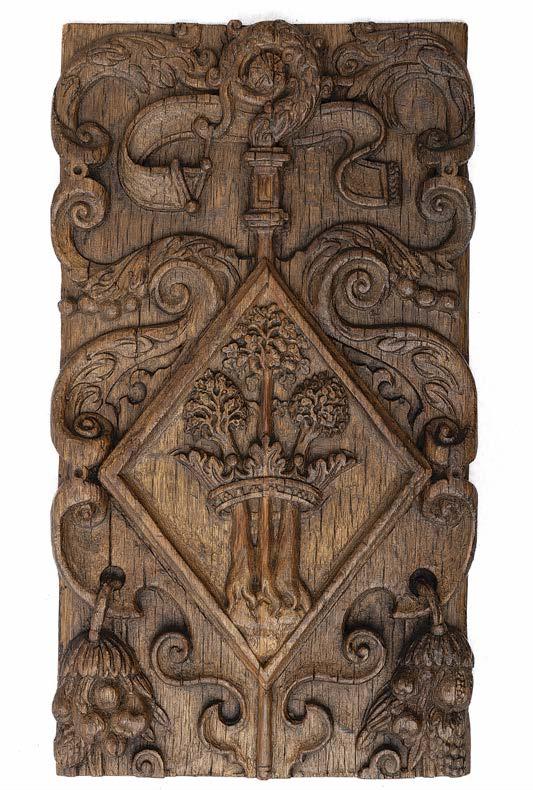
A late 16th century oak panel, Flemish, circa 1580
Carved in high relief, designed with a central lozenge enclosing a stylised triple canopy tree, all growing through a coronet, atop paired scrolls with masklike terminals, headed by scrolling foliage with vacant banner and croziertype motif.
H 52cm, W 30cm, D 2cm
£400600
114
A robust pair of 17th century brass pricket candlesticks, North Italian, circa 16501700
Each with a cylindrical socletype base, supporting a bold ovoid and baluster stem, rising to a flattened urnshaped drippan fitted with an iron pricket. (2)
H 43.2cm, D 14cm
£600800
115
A 17th century boxwood Corpus Christi, Flemish, circa 160050
Finely carved with anatomical and expressive modelling, the elongated body rendered with taut musculature, and prominent ribcage, the head inclined and crowned with thorns, the face serene, yet marked by suffering, mounted on a green velvet framed board.
H 41.9cm, W 35.6cm
£400600
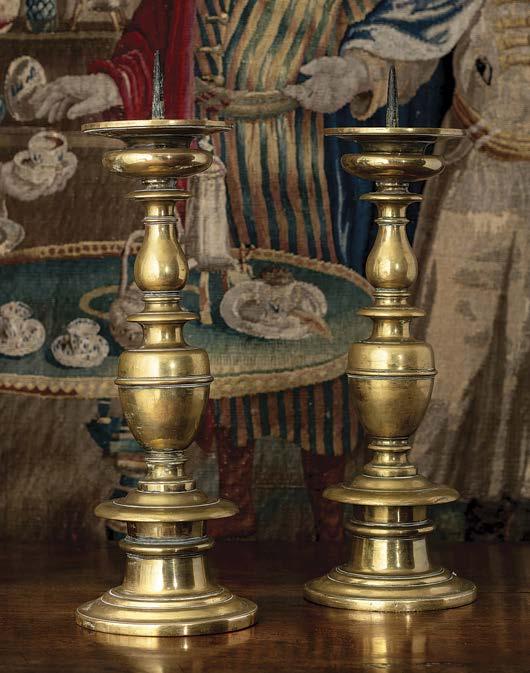
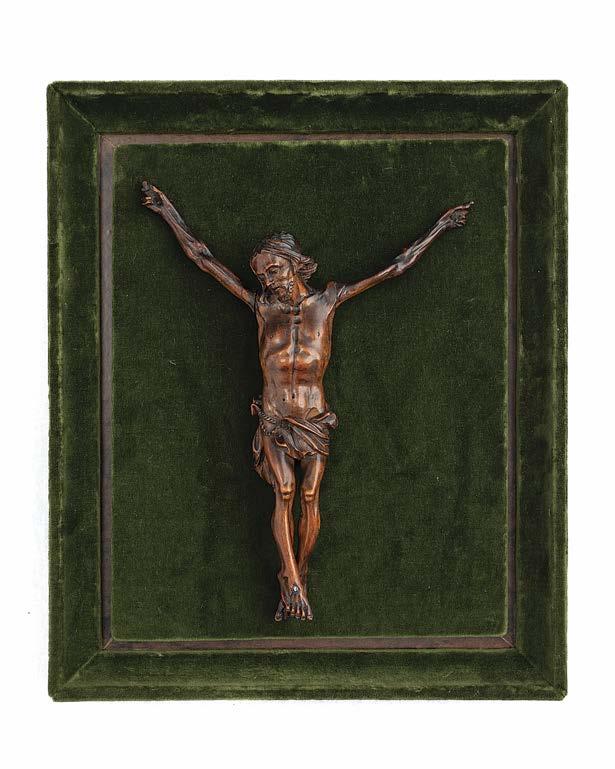
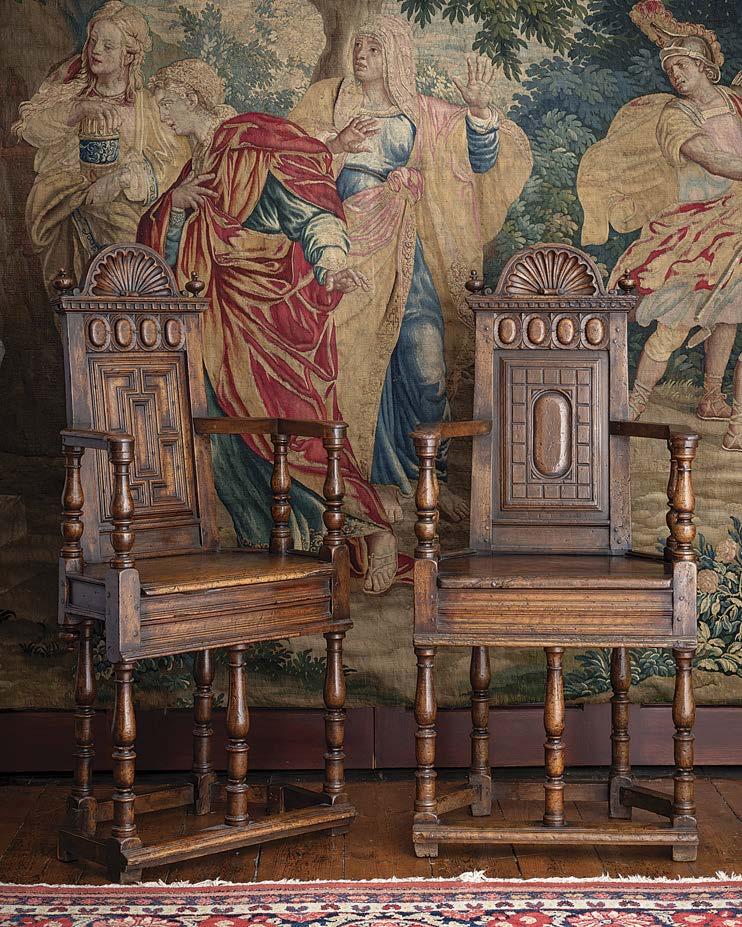
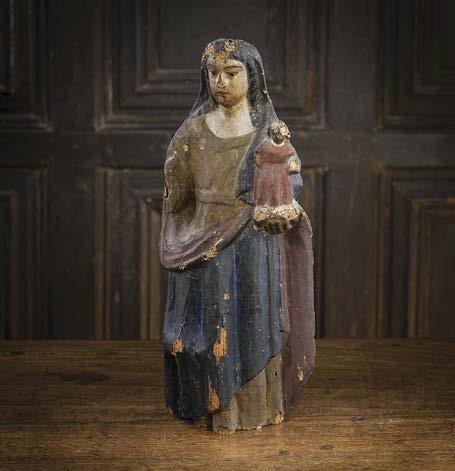
A pair of 16th century walnut caquetoire open armchairs, French, circa 1570
Each with a narrow rectangular high back, with either carved or applied mouldings, below an arched, scallopshell carved cresting, angularshaped arm rest on paired balusterturned supports, trapezoidshaped boarded seat, deep runmoulded seat rails, on five multipleturned legs, joined all round by plain stretchers, with a characteristic moulding applied to the front stretcher and extending over the front legs. (2)
Chairs of this type always appear to be of unique design, a oneoff, and never built in exact pairs or in a series.
There are also two comparable examples in the Louvre, Paris acc. nos. OA 3119 & OA 3120. See also collection Bruno Perrier, Haute Epoque, Ader Tajan, Hotel Drouot, Paris, 7 December 1993, Lot 85 for an identical chair from the same workshop (lacking cresting).
Literature:
Daniel Alcouffe, ‘Furniture Collections in the Louvre, Vol. I, Middle Ages, Renaissance’, pp. 2829, nos. 7 & 8.
Jacqueline Boccador, ‘Le Mobilier Francais du Moyen Age a la Renaissance’ (1988), pp. 300, 302 & 303.
David Dubon and Theordore Dell, ‘Furniture in the Frick Collections’, (1992), Vol. V, pp. 158, 167 & 169.
Provenance: Dr. Preston Pope Satterwhite Collection circa 1940’s, on loan to ‘Speed Art Museum’, Louisville, Kentucky. The chairs were deacquisitioned from the museum in 2011.
Thence Graham Dark private collection, Truro, Cornwall, these chairs were originally intended to be housed in Truro Museum.
H 125.7cm, W 59.7cm, D 42cm
£3,0005,000
A 17th century carved softwood and polychromedecorated figure group, Virgin and Child, Spanish or SpanishColonial, circa 16501700
This rustic devotional sculpture depicts The Virgin standing in a frontal pose, simply rendered with long robes painted in earthy tones of blue, red, and brown, she holds the Christ Child before her, the Child similarly simplified in form and painted in red, conveying the essential theological presence rather than naturalistic detail.
Unlike the refined works of major city workshops, pieces such as this emphasised clarity of iconography and immediacy of spiritual engagement over realism or artistic flourish.
The rigid frontally and schematic treatment of the drapery, combined with the straightforward paint application, speak to its origins in a regional workshop.
H 36.2cm, W 14cm, D 7cm
£100200
A pair of 16th century walnut and upholstered side chairs, French, circa 1580
With open rectangular padded back and stuffover seat upholstered in richly embroidered floral motifs on a navyblue ground, on tall entasis columnar forelegs, joined by uppermoulded stretchers all round, on ballturned front feet. (2)
Provenance: With French & Co., New York, label to underside.
Comparable examples are preserved in the Louvre, the Metropolitan Museum, and the Musée des Arts Décoratifs, Paris.
H 106.7cm, W 47.6cm, D 41.9cm
£8001,000
A brass basin, Flemish, circa 16001700
Having an everted rim, steep booge and central boss.
H 10.2cm, Dia 31.8cm
£100150
A 17th century bronze cauldron, German, circa 16501700
Of globular form, rising to an everted rim, with angular lug handles, on triangular splayed legs terminating in paw feet, possible faint founder’s mark to body.
Cauldrons of this type were essential in both kitchen and ceremonial contexts, used for boiling, brewing, or serving at table.
H 16.5cm, W 21cm, D 17.8cm
£200300
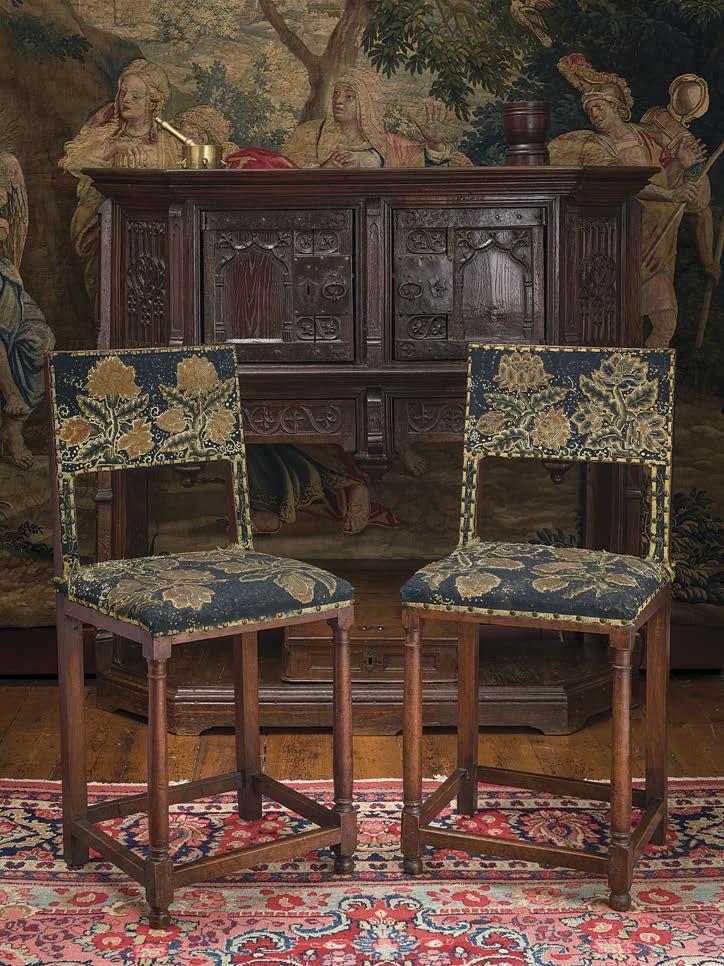
121
A 16th century limewood and polychromedecorated figural group, Virgin and Child, South German, circa 152040
The crowned Virgin standing serenely, presenting the Christ Child to the viewer, her drapery folds retain the vertical rhythm of the Gothic tradition, while the tender, more naturalistic modelling of the Child reflects the influence of the Renaissance.
Most likely intended for private devotion in a domestic setting or as part of a small chapel ensemble. Such works were widely produced in Swabia and Franconia during the early 16th century, reflecting the enduring Marian piety of the region.
H 50.8cm, W 16.5cm, D 8.9cm
£500800
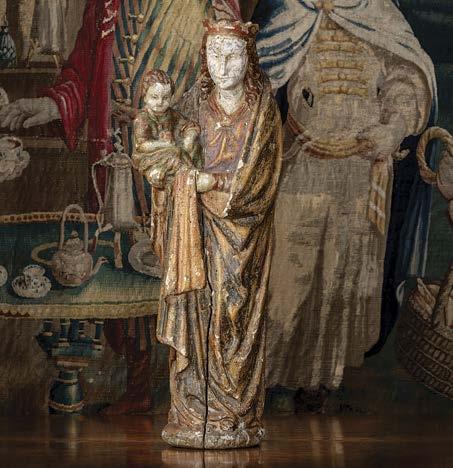
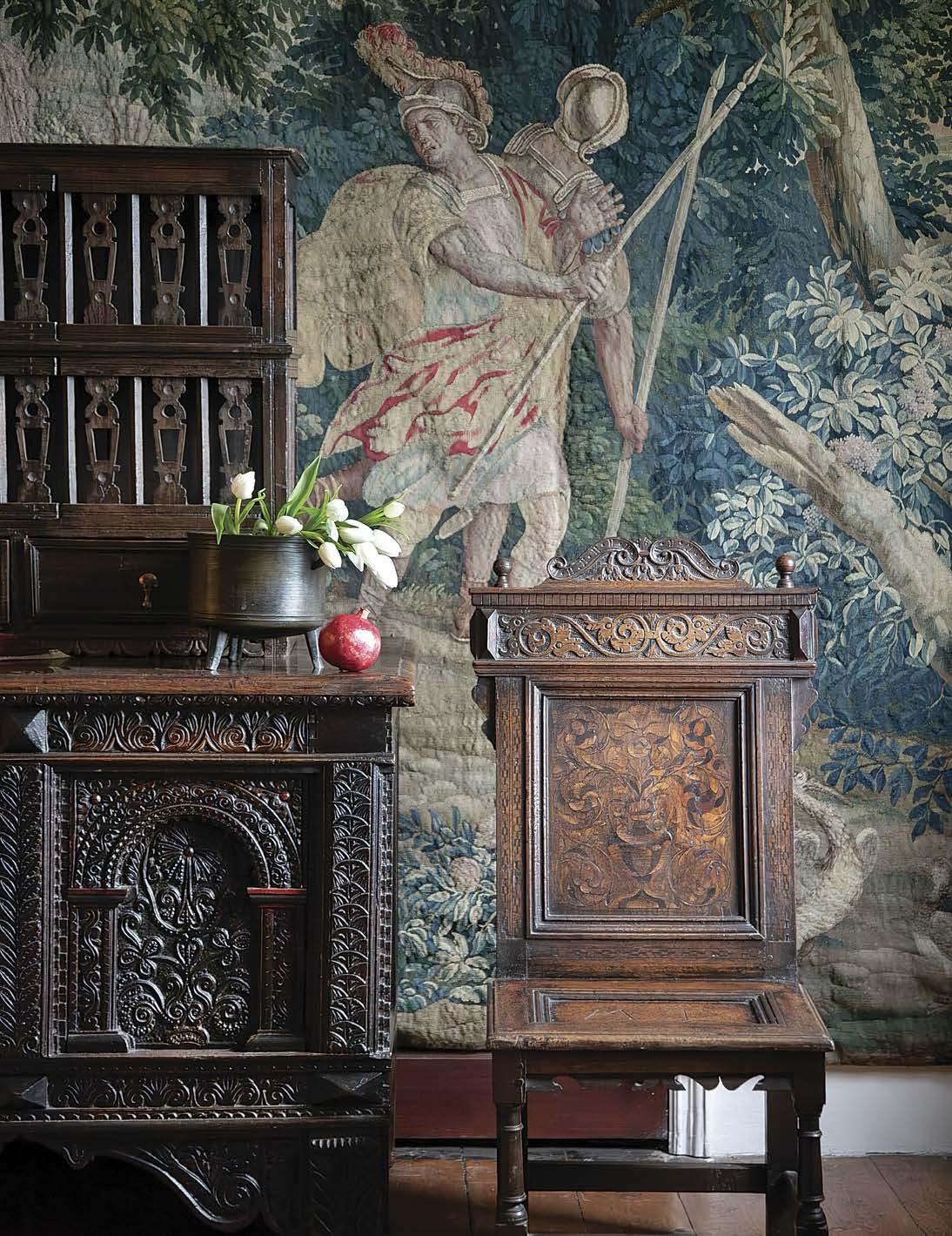
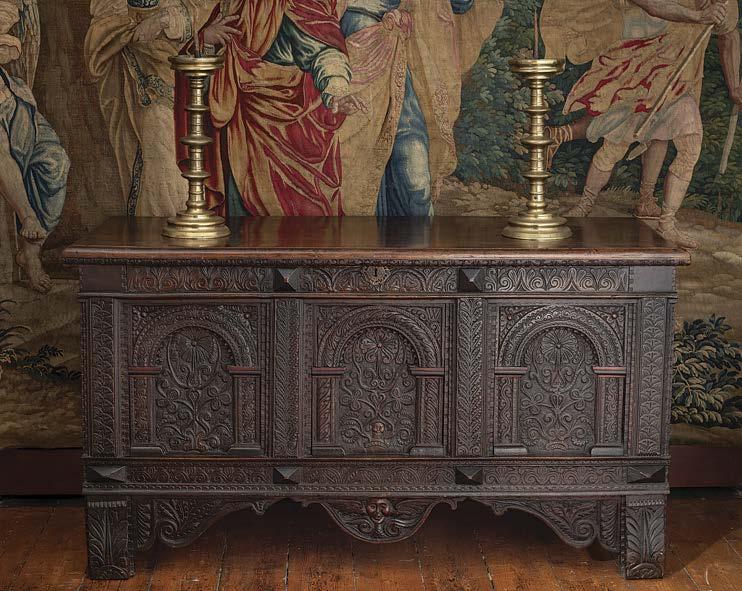
A fine Elizabeth I joined oak and polychromedecorated coffer, Exeter, Devon, circa 1580
The front composed of three deeply carved panels, each centred with a stylised flowering plant or tree of life motif, the spandrels filled with scrolling foliage and grotesque masks, one bearing the initials ‘T W’ to the top and a human face to the bottom, the top rail profusely ornamented with running strapwork, lunettes, and interlacing foliage, punctuated by lozenges carved with alternating pyramidal boss, the base rail with rare exuberant scrolled apron, carved with a winged cherub, foliagecarved corbels applied to the base of the stiles, the thick oak boarded top with cleated ends. The decorative vocabulary, including the arched panels finely carved with flora, vine tendrils, and figural masks demonstrate the widespread diffusion of Flemish ornament through the ports of Exeter and Plymouth in the 16th century. The growth in European styles was further influenced through imported pattern books, such as ‘Wendel Dietterlin’s Architectura’ (1598). Undoubtedly an Englishtake on the imported designs existed, and the use of wellestablished regional practices, for example the use of polychrome, continued. H 86.4cm, W 154.9cm, D 62.2cm.
£2,0003,000
123
An Elizabeth I oak and inlaid backstool, circa 1580
The back panel finely inlaid with a flowerfilled vase, within chequerinlaid rails, below an overhanging, scrollcarved rail and slender, scrollprofiled cresting, with fine floral carving, and flanked by ball finials, the panelled seat with a framed border and centred by the carved initials ‘MT’, on columnarturned legs joined by plain stretchers.
The combination of inlay, carving, and architectural form places this chair firmly within the upper tier of Elizabethan craftsmanship, standing apart from the plainer oak backstools that make up most of the recorded examples.
H 103.5cm, W 52.7cm, D 37.5cm
£600800
124
A poignant carved, gilded and polychromedecorated figure, probably Mary Magdalene, German, circa 1500
Depicted kneeling, her head veiled, and left hand across her chest in a gesture of devotion, the drapery in the distinctive angular folds of the Schwaben and Franconian schools of the late 15th century, lacking her most familiar attribute, an ointment jar.
The figure probably formed part of a larger ensemble; either a Crucifixion group or a Resurrection scene.
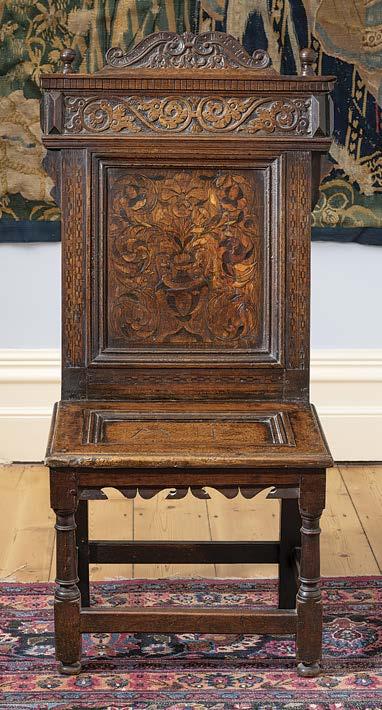
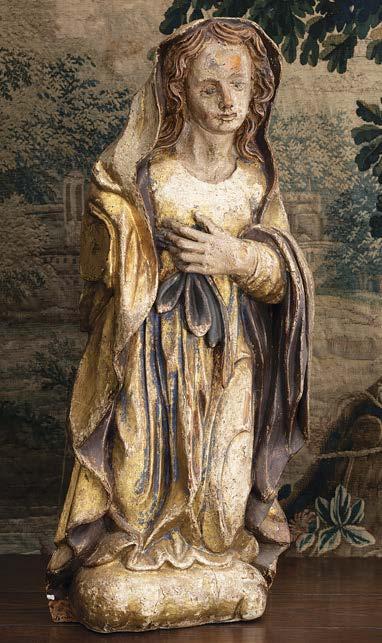
H 68.8cm, W 33cm, D 19cm
£1,5002,000
A delftware lobed charger, Dutch, early 18th century
Decorated in cobalt blue, the large central panel designed with flowering peonies, foliage and birds, the shaped rim with alternating foliate sprays and leafy motifs.
Dia 34.5
£200300
126
A 17th century maiolica dish, possibly Spanish, circa 1700
Decorated in cobalt blue with the image of Christ crucified, flanked by stylised trees, the rim with highly stylised foliage and arched motifs.
Dia 29.8cm
£100200
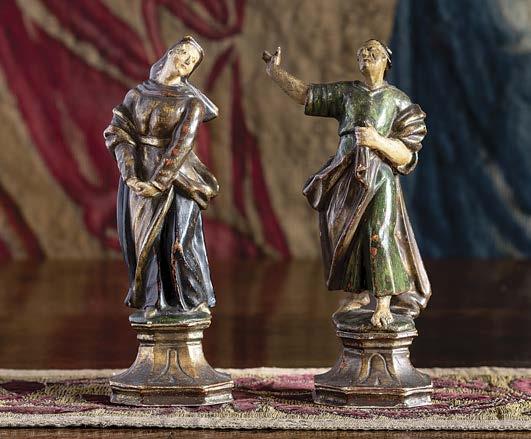
129
A mid18th century Flemish faience jug, Brussels, circa 1750
Having a deep cobaltblue ground, the front painted with oval shaped, whiteground reserve, depicting a rustic figure in a yellow dress and hat standing among flowering plants, further smaller floral sprays within starshaped reserves, with pewtermounted hinged lid and thumbpiece, height 30.5cm, diameter: 15.9cm; together with a German mug, with a domed pewter lid and raised thumbpiece, the baluster body decorated with floral sprays, in manganese, yellow and green.
H 29.2cm, D13.3.
£100150
130
An Afghan rug, circa 1930
The terracotta field with columns of ‘Salor’ guls enclosed by borders of chevrons.
L 185cm, W 119cm
£6080
131
A Charles II oak and upholstered stool, circa 1680
The floral upholstered stuffover seat on ball and parallelbaluster legs, joined by unusual stretchers, namely an ogeeprofiled lower edge.
Provenance: Robert & Rachel Byles Collection, Somerset. H 45cm, W 50cm, D 46cm
£300400
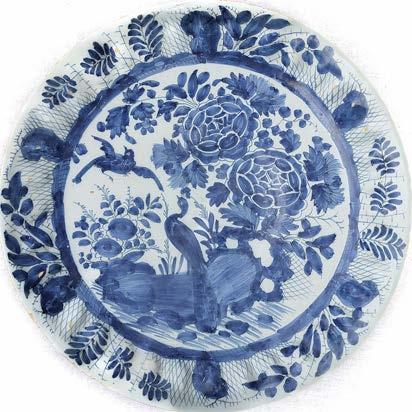
A small pair of 17th century polychromed devotional figures, Central Europe, circa 166080
Each designed standing in fulllength robes, on a socle base, the figures are imbued with a graceful, yet almost theatrical quality, typical of Southern German and Austrian Baroque sculpture of the period, their delicate proportions, stylised drapery, and expressive postures capture the emotional spirituality that characterised CounterReformation art, designed to inspire piety. (2) H 20.3cm, W 7cm, D 5.1cm
£200300
128
A 15th century style threeknop candlestick
In the Dinant, Belgium, circa 14501500 manner
Having a bold flared socket with paired rectangular extraction holes, the stem with three equally spaced discoid knops, the twostage base with a domecentred dish over a capstan foot.
H 21cm, Dia 10.8cm
£100200
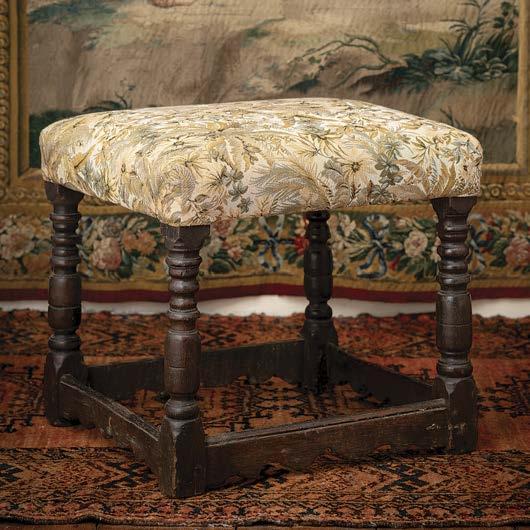
Two delftware polychrome painted chargers, Dutch and English, mid18th century
One designed with a bird, perched beside a large flowering plant, the rim decorated with alternate panels of foliate motifs and foliage; the other, possibly London (Vauxhall), centred by a Chineseinspired figural garden scene, the single figure standing next to a fence, the rim decorated with floral panels. (2)
Dia 34cm
£100200
133
A pair of brass pricket candlesticks, Nuremberg, German, circa 1600
Each with wide dished drippan and wroughtiron pricket, on a triple lenticular knopped stem, standing on a stepped circular base. (2)
H 42cm, Dia 15.2cm
£8001,200
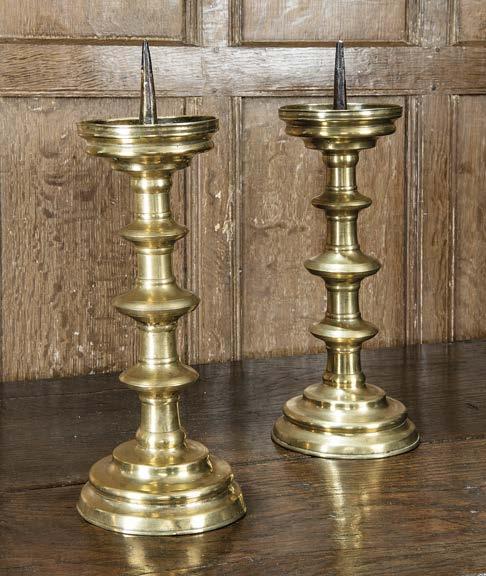
A late 15th century walnut Savonarola (folding chair), Italian, Florence, circa 14801500
The characteristic Xframe formed by multiple lathes, on bold lion pad sledge feet, the backrest of ogeeshaped boarded form, the bold, downswept armrests decorated with carved floral roundels to the face of the rounded ends.
The Savonarola chair design originates from the ancient Roman sella curulis, the folding seat of magistrates and senators, and is long associated with civic power and authority. Its revival in late 15thcentury Florence coincided with the political upheavals of the period, with the chair design becoming symbolically associated with Dominican friar Girolamo Savonarola (14521498) and his demand for Christian renewal to rid Florence of ‘vice’.
Provenance: Graham Dark private collection, Truro, Cornwall. This chair was originally intended to be housed in Truro Museum.
H 107.8cm, W 67.3cm, D 57.2cm
£1,0001,500
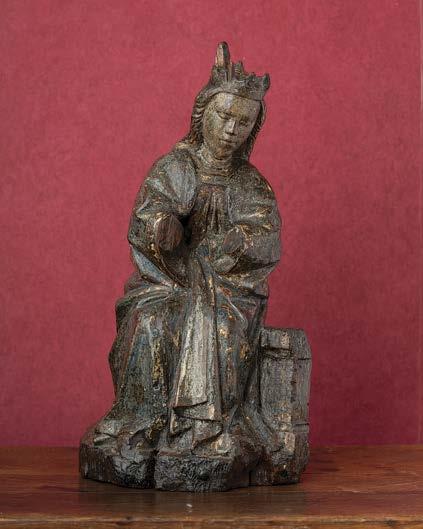
134
A late 15th century figural oak carving, The Seated Virgin, Low Countries/ German, circa 14801500
The Virgin Mary seated and crowned, the flowing drapery arranged in deep, vertical folds, her head slightly inclined, with a serene and contemplative expression, in quiet devotion, with traces of original polychrome, losses to hands, probably originally holding the Christ Child or attribute.
H 44cm, W 23cm, D 19cm
£400600
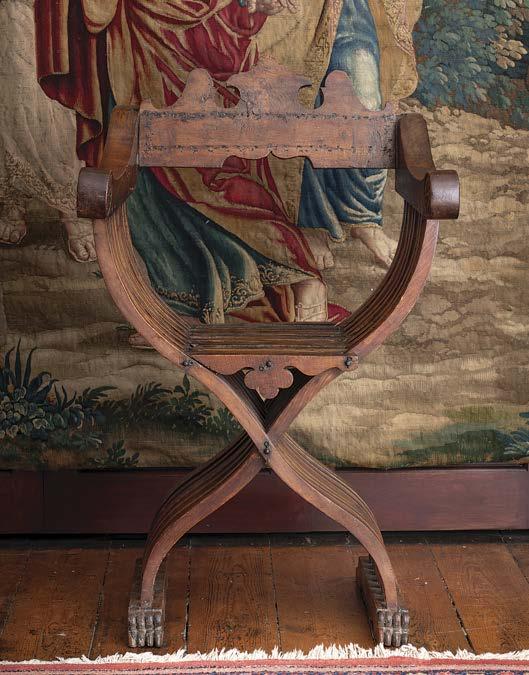
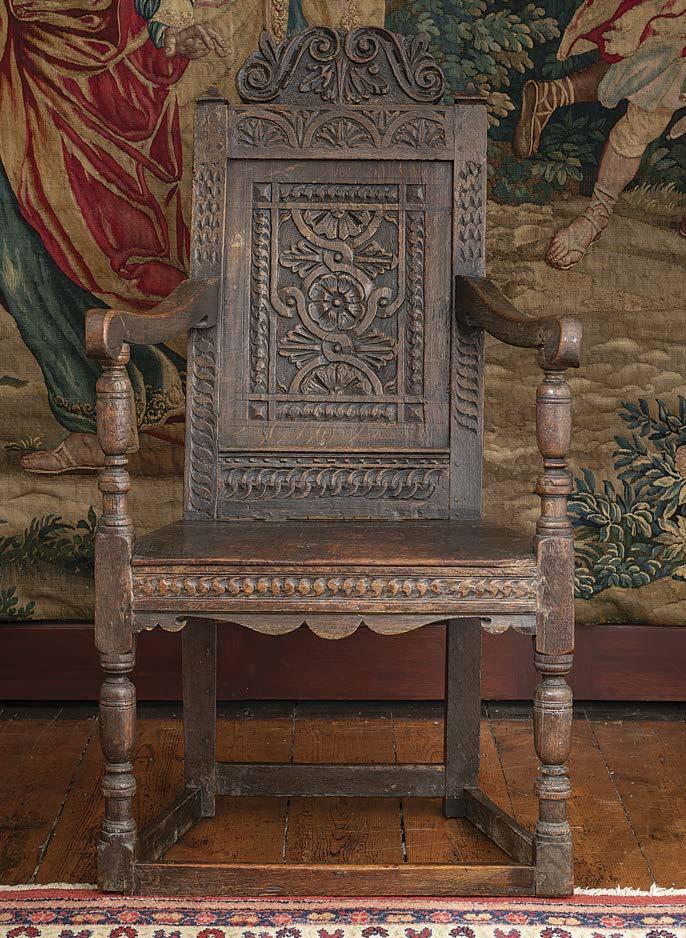
136
An Elizabeth I/James I oak open armchair, Salisbury, circa 15801620
Possibly attributed to the Beckham workshop.
The back panel carved with bold strapwork and guilloche ornament, surmounted by a top rail with lunettecarving and an arched crest carved with Sscroll designs, the back uprights carved with chains, the outsplayed arms with scrollends, on parallelbaluster turned front supports, the boarded seat atop carved seat rails, with bicuspid lower edge, on matching turned forelegs joined all round by plain stretchers.
Victor Chinnery the author of ‘Oak Furniture: The British Tradition’, (2016) p.409, records only three Salisbury armchairs not of caquetoire/caqueteuse form, making this chair potentially an important fourth example with straight arms.
The Salisbury workshops, notably the Beckham family workshop, were active at the very end of Elizabeth I’s reign and into the Jacobean period, producing highquality joined furniture for prosperous merchants and gentry in the Wiltshire region. This armchair’s rich carving and solid architectural presence place it firmly within that corpus, see ibid., p.409, fig. 4:65. H 120cm, W 66cm, D 56cm
£1,2001,800
137
A striking Charles II joined oak open armchair, Somerset, circa 166080
The back panel deeply carved with a fanciful single floral stem, within a carved arcade, flanked by serpent carved uprights and topped by a matching carved and pierced cresting, with fulllength ‘ears’ designed as highlystylised birds, with hooked beaks, balusterturned front arm supports, and boarded seat on chaincarved rails, the matching turned forelegs; joined all round by plain stretchers.
For an armchair, dated 1672, almost certainly form the same workshop, see Victor Chinnery, ‘Oak Furniture: The British Tradition’ (2016), p. 414, fig. 4:79. H 108cm, W 57cm, D 50cm
£600800
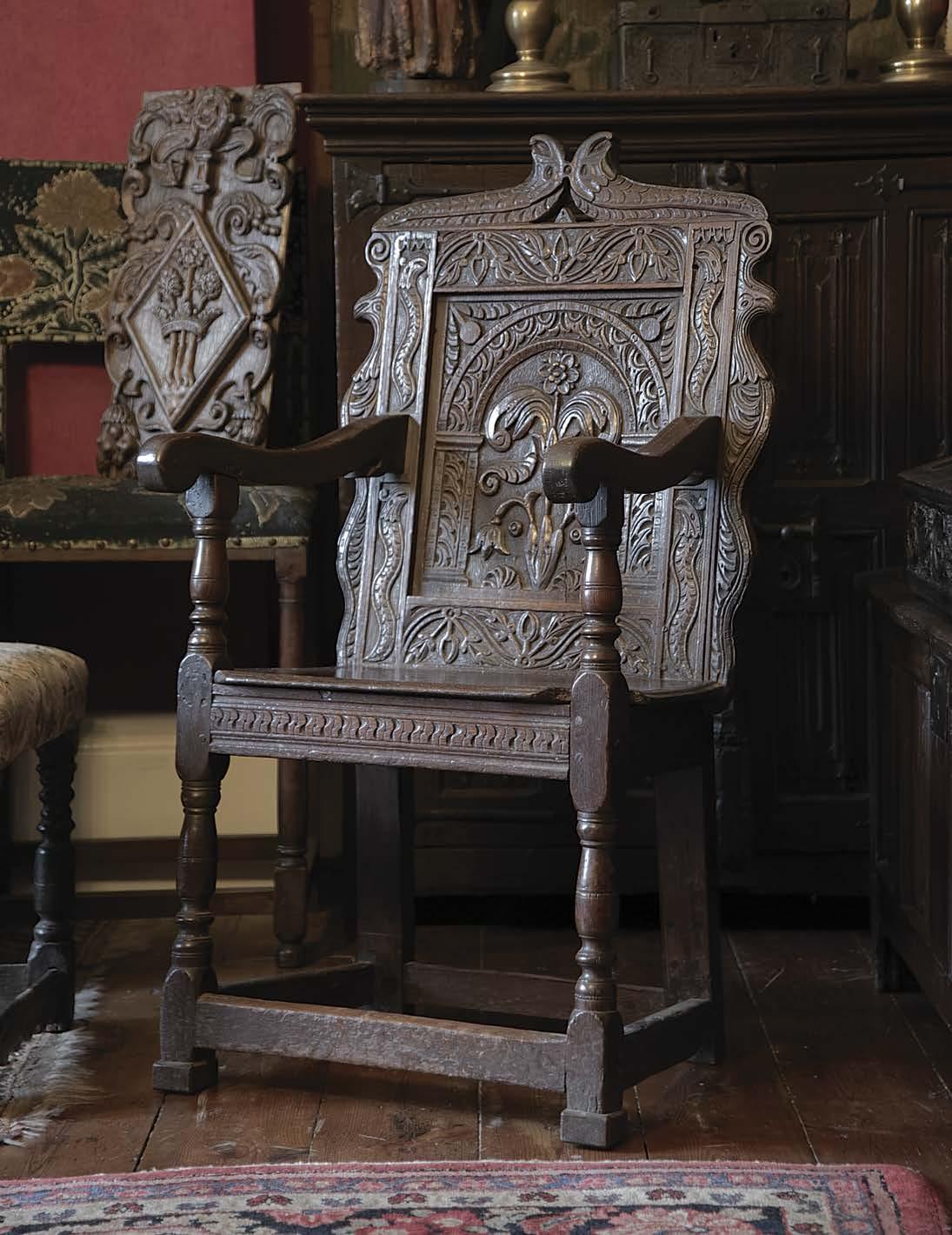
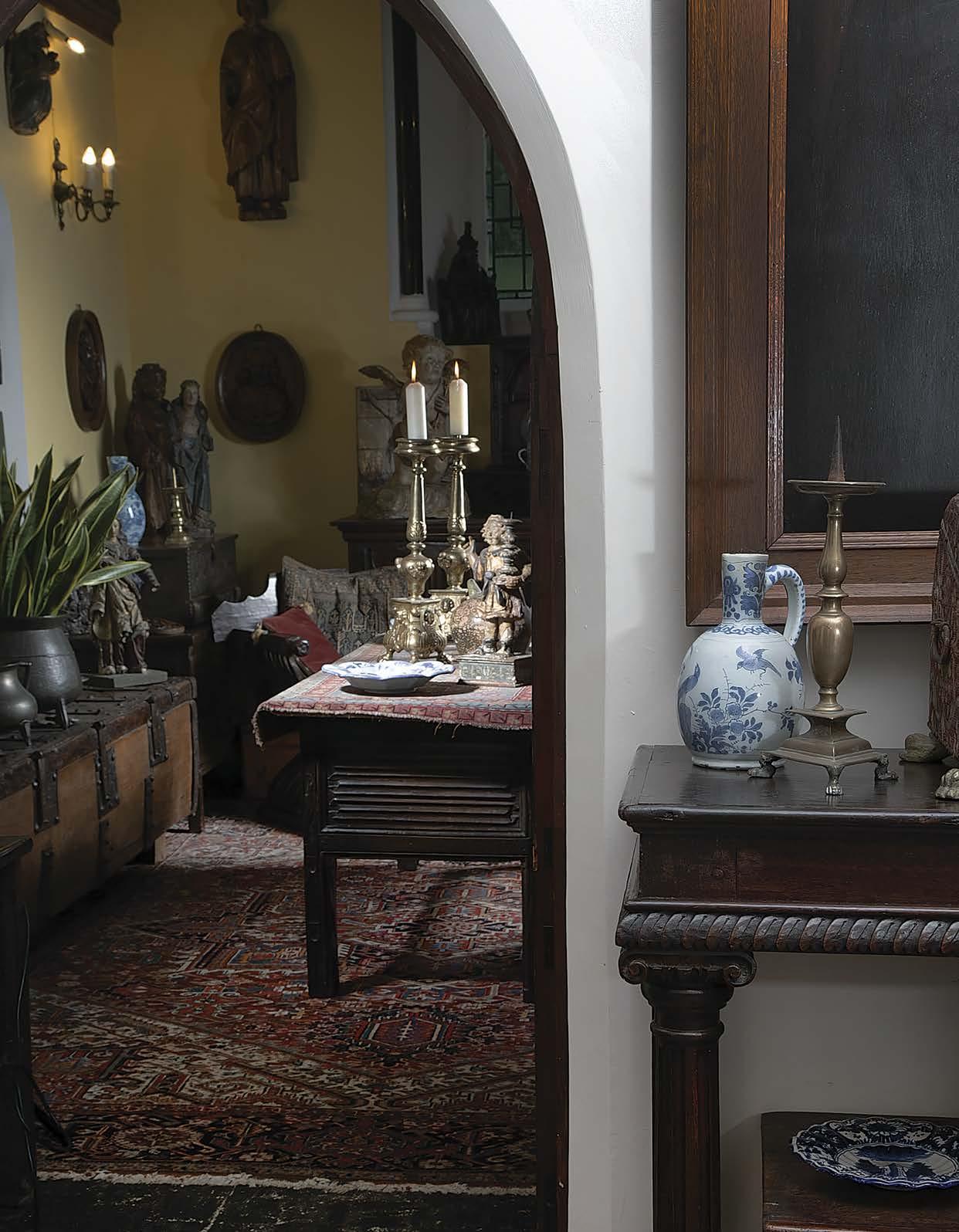
HALL LOTS 138-228
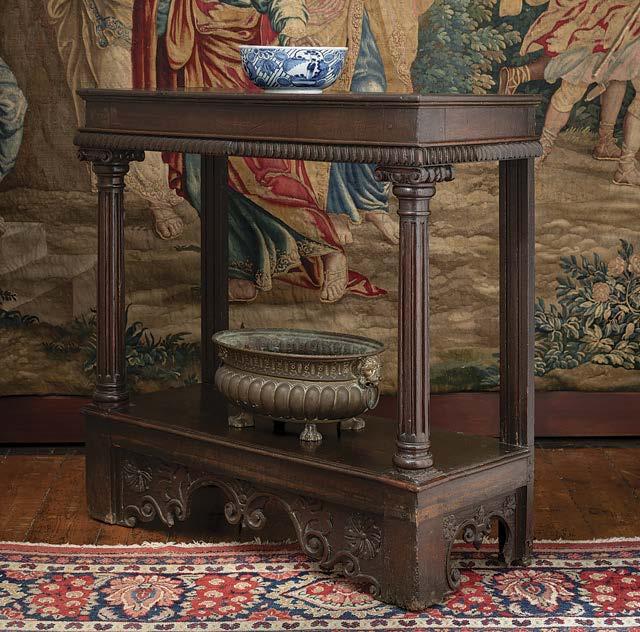
138
A rare Elizabeth I / James I oak cupboard, circa 15901610
The rectangular top above a plain frieze with gadrooned edge, supported by front Ionic capital fluted columns, and similar carved rear stiles, joined by a low open undertier, with elaborate scrollprofiled and carved apron, the sides are similarly treated, an unusually ambitious feature. This form belongs to a group of open ‘cupboards’ made in the 16th century, as a transition between medieval side tables and the enclosed court cupboards of the early 17th century. They were intended for the prominent display of plate, ceramics, and costly vessels in a hall or great chamber, often with a cloth/table carpet draped over the upper surface.
The present example is closely comparable to a celebrated group at Hardwick Hall, illustrated and discussed by Adam Bowett, Furniture History Society Newsletter, no. 231, August 2023. See NT, HH F349, F347 & F350. Like the Hardwick cupboards, this lot exhibits unusually high quality in both design and carving, especially in the bold undercut arcade of the base.
Provenance: Illustrated Apollo magazine, 1937 in an advertisement by Anderson of Welshpool, erroneously described as Charles I. Thence with Sam W. Wolsey, Buckingham Gate, London, again advertised Apollo magazine January 1942 and dated to circa 1600.
H 109.2cm, W 108cm, D 45.7cm
£3,0005,000
139
A delftware ewer, Dutch, circa 170050
Of ovoid form, with a flared, conical neck and loop handle, painted in cobalt blue, the body with a continuous Chineseinspired garden scene, showing flowering peonies, rockwork, and a longtailed bird perching beside bamboo, all within scrolling foliage, the neck with vertical floral sprays beneath a foliate border, the handle decorated with blue dashes.
H 24.1cm, W 14cm
£300400
140
A 17th century pair of brass pricket candlesticks, Italian, circa 16501700
Each with a shallow, broad drippan surmounted by an iron pricket, above a tall baluster and ovoid stem, on a stepped triangular base, with lion paw feet. (2)
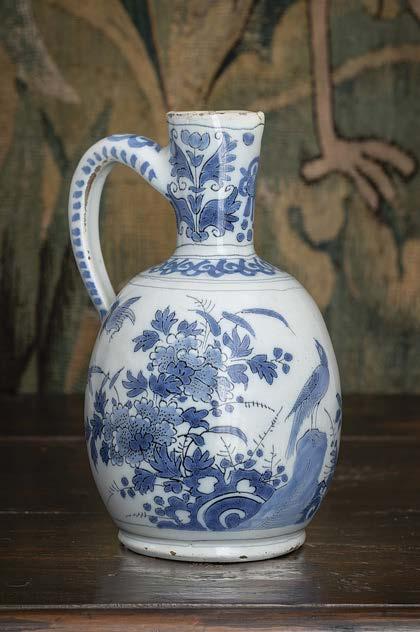
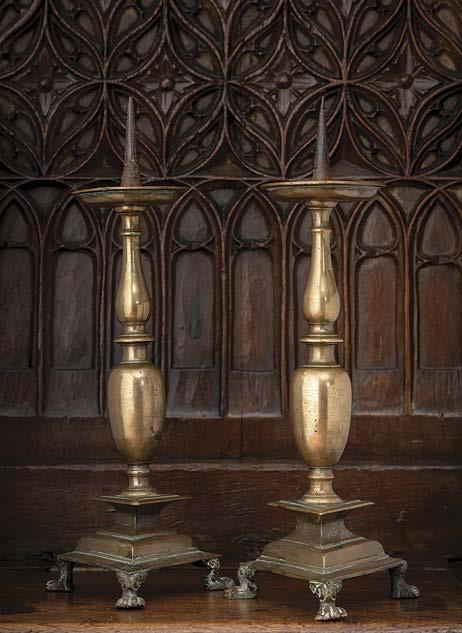
H 39.4cm, W 15.2cm, D 15.2cm
£500800
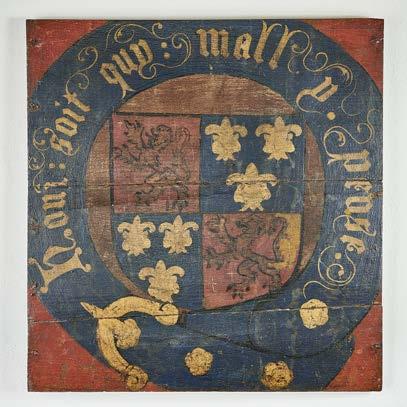
A 16th century carved oak panel, The Annunciation, Netherlandish, probably Antwerp, circa 156080
Of large, arched form, at the centre the Virgin Mary kneels before a lectern, as the Archangel Gabriel announces the conception of Christ, above God the Father appears with orb and benediction, sending forth the Holy Spirit in radiant beams towards Mary, while choirs of angels with scrolls, instruments, and trumpets surround him, the lower register includes figures of prophets and Old Testament Kings bearing scrolls and books, prefiguring the moment of Incarnation.
This iconographic program transforms the Annunciation into a cosmic vision of salvation history, linking Mary’s obedience to the fulfilment of prophecy and divine will.
H 57.2cm, W 39.4cm, D 5.1cm
£600800
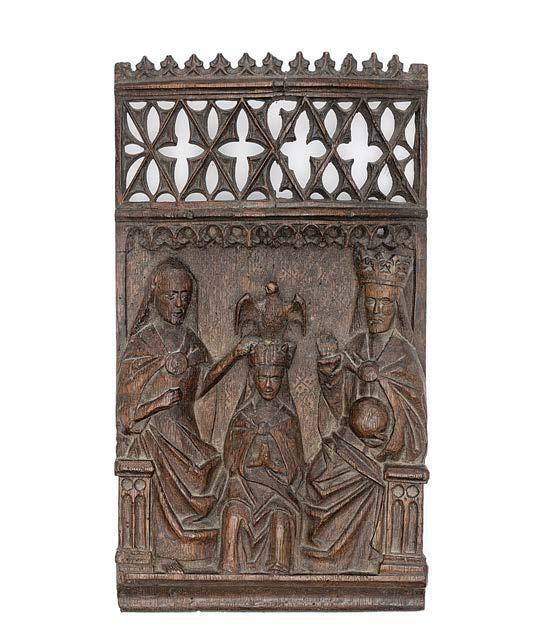
A 16th century painted oak heraldic panel, English, circa 150040
This painted oak panel depicts a simplified version of the Royal Arms of England, quartered, with lion rampant (on a crimson ground) and fleurdelys (on blue ground), encircled by the strap and buckle of the Most Noble Order of the Garter, inscribed with the motto ‘Honi soit quy mall y pense’(sic).
Only one lion rampant is shown, heraldic convention requires three lions passant. It is possible the rendering of the complex arms was abbreviated for clarity or economy. The present effect could simply reflect workshop practice, or more prominence was given to the French derived fleurdelys, as the Order of the Garter was initially created (c.1348) to help pursue the English claim to the French throne.
Panels of this type were frequently displayed in civic halls, noble residences, or parish churches, particularly where loyalty to the crown or the symbolism of the Garter was to be made visible.
Comparable examples of painted arms within the Garter are at St George’s Chapel, Windsor, early 16th century. A stainedglass renderings of Henry VIII’s arms with the Garter is in the British Museum collection, c.1540, acc. no. 1856,0624.1. See also the painted boards of Edward VI at St Mary’s Church, Westerham (c.1547–53). Each shows variations in detail but demonstrates the widespread practice of rendering the royal arms in wood or glass for public and devotional spaces.
£1,2001,800
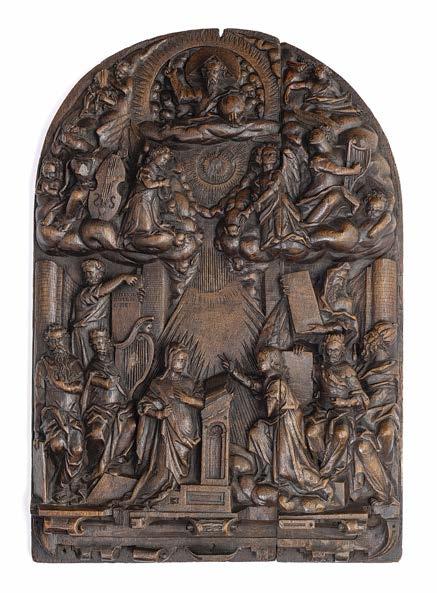
A 15th century carved oak panel, Coronation of the Virgin, French, circa 14501500
The Virgin, seated at the centre, with hands joined in prayer, is crowned by Christ and God the Father, the Holy Spirit descends in the form of a dove above, hence the full Trinity is present in the act of crowning the Queen of Heaven. Christ holds an orb, underscoring the cosmic and earthly significance of the scene. The upper section retains an elaborate openwork Gothic tracery frieze.
Panels such as this were set into the front of a highstatus chest or reliquary, usually directly beneath the lockplate, so the act of opening and closing the piece was framed by sacred imagery, not only proclaiming the piety of the owner but also serving as a protective invocation.
H 35.6cm, W 20cm, D 2.5cm
£600800
A carved walnut figure, St Jerome at the Rocks, Flemish, circa 1500
Depicted seated in a rocky landscape, his head resting on his hand in a gesture of sorrow and meditation, barefoot and clothed in a long robe with angular folds.
H 91.4cm, W 38.1cm, D 26.7cm
£1,5002,000
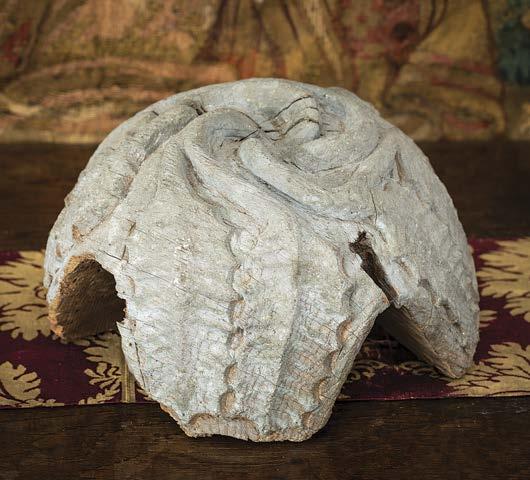
145
145
A 15th century carved oak roof boss, with traces of polychrome, English, circa 14501500
Of raised circular form, carved with swirling foliage, their branches spiralling around the centre, the surface retaining traces of an original blue painted ground. Roof bosses were carved ‘keystones’ placed over the intersections of ribs in stone vaulted or timber religious ceilings. They not only served a structural function but were also highly symbolic, acting as visual focal points within sacred spaces. The survival of medieval paint here is particularly important: blue, derived from costly azurite or indigo pigments, was strongly associated with the Virgin Mary, heaven, and divine truth. The leafy design reflects the enduring medieval tradition of the Green Man and foliate ornament, symbolising rebirth, resurrection, and the eternal cycle of nature.
H 12.7cm, W 22.9cm, D 22.9cm
£300400
146
A 15th century carved oak figure, Christ in Majesty, Brabant/Meuse, circa 14701500
Christ sits enthroned, as the ruler of the world, his right hand raised in benediction (now with losses) and the left probably grasping the Gospel, the earthly orb rests between his feet, deeply undercut, with angular ‘broken’ folds of the mantle cascading in crisp planes across his lap, a hallmark of late 15thcentury Netherlandish drapery style. The head is sensitively modelled with long, parted hair and a forked beard, the eyes are drilled and the lips subtly incised. The throne is blockcarved with stepped sides; the base is integral.
Often described as ‘God the Father’, the absence of a papal tiara or imperial crown and the presence of a book and blessing gesture identify the subject more precisely as Christ. The orb at the foot, rather than held in the hand, echoes Isaiah 66:1 (the earth is my footstool) and occurs in workshop sculpture from Brabant and the Meuse valley, notably in pieces associated with Antwerp retable carvers.
H 43.8cm, W 33cm, D 12cm
£2,0003,000
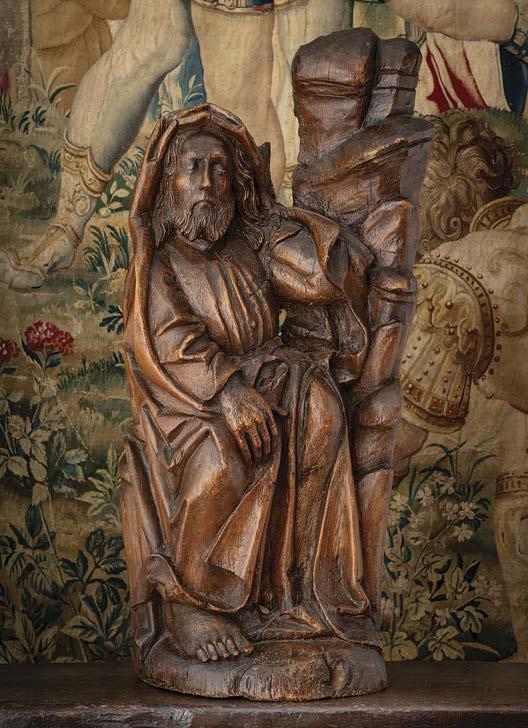
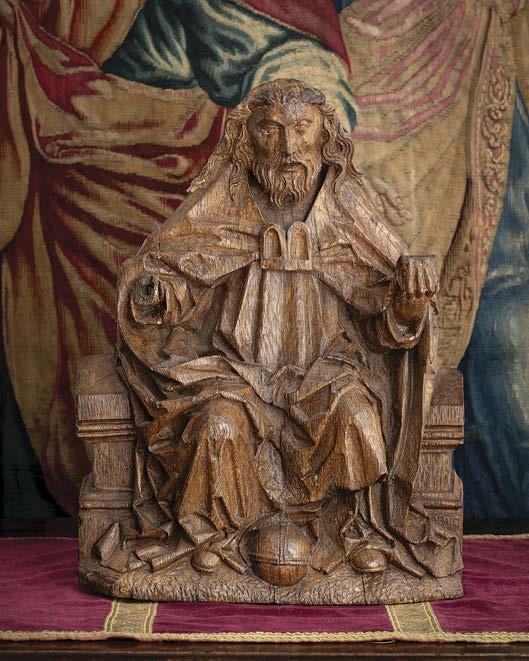
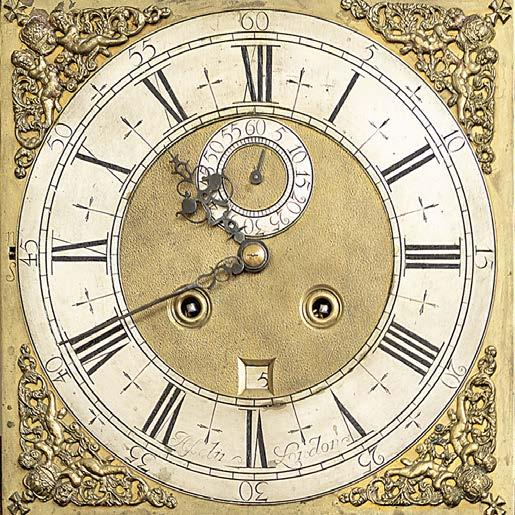
147
An imposing walnut and marquetry monthgoing longcase clock, English, circa 1695
Stephen Aselin, London (fl.16871717)
The overhanging cornice with ornate scallopshell centred cresting, on ebonised spiral columns, the long door with three fine reserves of floral and bird marquetry, centred by an oval lenticle, on a matching inlaid base and stepped plinth, the 11 inch square brass dial with cherub and crown spandrels enclosing the silvered Roman chapter ring, with fleurdelys half markers, matted centre, subsidiary dial and chamfered date aperture, with month going movement.
H 238cm, W 51cm, D 23cm
£1,5002,000
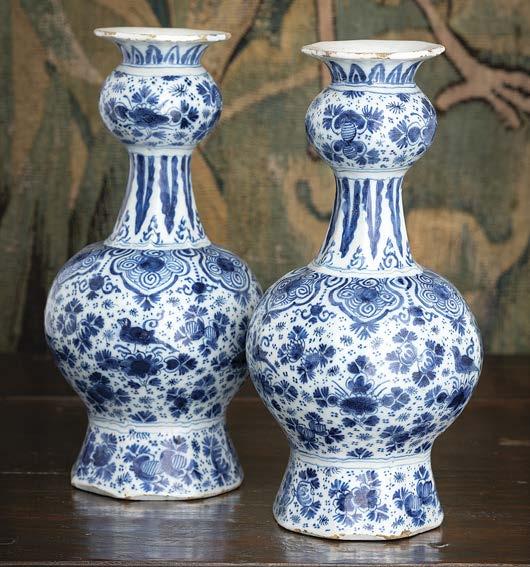
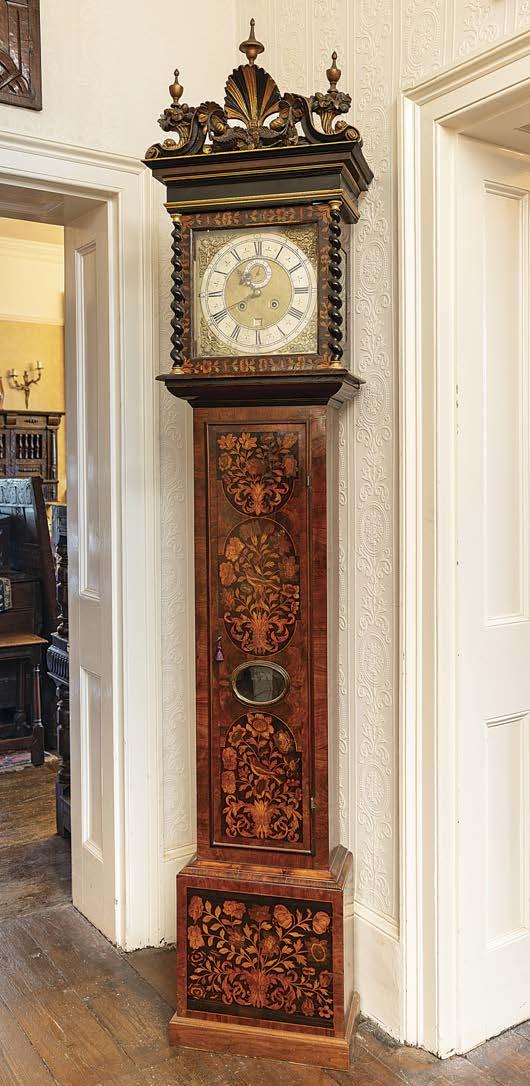
148
A pair of delftware vases, Dutch, circa 170050
Each of distinct baluster form, with slender neck rising to a bulbous end just below the flared rim, finely painted in cobalt blue with dense floral ornament and stylised foliage in the socalled Hollandse Bloemen (Dutch flower) pattern. (2) H 29.2cm, Dia 14cm
£200300 147
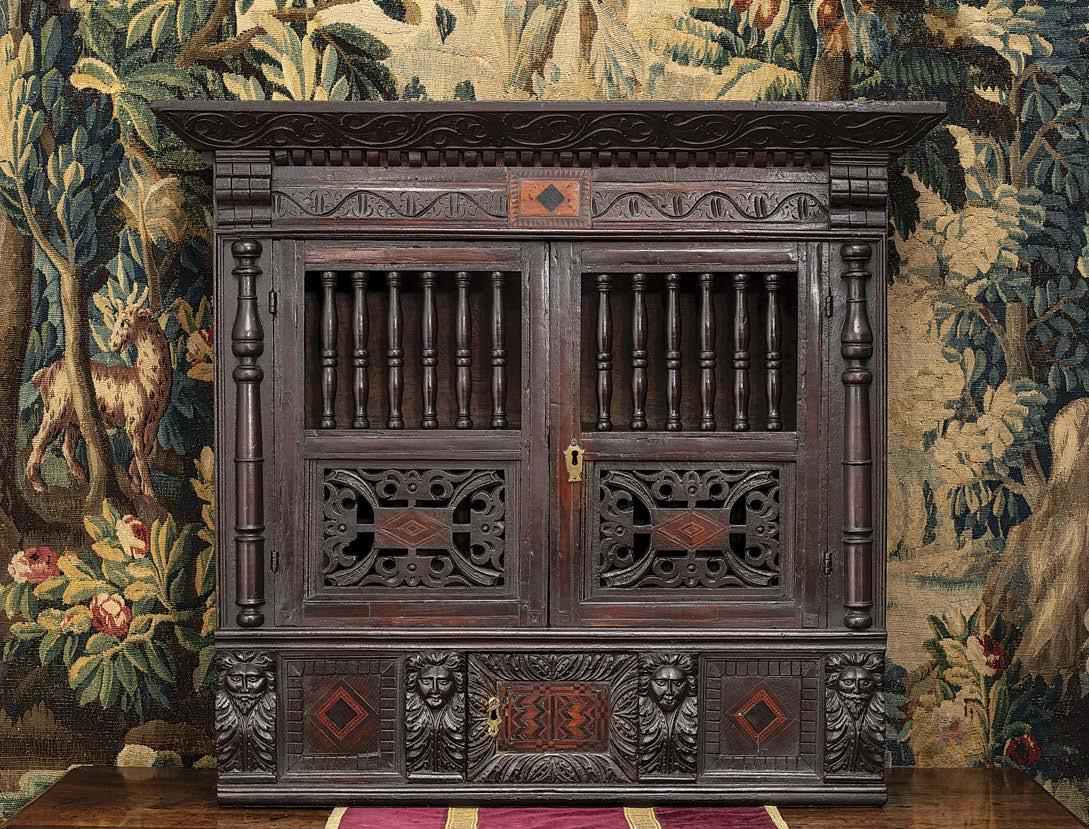
149
A fine James I oak and inlaid mural cupboard, West Country, circa 161525
Designed with a sophisticated interplay of architectural form, carved ornament, and inlaid decoration. The upper stage comprises a pair of cupboard doors, each with turned spindles above a finely scrollfretted panel, centred by lozenge inlay, atop a slender cupboard, enclosed to the centre by a small boarded door, parquetry inlaid and with a gadrooncarved frame, flanked by lozenge and dentilmoulded fixed panels and spaced by male and female mask and stiffleaf carved corbels, the projecting cornice is enriched with a continuous carved frieze of meandering scrolls, lending the piece a striking architectural presence, the front uprights with spiltbaluster applied mouldings, uniting the upper and lower stages in a manner characteristic of West Country joinery of this date, the rear of the doors carved with the date ‘1642’ and initials ‘TE’ added a short while after manufacture; any original date would almost certainly have formed part of the frontal design at the time of manufacture.
Provenance: Private collection, Canada.
Literature: Illustrated John Fiske and Lisa Freeman, ‘Living with Early Oak’, p. 83, fig. 4.21 & by the same authors in ‘When Oak Was New’, p. 119.
A related mural cupboard, almost certainly from the same workshop, sold Bonhams, London, 24 February 2016, lot 403, (£25,000)
H 89.5cm, W 98.4cm, 31.8cm
£6,0008,000
150
A group of three delftware blue and white vases, Dutch, circa 170050 and later
Of related distinct baluster form, with slender neck rising to bulbous end below the flared rim, finely painted in cobalt blue with dense floral ornament and stylised foliage in the socalled Hollandse Bloemen (Dutch flower) patterns, together with exotic birds, trelliswork and floral medallions. (3)
H 41.3 (largest)
W 17.8 (diameter)
£600800
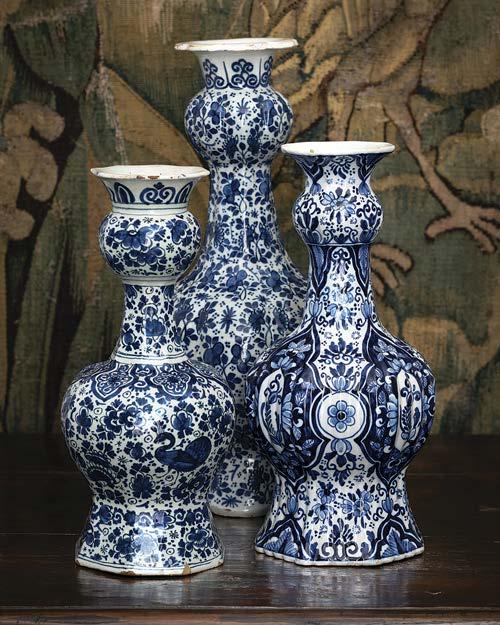
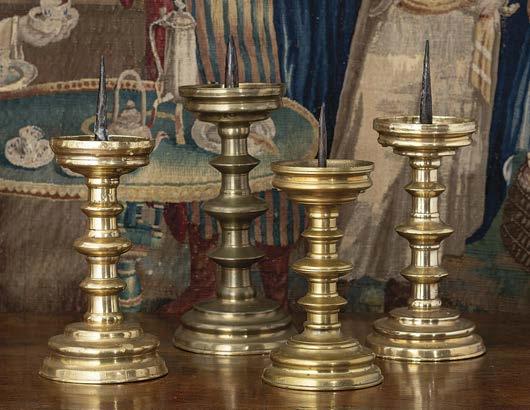
151
A group of four individual brass pricket candlesticks, German, circa 1600
Each with a triple lenticular knopped stem, dished drippan with iron pricket, on a stepped domed base. (4)
H 34.3cm (largest), Dia 14cm
£1,2001,800
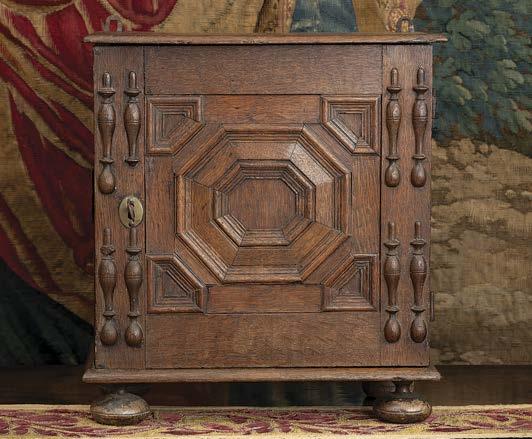
153
A small Charles II oak spice cupboard, circa 1670
The single door enriched with geometric mitremouldings centred by an elongated octagonal design, flanked by pairs of splitbaluster applied mouldings, enclosing an interior of eight various sized small drawers, on turned bun feet.
H 43.8cm, W 40cm, D 21.6cm
£500800
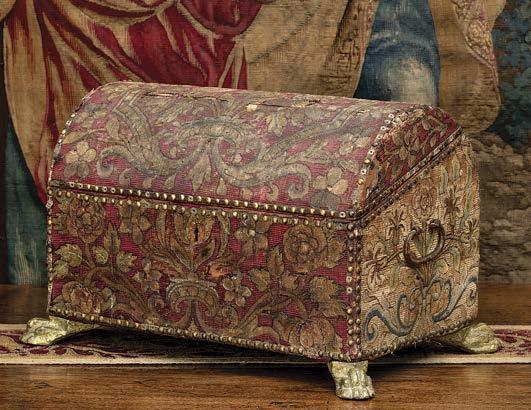
152
An embroidered casket, Italian, circa 160050
Having a wooden rectangular carcass and domelid of angled form, with the rear hinges set higher than the lock, covered in bespoke canvaswork panels, each embroidered in coloured silks, in shades of crimson, blue, green and gold with scrolling floral designs, gilthead studs to all edges secure the panels, on angled giltwood paw feet.
H 30.5cm, W 49.5cm, D 33cm
£500800
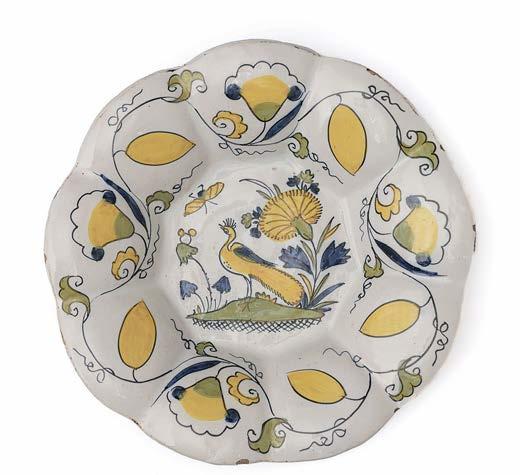
154
A delftware lobed dish, Dutch, mid18th century
Painted in canaryyellow, with green and blue, designed to the centre with a peacock, a moth above, standing amongst flowering plants, the rim with scallopededge and decorated with meandering scrolled flora.
Dia 34.3cm
£200300
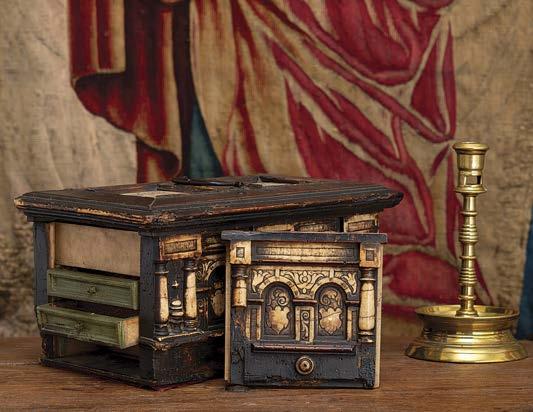
155
A 17thcentury ebonised and alabaster casket, Mechelen, Belgium, circa 1630
Of rectangular form and architectural design, the front and sides conceived as classical building facades, with paired columns centred and flanked by arcades, the hinged top inset with two alabaster panels within profiled mouldings, opening to reveal a sophisticated arrangement of secret compartments, with sliding side panels concealing small drawers, some retaining greenpainted interiors.
The caskets ingenuity reflects the fascination with hidden mechanisms in early modern collector’s items, where cabinets were used to store jewels, coins, medals, or precious curiosities.
H 17.8cm, W 34.3cm, D 21cm
£500800
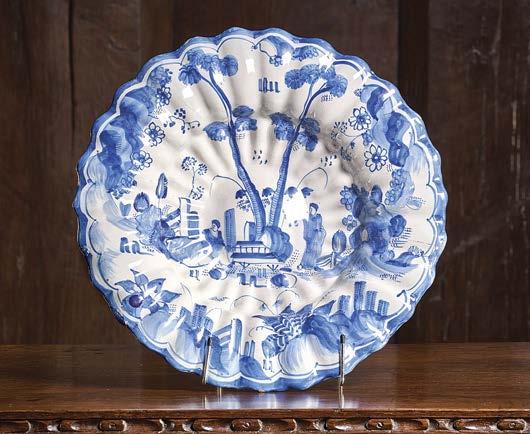
157
A tinglazed lobed dish, possibly Frankfurt, early 18th century
Decorated in pale cobalt blue, with a Chineseinspired figural garden scene, the two figures standing beneath tall drawers, their canopies extending to the lobed rim, the rim with further floral sprays.
Dia 34.2cm
£100200
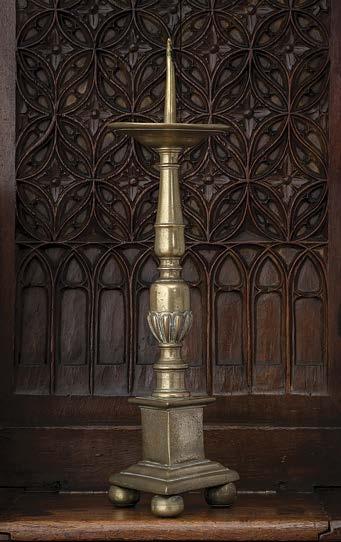
A 17th century brass pricket candlestick, Italian, circa 160050
With a triangular plinth base, engraved to each side with a laurel wreath, on three bold ball feet, supporting a reededovoid and baluster stem, surmounted by a wide drippan and tall pricket.
H 57.8cm, W 16.5cm
£200300
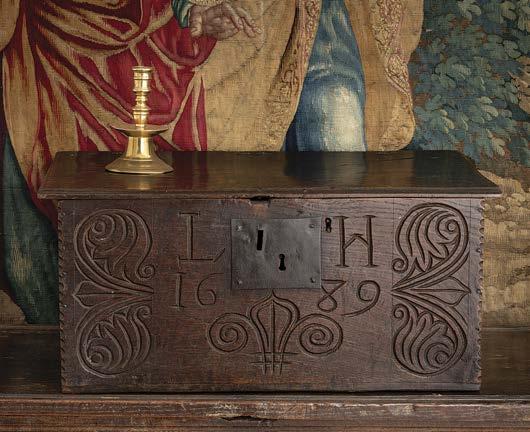
A James II/William & Mary carved oak boarded box, Devon, dated 1689
The front boldly carved with paired leafy volutes to each end, and a central fleurdelys, beneath the intials ‘L’ and ‘H’ either side of the iron lockplate, atop the carved date ‘1689’, the sides left plain, the lid formed from a single board, secured by iron strap hinges.
The decorative vocabulary, particularly the scrolling leaf motifs and symmetrical arrangement around a central device, corresponds closely with late 17th century workshop traditions of Devon. The fleurdelys, frequently encountered in West Country carving, may be read both as a conventionalised floral ornament (flower of the valley) and as a symbol of purity and faith, linked to the Virgin Mary.
H 28.6cm, W 65cm, D 43.2cm
£200300
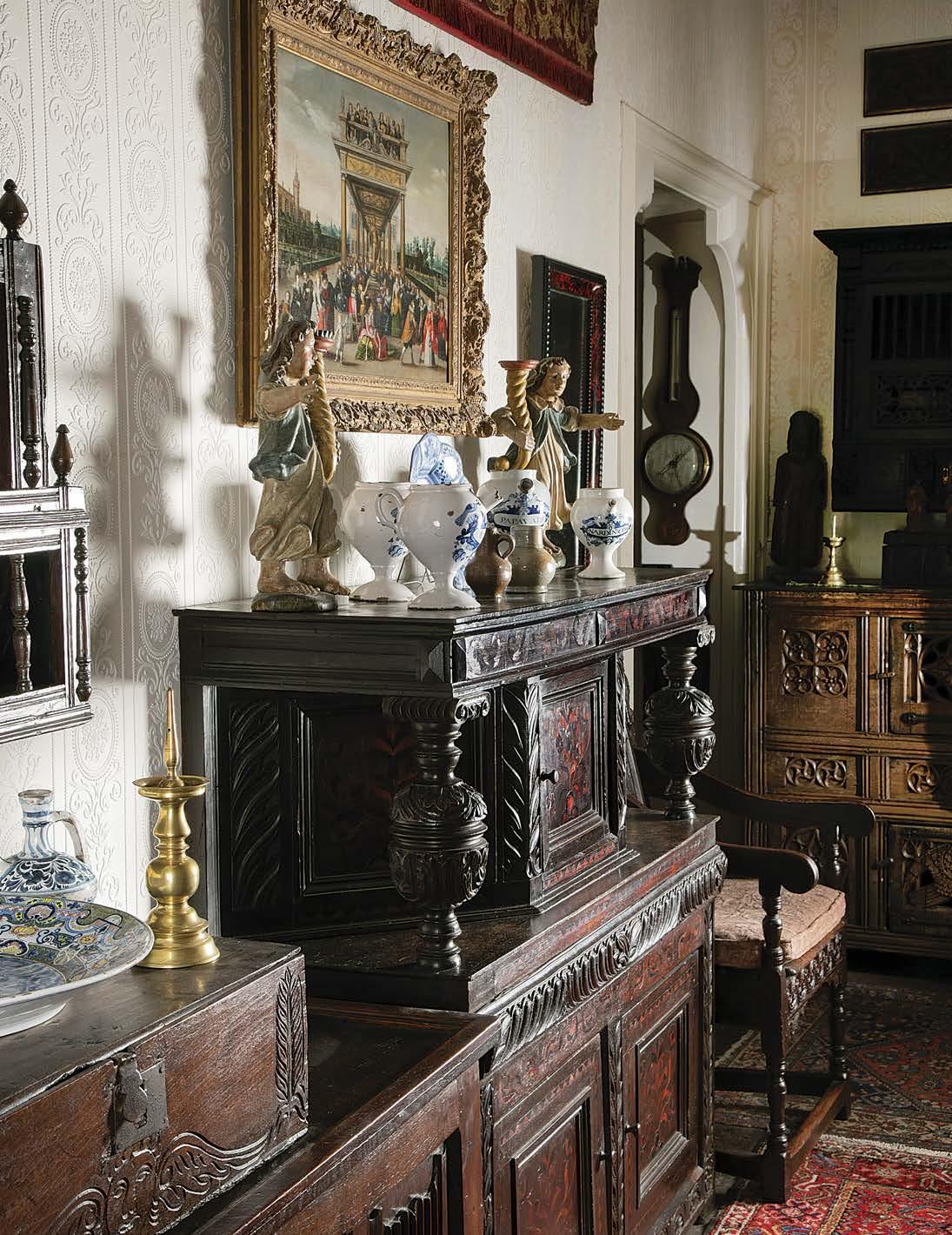
A good Charles I oak and inlaid press cupboard, Leeds and surrounding area, Yorkshire, circa 1630
In the regional Elizabethan manner.
This striking cupboard blends robust carving with refined inlay work. The lowersection with a pair of panelled cupboard doors, each centred by floral inlays executed in contrasting woods, framed by stiffleaf rails and lunette base rail, the long drawer above is enriched with deep gadrooned carving, the upper section of canted form, with a central single cupboard door, with matching inlay, the angled sides similarly decorated, the scrollinlaid cornice is further supported on bold cupandcover columns, enriched with leafy carving and terminating in Ionic capitals.
For a comparable example see Victor Chinnery, ‘Oak Furniture: The British Tradition’ (1979), p. 429, fig. 4:120
H 139cm, W 138.4cm, D 50.8cm
£4,0006,000
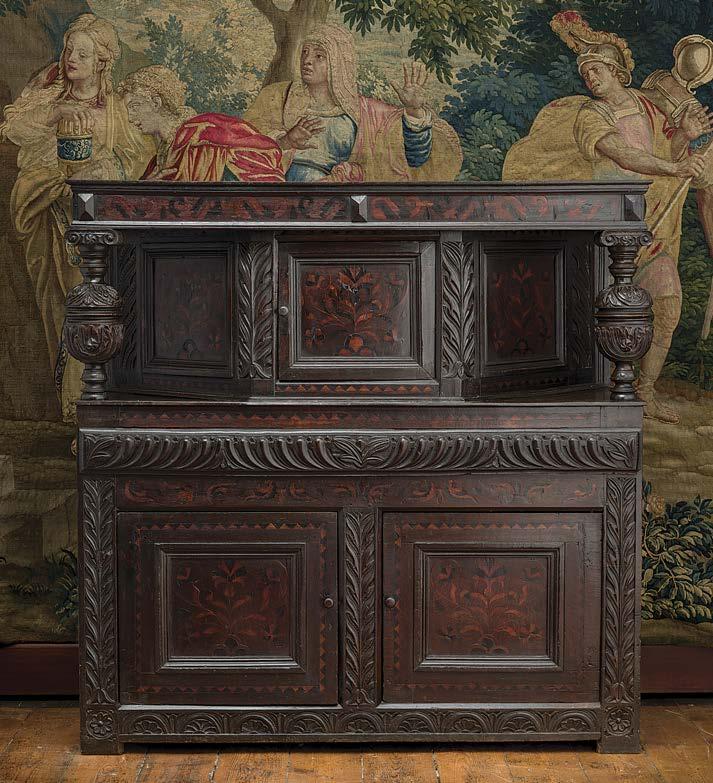
160
A charming pair of carved oak and polychromedecorated candleholders, Italian, circa 165080
Designed as youthful attendants, each carved in animated stance, wearing a flowing tunic and open jacket, carrying a cornucopia socket in one hand, the other hand gestures outwards, on a circular base. (2)
The use of cornucopia is significant as a longstanding symbol of divine abundance and blessing, whilst the flame of the candle embodies both faith and illumination. Together, these motifs combine to create a powerful dual symbolism of heavenly light and spiritual plenty.
H 45.7cm, W 33cm, D 12.7cm
£1,0001,500
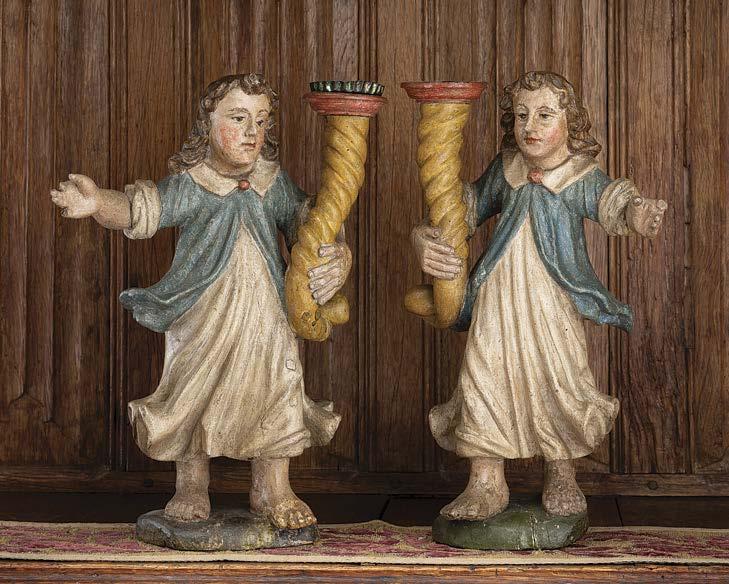
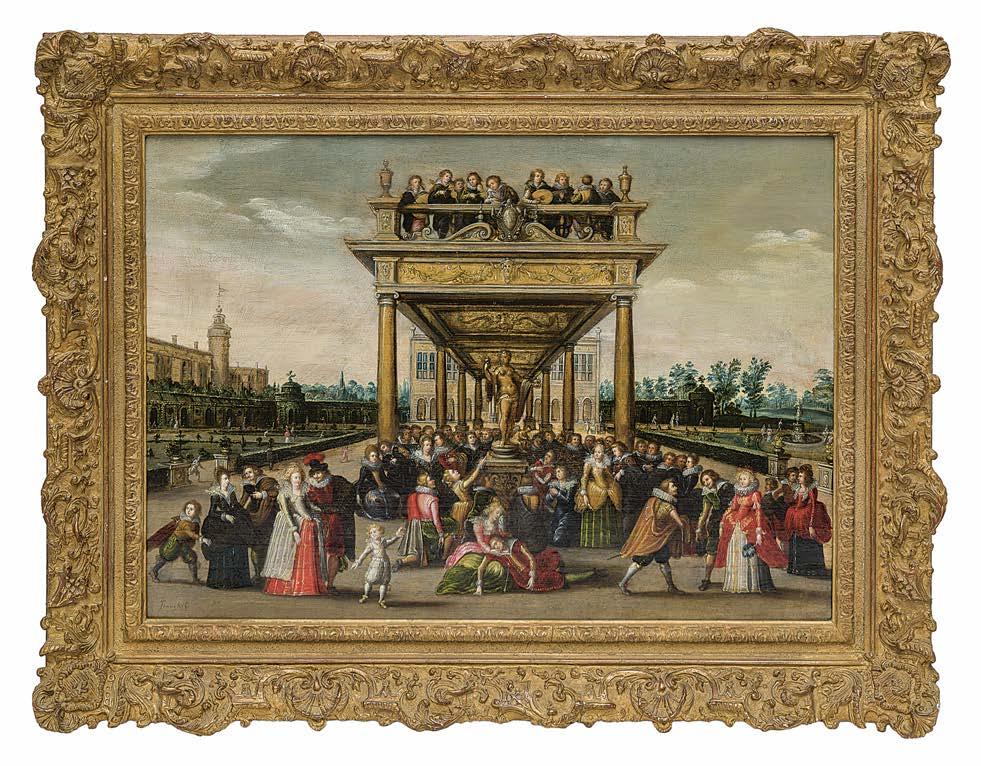
161
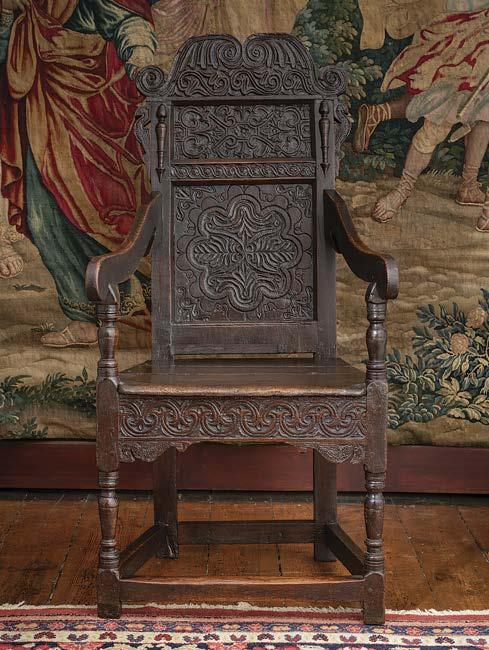
161
Circle of Louis de Caullery (FrancoFlemish, 15821621)
An Allegory of Venus Verticordia: A Garden with Elegant Company at a Statue of Venus within a Colonnade Bears signature Franck.f. (lower left) Oil on panel
53 x 75cm; 20 3/4 x 29 1/2in
Designed with a group of aristocratic, welldressed figures around an architectural colonnade, enclosing a statue of Venus, shown standing, holding burning hearts, whilst Cupid sits on the plinth below, whilst some figures gaze at the statue, others have been shot by Cupid’s arrows; the two central figures to the foreground fall into the arms of one another, an arrow clearly piercing his doublet, in a giltwood frame.
The painting goes beyond a materialistic first impression of wealth and status but has a more complex mythical undertone around the central question of love.
£3,0005,000
162
A large Charles II joined oak open armchair, South West Yorkshire/East Lancashire, circa 1670
The back with a large central foliate carved panel, beneath a leafystrapwork carved narrow panel, topped by a bold double scrollcarved cresting, filled with stylised foliage, with slender ears carved with fantastical seacreatures, the downswept open arms on invertedbaluster turned front supports, flanking a boarded seat, on interlaced lunettecarved rails, the balusterturned forelegs joined all round by plain stretchers. This chair exemplifies regional traditions where ambitious scale and a strong vocabulary of Sscrolls, lunette friezes, and foliate strapwork distinguished their output from plainer provincial chairs. A small group of related Yorkshire/Lancashire armchairs are illustrated in Victor Chinnery, ‘Oak Furniture: The British Tradition’ (2016), pp. 433434.
H 128.9cm, W 62.9cm, D 61cm
£8001,200
A rare Charles I threetiered oak mural glass/trencher case, circa 1640
Having a stepped arrangement of three tiers, the upper tier open and the two remaining enclosed by slender balusterturned spindles, opening to the centre with an integral pivotal door, the whole crowned with a carved arcaded frieze rail and gadrooned cornice, all end uprights with applied splitbaluster mouldings, and embellished with baluster finials, backboards remain intact.
Although traditionally described as a trencher case, a term used for the storage of wooden eating plates, examples of this type were more broadly employed for the keeping of pewter, glassware, delftware and treen. Victor Chinnery notes in ‘Oak Furniture: The British Tradition’, these cases represent a transitional form between the open dresser and the enclosed court cupboard, often made for the upper middling and wealthier households in early 17thcentury England. The spindled fronts not only protected their contents within but allowed them to be displayed, reflecting both function and status.
H 90.8cm, W 102.2cm, D 16.5cm
£2,0003,000
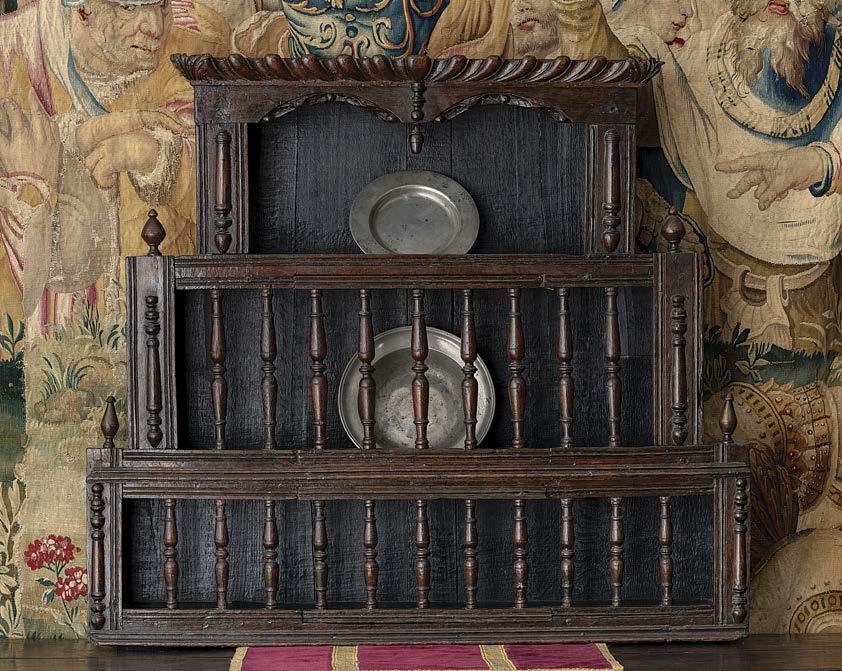
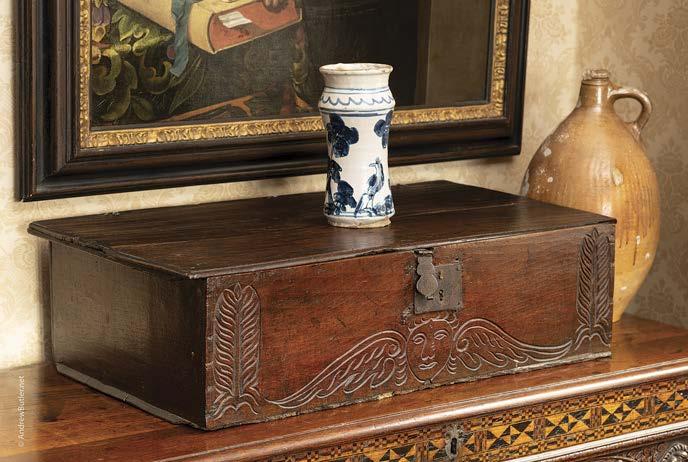
164
A James I carved oak boarded box, English, possibly Salisbury, circa 1620
The construction remarkable for the use of exceptionally thin boards throughout, the front unusually carved to the base with a stylised winged angel mask, flanked by stylised stiffleaf singlestems.
H 22.9cm, W 82.6cm, D 45.7cm
£400600
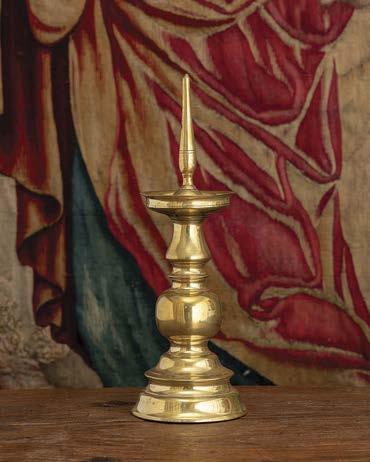
165
A 17th century brass pricket candlestick, Flemish, circa 160050
With tall, balustershaped pricket, rising from a circular drippan with everted rim, the bold baluster and pronounced ballknop stem on a domed and circular spreading base.
H 32.4cm, Dia 10.8cm
£200300
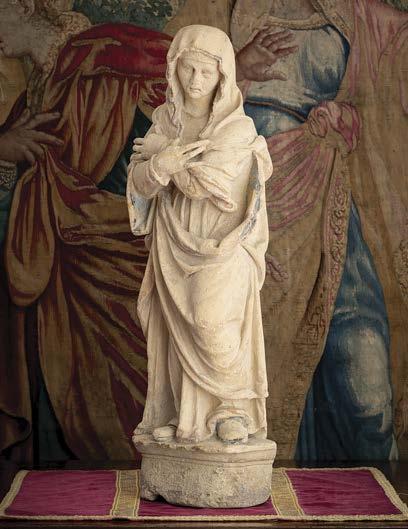
A pair of carved oak figures, the Virgin Mary and St John the Evangelist, Low Countries, circa 14801520
Almost certainly originally conceived flanking a Calvary group, both rendered in contemplative poses, Mary with one hand gently touching her chest and St John gazing upwards in sorrow, their gestures embodying the devotional drama of the Crucifixion narrative. Of elongated proportions, with flowing but somewhat angular drapery folds, and serene facial modelling. The polychrome, of vivid reds, greens, and blues, is largely a later reapplication laid over traces of original surface, reflecting the continued liturgical use and renewal of such images across generations. (2)
H 100cm, W 34.3cm, D 22.9cm
£1,0001,500
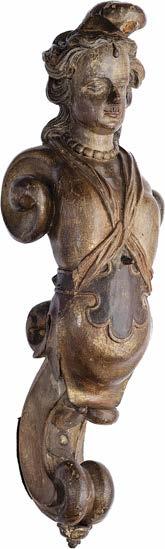
A stone carved figure of the Virgin in mourning, Flemish, circa 150050
Probably limestone, carved standing, in a posture of sorrow and devotion, her arms folded across her chest, her head gently inclined in grief. Enveloped in a voluminous mantle, the folds deeply undercut and gathered around her waist, on an integral circular plinth, with traces of polychrome.
Comparable examples in the Musées Royaux d’Art et d’Histoire, Brussels and the Museum Catharijneconvent, Utrecht.
Provenance: With A J M de Bruijn Art, pictured in their gallery late 1980s.
H 67.3cm, W 20.3cm, D 14.6cm
£8001,200
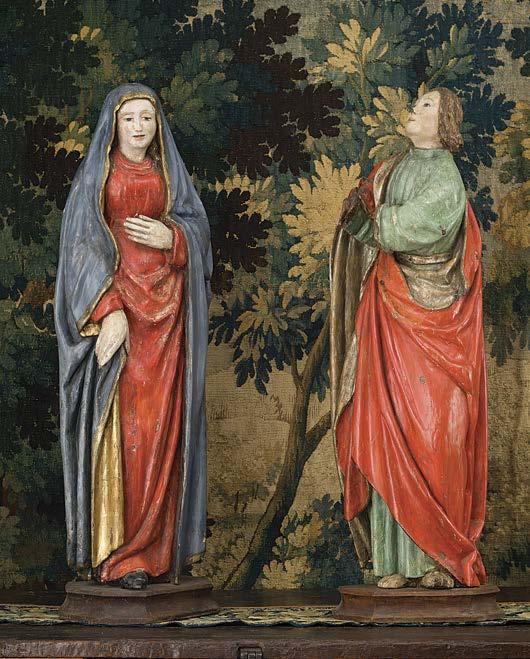
A 17th century carved oak bracket, Flemish, circa 1650
With traces of polychrome, designed as a term, the female bust emerging from a scrolling support, wearing a teardrop jewel at the centre of her hairline and a beaded necklace, folds of fabric cross over her torso and gather at a cartoucheshaped belt.
This type of bracket was designed as an architectural or furniture projecting support, possibly partly structural, but mainly for decorative purposes. They often embody the fusion of classical ornament with local Northern European craftmanship.
H 57cm, W 18cm, D 18cm
£400600
A 16th century carved oak figure of a male saint, Flemish, circa 15501600
Shown standing in contrapposto, the drapery falling in deeply undercut folds across the body, conveying both movement and weight. The youthful, softly modelled face, with curling hair and upward gaze, reflects the naturalism introduced into religious sculpture in the mid16th century under Italianate influence. The flat back indicates it was designed to stand within a larger architectural framework, almost certainly part of a multifigure altarpiece. Although the original attributes are now lost, the figure would likely have represented one of the Apostles or another prominent saint.
H 59.7cm, W 22.9cm, D 10.2cm
£500800 170
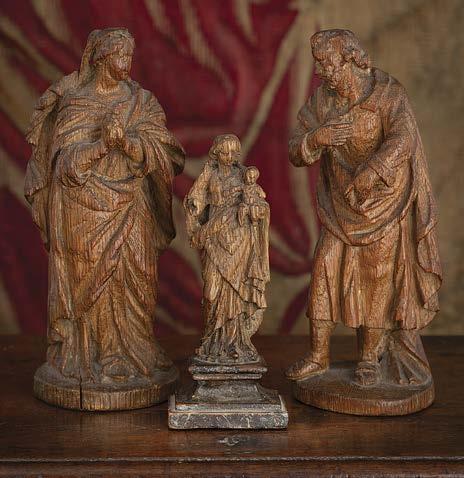
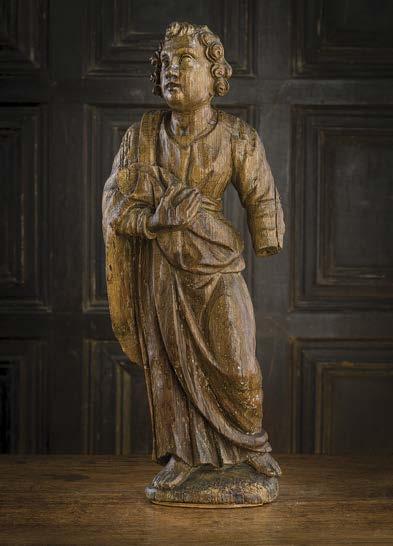
Three small oak devotional figures, the Holy Family, Low Countries, circa 162050
All standing, the Virgin with hands joined in prayer, St Joseph with righthand to chest, and a smaller Virgin and Child, on an associated plinth. Each carved in the round, with tightly pleated, descending drapery and gentle head inclinations. (3)
The simplified anatomy, parallel foldsystems and quiet piety reflect the lateMannerist idiom current in Amsterdam/Antwerp circles after Hendrick de Keyser and Artus Quellinus the Elder, made for private devotion in household chapels.
H 16.5cm (largest), W 6.4cm, D 5.1cm
£200300
171
A 17th century carved and polychromedecorated figure, female saint, German or possibly North Italian, circa 1660
Designed standing in a moment of intense spiritual ecstasy, her head thrown back, eyes uplifted, and her right hand pressed to her chest while the left arm extends outward in an expressive gesture. The sense of movement, with the drapery caught in flowing folds of gold and crimson, against the subdued greyblue of the under garment, reflects the theatrical dynamism of mid17th century Baroque devotional carving.
The figure may represent Mary Magdalene, often portrayed in both postures of rapture and penitence.
H 57.2cm, W 40.6cm, D 16.5cm
£600800
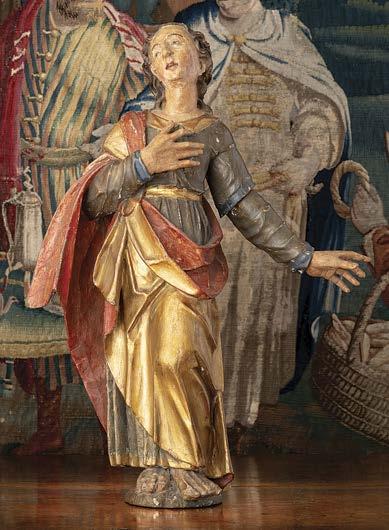
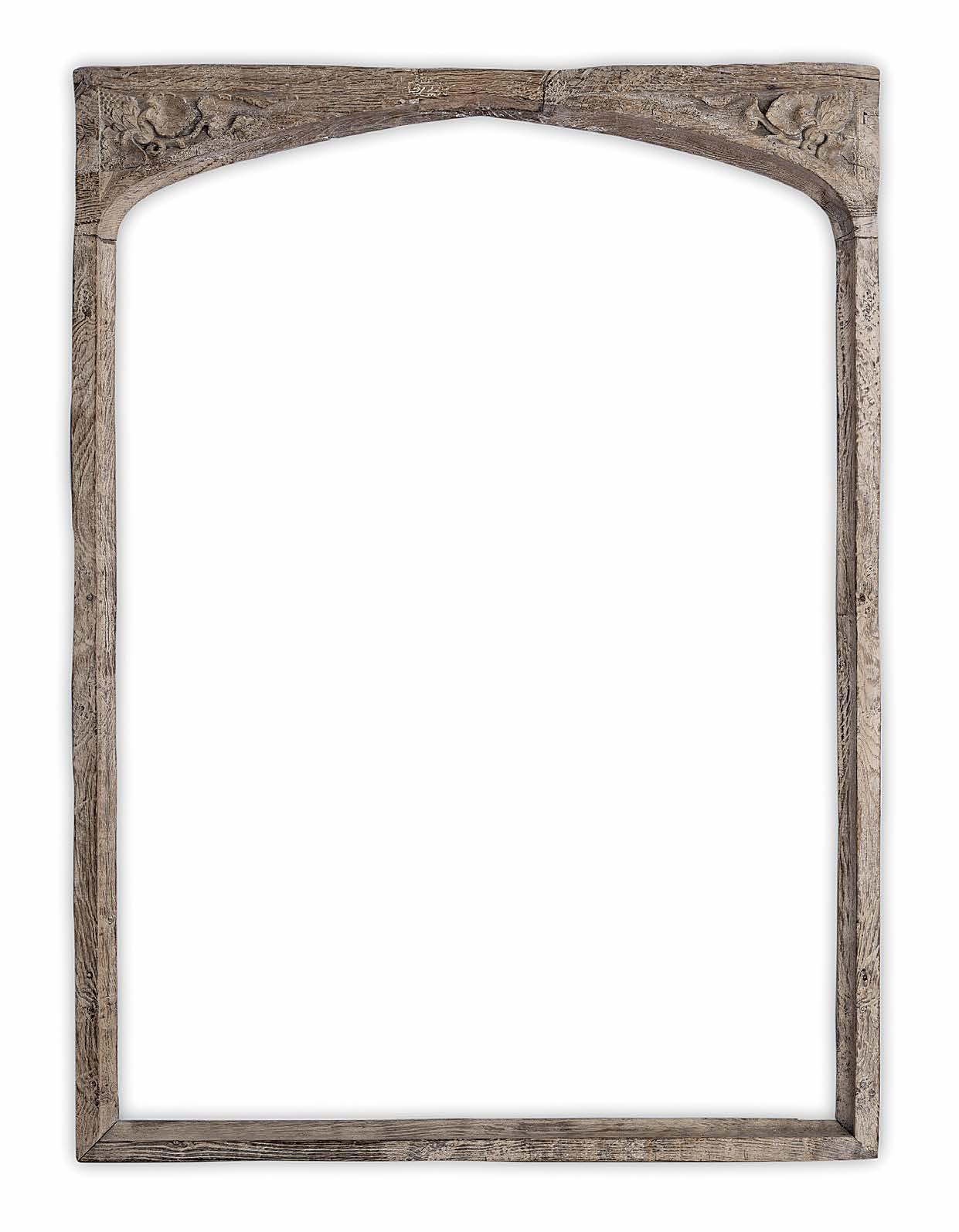
A Henry VIII oak architectural interior frame, almost certainly East Anglia, circa 152040
Headed with a shallow pointed arch, the spandrels carved in relief with scrolling foliage bearing a seeded fruit, all internal edges chamfered, pale, dry surface, later timber backing for stability. At only 5cm in depth the frame was almost certainly intended to enclose a recess or niche rather than serve as a structural window or door.
H 162.6cm, W 119.4cm, D 5.1cm (with support 6.4cm)
£600800
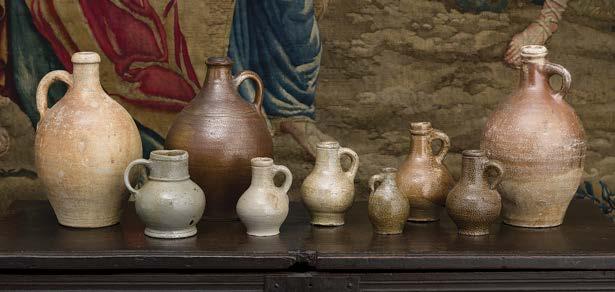
173
A group of nine saltglazed bellarmine jugs, German, mainly 17th century
Of varying colours, from pale grey, buff to deep brown, of ovoid form, with cylindrical neck and strap handle. (9)
£200300
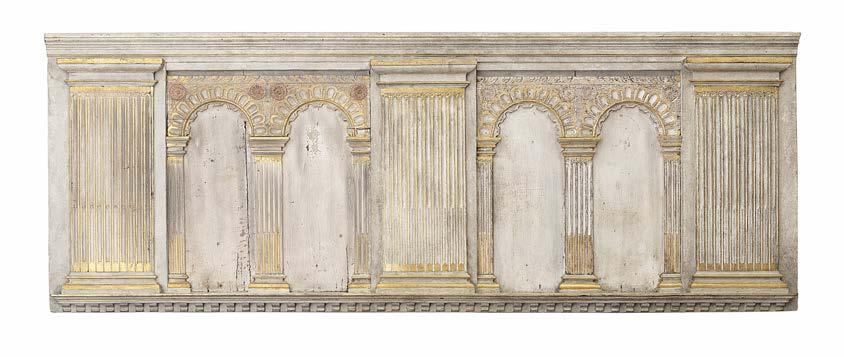
174
An Elizabeth I oak wall or overmantel panel, with later painted decoration, East Anglia, circa 15801600
Carved with two paired arcades, supported on fluted columns, the spandrels with rose and triangularleaf carved spandrels, centred and flanked by broad fluted pilasters, with dentilmoulded base rail, the arcades are enriched with roundel and strapwork detail, emphasising the classical influence on late Tudor domestic design.
The surface retains painted and gilded decoration added during the 18th or early 19th century, when there was renewed interest in historic interiors and the reuse of Tudor and Jacobean architectural elements.
Provenance: Private Norfolk residence.
H 83.8cm, W 226.1cm, D 8.9cm
£7001,000
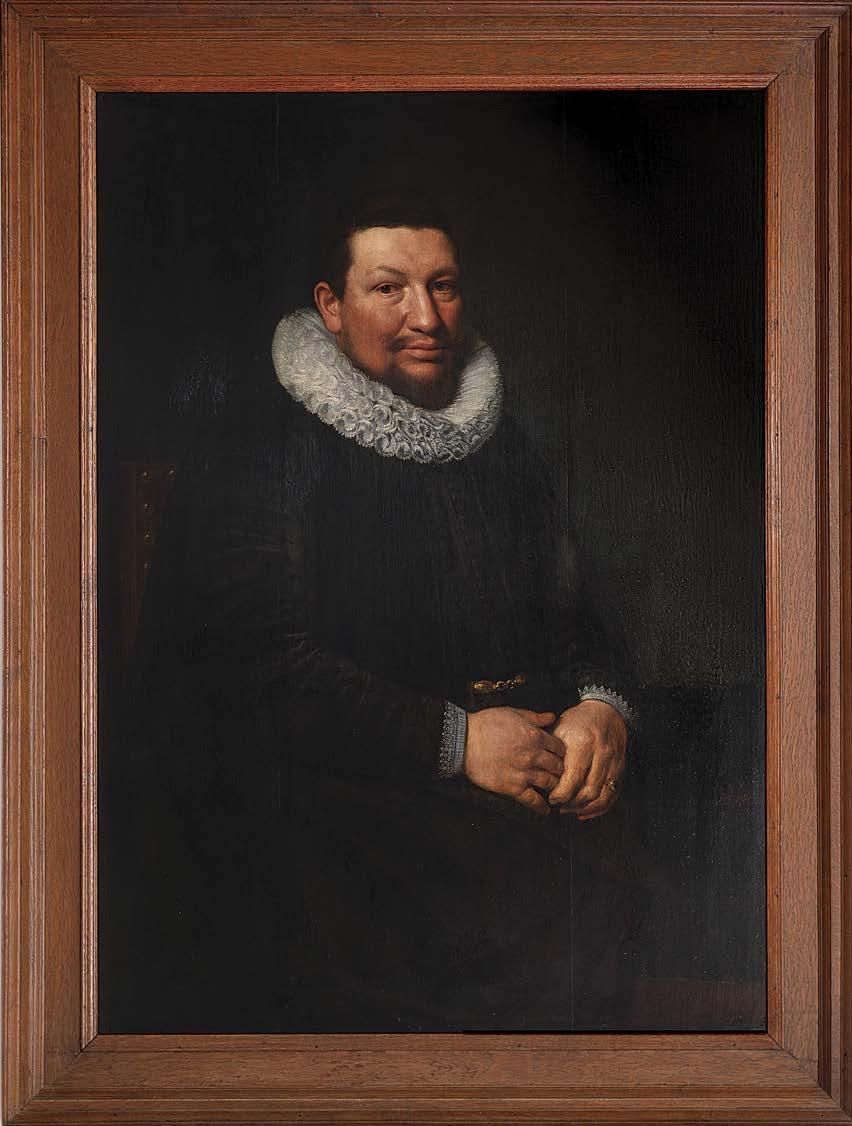
Circle of Nicolaes Eliasz. Pickenoy (Dutch, 15881650)
Portrait of a Gentleman
Seated half length, wearing a dark tunic and white ruff
Oil on braced panel
102.5 x 80cm; 40 1/4 x 31 1/2in
The sitter’s costume provides a secure date in the late 1620s to mid1630s, when the large millstone ruff was still fashionable among the Dutch elite, just before it was supplanted by the falling band.
£2,0003,000
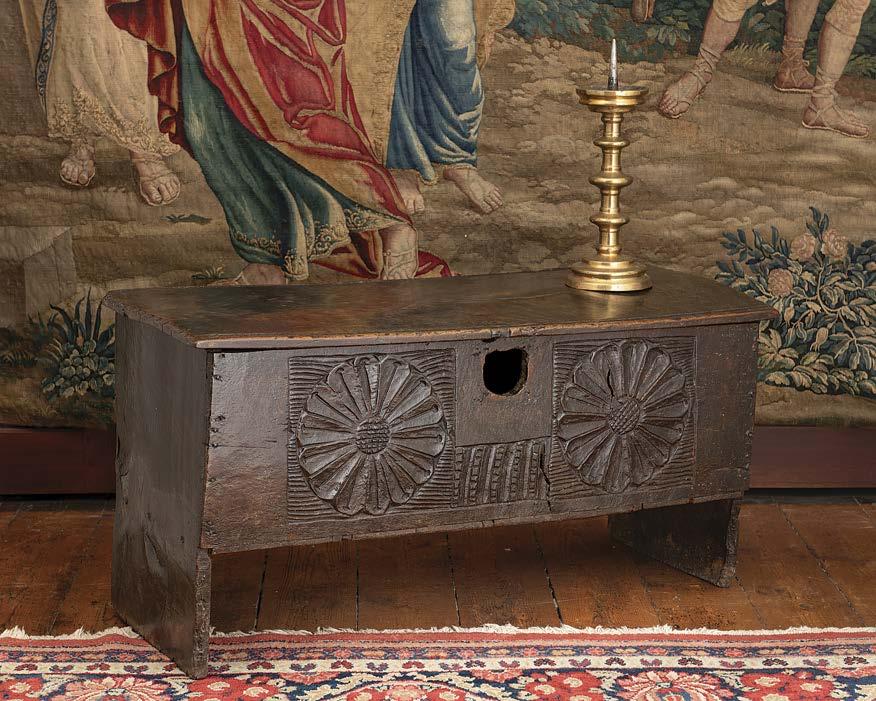
An impressive 16th century carved oak panel, Flemish, circa 1580
A Henry VIII oak boarded chest, circa 152040
The front carved with two large floral roundels against a linear gaugecarved ground, below the lockplate position a reserve with similar gaugecarving, on slab ends, with single board lid, the original iron fastenings now oxidised in situ, historically lacking lockplate. H 55.2cm, W 109.9cm, D 43.8cm
£8001,200
Designed with a dramatic martyrdom scene, at the centre stands a female saint (possibly St Lucy), holding a palm branch, her right hand raised holding an object, surrounded by soldiers and horsemen; to the left, attendants bear standards and spears; to the right, a cavalry skirmish unfolds with fallen figures beneath rearing horses, a twisting tree to each end.
The treatment of drapery, musculature, and armour reflects the influence of Italian Renaissance models filtered through Northern Mannerism. H 50.8cm, W 102.2cm
£8001,200
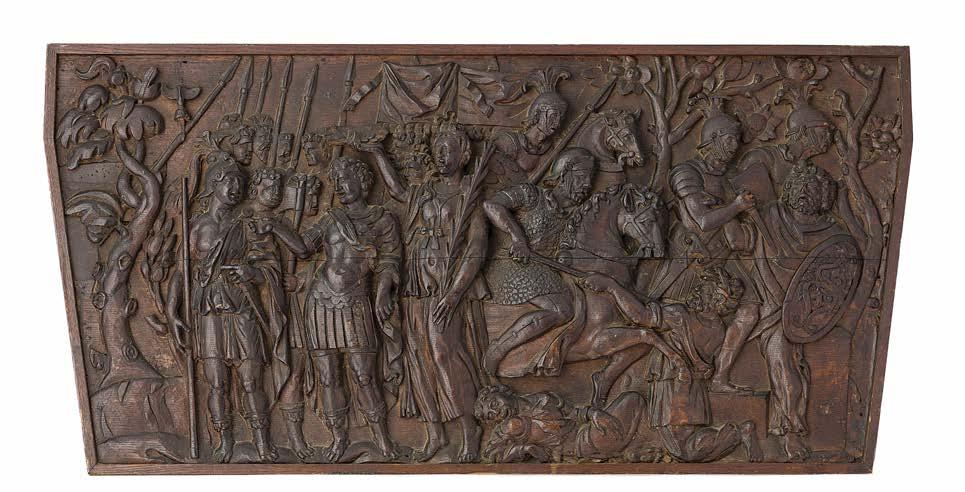
178
A rare Charles I joined oak enclosed folding table
Having an octagonal foldover top, hinged and resting on a single rear loper when open, atop a triangularshaped cupboard, carved to each face with nulling, indicating the table was possibly conceived to be freestanding, the righthand canted side with boarded door, with scrollprofiled aprons, on invertedbaluster turned legs, joined by a boarded open undertier.
Tables of this form part cupboard, part sidetable are rare survivals, reflecting both functional ingenuity and aesthetic ambition.
Provenance: With Sam W. Wolsey, London.
Thence Irwin Untermeyer Collection, New York.
With Huntington Antiques, Stowonthe Wold, Gloucestershire.
Thence Private Collection, Kent.
Literature:
Illustrated S. W. Wolsey & R. W. P. Luff, ‘Furniture in England: The Age of the Joiner’ (1968) pl. 70 & 71.
H 80cm, W 90.2cm, D 43.8cm
£3,0005,000
179
A Henry VIII oak boarded chest, Cornwall or Devon, circa 1530
The front richly carved with facing mythical creatures, each with a human male moonface, and scaly mermantype body, the central iron lockplate features the main keyhole alongside a secondary slot for the hasp to engage, an original security feature typical of the period, hinged lid and slabtype sides, historic restorations to lid.
The male moonface may symbolise the lunar cycle and renewal, or protective watchfulness. Their integration into scrolling grotesque ornament reflects early Renaissance influence entering England through pattern books and immigrant workmen. The design has strong regional affinities with West Country carving, particularly the font cover at Swimbridge Church, near Barnstaple, Devon, which displays nearidentical opposing lunar profiles.
H 43.2cm, W 90.8cm, D 38.7cm
£1,8002,200
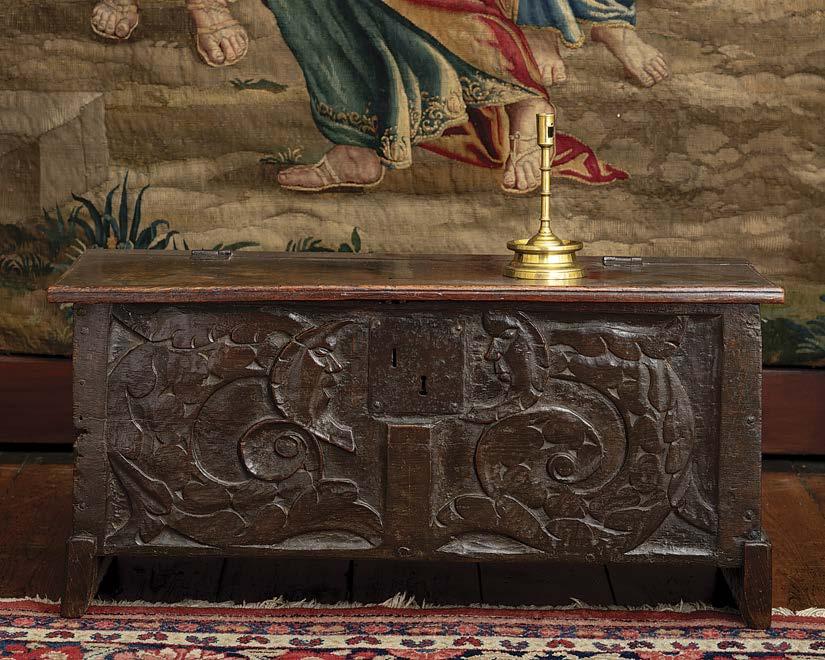
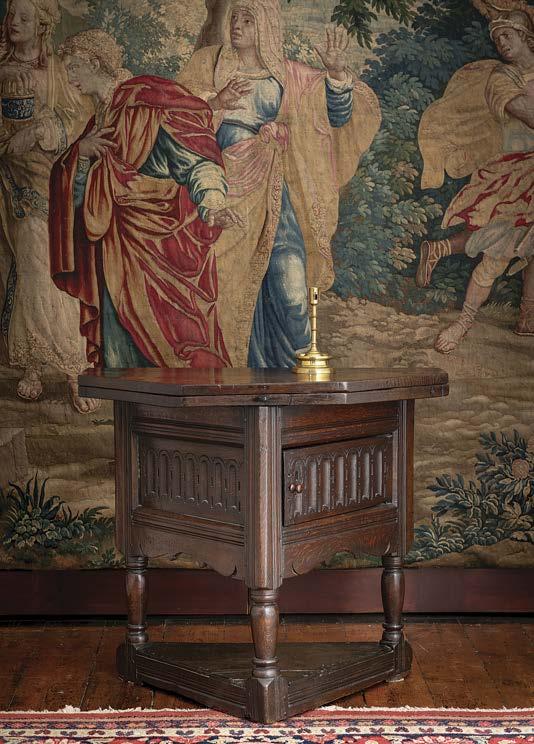
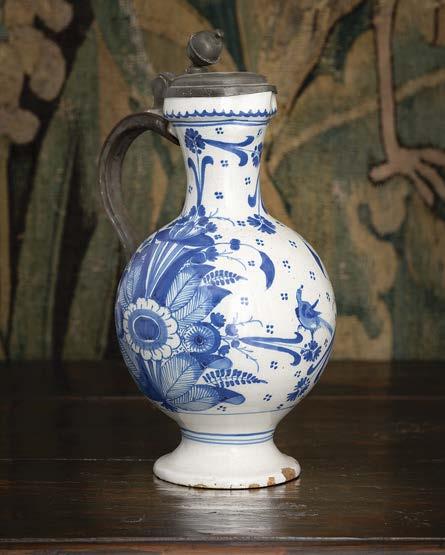
180
A delftware pewtermounted lidded jug or ewer, Dutch, circa 16701700
Of globular form, with cylindrical, flared neck, on a spreading foot, painted in rich cobalt blue, the body with large stylised floral sprays and scrolling leaves, the neck with pendant flower motifs beneath a zigzag border, with metal strap handle, probably later, and a pewter hinged cover, with ball finial in the German manner.
H 30.5cm, W 14.6cm
£300400
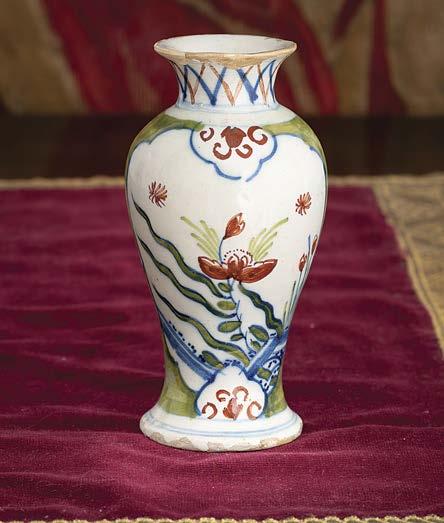
181
A small delftware polychromedecorated vase, probably London, circa 1750
Of baluster form, with flared rim, painted in ironred, blue and green, designed with freely formed rhythmic floral sprays, the neck with a trellis pattern.
H 14.6cm, Dia 7.6cm
£80120
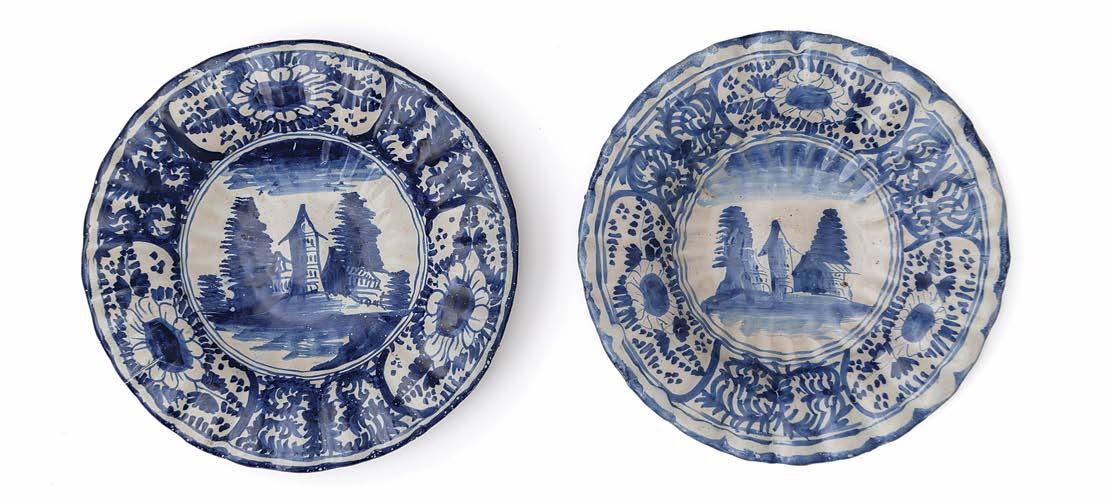
182
A delftware charger, Dutch, circa 170050
Decorated in rich cobalt blue, centred by a stylised flowerfilled vase, the rim with alternating figural and floral reserves.
Dia 39.4cm
£150200
183
A rare plain white delftware charger, London or Bristol, circa 170050
With slightly everted rim, the unadorned surface exemplifies the refined simplicity of early English delftware production.
Dia 34.3cm
£100150
184
A pair of faience earthenware dishes, Nevers or Rouen, France, circa 170020
Each with fluted rim and scalloped edge, painted in varying cobalt blue tones, with architectural and landscape scenes depicting turreted buildings amongst trees, the rim with stylised floral decoration. (2)
Dia 22.5cm
£100150
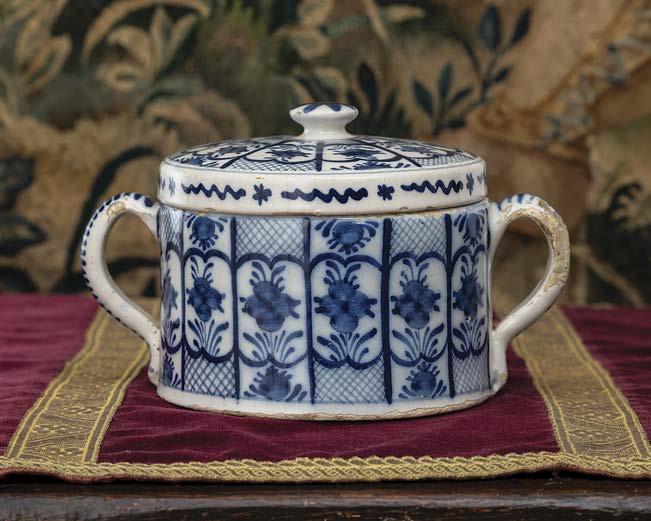
185
A delftware posset pot, Dutch, circa 1750
Of typical lidded, cylindrical form, with loop handles, decorated in rich cobalt blue, with vertical repeats of stylised floral sprays, against a part lattice ground, the knopped lid similarly decorated, handles with blue dash decoration.
H 14cm, W 22.2cm, D 15.2cm
£100150
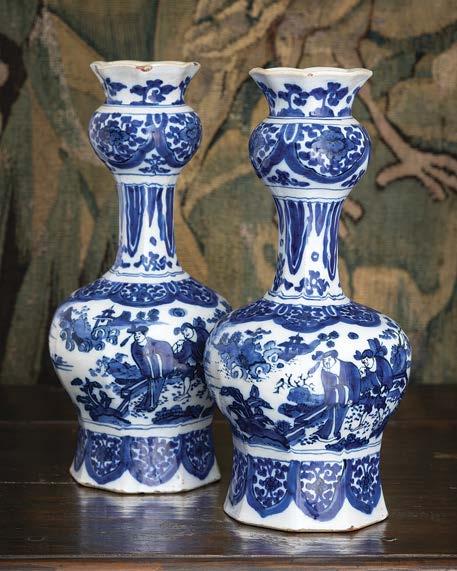
A matched pair of delftware vases, Dutch, early 18th century style
Of distinct baluster form, each with slender neck rising to bulbous end below a flared rim, painted in a strong cobalt blue with alternating figural and floral panels, the principal scene depicts figures standing in a stylised garden landscape, surrounded by pavilions and scrolling clouds, while the neck and foot are decorated with ornamental lambrequin and foliate motifs within shaped panels, blue painted ‘81’ to the bases. (2)
H 33.7cm, Dia 15.2cm
£400600
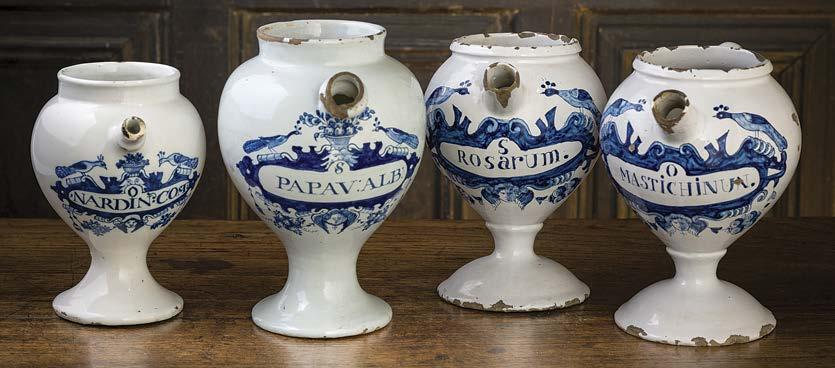
189
187
A delftware devotional plate, Dutch, mid18th century
Painted in manganese, designed with the Crucifixion of Christ, with wounds of the Passion and titulus, the rim decorated with stylised foliage.
Dia 22.9cm
£80100
188
A delftware lobed dish, probably London, circa 170050
Decorated in cobalt blue, centred by a roundel enclosing a figure in a garden, within a stylised foliate border, the scallopedge rim designed with alternating scenes of standing and seated figures, interspersed with floral sprays.
Dia 33.6cm
£100150
189
A group of four delftware apothecary syrup jars, probably Dutch, circa 172050
Each of ovoid form, on spreading socle foot, with short spout, three with strap handle, all painted in rich colbalt blue, with label strap within a scrolling cartouche, headed by paired birds and centred to the base with an angel mask, labels read: ‘PAPAV. ALB’ (opiate); ‘ROSARUM’ (rose); MASTICHINUM (Lentisk gum); NARDIN.COM (nard). (4) H 21cm (largest), Dia 14cm
£600800
A 16th century brass alms dish, Nuremberg, Germany, circa 156080
The broad rim with rolled edge and stamped with repeated fleurdelys and flowerhead motifs, centred by a boss surrounded by a whirl of gadroons and Gothicscript.
Dia 38.7cm
£100150
191
An early to mid19th century mahogany inlaid wheel barometer, Gilardone, Exeter
With thermometer, and silvered dial signed ‘Gilardone & Co. Exeter’, the case with brokenpediment and conchshell inlay.
H 97.8cm, W 25.4cm, D 6.4cm
£6080
A 19th century delftware polychrome charger, in the Dutch 18th century manner
Designed to the centre with a mythical figure riding a sea creature amongst crashing waves, with distant sailing vessels and figure on a shore, all in pale cobalt blue, the wide rim decorated with blue, green and yellow, with radiating floral motifs and shell forms, inscribed ‘IVH 1728’ verso.
Dia 48cm
£5080
193
A 17th century brass mortar and pestle, Spanish, circa 160050
The cylindrical, thickwalled mortar with a series of bold, triangular luglike projections around the base, with an associated pestle. (2)
H 7.6cm, Dia 11.4cm
£100150
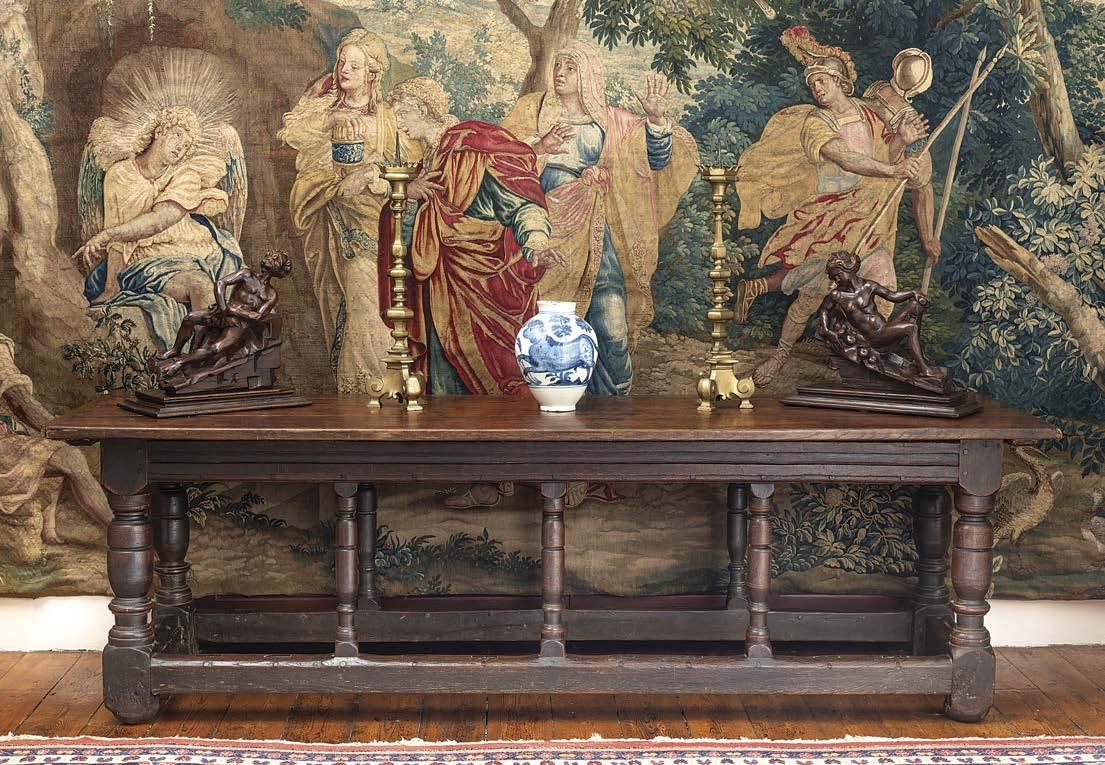
194
A rare Charles I joined oak long table, with unusual underframe, probably West Country, dated 1636
The base with four robust corner parallelbaluster and reelturned legs, spaced by three matching supports to front and rear, joined by plain stretchers, and supporting moulded frieze rails, six inner supports remain intact, however, there is clear evidence that further supports were once present, one end rail carved with the initials and date ‘IPTF’, ‘1636’, the cleated twoplank top with overhang, which allows the design to balance the visual lines of the numerous supports.
The design suggests an intention to lighten the appearance of the heavy oak form, while simultaneously enclosing the under framing, a unique solution within English joinery of the period and which possibly had a ‘cageform’ function.
H 79.4cm, W 255cm, D 78cm
£1,5002,000
195
A 18th century delftware jug, probably English, circa 176080
Of baluster form, with a ribbed, cylindrical neck, strap handle and lower ring above foot, decorated in cobalt blue with freely brushed stylised floral sprays.
H 17.8cm, Dia 10.2cm
£80120
196
A delftware plate, Dutch, circa 1750
Painted in cobalt blue, the central octagonal reserve depicts a flowerfilled vase, the rim divided into radiating panels of stylised blossoms, in the Kraak porcelain manner.
Dia 30.5cm
£80120
197
A late 17th century delftware lobed plate, Dutch or German, circa 170050
Painted in cobalt blue, to the centre a narrative landscape scene, depicting a seated figure, the scallopedge rim decorated with alternating reserves of floral motifs and similar figural landscapes, after imported Kraak style porcelain.
Dia 29.8cm
£100200
198
A pair of 18th century delftware plates, Dutch, circa 170050
Each painted in blue, yellow and green, centred with a lively depiction of Cupid, running with bow and drawn arrow, the rim with stylised floral motifs, blue painted ‘DBP’ to the bases. (2)
Dia 22.9cm
£100150
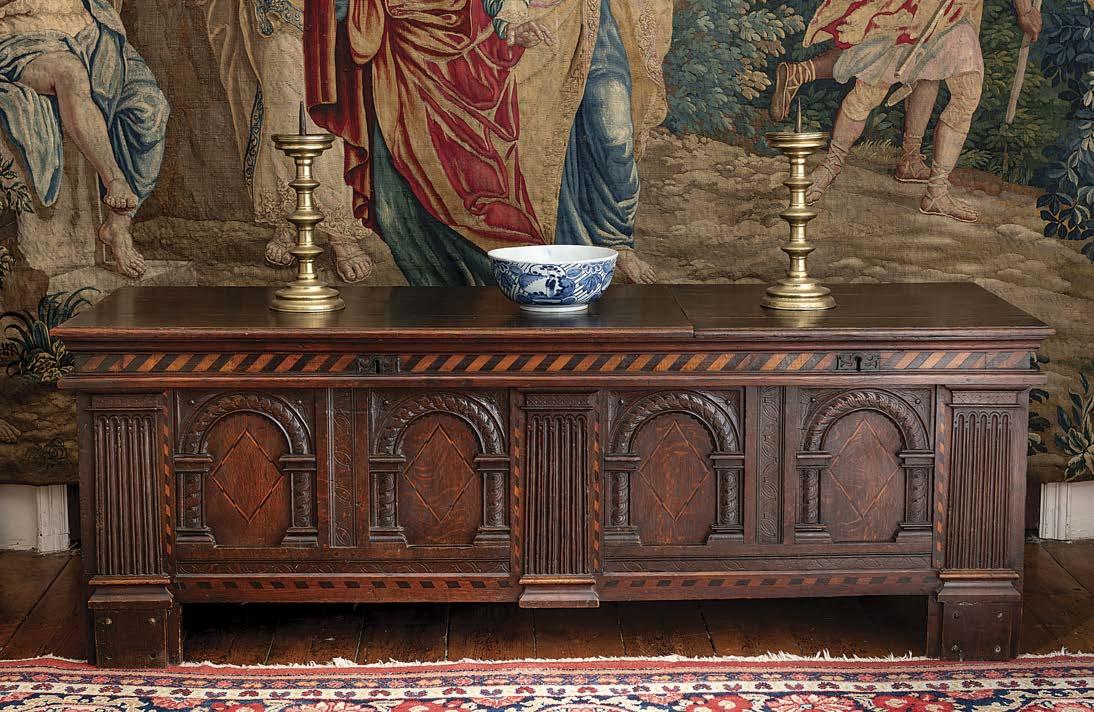
199
A substantial Elizabeth I oak and inlaid coffer, circa 1580 1600
The façade richly decorated with four large applied carved arcades, each framing a central chequerinlaid lozenge, centred and flanked by broad nulled pilasters, rising from block bases and providing vertical strength to the long design, the top and base rails with holly and bogoak diagonal, chequered banding, with a pair of iron lockplates, characteristically offset from the centre to accommodate the unusual twinsectioned hinged lid, the back is constructed in the manner of a cupboard, with applied nailed boards rather than conventional framed and panelled work, historic restorations to feet.
H 65.4cm, W 186.7cm, D 63.5cm
£1,5002,000
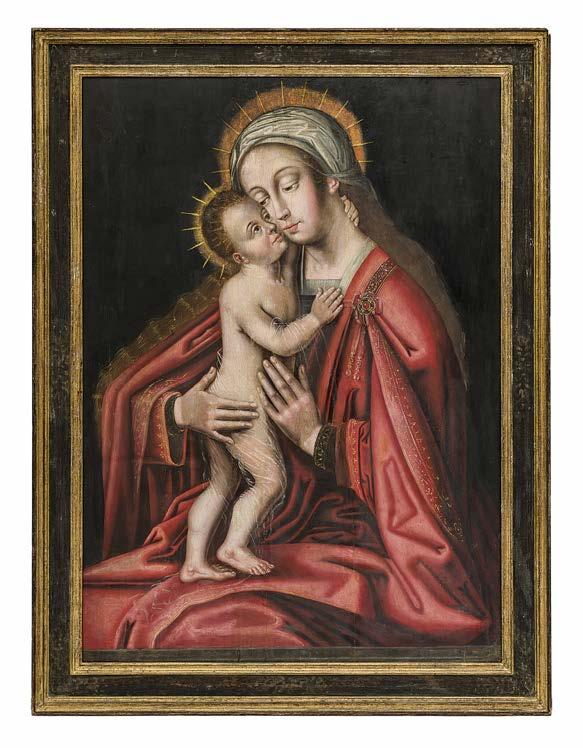
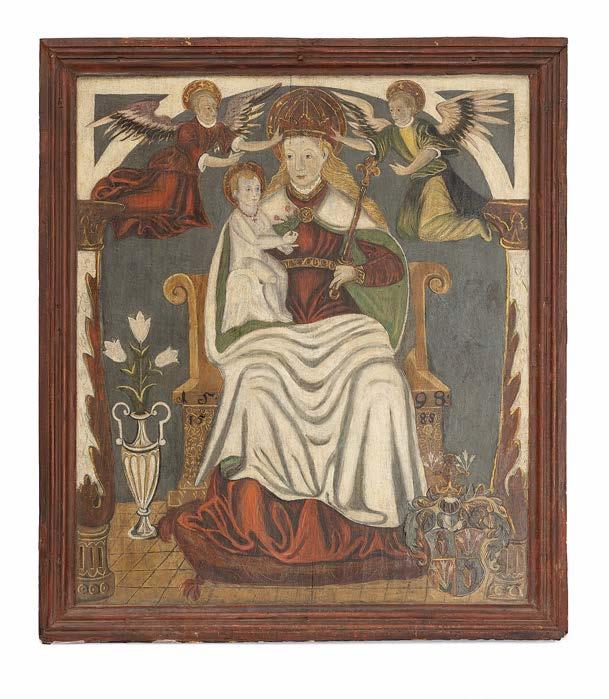
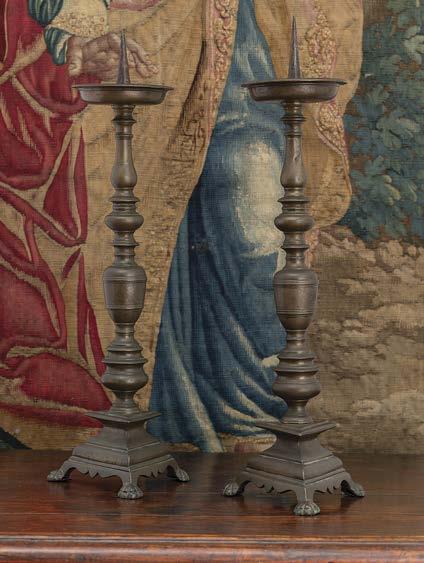
200
After Adriaen Isenbrandt (Flemish, 14801551)
The Virgin and Child
Oil on partially braced panel
94 x 68cm; 37 x 26 3/4in
£1,2001,800
An Anatolian Kazak runner, 20th century
The field with a column of ‘Memling’ guls enclosed by leaf and calyx borders.
L 256cm, W 97cm
£100200
A pair of bronze pricket candlesticks, Italian, circa 16501700
Each with a broad drippan and pricket, a baluster and ovoidshaped stem, on a triform base, with splayed pawlike feet. (2)
H 52.1cm, W 15.2cm. D 15.2cm
£600800
A Hamadan rug, Persian Kurdistan, circa 1920
The terracotta field of angular vines centred by an indigo medallion framed by spandrels and lemon borders.
L 203cm, W 132cm
£6080
School of Avignon
Virgin and Child enthroned with Angels
Bears dates 15—98 and 15—85
Oil on panel
Sight size 72.5 x 61.5cm; 28 1/2 x 24 1/2in
£1,0001,500
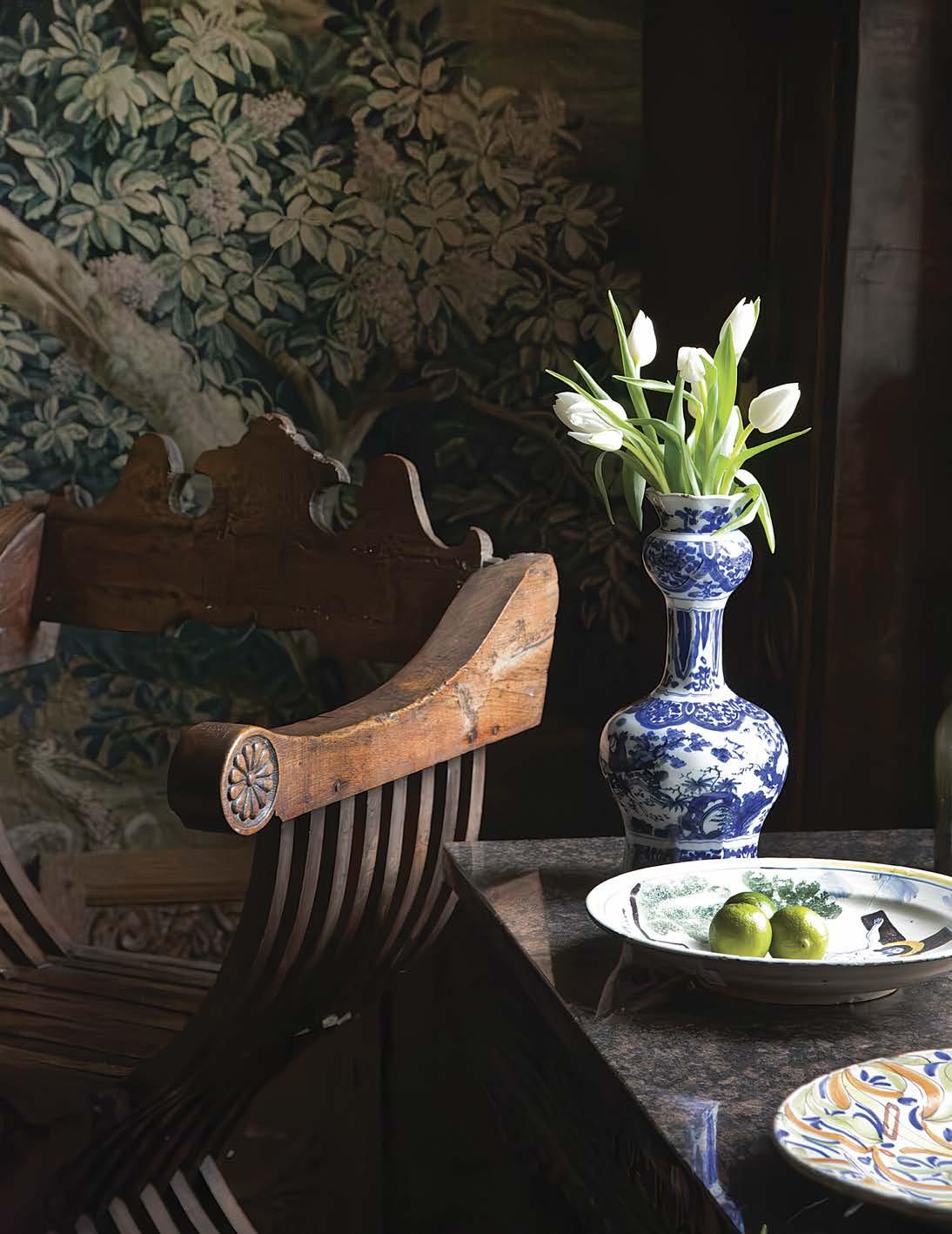
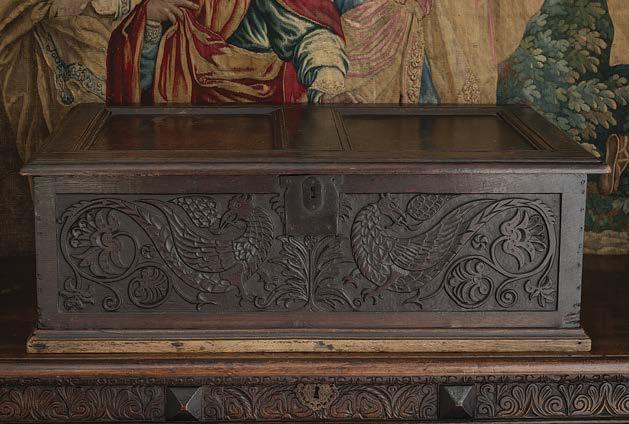
A 17th century carved oak panel, God the Father, Flemish/North German, circa 1620
Designed as a bust, his solemn features framed by flowing hair and beard, the drapery deeply modelled in rhythmic folds. The divine nature of the figure is emphasised by the radiating nimbus, symbolising eternal light and divine wisdom. The composition is contained within a circular border, with raised and carved edge.
Similar roundels formed part of larger ecclesiastical furnishings, or on architectural panelling, where they served as focal meditative images. The rendering of the face, with its naturalistic modelling and strong expression, reflects the influence of the late Northern Renaissance, when devotional imagery sought to combine human immediacy with sacred authority.
H 55.9cm, W 47cm, D 6.4cm
£300400
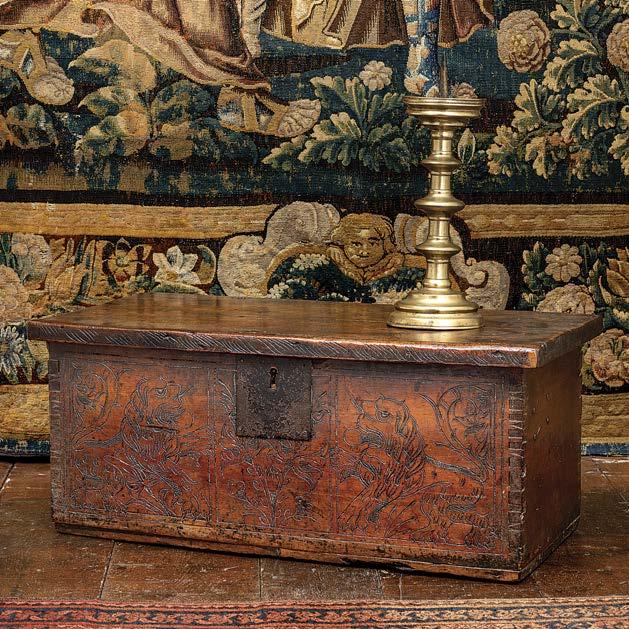
A large boarded and panelled oak box, Gloucestershire, circa 164060
The lid of two panels, the front carved in low relief, centred by a leafystem and flanked by a pair of addorsed, cocklike birds, their fancy tails issuing scrolling flora, bold base moulding.
H 32.4cm, W 97.2cm, D 58.4cm
£400600
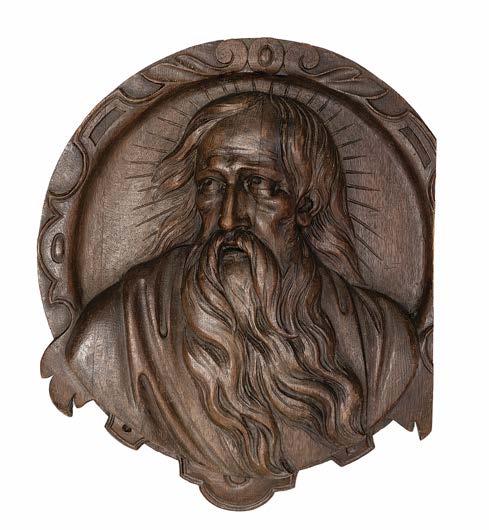
A small cedar/cypress boarded chest, North Italian, circa 15801620
Made for export to England
Of dovetailed construction, inciseddecorated to the front with central stylised foliage, flanked by rampant lions.
The use of cedar/cypress marks this piece as part of the wider AngloItalian trade of the late 16th/early 17th century, when Northern Italian workshops produced fragrant timber chests for the English market, valued for storing fine clothing and linens.
Unlike larger examples its compact proportions suggest it was conceived as a personal container, closer to a travelling chest or valuables box, rather than a general household storage piece.
H 34.5cm, W 81.9cm, D 40cm
£200300
An Elizabeth I carved oak boarded box, West Country, circa 15801600
Of large proportions, the front with two reserves, each carved with guillochestrapwork, framed by linear gaugecarving, the sides with applied mouldings to form similar framed plain reserves and create the illusion of panelled construction, the hinged lid with chipcarved ends.
Provenance: Retail label of ‘Stair & Andrew Ltd.’, 25 Soho Square, London and 45 East 57th Street, New York, eminent early 20th century dealers, and known to have supplied William Randolph Hearst.
H 25.4cm,W 82.6cm, D 55.9cm
£600800
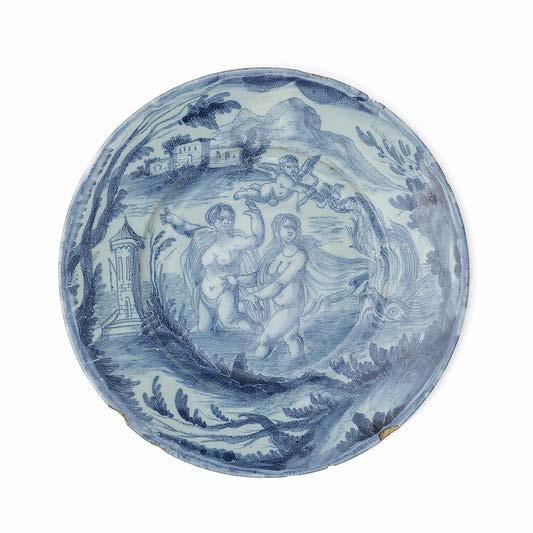
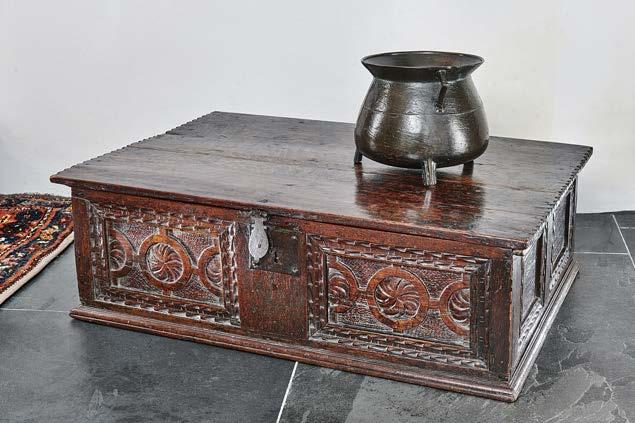
A 17th century Italian maiolica plate, Savona, circa 16701700
Extensively overall painted with a classical narrative of Cupid and Psyche, (from Ovid’s Metamorphoses), Psyche and probably her sister depicted wading, whilst turning to look at a seamonster, cupid hovers above aiming his arrow at the monster, the scene extends to the rim with buildings, a turret and distant villa beneath a mountainous skyline, along with foliate branches, the reverse with small foliate sprays and a painted ‘bottle’ factory mark.
Dia 26cm
£200300
210
A joined oak stool, English, circa 164060
With rare leg design
The top with ovolomoulded edge, broad runmoulded and bicuspidshaped rails, on unusual double balusterturned legs, joined by plain stretchers all round, on turned feet.
H 57.8cm, W 52.1cm, D 32.4cm
£300400
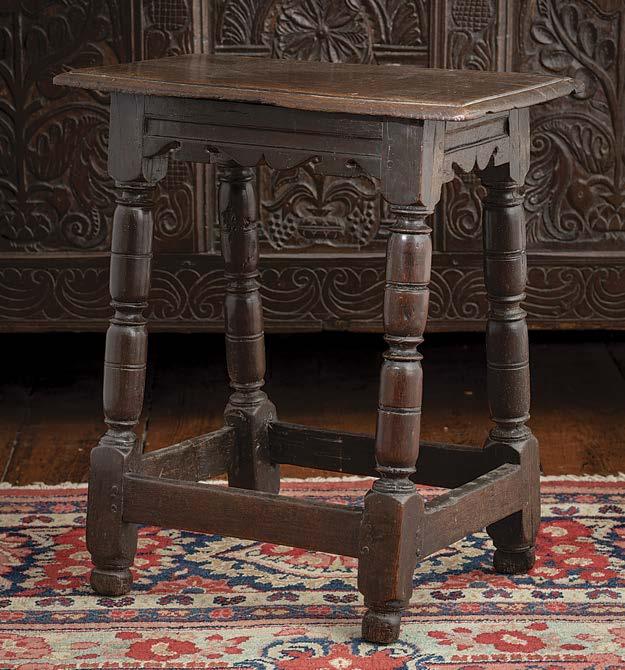
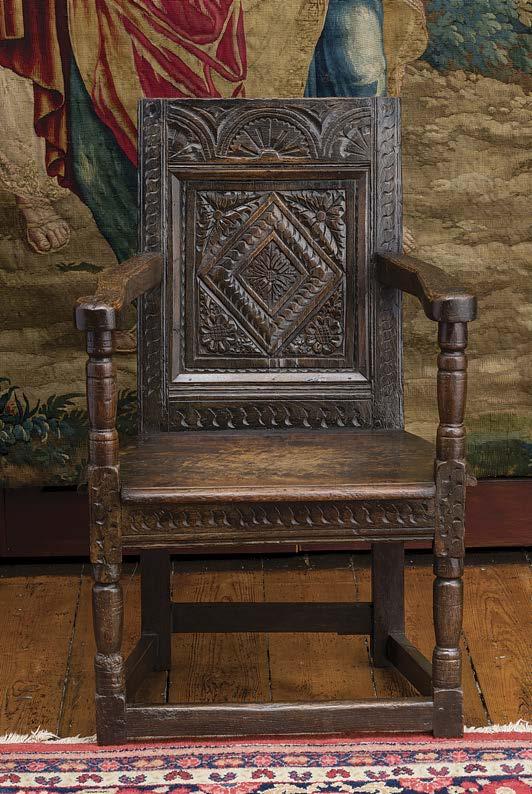
Of
H 22.2cm, Dia 9.5cm
£8001,200
An Elizabeth I / James I oak caquetoire open armchair, Salisbury, circa 160020
The back panel boldly carved with a lozenge enclosing a flowerhead, framed by a chaincarving, and with leafytriform spandrels, below a lunettecarved top rail, further chaincarving to uprights, the gently angularshaped arms on balusterturned front supports, the trapezoidshaped seat on carved rails, with matching turned forelegs, joined by plain stretchers.
The trapezoidal seat and outwardangled arms are characteristic of the Frenchderived caquetoire (caqueteuse) form, a type of ‘conversation chair’, introduced into England in the late 16th century and favoured in the West Country.
Victor Chinnery, the esteemed author, identified Salisbury as a centre of distinctive joinery at this period, partcularly noting the persistence of lunette carving and geometric lozenges in Wiltshire work. This chair is a survival of that regional tradition, both structurally robust and rich in decoration.
Comparable examples are illustrated in Chinnery, ‘Oak Furniture: The British Tradition’(2016), notably p.412, fig.4:73 and are held in the collections of Salisbury Museum and the Wiltshire Heritage Centre.
H 99.1cm, W 62.2cm, D 47cm
£1,2001,800
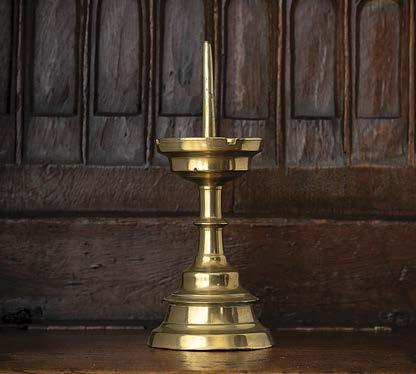
213
A set of three delftware tile panels, St Augustine, the Crucifixion and St Martin, Dutch, mid18th century
Each devotional tile picture composed of six square tiles painted in manganese, in one Christ is shown upon the Cross above the skull of Adam, flanked by a distant landscape, both saints depicted standing, St Augustine, holding the flaming heart, and St Martin in episcopal vestments with sword and cloak, both titled in Latin cartouches. (3)
H 45.1cm, W 32.4cm, D 2.5cm
£600800
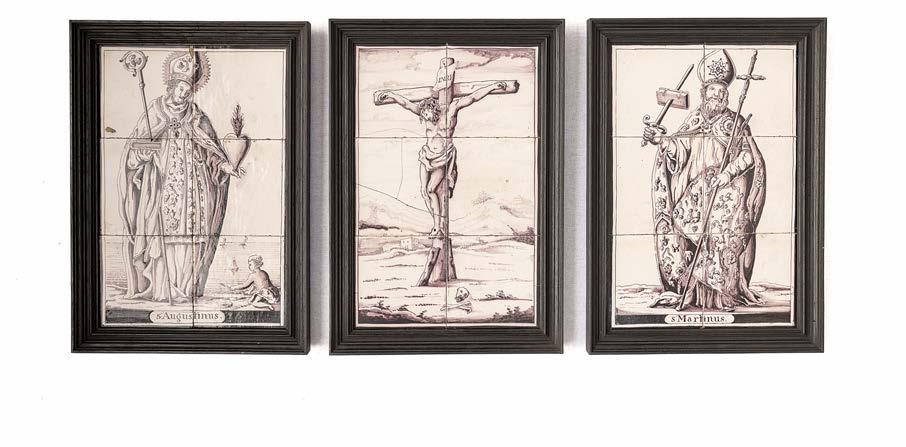
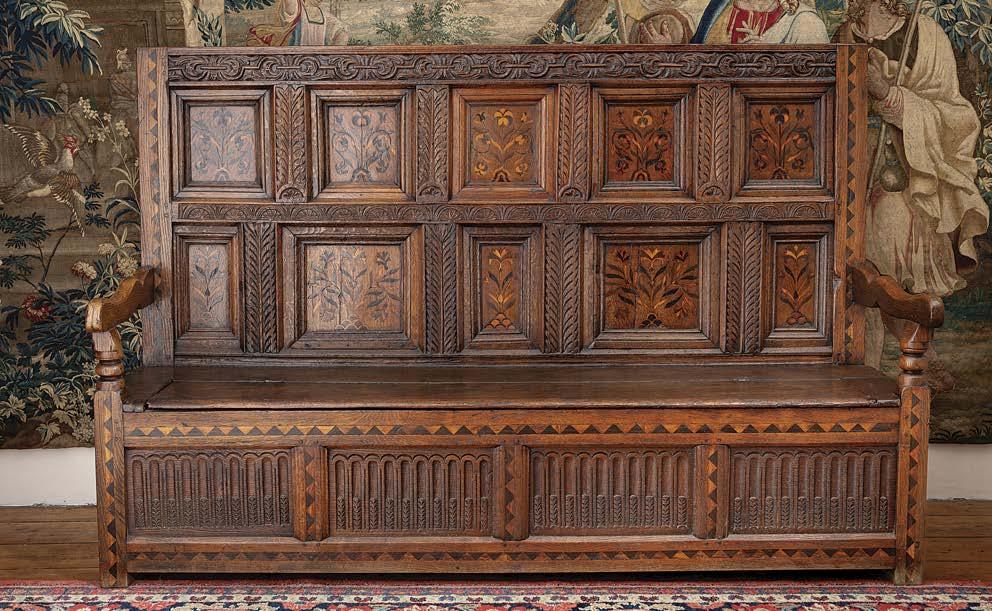
214
A Charles I joined oak and inlaid boxsettle, Leeds area, Yorkshire, circa 1630
The back rest constructed with ten deeply recessed panels, each framed within robust mouldings and finely inlaid with holly and bogoak in stylised floral and foliate designs, the uprights are each carved with a single leafystem, the top rail with entwined Sscrolls, the open arms on squat turned front supports, the hinged seat atop four stopfluted panels, the surrounding rails and extended stiles with chequeredchevron inlay.
H 129.5cm, W 195.6cm, D 57.8cm
£8001,200
215
A pair of James I carved walnut fullbodied terms, circa 1620
A male and a female, each standing upright, he with crossed arms, she with one hand to chest, with modestly draped fabric folds, and shelllike headdress beneath Ionic volutes. (2)
The use of walnut rather than oak denotes a highstatus commission, with European influence.
H 57.2cm, W 10.2cm, D 4.4cm
£400600
216
A silk appliqué valance, Italian or possibly Spanish, circa 1600
Worked in silk threads and couched work, designed with interlacing foliate arabesque, hung with floral pendants, with tasselled fringe to lower edge.
H 30.5cm, W 238.8cm
£200300
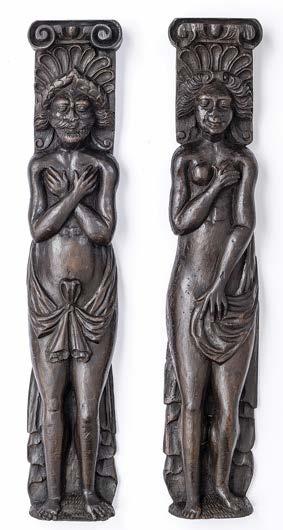

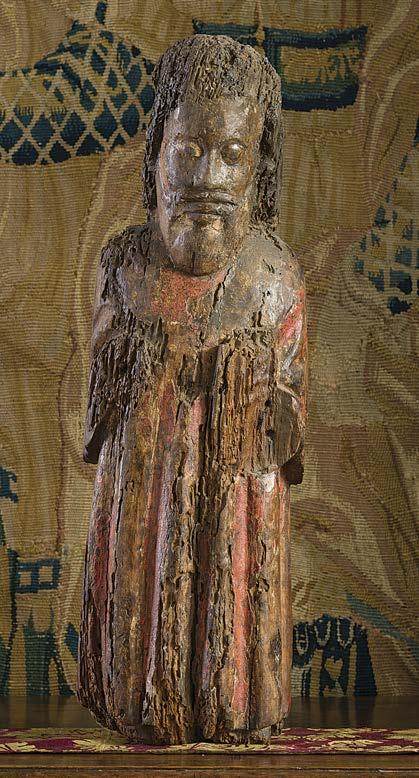
A rare Romanesque, early Gothic, carved oak and polychromedecorated figure, a Saint or Apostle, French, circa 12001300
Carved in the round, although with a frontal emphasis typical of this period, retaining traces of original red and fleshtoned polychrome. The figure, standing, is characterised by its rigid stance, stylised vertical folds of drapery, and the powerful, masklike treatment of the face, with a prominent moustache and heavylidded eyes.
Such features recall the monumental idiom of French Romanesque sculpture, where austerity and spiritual authority were expressed through geometric form and emphatic presence rather than naturalistic detail. Although the figure’s original attributes are now lacking the clerical robe suggests a male saint or apostle.
H 50.8cm, W 16.5cm, D 12.7cm
£8001,200
A pair of 17th century carved oak panels, Flemish, circa 1660
Each carved in deep relief, centred by a classical urn issuing abundant fruit and foliage, framed by scrolling acanthus with pendant clusters of grapes, and flanked by pairs of exotic birds, framed. (2)
The overflowing urn signifies abundance, prosperity, and domestic plenty, while the grapes hold both Eucharistic associations and connotations of fertility and conviviality. The paired birds reinforce themes of harmony and love.
H 21cm, W 78.1cm, D 2.5cm
£200300
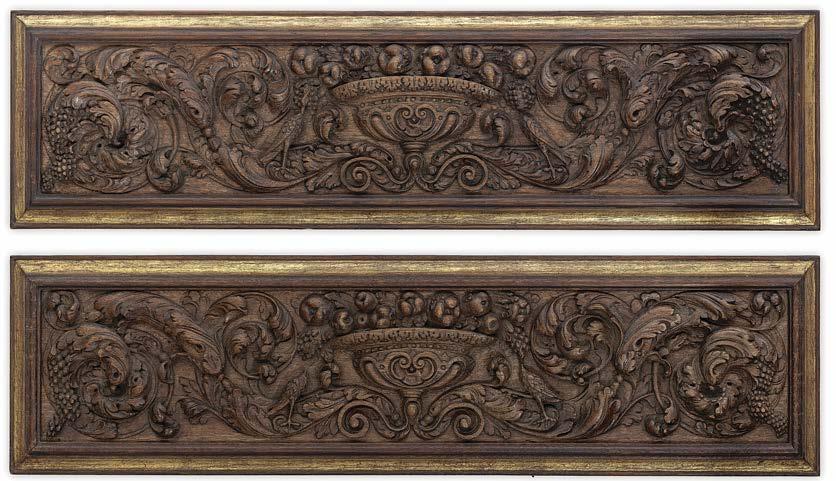
An arresting carved limewood and polychromedecorated figure, St John the Evangelist, South German, circa 14801510
The youthful, beardless features, contemplative expression, and book held to the side are canonical attributes of St John, further emphasised by his hand raised in devotion across his chest.
The carving is characteristic of late Gothic sculpture in South Germany, where limewood was the favoured medium for ecclesiastical works. The elongated proportions, softly modelled face, and deeply folded drapery align with the sculptural language of Swabian and Franconian workshops active in the closing decades of the fifteenth century. Such figures would originally have formed part of a larger altarpiece ensemble, arranged alongside the Virgin and other apostles in a narrative or devotional scheme.
The surviving polychrome decoration shows evidence of both original pigment and later repainting, with bold 17th–18th century layers over traces of the earlier gilded surface. This pattern of repaint reflects the practice of refreshing devotional sculpture to maintain liturgical splendour.
H 99.1cm, W 30.5cm, D 21.6cm
£1,0001,500
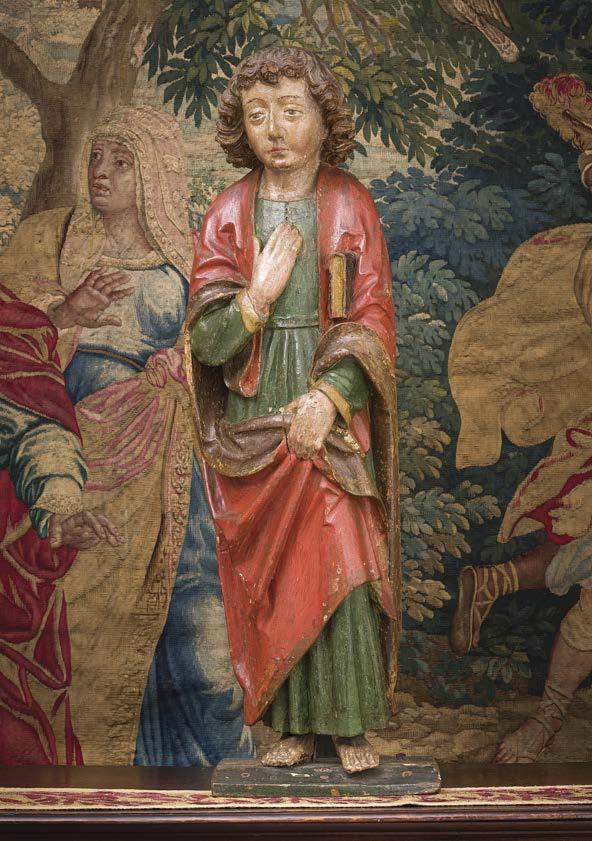
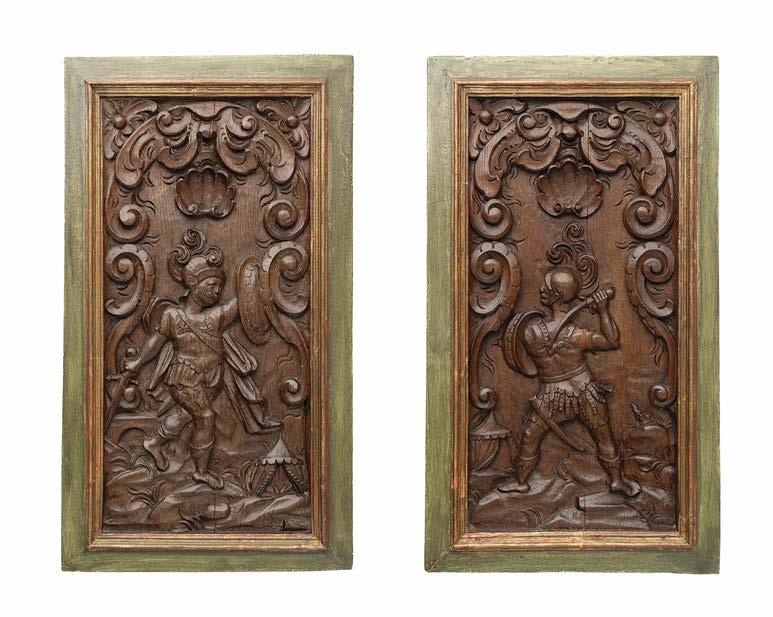
A pair of carved oak panels, Flemish, circa 1600
Each carved in deep relief with a martial Roman soldier, in animated stance with shield and sword, set within scrolling strapwork ornament and surmounted by a scallopshell device, in green painted and gilded frames. (2)
Executed in the Mannerist taste prevalent in Antwerp workshops of the mid16th century, the panels display bold undercutting and a vigorous sense of movement.
H 65cm, W 36.8cm, D 2.5cm
£400600
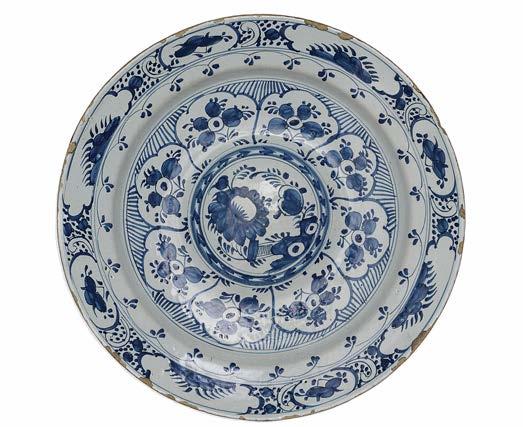
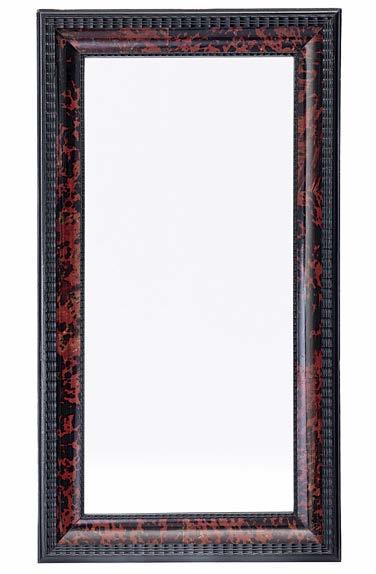
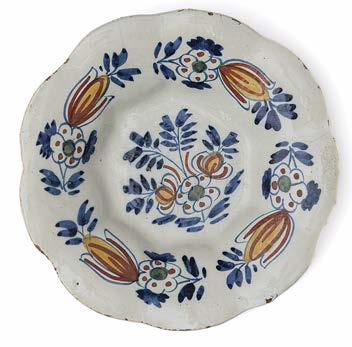
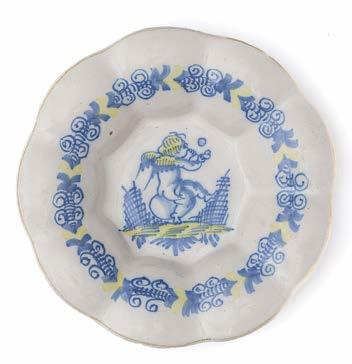
A delftware charger, Dutch, circa 1680
Painted in cobalt blue, with central boss, floral decorated, enclosed with radiating petalshaped cartouches, each containing a flower, the rim enriched with alternating panels of foliage and abstract motifs.
The domed centre is a notable feature, giving the piece added depth and presence. The influence of Chinese Kraak porcelain in the division of decorative fields is strongly evident, albeit with a distinctly European handling.
Dia 33.7cm
£150200
λ 222
A 19th century red tortoiseshell and ripplemoulded frame
In the 17th century Dutch manner, or possibly period and cutdown.
Of cavettoprofile, veneered in tortoiseshell on a crimson ground, within a deep ebonised border.
H 43.2cm, W 78.7cm
£300400
A delftware lobed dish, Dutch, circa 170050
Polychrome painted with a floral spray and four tulip sprays to the rim, together with another painted in blue and yellow, centred by a seated cherub, the rim with scallop edge decorated with repeating scroll motifs. (2)
Dia 21.6cm
£100200
A 17th century brass pricket candlestick, Italian, circa 162050
Having a relatively flat, circular drippan, with balustershaped, tall pricket, on a discoid, baluster and ovoid stem, atop a triform spreading base, on ball feet.
H 38cm, Dia 14.6cm
£200300
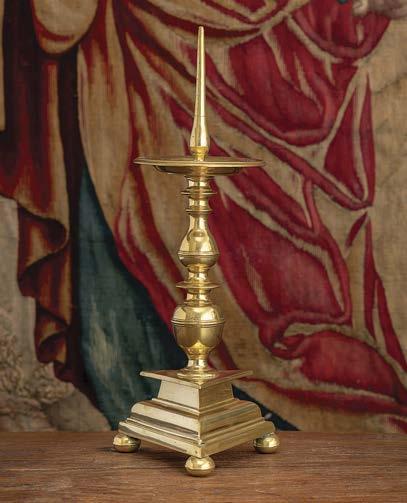
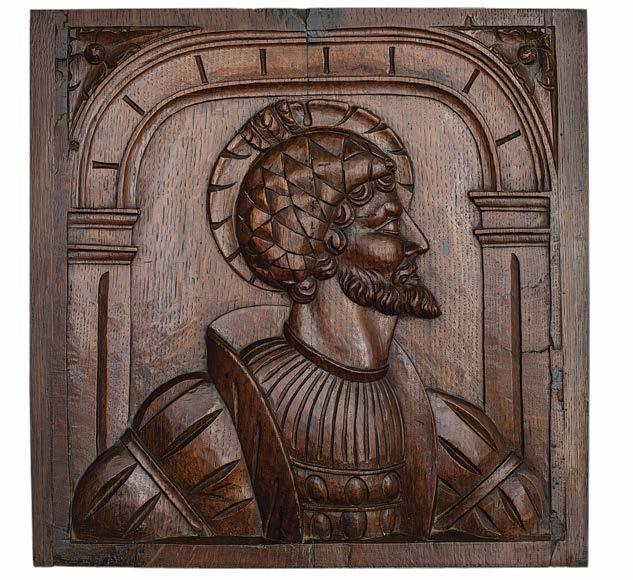
A carved oak portrait panel, King François I, French, circa 1530
King François I (1494–1547) is shown in profile, within a flattened arcade, with leafy spandrels, wearing an open over garment, with padded and slashed sleeves, a plumed turbanstyle headdress, with distinctive long nose and beard.
Panels of this type were produced in French court workshops during the height of the Renaissance, echoing the royal imagery of Fontainebleau and Blois, where François I promoted Italianate design and the arts. Such panels frequently adorned thrones, or ceremonial chairs intended for ecclesiastical and aristocratic settings.
Provenance: Reputedly College Hall, Exeter, dispersal sale, 1980s. Further related panels have been recorded. A chair, with an identical panel in the back, is illustrated in a photograph of Exeter College Hall, ‘The Hall of the Vicars Choral’, dated 1931.
H 42.5cm, W 42.5cm, D 5.1cm
£1,0001,500
226
A delftware posset pot, possibly London or Bristol, circa 170050
Of cylindrical lidded form, with two loop handles, the body freely painted in cobalt blue with a rustic riverside scene, a cottage, trees and sailing vessel, the lid floral decorated and the handles with dot decoration.
The softer glaze and decorative style suggest English rather than Dutch manufacture.
H 11.4cm, W 19cm, D 12cm
£100200
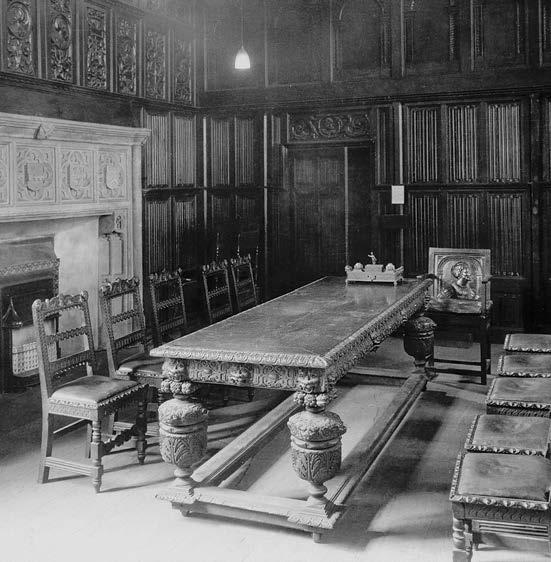
A Malayir runner, West Persia, circa 1930
The madder field with a column of indigo medallions enclosed by borders of flowerheads and ivory outer guard stripes.
L 377cm, W 100cm
£200300
A Spanish tinglazed earthenware ewer, Teruel, 18th century
Of flattened ovoid form, with tall waisted cylindrical neck, and flared collar, strap handle, and narrow conical spout, painted in cobalt blue with broad brushed stylised foliage.
H 18.4cm, Dia 14cm
£100200
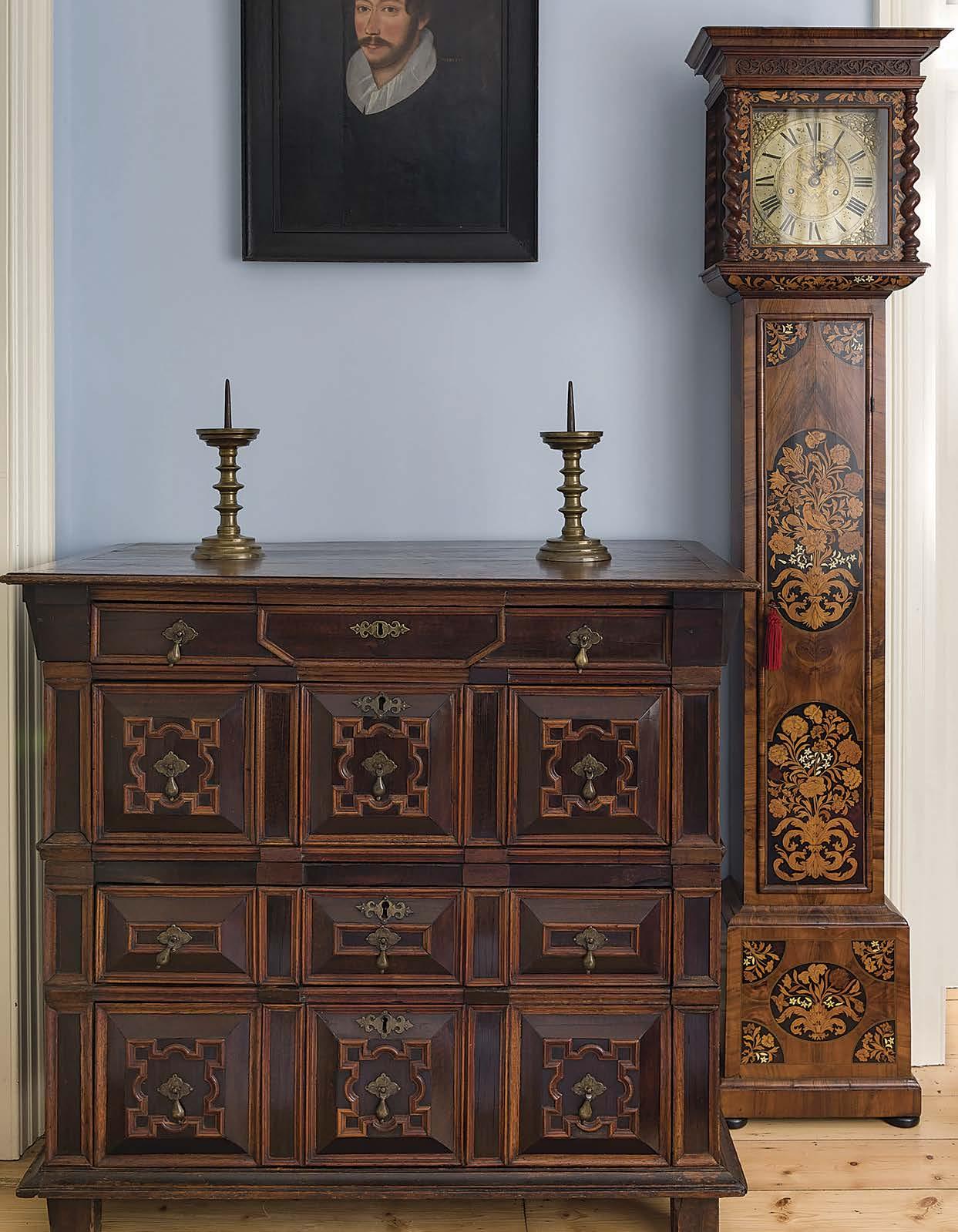
A Charles I ash turner’s chair, English/Welsh, circa 1630
Of typical triangular form, all parts turned apart from the boarded triangular set, the uprights rising to support heavily turned armrests and a spindleback formed of radiating bobbinturned members.
Comparable examples are illustrated in Victor Chinnery, ‘Oak Furniture: The British Tradition’ (2016) p.66 and Tobias Jellinek, ‘Early British Chairs and Seats 1500–1700’ (2009), pp.164169.
H 76.2cm, W 59.7cm, D 51.4cm
£400600
A Charles II oak and snakewood/fruitwood chest of drawers, circa 166070
Constructed in oak and faced with applied geometric mouldings framing panels of snakewood/fruitwood veneer, of four longs drawers, each with three reserves, with brass drop handles, in twoparts.
The bold rectilinear design, with sunken squares and mitred applied mouldings, is characteristic of English furniture in the years immediately following the Restoration of Charles II. The architectural form reflects both the classical ideals of order and proportion along with the influence of Dutch cabinetmaking, newly fashionable in England after 1660. Furthermore, a chest with drawers was relatively novel in the 1660s.
H 105.4cm, W 114.9cm, D 64.1cm
£8001,200
231
A pair of delftware tobacco jars, Dutch, probably circa 17501800
Of unlidded, baluster form, decorated in rich cobalt blue with scrolling foliage and stylised acanthus motifs framing bold central label cartouches, inscribed with the blends, ST. OMER and VARINAS. (2)
The inscriptions identify the type and origin of the tobacco. St Omer refers to a French producer and Varinas denotes prized leaf from Virginia, in the American colonies.
H 25.4cm, Dia 20.3cm
£200300
A Charles II oak spice cabinet, circa 1670
With a moulded overhanging top, the single panelled door with an applied lozenge, and iron butterfly hinges, opening to an arrangement of drawers, two pairs of short over one long.
H 41cm, W 37cm, D 26.5cm
£300500
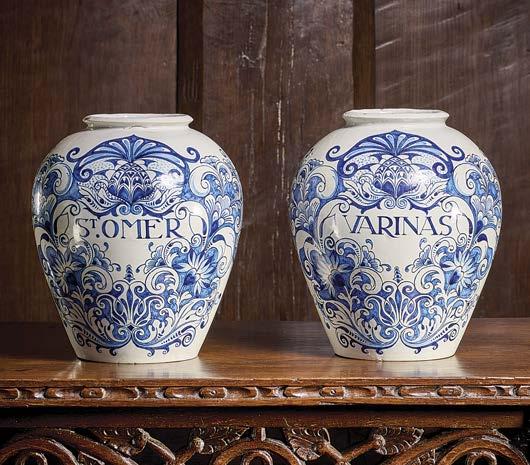
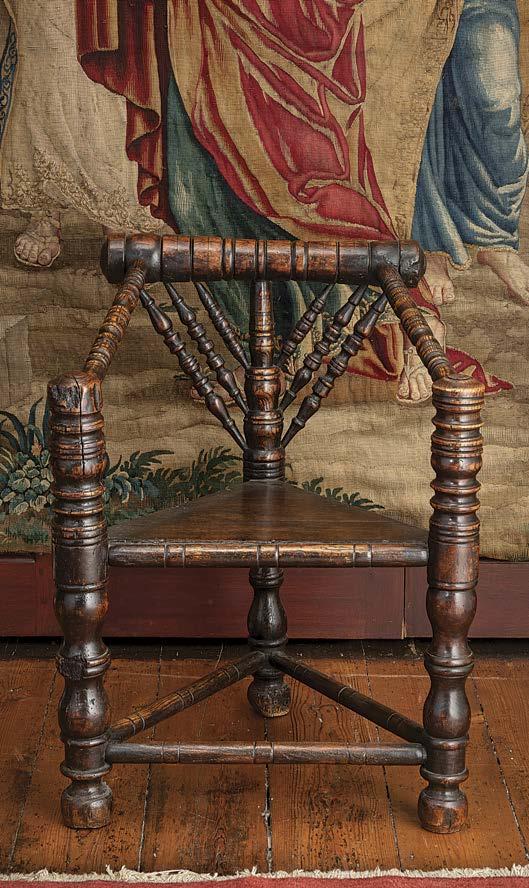
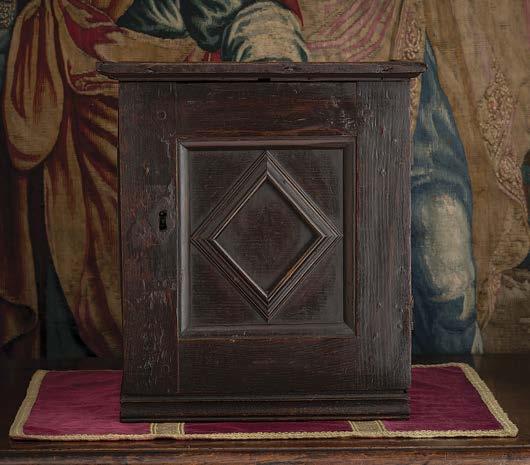
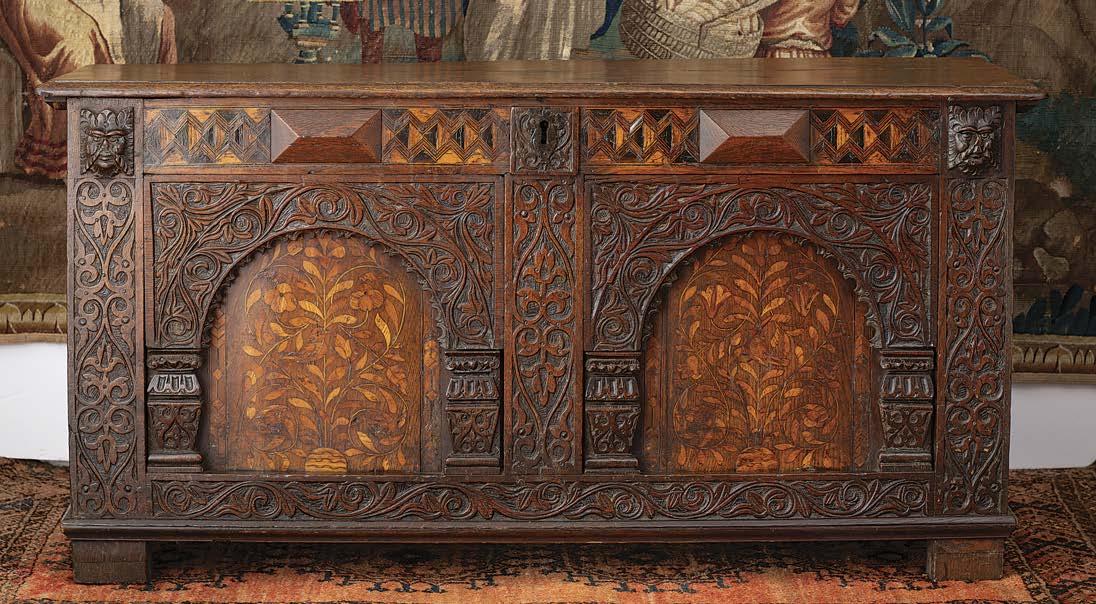
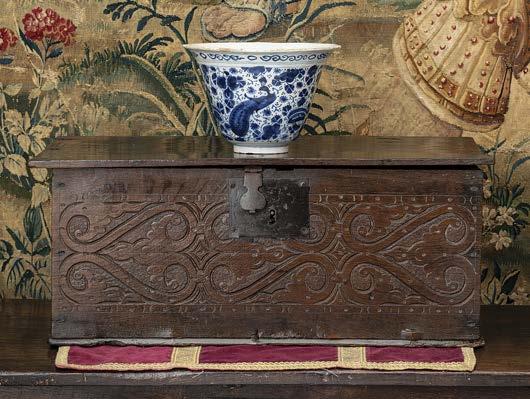
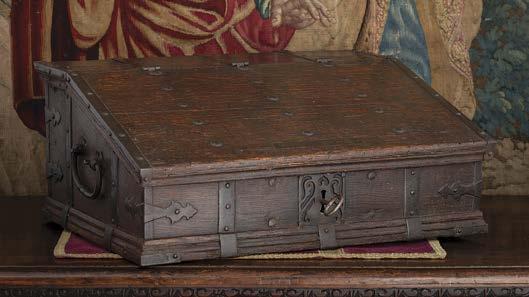
An Elizabeth I oak and inlaid coffer, circa 1600
The front with a pair of large applied arcaded panels, the arches filled with scrolling botanical motifs, on squat pillars with upper fluted carving and Ionic capitals, enclosing extensive floral and bird marquetry, below a parquetry inlaid top rail, applied with pyramidal boss and flanked by green man masks, the front uprights carved with leafy Sscrolls, the base rail again leaf carved, on extended stile supports.
Detailed carving and inlay of this type would be labourintensive and hence costly. Hence, it was principally commissioned by gentry or prosperous mercantile households, who sought to display wealth and refinement in their fashionable furnishing choices.
H 64.1cm, W 128.3cm, D 48.9cm
£600800
A Charles II oak boarded box, Devon, circa 1660
The front carved with a continuous frieze of paired Sscrolls within linear borders, enriched with extensive punchdecoration, the sides echo the design, iron lockplate.
H 26cm, W 62.9cm, D 35.6cm
£200300
An early 17th century ironbound oak desk box, Dutch/German, circa 160025 With sloping hinged lid, the front and sides with wrought iron strapwork fixed by domed rivets, extending over the moulded base rails, the angled corner plates with ‘fishtail ‘terminals, and with an ornate pierced iron escutcheon, original bale carrying handles to sides, strap hinges to lid.
The secure ‘strong box’ design of this portable writing desk / document box suggests it was used by merchants, clerks or guild officials for papers, account books and valuables, rather than intended for a domestic purpose.
H 24.8cm, W 57.8cm, D 44.5cm
£600800
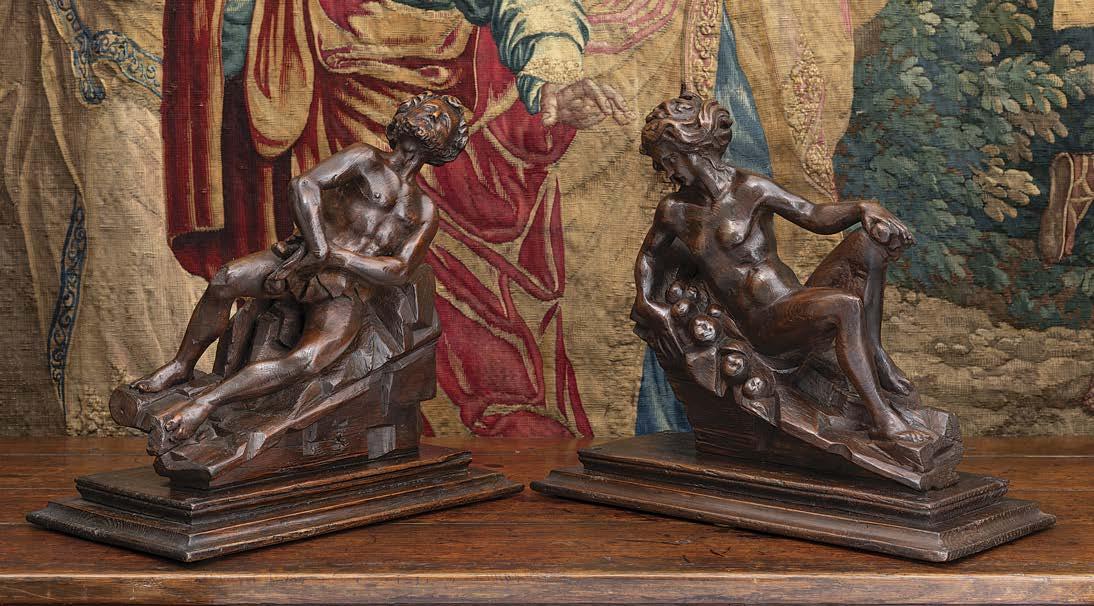
A pair of carved oak figures, Adam and Eve, Flemish, circa 15801600
Each shown reclining, in contrapposto poses on rocky outcrops, typically shown nude, Adam’s muscular body twists in a gesture of modesty, while Eve leans back gracefully, touching the fruits of temptation. (2)
The figures are carved in a highly Mannerist style, favouring emotional intensity over realism, with emphasis on elongated forms, distorted anatomy and theatrical gestures.
H 43.2cm, W 50.8cm, D 22.2cm
£8001,200
A delftware plate, Dutch, circa 1700
Polychrome painted in manganese and yellow with a man milking a cow inside a geometric border.
Dia 28.5cm
£100150
238
A delftware polychromedecorated charger, Dutch, circa 1750
Painted in blue, ironred and green, the centre decorated with a joyful winged cherub, the circular reserve framed by stylised floral sprigs, the rim with a band of ovoid motifs.
Dia 34.3cm
£100200
239
A small oak linenfoldcarved coffer, Flemish, circa 15901620
The front carved with three vertical linenfold panels, the centre panel set below the lockplate, and spaced by applied spiralturned split mouldings, the hinged lid with moulded edge, on block feet.
H 51cm, W 88cm, D 47cm
£150200
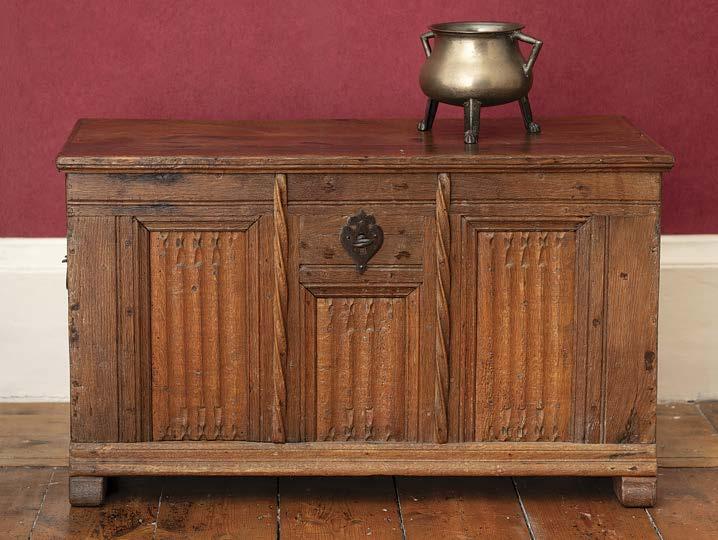
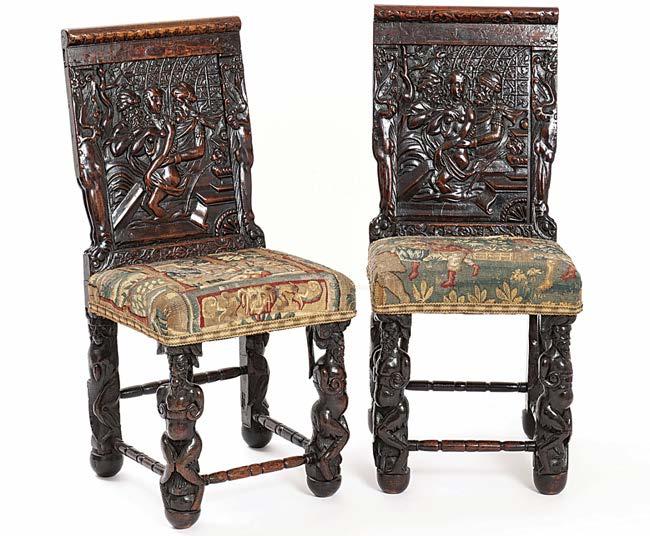
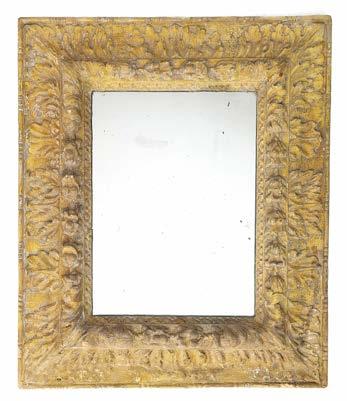
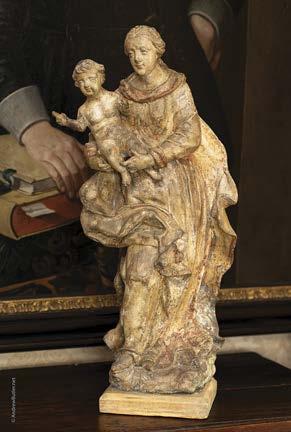
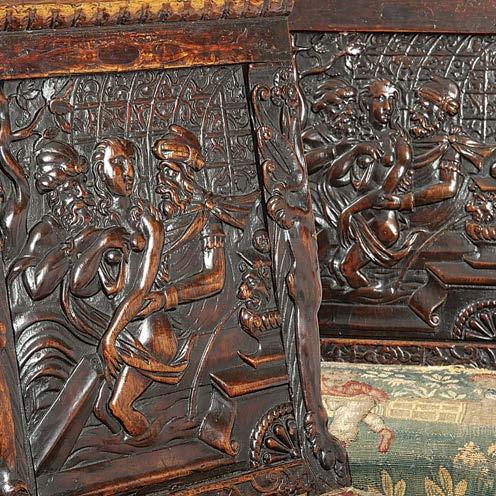
240
An interesting pair of walnut chairs, French, circa 157590
Each with an elaborate highrelief carved panelled back, designed with ‘Susanna and the Elders (Book of Daniel, Old Testament Apocrypha), a moralising theme that symbolised chastity, justice, and divine truth. The moulded and carved top rail enriched with fruitwood inlays, the back uprights with monopodium, the stuffover seats tapestry upholstered, one of figural design, the other with animals, all legs take the form of fulllength satyrs, embodying lust and temptation in deliberate contrast to Susanna’s virtue. (2)
The chairs intimate scale suggest they were conceived for a private chamber, intended as much for intellectual and moral conversation as for functional seating. The combination of sculptural narrative carving and rich textile covering elevates them to the status of statement pieces, blurring the line between furniture and moralising art.
Provenance: With Mallett Antiques, Bond Street, circa 1925, sold to Mr and Mrs Palmer, Bussock Wood, Newbury.
Cotehele, in Cornwall, a renowned Tudor mansion, in the stewardship of the National Trust, has a highly comparable chair (NT 347705). It is almost certainly from the same workshop.
H 83.8cm, W 36.8cm, D 43.2cm
£1,0001,500
241
A 17th century softwood mirror frame, Italian, circa 16501700
Rectangular in form, the frame deeply moulded and carved in relief with a continuous band of scrolling acanthus and foliate sprays, bordered by narrow inner and outer mouldings, the surface later painted in a warm ochre/gilt tone, now with aged patina and wear, fitted with a modern mirror plate.
H 69.9cm, W 58.4cm, D 5.1cm
£300400
242
A limewood figural carving, Madonna and Child, Italian, circa 160020
The Virgin Mary holds the Christ Child in a tender, yet dignified pose. Standing, her drapery falling in broad, flowing folds that recall, along with her calm, softened face, the idealised serenity that anticipates the devotional warmth of the Baroque. The Christ Child, by contrast, introduces a more naturalistic and animated character, his body rendered with a plump vitality, his right hand raised in a gesture of blessing, his head slightly turned, in an effort of heightened naturalism and immediacy to engage the faithful more directly. The hollowed reverse indicates the figure was originally intended for placement against a wall or in a devotional setting, perhaps within a small chapel or private oratory. Traces of original polychrome.
H 62.2cm, W 27.9cm, D 17.8cm
£600800
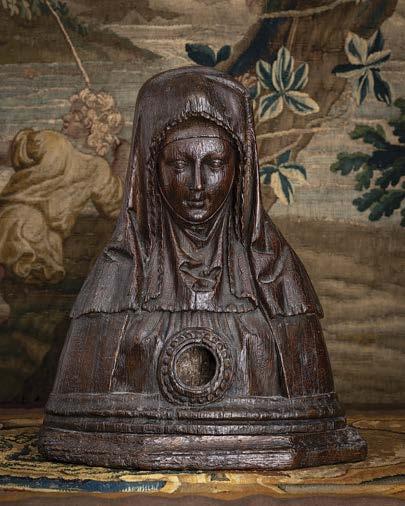
A 15th century oak reliquary bust, female saint, Netherlands, circa 14501500
The figure is shown with downcast eyes in serene devotion, wearing a wimple, a medieval female headcovering, formed from a cloth worn draped around the chin and neck, whilst covering the hair entirely. At the centre of her chest a circular recess, framed with beading, which once held a sacred relic, probably sealed behind a rock crystal or glass covering, on moulded base.
This form of busts combined devotional portraiture with function, the safe keep of a religious relic, allowing the faithful to venerate both the image and the relic contained within.
H 41.9cm, W 34.3cm, D 15.2cm
£1,2001,800
244
A 16th century carved oak panel, Circumcision of Christ, Flemish, circa 1590
The infant shown upon a table, as the ritual commences, attended by priests and figures in contemporary dress, presumably including Mary and Joseph, and with a dog leaping at the base of the ornate table legs. The subject (Luke 2:21) represents the first shedding of Christ’s blood, a prefiguration of the Passion, and his obedience to Mosaic Law. It also represents the formal naming of the infant Jesus.
Reliefs of this subject are comparatively rare within Flemish woodcarving, where Nativity and Adoration scenes predominate. Retaining its frame and hinges it likely formed part of a tabernacle door, a folding altarpiece, or domestic devotional furnishing.
H 33.7cm, W 29.2cm, D 2.5cm
£300500
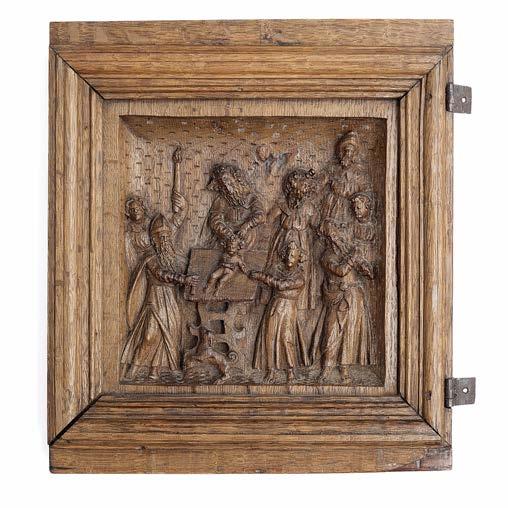
A pair of James I oak and upholstered low chairs, circa 1620
Each with 17thcentury silkvelvet upholstery and decorative crimson tassel fringe. The square oak frames constructed with columnar forelegs, joined by a moulded front forerail and low stretchers, with rectangular padded back and broad seat, with squab cushion. (2)
The use of velvet, one of the most luxurious textiles of the Stuart court, alongside the low form of the chairs, places them in a rarefied category of early upholstered furniture almost entirely absent from surviving English domestic interiors. Such chairs were costly items reserved for elite households, providing comfort and status at a time when most seating remained of boarded construction.
Provenance:
With Mary Bellis Antiques, Hungerford, (Edward Willson & David Gill).
Sold Sotheby’s, Billingshurst, 24 November 1992, lot 31 (£2,600).
Thence, private collection, Barrow Court, Somerset.
H 83.8cm, W 54.6cm, D 45.7cm
£400600
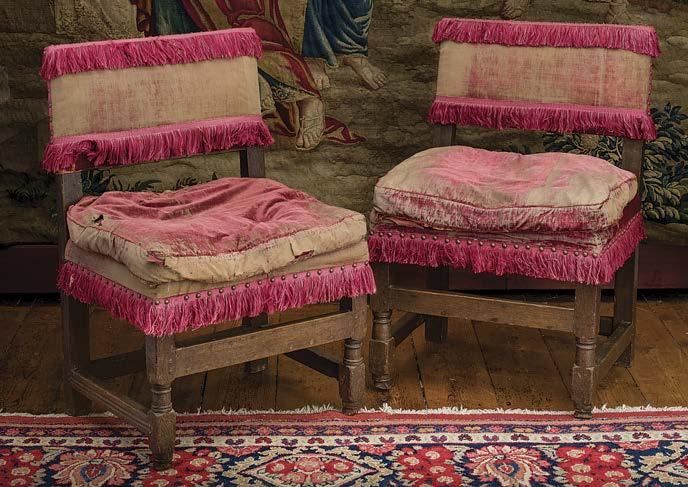
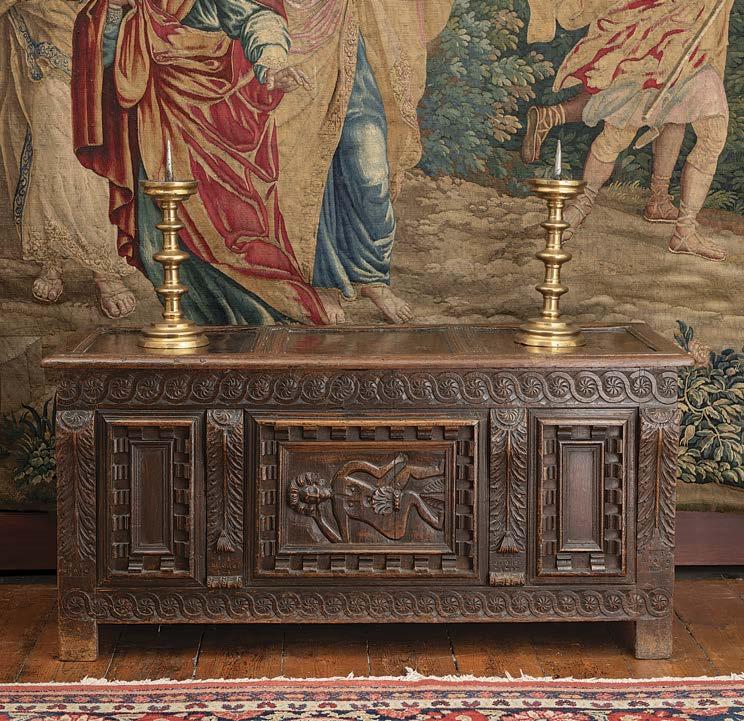
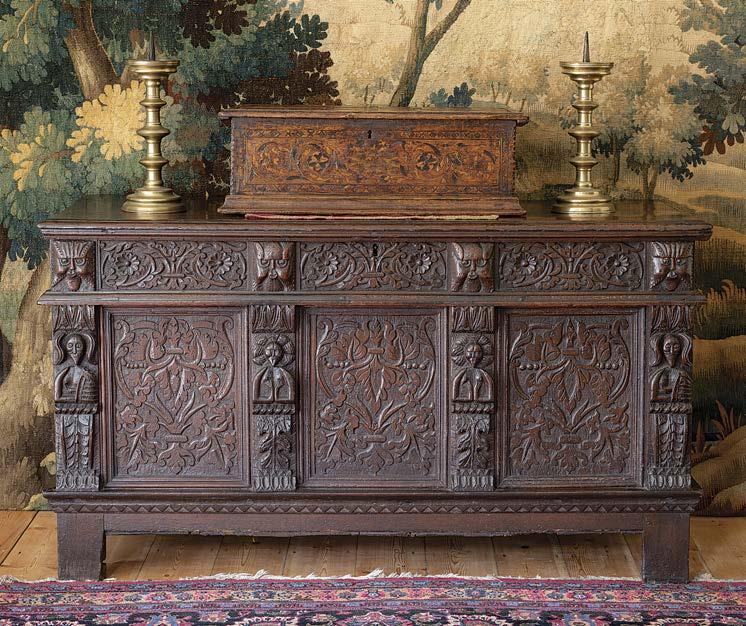
246
An Elizabeth I joined oak coffer, circa 15801600
The lid and front of three panels, the front centred with a naïve male figure, fulllength, naked except for a modesty shell, possibly representing Adam, set within a bold dentil moulded frame, flanked by plain panels, with matching frames, spaced by acanthuscarved pilasters, the top and bottom rails enriched with continuous guilloche carving.
It is possible the chest was once a pair, the companion with a carved panel of Eve, thus completing the narrative cycle.
H 62.2cm, W 130.8cm, D 58.4cm
£400600
247
An Elizabeth I /James I joined oak coffer, West Country, circa 15901610
The front with three panels, each carved with leafyfoliage, with grotesque terminals, within moulded frames, spaced and flanked by whimsical carved terms, the top rail repeating the rhythm of the lower resister, with scroll carving spaced and flanked by green man masks, the boarded lid with moulded edge, dogtooth applied rail to base, on extended stile supports, originally with base drawer.
H 80.6cm, W 145.4cm, D 59.7cm
£1,0001,500
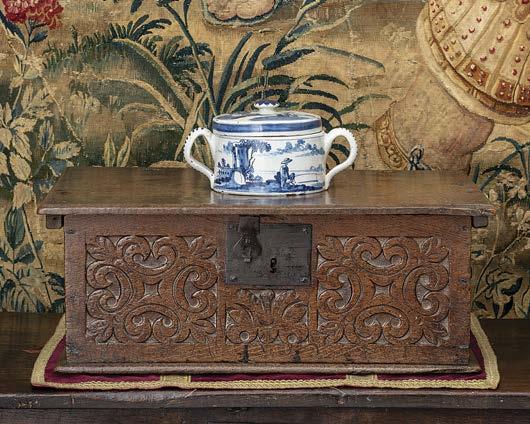
248
A Charles II oak boarded box, Exeter, circa 1670
The front boldly carved with two leafyscroll quatrefoils, centred by further leafy decoration below the iron lockplate, all enriched with punchdecoration, the sides plain, the hinged top with a simple moulded edge.
H 20.3cm, W 54.6cm, D 39.4cm
£200300
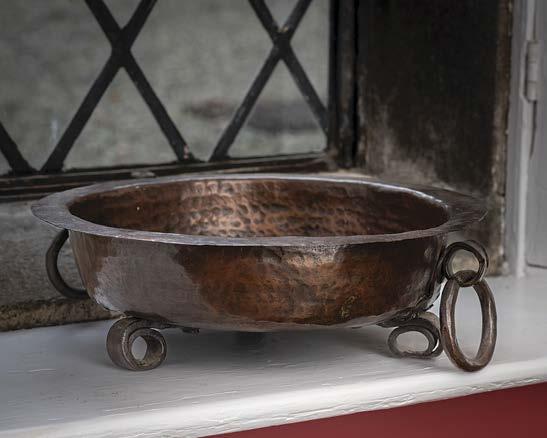
250
A copper and wroughtiron basin
The shallow bowl hammered allover, and with flat rim, paired iron ringhandles, and three tightlyscrolled iron feet.
H 10.5cm, Dia 36.5cm
£80120
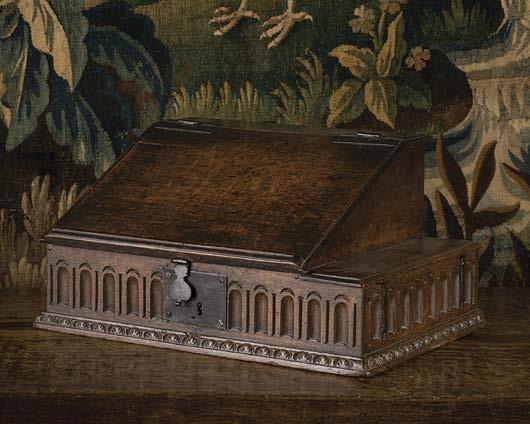
249
A small Elizabeth I / James I oak desk box, with exterior lidded till, circa 15901610
The front and sides finely carved with nulling, each null deeply recessed, the base mouldings carved with repeated leafymotifs, the sloping lid opens to reveal a compartmentalised interior, and allows the lid of the side till to be opened, the interior with bluegreen wash.
H 27.9cm, W 54.6cm, D 38.7cm
£600800
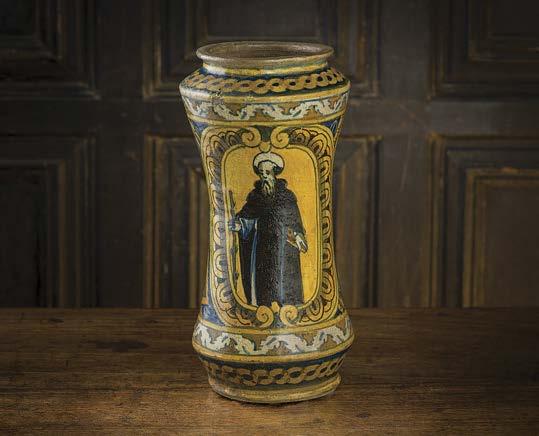
251
A Sicilian maiolica albarello, probably Palermo, dated ‘1621’
Of waisted cylindrical form, polychrome decorated, the rim and edges with scrolling guilloche and meandering leafy motifs, the front designed with a saint, possibly St John of Cologne, of the Dominican order, holding a leafy branch and book, within a cartouche, the reverse with ‘trophies’, letters ‘S P Q R’ (Latin phrase Senātus Populusque Rõmãnus; The Senate & People of Rome’), and dated ‘1621’.
This albarello belongs to the distinguished Sicilian maiolica tradition, produced for apothecaries and monastic infirmaries in Palermo. The saintly figure would possibly invoke divine protection over the remedies stored within, while the heraldicdevices denotes historical prestige and confidence in the contents. For a comparable example, from the Workshop of Lazzaro workshop, Palermo, Sicily, see the Metropolitan Museum of Art, New York (acc. no. 02.5.19).
H 31.1cm, W 15.2cm (diameter).
£600800
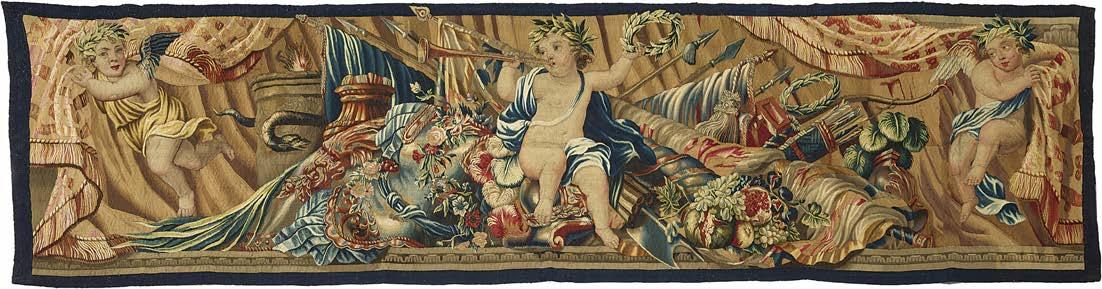
A good pair of tapestries, Brussels or Beauvais, circa 16701700
Of elongated rectangular form, finely woven in wool and silk, each centred by winged putti, crowned with laurel wreaths, amongst trophies of war, including helmets, shields, banners, spears, and breastplates, the addition of draped and swagged fabric set the scene in theatrical fashion, with abundant garlands of flowers and fruit symbolising prosperity and triumph. (2)
The iconography draws upon the Baroque allegorical tradition of Victory and Fame, where putti serve as playful embodiments of martial virtues. The laurel wreaths and military trophies echo classical Roman triumphal imagery, a theme highly popular in the decorative arts of the Louis XIV period.
Tapestries of this elongated form were woven to accompany larger tapestries, serving as overdoors, dado friezes, or bedroom hangings within grand interiors. Comparable examples are preserved in the collections of the Musée des Arts Décoratifs, Paris and the Musée du Cinquantenaire, Brussels, illustrating the close connection between Flemish and French weaving workshops in the late 17th century.
H 86.4cm, W 323.2cm
£4,0006,000
An Elizabeth I carved oak coffer, Exeter, circa 15801600
The front with three panels, each decorated with an applied arcade, carved with foliatemotifs, and leafytriform spandrels, the uprights carved with flowerheadrosette strapwork, the top and base rails carved with leafy Sscrolls, plain boarded lid.
H 76cm, W 128cm, D 58.5cm
£600800
An Afghan Turkmen carpet, first quarter 20th century
The madder field of ‘elephant foot’ guls enclosed by borders of hooked guls and stellar motifs flanked by boteh guard stripes.
L 353cm, W 262cm
£200300
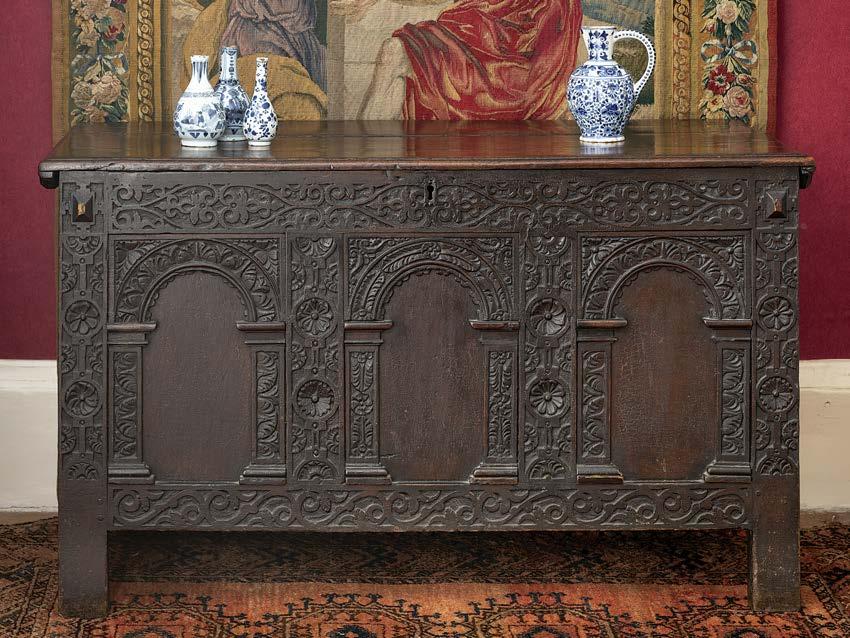
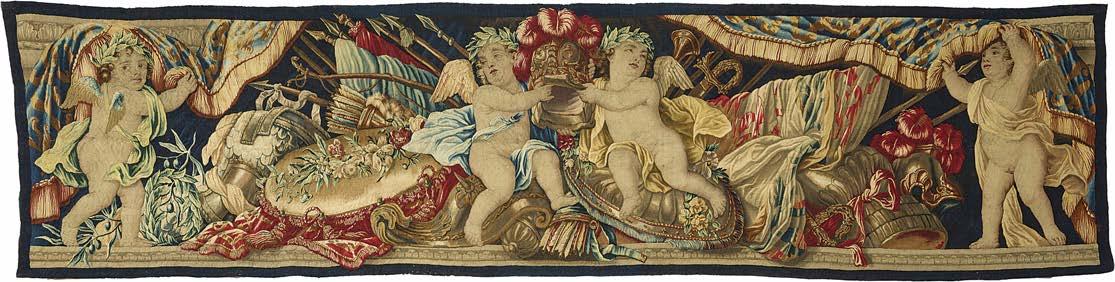
A 17th century brass socket candlestick, Italian, circa 160050
Of sectional construction, the tall socket with bulbous base, atop a circular drippan, atop a possibly associated base, with cylindrical, flattenedball and acorn knop stem, on a triform spreading base with small feet.
H 39.4cm, W 19.1cm, D 19.1cm
£80120 256
A Henry VII/VIII carved oak boarded chest, circa 14901520
The front carved with deep compassdrawn roundels, filled with radiating ‘petals’, with matching spandrels, centred by stylised budding flowers and further ‘petal’ reserves, with crosshatch detail, and traces of red and black pigment visible within the recesses. The front boards are cut unusually thin.
The top appears 17thcentury, with later lockplate and hinges.
The frontal composition exemplifies the design transition between Henry VII’s reign and Henry VIII, where medieval star and roundel patterns continued to flourish alongside the first stirrings of Renaissance influences, in the form of the floral motifs.
H 58.4cm high, W 144.1cm, D 52.1cm
£8001,200
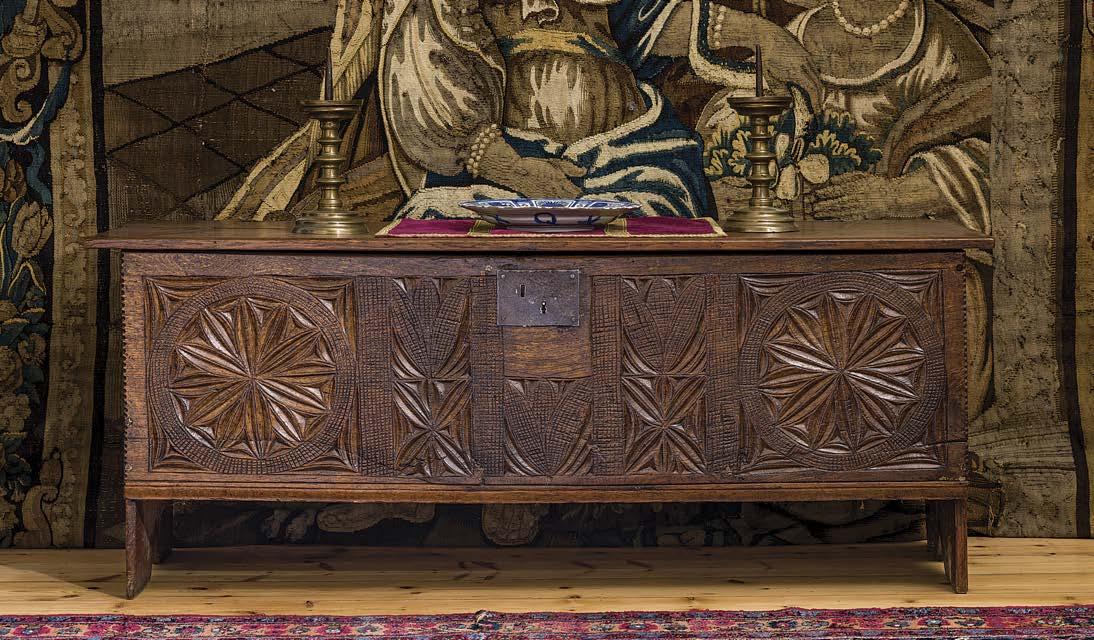
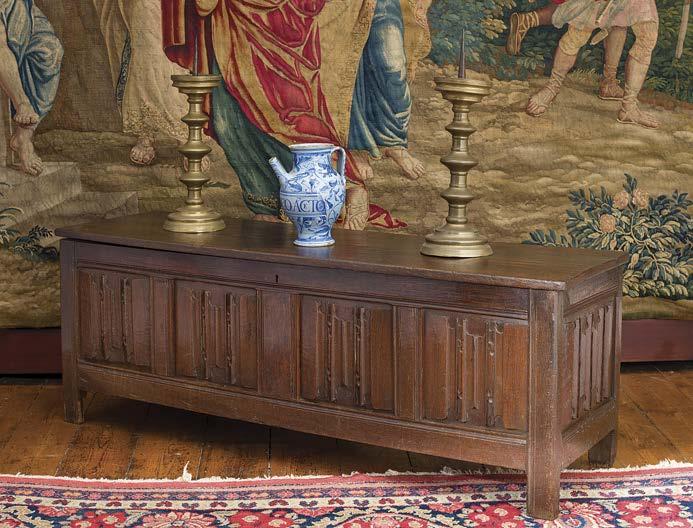
century
Of long and low proportions, with linenfold panels to the front and sides, within edgemoulded rails and stile supports, later boarded top, appears to have never had a lockplate.
Provenance: Welsh farmhouse. Although the coffer is provincial in execution, the crispness of the linenfold shows the coffer is a product of a skilled rural workshop.
H 52.7cm, W 145.4cm, D 43.8cm
£400600
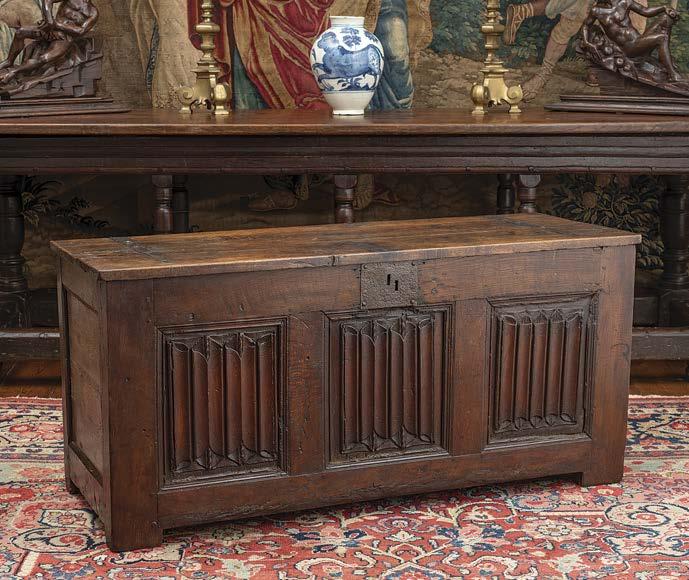
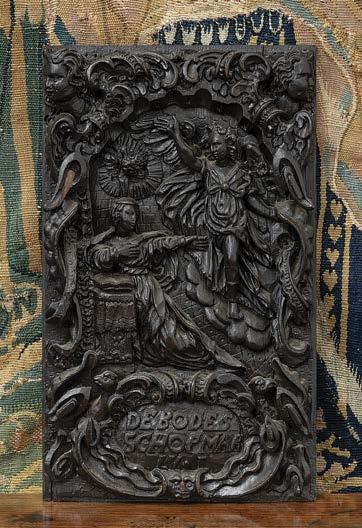
258
A 16th century carved panel, The Annunciation, Flemish, circa 15501600
Carved in high relief with a dynamic representation of the Annunciation. The Virgin is shown kneeling at prayer, interrupted in devotion by the Archangel Gabriel, who enters dramatically from the right, his drapery billowing in deeply undercut folds, above the Holy Spirit descends in the form of a radiant sunburst, the composition is archframed with scrolls enriched with masks and foliage, below in a bold cartouche, designed with birds and mask is an inscription ‘DE BODES / SCHOPMAR / LV . 1’ – ‘the Messenger’ – and if referring to Isaiah 55:1, an invitation from God to the spiritually ‘thirsty’ to find sustenance.
The handling of the figures, the animated folds of drapery, and the strong chiaroscuro created by the deep carving all demonstrate the high quality produced by the workshop.
H 47cm, W 28.6cm
£400600 259
A Henry VIII joined oak and linenfoldcarved coffer, North Devon, circa 152040
Of robust form, the front carved with three linenfold panels of crisp and varied execution, framed by broad stiles and rails, boarded lid, fitted with inset iron strap hinges, lock and base boards old replacements.
The linenfold carving relates closely to that found on North Devon wall settles of the early 16th century, with the same deeply cut folds and bold proportions.
H 59.1cm, W 125.1cm, D 47cm
£600800
A cedar/cypress chest, Italian, circa 15801620
Made for export to England
Of boarded, dovetail construction, the front extensively incisedecorated with a detailed narrative of the Sacrifice of Isaac (Genesis 22) on Mount Moriah; God tests Abraham’s faith by commanding him to sacrifice his beloved son, Issac, at the very last moment an angel intervenes, revealing a ram caught in the nearby thickets to be sacrificed instead.
Chests of this kind were commissioned by wealthy English gentry and merchants, eager to display biblical literacy and European taste. The use of cedar, a prized, aromatic wood, ensured protection against moths and insects, making these coffers particularly suited for the storage of costly textiles, linens, and devotional garments
H 58.4cm, W 116.8cm, D 59.1cm
£300500
A 16th century carved oak panel, Flemish, Antwerp or Mechelen, circa 157090
Richly carved in deep relief, centred by a young nobleman, on horseback, greeted by attendants, courtiers, and female figures, set within an elaborate framework of scrolling foliage, grotesque masks, and Mannerist ornament, red silkvelvet mount.
The carving demonstrates the high technical skill and narrative exuberance of late 16thcentury Flemish workshops, where devotional and secular subjects alike were rendered with theatrical vitality. Panels such as this, once integrated into larger domestic or ecclesiastical furnishings, were prized by 19thcentury collectors and often remounted, as here, on velvet backings to be appreciated as autonomous works of art.
H 39.4cm, W 30.5cm, D 3.8cm
£400600
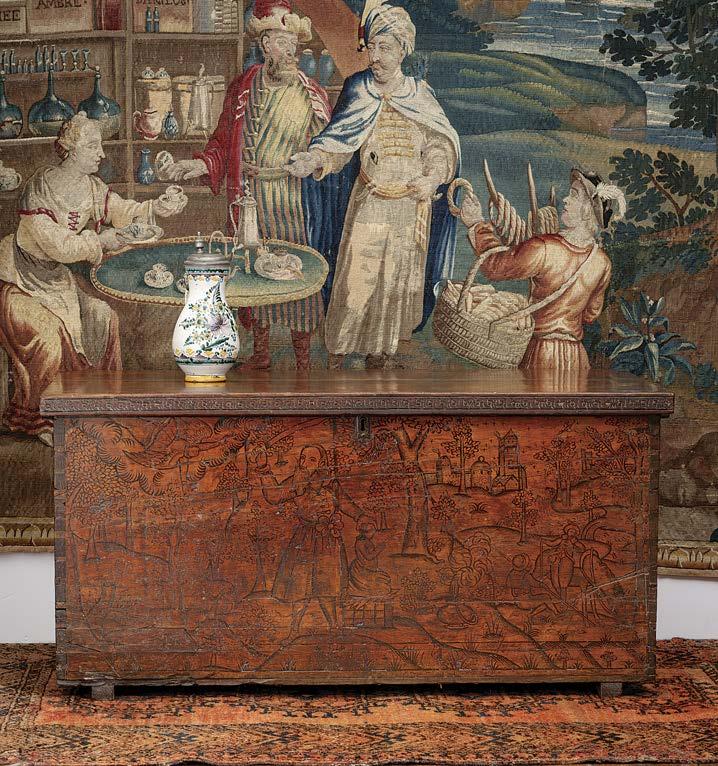
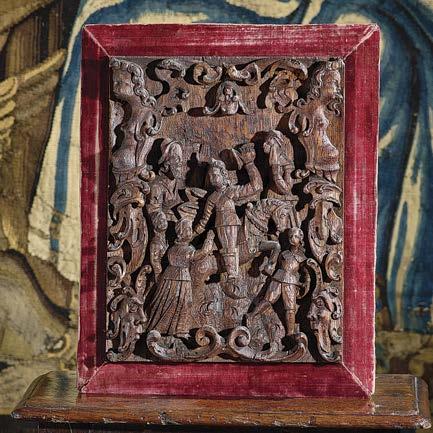
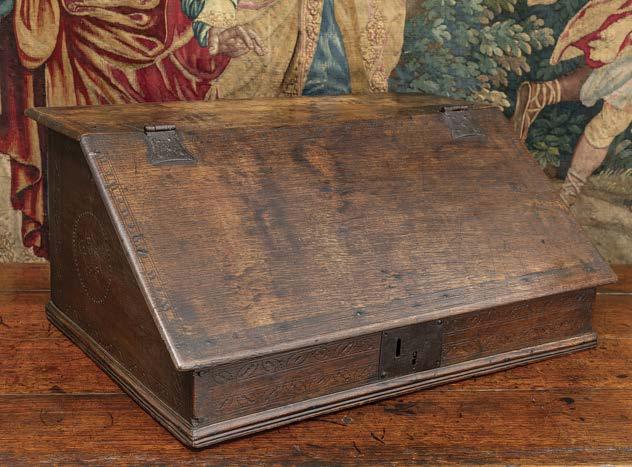
A Charles II boarded oak desk box, West Country, circa 1670
The sloping lid opens to reveal a fitted interior of five drawers below an open tray, the drawers retaining their original blackstained frame mouldings, the borders of the lid, front and sides all puncheddecorated, adding a refined and decorative element to the boxes functional form.
H 32.4cm, W 75.6cm, D 47.6cm
£200300
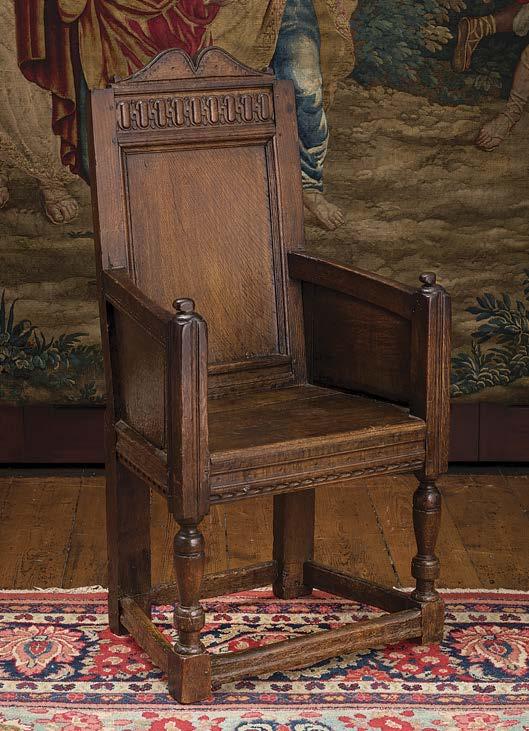
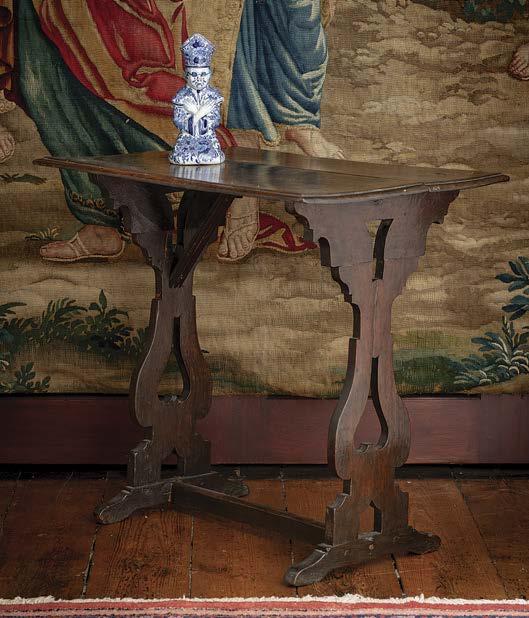
An Elizabeth I oak enclosed armchair, circa 15801600
The back with a plain panel, below a raisednulled carved top rail and doublescroll profiled cresting, the enclosed arms with gently outsplayed armrests tenoned directly into the rear of the ballsurmounted front supports, boarded seat, above a runmoulded, punchdecorated and gaugecarved rails, on risingbaluster forelegs, joined by runmoulded stretchers.
The panels below the armrests were designed to shield the sitter from draughts.
H 110.5cm, W 57.2cm, D 42cm
£400600
264
A Charles I joined oak occasional table, circa 1640
With piercedsilhouette trestle ends, supporting the twinboarded and edge moulded top, and joined by a low stretcher, on sledge supports.
The ‘silhouette baluster’ supports are more commonly found on dressers, larger tables, and stair rails. Their appearance on a small side table is highly unusual and reflects both economy of design, and a taste for strong decorative effect, on everyday household furnishings.
H 67.3cm, W 71.8cm, D 74.5cm
£300500
265
A carved oak figure, St John the Baptist, Netherlands, circa 1620
Depicted standing and animated, his hands raised in a gesture of address, the flowing drapery cut in broad, angular folds, revealing the sculptor’s concern with naturalism and movement, qualities that distinguish Netherlandish carvings of this period. The figure’s appearance, the ascetic features, long beard, bare feet, and mantle wrapped across the body suggests an identification with John the Baptist, the desert preacher and forerunner of Christ. Although without his traditional attributes (the lamb or crossstaff), the facial feature and treatment of dress correspond closely with other known examples of the saint.
H 62.6cm, W 36.2cm, D 30.5cm
£400600
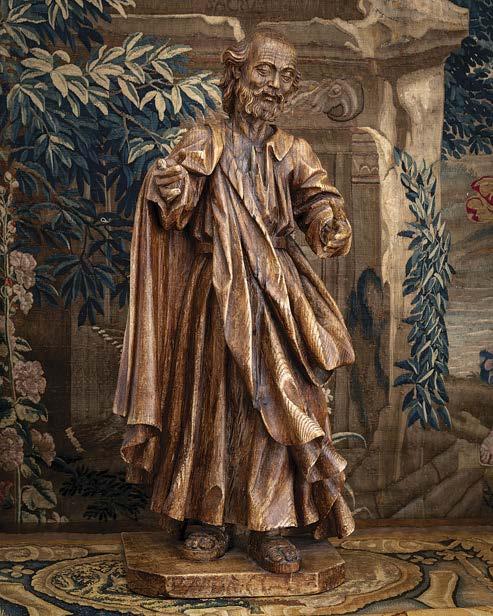
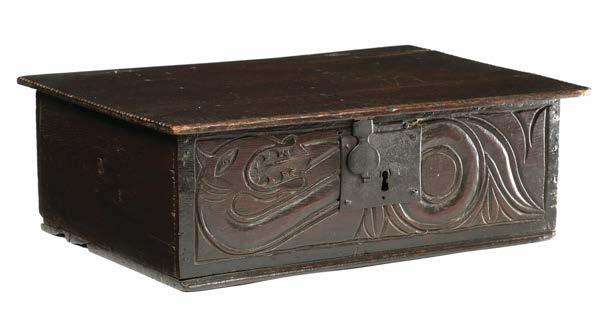
266
A Charles II carved oak boarded box, Devon, circa 1670
The front boldly decorated with a carved, sinuous serpent, with open jaw, forked tongue, prominent eyes and tightly coiled body, hinged lid board.
The serpent was a popular 17th century symbol, simultaneously evoking danger, temptation and protection. In domestic furniture, particularly in the West Country, zoomorphic carvings carried apotropaic meaning, here guarding the contents of the box against theft or evil influences.
H 21cm, W 55cm, D 39cm
£200300
267
A Charles I oak and hide upholstered open armchair, London, circa 1630
The rectangular padded back, stuffover seat and armrests upholstered in leather, secured with domed brass stud, with columnar arm supports and forelegs, joined by guillochecarved stretchers, which may date the chair slightly earlier than 1630, reupholstered.
Provenance: With H. W. Kiel, Broadway, Worcestershire.
H 104.8cm, W 66.8cm, D 55.2cm
£200300
268
A large 18thcentury delftware tobacco jar, Dutch, circa 17501800
Of ovoid form, decorated in underglaze cobalt blue, and fitted with a later giltbrass cover. The body is painted with a central cartouche, labelled HANNOVER, flanked by two ‘Native Americans’, in feathered headdresses, and each holding a long clay pipe, standing beside columns, and headed by a scallop shell and foliage.
Hannover refers to the German state of Hanover, the import city for this specific type of tobacco. The figural imagery reinforced the transatlantic origins of the product and catered for the European fascination with the ‘exotic’ ‘New World’.
H 30.5cm, Dia 21.2cm
£200300
269
A delftware lobed dish, probably Dutch, circa 16801720
Finely painted in cobalt blue, with Chinese Kraakinspired designs, centred by a figural garden scene, the scallop edged rim divided into radiating panels, alternately decorated with stylised scrolling blossoms and similar figural scenes.
Dia 34.3cm
£150200
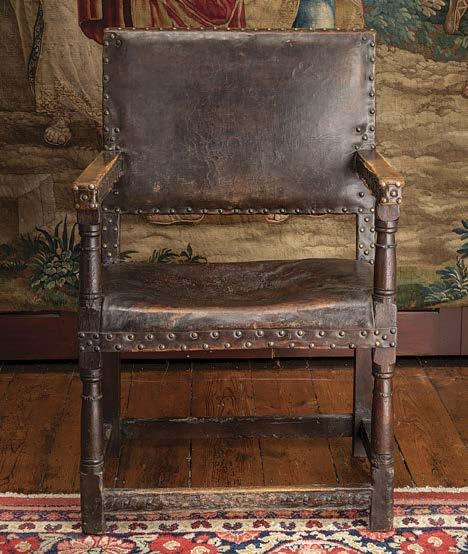
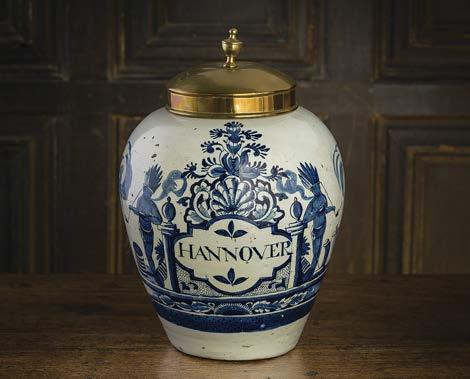
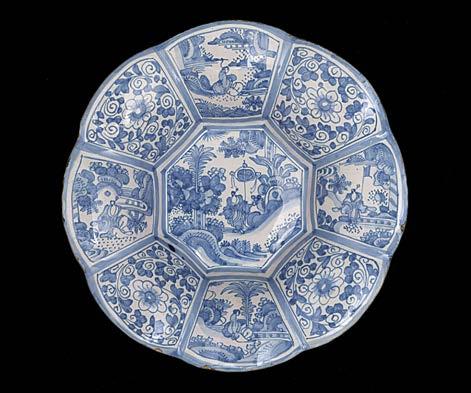
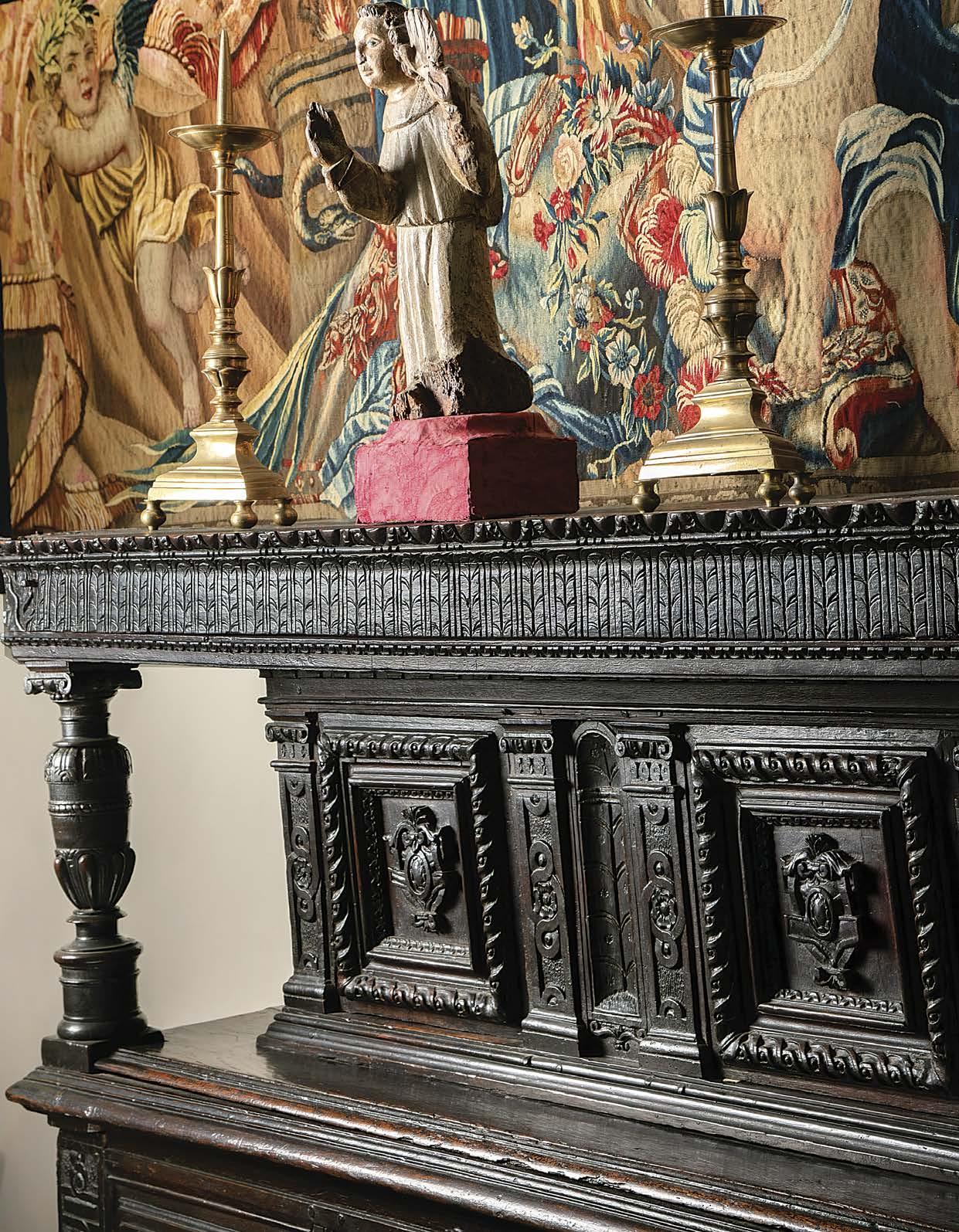
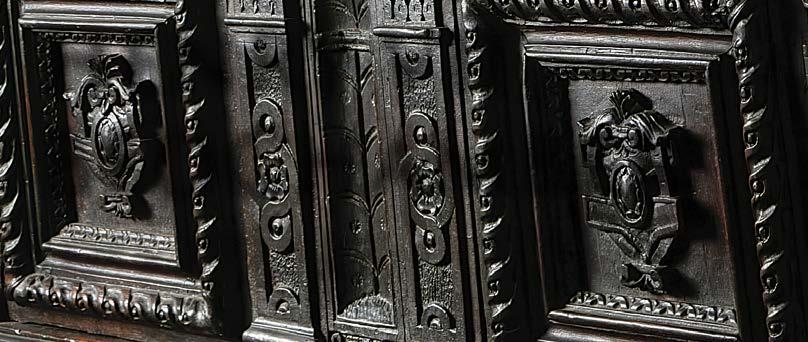

A small Henry VIII joined oak, linenfoldcarved, coffer, circa 152040
The front with twin linenfold panels, framed by simple moulded stiles and rails, the top with two plain panels. Period coffers of this size are seldom encountered, as most examples were larger, intended for storing a great number of items, in great halls, chambers and ecclesiastical settings.
This piece likely served in a more intimate domestic chamber
H 60.3cm, W 74.9cm, D 45cm
£8001,200
A mid16th century brass alms dish, Nuremberg, Germany, circa 1550
Centred with a boss and swirling gadroons, enclosed with Gothicscript, gadrooned booge, the rolled rim with fleurdelys puncheddecoration.
Dia 38.7cm
£100150
272
A lignum vitae mortar, English, circa 1700
Of bold cupform, on a tall cylindrical foot, designed with multiple incised rings and mouldings. Lignum vitae (Guaiacum officinale) imported from the West Indies from the early 17th century, was valued for its extreme hardness and selflubricating properties. Apothecaries and physicians particularly favoured it for mortars, where durability and resistance to contamination were paramount.
Provenance: Jonathan Biggs, Bideford, Devon.
H 19cm, Dia 13.4cm
£100200
A pair of early 16th century style carved oak candlesticks, English
With wide flattenedcup drippan, vacant pricket hole and lenticular knop stem, on a stepped cylindrical base. (2)
Literature: For a similar, period example, see Victor Chinnery, ‘Oak Furniture: The British Tradition’, (2016), p. 59, fig. 2:57.
H 24cm, Dia 10.7cm
£3050
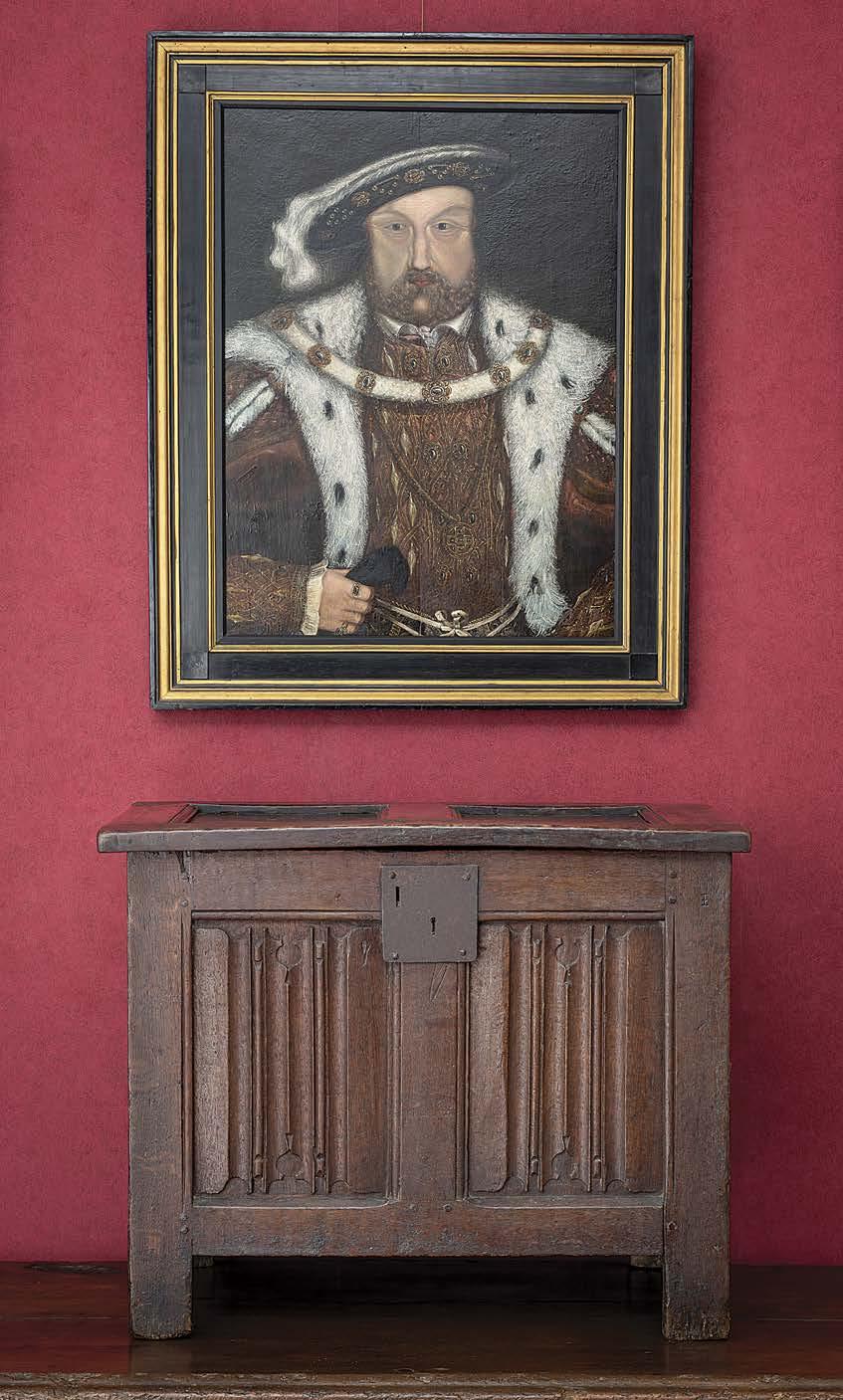
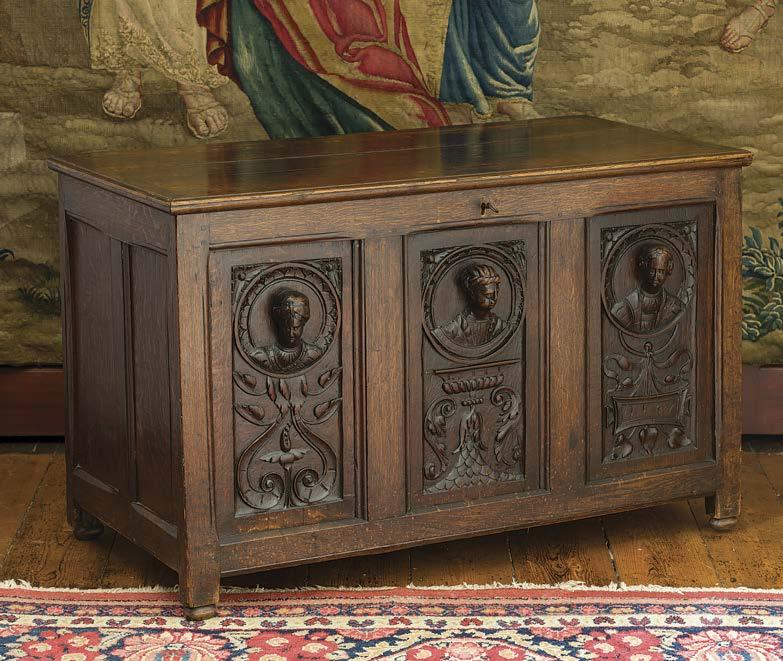
274
A Henry VIII/Edward VI joined oak coffer, dated 1547
The front with three panels, each headed by a highrelief carved bust, within a roundel, their heads turned slightly and wearing contemporary headwear, respectively atop Renaissance leafyscrolls, a gadrooned and scaly urn and a tablet dated ‘1547’, providing a rare terminus and situating the carving at the very close of Henry VIII’s reign, bottom boards and bun feet later.
The medallionbust and scrolling ornament reflect Northern Renaissance print sources in circulation among London workshops, such as the work of Virgil Solis (151462). The work is characteristic of commissions supplied by immigrant joiners active in Southwark, the borough’s liberties attracted Dutch, Flemish, and German artisans alike, as it sat outside the capitals City Guilds control.
H 68cm, W 110.5cm, D 56.5cm
£8001,200 275
A Hamadan rug, Persian Kurdistan
The terracotta field of semi naturalistic flowers centred by an ivory medallion framed by spandrels, meandering vine borders and carnation guard stripes.
L 194cm, W 149cm
£80120
276
A chinoiseriedecorated toilet mirror, early 19th century and later
Having a rectangular plate with a red japanned and giltdecorated frame, pivoting on turned uprights, the bowfront base fitted with three drawers, decorated with figures, pavilions and landscapes, with geometric decorated borders, on bun feet.
H 68cm, W 63cm, D 23cm
£100200
277
A 16th century carved oak panel, French, circa 156080
Centred with an oval boss, in a scrollwork cartouche, flanked by leafyfruiting arabesques, terminating in animal head profiles and rosettes, within a lappet moulded border, and red velvet frame.
The carving reflects the refined design vocabulary circulating in mid16thcentury France, influenced by engravings after Jacques Androuet du Cerceau and Hugues Sambin. The disciplined symmetry of the design, combining classical ornament with naturalistic flora, suggests a Lyonnais or Burgundian workshop.
H 33cm, W 118.8cm
£300500
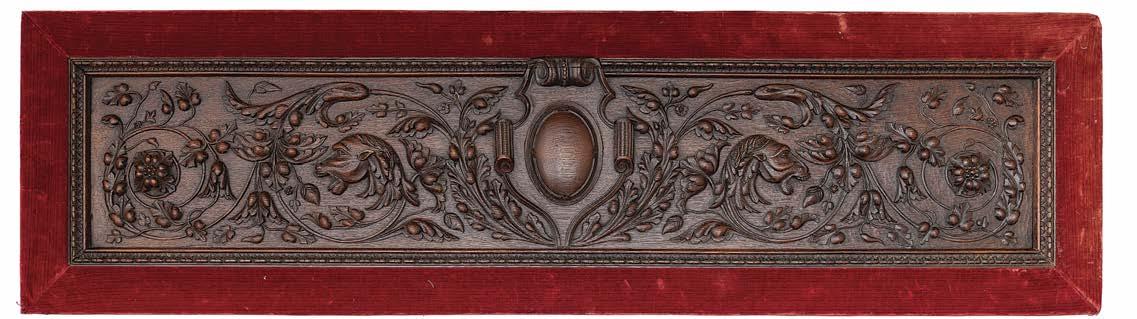
A striking Elizabeth I joined oak coffer, Gloucestershire/Severn Valley, circa 157090
The front with four panels, each with an applied arcade, with fluted columns and leafyspandrel filled arches, enclosing a reliefcarved cartouche below a fan crest. The stiles carved with a single floral stem, and the top rail and upper side rails enriched with cockatrice scrolled foliage, iron lockplate and hasp.
H 69.9cm, W 146cm, D 58.4cm
£1,0001,500
A maiolica albarello, Spanish, circa 170050
Of tall waisted cylindrical form, with everted rim, decorated in a vivid cobalt blue, with two floral bands, the central band blank, presumably intended to be inscribed/labelled with the name of medicinal contents when in use within the apothecary.
H 26.7cm, Dia 10.8cm
£100200
280
A 16th century profusely carved oak panel, Flemish, dated 1591
Of remarkable technical refinement, demonstrating the ambitious Renaissance impulse to visualise the totality of a theological theme within a single image. The panel unites the foundational moments of the Old and New Testaments, through the central figures of Moses the Lawgiver and John the Baptist, around which the history of salvation is organised. It includes to the left, Adam and Eve beneath the Tree of Knowledge, the moment of humanity’s fall; Moses on Mount Sinai, receiving the Tablets of the Law, the defining covenant of the Old Testament; The Brazen Serpent, raised among the tents of the Israelites, prefiguration of the Crucifixion. To the right, The Crucifixion; Agnus Dei; and Christ’s Resurrection, stepping from the tomb before astonished soldiers, completing the arc of Redemption.
Above, swirling clouds suggest the divine presence, binding together the temporal and eternal. The year ‘1591’ is carved below the lower central seated figure.
Provenance:
Captain William Miles Kington DSO, Royal Welsh Fusiliers (d.1914) Collection. By repute, Cadbury Museum Collection, Birmingham.
H 30.5cm, W 47.6cm
£1,0001,500
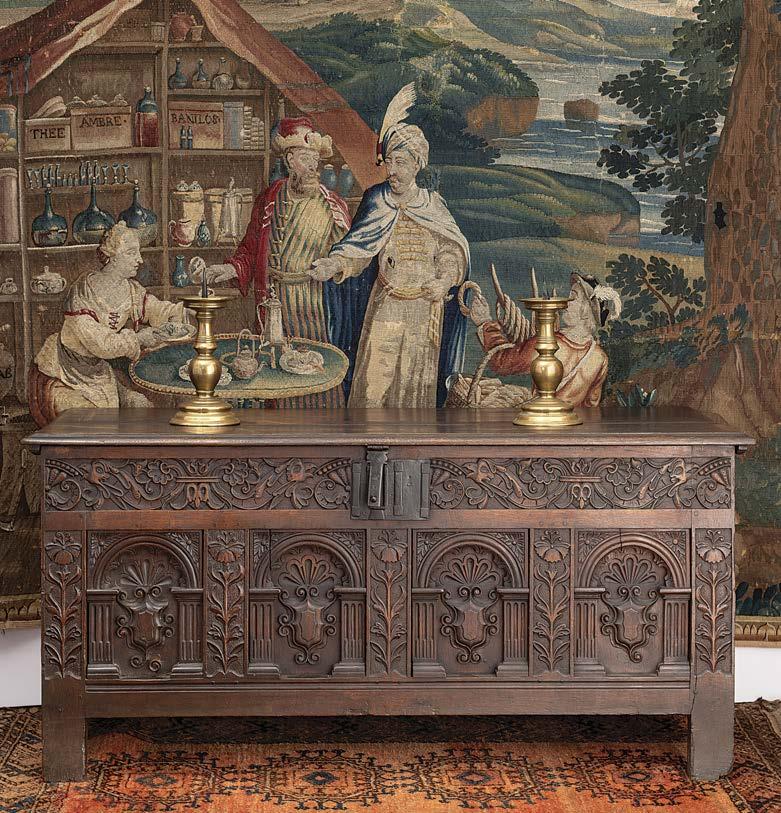
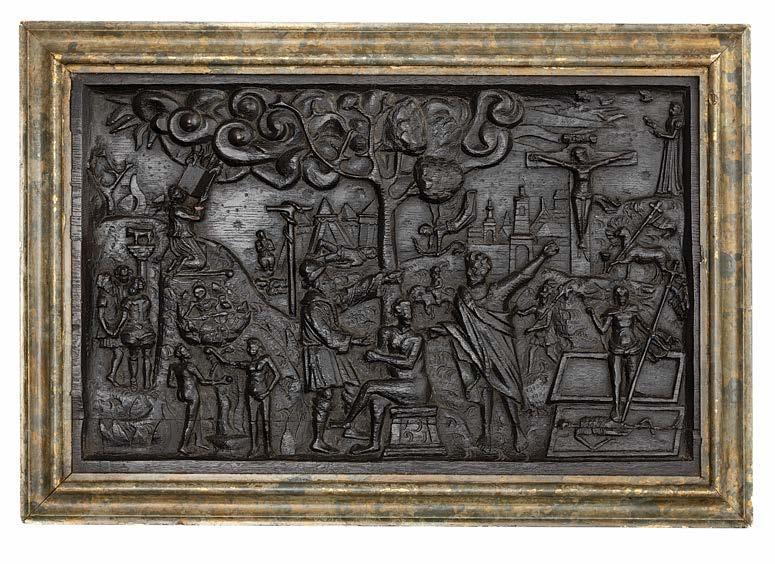
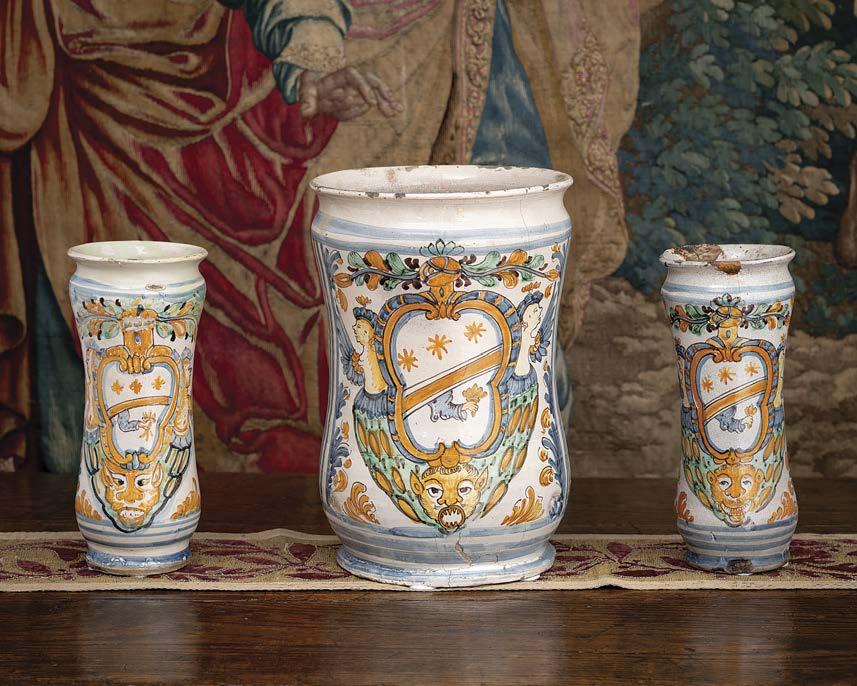
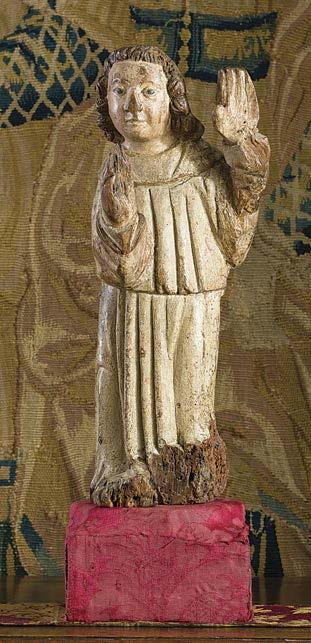
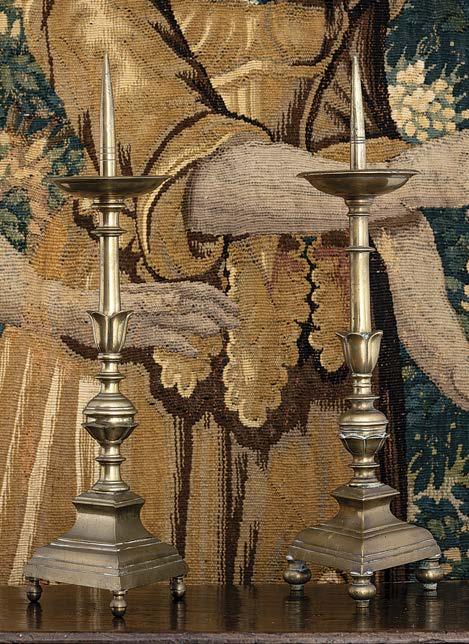
A set of three Italian maiolica armorial albarelli, possibly Montelupo, circa 16501700
Richly decorated in polychrome, of cylindrical waisted form, each designed with an armorial, the arms show a diagonal bend with three gold sixpointed stars atop an armoured arm holding a flower, framed by bold scrolling foliage, grotesque masks, and winged term supporters, executed in vibrant yellow, green and cobalt blue.
The decorative heraldry follows the Montelupo workshop tradition of ‘fantasy arms’, commissioned for apothecaries or hospital pharmacies, rather than representing a specific Italian noble family.
H 35cm (largest), Dia 23.5cm
£1,8002,200
A carved oak figure of a winged angel, Flemish/German, circa 14801520
The youthful angel, with traces of original polychrome, represents the devotional art of late Gothic Northern Europe. Depicted with curly hair, framing a serene, rounded face, hands raised in a gesture of blessing or intercession, the drapery falls in simple, vertical folds, emphasising the upright stance and the figure’s spiritual gravitas, on a red silkvelvet covered stepped base.
Typically, this type of carved angel would have flanked central devotional imagery, commonly the Virgin and Child, the Crucifixion, or the Coronation of the Virgin, acting as celestial attendants. Their role was to visualise the heavenly liturgy, bringing the faithful into direct imaginative contact with the divine. Rich pigments and gilding once animated the sculpture, reinforcing its symbolic role as a radiant messenger of God.
H 49.5cm (including base), W 15.2cm, D 20.3cm
£600800
283
A matched pair of brass pricket candlesticks, Italian, circa 1700
Each with an exceptionally tall pricket, and circular drippan, on a discoid and leafwrapped stem, above a bulbous knop, on a triform stepped base and ball feet. (2) H 43.8cm, Dia 14cm
£300500
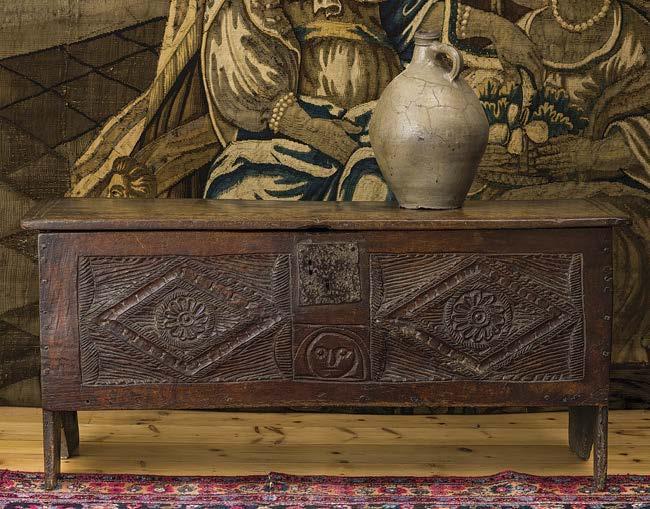
284
A Henry VII/VIII boarded oak chest, English, circa 150020
The front carved with two reserves, each with a large lozenge, enclosing a stylised rosette against a carefully lineargauged ground; at the centre an iron lockplate, above a charming carved human face, the plain sides descending to Vshaped cutaway supports.
Boarded chests are among the earliest forms of domestic furniture to survive. Comparable examples are preserved in the collections of the V&A Museum, London, and various English parish churches, typically dated to the cusp of the late medieval and early Tudor periods. The inclusion of a human face is a rare period feature.
H 55.2cm, W 120cm, D 47cm
£4,0006,000
285
A mid17th century oak low stool, English, circa 1650
The seat board with moulded edge, above carved friezes worked with stylised lunettes, on balusterturned legs, joined by plain stretchers all round, block feet.
Literature: Tobias Jellinek discusses these stools in depth in ‘Early British Chairs and Seats 1500–1700’ (2009), noting their structural economy, regional variety, and decorative vocabulary. A closely comparable example is illustrated on, p.252, pl.339, dated to around 1650.
H 30.5cm, W 35.6cm, D 34.3cm
£300400
A 16th century walnut Savonarola, Italian, circa 154070
Of traditional Xform, the curved arm supports and legs meeting at a central roundel, mounted with a moulded boss. The arms terminate in rolledends, while the legs rest on sledge feet with pawcarved ends. The seat and backrest are fitted with later, yet early red silkvelvet panels trimmed with fringe, secured over leather straps, recalling original 16thcentury practice.
The design is derived from the sella curulis of ancient Rome, the folding seat of magistrates and consuls, emblematic of civic authority. Its reintroduction during the Renaissance is linked with the growth of interest in classical antiquity. By the mid16th century, such chairs had become symbolic furnishings of erudition and high status, associated with scholars, nobles, and ecclesiastical dignitaries.
H 88.3cm, W 67.3cm, D 48.9cm
£8001,200
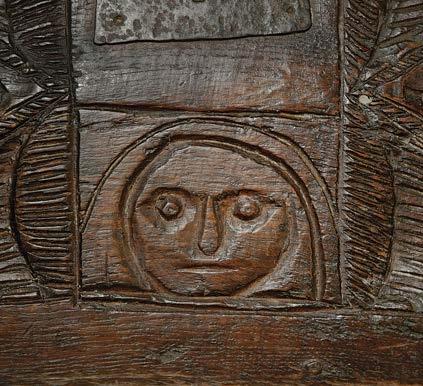
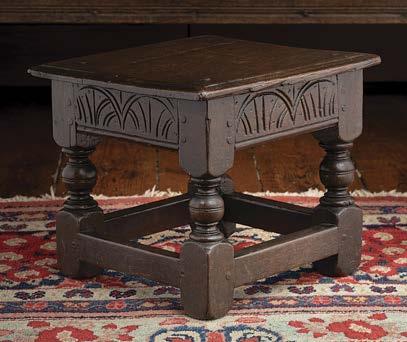
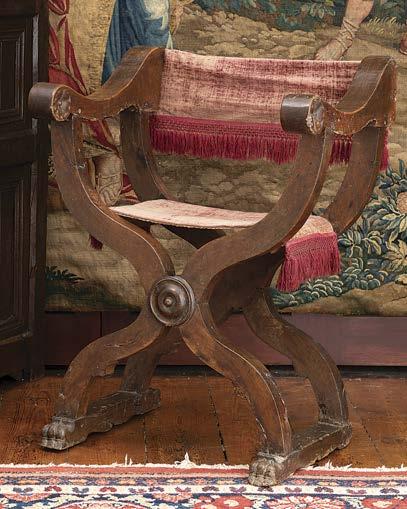
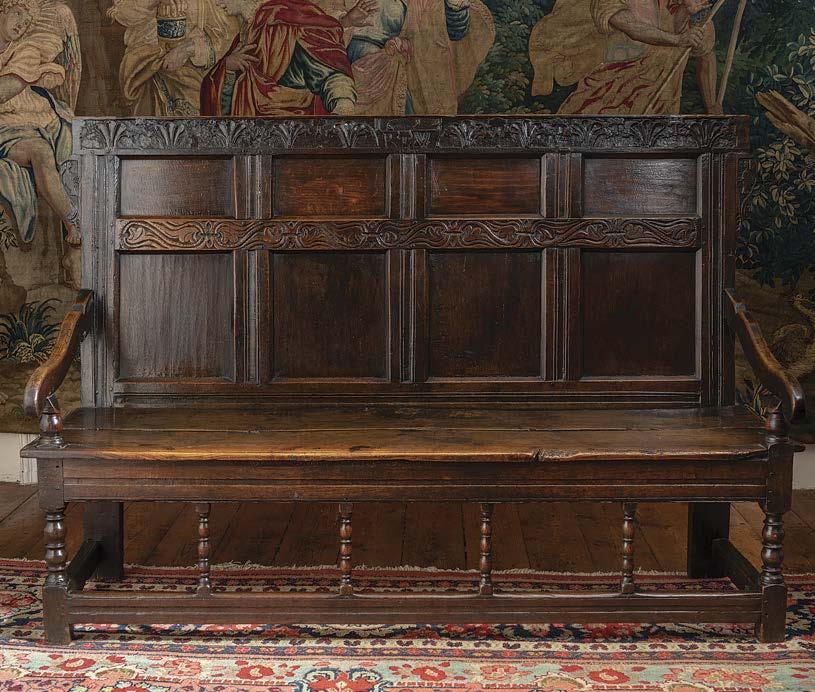
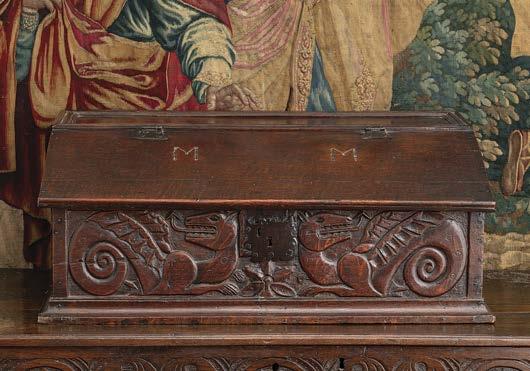
288
A good Charles I boarded oak desk box, Gloucestershire, circa 1640
The front boldly carved with addorsed winged dragons, their coiled serpentine tails forming volutes, and flanking the iron lockplate.
The sloping lid, incised with the initials ‘M M’ opens to reveal a fitted interior of three drawers, simply moulded and retaining their periodstained finish.
Such powerful imagery speaks both to the decorative vocabulary of the period, particularly regional to Gloucestershire, and to the allegorical language of protection and guardianship.
Provenance: With William Stokes, Cirencester.
H 31.8cm, W 77.5cm, D 46.4cm
£1,2001,800
An impressive William & Mary joined oak and elm settle, North Country dated 1694
The tall back composed of eight plain panels, framed, with a carved midrail of leafy Sscrolls and a floral lunettecarved top rail, centred by the date ‘1694’ over the initials ‘R W’, the shaped ears carved with birds, the elm boarded seat supported on an underframe with multiple turned ball and ring spindles, whilst the arms rest on squat baluster supports.
H 118cm, W 176.5cm, D 61cm
£8001,200
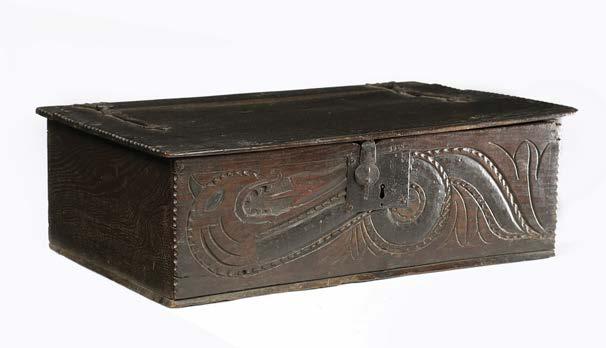
289
A Charles II carved and painted boarded oak box, Devon/Dorset, circa 1670
The front decorated with a sinuous serpent, with open jaws issuing a forked tongue, prominent eyes and coiled, with traces of its original polychrome decoration, the ends chipcarved, with iron lockplate.
See Lot 266.
H 21cm, W 65cm, D39cm
£300400
A rare early 16thcentury leather covered, ironbound, elm, standard, Engish, circa 150040
Having a domed lid, a comprehensive grid of wroughtiron straps, and three hasp fittings for multiple locks, the sides with robust wroughtiron carrying handles.
Standards of this type were made specifically for the secure storage and transportation of valuables, textiles, and documents in the households of the nobility and at court. The domed form not only increased internal capacity but also discouraged stacking, ensuring the safety of delicate contents. The three lock positions, designed to be opened only when all key holders were present, reflects both the chest’s function as a travelling treasury and the high status of its owner. This form is well documented in Tudor records. Victor Chinnery, ‘Oak Furniture: The British Tradition’ (2016), p. 304, notes from an inventory of 1500 – ‘5 standardes coverid wyth lether & peyntid redd … a square standarde … coverid with blaakletheir, and bowden wyth yrne, wyth 2 lokys’.
Provenance: Pat Morley Collection, Warwickshire.
H 61cm, W 125.7cm, D 54.6cm
£600800
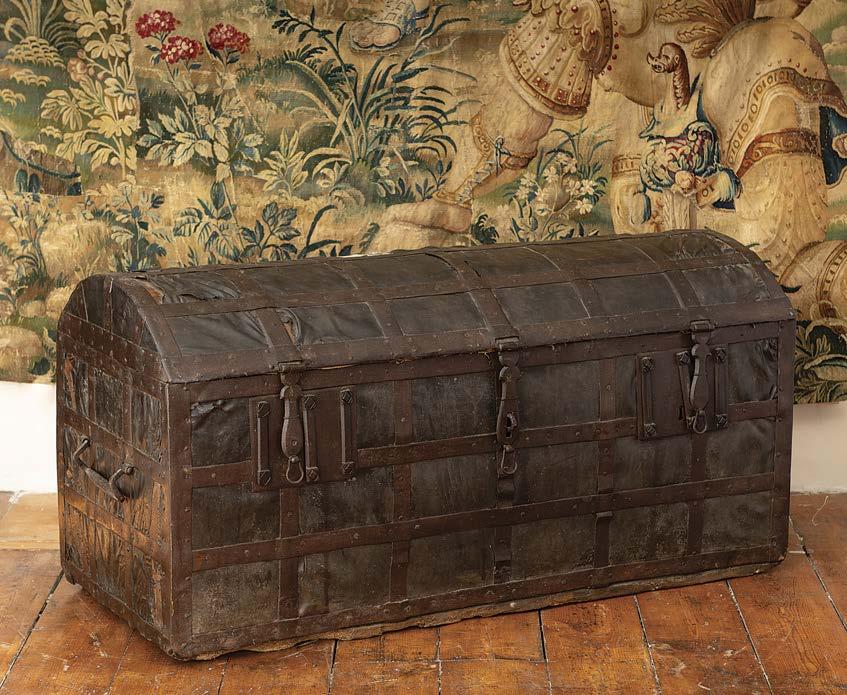
290
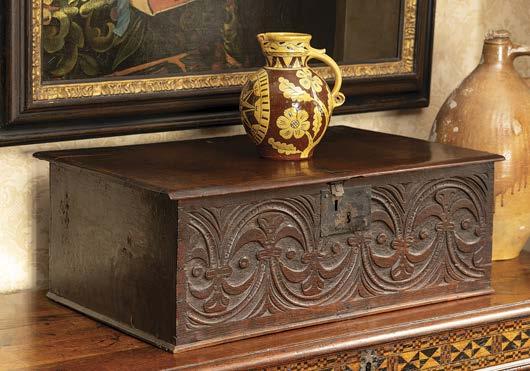
291
A Charles II carved oak boarded box, West Country, circa 1660
The front boldly carved with a continuous band of interlaced floral lunettes, and highlighted by punchdecoration, iron lockplate, simple moulded hinged lid.
H 24.8cm, W 69.9cm, D 44.5cm
£100200
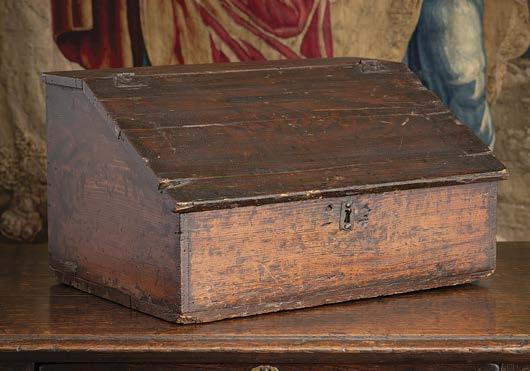
292
A rare and documented pine, painted, boarded box, circa 1700
Retaining traces of original painted surface imitating timber grain. The sloping lid, simple boarded form and iron lockplate epitomise the practical, robust domestic furniture made for both gentry and professional households in the late 17th century.
Literature: Illustrated Victor Chinnery, ‘Oak Furniture: The British Tradition’ (2016), p.333, fig. 3:427.
H 28cm, W 50cm, D 36.5cm
£300400
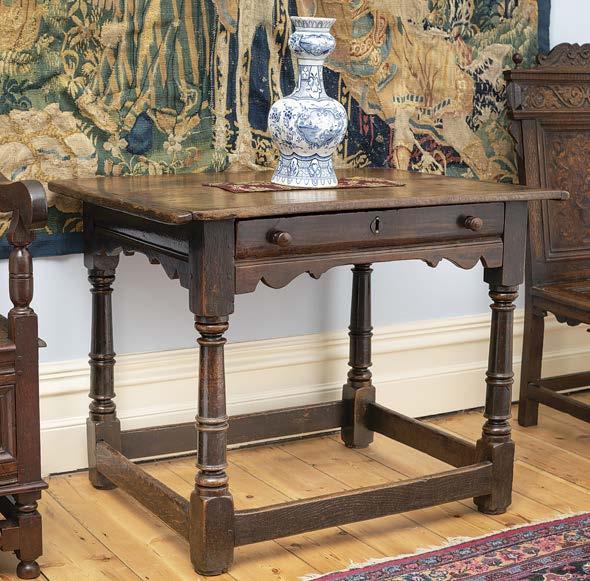
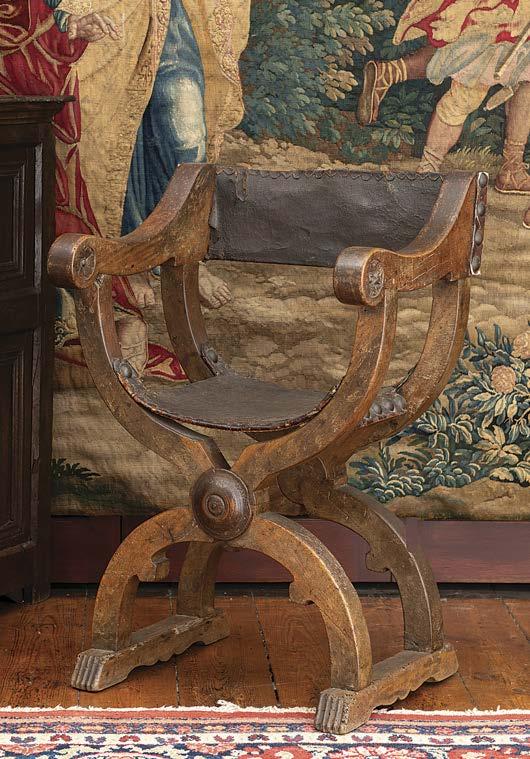
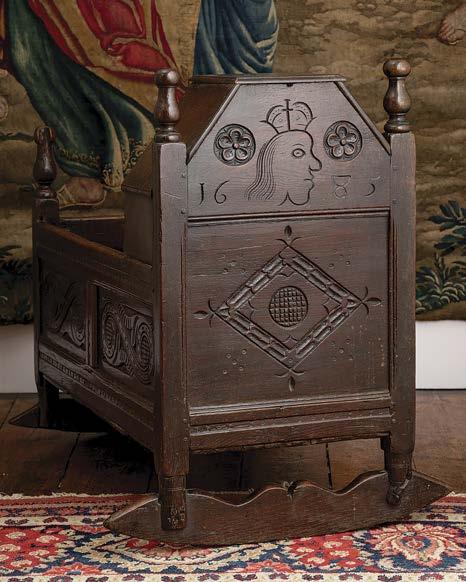
A Charles I oak side/centre table, circa 163040
Having a twoboardcleated top, and single frieze drawer, above an integral scrollprofiled spandrel rail, on four robust, slightly tapering columnarturned legs, with paired ring mouldings, joined by plain stretchers, matching moulded rails to sides.
The table’s visual strength and architectural appeal is typical of the heavier forms developed during the second quarter of the 17th century.
H 73cm, W 92.3cm, D 70.5cm
£300400
A Charles II/James II joined oak cradle, Yorkshire, dated 1685
The end and side panels with bold leafy Sscrolls, the canopy end headed by a naïve carved crowned king, flanked by rosettes and dated ‘1685’, above a lozenge carved panel, the uprights with balusterturned finials, on shaped rockers.
H 85cm, W 92.7cm, D 66cm
£200300
A 16th century walnut Savonarola, Italian, circa 154070
Of Xform, the legs and arm supports sweeping in intersecting arcs, meeting at a central roundel carved with a moulded boss, the arms with rollover end, and the legs on pawcarved sledge supports, the seat and back formed from hide, held in place by domeheaded studs.
H 92.7cm, W 62.2cm, D 74.9cm
£8001,200
A large delftware apothecary jar, Dutch, circa 170050
Of cylindrical albarello form with slightly everted foot, decorated in cobalt blue, with label strap S. MANN: CALABR (sap of the flowering ash tree, known as Manna ash) within a cartouche headed by exotic birds, centred by a fruit filled basket, a winged angel mask to the base, with a later but historically appropriate brass cover, blue painted ‘P’ to the base.
H 31.1cm, Dia 17.8cm
£100200
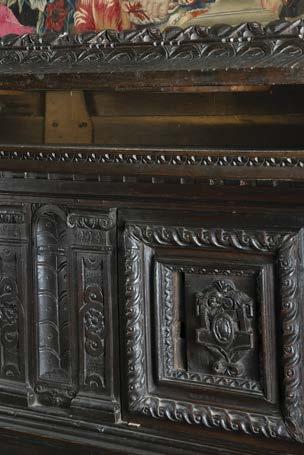
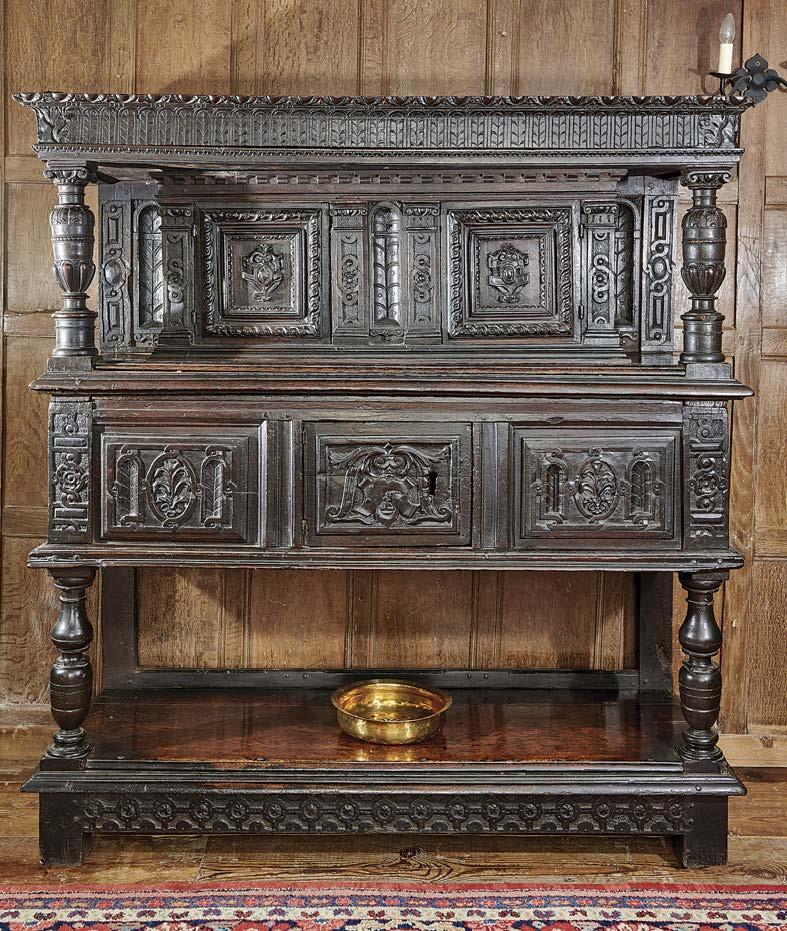
A rare and important James VI oak livery cupboard, Scottish, circa 157090
This piece exemplifies the fusion of Renaissance architectural vocabulary with Scottish courtly joinery, distinguished by heraldic ornament and ingenious concealed fittings. Arranged in three registers; the upper sections with boldly projecting cornice enriched with a continuous leafynulled carving, ingeniously hinged and lifting to reveal a secret compartment, above a pair of cupboard doors, each centred by a carved cartouche, the panels sliding to reveal concealed locks, centred and spaced by stiffleaf carved slender arched niches and guillochecarved and ionic capital pilasters, all framed by elongated gadroonedcarved cupandcover columns; the middlesection cupboard with a central door, carved with an heraldic device and leafy scrolls, flanked by fixed panels, each carved with stiffleaf and botanical strapwork; the open undertier with balusterturned front supports, joined by base boards, the base rails strapwork carved.
The decoration draws upon the Northern Mannerist repertoire, with guilloche, strapwork, feathery motifs, gadrooning, and architectural capitals. The architectural language arches, entablatures, pilasters translates from the vocabulary of contemporary Scottish stonework.
The heraldic shield (though its original armorial device is now softened by time) suggests the cupboard was commissioned by or for a family of standing. The shield is charged with a roundel containing a cross, surmounted by a curling flourish possibly intended as a serpent or crest device. The form suggests a cadet armorial device, likely of a Scottish Laird family
Provenance:
Collection of Sir Ernest Salter Wills, Bt., Littlecote House, Wiltshire. Reputedly purchased from Tobias Jellinek. Sold Sotheby’s, Littlecote House, 1985, Lot 269.
Literature: Illustrated front cover ‘Antique Collecting: Journal of the Antique Collectors’ Club’, July 1977, Vol. 12, No. 3 (captioned as ‘A fine late 16thcentury English oak court cupboard, circa 1580’).
H 158.8cm, W 145.4cm, D 55.9cm
£6,0008,000
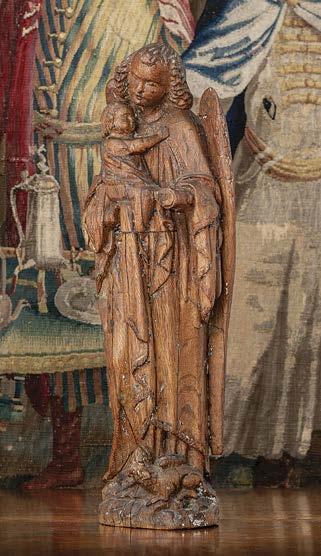
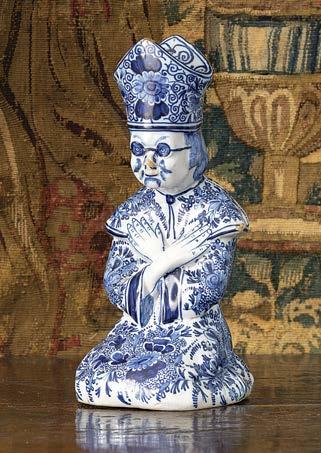
A Charles II joined oak open armchair, Yorkshire, circa 1670
The back panel carved with a large flowerfilled lozenge, with leafy sprays to each cardinal point, below an arched, doublescroll and floral ornamented cresting, extending over the singlestem carved back uprights, with leafyscroll carved ears, the downswept arms on balusterturned front supports, boarded seat and egganddart carved seat rail, on matching turned forelegs, joined all round by stretchers.
H 113.7cm, W 59.7cm, D 55.9cm
£400600
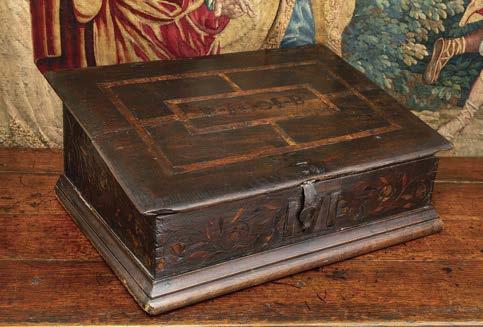
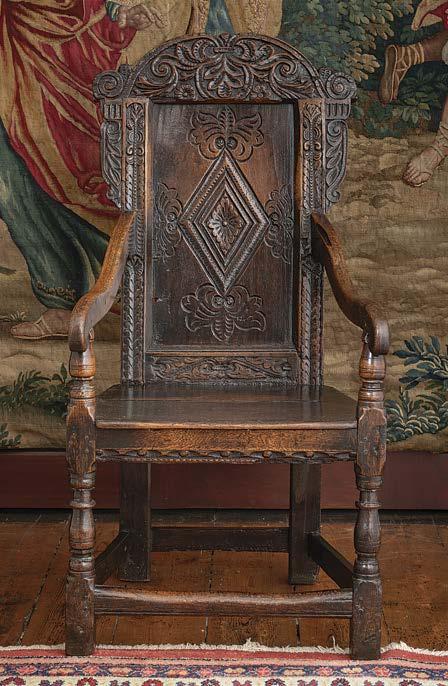
A delftware figural candlestick, Dutch, late 18th/19th century
Modelled as a kneeling bishop, rendered in cobalt blue against a white tinglazed ground, with arms crossed across the chest, wearing a mitre and chasuble with foliate and scroll motifs, the mitre is formed with an opening at the top to hold a candle. To the underside signed ‘V Duijn’, identifying the potter Johannes van Duijn, who is recorded as the owner of the “De Porceleyne Lampetkan” factory in Delft between 1764 and 1770.
H 23.5cm, W 10.2cm, D 11.4cm
£200300
A 16th century carved oak figure, possibly St Michael The Archangel, circa 150050
The angel, holding a Child, stands before a dragon writhing at the base; the sculptor has paid close attention to the linear folds of the drapery, the softly modelled faces, and the symbolic confrontation beneath the figure’s feet.
The theological reading of the piece is the triumph of good over evil. The figure could represent an allegorical angel, or even Christ himself, carrying the redeemed soul (the child), or it could be a variant on the Virgin and Child, where the Virgin is shown in active triumph over Satan. Such imagery recalls the Woman of the Apocalypse from the Book of Revelation (12:1–6).
H 47cm, W 15.9cm, D 8.9cm
£8001,200
An Elizabeth I large oak and inlaid desk box, dated 1601
The sloping lid inlaid with an innerframe design, centred with the initials ‘R B’ and the date ‘1601’. The front and sides are enriched with scrolling foliate and floral inlay, set within applied mouldings, remains of iron lock and hasp.
Provenance:
Kenneth Binns Collection.
Sold Sotheby’s, Cold Overton Hall, Oakham, Leicestershire, 10 October 1986, Lot 1 (£374).
Literature:
Illustrated ‘The Antique Collector’, February 1973, p. 33, fig. 13.
H 29.8cm, W 77.5cm, D 76cm
£400600
A pair of Henry VIII oak portrait panels, circa 152040
Each carved in low relief, with a male profile bust, one wearing a skullcap, the other a helmet with raised visor, both enclosed within a laurel wreath roundel, the backgrounds enriched with scrollwork and grotesque masks. (2)
H 38.7cm, W 26cm
£300500
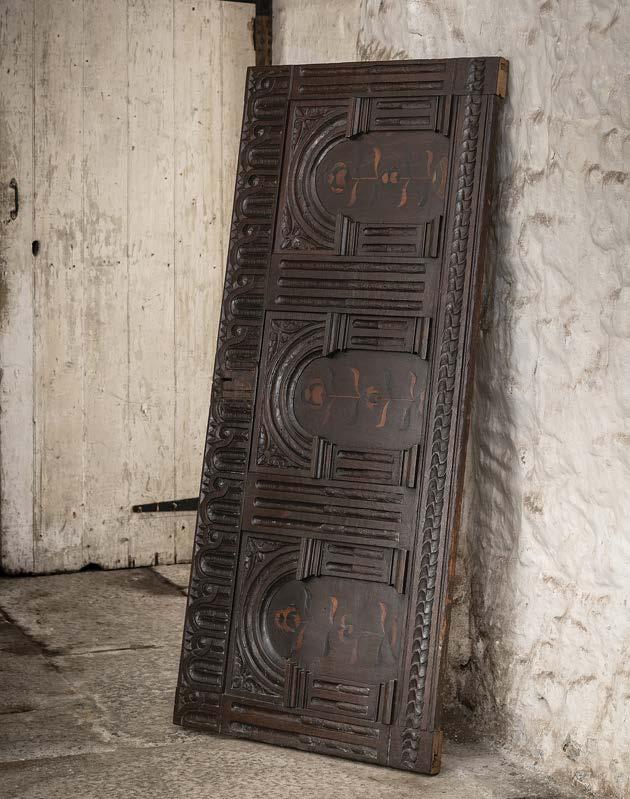
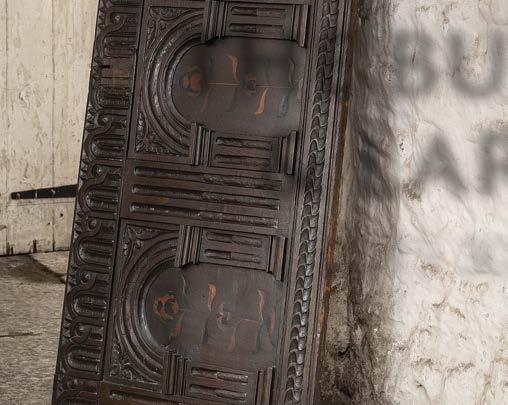
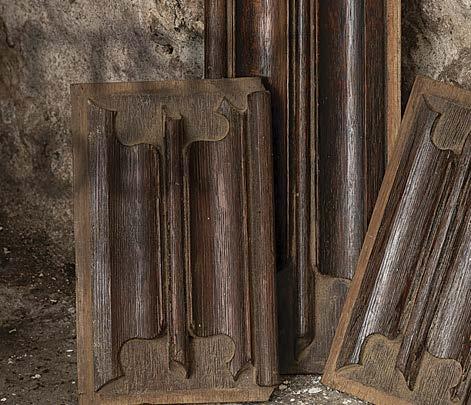
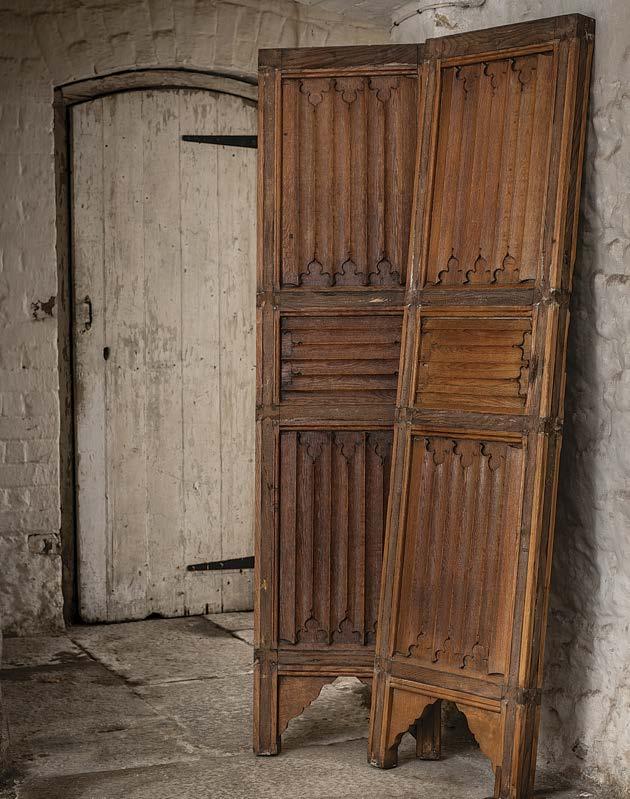
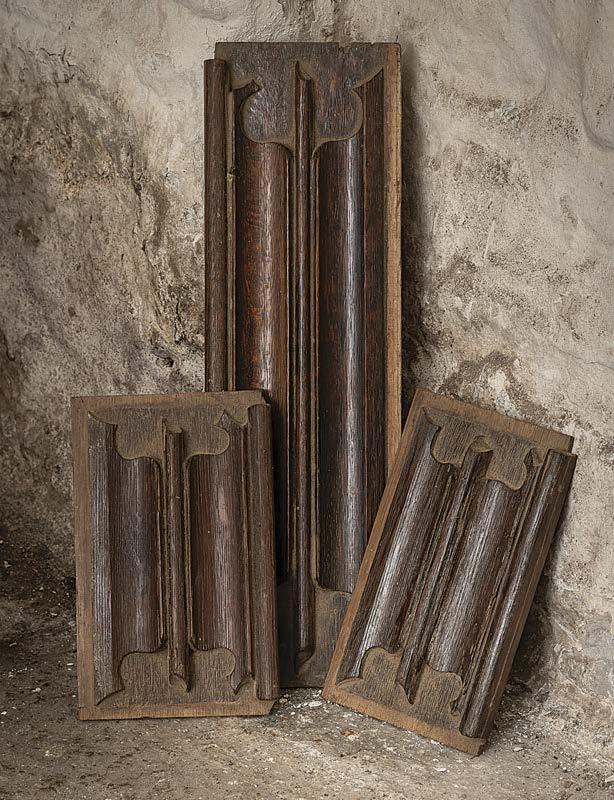
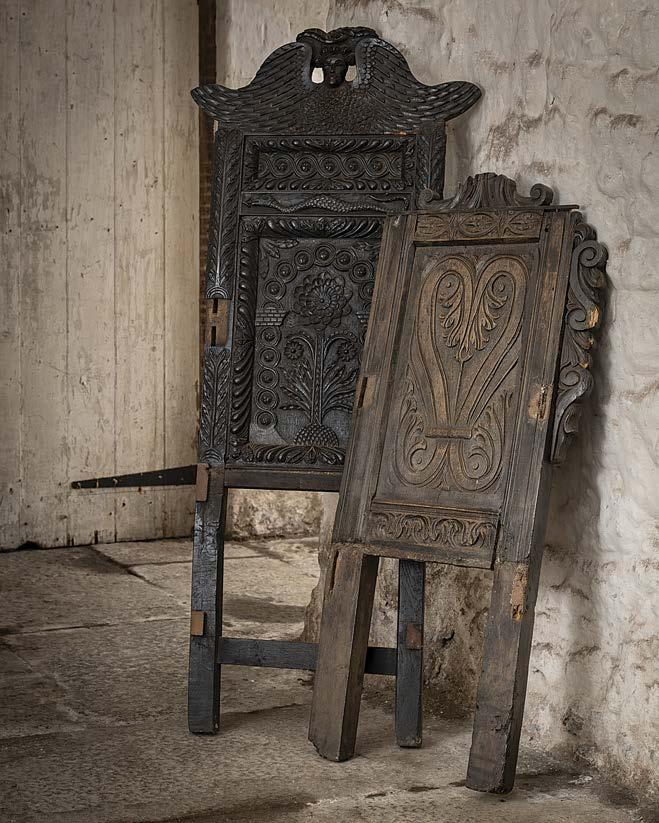
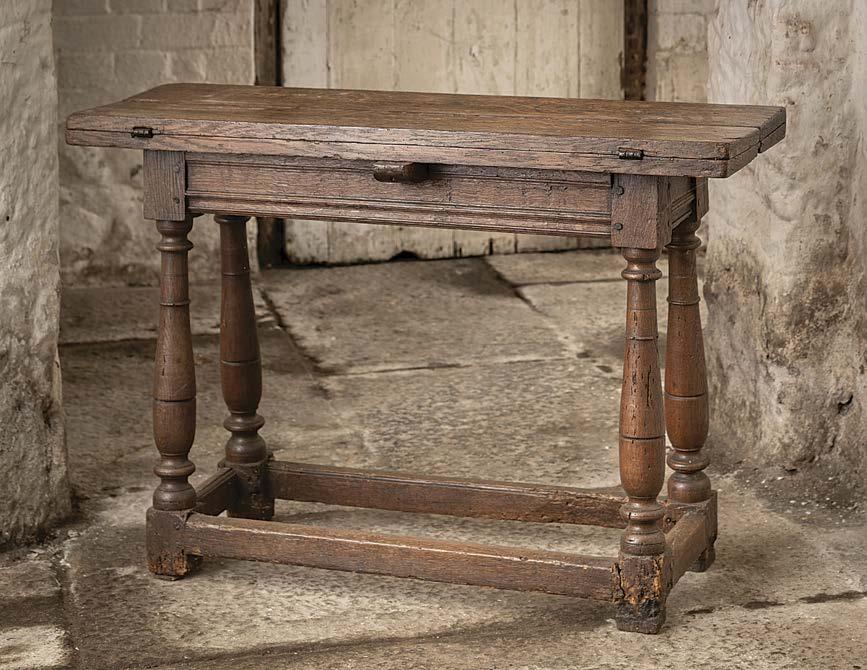
A James I oak and inlaid coffer front, circa 1620
With three panels, each marquetry inlaid with a single flower stem, within applied arcades, with triform leafcarved spandrels and fluted pillars, spaced by fluted uprights, below a strapwork carved rail.
H 66cm, W 140.2cm, D 4.5cm
£100200
Three 19th century linenfoldcarved panels
All carved with vertical folds representing drapery. (3)
Largest H 42cm, W 13cm
£4060
A group of six 16th century oak linenfoldcarved panels, framed, German
Later framed in two sections, probably to form a tall decorative screen, each comprising a pair of vertical designed panels, centred by a horizontal carved panel, all with deeply recessed pleats and tracerystyle terminals.
H 170.6cm, W 46cm, D 6.5cm
£100200
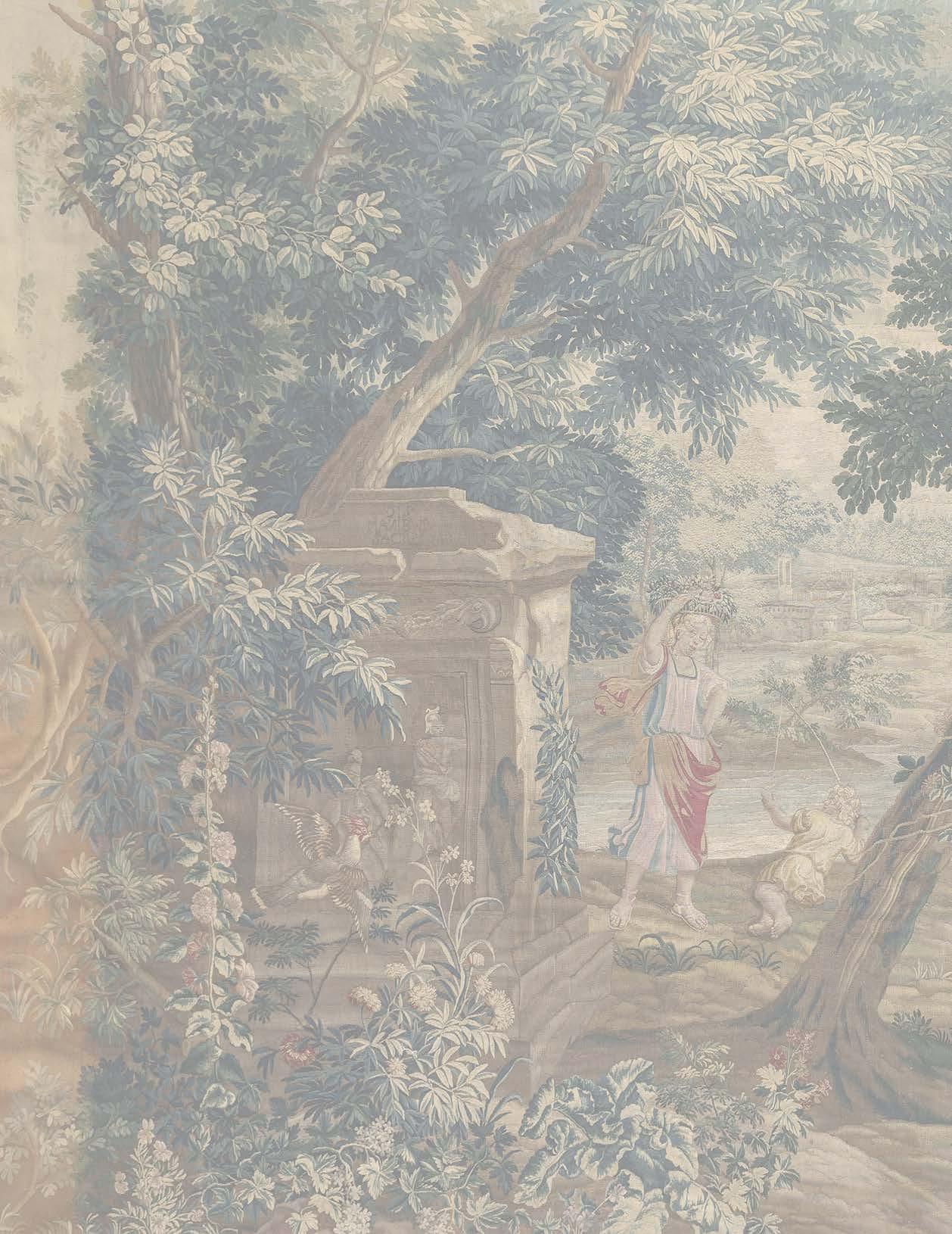
Two carved oak chair backs, English
Late 16th/ early 17th century and later
One of substantial scale, carved with a winged angel crest, atop a guillochecarved slender panel, over a flowering stem carved panel, each with gadrooncarved frames and spaced by a serpent carved rail, the other, West Country, carved with a bold leafy Sscroll to the back panel, alterations. (2)
Largest H 140cm, W 58cm, D 5cm
£100200
A mid17th century oak folding centre table, Dutch, circa 1640
Of narrow form, the rectangular top with two hinged boards, opening on lopers concealed within the long frieze, raised on balusterturned legs, joined by plain stretchers.
H 66.5cm, W 99cm, D 30cm (closed)
£200300
A small group of 17th century carved oak rails and panel, English
With various nulled, lunette and lozenge carving. (5)
£4080
A pair of Elizabeth I carved oak and inlaid panels, circa 1580
Each inlaid with mastic/pitch in a stylised fleurdelys design, within a classical arcade, the arch carved with raised nulls to form radiating voussoirs, on fluted pillars, and with leafandberry spandrels, within a deep moulded frame. (2)
Possibly originally bed headboard panels.
H 46cm, W 43cm
£200300 310
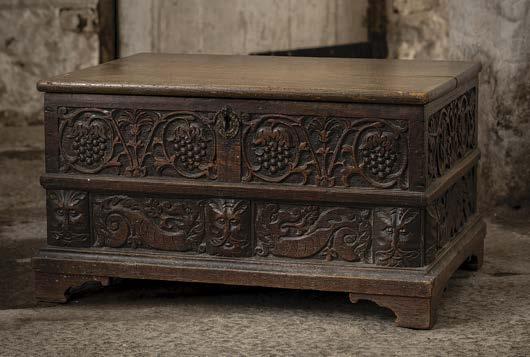
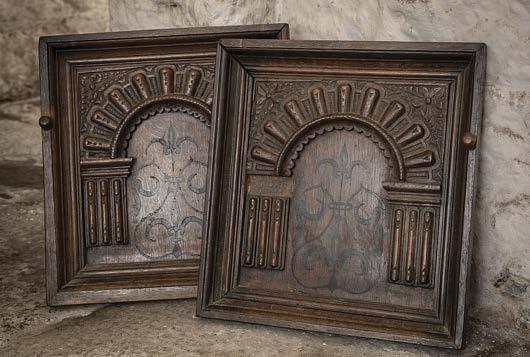
A James I boarded oak box, Gloucestershire, circa 1620 and later
Designed with two registers, the upper with fine scrolling fruiting vine, above a pair of dragonlike beasts, a leaf issuing from their open jaw and with coiled tail, centred and spaced by green man style masks, each side similarly decorated, later boarded lid and bracket feet.
H 38.5cm, W 70cm, D 48cm
£200300
311
A set of four Elizabeth I carved oak supports, Exeter, circa 15801600
Of cupandcover design, deeply carved with palmettes, mounted on later square bases for display. (4)
£100200
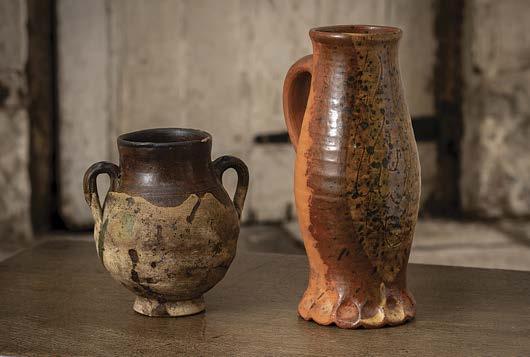
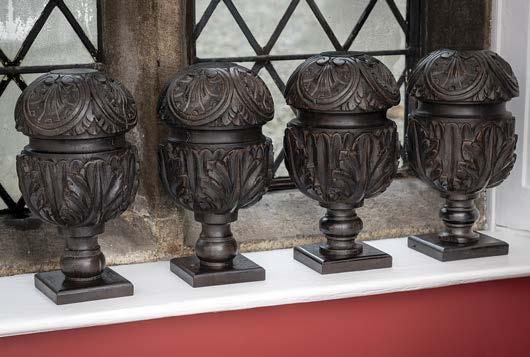
312
A 19th century pottery preserve/olive jar, possibly Hungarian
Of baluster, twinhandled form, treacle glazed to the upper body, on a narrow foot ring, together with a Medievalstyle terracotta slender, baluster jug, with strap handle and thumbpinched base. (2)
Smaller H 17cm, W 16cm, D 13cm
£3050
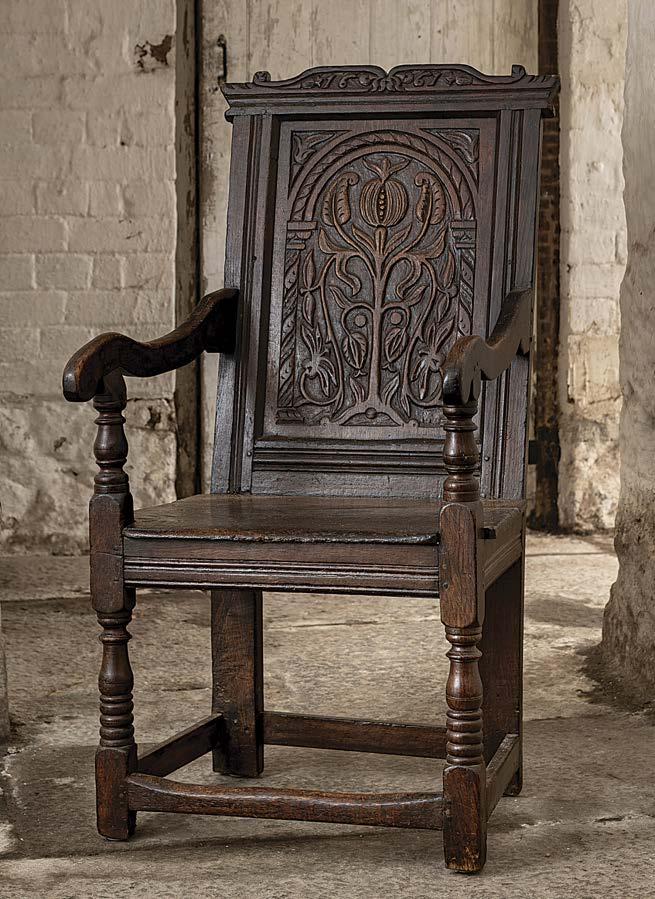
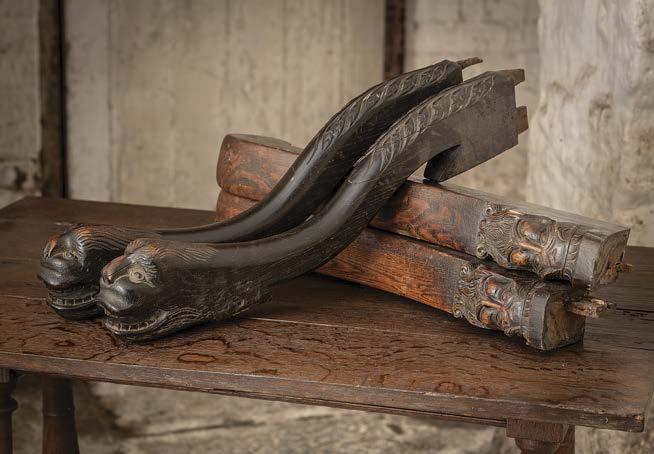
A Charles II joined oak panelback open armchair, Yorkshire, dated 1661
The back ornately carved with a single ‘pomegranate’ stem, with numerous pointed leaves, within an arcade, the slender doublescroll cresting carved with the date ‘1661’, the downswept arms on balusterturned front supports, with boarded seat, on baluster and multiple ringturned forelegs joined by plain stretchers all round, repairs.
H 107cm, W 57cm, D 51cm
£100200
A group of oak cupboard doors and framed panels, English, 17th century and later
To include a pair of doors and a long run of plain panelling. (8)
Various sizes (average door size 100 x 44cm)
£80120
A Victorian cast iron cauldron
Of typical, squat form, with three cast linear bands, short, splayed feet, and bail handle; together with a brass and copper cooking vessel, with folded rim and iron swing handle. (2)
Largest H 19cm, Dia 26cm
£3050
Three metal domestic vessels
Comprising a 19th century iron mortar and pestle, the mortar of flared, upright form, with twin angular handles and armorialstyle cartouche; a small bronzealloy cauldron in the 17th century manner, of bagform, with lug handles; and a 19th century ovoid copper pouring vessel, with twin spouts to rivetted banded neck, and carry handle. (3)
H 37cm largest, Dia 19cm
£80120
A group of 17th century carved oak rails, English
Variously decorated with meandering stylised foliate motifs, leafylunettes, and whorlfilled Sscrolls.
Largest H 71cm, W 10.5cm, D 4.5cm
£4060
318
Two pairs of 19th century carved oak armrests
One pair with stylisedlion carved terminals, their mouths open and bearing teeth; the other headed with bearded male masks. (4)
Largest H 11.5cm, W 60cm, D 7cm
£80120
319
A pair of 17th century bulbous turned supports, circa 160020
Of cupandcover form, with ringturned detail, mounted on later square bases. (2)
H 29cm, Dia 16cm
£3050
320
A James I oak coffer front and corresponding back panel, circa 1620
Each formed of four panels, the front with nulledcarved top rail. (2)
H 79cm, W 146cm, D 6cm
£80120
321
Two 19th century earthenware oil jugs, French, circa 1850
Each of ovoid form, with short narrow neck and loop handle. (2)
H 44cm (largest), Dia 24cm
£4080
322
A Charles II joined oak panelback open armchair, North Country, circa 1670
The back panel carved with an interlaced lunette and flowerhead design, below a flowerfilled guilloche top rail and integral arched and scroll profiled cresting, the downswept arms with turned front supports, later boarded seat, on match turned forelegs, joined by plain stretchers all round, losses.
H 85cm, W 58cm, D 54cm
£100200
323
A pair of Elizabeth I/James I carved oak bed post sections, circa 160020
Of cupandcover form, the turned lower section carved with stiffleaves, rising to a similarly carved top, below ‘gadrooned’ collars. (2)
H 37cm, Dia 14cm
£4060
324
Four 17th century carved oak framed panels and furniture fronts, English
To include an inlaid press front, with two doors and a central fixed arcaded panel, circa 1600, a mid17th century, West Country, press front with a pair of doors, a run of Laudian inspired panelling and a plain example. (4)
Largest H 44.5cm, W 153cm
£100200
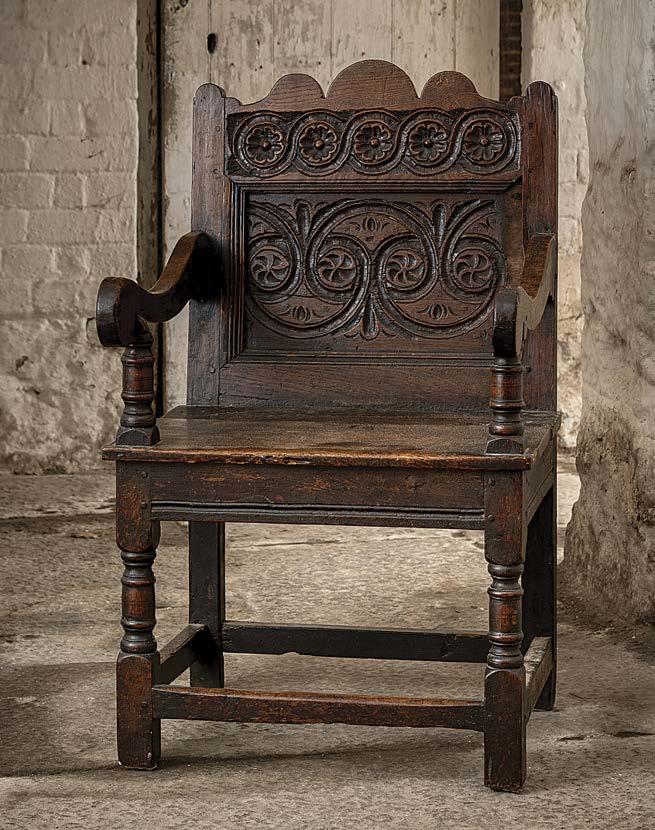
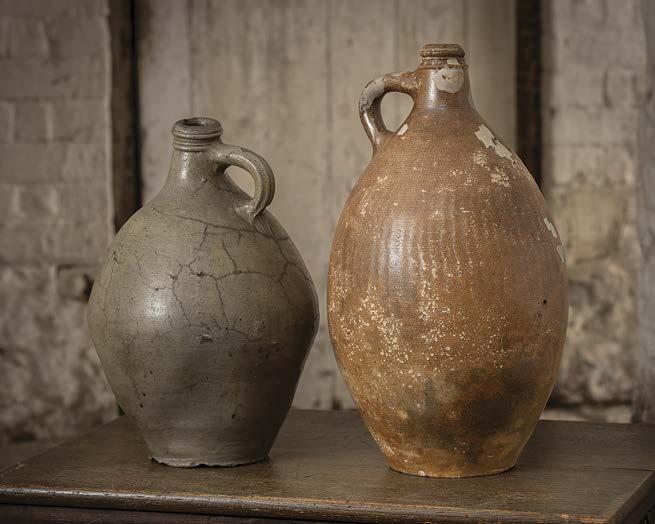
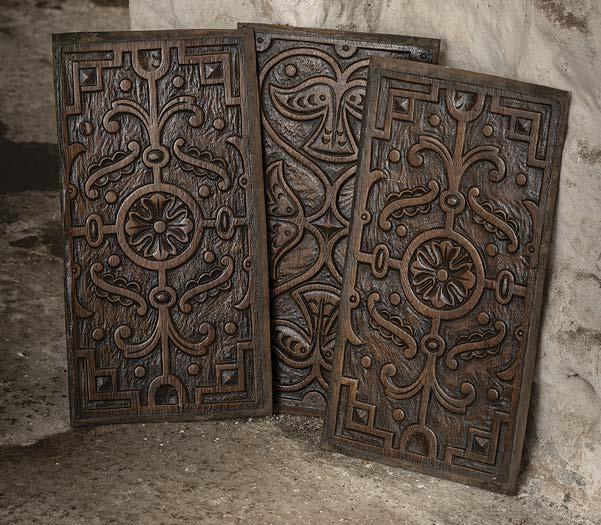
325
A set of three early 17th century carved oak panels, West Country, circa 161030
Each of strapwork inspired design, to include a pair centred by a flowerhead roundel, with geometric spandrels. (3)
H 43cm, W 22cm
£100150
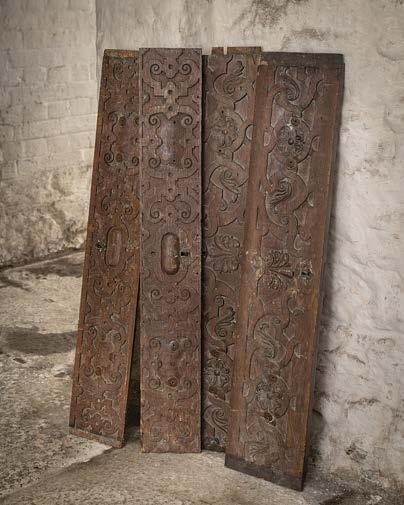
327
A set of four oak carved panels, Exeter, circa 15801620
Each carved in deep relief with bold strapwork, interspersed with scrolling and geometric motifs. (4)
H 18cm, W 105cm
£100200
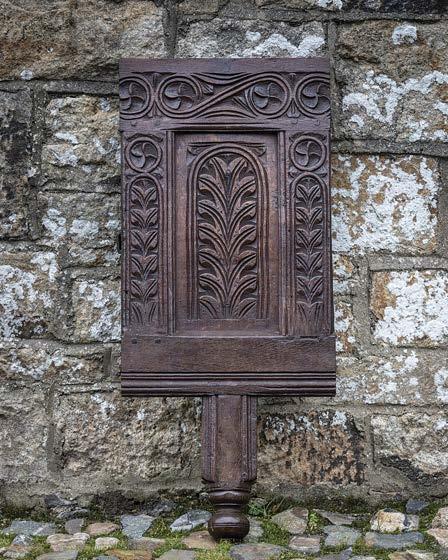
A 17th century carved oak furniture fragment panel, English Of framed form, centred by a stiffleaf carved panel, the upright rails with similar carving headed by a whorl, the top rail with whorl Sscrolls, mounted on a later, central, ballterminal rail.
H 32.5cm, W 74.5cm, D 6.5cm
£4060
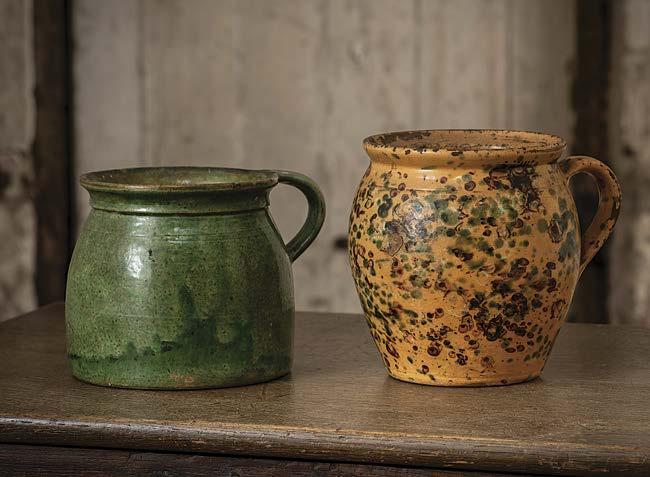
328
Two 19th century earthenware vessels, French, circa 1850
One a greenglazed example of squat cylindrical form, with narrow flared rim and loop handle; the other of baluster shape, with mottled yellow, green and brown glaze, again with everted rim and loop handle. (2)
H 17cm largest, Dia 16cm
£4080
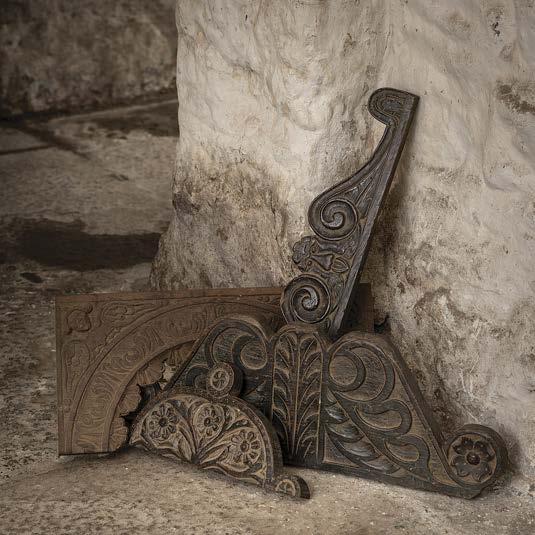
329
Three 17th century carved oak crests and a carved arch, English
Each crest of scrollprofiled form, carved with foliate designs, and one centred by a naïve mask; the arch carved with angel spandrels. (4)
Largest H 19cm, W 57cm
£80120
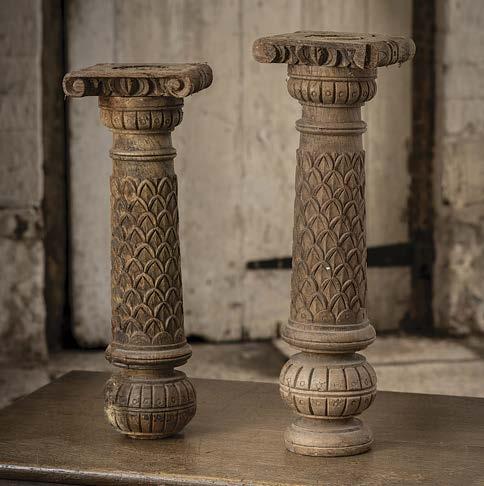
331
A pair of Elizabeth I carved oak bed post sections, circa 15801600
Each of columnar form, relief carved with a repeating scale or imbricated leaf design, framed by welldefined collars, above a carved ballturning, surmounted by Ionic capitals. (2)
H 49cm, W 15.5cm, D 14cm
£4060
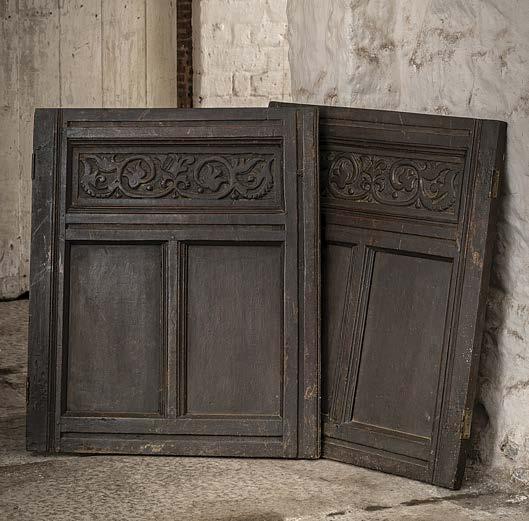
330
A pair of oak cupboard doors, Yorkshire, circa 164060
Each have a horizontal floral carved panel, above a pair of plain panels, within moulded rails, iron strap hinges. (2)
H 75cm, W 63cm
£80120
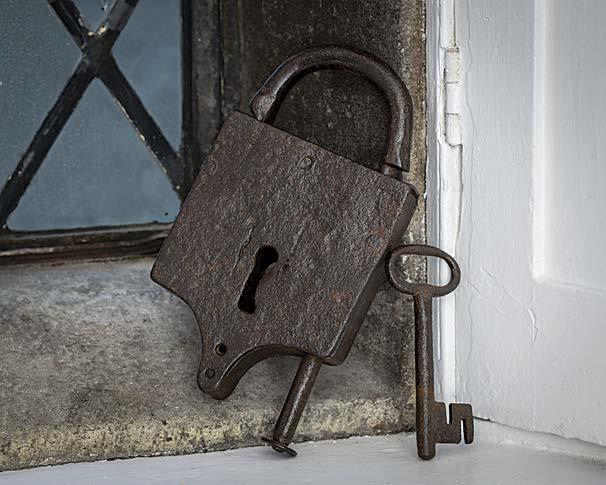
332
A late 16th century iron padlock with key, French or Italian
Of shieldform, with arched shackle, appears the original key.
H 22cm, W 12cm, D 3cm
£100150
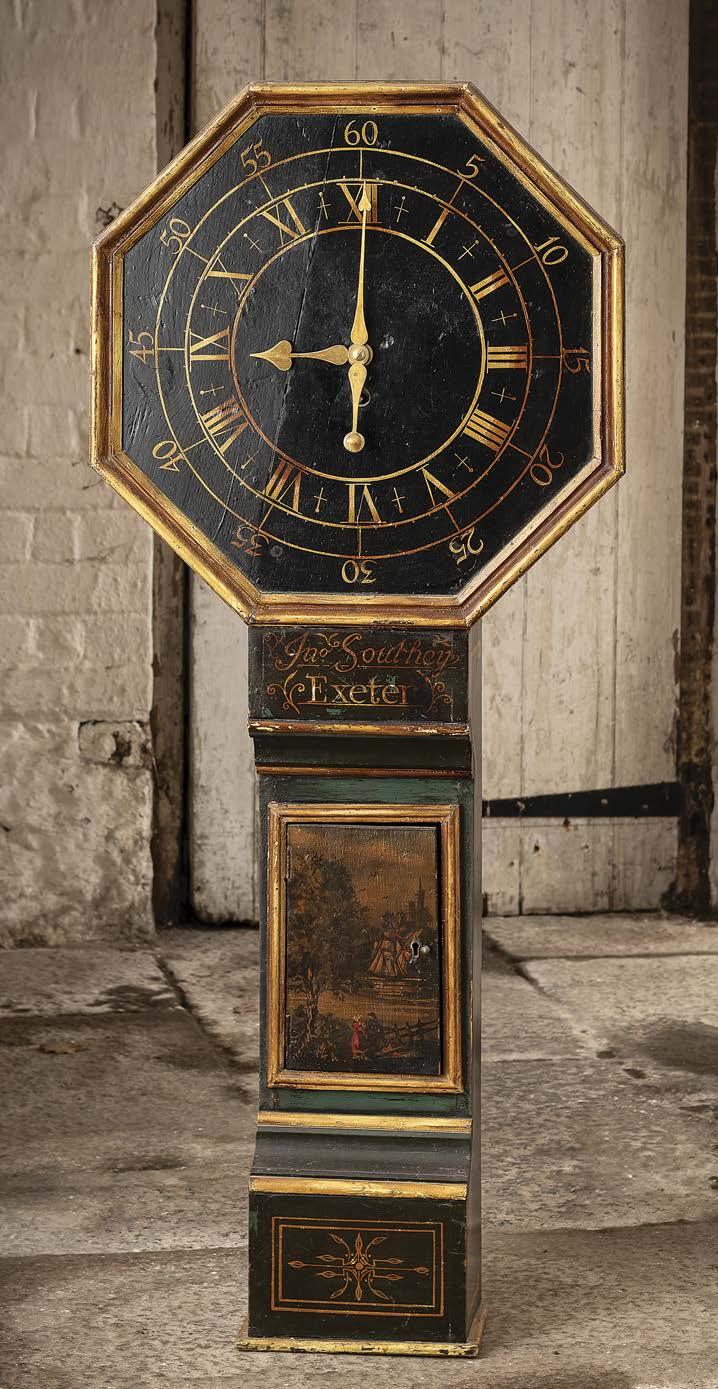
333
A rare, small, japannedgilt tavern clock, Devon, circa 1750
John Southey, Exeter
The 21.5in octagonal dial with Roman numeral chapter ring, and Arabic fiveminute markers, the recessed narrow trunk inscribed ‘Jno. Southey Exeter’, over a boarded door painted with figures on a riverbank, before a sailing vessel and distant buildings, the stepped base with geometric motif reserve, weight driven brass 8day movement.
Literature: Recorded in Clive N. Ponsford, ‘Devon Clocks and Clockmakers’ (1985), p. 300.
H 130cm, W 54cm, D 17cm
£3,0004,000
334
A set of 20th century crewelworkstyle tester bed hangings
Including two pairs of curtains, sheetcover, boxcover, valance hangings, tie backs: together with a pair of curtains of similar date and design; a brocade olivegreen curtain, and lengths of coloured damask. (qty)
£100200
335
A group of five 17th century carved oak rails, English
To include a pair carved with Sscroll serpents, and a nulled example. (5)
Largest H 16cm, W 44cm
£80120
336
A group of assorted carved oak rails and mouldings, English, 17th century and later
To include nulled, lunette and gadrooned examples.
Largest H 12cm, W 76cm, D 2.5cm
£100200
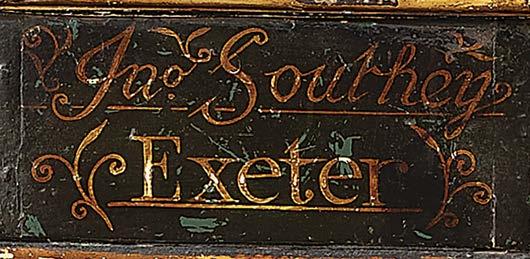
337
The History of the King’s Works, (HMSO), five volumes
A scholarly reference series documenting the royal buildings of England from the medieval period through the 19th century, edited by Howard Colvin and others, Vol IIII; VI & Plans. (5)
£200300
338
A small collection of reference books on English furniture and architecture
Murray AdamsActon, Domestic Architecture and Furniture; Herbert Cescinsky, English Furniture of the Eighteenth Century, Vol. II; Herbert Cescinsky & Ernest R. Gribble, Early English Furniture and Woodwork, Vols. I, I & II; Country Life, English Homes, Period II, Henry Tudor, 1485–1558, Vol. I. (7)
£80120
339
A group of auction catalogues, mainly venerated collections
Sotheby’s, Clive Sherwood Collection, 2002; Sotheby’s, Nyetimber Manor, 2001; Sotheby’s, Thomas F. Flannery, Jr. Collection, 1988; Christie’s, Longridge Collection, 2011; Christie’s, Huntington Antiques, 1999; Sotheby’s, Peter Gwynn Collection, 2001; Christie’s, Early Oak Furniture and Metalware, 2001, Christie’s, A Cotswold Collection, 2007; Christie’s, Roger Warner Collection, 2009; Sotheby’s, Rous Lench; Sotheby’s; Cold Overton Hall, 1986; Christie’s, Mary Bellis, 1987; Sotheby’s, Littlecote House, Vol. I, 1985. (13)
£80120
340
A group of reference books on English furniture and vernacular woodwork
Wheeler, Old English Furniture; A. J. Conybeare, Trees, Chests & Boxes; R. W. Brunskill, The Age of the Joiner; Ivan Sparkes, English Domestic Furniture; Eric Mercer, Furniture 700–1700; V&A, Catalogue of English Furniture & Woodwork, Vols. I–IV; G. Wills, English Furniture: 1550–1760; Arthur Negus, Going for a Song: English Furniture; Ralph Edwards, The Shorter Dictionary of English Furniture. (12)
£80120
341
A group of reference books on English furniture, decorative arts and auction catalogues
Eric Mercer, Furniture 700–1700; F. Roe, Ancient Church Chests and Chairs; Michael Dunn, The English Smile; Sotheby’s, Nyetimber Manor, 2001; Sotheby’s, Clive Sherwood Collection, 2002; Sotheby’s, Peter Gwynn Collection, 2001; Dreweatts, Boarsney House, 2006; Charles Tracy, Continental Church Furniture in England: A Traffic in Piety; Wolsey & Luff, Furniture in England; Sotheby’s, Rous Lench, Vol. II, 1986. (10)
£80120
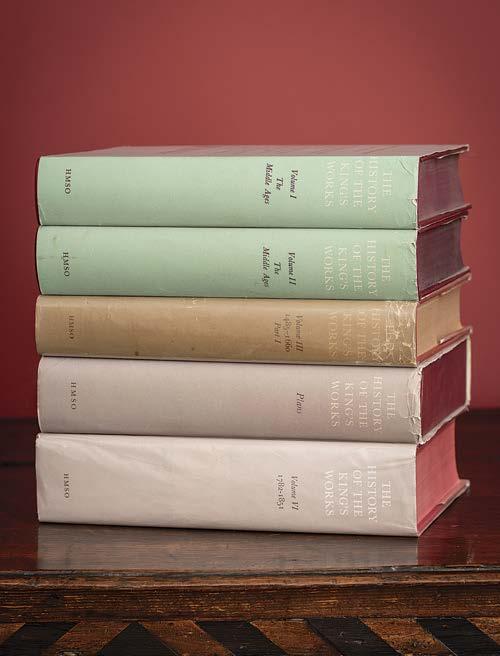
337
342
Regional Furniture Journals
Volumes: II (1988); IV (1990); V (1991); VI (1992); VIII (1994); XI (1997); XXI (2007); XXIV (2010); XXV (2011); XXXI (2017); XXXVI (2022); together with Penelope Eames, Medieval Furniture. (12)
£4060
343
A group of reference books on English furniture, woodcarving & decorative arts
Howard & Crossley, English Church Woodwork; J. Smith, Church Woodcarvings: J. Smith, A West Country Study, A Guide to Church Woodcarving; C. Gossinger, The World UpsideDown; M. Dann, The English Smile, (three copies); Beard & Goodison, English Furniture 1500–1840; J. Geddes, Medieval Decorative Ironwork in England; E. Perry, Collecting Antique Metalware; H. D’Allemange, Decorative Antique Ironwork; M. Jourdain, English Interior Decoration 1500 to 1830; A WellsCole, Art and Decoration in Elizabethan and Jacobean England. (13)
£100200
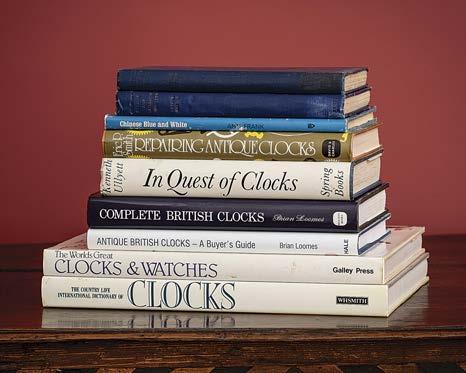
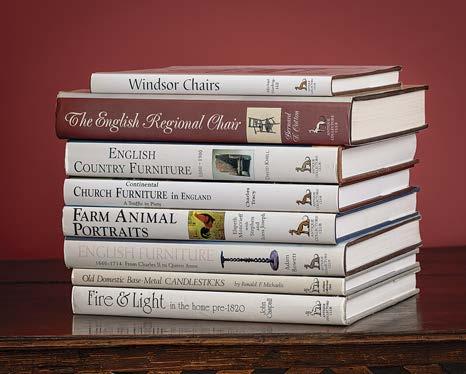
344
A group of books on horology and decorative arts
Brian Loomes, Complete British Clocks; Brian Loomes, Antique British Clocks A Buyer’s Guide; Kenneth Ullyett, In Quest of Clocks; E. Smith, Repairing Antique Clocks; The World’s Great Clocks & Watches; The Country Life International Dictionary of Clocks; Anna Frank, Chinese Blue and White and two other volumes. (9)
£80120
345
A quantity of oak related auction catalogues
Mainly Christie’s, to include Hearts of Oak; Grimshaw Hall; The Parry Collection; together Phillips, Dukes and Dreweatt examples. (21)
£4060
346
Miller’s Price Guides
To include editions from 2000 to 2008; together with James Mackay, An Encyclopaedia of Small Antiques. (7)
£3050
347
A group of books and publications relating to medieval art, furniture, church history and the decorative arts
To include, Orme, English Church Dedications; J de Voragine, The Golden Legend of the Saints, Vols I & II; Graham Child, World Mirrors; The Wallace Collection; Diehl & Donnelly, Medieval Furniture; The Burrell Collection; Eglwys Gadeiriol Tyddewi / St David’s Cathedral 1181–1981; Huntington Antiques stock catalogues; further exhibition catalogues. (qty)
£50100
348
A quantity of Sotheby’s auction catalogues
Many oak related, including Haute Epoque; together with Patrick and Gill Moberly Collection; The Fritz Phillips Collection; The Journey of a Cotswold Antiquarian; Croft Castle. (qty)
£80120
349
A group of reference books on English furniture, chairs and domestic objects
HardingHill, Windsor Chairs; Dr. B. Cotton, The English Regional Chair; D. Knell, English Country Furniture 1500–1900; C. Tracy, Continental Church Furniture in England: A Traffic in Piety; E. Moncrieff, S. Skipp & I. Joseph, Farm Animal Portraits; Adam Bowett, English Furniture 1660–1714: From Charles II to Queen Anne; R. F. Michaelis, Old Domestic BaseMetal Candlesticks; J Caspall, Fire & Light in the Home pre1820. (8)
£100200
350
A group of Bonhams auction catalogues
Predominately ‘The Oak Interior’, Oxford & London, mainly 20142019. (qty)
£80120
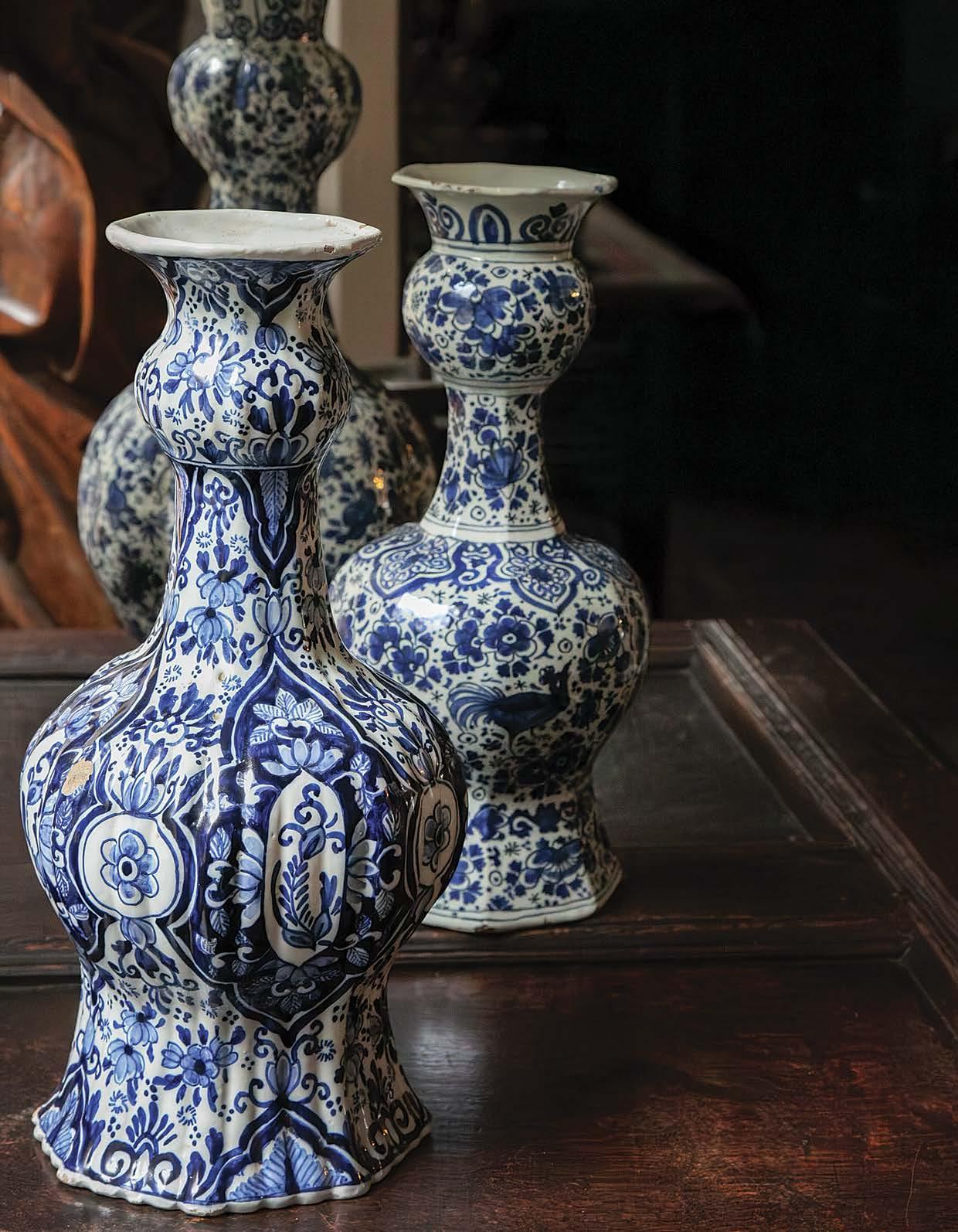
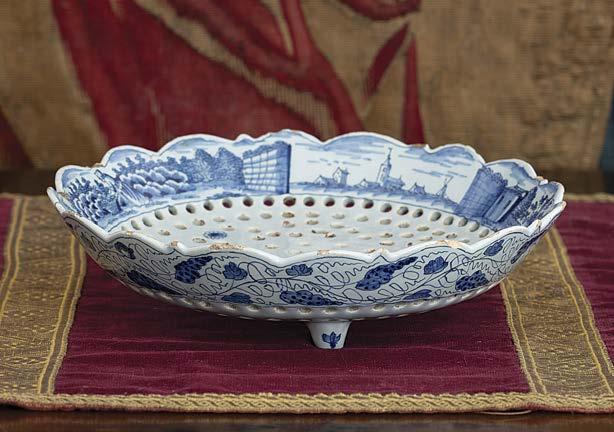
351
A delftware strainer, Dutch, circa 1750
Typically for strawberries, of lobed circular form standing on three integral pad feet, the domed base densely pierced with small circular apertures radiating around a central rosette, the scalloped rim painted in soft blue tones with a continuous panoramic landscape depicting windmills, houses, trees, and distant church spires beneath a cloudy sky, framed by narrow line borders, the exterior decorated with scrolling tulip and berry vine.
H 5.1cm, W 22.2cm
£100200
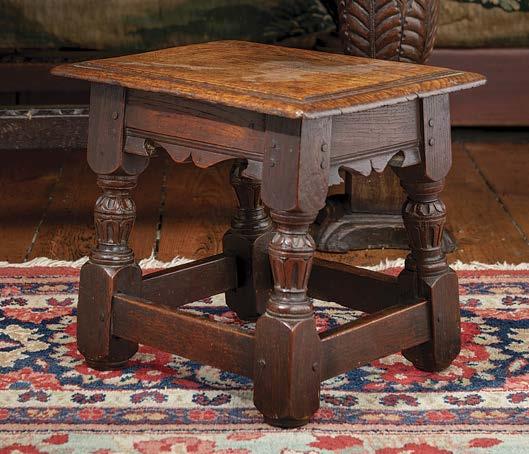
353
A rare Elizabeth I oak low stool, circa 1600
Almost certainly intended for use as a footstool or as a child’s stool, having a multireeded edge top, bicuspid shaped rails and squat invertedbaluster turned legs with crisp fluted ornament, united by plain stretchers.
H 33cm, W 38.7cm, D 29.2cm
£1,0001,500
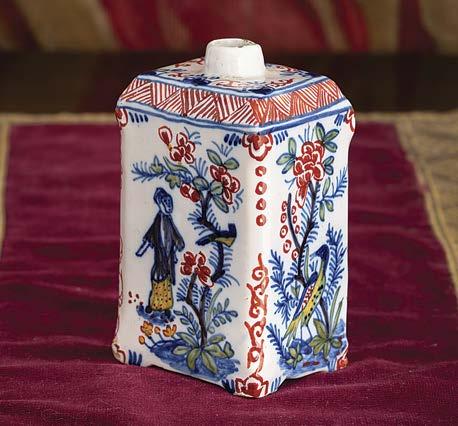
352
A delftware polychrome tea canister, Dutch, circa 170040
Decorated in blue, ironred, yellow and green, the rectangular body with chamfered corners rising to a short cylindrical neck for a cork or pewter stopper, the sides designed in a lively chinoiserie palette, with standing figure and perching birds amidst flowering prunus and peony, the corners enlivened with scrolls, and the shoulder with a red diaper border, a blue line frames the raised foot, monogram ‘VR’ mark for workshop or decorator.
The compact form and tight neck are typical of early European tea containers, produced when tea was an expensive luxury and stored in small, lockable caddies.
H 12.1cm, W 7.6cm, D 5.7cm
£200300
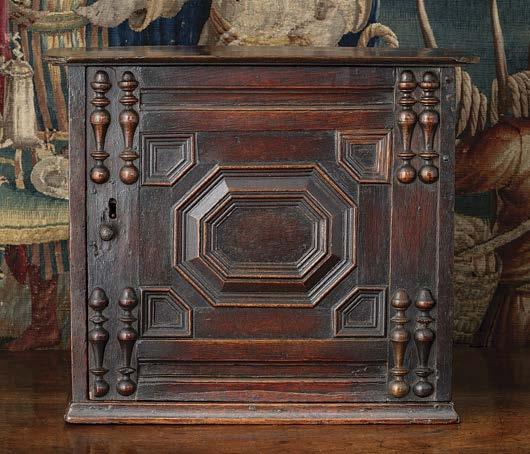
354
A Charles II oak spice cupboard, circa 1670
The door with applied mouldings forming a geometric design centred on an octagon, flanked by splitbaluster mouldings, the interior fitted with an arrangement of drawers of various sizes, each retaining original iron pulls. Spice cupboards were prized household furnishings in the later 17th century, used to store not only costly spices but also small valuables, documents, or apothecary items. Their secure lock and compact scale made them symbols of both wealth and domestic refinement.
H 39.4cm, W 45.7cm, D 21.6cm
£400600
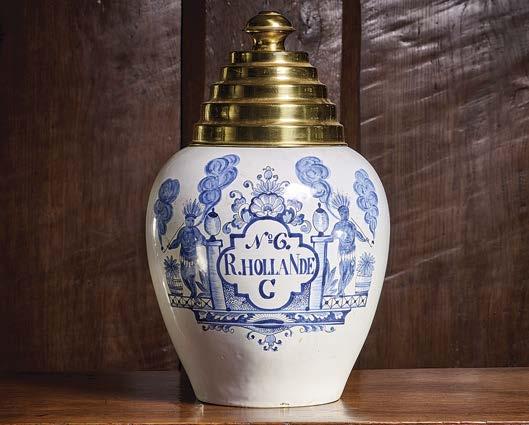
355
A delftware tobacco jar, Dutch, possibly 18th century
Of ovoid form, decorated in cobalt blue, with a central cartouche inscribed “No 6. R. HOLLANDE G.”, flanked by figures of Native Americans in feathered headdresses, each holding smoking pipes, the decoration alluding to the New World origins of tobacco, stylised floral sprays and tobacco leaves complete the design, with a tall, stepped, domed brass lid of original form.
The inscription identifies a type of tobacco blend Hollande’ referring to Hollandcut tobacco and the number ‘6’ marking the jar as part of a larger merchant’s set, with each jar being used to store and display specific blends within a shop or apothecary.
H 44.5cm, W 26.7cm
£200300
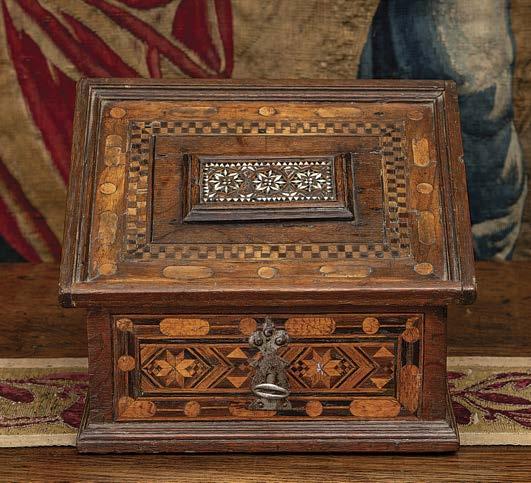
357
An Elizabeth I small oak inlaid ‘Nonsuch’ desk box, Southwark, London, circa 1570
The sloping lid with applied moulding, inlaid to the front, sides, and top with chequer, dot, and geometric banding, characteristic of inlay found on the celebrated ‘Nonsuch’ chests, socalled due to their imagery association with Henry VIII’s great palace of Nonsuch (begun 1538, now demolished), the lid centred with a geometric boneinlaid tablet, tin strap hinges and iron lock, fitted interior.
H 24.8cm, W 27.3cm, D 22.9cm
See Lot 365 for a similar box
£1,5002,000
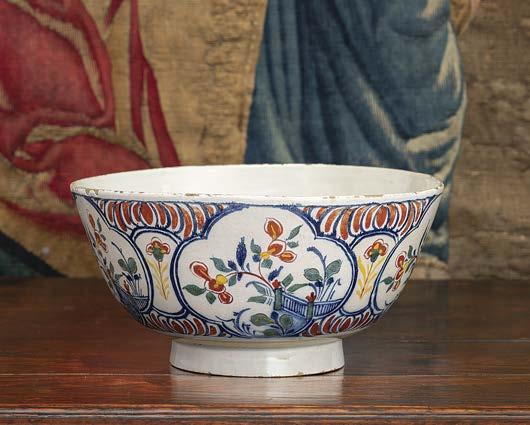
356
A delftware polychrome bowl, Dutch, mid18th century
The exterior with quatrefoil reserves enclosing floral sprays, in red, green and yellow, the panels outlined in deep cobalt, spaced by single stem reserves, on a ground of radiating orange strokes, the interior base painted with a leafy motif, with a border of ring and star motifs, on a ring foot.
H 15.2cm, Dia 24.8cm
£100200
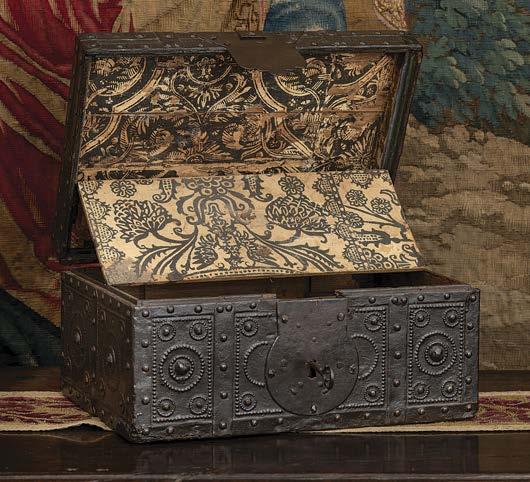
358
A striking 16th century ironclad strong box, Spanish, circa 15801600
Entirely covered in decorative sheetiron, arranged in geometric panels with raised bosses and studwork, centred by a large shaped lockplate with hasp to front, the fitted interior retains two layers of early lining papers a marbled lining of the late 16th/early 17th century and an overlaid blackprinted floral paper, almost certainly Italian or Spanish, covering the secret compartment built into the lid. This type of box served as a personal strongbox for money, jewels, or documents.
H 19.7cm, W 39.4cm, D 26.7cm
£600800
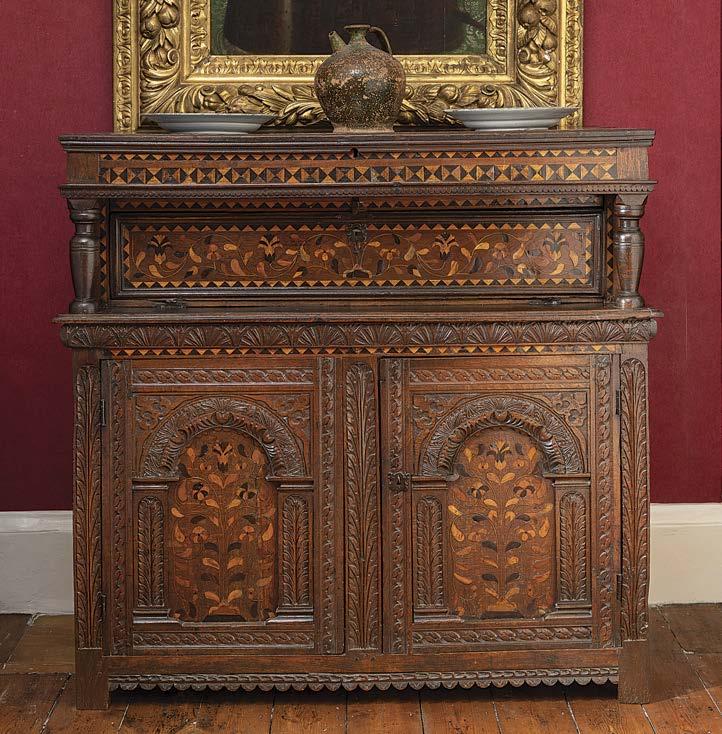
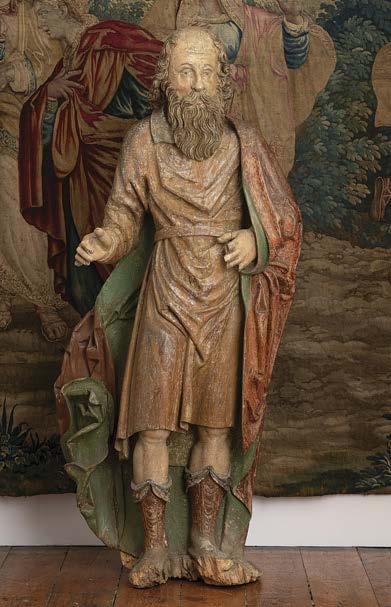
A rare James I oak and marquetryinlaid press cupboard, Yorkshire, circa 1610
Constructed in three stages, each enriched with elaborate inlay and carving that epitomises the decorative exuberance of the Jacobean period. The lowersection fitted with twin doors, each set within deep applied carved arcades, centred by botanical inlaid panels, the naturalistic foliage worked in contrasting woods to striking effect, the doors are framed by guillochecarved uprights and borders, lending strong architectural presence; the central section features a remarkable fallfront door, again inlaid with scrolling floral, opening to reveal an interior fitted with five original small drawers, where costly spices and small valuables required secure and discreet storage, the upper stage on balusterturned front columns is surmounted by a lifting lid, enclosing a well, traditionally referred to as a silver chest, intended for the safekeeping of plate and precious vessels.
Overall, the press demonstrates a masterful balance between robust Jacobean form and delicate ornament. The combination of inlaid marquetry panels, architectural carving, and ingenious hidden drawers sets this piece apart as a work of high status, likely commissioned in Yorkshire for a prosperous gentry family.
H 136.5cm, W 142.9cm, D 63.5cm
£1,8002,200
360
A mid16th century lifesize oak and polychromedecorated figure of St Joseph, Flemish or German, circa 1550
St Joseph, the earthly father of Christ, is shown standing in flowing robes, belted at the waist, a mantle draped across his shoulder, with full beard and curling hair, the features rendered with naturalism and quiet dignity.
Figures of this monumental scale were typically commissioned for altarpieces and church interiors, where saints were presented as near lifesize companions for the faithful. St Joseph in particular rose to prominence in the 15th and 16th centuries, widely venerated as the protector of the Holy Family, a model of paternal care, and intercessor for Christian households.
H 152.4cm, W 66cm, D 40.6cm
£1,5002,000

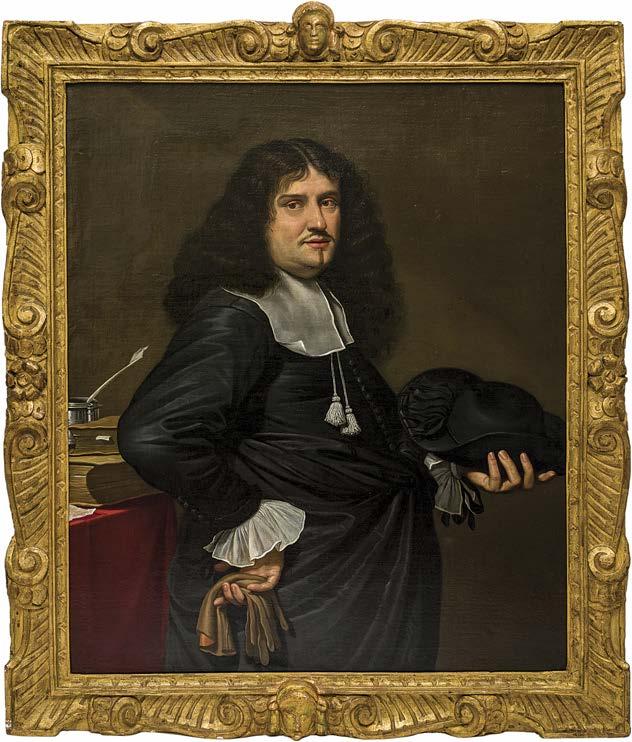
361
Follower of Bartholomeus van der Helst (Dutch, 16131670)
Portrait of a Gentleman
Standing three quarter length, wearing a black tunic and sash, holding a black hat and tan gloves, books and and inkwell behind him
Oil on canvas
119.5 x 100.5cm; 47 x 39 1/4 in
Of note is the fine mid17thcentury Dutch (or Flemish) auricular ‘maskandscroll’ frame, retaining watergilding. The boldly carved scrolled rails with punched grounds, central mascaron to top and bottom, and voluted corners with leafwork.
£4,0006,000
362
A 16th century oak and polychromedecorated figure of the Virgin Mary and Child, Mechelen, Belgium, circa 152050
Retaining much of its original polychrome, the Virgin is shown standing on an octagonal base, robed in a red undergarment and white mantle, supporting the Christ Child on her left arm, the Child clasps an orb, emblematic of his dominion over the world.
While many Malines statuettes of this period were carved in limewood, the present example is executed in oak, a harder and more durable material often favoured for largerscale sculpture and ecclesiastical furnishings.
H 30.5cm, W 10.2cm, D 7.6cm
£1,2001,800

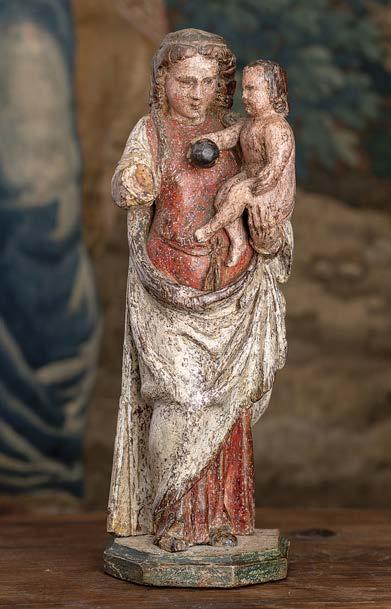
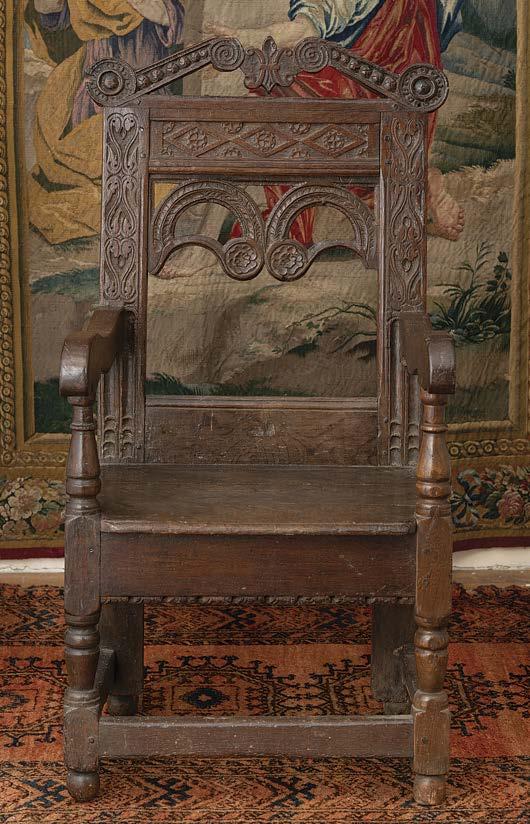
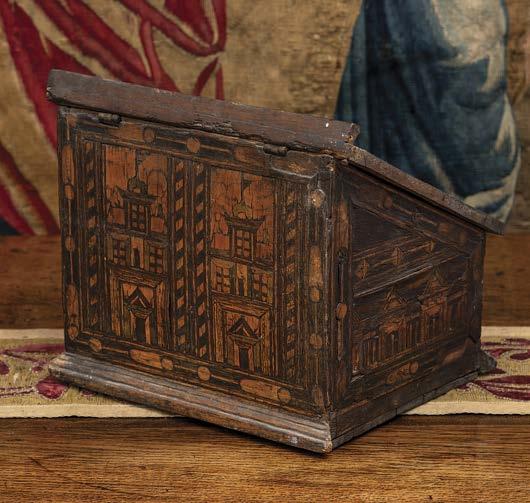
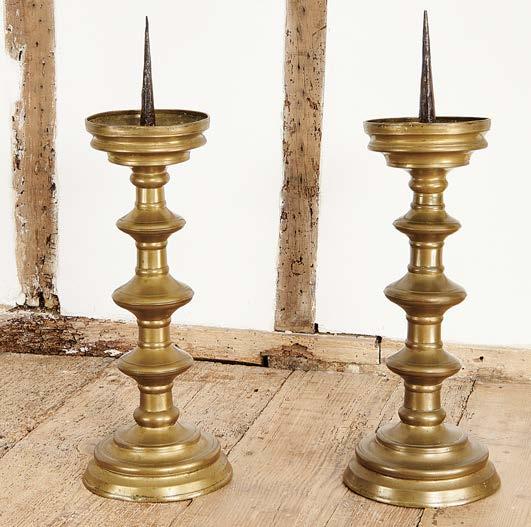
363
A James I joined oak openback armchair, West Country, circa 161020 and later
The back topped by two carved arches centred by paired rosettes, below a lozengecarved top rail and pierced cresting rail carved with scrolls and centred by a fleurdelys motif, with carved back uprights, and downswept shaped arms on balusterturned supports, the boarded seat above moderately deep stretchers with beaded lower edge, risingbaluster forelegs joined by plain stretchers, on ball feet, restorations.
H 106cm, W 57cm, D 51cm
£100200
364
A nearmatched pair of 16th century brass pricket candlesticks, Nuremberg, Germany, circa 15501600
Each with wide drippan and tall iron pricket, on triple large discoidknopped stem and spreading circular base. (2)
One candlestick shows evidence of an historic repair to the upper section, where the stem has been rejoined slightly offcentre, reflecting long liturgical use and conservation typical of extant ecclesiastical examples.
H 54cm, W 18.4cm
£8001,200
365
An Elizabeth I small oak inlaid ‘Nonsuch’ desk box, Southwark, London, circa 1570
Having a sloping lid, inlaid in bogoak and fruitwood, with traces of green stain, to the front and sides, designed with geometric banding enclosing fantastical turreted buildings, original tinned strap hinges and iron lock (a/f).
The architectural designs were not merely decorative but symbolic of royal magnificence, based on the imagery associated with Henry VIII’s Nonsuch Palace. The turrets, towers, and façades echo contemporary engravings of Nonsuch, making this box a status symbols for the prosperous London merchant classes.
Boxes of this type are now firmly attributed to workshops of German émigré craftsmen working in Southwark, London, whose skills in intarsia and marquetry were highly prized. Though larger Nonsuch chests survive in greater numbers (see lot 599), smaller desk boxes are far rarer and would have been prized personal items for storing documents, writing implements, or valuables.
H 24.8cm, W 27.3cm, D 22.9cm
£8001,200
An Elizabeth I / James I ash turner’s armchair, circa 15801620
Of typical triangular form, all parts turned except for the triangular boarded seat, with a ballfinial bold columnarturned front supports, the back turned crestingrail centred by a tapering ballturned column with radiating spindles forming a fanlike design.
The chairs compact, yet commanding form, suggests use as a seat of distinction within a private chamber rather than for communal or hall use.
The boldness of its turning, the use of native ash with its distinct graining, and the triangular innovation mark it as an outstanding product of Elizabethan/ Jacobean joinery. Comparable examples are illustrated in Tobias Jellinek, ‘Early British Chairs and Seats 1500–1700’ (2009), pl.195, p.166, where the author notes their rarity and importance in the history of English seating furniture.
H 90cm, W 61cm, D 43.2cm
£7001,000
367
A nearmatched pair of 17thcentury brass pricket candlesticks, Italian, circa 16501700
Each with a leafy baluster stem rising above a stepped and moulded triangular plinth, supported on turned ball feet, the wide dished drippans with tall integral prickets. (2)
The design combines the late Renaissance vocabulary of classical architectural forms with the emerging Baroque taste for heightened monumentality. The leafy knop recalls vegetal ornament derived from antiquity, while the bold plinth and ball feet reflect contemporary Italian ecclesiastical furnishings.
H 43.8cm, W 14cm, D 14cm
£200300
368
A small dugout walnut domedlid table casket, French, circa 14801530
The lid fitted with wroughtiron strap hinges and hasp, and surmounted by a wroughtiron handle with zoomorphic dragon head terminals, the sides with integral moulded lip and foot, on an ogeeprofiled cutaway plinth base.
H 16.5cm, W 19.7cm, D 11.4cm
£1,0001,500
369
Four 19th century pewter mugs, English
Three of bulbous shape, quart, with midfillet and hollow handle, one engraved ‘ENOCH JONES’; and a tulipshaped example with double Cscroll handle, pint, verification marks to rim. (4)
H 16cm (tallest), Dia 12cm
£4080
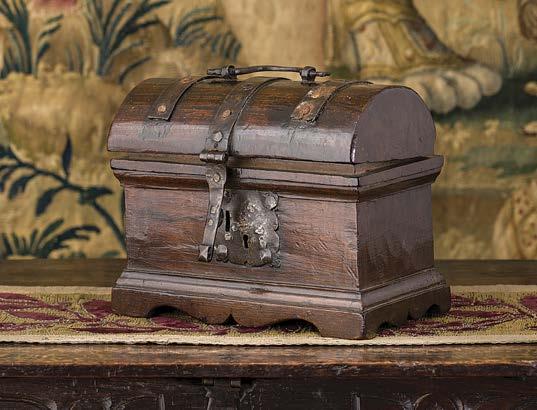
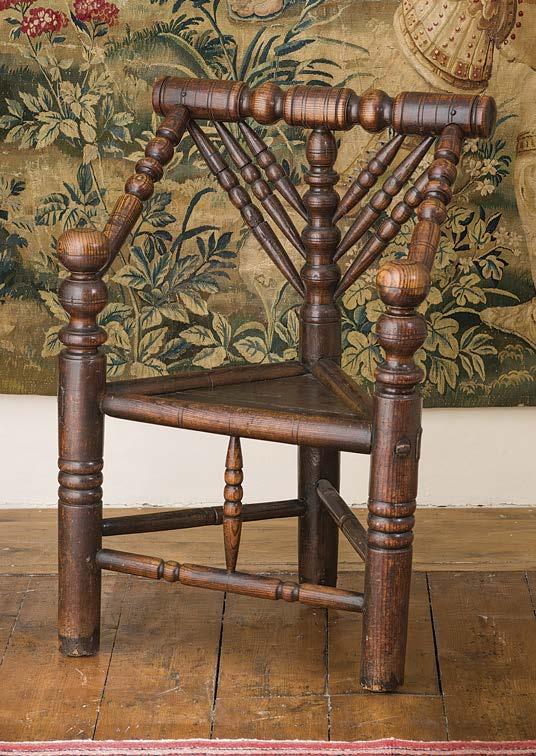
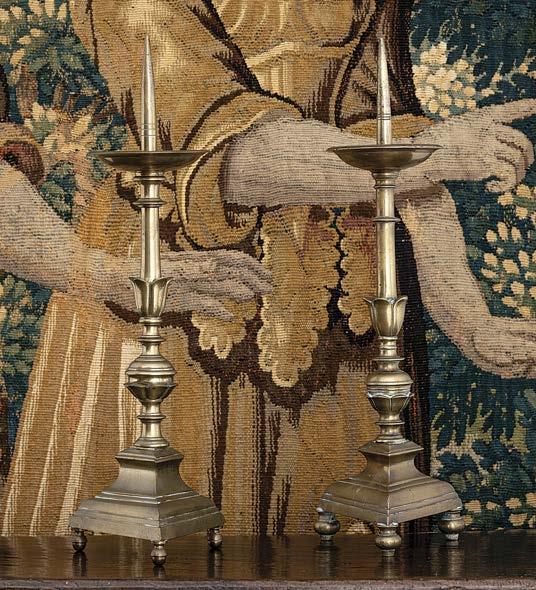
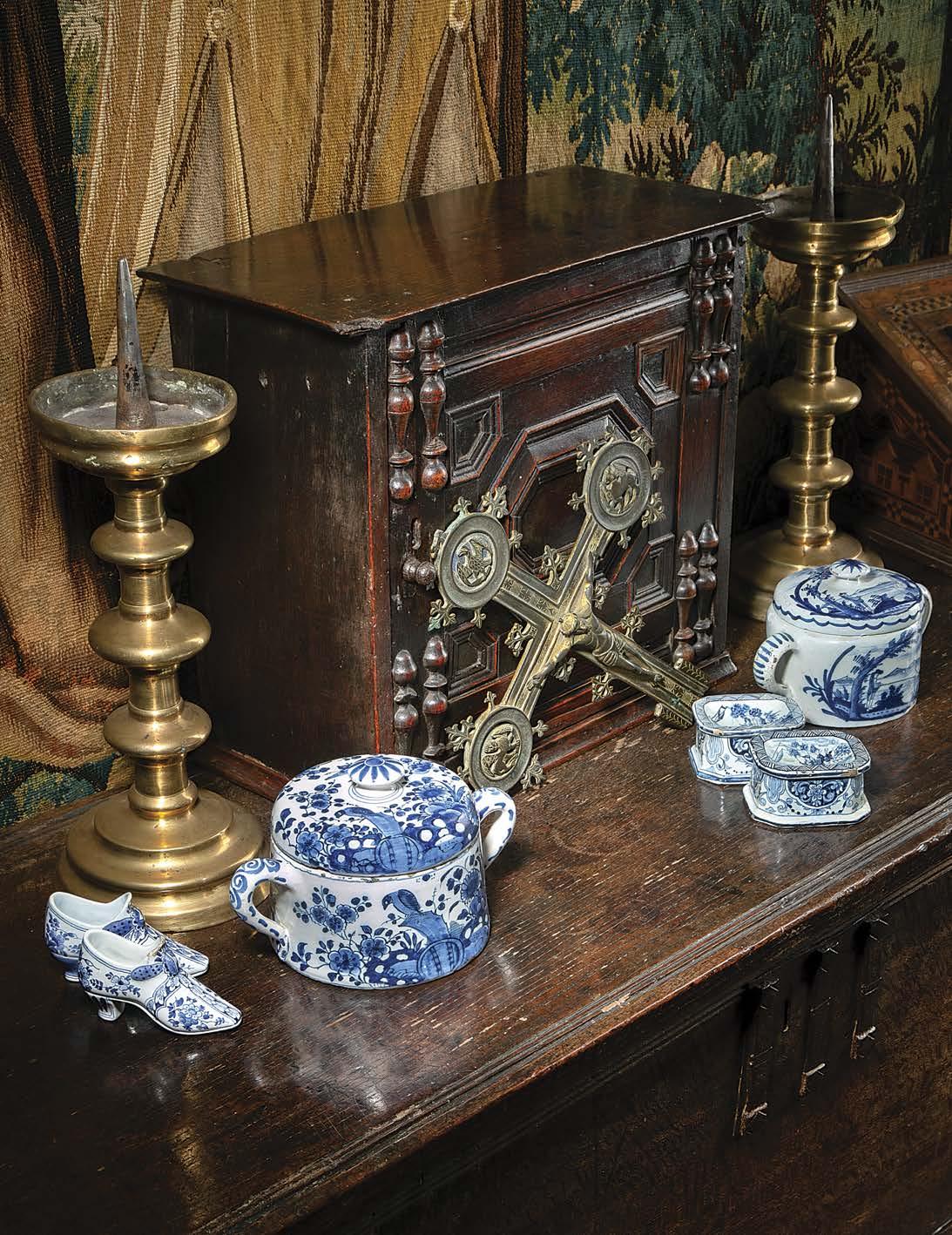
370
An important Henry VII/VIII, preReformation, gilt copperalloy Processional Cross, probably Westminster, London, circa 14901520
Cast in separate elements and assembled with engraved and pierced decoration to form a cross pommée, to the centre Christ crucified, his elongated body rendered in a typical period restrained manner, with sharply modelled ribs, knotted short perizonium and inclined head, the three terminals of the cross with a roundel, surrounded by an openwork circlet of cusped leaves, each roundel with a symbol of three of the four Evangelists – a winged lion (St Mark); a winged ox (St Luke); an eagle (St John), cast in high relief against a recessed and originally coloured ground, with fragments of blue pigment surviving in protected areas. The reverse of each roundel engraved with a Tudor rose, finely chased with inner and outer petal rings and a central seed pod. The crossarms are decorated with engraved lozenge and chequer diapering contained within raised linear borders. The lower terminal with faceted remains of the original ferrule for attachment to the processional staff. The surface retains extensive original firegilding, visible as burnished gold along ridges and protected recesses.
The symbol of the fourth Evangelist, St Matthew (a winged man, or angel) is highly unlikely to be omitted by design (with Christ himself forming the human element of the Tetramorph) and was probably almost certainly positioned at the base of the cross, just above the staff
Edward VI’s Royal Injunctions of 1547 banned processions, leading to the destruction of elaborate liturgical objects. As a result there are few extant examples, which are now principally in museums. For example, ‘The Bosworth Cross’, in the Society of Antiquaries collection, Burlington House, London. It was believed to have been carried by Richard III’s forces at the Battle of Bosworth, discovered 1778, Ambion Hill, and dated to pre1485. The V&A Museum Collection, London, has a cross of closely related form, found at Abbey Dore, Herefordshire, (acc. no. 8241901), dated to c.150020. Another, the St Davids Cathedral Cross, National Museum Wales (inv. 32.233), is dated to the late 15th century and was found within the Cathedral precincts. A fourth, from Georges Davioud Collection, sold Osenat, 22 June 2024, Lot 95, (€20,160), erroneously catalogued as Spanish.
Provenance: Private antiquarian collection, Wolverhampton, 1950s.
H 34.3cm, W 31.8cm, D 2.5cm
£15,00020,000
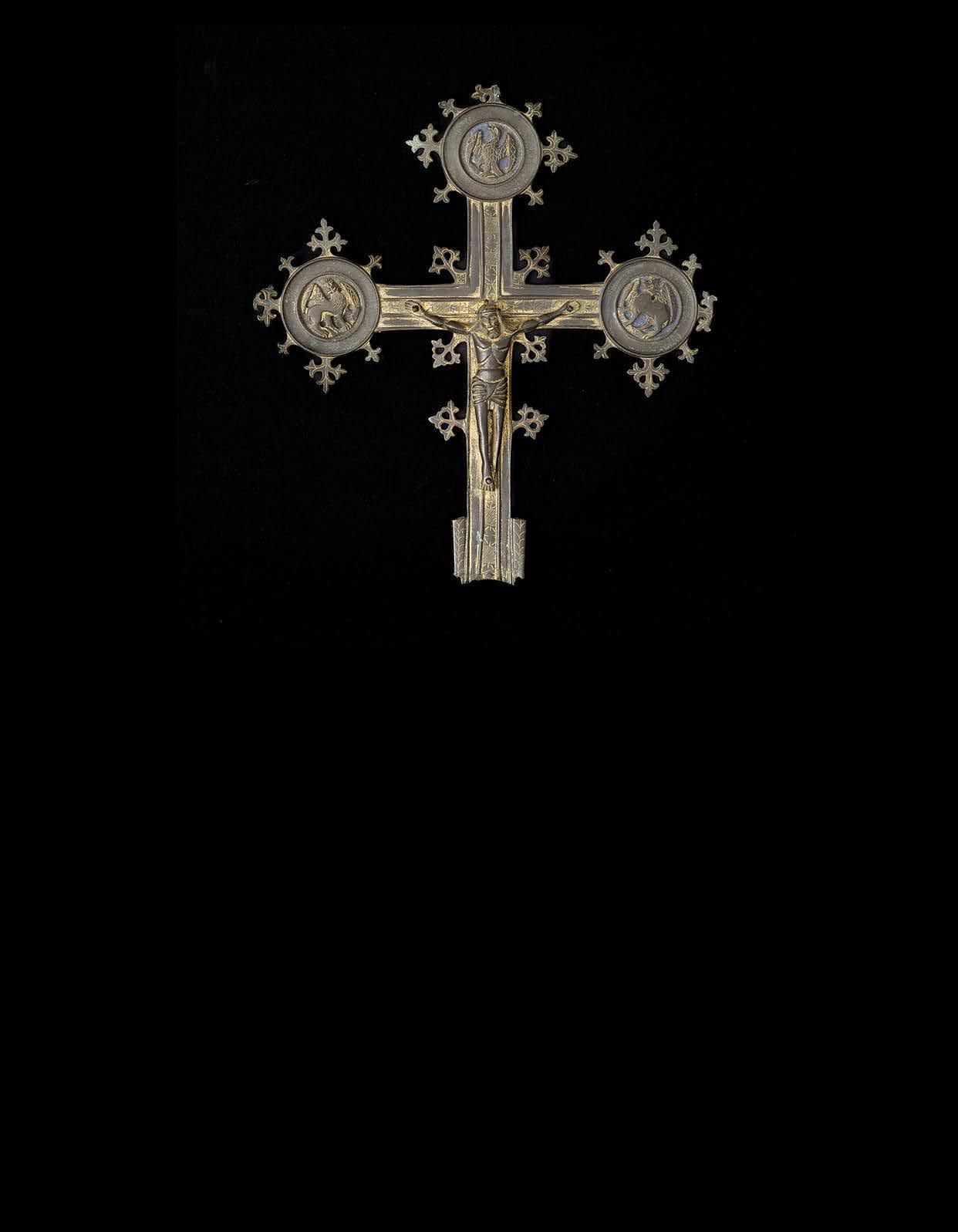
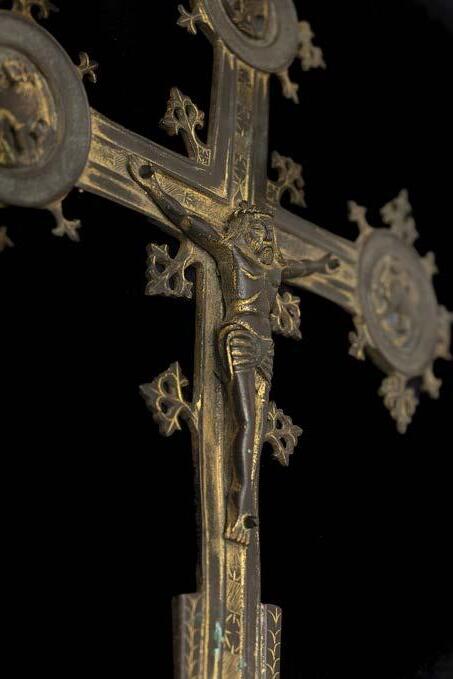
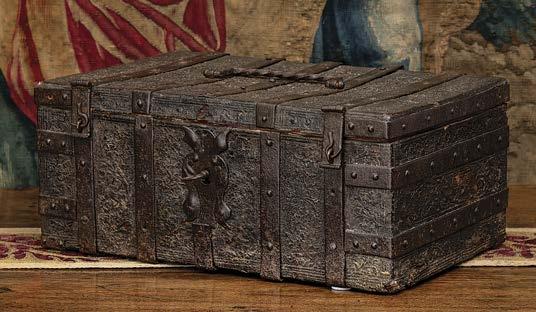
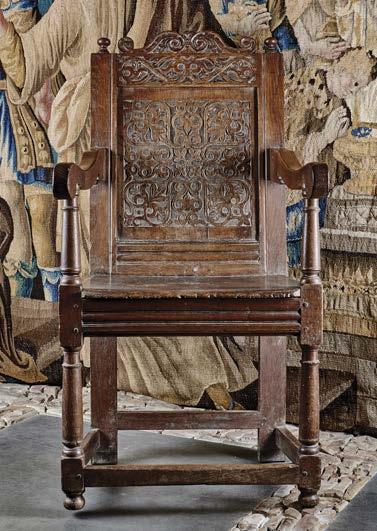
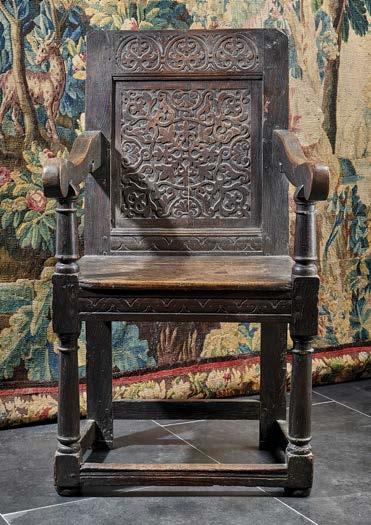
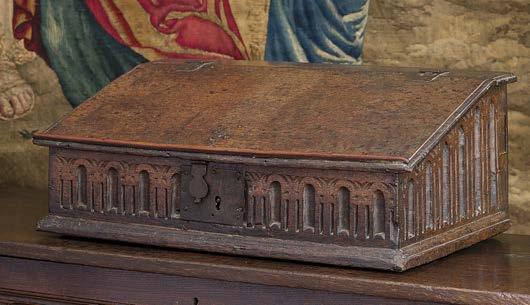
A 16th century oak, leather and ironbound casket, German or Flemish, dated 1506
The exterior covered in black leather, tooled and embossed with foliate scrolling designs, the front mounted with a robust iron lockplate and decorative escutcheon, the interior lined with crimson silk, the underside tooled with the date ‘1506’.
The combination of iron strapwork and leather covering offered their owner both security and prestige.
H 20.3cm, W 47cm, D 30.5cm
£1,0001,500
A James I boarded oak desk box, circa 1610
The front and sides carved with a continuous nulled arcade, the sloping hinged lid with moulded edge, the interior with evidence of a former sliding mechanism most likely serving as a concealed compartment, iron lockplate and clasp.
H 24.1cm, W 64.1cm, D 39.4cm
£200300
A Charles I joined oak armchair, Exeter, Devon, circa 1630
The back panel deeply carved with interlaced Sscrolls, heart motifs, and a central rosette, the arched doublescroll cresting rail similarly carved with entwined scrolls and foliage, the back uprights with ballfinials, the downswept arms on columnarturned front supports, boarded seat, runmoulded seat rails and matching columnarturned front legs joined plain stretchers.
Chairs of this form are strongly associated with Exeter workshops, noted for their distinctive vocabulary of scrolling foliage and heartshaped ornament.
H 114.3cm, W 61cm, D 53.3cm
£600800
374
A Charles I joined oak open armchair, Exeter, Devon, circa 1630
The backpanel finely carved with interlacing scrolls and foliate tendrils enclosing a central rosette, the top rail carved with similar stylised heart motifs (a distinctive Exeter feature) the uprights and arms are both substantial, the latter with scrollends, while the columnarturned legs are joined by moulded seat rails and plain stretchers.
Chairs of this type appear in early 17thcentury Exeter inventories, where they are described as ‘ioyned cheares’, often reserved for prominent display in parlours or halls. The design demonstrates the strong influence of European strapwork patterns, with rhythmic scrollcarving, but reinterpreted through the robust vernacular idiom of the West Country.
H 110.5cm, W 62.2cm, D 53.3cm
£600800
A Charles II boarded oak box on detachable stand, Exeter and surrounding area, circa 1680
Richly carved to the front, sides, and lid with strapwork designs centred by a stylised flower, the stand appears purposemade of similar date, with balusterturned legs joined by plain stretchers, allowing the box to be displayed or removed as needed.
The distinctive strapwork carving, vigorous yet controlled, is characteristic of the Exeter and Devon region in the late 17th century. These areas were strongly influenced by Dutch immigrant craftsmen, who introduced European forms and ornament into local workshops.
H 83.2cm, W 47cm, D 31.1cm
£200300
376
18th/19th century pewter holloware
To include a truncated cone mug, pint, a spouted example of similar form, with verification marks and a lidded water jug, with erect thumbpiece. (3)
H 24cm (jug), Dia 14cm
£4060
377
A matched pair of delftware trencher salts, Dutch, mid18th century and later
Each of elongated octagonal form with chamfered corners and a narrow footring, the sides painted in rich cobalt with alternating baroque cartouches and flowerhead panels, the well edged with a characteristic hatched band, each painted with a man fishing before a castle, painter’s monogram ‘HVH’ to the base, traditionally attributed to Hendrick van Hoorn. (2)
H 4.4cm, W 8.9cm, D 7cm
£100150
378
A group of four pewter mugs, English, circa 186090
Each of truncatedcone form, halfpint, with singlecurve handle and verification marks, one by Parnall & Sons, Bristol, (fl. 18601914), (PS7118). (4)
H 10cm, Dia 8cm
£4060
379
A Charles I joined oak open armchair, Somerset, circa 1630
The back panel is finely carved with a single guillochefilled arcade enclosing a ‘tree of life’, the cresting rail enriched with lunettes and scrolled motifs, while the unusual turned forelegs are joined by plain stretchers, typical of regional craftsmanship of this date and repeated to the arm supports, broad runmoulded seat rails and boarded seat.
W 59.1cm, D 55.9cm
£400600
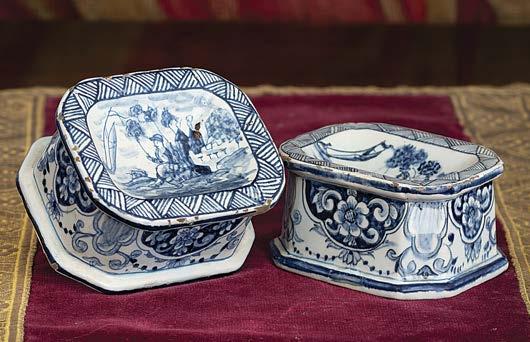
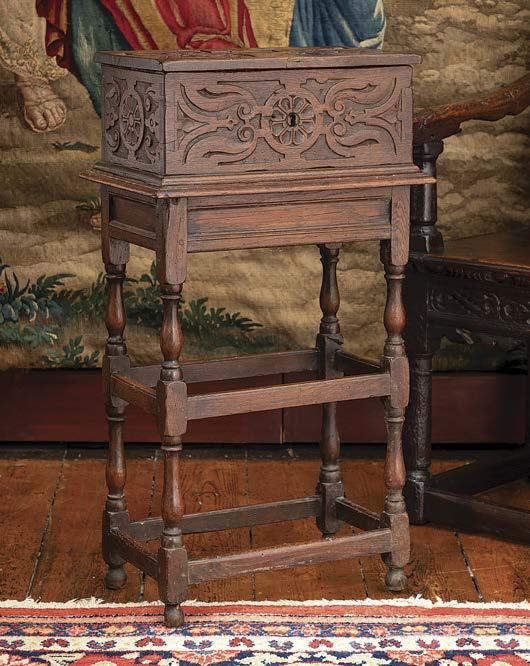
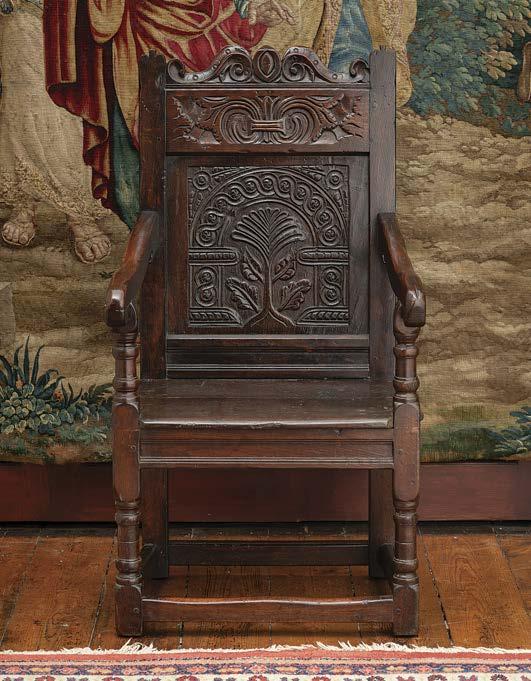
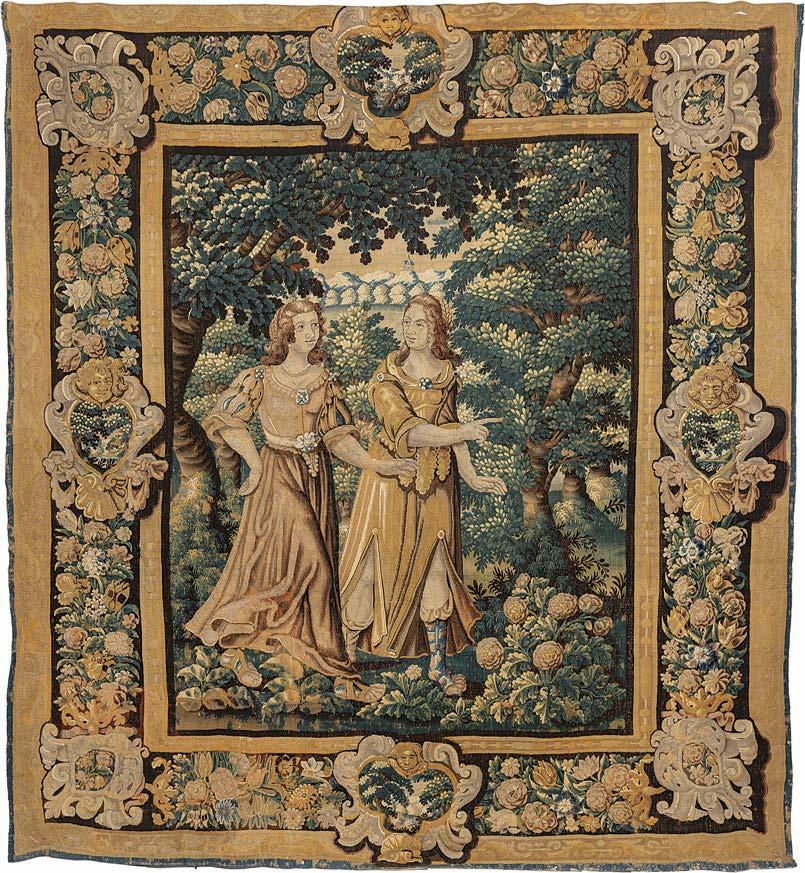
380
A 17th century verdure figural tapestry panel, Brussels, circa 166090
Worked in deep bluegreens and golden ochre, with a central verdure scene showing two fashionably dressed young women walking in a flowerstrewn grove beneath interlaced boughs, one holds a garland and gestures towards a profusion of blossoms, both wear classically draped bodices, pearl jewels and blue bows, within an elaborate border of dense roses, carnations and peonies, punctuated by strapwork cartouches with cherub heads and foliate consoles, and framed by an outer band with scrolling acanthus.
Borders of this type were used by several Brussels ateliers in the third quarter of the century, for example the workshops of Jan Raes, Gerard Peemans, and the Reydams family.
The figures’ garlands, abundant flowers, and light, pastoral setting indicate an allegory of Spring, or early Summer.
H 308.6cm, W 281.9cm
£4,0006,000
381
A small pair of delftwarestyle shoes
In the 18th century Dutch manner, with raised instep, decorated in cobalt blue with leafybands and flora, with stylised rosette buckle, painted and impressed marks (2)
H 6cm, W 11cm, D 4cm
£3050
382
A Hamadan runner, Persian Kurdistan, circa 1920
The camel Herati field enclosed by ivory borders and carnation guard stripes.
L 283cm, W 102cm
£100200
383
A pair of needlepoint cushions, English
Adapted from mid18th century upholstery, each with a bold, radiating, floral design, work in coloured wools, in reds, greens and golds, on an ochre ground, with ropetwist border and damask backing. (2)
H 40cm, W 50cm
£100150
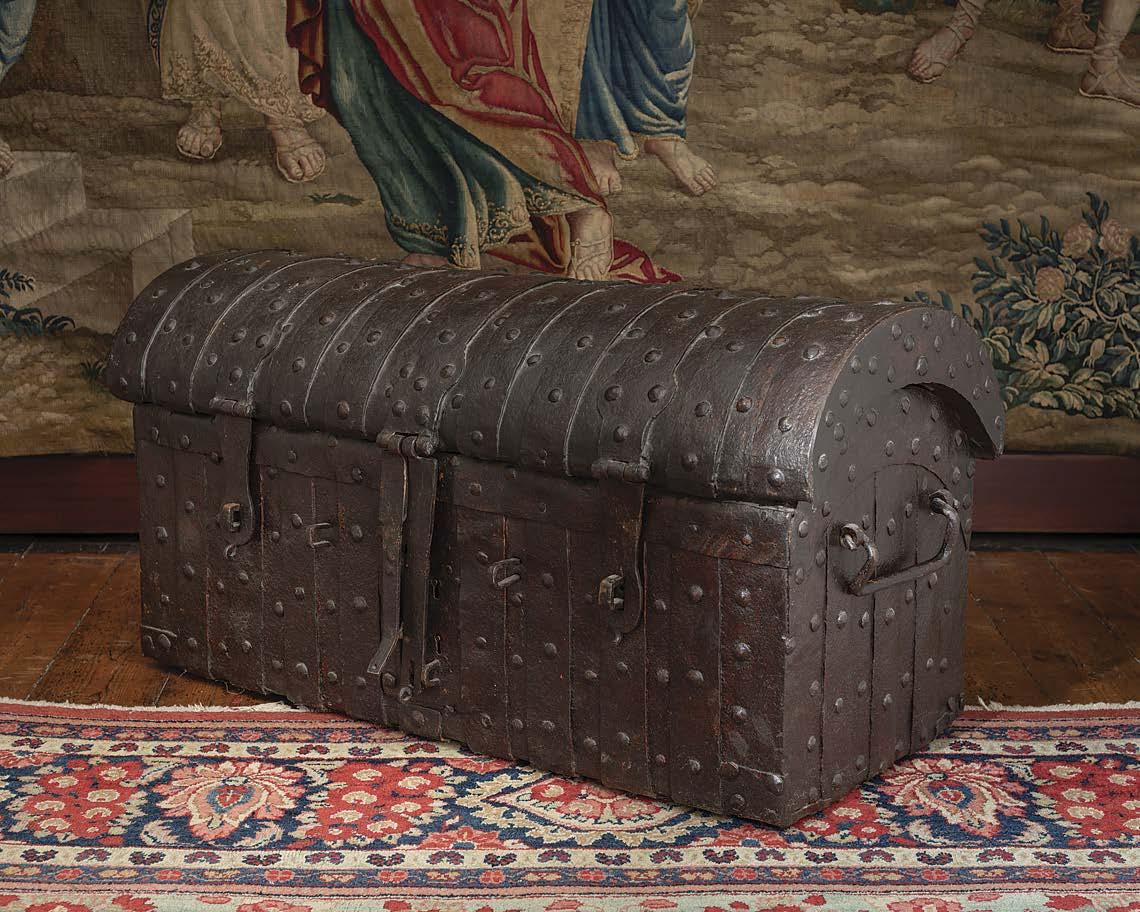
384
A superb 15th century ironbound, domelid chest, English or possibly Low Countries, circa 14501500
This medieval ‘domed standard’ represents the pinnacle of the Gothic armoured chest tradition of Northern Europe during the fifteenth century. Constructed from a robust deal carcass completely encased in wrought iron strapwork using vertical and transverse iron bands, fixed by large domed rivets and terminating in roundheaded studs that lend the surface a rhythmic architectural quality. The front retains its original lock plates and hasps, one centrally placed with an internal spring lock, and two flanking hasps for subsidiary padlocks or seals, an arrangement typically specified in ecclesiastical and civic statutes to require multiple keyholders. Massive, forged side handles permit the chest to be carried by two men.
For a comparable example, with pine interior, see the V&A Museum, London, (acc. no. M.1121919). The majority of recorded Medieval dome standards are in England, with only a handful recorded in Europe. See the Museum Catharijne Convent, Utrecht, where such chests are recorded as kerkkisten or tresorkisten—treasury boxes for plate, relics, and documents. Archival sources record English parishes being ordered to keep ‘a strong chest with three locks for the books and jewels of the church’, a mandate that produced this distinctive triplelocked form.
Literature: See C. Pickvance, ‘Archaeologia Cantiana’, 2015, Vol 136, pp. 139162, Maidstone, Kent, Archaeological Society. It is noted, there is a national collection of over 130 dome standards, with the majority in eastern coastal counties (29 are recorded in Suffolk alone). See also, by the same author, ‘Domed medieval chests in Kent: a contribution to a national and international study’, Regional Furniture Journal, no.26, pp.105147.
H 57.2cm, W 113cm, D 48.3cm
£10,00015,000
385
A 17th century bronze cauldron, German or Dutch, circa 16501700
Of bulbous form raised on three roundedtriangular splayed legs, having an everted rim and fitted with angular lug handles, cast foundry mark to rim.
The cauldron’s form corresponds with Nuremberg and Dinant foundries, both major centres for castbronze domestic wares in the late Renaissance period.
H 18.4cm, W 21cm
£150200
A 16th century brass alms dish, German, Nuremberg, circa 1550
With characteristic central boss, encircled by a swirl of gadroons and two bands of Gothic script, the rim with rolled edge and extensive punched motifs, in the form of fleurdelys and leafy motifs.
Dia 43.2cm
Provenance: Andrew Singleton, Suffolk House Antiques.
£100200
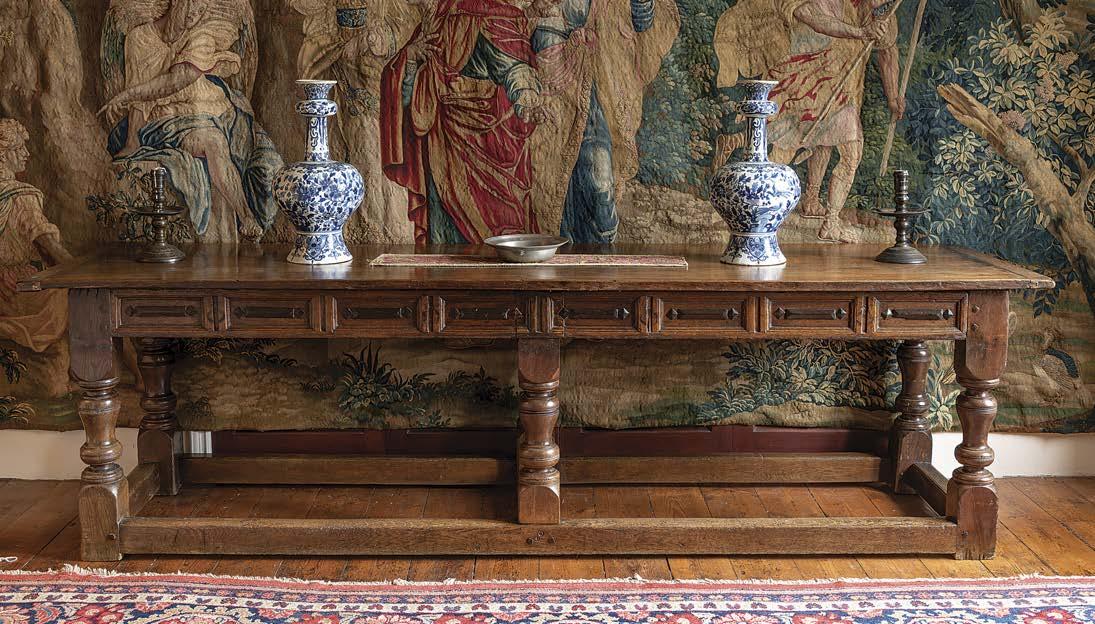
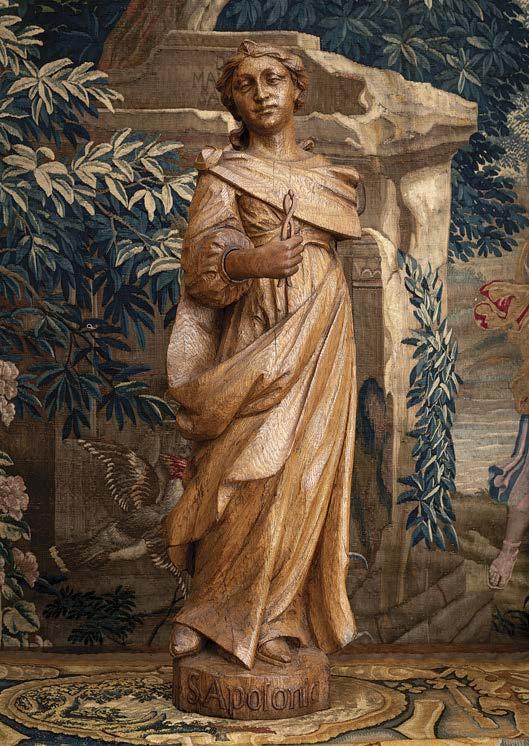
387
387
A Commonwealth joined oak sixleg refectorytype table, English, circa 165060
A fine and unusually long joined oak table, standing on six robust balusterturned legs joined by plain stretchers, with a boldly moulded frieze rail enriched with rare, applied decoration.
The rectangular top, of generous proportions, rests on a substantial joined frame, the baluster legs, with their compressed bulbs and turned collars, reflect the mature phase of English joinery during the early Restoration period, where strength of form was balanced with controlled ornament, the frieze with applied mouldings is a particular rarity, unlike the plain or simply runmoulded friezes seen on the majority of refectory tables of this date, here the craftsman introduced an additional architectural element.
H 78.1cm, W 273.1cm, D 74.3cm
£2,0003,000
388
An early 17th century carved oak figure, St Apollonia, Flemish, circa 1600
St Apollonia, the early Christian virgin martyr of Alexandria, is shown standing gracefully, her mantle flowing in deep folds across her body, and holding in her right hand the instrument of her martyrdom, a pair of pincers, once grasping a tooth, inscribed to the base ‘S. Apolonia’.
According to tradition, Apollonia was tortured during an uprising against Christians in 249 AD, her teeth violently shattered before she met her death in the flames. Venerated since the Middle Ages, she became the patroness of dentistry and was invoked by the faithful for relief from toothache and other ailments of the mouth.
H 92.7cm, W 27.9cm, D 16.5cm
£600800
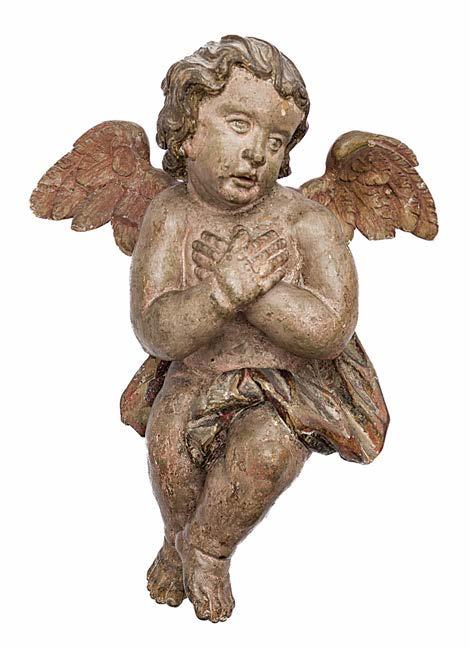
389
A pair of early 17th century limewood and polychromedecorated winged cherubs, Southern Netherlands, possibly Antwerp, circa 1630
Each figure is portrayed in a seated stance, with delicately carved feathered wings and wrapped in drapes, one cherub crosses their arms across their chest in a gesture of adoration, while the other extends one arm in offering, their expressive faces and softly curling hair enlivening the devotional sentiment. (2)
While rooted in the calm naturalism of the Renaissance, the figures ’ animated poses and heightened expressiveness anticipate the emerging Baroque style. Figures such as these were typically integrated into larger ecclesiastical ensembles, altarpieces, pulpits, or architectural canopies, serving as celestial attendants and reinforcing the visual splendour of sacred settings.
H 50.8cm, W 41.9cm, D 22.9cm
£1,8002,200
390
A pair of Elizabeth I oak figural terms, circa 15801600
Each depicting a bearded male bust in classical drapery, the arms resting upon elaborate architectural supports enriched with geometric strapwork, guilloche mouldings, and applied bosses, conceived in high relief with naturalistic hair and beards. (2)
These terms reflect the Renaissance humanist taste flourishing in England during the late reign of Elizabeth I, when imported pattern books by Hans Vredeman de Vries, Wendel Dietterlin, and Jacques Androuet du Cerceau inspired a new decorative vocabulary of strapwork, grotesque ornament, and classical figuration. They likely originated as architectural supports or pilaster figures from a piece of joined furniture or overmantel, executed in a highstatus domestic interior.
H 43.2cm, W 12.1cm, D 4.4cm
£300400
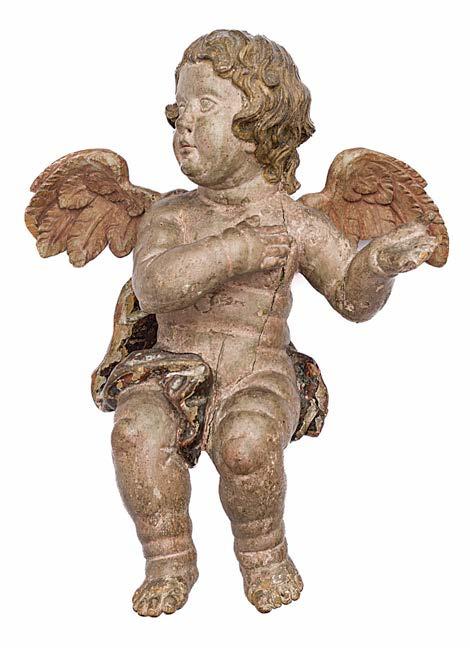
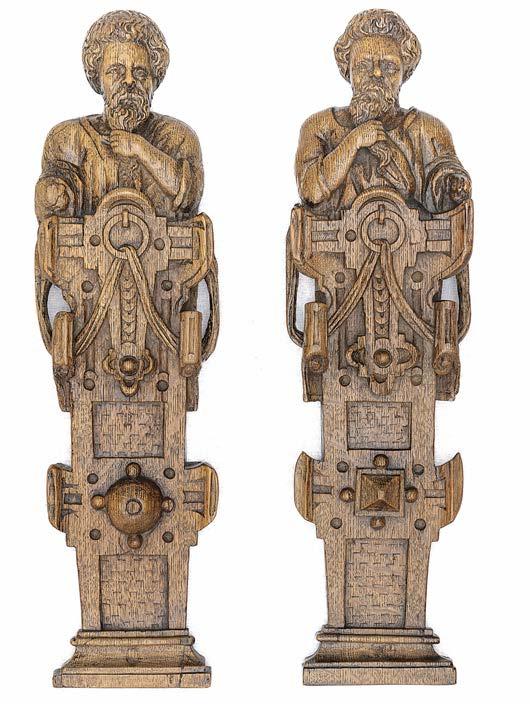
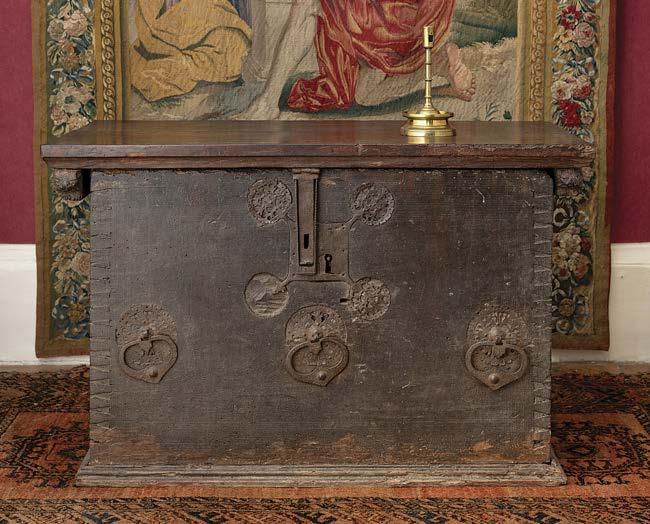
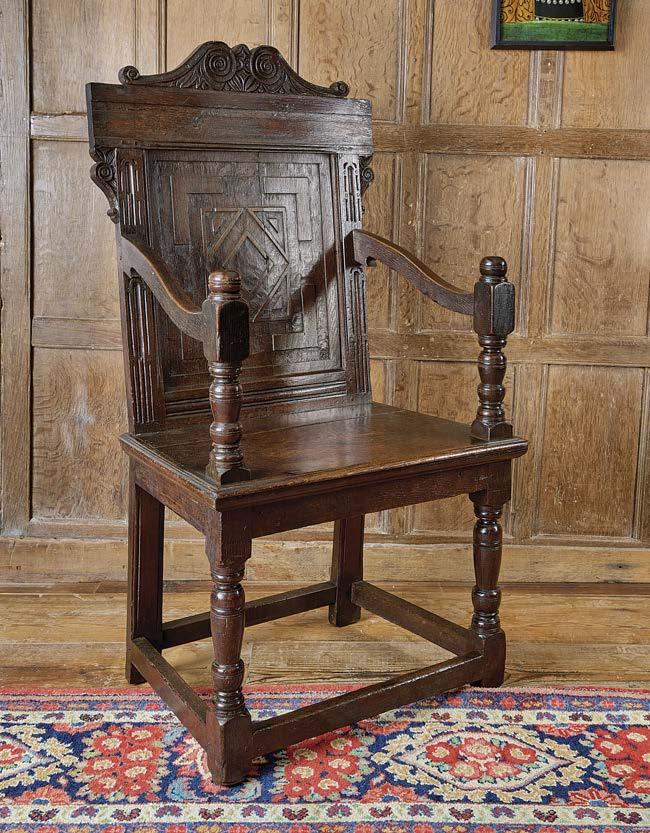
391
A late 15th century walnut strongbox, North Italian, possibly Venetian, circa 1500
Of dovetail construction, the boarded, oversailing lid with underside endlocators, the front fitted with extraordinary original wroughtiron mounts, including a pierced lock plate and substantial carrying handles.
H 60.5cm, W 97cm, D 55.5cm
£1,0001,500
392
A late Elizabeth I joined oak armchair, circa 1600
Originally with inlay, the back panel carved with a geometric strapwork design, the overhanging cresting rail carved with tightly scrolled volutes, with matching ears, the arms shaped with a restrained curve and unusually jointed to the rear of the front arm supports rather than resting on top, the balusterturned arm supports thereby terminating with a ball finial, their turned design repeated on the forelegs.
The chairs bold architectural carving with refined joinery, and rare front arm support design, mark it as a seat of status within a gentry or ecclesiastical household.
Provenance: Abbey House, Malmesbury, Wiltshire.
H 123.2cm, W 62.2cm, D 47cm
£2,0003,000
393
A mid16th century oak ‘clampfront’ chest, Welsh, circa 1550
The chests regional form is defined by the plank construction set within hollowedout stiles, with characteristically descend to bold, cutaway feet, decoration is in the form of incised mouldings to the stiles, along with lattice punchwork and nailhead detail, with original iron hinges.
The use of heavy, slowgrown Welsh oak, combined with its simple yet powerful design, demonstrates both the regional aesthetic and the practicality for which these chests were made, serving as multipurpose storage for food, valuables, or textiles in early Tudor Welsh households.
Comparable chests from this small group are published by Richard Bebb, ‘Welsh Furniture 1250–1950’, Vol. I, pp. 146–147, where they are attributed to the counties of Breconshire and Radnorshire, ibid., p. 146.
H 69.9cm, W 136.5cm, D 45.7cm £500800
394
A Charles II joined oak armchair, Exeter region, Devon, circa 1670
The back panel is carved with two large Sscrolls enclosing stylised rosettes, with additional foliate motifs filling the spandrels, the surrounding frame with further leafy and scrolled ornament, while the seat and upper rails carry a continuous band of Sscroll carving, all executed with a bold, rhythmic energy characteristic of West Country joinery, the arm supports and front legs columnarturned, plain lower stretchers.
The chair’s robust composition, crisp carving, and dark patina embody the distinctive Exeter school, where joiners were producing furniture of both provincial strength and sophisticated design. The carved Sscrolls and rosettes are particularly associated with Exeter and East Devon workshops, and closely parallel the ornament seen on documented pieces from the Ottery St Mary district.
Provenance: Exhibited ‘Discovering Dennis: The Search for Thomas Dennis among the Artisans of Exeter’, Guildhall, Exeter, November 2009 (not in the published catalogue). Chosen for inclusion in the exhibition as the chair has strong affinities to the work of William Searle and Thomas Dennis, who were active in Ottery St Mary before emigrating to Ipswich, Massachusetts, around 1663. Their work in both Exeter and Ipswich, Massachusetts, is widely acknowledged as foundational to early American furniture history. The carving of this chair provides an important visual bridge between the Exeter tradition and the transatlantic development of New England joinery.
H 104.8cm, W 59.7cm, D 47cm
£300400
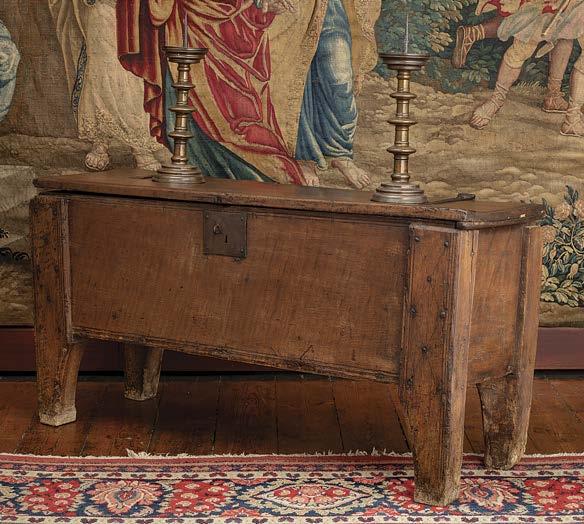
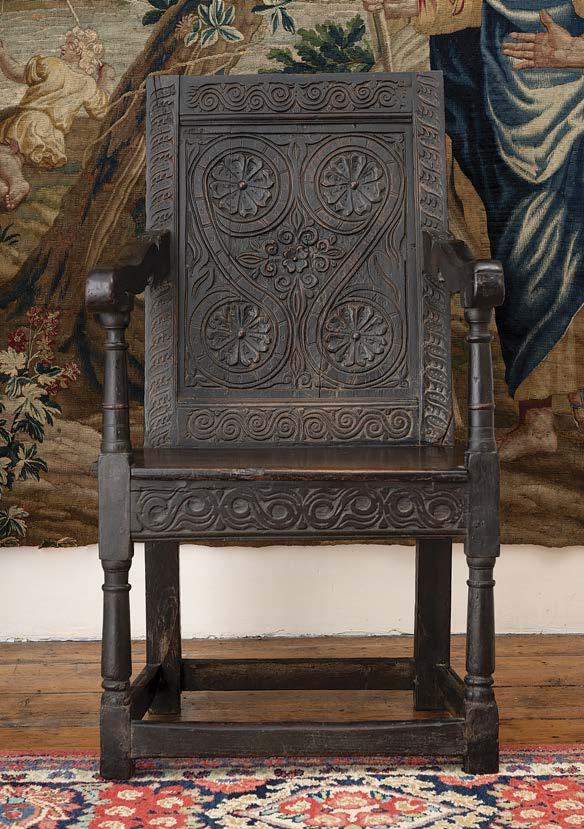
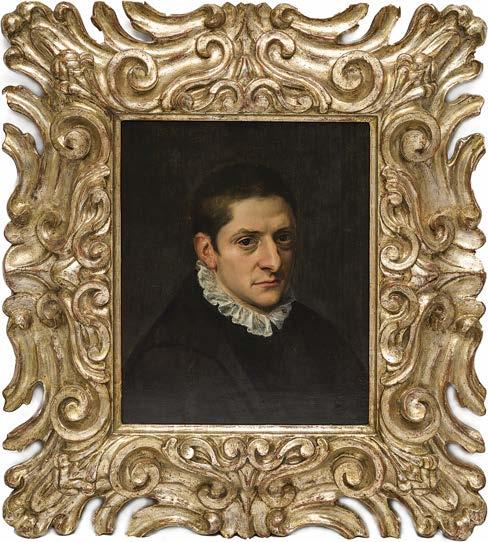
Manner of Antonio Moro (Dutch, 15191575)
Portrait of a Young Gentleman
Quarter length, wearing a dark tunic and white collar
Oil on cradled panel
51 x 42cm; 20 x 16 1/2in
£1,0001,500
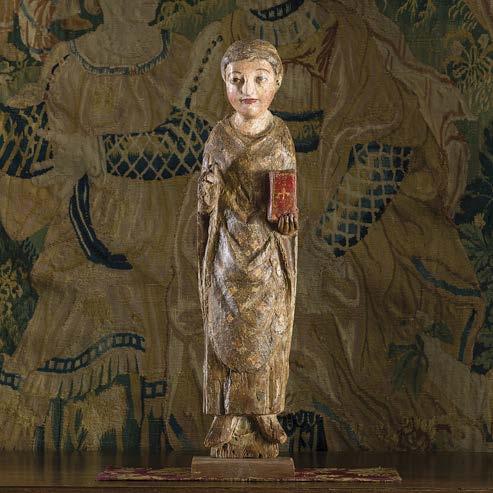
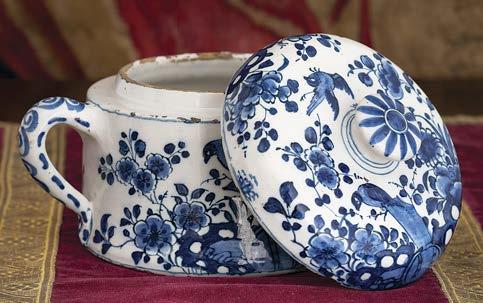
A Medieval carved limewood and polychromedecorated figure, St John the Evangelist, South German or Austria, circa 13801420
The saint is recognisable by his youthful features and the small red volume, enriched with a cross, as the author of one of the four Gospels held in his left hand, retaining remnants of original polychrome, including traces of red, gilding, and surface decoration that would once have enlivened the drapery folds.
The figure’s frontal, upright stance, with feet placed together and a gently idealised face, reflects the Gothic idiom of the late 14th to early 15th century, when devotional imagery sought to convey both serenity and divine presence. The relatively flatbacked form suggests the sculpture was created to occupy a niche or architectural setting, likely as part of a larger altarpiece ensemble.
H 60.3cm, W 14.6cm, D 8.3cm
£600800
397
A delftware twinhandled pot with cover, probably English, circa 16701700
A highly decorative and unusually wellpreserved example, painted in vibrant cobalt blue with flowering peonies, chrysanthemums, and songbirds amidst scrolling foliage, all within a dotted border pattern, the knopped domed cover similarly painted, the twin loop handles decorated with painterly blue dashes. The form and decoration place this rare piece at the crossroads between English and Dutch delftware production, when stylistic and technical exchange between London, Bristol, and the major workshops of Haarlem and Delft was intense. The bold blue palette and spirited brushwork suggest influence from Delft painters such as Frederik van Frytom, while the pot’s slightly creamy body and irontinged glaze suggest an English origin, perhaps Southwark or Lambeth.
H 14cm, W 21.6cm, D 14cm
£100200
398
Follower of Daniel Mytens (Dutch, 15901647)
Portrait of Sir Henry Hobart (c.1560–1625), Chief Justice of the Common Pleas
Bust length, wearing robes and a ruff collar
Oil on canvas, possibly cut down
49.5 x 43.5cm; 19 1/2 x 17in
Wearing the coif and black skullcap of a SerjeantatLaw
£400600
399
A delftware twinhandled lidded posset pot, Dutch, circa 170050
Of cylindrical form with twin loop handles and knopped domed cover, painted in cobalt blue with a continuous pastoral riverscape, a fisherman before distant mountains, trees, and sailing boats, the cover with matching scene and a stylised flowerhead within wave borders, the handles highlighted with blue dashes.
Most likely intended as a caudle cup or posset pot, a vessel for warm, mildly spiced drinks of wine, ale, or milk thickened with egg, sugar, and bread, commonly served for breakfast or to invalids. Comparable examples were also used for syllabub or custard, but the presence of a closefitting cover strongly suggests a purpose to keep contents warm.
H 12.1cm, W 19.1cm, D 12.7cm
£100200
400
A 16th century softwood and polychromedecorated figure, a kneeling nun, Italian, circa 156090
Retaining much of its original polychrome, this devotional figure depicts a nun in a posture of prayer, kneeling with one hand across her chest and the other resting open in humility, her habit and veil rendered with careful folds, emphasizing the austerity and dignity of religious life, a strand of rosary beads clearly visible at her side, an important attribute of piety.
The Rosary had become a defining devotional practice by the mid16th century, especially in the wake of the CounterReformation. It was seen as a powerful intercessory tool, and images of nuns with rosaries served as visual embodiments of prayer, penitence, and constancy in faith.
H 45.7cm, W 22.9cm, D 15.2cm
£200300
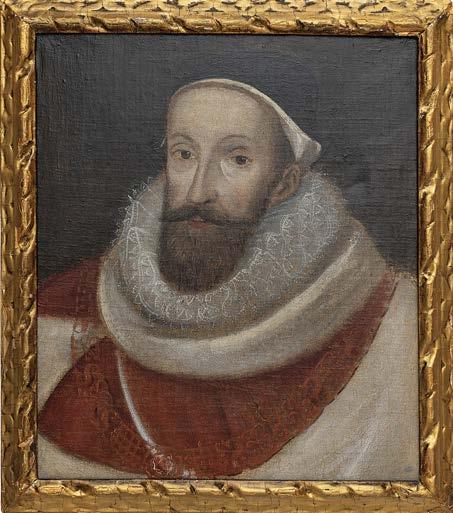
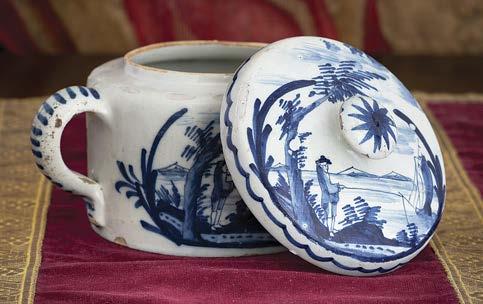
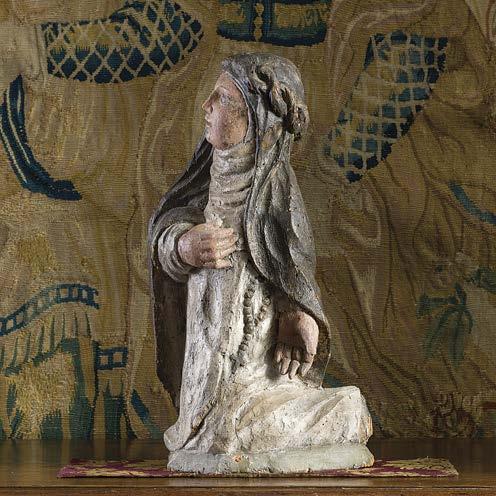
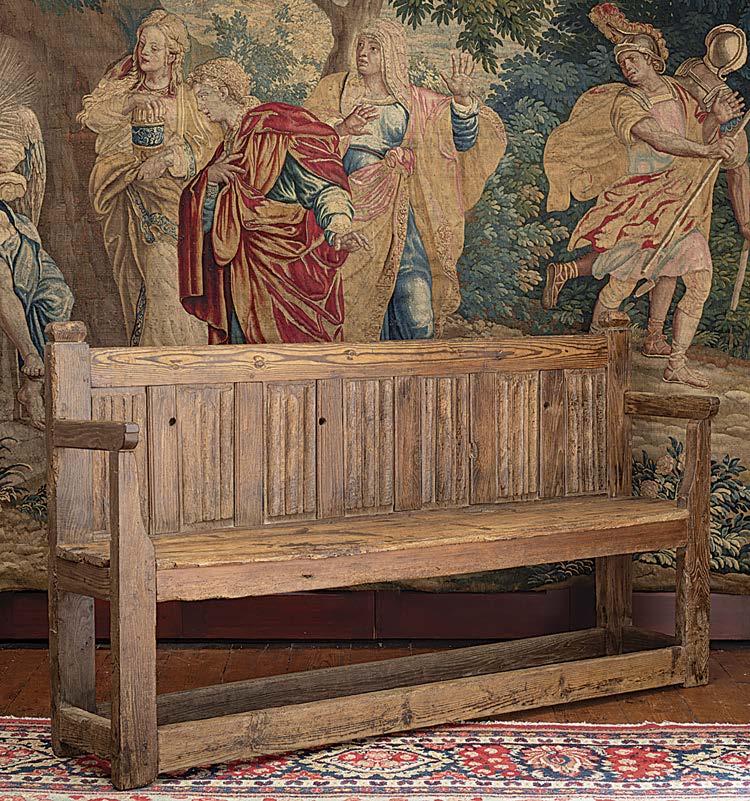
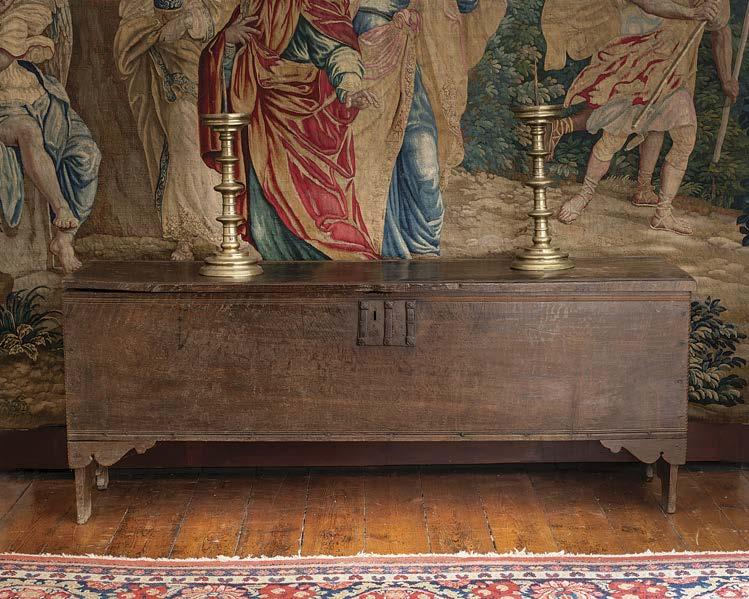
A late 15th century oak and pine linenfoldcarved settle, French, circa 1500
The back formed of seven deeply carved oak linenfold panels, set within a robust oak and pine frame, the end uprights terminate in shaped finials, while the flat arms rest on bold plain supports, their simplicity balancing the sculptural strength of the linenfold, the seat is fashioned from a single plank of pine, supported by a plain openbox base.
Benches of this monumental type would have served both liturgical and domestic functions. Their presence is recorded in monastic refectories, collegiate halls, and the great chambers of important households, where their length and upright presence marked them out as seating for status and community.
Provenance: Acquired direct from a monastery in Northern France.
H 99.1cm, W 178.4cm, D 39.4cm
£8001,200
An exceptionally large Henry VIII boarded oak chest, circa 1540
The hinged lid, plain front and sides with chipcarved ends, the end boards descending to cutaway Gothic trefoilshaped ends, large, original, wroughtiron strap hinges to lid.
The form, construction and detail correspond with the closing decades of the Gothic tradition in England. The trefoil feet, an unusual and archaic feature, place the chest firmly within the early 16thcentury idiom, while the robust ironwork and monumental proportions suggest a commission for a household of considerable status.
H 69.2cm, W 176.5cm, D 49.5cm
£600800
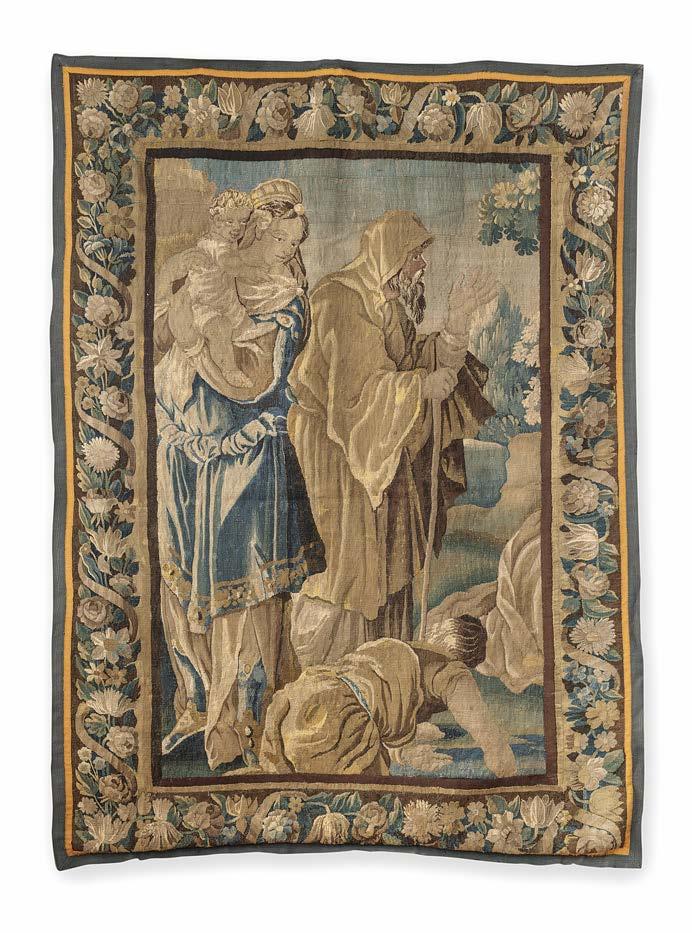
404
A pair of monumental 17th century silveredbronze pricket candlesticks, Flemish, circa 165080
Each with a broad, dished drippan and tall central pricket, atop a tapering ballribbed and invertedacorn knop stem, set on a triform base cast with cherub faces between bold ballandclaw feet. (2)
The heavy casting and traces of silvering reflect their intended role as prestigious ecclesiastical furnishings, combining both splendour and durability, firmly in the dramatic Baroque manner.
H 59.1cm, W 17.8cm, D 17.8
£8001,200
403
A 17th century Biblical tapestry panel, French, circa 165080
Woven in wool and silk, depicting a cloaked prophet or hermit addressing a richly dressed woman carrying a child, with attendants kneeling in reverence at the lower edge, the figures are rendered with expressive drapery and naturalistic modelling, all within a floral border of scrolling roses, tulips, and carnations, emblematic of abundance and renewal.
The composition suggests a biblical or allegorical narrative, possibly drawn from Old Testament or devotional themes, in which the central figure delivers guidance or prophecy.
H 210.8cm, W 156.2cm
£8001,200
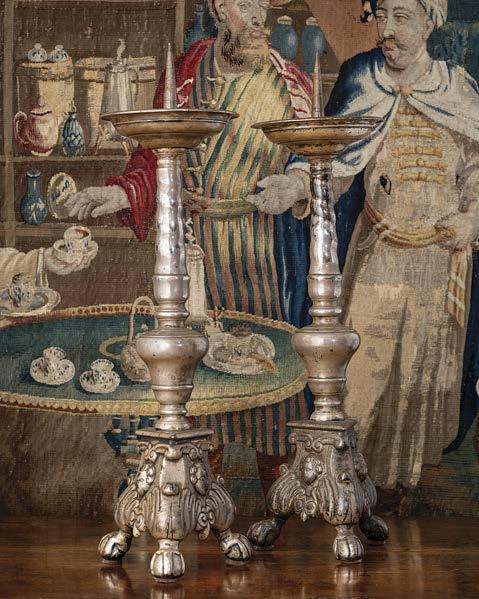
404
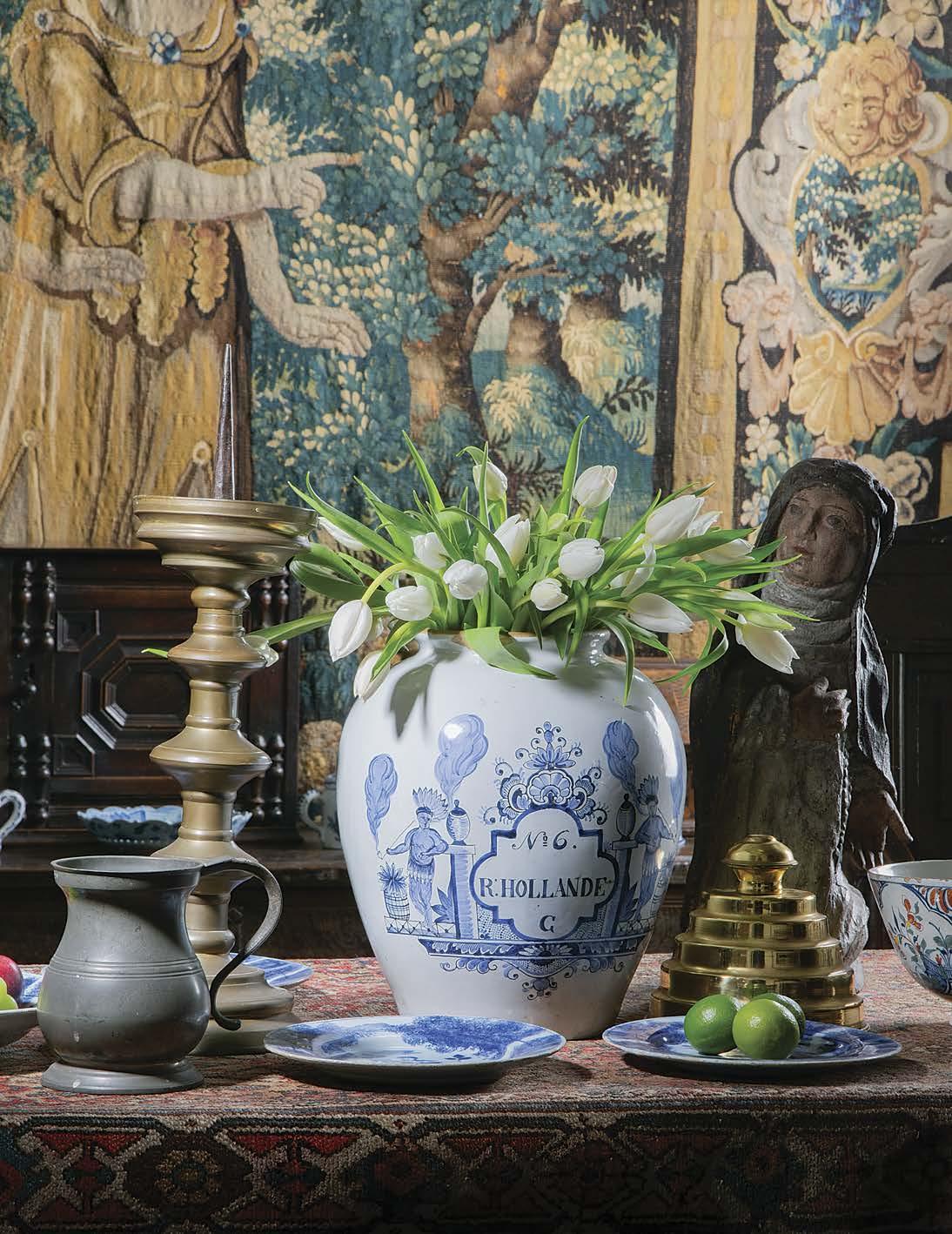
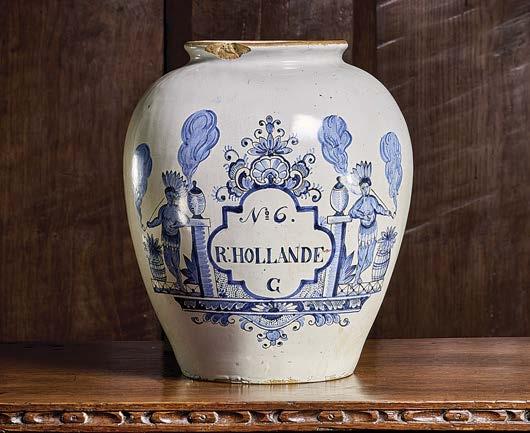
405
A delftware tobacco Jar, Dutch, possibly 18th century
Painted in cobalt blue with a central cartouche inscribed ‘No. 6 R. HOLLANDE G.’, framed by scrollwork, stylised foliage, and flanking figures of Native Americans in feathered headdresses, each holding smoking pipes. This type of jar was made for use in tobacconists’ shops, where numbered sets of jars allowed merchants to distinguish between different blends. The inscription R. HOLLANDE’ identifies a Hollandcut variety of tobacco, while the number six denotes its place within a larger shop inventory.
H 31.8cm, W 26.7cm
£200300
406
A delftware plate, Dutch, circa 170050
Painted in soft cobalt blue with a lively scene of two huntsmen spearing a boar in a wooded landscape before a turreted house, all within a band of loosely brushed trees under a cloudy sky.
Dia 22.9cm
£100200
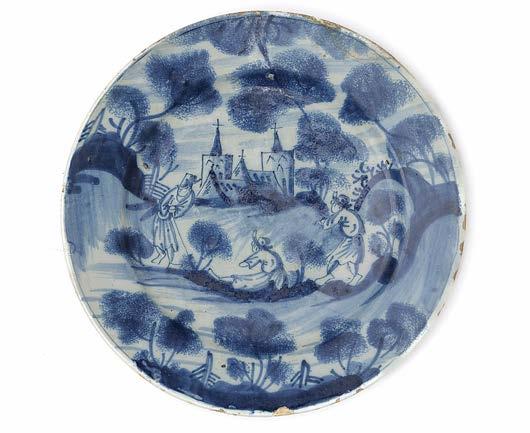
407
A set of five delftware plates, probably London in the Dutch style, circa 170050
Each painted in a bright cobalt palette, with a lady standing and holding leafysprigs within a hilly landscape, framed by sponged and stippled treemasses extending to the plain rim, narrow footrim. (5)
Dia 22.2cm
£400600
408
A delftware charger, Dutch, circa 16801720
Finely decorated in cobalt blue with a central starshaped reserve enclosing a Chinese figure within a stylised landscape of rocks and foliage, framed by a wide border of scrolling foliage and fruiting motifs, interspersed with roundels. The design reflects the influence of Chinese Kangxi porcelain (1662–1722), widely imported into the Netherlands during the late 17th century and avidly copied by Delft potters.
H 3.8cm, W 34.3cm
£120180
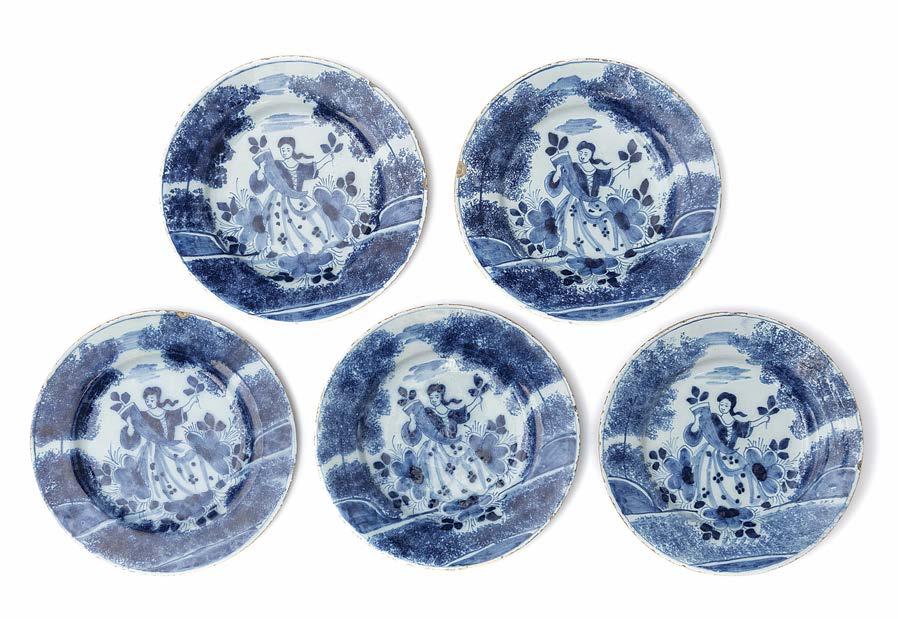
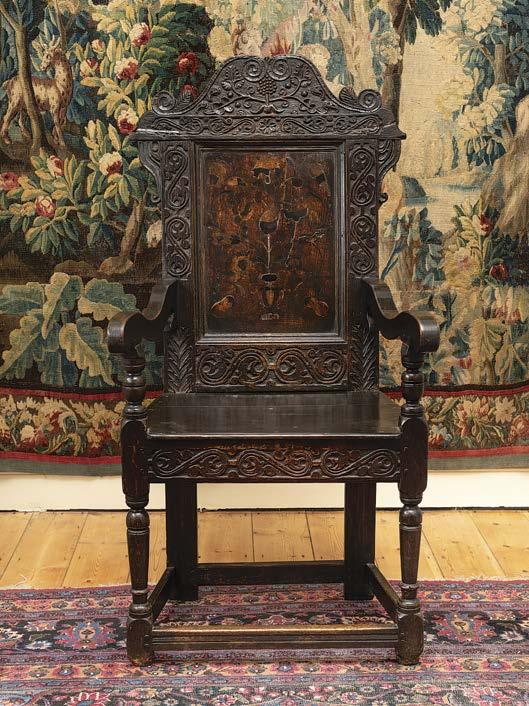
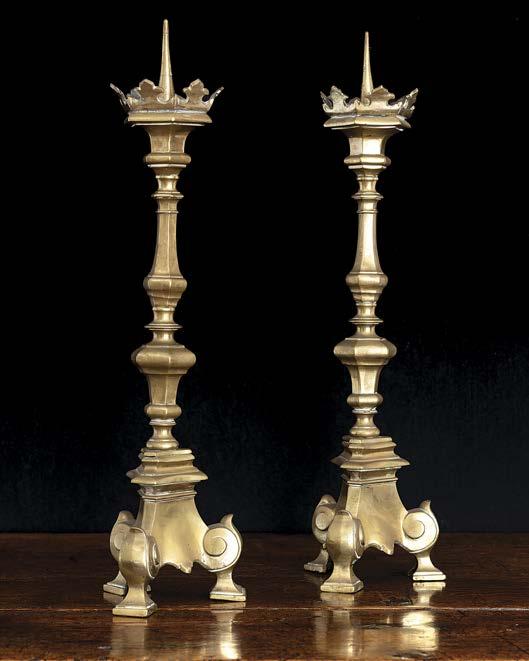
409
An impressive Charles I joined oak armchair, Leeds area, Yorkshire, circa 1640 Distinguished by its bold scale and elaborate carved and inlaid decoration, the back panel decorated with contrapartie marquetry of stylised flowers and pomegranates issuing from a vase, with traces of birds amongst the foliage, the tall arched cresting rail carved with scrolling foliage and a central daisyhead, flanked by voluted ears, the uprights and seat rails carved with Sscroll ornament, the downswept open arms on balusterturned supports, the boarded seat on balusterturned front legs, joined by moulded stretchers all round.
An armchair from the same group sold Bonhams, Chester, 24 May 2012, lot 231 (£18,750). Further comparable chairs illustrated V. Chinnery, ‘Oak Furniture: The British Tradition’, p. 428, figs. 4:114 & 4:115.
H 128.9cm, W 66.4cm, D 57.2cm
£2,0003,000
410
A pair of brass pricket candlesticks, Italian, circa 16801750
Each with a castellated drippan, in the form of a fleurdelys crown, atop a knopped and faceted stem, on a triform base with bold scrolling feet. (2)
The castellated drippans (one a/f) provide both a decorative flourish and practical means of securing large candles, while the triform bases echo the architectural vocabulary of the late Baroque period, reflecting the dynamism and grandeur of contemporary Italian church design.
H 58.4cm, W 16.5cm, D 16.5cm
£500800
411
A 17th century bronze cauldron, South German, circa 16501700
With a fine, even patination, of rounded bulbous form, with sharply defined shoulder and everted rim, it stands upon three splayed faceted legs each terminating in a small simple pad foot, twin angular lug handles, small founder’s mark or initials incised to the side of the body.
H 22.2cm, W 21cm
£200300
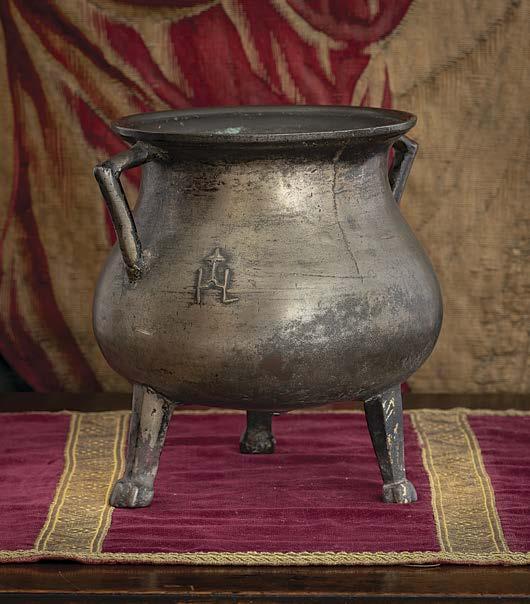
412
A Charles I joined oak armchair, South Wales/West Country, circa 163040
The design of the back panel dominated by a large central lozenge, filled with a carved rosette, surrounded by bullseye roundels and framed with leafy spandrels, the oversailing cresting rail carved with lunettes and additional bullseye decoration, the boarded seat on bicuspidshaped and carved rails, balusterturned forelegs and arm supports, plain lower stretchers.
The bullseye device is a popular motif in South Walian furniture in the 17th century. Concentric circles often carried an apotropaic meaning, serving as perceived protective devices against misfortune.
H 111.8cm, W 67.3cm, D 53.3cm
£600800
413
A pair of brass pricket candlesticks, Nuremberg, Germany, circa 1600
Each with a broad, stepped and domed base, a tripleknopped stem, and original wrought iron pricket set within a stepped drippan. (2)
H 43.8cm, W 6.1cm
£400600
414
A Charles II joined oak stool, circa 1660
Having an ovolomoulded seat, and runmoulded frieze rails, on turned invertedbaluster legs, joined by plain stretchers, bun feet.
Stools of this type were the most essential and ubiquitous seating furniture of the 17th century, appearing in inventories from farmhouses to great halls. Unlike chairs, which could be reserved for persons of status, stools were democratic in form, yet central to social life, used at both dining tables and parlours.
H 56.5cm, W 41.3cm, D 33cm
£200300
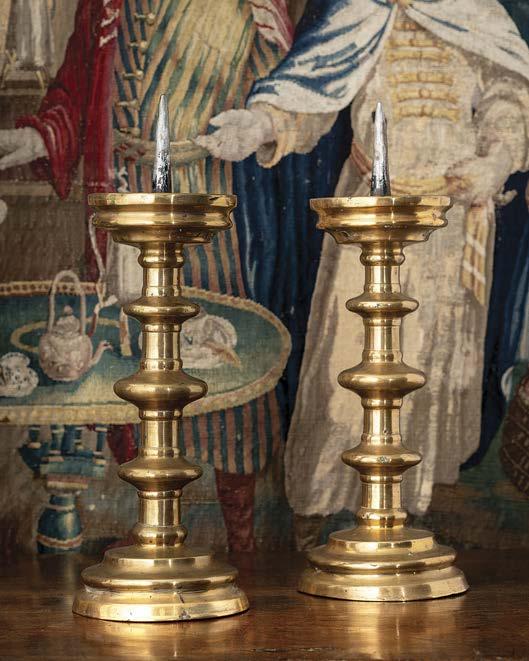
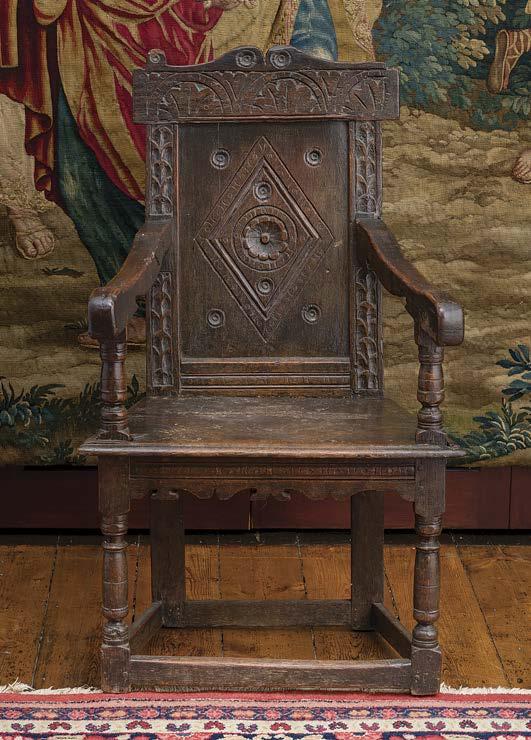
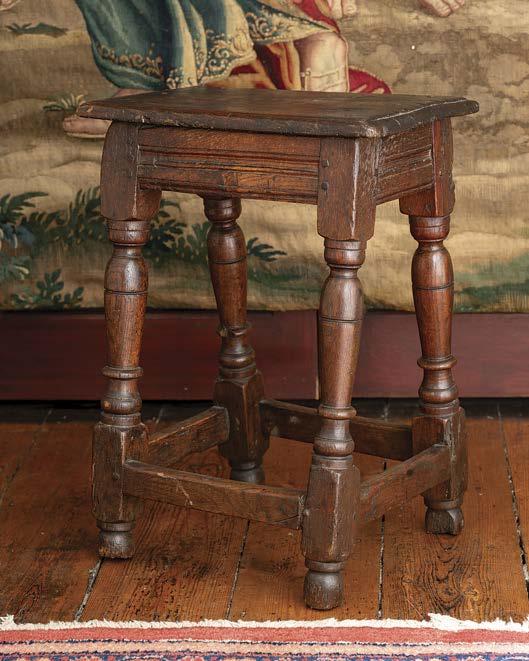
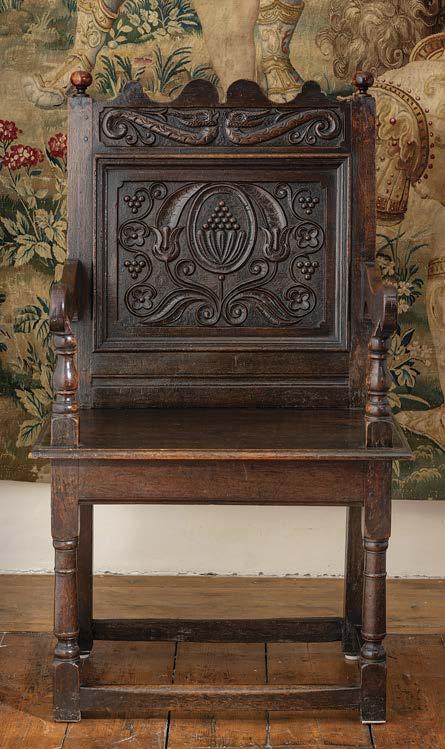
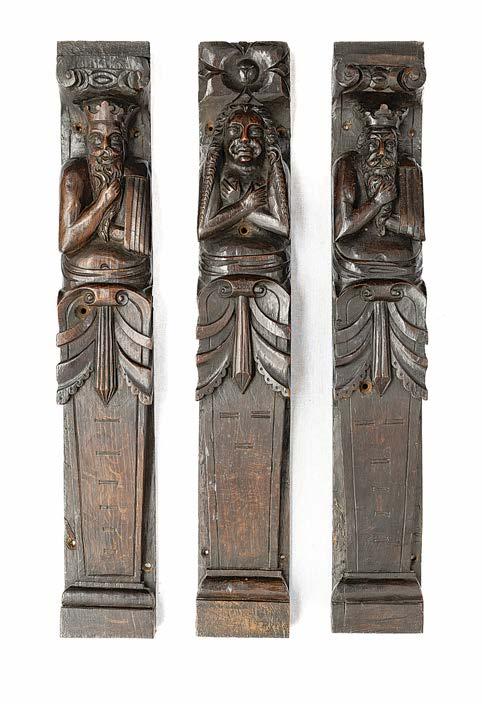
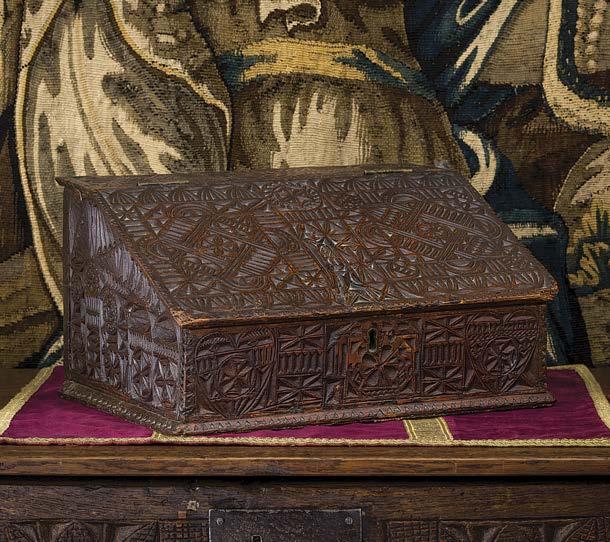
415
William Quick’s box: A mid17th century chipcarved oak boarded box, name inscribed, West Country or Welsh Borders, circa 1650
Densely carved throughout with geometric chipcarved ornament, the sloping lid, front and sides are designed with interlaced strapwork, lozenges and star motifs, the back board boldly incised ‘WILLIAM QUICK’, almost certainly the original owner.
Boxes of this type are particularly associated with Devon and Exeter, though the tradition of dense chipcarved ornament also flourished in Wales, where such pieces were often made as love tokens or personal gifts.
Victor Chinnery, Oak Furniture: The British Tradition, (2016), pp.142145, notes similar boxes were often the work of amateur carvers, not professional joiners, adding to their personal character and expressive quality.
H 21cm, W 39.4cm, D 29.2cm
£600800
416
A Charles II joined oak armchair, Lancashire, circa 1670
The back panel carved with a central oval medallion enclosing a stylised tulip with radiating seedpods, framed by scrolling foliate tendrils and fourpetal flowers, the doublescroll profiled cresting rail carved with a pair of addorsed dragonlike creatures, the uprights with later ball finials, with balusterturned front arm supports, boarded seat, and columnarturned forelegs joined by plain rectangular stretchers.
The symbolism of the back panel, the tulip and seedpods, conveys fertility, renewal, and continuity of lineage, resonant themes in the later Stuart period. The serpents on the frieze, often interpreted as guardians or protectors, appear on related examples in the V&A Museum (acc. no. W.521938) and in regional collections such as Towneley Hall, Burnley.
H 111.8cm, W 64.1cm, D 50.8cm
£400600
417
A set of three James I carved oak terms, possibly West Country or Midlands, circa 1620
Comprising two male kings and one female figure, each rendered with striking facial detail, both kings are crowned and bearded, while the female figure is shown with flowing hair and crossed arms in a pose of dignity and restraint, all on a carved pilasterlike base. (3)
The crowned kings embody earthly power and judgement, while the female conveys grace, wisdom, and stability.
H 64.1cm, W 10.2cm, D 5.1cm
£200300 415
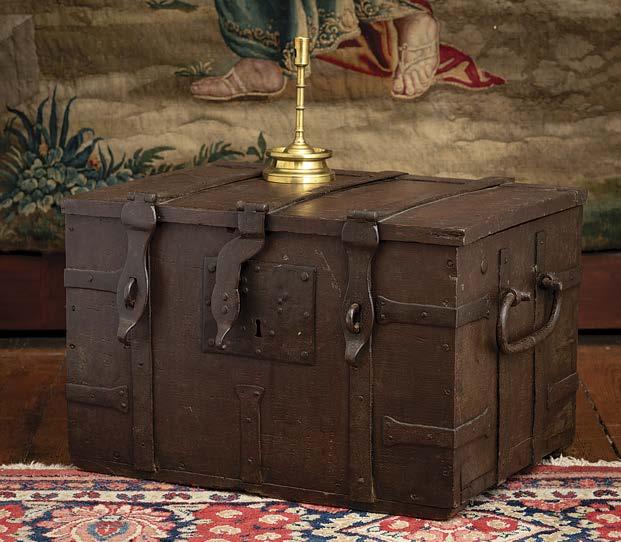
418
An early 16th century oak ironbound chest, with painted arms, Flemish, possibly Bruges, circa 150020
Constructed with heavy oak boards reinforced by broad iron straps and fitted with three hasp locks, substantial wrought iron carrying handles are mounted to either side, the lid retains rare traces of a painted coat of arms.
Such boxes were designed for the secure storage of money, documents, or valuables, and were often used in mercantile and civic contexts in prosperous trading centres such as Bruges. The presence of three locks, each requiring a different key, indicates a system of shared custodianship, typical of guild or municipal chests.
For a closely comparable example see the Museum Gruuthuse, Bruges, published in Valentin Vermeersch, ‘Meubles Flamands Anciens’, p.14.
H 39.4cm, W 61.6cm, D 45.7cm
£8001,200
419
A Charles I joined oak armchair, West Country, most probably Devon, circa 1640
The back panel is carved with an impressive largescale quatrefoil enclosing foliate sprays, the frame further enriched with moulded seat rails, while the plain lower stretchers are joined to columnarturned legs, their design repeated to the arm supports, single seat board.
H 106.7cm, W 66.7cm, D 50.8cm
£600800
420
A substantial pair of 17th century carved oak pilasters, with musicians, Netherlands, circa 1640
Each depicting a threequarter figure, holding a musical instrument, with expressive faces and flowing hair, atop a series of cascading foliate ornaments, including pendant flowerheads and acanthus leaves, terminating in bold vegetal sprays.
The iconography of musicians was a popular theme in 17th century Netherlandish decorative art, often symbolising festivity.
H 90.2cm, W 10.2cm, D 5.1cm
£200300
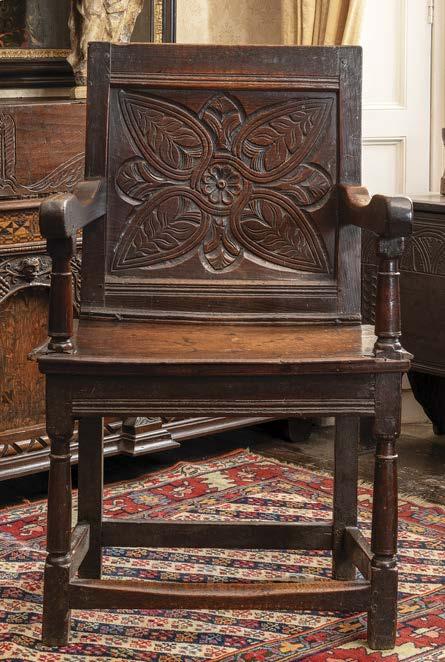
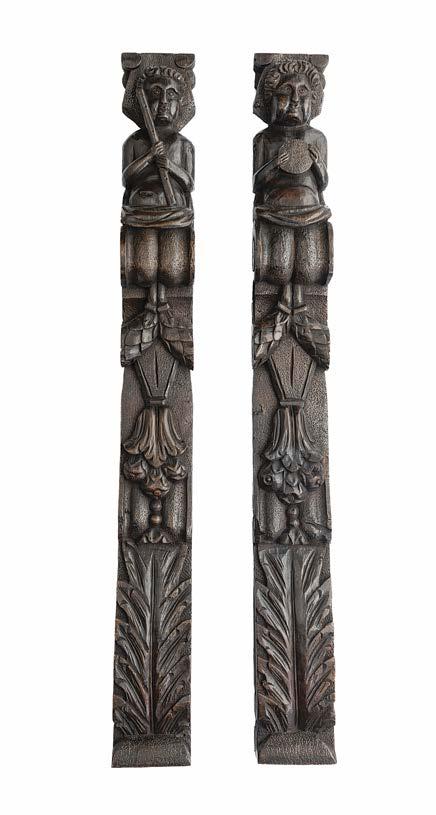
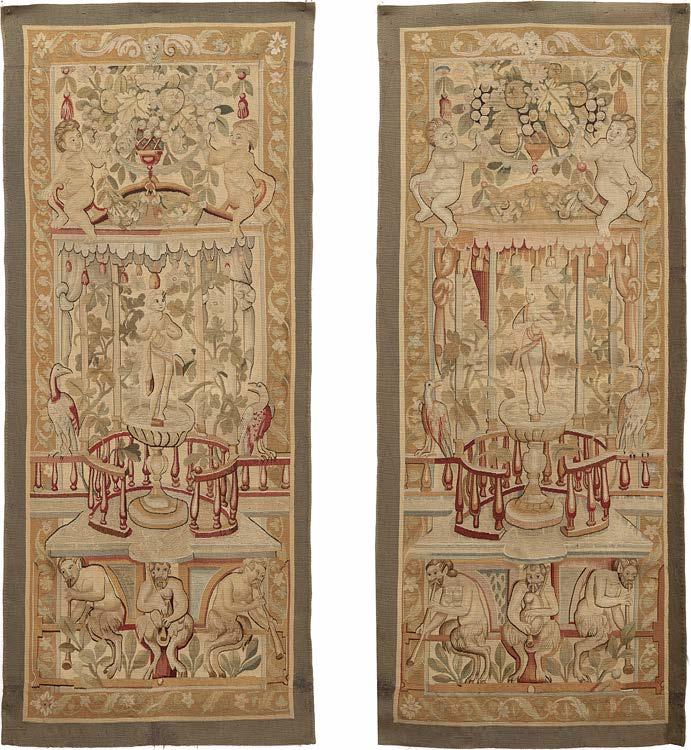
421
421
A pair of tapestry panels, Flemish, probably Oudenaarde/Enghien, circa 160050
Each panel centred by a pedestal fountain supporting a small nude figure, flanked by exotic birds perched upon a balustrade, above, wingless putti support festoons of fruit, emblematic of abundance, the lower register is ornamented with satyrs supporting the architectural framework, within a scrolling floral border with stylised foliage headed by a mask. (2)
These narrow vertical panels were designed for architectural settings, hung as door coverings (portières) or to flank larger tapestry hangings. Their fanciful vocabulary derives from Roman Grottesche decoration, rediscovered in the late fifteenth century and widely disseminated through prints by artists such as Jean Lemaire, Cornelis Floris and Cornelis Bos. Flemish centres including Oudenaarde and Enghien specialised in furnishing sets of this type, often exported across Europe.
H 170.2cm, W 73cm
£500800
422
A pair of monumental brass pricket candlesticks, Italian, circa 16501680
Each with a castellated drippan and tall pricket above a boldly knopped hexagonal stem, the triform bases powerfully modelled with deep scrolled feet, giving the candlesticks a strong sculptural presence. (2)
H 74.3cm, W 19.1cm, D 19.1cm
£300500
423
An elegant, matched pair of 17th century brass pricket candlesticks, Flemish, circa 1650
Each with steppeddomed circular base raised on ball feet, swelling baluster stem divided by discoids, wide drippans, and tall central prickets. (2)
H 30.5cm, W 11.4cm
£200300
424
A brass candlestick, North West Europe, probably Dinant, Belgium, possibly circa 1500
The bold socket pierced by rectangular extraction holes, atop a twin discoid knop and ribbed baluster stem, the twostage base with an integral driptray and short capstan foot.
See R. Butler, ‘A Study Collection of Marked Domestic Brass and Other Base
Metalware c. 1600c.1900’, p. 105, no. 228, for a Belgian candlestick dated 1500, with comparable stem.
H 21.6cm, W 12.7cm
£200300
425
A small group of decorative pictures, prints and engravings
To include, a 19th century watercolour, Thomas a Becket’s House, Tarring, Sussex, dated October 1878, 41 x 36.5cm; an interior of the Guildhall, Exeter, engraved print, 42 x 54cm; a pair of sporting engravings of pointers, 39.5 x 34.5cm; a set of coloured engravings, ‘London Views’, 25.7 x 20cm; a map of the British Isles: Anglia, Scotia et Hibernia, after Gerard Mercator 47.5 x 40cm; The Old Bridge, Exeter, etching or engraving, 49.5 x 43.5cm; and after J. M. W. Turner RA, Quayside, Exeter, engraving, 30 x 24cm. (11)
£100200
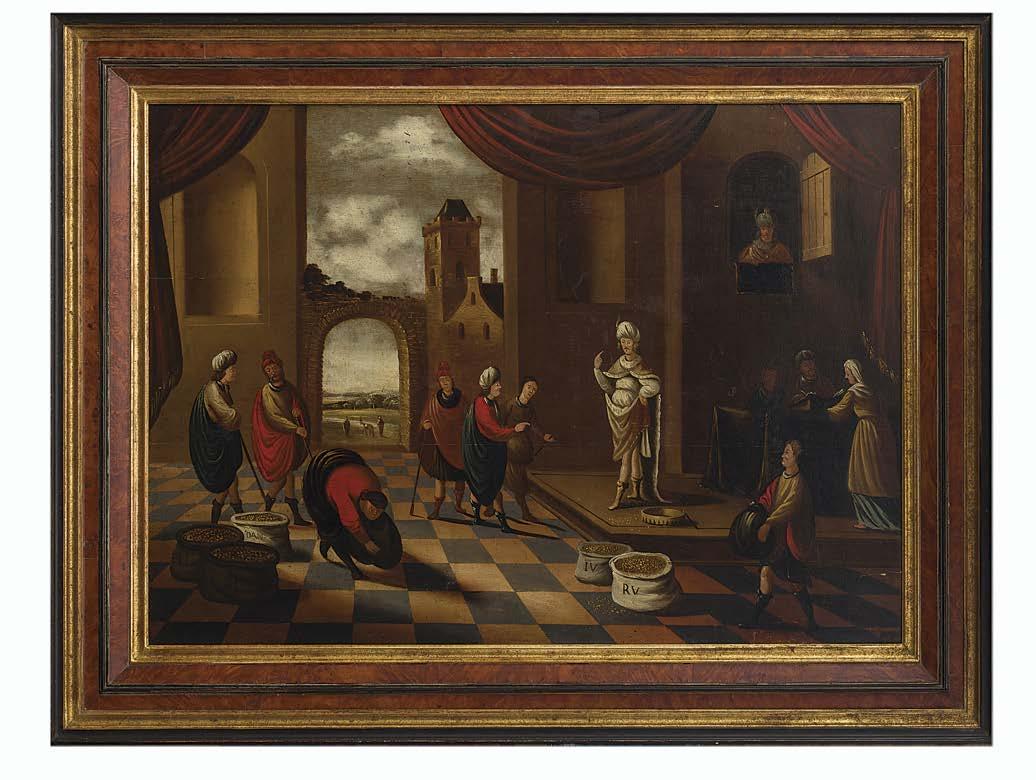
426
Follower of Jacob Willemsz. de Wet (Dutch, circa 16101675/91)
Joseph presents Jacob to the Pharoah in Egypt Oil on panel
60 x 83cm; 23 1/2 x 32 3/4in
£400600
427
A delftware charger, possibly English in the Dutch style, circa 170050
Painted in cobalt blue, centred by a lady, standing holding a floral cornucopia, possibly emblematic of Flora, within a stylised garden landscape, flanked by trees and fencing beneath a cloudy sky, with sponged detail, the lady wears a fullskirted gown.
Dia 35.6cm
£200300
428
A delftware charger, Dutch, circa 16801720
Decorated in the Chinoiserie style, with a central scene of figures in a garden landscape, the composition features richly foliated trees, pavilions, and stylised rocks, imitating imported Chinese porcelain of the Wanli and transitional periods, blue painted ‘PK 10’ to the base.
H 4.4cm, Dia 34.3cm
£200300
429
A brass socket candlestick, Italian, circa 170050
Having a tall cylindrical socket, and relatively flat driptray, raised on a turned baluster stem, supported on a stepped triform base upon three lion paw feet.
The lion feet reflects the Baroque fascination with sculptural vitality and symbolic power; lions, long associated with strength, guardianship, and divine protection, made these candlesticks particularly fitting for use on altars or within private chapels.
H 27.9cm, W 15.9cm, D 15.9cm
£200300
Two 17th century monochrome albarelli, Spanish, probably Talavera de la Reina, circa 165080
Each of tall waisted cylindrical form with slightly everted rims and plain moulded bands to the neck and foot, with a rich tinglazed blue ground, one plain skyblue, the other a deep mottled cobalt, the thick glazes exhibit the subtle pinholing, pooled edges, and slightly opaque, creamy surface associated with Spanish maiolica of this period. (2)
The bodies are thrown in a distinctive Hispanic waisted profile and marginally more robust at the shoulder than their Italian or Dutch counterparts. The bases reveal the typical buff earthenware fabric and glaze contraction of Talavera workshops.
Originally used in a pharmacy or monastic dispensary, their plain surfaces probably once carried paper or parchment labels identifying herbs, electuaries, or mineral compounds.
H 27.3cm, W 10.8cm
£200300
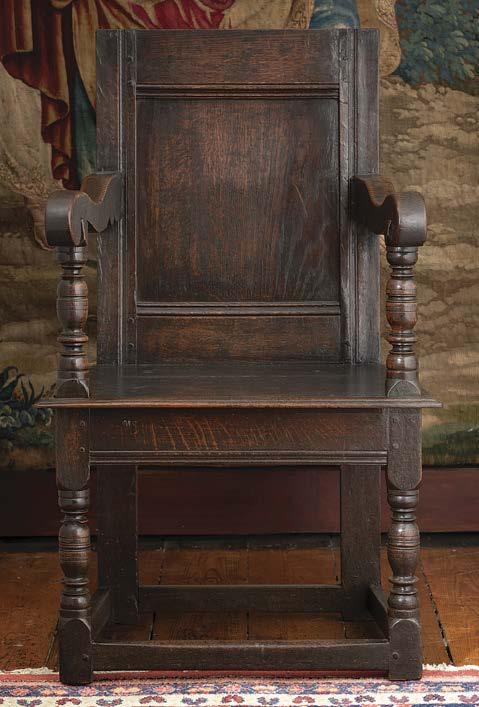
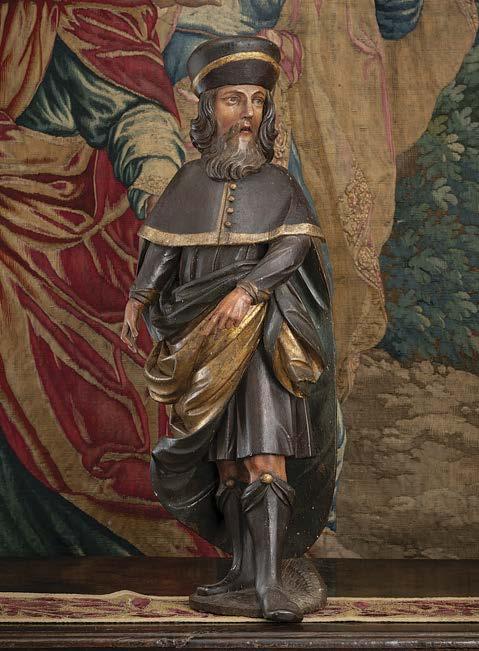
A Charles I joined oak armchair, West Country, circa 1640
Of simple, wellbalanced design, the back formed with a single large, fielded panel between moulded stiles, the arms sharply shaped and on robust balusterturned front supports continuing to the legs, joined by plain rectangular stretchers.
H 109.2cm, W 66.7cm, D 47cm
£400600
432
A 16th century carved oak and polychrome and giltdecorated figure, St Roch, German, circa 156080
The patron saint invoked against the plague, retaining its original Renaissance polychrome and gilding, is depicted as a youthful pilgrim, dressed in travelling boots and cloak with gold lining, and wearing the traditional broadbrimmed hat of the pilgrim, his right hand draws attention to his thigh, once painted with the saint’s identifying plague bubo, while his left holds the drapery.
The restrained palette of black, green, and gold reflects the sober style of late 16thcentury South German sculpture. St Roch was one of the most popular plague saints of Renaissance Europe and images of him were commissioned for altars, confraternities, and private devotion as acts of protection against epidemics.
H 74.9cm, W 25.4cm, D 22.9cm
£7001,000
433
A late 16th century carved oak panel, The Sacrifice of Isaac, Netherlands or North German, circa 15801600
At the centre Abraham raises a knife to slay his son Isaac, who kneels in submission, while an angel descends from the heavens to intervene, to the side stands the ram, which will serve as the sacrificial substitute, the scene framed within an architectural arch with pyramidal bosses.
This subject, drawn from Genesis 22, was a favoured theme of the Renaissance, embodying absolute faith and obedience to God, while prefiguring the sacrificial death of Christ. The compact format suggests use as a domestic devotional panel or as part of a larger ensemble.
Provenance: Wernigerode Castle, Harz Mountains, SaxonyAnhalt, Germany.
H 34.3cm, W 24.1cm, D 1.3cm
£100200
434
A 17th century brass pricket candlestick, Italian, circa 16501700
With a stepped triform base on three ball feet, supporting a slender baluster stem, wide dished drippan, and tall pricket for securing a substantial candle.
H 40.6cm, W 14.6cm, D 14.6cm
£100200
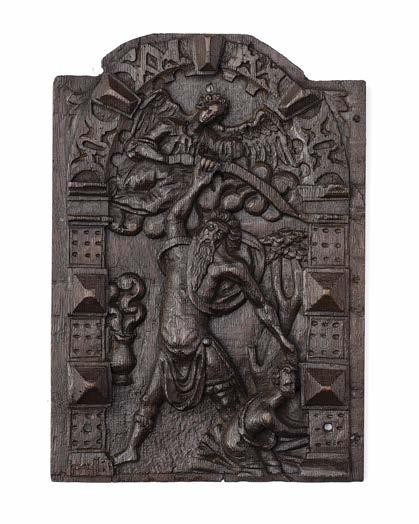
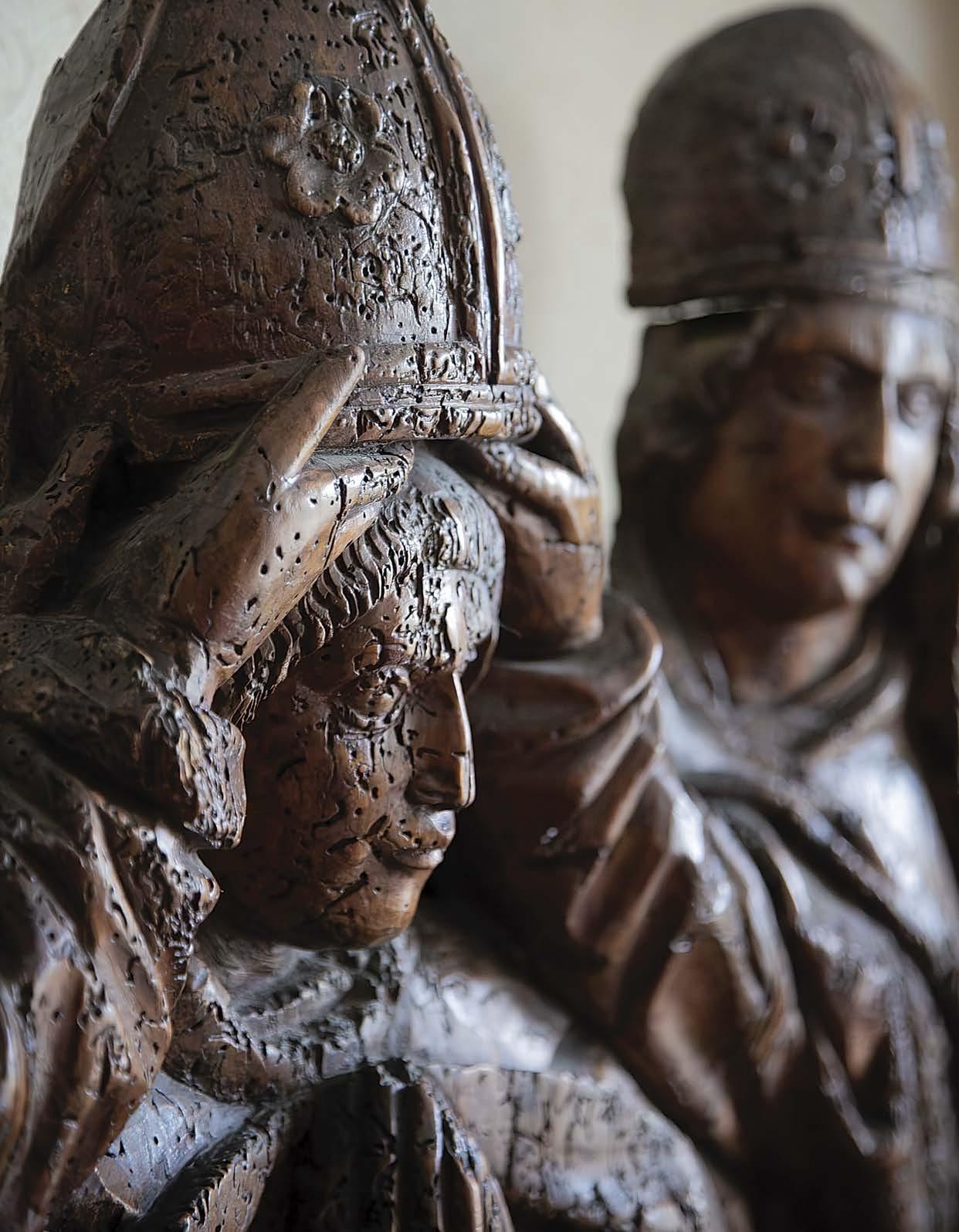
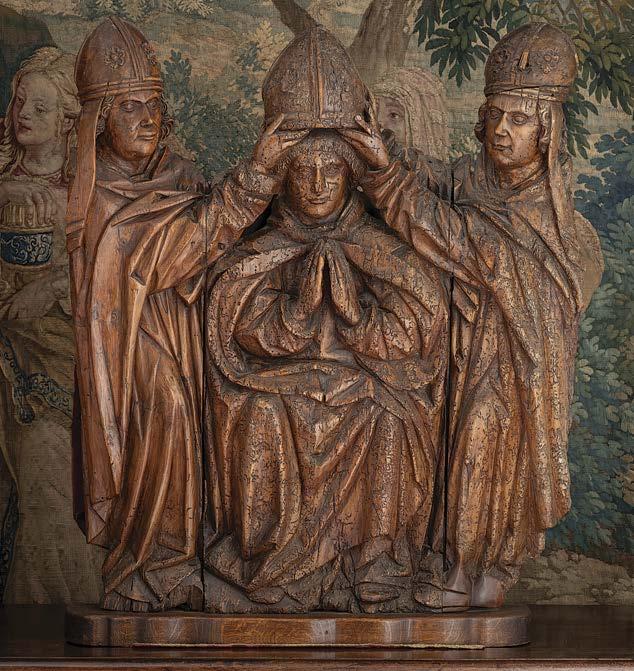
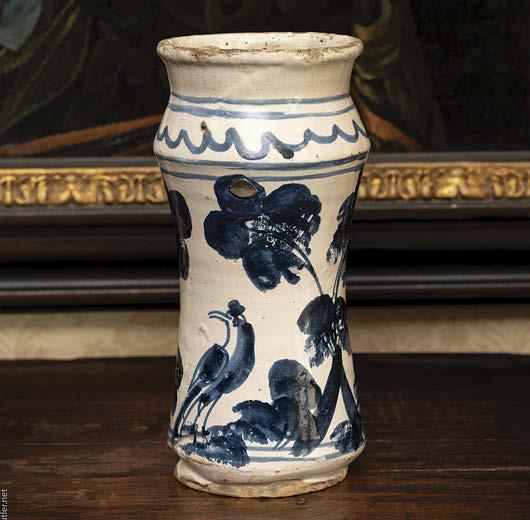
A Spanish albarello, mid18th century
Of cylindrical waisted form, painted in blue, with birds perched among stylised foliage and trees.
H 24.8cm, W 11.4cm
£200300
A monumental late 15th century carved oak figure group, Consecration of a Bishop, FrancoFlemish, circa 14801500 This large and powerfully sculpture shows three mitred ecclesiastics, the central figure kneeling in prayer, hands joined in devotion, while two assisting bishops place a mitre upon his head, the drapery is rendered in deep rhythmic folds, cascading in angular planes, the figures wear full episcopal vestments with chasubles and stoles, their faces sensitively modelled with downcast, contemplative expressions.
The composition likely formed part of a major altarpiece ensemble, perhaps illustrating the Consecration of St Augustine or another episcopal saint, a subject popular in Brabant and Flanders during the final decades of the fifteenth century. Comparable examples of similar scale and style survive in the Musée des BeauxArts, Dijon and the Cathedral Museum, Tournai, where the dynamic drapery, elongated proportions, and intricate undercutting exemplify the transition from the late Gothic toward early Renaissance naturalism.
H 100.33cm, W 81.3cm, D 15.2cm
£1,2001,800
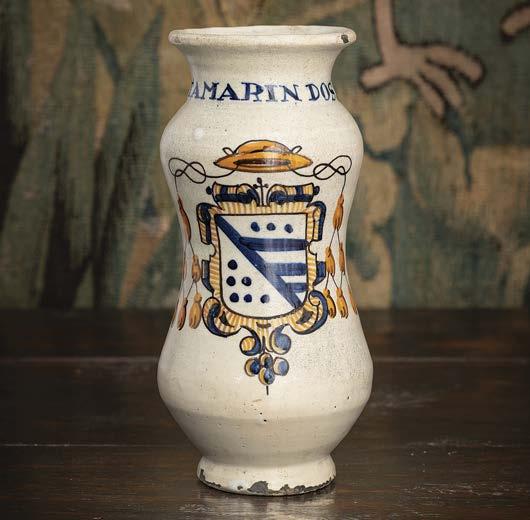
An 18th century style Spanish albarello, Talavera, probably 19th century
Of cylindrical waisted form, with everted rim and narrow foot, painted in cobalt blue and ochre, with a Bishop’s coat of arms, the collar inscribed ‘TAMARIN DOS’ (tamarind fruit), probably used as a laxative.
H 24.8cm, Dia 10.8cm
£80120
A substantial Henry VIII oak boarded chest, circa 151030
The front deeply carved with a series of large, interlaced lunettes containing Gothic tracery and floral boss, set around a central roundel, the wroughtiron lock plate, though old, appears a period replacement, with large front scrollprofiled spandrels (one replaced), the sides extending to cutaway supports.
The carved design bridges the late medieval taste for architectural tracery with the emerging decorative vocabulary of the Tudor period.
Early 16th century boarded chests with true elaborate tracery are scarce survivals. They were intended not only for storage but also as important statements of household wealth, to be positioned prominently within a hall or chamber.
H 74.9cm, W 138.43cm, D 48.3cm
£3,0005,000
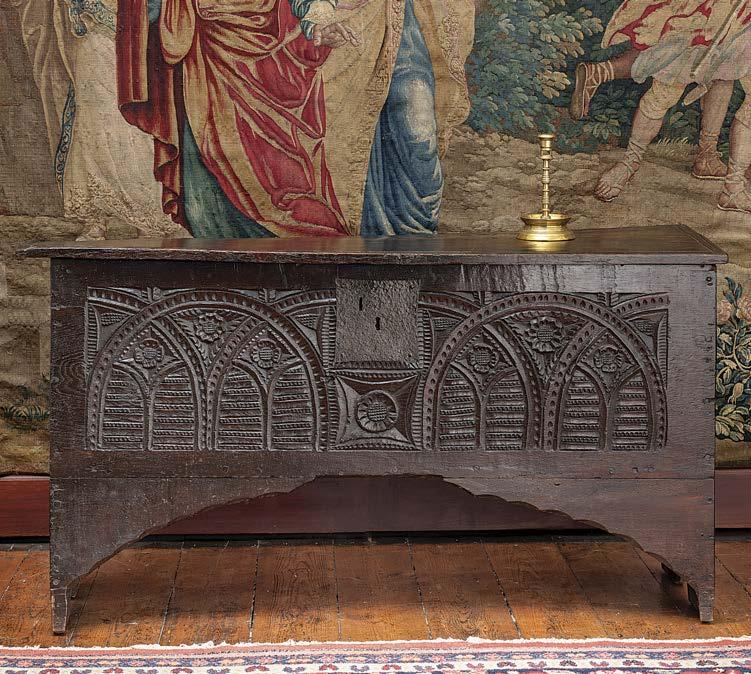
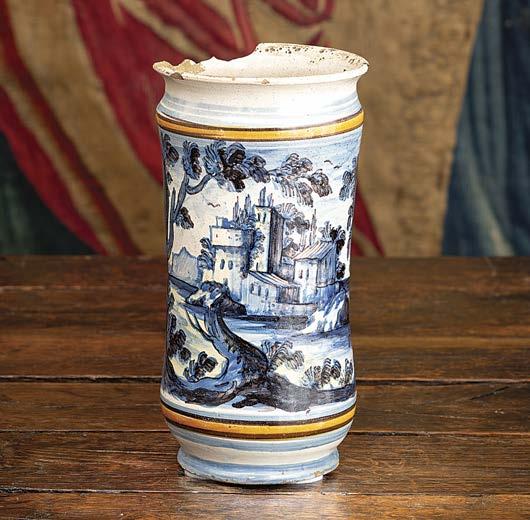
439
An Italian maiolica albarello, possibly Naples, dated ‘1738’
Of tall, slightly waisted, cylindrical form, the front decorated with an architectural landscape, a fortified town by a river, with trees and rolling hills in the background, the reverse dated ‘1738’, the rim and base with ochre bands.
H 21.6cm, Dia 10.8cm
£100200
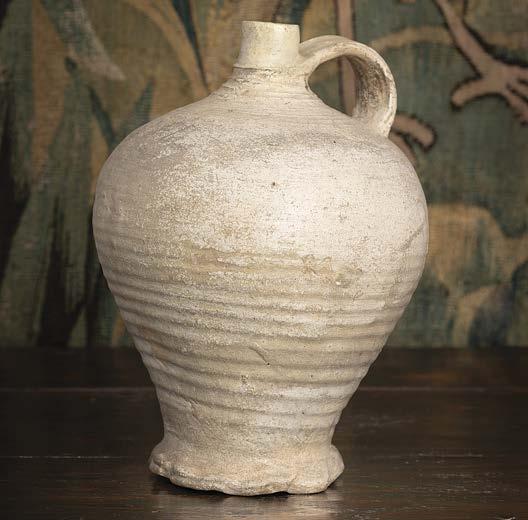
440
A 15th century stoneware jug, probably Siegburg, Germany, circa 14601500
Of elegant ovoid form tapering to a narrow, short neck, next to a strap handle, the whole with a pale greywhite ash glaze and characteristic horizontal throwing rings, the gently spreading flanged foot, formed by the potter’s hand at the wheel, identifies this as part of the Siegburg tradition of stoneware manufacture active along the Rhine in the later 15th century.
H 29.2cm, Dia 21cm
£100200
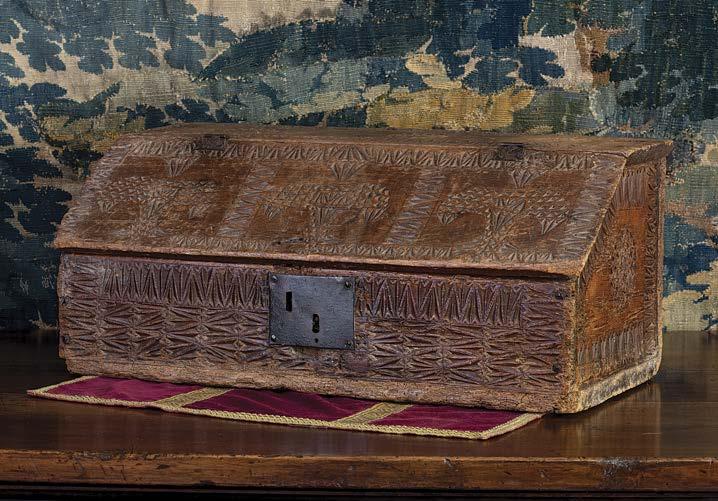
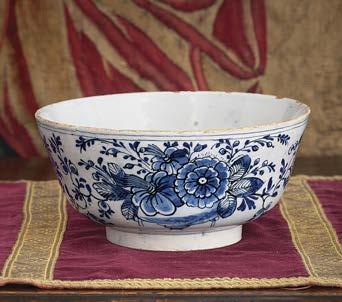
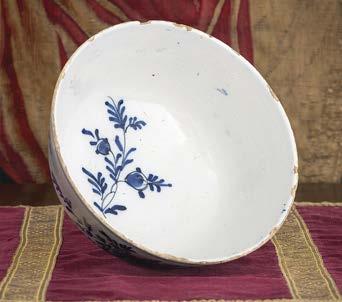
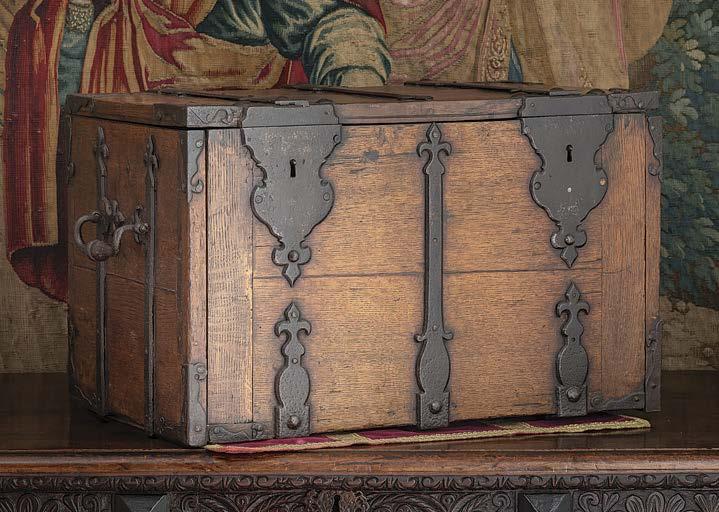
441
A mid17th century pine boarded, chipcarved, desk box, English, circa 165060
The front, sides, lid, and top boards all richly ornamented with chipcarved decoration, the geometric patterns include chevrons, lozenges, radiating starbursts, and unusual stylised motifs resembling significantly doubleheaded eagles.
The doubleheaded eagle is a potent emblem in European heraldry, deriving from the Byzantine and Holy Roman Empires, signifying dominion over East and West and hence the enduring authority of Empire. Its presence here, rendered through the hand of a vernacular carver, may carry resonance as a symbol of continuity in unsettled times, a discreet allusion to sovereignty during the periods of the English Commonwealth and the Restoration. Or, simply as an apotropaic belief that the powerful repetitive patterns could guard the contents within.
H 27.9cm, W 65.4cm, D 34.3cm
£300500
442
A delftware bowl, London or Bristol, circa 170050
With relatively straight, flared sides, on a short footring, the exterior painted in cobalt with bold floral splays and ancillary leaves and berries, the interior with a single sprig below a plain rim line.
H 10.8cm, Dia 22.2cm
£150200
443
A late 17th century oak and ironmounted strong box, possibly English, circa 166090
Of rectangular form with elaborate pierced and shaped iron straps, corner mounts and lock plates, robust iron side handles and hinges, originally veneered externally, probably with contrasting figured woods, likely walnut or kingwood, the plain exterior now revealing fine quality carcase joinery, the hinged top opens to reveal a fitted interior with a fallfront and two small drawers below, designed for documents, coin, or personal valuables, surviving interior veneers and gilt brass drawer pulls provide an evocative glimpse of its original splendour.
H 38.7cm, W 61cm, D 38.7cm
£600800
444
An early 17th century oak strongbox or document casket, with wroughtiron mounts, Flemish, circa 160040
Of rectangular form, with a moulded, slightly overhanging lid and deep stepped plinth, all upright corners fitted with wroughtiron angled brackets, with decorative terminal, iron drop carryinghandles to each end, the ironwork fixed with roseheaded nails, several neatly clenched on the interior.
H 19.1cm, W 41.3cm, D 29.8cm
£300400
445
A large and impressive delftware punch bowl, probably Dutch, circa 170050
Painted in cobalt blue, the deep rounded sides rising from a short foot, the exterior decorated outside with a dense floral design of peonies and foliage, the interior centred by a bold sunflower and a band of socalled ‘insects’ to rim.
Bowls of this impressive size were luxury tableware, used for syllabub, posset, or a mixed punch for festive group gatherings.
Provenance: With Aronson, Amsterdam, and Guest & Gray, circa 1994.
H 18.4cm, Dia 34.9cm
£8001,200
446
A large Charles II carved oak salt box, circa 1660
The tall backboard is enriched with nulling, whilst the front is boldly decorated with a repeating arcade of floral lunettes set against a crosshatched ground, with hinged sloping lid and shaped boarded sides.
The deep, capacious body was designed to hold coarse rock salt.
H 43.8cm, W 47cm, D 17.8cm
£400600
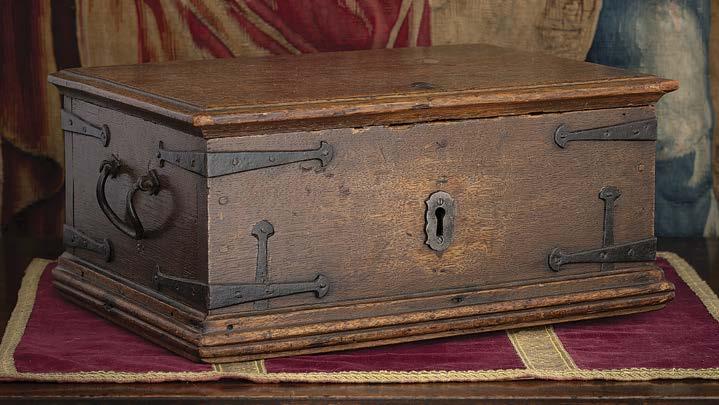
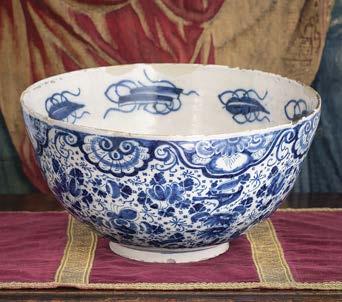
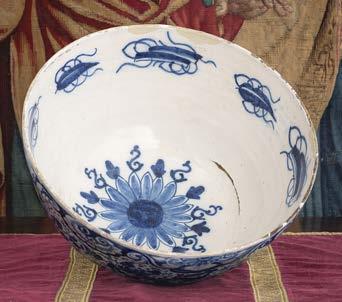
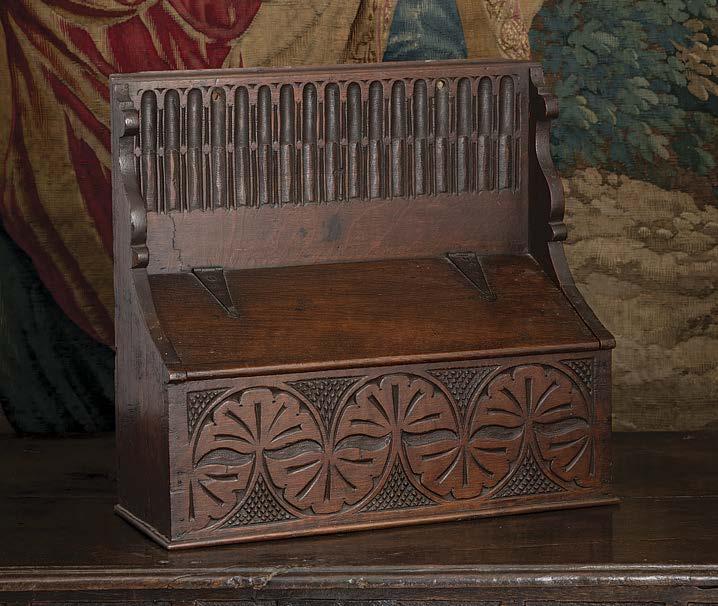
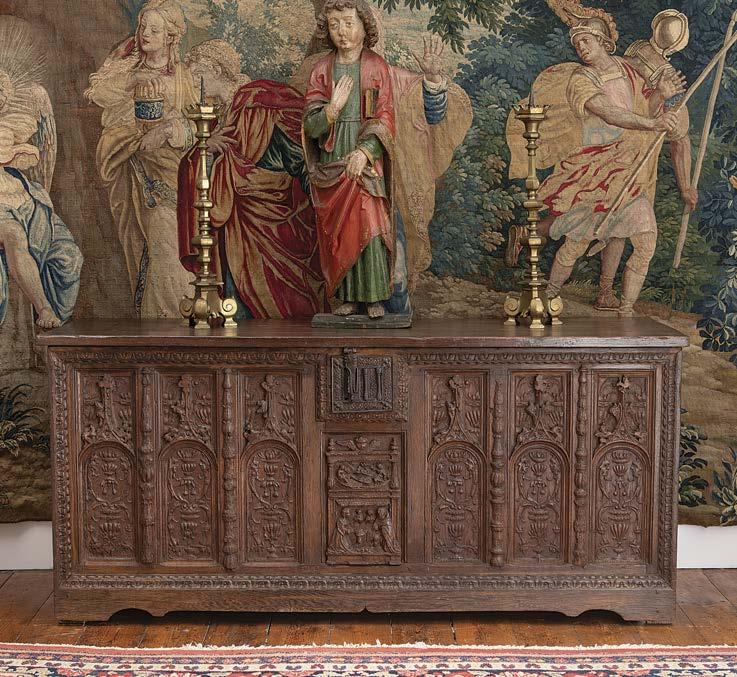
448
A set of four Elizabeth I carved oak panels, circa 15801600
Each centred with a roundel enclosing an angel bust with folded wings, all with subtly different facial treatment, yet all by the same workshop, the surrounding design consists of rectilinear and cartouche Mannerist strapwork, formed of scrolls, moulded bars, and pyramidal boss, enriched with a punchdecorated ground. (4)
H 43.2cm, W 26.7cm, D 1.3cm
£200300
447
A magnificent early 16th century carved oak chest, French, circa 151030
The front with six grotesquecarved panels, filled with fantastical beasts, birds, and scrolling ornament, applied crockets frame the design, reinforcing the strong Gothic inheritance of the piece. At the centre, below the fine iron lockplate and hasp worked with a winged dragon, is a wellcarved Nativity scene, its figures set beneath an architectural canopy, unusually the panel above depicts a boat at sea, a highly symbolic subject in early 16thcentury devotional art, evoking pilgrimage, salvation, or the Church itself as a vessel of faith. Together, these narrative carvings elevate the chest beyond the purely decorative into a profound statement of piety and learning, the sides are carved with twin linenfold panels.
A closely related example, though with Gothic tracery rather than grotesque carving, is illustrated in Jacqueline Boccador, Le Mobilier Français du Moyen Âge à la Renaissance, p. 32, described as a ‘coffre d’apparat ou de mariage’ in oak.
H 83.2cm, W 181.61cm, D 62.5cm
£3,0005,000
Three early 17th century oak panels, West Country, probably Exeter, circa 160040
Two of intersecting strapwork design, incorporating floral rosettes, the third, again with part strapwork and foliate sprays; together with a ‘pomegranate’ floral applique. (4)
Largest H 26.5cm, W 28cm
£100200
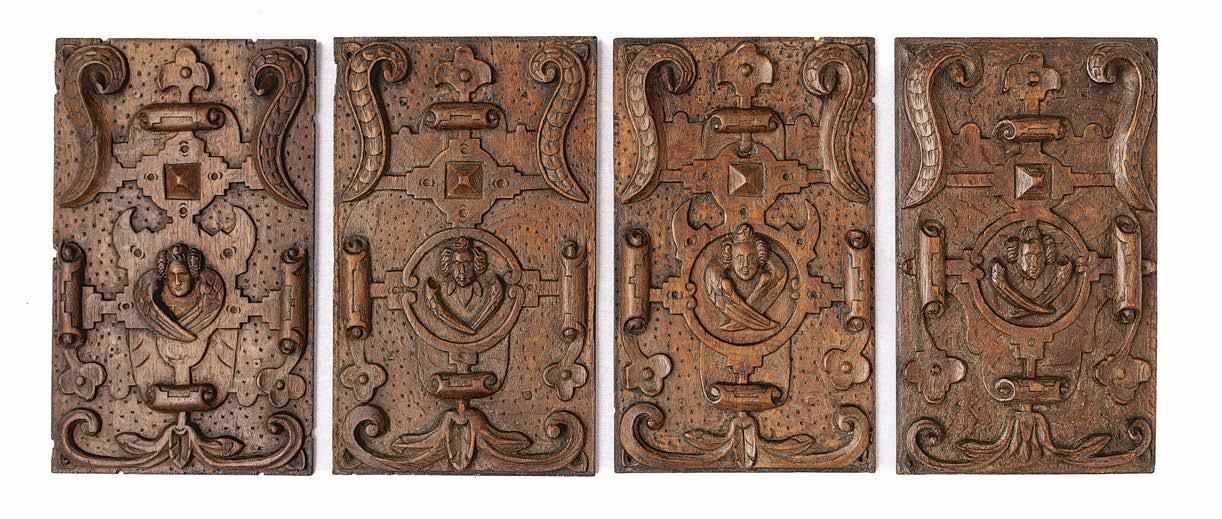
450
A Bidjar rug, Persian Kurdistan, circa 1910
The indigo lattice field of flowerheads enclosed by madder borders.
L 212cm, W 129cm
£50100
451
An oak livery cupboard, with open undertier, FrancoFlemish, circa 14801520
Of compact architectural form, the uppersection with a central boarded door, atop a small door, each carved with Gothic blindtracery, mounted with finely decorated pierced lock plates and wroughtiron strap hinges, flanked by fixed tracerycarved panels, the top register includes bold fleurdelys motifs, the sides are enriched with deep linenfoldcarved panels, standing on extended stile supports joined by a boarded open base.
The cupboard survives in remarkable condition, with original ironwork, and tracery and linenfold panels of crisp high quality. A related example was sold at Coronari Auctions, Belgium, 29th November 2023, Lot 494, (€38,250).
H 146.7cm, W 111.1cm, D 51.4cm
£1,0001,500
452
A pair of 16th century lavishly carved oak panels, Flemish, circa 15501600
Carved in high relief with allegorical female figures set in abundant garden landscapes, one panel depicts a classically draped lady seated beside fruitfilled cornucopia, its fruits spilling forth, surrounded by trees laden with fruit, flowers in bloom, and gourds strewn along the ground, all reinforcing themes of fertility and harvest. The second panel presents a more animated figure, a lady holding a mirror in one hand while adjusting her hair with the other, framed by richly curling foliage, attended by a lively putto, while beneath her crouches a griffin. The mirror on one hand is emblematic of Vanity (selfregard) and on the other of Prudence (selfknowledge), symbolising vice overcome by wisdom. (2)
H 41.3cm, W 48.3cm, D 2.5cm
£400600
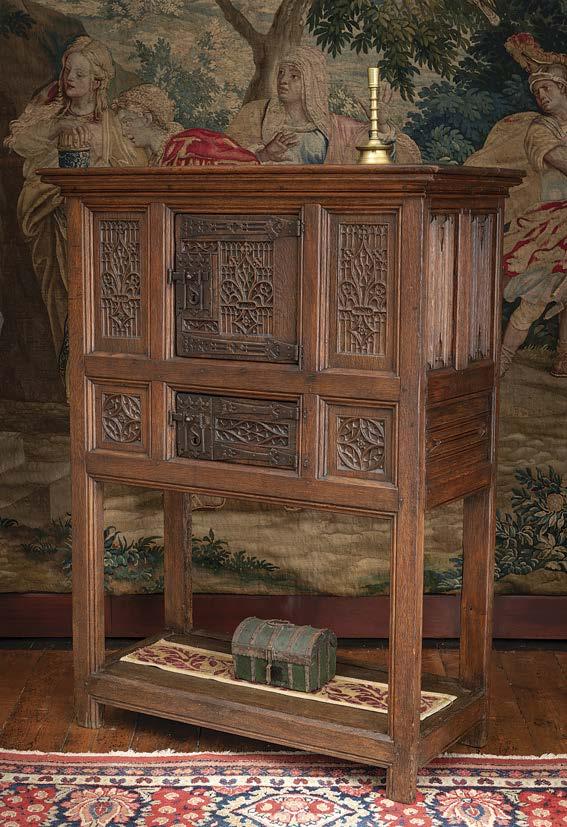
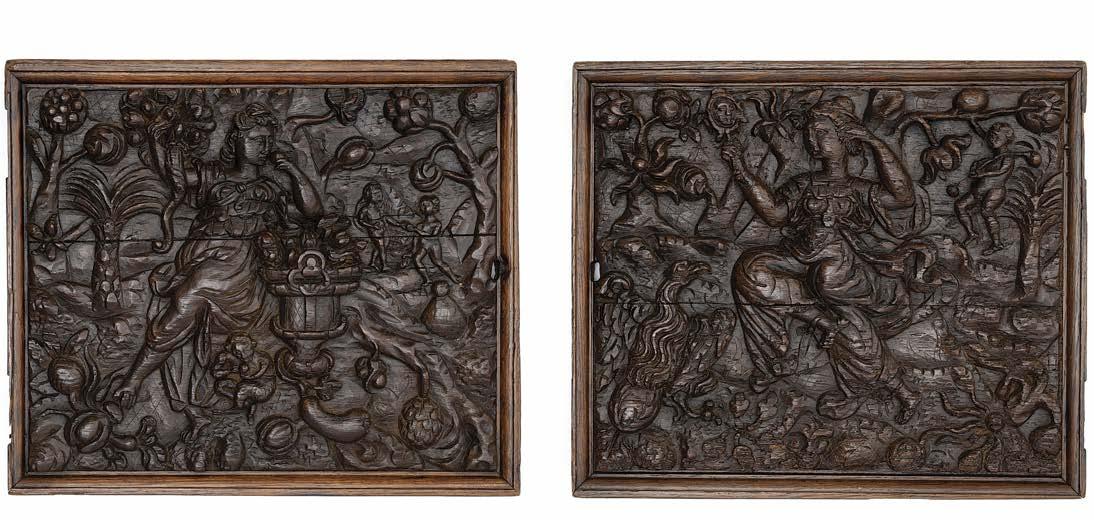
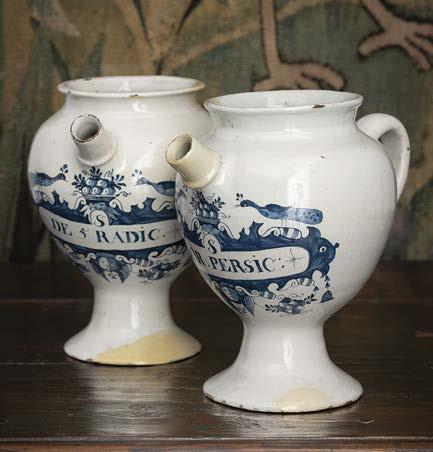
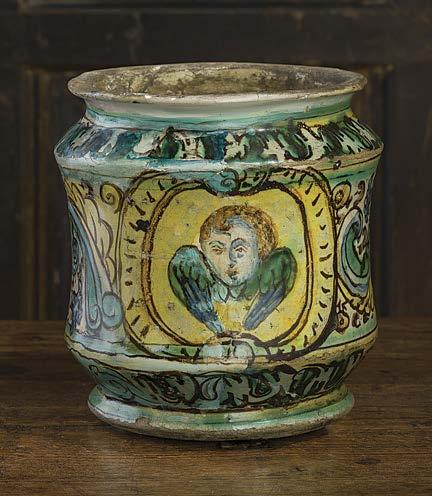
A near pair of early 18th century delftware apothecary syrup jars, Dutch, circa 170050 Each with globular body on a spreading foot, applied with a broad strap handle opposite a short spout, painted in cobalt blue with a strapwork label, one inscribed ‘S • DE. 5. RADIC’ (root preparation), the other ‘S • FLOR. PERSIC’ (peach blossom syrup), each label within an elaborate cartouche, headed by paired peacocks and centred by fruit filled baskets, with winged cherub mask below. (2)
H 22.2cm, W 15.9cm, D 25.4cm
£300500
A mid16th Italian maiolica albarello, possibly Faenza, probably early 17th century Of squat, cylindrical, waisted form, decorated in vivid polychrome with winged putti cartouches against scrolling foliate ornament, black painted ‘542 12.’ to the base.
H 20.3cm, Dia 19.1cm
£300500
455
A set of three delftware plates, possibly Bristol, circa 16801720
Each painted in manganese and green with a large bunch of stylised grapes surrounded by meandering budding vines, blue painted ‘2’ or ‘Z’ to the base. (3)
Dia 22.2cm
£300400
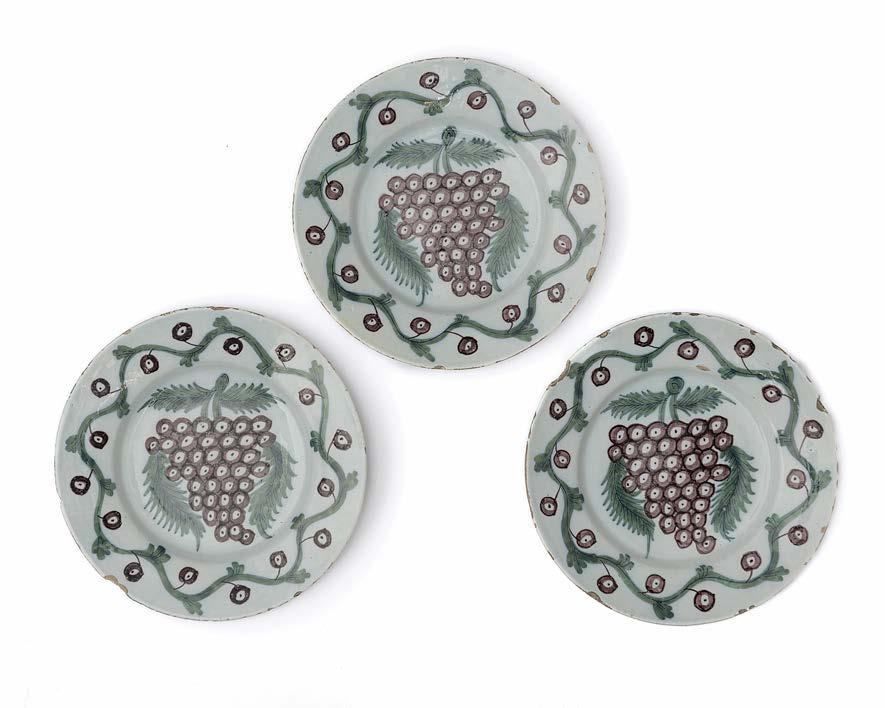
A rare delftware ‘ink well’, probably London, Southwark or Lambeth, circa 166080
Thrown and modelled in white tinglazed earthenware, the circular body is fitted with a single strap handle terminating in a moulded scroll, with two large, opposed, lobed and scalloped receptacles, and four short upright tubular apertures, along with a central circular opening.
The underside shows the characteristic buff earthenware body with triple stilt scars and a wiped footrim, all indicative of the London delft workshops at Southwark or Lambeth active during the third quarter of the seventeenth century.
The central aperture likely held a removable metal inkwell, while the surrounding small tubes could hold quills. The broad flanking scalloped recesses may have served as decorative shelllike reservoirs for wateror pounce. Such hybrid forms epitomise the Restoration fashion for elaborate table furnishings combining fragrance and function.
H 10.8cm, W 22.9cm, D 19.1
£300500
A faience vase, probably Berlin, early 18th century
Of unusual, faceted form, with long flared neck, an octagonalsection body, on a short waisted and moulded stem, and octagonal spreading foot, painted in cobalt blue with reserves of upright leafymotifs, apart from the main body which is decorated on each face with chrysanthemumtype sprays and birds, ruyiinspired decoration to rim.
H 27.3cm, W 10.2cm, D 9.5cm
£200300
458
A set of three delftware plates, Dutch, circa 16801720
Each decorated in cobalt blue with brush and sponge, with a pastoral scene, depicting standing and seated figures by a stream, with a distant church, all within a landscape of trees and rolling hills, the design extending to rim edge. (3)
Dia 22.2cm
£300400
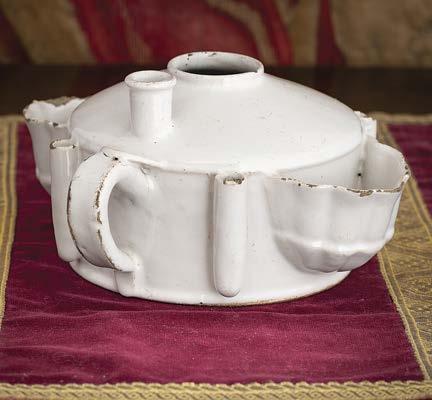
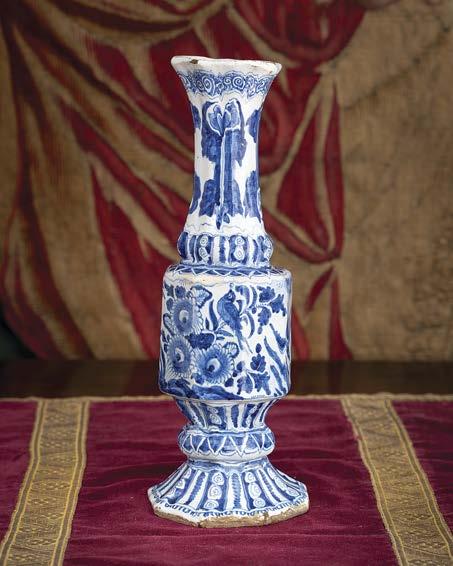
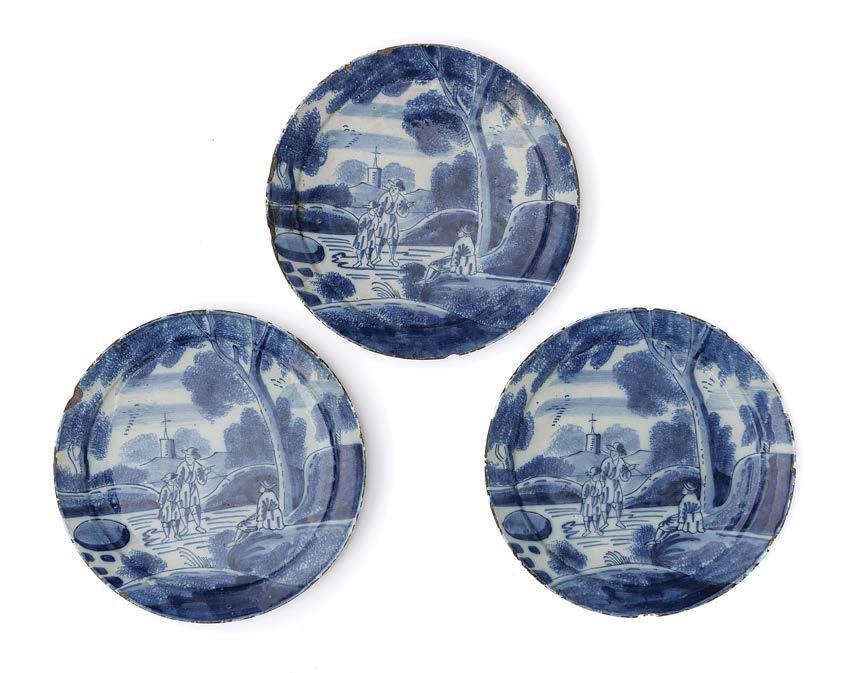
459
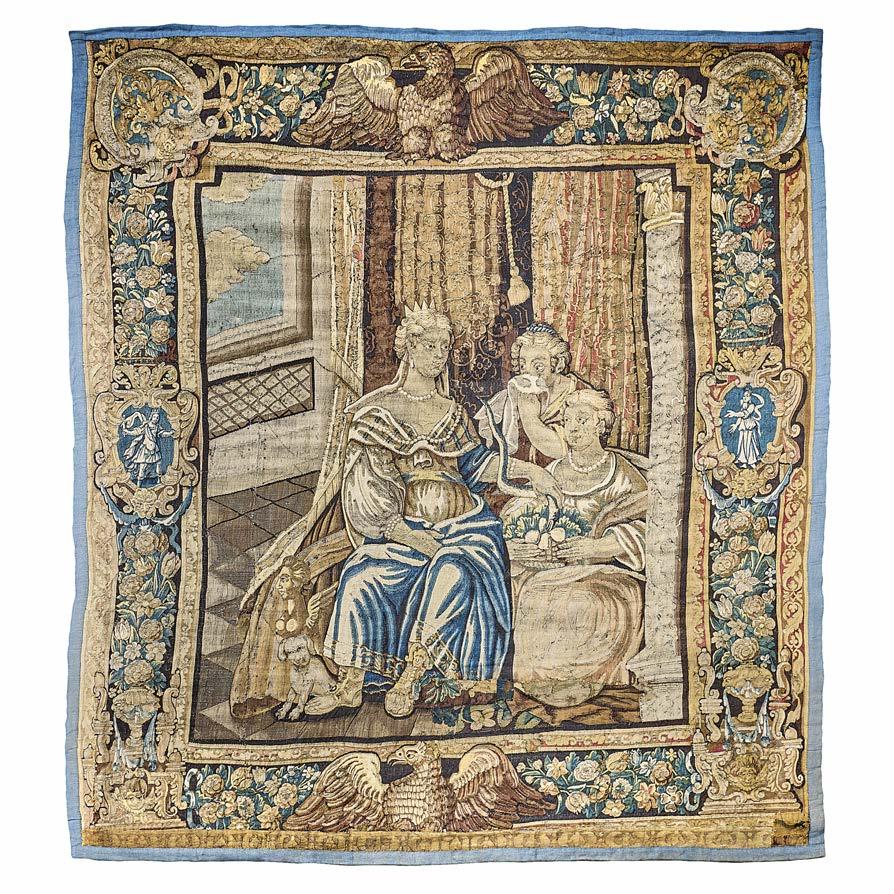
A 17th century figural tapestry, Flemish, circa 164080
Woven in coloured wool and silk, using a palette of blues, ochres and lightbrowns, depicting a welldressed female figure, wearing a coronet and seated with attendants in an interior windowed setting, a small dog at her feet, she holds a serpent in her left hand, the mythical beasts directed to a basket of fruit on the lap of one of the attendants, whilst the other stands holding a cloth to her face, in reference to sin and shame, the border richly ornamented with scrolling floral decoration interspersed with cartouches containing figures, and with prominent eagle to top and bottom.
H 332.1cm, W 280cm
£3,0005,000
460
An impressive pair of brass Baroquestyle pricket candlesticks, Italian
Each with a castellated drippan, centred by a pricket, the tall stem with multiple baluster and faceted knops, on a large triform base with scrolling volute feet. (2)
H 94cm, W 19.1cm
£200300
459
461
A delftware plate, Dutch, circa 172050
Painted in cobalt blue with a central cartouche enclosing The Crucifixion, Christ on the Cross, flanked by the Virgin and St John, the city walls of Jerusalem beyond, surrounded by the Arma Christi, or Instruments of the Passion, the rim decorated with scrolling foliage and floral motifs, inscribed ‘LPK’ to the base
Dia 22.2cm
£100200
462
A delftware charger, probably English, circa 1700
Decorated in rich cobalt, with a ‘scholarly’ arrangement of wares to include a bird resting on a tall vase, smaller vessels, books, flowering plants, and ‘day bed’, symbolising prosperity and the cultured life of the literati, the rim painted with stylised scrolling foliage and flowers.
This charger illustrates the fascination with exotic imports and the translation of Chinese imagery into European taste.
Dia 31.1cm
£100200
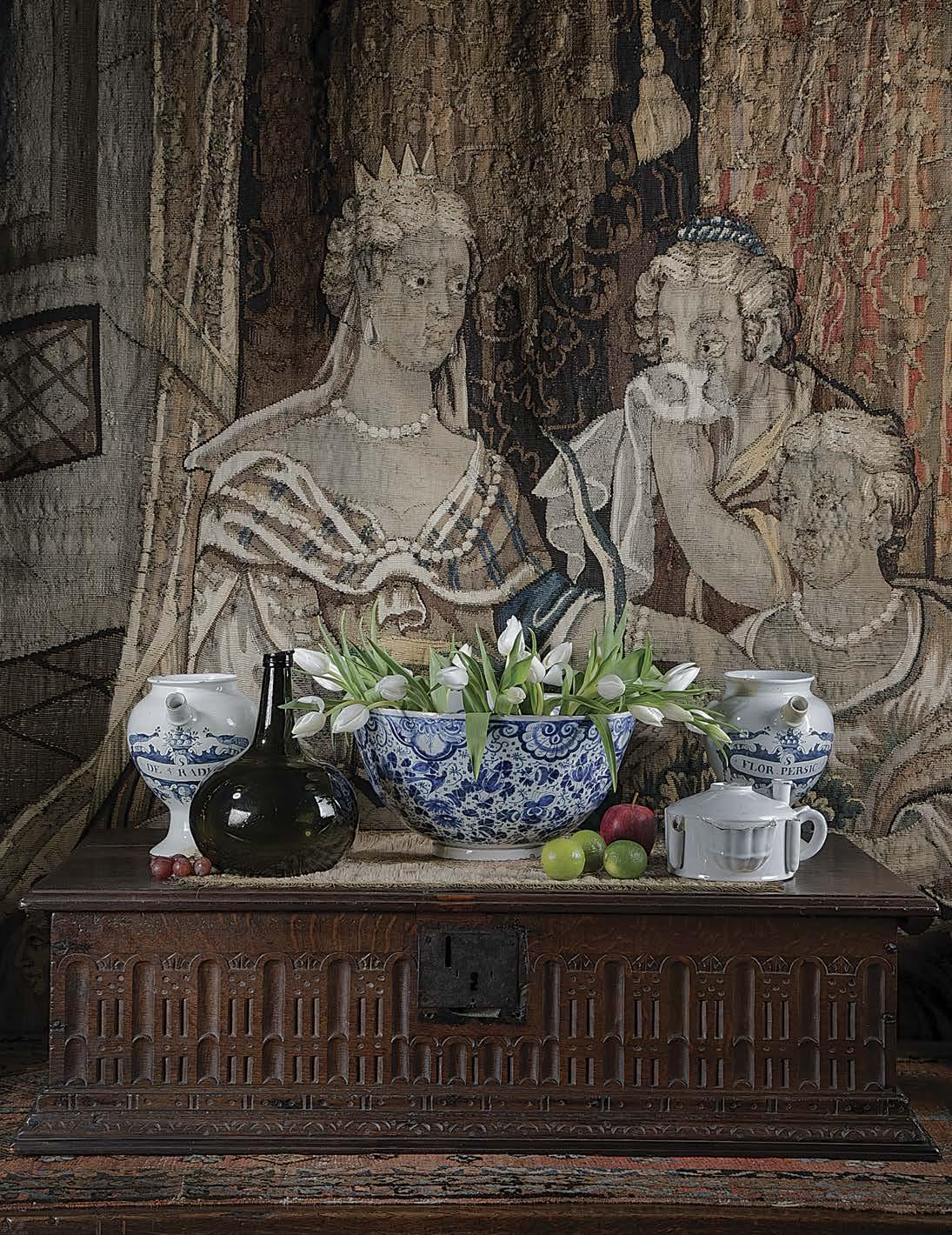
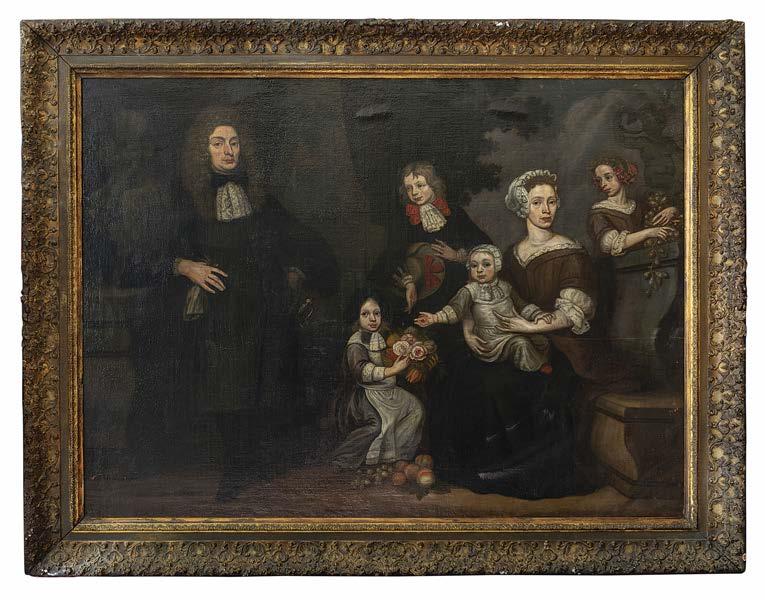
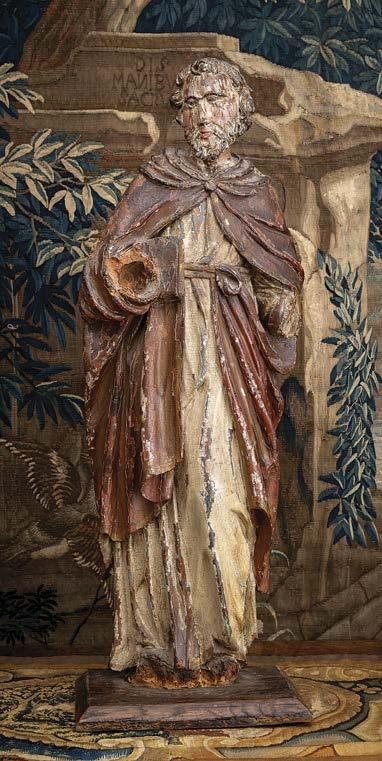
A 16th century carved oak and polychromedecorated figure of a Saint, Flemish, circa 152040
Carved in the round, shown standing, bearded, and robed in a long tunic gathered at the waist beneath a voluminous mantle fastened at the chest, his left hand, now with a hollow socket, would once have supported an identifying attribute, whilst the right hand is partially concealed within the folds of his cloak.
Although the original attribute is lost, the figure’s scholarly pose and contemplative expression suggest an Evangelist or Apostle, with the overall composition exemplifying the restrained naturalism of early 16thcentury sculpture.
H 90.8cm, W 31.8cm, D 17.8cm
£600800
Follower of Philips Bernaerdts (Dutch, 16201683)
Portrait of a Family Group, depicting Two Parents with Four Children in a Garden Setting
Oil on canvas
122.5 x 168cm; 48 1/4 x 66in
£1,0002,000
A large reliefmoulded terracotta armorial tile, Flanders/Brabant, circa 154080
Of demilunette form, centred by a heraldic shield with lion rampant, flanked by similar lion supporters and encircled by a band of wicker fencing, above, a bustlength female personification (perhaps Fame/Justice) holds a drapery or wreath, the surround carries a frieze of multiple small armorial escutcheons, likely denoting constituent towns or lordships within the Habsburg Netherlands, the whole within a beaded border.
Tiles of this type, variously called hearth tympana or armorial stove/fireplace tile, were made in Flemish and Brabantine workshops in the 16th century for chimneypieces and large domestic hearths. Their iconography celebrated territorial identity and princely authority. They functioned both as heatresistant architectural elements and as conspicuous displays of allegiance in patrician houses.
H 21.6cm, W 34.3cm, D 5.1cm
£200300
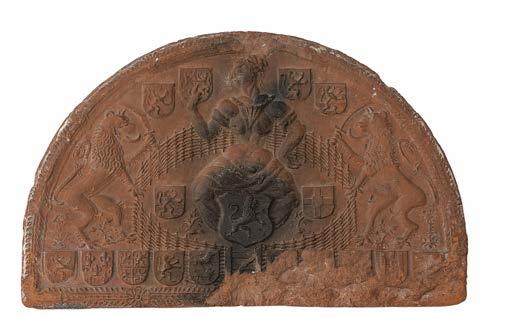
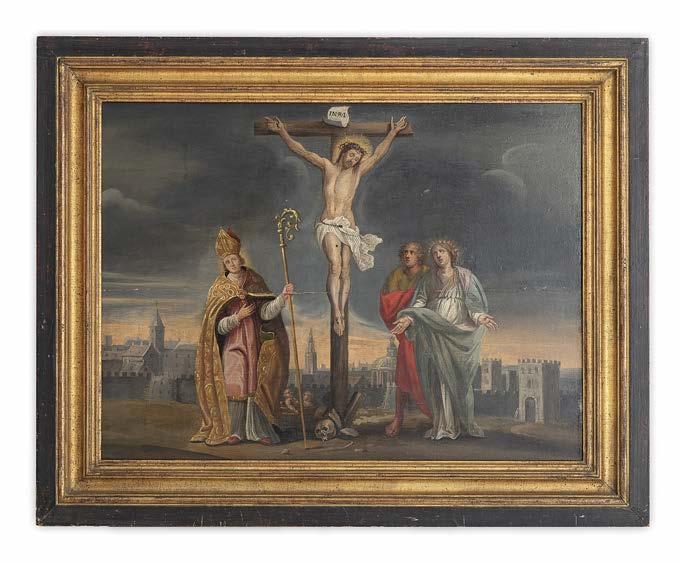
466
Follower of Abraham Willemsen (Flemish, c.1605/101672)
The Crucifixion, with the Virgin Mary, St John the Evangelist and a Bishop Saint (St Nicholas or St Servatius?)
Oil on panel
54.5 x 73cm; 21 1/2 x 28 3/4in
£500800
467
A 16th century carved walnut figure, Virgin and Child, Flemish, circa 150050
The Virgin stands crowned as Queen of Heaven, her head gently inclined, holding the Christ Child on her left arm, her right hand now partially lost, would once have held a symbolic attribute such as an orb or flower, the drapery, arranged in long, controlled folds that gather diagonally across the body, reflects the stylistic vocabulary of the Late Gothic period in the Low Countries, when sculptors began to temper the rhythmic angularity of earlier Gothic drapery with softer, more naturalistic handling.
The intimate yet regal presentation of Mother and Child reflects the dual role of the Virgin as both intercessor and Queen of Heaven, embodying the theological ideals promoted in the period following the Council of Basel (1431–1449), when Marian devotion flourished across Europe.
H 92.7cm, W 30.5cm, D 27.9cm
£2,0003,000
468
A pair of 17th century wrought iron cresset spitdogs, FrancoFlemish, circa 160050
Each topped by a cresset pan on an upright fitted with an adjustable attachment of three scrollended spit hooks, on divergent front feet with decorative circular scroll, billet bar to rear. (2)
H 94.6cm, W 29.8cm, D 61cm
£500800
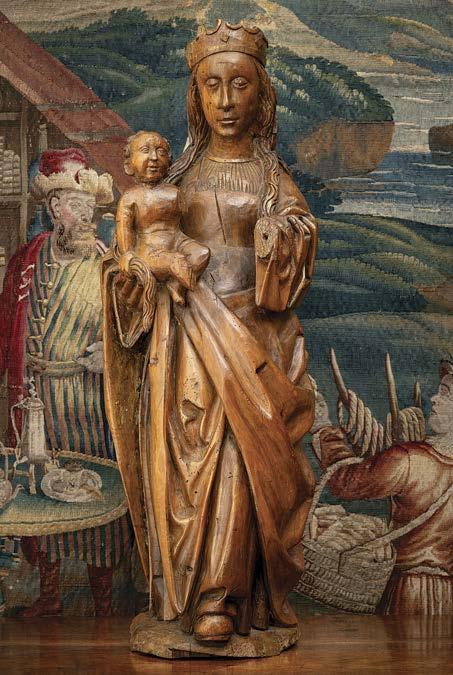
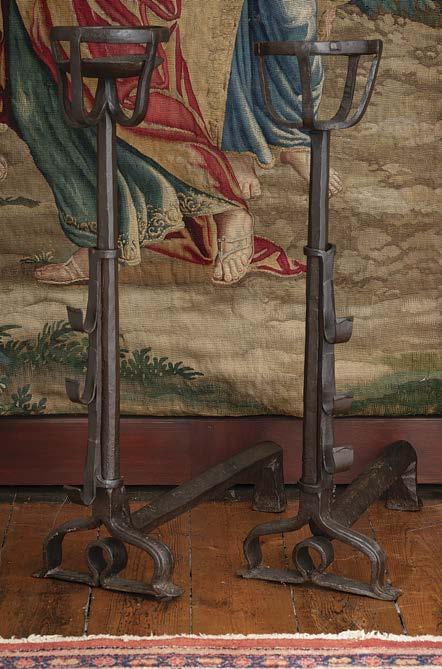
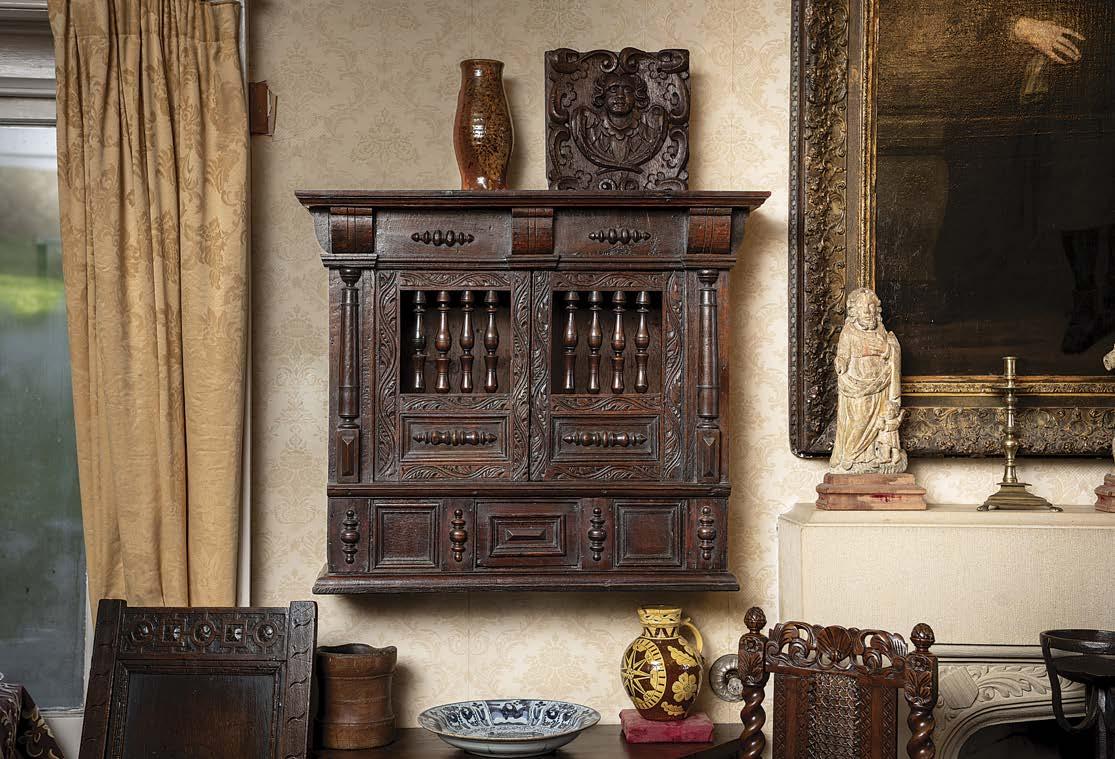
469
A good Charles I joined oak and boarded, spindlefilled, mural cupboard, West Country, circa 1640
The frieze with applied projecting corbels centred by and flanked by splitturned mouldings, atop a pair of doors fitted with fourspindles above a narrow panel with matching applied turned mouldings, all within meandering stylised leafcarved rails, and flanked by columnarturned pilasters, a small cupboard below accessed by a central door with pyramidal boss, flanked by fixed panels and further turned split mouldings.
Provenance: Purchased from Key Antiques, Chipping Norton, Oxfordshire, 2003. Sold Bonhams, Oxford, 20 January 2021, Lot 81 (£6,375).
H 76.2cm, W 88.9cm, D 22.9 cm
£4,0006,000
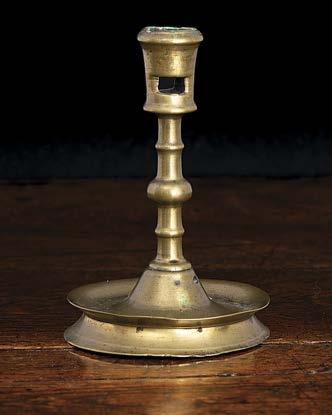
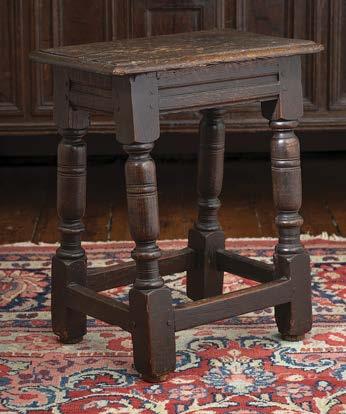
470
A rare 15th century brass candlestick, NorthWest Europe, circa 14501500
The bold tapered socket with paired rectangular extraction holes, on a paired discoid and central knop stem, on a shallow twostage base with raised centre, and ‘capstan’ foot.
For a closely related example see C. Bangs, ‘The Lear Collection: A Study of Copper Alloy Socket Candlesticks A.D. 200–1700’, p.223, no.29. The author notes far fewer candlesticks of this group survive in good condition compared with other coeval forms, likely because the broad, shallow base was more vulnerable to distortion and damage.
H 15.9cm, Dia 10.8cm
£500800
471
A Charles I joined oak stool, circa 1640
Of robust rectangular form, the top with moulded edge above single runmoulded rails, on four parallelbaluster and reelturned legs united by plain stretcher rails all around.
H 53.3cm, W 44.5cm, D 30.5cm
£300400
472
A rare James I / Charles I yewwood credencetype table, West Country, circa 162040
Of canted rectangular form, on four slender balusterturned legs, joined by peripheral stretchers, the friezes deeply carved with addorsed serpents and scrolling foliage, centred by stylised flowerheads, rear leaf and gate now lacking.
Entirely constructed in solid yew; a timber rarely used in early 17th century joined furniture as it was expensive and difficult to work. It would be reserved for prestigious furniture of small scale or exceptional commissions. Its glowing colour and close, silky grain are well preserved.
H 80cm, W 97.8cm, D 45.1cm
£1,0001,500
473
A 16th century brass alms bowl, German, Nuremberg, circa 152060
The well designed with a radiating image of the Virgin Mary standing in glory upon a crescent moon, her figure enveloped by a sunburst aureola, with steep sides and narrow rim, the latter with repeating punched geometric motifs.
The iconography is drawn directly from Revelation 12:1: ‘A woman clothed with the sun, with the moon under her feet, and upon her head a crown of twelve stars’.
H 6.4cm, Dia 25.4cm
£300400
474
A Charles I joined oak stool, circa 1635
Having a moulded edge top, the seat rails with broad runmoulding and slender bicuspid profiled lower edge, on inverted pegbaluster turned legs joined all round by plain stretchers.
H 53.3cm, W 48.9cm, D 33cm
£200300
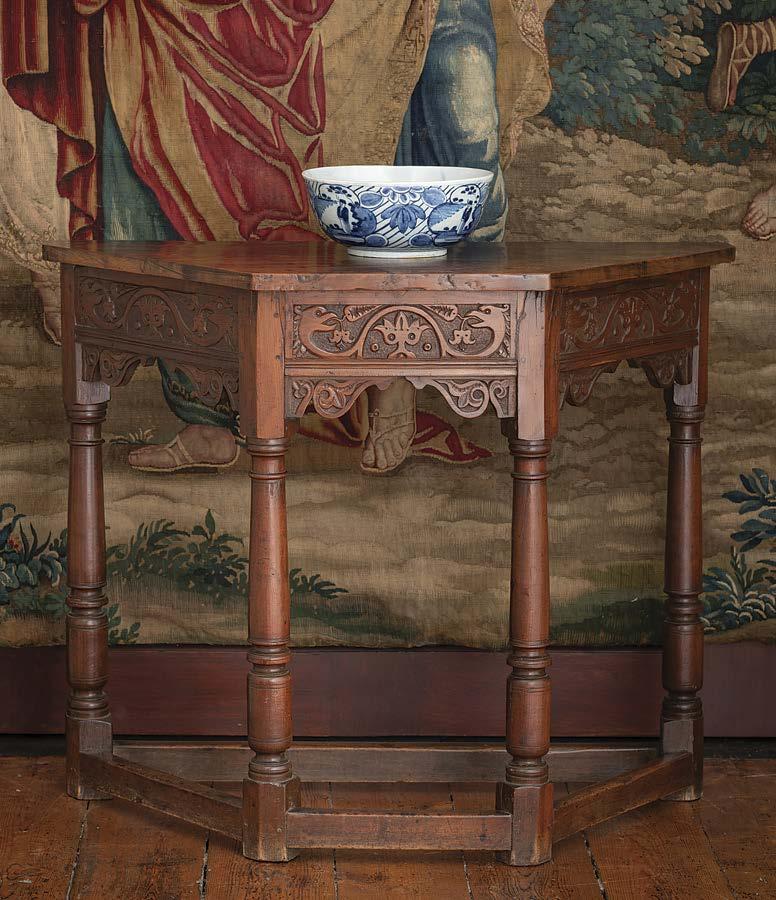
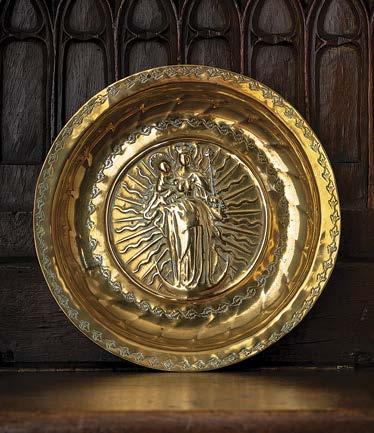
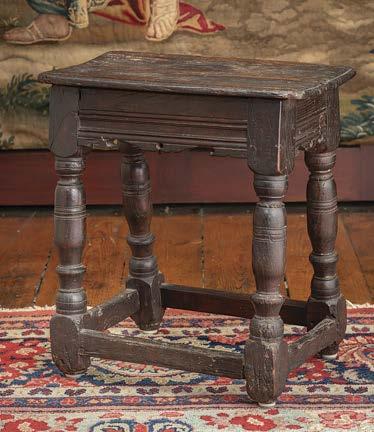
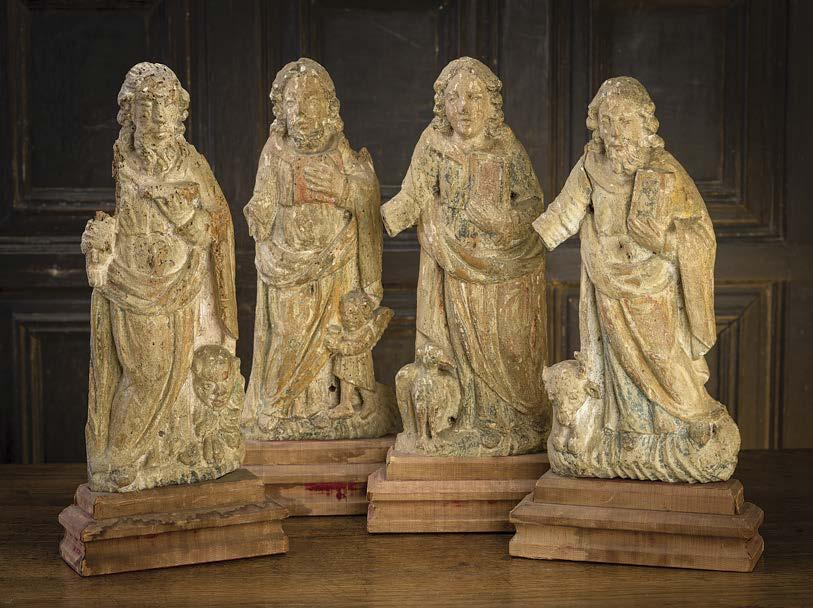
476
A 19th century slipware harvest jug, North Devon, circa 1840
In the manner of John Phillips Hoyle, Bideford
Of globular form with a deep everted neck, the handle with a lower scrolled terminal, the body richly decorated in ochre and brown with carved and sgraffito ornament, the front with a mariner’s compass, with cardinal points, flanked by large flowering plants, the neck and rim further ornamented with chevrons and leafy tendrils, impressed initials to base ‘T S’
The combination of the maritime compass motif with traditional harvest
flowers reflects the strong seafaring and agrarian identity of North Devon in the mid19th century. Such jugs were made for celebratory use during harvest and communal gatherings.
A highly comparable jug sold Bonhams, ‘The Sampson & Horne Collection ’ , London, 28 April 2010, Lot 626, dated 1812 and attributed to Barnstaple (£5,760). For a jug, by John Phillps Hoyle, in the Fitzwilliam Museum, Cambridge, with similar neck decoration see acc. no. GI.C.741928.
H 21.6cm, Dia 15.9cm
£300500
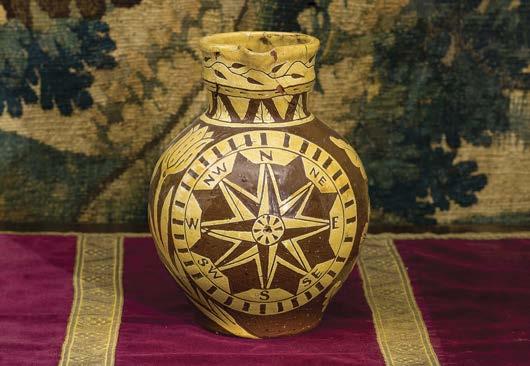
A set of four rare oak figures, three Evangelists and St Michael, Flemish, circa 1500
Each carved in the round with traces of original polychrome. Once part of a larger altarpiece ensemble. To include: St Michael the Archangel, shown triumphing over the devil, whose head is crushed beneath his feet; St John the Evangelist, an eagle at his side; St Luke the Evangelist, accompanied by a winged bull; the fourth a figure holding a book with a chalice beside him, possibly representing St John in his Eucharistic role, each on a velvetlined stepped plinth base. (4)
H 43.2cm, W 19.1cm, D 7cm
£1,0001,500
477
A group of five 20th century stoneware vessels
Each brownglazed, of varying tone and partly mottled, four of globular form with tall cylindrical neck, strap handle and short spreading foot, the taller of cylindrical form with moulded medallion. (5)
H 24cm (Largest), Dia 11.5cm
£80120
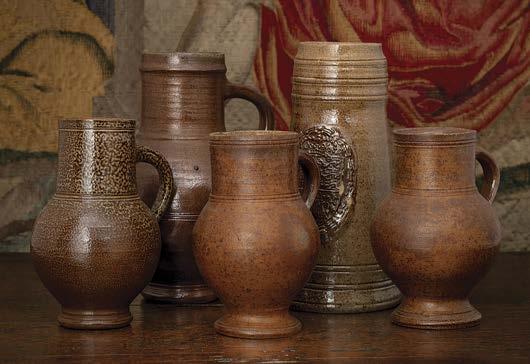
478
A late 15th century carved limewood and polychromedecorated figure, St George, German, circa 14801500
The youthful figure represents an armoured saint, traditionally identified as St George, which can be depicted without the dragon, he is shown standing frontally, with a flowing cloak draped over his shoulders, his right hand raised to hold a nowlost attribute, most probably a lance, his face is sensitively modelled with almondshaped eyes and softly curling hair, giving the figure a contemplative presence that balances the martial character of his armour.
In late medieval Germany, St George was venerated both as a soldier saint and as a model of Christian knighthood, his cult closely tied to confraternities, guilds, and knightly orders. Alongside St Maurice, St Florian, and other warrior saints, George embodied both protection and the ideals of Christian chivalry.
The carving style, with angular drapery folds, schematic armour, and a poised, upright stance, places the work within the Swabian and Franconian traditions of the late Gothic period. Limewood was the preferred medium of these regions, valued for its fine grain and ability to capture subtle detail. The remnants of polychrome and gilding would once have given the figure vivid colour, animating its presence in a church interior lit by candles.
H 79.4cm, W 24.8cm, D 11.4cm
£2,0003,000
479
A velvet and metallic thread embroidered ‘devotional box’, French, circa 1700
Of low rectangular form, covered in grey silkvelvet worked in metal thread, highlighted with seed pearls and glass beads, in a floral and geometric design, the interior embroidered in coloured silks, the underside of the lid with a samplerlike arrangement of motifs, including Passion devices, enclosed within a geometric border, the base centred by a large chalice, flanked by winged angels, bordered by the inscription from John 6:51 If anyone eats of this bread, he shall live forever, alluding to the Eucharist.
H 6.4cm, W 23.5cm, D 21cm
£300500
480
A 17th century Italian maiolica bottle, possibly Venice, circa 1600
Of globular form with tapering neck and everted rim, richly decorated in cobalt blue, ochre and white, highlighted with touches of green, one side painted with a male profile portrait within a circular medallion, the reverse adorned with bold scrolling foliage and large stylised floral blooms.
H 24.8cm, Dia 15.2cm
£8001,200
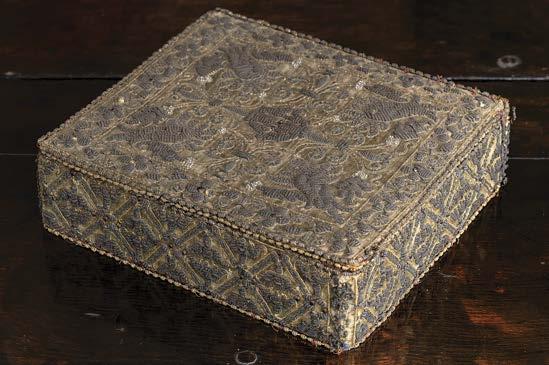
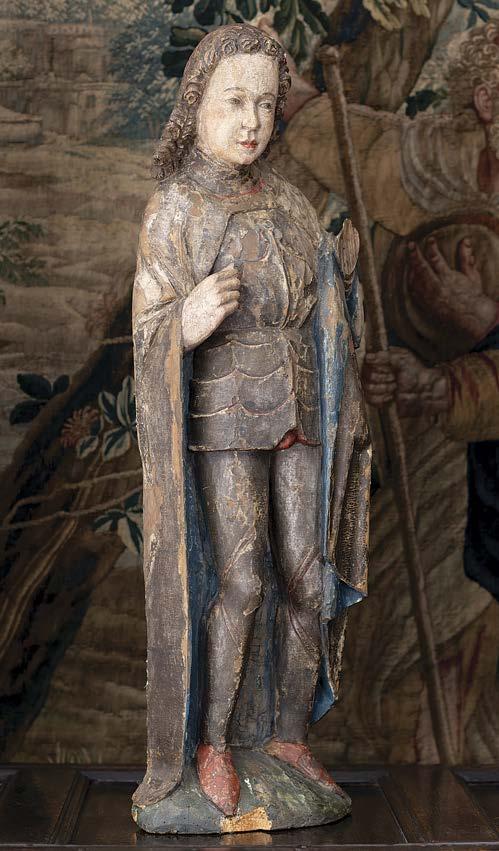
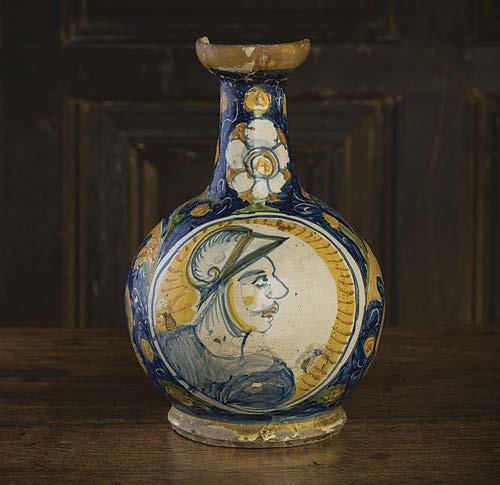
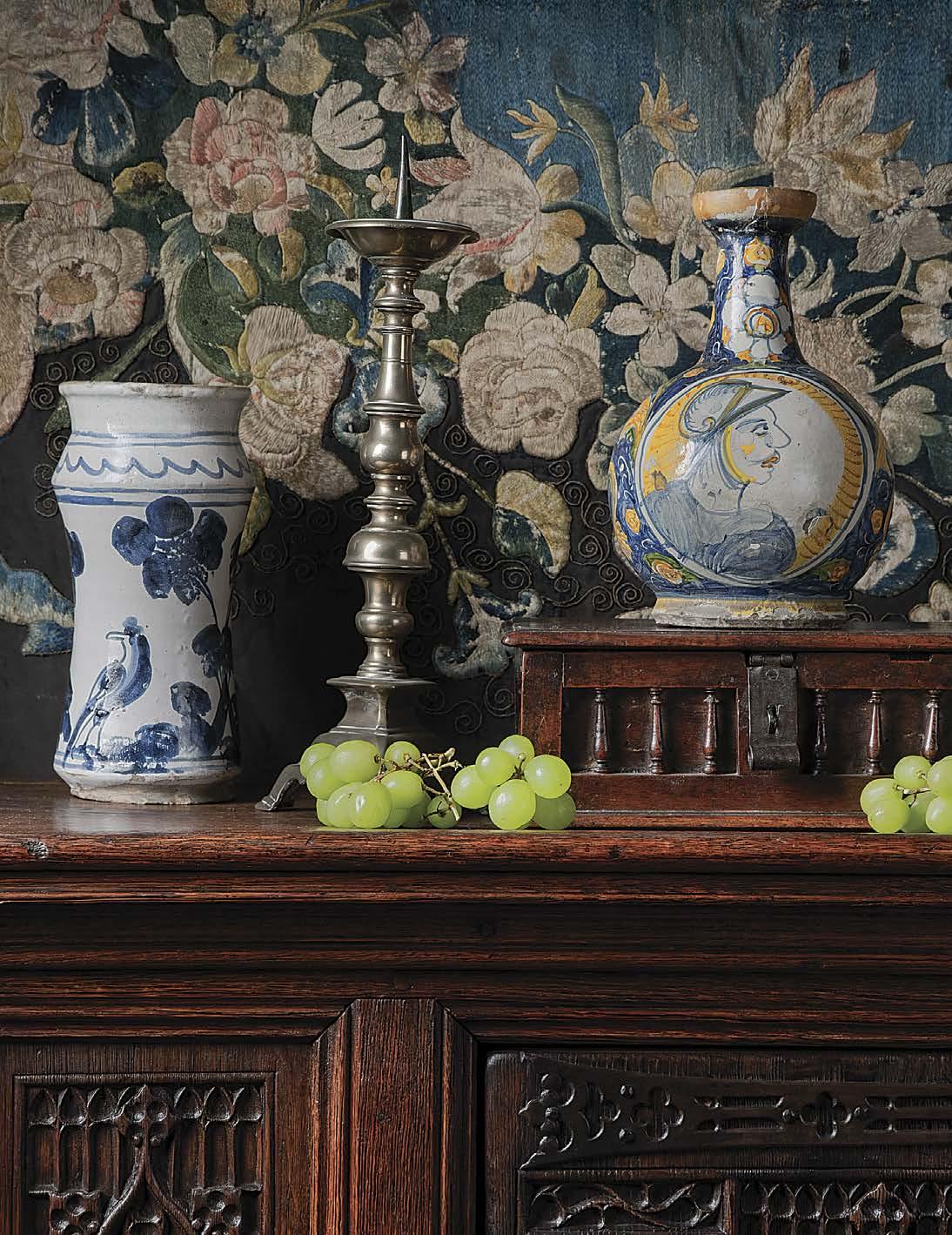
481
A James I joined oak livery cupboard, West Country, circa 1620
Of canted form, the upper cupboard section enclosed by a single central door carved with a complex interlaced knot pattern, flanked by fixed lozengecarved panels within moulded frames, the whole articulated by parallelbaluster turned corner posts, the frieze rail carved with interlaced leafylunettes, atop a gadrooned carved drawer, on matching turned front supports, joined by a boarded undertier, with continuous chainlike carved base rail, on block feet.
The canted form is particularly associated with the West Country, combining robust carving with strong architectural form. Such cupboards often stood in halls or parlours, where they functioned as both storage and display, proclaiming the wealth and taste of the owner.
H 125.1cm, W 135.9cm, D 52.1cm
£1,2001,800
482
A 17th century small walnut table casket, FrancoFlemish, circa 162575
Of architectural, rectangular form, with moulded lid and base, all four sides inset with a balusterturned gallery, the hinged lid secured at the front by an iron strap hasp and staple.
H 10.8cm, W 28.6cm, D 20.3cm
£200300
483
A delftware jug, Dutch, circa 170050
Of baluster form with a strap handle, the body painted in a bright cobalt palette with dense floral motifs, the handle with dot detail.
H 23.5cm, Dia 13.3cm
£100150
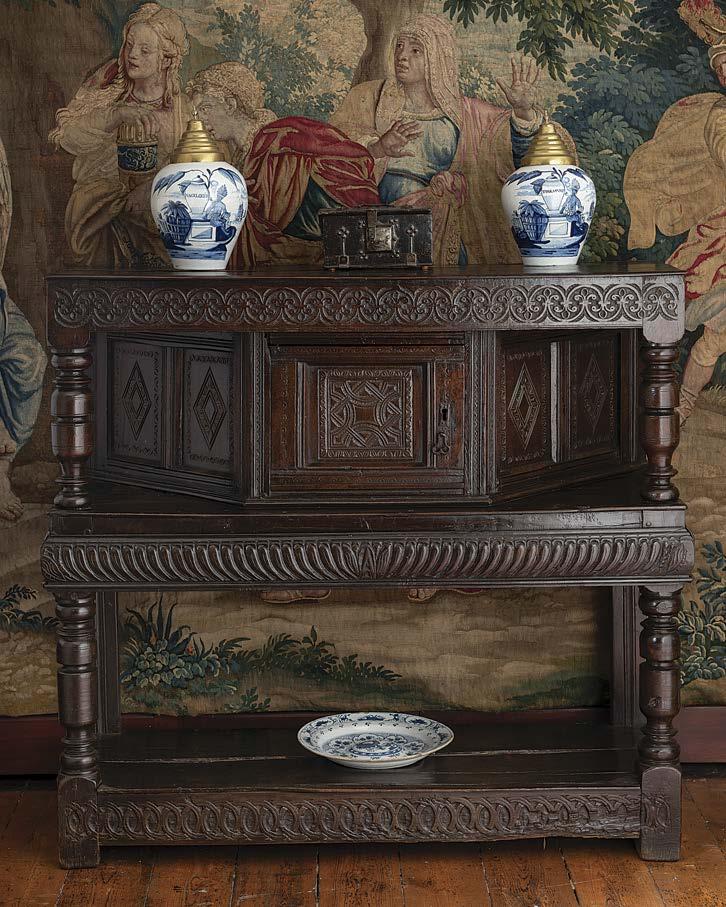
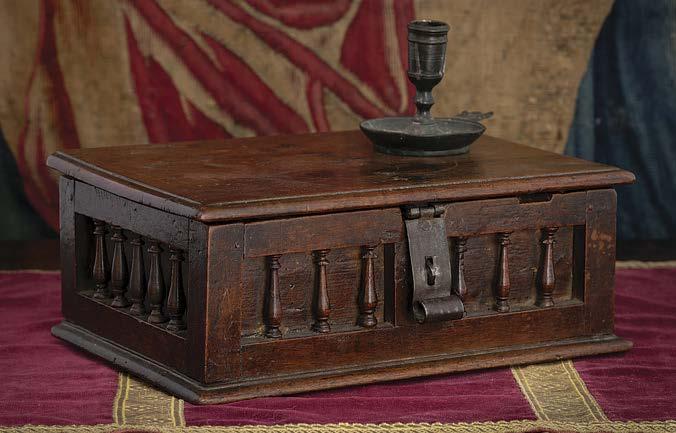
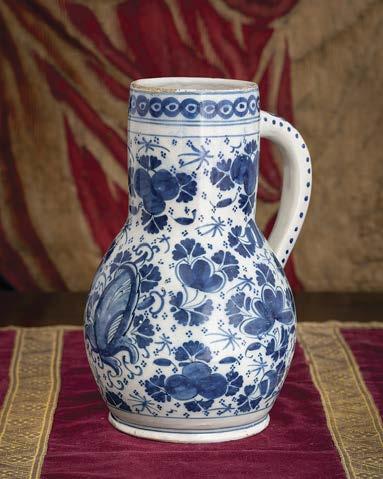
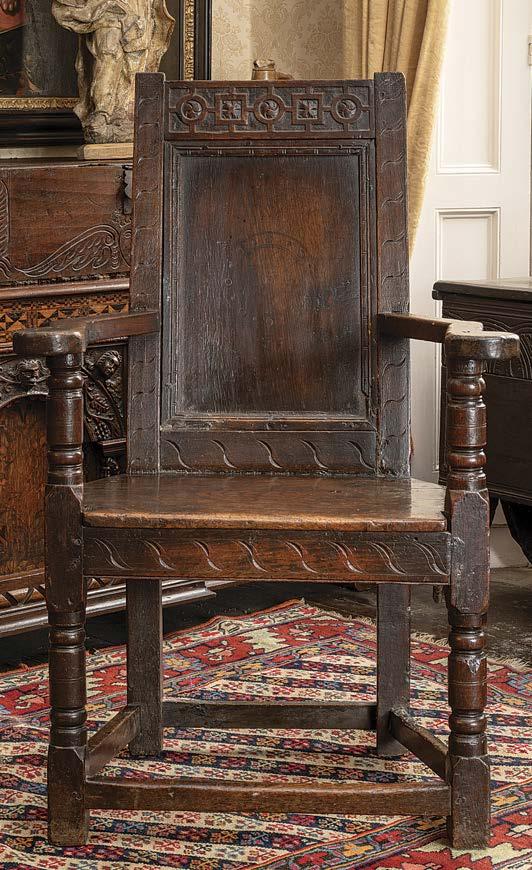
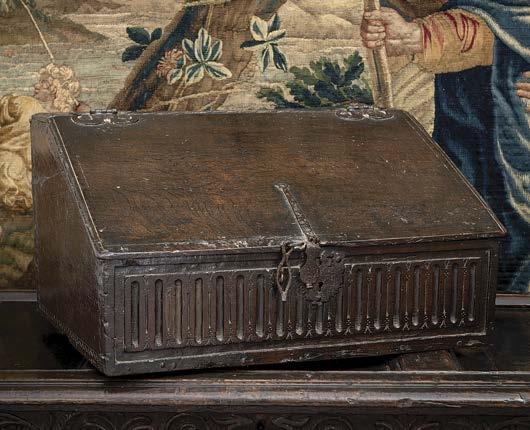
484
A rare James I joined oak caquetoire armchair, Exeter, Devon, circa 161020
The form, with its tall narrow back and shaped arms, derives from fashionable French prototypes of the late 16th century. Here it transforms into the robust, rectilinear joinery of English Jacobean taste. Having a back panel with a fine central punchwork roundel, below a strapworkcarved top rail, the back uprights, lower back rail and seat rails carved with a simple, yet effective, chain motif, the outsplayed angular arms with roundedends, on parallelturned front supports, their design repeated to the forelegs, boarded seat and plain stretchers.
The survival of this distinctive form of Exeter joiner’s work demonstrates the cosmopolitan influences at play in the region during the reign of James I. Devon and Exeter workshops are known for their willingness to adapt European fashions, a practice reinforced by Exeter’s status as a thriving port city with close trade links to France and the Low Countries.
H 109.2cm, W 68.6cm, D 53.3cm
£8001,200
485
A James I boarded oak desk box, West Country, circa 161020
Carved to the front with rounded nulling, enriched with punchwork, retaining iron lockplate, hasp, and distinctive cock’shead hinges, the sloping lid with moulded edge.
Boxes of this form are regularly included in contemporary inventories. For example, a 1620 household record notes ‘a box for my Lord’s bouks’, noted in Victor Chinnery, ‘Oak Furniture: The British Tradition’, (2016), p.321. They were valued possessions, often placed in a chamber or study, where they served both practical and symbolic roles: protecting precious volumes and papers while projecting the owner’s education and status.
H 30.5cm, W 56.5cm, D 42.5cm
£200300
486
A small late 15th century oak linenfoldcarved chest, Flemish, circa 14801500
The twopanel front carved in deep linenfold and with ornate wroughtiron lockplate, the sides and lid of plain panelled construction, regional characteristic deep top rail.
Comparable examples are preserved in major museum collections including the V&A Museum, London, the Musée de Cluny, Paris and the Gruuthuse Museum, Bruges.
H 55.3cm, W 86.4cm, D 47cm
£500800
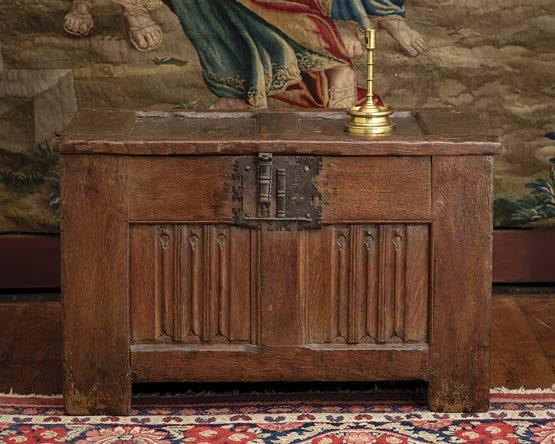
487
A 17th century pine caquetoire ‘marriage’ armchair, North East Scotland, probably Aberdeenshire, dated 1672
The chairs design, with its narrow back rest, trapezoid seat, and outsplayed arms, corresponds closely to the distinctive Scottish caquetoire tradition of the 17th century, the back panel carved with initials ‘R C’ over ‘I B’, the latter centred by a heart, strongly indicate the chair was made to commemorate a union of two families, over the date ‘1672’, the squareended open arms on balusterturned supports, boarded seat, and turned forelegs joined by plain stretchers all around.
Literature: see Stephen Jackson, ‘Scottish Caquetoire Armchairs’, Regional Furniture (2021), for discussion of form, dating, and symbolic inscriptions.
H 113cm, W 67.9cm, D 48.3cm
£600800
488
A monumental Elizabeth I carved oak box, circa 15801600
Of greater proportions than the usual domestic example. The front and sides are deeply carved with two registers of nulledarcading, beneath a boldly moulded lid and prominent ‘domino carved’ base moulding.
H 27.9cm, W 99.1cm, D 55.2cm
£300500
489
A mid16th century joined oak linenfoldcarved chest, English, circa 154060
With twinpanelled lid, the front with linenfoldcarved panels, unusually designed horizontally, the sides left plain, on broad stile supports. Of note are the three locking arrangements visible to the front rail, a feature strongly associated with parish and guild chests, where communal safeguarding was required, with separate keyholders.
H 55.2cm, W 92.7cm, D 48.9cm
£500800
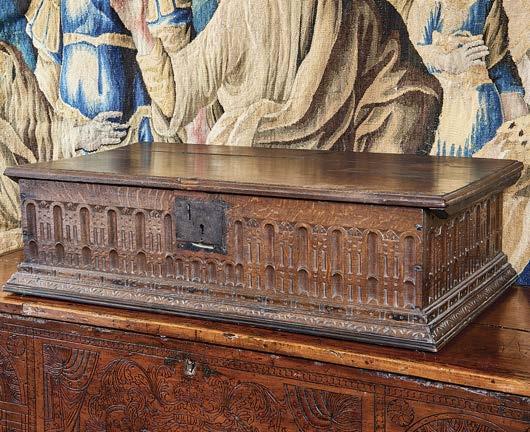
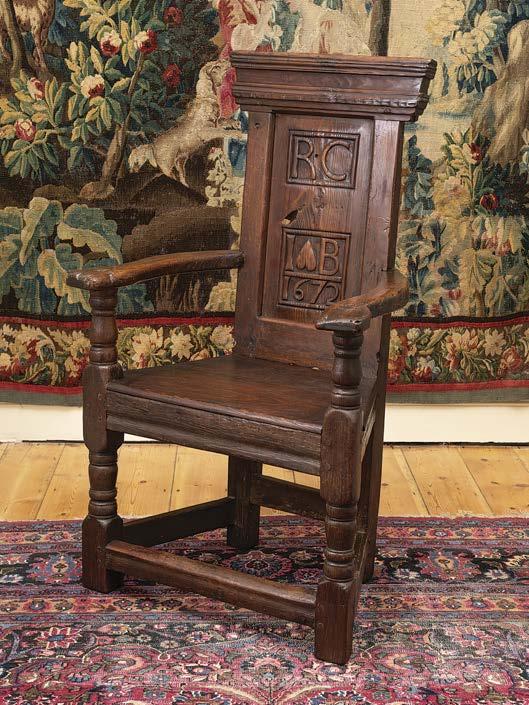
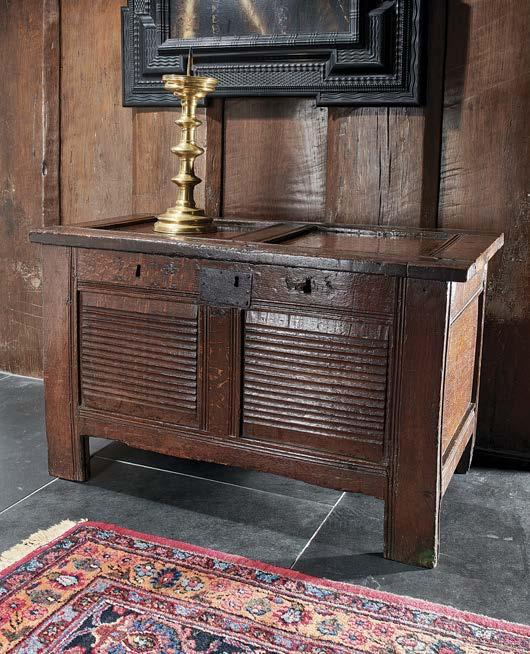
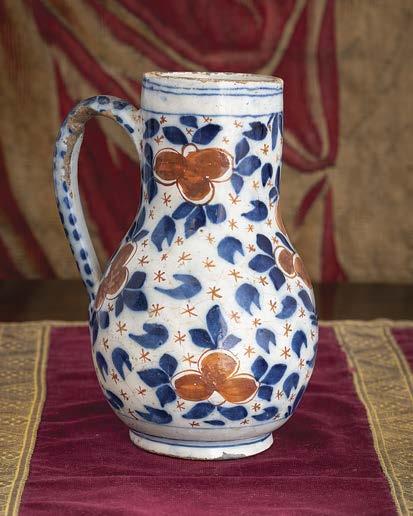
490
A delftware polychrome jug, Dutch, circa 1700
Of baluster form, with strap handle, decorated in cobalt blue and ironred with scattered flora and leaves, highlighted with ‘stars’, the handle with a series of blue dots.
H 21cm, Dia 12.1cm
£100150
491
An 18th century delftware jug, Dutch, circa 1750
Of baluster form, having a tall cylindrical neck, strap handle, and spreading footrim, the body polychrome painted in vibrant yellow and orange, along with blue and green, with a large stylised floral spray, the handle with leafy motifs.
H 21cm, Dia 12.1cm
£100150
492
A delftware lidded posset, caudle or broth bowl, English or Dutch, circa 16801700
Painted in rich cobalt blue with bold stylised floral sprays, the twin loop handles are ornamented with dots and dashes, while the cover bears a flowerhead knop, interior with pierced halfliner or drainer, used for retaining slops or curds above the caudle or mulled ale below.
H 11.4cm, W 22.9cm, D 15.9cm
£200300
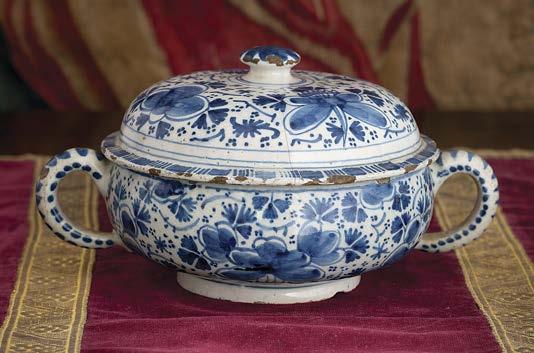
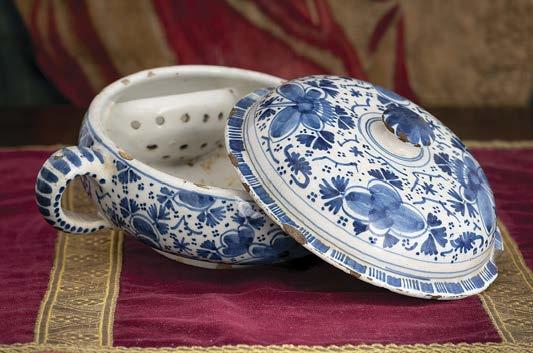
492
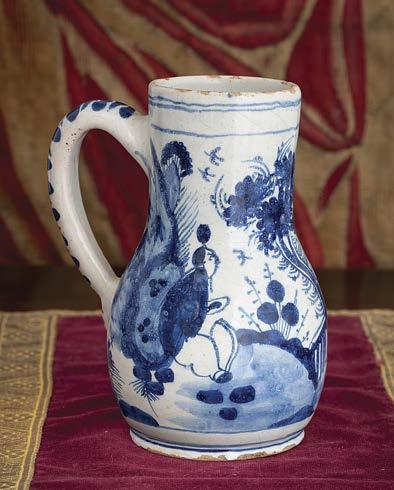
493
A delftware jug, Dutch, circa 170050
Of baluster form with strap handle, painted in cobalt blue with stylised rocks, plants, and grasses, within doubleline borders, the handle decorated with rhythmic blue dashes.
H 19.1cm, Dia 11.4cm
£100150
494
A delftware charger, Dutch, circa 170050
Decorated in rich cobalt blue, with a radiating design of stylised floral motifs, with scallop or piecrust rim, blue painted ‘BP’ to the base.
Dia 34.9cm
£120180
495
An albarello, Spanish or Portuguese, circa 170050
Of cylindrical waisted form, decorated in blue with stylised foliage.
H 29.2cm, W 12.1cm
£200300
496
A delftware plate, Dutch, circa 170050
Decorated in rich cobalt blue with a striking radiating design of stylised floral blooms, with scalloped or pie crust rim, painted ‘10’ to the base.
Dia 26cm
£100150
497
A delftware bowl, London or Bristol, circa 170050
The relatively straight, flared sides painted in vibrant cobalt blue with floral stems and fruiting sprays, the interior with central hatched decoration, surrounded by a band of stylised crosses and ovals, on a narrow ring foot.
H 10.8cm, Dia 19.1cm
£120180
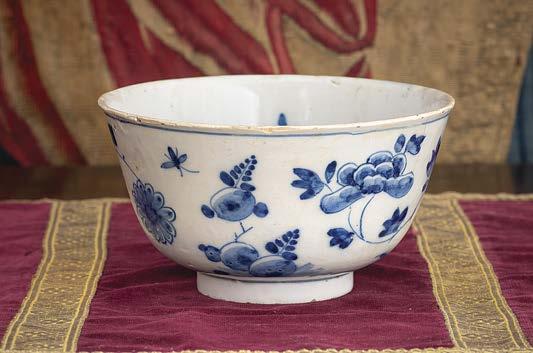
498
A delftware plate, Dutch, circa 170050
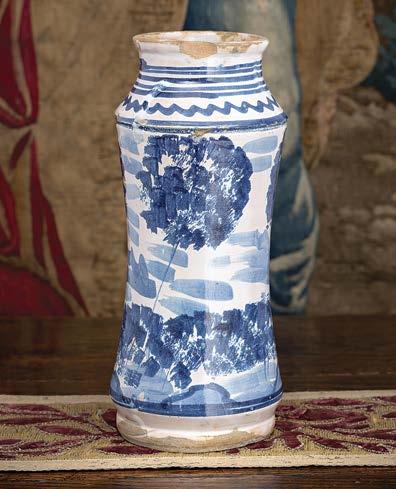
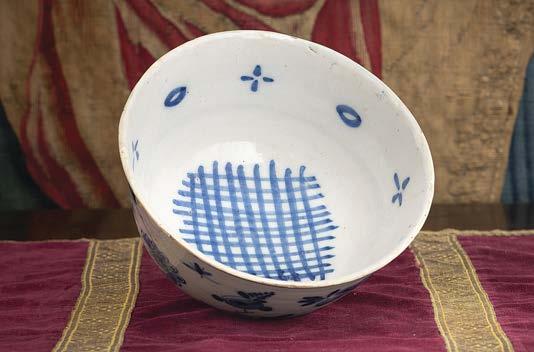
Decorated in rich cobalt blue with a striking radiating design of stylised floral blooms, with scalloped or pie crust rim.
Dia 26cm
£100200
499
An early 18th century Italian albarello, Caltagirone, circa 170030
Of waisted cylindrical form, with everted rim, decorated in blue, designed with two bands of reserves, centred by a flaming heart, enclosing scales, flanked by the inscription ‘GIO: SERRA’(?), remaining reserves with scrolls and foliage.
H 26cm, W 13.3cm
£100150
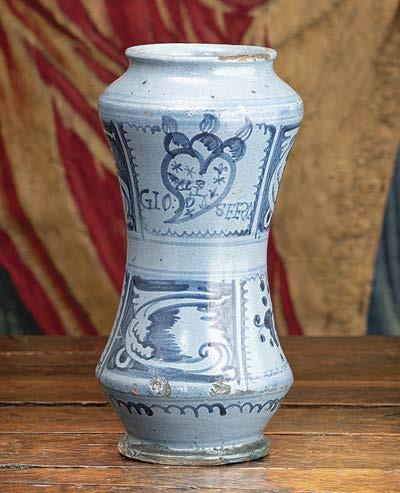
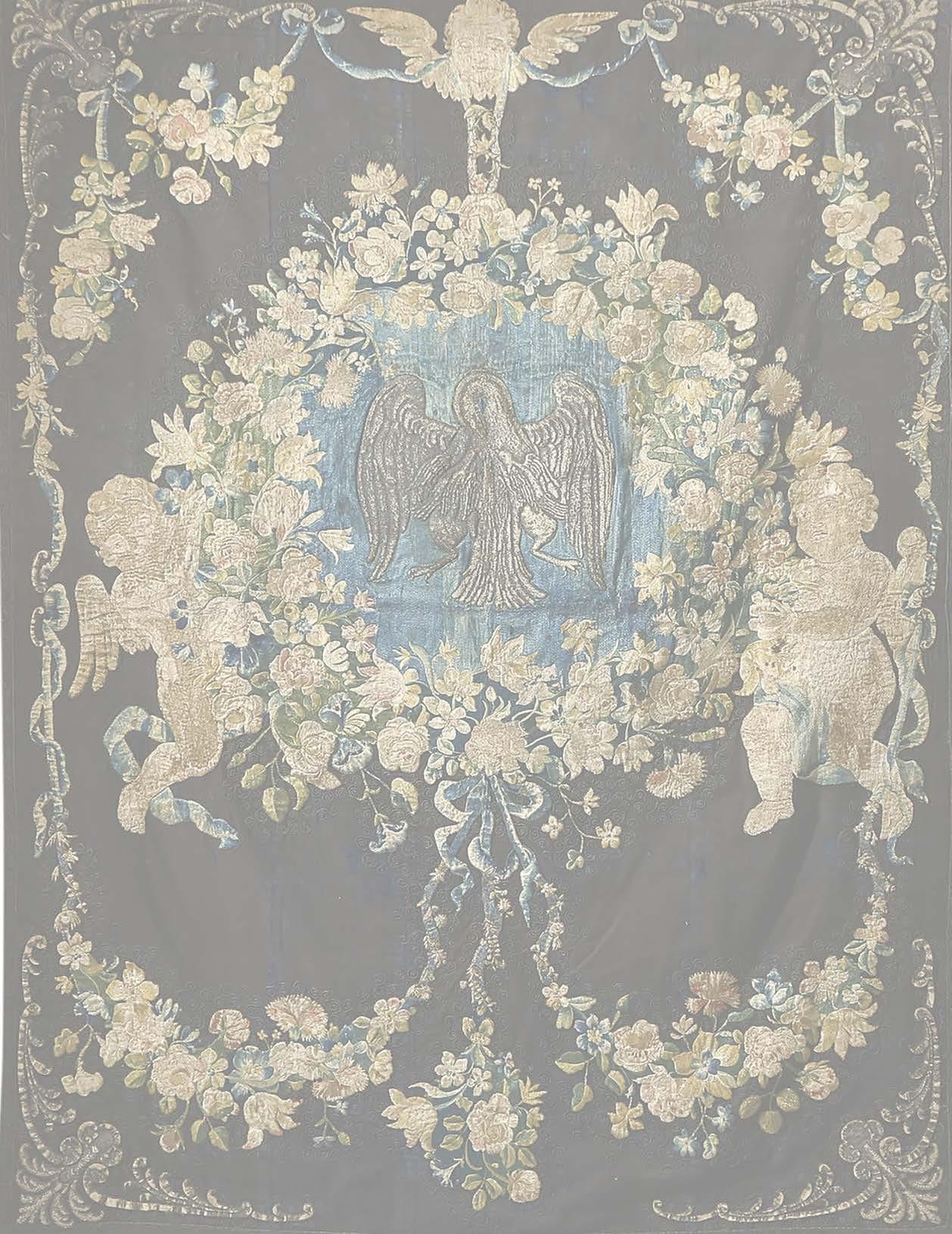
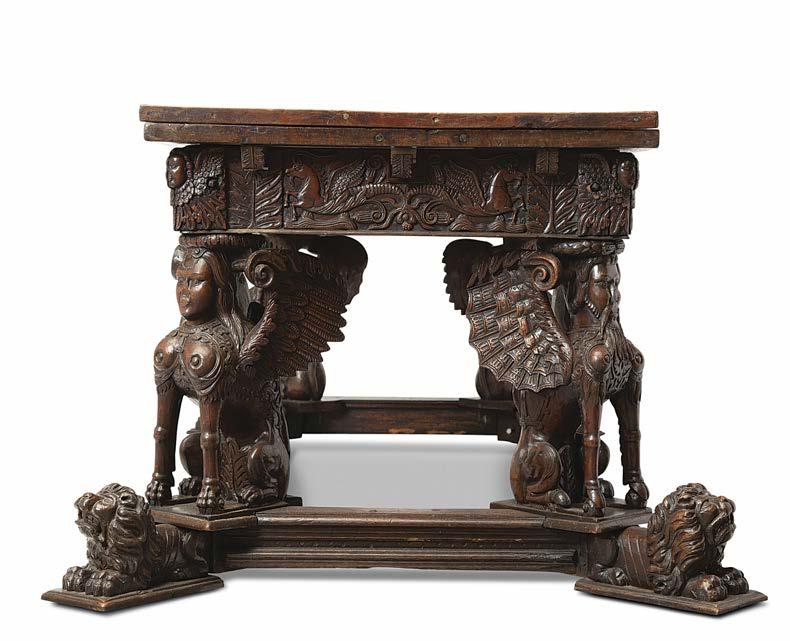
The Lambert Table: An important Elizabeth I elaborate, fantastical and exquisitely carved oak drawleaf table, circa 15751600
Without doubt the unique leg design is the notable feature of this exceptional table, all four are beautifully carved in the form of highly decorated sphinx sejant, namely a lion body, griffin wings and human face, two male, two female, each winged, their tails and bodies carved with differing devices, each facing out and atop a projecting lion couchant. The richly decorated long frieze rails are spaced by grotesque or green men masks, issuing arabesques with exotic birds and animals, centred on one side with a scrolled cartouche blazoned with the Lambert family coats of arms. Each end frieze is carved differently, one with entwined acorns, leaves and fivepetal Tudor roses, and the opposite end with addorsed carved hippocampi. All frieze corners with winged angel masks. Drawleaf top.
The design and form of the Lambert table strongly resembles the famous socalled ‘SeaDog Table’, Hardwick Hall, Derbyshire (NT. 1127744), pre 1956 in the Duke of Devonshire collection and dated to circa 1570.
Furniture designs published around 1560 by Jacques Androuet du Cereau (15151584) show a page of sphinx and chimeralike creatures, both like the designs on the SeaDog and Lambert Table.
A comparable, part 17th century table, with lion and human legs, referred to as’ The Armada Table’, sold Adams, Ireland, 16 October 2018 (€430,000) and is the only comparable table to have been sold at auction in the last 50 years.
£100,000150,000
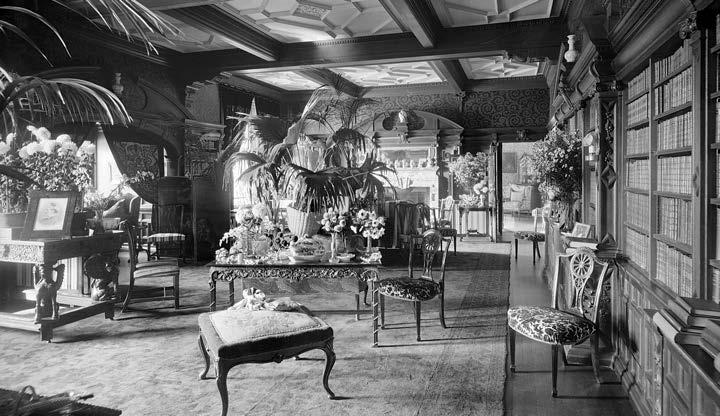
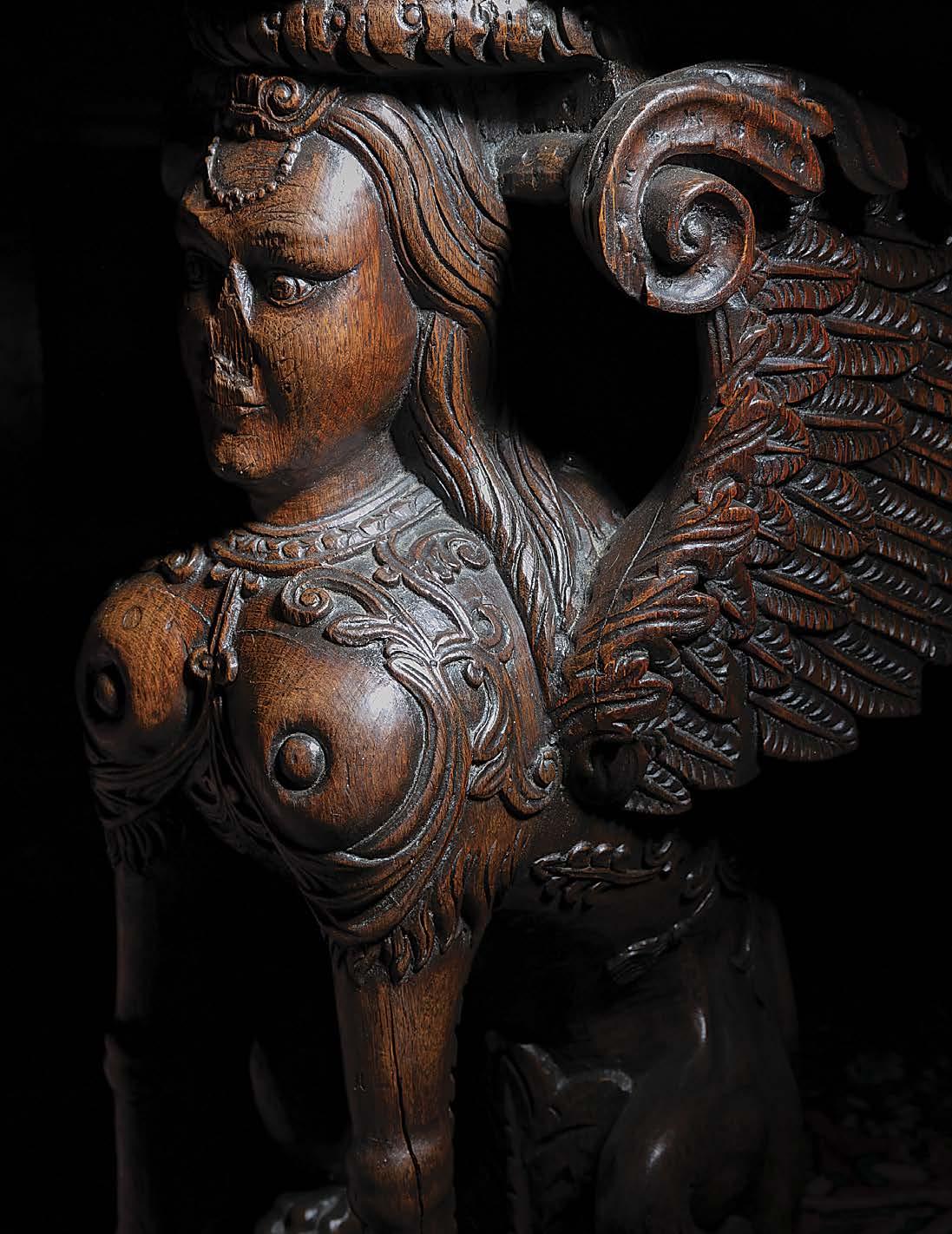
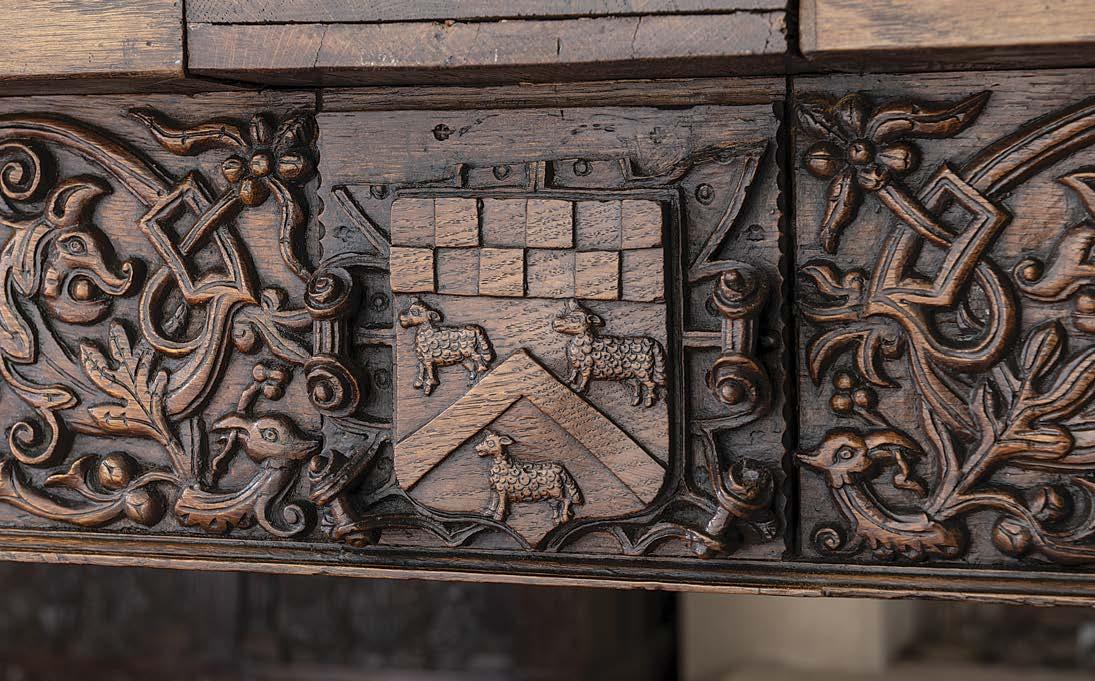
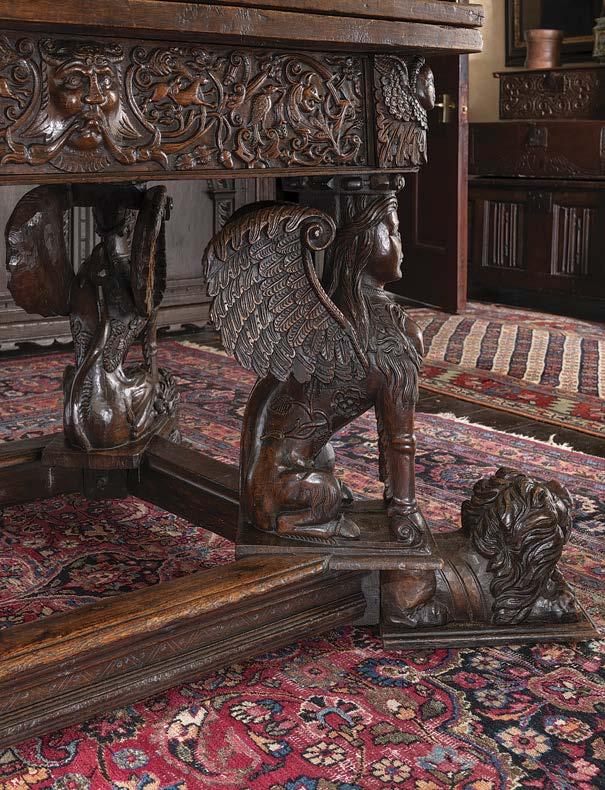
Provenance: Lambert Family, Yorkshire.
Sir Archibald Edmonstone, 5th Baronet (18671954), Duntreath Castle, Strathblane, nr. Glasgow. Photographed in the library in 1898, with the lion couchant removed for safe keeping.
With Sam Wolsey, 71 Buckingham Gate, London.
Thence Sold Sotheby’s, London, circa 1970 (photo credit Victor Chinnery, ‘Oak Furniture: The British Tradition’).
With Arthur Davidson, London, circa 1972.
Thence Bartlett Burnap Collection, Florida, USA.
Then present owner.
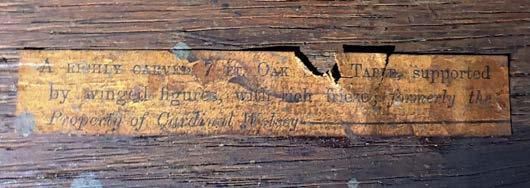
A paper label to the rear of one long frieze reads: ‘A highly carved 7 ft oak drawer table, supported by wing figures with rich frieze, formerly the property of Cardinal Wolsey’.
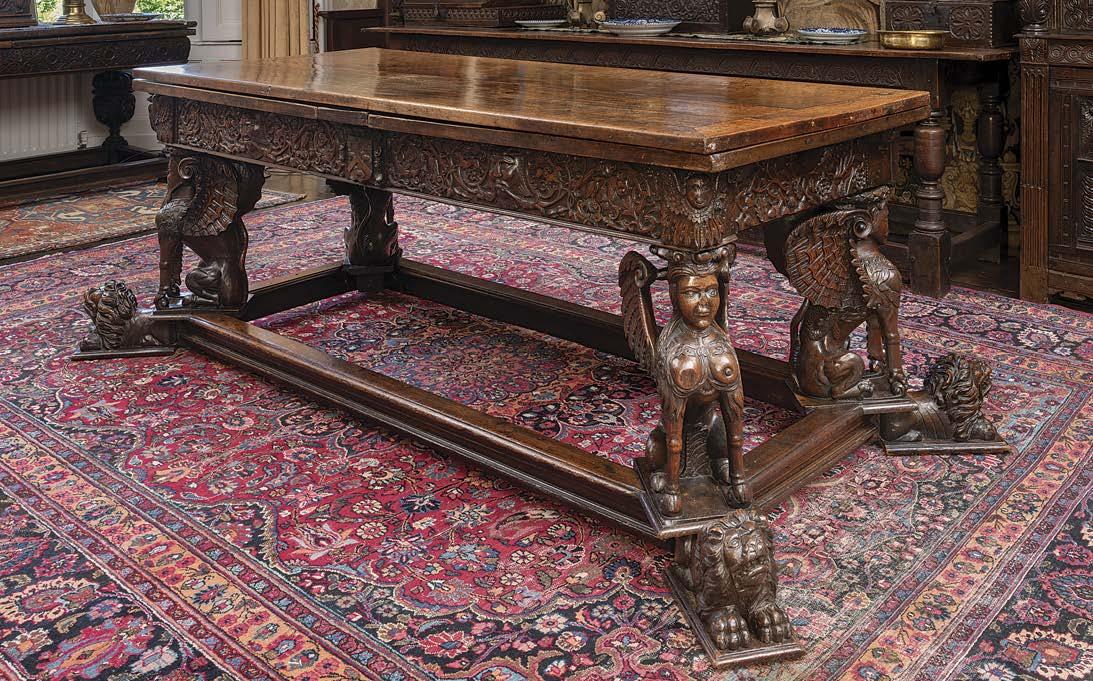
Illustrated:
Victor Chinnery, ‘Oak furniture: The British Tradition’ (2016), p.134, fig. 2:168.
S W Wolsey and R W P Luff, ‘Furniture in England: The Age of the Joiner’, pl. 58.
Ralph Edwards, ‘Shorter Dictionary of English Furniture’, p. 534, fig. 8.
Geoffrey Wills, ‘English furniture 1550–1760’, p. 7.
Franz WindischGraetz ‘Mobel Europas’, p. 335, fig. 257. ‘C.I.N.O.A International Art Treasures Exhibition’, V&A Museum, London, 1962, pl. 42; p. 9, item 62.
Helen Hayward, ‘English and French furniture at the International Arts Treasure Exhibition’, Apollo, March 1962, pp. 56, fig. 1.
The Arms of Lambert blazoned as follows: Gules a chevron between three lambs passant argent a chief chequy or and azure. The table was almost certainly commissioned by John Lambert (15221593), of CaltoninCraven, Yorkshire, eldest son of John Lambert (1490 1562) and his wife, Anne Agnes Midhope (14901548).
A further oblique confirmation of the ownership of this table by the Lamberts is the use of sphinxes. In several print sources the crest of the Lamberts is blazoned as follows: A sphinx passant guardant or face proper holding in the dexter foot a rose gules seeded and leaved vert. The Heralds’ Visitation of the County of Yorkshire, 1585, records Lambert blazoned as follows: ‘A female centaur proper crined or holding a flower argent leaved and stalked vert’. However, another contemporary heraldic writer called this mythical beast, a ‘lamia’, which could have been a play upon the name of Lambert. A ‘lamia’ is distinct from a sphinx, although both have certain female attributes that may have caused confusion amongst early heralds. This misconception is further highlighted by the fact when, William Camden, Clarenceux King of Arms, confirmed these arms and crest to William Lambert in 1613, he incorrectly blazoned the ‘lamia’ as a ‘mantichor’.
H 84.5cm, W 208.3cm (lions at base 240cm), Table fully extended 396.2cm, D 89.5cm (lions at base 121.9cm)
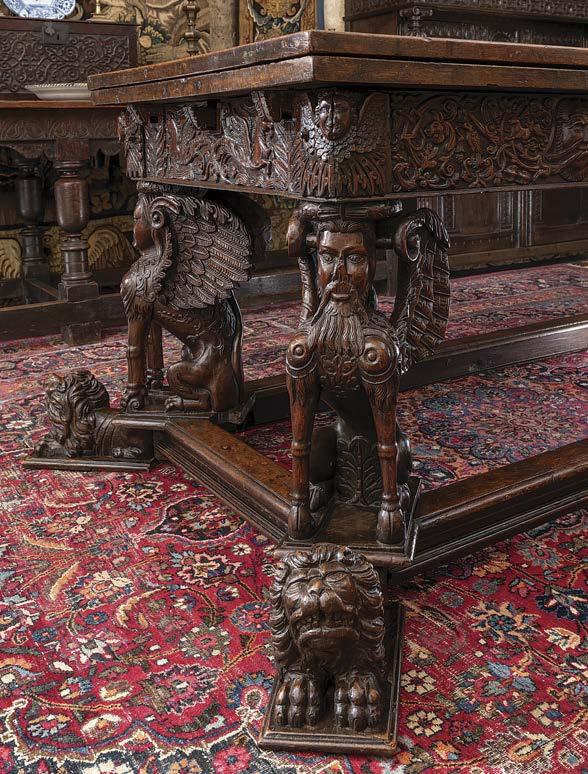
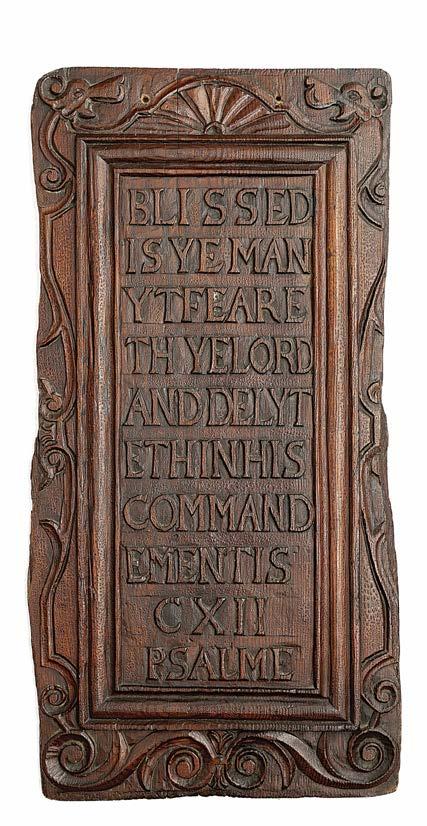
501
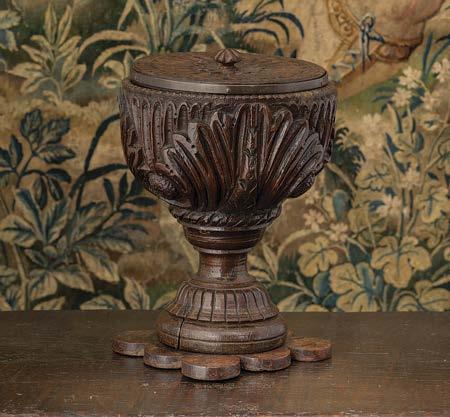
A carved oak ‘wassail bowl’ or communal cup, English Adapted, probably in the 17th century, from an Elizabeth I bed post.
Turned, having a large bowl, waisted short stem and spreading foot, the bowl carved in deeprelief with palmettes, the domed foot lenticular carved, later lid, the whole on a square cuspprofiled base, with handwritten name and dated label; ‘John Lowia’ and ‘1656’ to the underside.
H 29.2cm, Dia 22.9cm
£300400
An early 17th century carved pine panel, probably Scottish, circa 160040
Carved in high relief with a biblical inscription from Psalm 112, reading: ‘Blessed is ye man yt feareth ye Lord and delyteth in his commandments’, set within a bold frame carved with scrolls, headed by stylised beasthead terminals and fanlike cartouche.
Apart from being made of pine, the use of lettering and font styles are part of the decorative vocabulary of early 17thcentury Scottish carving. See Lot 487 (chair) in this sale.
H 76.8cm, W 36.8cm
£600800 501
A carved oak panel of a merman, Dutch, circa 162040
The merman grasping a writhing serpent, his bold scaled tail coiling into scrolling fruiting foliage, with a cluster of grapes emerging amidst bold acanthus leaves.
The composition combines classical and maritime motifs with Bacchic symbolism. The grapes evoking abundance and the pleasures of wine, while the serpent and merman reflect the dangers and mysteries of the sea.
H 22.2cm, W 43.8cm, D 1.3cm
£100150
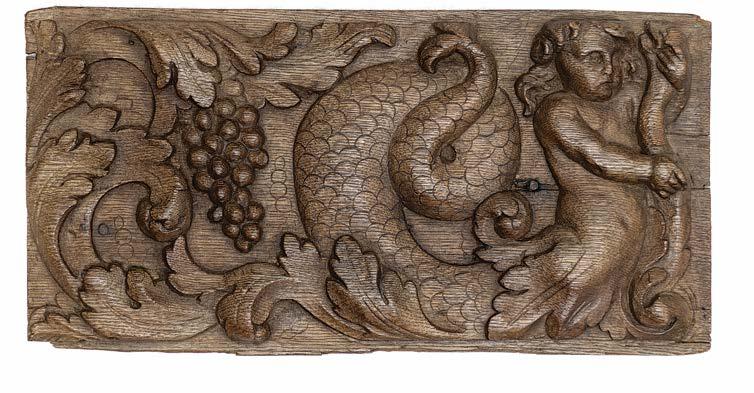
A carved oak panel, Netherlands or Northern Germany, circa 15801600
Depicting the bust of a winged angel, framed within a scrolling cartouche, the angel’s features are delicately modelled, conveying both serenity and watchful presence, while the surrounding foliate ornament enhances the celestial theme.
H 28.6cm, W 27.9cm, D 1.3cm
£100150
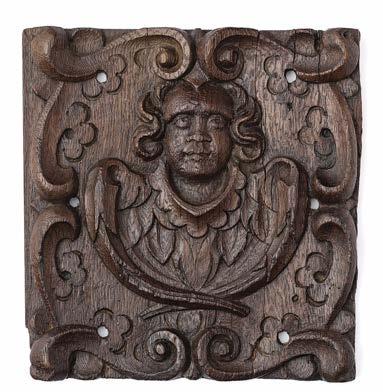
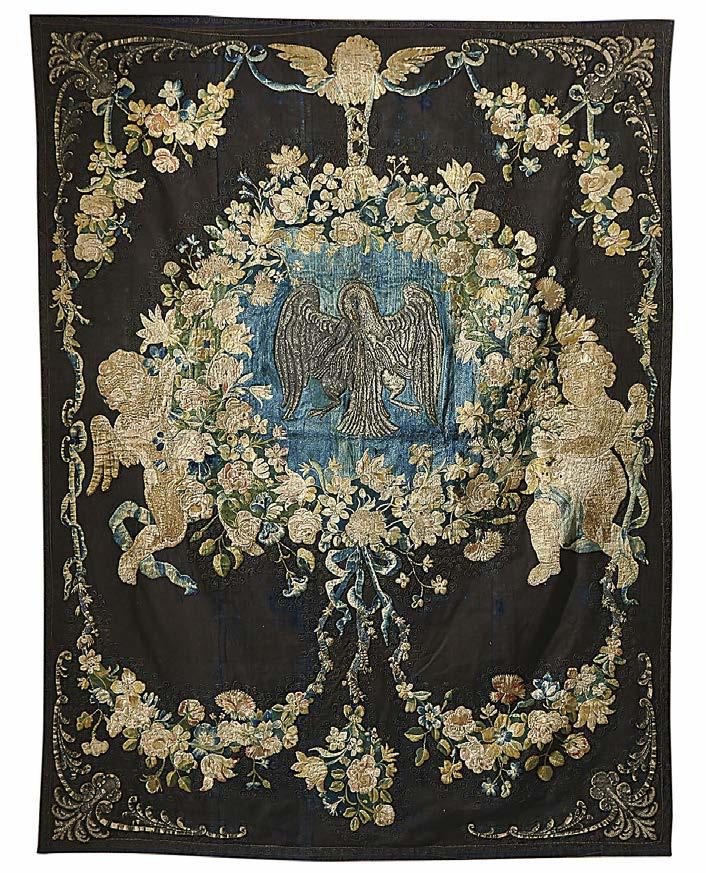
505
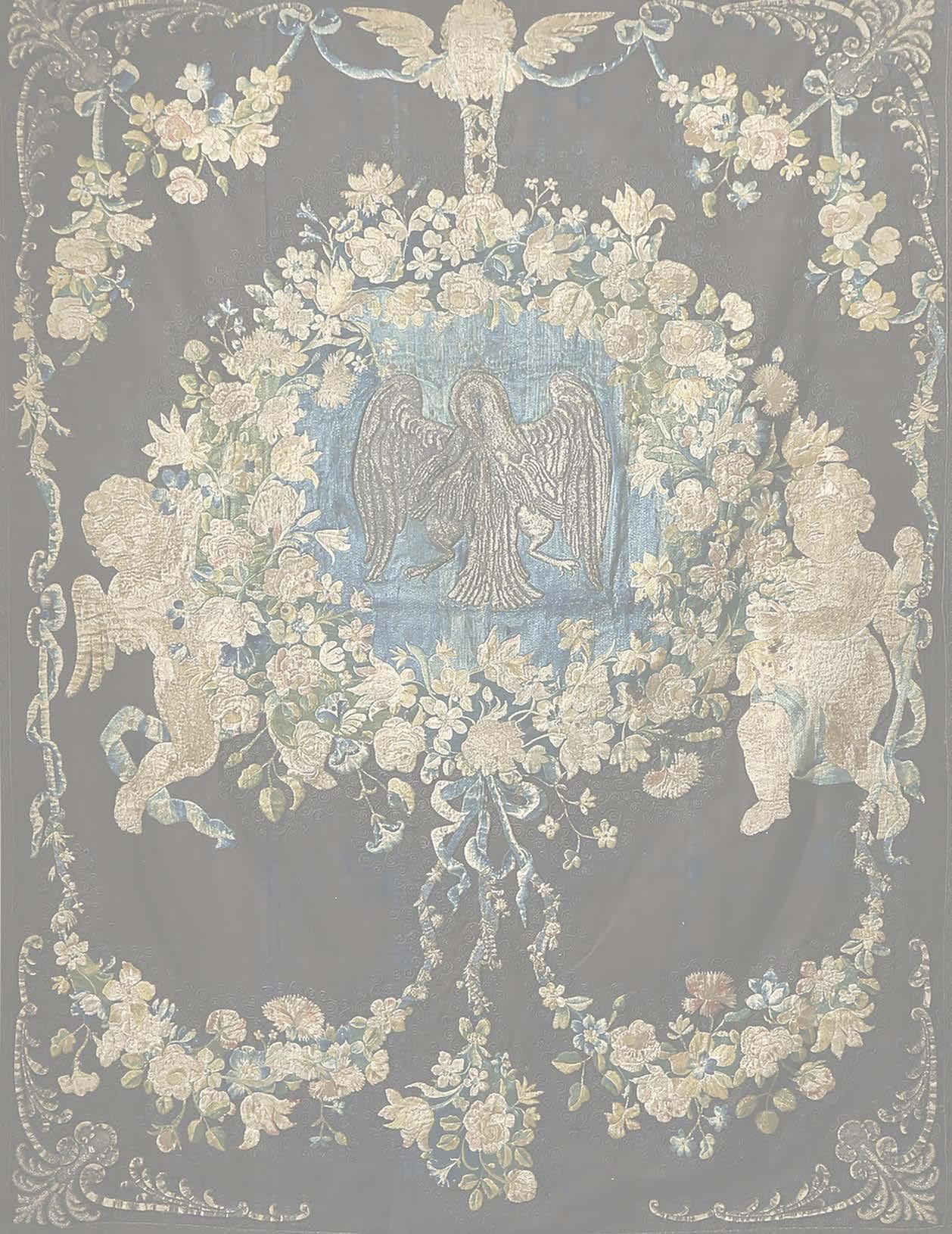
505
An embroidered and appliqué wall hanging, French, circa 1700
To the centre a Pelican in her Piety, worked in silver and silvergilt thread, possibly of earlier date, on a blue silkvelvet ground, within a floral wreath composed of roses, lilies, carnations and other blossoms, worked in shaded silks, flanked by winged cherubs, headed by a winged cherub mask issuing ribbon tied floral swag borders, and with leafyspandrels again worked in silvergilt threads.
H 227.3cm, W 167.6cm
£1,5002,000
506
A mid18th century delftware charger, Dutch, circa 1750
Painted in cobalt blue with a Chinoiserie garden scene, depicting a figure seated beneath an abundance of oversized floral sprays, before a water garden, the rim with alternating floral panels and a diaper trellis pattern, scallop or piecrust rim, blue painted ‘BP 240’ to the base.
Dia 34.3cm
£120180
507
A delftware charger, Dutch, circa 170050
Painted in cobalt blue, to the centre stands a stylised lion, possibly the Lion of Judah, before an architectural pavilion or gateway, flanked by stylised foliage and rockwork, the rim with a continuous scrolling foliate band.
Dia 34cm
£100200
508
A delftware plate, London or Bristol, circa 170050
Painted in cobalt blue, with a standing man, holding a staff or hoe, set against a stylised ground with foliage either side, the rim decorated with a narrow band of repeated foliate and trellis design.
Literature: See Michael Archer, ‘Delftware: The TinGlazed Earthenware of the British Isles’ (1997), for comparable figural plates.
Dia 22.9cm
£120180
A Charles II walnut child’s highchair, circa 1680
The backrest features a central caned panel, a fashionable innovation of the Restoration period influenced by Dutch and French imports, framed by spiralturned uprights, surmounted by ‘acorn’ finials, the cresting rail with a central shell flanked by pierced foliage, the relatively flat arms wrapped with stylised foliage, and the front legs with ball over spiralcarving, with spiralturned rear legs and stretchers.
Comparable examples are illustrated Tobias Jellinek, ‘Early British Chairs and Seats 1500–1700’ (2009) pl. 179. p. 154 & pl.181, p. 155.
Provenance: Formerly in the private collection of Mrs V. Ray Ellis. Acquired in 1987 from T.E. Robinson Antiques, Bath (£3,400).
H 108cm, W 41.3cm, D 35.6cm
£8001,200
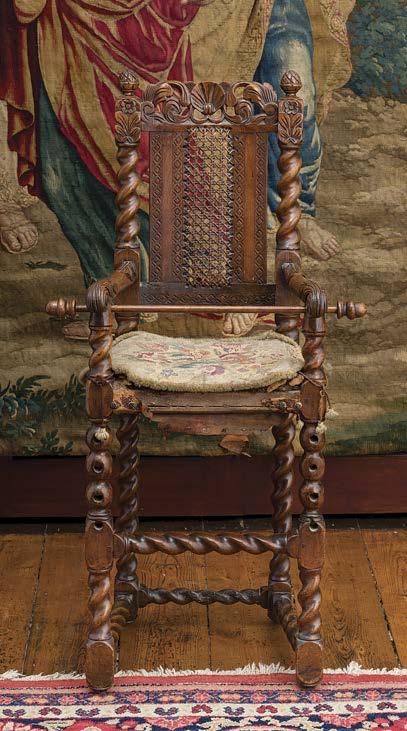
511
A lignum vitae mortar, English, circa 16801700
A matched set of six oak backstools, South Lancashire/North Cheshire, circa 1670
Each with high arched cresting rails and panelled back carved with vigorous foliate motifs, the boarded seat on block and turned forelegs, joined by a turned front mid and multiple stretchers. (6)
Provenance: Private Devonshire collection.
Literature: See ‘Victor Chinnery, Oak Furniture: The British Tradition’ (1979), pp. 484–485, for a discussion and comparable South Lancashire / North Cheshire backstools.
H 108cm, W 49.5cm, D 40.6cm
£500800
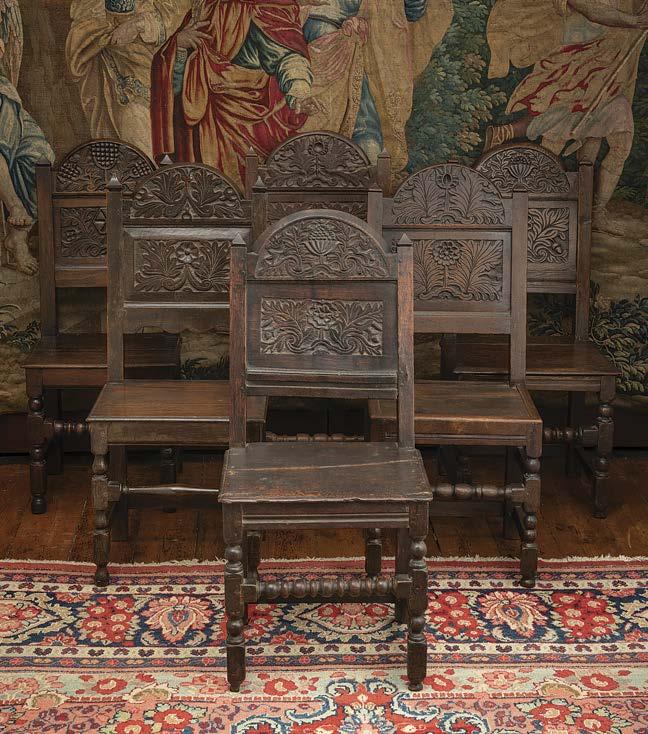
510
The thickwalled vessel of slightly waisted cylindrical form, with bold turned bands.
The use of lignum vitae in England reflects the expansion of global trade in the late Stuart period, the wood being imported in limited quantities from the Caribbean and northern South America. Valued as ‘the wood of life’ for both its medicinal purposed (used in treating gout and syphilis) and its extraordinary dense durability, it was a material associated with both health and strength.
H 17.8cm, W 15.9cm
£100150
512
A Charles I joined oak stool, circa 1640
Having an ovolomoulded top, runmoulded and bicuspidprofiled rails, on columnarturned legs, joined by plain stretchers all round.
H 57.8cm, W 45.7cm, D 34.9cm
£200300
A Charles I joined oak sixleg refectorytype table, Derbyshire, circa 163040
Having a cleated boarded top, the six bold balusterturned legs united by robust stretchers, the table is enriched with a carved frieze of leafy lunettes.
Long tables of this calibre were often placed against a wall, laden with plate, textiles, or imported ceramics to impress visitors, but also served for dining.
Provenance: Huntington Antiques Ltd., StowontheWold, Gloucestershire.
Thence private Cotswolds collection.
H 83.8cm, W 316.9cm, D 76.8cm
£4,0006,000
An early 18th century Delftware charger, Dutch, circa 170050 Decorated in cobalt blue, centred with a lion, standing before a columned pavilion, flanked by stylised rocks and foliage, the segmented rim with alternating panels of floral sprays, fruiting branches, and figural vignettes, directly recalling the designs of late Ming Kraak porcelain that so strongly influenced Dutch ceramic production.
The lion, rendered with a bold mane and expressive features, may be understood as a Europeanised interpretation of the Chinese guardian lion (foo dog) or the Lion of Judah.
Dia 34.3cm
£100200
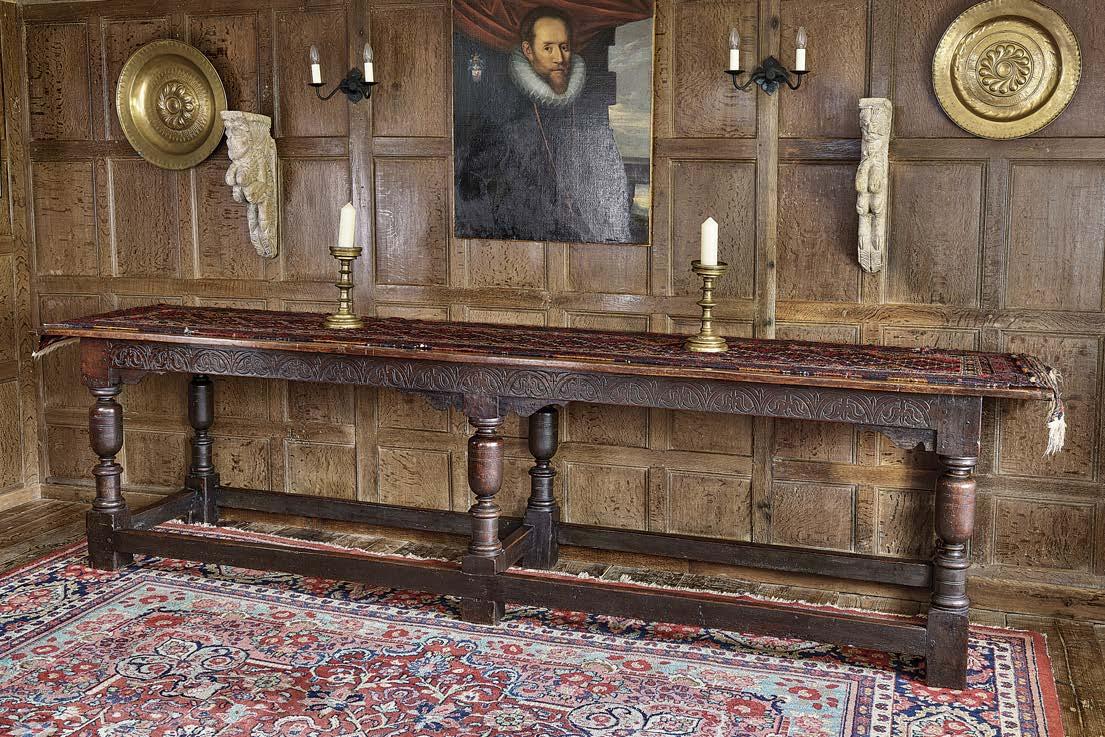
513
515
A Khorasan carpet, circa 1910
The raspberry field of vines centred by an indigo medallion framed by spandrels, floral vine borders, flanked by mustard guard stripes.
L 405cm, W 318cm
£200300
516
A Hamadan rug, Persian Kurdistan, circa 1920
The indigo field with a hexagonal medallion enclosed by triple borders.
L 175cm, W 108cm
£80120
An Azeri rug, North West Persia, circa 1930
The terracotta field with a diamond medallion enclosed by triple borders.
L 284cm, W 75cm
£60100
518
An Afghan Saryk rug, circa 1930
The ivory field with columns of ‘Salor’ guls enclosed by multiple borders.
L 179cm, W 126cm
£80120
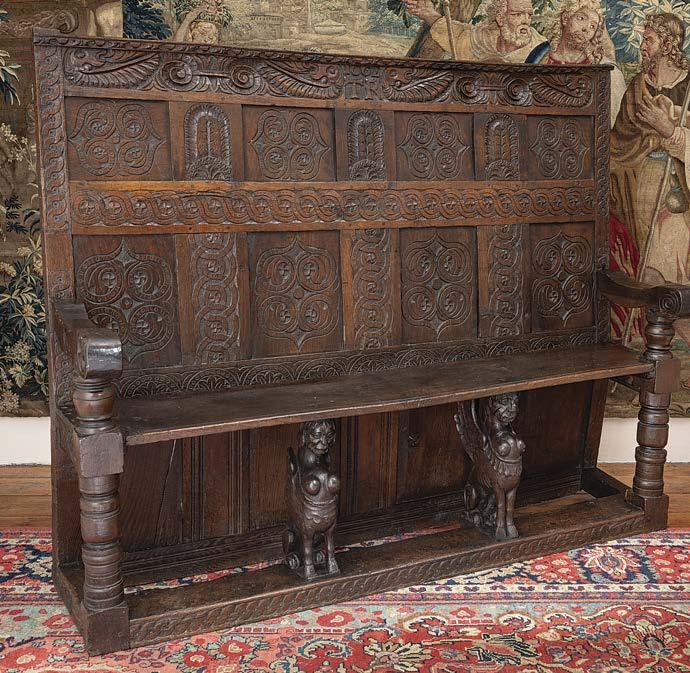
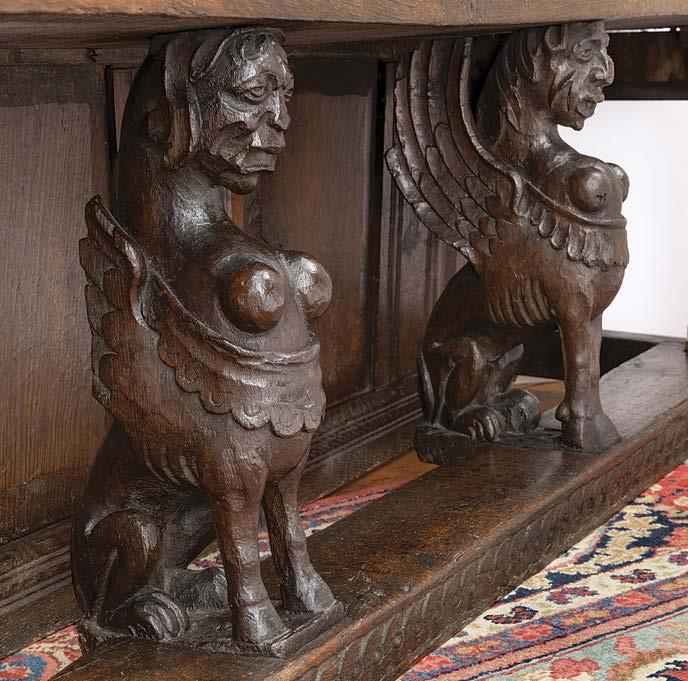
519
A 17th century and earlier bold and interesting oak highback settle
Including Elizabethan elements, adapted and inscribed in the Restoration period.
A single, thick oak plank forming the seat, supported to the centre by highly sculptural figures, circa 1570, in the form of ‘chimera’ or winged griffins with human faces and breasts, further Elizabethan elements appear to form the heavy lower stretcher rail, boldly guillochecarved, the robust scrollended arms and the front turned supports. The high back, composed of multiple panels carved on both sides, using Gloucestershire/Wiltshire regional doubleheart motifs, is 17th century, the top rail carved with scrolling serpents centred by a tablet carved with the date ‘1662’ and initials ‘T R’
H 134.6cm, W 165.7cm, D 45.7cm
£1,0001,500
520
A 17th century squat bronze cauldron
The shallow bulbous body with two cast bands, and large angular lug handles, on three outsplayed triangular legs, body inscribed ‘I F H W’.
H 21.6cm, W 33cm
£100150
521
A Charles I joined oak stool, circa 1640
Having a singlereed edge top and plain bicuspidprofiled rails, on rising balusterturned legs, joined all round by plain stretchers.
H 56.5cm, W 44.5cm, D 31.1cm
£200300
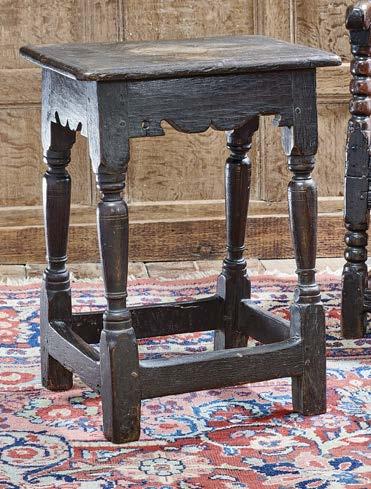
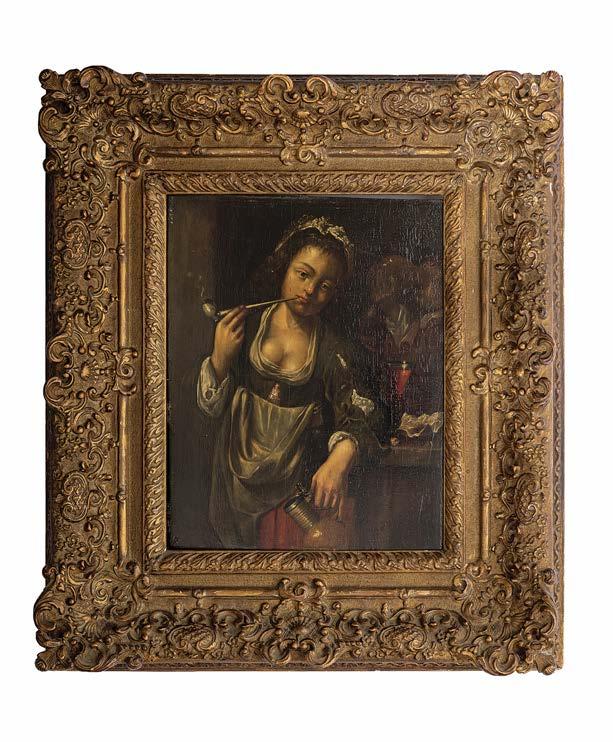
522
Follower of Jacob Toorenvliet (Dutch, 16401719)
Woman in a Tavern, Smoking a Pipe
Oil on panel
35 x 28cm; 13 3/4 x 11in
£300500
523
A brass lantern clock, English, circa 170015
By Jacob Lovelace, Bridport, Dorset
This provincial lantern clock is of traditional form, with bell strap surmounted by a turned finial, bordered by engraved dolphin frets, over the pillars a large circular dial, with Roman chapter ring and fleurdelys half hours, signed ‘Jacob Lovelace Bridport Fecit’, originally fitted with weightdriven verge movement, later converted to a long pendulum with anchor escapement.
H 38.1cm, W 16.5cm, D 17.8cm
£1,5002,000
524
Follower of Claude Deruet (French, 15881662)
Equestrian Portrait of a Nobleman (possibly King Charles I)
Oil on cradled panel
43 x 30.5cm; 17 x 12in
£400600
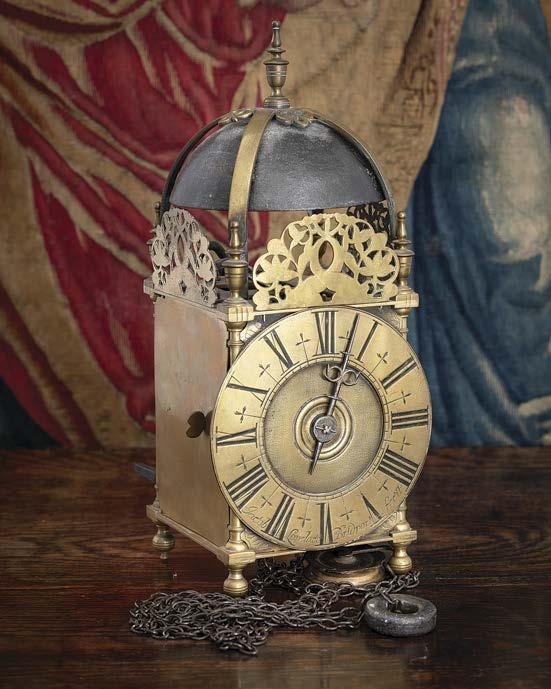
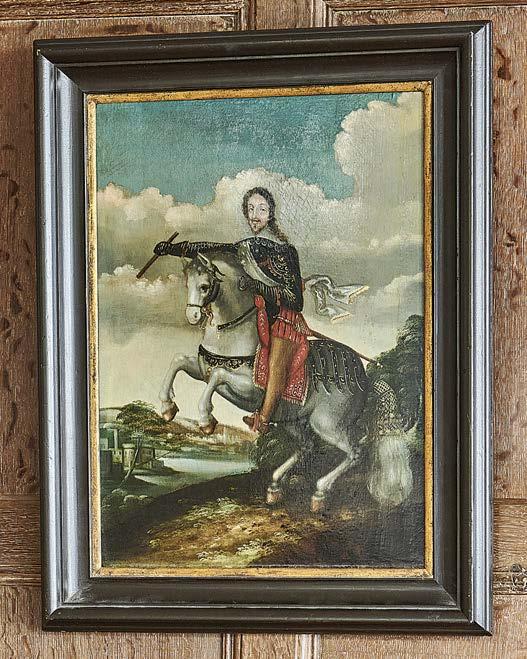
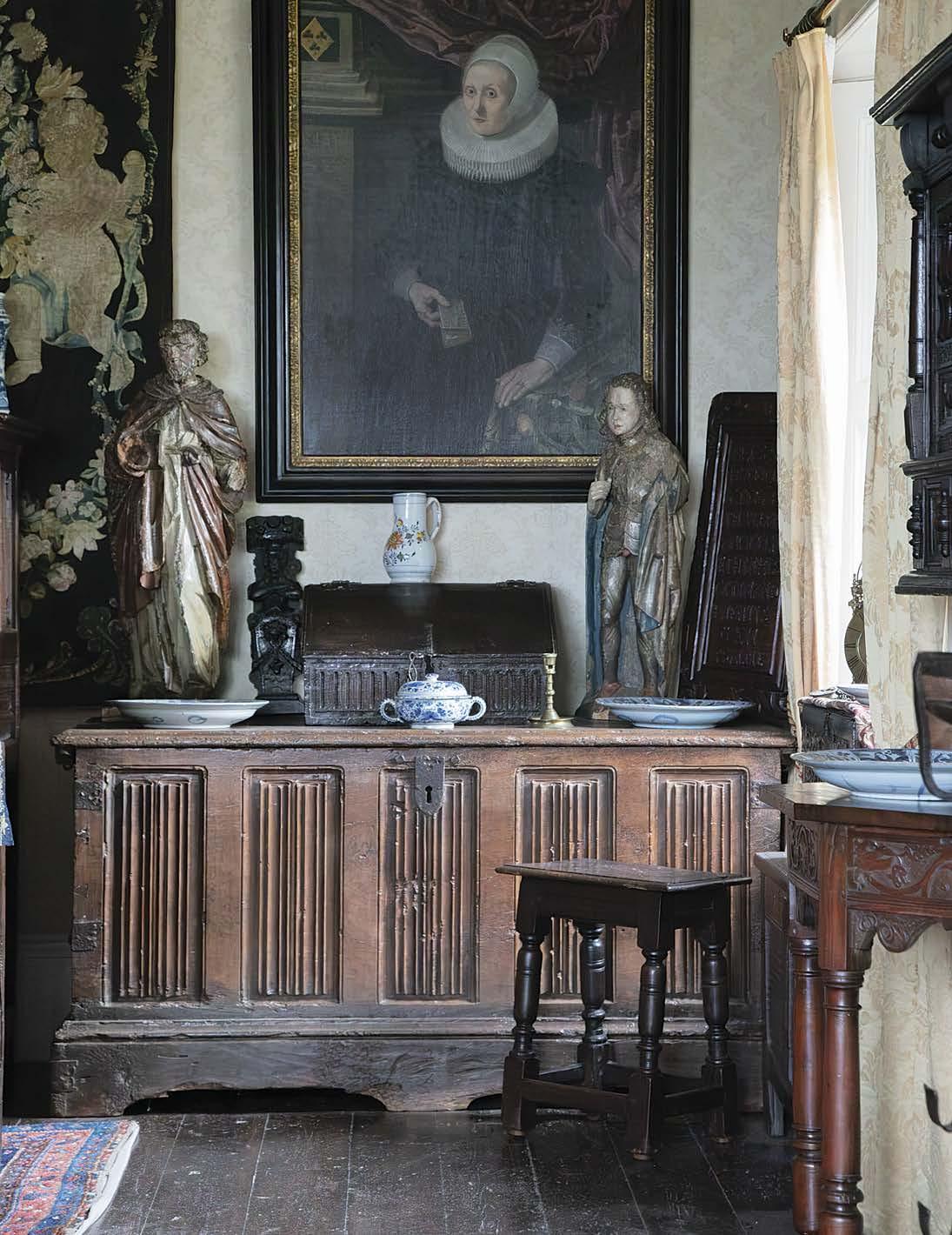

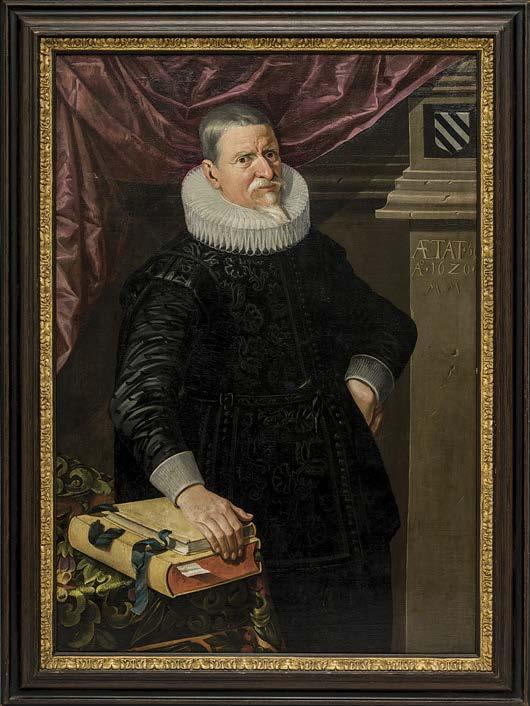
525
Circle of Michiel Jansz. van Mierevelt (Dutch, 15671641)
Portraits of a Gentleman; and his Wife
Each depicted three quarter length, wearing black, with ruff collar, his right hand upon books, she holding a prayer book or similar, he inscribed AETAT 69/Ao 1626/MM, she inscribed AETAT 50/Ao 1626/MM Oil on canvas
He 118.5 x 83.5cm; 46 1/2 x 33in; she 109.5 x 81cm; 43 x 31 3/4in (2)
£3,0005,000
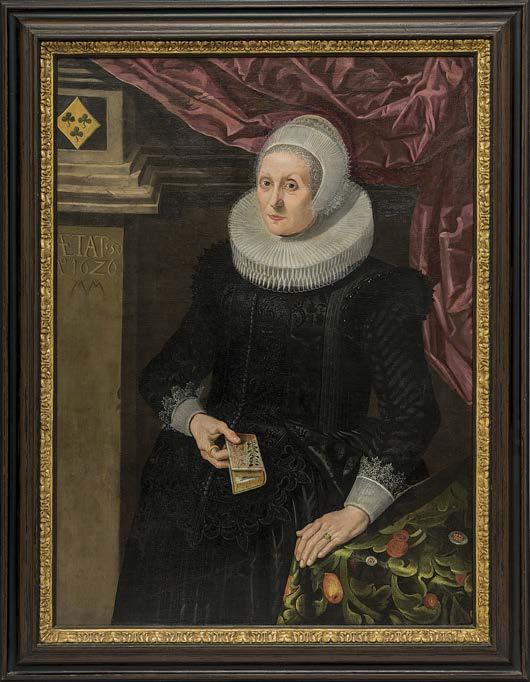
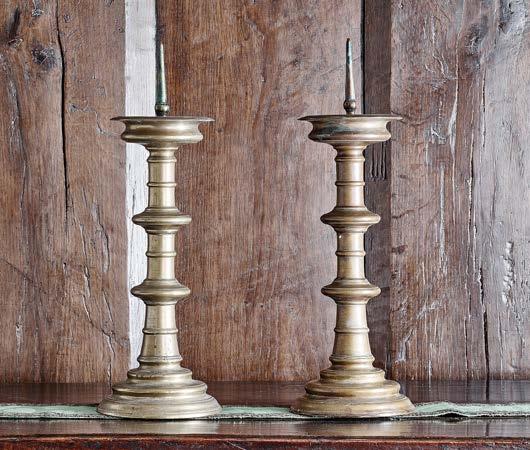
526
A pair of brass pricket candlesticks, South German, probably Nuremberg, circa 15801620
Each with a broad dished drippan centred by an integral brass pricket, the stem with two lenticular knops, and multiple discoids, on a stepped and spreading circular base. (2)
H 49.5cm, W 16.5cm
£400600
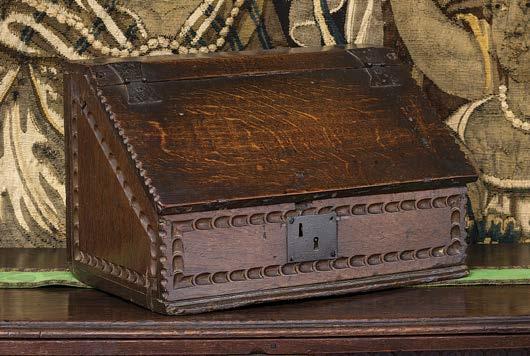
528
A small Elizabeth I boarded oak desk box, circa 15801600
The front and sides decorated with a continuous gaugecarved border, the sharply sloping hinged lid with chipcarved ends.
The gaugedecoration, with its rhythmic crescent carving, is a hallmark of Elizabethan ornament, appearing widely on furniture of the period and is particularly effective here in framing the compact proportions of the box.
H 30.5cm, W 50.2cm, D 30.5cm
£300400
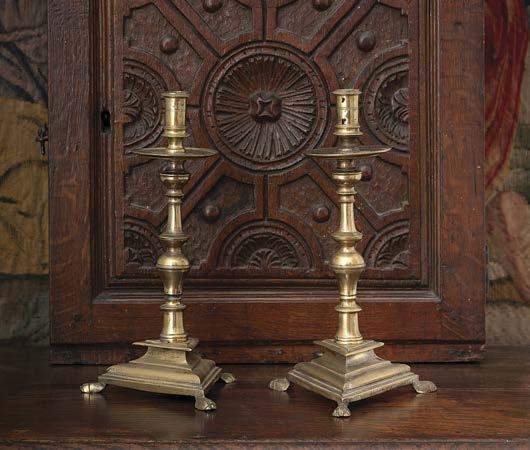
527
A pair of 17th century brass candlesticks, Italian, circa 16501700
Each with a cylindrical socket, a circular drippan, and ornate baluster stem, the spreading triform base with paw feet. (2)
H 29.5cm, Dia 16cm
£400600
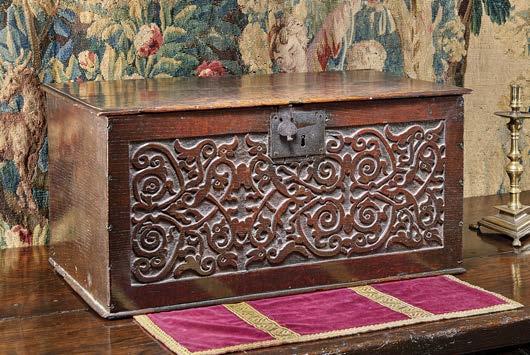
529
A James I boarded oak, strapwork carved, box, circa 1620
Richly carved to the front with interlacing strapwork scrolls, volutes, and stylised foliage, the design crisply executed and retaining traces of original red polychrome within the recesses, the sides left plain and the lid with moulded edge.
H 32.4cm, W 66cm, D 35.6cm
£300400
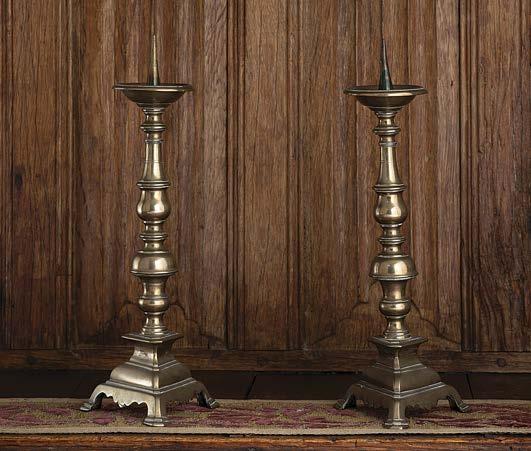
530
A pair of 17th century brass pricket candlesticks, Italian, circa 160050
Each with a broad, dished drippan with central pricket, atop a tall multibaluster stem, on a triform base with scrollprofiled apron and splayed stepped pad feet. (2)
H 38.7cm, W 14.6cm
£300500
531 530
531
An impressive ‘pair’ of 18th century brass pricket candlesticks, Italian, circa 170070
Each with cylindrical socle base, supporting a tall bulbous and baluster stem, topped by an urnshaped drippan and iron pricket. (2)
One candlestick dated 1764.
A very similar pair of pricket candlesticks sold Sotheby’s London, November 17, 2010, lot 361.
H 98.4cm, Dia 21.6cm
£1,5002,000
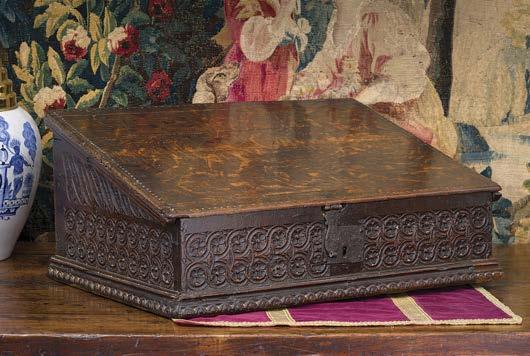
532
An Elizabeth I/James I boarded oak slope, Gloucestershire, circa 160020
Having a sloping lid with dotpunched border, front and sides carved with doubleguilloche, and an egganddart style carved base moulding, the interior with decorative paper lining.
H 33cm, W 67.3cm, D 47.6cm
£200300
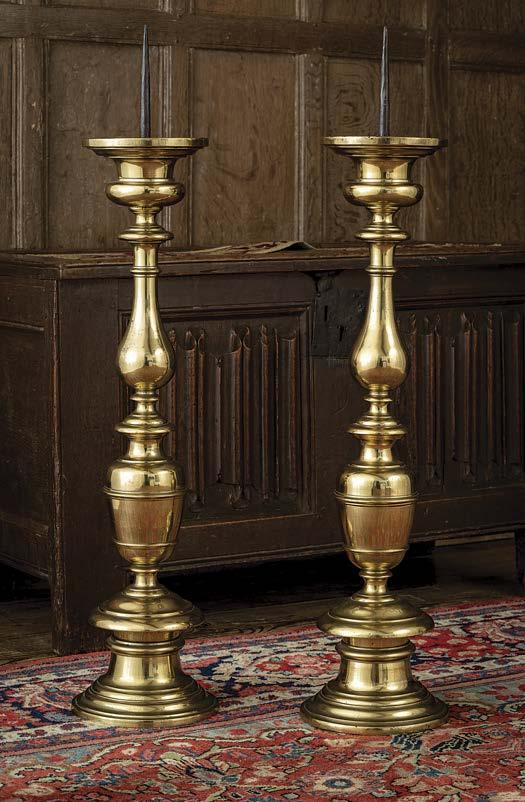
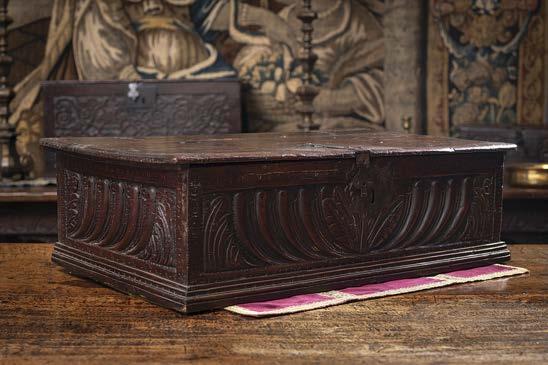
533
An Elizabeth I boarded elm box, West Country, circa 15801600
The front and sides carved with bold gadrooned decoration terminating in leafy cusps, original iron lockplate and hasp.
The gadrooned motif, a sequence of swelling convex flutes derived from classical sarcophagi and Roman silverware, became a key decorative element on English Renaissance furniture.
Provenance: With Crispin Antiques, Hertfordshire and Illustrated in ‘Bible Boxes: English Oak Table Boxes, Slopes, Desks and Cabinets of the 16th and 17th Centuries’, BADA.
H 20.3cm, W 68.6cm, D 41.9cm
£600800
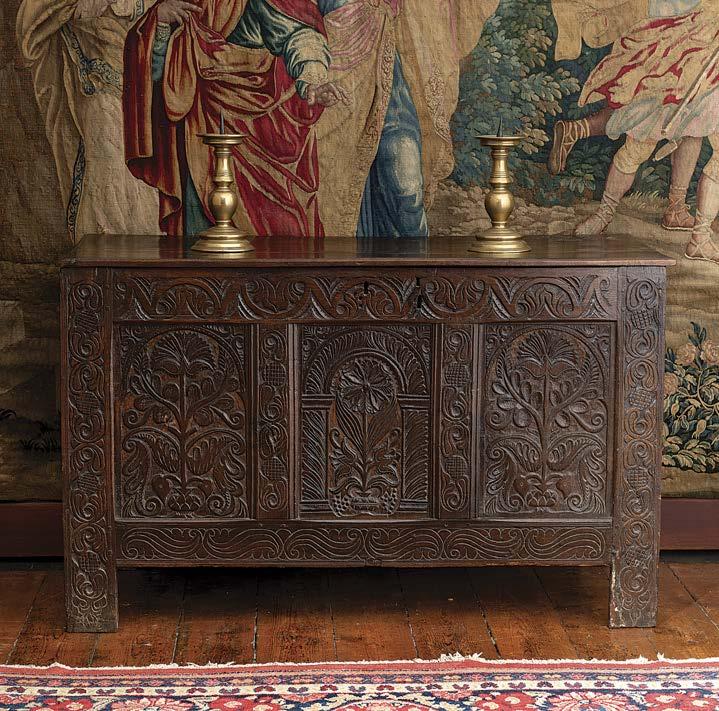
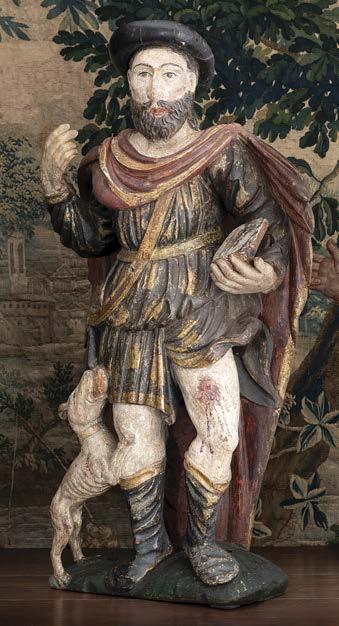
A Charles II joined oak and polychromed coffer, Ottery St Mary, East Devon, circa 1670
Attributed to the workshop of Thomas Dennis
The front is composed of three carved panels, each outer panel with a large single flowering stem, the central panel carved with a similar floral design enclosed within a leafyarcade, the front stiles and rails are further enriched with distinctive Sscrolls and foliate lunettes, remains of original polychrome to the panels ground.
This coffer belongs to a small group of furniture holding international significance. Thomas Dennis emigrated from Devon, England to Ipswich, Massachusetts, New England, in 1663. Using his ‘Ottery St Mary’ stylistic and technical foundation Dennis established a successful American workshop. His signed and documented pieces make him one of a very select group of named joiners/carvers of the period. The pieces linked to his English origins are of profound importance to AngloAmerican furniture history
Provenance: With Michael Dann, Devon. Thence private collection.
H 83.8cm, W 135.3cm, D 55.9cm
£8001,200
A late 17th century carved oak and polychromedecorated figure, St Roch, Flemish, dated 1693
The patron saint invoked against plague is shown in the traditional manner, raising his garment to reveal a plague sore on his thigh, accompanied by a faithful dog offering bread, in his left hand he holds a book, while his right gestures outward in benediction, he wears a short tunic, travelling cloak and hat, evoking Roch’s identity as a pilgrim, the rear of the sculpture bears the painted date ‘1693’, together with a small cross at the back of the neck, reinforcing its devotional purpose.
H 80.65cm, W 35.6cm, D 17.8cm
£8001,200
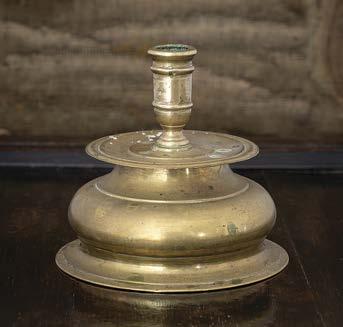
536
A brass candlestick, German, Nuremberg, circa 16501700
Having a slightly flared straightsided socket, screwattached to a relatively flat drippan and bellbase.
The broad base and compact height reflect practical use through stability
H 14cm, W 14.6cm
£100150
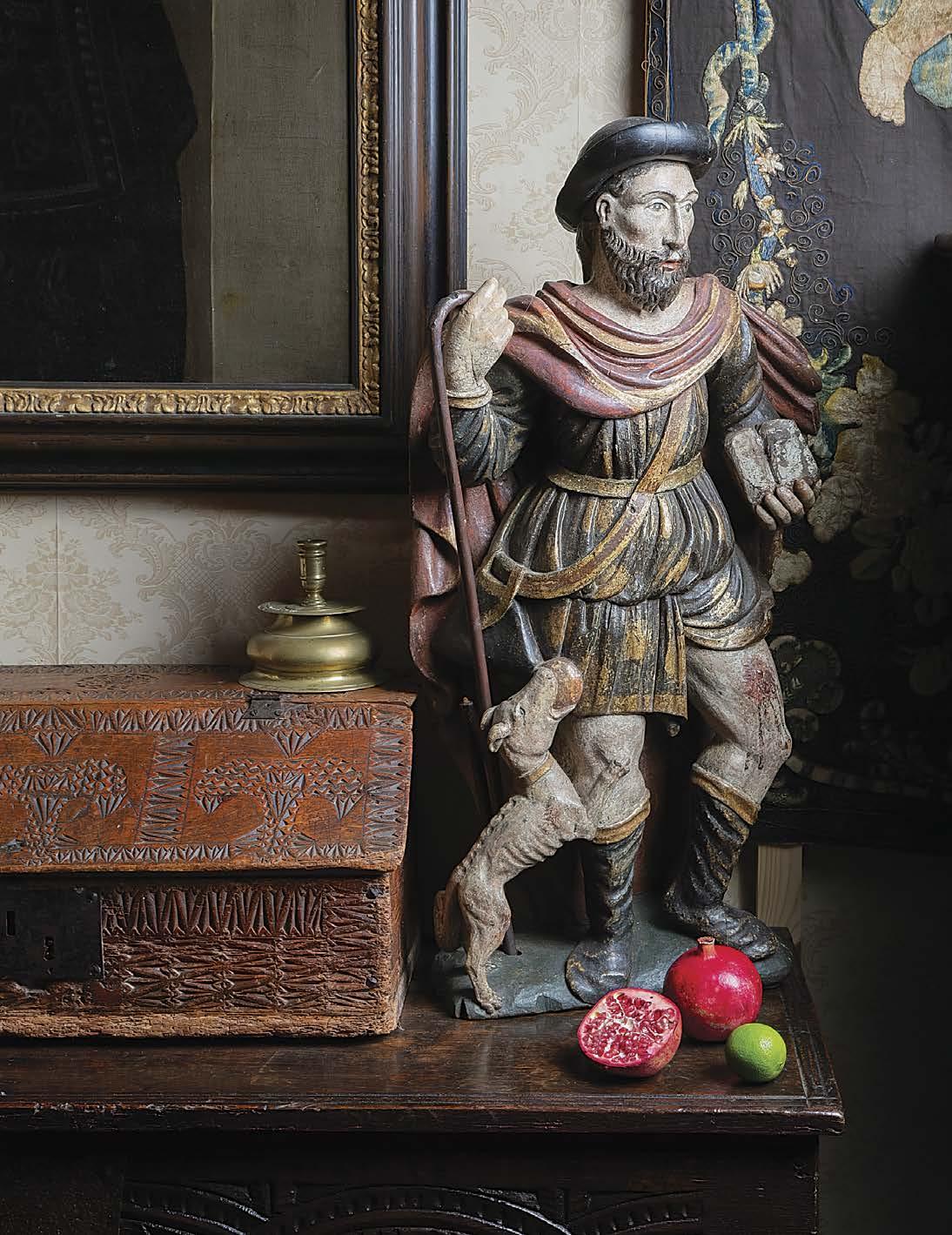
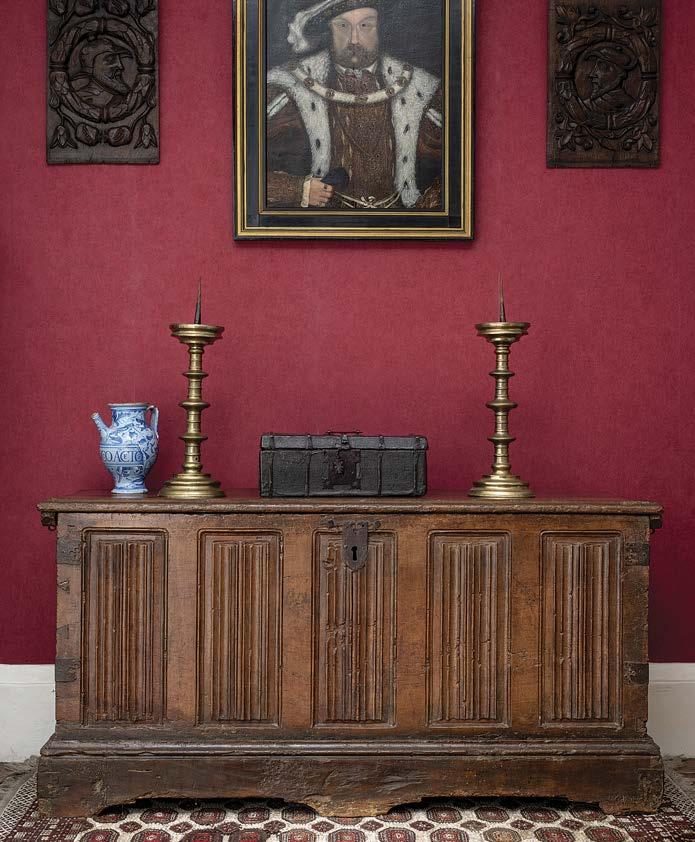
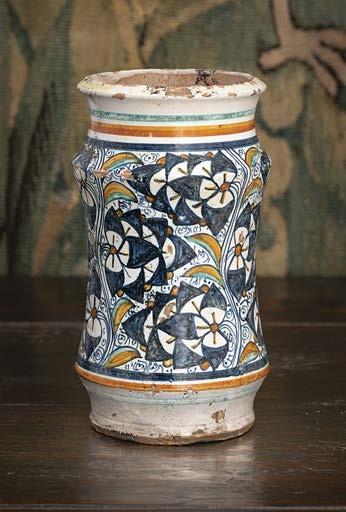
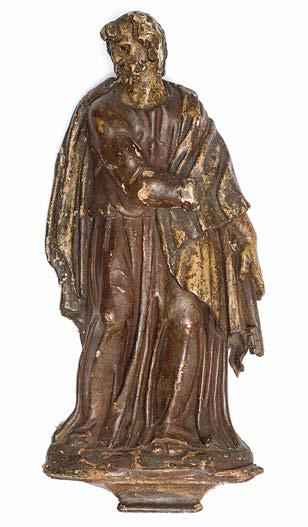
537
A substantial late 15th century boarded walnut coffer, FrancoFlemish, circa 14801500
The front carved from a single thick plank with five deep linenfold reserves, set above a boldly cutout plinth, the ends retain their original wrought iron carrying handles, testifying to the chest’s dual function as both a secure strongbox and a piece of domestic storage, interior till, iron lock plate and strap hinges.
Closely related examples are illustrated in Jacqueline Boccador, Le Mobilier Français du Moyen Âge à la Renaissance (1988), p. 40, no. 32, dated to the late 15th century.
H 79.4cm, W 156.2cm, D 63.5cm
£1,8002,200
538
A rare early 16th century Montelupo maiolica albarello, Florence, circa 150020
Of shouldered slightly waisted cylindrical form, with everted rim, densely painted in cobalt blue, green and orange with Persian palmettes, bordered by narrow bands.
The decoration exemplifies the “alla porcellana” (porcelaininspired) style of Montelupo in the early sixteenth century, directly influenced by imported HispanoMoresque and Near Eastern ceramics, which were widely admired by Florentine patrons. Furthermore, the ornament reflects the transitional phase between the late Quattrocento HispanoMoresque influence and the fully developed Italian Renaissance maiolica of the 1520s. The albarello form was designed to hold dry apothecary ingredients, its slightly waisted profile allowing it to be gripped securely by hand, and its rim sealed with parchment or leather. Montelupo was the principal Tuscan centre for such wares in this period.
Literature: See Bernard Rackham, ‘Catalogue of Italian Maiolica with emendations and additional bibliography’, by J.V.G. Mallet, (1977), cat. 333, pl. 55, p.116 and Jeanne Giacomotti, ‘Catalogue des Majoliques de Musees Nationaux’, (1974), p. 39, cat.143, for similar examples.
H 20.3cm, Dia 11.4cm
£3,0004,000
539
A carved figure of St Peter, Flemish, circa 152060 The shallow relief figure carved to stand against an architectural support, St Peter shown bearded and mantleclad, his proper left hand gripping an oversized key, his canonical attribute as gatekeeper of heaven, the drapery falls in tight, pipelike folds, with the mantle sweeping over his left shoulder and down across his waist, on an integral soclelike base, further indicating original placement within an altarpiece ensemble, choir screen, or shrine niche, with traces of original polychrome and watergilding.
H 40.6cm, W 17.8cm, D 5.1cm
£200300
An unusual Charles II joined oak stool, circa 166080
Having a moulded edge top, multiple narrow runmoulded rails and rare double balusterturned legs, joined by plain stretchers all round.
H 57.2cm, W 48.3cm, D 35.6cm
£300400
541
A delftware polychrome and pewter lidded jug, Dutch, circa 170050
Of baluster form, with straphandle, fitted with a pewter hinged lid with leafybeaded thumbpiece, the handle with dot decoration and the body boldly painted in ironred and cobalt blue with stylised floral motifs and rosettes, dispersed among red stars.
H 23.5cm, Dia 12.7cm
£100150
542
A Charles II joined oak boxseat armchair, Lancashire, circa 166080
The arched and scrolled cresting with carved foliage, atop a double back panel, the upper panel worked with floral imagery and stylised tulip motifs, the lower panel left plain, the downswept arms on squat balusterturned front supports, the box base with plain panels set within runmoulded rails, hinged seat.
H 123.2cm, W 59.1cm, D 57.2cm
£400600
543
A delftware charger, Dutch, circa 170050
The central reserve depicts a Chineseinspired figure scene, set within a garden landscape, flanked by columns and architectural motifs, with further foliage and rockwork details, the rim divided into alternating panels of floral sprays and stylised rockwork vignettes, echoing the panelled borders of imported Ming Kraak porcelain.
Dia 34.9cm
£100200
544
A Charles I joined oak stool, circa 1640
Having an ovolomoulded top, and broad runmoulded seat rails, on columnarturned turned legs, joined by plain stretchers all round.
H 57.8cm, W 43.2cm, D 31.1cm
£300400
545
A mid18th century delftware charger, Dutch, circa 1750
Painted in cobalt blue in imitation of Chinese kraak porcelain; centred with two seated figures on a terrace beside ornamental plants, framed within a band of stylised foliage, the rim divided into radiating panels alternating between blossoms, scrolling foliage, and figures, separated by narrow floral devices, the reverse is decorated with simple dash motifs, and the footrim is pierced for suspension, suggesting the piece was intended for display as well as use.
Dia 34.9cm
£100200
546
A delftware plate, possibly London or Bristol, circa 16801720
Painted in cobalt blue with The Crucifixion, showing Christ on the Cross between the two thieves, with the titulus INRI above and the Instruments of the Passion, two nails, beneath, the scene enclosed by a double blue line, the rim decorated with freely brushed floral sprays.
Religious imagery on English delftware of this period is uncommon, reflecting the restrained Protestant taste of Restoration England. Devotional ceramics were more characteristic of Dutch or Iberian production. This example aligns closely with a small group of late 17thcentury London and Bristol wares painted with biblical subjects.
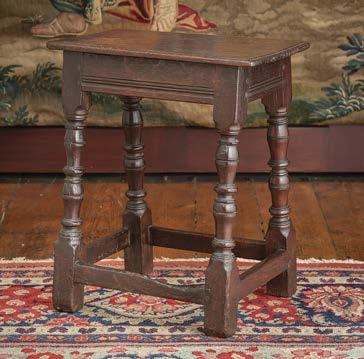
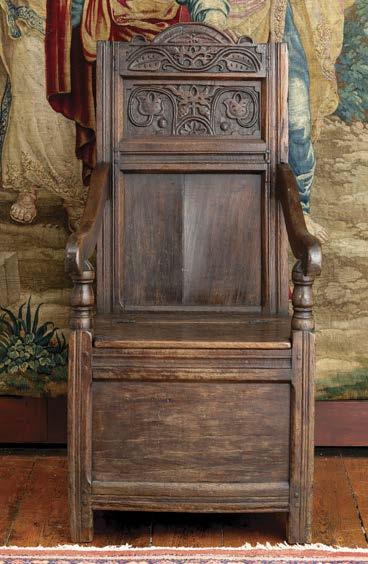
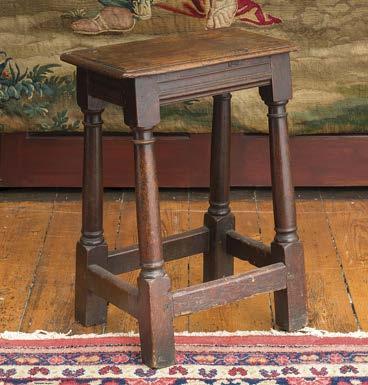
Dia 22.9cm
£100200
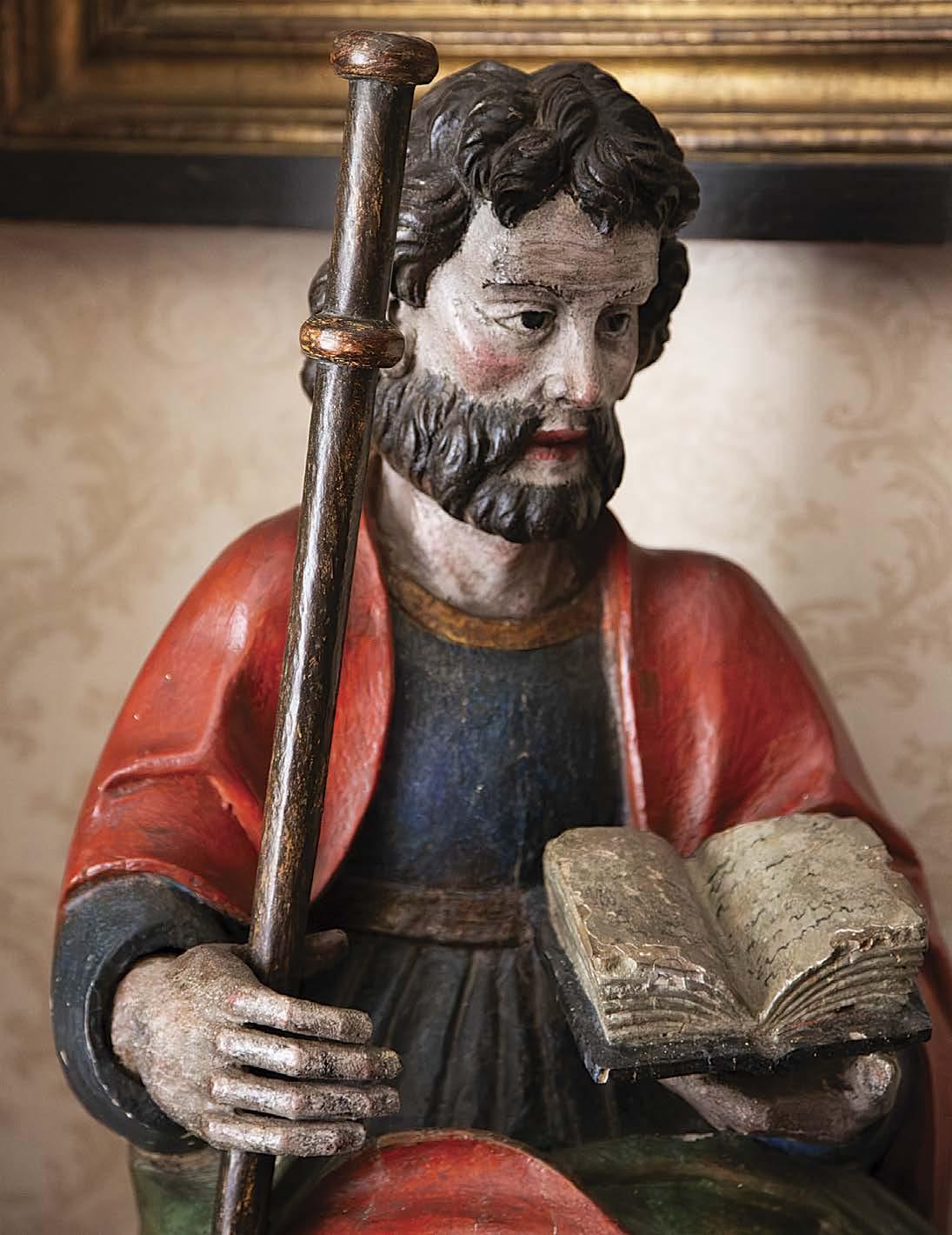
547
A mid16th century brass alms dish, Nuremberg, Germany, circa 1550
Of characteristic form, having a central boss within a gadrooned swirl, enclosed by a band of Gothicscript, edged with decorative punches, the rim with rolled edge and a band of further punchdecoration.
Dia 54cm
£100200
548
A 17th century squat bronze cauldron, Germany or Low Countries, circa 1600
With everted rim, paired angular lug handles and three triangular section splayed feet, near one handle cast foundry mark ‘TA’.
H 14.6cm, W 34.3cm, D 25.4cm
£80120
549
A delftware charger, Dutch, circa 170050
Painted in the Kraak style with a Chineseinspired garden scene, centred by a figure in flowing robes within a stylised landscape of rocks, fencing, and bamboo beneath a canopy of trees, enclosed within a scrolling border, the rim divided into alternating panels of floral sprays, precious objects, and stylised motifs, all executed in a rich cobalt blue, blue painted ‘ID’ to the base.
Dia 34.3cm
£100200
550
A delftware charger, Dutch, circa 170050
Painted in pale cobalt blue, centred with a fantastical dragon, in animated pose, with bristling mane, outstretched claws, and spotted body, transformed by Delft decorators into a wild chimera inspired by Chinese models, the field is richly filled with foliage, the rim with alternating feathered motifs and trellis reserves.
Dia 31.1cm
£100200
551
A 16th century carved figure, St Peter, South German or Austrian, circa 150050
Designed seated, barefoot, holding an open book in his left hand and a staff in his right, his features are carefully modelled, with a curling beard and hair framing a thoughtful expression, while the folds of his mantle fall in angular planes across his body, later polychrome.
Although St Peter is more commonly identified by the keys to the Kingdom of Heaven, the staff and book also serve as attributes. The work was likely part of a larger ensemble of Apostles designed for an altarpiece or choir screen, where such figures were arranged in seated or standing poses as witnesses to the faith.
H 66cm, W 30.5cm, D 17.8cm
£500800
552
A delftware charger, Dutch, circa 170050
Decorated in cobalt blue on a white tinglazed ground, the well with a group of four figures seated before a twincolumn arch, festooned with drapery, suggestive of a theatrical setting, the rim divided into alternating panels enclosing reserves of stylised foliage, floral scrolls, and figures in landscape settings, a design scheme derived from Chinese Kraak porcelain of the late Ming period.
Dia 34.9cm
£150200
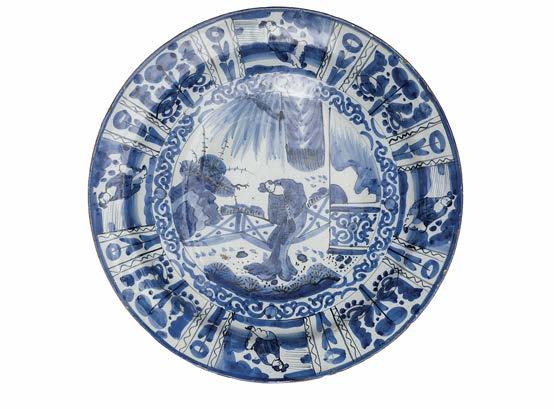
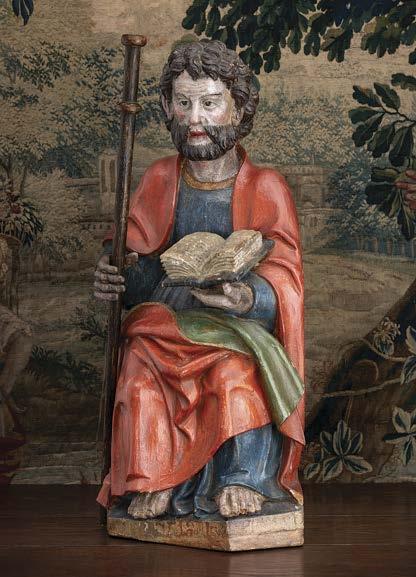
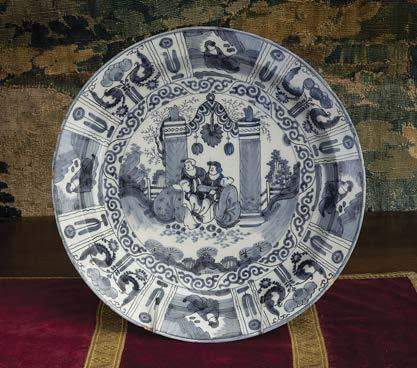
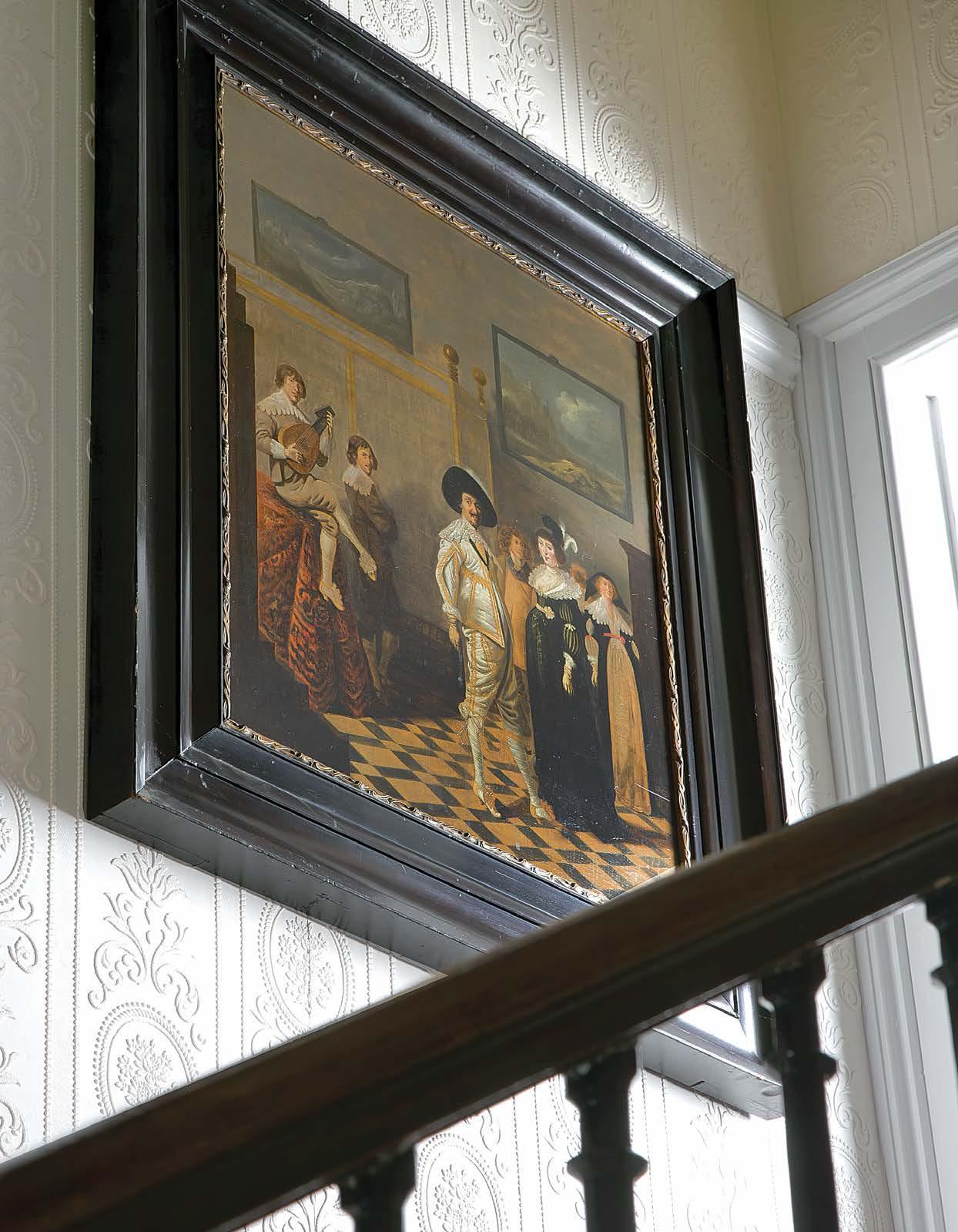
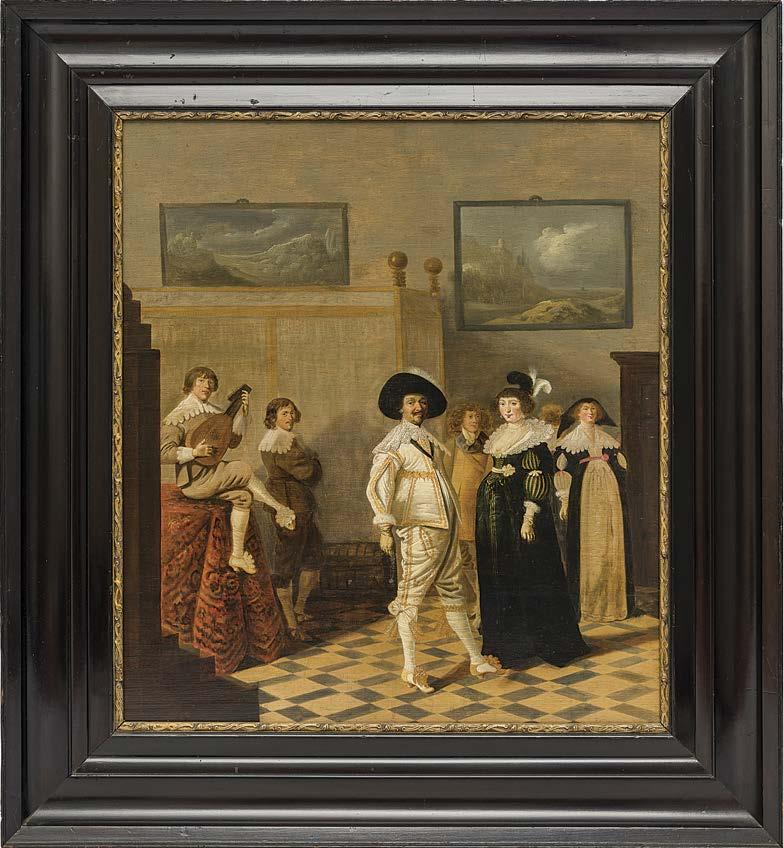

553
Circle of Pieter Jansz. Quast (Dutch, 16061647)
Interior with Elegant Company and a Lute Player
Oil on cradled panel
68.5 x 62cm; 27 x 24 1/2in
£3,0005,000
554
An Elizabeth I oak term, West Country, circa 15851600
The upper part carved as a male, his strong arms crossed over the torso, atop a plinth carved with a lion mask supporting leafysways and hung with fruit.
H 47cm, W 13.3cm, D 6.4cm
£150200
555
A Kurdish rug, Persian Kurdistan, circa 1930
The indigo field with a raspberry panel surrounded by flowers enclosed by ivory borders and carnation guard stripes.
L 196cm, W 111cm
£80120
556
A pair of mid18th century brass candlesticks, English, circa 1750
Each with a cylindrical socket and flared rim, on an invertedbaluster and knopped stem, the spreading circular base with cusped footrim. (2)
H 18.5cm, Dia 10.5cm
£6080
557
A George III oak birdcage action tripod table, circa 1760
Having a circular tilttop, on a fourpillar cage support, the vaseturned support on three downswept legs, terminating in pad feet.
H 67cm, Dia 79.5cm
£100150
558
A German faience and pewtermounted tankard, probably Bayreuth, circa 174060
Of cylindrical form, fitted with its original pewter mounts including a domed hinged lid with ball thumbpiece and foot ring, the body painted in cobalt blue and manganese, with a stylised flora and trees, blue painted ‘BFS’ to the base.
H 26cm, Dia 13.3cm
£6080
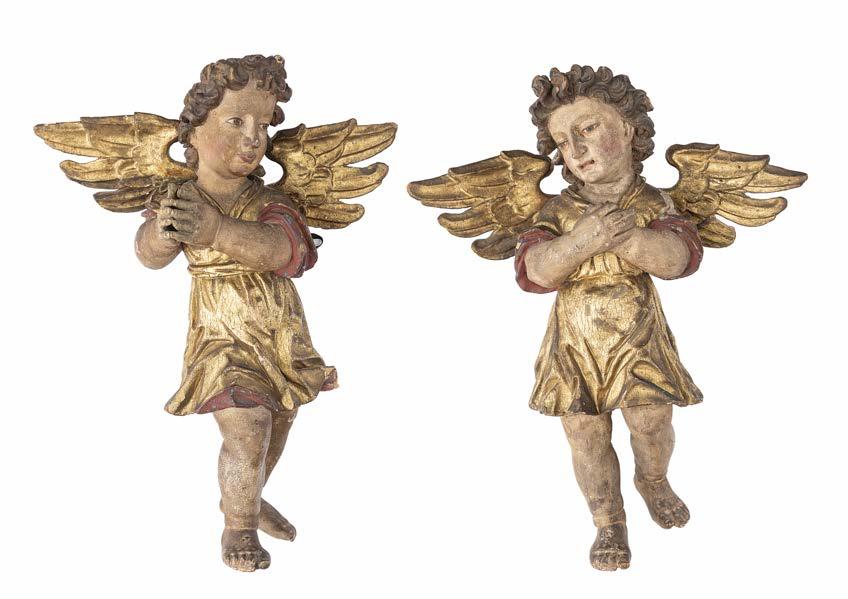
A charming pair of carved, polychrome and gilded angels/cherubs, possibly Antwerp, circa 1600
The pair exemplifies the lively, devotional sculpture produced in the Netherlands at the close of the 16th century. Each figure is shown in motion, with gilded feathered wings spread behind them and curly hair framing rounded, childlike faces. One cherub clasps its hands in prayer, while the other folds its arms across its chest in a gesture of humility. Both wear short tunics, again highlighted in gold, with red undersleeves lending a rich contrast to the gleaming surface. (2)
Figures of this type were produced for altarpieces, tabernacles, pulpits, and canopies, where they served both decorative and symbolic purposes. Cherubs, associated with divine light and heavenly praise, were imagined as eternal attendants at the throne of God. Their presence near the altar or the Eucharist reflected the idea of heaven breaking into the liturgy, surrounding the sacred action with angelic hosts.
The style of carving, particularly the rounded facial type and the treatment of the drapery, suggests the influence of Antwerp workshops, which were prolific centres of wood sculpture in this period and exported altarpieces, saints, and angelic figures throughout Northern Europe.
H 50.8cm, W 40.6cm, D 15.2cm
£2,5003,500
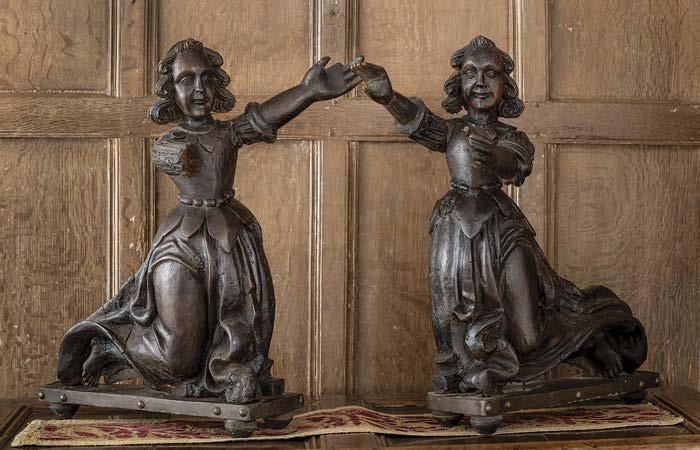
560
An interesting pair of Elizabeth I/James I carved oak figures, circa 160020
The expressive kneeling figures depict youthful attendants in courtly dress, each with flowing curled hair, scalloped ruffs, and long, pleated gowns gathered in heavy folds. Their raised, outstretched arms may suggest they were originally designed as supporters within a larger architectural or heraldic ensemble, possibly framing a coat of arms, cartouche, or devotional image. (2)
The bold modelling, with deeply undercut drapery and animated postures, reflects the influence of late Renaissance mannerist design, embodying the transitional aesthetic between the Elizabethan taste for bold, decorative carving and the more naturalistic forms of the early Stuart period.
H 53.3cm, W 48.3cm, D 20.3cm
£8001,200
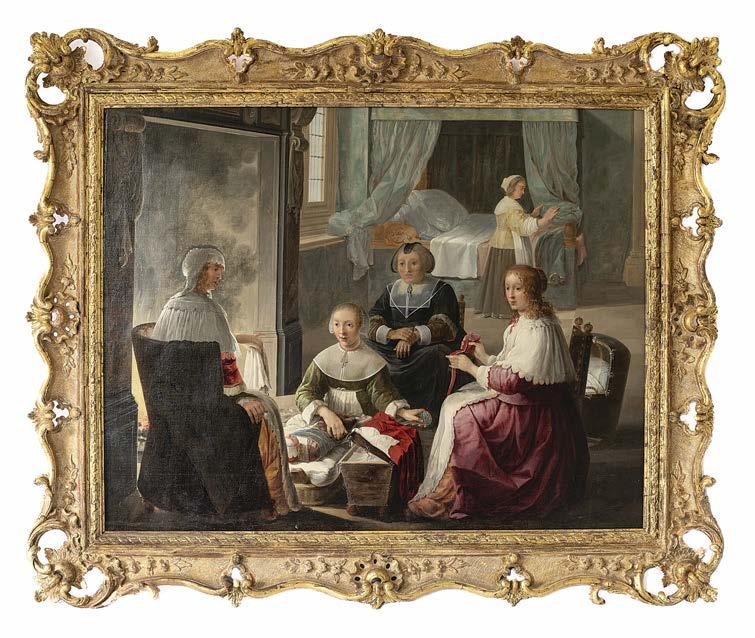
561
Follower of Richard Brakenburg (Dutch, 16501702)
Domestic Scene in a Bedchamber, with a Mother, Newborn Child and Nursemaids
Oil on canvas
97.5 x 122cm; 38 1/2 x 48in
£2,0003,000
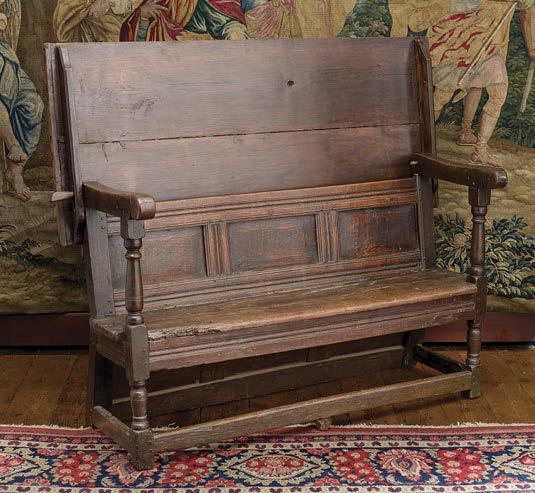
A mid17th century joined oak and elm tablesettle, West Country, circa 164060
The table top of two wide boards, on pivotal hinges attached to the rear of the relatively flat open arms, over a triplepanelled back, with wide runmoulded rails, boarded seat, and balusterturned front arm supports, the matching forelegs joined by plain stretchers.
Provenance: With Sam W. Wolsey, London.
Literature: Illustrated Apollo Magazine, November 1935 (inside front cover). H 130.8cm (table 87.6cm), W 149.9cm, D 54.6cm (table 66.8cm)
£1,0001,500
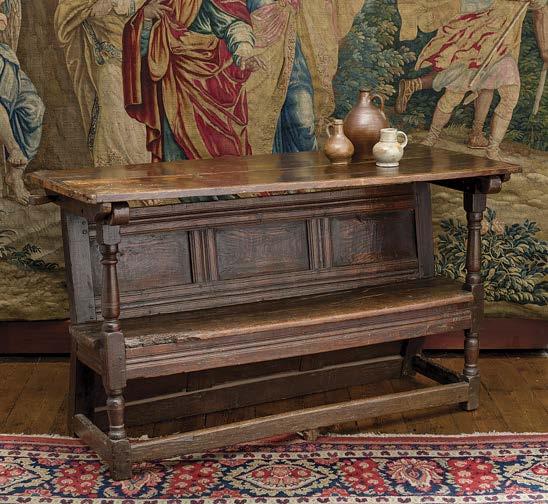
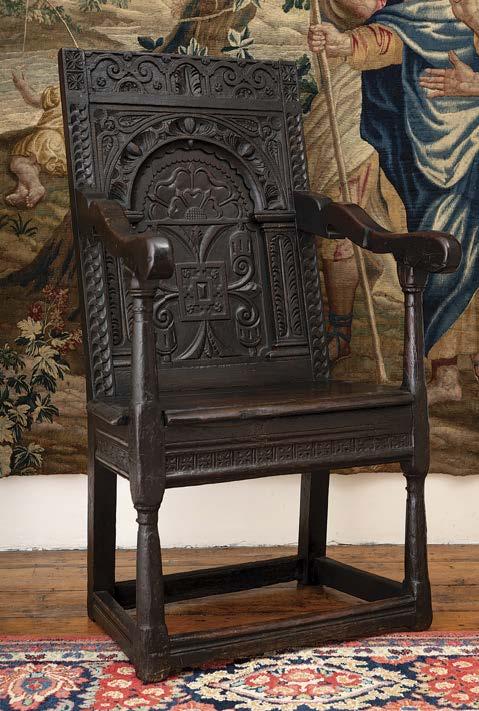
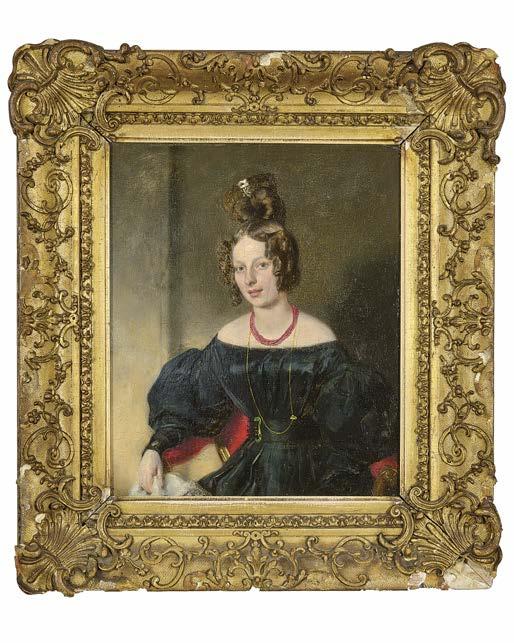
An Elizabeth I carved oak open armchair, Exeter, circa 15801600
The back panel centred with a strapwork carved tablet, within a volute cartouche, below a demi Tudor rose, all within an arcade, with bold egganddart arch, on stiffleaf pillars, with pointedleaf spandrels. The back uprights with chaincarving, the top rail with Mannerist jewelled scrolled ornament. The downswept scrollended open arms on columnarturned front supports, having a boarded seat on runmoulded and geometric punchdecorated rails, and matching turned forelegs joined all round by moulded stretchers.
H 113.7cm, W 66cm, D 48.3cm
£1,0001,500
Follower of Henry Wyatt (British, 17941840)
Portrait of a Young Lady
Seated half length, wearing a black dress, with a gold chain and a coral necklace
Oil on board
31 x 25cm; 12 1/4 x 9 3/4in
In a gilt composition frame, decorated with scrolling foliate ornament.
£80120
A mid16th century joined oak linenfoldcarved chest, English, circa 154060
The front with four deeply carved linenfold panels, framed by moulded rails and extended stiles, the sides and top panelled.
The linenfold motif, inspired by the folds of drapery, was one of the most enduring designs of late Gothic and Tudor furniture, symbolising status and refinement. While first popular under Henry VII and Henry VIII, the style continued to be favoured in provincial and courtly workshops into the reign of Elizabeth I. Constructed in wellseasoned Baltic oak, the preferred timber of English joiners during this period due to its straight grain and stability, this chest is representative of the international timber trade that supplied English workshops with the raw material for fine household furniture.
Provenance: Pat Morley Collection, Warwickshire.
H 67.9cm, W 123.2cm, D 60.3cm
£8001,200
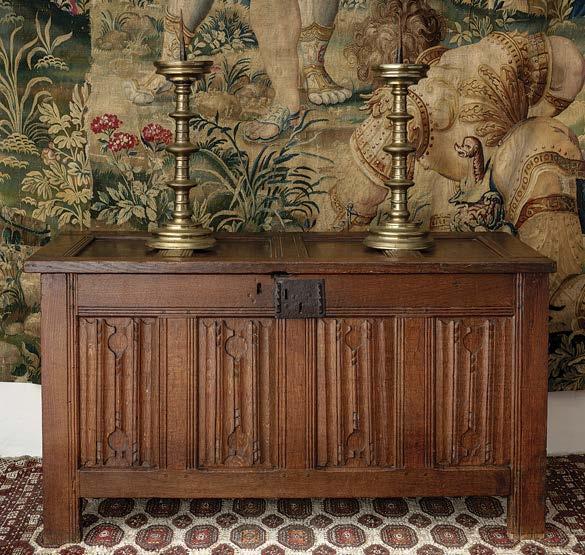
566
An Elizabeth I oak food hutch, circa 156080
Of small proportions, constructed with framed panelled sides and rear, the front with two cupboard doors, the upper pierced with ventilation holes for the safe storage of perishable foods, with runmoulded rails and extended stiles.
Food hutches of this type were central to the storage of meat, cheese, and other household provisions before the advent of modern preservation methods. The piercing of the upper door provided necessary airflow, whilst keeping out vermin.
Provenance: Roger Warner Collection, Burford. Sold Christie’s, South Kensington, London, 20 January 2009, Lot 101 (£1,300).
H 92.1cm, W 69.9cm, D 48.3cm
£1,0001,500
567
Circle of Albert Ludovici (British, 18521932)
Encore: A Dancer in the Wings
Inscribed ENCORE (upper left)
Oil on panel
30.5 x 20.5cm; 12 x 8in
£80120
568
An Elizabeth I joined oak chest, West Country, circa 1580
Of compact proportions, the front with two applied arcades, with egganddart carving and flowerhead roundel columns, the uprights applied with pilasters, enriched with repeating roundels and anthemion, all below a guillochecarved top rail, flanked by a large flowerhead, the hinged lid with moulded edge.
This chest reflects the spread of Renaissance design vocabulary into provincial workshops during the 16th century, where traditional arcaded structures were enhanced with classical details, using pilasters, guilloche, and egganddart mouldings. The strong architectural front demonstrates how English joiners adapted European ornament into vernacular furniture, balancing structure with decoration.
H 64.8cm, W 104.1cm, D 50.8cm
£600800
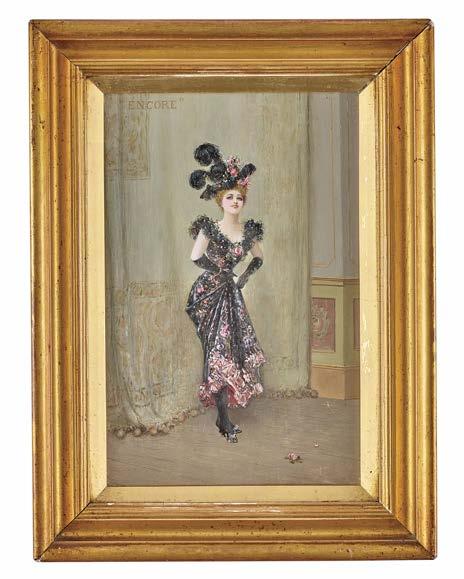
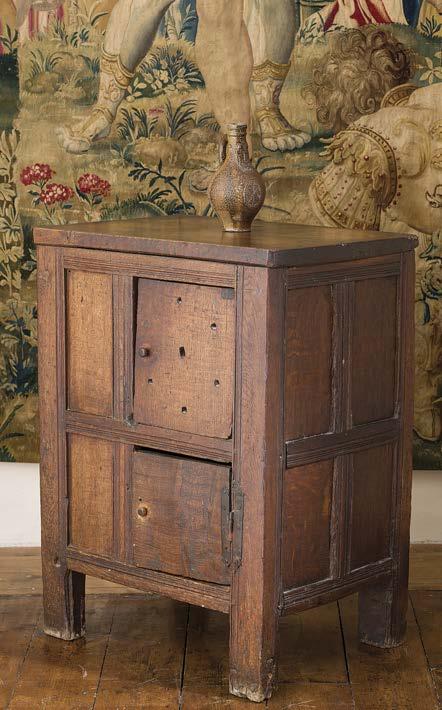
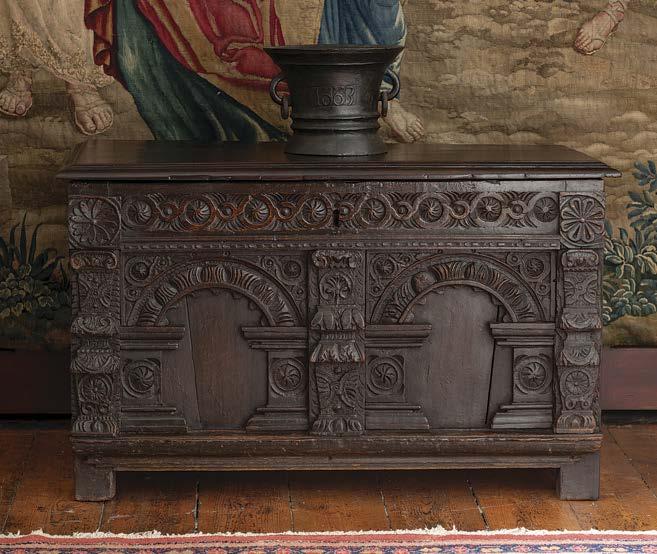
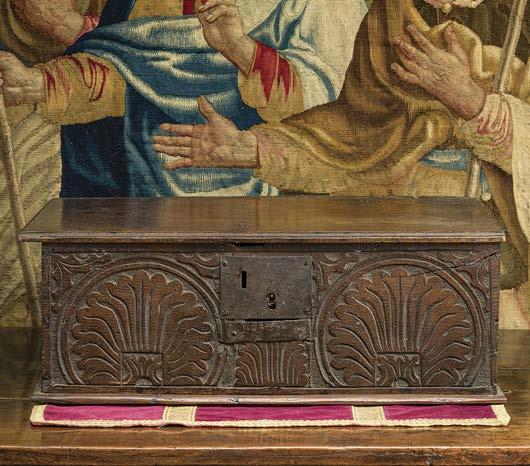
A Charles II boarded oak box, East Devon, circa 1680
The front carved with two large lunette motifs, flanking a smaller lunette beneath the iron lockplate, the lid with a single rear moulding, puncheddecorated throughout.
H 21cm, W 58.4cm, D 38.1cm
£200300
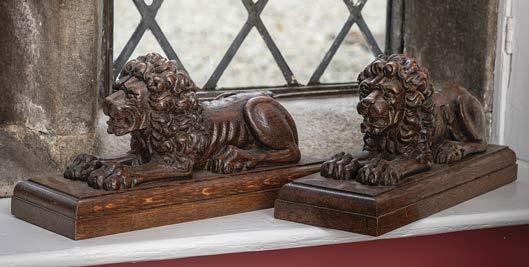
A pair of 18th century carved oak lions, Dutch, circa 172060
Each recumbent, whilst resting alert, their forepaws extended and heads slightly turned outwards, with expressive faces and deeply worked manes, deploying carefully worked musculature conveying strength, yet their pose restrained, on rectangular plinth base. (2)
H 20cm, W 40cm, D 15cm
£500800
572
An interesting carved oak panel, Low Countries, circa 1520
Designed with a king, finely dressed and crowned, standing before his seated scribe, who studies a scroll, set within an elaborate architectural backdrop, with a Corinthian column and arched masonry, headed by a portrait roundel. The imagery speaks to the theme of law, wisdom, and divine authority, with the king representing temporal power and the scribe embodying the preservation of justice and learning. Such iconography reflects the civic and religious culture of the Low Countries in the late 15th/early 16th century, when panels of this type were commissioned for incorporation into choir stalls, doors, or domestic furniture of the elite.
H 65.4cm, W 31.8cm
£600800
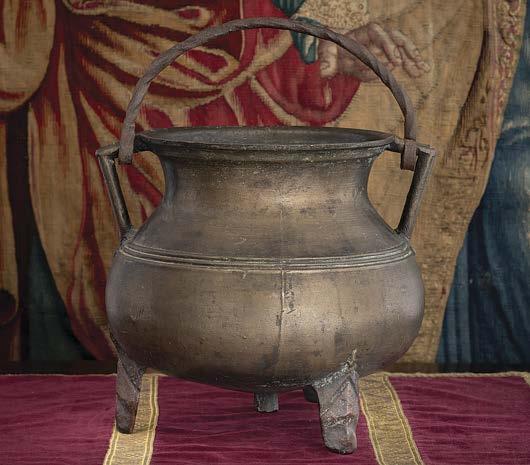
570
A 17th century bronze cauldron, probably Flemish, circa 165070
Of typical ‘bagform’, with everted rim and angular lug handles, on three roundedtriangular feet, H 21cm, Dia 23.5cm; together with a similar example, with mid cord to body and iron swinghandle. (2)
Literature: Michael Finlay, ‘English Decorated Bronze Mortars’ (1988), figs. 3–4, where the author discusses this type of cauldrons European origins and imports into England.
H 26cm, Dia 27.3cm
£200300
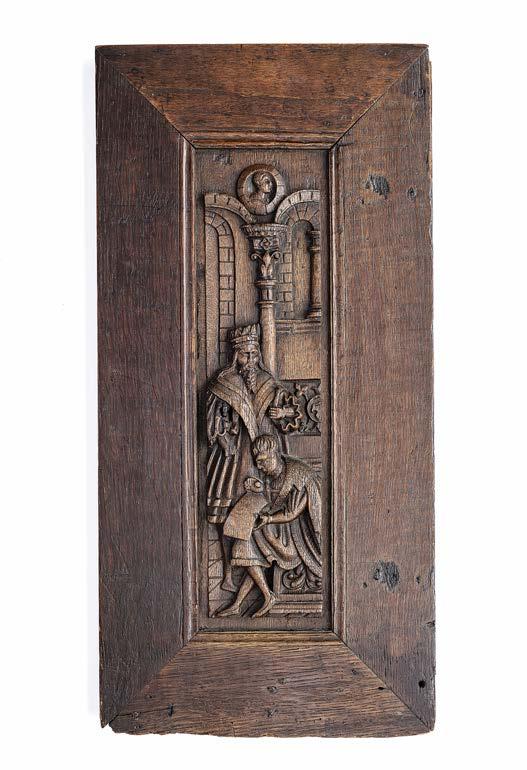
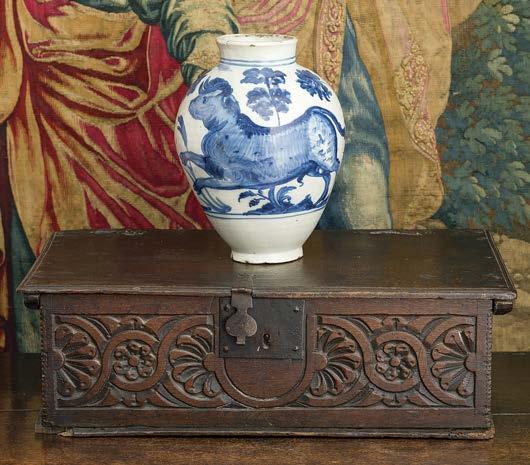
573
A Charles I boarded oak box, circa 1640
The front richly carved with interlaced guilloche enclosing stylised rosettes, centred by an iron lock plate and hasp, the onepiece top with moulded edge.
H 19.7cm, W 61.6cm, D 32.4cm
£200300
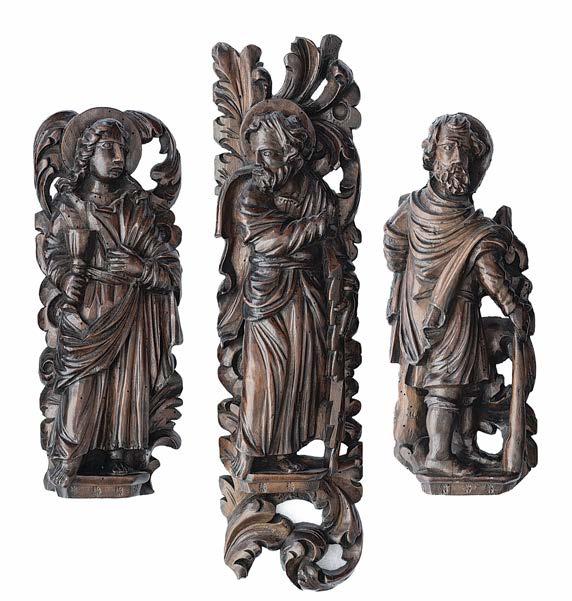
575
A group of three carved walnut saints, Flemish, circa 15801600
Each framed by scrolling acanthus ornament, with modelled drapery and expressive faces. One depicts St Jude, shown holding a staff; another St Simon, with his long saw; and the third Mary Magdalene, carrying a vessel of ointment. (3)
H 41.9cm (largest), W 10.8cm, D 5.1cm
£300500
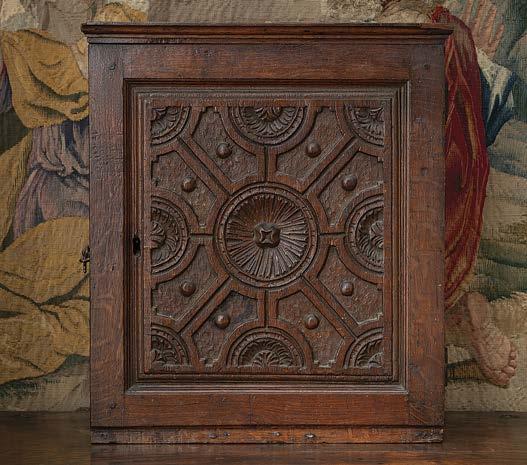
An Elizabeth I/James I oak spice cupboard, Exeter, circa 160020
The top with simple moulding, the single panelled door with deep strapwork carving, centred by a rosettefilled roundel, enclosing two original small drawers, the remainder of the interior vacant.
H 54.5cm, W 47cm, D 21.5cm
£300400
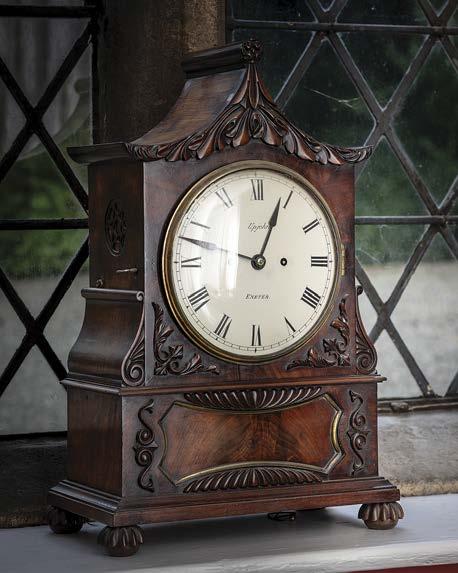
576
A Regency mahogany bracket clock, circa 1810
Upjohn, Exeter
Having a foliate carved pagoda top, classical scroll carved brackets and stepped brass strung base, on reeded bun feet, the circular white enamelled 8in dial with Roman numerals, signed ‘Upjohn’ atop ‘Exeter’, with brass bezel and bluesteel hands, pierced sides, the twin fusee movement with anchor escapement, striking on a bell.
H 53cm, W 36cm, D 19.5cm
£400600
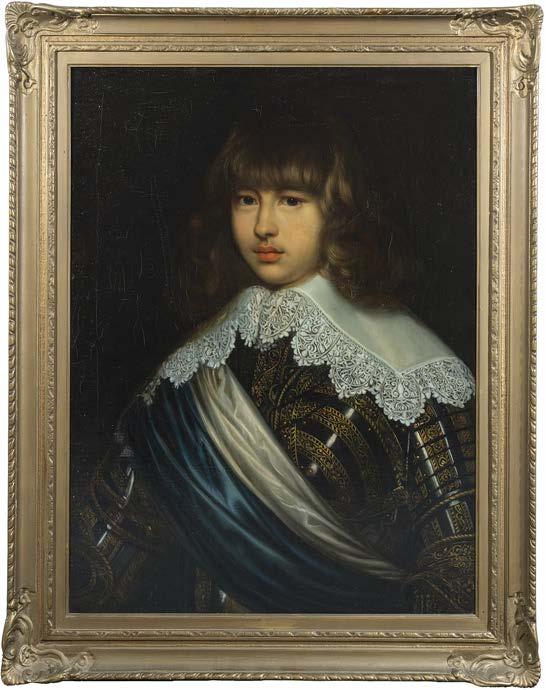

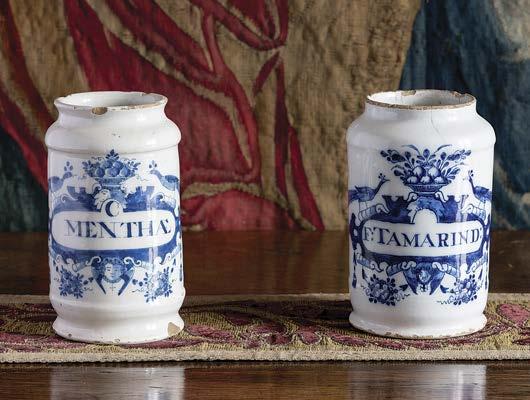
578
Two delftware apothecary jars, Dutch, circa 16801720
Of cylindrical albarello form, with slight everted rim and circular foot, decorated in colbalt blue, with Latin strap label, within an elaborate cartouche, characteristically headed by paired exotic birds, and centred to base with a winged angel mask, one inscribed MENTHAE (peppermint oil), the other TAMARINDI (tamarind pulp). (2)
H 17.8cm, W 10.8cm
£100200
After Justus Sustermans (Flemish, 15971681)
Portrait of Prince Valdemar Christian of Schleswig Holstein (1622–1656)
Quarter length, wearing ceremonial enamelled armour, a white lace collar and a blue sash
Oil on canvas
72 x 53.5cm; 28 1/4 x 21in
After the original composition, c.16389 (Florence, Pitti Palace).
Eldest son of King Christian IV of Denmark and Kirsten Munk.
Valdemar Christian was destined for high dynastic alliances. He was betrothed to Tsarevna Irina Mikhailovna of Russia, daughter of Tsar Mikhail I. However, the marriage was thwarted by political tensions. Instead, he pursued a military career, fighting in Poland, where he died in 1656 at the age of only 33.
£1,0001,500
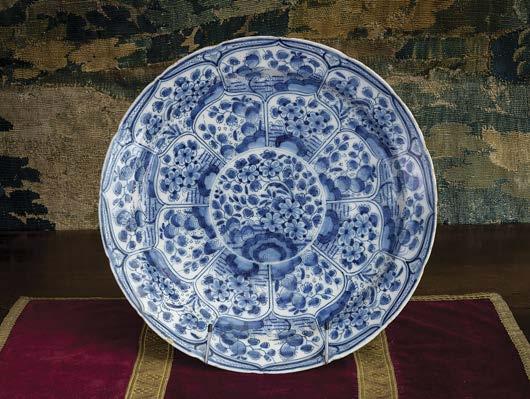
579
A delftware charger, Dutch, circa 170050
Designed with a central roundel of flowering branches, surrounded by two bands of radiating pointed panels filled with floral sprays.
This finely painted charger exemplifies the Dutch ceramic industry’s response to the vogue for Chinese blue and white porcelain in late seventeenthcentury Europe. Executed in tinglazed earthenware, the dish is decorated in a lively Kraak style, derived from the Chinese export wares produced at Jingdezhen during the late Ming dynasty (c. 15701640).
Dia 34.3cm
£100200
Follower of John Closterman (German, 16601711)
Portrait of King Charles II
Quarter length, wearing armour and a lace jabot
Oil on canvas, within an oval cartouche
75 x 63.5cm; 29 1/2 x 25in
£500800
581
A 17th century carved giltwood figure, female saint, Spain, Castile or Aragón, circa 162050
Possibly St Catherine, carved in the round with flowing drapery and rich gilding. Shown standing, with downcast expression, her right hand raised to her face in a gesture of lament, while her left hand holds a closed book, a symbol of devotion and meditation.
The emotional naturalism of the figure, combined with the broad handling of the drapery and the glowing gilded surface, situates the work within the Iberian sculptural tradition. Its restrained, yet poignant composition reflects the transition from the balanced serenity of the Renaissance toward the dramatic intensity of the Baroque. It exemplifies the Spanish concern with heightened realism and affective spirituality, characteristics championed by sculptors such as Gregorio Fernández and his circle in the early 17th century.
H 54.6cm, W 24.1cm, D 14.6cm
£400600
582
French School, circa 190020
Elegant Lady in Evening Dress
Watercolour and bodycolour with blue crayon 24 x 16cm; 9 1/2 x 6 1/4in
£100150
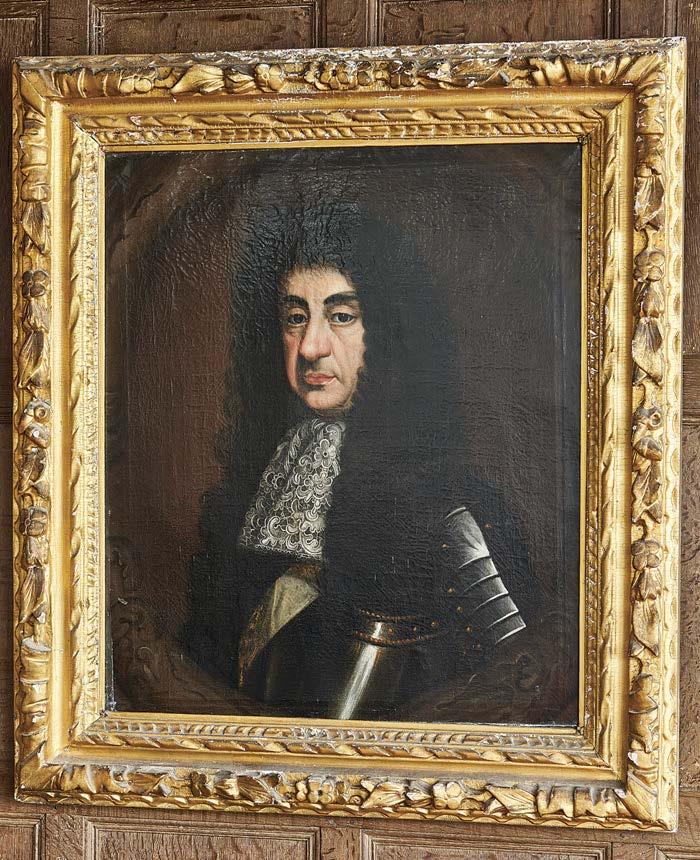
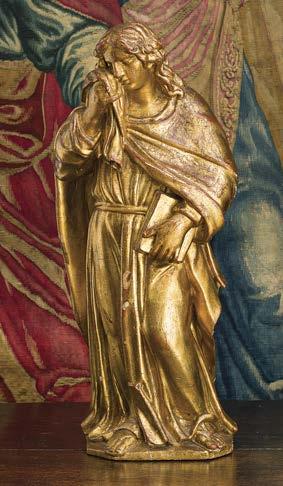
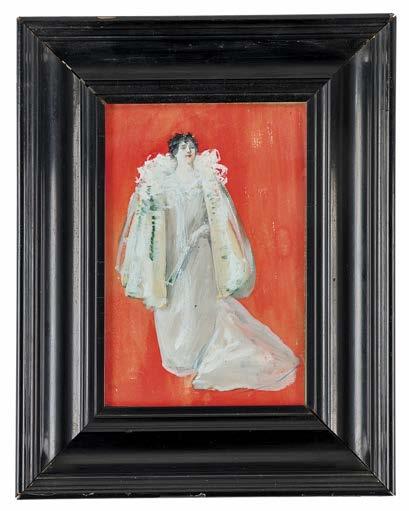
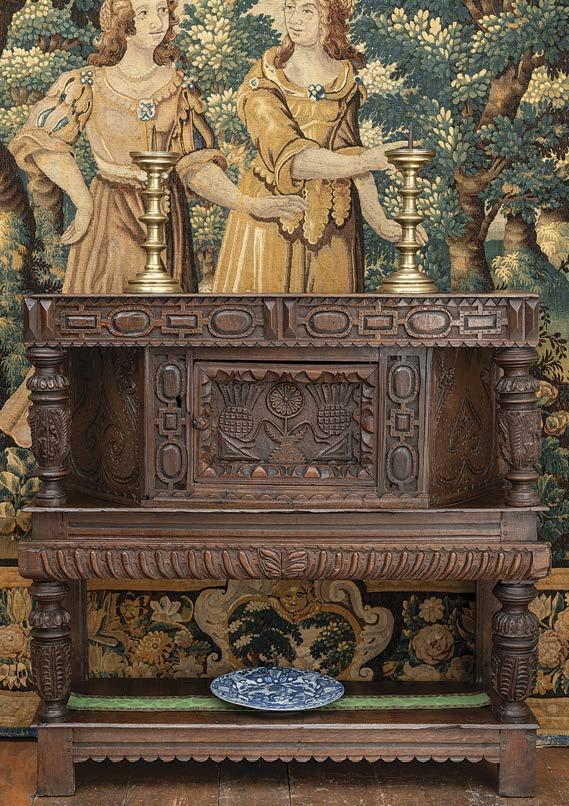
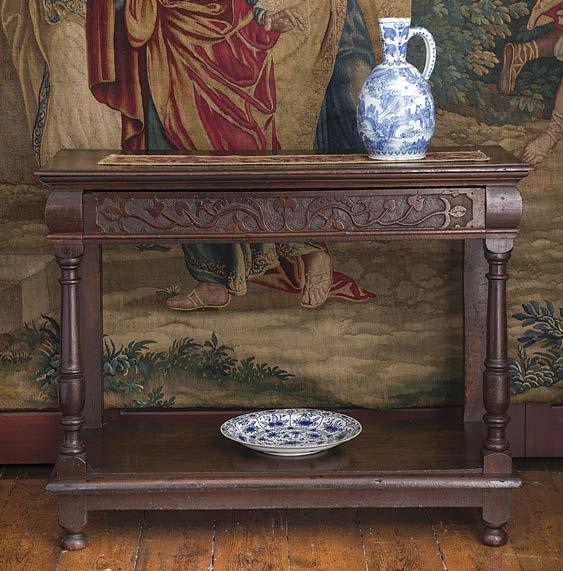
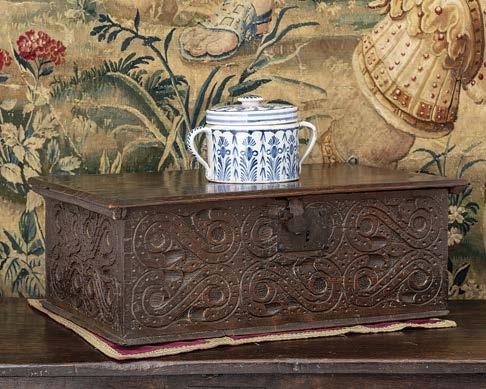
583
A James I oak carved canted livery cupboard, West Country, circa 1615
Boldly carved with decorative motifs. The central door carved in high relief with a single stem of thistles and daisy flower, within an egganddart carved frame, flanked by strapwork carved uprights, and canted sides carved with large double scrolled serpents amongst foliage, the strapwork design repeated to the top rail, supported on cupandcover supports, deeply carved with acanthus and gadrooned decoration, atop a broad gadroonedcarved drawer, over an open boarded undertier, with matching turned front supports, the base rail with scalloped lower edge mouldings, on block feet.
Provenance: A brass plaque inscribed reads: ‘James I Court Cupboard / from Nevill Holt. Leicestershire, circa 1620’. It also notes ‘Guaranteed by Frederick Litchfield’. Nevil Holt Hall, a Grade I listed manor house, was the ancestral home to the Neville family between the 15th century and 1876, when it was then sold to the Cunard shipping family.
Frederick Litchfield was a prominent antique dealer at 28 & 30 Hanway St., off Oxford St., London. He was also an author, publishing ‘The Illustrated History of Furniture’ in 1899.
H 122.6cm, W 127cm, D 40cm
£2,0003,000
584
A Charles II boarded oak box, Devon, circa 165080
The front and sides finely carved with bold addorsed Sscrolls, enriched with punchwork and retaining faint traces of original red polychrome within the carving.
The decoration exemplifies the exuberant regional tradition of West Country carving, where fluid scrollwork and rhythmic punch decoration created a sense of movement and richness.
H 22.9cm, W 61.6cm, D 38.7cm
£150200
585
A Charles II oak singletier court cupboard, circa 1670
Having a rectangular top above a single broad drawer, boldly carved with scrolling floral motifs, and flanked by applied plain cushionmouldings, supported on balusterturned front supports, and plain rear stiles, joined by a boarded undertier, to form an open base, on turned feet.
This type of cupboard occupied a central place in the 17thcentury household, serving both as a practical vessel for storage and as a display surface for flagons, silver plate, and imported pottery.
H 89.5cm, W 113cm, D 47cm
£1,0001,500
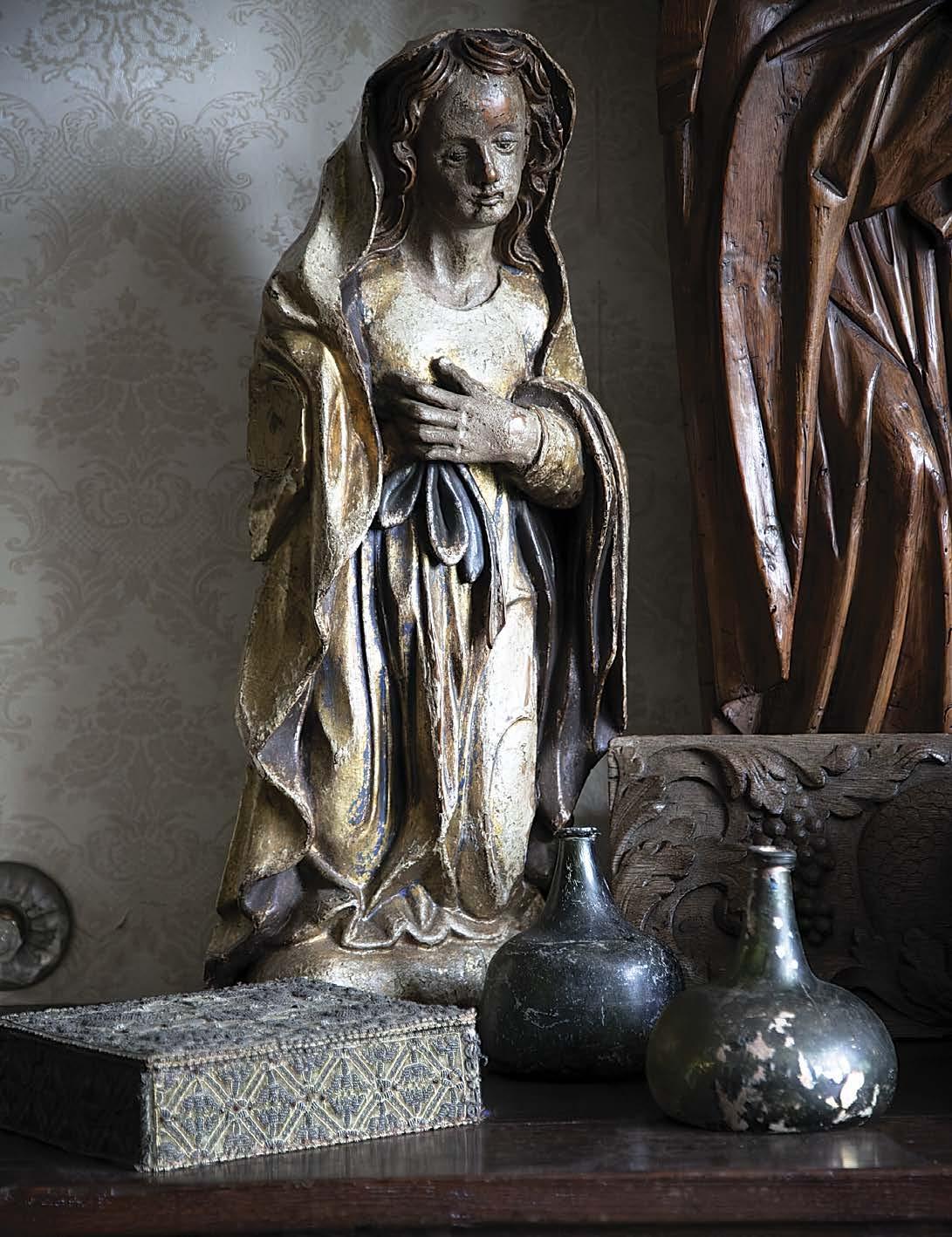
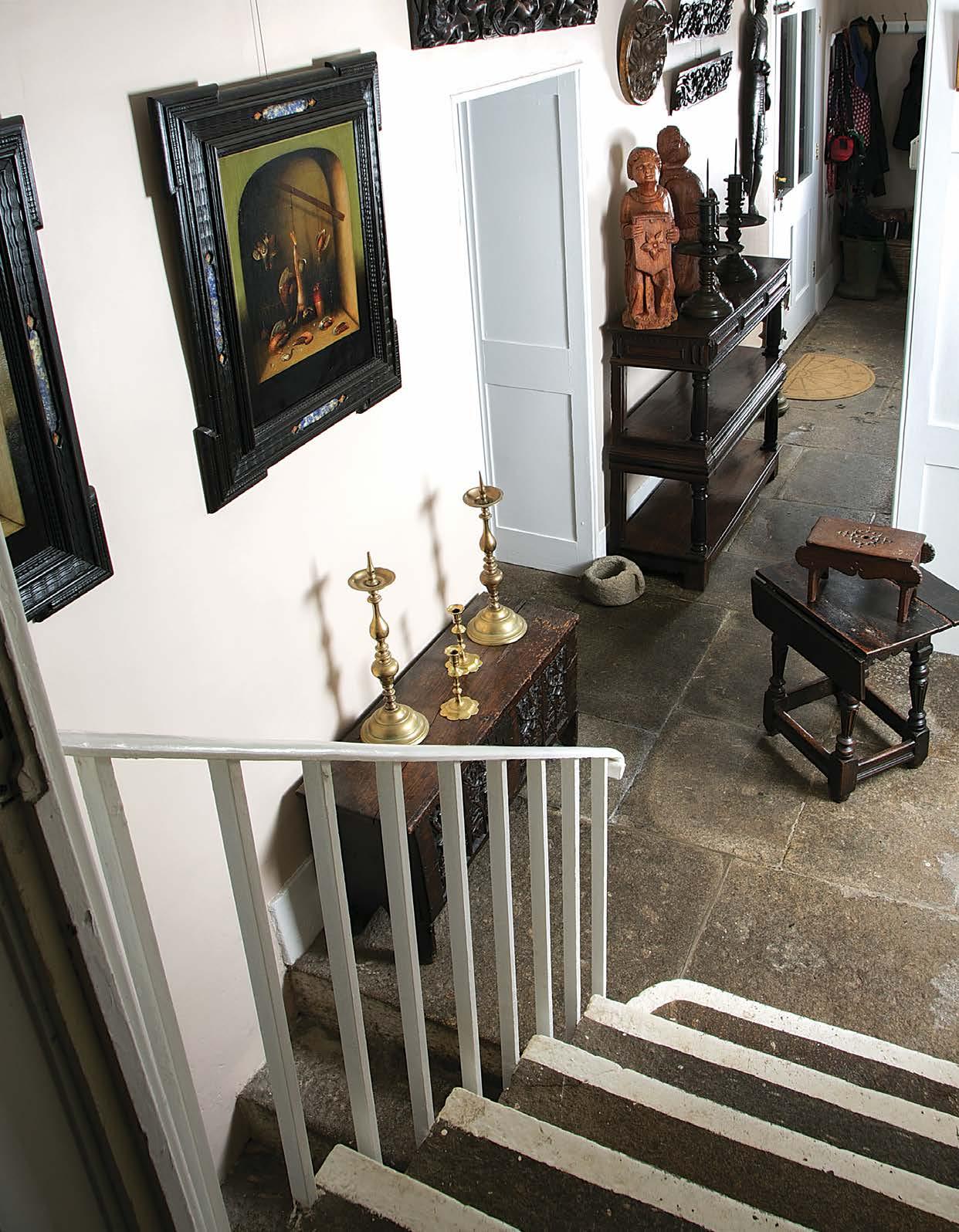

A Charles I joined oak court cupboard, Dorset, circa 1640
Of restrained design and retaining evidence of original surface staining. Of three tier form, the top with a narrow frieze drawer framed by applied mouldings, the panels enriched with fruitwood insets, originally highlighted by contrasting black stain, all below dentil mouldings; the middle with a single drawer, the moulded front similarly accented with staining, the base on simple runmoulded rails, all supported on turned columnar uprights.
H 102.9cm, W 119.4cm, D 39.4cm
£1,2001,800
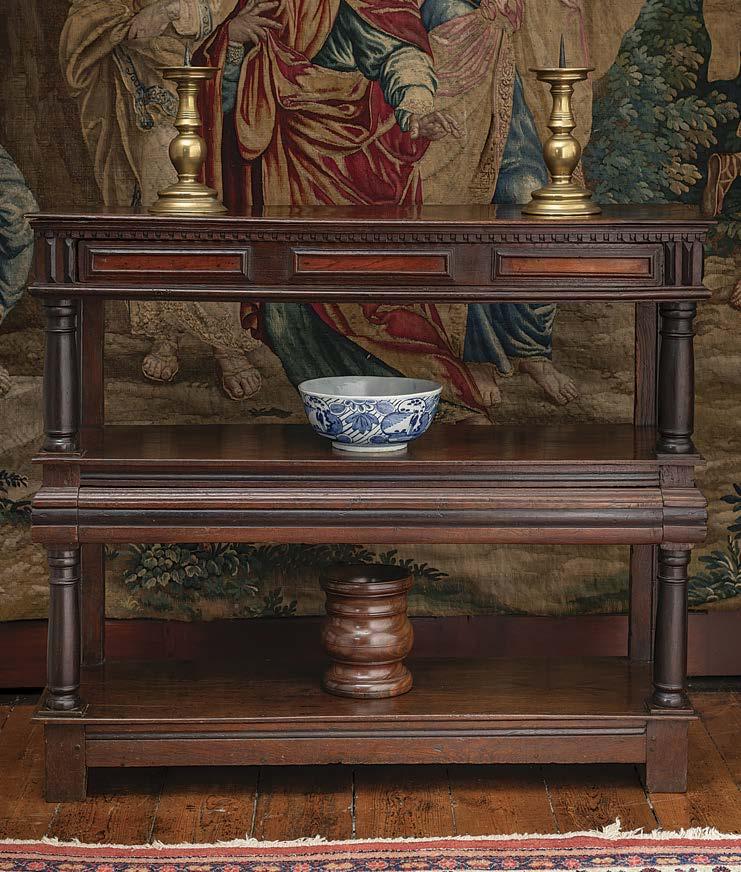
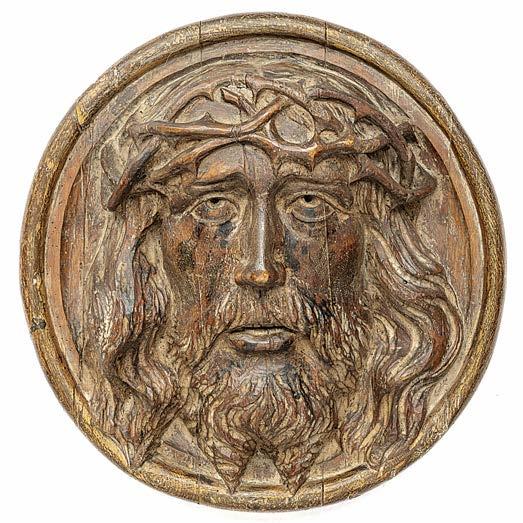
587
A late 15th century carved pine tondo, Head of Christ, Flemish, probably Brabant or Leuven, circa 1480
Christ depicted faceon, and crowned with thorns, his features marked by deep pathos, with downcast eyes and parted lips, along with a long flowing beard framed by wavy, shoulder length, hair. Traces of original polychrome.
This devotional carving is closely associated with the Vera Icon (Latin for ‘True Image’) tradition, when Christ’s face miraculously imprinted on a cloth, or veil, offered by St Veronica as he carried the cross to Calvary. It also drawers from Ecce Homo (Latin for ‘Behold the Man’), the phrase Pontius Pilate used when presenting Christ, crowned with thorns, to the crowd before his crucifixion, which became a common theme in Christian art, depicting suffering.
The composition reflects the contemplative portraits of Christ painted by the likes of Aelbrecht Bouts (c.1451–1549), Leuven, and the strong demand for private devotional images at this time.
Dia 39.4cm, D 10.8cm
£8001,200
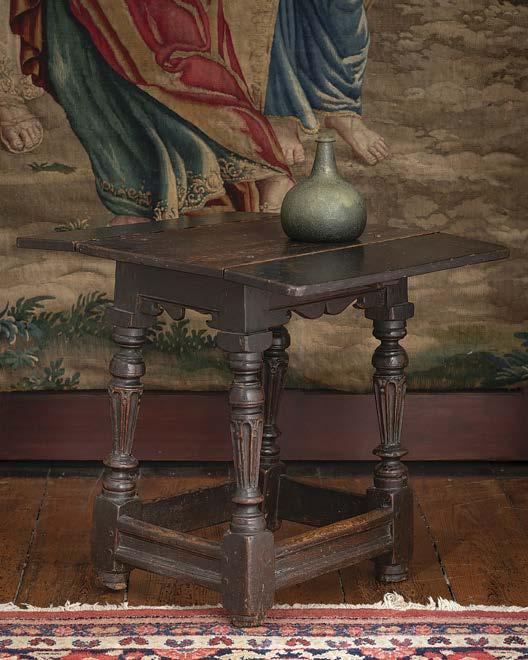
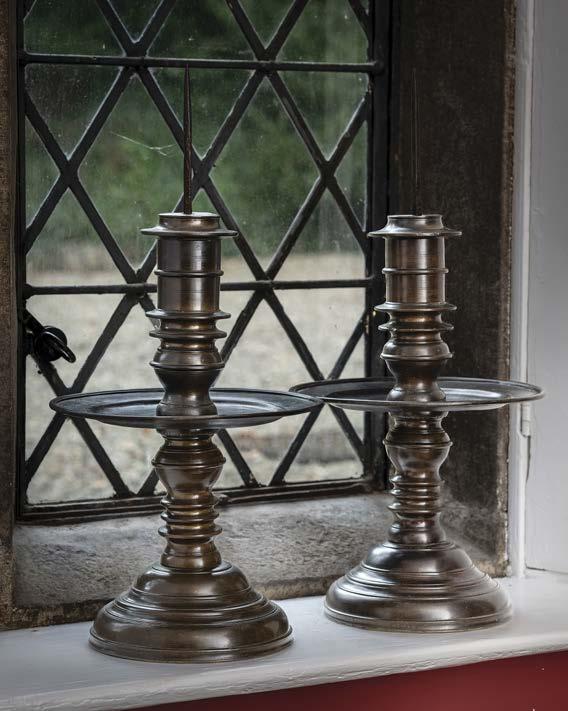
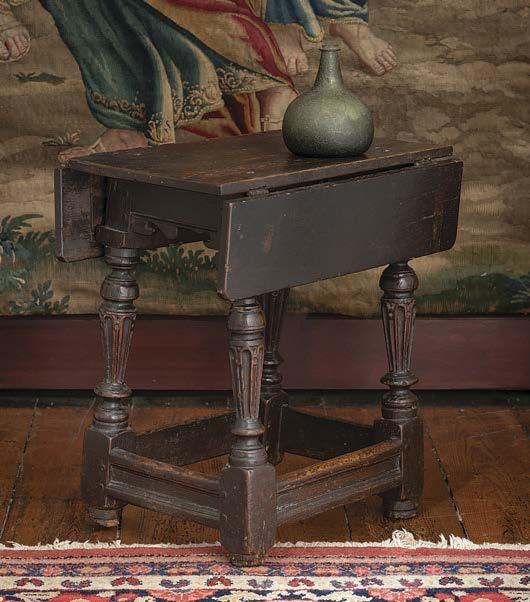
588
An exceptionally rare and documented Elizabeth I joined oak stooltable, circa 1600
Having a rectangular twinflap top, each leaf supported on pullout lopers concealed within the bicuspidprofiled frieze rails; on turned and fluted legs, joined by wide runmoulded stretchers, on turned feet.
This ingenious form, combining the compactness of a stool with the functionality of a small expanding table, represents an important transitional stage in the evolution of English domestic furniture at the end of the 16th century. The ‘joined stooltable’ could be considered a precursor to the later gateleg table, and only a handful of examples are known to survive from the late 16th to early 17th century.
Provenance: Mary Bellis Collection, Hungerford, Berkshire.
Literature: Illustrated Victor Chinnery, ‘Oak Furniture: The British Tradition’ (2016), p. 229, fig. 3:115.
H 56.5cm, W 52.7cm, D 35cm (closed, 59cm (open)
£6,0008,000
589
A small boarded oak stool, English, circa 17501800
The rectangular top with moulded edge, centred by piercing in the form of a lozenge, atop overhanging roundended, piercedcentred shaped aprons, the boarded sides with Vshaped cutaway supports.
H 20.5cm, W 36cm, D 16cm
£150200
590
A pair of 17th century bronze pricket candlesticks
Each of substantial socalled ‘heemskerk’form, the multiple discoid and knopped stem surmounted by an iron pricket and centred by a wide circular drippan, on a stepped circular base, retaining a deep, even patination throughout, with Japanese character marks to the bases. (2)
The overall form and weight suggest a piece made either for temple or ceremonial use, or possibly for the export market.
H 57cm, Dia 28cm.
£8001,200
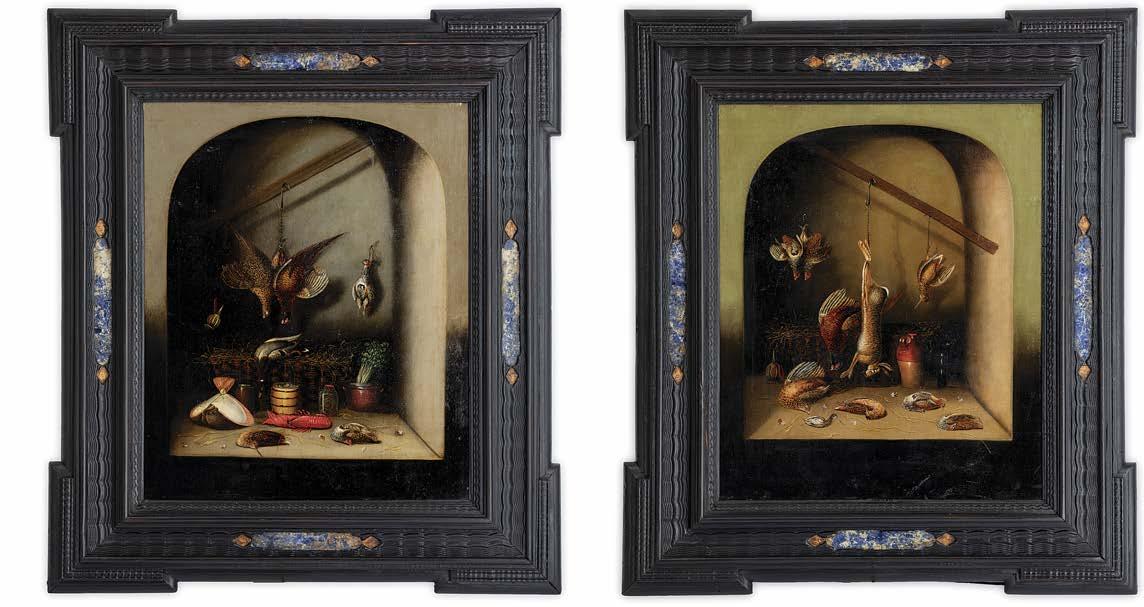
591
Benjamin Blake (British, circa 17571830)
Game Larders, with Gamebirds, a Hare, Fish and Shellfish
A pair, oil on canvas
Each 61 x 51cm; 24 x 20in (2)
The paintings are presented in highquality 20thcentury reproduction frames in the Dutch style, with ebonised ripple mouldings and inset bluestone marbling.
£1,2001,800
592
A rare pair of 15th century beamend corbels, possibly East Anglia, circa 14501500
Each corbel takes the form of an upright winged angel, robed, and holding a heraldic shield carved in relief with a stylised fivepetal flower. The figures are truncated at the base and back, designed to be fixed to the ends of structural beams, most likely in the roof or hall of an ecclesiastical or highstatus secular building. The angels’ faces are simple, yet expressively modelled, with rounded features and curled hair, their robes are defined with bold, shallow folds, with vestiges of feathering around the shoulders which suggest the remains of once more pronounced wings. Historic paint and some original polychrome in places. (2)
H 66cm, W 20.3cm, D 21cm
£2,5003,500
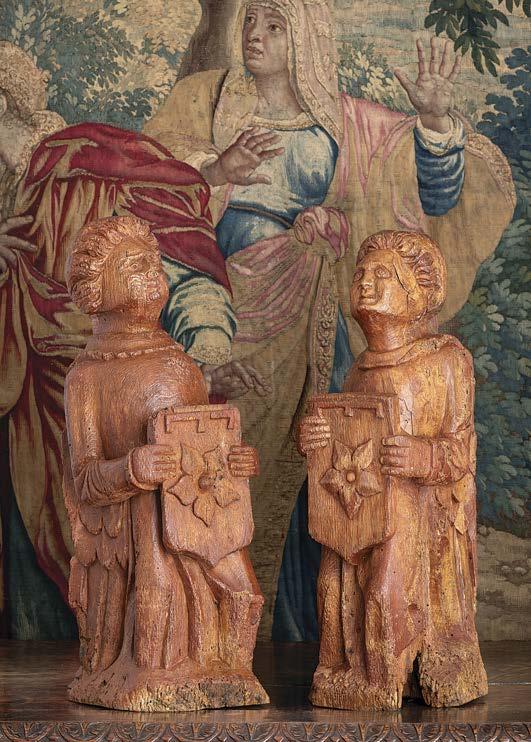
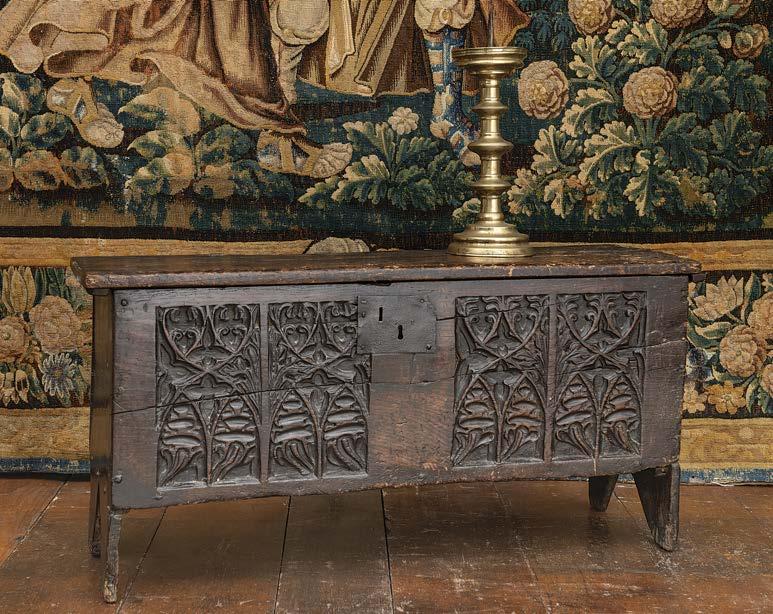
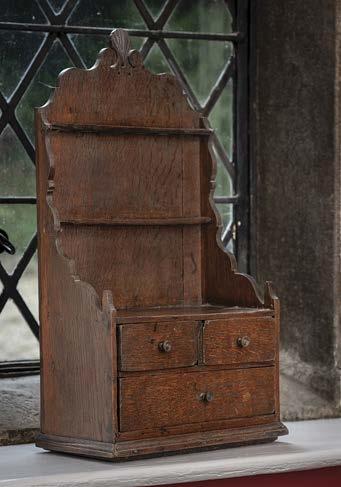
594
A George III oak spoon rack, with drawers, circa 1770
Of tall narrow form, the back board rising to an arched, scrollprofiled cresting, centred by an embryo scallop shell, with shaped sides and two rows of spoon apertures, atop two short and one long base drawer, all retaining turned wooden knobs.
H 56cm, W 30.5cm, D 17cm
£100150
593
A small Henry VII/VIII oak boarded chest, probably West Country, circa 14901520
The front boldly, and deeply, carved with paired Gothic tracery, lancet arches, quatrefoils and trefoils embellished with leafymotifs, construction is of simple boarded form, with iron lockplate, hinged boarded lid and sides descending to Vshaped cutaway supports.
The use of overscale leaf ornament within Gothic shapes is rare on domestic furniture of this period. Leaf designs are more commonly seen on contemporary West Country parish bench ends and screen panels, where carvers experimented with exaggerated foliage within a Perpendicular framework. This chest thus represents a translation of local ecclesiastical carving expression into household furniture.
Provenance: Stuart Antiques, thence Stuart Interiors, Somerset
H 48.9cm, W 101cm, D 33.7cm
£1,5002,000
595
A 17th century carved walnut panel, Flemish, circa 160030
Centred by a reclining female nude, almost certainly an allegory of Venus or a classical nymph, embodying ideals of beauty and fertility, within a scrollcarved oval cartouche, flanked by playful winged cherubs, and sphinxlike hybrid figures. The Renaissance grotesque hybrid figures, function symbolically as guardians. The liminal beings combine both the alluring and monstrous, while the cherubs soften their presence with a playful, amorous quality.
H 22.8cm, W 113.7cm
£300400
595A
A ‘feuilles de choux’ tapestry panel, La Marche, France or Oudenaarde, Flemish, circa 1550
Woven in wool and silk, with five birds, including a peahen and cockerel, amongst large curling leaves. Large leaf tapestries are noted for the acanthus or cabbagelike curving foliage that covers nearly the entire ground.
Literature: See S. Frances, ‘Giant Leaf Tapestries of the Renaissance 15001600’, exhibition catalogue, 2005, nos. 13 & 14, for comparable examples.
H 221cm, W 119.4cm
£6,0008,000
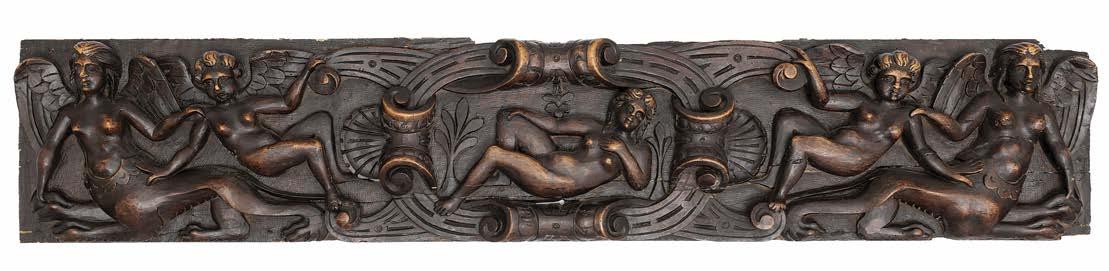
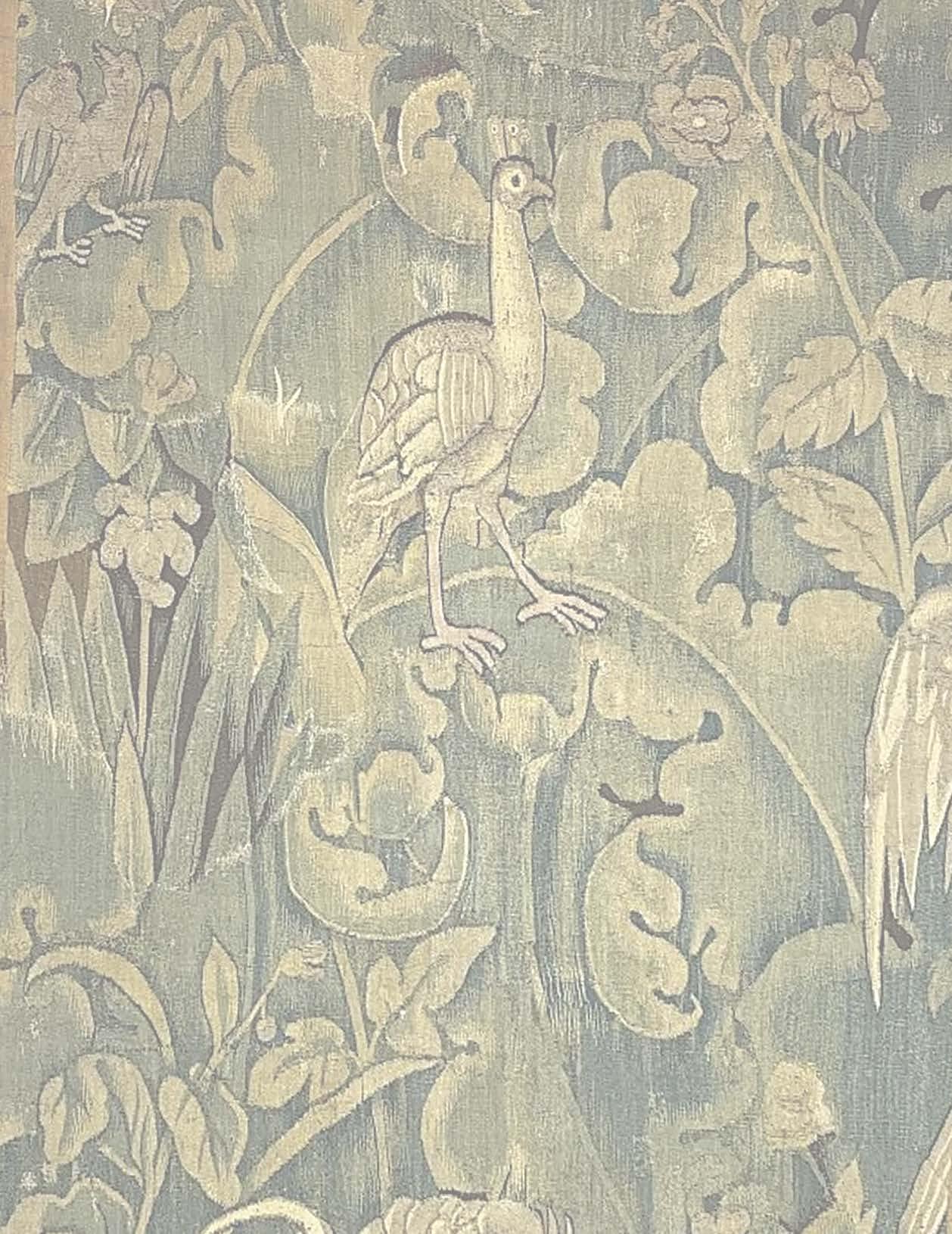
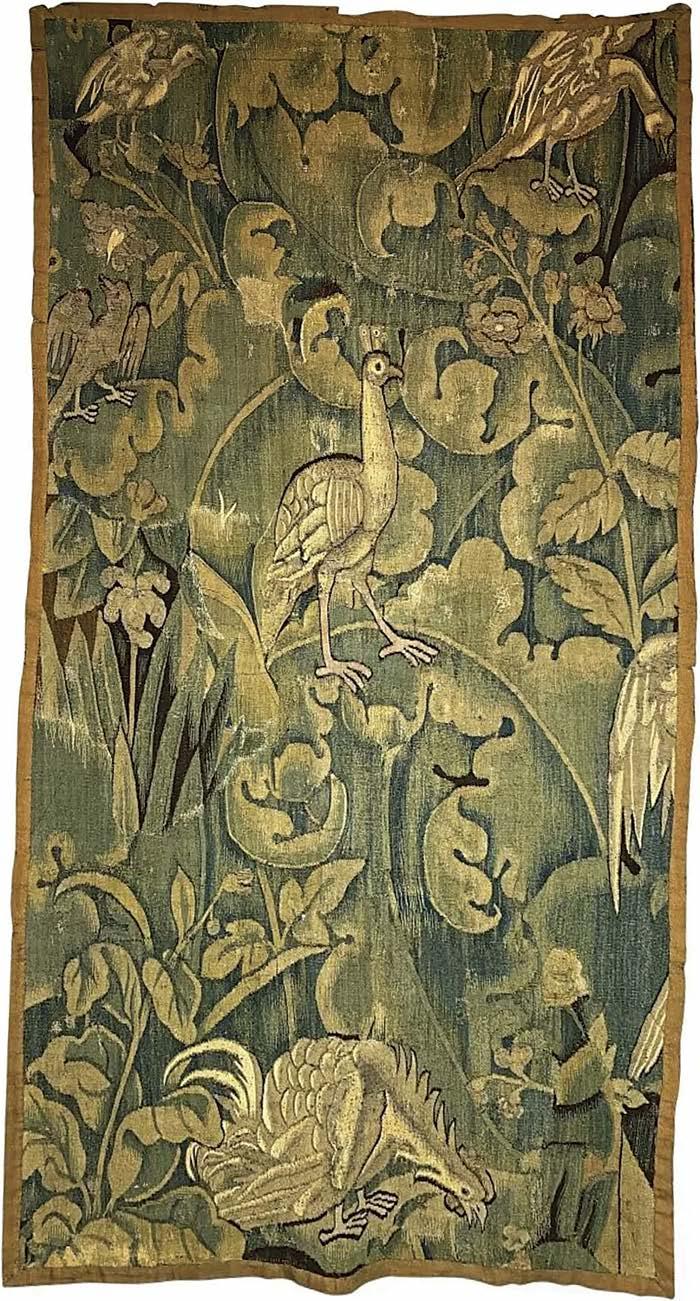
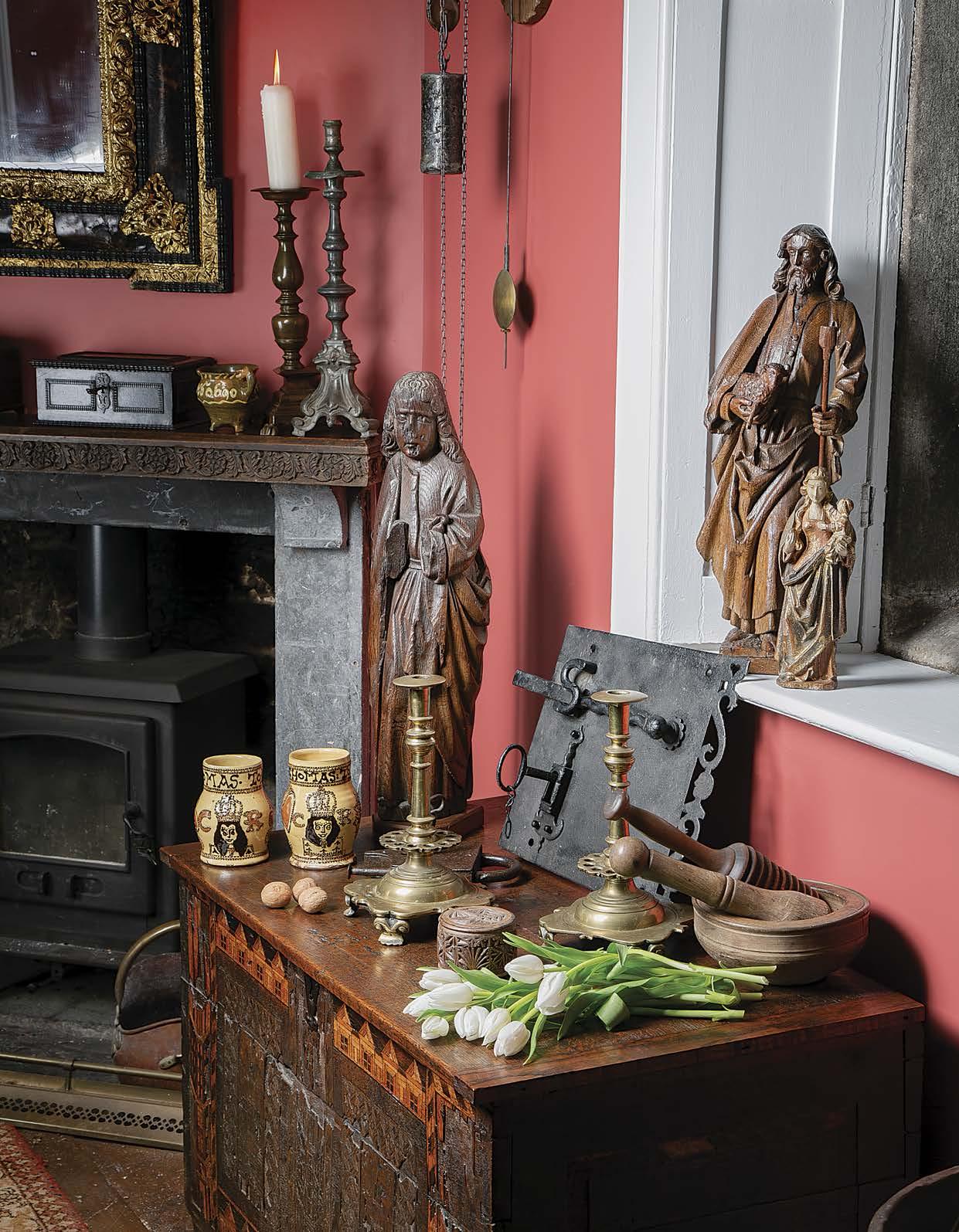
A pair of oak carved panels, Netherlands or Flanders, circa 15801620
Each panel with meandering acanthus scrolls and floral rosettes, terminating in foliate tendrils. (2)
These panels epitomise the Northern Mannerist style of the period, which blended classical Renaissance motifs with a lively, naturalistic treatment of foliage.
H 17.8cm, W 76.2cm
£300400
λ 597
An impressive 19th century giltmetal mounted tortoiseshell mirror, FrancoFlemish
The arched, cutcorner and cushionmoulded frame applied with tortoiseshell veneers, heavily embellished with giltmetal floral mounts, and outlined in ebonized ripplemouldings, the stepped pediment again worked in giltmetal centred by a figural mask, and flanked by dense foliage ornament, later mirror plate.
H 110cm, W 70cm, D 7cm
£400600
A late 15th century carved oak figure, possibly St John The Evangelist, Netherlandish, circa 14801520
Carved in the round, standing in gentle contrapposto, the youthful saint depicted with long flowing hair, and wearing deeply folded robes, the rear with a long thin aperture presumably for a relic, mounted on a later base.
H 65cm, W 16cm, D 15cm
£400600
An Elizabeth I oak and inlaid ‘Nonsuch’ chest, circa 1570
Of rectangular form, the front extensively parquetry inlaid, with two reserves, each with a fanciful towered building, within broad geometric bands, flanked by similar towers, and a run of gabled buildings to the top and bottom, cleated boarded top. Socalled Nonsuch Chests take their name from Henry VIII’s celebrated Palace of Nonsuch. Work commenced in 1538, at Etwell, Surrey. It was intended to celebrate the birth of Henry’s son, Edward, and architecturally rival the French King, Francis I’s Chateau de Chambord. It featured tall bay windows, octagonal corner towers and a highly decorated gatehouse. The latter often depicted (with swans) on this type of chest or box. The palace was demolished in 1670, reputedly to pay off the gambling debts of Barbara Villers, mistress of Charles II.
H 56cm, W 101cm, D 55cm
£400600
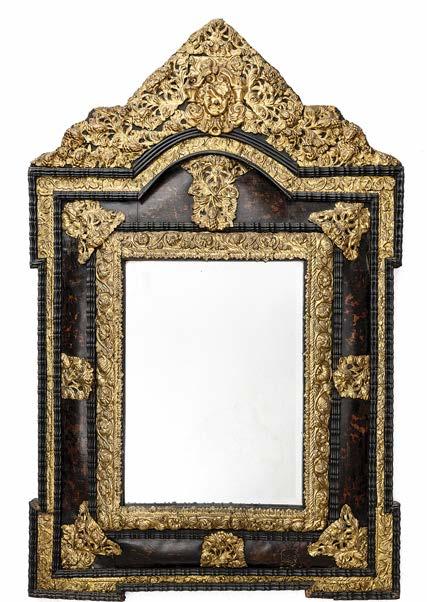
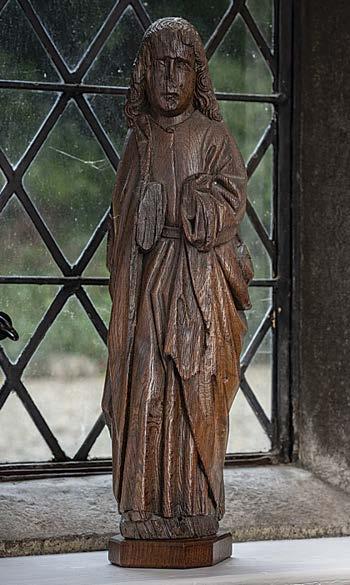
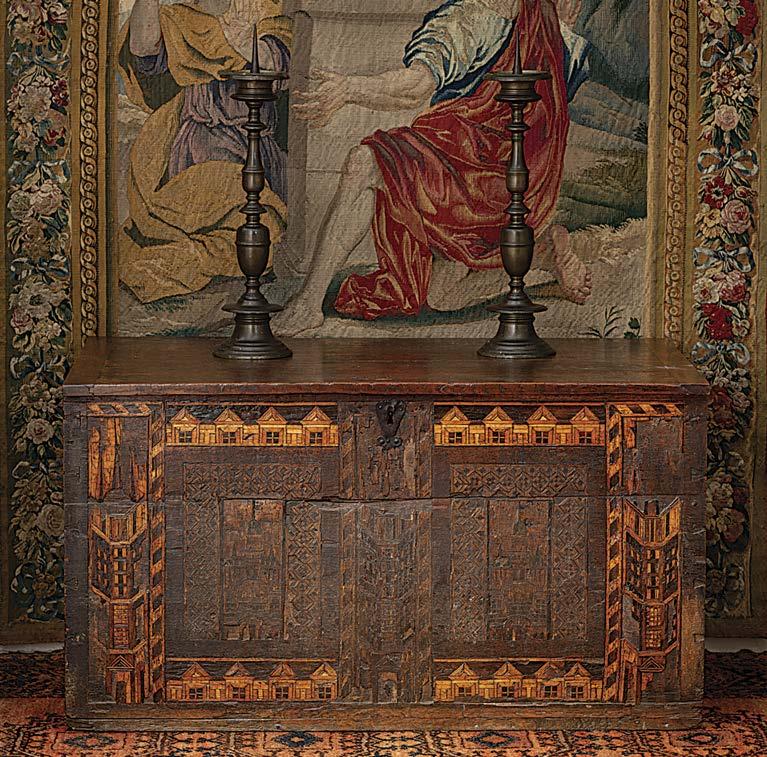
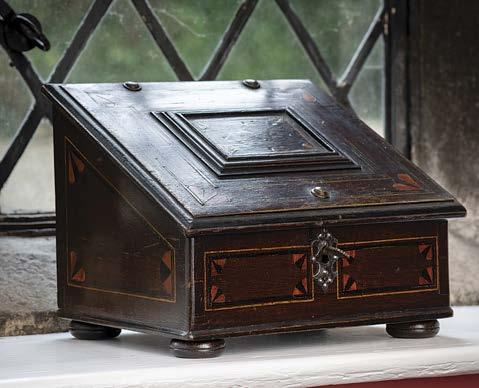
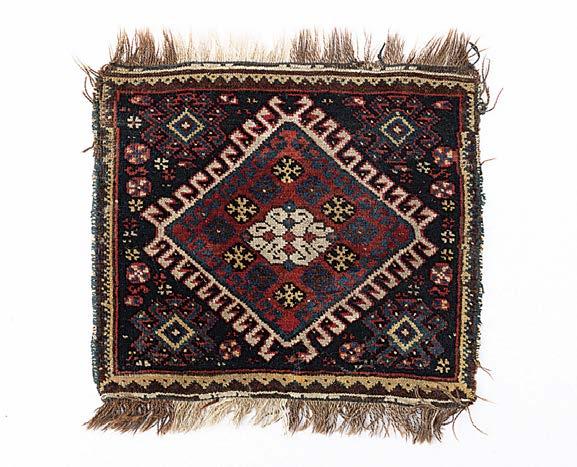
A small oak and inlaid desk dox, German, dated 1700
The sloping lid framed to the centre with the date ‘1700’, with fan inlaid spandrels to the moulded edge, the front and sides with matching spandrel inlay within linear reserves, on turned bun feet.
H 23cm, W 30cm, D 23cm
£400600
A Victorian oak tantalus, circa 1870
Of square form, with deep hinged lid, the underside fitted with glasses, and enclosing three cutglass decanters with faceted stoppers, working lock and key.
H 23cm, W 22cm, D 22cm
£100150
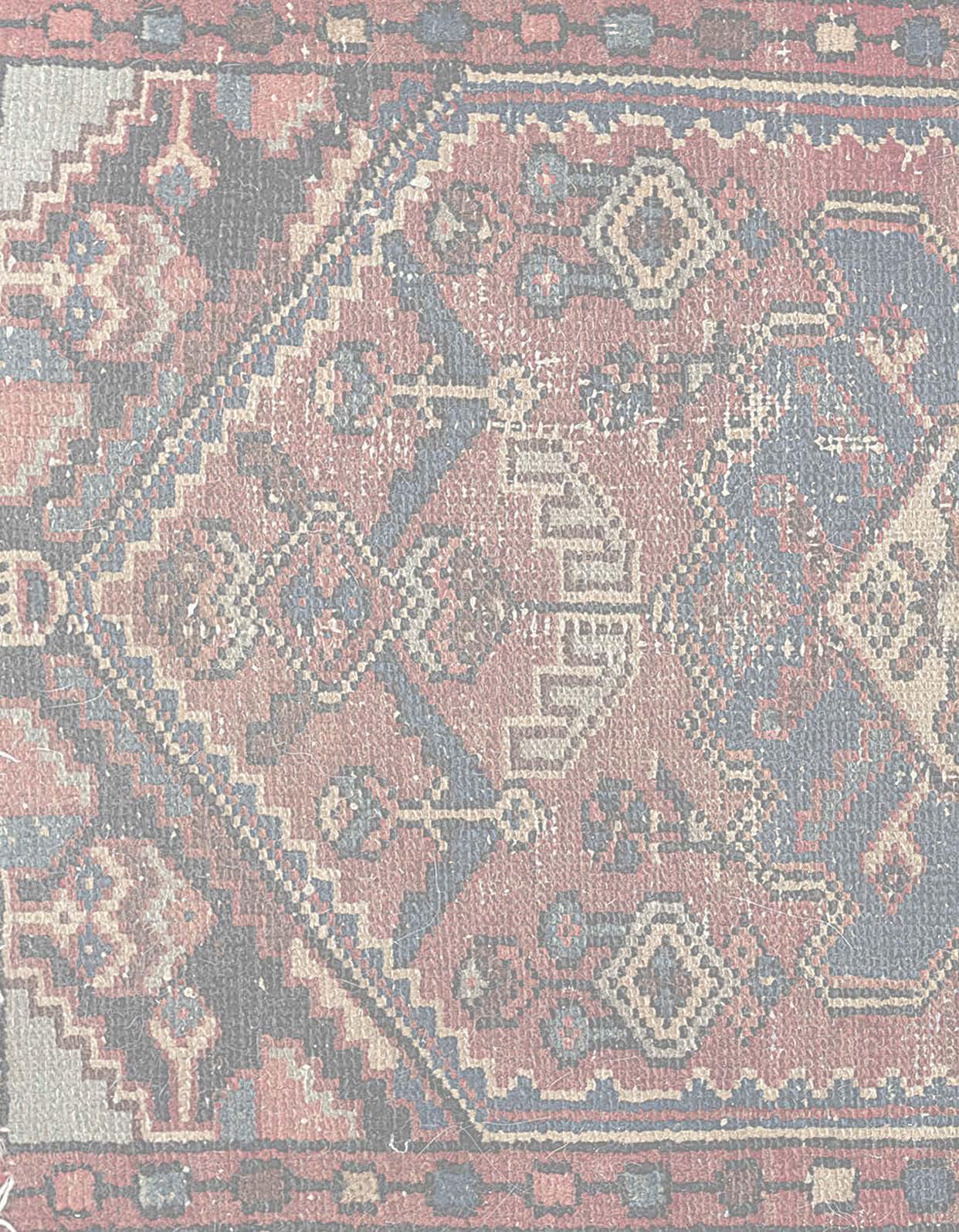
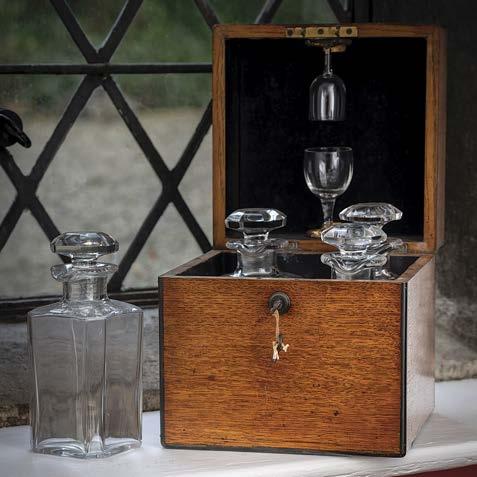
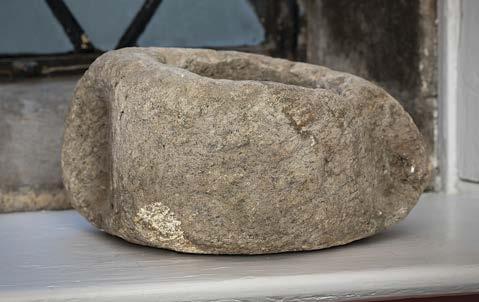
602
A Lori bag face, West Persia, circa 1930
The indigo field with a diamond latch hook medallion surrounded by tribal devices enclosed by saw tooth borders.
L 48.3 cm, W 43.2cm
£4060
603
A small medieval stone mortar, 15th century or earlier
Carved from a single block, with a deep circular well.
H 14cm, W 27cm, D 21.5cm
£100200
A group of four 19th century pewter measures, Birmingham
Including two halfpint truncated cone mugs, each stamped ‘BIRM’, with low fillets to straightsided body and fishtail terminal to hollow cast handle; together with two gill bulbous measures, each with midfillet. (4)
H 8.7cm (largest), Dia 8cm
£4080
605
A George III mahogany tea caddy, circa 1770
Of rectangular form, the hinged lid with brass carryhandle and cavettomoulded edge, opening to reveal a fitted interior with three metal tea canisters, on bracket feet.
H 14cm, W 23.5cm, D 14cm
£80120
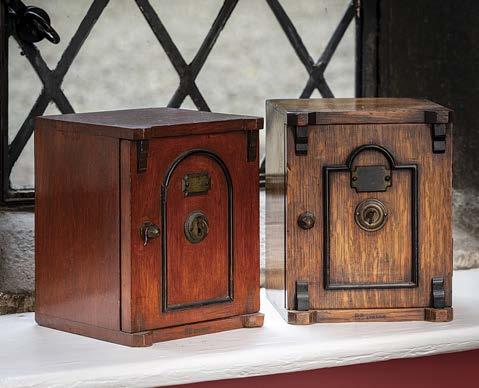
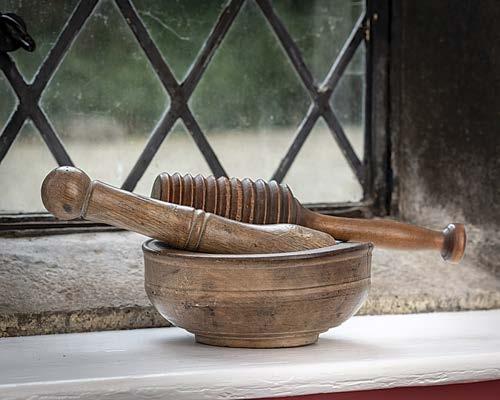
606
Two small Victorian tabletop cabinets, each in the form of a safe, circa 1880
Each of compact form, fitted with a central locking door, with ebonised mouldings, enclosing two drawers. (2)
H 21cm, W 16cm, D 15.5cm
£200300
An inlaid, ebonised casket, Ulm, Germany, circa 15801620
The hinged lid marquetry inlaid with a panel depicting stylised architectural forms, within a ripple moulded frame, further matching mouldings applied in the form of reserves to the front and sides, iron lock plate and key.
H 10.5cm, W 25.5cm, D 15cm
£300400
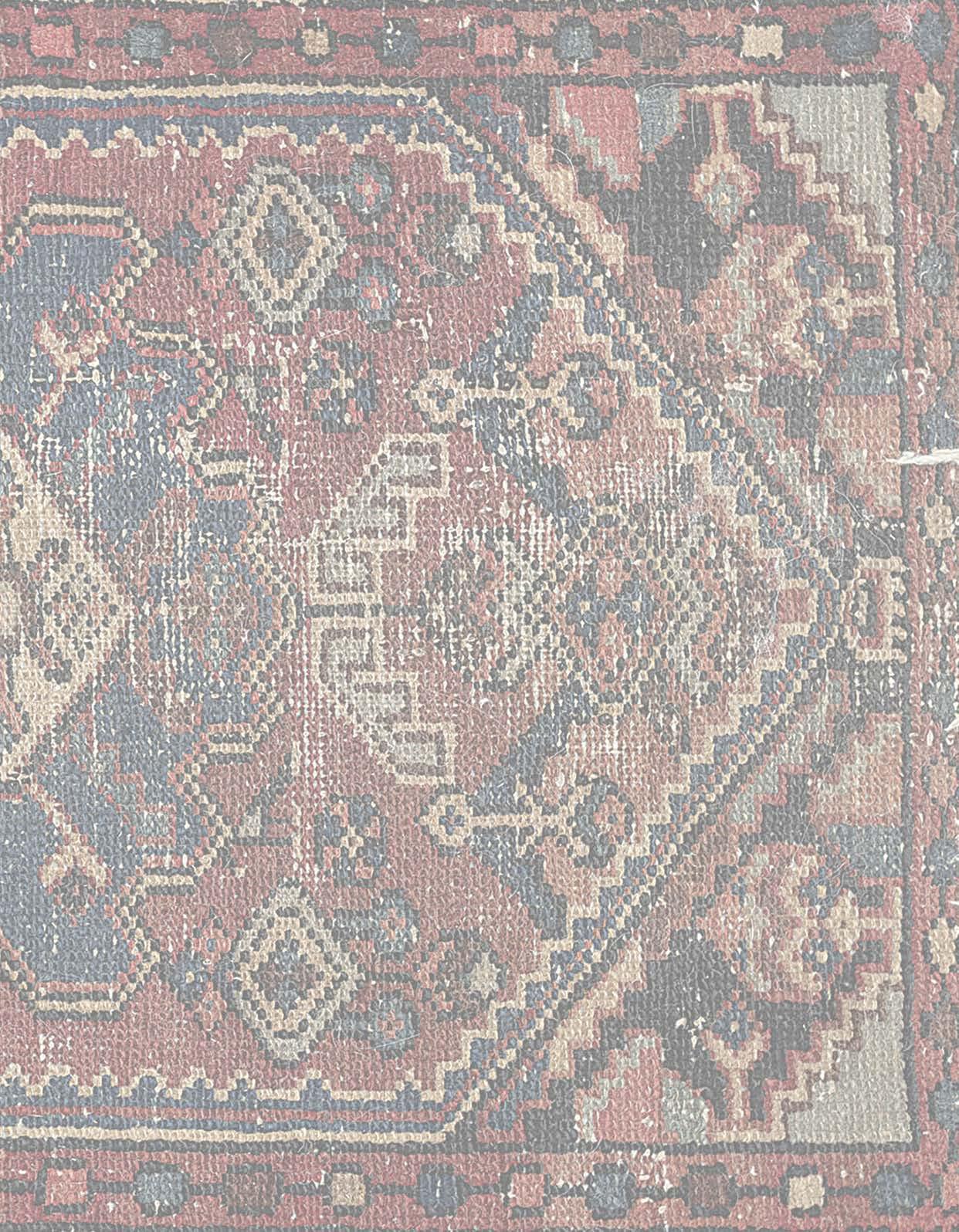
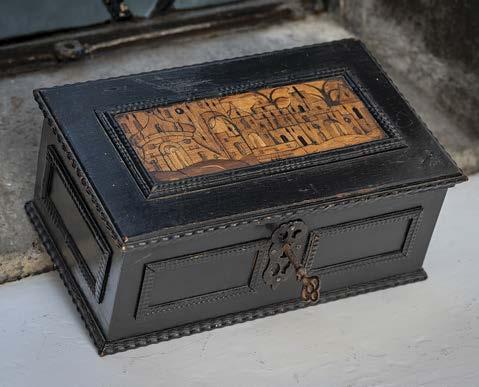
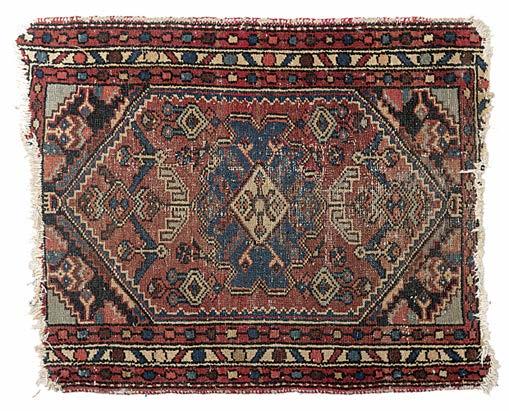
A sycamore turned mortar and pestle, circa 1800
Of low, circular form with singlereeded rim and narrow foot, the pestle with bulbous terminal; together with a large ‘honeytype’ pestle. (3)
H 8cm, W 21cm, D 17cm
£100150
609
A 19th century saddle bag face
With a bold central madder medallion composed of angular hooked motifs and stylised floral devices; the field enclosed by multiple narrow borders and decorated with geometric rosette devices, short fringes.
W 73.7cm, D 16cm
£4080
An early 19th century boarded walnut child’s rocking chair, English
Having an arched back with heartpierced cresting, wingshaped sides, boarded seat and ogeeprofiled front board.
H 61cm, W 33cm, D 41cm
£80120
611
A pair of 17th century style slipware mugs. by John Hudson in the manner of Thomas Toft, 20th century
Each of baluster form with loop handles, decorated using brown slip on a cream ground, designed with a portrait bust of Charles II, with royal cypher, and fleursdelys or stylised floral motifs, the rims inscribed ‘Thomas Toft’. (2)
H 13.5cm, Dia 10cm
£5080
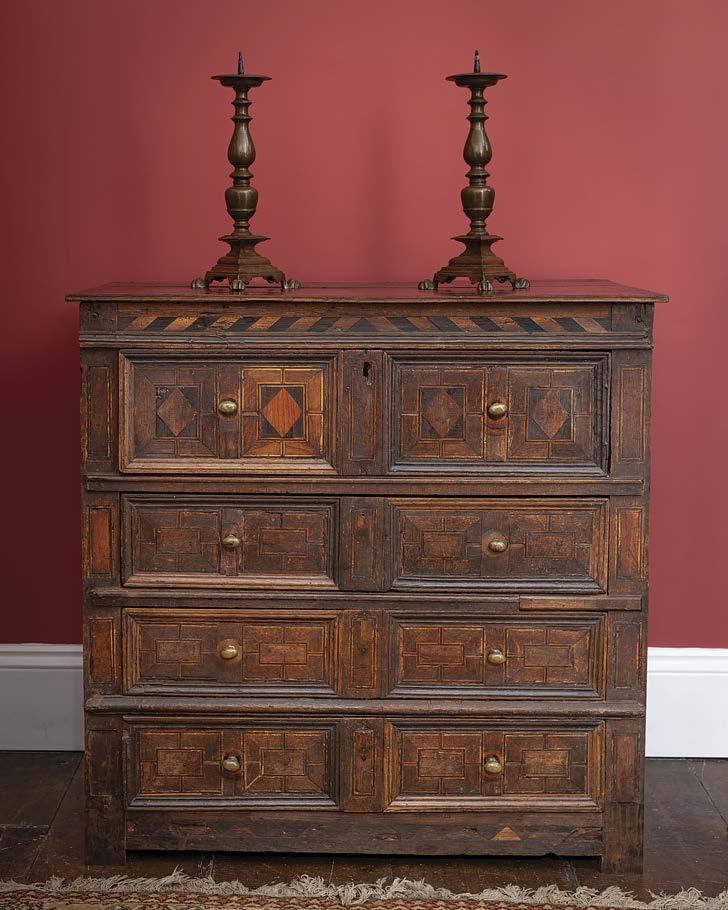
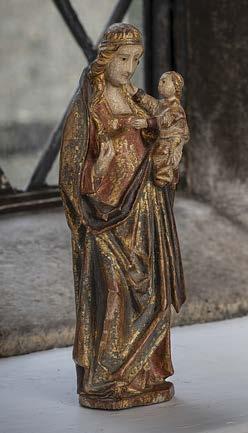
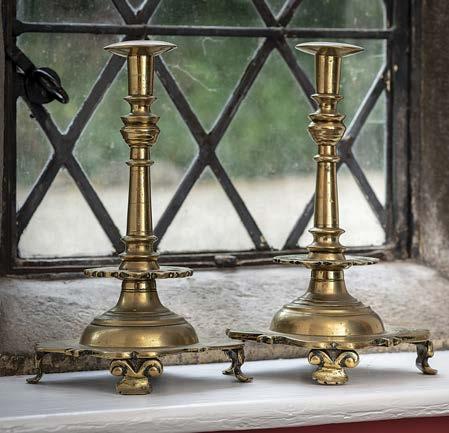
An early 17th century oak, walnut and holly inlaid chest of drawers, English, probably Southwark, London, circa 162040
The top boards with simple moulded edge, the frieze with chequer, diagonal band inlay, atop four long drawers, each with paired reserves, line inlaid with inner framing, the top drawer with the addition of central lozenge inlay, with twinpanelled sides and similar inlaid top rail. This type of inlay has long been associated with immigrant German craftsmen, working in the Southwark area of London, out of the controls of the City Guilds, in the late 16th and early 17th centuries.
A highly comparable chest, possibly from the same workshop, formerly Judith Hamilton Collection, Boarsney House, East Sussex, sold Dreweatt Neate, 18 September 2008, Lot 137 (£2,200).
£600800
A small polychromedecorated figural carving, Virgin and Child, possibly Malines (Mechelen) or Spanish, circa 152050
Carved in the round, the Virgin standing, tenderly holding the Christ Child on her left arm, her right hand raised in a gentle gesture, the facial features are delicately carved, displaying soft modelling and devotional intimacy characteristic of early 16thcentury European sculpture. Retaining extensive original polychrome and gilding, with richly painted robes in red, blue and gold.
The scale, refined carving and polychrome treatment are consistent with Malines production, though a Spanish origin is also very possible. Such figures were intended for private devotion.
H 27cm, W 9cm, D 5.5cm
£400600
A pair of 18th century brass candlesticks, probably Eastern European, possibly Russian, circa 1700
Each with a slightly flared cylindrical socket and wide flange, on a knopped and discoid stem, low decorative drippan, raised on a domed base, and shaped platform, on volute feet. (2)
H 32cm, Dia 17.5cm
£400600
A Charles II joined carved oak coffer, Gloucestershire, circa 1660
The front with two panels, each carved with a serpent, with scaled and coiled body, within a reentrant corner moulded frame, the muntin rail carved with a flower centred interlaced quatrefoil, the end uprights with a single tulip stem, the deep top rail with a band of leafy swirls, with boarded top, base rail and extended stile supports.
Provenance: With H. W. Keil, Cheltenham, Gloucestershire, 9 January 1985 (with invoice).
£500800
616
A late 16th century carved figure, St John the Baptist, Dutch, circa 1580
Shown standing, holding the Lamb of God (Agnus Dei) in his left arm and a staff in his right; the bearded figure is carved with sensitively modelled features and flowing drapery, reflecting the high quality of late 16thcentury Netherlandish devotional sculpture.
H 56cm, W 17cm, D 16cm
£8001,200
617
A pair of early 17th century bronze pricket candlesticks, Flemish, circa 1620
Each with iron pricket and shallow driptray, on a balustroid and ovoid knopped stem, with moulded and spreading triform base, and three separatelycast paw feet. (2)
An identical pair of candlesticks sold Bonhams, Oxford,The Graham & Susan James, Collection, 13 May, 2015, Lot 13. H 42cm, Dia 19.5cm
£300500
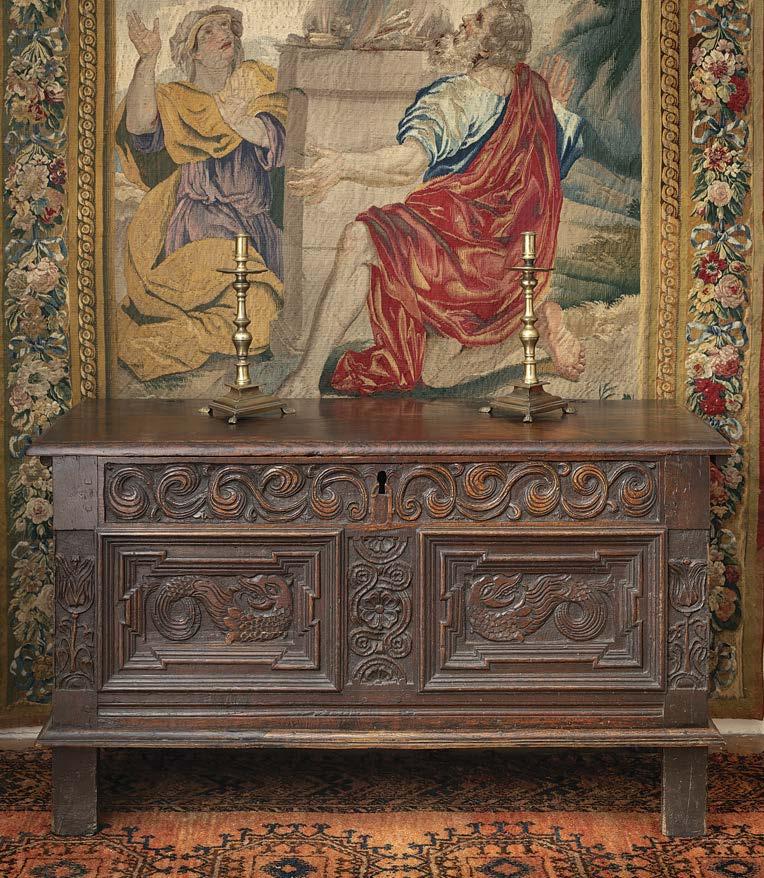
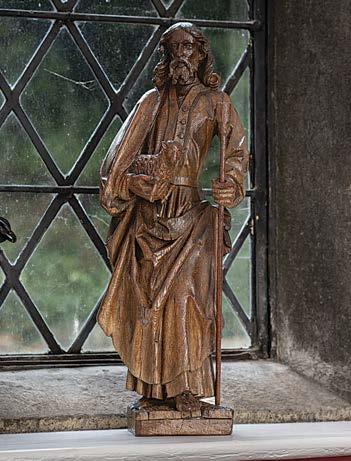
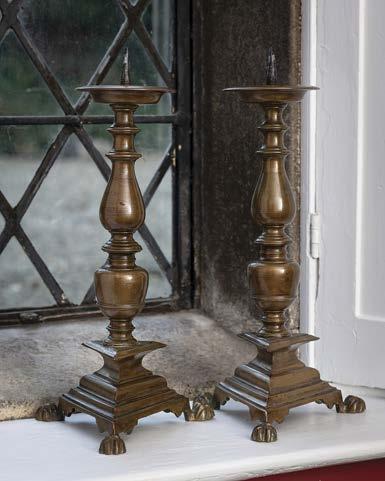
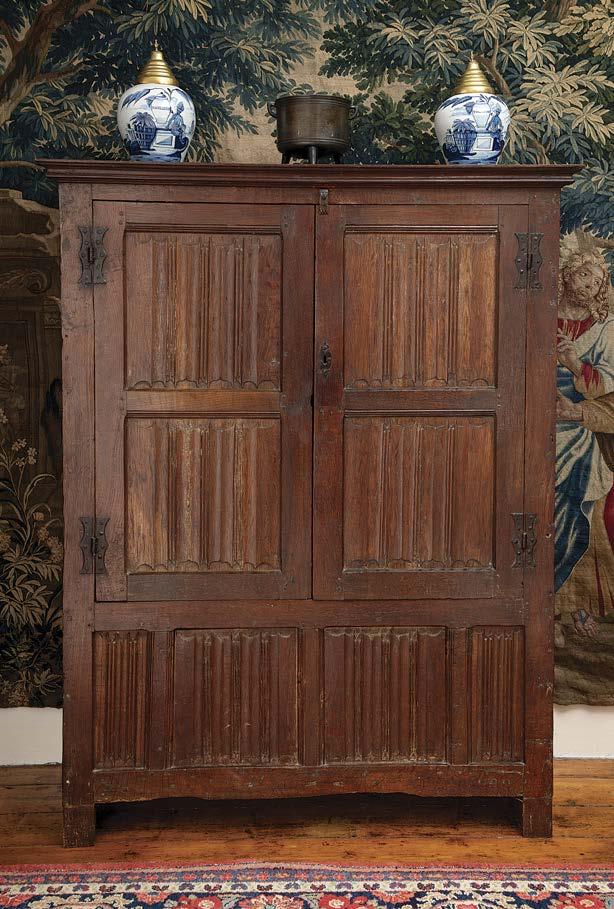
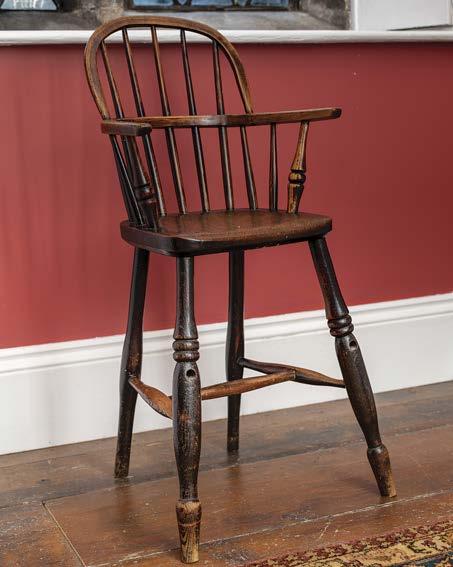
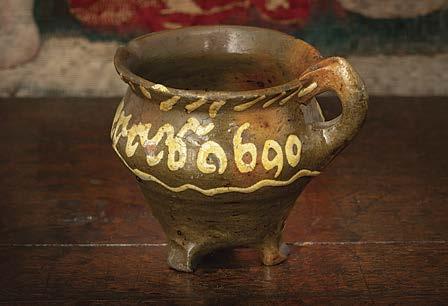
618
A joined and boarded oak, linenfoldcarved cupboard, Bruges, circa 152030
Having a moulded cornice and boarded sides, the front framed, with a pair of twinpanelled cupboard doors, atop two central fixed panels, flanked by narrow fixed panels, all panels linenfold carved, on extended stile supports. The door hinges are similar to those on a late fifteenthcentury oak screen at the church of St Andrew in Colebrook, Devon, Illustrated Charles Tracey, ‘Continental Church Furniture in England: A Traffic in Piety’, pl. 243 & 244. It is a good example of European artisans working in England, which perhaps could be the case here.
H 179cm, W 140.3cm, D 51.4cm
£1,0001,500
619
An early 19th century child’s ash Windsor highchair, circa 1830
Having a hooped stick back, baluster and ballturned front arm supports, flanking a saddle seat, on tall doublering and baluster turned legs, joined by an Hform stretcher, with vacant peg holes for former foot board.
H 88.5cm, W 45cm, D 30cm
£100200
620
An unusual slipware threelegged cup, English, possibly Wrotham, dated 1690
Of squat baluster form, raised on three short stump feet and with a single strap handle, the umbrabrown body is decorated in cream slip, with diagonal dashes to everted rim, atop swirls and the dated ‘1690’, a wavy line below.
H 9.5cm, Overall W 12cm, D 10cm
£100200
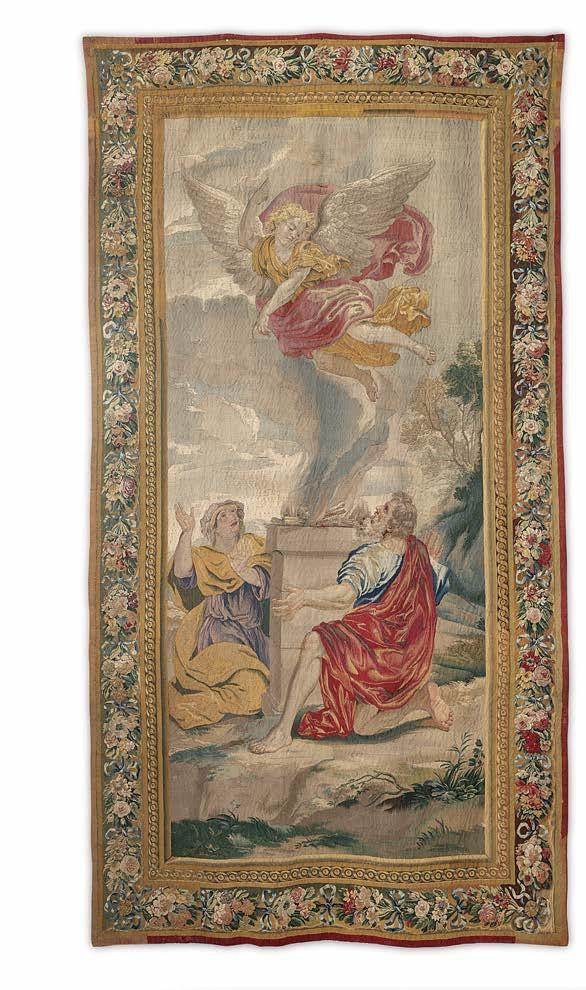
A 17th century tapestry, French, circa 1660
Finely woven in red, blue, green and ochre coloured wools, and with silk threads, illustrating the story of Manoah and his wife (Judges 13:3 – 23).
Desperate to conceive the childless couple prepare a sacrificial altar, through the column of smoke ascends the angel of the Lord; Manoah hides, fearing death after seeing God, whilst his wife acknowledges the miracle of her conception. The figures are richly dressed in flowing classical robes, set within a wooded landscape under a softly coloured sky. With an elaborate floral and foliate border, densely worked with roses.
H 363cm, W 138cm
£2,0003,000
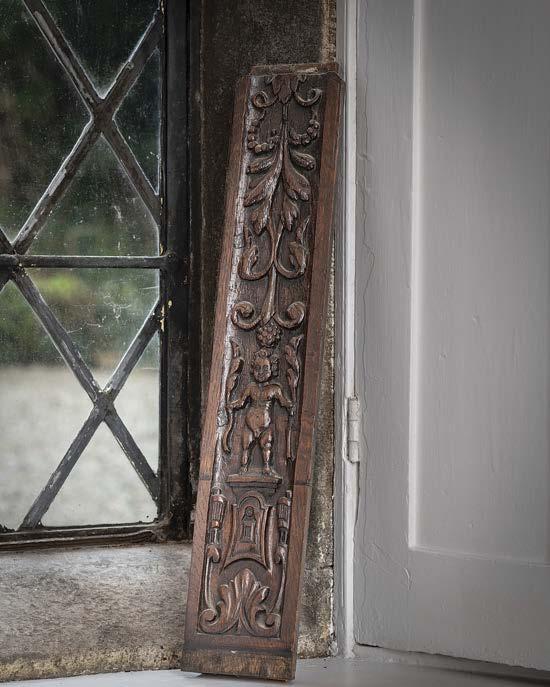
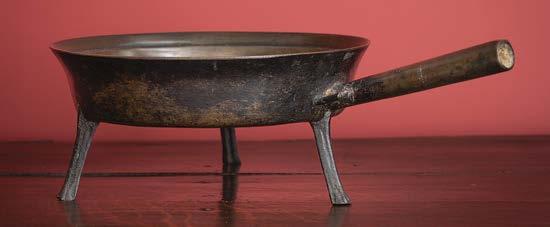
A 16th century carved oak architectural panel, circa 1530–40
The narrow vertical panel carved in high relief with a lively putto standing beneath scrolling foliate ornament, the composition framed by stylised acanthus leaves and architectural motifs typical of Renaissance decorative carving.
H 51.5cm, W 10cm
£100150
A bronze downhearth pan or skillet, North West European, circa 16801730
The relatively shallow pan with flared sides and inner moulded rim, on three triangular splayed legs, the tubular handle aperture fitted with angled side braces
H 14cm, Overall width 43.5cm, Dia 29cm
£100200
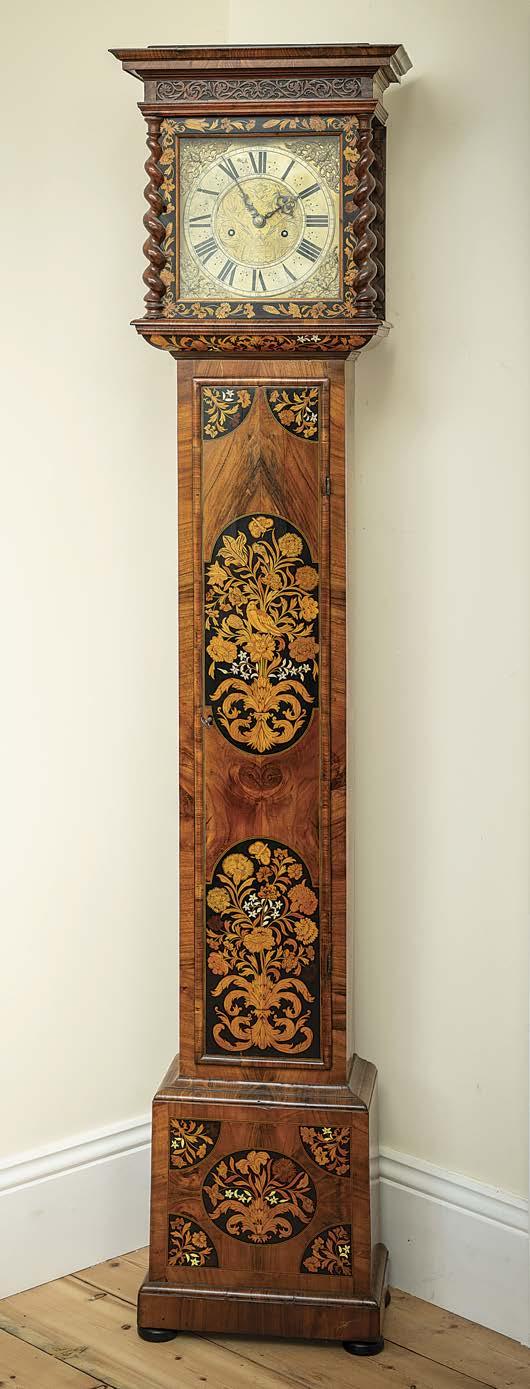
A late 17th century walnut marquetry longcase clock
John Ebsworth, London
The flat topped hood with floral marquetry, the trunk with two reserves of floral sprays, one with a bird and highlighted with bone inlay, below upper matching spandrels, similar decorated plinth, later bun feet, the 10 inch square brass dial with cherub scroll spandrels, silvered chapter ring with Roman numerals, floral engraved to the centre, above the inscription ‘John Ebsworth Londini fecit’, 30hour movement, later converted to 8day.
H 198.5cm, W 44.5cm, D 41cm
£2,0003,000
625
A 16th century polychrome and parcelgilt tabernacle door, Spanish, probably Castilian
Depicting the Resurrection of Christ, shown emerging from the tomb, perhaps with the triumphal banner draped in red across his left arm and back, holding a long staff in the left hand, while blessing with the other. At the base of the open sarcophagus are two Roman soldiers, who had been sent to guard the tomb; their weary, startled forms in stark contrast to the upright, majestic
figure of the resurrected Christ.
The reverse fitted with a period iron lock mechanism, confirming function as a tabernacle door, originally from an altar or retable. Mounted within a later velvetlined frame.
H 52.5cm, W 38.5cm
£500800
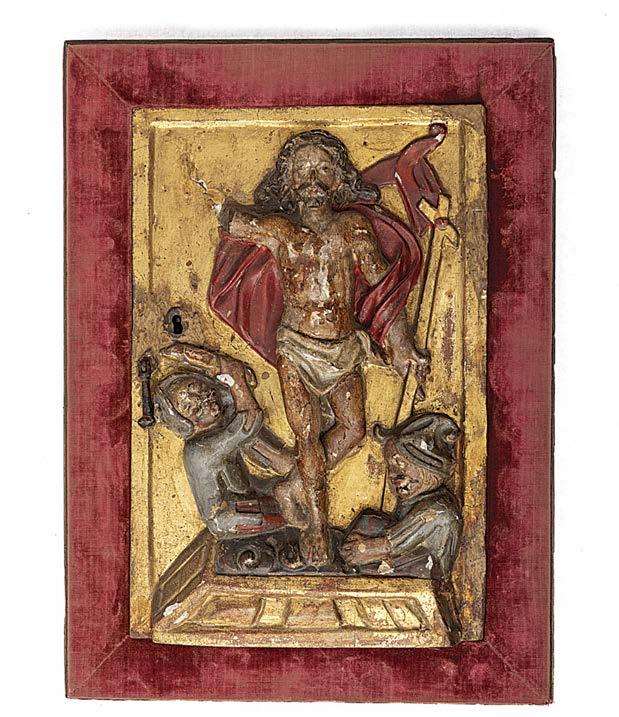
A Charles II oak ventilated mural cupboard, circa 1670
Designed with two tiers of silhouette and pierced baluster spindles, the five central spindles joined and pivoting to form a door, atop three small drawers, each framed with simple mouldings, the base rail cuspcarved.
The cupboard has a striking architectural rhythm, reminiscent of early balustrading and choir screens.
H 65cm, W 120cm, D 31cm
£2,0003,000
627
A small, mid16th century joined oak coffer, English, circa 1550
The front with two plain panels, centred by an iron lockplate, with decorated hasp, atop a narrow panel, highrelief carved to the centre with an elongated lozenge, with boarded top, on extended stile supports.
H 74.5cm, W 107cm, D 47cm
£200300
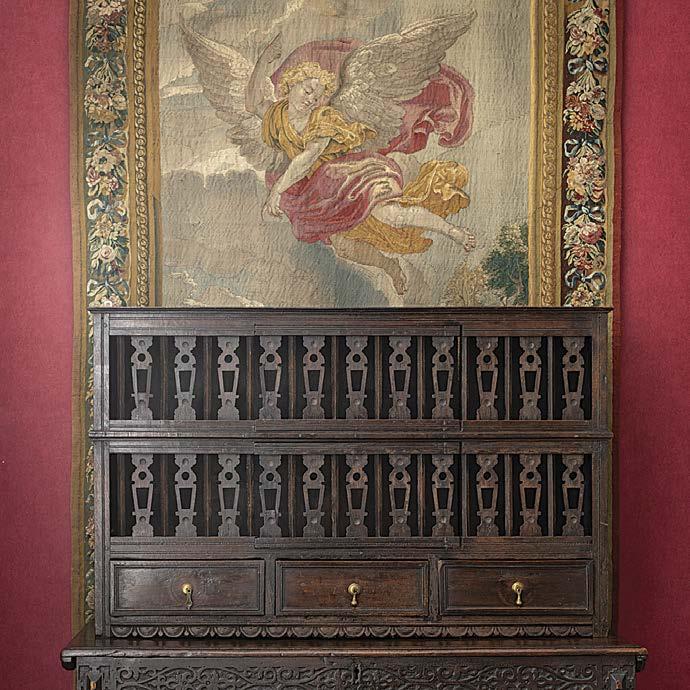
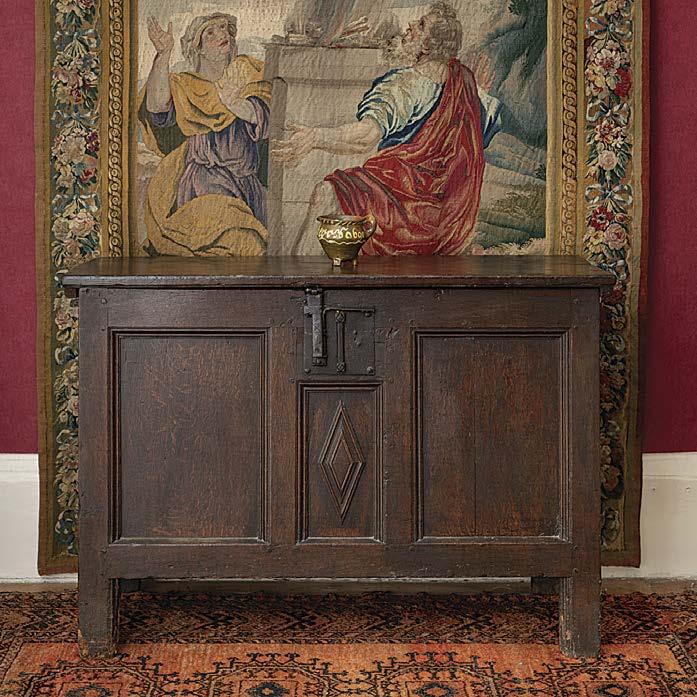
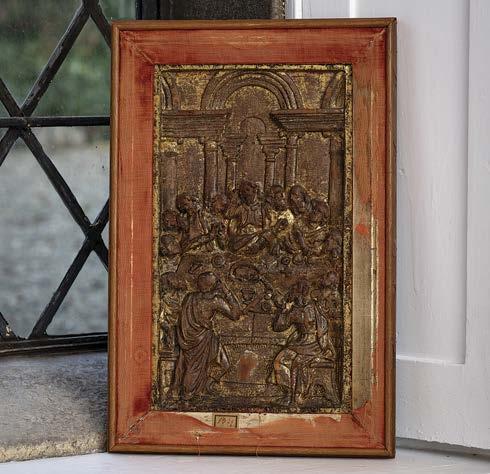
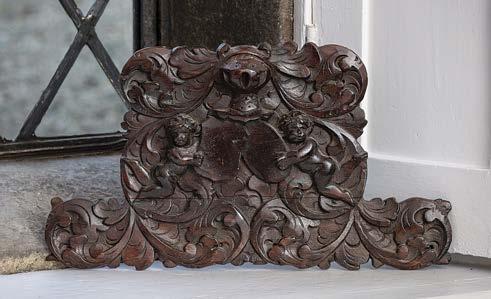
628
A 16th century carved oak panel, The Last Supper, Flemish, circa 152050
The animated scene shows Christ sitting at the centre of a long table, laden with food and drinking vessels, flanked by his Disciples, beneath arched colonnades, the figures have expressive faces, lively gestures and wellmodelled drapery, with traces of polychrome and gilding, in a silkvelvet covered frame.
Provenance: Collection label to rear, reading: ‘Collectie S. Van Der Velden / Delft’.
H 44cm, W 29cm, D 4.5cm
£500800
629
A pair of altar candlesticks, Italian, circa 1800
Each with a waisted socket, drippan, and multiple baluster knop stem, on a triform, lobed base, with scrolled feet. (2)
H 56cm, Dia14cm
£100200
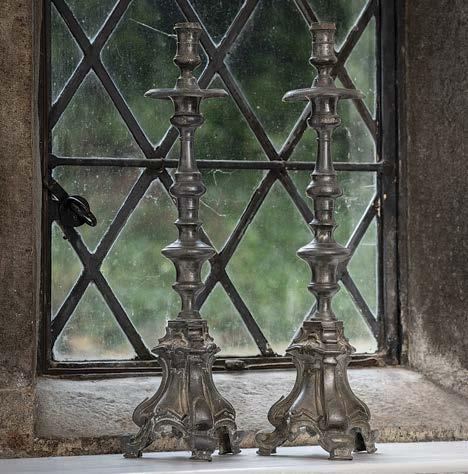
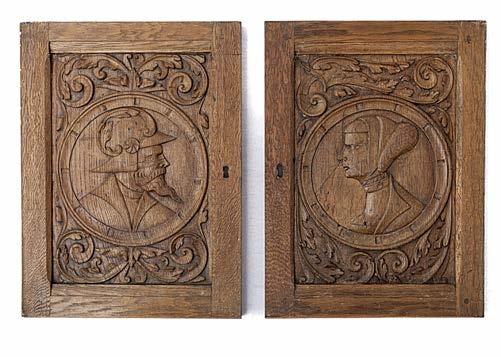
An early 17th century carved walnut panel, Flemish, circa 1620
Richly and deeply carved, with scrolling acanthus foliage around a pair of vacant shields, with lively cherub supporters and visordevice crest.
H 21cm, W 38cm, D 4cm
£100200
A pair of carved oak portrait panels, French, circa 1530
Each with a finely observed profile portrait roundel, one a bearded male, wearing a classical helmet, the other female, in contemporary headdress, both surrounded by dense scrolling foliate ornament, mounted in later oak frames. (2)
H 52cm, W 39cm
£200300
A pair of carved oak portrait panels, French, circa 1530
Each with a profile portrait medallion, carved in low relief, one a young male, in contemporary flat cap and highneck shirt, the other female, wearing a contemporary headdress, both framed by scrolling foliate ornament, in later oak frames. (2)
H 52cm, W 39cm
£200300
633
A carved oak panel, French, circa 1530
Carved in low relief with a symmetrical foliate design issuing from a simple flared urn, the scrolling leaves and stylised flowers arranged in a balanced architectural composition within a moulded border.
H 21cm, W 24.5cm
£100150
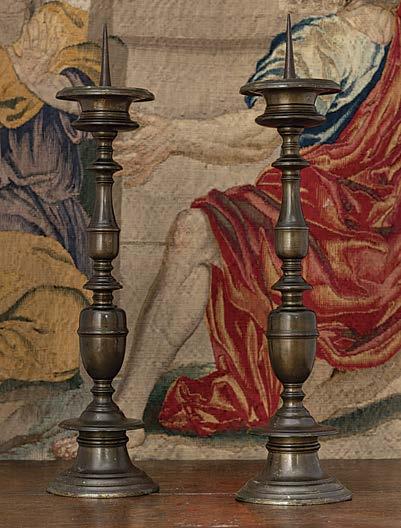
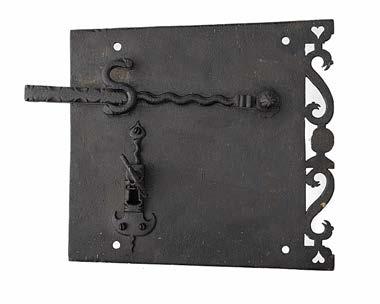
A pair of bronze alloy pricket candlesticks, Italian in the 17th century manner
Each with a pegbaluster and ovoid stem rising from stepped, circular socle bases, surmounted by a flattened urn drippan, and iron pricket. (2)
H 55cm, Dia 13.2cm
£200300
A very large wroughtiron door lock plate, Northern European, 160060
The long end of the trapezoid back plate cut with paired Sscroll serpents, centred by a naïve portrait silhouette, the sliding bolt arm with filed decoration and serpentine connecting device, ornate escutcheon, with key.
H 34.5cm, W 42cm, D7cm
£100150
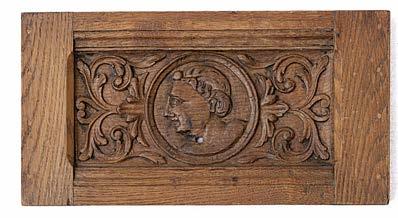
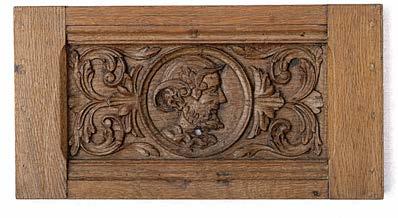
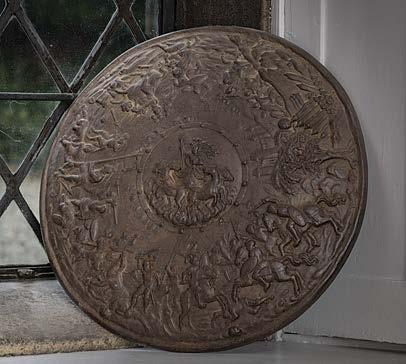
A pair of carved oak portrait panels, French, circa 1530
Each rectangular panel carved in low relief with a classical profile portrait roundel, one male, the other female, flanked by scrolling foliate ornament, set within a later oak frame. (2)
The design reflects the strong influence of Italian Renaissance portraiture, likely derived from antique coin and medal imagery, at the French courts from the beginning of the 16th century. Such portrait panels were commonly incorporated into highstatus domestic furniture or architectural panelling.
H 20cm, W 38cm
£200300
A cast metal shield or tondo
Possibly 19th century, in the 16th century manner
Designed in relief with a dynamic martial scene inspired by Renaissance and Classical imagery; the central medallion depicts a mounted warrior, encircled by horsemen, foot soldiers, banners, and trophies of arms.
Dia 46cm, D 7cm
£80120
638
A small fruitwood/walnut chipcarved box, Central or Eastern Europe, circa 18001900
The cylindrical box carved in relief with repeating geometric and stylised foliate chipcarving, the lid similarly decorated with a radiating motif.
H 6.5cm, Dia 9cm
£4080
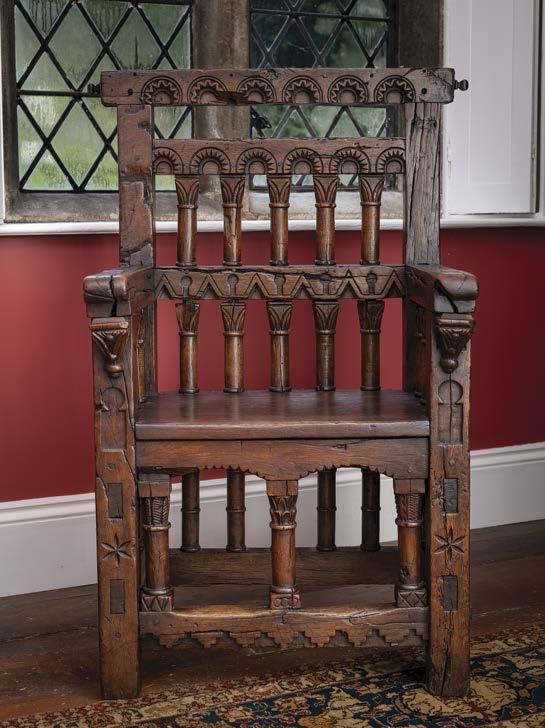
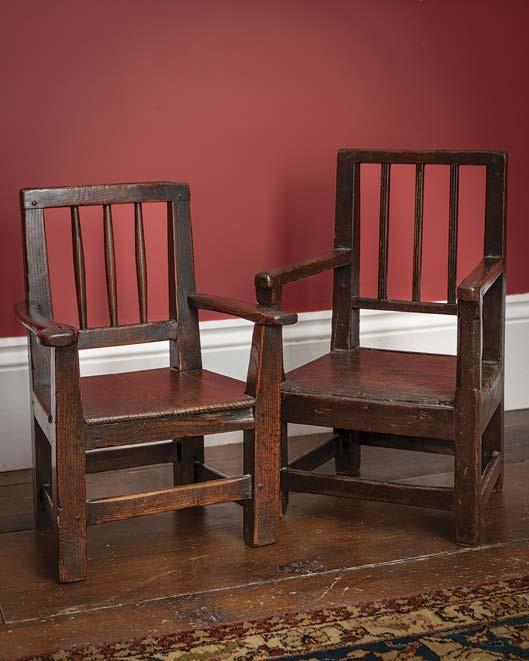
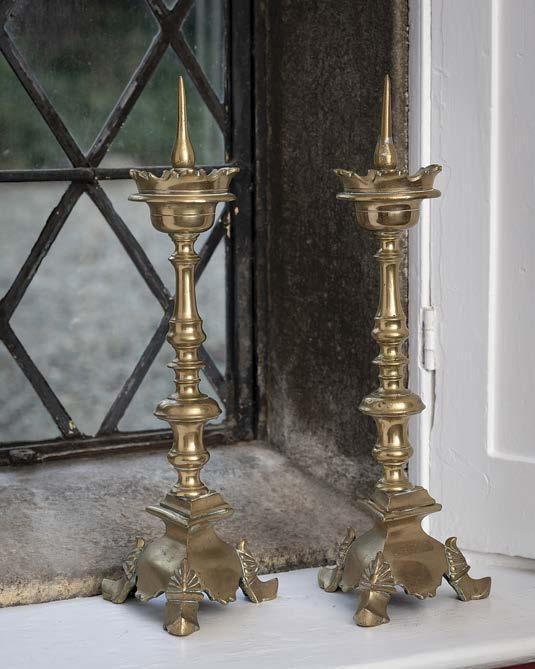
639
An oak side table, English, elements 17th century
The top with moulded edge, above a single frieze drawer carved with wavy foliate motifs, on turned front legs and square rear supports united by stretchers.
H 46cm, W 58cm, D 38cm
£5080
640
An unusual oak armchair, in the Romanesque manner, circa 1900 with possible earlier elements
Robustly constructed with a high, colonnaded back, topped by architectural arcades, the flat arms on matching columns, their design repeated below the seat board, the squaresection uprights with geometric carved motifs.
H 119cm, W 73.5cm, D 54cm
£600800
641
A pair of brass pricket candlesticks, North Italian, probably Lombardy, circa 170050
Each with a ‘coronet’ driptray and baluster pricket, on tall balustroid stem and triform base, with downswept sides and shaped feet with embryoshell carved knees. (2)
H 41.5cm, Dia 14.5cm
£300400
642
A pair of brass candlesticks, English, circa 1750
Each with petaledged circular base, rising to a baluster stem and cylindrical socket, with shaped flared rim. (2)
H 20cm, Dia 11cm
£4060
643
A set of four Victorian West Country silver salt cellars by Josiah Williams & Co., Exeter 1852
Of circular cauldron form, with embossed foliate scroll decoration, on three lionmask paw feet, with gilded interiors, diameter 8cm, approx. weight 13.5 Troy oz. (4)
£200300
644
Two similar George III oak child’s chairs, circa 1790
Each with a square framed back, filled with three ‘spindles’, the flat open arms on chamfered front supports, solid seat, rectangularsection legs joined by plain stretchers. (2)
Largest chair H 52cm, W 32cm, D 28cm
£200300
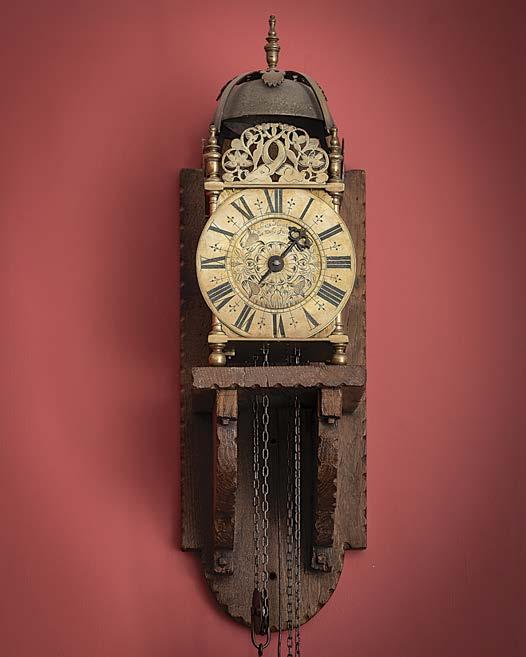
645
A brass lantern clock, West Country, circa 1695–1700
Ambrose Hawkins, Somerset and Devon
The strap bell over urn finials, dolphin and foliate frets, turned columns and ball feet, the circular dial with Roman chapter ring, with fleurdelys halfhour markers, single fettled steel hand, and signed ‘Ambrose Hawkins de Wells fecit’, atop engraved tulip sprays, on a later oak wall bracket, with weights and pendulum.
This Lot corresponds directly with a lantern clock recorded by Clive N. Ponsford, ‘Devon Clocks and Clockmakers; Somerset and Dorset Notes and Queries, Vol. 17, described as: ‘A lantern clock with ‘Ambrosse Hawkins de Wells fecit’ finely engraved upon the dial’.
Ponsford notes that prior to establishing himself in Exeter, Hawkins worked in the cathedral city of Wells, Somerset.
H 39cm, W 14.5cm, D 15cm
£3,0004,000
646
A late 17th century delftware lobed dish, probably Dutch, circa 170050
Of circular lobed form, painted in underglaze blue in the Chinese Kraak style, the central octagonal panel depicting figures in a landscape beneath trees, the scallop edge rim with radiating panels alternately decorated with scrolling foliage and further figural scenes.
Dia 33.5
£100200
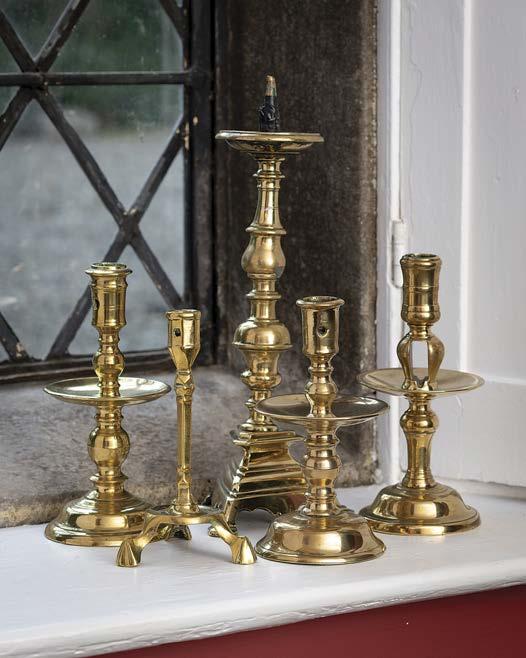
A pair of carved oak panels, French, circa 1530
Each rectangular panel carved in low relief, one with an elegant scrolling foliate design issuing from a classical urn, the other incorporating satyrs supporting scrolling foliage and stylised leaves, both framed within simple moulded borders. (2)
H 54cm, W 24.5cm
£100150
648
A group of five brass candlesicks, Northwest European, circa 1650 and later
To include an Italian pricket example, with balustroid stem and spreading triform base; two Heemskerk candlesticks, with typical flared cylindrical socket, and ballknop stem centred by a driptray, on a dome base; another of similar form with a slot to upper stem for candlesnuffers; together with a candlestick with faceted socket and stem, on a circular platform base and three downswept legs. (5)
Largest H 34cm, Dia 13cm
£200300
A large pair of carved oak architectural pilasters, Dutch, circa 1600
Each carved in high relief, with a standing nude male figure, set within scrolling strapwork and foliate ornament, the figures posed contrapposto standing on a mask, the base carved to represent an elongated panel. (2)
Originally part of a domestic or civic interior, possibly framing an opening, fireplace or wall panelling scheme.
H 110.1cm, W 14cm, D 5cm
£300500
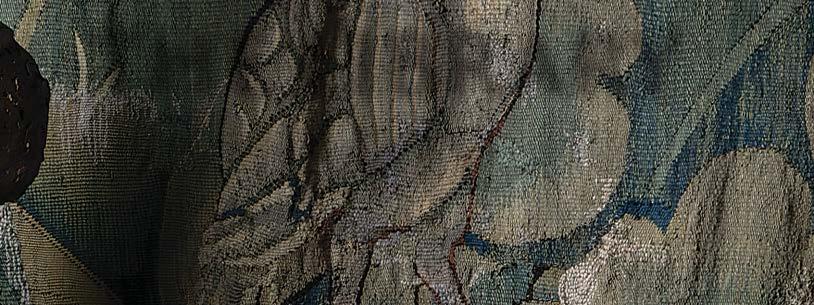
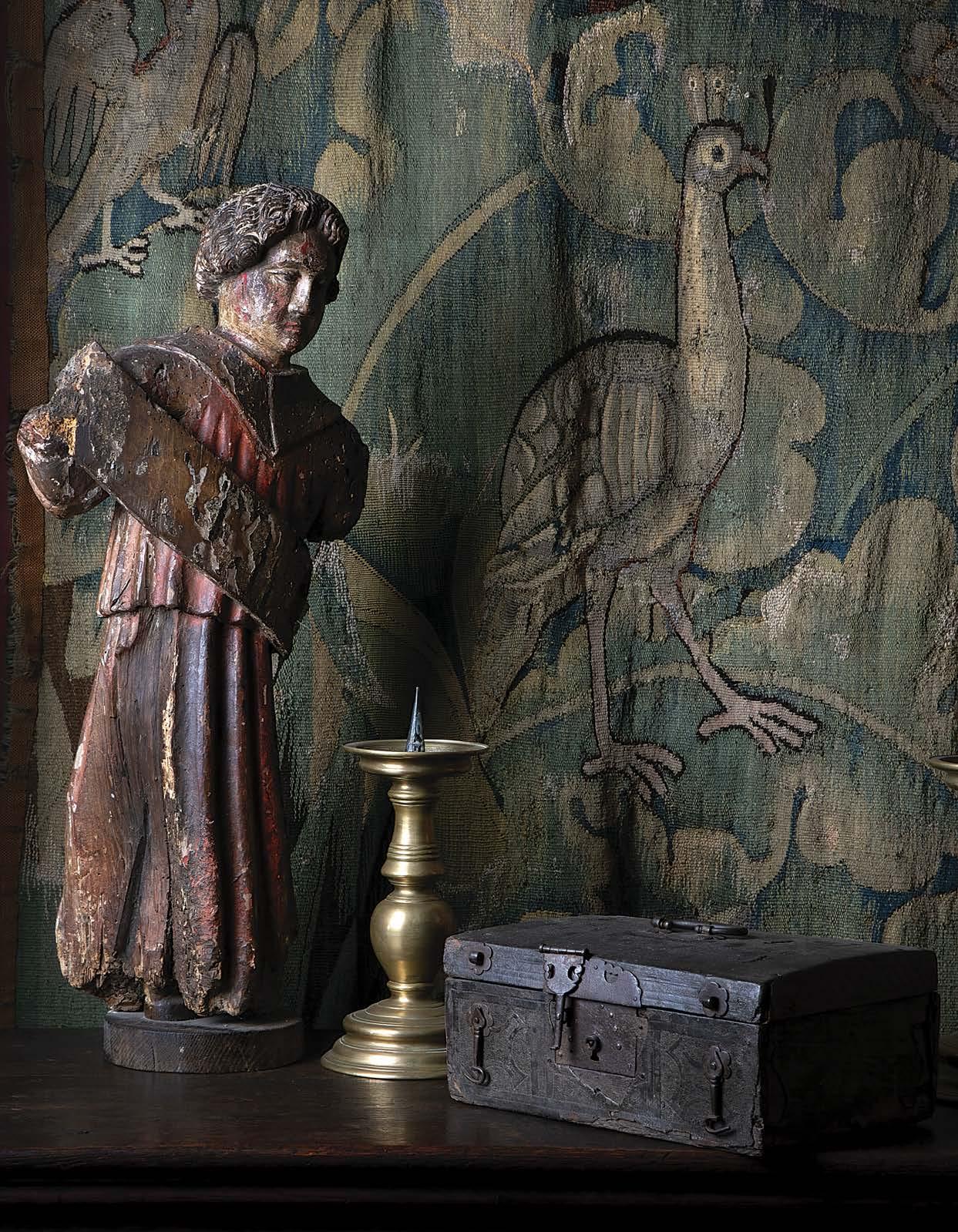
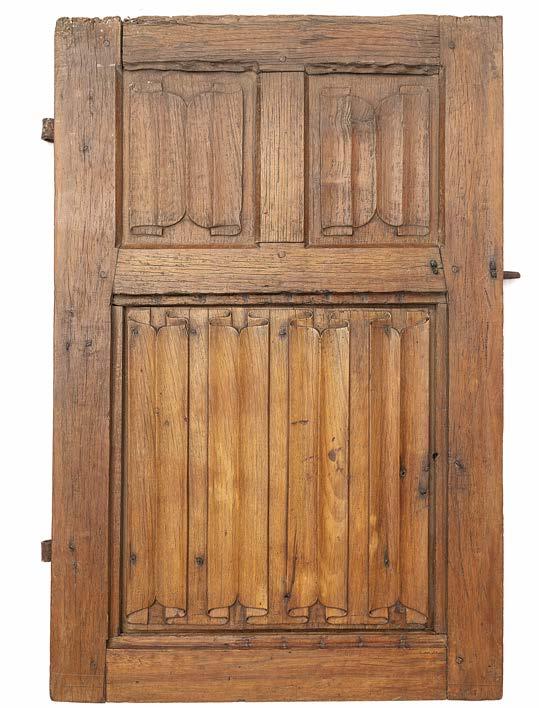
A rare walnut, linenfoldcarved window frame with integral shutter, French or Swiss Upper Rhine region, circa 14801520
A highly uncommon surviving window assembly comprising its original moulded frame and singleleaf shutter.
With a pair of fixed linenfold panels, atop a larger linenfold board forming a door, with similar moulded edges, and hinged to the rear with wroughtiron straps, along with latch and locking bar.
Surviving framed Gothic window shutters are exceptionally scarce; most were discarded during window enlargement in the 17th and 18th centuries.
H 101cm, W 66cm, D 4.5cm
£600800
651
A small, and good oak press base, Dutch, circa 15801620
The top with egganddart moulded edge, and two vacant apertures for the former press superstructure, with concaveshaped front and rear friezes, the single drawer carved to the centre with a male mask, moustached, and wearing an elaborate headdress, joined by swags to a fivepetal reliefcarved flower, all within a volutecarved cartouche, on downswept, ogeeprofiled sides, carved with scrolls, and to each end surmounted by a recumbent lion.
Provenance: Robert & Rachel Byles Collection, Somerset.
H 11.5cm, W 31cm, D 41cm
£150200
652
A late 19th century bone handled walking cane, circa 1880
Japanese for English Market, retailed by J. Vowler, Queen Street, Exeter
The bamboo shaft engraved and stained with figures, together with birds and trees, interspersed with script/characters, the handle engraved with Samurai and signed to the terminal ‘J Vowler, Queen St. Exeter’.
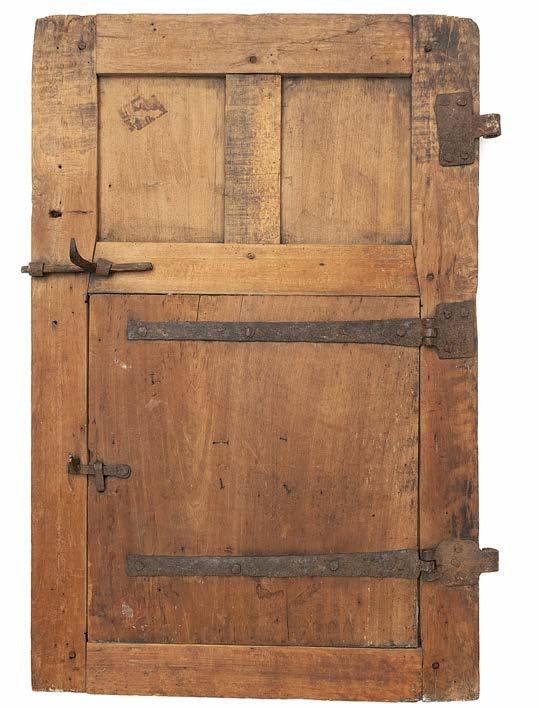
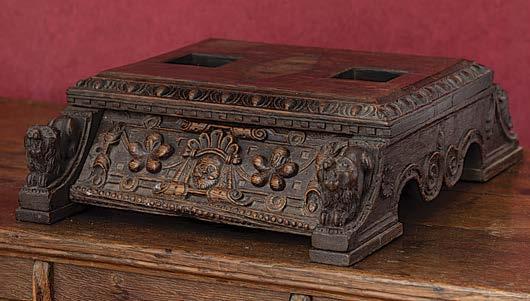
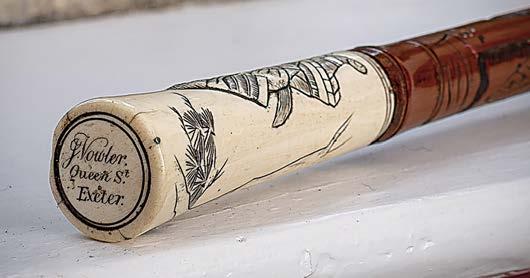
L 91cm
£200300
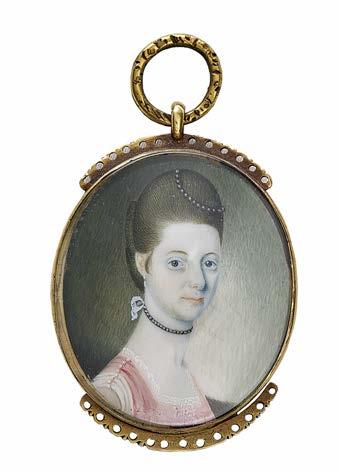
λ 653
Circle of Samuel Cotes (17341818)
Portrait miniature of a lady, wearing a pink dress with pearl necklace and pearls in her hair
Watercolour on ivory, oval, in a gilt metal frame
34 x 29mm
*This item is offered for sale in accordance with the Ivory Act 2018 and has been assigned a registration number.
£300400
λ 654
Circle of Jeremiah Meyer (17351789)
Portrait miniature of a lady, wearing a blue dress and with pearls in her hair
Watercolour on ivory, oval in a gilt metal frame
37 x 29mm
*This item is offered for sale in accordance with the Ivory Act 2018 and has been assigned a registration number.
£300400
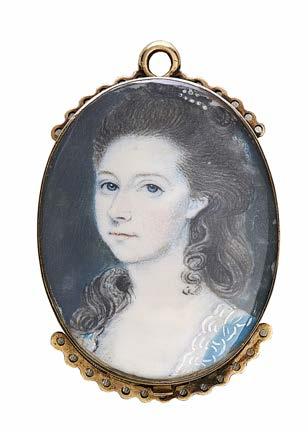
655
A small group of 16th to 19th century iron furniture fittings
To include a pair of pierced, shieldshaped escutcheon’s; a strap hinge with hasp (a/f); a shaft with scallop shell terminal and a key. (5) lockplates 8cm wide
£3050
656
An Ersari Turkmen carpet, North Afghanistan, circa 1900
The madder field of ‘elephant foot’ guls enclosed by borders of stepped medallions and boteh guard stripes.
L 330cm, W 212cm
£100200
657
Three Medievalstyle tiles
Of square form, two of zoomorphic design, with Griffintype beasts; and a third depicting a kneeling angel, all within a scallop border. (3) 14.5cm x 14.5cm
£4080
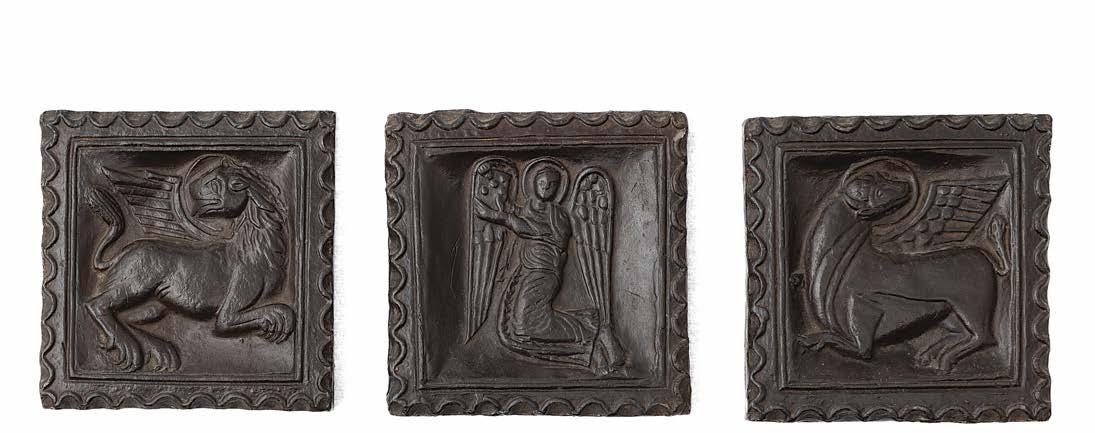
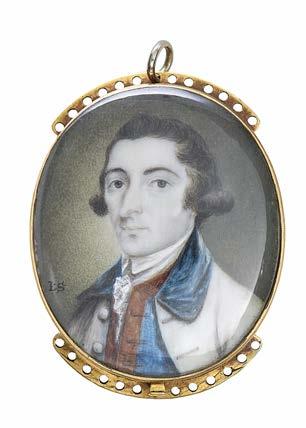
λ 658
Attributed to Luke Sullivan (Irish 17391775)
Portrait miniature of a gentleman, wearing a red and blue waistcoat and buff coat
Signed with initials LS (lower left)
Watercolour on ivory, in a gilt metal frame
36 x 31mm
Literature: Illustrated ‘Country life’, 19 April 2023.
*This item is offered for sale in accordance with the Ivory Act 2018 and has been assigned a registration number.
£300500
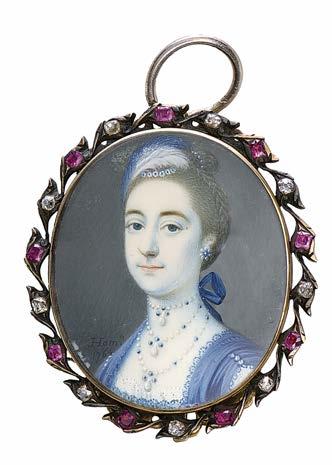
λ 659
Gustavus Hamilton (17391775)
Portrait miniature of a lady wearing a blue dress, a pearl necklace, and a pearl and feather headdress in her hair
Signed and dated HAMn/1764 (lower left)
Watercolour on ivory, oval, in a gilt metal and paste frame
35 x 30mm
*This item is offered for sale in accordance with the Ivory Act 2018 and has been assigned a registration number.
£600800
660
A roemer glass, German, possibly 17th century
Of typical form, with bulbous bowl, sturdy stem with decorative ‘prunts’ and a hollow coiled foot, with a soft olivegreen tint.
H 10.5cm, D 6.5cm
£3050
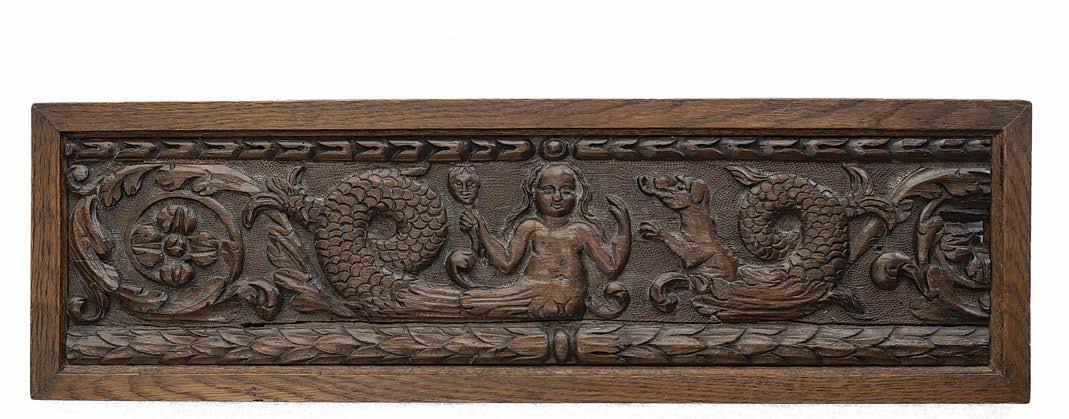
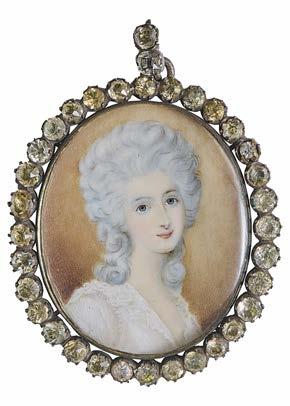
661
A pair of mid18th century brass candlesticks, English, circa 1750
Each with an urnshaped socket, baluster stem and domed petalbase. (2)
H 18cm, Dia 10.5cm
£4060
662
A pair of 17th century carved oak Siren panels, Dutch, circa 164070
Each designed with a mermaid or siren, with bifurcated, scalecarved fishtail; holding a comb and mirror, traditional attributes associated with vanity, seduction, and the dangers of feminine allure; flanked by coiling acanthus scrolls and stylised rosettes; all carved in high relief against a stippled ground. (2) Mermaid imagery was particularly resonant in the Netherlands, a seafaring nation whose cultural identity tied closely to the sea. Such figures could embody the perils of the ocean, as well as a metaphor for temptation.
Comparable examples can be found integrated into surviving Dutch kasten and bedframes.
H 20.5cm, W 67cm
£200300
λ 663
Manner of Richard Cosway (17421821)
Portrait miniature of a Lady wearing a white dress and with powdered hair
Watercolour on ivory, oval, with a metal frame with paste border 49 x 41mm
*This item is offered for sale in accordance with the Ivory Act 2018 and has been assigned a registration number.
£150250
664
Reference books on Renaissance & German furniture
Egon Hessling, Renaissancemoebel: Meisterstucke altfranzosischer Kunsttischlerei und Holzbildhauerei; Heinrich Kreisel, Die Kunst des Deutschen Mobels – (three volumes); Otto Von Falke Deutsche Mobel Des Mittelalters und der renaissance. (5)
£80120
665
A group of European scholarly books on furniture, woodwork & decorative arts WindischGraetz, Mobel Europas, Vols. I & II; Jacques Thirion, Le Mobilier Moderne de la Renaissance en France: Jacqueline Boccador, Le Mobilier Francais du Moyen Age a la Renaissance; K. Heinrich von Stulpangel, Die gotischen Truhen der Luneburger Heidekloster; Gothic ChoirStalls in the Netherlands, (two copies); L. Fligny, Le Mobilier en Picardie; A Massenelli, Il Mobile Toscano 1200–1800; J. Boccador, Moyen Age Renaissance, Le Mobilier Francais; J. Boccador, Statuarie Medievale en France de 1400 a 1530, and four other volumns. (15)
A group of reference books on British furniture, chairs and woodwork
Fred Roe, History of Oak Furniture; Fred Roe, Ancient Church chests and chairs; Frank Davis, Furniture; Fred Roe, Ancient coffers and Cupboards; Victor Chinnery, Oak Furniture: The British Tradition; Tobias Jellinek, Early British Chairs and Seats, 1500–1700; Richard Bebb, Welsh Furniture 1250–1950, two volumes. (7)
£100200
667
A small collection of West Country silver Fiddle pattern flatware
Exeter, various dates and makers comprising: two pairs of sugar tongs, two ladles and a presentation tablespoon, the terminal initialled, plus a Londonmade Fiddle pattern tablespoon, approx. total weight 11 Troy oz. (6)
£200300
668
Of Exeter interest: A Victorian brass ‘snuff’ box
Of circular form, with pushon lid engraved with the City of Exeter arms, over ‘EXETER’, with beaded footrim; together with a small 20th century metal lidded pot with Verdigris style finish. (2)
Dia 5.5cm
£4060
669
A 14th centurystyle seal matrix
Designed in relief, with a framework of Gothic arches, headed by the Crucifixion, with subsidiary narrative scenes below, flanked by the Virgin and Child and St John the Evangelist, Latin inscription to edge, the reverse plain.
Dia 10cm
£4080
Two 16th centurystyle brass candlesticks
One in the style of a ‘chalice and patten’, English, circa 1550, candlestick, with spreading twostage base; another with a fourknop stem and capstanstyle base, in the circa 14501500 Dinant, Belgium, manner, and a third in the Arts & Crafts manner, with ‘crimped’ driptray, ball knop stem and stepped, domed base. (3)
H 24cm (largest), Dia 11cm
£80120
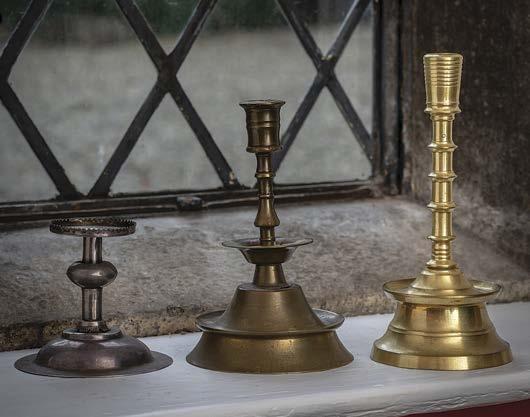
£80120
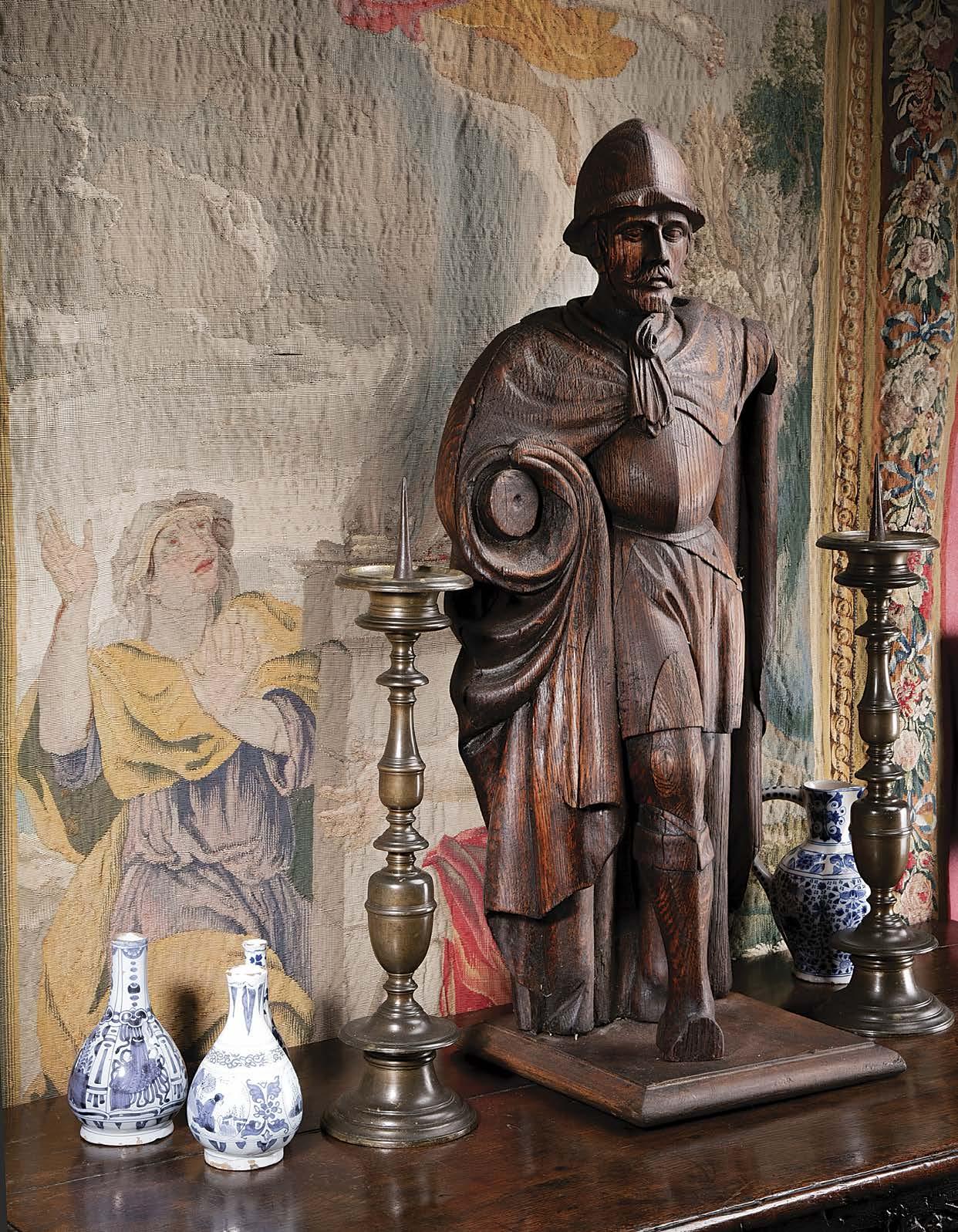
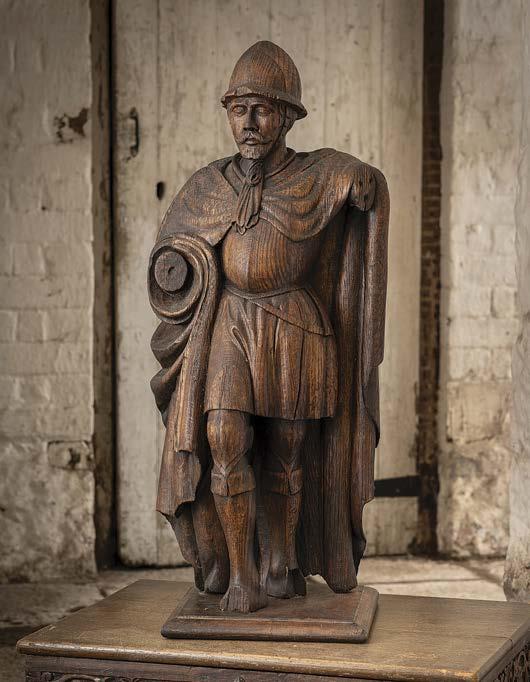
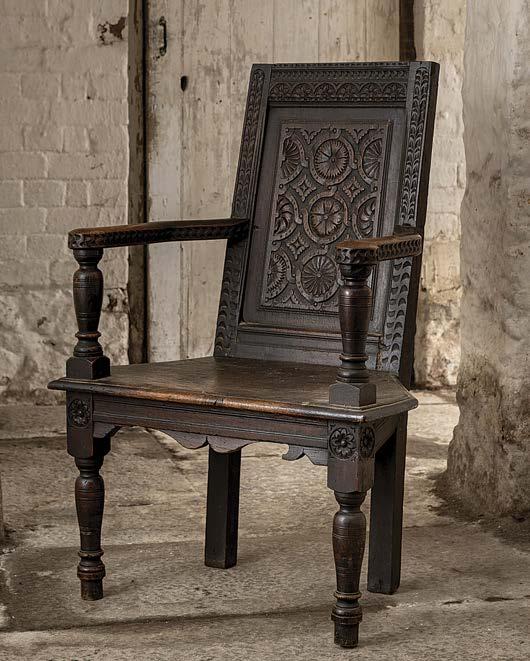
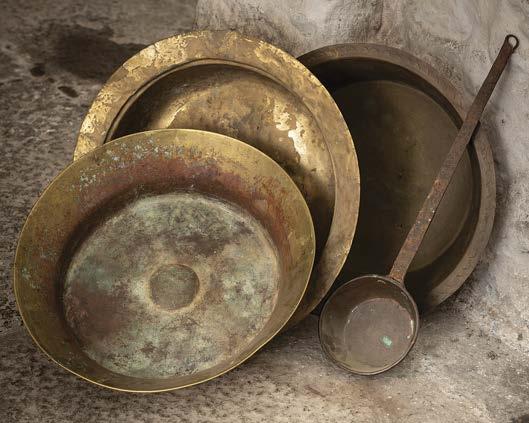
A large carved oak figure of a soldier, Flemish/German, circa 160050
Depicted standing, with restrained facial expression, wearing a cabassettype helmet, his cloak draped over his shoulders and fastened under the neck, one arm raised, on a square moulded base.
H 86cm, W 33cm, D 30cm
£300500
Three brass basins and a brass skillet, 17th19th century
One basin with central boss and flared sides without rim; another with traces of gilt and semibroad flat rim; the third with meandering punchdecoration to a narrow rim, the downhearth pan or skillet with iron handle. (4)
Largest Dia 47cm, H 10cm
£200300
An Elizabeth I joined oak caquetoire open armchair, Salisbury and the surrounding area, circa 1590 and later
Having a rosettefilled strapworkcarved back panel, framed by a demiflower carved top rail, and gaugecarved uprights, the outsplayed arms with gaugecarved sides, on invertedbaluster turned front supports, trapezoid seat, with runmoulded and bicuspid profiled front seat rail, and later turned forelegs.
Provenance: Athelhampton House, Dorset.
H 102cm, W 70cm, D 47cm
£100200
A group of four trays
To include a mahogany oval example with foliate scroll inlay; one of kidneyshape, another oval of papiermâché; and a fourth electroplated of serpentine, pierced gallery, form. (4)
Largest H 4.5cm, W 68cm, D 42cm
£3050
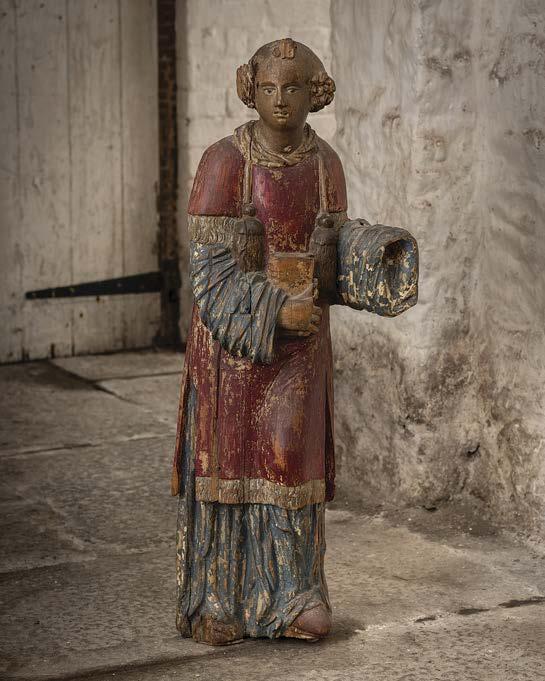
675
A carved limewood and polychromedecorated figure, possibly St Nicholas, Low Countries/Germany, circa 1600
Depicted standing, holding a book to his chest, his face modelled with a calm, contemplative expression, the drapery falling in long, vertical folds, retaining significant polychrome, in reds, blues and ochre tones, one hand detached.
H 95.5cm, W 36cm, D 19cm
£500800
676
A Charles II joined oak panelback open armchair, North Cheshire/Lancashire, circa 1680
The back panel carved with a bold stylised floral spray issuing from a single stem, below a scrollarched and floralcarved cresting rail, the upright with pyramidal finials, downsept arms on balusterturned supports, the boarded seat on deep, narrow runmoulded rails, the parallelbaluster turned forelegs joined by plain stretchers all round, historic repairs.
H 107cm, W 56cm, D 50cm
£100200
677
A 17th century heemskerk brass candlestick, Dutch, circa 1650
Having a tulipshaped candle socket with moulded rim, and a pierced circular extraction holes, on a balustroid and knopped stem, centred by a dished drippan, raised on a domed circular base.
H 19cm, Dia 10cm
£4080
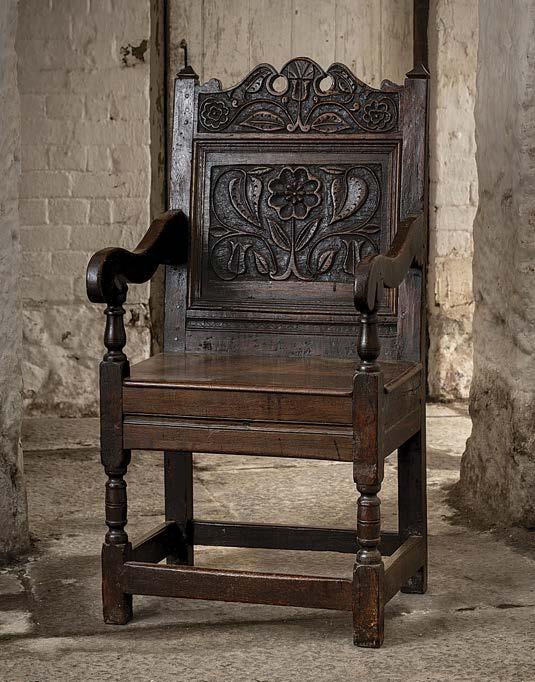
A group of four timber trays
Mostly rectangular, one with a large chequerinlaid oval paterae to centre, and two with folding legs. (4)
Largest H 4.5cm, W 68cm, D 42cm
£3050
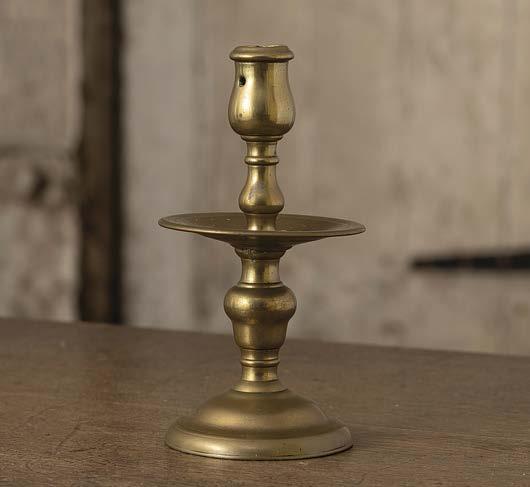
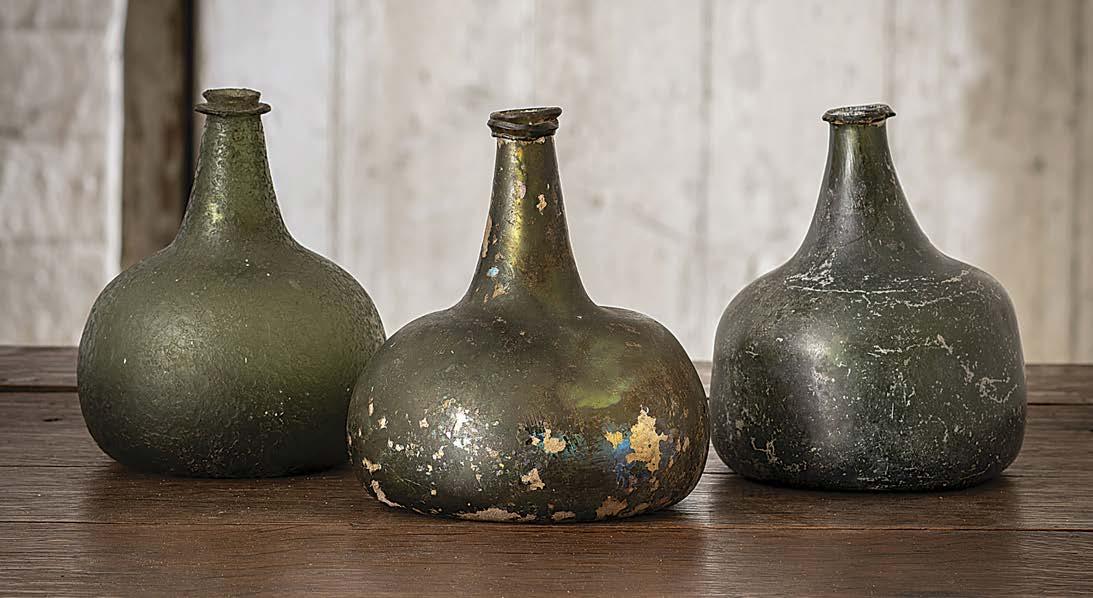
679
Three glass ‘onion’ wine bottles, English, circa 170020
Of squat onionshape, dark olivegreen tint, all with a bulbous body, one slightly more straightsided, tapering neck and string rim, traces of iridescent finish. (3)
H 17 (largest), Dia 14cm
£300500
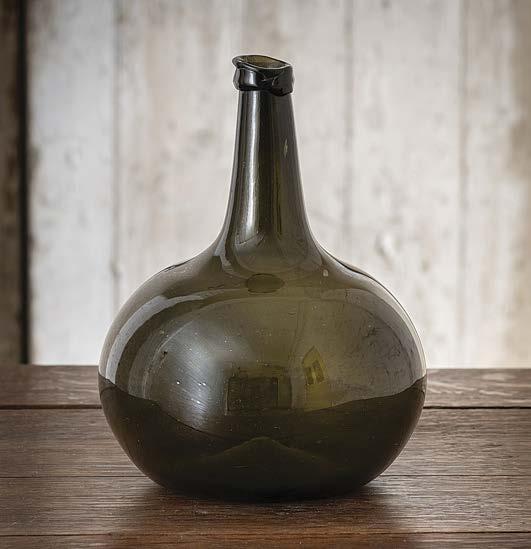
680
A 17th century iron lock, Dutch
The backplate with bulbous end, and external catch mechanism, heavy oxidization.
H 12cm, W 17cm, D 6cm
£3050
681
A large 17th century iron mortar
Of robust flared form, with a broad rolled rim and tapering body; together with a timber pestle. (2)
H 19.5cm, Dia 21.5cm
£80120
682
Three sections of 17th century carved oak panelling, English
Each with geometric and foliate carved panels, within moulded rails. (3)
Largest H48cm, W125cm
£100200
683
A carved marble mortar, Italian, circa 1800
Of typical deep, circular form, with four lugs to rim.
H 18cm, Dia 38cm
£80120
684
A large glass ‘onion’ wine bottle, English or Dutch, circa 170050
Onionshaped, of dark olivegreen tint, the plain, wide bulbous body with rounded shoulders and tapering neck with ‘string’ rim.
H 25.5cm, Dia 19cm
£200300
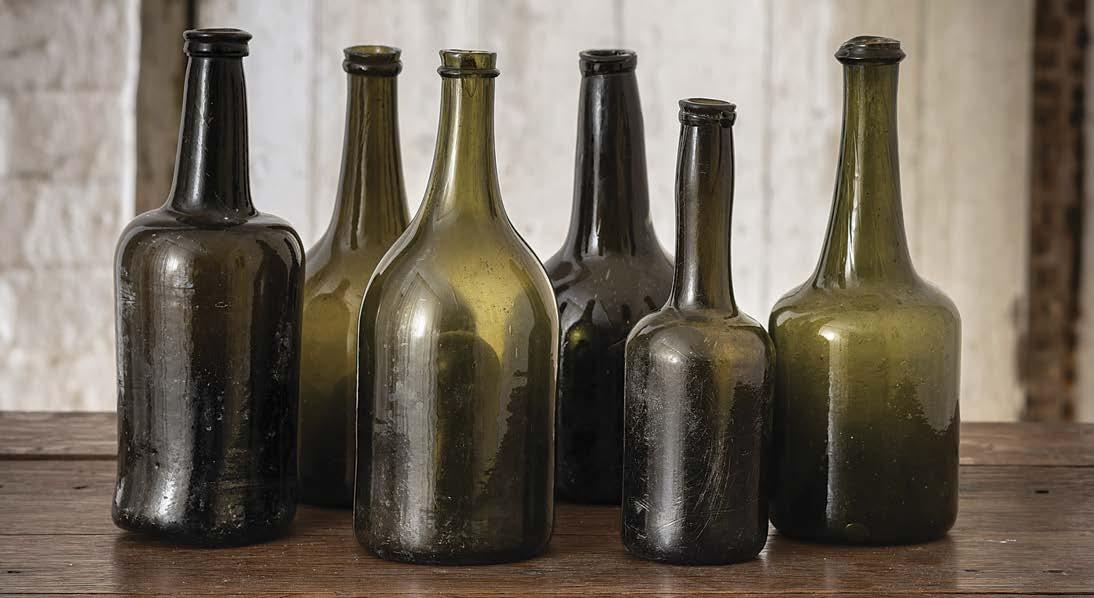
685
A group of six ‘mallet’ wine bottles, English, mid18th century
Of dark and light olivegreen tint, straightsided tapering body, with long tapering neck, and string neck, deep basal ‘kick up’. (6)
£300400
686
A group of assorted carved oak rails, English, 17th century and later
Variously carved with guilloche, lunettes, meandering flowerheads and Sscrolls. Largest H 12.5cm, W 140cm, D 3cm
£100200
687
A set of three early 17th century carved oak panels, West Country, circa 1610
Each carved with an arcade, filled with flowerhead guilloche, and with leafandberry spandrels. (3)
H 41.5cm, W 36cm
£80120
688
A Victorian brass footman, English
Of rectangularform, with ogeeprofiled apron, cabriolestyle front legs, and side carry handles.
H 26cm, W 53cm, D 36cm
£4060
689
A 19th century ‘ebonised’ mirror, Dutch, In the 17th century manner
The frame with deep stepped and reeded mouldings, rising to a narrow sight edge, later mirror plate.
H 42cm, W 31.2cm
£4080
685
690
Two sections of part 17th century oak panelling, English
Each constructed of four plain panels, above a larger panel, within a part moulded frame, alterations. (2)
H 120.5cm, W 53cm, D 6.5cm
£100200
691
A greenglazed earthenware oil jug, French, 18th or 19th century
The typical wide body of globular form, with a green glaze, the short, waisted neck attached to a strap handle, and with small conical spout.
H 28cm, Dia 24cm
£100200
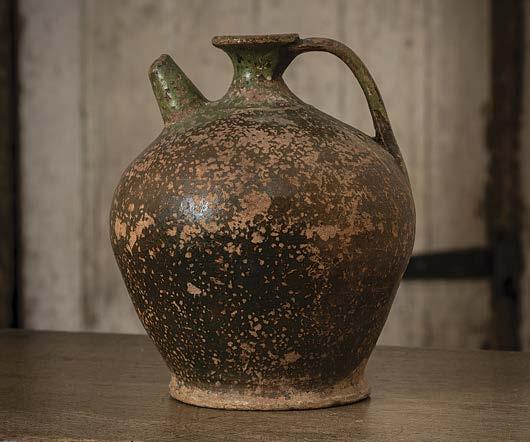
691
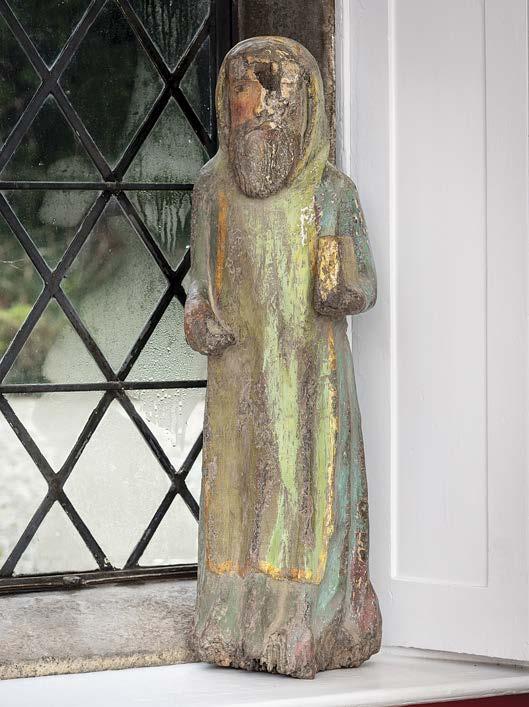
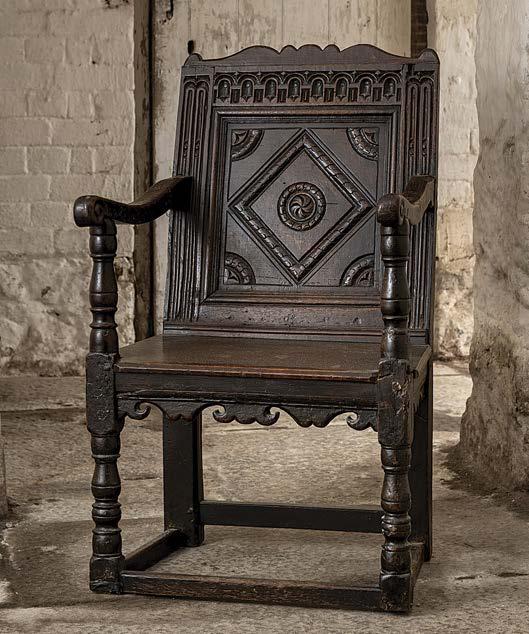
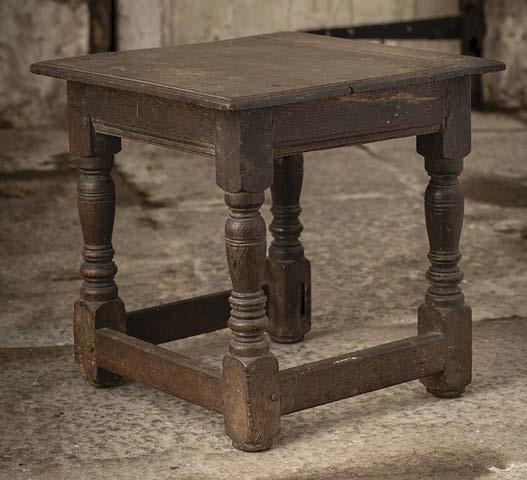
692
692
A mid17th century joined oak stool, English, circa 1650
The later square top with moulded edge, above loweredge moulded rails, on invertedbaluster turned legs, joined by plain stretchers, one lacking.
H 41cm, W 41cm, D 41cm
£80120
Two lidded glazed earthenware tureens, French, circa 1850
One of squat globular form, the other cylindrical, each with paired loop handles and slightly domed, knopped lid, with warm honeyochre lead glaze. (2)
Largest H 16.5cm, Dia 22cm
£80120
694
A 15th century oak and polychromedecorated figure, probably an Apostle, English
The standing, bearded male, with a simple, yet expressive face, wearing a hooded scapula, and holding an attribute, redecoration, with traces of original polychrome.
H 75cm, W 21cm, D 13.5cm
£300500
695
A Charles I joined oak stool, circa 1630
Having a moulded edge top, the runmoulded rails with crescent motifs, on parallelbaluster and reelturned legs, lacking stretchers and feet.
H42cm, W46cm, D26.3cm
£6080
696
A Charles I joined oak open armchair, Taunton and surrounding area, Somerset, circa 1630
The back panel carved with a whirlroundel centred lozenge, with matching spandrels, below a nulledcarved top rail, and slender scrollprofiled cresting, extending over the flutedcarved upright, the scrollover open arms on elaborate balusterturned front supports, the boarded seat atop ornate bicuspid profiled rails, the turned forelegs joined all round by plain stretchers.
Provenance: This chair featured in the 2025 film ‘Hamnet’
H 98.5cm, W 60cm, D 51cm
£200300
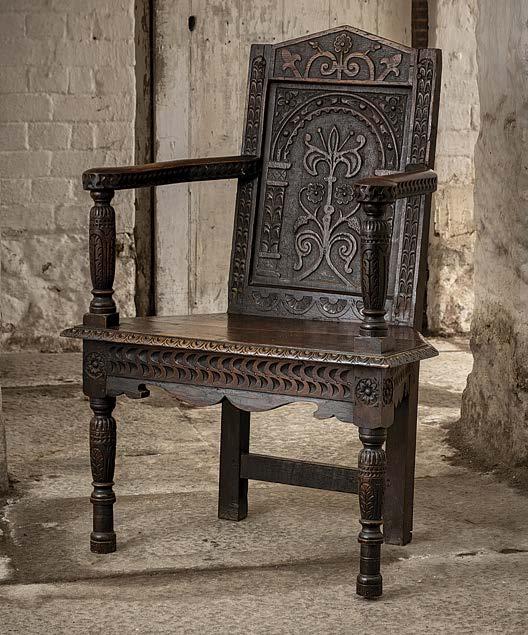
697
An early 17th century oak caquetoire open armchair, Salisbury, circa 162030 and later
The back panel carved with stylised foliage, enclosed within an arcade, beneath a carved pediment, gaugecarved uprights, the angular outsplayed arms on stiffleaf carved front supports, flanking a trapezoid seat, with bicuspid and chaincarved seat rails, and carved baluster and reelturned forelegs, lacking stretchers and feet, part later decoration.
Provenance: Athelhampton House, Dorset.
H 97cm, W 69cm, D 44cm
£100200
698
A group of four oak coffer fronts, English, 17th century and later
Of joined panelled construction, the panels variously carved with scrolling flora, leafy Sscrolls and flowerfilled roundels. (4)
Largest H 74.5cm, W 117cm, D 2.5cm
£100200
699
A joined oak cupboard, circa 1650 and later
Constructed in twoparts, having a dentil moulded cornice, over two pairs of cupboard doors, on extended runmoulded stiles, panelled sides, restorations.
H 121cm, W 83cm, D 34.5cm
£100200
700
A quantity of various oak framed panels, mostly fragmentary, English, 17th century and later
The majority plain, framed with runmoulded rails.
Largest H 72cm, W 47cm
£100200
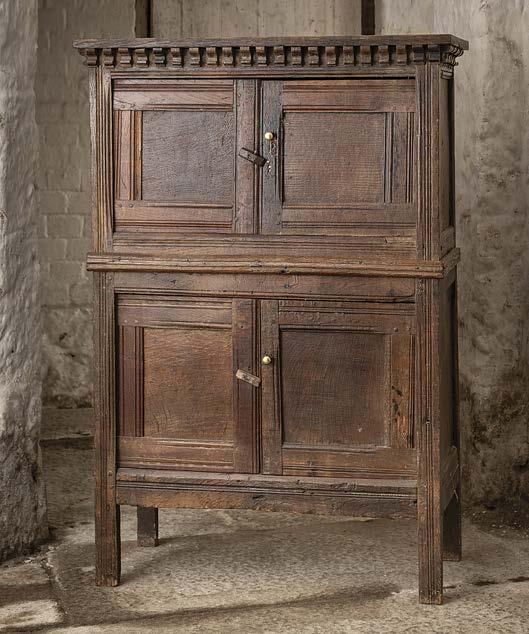
701
A large Charles I carved oak coffer front, West Country, circa 1640
With four panels, each carved with a bold, symmetrical foliate scrolling design, framed by chaincarved rails, below an interlaced leaffilled lunette carved top rail.
H 69cm, W 171cm, D 5cm
£100200
702
A pair of 17th century carved oak panels, English, circa 1660
Each carved in low relief with a large tulip flower scroll design. (2)
H 23cm, W 42cm
£4080
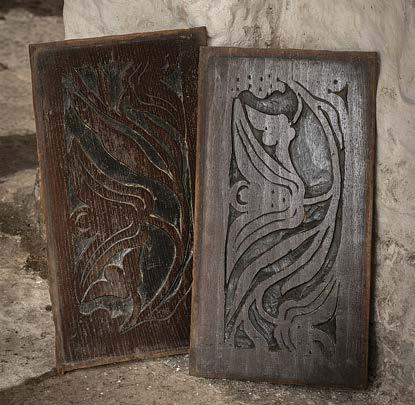
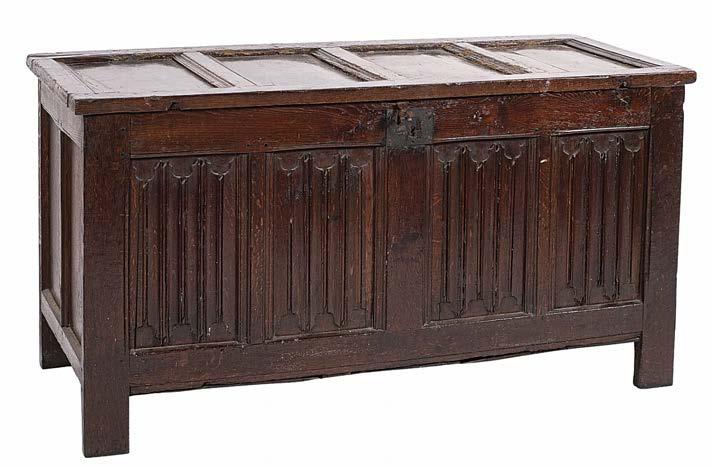
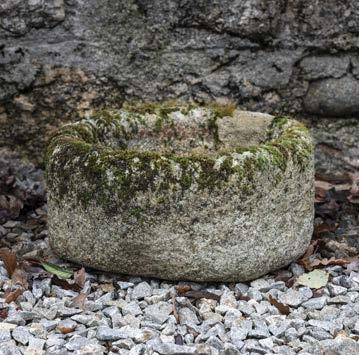
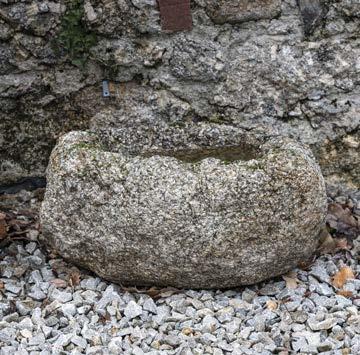
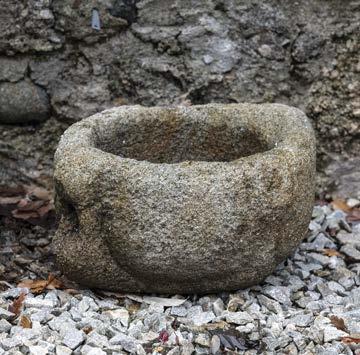
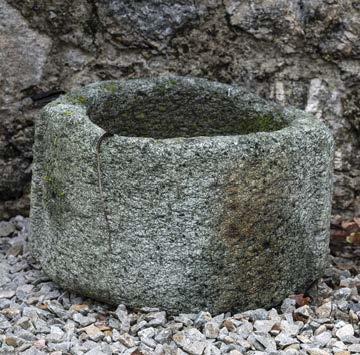
A Henry VIII joined oak linenfoldcarved chest, circa 153040
Having a quadruple panelled hinged lid and front, the front panels carved with linenfold, with edgemoulded upright rails, plain top and base rails, twin panelled sides, on extended stile supports.
H 70cm, W 135.5cm, D 58cm
£200300
A granite water stoup
Probably 15th/16th century, English
Of heptagonal form, with a shallow interior, and former evidence of an outlet to one side, now infilled with cement.
H 17cm, W 36cm, D 34.5cm
£80120
A small granite trough, Dartmoor, Devon, 16th/17th century
Of simple rectangular form, with a shallow hollowed interior.
H 17cm, W 50, D 34.5cm
£80120
A small Medieval granite water stoup
Of thickwalled form, with a shallow hollowed interior, and projecting outlet to one side.
H 17cm, W 41, D 35cm
£80120
A substantial granite mortar, 15th to early 17th century
Of cylindrical, thickwalled form, with a deep hollowed interior, with remains of two lugs.
H 25cm, Dia 39cm
£80120
3rd Old Masters, British & European Paintings
10th11th Paul Fitzsimmons: A Life in Oak
24th26th Classics Week (Furniture, Interiors, Arts of Africa, Oceania & The Americas)
26th The Gordon Reece Collection
APRIL
15th Design
16th Fine & Important Glass
22nd Fine Jewellery
28th & 29th Fine Silver & Objects of Vertu
MAY
19th Fine Asian Art
20th Asian Art II & Japanese Works of Art 21st Interiors
JUNE
2nd Modern British & 20th Century Art
3rd British Art Pottery
10th Medals & Coins, Arms & Armour
30th Classics Week (Fine Furniture, Interiors, British & Continental Ceramics & Glass)
Dates may be subject to change
+44 (0) 1722 424500 info@woolleys.live 5161 Castle Street, Salisbury, SP1 3SU www.woolleyandwallis.co.uk
*Price includes buyer’s premium
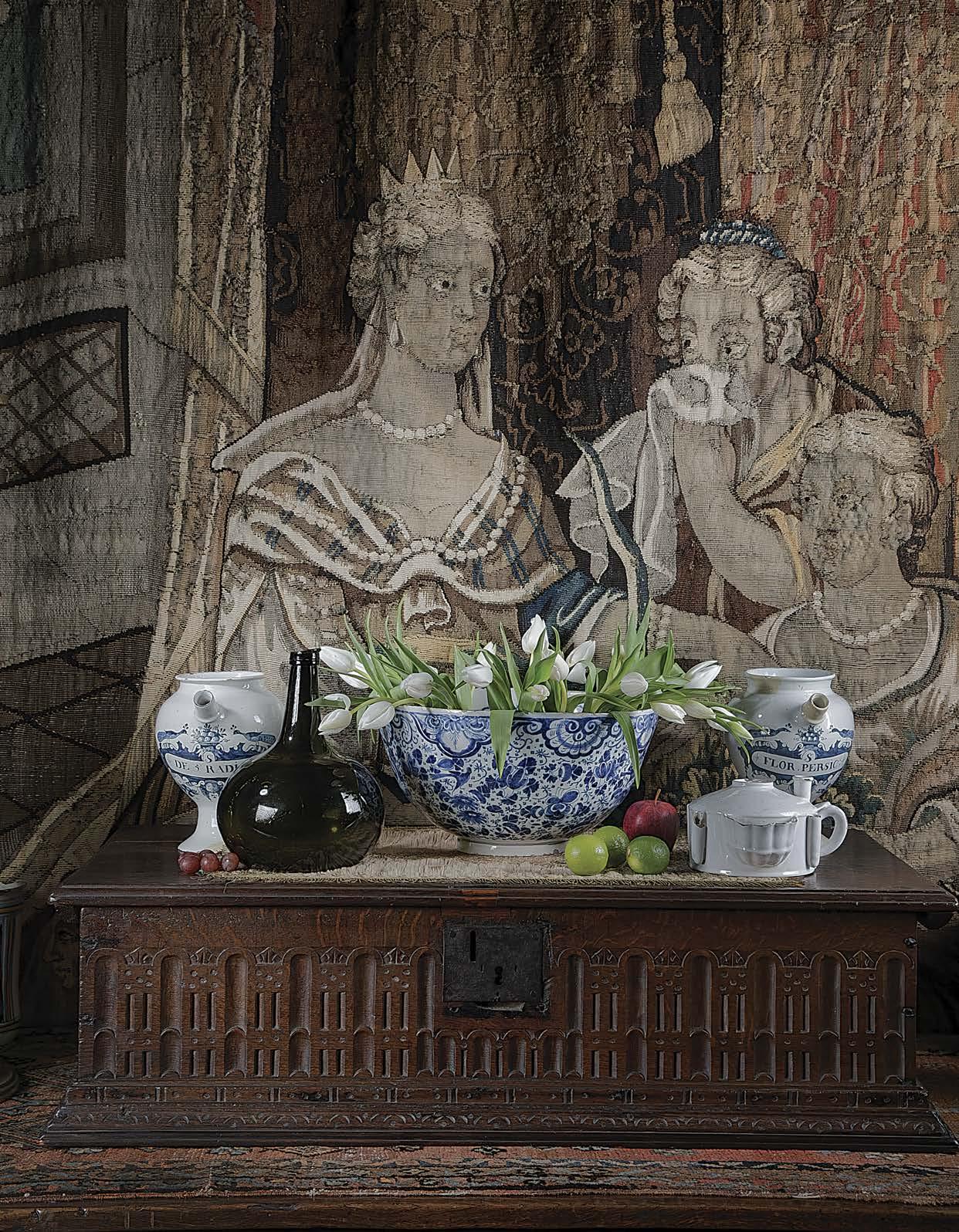
City Centre Salerooms
Monday to Friday 9am – 5pm
Old Sarum Galleries
Monday to Friday 9am – 5pm
All our auctions are on view at least two days prior to the sale and details will be found in the relevant catalogues.
All first time buyers need to register with us. To register, you will need to provide two forms of identification:
1. a passport or photographic driving licence
2. a utility bill or document showing your name and address
You can register in person or by contacting client services on 01722 424500 or emailing id@woolleys.live
You will be asked to show your documents or email copies.
PLEASE NOTE: Registering with our website, or any third party website, does not automatically register you to bid with us.
See below for the different options for bidding. Please note that you may be asked to provide two forms of identification, even if you have bid with us before, in order that we are compliant with Money Laundering Regulations.
To bid at auction you will need a paddle number. This can be obtained from client services either during the view or on the day of the sale.
If you are unable to attend the sale you can leave a commission bid. This will be executed on your behalf by the auctioneer who will purchase the lot as cheaply as possible bearing in mind any reserve price and other bids.
It is usually possible to bid on the telephone by prior arrangement with client services
Live online bidding is now available free of charge for most of our auctions via bid.woolleyandwallis.co.uk, enabling you to take part in the bidding from anywhere in the world live as it happens.
The Buyer shall pay the hammer price together with a Buyer's Premium thereon of 27% plus VAT at 20% (totalling 32.4% inclusive) on the first £20,000 of the hammer price and 26% plus VAT at 20% (31.2% inclusive) up to £500,000, and 20% plus VAT at 20% (24% inclusive) thereafter.
The relevant department will be pleased to give condition reports on any lot, where practical. All weights and measures given in the catalogue should be regarded as approximate.
The colours printed in the catalogue are not necessarily true.
These will be posted on our website shortly after the sale.
Woolley & Wallis do not offer a packing and despatch service but the following are carriers in our area.
Alban Shipping +44 (0)1582 493099 info@albanshipping.co.uk www.albanshipping.co.uk
Kimdan Ltd +44 (0)7973 389436 andy@kimdan.co.uk
Mailboxes +44 (0)1962 622133 info@mbewinchester.co.uk www.mbe.co.uk/winchester
ZIXIS Fine Art Limited +44 (0)7873 981026 zixisfineart@163.com www.zixisfineart.co.uk
Please note that we cannot be held responsible for any damage or loss to items once they are in the hands of a carrier.
If you are exporting your property, import taxes, customs duties and other fees may apply at the country of destination. It is also your responsibility to ensure that your shipment can be lawfully imported to the destination country.
Please note that due to the withdrawal of the Retail Export Scheme by HMRC, we are unable to provide VAT refund documentation (C88) for handcarried exports.
In order to qualify for a VAT refund, your lots must be exported by a shipper and valid export documentation must be provided.
Payment is due immediately after the auction in pounds sterling. If you are a first time buyer we will need your name, address and bank details and will require funds to be cleared before purchases can be released. Please note that payment will only be accepted from the registered bidder.
The following methods of payment may be made:
Bacs, debit and credit cards
Wire transfers should be sent to:
Lloyds Bank plc, Blue Boar Row, Salisbury SP1 1DB.
Account no. 00957707
Sort code 309741
IBAN no. GB20LOYD30974100957707
BIC code LOYDGB21063
Debit and Credit cards: Visa, Mastercard, Amex or Union Pay.
Where practical, payment can be made and purchases collected during the auction.
We reserve the right to add storage charges to all lots not collected within 30 calendar days of the sale. This will include a handling fee of £20 (+ VAT) per consignment and a storage charge of £2 (+ VAT) per lot per day. No goods will be allowed to be collected until these charges have been paid.
We are pleased to offer two weeks free storage for all lots purchased from this sale. However, owing to a busy schedule, all lots not collected by 4pm on Thursday 26th March will be transferred to SackvilleWest Moving and Storing (Andover SP10 3SA), where they will be available for collection from Tuesday 31st March. Lots will be unavailable for collection from the 27th to 30th March as the items will be in transit.
Please note, handling and storage charges will be applied from 8am on Tuesday 31st March.
On acceptance of a delivery quotation with SackvilleWest Moving & Storing, they will waive any storage fees if they are instructed by the purchaser to deliver them within 2 weeks of the quotation, however transfer fees will still apply. They provide competitive deliveries to much of the UK and offer twice weekly trips to London and across the south of England. Woolley and Wallis clients are eligible for a 10% discount on their first booking with SackvilleWest.
Please call 01722 446950 or 01722 424500 to make an appointment to collect from our warehouse, Unit 1B, Castle Gate Business Park, Old Sarum, Salisbury, SP4 6QX. Please call 020 8090 9988, email: office@sackvillewest.co.uk, to make an appointment to collect from SackvilleWest Moving & Storing.
All accounts to be settled prior to collection.
Lots marked with an dagger (†) are subject to VAT on the hammer price. Lots marked with an omega (Ω) have been temporarily imported from outside the EU and are subject to VAT at 5% on the hammer price and the buyer’s premium. In online catalogues, the Sales Tax % column indicates the rate of VAT on hammer price.
Please note that lots marked λ may be subject to CITES Regulations when exported.
The CITES Regulations may be found at www.defra.gov.uk/ahvlaen/importsexports/cites/
Lots marked with a Φ symbol are potentially subject to a levy.
Droit de Suite is a royalty payable to a qualifying artist or the artist’s heirs each time a work is resold during the artist’s lifetime and up to a period of 70 years after the artist’s death.
Royalties are calculated on a sliding percentage scale based on the hammer price excluding the buyer’s premium. The royalty does not apply to lots selling below £1,000 and the maximum royalty payable on any single lot is £12,500.
Droit de Suite, which is not subject to VAT, will be added to the buyer’s purchase price and then passed on to the relevant collecting agency.
Royalties for Droit de Suite are as follows:
4% Up to £50,000
3%
1%
£50,000.01 200,000
£200,000.01 350,000
0.5% £350,000.01 500,000
0.25% In excess of £500,000 Up to a maximum levy of £12,500
Lots marked Ƒ in the catalogue, or by any other means identified as controlled firearms, are subject to the UK firearms/shotgun licencing regime, and should only be viewed/purchased by individuals with appropriate licences. It is the responsibility of the bidders to ensure that they are legally authorised to acquire the lot that they are bidding for. In the event that such a lot is successfully bid for by an individual who is not authorised to possess it, that individual will be required to pay for it, but will not be allowed to take physical possession of it. The auctioneers will reoffer the lot on behalf of the buyer in a future auction; or may accept instructions to dispose of it by some other legal means, at their discretion.
Valuations are a core part of our business and are usually carried out by a senior specialist or directors. Accuracy, speed and above all confidentiality are paramount.
Written valuations for insurance can vary from a single item to a large estate. Before starting we discuss the various options available so that the valuation is specifically tailored to individual client’s needs.
For valuations of an entire house contents an itemised bound valuation is produced and can be accompanied by photographs when required. In addition to providing an inventory, written valuations can prevent painful arguments with a loss adjuster in the event of a claim.
Woolley & Wallis valuations are accepted by all leading insurance companies.
We offer a speedy and professional service for executors and trustees and provide bound valuations for probate and duplicate copies when required. Since security is often a consideration, we can usually arrange for a house to be cleared and sent for auction, our Valuations Department ensures that executors are informed of which sales are involved and the results thereof.
We also carry out valuations for Family Division, Capital Gains Tax, and Private Treaty Sales.
Contact Jeremy Lamond +44 (0)1722 424502 | valuations@woolleys.live
Free verbal valuations of items for sale are available by appointment. Please email valuations@woolleys.live or call +44 (0)1722 424500