WEDNESDAY 20TH MAY 2026
WEDNESDAY 20TH MAY 2026
Jōmon Period Ca. 10,000 BC – Ca.300 BC
Yayoi Period Ca. 300 BC – 552 AD
Asuka Period 552-645
Nara Period 645-794
Heian Period 794-1185
Kamakura Period 1185-1333
Muromachi Period 1333-1573
Namboku-Chō Period 1336-1392
Momoyama Period 1568-1615
Bunroku Era 1592-1596
Keicho Era 1596-1615
Edo Period 1615-1868
Kan’ei Era 1624-1644
Kanbun Era 1661-1673
Genroku Era 1688-1704
An’ei Era 1772-1781
Tenmei Era 1781-1789
Kansei Era 1789-1801
Kyowa Era 1801-1804
Bunka Era 1804-1818
Bunsei Era 1818-1830
Tenpo Era 1830-1844
Koka Era 1844-1848
Kaei Era 1848-1854
Ansei Era 1854-1860
Man’ei Era 1860-1861
Bunkyu Era 1861-1864
Genji Era 1864-1865
Keio Era 1865-1868
Meiji Era 1868-1912
Taisho Era 1912-1926
Showa Era 1926-1989
Heisei Era 1989-2019
Reiwa Era 2019-Present
WEDNESDAY 20TH MAY 2026
10.00AM
The sale to be conducted at our Castle Street Salerooms, SP1 3SU



VIEWING
Viewing in London (highlights) 17 Clifford Street, 2nd Floor W1S 3RQ
Saturday 9th May 11.00am – 4.00pm
Sunday 10th May 11.00am – 4.00pm
Monday 11th May 11.00am – 4.00pm
Viewing at our Old Sarum Galleries Unit 1B Castle Gate Business Park, Old Sarum, Salisbury SP4 6QX
Friday 15th May 10.00am – 4.00pm
Saturday 16th May 10.00am – 1.00pm
Monday 18th May 10.00am – 4.00pm
Tuesday 19th May by appointment only
Alexandra Aguilar
Head of Japanese Art +44 (0)1722 424583 aa@woolleys.live
Ned Cowell
Japanese Arms & Armour +44 (0)1722 341469 nc@woolleys.live
Olivia Jones
Department Coordinator
+44 (0)1722 494591 asianart@woolleys.live

Fahmeeda Yasmin Photography

Please register by 12 noon on Tuesday 19th May
Instagram: @woolleyandwallisasianart @woolleyandwallissalerooms
Facebook: @woolleyandwallis
BUYER’S
See paragraphs 4 & 5 of our conditions of business at www.woolleyandwallis.co.uk for additional charges on the final hammer prices.
500
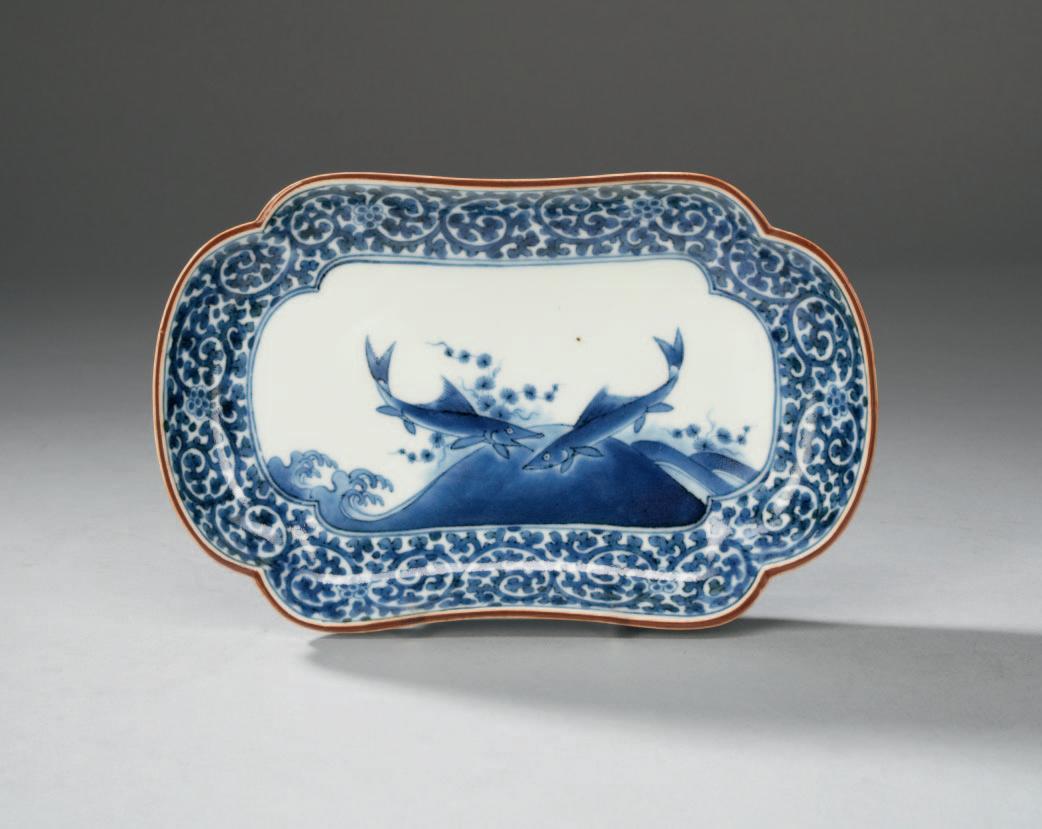
A JAPANESE ARITA BLUE AND WHITE RECTANGULAR DISH
EDO PERIOD, 18TH CENTURY
Of lobed rectangular shape, the well decorated in underglaze blue with a panel enclosing two sturgeons swimming amongst seaweeds, framed by a border of karakusa scrolls; the reverse with four clusters of scrolling tendrils and raised on a foot with keyfret border; with a fuku mark, 20.6cm.
WITHOUT RESERVE
£100-200
501
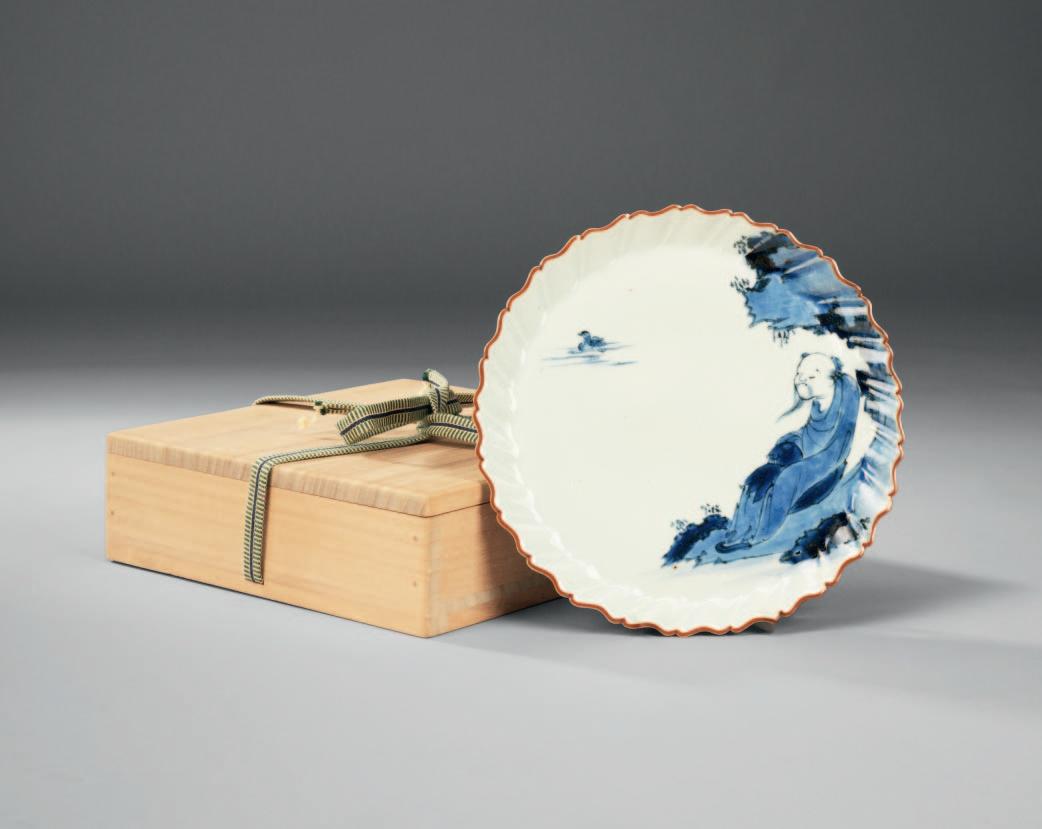
A JAPANESE ARITA BLUE AND WHITE DISH
EDO PERIOD, 17TH CENTURY
Decorated with a Chinese scholar under a rocky outcrop looking pensively at a lone mandarin duck on a pond, painted in underglaze blue; the scalloped rim with a brown edge; the reverse painted with leafy sprays and a fuku mark; together with a tomobako (wood box), 20.4cm. (2)
£1,500-2,500
502
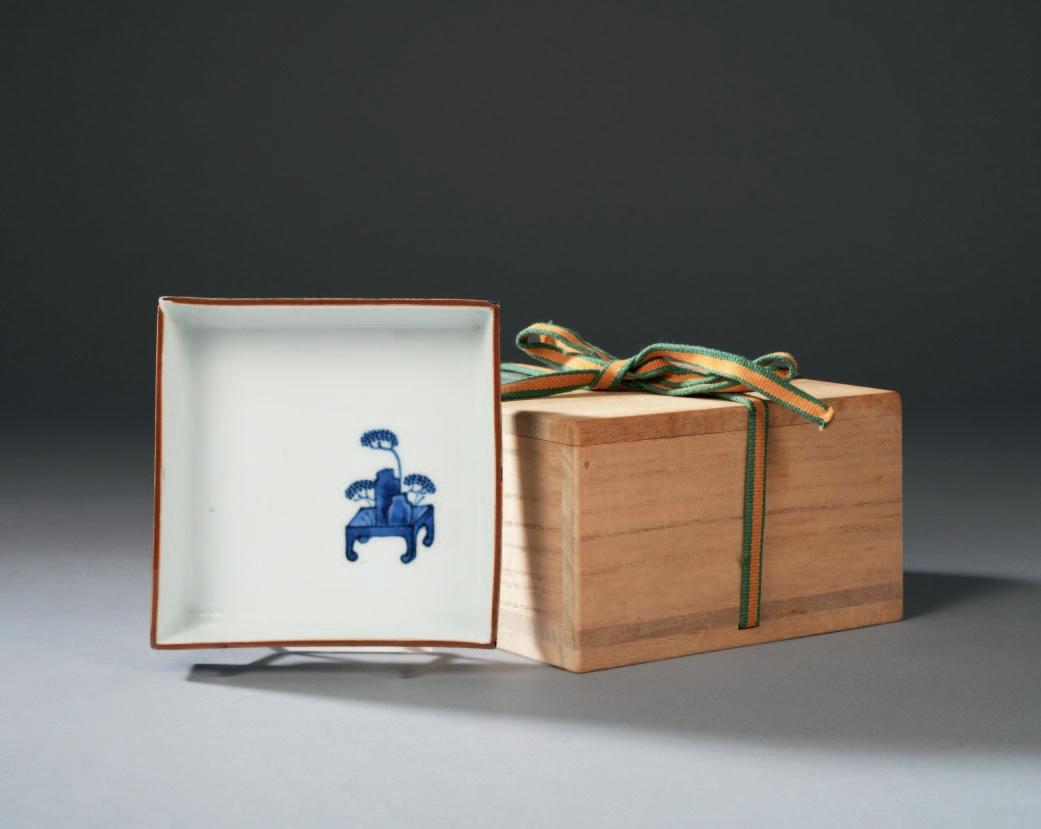
A JAPANESE ARITA SQUARE FOOTED DISH
EDO PERIOD, 17TH CENTURY
The well decorated with a low stand supporting plants and scholar’s rocks; the tall rim with a brown edge; two diagonal bands to the reverse, one side with a flowering branch of prunus rendered in the ronuki (wax resist) technique, and the other with sayagata patterns; the base with a fuku mark; together with a tomobako box, 11.2cm. (2)
£800-1,200
Provenance: from a private collection, London.
Cf. The Kyushu Ceramic Museum, Complete Catalogue of Shibata Collection, p.135, n.1068 for a similar dish.
503
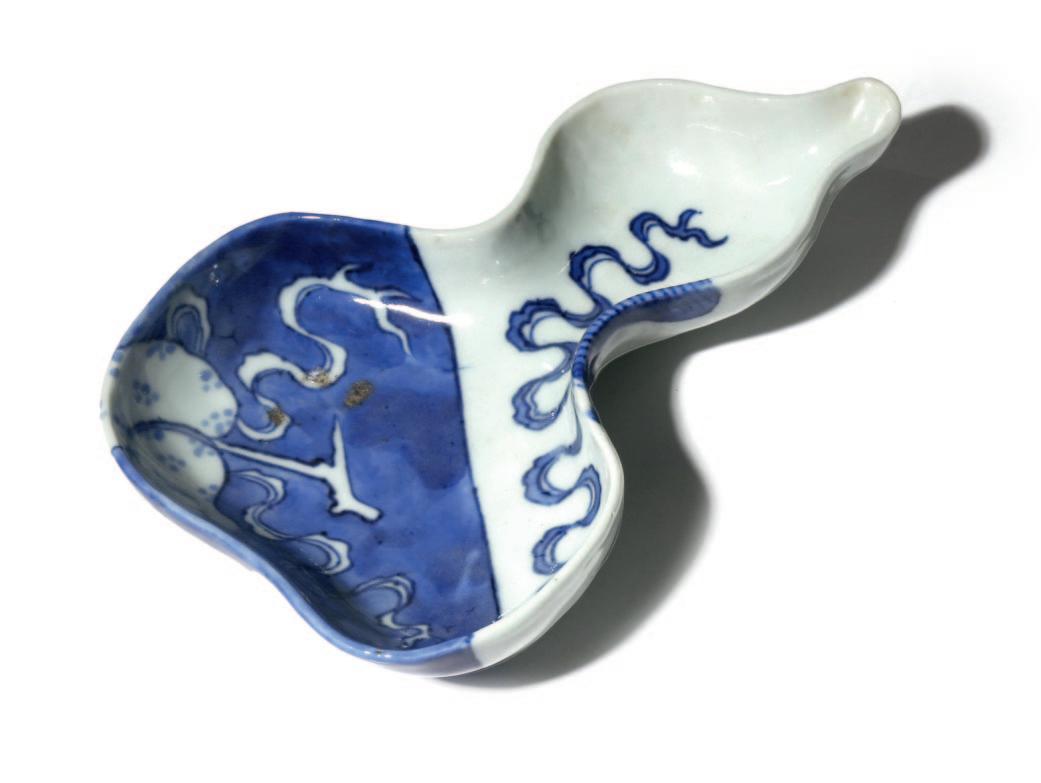
A JAPANESE ARITA GOURDSHAPED DISH
PROBABLY EDO/MEIJI, 19TH CENTURY
Painted to the well with two negative halves, the upper one with a beribboned fan on a white ground and the lower with a double gourd on a blue ground, raised on three double gourdshaped feet, 18.9cm.
WITHOUT RESERVE
£200-300
504
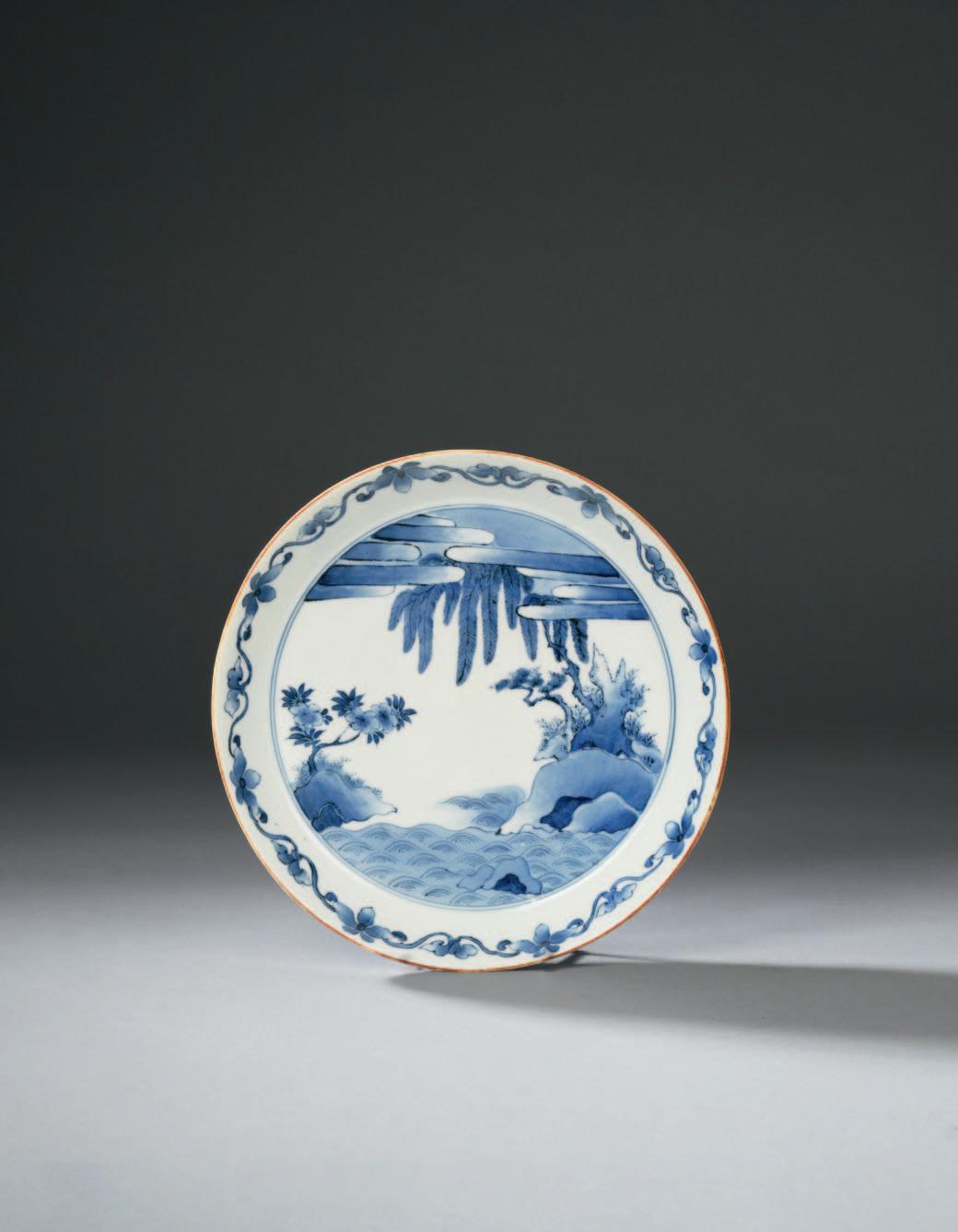
A DEEP JAPANESE AI-KAKIEMON DISH
EDO PERIOD, 17TH CENTURY
With a tall rim, the well painted in underglaze blue with a flowering prunus tree, pine and weeping willow on rocky outcrops by the water’s edge, with horizontal clouds above; the cavetto with a band of flowerheads and scrolling tendrils, the rim with a brown edge; the reverse with another floral band and leafy scrolls; with a tomobako (wood box), 20.9cm. (2)
£800-1,200
Provenance: from a private collection, London.
505
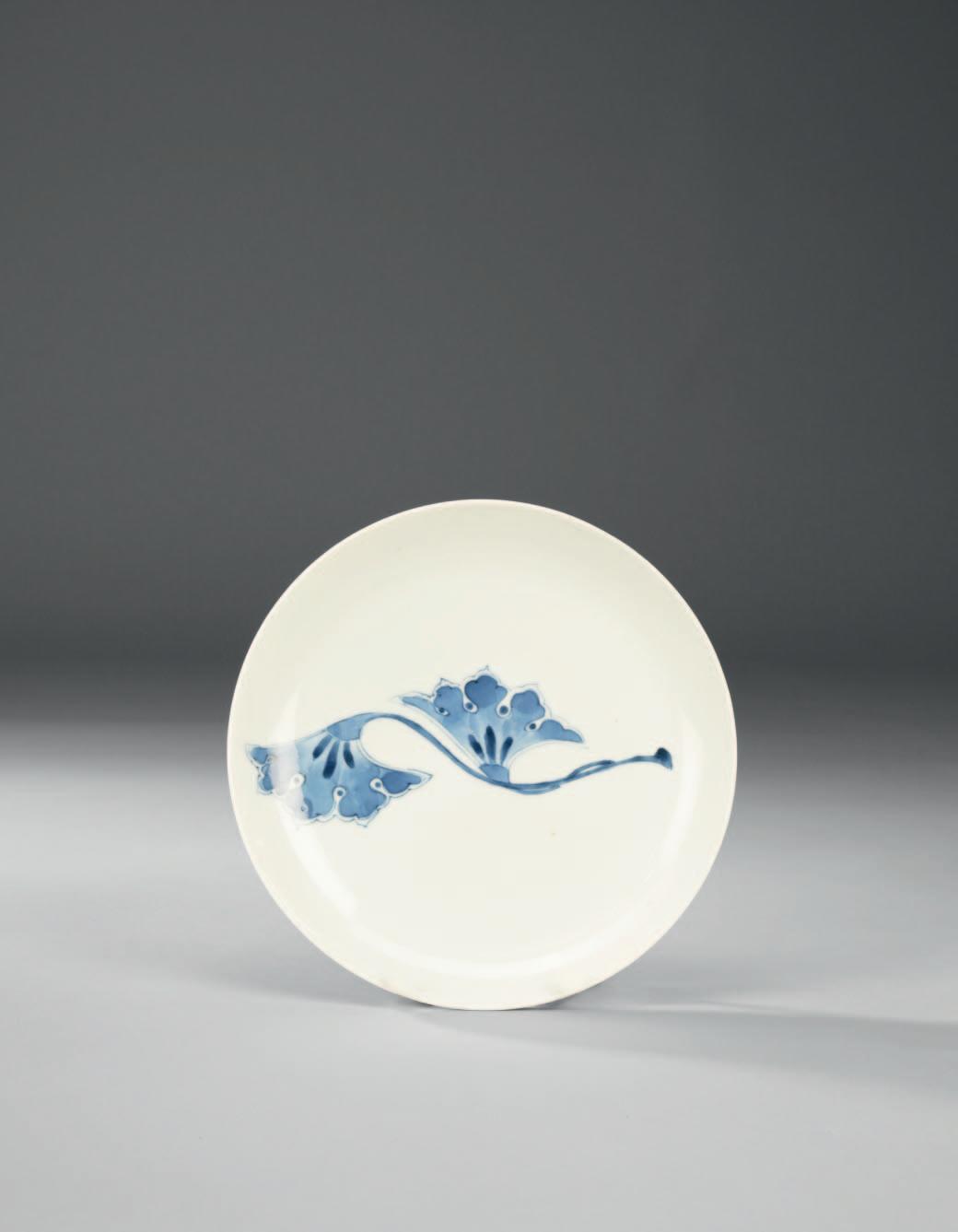
A JAPANESE AI-KAKIEMON BLUE AND WHITE DISH
EDO PERIOD, 17TH CENTURY
The well elegantly decorated with two stylised ginkgo leaves, the ornate fanshaped sprays painted in underglaze blue on the creamywhite nigoshide ground; the reverse with a band of flowers and scrolling tendrils; with a tomobako (wood box), 18.2cm. (2)
£800-1,200
506
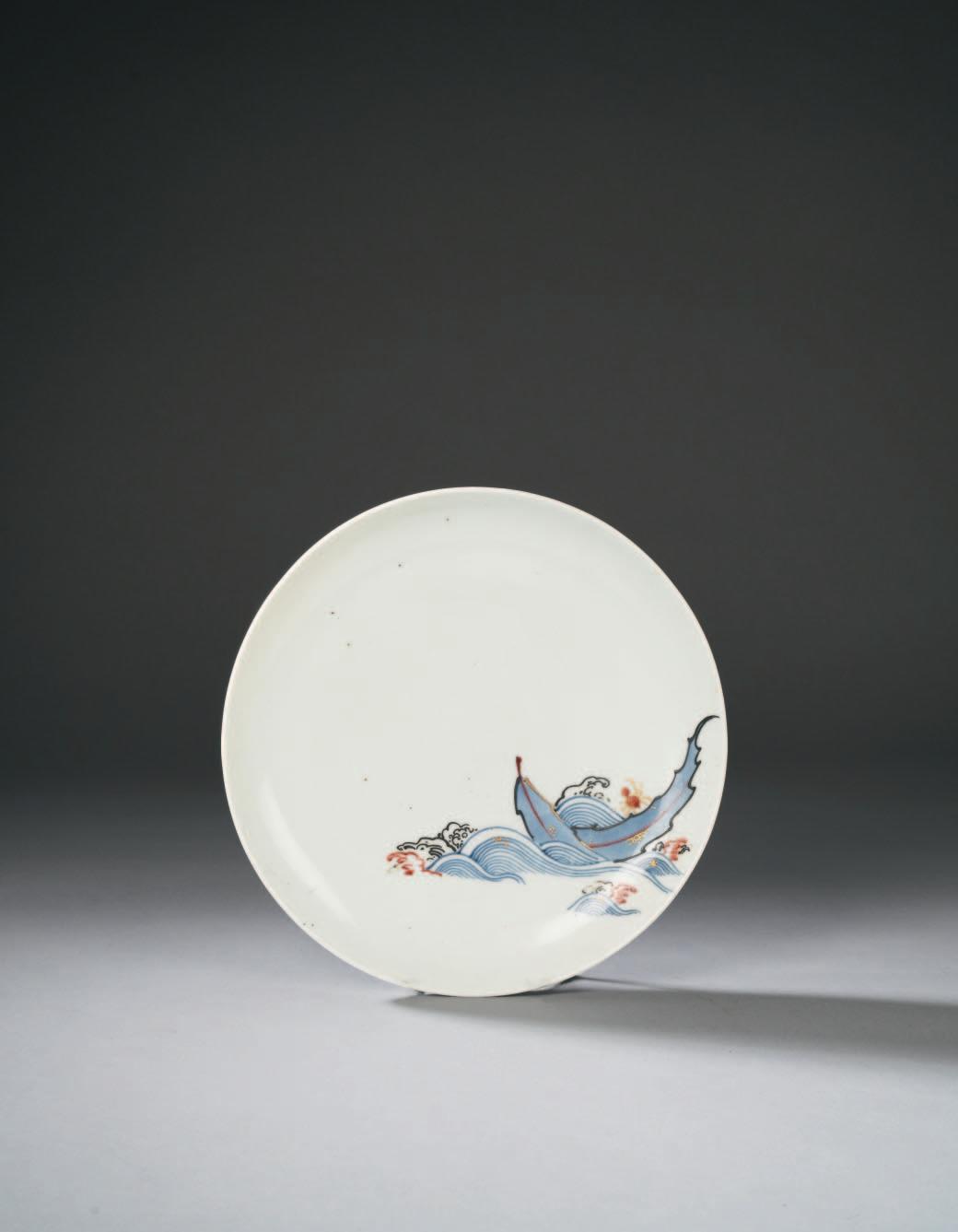
A RARE JAPANESE ARITA DISH WITH SPIDER AND WAVES
EDO PERIOD, 17TH CENTURY
The large dish decorated with a small spider standing precariously on a leaf floating on crashing waves; rendered in underglaze blue, gilt, black and red enamels; the reverse with three rough spur marks, together with a tomobako (wood box), 22.2cm.
£2,000-3,000
Provenance: from a private collection, London.
507
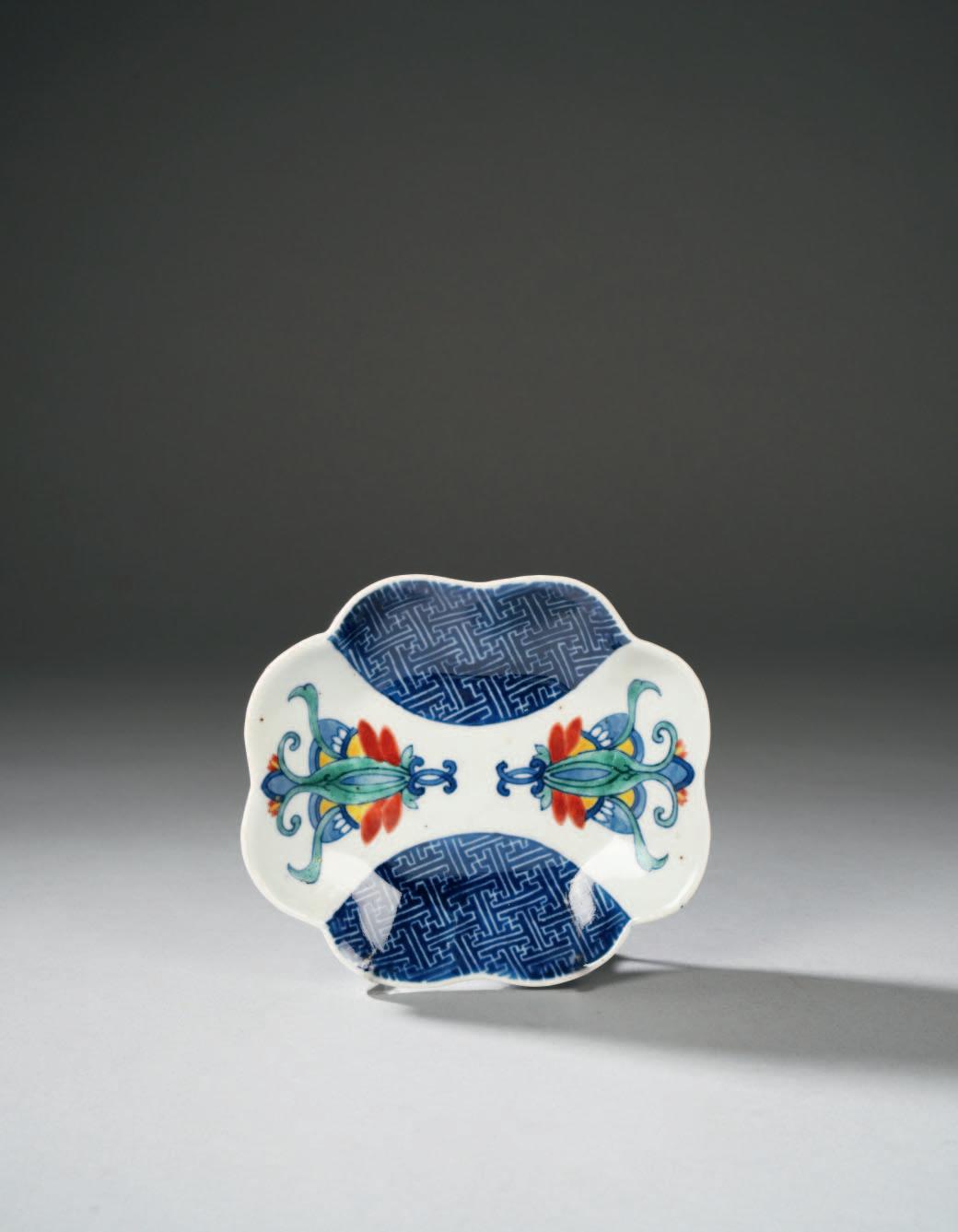
A SMALL JAPANESE ARITA FOOTED DISH
EDO PERIOD, 17TH CENTURY
The lobed body raised on a thin rectangular foot, the well decorated with formal floral designs and panels of sayagata patterns; the reverse with two flowerheads and scrolling tendrils, the foot with a band of triangular lappets; painted in underglaze blue, green, yellow and red enamels; together with a tomobako (wood box), 13cm. (2)
£800-1,200
Provenance: from a private collection, London.
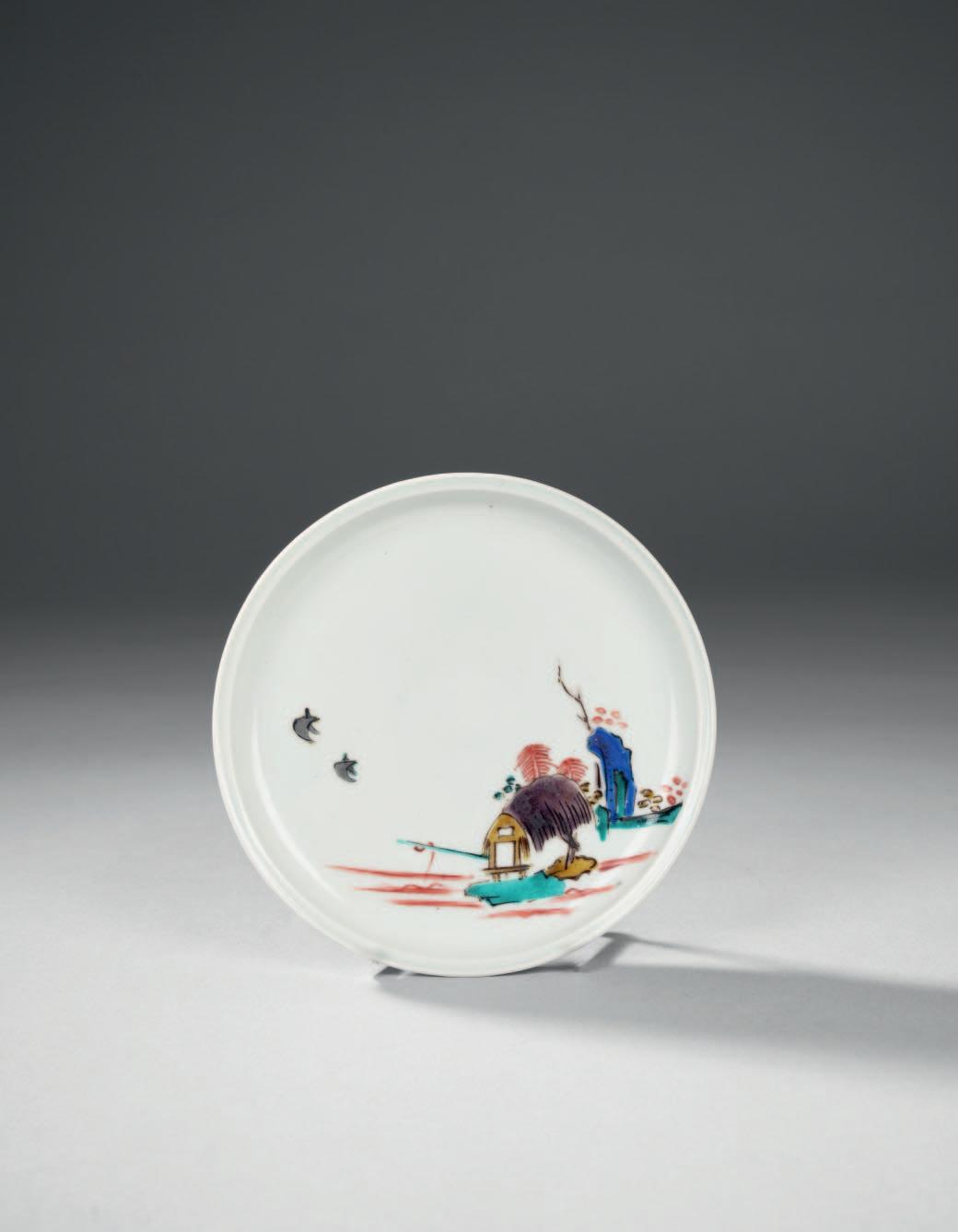
508
A SMALL JAPANESE KOKUTANI DISH
EDO PERIOD, 17TH CENTURY
Decorated with a thatched pavilion amongst vegetation and by a rocky outcrop, with two sailboats in the distance; painted in bright gosai enamels (red, yellow, green, deep blue, and purple), most of the dish left undecorated; the base with a homare (esteemed) mark used by the Chokichidani kiln, 14.5cm.
£600-1,000
Provenance: from a private collection, London.
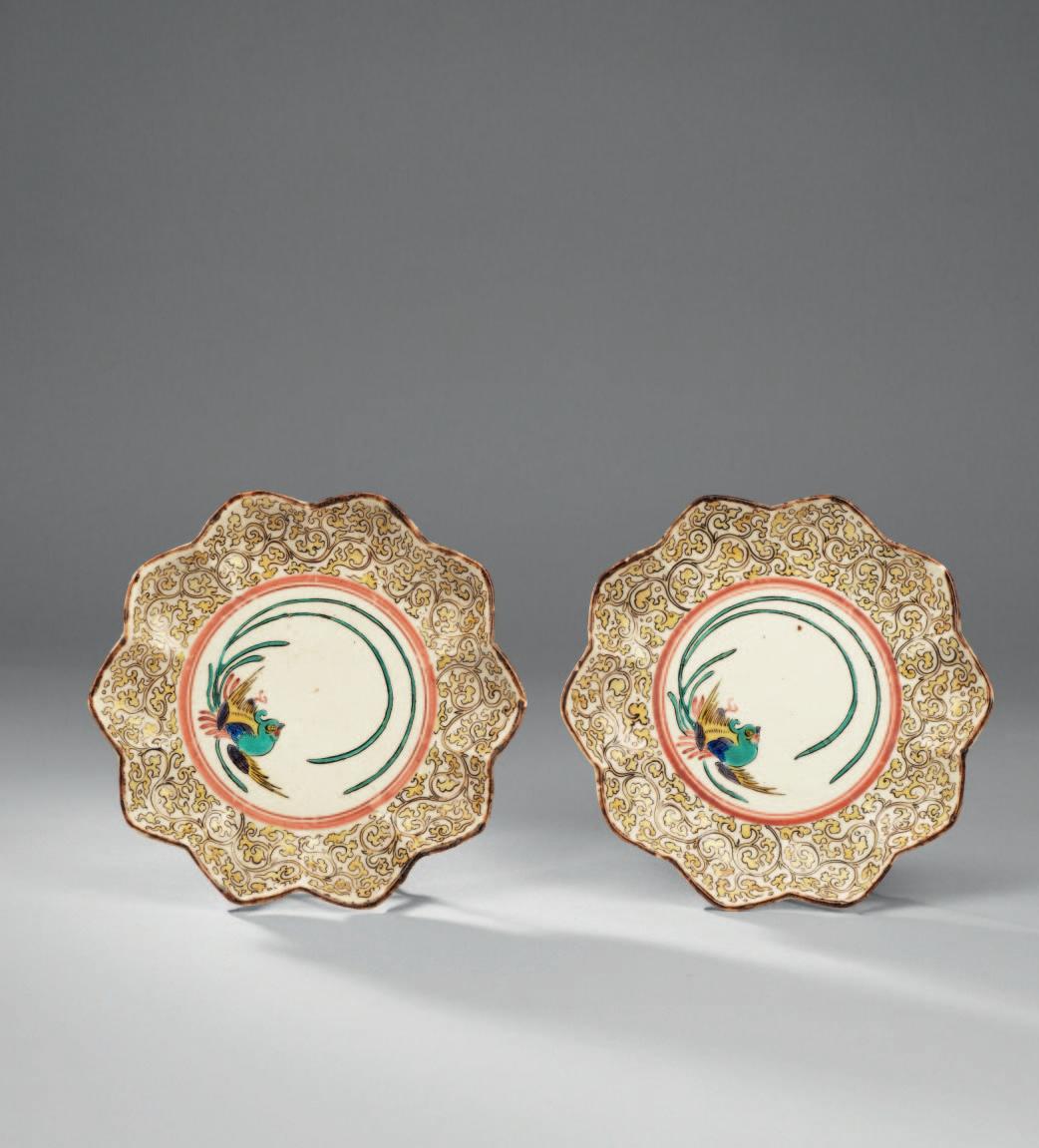
509
A PAIR OF JAPANESE KUTANI FOLIATE DISHES WITH BIRDS
EDO PERIOD, 17TH CENTURY
Both decorated in colourful enamels with a central Hōō bird with long tail feathers, the cavetti with dense patterns of foliate karakusa scrolls; both painted with pine needles and a central fuku mark to the reverse; each with a Christie’s paper label to the base, 16.7cm. (2)
£500-800
Provenance: sold at Christie’s New York, 22 April 1992, lot 305.
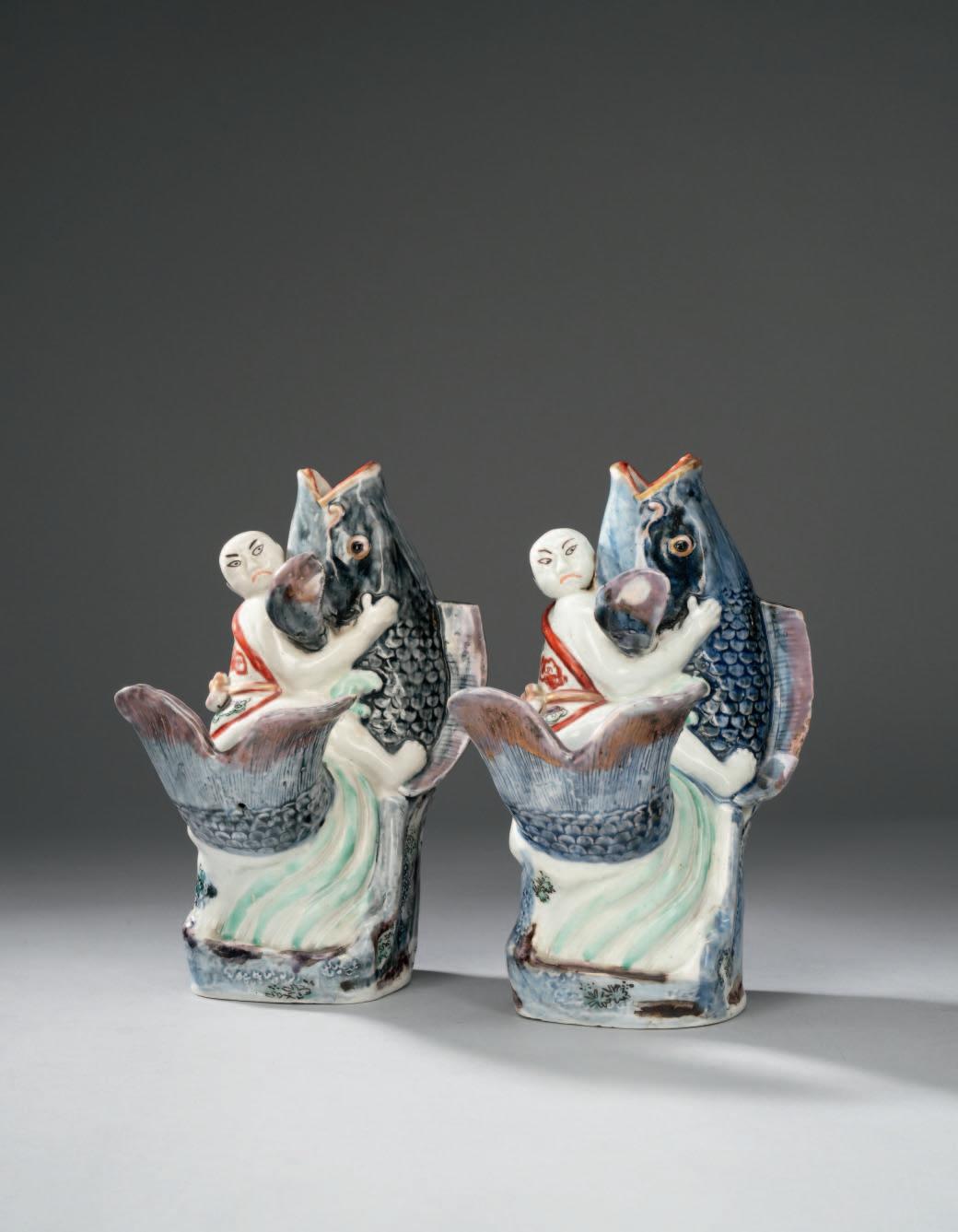
510
TWO JAPANESE ARITA BENKEI AND CARP HANAIKE (FLOWER VASES)
EDO PERIOD, 17TH/18TH CENTURY
Both painted in underglaze blue, gilt and polychrome enamels; each modelled with the boy clambering on the back of the gigantic fish, with waves crashing against rocks below; the fish with their mouths agape and fins flapping; both bases with gauze marks and old collection numbers, both 23.5cm. (2)
£800-1,200
Cf. J Welsh, Okimono, Japanese Porcelain Figures From The Edo Period, pp.172-173, for a similar model.
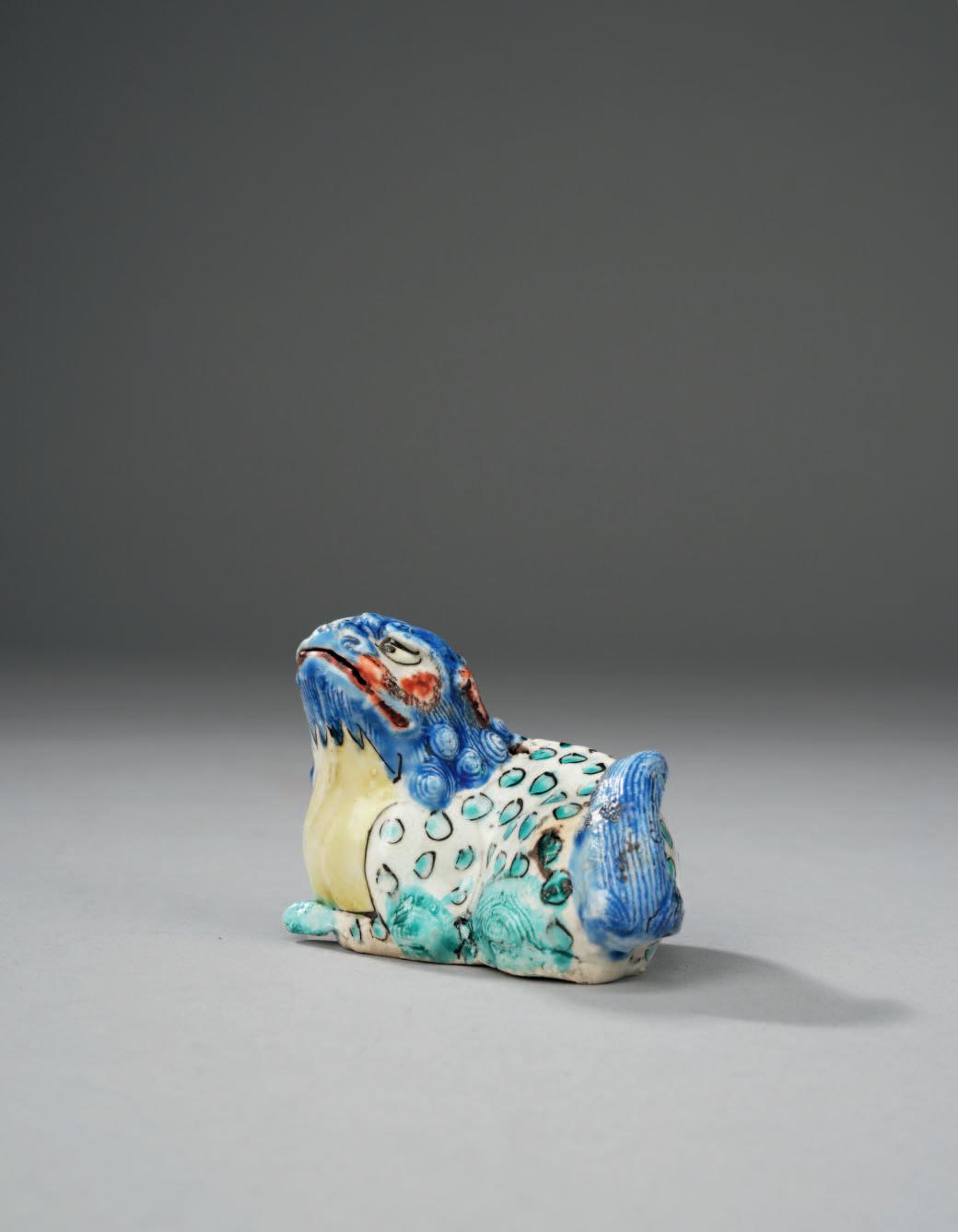
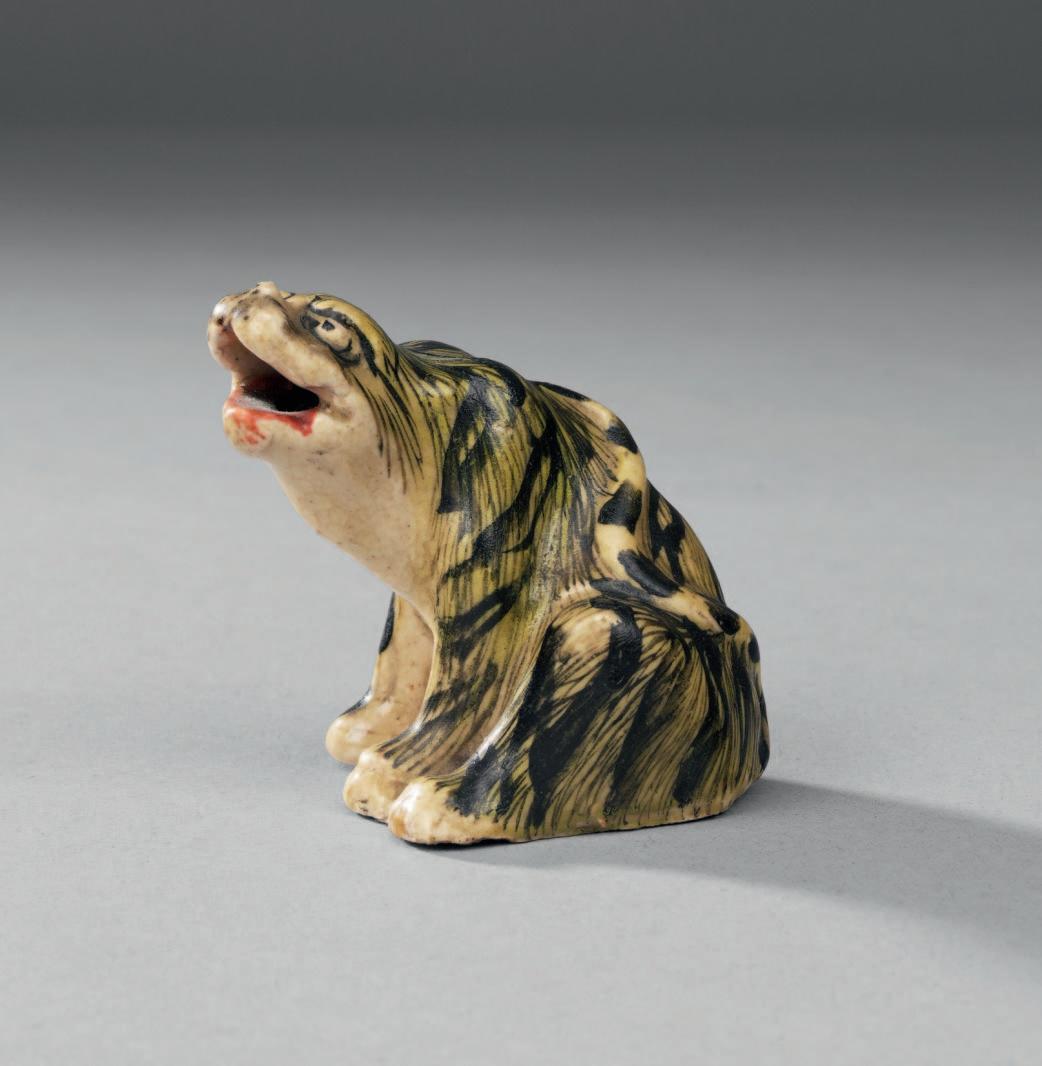
510
A JAPANESE KAKIEMON SHISHI SUITEKI (WATER DROPPER)
EDO PERIOD, C.1690
Modelled as a crouching lion dog, the mythical beast with its head raised and painted in red, blue, yellow, green and black enamels, with a small aperture to its back and with the mouth open, the flat base with gauze marks, 8.4cm.
£1,500-2,000
Cf. J Welch, Okimono, Japanese Porcelain Figures from the Edo Period, pp.108-109, no.14 for a related model. The author mentions that small lion dog figures were used as amulets to protect from evil. Also, see Christie’s London, Courtly Display, The Somlyo Collection of Japanese ceramics, p.34 no.7, for a similar pair of shishi
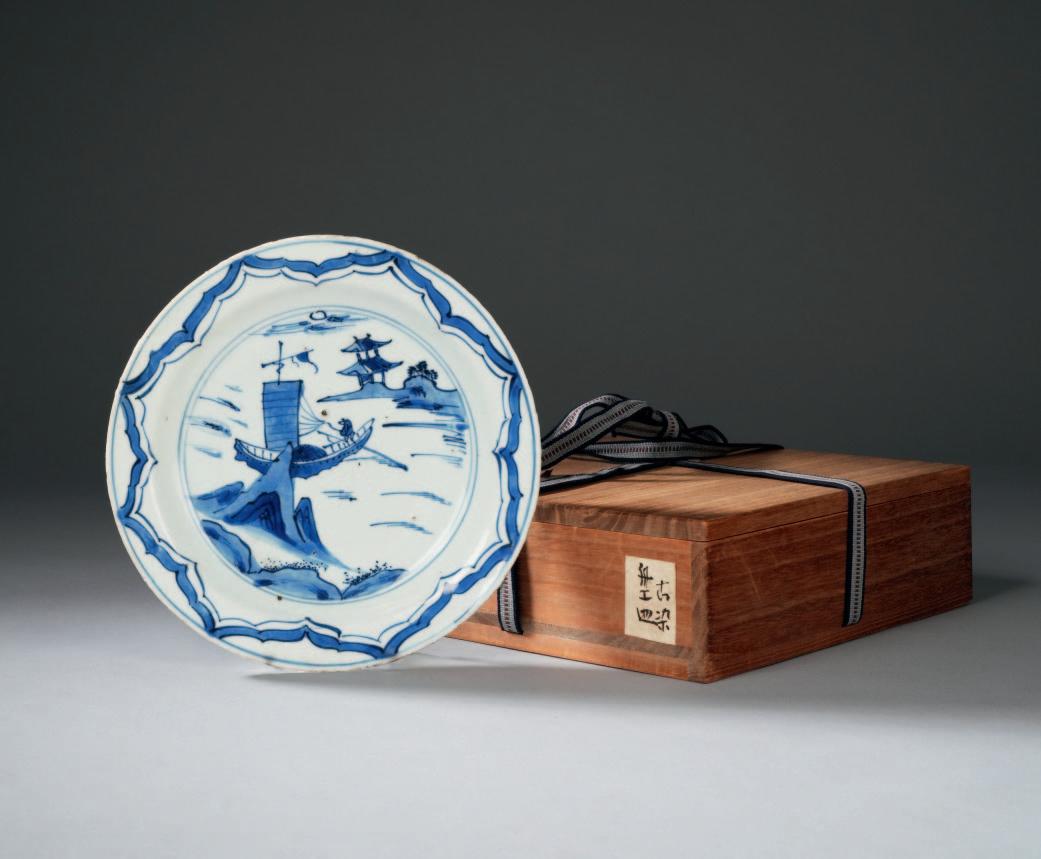
512
A CHINESE KO-SOMETSUKE DISH FOR THE JAPANESE MARKET TIANQI/CHONGZHEN, 17TH CENTURY
Decorated in underglaze blue, the well painted with a fisherman on a sampan, a twostorey pavilion in the distance; the rim with a flowershaped lappet border and mushikui; the reverse with two leafy sprays; together with a tomobako (wood box), 21cm. (2)
£1,000-2,000
Provenance: from a private collection, London.
See T Edo Inouye & Son, Collected and Selected Seventy-Seven Dishes from the Late Ming, Seventeenth-Century, Kosometsuke, no. 45 for a dish of similar form and border, painted to the centre with fish.
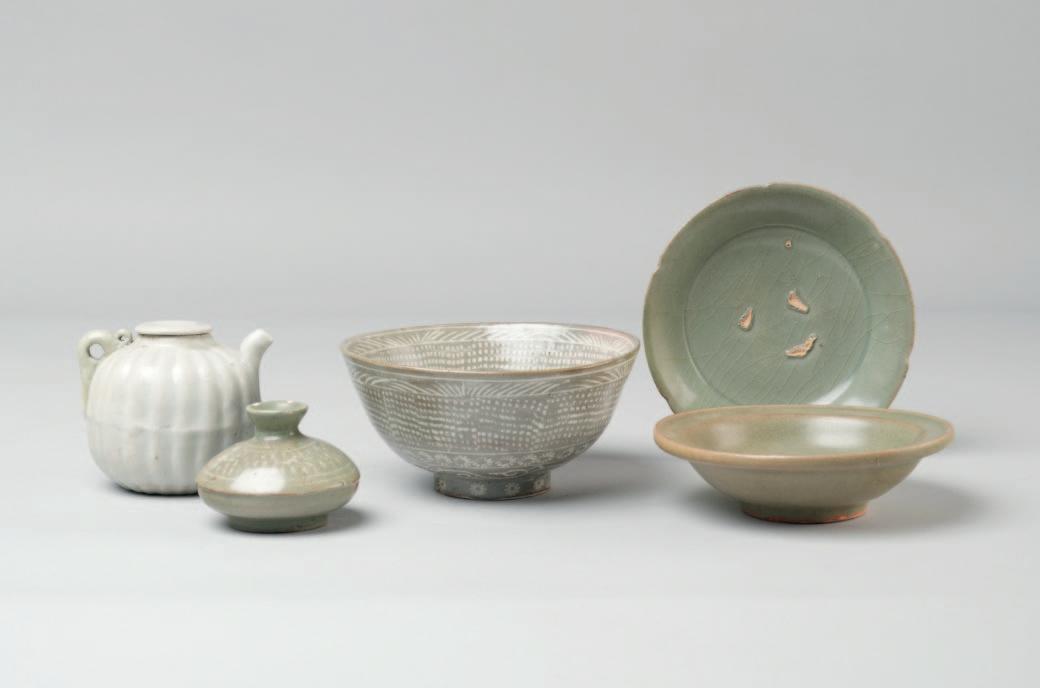
A COLLECTION OF KOREAN CELADON PIECES
KORYO AND LATER, 12TH CENTURY AND LATER
Comprising: a Sanggam inlaidceladon bowl with many flowerheads, two dishes each raised on a short foot, and an inlaidceladon jarlet; together with a Vietnamese ewer and cover, 14.4cm max. (6)
£200-300
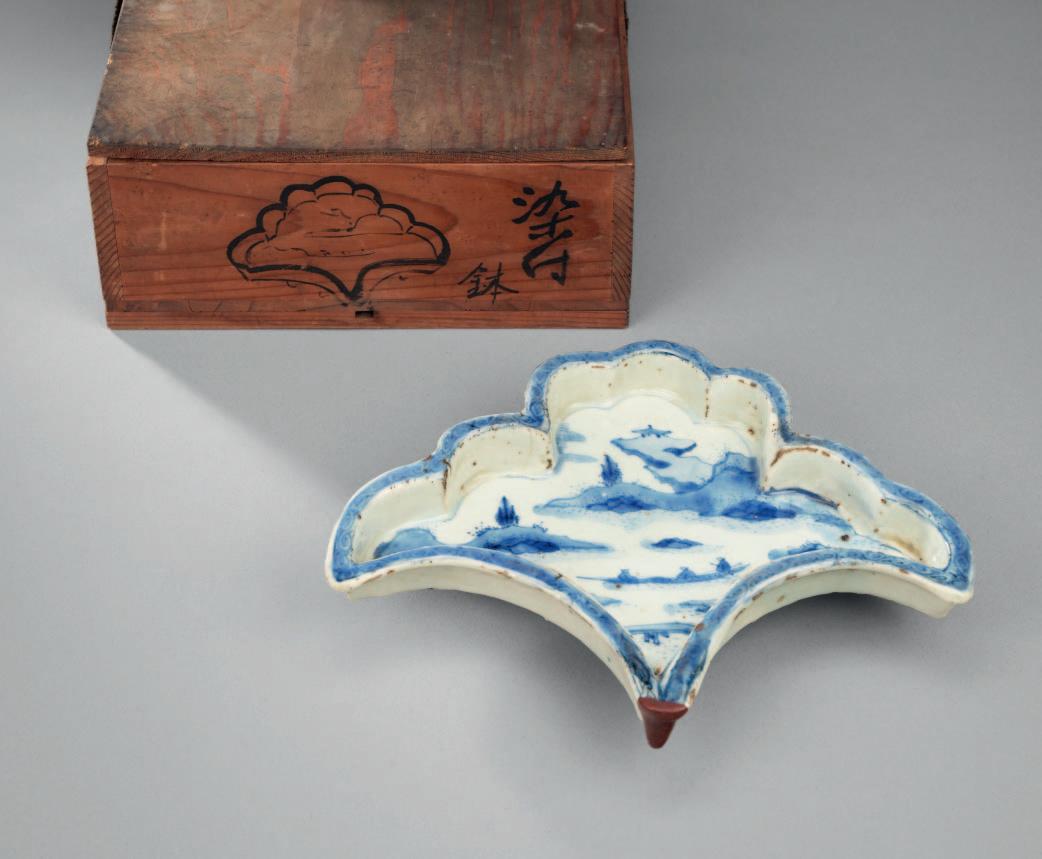
For the Japanese market, shaped as a gingko leaf and raised on three short feet modelled as lions’ heads; the well decorated with three figures on a boat in a mountainous river landscape; the rim with mushikui and a band of spirals; together with a tomobako (wood box), inscribed sometsuke, hachi and with an ink drawing of the dish; 24.2cm. (2)
£600-800
Cf. Kawahara Masahiko, Ko-Sometsuke, vol.1, color section, pp.94-95 for a related dish in the Tokyo National Museum Collection.
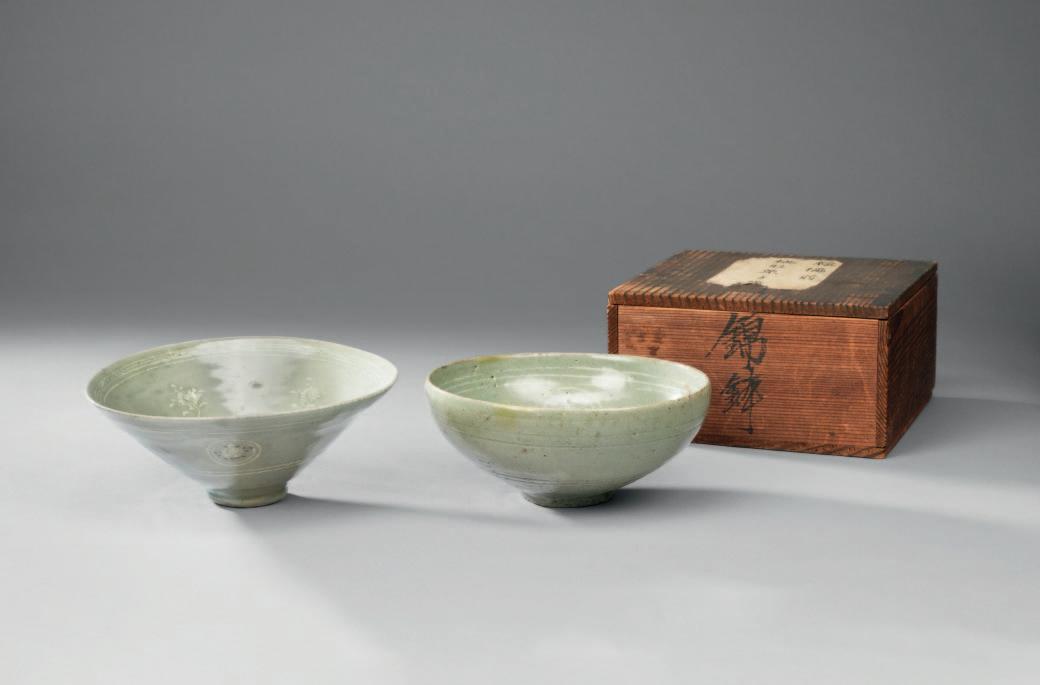
Both decorated with flowers and roundels, the first delicately potted, of conical shape with a wide rim; the other with a heavier rounded body, in a Japanese tomobako (wood box), 18.4cm and 17cm respectively. (3)
£400-600
Provenance: from an English private collection, Devon. The first bowl with a copy of a certificate of authenticity from G Nakajima Antiques & Curios, Kyoto, dated 22 February 1998.
516
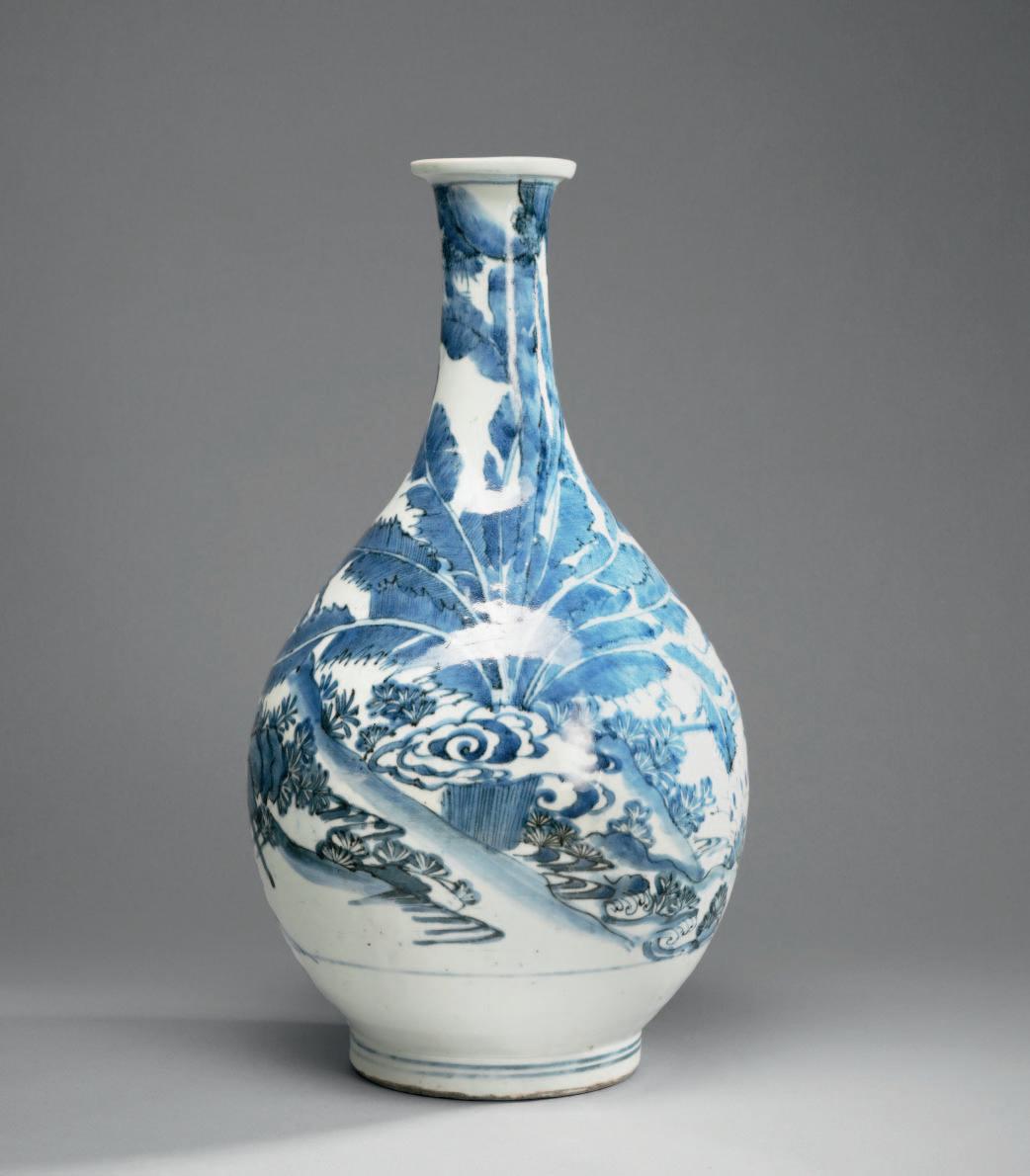
A TALL JAPANESE ARITA BLUE AND WHITE VASE
EDO PERIOD, 17TH CENTURY
The pearshaped body decorated with a luxuriant garden with many flowers, plantain with large leaves and other plants amongst rockwork and scrolling clouds, 39.3cm.
£500-1,000
Provenance: from an English private collection, London.
517
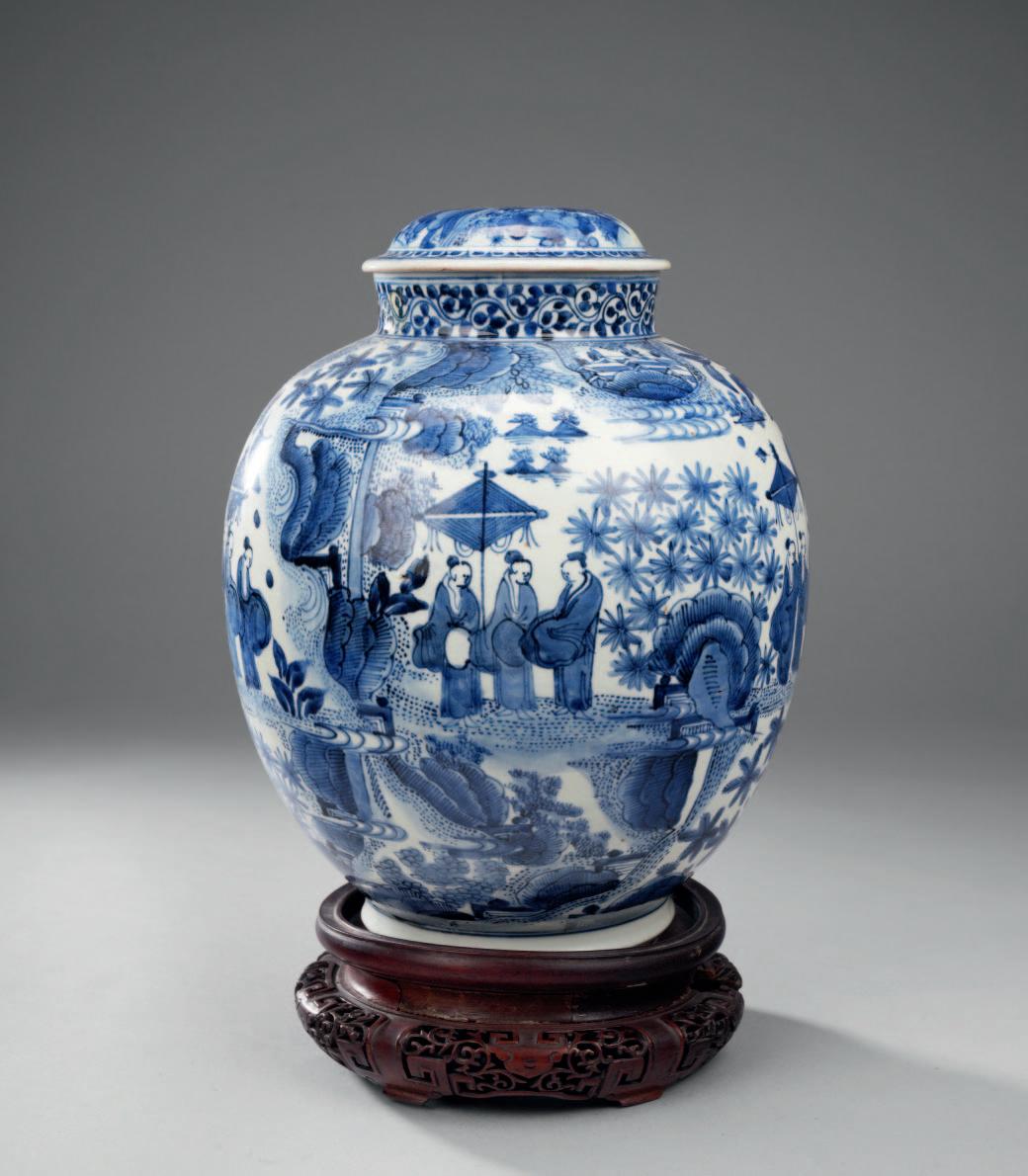
A JAPANESE ARITA BLUE AND WHITE JAR AND COVER
PROBABLY EDO, 18TH/19TH CENTURY
The bulbous body decorated with groups of figures in luxuriant gardens, some carrying parasols and tall fans, standing amongst stylised foliage and rockwork, the lid similarly decorated; raised on a short foot and with a straight neck painted with scrolling tendrils, with an associated wood stand, 31cm. (3)
£500-1,000
Provenance: from an English private collection, Hertfordshire, by repute acquired at the turn of the 19th century and thence by descent.
518
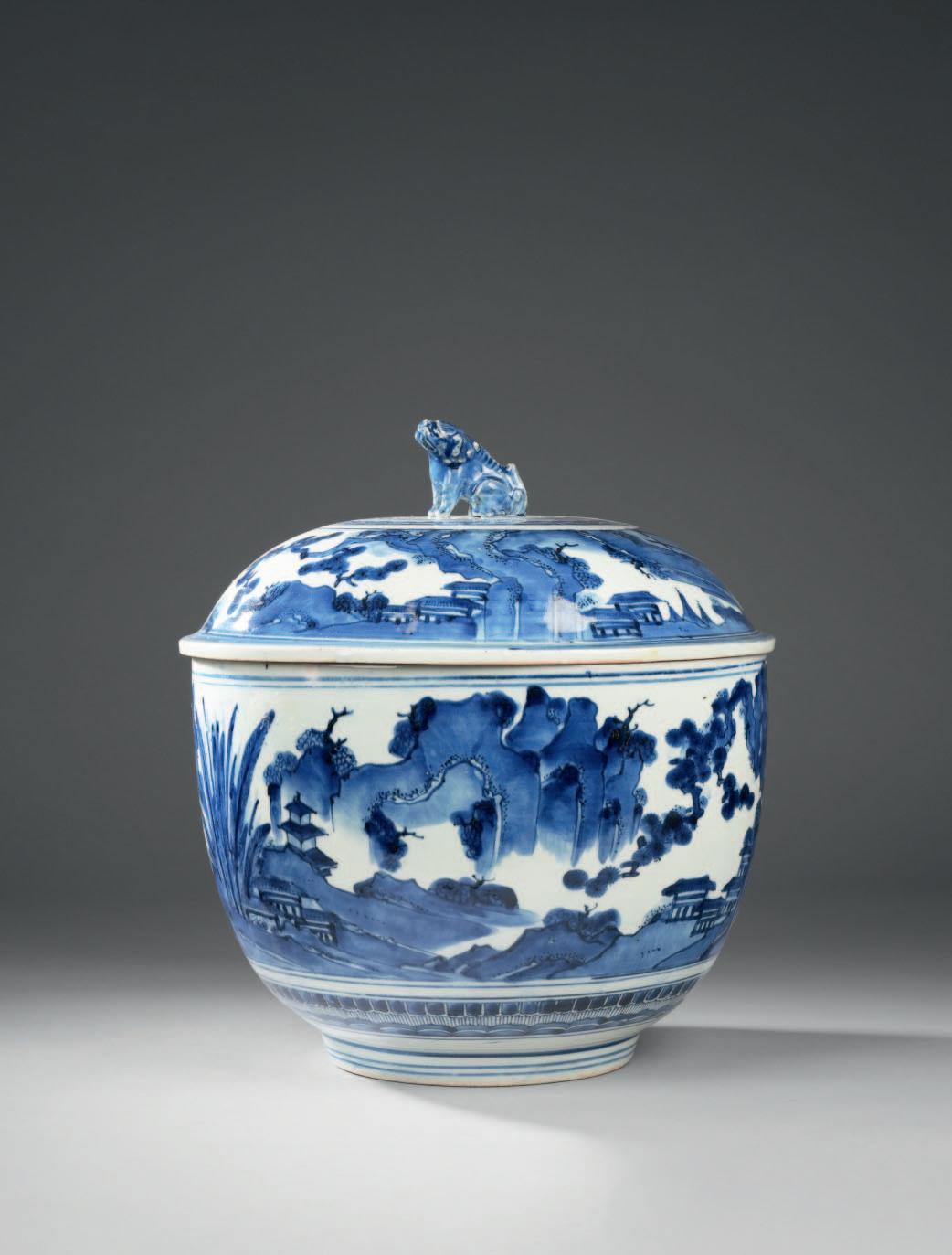
A LARGE JAPANESE ARITA BOWL AND COVER
EDO PERIOD, C.1700
Decorated in underglaze blue, the deep bowl painted with a continuous landscape, with many pavilions and a tiered pagoda nestled amongst lush vegetation and rockwork; the lid with a border enclosing a similar landscape and bands of lappets, the knop modelled as a shishi, the lion dog seated on its haunches; 30cm. (2)
£1,500-2,500
Provenance: from an English private collection, Devon. Acquired from Bonhams London, Asian Art, 10 May 2021, lot 382.
519
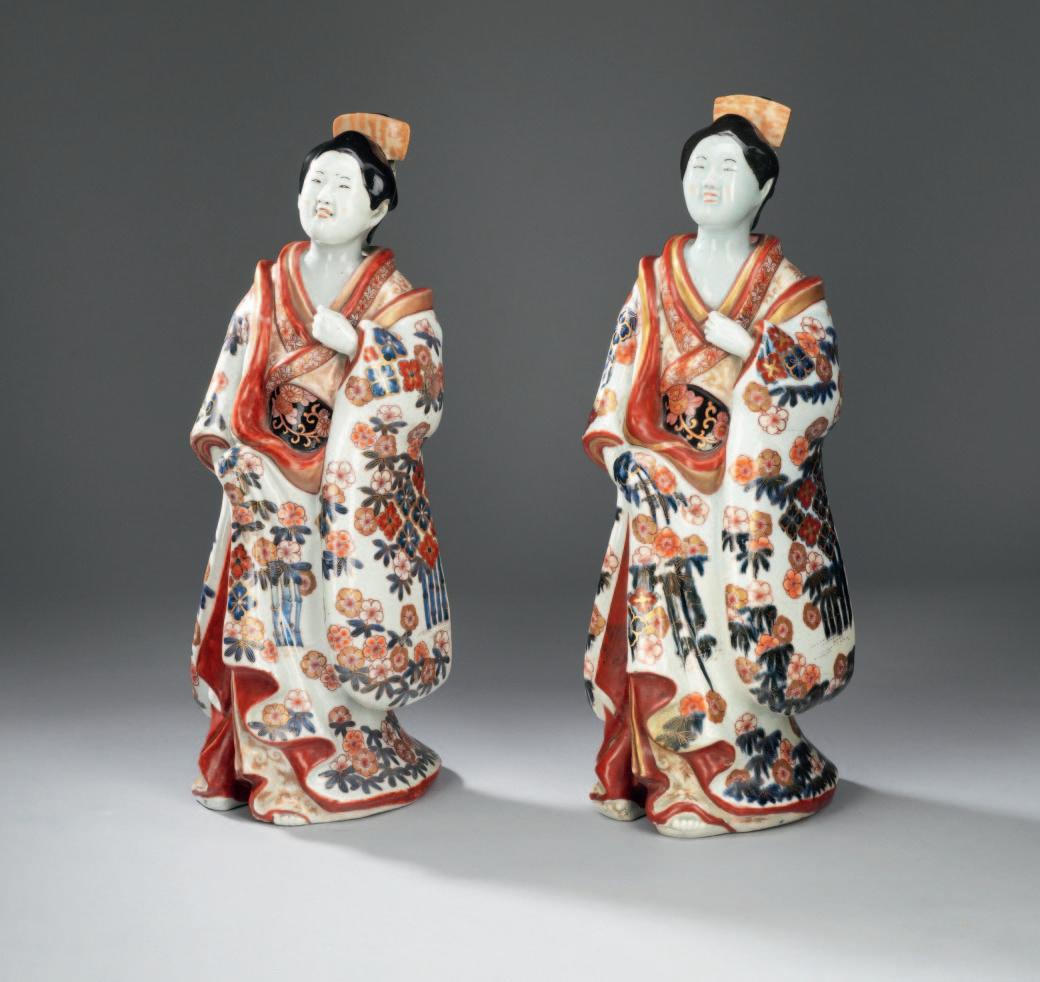
TWO LARGE JAPANESE IMARI FIGURES OF BEAUTIES
EDO PERIOD, C.1700
Both bijin typically decorated in underglaze blue, red, black and gilt; the two graceful figures depicted standing and smiling gently, each holding the hem of her garment and with her hair elegantly held up with a comb; their robes similarly decorated with prunus flowers, bamboo and hana-bishi (quatrefoil patterns), their collars with maple leaves, 45.2cm and 43.5cm. (2)
£4,000-6,000
520
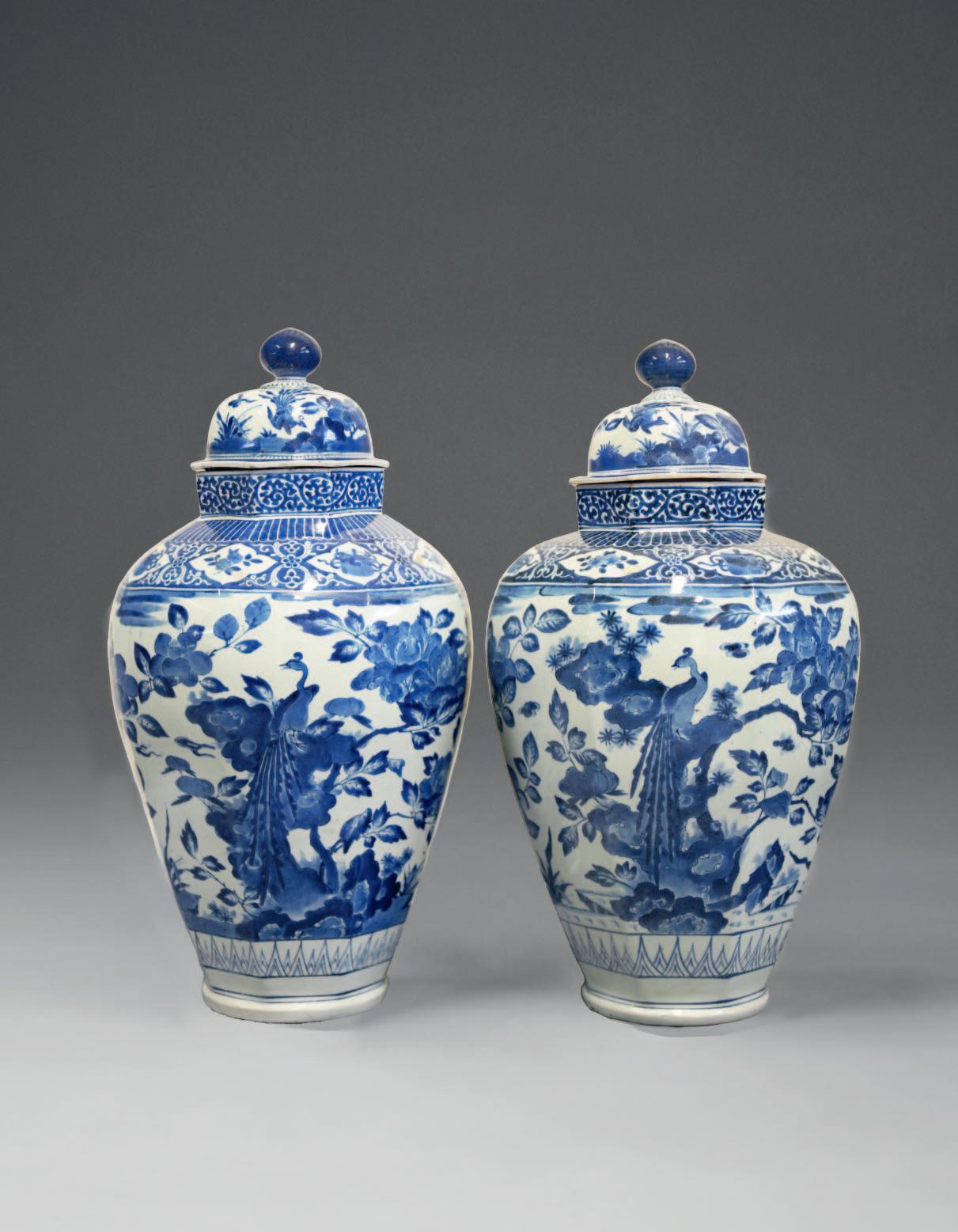
A LARGE AND IMPRESSIVE PAIR OF JAPANESE ARITA BLUE AND WHITE VASES AND COVERS
EDO PERIOD, C.1700
The large octagonal baluster bodies decorated in underglaze blue with large H
ō birds in flight and perched amongst vegetation, in a luxuriant garden with large camellia and rockwork, framed by borders of triangular lappets, scrolling tendrils, auspicious objects and karakusa scrolls to the necks; the covers with further birds amongst flowers, 71cm and 73cm. (4).
£4,000-6,000
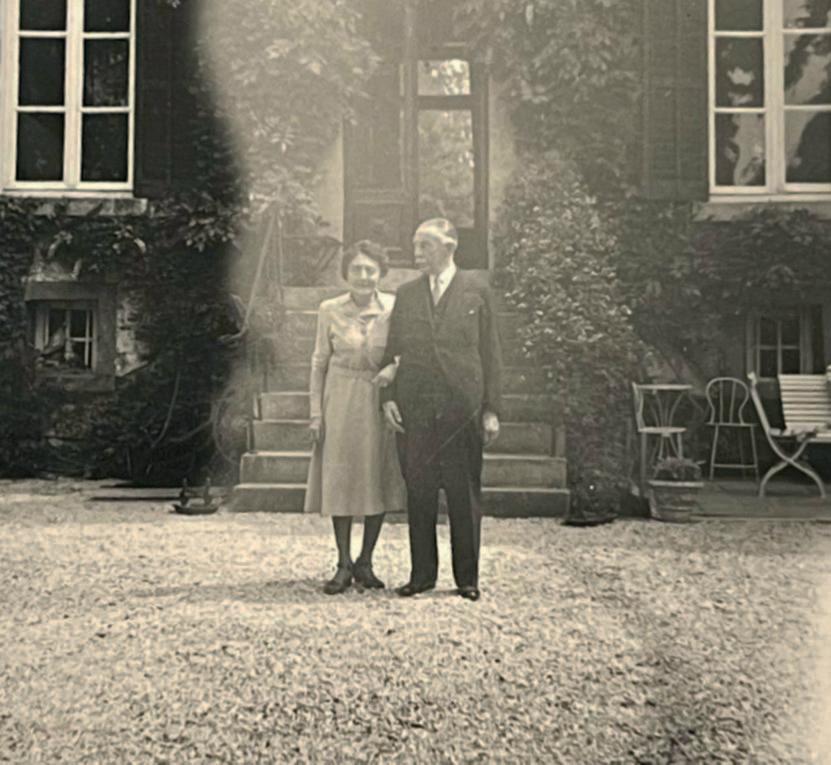
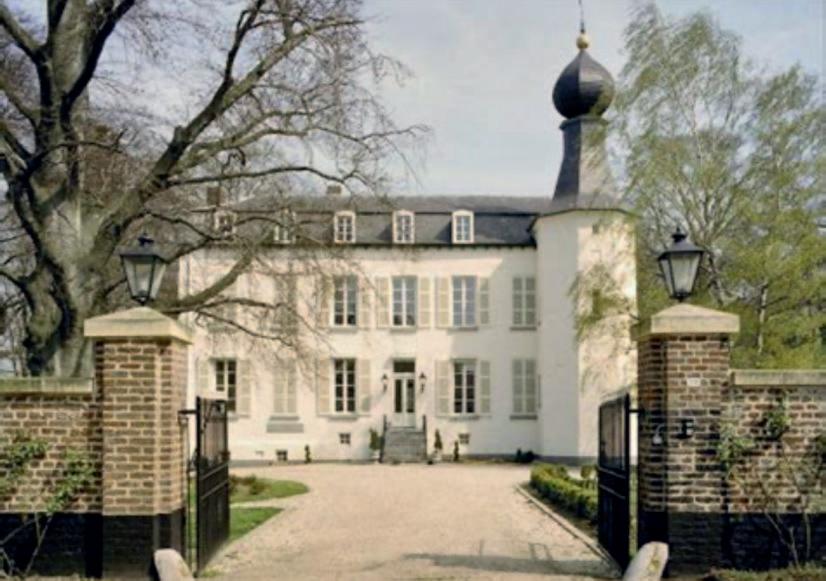
Provenance: from the collection of Baron & Baroness Michiels Van Kessenich of Kasteel Reymersbeek, The Netherlands, and thence by descent.
See Japanese Art, 23rd May 2018, lot 953 for another large pair of Arita blue and white vases and covers decorated with Hō-ō birds.
521
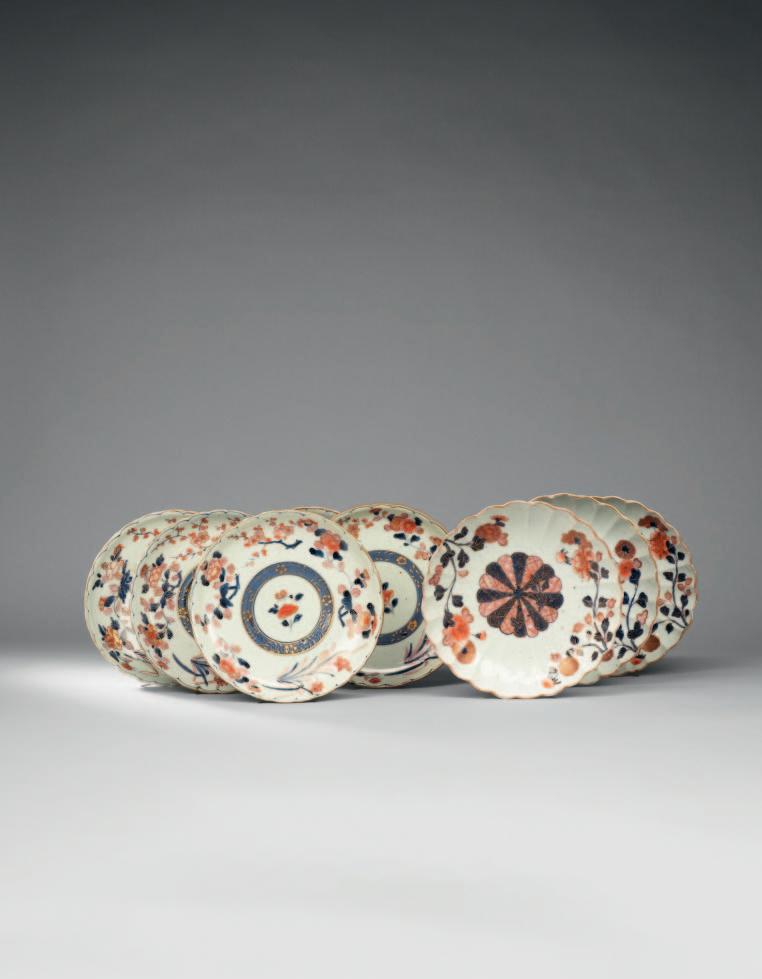
EIGHT JAPANESE IMARI DISHES
EDO PERIOD, C.1700
Three of foliate shape and each raised on a short foot, the reverse painted with chrysanthemum amongst trellis and with some moulded details; all dishes typically painted in underglaze blue, gilt and ironred with flowers, 21.2cm max. (8)
£400-600
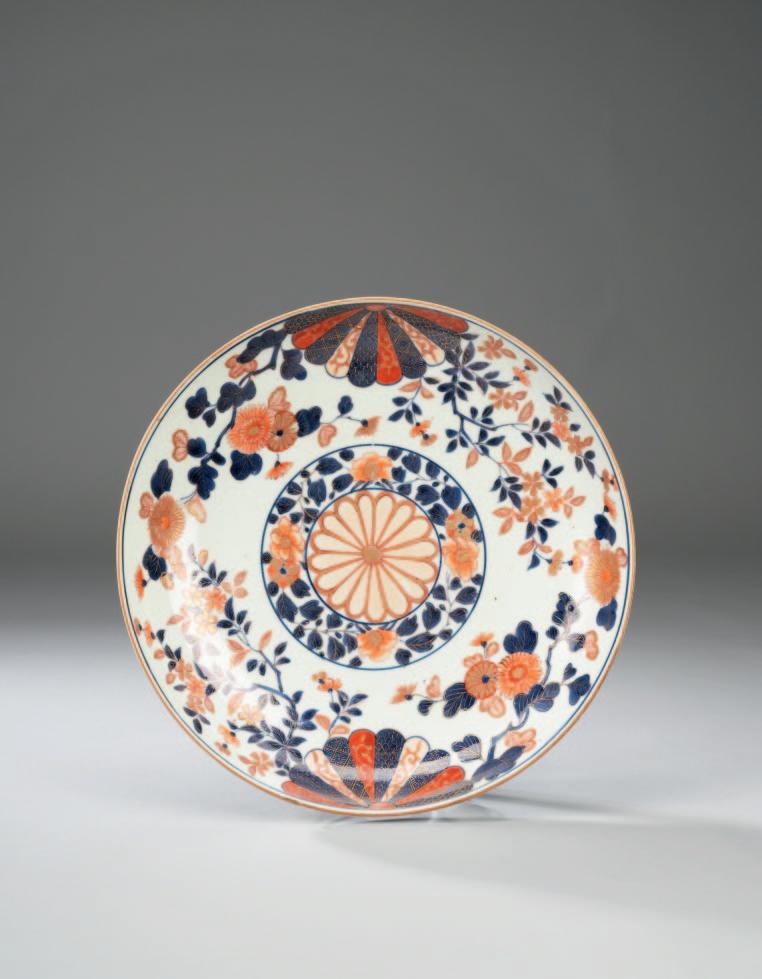
522
A JAPANESE IMARI DISH WITH CHRYSANTHEMUM
EDO PERIOD, C.1700
Typically decorated in underglaze blue, gilt, and red enamels, the well with a central chrysanthemum mon, with further chrysanthemum and prunus blossoms around it; the reverse with more flowers and a circular band of peony and scrolling tendrils to the base, 31.7cm.
£400-600
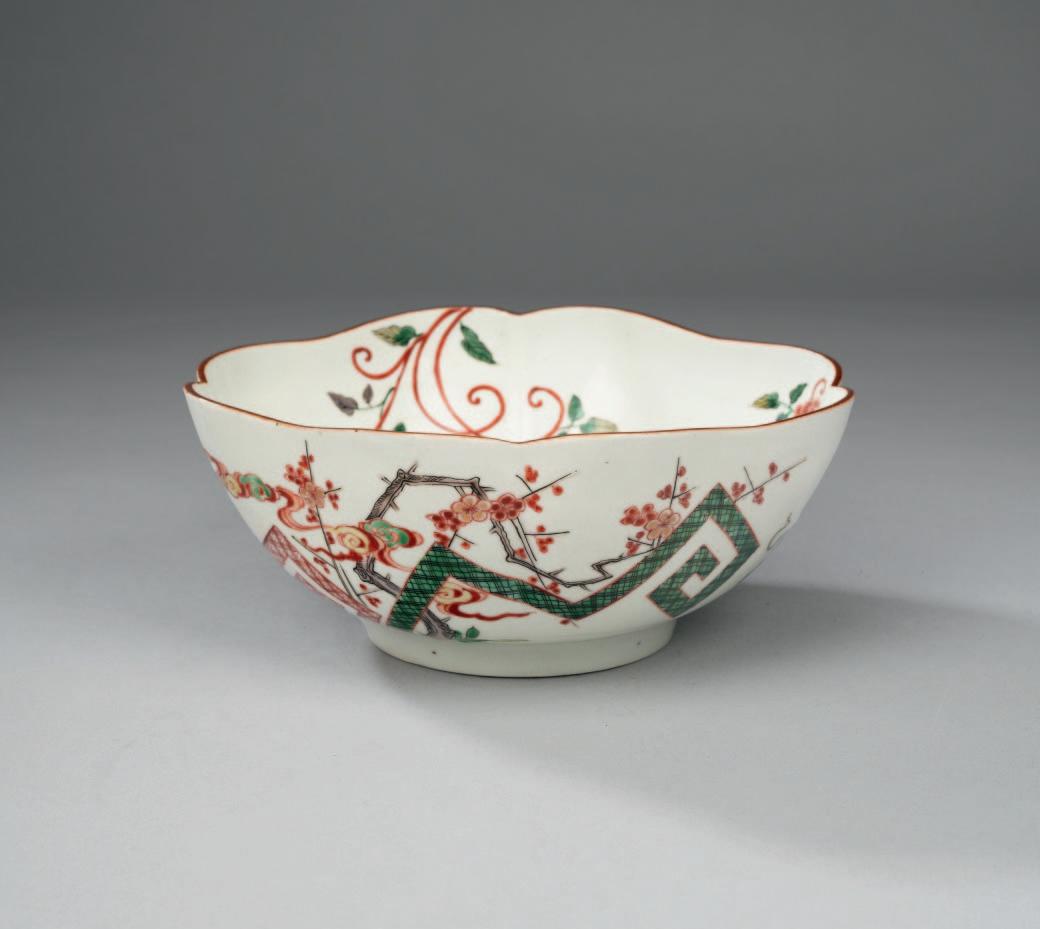
524
A JAPANESE ARITA BOWL
EDO PERIOD, C.1700
The square body with lobed sides and raised on a short circular foot, the cavetto moulded with waves and cherry blossoms, painted in red, yellow, green, aubergine and gilt with scrolling tendrils and stylised peonies to the inside and prunus, chrysanthemum and raimon (thunder pattern) spirals to the outside, 18.2cm.
£400-600
Provenance: from the collection of Sir Ronald Charles Lindsay GCB, KCMG, CVO, PC, 1877-1945, and thence by descent. Sir Ronald Lindsay was a British civil servant and diplomat. He became British Ambassador to Turkey from 1925-26 and to Germany from 1926-28; from 1928-30, he was Permanent Undersecretary for Foreign Affairs and from 1930-39 the British Ambassador to the United States of America.
Cf. S Jenyns, Japanese Porcelain, ill.36A for a related bowl from the collection of Mr and Mrs de la Mare, also illustrated in the exhibition catalogue of the Oriental Ceramics Society, Loan Exhibition of Japanese Porcelain, 28 March-28 April 1956, no.248.
An identical bowl from the collection of Augustus the Strong (1670-1733), inventoried in 1721 and with N=10 incised reference mark is on display today at the Zwinger Palace in Dresden. The Ashmolean Museum in Oxford owns another comparable example, ref. 1985.48, from the Jeffery Story and Walter Cook Bequest.
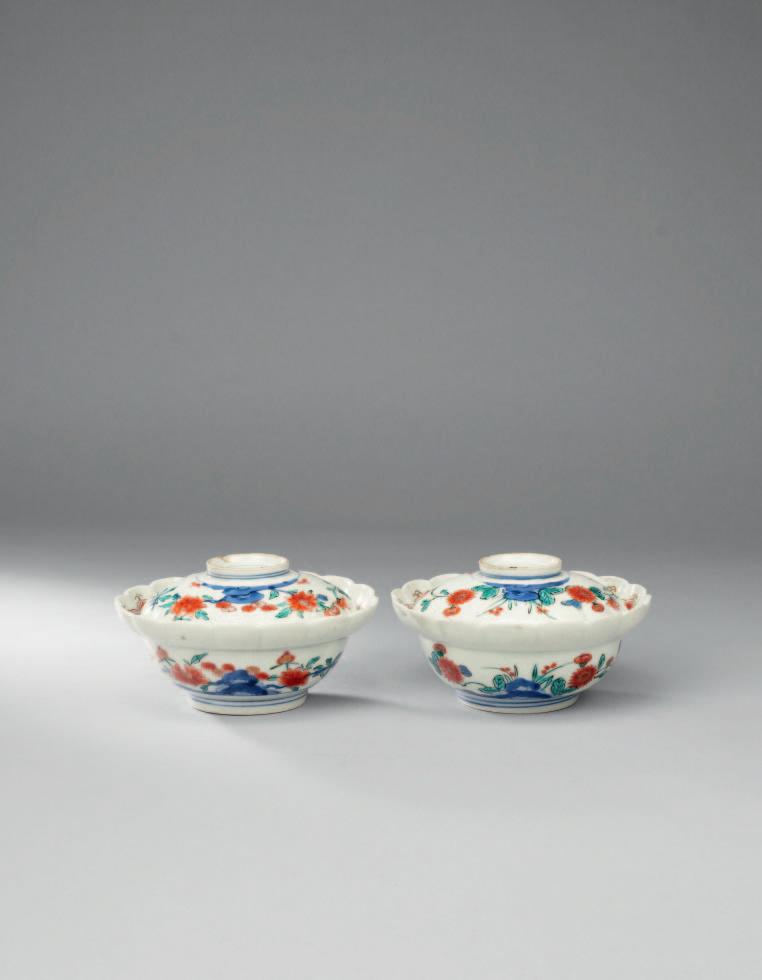
523
A PAIR OF JAPANESE ARITA BOWLS AND COVERS
EDO PERIOD, 18TH CENTURY
Of foliate shapes, the bowls and covers decorated in Kakiemon style with underglaze blue, gilt and polychrome enamels, painted with flower sprays, rockwork and reishi heads, 15.3cm max. (4) WITHOUT RESERVE
£200-400
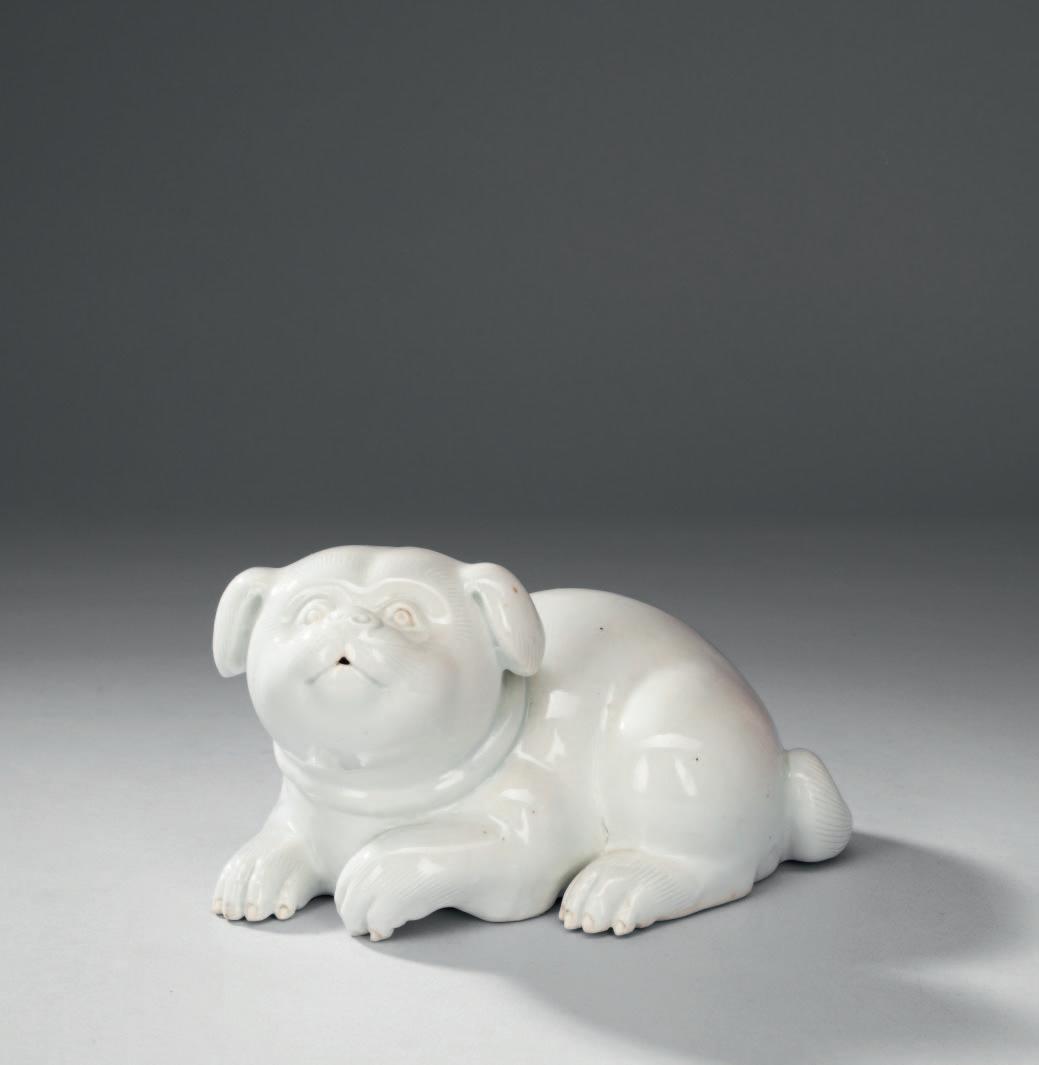
526
A LARGE JAPANESE HIRADO OKIMONO OF A PUPPY MEIJI ERA, 19TH/20TH CENTURY
The recumbent dog modelled with a ribbon at its neck and a small curly tail, with details of the hair finely incised, 22.8cm.
£300-500
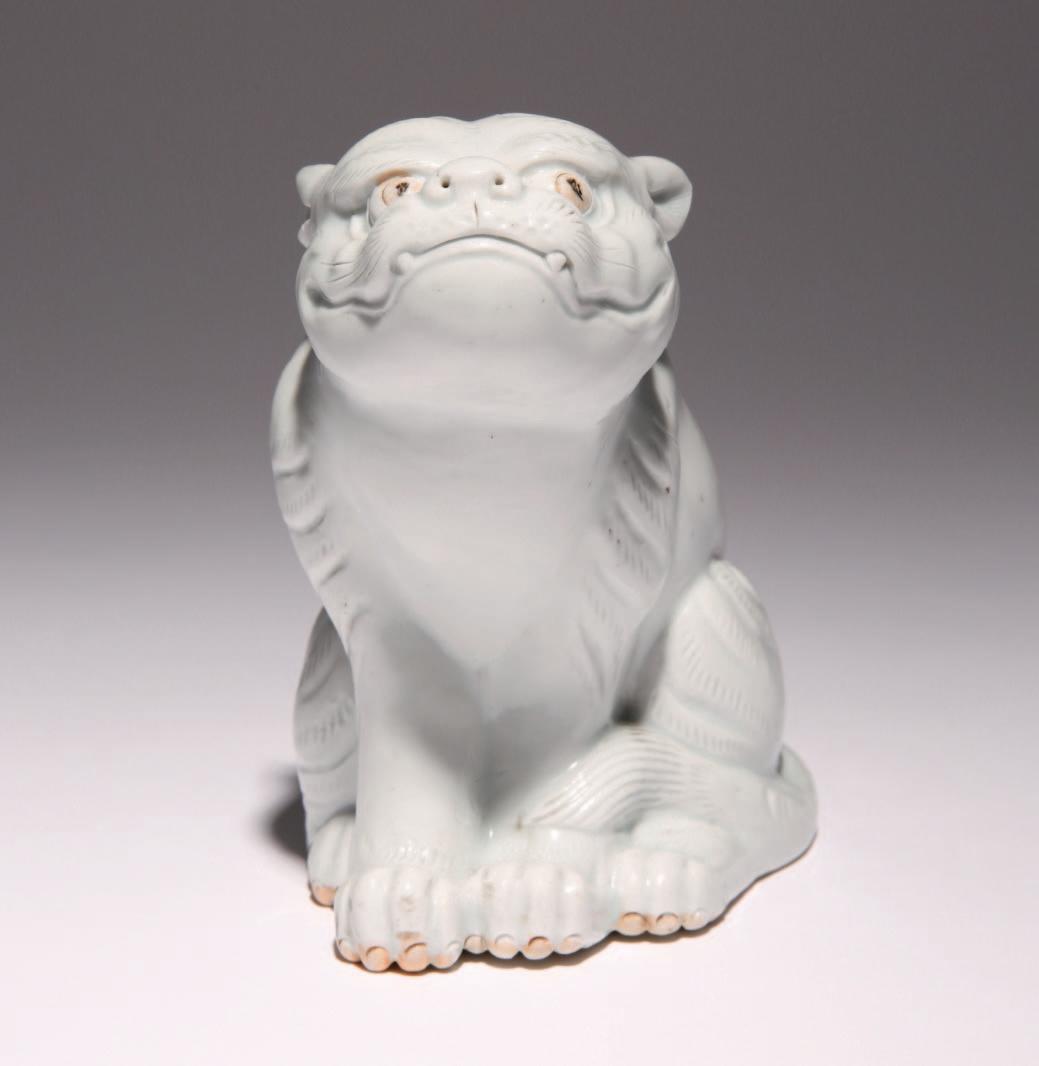
525
A SMALL JAPANESE MODEL OF A TIGER
PROBABLY EDO, 18TH OR 19TH CENTURY
Depicted sitting on its haunches with its mouth wide open in a snarl, the surface painted in colourful enamels, 8.5cm.
WITHOUT RESERVE
£150-250
527
A JAPANESE HIRADO MODEL OF A TIGER
EDO OR MEIJI PERIOD, 19TH CENTURY
Seated on its haunches and with its tail wrapped close to its body, the feline looks up with its ears lying flat, with details of the fur carved in the surface, the eyes highlighted with black iron oxide and the claws left unglazed, the nostrils and base with holes for air to escape during firing, 15.3cm.
£500-1,000
Provenance: from the collection of Edward Croft-Murray CBE (1907-1980). CroftMurray was an expert in British Art and Keeper of Prints and Drawings at the British Museum.
Cf. C P Cardeiro, Hirado Ware, p.75, where a comparable model of a tiger is illustrated. Also, see Bonhams New York, Fine Japanese Works of Art, 19th May 2013, lot 2331 for a similar model.
529
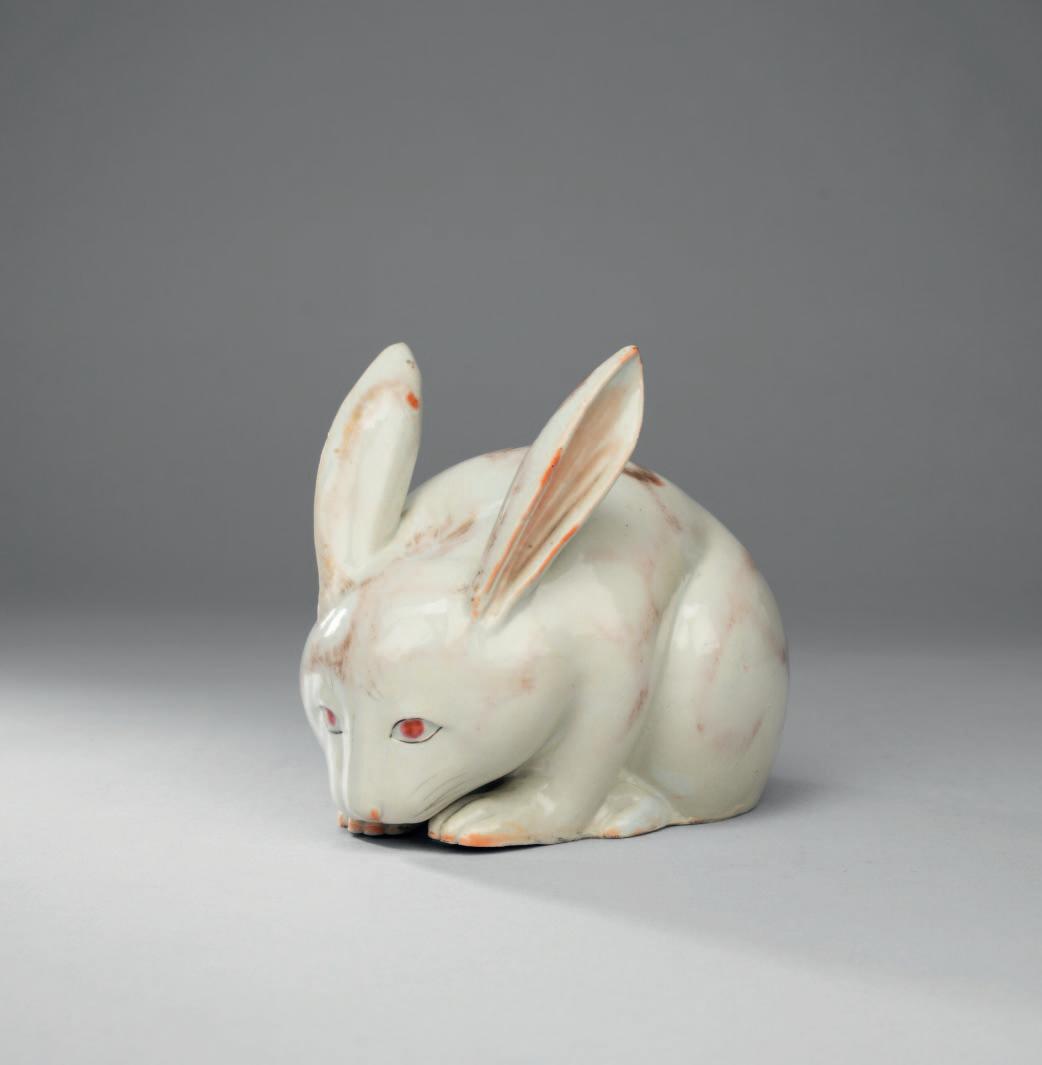
A JAPANESE KUTANI MODEL OF A HARE
MEIJI ERA, 20TH CENTURY
The charming animal depicted with a plump body and elongated ears; its fur painted with gilt patches, 16cm.
£600-800
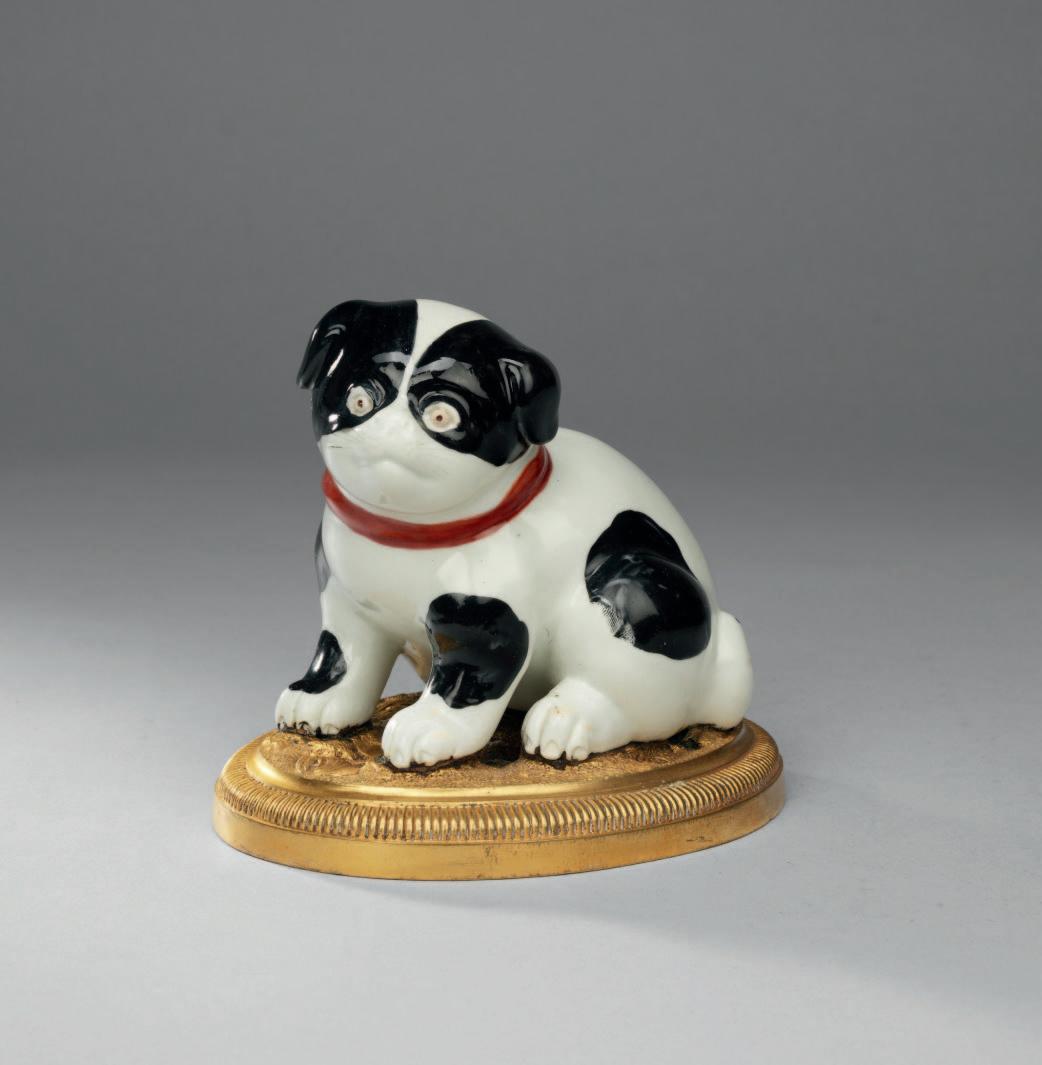
528
A JAPANESE KUTANI MODEL OF A PUPPY
MEIJI ERA, 19TH/20TH CENTURY
The charming dog depicted sitting on its haunches, with a red ribbon tied around its neck and a small curly tail, painted with black patches and the eyes pick out in ochre, attached to a French ormolu base, 14.5cm.
£400-600
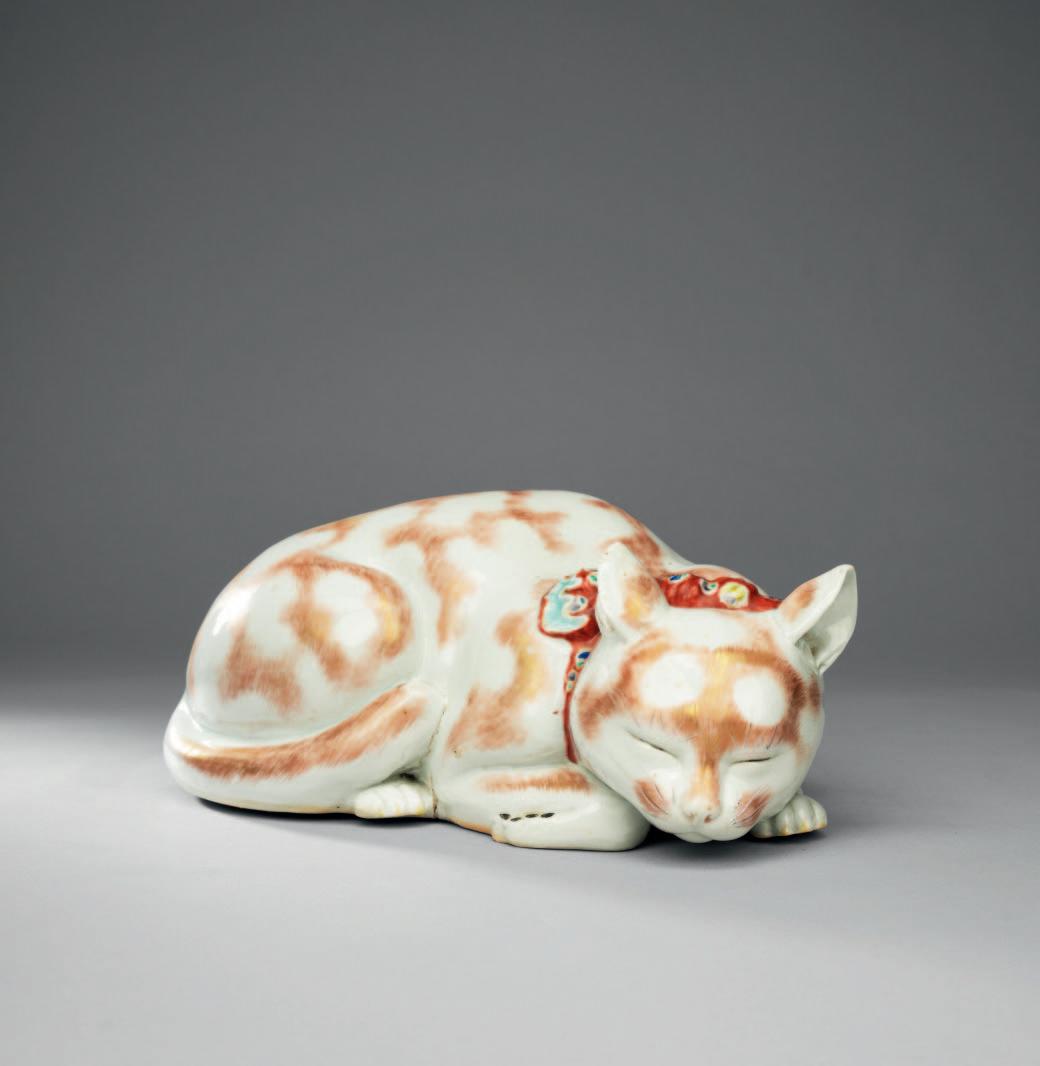
530
A LARGE JAPANESE KUTANI MODEL OF A CAT
MEIJI ERA, 19TH/20TH CENTURY
Sleeping with its head resting on its front paws, a colourful ribbon tied around its neck; with details rendered in colourful enamels and gilt, 29.5cm.
£600-1,000
532
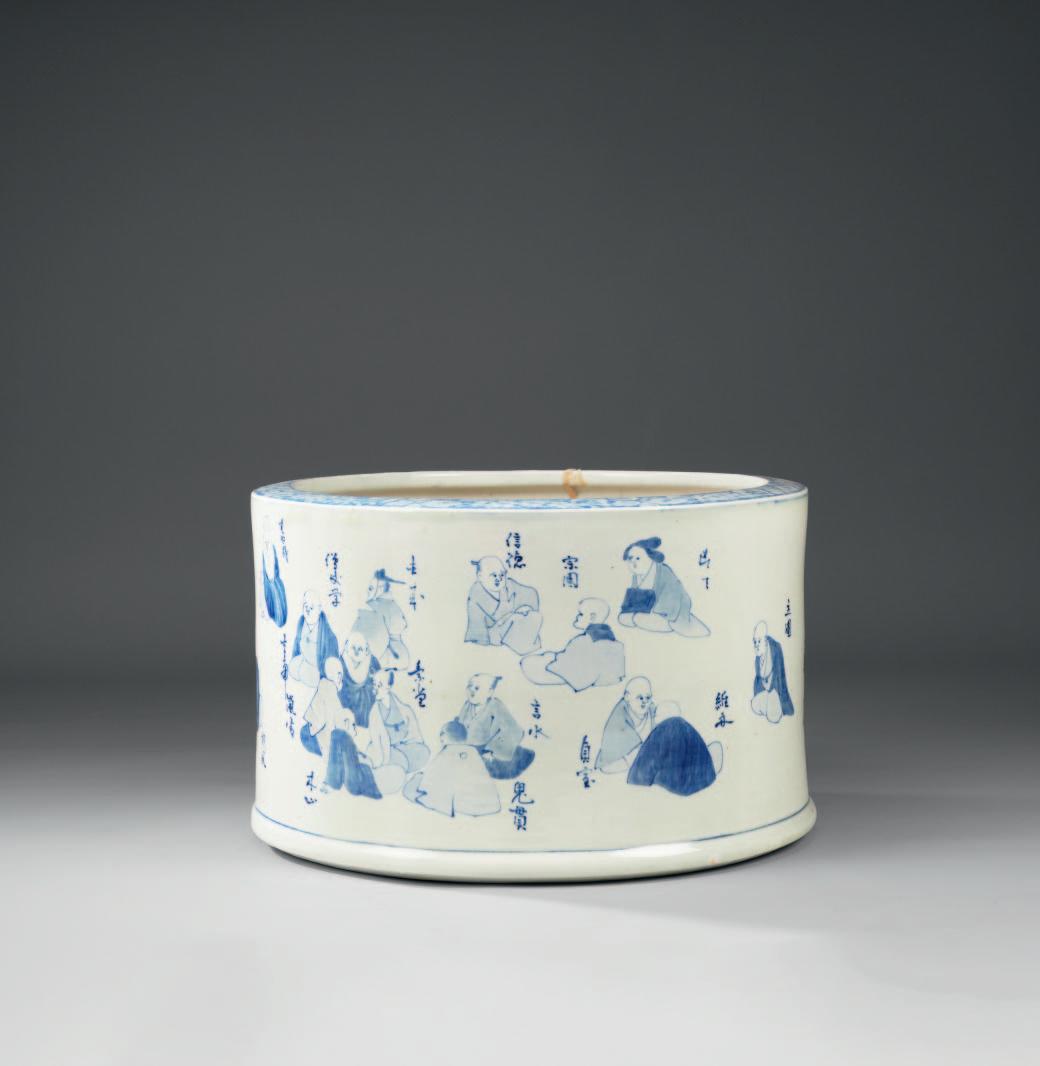
A LARGE JAPANESE BLUE AND WHITE HIBACHI (HANDWARMER)
PROBABLY MEIJI, 19TH/20TH CENTURY
Painted with a continuous design of many figures accompanied by calligraphic inscriptions, some identifying them as famous poets and artists; one line reading as Toba Sōjō Anzu (Illustration of the Hermitage of Toba Sōjō); signed underneath Ikka sha-shi (Painted/copied by Ikka), 46cm.
£500-800
Toba Sōjō (1053-1140) was a high-ranking Buddhist monk and artist famously credited with creating the ‘Scrolls of Frolicking Animals’.
531
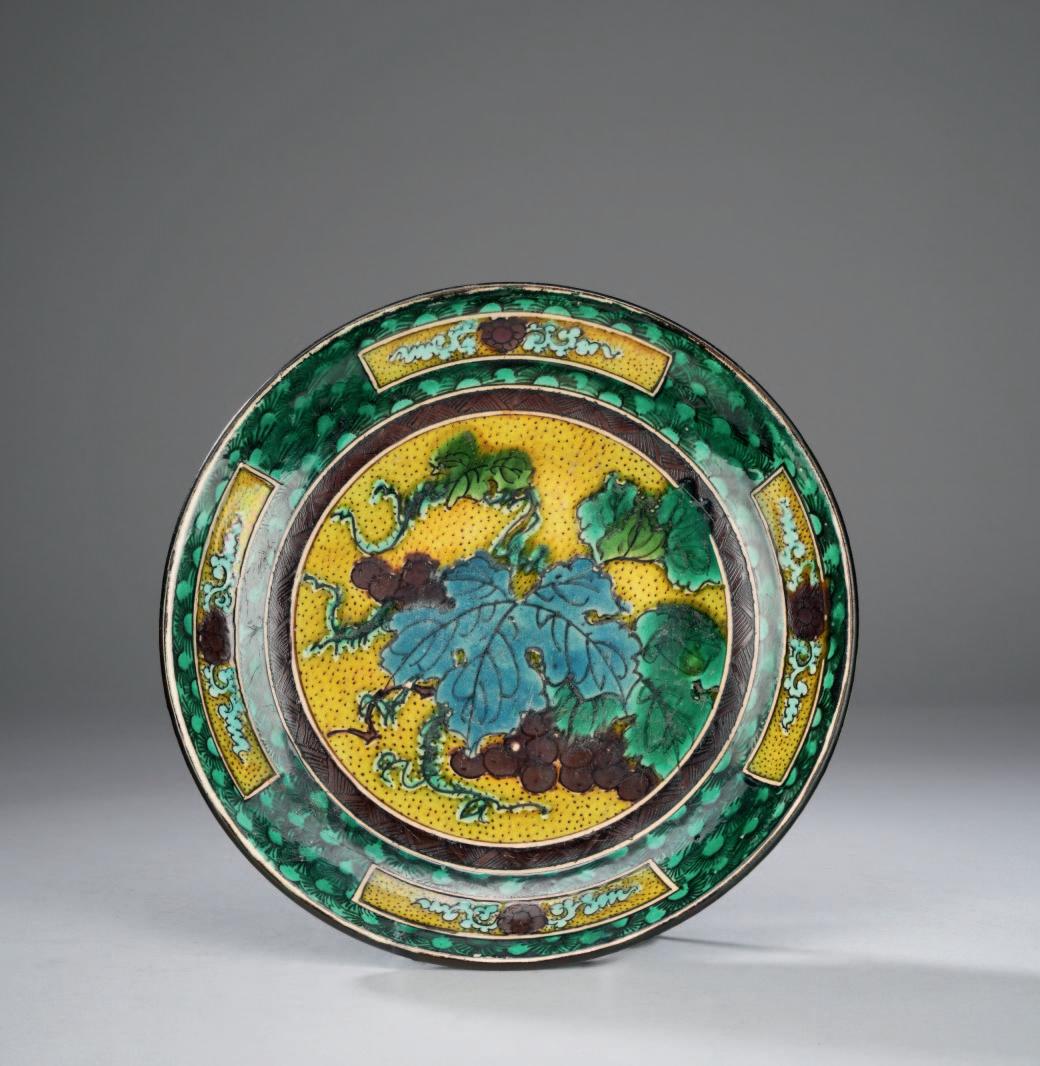
A JAPANESE YOSHIDAYA KUTANI DISH
MEIJI ERA, 19TH/20TH CENTURY
Typically decorated in blue, green, black, aubergine and yellow enamels, the well painted with fruiting vines, framed by borders of chevrons, flowers and scrolling tendrils, the reverse with karakusa scrolls and a central fuku mark, 23.9cm.
£200-400
533
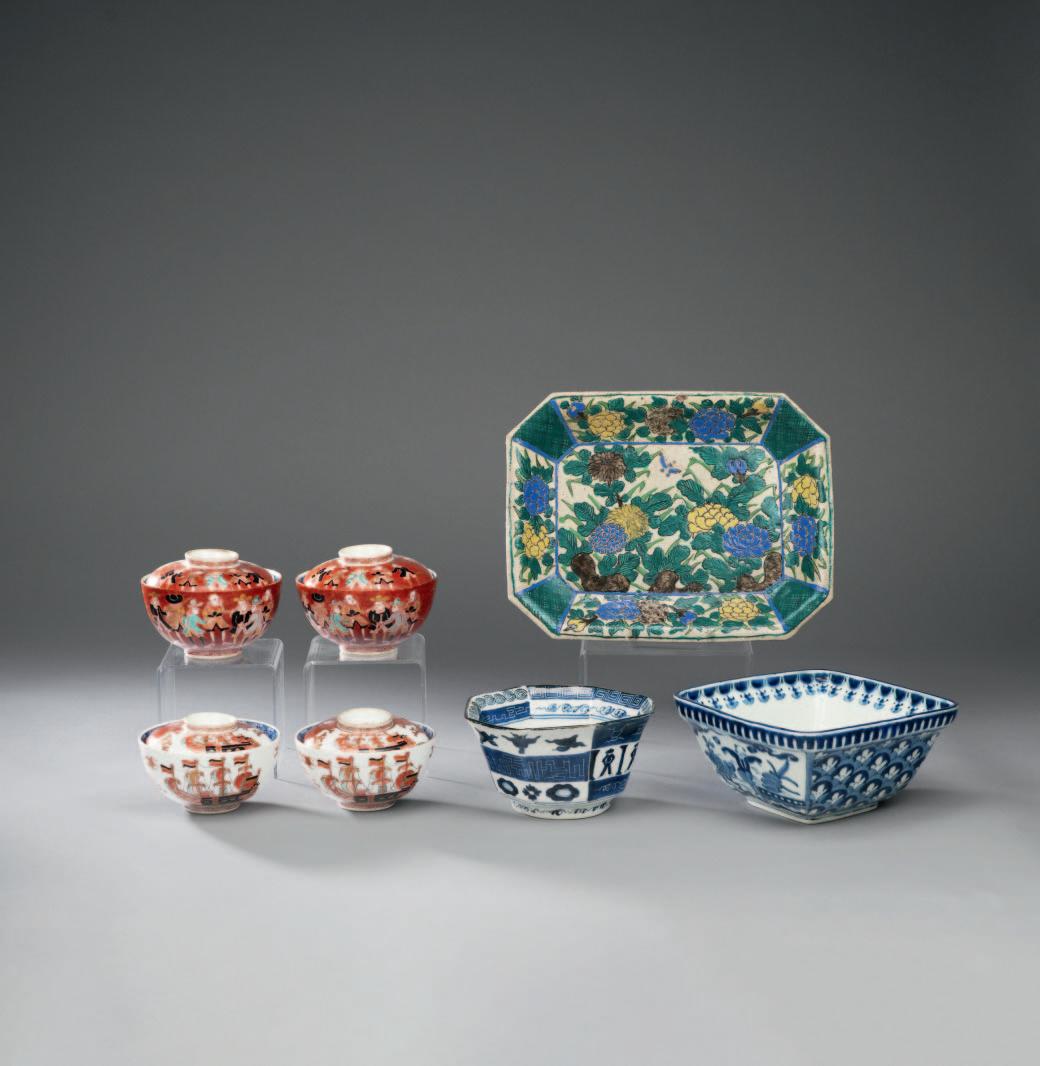
A SMALL COLLECTION OF JAPANESE CERAMICS
MEIJI AND LATER, 19TH AND 20TH CENTURY
Comprising: a rectangular Ko Kutanistyle dish with flowers in thick enamels; four Arita bowls and covers painted with Dutchmen and ships; and two blue and white bowls, the square one with boys and butterflies and the octagonal one decorated with stylised European figures, 28.6cm max. (11))
WITHOUT RESERVE
£200-300
Provenance: from an English private collection, Devon.
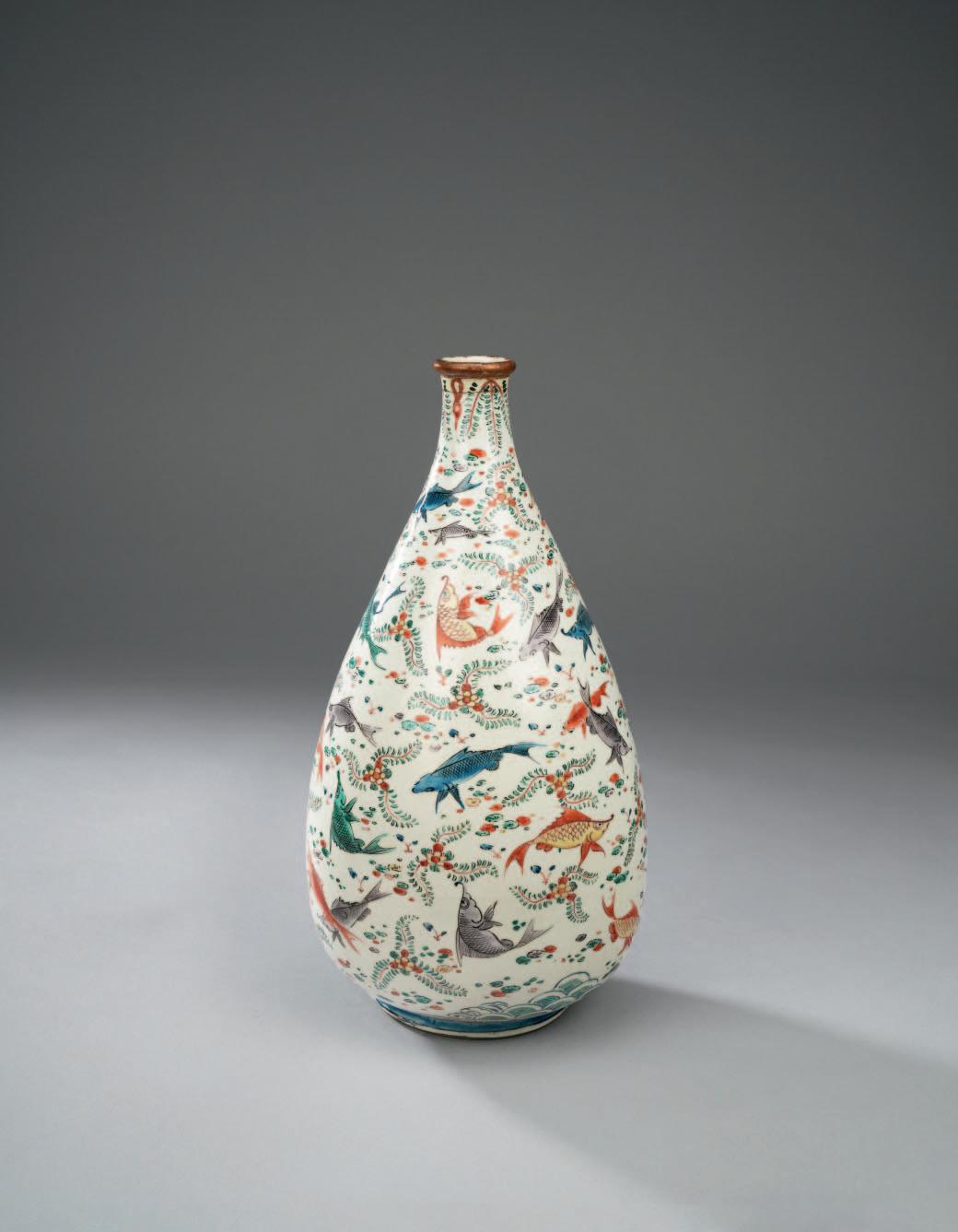
534
A RARE JAPANESE KOKUTANI VASE EDO PERIOD, 18TH CENTURY
The tall pearshaped body decorated with a multitude of fish swimming amongst seaweeds, above stylised waves and bordered by flowers and leafy sprays; all painted in colourful enamels, the base with a fuku mark, 38cm. £800-1,200
535
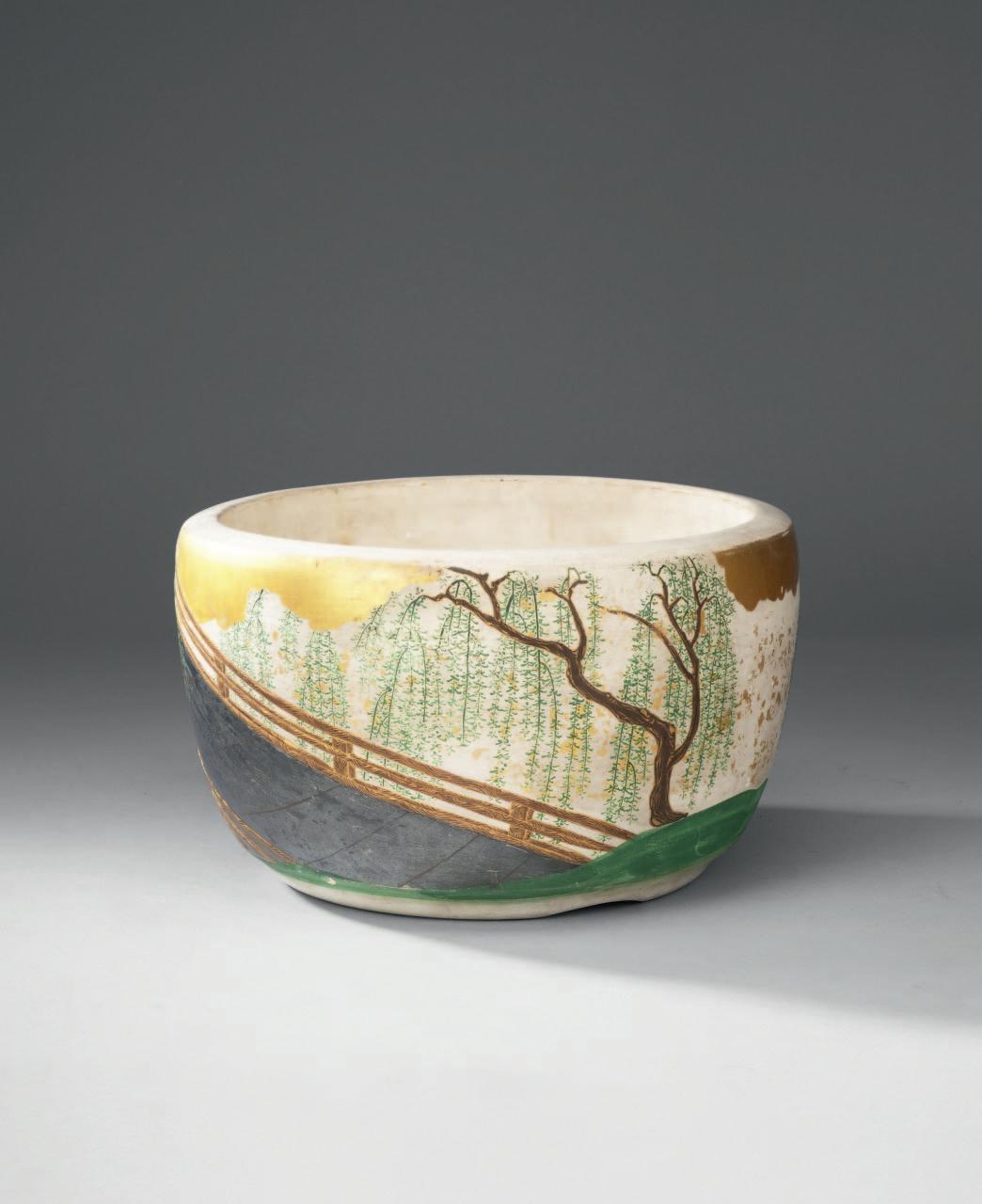
A JAPANESE KYŌ-YAKI HIBACHI (KYOTOWARE BRAZIER) EDO/MEIJI, 19TH CENTURY
From the workshop of Kitamura Shoho, the circular body decorated in the style of Ninsei in ink, colour, and gold and silver lacquer, with a continuous design of a bridge spanning a river, with branches of weeping willow overhanging and gold clouds above; a seal mark for Shoho underneath; together with a removable tripod and a tomobako (wood box) inscribed Yanagibashi [..] hibachi (brazier with design of willow bridge), and signed and sealed Shoho saku (made by Shoho), 29.5cm. (3)
£1,500-2,500
Provenance: from an English private collection, Devon; acquired from Bonhams London, Fine Japanese Art, 7th November 2019, lot 123. A copy of the invoice is available.
537
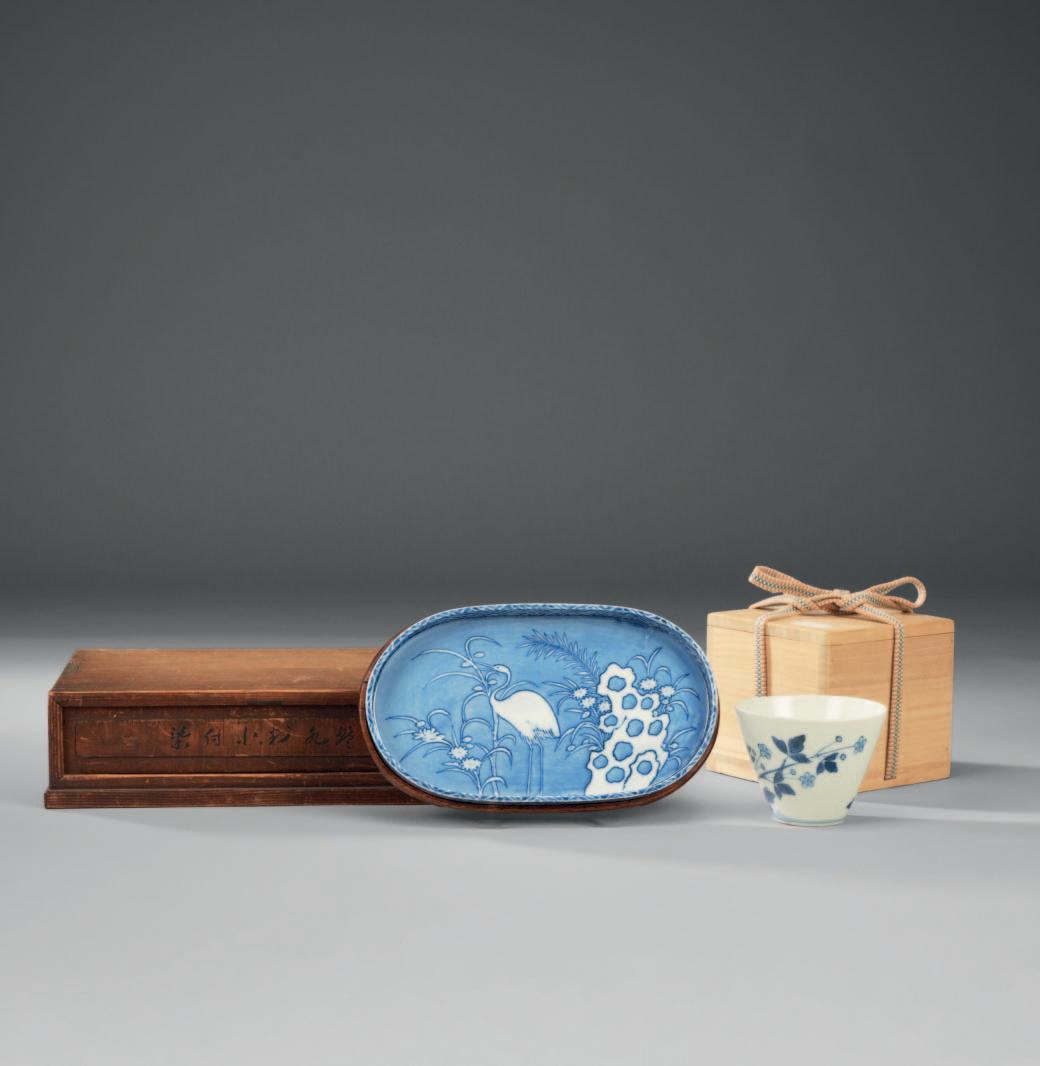
TWO JAPANESE ARITA BLUE AND WHITE PIECES
EDO OR MEIJI, 18TH/19TH CENTURY
One a shallow tray, the oval body decorated in the fuki-zumi or dami (blue wash) technique with a crane amongst flowers and rockwork, the rim with sayagata patterns; with a fitted wood stand and a tomobako (wood box) inscribed Sometsuke kofunmaru ban (blue and white tray with flowers); the other piece a flared cup painted with flowers, with a tomobako, 18.7cm and 6.2cm. (5)
£600-1,000
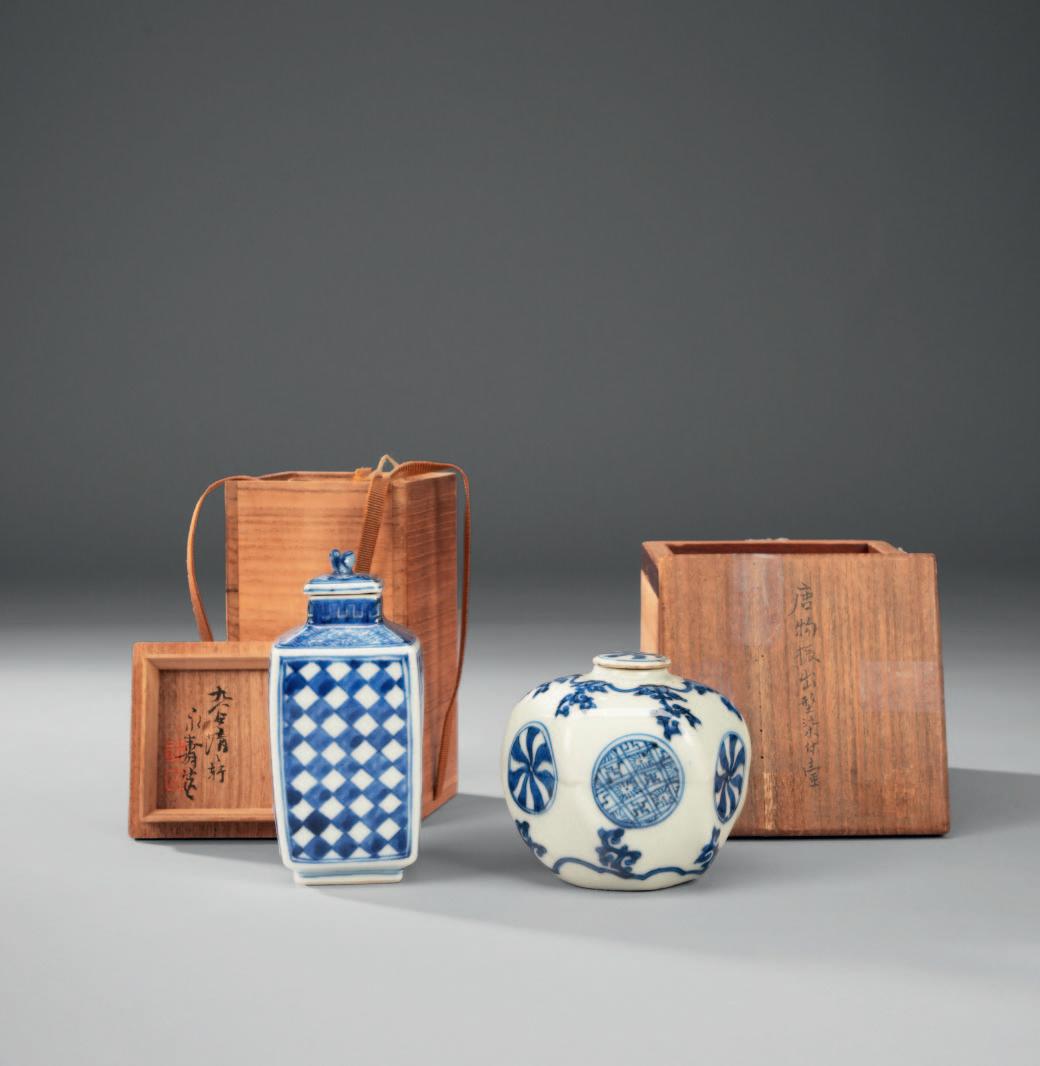
536
TWO JAPANESE SHONZUISTYLE FURIDASHI (SWEET JARS AND COVERS)
EDO AND LATER, 18TH CENTURY AND LATER
The first with a tall squaresection body painted with various brocade patterns, the lid with a birdshaped knop, signed Kutani Eiju underneath for Yaguchi Eiju (18701952); with a tomobako (wood box) inscribed Shonzui shihō furidashi (foursided Shonzuistyle vessel) and signed Kutani Seiseiken Eiju zo with two red seals; the other of ovoid, hexagonal form painted with leafy tendrils and roundels of geometric patterns, with a flat lid, in a tomobako inscribed Karamono furidashi gata sometsuke tsubo (Chinesestyle blue and white jar of furidashi shape); 11cm and 8cm. (6)
£800-1,200
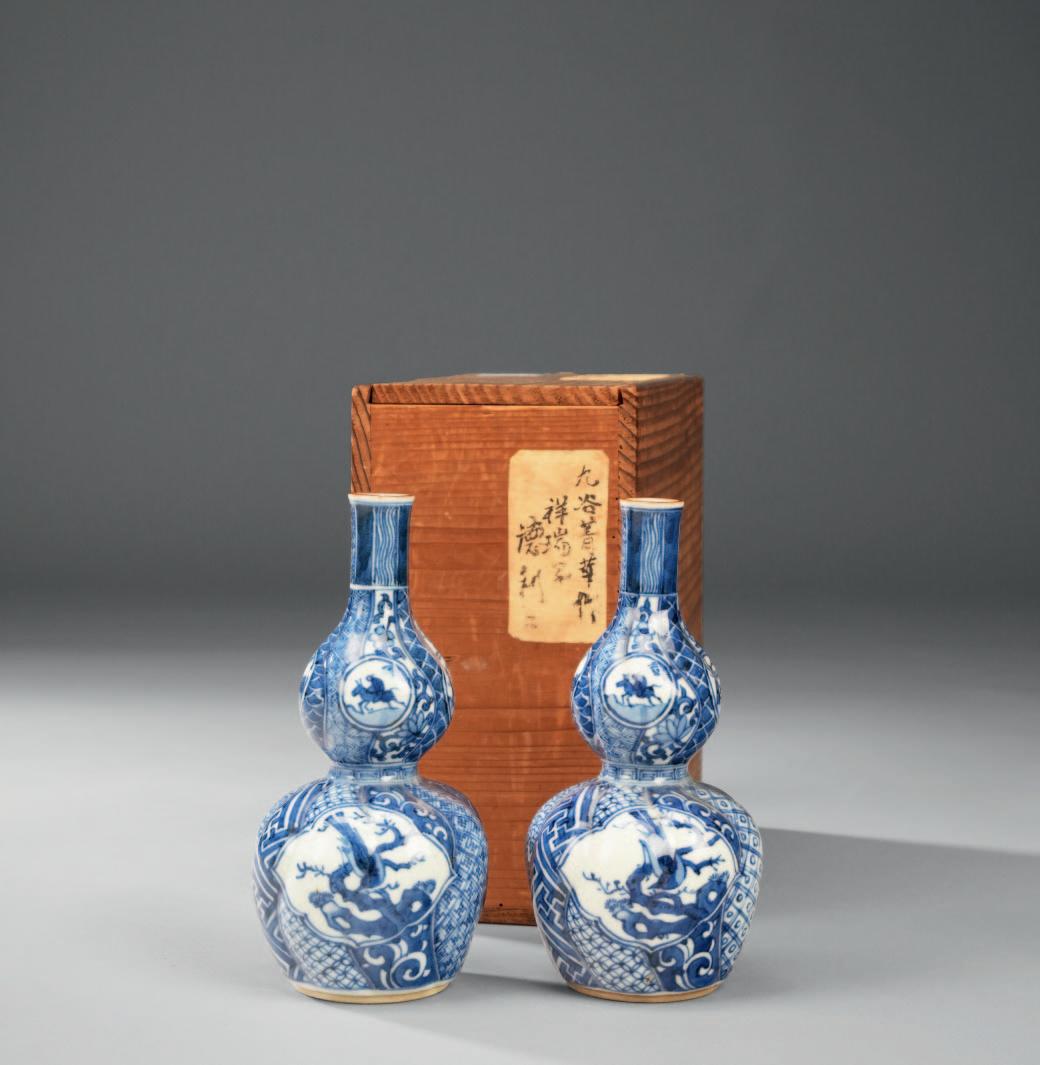
538
A PAIR OF JAPANESE SHONZUISTYLE TOKKURI (SAKE BOTTLES) SHŌWA ERA, 20TH CENTURY
By the Suda Seika kiln, each gourdshaped bottle with a tall cylindrical neck, typically decorated in underglaze blue with panels enclosing figures, birds and landscapes, on a ground of various brocade patterns; with a tomobako (wood box) labelled Kutani Seika saku, Shonzui utsushi, tokkuri futatsu (pair of blue and white Shonzuistyle porcelain sake bottles, made by Seika, Kutani ware), 14.5cm. (3)
£500-1,000
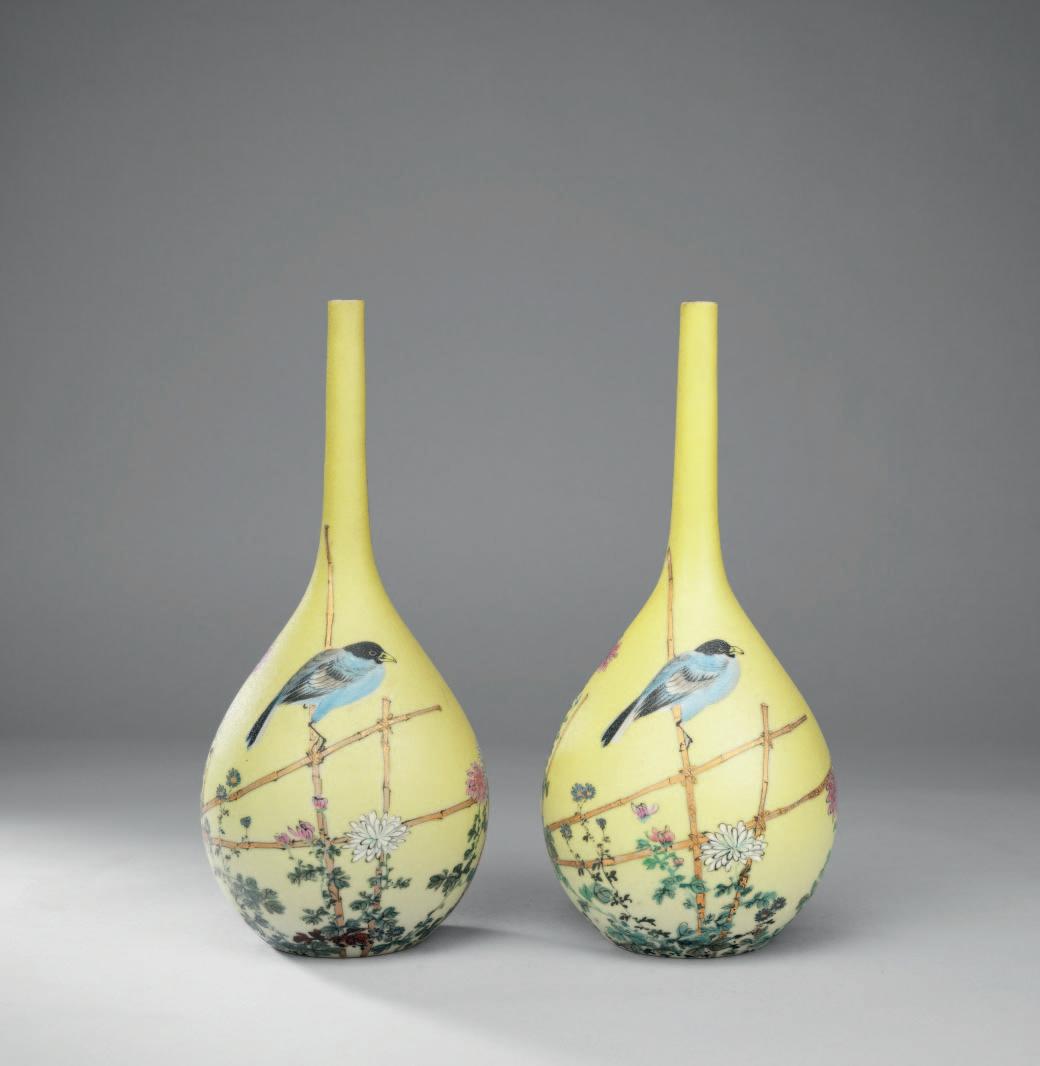
540
A PAIR OF JAPANESE VASES BY TAKEUCHI CHUBEI
MEIJI ERA, 19TH/20TH CENTURY
The tall bottleshaped vases with slender necks; each colourfully painted with a blue bird perched on trellis on which grow chrysanthemum, on a bright lemonyellow ground; each signed Takeuchi sei underneath, 26cm each. (2) WITHOUT RESERVE
£200-400
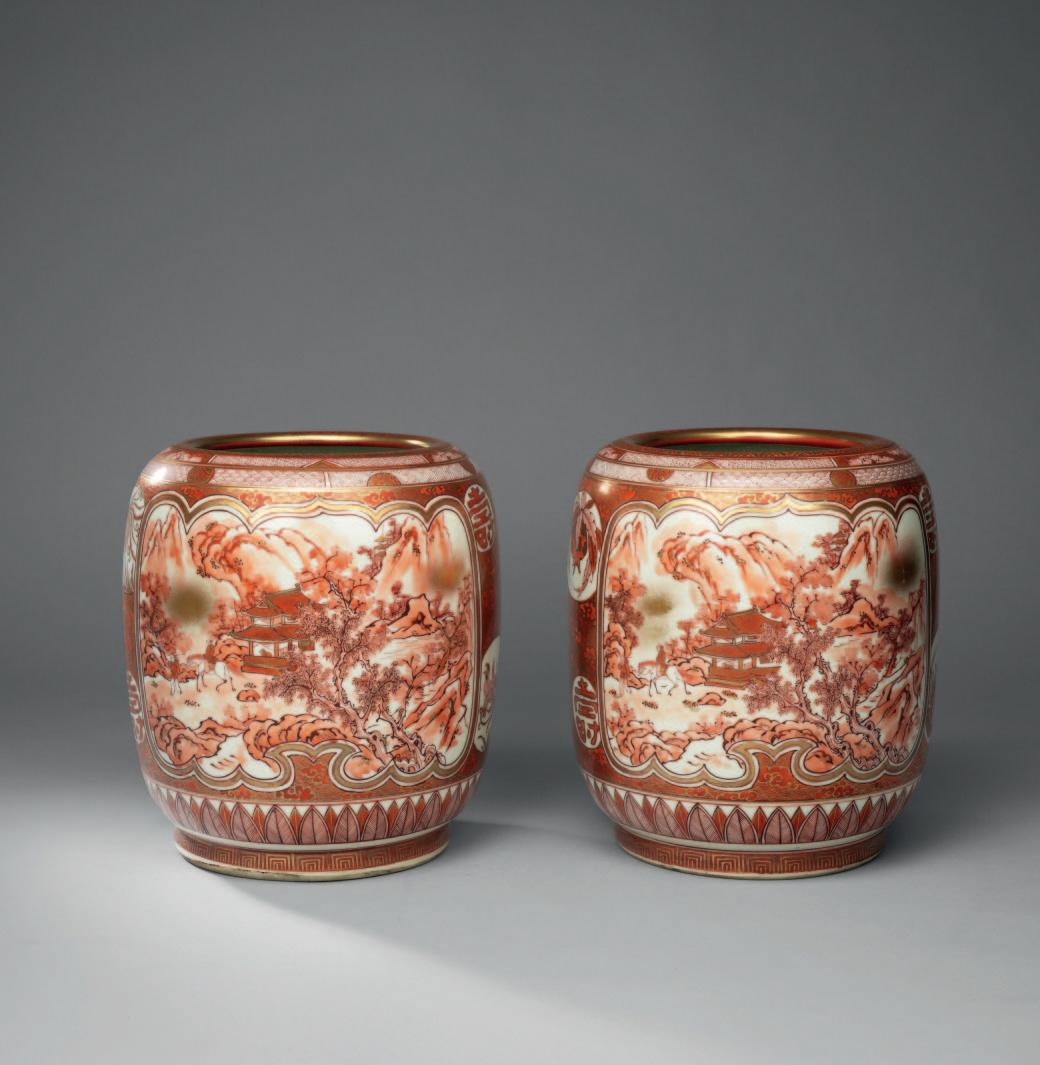
539
A PAIR OF JAPANESE KUTANI VASES BY YOSABURO HASHIDA
MEIJI ERA, 19TH/20TH CENTURY
Each with a tall cylindrical body densely decorated in ironred and gilt, with shaped panels enclosing extensive landscapes, birds and flowers; on a ground of scrolling clouds, waves and roundels enclosing auspicious designs; each signed underneath, both 25cm. (2)
£400-600
Provenance: from a private collection, London.
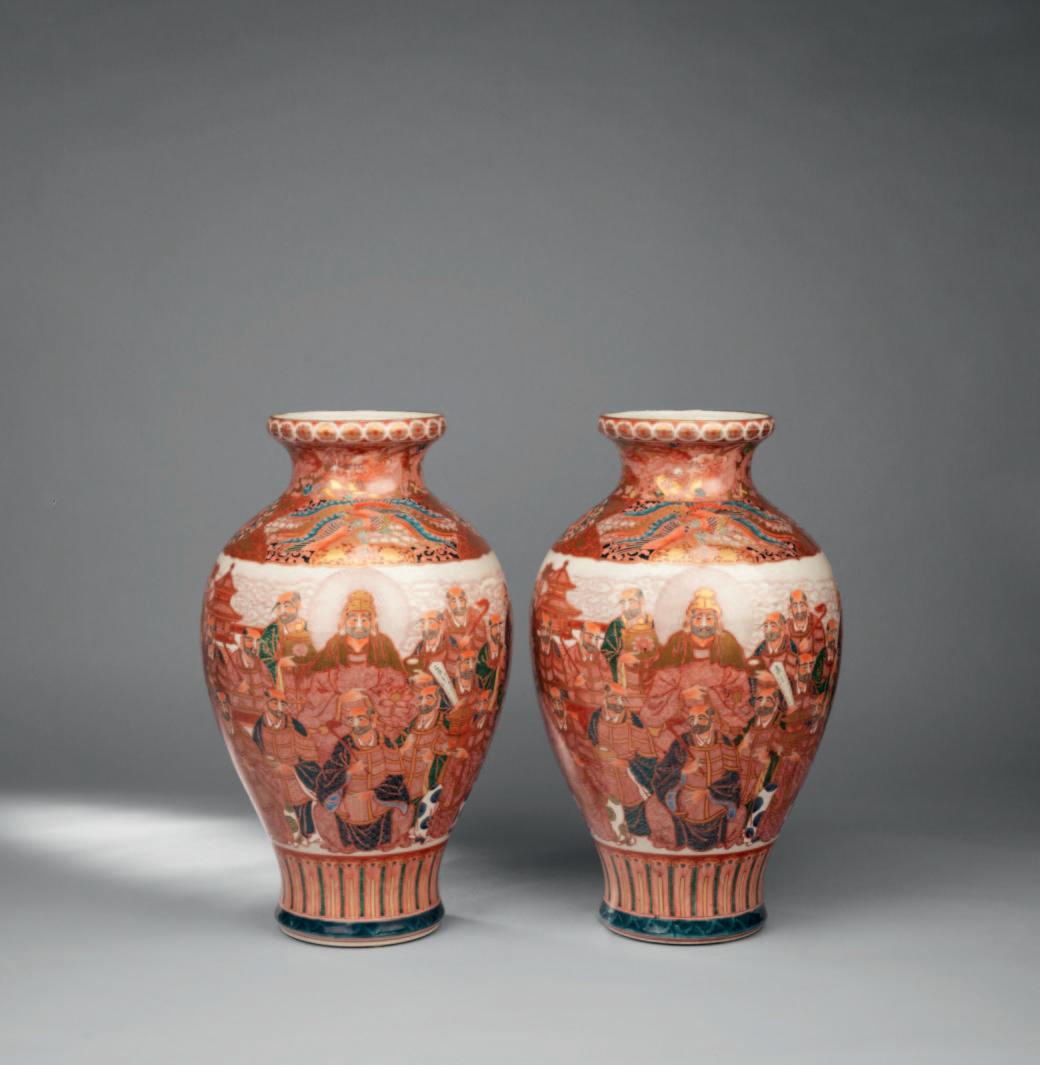
541
A PAIR OF LARGE JAPANESE KUTANI VASES
MEIJI OR LATER, 20TH CENTURY
Each densely decorated with many rakan with their attributes, in between borders of lappets, formal designs, Hōō birds and dragons, all rendered in ironred, gilt and polychrome enamels; both signed Kutani zo, Akiyama sei; 45.5cm each. (2)
£500-800
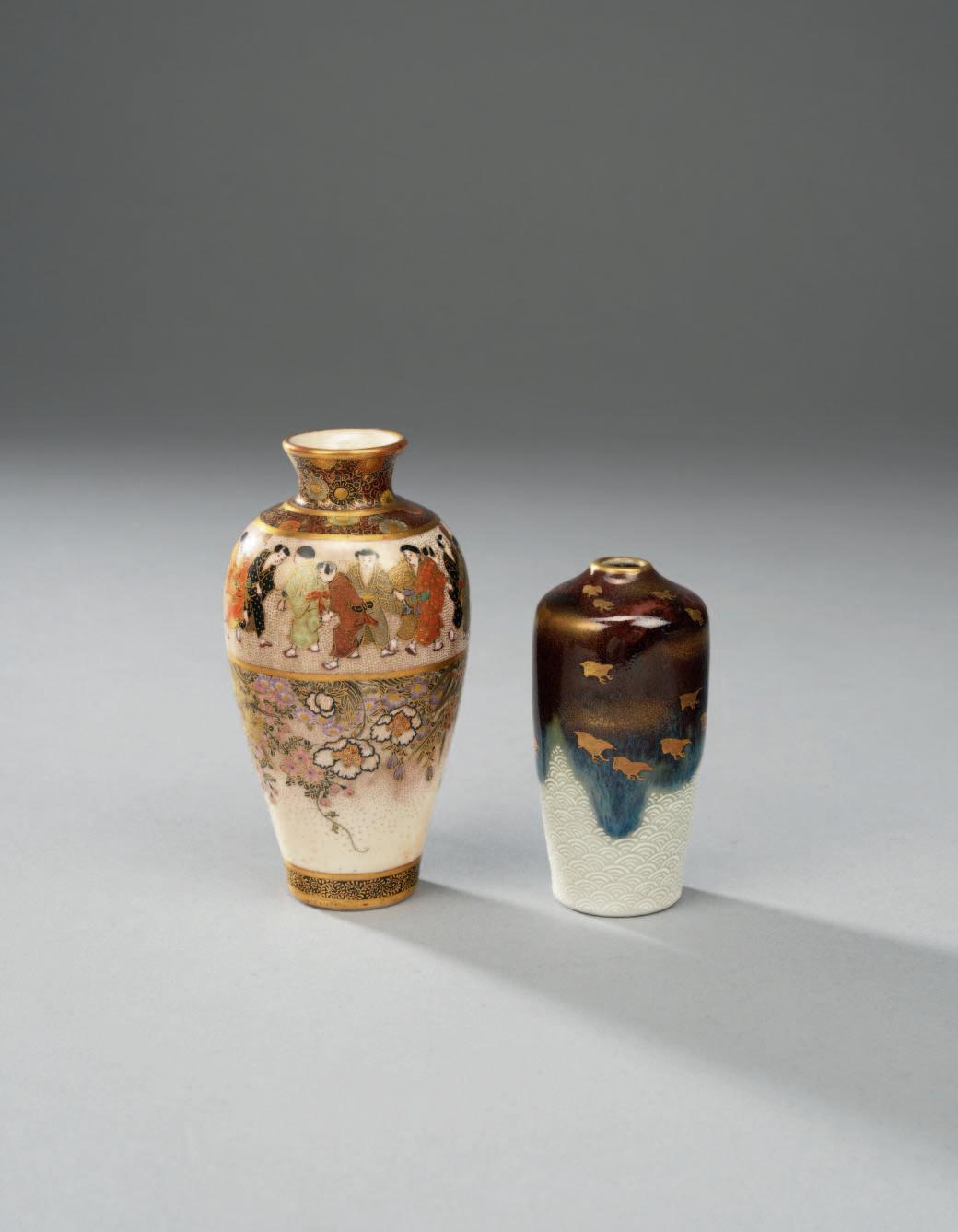
542
TWO MINIATURE JAPANESE VASES
MEIJI ERA, 19TH/20TH CENTURY
One a Satsuma vase decorated with many boys at play, flowers and karakusa scrolls, signed Shizan; the other a Kutani piece with chidori flying above waves, marked Kutani underneath, 10.3cm and 7.6cm. (2)
£200-300
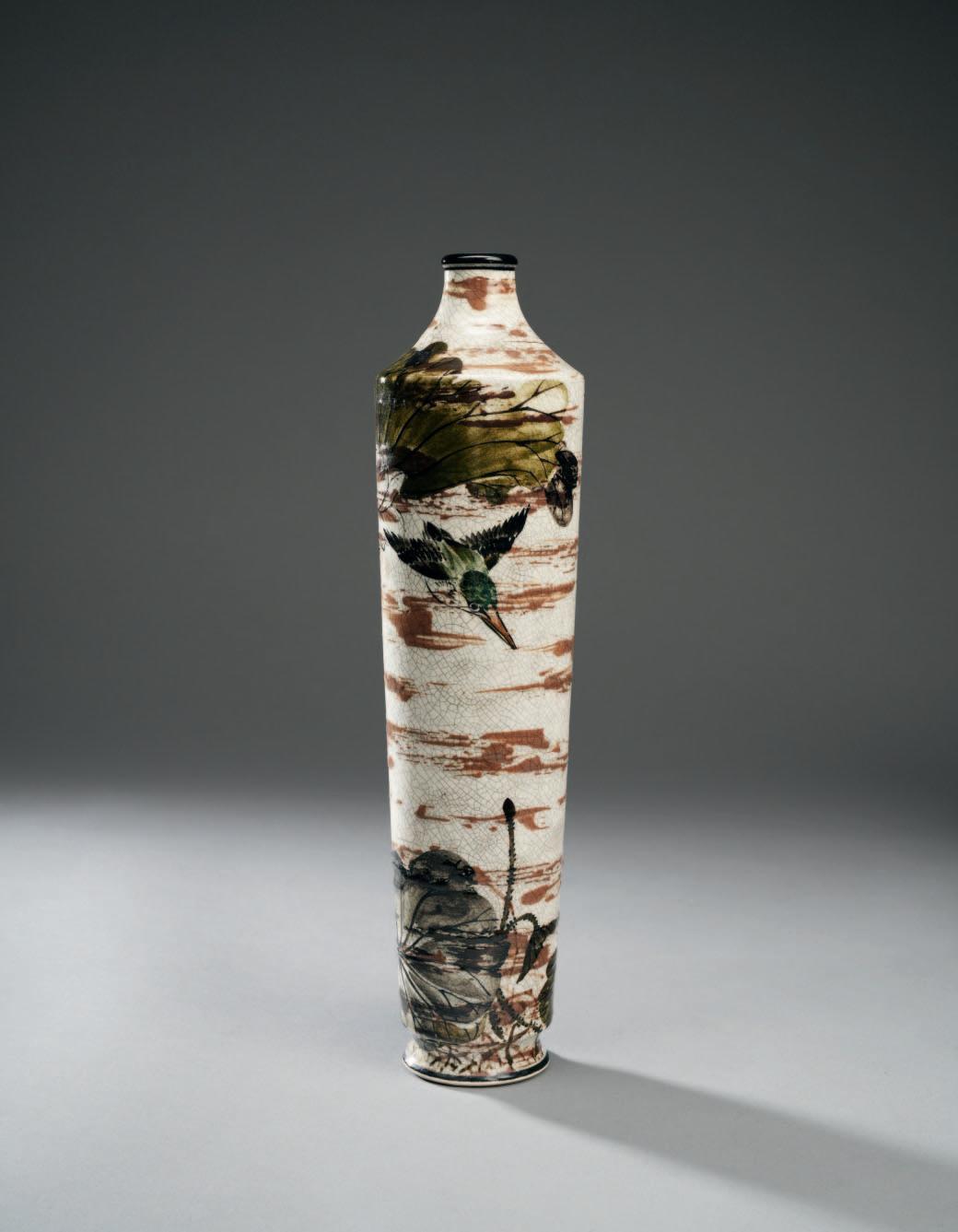
543
A TALL JAPANESE VASE BY TAIZAN
MEIJI ERA, 19TH/20TH CENTURY
Of cylindrical form with a tapered neck, decorated with a kingfisher flying amongst lotus leaves, all on a heavily crazed ground, the base signed Dai Nihon Taizan sei, 37cm.
£300-500
Provenance: from the collection of Robert L Stolper of Stolper Galleries, and thence by descent. Robert worked with Asian and African art from the 1940s onwards in Amsterdam, Munich, New York and the UK.
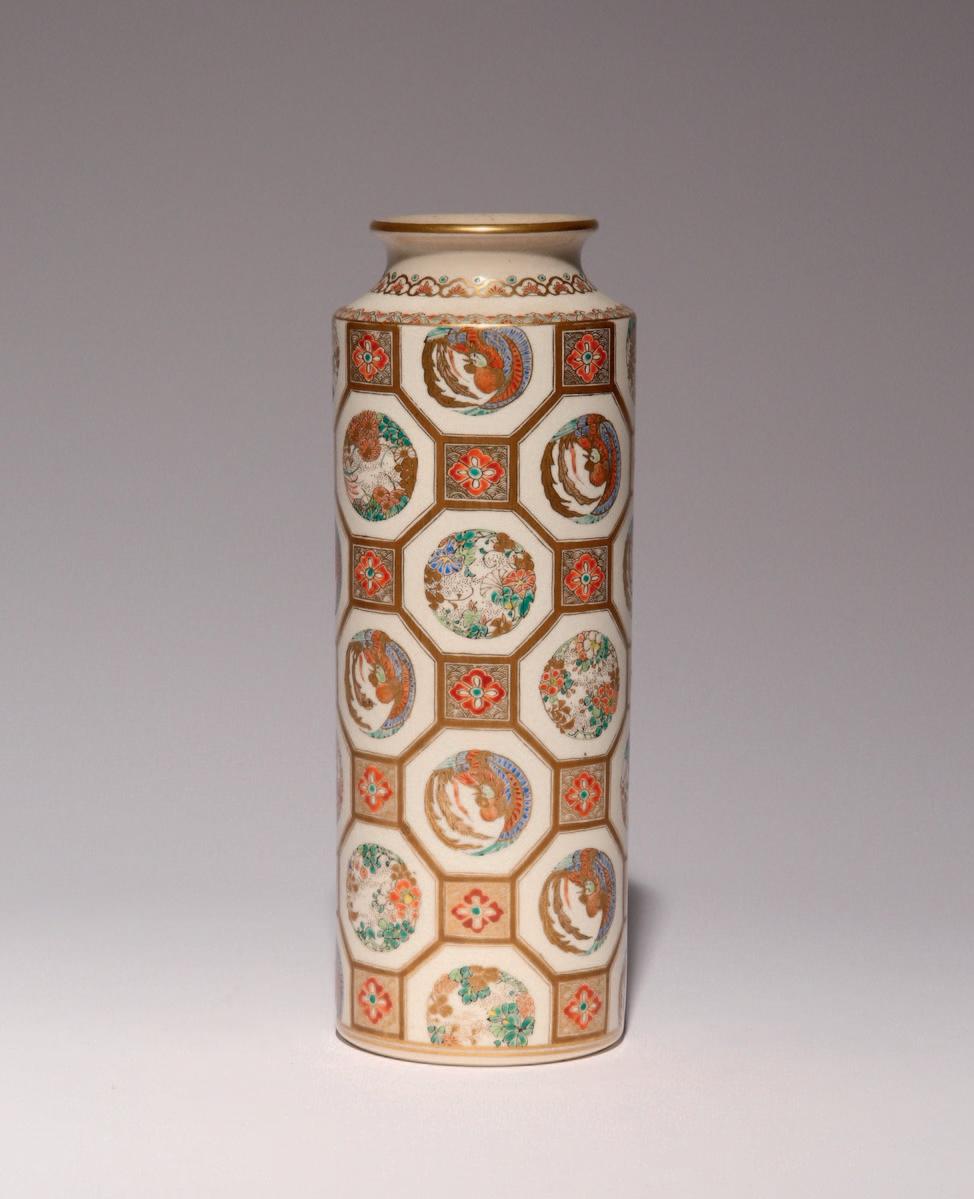
544
A JAPANESE VASE BY TAIZAN
MEIJI PERIOD, 19TH/20TH CENTURY
The tall cylindrical body decorated in polychrome with a brocade pattern enclosing floral and Hōō birdshaped mon, the base with a sixcharacter mark for Dai Nihon Taizan sei, 22.5cm.
WITHOUT RESERVE
£150-250
545
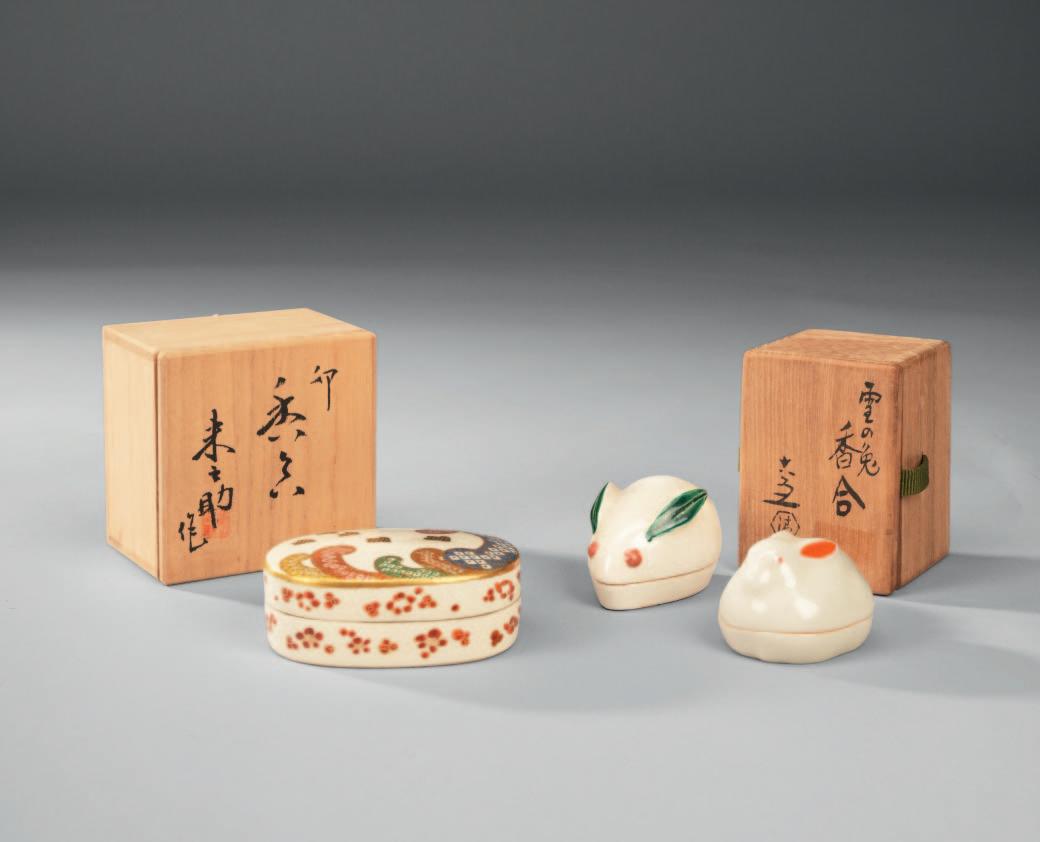
THREE JAPANESE KŌGŌ (INCENSE BOXES AND COVERS)
MEIJI AND LATER, 19TH AND 20TH CENTURY
Two shaped as stylised rabbits, one Kyō-yaki by Ishida Rainosuke (b.1903) with orange ears and eyes, stamped Rainosuke underneath and with a tomobako (wood box) inscribed and signed; the other with green ears, with a stamped mark for Rokubei, in a tomobako inscribed, signed and sealed, possibly by Kiyomizu Rokubei V (18751959); the third a Satsuma example of oval shape with chidori flying over crashing waves, brocade patterns and flowers, signed Gyokuzan under the Shimazu mon underneath; 8.5cm max. (8)
£600-800
546
A PAIR OF JAPANESE VASES BY THE KINKOZAN WORKSHOP
MEIJI OR LATER, 20TH CENTURY
Decorated with birds in flight amongst prunus and chrysanthemum, with gilt clouds beside them; all framed by borders of brocade patterns; both signed Kinkozan Kyōryū zo, 30.3cm each. (2)
WITHOUT RESERVE
£400-600
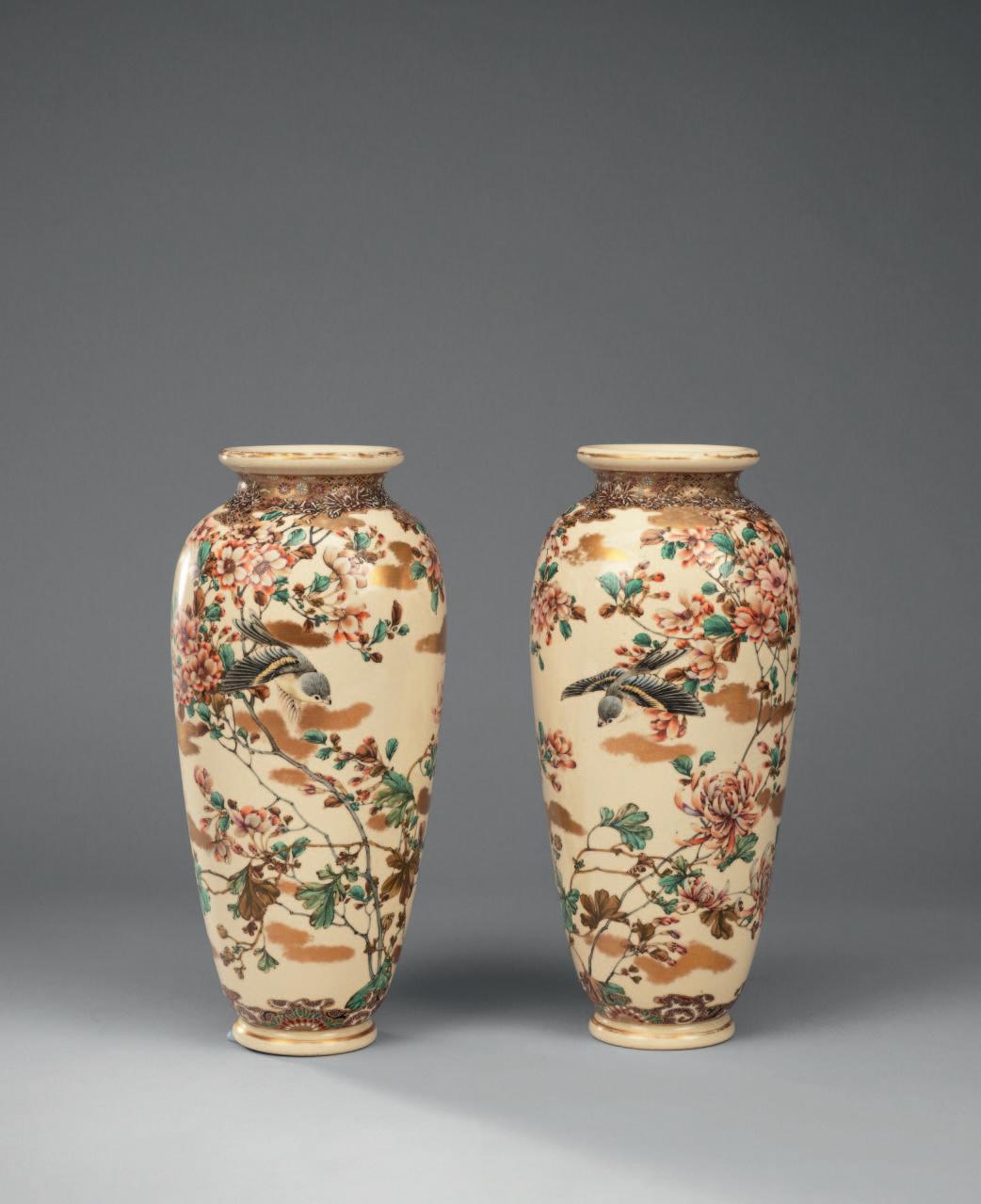
547
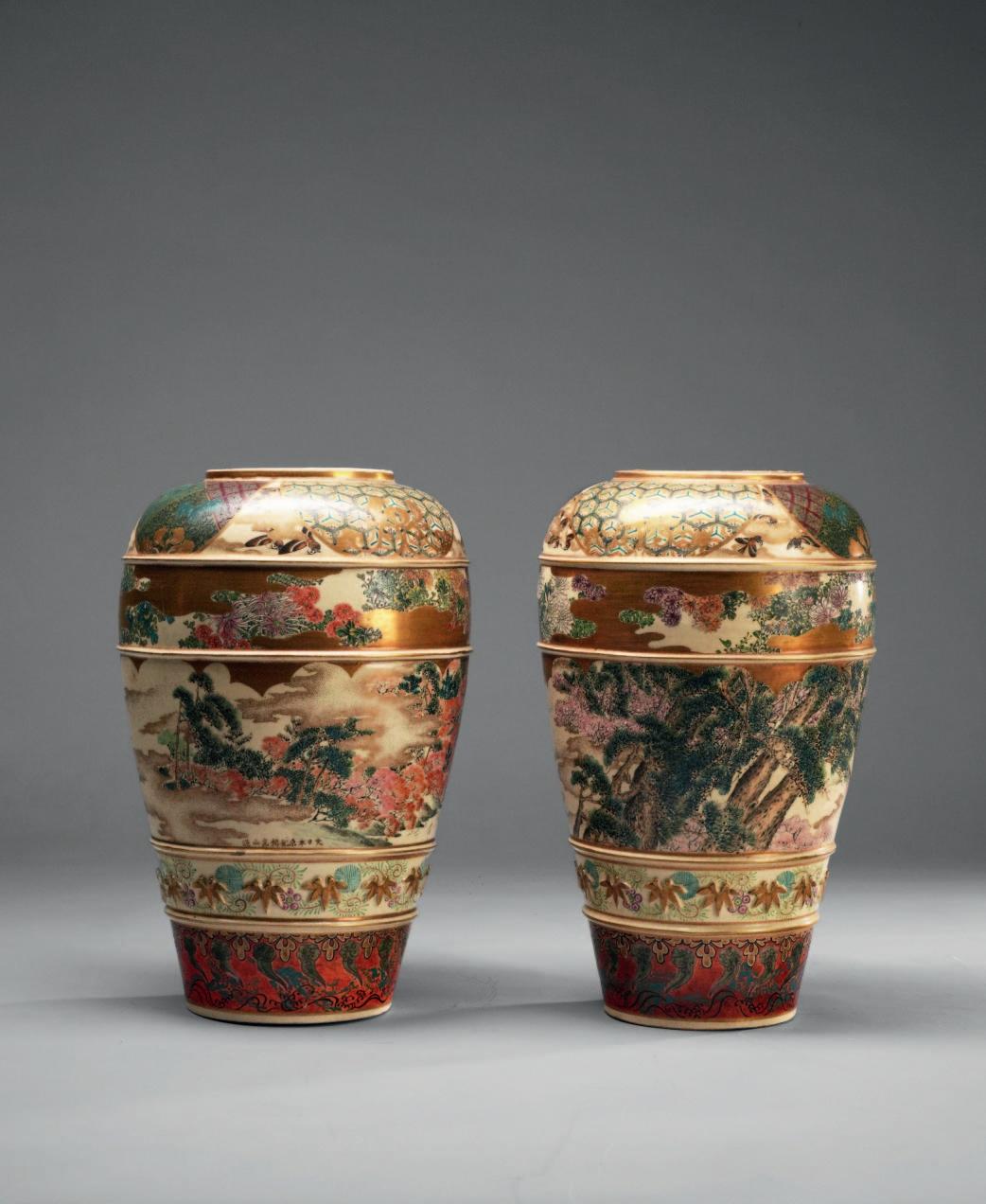
A PAIR OF LARGE SATSUMA VASES BY THE KINKOZAN WORKSHOP
MEIJI OR LATER, 20TH CENTURY
The tall bodies decorated with bands of dense designs including sparrows, flowers, brocade patterns, and views of bridges underneath pine trees, one with a figure on a raft; with moulded rings and bamboo leaves rendered in relief; each vase signed horizontally Dai Nihon Kyoto Kinkozan zo, both 33cm. (2)
WITHOUT RESERVE
£300-500
548
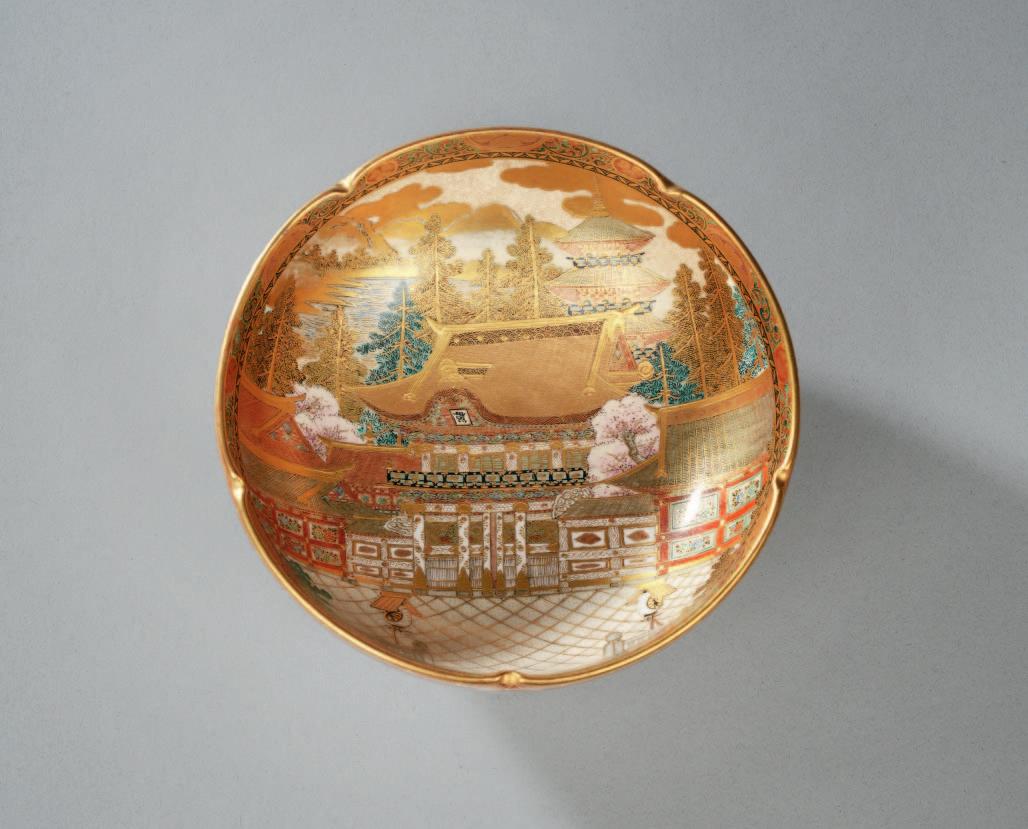
A JAPANESE SATSUMA FOLIATE BOWL BY NIKKO MEIJI ERA, 19TH/20TH CENTURY
The well richly decorated with the Yōmeimon Gate at Nikko Tōshōgū Shrine, the rim with a border of karakusa scrolls and mon (family crests), the reverse with two panels enclosing landscapes and with similar borders, the base signed Satsuma Nikko zo beneath the Shimazu mon, 15.9cm.
£200-300
549
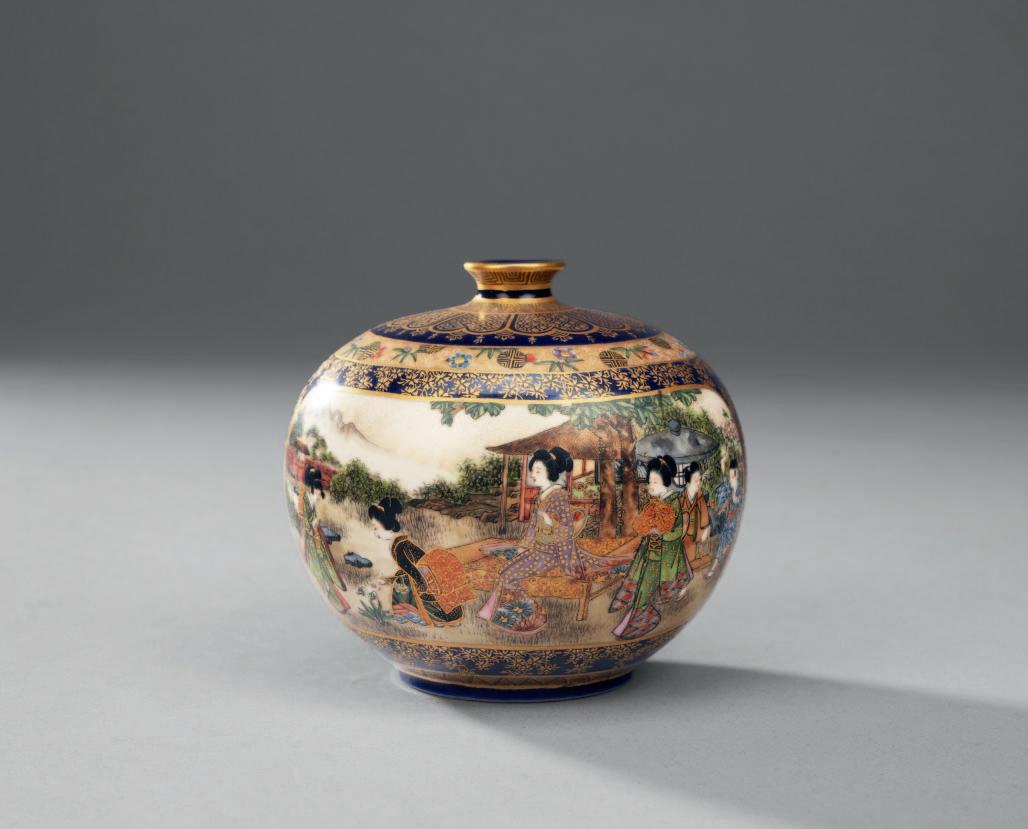
A JAPANESE SATSUMA VASE BY THE KINKOZAN WORKSHOP MEIJI ERA, 19TH/20TH CENTURY
Of bulbous form with a short everted rim, decorated with two large panels enclosing beauties and children in gardens, all reserved on a deep midnightblue ground embellished with flowers and brocade designs in gilt, the shoulder with a border of colourful flowers and bamboo leaves, the base signed Kinkozan zo, 9cm.
£400-600
550
TWO JAPANESE SATSUMA PIECES MEIJI ERA, 19TH/20TH CENTURY
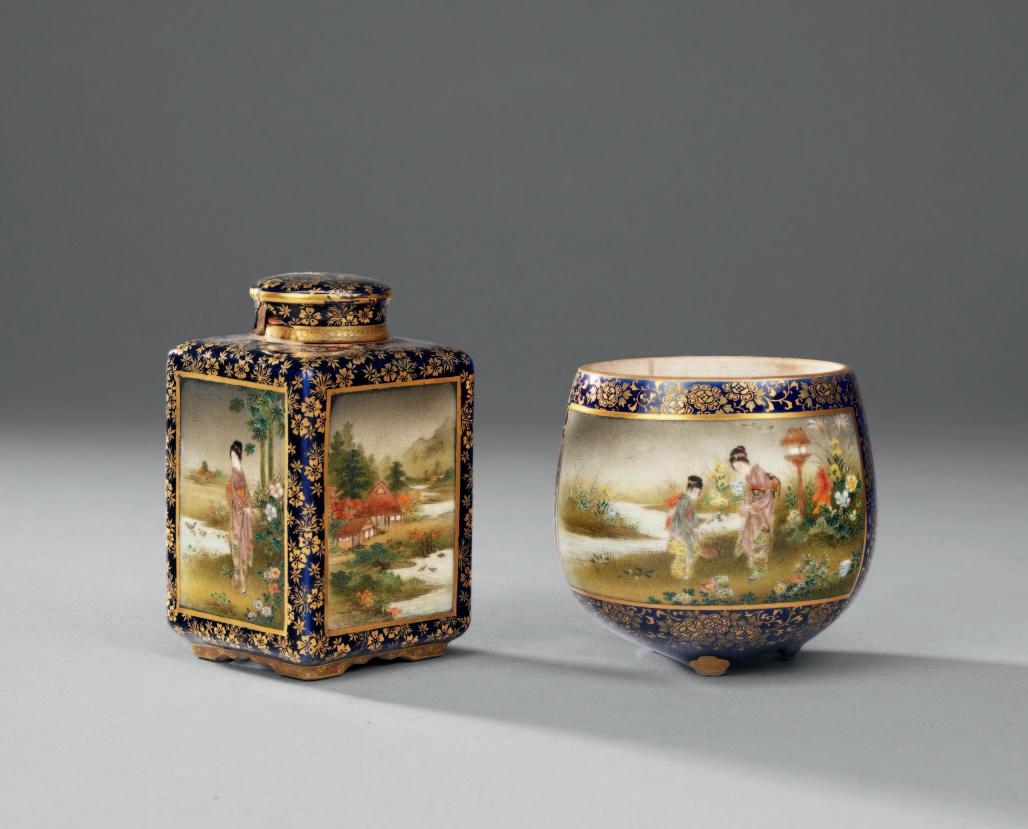
Both painted with panels enclosing beauties in gardens, chickens and landscapes, all reserved on midnightblue grounds embellished with floral patterns in gilt; the first a cup raised on three feet, the other a small tea caddy with an inner lid and cover, both with ornate signatures with flowers reading Kinkozan zo and Keizan, 9.2cm. (4)
£400-600
551
A GOOD JAPANESE SATSUMA BOWL BY THE KINKOZAN WORKSHOP
MEIJI ERA, 19TH/20TH CENTURY
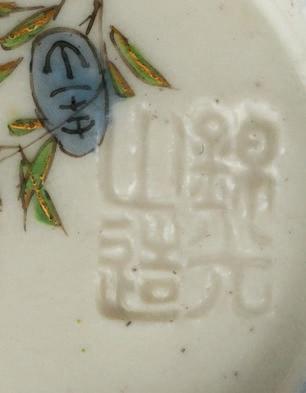
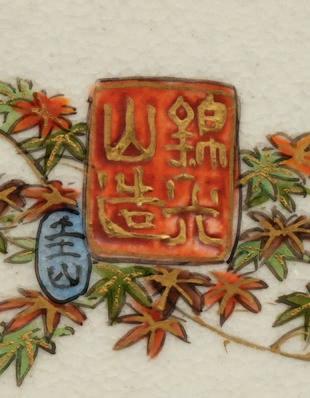
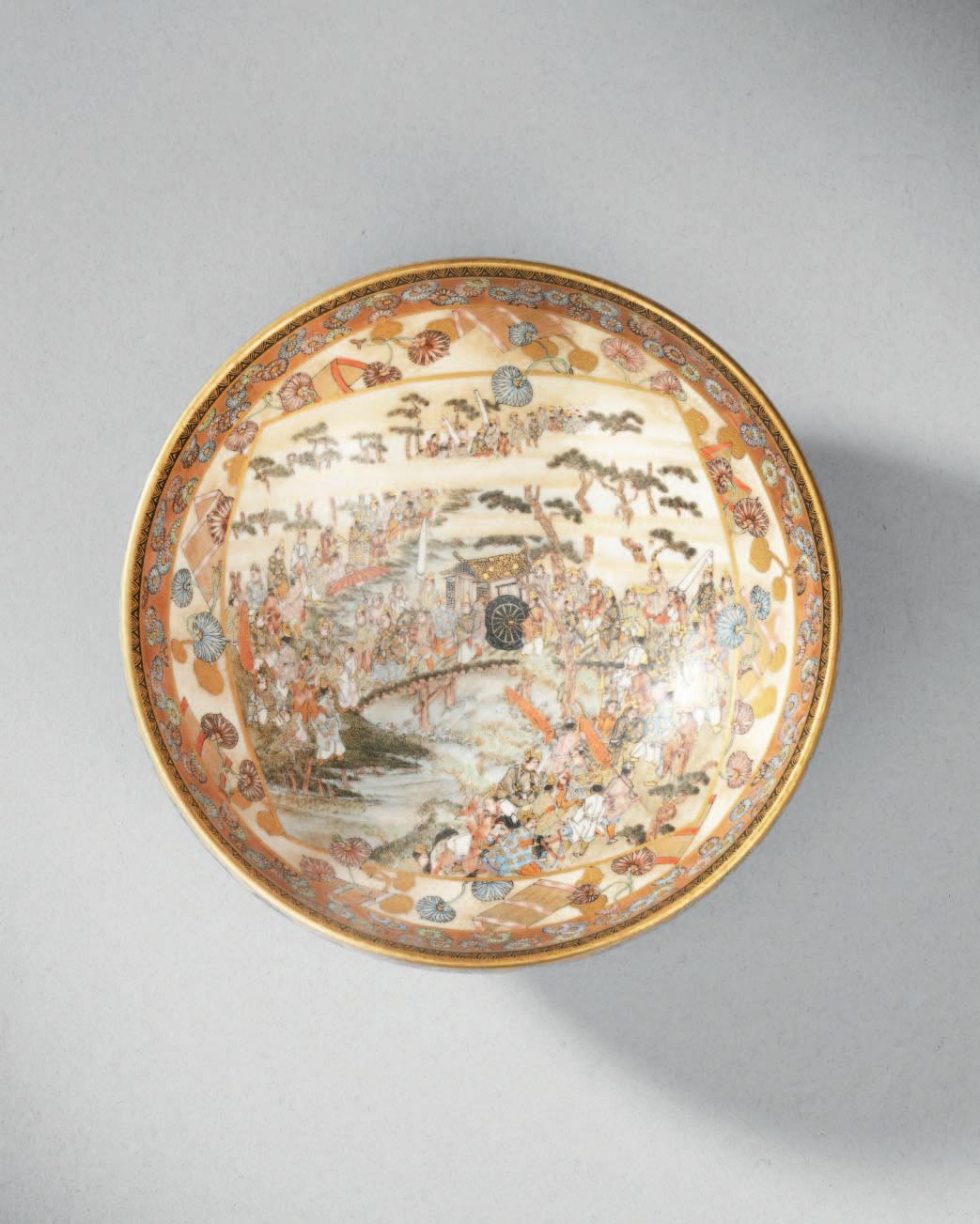
Richly decorated inside and out, the well with a central panel enclosing a complex scene of a long procession with a central oxdrawn cart, the figures walking on a bridge and by a river; all framed by colourful flowers and leaves, bamboo curtains, and triangular lappets; the reverse delicately painted with further borders of flowerheads and a wide continuous band enclosing a very large number of men, women and children, all wearing colourful garments and depicted at leisure; the base signed Kinkozan zo in a square cartouche, 12.6cm.
£3,000-4,000
552
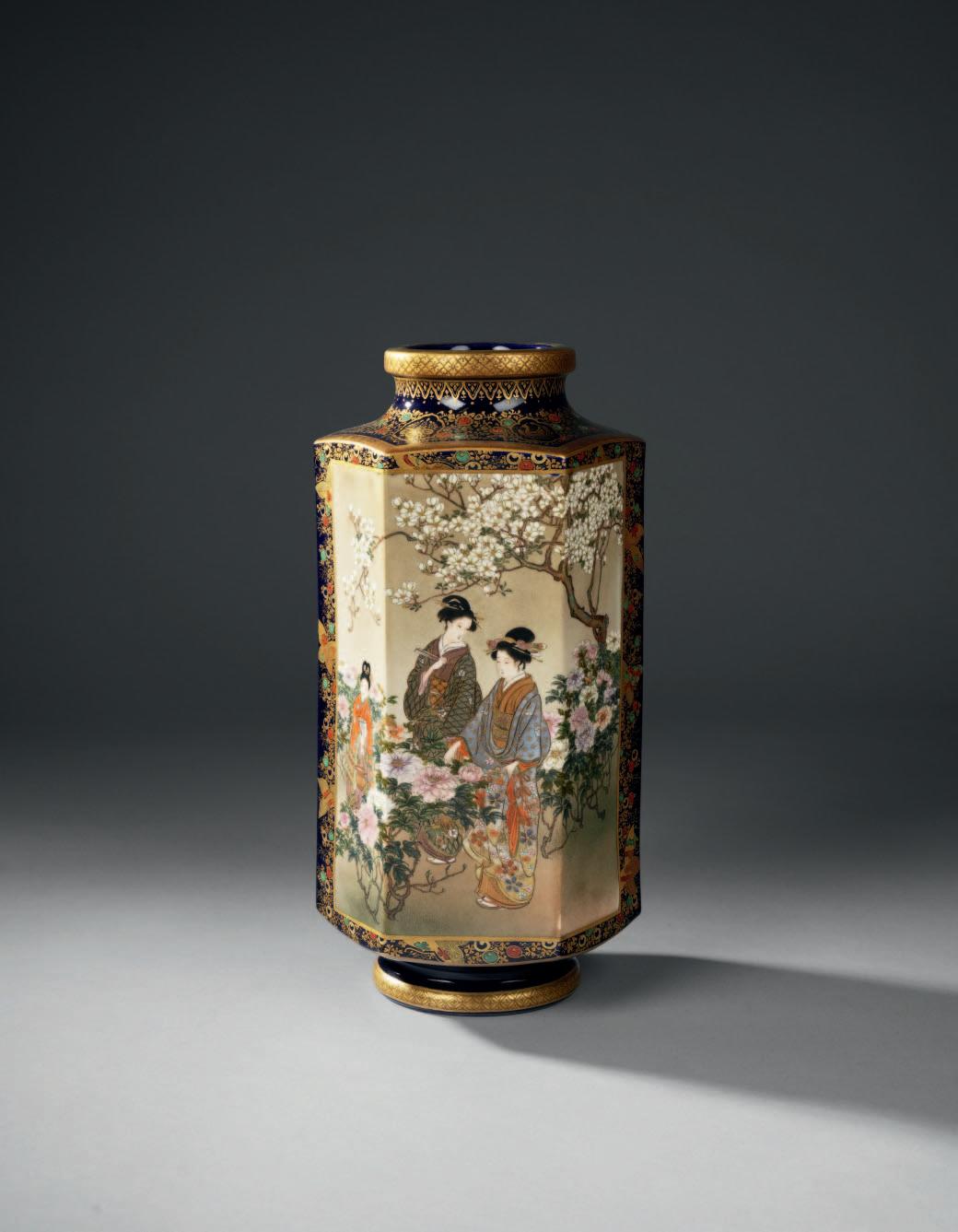
A TALL JAPANESE SATSUMA VASE BY THE KINKOZAN WORKSHOP
MEIJI ERA, 19TH/20TH CENTURY
The hexagonal body raised on a short circular foot, with a waisted neck and a lipped rim; richly decorated with two large panels, one enclosing two beauties and a small girl in a luxuriant garden, observing the large pink peonies before them, with a tall magnolia in bloom behind them; the reverse with two chickens standing beside a tall flowering prunus tree and other flowers; all reserved on a midnightblue ground embellished with gilt decoration of mon, birds and flowers, with borders of chevrons, lappets and other diaper patterns; the base marked Kinkozan zo, 31cm.
£800-1,200
Provenance: from an English private collection, Sussex.
553
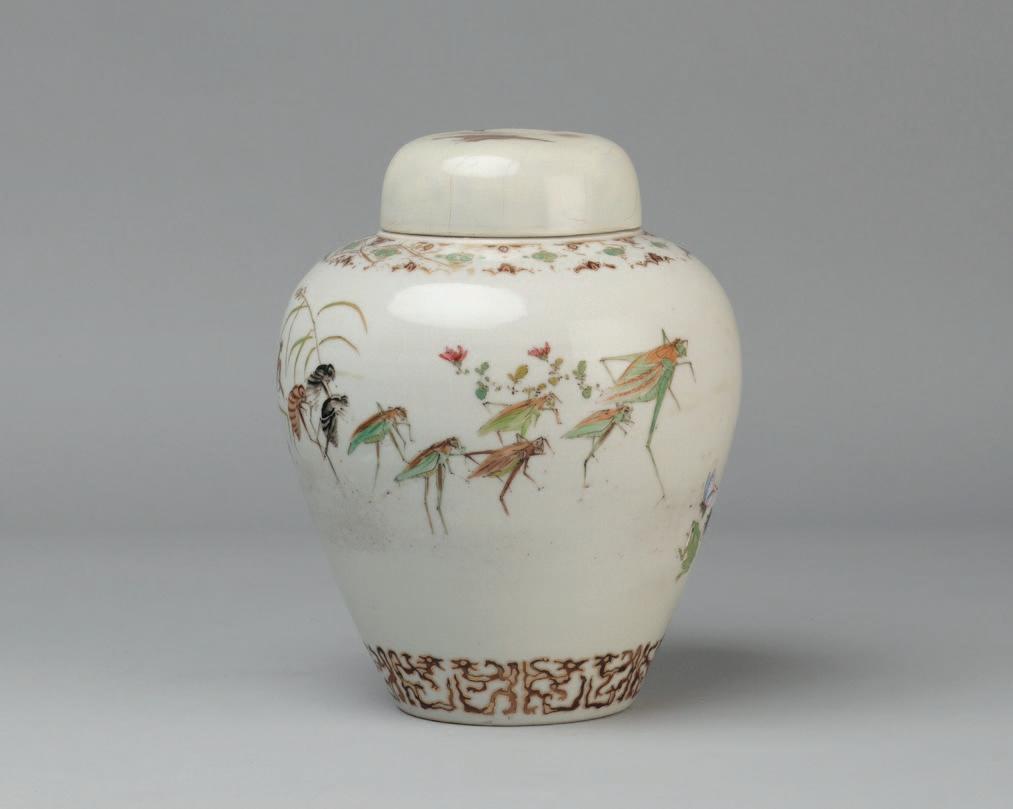
A JAPANESE VASE AND COVER WITH A PROCESSION OF INSECTS
MEIJI ERA, 19TH/20TH CENTURY
Decorated in polychrome enamels and gilt with a continuous scene of many grasshoppers and other insects carrying flowers as weapons or insignia; the lid with butterflies; signed Nihon Yokohama Imura sei, for Hikojirō (Hikotaru) Imura, 20cm. (2)
£200-300
555
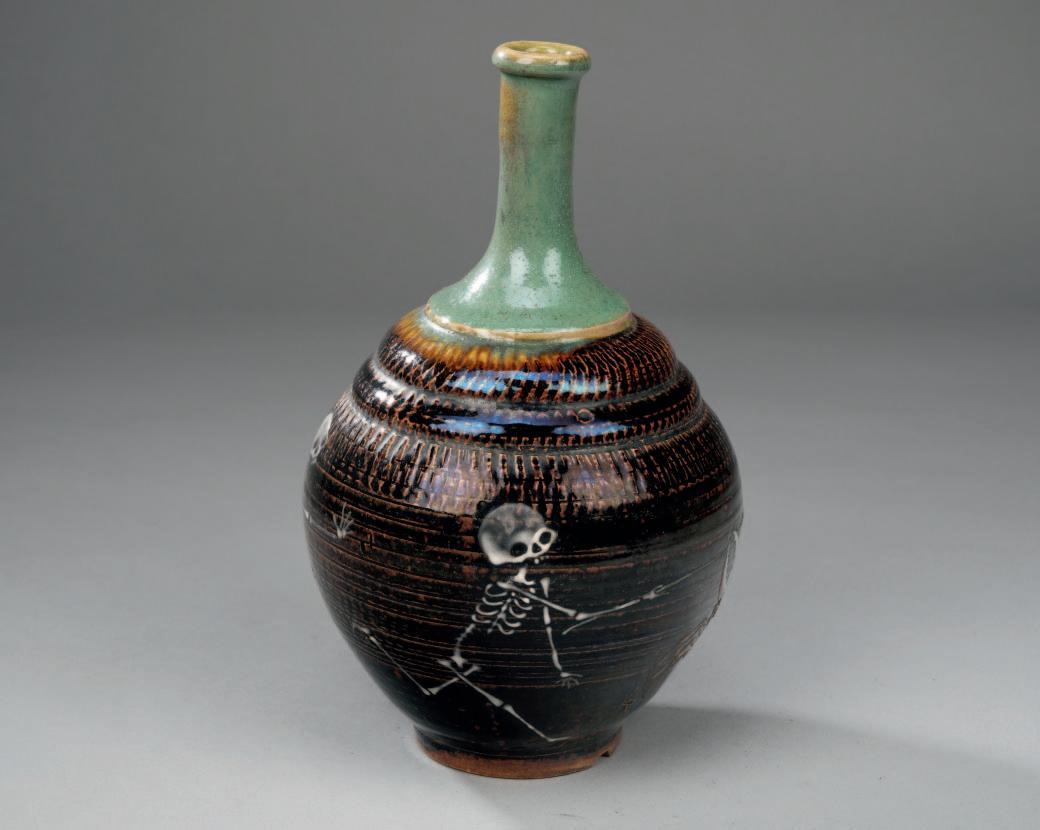
A HUMORISTIC JAPANESE VASE WITH SKELETONS
MEIJI OR LATER, 20TH CENTURY
The bottle vase with three skeletons fighting and running away from a large crab, all rendered in enamels on the celadon and brown ground, 23cm.
WITHOUT RESERVE
£300-500
554
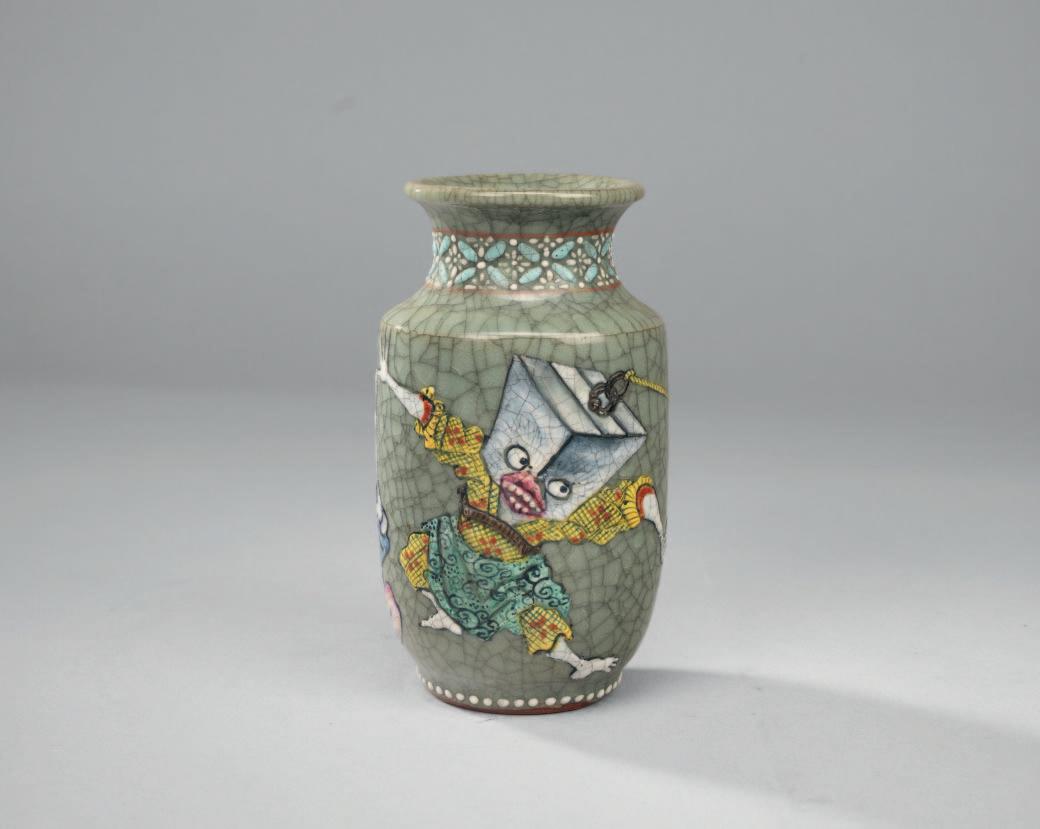
A HUMORISTIC JAPANESE VASE WITH TSUKUMOGAMI
MEIJI OR LATER, 20TH CENTURY
Of baluster form with a crackled celadon ground, decorated in colourful enamels with animated objects including a water bucket, 14.4cm.
WITHOUT RESERVE
£150-250
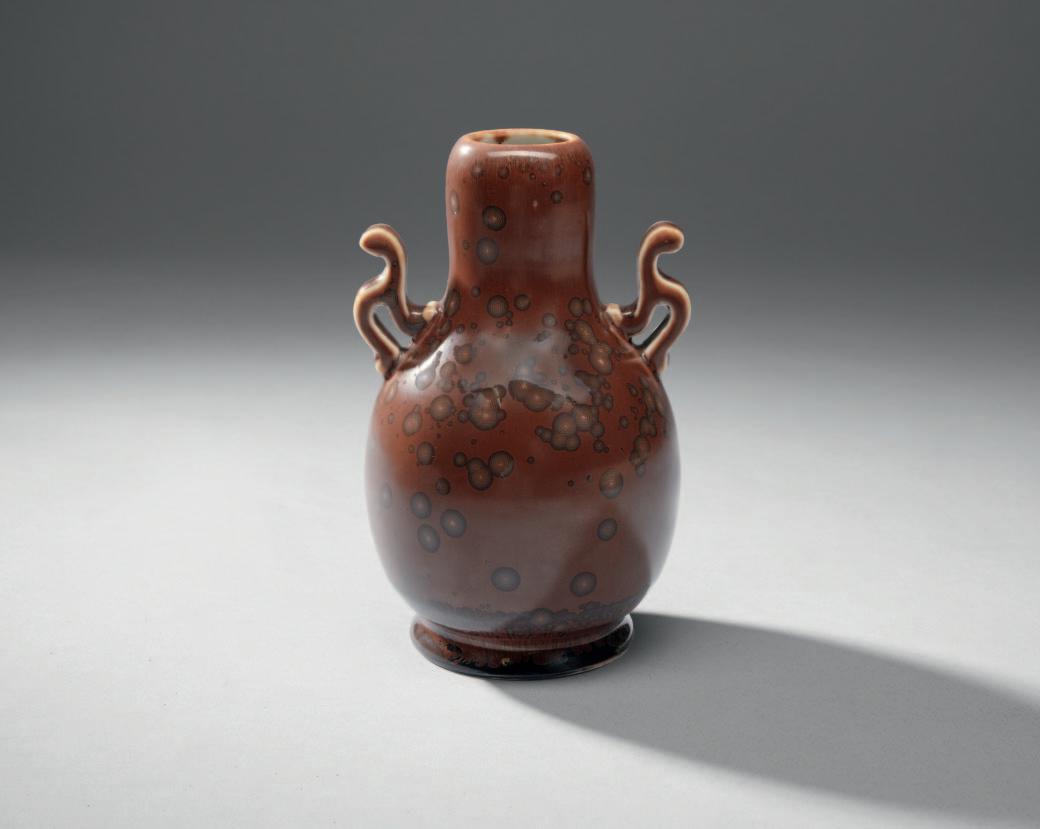
556
A RARE JAPANESE VASE BY MIYAGAWA (MAKUZU) KŌZAN (18421916)
MEIJI ERA, 20TH CENTURY
The pearshaped body raised on a flared foot, with scrolling handles applied to the shoulder; decorated in an unusual chocolatebrown puddingstone glaze, the footrim with a stamped Kōzan mark, 17.5cm.
WITHOUT RESERVE
£500-1,000
See the British Museum, access. no.1981,0601.1 for a related vase by Kōzan with a similar glaze originally purchased from Sydney L Moss Ltd. Also, see the Carnegie Museum, access. no.2021.12.1.A-.B for another example.
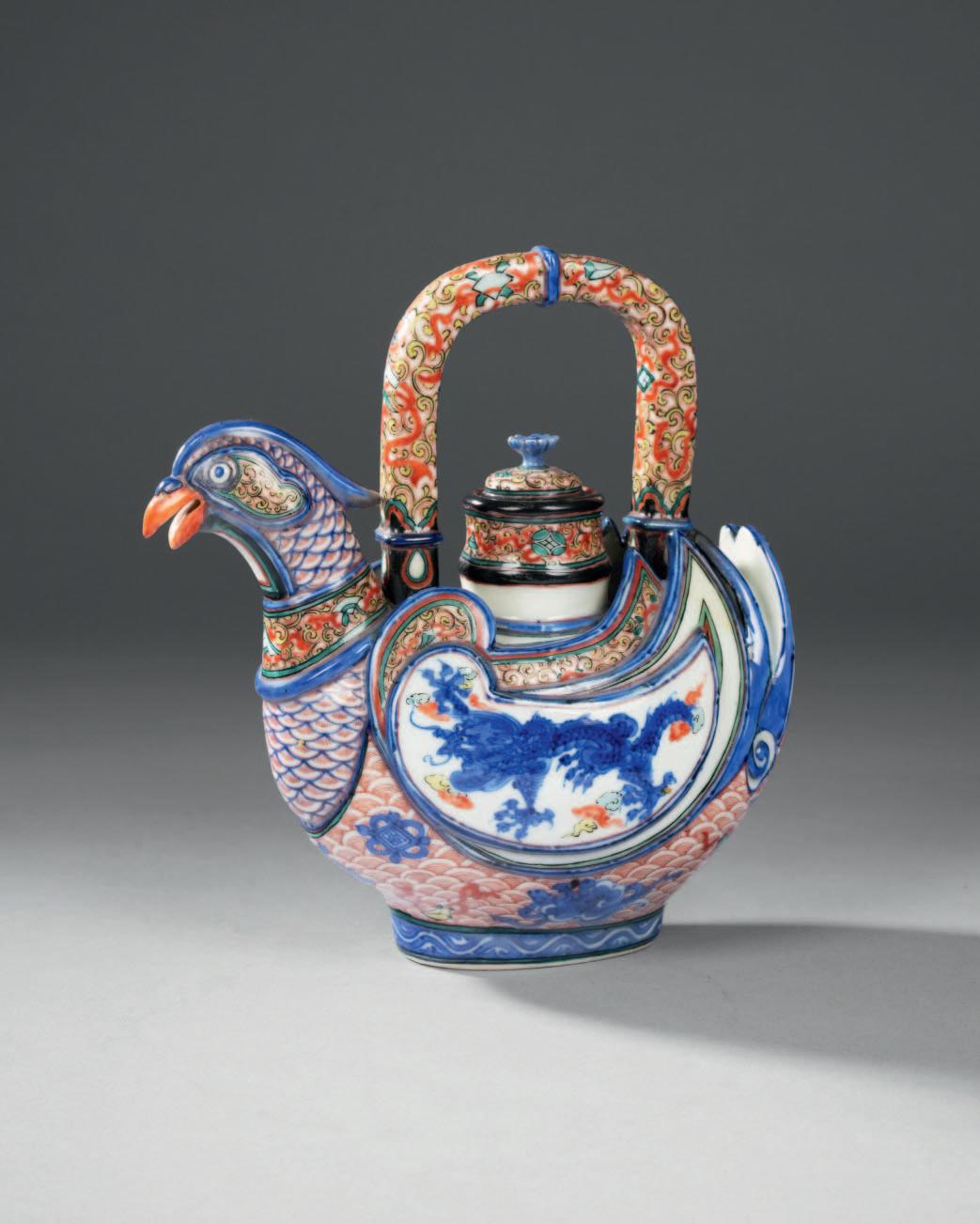
557
A JAPANESE TEAPOT AND COVER BY MIYAGAWA (MAKUZU)
KŌZAN (18421916)
MEIJI ERA, 19TH/20TH CENTURY
Modelled as a fantastical bird with curled feathers, the head forming the spout; with a tall bail handle above and the cover with a flowershaped knop; decorated allover in brightly coloured enamels with auspicious objects amongst scrolling tendrils and seigaiha, the wings with writhing dragons; the base signed Makuzu Kozan sei in a rectangular cartouche, 19cm. (2)
£2,000-3,000
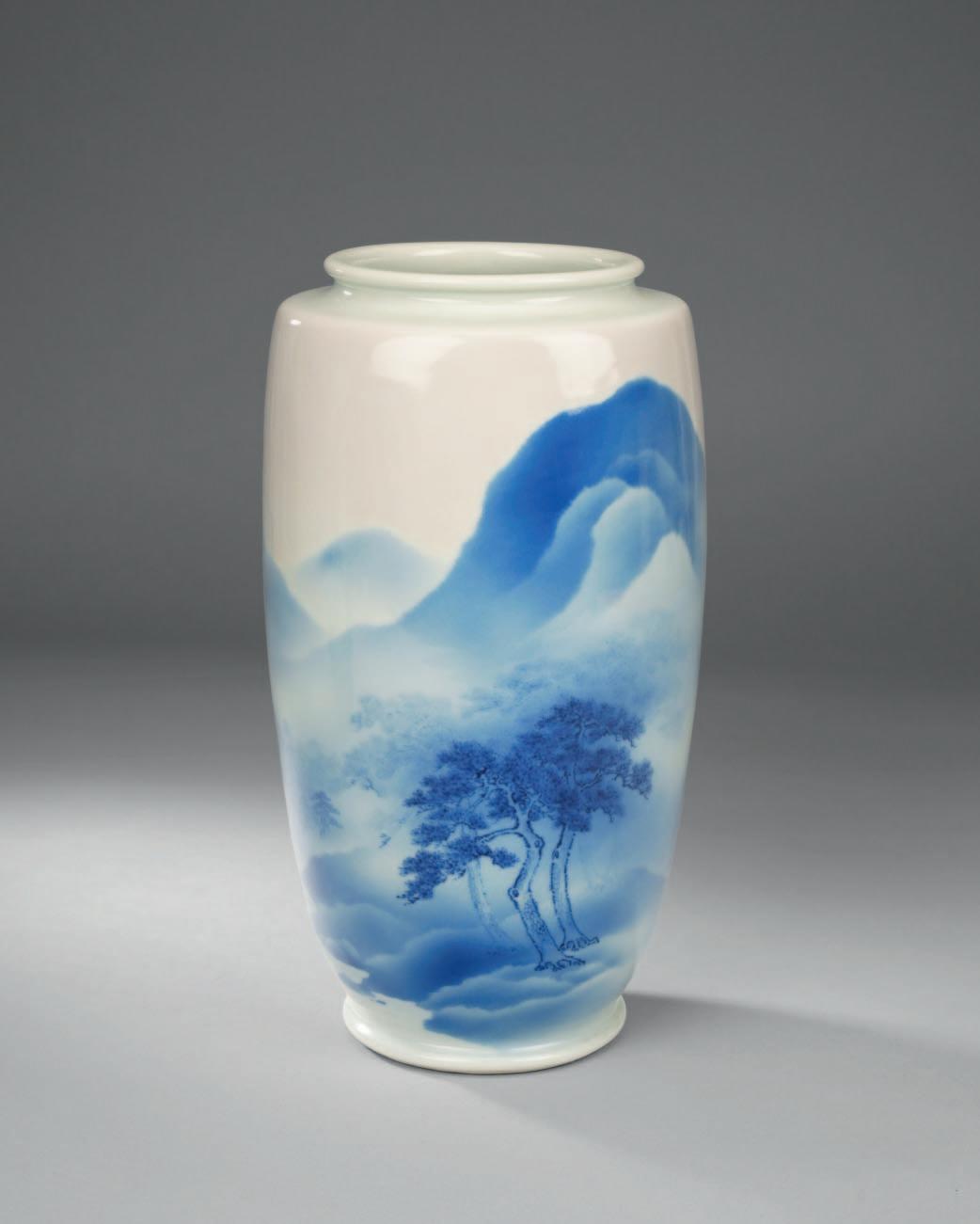
558
A TALL JAPANESE VASE BY MAKUZU KOZAN (18421916)
MEIJI OR TAISHŌ PERIOD, 20TH CENTURY
The cylindrical body decorated with a continuous river landscape in underglaze blue and with a faint pink hue in the sky above, with a meandering stream and many pines fading away into the mist, the base signed Makuzu Kozan sei, 30.7cm.
£1,500-2,500
Provenance: from an English private collection, purchased in these rooms, Japanese Works of Art, 7 December 2020, lot 255.
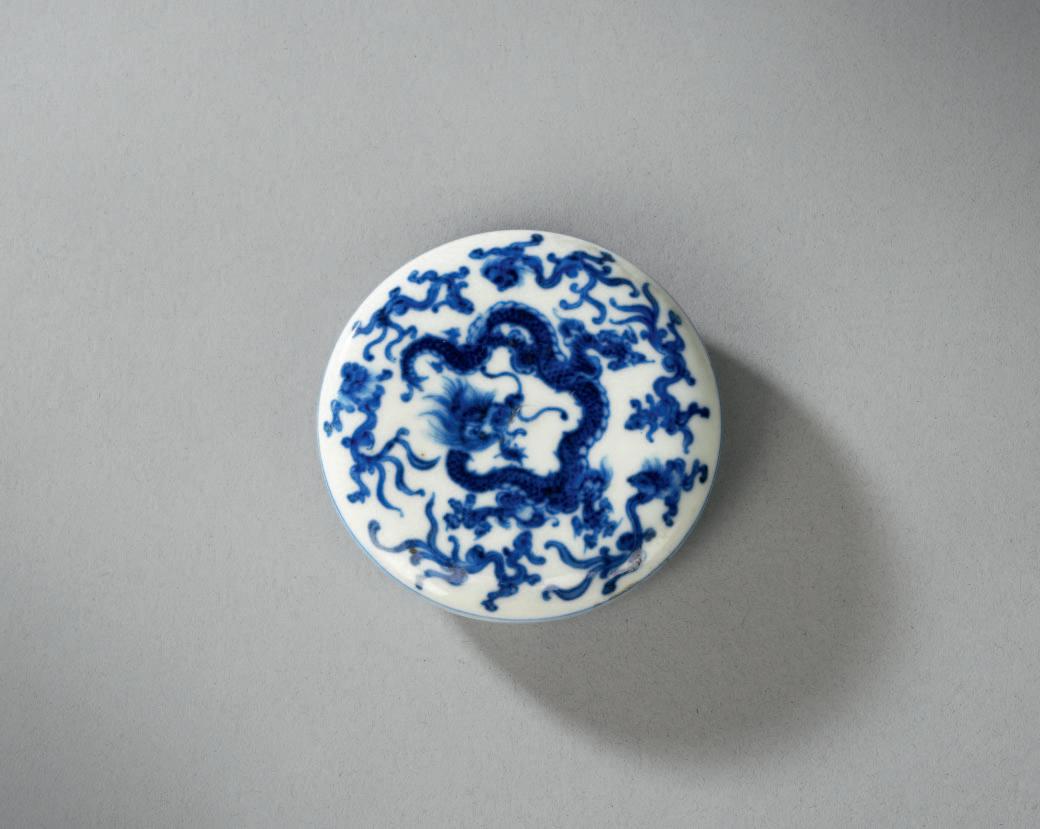
559
A BLUE AND WHITE INK CONTAINER 19TH/20TH CENTURY
Of circular shape, the lid decorated with a large writhing dragon amongst smaller ones, the lower half with three further dragons and marked Fukuju Muruo (Infinite happiness and longevity) underneath, 8.3cm. (2)
WITHOUT RESERVE
£400-600
560
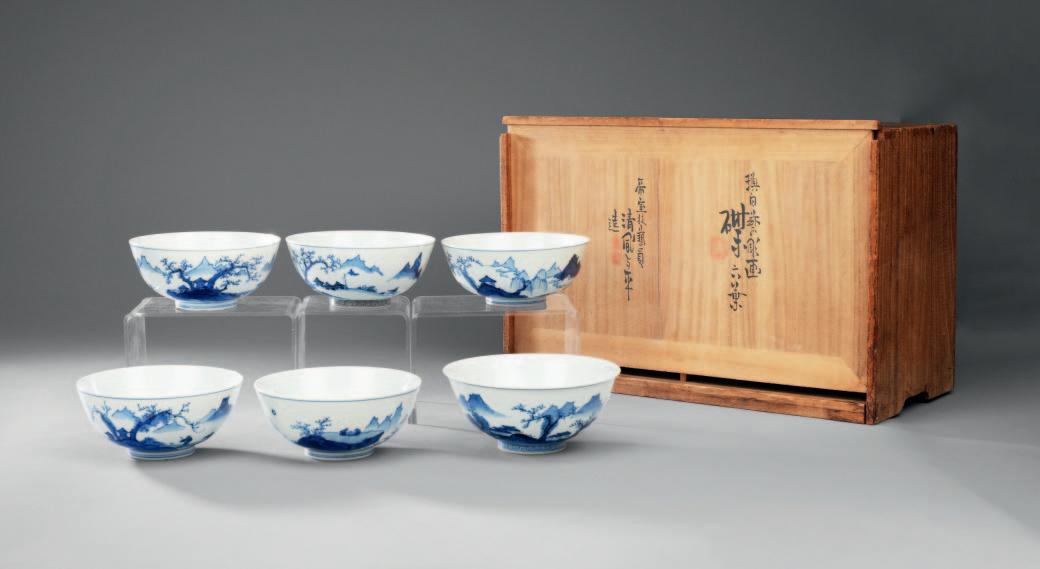
SIX JAPANESE BLUE AND WHITE BOWLS BY SEIFU YOHEI III (18511914)
MEIJI OR TAISHŌ, 20TH CENTURY
Each painted in underglaze blue with horse riders and other figures in a continuous landscape, two raised on short feet decorated with spirals; in a box inscribed Kanhakujiboriga kawagutsu rokuyou (Six incised white porcelain shallow dishes), signed Teishitsugigeiin Seifu Yohei tsukuru with two seals, one reading Seifu; each bowl incised Seifu, five bowls measuring 13.8cm and the sixth 15cm. (7)
£500-800
Provenance: from an English private collection, Devon.
561
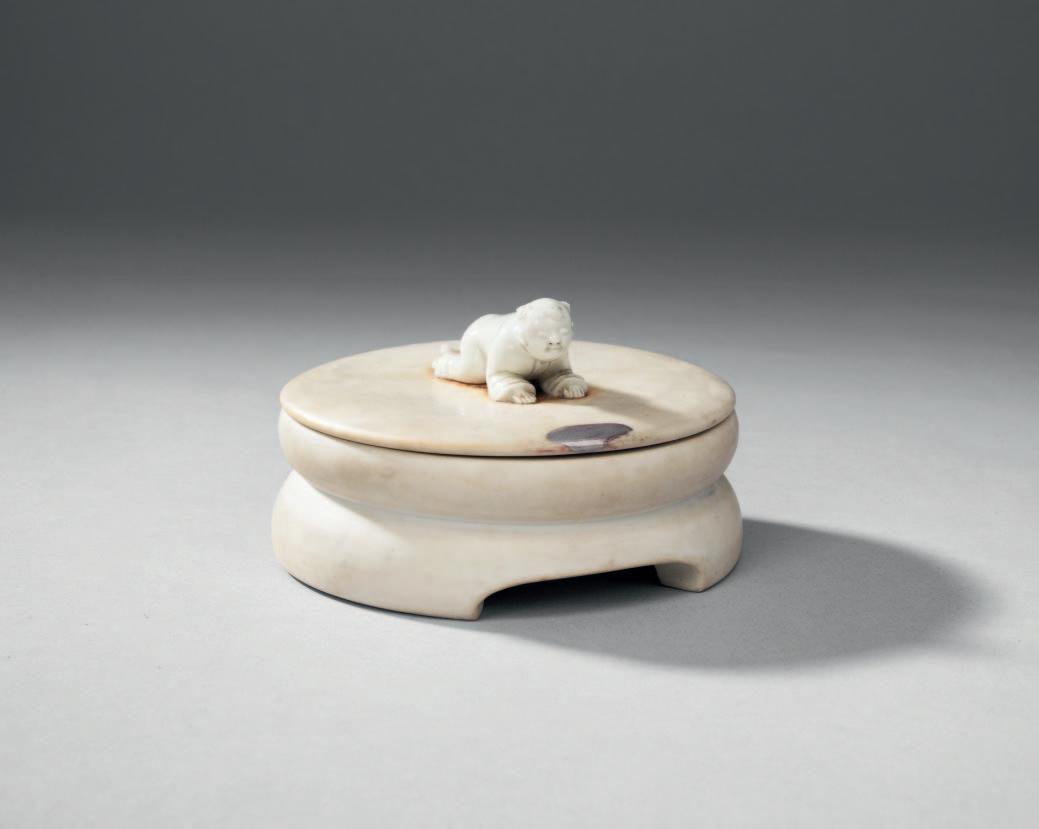
AN UNUSUAL JAPANESE INKSTONE BOX AND COVER MEIJI ERA, 19TH/20TH CENTURY
With a biscuit body and cover, topped by a small glazed boy modelled in the round, the child seemingly crawling toward a gintsugi silver repair, the underside of the lid possibly marked Keiga Mitsugo, and with a poem in a leaf to the base, 12cm. (2)
WITHOUT RESERVE
£400-600
562
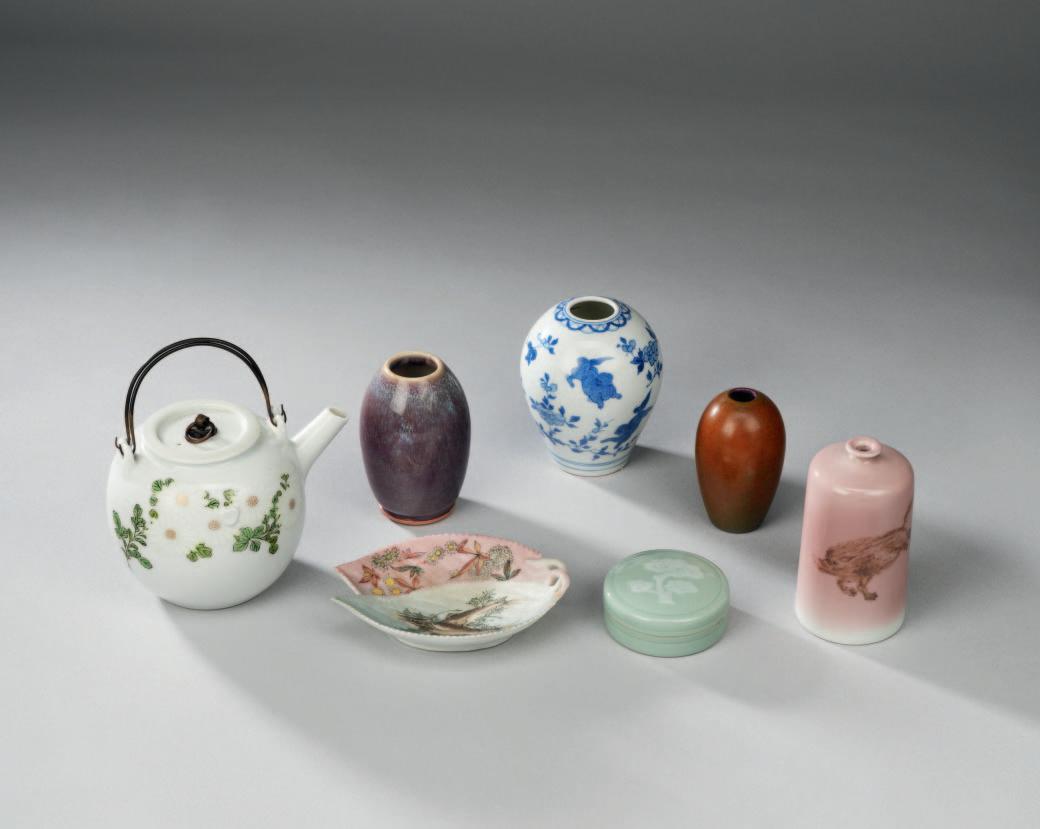
A COLLECTION OF JAPANESE PORCELAIN PIECES
MEIJI AND LATER, 19TH AND 20TH CENTURY
Comprising: two miniature vases with marks for Inoue Ryosai I or II, the first with a running boar and rabbits on a pink ground, the other with a purpleblue
flambé glaze; two small vases signed Seifū for the Seifū Yohei lineage, one with an orangegreen glaze and the other with shishi and peony in underglaze blue; a teapot and cover with flowers, an impressed seal mark to the base, possibly a tensho kotobuki mark; a small celadon box and cover with reishi fungi, with a zuishō (auspicious omen) mark; and a leafshaped dish with flowers and fish, inscribed with a patent mark and impressed, possibly by the workshop of Takeuchi Chubei; 10cm max. (9)
£500-1,000
563
A JAPANESE BLUE AND WHITE JAR AND COVER MEIJI OR LATER, 19TH/20TH CENTURY
The baluster body painted in underglaze blue with the shochikubai or Three Friends of Winter (pine, prunus and bamboo), the cover similarly decorated, with a tomobako (wood box), 40.6cm. (3)
£500-800
564
A LARGE JAPANESE KIYOMIZU WARE VASE SHŌWA/HEISEI, 20TH CENTURY
Of bulbous shape, decorated with two small birds perched on flowering branches of peony; the base with a fourcharacter mark possibly reading Heian Zuikō; together with an inscribed tomobako (wood box); 24cm. (2)
£200-400
Provenance: from a Japanese private collection, London.
565
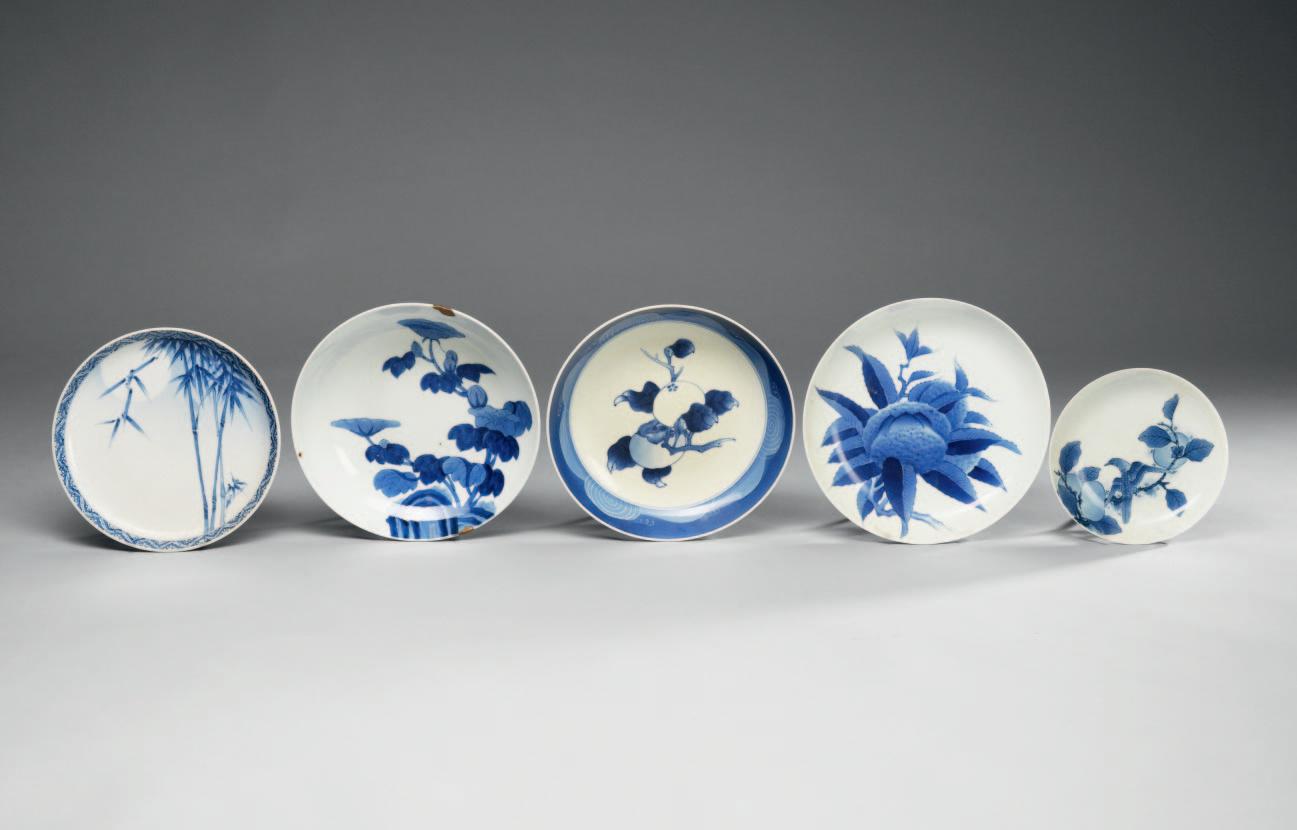
A SMALL COLLECTION OF JAPANESE BLUE AND WHITE DISHES
MEIJI OR LATER, 19TH/20TH CENTURY
Including four Nabeshimastyle dishes, variously decorated with fruiting branches and flowers, one with a small birds perched on a branch of persimmon; together with a Seto dish with bamboo before a full moon, 21cm max. (5)
WITHOUT RESERVE
£150-250
566
A JAPANESE NABESHIMA DISH HEISEI ERA, 20TH CENTURY
Painted to the well in underglaze blue with leafy branches of maple, with three flower sprays to the reverse and raised on a short foot with comb design, 21.1cm.
WITHOUT RESERVE
£100-200
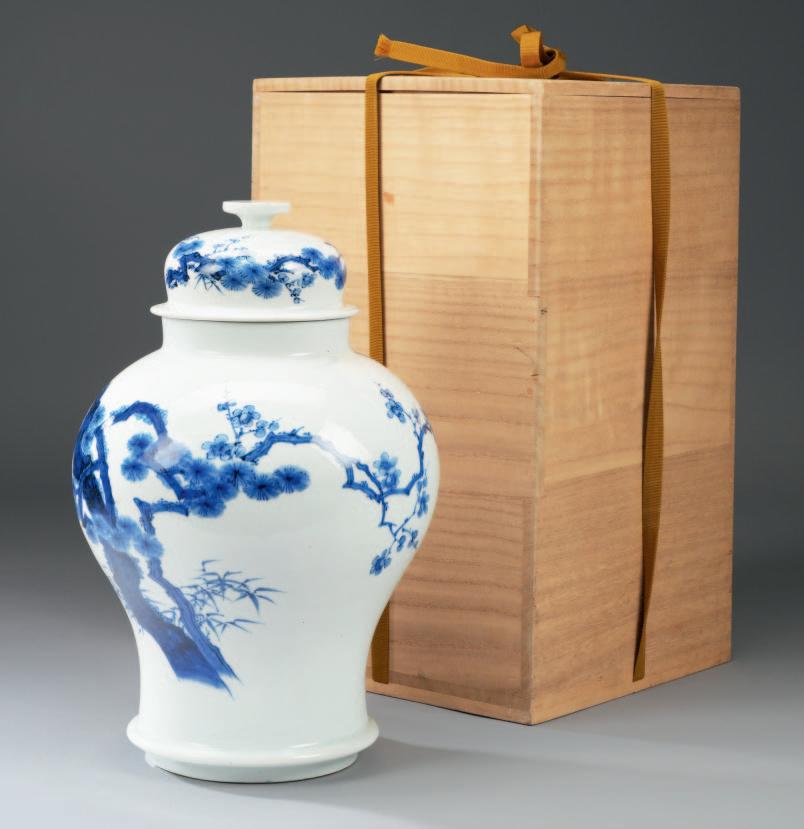
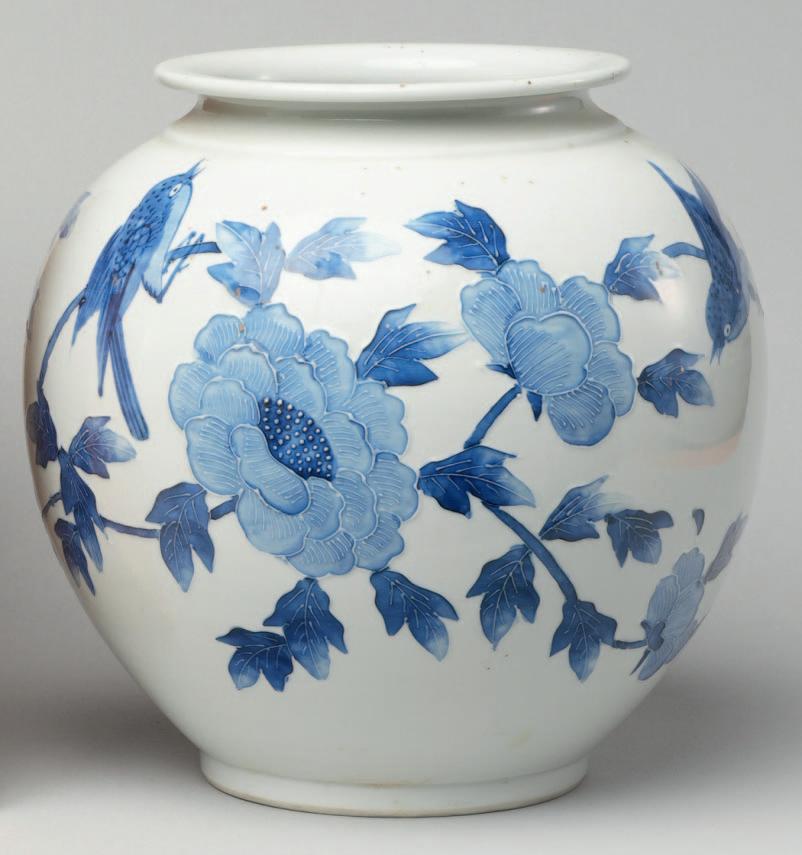
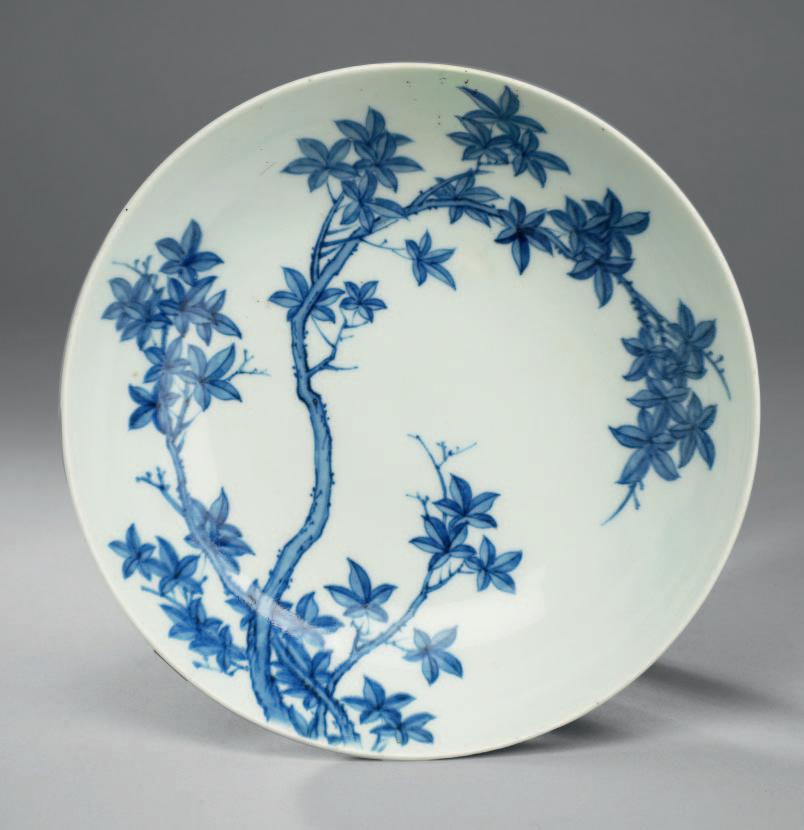
TO BE OFFERED WITHOUT RESERVE
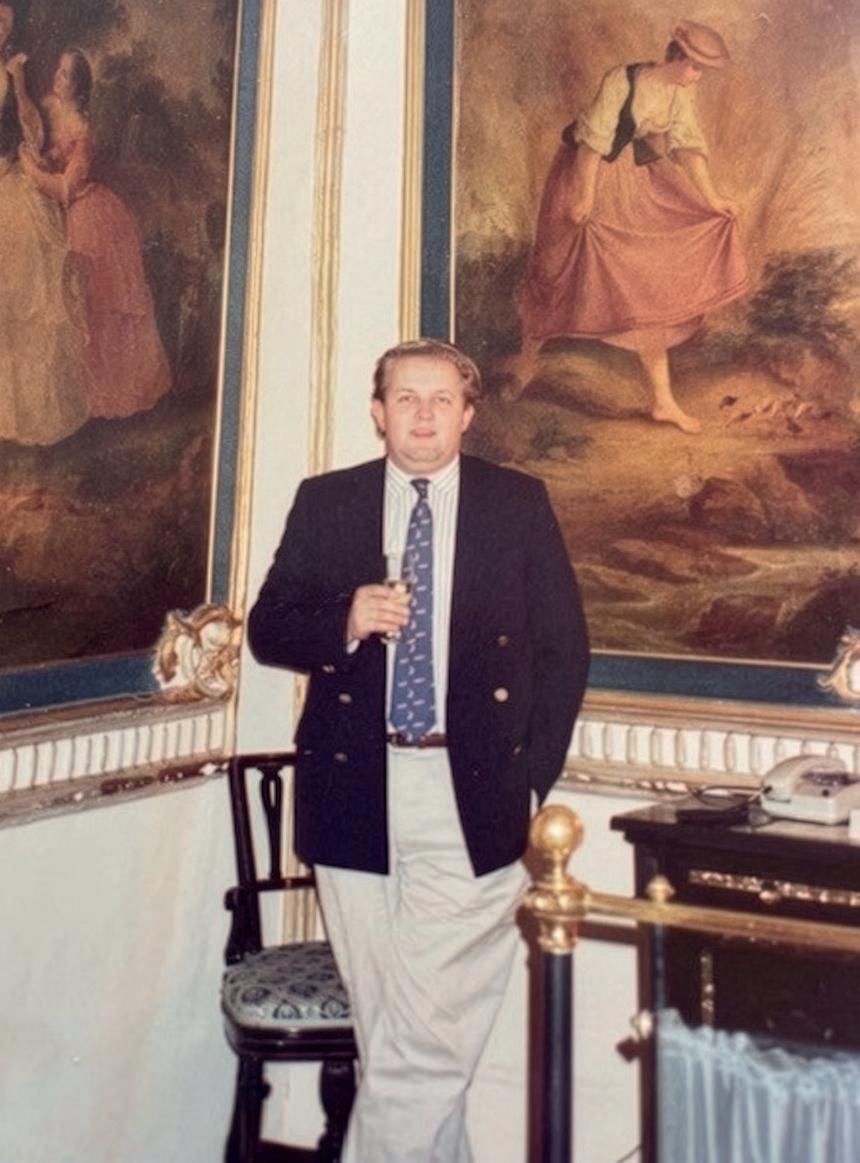
Originally from Devon, Mark Treece’s formal training in Art History provided the foundation for a lifelong passion for East Asian aesthetics. Following a distinguished career in finance and sales, he relocated to Tokyo in the 1990s, where he achieved fluency in Japanese and immersed himself deeply in the local culture.
This collection was meticulously assembled over the final fifteen years of his life, reflecting a refined focus on the Nabeshima tradition. A frequent visitor to the Imaemon Museum in Arita, Mr. Treece developed a sophisticated eye for the technical precision and understated elegance of modern IroNabeshima ware, seeking out pieces that embodied the lineage’s exacting standards.
567
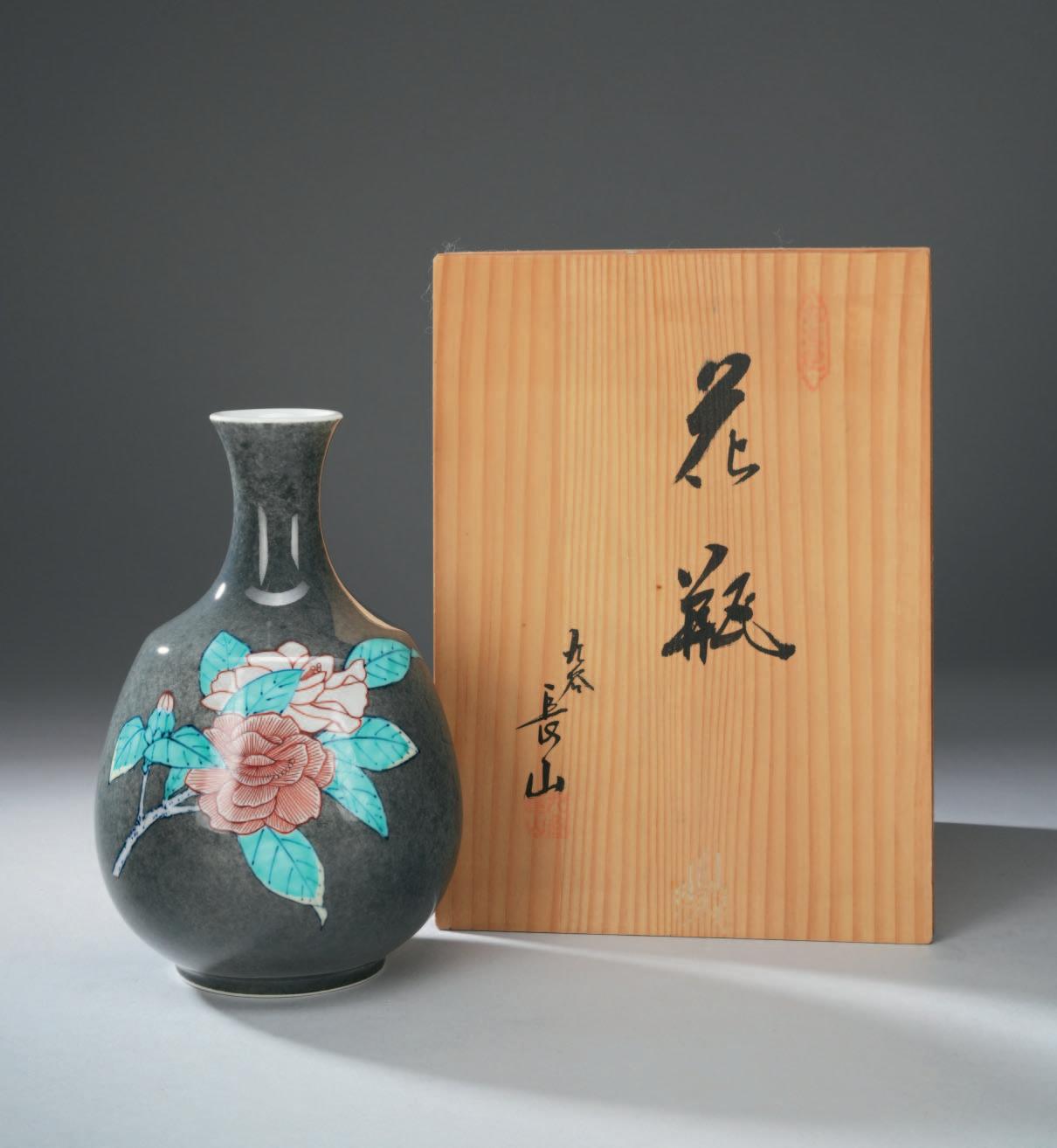
A JAPANESE IRO-NABESHIMA VASE BY IMAIZUMI IMAEMON XIII (19262001)
HEISEI ERA, 20TH/21ST CENTURY
With a globular body and a tall flared neck, decorated with a flowering spray of camellias, rendered in colourful underglaze blue and overglaze green, yellow and red enamels, on a typical usu-zumi (light ink) mottled ground, the base incised with the mark for Imaemon; with an associated tomobako (wood box), 21.5cm. (2)
WITHOUT RESERVE
£800-1,200
Provenance: from the Mark Treece (d. 2021) Collection of iroNabeshima porcelain.
Provenance:
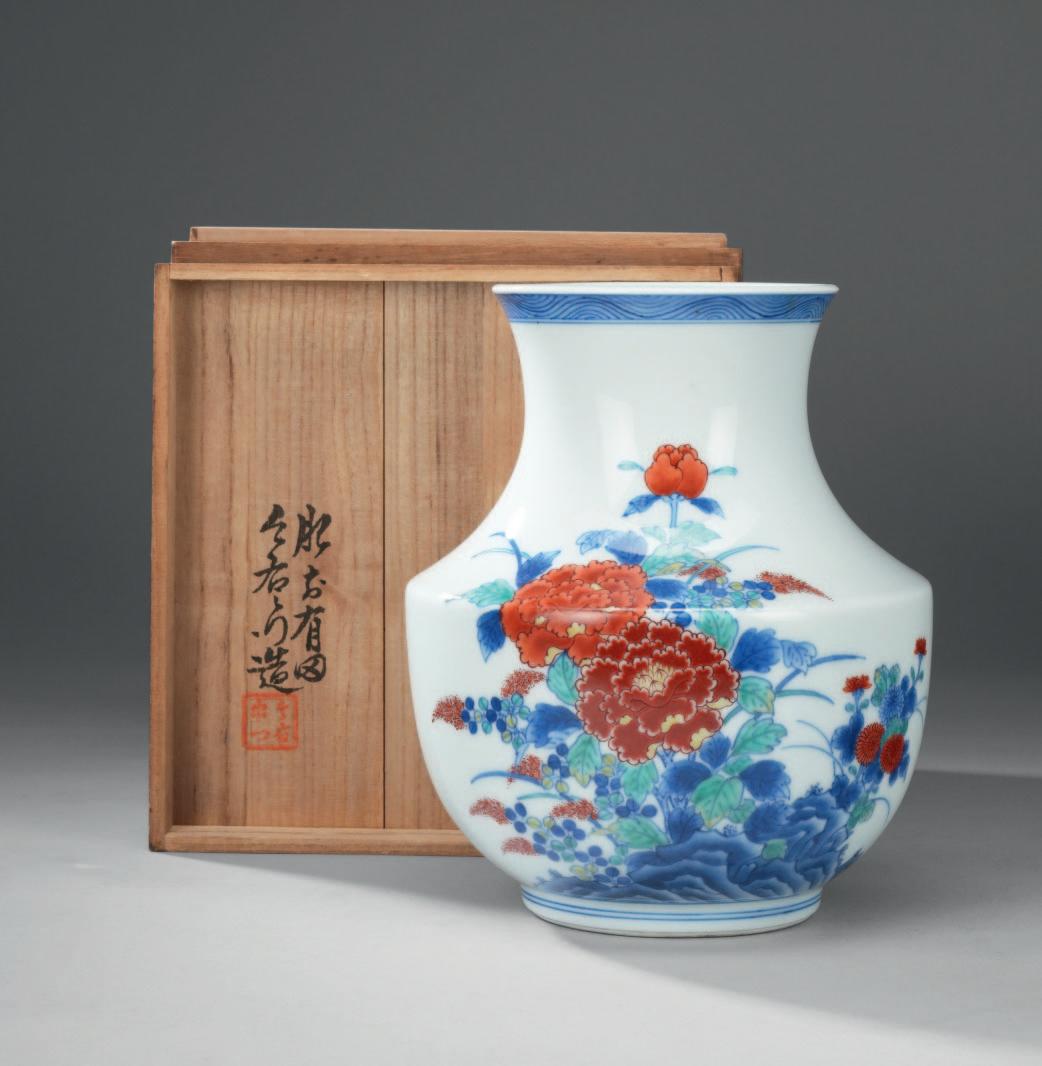
569
A JAPANESE IRO-NABESHIMA VASE BY THE IMAEMON WORKSHOP
HEISEI ERA, 20TH/21ST CENTURY
The baluster vase with a flared neck, decorated to one side with leafy sprays of peony and bush clovers, the reverse with chrysanthemum; all painted in underglaze blue and red, cyan and yellow enamels; the base inscribed Imaemon, with a tomobako (wood box) inscribed Nishiki hana-e kabin (polychrome vase with floral decoration) and Hizen Arita Imaemon zo (Hizen, Arita, made by Imaemon) with a red seal for Imaemon, 22cm. (2)
WITHOUT RESERVE
£800-1,200
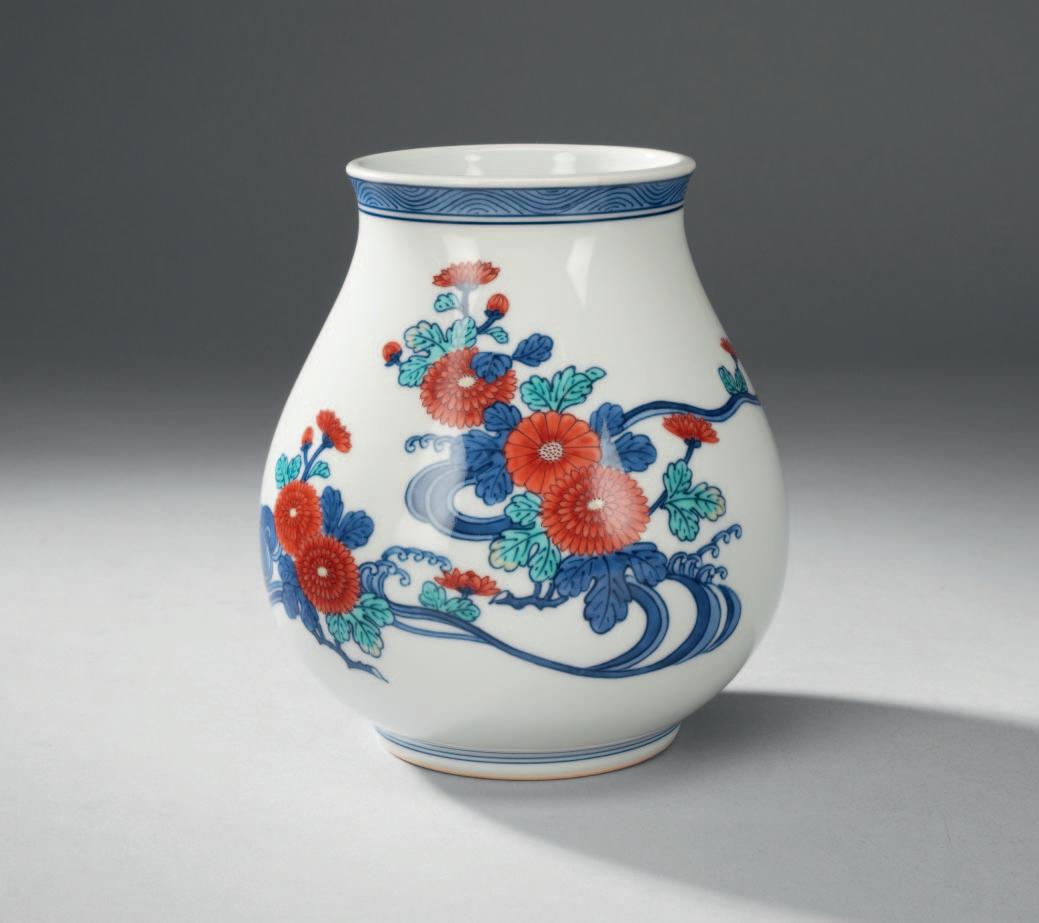
568
A JAPANESE IRO-NABESHIMA VASE BY THE IMAEMON WORKSHOP
HEISEI ERA, 20TH/21ST CENTURY
The pearshaped body with a wide mouth, painted in underglaze blue and red, cyan and yellow enamels with sprays of chrysanthemum floating down a meandering stream; the base inscribed Imaemon, 17.5cm.
WITHOUT RESERVE
£400-600
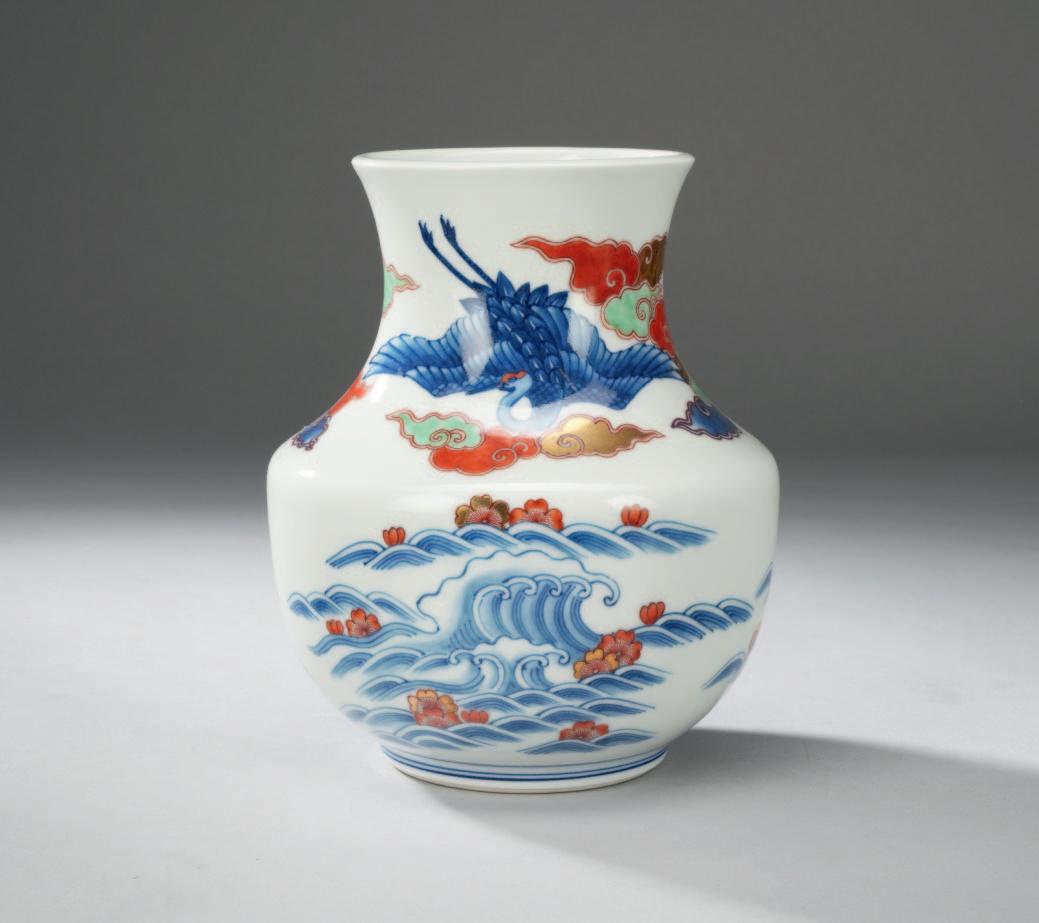
570
A JAPANESE IRO-NABESHIMA VASE BY THE IMAEMON WORKSHOP
HEISEI ERA, 20TH/21ST CENTURY
Of baluster form, decorated with two cranes flying amongst scrolling clouds, above crashing waves with cherry blossom floating on the surface; rendered in underglaze blue, red, green and gilt; the base inscribed Imaemon, 21cm.
WITHOUT RESERVE
£400-600
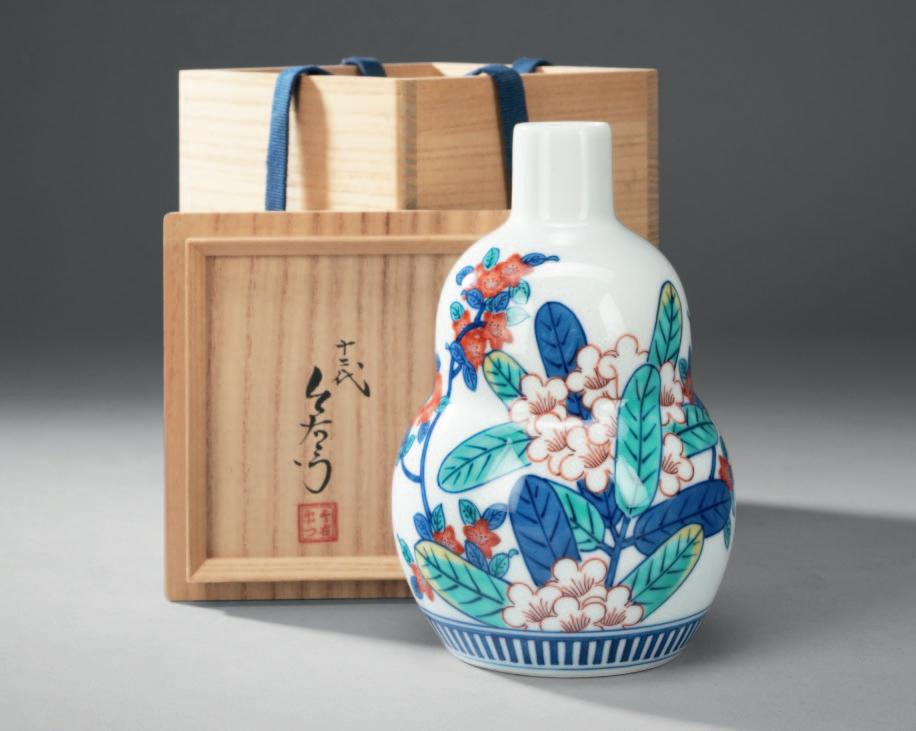
571
A JAPANESE IRO-NABESHIMA VASE BY IMAIZUMI IMAEMON XIII (19262001)
HEISEI ERA, 20TH/21ST CENTURY
The gourdshaped bottle vase decorated with rhododendrons and azaleas, painted in underglaze blue and red, cyan and yellow enamels; the base inscribed Imaemon, with a tomobako (wood box) inscribed Nishiki-sai ji mushi bin (Polychrome porcelain vase with flowers) and Jūsandai Imaemon (Imaemon XIII) with a red seal Imaemon; 17cm. (2)
WITHOUT RESERVE
£300-500
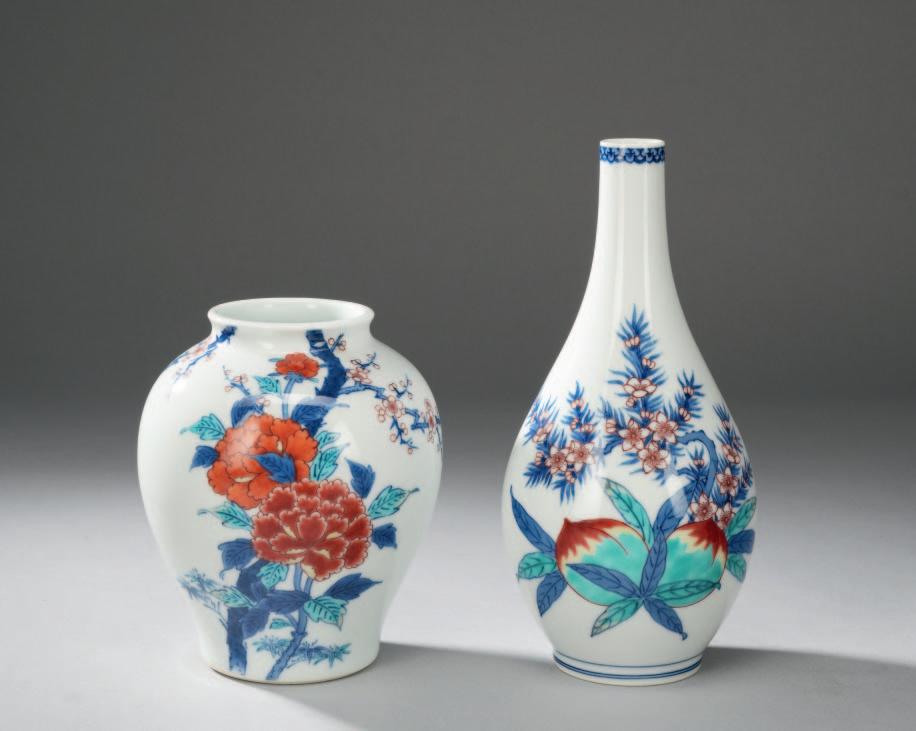
573
TWO JAPANESE IRO-NABESHIMA VASES BY THE IMAEMON WORKSHOP
HEISEI ERA, 20TH/21ST CENTURY
One a bottle vase decorated with peaches and flowering plum branches, the other of baluster form and with large peonies and cherry blossoms, both painted in underglaze blue and red, cyan and yellow enamels; each base inscribed Imaemon, 17cm and 25cm. (2
WITHOUT RESERVE
£500-800
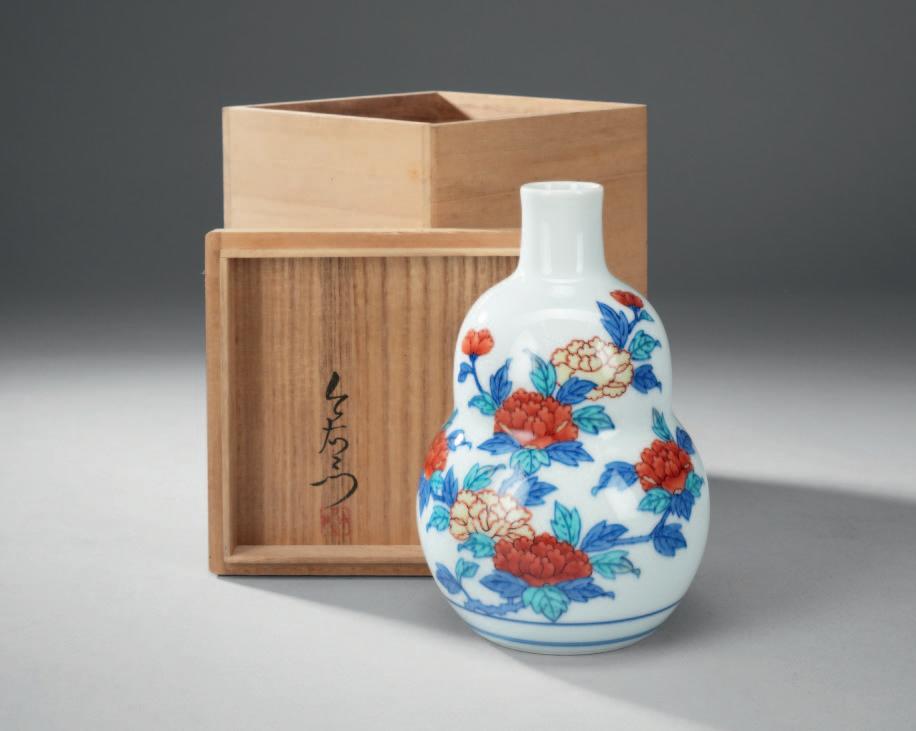
572
A JAPANESE IRO-NABESHIMA VASE BY THE IMAEMON WORKSHOP
HEISEI ERA, 20TH/21ST CENTURY
The gourdshaped vase with a tall cylindrical neck, decorated with leafy sprays of peony in underglaze blue and red, cyan and yellow enamels; the base inscribed Imaemon, with a tomobako (wood box) inscribed Nishiki botan tsuru kabin (polychrome waisted vase with peony) and signed and sealed Imaemon to the reverse; 17.2cm.
WITHOUT RESERVE
£300-500
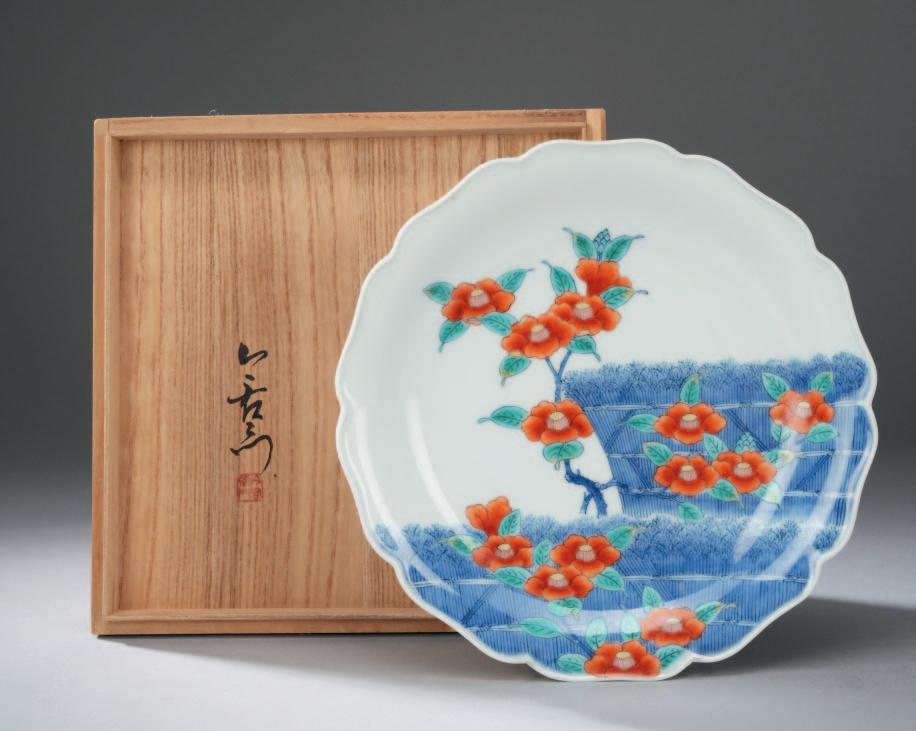
574
A LARGE JAPANESE IRO-NABESHIMA DISH BY THE IMAEMON WORKSHOP
HEISEI ERA, 20TH/21ST CENTURY
The flowershaped body decorated with flowering branches of camellia before banded hedges, all rendered in underglaze blue and red, yellow and cyan enamels; the reverse with three beribboned jewels and the base marked Imaemon in underglaze blue; with a tomobako (wood box) inscribed Nishiki iwabotan gensai-ban (polychrome dish with floral festoons), and signed and sealed Imaemon, 25.8cm. (2)
WITHOUT RESERVE
£400-600
Provenance: from the Mark Treece (d. 2021) Collection of iroNabeshima porcelain.
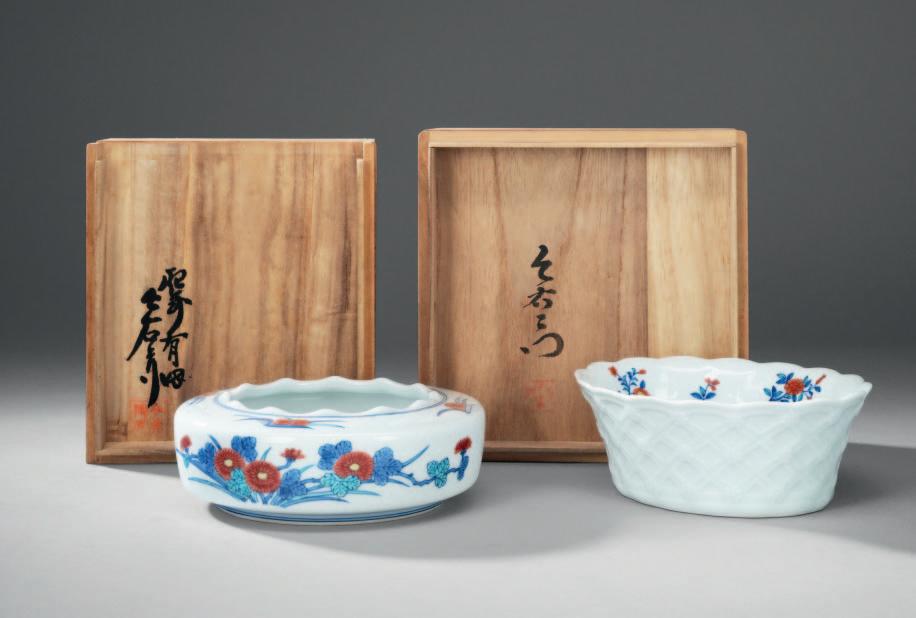
575
TWO JAPANESE IRO-NABESHIMA PIECES BY THE IMAEMON WORKSHOP
HEISEI ERA, 20TH/21ST CENTURY
One an oval, scallopededge bowl with moulded basketweave pattern to the exterior, the inside painted with flower sprays, the base signed Imaemon, with a tomobako (wood box) inscribed Nishiki kamon soku en fukabachi (polychrome flower motif, moulded, round and deep bowl) and Hizen, Arita, Imaemon with red seal Imaizumi Toen; the other an ashtray with chrysanthemum and other flowers, signed Imaemon, with a tomobako inscribed Nishiki hana-e haizara (polychrome flower motif ashtray) and Imaemon, with a red seal for Imaemon; both pieces painted in underglaze blue and red, cyan and yellow enamels; 16.3cm and 16.6cm. (4)
WITHOUT RESERVE
£400-600
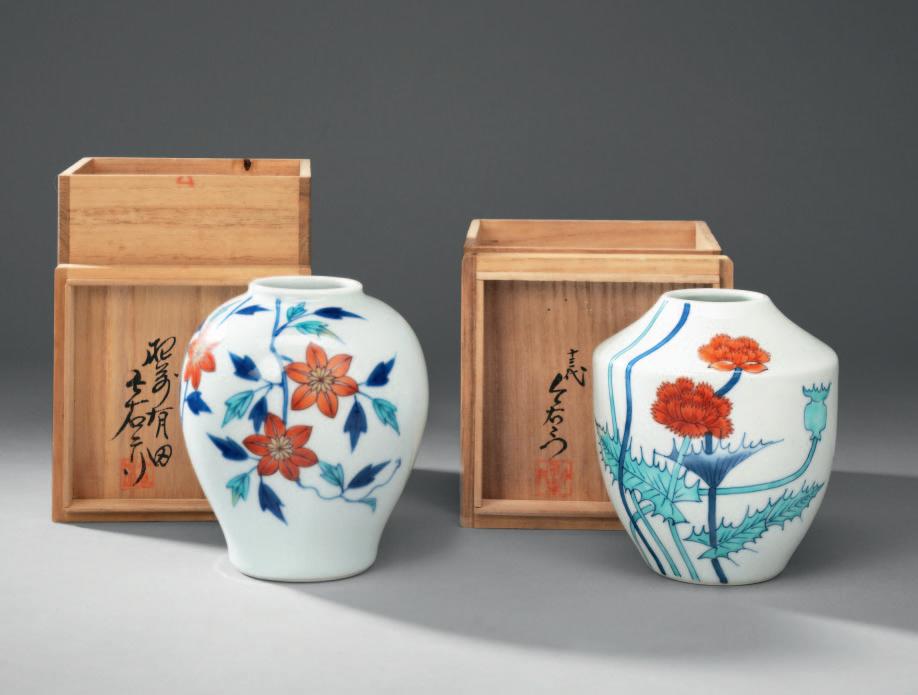
577
TWO JAPANESE IRO-NABESHIMA VASES BY THE IMAEMON WORKSHOP
HEISEI ERA, 20TH/21ST CENTURY
The first a shoulder vase with a narrow mouth decorated with poppies, the reverse with a small butterfly, all painted in underglaze blue and red, cyan and yellow enamels; the base signed Imaemon in blue overglaze enamel, with a tomobako (wood box) inscribed iro-Nabeshima keshi-e kabin (coloured Nabeshima poppy design vase) and Jūsandai Imaemon (Imaemon XIII); the other vase of ovoid form, painted with clematis and leafy tendrils, signed Imaemon in underglaze blue, with an associated tomobako, 13.5cm and 13.8cm. (4)
WITHOUT RESERVE
£600-800
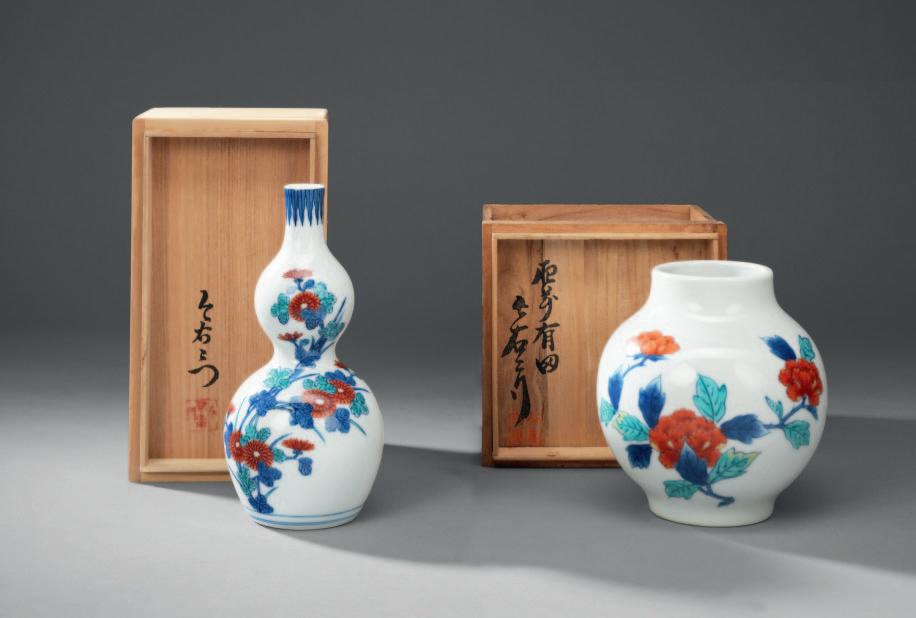
576
TWO JAPANESE IRO-NABESHIMA VASES BY THE IMAEMON WORKSHOP
HEISEI ERA, 20TH/21ST CENTURY
One a gourdshaped vase decorated with chrysanthemum, the base signed Imaemon in underglaze blue, with a tomobako (wood box) inscribed Nishiku kikue hyobin (polychrome gourd vase with chrysanthemum) and Imaemon; the other of bulbous shape, painted with sprays of peony, the base also signed Imaemon, the tomobako inscribed Hizen, Arita, and Nishiki-ka Moyō kabin (polychrome vase with flower pattern) and Imaemon and Imaizumi to the reverse, 13.4cm and 18.5cm. (4)
WITHOUT RESERVE
£600-800
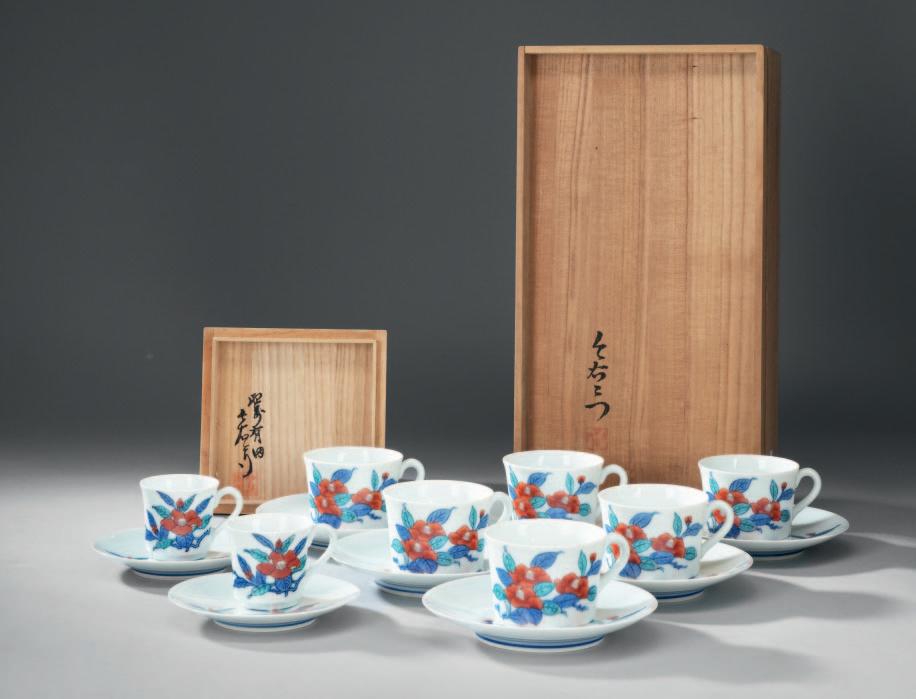
578
EIGHT JAPANESE IRO-NABESHIMA CUP AND SAUCER SETS BY THE IMAEMON WORKSHOP
HEISEI ERA, 20TH/21ST CENTURY
Including six coffee cups and saucers and two sets of smaller ones, all decorated in underglaze blue and red, yellow, and green enamels with branches of camellia; each pieces marked Imaemon in underglaze blue underneath, in two tomobako (wood boxes), one inscribed Nishiki katsura-e kōchawan (polychrome coffee cups with flowers) and signed and sealed Imaemon on the reverse; the other inscribed Nishiki tsubaki-ga kōhi-wan (polychrome coffee cups with camellia) and Hizen, Arita, Imaemon and sealed Imaizumi Tōen, 15.5cm max. (18)
WITHOUT RESERVE
£500-800
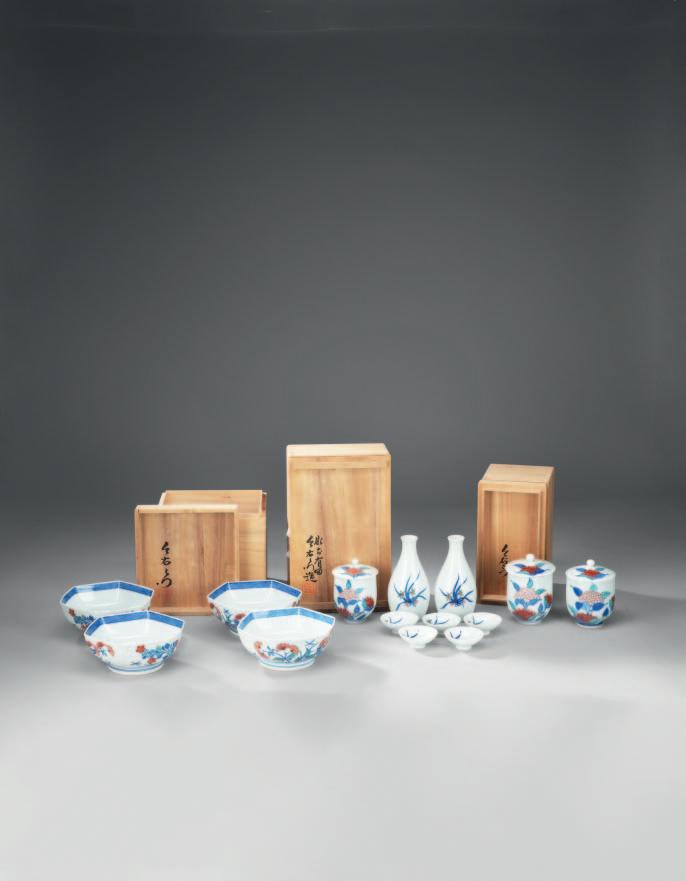
579
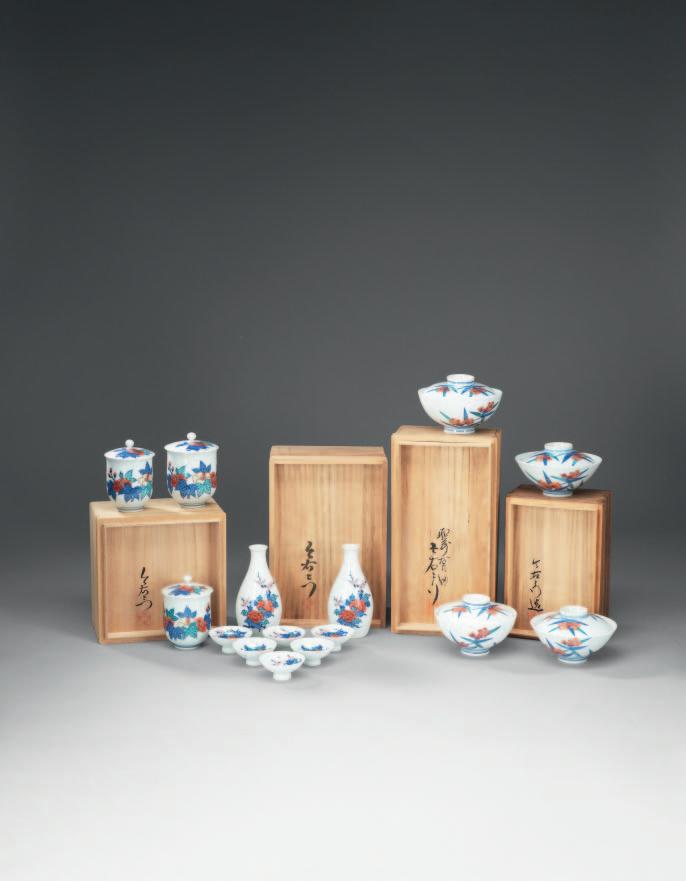
A COLLECTION OF JAPANESE PIECES BY THE IMAEMON WORKSHOP
HEISEI ERA, 20TH/21ST CENTURY
Comprising: a sake set with two bottles and five footed cup, decorated with wild orchids; three cups with lids painted with chrysanthemum, and four hexagonal bowls with hibiscus; all painted in underglaze blue and red, cyan and yellow enamels, all marked Imaemon in underglaze blue underneath; in three associated tomobako (wood boxes), 13cm max. (20)
WITHOUT RESERVE
£400-600
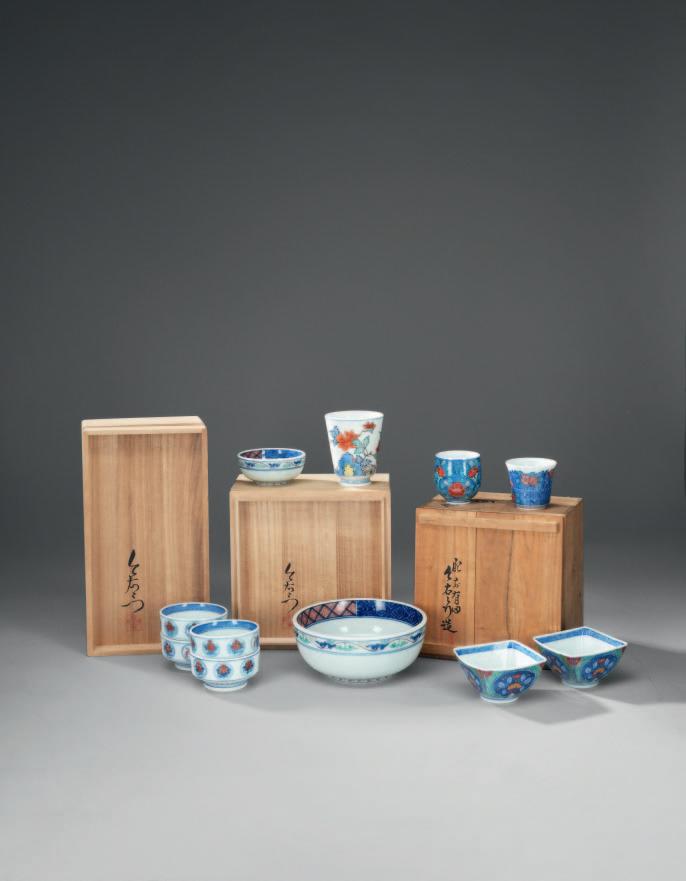
580
A COLLECTION OF ELEVEN JAPANESE BOWLS BY THE IMAEMON WORKSHOP
HEISEI ERA, 20TH/21ST CENTURY
Variously shaped and decorated with flowers, fruits and brocade patterns, painted in underglaze blue, polychrome enamels and some with gilt; ten with an Imaemon mark in underglaze blue underneath, the eleventh with the mark incised; in three associated tomobako (wood boxes), 15.4cm max. (14
WITHOUT RESERVE
£400-600
581
A COLLECTION OF JAPANESE IRONABESHIMA PIECES BY THE IMAEMON WORKSHOP
HEISEI ERA, 20TH/21ST CENTURY
Comprising: two sake bottles and six footed cups; four bowls and covers and three cups and covers; variously decorated with flowers and leafy branches, all rendered in underglaze blue and red, yellow, and green enamels, all with a mark underneath in underglaze blue for Imaemon; together with four tomobako (wood boxes) inscribed Imaemon, 13cm max. (26)
WITHOUT RESERVE
£500-800
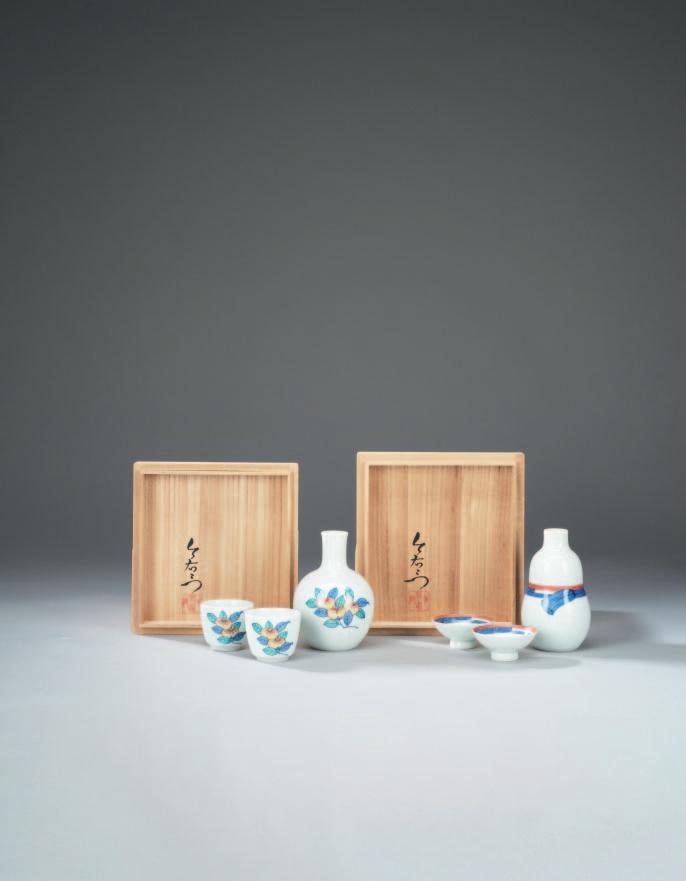
582
TWO JAPANESE IRO-NABESHIMA SAKE SETS BY THE IMAEMON WORKSHOP
HEISEI ERA, 20TH/21ST CENTURY
The first including a globular sake bottle with a tall cylindrical neck and two small cups, decorated with pomegranates, in a tomobako (wood box) inscribed Nishiki zakuro-e shuki (polychrome sake set with pomegranates) and Imaemon to the reverse; the other set with a design of cords and tassels, in a tomobako inscribed Nishiki himo-e shuki (polychrome sake set with tassels) and Imaemon; all painted in underglaze blue and polychrome enamels; each piece signed Imaemon in underglaze blue underneath; 11.2cm max. (8)
WITHOUT RESERVE
£200-400
583
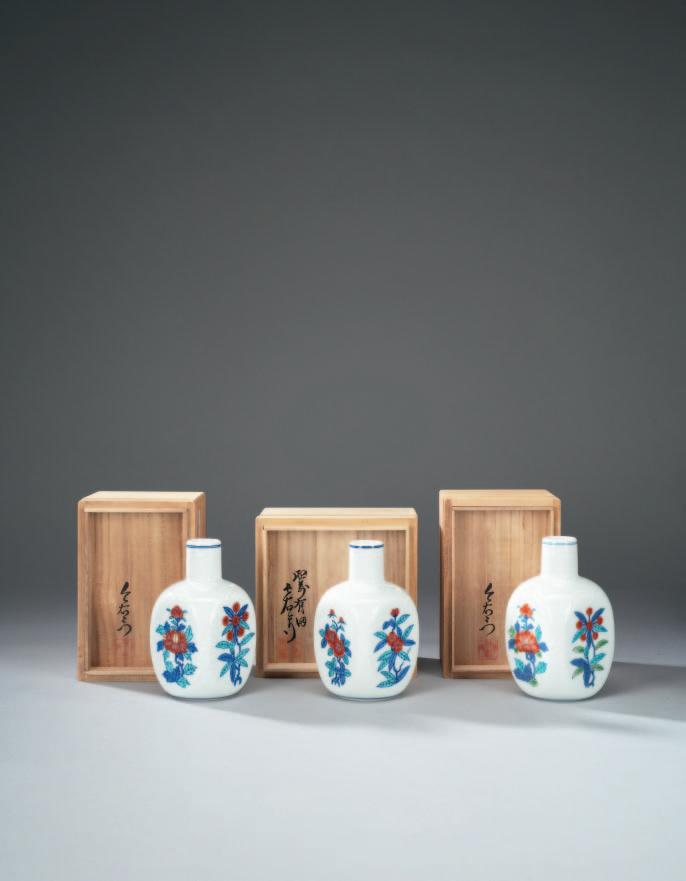
THREE JAPANESE IRO-NABESHIMA VASES BY THE IMAEMON WORKSHOP
HEISEI ERA, 20TH/21ST CENTURY
All three with a squaresection body and a tall cylindrical neck, decorated in underglaze blue and red, cyan and yellow enamels, one with slightly brighter enamels; painted with the same designs of leafy flower sprays; each with an underglaze blue mark to the base for Imaemon; two with tomobako (wood boxes) inscribed Nishiki kachō hōbin (polychrome square bottle with flowers) and Imaemon with a red seal to the reverse; the third vase with an associated tomobako; 14cm max. (6)
WITHOUT RESERVE
£400-600
584
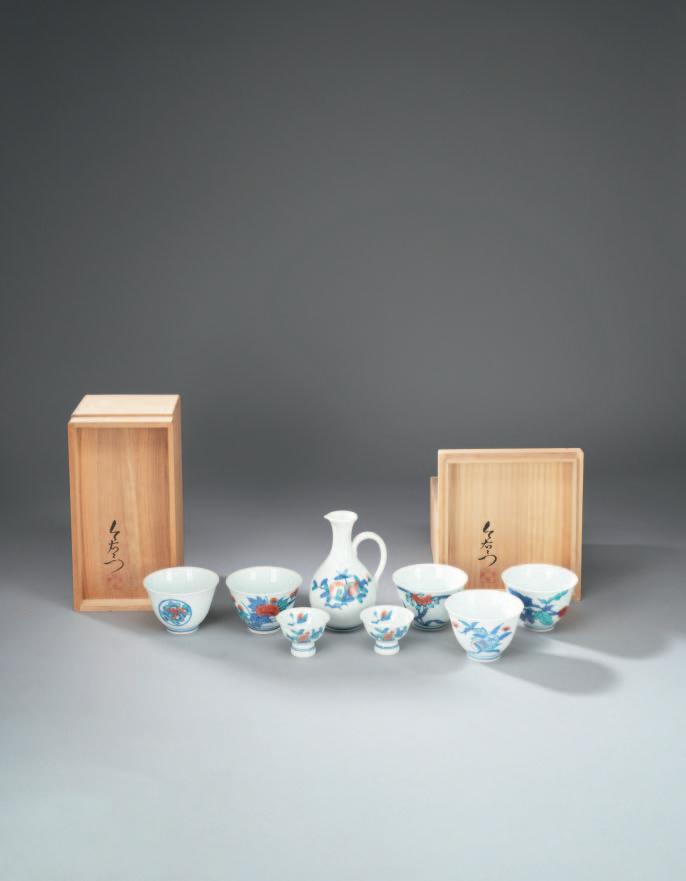
A JAPANESE SAKE SET AND CUPS BY THE IMAEMON WORKSHOP
HEISEI ERA, 20TH/21ST CENTURY
Comprising a sake ewer and two footed cups decorated with branches of pomegranate, each with an Imaemon mark in underglaze blue underneath; in a tomobako (wood box) inscribed Nishiki zakuro-e shuki (polychrome sake set with pomegranate picture), and signed and sealed Imaemon on the reverse; together with five cups variously decorated with flowers and fruits, each marked Imaemon, in a tomobako inscribed Nishiki denrai zensai (polychrome cups with traditional designs) and Imaemon inside, possibly associated; 14cm max. (10)
WITHOUT RESERVE
£300-500
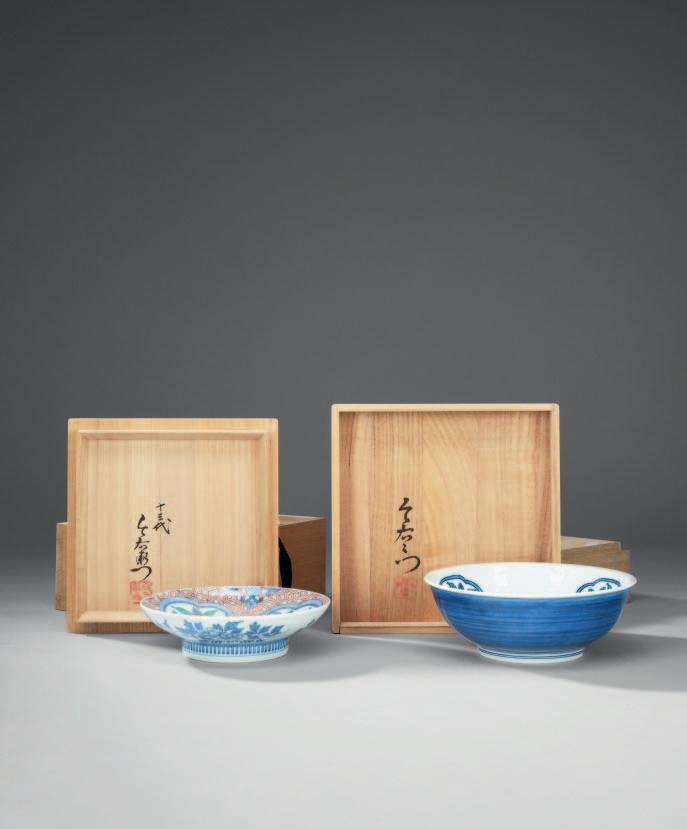
585
TWO JAPANESE IRO-NABESHIMA PIECES BY THE IMAEMON WORKSHOP
HEISEI, 20TH/21ST CENTURY
One a deep footed bowl, the well moulded with lotus flowers and leaves, with three quatrefoil panels enclosing branches of oranges, the reverse simply painted blue, the base inscribed Imaemon, together with a tomobako wood box inscribed Nishiki tachibana-e kashiki (polychrome, mandarin orange decoration bowl for confectionery) and Imaemon with a red seal Imaemon; the other a footed dish with similar decoration of mandarin oranges on a geometric ground, the reverse with flowering sprays of peony, the foot with comb design; signed to the side Imaemon, with a tomobako box inscribed iroNabeshima Tachibana-mon kodai-zara (polychrome Nabeshima mandarin orange pattern highfooted dish) and Jūsandai Imaemon (Imaemon XIII) and sealed Imaizumi Tōen; 15.5cm and 17.2cm. (4)
WITHOUT RESERVE
£800-1,200
586
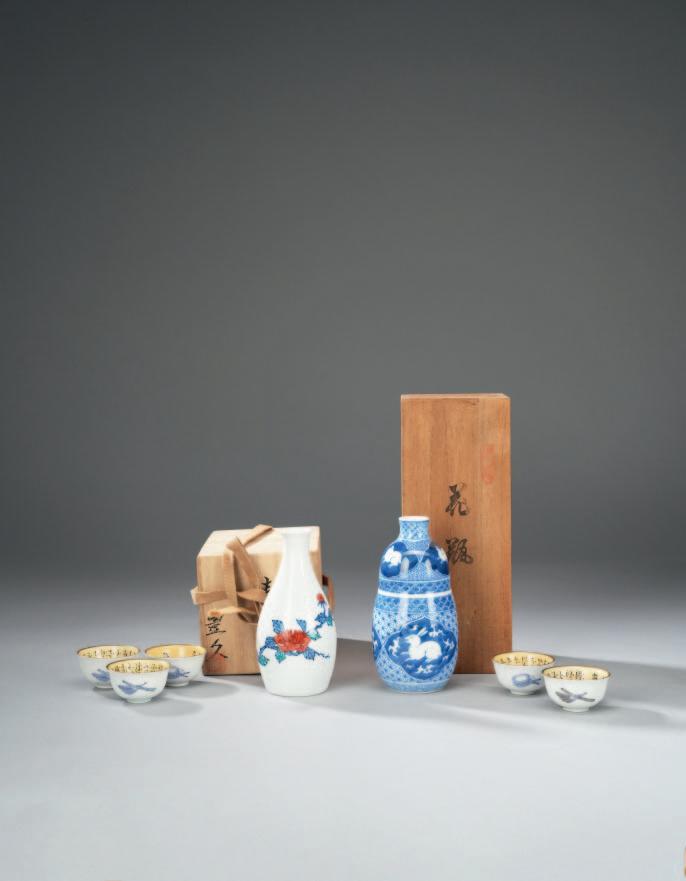
TWO JAPANESE SAKE BOTTLES BY THE IMAEMON WORKSHOP
HEISEI ERA, 20TH/21ST CENTURY
The first decorated in blue and white with panels enclosing rabbits on a dense ground of brocade patterns; the other with sprays of peony in polychrome enamels, both signed in underglaze blue Imaemon; together with five small Kutani sake cups with figures and poems, and two associated tomobako (wood boxes), 13.8cm max. (9)
WITHOUT RESERVE
£200-300
587
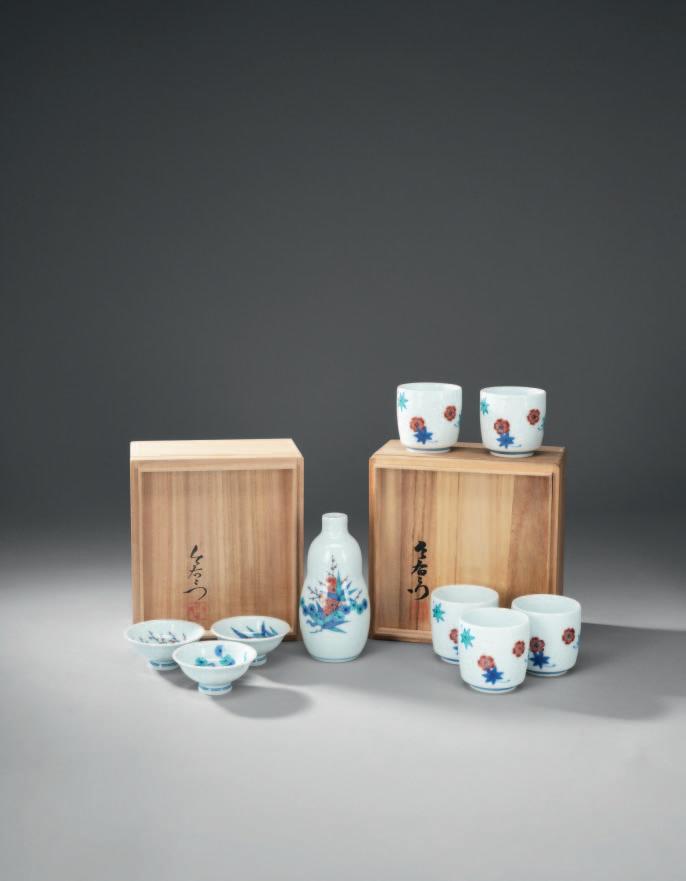
A JAPANESE SAKE SET AND CUPS BY THE IMAEMON WORKSHOP
HEISEI ERA, 20TH/21ST CENTURY
Comprising a sake pourer decorated with sprays of prunus, pine and bamboo, with three footed cups painted with one of the three plants, each with an Imaemon mark in underglaze blue underneath; in a tomobako (wood box) inscribed Nishiki sho-chiku-bai tokkuri sakazuki (polychrome sake pourer and cups with the Three Friends of Winter) and signed and sealed Imaemon; together with a set of five cups with prunus blossoms and maple leaves, each signed Imaemon in underglaze blue to the base, in a tomobako inscribed Nishiki Tastutagawa-e yunomi (polychrome teacups with Tatsuta River), possibly referring to flowers and leaves floating on the surface, signed and sealed Imaemon on the reverse; all decorated in underglaze blue and red, cyan and yellow enamels, 14cm max. (11)
WITHOUT RESERVE
£300-500
Provenance: from the Mark Treece (d. 2021) Collection of iroNabeshima porcelain.
Provenance: from the Mark Treece (d. 2021) Collection of iroNabeshima porcelain.
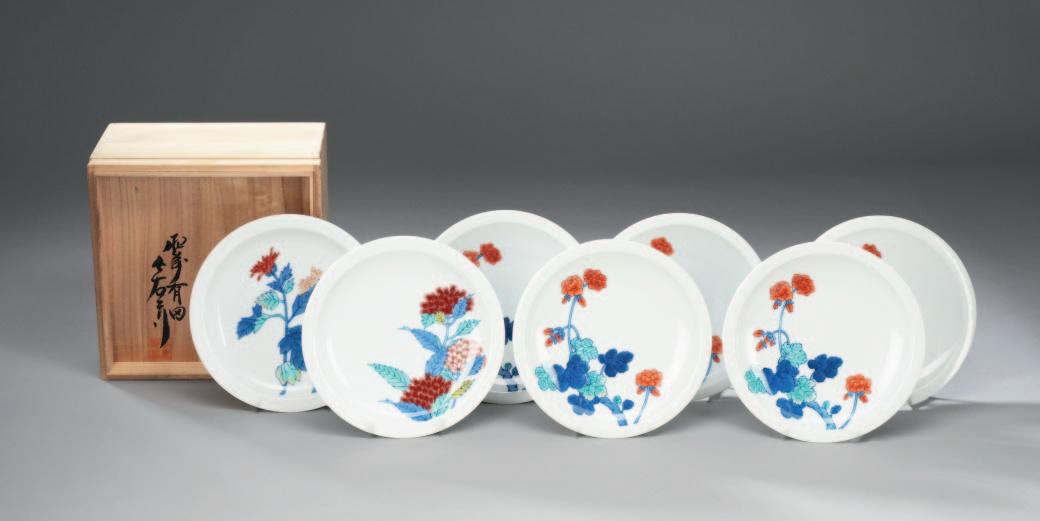
588
SEVEN JAPANESE IRO-NABESHIMA DISHES BY THE IMAEMON WORKSHOP
HEISEI ERA, 20TH/21ST CENTURY
Five forming a set, painted with the same floral design, the two other dishes decorated with chrysanthemum; all with an underglaze blue mark underneath for Imaemon; in a tomobako (wood box) inscribed Nishiki seiyo-aoi go-meibutsu zara (polychrome set of five dishes with hollyhock) and Hizen, Arita, Imaemon with Imaizumi Tōen seal, 16.5cm max. (8)
WITHOUT RESERVE
£400-600
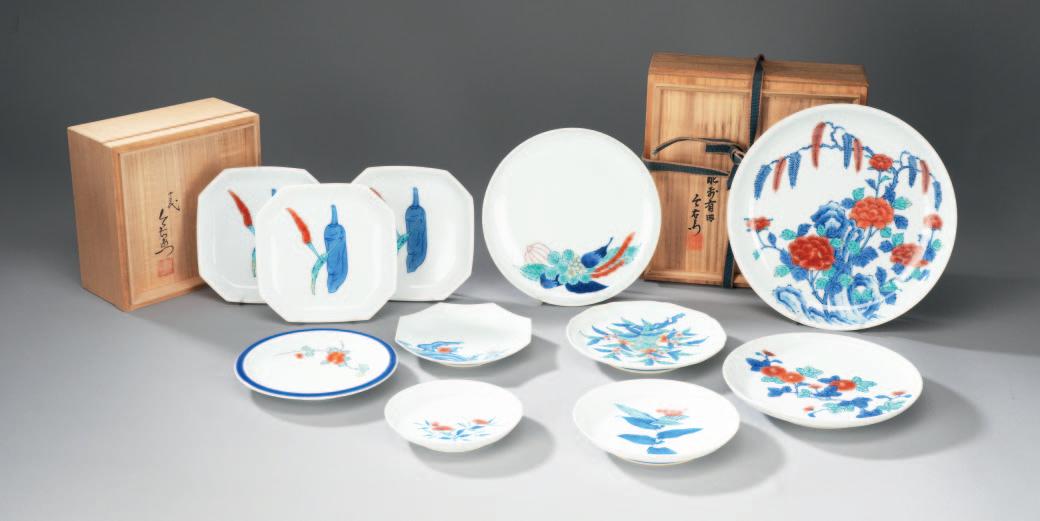
589
A COLLECTION OF ELEVEN JAPANESE DISHES BY THE IMAEMON WORKSHOP
HEISEI ERA, 20TH/21ST CENTURY
Of different sizes and shapes, variously painted with fruits and flowers in underglaze blue, yellow, red, and green enamels; three octagonal ones decorated with chilies, another octagonal one with prunus flowers and maple leaves amongst crashing waves; all signed Imaemon in underglaze blue underneath; in two associated tomobako (wood boxes), 24.2cm max. (13)
WITHOUT RESERVE
£600-1,000
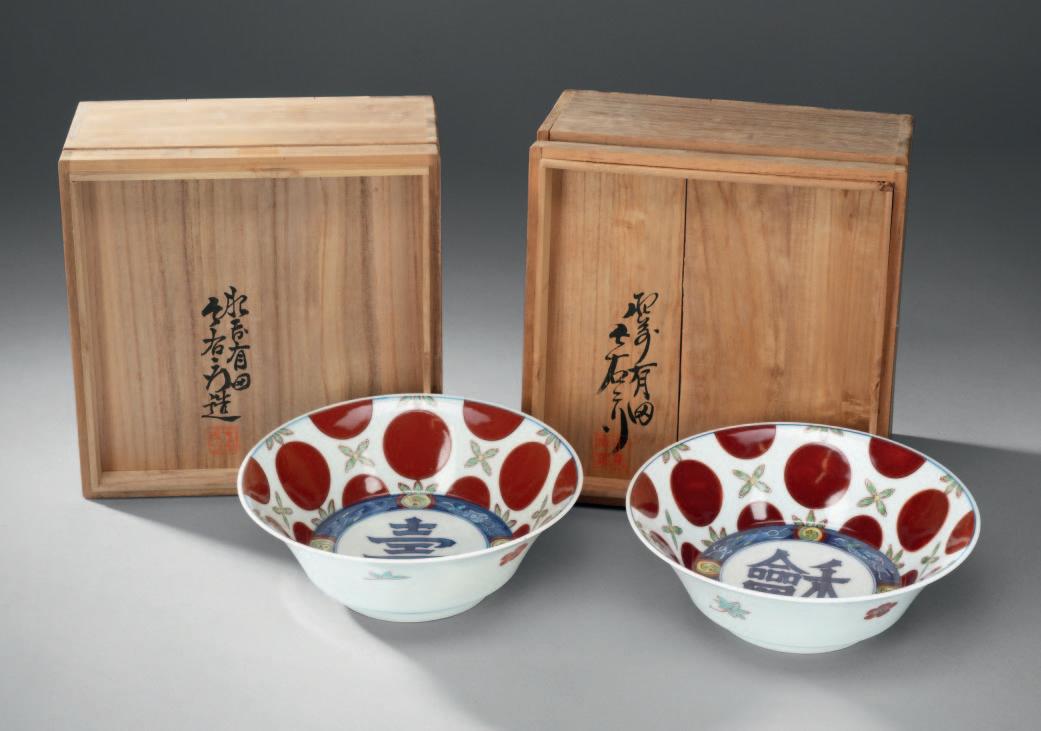
590
TWO JAPANESE ARITA BOWLS BY THE GEN’EMON KILN
HEISEI, 20TH/21ST CENTURY
Both raised on a short foot and with a flared rim, each decorated with a large auspicious character framed by bands of yin-yang designs, lucky emblems and large red roundels, both with maple leaves and cherry blossoms to the reverse; both signed Gen’emon in underglaze blue; each with a tomobako (wood box), one inscribed Nishiki aka-tama moyō kashi-zara (polychrome red ball pattern plate for confectionery), Gen’emon zō (made by Gen’emon) with a red seal for Gen’emon; the other associated box with an inscription about the Imaemon kiln; 18.9cm and 19.2cm. (4)
WITHOUT RESERVE
£600-800
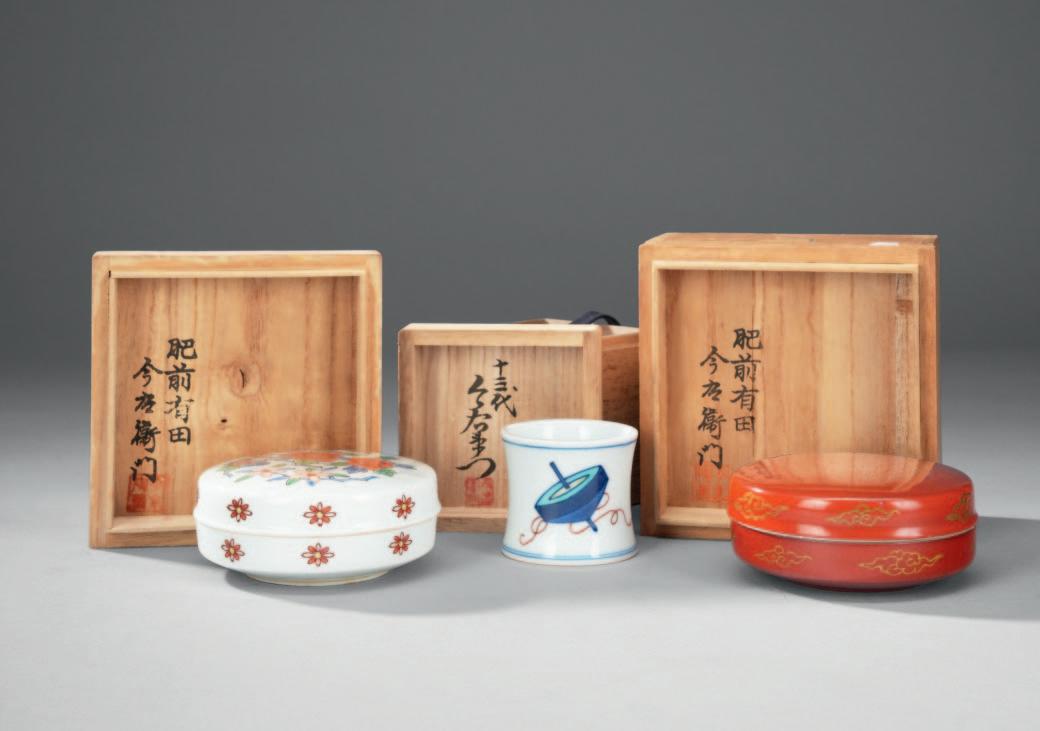
591
THREE JAPANESE IRO-NABESHIMA PIECES BY THE IMAEMON WORKSHOP
HEISEI ERA, 20TH/21ST CENTURY
Including two boxes and covers, one decorated with peony and clouds in gilt on an ironred ground, the other painted with flower sprays in polychrome enamels, both signed Imaemon in overglaze blue enamel on the base, each with a tomobako (wood box) inscribed Hizen Arita and Imaemon with a red seal for Imaemon Tōen; together with a napkin ring decorated with a spinning top, signed Imaemon in underglaze blue, with a tomobako inscribed iro-e koma-e nafukin ringu (polychrome napkin with spinning top decoration) and Jūsandai Imaemon (Imaemon XIII) with a red seal for Imaemon, 9.5cm max. (8)
WITHOUT RESERVE
£300-500
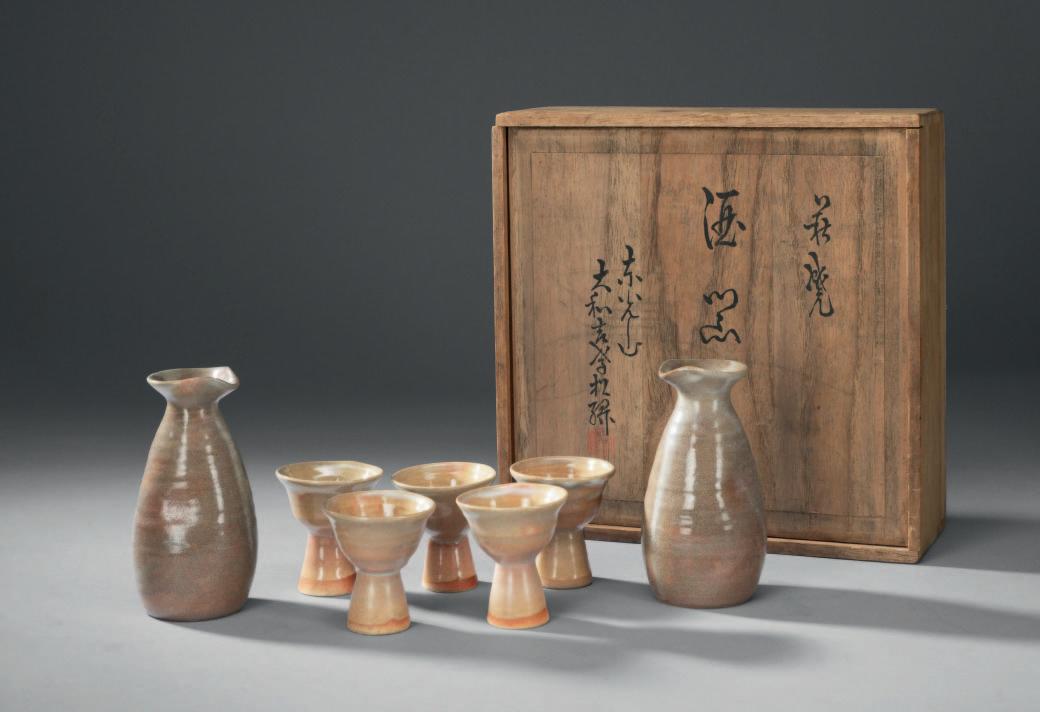
592
A JAPANESE HAGI WARE SAKE SET
SHŌWA ERA, 20TH CENTURY
Comprising: two sake pourers, both with a stamped mark, and five stem cups; all with a transparent white slip on a crackled ground; contained in a fitted tomobako (wood box) inscribed Akamizuyama, Yamato Matsuemon and the reverse with a dedication mentioning a wedding commemoration, dated 9th November 1967 (Shōwa 42), 12cm max. (8)
WITHOUT RESERVE
£150-250
Provenance: from the Mark Treece (d.2021) Collection of iroNabeshima porcelain.
– END OF COLLECTION –
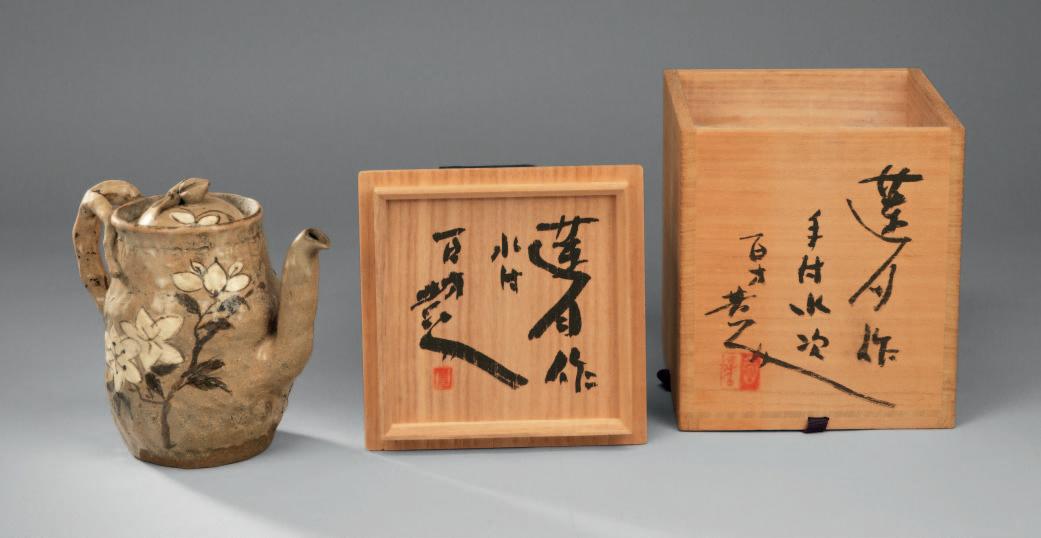
594
ŌTAGAKI RENGETSU (17911875)
EDO/MEIJI, 19TH CENTURY
The tall body applied with a bifurcated handle and a long curved spout, a faint band of key fret below the rim; decorated to one side with sprays of flowers in white slip and brown glaze, the reverse with a long poem about the joy of finding comfort in a secluded hut during the spring rain, knowing the cherry blossoms are just on the verge of blooming; the lid with a peachshaped knop and painted with a stylised butterfly; in a fitted tomobako (wood box) inscribed Rengetsu saku, Tetsuki mizutsugi, Hyakusuke Yoshuyuki (made by Rengetsu, a handled water pourer, Hyakusuke Yoshiyuki) with two seals for Kuroda Hyakusuke, and inside the lid Rengetsu saku, Koboshi, Hyakusuke dai (made by Rengetsu, the teapot named Koboshi‘Little Monk’inscribed by Hyakusuke), with a red seal reading Hyakusuke; 16.8cm. (3)
£400-600
Kuroda Hyakusuke (1893-1959) was a famous tea master and a renowned expert in Rengetsu’s work.
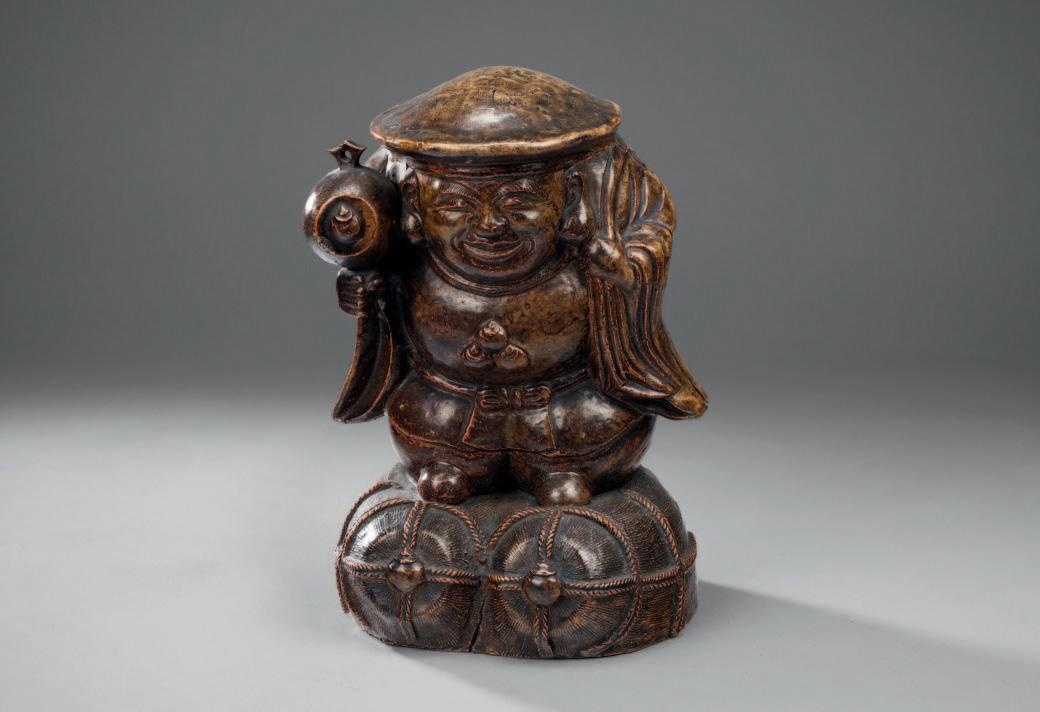
593
A JAPANESE SETO FIGURE OF DAIKOKU EDO PERIOD, DATED SEPTEMBER 1843
The God of Good Fortune typically depicted standing on hay bales holding his mallet, with several tama (precious jewels) decorating the surface, the back incised with a long inscription reading as Tenpō Jūshinnen, Mizunoto-U Kugatsu Kichijitsu (on an auspicious day in September, Year 14 of the Tenpō Era), Setomura (Seto Village), Shōdō Tōsen saku (Made by Shōdō Tōsen), 31.5cm.
WITHOUT RESERVE
£200-300
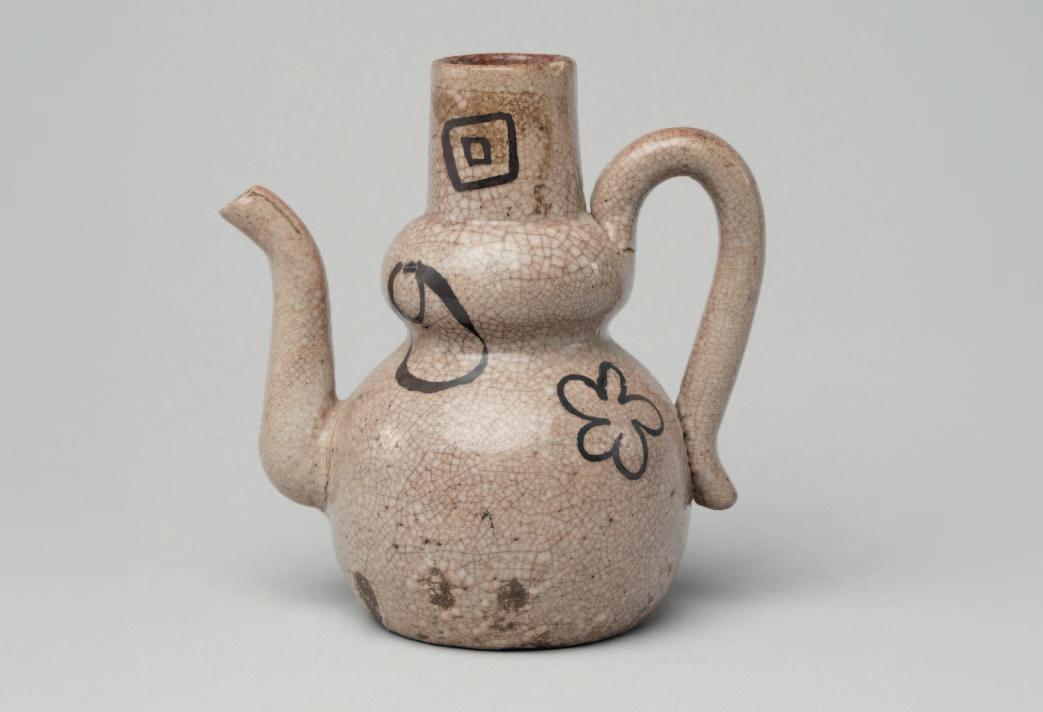
595
A JAPANESE ORIBE EWER
PROBABLY MEIJI, 19TH CENTURY
The body shaped as a doublegourd with a tall straight neck and a curved handle, one side with a blue and red splash, the reverse with a flower, a tama and a kite freely drawn on the crackled glaze, 17.5cm.
£150-250
Provenance: from a Japanese private collection, London.
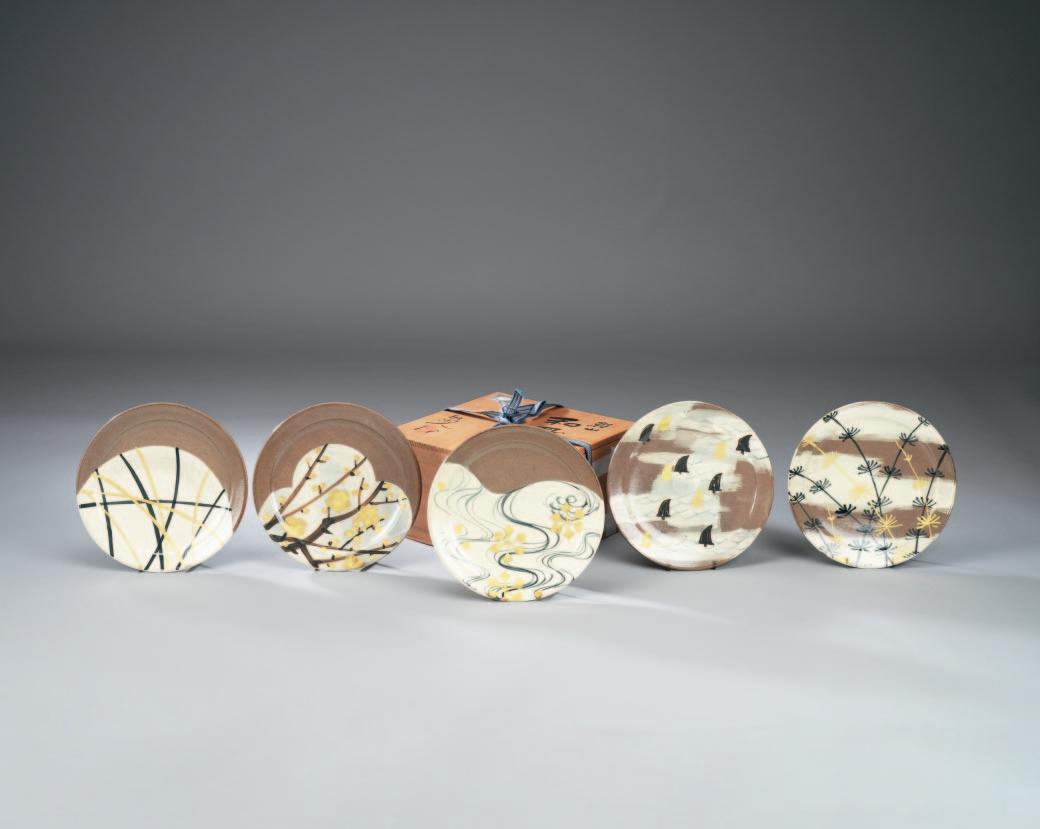
596
A SET OF FIVE JAPANESE MINO WARE DISHES BY NAKAJIMA MASAO (19212014)
HEISEI ERA, 20TH CENTURY
Variously decorated with flowers, landscapes and other abstract designs, rendered in white slip, gilt and black enamel on the warm brown ground, each signed underneath; with a tomobako (wood box) inscribed Kenzan (in the style of Ogata Kenzan), Wasara go (set of five dishes), signed and seal Masao, 21.5cm each. (6)
£500-1,000
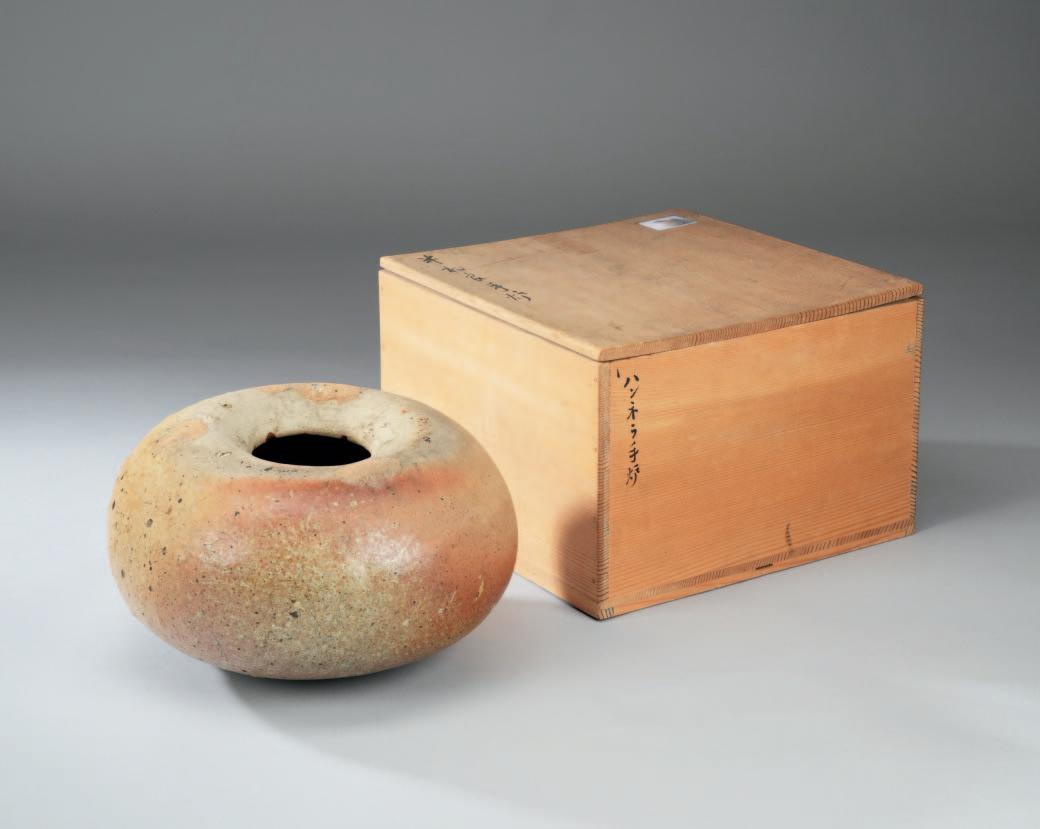
598
A LARGE JAPANESE TAMBA-YAKI TE-ABURI (HANDWARMER) POSSIBLY EDO, 19TH CENTURY
The doughnutshaped stoneware body with an uneven orange surface, the inside with a dark lustrous glaze; with a tomobako (wood box) inscribed Hannerate te-ro/ shuro (earthy style handwarmer), 25cm. (2)
£500-800
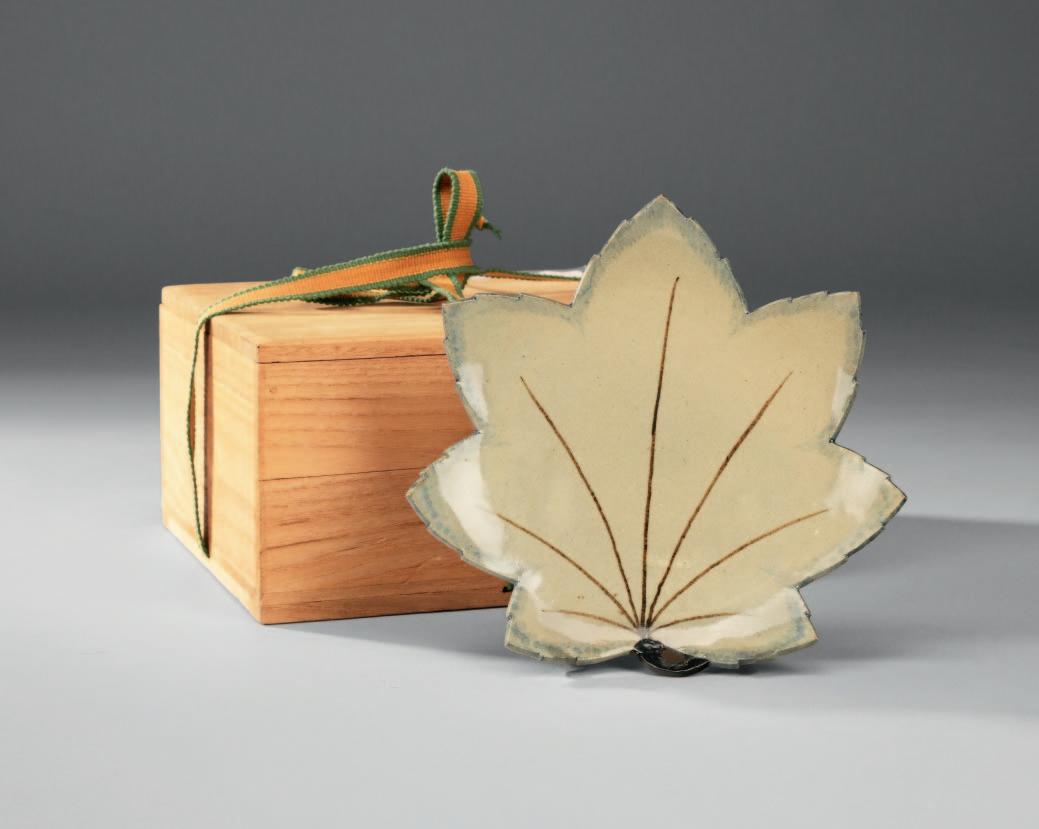
597
A JAPANESE LEAFSHAPED DISH IN THE STYLE OF NINSEI PROBABLY 20TH CENTURY
Modelled as a maple leaf with sharp edges, with details of the veins in dark brown and blue; raised on a short circular foot, stamped Ninsei underneath; with a tomobako (wood box), 16cm. (2)
£400-600
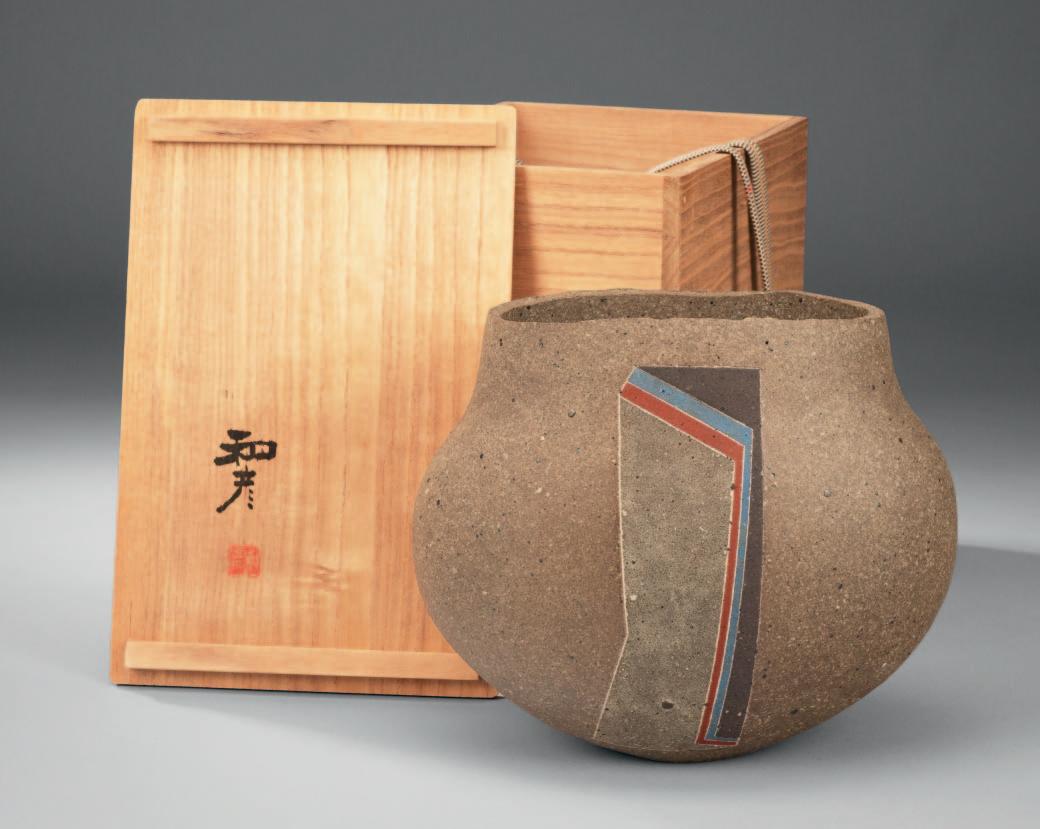
599
A JAPANESE STONEWARE VASE BY SATO KAZUHIKO (B.1947)
SHŌWA ERA, 20TH CENTURY
Of flattened form with a wide oval mouth, the sides decorated with geometrical patterns rendered in dark grey, blue and red on the rough stoneware ground, stamped with a rectangular mark underneath and ‘SATCH 1982’; with a tomobako (wood box) inscribed Haitō saimon tsubo (ashglazed earthenware vase with coloured patterns) and signed and sealed Kazuhiko , 21.5cm. (2)
£500-800
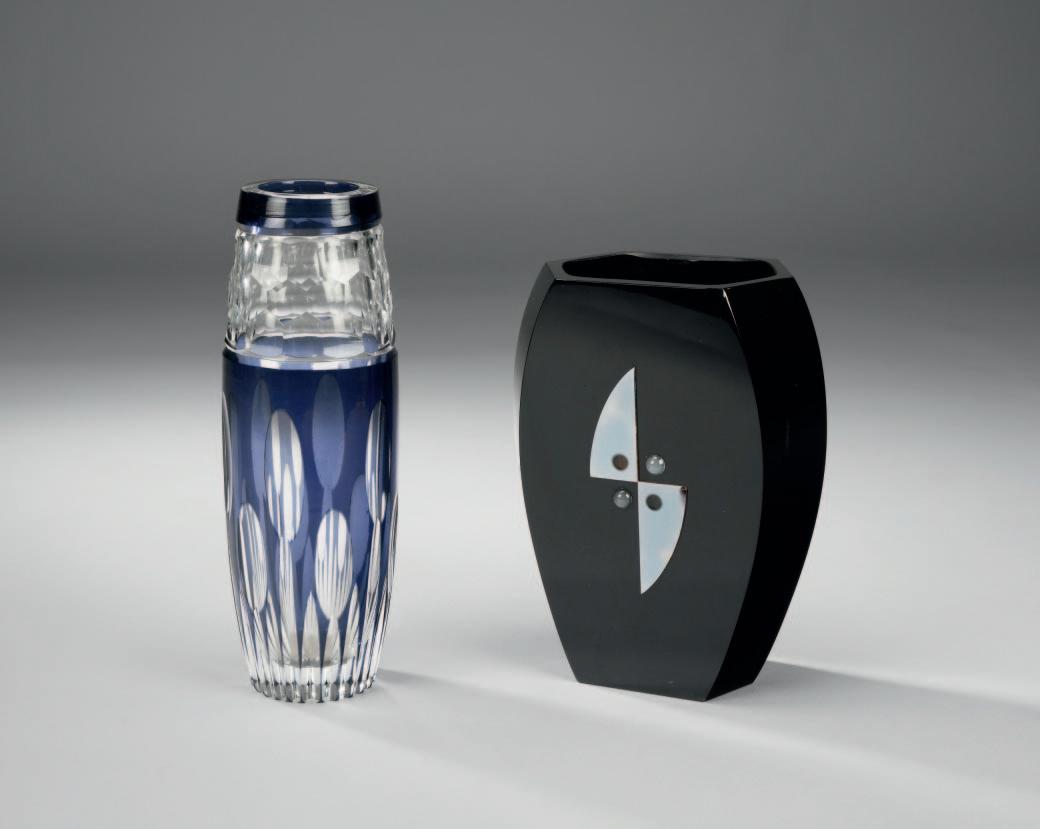
600
TWO GLASS VASES
20TH CENTURY
Possibly Japanese, one with a black flattened body with geometrical decoration, the other a cylindrical faceted vessel, 24.5cm and 20.5cm. (2)
£200-400
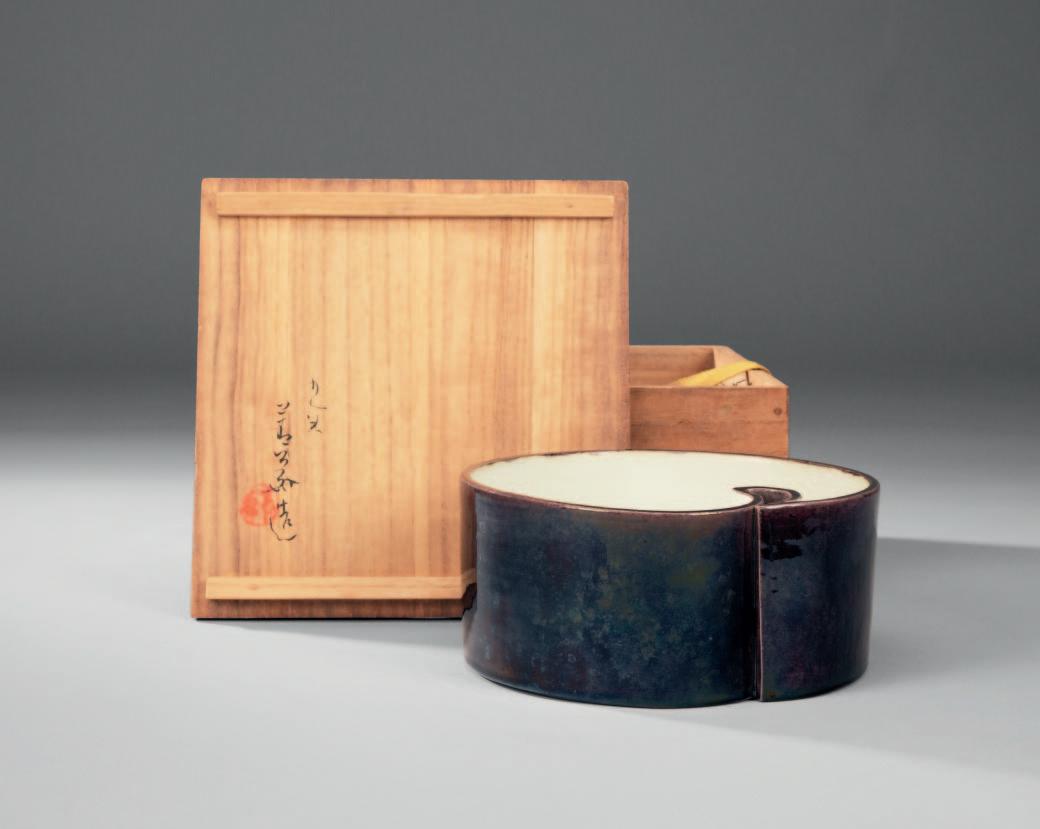
602
A JAPANESE PORCELAIN KENSUI (WATER BOWL) FOR THE TEA CEREMONY
SHŌWA/HEISEI, 20TH CENTURY
Of circular shape with a notch to the side, the inside glazed white and the outside and base with a lustrous auberginecolour surface; marked Hanazen underneath; with a tomobako (wood box) inscribed Kensui Kōchi Shiyu, Oshiko-yaki Matsubayashi Hosai (a lustrous purple wastewater bowl by Matsubayashi Hosai), possibly referring to Matsubayashi Hosai XV (19502015); 18cm approx. (2)
£500-800
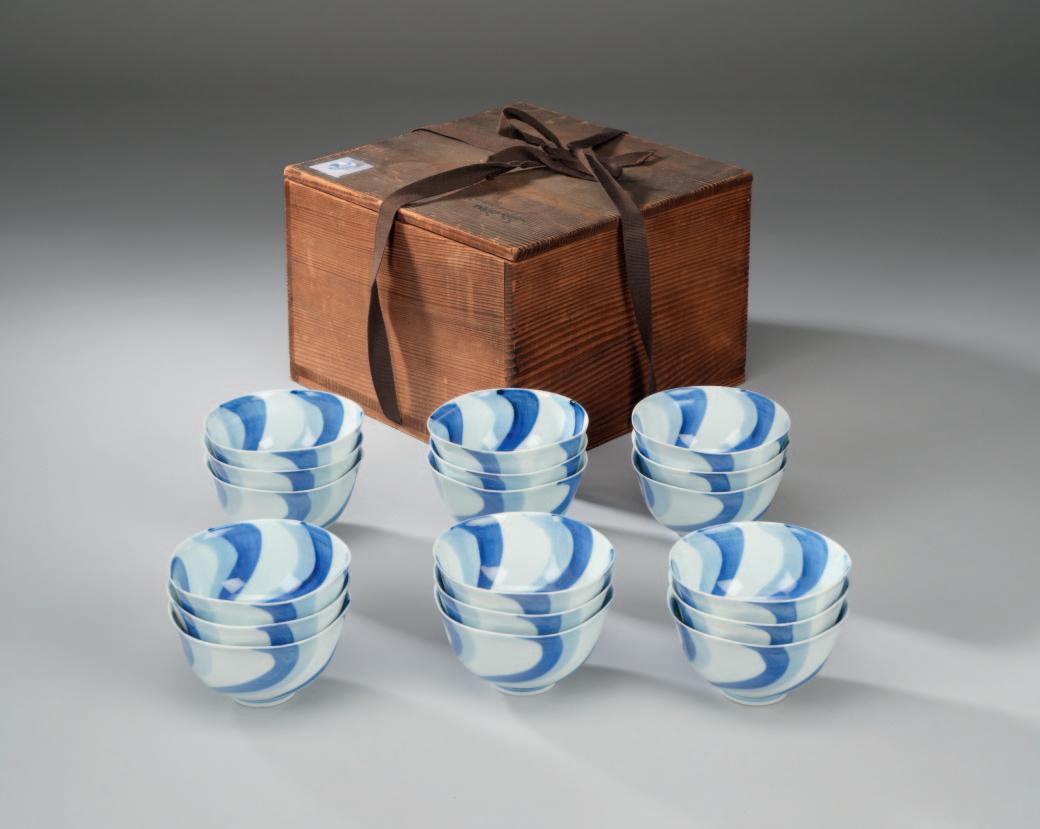
601
A SET OF EIGHTEEN JAPANESE BOWLS BY HEIAN SHUNPO (B. 1896)
SHŌWA ERA, 20TH CENTURY
Each with a slightly uneven rim and raised on a short foot, decorated in underglaze blue with a swirl pattern, each signed Heian Shunpo underneath; with a tomobako (wood box) inscribed Seika nejiri kumidashi chawan (blue and white porcelain, twist pattern, small teabowls) and signed Heian Shunpo, each approx. 10cm. (19)
£500-800
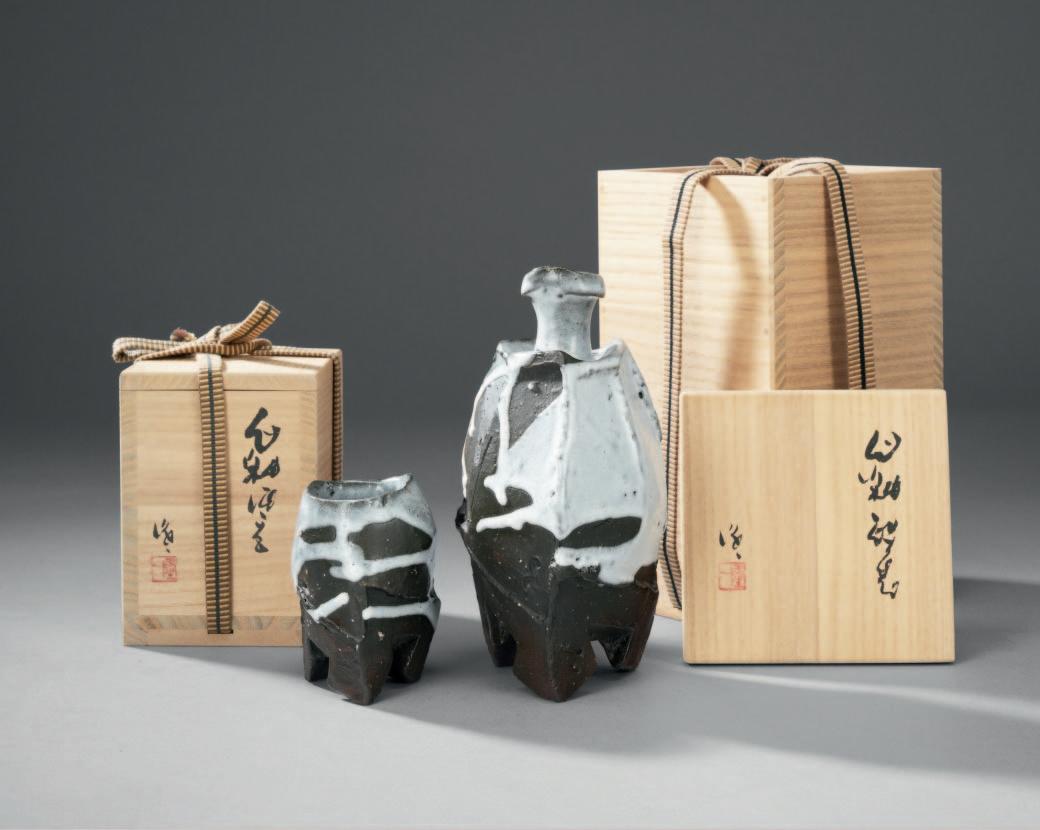
603
A JAPANESE BIZEN SAKE SET BY RYUICHI KAKUREZAKI (B.1950)
HEISEI ERA, C.2013
Both the tall decanter and cup with a triangular body raised on three Lshaped feet, decorated with a creamywhite glaze on the dark grey earthenware ground; both with a mark for the artist to the side; each with a tomobako (wood box) inscribed Hakuyu Shuki (white glaze sake set), signed Ryuichi and sealed; 8.2cm and 5.7cm. (4)
£500-800
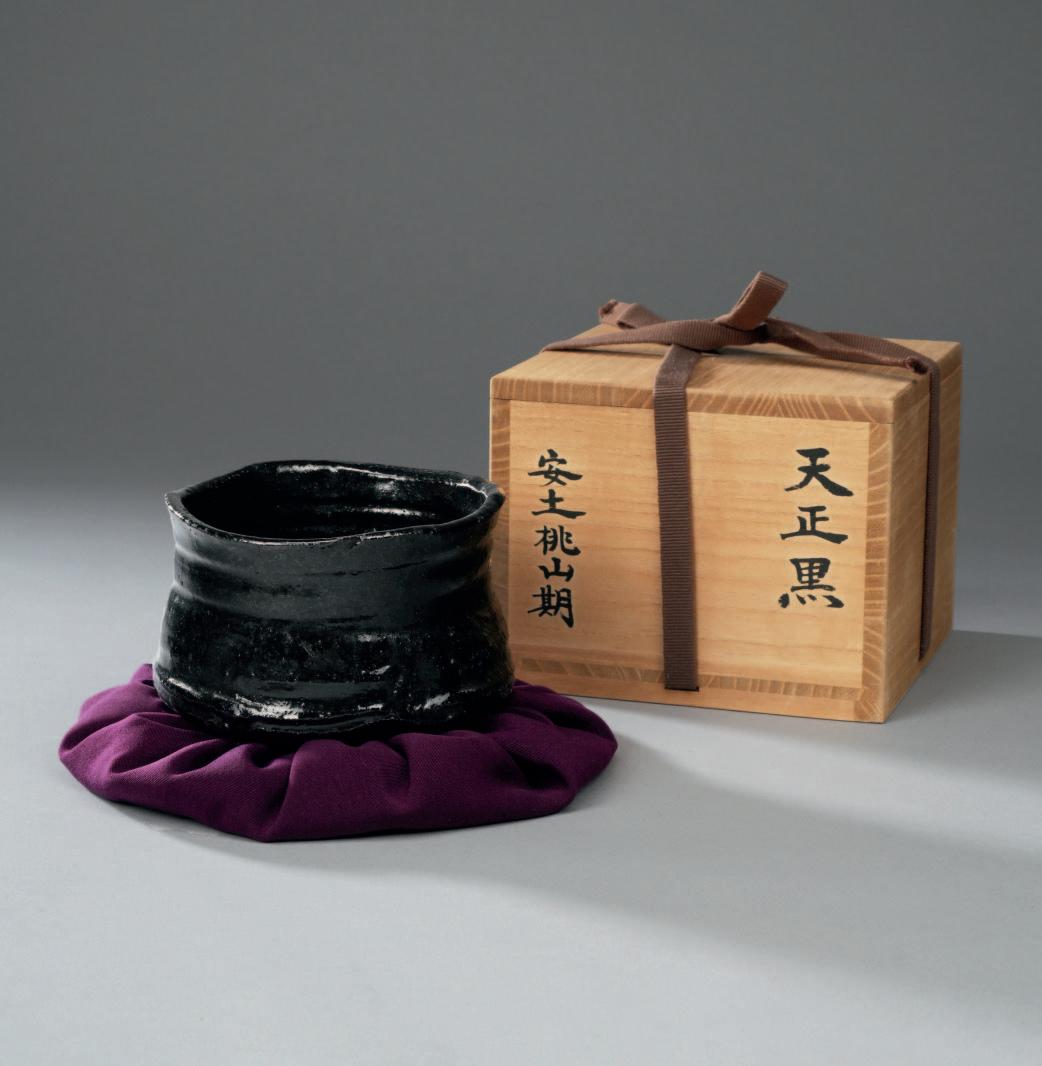
605
A JAPANESE BLACK SETO WARE CHAWAN (TEABOWL)
SHŌWA ERA, 20TH CENTURY
The large waisted body of cylindrical form, with a deep black and lustrous glaze stopping short of the floor; in a fitted tomobako (wood box) inscribed Setoguro chawan, Tenshō-ki Momoyama-jidai, and Kōkurō saku (made by Kōkurō), 13.2cm dia. (2)
£200-300
Provenance: from an English private collection, Devon.
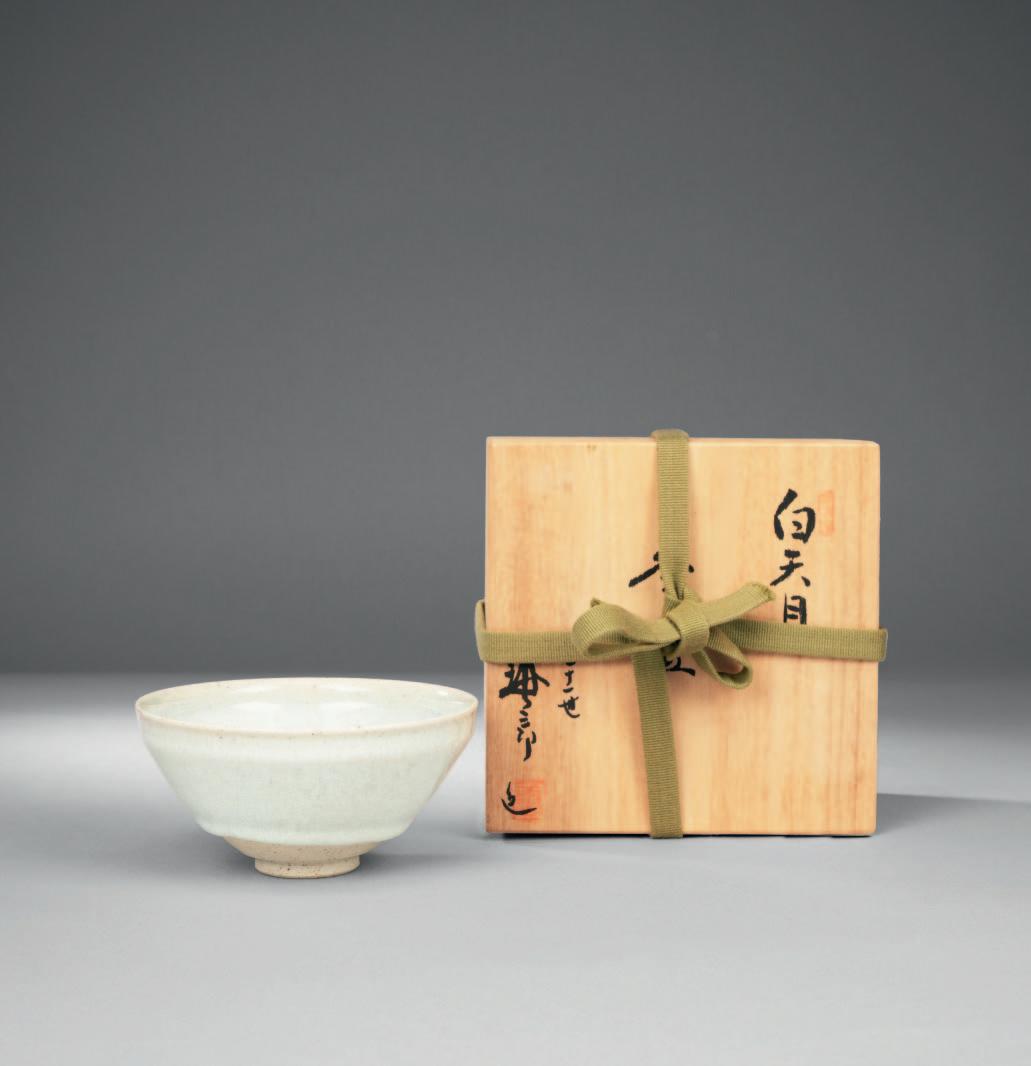
604
KATO TŌZABURO XXXI (B.1948)
SHŌWA OR LATER, 20TH OR 21ST CENTURY
A Japanese chawan (teabowl), the conical body covered with a thick white tenmoku glaze with bluish streaks stopping short of the foot, the base with two impressed marks, one for Tō and the other, a wisteria leaf mon (the Kato family crest); with a fitted tomobako (wood box) inscribed Shiro tenmoku, chawan, sanjūissei Tōzaburō (White tenmoku teabowl, 31st generation Tōzaburō) and with a red seal for Kato, 13cm. (2)
£150-250
Kato Tozaburo XXXI belongs to a distinguished lineage of potters, claiming to trace its roots back to the first-generation master, Kato Shirozaemon Kagemasa (1168–1249). Since beginning his career in the 1970s, he has earned numerous accolades for his craftsmanship. In 1991, he formally inherited both the family kiln and the prestigious title of the 31st Kato Tōzaburo.
Provenance: from an English private collection, Wiltshire.
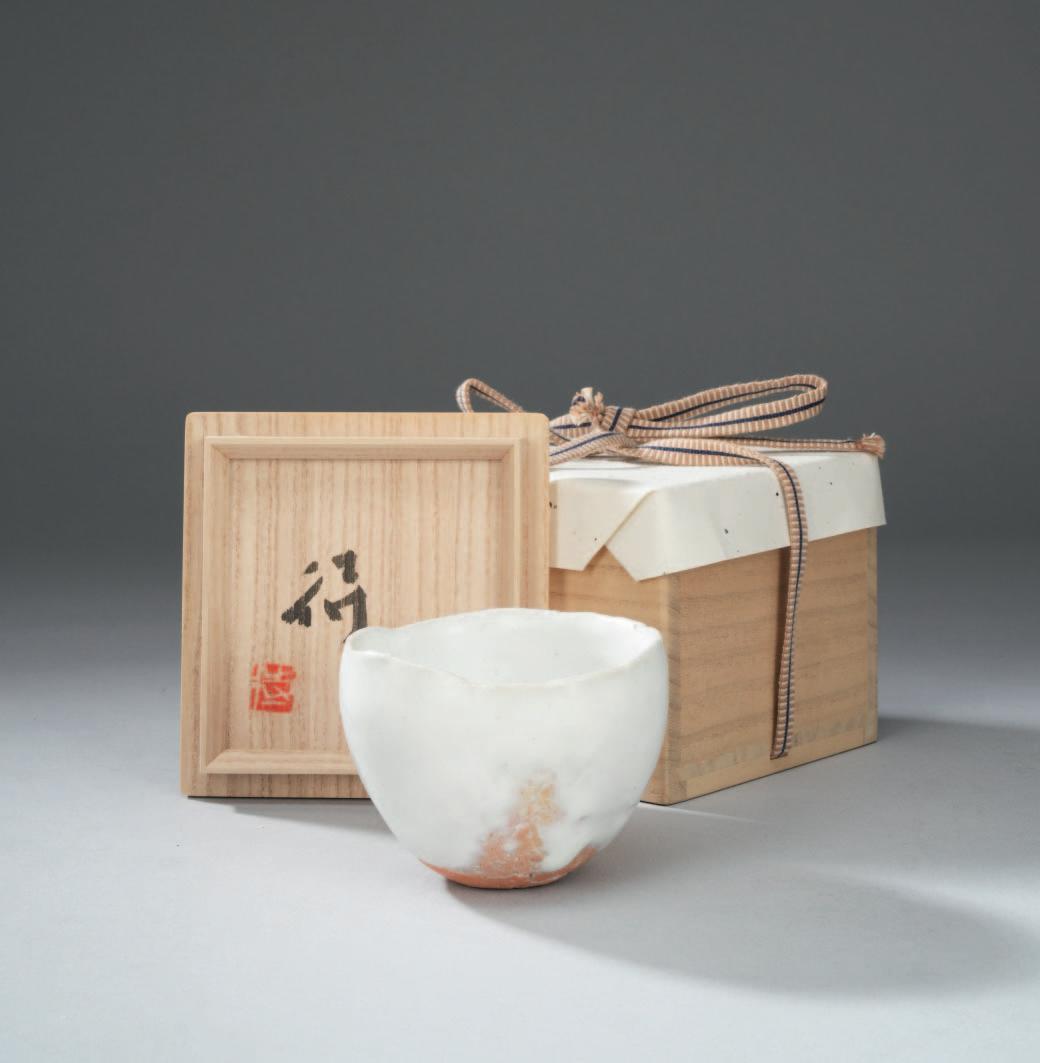
606
A JAPANESE WHITE TEABOWL BY MACHIKO OGAWA (B. 1946) REIWA ERA, 2021
The charming Ushaped body with an uneven rim, applied with a thick creamywhite glaze stopping short of the foot, the warm orange surface visible below; with a tomobako (wood box) inscribed, signed Machiko and sealed Ogawa, 10.5cm. (2)
£600-1,000
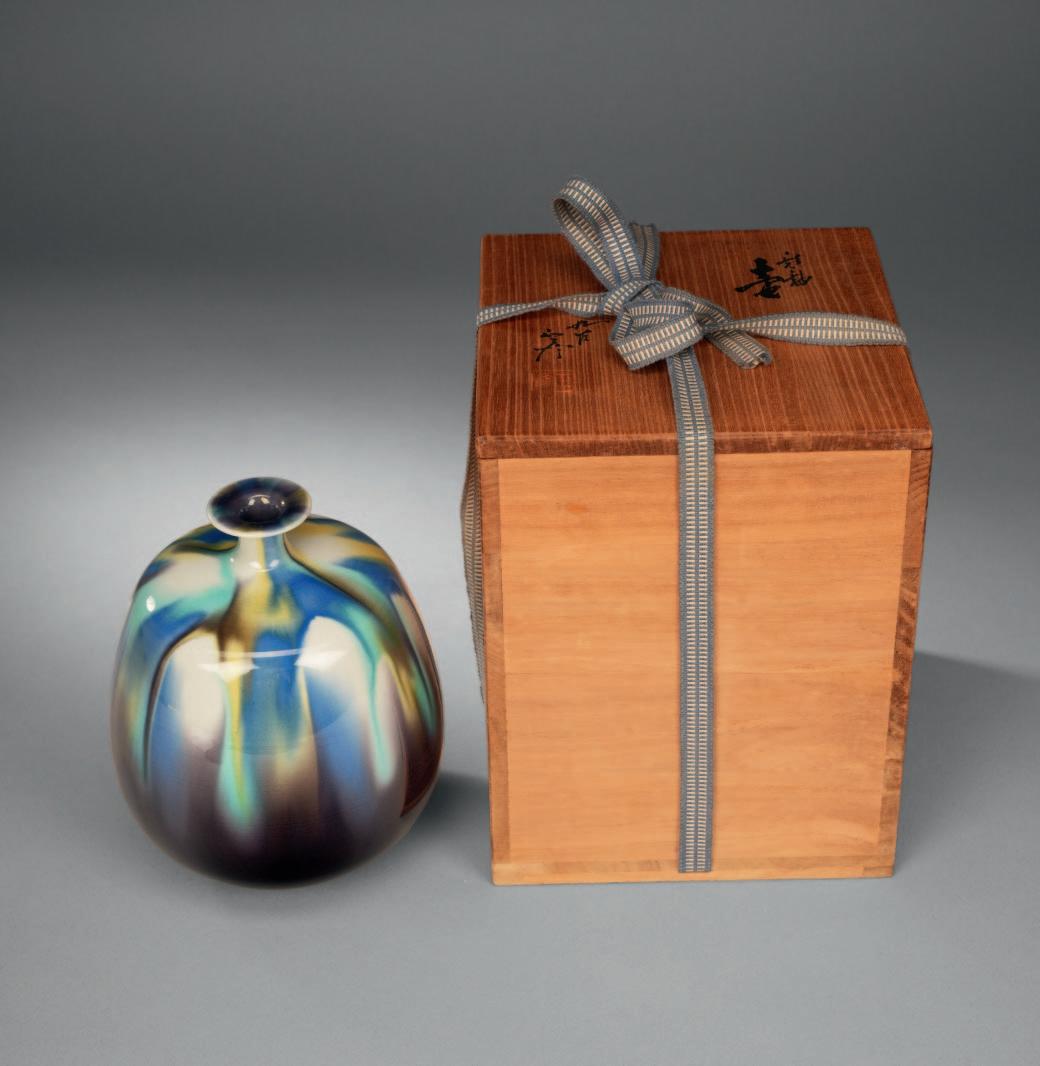
608
TOKUDA YASOKICHI III/ MASAHIKO (19332009)
HEISEI, 20TH CENTURY
The pearshaped body with an elongated neck, covered in an unctuous glaze stopping short of the foot, in deep aubergine with paler blue streaks; the base signed; together with a tomobako (wood box) inscribed Kutani Masahiko and sealed Masahiko, 23cm. (2)
£200-400
Provenance: from an English private collection, Wiltshire.
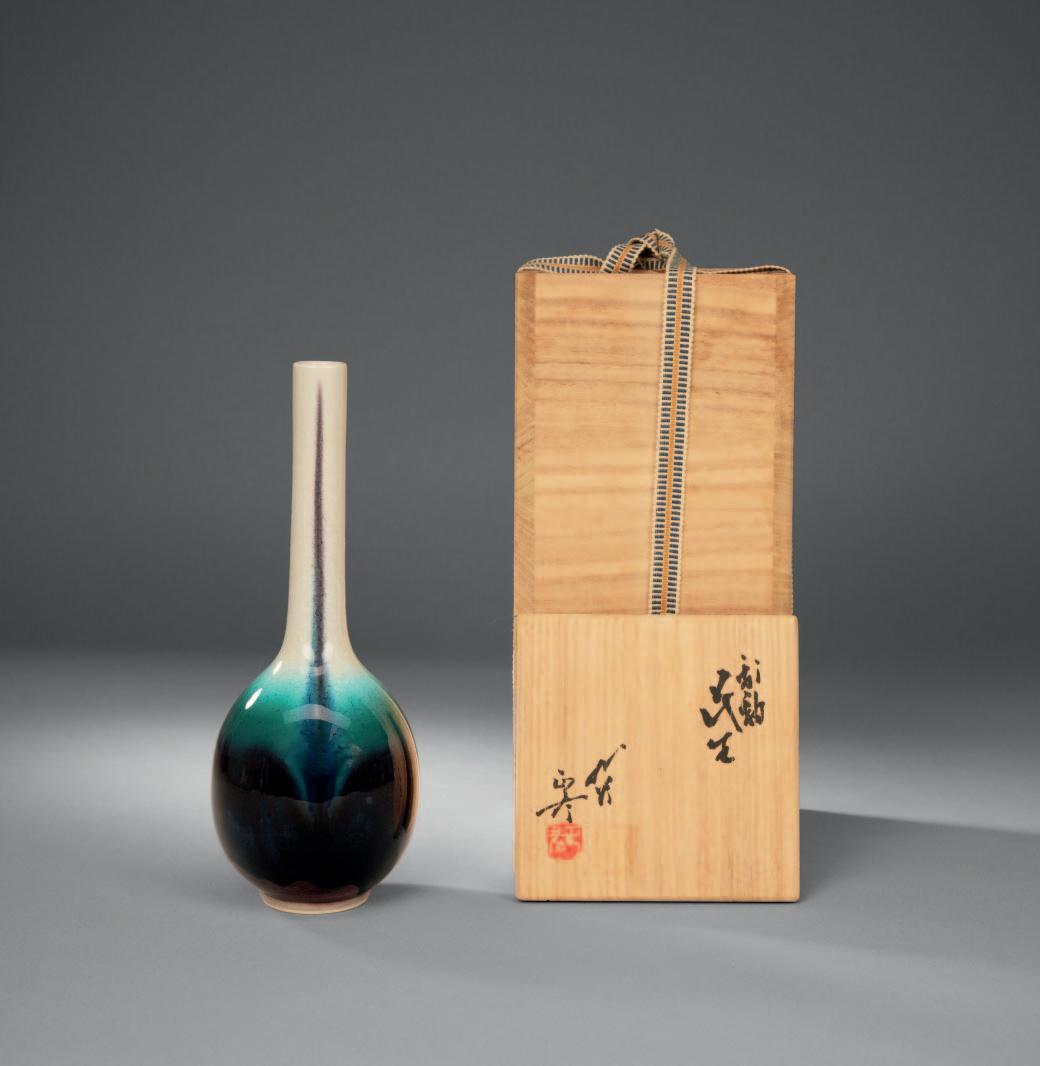
607
TOKUDA YASOKICHI III/ MASAHIKO (19332009)
HEISEI, 20TH CENTURY
A Japanese Kutani vase of bulbous form with a waisted neck and a flared rim, decorated with a colourful glaze with aubergine, electric blue, cyan and yellow streaks, the white body left visible in places; signed underneath, 25.5cm; with a tomobako (wood box) inscribed Saiyu tsubo, Kutani Sandai, Yasokichi (vase with vivid glaze, 3rd generation Yasokichi) and with a red seal mark, 17.5cm. (2)
£300-500
Provenance: from an English private collection, Wiltshire.
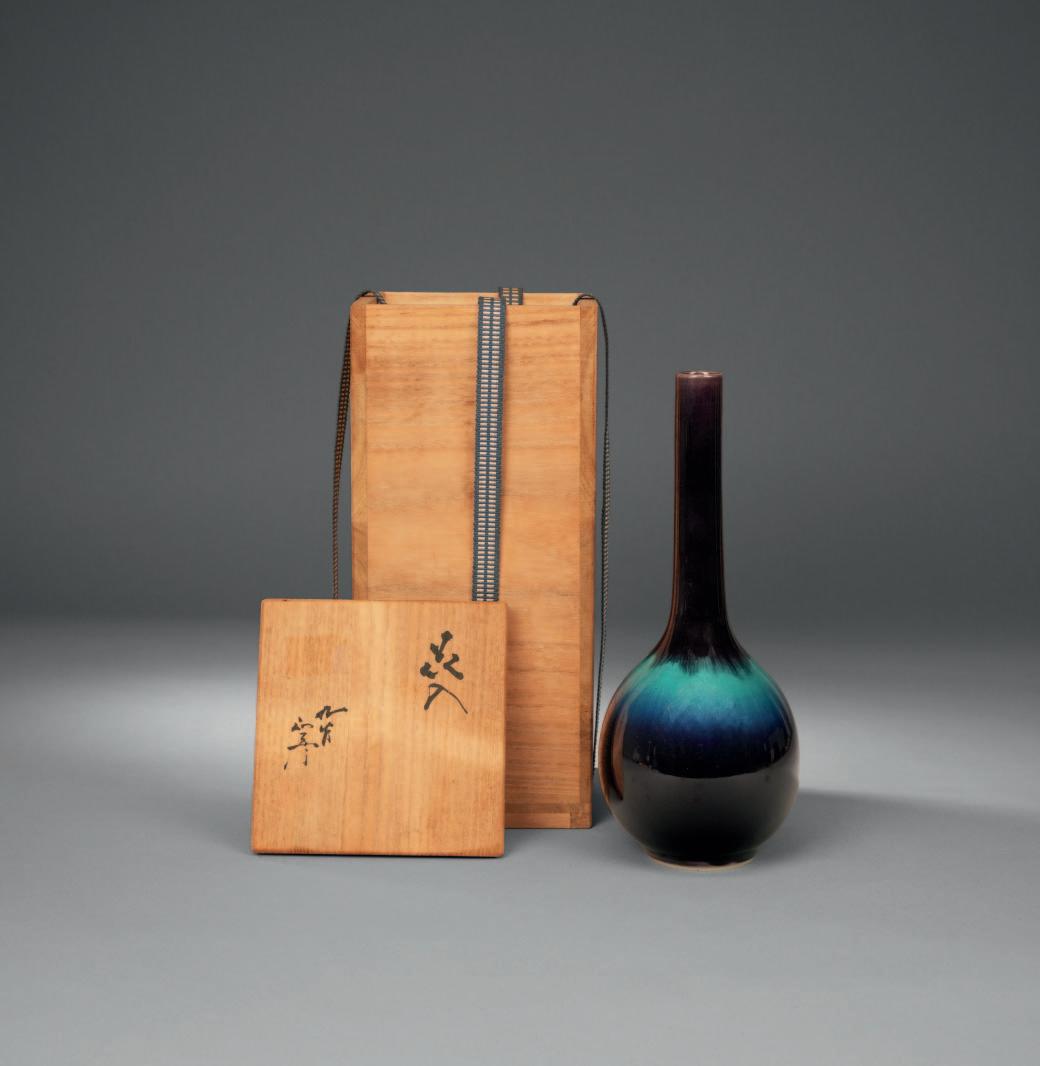
609
TOKUDA YASOKICHI III/ MASAHIKO (19332009)
HEISEI, 20TH CENTURY
The pearshaped body with an elongated neck, covered in an unctuous glaze stopping short of the foot; the upper half with the white crackled body visible throught the transparent glaze, the shoulder a bright cyanblue and the lower body an aubergine colour, with one long streak extending down from the neck; the base signed; together with a tomobako (wood box) inscribed Kutani Masahiko and sealed Masahiko, 23cm. (2)
£200-400
Provenance: from an English private collection, Wiltshire.
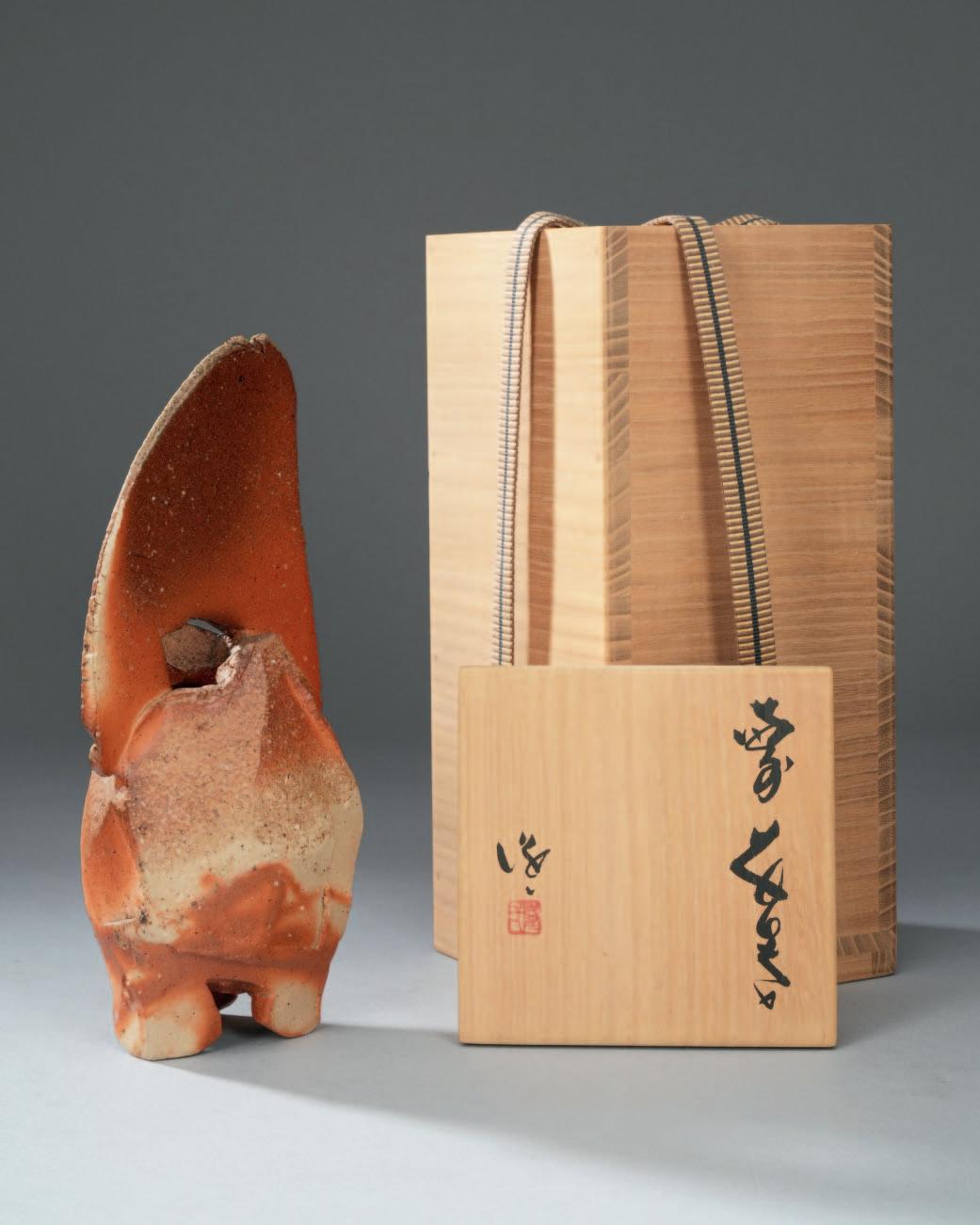
610
A JAPANESE BIZEN WARE VASE BY RYŪICHI KAKUREZAKI (B.1950) HEISEI ERA, 1999
The ashglazed flower vase raised on three Lshaped feet, the short angular body topped by a transverse finshaped form, the surface with areas a deep warm orange, an artist’s mark on the side; together with a tomobako (wood box) inscribed Suiki (Intoxicated vessel) and signed Ryūichi with a red seal for Kakurezaki; 21cm. (2)
£1,200-1,500
611
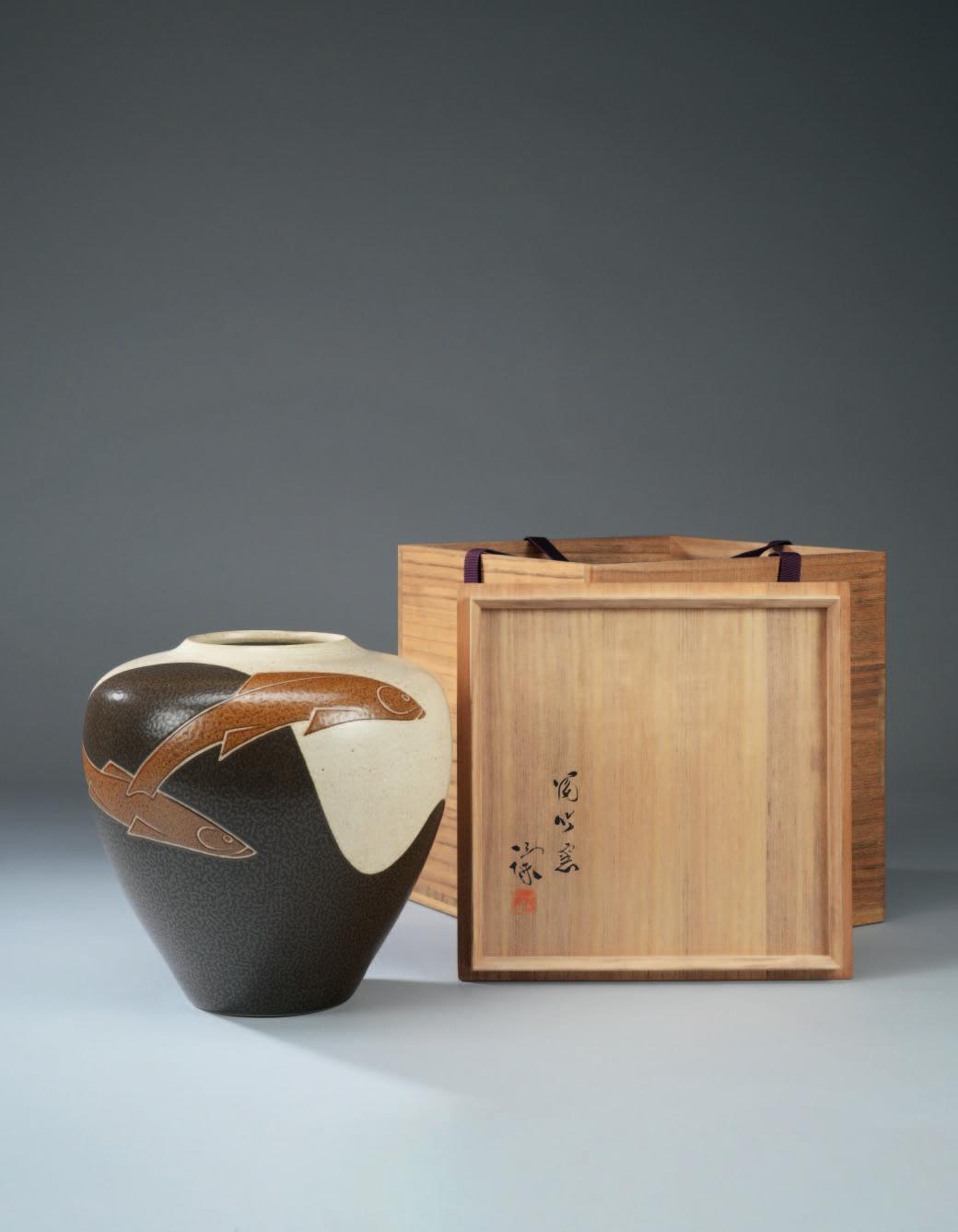
A JAPANESE VASE WITH TWIN FISH BY MIYANOHARA KEN (18981977)
SHŌWA ERA, C.1950s
With a wide shoulder and a tapered foot, decorated with two stylised fish amongst waves, the base with an impressed seal mark for Ken; together with a tomobako (wood box) inscribed Moriage Sōgyo-mon tsubo (vase with twin fish in relief) and signed Fuchiku-gō Ken, 24cm. (2)
£1,200-1,500
613
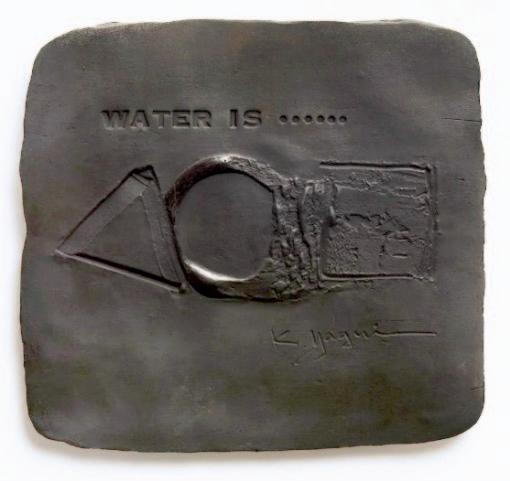
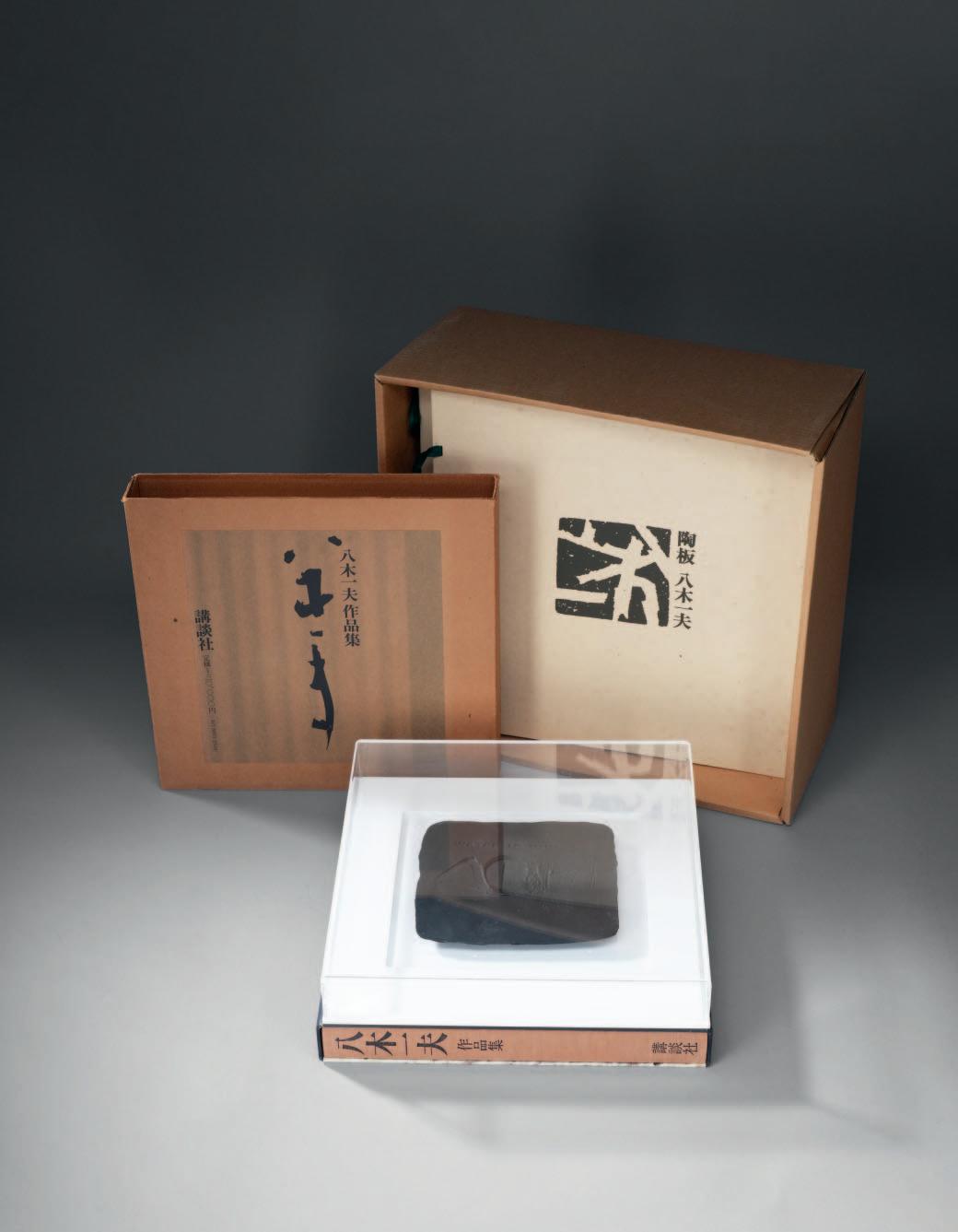
KAZUO YAGI (1918–1979)
WATER IS...
SHŌWA ERA, 1979
A Japanese kokutō tōban (black ware porcelain plaque), of square form and stamped with the words ‘WATER IS...’ above a triangle, a circle and a square, signed K. Yagui underneath; in a box frame and glazed; with a fitted box and sleeve labelled with the name of the artist and of the piece; together with a deluxe limited edition of the Yagi Kazuo Collected Works published in 1979; 15.1cm x 16.3 cm. (3)
£1,000-2,000
The triangle, circle and square are a common Japanese philosophical motif representing the universe. It is famously associated with the Zen monk Sengai Gibon.
Kazuo Yagi was a revolutionary Japanese ceramicist and a founding member of the avantgarde Sōdeisha group, which rejected the functional use for pottery. He is credited with transforming traditional Japanese ceramics into a medium for modern sculpture, often using flat ceramic slabs (such as this tōban) and abstract forms to express complex philosophical ideas.
612
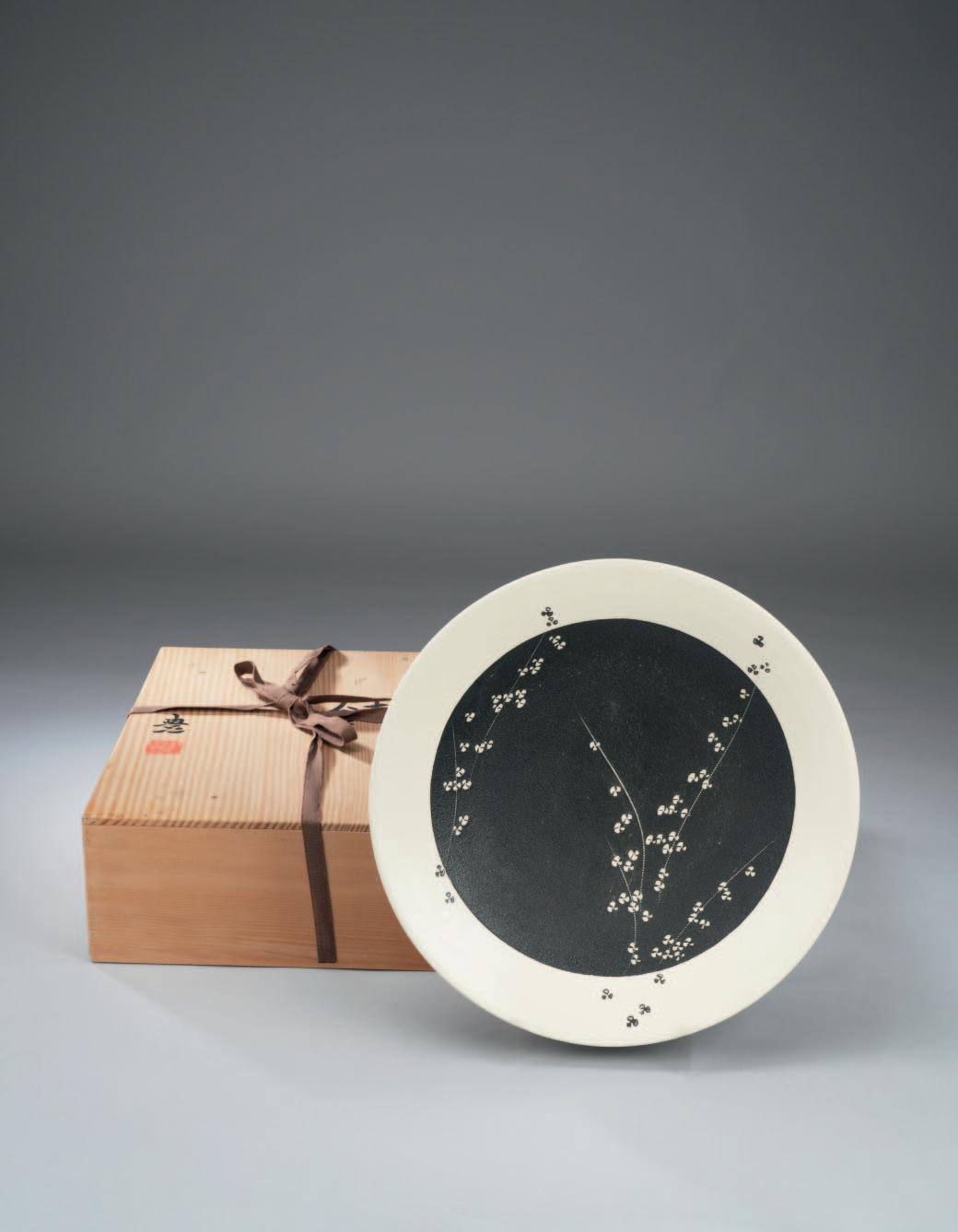
A LARGE JAPANESE DISH BY KONDŌ YUTAKA (193283)
SHŌWA ERA, 20TH CENTURY
The monochrome dish decorated in a technique similar to the Chinese Cizhou or Korean Buncheong wares, with sprays of white flowers on a black ground, the reverse signed with a single character for Yutaka, with a tomobako (wood box) inscribed Funka hachi (deep dish with black and white stamped design), and signed and sealed Yutaka, 39cm. (2)
£1,200-1,500
Kondō Yutaka (1932–1983) was a Kyoto-born artist renowned for mastering the Chinese Cizhou technique. During his career, he received many prizes including the prestigious 1967 JCS Award. He was honoured with a 1985 retrospective at the Kyoto Municipal Museum of Art, and his work is included in major collections, including the MET Museum in New York, the Victoria & Albert Museum, and the Kikuchi Kanjitsu Memorial Tomo Museum in Tokyo.
614
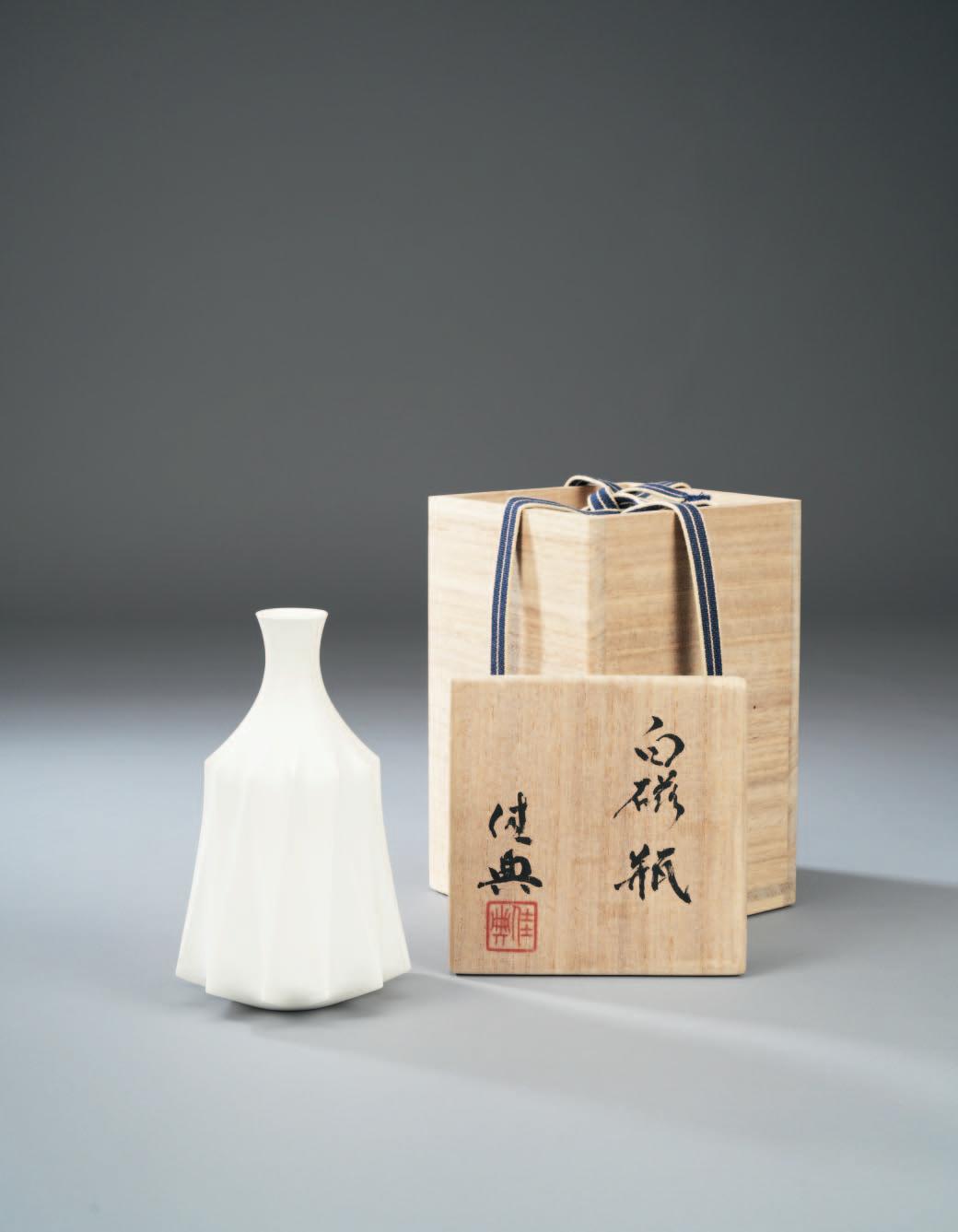
A WHITE JAPANESE PORCELAIN BOTTLE VASE BY YOSHINORI OHNO (B.1978)
HEISEI/REIWA, 20TH/21ST CENTURY
With a faceted body radiating underneath the slender, flared neck; in a tomobako (wood box) inscribed Hakuji hei (white porcelain vase), signed and sealed Ohno, 17cm. (2)
£500-800
615
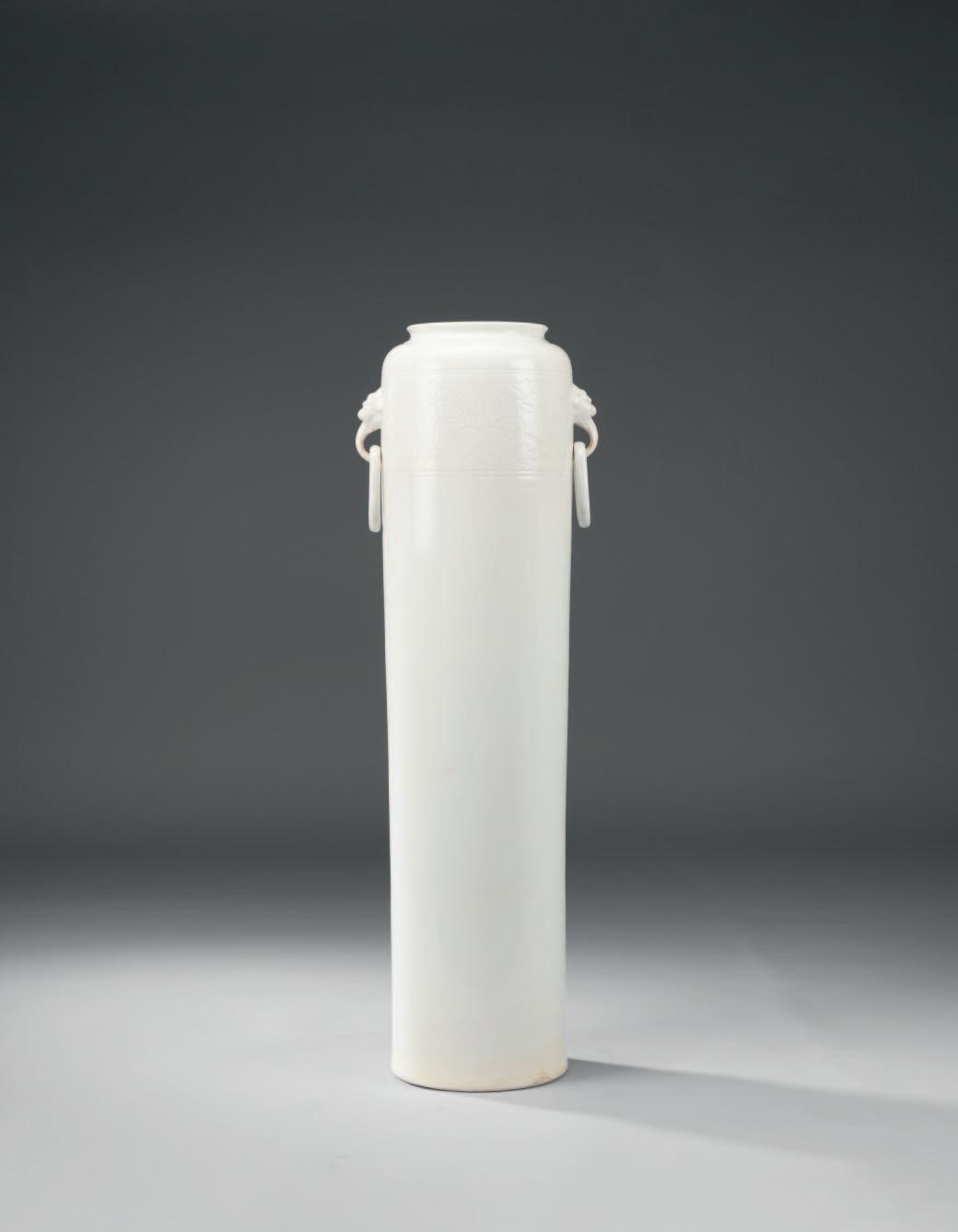
A TALL AND IMPRESSIVE JAPANESE VASE
SHŌWA/HEISEI, 20TH CENTURY
The slender milkywhite body with an incised band of lotus flowers and scrolling tendrils, applied with two lionhead mask handles suspending loose rings, 65.5cm.
£500-800
616
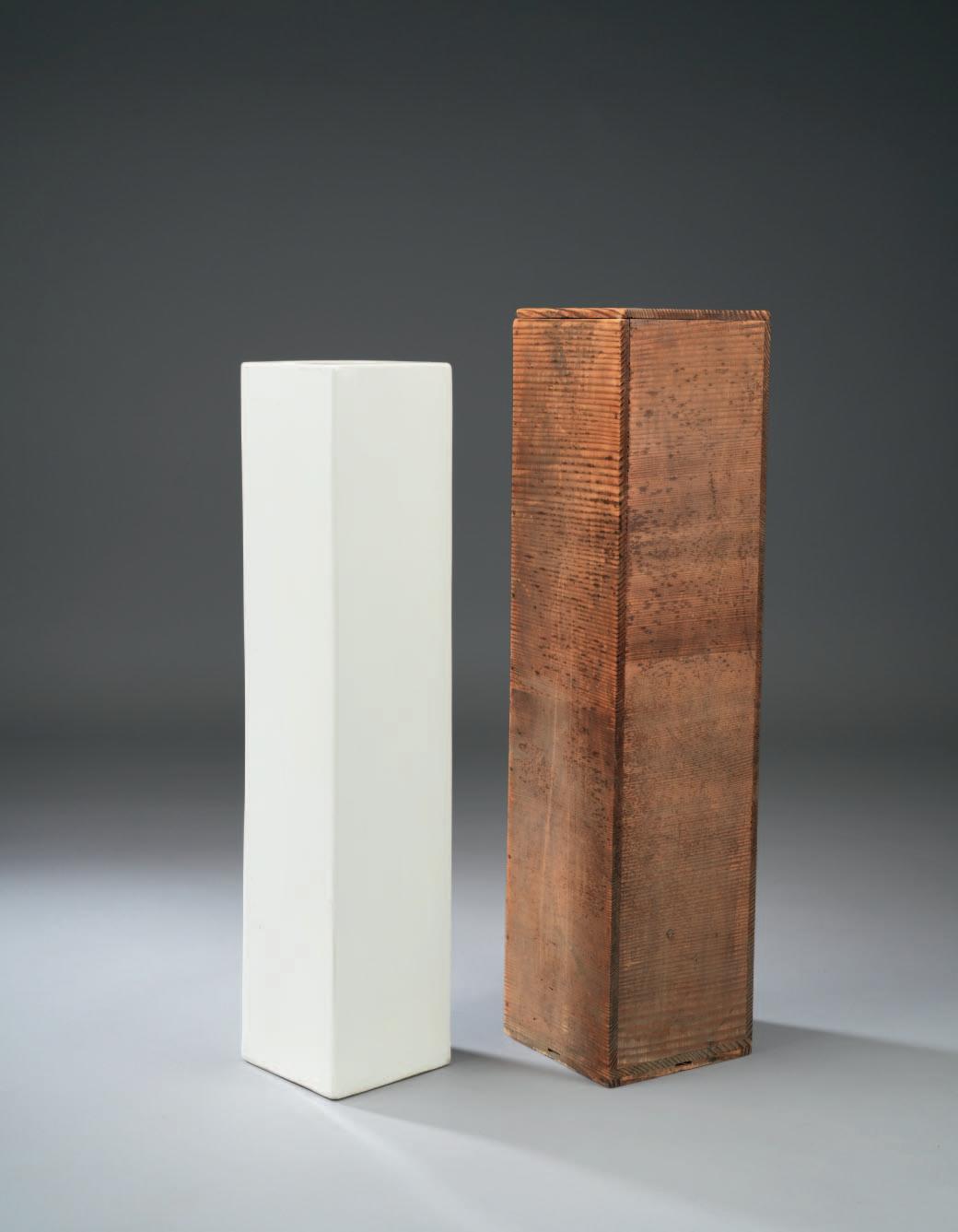
A TALL JAPANESE SQUARESECTION VASE
SHŌWA/HEISEI, 20TH CENTURY
The slender body with a bright white, thinly crackled glaze, with a tomobako (wood box), 54.5cm. (2)
£400-600
617
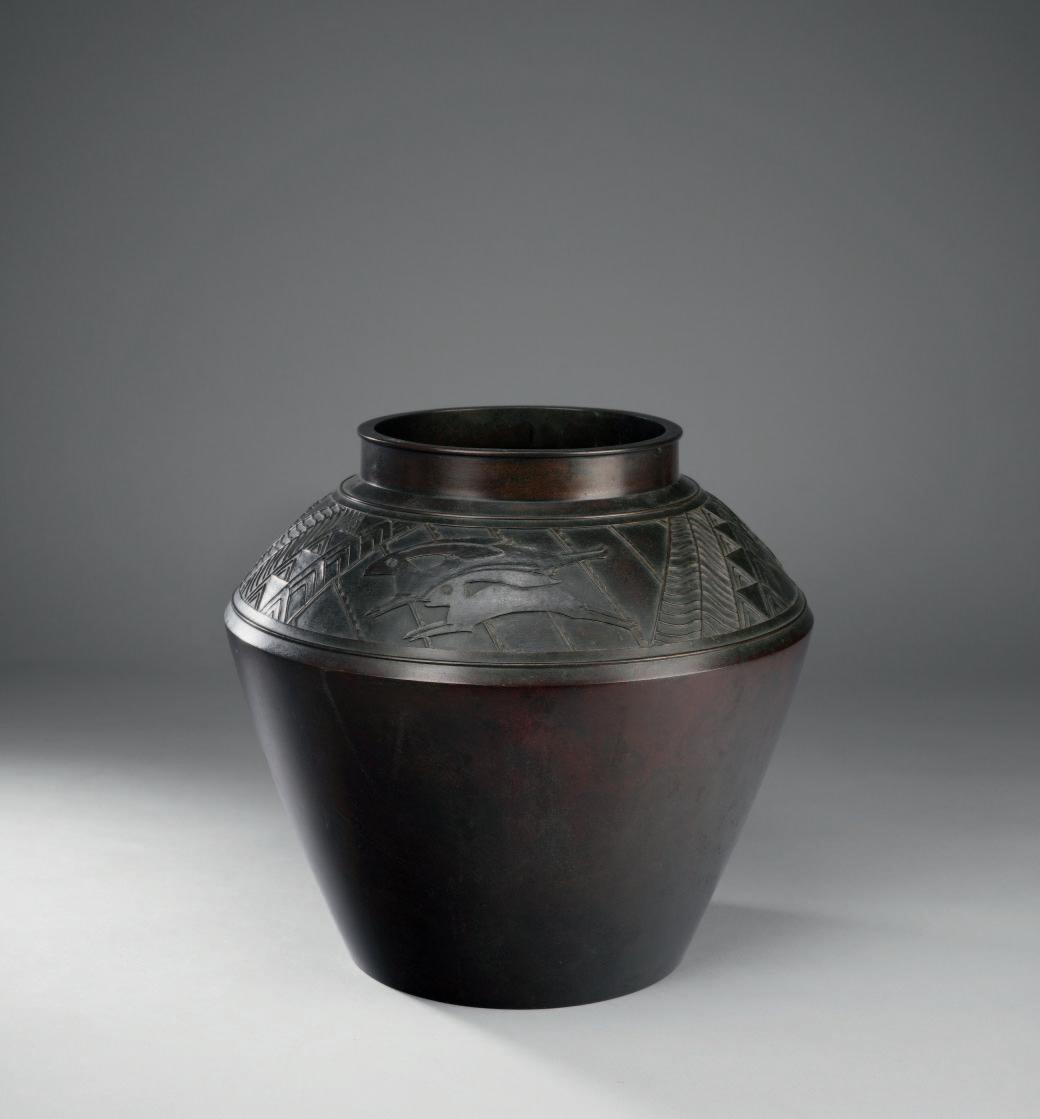
A LARGE JAPANESE BRONZE VASE WITH HARES BY HORI JOSHIN (19071993)
SHŌWA PERIOD, 20TH CENTURY
Of conical form with a short straight neck, the shoulder with a band of hares running amongst Art Decostyle geometrical motifs; signed Joshin saku underneath, 33cm.
£1,000-2,000
618
A LARGE JAPANESE BRONZE FLOWER VASE
SHŌWA ERA, 20TH CENTURY
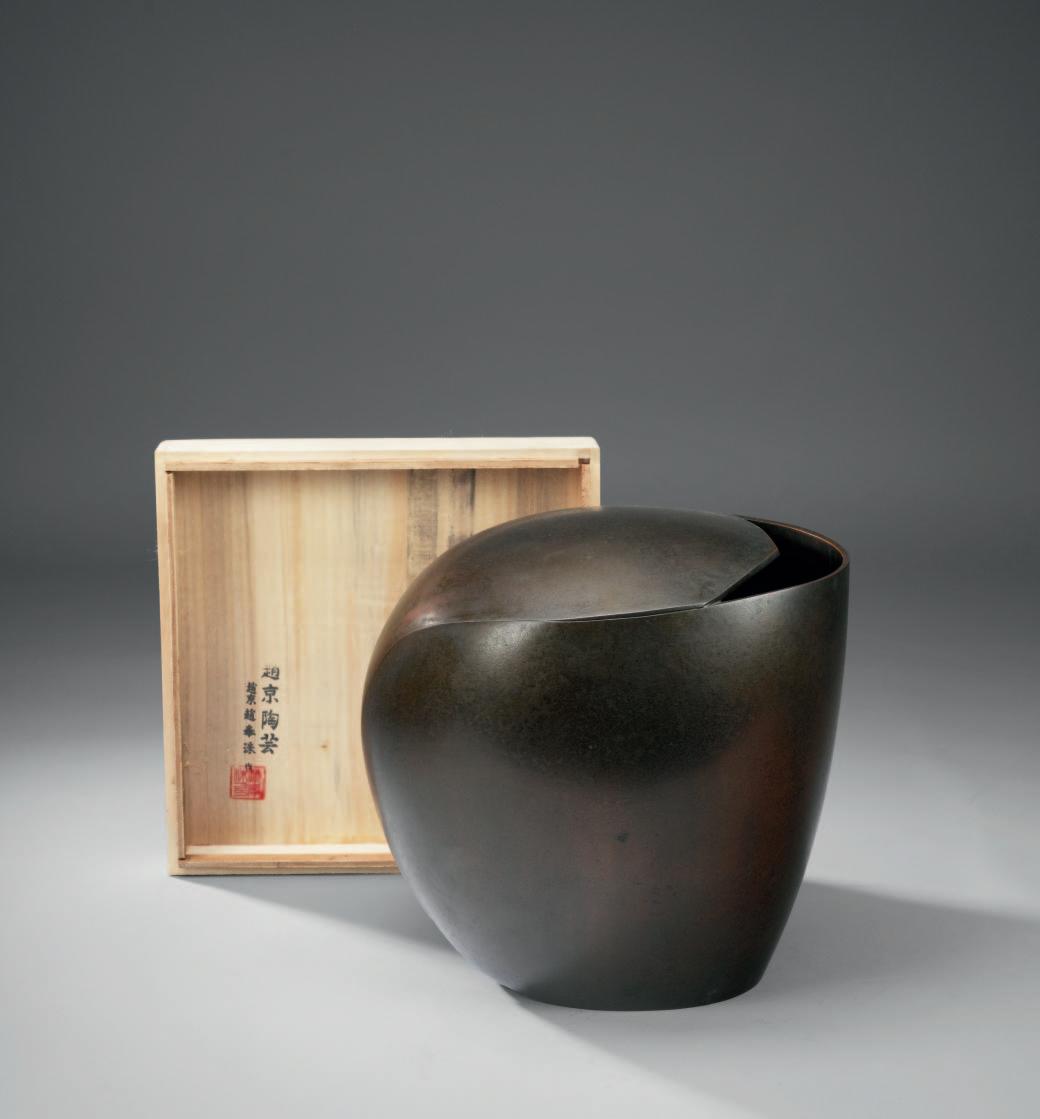
The pebbleshaped vase with a flat base, the domed top with an asymmetrical opening; together with a tomobako (wood box) inscribed Dō Kaki (bronze flower vase), Chōkyō Tōgei and signed Chōkyō Chō Kōshu, 32.cm. (2)
£800-1,200
619
A PAIR OF LARGE AND IMPRESSIVE JAPANESE BRONZE VASES BY HASEGAWA YOSHIHISA (1928–2002)
SHŌWA ERA, 20TH CENTURY
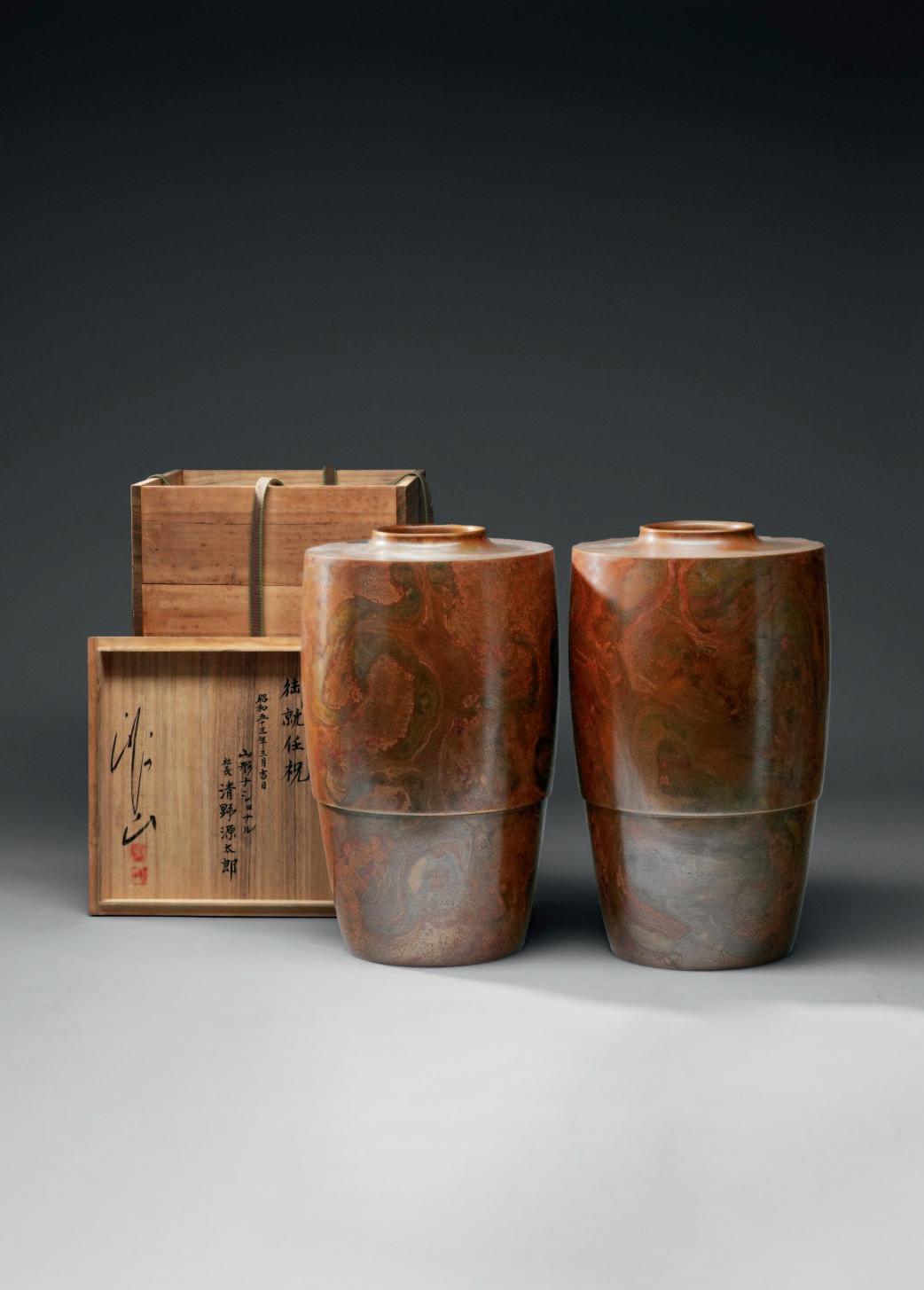
Each of tall cylindrical form with a short rim, both vases with a rich mottled patina; the surfaces with warm red, orange and chocolatebrown swirls; each with an incised signature for Yoshihisa to the base and one with a minute seal mark; one with a tomobako (wood box), the front signed Yoshihisa, inscribed Akebono (Dawn, possibly the name of the vase referring to its warm patina), and with a red seal mark reading as Kokka Shitei Dentō Kōgeihin (Nationally
Designated Traditional Craft Product); the reverse with a dedication noting that the vase is a gift in celebration of an inauguration or appointment to a high office, offered by Kiyono Gentaro, President of Yamagata National (Panasonic) and dated March 1978 (Shōwa 53); both 37cm. (3)
£2,000-3,000
Provenance: from a private collection, London.
620
TWO JAPANESE BRONZE VASES BY AIDA TOMIYASU (19011982)
SHŌWA ERA, 20TH CENTURY
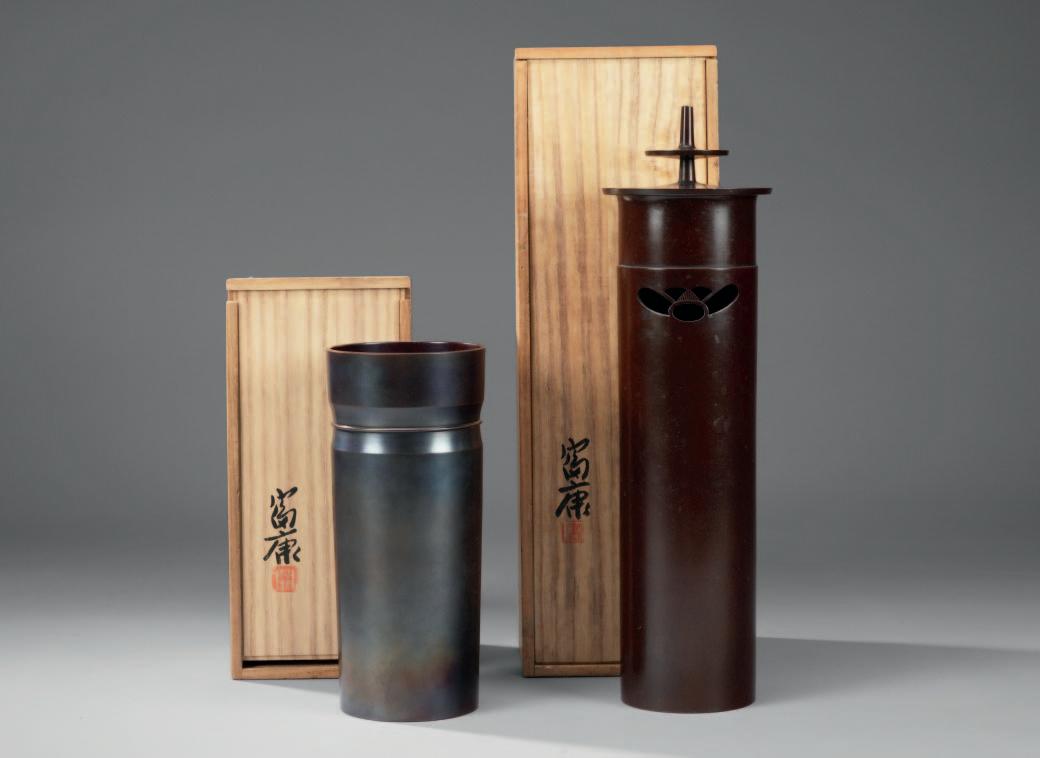
The tallest of cylindrical form with a shaped aperture at the front and a cover reminiscent of a spinning top, in a tomobako (wood box) inscribed Seidō Yoru no hana-ire (bronze flower vase of the night); the other vase of wider girth and with a ribbed neck, in a tomobako inscribed Seidō hana-ire (bronze flower vase); both vases inscribed Tomiyasu underneath, the boxes signed and sealed Tomiyasu, 39cm max. (5)
£1,000-1,500
622
THREE JAPANESE METAL VASES
SHŌWA/HEISEI, 20TH CENTURY
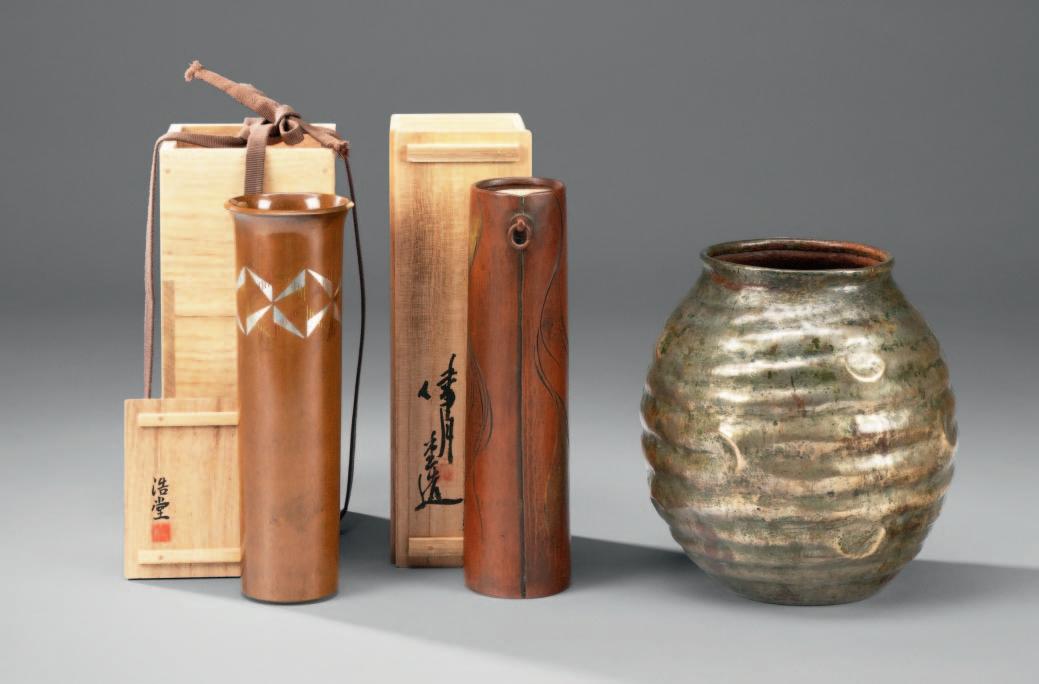
The first a cylindrical bronze wall vase with a ring for suspension, decorated with gilded waves, signed Masatoshi zō, with a tomobako (wood box) inscribed Tsuru hana-ire (cylindrical flower vase) and signed and sealed Masatoshi, with a biography of the artist, Shiotsu Masatoshi (b.1895); the second bronze vase of slender form with a short everted rim, decorated in kaga zōgan with pinwheels inlaid in silver and gilt, the base signed Kō for Kōdō Murakami (b.1961), also with a biography of the artist; with a tomobako inscribed Kaga zōgan nuki hana-ire (Kaga metalinlaid vase, titled ‘Wind’), signed and sealed Kōdō; the third a ribbed globular vase in white metal, possibly signed Shoryoku saku underneath, 21.5cm max. (5)
£600-800
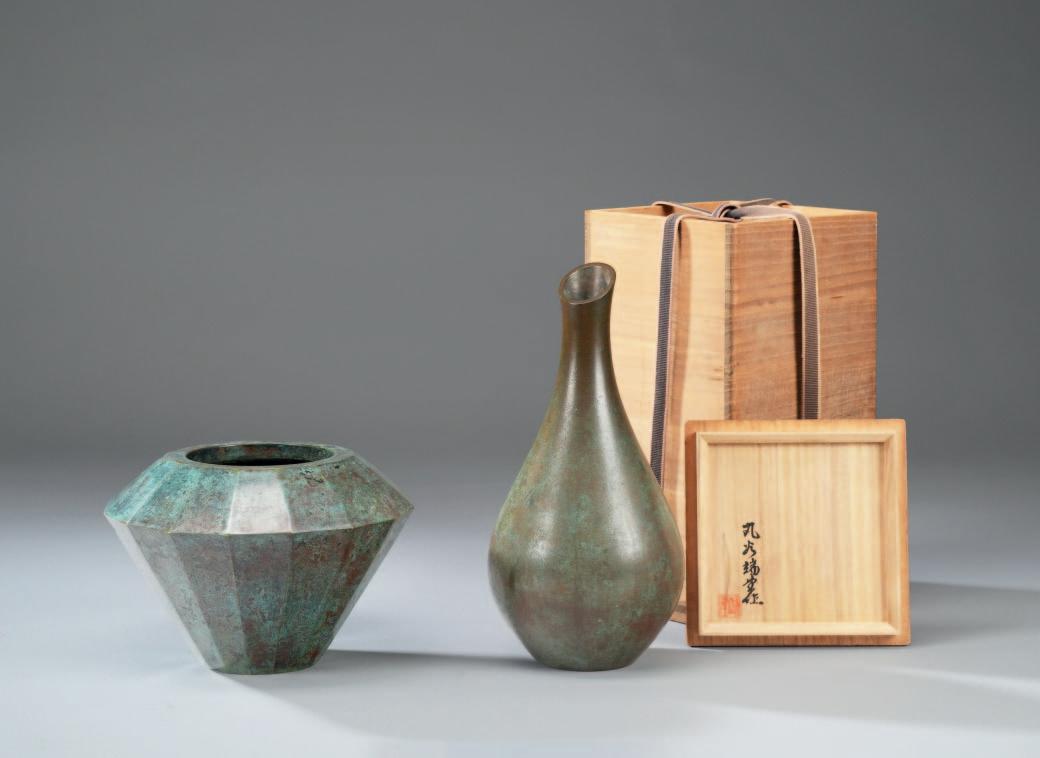
621
TWO JAPANESE BRONZE VASES, ONE BY MARUTANI TANDŌ (19001984)
SHŌWA/HEISEI, 20TH CENTURY
Both with deep bluegreen patinas, the first a tall bottleshaped vase with the rim at an angle, marked Tandō underneath, with a tomobako (wood box) inscribed Seidō kiriguchi hanama / hana-ike (bronze flower vase with crosssection rim) and signed Marutani Tandō saku (made by Marutani Tandō); the other with a diamondshaped, faceted body, a faint stamped mark underneath, 25.5cm and 13cm. (3)
£1,000-1,500
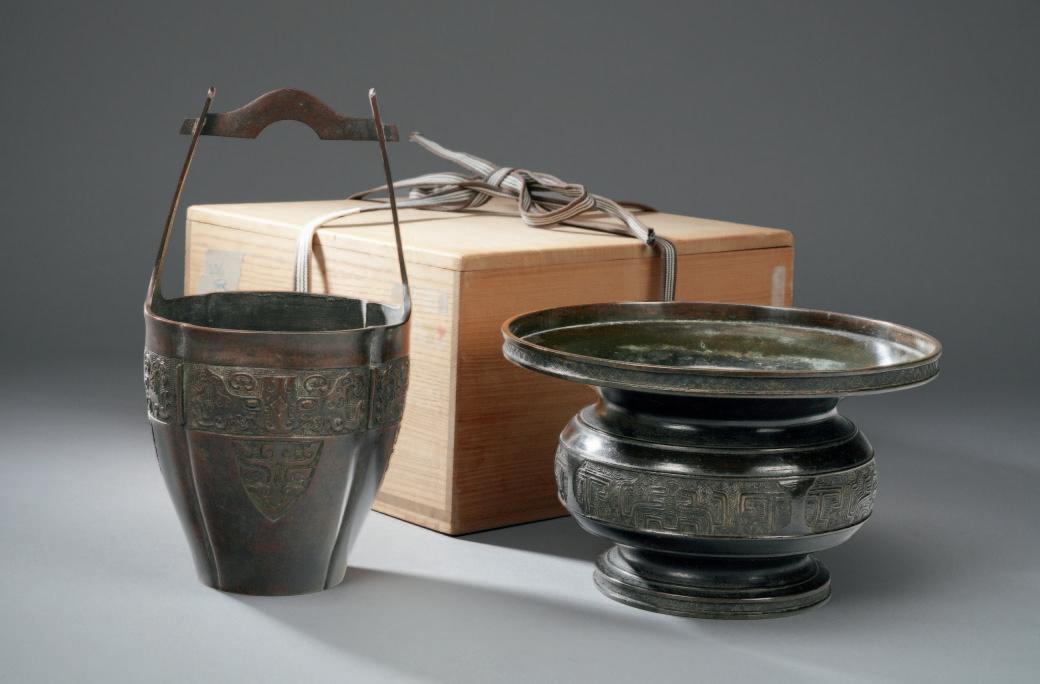
623
TWO JAPANESE ARCHAISTIC BRONZE VESSELS
MEIJI ERA, 19TH/20TH CENTURY
The first a circular vase with a wide rim, decorated with a band of angular scrolls and spirals, with a tomobako (wood box); the other a lobed basketshaped vase with a tall lug handle, with a border of taotie masks and lappets, a Chinese Wanli seal mark to the base; 24.2cm and 26.5cm. (3)
£800-1,200
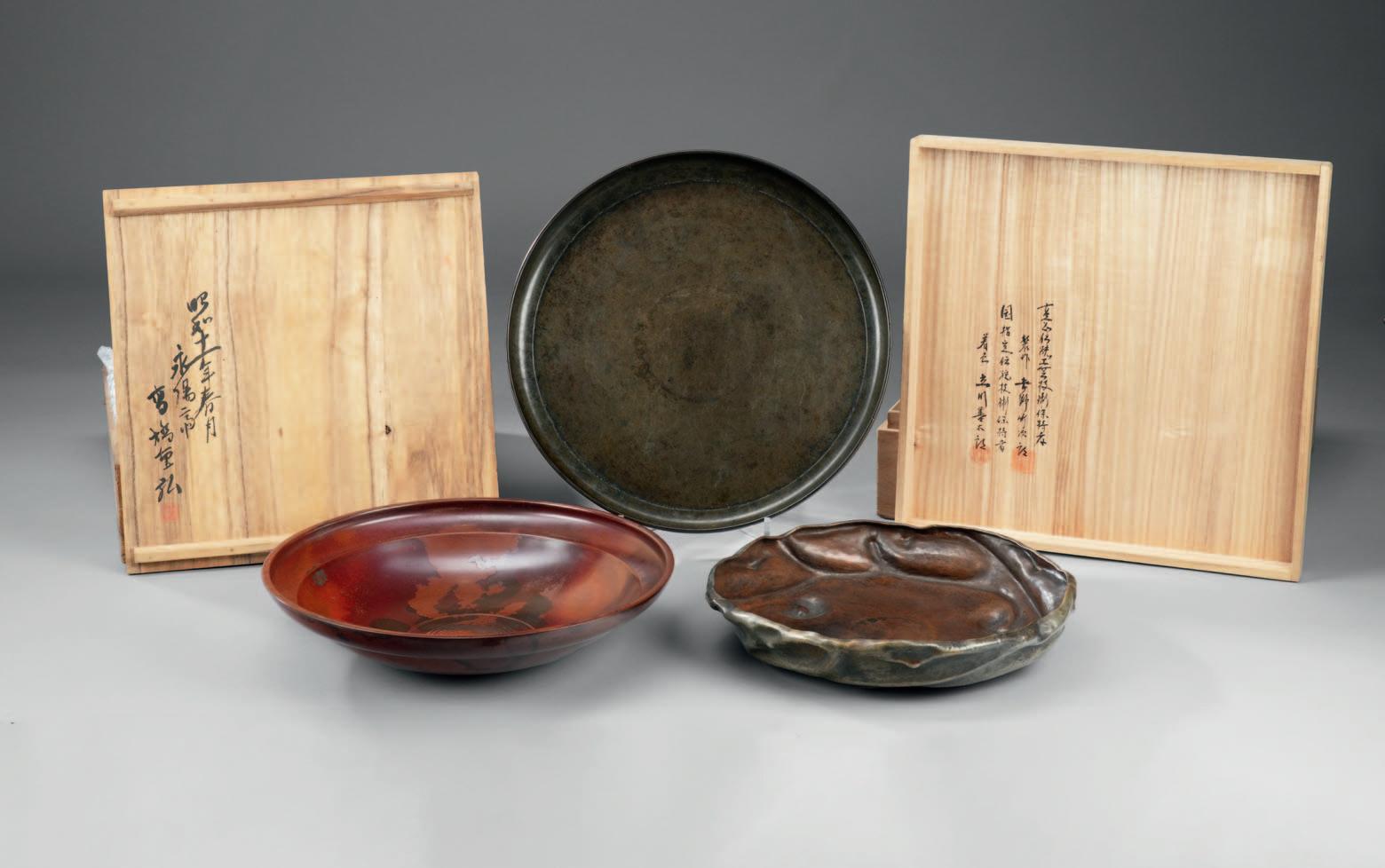
624
THREE JAPANESE COPPER ALLOY DISHES
SHŌWA PERIOD, 20TH CENTURY
The first with a crumpledlooking rim and a hammered surface, raised on three swirly feet, with a seal underneath for Takahashi Shigehiro (b.1941), in a tomobako (wood box) inscribed Namigata Suiban (wavepatterned water basin), dated the spring of Shōwa 10 (1935), signed Eiyō Takahashi Shigehiro and sealed Shigehiro; another deep dish with a red mottled patina, marked Take underneath for Nakano Takeji, its tomobako inscribed Heikou Watakushi-bachi Sōgata Chūdōki (a large flat, cast copper vessel) and signed Jinko Dentō Kōgei Gijutsu Hojisha (Holder of Jinko traditional techniques), Seisaku Nanako Takeji kin (respectfully produced by Nanako Takeji), and sealed; the third dish with a mottled green surface, with the remnants of a tomobako inscribed Nanban Sahari chabon, 35.5cm max. (6)
£800-1,200
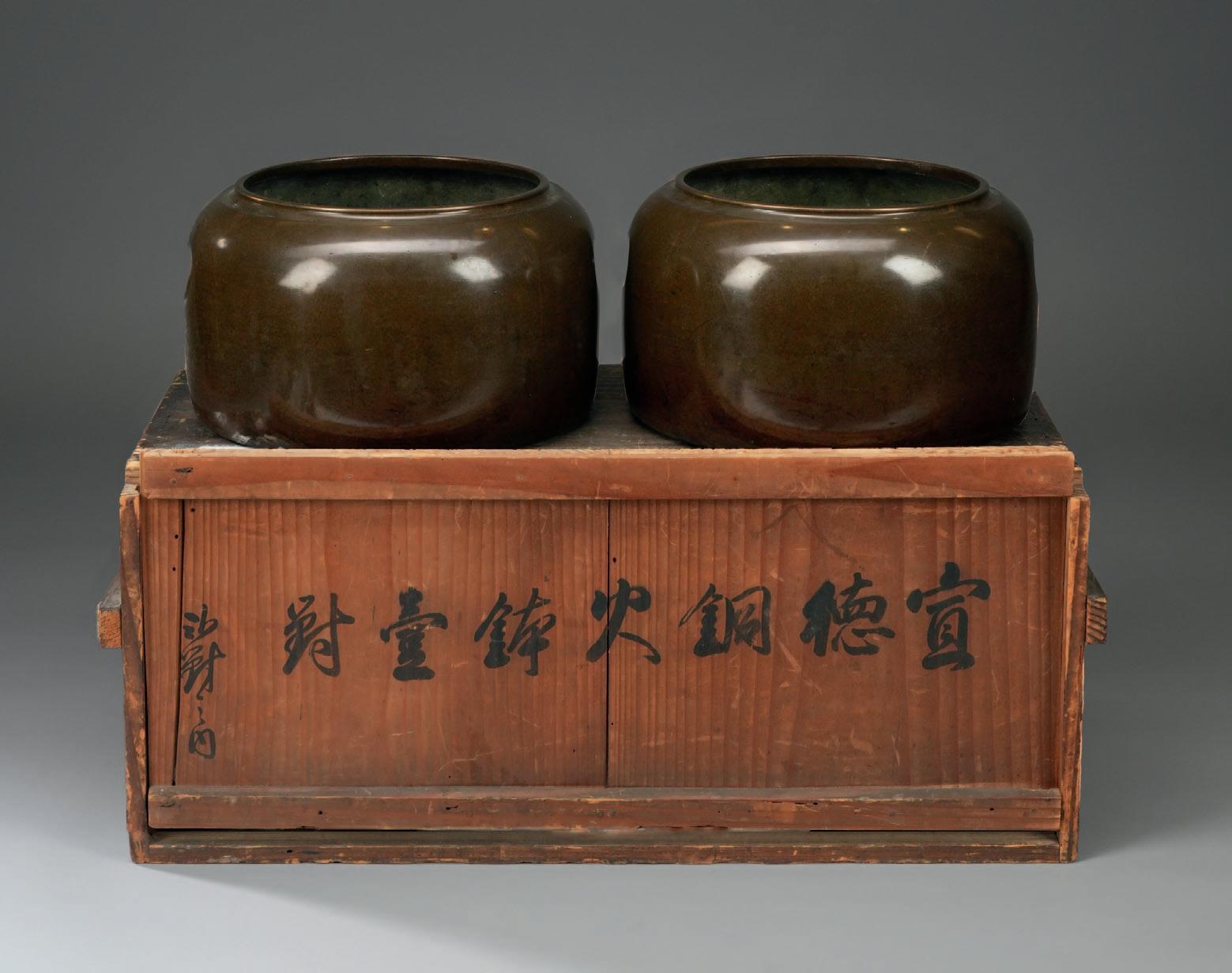
626
A PAIR OF JAPANESE BRONZE HIBACHI (HANDWARMERS)
SHŌWA ERA, 20TH CENTURY
Both of cylindrical shape and with two inomeshaped handles to the side, in a tomobako (wood box) inscribed Sentoku-dō hibachi ittsui (pair of dark bronze hibachi), 26cm. (3)
£600-800
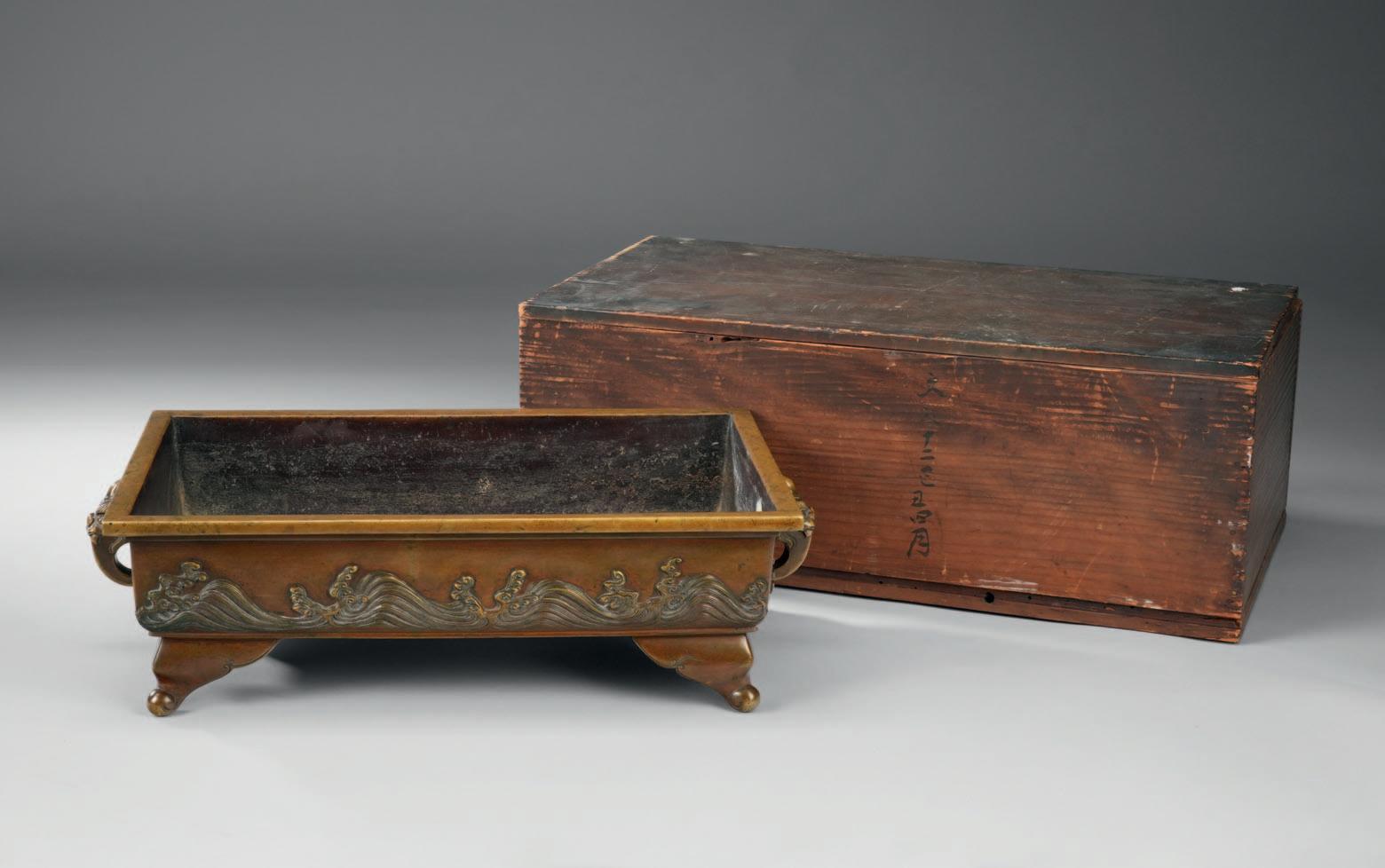
625
A LARGE JAPANESE BRONZE JARDINIERE EDO PERIOD, DATED 1841
Of rectangular form, raised on four scrolling feet and with lion doghead handles to the sides; the base with a seal mark for Imanaka; with a tomobako (wood box) inscribed Karakane sunabachi (bronze alloy sand bowl) dated the fourth month of the Year of the Ox, Tenpō 12 (May/June 1841) signed Imanaka; 12.5cm x 45cm x 25cm. (2)
£800-1,200
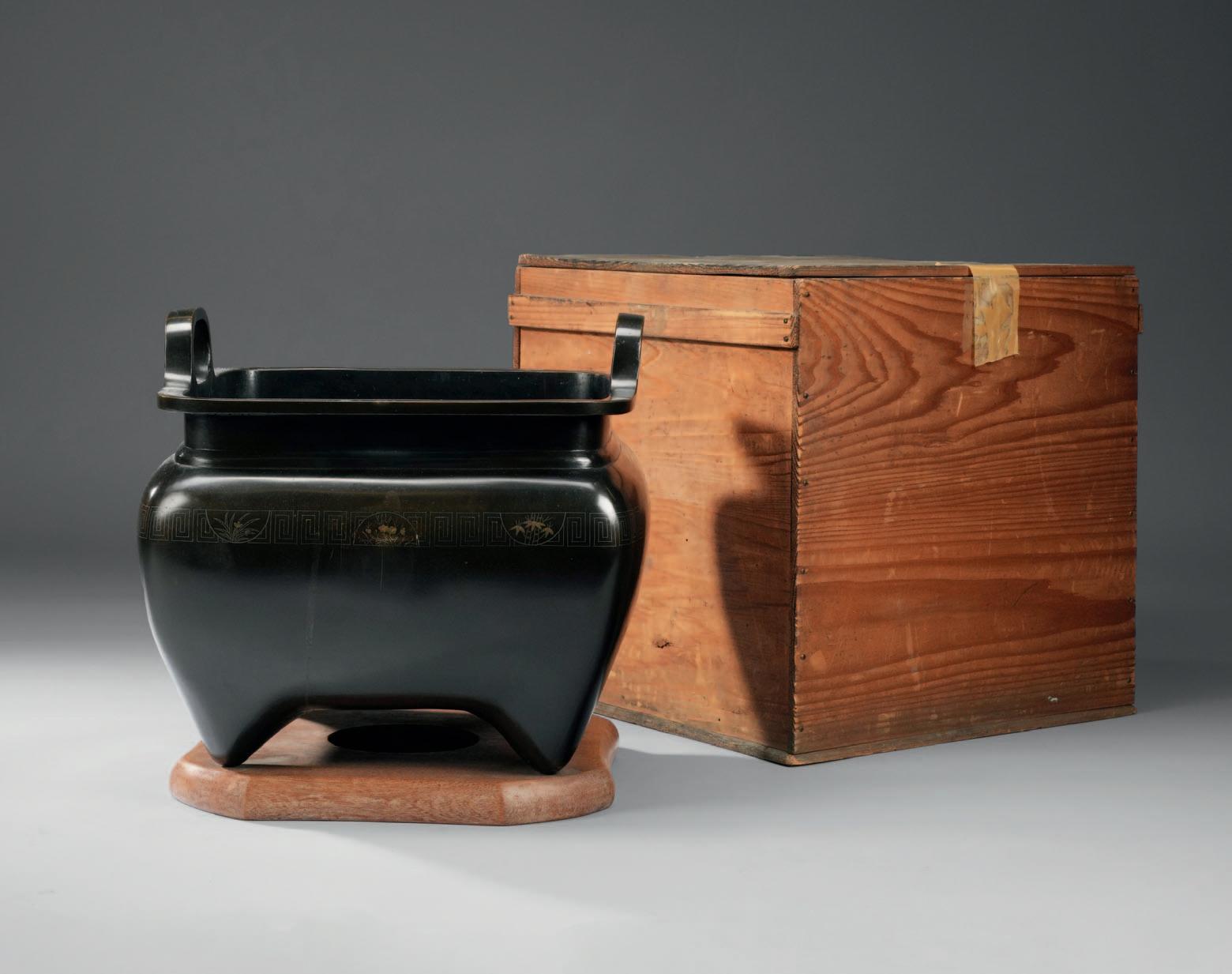
627
A LARGE AND IMPRESSIVE JAPANESE BRONZE KŌRŌ (INCENSE BURNER)
PROBABLY SHŌWA, 20TH CENTURY
The square body raised on four conical feet, with two lug handles to the rim and attached to a wood base; decorated with a band of key fret and semicircles enclosing bamboo and other flowers; with a tomobako (wood box), 33cm. (2)
£800-1,200
628
TWO JAPANESE BRONZE VASES BY SUETAKE SEIHŌ (D.2011)
SHŌWA/HEISEI, 20TH CENTURY
The first of gu shape with a flared foot, the other with a tall cylindrical body, both marked Seihō underneath; each with a tomobako (wood box) inscribed, signed and sealed Seihō, 23cm and 25.5cm. (4)
£800-1,200
629
FOUR JAPANESE BRONZE PIECES
MEIJI AND LATER, 19TH AND 20TH CENTURY
The first a kōrō, the incense burner with a waisted body and a cover with five circular apertures, signed Yasuki underneath, in a tomobako (wood box) inscribed Seido suehiro kōrō (bronze incense burner of waisted shape) and signed Yasuki; the second, another kōrō shaped as a chrysanthemum flower, signed Shigetani Kameaki; the third a circular box and cover, signed Nagakuni for Fujimoto Nagakuni; and a pearshaped vase with scroll decoration in openwork, 18.2cm max. (9)
£600-1,000
630
TWO JAPANESE PIECES BY WATANABE TADASHI (19232009)
SHŌWA/HEISEI, 20TH CENTURY
One a ewer with a thin side handle and decorated with rhomboids in colourful enamels, signed Tadashi saku underneath, with a tomobako (wood box); the other of slender shape with a flared neck and spreading foot, inscribed Chūjin Tadashi (Master Founder Tadashi), in a tomobako inscribed Rōgin shihō hana-ike (square shibuichi flower vase), and signed and sealed Tadashi, 25.5cm max. (4)
£1,000-2,000
631
A COLLECTION OF FIVE JAPANESE BRONZE VASES
SHŌWA/HEISEI, 20TH CENTURY
Of various sizes and shapes, the first by Osumi Isao (19402010), marked, with a tomobako (wood boxes) signed and sealed Isao; the second by Inoue Junkei (b.1930), marked, its tomobako signed and sealed Junkei; the third, possibly by Emi Homi (dates unknown), signed Homi on the base and on the tomobako; the fourth by Aida Tomiyasu (1901-1987), both the base and tomobako signed Tomiyasu; the last by Nakatani Yoshio, with an inscribed tomobako; 24.2cm max. (10)
£2,000-3,000
632
THREE JAPANESE BRONZE VASES, ONE BY SOMEKAWA TETSUNOSUKE (191282)
SHŌWA ERA, 20TH CENTURY
The first of flattened globular form with a short narrow neck, the base signed Tetsunosuke, with a tomobako (wood box) inscribed Seidō tsubo (bronze vase) and Shōwa 38-nen, shinshū, Dai jūsan-kai Jōshō-ten shuppin (early autumn 1963, exhibited at the 13th Jōshō exhibition) and signed Tetsunosuke with his red seal mark; another of tall cylindrical form with a slightly narrower waist by Tetsuyama Somekawa (b.1941), a stamped mark underneath reading Ka, its tomobako inscribed 1973-nen, Shudō tsutsu-hanairi (redpatinated bronze flower vase) and the inside Nitten Shinsain, Yamagata-shi, Tetsuyama saku (1973, The Japan Fine Arts Exhibition, Yamagata City, made by Tetsuyama) and with a red seal for Somekawa; the third vase of globular form with a wide mouth, signed Seihō, 27.9cm max. (5)
£1,200-1,500
633
FOUR JAPANESE BRONZE VASES
MEIJI AND LATER, 20TH CENTURY
The first with a slender pearshaped body, signed, by Hata Zoroku IV (18981984); the second of tall ovoid form with a ribbed shoulder, signed, by Hata Ichiyō (19141996?), the third cylindrical vase with a narrow band, signed, by Hasegawa Kyūju (act. 1950s80s); the fourth with a small bulbous body and an elongated neck with monsterhead handles applied to the rim; all with tomobako (wood boxes), three inscribed and signed, 28.1cm max. (8)
£1,500-2,000
634
FOUR JAPANESE BRONZE VASES
SHŌWA/HEISEI, 20TH CENTURY
The first a wall vase cast as a section of bamboo, signed Joūn with a kao for Kitamura Joūn (act.1960s), in an inscribed tomobako (wood box), signed and sealed Joūn; the second with a crumpled cylindrical body, marked Shigehiro for Takahashi Shigehiro III (b.1925), the inscribed tomobako also signed Shigehiro and sealed; the third with a triangular, lobed body reminiscent of a flower bud, marked underneath, with an inscribed tomobako, signed and sealed, possibly for Takato Shizuo (19101988); the last a cylindrical wall vase with an uneven rim, a ring at the back for suspension, in an inscribed tomobako; 24cm max. (8)
£1,200-1,500
635
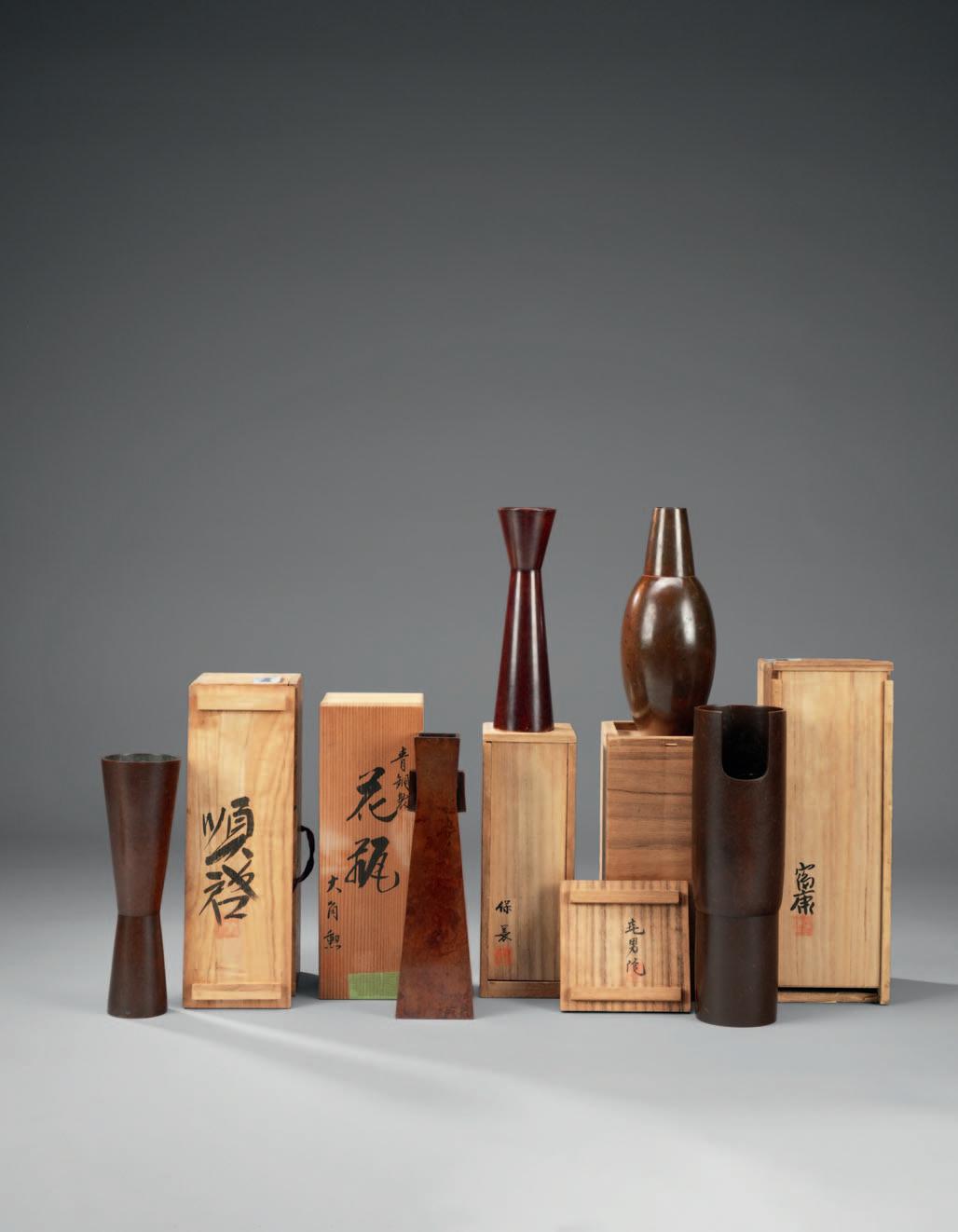
A COLLECTION OF SIX JAPANESE BRONZE VASES
SHŌWA/HEISEI, 20TH CENTURY
The first with a slender pearshaped body with ribs at the shoulder, marked, by Ichinose Sōshin (act. 1970s80s); the second a gushaped vase with a warm orangebrown patina, marked, by Kobayashi Bishun (18871986); the third of cylindrical form with ribs at the shoulder, marked, by Tsuda Eiju (19152001); the fourth another gushaped vase with a thinner body, unmarked, with a tomobako (wood box) inscribed and signed Nosaku Ikkei (act.1950s50s); the fifth of conical shape with ribs under the rim and above the flared foot, the inside lacquered black, marked, by Toyoda Kastusaki (the box dated 1947); the last with a conical foot and ribbed under the flared rim, marked, by Kamara Suzu (20th c.); all in tomobako (wood boxes) inscribed and signed; 27.4cm max. (12)
£2,500-3,000
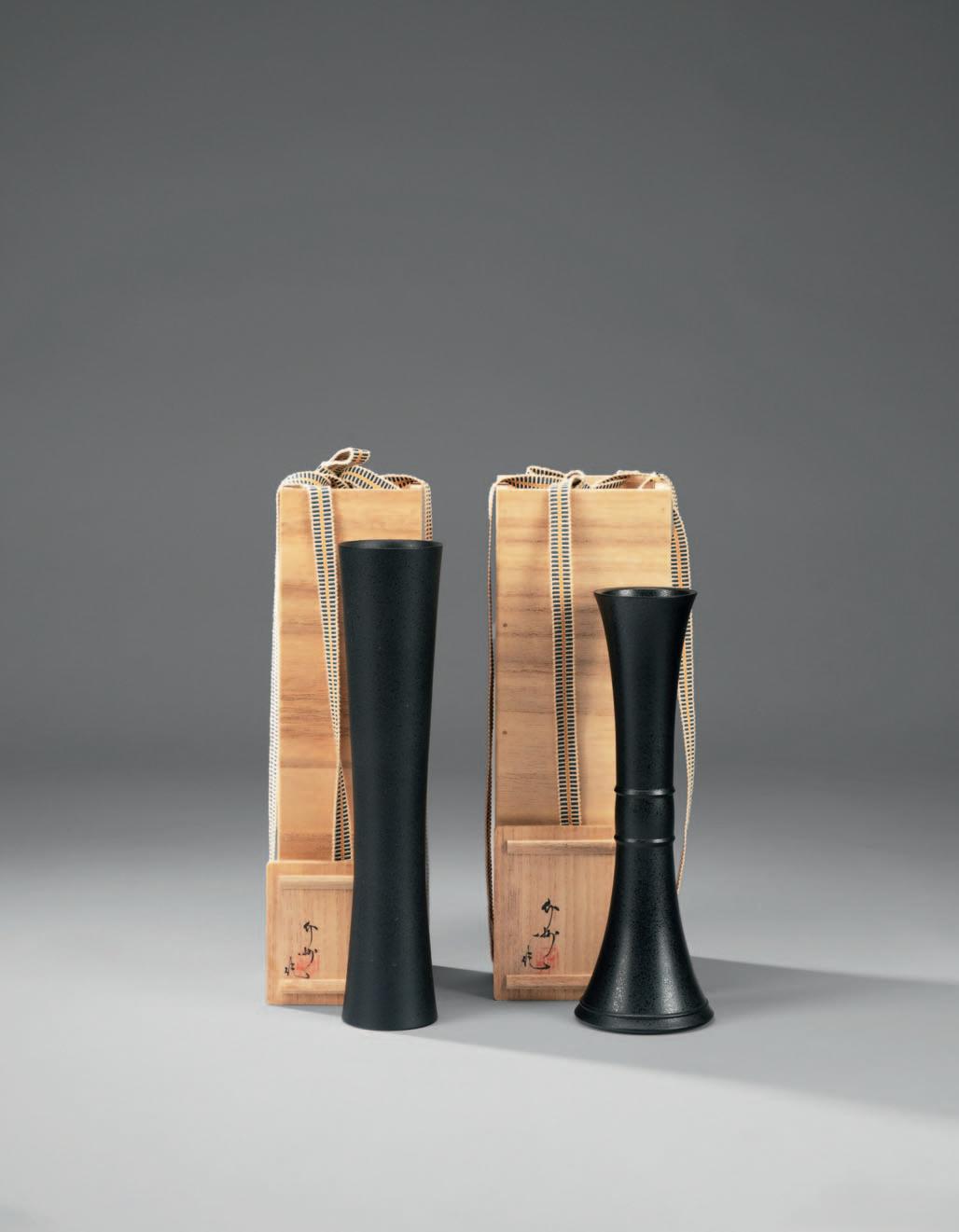
FOUR JAPANESE BRONZE VASES SHŌWA/HEISEI, 20TH CENTURY
The first with a tall body raised on a sprayed circular foot, marked, with an inscribed tomobako (wood box), signed and sealed, by Marutani Tando (19001984); the second, a rectangularsection vase with vertical lines, the inscribed tomobako signed and sealed, by Satō Seikō (19161996); the third with a tall cylindrical body raised on a small circular foot, marked, with an inscribed tomobako signed and sealed Toyama; the last vase with a faceted baluster body, signed Seihō saku underneath for Suetake Seihō (d.2012), 34.5cm max. (7)
£1,500-2,000
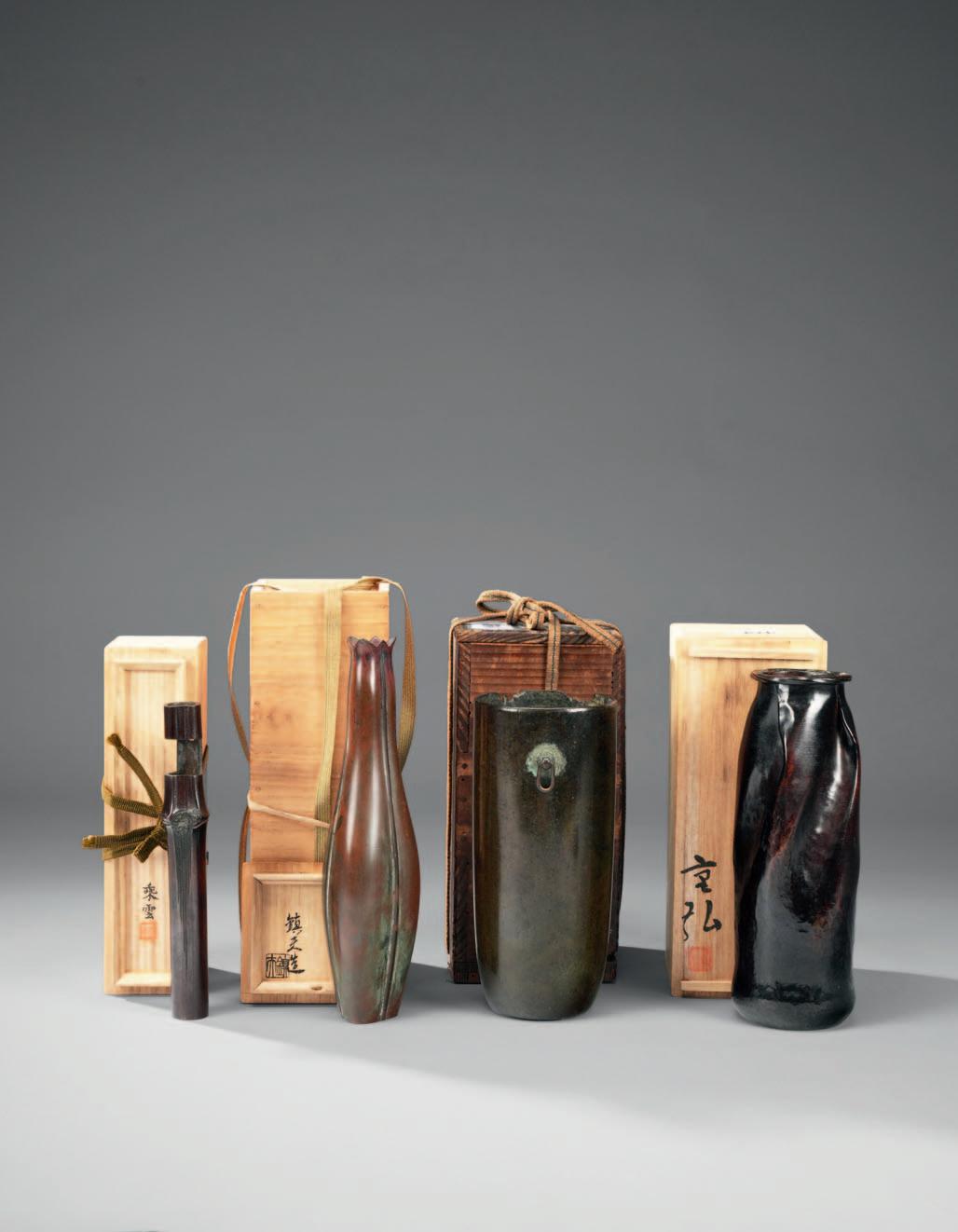
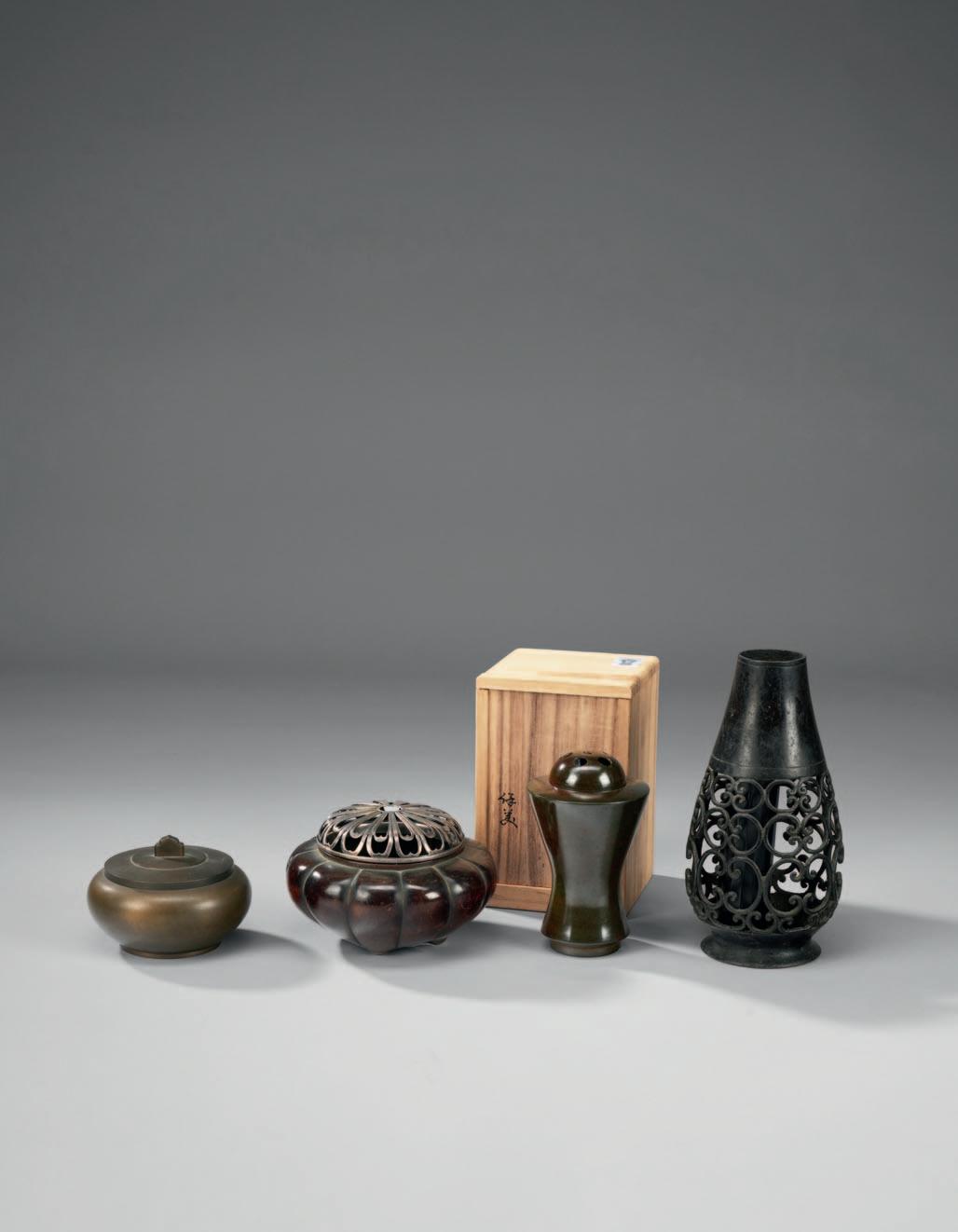
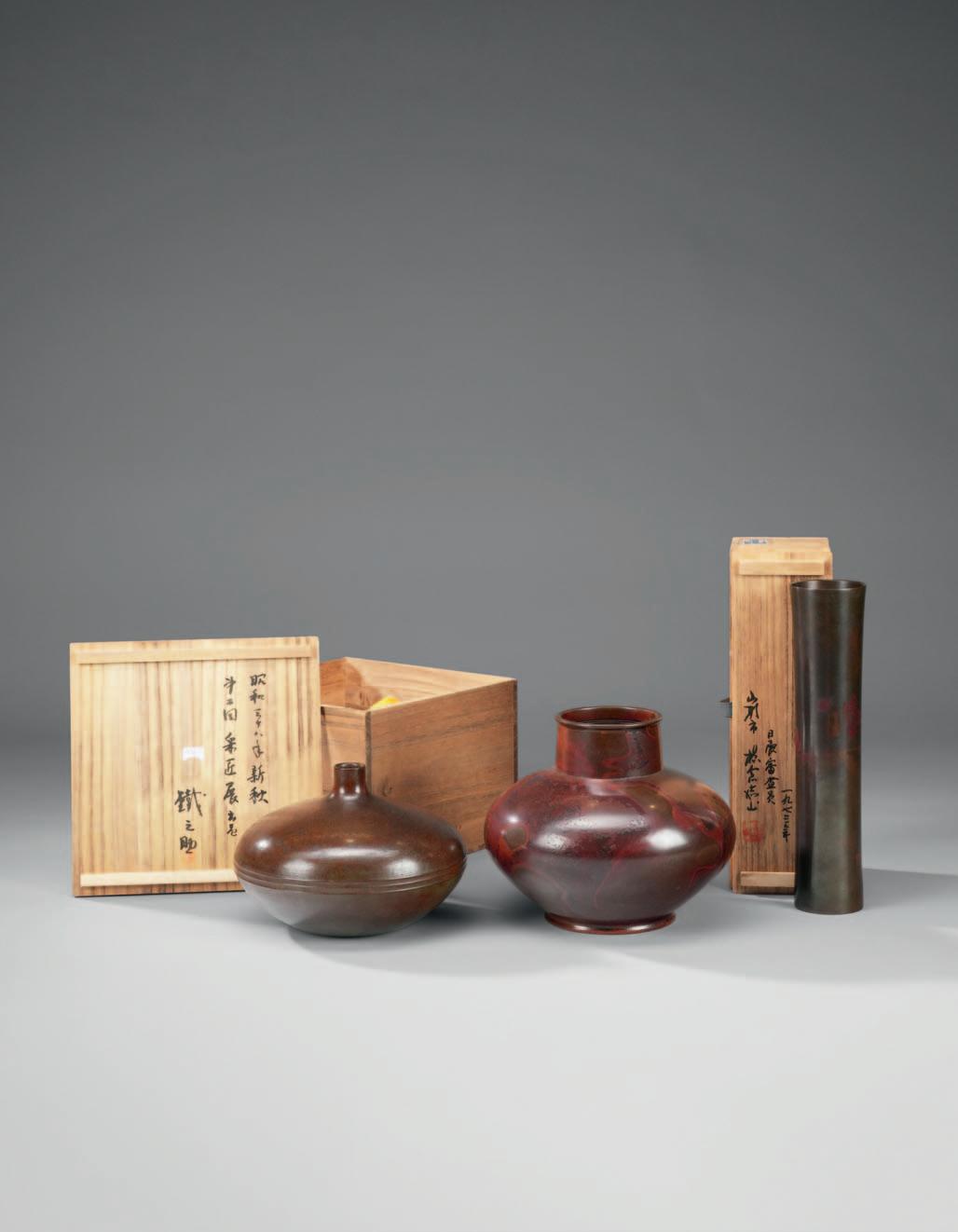
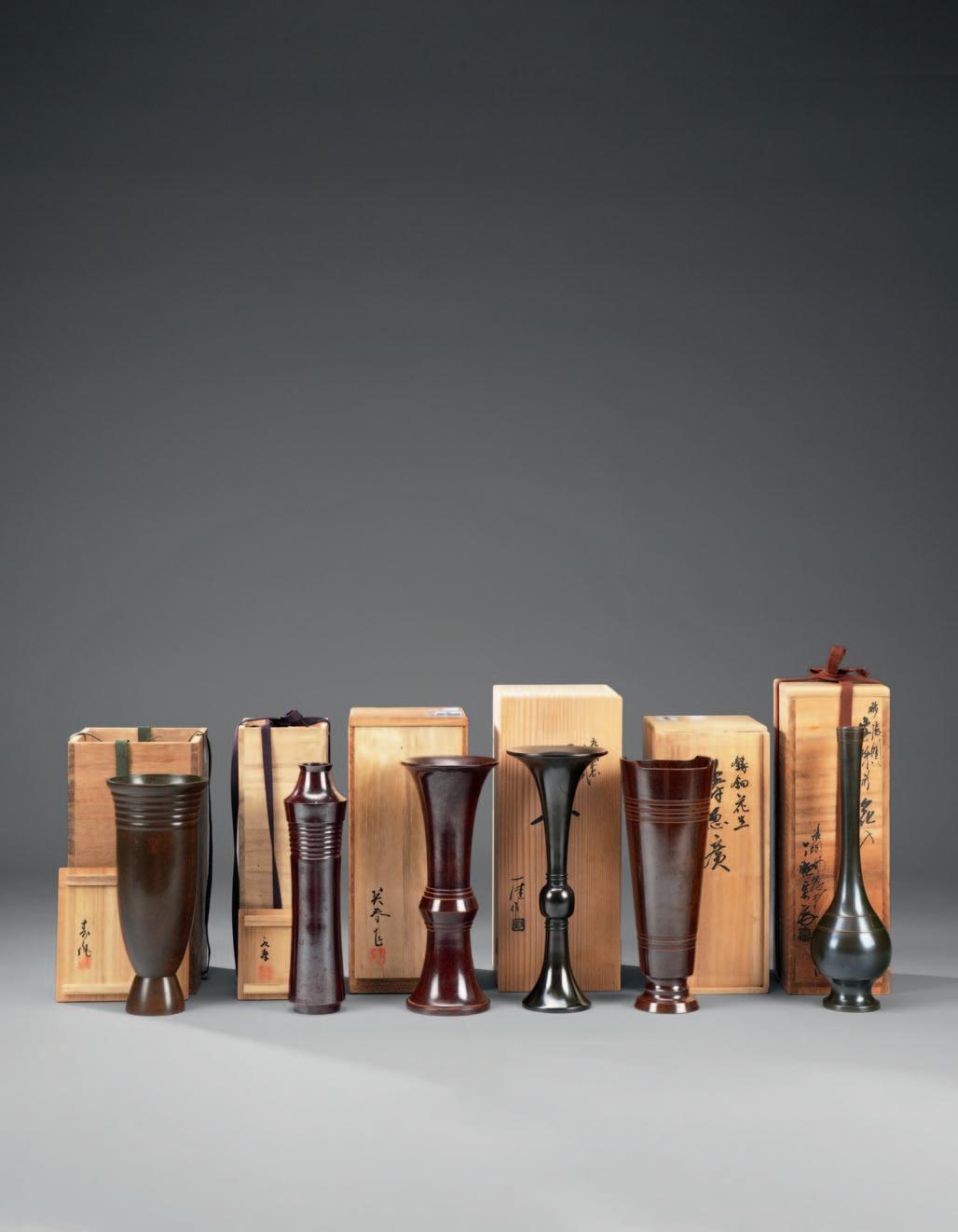
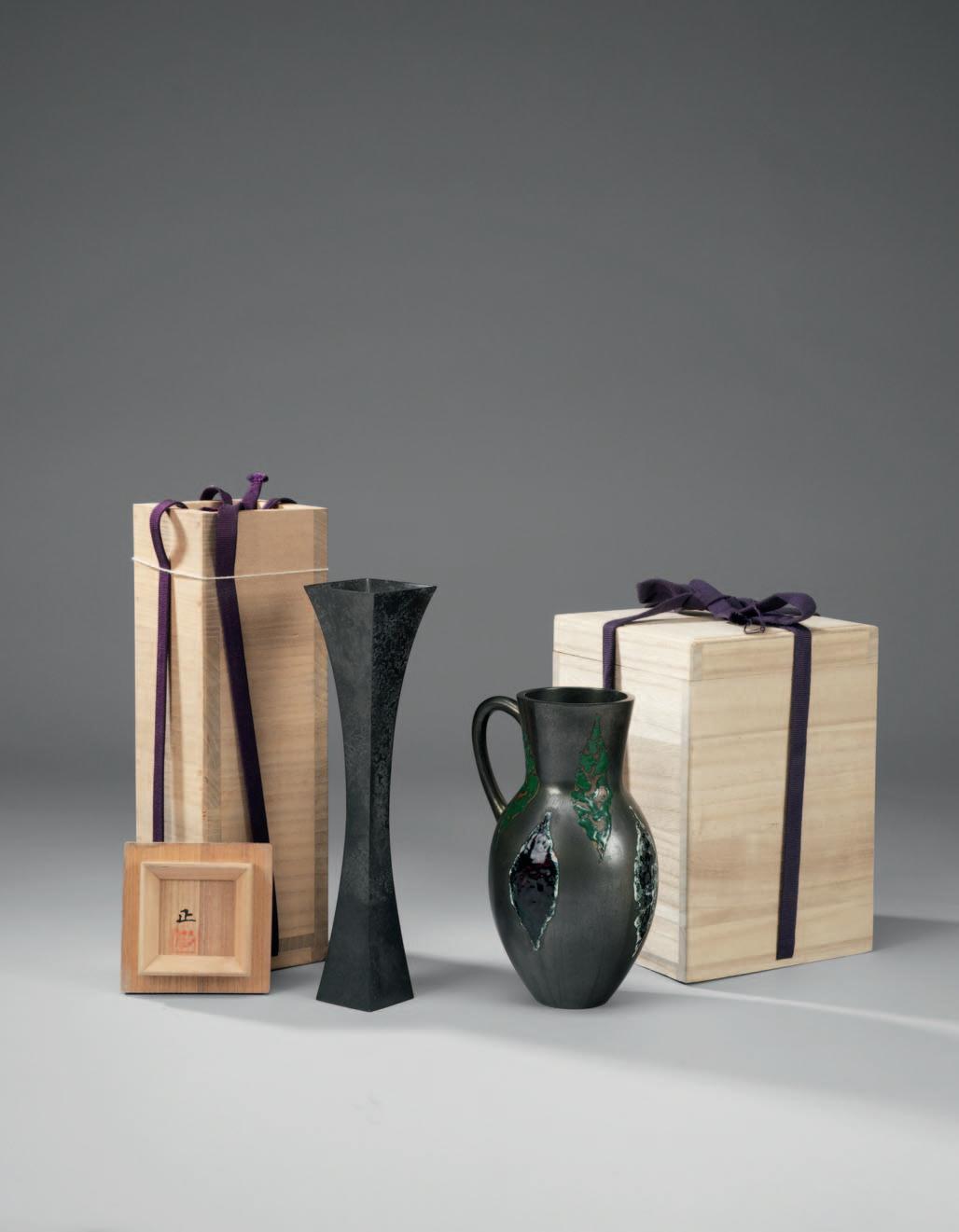
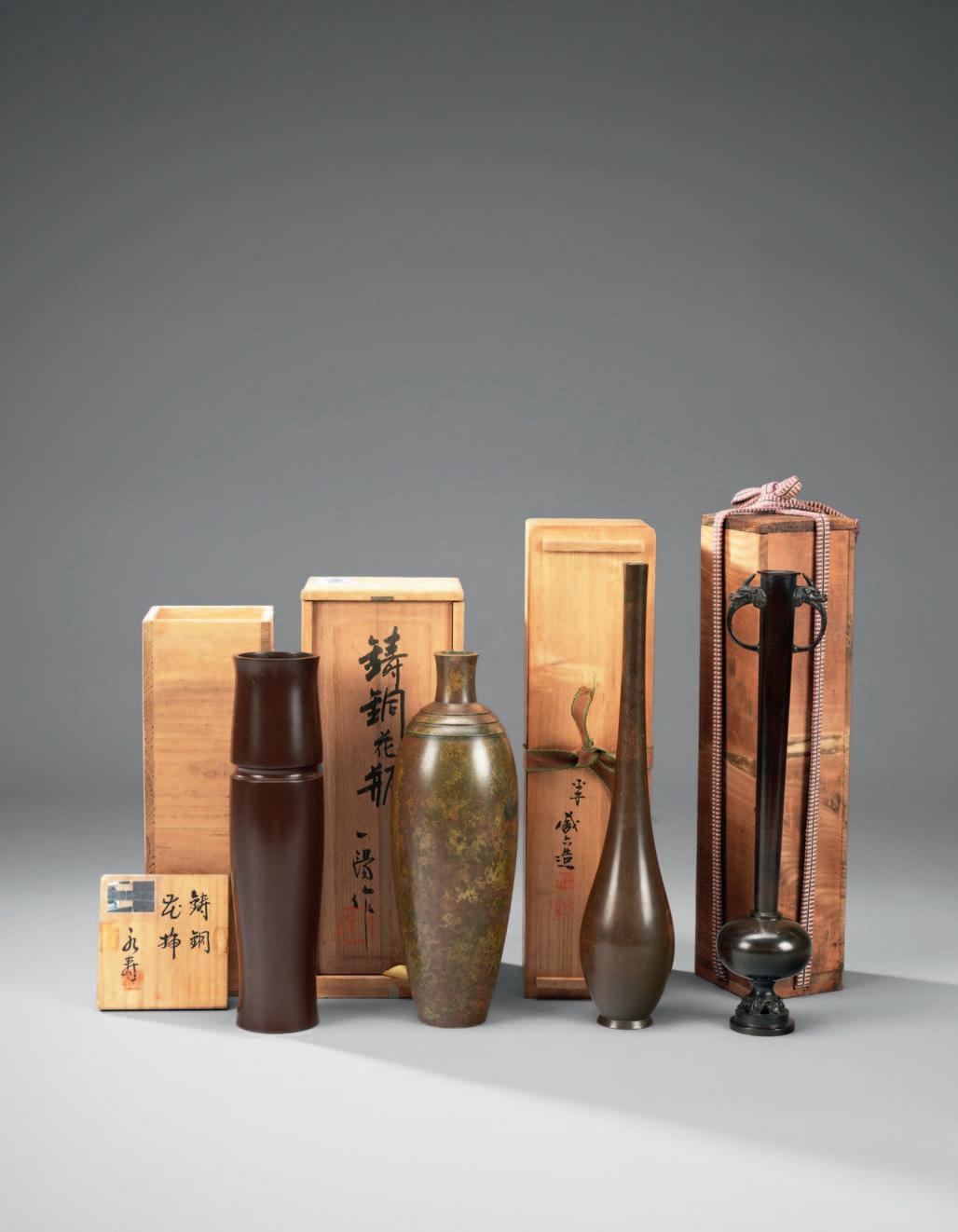
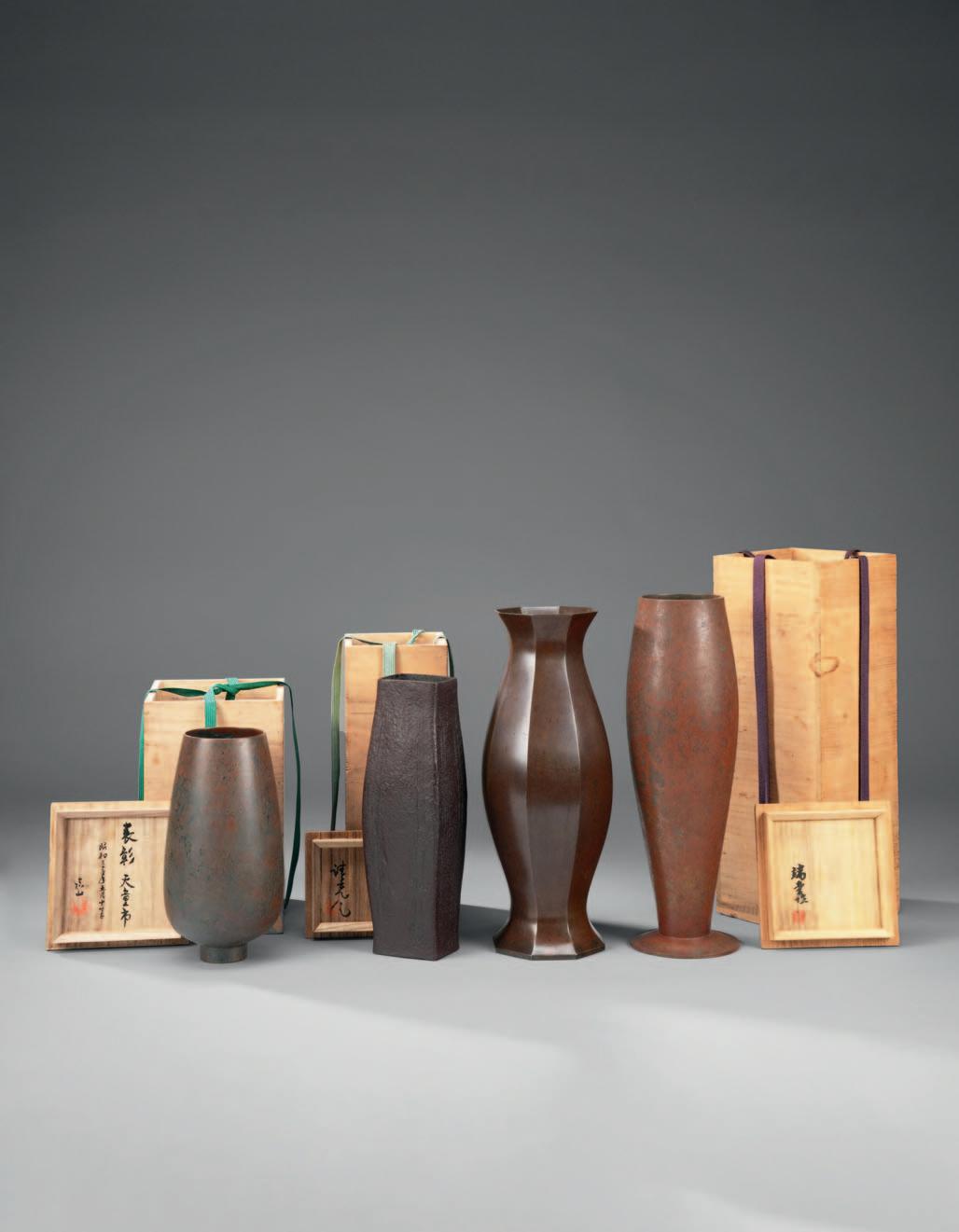
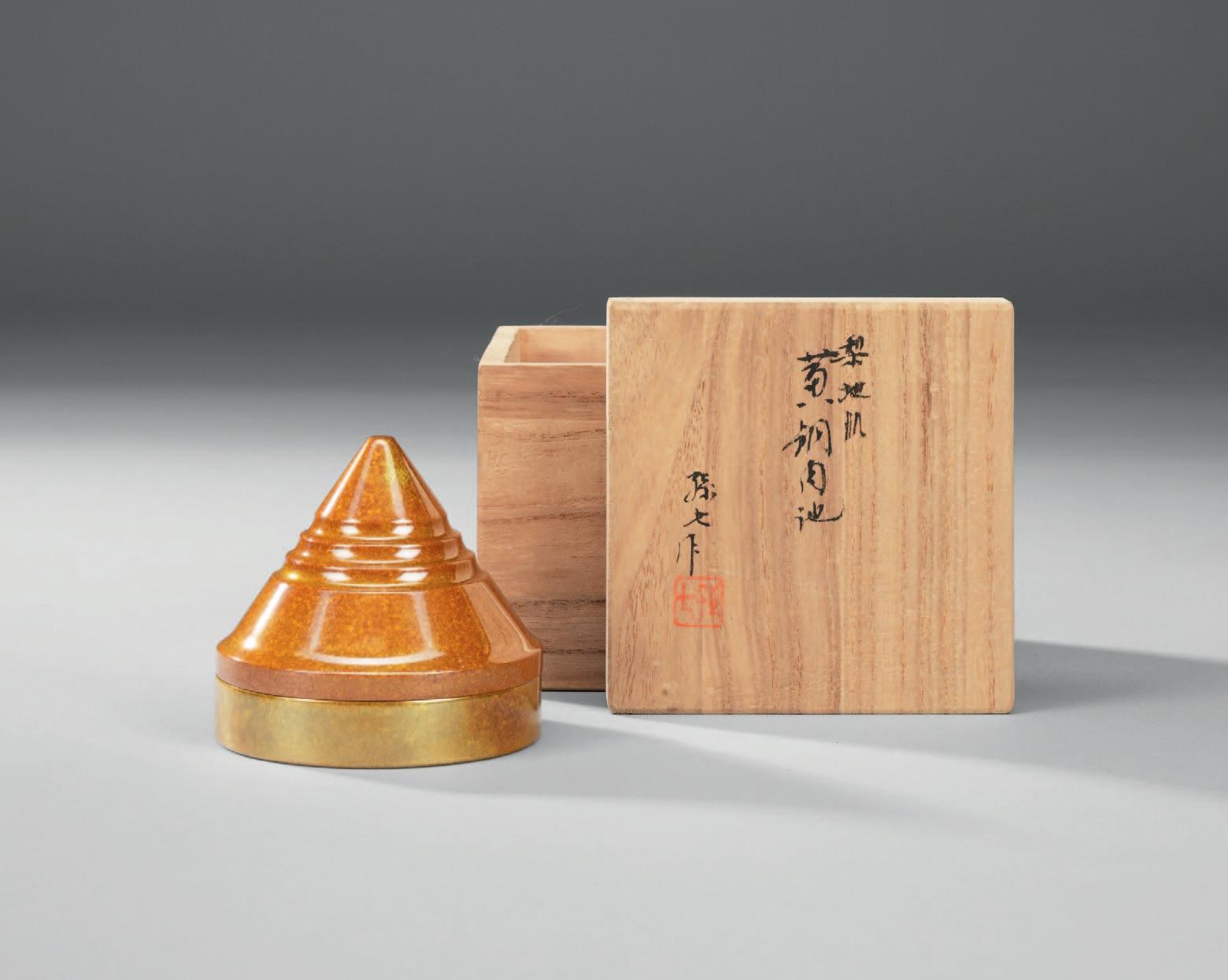
637
A JAPANESE COPPER SHUNIKU-IRE (INK CONTAINER) BY MAGOICHI
SHŌWA ERA, 20TH CENTURY
Modelled as a tama, the sacred jewel opening to reveal the compartment for the ink; the base stamped Magoichi; with a tomobako (wood box) inscribed Nashiji-hada mandō enchi (pearskin copper box), signed Magoichi saku and sealed Magoichi, 7cm. (3)
£400-600
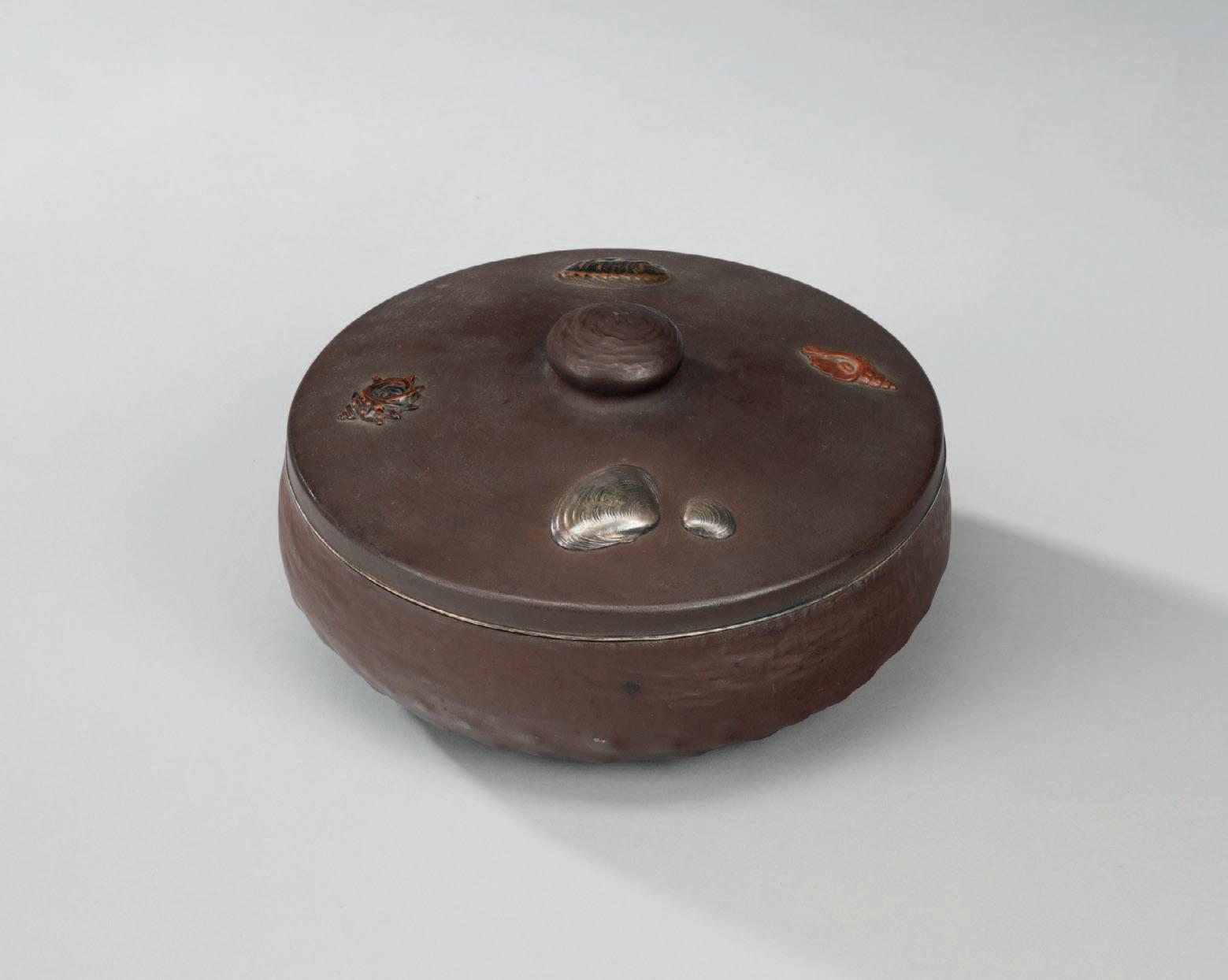
639
A JAPANESE INLAIDIRON AND SILVER KASHIKI (BOWL AND COVER FOR CONFECTIONERY)
MEIJI ERA, 19TH/20TH CENTURY
The cover decorated with various seashells rendered in silver, copper and other alloys on the iron ground; the lower half modelled with bumps also reminiscent of a seashell, the inside lined in silver, 17cm. (2)
£600-1,000
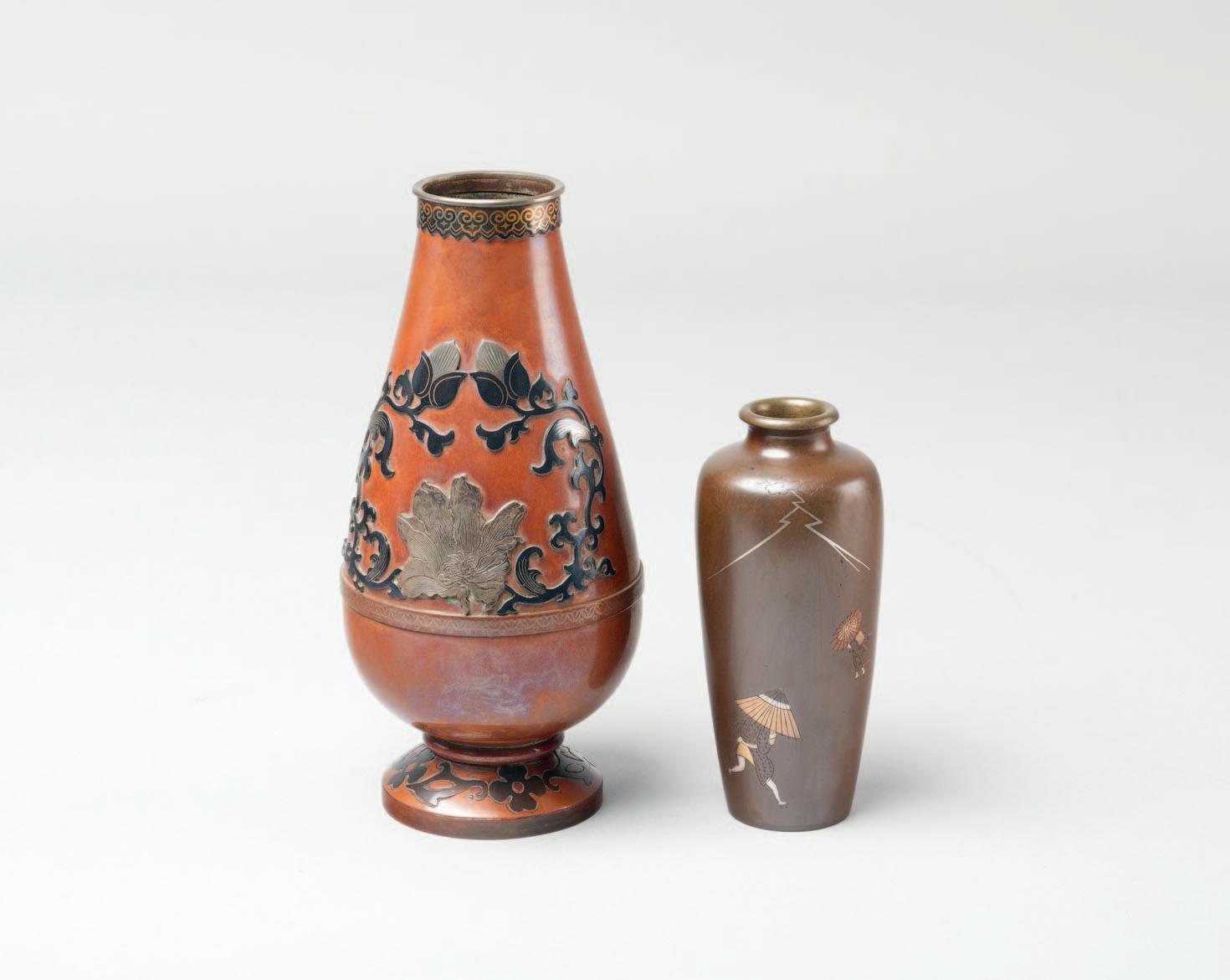
638
TWO JAPANESE MIXEDMETAL VASES
MEIJI ERA, 19TH/20TH CENTURY
The tallest with a pearshaped body and raised on a flared foot, decorated with flowers in low relief, rendered in silver and shakudō on a copper ground, 18.5cm; the other with two figures under umbrellas caught in a storm, with a lightning bolt above, signed Hidekuni koku to the side and with another minute mark underneath, 12cm. (2)
£300-500
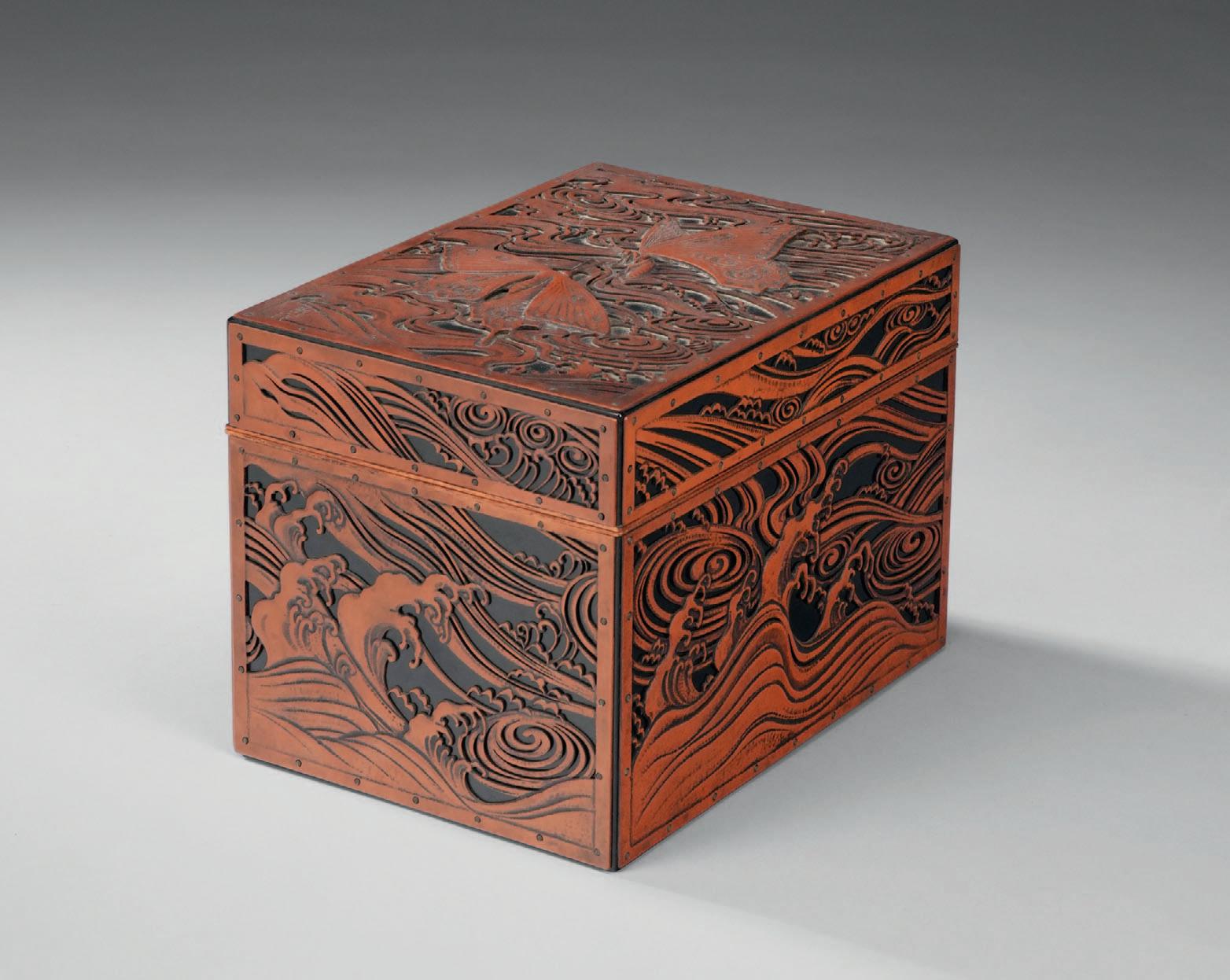
640
A JAPANESE COPPER AND WOOD BOX AND COVER BY OSUGA TAKASHI (192689)
SHŌWA ERA, 20TH CENTURY
Of rectangular form, the blacklacquered wood surface decorated with hammered copper plaques, the reticulated designs depicting large butterflies
fluttering above water swirls and crashing waves; the cover signed Takashi saku; with a tomobako (wood box), 15.4cm x 15.4cm x 21.4cm. (3)
£2,500-3,000
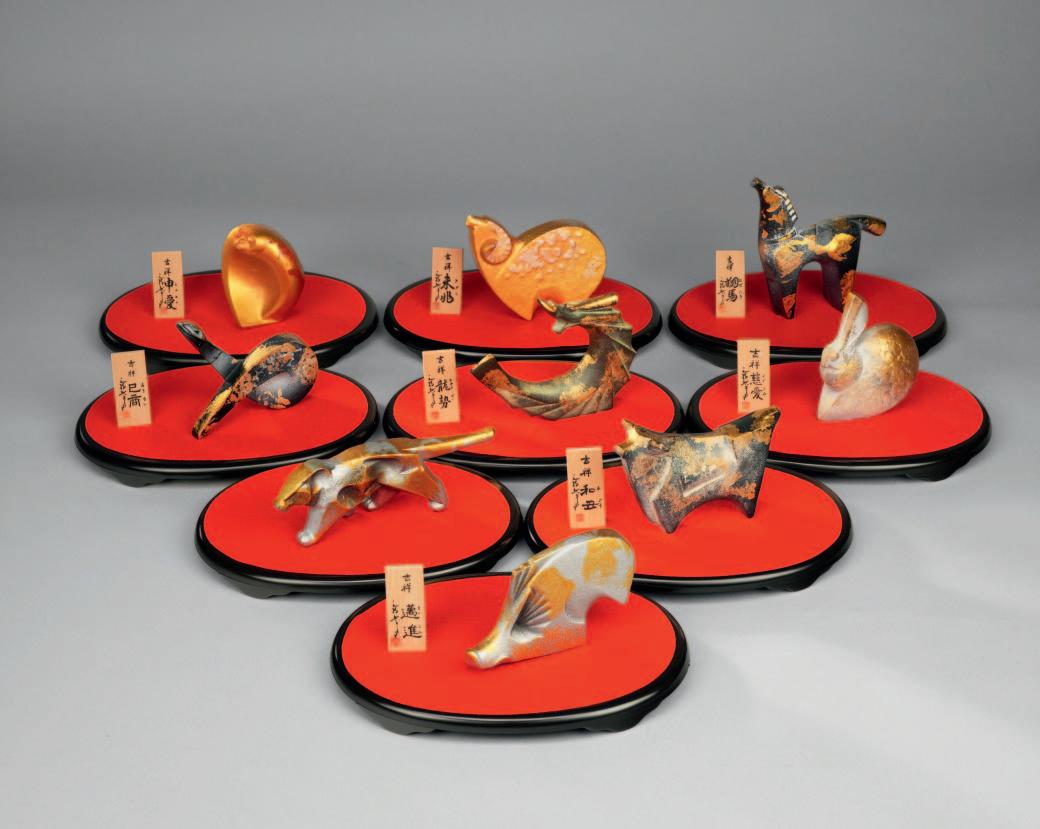
641
SOTARO SAEGUSA (19112006)
NINE JAPANESE PARCELGILT IRON MODELS OF ZODIAC ANIMALS
HEISEI ERA, 1999
Comprising stylised depictions of the monkey, the ram, the horse, the snake, the dragon, the hare, the tiger, the ox and the boar; each with a stand and a small wood plaque with the name of the animal and the artist’s signature, with eight original boxes. (9)
£200-300
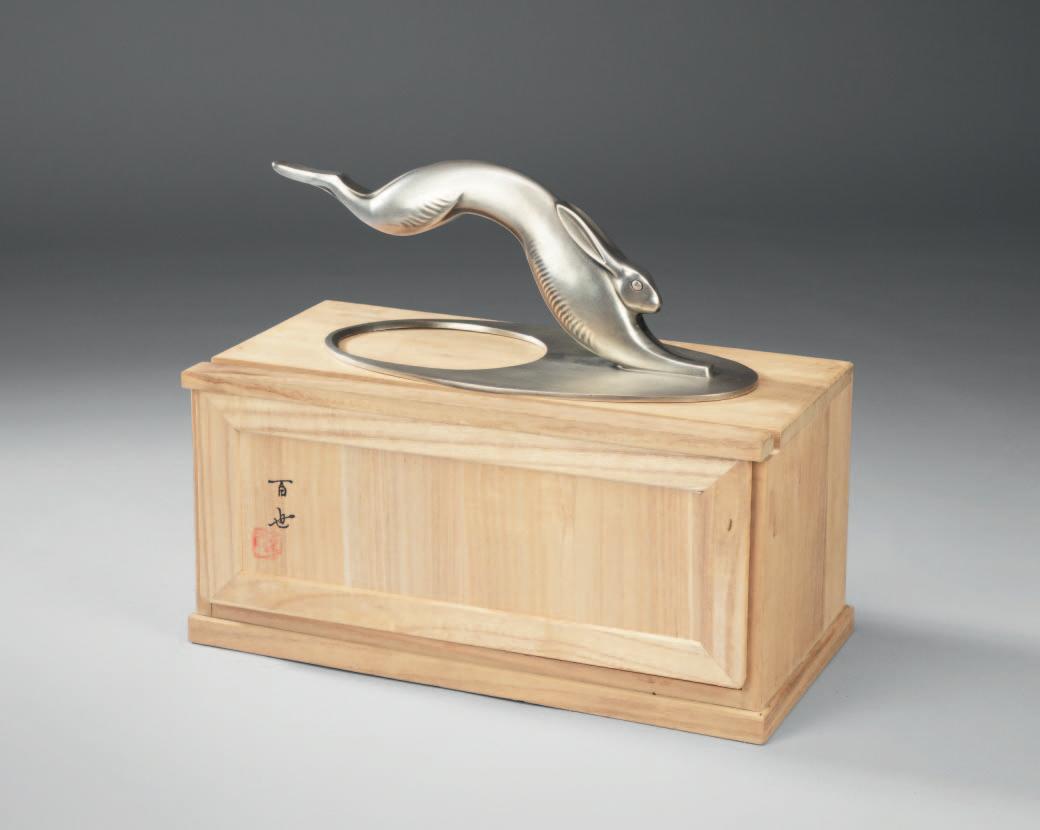
643
A JAPANESE SILVER OKIMONO OF A MOON HARE BY SAITO MOMOYA (190993)
SHŌWA ERA, 20TH CENTURY
The stylised animal depicted leaping above an oval base suggesting the moon, signed underneath Momoya and marked gin 900; in a tomobako (wood box) inscribed Tsuki-no-Usagi (Moon Hare) and signed Momoya with a red seal mark, 27.5cm. (2)
£500-800
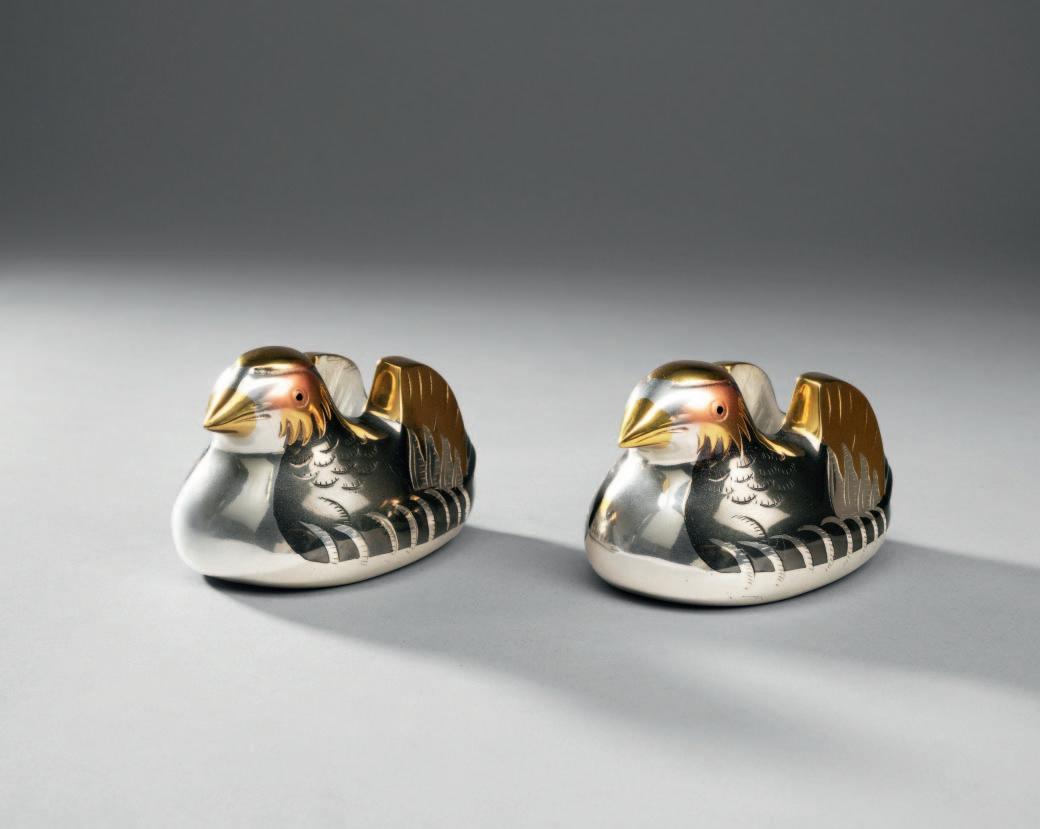
642
A PAIR OF JAPANESE MANDARIN DUCKSSHAPED SCREEN STANDS
HEISEI ERA, 20TH CENTURY
Of typical shapes with a slit at the back, with details highlighted in gilt, both 10.5cm. (2)
£200-400
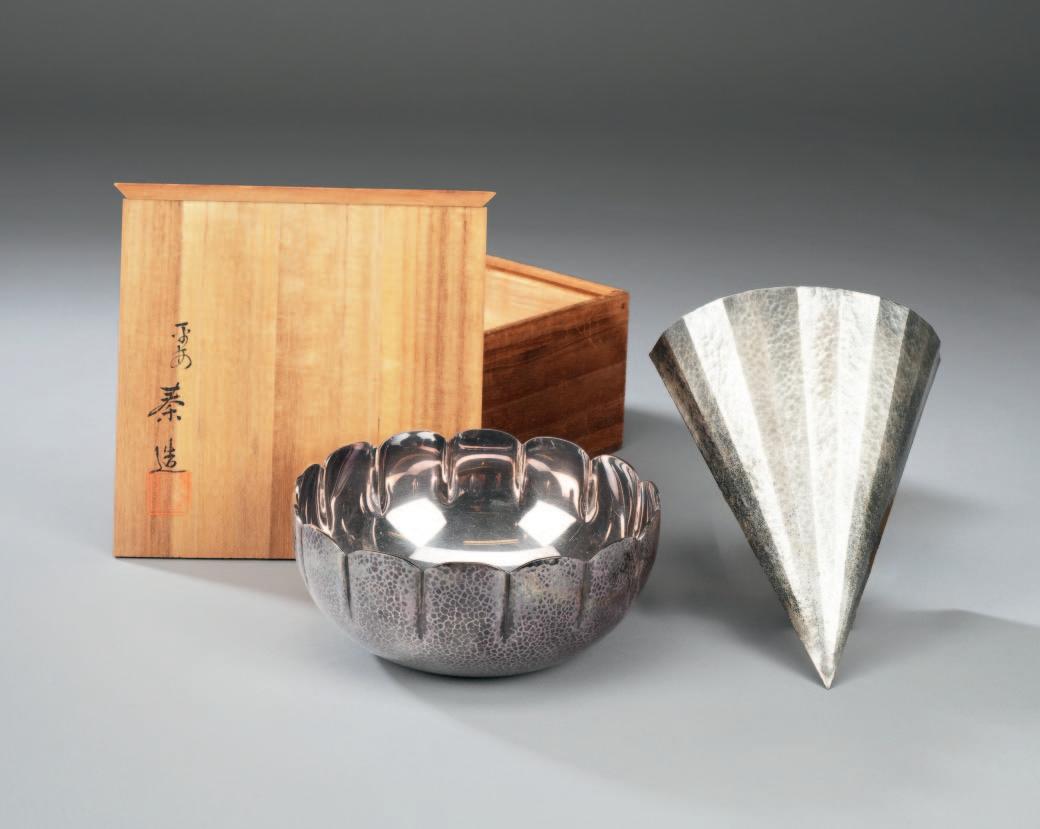
644
TWO JAPANESE SILVER PIECES, ONE BY HATA ZOROKU V (19272013)
SHŌWA ERA, 20TH CENTURY
The first a deep bowl with a scalloped rim, polished on the inside and hammered on the outside; the base with a stamped mark for Hata ginkiten (Hata silversmith shop) and jungin (silver), with a tomobako (wood box) inscribed Jungin tsume-me kikka-gata kashiki (pure hammered silver chrysanthemumshaped bowl for confectionery) and signed Gosei Zoroku zo (the Fifth generation, made by Zoroku) and sealed Zoroku; together with a faceted, conical silver wall vase, 17cm and 18.5cm. (3)
£500-800
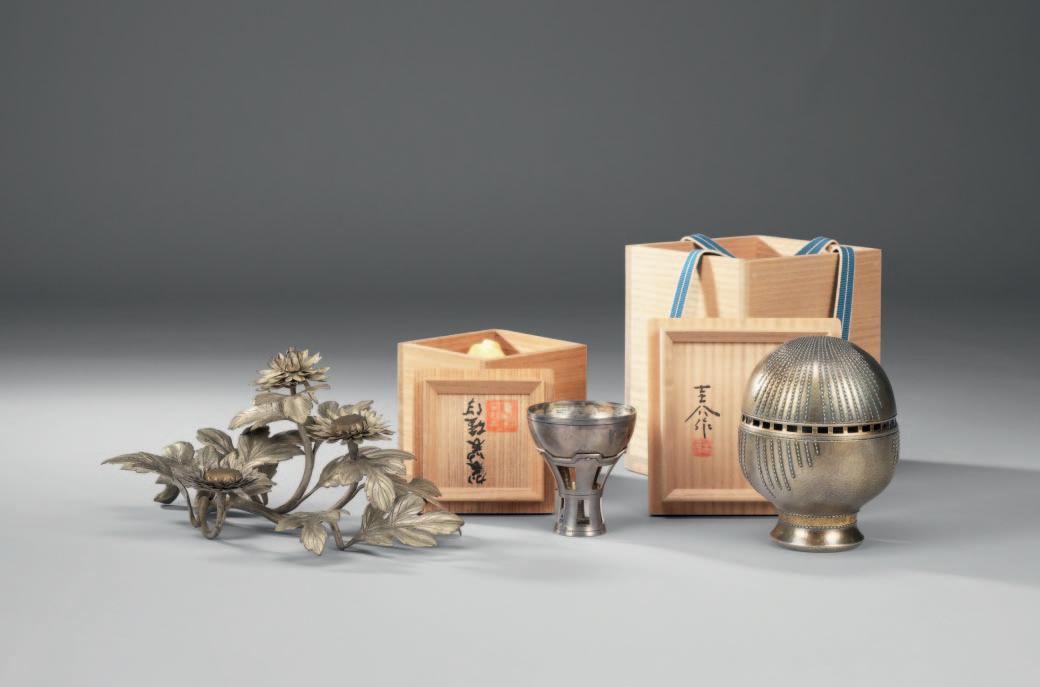
645
TWO JAPANESE SILVER PIECES BY KEISUKE
SHŌWA/HEISEI, 20TH CENTURY
The first a parcelgilt kōrō, the incense burner of ovoid form and raised on a short foot, with geometric decoration, a band of apertures, and an inner liner, signed Kei underneath; in a tomobako (wood box) inscribed Nanryō nunome senmon kōrō (silver, cloth weave and linear pattern incense burner) and signed Keisuke saku (made by Keisuke) and sealed Keisuke; the other a cup raised on a pierced foot, in a tomobako inscribed Gin Takatsuki (silver highfooted cup) and signed Kato Keisuke with seal Keisuke; together with a white metal okimono of chrysanthemum, 24cm max. (6)
£500-800
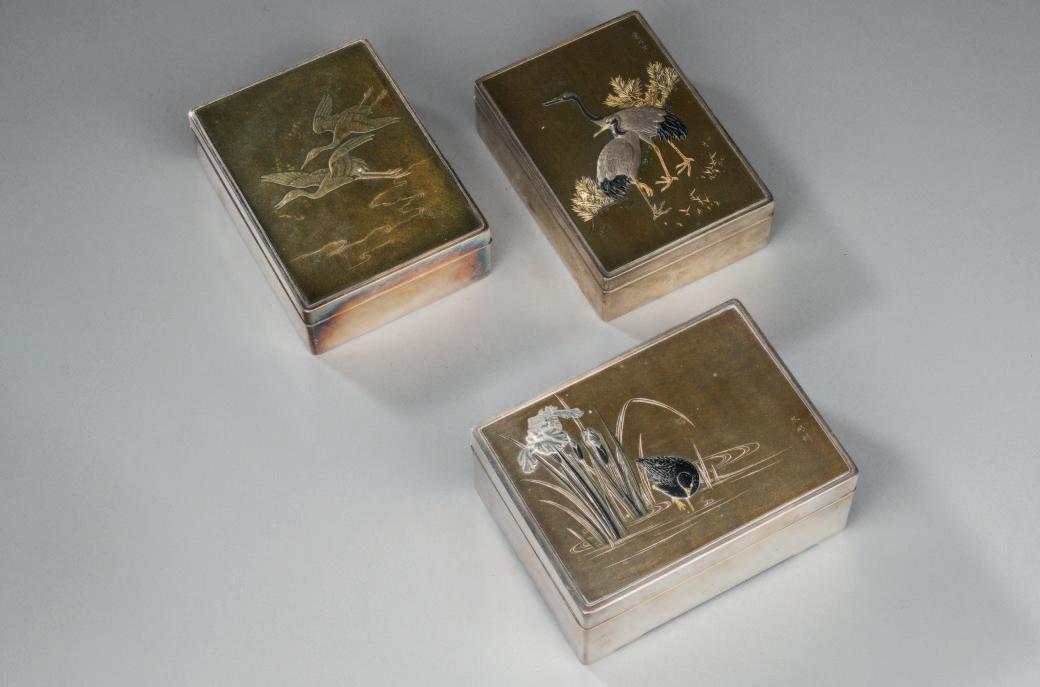
647
THREE JAPANESE INLAIDSILVER BOXES AND COVERS MEIJI/TAISHŌ, 20TH CENTURY
All three of rectangular shape and decorated with birds, with details highlighted in gilt; one box with an inscription inside reading ‘Presented by Major W.S. Nathan, Tokyo, December 20. 1915.’; another marked Kagemitsu tō, ginsei and Miyamoto sei for the Miyamoto Shoko company; and the third possibly signed Terumitsu koku and with a ginsei silver mark, 5.7cm x 14.2cm x 10.8cm max. (6)
WITHOUT RESERVE
£600-800
Provenance: the inscribed box originally from Major Walter Simeon Nathan (1867–1939), who was a British officer in the Royal Engineers and a prominent businessman in East Asia during the early 20th century. In 1915, Major Nathan was in Tokyo working as the General Manager of the Chinese Engineering and Mining Company.
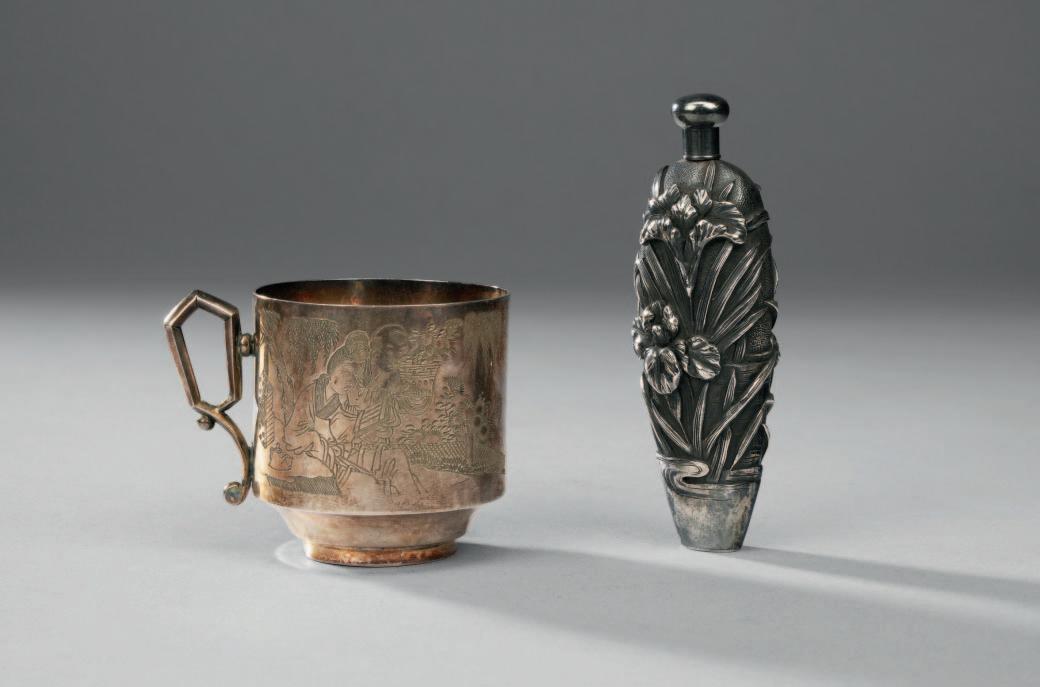
646
A JAPANESE SILVER SCENT BOTTLE AND A CHINESE SILVER CUP
MEIJI ERA, 19TH/20TH CENTURY
The flattened body decorated all over with irises emerging from a stream, signed to the side Komei; together with a Chinese silver cup decorated with a woman and boy in a garden, a long poem to the side, inscribed Yunfang shi and with a Qinghe mark, 10.3cm and 6cm. (2)
£200-300
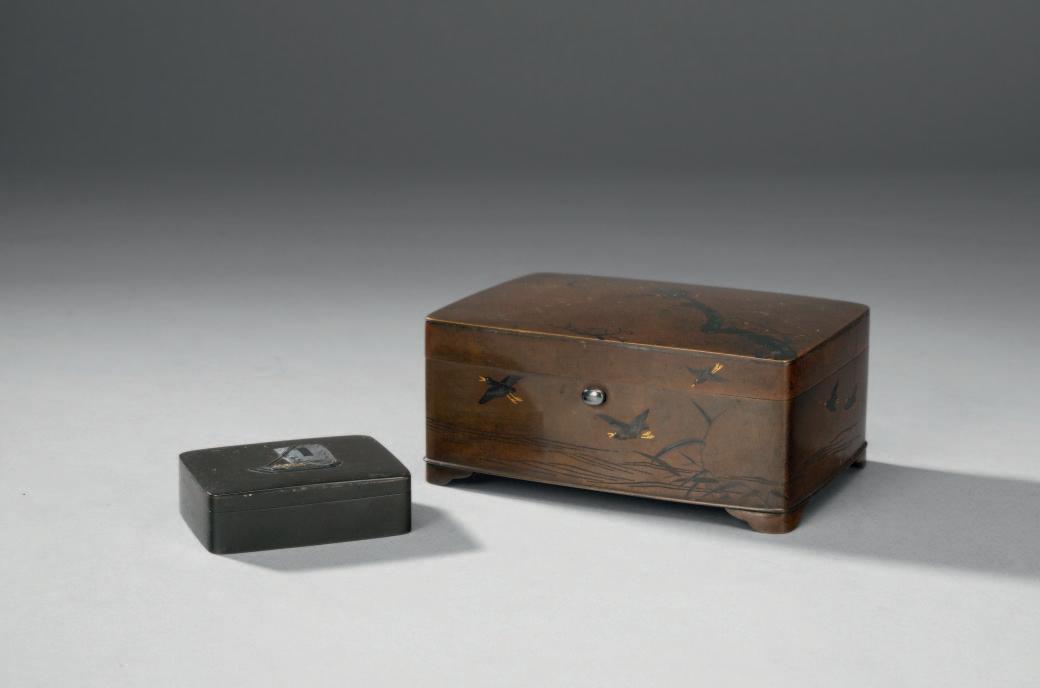
648
TWO JAPANESE INLAIDBRONZE BOXES BY THE NOGAWA COMPANY
MEIJI ERA, 19TH/20TH CENTURY
Both of rectangular form with hinged lids, the largest decorated with an owl perched on a sparsely leafed tree, a moon crescent beside it, the sides with birds in flight above waves; the smaller stamp box with a lone sailboat on a lake; both boxes with the Nogawa trademark underneath; 4.9cm x 8cm x 11.8cm and 1.7cm x 4.2cm x 5.8cm. (2)
£500-1,000
649
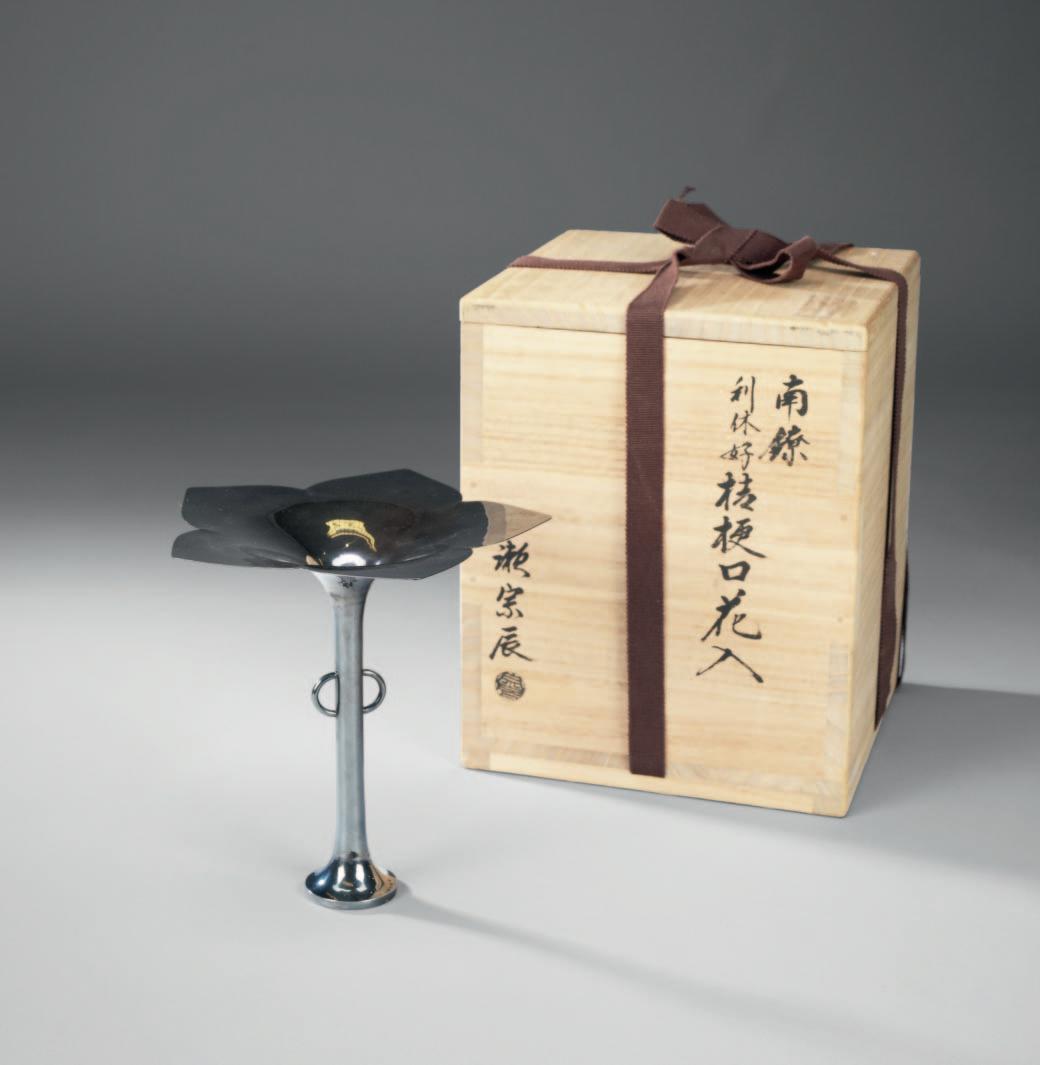
A JAPANESE NANRYŌ SILVER VASE BY ICHINOSE SOSHIN IV (190482)
SHŌWA/HEISEI, 20TH CENTURY
Modelled as a fivepetalled flower with a long stem, with semicircular side handles; in a tomobako (wood box) inscribed Nanryō Rikyū-kono-mi kiky, ō-guchi hana-ike (highpurity silver, balloon flowershaped vase in the taste of Sen no Rikyū) and signed Ichinose Sōshin with a seal, 18.7cm. (2)
£800-1,200
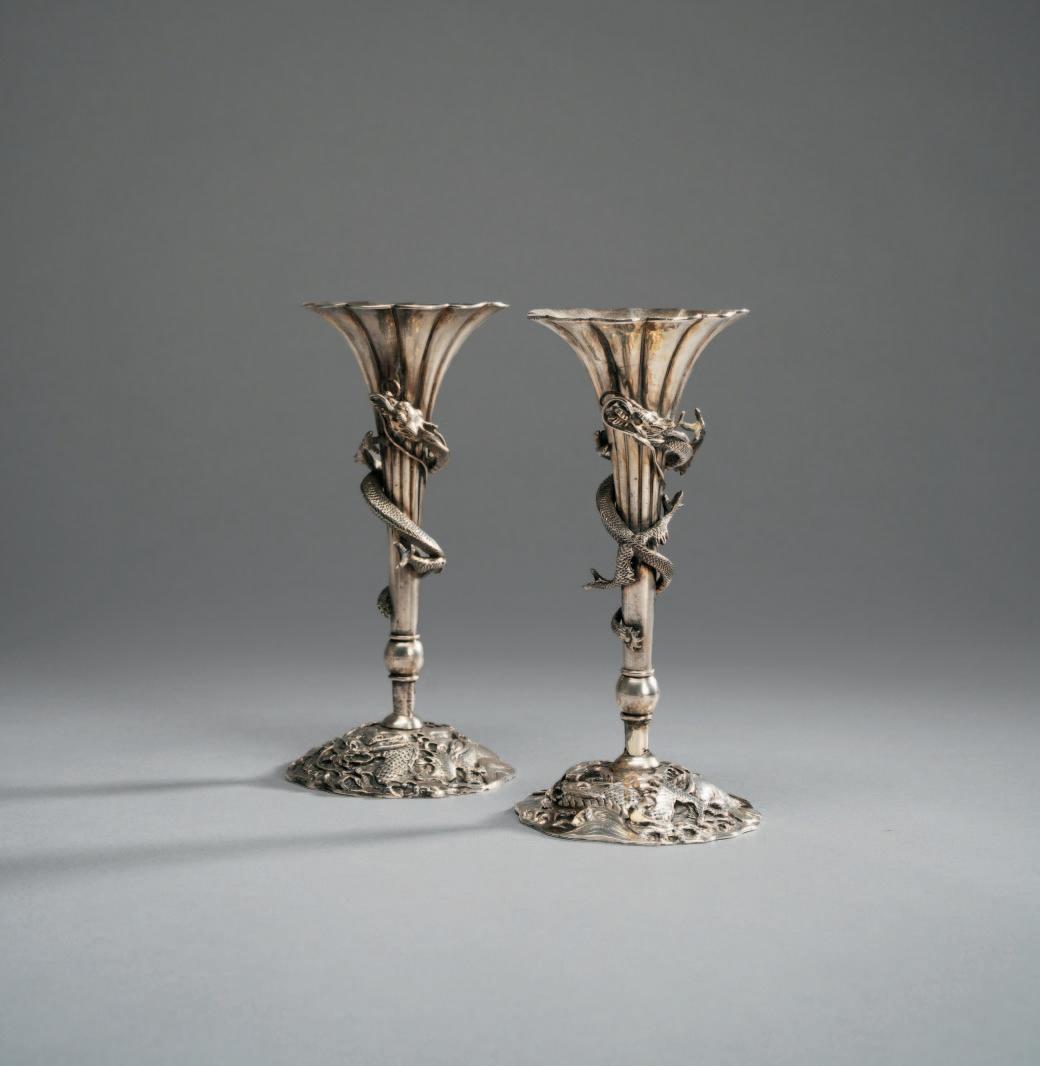
650
A NEARPAIR OF JAPANESE VASES BY KONOIKE OF YOKOHAMA (ACT. C.18801921)
MEIJI/TAISHŌ, 19TH OR 20TH CENTURY
Both with an elegant foliate trumpetshaped body and raised on a circular base, each decorated with a dragon rendered in the round ensnaring the stem, with another dragon depicted in low relief on the foot, both with a mark underneath for Konoike zo and jungin (pure silver), both 14.5cm. (2)
£500-1,000
651
A JAPANESE SILVER AND ENAMEL VASE WITH DRAGON
MEIJI ERA, 19TH/20TH CENTURY
With a wide body, raised on a short foliate base and with a tall flaring neck, a large dragon in relief coiled around it; the body decorated with a band of flowers, with details highlighted in polychrome enamels, the base signed Mitsuyoshi with kao, 23.8cm.
£2,000-3,000
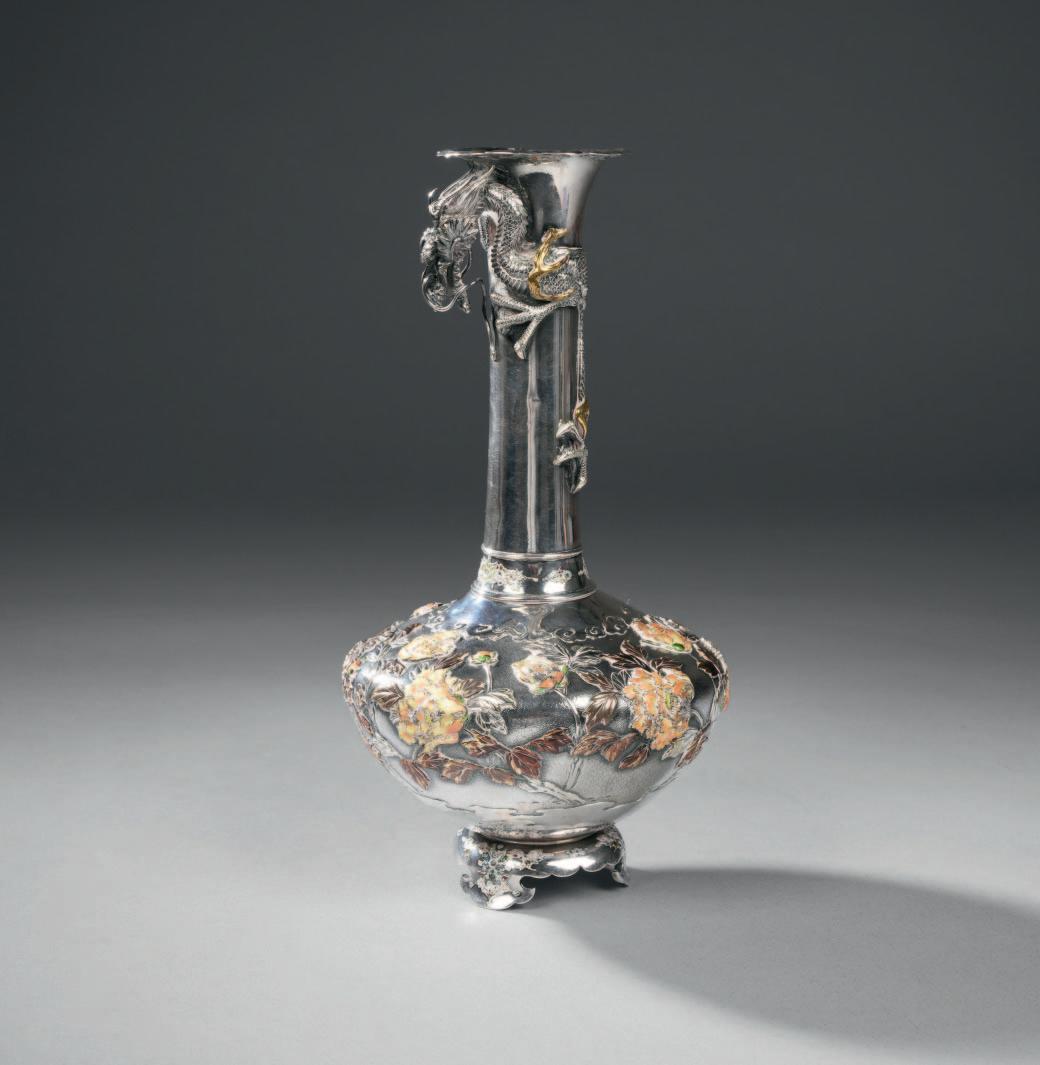
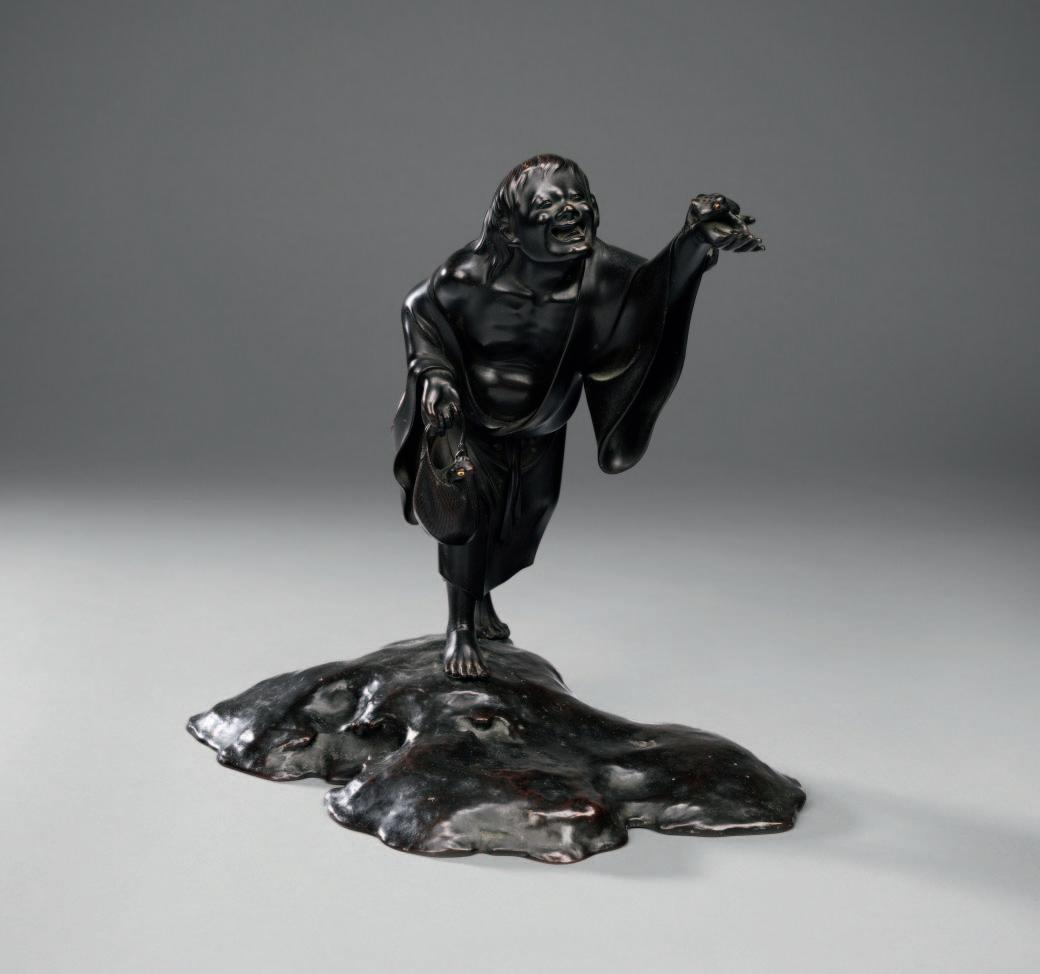
652
A JAPANESE BRONZE OKIMONO OF GAMA SENNIN
TAISHŌ/SHŌWA, 20TH CENTURY
The Immortal depicted stepping on a rocky outcrop, smiling while lifting a large frog in his left hand, holding a basket from which another amphibian emerges; both animals with the eyes picked out in gilt; the back of the base with a silver rectangular cartouche inscribed Joun, probably for Ōshima Joun (18581940), 23.5cm.
£2,000-3,000
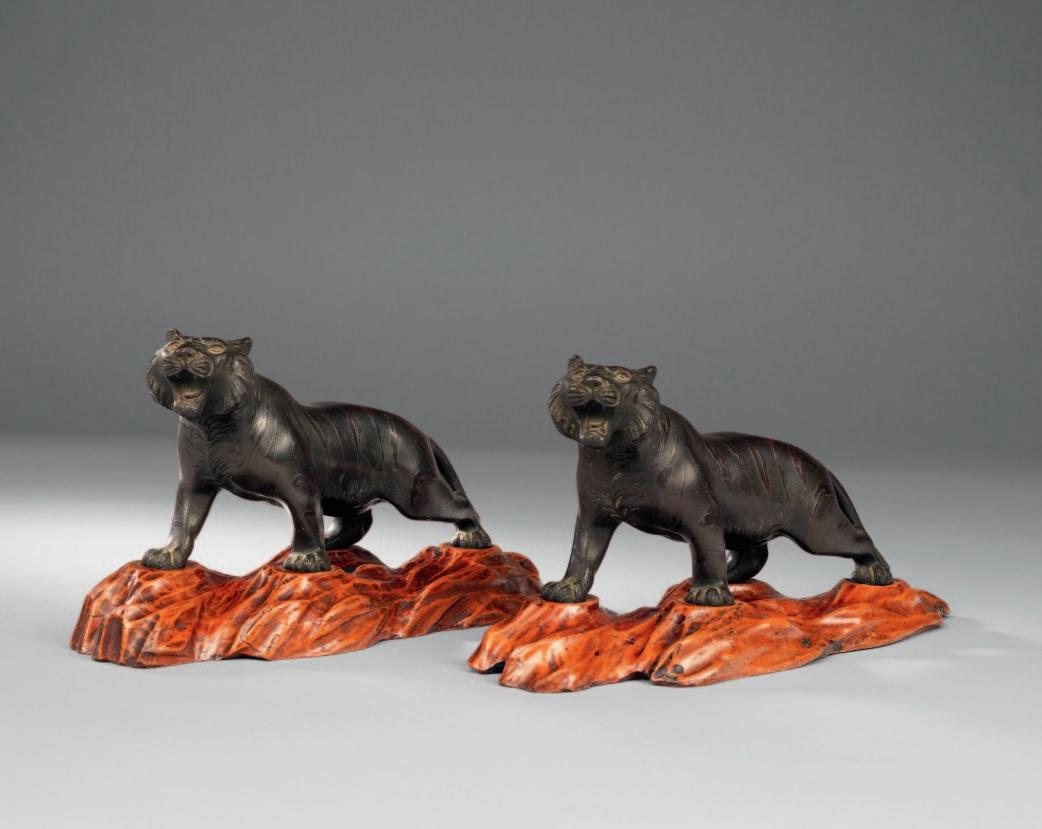
654
TWO JAPANESE BRONZE OKIMONO OF TIGERS BY WATANABE MEIJI ERA, 19TH/20TH CENTURY
Both standing foursquare with their mouths open in a snarl, the stripes on their backs realistically rendered, each signed Watanabe sei on the belly; with fitted wood bases carved as rockwork, both tigers 22cm. (4)
£400-600
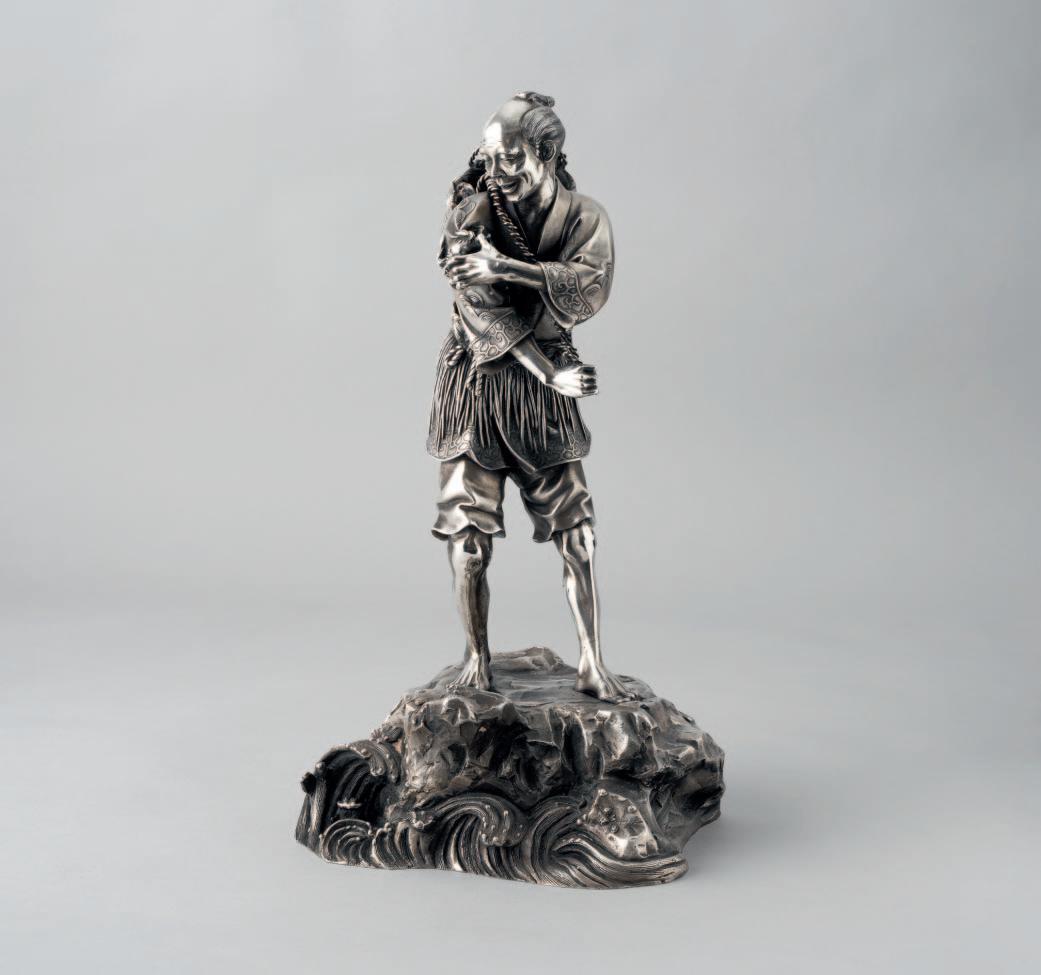
653
A LARGE JAPANESE SILVERED BRONZE OKIMONO
SHŌWA OR LATER, 20TH/21ST CENTURY
Depicting a fisherman removing a large crab off his shoulder, another crustacean escaping to the side of his wicker basket; the man wears a short tunic decorated with waves and a skirt made of sea grass; all raised on a base shaped as a rocky outcrop with further waves crashing to the side, 40cm.
£500-1,000
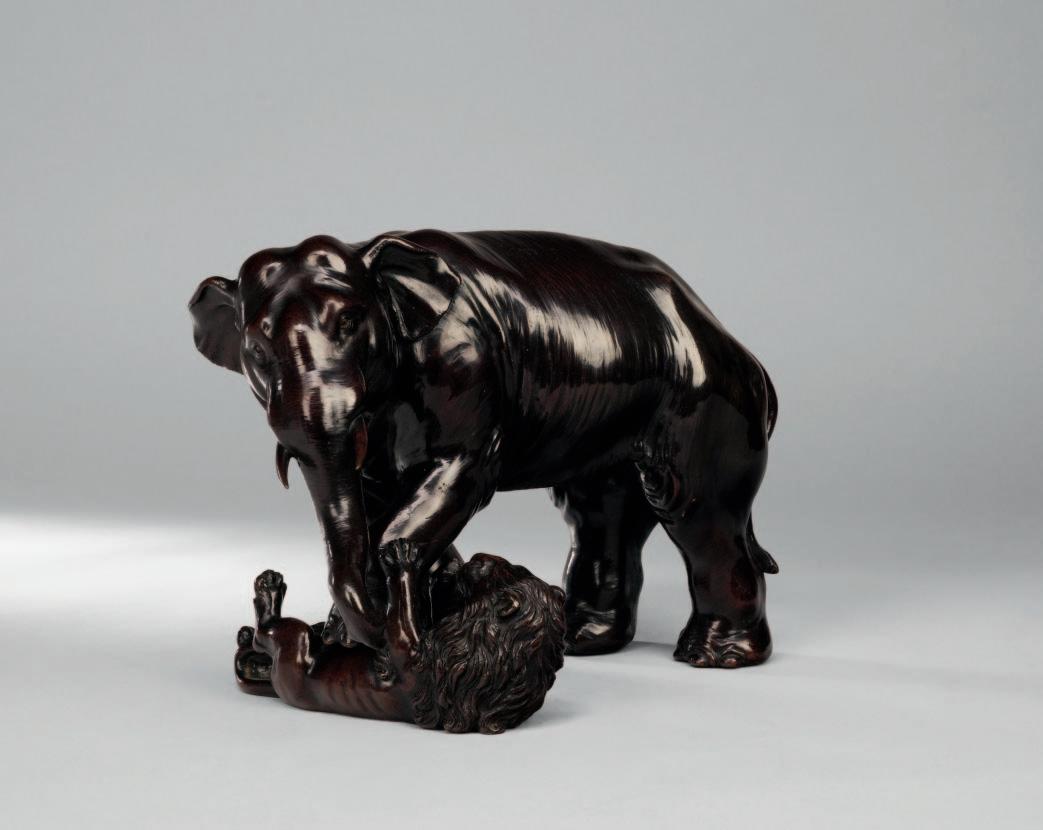
655
A JAPANESE BRONZE OKIMONO MEIJI ERA, 19TH/20TH CENTURY
Modelled as an elephant trampling on a lion, both animals cast separately and naturalistically rendered, the pachyderm with its eyes subtly gilded and signed Shunsai on the belly, approx. 30cm. (2)
£400-600
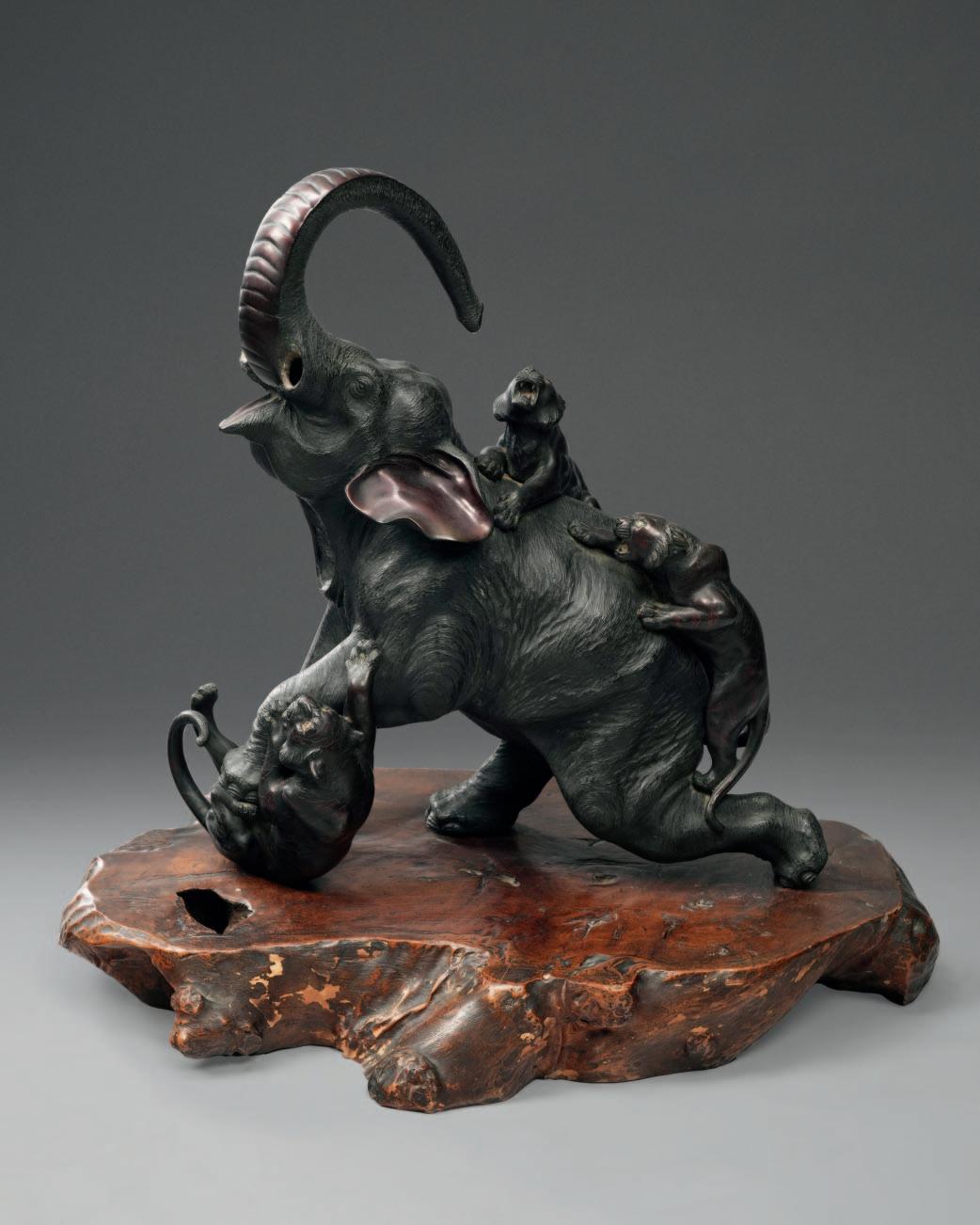
656
A LARGE AND IMPRESSIVE JAPANESE BRONZE ELEPHANT BY SEIKO
MEIJI ERA, 19TH/20TH CENTURY
The majestic animal fending off the attack of three tigers, trampling on one whilst two clamber upon its back, raising its trunk and with its mouth agape, the rough texture of its skin realistically rendered and with a warm patina; signed on its belly Seiko saku; with a wood plinth carved as rockwork, 61cm x 64cm overall. (2)
£3,000-5,000
Provenance: from a private English collection, London.
657
A PAIR OF JAPANESE BRONZE VASES BY GENRYUSAI SEIYA
MEIJI ERA, 19TH/20TH
CENTURY
The charming vessels modelled as a small elephant and a monkey, each playing with a tall trumpetshaped vase; the elephant holding it in its mouth with its trunk coiled around it, sitting on its haunches and with its head raised; the monkey putting it against his ear; both realistically rendered with the texture of the skin and hair naturalistically cast; each with a rectangular reserve to the underside reading as Seiya chu, both 30cm. (2)
£6,000-8,000
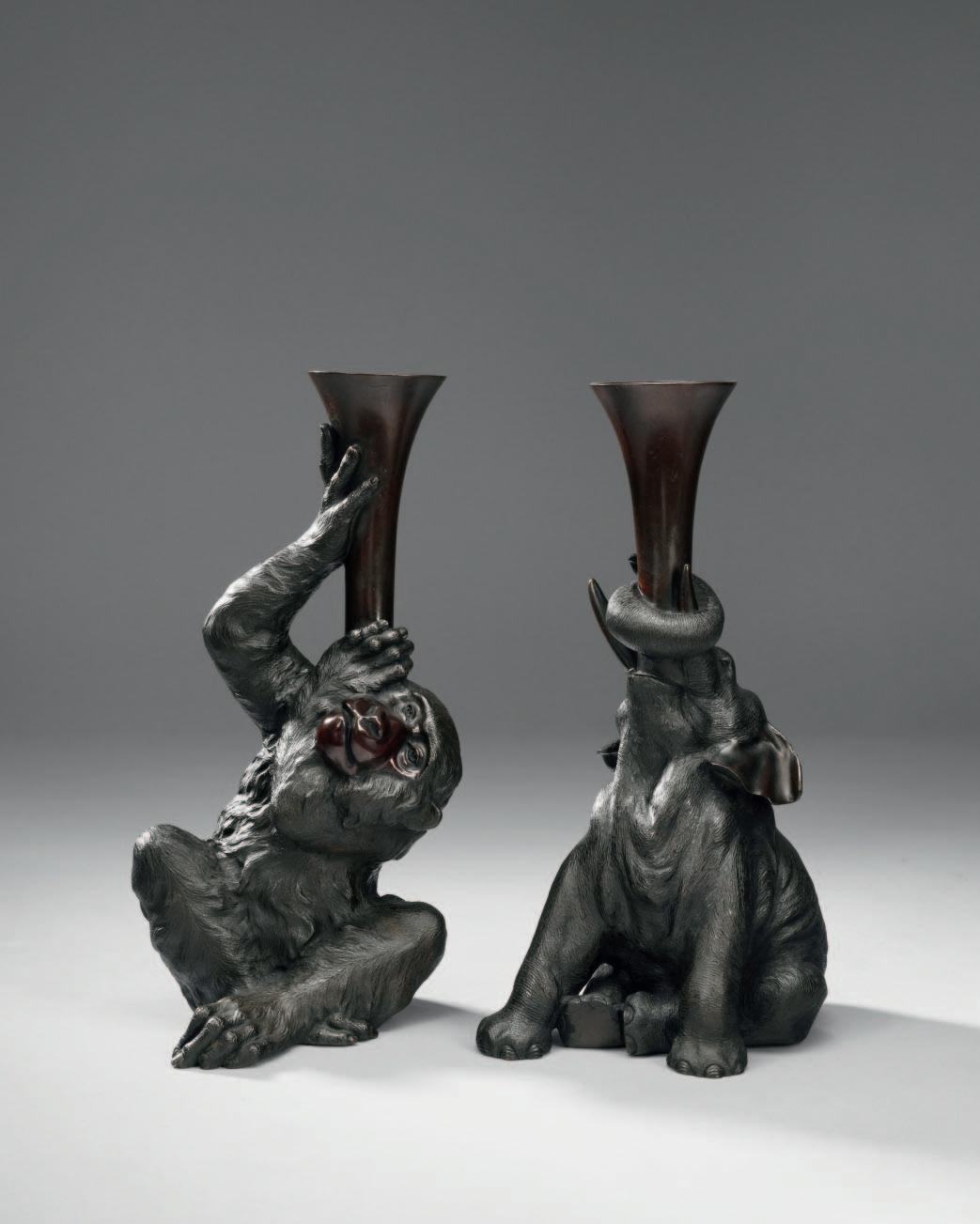
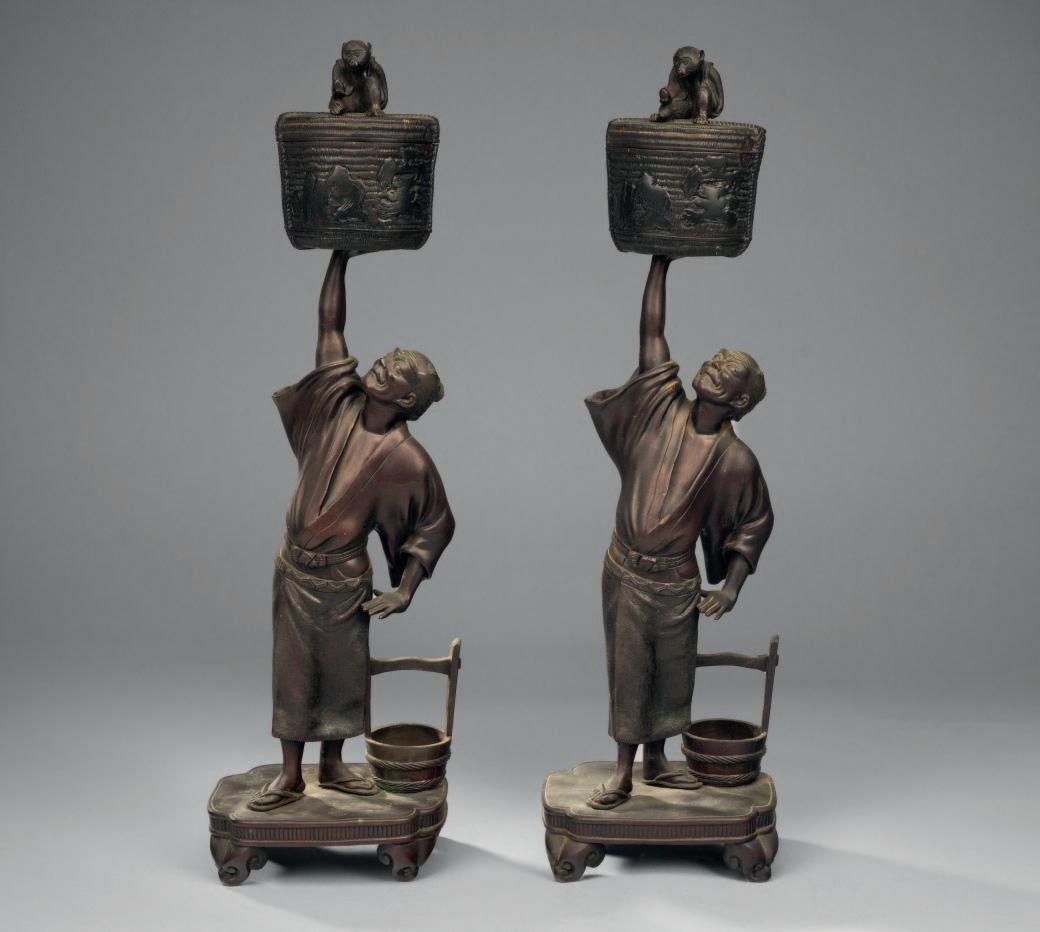
658
TWO JAPANESE BRONZE FIGURES OF SARUMAWASHI (MONKEY TRAINERS)
MEIJI ERA, 19TH/20TH CENTURY
Both cast with a man standing on a lobed base lifting a sake barrel, each with a monkey wearing a waistcoat sat at the top, the upper sections opening to reveal the inside of the barrels; each signed in two cartouches, Mori and an illegible mark; both 46cm. (4)
£800-1,200
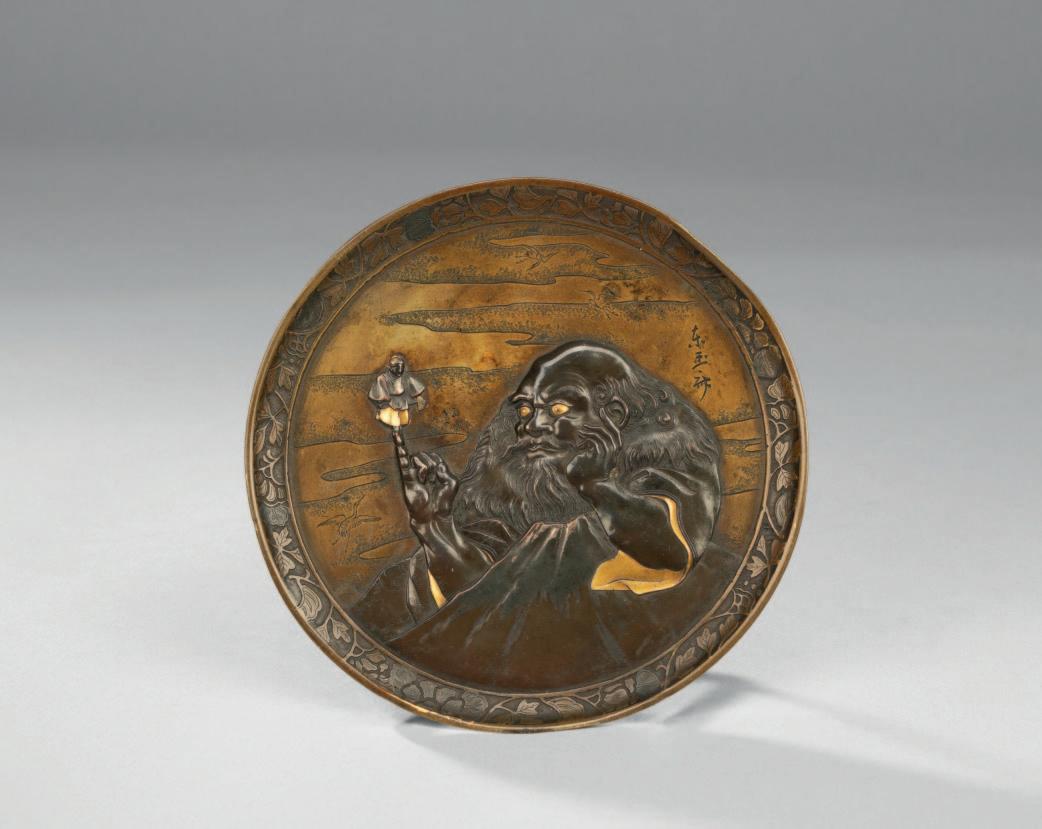
660
A JAPANESE MIYAO BRONZE DISH
MEIJI ERA, 19TH/20TH CENTURY
The well decorated with the giant Wasobei resting against Mount Fuji, with a small figure standing on his little finger; some details picked out in gilt; the dish signed Togyokusai to the front and Miyao zō on the back, 12.2cm.
WITHOUT RESERVE
£200-300
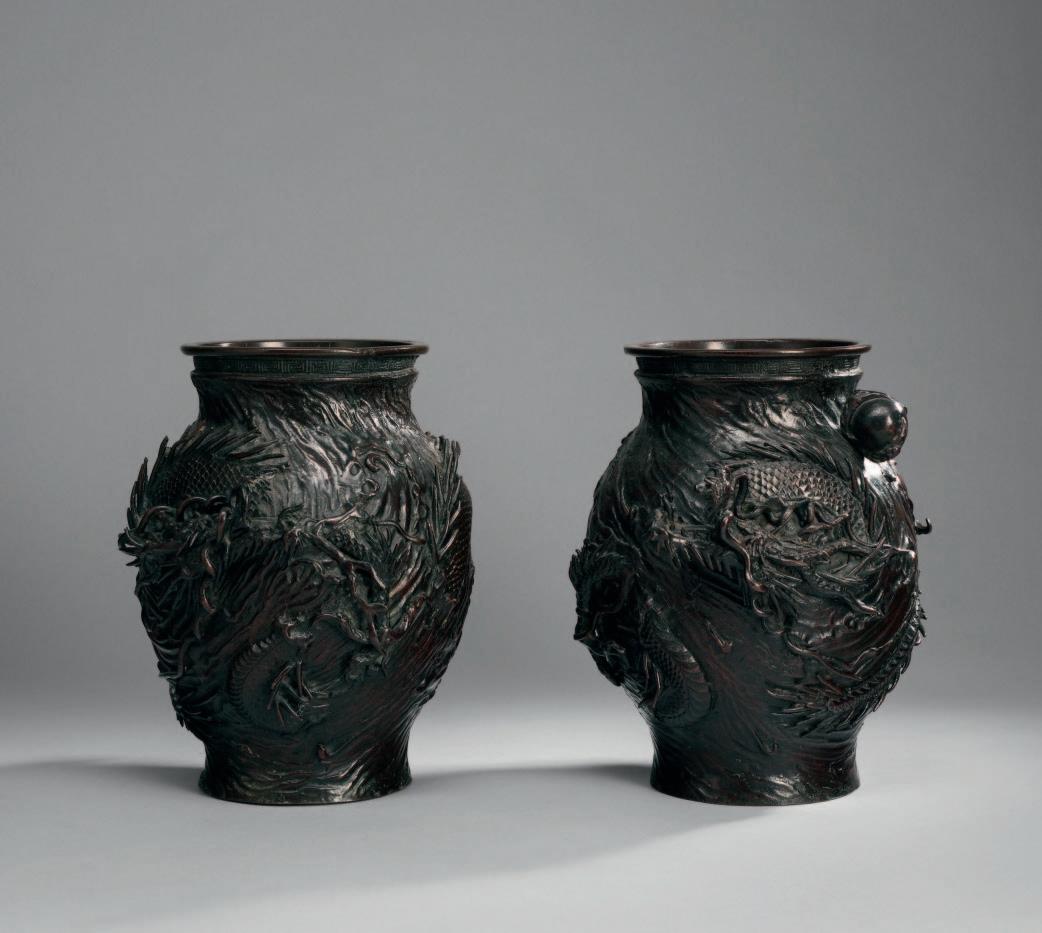
659
A PAIR OF JAPANESE BRONZE VASES
MEIJI ERA, 19TH/20TH CENTURY
Both decorated with ferocious scaly dragons amongst crashing waves, one clasping a pearl of wisdom; the mythical beasts cast in high relief below a band of key fret; both marked Dai Nihon Sakamoto sei underneath, 23.8cm each. (2)
WITHOUT RESERVE
£200-300
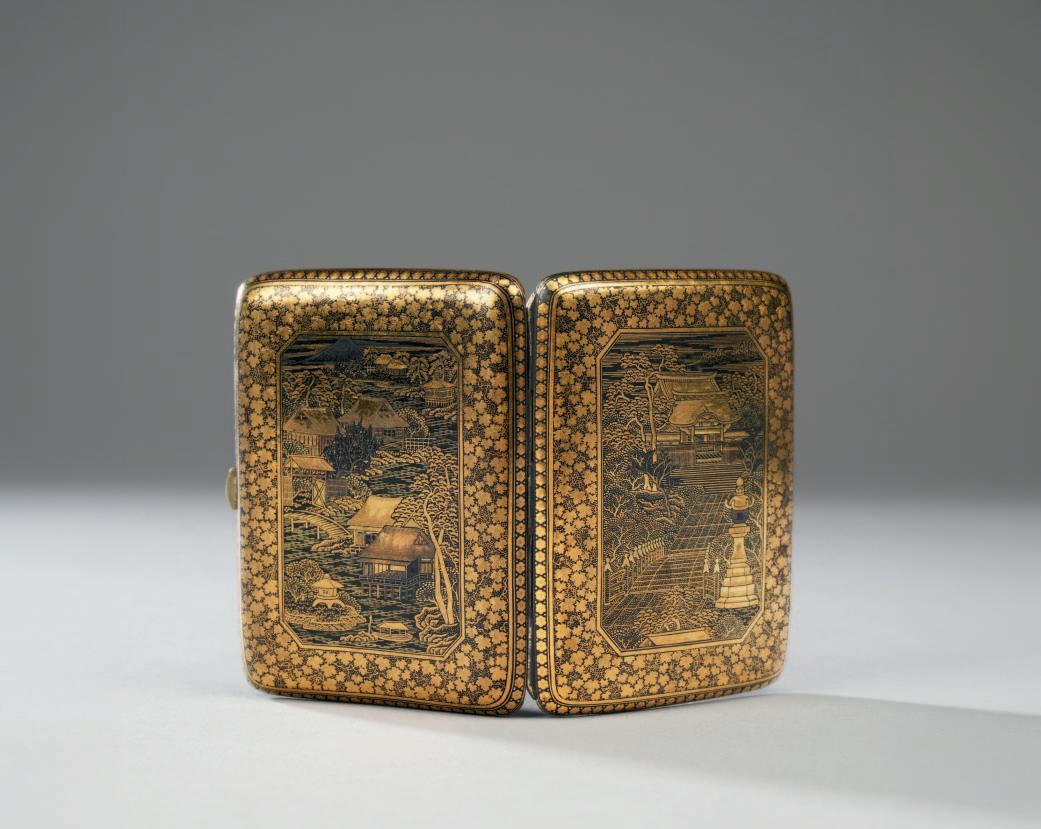
661
A JAPANESE IRON KOMAI CASE
MEIJI ERA, 19TH/20TH CENTURY
Decorated in gold and silver nunome-zogan with the Sanmon Gate at Chionin Temple in Kyoto, the reverse with Mount Fuji and Hakone; a seal mark inside reading Nihon koku Kyoto ju Komai sei, 8.5cm x 6.5cm.
£200-400
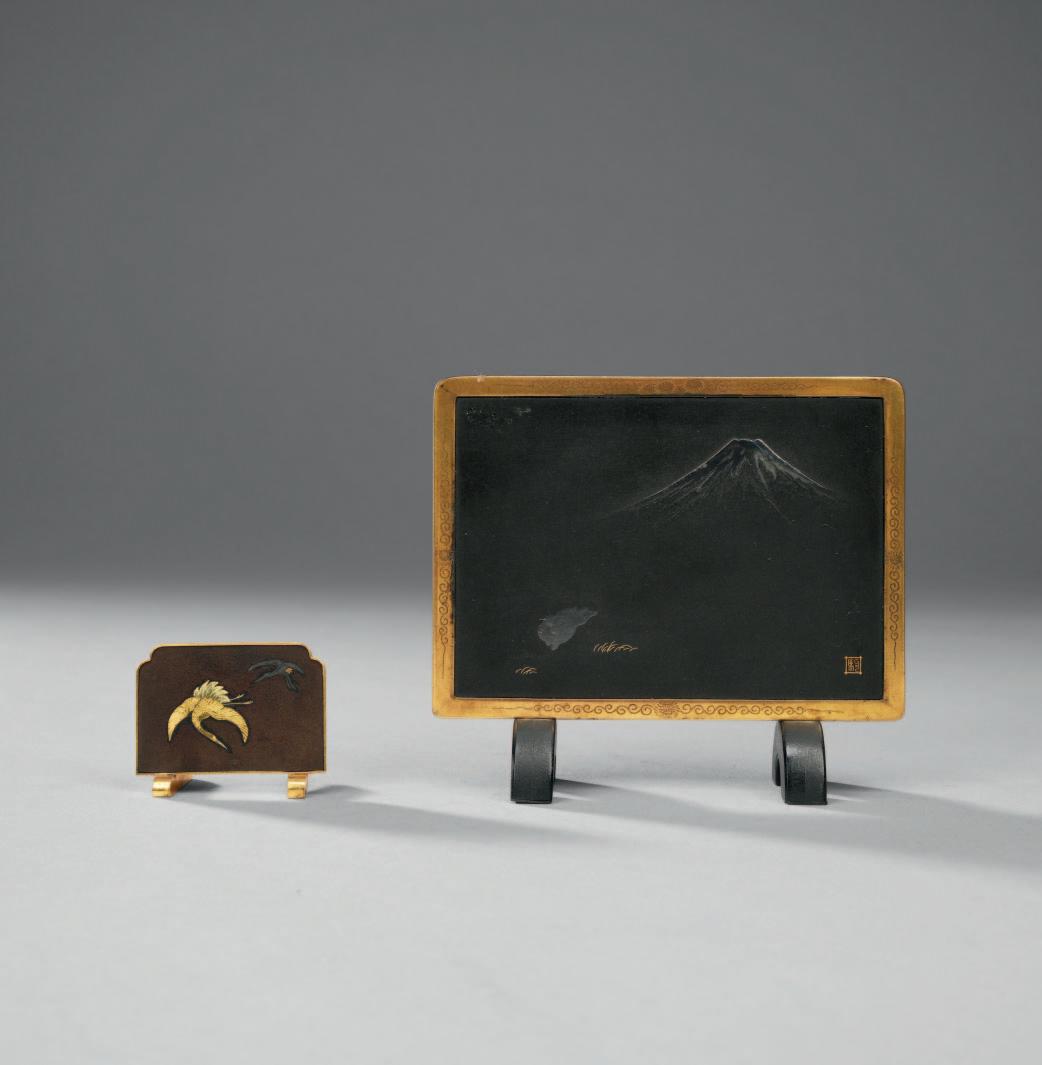
663
A JAPANESE BOX AND COVER BY FUJII YOSHITOYO (B.1868) TAISHŌ ERA, 20TH CENTURY
The cover decorated with a thatched watermill by a stream, nestled amongst tall trees and with a small bird flying above; the sides with further thatched buildings in a watery landscape and with sailing boats to the reverse, all rendered in nunome zogan, the base with Fujii Yoshitoyo’s Fujii Damascene Company trademark, 5cm x 13.5cm x 9.3cm. (2)
WITHOUT RESERVE
£300-500
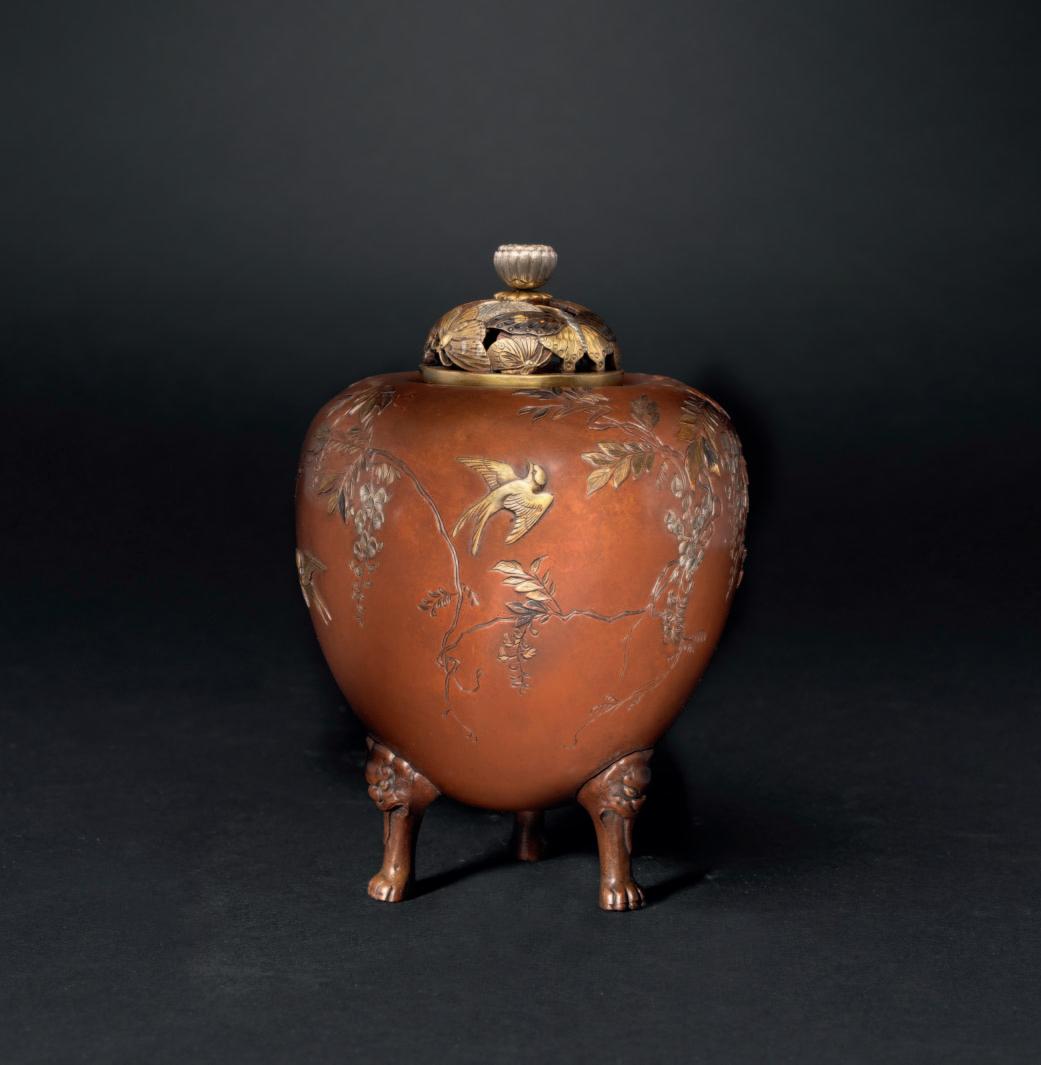
662
A JAPANESE MINIATURE INLAIDIRON SCREEN BY KOMAI MEIJI/TAISHŌ, 19TH/20TH CENTURY
Of rectangular shape and raised on two semicircular feet, decorated to one side with a silver rabbit prancing before Mount Fuji, the reverse with swallows in flights, a twocharacter signature above the Komai seal; together with a small screenshaped place card holder, 10.5cm x 11.7cm max. (2)
£300-500
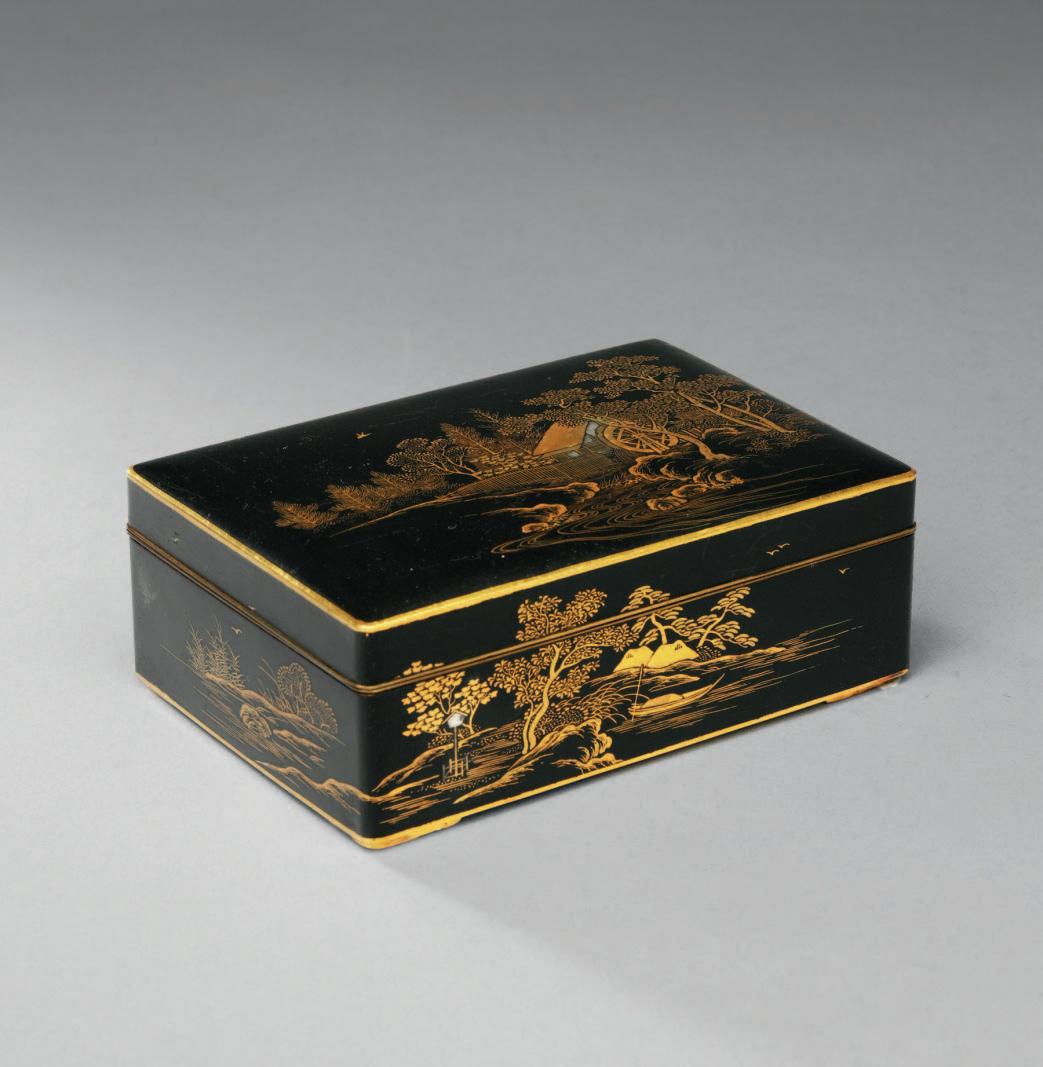
664
A JAPANESE INLAIDBRONZE KŌRŌ AND COVER BY THE INOUE COMPANY OF KYOTO MEIJI ERA, 19TH/20TH CENTURY
The body of the incense burner raised on three tall feet in the form of mythological beasts; decorated in relief and inlaid in bronze, silver, copper and gold with three swallows in flight between leafy branches of wisteria; the domed reticulated cover similarly worked with butterflies, surmounted by a knop in the form of a chrysanthemum bud; signed to the base with a seal reading Inoue sei, 13.3cm. (2)
£800-1,200
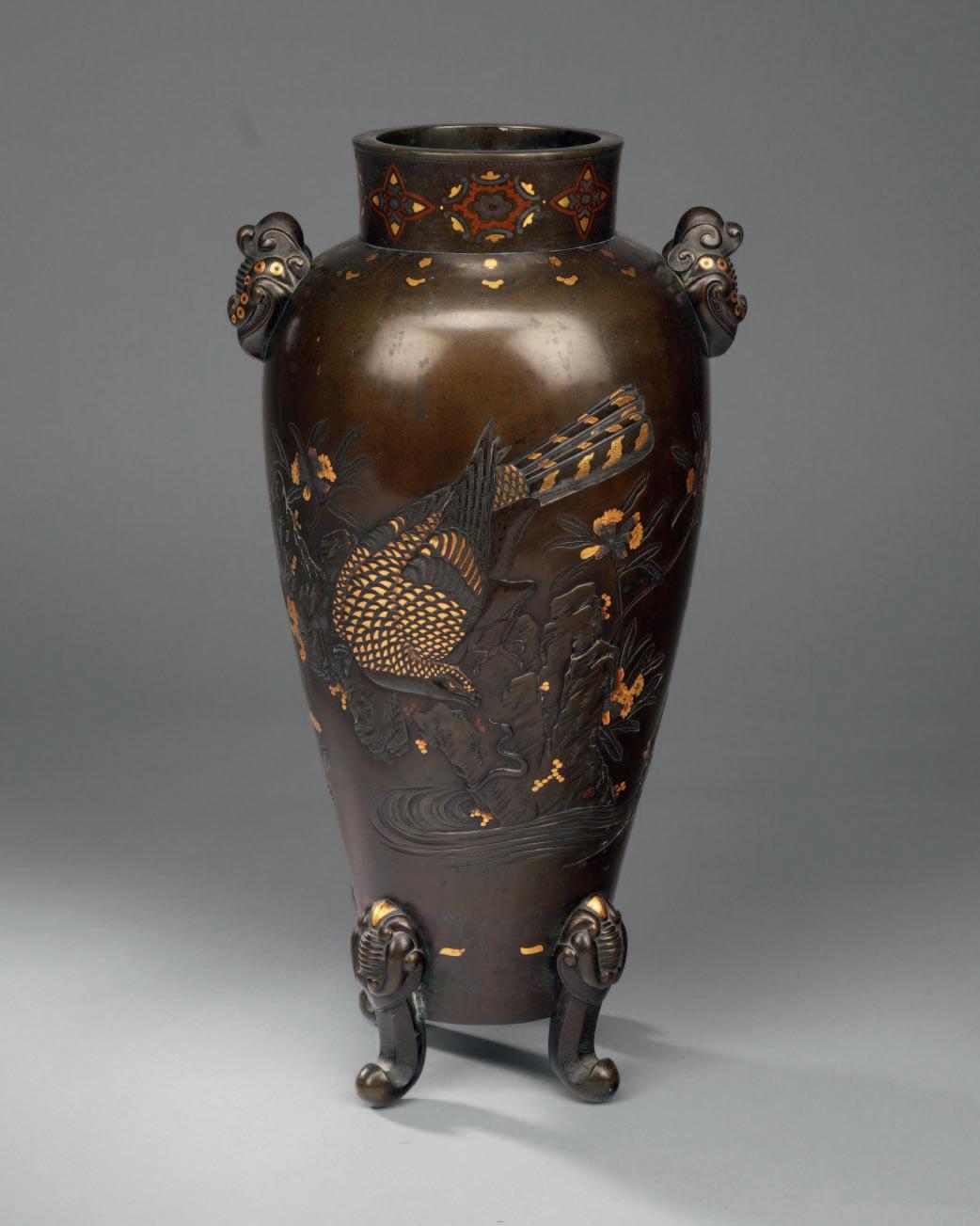
665
A JAPANESE INLAIDBRONZE VASE MEIJI ERA, 19TH CENTURY
Of tall baluster form, raised on four scrolling feet and with archaistic handles shaped as stylised frogs; the side embellished with a bird of prey perched on rockwork by a stream, observing a small snake below; the reverse with a pheasant amongst chrysanthemum, with formal borders to the shoulder and neck; all rendered in low relief with details in gilt and silver, 38.5cm.
£500-1,000
666
A JAPANESE BRONZE OWL VASE BY YAMAMOTO KŌKEN MEIJI ERA, 19TH/20TH CENTURY
The ovoid body raised on a short flaring foot and with an everted rim, decorated with a charming owl perched on a leafy maple branch, the full moon emerging from wispy clouds above; rendered in low relief with gold and silver inlays; signed Yamamoto sei to the base and Kōken to the side, 17.5cm.
£2,000-3,000
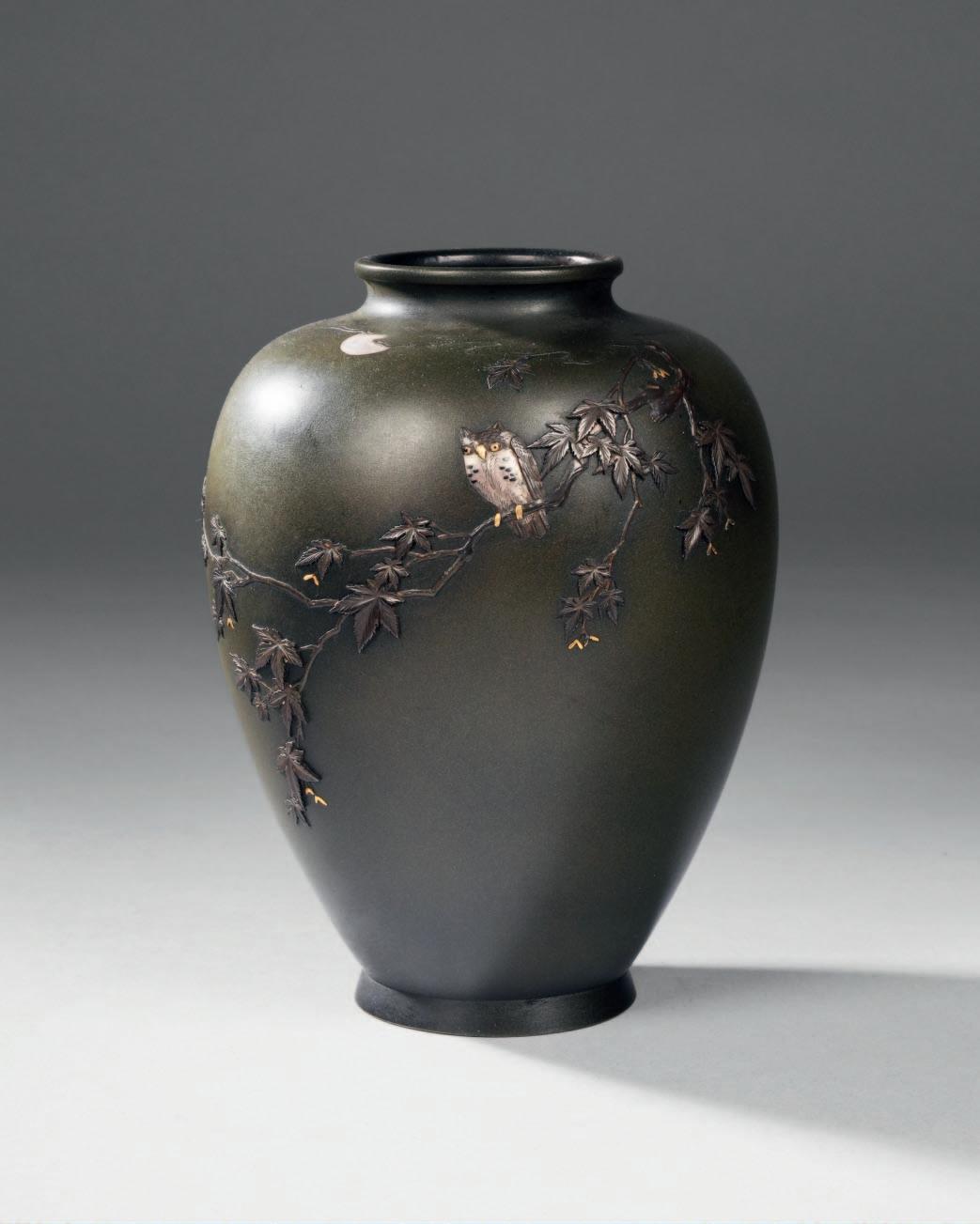
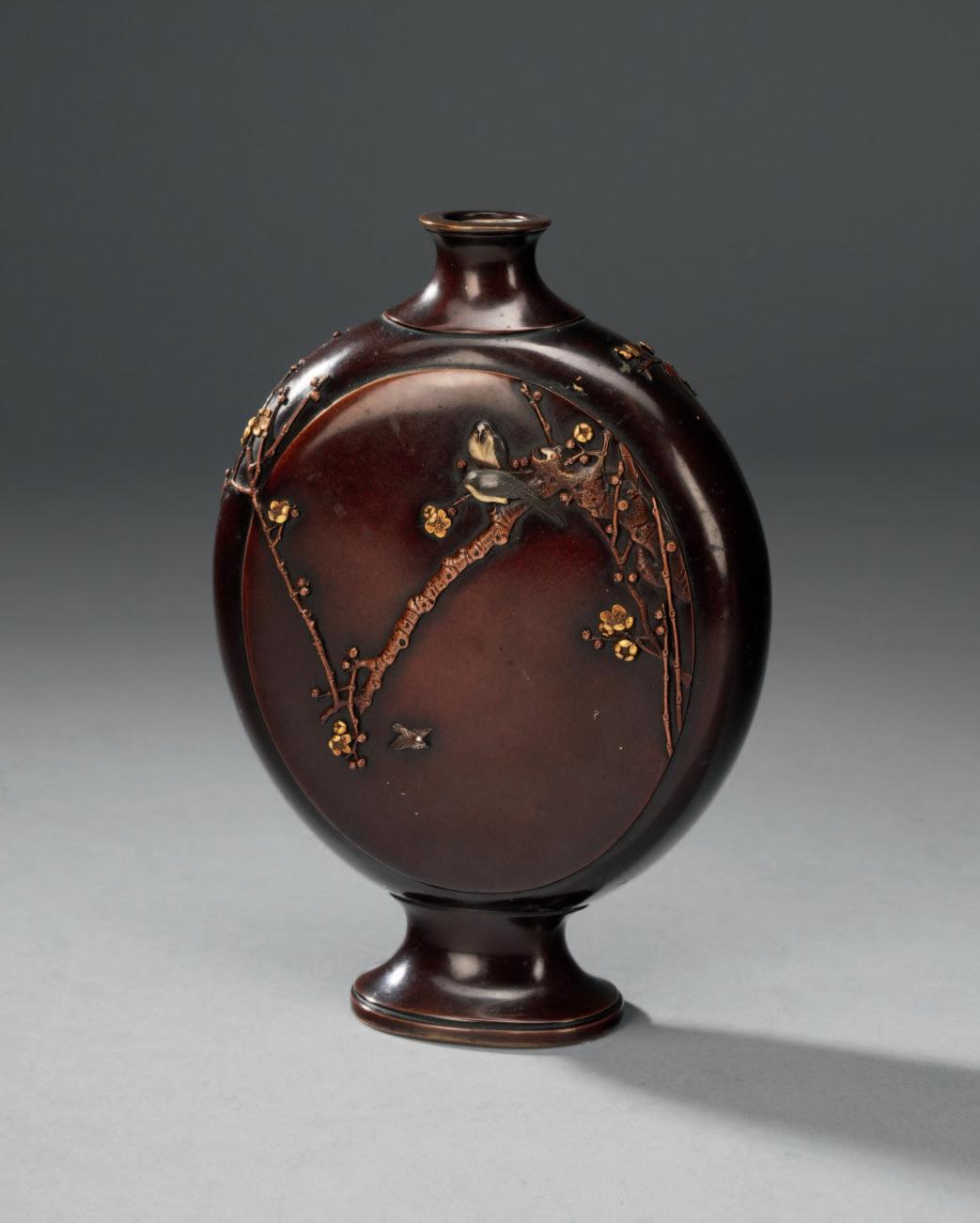
667
A JAPANESE INLAIDBRONZE MOONFLASK BY MIYABE
ATSUYOSHI
MEIJI ERA, 19TH CENTURY
The flattened circular body raised on a spreading foot and with a flared neck, one side decorated with a silver egret taking flight underneath a flowering hibiscus tree, the reverse with two birds perched on a prunus tree in bloom, a third smaller bird flying below; the base signed Dai Nihon Kyoto ju Ikkodo Miyabe Atsuyoshi with kao, 16.8cm.
£3,000-4,000
Provenance: previously in a Scottish private collection, Renfrewshire.
668
A PAIR OF JAPANESE INLAIDBRONZE VASES BY MIYABE
ATSUYOSHI
MEIJI ERA, 19TH/20TH CENTURY
Each with a tall cylindrical body raised on a short foot and with an elongated neck, both decorated with a continuous design of birds and flowers, one with a swallow observing a grasshopper and the other with large hibiscus flowers; all rendered in a variety of metals including gold, silver, bronze and copper takazogan; each signed Miyabe Atsuyoshi with a kao underneath, 30.8cm each. (2)
£2,000-3,000
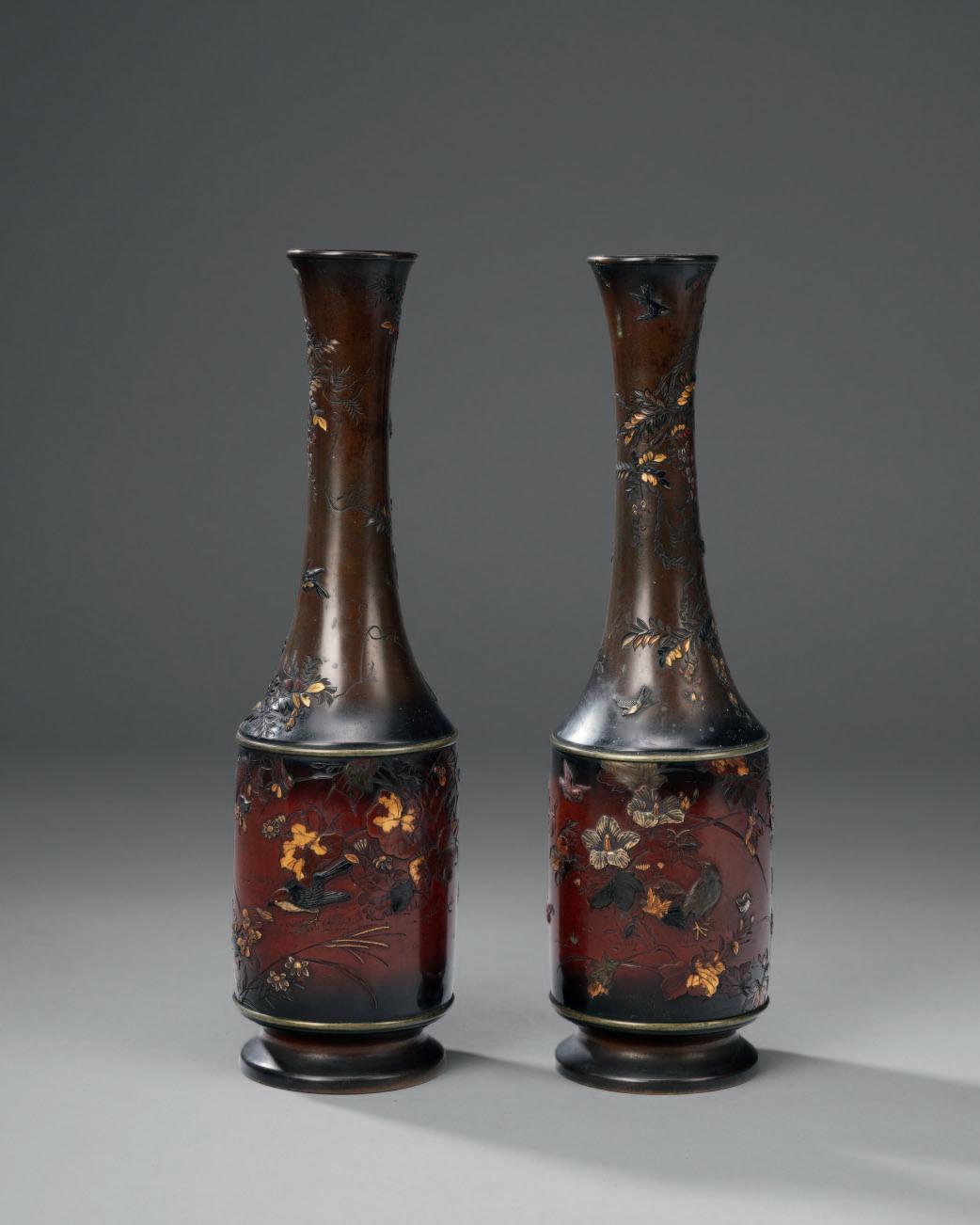
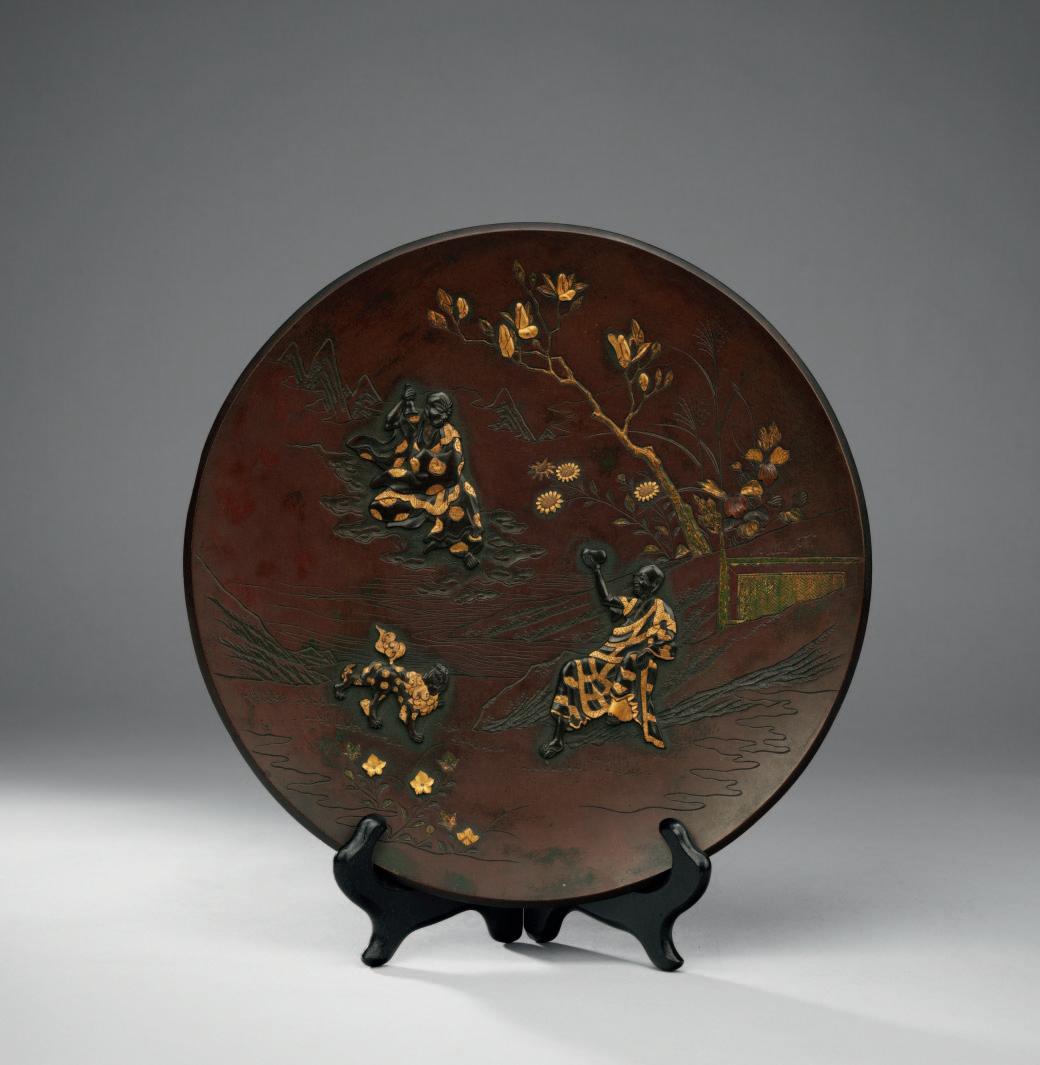
670
AN UNUSUAL JAPANESE MALACHITE AND AGATEINLAID BRONZE DISH
MEIJI/TAISHŌ, 20TH CENTURY
Decorated with a small sparrow observing a firefly in the rain, the small bird perched amongst large lotus leaves emerging from a stream; with details highlighted in hardstone and mixed metals; raised on a short foot and with a long inscription to the base reading as Dai Nippon Ecchū koku Takaoka jū, Seizō nin, Kurotani tsu emon; 34cm.
£1,500-2,500
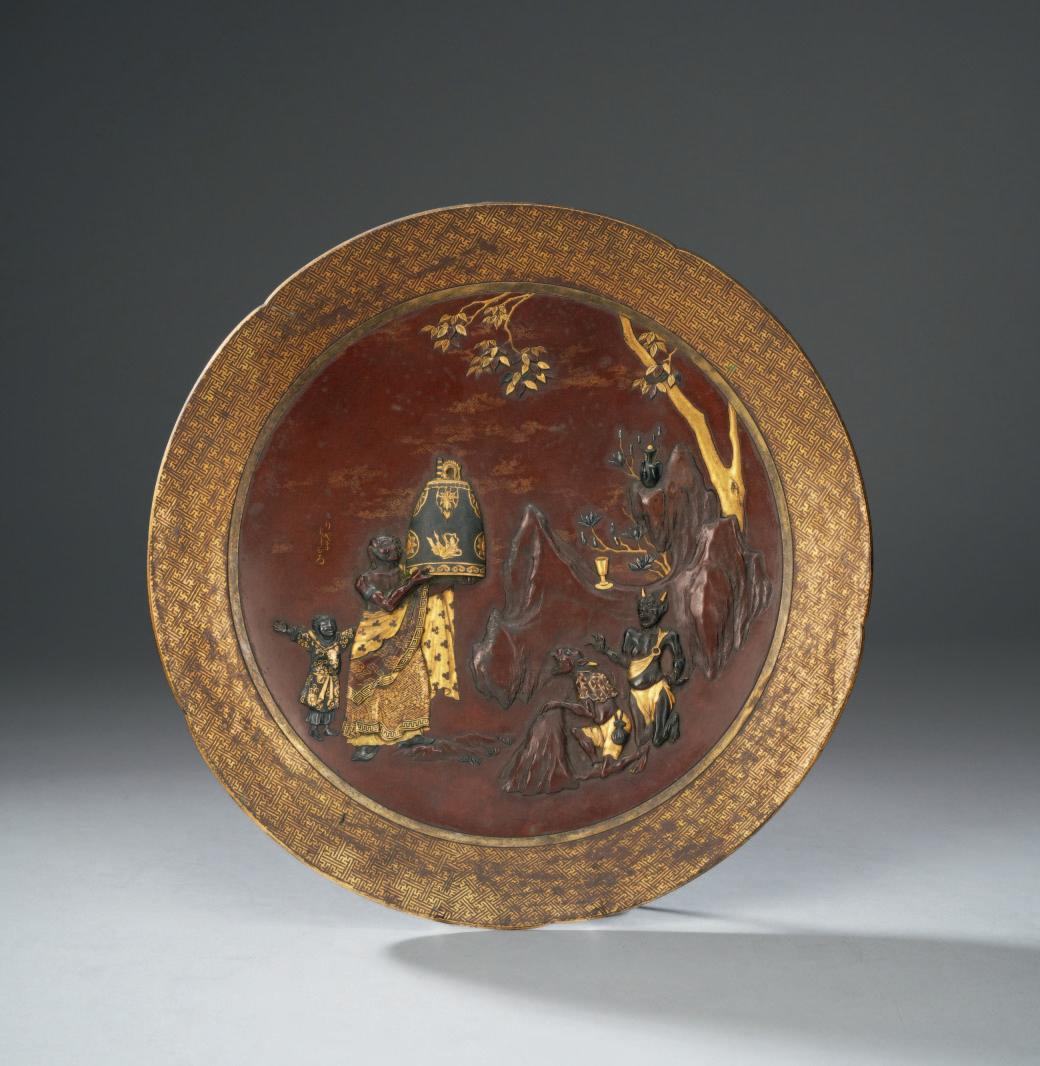
669
A JAPANESE INLAIDBRONZE DISH BY YAMAMOTO MEIJI ERA, 19TH CENTURY
Depicting two rakan and a shishi in a luxuriant garden with mountains in the distance, one Immortal holding a begging bowl whilst the other descends from scrolling clouds; with some details highlighted in gilt and inlaid in low relief, signed Yamamoto sei to the reverse, 27cm.
£600-800
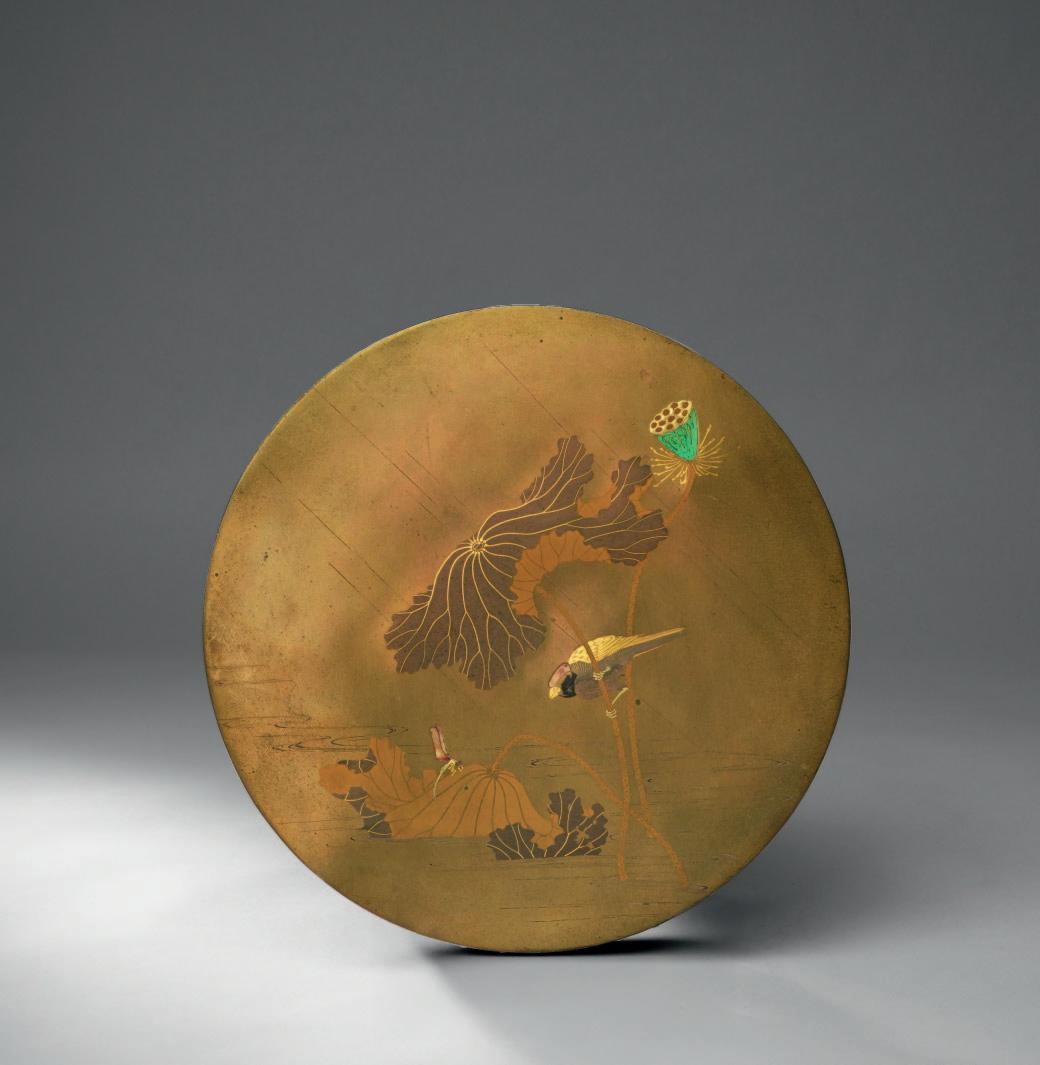
671
A JAPANESE INLAIDBRONZE CHARGER BY THE INOUE COMPANY OF KYOTO
MEIJI ERA, 19TH CENTURY
The well decorated in relief with an Immortal hoisting a large Buddhist bell, a small boy cheering behind him with outstretched arms, whilst two frightened oni hide behind rocky outcrops; a faint inscription above the boy reading
Toriyama Yo...ro; framed by a band of sayagata patterns, the details rendered in iroe takazogan, hirazogan, takabori and kebori; the reverse signed Saikyo Inoue sei (made by Inoue of West Kyoto) and with a gold seal for Fusahiro, 27.4cm.
£2,000-3,000
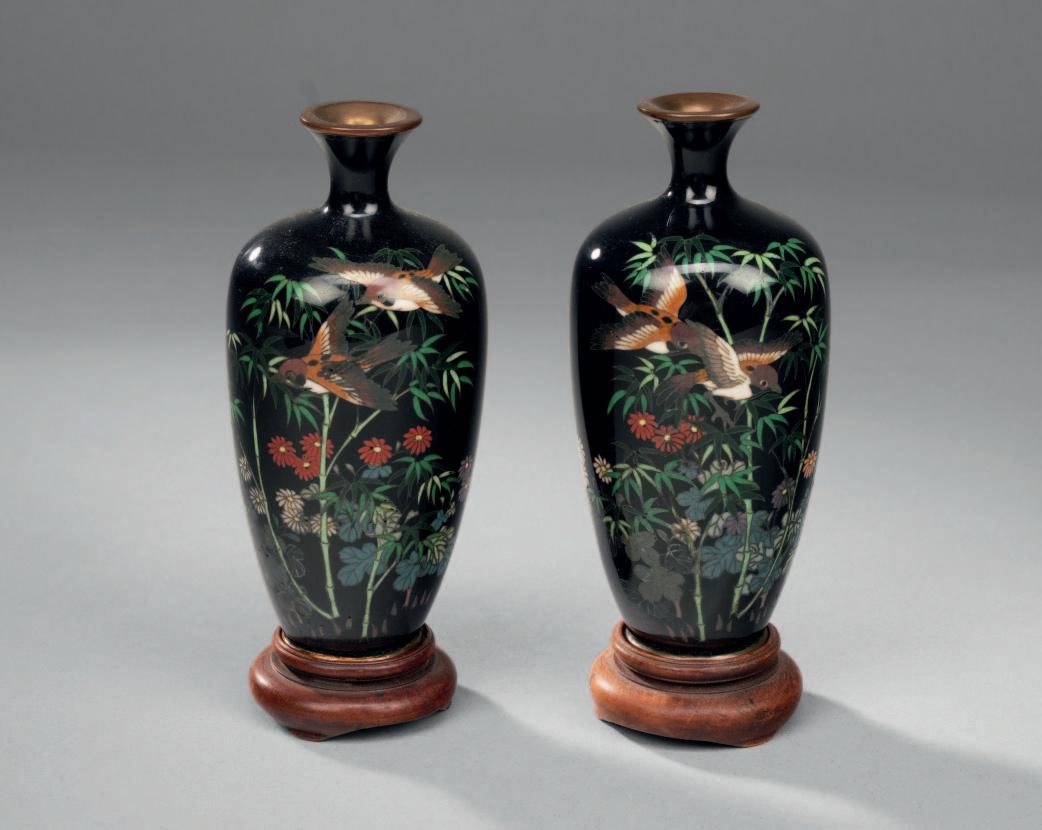
672
A PAIR OF JAPANESE CLOISONNE VASES
MEIJI ERA, 19TH/20TH CENTURY
Decorated with mirroring images of sparrows in flight, with bamboo and colourful flowers behind them, all on a darkblue ground and raised on wooden stands; the bases marked Chū for Hayashi Chūzo or Chushirō, both 12.3cm. (4) WITHOUT RESERVE
£200-400
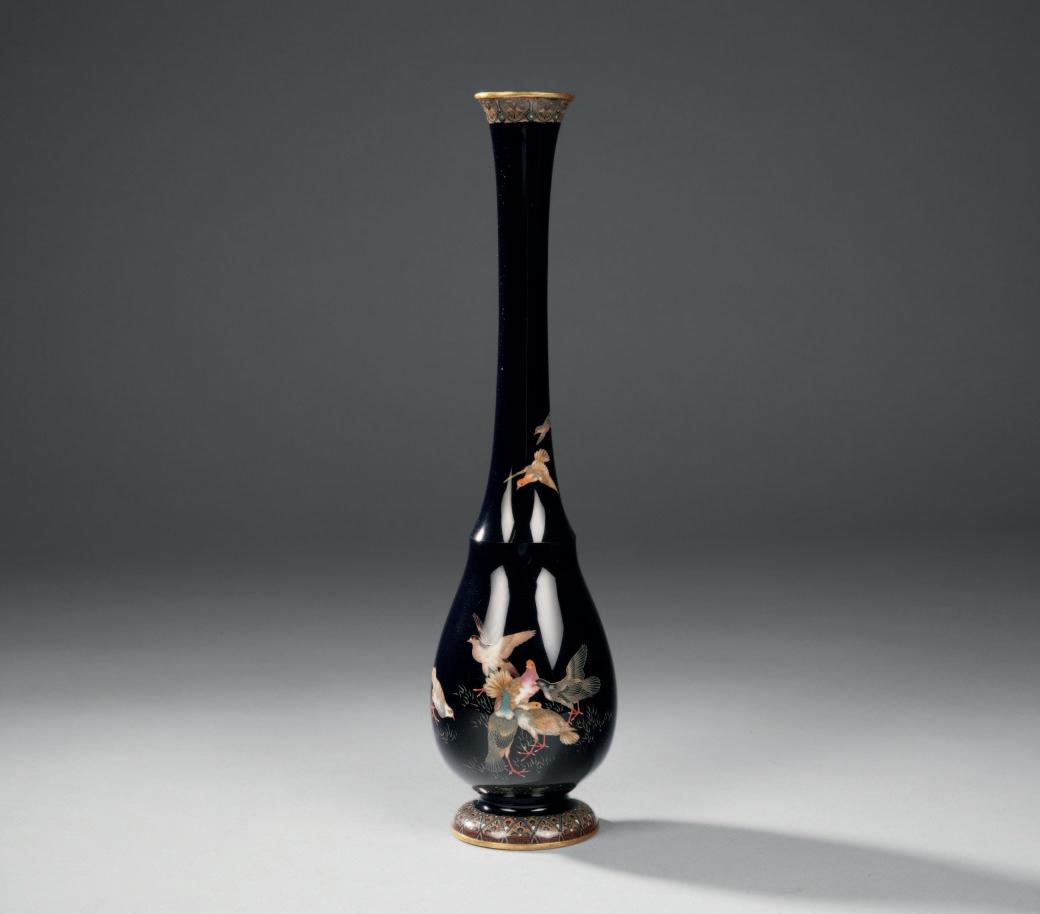
674
A TALL JAPANESE CLOISONNE VASE WITH BIRDS
MEIJI ERA, 19TH/20TH CENTURY
The elegant vessel with an elongated, pearshaped body, raised on a rounded foot and rising to a slightly flared neck; embellished with depictions of many birds, some in flight, others pecking the ground, with borders of lappets with floral designs above the foot and below the rim; all rendered in colourful enamels on the dark midnightblue ground; 30.8cm.
£2,000-3,000
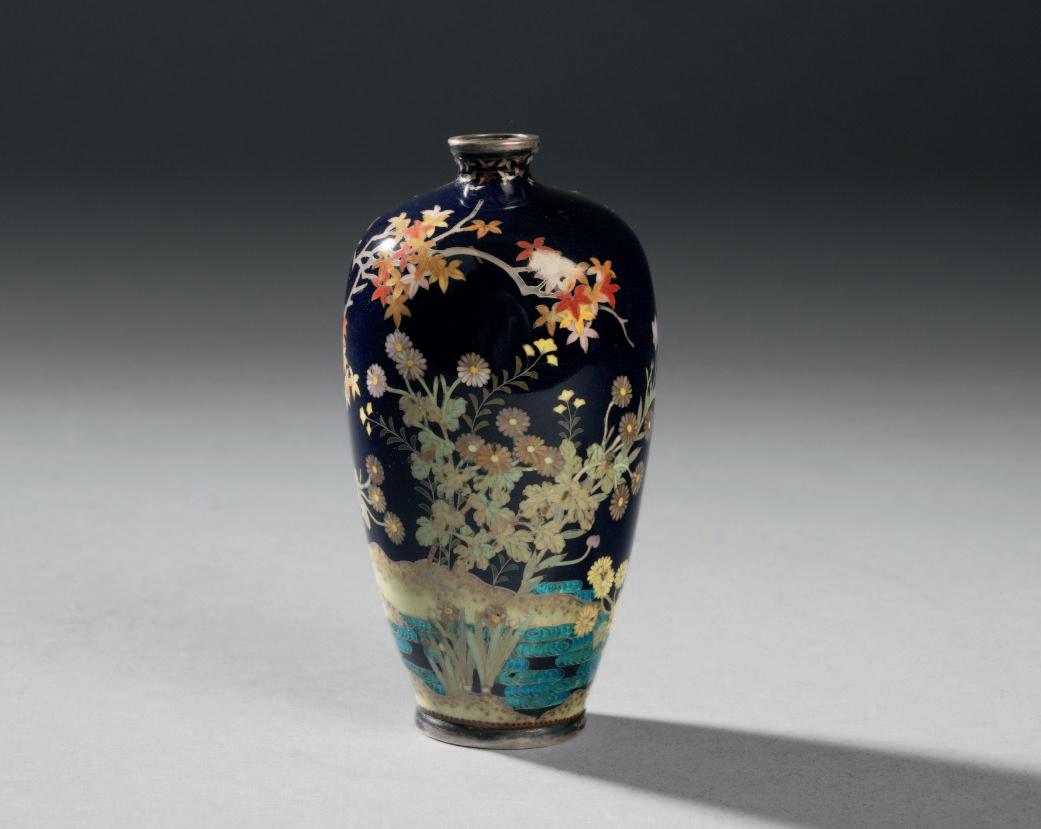
673
A SMALL AND UNUSUAL JAPANESE CLOISONNE VASE
MEIJI ERA, 19TH/20TH CENTURY
The baluster body with a short everted rim, decorated with a continuous design of many flowers and a large maple tree by a stream, a band of minute butterflies fluttering around the neck; all in colourful enamels on the dark midnightblue ground; the water rendered in translucent, bright blue ginbari, 9.2cm.
£1,500-2,000
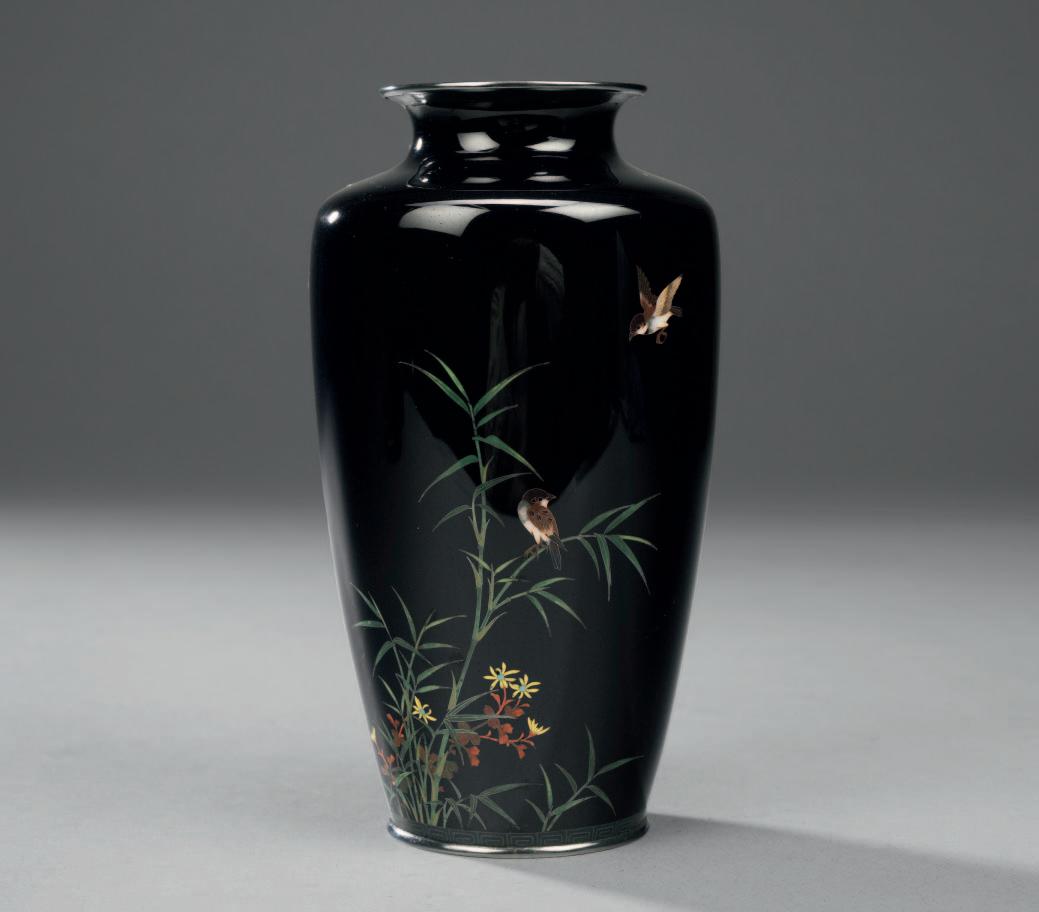
675
A JAPANESE CLOISONNE VASE WITH BIRDS
MEIJI ERA, 19TH/20TH CENTURY
Of baluster shape, decorated with swallows in flight and perched on bamboo branches, all on a darkblue ground, the rims with metal mounts; an illegible mark to the footrim, possibly for jungin, 15cm.
£200-300
676
A JAPANESE CLOISONNE VASE WITH BUTTERFLIES
MEIJI ERA, 19TH/20TH CENTURY
Of ovoid shape, raised on a short base and with a flared rim, delicately decorated with two large butterflies fluttering against the darkblue ground, the insects depicted in colourful enamels and silver and gilt wires, 9cm.
£1,000-1,500
677
A JAPANESE CLOISONNE VASE WITH BUTTERFLIES
MEIJI ERA, 19TH/20TH CENTURY
The baluster body raised on a short foot and with a flared neck, delicately decorated with five butterflies fluttering on the dark midnightblue ground, the insects rendered in colourful enamels and silver wires; with bands of triangular lappets above the foot and under the rim, 9.5cm.
£1,000-2,000
Provenance: from an English private collection, London.
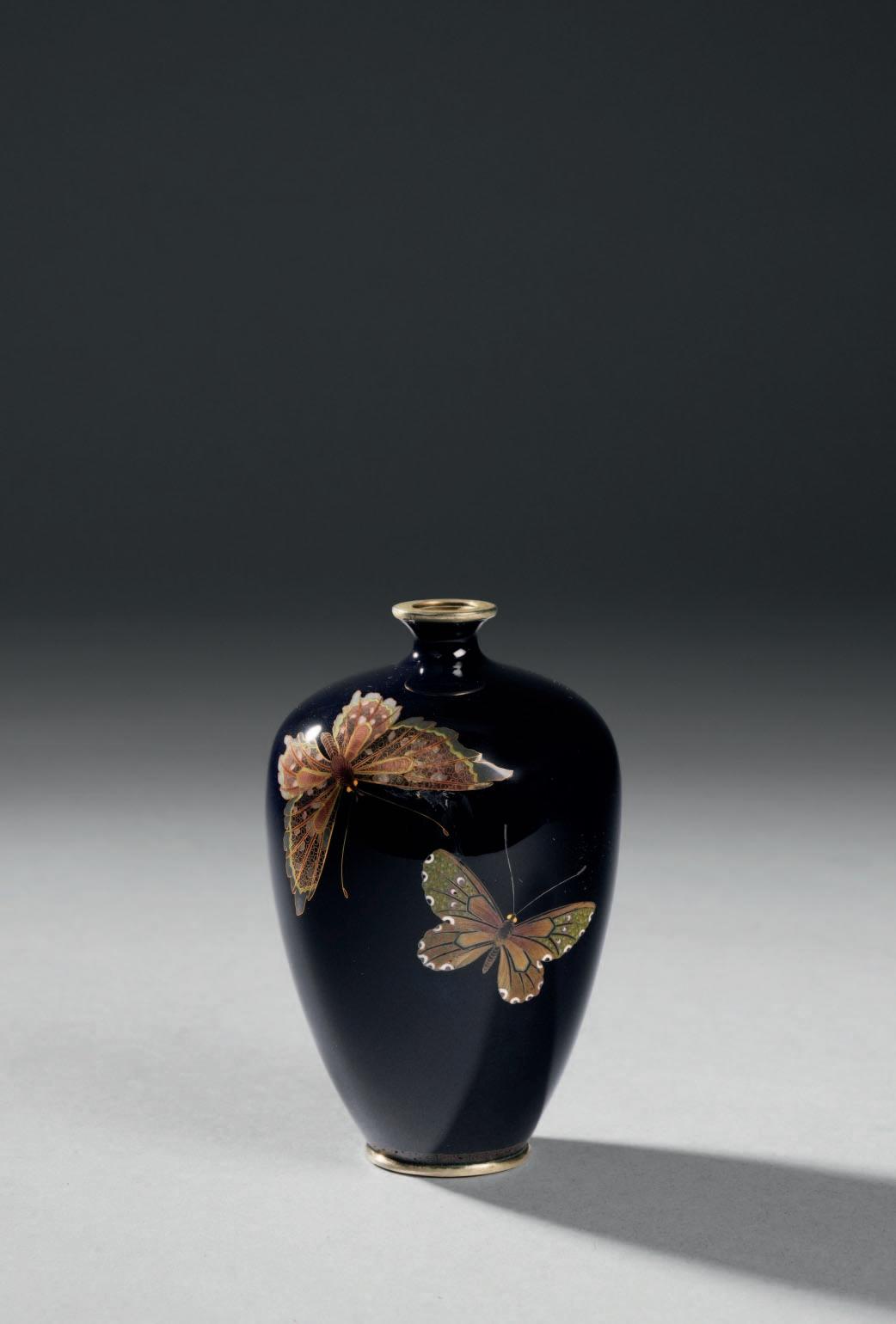
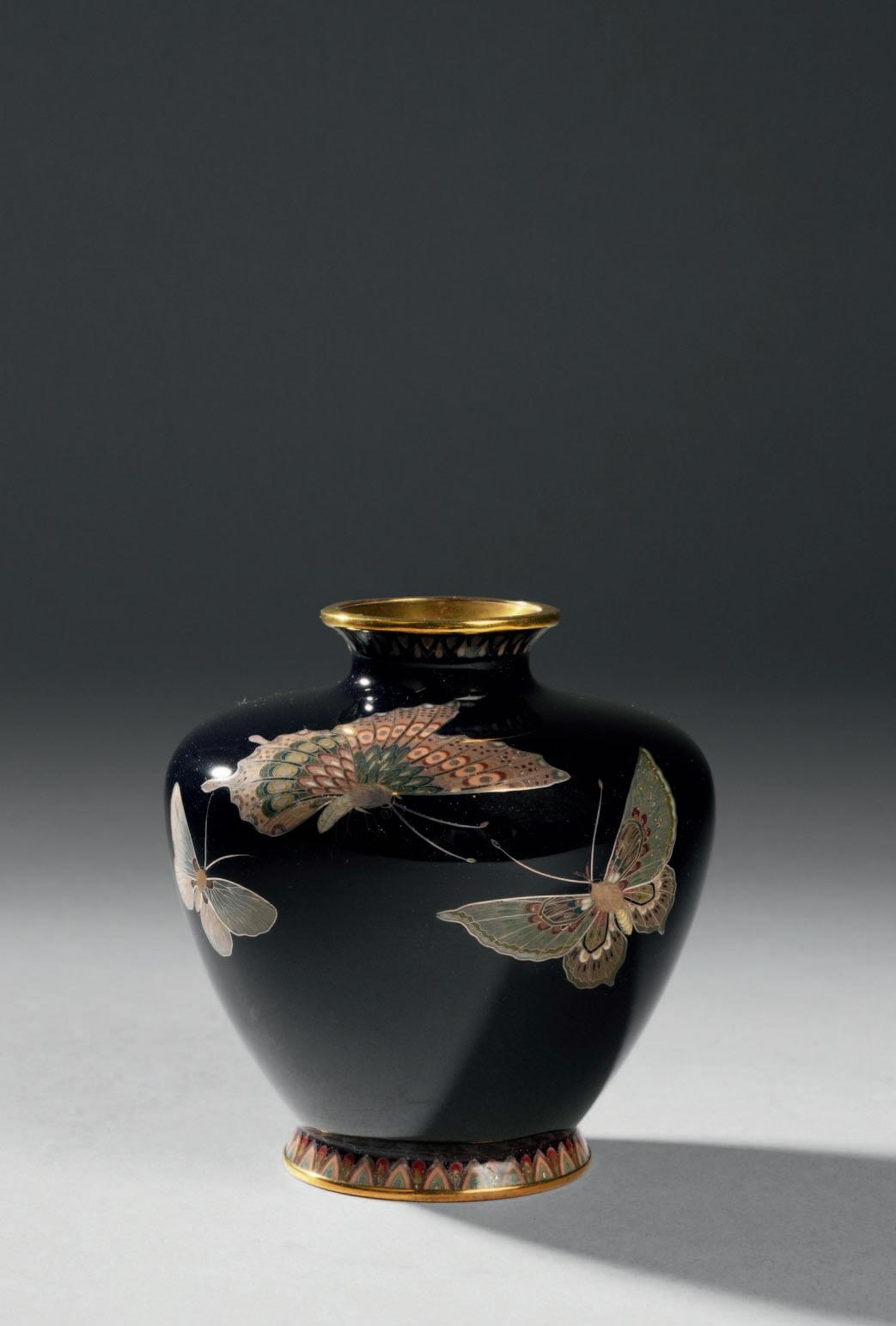
678
A SMALL JAPANESE CLOISONNE VASE BY NAMIKAWA YASUYUKI (18451927)
MEIJI ERA, C.19001910
The slender body delicately decorated with a design of flowering prunus branches, the delicate petals rendered in subtle shades of pink, in silver wires and polychrome enamels on the lustrous black ground; the rim and foot mounted with shakudō rings, the base with four chiselled cursive characters on a silver plaque reading as Kyoto Namikawa, 8cm.
£2,000-4,000
Provenance: from an English private collection, London, purchased from Malcolm Fairley; illustrated and discussed in M Fairley, Japanese Enamels of the Meiji Era, 1526 June 1998, p. 17, no.13. The author notes that the ‘careful handling of the wire and the less crowded surface decoration point to a date in the early years of this [20th] century’.
Cf. J Earle, Meiji no Takara, Treasures of Imperial Japan, the D. Khalili Collection, Enamel, vol.III, no.28, for a related vase with similar decoration. Two other comparable vases are also listed in the collection of the Namikawa Cloisonné Museum of Kyoto.
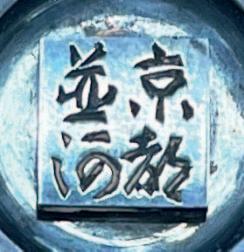
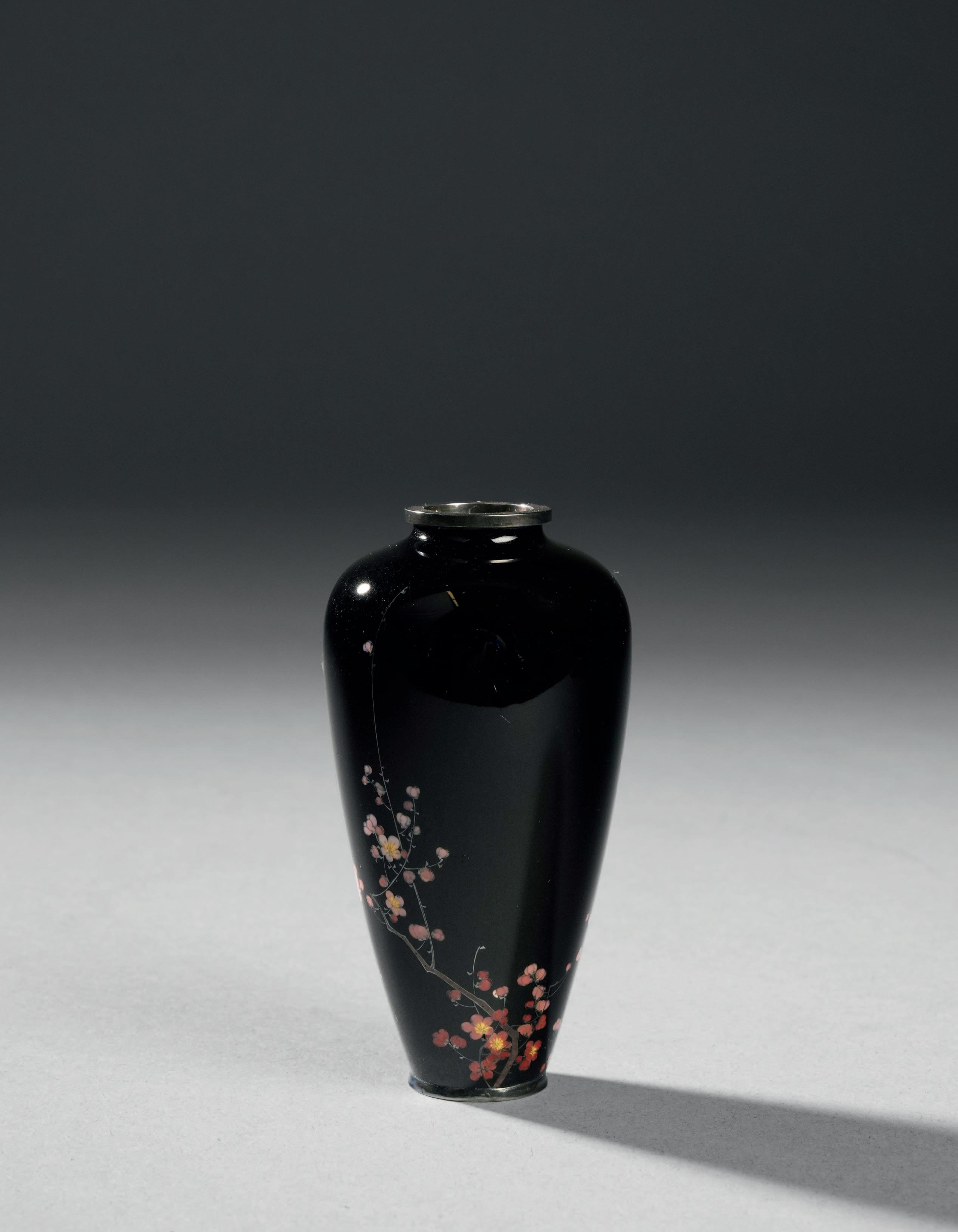
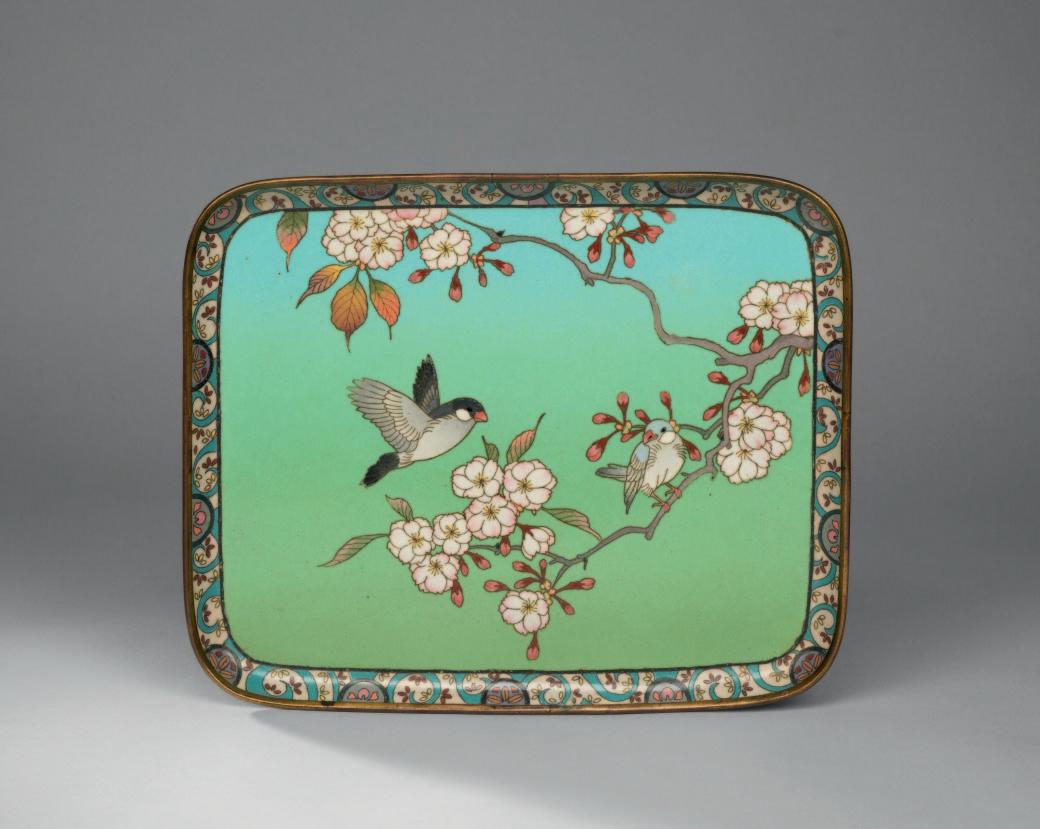
679
A JAPANESE CLOISONNE TRAY WITH BIRDS
MEIJI ERA, 19TH/20TH CENTURY
Decorated with two birds rendered in colourful enamels on a bluegreen musen ground, one flying and the other perched on a flowering branch of prunus, framed by a border of spirals and floral designs; the reverse with leafy tendrils and a central medallion enclosing a butterfly and peonies, 25.6cm x 31.2cm.
£400-600
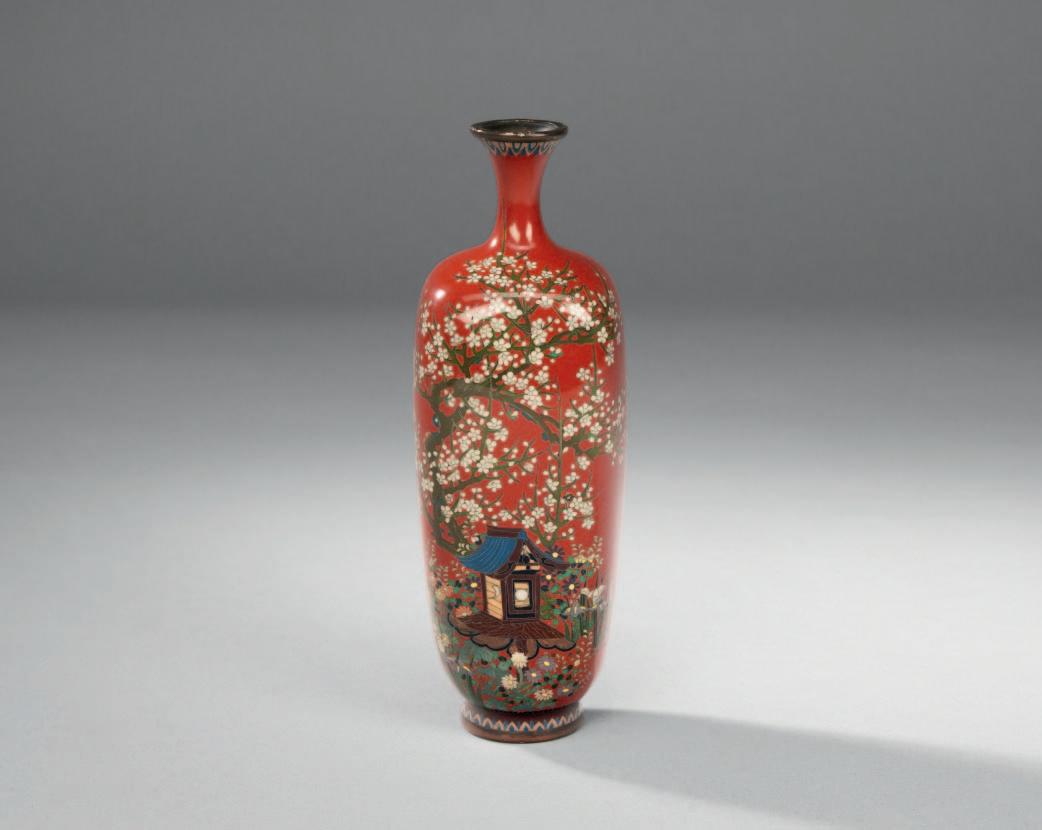
681
A JAPANESE CLOISONNE VASE BY OTA KICHISABURO
MEIJI ERA, 19TH/20TH CENTURY
The slender squaresection body decorated with a tōrō (lantern) underneath a flowering prunus and with further flowers below, all rendered in colourful enamels on the burntSienna ground, with the twocharacter mark underneath for Ota Kichisaburo, 15.5cm.
£400-600
Provenance: from an English private collection, London.
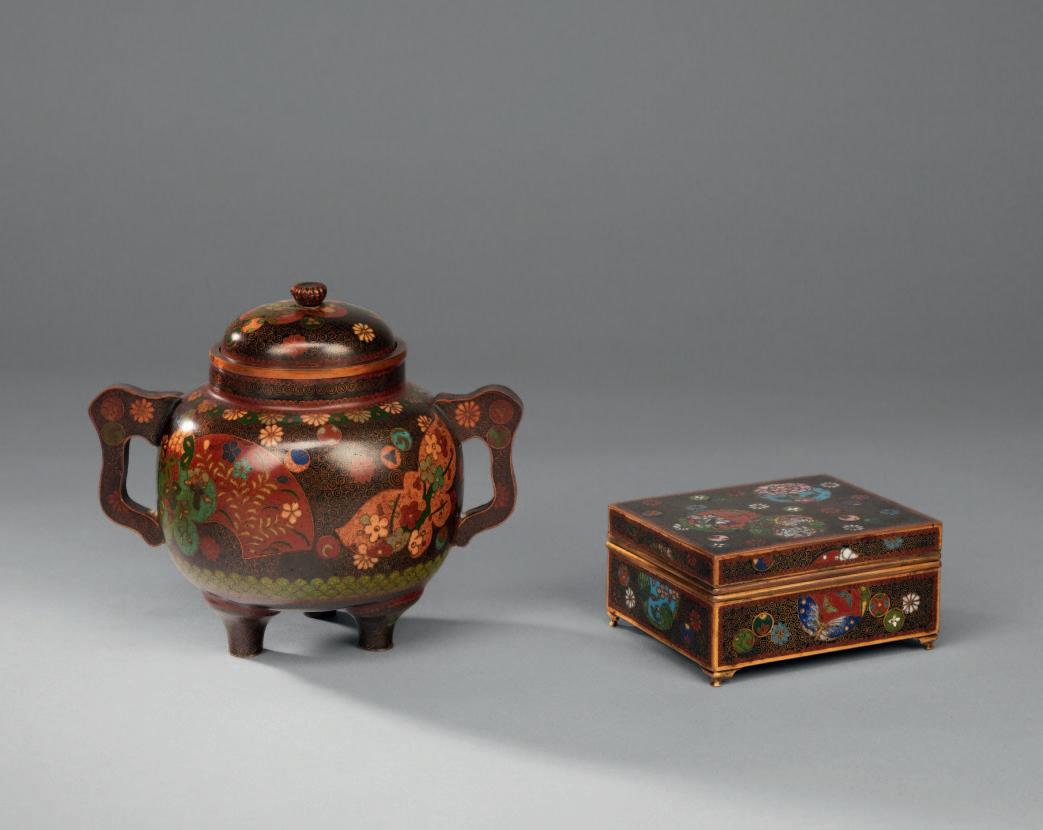
680
TWO JAPANESE CLOISONNE PIECES
MEIJI ERA, 19TH/20TH CENTURY
Both decorated with shaped panels enclosing flowers and butterflies on a dense ground of spirals, mon and flowers; one a doublehandled vase and cover and the other a rectangular box and cover, 13cm max. (4) WITHOUT RESERVE
£200-300
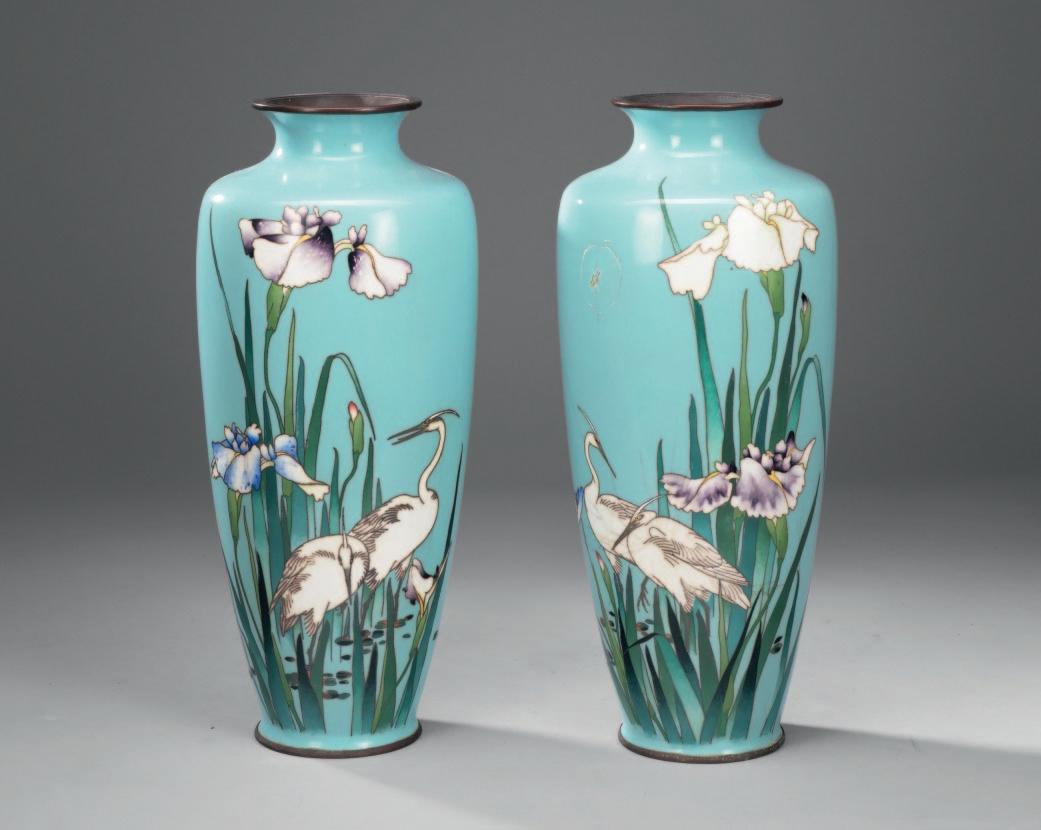
682
A PAIR OF TALL JAPANESE CLOISONNE VASES
MEIJI ERA, 20TH CENTURY
The baluster bodies each decorated with large egrets wading in a pond amongst narcissi, rendered in bright enamels on a deep robin’s egg blue ground, both 37cm. (2)
£200-400
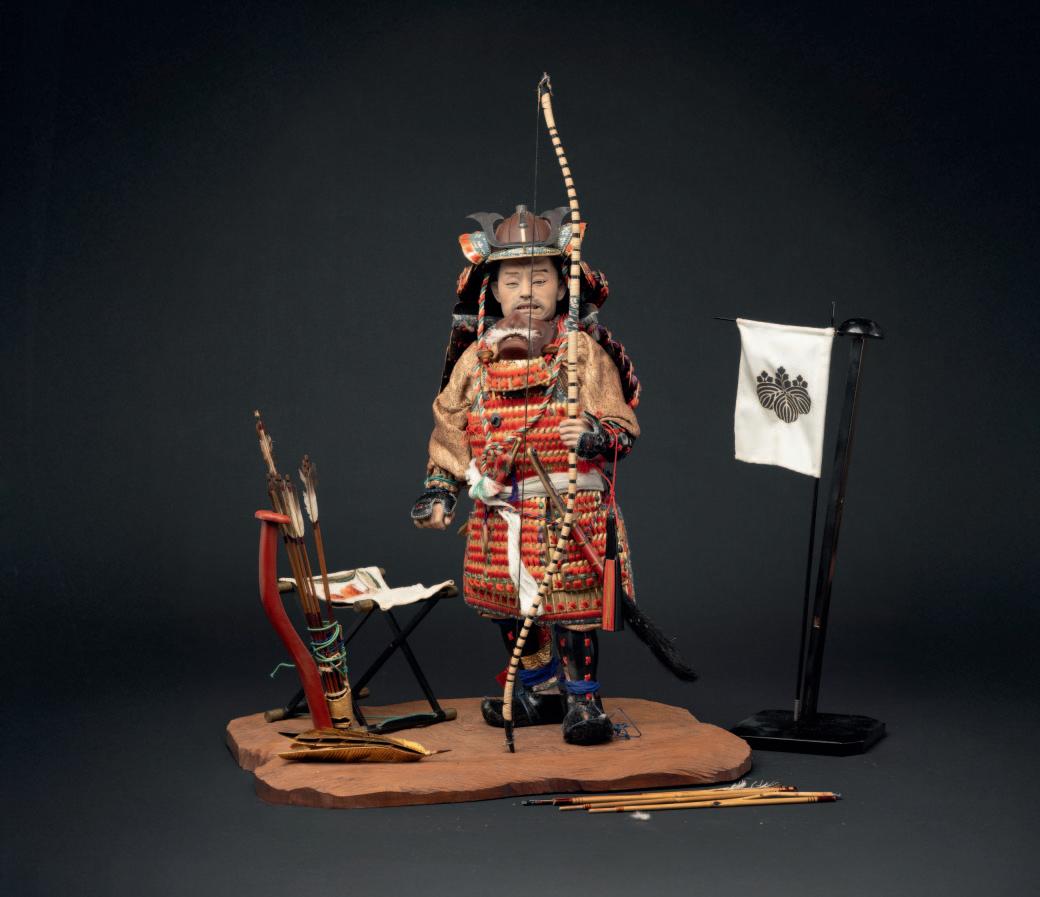
683
A JAPANESE IKI-NINGYO MODEL OF AN ARCHER
MEIJI ERA, 19TH/20TH CENTURY
Realistically modelled with glass eyes; the samurai is depicted standing, wearing a full armour with red lacing, a kabuto (helmet) and a menpo (face mask), holding a tall bow; together with miniature arrows, a campaign stool and a flag with the paulownia mon (crest); raised on a flat wood base; the figure 41cm, in a wood box. (approx. 20)
WITHOUT RESERVE
£200-300
Provenance: from the Estate of a Collector, Heath House, Hampshire, and thence by descent. By repute, acquired in Asia at the turn of the 19th century.
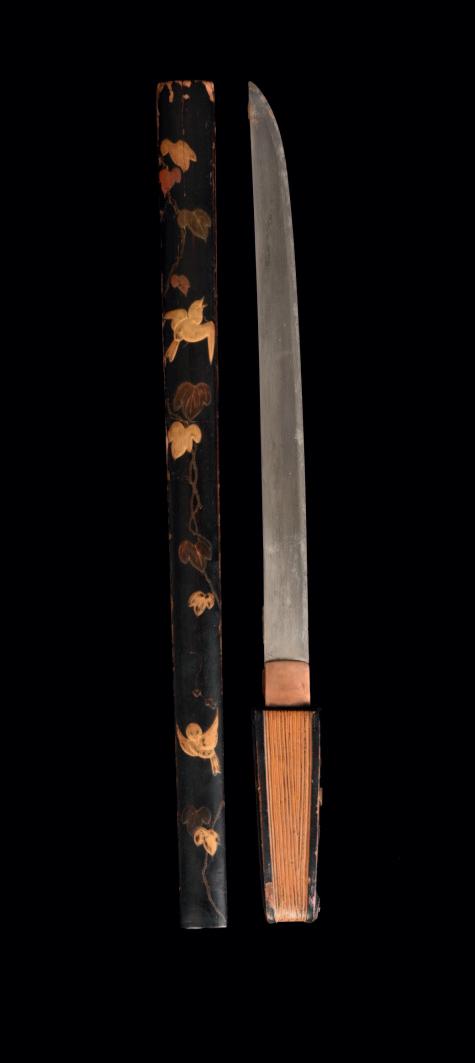
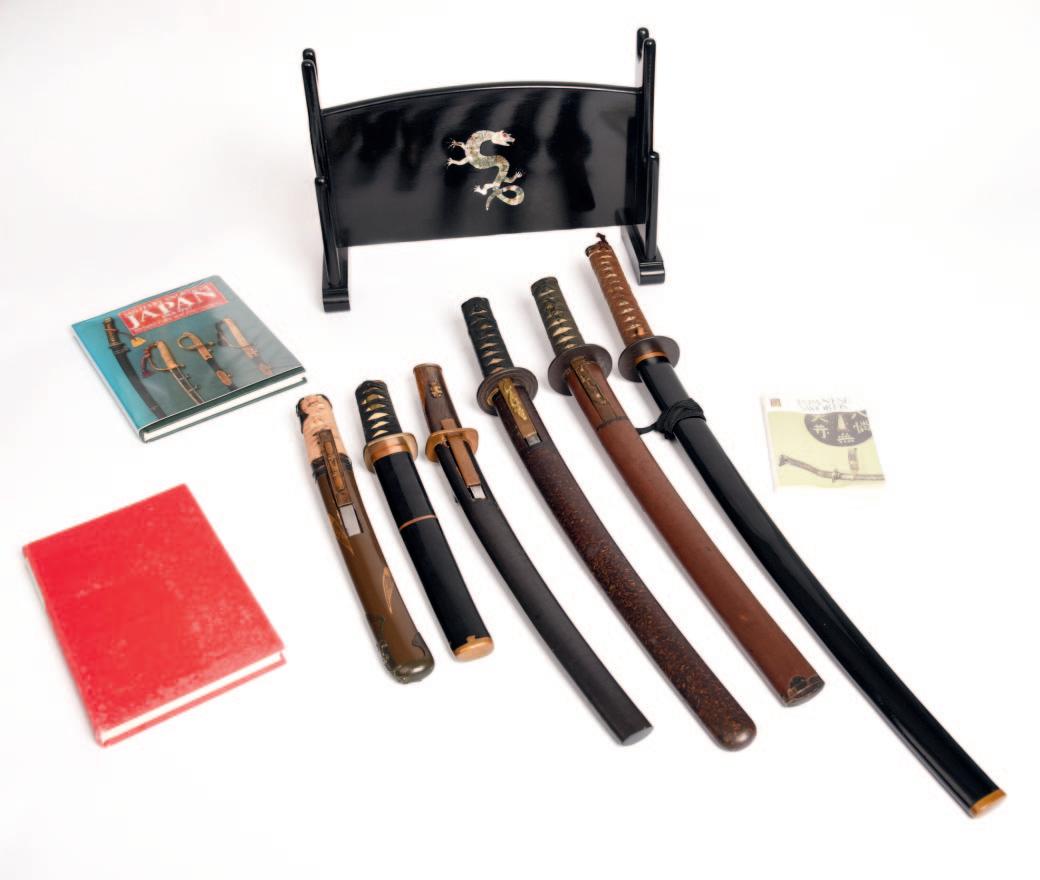
684 A SMALL COLLECTION OF JAPANESE EDGED WEAPONS
Comprising: a sword (o-wakizashi), blade 21.75 in., hon-zukuri, o-suriage nakago with twocharacter mei (Nobu Kuni), associated koshirai including fuchi and kashira depicting folded fans; another sword (wakizashi), blade 16.5 in., faint suguha hamon, suriage nakago, associated mountings including a kozuka (lacking blade) depicting a warrior emerging from a tent; another sword (wakizashi), blade 16.75 in., mumei, composite koshirae including an iron tsuba with concentric grooves and menuki representing feathers; a dagger (tanto), blade 11.75 in, ubuzukuri, copper fittings with lightly engraved decoration; another dagger (aikuchi tanto), a composite weapon with a reshaped sword blade and with 20th century mounts; and another dagger (tanto), also a composite, the blade fashioned from part of a Shōwa era military sword blade, plain copper fittings; together with three books: Fuller and Gregory, ‘Military Swords of Japan 18681945’; and two other titles; and a stand for two swords, inlaid with a dragon in mother of pearl. (10)
WITHOUT RESERVE
£400-600
685
A JAPANESE DAGGER MODELLED AS A FAN (SENTO)
Blade 10.75 in., hira-zukuri, plain copper habaki, lacquered tsuka and saya embellished with gold lacquer birds and foliage.
£1,500-2,000
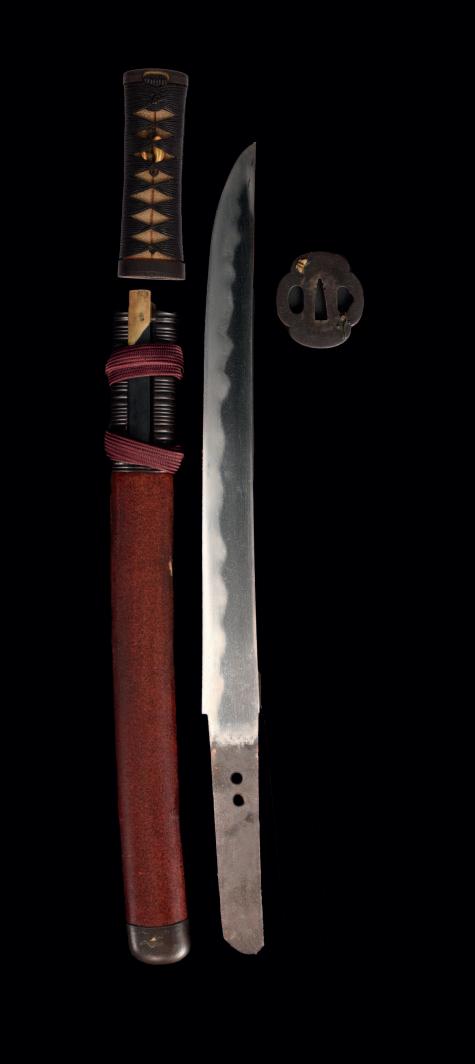
686
A JAPANESE DAGGER (TANTŌ)
Blade 11 in., hira-zukuri, notare hamon, nakago with two ana, mumei, giltcopper habaki with transverse striations; iron mokko-gata tsuba encrusted with a gilt butterfly; menuki in the form of gourds, lacquered saya with transverse fluting to the upper part, iron kojiri with a gilt praying mantis, kogatana with ken-horimono, kogai with black and gold finish en suite to the kozuka; offered with a purple katana bukuro; koshirae components associated, kogatana and kogai possibly modern.
£700-1,000
Provenance: from an English private collection, Devon.
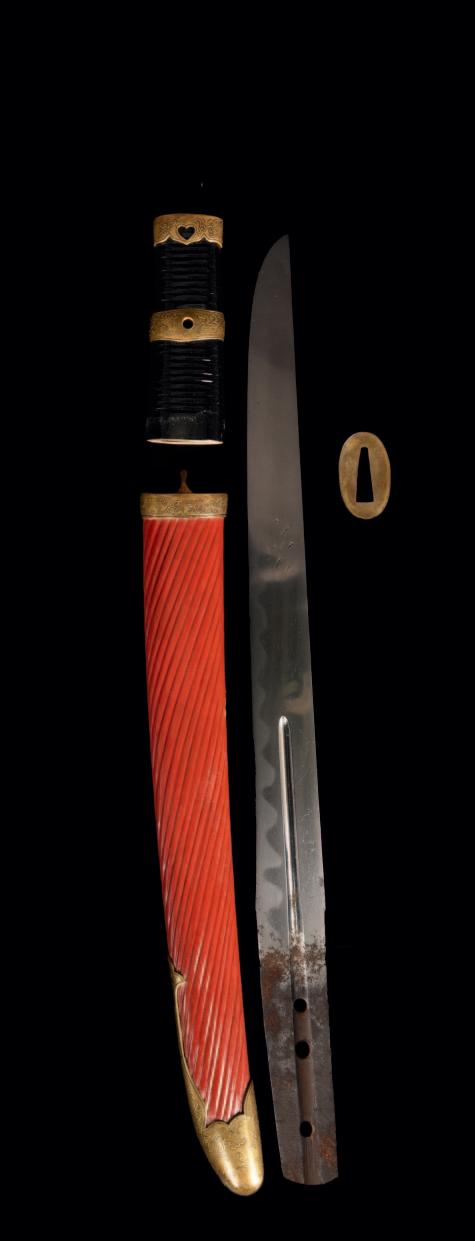
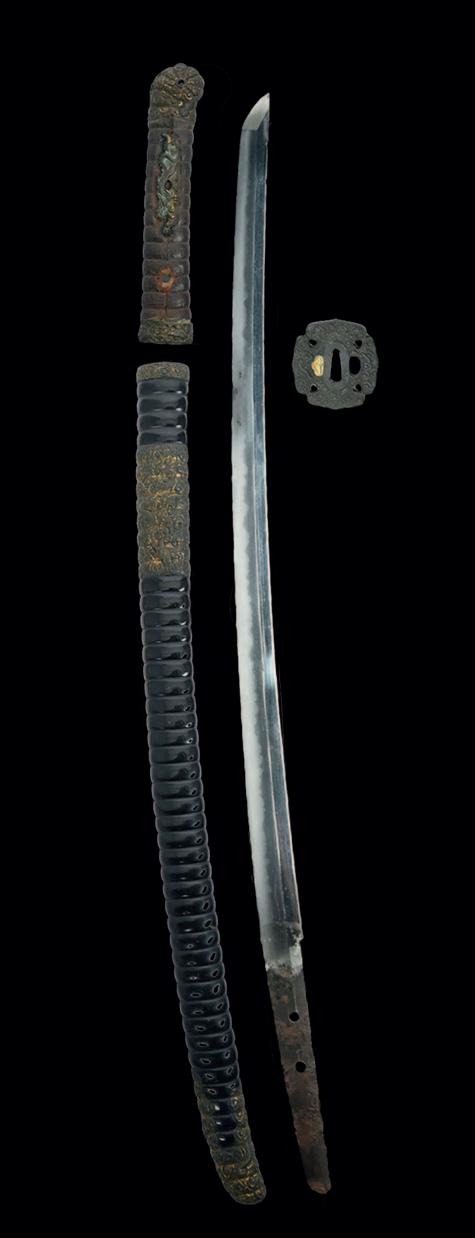
687
A JAPANESE DAGGER (TANTŌ)
Latekoto blade 11.75 in., hirazukuri, single hi to the omote and double hi to the ura all extending to the nakagojiri, gunome hamon, itame-hada, nakago with three ana, mumei but attributed to Kanemoto (15th century), giltcopper and shakudō habaki, in shirasaya; black lacquered tsuka with transverse fluting and chased brass mounts, red lacquered saya with oblique fluting and mounted en suite to the tsuka; offered with a Juho Token Kenkyukai certificate for the blade and a Nihon Tosogu Kenkyukai certificate for the koshirae
£2,500-3,500
Provenance: from an English private collection, Devon. Purchased from Bonhams London, 7th November 2013, lot 129.
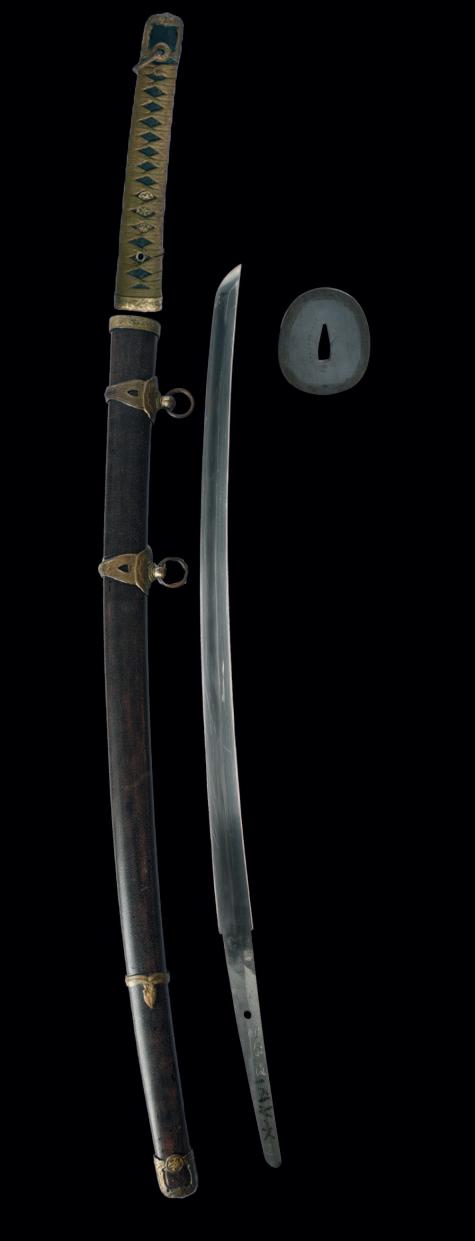
689
Blade 23.75 in., hon-zukuri, gumone hamon with elements of choji, goldfoiled habaki with neko-gaki; nakago with fourcharacter mei (some characters indistinct, probably kawachi no kami kunisuke); kurikomi mokko gata tsuba with un-ryu (cloud dragon) design in relief and with traces of gilding, tsuka mounted en suite to the tsuba, the fuchi signed with kao (narinobu); black lacquered sendan-kizami saya with giltmetal fittings embellished en suite to the tsuba; Edo Period, 17th/18th century.
£2,500-3,500
Provenance: from an English private collection, London.
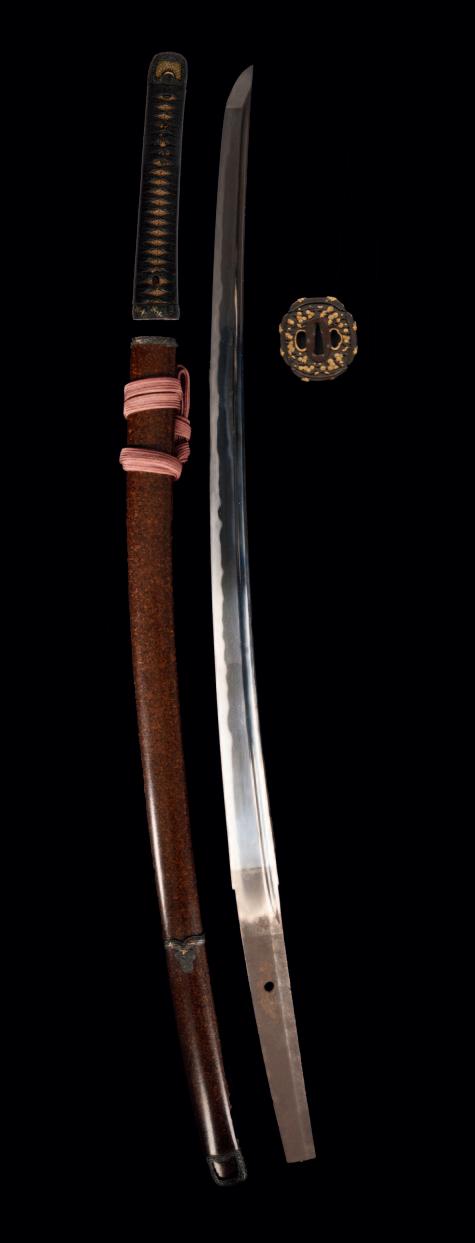
688
AN IMPERIAL JAPANESE NAVY OFFICER’S SWORD (KAIGUNTŌ)
Blade 27.25 in. hon-zukuri, nakago with threecharacter mei, Inaba (possibly Inaba Muneyoshi or Munetoshi), struck with an anchor arsenal mark, regulation naval mounts with serial number 1576 applied to the tsuba, seppa and fuchi, saya clad in simulated same. WITHOUT RESERVE
£300-400
690
A JAPANESE SWORD (KATANA)
Blade 24.75 in., hon-zukuri with hi fulllength to each side, hamon based on notare, itame hada, nakago with ichimonji nakagojiri, mumei, giltcopper habaki with neko-gaki supported by a separate silveredcopper collar; moko-gata tsuba of shakudō richly encrusted with gilded chrysanthemums against a nanako ground; tsuka and saya with handachi fittings all embellished with birds flying over turbulent waters in low relief highlighted with gold and silver, the body of the saya in black lacquer flecked with chopped straw kuro-urushi Ishimi-ji; offered with a katana bukuro in green and gold fabric.
£2,500-3,500
Provenance: from an English private collection, Devon.
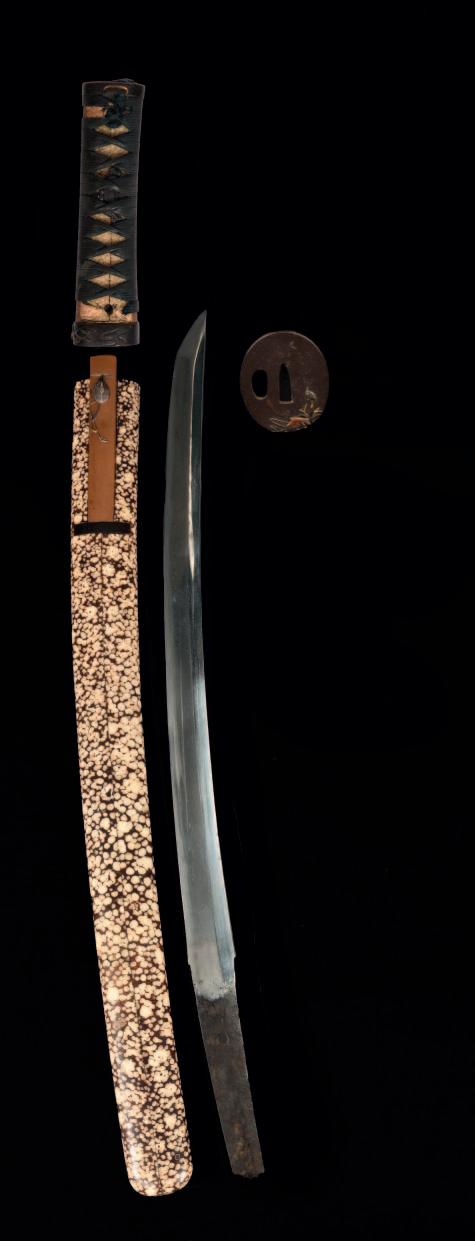
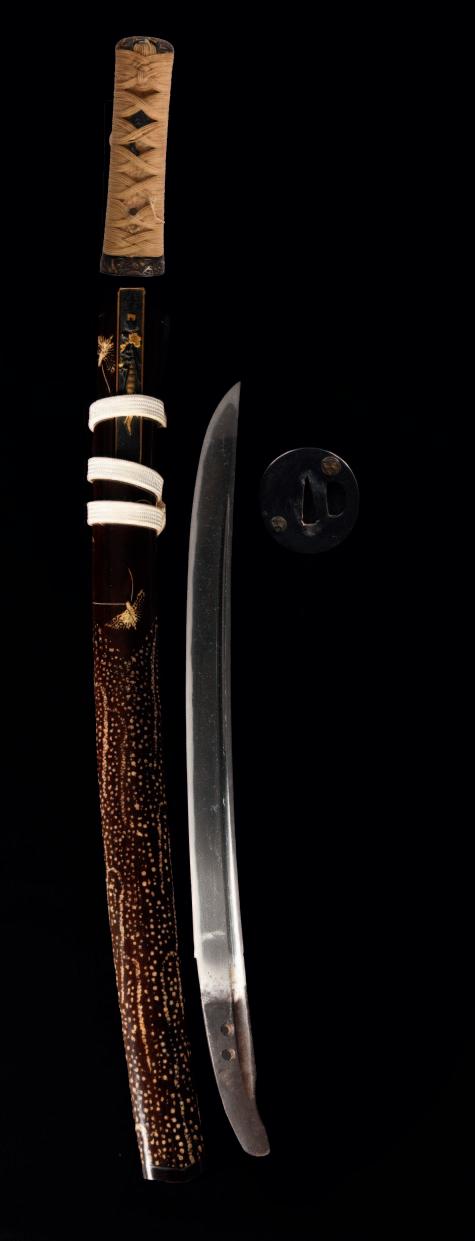
691
)
Blade 15.5 in., hon zukuri, hamon based on suguha, mumei; iron tsuba, naga maru gata, taka-zogan decoration of a heron standing over the prow of a boat beneath a crescent moon; fuchi and kashira in shakudō with galloping horses in relief against a nanako ground; togidashi - same saya, kogatana with signed blade (Sagami no Kami Masatsune), the kozuka embellished in relief with a heron viewed from above.
£3,000-5,000
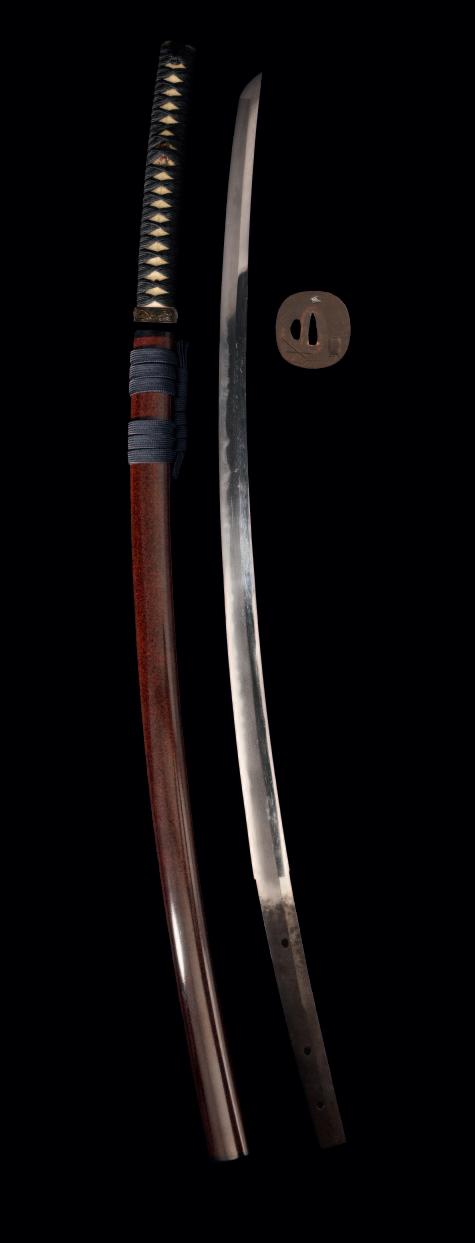
Shintō blade 13.5 in., hira-zukuri, hi to each side extending to the nakago, suguha hamon, itame hada, funa-gata nakago with two mekugiana, mumei but attributed to Yamamura, giltcopper habaki, in shirasaya; maru-gata tsuba of shakudō set with a kamon of bamboo leaves in a roundel (possibly associated with the Fukuoka domain), Momoyama period fuchi and kashira, menuki in the form of geese, lacquered saya with willow design in same and with moths, kogatana with Goto school kozuka embellished with a botanical arrangement in iroe taka-zogan to a nanako ground; offered with NBTHK Hozon Token certificate, Edo period.
£1,200-1,800
Provenance: from an English private collection, Devon. Purchased from Bonhams London, 13th May 2008, lot 37.
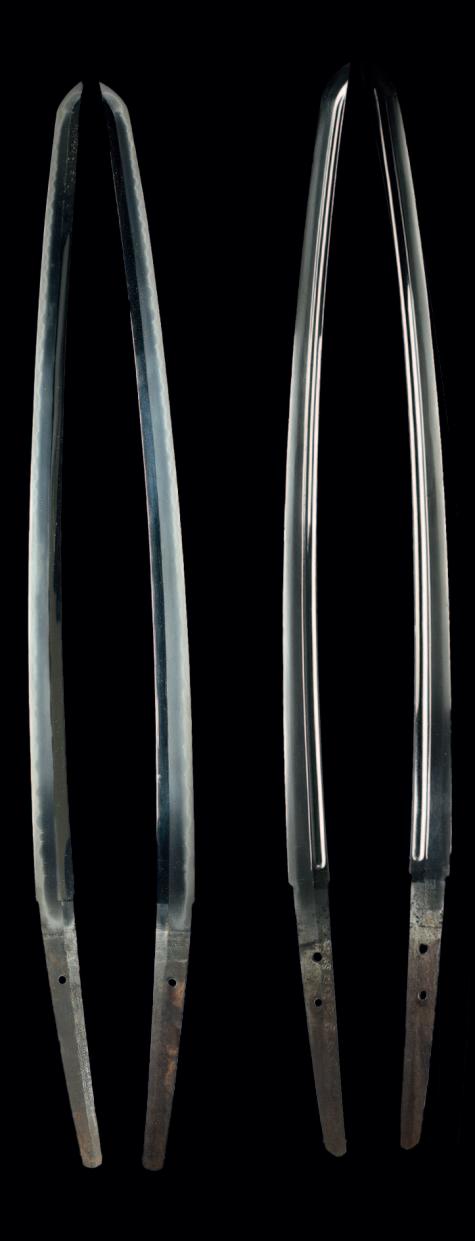
692
A JAPANESE SWORD (KATANA)
Blade 28.5 in., hon-zukuri with koshizori, hamon of notare midare form, itame hada, nakago appears suriage with ichimonji nakagojiri, three mekugi ana, partial mei (kagemori), silveredcopper habaki with nekogaki; iron naga-maru-gata tsuba with a birdcage and a soaring bird in taka-zogan (perhaps a scene from ‘The Safflower’ in The Tale of Genji), fuchi and kashira of shakudō with komainu and peonies in relief to a nanako ground; rewrapped tsuka with menuki in the form of buffalo; saya with redflecked black lacquerkuro-urushi Ishimi-ji; offered with a katana bukuro in peach and gold fabric.
£1,500-2,000
Provenance: from an English private collection, Devon.
694
TWO JAPANESE SWORDS
A katana, Shōwa era military blade 27.25 in., hon-zukuri with one broad and one narrow hi, nakago dated Shōwa 17 (1943) and with eightcharacter mei (Noshu Ju Minamoto Kanehisa saku), struck with Seki control mark and with ‘hot stamp’ (Hya-Kuren); later mounted in bukezukuri koshirai including some modern components, fuchi and kashira with gilt dragons against a nanako ground, openwork iron tsuba also displaying a dragon; and a tachi, Shōwa era blade 27.25 in., honzukuri with hamon (though possibly not traditionally forged), nakago with sixcharacter mei (Noshu Seki Nobumitsu saku), 20th century jindachi-zukuri koshirai. (2)
£300-500
695
AN IMPRESSIVE JAPANESE HELMET (KAWARI KABUTO) MOMOYAMA PERIOD, LATE 16TH CENTURY
The tall iron hachi formed of six iron plates lacquered red, fivetier shikoro with blue odoshi, small fukigaeshi, black lacquered mabisashi, fabric lining, 36 cm.
£6,000-8,000
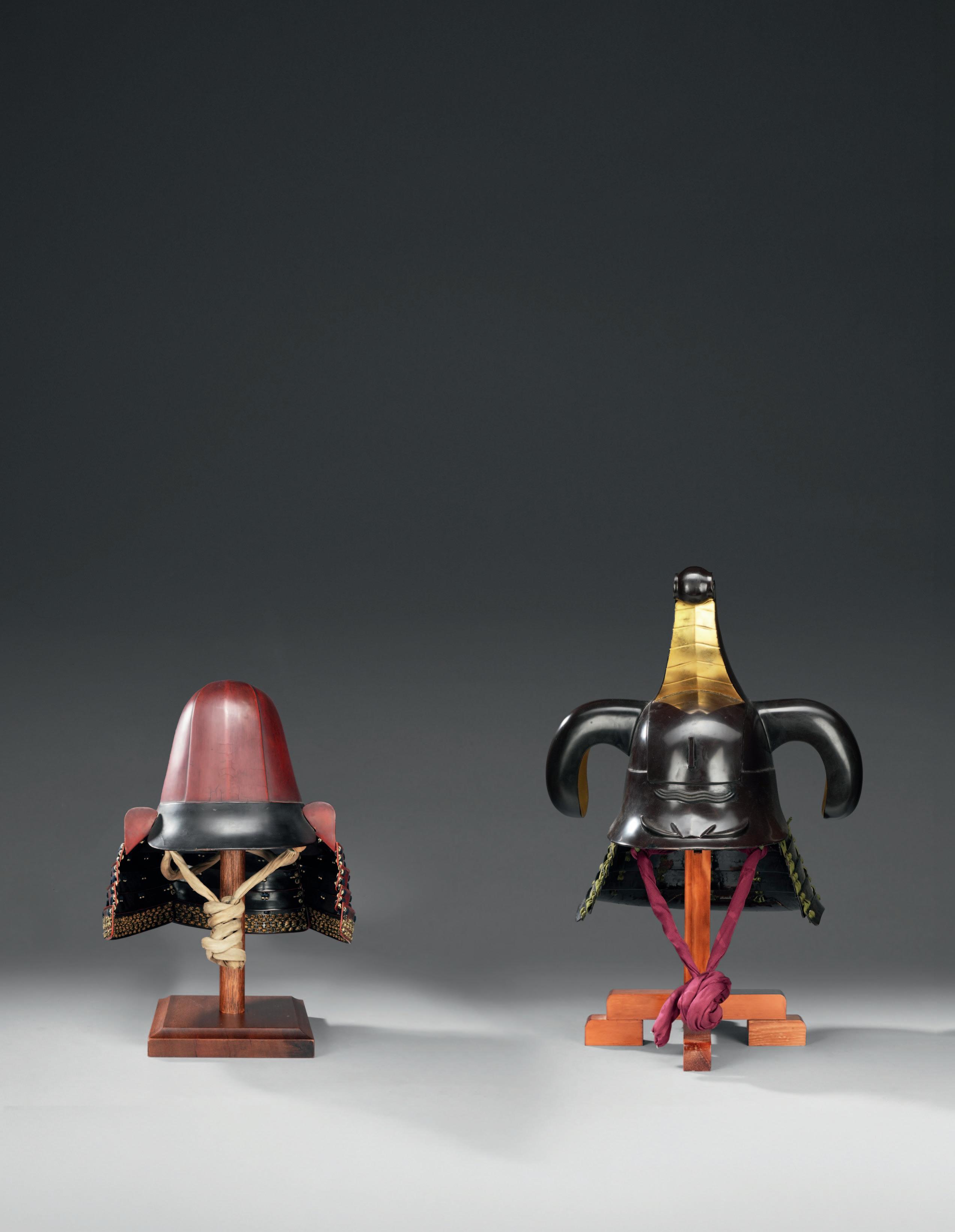
696
AN IMPRESSIVE JAPANESE HELMET (KAWARI KABUTO) EDO PERIOD, 18TH CENTURY
Black lacquered iron hachi of ettchu-zunari form supporting a magnificent lacquer structure representing a rearing elephant with raised trunk and stylised ears lined in gold pigment, shikoro of five tiers and without fukigaeshi, broad mabisashi overlapping the fukigaeshi and embellished with stylised eyes in raised lacquer, fabric lining, 50 cm.
£5,000-8,000
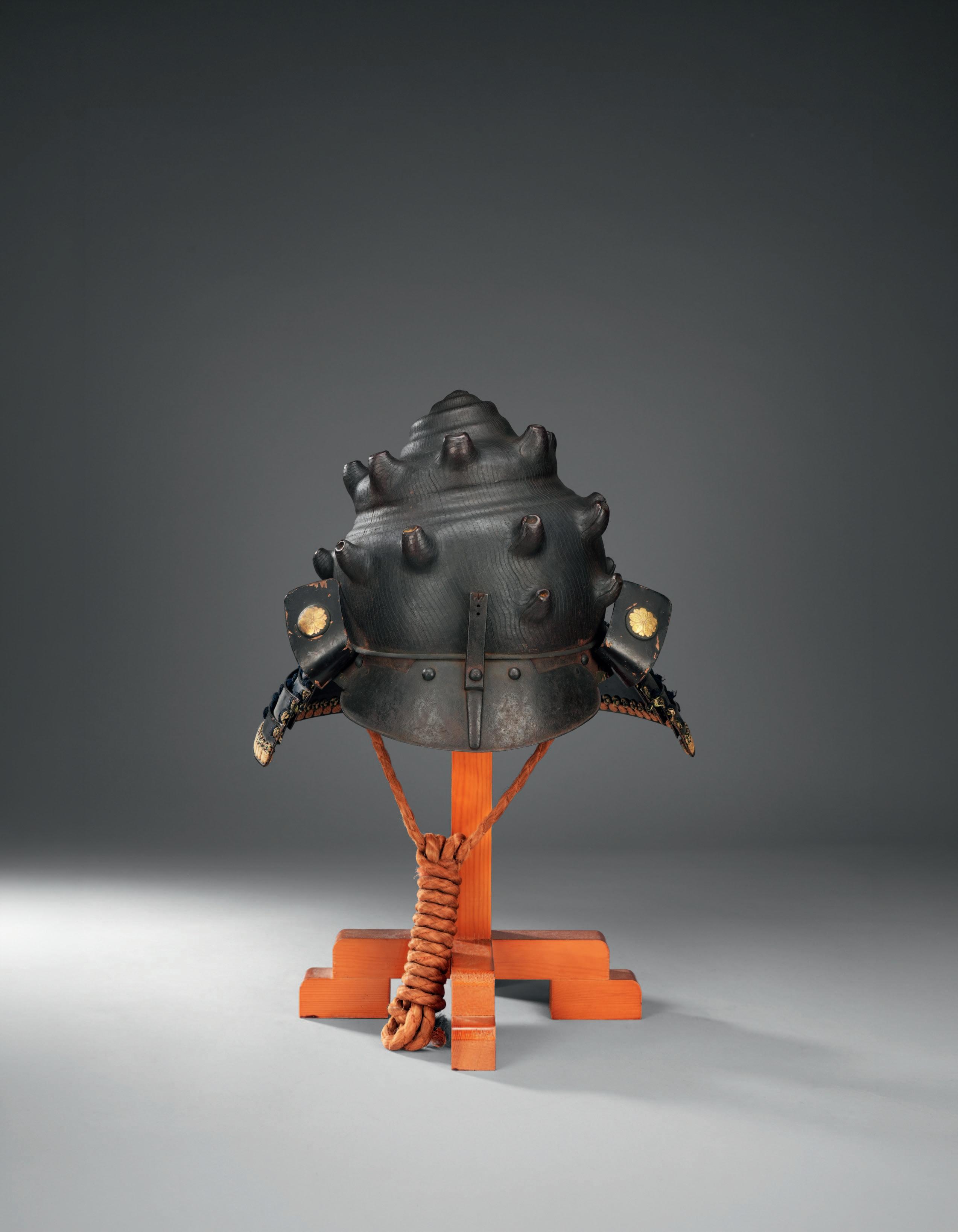
The hachi made from a single piece of iron formed as the upper part of a turban shell with a structure of concentric whorls rising to an apex and bearing a succession of integral nodes (spikes) with concave terminals, the axial ribs represented by incuse lines, lacquered iron shikoro of five tiers with black odoshi, small fukigaeshi displaying a cherry blossom kamon, fabric lining, 32 cm.
£8,000-10,000
Another seashell-shaped kabuto is in the John Woodman Higgins Armory Collection at the Worcester Art Museum, Massachusetts, access. no.2014.89.1.
By the 18th century, the uchidashi kabuto (extraordinary helmets) like this one had become a symbol of prestige and ceremonial rank during the peaceful Edo period. This example, crafted in the shape of a shell, illustrates the continued obsession with bold, sculptural headgear among the samurai elite. The seashell form represents both secular and spiritual power. Historically, generals sounded the conch to marshal their forces, yet it also served as a sacred symbol of the Buddha’s voice and the dissemination of divine law.
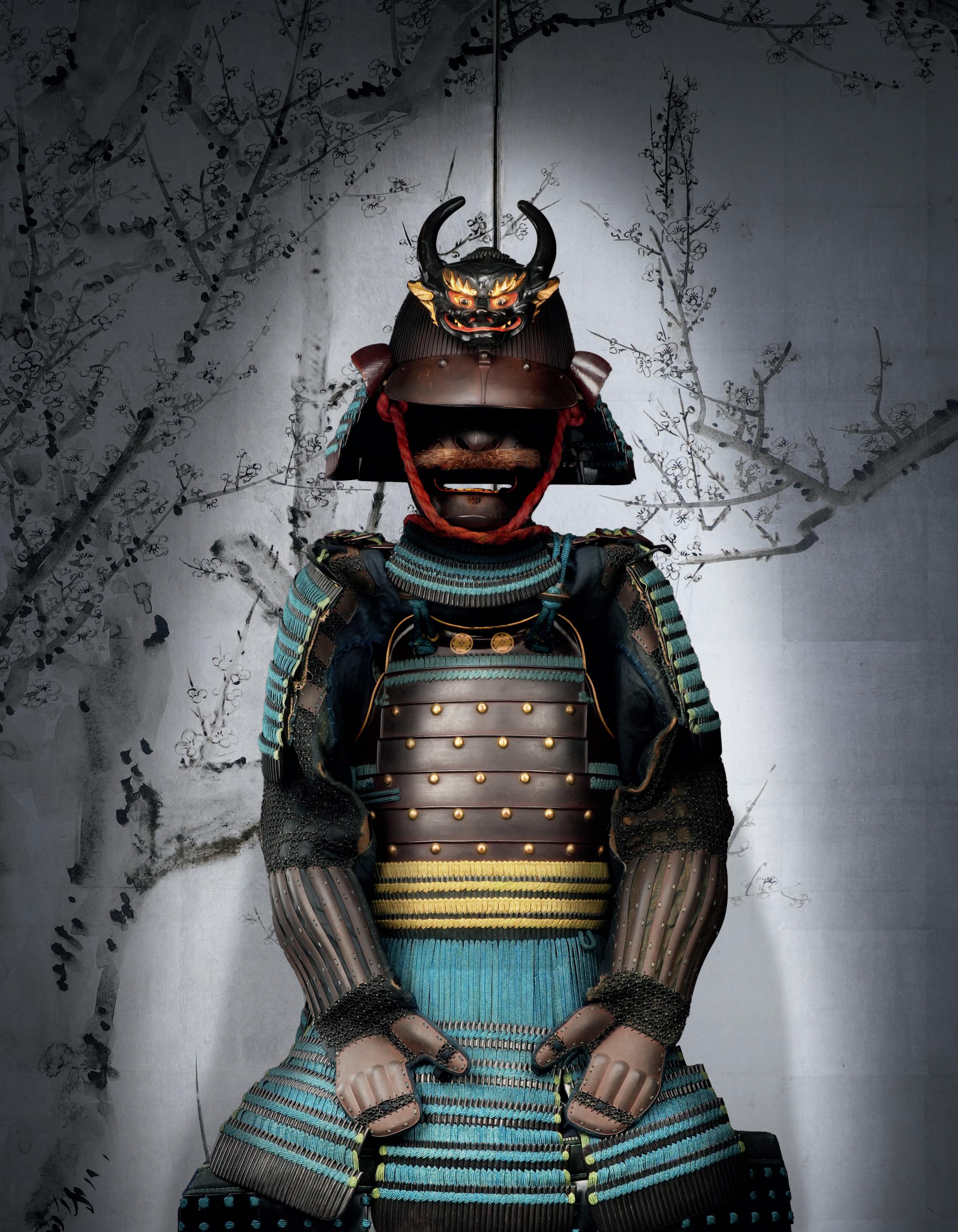
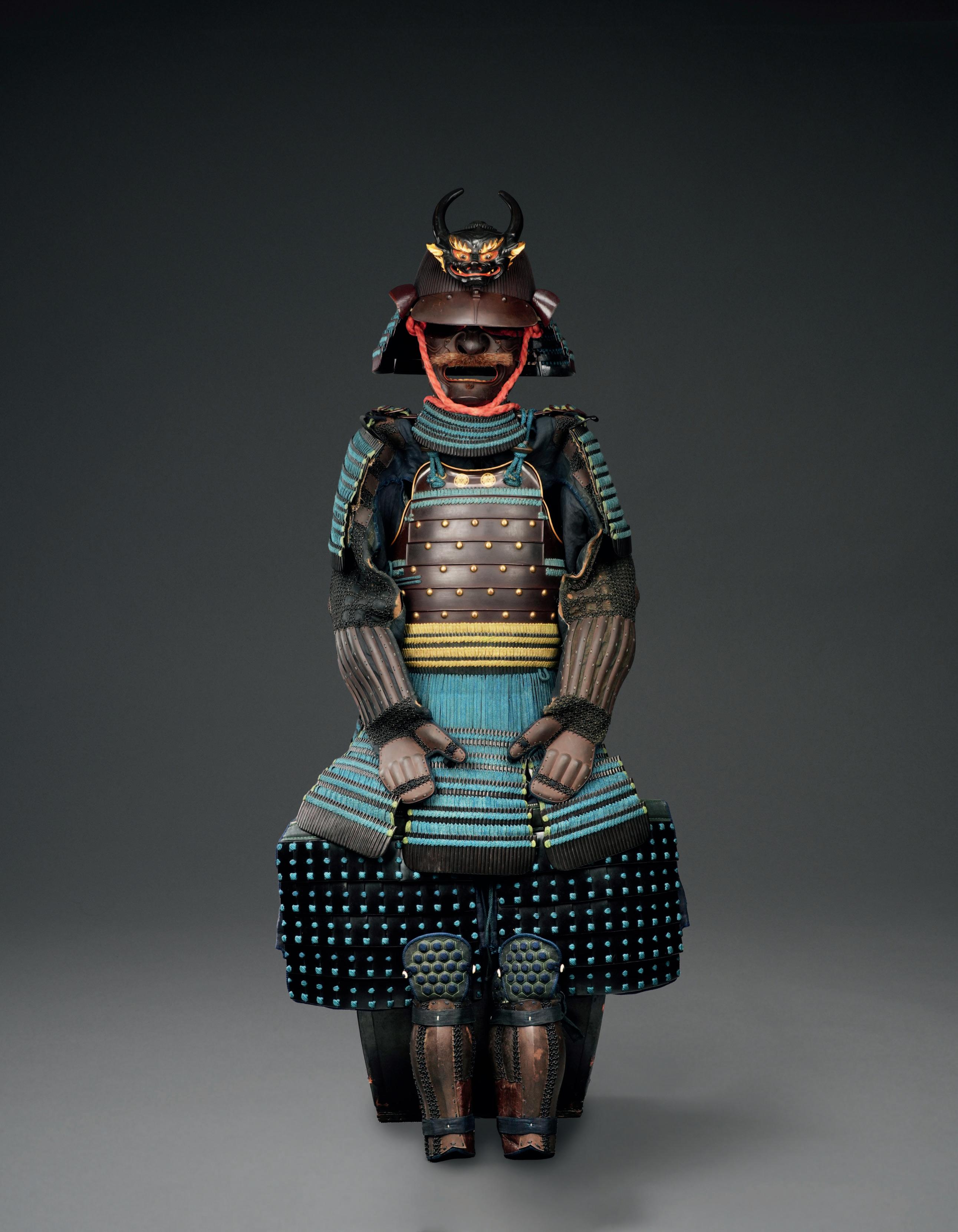
Russet iron suji-batchi kabuto of 120 plates, with shikoro of five tiers – the lower divided in three, small fukigaeshi, russet iron mabisashi; maedate of black lacquer in the form of an oni with red lined gilt eyes, gilt eyebrows and ears, and tall converging horns; russet iron ressei-men with embossed lines around the mouth and above the prominent cheek bones, small beard above the projecting chin, removeable hana with bristling moustache; the tachi-do of iron plates with blue and gold odoshi, gold lacquered hollyhock kamon, kusazuri each of five tiers suspended on blue odoshi; the sode of kiritsuke-kozane, the kote of squarelinked mail re
enforced with russet iron bars at the forearms and iron flowerheads at the point of the elbows and with discrete square plates to the upper arms, iron tekkō with embossed knuckles; haidate of lacquered vertical plates bound in five rows with blue odoshi; suneate of vertical iron plates united by mail and supported by quilted fabric.
£12,000-15,000
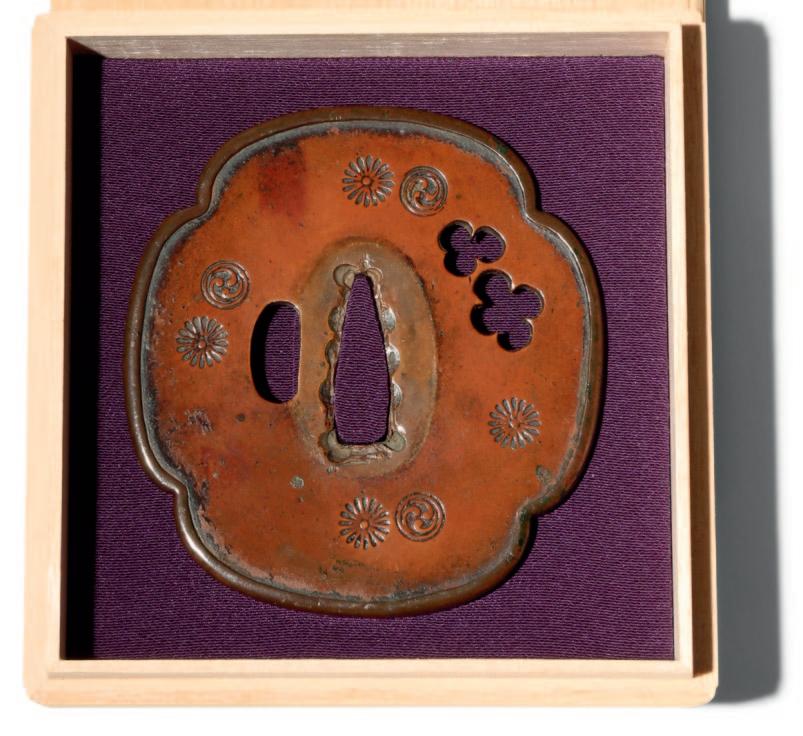
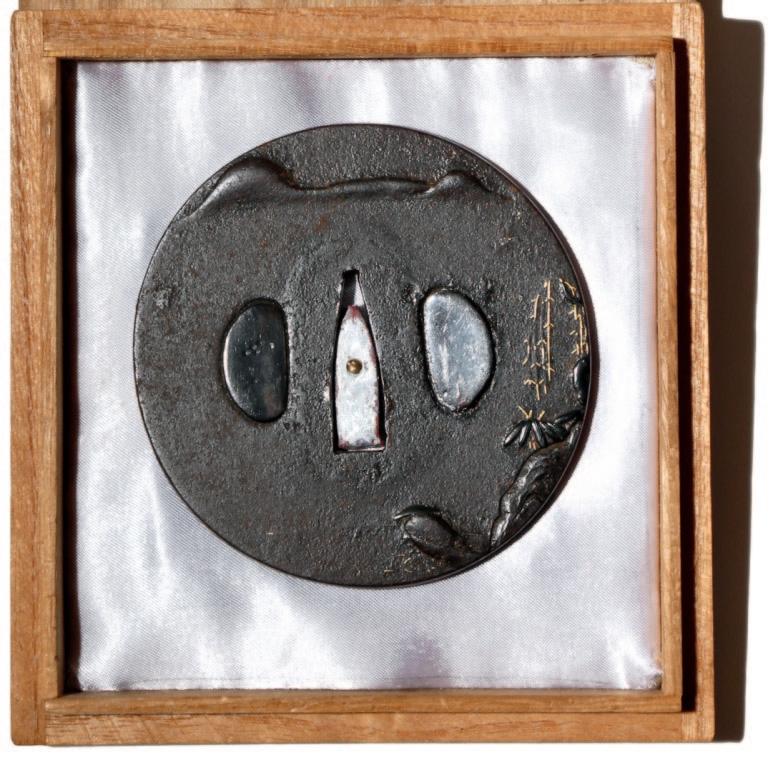
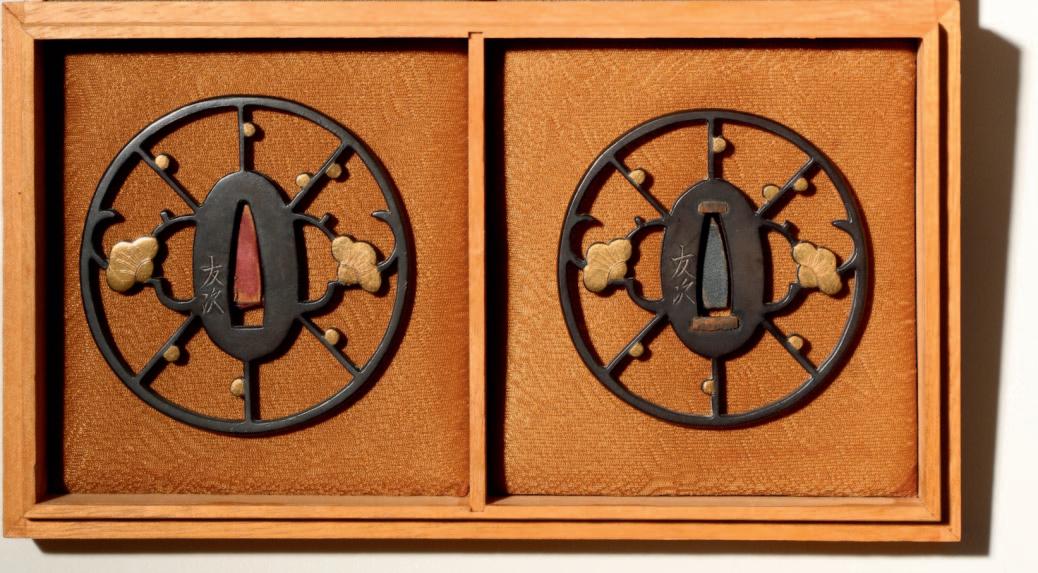
699
A JAPANESE YAMAGANE KO-KINKO TSUBA
LATE MUROMACHI PERIOD/EARLY MOMOYAMA, 16TH CENTURY
The mokkō-gata body decorated with openwork designs of shamrocks, with impressed chrysanthemum flowers and tomoe (threecommas design), the rim with a copper ring, unsigned, with a copy of a Hozon Tosogu (Sword fitting Worthy of Preservation) certificate no.4011980 issued by the Nihon Bijutsu Token Hozon Kyokai (The Society for the Preservation of the Japan Art Sword), dated 10th May 2017; in a kiri box, 6.5cm. (3)
£300-500
700
A JAPANESE IRON AIZU SHOAMI TSUBA
EDO PERIOD, 18TH CENTURY
Of circular shape, one side decorated with the lone figure of a traveller with a long coat and a widebrimmed hat, by rocky outcrops and underneath branches of weeping willow; the reverse with small pines visible in the distance, unsigned, with a copy of a Hozon Tosogu (Sword fitting Worthy of Preservation) certificate no.4014656 issued by the Nihon Bijutsu Token Hozon Kyokai (The Society for the Preservation of the Japan Art Sword), dated 22nd February 2019; in a kiri box, 7.5cm. (3)
£400-600
701
A JAPANESE SET OF TOMOTSUGU IRON DAISHO TSUBA
EDO PERIOD, 19TH CENTURY
Each of circular shape and decorated in openwork with a design of radiating rays, two plum blossoms and many dots in gilt, both signed Tomotsugu, in a fitted kiri box, 7.6cm and 7.1cm respectively. (3)
£300-500
702
THREE JAPANESE IRON TSUBA
EDO AND LATER, 17TH CENTURY AND LATER
One a parcelgilt nanban tsuba of mokkōgata shape with reticulated decoration of a dragon writhing amongst clouds, chasing a sacred pearl of wisdom above a pavilion; another inlaid in gold and shakudō, depicting a duck on a pond and lotus, signed Kafudo Mitsuaki with kao; the third with openwork decoration featuring a shishi, the lion dog prancing over a peony bloom, with a paper collection label reading ‘Tomkinson Collection’ and possibly ‘I 500 / 108’, 8.4cm max. (3)
£200-300
Provenance: the Tomkinson Family Collection. By repute, the tsuba with Tomkinson label originally collected by Michael Tomkinson.
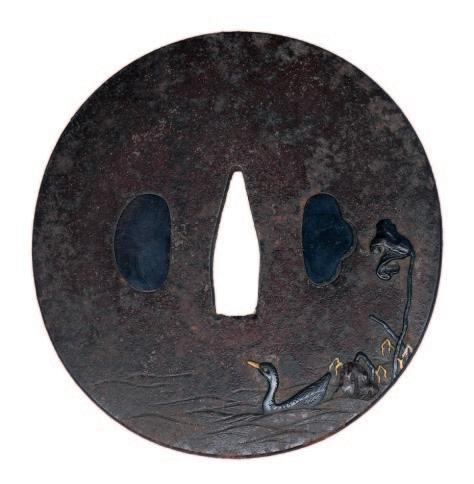
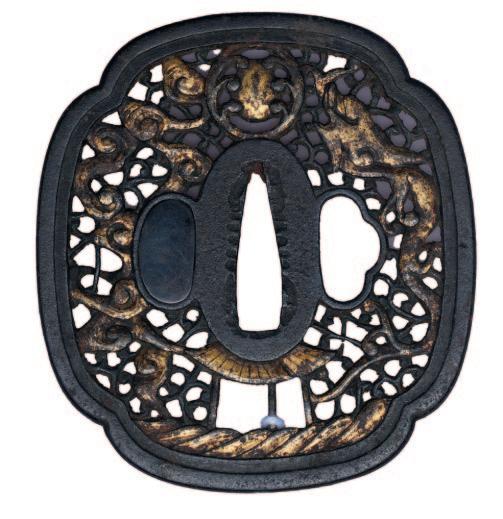
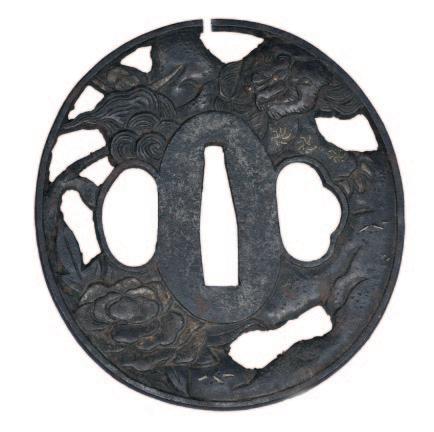
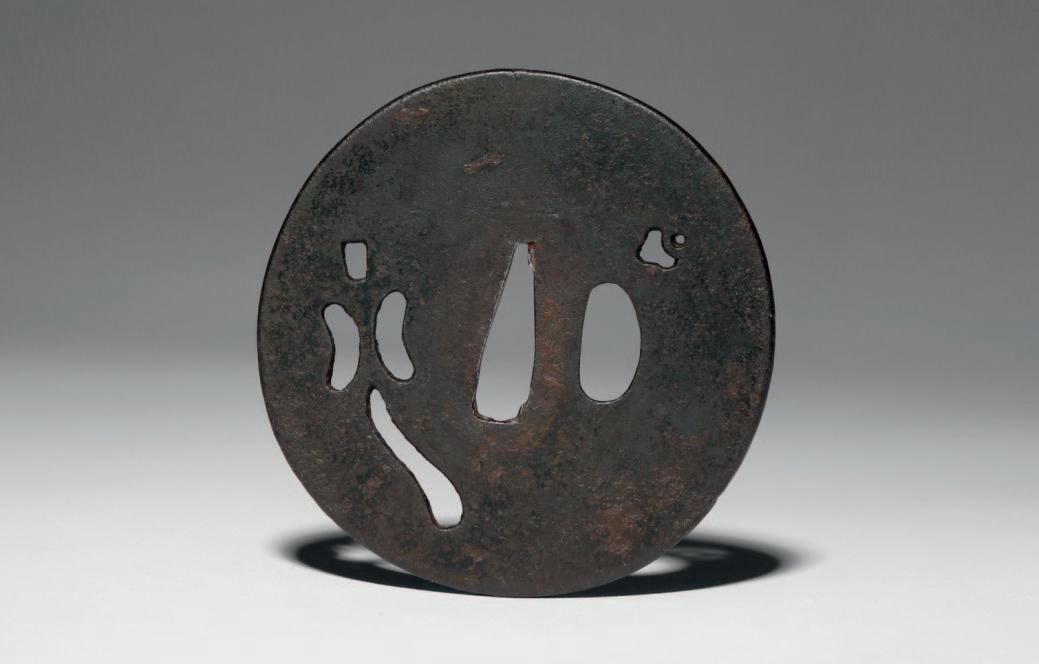
703
A JAPANESE IRON TŌSHŌ TSUBA
MUROMACHI PERIOD, 16TH CENTURY
The circular plate bearing a dark brown patina, decorated with a war fan (gunbai) and a lucky charm in openwork (sukashi), unsigned, with a copy of a Hozon Tosogu (Sword fitting Worthy of Preservation) certificate no.4014654 issued by the Nihon Bijutsu Token Hozon Kyokai (The Society for the Preservation of the Japan Art Sword), dated 22nd February 2019; in a kiri box, 8.2cm. (3)
£400-600
704
A JAPANESE BRONZE TSUBA WITH SPIDER AND WEB
MEIJI ERA, 19TH CENTURY
The circular body decorated with a small gilt spider modelled in the round, both sides with a web rendered in inlaid silver wire on the dark bronze ground, 8cm.
£800-1,200
705
TWO JAPANESE IRON TSUBA
EDO/MEIJI, 19TH CENTURY
Both of oval form and decorated with geese in flight and crabs below, the animals inlaid in brass and copper takazogan on the hammered ground; one with box, 8.8cm and 7.6cm. (3)
£300-500
Provenance: from an English private collection, Devon. The largest tsuba purchased from Bonhams London, Fine Japanese Works of Art from the Edward Wrangham Collection, 18 June-9 July 2018, lot 14 (part).
706
THREE JAPANESE TSUBA
EDO AND LATER, 18TH CENTURY AND LATER
Two of mokkō-gata (quadrilobed) form and made of iron, one Mitotype tsuba decorated with a large tiger emerging from clouds, inlaid in brass takazogan; the other with a chicken and flowers inlaid in gold and silver; the third tsuba of oval shape and made of copper, decorated with a gnarly flowering prunus tree, an illegible signature; one with a box, 8.4cm max. (4)
£300-500
Provenance: from an English private collection, Devon. The tiger tsuba purchased from Bonhams London, Fine Japanese Works of Art from the Edward Wrangham Collection, 18 June-9 July 2018, lot 14 (part).
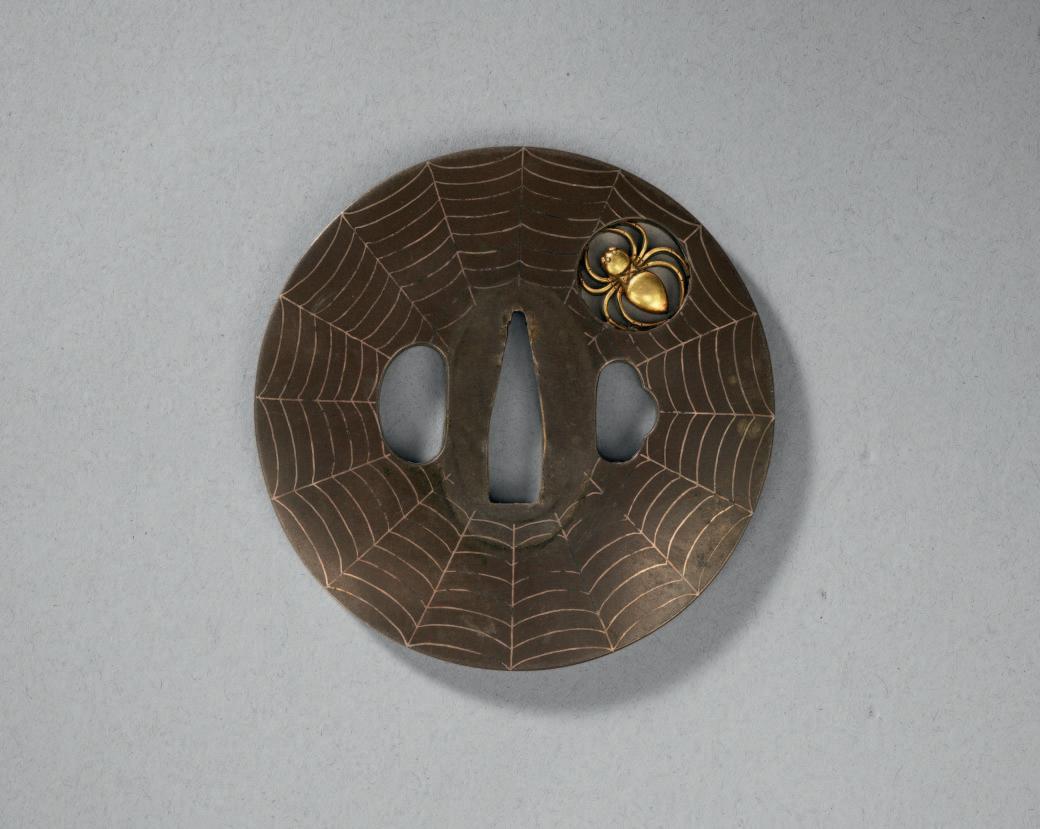
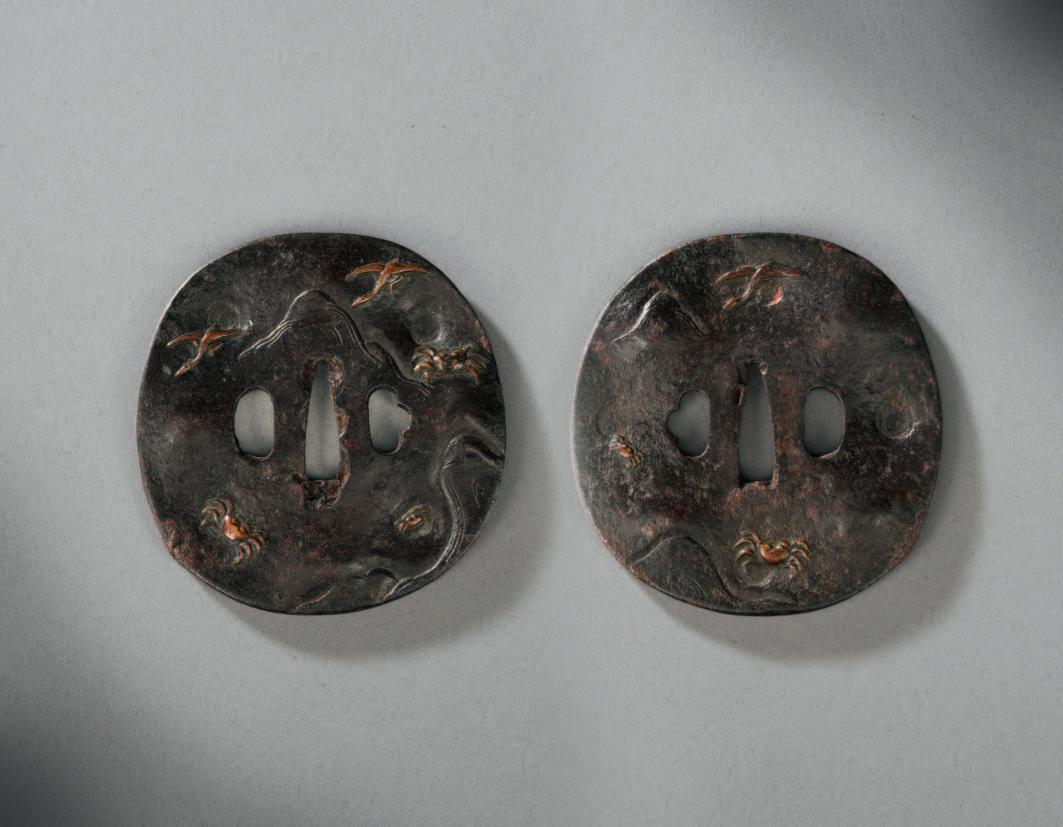
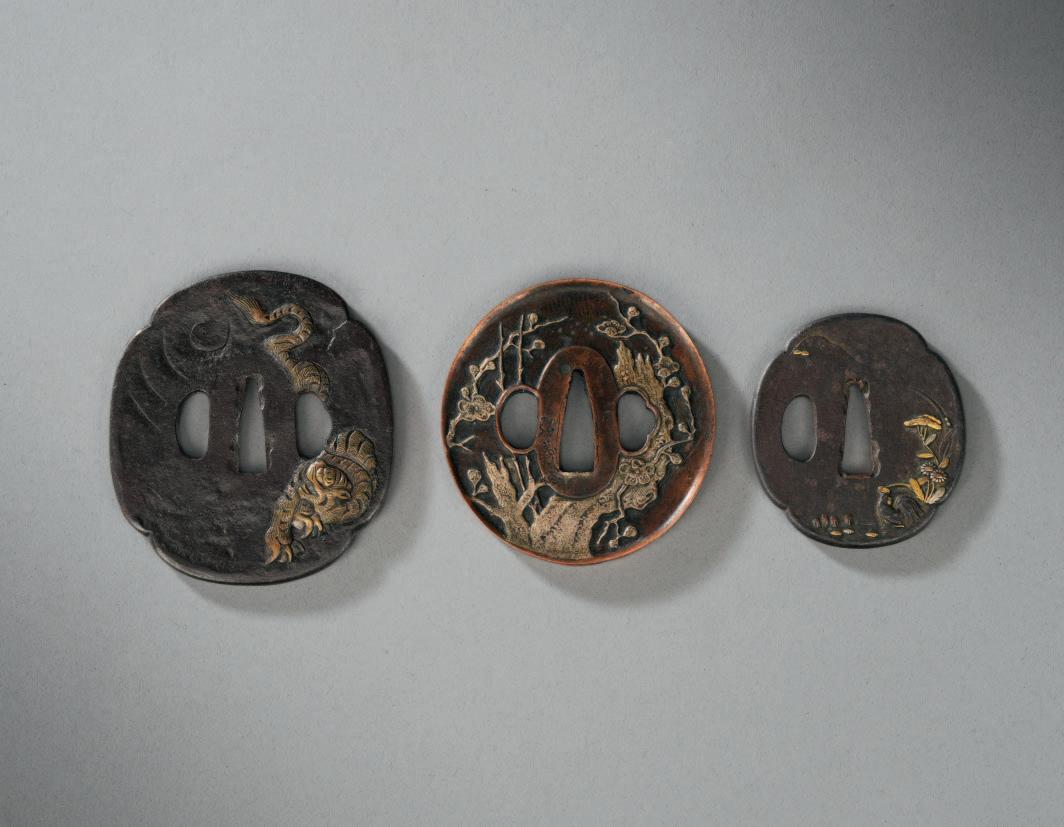
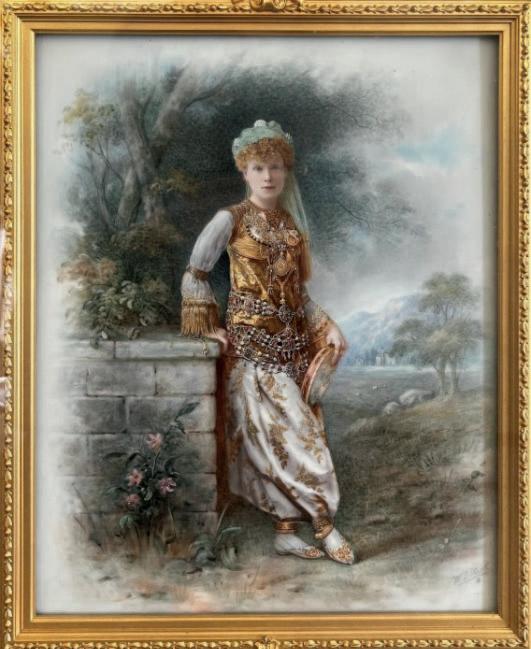
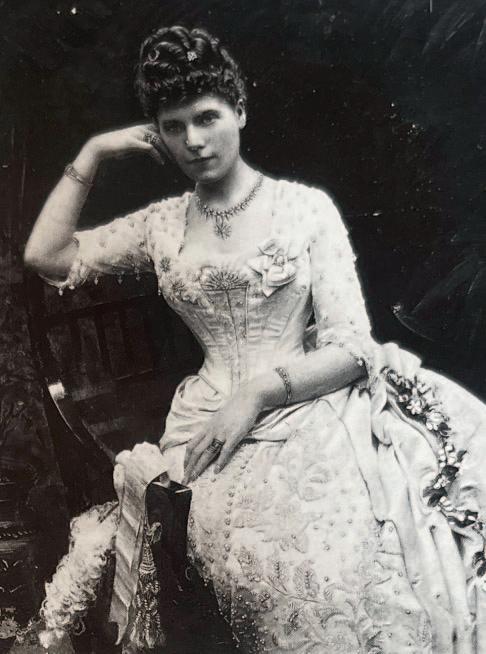
The following lots come from the collection of Mrs Frederica (Freda) Cook (18561925), and thence by descent. In 1887, Freda married Wyndham Francis Cook, the younger son of Sir Francis Cook. Sir Francis (18171901) was a wealthy textile magnate who notably owned the Gothic palace on Montserrate in Cintra, Portugal (previously subleased by William Beckford), where he created a Japanese garden. He was given the title of Marquess of Montserrate by the King of Portugal in 1886, and first Baronet Cook the same year.
Sir Francis was an avid art collector, amassing one of the most important private art collections of the 19th century, housed primarily at Doughty House in Richmond. His collection featured pieces by renowned artists, including Jan van Eyck's The Three Marys at the Sepulchre, Velázquez's Old Woman Cooking Eggs, Fra Angelico and Filippo Lippi's Adoration of the Magi, and Rembrandt's Portrait of a Boy. In 1900, he bought a painting that would eventually sell for $450 million at auction: the famous Salvator Mundi by Leonardo da Vinci.
When her husband died in 1905, Freda was left £1,224,381 (approximately £189 million today). Her own will made the news in 1925 when the Time published an article entitled "Will as Long as a Novel": it was handwritten, included 95,940 words, 1066 pages, and still holds today the Guinness World Records title for the longest will ever written.
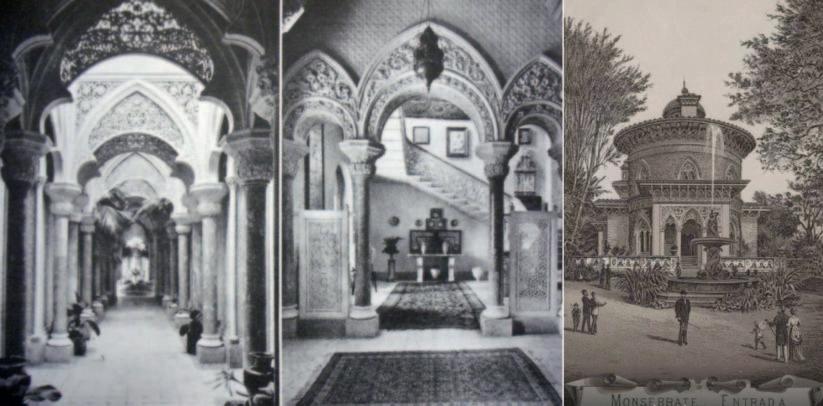
Provenance: from the collection of Freda Cook (1856-1925), and thence by descent.
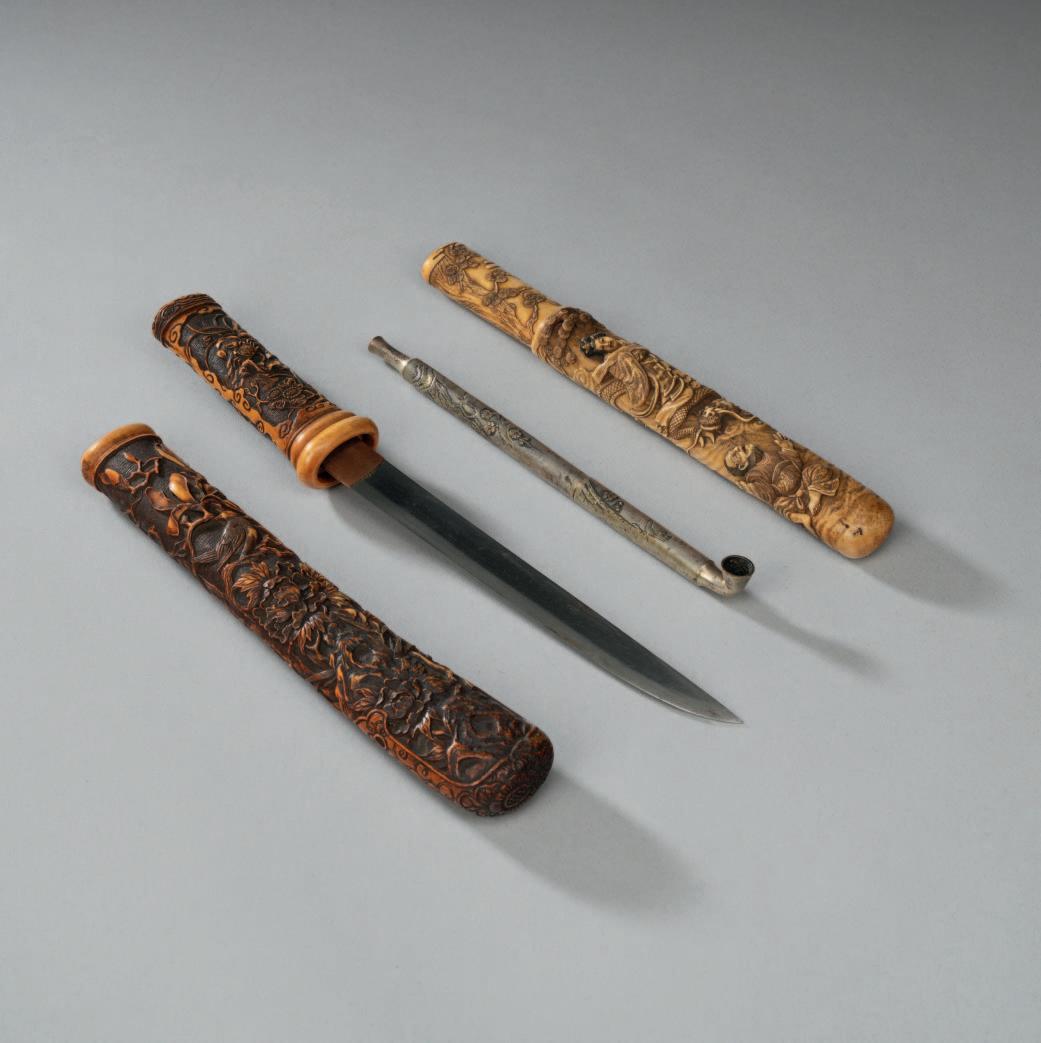
708
A COLLECTION OF JAPANESE SWORD FURNITURE
EDO/MEIJI, 18TH/19TH CENTURY
Variously decorated with figures, flowers and animals, all carved and inlaid in iroe takazogan, variously made of shibuichi, shakudō, copper, gold and silver; comprising: nine sets of fuchi-kachira, one decorated with Gama Sennin and his pet frog, signed Masayuki; three odd fuchi and three odd kachira; and two kozuka, one decorated with a man pointing up, signed Tadashige, and the other with a crane, signed Mito-ju Masashige, 9.6cm max. (26)
WITHOUT RESERVE
£1,200-1,500
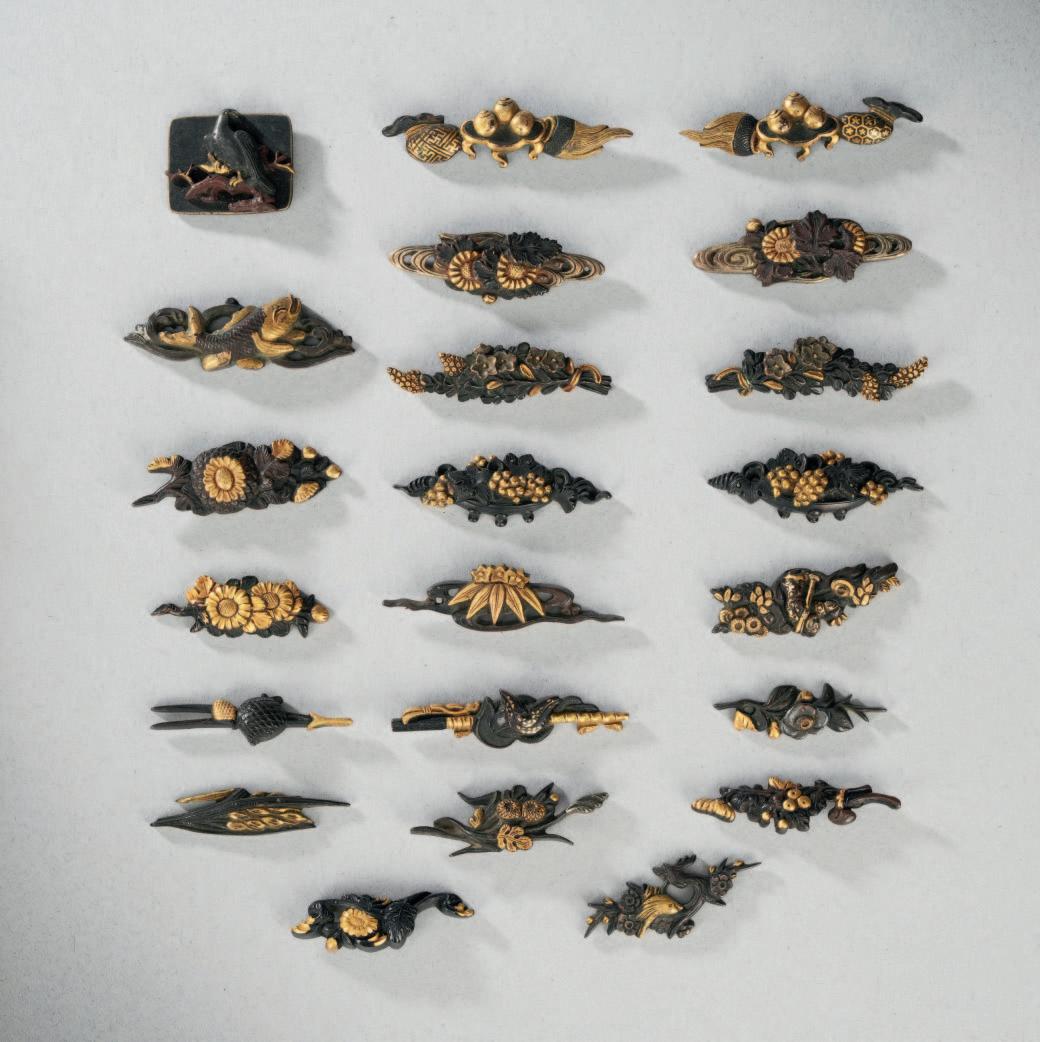
707
A STAG ANTLER TANTŌ AND KISERUZUTSU (PIPE CASE)
MEIJI ERA, 19TH CENTURY
The scabbard carved with birds perched amongst magnolia, peony, finger citron and reishi fungi, the handle with a small crab; the pipe case decorated with a man surprised by the Goddess Benten descending from the sky on a dragon, a large pine to the side; together with a white metal pipe, 32.5cm, max. (6)
WITHOUT RESERVE
£500-1,000
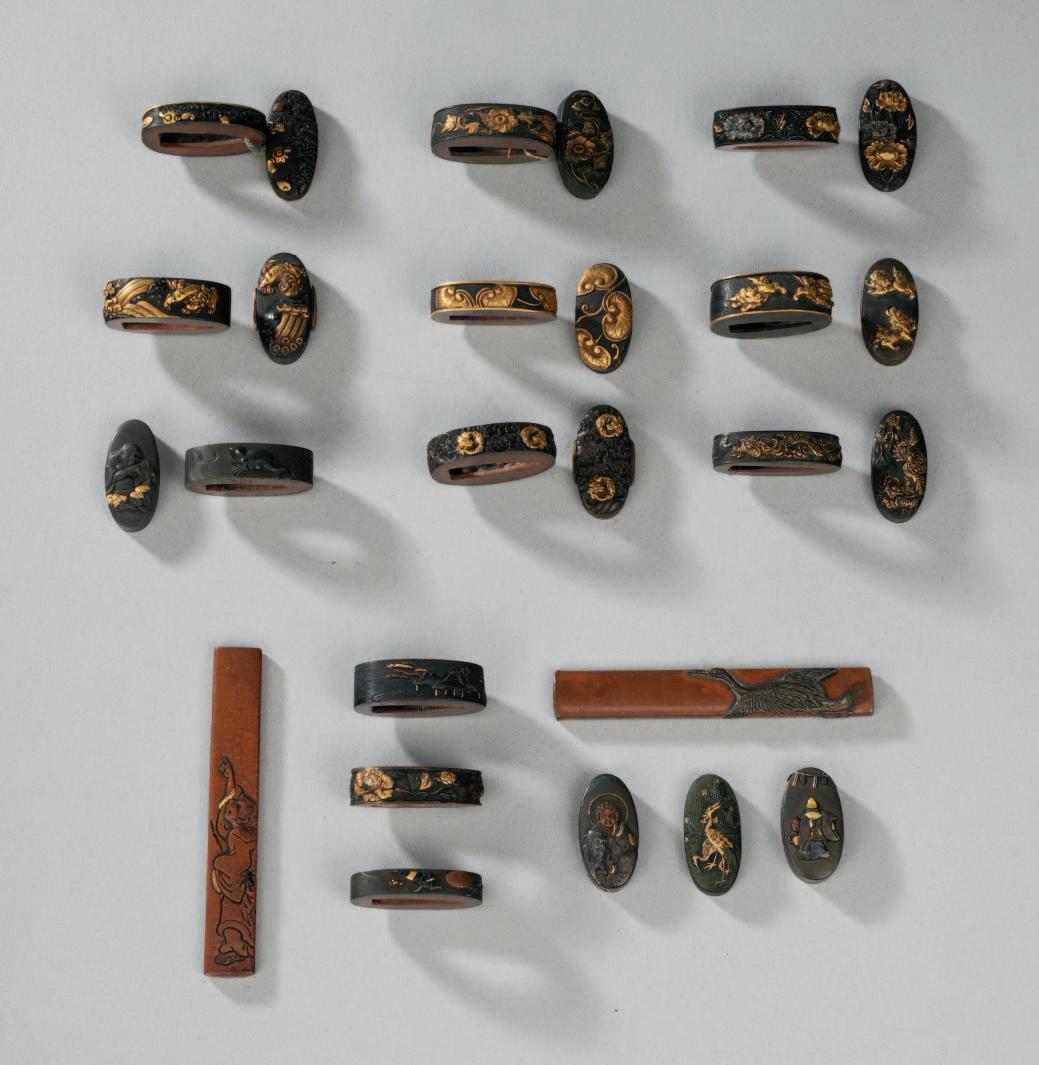
709
A COLLECTION OF TWENTYTWO JAPANESE MENUKI
EDO/MEIJI, 18TH/19TH CENTURY
Including four pairs, variously decorated with birds, flowers and auspicious objects, one with a figure and another with a fish; with details rendered in gold, copper, shakudō and other alloys, 4.6cm max. (22)
£300-500
Provenance: from the collection of Freda Cook (1856-1925), and thence by descent.
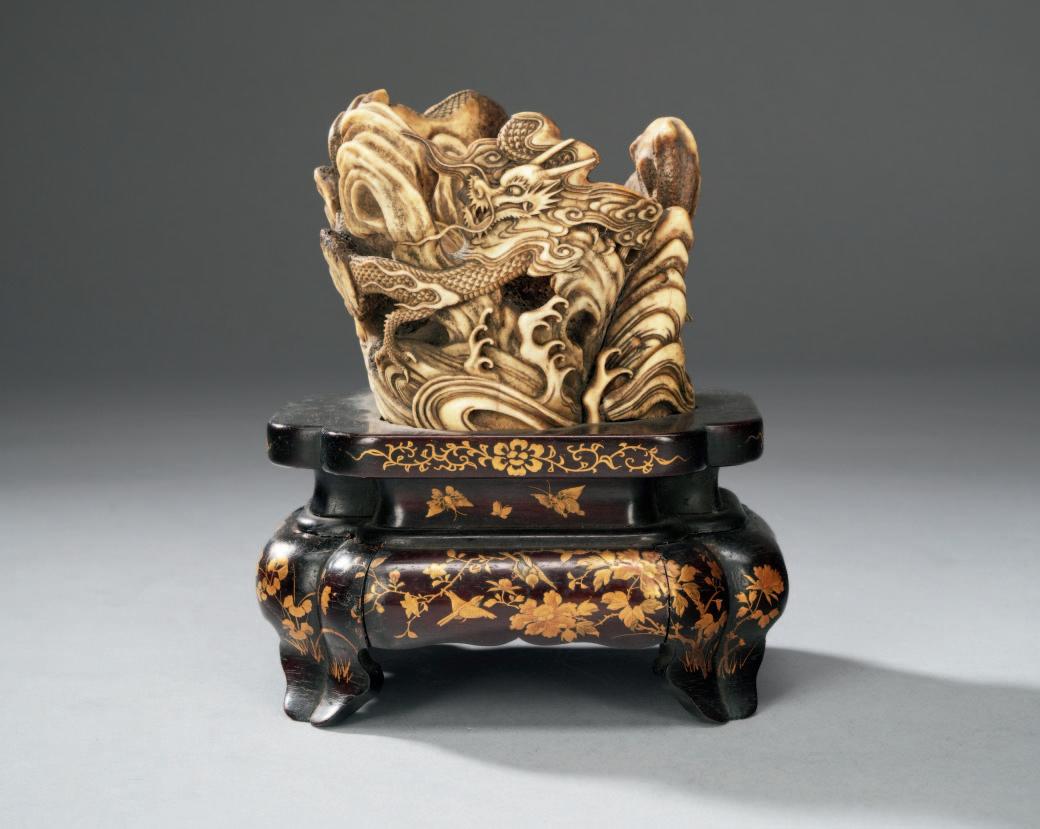
710
AN UNUSUAL JAPANESE STAG ANTLER OKIMONO WITH DRAGON AND KAPPA
MEIJI ERA, 19TH CENTURY
Carved in the round with a large dragon writhing amongst scrolling clouds, descending upon waves crashing against rocks; with two small kappa to the sides, both depicted with their usual shallow heads and turtlelike carapaces, one eating a cucumber; all raised on a lobed wood base decorated with birds amongst flowers in gold and red hiramaki-e lacquer, 14.8cm x 10cm x 13cm.
WITHOUT RESERVE
£400-600
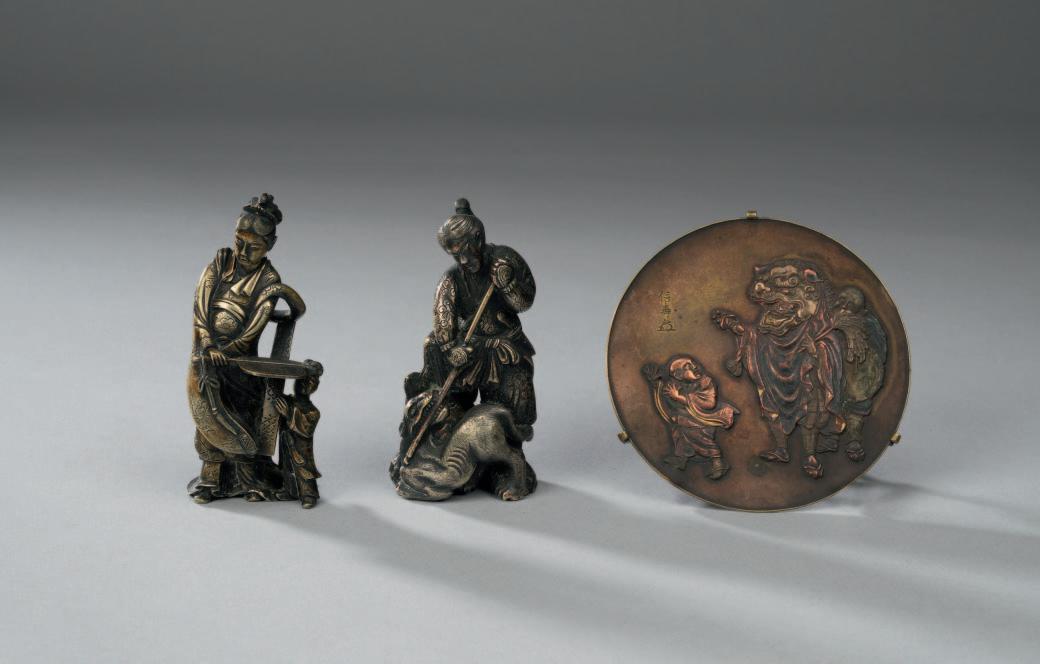
A JAPANESE MIYAO DISH AND TWO BRONZE OKIMONO
MEIJI ERA, 19TH/20TH
Raised on three scrolling feet, the well decorated with a boy running scared from two figures dressed as a lion dog for the shishimai dance; signed at the front, possibly Nobutoshi with kao, and inscribed Miyao zo at the back; together with two bronze okimono, one depicting Katō Kiyomasa pinning a tiger and the other of a beauty with an attendant, 10.7cm max. (3)
WITHOUT RESERVE
£400-600
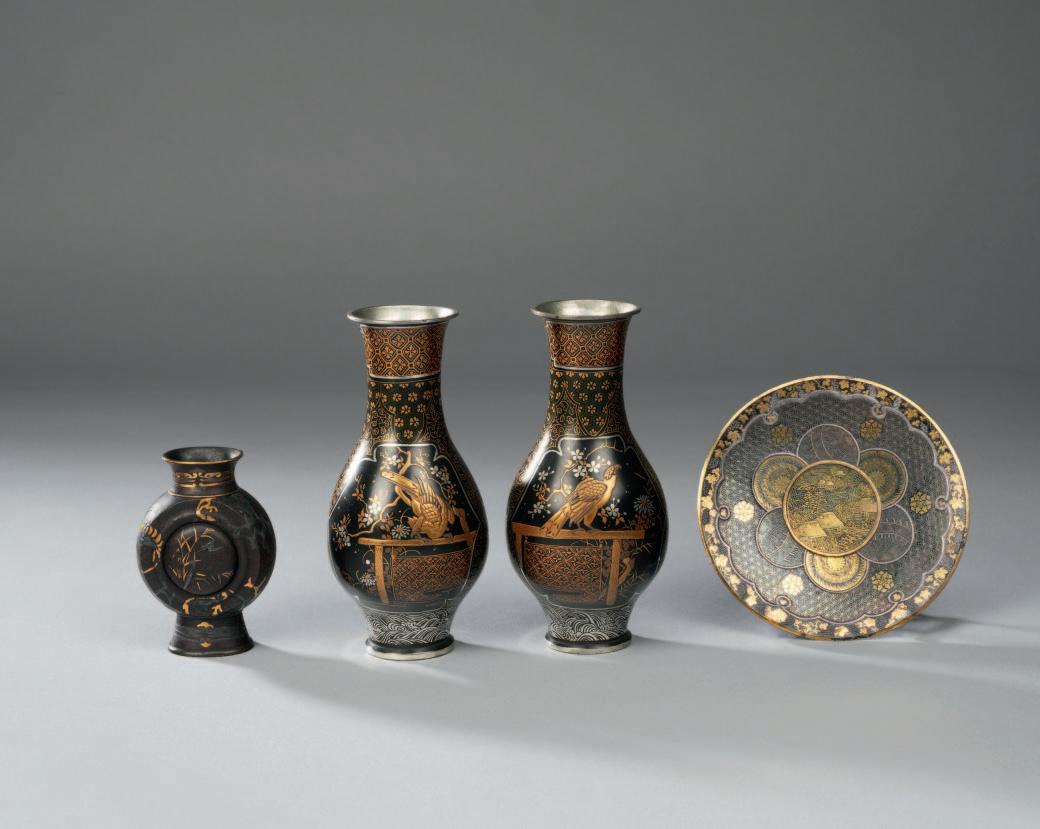
FOUR JAPANESE KOMAISTYLE PIECES
MEIJI ERA, 19TH/20TH CENTURY
One a small inlaidiron dish decorated with a central medallion enclosing thatched buildings amongst rice paddies, with temari balls and chrysanthemum mon encircling it, on a ground of asa-no-ha and bordered by fruiting vines, the reverse with a twocharacter signature possibly reading Kaki ya; a pair of lacquered metal vases with shaped panels of birds on a ground of brocade patterns, each signed Kyoto Okuda sei; and a small moonflask with birds in flight and archaistic dragons, unsigned, 15.2cm max. (4)
WITHOUT RESERVE
£600-1,000
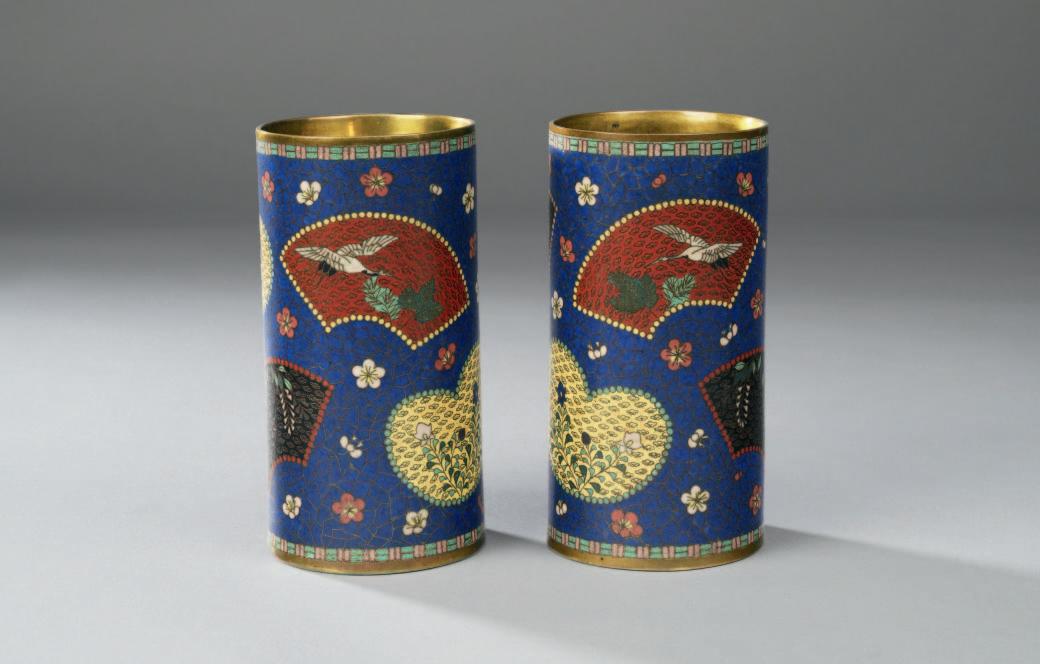
A PAIR OF JAPANESE CLOISONNE VASES
MEIJI ERA, 19TH CENTURY
Of cylindrical form, decorated with shaped panels enclosing birds and flowers, on a crackedice ground with scattered cherry blossoms; all rendered in colourful enamels, both 15.3cm. (2)
WITHOUT RESERVE
£300-500
Provenance: from the collection of Freda Cook (1856-1925), and thence by descent.
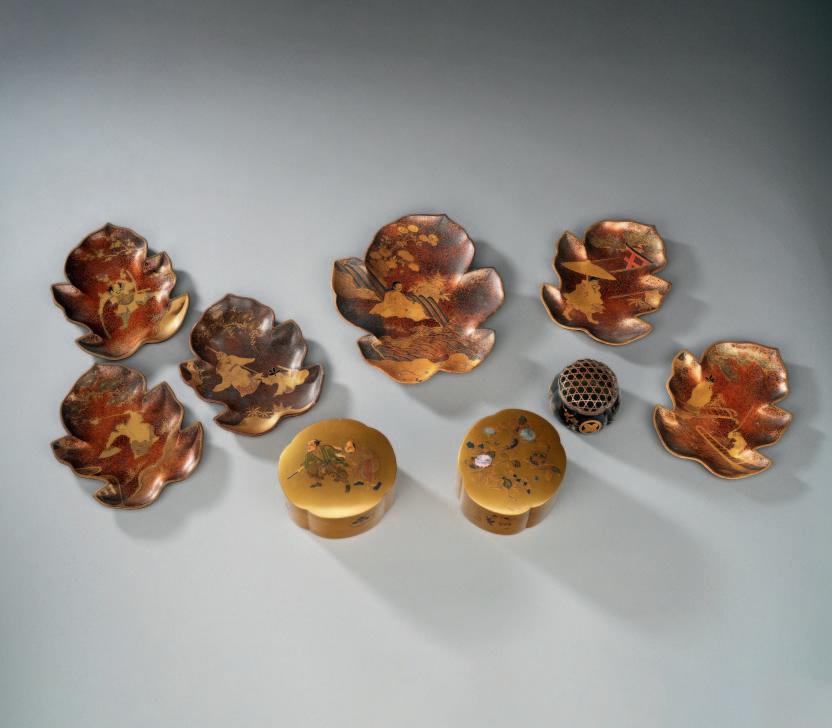
714
λ
EDO/MEIJI, 19TH CENTURY
Comprising: two quadrilobed boxes and covers in gold lacquer inlaid with mother of pearl and ivory, one with two figures and the other with a bird perched amongst hydrangeas; a set of five leafshaped dishes and a larger one, variously decorated with figures in gardens, one a shōjō; and a small kōrō, the incense burner with pine and prunus branches in between feather mon, 19cm. (12)
£600-1,000
With an ivory registration number.
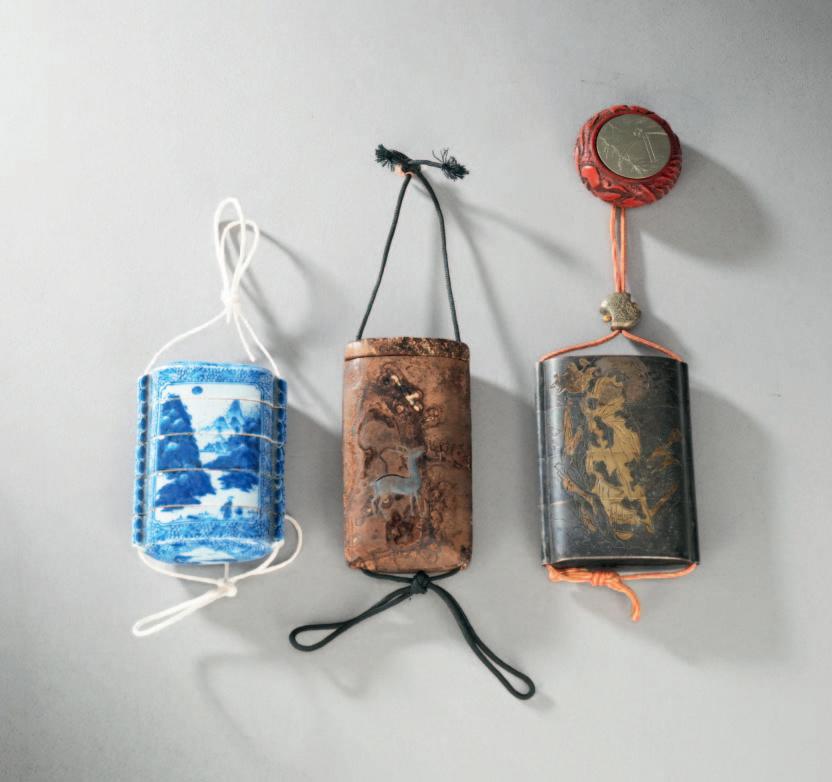
716
MEIJI ERA, 19TH/20TH CENTURY
The first a singlecase inrō made of a very light wood similar to cork, decorated in gold and silver hiramaki-e lacquer with a deer to one side and two bats to the other; another a threecase metal inrō with a bodhisattva holding a vase of flowers, the reverse with a full moon above a lotus pond, with gilded details, attached to a metal ojime and a tsuishu lacquer kagamibuta netsuke with a metal plate decorated with a figure on a bridge; the third a Hirado porcelain four-case inrō with panels enclosing landscapes, 8.8cm max. (3)
£400-600
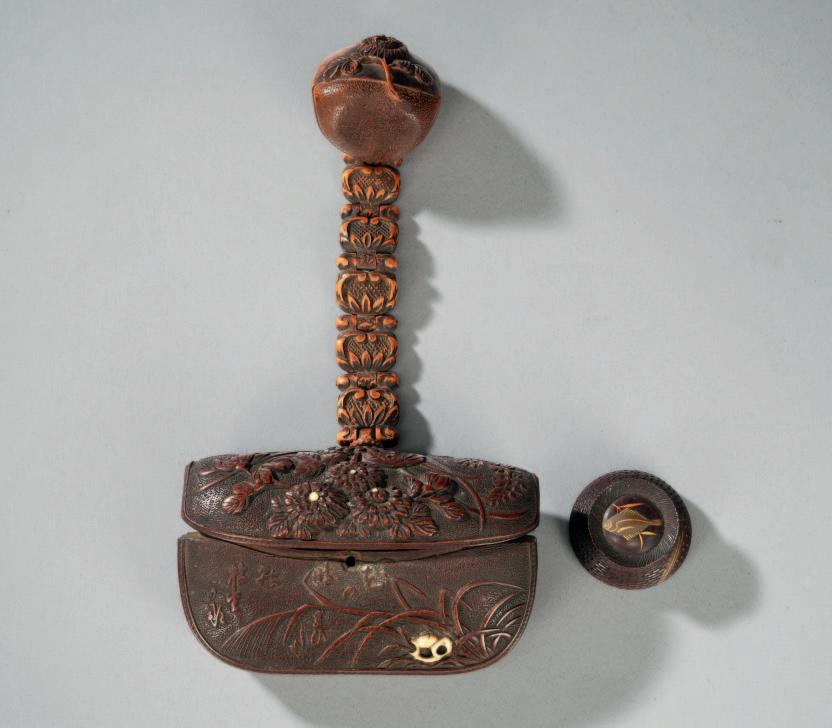
MEIJI ERA, 19TH/20TH CENTURY
Carved to imitate a fabric pouch, the front decorated with a skull discarded amongst tall autumn leaves, a poem to the side and large chrysanthemum above and to the reverse; attached to a chain with wooden links, and to a chestnutshaped netsuke with a small worm poking out on the side; together with a netsuke shaped as a woven basket, a small fish painted in lacquer to the top, the tonkotsu 11.5cm and the netsuke 4.1cm. (2)
£200-300
With an ivory registration number.
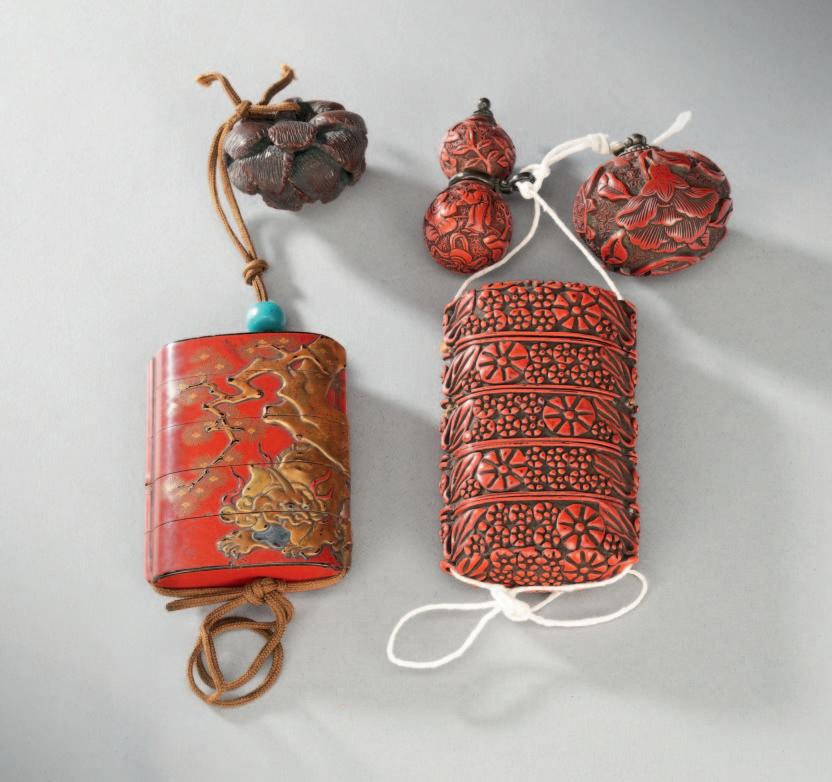
TWO JAPANESE RED LACQUER FOURCASE INRŌ
The first tsuishu lacquer inrō carved with a dense pattern of stylised flowerheads, attached to a small gourdshaped yatate with Chinese figures in a landscape and an ovoid netsuke with auspicious objects and peony; the other inrō in gold and silver hiramaki-e and kirikane on the red ground, decorated with a shishi crouching under a pine tree, attached to a wood netsuke carved with a minute frog on a peony, the inrō 8.5cm and 6.7cm. (2)
£300-500
Provenance: from the collection of Freda Cook (1856-1925), and thence by descent.
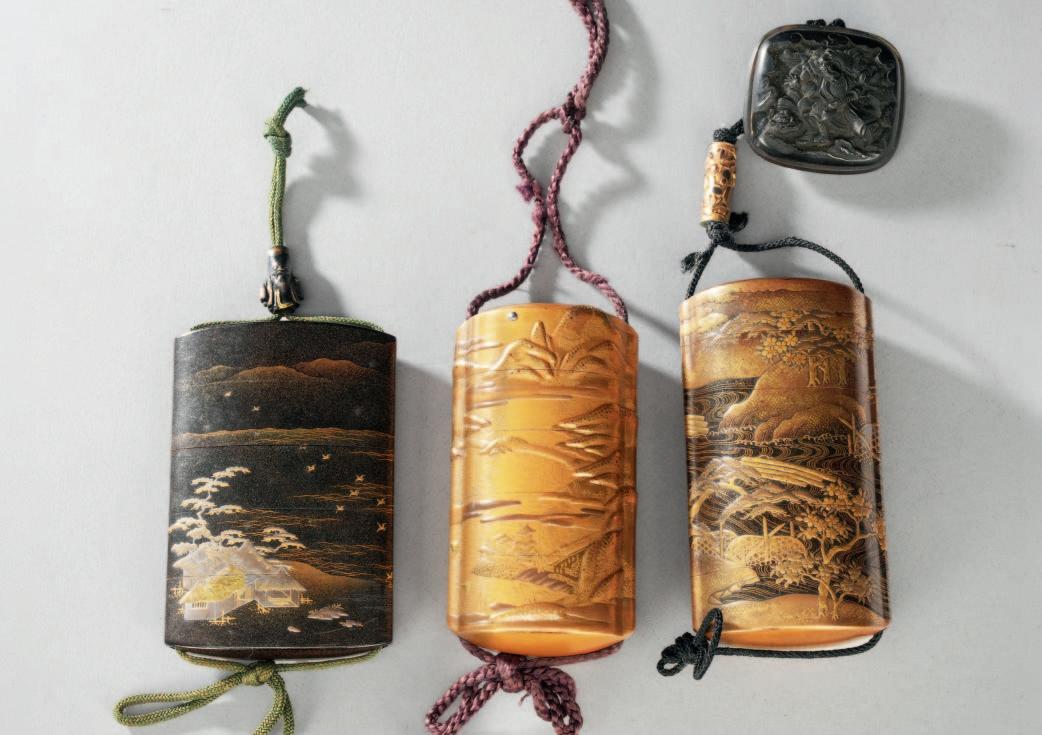
718
THREE JAPANESE GOLD LACQUER INRŌ WITH LANDSCAPES
MEIJI ERA, 19TH/20TH CENTURY
All three with extensive watery landscapes variously rendered in gold and silver hiramaki-e, kirikane and nashiji lacquer; one a fourcase inrō with minute figures by a shrine, signed with a threecharacter mark and a red pot seal; the second another fourcase inrō with many birds in flight over thatched buildings, possibly signed Taigyo saku with kao; the third a fivecase inrō with fish traps set in a river, attached to a metal ojime and a horn manju netsuke depicting Kato Kiyomasa fighting a tiger; 9.7cm max. (3)
£1,000-2,000
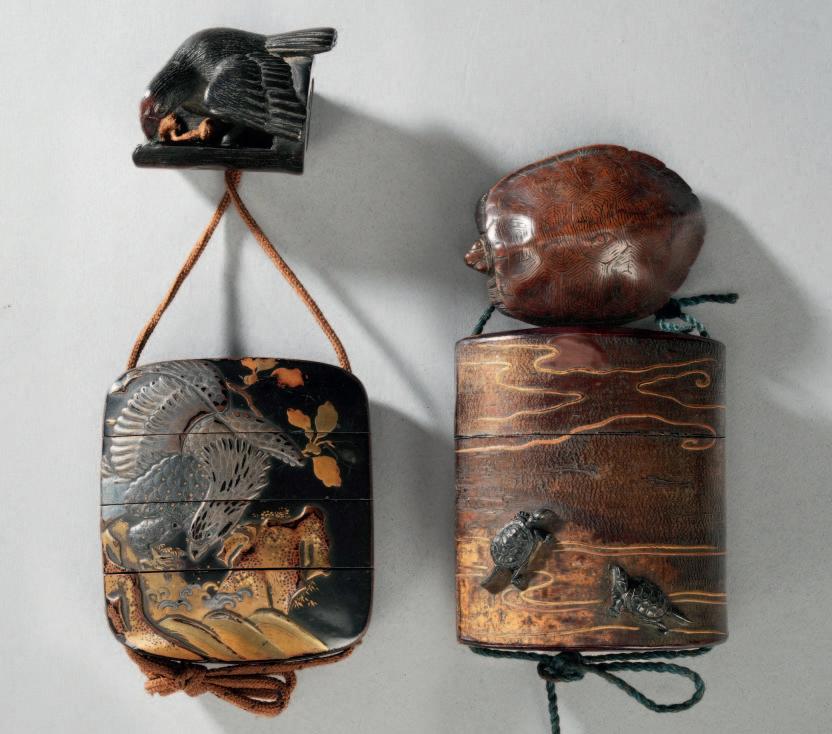
720
MEIJI
The threecase inrō decorated with a large bird of prey perched on a rock by crashing waves, a gnarly tree to the side, all rendered in gold and silver hiramakie and kirikane, attached to a wood netsuke carved as another large bird perched on a roof tile; the tonkotsu (tobacco box) with two metal turtles applied to the lacquer surface, the reverse with a flower spray in gold hiramaki-e, with an ensuite wood netsuke of a large turtle; a partial paper label inside for M W Edgley, the oriental art dealer based at 40 & 41 Fleet Street, London; the inrō 7.2cm and the tonkotsu 7.8cm. (2)
£400-600
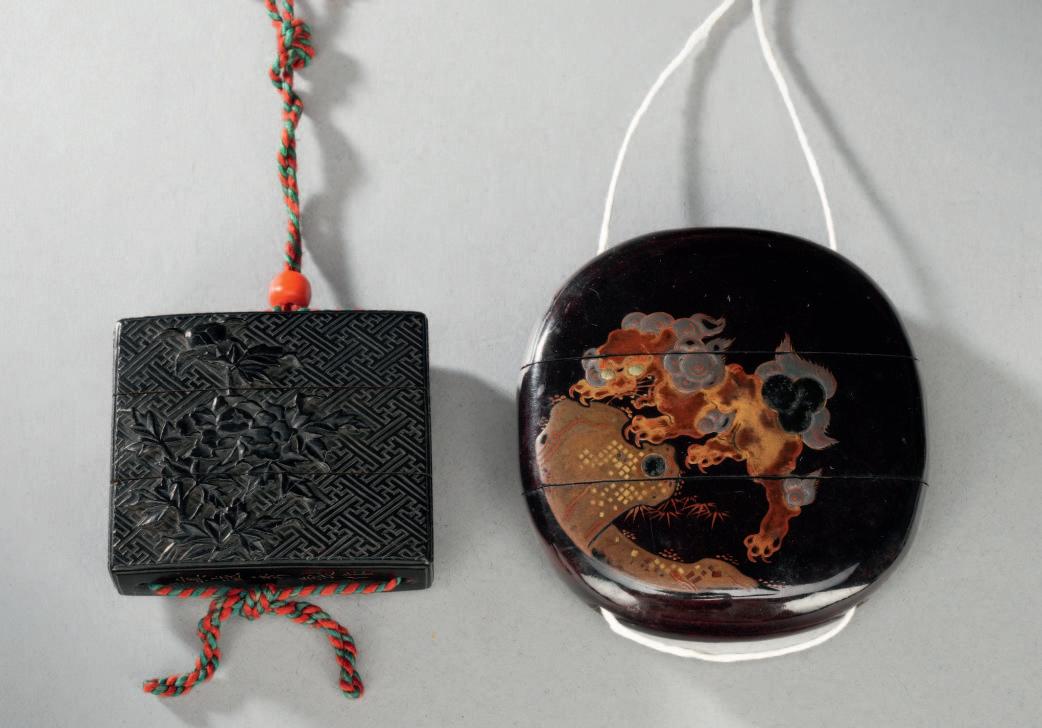
EDO/MEIJI,
One of rectangular shape in ebony carved with a lion dog scratching its ear and sprays of peony to the other side, all on a dense ground of sayagata pattern, the base signed Masahide (Shinseishu) sei saku and with two red seal marks; the other of oval form with a shishi climbing on a rock, the reverse with further peonies, all rendered in gold and silver hiramaki-e and kirikane on the black roiro ground, 6cm and 7.9cm. (2)
£400-600
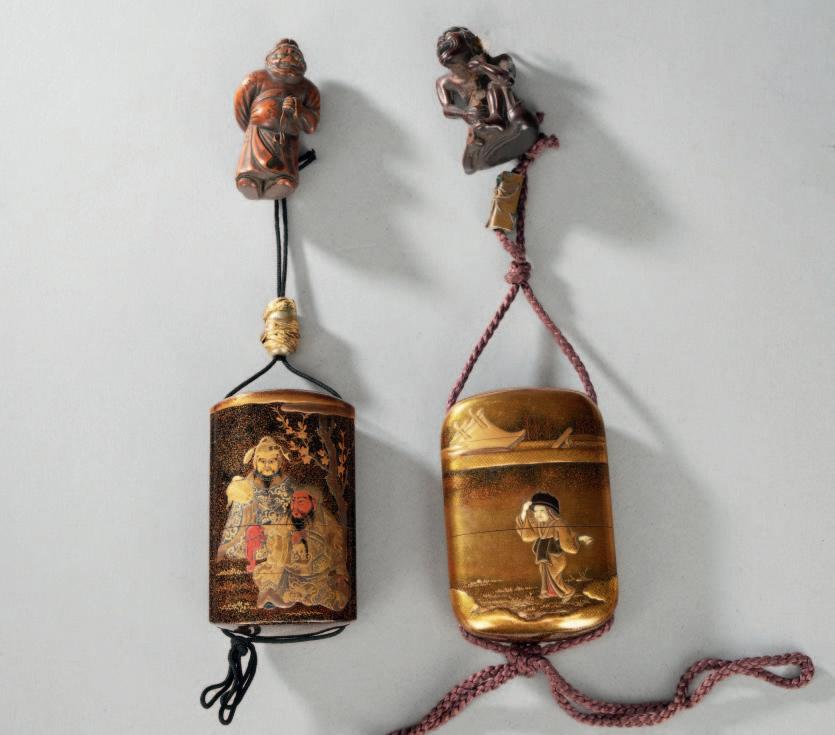
λ
The first decorated with three Chinese officials in a garden, rendered in iroe hiramaki-e, hira-kanagai, and nashiji lacquer, the base signed Kajikawa with a redjar seal Ei; attached to a metal ojime with a dragon, and to a wood netsuke carved as a Chinese general holding a sword behind him, signed Masatsugu; the other with three women walking through a mountainous landscape balancing pots on their heads, rendered in iroe hiramaki-e, nashiji, and kirikane lacquer and inlaid, the base signed Kogyokusai with kao; attached to a copper ojime with bird and flower, and a wood netsuke of a SouthSea Islander with inlaid glass eyes, 8.2cm max. (2)
£400-600
With an ivory registration number.
Provenance: from the collection of Freda Cook (1856-1925), and thence by descent.
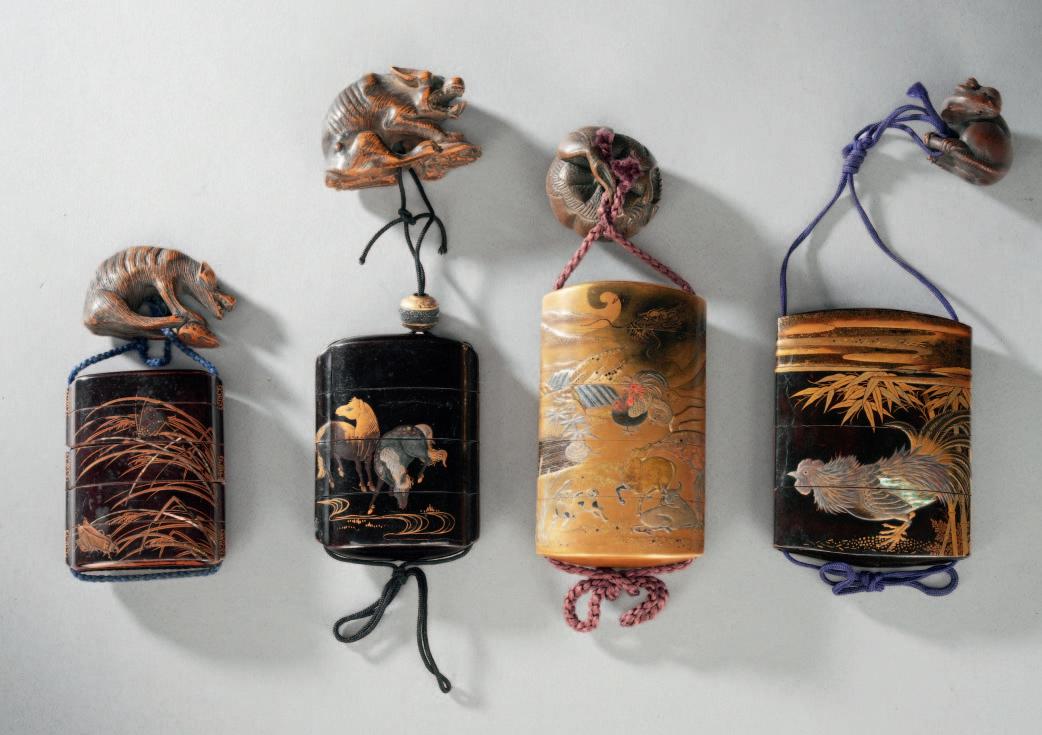
722
FOUR JAPANESE LACQUER INRŌ AND NETSUKE WITH ANIMALS
MEIJI ERA, 19TH/20TH CENTURY
The first a fourcase inrō with the twelve zodiac animals in a landscape, possibly signed Kōsai saku with a red seal pot underneath, attached to a wood netsuke carved as a dragon emerging from a mikan; another inrō depicting large chickens in a bamboo grove, with a wood netsuke of a small mouse, the rodent gnawing on the back of its paw, the eyes inlaid, signed Ichimin; the third with horses and the last with insects amongst tall grasses, both with wood yama-inu (wild dog) netsuke, one signed Masatsugu; all the inrō variously rendered in iroehiramakie, kirikane, nashiji, aogai, hirakanagai and roiro, the largest 8.7cm. (4)
£2,000-3,000
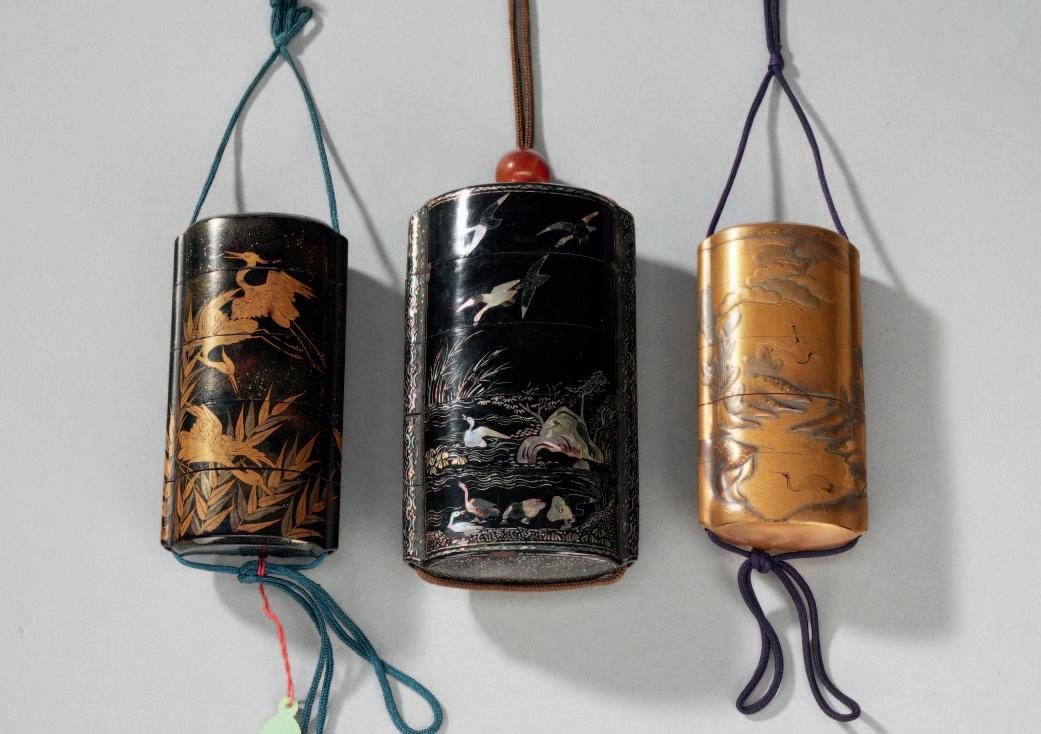
724
THREE JAPANESE FOURCASE LACQUER INRŌ WITH BIRDS
MEIJI ERA, 19TH CENTURY
One a Somada School example, decorated with many geese in a watery landscape, typically rendered in aogai (mother of pearl) on a black roiro ground; another in gold hiramaki-e and kirikane lacquer with cranes, signed Kensai with kao (for Kensai/Tonei), and the third in gold fundame and nashiji on a black roiro ground, decorated with egrets in flight, 10.3cm max. (3)
£500-1,000
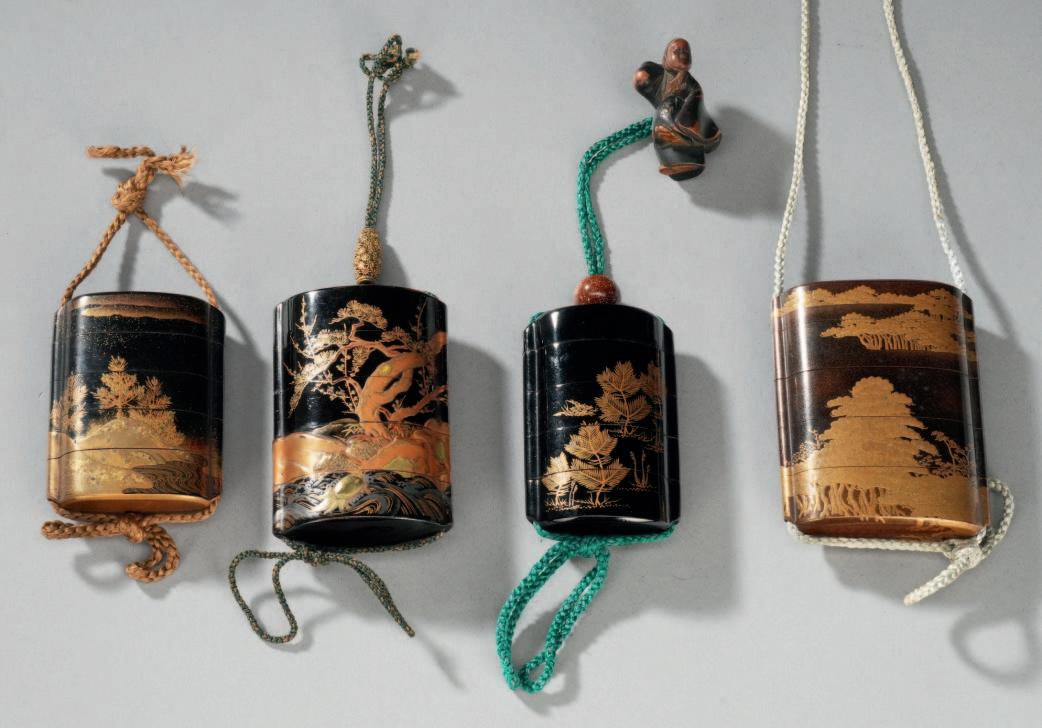
723
FOUR JAPANESE LACQUER INRŌ WITH PINES
MEIJI ERA, 19TH/20TH CENTURY
Each decorated with coniferous, one inrō with a flying crane and a minogame to the reverse, variously rendered in hiramaki-e, kirikane, nashiji, hira-kanagai and roiro, one attached to a wood netsuke carved as a Sambaso dancer, 8.1cm max. (4)
£500-1,000
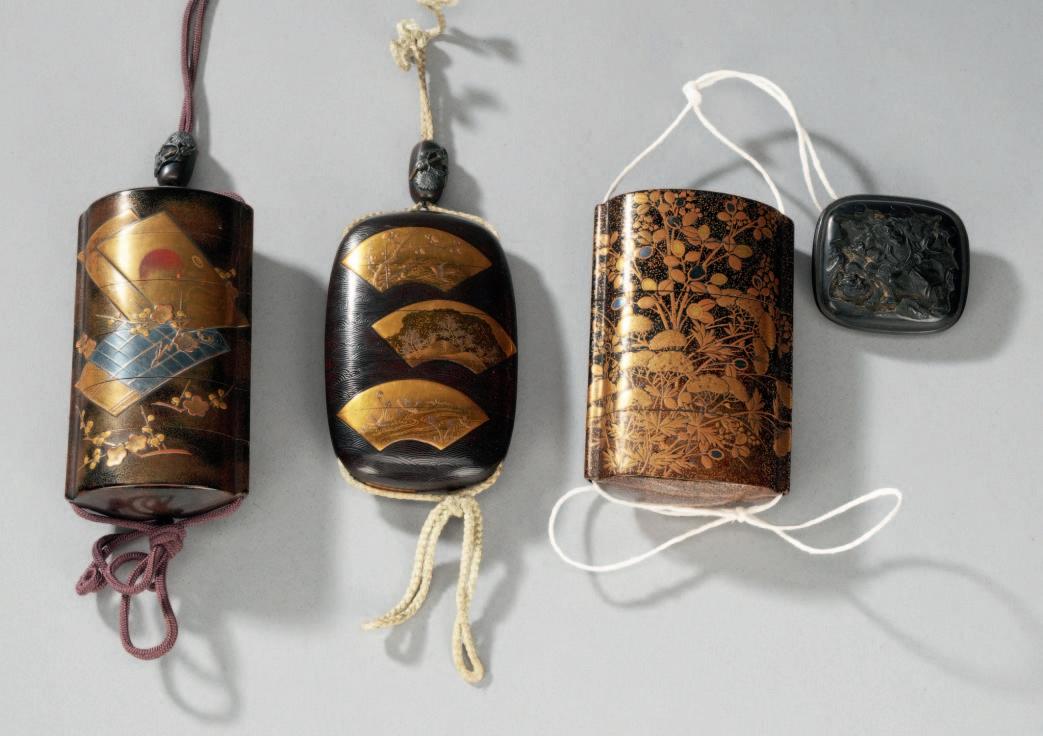
725
THREE JAPANESE LACQUER INRŌ
Two with four cases decorated in iroe hiramakie and nashiji, attached to metal ojime with flowers; the first decorated with fans variously enclosing birds, flowers and rivers, on a seigaiha (stylised waves) ground, the base signed in a rectangular gold lacquer reserve, possibly Kogyokusai; the second inrō with discarded fusuma (sliding doors) amongst flowering branches of prunus; the third decorated with bush clover and valerian in hiramakie, nashiji, kirikane and aogai, with a horn manju netsuke depicting Kato Kiyomasa fighting a tiger, 9.3cm max. (3)
£500-1,000
Provenance: from the collection of Freda Cook (1856-1925), and thence by descent.
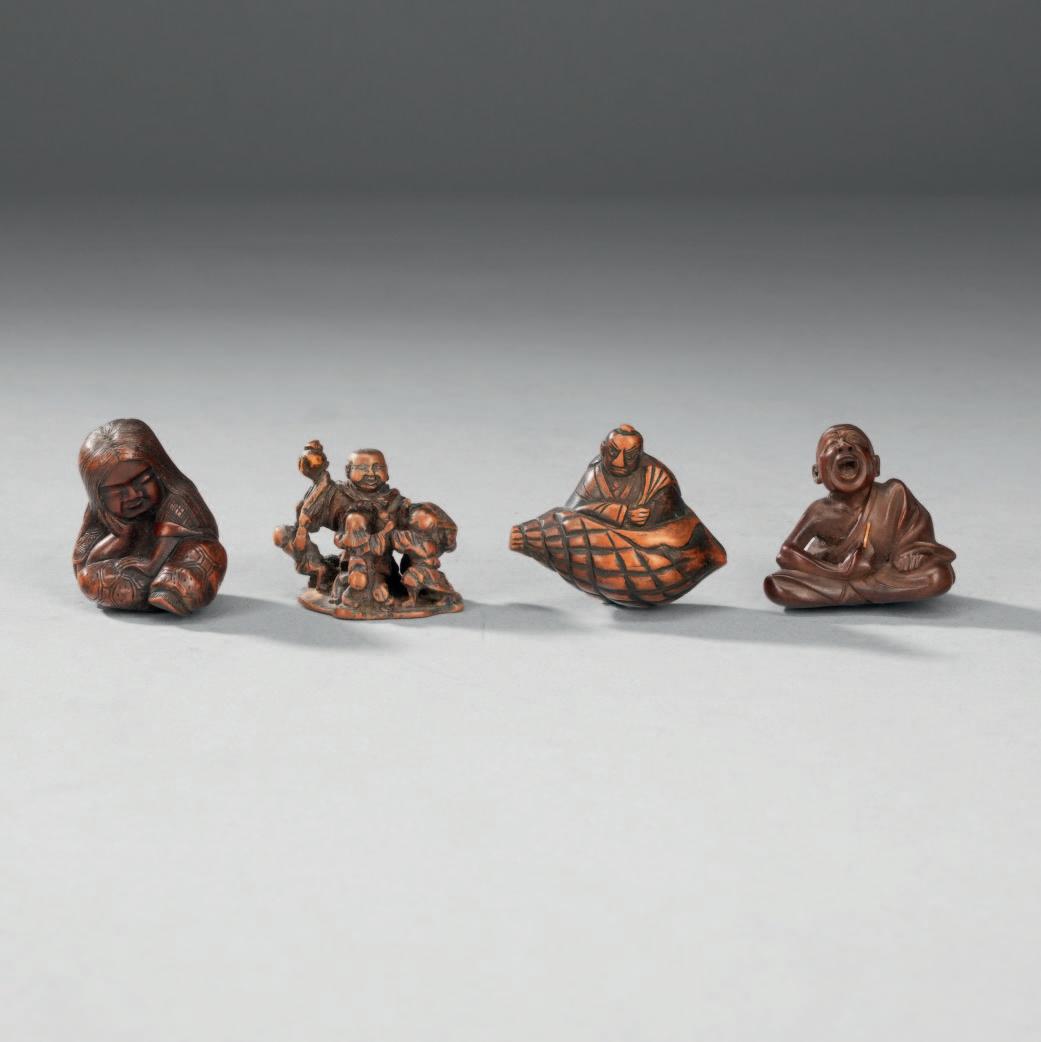
727
A JAPANESE NETSUKE OF TWO FROGS
MEIJI ERA, 19TH/20TH CENTURY
One smaller amphibian clambering on the back of the other, the animals realistically carved with large bumps on their skin and their eyes inlaid in black horn, the belly of the larger frog signed Masanao (for Masanao of Yamada, Ise Province), 4cm.
£600-800
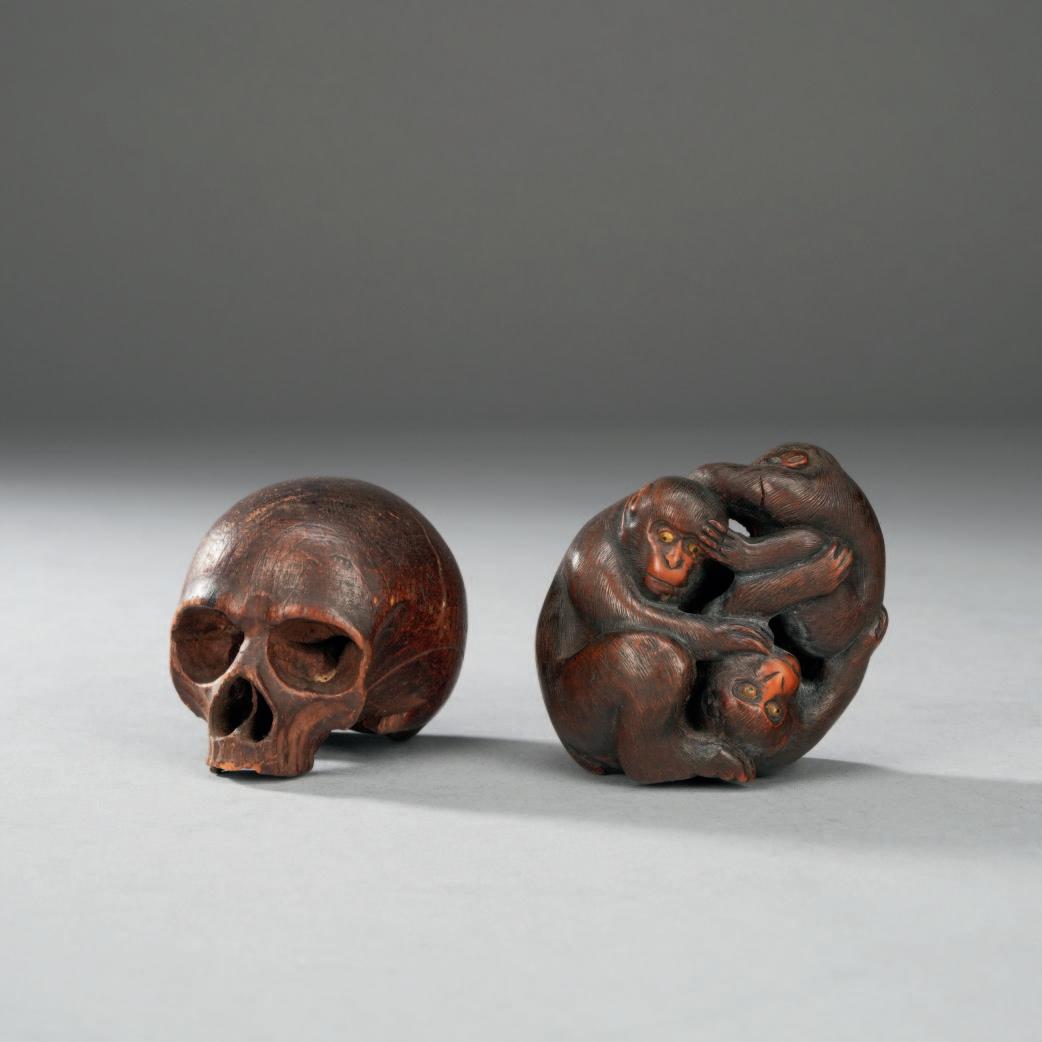
726
FOUR JAPANESE WOOD NETSUKE
MEIJI ERA, 19TH/20TH CENTURY
One a shōjō, peacefully sleeping with her head resting to one side, her long hair trailing down her back, signed Masajo in a rectangular cartouche underneath; another a sneezing man signed Shokei; the third depicting Hotei with a group of children, possibly signed Nobuyuki; and the fourth an unsigned tengu in a conch shell, 3.8cm max. (4)
£300-500
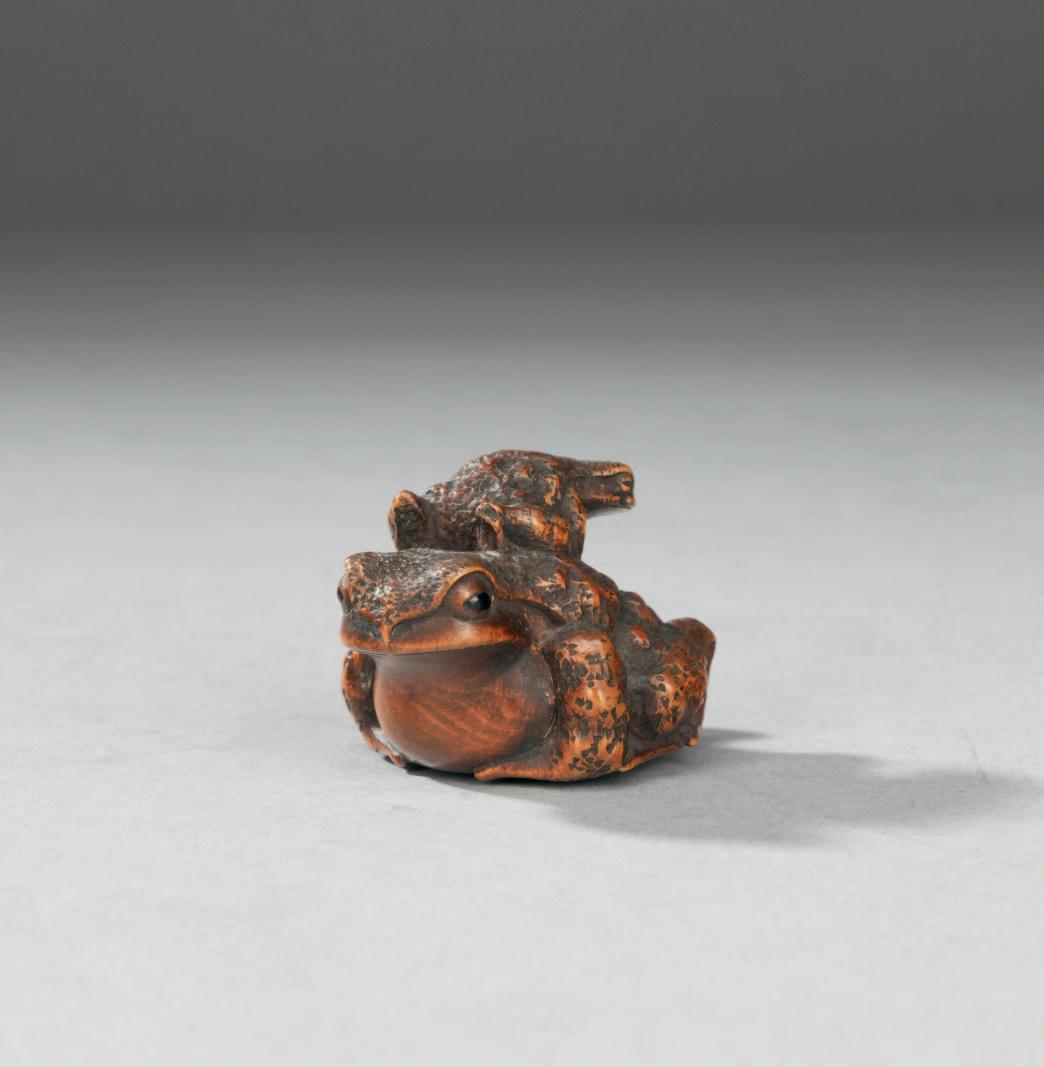
728
TWO JAPANESE WOOD OKIMONO
MEIJI ERA, 19TH/20TH CENTURY
The first carved as three monkeys wrestling, their fur realistically rendered and their eyes inlaid in horn; the other depicting a toothless skull; 5.9cm and 5.2cm. (2)
£500-1,000
Provenance: from the collection of Freda Cook (1856-1925), and thence by descent.
729
A JAPANESE NETSUKE OF A SKULL AND SNAKE BY IZUMI SUKEYUKI (18381920)
MEIJI ERA, 19TH CENTURY
Realistically carved, the snake emerging from the skull’s left eye socket and writhing towards the top, its long body ensnaring the back of the head; the scales realistically rendered and with details stained a darker colour; the skull with a toothy grin and signed to the side Sukeyuki, 4.2cm.
£1,500-2,500
Izumi Sukeyuki (1838–1920), originally an altar carver from Omi Province, pivoted to sculpture after studying under Matsuda Sukenaga. To master his signature memento mori motifs -notably snakes and skulls- Sukeyuki reportedly studied anatomy with a physician and sourced skeletal models from ancient burial mounds. These subjects served as Zen-inspired reminders of impermanence, a theme highly valued by the samurai class.
Cf. F Meinertzhagen, The Meinertzhagen Card Index on Netsuke in the Archives of the British Museum, Part B, p.823, for a wood netsuke of a skull and snake by Sukenaga (Hayashi collection). Also, see Bonhams New York, Fine Japanese and Korean Works of Art, 22nd March 2023, lot 877 for an okimono of a skull and snake also by Izumi Sukeyuki.
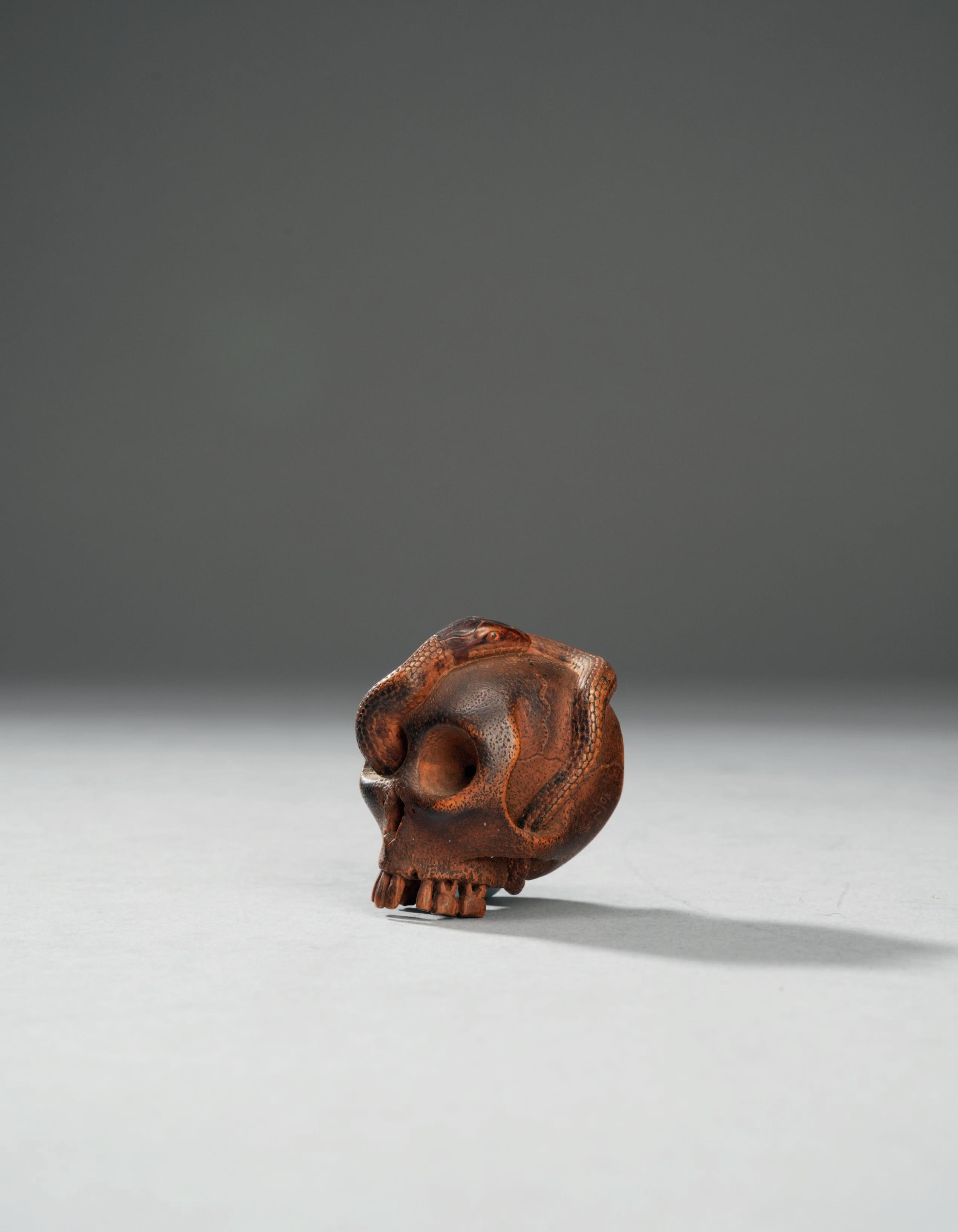
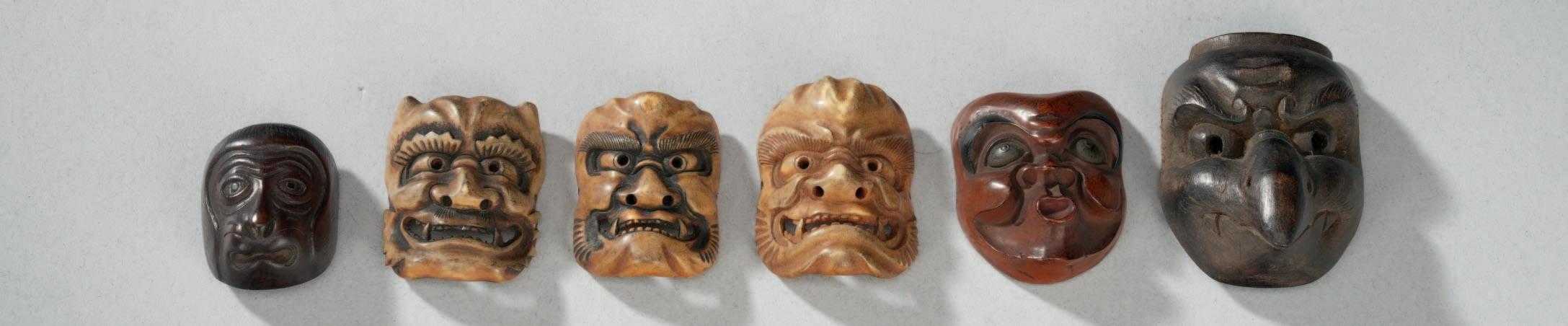
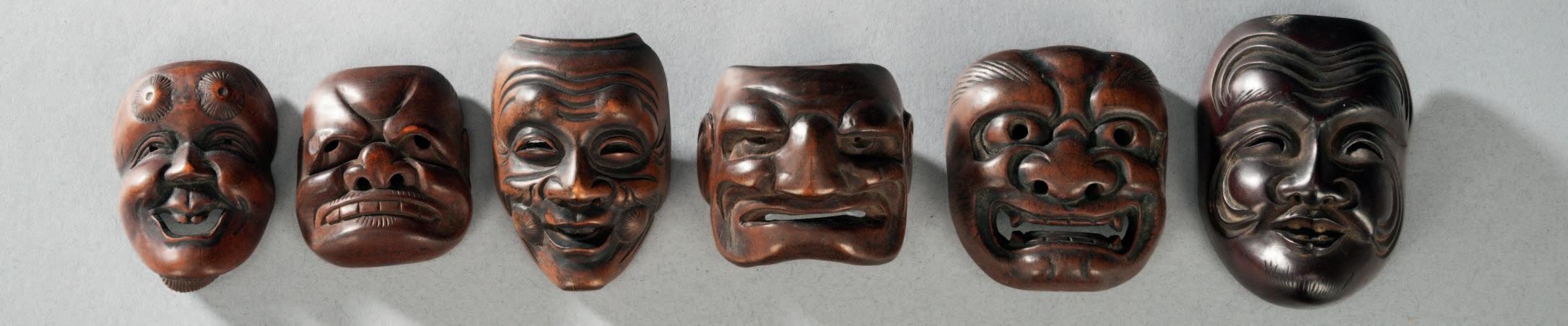
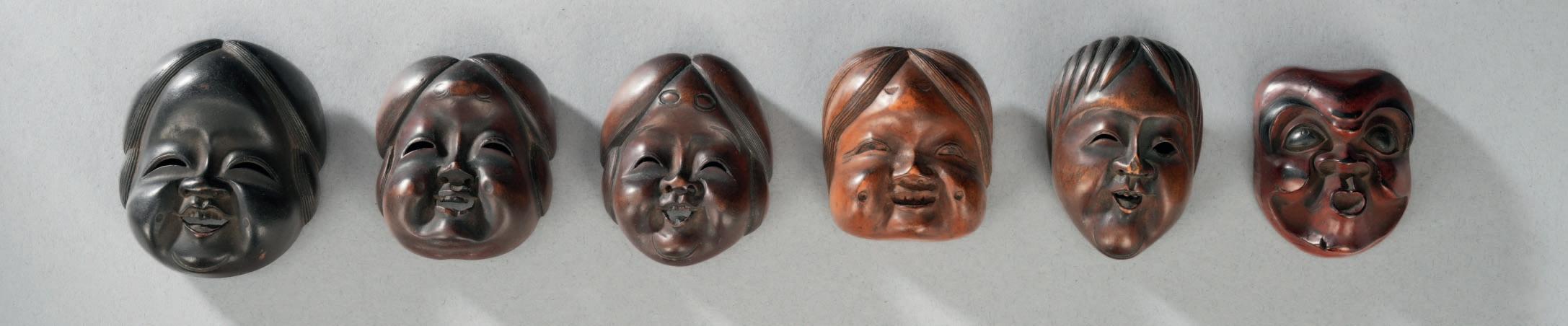
730
SIX JAPANESE MASK NETSUKE
MEIJI ERA, 19TH/20TH CENTURY
Three made of wood, one carved as a small grimacing monkey signed Miwa with kakihan, another a large tengu, the third a lacquered Usofuku; the three others in bone and depicting oni, 5.7cm max. (6)
£500-1,000
731
SIX JAPANESE WOOD MASK NETSUKE
MEIJI ERA, 19TH/20TH CENTURY
Two depicting ‘Happy Old Man’ Okina, one signed with a kao at the back, possibly Deme Uman or Deme Joman, the other signed Tadakazu; another a netsuke of ‘Grumpy Man’ Obeshimi, possibly signed Seishu with kao; another depicting Buaku signed Deme Yoshimasa; and two other unsigned netsuke, 5cm max. (6)
£500-1,000
732
SIX JAPANESE WOOD MASK NETSUKE
MEIJI ERA, 19TH/20TH CENTURY
Four depicting Okame, the Goddess of Mirth typically depicted with a warm smile and round cheeks, together with a redlacquer mask of Usofuku, and another of a figure winking, possibly Uzume; three signed Shuzan. (6)
£400-600
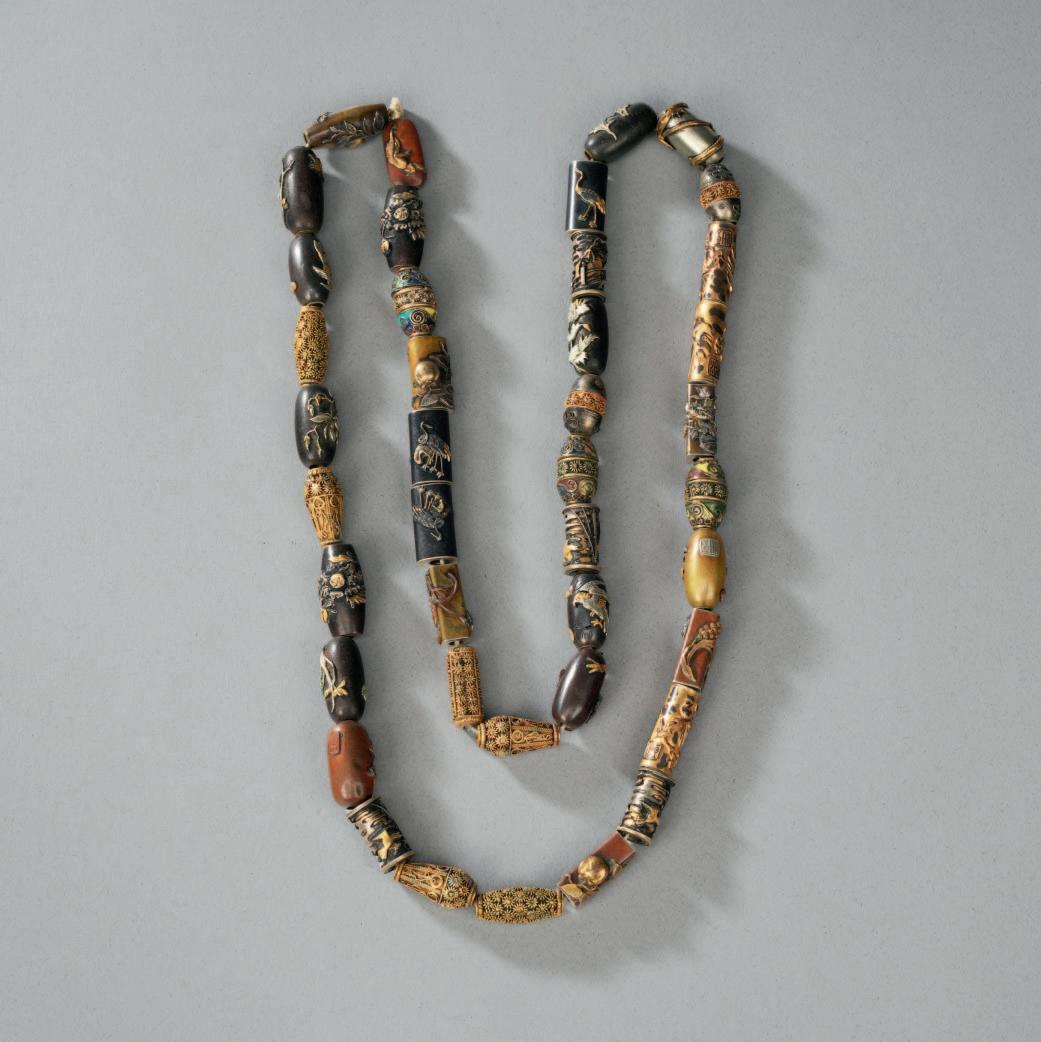
734
A SMALL COLLECTION OF JAPANESE OJIME (BEADS)
MEIJI AND LATER, 19TH AND 20TH CENTURY
Strung as a bracelet made of eleven ojime and thirteen other beads; variously shaped and made from different materials including stag antler, wood and metal; together with a lacquer box and cover decorated with flowers. (3)
WITHOUT RESERVE
£200-300
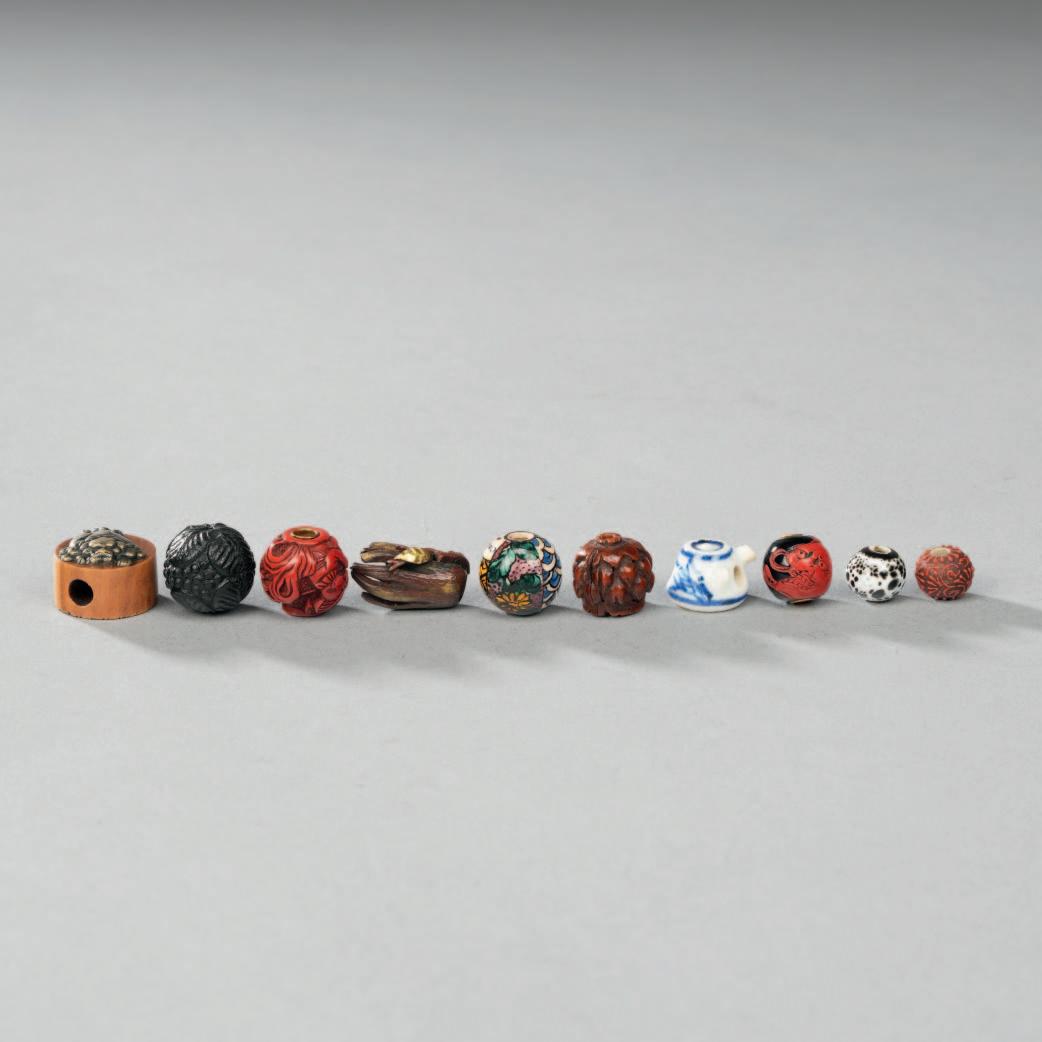
733
A COLLECTION OF FORTYONE JAPANESE METAL OJIME (BEADS)
MEIJI ERA, 19TH/20TH CENTURY
Strung as a necklace, made of a variety of metals including silver, copper, iron, bronze, and other alloys, some with coloured enamels; variously decorated with birds, flowers, geometric patterns and fruits, one with a man holding a fire torch; some with minute signatures, 2.4cm max.
WITHOUT RESERVE
£400-600
Provenance: from the collection of Freda Cook (1856-1925), and thence by descent. – END OF COLLECTION –
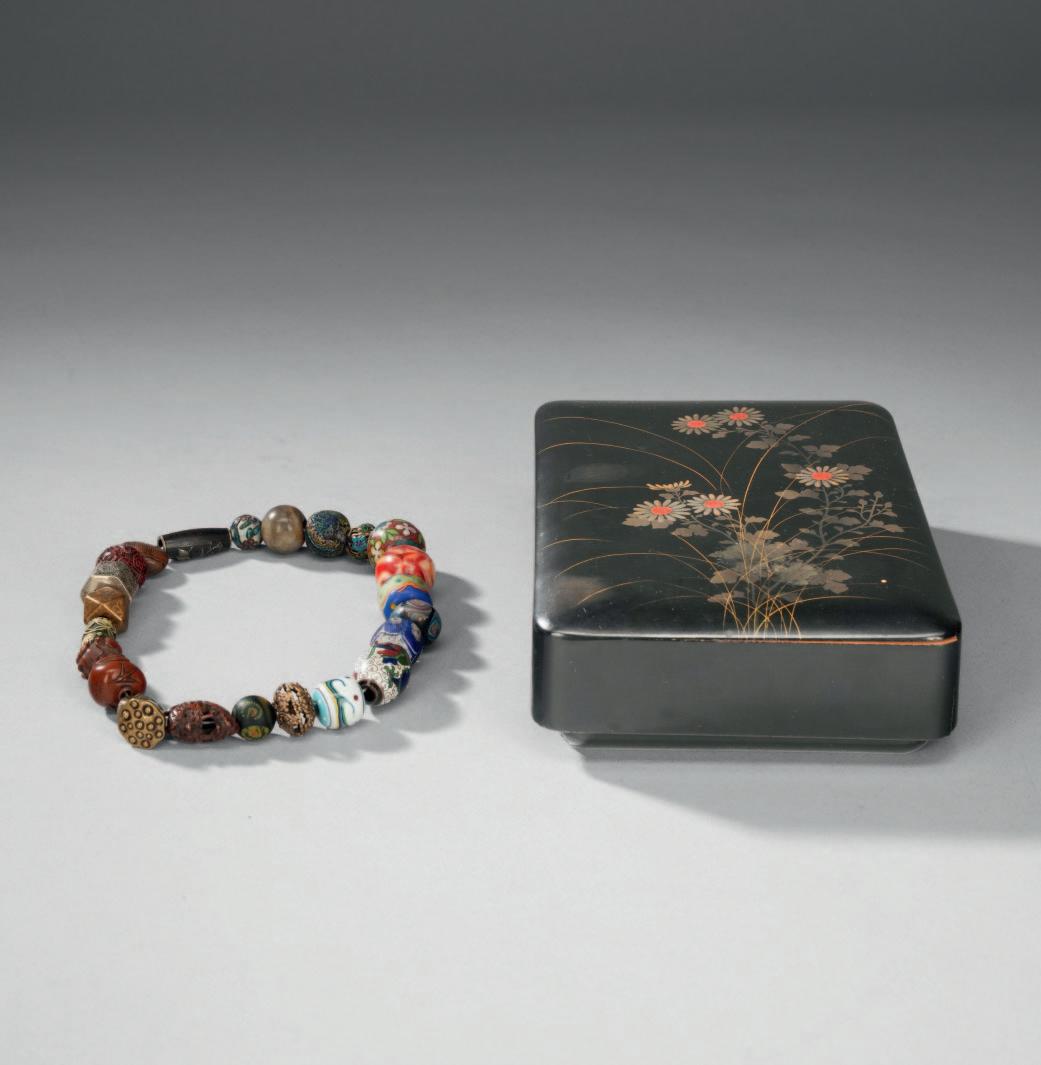
735
A SMALL COLLECTION OF TEN JAPANESE OJIME (BEADS)
MEIJI AND LATER, 19TH AND 20TH CENTURY
Made of various materials including ceramic, metal, lacquer and nuts; one a stoneware bead with bright enamels signed Kenzan; another with a metal shishi on a wood base with peony signed Naoaki, 1.8cm max. (10)
WITHOUT RESERVE
£150-250
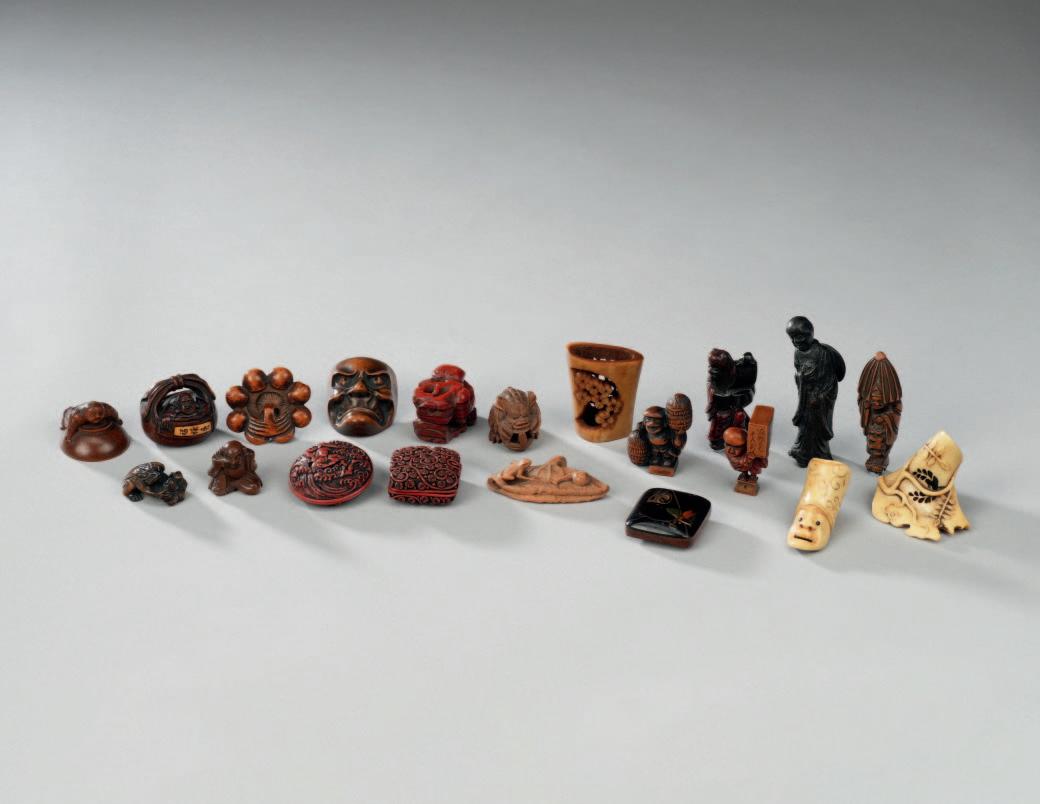
736
λ A COLLECTION OF TWENTY JAPANESE NETSUKE
MEIJI AND LATER, 19TH AND 20TH CENTURY
Variously made of wood, stag antler, lacquer and resin, carved as animals, figures and flowers; one in wood depicting Hotei emerging from his large sack of treasures, holding a scroll on which reads Fukurokuju, signed Hokei at the back; another a shishi with a brocade ball, signed Masamitsu; a third, a lacquer cluster of reishi fungi, with an illegible signature; and others, 8.2cm max. (20)
WITHOUT RESERVE
£300-500
With an ivory registration number.
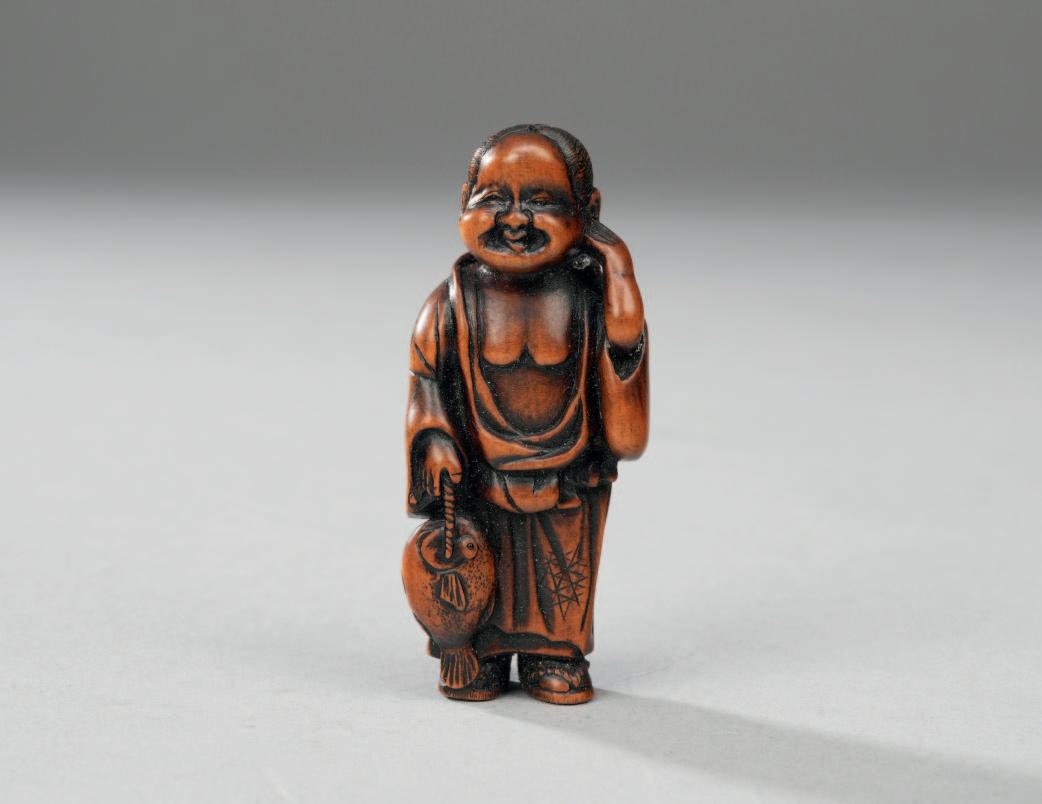
738 A JAPANESE WOOD NETSUKE OF OKAME AND FISH
MEIJI ERA, 19TH/20TH CENTURY
The Goddess of Mirth depicted wearing loose robes revealing her bare torso, a hand raised to her ear and holding a puffer fish attached to a cord in the other, 6.5cm.
£600-800
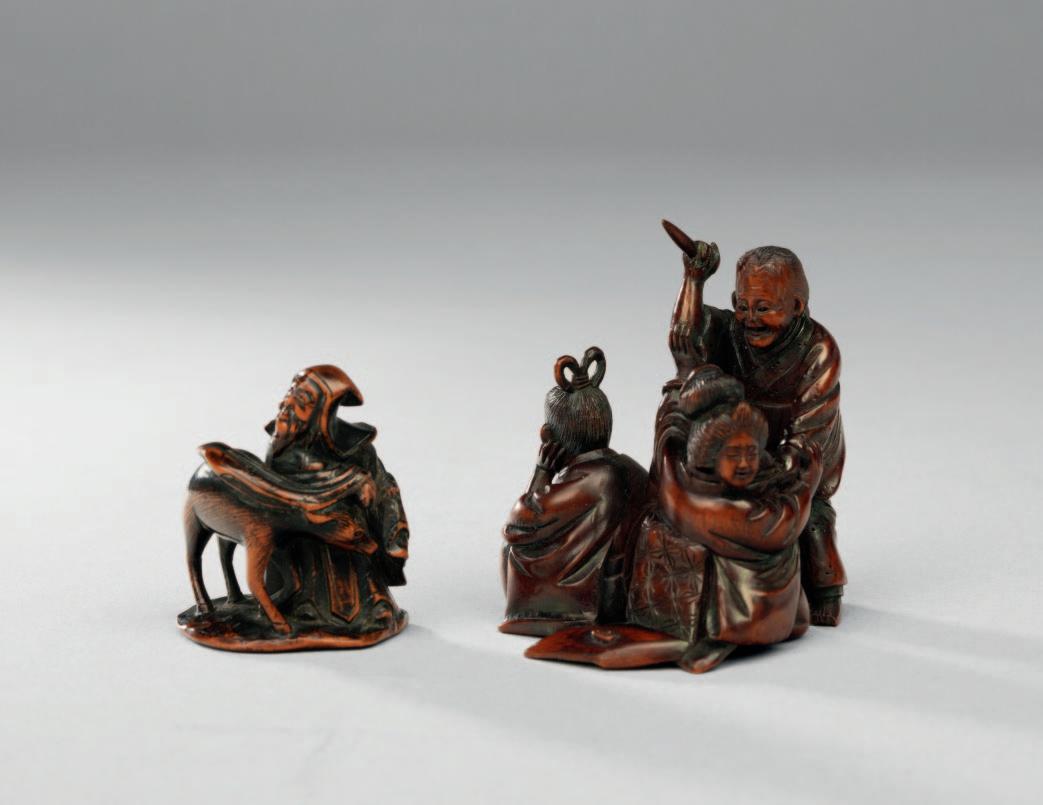
737
A JAPANESE WOOD OKIMONO BY CHIKUSEN AND A NETSUKE MEIJI ERA, 19TH/20TH CENTURY
The okimono realistically carved with three figures, one an old woman attacking a younger one with a knife while a girl peacefully sleeps beside them, the base signed Chikusen; together with a netsuke of Fukurokuju and a deer, signed, 5.7cm and 3.4cm. (2)
WITHOUT RESERVE
£300-500
The okimono depicts the story of the Hag of Adachigahara, a tragic tale of a woman driven to cannibalistic madness by a dark obsession. The scene portrays the horrific moment the hag prepares to kill a pregnant traveller, unaware that the peacefully sleeping victim beside them is actually her own long-lost daughter.
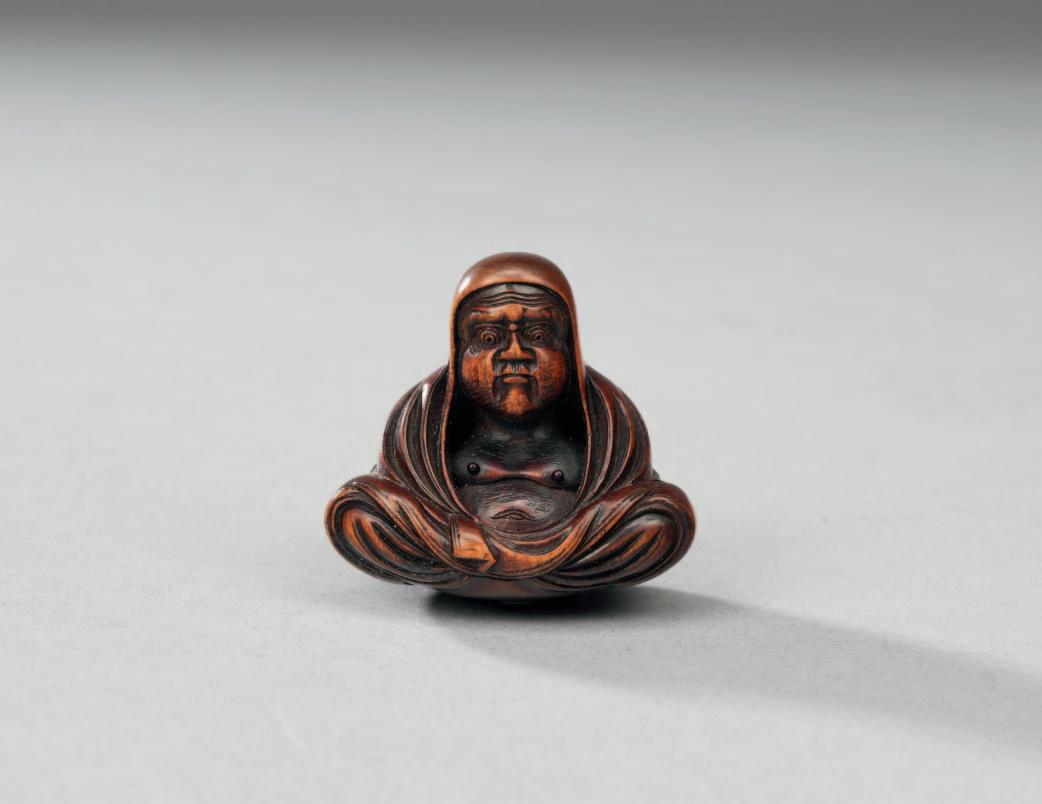
739
λ A JAPANESE WOOD NETSUKE OF DARUMA BY HARA SHUMIN
MEIJI ERA, 19TH/20TH CENTURY
The Father of Zen Buddhism seated in meditation, wearing long robes covering his limbs but revealing his bare torso; the himotoshi with inlaid rings, signed Shumin, 3.9cm.
£400-600
With an ivory registration number.
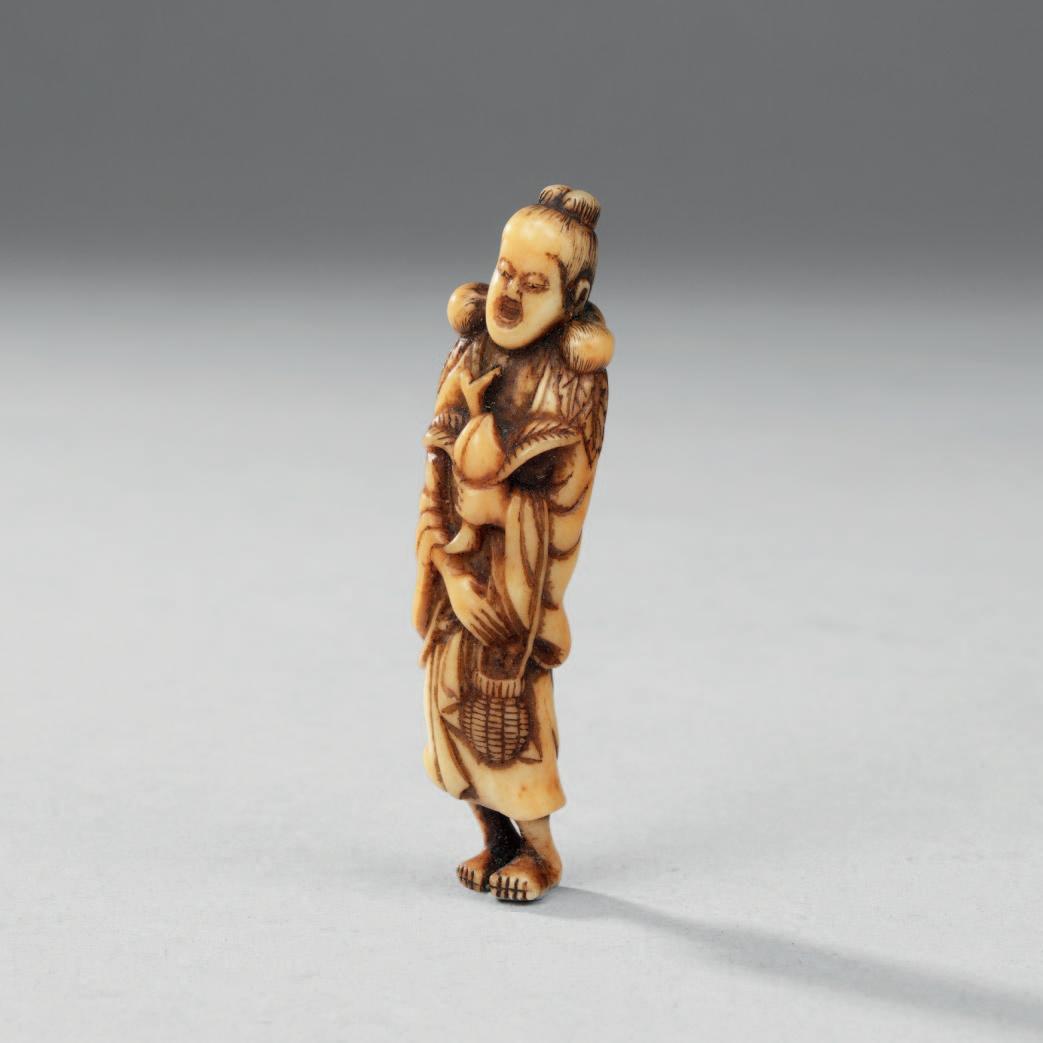
741
A JAPANESE WOOD NETSUKE OF A STAG EDO PERIOD, 18TH CENTURY
The large animal is depicted bent over in half, as if hanging by the waist; the himotoshi located behind its hind legs; 8cm.
£150-250
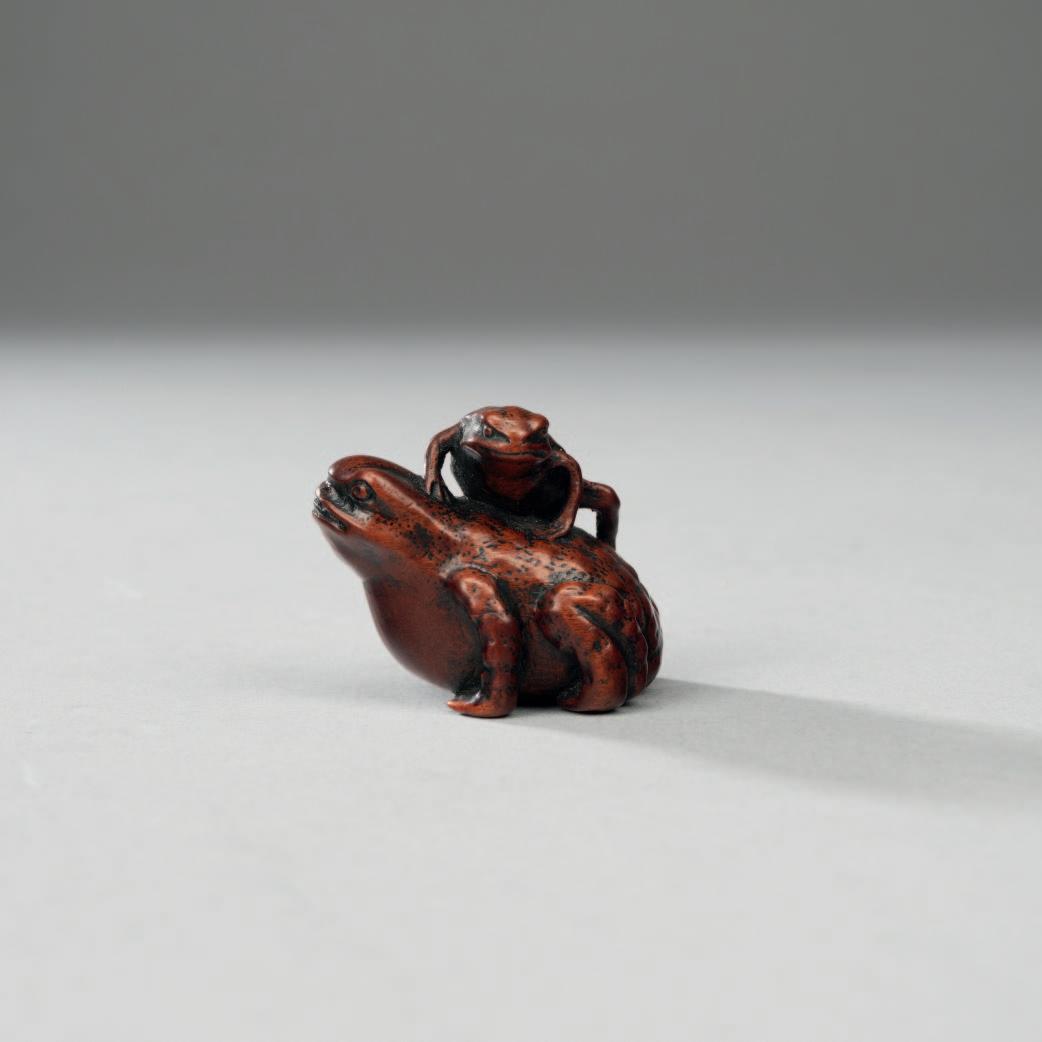
740
A JAPANESE STAG ANTLER NETSUKE OF SEIOBO EDO/MEIJI, 19TH CENTURY
Depicting Seiobo, the Queen Mother of the West, standing wearing long robes and holding a spray of fruiting peach in her hand, a wicker basket hanging from her arm, with a coat of mugwort leaves upon her shoulders and a necklace made of four large balls, 7.1cm.
£300-500
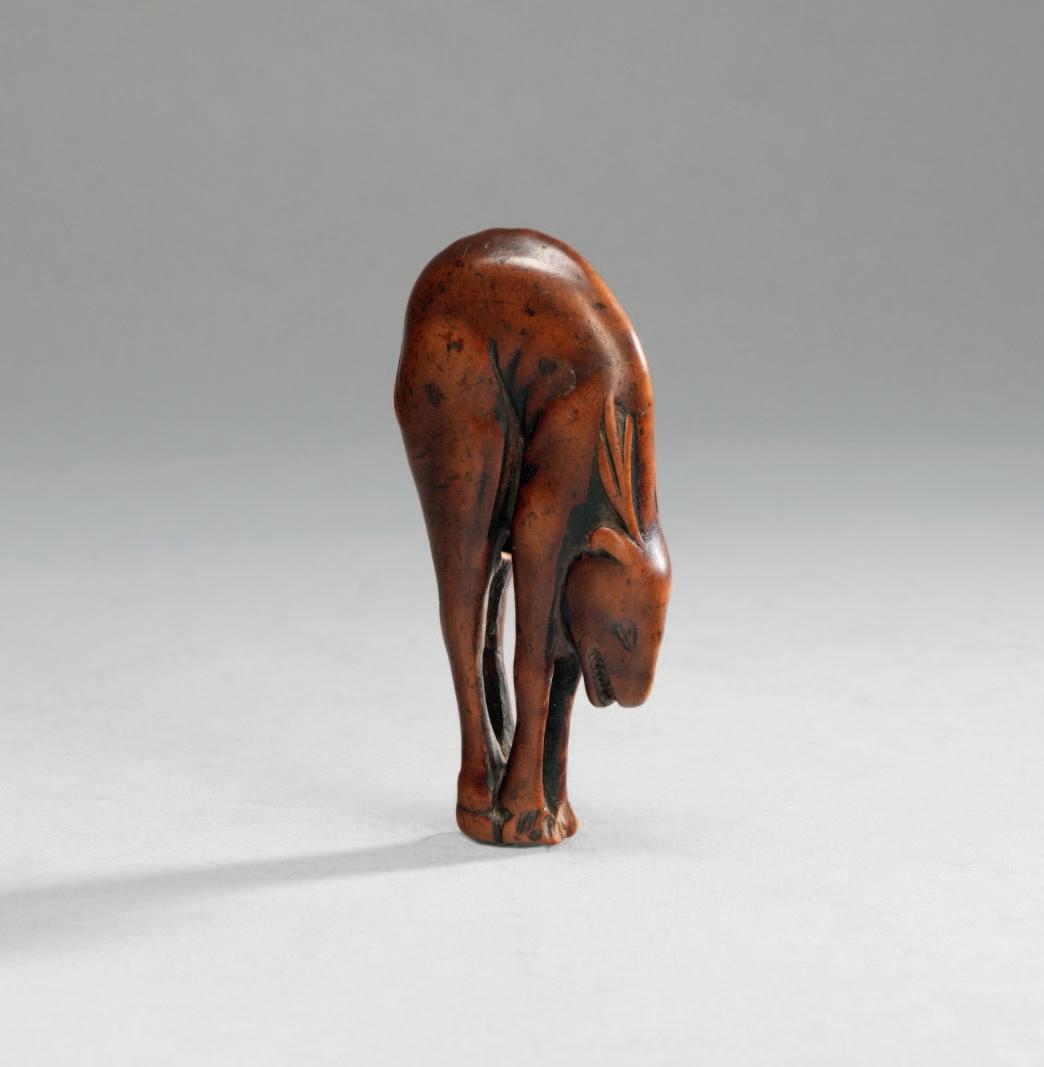
742
A JAPANESE WOOD NETSUKE OF TWO FROGS MEIJI ERA, 19TH/20TH CENTURY
One smaller amphibian clambering on the back of the other, the animals realistically carved with large bumps on their skin, the belly of the larger one with old collection numbers, 4.7cm.
£600-800
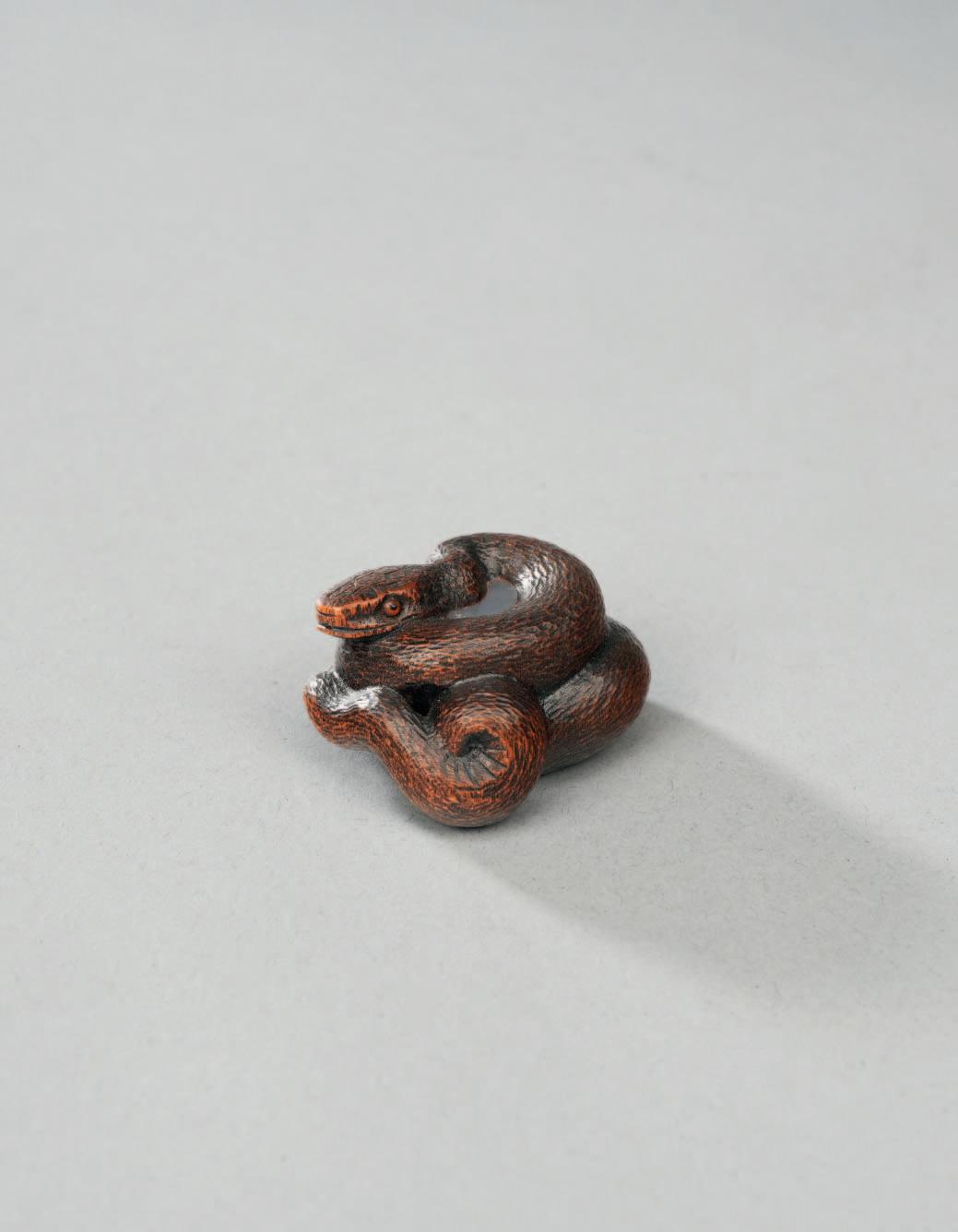
743
744
A JAPANESE NETSUKE OF KUZUNOHA BY MASAKAZU OF NAGOYA EDO/MEIJI, 19TH CENTURY
The Fox Woman depicted seated on her haunches, protectively holding her child Abe no Seimei swaddled in a cloth and with a writing brush in her mouth, her hind legs and bushy tail folded beneath and forming the himotoshi, signed Masakazu on the tail; attached to a woven bamboo tonkotsu (tobacco box), the netsuke 3.5cm, the box 7.5cm.
£500-1,000
Cf. N K Davey, Netsuke, a Comprehensive Study Based on the M. T. Hindson Collection, p.199, no.603. and F Meinertzhagen, The Meinertzhagen Card Index on Netsuke in the Archives of the British Museum, Part A, p.425 for similar examples.
This netsuke is a reference to the kabuki play titled Kuzunoha, based on the legend Shinoda no tsuma (The Shinoda Wife), the story of a fox woman. In the original legend, a white fox transforms into a woman and marries a man, but must return to the Shinoda forest once her true identity is discovered. A variation of the story follows the fortune-teller Abe no Yasuna, who saves a fox that later bears him a son. Before reverting to her animal form, the fox-mother writes a moving farewell poem to her child, gripping the brush in her mouth.
743
A JAPANESE WOOD AND MOTHER OF PEARL SNAKE NETSUKE MEIJI ERA, 19TH/20TH CENTURY
The reptile depicted with its long body tightly coiled, the eyes inlaid in horn and with a mother of pearl inlay to the top, an old paper collection label underneath, 4.5cm.
£800-1,200
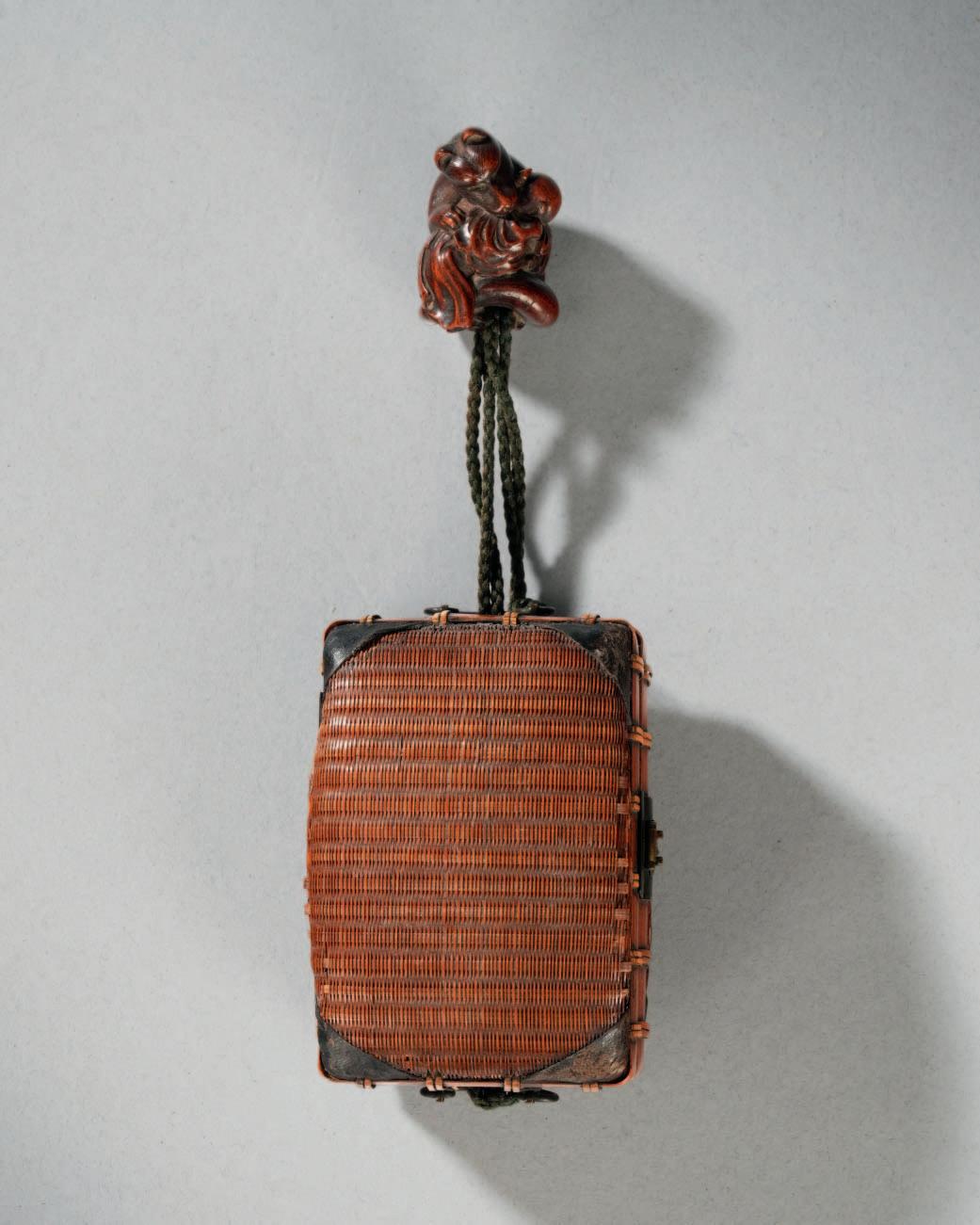
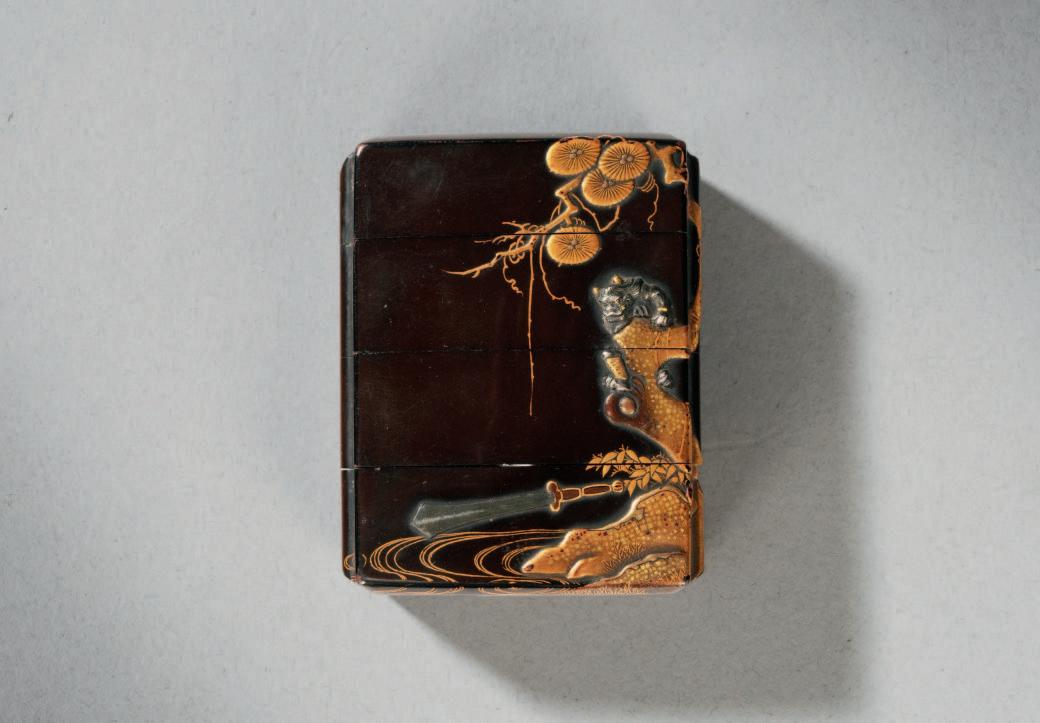
745
A JAPANESE THREECASE LACQUER INRŌ
MEIJI ERA, 19TH CENTURY
With a continuous design depicting two oni, one hiding amongst rockwork whilst the other climbs onto a large pine tree, looking at a sword lying in a stream below; one of the demons rendered in silver inlaid on the black roiro ground, with details rendered in gold lacquer kirikane, iroe hiramaki-e and takamaki-e; the base inscribed enreitan (life elixir pill) and signed Makie Shigetsugu, Mon Masayuki / Shozui (Lacquer by Shigetsugu, metal inlays by Hamano Masayuki / Hamano Shuzui), 6.8cm.
£200-400
Provenance: by repute, acquired in Asia c.1880 by Lieutenant Colonel Francis G Howard, and thence by descent.
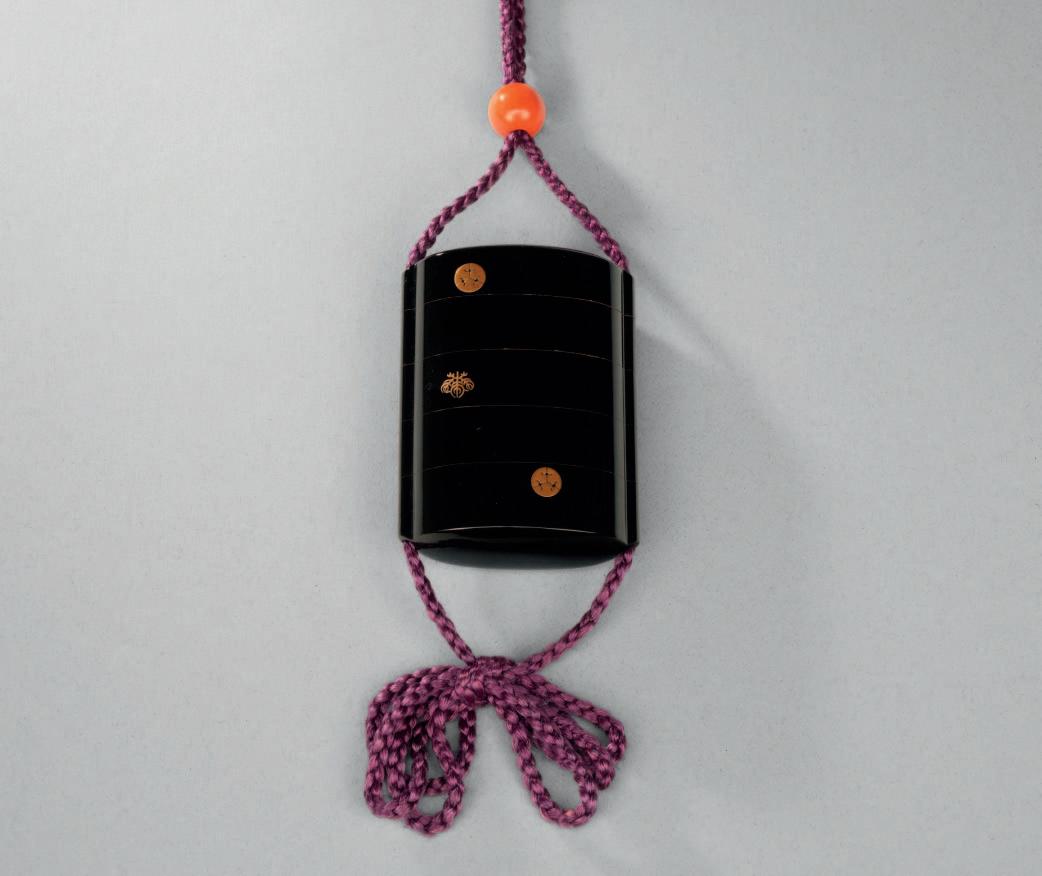
747
A JAPANESE FOURCASE LACQUER INRŌ
MEIJI ERA, 19TH/20TH CENTURY
Decorated with small mon scattered across the surface, the family crests rendered in gold hiramaki-e lacquer on the black roiro ground, 7.7cm.
£500-800
Provenance: by repute purchased from Sydney L Moss, London.
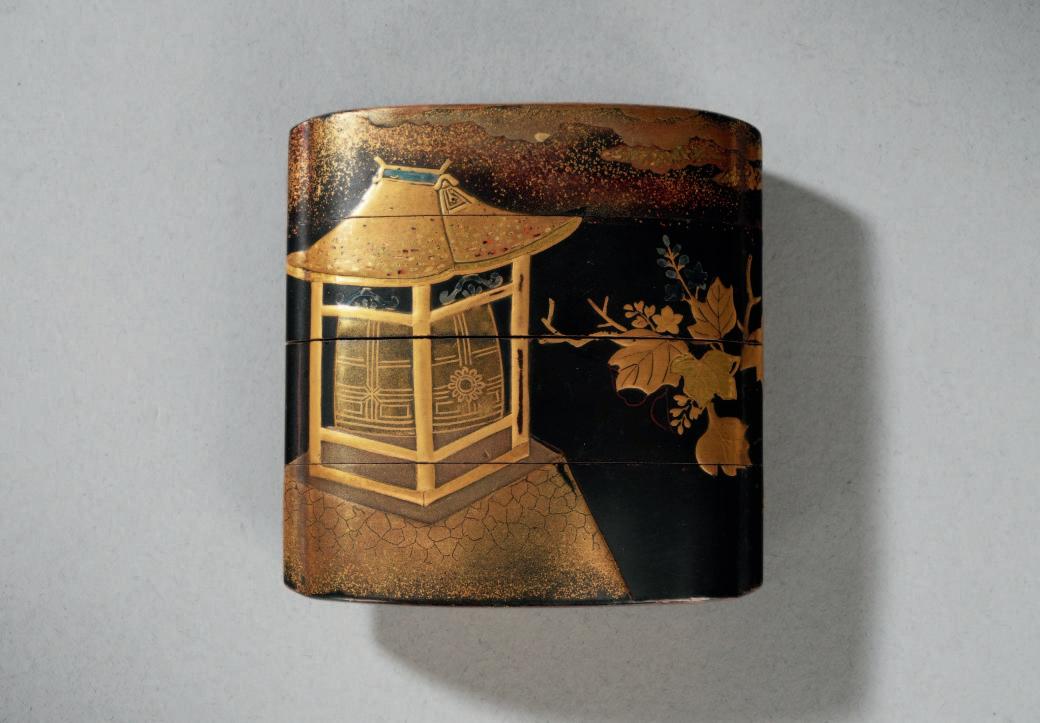
746
A JAPANESE THREECASE GOLD AND BLACK LACQUER INRŌ
MEIJI ERA, 19TH CENTURY
Decorated with a continuous design of a shōrō (bell tower) beside a flowering paulownia tree, all rendered in gold hiramaki-e, nashiji, kirikane lacquer and aogai (mother of pearl) on the black roiro ground, 7.6cm.
WITHOUT RESERVE
£150-250
Beyond their religious use, shōrō functioned as vital civic infrastructures for timekeeping and sounding alarms for fires, natural disasters, or approaching enemy forces.
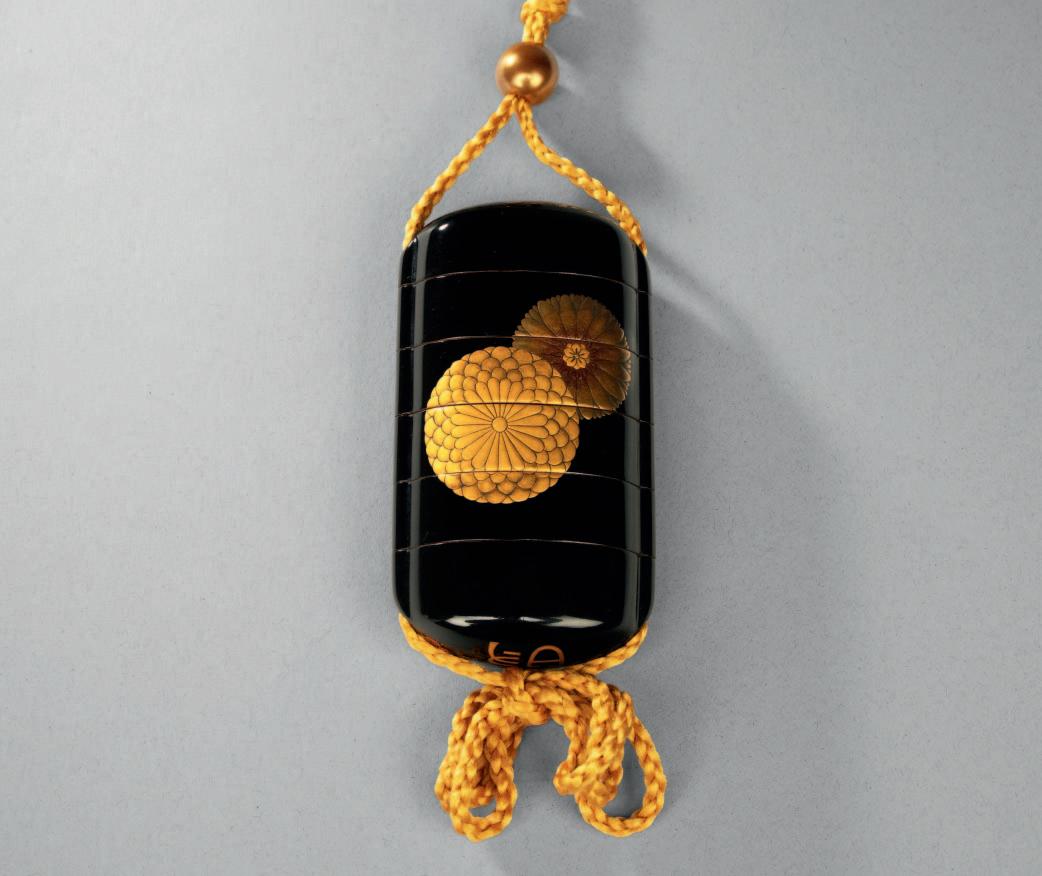
748
A JAPANESE FIVECASE LACQUER INRŌ
MEIJI ERA, 19TH/20TH CENTURY
Decorated with twentypetalled chrysanthemum mon, the family crests rendered in gold hiramaki-e lacquer on the black roiro ground, with kotobuki characters to the sides, signed Inagawa saku to the base with a redjar Nakaharu seal, 9.5cm.
£800-1,200
Provenance: by repute purchased from Sydney L Moss, London.
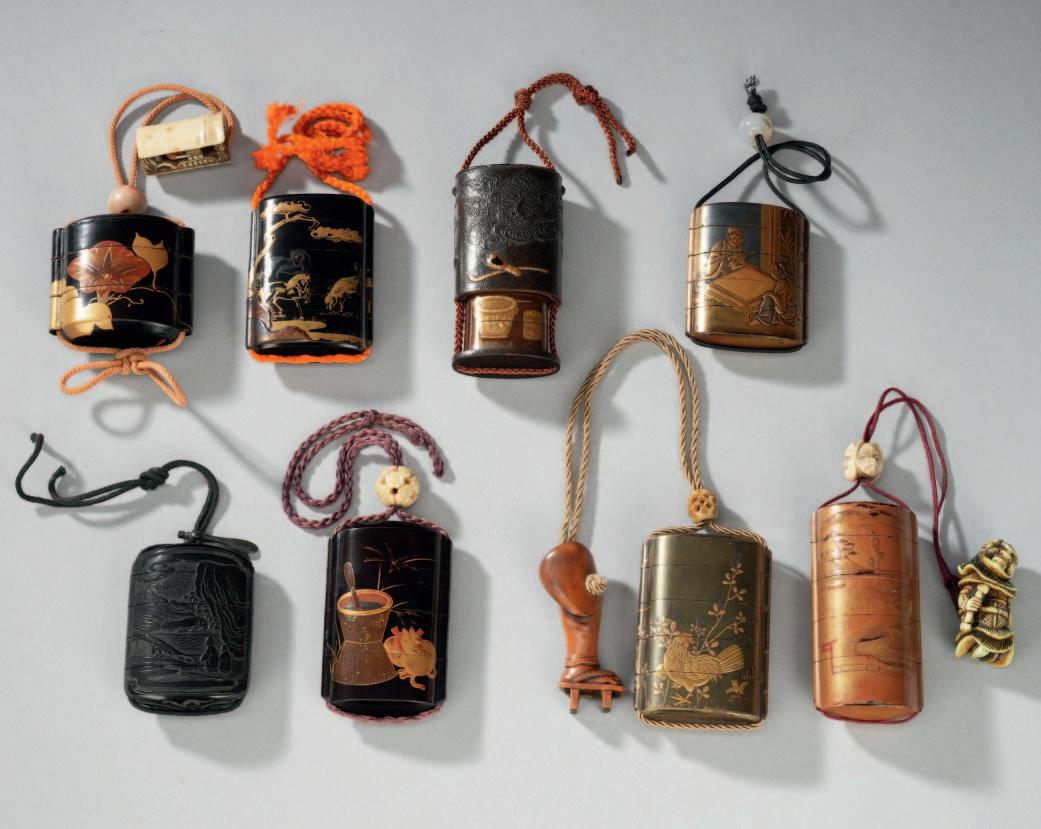
749
A COLLECTION OF EIGHT JAPANESE INRŌ
EDO/MEIJI, 19TH CENTURY
Mostly decorated in gold and black lacquer, one an unusual saya (sheath) inrō with a rough ishime surface imitating stone or bronze, the side with a dragon and opening to reveal three goldlacquer cases embellished with implements for the tea ceremony; the others variously decorated with birds, landscapes, flowers, horses, and figures, attached to various bone and stag antler netsuke, one shaped as a human leg. (8)
£500-800
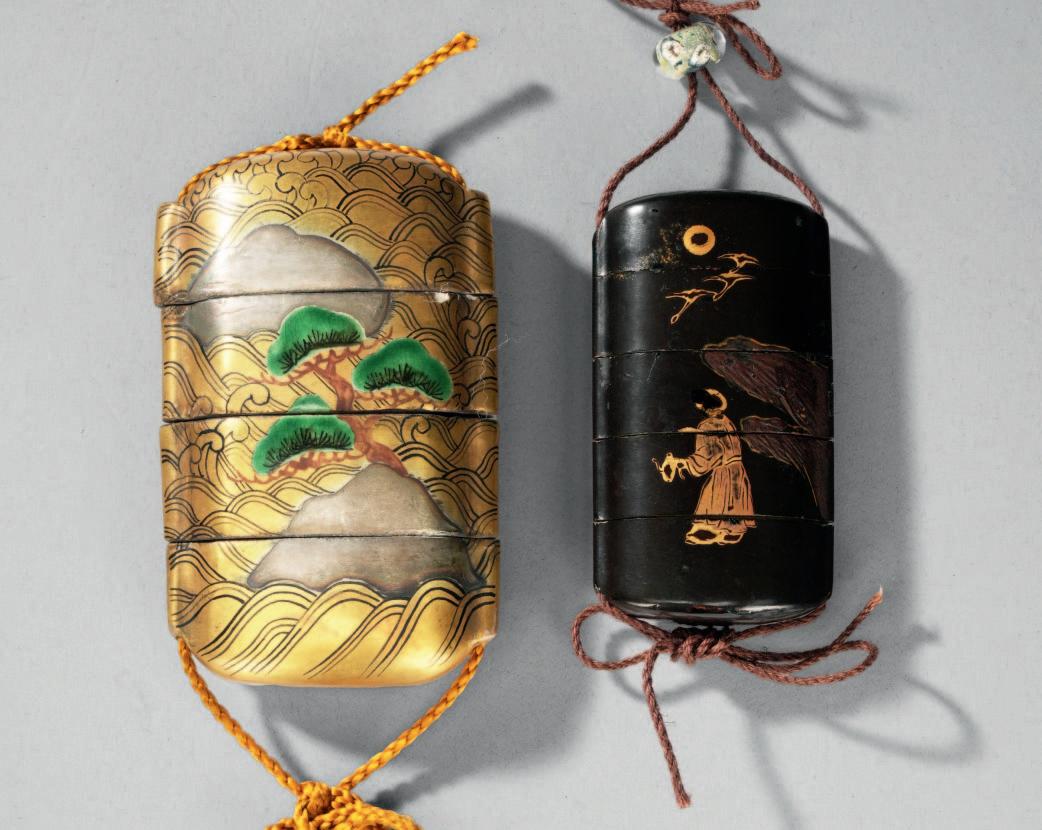
751
TWO JAPANESE INRŌ
MEIJI AND POSSIBLY LATER, 19TH AND 20TH CENTURY
One a threecase inrō in porcelain decorated with waves crashing against rocks with pines, green enamel, silver and gold lacquer; the other a fourcase inrō with figures, the remnants of a Kajikawa signature underneath, 10.8cm and 8.7cm. (2)
WITHOUT RESERVE
£200-300
Provenance: from an English private collection, Devon.
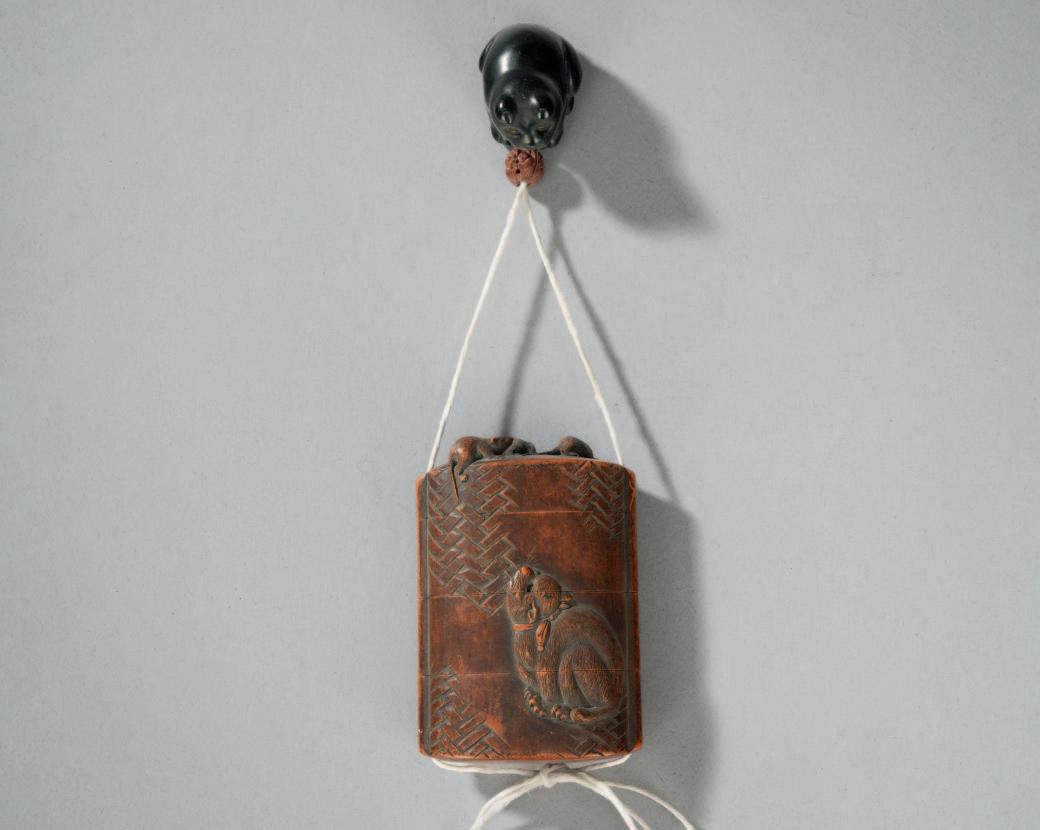
750
AN UNUSUAL JAPANESE THREECASE WOOD INRŌ
MEIJI ERA, 19TH/20TH CENTURY
Carved to one side with a cat looking up at rats carved at the top of the inrō, the reverse featuring a small cupboard with a moveable door opening to reveal another rodent inside; attached to a wood netsuke modelled as a puppy, the eyes inlaid and with a red tongue, signed Minko underneath, the inrō 8.4cm.
£400-600
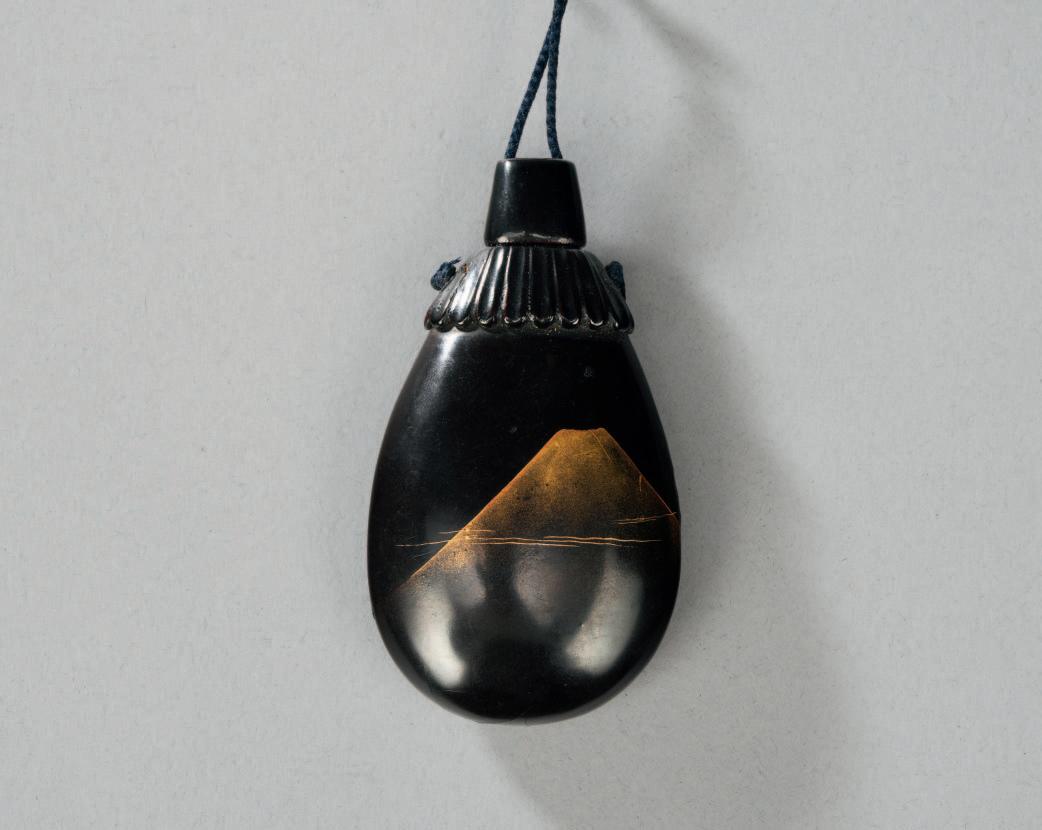
752
EDO PERIOD, 18TH/19TH CENTURY
The pearshaped body with lappets to the top, a thin cylindrical spout and a lid; decorated with Mount Fuji to one side and a bird in flight to the other, in gold lacquer hiramaki-e on the black roiro ground; 9.8cm.
WITHOUT RESERVE
£150-250
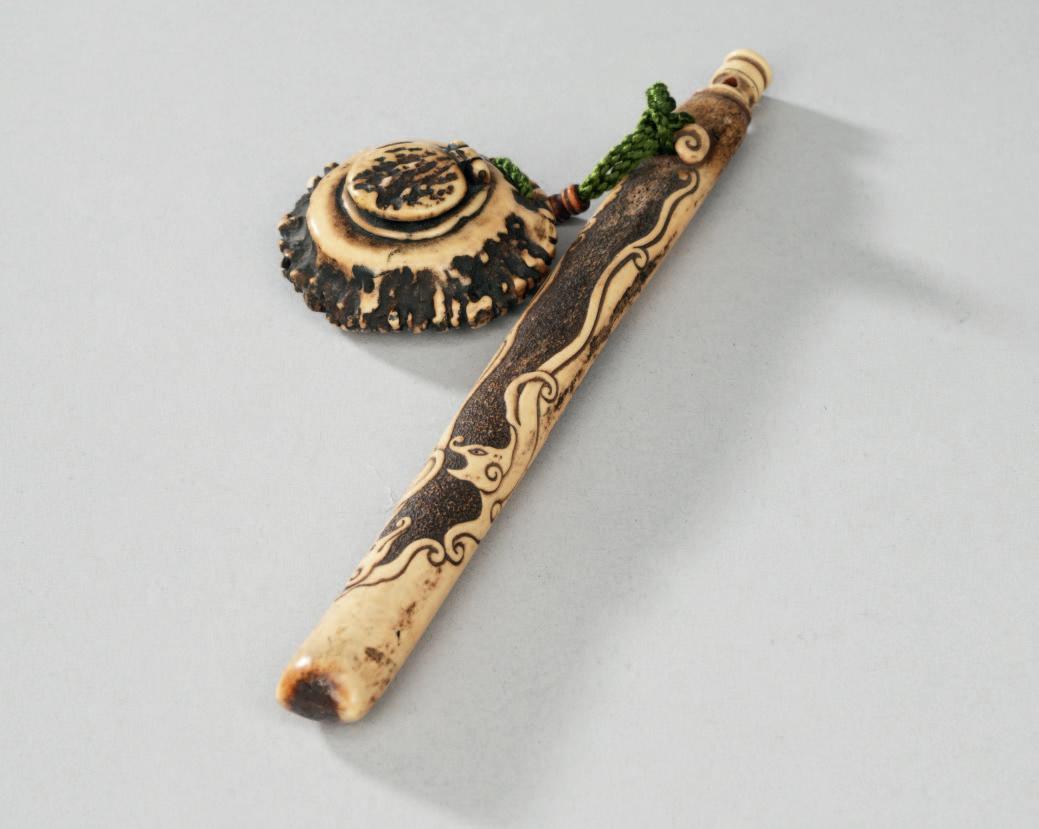
753
A JAPANESE STAG ANTLER YATATE
MEIJI ERA, 19TH/20TH CENTURY
The brush holder of long flattened form, carved with two stylised scrolling dragons, with a detachable lid at the top with an inner fitting for a brush; attached to an ink container with a hinged lid, carved from the burr of the antler, 18.8cm. (2)
£200-300
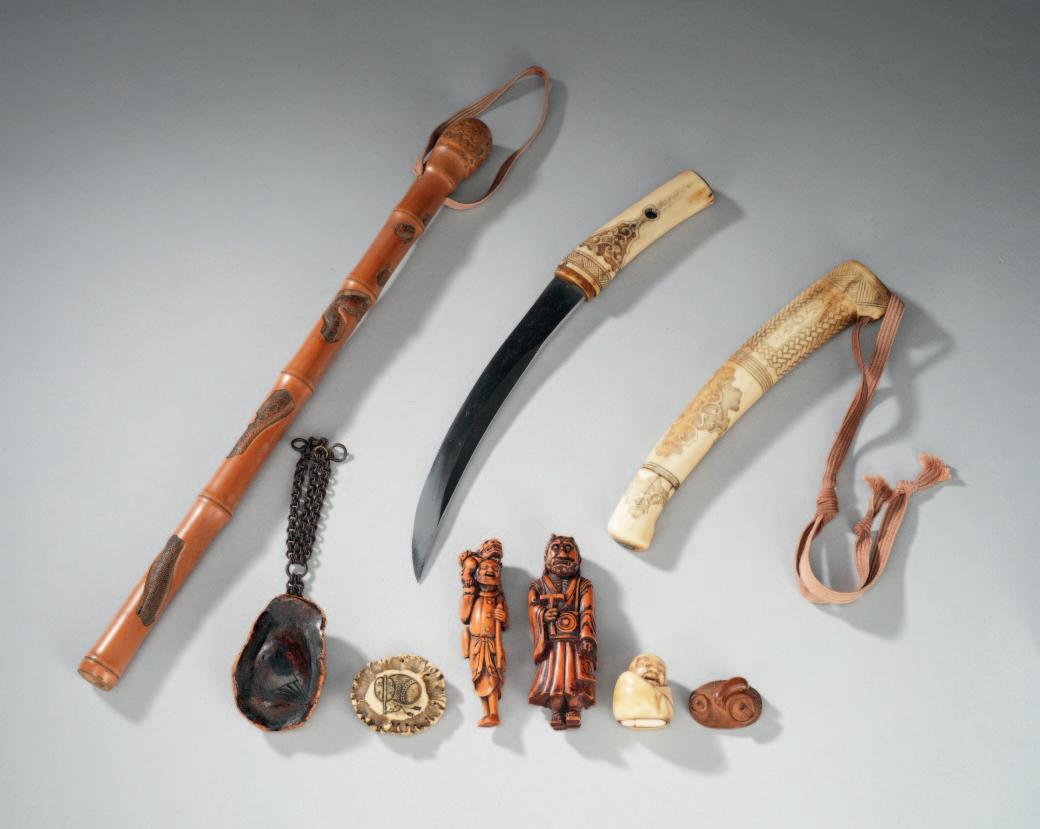
755
A COLLECTION OF VARIOUS JAPANESE ITEMS IN WOOD AND STAG ANTLER
EDO AND LATER, 19TH AND 20TH CENTURY
Comprising: a tanto, the scabbard carved with a lattice pattern and scrolling tendrils; a bamboo cane handle with a snake biting a frog’s leg; and six netsuke, two made of stag antler, one with a fan and drum signed Mingyoku, the other a Daruma doll; and four other netsuke made of wood, one with a chain, 43.5cm max. (9)
WITHOUT RESERVE
£300-500
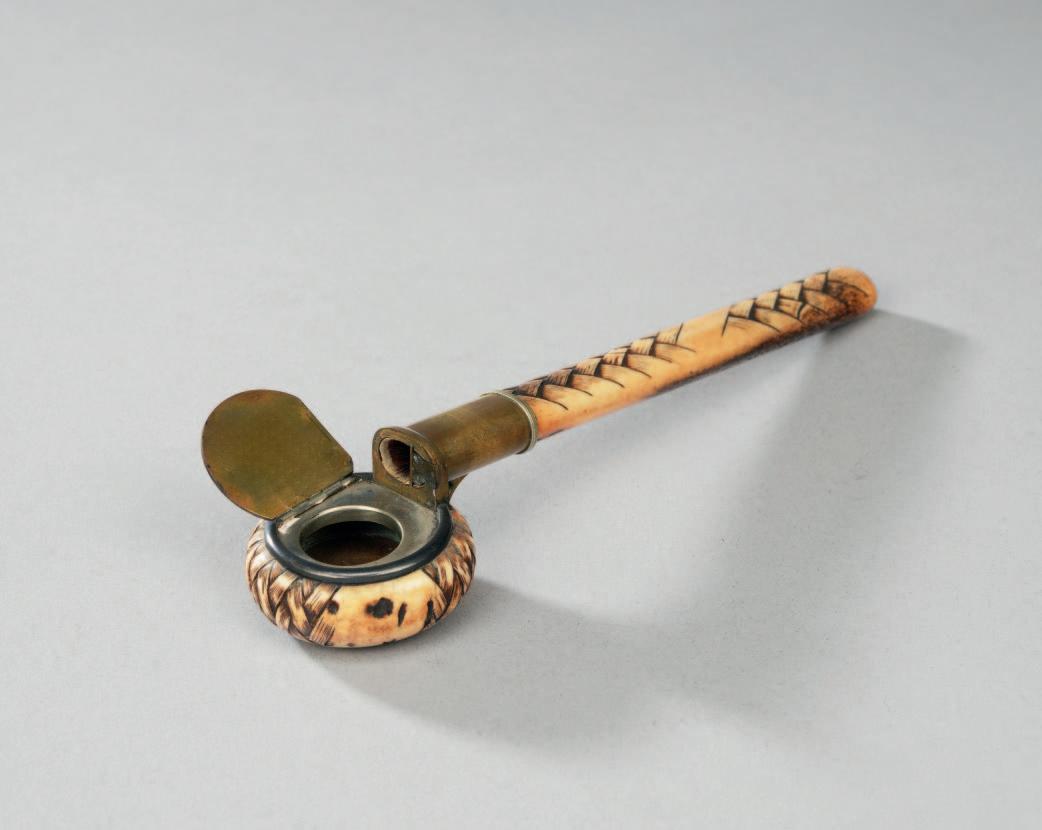
754
A JAPANESE STAG ANTLER YATATE
MEIJI ERA, 19TH/20TH CENTURY
The brush holder and ink container with decoration imitating woven bamboo, with metal mounts and a hinged door opening to reveal the inkwell, the brush tube and a minute blade which slides to the side, 17.2cm. (2)
£200-300
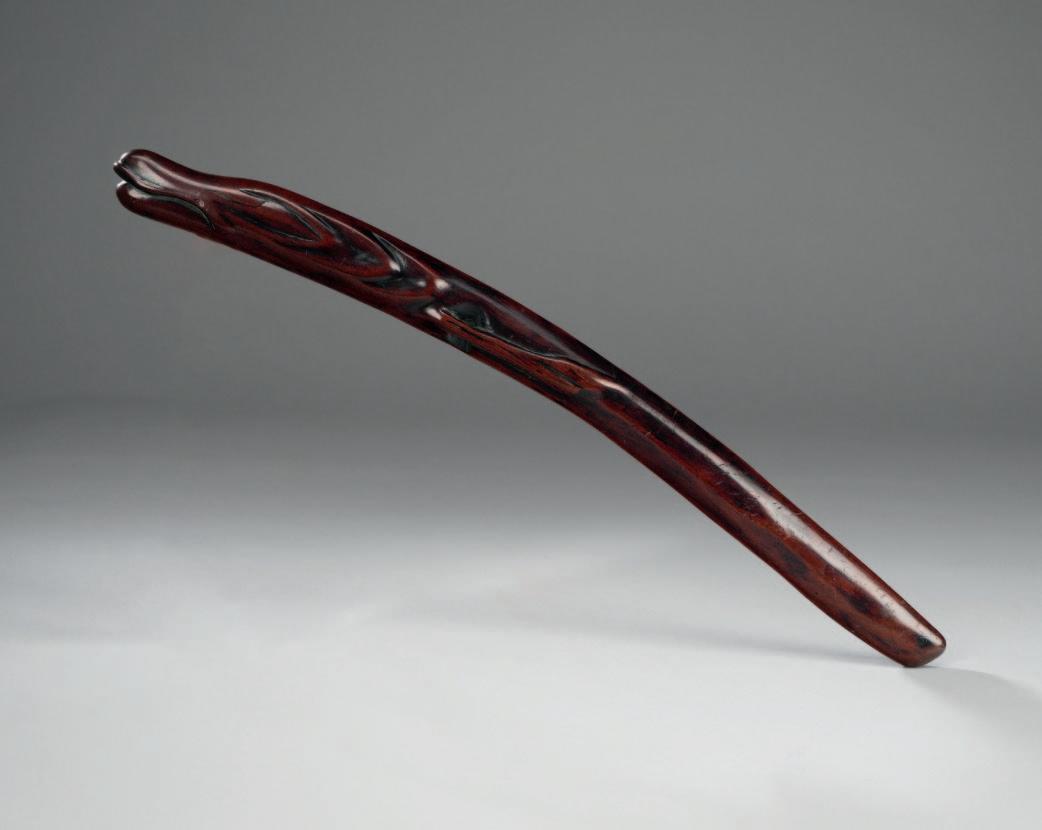
756
A JAPANESE WHALE CHATŌ (WOODEN SWORD)
EDO/MEIJI, 18TH/19TH CENTURY
Carved as a stylised whale, with folds to the side representing the ventral pleats; the hardwood with a lustrous surface, and with a hole for suspension, 49.5cm. Chatō were imitation swords worn by doctors, actors and travelling merchants in the 1700s and 1800s. Real swords could only be carried by samurai, and at night, it gave the impression of a real sword that would warn off potential attackers.
£500-800
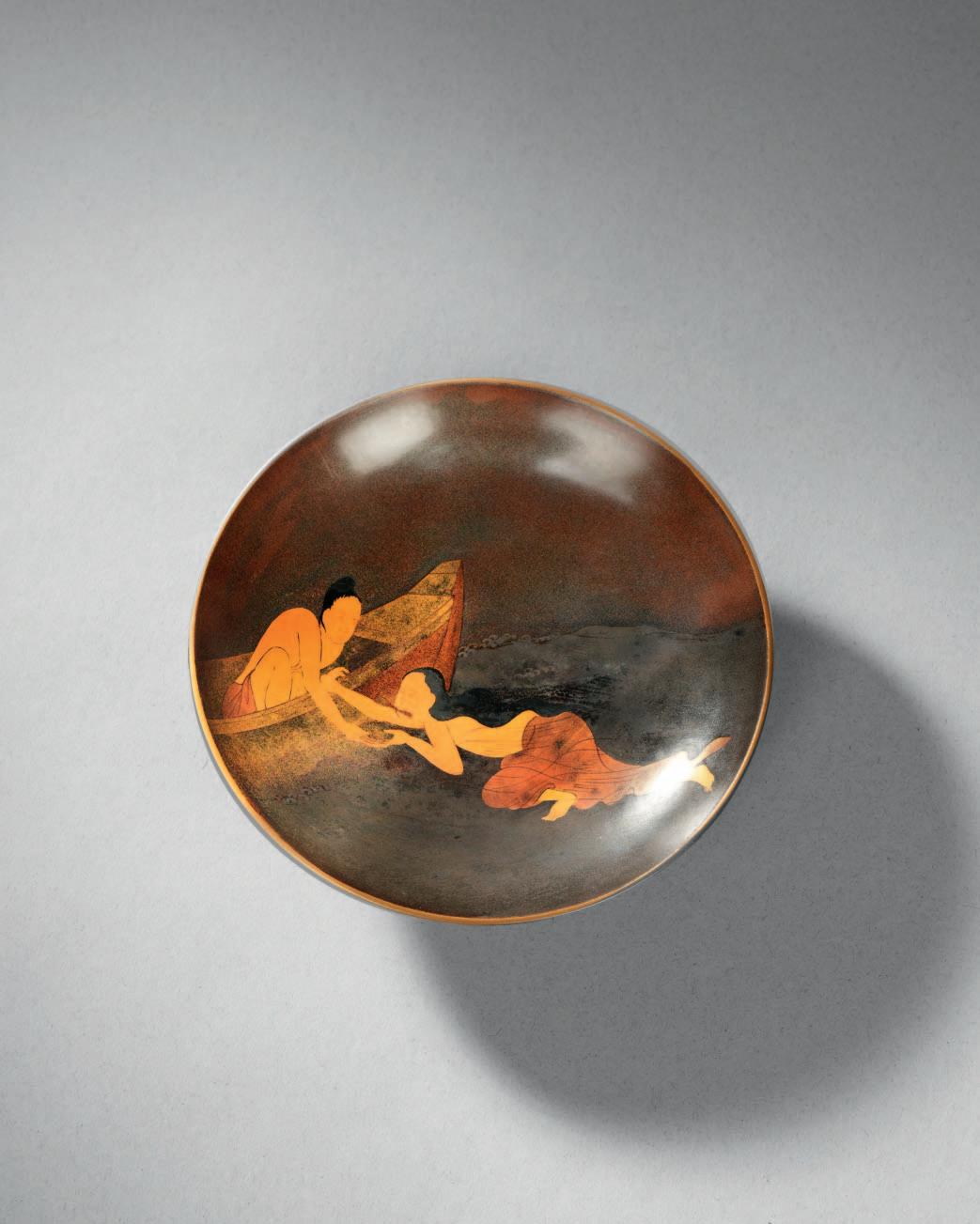
757
A JAPANESE LACQUER SAKAZUKI (SAKE CUP)
MEIJI ERA, 19TH/20TH CENTURY
The well decorated with two ama, one pearl diver depicted in the water and handing a shell over to her companion crouching on a small boat; all rendered in gold, silver and chocolatebrown lacquer; raised on a short straight foot and inscribed Zeshin to the base, 11.5cm.
£150-250
Provenance: by repute purchased from Sydney L Moss, London.
758
A RARE AND UNUSUAL PAIR OF JAPANESE INLAIDWOOD VASES
MEIJI ERA, 19TH/20TH CENTURY
Each with a rectangularsection body raised on bracket feet and with a flared rim; both decorated with panels enclosing birds, flowers and butterflies in relief, and with scrolling clouds to the necks; some details rendered in gold and silver inlays contrasting with the black wooden ground; each vase signed Kaiseki in a rectangular gilt tablet to the side, 14.6cm each. (2)
£6,000-8,000
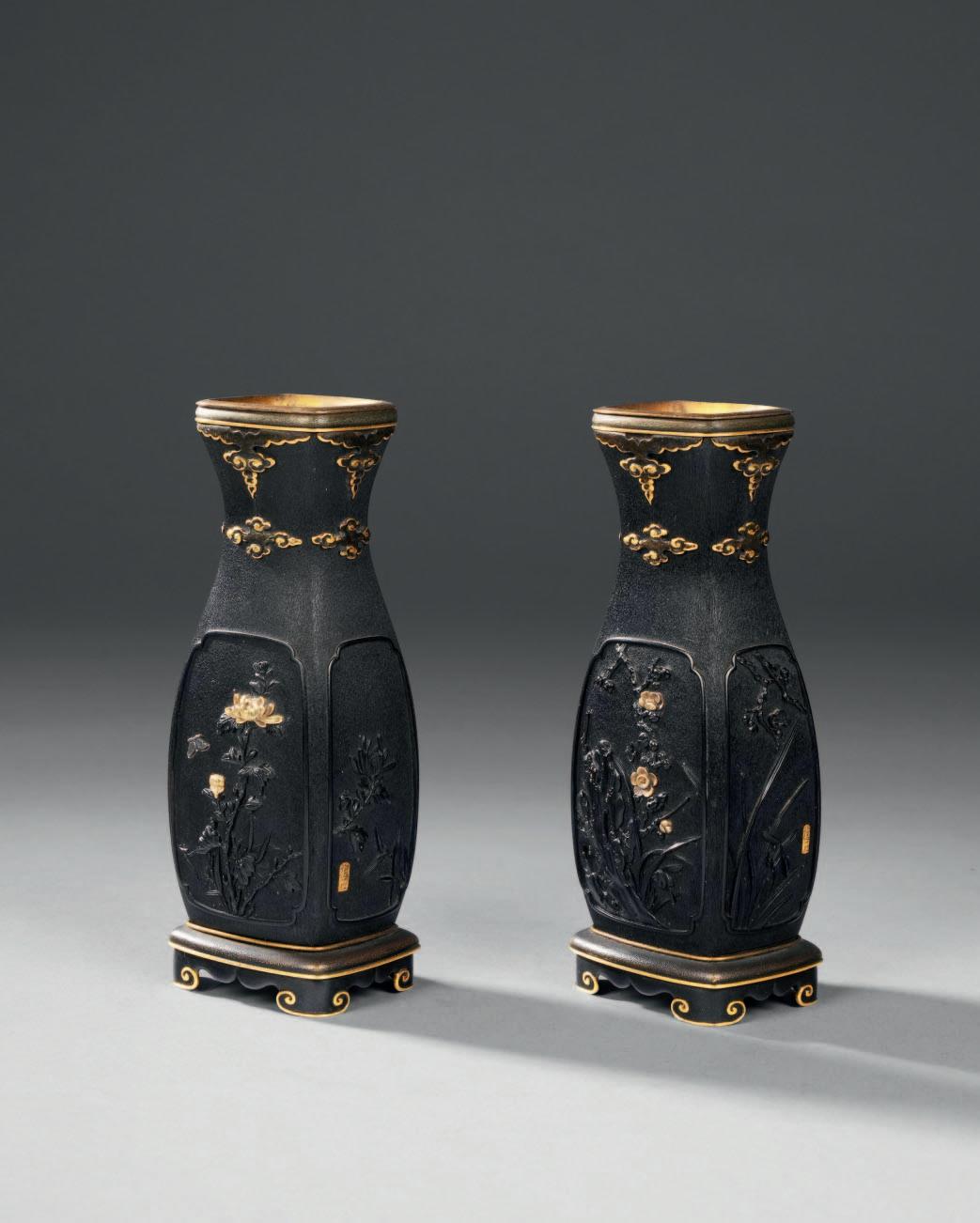
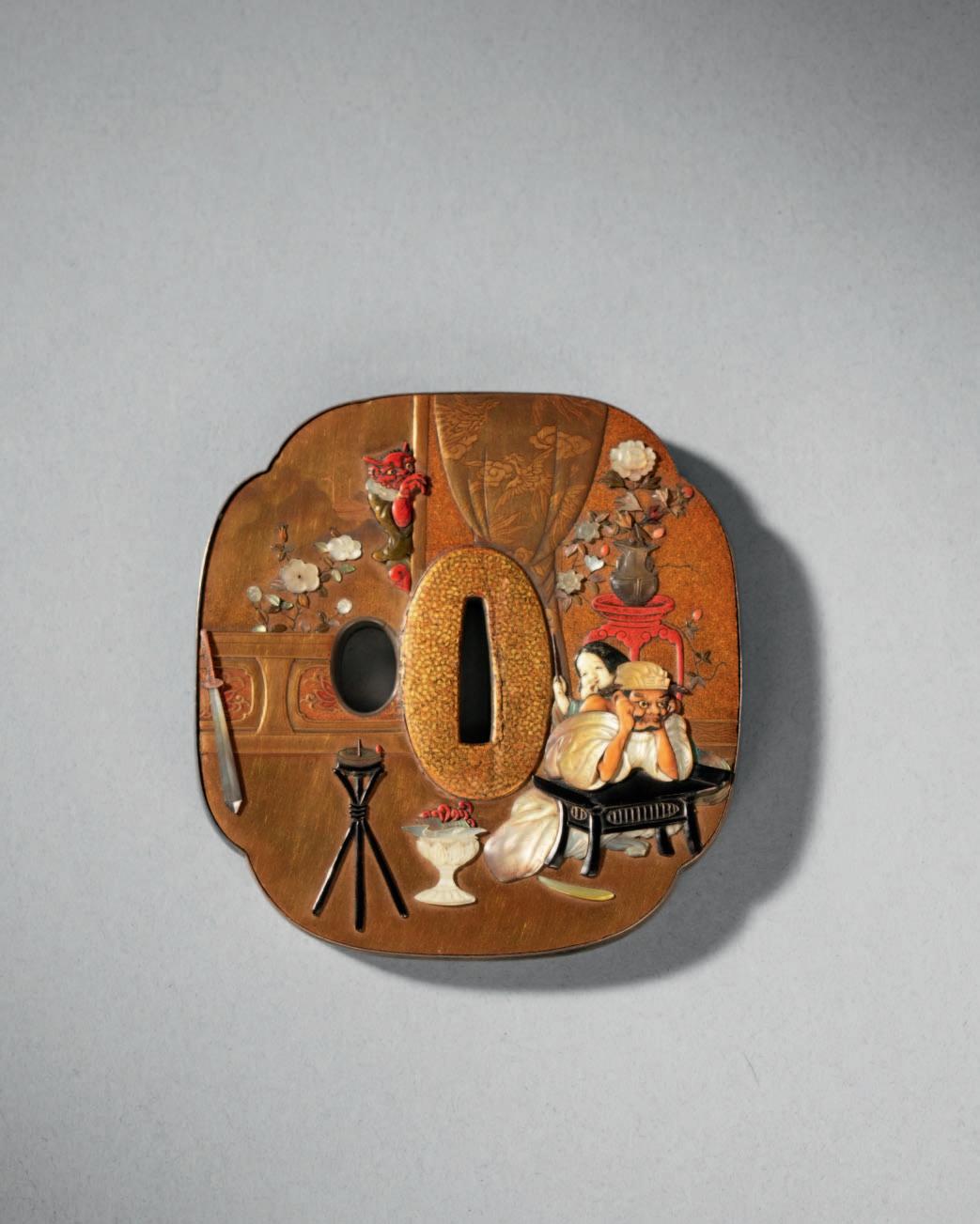
760
λ A PAIR OF JAPANESE SHIBAYAMASTYLE LACQUER VASES AND COVERS
MEIJI ERA, 19TH CENTURY
Both with a bulbous body raised on a tall conical foot, and with a circular cover; each decorated with two large panels, one with a scholar observing a scroll painting from which emerges an oni nembutsu causing panic, with figures fleeing in terror behind him, the other panel with birds and flowers by a stream; the second vase decorated with the same repentant demon and his travelling companion on a ferry boat, the reverse with further birds and flowers; all reserved on a rich ground of butterflies, scrolling tendrils, lappets enclosing alternating brocade patterns and further blooms; all rendered in a variety of lacquer techniques including iroe hiramaki-e, nashiji, kirikane and others, with inlays in mother of pearl, coral and other materials; the cover embellished with further brocade patterns and topped with fingercitron knops; each with a paper label underneath mentioning Sotheby’s, 27.7.48, lot L50; 19cm each. (4)
£6,000-8,000
With an ivory registration number.
759
λ AN EXQUISITE SHIBAYAMASTYLE LACQUER TSUBA (SWORD GUARD)
MEIJI ERA, 19TH/20TH CENTURY
Of mokkō-gata shape with a metal mount, one side decorated with Emmaō, the King of Hell resting on a low table and looking visibly annoyed whilst the Goddess of Mirth Okame stands behind him, with a red oni in the background, the demon also looking mischievous; in an interior decorated with a vase of flowers, ornate curtains and Emmaō’s sword to the side, a pavilion nestled amongst mountains visible in the distance; the reverse with a kingfisher perched on a fruiting branch of nandina (heavenly bamboo) and with white narcissus below; all intricately rendered in mother of pearl, coral, horn and other minute inlays on the iroe-hiramakie, nashiji and kirikane lacquer ground; signed Shinichi in a red cartouche, 9.6cm.
£6,000-8,000
With an ivory registration number.
See p.1 (Chronology of Japan) for another view of this lot.
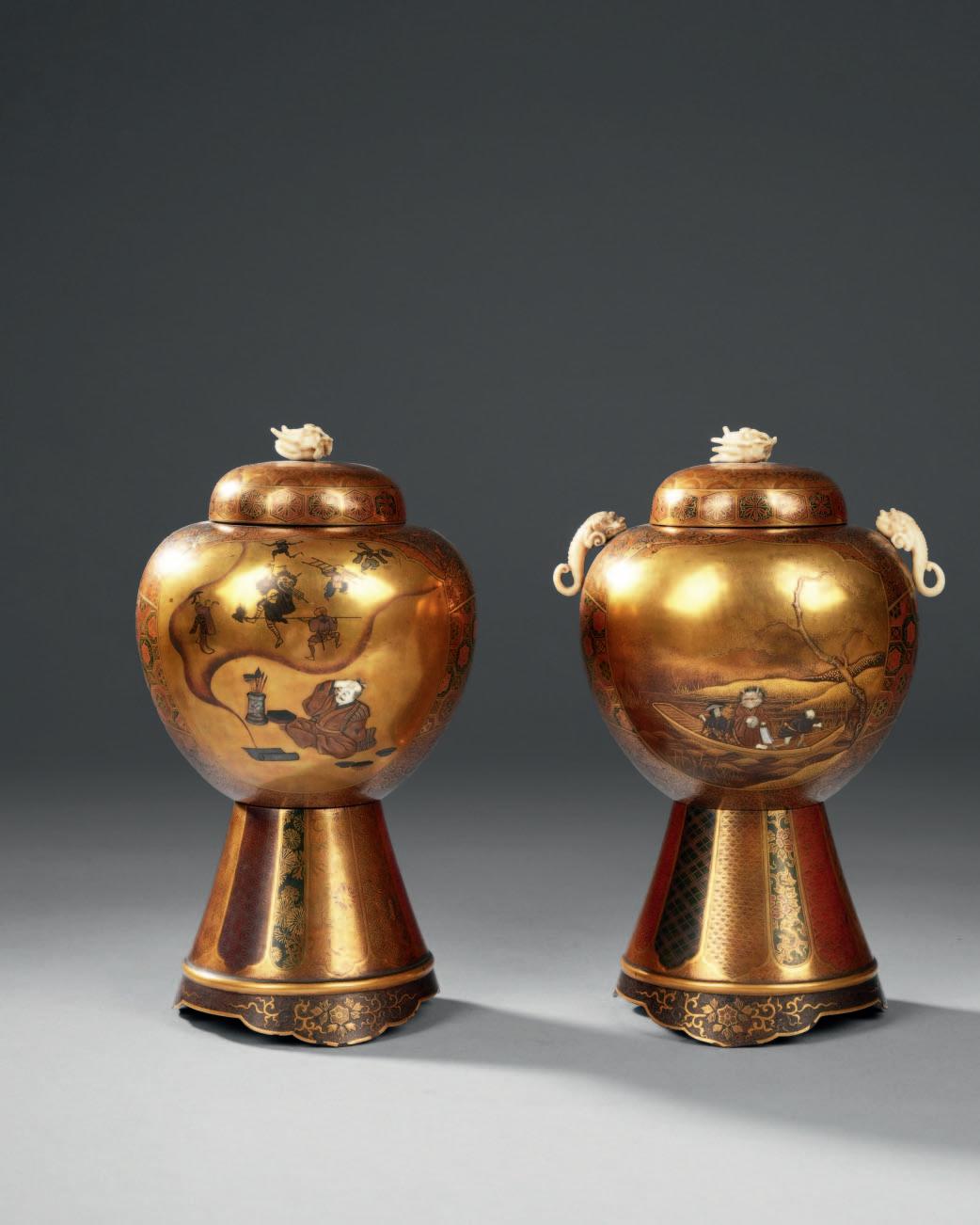
761
A JAPANESE GOLD LACQUER NATSUME (TEA CADDY AND COVER) MEIJI ERA, 19TH/20TH CENTURY
Of typical form, decorated with scattered fans decorated with landscapes, birds and flowers; all rendered in gold hiramaki-e, fundame, kirikane, and nashigi lacquer, and with small aogai (mother of pearl) inlays on the black roiro ground, 7cm. (2)
£500-800
762
A JAPANESE WOOD MODEL OF A CRAB AND AN INDIAN CARD CASE 19TH AND 20TH CENTURY
The crustacean realistically depicted with its legs tightly folded against its body; the rectangular case richly carved with panels enclosing birds, figures, a dog and a tiger, on complex grounds of flowers and leafy tendrils, framed by borders of geometric and floral patterns, 7.5cm and 12.2cm x 8.2cm. (3)
£200-400
763
A JAPANESE RECTANGULAR LACQUER BOX AND COVER TAISHŌ/SHŌWA, 20TH CENTURY
Decorated in iro takamakie (raised coloured lacquer) and gold nashiji, with a pagoda on a rocky outcrop, a waterfall and a bridge crossing a river beside it; in a tomobako (wood box) signed Komiya, 13cm. (3)
£400-600
764
A JAPANESE LACQUER KŌGŌ (INCENSE BOX AND COVER) MEIJI ERA, 19TH/20TH CENTURY
Of circular flattened form, the lid decorated with irises rendered in gold hiramaki-e and nashiji on the black roiro ground, the rims with metal rings; a faint threecharacter mark hidden amongst the decoration and with a red seal mark, 7.8cm. (2)
£600-800
765
AN UNUSUAL JAPANESE WOOD CARVING OF AN AINU 20TH CENTURY
With a long beard, sitting crosslegged with his hands resting on his knees; his robes embellished with traditional Ainu patterns; 19.5cm.
£100-200
766
A JAPANESE TSUISHU LACQUER KŌGŌ (INCENSE BOX AND COVER) MEIJI ERA, 19TH/20TH CENTURY
Of square form, the cinnabar lacquer surface carved with many flowers on a hana-kikko ground, the inside and base in black roiro lacquer, 2.5cm x 7.6cm x 7.6cm. (2)
£300-500
767
A HUMORISTIC WOOD CARVING 20TH CENTURY
Probably SouthEast Asian, depicting a large primate with anthropomorphic features lifting a man above its head, a large lizard carved below, 48cm. WITHOUT RESERVE
£150-250
768 TWO JAPANESE LACQUER NATSUME (TEA CADDIES)
The first decorated with a mask of Hannya amongst maple leaves, possibly signed Sōtetsu; the other decorated with origami paper cranes, with a fitted tomobako (wood box) inscribed orizuru maki-e hira-natsuke and signed Shō sai; together with a wood okimono of a woman helping a blind man, with details picked out in gold lacquer, 11cm max. (6) WITHOUT RESERVE
£300-500
769
A JAPANESE WOOD JAR AND COVER WITH SHŌJŌ MEIJI ERA, 19TH/20TH CENTURY
The tall jar shaped as a sake container, the sides decorated in relief with four shōjō depicted in various degrees of drunkenness, the lid surmounted by another shōjō carved in the round, 26cm overall. (2)
£200-300
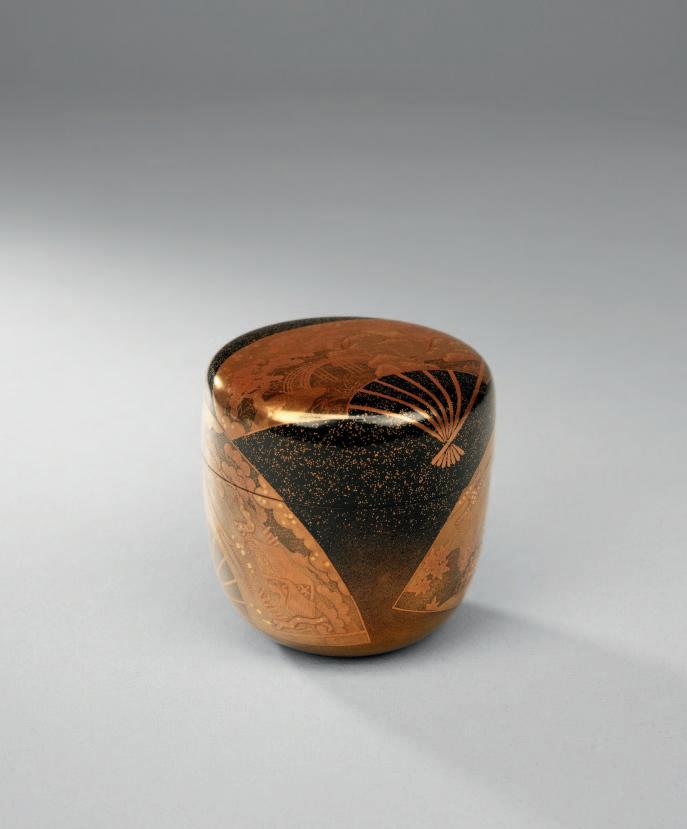
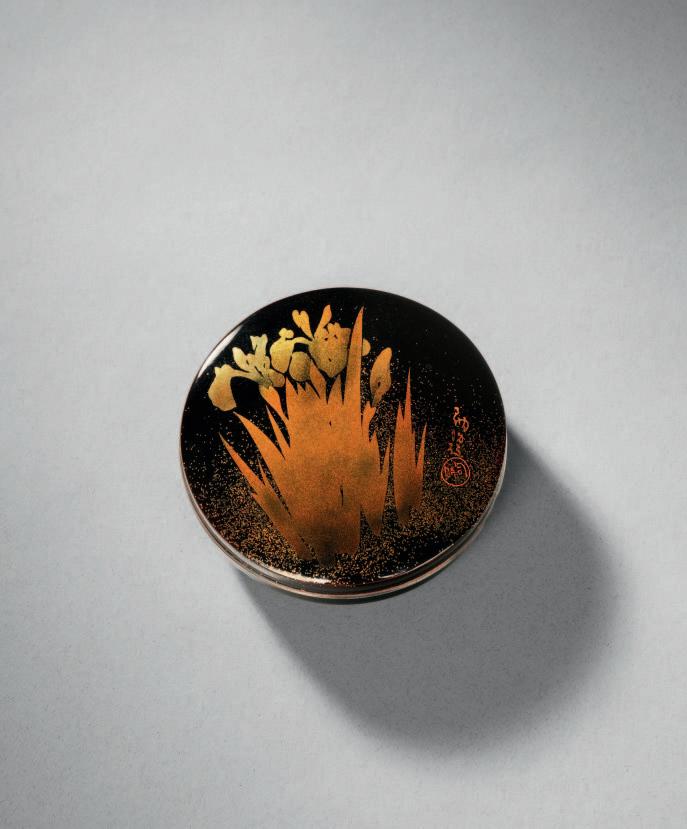
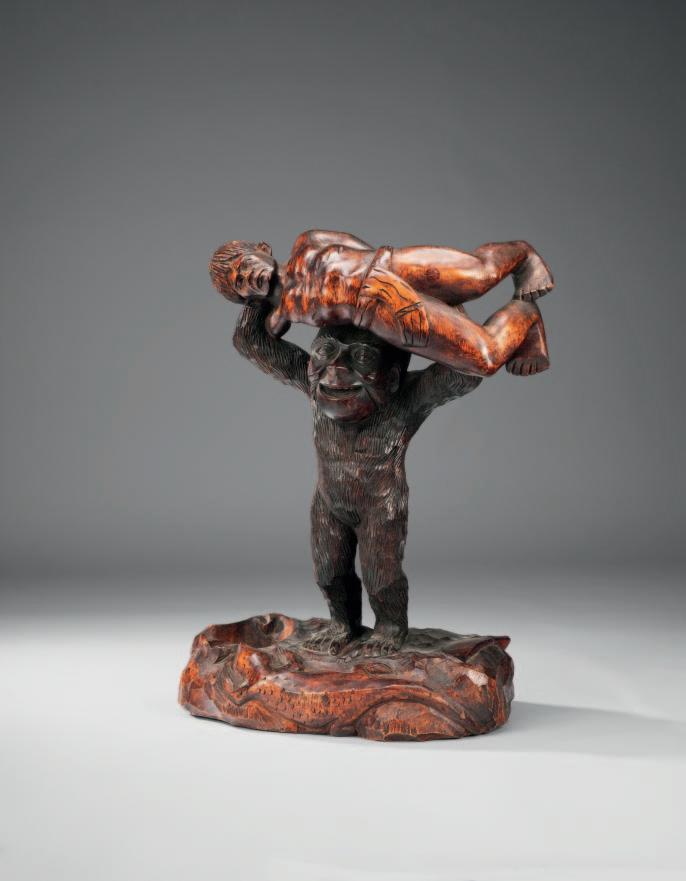
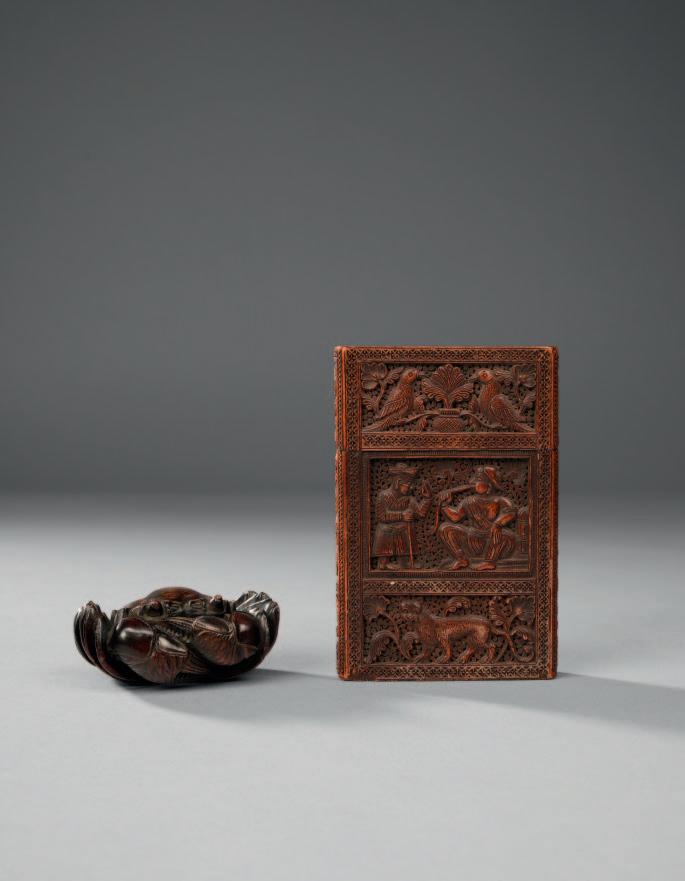
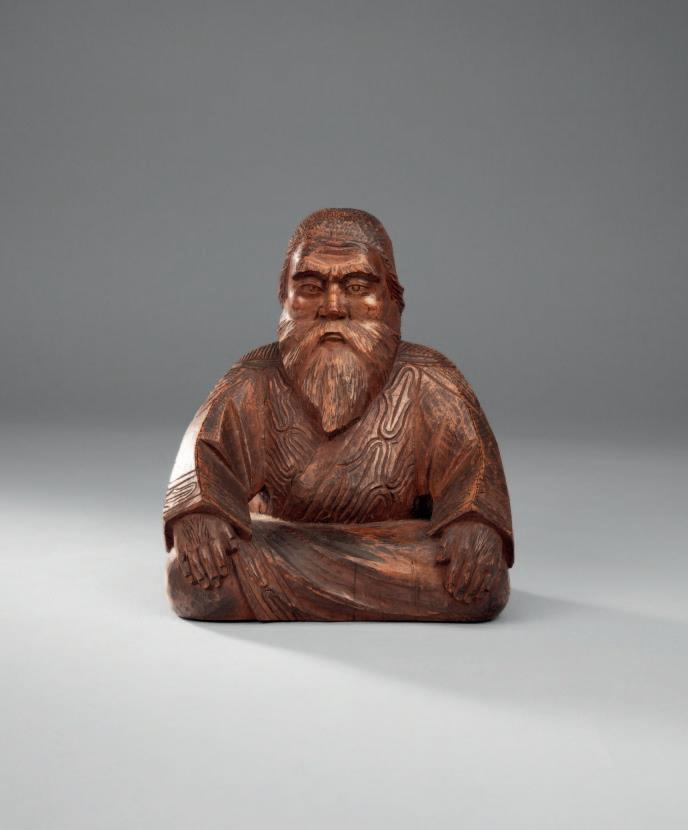
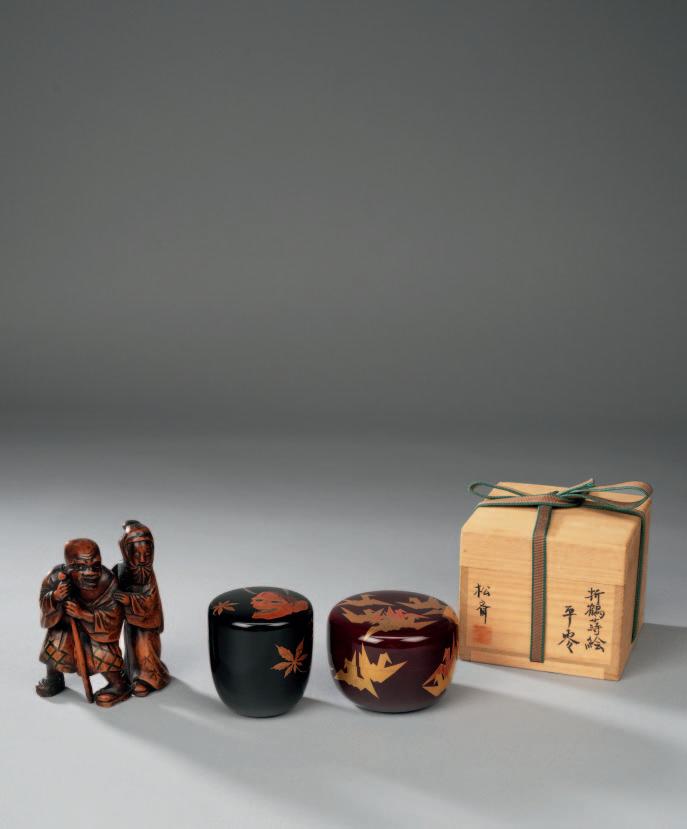
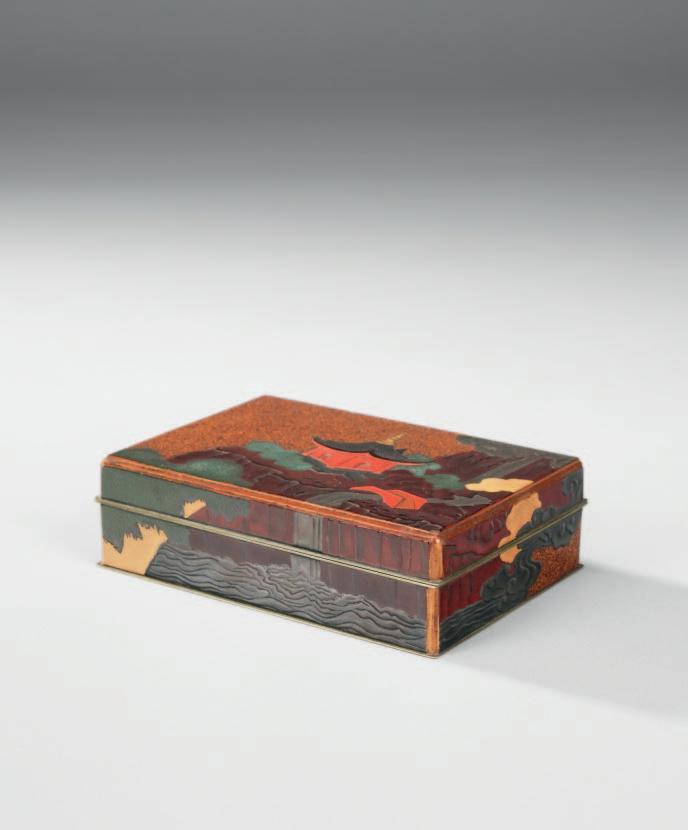
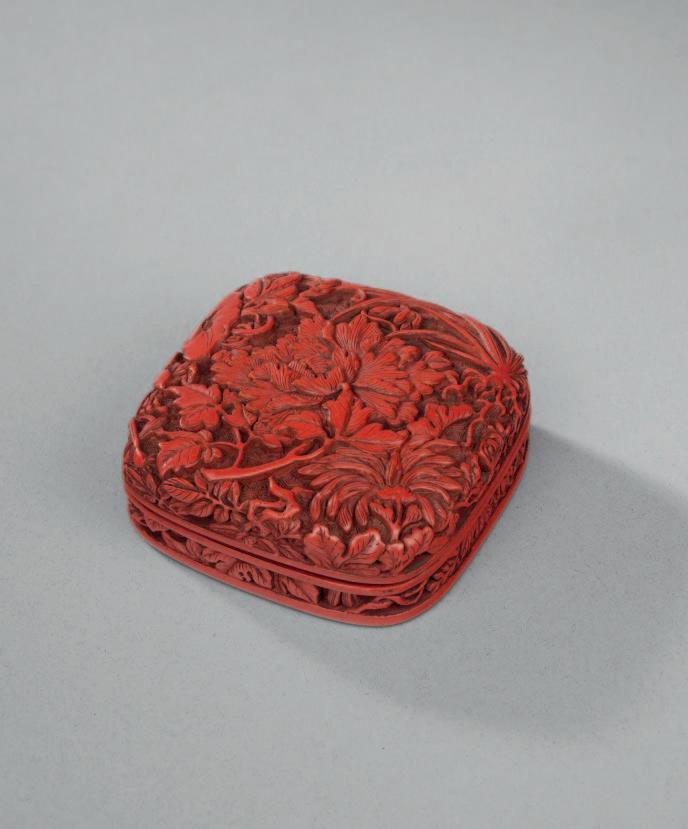
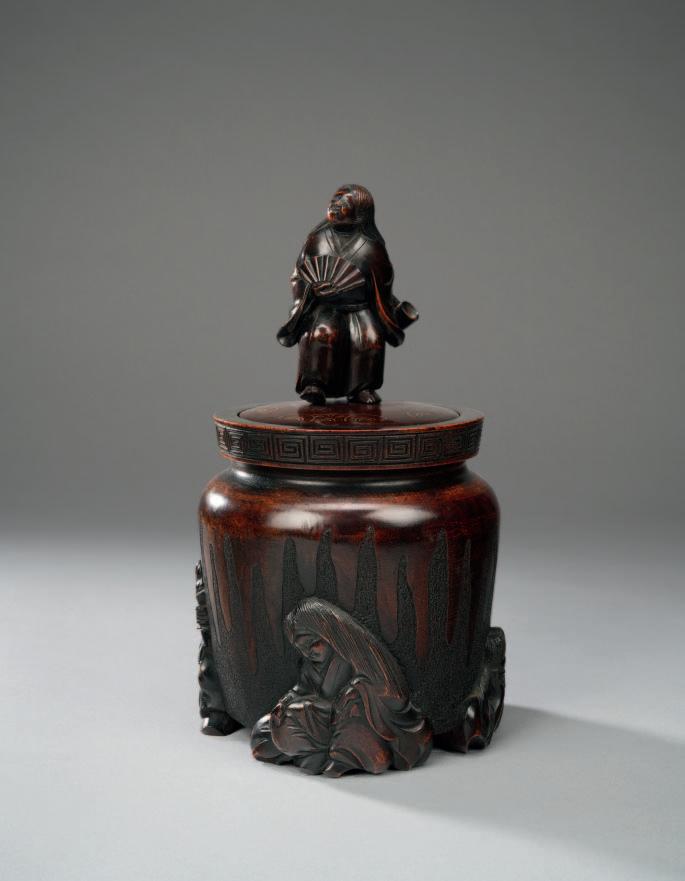
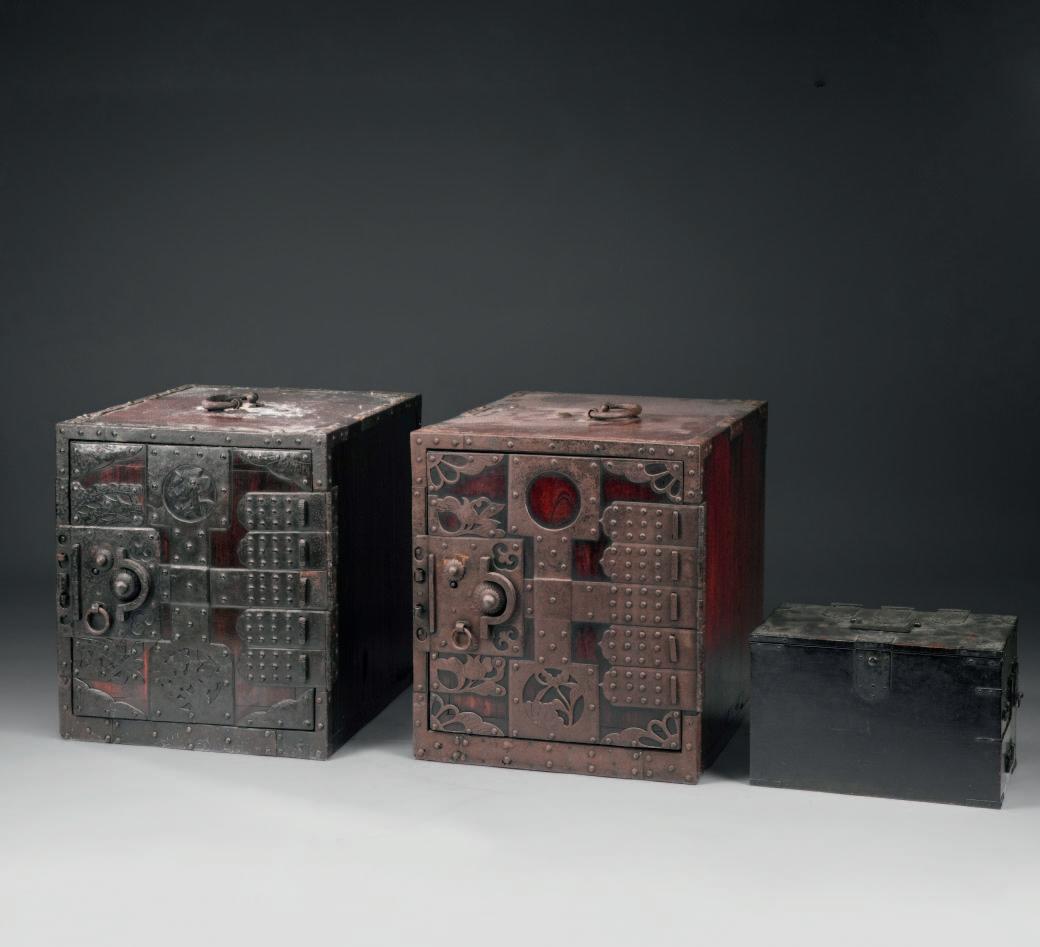
771
TWO SMALL JAPANESE KODANSU (LACQUER CABINETS) AND POEM CARDS
EDO PERIOD, 17TH CENTURY AND LATER
One of long rectangular form with four small drawers to the side, decorated in gold hiramaki-e, fundame and kirikane on a black roiro ground with pavilions in mountainous river landscapes, the top with a waterfall; the taller cabinet with two front drawers, decorated to the sides and back with many birds flying amongst flowering prunus branches, rendered in gold hiramaki-e and nashiji on a roiro ground; the drawers containing a set of four hundred and two uta garuta (poem cards) for the Hyakunin Isshu game, each handwritten in sumi ink and with a silver leaf backing; 18cm x17.3cm x 10.2cm max. (410)
£150-250
Provenance: the Tomkinson Family Collection.
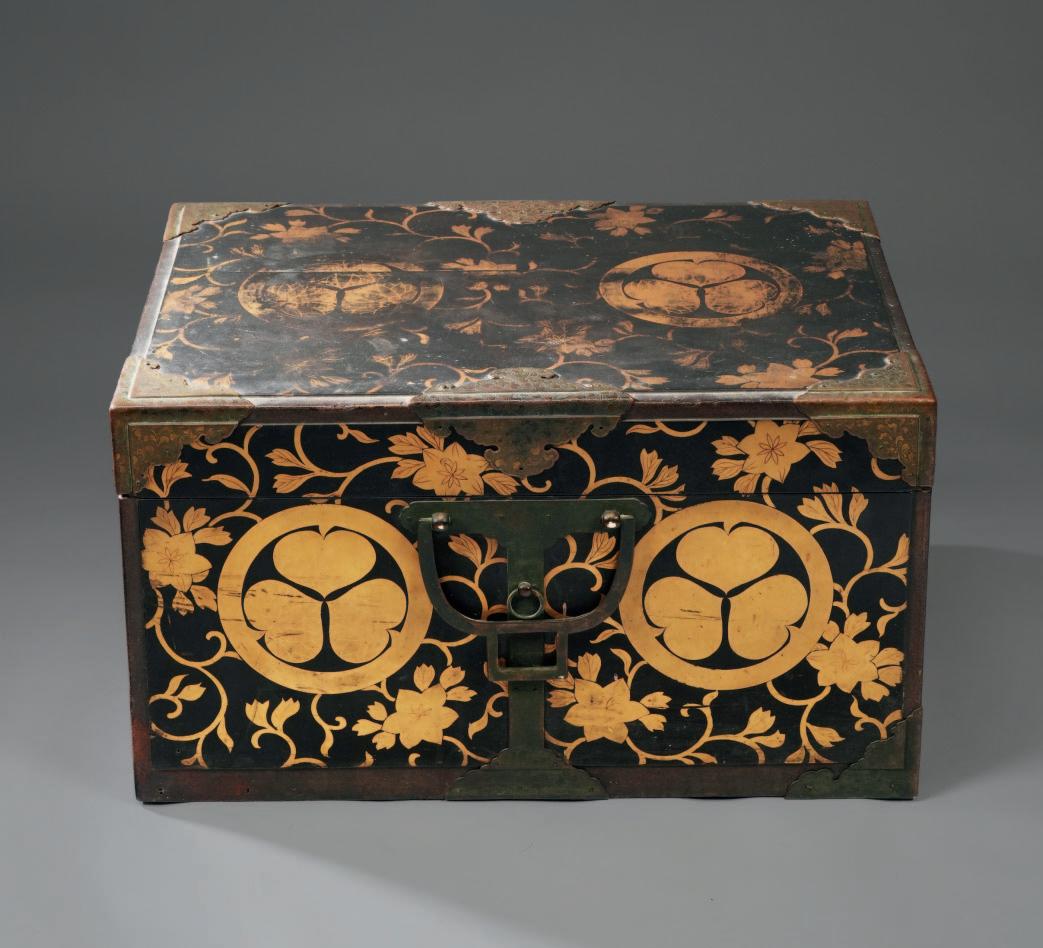
770
THREE JAPANESE IRONBOUND FUNADANSU (SEA CAPTAINS’ CHESTS)
EDO PERIOD, 18TH/19TH CENTURY
All three of typical rectangular form, made of heavy keyaki (zelkova) wood, the exterior elaborately reinforced with handforged iron hardware and complex locking plates featuring auspicious motifs, the larger two with doors opening to reveal inner drawers, 48cm x 38cm x 44.5cm max. (3)
£2,500-3,000
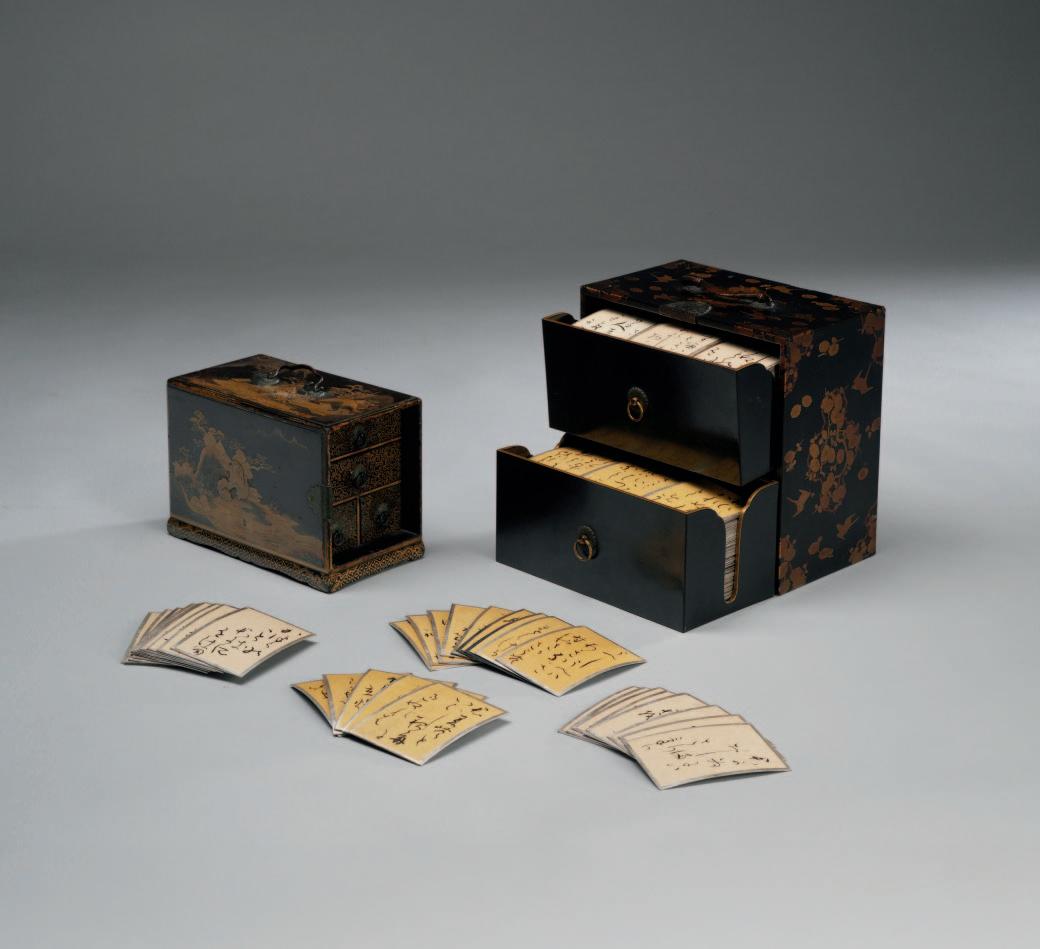
EDO PERIOD, 18TH
Of typical rectangular shape, decorated with clematis and scrolling tendrils, the sides with large mitsuba aoi mon (triple hollyhock family crests), all rendered in gold lacquer on the black ground, with metal mounts decorated with further floral motifs, 32.5cm x 58cm x 41cm. (2)
£400-600
The mitsuba aoi mon family crest was notably used by the Tokugawa clan. 771
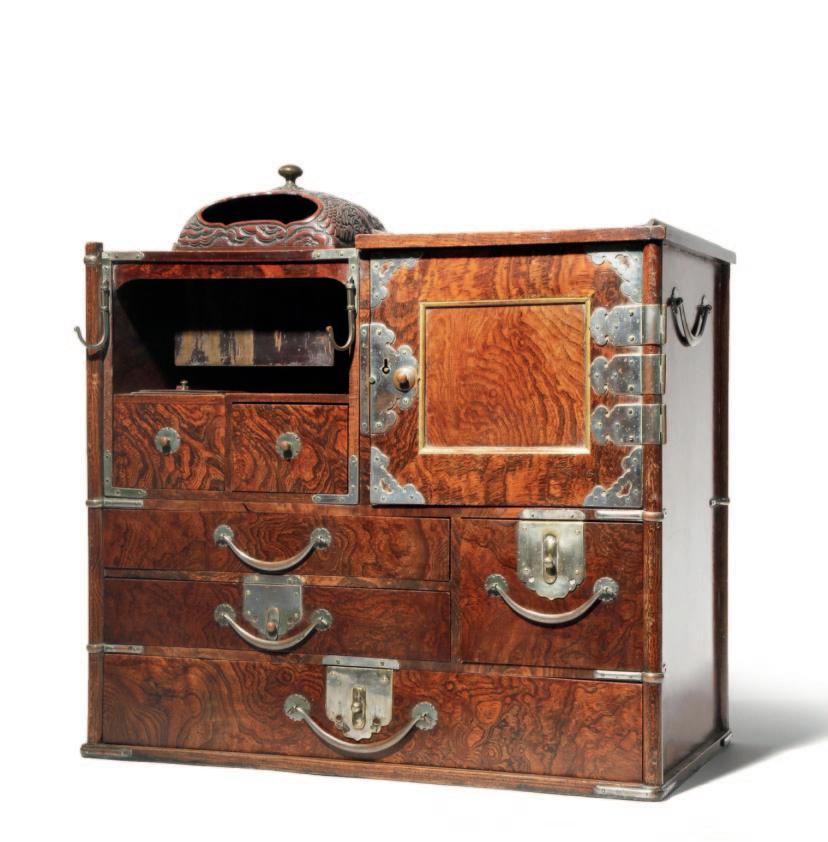
773
A JAPANESE WOOD TABAKO-BON (SMOKING SET)
MEIJI PERIOD, 19TH CENTURY
Of rectangular form, the top inset with a copper ash compartment or brazier, the lid decorated with a large dragon amongst clouds and with a shaped aperture to the front, the lower part with six square and rectangular drawers, the top right corner with a door opening to reveal two further drawers, with white metal mounts, 35cm x 19.3cm x 35cm.
£200-300
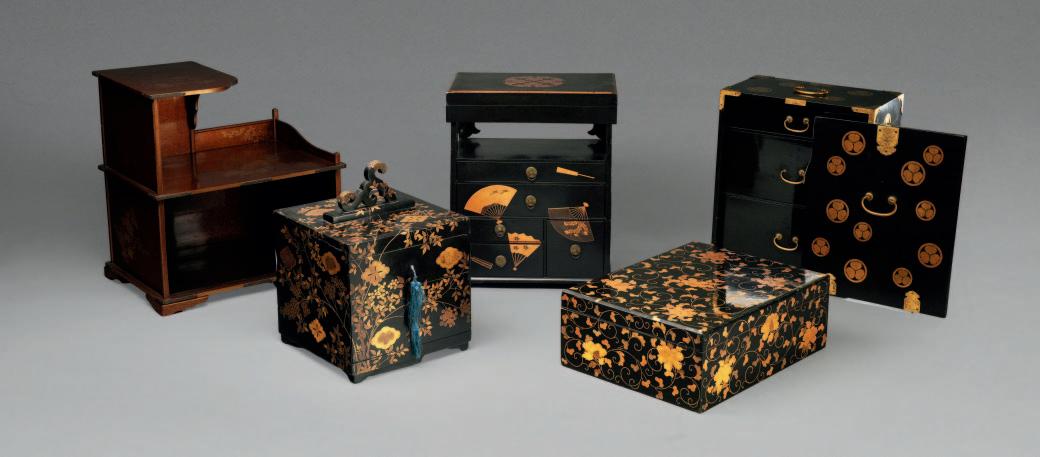
775
A COLLECTION OF JAPANESE LACQUER PIECES
MEIJI ERA, 19TH/20TH CENTURY
All decorated in gold lacquer, most with hiramaki-e designs on a black roiro ground; one a large cabinet decorated with the mitsuba aoi mon (triple hollyhock crest), the removable front door opening to reveal three drawers of various sizes; a cabinet with an integrated box and cover to the top and five drawers, decorated with scattered fans, each embellished with a different design including birds and flowers; a large bunko (document box and cover) with chrysanthemum and scrolling tendrils; another small cabinet with bush clover and paulownia mon; and shelves decorated in gold lacquer with floral designs; 47.5cm x 46cm x 32.5cm max. (18)
£200-300
Provenance: the Tomkinson Family Collection.
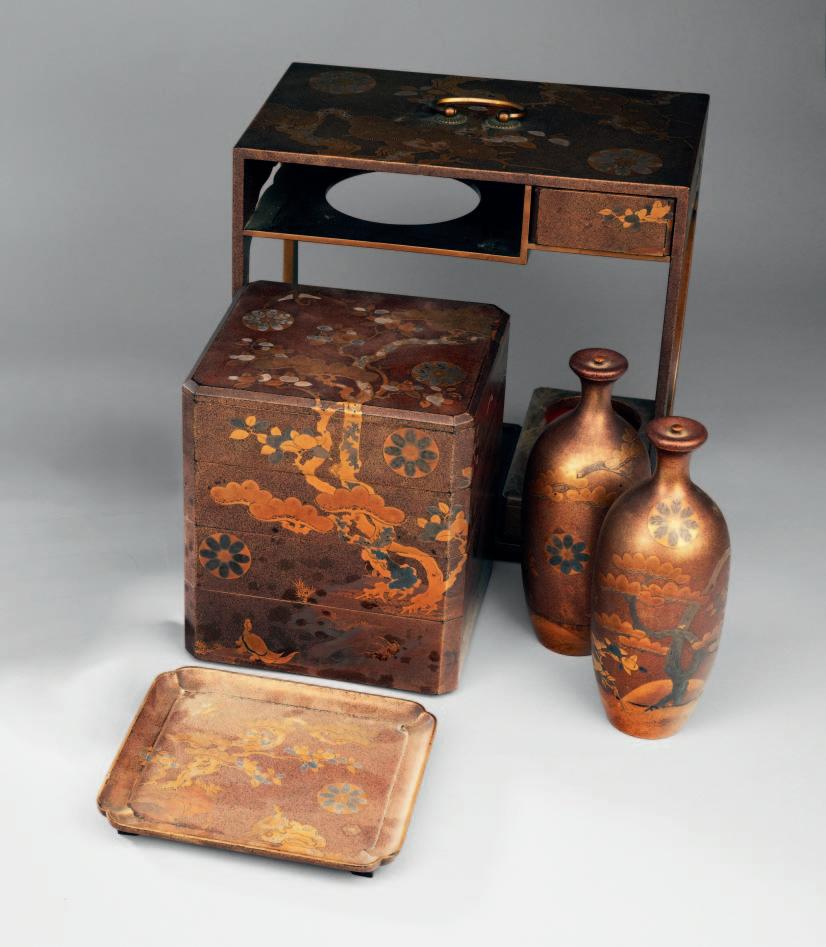
774
A JAPANESE GOLD AND SILVER LACQUER SAGEJUBAKO (PICNIC SET)
EDO/MEIJI, 18TH/19TH CENTURY
Of typical rectangular form, including a fourtier box and cover, a shallow tray, a drawer and a box and cover with two apertures for the lacquer bottles with lids; decorated all over with symbols of longevity including minogame, the mythical turtles standing amongst pine and chrysanthemum, with circular feather mon scattered across the design; 33cm x 33cm x 19cm. (14)
£300-500
Provenance: by repute, acquired in Asia c.1880 by Lieutenant Colonel Francis G Howard, and thence by descent.
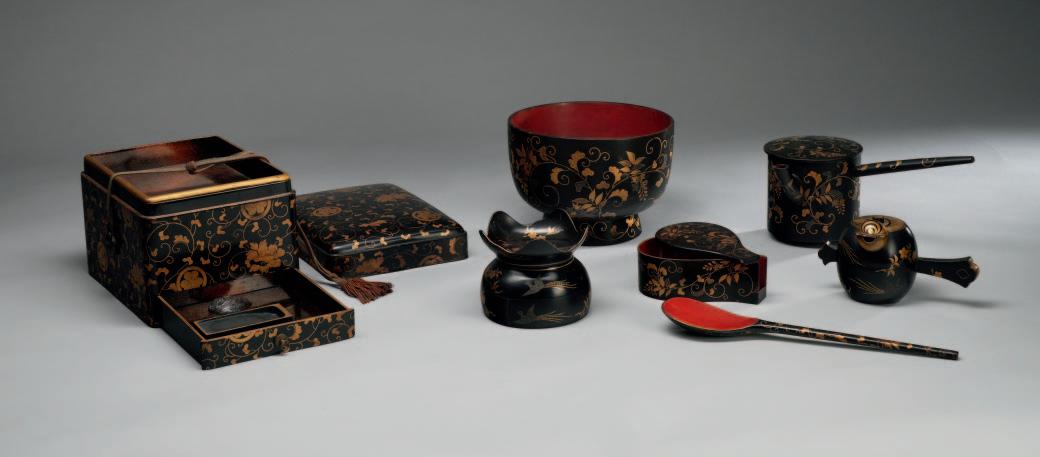
776
A COLLECTION OF JAPANESE LACQUER PIECES
EDO AND LATER, 18TH CENTURY AND LATER
Decorated in gold and silver hiramaki-e on a black roiro ground, some with areas in red lacquer; most decorated with scrolling leafy tendrils; one a combined bunko and suzuribako, the tall rectangular box with an inner tray and a drawer opening to reveal an ink stone and a shellshaped copper suiteki (water dropper), embellished with mon and tendrils; a large renge spoon, with a fitted case and cover to protect the bowl; a cylindrical kettle with a long straight handle and lid; a box, cover and integrated cup stand decorated with cherry blossoms and Hōō birds in flight, together with a small kettle and cover shaped as Daikoku’s mallet, with the same decoration; and a large footed bowl with scrolling wisteria, 25cm max. (18)
£200-300
Provenance: the Tomkinson Family Collection.
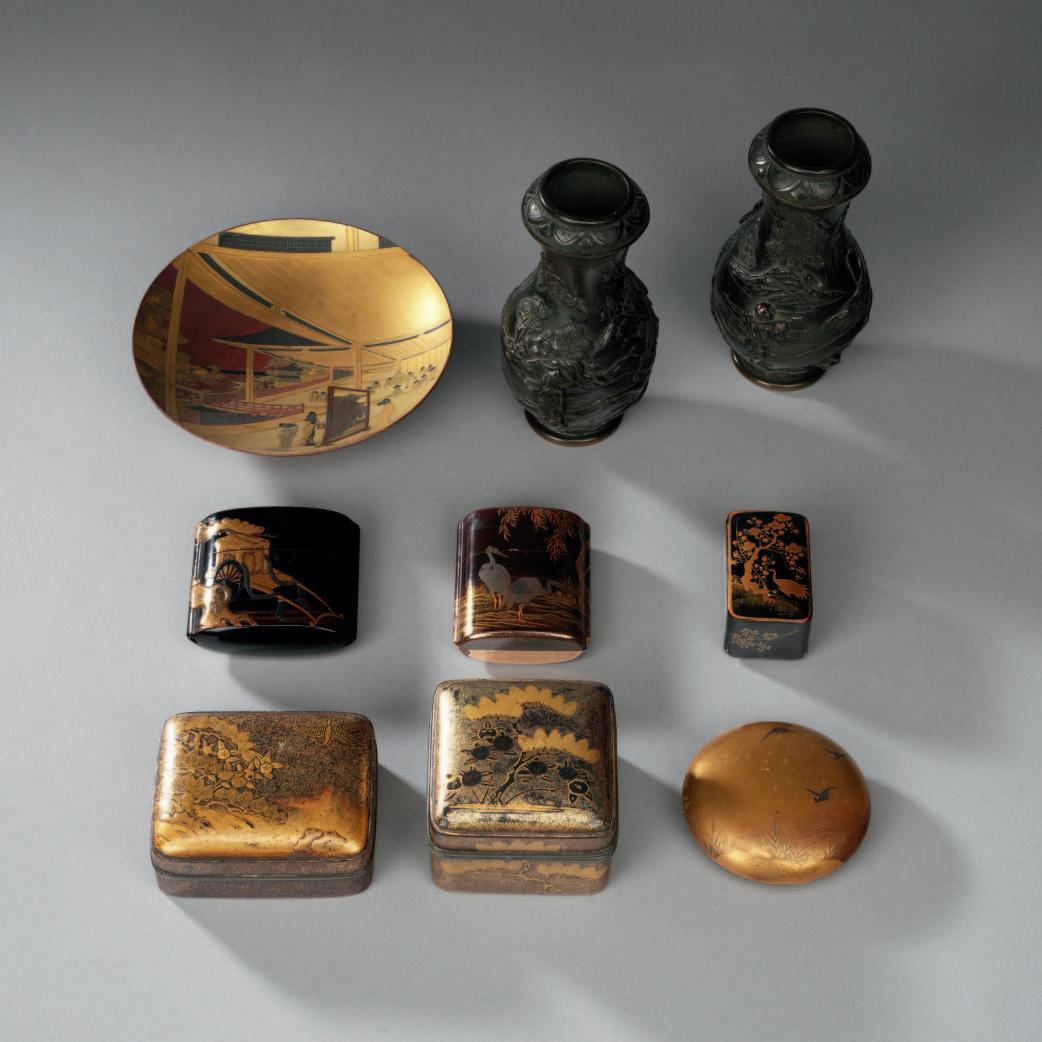
778
A SMALL COLLECTION OF LACQUER PIECES
19TH AND 20TH CENTURY
Comprising: two sakazuki (sake cups) with birds of prey; a small cinnabar lacquer vase with Immortals amongst rockwork, and a doublepeach box and cover, the surface decorated with insects and bats, 12.1cm max. (5) WITHOUT RESERVE
£200-300
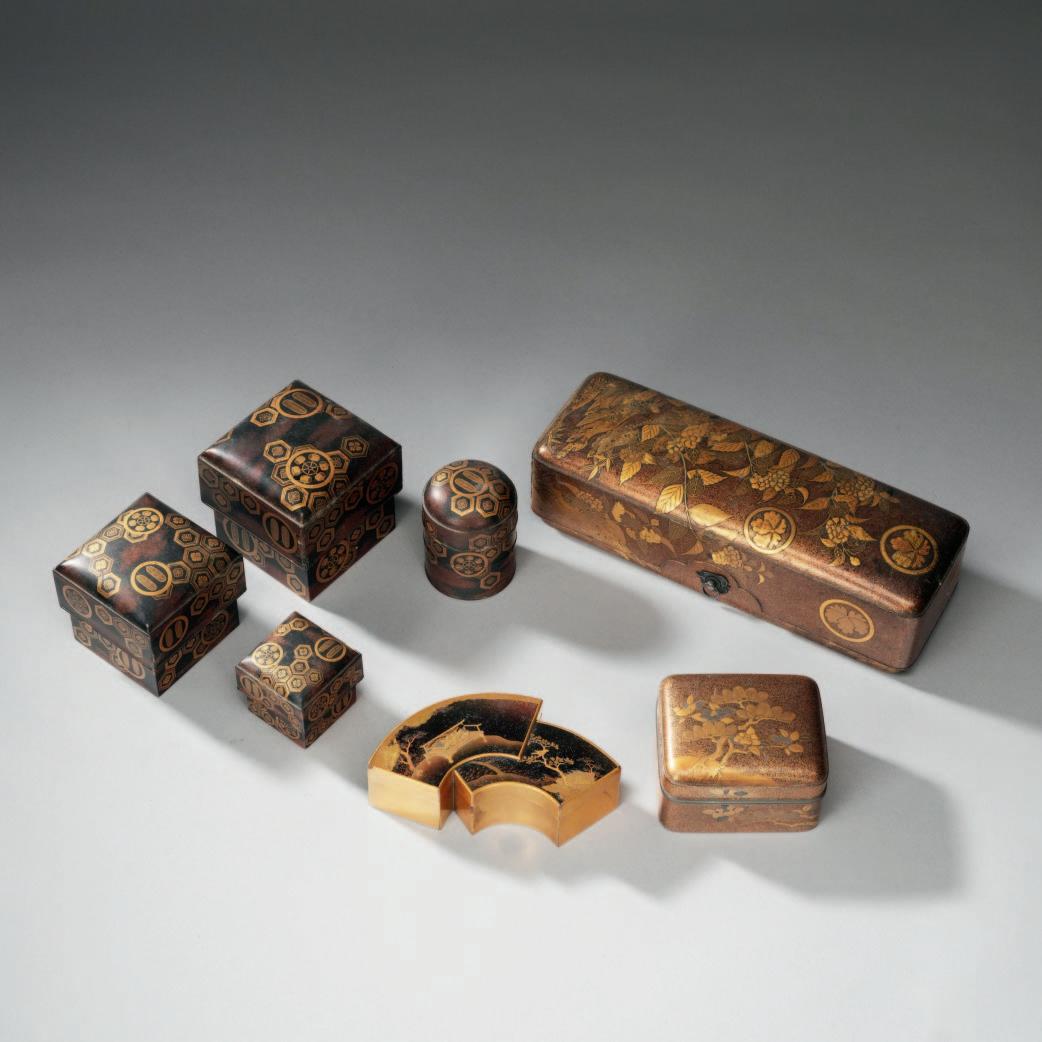
777
EDO AND MEIJI, 18TH AND 19TH CENTURY
Comprising: two fourcase inro, one with birds and the other with a cart; one large sake cup with foxes dressed up in kimonos in an interior, signed; four small gold and black lacquer boxes and a cabinet with sliding door and a single inner drawer; together with a pair of bronze vases with figures and birds of prey in landscapes, both signed Masayoshi saku; 21cm max. (16)
WITHOUT RESERVE
£300-500
Provenance: The Michael Baggott Collection.
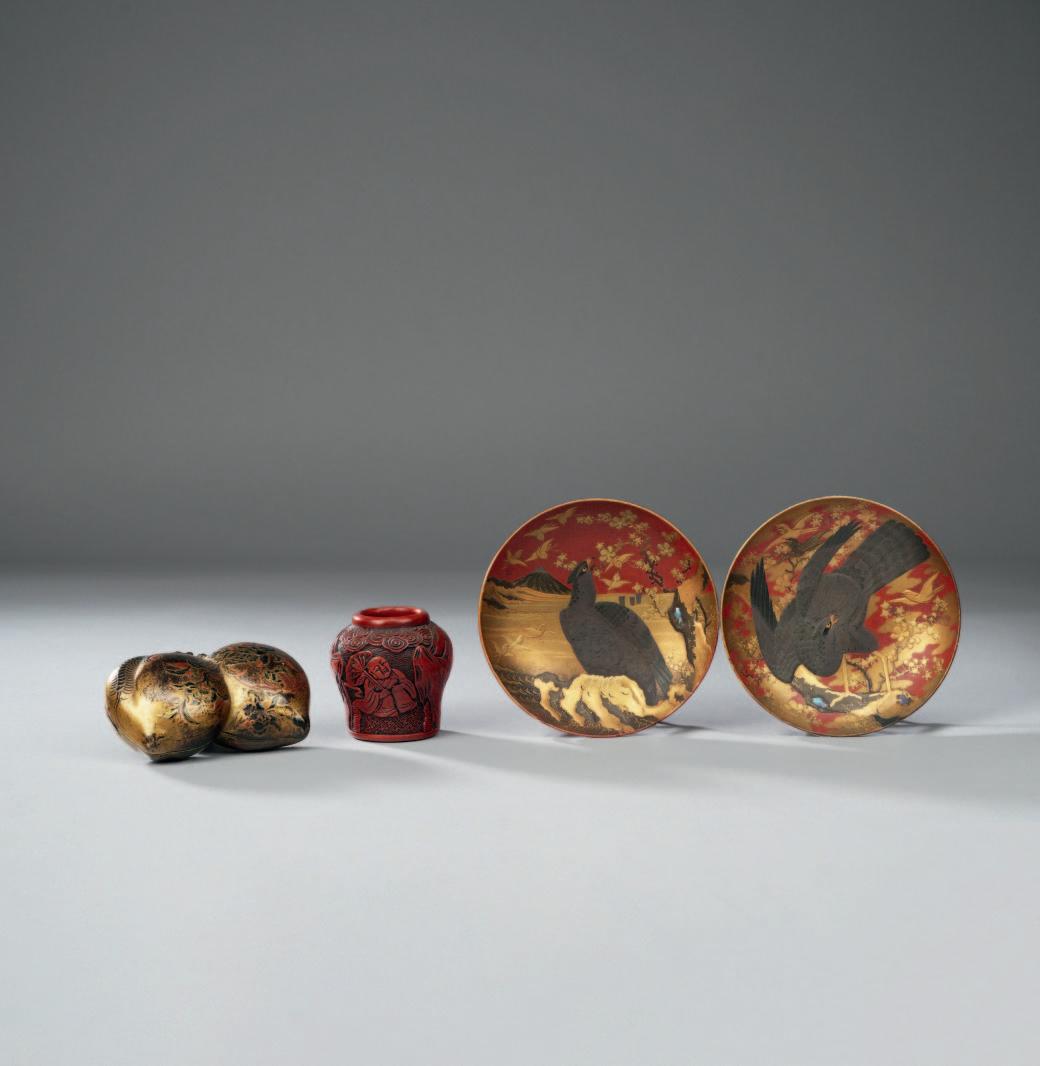
779
EDO/MEIJI, 18TH/19TH CENTURY
All decorated in gold lacquer, comprising: a fanshaped box, decorated with a man resting on a daybed observing a bird, a reference to the Tale of Genji; three square boxes and overlapping covers, and a cylindrical box with lid, all decorated with the same waterwheel and doublefeather mon (family crests); together with a rectangular kōgō (incense box and cover) with pine, and a fubako (letter box and cover) with flowers issuing from rockwork and paulownia mon, 26cm max. (14)
£200-400
Provenance: by repute, acquired in Asia c.1880 by Lieutenant Colonel Francis G Howard, and thence by descent.
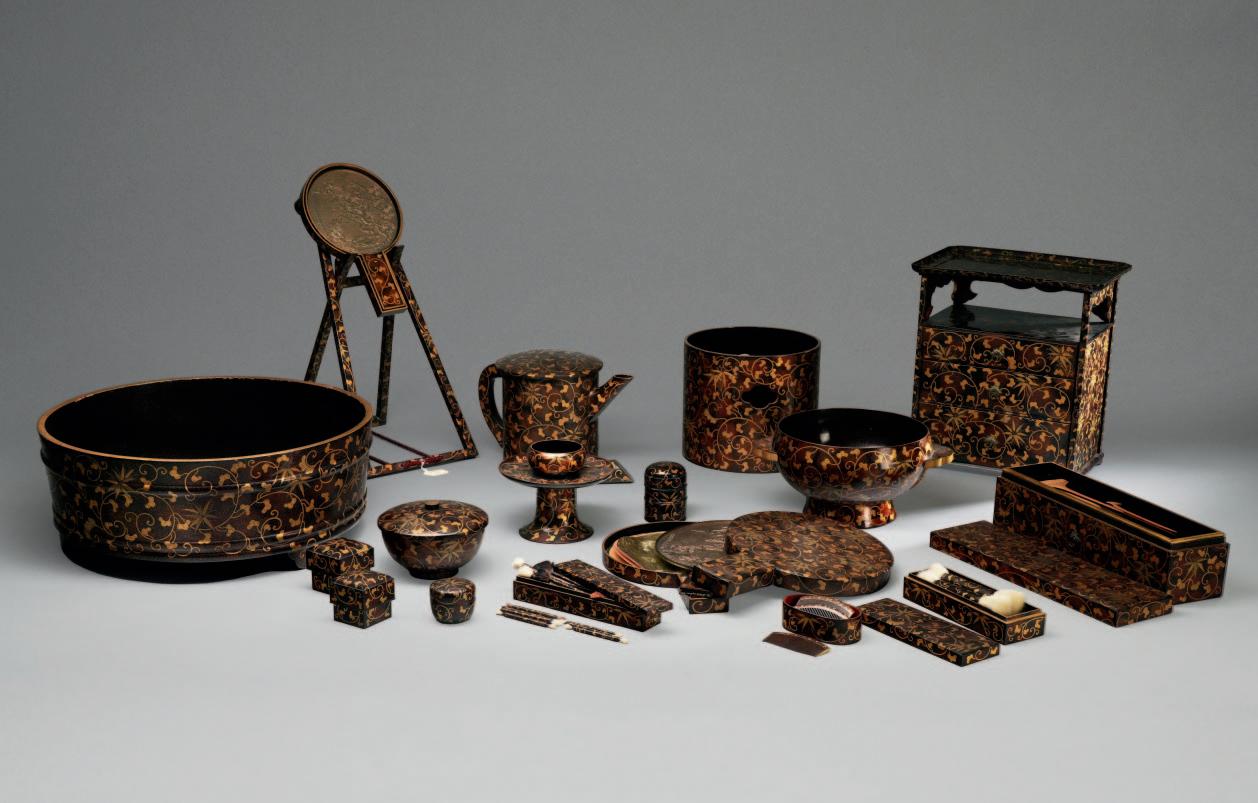
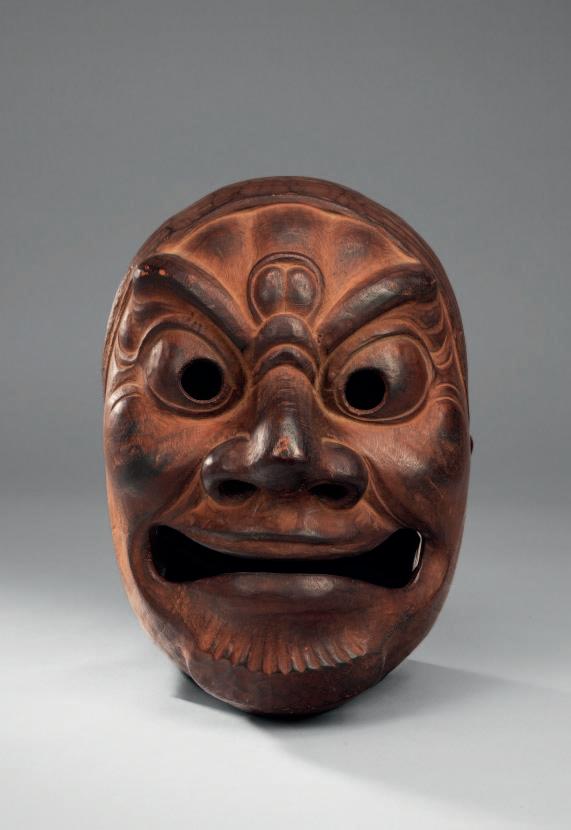
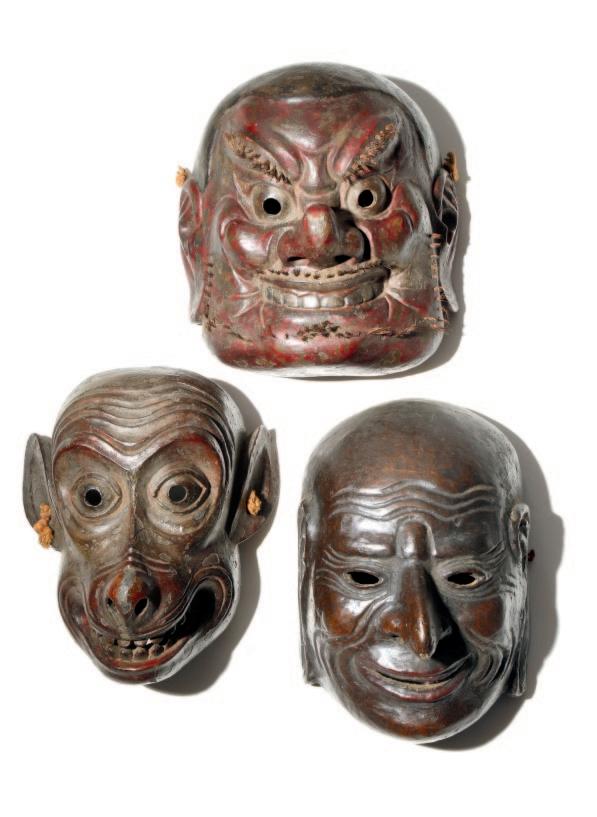
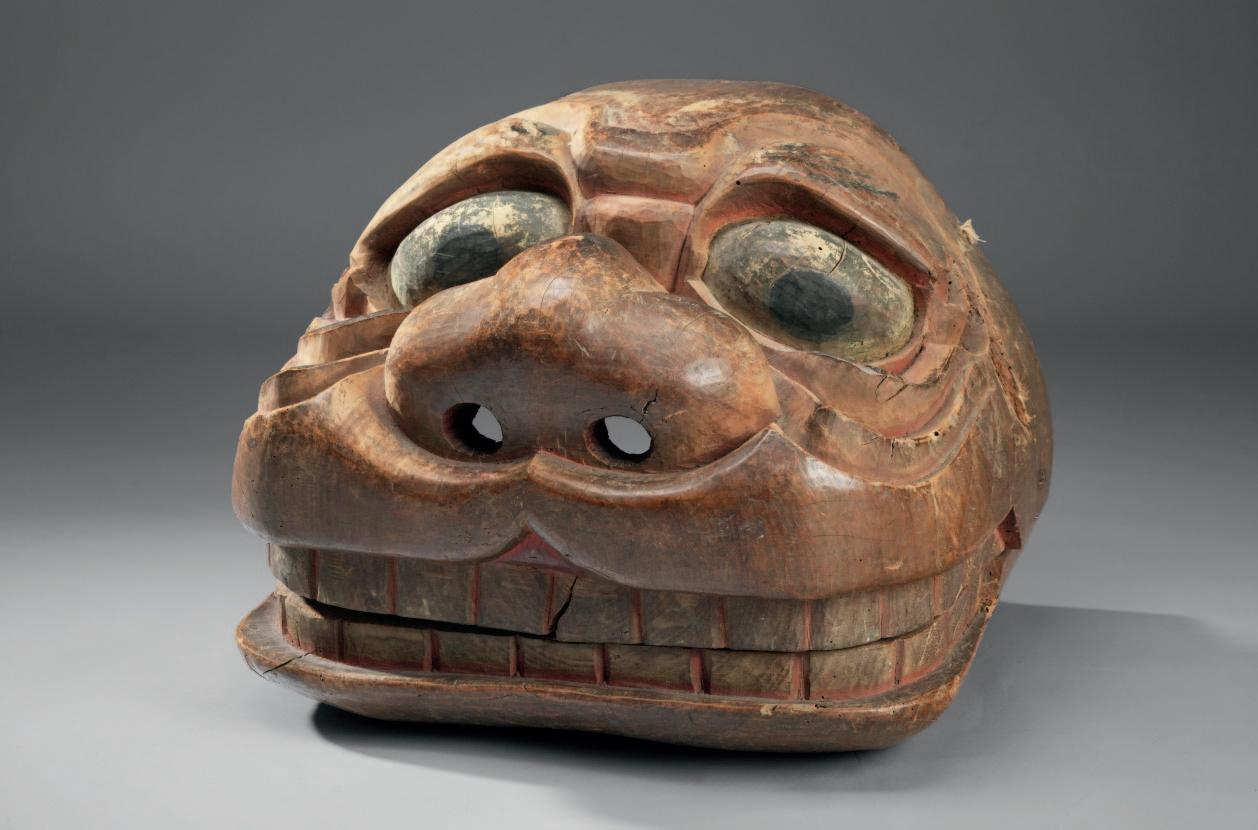
780
AN EXTENSIVE JAPANESE GOLDLACQUER WEDDING TROUSSEAU
EDO PERIOD, 18TH/19TH CENTURY
The lavish set decorated in gold hiramaki-e and mura-nashiji lacquer with a dense pattern of sasa-no-ha (bamboo leaves) and scrolling tendrils; comprising: a large te-arai (washbasin raised on three feet), a hazo (ewer with lid and spoutcover), a large hollow cylinder with quatrefoil apertures to the sides, eight boxes of various sizes and shapes with covers and some with inner trays, probably used to contain cosmetics, one containing eighteen brushes for makeup, another with two brushes on rests; a footed bowl, a cabinet with three drawers below an integral tray; two cases with lids enclosing bronze hand mirrors, and a folding stand; a tenmoku-dai (cup stand), and a number of combs and wooden implements for makeup application; 53cm max.
£600-1,000
Provenance: the Tomkinson Family Collection. Purchased from Christie’s London, 13th November 1995, lot 488; a copy of the original invoice is available.
Commissioned by powerful daimyō for their daughters, these impressive trousseaux were more than just possessions; they symbolized the family’s social standing and the political alliances formed through the marriage. Preparations for the trousseau would begin as soon as an engagement was announced. As the bride was marrying into the groom’s family, her trousseau was a crucial part of the dowry, and it would be transported to the groom’s estate in an elegant wedding procession.
781
A JAPANESE WOOD OTOBIDE NOH MASK
PROBABLY MEIJI, 19TH/20TH CENTURY
With a ferocious expression, the reverse signed, possibly Kyō ichi tō, 29.5cm.
£100-200
782
THREE JAPANESE LACQUERED WOOD GIGAKU MASKS
MEIJI OR TAISHŌ, 20TH CENTURY
The first depicting a monkey with its eyes wide open in surprise; the second depicting Beshimi / Akujō (The Stern Old Man), with an aquiline nose and elongated earlobes; the third of Shikami (The Demon) with thick horse hair for the eyebrows, moustache and beard; each mask signed and inscribed by the artist Kano Tessai (18451925), 26cm max. (3)
£400-600
Kano Tessai (1845-1925) was a sculptor who specialised in mask netsuke. He started life as a Buddhist priest whilst being taught the art of carving by his father. He also studied Chinese literature and art, and he became a professor at the Tokyo Art School in 1872.
783
A LARGE JAPANESE WOOD MASK FOR THE SHISHIMAI (LION) DANCE
MEIJI/SHŌWA, 20TH CENTURY
Typically depicted with a toothy grin and a movable lower jaw; with details painted in polychrome; together with a stand, 39cm. (2)
£500-1,000
784
A JAPANESE SHODANA (DISPLAY CABINET AND STAND)
MEIJI OR LATER, 20TH CENTURY
Of tall rectangular form, decorated with birds amongst cherry blossoms rendered in mother of pearl and gold lacquer on the black lacquer ground; with two drawers, sliding doors and another hinged door opening to reveal two further drawers, the cabinet 58.5cm x 59cm x 30.5cm, 95cm x 59cm x 30.5cm overall. (2)
£300-500
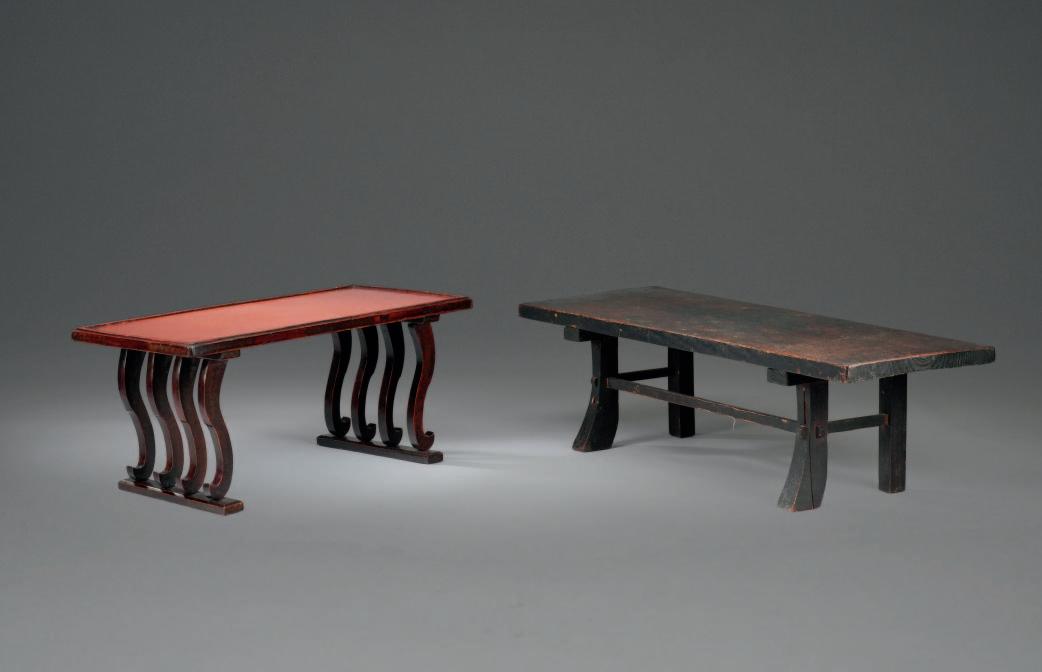
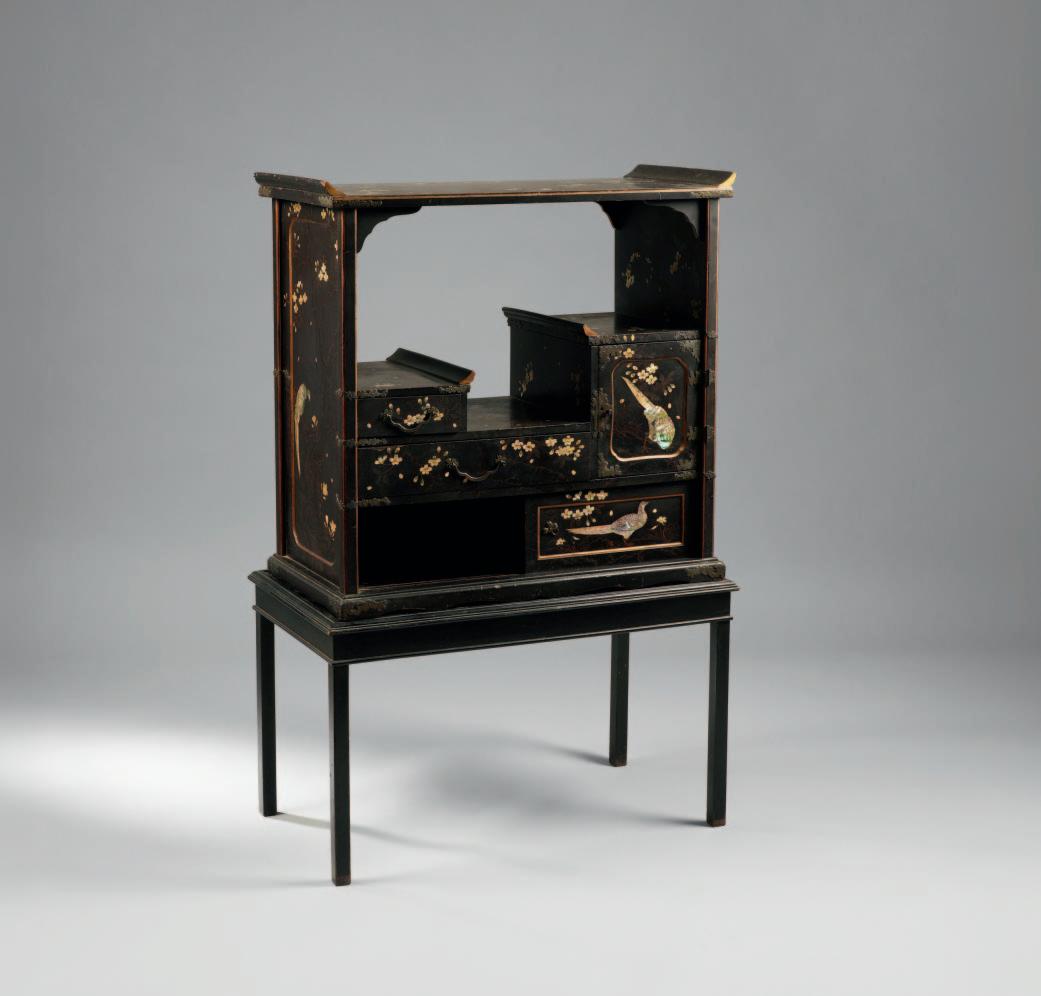
785
TWO JAPANESE LOW TABLES
EDO OR LATER, 18TH/19TH CENTURY
The first with a red negoro lacquer top and scrolling legs; the other of dark wood, raised on slightly curved legs; 88cm and 66cm. (2)
£500-1,000
786
A LARGE AND IMPRESSIVE JAPANESE TWOFOLD SCREEN
MEIJI ERA, 19TH CENTURY
The panels elaborately carved in high relief and decorated with Momotaro (the ‘Peach Boy’) on his quest to Onigashima (The ‘Demon Island’), one side with the boy depicted wrestling a large red oni, his acolytes the dog, the monkey and the pheasant chasing other demons around him, the monkey with a movable sword attached to its waist; all framed by borders of chrysanthemum and iris, the lower halves decorated with large carp amongst crashing waves; all lacquered in red, black, yellow, gold and silver and inlaid with stone and glass cabochons; the reverse carved with a dense design of scrolling clouds, 197cm x 83cm.
£5,000-8,000
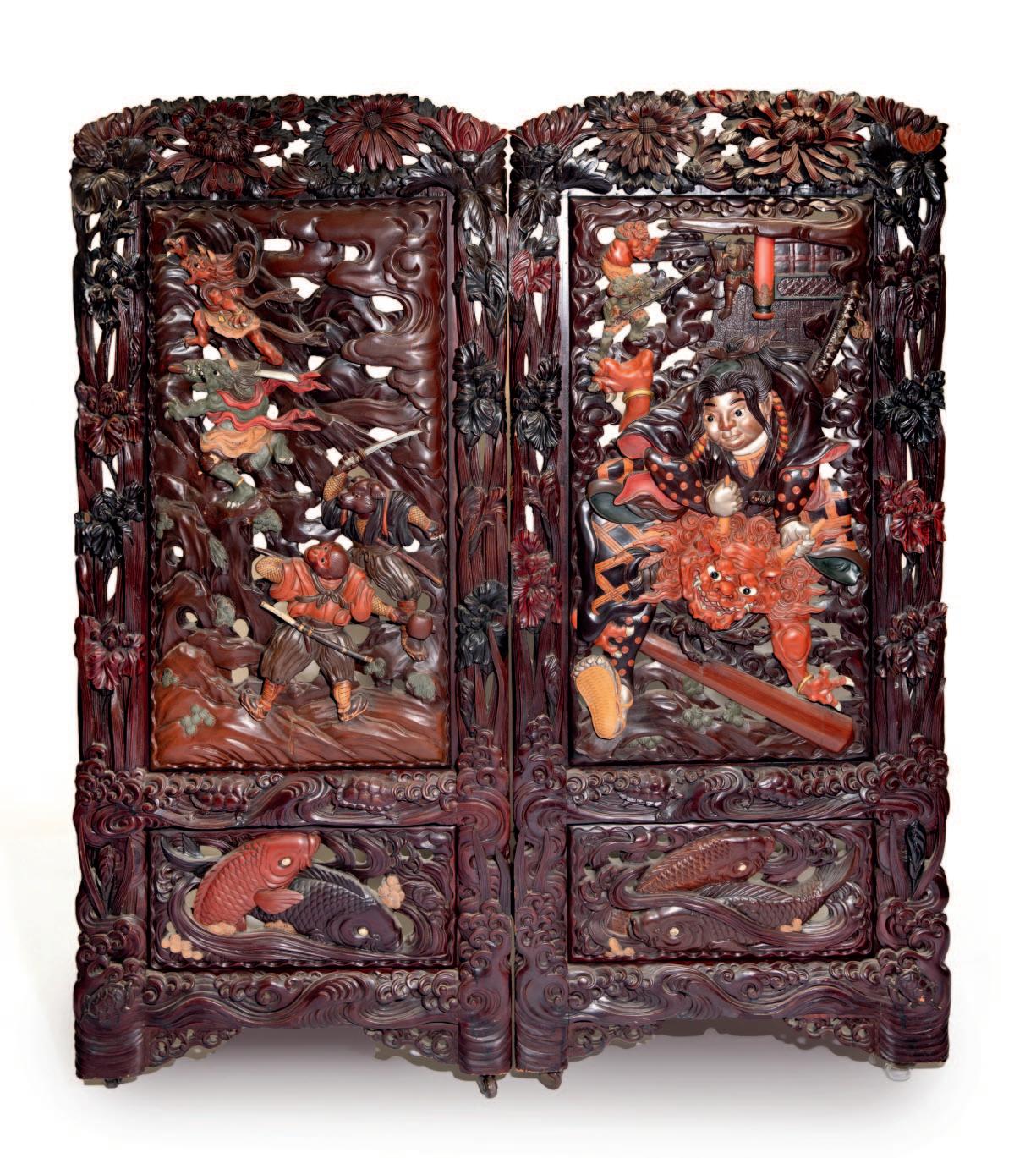
787
A MINIATURE JAPANESE SHAKU-DOKEI (PILLAR CLOCK)
EDO/MEIJI, 19TH CENTURY
Of long rectangular shape, the weightdriven movement visible at the top and embellished with reticulated floral designs, the wood frame with brass plaques inscribed with Japanese numerals at the front, a small rectangular drawer below; together with a small key, possibly associated, 23.5cm. (3)
£400-600
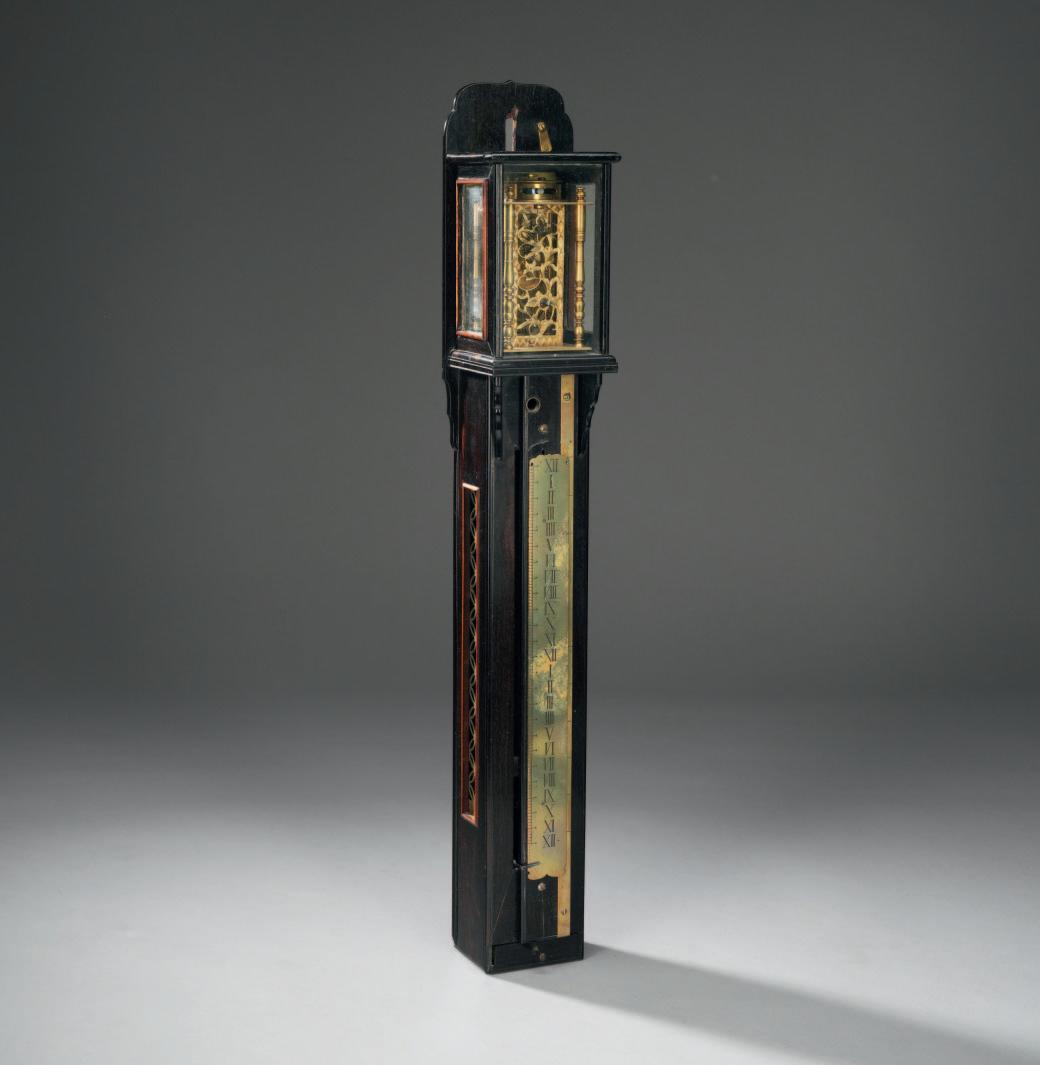
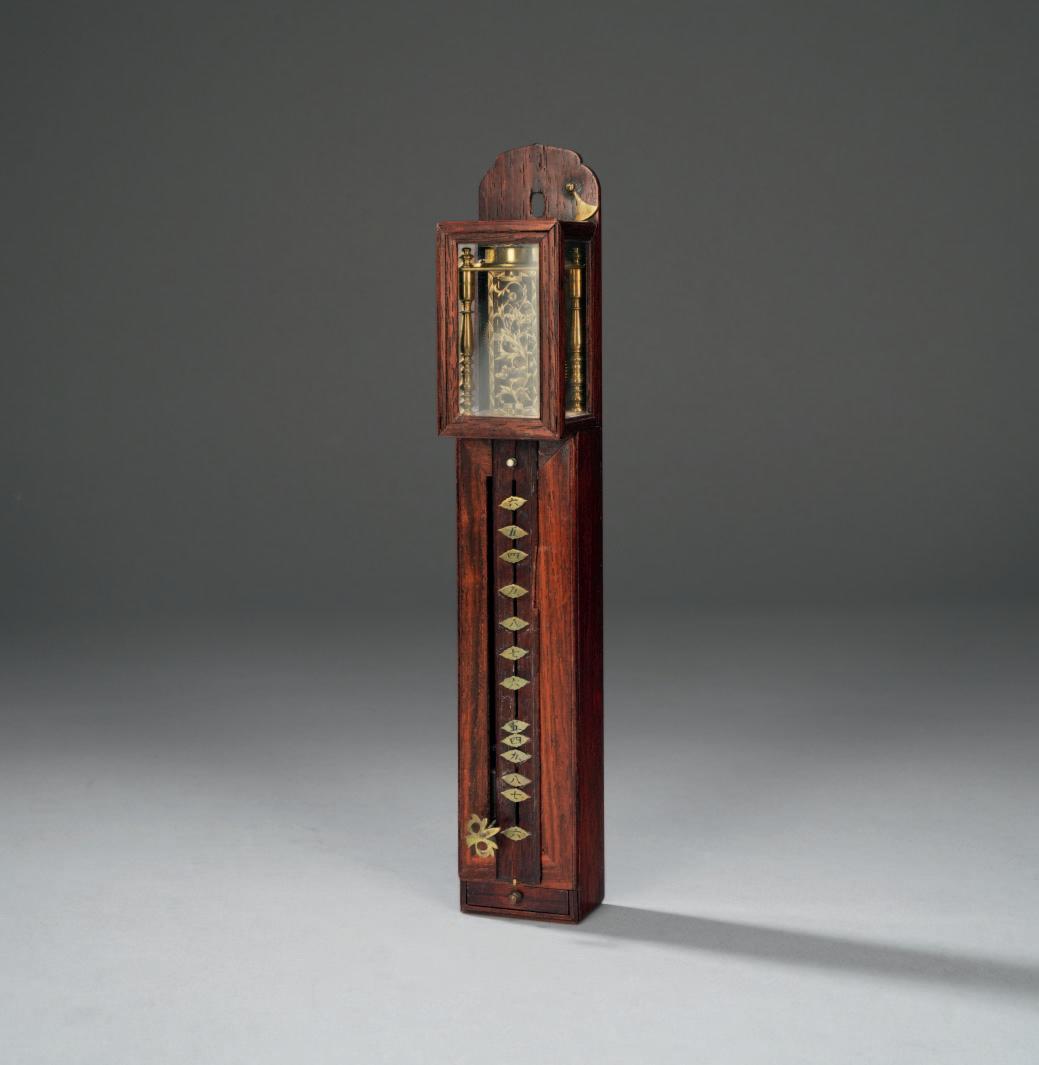
788
A JAPANESE SHAKU-DOKEI (PILLAR CLOCK)
EDO/MEIJI, 19TH CENTURY
Of tall rectangular shape, the weightdriven movement visible at the top and embellished with reticulated floral designs, the wood frame with a brass plaque inscribed with Roman numerals at the front, a small rectangular drawer below; together with an associated Swiss key, 51.3cm. (3)
£500-1,000
789
λ A RARE TORTOISESHELL AND LACQUER KOREAN BADUK BOARD
JOSEON DYNASTY, 18TH/19TH CENTURY
Of square shape with a typical grid to the top, richly embellished to the sides with a large dragon and a phoenix amongst scrolling clouds, all rendered in tortoiseshell and twisted wire inlays on the warm gold lacquer ground; with a shaped apron decorated with leaves, fruits and auspicious symbols, 30.5cm x 48cm x 47.5cm.
£2,500-3,500
Provenance: from the collection of Dr Richard Brown, by repute.
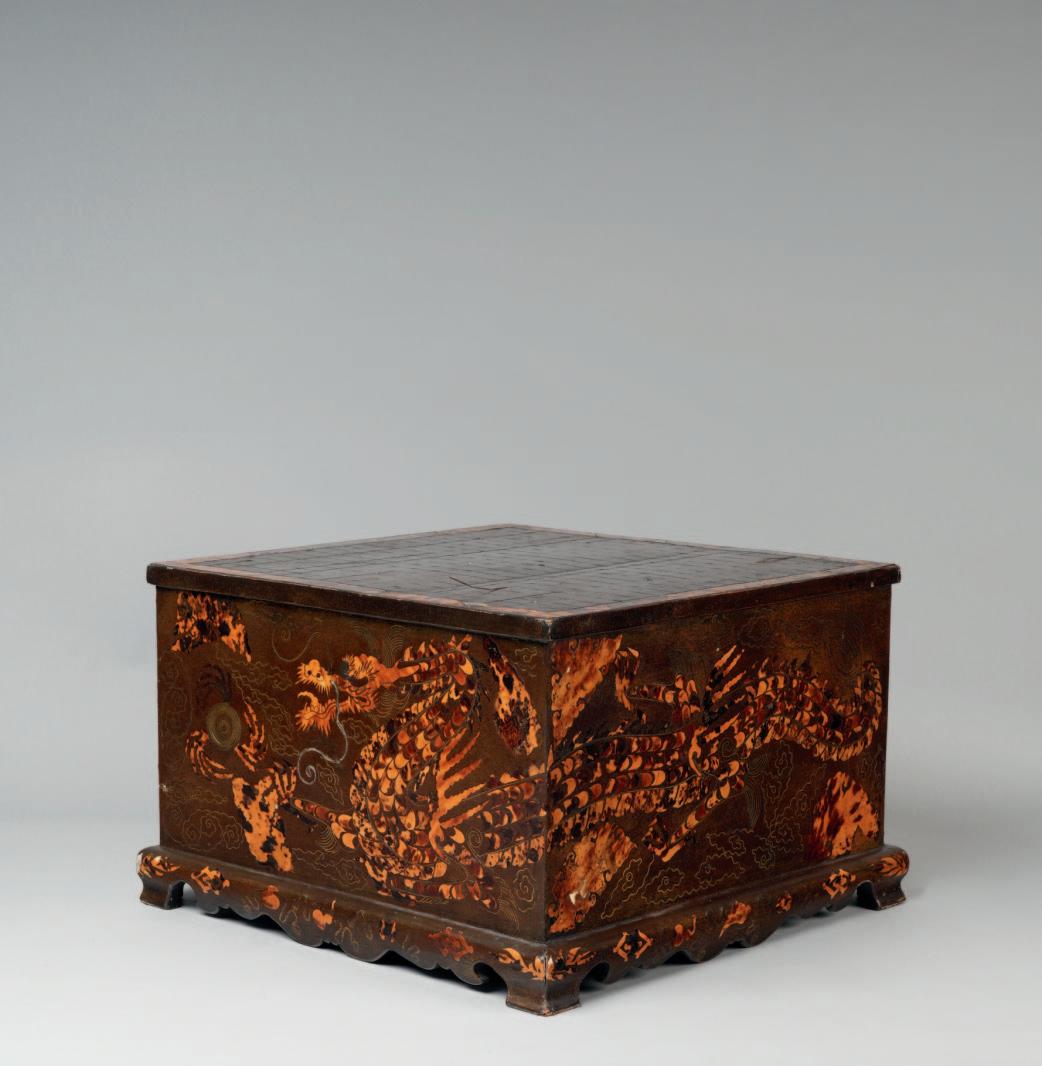
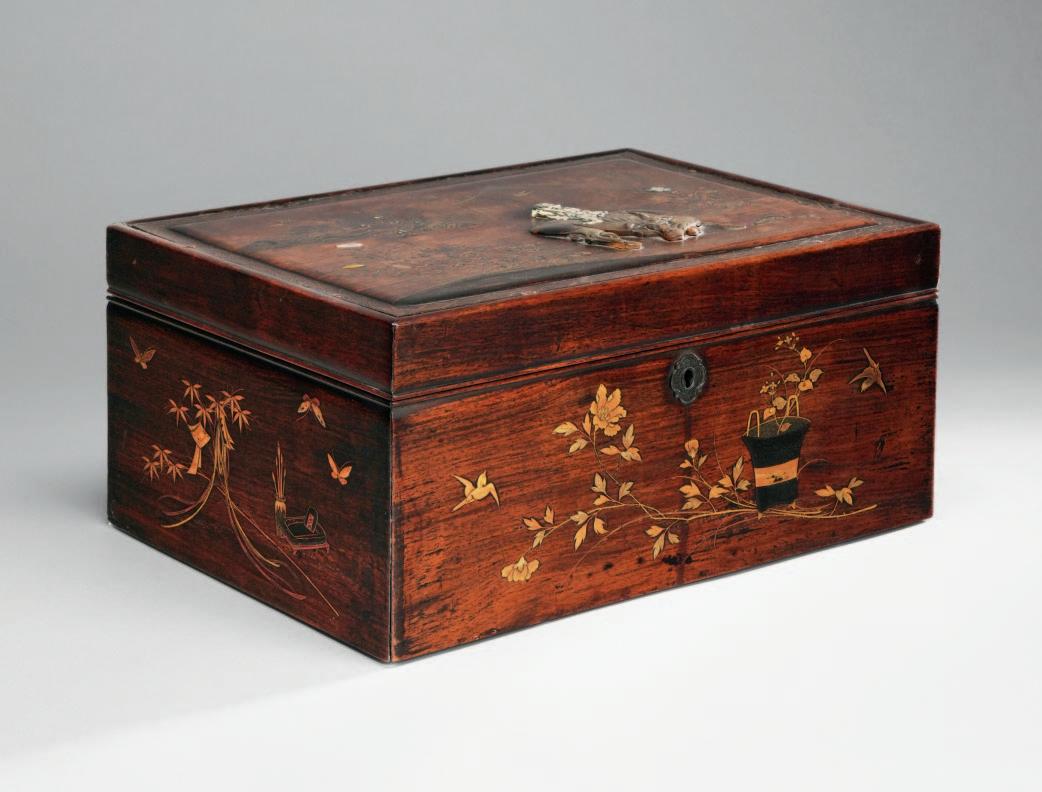
791
A JAPANESE INLAIDLACQUER BUNKO (DOCUMENT BOX)
EDO PERIOD, 18TH/19TH CENTURY
IN THE STYLE OF OGAWA HARITSU (RITSUO, 16631747)
The lid decorated with a caparisoned white elephant, the pachyderm carrying a large jardinière containing reishi fungi and branches of red coral, the sides with the silhouettes of karako holding the tether attached to the elephant’s trunk, one boy at the front carrying a triangular flag on a pole; the inside of the lid with a mask of Okame beside a small square seal mark reading as Kan; all rendered in lacquer and mother of pearl inlays, 15.5cm x 34.7cm x 42cm. (2)
£400-600
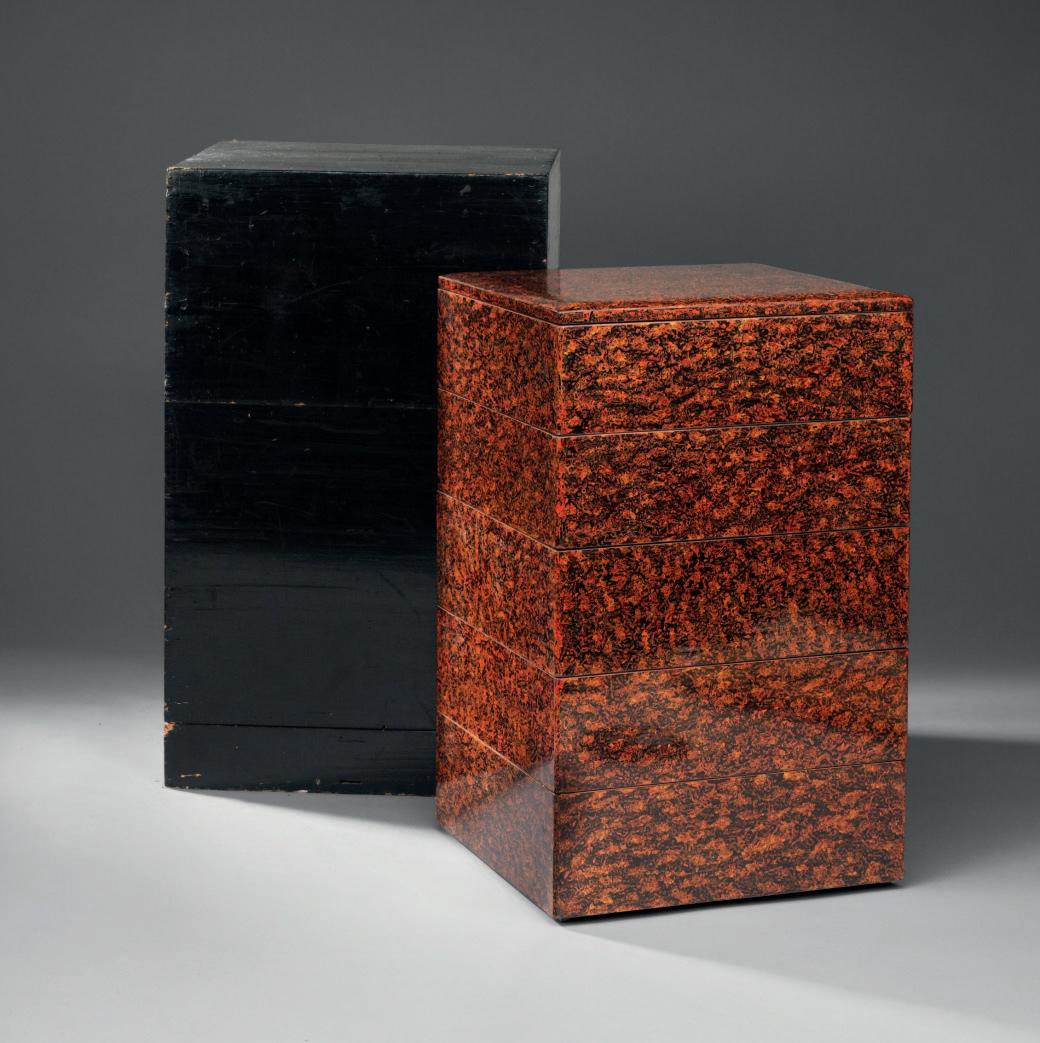
790
λ AN UNUSUAL JAPANESE INLAID AND LACQUERED BOX
MEIJI ERA, 19TH CENTURY
With a hinged cover, decorated in gold and iroe hiramaki-e, with inlays in mother of pearl, horn and other materials; the top embellished with a boy playing the flute while seated on a large ox, with many flowers beside them, birds and a village in the distance, signed Kajikawa Kikosai to the left; the sides with further birds flying over variouslyshaped vases and an ink stone; the inside of the lid with another bird flying over an inrō; 16.5cm x 36.5cm x 25.8cm.
£200-300
With an ivory registration number.
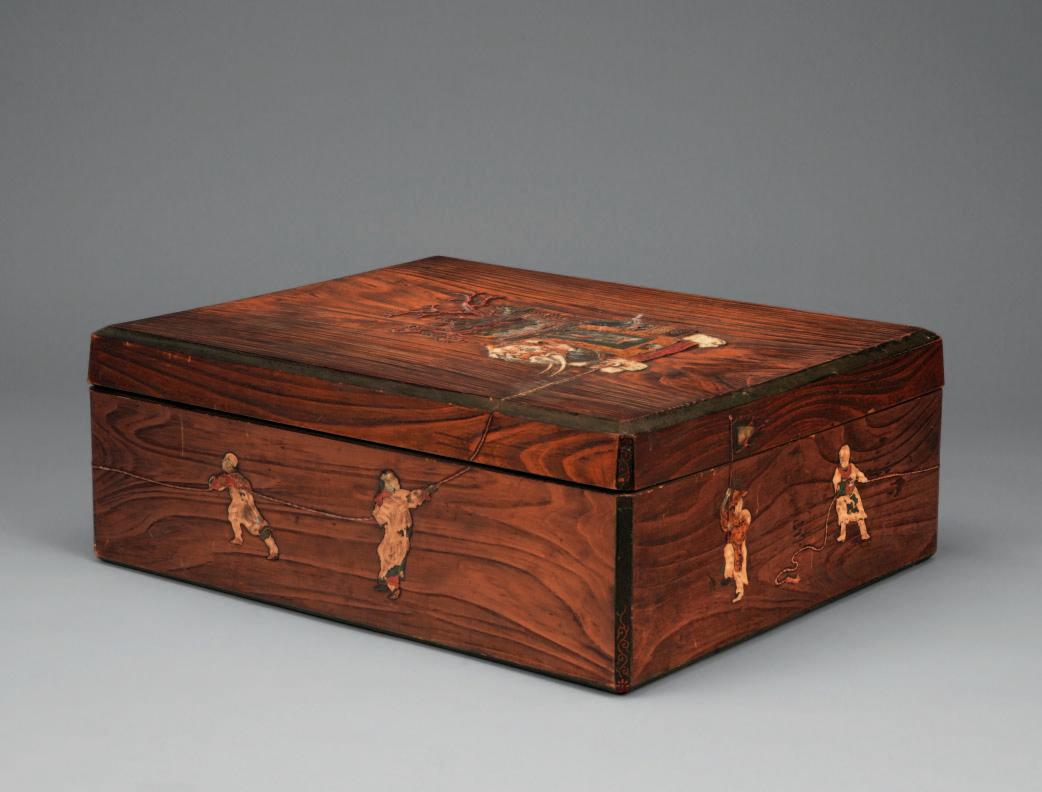
792
A JAPANESE TSUGARU-NURI LACQUER FIVETIERED PICNIC BOX
TAISHŌ OR SHŌWA, 20TH CENTURY
The trays and the cover of rectangular shape, the surface decorated in the karanuri pattern with red, yellow, green and black lacquer, the inside in red lacquer; together with another cover; with a tomobako (wood box), 37cm x 23.5cm x 22cm. (8)
£400-600
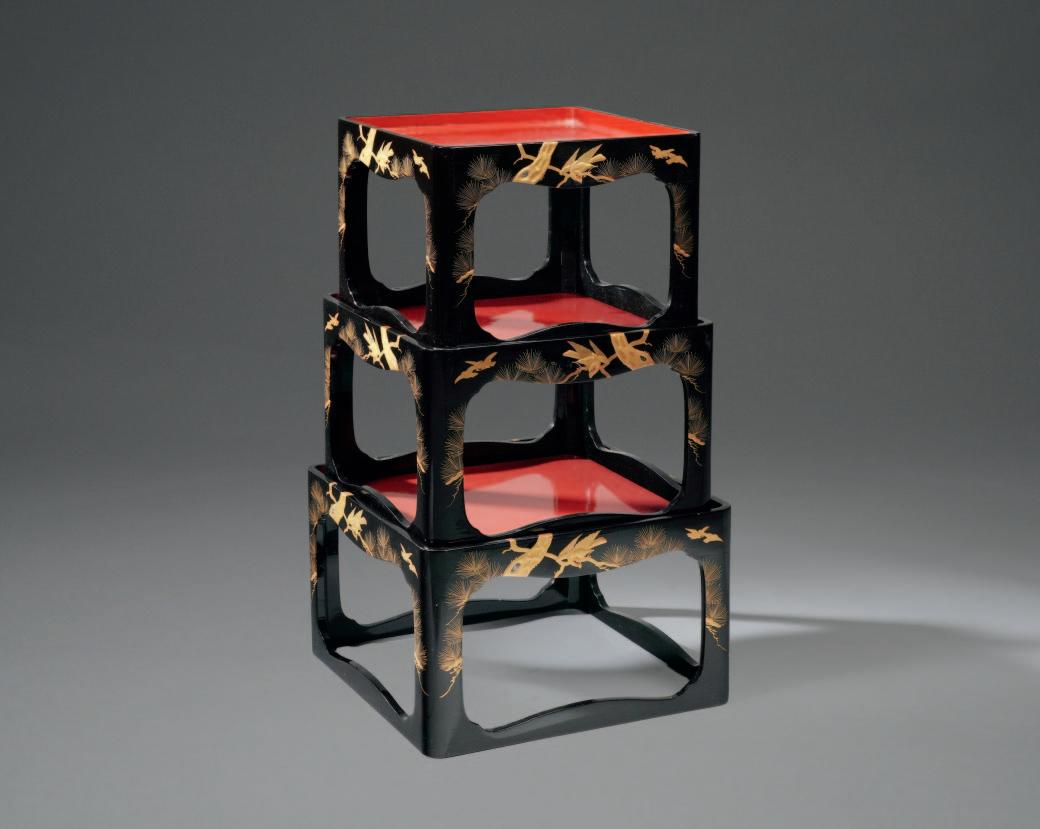
793
A SET OF THREE JAPANESE LACQUERED NESTING TABLES
SHŌWA ERA, 20TH CENTURY
Each of rectangular shape with red lacquer tops, the sides with birds of prey perched on pine observing smaller birds, rendered in gold lacquer and mother of pearl on the black roiro ground, 24.2cm x 39.5cm x 39.6cm max. (3)
£200-400
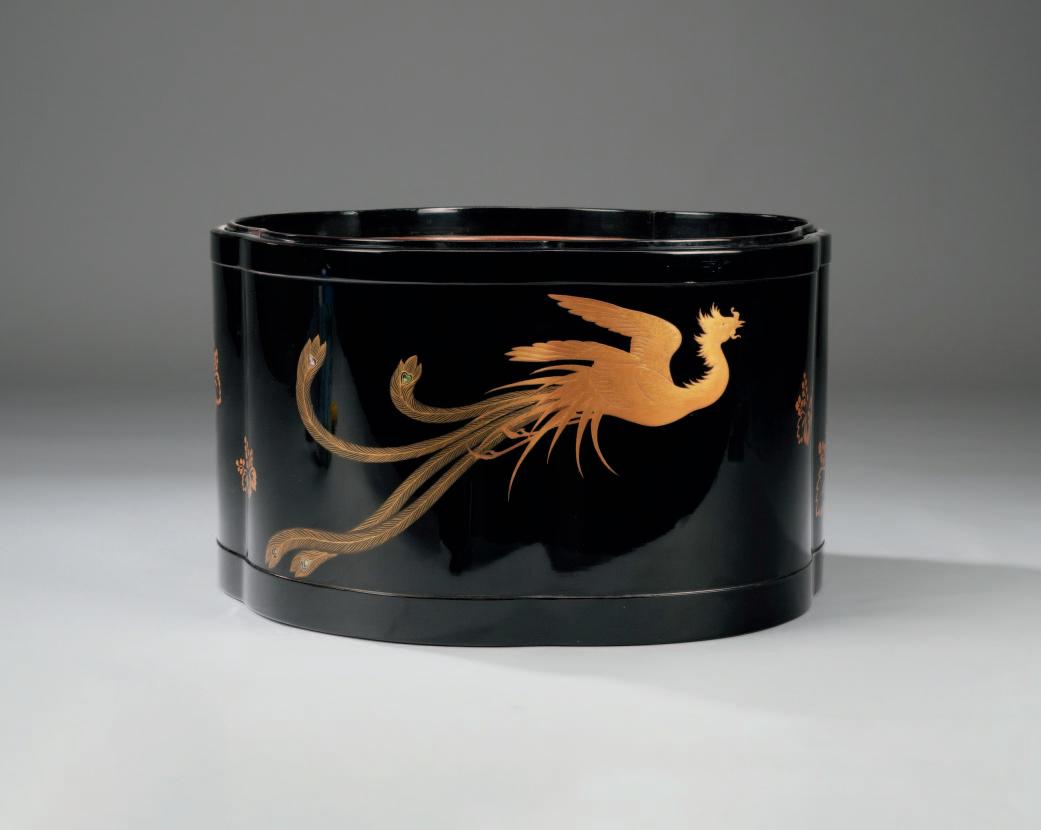
795
A JAPANESE LACQUER HIBACHI (BRAZIER)
SHŌWA ERA, 20TH CENTURY
The lobed body decorated with large Hōō birds in flight amongst paulownia mon, rendered in gold hiramaki-e lacquer with aogai (mother of pearl) details on the black roiro ground, with a metal liner and a removable rim, 39.5cm. (3)
£500-1,000
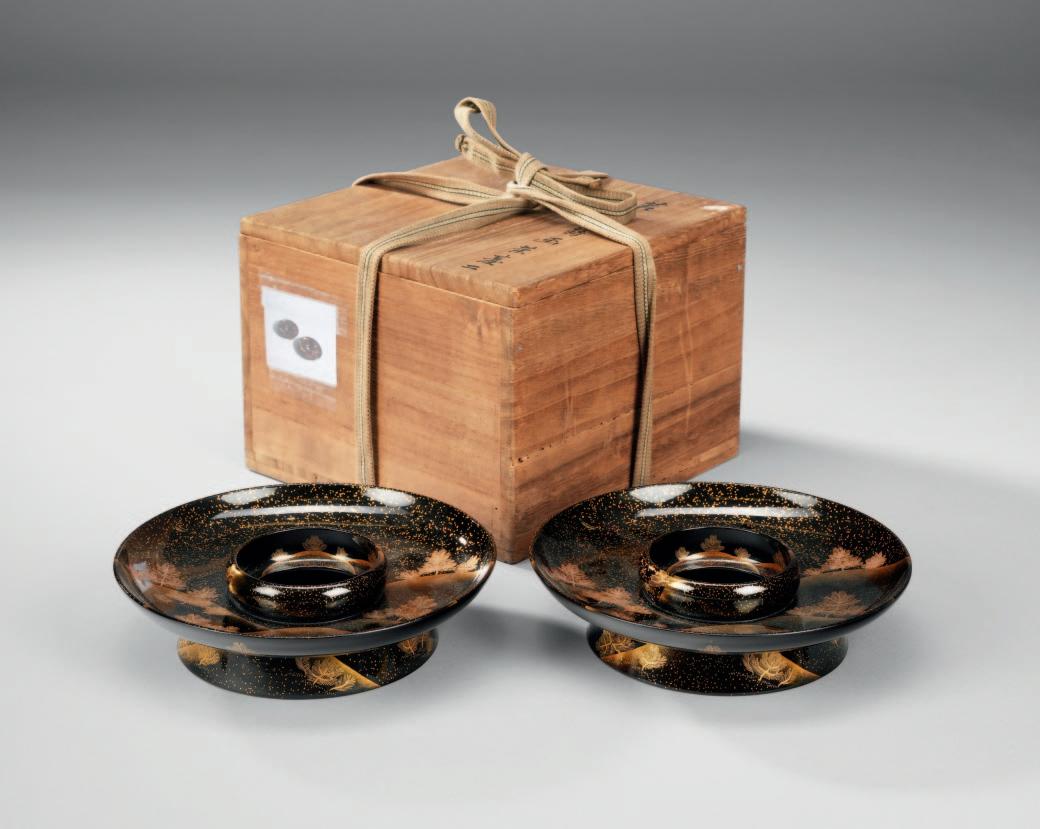
794
A PAIR OF JAPANESE LACQUER CHADAI (TEABOWL STANDS)
MEIJI ERA, 19TH/20TH CENTURY
Each with a wide rim, a rounded neck and raised on a slightly flared foot; both decorated in gold hiramaki-e and nashiji on the black roiro ground with many pine trees on hills; with an inscribed tomobako (wood box), 16.5cm. (3)
£500-800
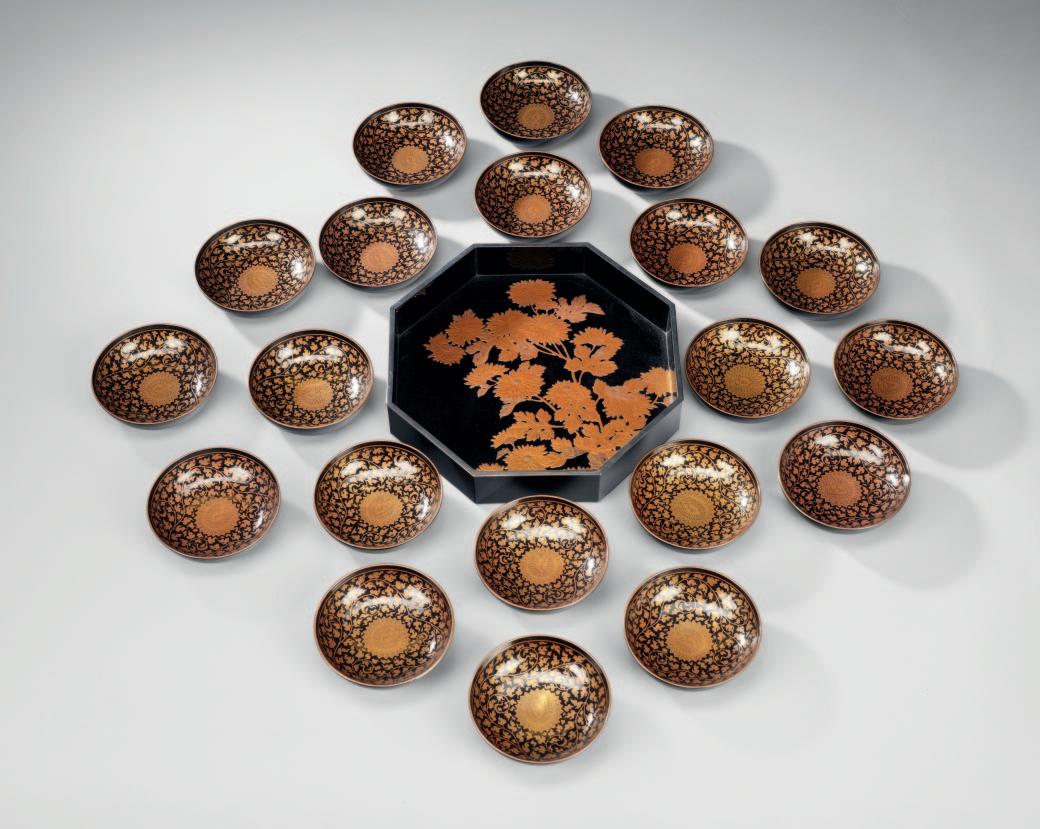
796
A JAPANESE LACQUER TRAY AND A SET OF TWENTY BOWLS
MEIJI OR LATER, 19TH/20TH CENTURY
The octagonal tray decorated with chrysanthemum rendered in gold hiramaki-e and kirikane on the black roiro ground, with a tomobako (wood box); together with a set of twenty lacquer bowls decorated with lotus flowers and leafy tendrils, also with a tomobako, 26cm and 11.2cm. (23)
£500-800
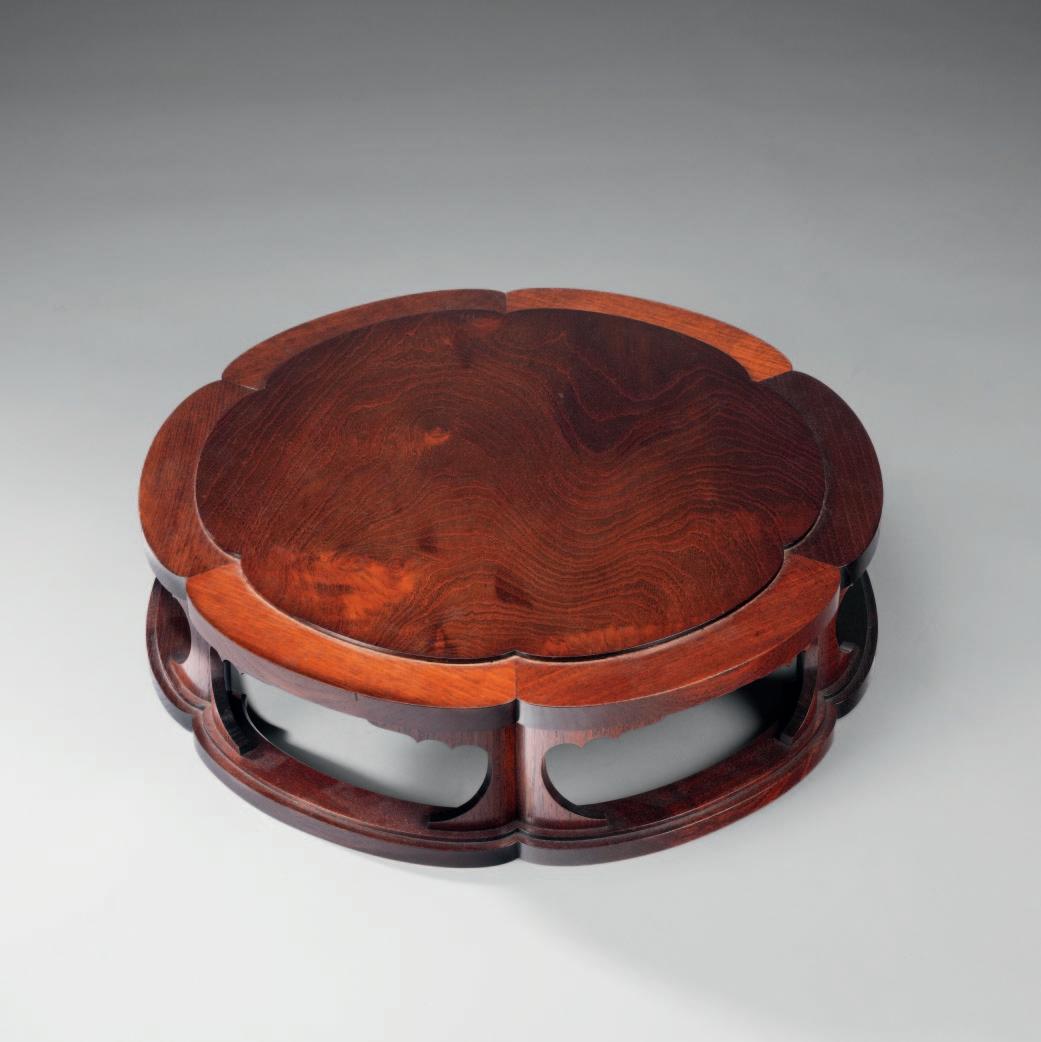
798
A JAPANESE WOVEN BAMBOO TRAY AND TWO WOODEN DISHES
SHŌWA ERA, 20TH CENTURY
The rectangular tray with tall sides, the strips woven tightly; together with a large circular dish, boxed and with a paper label reading as Shokawa hikimono, tochi (Shokawa latheturned woodwork, horse chestnut tree), and a hexagonal parquetry footed platter, the sides made of triangles in slight relief, 63cm max. (4)
£600-800
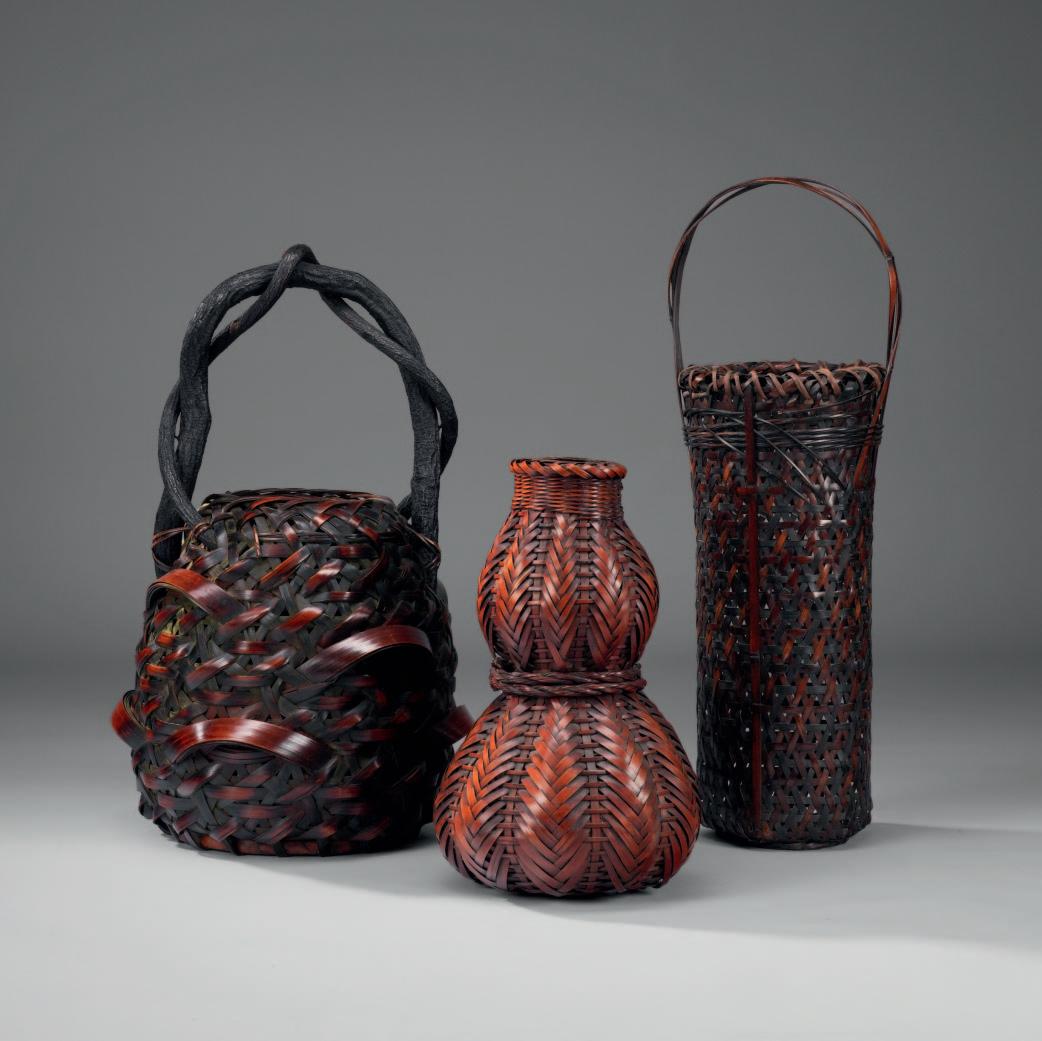
797
A LARGE JAPANESE HEXAFOIL KEYAKI (ZELKOVA) STAND
SHŌWA ERA, DATED SPRING OF 1936
The flowershaped stand with lobed apertures below; together with a tomobako (wood box) inscribed Rikuryō kiridai (hexafoil base), dated and signed Bunroku saku, 41cm. (2)
£500-1,000
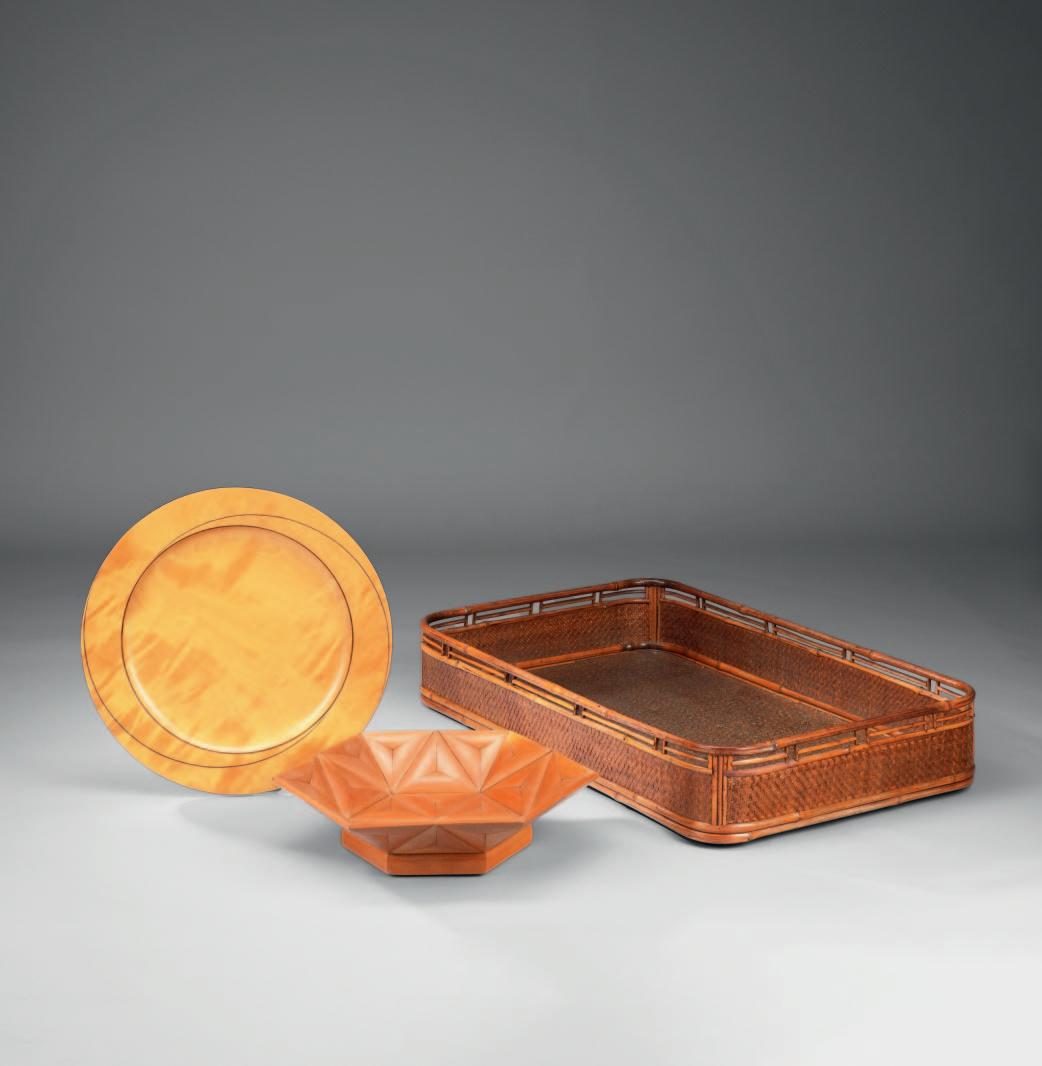
799
THREE JAPANESE IKEBANA BAMBOO BASKETS
SHŌWA ERA, 20TH CENTURY
For traditional flower arrangements, of various shapes and woven in a variety of complex patterns; one with an inner otoshi (water container) made of a lacquered section of bamboo; 42.5cm max. (3)
£500-800
800
TWO JAPANESE MOTHER OF PEARL AND LACQUER DISHES
SHŌWA ERA, 20TH CENTURY
The largest decorated with the eight trigrams rendered in aogai on the lustrous black roiro ground, with an inscribed tomobako (wood box), possibly by Wakajima Ryohei (d.1986); the other smaller one with a border of triangles, also with a tomobako, 24.6cm and 33.5cm. (4)
£600-1,000
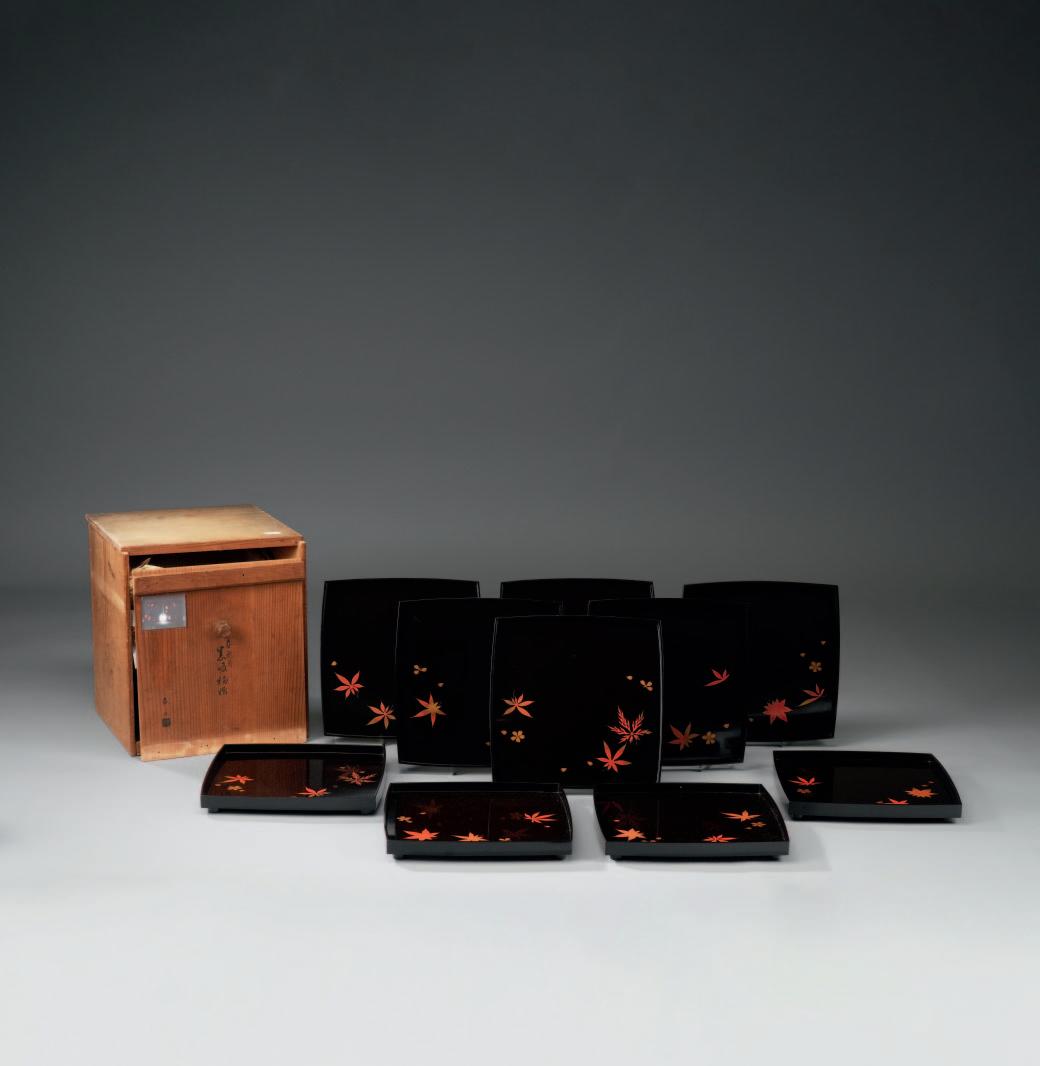
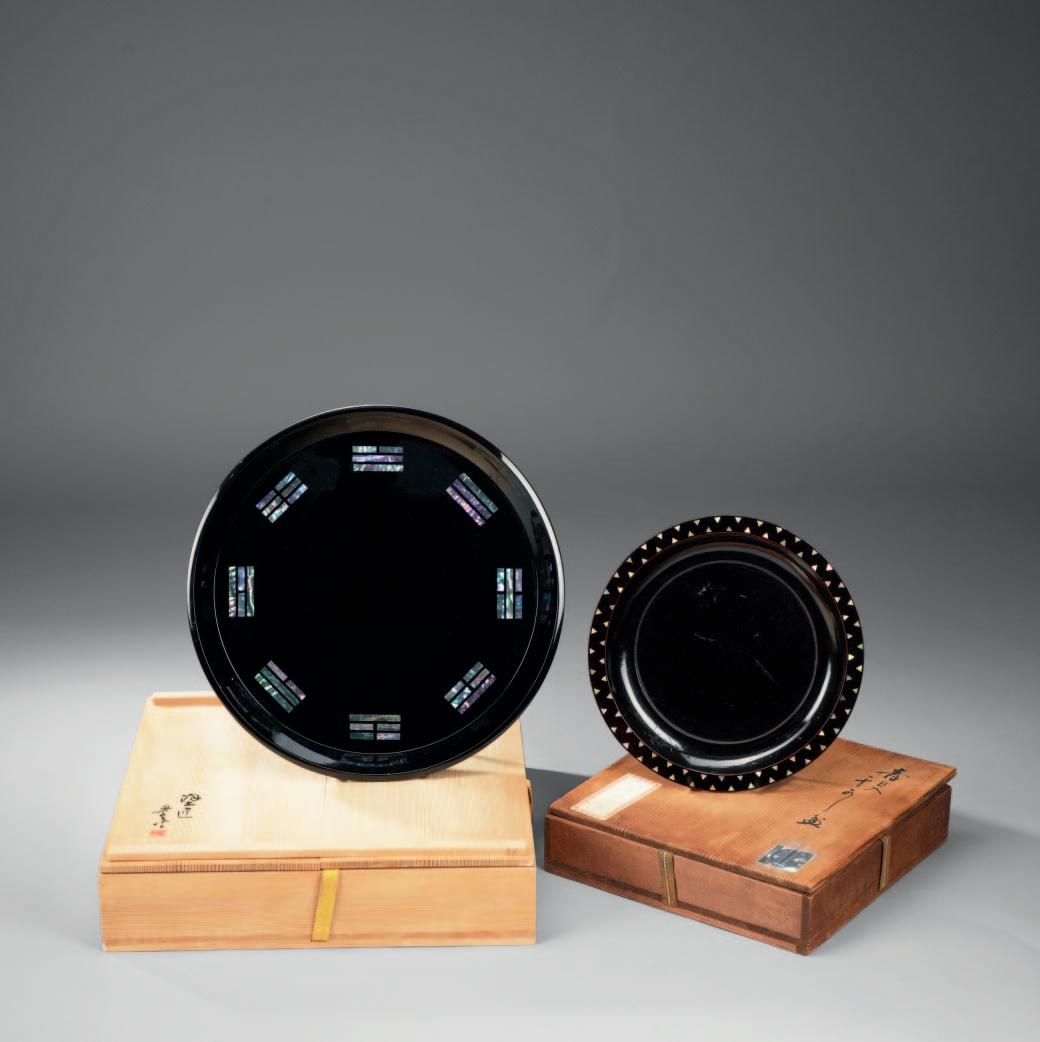
801
A SET OF TEN JAPANESE LACQUER TRAYS
SHŌWA ERA, 20TH CENTURY
Each square tray with slightly rounded sides and raised on four short circular feet, each decorated with cherry blossoms and maple leaves scattered across the surface, rendered in gold and red hiramaki-e lacquer on the black roiro ground; in a tomobako (wood box) inscribed Kuro suimono-wan shunjū-ga (black trays with spring and autumn painting) and signed and sealed Shunshō, 24.2cm. (11)
£600-1,000
802
SIX JAPANESE RED LACQUER DISHES
SHŌWA/HEISEI, 20TH CENTURY
Five forming a set, in a tomobako (wood box) inscribed Kyoto Ebisugawa Miyazaki Heiando; together with a larger negoro dish, also with a tomobako, 17.3cm and 24cm. (8)
£600-1,000
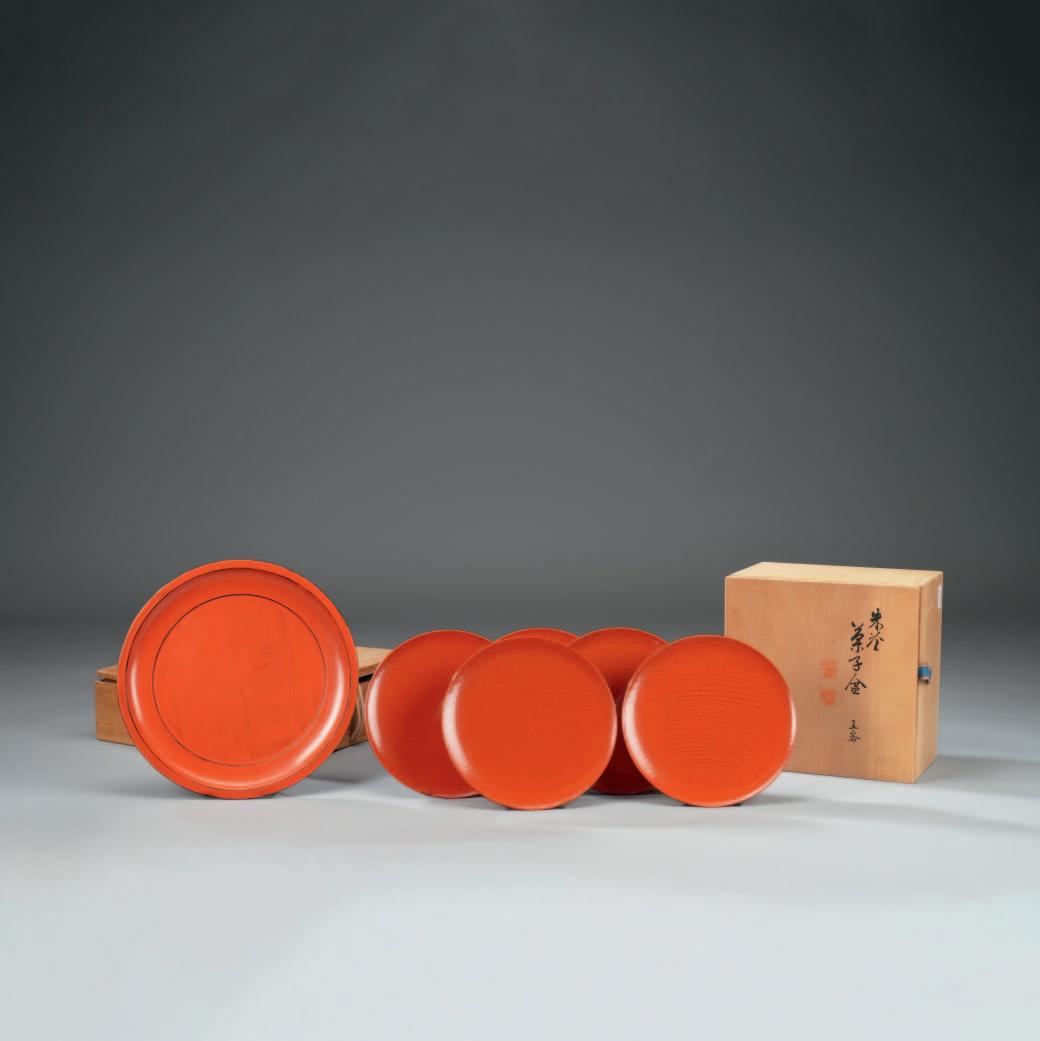
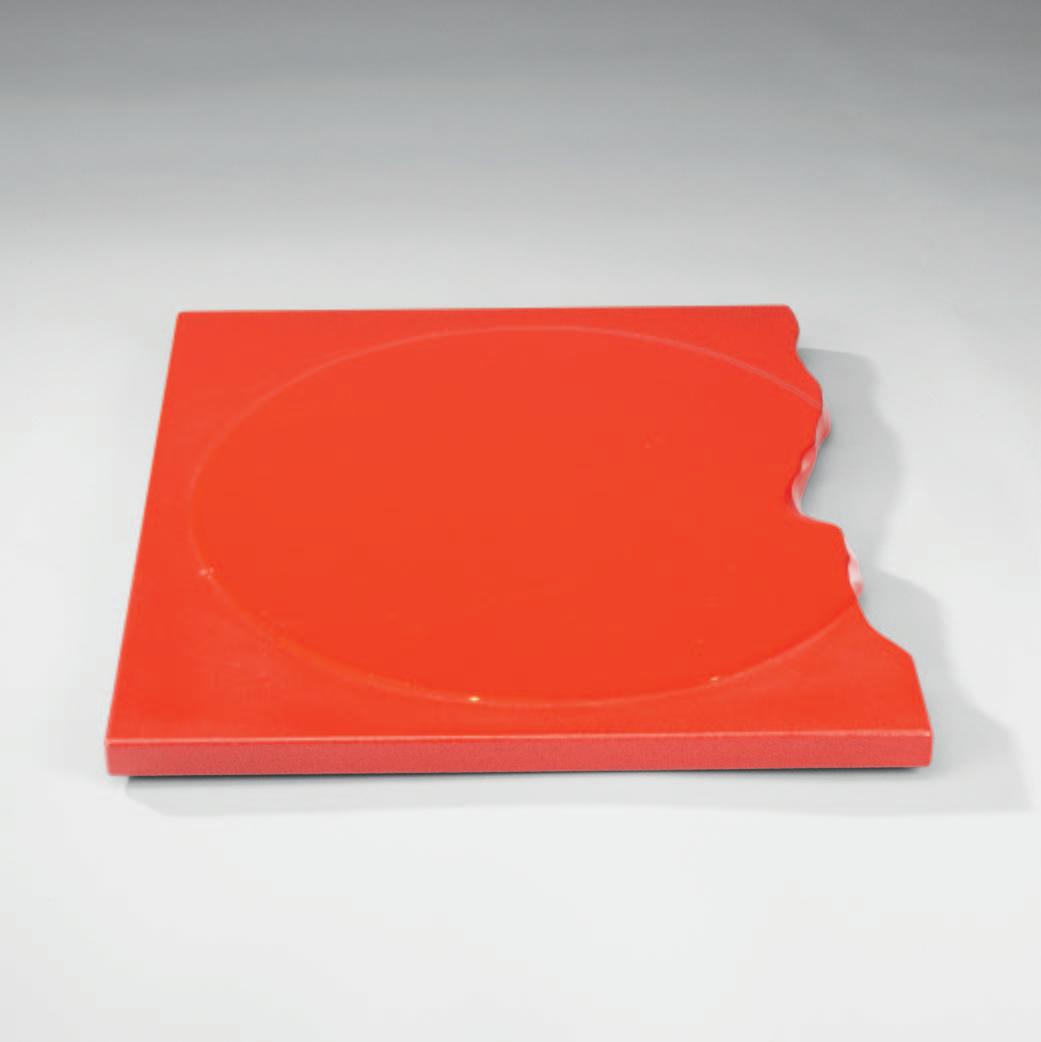
804
MASAHARU YAMADA (B.1955)
LE BAISER (THE KISS)
HEISEI ERA, DATED 1992
A Japanese abstract sculpture in marble and possibly sandstone, the upper section with fluid, ribbonlike shapes contrasting with the heavy oval base; inscribed Masa on the side, and underneath le baiser, Masaharu Yamada, 1992.11.21; 39.5cm (2)
£500-800
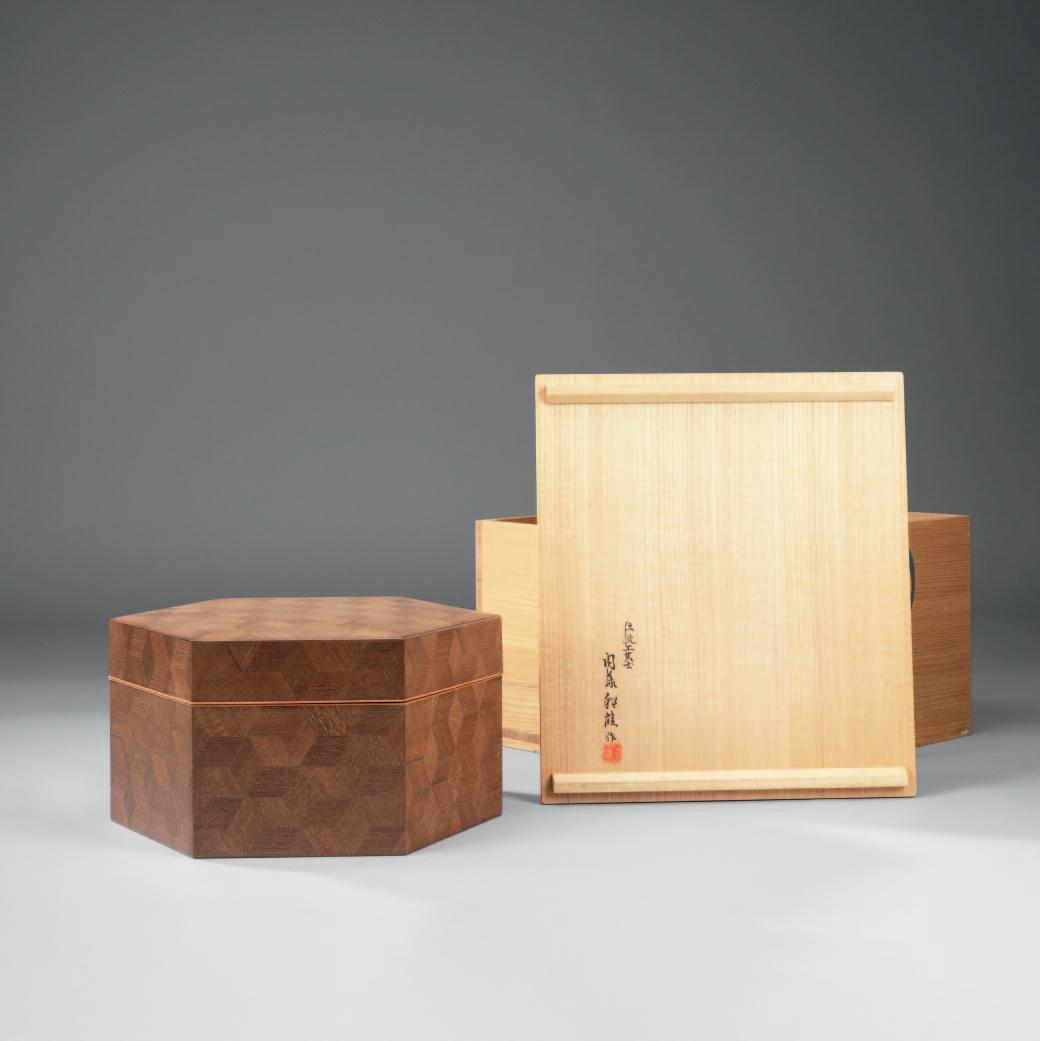
803
A JAPANESE RED LACQUER TRAY BY HARA WATARU (B.1948)
SHŌWA/HEISEI, 20TH CENTURY
Of rectangular shape, one side with a craggy edge, raised on four short circular feet; the top in red cinnabar lacquer and the reverse a deep lustrous black; in a tomobako (wood box) inscribed Urushi-nuri kakuzara (lacquercoated square dish), signed Hara Wataru and sealed; 40cm x 36.8cm. (2)
£1,000-2,000
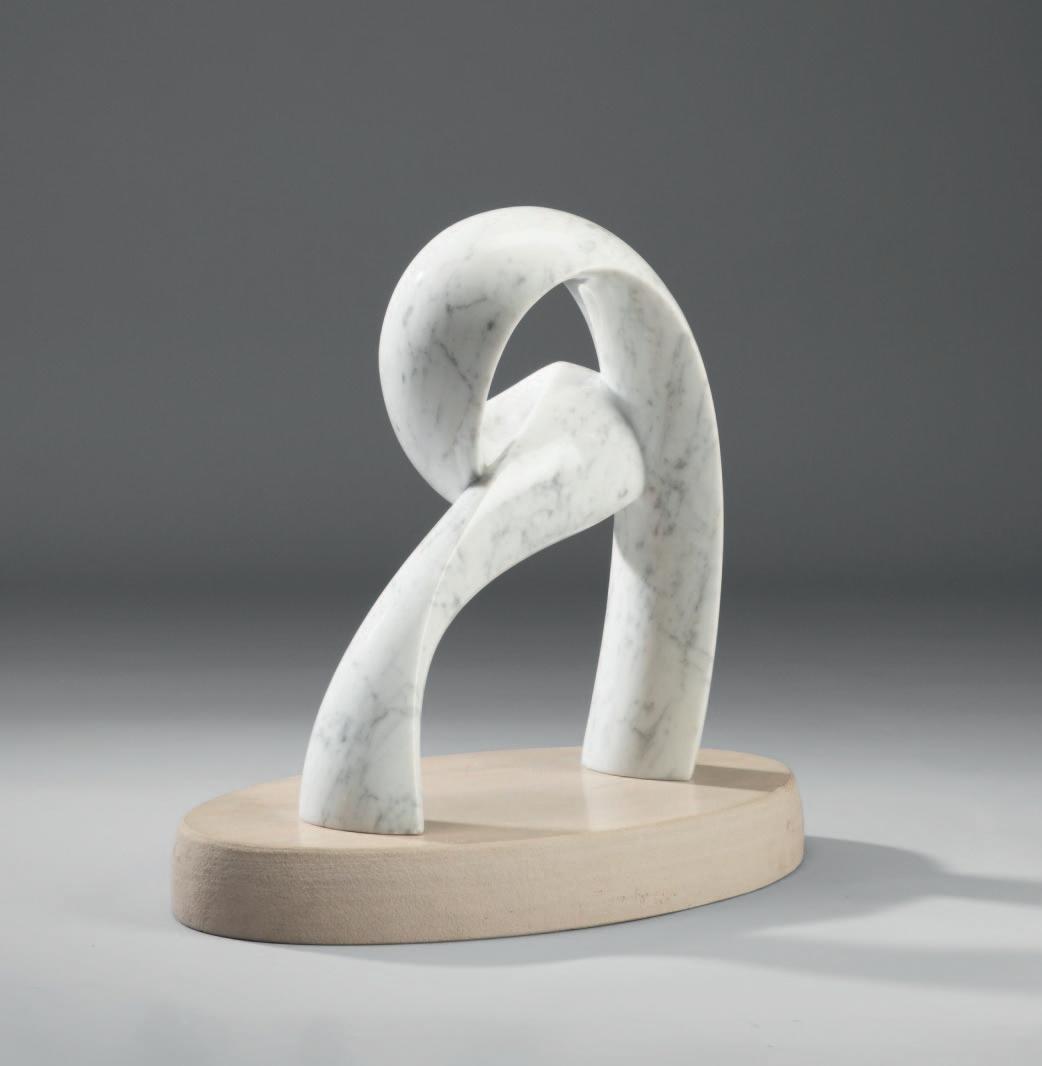
805
A JAPANESE ZELKOVA PARQUETRY BOX AND COVER BY NAITO KUNIO (19192007)
SHŌWA/HEISEI, 20TH CENTURY
An example of Hakone Yosegi-zaiku zuku-pika (traditional Japanese parquetry with solidwood joinery), the hexagonal box, cover and inner tray decorated with a cube effect, the rims lined with a wood of a lighter colour, in a tomobako (wood box) inscribed Jindai-tamo yosegi-zaiku rokkaku-bako (Hexagonal wood parquetry box), and signed on the inside Dentō Kōgeishi Naito Kunio saku (Master Craftsman, Made by Naito Kunio) and with a red seal mark; 25.4cm. (4)
£2,000-3,000
Naito Kunio was a master of Kyosashimono, a refined Kyoto-style wood joinery that specializes in creating elegant furniture and tea utensils without the use of nails. Hi work is regularly featured in major cultural showcases such as the Japanese Traditional Crafts Kyoto Exhibition and in specialized galleries at the Kyoto Museum of Crafts and Design.
806 no lot 804
EVENING | TUESDAY 2ND JULY 2026, 6-8PM
The Russell Cotes Art Gallery & Museum is a Grade II* listed Victorian villa on Bournemouth’s East Cli . Built in 1901 as a lavish birthday gi , this unique museum house showcases a world class collec on of artworks and an qui es.
Woolley & Wallis specialists will be hos ng a special evening at the museum on Tuesday 2nd July, from 6pm 8pm. Experts will be on hand to give auc on valua ons for Ceramics, Silver, Asian Art, Pain ngs, and other fine art and collectables. As visitors explore the historic house, they will also be given the opportunity to enjoy live piano music and a end short, insigh ul talks on specific highlights within the galleries.
Tickets are £18 (£15 for Friends Members of the Museum) and include a glass of wine or a so drink.
For further informa on, please email events@woolleys.live or the museum at russellcotes@bcpcouncil.gov.uk.
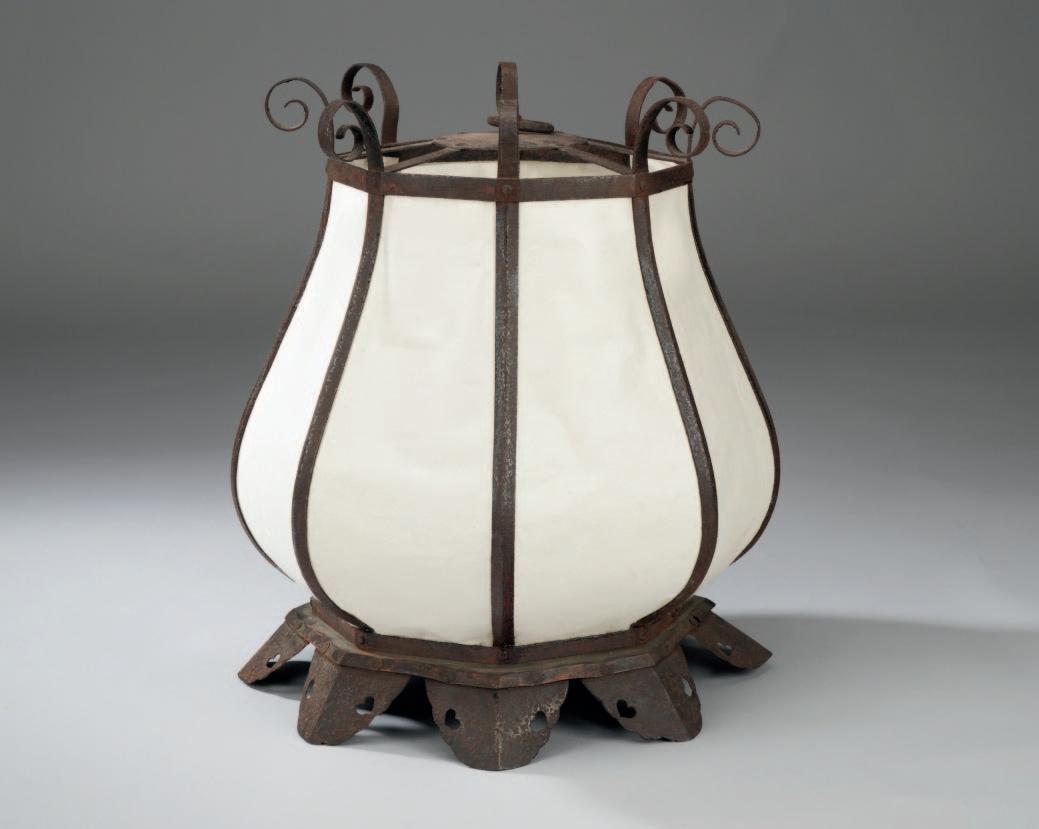
807
A JAPANESE IRON AND PAPER TSURI-DŌRO (HANGING LANTERN)
MEIJI ERA, 19TH/20TH CENTURY
With decorative spirals above and lappets with heartshaped apertures below; a chain at the top for suspension, 37cm.
£400-600
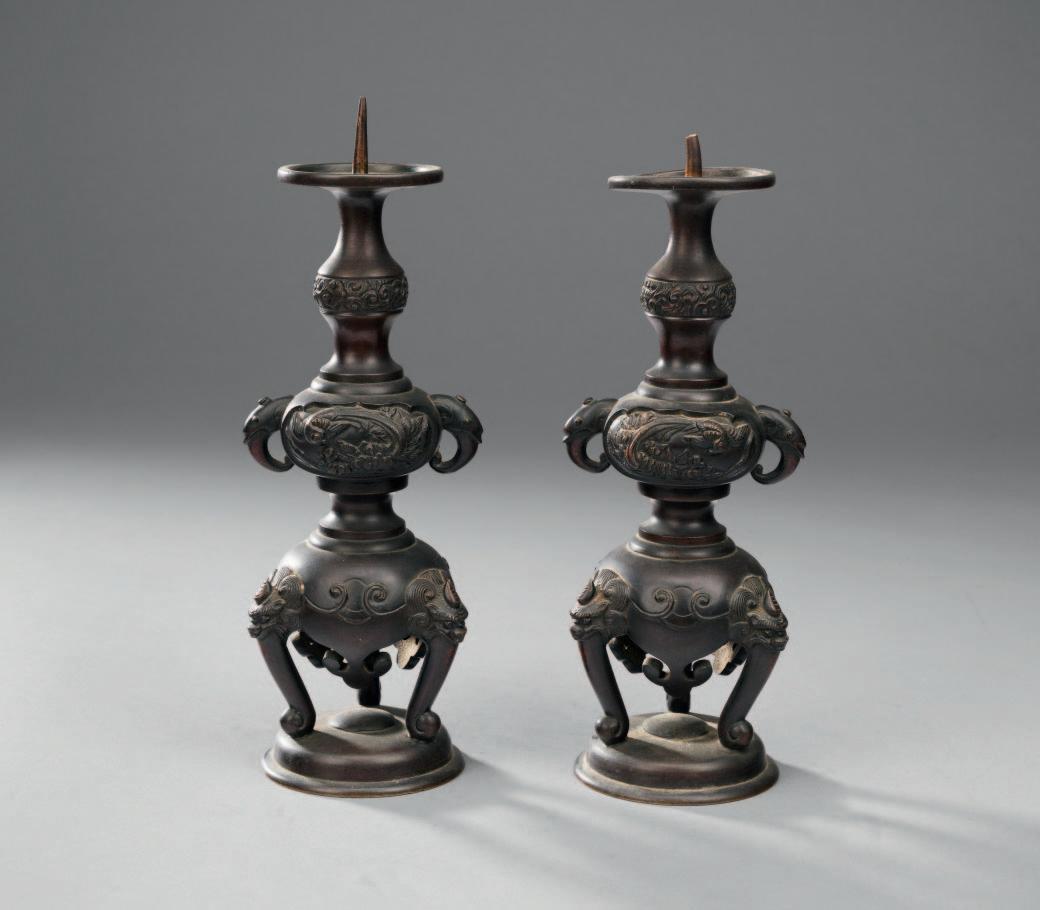
809
A PAIR OF JAPANESE BRONZE PRICKET CANDLESTICKS
MEIJI ERA, 19TH/20TH CENTURY
Both raised on three monsterhead feet and with elephanthead handles, each with panels containing birds on both sides, both signed underneath, possibly Nakao Shōshin zō, 22cm and 22.8cm. (2)
£200-300
Provenance: from the Estate of a Collector, Heath House, Hampshire, and thence by descent. By repute, acquired in Asia at the turn of the 19th century.
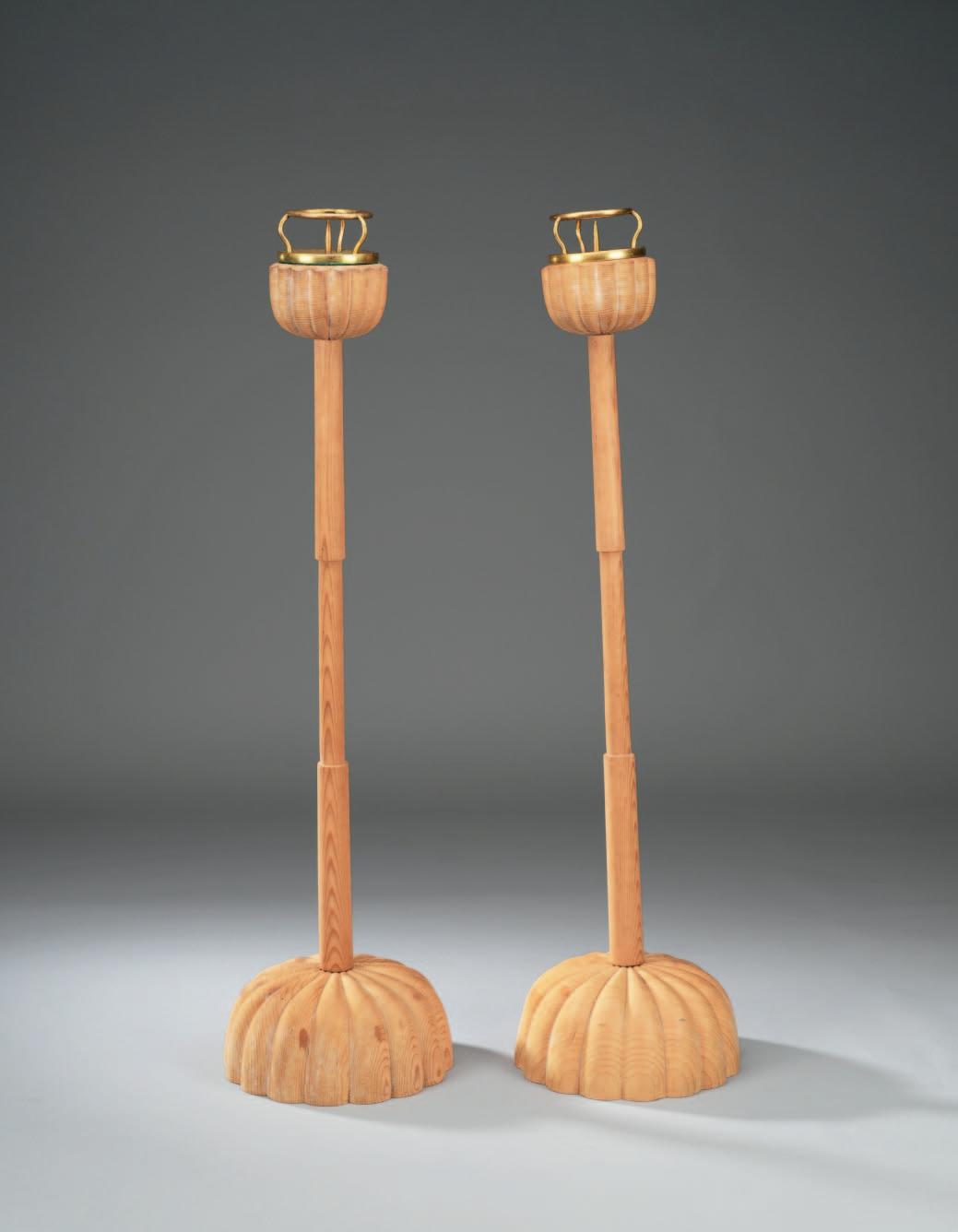
808
A PAIR OF TALL JAPANESE SHOKUDAI (CANDLESTICKS)
MEIJI/TAISHŌ, 20TH CENTURY
Each with a long stem rising from a chrysanthemumshaped base and with a foliate drip catcher, all elements detachable and with a tomobako (wood box), 74cm. (7)
£400-600
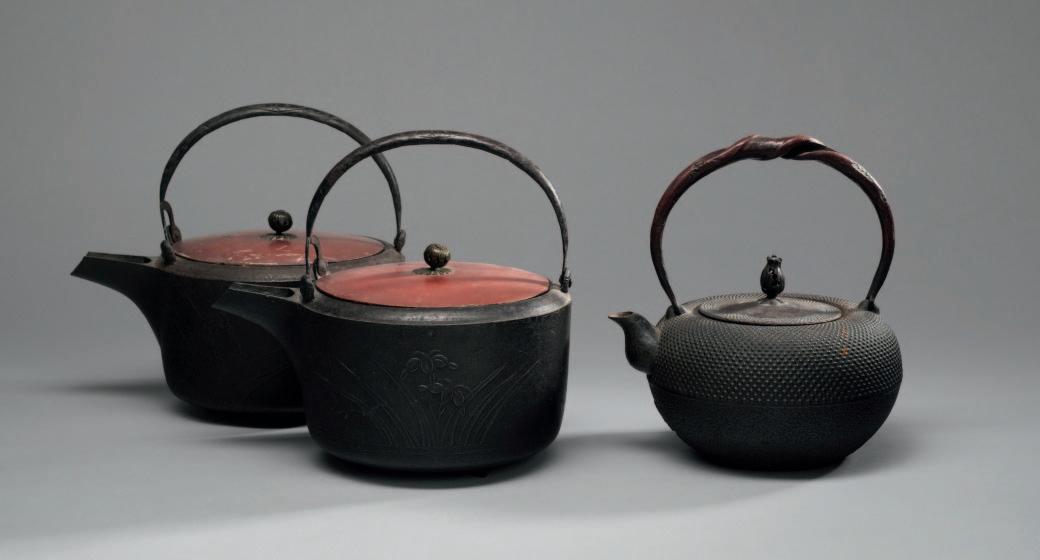
810
THREE JAPANESE IRON TETSUBIN (TEA KETTLES)
MEIJI OR LATER, 19TH/20TH CENTURY
Two a pair decorated with irises in low relief, both with a lacquer cover; the third decorated with raised dots and with a signature to the front, 21.5cm max. (6) WITHOUT RESERVE
£150-250
Provenance: from the collection of Dr Richard Brown, by repute.
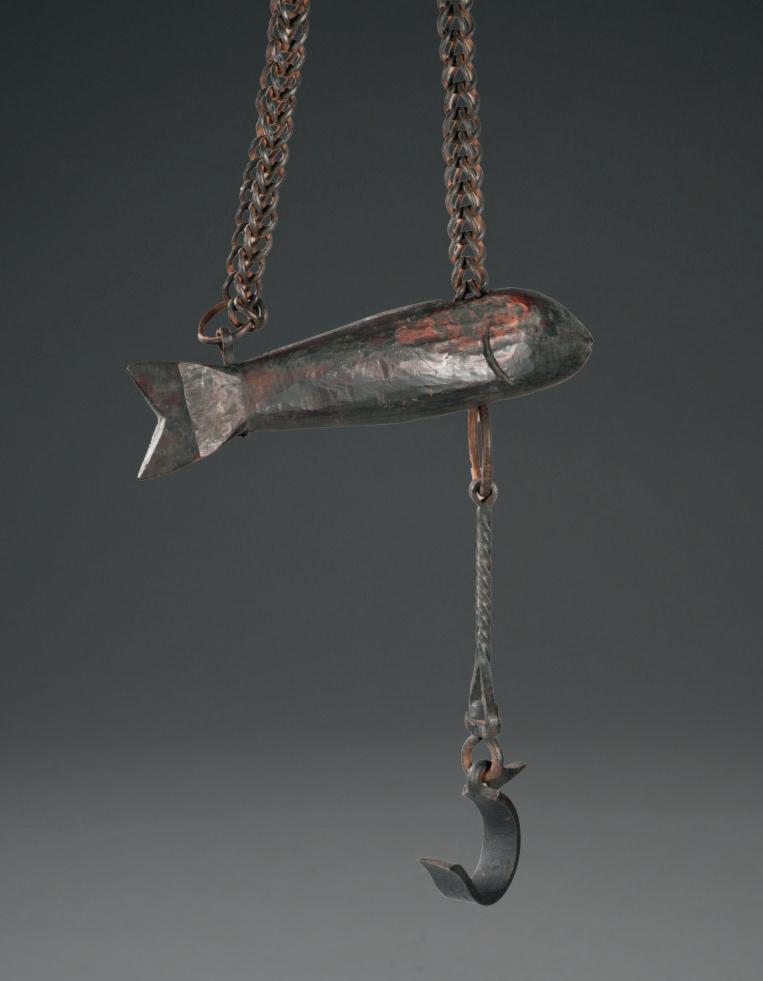
811
A JAPANESE WOOD AND IRON FISHSHAPED JIZAI KAGI (KETTLE HOOK)
EDO/MEIJI, 19TH CENTURY
Typically modelled as a stylised fish, attached to a heavy iron chain and suspending a hook, the chain approx. 260cm.
£200-400
Provenance: from the collection of Robert L Stolper of Stolper Galleries, and thence by descent. Robert worked with Asian and African art from the 1940s onwards in Amsterdam, Munich, New York and the UK.
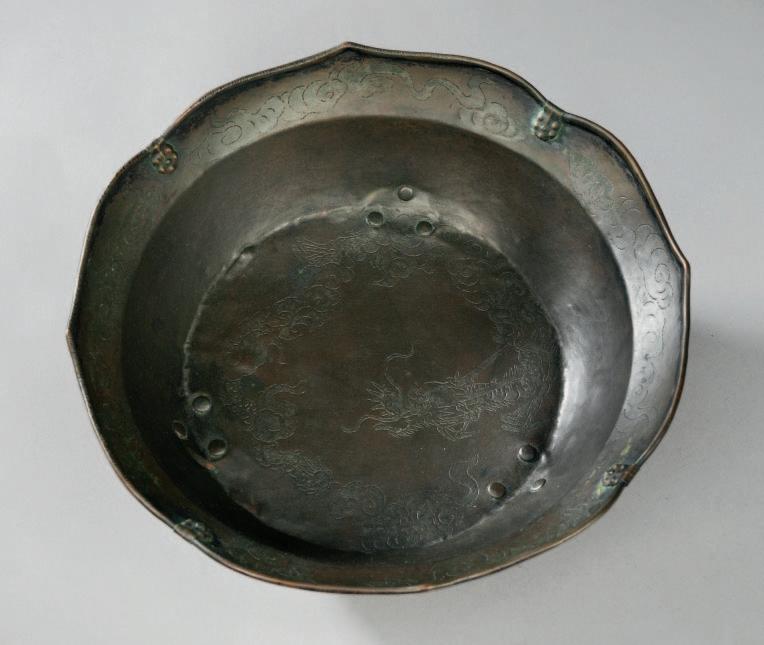
813
AN UNUSUAL COPPER TRIPOD BOWL POSSIBLY JAPANESE, MUROMACHI
With a foliate rim, the well decorated with a large writhing dragon amongst scrolling clouds, the rim and reverse embellished with further clouds, 25.3cm. WITHOUT RESERVE
£400-600
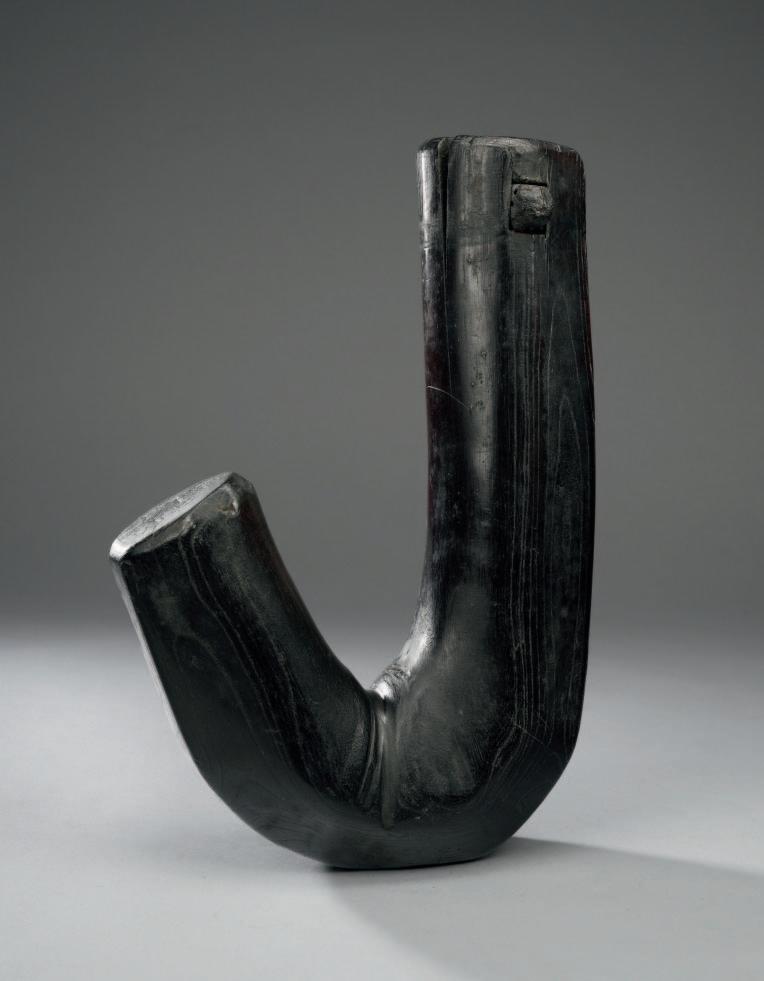
812
A JAPANESE WOOD JIZAI KAGI (KETTLE HOOK)
EDO/MEIJI, 19TH CENTURY
Of typical form, carved from a single block of zelkova (keyaki), richly patinated and polished to reveal the extensive wood grain, 37.5cm.
£400-600
Provenance: from the collection of Robert L Stolper of Stolper Galleries. Robert worked with Asian and African art from the 1940s onwards in Amsterdam, Munich, New York and the UK.
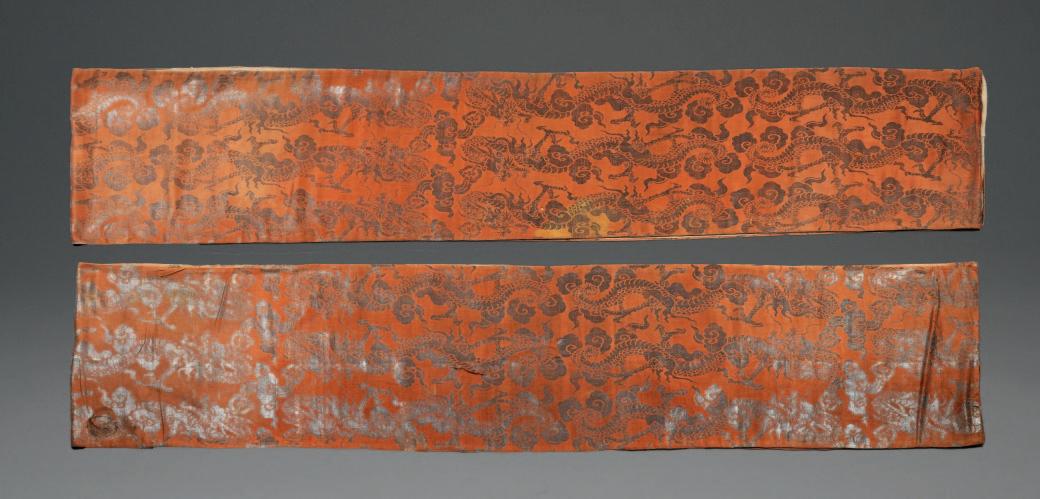
814
A PAIR OF JAPANESE SILVER THREAD TEXTILE PANELS
EDO/MEIJI, 19TH CENTURY
The long rectangular panels decorated with writhing dragons amongst scrolling clouds, all rendered in silver thread against the warm orange silk ground; the reverse inscribed Jūmotsu Hōunō Saigoku Kuyō-jo Kuni-Chū Seishu (roughly translating as ‘Temple offering dedicated by the local group for the thirtythree station Saigoku pilgrimage, provided by benefactor thirteen’); 416cm x 57cm. (2)
£500-1,000
The Saigoku Kannon pilgrimage is the oldest and most prestigious circuit featuring thirty-three Buddhist temples in the Kansai region of Japan, all dedicated to Kannon, the Bodhisattva of Compassion.
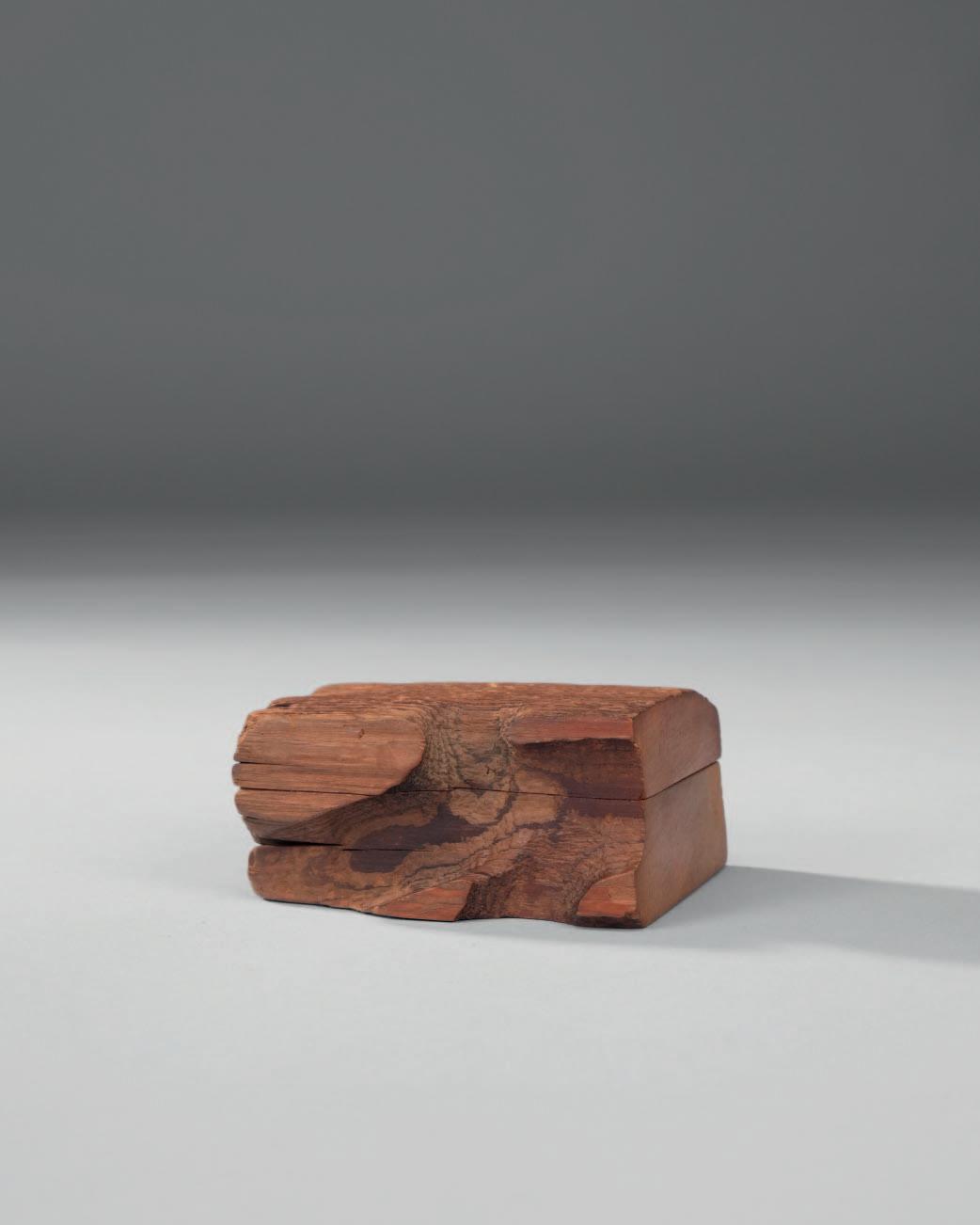
816
A LARGE JAPANESE HINOKI (CYPRESS) TRAY FROM NARA’S HŌRYŪJI TEMPLE
SHŌWA ERA, DATED 1981
The wooden crosssection slab taken from a pillar, with a rectangular heatstamped mark reading as Hōryū-ji kozai zo (made with the old material of the Hōryūji temple), in a tomobako (wood box) inscribed Hōryū-ji Dai-kodo Kozan Suiban (from the Great Lecture Hall, a tray made from ancient wood), dated Shōwa 56 (1981), and signed Ryogen; 65cm. (2)
£1,000-2,000
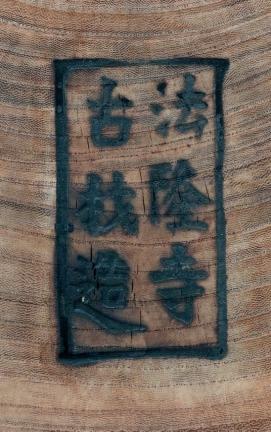
815
A JAPANESE KŌGŌ (INCENSE BOX) MADE FROM SACRED TEMPLE WOOD
NARA PERIOD, DATED TENPYŌ ERA (8TH CENTURY)
Of rectangular shape, the lid opening to reveal a small oval notch on the inside; the reverse inscribed Tsugiba-no-tokoro, Tōtō-ji, Tenpyō Kozai (From the main square of the East Pagoda Temple, ancient wood from the Tenpyō Era); with a tomobako (wood box), 7.7cm. (3)
£400-600
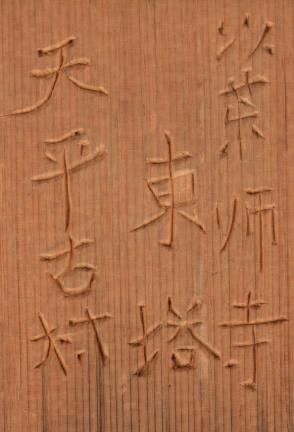
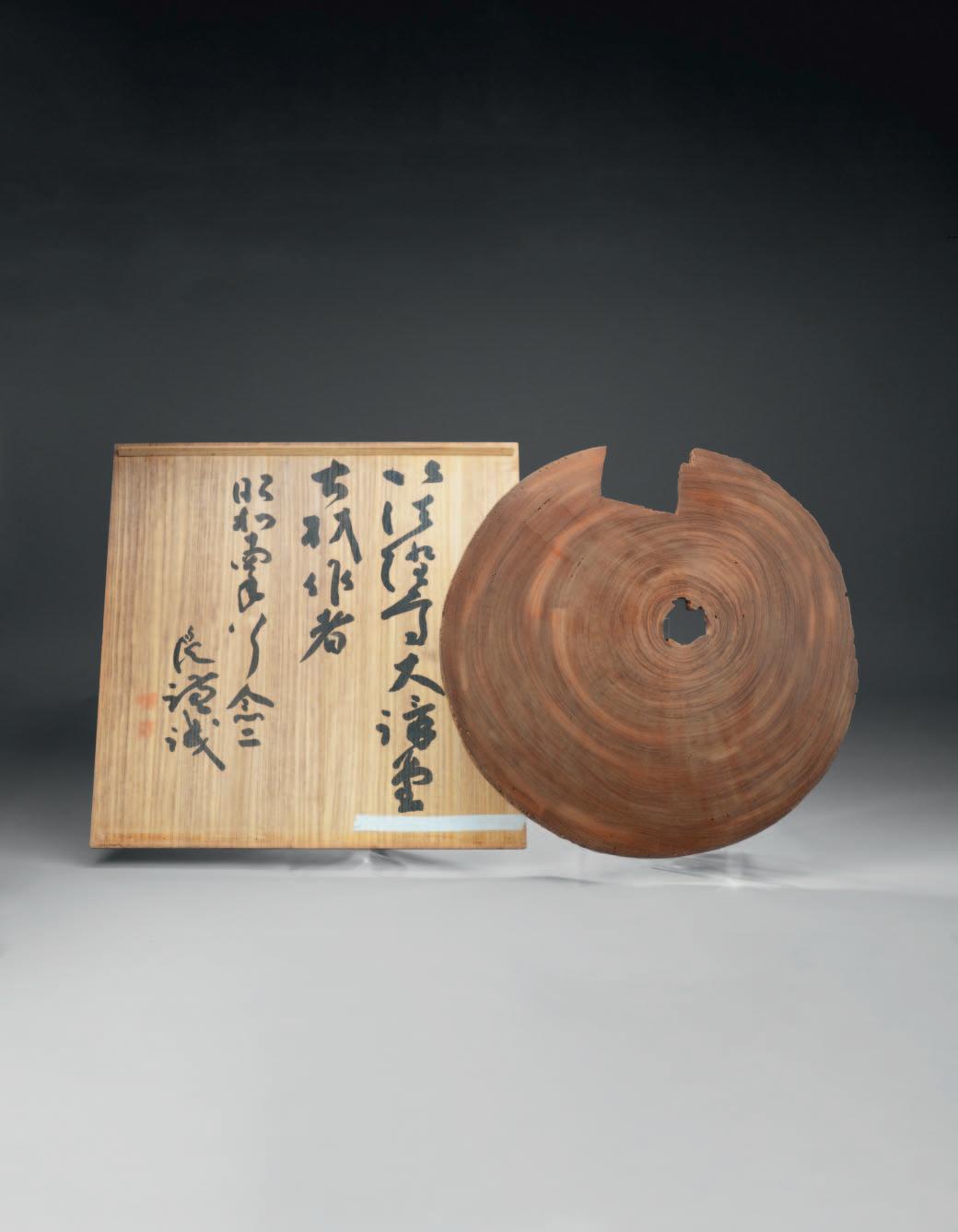
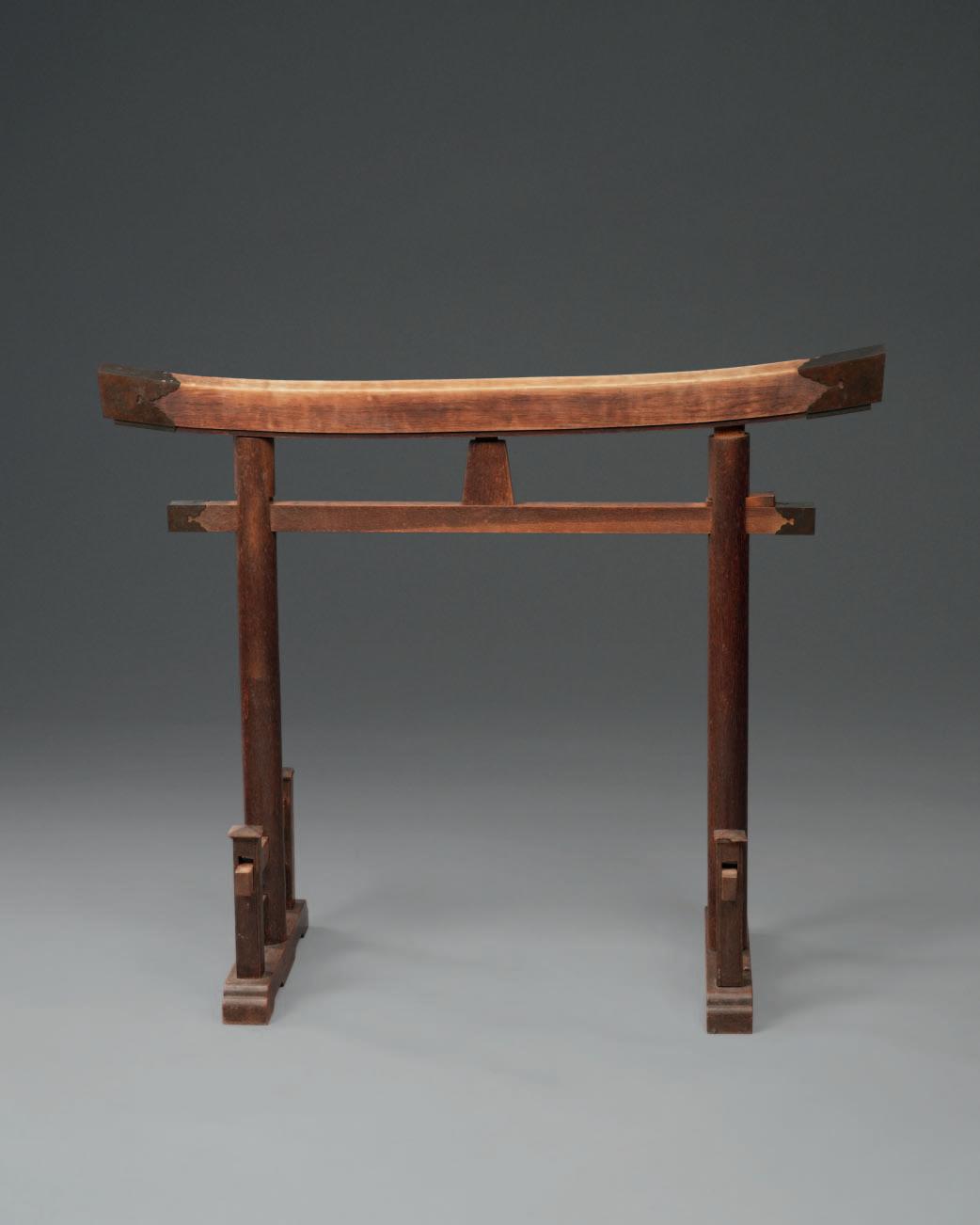
A LARGE JAPANESE MODEL OF A TORII (TEMPLE GATE)
MEIJI ERA, 19TH/20TH CENTURY
Made of various carved wood pillars held together by pegs, with metal mounts at the end of the horizontal beams, 76.8cm x 90.7cm.
WITHOUT RESERVE
£200-400
A MONUMENTAL JAPANESE PLASTER AND WOOD MODEL OF A PAGODA
MEIJI ERA, 19TH CENTURY
Of tahōtō (manyjewelled pagoda) type with two storeys, a square lower level, a cylindrical upper story, and a mokoshi (skirt roof), with a tall spire crowned by a flaming pearl; realistically rendered and painted in pink, blue, green and white pigments; the model of modular construction with detachable tiers and stackable sections; 114cm x 56.5cm.
£1,200-1,500
These large models of pagodas were rarely just souvenirs; they were usually made as pieces for international exhibitions, votive offerings, or architectural ‘blueprints’ used before building the full-scale monument. This particular type of pagoda is found at Shingon and Tendai Buddhist temples in Japan, and it is possible that this one depicts the Tahōtō of Ishiyama-dera in Ōtsu, Shiga Prefecture.
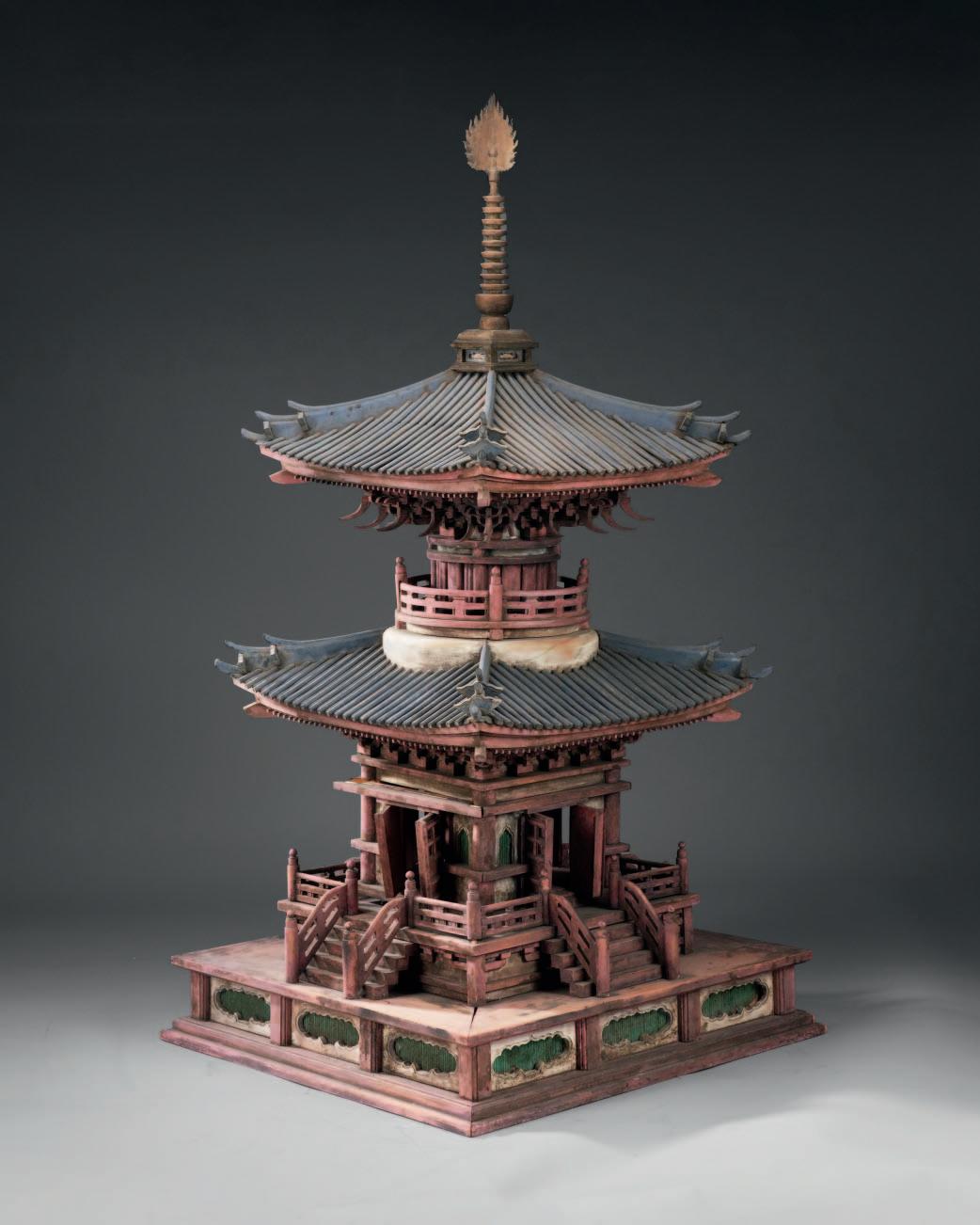
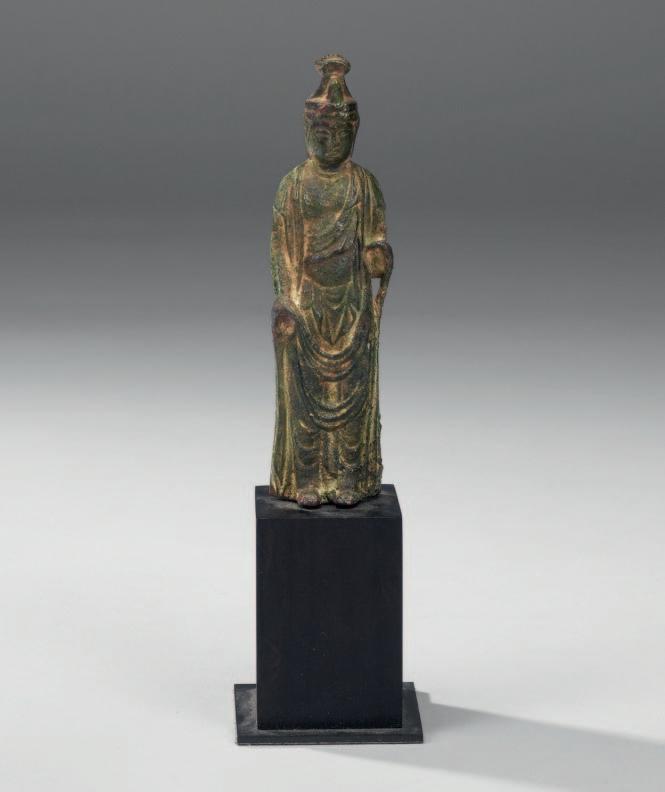
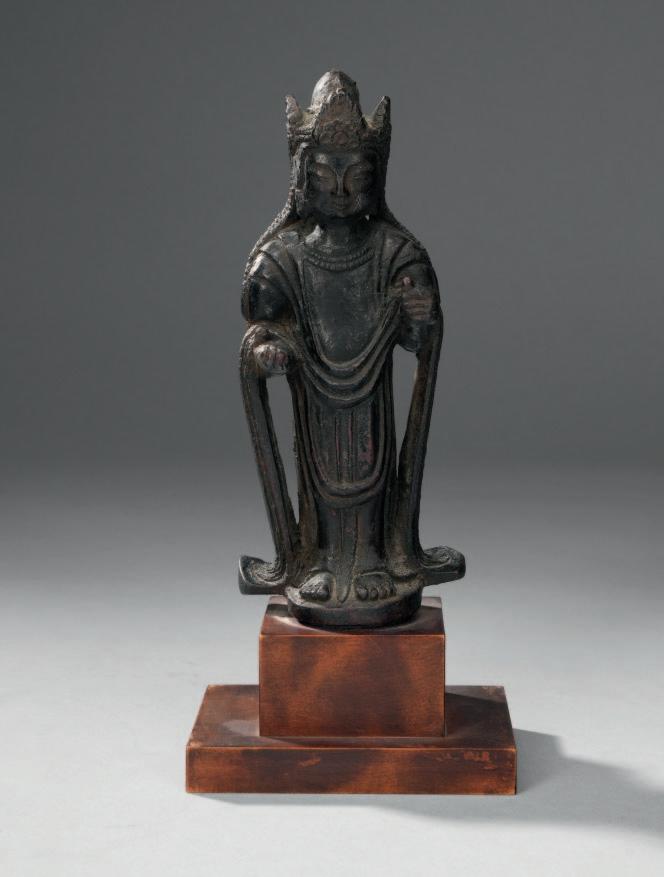
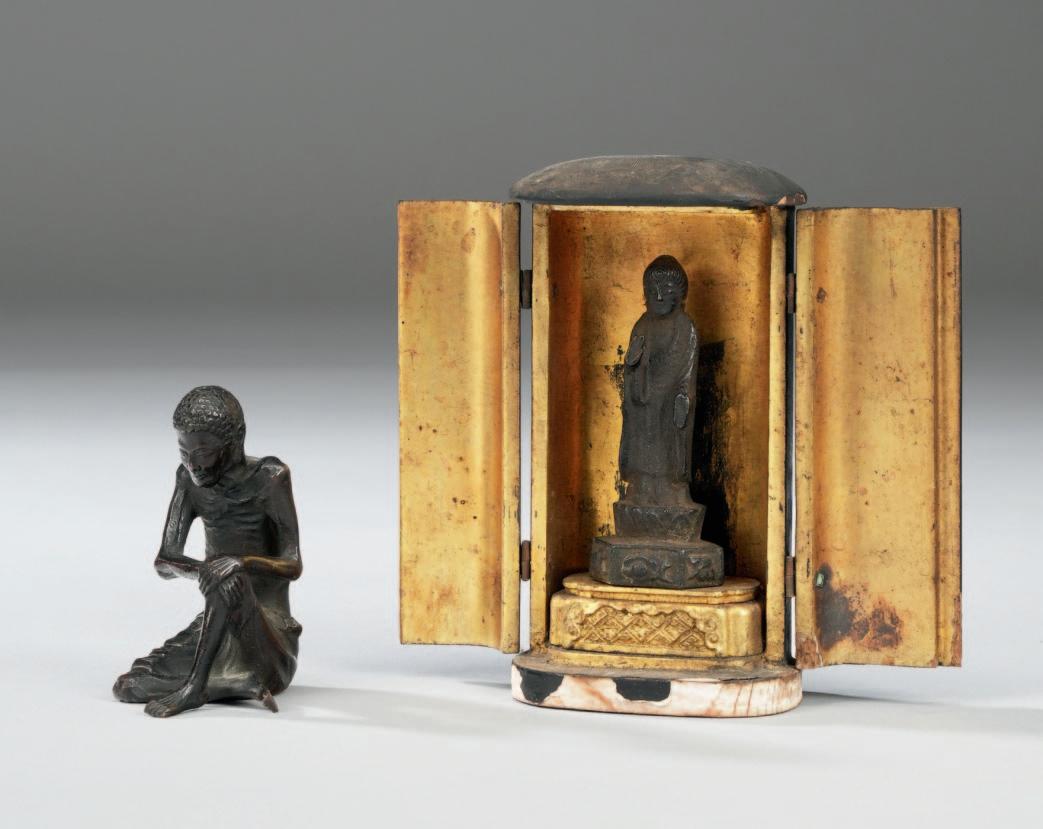
819
A JAPANESE BRONZE FIGURE OF KANNON BOSATSU
LATE KAMAKURA/NANBOKUCHO PERIOD, 14TH CENTURY
The bodhisattva depicted standing, wearing long flowing robes and with her hair arranged in a tall chignon; raised on a modern plinth, the figure 13.3cm. (2)
£1,500-2,000
820
A KOREAN BRONZE FIGURE OF A BODHISATTVA
UNIFIED SILLA DYNASTY, 9TH CENTURY
Depicted standing, wearing long flowing robes and a tall headdress with ribbons trailing down her shoulders, her hands held in the abhaya and varada mudras, the gestures of protective compassion and signifying the granting of wishes; raised on a modern wood stand, 21.5cm overall.
£1,000-2,000
Provenance: from the collection of Robert L Stolper of Stolper Galleries, and thence by descent. Robert worked with Asian and African art from the 1940s onwards in Amsterdam, Munich, New York and the UK.
821
TWO SMALL JAPANESE BUDDHIST BRONZE FIGURES
EDO/MEIJI,
The largest depicting the Emaciated Buddha, seated with his hands resting on his knee; the other cast as Amida Nyorai, standing on a lotus base with his hands in a mudra of benediction, in a portable zushi shrine, 11cm max. (3)
£400-600
822
EDO/MEIJI, 18TH/19TH CENTURY
The tallest enclosing a bodhisattva, probably Kannon, standing with her hands outstretched and raised on a doublelotus throne; the other with a Buddhist King trampling on a demon, 32.5cm max. (2)
WITHOUT RESERVE
£200-300
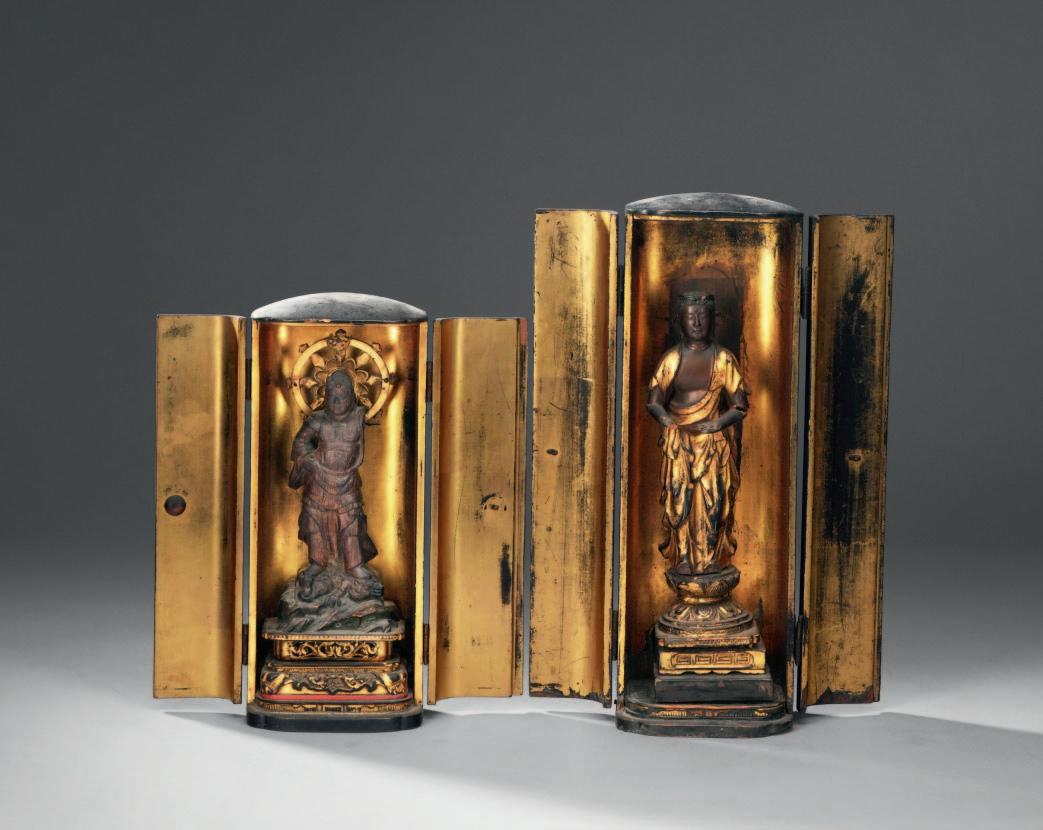
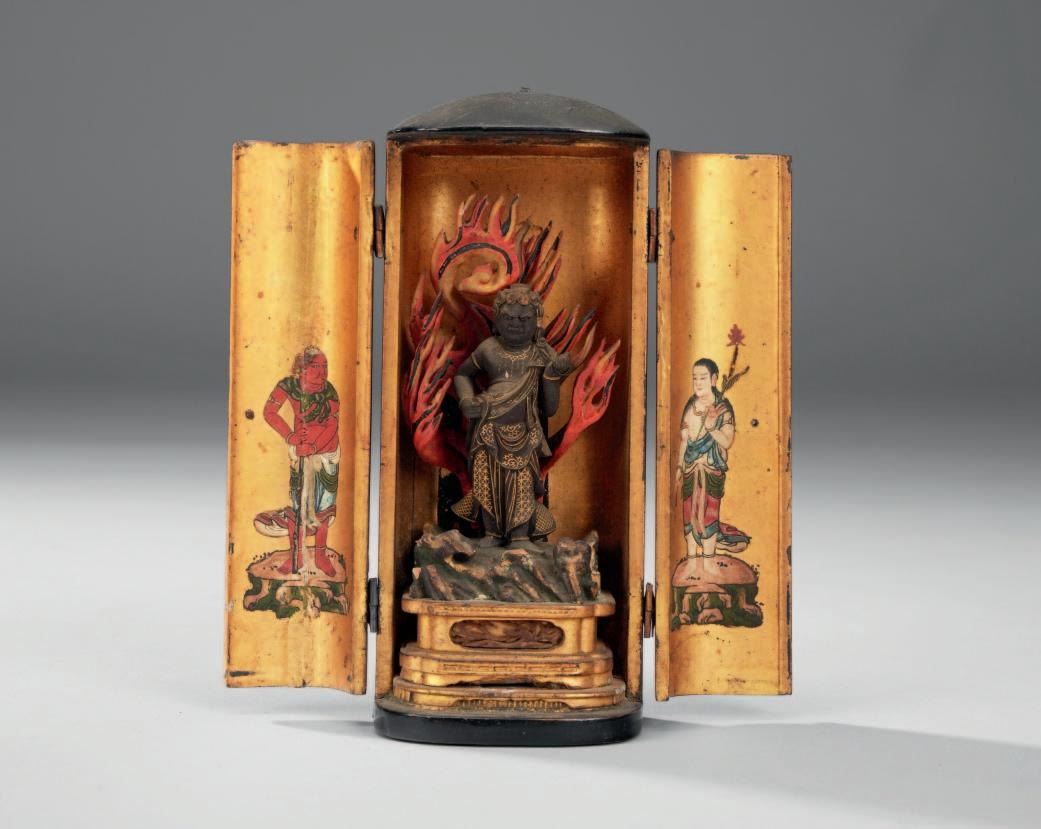
823
A JAPANESE ZUSHI (PORTABLE SHRINE) WITH THE FUDŌ SANZON (TRIAD)
EDO PERIOD, 17TH/18TH CENTURY
Enclosing the central wood figure of Fudō Myōō, the Immovable Wisdom King standing on a rocky outcrop with flames behind him; the doors painted with his two primary boy attendants, Seitaka Dōji with his red skin and Kongara Dōji as a youth; together with a silk bag, 15cm. (2)
£600-800
824
A JAPANESE ZUSHI (PORTABLE SHRINE) OF MIROKU BOSATSU
EDO PERIOD, 18TH CENTURY
The Buddha of the Future depicted seated, his right hand resting against his cheek in contemplation; raised on an elaborate gilded lotus throne with decorated tiers, the base with scrolling clouds; 21.8cm, the shrine 31cm overall. (2)
£600-1,000
825
A JAPANESE ZUSHI (PORTABLE SHRINE) WITH JŪICHINEN KANNON (THE ELEVENHEADED KANNON)
EDO PERIOD, 18TH CENTURY AND LATER
Depicted standing, holding a bottle in one hand and the other opened towards the ground; wearing long loose robes and with a typical, elaborate headdress with smaller heads, scrolling clouds and jewels; raised on a lotus throne rising from a rocky outcrop and on a tiered base; the back of the shrine with a long inscription reading as Tōji Chinjū Hakusan Daigongen (The Great Avatar of Hakusan, the protector deity of this temple), Honji Jūichinen Kanzeon (the original form of the ElevenHeaded Kannon) and signed An’ami saku (made by An’ami); the figure 25cm, 29cm overall.
£1,000-2,000
826
A LARGE JAPANESE ZUSHI (PORTABLE SHRINE) OF AMIDA NYORAI (BUDDHA AMITABHA)
EDO/MEIJI, 19TH CENTURY
The Buddha of Infinite Light depicted seated in padmasana with his hands resting before him in the mudra of meditation, wearing loose robes and with a lotusshaped halo behind him; raised on a lotus throne, 45cm overall. (3)
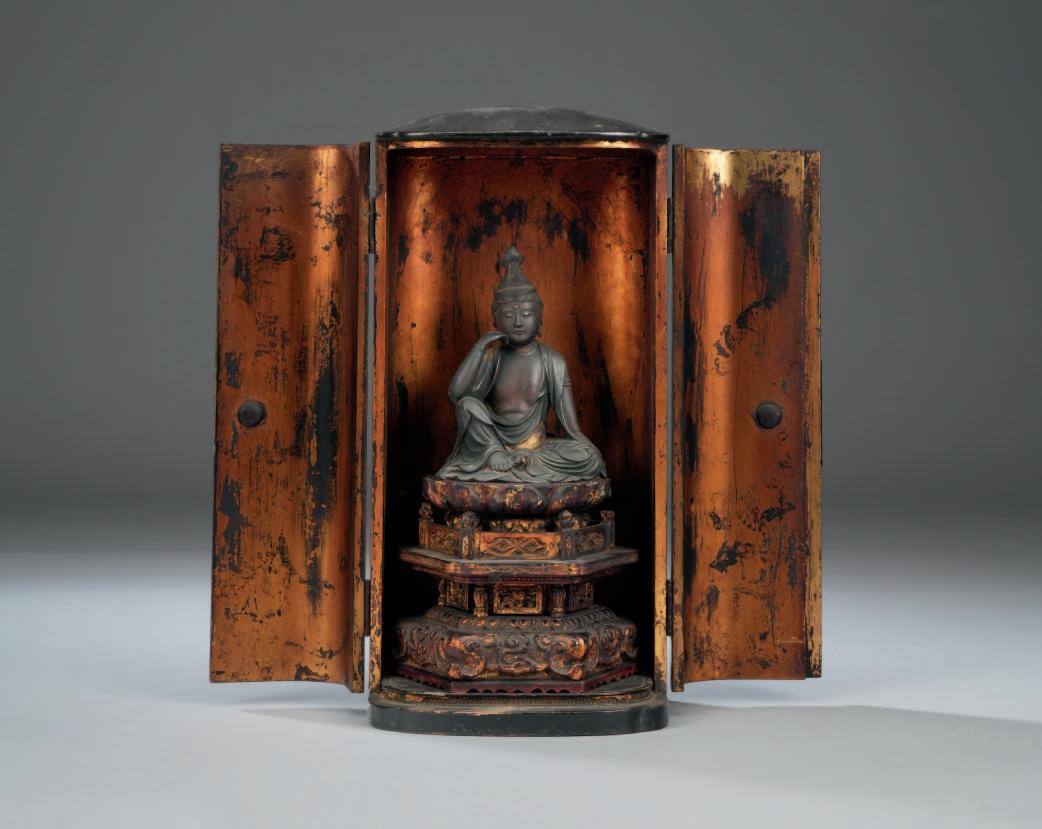
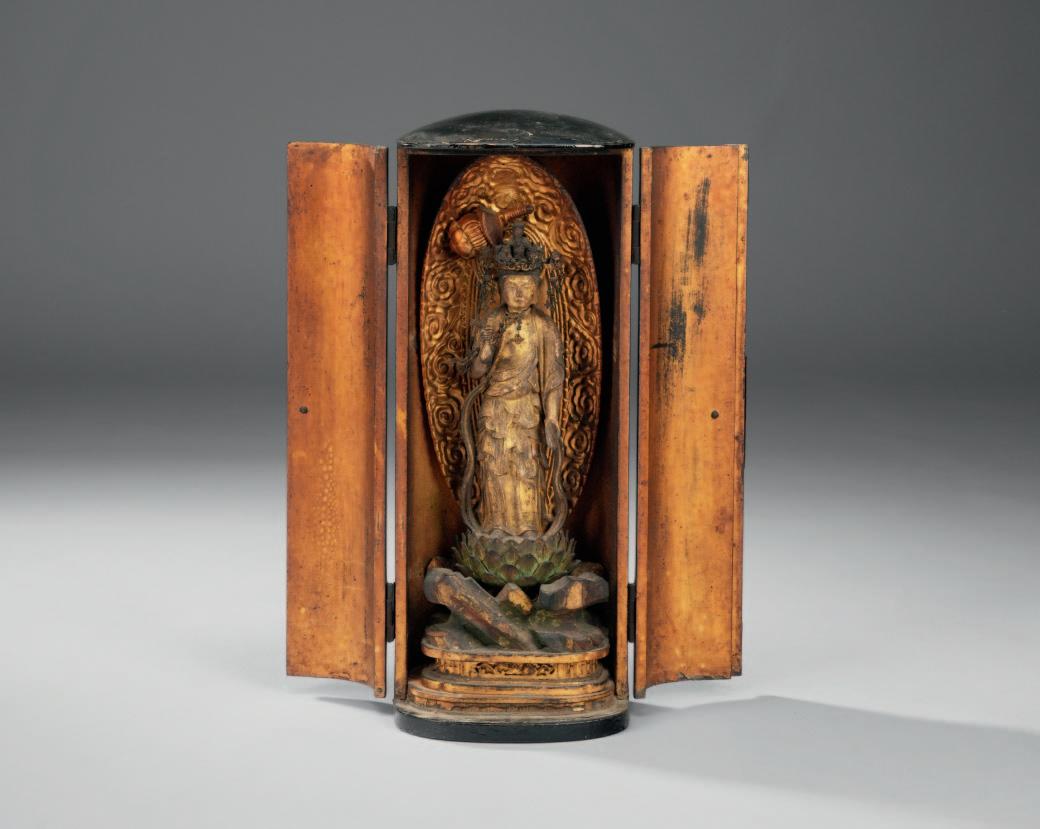
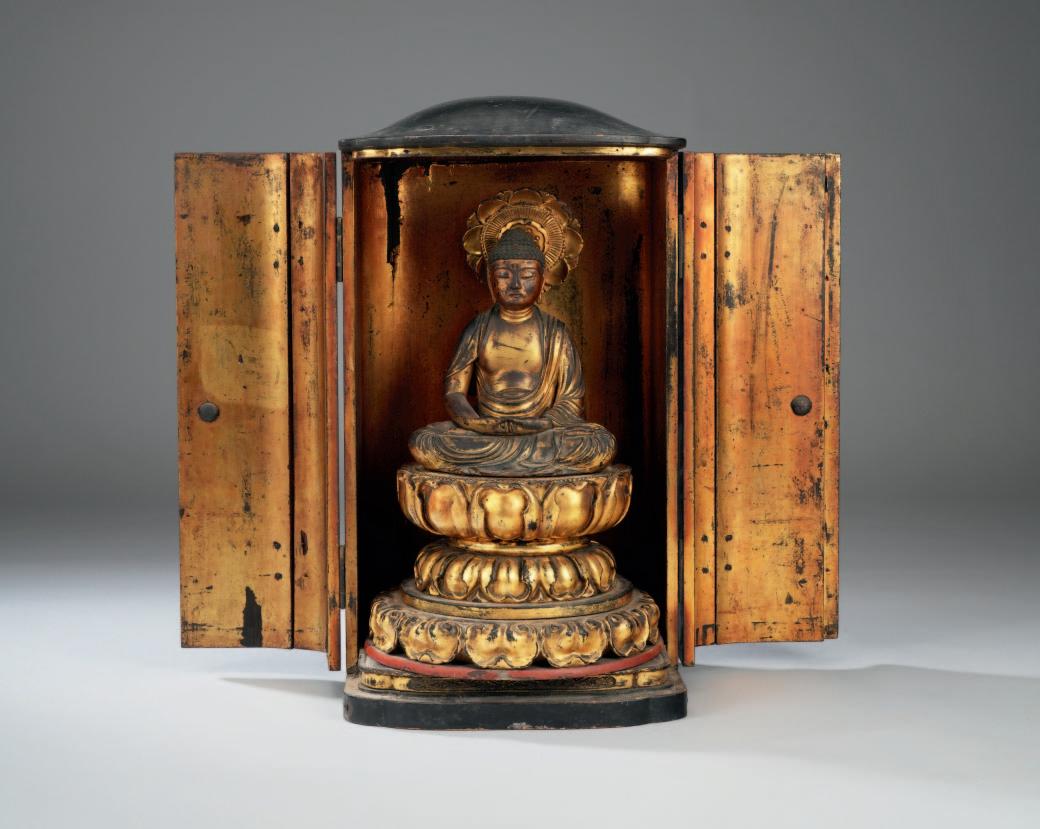
£1,500-2,000
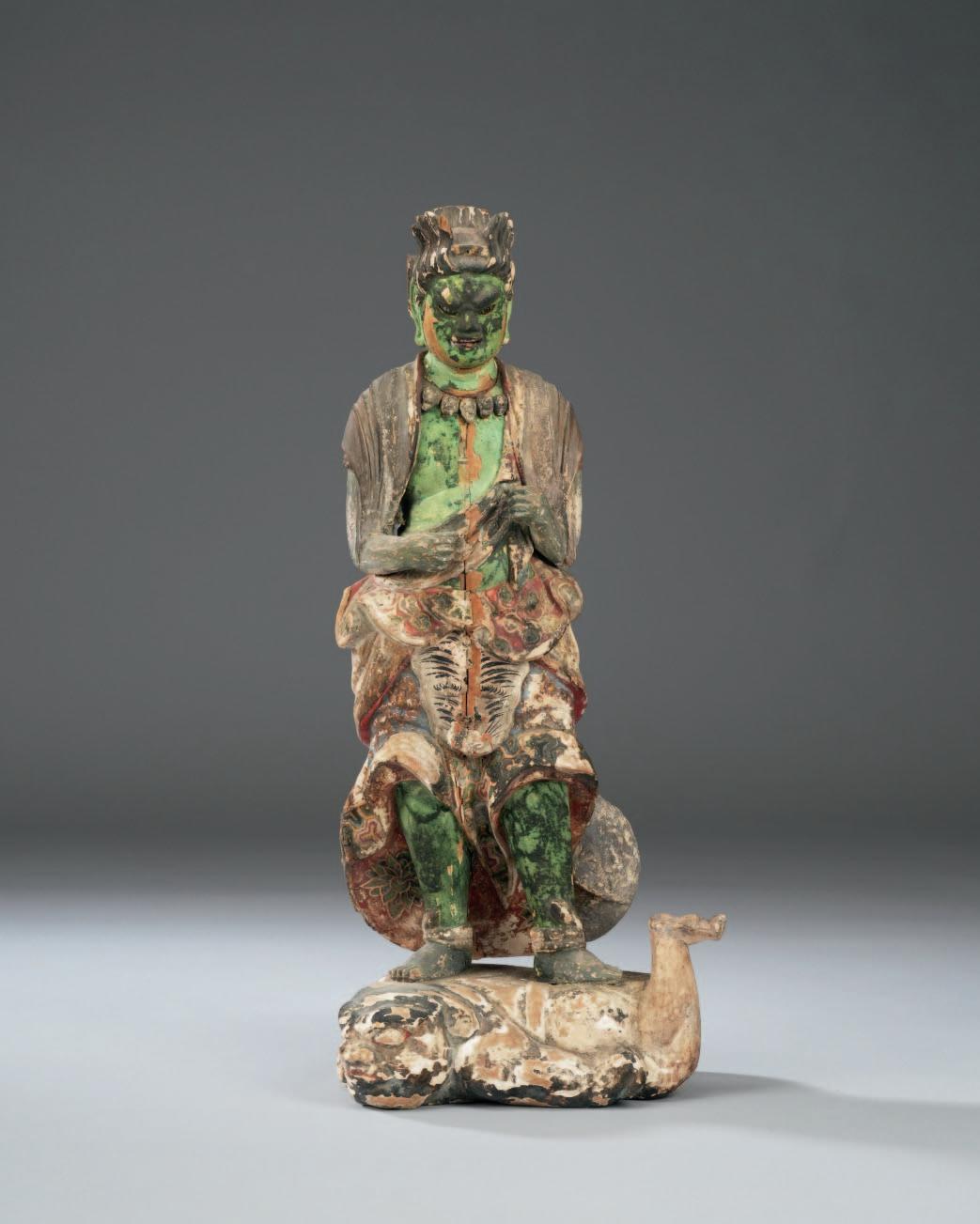
827
A JAPANESE POLYCHROME WOOD FIGURE OF A HEAVENLY KING PROBABLY EDO, 18TH CENTURY
Likely one of the Jūni Shinshō (Twelve Heavenly Generals) or a Myōō (Wisdom Kings), depicted standing on a demon, with a wrathful expression; wearing loose robes, a necklace made of skulls, and a tiger skin; the eyes inlaid in glass with gold pupils, and the surface with remnants of polychromy; 39cm.
£1,500-2,000
828
A JAPANESE WOOD FIGURE OF ZAŌ GONGEN EDO PERIOD, 19TH CENTURY
Typically depicted with a wrathful expression, balancing on one foot whilst holding a vajra, his other hand gesturing a mudra; raised on a tiered gilded base, 24.7cm.
£600-800
The guardian deity of Mount Kinpu, Zaō Gongen appeared to the ascetic En no Gyōja as a powerful protector of the mountain. A fierce manifestation of Shakyamuni, Kannon, and Miroku, the deity represents the past, present, and future.
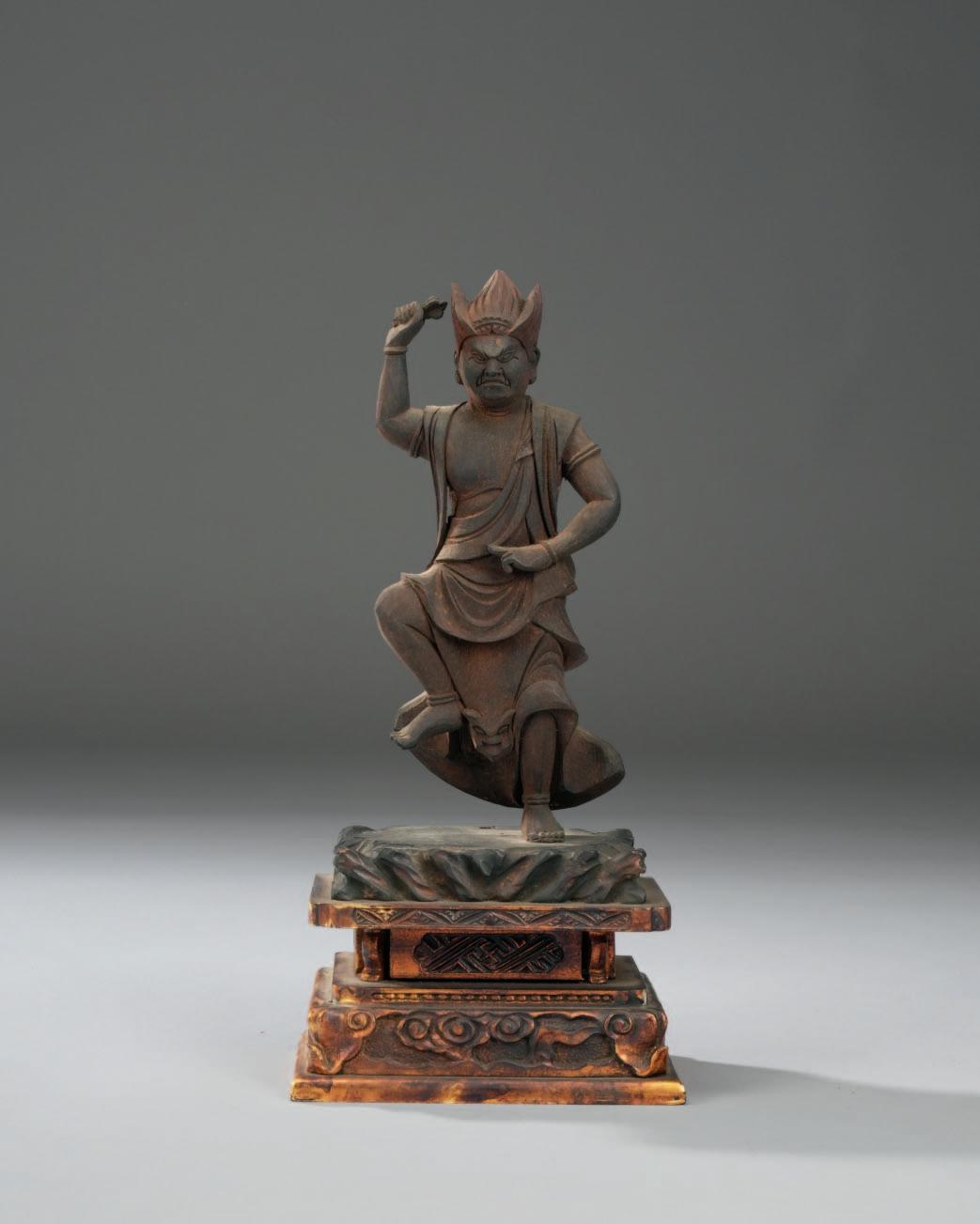
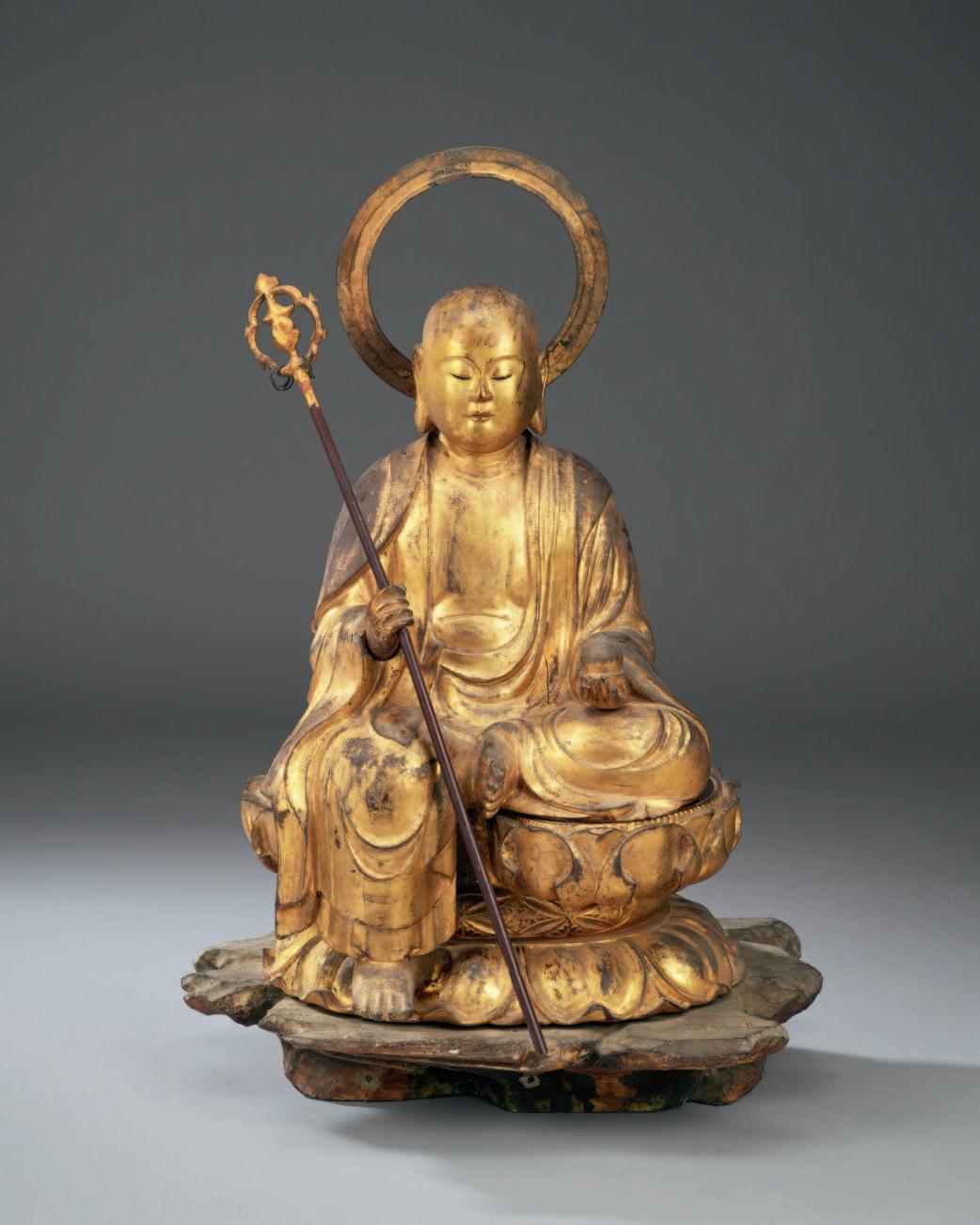
829
A JAPANESE GILT WOOD FIGURE OF JIZŌ BOSATSU
EDO PERIOD, 18TH CENTURY
Depicted seated on a doublelotus throne, holding the Cintamani (Wishgranting Jewel) in one hand and his Khakkhara (sistrum) in the other, with a circular halo behind him; wearing loose robes and with his head typically shaved, his eyes downcast; all raised on a base carved as rockwork with traces of polychromy, 53cm overall. (3)
£2,500-4,000
830
A TALL JAPANESE GILT WOOD FIGURE OF AMIDA NYORAI (BUDDHA AMITABHA)
EDO PERIOD, 18TH CENTURY
Depicted standing, holding the Cintamani (Wishgranting Jewel) in one hand and his Khakkhara (sistrum) in the other, with a radiating halo behind him; on a lotus base raised on a rocky outcrop, 84cm overall. (4)
£2,500-4,000
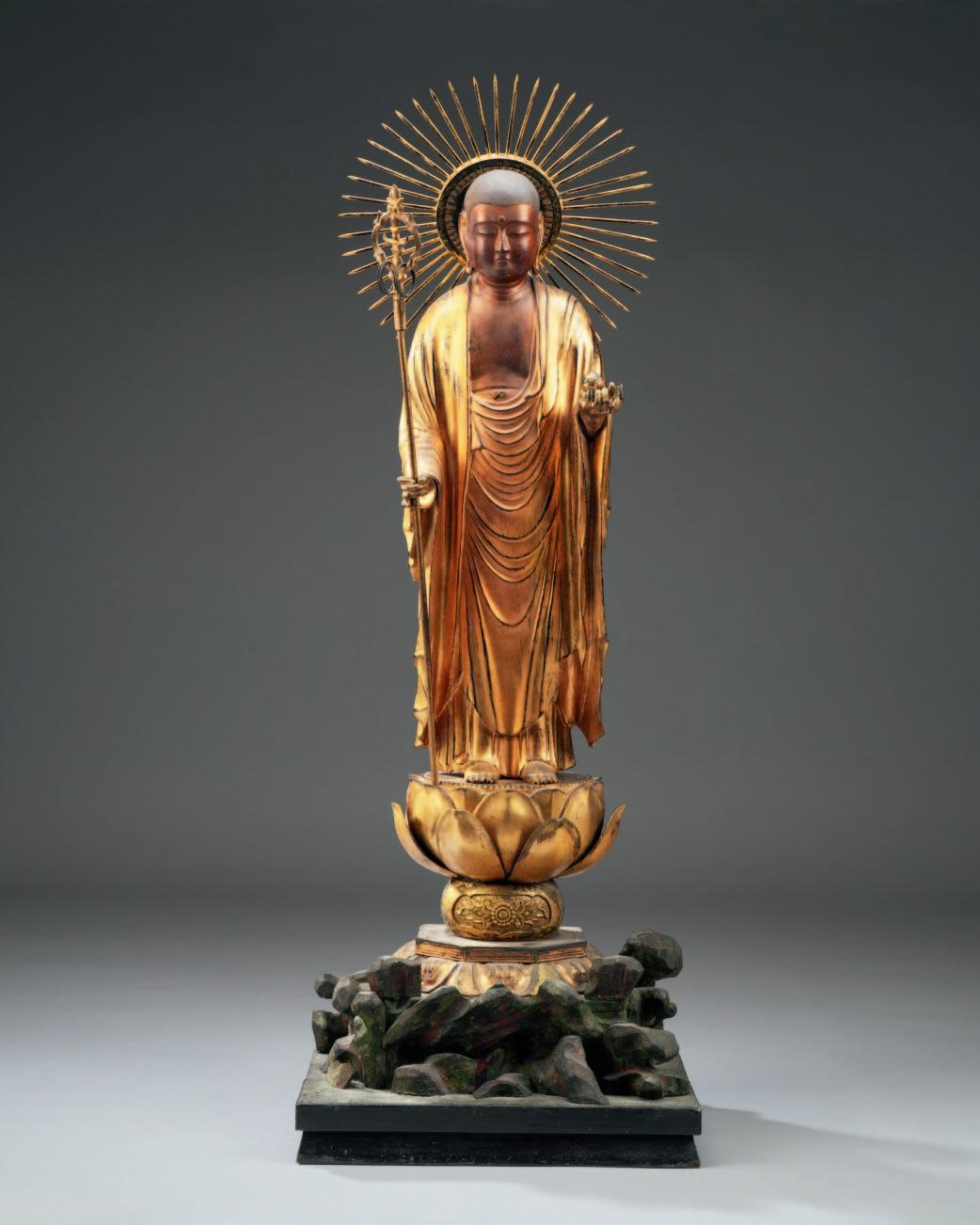
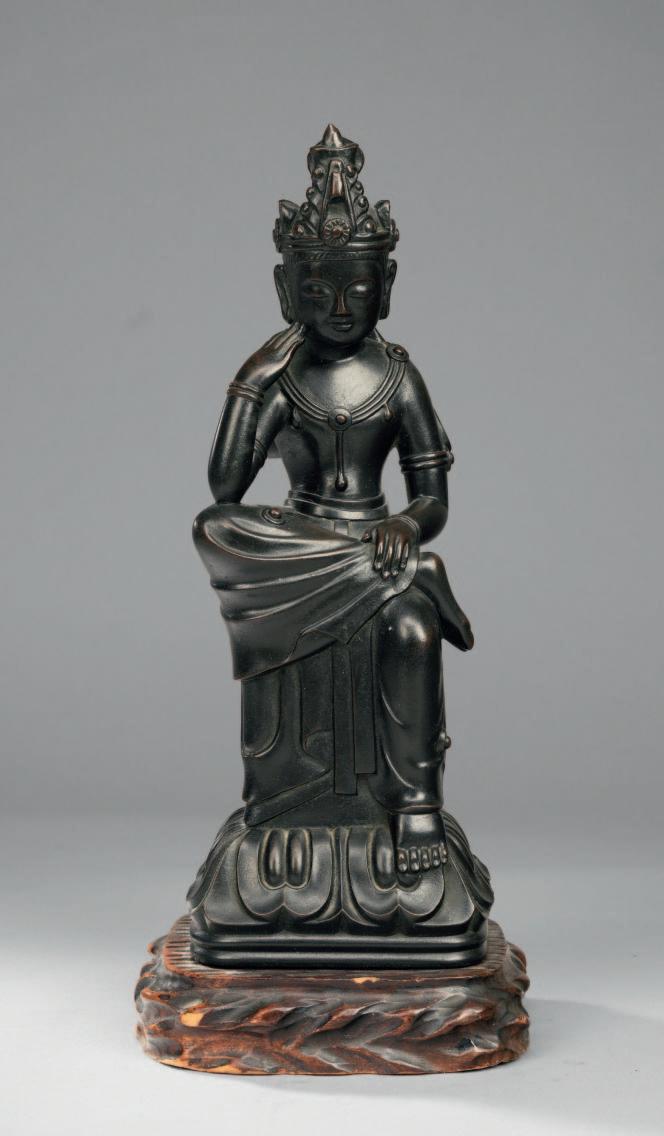
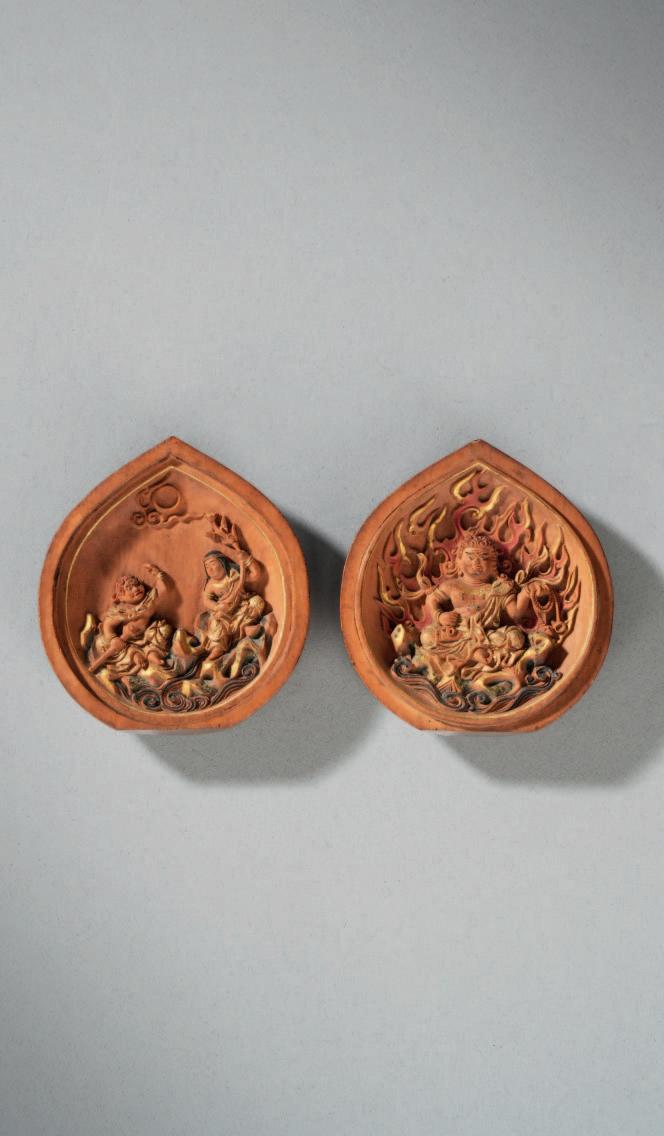
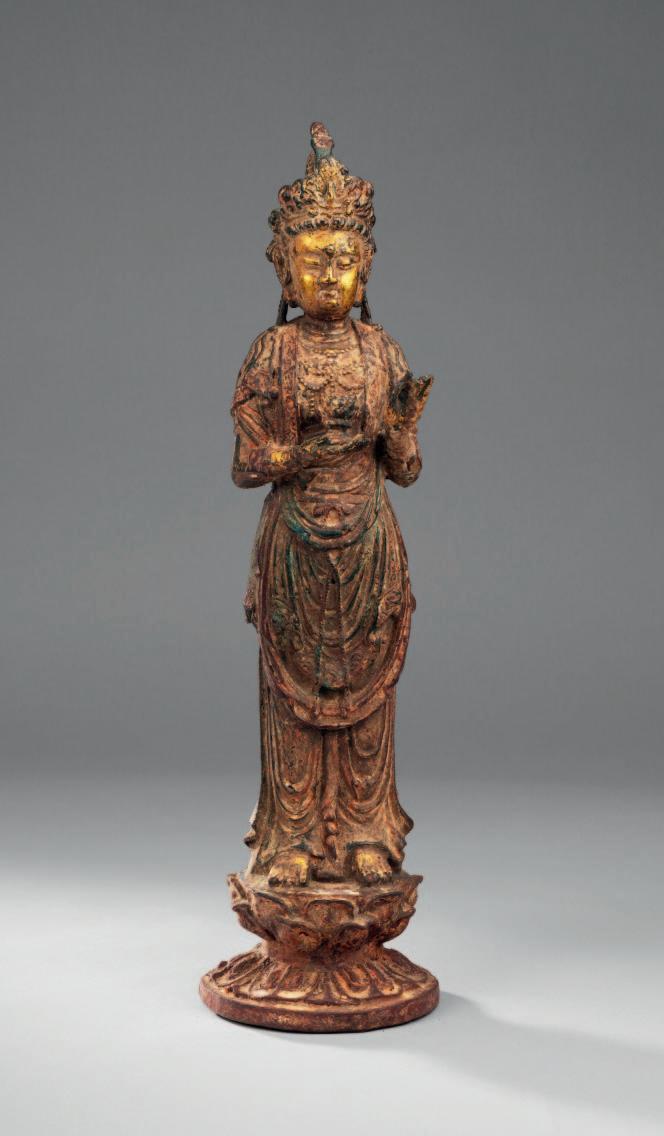
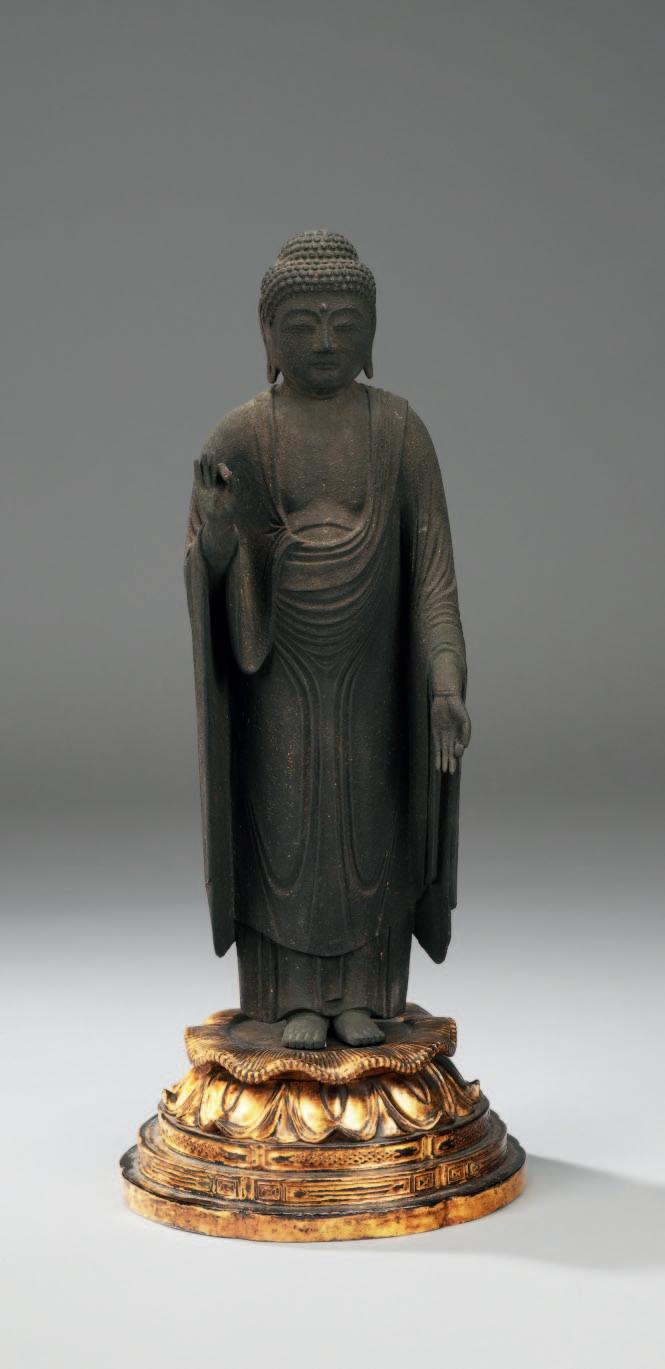
831
A JAPANESE BRONZE FIGURE OF MIROKU BOSATSU
SHŌWA/HEISEI, 20TH CENTURY
The Future Buddha depicted seated on a tall square plinth, with one leg crossed over the other and a finger lightly touching his cheek, with a pensive expression; attached to a wood base, 30.7cm overall.
£200-300
832
A JAPANESE WOOD GOSHINBUTSU (POCKET SHRINE)
EDO/MEIJI, 19TH CENTURY
In two halves and shaped as a lotus bud, opening to reveal minute carvings of Fudō Myōō to one side, the acolytes Seitaka Dōji and Kongara Dōji to the other; with details picked out in gilt and colours, each half 7.2cm. (2)
WITHOUT RESERVE
£300-500
833
A PARCELGILT BRONZE FIGURE OF A BODHISATTVA
POSSIBLY 20TH CENTURY
Standing on a doublelotus throne, wearing loose robes and an elaborate headdress, holding offerings in one hand and the other raised in a mudra of blessing, with remnants of polychromy and gilt, 42.5cm.
£200-300
834
A JAPANESE WOOD FIGURE OF AMIDA NYORAI (BUDDHA AMITABHA)
MEIJI OR LATER, 19TH/20TH CENTURY
Depicted standing and wearing long robes loosely draped across his torso, his hands in the kubon mudra representing one of the nine levels of rebirth; raised on a giltlacquer lotus throne, 39cm overall. (2)
£600-1,000
Sculptures and paintings depicting Amida Nyorai became popular during the 12th century and were placed near the beds of dying devotees to bring them comfort.
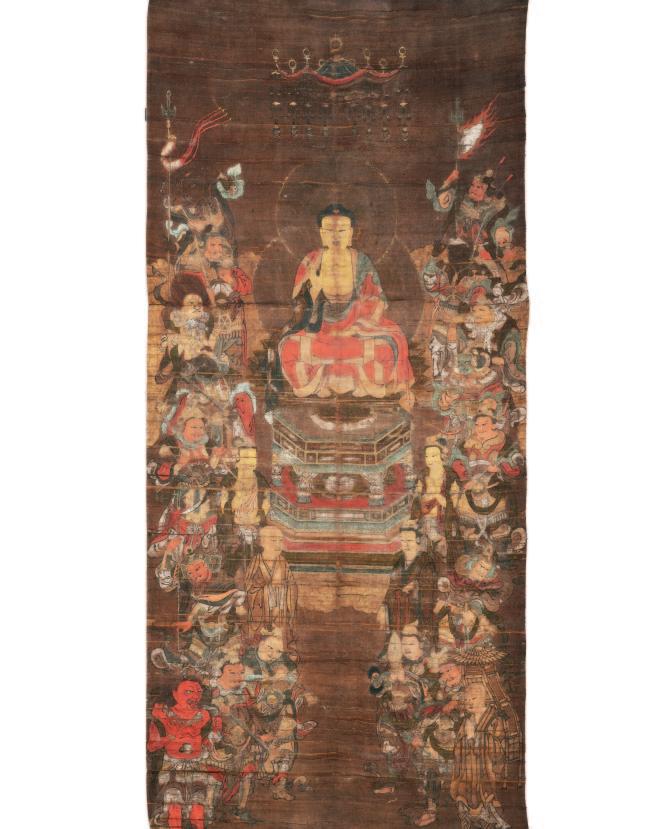
835
ANONYMOUS
BUDDHA SHAKYAMUNI AND ATTENDANTS
EDO PERIOD, 18TH/19TH CENTURY
A Japanese scroll painting in ink, colour and gold on silk, with the central figure of Buddha Shakyamuni raised on an elaborate throne, a jewelled canopy above him and a double halo behind, his hands in the vitarka mudra; with many bodhisattvas and other guardian deities standing beside him, 91cm x 41cm.
£200-300
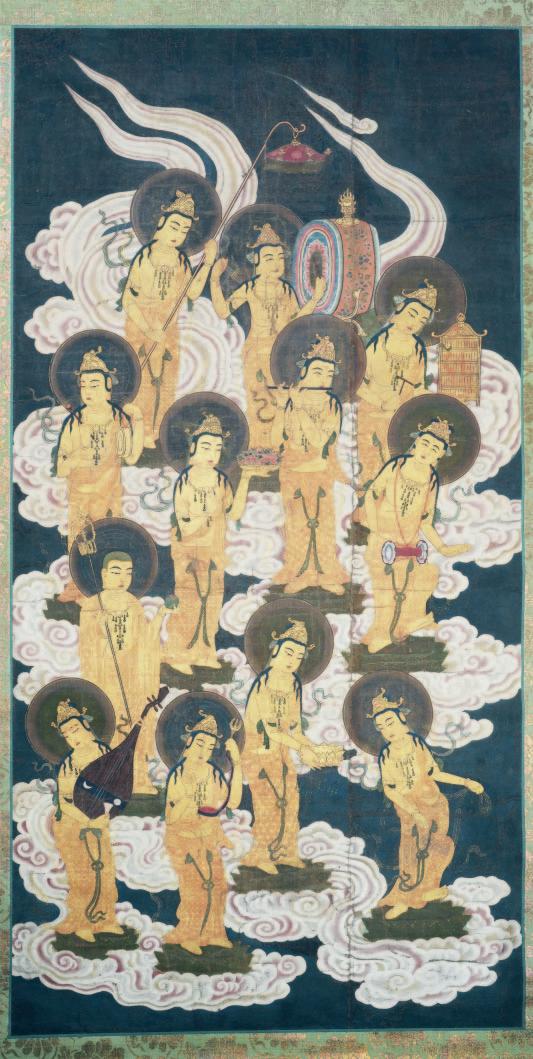
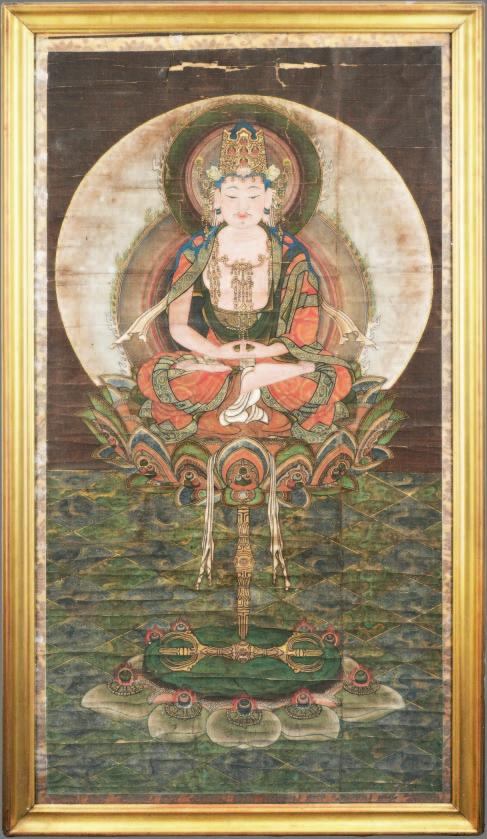
836
ANONYMOUS
DAINICHI NYORAI
EDO OR EARLIER, 19TH CENTURY OR EARLIER
A Japanese scroll painting in ink, colour and gold on silk; the ‘Great Sun Buddha’ depicted wearing ornate robes and a tall headdress containing five smaller figures; the Cosmic Buddha with his hand in dhyana mudra and his legs crossed, a triple halo behind him; seated on an elaborate lotus throne, raised on a vajra supported by a Dharmachakra (Dharma wheel), on a ground of rhomboid patterns enclosing scrolling waves; with silk mounts, framed and glazed, 117cm x 60cm.
£1,500-2,500
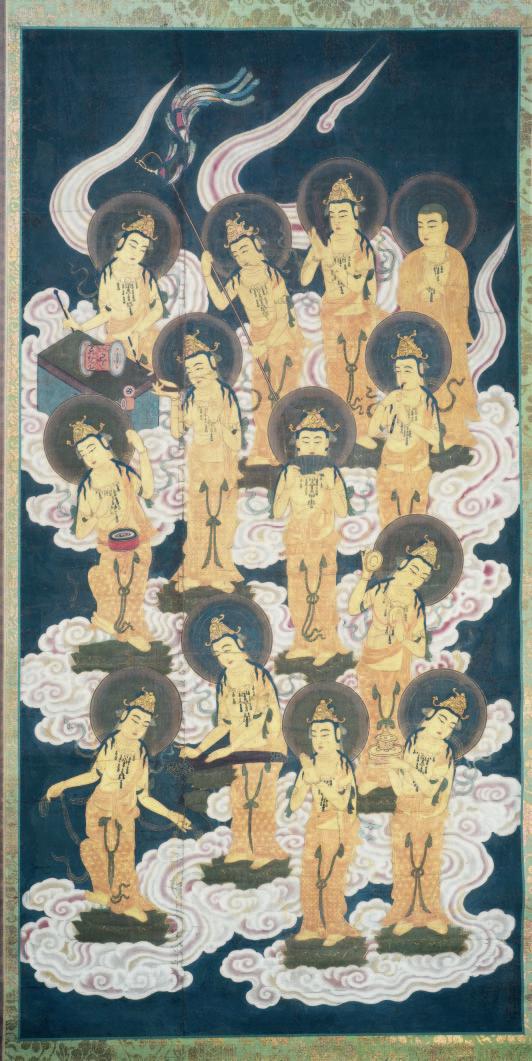
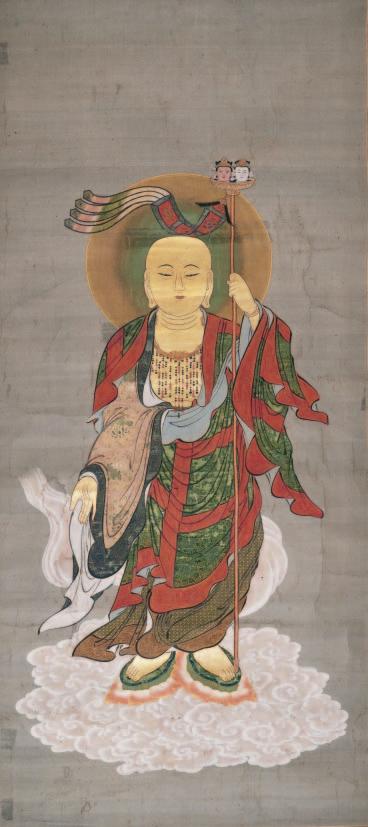
837
ANONYMOUS
JIZŌ BOSATSU RAIGŌ (THE CELESTIAL DESCENT OF JIZŌ BOSATSU)
PROBABLY EDO, 17TH/18TH CENTURY
A Japanese kakejiku (hanging scroll painting), in ink, colours, and gold on silk, the Buddhist Protector of children depicted descending from the heavens, holding a staff topped with two deities’ heads; with an ornate beaded necklace and dressed in monastic robes, raised on a double lotus pedestal and scrolling clouds; 98cm x 42cm.
WITHOUT RESERVE
£300-500
838
ANONYMOUS
NIJUGO BOSATSU RAIGŌ (THE CELESTIAL DESCENT OF TWENTYFIVE BODHISATTVAS )
POSSIBLY KAMAKURA, 14TH CENTURY
A pair of Japanese kakejiku (hanging scroll paintings), ink, colour and gold on silk, one painted with thirteen bodhisattvas and the other with twelve; the celestial beings depicted with golden bodies, wearing loose robes and ornate headdresses, descending amongst scrolling clouds, many playing musical instruments; the jikusaki (end cap of the scrolls) made of metal and decorated with stylized lotus flowers and scrolling tendrils; each painting with a tomobako (wood box) inscribed Hachi yon go rei go, Kamakura jidai, nijugi Bosatsu, sofuku (A pair of paintings depicting twentyfive bodhisattvas, Kamakura Period), and labels possibly mentioning the Bigorio Museum or monastery in Switzerland; both 111cm x 57cm. (4)
£4,000-6,000
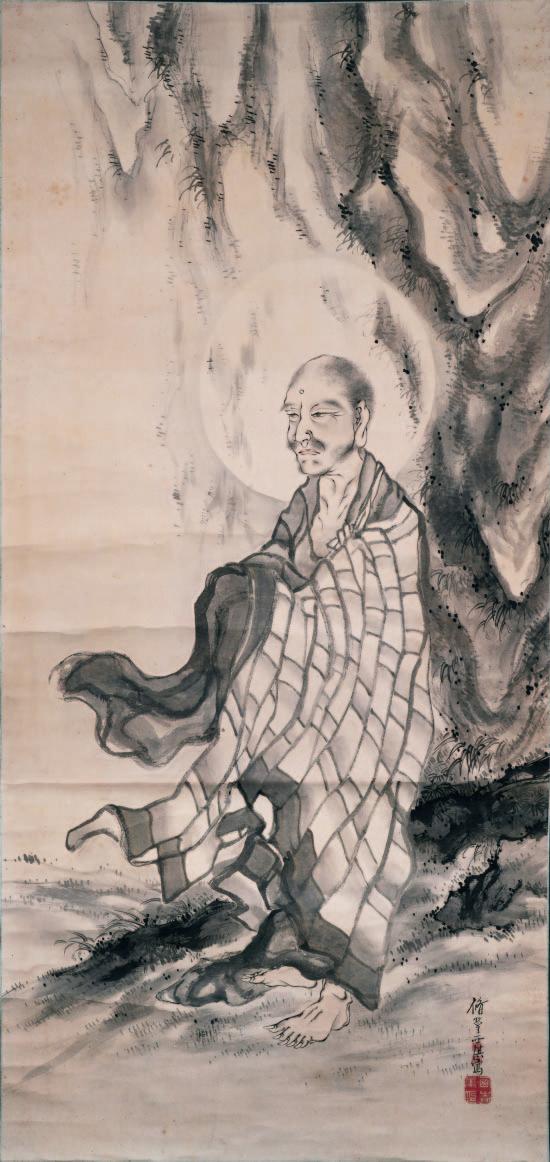
839
AFTER NISHIKAZI KIZAN (SHUKO / CHIKARA)
SHUSSAN SHAKA (BUDDHA SHAKYAMUNI DESCENDING FROM THE MOUNTAIN)
MEIJI ERA, 19TH/20TH CENTURY
A Japanese kakejiku (hanging scroll painting), ink, gold and colour on paper, depicting the historical Buddha standing by a rocky outcrop, signed Shuko Saiki utsusu and sealed Nishizaki Kizan, Shuko and Nishizaki Chikara (Ryo) in; 125cm x 59cm.
WITHOUT RESERVE
£200-300
840
UNIDENTIFIED ARTIST
ZHAO GONGMING 19TH CENTURY
A hanging scroll painting, ink and colour on paper, depicting the Chinese Daoist God of Wealth riding on a tiger, possibly signed Montei ga, 146cm x 64cm. WITHOUT RESERVE
£200-300
841
FUJIWARA UJITSUNE (MINRYUSAI, ACT. 19TH CENTURY)
KAKU SHIGI AND CHILDREN
EDO/MEIJI, 19TH CENTURY
A Japanese kakejiku (hanging scroll painting), ink and colour on silk, depicting the famous Chinese Tang dynasty general Kaku Shigi or Guo Ziyi (697781) as an elderly man with children, signed Fujiwara Ujitsune ga and sealed Fujiwara, 108cm x 36.5cm; together with a scroll painting of Kan’u and Chohi (Guan Yu and Zhang Fei), with a seal reading Rinsen juin (Auspicious seal of Rinsen), 86cm x 42cm. (2)
WITHOUT RESERVE
£150-250
Provenance: from the Estate of a Collector, Heath House, Hampshire, and thence by descent. By repute, acquired in Asia at the turn of the 19th century.
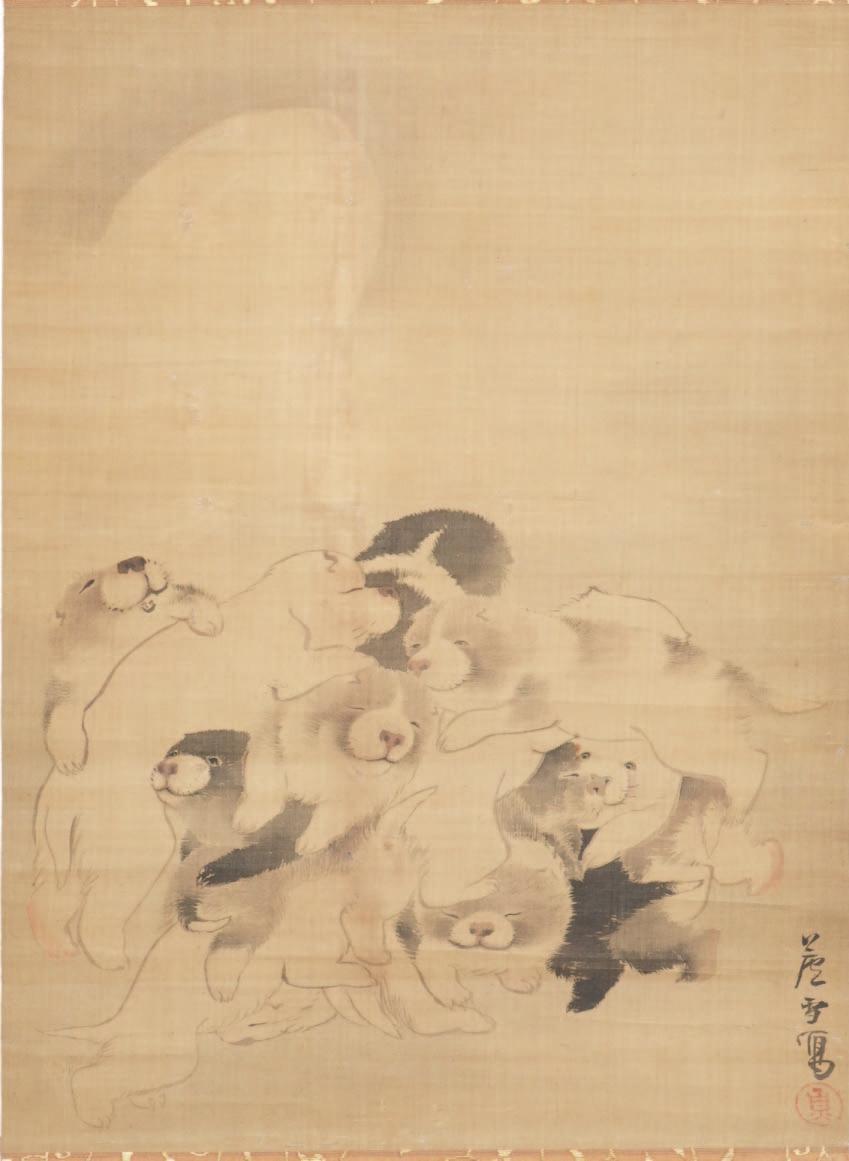
not to scale
842
HANABUSA ITCHŌ (16521724)
TRAVELLERS IN THE RAIN
EDO PERIOD, 17TH/18TH CENTURY
A Japanese kakejiku (hanging scroll painting), ink and colour on paper, with a long poem reading as ‘Two blind men sharing a straw hat, Shouldering a biwa (lute) on their backs, Huddled in their robes to escape the rain, Rushing into the house of Tao’; together with a tomobako (wood box); signed Hanabusa Itchō and sealed Hokusōō (Old Man of the North Window) and Kyūkyōan; 52cm x 23.5cm. (2)
£150-250
843
FOLLOWER OF MORI SOSEN MONKEY ON A DEER
MEIJI ERA, 19TH CENTURY
A Japanese kakejiku (hanging scroll painting), watercolour on paper, depicting a small monkey riding a deer backward while grasping at overhanging willow branches, signed Senzan hitsu lower left and with two red seal marks, 38cm x 16.5cm.
£300-500
844
FOLLOWER OF NAGASAWA ROSETSU PUPPY CHAOS
MEIJI ERA, 19TH/20TH CENTURY
A Japanese kakejiku (hanging scroll painting), ink and colour on silk, depicting a large group of puppies clambering on top of each other; signed Rosetsu and with a red seal mark for Gyo, 50cm x 34.5cm. WITHOUT RESERVE
£100-200
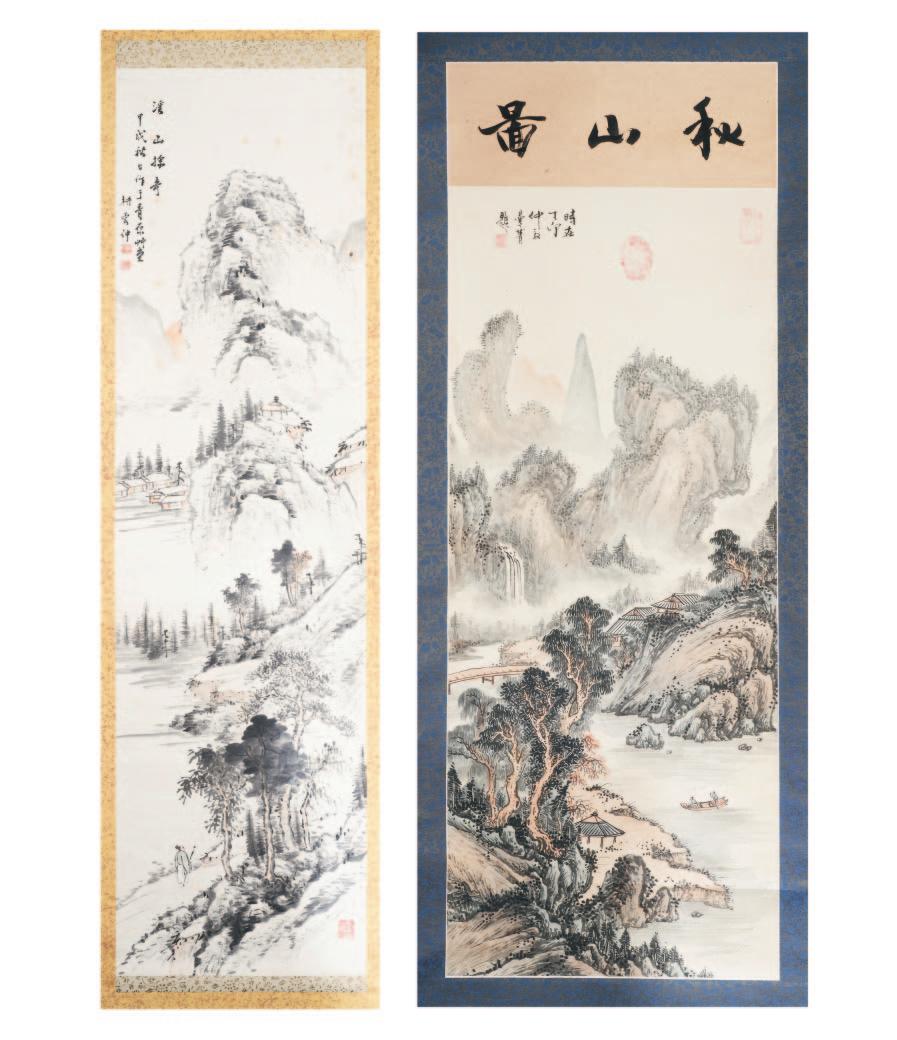
846
GOTO SHOIN (17971864) CALLIGRAPHY
EDO PERIOD, 19TH CENTURY
845
The first a Japanese kakejiku (hanging scroll painting) with a lone figure on a mountainous path, signed Koun chu and sealed Chu in and Koun, possibly for Yamada Koun (18781956), inscribed with the poem Keizan tanki, kinoe-inu shujitsu Seigen Sodo nite saku (Exploring the Wonders of Streams and Mountains, painted by Koun Chu, a day in autumn in the year of the wood dog possibly 1934 at the Seigen Sodo, a thatched studio in the field), 129cm x 33.5cm; the other depicting figures on a boat in a landscape, ink and colour on paper, with title slip Shuzan zu (Painting of an Autumnal Mountain); signed Shizai ding-mao zhongxia Man Jing ti /Jizai Hinoto-u chuka Mansei dai (Painted and inscribed by Man Jing / Mansei) and dated the midsummer of the Fire Hare (probably 1807), with three seals possibly reading as Man Jing/Mansei, Jiaqing yulan zhi bao (A Treasure viewed by the Jiaqing Emperor) and Shenpin (A sublime work), 86cm x 35cm. (2)
£300-500
A Japanese kakejiku (hanging scroll painting), with a long kanshi (a Japanese poem written in Classical Chinese) about a youth of immense ambition who strides toward high office rather than enduring humiliation, possessing a spirit that ‘swallows the mountains and rivers’, signed Shoin and ‘a seventysix year old man’; in a tomobako (wood box) inscribed Goto Shoin and describing the poem as a fivecharacter quatrain in Japanese and Chinese style; together with a Chinese fan painting depicting a snowy landscape, in ink and colour on paper, signed Banyi and dated Gengxu year; 131cm x 28cm and 51cm. (3)
WITHOUT RESERVE
£200-400
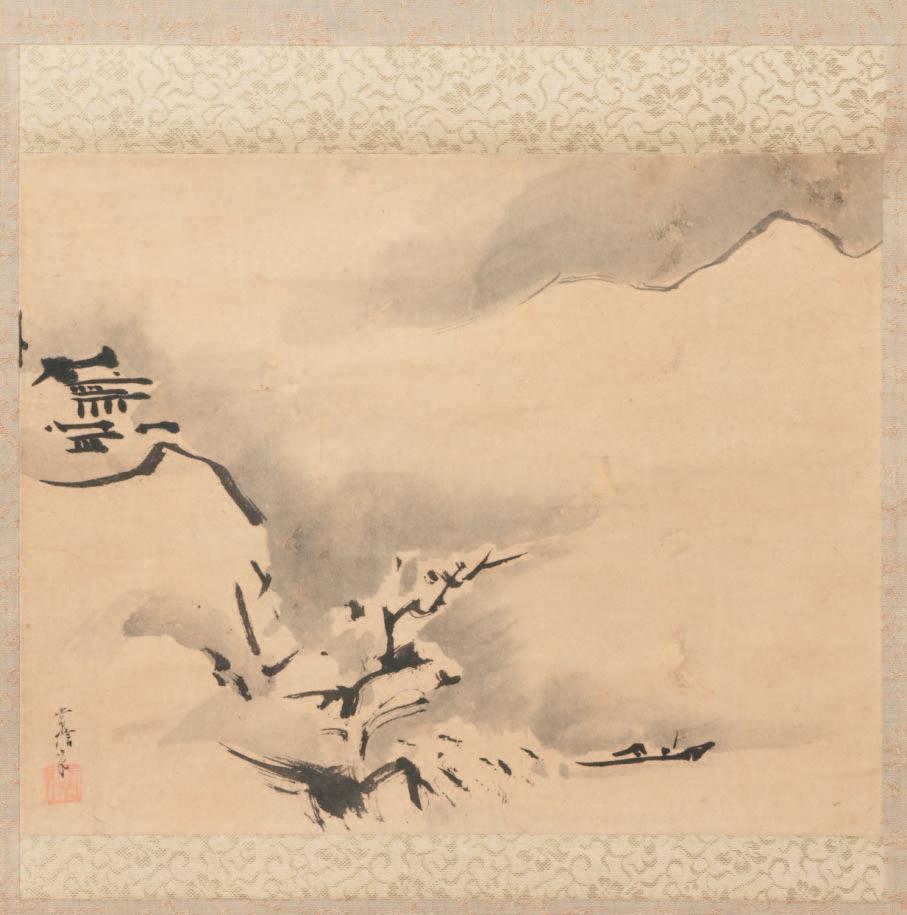
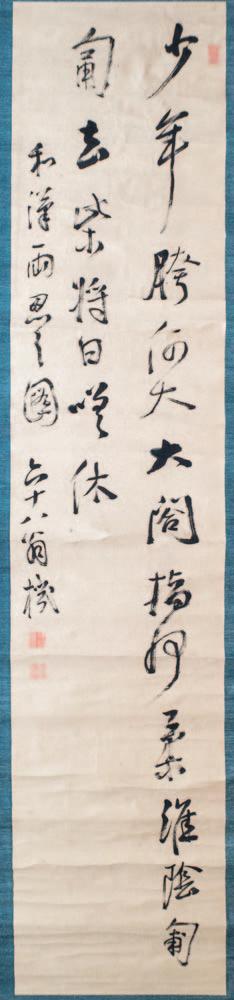
846 Part lot illustrated
847
KANŌ TSUNENOBU (16361713)
WINTER LANDSCAPE
EDO, 17TH/18TH CENTURY
A Japanese kakejiku (hanging scroll painting) depicting a mountainous water landscape, with a snowcovered pavilion on a hilltop to the left of the composition, a tree and a small boat below; signed and with a red seal mark; together with an inscribed box and a ‘certification of antique’ from H Taniguchi, Kyoto, dated January 31st, 1987, certifying that this is an original painting by Tsunenobu, 23cm x 29cm. (3)
£300-500
Provenance: from a Japanese private collection, London.
848
TETSUZAN/HARIYAMA SENSHI (ACT. 1920S)
PLUM TREE ON SILVER LEAF
TAISHŌ ERA, DATED 1924
A Japanese sixfold byōbu (paper screen), sumi ink on silver leaf, painted with a large flowering prunus tree and bamboo sprays issuing from rockwork; a long poem to the side celebrating ‘beauty blooming in the cold moonlight’, signed Tetsuzan/Hariyama Senshi, ‘at the age of seventyseven’, and dated Taisho 13 (1924), 172cm x 372cm.
£1,000-2,000
Provenance: from an English private collection, Surrey; purchased from Kathryn Milan Oriental Antiques, Tokyo, 24th September 1996; copies of the certificate of antiquity and invoice are available.
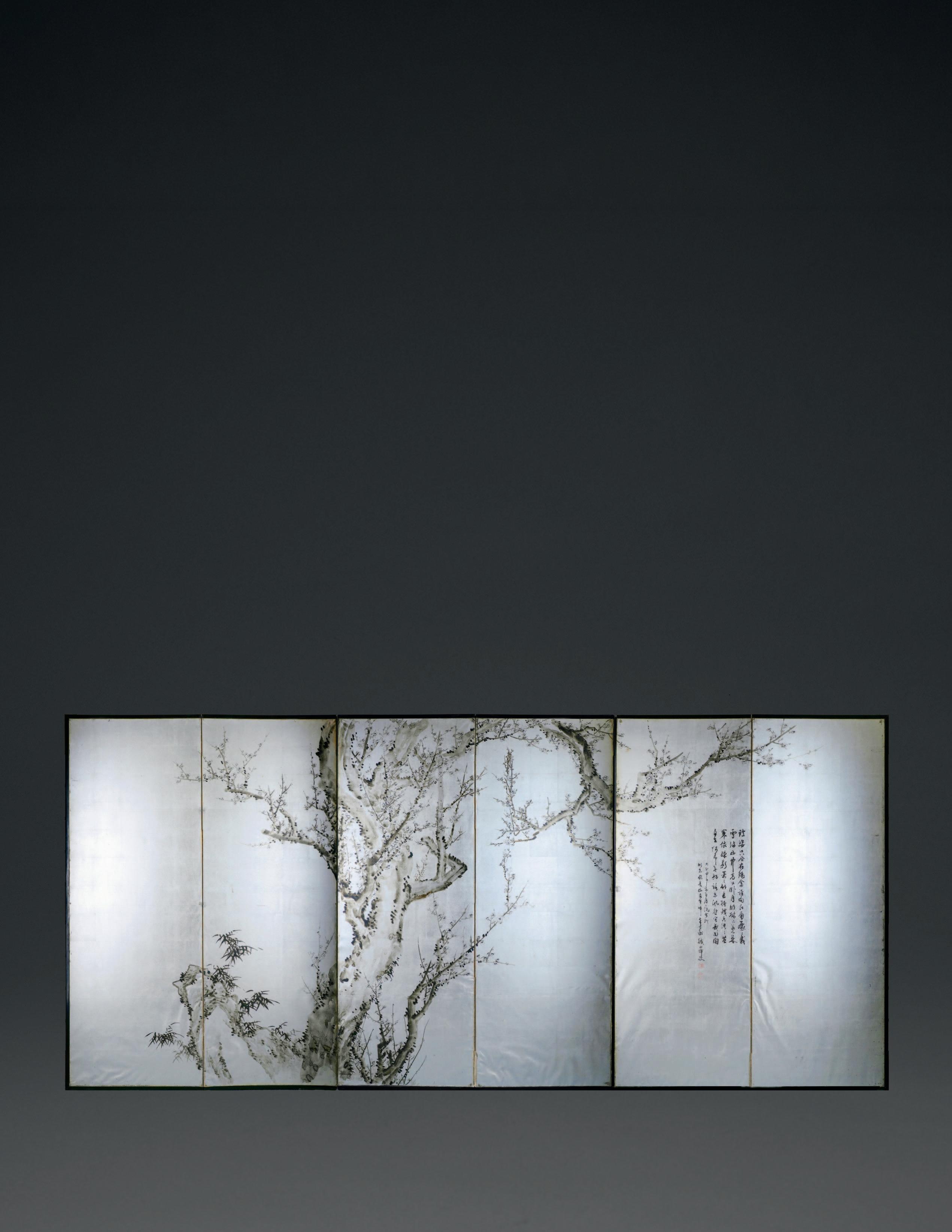
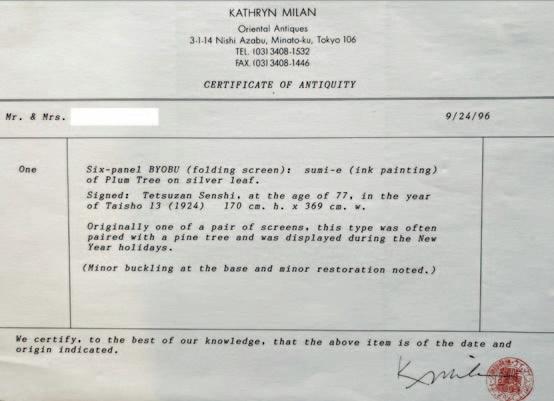
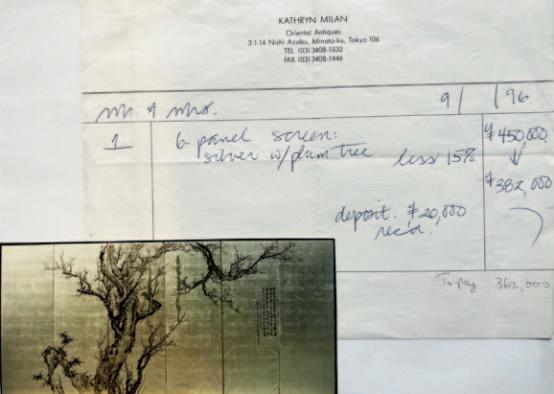
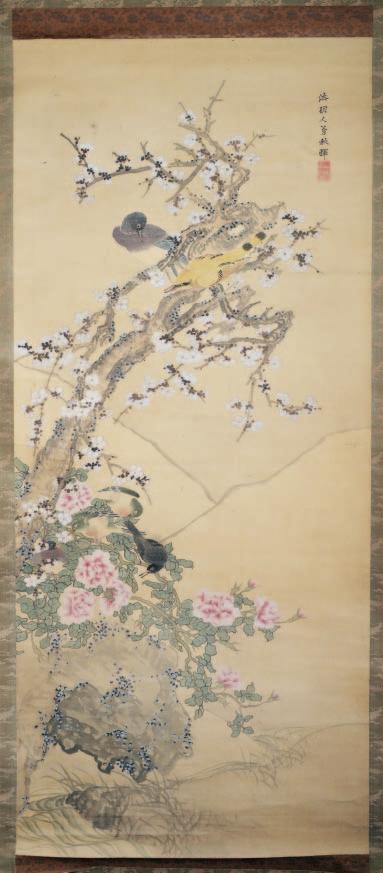
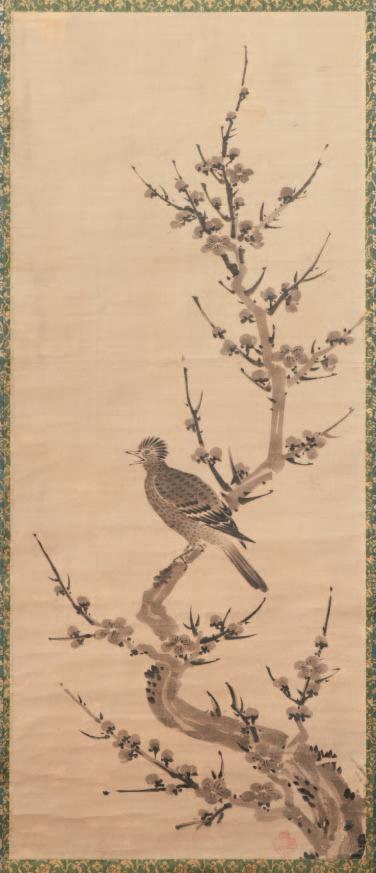
849
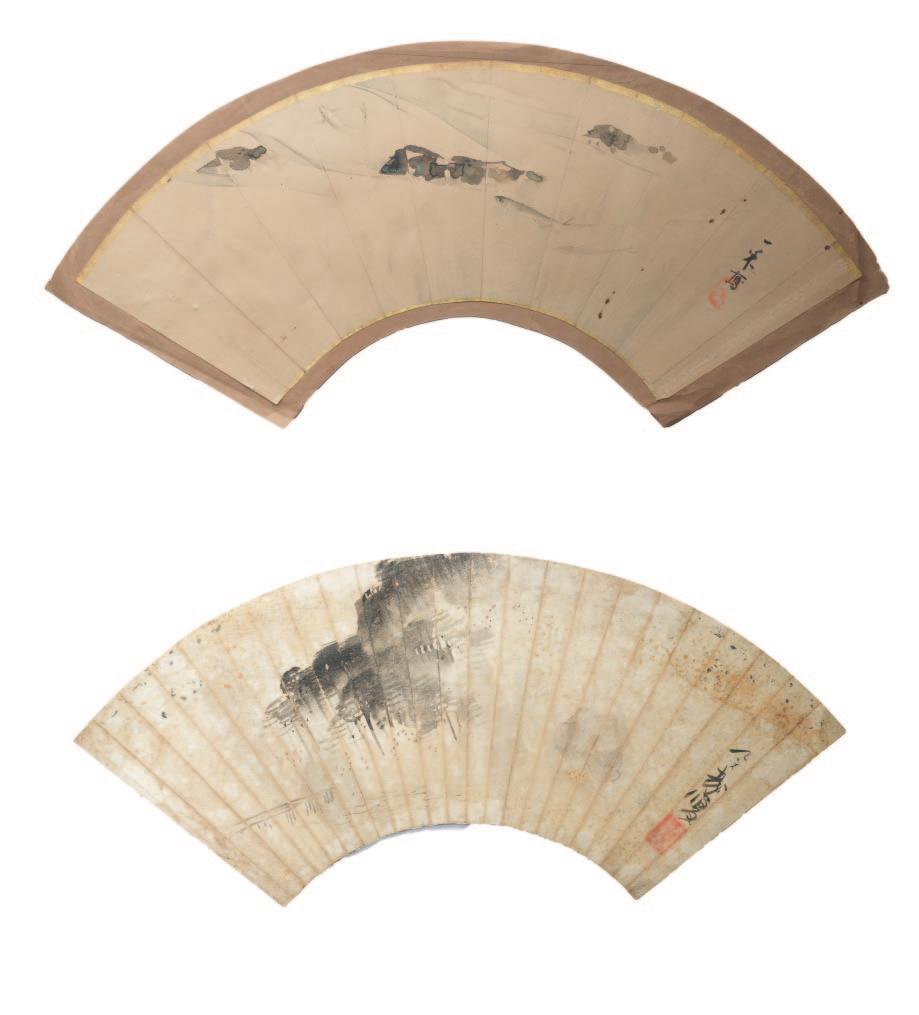
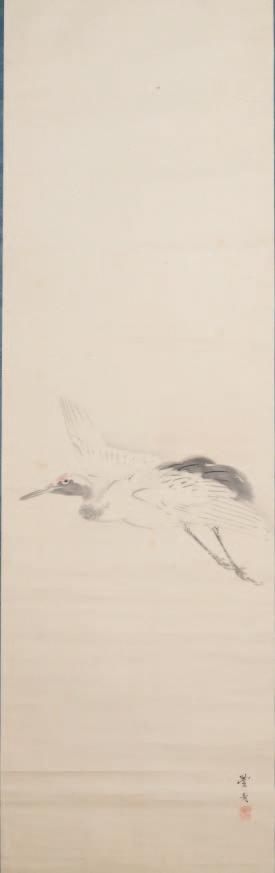
A COLLECTION OF FOUR JAPANESE SCROLL PAINTINGS
EDO OR LATER, 19TH/20TH CENTURY
Variously depicting birds and figures, painted by Okamoto Shuki (18071862) and other artists; together with an embroidered paper scroll with a dragon, 124cm x 50cm max. (5)
£300-500
850
UNIDENTIFIED ARTIST, KANO SCHOOL
HOOPOE AND PRUNUS
PROBABLY EDO, 19TH CENTURY
A Japanese kakejiku (hanging scroll painting), depicting a crested hoopoe perched on a flowering branch of prunus; a redvessel seal mark lower right corner reading as Naonobu; together with a box, labelled ‘Peach blossom tree and young chick, painted by Shoei’, and a document with biographical details about the painter Kano Shoei Naonobu (15191592), 76cm x 32cm. (2)
£200-300
Provenance: from a Japanese private collection, London.
851
OKAMOTO TOYOHIKO (17731865)
FLYING CRANE
EDO PERIOD, 19TH CENTURY
A Japanese kakejiku (hanging scroll painting), ink and colour on paper, in a tomobako (wood box); together with a paper fan decorated with a discarded broom and rake; 112cm x 29cm and 45cm. (3)
£400-600
Provenance: both gifted by Dr Oliver Impey (1936-2005) to the current owner, a family member; the crane painting as a wedding present.
852
TWO JAPANESE SENSU (FAN PAINTINGS)
EDO/MEIJI, 19TH CENTURY
The first in ink and colour on paper, depicting fish swimming up a river, signed Ikka ga (painted by Ikka), possibly for Suzuki Ikka (18231866), the other in ink on paper with gold leaf, depicting a pine forest by a bridge, signed Ōju Kōfuku (by request, painted by Kōfuku); 47.5cm and 47cm. (2)
£150-250
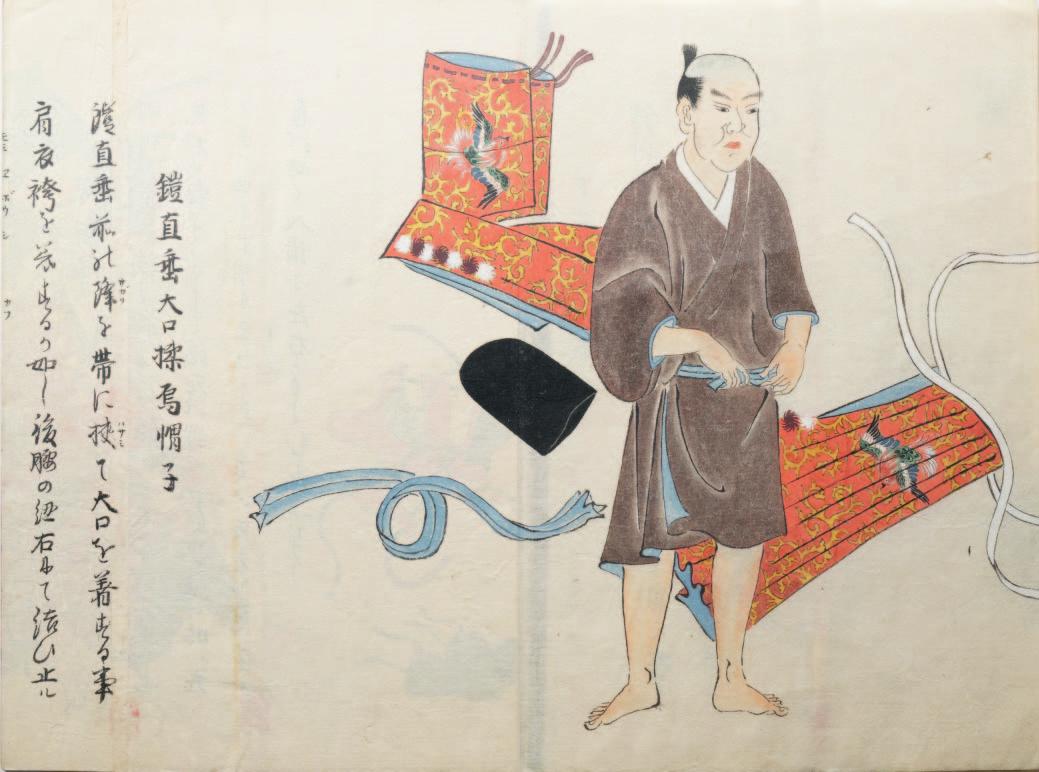
853
THREE JAPANESE HANDPAINTED INSTRUCTIONAL MANUALS
EDO AND MEIJI, DATED 1796 AND 1894
The first with a title slip reading Katchū Jitsuden (True Stories of the Armour), comprising numerous illustrations in ink, colour and gofūn on paper, depicting samurai putting on armours, and with instructions on how to assemble a rokugu (sixpart armour); the last page dated the autumn of Kansei 8 (1796), signed Kondō Yasuhiro/Tomohiro Asaokasai Sōdō (Kondō Yasuhiro/Tomohiro, in a grass hut in Asaokapossibly in Minato City, Tokyo), 27.5cm x 19cm; the two other albums dedicated to ikebana (flower arrangement), with illustrations and text in ink on paper, the last pages of each album dated January, Meiji 27 (1894), and signed Suzukisai Issui, 26.6cm x 19.6cm. (3)
£200-400
Provenance: from the Estate of a Collector, Heath House, Hampshire, and thence by descent. By repute, acquired in Asia at the turn of the 19th century.
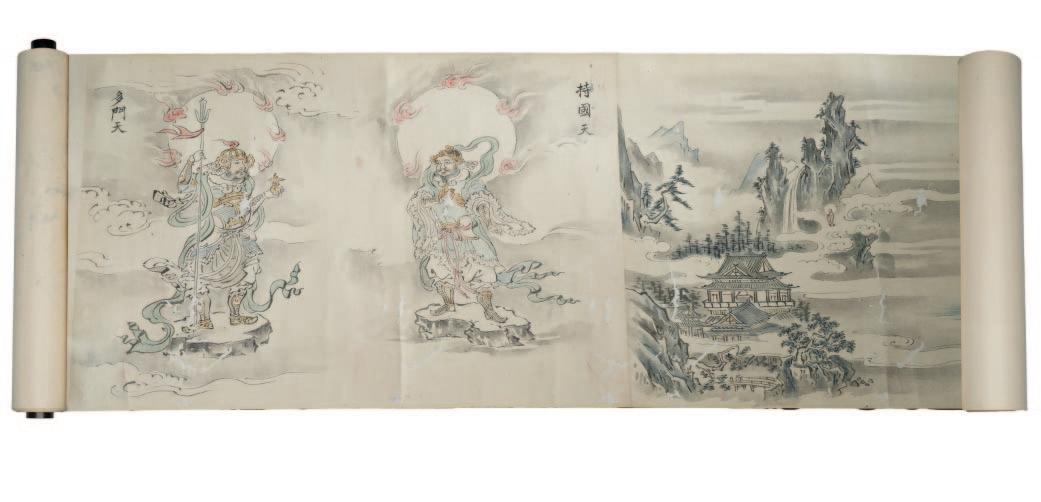
855 ANONYMOUS IMMORTALS
EDO/MEIJI, 19TH CENTURY
Two Japanese makimono (handscroll paintings), ink and colour on paper, each with depictions of Buddhist and Shintō deities, one scroll starting with views of Earth and Heaven followed by divine beings, each accompanied by an inscription with its name; 26cm x 419cm and 22cm x 495cm. (2)
WITHOUT RESERVE
£150-250
Provenance: from the Estate of a Collector, Heath House, Hampshire, and thence by descent. By repute, acquired in Asia at the turn of the 19th century.
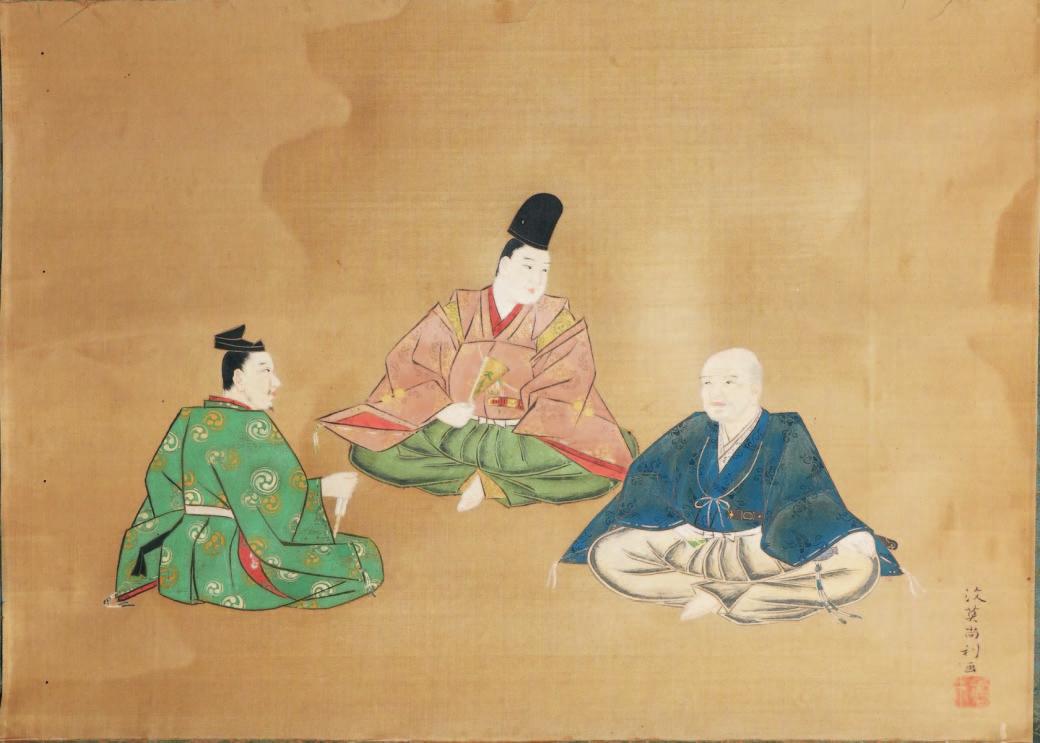
854
TACHIBANA NAOTOSHI (C.1750–1780)
GATHERING FOR THE FUIGO MATSURI
EDO PERIOD, 18TH CENTURY
A Japanese kakejiku (hanging scroll painting), ink, colour and gold on silk, depicting three men gathered for the Fuigo Matsuri, one possibly a sword maker; signed Bunbaku Naotoshi ga and sealed Tachibana; with a tomobako (wood box), 31.5cm x 44cm.
WITHOUT RESERVE
£150-250
Another painting by Tachibana Naotoshi is held at the Sword World Foundation (Token World collection, Nagoya), depicting the twenty-four Samurai vassals of Takeda Shingen.
Fuigo Matsuri is a traditional festival celebrating sword-makers, blacksmiths, and other professions involving fire. Usually held on 8th November, it was an opportunity to take a day off and clean the fuigo (box bellows), decorate it with straw ropes (shimenawa), and make offerings to the fire deities as a gesture of gratitude.
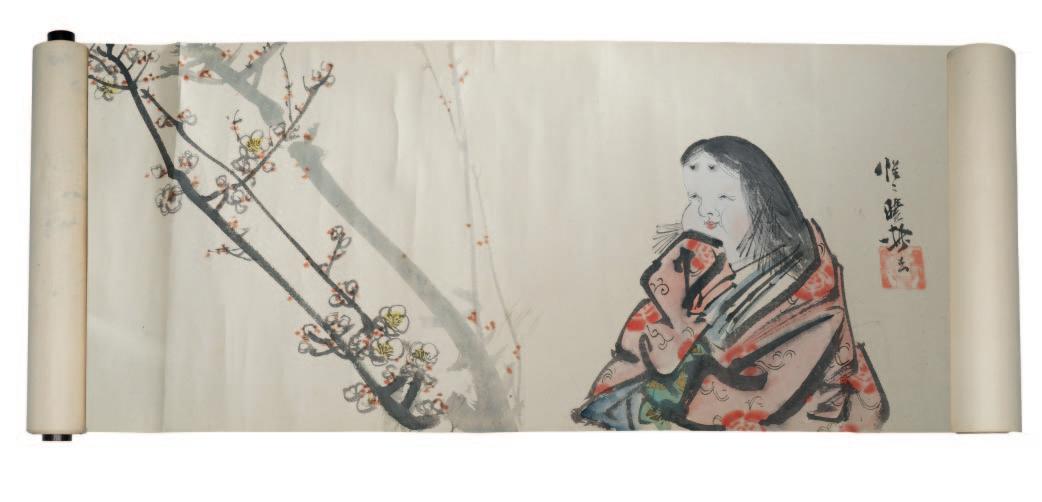
856
SHIBATA ZESHIN (180791)
KAWANABE KYŌSAI (183189) AND OTHERS
EDO/MEIJI, 19TH CENTURY
A rare Japanese collaborative makimono (handscroll painting), ink and colour on paper, with a title slip inscribed Kinsei Meika gassaku ga makimono (Collaborative Painting Scroll by Renowned Artists of the Early Modern Period), featuring eleven sketches by various artists, including Shibata Zeshin, Kawanabe Kyōsai, Sato Genran and others, 28cm x 494cm.
£500-1,000
Provenance: from the Estate of a Collector, Heath House, Hampshire, and thence by descent. By repute, acquired in Asia at the turn of the 19th century.
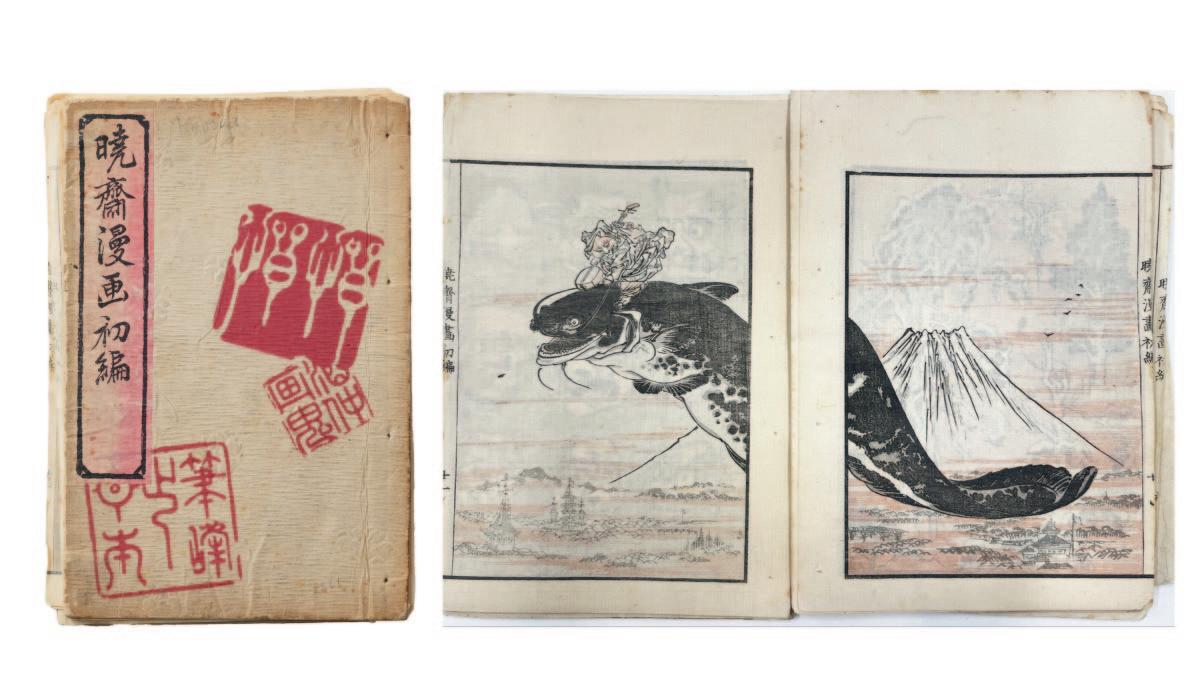
858
SHIBATA ZESHIN (180791)
URUSHI-E (LACQUER PAINTING)
EDO/MEIJI, 19TH CENTURY
A Japanese painting, ink, coloured lacquer and gold leaf on paper, mounted as an album leaf; depicting peony flowers and buds amongst leafy branches; signed Zeshin and sealed Reisai; with a Spink paper label at the back, 19cm x 15.7cm.
WITHOUT RESERVE
£400-600
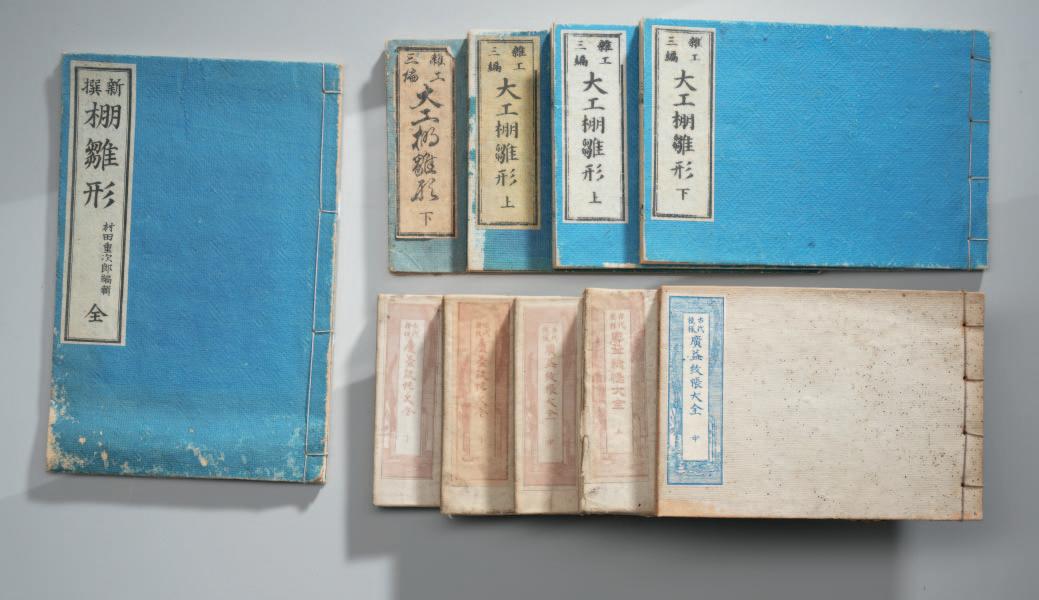
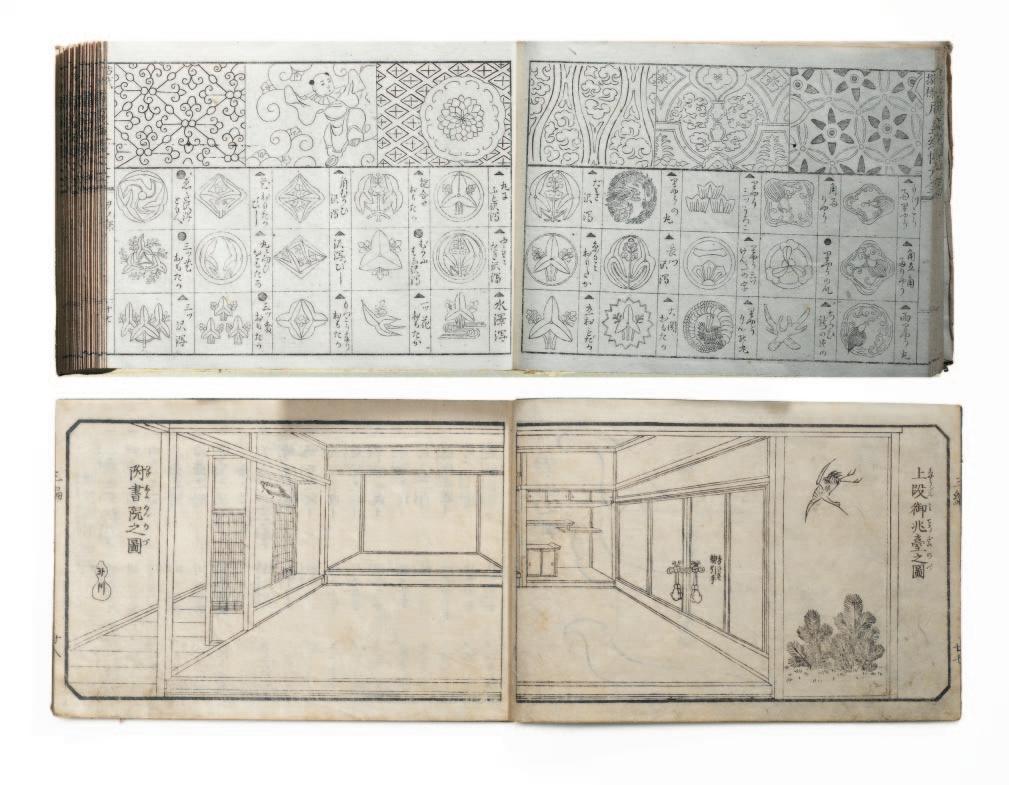
857
KAWANABE KYŌSAI (18311889)
KYŌSAI MANGA
MEIJI ERA, 19TH CENTURY
A Japanese woodblockprinted ehon (album of pictures), vol. I, the colophon signed Kawanabe Dōiku, published by Makino Kichibei and dated Meiji 14 (1881), 18cm x 12.5cm.
WITHOUT RESERVE
£150-250
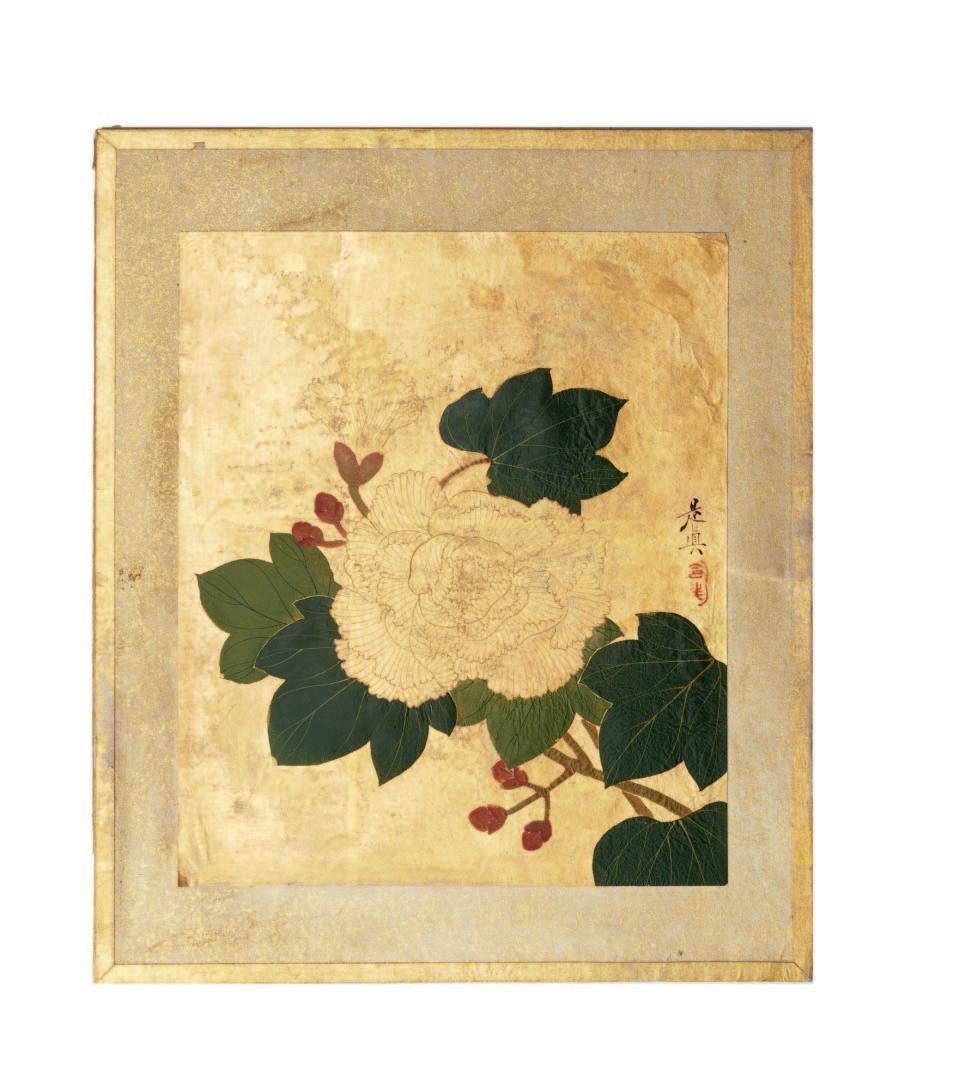
859
A COLLECTION OF JAPANESE PRINTED MANUALS
MEIJI ERA, 19TH CENTURY
The woodblockprinted books variously illustrating mon (family crests), kimono patterns and woodworking; including one full threevolumes set, and two volumes of the Kodai Moyō Kōeki Moncho Taizen (The complete collection of ancient patterns and broadly useful family crests), by Kaiyama Kyusaburo, published in June, Meiji 24 (1891) by Sokojukai; two sets in two volumes of the Daiku Tana Hinagata (Carpenter’s shelf models) from the series Zōkō San-hen (Miscellaneous craftwork) by Ochiga Taiga no Kuni, published in 1876; and a single volume of the Shinsen Tana Hinagata by Jūjirō Murata, published in Meiji 15 (1882), edited by Murato Juijiro; 22.6cm x 15cm max. (10)
£300-500
Provenance: from the Estate of a Collector, Heath House, Hampshire, and thence by descent. By repute, acquired in Asia at the turn of the 19th century.
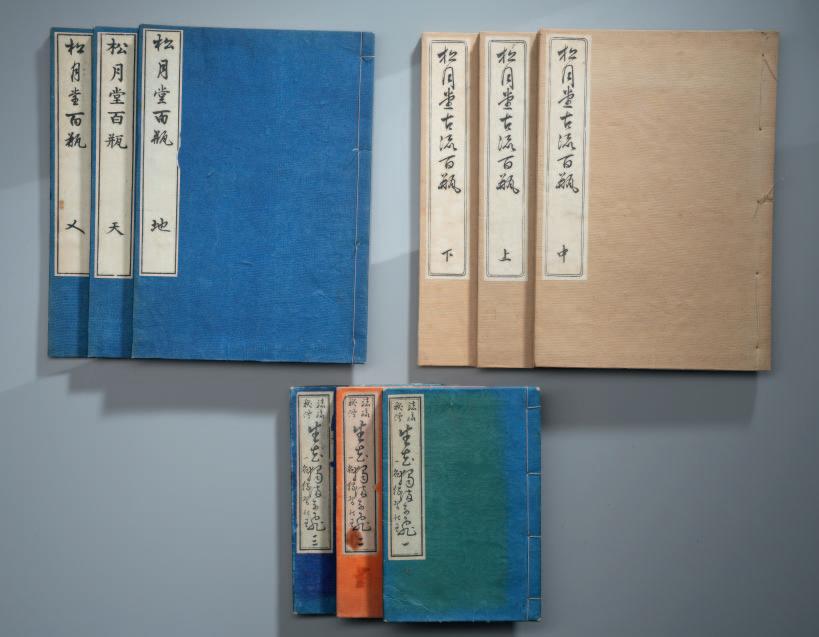
861
KATSUSHIKA HOKUSAI (17601849)
THIRTEEN VOLUMES OF THE MANGA MEIJI ERA, 19TH CENTURY
A collection of thirteen woodblockprinted ehon (picture books), including volumes I, III, IV, VII, VII, VIII, IX, X, XI, XII, XIII, XIV and XV; 1875 edition published posthumously, 24.6cm x 16.1cm. (13)
£800-1,200
Provenance: from the Estate of a Collector, Heath House, Hampshire, and thence by descent. By repute, acquired in Asia at the turn of the 19th century.
860
A COLLECTION OF JAPANESE INSTRUCTIONAL MANUALS ON IKEBANA (FLOWER ARRANGEMENT)
MEIJI ERA, 19TH CENTURY
Comprising three sets of three volumes each, entitled Shōgetsudō Kohō Hyakubin (One Hundred floral arrangements in the traditional ways of the Shōgetsudō School of Ikebana); another set Ryuha Hiden: Seika Shoho Dokushu (Secret Traditions of the School: A SelfStudy Guide to the Fundamentals of Seika Ikebana), and the third simply Shōgetsudō Hyakubin (One Hundred floral arrangements of the Shōgetsudō School of Ikebana), 26cm x 18.1cm max. (9)
£400-600
Provenance: from the Estate of a Collector, Heath House, Hampshire, and thence by descent. By repute, acquired in Asia at the turn of the 19th century.
862
KATSUSHIKA HOKUSAI (17601849)
KAWANABE KYŌSAI (18311889)
MEIJI ERA, 19TH CENTURY
A full set of the Fugaku hyakkei (One Hundred Views of Mount Fuji) in three volumes, each woodblockprinted illustrated book with a colophon dated Meiji 8 (1875), published by Eirakuya Toshiro (Tohekido), each 22.7cm x 15.7cm; together with a copy of the Kyōsai Donga (Idle Drawings of Kyōsai), signed Kawanabe Dōiku, published in 1881 by Masuyama Naoyoshi, first edition, 12cm x 18.2cm. (4)
£500-1,000
Provenance: from the Estate of a Collector, Heath House, Hampshire, and thence by descent. By repute, acquired in Asia at the turn of the 19th century.
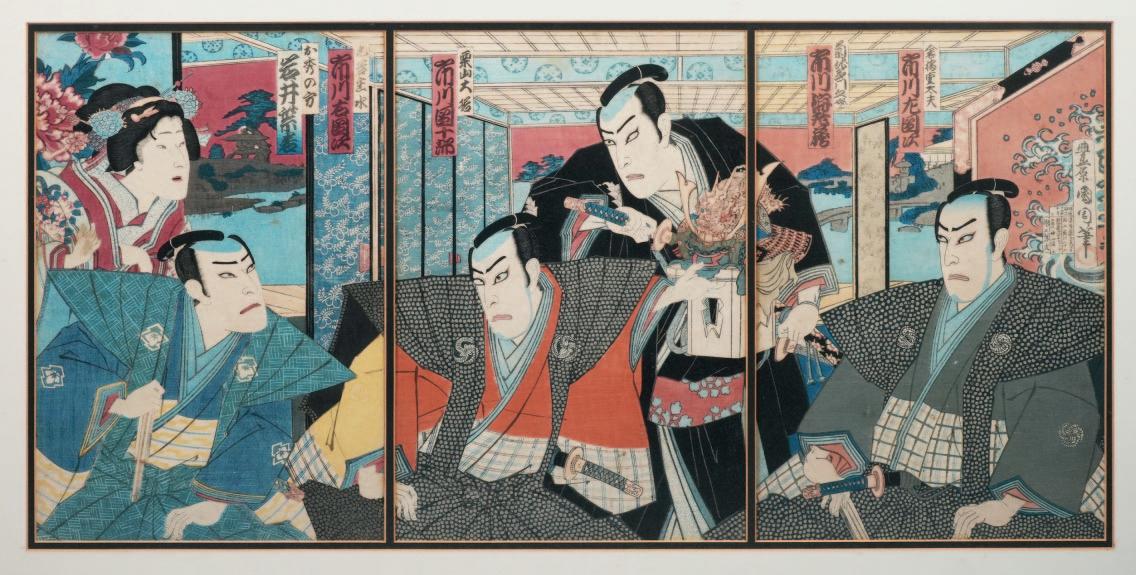
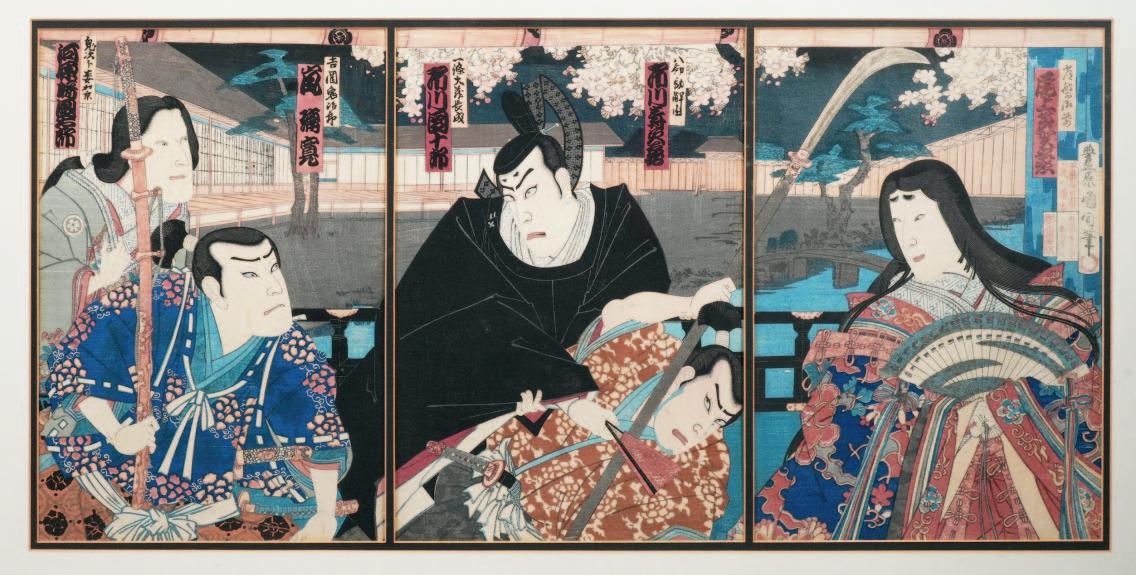
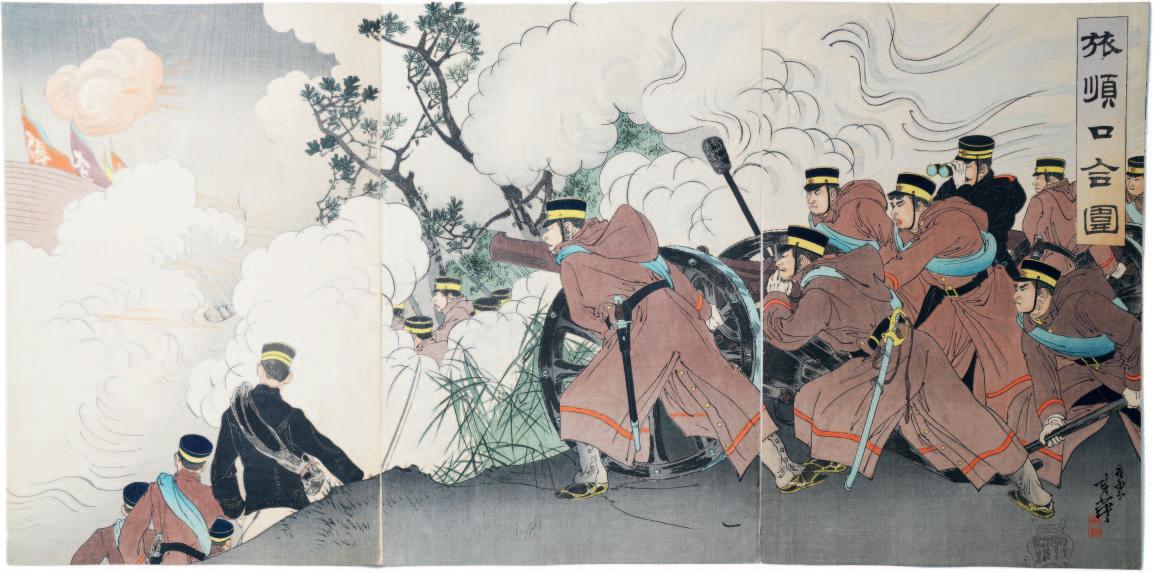
863
A LARGE COLLECTION OF JAPANESE WOODBLOCK PRINTS
MEIJI ERA, 19TH CENTURY
Comprising over twenty triptychs mounted on two long handscrolls, including prints by Mizuno Toshikata (18661908), Kobayashi Kiyochika (18471915), Ogata Gekko (18591920), Adachi Ginko (act. 18741897) and others, depicting scenes from the SinoJapanese War; the first scroll with twentyone oban triptychs, six by Toshikata and two by Kiyochika, including one titled Heijo kogeki denki shiyo no zu (Night
Attack on Pyongyang); the other scroll with twentytwo triptychs and five single oban prints, including six by Toshikata; two by Gekko, one titled Nisshin senso Kinshujo tsuigeki no zu (The SinoJapanese War: Attack on Jinzhou Castle) and one by Kiyochika, together with five oban sheets by Kiyochika from the series Nihon banzai hyakusen hyakusho (One Hundred Victories, One Hundred Laughs); together with a tomobako (wood box) inscribed Seishin gafu (Illustrated Book of the SinoJapanese War), each triptych approx. 36cm x 71cm (3)
£1,500-2,500
Provenance: from an English private collection, Devon; acquired from Bonhams London, Fine Japanese Art, 16th May 2019, lot 289.
864
TOYOHARA KUNICHIKA (1835–1900)
KABUKI PLAYS
MEIJI ERA, 19TH CENTURY
Two Japanese woodblock print triptychs, oban tate-e, the first depicting the Sanemori Monogatari act of the play Genpei Nunobiki no Taki with four samurai discussing a golden helmet, published by Kamiyama Seishichi in October 1884; the other possibly depicting a scene from the play Hana Ayame Bunroku Soga, both signed Toyohara Kunichika hitsu on the right panel, both framed and glazed, both 35cm x 73cm. (2)
£300-500
Provenance: purchased from Liberty’s London in the 1970s/80s by the current owner’s father, and thence by descent.
865
A COLLECTION OF JAPANESE PRINTS ABOUT THE SINOJAPANESE WAR
MEIJI ERA, 19TH/20TH CENTURY
Including five woodblock print triptychs and three single prints; most oban tate-e senso-e (war prints), including works by Mizuno Toshikata (18661908), Ogata Gekkō (18591920) and Kobayashi Kiyochika (18471915), 36cm x 24cm max. (8)
£500-1,000
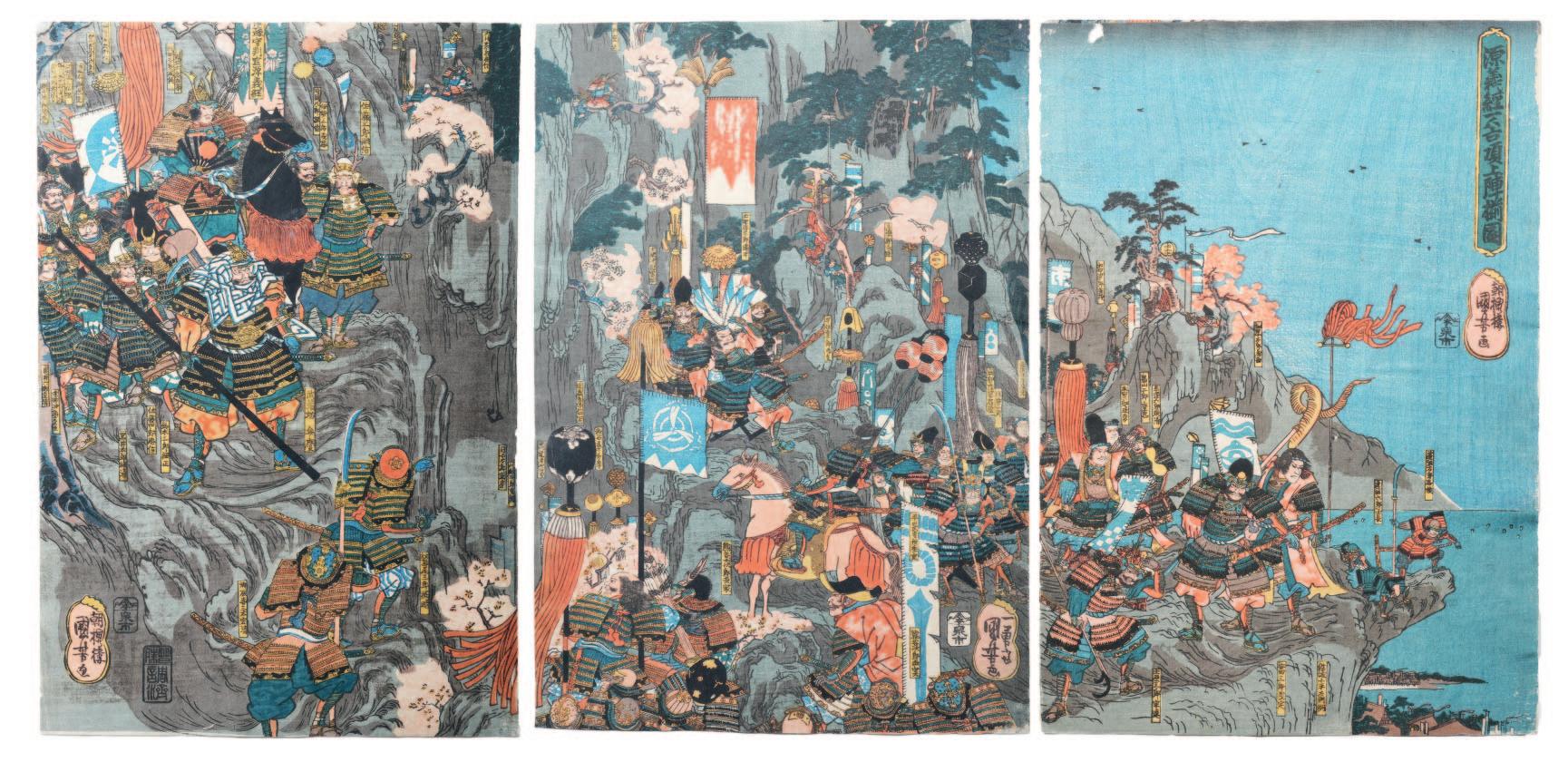
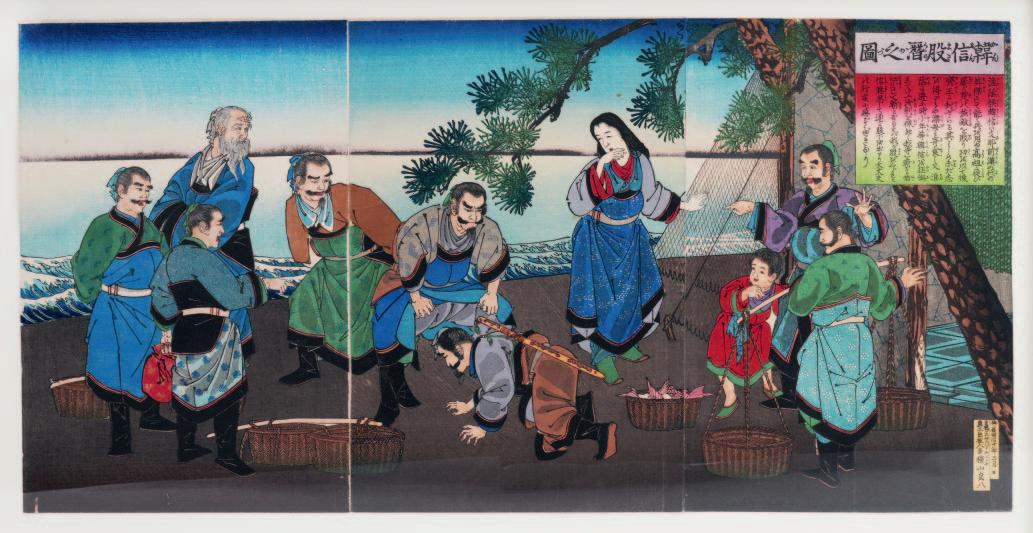
867
A COLLECTION OF JAPANESE WOODBLOCK PRINTS
EDO AND MEIJI, 17TH CENTURY AND LATER
The first a woodblock print triptych by an unidentified artist, depicting the Chinese story of the famous general Han Xin crawling between the legs of a bully, framed and glazed; the others by Katsushika Hokusai (17601849), Hishikawa Morunobu (16181695), Yashima Gakutei (17861868), Ogata Gekkō (18591920) and others; together with a small painting of revellers by Kōsen/Kyōsen; 35cm x 70cm max. (10)
£300-500
Provenance: from an English private collection, Devon.
868
ADACHI GINKŌ (18531902)
TAGUCHI BEISAKU (18641903)
MEIJI ERA, 19TH CENTURY
Two Japanese woodblock print triptychs, oban tate-e, the first by Adachi Ginkō entitled Sono hajime Chōsen hottan (The Beginning of the Korean Incident), signed Ōju Ginkō, published by Fukuda Kumajirō in 1894; the other by Taguchi Beisaku, titled Sōkakō fukin Nichijin enbō Manshū kihei isō shutsujin no zu (Manchurian Horsemen Observing the Japanese Camp Near Sauhoku), signed Beisaku, printed by Suri Nakajima, also in 1894; both framed and glazed, 34cm x 70cm max. (2)
£300-400
866
UTAGAWA KUNIYOSHI (17981861)
YOSHITSUNE AT ICHINOTANI
EDO PERIOD, C.18421843
A Japanese woodblock print triptych entitled Minamoto no Yoshitsune Ichi-no-tani chōjō jin soroi zu (Yoshitsune and his men looking down on the Taira position at Ichino-tani from the precipice of Hiyodori-goe), the central panel signed Ichiyūsai Kuniyoshi ga and the others Chōōō Kuniyoshi ga, published by Izumi-ya Ichibei, 36cm x 24cm (left), 36cm x 25cm (centre) and 36cm x 25cm (right panel).
£600-1,000
Cf. B W Robinson, Kuniyoshi: The Warrior-Prints, where this design is listed as T84.
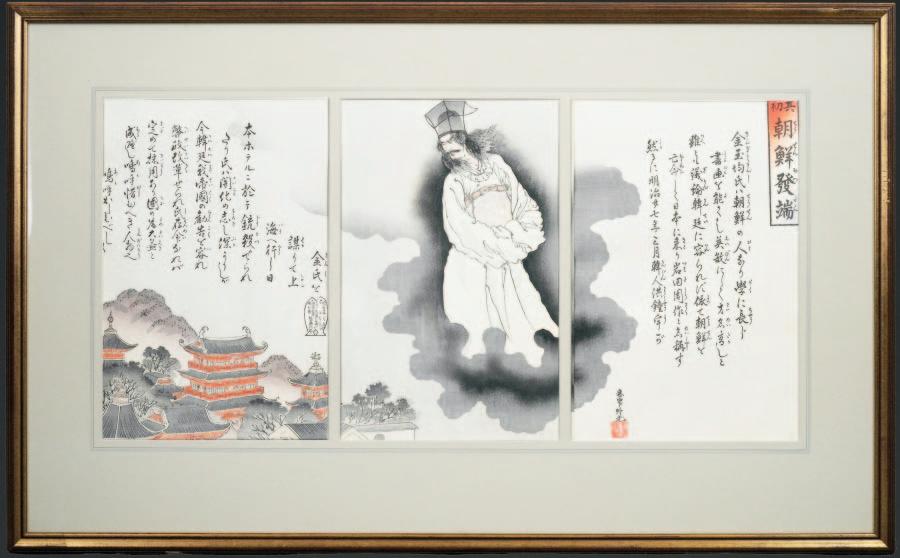
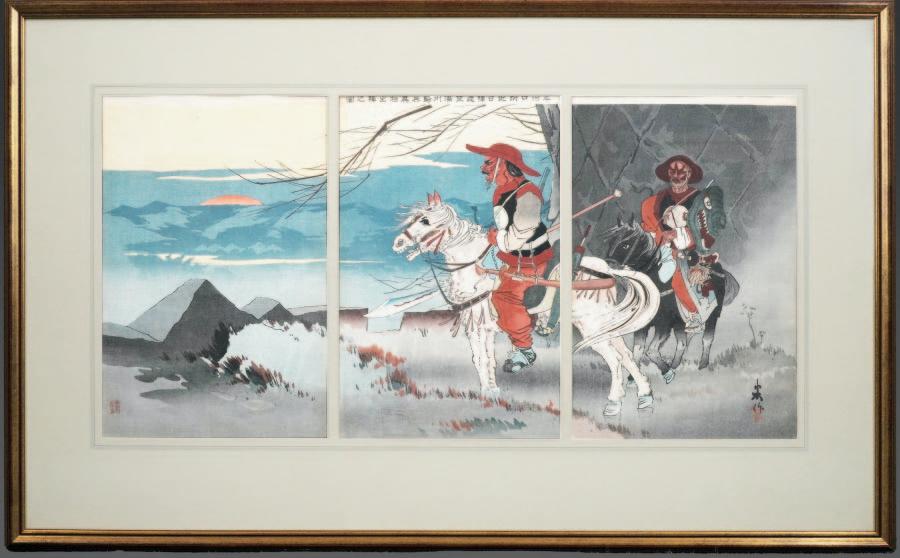
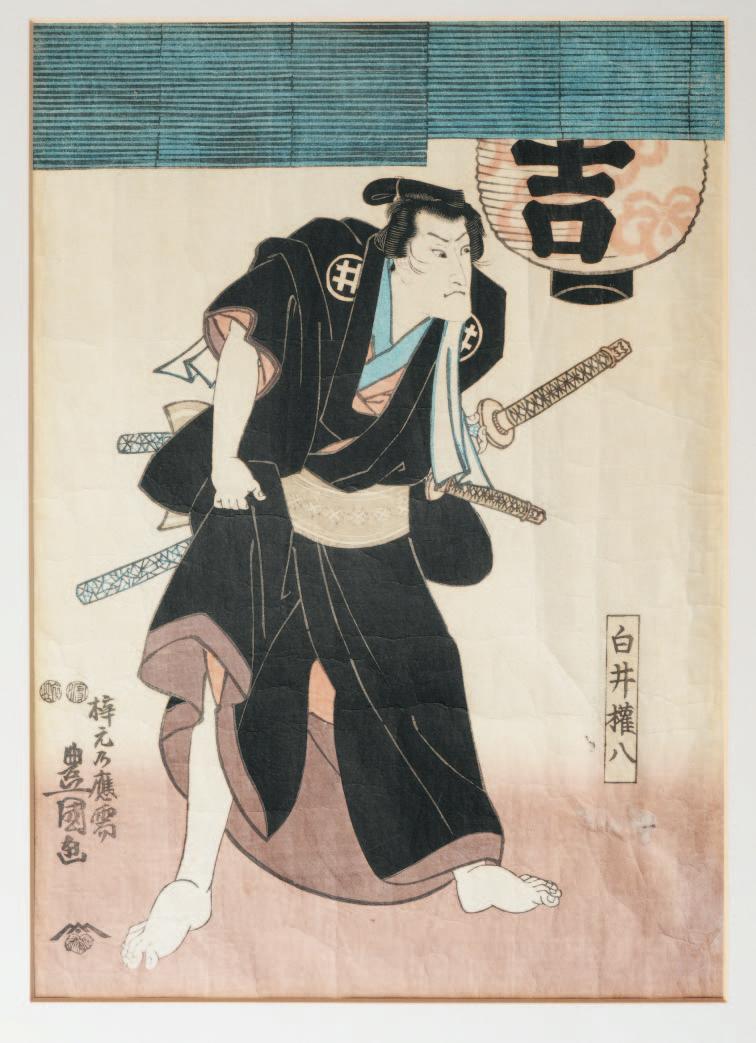
870 AFTER UTAGAWA HIROSHIGE TRAVELLERS
MEIJI ERA, 19TH/20TH CENTURY
869
SIX JAPANESE WOODBLOCK PRINTS
EDO AND MEIJI, 19TH AND 20TH CENTURY
Two from the Hokusai Manga (Random Drawings by Hokusai); one by Ogata Gekkō (18591920) from his ‘Illustrations of the Fortyseven Loyal Retainers’ series; one by Ichiyusai Kuniyoshi (17971861) from the series ‘Ogura imitation of the Hundred Poets’; an actor print by Utagawa Kunisada / Toyokuni III (17861865); and the last a beauty and children, possibly by Katsukawa Shunshō (c.17431793); 35cm x 24.5cm max. (6)
WITHOUT RESERVE
£200-300
A Japanese kakejiku (hanging scroll painting), ink and colour on silk, depicting two men on a path holding guns and another figure walking towards them; with Mount Fuji visible in the distance, an apocryphal signature for Hiroshige, 56cm x 34cm.
WITHOUT RESERVE
£100-200
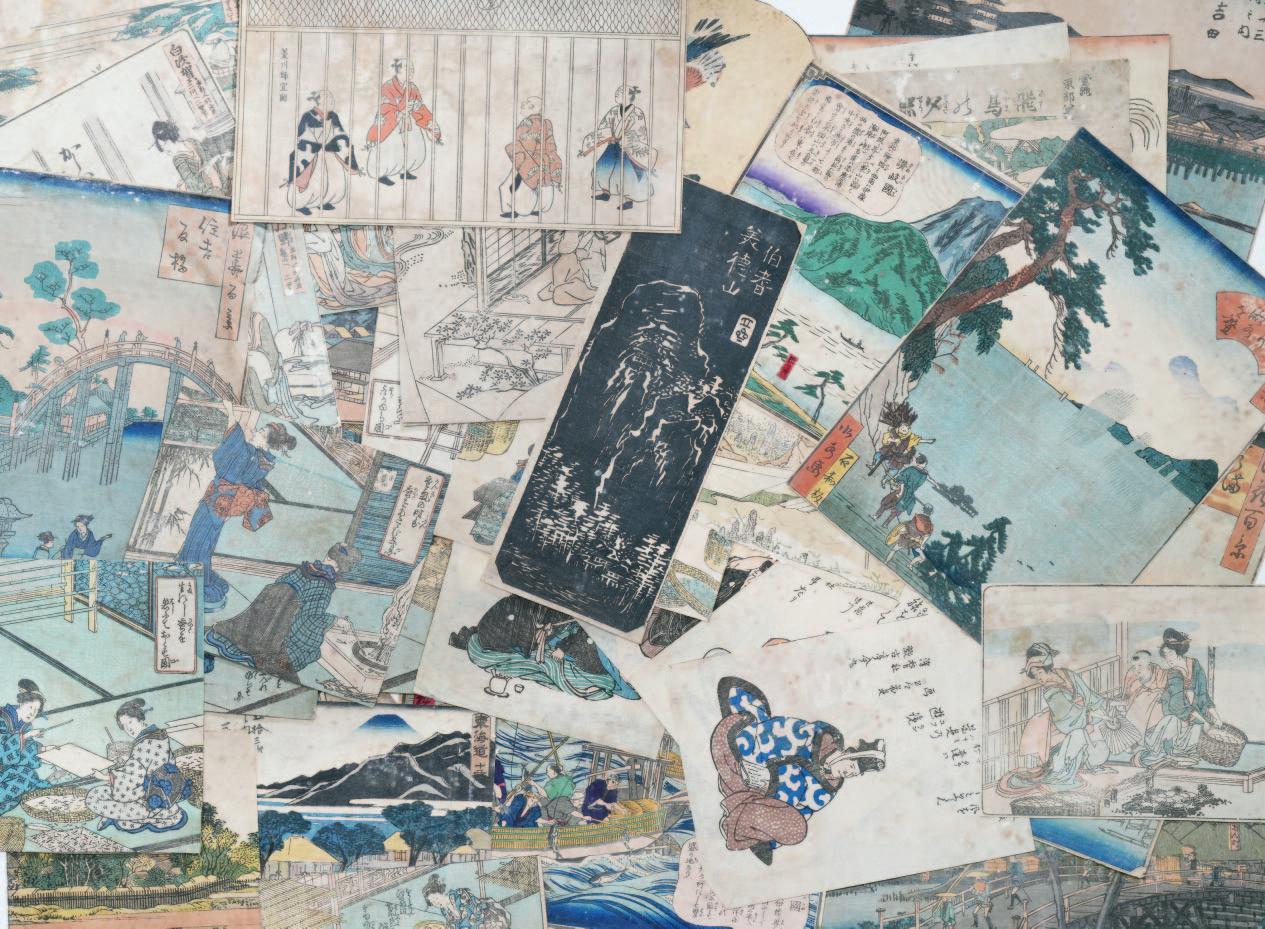
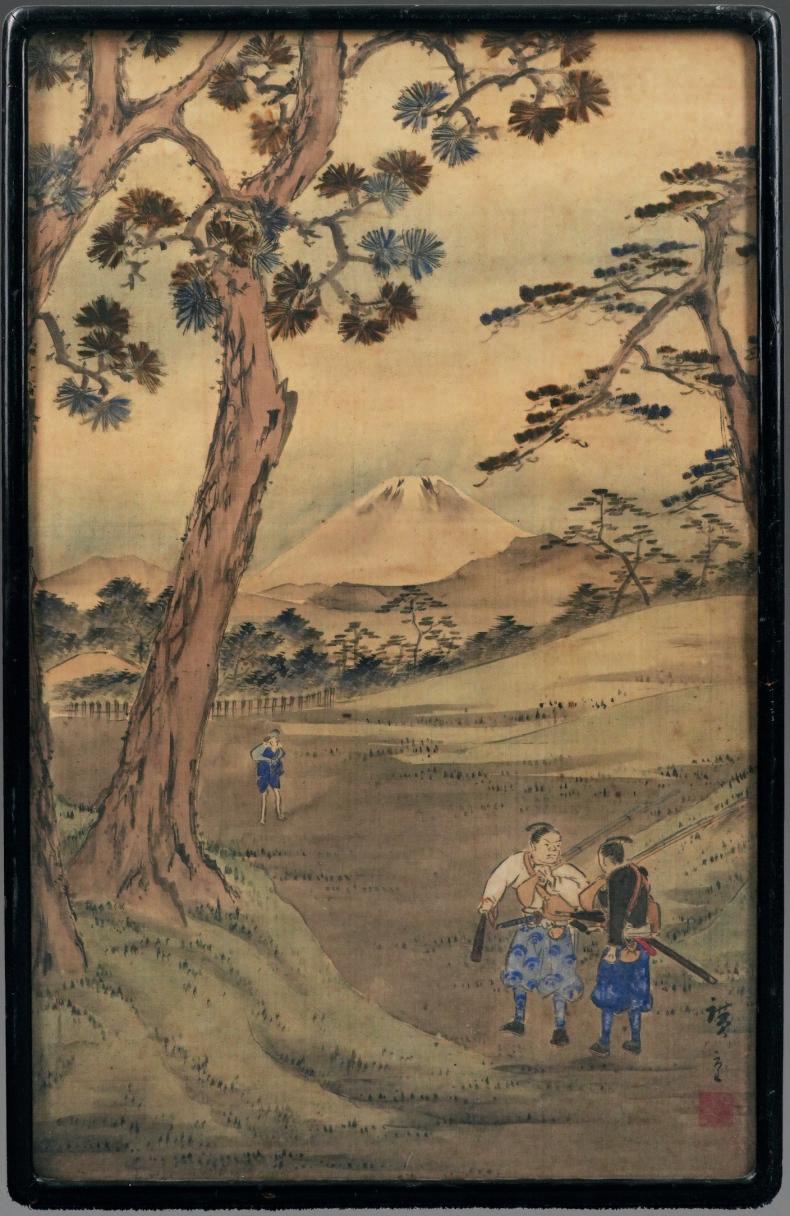
871
A LARGE COLLECTION OF JAPANESE WOODBLOCK PRINTS
EDO/MEIJI, 18TH/19TH CENTURY
Comprising views and portraits by and after Utagawa Hiroshige (17971858), Katsushika Hokusai (1760–1849), Hanabusa Itchō (16521724), and others, 23.8cm x 17cm max. (approx. 59)
£400-600
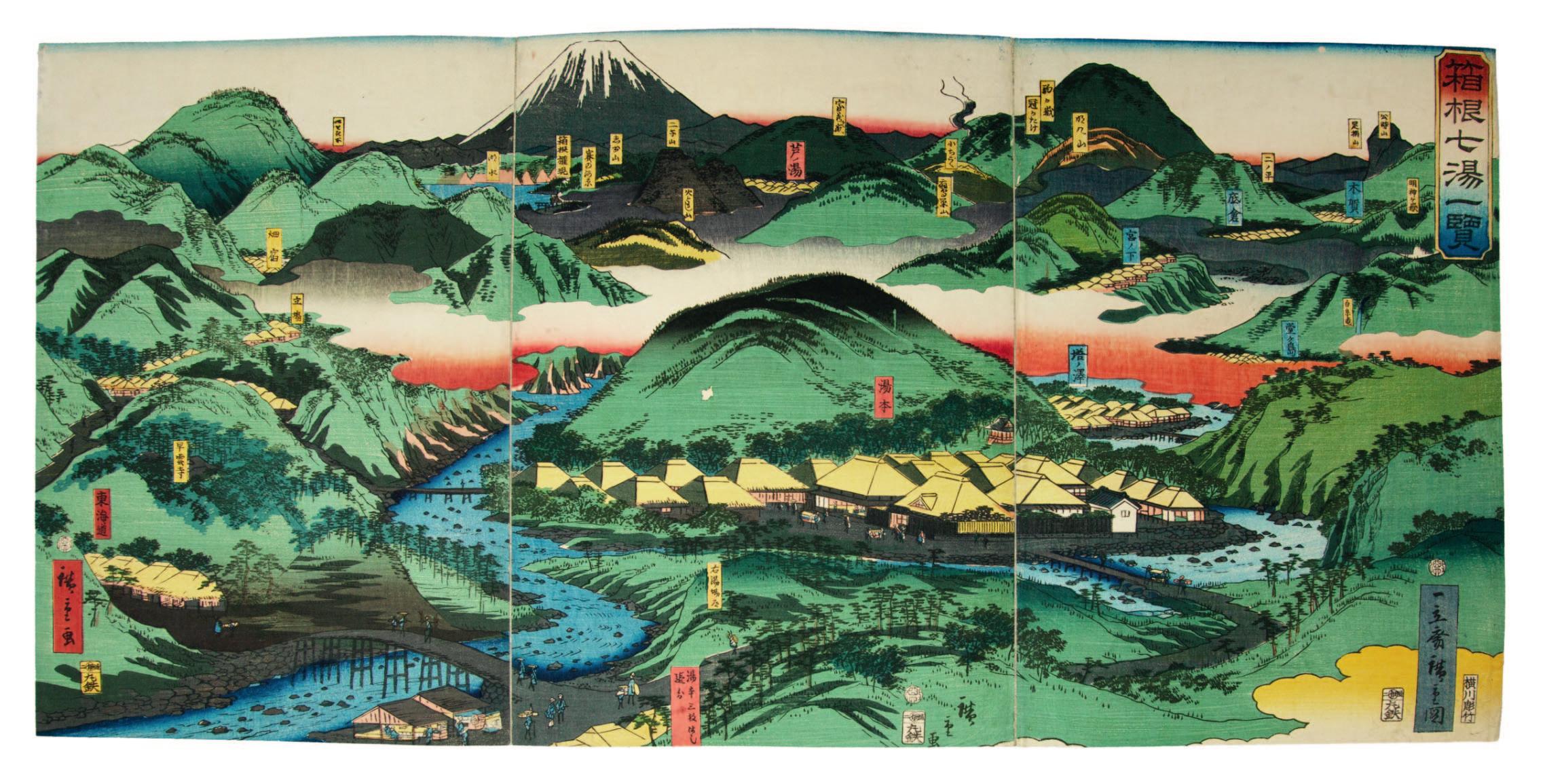
872
UTAGAWA HIROSHIGE II (182669)
HAKONE SHICHIYU ICHIRAN (THE SEVEN HOT SPRINGS OF HAKONE IN A SINGLE VIEW)
EDO PERIOD, 19TH CENTURY
A Japanese oban tate-e woodblock print triptych, each sheet signed Ichiryusai Hiroshige zu, published by Maruya Tetsujiro (Enjudo), 1861; mounted with a silk backing; each sheet 35.4cm x 24.5cm.
£400-600
Provenance: from the Estate of a Collector, Heath House, Hampshire, and thence by descent. By repute, acquired in Asia at the turn of the 19th century.
873
UTAGAWA HIROSHIGE (17971858)
SETTSU-TŌI (POUNDING CLOTH IN THE SETTSU PROVINCE)
EDO PERIOD, 19TH CENTURY
A Japanese woodblock print from the series Shokoku Mutamagawa (Six Jewel Rivers in Various Provinces), signed Hiroshige ga, published by Maruya Kyushiro, censor’s seal kiwame, date seal Snake 11 (1857), in a card mount, 36.8cm x 24.3cm.
Provenance: from an English private collection, Devon.
£250-350
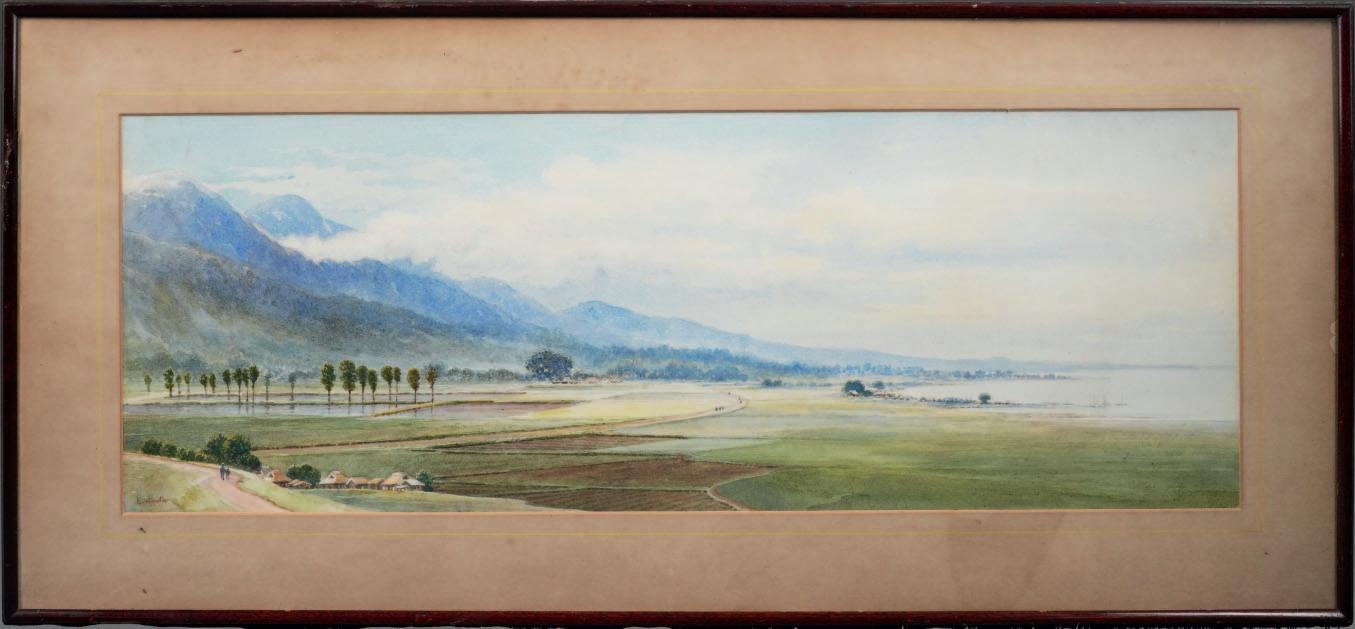
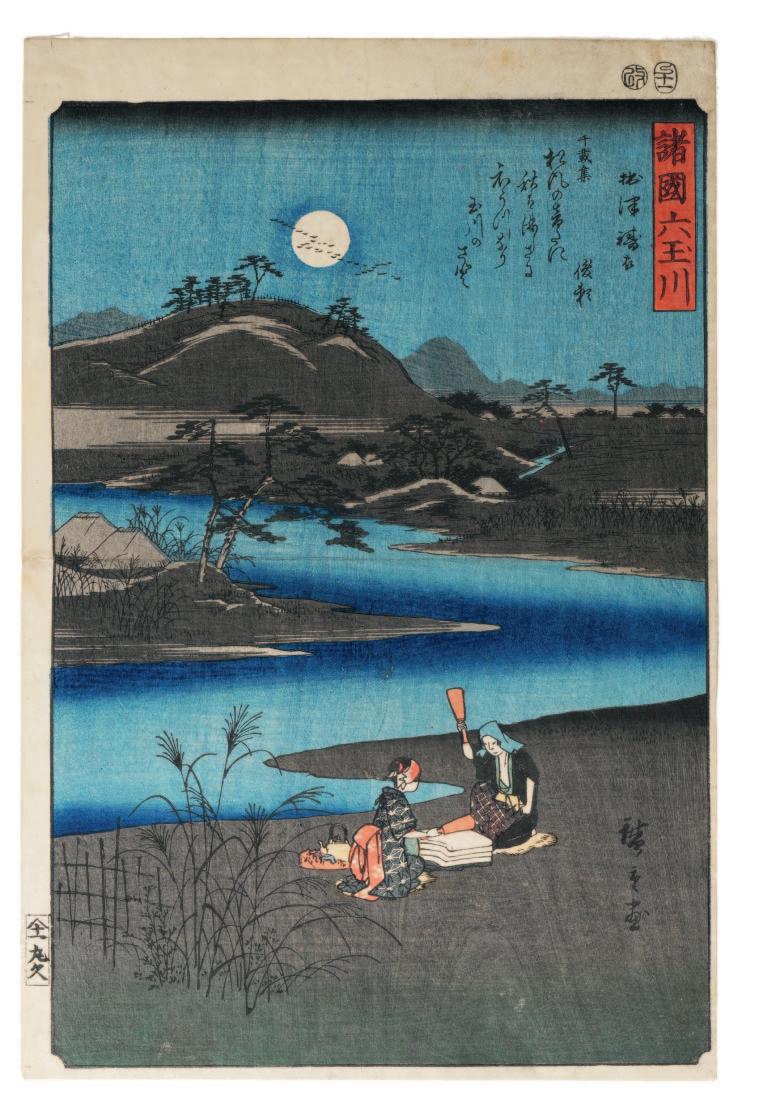
874
E. KATO (DATES UNKNOWN)
JAPANESE LANDSCAPE
MEIJI OR LATER, 20TH CENTURY
A Japanese watercolour depicting figures walking towards a village, with mountains towering in the distance and fields below, signed E. Kato lower left corner; framed and glazed, 23.5cm x 66cm.
£200-300
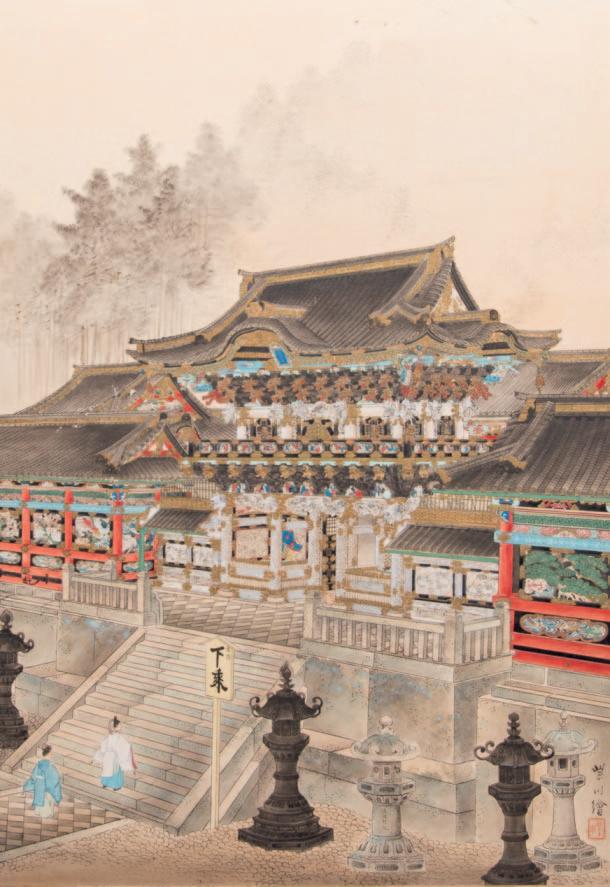
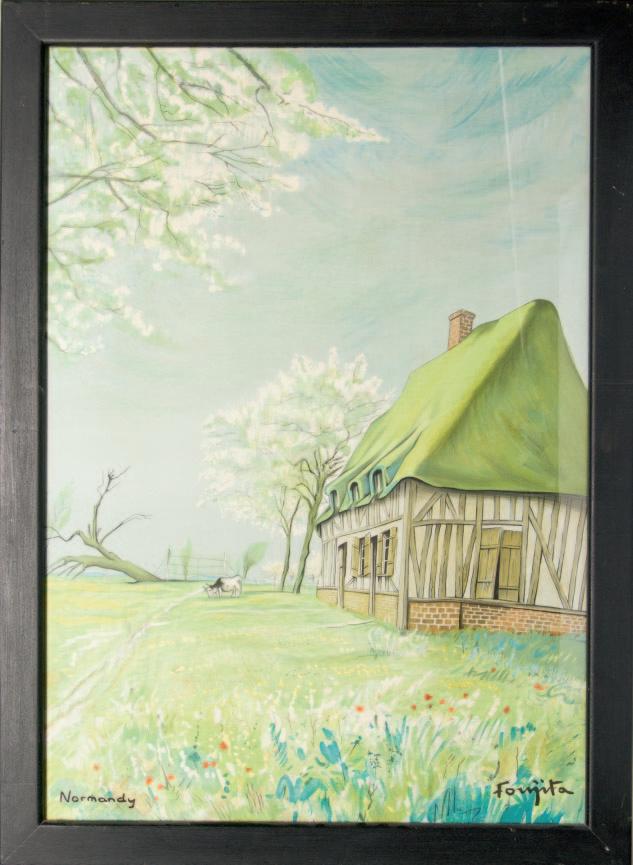
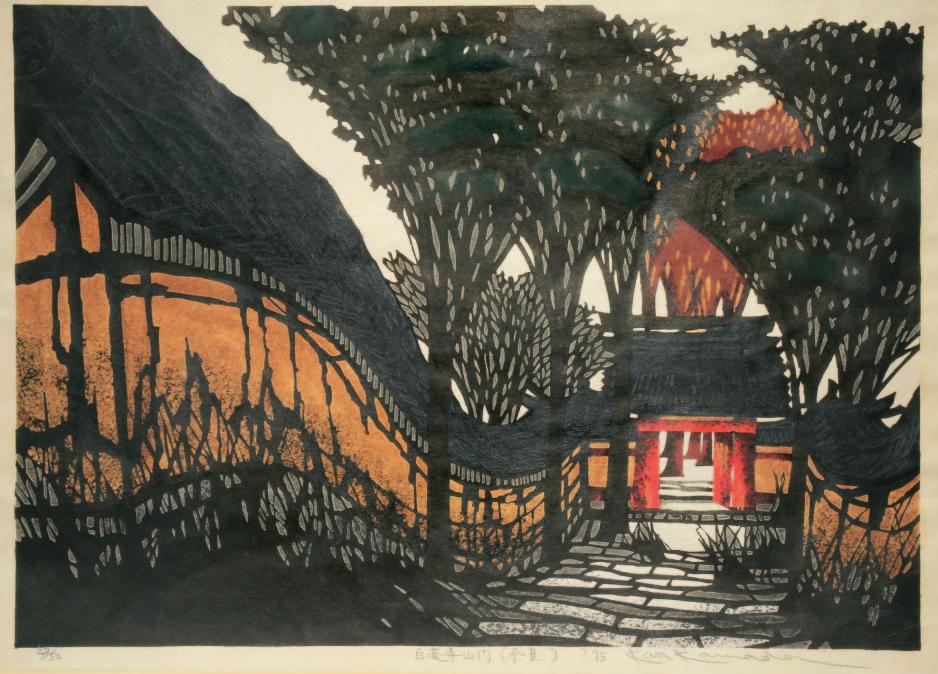
875
HASHIDATE SHISEN (18551921)
TEMPLE GATE
MEIJI OR TAISHŌ, 19TH/20TH CENTURY
A Japanese painting, ink and colour on paper, depicting the Yomeimon Gate of Tokugawa Ieyasu’s Toshogu Shrine in Nikko, with two figures walking up the steps, signed and sealed Shisen, framed, 61.5cm x 42.3cm.
£150-250
876
AFTER LEONARD TSUGUHARU FOUJITA (18861968)
SHŌWA OR LATER, 20TH CENTURY
After Fouijta’s design entitled ‘Normandie’, the image later used for an SNCF poster (Société Nationale des Chemins de Fer) to promote travelling around France by train, framed and glazed, 79cm x 55cm.
£80-120
877
KAN KAWADA (19271999)
THE GATE AT HAKUGOKI
TAISHŌ ERA, DATED 1975
A large Japanese print, the torii and trees depicted in black and muted shades of red, amber and green, inscribed by the artist in pencil underneath with the title, his signature and dated ‘75, 28/50; framed and glazed, 61cm x 77xm overall.
WITHOUT RESERVE
£100-200
Provenance: previously with Brian McElney Esq. (1932-2023), founder of the Museum of East Asian Art, Bath.
A LARGE COLLECTION OF JAPANESE WOODBLOCK PRINTS
EDO AND MEIJI, 19TH AND 20TH CENTURY
Comprising: a scroll with prints from vol.II of the Chūshingura (A Treasury of Loyal Retainers) by Keisai Eisen, published in 1873; eleven prints from the series Koto Meisho (Famous Places in Edo) by Utagawa Hiroshige (17971858); four large prints by Tokuriki Tomikichirō (19022000), from the series Fuji Sanjurokkei no Uchi (Thirtysix Views of Mt Fuji), and fortytwo prints by and after various artists including Utagawa Kuniyoshi (17981861), Yoshu / Toyohara Chikanobu (18381912), Toyohara Kunichika (18351900) and others; the scroll 24cm x 380cm, the prints 37cm x 26cm max. (approx. 58)
£500-1,000
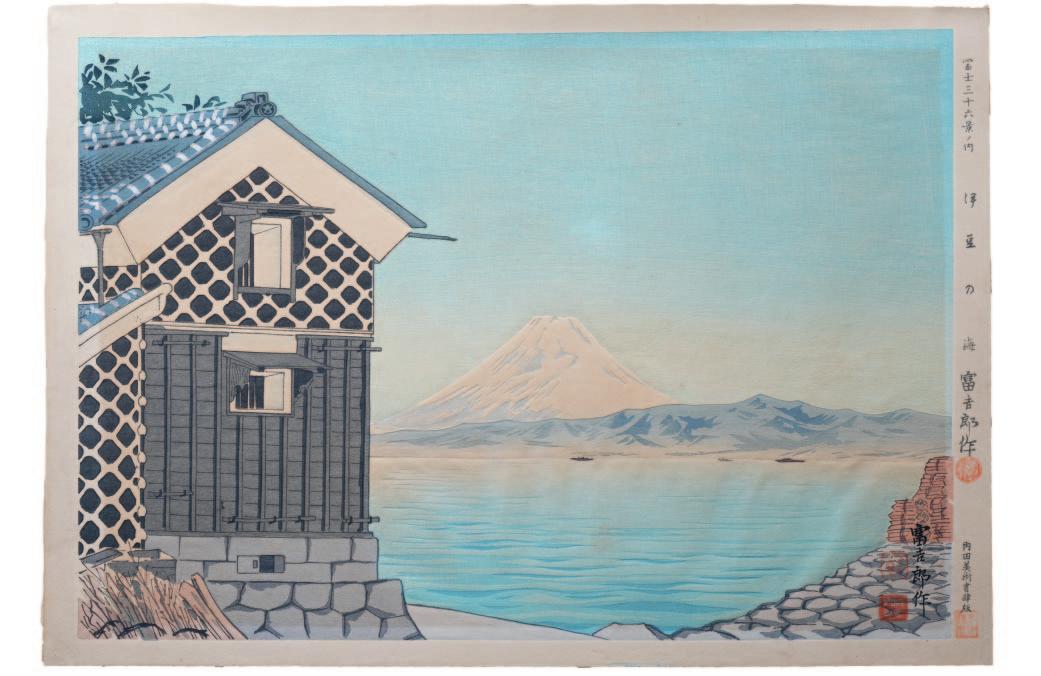
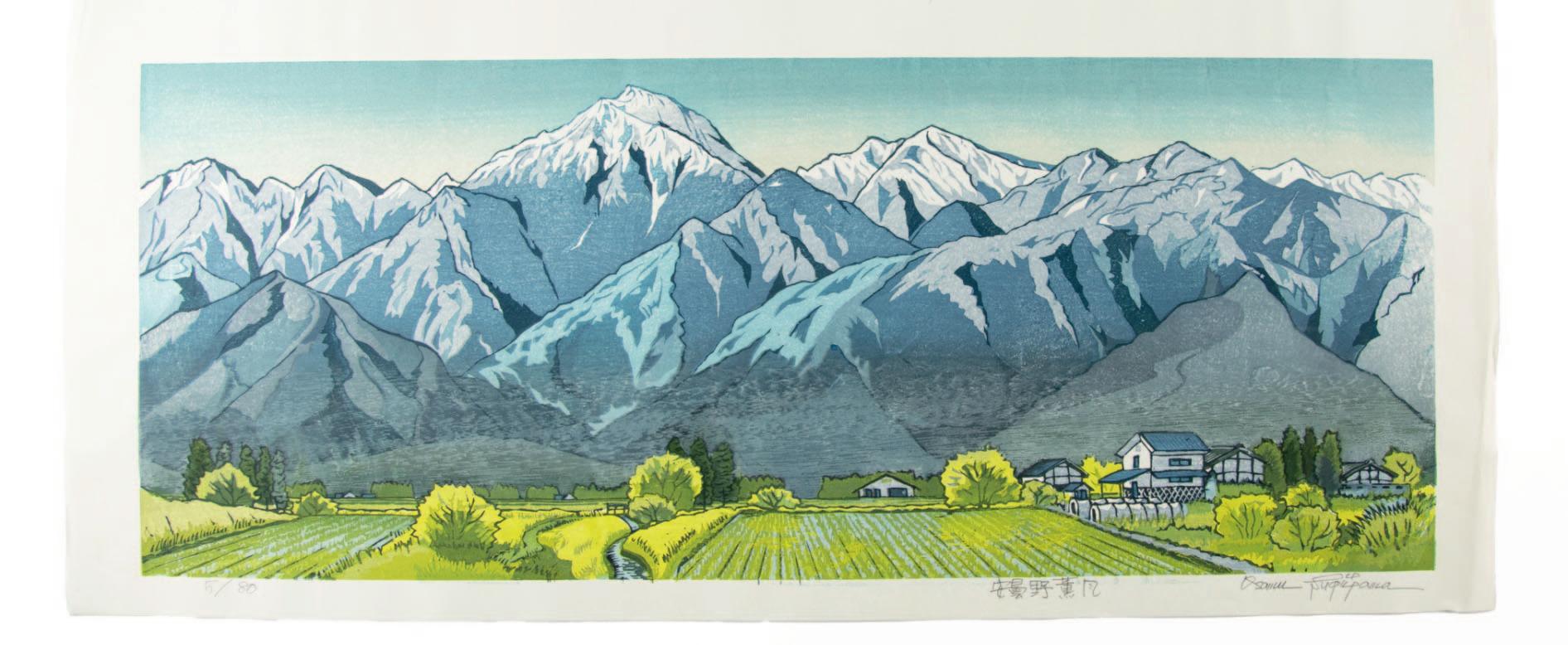
878
KASAMATSU SHIRŌ (18981991)
OSAMU SUGIYAMA (B.1946)
20TH CENTURY
Four Japanese woodblock prints depicting landscapes, two by Shirō Kasamatsu, titled Inubo-saki (Inubosaki Cape) and Yuki no Matsushima (Snowy Matsushima Island in the evening glow); the two others by Osamu Sugiyama, numbered 1/50 and 5/80, both titled and signed by the artist in pencil in the lower margins, one titled Midsummer, from the series Ten Views of Mount Fuji, and the other possibly depicting Mount Jōnen; 31.8cm x 72.5cm max. (4)
WITHOUT RESERVE
£300-500
Provenance: previously from the private collection of Ian Wilson (d.2024), County Durham.
879
KASAMATSU SHIRŌ (18981991)
YUKI NO MATSUSHIMA (SNOW AT MATSUSHIMA)
SHŌWA ERA, 20TH CENTURY
A Japanese woodblock print, oban tate-e, depicting the snowcovered pavilion of Godaidō Temple, signed and sealed Shirō, published by Iwasaki Shuppan in 1954, 40.2cm x 27.3cm.
£200-400
880
KAWASE HASUI (18831957)
URAYASU NO ZANSETSU (LINGERING SNOW IN URAYASU)
SHŌWA ERA, C.19461957
A Japanese woodblock print, oban tate-e, depicting a winter scene in a fishing village; signed Hasui and sealed Sui, published by Watanabe Shozaburo, with a 6mm Jseal lower right corner; 40.1cm x 26.5cm.
£800-1,200
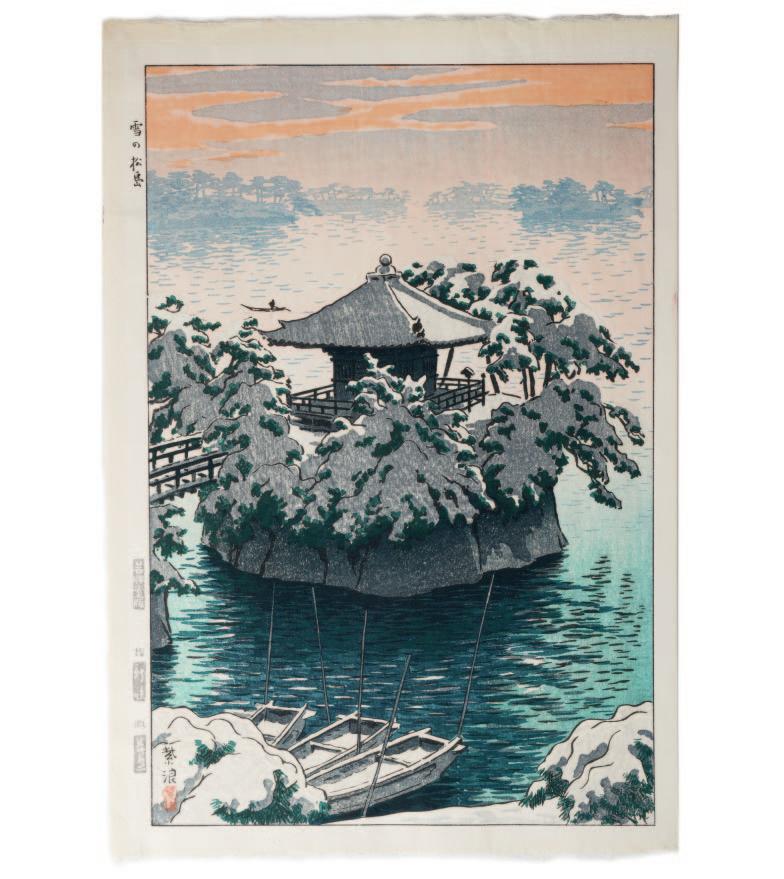
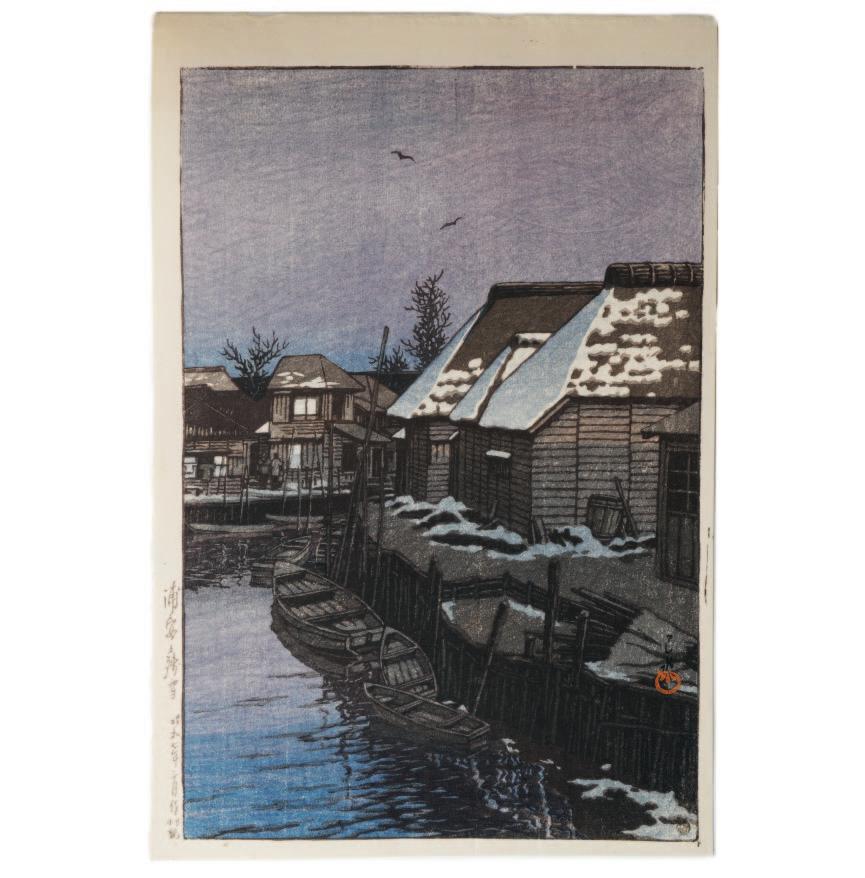
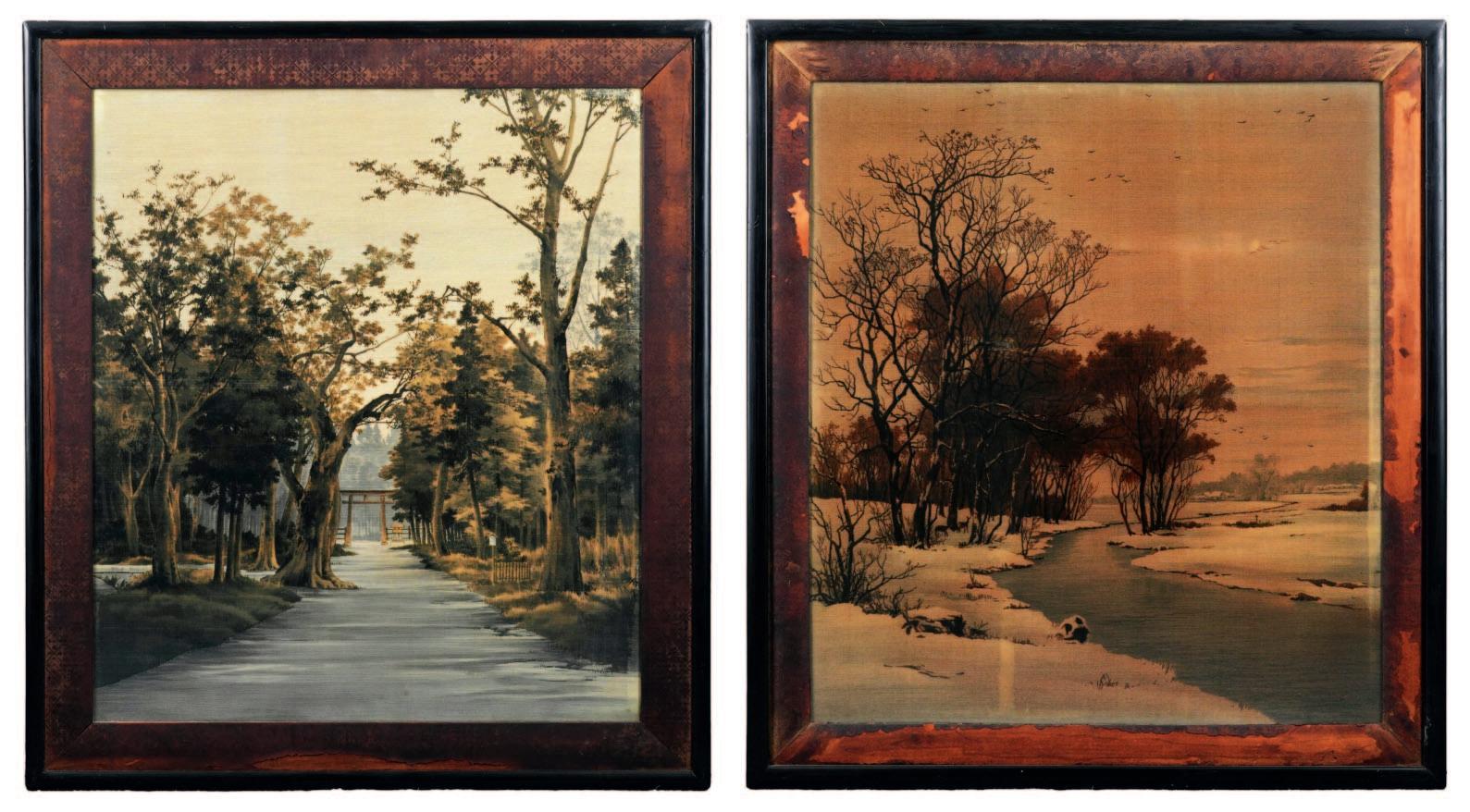
881
TWO LARGE JAPANESE YŪZEN BIRODO (VELVETCUT) PICTURES
MEIJI ERA, 19TH/20TH CENTURY
Both rectangular panels depicting landscapes, one with a treelined path leading to a torii (gate), the other with deer in snowcovered fields by a river, both framed and glazed, both 66cm x 57cm. (2)
£500-1,000
882
A JAPANESE EMBROIDERED SILK PICTURE OF A POMERANIAN
MEIJI ERA, 19TH/20TH CENTURY
The charming dog seated on its haunches and looking to the right, its long hair realistically rendered in silk threads; in its original glazed frame, 33cm x 45cm.
£400-600
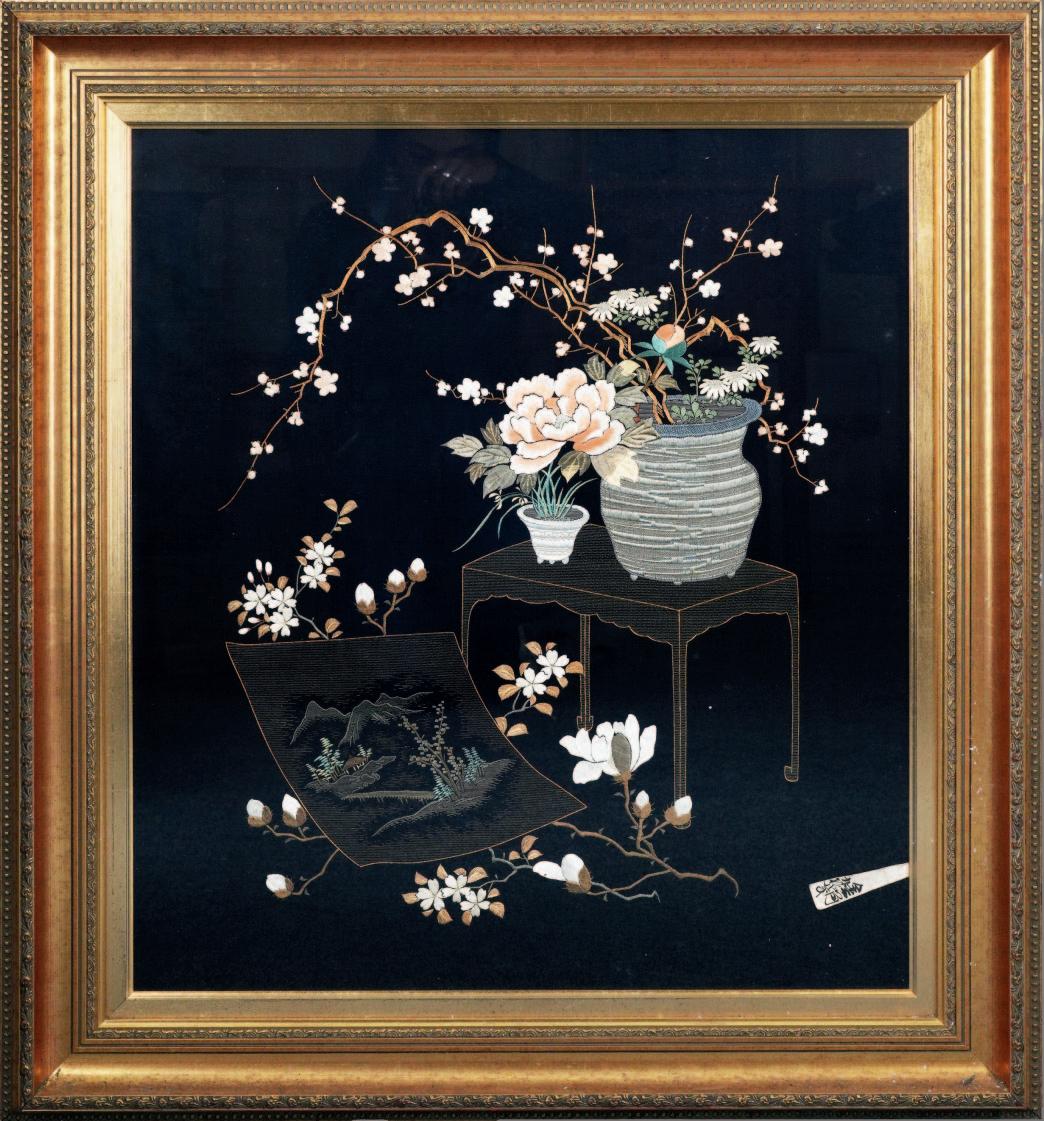
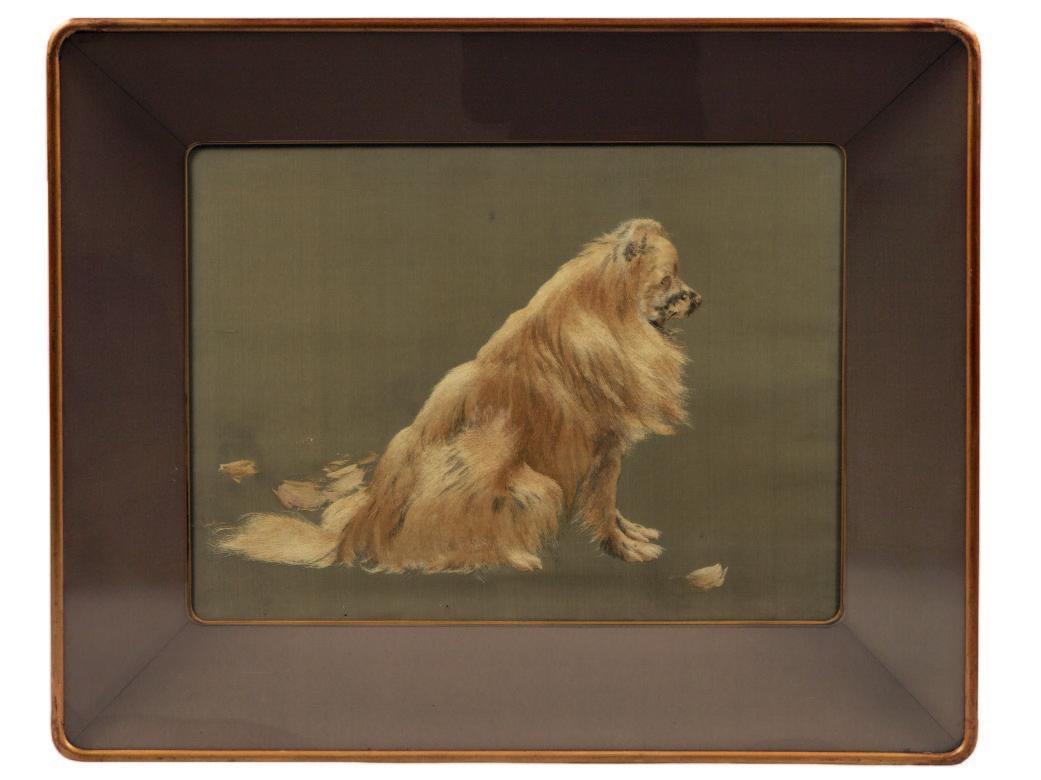
883
A JAPANESE EMBROIDERED SILK PANEL
MEIJI ERA, 19TH/20TH CENTURY
Of rectangular shape, decorated with a still life featuring flowering branches of prunus, magnolia and peony in vases on a low table, with a picture to the side depicting a landscape, all embroidered with gold and colourful threads; signed Mitsuzō on a label to the right, the reverse with an inscription reading as ‘skyblue satin, embroidered silk fabric’; in a gilded frame and glazed, 68cm x 60cm.
£300-500
884
A VERY LARGE AND IMPRESSIVE JAPANESE
(NIHON SHISHU)
MEIJI ERA, 19TH/20TH CENTURY
The silk panel expertly embroidered with a large peacock and peahen on rockwork, the majestic birds surrounded by pine branches and lush flowers including trailing wisteria and white azaleas; with a river beyond and the sky woven in gold threads; some details rendered in the fura-nu (radiating silk threads), koma-nui (couching stitch), sashi-nui (long and short stitches), suga-nui (stem stitching) and matsu-nui (staggered diagonals) techniques; framed by a silk mount embellished with peonies, mon and other brocade patterns, approx. 314cm x 132cm.
£20,000-30,000
Provenance: formerly in an American collection, originally acquired in the East in the 1980s.
Cf. C Pollard, The Ashmolean Museum, Threads of Silk and Gold: Ornamental Textiles from Meiji Japan, p.120-137 for comparable examples of Meiji textiles featuring peacocks.
This type of very large Japanese embroideries with a painterly quality is typical of the textiles that were displayed in international exhibitions in the late 19th century, selected to promote the arts and crafts of Japan. One notable example is a large, 305cm by 244cm wall hanging depicting dragons today at the Bowers Museum, California, acquired from the Japanese pavilion at the 1893 World’s Columbian Exposition in Chicago.
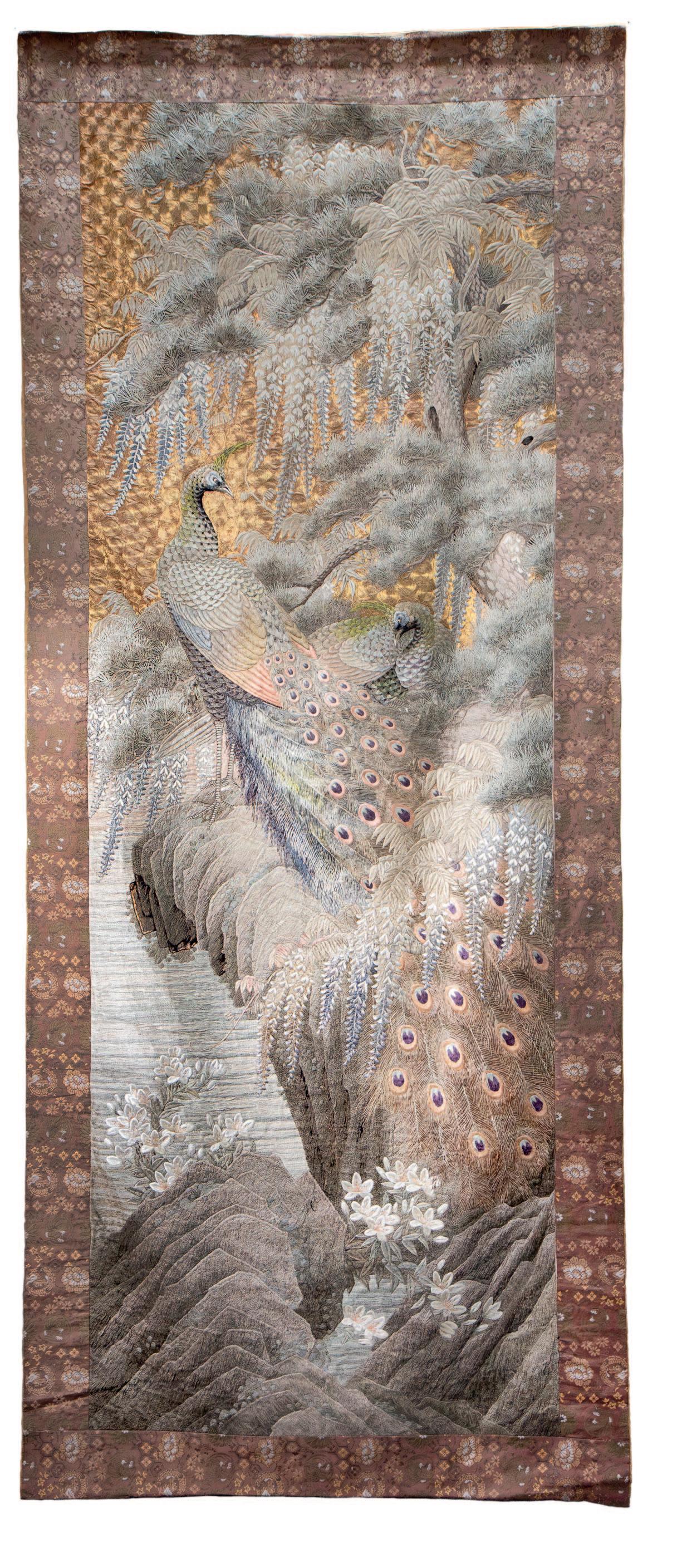
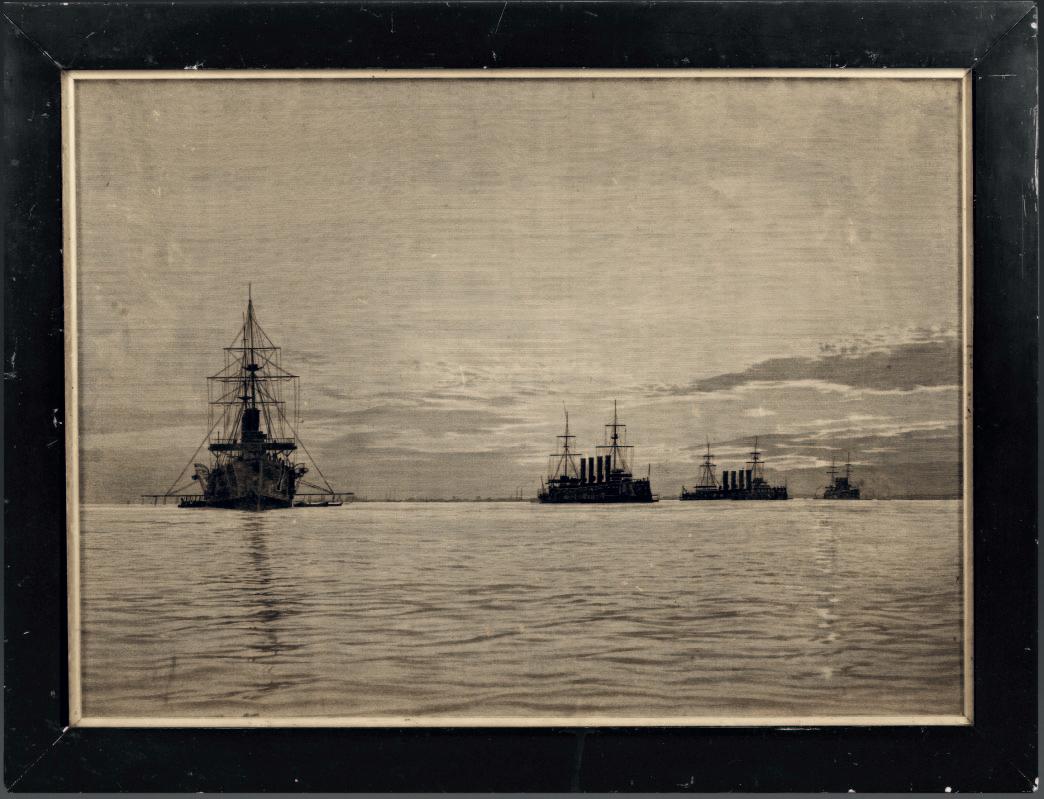
886
FOUR JAPANESE FUKUSA (GIFT COVERS)
MEIJI ERA, 19TH/20TH CENTURY
Each embroidered in silk and with details rendered in metallic threads, one with the Shichifukujin (Seven Gods of Good Fortune) celebrating the New Year, another an aerial view of the shrine at Itsukushima with its iconic ‘floating’ torii gate; the third with three figures in an interior reading poem cards, the fourth with many auspicious symbols; each approx. 84cm x 71cm. (4)
£200-300
Provenance: the Tomkinson Family Collection, first collected by Michael Tomkinson (1841-1921) and thence by descent.
Literature: the Shichifukujin and Itsukushima fukusa both listed in M Tomkinson, A Japanese Collection Made by Michael Tomkinson, vol.1, p.183, nos.18 and 32.
885
A JAPANESE YŪZEN BIRODO (VELVET PICTURE)
MEIJI ERA, 20TH CENTURY
Depicting four ships and the shores of a city in the distance, one on the left appearing to be a fishing boat and two cruisers on the right with four chimneys, possibly Russian; framed and glazed, 42cm x 59cm.
£200-300
This image probably depicts a scene from the Russo-Japanese War of 1904-05.
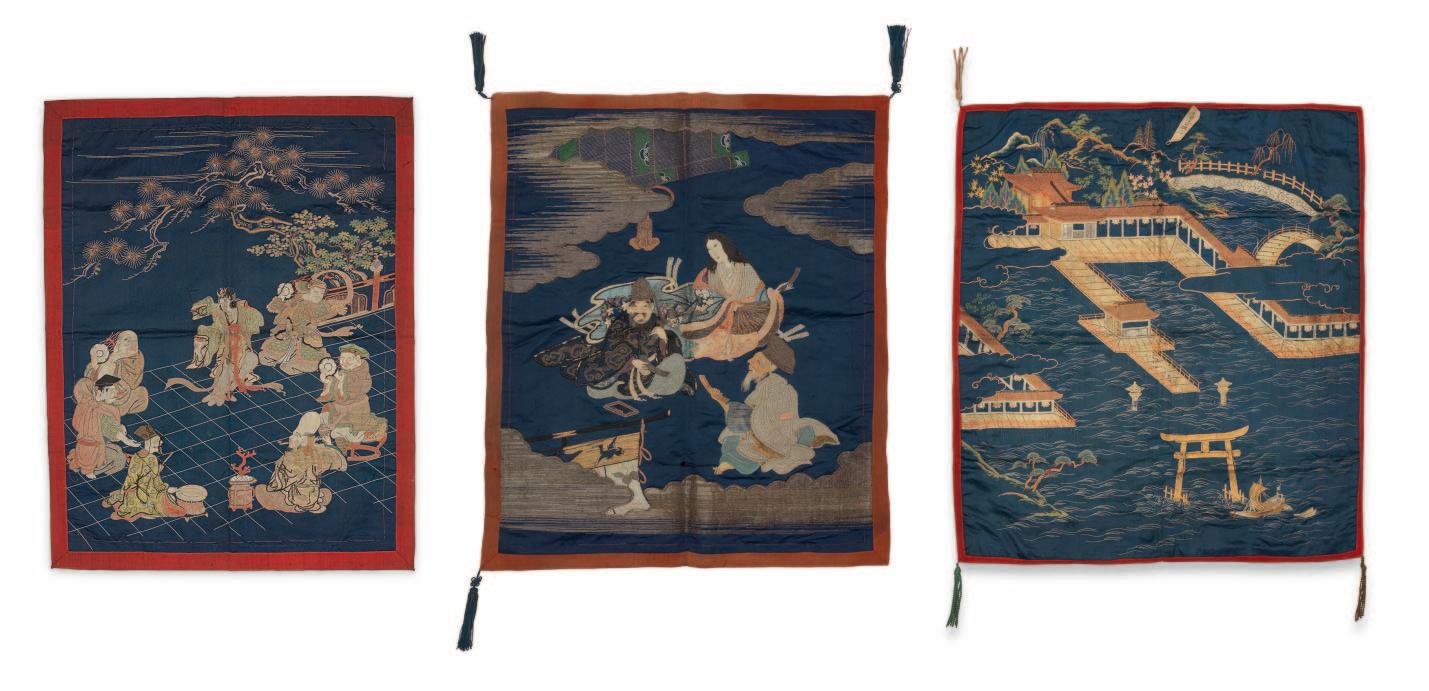
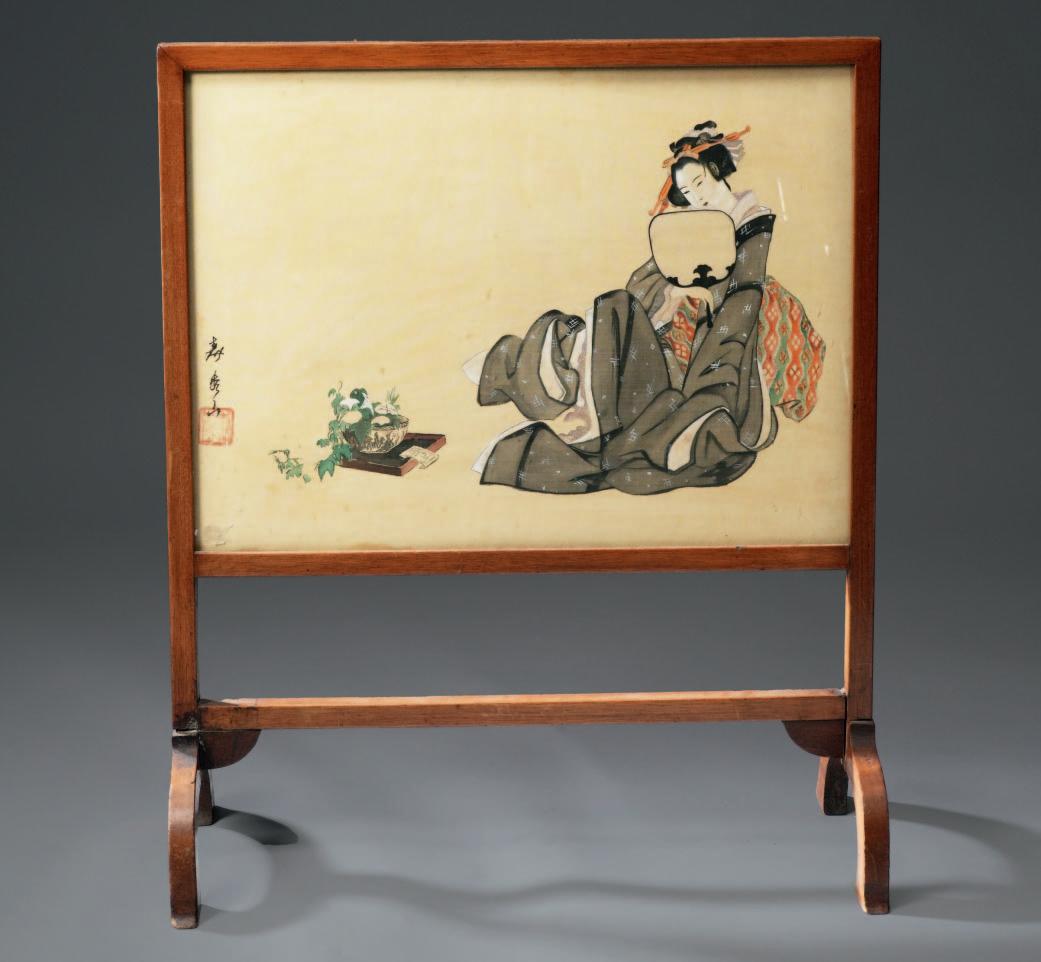
887
A JAPANESE PAINTING MOUNTED AS A FIRE SCREEN
MEIJI ERA, 19TH/20TH CENTURY
In ink and colour on silk, depicting a kimonoclad beauty seated beside flowers, possibly signed Kitayama with a red seal mark; mounted as a glazed fire screen, 74cm x 62.7cm.
£100-200
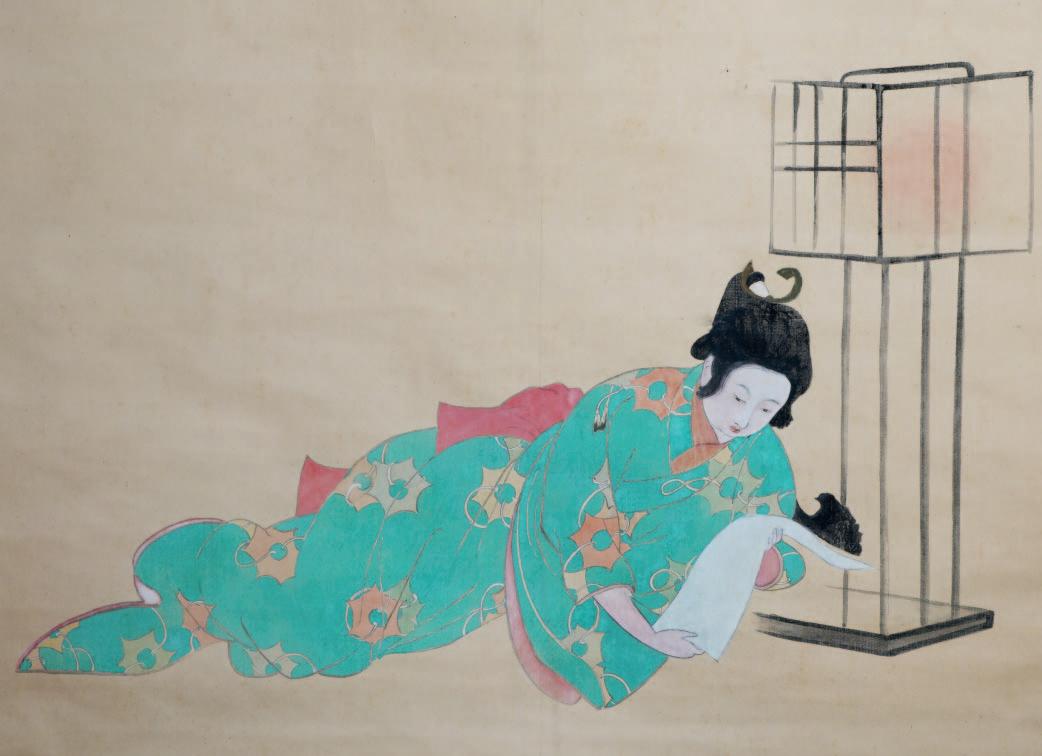
889
KITANO TSUNETOMI (18801947) BEAUTY WITH FAN
SHŌWA ERA, 1920s1930s
A Japanese Nihonga-style scroll painting in ink, gofun, and colours on silk, depicting a beauty with an elaborate hairstyle, holding a fan and demurely concealing her mouth behind her sleeve; signed Tsunetomi and sealed Kitano Tsunetomi; mounted on silk brocade, 40cm x 40.5cm.
£1,500-2,500
Provenance: from the collection of Frederick Leyman Evans (1878-1951), and thence by descent. Evans was a prominent British executive for British American Tobacco (China) Ltd. who resided in Shanghai from the 1920s to the 1940s, where he became a known figure in the expatriate business community and a collector of fine Asian art.
See the British Museum, access. no.2001,1123,0.2, the Harvard Museum, access. no.2025.9, and the MET Museum, access. 2023.6 for other examples of scroll paintings by Kitano Tsunetomi depicting beauties.
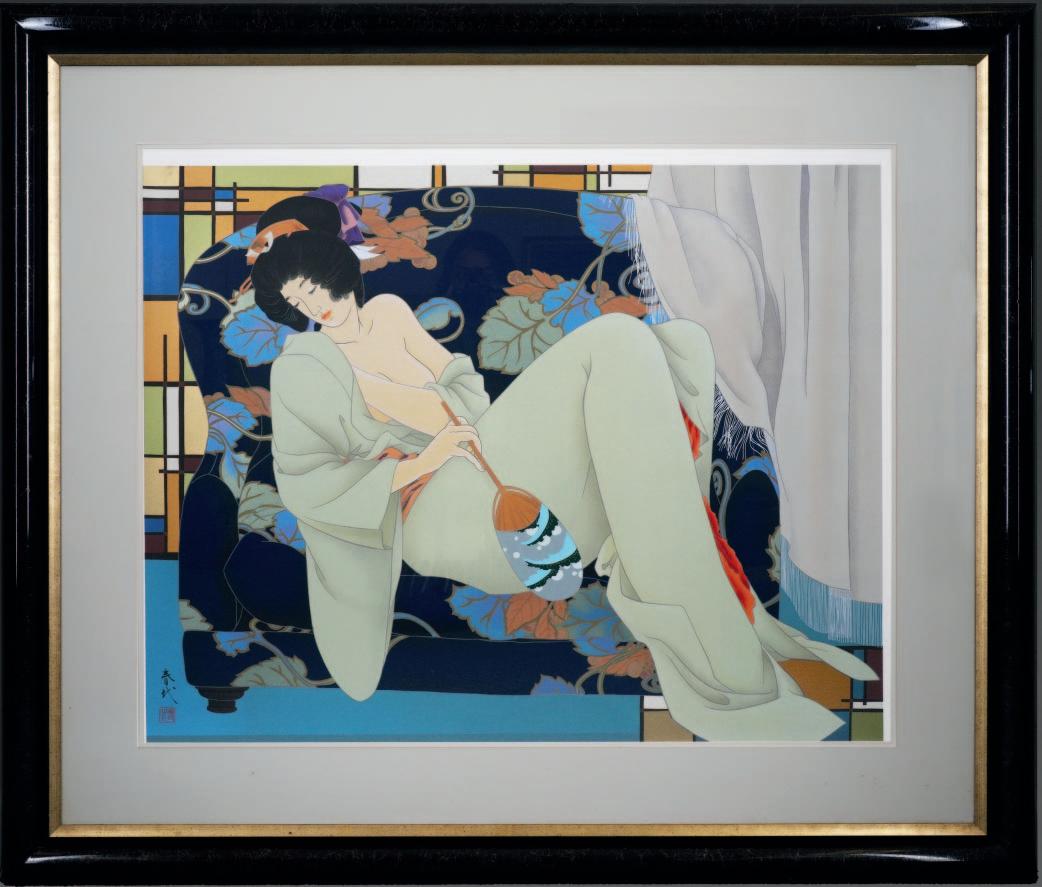
888
ANONYMOUS
BIJIN-GA (PAINTING OF A BEAUTY)
SHŌWA ERA, 20TH CENTURY
A Japanese kakejiku (hanging scroll painting) in Nihonga style, ink and colour on paper, depicting a young woman lying on her stomach while examining a handscroll, a tall andon (paper lantern) beside her, 80cm x 84cm.
£400-600
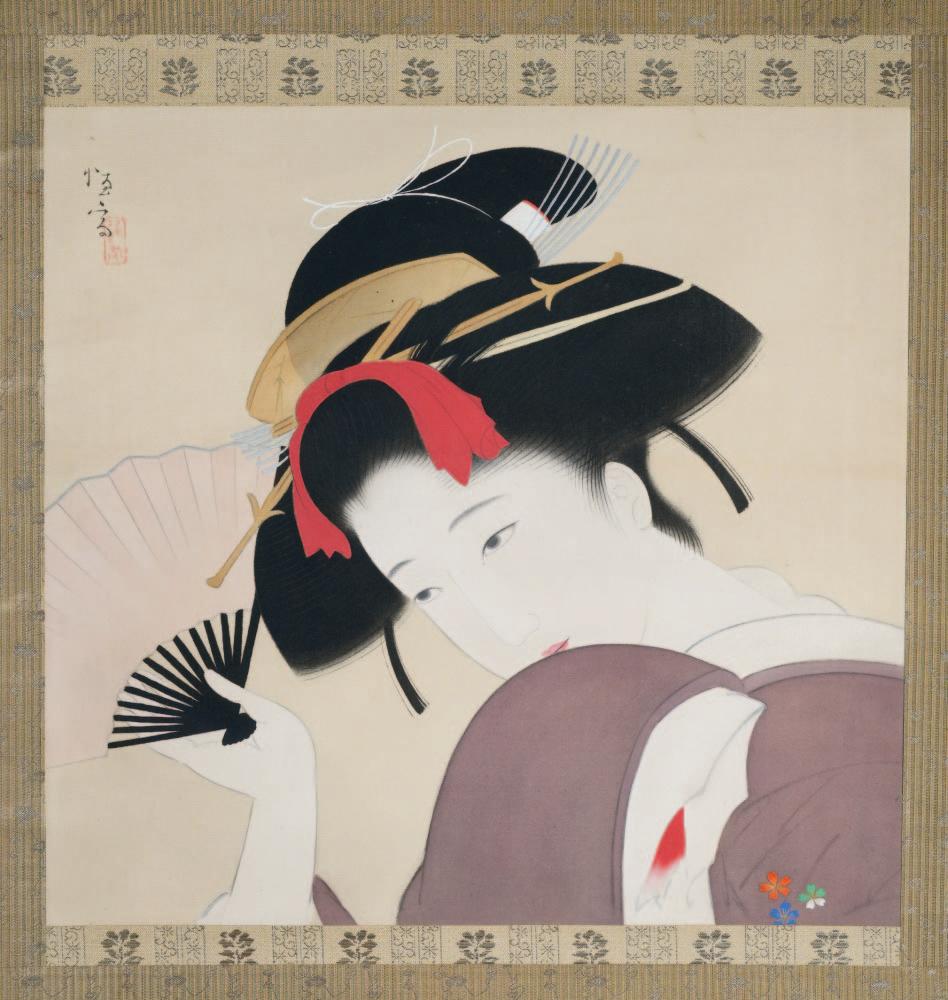
890
HARUYO MORITA (B.1945)
NATSU NO YO, II (A SUMMER NIGHT, II)
SHŌWA ERA, 1988
A Japanese lithograph depicting a beauty wearing a loose kimono and fast asleep on a colourful sofa, with abstract grid designs in the background; signed and numbered 3/350, framed and glazed, 136cm x 118cm.
£400-600
Provenance: from an English private collection, purchased in 1989.
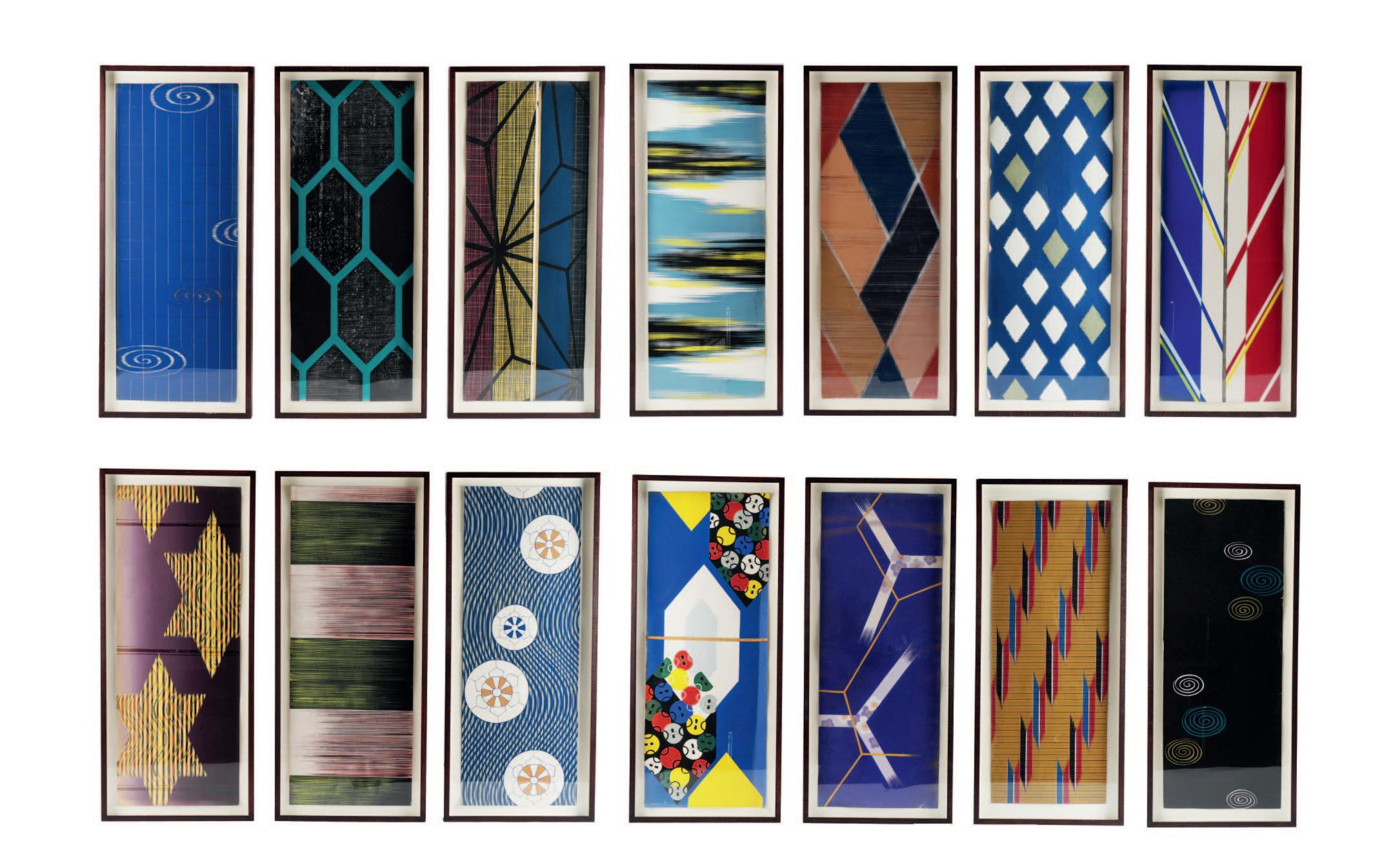
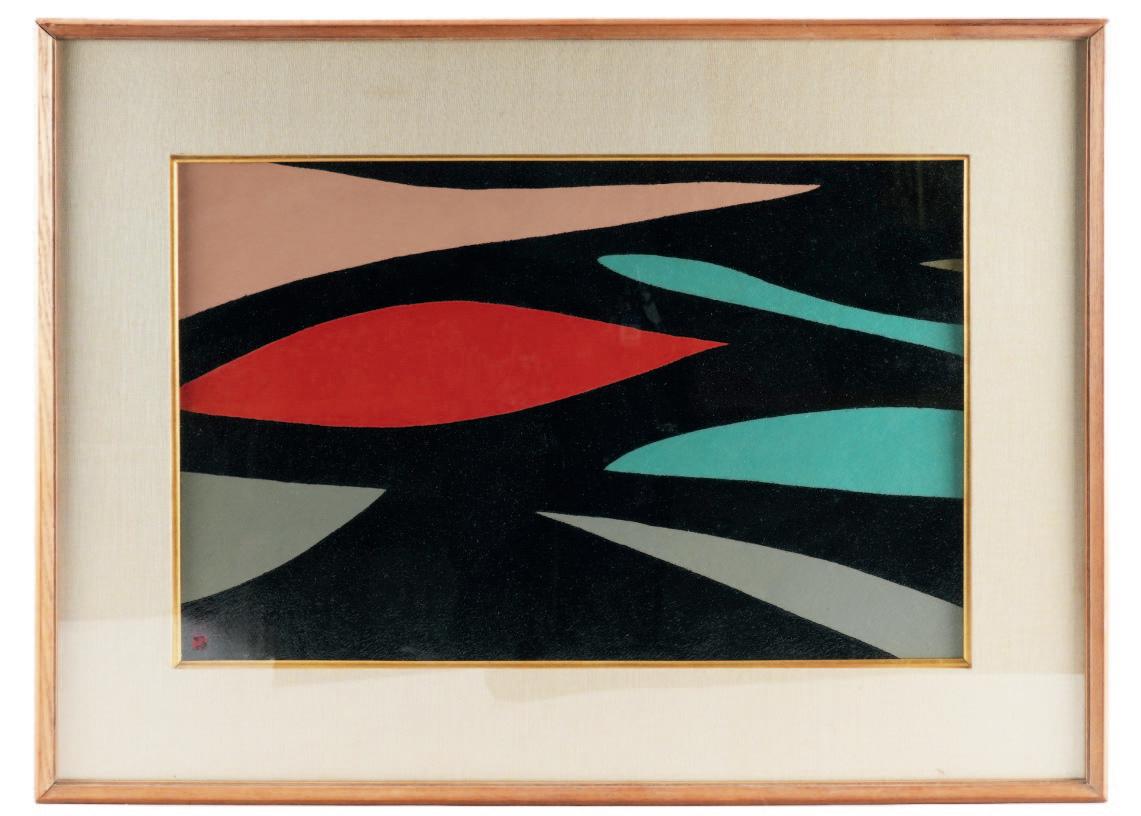
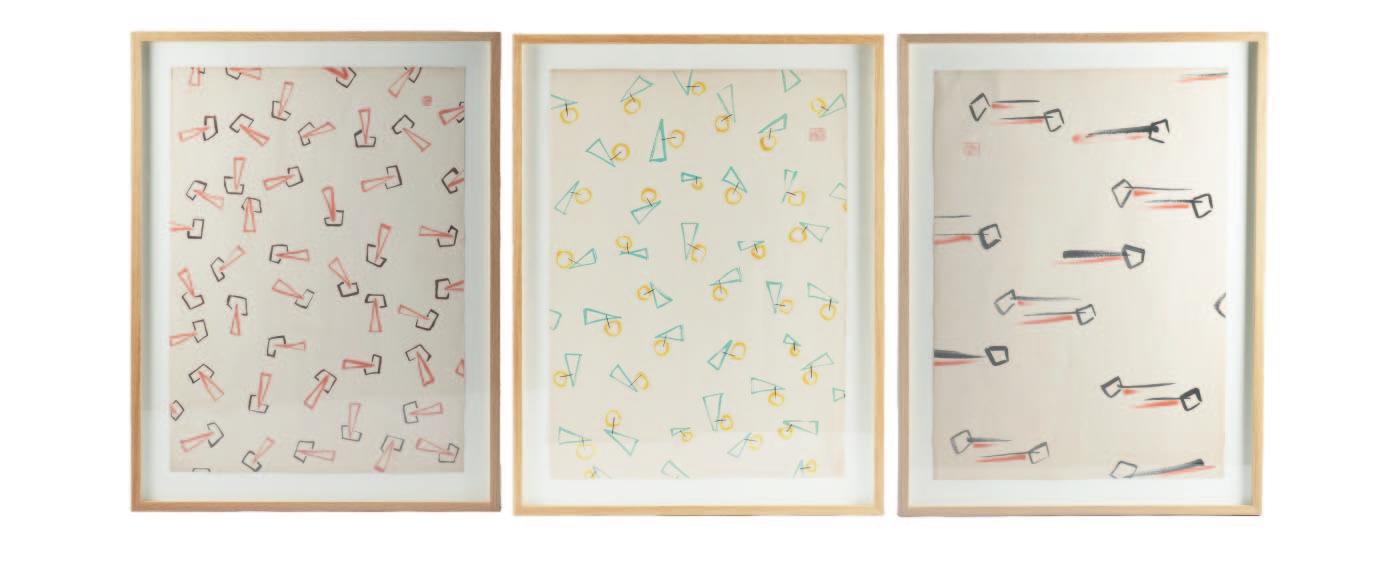
891
A COLLECTION OF FOURTEEN JAPANESE FRAMED
TEXTILE PANELS
SHŌWA ERA, 20TH CENTURY
Depicting various geometrical designs, most with abstract patterns and some with stylised flowers, all framed and glazed, 76cm x 29cm. (14)
£600-800
892
A JAPANESE LACQUER PANEL
SHŌWA PERIOD, 20TH CENTURY
Of rectangular shape, with colourful horizontal abstract shapes on the lustrous black ground, a red seal mark lower left corner; with a silk mount, framed and glazed; the reverse with a paper label; possibly by Kano Byakkan/ Kano Hakko (18981985), framed and glazed, 37cm x 57cm.
£400-600
893
YUSHI IKEDA (19092006)
TEXTILE DESIGNS
SHŌWA ERA, 20TH CENTURY
Three paintings, ink and colour on paper, with abstract geometrical designs, some resembling figures, each with a red seal mark; all framed and glazed, 36.5cm x 52cm. (3)
£800-1,200
Yushi Ikeda was a Japanese artist based in Osaka, celebrated for his primitive and high-energy wood carvings, sculptures, and paintings that drew inspiration from African art. Operating outside the mainstream art establishment, he spent decades working from a legendary attic studio in the Osaka City Museum of Fine Arts, leaving behind a legacy as a unique “maverick” of modern Japanese art.
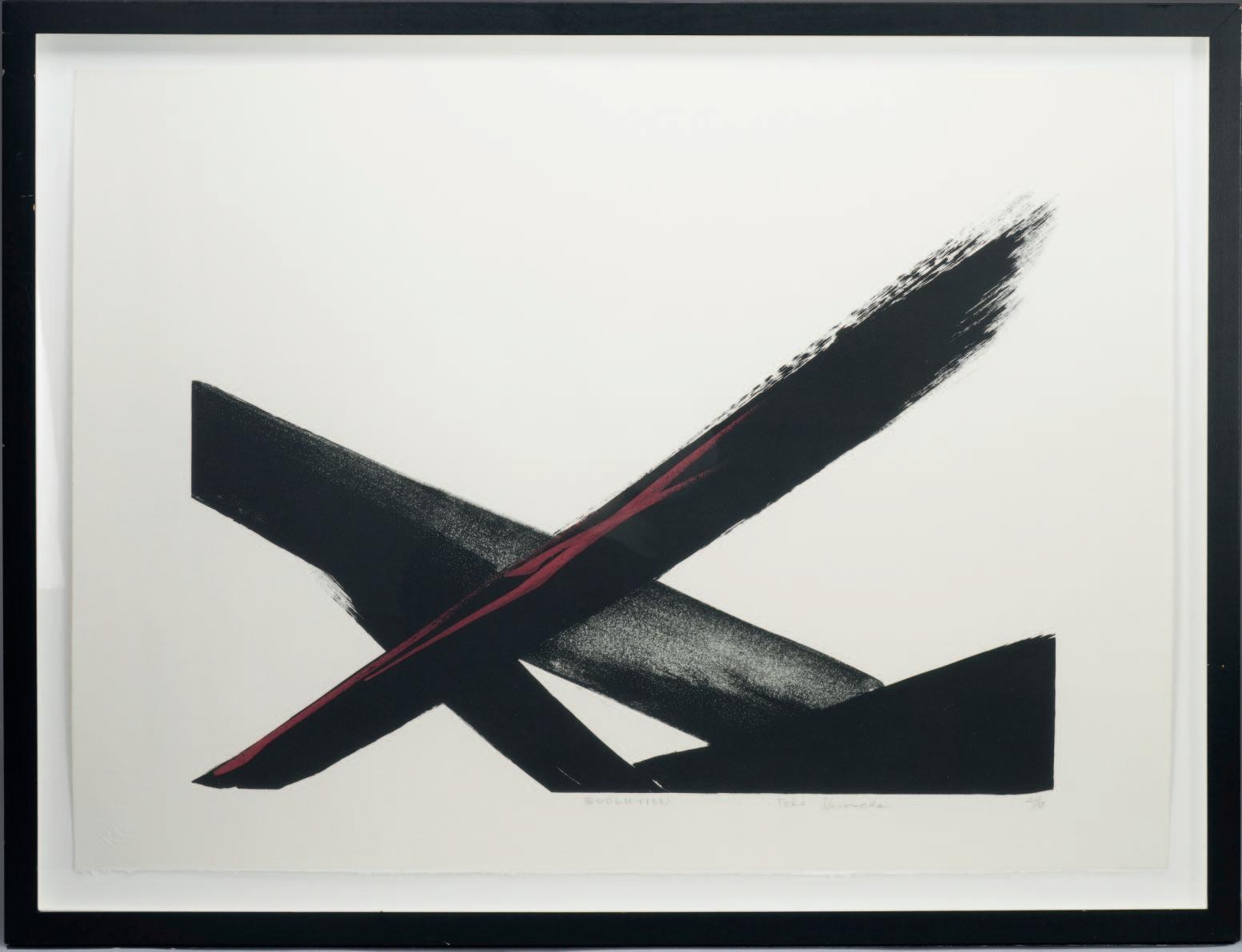
894
TŌKŌ SHINODA (19132021)
EVOLUTION
SHŌWA, 1985
A Japanese lithograph, ink and colour on paper, signed Toko Shinoda, titled EVOLUTION, and numbered 21/35 in pencil to the lower margin; framed and glazed, the picture 53cm x 71 cm, 62cm x 81cm overall.
£1,200-1,500
Following years of traditional calligraphy training under her father, Shinoda transitioned toward a personal, idiosyncratic style of abstract expressionism by deconstructing Japanese characters. After debuting her first solo exhibition in Tokyo in 1936, she relocated to the United States and immersed herself in the vibrant New York art scene alongside figures like Jackson Pollock and Mark Rothko.Today, her works are held in prestigious collections around the world, including the MET Museum, the British Museum, and the Art Institute of Chicago.
895
JUNG KWANG (19352002)
PORIDALMA
20TH CENTURY
A Korean painting, in ink and red pigment on paper, depicting the rotund figure of Poridalma resting; with a twocharacter signature and an artist’s seal for the monk painter Jung Kwang, framed and glazed, 66cm x 42cm.
WITHOUT RESERVE
£200-300
See the British Museum, acc. no.1991,0723,0.4, for a comparable picture of Poridalma in black and red ink by Jung Kwang and dated 1985.
896
A JAPANESE CALLIGRAPHIC INK PAINTING
SHŌWA ERA, 20TH CENTURY
Ink on paper, with the single character Take (bamboo) and a red seal mark for Roku; a picture of the reverse attached to the back of the frame, with an inscription for Hasegawasama; in a box frame and glazed, 58cm x 60cm.
£400-600
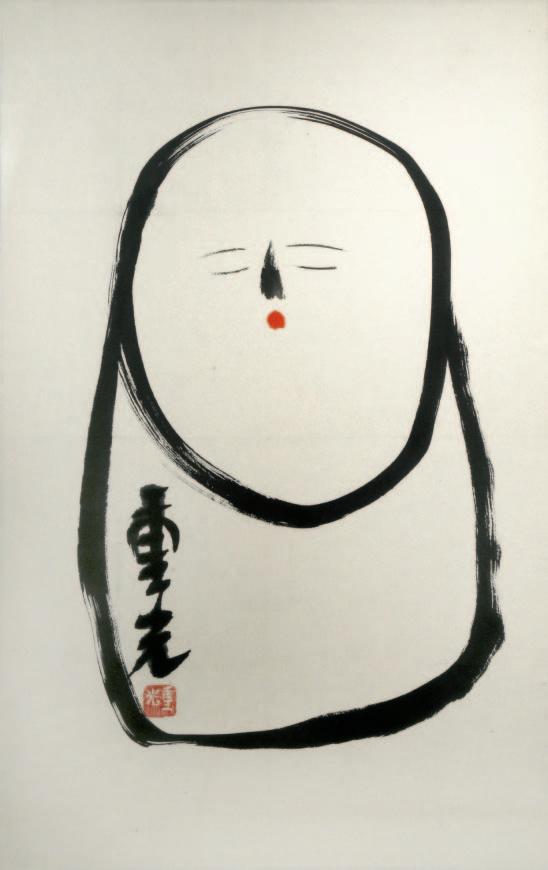
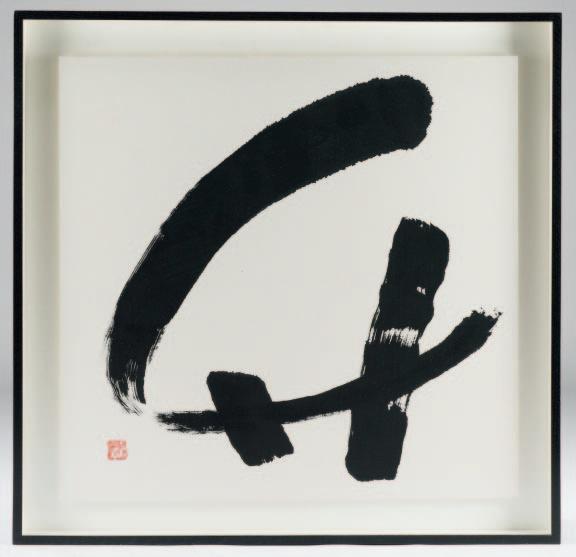
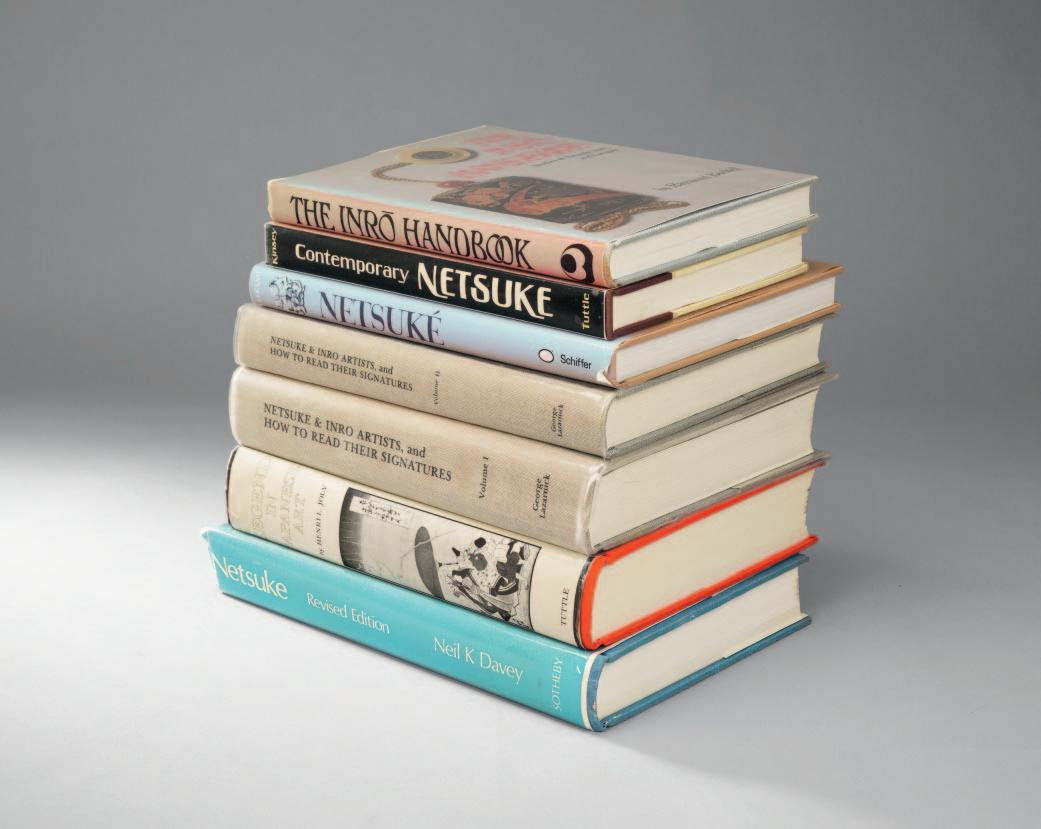
897 LITERATURE
Seven books on Japanese Art, mostly relating to netsuke, including G Lazarnick Netsuke & Inro Artists, and How To Read Their Signatures in two volumes. (7)
WITHOUT RESERVE
£300-500
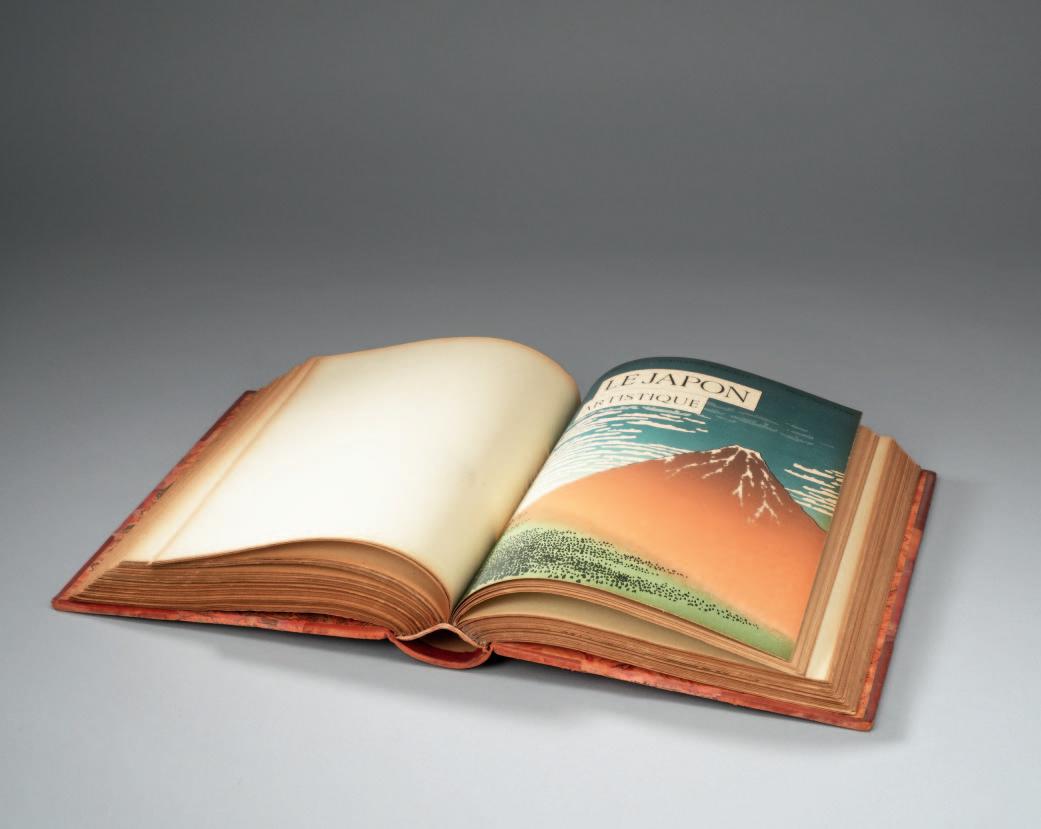
898 LITERATURE SIEGFRIED BING, LE JAPON ARTISTIQUE, DOCUMENTS D’ART ET INDUSTRIE
A leatherbound volume enclosing the first 18 issues of the magazine published between May 1888 and October 1889.
£400-600
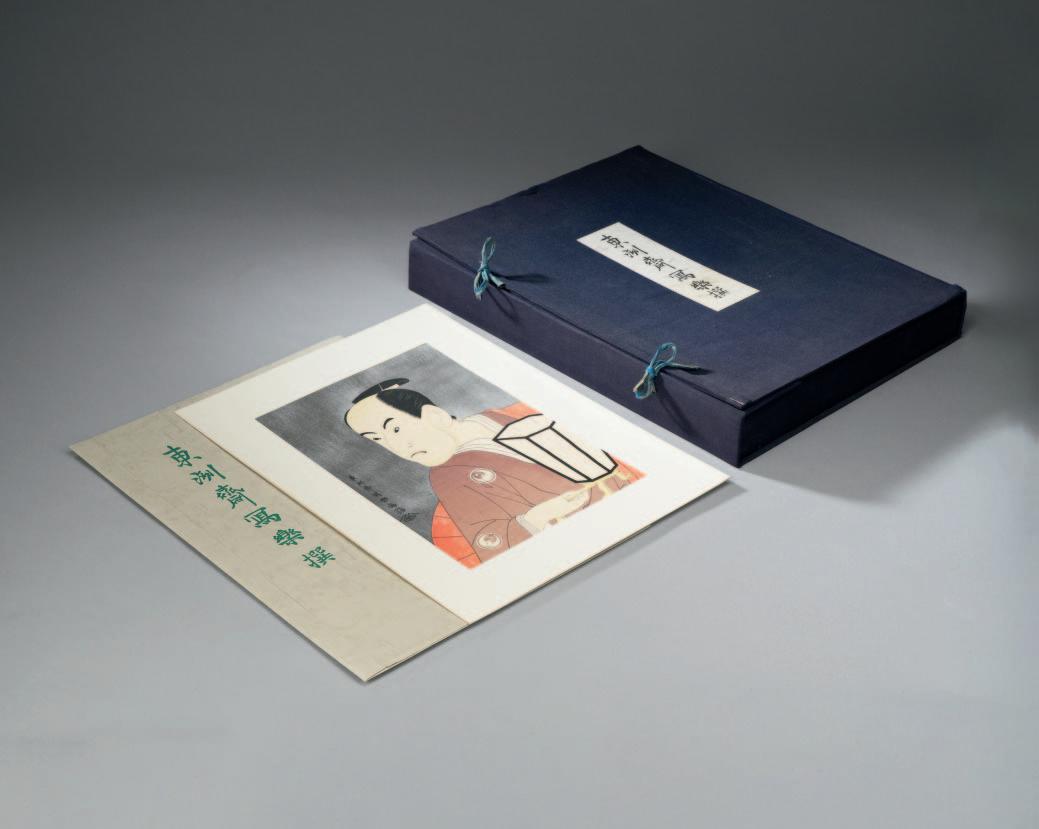
899
A JAPANESE FOLIO OF PRINT REPRODUCTIONS AFTER TŌSHŪSAI SHARAKU
SHŌWA/HEISEI, 20TH CENTURY
Including thirtytwo reproductions of famous woodblock print portraits by the artist, some with mica grounds, 30.3cm x 20.3cm. (33)
WITHOUT RESERVE
£200-300
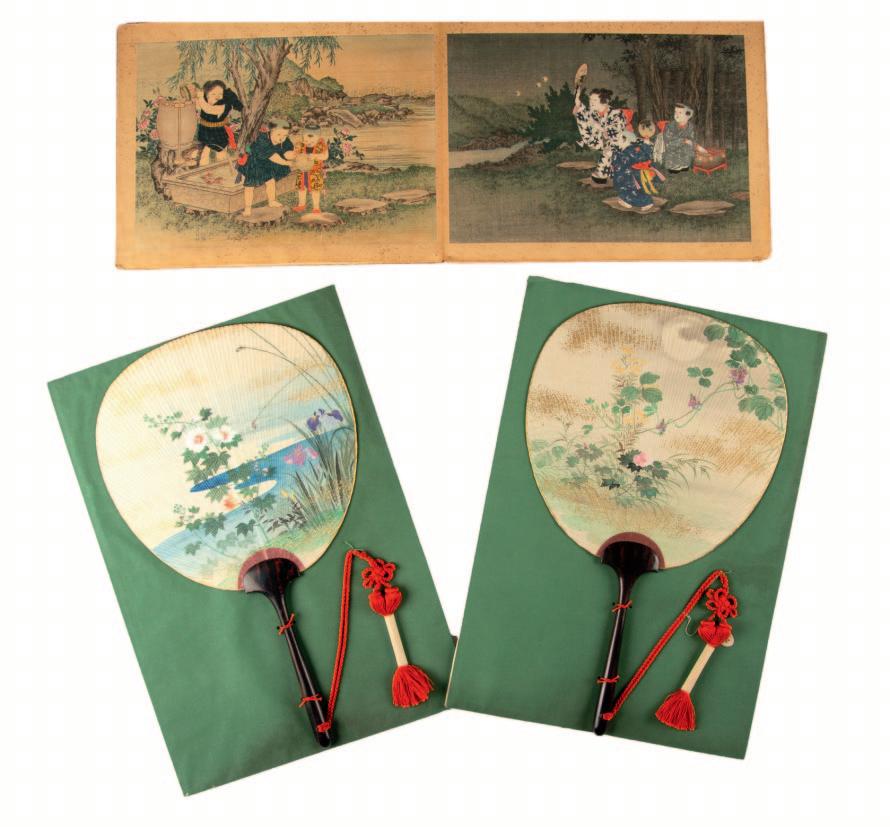
900
TWO JAPANESE PAPER FANS BY HAIBARA NAOJIRO (18461910) MEIJI/TAISHŌ, 19TH/20TH CENTURY
Each painted in ink, colour and gold with flowers, with wooden handles and silk tassels, each presented in its original manufacturer’s folder, both 38.5cm; together with an album of prints entitled Kodomo Asobi Gajo (Picture Book of Children’s Play), the trilingual (Japanese, English and French) publication edited by Nagao Kagesuke, 22.8cm x 29.2cm. (3)
WITHOUT RESERVE
£150-250
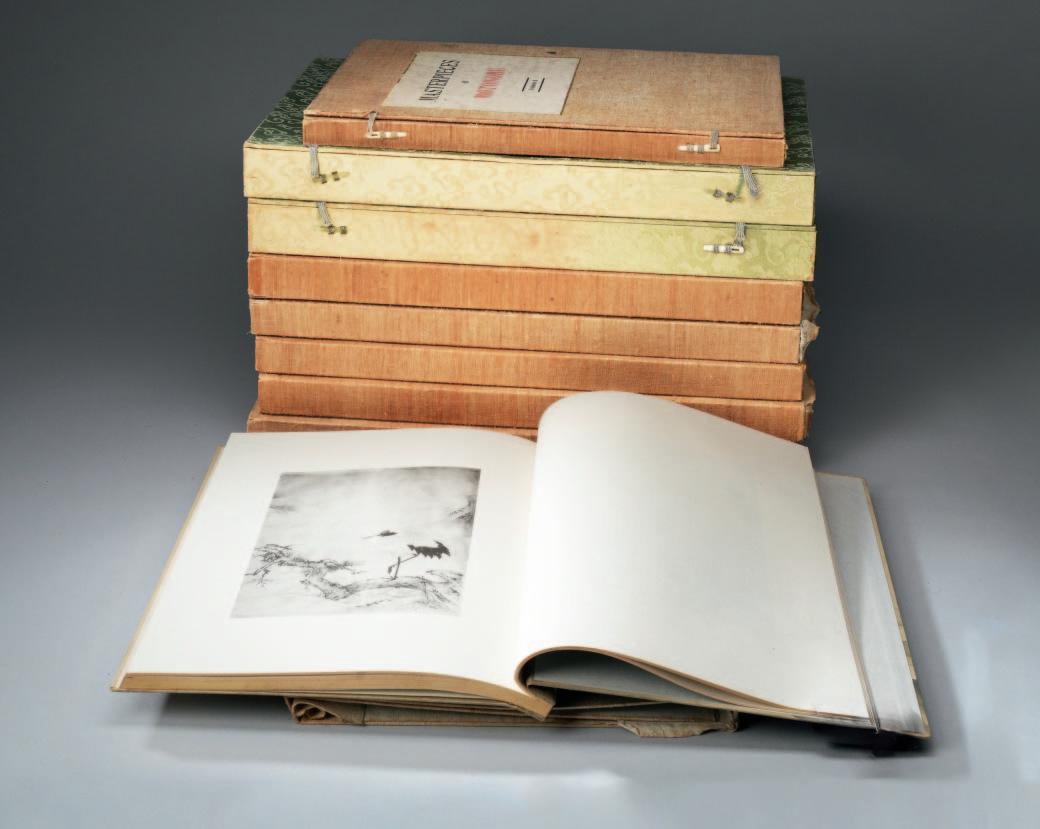
901
LITERATURE
NINE PUBLICATIONS BY THE SHIMBI SHOIN PUBLISHING HOUSE
MEIJI ERA, 19041909
Comprising: a set of Masterpieces Selected from the Ukiyoe School, volumes IV, edition de luxe, n.38/100; a set of Masterpieces by Motonobu, volumes III, limited edition, n.100/2,000; and two copies of Old Masterpieces Reproduced by The Shimbi Shoin. (9)
WITHOUT RESERVE
£200-400
Provenance: one set with a presentation slip dedicated to Mrs C W Christie-Miller and dated June 1909. Alice Wakefield Christie-Miller was an important collector of Japanese art, which she notably lent to the Red Cross Exhibition (1915).
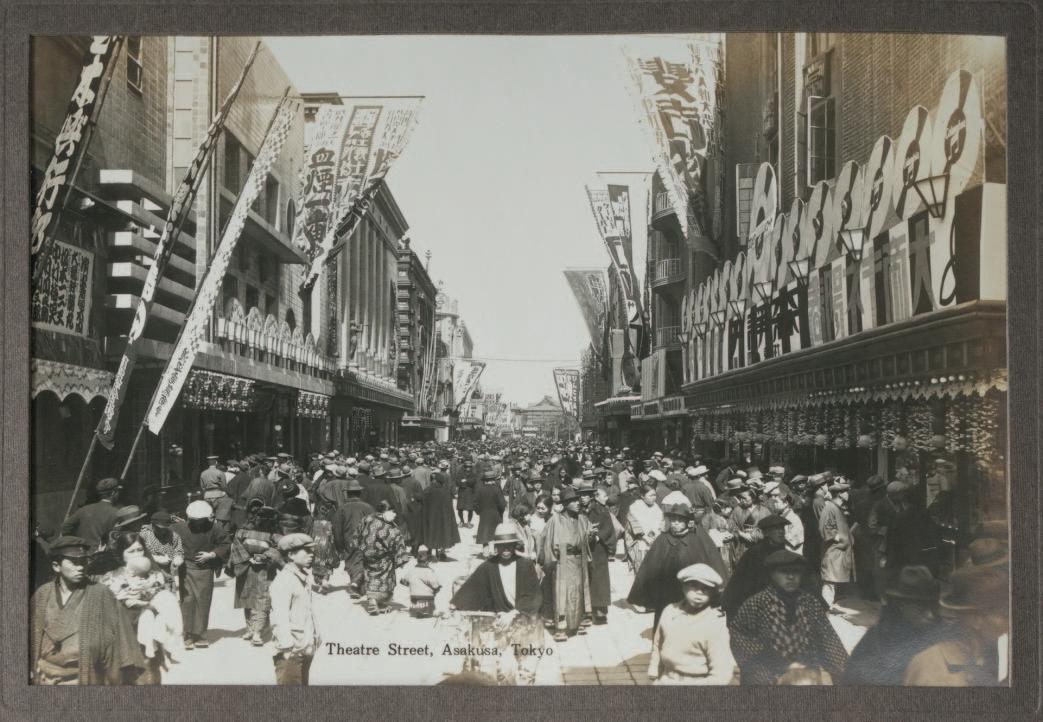
903
A JAPANESE ALBUM OF SILVER PRINT PHOTOGRAPHS
TAISHŌ ERA, C.1914
Titled ‘Fair Japan’ and published by the Japanese Government Railways Agency, including fortynine photographs depicting famous views and studio portraits of Japanese people engaged in daily activities, each with captions in English; the clothbound album cover depicting Mount Fuji with ‘Japan’ written in gilt and finished with white tassels, 29cm x 20cm.
£500-1,000
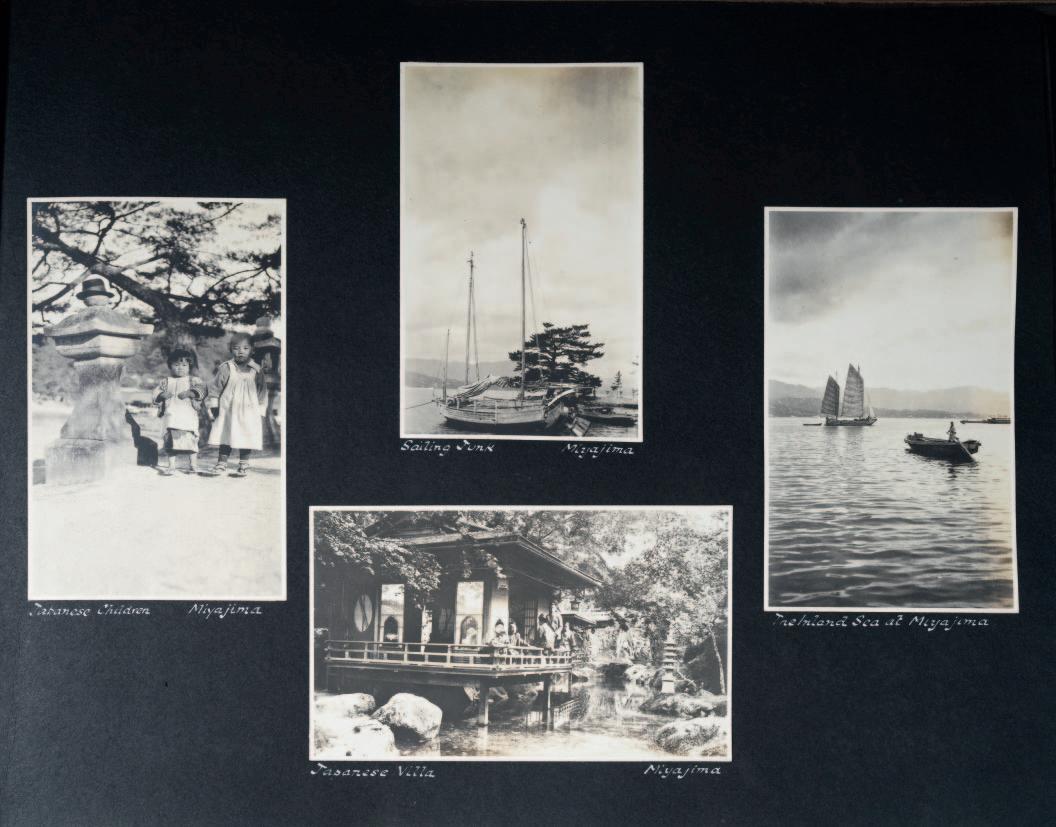
902
TWO ALBUMS OF PHOTOGRAPHS OF JAPAN, CHINA, KOREA, SRI LANKA AND INDIA 20TH CENTURY, C.1920
Including a total of approximately two hundred and five silver gelatine prints, depicting famous views and people engaged in daily activities, the two albums with hardbound covers. (2)
£300-500
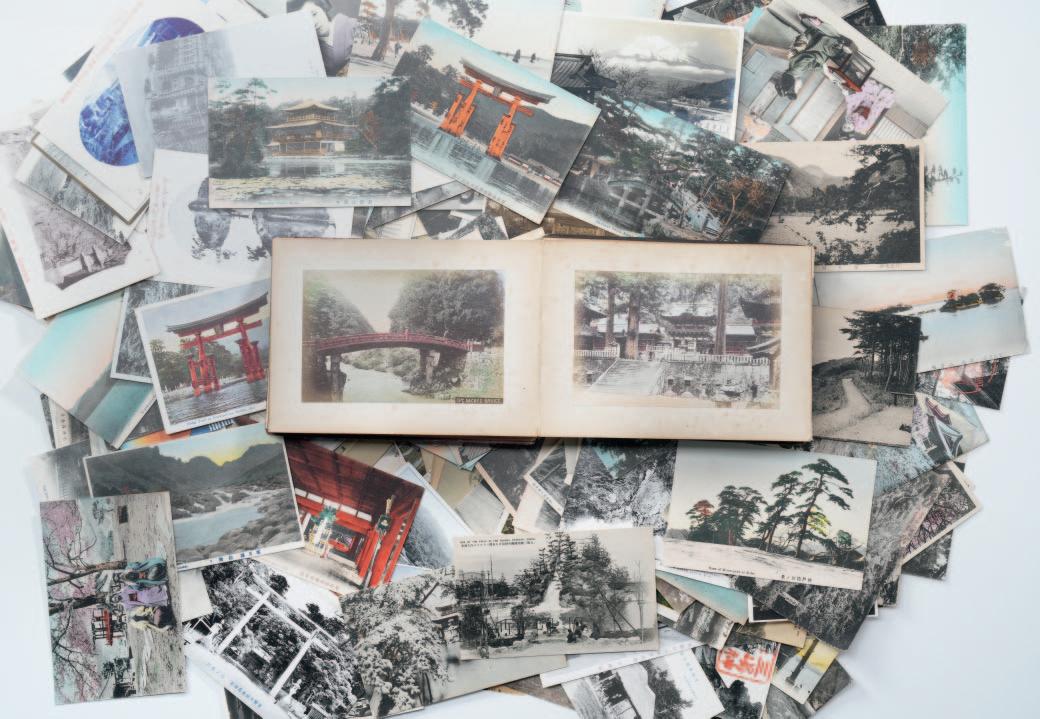
904
A VERY LARGE COLLECTION OF JAPANESE POSTCARDS MEIJI AND LATER, 19TH AND 20TH CENTURY
Depicting famous views of Japan and its people, most from the 1910s and 1920s; together with a small album of handcoloured photographs of famous landmarks and people engaged in daily pursuits, the album 13.5cm x 18.5cm. (a lot)
WITHOUT RESERVE
£200-300
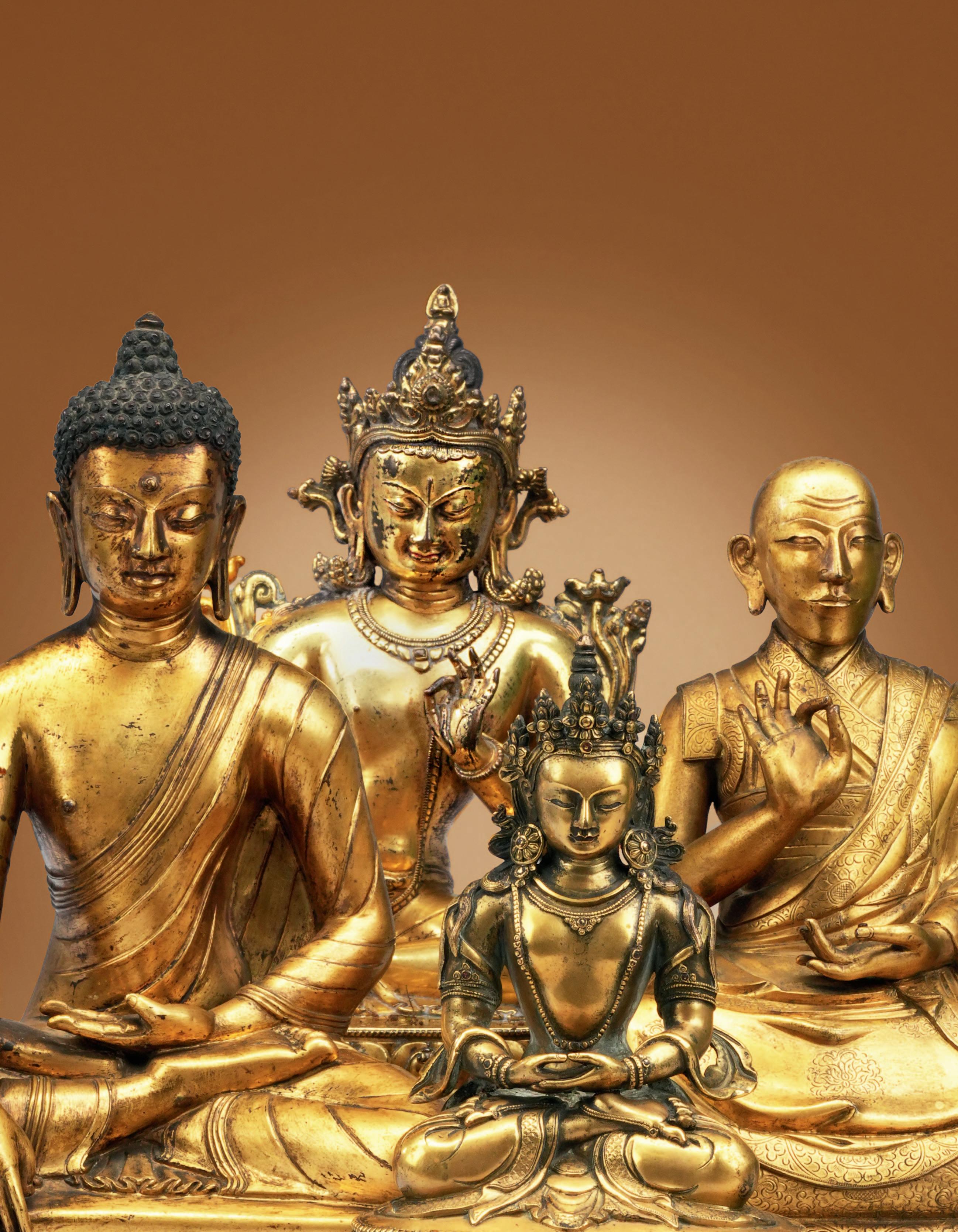

亞洲藝術精品
TUESDAY 19TH MAY 2026
日本美術
WEDNESDAY 11TH NOVEMBER 2026
Now accepting consignments
Enquiries:
Alexandra Aguilar
+44 (0)1722 424583 aa@woolleys.live
CHŌBUNSAI EISHI 鳥文斎栄之 (1756–1829) PORTRAIT OF A BEAUTY (detail)
Provenance: Shimomura Kanzan (1873–1930)
Azabu Museum of Art
Christie's, New York, Japanese Screens, Paintings and Prints, 27 October 1998, Lot 243
Published:
Gotō Shigeki ed., Ukiyo-e taikei, vol. 6, Utamaro, Eishi, Tokyo, Shūeisha, 1973, pl. 63 and p. 131
Est. £8,000-12,000*
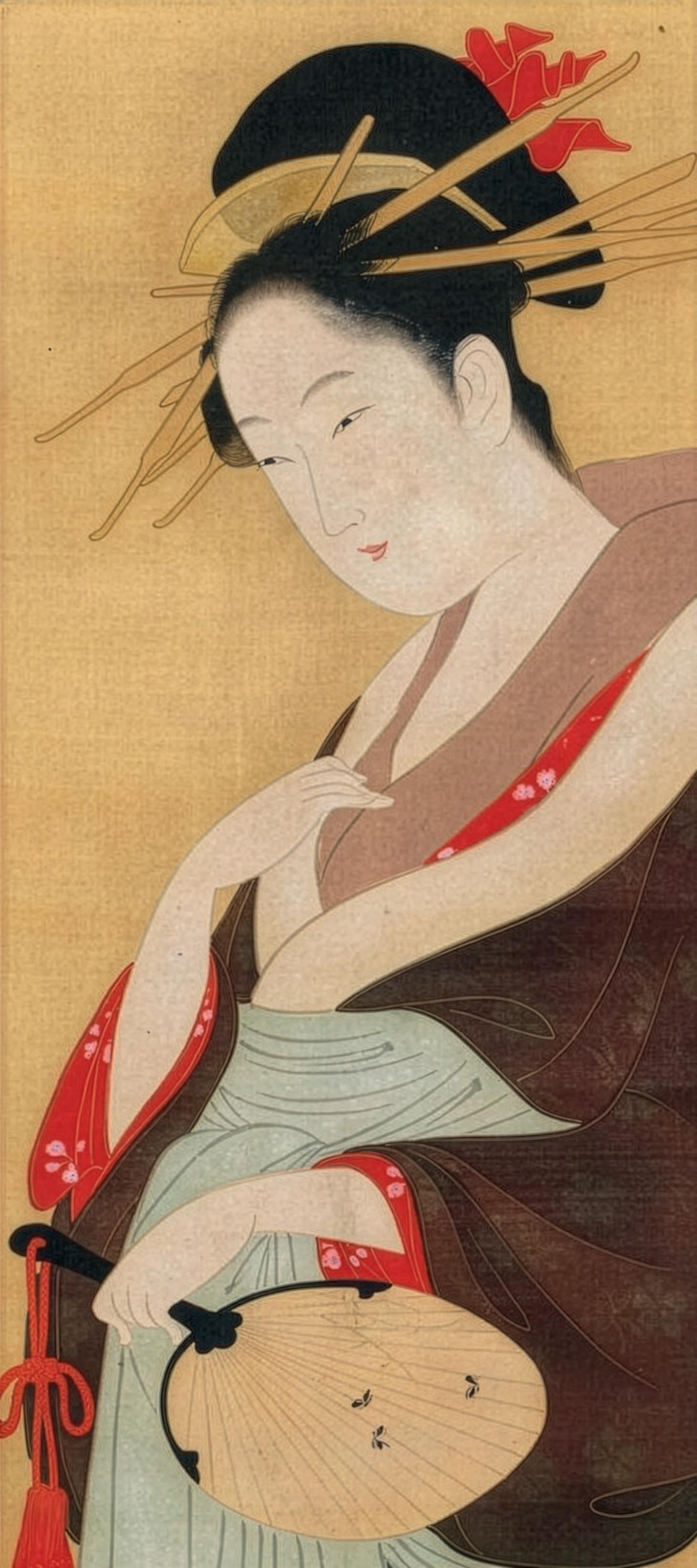
City Centre Salerooms
Monday to Friday 9am – 5pm
Old Sarum Galleries
Monday to Friday 9am – 5pm
All our auctions are on view at least two days prior to the sale and details will be found in the relevant catalogues.
All first time buyers need to register with us. To register, you will need to provide two forms of identification:
1.a passport or photographic driving licence
2.a utility bill or document showing your name and address
You can register in person or by contacting client services on 01722 424500 or emailing id@woolleys.live
You will be asked to show your documents or email copies.
PLEASE NOTE: Registering with our website, or any third party website, does not automatically register you to bid with us.
See below for the different options for bidding. Please note that you may be asked to provide two forms of identification, even if you have bid with us before, in order that we are compliant with Money Laundering Regulations.
To bid at auction you will need a paddle number. This can be obtained from client services either during the view or on the day of the sale.
If you are unable to attend the sale you can leave a commission bid. This will be executed on your behalf by the auctioneer who will purchase the lot as cheaply as possible bearing in mind any reserve price and other bids.
It is usually possible to bid on the telephone by prior arrangement with client services
Live online bidding is now available free of charge for most of our auctions via , enabling you to take part in the bidding from anywhere in the world live as it happens.
The relevant department will be pleased to give condition reports on any lot, where practical. All weights and measures given in the catalogue should be regarded as approximate.
The colours printed in the catalogue are not necessarily true.
These will be posted on our website shortly after the sale.
Woolley & Wallis do not offer a packing and despatch service but the following are carriers in our area.
Alban Shipping+44 (0)1582 493099 info@albanshipping.co.uk www.albanshipping.co.uk
Kimdan Ltd
Mailboxes
+44 (0)7973 389436 andy@kimdan.co.uk
+44 (0)1962 622133 info@mbewinchester.co.uk www.mbe.co.uk/winchester
Please note that we cannot be held responsible for any damage or loss to items once they are in the hands of a carrier.
If you are exporting your property, import taxes, customs duties and other fees may apply at the country of destination. It is also your responsibility to ensure that your shipment can be lawfully imported to the destination country.
Please note that due to the withdrawal of the Retail Export Scheme by HMRC, we are unable to provide VAT refund documentation (C88) for hand carried exports.
In order to qualify for a VAT refund, your lots must be exported by a shipper and valid export documentation must be provided.
Payment is due immediately after the auction in pounds sterling. If you are a first time buyer we will need your name, address and bank details and will require funds to be cleared before purchases can be released.
The following methods of payment may be made:
Bacs, debit and credit cards
Wire transfers should be sent to:
Lloyds Bank plc, Blue Boar Row, Salisbury SP1 1DB. Account no. 00957707
Sort code 30 97 41
IBAN no. GB20LOYD30974100957707
BIC code LOYDGB21063
Debit and Credit cards: Visa, Mastercard, Amex or Union Pay.
Where practical, payment can be made and purchases collected during the auction.
We reserve the right to add storage charges to all lots not collected within 30 calendar days of the sale. This will include a handling fee of £20 (+ VAT) per consignment and a storage charge of £2 (+ VAT) per lot per day. No goods will be allowed to be collected until these charges have been paid.
Lots marked with an dagger (†) are subject to VAT on the hammer price. Lots marked with an omega ( ) have been temporarily imported from outside the EU and are subject to VAT at 5% on the hammer price and the buyer’s premium. In online catalogues, the Sales Tax % column indicates the rate of VAT on hammer price.
Please note that lots marked may be subject to CITES Regulations when exported.
The CITES Regulations may be found at www.defra.gov.uk/ahvla en/imports exports/cites/
/
Lots marked with a symbol are poten ally subject to a levy.
Droit de Suite is a royalty payable to a qualifying artist or the artist’s heirs each time a work is resold during the artist’s lifetime and up to a period of 70 years after the artist’s death.
Royalties are calculated on a sliding percentage scale based on the hammer price excluding the buyer’s premium. The royalty does not apply to lots selling below £1,000 and the maximum royalty payable on any single lot is £12,500.
Droit de Suite, which is not subject to VAT, will be added to the buyer’s purchase price and then passed on to the relevant collecting agency.
Royalties for Droit de Suite are as follows:
4%Up to £50,000
3%£50,000.01 200,000
1%£200,000.01 350,000
0.5%£350,000.01 500,000
0.25%In excess of £500,000
Up to a maximum levy of £12,500
Lots marked in the catalogue, or by any other means identified as controlled firearms, are subject to the UK firearms/shotgun licencing regime, and should only be viewed/purchased by individuals with appropriate licences. It is the responsibility of the bidders to ensure that they are legally authorised to acquire the lot that they are bidding for. In the event that such a lot is successfully bid for by an individual who is not authorised to possess it, that individual will be required to pay for it, but will not be allowed to take physical possession of it. The auctioneers will re offer the lot on behalf of the buyer in a future auction; or may accept instructions to dispose of it by some other legal means, at their discretion.
Valuations are a core part of our business and are usually carried out by a senior specialist or director. Accuracy, speed and above all confidentiality are paramount.
Written valuations for insurance can vary from a single item to a large estate. Before starting we discuss the various options available so that the valuation is specifically tailored to individual clients needs.
For valuations of an entire house contents an itemised bound valuation is produced and can be accompanied by photographs when required. In addition to providing an inventory, written valuations can prevent painful arguments with a loss adjuster in the event of a claim.
Woolley & Wallis valuations are accepted by all leading insurance companies.
We offer a speedy and professional service for executors and trustees and provide bound valuations for probate and duplicate copies when required. Since security is often a consideration, we can usually arrange for a house to be cleared and sent for auction, our Valuations Department ensures that executors are informed of which sales are involved and the results thereof.
We also carry out valuations for Family Division, Capital Gains Tax, and Private Treaty Sales.
Contact Jeremy Lamond +44 (0)1722 424502 | valuations@woolleys.live
Free verbal valuations of items for sale are available by appointment. Please email valuations@woolleys.live or call +44 (0)1722 424500


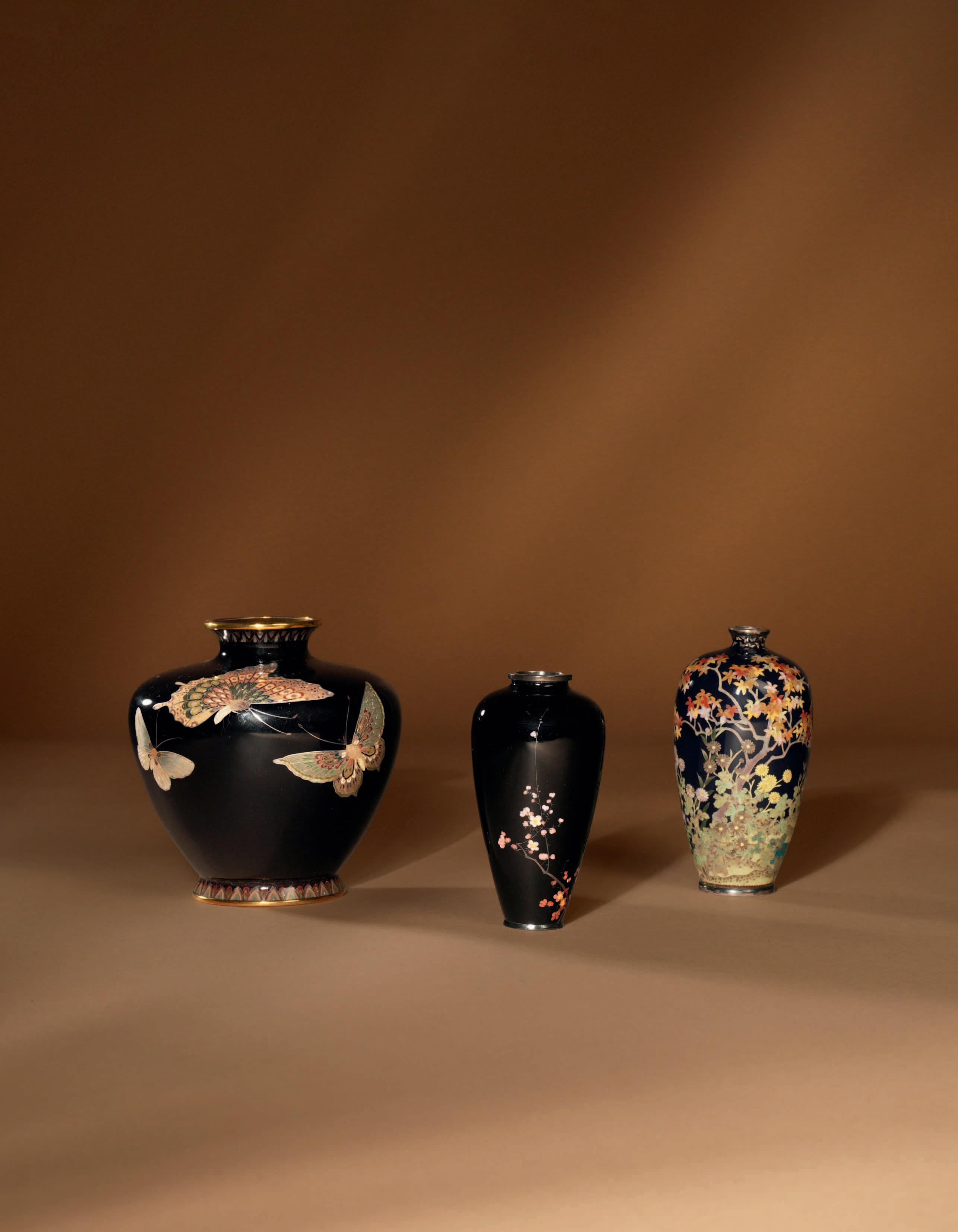
MAY
19th Fine Asian Art & Asian Art II
20th Japanese Works of Art
JUNE
2nd Modern British & 20th Century Art
3rd British Art Pottery & Studio Ceramics
10th Medals & Coins, Arms & Armour
30th Fine Furniture
JULY
1st Interiors
2nd English & European Ceramics & Glass Treasures from Kirtling Towers, the Property of Lord & Lady Fairhaven
8th & 9th Fine Jewellery
14th & 15th Silver & Objects of Vertu
AUGUST
20th Arts of Africa, Oceania and the Americas
SEPTEMBER
8th & 9th Old Masters, British & European Paintings
23rd & 24th Design
Lots 677, 678 & 673 ENTRIES ARE CURRENTLY BEING ACCEPTED FOR OUR 2026 AUCTIONS