SPRING 2026 BOOKS CATALOG







October 27, 2025
I am just back from a meeting of University Press directors, where we envisioned the role of our presses in 2035 in four different worlds. These worlds or scenarios had varying levels of societal integration of generative artificial intelligence. The through line that we identified in all these disparate scenarios was the need for evidencebased, peer-reviewed scholarship for which University Presses are known. So, whether future readers discover our authors’ work via a chatbot, a virtual reality headset, our own website, or in a community bookstore, what we have to offer is even more valuable in the information-saturated environment of 2035.
This experience made me even more excited about our role in connecting authors with readers. We need to ensure that we meet our readers where they are, and that’s rapidly changing. But what we won’t change is our commitment to the best research and scholarship. And this is evident in our collection of titles this spring.
Have a look at our lead title by Jacob Mchangama and Jeff Kosseff, who base their argument about the rise and fall of free speech on evidence spanning a century (p. 3). Rod Phillips, who is a noted historian at Carleton University, turns his attention to our feline friends in Cats: A History , supporting every assertion about their place in culture and society with archival evidence (p.7). And who wouldn’t want to hear from Adam Barsouk, a resident-physician at the University of Pennsylvania, about how to outsmart cancer (p.11)?
In an era of misinformation, disinformation, synthetic data, and fake news, our role in credentialing scholarship and research has never been more important. I hope you enjoy learning about our newest additions to our growing body of work that you can trust.
As always, thank you for supporting our work. Without you, we wouldn’t be able to strive further toward our vision of a future where knowledge enriches the life of every person.
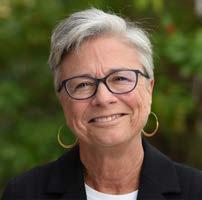
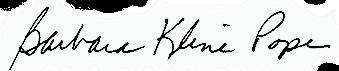
—Bar bara Kline Pope, Executive Director Johns Hopkins University Press
America’s oldest university press was established at the nation’s first research university in 1878. Ever since, Johns Hopkins University Press has shared the benefits of discovery with the world.
With a portfolio of four interconnected publishing businesses, Hopkins Press provides globalaccess, impact, and influence for the scholarship that we publish and distribute. We select and develop innovative ideas and research; we employ groundbreaking technologies to enhance discovery and learning; we connect a global audience of readers to trusted knowledge from leading researchers, scholars, and educators.
We do all this under the imprint of Johns Hopkins University Press and in the name of our University’s distinguished faculty and institutions.
POLITICAL SCIENCE / Political Ideologies / Democracy
Available 04/07/2026
$32.95 • Hardcover • 9781421454160
416 pages • 6.125 x 9.25” Also available as an ebook
Jacob Mchangama is the founder and executive director of The Future of Free Speech and a research professor at Vanderbilt University. He is the author of Free Speech: A History from Socrates to Social Media
Jeff Kosseff is a nonresident senior legal fellow at The Future of Free Speech and the author of Liar in a Crowded Theater: Freedom of Speech in a World of Misinformation
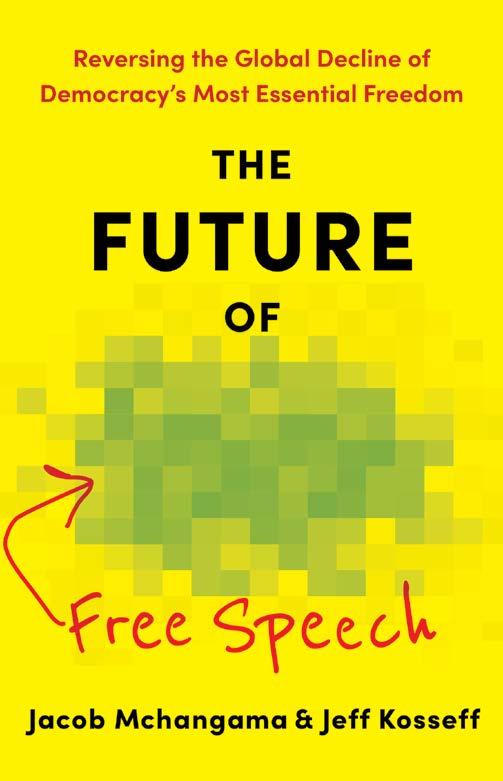
Reversing the Global Decline of Democracy’s Most Essential Freedom
Jacob Mchangama and Jeff Kosseff
The Future of Free Speech confronts a stark truth: the right to speak freely is under siege. Once celebrated as a cornerstone of democratic societies, free expression is now met with growing suspicion and retaliation across the globe. Jacob Mchangama and Jeff Kosseff present a panoramic view of how we arrived at this pivotal moment.
The authors examine a century in which speech rights expanded dramatically—including postwar democratic revolutions and the sweeping protections of the First Amendment—only to find those rights unraveling in the face of new political, technological, and cultural pressures. Today, liberal democracies are imposing speech controls, authoritarian regimes are cloaking censorship in democratic language, and digital platforms wield unprecedented power over global discourse. This book examines the backlash against free speech from all sides: governments criminalizing dissent in the name of national security; lawmakers and activists demanding tighter controls on misinformation, hate speech, and offensive content; and AI systems removing speech at a scale and speed that dwarfs historical forms of censorship. At the same time, faith in free speech itself is waning, even in the very societies that once championed it.
The Future of Free Speech argues for a reinvigorated, global commitment to open dialogue. Mchangama and Kosseff advocate nonpartisan, civicminded solutions that resist both government overreach and corporate silencing. They offer a compelling case for how free speech can meet modern challenges without abandoning its foundational role in sustaining democracy, human rights, and shared understanding.
Legislative Branch
Available 03/10/2026
$32.95 • Hardcover • 9781421454580
272 pages • 6 x 9” • 3 b&w photos, 2 b&w illus. Also available as an ebook
Maya Kornberg is a senior research fellow at the NYU Law’s Brennan Center for Justice. She is the author of Inside Congressional Committees: Function and Dysfunction in Lawmaking
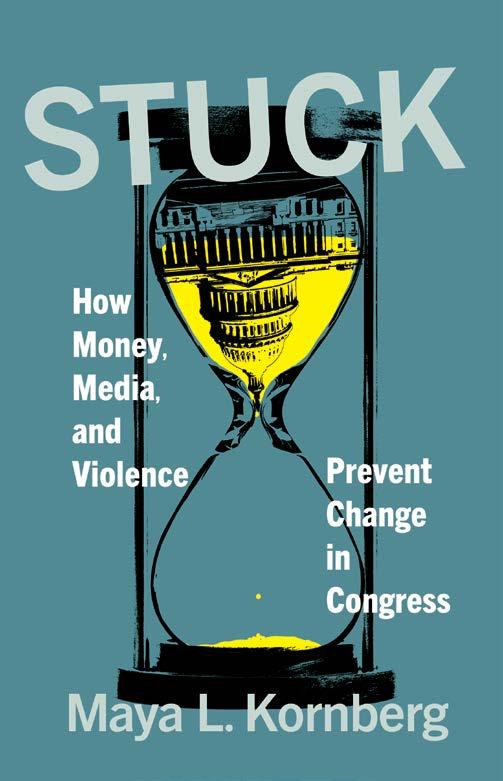
Maya L. Kornberg
Congress, the central democratic institution in the United States, is hanging on by a thread. On January 6, 2021, a violent attack on the Capitol Building left five people dead, and threats and attacks against politicians are on the rise. In Stuck , Maya Kornberg chronicles the efforts of congressional reformers over the last fifty years and documents the mounting forces that have kept their reforms from creating meaningful change.
The “Watergate babies” of 1974, the Contract with America conservatives of 1994, and the historic 2018 class fueled by backlash to Donald Trump all represent younger, more diverse, and less entrenched members who arrived in Washington energized and idealistic. Kornberg reveals the ways Congress has become increasingly inhospitable to change. Political violence, astronomical campaign costs, relentless fundraising demands, shrinking staff, and centralized party leadership all constrain the ability of new members to legislate and represent their constituents. Social media, while offering new platforms for political expression, has also heightened harassment and fueled a performative culture that rewards spectacle over substance.
Bolstered by dozens of interviews, congressional records, and the voices of lawmakers past and present—including Henry Waxman, Toby Moffett, Phil English, Alexandria Ocasio-Cortez, and Lauren Underwood— Stuck offers a sobering portrait of a legislative body paralyzed by its own internal dynamics. Kornberg also outlines tangible reforms that could restore Congress’s capacity to function and amplify the power of its newest members. At a time when Americans are losing faith in democracy’s most representative institution, Stuck makes the case for how it could be saved.
“As a former Member of Congress dedicated to improving the institution, I know how urgent it is to fix our politics. This lively and insightful book captures the experiences of politicians trying to make change, offers thoughtful analysis of distortions in our political system, and suggests pragmatic solutions to strengthen our democracy.”
—Derek Kilmer
Former Member of Congress and Chair of the House of Representatives Select Committee on the Modernization of Congress
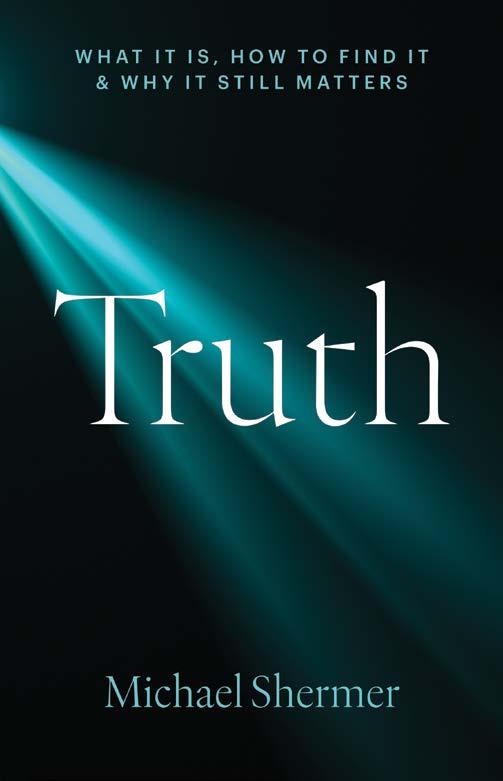
Available 01/27/2026
$32.95 • Hardcover • 9781421453729
384 pages • 6 x 9” • 27 b&w photos, 3 b&w illus. Also available as an ebook
Michael Shermer is the publisher of Skeptic magazine, the executive director of the Skeptics Society, and the host of the popular podcast
The Michael Shermer Show . He is the author of Conspiracy: Why the Rational Believe the Irrational ; Why People Believe Weird Things: Pseudoscience, Superstition, and Other Confusions of Our Time ; and The Believing Brain: From Ghosts and Gods to Politics and Conspiracies—How We Construct Beliefs and Reinforce Them as Truths
Michael Shermer
“Fake news.” “Alternative facts.” “Post-truth.” Misinformation is everywhere, sparking public confusion and polarization. In Truth , best-selling author Michael Shermer cuts through the noise to argue that not only does truth still matter—but also that it’s essential to our individual and collective flourishing. This sharp-sighted and accessible book provides a framework for thinking more clearly in an age clouded by doubt and distortion.
Shermer, the author of Conspiracy: Why the Rational Believe the Irrational , explores why truth deserves our attention, how falsehoods take hold in the public’s imagination, and how we can resist manipulation through reason, evidence, and open inquiry. This book introduces powerful tools for evaluating claims, including the concepts of causality, correlation, and Bayesian reasoning. Beyond these abstract ideas, Shermer also examines how we determine truth in specific domains—such as science, history, and religion—and brings clarity to hot-button topics like UFOs, conspiracy theories, miracles, mystical experiences, consciousness, morality, God, and even existence. With his trademark wit and intellectual rigor, Shermer reveals how even the most intelligent among us fall prey to such pitfalls as “myside bias” and motivated reasoning and how a commitment to universal realism can help push back against tribalism and misinformation.
Truth offers a timely antidote to cynicism and confusion. It emphasizes critical thinking and urges readers to rebuild the intellectual foundations of a functioning democracy by embracing the pursuit of truth, however complex or inconvenient it may be.
“Michael Shermer has spent his career grappling with the slipperiest word in our language: Truth. As someone who knows firsthand what happens when truth gets lost in noise and narrative, I’m grateful for Shermer’s cleareyed insistence that truth is not only real, but necessary.”
—Amanda Knox author
of Free: My Search for Meaning

Available 03/17/2026
$32.95 • Hardcover • 9781421453996
280 pages • 6 x 9”
Also available as an ebook
F. Marina Schauffler is a journalist and the author of Turning to Earth: Stories of Ecological Conversion
F. Marina Schauffler
Invisible and nearly indestructible, per- and polyfluoroalkyl substances (PFAS) have seeped into the blood of almost every American and permeated the natural world. These insidious chemicals now drift on global air currents, fall in rain, accumulate in soils and food webs, and can persist in ecosystems for generations. Inescapable reveals how ordinary people are tackling the toxic impacts from this sprawling class of industrial compounds—long used in consumer products, building supplies, and firefighting foam and still widely produced.
Journalist Marina Schauffler recounts how PFAS contamination in Maine, a state known for its bountiful farms, woods, and waters, has upended lives and livelihoods, endangered public health, and cost taxpayers hundreds of millions of dollars. Stories from homeowners, firefighters, farmers, tribal members, researchers, and elected officials reveal the staggering implications of the federal government’s failure to regulate synthetic chemicals that manufacturers have known for decades were toxic. Maine is among states at the forefront of PFAS testing and regulation, but no region is immune from this chemical threat.
The poignant accounts in this book illuminate the challenge of reckoning with the far-reaching effects of PFAS and addressing the ongoing burden borne by highly affected individuals. Countless communities across the nation and world could face similar struggles as the ubiquity of PFAS contamination becomes clear. Inescapable offers a roadmap for tackling this chemical Hydra.
and
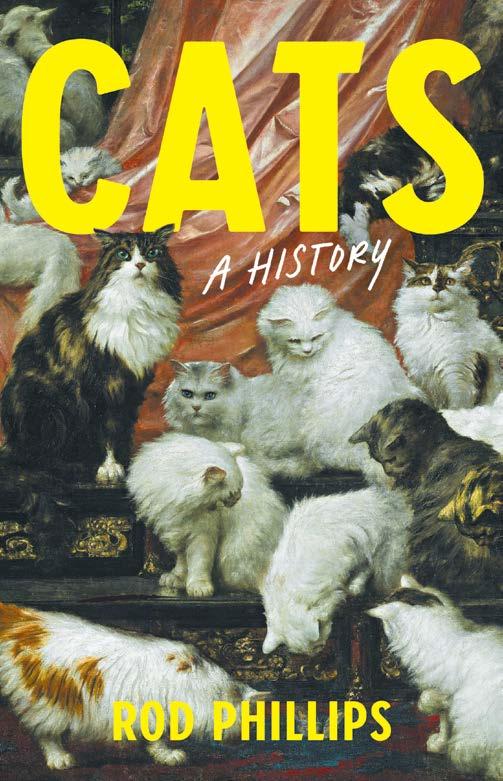
Available 06/02/2026
$32.95 • Hardcover • 9781421454184
464 pages • 6 x 9” • 29 b&w illus., 1 map Also available as an ebook
Rod Phillips is a professor of history at Carleton University, Ottawa, Canada. He is the author of Alcohol: A History and A New History of Divorce
Rod Phillips
For more than 10,000 years, cats have prowled at the edges of human life. But, starting only a few decades ago, hundreds of millions of them became pets. In Cats: A History , historian Rod Phillips shares a sweeping cultural and social history of cats, tracing the shifting place of felines across societies and centuries,from ancient Egypt’s revered hunters to Europe’s suspected familiars of witches and from shipboard rodent controllers to cherished internet icons.
Phillips illustrates how cats have always occupied spaces both familiar and mysterious and how their perceived independence and disruptive nature—and their associations with women, the supernatural, and outsiders—have shaped humans’ attitudes toward these fascinating creatures. Cats have been lauded as companions and vermin-killers, reviled as threats to moral and ecological order, and cherished for the very qualities that make them hard to control. This richly textured portrait of cats explores their significance in religion, politics, gender, literature, warfare, and pop culture. It also provides fascinating insights into our relationships with other animals, especially dogs and rodents.
The many roles that cats have played throughout history illuminate a variety of fascinating contradictions in humans’ perceptions of them: as affectionate yet aloof, adorable and evil, ordinary and exceptional. Cats: A History is the definitive story of the feline presence in human history—an elegant study of how we live with animals whom we see as living by their own rules.
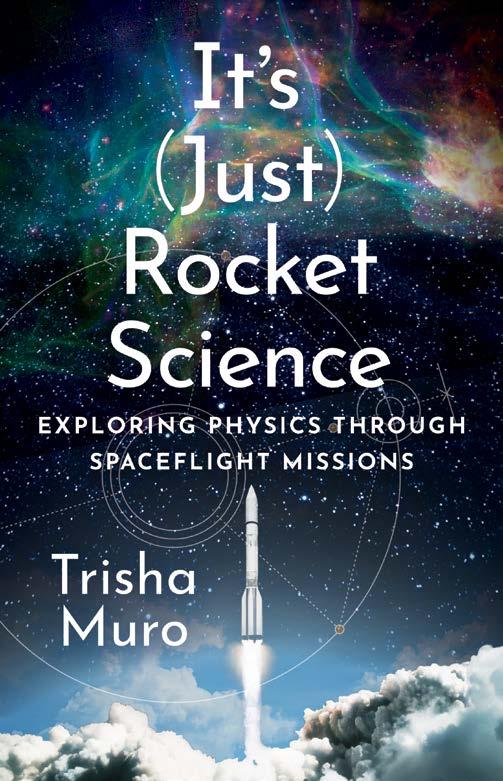
Available 05/12/2026
$32.95 • Hardcover • 9781421454269
384 pages • 6 x 9” • 35 b&w illus. Also available as an ebook
Trisha Muro is a freelance science writer and former high school physics teacher who has written for OpenMind Magazine , NOIRLab , and Science News Explores
Trisha Muro
It’s (Just) Rocket Science delivers on a bold promise: spaceflight isn’t just for engineers or physicists. Science writer Trisha Muro introduces readers to the physics principles behind how rockets, satellites, and space telescopes reach their destinations by making the science behind these technological marvels both meaningful and accessible.
Muro untangles the concepts and calculations that make space exploration possible. Addressing a handful of core topics—including motion, forces, waves, and energy—each section demonstrates how to see physics at work in easy-to-understand explanations. Chapters center on the challenges faced by real spaceflight missions, such as Voyager ’s deep space dispatches, the James Webb Space Telescope’s distant perch beyond the Moon, and DART’s asteroid-deflecting impact, while connecting the physics behind these missions to readers’ daily lives. Muro introduces essential physics concepts and makes abstract principles tangible through true stories of human ingenuity and cosmic ambition.
Covering topics such as orbits, gravity, momentum, light, and relativity, this book explains the surprising science behind familiar headlines, like: How do missions like Psyche use a gravitational slingshot to reach their destinations? Why does the Webb telescope orbit a million miles away from Earth? How do we land rovers like Perseverance safely on Mars? Whether readers are seasoned stargazers or hesitant explorers, It’s (Just) Rocket Science invites you to see the science behind space exploration — and recognize how those missions connect back to us.
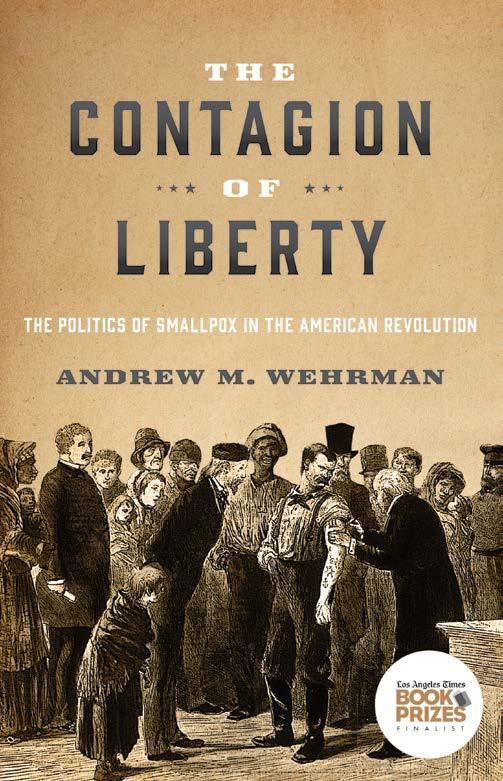
Available 02/03/2026
$24.95 • Paperback • 9781421454320
416 pages • 6 x 9” • 14 b&w illus., 2 maps Also available as an ebook
Andrew M. Wehrman is an associate professor of history at Central Michigan University. A winner of the Walter Muir Whitehill Prize in Early American History, his writing has appeared in The New England Quarterly , The Boston Globe , and The Washington Post
Andrew M. Wehrman
The Revolutionary War broke out during a smallpox epidemic, and in response, General George Washington ordered the inoculation of the Continental Army. But Washington did not have to convince fearful colonists to protect themselves against smallpox—they were the ones demanding it. In The Contagion of Liberty , Andrew M. Wehrman describes a revolution within a revolution, where the violent insistence for freedom from disease ultimately helped American colonists achieve independence from Great Britain.
Inoculation, a shocking procedure introduced to America by an enslaved African, became the most sought-after medical procedure of the eighteenth century. The difficulty lay in providing it to all Americans and not just the fortunate few. Across the colonies, poor Americans rioted for equal access to medicine, while cities and towns shut down for quarantines. In Marblehead, Massachusetts, sailors burned down an expensive private hospital just weeks after the Boston Tea Party.
This thought-provoking history offers a new dimension to our understanding of both the American Revolution and the origins of public health in the United States. The miraculous discovery of vaccination in the early 1800s posed new challenges that upended the revolutionaries’ dream of disease eradication, and Wehrman reveals that the quintessentially American rejection of universal health care systems has deeper roots than previously known. During a time when some of the loudest voices in the United States are those clamoring against efforts to vaccinate, this richly documented book will appeal to anyone interested in the history of medicine and politics, or who has questioned government action (or lack thereof) during a pandemic.
Available 04/21/2026
$54.95 • Hardcover • 9781421454092
$24.95 • Paperback • 9781421454108
248 pages • 6 x 9” • 3 b&w illus. Also available as an ebook
Alice Hoyt, MD, a board-certified allergist and immunologist, internist, and pediatrician, is the chief allergist at the Hoyt Institute of Food Allergy. She is the host of the podcast Food Allergy and Your Kiddo and leads the food allergy-focused non-profit Code Ana.
Alice Hoyt, MD
When your child has a food allergy, every season of life brings new challenges. Navigating Food Allergies is the trusted, practical resource for parents seeking clarity, confidence, and control in a world that too often feels uncertain. Allergist Alice Hoyt, MD, offers a step-by-step guide through every stage of the food allergy journey, from health care encounters to everyday meals. From your child’s first allergic reaction to the long-term planning that helps your child begin to handle their food allergies, Dr. Hoyt provides a framework for how you can comprehensively manage your child’s life with food allergies.
Dr. Hoyt empowers you to:
• Understand food allergy tests, diagnoses, and treatments
• Create the right care team for your child
• Prepare for and navigate medical appointments
• Create effective plans to respond to allergy emergencies
• Manage the social impacts of food allergies when you’re out of the house
• Navigate insurance and health care costs
• Understand the differences between food allergies, food intolerances, and other adverse reactions to foods
This guide offers clear strategies for tackling the medical, logistical, emotional, and financial realities of parenting your child with food allergies. You’ll find helpful visuals, planning tools, and checklists designed for real families managing real challenges. Throughout the book, Dr. Hoyt emphasizes preparation over panic, teamwork over guesswork, and informed decision-making over misinformation.
HEALTH & FITNESS / Diseases & Conditions / Cancer
Available 02/24/2026
$54.95 • Hardcover • 9781421453859
$24.95 • Paperback • 9781421453866
376 pages • 6 x 9” Also available as an ebook
Adam Barsouk, MD , is a resident-physician at the University of Pennsylvania.
Adam Barsouk, MD
Outsmarting Cancer reframes one of the most pressing medical challenges of our time: how to prevent cancer. In this timely and accessible book, physician and medical researcher Adam Barsouk, MD, presents a sweeping examination of cancer’s true origins—biological, environmental, dietary, infectious, industrial, occupational, and behavioral—and makes a compelling case for why cancer prevention must become a central priority in public and personal health.
With personal stories from his clinical practice and the latest research, Dr. Barsouk explains why more people are getting diagnosed with cancer—and at younger ages—than ever before. This book explores a wide range of overlooked and misunderstood risk factors, as well as how inequities in diagnosis, treatment, and prevention disproportionately impact underserved populations. Unlike typical cancer books that focus narrowly on diet or organ-specific disease, Outsmarting Cancer takes a comprehensive, systems-level view, urging readers to look beyond the symptoms and target the root causes.
Dr. Barsouk explores the role of genetic predisposition to cancer alongside environmental, lifestyle, and public policy influences that may contribute to developing the disease. With rigorous scientific insight, he offers real-world, evidence-based strategies to reduce cancer risk in practical, meaningful ways. Honest, urgent, and empowering, Outsmarting Cancer challenges readers to rethink how we talk about cancer and how we can reduce its burden before it begins.
“Dr. Barsouk provides a clear, evidence-based examination of cancer’s preventable causes and the role of public health in reducing risk. A timely reminder that prevention deserves as much attention as treatment.”
—Melina Marmarelis University of Pennsylvania
& FITNESS / Diseases & Conditions / Cancer
Available 02/10/2026
$54.95 • Hardcover • 9781421453774
$22.95 • Paperback • 9781421453781
248 pages • 6 x 9” Also available as an ebook
Anne Katz, PhD, RN , is a certified sexuality counselor in private practice. She is the author of numerous books, including Sexuality and Illness: A Guidebook for Health Professionals, Symptom Management Guidelines for Oncology Nursing , and Woman Cancer Sex
Anne Katz, PhD, RN
Cancer changes lives—but it doesn’t erase the need for intimacy, connection, or sexual expression. In this essential guide, certified sexuality counselor Anne Katz, PhD, RN, offers a compassionate, candid, and evidence-based guide for individuals and couples navigating the oftenoverlooked sexual challenges brought on by cancer and its treatment
Dr. Katz addresses the full scope of situations survivors may face, including an altered body image, loss of desire, physical pain, emotional distance, relationship strain, and more. Although these changes are common, they are rarely discussed openly—and survivors are often left to figure things out alone, or not at all. Through the stories of couples she’s worked with, Dr. Katz shows that while the path back to sexual intimacy may be complex, it is deeply worthwhile. With equal attention to anatomy and emotion, this book empowers readers to understand how cancer treatments impact sexual function, identity, and mental health—and how to reclaim pleasure and closeness at any stage of survivorship.
Clear explanations, practical tools—including mindfulness and sensate focus exercises—and thoughtful commentary make this guide both personal and informative. Cancer, Sex, and Intimacy fills a critical gap in survivorship care and reminds readers that sexuality is not a luxury, but a fundamental part of quality of life.
“Anne Katz’s Cancer, Sex, and Intimacy masterfully weaves science and clinical insight with survivors’ lived experiences. This compelling blend of evidence and storytelling brings humanity to a topic often left unspoken. A brilliant, compassionate, and essential read for anyone touched by cancer, or on the journey toward sexual healing and connection.”
—Lori Brotto University of British Columbia

Available 03/31/2026
$54.95 • Hardcover • 9781421454603
$27.95 • Paperback • 9781421454610
368 pages • 6 x 9” • 10 b&w illus. Also available as an ebook
Erum N. Ilyas, MD , is a board-certified dermatologist and the chair of dermatology at the Drexel University College of Medicine.
Erum N. Ilyas, MD
Skincare isn’t one-size-fits-all—but you wouldn’t know that from the overwhelming tide of product claims, influencer advice, and social media trends. In No-Nonsense Skincare , board-certified dermatologist Erum Ilyas, MD, cuts through the noise with trusted guidance for every part of the body and every stage of life. Whether you’re navigating teenage breakouts, pregnancy skin changes, or dryness in your 60s, this book offers practical, evidence-based strategies to care for your skin with clarity and confidence.
This essential guidebook explains how to:
• Build a skincare routine that works for you by learning how to choose and use products based on your skin’s changing needs, not marketing labels.
• Demystify skincare myths and understand the truth behind buzzwords like “clean beauty,” “skin type,” and “anti-aging.”
• Recognize misleading marketing, vague claims, unrealistic expectations, and overhyped ingredients before they influence your decisions.
• Understand what products can and can’t do so that you can identify when you’re buying real treatment—and when you’re paying for ineffective products.
• Save time and money by creating a streamlined routine that’s effective without being excessive.
Readers will learn how to decode marketing buzzwords, make sense of ingredients, and avoid common traps and dangerous trends. Through easy-to-follow routines, product insights, and scientific context, the book empowers readers to create skincare plans that are realistic, affordable, and customized to their own needs. From head to toe, and from infancy to older age, this guide offers a dermatologist’s honest insight on how to care for your skin without getting lost in the hype.
Available 05/05/2026
$29.95 • Hardcover • 9781421454214
264 pages • 6 x 9” • 58 b&w illus. Also available as an ebook
Roy Meals , MD, is an orthopedic surgeon and a clinical professor of orthopedic surgery at the University of California Los Angeles. He is the author of Bones: Inside and Out and Muscles: The Gripping Story of Strength and Movement
Roy A. Meals, MD
Ligaments are the quiet workhorses of the human body. They anchor our bones, guide our movements, and protect our joints—yet they remain largely unseen and misunderstood. In Ligaments: Appreciating the Bands that Bind Us , orthopedic surgeon and acclaimed science writer Roy A. Meals explores anatomy, biology, history, health, human performance, and popular culture to unlock the mysteries of ligaments. Completing a trilogy that began with Bones and Muscle , this richly illustrated volume offers a wide-ranging exploration of the anatomy, history, injuries, and cultural relevance of ligaments.
These bone-to-bone connectors are the critical linking mechanisms that allow our muscles to produce purposeful movement. Dr. Meals explains how ligaments stabilize the skeleton like hinge pins on a door, resist the forces of gravity in the face and breasts, and contribute to feats of athleticism, contortion, and childbirth. Readers will learn how ligaments are stronger than steel, how they recover from injury (or fail to), and how they can be stretched, stiffened, or surgically replaced. He also clarifies the differences among ligaments, tendons, and fascia, and why some people are “double-jointed” and others are not. Covering current and emerging treatments for ligament injuries, including artificial and engineered ligaments, the book provides practical insights into maintaining joint stability and flexibility across the lifetime.
Whether examining career-ending sports injuries, congenital laxity, or the elasticity of the vocal cords, Dr. Meals builds a case for why ligaments deserve center stage in our understanding of movement and health.
Available 04/14/2026
$54.95 • Hardcover • 9781421454535
$24.95 • Paperback • 9781421454542
320 pages • 6 x 9” • 10 line drawings Also available as an ebook
Steven H. Richeimer, MD, is board certified in pain medicine, anesthesiology, and psychiatry. He is a professor in the Departments of Anesthesiology and Psychiatry and the Chief of the Division of Pain Medicine at the University of Southern California.
Alexander Chen, MD, is a board-certified anesthesiologist and interventional pain medicine specialist. He is an assistant professor in the Department of Anesthesiology and Pain Medicine at the University of Southern California.
Steven H. Richeimer, MD, and Alexander Chen, MD
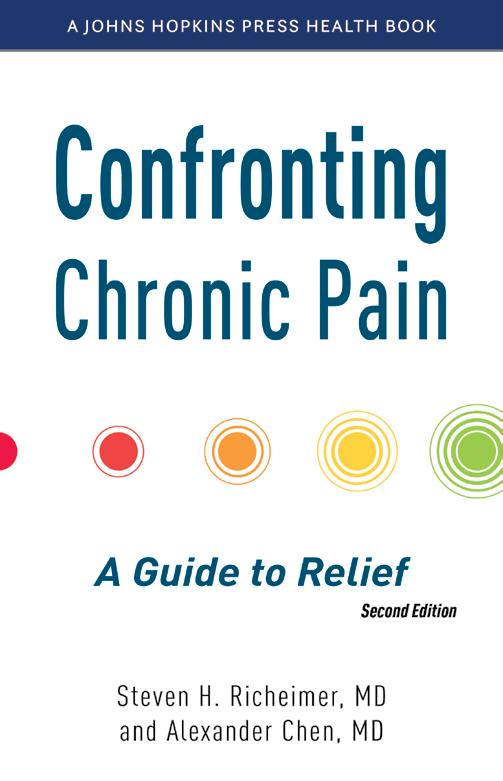
Confronting Chronic Pain is a clear, compassionate, and up-to-date guide to understanding and managing one of the most common and complex health challenges: long-term, persistent pain. Written by two leading pain specialists, this trusted resource distills decades of clinical expertise into an accessible, practical handbook for individuals living with pain and those who care for them.
This revised edition reflects major changes in the medical understanding of pain and its treatment. Readers will find insights on conditions such as arthritis, fibromyalgia, back pain, neuropathy, chronic headaches, and cancer-related pain, along with the latest options for relief. The authors explore traditional therapies and emerging treatments, including new minimally invasive procedures, improved migraine medications, and advances in neurostimulation. While examining the evolving role, risks, and best practices for opioid use, they also highlight promising non-opioid alternatives—from physical therapy and anti-inflammatory strategies to antidepressants, anticonvulsants, and innovative topical or injectable treatments.
Beyond the physical manifestations of pain in the body, Confronting Chronic Pain explores the psychological, social, and spiritual aspects of pain. Chapters on family dynamics, emotional resilience, and communication with health care providers help readers take an active role in their care and reclaim their quality of life.
FAMILY & RELATIONSHIPS / Death, Grief, Bereavement
Available 02/17/2026
$54.95 • Hardcover • 9781421453934
$24.95 • Paperback • 9781421453941
240 pages • 5.5 x 8.5” Also available as an ebook
Maureen Groden, RN, is a hospice nurse and educator.
Maureen Groden, RN
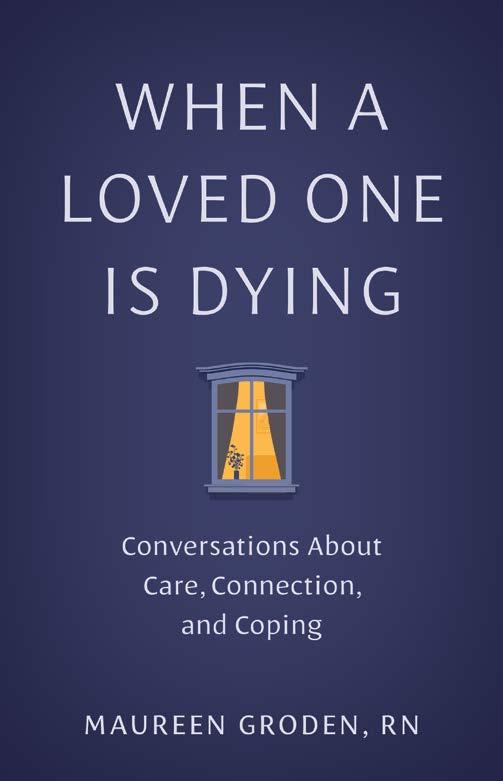
When faced with a loved one’s serious illness, many families find themselves overwhelmed, uncertain, and afraid. In this compassionate guide, hospice nurse and educator Maureen Groden, RN, offers a sympathetic and deeply human glimpse into one of life’s most challenging passages.
Groden shares true stories of families navigating the final chapter of a loved one’s life to explain the universal emotions, decisions, and realizations that emerge during the dying process. Readers meet families like their own—grappling with fear, love, sorrow, and strength—while learning how the health care system works when a family member is seriously ill, what decisions they might need to make, and how to care for their loved ones. These powerful accounts offer expert guidance and practical insights that help readers prepare for what lies ahead. Groden’s compassionate voice provides clarity and comfort while explaining symptom management, hospice services, and the subtle, poignant ways that families and loved ones can say goodbye.
This thoughtful guide invites readers to see that although death brings undeniable sorrow, it can also deepen bonds, cultivate resilience, and offer moments of profound beauty. This book is a steady, reassuring companion for anyone facing the uncertainties of end-of-life care—an essential resource for families seeking understanding, courage, and peace.
“A realistic, rich and comforting resource for people coming together in the face of end-of-life experiences. Groden’s personal devotion to helping people understand and engage in the complex circumstances of serious illness is evident. She shares accurate information side by side with emotional and thoughtful reflections. An essential collection of caring stories!”
Olga Ehrlich, RN Oakland University School of Nursing
& RELATIONSHIPS / Conflict Resolution
Available 01/13/2026
$54.95 • Hardcover • 9781421453477
$24.95 • Paperback • 9781421453484
304 pages • 6 x 9”
Also available as an ebook
Kate King, MA, LPC, is a licensed professional counselor, board-certified art therapist, and the award-winning author of The Radiant Life Project
Kate King, MA, LPC
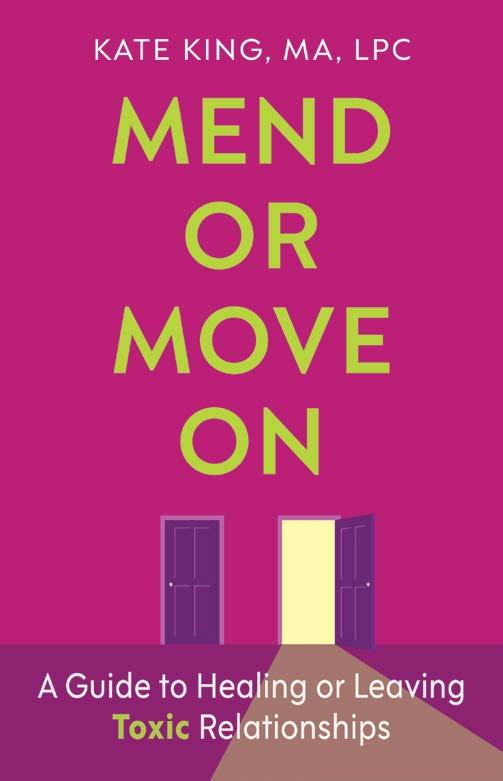
Relationships are meant to nourish us—but what happens when they cause harm instead? In Mend or Move On , licensed professional counselor and board-certified art therapist Kate King offers a bold, compassionate guide to breaking free from toxic dynamics and reclaiming a life rooted in self-respect and happiness.
King challenges the long-held belief that family loyalty and social harmony should come at the expense of personal well-being. This book is not about saving every connection—it’s about knowing which relationships are worth healing, and which ones demand an honest goodbye. With insight, clarity, and empathy, King outlines the seven most common traps that keep people stuck in painful friendships, partnerships, family bonds, and professional dynamics. These include internalized guilt, unhealed trauma, codependency, and more. She guides readers through the difficult process of deciding whether to stay or walk away by outlining practical, psychology-informed tools that support both paths. Whether repairing a struggling bond or finding the strength to sever it, readers will gain strategies to navigate complex emotional territory with integrity.
Through cutting-edge research and powerful stories from her clients and her own life, King offers a safe space to explore questions of belonging, betrayal, boundaries, and healing. Her unique approach provides a holistic path forward that emphasizes creative expression, evidence-based concepts, and nervous system regulation. This guide invites readers to build relationships that are honest, kind, and respectful—and to walk away from those that are dysfunctional, abusive, and beyond repair.
“ Mend or Move On is a compassionate, practical, and deeply validating guide for anyone navigating painful or confusing relationships. With clarity and heart, it helps readers discern whether to repair or release the bonds that shape their lives.”
—Sherrie
Campbell author of Adult Survivors of Toxic Family Members
Available 04/28/2026
$24.95 • Paperback • 9781421454733
208 pages • 6 x 9”
Also available as an ebook
Carolyn Roy-Bornstein, MD, FAAP, is a boardcertified pediatrician and the writer-in-residence at the Lawrence Family Medicine Residency program. She is the author of Through Thick and Thin: One Foster Family’s Eating Disorder Journey and Crash: A Mother, a Son, and the Journey from Grief to Gratitude
Restorative Writing for Healthcare Professionals
Carolyn Roy-Bornstein, MD
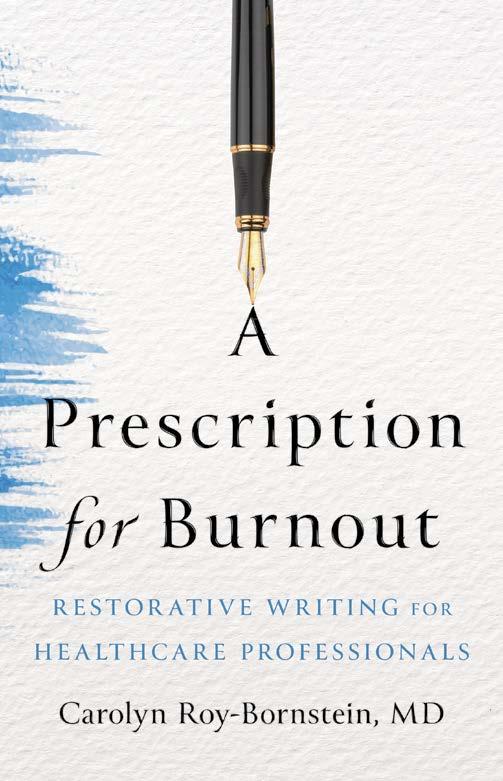
Physicians, nurses, and other healthcare professionals are leaving medicine in record numbers due in large part to exhaustion, disillusionment, and a profound loss of joy in their work. In A Prescription for Burnout: Restorative Writing for Healthcare Professionals , Carolyn Roy-Bornstein, MD, offers a powerful, science-backed remedy to burnout in the healthcare field: reflective writing. This guide is a structured, compassionate companion for those who want to stay in the profession they once loved and renew their sense of purpose.
In this book organized around the three dimensions of burnout identified by psychologist Christina Maslach—emotional exhaustion, cynicism, and a perceived lack of efficacy —each chapter introduces a focused writing practice to help clinicians reconnect with their values, strengthen empathy, and rediscover meaning in their work. Dr. Roy-Bornstein brings more than three decades of experience as a nurse, pediatrician, and narrative medicine educator to this deeply personal and practical work. She knows firsthand how writing can transform grief, trauma, and professional disillusionment into clarity, self-awareness, and healing.
These evidence-based and insightful exercises are designed to be brief yet sustaining antidotes to the pace and pressures of modern healthcare. Whether used privately or in groups, in early training or late-career reflection, A Prescription for Burnout offers clinicians not just strategies for surviving the system but tools to reclaim their voice—and their vocation.
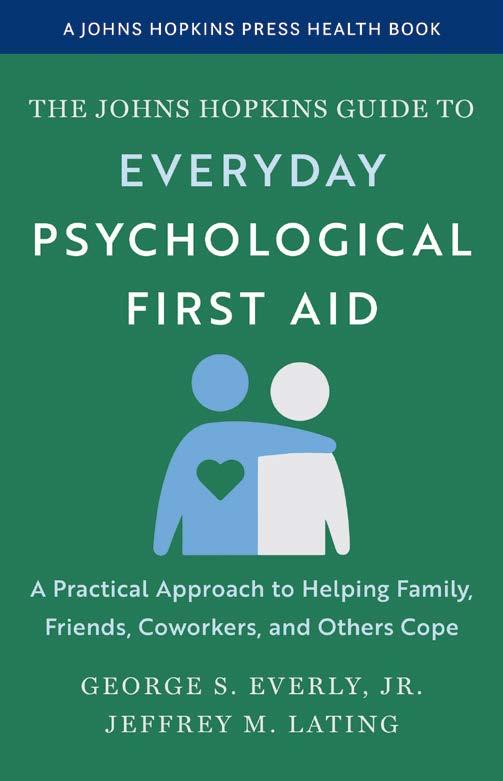
Available 01/20/2026
$24.95 • Paperback • 9781421453835
$54.95 • Hardcover • 9781421453828
344 pages • 5.5 x 8.5” • 5 b&w illus. Also available as an ebook
George S. Everly, Jr, has served on the faculties of the Johns Hopkins School of Medicine, the Johns Hopkins Bloomberg School of Public Health, and Harvard University. He is a former member of the Johns Hopkins Center for Public Health Preparedness.
Jeffrey M. Lating is a professor of psychology at Loyola University Maryland. Everly and Lating are the coauthors of A Clinical Guide to the Treatment of the Human Stress Response and Personality-Guided Therapy for Posttraumatic Stress Disorder
George S. Everly, Jr. and Jeffrey M. Lating
The Johns Hopkins Guide to Everyday Psychological First Aid equips readers with the tools to respond effectively and compassionately to emotional crises—whether they unfold in a home, workplace, school, or public setting. Based on decades of research, experience, and real-world examples, George S. Everly, Jr, and Jeffrey M. Lating present a streamlined, accessible version of the Johns Hopkins RAPID model of psychological first aid, designed specifically for everyday use by adults without formal training in mental health.
This guide empowers people to step in when someone is struggling— to listen, stabilize apparent distress, and offer effective, meaningful support. Offering advice and practical coping techniques for a variety of situations—like helping a stranger in a moment of panic or responding to the grief of a friend—the scenarios and checklists throughout the book help readers navigate some of life’s most difficult moments with clarity and care. This practical manual speaks to a world facing rising anxiety, loneliness, trauma, and loss by offering a simple, evidence-informed method for fostering resilience and restoring connection.
Everly and Lating emphasize that while no one can say the perfect thing in a crisis, everyone can learn how to offer compassion and help when it matters most. By making psychological first aid as accessible as physical first aid, this guide acts as an essential toolkit for being there when someone needs you most.
“Two distinguished pioneers in disaster-related psychological first aid now extend their expertise to the everyday struggles of the human condition. In this volume, they present a clear, well-structured framework for easing acute distress across a wide spectrum of high-prevalence mental, emotional, and behavioral crises, thereby meeting an urgent societal need.”
The Johns Hopkins School of Medicine
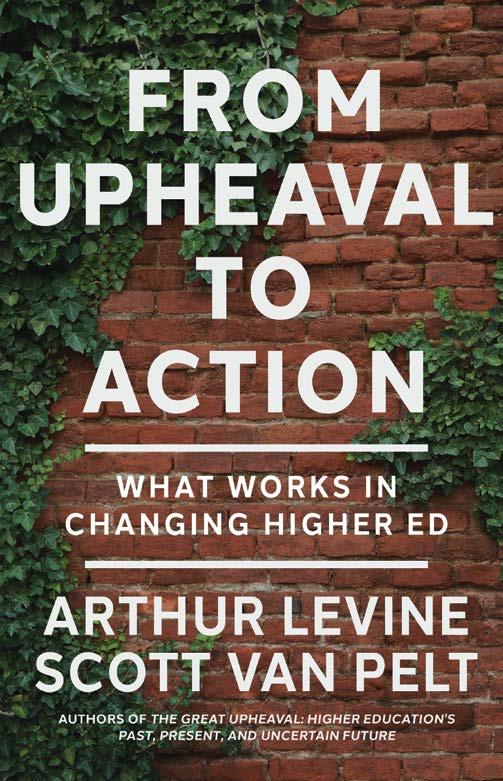
Available 03/03/2026
$32.95 • Hardcover • 9781421454030
248 pages • 6 x 9”
Also available as an ebook
Arthur Levine is the interim president of Brandeis University and president emeritus of Columbia University’s Teachers College and the Woodrow Wilson National Fellowship Foundation. He is the author and coauthor of many books, including Generation on a Tightrope: A Portrait of Today’s College Students
Scott Van Pelt is the Director of Research and Faculty Affairs at the University of Pennsylvania Graduate School of Education. Levine and Van Pelt are coauthors of The Great Upheaval: Higher Education’s Past, Present, and Uncertain Future
Arthur Levine and Scott Van Pelt
In From Upheaval to Action , Arthur Levine and Scott Van Pelt offer a vital update on the shifting landscape of American higher education. Building on the insights of their bestselling book The Great Upheaval , this on-the-ground account of how institutions are responding to today’s profound changes encapsulates two years of in-depth observation and conversation. Based on visits to more than sixty institutions and organizations—including colleges, state systems, accrediting bodies, and foundations—the authors provide an unflinching portrait of a sector navigating a complex, high-stakes transformation.
Colleges and universities are confronting the combined pressures of demographic realignment, economic strain, and technological disruption. They face challenges not only in attracting and retaining students, but also in remaining relevant in a world reshaped by automation, artificial intelligence, and the accelerating demands of a global knowledge economy. This book chronicles the successes and missteps of institutional responses while tracking new developments that have surged to the forefront, including the rise of alternative credentials, the redefinition of college affordability, renewed scrutiny of DEI initiatives, and growing political tensions around academic freedom and public trust.
From Upheaval to Action identifies areas of experimentation and change, spotlighting the creativity and resilience emerging within the sector. It examines what is being tried, what is proving effective, and what remains uncertain, offering essential insights into how today’s decisions are shaping the colleges and universities of tomorrow. Transformation is already underway, and its outcomes will be shaped by those institutions prepared to meet it with purpose, flexibility, and courage.
“In the face of waning public trust, fierce political divisions, and relentless technological disruption Arthur Levine and Scott Van Pelt lay out a bold, evidence-based blueprint for the future of higher education—showing how colleges can harness competency-based learning, AI-driven personalization, and alignment with the global knowledge economy to transform colleges from institutions in crisis into engines of opportunity.”
—Steven Mintz
author of The Learning-Centered University: Making College a More Developmental, Transformational, and Equitable Experience
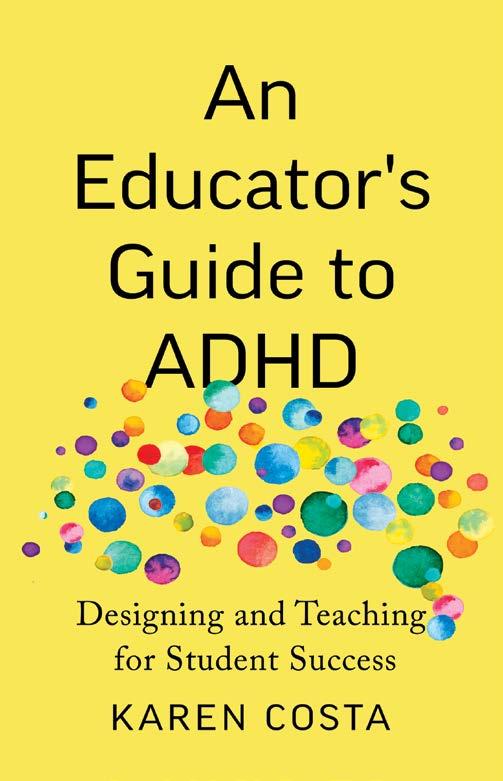
Available 01/20/2026
$29.95 • Paperback • 9781421453507
272 pages • 6 x 9”
Also available as an ebook
Karen Costa is a faculty development facilitator at 100 Faculty, an adjunct professor, and the author of 99 Tips for Creating Simple and Sustainable Educational Videos: A Guide for Online Teachers and Flipped Classes.
Karen Costa
The college learning environment is a place of both challenge and opportunity for students with ADHD. In An Educator’s Guide to ADHD , Karen Costa offers a transformative perspective on education that reimagines how college classrooms can support these learners. Challenging conventional narratives that treat ADHD as a deficiency, Costa instead invites educators to embrace the full humanity, creativity, and complexity of ADHD learners—whose minds are, as she puts it, wide open to the world like a house with its windows thrown open.
Costa introduces a framework built on strengths, compassion, and structural accountability. As a workshop facilitator with ADHD, she confronts the ableist underpinnings of traditional pedagogy and proposes a high-support, high-structure, and high-challenge approach that benefits all students. Her work encourages faculty to move beyond shame-based practices and toward a model of education that respects neurodiversity, supports executive functioning, and fosters resilience.
Costa’s vivid metaphor of an open-windowed house illustrates the reality of living and learning with ADHD, which involves occupying a psychic space of both beauty and vulnerability. Rather than insisting students “shut their windows” to conform, she urges educators to help them build environments where the fresh air of insight and connection can circulate freely while keeping out the mosquitoes. By teaching strategies like externalizing, reducing cognitive load, and embracing metalearning, Costa’s design and teaching approach will help educators create inclusive learning environments with the clarity, tools, and inspiration needed to shift the educational landscape one empowered learner at a time.
“Karen Costa invites us to rethink everything we thought we knew about ADHD. With fierce clarity and radical compassion, she shows us how to build classrooms where every student is free to be fully seen and valued. This book is a much-needed call to action.”
—Andratesha Fitzgerald
CEO of Building Blocks of Brilliance and author of Antiracism and Universal Design for Learning
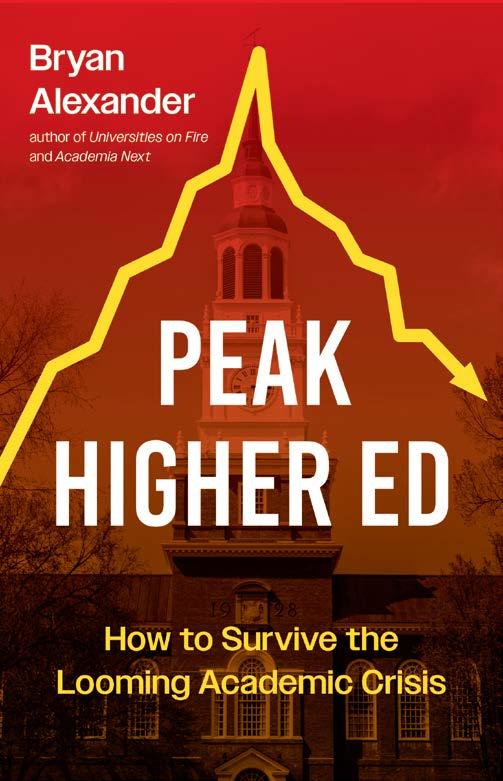
Available 01/06/2026
$36.95 • Hardcover • 9781421454702
224 pages • 6 x 9”
Also available as an ebook
Bryan Alexander is an internationally known futurist, researcher, writer, speaker, consultant, and professor. A senior scholar at Georgetown University, he is the author of Universities on Fire: Higher Education in the Climate Crisis and Academia Next: The Futures of Higher Education , as well as other books.
Bryan Alexander
Over the past decade, American colleges and universities have seen enrollment decline, campuses close , programs cut, faculty and staff laid off, and public confidence erode. In Peak Higher Ed , futurist Bryan Alexander forecasts what the next decade might hold if we continue down this path. He argues that the United States has passed its high-water mark for postsecondary education and now faces a critical turning point. How will higher ed institutions respond to this wave of change and crisis?
Combining data-driven research with scenario modeling, Alexander outlines a powerful framework for understanding what led to this moment: declining birthrates, surging student debt, rising tuition, shifting political winds, and growing skepticism about the value of a college degree. He maps out how these forces, if left unchecked, could continue to reshape academia by shrinking its footprint, narrowing its mission, and jeopardizing its role in addressing the planet’s most pressing challenges, from climate change to artificial intelligence. Alexander explores how institutions might adapt or recover, presenting two possible futures: a path of managed descent and a more hopeful course of reinvention.
Peak Higher Ed examines the fraying of the “college for all” consensus, the long shadow of pandemic-era disruptions, and the political polarization that has placed universities in the crosshairs. Written for educators, policymakers, students, and anyone invested in the future of higher learning, this book offers a deeply informed, unflinching look at the road ahead and the choices that will determine whether colleges and universities retreat from their peak or rise to a new one.
“Alexander offers both a historical lens and forward-looking roadmap for navigating higher education’s post-peak landscape. In the process, he provides the tools for strategic resilience and a vision for how colleges and universities can adapt, innovate, and regain momentum in service to students and society.”
—Lynn Pasquerella President, American Association of
Colleges and Universities
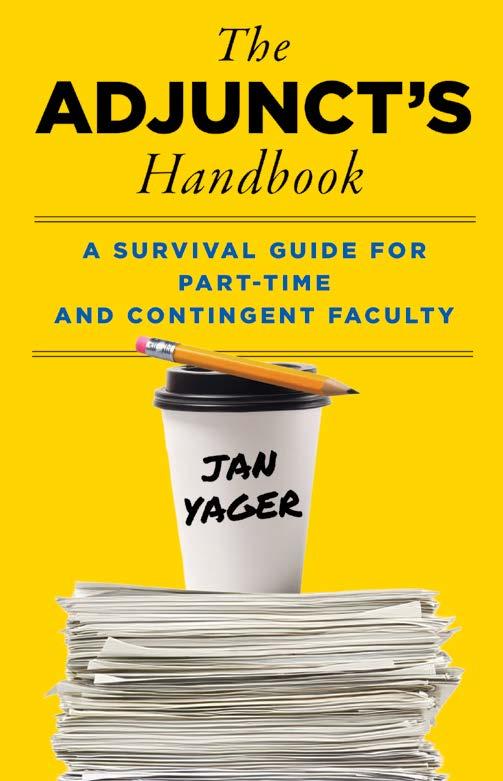
Available 02/10/2026
$27.95 • Paperback • 9781421453668
280 pages • 6 x 9” • 1 b&w photo
Also available as an ebook
Jan Yager is an adjunct associate professor at the John Jay College of Criminal Justice and an adjunct professor at William Paterson University. She is the author of numerous award-winning books, including Essentials of Victimology: Crime Victims, Theories, Controversies, and Victims’ Rights and Time Management and Other Essential Skills for College Students: How to Improve Productivity, Present with Ease, Write Better, Study More Effectively, Get an Internship, and Lots More.
Jan Yager
Today, more than two-thirds of college courses are taught by part-time or contingent faculty who are navigating a system that too often offers little guidance, support, or stability. Dr. Jan Yager’s The Adjunct’s Handbook is a clear, practical guide designed to equip adjunct instructors with the knowledge they need to thrive in a challenging and frequently overlooked corner of higher education.
Drawing on insights from more than one hundred surveys, interviews with more than sixty adjunct and full-time professors, and her own extensive teaching experience, Yager covers the essential information you need to become and excel as an adjunct. This comprehensive book explains how to:
• Hone your teaching strategies—including how to structure courses, manage students, and adapt to in-person or online formats
• Navigate the system by learning how to apply for teaching positions, negotiate pay, and choose the right institutions for your goals
• Know your rights regarding contracts, unions, intellectual property, other employment, and academic freedom
• Combat isolation by building professional networks, finding connections, and practicing advocacy
Whether you teach in person, online, or in a hybrid environment, as a new adjunct or a seasoned one, Dr. Yager addresses the inequities, questions, isolation, and stigma that too many adjuncts routinely face. She offers concrete strategies for improving working conditions, building community, and advocating for yourself in a field where opportunities and support can be unevenly distributed. Accessible and informative, filled with real-life anecdotes and quotes, The Adjunct’s Handbook is essential reading for anyone who is trying to make part-time teaching work.
“I’ve been adjunct teaching for three years, and while it’s deeply rewarding alongside my full-time career, it can also be demanding. Jan Yager’s The Adjunct’s Handbook resonates with my experience and pushes me to reflect on where this path may lead in the long run.”
—Vicky Qiu
John Jay College of Criminal Justice
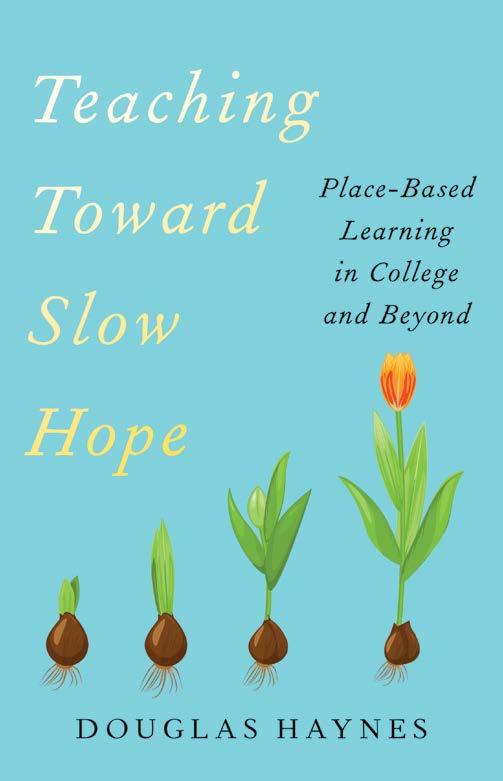
Available 03/10/2026
$37.95 • Hardcover • 9781421453903
272 pages • 6 x 9” • 5 b&w photos, 1 b&w illus Also available as an ebook
Douglas Haynes is a professor of English at the University of Wisconsin-Oshkosh. He is the author of Every Day We Live Is the Future: Surviving in a City of Disasters and Last Word
Douglas Haynes
Teaching Toward Slow Hope reveals what happens when higher education dares to become something more than transactional. Rather than positioning education as a financial investment, this book reimagines college as a space where students cultivate the skills and relationships needed for “collaborative survival” in an increasingly unpredictable world. Against a backdrop of mental health crises, ecological instability, and structural inequality, Douglas Haynes traces how students and educators across the Upper Midwest are remaking college into a place for connection, meaning, and collective resilience.
Through on-the-ground reporting and interviews with students, Haynes describes the impacts of dynamic, place-based educational programs. He takes readers on a journey from urban gardens in Milwaukee to restored oak savannas in Madison, and from a community food hub in Kalamazoo to the shore of Lake Superior. At the heart of the programs he visits is a shared commitment to what Haynes calls practices of slow hope: deep listening, reciprocity, collaboration, and embodied learning.
Haynes evokes the experiences of students harvesting native seeds, cooking with local produce, gathering community histories, and learning to see their landscapes anew. Many of these students are first-generation or struggling with anxiety or affording college. From their experiences emerges a deeply human story of transformation based in place, community, and care. Teaching Toward Slow Hope offers educators, administrators, and anyone invested in the future of higher education a powerful new lens for thinking about what college is really for.
“We could, I suppose, turn higher education over to Chat GPT. Or we could do the kind of hard, beautiful, connected work this book describes, and actually give kids (and teachers) a chance to learn.”
—Bill McKibbon author of Here Comes the Sun
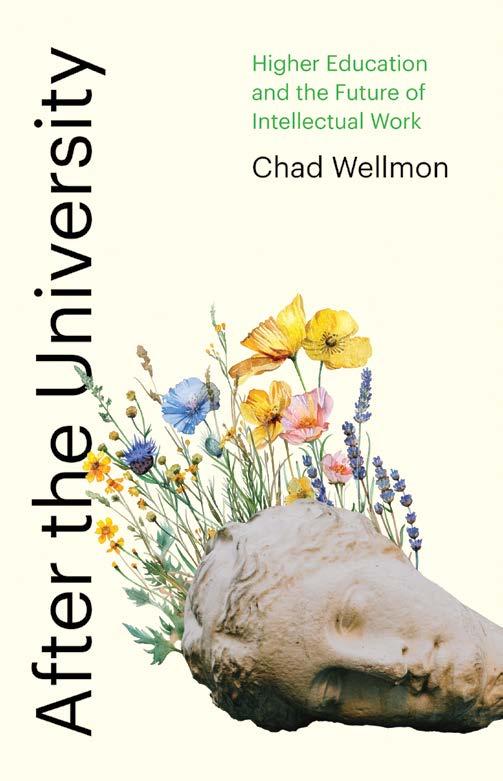
Available 06/23/2026
$39.95 • Hardcover • 9781421454351
376 pages • 6 x 9”
Also available as an ebook
Chad Wellmon is a professor of German at the University of Virginia. He is the author of Organizing Enlightenment: Information Overload and the Invention of the Modern Research University and Permanent Crisis: The Humanities in a Disenchanted Age.
Chad Wellmon
What is a university for? Is it a sanctuary for disciplined study, or has it become something else entirely? In After the University , Chad Wellmon traces the long and often uneasy relationship between higher learning and the institutions that claim to protect it. Moving from the guilds of medieval Paris and the knowledge factories of Enlightenment-era Göttingen to the research empires of Berlin and Berkeley, Wellmon shows how the modern university has repeatedly reshaped itself to serve shifting social and political demands.
Across centuries, the goods of disciplined study—the joy of reading, the virtues of intellectual rigor, and the possibility of self-formation—have been overshadowed by the pursuit of external rewards such as money, prestige, and power. Part institutional history and part philosophical reflection, After the University examines how today’s institutions defend themselves not in the name of learning but in the language of productivity, innovation, and economic utility. Drawing on his experiences as a scholar, teacher, administrator, and witness to crises such as white supremacist marches and the COVID-19 pandemic, Wellmon illustrates how universities justify themselves through the outputs of graduates, research discoveries, and workforce training while leaving unspoken the very practices that once defined them.
Despite this transformation, Wellmon argues that the university’s state of current turmoil exposes new possibilities: to recognize the practices of disciplined study as goods worth valuing in themselves, not just as means to other ends. With insight and urgency, After the University asks whether our institutions can still nurture intellectual desire—or whether we must find new homes for the life of the mind.
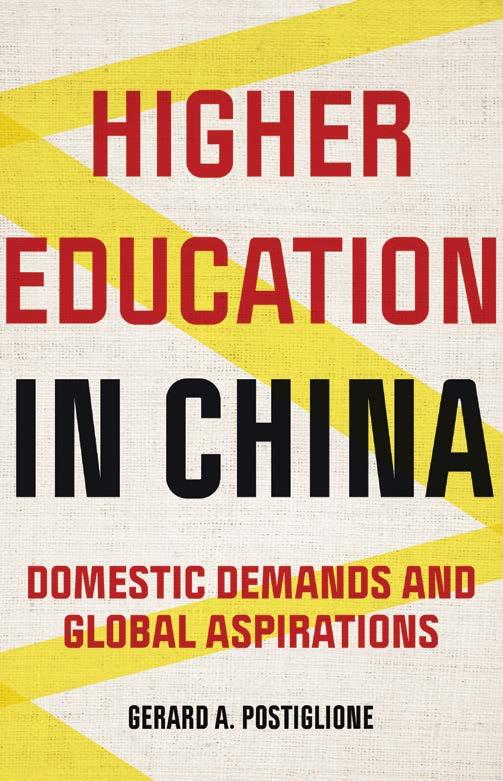
Available 04/28/2026
$49.95 • Paperback • 9781421454511
320 pages • 6 x 9”
Also available as an ebook
Gerard A. Postiglione is a professor and former associate dean for research at the University of Hong Kong. He is the author of Education, Ethnicity, Society, and Global Change in Asia
Gerard A. Postiglione
By 2025, China had twice as many college students as the United States, four times as many STEM graduates, and double the number of STEM PhDs. What will it mean for the global future when a quarter of a billion Chinese citizens hold higher education degrees? In this timely book, Gerard A. Postiglione—an internationally recognized authority on Chinese education—offers a panoramic view of the world’s largest state-directed higher education system and its complex interplay with China’s social, economic, and geopolitical ambitions.
At the center of Postiglione’s analysis is the tension between domestic imperatives and global aspirations. As China aims to cultivate a worldsignificant higher education system by 2035, it faces a trio of formidable challenges: graduate employment, equitable access, and governance reform. H igher Education in China unpacks how elite Chinese research institutions and rapidly expanding second- and third-tier colleges are navigating these pressures amid a shifting landscape shaped by urbanrural inequality, labor market demands, and technological disruption.
Based on policy consultation with China’s Ministry of Education and on-the-ground research in nearly every province, Postiglione’s account brings unmatched depth and perspective. He traces how returnee scholars, massification policies, and regional development initiatives have transformed campuses and classrooms, while also posing difficult questions about sustainability, quality, and inclusion. Higher Education in China illustrates how the country’s evolving academic system may influence its long-term trajectory—and, by extension, reshape the global order of knowledge and innovation.
/ Schools / Levels / Higher
Available 04/14/2026
$37.95 • Paperback • 9781421453569 232 pages • 6 x 9”
Also available as an ebook
Michael T. Nietzel is president emeritus of Missouri State University.
Charles M. Ambrose is a senior education consultant at Husch Blackwell Consulting. Together, they are the authors of Colleges on the Brink: The Case for Financial Exigency
Michael T. Nietzel and Charles M. Ambrose
Faculty votes of no confidence in college presidents have become a defining feature of leadership turmoil in American higher education. Often dismissed as merely symbolic, these votes can nonetheless mark a turning point in campus governance—and frequently signal the end of a presidency. In No Confidence , Michael T. Nietzel and Charles M. Ambrose present the first comprehensive analysis of this dramatic and increasingly visible phenomenon.
This book examines the origins, causes, and consequences of noconfidence votes, placing them in the wider context of higher education’s evolving governance structures. Nietzel and Ambrose explain why these votes have increased in frequency, especially in the wake of financial crises, political pressures, and a rapidly shifting academic workforce. What happens after such votes are cast—who resigns, who survives, and what do these outcomes mean for the institutions involved? Through detailed case studies and critical insights, No Confidence reveals how diminishing shared governance, declining faculty influence, and rising tensions between academic and corporate management styles have created fertile ground for conflict.
To prevent and repair campus conflict, Nietzel and Ambrose recommend focusing on improving trust, transparency, and collaboration among presidents, governing boards, and faculty. These essential actions, they argue, can help maintain institutional stability in an increasingly volatile higher education landscape.
“In this first-of-its-kind study, Michael Nietzel and Charles Ambrose, both experienced university leaders, do more than analyze the history and increasing popularity of no-confidence votes in university presidents. They provide strong—and, for some audiences, controversial—recommendations that might forestall such votes on our campuses, even in these times of turmoil in American higher education.”
—George Justice provost, University of Tulsa
Available 04/21/2026
$32.95 • Paperback • 9781421454283 248 pages • 5 x 8” Also available as an ebook
Robert A. Scott is the president emeritus of Adelphi University and of Ramapo College of New Jersey.
Robert A. Scott
Boards of trustees hold immense responsibility in guiding the future of colleges and universities. They hire and fire presidents, approve and monitor strategy, oversee finances, and safeguard institutional missions and autonomy. Yet many trustees enter this role with limited understanding of the distinct culture, structure, and values of the academic institutions they are selected to govern.
In this second edition of How University Boards Work , former university president Robert A. Scott offers a practical and candid guide for navigating the complexities of academic board service. Originally published in 2018 and widely adopted in board development programs, this updated edition incorporates insights gleaned from years of training sessions, executive coaching, and a radically altered higher education landscape. Elements unique to this edition include:
• A new preface addressing the contemporary pressures affecting higher education governance, including political interference, enrollment challenges, changing public attitudes, tuition pricing, overall costs and ROI, and post-pandemic adaptations.
• Expanded guidance on key topics such as consent agendas, indicators of institutional vitality and vulnerability, risk assessment, and succession planning.
• Updated index entries and terminology reflecting evolving governance concerns such as cybersecurity and free speech.
With illustrative examples of effective and problematic board behavior and actionable suggestions for trustee development, How University Boards Work remains the definitive primer for trustees of both public and private institutions.
Available 04/07/2026
$44.95 • Paperback • 9781421453149
408 pages • 6.125 x 9.25” • 10 b&w photos, 30 line drawings
Also available as an ebook
Steven P. Dandaneau is the executive director of the Association for Undergraduate Education at Research Universities and the Associate Provost at Colorado State University.
Fostering Student Success in Higher Education edited
by Steven P. Dandaneau
How can research universities foster both equity and excellence in undergraduate education? This compelling collection, edited by Steven P. Dandaneau, offers a rich set of answers that presents equity and excellence not as competing ideals, but as mutually reinforcing commitments. Building on the influential Boyer 2030 Report, which urged US research universities to embrace the equity-excellence imperative as central to their democratic mission, this volume brings together case studies and reflective essays to document reform efforts that are fundamentally changing the shape of undergraduate education.
Essays authored by senior administrators, faculty leaders, and other educational experts highlight institutional strategies ranging from MIT’s reevaluation of grading and credit policies to Florida State’s scaleup of high-impact practices. Authors describe how shared advising models, integrative general education programs, curricular analytics, and faculty incentive structures have advanced equity and student success. Perspectives from HBCUs, HSIs, regional, and land-grant universities emphasize the importance of mission-driven approaches and contextual responsiveness. Each chapter features empirical data, takeaways for practice, and candid insight into the challenges of leading change.
The Equity-Excellence Imperative in Action makes the case for sustained, systemic reform guided by the principle that true excellence requires full inclusion, and that undergraduate education is the foundation upon which the nation’s research universities—and democracy itself—depend.
Available 04/28/2026
$22.95 • Paperback • 9781421454658
160 pages • 5.5 x 8.5” Also available as an ebook
David M. Perry is the associate director of undergraduate studies in history at the University of Minnesota Twin Cities. He is the author of Sacred Plunder: Venice and the Aftermath of the Fourth Crusade and a coauthor of The Bright Ages: A New History of Medieval Europe and Oathbreakers: The War of Brothers That Shattered an Empire and Made Medieval Europe
David M. Perry
Public scholarship should not be reserved for celebrity intellectuals or tenured faculty at elite institutions. It’s designed for anyone who wants to share their academic work and engage with the public beyond the classroom or conference panel. In The Public Scholar , historian and journalist David M. Perry offers a clear, candid, and practical guide to writing for public audiences.
Rather than debating whether academics should write for the public, Perry focuses on the practical details of how to approach public scholarship. How do you pitch a piece to an editor? What counts as evidence in a 900word op-ed? When should you follow or ignore the rules of the genre? And what happens once your piece is out in the world? Covering the full life cycle of public writing, Perry walks readers through pitching, writing, editing, publishing, building a platform, and navigating the real-world risks and rewards that come with stepping into the public sphere. As the author of multiple best-selling books and over five hundred essays, Perry shares insights that are direct, hard-won, and refreshingly honest. He explains how public-facing work can support an academic career, how it can provide leverage for tenure and promotion, and, importantly, how it can also live outside traditional institutional paths.
Perry’s accessible approach invites scholars at all stages to consider what public engagement might look like in their own lives. Whether you’re hoping to write for major newspapers, connect with communities beyond your discipline, or simply make your research more visible, The Public Scholar offers the right tools to help you get started.

BUSINESS & ECONOMICS / Nonprofit Organizations & Charities / Marketing & Communications
Available 04/28/2026
$25.95 • Paperback • 9781421453026
200 pages • 5.5 x 8.5” • 13 b&w illus. Also available as an ebook
You Can Transform Your Nonprofit Organization with Data T’Pring R. Westbrook and Allison K. Holmes
In today’s nonprofit landscape, the language of data is everywhere. Leaders are urged to be data-driven, but for many small and midsized organizations, the idea of working with data is as intimidating as it is essential. Some feel overwhelmed by the demand to build reliable systems for reporting and analysis, while others are buried under numbers they cannot organize into meaningful insights. In Data Party , T’Pring R. Westbrook and Allison K. Holmes bring fresh perspective to what it means for nonprofits to strengthen their data capacity.
Through real-world examples, sharp analysis, and a keen understanding of organizational challenges, the authors reveal how data can become less of a source of anxiety and more of a tool for learning, accountability, and growth. Rather than treating data as an abstract or technical puzzle, Westbrook and Holmes emphasize its role in shaping equitable practices and supporting mission-driven work. They show how organizations can move beyond fear and frustration to create systems that are not only functional but empowering. Their approach highlights the connections among good data practice, effective communication, and sustainable impact.
Data Party speaks directly to leaders, staff, and partners navigating the complexities of today’s information-oriented environment. It provides a language and framework that make data capacity approachable while never losing sight of the broader values that drive nonprofit missions. For anyone invested in using information to make better decisions and deepen community impact, this book is an invaluable resource.
Available 04/07/2026
$29.95 • Paperback • 9781421454306
224 pages • 6 x 9” • 20 b&w illus. Also available as an ebook
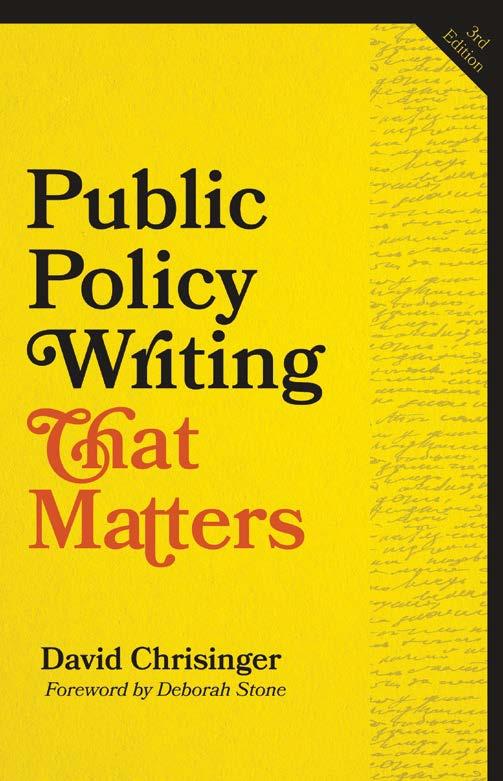
David Chrisinger is the director of the policy writing program at the University of Chicago’s Harris School of Public Policy. He is the author of Stories Are What Save Us: A Survivor’s Guide to Writing about Trauma and the co-author of Because Data Can’t Speak for Itself: A Practical Guide to Telling Persuasive Policy Stories
David Chrisinger, foreword by Deborah Stone
Effective policy writing holds the transformative power to inspire action, shape public opinion, and influence outcomes. In the third edition of Public Policy Writing That Matters , communications expert David Chrisinger, who directs the Harris Writing Workshop at the University of Chicago and worked in the US Government Accountability Office for nearly a decade, continues to demystify the art of writing persuasively about public policy.
Effective public policy writing is a catalyst for meaningful societal change. Chrisinger argues that by mastering the craft of clear, concise, and compelling communication, writers can elevate their ability to influence decision-makers, mobilize communities, and drive lasting and positive change. The book combines practical advice, insightful analysis, and hands-on exercises to provide a comprehensive guide for readers who want to improve their policy-writing skills. Offering real-world examples and cautionary tales, it offers a step-by-step approach to crafting impactful policy analysis, leveraging evidence, and framing arguments persuasively.
Aimed at helping students and professionals overcome their default impulses to merely “explain,” this book reveals proven tips for writing sophisticated and persuasive policy analysis that is also easy to understand. For anyone interested in planning, organizing, developing, writing, and revising accessible public policy, Chrisinger offers a step-bystep guide that covers everything from the most effective presentation methods to the best ways to write a sentence.

Available 06/02/2026
$89.95 • Hardcover • 9781421454474
$54.95 • Paperback • 9781421454481
248 pages • 6 x 9” • 1 b&w photo, 9 b&w illus. Also available as an ebook
Dwight E. Neuenschwander is an emeritus professor of physics at Southern Nazarene University. He is the author of Emmy Noether’s Wonderful Theorem and How to Involve Undergraduates in Research: A Field Guide for Faculty
Dwight E. Neuenschwander
Understanding tensors is essential for physics students who encounter phenomena where direction matters. A jet stream rushing overhead can trigger vertical convection that leads to thunderstorms. An unbalanced car wheel spinning around a horizontal axis produces a wobble in the vertical plane. Astronauts orbiting Earth observe an electrostatic field as a magnetic one. In all these cases, tensors offer a language that captures directional relationships with precision. In the second edition of Tensor Calculus for Physics , Dwight E. Neuenschwander provides an accessible guide that shows how tensor logic arises naturally from physical problems.
Tensors’ true elegance lies in how they transform: when coordinates change from one system to another, tensors follow the same rules, allowing physical laws to retain their form across perspectives. Students are often introduced to tensors piecemeal through the inertia tensor in classical mechanics or the polarization tensor in electricity and magnetism. While useful, this fragmented approach does not prepare the student for tensor features such as affine connections, dual basis vectors, and covariant derivatives they will encounter in advanced studies such as general relativity, continuum mechanics, or non-Euclidean geometry. This concise guide builds from the ground up, providing a clear, step-by-step progression that embeds tensors in contexts where their power becomes self-evident.
This extensively revised second edition incorporates more illustrative examples and carefully designed homework problems to strengthen understanding. Now accompanied by a solutions manual, this edition is an ideal resource for courses in general relativity, covariant electrodynamics, continuum mechanics, fluid dynamics, materials science, and any discipline where tensors illuminate the structure of physical reality.

Available 04/28/2026
$29.95 • Paperback • 9781421454634
320 pages • 6.125 x 9.25” • 13 b&w illus. Also available as an ebook
Carlo Ginzburg has taught at the University of Bologna, the University of California, Los Angeles, and the Scuola Normale Superiore di Pisa. The recipient of the 2010 International Balzan Prize, he is author of The Cheese and the Worms: The Cosmos of a Sixteenth-Century Miller and Clues, Myths, and the Historical Method, also published by Johns Hopkins.
The Cosmos of a Sixteenth-Century Miller, Fiftieth Anniversary Edition
Carlo Ginzburg, translated by John Tedeschi, Anne C. Tedeschi, and Stephen Twilley
The Cheese and the Worms is an incisive study of popular culture in the sixteenth century as seen through the eyes of one man, the miller known as Menocchio, who was accused of heresy during the Inquisition and sentenced to death. In the fiftieth anniversary edition of this now-classic book, Carlo Ginzburg uses the trial records to illustrate the religious and social conflicts of the society Menocchio lived in.
For a common miller, Menocchio was surprisingly literate. In his trial testimony, he made references to more than a dozen books, including the Bible, Boccaccio’s Decameron, Mandeville’s Travels, and a “mysterious” book that may have been the Koran. And what he read he recast in terms familiar to him, as in his own version of the creation: “All was chaos, that is earth, air, water, and fire were mixed together; and of that bulk a mass formed—just as cheese is made out of milk—and worms appeared in it, and these were the angels.”
Ginzburg’s massively influential book has been widely regarded as an early example of the analytic, case-oriented approach known as microhistory. In the preface, Ginzburg offers his own corollary to Menocchio’s story as he considers the discrepancy between the intentions of the writer and what gets written. The Italian miller’s story and Ginzburg’s work continue to resonate with modern readers because they focus on how oral and written culture are inextricably linked. Menocchio’s 500-year-old challenge to authority remains evocative and vital today.
BIOGRAPHY & AUTOBIOGRAPHY / Political
Available 04/21/2026
$39.95 • Hardcover • 9781421454016
416 pages • 6 x 9” • 18 b&w illus. Also available as an ebook
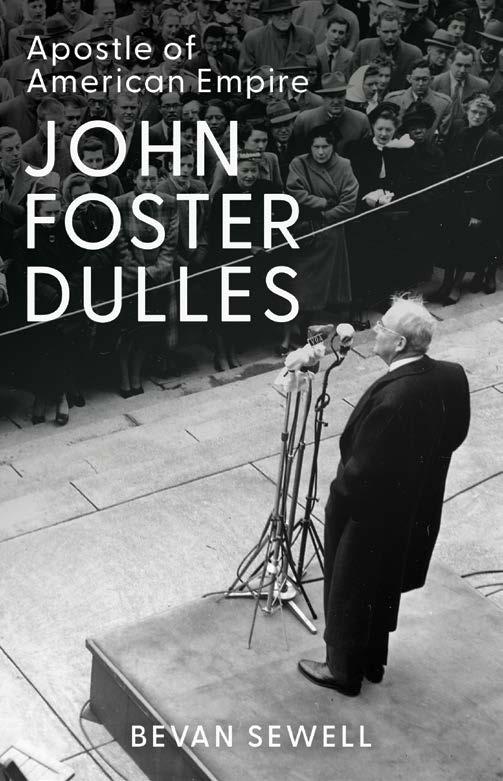
Bevan Sewell is an associate professor of American history at the University of Nottingham. He is a former editor of the Journal of American Studies and the author of The US and Latin America: Eisenhower, Kennedy, and Economic Diplomacy in the Cold War
John Foster Dulles is a towering yet misunderstood figure in American and international history. Best known as secretary of state under Dwight D. Eisenhower and as the namesake for the Dulles airport, he has long been cast as a Cold War hardliner—moralizing, rigid, and ready to meet Soviet threats with nuclear force. Yet this view, while enduring, leaves much of his intellectual legacy unexplored.
In John Foster Dulles , Bevan Sewell presents a compelling intellectual biography that restores Dulles as a central architect of the Americanled world order in the twentieth century. Across a remarkable career that spanned the Versailles Peace Conference, landmark legal work on international finance, leadership in Christian ecumenical movements, and his role as one of the first US representatives to the nascent United Nations, Dulles consistently sought to shape a global system anchored by American values in a transnational context . His was a vision of peace not as passive coexistence but as a dynamic, evolving framework of moral, economic, and political order from a transatlantic perspective. Far from the caricature of an inflexible ideologue, Dulles emerges as a thinker attuned to the complexities of change. His philosophical pragmatism, informed by religious conviction and transnational experience, guided a lifelong search for durable solutions to global conflict—even as it exposed glaring contradictions in his policies.
Dulles’s work was rooted in empire, inspired by a belief in American exceptionalism, and constrained by the biases of his time. Based on wide-ranging research and a sharp reassessment of Dulles’s intellectual development, John Foster Dulles reframes his legacy for a new generation and offers a substantial new interpretation of his influence on US foreign relations in the twentieth century.
/ Indigenous / Contact, European Invasion & Exploration
Available 05/19/2026
$34.95 • Hardcover • 9781421454566
400 pages • 6 x 9” • 11 b&w illus. Also available as an ebook
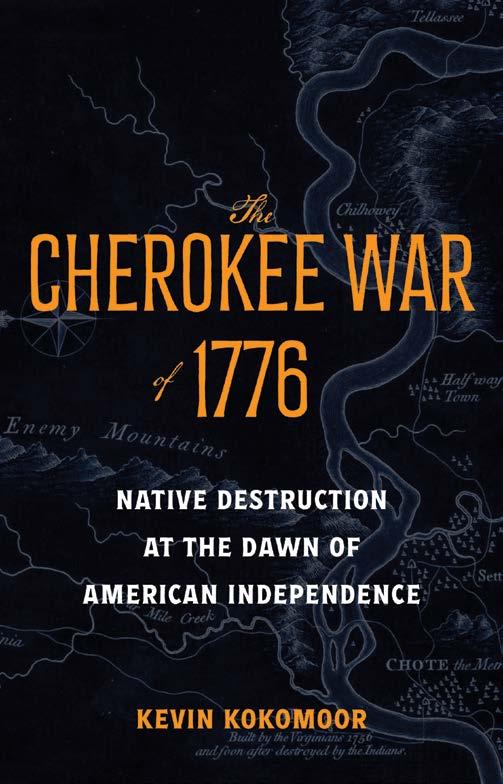
Kevin Kokomoor is a lecturer in the history department at Coastal Carolina University. He is the author of Of One Mind and Of One Government: The Rise and Fall of the Creek Nation in the Early Republic and La Florida: Catholics, Conquistadores, and Other American Origin Stories
Native Destruction at the Dawn of American Independence
Kevin Kokomoor
Americans remember 1776 as the year liberty was declared, the moment they cast off tyranny and proclaimed the self-evident truths of equality and freedom. But that same summer, as patriots celebrated their defiant new nation, American armies launched another campaign—this one aimed at destroying the Cherokee nation.
The Cherokee War of 1776 recasts America’s founding moment by tracing the importance of westward ambition and settler violence to the origins of the Revolutionary War. In this gripping and sobering book, historian Kevin Kokomoor uncovers the rarely acknowledged war waged by the emerging United States against the Cherokee people just days after the Declaration of Independence was signed. Far from a spontaneous frontier skirmish, this war was a coordinated, state-backed campaign with a clear aim: seize Indigenous land and crush Native resistance. Many of the very men who championed liberty on parchment simultaneously advocated for the wholesale destruction of a sovereign Native nation.
At the heart of this story is Cherokee resistance, which was strategic, determined, and deeply rooted in community dynamics. Figures like Dragging Canoe emerged to lead a movement that endured long after American armies had burned Cherokee towns to the ground. Kokomoor foregrounds Cherokee voices, motivations, and resilience, challenging the notion that they were merely pawns in a colonial struggle and forcing us to reckon with the real costs of independence and the long fight for Indigenous sovereignty.
and
Available 06/23/2026
$64.95 • Hardcover • 9781421453170
264 pages • 6 x 9” • 5 b&w illus. Also available as an ebook
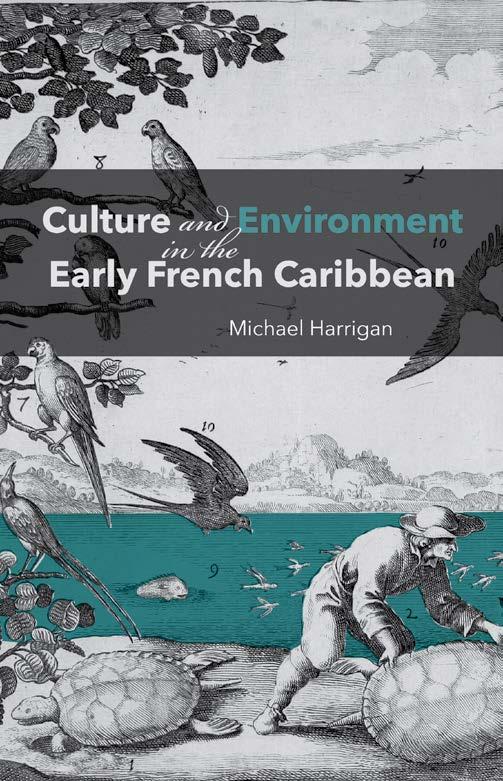
Michael Harrigan is the author of Life and Death on the Plantations: Selected Jesuit Letters from the Caribbean and Frontiers of Servitude: Slavery in Narratives of the Early French Atlantic
Michael Harrigan
The early French colonies in the Caribbean brought great demographic, economic, and agricultural changes, with settlers introducing crops, animals, and new forms of labor into ecosystems that imposed their own limitations. In these settlements, ideas and practices concerning the environment, ranging from the preparation of food and drink to medical treatments, drew on both European and non-European knowledge. Yet social, gender, and linguistic barriers restricted what colonial populations knew about Caribbean ecosystems. Colonial practices such as feasting distinguished culture from wilderness, and people from one another; in an environment in which cultivation signified culture, the plantations were ultimately an unstable model in ecological and social terms.
Drawing on a wide range of source material including manuscript treatises and correspondence, natural histories, engravings, and missionary texts, Michael Harrigan explores how people interacted within their environment during early French colonization in the Caribbean from the mid-1620s to 1730. Examining the ways in which colonial culture and the environment were intertwined, this book explores how relationships between colonial populations were reflected in their environment and in the landscape itself. Distinct human preoccupations determined cultural forms, with these forms in turn shaped by the contingencies of early settlement. Knowledge of Caribbean ecosystems, Harrigan contends, could constitute a powerful body of techniques while being fragmented and driven by approaches to the environment focused on human priorities.

HISTORY / United States / State & Local / West (AK, CA, CO, HI, ID, MT, NV, UT, WY)
Available 01/06/2026
$59.95 • Paperback • 9781421453545
248 pages • 6 x 9” • 4 b&w photos, 3 b&w illus. Also available as an ebook
Xu is an assistant professor at the University of Washington.
San Francisco’s 1906 Earthquake and the Paradox of American Immigration Policy
Dafeng Xu
San Francisco’s Chinatown is the oldest Chinatown in North America and one of the largest Chinese enclaves outside Asia. Spanning 30 city blocks and home to tens of thousands of monolingual Chinese residents, its endurance is remarkable—especially given how close it came to erasure.
In this fascinating history, Dafeng Xu uncovers the contested history of this vibrant community, focusing on the transformative period surrounding the 1906 earthquake and fire that destroyed 80 percent of the city, including Chinatown. White San Franciscans saw the disaster as an opportunity to permanently displace the neighborhood. Instead, Chinatown was rebuilt— but not without conflict or consequence. Using detailed census data and other historical documents, Xu examines how this rebuilt Chinatown differed socially and physically from its earlier form—and the many ways it stayed the same. He explores whether the earthquake shifted patterns of segregation, if and how Chinese immigrants navigated pressure to assimilate—including adopting English, changing their names, and leaving ethnic neighborhoods—and whether they gained economic ground in the city’s new landscape.
Xu’s study reveals a striking contradiction: while Chinese Americans were often criticized for not assimilating, systemic barriers made that very process nearly impossible. The post-disaster Chinatown became a symbol of cultural resilience, shaped by both community agency and persistent exclusion. Rich in insight and original research, Chinatown offers a powerful look at how disaster, racism, and resistance shaped one of America’s most storied immigrant neighborhoods.
“Using historical censuses and archival material, Xu details the evolution of San Francisco’s Chinatown and the importance of the 1906 earthquake in shaping its transformation. The historical racism experienced by Chinese San Franciscans—and their resistance—hold important relevance to today’s immigration debates, making this book valuable for scholars and students alike.”
—Wei Li author
of Ethnoburb: The New Ethnic Community in Urban America
Available 02/03/2026
$29.95 • Paperback • 9781421453804
152 pages • 5 x 7” • 2 figures Also available as an ebook
Paul B. Greenberg , MD, MPH, is a professor of surgery at the Warren Alpert Medical School of Brown University.
John C. Lin is a medical student at the University of Pennsylvania Perelman School of Medicine.
Victoria L. Tseng , MD, PhD, is an assistant professor in residence and the residency program director in the ophthalmology department at the University of California, Los Angeles.
Paul B.
Greenberg,
MD, MPH, John C. Lin, and Victoria L. Tseng, MD, PhD, foreword by Mukesh K. Jain, MD
Practical advice for medical students, based on the premise that every student can participate meaningfully in research and scientific discovery. This guide supports learners through every step—from preparation and project design to publication and presentation.
The authors bring together the essential perspectives of a senior and junior faculty member and a current medical student, resulting in an accessible resource tailored to the realities of academic medicine today. Whether students are new to research or seeking innovative ways to enhance their current projects, this guide delivers strategic advice on securing mentors, identifying goals, managing time, navigating team dynamics, and producing impactful written work. Case studies highlight how students have shaped medical history and address the practical challenges they face, such as limited experience, uneven mentorship, and competing demands. The authors present helpful tools to overcome these barriers and reinforce the importance of sustaining resilience and wellbeing. The Medical Student’s Field Guide to Research fills a significant gap in the way students are trained and offers them the confidence and clarity needed to become physicians and vital contributors to the scientific community.
“From that first intimidating email to a potential mentor to seeing your name in print, this book transforms the mysterious world of medical research into an achievable journey. With the perfect blend of inspiration and nuts-and-bolts guidance, it’s the mentor-in-your-pocket that every medical student needs.”
—Ravi Parikh, MD, MPP
Associate Professor of Hematology and Medical Oncology, Emory University
are subject to change without notice.
Available 05/05/2026
$89.95 • Paperback • 9781421453965
480 pages • 7 x 10” • 79 color photos, 76 b&w illus.
Also available as an ebook
edited by Megan Weil Latshaw and Joseph P. Bressler
Everything around us—air, water, food, buildings, neighborhoods—shapes our health in profound ways. Edited by Megan Weil Latshaw and Joseph P. Bressler, this essential textbook offers a comprehensive foundation in environmental health to help students understand how physical, chemical, biological, and social environments influence well-being.
This textbook provides clear, accessible coverage of the key topics required by instructors, including legacy content from traditional environmental health syllabi and new competency-based standards. Students will explore environmental exposure assessment, toxicology, epidemiology, air and water pollution, food safety, occupational health, and risk assessment.
They’ll also examine broader systemic issues, such as climate change, food systems, environmental justice, and the intersection of human, animal, and ecosystem health. Emerging concerns like “forever chemicals,” global waste, and the health impacts of the built environment are addressed alongside traditional core topics. Through a systems-thinking lens, the book encourages readers to analyze complex, real-world challenges and consider policy and intervention strategies that can improve health outcomes at individual, community, and global scales. Engaging case studies and clear learning objectives reinforce each chapter’s key concepts.
The Environment and Your Health equips students with the knowledge and perspective to understand how their environment shapes their health— and how they can help shape healthier environments.
P.

Available 05/12/2026
$28.95 • Paperback • 9781421454436 224 pages • 5.5 x 8.5” Also available as an ebook
Michael Rozier is an associate professor of health management and policy and vice provost at Loyola University Chicago.
Approaching Health Care with A New Faith-Based Vision
Michael Rozier
In a country where more than one in five hospital beds belong to religious institutions, amid skyrocketing costs, deepening inequities, and burnout across the health care system, Growing Our Moral Imagination challenges us to see beyond policies and procedures to the stories and values that shape how we care for one another.
Michael Rozier, a scholar of public health and health care services and a Jesuit priest, turns to the Gospels to explore how foundational stories of healing might guide our response to today’s most pressing health challenges. But rather than retell familiar miracles, he instead examines where social stigma, isolation, injustice, and spiritual suffering intersect with physical care. How do we make sense of illness for which there is no cure? How do we respond to needs that medicine alone cannot meet? Through nine compelling contemporary stories inspired by Scripture, Rozier examines the emotional and ethical complexity of topics such as addiction, mental health stigma, elder loneliness, social safety nets, and the crisis of preventable disease. He suggests that the biggest barrier to having the health care system we deserve is not a lack of practical expertise but an inability to imagine what is possible, and he shows how religious insights might guide us toward more responsive, compassionate systems of care.
This book invites readers, both religious and secular alike, to imagine a future where prevention is prioritized, care is communal, and wellness includes the whole person. With theological insight and public health expertise, Rozier helps us see that health care is not merely an industry; it’s a reflection of our deepest values and collective responsibility.
Available 04/28/2026
$29.95 • Paperback • 9781421451763
208 pages • 6 x 9”
Also available as an ebook
Panagis Galiatsatos, MD, MHS, is an associate professor and a co-founder and co-director of Medicine for the Greater Good at the Johns Hopkins School of Medicine. He is a coauthor of Building Healthy Communities through Medical-Religious Partnerships
Health begins long before a patient enters a clinic or hospital. It takes root in the neighborhoods, families, and faith communities that shape our daily lives. In Medicine for the Greater Good , Panagis Galiatsatos shows how physicians, community leaders, and health systems can work together to strengthen those roots and transform the way we understand and deliver care.
Dr. Galiatsatos offers a compelling vision of health care that extends beyond the exam room. Chapters highlight the expanding role of Community Health Workers, advice for treating both children’s and adults’ mental health, and insights from a surgeon and a religious leader working to advance community-focused projects at the state level. Through partnerships with churches and community organizations, volunteers are trained as trusted health educators, addressing challenges that medical advice alone cannot solve. These collaborations create lasting networks of support that improve access to screenings, encourage healthier lifestyles, and foster trust between institutions and communities. Examples drawn from initiatives developed during and after the pandemic underscore how resilient, adaptive outreach can save lives while reducing costs for hospitals and health systems.
In an era when population health and cost efficiency are under intense scrutiny, this book offers a model rooted in trust, compassion, and the shared work of building healthier communities. Whether you are a health care professional frustrated by seeing the benefits of your team’s service end at the clinic door or a community member who sees the benefits of connecting with your local health system, this first-hand account will give you the inspiration to get started.
Available 05/05/2026
$34.95 • Paperback • 9781421454337
280 pages • 6 x 9” • 16 b&w photos, 5 b&w illus., 3 maps
Also available as an ebook
Barry R. Davis is professor emeritus and the former Guy S. Parcel Chair in Public Health at the University of Texas School of Public Health.
Barry R. Davis, MD, PhD, foreword by Charles Hennekens, MD, DrPH
What drives someone to challenge the status quo to prevent disaster? In The Preventioneers , Barry R. Davis chronicles the work of bold individuals who recognized the warning signs of catastrophe and intervened before tragedy could strike. With stories that include fire, disease, climate change, and public health, Davis illuminates the efforts of those who confronted indifference, ignorance, and inertia to shift society’s focus from reaction to prevention.
Through real-world case studies and historical research, The Preventioneers introduces readers to a diverse cast of problem-solvers who identified threats, persuaded skeptics, and devised practical solutions. In colonial Boston, a young Benjamin Franklin witnessed one of the city’s most devastating fires. Haunted by that memory, Franklin grew into a lifelong advocate for fire prevention. Ignaz Semmelweis and Sara Josephine Baker fought to raise awareness of and prevent child and maternal mortality. Richard Doll’s work to establish the link between smoking and lung cancer revealed the danger of what many viewed as a harmless activity. These inspiring stories exemplify the central message of the book: Prevention is a powerful form of civic action. Their work underscores how principles of prevention transcend fields, whether addressing maternal mortality, auto safety, cancer, or climate change.
Davis underscores that successful prevention requires more than knowledge; it also demands courage, strategy, and relentless advocacy. In doing so, The Preventioneers introduces a framework for thinking about how societies can act early, save lives, and build a healthier, more resilient future.
Available 03/03/2026
$34.95 • Hardcover • 9781421454245
384 pages • 6 x 9”
Also available as an ebook
Jason Gale is an award-winning journalist and a senior editor and biosecurity correspondent at Bloomberg News.
Jason Gale
The Covid-19 pandemic may have faded from headlines, but its shadow remains. In After Covid , award-winning journalist Jason Gale delivers a gripping, deeply researched account of a crisis that has fundamentally changed the world, and continues to reshape it in ways we’re only beginning to understand.
In this riveting account of the pandemic and its devastating ripple effects, Gale captures the pandemic’s messy realities—the panic it spurred, the misinformation and political infighting that stood in the way of controlling it, and the heroic efforts by scientists and health care workers to contain it. Gale exposes what went wrong, what worked, and what continues to threaten us. From the pandemic’s chaotic beginnings to the hidden toll of Long Covid, he examines how governments shaped—and sometimes warped—the public narrative around the pandemic. He documents the consequences still unfolding: the rise of chronic illness, the erosion of healthcare systems, the deepening mental health crisis, and the dangerous spread of anti-science extremism.
This book is a powerful, evidence-based reminder that pandemics don’t end when case numbers fall. They linger in damaged bodies, strained institutions, and collective memory. Gale connects the dots between lingering symptoms and systemic failure, offering a sweeping view of what’s at stake if we choose to forget. After Covid urges readers to confront the true scope of the pandemic’s legacy—and the vulnerabilities it has revealed in our systems, societies, and selves.
“Jason is a topflight health and science journalist who followed the course of the pandemic every step of the way. He interviewed many of the world’s important COVID scientists and healthcare workers on the front lines. After Covid documents the key events of the pandemic; it will become an enduring chronicle for future students of pandemics and pandemic threats.”
—Peter J.Hotez, MD, PhD Baylor College of Medicine

Available 01/06/2026
$59.95 • Hardcover • 9781421453644
296 pages • 6 x 9” • 22 b&w illus. Also available as an ebook
Ian Rockett is emeritus professor of epidemiology at West Virginia University and an adjunct professor of psychiatry at the University of Rochester.
Ian Rockett, foreword by Hilary S. Connery
In Hidden Suicides and Fatal Overdoses , Ian Rockett confronts the persistent crisis of suicide misclassification in the United States. Various institutional, cultural, and political forces distort suicide statistics and mask the full scale of self-inflicted injury mortality. This deeply informed book proposes a more inclusive and accurate framework for measuring fatal self-injury, one that challenges the sufficiency of official suicide counts and the narrow definitions that underpin them.
At the heart of this problem is a web of stigma, religious taboos, familial denial and shame, punitive insurance policies, an opioid epidemic, underfunded forensic and emergency health care systems, and disparities in access to physical and mental health care. These forces not only distort epidemiologic data; they also hinder the development of effective public health interventions. Rockett documents how these systemic failures compromise a broader understanding of who is at risk and situates suicide undercounting within the broader context of health inequity and forensic fragmentation, tracing profound implications for research, policy, prevention, and treatment. A mix of empirical data and personal reflections underscore the emotional gravity behind the data and the complex interplay between pain and social context.
This book details how and why societies fail to recognize and reckon with suicide. Rockett invites readers in public health, clinical medicine, forensics, policy, and beyond to confront the fragile scaffolding of official suicide records—and to consider what more honest accounting might make possible. An optimistic cautionary tale, this book’s lessons have relevance across the globe.
“Professor Rockett’s essential book reveals unacceptable deficiencies in the way America counts suicide and overdose fatalities, while presenting a groundbreaking framework for understanding self-injury. He highlights the serious and mounting consequences of conceptualizing suicide and overdose deaths as separate threats and establishes a robust basis for revitalizing preventative initiatives.”
—Mark Olfson Columbia University
Available 05/05/2026
$29.95 • Paperback • 9781421453088 240 pages • 6 x 9” • 12 b&w illus. Also available as an ebook
Perry N. Halkitis is the dean, the Hunterdon Professor of Public Health and Health Equity, Distinguished Professor of Biostatistics, & Epidemiology, and the Director of the Center for Health, Identity, Behavior, and Prevention Studies at Rutgers School of Public Health. He is the author of Out in Time: The Public Lives of Gay Men from Stonewall to the Queer Generation and The AIDS Generation: Stories of Survival and Resilience
We are doomed to live through pandemics as long as we rely on biomedical advances to save us. In Humanizing Public Health , Perry N. Halkitis explores how human behavior, societal structures, and flawed public health approaches fuel the spread of infectious diseases. With extensive experience as an epidemiologist and public health psychologist, Halkitis critiques the biomedical paradigm that dominates pandemic responses, advocating instead for a holistic, person-centered model.
A purely biological perspective on these viruses, which dominates so much of the conversation around pandemics, falls short in protecting the health of populations. Instead, Halkitis illuminates how psychological, social, and structural factors—such as misinformation, systemic inequities, and cultural beliefs—create ideal conditions for pathogens to thrive and for pandemics to spread. A more holistic approach to public health and health care delivery can help advance our efforts in fighting diseases which, in turn, should also help advance health equity. Halkitis explores key lessons from the HIV and COVID-19 pandemics while offering actionable insights to reimagine public health education, preparedness, and equity.
This book challenges readers to confront the human behaviors and systemic barriers perpetuating pandemics and presents a transformative vision for preventing future crises. With clarity and compassion, Halkitis empowers public health professionals, policymakers, and the public to rethink the way we approach health crises by emphasizing the importance of empathy, community engagement, trust-building, and political acumen as cornerstones of effective prevention and care.
Available 04/07/2026
$54.95 • Hardcover • 9781421454412
392 pages • 6 x 9” • 11 b&w illus. Also available as an ebook
Lisa M. Sullivan is a professor of biostatistics and the associate dean for education at Boston University’s School of Public Health. She is the author of Essentials of Biostatistics in Public Health
Sandro Galea is the Margaret C. Ryan Dean of the School of Public Health at Washington University. He is the author of Healthier: Fifty Thoughts on the Foundations of Population Health
edited by Lisa M. Sullivan and Sandro Galea
In an era shaped by the seismic effects of the COVID-19 pandemic and politically derived challenges, the second volume of Teaching Public Health offers a timely and essential contribution to the evolving field of public health education. Building on the success of its predecessor, editors Lisa M. Sullivan and Sandro Galea convene a distinguished group of educators to examine what it means to teach public health today.
Spanning the foundational and the forward-thinking, this collection addresses core themes such as racial justice, science communication, law, data literacy, advocacy, and systems thinking. It offers practiceinformed insights into teaching the craft and values of public health in ways that are relevant, accessible, and effective. Anyone who teaches public health in times of heightened challenge will find practical strategies for guiding students through complex material, fostering community partnerships, and supporting diverse learning needs in hybrid, in-person, and online settings. The volume also explores the changing culture of classrooms—rethinking assessment, reimagining attendance, and redefining academic integrity—as well as the institutional structures that shape how teaching is supported, rewarded, and sustained.
Recognizing the demands placed on both instructors and learners, contributors share approaches to supporting wellness, preventing burnout, and preparing educators across the academic lifecycle. At once a snapshot of where the field stands and a vision for where it can go, Teaching Public Health (Volume 2) is a resource for educators, administrators, and institutions committed to ensuring that public health teaching remains dynamic, inclusive, and responsive to the world it serves.

Available 03/24/2026
$64.95 • Paperback • 9781421454146 208 pages • 6 x 9”
Also available as an ebook
Kevin J. A. Thomas is a distinguished professor of sociology at Rice University. He is the author of Global Epidemics, Local Implications: African Immigrants and the Ebola Crisis in Dallas and Diverse Pathways: Race and the Incorporation of Black, White, and Arab-Origin Africans in the United States
Kevin J. A. Thomas
What happens to survivors when an epidemic ends and the headlines fade? In Life After Epidemics , Kevin J. A. Thomas confronts this pressing question through the voices of those who lived through the world’s deadliest Ebola outbreak. Based on interviews with 250 survivors in Liberia and Sierra Leone, the book reveals how, years after their recovery, many survivors continue to endure long-term health issues, economic hardship, and social exclusion, conditions which are often exacerbated by their preexisting marginalization.
The 2014—2016 West African Ebola epidemic left more than 17,000 survivors. Yet even as governments and international agencies celebrated medical successes and invested in disease surveillance and vaccine development, they offered minimal attention to the social realities unfolding in the epidemic’s aftermath. This book documents how the lack of sustained social response through support for livelihoods, reintegration, and long-term care has had lasting consequences on survivors and their communities. Thomas argues that these devastating consequences are even worse for those already facing poverty, stigma, and social invisibility.
Yet amid these challenges, many survivors have found ways to reframe their experiences, participate in recovery efforts, and forge new roles within their communities. Their stories speak not only to resilience but to the unfinished work of public health systems that still treat survival as a conclusion rather than a beginning. Life After Epidemics makes the case that addressing the aftermath of outbreaks must go beyond emergency medical responses to encompass the complex social dimensions that shape recovery while reconsidering what it means to truly heal after crisis.
Available 03/03/2026
$64.95 • Paperback • 9781421454054
336 pages • 6 x 9” • 11 b&w photos, 9 b&w illus. Also available as an ebook
Heather Vrana is an associate professor of modern Latin America at the University of Florida. She is the author of This City Belongs to You: A History of Student Activism in Guatemala and a coeditor of Out of the Shadow: Revisiting the Revolution from Post-Peace Guatemala
David Carey Jr. is the Doehler Chair in History at Loyola University Maryland. He is the author of Health in the Highlands: Indigenous Healing and Scientific Medicine in Guatemala and Ecuador and Oral History in Latin America: Unlocking the Spoken Archive, among other books.
edited by Heather Vrana and David Carey Jr.
Histories of Disability in Latin America offers a sweeping reexamination of disability’s place in the region’s past, bringing together original scholarship by historians and anthropologists to illuminate how bodies, minds, and the concept of difference have been understood across centuries of Latin American history. Edited by Heather Vrana and David Carey Jr., this volume foregrounds the lived experiences, agency, and social meanings of disability in a region too often marginalized in global disability studies.
With contributions and case studies based on archival and ethnographic research, the book illustrates how colonialism, slavery, war, industrialization, imperialism, and revolution have generated both disability and distinctive conceptions of disability. Rather than applying rigid Western frameworks, contributors examine Indigenous and AfroLatin American terminologies and epistemologies to explore how societies have made sense of bodily difference, care, and capacity. In doing so, they critically engage medicalized and deficit-based interpretations that have long dominated historical and scholarly narratives. This collection shifts the center of inquiry to Latin America, interrogates presentist assumptions, and reconsiders the historical emergence of disability through the prisms of race, class, gender, and power.
Histories of Disability in Latin America engages and expands key debates in both disability studies and Latin American historiography. This book invites readers to rethink what disability has meant—and continues to mean—across time and place. It is essential reading for those interested in the entanglements of embodiment, identity, and the historical forces that have shaped life in the Americas.
Available 02/17/2026
$49.95 • Paperback • 9781421453750
240 pages • 6 x 9” • 45 b&w illus. Also available as an ebook
Christopher JW McClure is the executive vice president of science and conservation at The Peregrine Fund. He is a coeditor of Applied Raptor Ecology: Essentials from Gyrfalcon Research
Christopher JW McClure
Counting birds may sound simple—just step outside and start tallying. But in reality, it’s a complex and essential endeavor at the core of modern wildlife conservation. In How to Count Birds , conservation biologist Christopher JW McClure offers a practical guide to designing effective bird monitoring programs that inform real-world management and conservation strategies.
As species vanish at unprecedented rates, having accurate population data is more urgent than ever. Yet too often, flawed study designs and outdated techniques lead to wasted time, ill-used resources, and misleading conclusions. McClure equips researchers, students, and birders with the tools to design efficient studies that avoid common pitfalls and capture what’s truly happening in bird populations. This guide explains the biological, statistical, and philosophical principles behind good monitoring and explores study designs for estimating key demographic rates like survival and reproduction. McClure surveys the techniques used to estimate populations and highlights methods prone to error. Throughout, he advocates for a shift away from traditional approaches toward more precise techniques available today, such as acoustic monitoring and occupancy modeling.
Effective study design requires collaboration among wildlife managers, field biologists, and statisticians from the start, as well as flexibility for field conditions and methodological adaptability. Whether you’re just beginning or reevaluating a long-standing program, How to Count Birds is a timely reminder that precision and planning are just as critical as passion in the work of conservation.
“A short, dense and yet superbly readable compendium of best practices for bird monitoring. With a deceptively simple language, McClure’s text is extremely wide-ranging, covers much ground and introduces plenty of deep and useful ideas a—real page turner.”
—Marc Kéry Swiss Ornithological Institute
SCIENCE / Life Sciences / Zoology / Invertebrates
Available 01/20/2026
$74.95 • Hardcover • 9781421453521
216 pages • 6 x 9” • 41 b&w illus. Also available as an ebook
Caryn C. Vaughn is a George Lynn Cross Distinguished Research Professor and President’s Associates Presidential Professor at the Oklahoma Biological Survey and in the School of Biological Sciences at the University of Oklahoma.
Caryn C. Vaughn
Freshwater mussels are among the most endangered animals on the planet—and some of the most ecologically important. As powerful filter feeders and ecosystem engineers, mussels influence everything from water clarity and nutrient cycling to the structure of entire aquatic communities. In The Functional Ecology of Freshwater Mussels , Caryn C. Vaughn offers the most comprehensive synthesis to date of how mussels shape the ecosystems they inhabit.
Integrating more than 30 years of original field and laboratory research with a rapidly expanding global literature, Vaughn examines how mussels support water quality, contribute to biogeochemical processes, influence food web dynamics, and enhance biodiversity across aquatic and adjacent terrestrial environments. Chapters detail the biology and life history of mussels, the complex interactions within their communities, and the environmental conditions that influence their performance. Vaughn shows how species-specific traits and environmental context shape the magnitude of diverse mussel functions. With attention to the consequences of species composition, habitat variation, and climate stressors, the book shows how mussel-driven processes scale from individual organisms to entire river systems.
Vaughn presents practical strategies for conservation and explains how effective restoration requires linking mussel biology with the goals of broader ecosystem management. The Functional Ecology of Freshwater Mussels is an essential reference for ecologists, conservation professionals, aquatic resource managers, and policymakers concerned with the sustainability of freshwater systems.
“A fitting capstone to Caryn Vaughn’s remarkable career, this book details how biological processes of freshwater mussels positively impact riverine habitats, promoting ecosystem function. Expertly researched and concisely written, the text is accessible to students and professionals alike. An invaluable guide to understanding the intricacies of freshwater mussels.”
Paul D. Johnson
Alabama Aquatic Biodiversity Center, Alabama Department of Conservation and Natural Resources
Available 05/19/2026
$54.95 • Paperback • 9781421454726
368 pages • 6 x 9” • 5 b&w photos, 7 b&w illus., 2 maps
Also available as an ebook
Christos Lynteris is a professor of medical anthropology at the University of St Andrews. He is the author of Visual Plague: The Emergence of Epidemic Photography.
Today, rats are nearly synonymous with plague, but this association is surprisingly recent. For centuries, plague devastated populations without being linked to animals at all. So how did the rat become the symbol of one of history’s deadliest diseases? In How Plague Got Rats , anthropologist Christos Lynteris unravels this story by focusing on the Third Plague Pandemic, a global outbreak that began in China in the 1850s and claimed an estimated 15 million lives by the mid-twentieth century.
This was the first major pandemic recognized by scientists as zoonotic— spread from animals to humans—and it marked a turning point in both medical science and global health. Through a gripping historical investigation, Lynteris explores how rats entered the medical imagination of the time. He reveals how scientific thinking about disease vectors evolved in tandem with colonial power structures, as plague responses unfolded across Asia, Africa, and the Americas. From laboratory discoveries to imperial interventions, the rat became central not just to understanding plague, but to shaping new forms of epidemiological reasoning.
This provocative book shows how zoonosis emerged as a politically charged concept in the context of empire and pandemic crisis. It is a powerful history of how science, society, and colonialism converged around a creature now inseparable from the story of epidemic disease.
NATURE / Environmental Conservation & Protection
Available 01/27/2026
$54.95 • Paperback • 9781421453422
320 pages • 6 x 9” • 29 b&w photos, 44 b&w illus. Also available as an ebook
Charles G. Curtin is the director of Regenerative Conservation Design. He is the author of The Science of Open Spaces: Theory and Practice for Conserving Large, Complex Systems and the coeditor of Complex Ecology: Foundational Perspectives on Dynamic Approaches to Ecology and Conservation
Power of Regenerative Thinking in the Face of Crisis
Charles G. Curtin
How do we move beyond simply surviving in a world of accelerating environmental and social disruption? Place-Based Solutions offers a bold and practical response, charting a path toward what Charles G. Curtin calls “prosilience”—the capacity not just to endure crises, but to leap forward through them. With over thirty years of collaborative, on-theground experience in conservation and climate adaptation, Curtin explores why so many well-intentioned efforts fall short and what distinguishes the ones that succeed.
This book distills decades of applied research and institutional leadership ideas into a framework for designing solutions that are adaptive, durable, and rooted in the strengths of local communities. It explains how to transform the ways people think, organize, and act in response to complex challenges, especially when top-down, technocratic approaches fail to deliver. Place-Based Solutions emphasizes the power of small and mid-sized organizations to catalyze meaningful change, using real-world examples to illustrate how lasting impact depends on aligning ethics, equity, institutional design, and the ability to learn over time.
Curtin encourages readers to shift their focus from the pre-crisis status quo to preparing for—and thriving in—novel futures. Accessible, honest, and deeply grounded in practical solutions, this book assembles a set of proven principles for turning uncertainty in the face of societal transformation into opportunity. It is an essential resource for anyone seeking to understand how humanity can respond to global crises with creativity, integrity, and lasting effect.
“Blending personal insight, ecological practice, and institutional design, Place-Based Solutions offers tools for navigating uncertainty and transformation. Informed by Post-Normal Science, it bridges ethics, policy, and local knowledge through vivid case studies and illustrations—making it an essential resource for educators, practitioners, and communities confronting today’s complex socio-environmental challenges.”
—Silvio Funtowicz European Centre for Governance in Complexity
Available 03/17/2026
$64.95 • Paperback • 9781421454122
336 pages • 6 x 9” • 20 b&w illus., 3 line drawings Also available as an ebook
Kristen Ann Ehrenberger is an assistant professor of medicine and pediatrics at the University of Pittsburgh School of Medicine.
Kristen Ann Ehrenberger
What does it mean to eat well, and why should it matter to the nation? In The Politics of the Table , historian Kristen Ann Ehrenberger uncovers how food became a matter of political concern in modern Germany, tracing the evolution of nutritional science from the laboratory bench to the family dinner table between 1890 and 1935.
This compelling study reveals how everyday meals became sites of public policy, scientific authority, and cultural identity. Germans were encouraged to see their bodies not only as private entities but also as integral parts of a larger social organism in matters ranging from calories and vitamins to ration cards and state-sponsored hygiene exhibitions. Ehrenberger introduces the concept of the “scalar body” to explain how individuals were imagined as connected to one another through the acts of eating, drinking, and digesting. Using a wide array of sources including cookbooks, popular magazines, medical texts, trade journals, and government archives, the book charts how nutrition was promoted as a means to build healthier citizens and a stronger nation. Whether in kitchens or clinics, during wartime shortages or peacetime reforms, food was imbued with moral, medical, and economic significance. The dining table emerged as a focal point where gender roles, social expectations, and state interests converged.
The Politics of the Table illuminates the intimate links between bodily health and national politics in an era of profound social transformation. It challenges readers to reconsider how private habits like eating have long been shaped by public values, and how the politics of food and nutrition continue to resonate today.
Available 01/13/2026
$64.95 • Paperback • 9781421453606 392 pages • 6 x 9” • 21 b&w illus. Also available as an ebook
Andrew Wells is a senior lecturer in early modern history at the Christian-Albrechts-Universität zu Kiel in Germany. He is a coeditor of The “Second World” in Contemporary British Writing
1660—1840
In Generating Difference , Andrew Wells traces the entwined histories of race, sex, and reproduction in Britain and its empire during the long eighteenth century. Challenging the assumption that the concept of race evolved in the modern era solely through new forms of biological science, Wells argues that older ideas of lineage, sexual reproduction, and bodily difference remained central to how race was understood, categorized, and enforced well into the nineteenth century.
From the pages of Enlightenment science to colonial policy in the Caribbean, South Asia, and the Pacific, Wells shows how reproductive sex served as a primary framework for defining human differences. Concepts of identity were written onto bodies—especially those marked as nonwhite or non-male—through perceived differences in anatomy, fertility, and sexuality, albeit never unproblematically. Whether in debates about slavery, interracial relationships, embryology, or population policy, the reproductive body became the crucible in which ideas about race and sex were forged and maintained.
Offering a global scope beyond the Atlantic, including South Asia and the Pacific, and drawing from a wide range of sources—from satire to scientific treatises— Generating Difference brings the scholarship of race and sexuality into direct and compelling conversation. Wells uncovers how deeply reproduction structured imperial ideologies and how the policing of bodies helped naturalize hierarchy, control, and exclusion. At its core, the book reconsiders what made difference “visible” in a period before the dominance of the idea of racial biology.
“Sweeping in scope and method, Generating Difference reveals how the early modern study of human reproduction—especially the female body— became the key site where race and slavery were theorized, contested, and ultimately enforced. An original and bold study demonstrating how biology was made to serve empire.”
—Andrew Curran author of Biography of a Dangerous Idea: A New History of Race from Louis XIV to Thomas Jefferson
Available 06/23/2026
$64.95 • Paperback • 9781421454399
352 pages • 6 x 9” • 17 b&w photos, 9 b&w illus., 4 maps
Also available as an ebook
Roberta J. Magnusson is an associate professor of history at the University of Oklahoma.
Roberta J. Magnusson
In the bustling market towns and growing cities of medieval England between 1200 and 1600, public works were the lifelines of urban society. In Urban Infrastructure in Medieval England , Roberta J. Magnusson offers the first comprehensive study of how medieval towns built, financed, and sustained their defenses, bridges, streets, water systems, and harbors.
Magnusson reveals how even modest communities, like the Warwickshire town of Atherstone, boldly pursued projects that reshaped their futures. Grants of tolls and taxes funded paving initiatives, bridge repairs, and fortified walls, while enterprising lords and abbots sponsored sluices, conduits, and quays. These efforts were not confined to England’s great cities; small towns with limited means also sought to enhance their competitive edge, even when such investments strained their resources. Drawing on royal records, municipal archives, and archaeological evidence, Magnusson situates these civic undertakings in their broader social and environmental contexts. She shows how townsmen adapted traditional obligations of labor and charity alongside innovative fiscal tools to sustain projects that could span generations. Yet the balance was fragile. The crises of the fourteenth century—famine, plague, and the harsher climate of the Little Ice Age—undermined local resources, leaving many communities to struggle with maintenance or watch their infrastructures decline.
At once a history of engineering, economy, and community, this study illuminates how medieval people conceived of security, health, and prosperity through the material fabric of their towns. By tracing the rise, transformation, and survival of these infrastructures, Magnusson demonstrates how urban communities navigated centuries of change while shaping the very landscapes in which they lived.
CRITICISM / Semiotics & Theory
Available 05/12/2026
$59.95 • Paperback • 9781421454450
320 pages • 6 x 9” • 10 b&w illus. Also available as an ebook
Courtney Weikle-Mills is the director of the Children’s Literature program and an associate professor at the University of Pittsburgh. She is the author of Imaginary Citizens: Child Readers and the Limits of American Independence, 1640-1868.
Children’s Literature and Atlantic Enslavement
Courtney Weikle-Mills
What ethical lessons are children taught when their books are funded by enslavement and their childhoods sweetened with sugar? In Sugarcoated Ethics , Courtney Weikle-Mills traces the intertwined histories of children’s literature and the transatlantic slave economy, revealing how stories written for the young often masked the realities of enslavement, consumption, and colonial power.
Focusing on the eighteenth and nineteenth centuries, this book examines how early British and US children’s books emerged alongside and within a world built by enslaved labor. With many texts imported into the colonial Caribbean, the trajectory of children’s literature was shaped by the unethical systems that it failed to fully acknowledge. And yet, in their frequent concern with care, interdependence, and moral formation, children’s books also reflected and distorted the relational crises at the heart of enslavement. Weikle-Mills explores how white-authored stories attempted to “purify” white children from complicity in slavery through narratives of sentimental training, civility, and false reciprocity. At the same time, she recovers traces of Afro-Caribbean storytelling and protest traditions such as songs, oral narratives, and archival fragments that offered radically different models of ethical responsibility rooted in collective action, improvisation, and intergenerational care.
Through literary analysis and archival research, Sugarcoated Ethics reconsiders the ethical stakes of early children’s books and the young readers they addressed. Weikle-Mills shows how relational ethics— concerned with mutual vulnerability, openness to difference, and care across power imbalances—both surfaced and were suppressed in these texts. Her study challenges idealized visions of childhood innocence and expands our understanding of how literature has helped shape, soften, and sometimes resist the moral contradictions of the Atlantic world.
Available 03/17/2026
$64.95 • Paperback • 9781421454078
176 pages • 6 x 9” • 9 b&w photos, 4 line drawings Also available as an ebook
Megan Peiser is an associate professor of eighteenth-century literature at Oakland University.
At the turn of the nineteenth century, British women novelists were publishing more fiction than their male counterparts, yet their place in literary history remains precarious. In British Women Novelists and the Review Periodical , Megan Peiser offers a compelling new perspective on this pivotal period by examining the overlooked power of the review periodical in shaping literary reception, authorial careers, and the novel as a genre.
Through a dynamic study of the Novels Reviewed Database, 1790—1820 (NRD)—the first dataset to systematically catalog novels reviewed as novels during the Romantic period—Peiser demonstrates how these reviews operated not as static judgments, but as an interconnected system of influence, circulation, and criticism. Periodicals functioned as central components of the literary marketplace, steering readers’ tastes, framing authors’ reputations, and reinforcing cultural notions of gender and genre. Examining the context of these reviews—such as Frances Burney’s ambivalent negotiations with her critics and the rise and decline of Charlotte Smith’s status among the “sister-queen” novelists—Peiser’s analysis foregrounds the gendered dynamics of literary evaluation. By tracing the dialogue between reviewers and authors—especially in novel prefaces—she uncovers how women writers used, resisted, and responded to critical discourse. Peiser also confronts the limitations of traditional literary data by accounting for overlooked voices and diverse forms of authorship.
This fascinating literary history argues for feminist bibliographic intervention, restores the complexity of the eighteenth- and early nineteenth-century review ecosystem, and provides a vital scholarly tool to reframe how we understand women’s novels and the systems that have shaped literary memory.

CRITICISM / European / General
Available 06/23/2026
$49.95 • Hardcover • 9781421454191
$49.95 • 6 x 9” • 30 b&w illus. Also available as an ebook
edited by George Boulukos
Coming soon! Studies in Eighteenth-Century Culture (volume 55) edited by George Boulukos.
information, prices, and publication date are subject to change without notice.
Health and Wellness
The 36-Hour Day, 8th ed.
A Family Guide to Caring for People with Alzheimer Disease, Other Dementias, and Memory Loss
By Nancy L. Mace, MA, and Peter V. Rabins, MD, MPH
$24.95 • Paperback • 9781421452463 • 08/12/2025
Is It Alzheimer’s?, 2nd ed.
101 Answers to Your Most Pressing Questions About Memory Loss and Dementia
By Peter V. Rabins, MD, MPH
$18.95 • Paperback • 9781421451480 • 05/06/2025
Aging Well with Diabetes A 10-Point Action Plan for Older Adults
By Medha Munshi, MD, and Sheri Colberg, PhD
$24.95 • Paperback • 9781421451527 • 04/01/2025
Living Well with Autoimmune Diseases
A Rheumatologist’s Guide to Taking Charge of Your Health
By Julius Birnbaum, MD, MHS
$29.95 • Paperback • 9781421451244 • 02/11/2025
Living with Rheumatoid Arthritis, 4th ed.
By Tammi L. Shlotzhauer, MD
$29.95 • Paperback • 9781421449890 • 10/15/2024
The Cancer Journey
Understanding Diagnosis, Treatment, Recovery, and Prevention
By Chadi Nabhan, MD, MBA, FACP
$22.95 • Paperback • 9781421449760 • 08/27/2024
Living Well with Orthostatic Intolerance A Guide to Diagnosis and Treatment
By Peter C. Rowe, MD
$22.95 • Paperback • 9781421450254 • 08/02/2024
Beating Melanoma, 2nd ed.
The Ultimate Patient Resource
By Steven Q. Wang, MD
$22.95 • Paperback • 9781421449487 • 04/23/2024
Fight Heart Disease Like Cancer
By Michael V. McConnell, MD, MSEE
$29.95 • Hardcover • 9781421448466 • 01/02/2024
The Lupus Encyclopedia, 2nd ed. A Comprehensive Guide for Patients and Health Care Providers
By Donald E. Thomas, Jr., MD, FACP, FACR
$39.95 • Paperback • 9781421446844 • 08/09/2023
Dementia Prevention
Using Your Head to Save Your Brain
By Emily Clionsky, MD, and Mitchell Clionsky, PhD
$24.95 • Paperback • 9781421446257 • 03/07/2023
Honest Aging
An Insider’s Guide to the Second Half of Life
By Rosanne M. Leipzig, MD, PhD
$24.99 • Paperback • 9781421444703 • 12/02/2022
The Caregiver’s Guide to Memory Care and Dementia Communities
By Rachael Wonderlin
$23.99 • Paperback • 9781421444321 • 08/09/2022
Eating Disorders, 4th ed.
A Comprehensive Guide to Medical Care and Complications
By edited by Philip S. Mehler, MD, FAED, CEDS, and Arnold E. Andersen, MD, FAED, DLFAPA
$49.95 • Paperback • 9781421443584 • 04/19/2022
Bipolar Disorder, 4th ed.
A Guide for You and Your Loved Ones
By Francis Mark Mondimore, MD
$23.95 • Paperback • 9781421439068 • 09/15/2020
K-12 Education
Learning with AI
The K-12 Teacher’s Guide to a New Era of Human Learning By Joan Monahan Watson. With José Antonio Bowen and C. Edward Watson
$24.95 • Paperback • 9781421451206 • 11/05/2024
Failing Our Future
How Grades Harm Students, and What We Can Do about It
By Joshua R. Eyler
$27.95 • Hardcover • 9781421449937 • 07/30/2024
Higher Education
Leading Toward Liberation
How to Build Cultures of Thriving in Higher Education
By Annmarie Caño
$32.95 • Hardcover • 9781421451336 • 06/10/2025
The Caring University
Reimagining the Higher Education Workplace after the Great Resignation
By Kevin R. McClure
$34.95 • Hardcover • 9781421451947 • 06/03/2025
Policy Documents and Reports, 12th ed.
By American Association of University Professors
$44.95 • Paperback • 9781421451886 • 03/18/2025
Hacking College
Why the Major Doesn’t Matter—and What Really Does
By Ned Scott Laff and Scott Carlson
$29.95 • Hardcover • 9781421450759 • 01/28/2025
College Sports
A History
By Eric A. Moyen and John R. Thelin
$39.95 • Hardcover • 9781421450094 • 10/29/2024
Mindset Matters
The Power of College to Activate Lifelong Growth
By Daniel R. Porterfield
$29.95 • Hardcover • 9781421449289 • 05/28/2024
Teaching with AI
A Practical Guide to a New Era of Human Learning
By José Antonio Bowen and C. Edward Watson
$24.95 • Paperback • 9781421449227 • 03/25/2024
Leading from the Margins
College Leadership from Unexpected Places
By Mary Dana Hinton
$28.95 • Hardcover • 9781421448510 • 01/23/2024
Book information, prices, and publication date are subject to change without notice.
Higher Education Leadership
Challenging Tradition and Forging Possibilities
By Rozana Carducci, Jordan Harper, and Adrianna Kezar
$49.95 • Paperback • 9781421448787 • 01/09/2024
The Black Family’s Guide to College Admissions, 2nd ed. A Conversation about Education, Parenting, and Race
By Timothy L. Fields and Shereem Herndon-Brown. Foreword by Akil Bello
$22.95 • Paperback • 9781421448961 • 12/19/2023
HBCU
The Power of Historically Black Colleges and Universities
By Marybeth Gasman and Levon T. Esters
$34.95 • Hardcover • 9781421448183 • 12/19/2023
The Resilient University How Purpose and Inclusion Drive Student Success
By Freeman A. Hrabowski III. With Peter H. Henderson, Lynne C. Schaefer, and Philip J. Rous
$29.95 • Hardcover • 9781421448442 • 12/12/2023
Centers for Teaching and Learning
The New Landscape in Higher Education
By Mary C. Wright
$39.95 • Hardcover • 9781421447001 • 08/15/2023
The Truth about College Admission, 2nd ed. A Family Guide to Getting In and Staying Together By Brennan Barnard and Rick Clark
$21.95 • Paperback • 9781421447483 • 08/08/2023
Connections Are Everything
A College Student’s Guide to Relationship-Rich Education
By Peter Felten, Leo M. Lambert, Isis Artze-Vega, and Oscar R. Miranda Tapia
$19.95 • Paperback • 9781421443126 • 06/27/2023
Transforming Hispanic-Serving Institutions for Equity and Justice
By Gina Ann Garcia
$34.95 • Paperback • 9781421445908 • 01/17/2023
American Higher Education in the Twenty-First Century, 5th ed. Social, Political, and Economic Challenges
By edited by Michael N. Bastedo, Philip G. Altbach, Patricia J. Gumport
$39.95 • Paperback • 9781421444406 • 12/16/2022
Unraveling Faculty Burnout
Pathways to Reckoning and Renewal
By Rebecca Pope-Ruark, PhD
$27.95 • Paperback • 9781421445120 • 08/23/2022
How to Chair a Department
By Kevin Dettmar
$28.95 • Paperback • 9781421445236 • 08/15/2022
Curriculum Development for Medical Education, 4th ed. A Six-Step Approach
By edited by Patricia A. Thomas, MD, et al
$49.95 • Paperback • 9781421444109 • 08/02/2022
What Universities Owe Democracy
By Ronald J. Daniels. With Grant Shreve and Phillip Spector
$29.95 • Hardcover • 9781421442693 • 09/07/2021
The Great Upheaval
Higher Education’s Past, Present, and Uncertain Future
By Arthur Levine and Scott Van Pelt
$29.95 • Hardcover • 9781421442570 • 08/24/2021
A Leadership Guide for Women in Higher Education By Marjorie Hass
$29.00 • PO • 9781421441016 • 07/27/2021
Relationship-Rich Education How Human Connections Drive Success in College
By Peter Felten and Leo M. Lambert
$40.00 • Hardcover • 9781421439365 • 10/06/2020
Why They Can’t Write Killing the Five-Paragraph Essay and Other Necessities
By John Warner
$22.00 • Paperback • 9781421437989 • 02/18/2020
How University Budgets Work
By Dean O. Smith
$30.00 • Paperback • 9781421432762 • 10/22/2019
The Empowered University
Shared Leadership, Culture Change, and Academic Success
By Freeman A. Hrabowski III. With Philip J. Rous and Peter H. Henderson
$34.95 • Hardcover • 9781421432915 • 10/08/2019
Becoming Hispanic-Serving Institutions
Opportunities for Colleges and Universities
By Gina Ann Garcia
$32.00 • Paperback • 9781421427379 • 01/18/2019
A History of American Higher Education, 3rd ed.
By John R. Thelin
$42.00 • Paperback • 9781421428833 • 01/14/2019
History
Catland
Louis Wain and the Great Cat Mania
By Kathryn Hughes
$29.95 • Hardcover • 9781421448145 • 05/07/2024
Spanning the Gilded Age
James Eads and the Great Steel Bridge
By John K. Brown
$34.95 • Hardcover • 9781421448626 • 04/23/2024
War in Ukraine
Conflict, Strategy, and the Return of a Fractured World
By edited by Hal Brands
$32.95 • PO • 9781421449845 • 04/02/2024
Abraham Lincoln, Abridged Edition A Life
By Michael Burlingame. Edited and abridged by Jonathan W. White
$34.95 • Hardcover • 9781421445557 • 09/12/2023
I Dread the Thought of the Place
The Battle of Antietam and the End of the Maryland Campaign
By D. Scott Hartwig
$54.95 • Hardcover • 9781421446592 • 07/18/2023
Book information, prices, and publication date are subject to change without notice.
To Antietam Creek
The Maryland Campaign of September 1862
By D. Scott Hartwig
$47.00 • Paperback • 9781421428963 • 01/03/2019
Science and Technology in World History, 3rd ed.
An Introduction
By James E. McClellan III and Harold Dorn
$37.00 • Paperback • 9781421417752 • 10/16/2015
The Cheese and the Worms
The Cosmos of a Sixteenth-Century Miller By Carlo Ginzburg. With a new preface. Translated by John and Anne C. Tedeschi
$28.00 • Paperback • 9781421409887 • 09/04/2013
Doughboys, the Great War, and the Remaking of America
By Jennifer D. Keene
$32.00 • PO • 9780801874468 • 08/11/2003
Gardening
The Maryland Master Gardener Handbook
Revised and Expanded Edition
By University of Maryland Extension - Master Gardener Program
$89.95 • Hardcover • 9781421451855 • 03/18/2025
Life Sciences
The Maryland Master Naturalist’s Handbook
By edited by McKay Jenkins and Joy Shindler Rafey
$49.95 • Paperback • 9781421451589 • 05/06/2025
Rise of the Zombie Bugs
The Surprising Science of Parasitic Mind-Control By Mindy Weisberger
$29.95 • Hardcover • 9781421451350 • 03/04/2025
Beyond the Sea
The Hidden Life in Lakes, Streams, and Wetlands By David Strayer
$27.95 • Hardcover • 9781421450070 • 10/22/2024
Birds of North America
A Photographic Atlas
By Bruce M. Beehler. Photo editor Brian E. Small
$59.95 • Hardcover • 9781421448268 • 03/12/2024
Wildlife Stewardship on Tribal Lands
Our Place Is in Our Soul
By edited by Serra J. Hoagland and Steven Albert
$69.95 • Hardcover • 9781421446578 • 04/25/2023
Wildlife Management and Conservation, 2nd ed. Contemporary Principles and Practices
By edited by Paul R. Krausman and James W. Cain III
$99.95 • Hardcover • 9781421443966 • 08/30/2022
Shark Biology and Conservation
Essentials for Educators, Students, and Enthusiasts
By Daniel C. Abel and R. Dean Grubbs. With contributions from Tristan Guttridge. Illustrated by Elise Pullen and Marc Dando
$52.00 • Hardcover • 9781421438368 • 08/11/2020
The Wildlife Techniques Manual, 8th ed., Volumes 1 and 2
Volume 1: Research. Volume 2: Management. By edited by Nova J. Silvy
$175.00 • Hardcover • 9781421436692 • 06/16/2020
Mammalogy, 5th ed. Adaptation, Diversity, Ecology
By George A. Feldhamer, Joseph F. Merritt, Carey Krajewski, Janet L. Rachlow, and Kelley M. Stewart
$125.00 • Hardcover • 9781421436524 • 02/25/2020
Chimpanzee Politics, Updated Edition Power and Sex among Apes By Frans de Waal
$32.00 • Paperback • 9780801886560 • 08/30/2007
Astronomy
Things That Go Bump in the Universe How Astronomers Decode Cosmic Chaos By C. Renée James
$29.95 • Hardcover • 9781421446936 • 10/24/2023
Literary Studies
Jane Austen and the Price of Happiness By Inger Sigrun Bredkjær Brodey
$27.95 • Hardcover • 9781421448206 • 05/14/2024
The Guide to James Joyce’s Ulysses By Patrick Hastings
$21.95 • Paperback • 9781421443492 • 01/04/2022
The Complete Prose of T. S. Eliot: The Critical Edition 8-Volume Set
By T. S. Eliot, edited by Ronald Schuchard
$700.00 • Hardcover • 9781421441061 • 03/16/2021
The Homeric Hymns, 3rd ed.
By translated by Apostolos N. Athanassakis
$27.00 • Paperback • 9781421438603 • 07/07/2020
Annotations to Finnegans Wake, 4th ed.
By Roland McHugh
$47.00 • Paperback • 9781421419077 • 01/20/2016
Of Grammatology, Fortieth Anniversary Edition
By Jacques Derrida. Translated by Gayatri Chakravorty Spivak. Introduction by Judith Butler
$39.00 • Paperback • 9781421419954 • 01/04/2016
The Orphic Hymns
By translation, introduction, and notes by Apostolos N. Athanassakis and Benjamin M. Wolkow
$28.00 • Paperback • 9781421408828 • 05/29/2013
Math
Math in Drag
By Kyne Santos
$24.95 • Hardcover • 9781421448749 • 02/06/2024
Matrix Computations, 4th ed.
By Gene H. Golub and Charles F. Van Loan
$76.00 • Hardcover • 9781421407944 • 12/27/2012
Political Science
Raiding the Heartland
An American Story of Deportation and Resistance
By William D. Lopez. Foreword by Nicole L. Novak
$28.95 • Hardcover • 9781421453705 • 08/26/2025
Book information, prices, and publication date are subject to change without notice.
Parliamentary America
The Least Radical Means of Radically Repairing Our Broken Democracy
By Maxwell L. Stearns
$34.95 • Hardcover • 9781421448336 • 01/30/2024
Wrong How Media, Politics, and Identity Drive Our Appetite for Misinformation
By Dannagal Goldthwaite Young
$29.95 • Hardcover • 9781421447759 • 09/19/2023
The Black Butterfly
The Harmful Politics of Race and Space in America
By Lawrence T. Brown
$19.95 • Paperback • 9781421445441 • 08/02/2022
Public Health
Under the Gun
An ER Doctor’s Cure for America’s Gun Epidemic
By Cedric Dark, MD, MPH. With Seema Yasmin
$27.95 • Hardcover • 9781421449111 • 07/16/2024
Progress Notes
One Year in the Future of Medicine
By Abraham M. Nussbaum, MD
$29.95 • Hardcover • 9781421448947 • 05/28/2024
Equal Care Health Equity, Social Democracy, and the Egalitarian State
By Seth A. Berkowitz, MD, MPH
$45.95 • HO • 9781421448244 • 02/27/2024
The Logic of Immunity Deciphering an Enigma
By B. J. Cherayil
$32.95 • Hardcover • 9781421447650 • 12/19/2023
The Deadly Rise of Anti-science A Scientist’s Warning
By Peter J. Hotez, MD, PhD
$24.95 • Hardcover • 9781421447223 • 08/22/2023
Introduction to US Health Policy, 5th ed.
The Organization, Financing, and Delivery of Health Care in America
By Donald A. Barr, MD, PhD
$64.95 • Paperback • 9781421446462 • 06/27/2023
The Doctor Who Fooled the World Science, Deception, and the War on Vaccines By Brian Deer
$28.00 • Hardcover • 9781421438009 • 09/01/2020
The Political Determinants of Health
By Daniel E. Dawes. Foreword by David R. Williams
$32.00 • Paperback • 9781421437897 • 02/25/2020
Health Disparities in the United States, 3rd ed. Social Class, Race, Ethnicity, and the Social Determinants of Health
By Donald A. Barr, MD, PhD
$60.00 • Paperback • 9781421432588 • 07/23/2019
Book information, prices, and publication date are subject to change without notice.
Prices and publication dates are subject to change without notice.
To order: US and Canadian customers can call toll free: 800-537-5487. Otherwise please call 410-516-6965, Monday through Friday, 8:30 – 5:00 ET. You may also order by fax (410-516-6998), e-mail (HFSCUSTSERV@jh.edu), and through our website (press.jhu.edu).
For special sales and bulk orders, please contact Davida Breier (dgb@jhu.edu) or Rachel Miller (rmill157@jhu.edu).
We are part of Pubnet. SAN 2027348
MEDIA REQUESTS
To contact the publicity department, email Kait Howard (kehoward@jhu.edu) or visit: press.jhu.edu/books/for-media
Sign up for our e-newsletter to hear about new books and to receive exclusive discounts and offers: jhupbooks.press.jhu.edu/newsletter
WEST COAST:
WILCHER ASSOCIATES
Arizona, Colorado, Idaho, Montana, New Mexico, Nevada, Utah, Washington, Wyoming
Jim Sena
Phone: 719-210-5222
Email: senawilcher@gmail.com
Northern California: Bay Area & Coastal areas; Southern California
Richard McNeace
1402 Highgate Avenue
Los Angeles, CA 90042
Phone: 323-273-7763
Email: richard@fahertybooks.com
Alaska, Hawaii, Oregon, Washington
Joseph Tremblay
9208 NE Ferngrove Street Vancouver, WA 98664
Phone: 503-490-3141
Email: joe@fahertybooks.com
Northern California: Sacramento, Davis, Central Valley & Sierras; Southern California, select accounts
Trevin Matlock
5900 Acorn Drive # 2612
Wrightwood, CA 92397
Phone: 909-263-2346
Email: trevin@fahertybooks.com
NEW ENGLAND & MID-ATLANTIC:
Delaware, District of Columbia, Maryland, New Jersey, New York, Pennsylvania
Lisa Sirak
20 Davenport Rd.
Montville, NJ 07045
Phone: 973-299-0085
Email: lsirak@nepubreps.com
Connecticut, Maine, Massachusetts, New Hampshire, Rhode Island, Vermont
Beth Martin
161-5 Flower Lane Dracut, MA 01826
Phone: 978-221-5758
Fax: 978-710-3544
Email: ee_martin@comcast.net
SOUTHEASTERN BOOK TRAVELERS, LLC
Alabama, Florida, Mississippi, Tennessee (west)
Chip Mercer
104 Owens Parkway, Suite J Birmingham, AL 35244
Phone: 205-682-8570
Fax: 770-804-2013
Email: chipmercer@bellsouth.net
Georgia, North Carolina, South Carolina, Tennessee (east), Virginia, West Virginia
Stewart Koontz
206 Bainbridge Road Florence, AL 35635
Phone: 256-483-7969
Fax: 770-804-2013
Email: cskoontz@hotmail.com
Arkansas, Louisiana, Oklahoma (east), Texas (south)
Sal E. McLemore
848 East Boston St., Apt. #603
Covington, Louisiana 70433
Phone: 281-360-5204
Fax: 281-360-5215
Email: sal@mclemorehollern.com
Oklahoma, Texas (central and north)
Larry Hollern
1677 Borchert Loop Lockhart TX 78644
Phone: 806-236-7808
Fax: 281-360-5215
Email: lhollern@aol.com
Book information, prices, and publication date are subject to change without notice.
Illinois, Indiana, Iowa, Kansas, Kentucky, Michigan, Minnesota, Missouri, Nebraska, North Dakota, Ohio, South Dakota, Wisconsin. Educational wholesalers. Eric Heidemann
528 Honey Bee Day Rd
Broxton, GA 31519
Phone: 314-494-4884
Fax: 636-600-5153
Email: eric@fujiiassociates.com
Minnesota, Iowa, Wisconsin, Illinois, Eastern Missouri
Jen Allen
5905 West Roscoe St. Chicago, IL 60634
Phone: 217-370-8851
Fax: 636-600-5153
Email: jen@fujiiassociates.com
North Dakota, South Dakota, Nebraska, Kansas, Iowa, Western Missouri
Beth Chang
2745 Bradfield Dr. Lincoln, NE 68502
Phone: 402-476-6199
Fax: 636-600-5153
Email: beth@fujiiassociates.com
Michigan, Ohio
Andrew Holcomb 3319 Alton Court
Ann Arbor, MI 48105
Phone: 734-913-4310
Fax: 636-600-5153
Email: andy@fujiiassociates.com
Indiana, Illinois, Kentucky, Wisconsin
Mark Fleeman
26 Karwick Glen Dr. Michigan City, IN 46360
Phone: 219-309-9004
Fax: 636-600-5153
Email: mark@fujiiassociates.com
CANADIAN DISTRIBUTION AND SALES REPRESENTATION
University of Toronto Press - Distribution Division 5201 Dufferin Street
Toronto, ON M3H 5T8
Tel: 416-667-7791. Fax: 1-800-221-9985
Toll Free: 1-800-565-9523
Fax: 416-667-7832
Email: utpbooks@utpress.utoronto.ca Website: utpdistribution.com
SALES REPRESENTATION
TRADE SALES
Hornblower Group
https://www.hornblowerbooks.com/ 1-855-444-0770
Toronto, SW Ontario and Northern Ontario
Roberta Samec 1-855-444-0770 ext 1 (Office) 416-461-7973 (fax) 416-461-0365 rsamec@hornblowerbooks.com
Toronto, Eastern Ontario & Atlantic Canada
Laurie Martella 1-855-444-0770 ext 2 (Office) 416-461-7973 (fax) 416-461-0365 lmartella@hornblowerbooks.com
Quebec
Karen Stacey 1-855-444-0770 ext 3 (Office) 514-704-3626 (Fax) 800–596-8496 kstacey@hornblowerbooks.com
Tracey Boisvert-Bhangu 1-855-444-0770 ext 5 (Office) 514-231-4727 (Fax) 800–596-8496 tboisvert-bhangu@hornblowerbooks.com
SPECIAL SALES EASTERN CANADA
Nellwyn Lampert 855-444-0770 ext 6 nlampert@hornblowerbooks.com
Neil Macrae Administration 1-855-444-0770 ext 4 (Office) 514-217-2350 (Fax) 800-596-8496 montreal@hornblowerbooks.com
Saskatchewan, Manitoba, Northwestern ON Rorie Bruce 1-855-444-0770 ext 7 (Office) 204-781-1769 (Fax) 204-487-3993 rorbruce@mymts.net
British Columbia, Alberta, NWT & Yukon
Heather Read 1-855-444-0770 ext 8 (Office) 250-532-3976 (Fax) 250-984-7631 readandcobooks@gmail.com
Bridget Clark (Office) 778-772-1276 (Fax) 250-984-7631 bridget@readandcobooks.ca
Erica Hendry (Office) 778 928 5612 (Fax) 250-984-7631 erica@readandcobooks.ca
University of Toronto Press https://utppublishing.com/ Tim McCleary Sales Manager, Higher Education tmccleary@utorontopress.com
The Oxford Publicity Partnership Ltd
Matthew Surzyn
Phone: +44 (0) 1327 357770 matthew.surzyn@oppuk.co.uk @OxfordPublicity
Durnell Marketing Ltd
Linden Park CC, Fir Tree Road Tunbridge Wells, TN4 8AH, UK Tel: +44 (0) 1892 544272 team@durnell.co.uk
MHM Limited
1-1-13-4F Kanda Jimbocho
Chiyoda-ku
Tokyo 101-0051, Japan
Tel: 03-3518-9181
Fax: 03-3518-9523 sales@mhmlimited.co.jp
B.K. Agency Ltd
Chiafeng Peng
5F, 60, Roosevelt Rd. Sec. 4 Taipei 100 Taiwan
Phone: 2-6632-0088 Fax: 2-6632-9772 chiafeng@bkagency.com.tw
ICK (Information & Culture Korea)
Mr. Se-Yung Jun 49, Donggyo-Ro 13-Gil, Mapo-Gu Seoul, 03997 S. Korea
Phone: +82 2 3141 4791 Fax: +82 2 3141 7733 cs.ick@ick.co.kr
SINGAPORE
Mr. PC Tham
Provider of Contents & Information 370 F Alexandra Road #10-03
Singapore 159959
Phone: +65 9363 7838 Fax: +65 6472 5977 pctham@singnet.com.sg
Princeton Asia (Beijing) Consulting Co., Ltd. Unit 2702, NUO Centre 2A Jiangtai Road, Chaoyang District Beijing 100016, P.R. China Phone: +86 10 8457 8802 sales@press.princeton.edu
INDIA, THAILAND, MALAYSIA, PHILIPPINES, HONG KONG, INDONESIA
The White Partnership Andrew White 6 Newlands Road Tunbridge Wells, Kent TN4 9AT, UK Tel/Fax: +44 (0) 1892 557767 Mobile: 07973 176046 andrew@thewhitepartnership.org.uk
World Press
Saleem Malik 27-A, al-Firdous Avenue Faiz Road, Muslim Town Lahore. 54600 Pakistan Phone: +92-336-9595011 worldpress@gmail.com
AUSTRALIA, NEW ZEALAND, FIJI, PAPUA NEW GUINEA
Woodslane Pty Ltd
Andrew Guy 10 Apollo St Warriewood NSW 2102 Phone: 61-2-8445 2304 www.woodslane.com.au info@woodslane.com.au
LATIN AMERICA & THE CARIBBEAN
Catamount International 32 Main Street 221 Montpelier, VT 05602 United States info@catamountinternational.com 917-477- 6392 917-512-1962