Power Scholars Academy Camp presents
POLLINATOR FIELD GUIDE
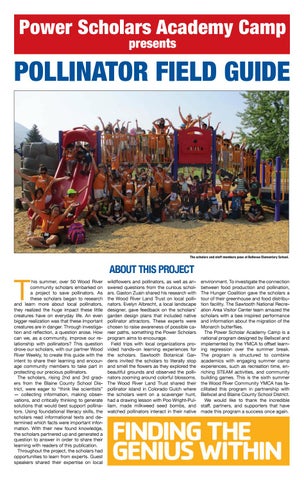
The scholars and staff members pose at Bellevue Elementary School.
T
ihis summer, over 50 Wood River community scholars embarked on a project to save pollinators. As these scholars began to research and learn more about local pollinators, they realized the huge impact these little creatures have on everyday life. An even bigger realization was that these important creatures are in danger. Through investigation and reflection, a question arose. How can we, as a community, improve our relationship with pollinators? This question drove our scholars, with our partner Wood River Weekly, to create this guide with the intent to share their learning and encourage community members to take part in protecting our precious pollinators. The scholars, rising 2nd and 3rd graders from the Blaine County School District, were eager to “think like scientists” — collecting information, making observations, and critically thinking to generate solutions that would best support pollinators. Using foundational literacy skills, the scholars read informational texts and determined which facts were important information. With their new found knowledge, the scholars partnered up and generated a question to answer in order to share their learning with readers of this publication. Throughout the project, the scholars had opportunities to learn from experts. Guest speakers shared their expertise on local
ABOUT THIS PROJECT wildflowers and pollinators, as well as answered questions from the curious scholars. Gaston Zuain shared his research with the Wood River Land Trust on local pollinators. Evelyn Albrecht, a local landscape designer, gave feedback on the scholars’ garden design plans that included native pollinator attractors. These experts were chosen to raise awareness of possible career paths, something the Power Scholars program aims to encourage. Field trips with local organizations provided hands-on learning experiences for the scholars. Sawtooth Botanical Gardens invited the scholars to literally stop and smell the flowers as they explored the beautiful grounds and observed the pollinators zooming around colorful blossoms. The Wood River Land Trust shared their pollinator island in Colorado Gulch where the scholars went on a scavenger hunt, had a drawing lesson with Poo Wright-Pulliam, made milkweed seed bombs, and watched pollinators interact in their native
environment. To investigate the connection between food production and pollination, The Hunger Coalition gave the scholars a tour of their greenhouse and food distribution facility. The Sawtooth National Recreation Area Visitor Center team amazed the scholars with a bee inspired performance and information about the migration of the Monarch butterflies. The Power Scholar Academy Camp is a national program designed by Bellxcel and implemented by the YMCA to offset learning regression over the summer break. The program is structured to combine academics with engaging summer camp experiences, such as recreation time, enriching STEAM activities, and community building games. This is the sixth summer the Wood River Community YMCA has facilitated this program in partnership with Bellxcel and Blaine County School District. We would like to thank the incredible staff, partners, and supporters that have made this program a success once again.
2
P S A C P O L L I N AT O R F I E L D G U I D E - P U B L I S H E D B Y W O O D R I V E R W E E K LY
POLLINATOR
•
BUMBLE BEE
J U LY 28, 2021
How do bees make other bees? By Luciana Geronimo and Mia Olsen
The Queen Bee lays the eggs in the cells of the hive. Bees put a roof over their hive when the eggs are inside to protect them. The eggs hatch and turn into pupa. Then they turn into larva and then a grownup bee. When they are grownups, they go find flowers.
What do bees eat?
By Angel Damian and Katheryn Galdmez Benjamin
They eat pollen. Honey is a very good food for bees! When they find flowers, bees go crazy! And then they call other bees to follow them. Then they collect the nectar and take it back to their hive.
By Porter Robinson and Alex Bravo Vega
Bees eat nectar and pollen. Bees get pollen from flowers. We can plant more flowers for bees to have food.
What do bees do during the day? By Sophia Guilen and Ariana Yamileth Nunez
How can we help bees?
By Ivy Westendorf and Hanna Mansecidor Baltazar
We can leave bees alone. Bees need water. We can leave a bowl of water in our gardens.
During the day, bees make wax for their hives. Pollen comes from flowers. They love pollen. Bees make honey and protect the hive. Honey is bee vomit. The bees work all the time. Some bees don’t do anything. Those are the drones or boy bees. When a bee stings you they die.
P S A C P O L L I N AT O R F I E L D G U I D E - P U B L I S H E D B Y W O O D R I V E R W E E K LY
POLLINATOR
•
BUMBLE BEE
J U LY 28, 2021
What are the parts of a bee?
By Samantha Valerio and Emely Marquez Minco
A bee has a stinger and legs and a head and wings and antennas and eyes and an abdomen. If a bee stings you, it dies. Don’t mess around with bees! They need to collect pollen. Bees are important to the environment.
Where do bees hibernate? By Renso Leon-Merino and Leo Nicholls
Honey bees stay in their hives until spring, when the queen bee goes out and looks for pollen. The queen bee wakes up first in the spring and the worker bees wake up after.
What do bees do?
By Jhordan Orihulea and Victor Tamayo Morse
Bees go get the pollen. Bees go from one plant to another plant to get food. Bees eat pollen. Bees eat honey. Bees eat nectar. Bees live in a beehive. Bees will sting you if you get them mad. We should leave bees alone.
Where do bees live?
By Diego Leon-Merino and Tripp Brown
Bees live in a nest or in the ground alone. They can live in a beehive. Sometimes the bees make hives by themselves. They can make the hives in people’s houses too. Some bees live in trees.
What happens when a bee stings you?
By Alma De Loera and Presley Bartholomew
When a bee stings you the bee dies. Queen bees do not die when they sting you. The queen bee can sting you over and over again. Leave them alone! Treat them nicely and they won’t hurt you.
3
4
P S A C P O L L I N AT O R F I E L D G U I D E - P U B L I S H E D B Y W O O D R I V E R W E E K LY
POLLINATOR
BUTTERFLY
•
J U LY 28, 2021
What would happen to us if butterflies die? By Graham Morrison and Angela Inga Alvino
What would happen to us if butterflies die, is there would be no fruit or vegetables. If we didn’t have butterflies we wouldn’t have avocados and carrots.
Where do butterflies lay their eggs? By Giselle Cervantes Lopez and Joselyn Romero
The butterflies find the perfect leaf to lay their eggs. The caterpillar eats the egg to survive.
P S A C P O L L I N AT O R F I E L D G U I D E - P U B L I S H E D B Y W O O D R I V E R W E E K LY
POLLINATOR
BUTTERFLY
•
J U LY 28, 2021
How does a caterpillar turn into a butterfly? By Thaily Huerta-Torres and Aliana Fernandez Alacron
When a caterpillar turns into a cocoon it is called a chrysalis. Metamorphosis is when a caterpillar turns into a butterfly. A chrysalis looks like a seed. Butterflies stay in their chrysalis for five to twenty-one days.
How do butterflies help make fruit? Lili Monzon and Alina Duran Garcia
Butterflies help make food by using pollen. The butterfly pollinates the flower, then the flower falls and a fruit grows.
How do butterflies move?
By Mia Martinez and Daniel Escobedo Torres
Butterflies use their wings and they can use their muscles to move. A butterfly can’t move its wings when it comes out of a cocoon. A butterfly can move its wings when blood goes in their veins.
5
6
P S A C P O L L I N AT O R F I E L D G U I D E - P U B L I S H E D B Y W O O D R I V E R W E E K LY
POLLINATOR
BUTTERFLY
•
J U LY 28, 2021
How can we help butterflies? By Ethan Perez and Yeidy Olmos Valencia
You can help butterflies by planting flowers. The best plants are ones with pollen.
How do butterflies sleep?
By Javi Romero and Brittany Frano Lopez
When butterflies sleep, they find a quiet branch. In the morning they are on the same branch, and in the night also. We should help butterflies and other pollinators.
What is a butterfly’s habitat? By Nathan Munoz and Summit Dunn
Butterflies lay eggs in flowers. They sleep on branches. Butterflies need water and food. Butterflies live near flowers.
P S A C P O L L I N AT O R F I E L D G U I D E - P U B L I S H E D B Y W O O D R I V E R W E E K LY
POLLINATOR
•
J U LY 28, 2021
HUMMINGBIRDS
Pollination
By Baylor Hawkins, Jayden Gonzalez Carrasco, McKenna Jensen
Flowers grow from the sun. Flowers make seeds. Flowers have pollen inside. A pollinator is an animal that carries pollen. Hummingbirds are important because they make strawberries.
Flowers
By Ryder Buxton, Yaretzy Garcia-Serrato
Hummingbirds drink nectar. They get nectar from flowers. They like western columbine, bee balm, and cardinal flowers. Red and orange flowers attract ruby throated hummingbirds. Hummingbirds eat all day long with 15 to 20 minute breaks. They hover to feed on the nectar of the flowers.
Cool Fact
By Brody Aoyama, Fernanda Reyes Vargas
Do you know how fast hummingbirds go? Hummingbirds fight with their beaks. They protect the flowers. A hummingbird can weigh up to .16 ounces. They are about 3 inches. The biggest hummingbird is about 7 ½ inches. Hummingbirds fly 30 miles per hour and as fast as 60 miles per hour. They live for 3 to 5 years.
7
8
P S A C P O L L I N AT O R F I E L D G U I D E - P U B L I S H E D B Y W O O D R I V E R W E E K LY
POLLINATOR
•
J U LY 28, 2021
HUMMINGBIRDS
Habitats
By Noe Hurtado, Sophia Ramirez Gonzalez
Where do hummingbirds live? They live in North and South America. Hummingbirds live here in the summer. They go to Mexico in the winter to pollinate. They drink sugar water. They like 70 degrees Fahrenheit and hide in 90 and 100 degrees Fahrenheit. Hummingbirds have 1,000 feathers.
Nests
By Zoe Figueroa Alvarado, Ryder Adamiec
Hummingbirds live in North America and South America. They live in deserts, tropical forests, mountains, valleys, and grasslands. Most hummingbirds live in warm places where flowers bloom all year. Hummingbirds live in backyards across the US. People enjoy feeding them. They fill special hummingbird feeders with sugar water. Hummingbirds enjoy drinking sugar water. They will go to a feeder many times a day. Hummingbirds build nests with leaves and other plant parts. They use spider webs too. Building a nest may take 5 days or more. It is very small. But hummingbird nests are very fragile and do not last more than one season.
Diet/Predators
By Hunter Reay, Zoey Bartholomew
Hummingbirds eat bees and spiders. They often fight over food because they want the pollen. Hummingbirds eat nectar that is actually sugar water. Frogs and hawks are hummingbirds’ predators.
P S A C P O L L I N AT O R F I E L D G U I D E - P U B L I S H E D B Y W O O D R I V E R W E E K LY
POLLINATOR
•
J U LY 28, 2021
HUMMINGBIRDS
Characteristics
By Elio Ceja-Hernandez, Sage Benko
Hummingbirds live in North America. Hummingbirds have long beaks. It is about 2 inches and 5 centimeters long. Their colors are red, gold, and green. Unlike males, female hummingbirds have no bright feathers. Female hummingbird colors are orange, black, and white. The hummingbird beats its wings 10 to 15 times per second. Some hummingbirds eat bees. They live 3 to 5 years. Their heart beats 1,260 times per minute.
Relationships/Babies
By Alex Cruz Flores, Dayra Mayuri
Hummingbirds are pollinators too. Hummingbirds build nests with spiderwebs sometimes. They have babies from February to May. Hummingbird eggs are white. The mother hummingbird has 1, 2, or 3 babies. A hummingbird baby stays with its mother for 22 to 25 days. Hummingbirds eat bees, gnats, and honeysuckle. They talk to each other by chittering. Hummingbirds are the only birds that fly backwards.
Migration/Hibernation By Riley Renfro, Anai Leon-Merino
Some hummingbirds migrate to new habitats as the seasons change. They prepare for migration by eating as much as they can. This increases their weight by up to 50 percent. They like the coasts of California and Oregon in January. One hummingbird called the Rufous hummingbird flies 3,900 miles from Alaska to Mexico to spend the winter there. Hummingbirds go into a deep sleep called a torpor. Their heart rate will drop to about 50 beats per minute.
9
10
P S A C P O L L I N AT O R F I E L D G U I D E - P U B L I S H E D B Y W O O D R I V E R W E E K LY
•
J U LY 28, 2021
P S A C P O L L I N AT O R F I E L D G U I D E - P U B L I S H E D B Y W O O D R I V E R W E E K LY
•
J U LY 28, 2021
How can we, as a community, improve our relationship with pollinators?
11
• Plant native Idaho plants that attract pollinators to your garden. Go to idahonativeplants.org for information. Seeds can be found at local Seed Libraries around the Valley. • Carefully plan your garden by considering flower colors, shapes, and bloom times to attract a variety of pollinators from spring to fall. • Make a Pollinator Watering Station in your garden. Fill a shallow dish with rocks or marbles for pollinators to rest on for a water break. • Reduce or eliminate the use of toxic pesticides in your garden. Search out options for pollinator safe pesticides. • Support local beekeepers by buying local honey. • Learn more about local pollinators and ways you can help them. • Get involved with local organizations that support pollinators, such as the Wood River Land Trust, Sawtooth Botanical Gardens, and the Hunger Coalition. • Make a native wildflower seed bomb!
• • • •
DIY SEED BOMB RECIPE
4 parts potter’s clay (available at your local art supply store) 1 part organic compost 1 part native Idaho wildflower seeds (available at seed libraries) 1 part water
Hand mix compost, clay and water thoroughly to a consistency of Play-Doh®. Add seeds (native varieties are best) and mix well. Roll 1 inch balls from the mixture, adding more water if they do not hold together easily. Place on a cookie tray and allow to dry for 24-48 hours. Plant your seed bomb to attract pollinators!
12
P S A C P O L L I N AT O R F I E L D G U I D E - P U B L I S H E D B Y W O O D R I V E R W E E K LY
Scholars & Staff Members Bumblebee Cluster
Butterfly Cluster
Victor Tamayo Morse Tripp Brown Sophia Guillen Samantha Valerio Renso Leon-Merino Presley Bartholomew Mia Olsen Luciana Geronimo Leo Nicholls Katheryn GaldamezBenjamin Jhordan Orihuela Mendoza Ivy Westendorf Hanna Mansecidor Baltazar Diego Leon-Merino Ariana Yamileth Nunez Angel Damian Alma De Loera Alexander Bravo Vega Emely Marquez Minco Porter Robinson
Yeidy Olmos Valencia Thaily Huerta-Torres Summit Dunn Peyton Kandler Nathan Munoz Mia Martinez Reyes Luyana Monzon Joselyn Romero Jesus Gonzalez Moreno Graham Morrison Giselle Cervantes Lopez Ethan Perez Daniel Escobedo Torres Brittany Franco Lopez Angela Inga Alvino Alina Duran Garcia Aliana Fernandez Alacron Alexander “Javi” Romero
Hummingbird Cluster Zoey Bartholomew Zoe Figueroa Alvarado Yaretzy Garcia-Serrato Sophia Ramirez Gonzalez Ryder Buxton Ryder Adamiec Riley Renfro Noe Hurtado McKenna Jensen Jayden Gonzalez Carrasco Hunter Reay Fernanda Reyes Vargas Elio Ceja-Hernandez Dayra Mayuri Brody Aoyama Robbins Baylor Hawkins Anai Leon-Merino Alex Cruz Flores Sage Benko
•
J U LY 28, 2021
PROGRAM STAFF BUTTERFLY CLUSTER STAFF Michal O’Callaghan-Abbott Clara Harding Isabel Crossen HUMMINGBIRD CLUSTER STAFF Megan Furious Andrea Ruiz Loera Dori Wilcox BUMBLEBEE CLUSTER STAFF Jayna Loy Rita Garcia Erika Kuhlman
LEAD STAFF
Teressa Johnson Elisabeth Ruiz Loera Amanda Silvis Susan Weaver Emily Albrecht
THANK YOU FOR YOUR HELP: Power Scholars Academy Supporters Donors: • • • • • • • • • • • • •
Silver Family Foundation Woolley Family Foundation Wood River Women’s Foundation SPUR Foundation Green Shoots Giving Horizon Foundation Richard K. and Shirley S. Hemingway Foundation Nancy Eccles and Homer M. Hayward Family Foundation Renée & Carl Behnke Rebecca and Jonathan Neeley Donald and Marcia Liebich Fund Ellison Foundation Heart of Gold Foundation
Partners: • • • • • • •
Blaine County School District Bellxcel Wood River Land Trust Sawtooth Botanical Gardens SNRA Hunger Coalition Mountain Rides Safe Routes to School • Blaine Soil Conservation District