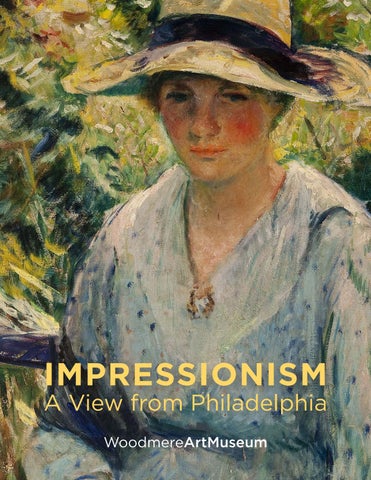
IMPRESSIONISM
A View from Philadelphia
Woodmere extends sincere thanks and appreciation to The Arcadia Foundation, The Walter Elmer Schofield Legacy Fund of The Philadelphia Foundation, and an anonymous donor for their support of this exhibition and catalogue.
IMPRESSIONISM
A View from Philadelphia
CONTENTS Foreword 2 Landscape and the Countryside 4 The City 34 Still Life 50 The Figure 60
May 22, 2021–March 13, 2022
FOREWORD Having swept through Paris in the 1870s,
knew her and whose families overlapped
Impressionism became an international
with her elevated social circle, including
phenomenon, taking root in many cities
Adolphe Borie, George Biddle, Carroll
and rural art colonies throughout Europe
S. Tyson Jr., Walter Elmer Schofield,
and the Americas up through the 1920s
and others. Cassatt was the model
and beyond. In general, Impressionist
independent woman of the modern
artists rejected academic methods and
age, and in Philadelphia, where the
worked in a “naturalist” manner, painting
Pennsylvania Academy of the Fine Arts
directly from the subjects before them,
(PAFA) had been training women artists
whether en plein air in the countryside, in
since 1844, Cassatt’s example paved the
the modern city, or in the studio. The
way for the careers of Cecilia Beaux, many
Impressionist brushstroke—often of vibrant,
of the Philadelphia Ten, and others.
unmixed color—expresses the artist’s
In addition to hiring Beaux, PAFA had the
temperament and a unique point of view.
foresight to hire William Merritt Chase
Philadelphia and its region became one
and Robert Vonnoh in the 1890s, artists
of the important centers of Impressionist
who established their voices as American
painting. A variety of factors and an
Impressionists early on. They were the
equilibrium of distinctive voices made for
mentors of the generation known today
a powerful florescence and contribution
as the Pennsylvania Impressionists,
to American art. To begin with, one of the
including Schofield, Edward Redfield,
artists who participated in the founding
Martha Walter, Raymond Theel, and
Impressionist exhibitions of Paris in
many others. These artists, after their
the 1870s was a Philadelphian: Mary
training at PAFA, established the
Cassatt. Born into a family of means,
pattern of traveling to France to study
Cassatt advocated for the embrace
the latest artistic trends in Paris and
of Impressionist practices and had a
to participate in the art colonies that
formidable influence on Philadelphia
had been established in the French
artists of a younger generation who
countryside. The career of trailblazing 2
Philadelphia modernist Arthur B. Carles followed this same trajectory, and that his earliest paintings demonstrate a naturalist, Impressionist approach reflects the influence of his mentors, both Chase and Beaux. By the time William Langson Lathrop founded his art colony in New Hope, Pennsylvania in 1899, there was already a broad base of interest among artists, collectors, and an art-loving public who appreciated their vision. The Pink Sash (Ellen Mary Cassatt), c. 1898, by Mary Cassatt (Long-term loan from a private collection)
All that is outlined above could be the subject of many doctoral theses, and Woodmere, with its focus on Philadelphia artists, is uniquely suited to exploring the
treasures into the future. As always,
configurations of Impressionism of our city
Woodmere’s staff shines, and the
and region. This exhibition is in many ways
curatorial team of Rachel Hruszkewycz,
an initial foray into an ongoing project.
Rick Ortwein, Laura Heemer, and Hildy Tow worked together to create wonderful
Woodmere thanks The Arcadia
gallery experiences, programs, and this
Foundation, The Walter Elmer Schofield
catalogue. We are especially thankful to
Legacy Fund of The Philadelphia
our special intern on this project, Julia
Foundation, and an anonymous donor
Leonor Thetford Valiela, an esteemed art
for the generous support that made
historian of the Italian Renaissance whose
this show possible. This is a show of
research and writing appears throughout
the Museum’s collection, and we are
these pages and on our wall labels.
grateful to the many individuals and families of artists who gave works of art,
WILLIAM R. VALERIO, PHD
supported conservation, and entrusted
The Patricia Van Burgh Allison
the institution to steward their great
Director and CEO 3
LANDSCAPE AND THE COUNTRYSIDE
6
ROBERT VONNOH American, 1858–1933
was very great. As an instructor, he
In the Connecticut Hills Date unknown Oil on canvas, 24 1/4 x 20 1/8 in.
of American Impressionism, including
Museum purchase, 2020
exhibited nationally and internationally
shaped the ideas of many of the artists who would themselves become leaders Walter Elmer Schofield, Edward Willis Redfield, and William Glackens—all represented in this exhibition. In the years that followed, Vonnoh and produced successful society portraits for Philadelphia, New York, and
Vonnoh was one of the earliest American
Chicago elites. He and his second wife,
proponents of French Impressionism in
sculptor Bessie Potter, summered at the
the United States. Having studied at the
artist colonies in Old Lyme and Cos Cob,
Massachusetts Normal Art Club in Boston,
Connecticut. These and other stimulating
he went to Paris in 1880. Impressionism
communities in unspoiled rural locations
was not yet a decade old and was taking
fostered the development of American
Paris by storm. Vonnoh, an ambitious,
Impressionism. Vonnoh may have
twenty-two-year-old artist, attended the
produced this moody view of a hazy day
Académie Julian in Paris. He joined the
in the Connecticut hills on one of these
art colony at Grez-sur-Loing, France, and
summer sojourns, before his return to
began experimenting in his landscape
Grez-sur-Loing in 1907. He died in France
paintings, adopting the Impressionists’
in 1933 and is buried in Nice.
preference for direct, outdoor painting and loose, suggestive brushwork of unmixed colors. Vonnoh brought this modern approach to Philadelphia as an instructor in 1891. He taught at the Pennsylvania Academy of the Fine Arts until 1896, and the impact of his ideas 7
8
WILLIAM LANGSON LATHROP American, 1859–1938
This subject, The River Lane, may be a
The River Lane c. 1915 Oil on canvas, 22 x 25 in.
who shared a naturalist, Impressionist
path to the river from the Lathrops’ home. Lathrop’s magnetic personality and the bucolic New Hope colony attracted artists approach to painting outdoors and they benefitted from Lathrop’s mentorship. The group organized exhibitions and showed their works at Phillips’ Mill, a
Bequest of Dorothy J. del Bueno, 2020
property Lathrop purchased in 1903 (it functions to this day as a community Almost from the moment it became
art center). Members of the art colony
known as an art movement, and with the
enjoyed Annie’s charm and famously
notoriety of paintings like Claude Monet’s
generous Sunday lawn parties. While
Impression, Sunrise, Impressionism offered
these painters lived and worked in rural
the potential of abstract stylization in the
settings, their professional success
treatment of landscape. Lathrop’s free,
was tied to Philadelphia and New York.
vigorous brushwork and manipulation of
Lathrop, for example, exhibited at the
dark and light shades of green capture
Pennsylvania Academy of the Fine Arts
nature’s energy and suggest the arrival
and at the National Academy of Design
at a sunny clearing on a walk through the
in New York nearly every year from 1915
cool shade of the woods.
to 1936.
Lathrop’s participated in “colonies” of Impressionism that arose in the 1890s in Woodstock, New York; Old Lyme, Connecticut; and later in Shinnecock Hills on Long Island. He and his wife, Annie, founded the art colony at New Hope in Bucks County when they settled there in 1899 on a property on the Delaware River. 9
CARROLL S. TYSON JR. American, 1877–1956
The Mouth of Somes Sound 1939 Oil on canvas, 23 x 37 in. Museum purchase, 1950
10
Tyson lived in Chestnut Hill and spent
Born in Philadelphia, Tyson was a
summers on Somes Sound, on the
cousin of artist John Singer Sargent. He
south-central coast of Mount Desert
studied at the Pennsylvania Academy
Island, Maine. The sound is depicted here
of the Fine Arts and exhibited his
in cool blues and greens punctuated
landscape paintings and pastels in 1927
by staccato touches of orange and
at New York’s prestigious Wildenstein
red. Tyson was an important American
Gallery and Durand-Ruel Gallery, which
collector of French Impressionism and his
were the premier galleries for French
landscapes reflect his knowledge of the
Impressionism.
Impressionists’ use of direct brushstrokes and application of color.
Mary Cassatt encouraged Tyson and helped him gain access to important private collections, including that of her friend Louisine W. Havemeyer, who also collected Impressionist art. Tyson had been a director of the Phoenix Iron Company, the Little Schuylkill Navigation and Coal Company, and the Delaware and Bound Brook Railroad Company. His wife, Helen Roebling, was a member of the Roebling industrialist and engineering family who built the Brooklyn Bridge. Tyson is remembered for donating his extraordinary collection of paintings by Berthe Morisot, Édouard Manet, Paul Cézanne, Claude Monet, Pierre-Auguste Renoir, Alfred Sisley, and Vincent van Gogh (including Sunflowers) to the
Sunflowers, 1889, by Vincent van Gogh (Philadelphia Museum of Art: The Mr. and Mrs. Carroll S. Tyson, Jr., Collection, 1963-116-19)
Philadelphia Museum of Art.
11
12
HENRY B. SNELL American, 1858–1943
was too conservative; they were looking for inspiration in the more forward-looking art of Paris.
Branches and Boat 1920s Oil on board, 17 1/4 x 19 1/2 in.
From 1899 to 1943, Snell was a beloved instructor at the Philadelphia School of Design for Women, now Moore College of Art and Design. It was there that he taught many of the members
Bequest of Dorothy J. del Bueno, 2020
of the Philadelphia Ten, a professional organization that helped women artists secure exhibition opportunities and
Snell is best-known for his paintings of
sell their work. Artists in this exhibition
boats and harbors. Looking at works by
that were part of the group include
Claude Monet, Edgar Degas, and Vincent
Theresa Bernstein, Susan Gertrude
van Gogh, he discovered Japanese prints
Schell, and Susette Inloes Schultz Keast.
and was inspired by the stylized forms,
Snell’s works are in the collections
flat shapes, asymmetrical compositions,
of the Metropolitan Museum of Art,
and bold juxtapositions of near and far
the James A. Michener Art Museum,
elements. The rowboat in the lower right
the Pennsylvania Academy of the
creates small ripples in the calm water
Fine Arts, the Allentown Art Museum,
while another vessel travels upstream.
the Indianapolis Museum of Art, the Worcester Art Museum in Massachusetts,
Born in Richmond, England, Snell
and Woodmere.
immigrated to the United States in 1875 at the age of seventeen and studied at the Art Students’ League in New York. The Art Students’ League had been recently formed by a group of artists who believed that the National Academy
13
14
SUSAN GERTRUDE SCHELL American, 1891–1970
Vacationing in Nova Scotia, Schell
Nova Scotia Date unknown Oil on canvas, 20 x 40 in.
sun as it reflects off the ocean. One can
Museum purchase, 2011
together with a few small houses and
captures the dramatic expanse of a cove-shaped beach and the light of the imagine shells and seaweed between the rocks and the scent of salt water in the air. The horizontal-shaped canvas two figures establish the overwhelming scale of nature. Just as the French Impressionists made paintings of the leisure activities of Parisians when they went on holiday to Normandy or the South of France, so did the Philadelphia Impressionists document the experiences of vacationing in Nova Scotia, Maine, Monhegan, Gloucester, and other scenic destinations. Raised in the Germantown section of Philadelphia, Schell attended West Chester State Teachers College, the Pennsylvania Museum School of Industrial Art (now the University of the Arts), and the Pennsylvania Academy of the Fine Arts. She was a member of the Philadelphia Ten, a group of women artists who exhibited and promoted their work together. She was a teacher for thirty years at the Pennsylvania Museum School of Industrial Art. 15
16
SUSETTE INLOES SCHULTZ KEAST American, 1892–1932
Keast most likely painted this watercolor
By the Bridge Date unknown Watercolor and pencil on wove paper, 22 5/8 x 25 5/16 in.
bridge is reflected in the river in the
outdoors and onsite, but we don’t know the specific location. (If you recognize it, please contact us at Woodmere.) A foreground, leading the eye to a quaint town with pink homes and a church steeple. With expert control over the difficult medium of watercolor, the artist renders the architectural details
Museum purchase, 2017
of the bridge and houses, while using a range of blues and greens to create a counterpoint between a foreground tree and an organic flow of trees on the opposite bank. Keast was a member of the Philadelphia Ten, a professional organization that helped women artists secure exhibition opportunities and sell their work. Prior to joining, she attended the Philadelphia School of Design for Women (now Moore College of Art and Design) and the Pennsylvania Academy of the Fine Arts. Her instructors included Henry B. Snell and William Merritt Chase (works by both artists are on view in this exhibition). In 1911, she received a prestigious Cresson Memorial Travel Scholarship from the Pennsylvania Academy of the Fine Arts, which allowed her to travel to Europe. 17
WALTER ELMER SCHOFIELD American, 1866–1944
McLegrenow Farm 1920 Oil on canvas, 30 x 36 in. Museum purchase with funds generously provided by the Margaret E. Phillips’ Walter Elmer Schofield Legacy Fund of the Philadelphia Foundation, 2021
18
Schofield studied the compositional
movement, Schofield made paintings
methods of French art. Like Claude
that are sought after by museums and
Monet, he based his work on direct
collectors throughout the United States.
observation of nature, but he also
Born in Philadelphia in 1866, he studied
composed in the studio and used color
at the Pennsylvania Academy of the Fine
to achieve structure and balance. In
Arts and then at the Académie Julian
McLegrenow Farm, for example, the same
in Paris, remaining in France for a time
blue of the sky in the upper left is used as
afterward to travel, paint, and immerse
the underlayer of stone elements in the
himself in French Impressionism. In 1886,
lower right, thereby unifying near and far
Schofield married an Englishwoman,
and the opposite sides of the painting. At
Muriel Charlotta Redmayne, and the
the same time, a rich palette of purples
couple took up residence in the United
and yellows creates an effect of dappled
Kingdom. From that time onward,
sunlight across the scene.
Schofield divided his time between his home in England and his brother’s family
Schofield served in World War I and
home in Chestnut Hill. He died in England
experienced some of its bloodiest battles.
in 1944. Per his wishes, his remains were
His family has described a change in
eventually brought back to Philadelphia;
his demeanor thereafter. He remained
he is buried in the family plot in the
extroverted and social, but there would
Cemetery of Saint James the Less (near
always be an inner sadness. In his
Laurel Hill Cemetery).
paintings from the 1920s, he recorded the appearance of stone cottages and thatched-roof farmhouses that seemed not to have changed for centuries, expressing a yearning for a simpler, preindustrial time. A leader among the Pennsylvania Impressionists and a central figure in the broader American Impressionism 19
20
EDWARD REDFIELD American, 1869–1965
Like his friend Walter Elmer Schofield,
Winter Wonderland c. 1917 Oil on canvas, 50 x 56 in.
lived and worked for an extended period
Redfield studied at the Pennsylvania Academy of the Fine Arts (PAFA) and in France. On completing the program at PAFA, Redfield traveled to France with Robert Henri in 1890. After attending the Académie Julian and the École des Beaux-Arts, he joined an American art
Courtesy of Lisa and Joe Walker
colony in Fontainebleau, and there met Elise Deligant. The two were married in 1893 and returned to the United States
With many important prizes and an
soon thereafter.
established international career by the first decade of the twentieth century, Redfield was considered the most accomplished of the Impressionist artists who lived near New Hope, Pennsylvania, and participated in the activities of Phillips’ Mill. Redfield and his colleagues were known for their snowy landscapes, and in this they were likely inspired by Monet, who enjoyed capturing the effect of sunlight on snow. There is no horizon in Winter Wonderland, and in this way, Redfield focuses the viewer on the luxurious pinks and yellows that interact with the cool blues and whites of the snow. 21
22
EDWARD REDFIELD American, 1869–1965
The artist’s great-grandson Laurent Ross recalls: When Redfield died, he left
Pennsylvania Mill Date unknown Oil on canvas, 50 x 40 in.
a proviso in his will that his paintings were to be sold on the market for ten years and then the remainder divided up
Courtesy of Patricia Ross
among the family. My grandfather Laurent (Redfield’s son) chose Pennsylvania Mill because he’d
Redfield painted outdoors, and sought
shown the spot to his father.
to interpret nature’s atmosphere at a
Laurent was out hunting one
particular time and place. Most of his
day and came upon the mill. He
colleagues would make quick sketches
thought to himself that his dad
and small paintings outdoors and later
would like it, so when he returned
prepare large canvases in the studio. But
home, he described it to his
Redfield claimed to make entire large
father. They went to look at the
paintings in one go, outdoors and on
scene, and Edward returned the
site, to capture fleeting light effects and
next day to paint it.
the intangible essence of the natural experience. He was eager to be known as an artist who rejected the refinements and rituals of traditional studio practices, and he developed his own methods of carrying equipment on painting hikes and strapping large canvases to trees on windy winter days. He would wade into freezing streams or stand knee-high in banks of snow to capture a chosen winter view.
23
24
EDWARD REDFIELD American, 1869–1965
In his later years, Redfield became a
Painted Covered Bridge Tray Date unknown Oil on pressed metal, 29 1/2 x 23 1/2 in.
unique painted chests, toleware (tin)
furniture maker and decorative artist. He built wooden furniture and created trays, and hooked rugs. These painted trays are decorated with the types of wintry landscapes that Redfield was known for.
Courtesy of Patricia Ross
Painted Tole Tray Date unknown Oil on pressed metal, 29 x 21 1/2 in. Courtesy of Patricia Ross
25
26
FREDERICK R. WAGNER American, 1864–1940
1902, he returned to Philadelphia and was employed as an illustrator for the Philadelphia Press.
Winter Waterfall Date unknown Oil on canvas, 40 x 50 in.
Wagner taught at PAFA’s Chester Springs School. He also founded the Addingham School of Painting in the suburbs of Philadelphia. His work is in the collections
Museum purchase, 2020
of the Philadelphia Museum of Art, the Philadelphia Sketch Club, the Cleveland Museum of Art, the James A. Michener
Wagner’s palette of cool purples, blues,
Art Museum, and Woodmere.
and grays conveys the deep cold of an icy pool banked with snow. The subject of this nocturne is a mill creek, the type of industry-driven structure in the rural landscape that draws energy from a man-made waterfall. A student of the great Philadelphia realist painter Thomas Eakins, Wagner frequently depicted man’s intervention in the landscape. Born in Port Kennedy, Pennsylvania, Wagner was an Impressionist painter. He was known for painting urban scenes featuring the Philadelphia area. From 1879 to 1884 he attended the Pennsylvania Academy of the Fine Arts (PAFA), where he studied with Eakins. Upon finishing his studies there, Wagner traveled west to California to paint. In
27
ANTONIO MARTINO American, 1902–1989
November c. 1925 Oil on canvas, 36 x 40 in. Gift of Lynn and Tony Hitschler, 2021
28
Martino’s composition is not a
making weekend painting trips to Bucks
conventional landscape with a
County. They understood that there
picturesque view, but one in which the
was an audience of patrons in the gritty,
earth itself dominates as a tangible
industrial city for art depicting the rural
presence. The hard edges of houses and
countryside. In 1941, the family founded
man-made structures contrast with a rich
Martino Commercial Art Studios, which
range of reddish-brown organic forms,
not only served as a gallery for the fine
including a dirt road that cuts through
art made by the Martino siblings, but
the sloping earth. Some indistinct
also provided a variety of graphic design,
buildings along the left side serve as a
illustration, promotional, and interior
counterpoint to a cluster of farmhouses
décor services. All of the Martino siblings
in the upper right. It is late fall. Leaves
and some of their children participated in
have either turned red or fallen, and
the business, whose staff grew to include
winter approaches. A single illuminated
twenty Martino artists.
window suggests the presence of a
The winner of many national awards,
solitary individual.
Martino was elected as an associate of
Born in Philadelphia, Martino was the son
the National Academy of Design in 1938
of Italian immigrants and one of eight
and as a National Academician, one
siblings, all of whom were creatively
of the highest distinctions awarded to
inclined. Their parents emigrated
American artists at the time, in 1942. By
from Italy and settled in Philadelphia’s
1971, Martino moved to California, where
Italian Market; the father worked as a
he continued to paint seascapes and
mason and stonecutter, the mother as a
landscapes until his death.
buttonhole maker in an apparel factory. In 1915, with the encouragement of eldest brother Frank, younger brothers Antonio and Giovanni began attending free art classes at the Graphic Sketch Club (now Samuel S. Fleisher Art Memorial) in South Philadelphia. The brothers also began 29
30
RAYMOND THEEL American, 1891–1952
studying with renowned artists such
Interior of Woods Late 1930s–early 1940s Oil on canvas, 67 x 69 in.
Daniel Garber, and Violet Oakley. As a
Long-term loan courtesy of Marilyn Steinbright
visit Paris, Brussels, Munich, Florence,
as Thomas Anshutz, Cecilia Beaux, Hugh Breckenridge, Henry McCarter, student at PAFA, Theel was awarded two prestigious Cresson Memorial Travel Scholarships that enabled him to Rome, and Tunis, among other cities. On returning to Philadelphia, Theel
A depiction of the environs of the artist’s
supported himself and his family by
home in Jarrettown, Pennsylvania, this
working as an illustrator and billboard
monumental painting is considered to be
painter for N. W. Ayer, Philadelphia’s large
Theel’s masterpiece. The work envelopes
advertising agency.
the viewer in a dazzling array of color
Theel was a thoughtful, modest individual
and bold impasto, conveying a sensation
and a quick study. He was interested in
of the energy of the forest as it springs
the work of Post-Impressionist artists
to life. The trunk of a large, sturdy tree
like Georges Seurat, and he was
commands the foreground. It stands
inspired to develop his own method of
apart from a gathering of younger trees
juxtaposing thick dabs of warm and
and vines that occupy the mid-ground of
cool color to enliven every inch of his
the painting.
compositions with animated paint. In
Almost all that we know of Theel and
the 1920s and 1930s, when many of his
his legacy as an artist comes from fewer
colleagues were making smaller paintings
than twenty paintings. Tragically, a fire
for domestic markets, Theel made large
in 1943 destroyed his home, studio,
canvases and was impressed by the scale
and most of his life’s work. The artist
of Monet, in particular, and his massive
attended the Pennsylvania Academy of
waterlily paintings.
the Fine Arts (PAFA) from 1909 to 1914,
31
32
BETTY W. HUBBARD American, 1901–1967
of Berthe Morisot (London: Lund
Pleasant Bay Road, East Harwich, Massachusetts c. 1947 Oil on canvas, 23 1/2 x 17 1/2 in.
critics, Hubbard rarely showed her work
Gift of the artist’s daughter, Moira Hyle, 2011
through the leafless trees; this is the cool
Humphries, 1957). Though she enjoyed friendships with numerous artists and publicly and, surprisingly, never had a solo exhibition. Well into the 1960s, Hubbard would maintain her modernist approach. In this landscape, dappled sunlight filters light of an autumn day. There is also a mysterious quality to the image: the road
Born Elizabeth Conrad Welsh in Chestnut
beckons us in, but shadows fall across
Hill, Hubbard attended the Pennsylvania
the path. We can only imagine where the
Academy of the Fine Arts. She studied
road may lead.
with Arthur B. Carles and was a lifelong champion of the importance of Carles’s contributions to American art. After marrying her husband, Richard, in 1934, Hubbard moved to New York City and spent summers on Cape Cod, raising a family and continuing to paint. Starting in the 1950s, she often visited Paris to see Julie Manet, the daughter of Berthe Morisot and Eugene Manet (brother of Impressionist Édouard). Hubbard is known for her translation of Morisot’s letters, The Correspondence
33
THE CITY
36
WALTER ELMER SCHOFIELD American, 1866–1944
Schofield immersed himself in the study
Montmartre c. 1896 Oil on canvas, 37 x 47 1/2 in.
the country with fellow painters Robert
of Impressionism while living in France at different times in the 1890s. He stayed in Fontainebleau and Brittany, and toured Henri and William Glackens in 1895. He painted Montmartre while living in Paris. This is thought to have been the view from the window of his apartment, an image of the very café and bistro
Funding for the purchase of Montmartre— in honor of Miss Margaret E. Phillips and in memory of her parents: Sarah M. Phillips (née Schofield) & Herbert L. Phillips—made possible by the Walter Elmer Schofield Legacy Fund of the Philadelphia Foundation, 2019
he would have frequented every day. Bright summer light traverses the varied textures and warm creams and ochres of the distinctive stucco facades. The artist may have been inspired by paintings of the Parisian cityscape by his French contemporary Camille Pissarro, such as Avenue de l’Opera: Morning Sunshine, now in the collection of the Philadelphia Museum of Art. That painting was originally acquired by Schofield’s friend Carroll S. Tyson, an important collector of French Impressionism and an artist whose work is also included in this exhibition. The Tysons and the Schofields lived in
Avenue de l’Opéra: Morning Sunshine, 1898, by Camille Pissarro (Philadelphia Museum of Art: Gift of Helen Tyson Madeira, 1991-180-2)
Chestnut Hill.
37
38
WALTER ELMER SCHOFIELD American, 1866–1944
This painting demonstrates Schofield’s
The Steam Trawlers, Boulogne 1909 Oil on canvas, 42 3/8 x 54 1/2 in.
Schofield’s Impressionist contemporaries
Museum purchase with funds generously provided by the Margaret E. Phillips’ Walter Elmer Schofield Legacy Fund of the Philadelphia Foundation and James M. Alterman, 2020
depicted tugboats in Gloucester. It may
interest in modern subjects. Trawlers are work boats that dredge or drag nets in harbors. Like the harbor scenes that depicted, they symbolize the modern age and the hard work that makes modernity possible. Among Schofield’s lifelong friends, William Glackens similarly depicted the tugboats of New York harbor and George Sotter be that all three artists were inspired by Claude Monet’s notorious Impression, Sunrise. This painting, made in Le Havre, the industrial port town adjacent to Boulogne, so shocked critics that in a derisive commentary one remarked that the painting was not finished but a mere “impression,” giving rise to the name Impressionists. The foggy atmosphere of the harbor in The Steam Trawlers, Boulogne is rendered with energetic brushstrokes, and the foremost trawler is sketched freely, amid plumes of smoke and swirling water.
Impression, Sunrise, 1872, by Claude Monet (Musée Marmottan © RMN-Grand Palais / Art Resource, NY)
Schofield lends movement and life to the harbor by placing the vessels at angles that cut diagonally across the water.
39
40
GEORGE SOTTER American, 1879–1953
that does the heavy lifting in the harbor.
Tugboat Docked in Gloucester Date unknown Oil on canvas, 26 x 22 in.
red boat stands out against the muted
Museum purchase, 2018
they do not render a landscape, but the
This work reflects Sotter’s interest in light effects and atmospheric conditions. The blues and grays of the overcast day. French art critic Jules-Antoine Castagnary explained Impressionism in 1874 by claiming, “They are impressionists in that sensation produced by the landscape.”
A much-admired landscape painter
Sotter was friendly with Edith Emerson,
and stained-glass designer, Sotter
director of Woodmere from the early
began his career in his hometown of
1940s through 1978 (and who also
Pittsburgh, painting industrial subjects.
designed stained-glass windows).
After teaching painting and design for
Sotter’s first museum exhibition was
nine years at the Carnegie Institute of
organized by Emerson at Woodmere.
Technology, in 1919 he moved to Bucks County, and became known for depicting historic stone farmhouses and pre-industrial buildings under dark night skies with twinkling stars. On summer vacation in Gloucester, Massachusetts, Sotter adopted a lighter palette and became attracted to subjects that harkened back to his youth in Pittsburgh. The tugboat, for example, is the quintessential “protagonist” of modernist realism, a hard-toiling vessel
41
42
ROBERT SPENCER American, 1879–1931
Spencer captures the atmosphere of
Waterloo Row c. 1917–18 Oil on canvas, 25 x 30 in.
an even gray light falling across the
a cloudy day at a busy construction site. The mood is somberly poetic with composition. Spencer renders the sensation of his scene in loose, gestural brushstrokes
Museum purchase, 2011
rather than depicting illustrative details. Direct application of paint can be seen in the short strokes of blue and white in the sky. With areas of raw canvas visible, the artist creates forms that hover between representation and abstraction. Spencer began his training in the arts at the National Academy of Design in New York City in 1899, and continued his studies in 1903 with William Merritt Chase at his New York School of Art. By 1906, Spencer moved to Bucks County, Pennsylvania, and became a member of the New Hope artist colony. Spencer’s work is in the collections of the Carnegie Museum of Art, the Delaware Art Museum, the Metropolitan Museum of Art, and Woodmere, among others.
43
44
ARTHUR B. CARLES American, 1882–1952
Having recently completed his studies
Notre Dame c. 1907 Oil on canvas, 46 x 39 in.
on a three-year stint in Europe,
Courtesy of Julie and Jim Alexandre
edge art, artists, and collectors, including
at the Pennsylvania Academy of the Fine Arts, Arthur B. Carles embarked starting in 1907. The experience was transformational. Spending much of his time in Paris, Carles encountered cuttingthe work of Henri Matisse and expatriates Gertrude and Leo Stein. For decades
Claude Monet introduced the subject
later, Carles would promote modern art
of the cathedral facade to modern art.
as an artist and teacher in the United
He depicted the play of light across the
States, and Philadelphia specifically.
facade of Rouen Cathedral in more than
Carles depicts Notre Dame de Paris as
thirty paintings, experimenting with
a majestic landmark that stands out
atmosphere and lighting conditions as
like a beacon against a dramatic sky.
the counterpoint to the richly sculpted
Working from the left bank across the
ancient surfaces.
Seine, Carles depicts the light of the early morning, with the sun rising in the east behind the Cathedral. Booksellers are Cathedral of Rouen: Full Sunlight, Blue Harmony and Gold, 1894, by Claude Monet (Musée d’Orsay) Photo Credit: Scala / Art Resource, NY
just beginning to open their stands along the quay.
45
46
C. JOSEPH WARLOW American, 1888–1918
a magnificent nighttime view of
In Manayunk Date unknown Oil on canvas, 50 x 40 in.
Tragically, Warlow died at the age of
Philadelphia, sparkling with electric lights.
thirty, a victim of the 1918 influenza epidemic. Christopher Morley wrote of the artist’s passing in the Philadelphia Evening Ledger on December 29, 1919:
Bequest of Dorothy J. del Bueno, 2020
There are no words competent to express the tragedy of those In Manayunk captures the play of morning
who have worked patiently for an
light and shadow looking up past a row of
ideal and yet die too soon to see
modest houses that ascend to the facade
their dreams come to full fruit.
of St. John the Baptist Church. It is winter
Yet it is good to remember that
and the sun is just rising in the East. Like
those pinched and bitter days
Claude Monet painting Rouen Cathedral,
of last winter, when we were all
Warlow depicts the church as a beacon of
bemoaning Black Mondays and
spiritual beauty.
ways clogged with snow, gave Warlow his opportunity to put on
Born in Williamstown, Pennsylvania,
canvas the beauty that haunted
Warlow was among the most promising
him and which made his life a
students of his generation at the
triumph. And a civilization that
Pennsylvania Academy of the Fine Arts.
is wise enough to beautify an
He received several awards, including
electrical office with so fine a
the prestigious Cresson Memorial Travel
mural canvas, that builds railroad
Scholarship.
stations like Greek temples, puts
Philadelphia Electric Company (PECO)
one of the world’s finest organs in
commissioned Warlow in the mid-1910s
a department store and a painting
to create a mural for its main office on
of mosaic glass in a publishing
Chestnut Street; the artist produced
plant, is a civilization that brings endless hope to birth. 47
48
EARL HORTER American, 1880–1940
Horter played an important role in
Cathedral, Rouen, France c. 1920 Charcoal on paper, 22 1/2 x 16 1/2 in.
also as a collector. Throughout the 1930s,
introducing modern art to Philadelphia, not only as an artist and teacher, but he taught at the Philadelphia Museum School (now the University of the Arts) and Temple University’s Tyler School of Art, exposing students to the formal innovations of the European avant-garde.
Museum purchase, 2003
His art collection of seminal modern works by artists such as Pablo Picasso, Horter’s drawing of Rouen Cathedral is
Georges Braque, Marcel Duchamp, and
a nod to Monet. In his more modernist,
Constantin Brancusi was bequeathed
Cubist-inspired version, atmosphere
to the Philadelphia Museum of Art
is created by overlapping angular
and shown in an exhibition in 1999:
geometries, hard edges, and charcoal
Mad for Modernism: Earl Horter and
shadings. There is a subtle tension
His Collection.
between order and disorder, with strong diagonals and occasional curves challenging the predominance of vertical lines. Horter was born in the Germantown section of Philadelphia. A superb draftsman and technician, he was first employed as a commercial artist working for N. W. Ayer, the largest advertising agency in Philadelphia. Throughout his career, Horter produced a large body of drawings, lithographs, and etchings that depict his modern Philadelphia and New York.
49
STILL LIFE
52
WILLIAM MERRITT CHASE American, 1849–1916
conservative Society of American Artists,
Still Life with Brass Coffee Pot, Bowl, Celery and Red Peppers Date unknown Oil on canvas, 32 1/8 x 28 in.
Beaux-Arts in Paris.
Museum purchase, 2020
Still lifes were such a staple of Chase’s
just as the French Impressionists had from the Salon of the Académie des
An influential instructor in New York and Philadelphia, Chase taught at the Pennsylvania Academy of the Fine Arts from 1896 to 1909. The work of many of his students and colleagues is on view in this exhibition.
artistic production that he worried he would be remembered as “a painter Chase is among the best-known
of fish.” Through his intense study of
American Impressionists. His artistic
Impressionist Édouard Manet’s work in
instruction began in Indianapolis and
the 1890s, Chase discovered still lifes by
New York, and he studied abroad in
Spanish Baroque artists such as Diego
Munich, enrolling in the Royal Academy
Velázquez. The result was a period of
in 1872. Encounters with Impressionism
dark and earthy compositions with
in Germany and France led Chase to
objects from the humblest of kitchens.
experiment with modern techniques and
Here, an assortment of vessels stands on
subjects. Back in the United States he
a table in a dark interior. A brass coffee
became known for his sunlit paintings
pot reflects a warm, narrow light and
of sophisticated New Yorkers enjoying
scattered vegetables serve as colorful
the urban beauty of Central Park and
counterpoints, drawing attention to the
Prospect Park.
artist’s expert brushwork.
In 1902, Chase became a member of Ten American Painters, an Impressionist exhibiting group that split from the 53
54
ARTHUR B. CARLES American 1882–1952
Carles made this painting while a student
Still Life with Copper Kettle 1904 Oil on canvas, 20 3/4 x 28 7/8 in.
training under William Merritt Chase and
Museum purchase, 2018
items into an intimate still life. The copper
at the Pennsylvania Academy of the Fine Arts (PAFA). Carles excelled there, Cecilia Beaux, whose works are also in this exhibition. He received a number of awards, including the Henry Thouron Prize for best student composition in 1903. Here Carles gathers assorted household kettle, blue and white porcelain, red drapery, yellow lemons, and other objects offer a pleasing array of shapes, sizes and materials. The contrasting warm and cool colors enrich one another. He was likely inspired by still life paintings by Chase such as Still Life with Brass Coffee Pot, Bowl, Celery and Red Peppers.
55
56
ADOLPHE BORIE American, 1877–1934
Borie developed a practice that combined
Flowers in an Urn 1904 Oil on canvas, 22 x 18 in.
Academy of the Fine Arts with the casual
Museum purchase, 2018
throughout his life and encouraged other
the realist approach he absorbed from his mentors at the Pennsylvania elegance, luminous color, and painterly sophistication of French Impressionism. He lived in Paris for several periods American artists to embrace modern French painting. With its high-keyed color, Borie’s Flowers in an Urn is a celebration of beauty. A large, pink, peony-like flower draws the eye to the center of the painting while violet blooms create a dynamically off-center arrangement. Woodmere purchased this painting at auction in 2018 from the collection of Dorrance “Dodo” H. Hamilton (1928–2017), a great philanthropist and supporter of the Museum.
57
58
WILLIAM GLACKENS American, 1870–1938
Glackens was born of humble means.
Flower Piece 1926 Oil on canvasboard, 12 1/4 x 15 3/8 in.
he took drawing classes at night at
Early on, he supported himself as an illustrator and reporter by day while the Pennsylvania Academy of the Fine Arts. The mentorship of Robert Henri led Glackens (and other illustrators) to painting and, around the turn of the century, to New York. There the group
Given in memory of Irwin Nat and Marjorie M. Pincus, 2005
of mostly Philadelphia artists formed the so-called Ashcan School, known for their scenes of city life. Glackens had attended
Full of color and energetic brushwork,
Central High School in Philadelphia
this floral still life is a handsome example
with Albert C. Barnes, and the two men
of Glackens’s mature work in this
remained lifelong friends. Glackens
genre. A diverse and casual bouquet
recommended and sometimes purchased
stands on a table in a simple vase. The
Impressionist and modernist paintings for
vibrant colors of the blooms, including
Barnes, and many of these are anchoring
anemone, narcissus, and goldenrod,
paintings in the galleries of the Barnes
strongly contrast the background. The
Foundation today.
conspicuous pattern of brushstrokes
By the time Glackens painted this still life
plays against atmospheric shadow.
in 1926, he had married Edith Dimock,
Glackens’s soft touch and feathery
an heiress (and painter) from Hartford,
brushstrokes suggest the inspiration of
Connecticut. The couple lived the high
Pierre-Auguste Renoir, whom he idolized,
life, with a magnificent Manhattan
but he was equally enamored of the bold
townhouse, summers on Long Island, and
color of Henri Matisse, whose work he
trips to Europe.
came to know in his many trips to Paris.
59
THE FIGURE
62
MARY CASSATT American, 1844–1926
Europe and, like many American artists
The Pink Sash (Ellen Mary Cassatt) c. 1898 Pastel on paper, 24 x 19 3/4 in.
life, becoming one of the few American
Long-term loan from a private collection
the domestic and social lives of upper-
of the day, received further training in Paris. She remained there for most of her artists to play a central role in the development of French Impressionism. Cassatt and Berthe Morisot were the two best-known women artists to show with the French Impressionists. Both Cassatt and Morisot focused their paintings on class women in France. It is likely that Cassatt created this work when her
Cassatt demonstrates her mastery of
brother Gardner and his family visited
pastel in this portrait of her niece. Bold,
Beaufresne, the artist’s château outside
rapid strokes of vivid color compose the
the city. She became especially close
dress and chair, while blended passages
with her niece, then around four years
softly describe the youthful roundness
old; the artist made many portraits
of Ellen Mary’s face. A lovely tenderness
of Ellen Mary throughout the girl’s
is expressed in her small, delicate hands,
childhood, and left Beaufresne to her
and the way her dark eyes look off to
when she died.
the side. The artist conveys a sensitive appreciation of childhood innocence while also asserting the girl’s individuality. Born to a large, affluent family in Allegheny City, Pennsylvania, Cassatt studied at the Pennsylvania Academy of the Fine Arts—one of the few such schools open to female students—from 1861 to 1862. After graduation she went to 63
GEORGE BIDDLE American, 1885–1973
Mother Dressing Daughter 1917 Hand-colored etching, 6 3/4 x 5 7/8 in. Gift of the Michael Biddle Family, 2021
Untitled [Woman and a Parrot] 1917 Hand-colored etching, 9 7/8 x 7 7/8 in. Gift of the Michael Biddle Family, 2021
Nude Bathing 1917 Lithograph, 13 1/2 x 8 in. Gift of the Michael Biddle Family, 2021
64
Biddle revered Mary Cassatt as one of
Philadelphia spinster of her generation,
the greatest artists of modern times.
and she would regale me with
When he met her in Paris in 1912, the
Washington pie and Philadelphia white
two became close friends. Cassatt took
mountain cake and sherry. She loved to
Biddle under her wing, introducing him to
gossip about Philadelphians.”
important gallerists and artists, including
Biddle’s prints of the mid-1910s suggest
Claude Monet. She also became an
that, per Cassatt’s advice, he studied the
important mentor. Biddle would bicycle
Impressionists. Untitled [Woman and a
over to her chateau for lunch when he
Parrot] and Mother Dressing Daughter
was living and making art in Giverny,
convey Biddle’s admiration for Cassatt’s
then famously the home of Monet, and
own work, in particular her strong
where Frederick Frieseke, an American
sense of line and pattern. Nude Bathing
Impressionist, had established an
suggests that Biddle was looking at the
expatriate art colony.
famous bathers of Degas.
Writing about Cassatt in 1926 on the occasion of her passing, Biddle wrote, “Her work had been the most important influence I had felt. Then through her, I had somehow lived with her contemporaries.” He went on to describe how Cassatt encouraged him to study the work of Berthe Morisot, Pierre-Auguste Renoir, and Edgar Degas in particular. In addition, Biddle wrote, “It was as a great human being that she influenced me—perhaps the greatest human being I have ever known . . . socially, she remained the prim
65
66
GEORGE BIDDLE American, 1885–1973
By the 1920s, Biddle established a
Untitled [Four Nude Women Standing] 1921 Etching, 10 x 13 1/4 in.
a complex, multifigure composition
confident style that was entirely his own. Four Nude Women Standing is that demonstrates the elegance and sophisticated line that would characterize his work for decades to come.
Gift of the Michael Biddle Family, 2021
67
68
GEORGE BIDDLE American, 1885–1973
horrors of World War I. Her arms reach
Victory 1921 Lithograph, 13 1/4 x 4 1/4 in.
wide-legged stance suggests a fragile
up to the sky and her right foot steps forward. Although she is strong, her stability. Biddle’s representation of France as a female nude reflects his faith in France as a civilizing force, an anchor of progressive art and culture. Marianne’s dramatic hair, extending beyond the
Gift of the Michael Biddle Family, 2021
border of the image, are the flowing tresses of Art Nouveau.
Victory may be the first of Biddle’s
In 1918, Biddle’s friend and fellow champion
many works of political art. The figure
of French painting Arthur B. Carles would
is Marianne, the embodiment of the
create a similar image of Marianne’s
French nation; she beseeches the
hard-won victory, his large-scale political
heavens to save her country from the
statement, La Marseillaise. Biddle was a humanitarian who championed the rights of workers and the poor. He lived in Mexico for an extended period and become involved in the leftist muralist movement in Mexico City, where he executed a mural himself. He also encouraged his one-time schoolmate Franklin Delano Roosevelt to create the Federal Art Project, a program that supported artists during the Great Depression.
The Marseillaise, c. 1918, by Arthur B. Carles (Philadelphia Museum of Art: Purchased with Subscription Funds, 1930-67-1) 69
70
CECILIA BEAUX American, 1855–1942
only during her second European trip, meeting Claude Monet in Giverny with American Lilla Cabot Perry in 1896.
Portrait of Hannah Rose Hoffman Lee 1893 Oil on canvas, 26 x 21 in.
Here Beaux works in a particularly Impressionistic manner, perhaps following other Americans, such as James Abbott McNeill Whistler. The painterly brushwork bears witness to the
Gift of Dr. and Mrs. Richard Cross, 1998
artist’s hand, describing the play of light across the surfaces of the dress. Yet, the sitter’s features and quiet introspection
In 1895, Beaux became the first full-time
remain Beaux’s artistic focus. Her great
female instructor at the Pennsylvania
reputation as a portraitist derived
Academy of the Fine Arts (PAFA), where
from just this combination of brilliant
most of the artists in this exhibition
execution and psychological quality
studied. Beaux, with the support of
that pleased clients and critics. Indeed,
her extended family, trained at PAFA
fellow PAFA instructor William Merritt
and privately with William Sartain in
Chase described Beaux as “not only the
Philadelphia. She won the Mary Smith
greatest living woman painter, but the
Prize for best picture by a Philadelphia
best that has ever lived.”
woman artist at PAFA’s annual exhibition of 1885. The award-winning portrait of Beaux’s sister and nephew was later exhibited at the prestigious Paris Salon. Beaux studied abroad from 1888 to 1889 in Paris and Brittany, encountering progressive approaches such as outdoor painting. However, she made direct contact with the Impressionists
71
72
THERESA BERNSTEIN American, born Poland, 1890–2002
called attention to Bernstein’s urban
Portrait of the Artist’s Mother c. 1916 Oil on board, 26 x 16 in.
Bernstein emigrated with her family
Museum purchase, 2018
scholarship, graduating in 1911. The
subjects and confident brushwork, which is beautifully illustrated here.
from Poland and settled in Philadelphia when she was an infant. She attended the Philadelphia School of Design for Women (now Moore College of Art and Design) with a Board of Education following year, she enrolled at the Art Students’ League in New York, under
This painting is thought to be a portrait
William Merritt Chase, whose work is
of the artist’s mother. Elegantly dressed
also on display in this exhibition. In New
for an outing, and with her back to the
York, Bernstein became acquainted with
viewer, the sitter turns to the right as if
Robert Henri, leader of the so-called
something has attracted her attention.
Ashcan School, and her future husband,
The informality of the gesture and the
painter William Meyerowitz.
pose are hallmarks of a certain type of French Impressionism that captures
In 1917, Bernstein participated in the
what appear to be unposed moments
first exhibition of the Philadelphia Ten,
of modern life. The format of a single
a society of women artists trained
figure against a seemingly unfinished,
in Philadelphia that enabled them to
painterly background that suggests an
sell their work and build professional
exterior environment was pioneered by
reputations across the country. The
the French Impressionists. Art critics
group was active for nearly thirty years,
often described Bernstein’s painting
more than any other all-women artist
style as “masculine.” While slighting her
association in the United States.
“femininity,” this commentary rightly
73
74
ADOLPHE BORIE American, 1877–1934
paintings Olympia and Luncheon on the
Chorus Girl 1914 Oil on canvas, 43 1/8 x 55 1/2 in.
Pettit spent a year in Paris. There
Gift of Horace Pettit, MD, 1995
Here Borie employs various Impressionist
Grass. After his training in Philadelphia and Munich, Borie and his wife Edith the artist encountered masterpieces of French Impressionism and met trailblazing painters, including fellow Philadelphian Mary Cassatt.
techniques: dashing, suggestive brushwork on the sofa seat and the This picture is unapologetically arresting:
model’s feet and blue and green
a nude with auburn hair reclines on a
modeling of her body. Even the subject
blue sofa strewn with a discarded dress
of the “chorus girl” echoes the cabaret
and petticoat. The woman’s gaze, pose,
dancers, singers, and circus performers
and unabashed display of her body
represented by Henri de Toulouse-
bring to mind Édouard Manet’s famous
Lautrec, Edgar Degas, and other French modernists exploring the erotic side of urban life. Yet Borie’s work seems more portrait-like than a generalized painting of a nude or entertainer. Could it portray a specific woman in an artistic guise, as Manet did with his favorite model Victorine Meurent? The copper hair, fleshy nose, and full lips of Borie’s woman do find tempting parallels in Evelyn Nesbit, arguably the first American supermodel with ties to the artistic
Olympia, 1863, by Édouard Manet (Musée d’Orsay) © RMN-Grand Palais / Art Resource, NY. Photograph by Patrice Schmidt
community in Philadelphia.
75
76
ADOLPHE BORIE American, 1877–1934
In the 1890s, many French Impressionists
Untitled [Female Seated Nude] Date unknown Charcoal on paper, 19 1/4 x 12 1/4 in.
and Pierre-Auguste Renoir. Borie was
Gift of Hollie Powers Holt, 2020
figure study in pencil likely dates to the
turned to the subject of classical nude bathers, most notably Edgar Degas frequently in Paris in the 1890s, and the generally classical approach of his Impressionism—whether in still lifes, portraits, or figurative subjects—may derive from his first encounters with Impressionism in these years. The delicate early twentieth century. It is serene in the classicism of its pose.
The Bathers, Number 2 c. 1930 Oil on canvas, 26 x 25 in.
Borie was certainly familiar with his friend and fellow painter Carroll Tyson’s important collection of Impressionist paintings (now in the Philadelphia
Gift of Peter D. Nalle, 2017
Museum of Art), particularly Renoir’s masterpiece The Large Bathers. The loose, painterly approach of Borie’s Bathers is free and open. Energetic brushstrokes animate an Arcadian landscape, with figures, water, and the landscape merging into a gestural statement.
The Great Bathers, 1884–87, by PierreAuguste Renoir (Philadelphia Museum of Art: The Mr. and Mrs. Carroll S. Tyson, Jr., Collection, 1963-116-13) 77
78
ADOLPHE BORIE American, 1877–1934
A Philadelphia native trained locally and abroad, Borie advocated for an embrace of French painting.
In the Garden Date unknown Oil on canvas, 29 3/4 x 22 in.
Here, a young woman sits quietly on a bench in a verdant garden. Borie’s loose brushstrokes suggest the forms of her dress and background foliage. Sunlight falls in brilliant color, as on the hat and
Museum purchase, 2012
blooms. Here, the artist unmistakably embraces the subject, technique, and aims of the French Impressionists. In 1907, Borie and his new wife Edith Pettit spent a year in Paris. He became enthralled with French Impressionism and met Mary Cassatt, a fellow Philadelphian and the only American to participate in the original Impressionist exhibitions. For decades after, Borie continued to experiment with the Impressionist aesthetic of vibrant color and bravura painting and was an advocate for modernism in American art.
79
80
HUGH HENRY BRECKENRIDGE American, 1870–1937
where he taught for forty-three years.
Nude Study 1915 Oil on canvas, 32 x 33 in.
year in Paris at the Académie Julian,
Breckenridge began his own studies at PAFA in 1887 and received a Cresson Travel Scholarship. After spending a where he worked with William-Adolphe Bouguereau, he returned to Philadelphia and taught briefly at Springside School for Girls (now Springside Chestnut
Bequest of Dorothy J. del Bueno, 2020
Hill Academy) before joining the PAFA faculty. In 1920, he opened the Although he is best known as a
Breckenridge School of Art in Gloucester,
modernist painter of abstract form
Massachusetts, which flourished as a
and intense color, Breckenridge would
summer haven for many notable artists.
sometimes work in the manner of Impressionist realism. Here, for example, he conveys the unidealized sensuality of a nude figure who turns away from the viewer, as if unposed. The volumetric, fleshy forms of the body in pink and beige occupy a shallow space: a sculptural presence between a foreground table and a rich, earthcolored brown curtain. The application of paint is gestural throughout. Breckenridge’s enthusiasm for French modern art made him one of the most daring instructors at the Pennsylvania Academy of the Fine Arts (PAFA),
81
ARTHUR B. CARLES American, 1882–1952
Mlle de C. 1908 Oil on canvas, 41 1/2 x 32 1/4 in. Museum purchase in honor of Tony Hitschler, 2020
82
An accomplished and charismatic
1908 Salon d’Automne in Paris, one of the
singer, dancer, and musician, Mercedes
groundbreaking exhibitions of modern art.
de Cordoba was a muse-like figure in
Carles, whose art is characterized by
avant-garde circles. She met Carles
incessant experimentation, seems at a
in New York in 1904, and the couple
crossroads between an impressionist
married while living in France in
approach and more avant-garde ideas.
1909. Carles sent the portrait back to
The ennobled figure seems to dissolve
Philadelphia to be exhibited in the
into broad, quick strokes of intense color
Annual Exhibition of the Pennsylvania
(note the green dashes for shadows in
Academy of the Fine Arts (PAFA) that
the dress.) Background elements vie
same year.
for the viewer’s attention, in particular
Living together with Mercedes in Paris.
geometric plays of light on the rear
Carles became immersed in the
doors. Carles depicts himself as a
exhilarating world of avant-garde artists
reflection in the French window behind
and collectors, including Paul Cézanne,
his beloved.
Henri Matisse, and Gertrude and Leo Stein
Carles would become an important
among others. He would participate in the
advocate for modernism in American art. He had a solo show at Alfred Stieglitz’s cutting-edge gallery 291 in 1912 and he
Mercedes de Cordoba, c. 1900, by Joseph T. Keiley (National Gallery of Art, Gift of William Innes Homer)
exhibited in the Armory Show of 1913, which introduced Cubism, Fauvism, Futurism, and other movements to the American public.
83
84
ADOLPHE BORIE American, 1877–1934
His family was French, and he spent
Portrait of Margaret Carey Madeira 1915 Oil on canvas, 84 x 36 in.
late nineteenth century.
considerable time in Paris, immersed in the forward-looking art scene of the
Both Borie and Madeira were members of Philadelphia’s affluent cultural elite, and they traveled in the same social circles as the Cassatt family.
Gift of Mary, Margaret, and Thomas White in honor of their Grandmother, 2020
After the failure of his family’s bank in 1905, Borie supported himself in part as a portraitist, capitalizing on his family’s
In this full-length portrait, the elegantly
society connections. His painterly
dressed Margaret Townsend Carey
brushwork in pink and gold suggests
Madeira (1891–1951) stands with hand on
luxurious fabrics and fashions.
hip addressing the viewer. The daughter of Francis King Carey, an influential Baltimore lawyer, she was a women’s rights advocate who successfully argued for legislation to place limits on women’s work hours. This portrait conveys her grace and confidence, and was commissioned on the occasion of her marriage in September 1915 to the lawyer Percy C. Madeira, Jr. of Philadelphia. Borie had studied under William Merritt Chase and Thomas Anschutz at the Pennsylvania Academy of the Fine Arts (PAFA), and he had won PAFA’s Carol Beck Gold Medal for portraiture in 1910. 85
THOMAS HOVENDEN American, born Ireland, 1840–1895
Where the Robins Sing 1890 Oil on canvas, 28 1/8 x 36 1/8 in. Museum purchase, 2019
86
A young woman pauses to listen to the
nature’s textures in Where the Robins
birdsong in a clearing, her stance and
Sing suggests the down-to-earth subject
arm gesture echoing the branches of a
matter of the Pont-Aven artists.
large, dramatic tree. The young woman
Although Hovenden’s painting style
is the artist’s teenage daughter Martha
would become increasingly loose and
on the family property at the corner of
Impressionist-like, he firmly believed
Germantown Avenue and Butler Pike. The
that the purpose of art was to express
symbolic meaning remains a mystery.
important ideas. In a lecture at the
This could be the spring of her coming of
Pennsylvania Academy of the Fine Arts
age. The reference to the robin in the title
(PAFA) in February 1895, Hovenden
is also suggestive. In Christian symbolism
argued against the avant-garde practice
the robin represents saintly individuals
of “art for art’s sake” and its self-centered
who comfort the needy; it was believed
tendencies.
that a robin had tried to ease Christ’s suffering and had pulled a spine from
In Brittany, Hovenden met painter Helen
his Crown of Thorns. Such moralistic
Corson (whose works are in Woodmere’s
storytelling is typical of Hovenden’s work.
permanent collection). In 1881, the couple married and settled at the Corson family
Born to humble means in Cork,
homestead in Plymouth Meeting.
Ireland, and orphaned at the age of six, Hovenden apprenticed as a child to frame makers who recognized his innate creative talent. After studying at the National Academy in New York, he arrived in Paris in 1874 to study at the École des Beaux-Arts. By the late 1870s he was living in Pont-Aven in Brittany, and had become part of Philadelphian Robert Wylie’s American colony of painters. The appreciation of the coarse stone wall and attention to 87
88
MARTHA WALTER American, 1875–1976
visits to Italy, France, the Netherlands,
Study for Picking Apples c. 1904–10 Oil on panel, 9 1/2 x 6 1/4 in.
Chaumière and Académie Julian and
and Belgium. She settled in Paris, taking classes at the Académie de la Grande likely executed By the Bandstand and Picking Apples at this time. In both paintings, figures are loosely
Bequest of Dorothy J. del Bueno, 2020
described as forms that emerge from the dark and they represent women of different social status. The farm woman
By the Bandstand— Luxembourg Gardens c. 1903–8 Oil on panel, 8 1/4 x 10 1/2 in.
is either on her way to the orchard at dawn or heading home at twilight after an exhausting day of work. The ladies of the bandstand are settling into a leisurely afternoon event in the shade of Paris’s great public garden.
Bequest of Dorothy J. del Bueno, 2020
In 1928, the Philadelphia Art Alliance organized simultaneous exhibitions
Martha Walter, a Philadelphia native,
of the work of Walter and William
studied at the Pennsylvania Academy of
Langson Lathrop, also represented in this
the Fine Arts (PAFA) and the Shinnecock
exhibition. Walter is best known for her
Summer School of Art on Long Island,
sun-soaked beach scenes, inspired by her
with teacher and mentor William Merritt
work with Chase on Long Island.
Chase. She was a classmate of Arthur B. Carles, whose work is also in this exhibition. In 1903, Walter won PAFA’s Cresson Memorial Travel Scholarship, enabling her to visit Europe for further artistic instruction and experience. Her paintings from subsequent years indicate 89
90
GRACE LYDIA EVANS American, 1877–?
racial inequities she experienced—in the
Portrait of a Young Black Girl 1926 Oil on canvas, 34 x 28 in.
all the more impressive given the work’s
Gift of Sue Ellen Miller, in honor of Black youth in America, 2020
early twentieth century. She studied at
toy store, at school, on the street, and more. The gravity of the girl’s presence is painterliness. Thick, loose brushstrokes suggest her expression. Evans was one of a number of women artists working in Philadelphia in the the Pennsylvania Academy of the Fine Arts (PAFA) in the 1890s under William Merritt Chase and Hugh Breckenridge.
Saturday Evening Post illustration by Grace Evans
She attended at the same time as Robert Henri, leader of the Ashcan School, who became famous for down-to-earth, expressive portraits of children. Evans exhibited at PAFA and the National Academy of Design in New York and is thought to have supported herself through sales of her art, portraiture, and an active career as a commercial illustrator. Her work appeared in the Saturday Evening Post and her fashion
This portrait captures an African
drawings were published in Good
American girl in a pensive moment. Lost
Housekeeping and the Philadelphia Press.
in thought, she seems to forget the doll cradled in her arms. With a fine bow and toy, she may have come from a family of means. Her white doll attests to the
91
92
ALICE KENT STODDARD American, 1884–1976
Born in Watertown, Connecticut,
Contemplation 1935 Oil on canvas, 16 x 24 in.
admired her work. She studied at the
Bequest of Dorothy J. del Bueno, 2020
of the Fine Arts (PAFA). During World
Stoddard was a first cousin of renowned artist Rockwell Kent, who greatly Philadelphia School of Design for Women (now Moore College of Art and Design), and then at the Pennsylvania Academy War II, Stoddard worked as a drafting artist and instructor making airplane
Stoddard was well known among
schematics for the Budd Company,
prominent Philadelphians, many of whom
a leading manufacturer of airplanes
commissioned her to paint portraits of
and defense equipment located on
their families. She painted her own family
Hunting Park Avenue in Philadelphia.
members as well. Here she masterfully
Stoddard regularly showed her work in
conveys the intimacy of family life,
PAFA’s annual exhibitions and received
capturing her mother and sister, Virginia,
numerous awards. She volunteered and
in the sitting room of their home on
exhibited at Woodmere for many years.
Crefeld Street in Chestnut Hill. Domestic
Her paintings are well represented in the
interiors and depictions of women and
Museum’s permanent collection.
children were the frequent subjects of women artists. In Contemplation, Virginia sits in an antique nursing chair and pauses while knitting, seemingly lost in thought. Across the room, Stoddard’s mother focuses on a game of solitaire. The large space between them suggests their separate psychological spaces and their respective moments of quiet inwardness. 93
94
BETTY W. HUBBARD American, 1901–1967
In a composition that seems defiantly
Moira c. 1933 Oil on canvas, 27 x 21 ½ in.
was particularly inspired by the works of
Gift of the artist’s daughter, Moira Hyle, 2011
bravura. Hubbard captures her daughter’s
unfinished, Hubbard depicts her daughter Moira with broad painterly gestures. She Impressionist Berthe Morisot, who, among the original group of Impressionist artists, was the most daring in her painterly innocence and an abstract sense to the world around her.
95
Woodmere Art Museum receives state arts funding support through a grant from the Pennsylvania Council on the Arts, a state agency funded by the Commonwealth of Pennsylvania and the National Endowment for the Arts, a federal agency.
© 2021 Woodmere Art Museum. All rights reserved. No part of this publication may be reproduced or transmitted in any form or by any means without written permission of the publisher. Photography provided by Jack Ramsdale unless otherwise noted. Catalogue designed by Barb Barnett and Kelly Edwards and edited by Gretchen Dykstra.
Support provided in part by The Philadelphia Cultural Fund.
Front cover: In the Garden (detail), date unknown, by Adolphe Borie (Museum purchase, 2012)
9201 Germantown Avenue, Philadelphia, PA 19118 woodmereartmuseum.org