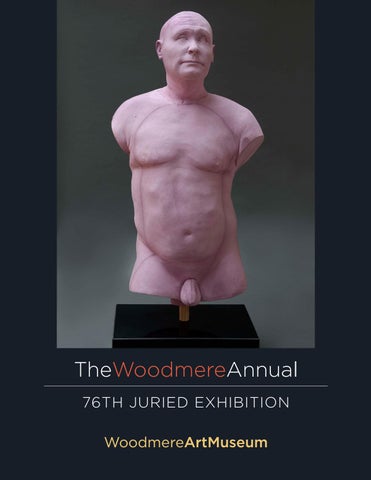
TheWoodmereAnnual 76TH JURIED EXHIBITION WoodmereArtMuseum
Woodmere extends sincere thanks and appreciation to the Drumcliff Foundation and Victor Keen and Jeanne Ruddy for their support of the exhibition and digital catalogue.
TheWoodmereAnnual 76TH JURIED EXHIBITION
CONTENTS
Foreword 2 A Conversation with Harry Philbrick 4 Works in the Exhibition 18
June 3–September 4, 2017
WoodmereArtMuseum
FOREWORD
The opening day of the Woodmere Annual
and for questioning the current state of culture in
represents the culmination of a twelve-month
the United States. This Annual seems like the right
process. We start conversations with the juror in
kind of exhibition for this moment.
late summer, walking through the current Annual and considering how the criteria for selection lead to the expression of an overarching statement about contemporary art in Philadelphia. New ideas develop and a call to artists is written in the fall, with the actual submissions for consideration and selections happening digitally in the course of the winter months. The installation and catalogue are planned and implemented through the spring for an early summer opening. Throughout the year, and on an ongoing basis, the Annual is an important expression of Woodmere’s mission, celebrating the vitality of the arts of Philadelphia as it is being made and at its grassroots. It has been Woodmere’s great honor over this past year to work with Harry Philbrick, our colleague of many years through his tenure as director of the museum at the Pennsylvania Academy of the Fine Arts. Now, as the founding director of Philadelphia Contemporary, Philbrick is developing a new museum that will engage the fabric of the arts of Philadelphia with international conversations and cross-disciplinary practices. It was from a strong sense of interest in contemporary art that is either thoughtfully implicit in its intertwining with a shared, lived culture or actively explicit in its questioning that Philbrick chose to focus his Annual selections on political consciousness. Regardless of where one may identify on the spectrum of right versus left in American politics, the 2016 presidential election unleashed an imperative for self-reflection
2
WOODMERE ART MUSEUM
Every year we ask our juror to incorporate Woodmere’s collection into the exhibition in some manner. Philbrick chose to make his selections at the important moment of installation, when he was deciding where individual works would be placed and, as a result, where relationships would occur through adjacencies and juxtapositions. Almost surgical in his precision, he inserted four works from the collection that expand the “conversations” across the galleries: Murray Dessner’s Viet Nam (1992), Sidney Goodman’s Divided Landscape (1966), Nina Martino’s Vacant Lot (1987), and David Pease’s Twin Culverts (1967). Woodmere is grateful to Harry Philbrick for creating this provocative exhibition and to all of the participating artists. The Annual is made possible by the generosity of several donors who have supported it now for many years: the Drumcliff Foundation and Victor Keen and Jean Ruddy. This dedicated sponsorship means we can plan the Annual knowing we have the support to focus on the art and the ideas being developed by our juror. Rick Ortwein, Woodmere’s Deputy Director for Exhibitions, and Rachel McCay, Assistant Curator, keep the exhibition on track throughout the year, and as usual they have done a superlative job. Thank you all. WILLIAM R. VALERIO, PHD
The Patricia Van Burgh Allison Director and Chief Executive Officer
Katrina, 2006, by Oscar Page, Jr. (Courtesy of the artist)
THE WOODMERE ANNUAL: 76TH JURIED EXHIBITION
3
A CONVERSATION WITH HARRY PHILBRICK
On April 11, 2017, William Valerio, Woodmere’s Patricia Van Burgh Allison Director and Chief Executive Officer; Rachel McCay, Assistant Curator; Rick Ortwein, Director of Exhibitions; and Hildy Tow, the Robert L. McNeil, Jr. Curator of Education sat down with Harry Philbrick, founding director of Philadelphia Contemporary and former director of the Museum of the Pennsylvania Academy of the Arts, to discuss his selections for Woodmere’s 76th Juried Exhibition. WILLIAM VALERIO: Harry, it’s exciting to look
permutations of the problems in the Middle East
at the images you’ve selected for the Woodmere
and America’s involvement in those issue’s, and our
Annual, our 76th Juried Exhibition. Your overarching
ongoing problems with race. I was gratified to see
concept is to address different aspects of political
that so many artists are dealing with a whole range
consciousness. Let’s talk about why that’s important
of different issues in very thoughtful ways; some of
now.
them obviously have been working in this way for
HARRY PHILBRICK: Thank you, and I’m delighted
to be doing this. When you approached me about being a juror for the exhibition, I was interested to
quite some time and others are really reacting in the moment to what’s been happening in this country in the last six months or so.
see if we could really focus on work that engaged
VALERIO: Can you elaborate on the matter of truth
with our current political situation and also, tied in
and the political culture of the United States?
with politics, the idea of truth. Those two things seemed to be very important in this era of President Trump and some of the issues that have been brought up, both during the election and in the early days of his administration. When we put out the call, I was interested to see what would come in, because—and I mean this as a criticism of the contemporary art world—I don’t see a lot of work that is engaging with political reality in a deep way. A lot of things have happened over the last decade that I thought artists would have responded more to, from the economic crisis in 2008 to the different
4
WOODMERE ART MUSEUM
PHILBRICK: Looking at history, truth is something
that defines the American art project. If you look back at early American art, when artists were chronicling the leaders of the revolution and George Washington as first president, there was an attempt to show the perceived reality of our new democratic leadership and the superiority of that system. Later, in the nineteenth century, the Hudson River School sought to show the natural glory of the American landscape and wilderness, and the idea that it reflected the greatness of our country. There was an attempt
Pink and Blue Un, 2013–15, by Jane Irish (Courtesy of the artist and Locks Gallery)
Pink and Blue Deux, 2013–15, by Jane Irish (Courtesy of the artist and Locks Gallery)
to show a new reality or to show a truth of what
to talk about a political situation and a political
America represents. Obviously, closer to home in
reality, moving beyond just one-liners about a
Philadelphia, the Peale family insisted on showing
particular election.
the reality of the natural world. Truth runs through American art. You can take it right up through Abstract Expressionism, reflecting an existential, emotional reality, and then Andy Warhol saying, “No, reality now is Marilyn Monroe and Campbell’s soup cans.” Today the issues presented by “fake news” and politicians saying things that are demonstrably false raise pertinent questions about how we define truth. If I think they’re demonstrably false and if you don’t, who’s right? Whose truth is correct? That’s not something that any individual work of art can answer. I’m interested in the way
VALERIO: It’s fascinating to think about the issues
that we are all dealing with today in America’s political culture in relation to realism in the arts. Realism is not only an important facet of American art, but also a defining factor in the art of Philadelphia. You mentioned the Peales, but realism of different stripes comes into being through the work of Thomas Eakins, the Ashcan School, Pennsylvania Impressionism, Arthur Carles, Andrew Wyeth, and Bo Bartlett. Realism is a mainstream in Philadelphia.
that an investigation of the idea of truth allows us
THE WOODMERE ANNUAL: 76TH JURIED EXHIBITION
5
Clinic Defense, 1990, by Sarah McEneaney (Courtesy of the Pennsylvania Academy of the Fine Arts: Gift of Jules and Connie Kay)
PHILBRICK: Another good example of an art
Vietnam War era, and in particular the anti-war
project in Philadelphia that touches on realism is
marches that veterans were involved with. Many of
the Mural Arts program. The community-based
her scenes are drawn from images of those protests
murals are a conscious attempt to say, “Okay, what
in parks in and around Philadelphia, juxtaposed
is the truth from your point of view on this block?
with images of the war in Vietnam, the Southeast
What’s your story?” You get a lot of narratives that
Asian landscape, and French colonialism. It’s a
are heartfelt and truthful. They reflect a micro-
really complicated mix of imagery. She’s been
community in some cases or a segment of a larger
fascinated for many years with how those different
metropolis. There’s tension within that, too. Whose
narratives are intertwined. Unfortunately the whole
truth matters, or whose story matters?
issue of war and American involvement in foreign
VALERIO: Truth according to whom?
lands for reasons that are sometimes dubious and driven by other agendas has not gone away. Irish’s
PHILBRICK: Exactly. Who privileges one story
work provides a good context for that, and there’s
versus another?
some other work in the exhibition that touches on that issue. We’ll show three older paintings
VALERIO: It’s interesting that you’ve grounded
by McEneaney that are nonetheless germane to
the exhibition in paintings by artists who are well-
conversations today. Clinic Defense (1990) depicts
known: Jane Irish and Sarah McEneaney.
a Planned Parenthood clinic in Philadelphia. It was
PHILBRICK: Yes, Sarah McEneaney and Jane Irish
to me were real touchstones for this exhibition. They
painted over twenty-five years ago, but it could have been painted yesterday.
are two artists who have been living and working
VALERIO: It’s certainly an image we need to
in Philadelphia for many years and creating well-
see today!
known work. There’s a political thread that runs through what they do. Irish’s works in this exhibition
PHILBRICK: Planned Parenthood provides health
are large-scale landscapes that are rooted in the
services for women, but it’s under threat because
6
WOODMERE ART MUSEUM
June 15, 1998, 1999, by Sarah McEneaney (Courtesy of the artist and Tibor de Nagy Gallery, New York)
June 15, 1998, 1999, by Sarah McEneaney (Courtesy of the artist and Tibor de Nagy Gallery, New York)
it also provides abortions. It’s a touchpoint for
which examines immigration through the lens of
controversy, and McEneaney comes down very
her grandfather and his experience coming to the
strongly on one side of that argument and presents
United States. By including the voices of refugees
it quite clearly. The other works—both titled June
and immigrants who are living today, the work
15, 1998—we’ve included as a counterpoint to
compares what it’s like to be a refugee now with
Clinic Defense. They are pieces she did in response
what it was like in the case of her grandfather, to
to a horrible incident in her life. McEneaney was
be an immigrant from Italy in the 1920s. It reminds
raped in her own home, and the police came and
us that most of us in this country are immigrants,
dusted the house for fingerprints to try to find the
and the stories behind that are deeply personal and
perpetrator. Her self-portrait shows her in color and
rooted in our families’ narratives.
her assailant in a kind of gray outline or silhouette, and the gray is the fingerprint dust that she’s used as the medium to depict her assailant. These three works together are powerful images of men trying to control women’s bodies. VALERIO: These works point to a broad spectrum
of what “political” means, from personal experience to the broader sociopolitical world that creates the context in which we live.
RACHEL MCCAY: You’ve selected more videos than
any juror in the past five years. Is this a personal preference or do you think there’s something about video that makes it particularly suited to express politically relevant stories and experiences? PHILBRICK: That’s a great question. Video isn’t a
personal preference for me, but there was some great work that utilized video. It’s interesting because it’s a real mix of different kinds of video,
PHILBRICK: I agree. The issue of immigration is
from the narrative, almost documentary style
in the news a lot these days and that also came
of Costanzo’s piece to Ashley Wick’s Wizard of
through in this exhibition. I’ve selected a film by
Oppression (2017), which consists of a marionette
Francesca Costanzo, Complexion Dark (2017),
in a small installation. Sascha Hughes-Caley has
THE WOODMERE ANNUAL: 76TH JURIED EXHIBITION
7
Sarraf Split, 2016–17, by Marie Manski (Courtesy of the artist)
8
WOODMERE ART MUSEUM
taken found footage of kids in a Costco store
HILDY TOW: Harry, you’ve been talking about
watching a 3-D television and jarringly juxtaposed
these artists and thinking about the truth from
it with found audio from Aleppo, Syria. Nishat
their point of view. In the enormous group of artists
Hossain’s Body/Document (2016), done on a
who submitted work, most of the artists question
scanner, engages with the history of displaying
our current political reality. Were there different
the female body in Western art. It’s dreamlike and
strategies of political consciousness or different
horrible, a nightmarish kind of display, but at the
creative ways of being political?
same time deeply personal. It’s a very simple but complex piece.
PHILBRICK: I certainly saw a lot of work that
touched strongly on the same issues that Trump
RICK ORTWEIN: We’ve also not had any
talked about, or many of the issues that Trump talked
performance before. How does Marie Manski’s
about in the election, both in a positive way and in
Sarraf Split (2016–17) fit into the theme of truth or
a negative way. So, for example, Trump’s campaign
truth to power?
slogan of “Make America Great Again” references
PHILBRICK: Manski’s piece also engages with
immigration and the complicated stories that we have in our family histories. Through this performance of sharing food with visitors, she is also sharing a little of her family history. The piece came about because of her discovery of her family history. She attempts to understand where her family comes from and how her surname doesn’t
an idea that America has lost its economic power and that many people are unemployed or underemployed, and the economic struggles of many Americans. This reality comes across in work in this exhibition, from Rachel Zimmerman’s photographs of Yazoo, Mississippi, to Tim Portlock’s pictures of economically challenged parts of Philadelphia or the vacuous desolation of some suburban developments.
reflect the full breadth of the history of her family.
Many works were trying to make the abstract real.
As she states, “Sarraf is my paternal grandfather’s
What I mean by that is Trump, and politicians in
original surname before adoption into the Manski
general, often paint verbal pictures that gloss over
family. In an effort to connect our family to our
huge realities. Take the idea that we must keep
roots, my father taught himself to cook authentic
immigrants from certain parts of the world away
Syrian food.” In her performance she makes ice
from this country because they would endanger
cream sundaes with Middle Eastern flavors such as
us. When that’s in the abstract, it’s fairly easy to
honey, tahini, and mint.
understand how people could say, “Oh yeah, that’s a
I love the way she explores her family history in this piece, which is very personal. Another layer of this work is the generosity of sharing food with strangers. It reminded me of the old expression of breaking bread together. You get to know someone when you share a meal with them. Sharing a meal and in the process sharing family history is really wonderful.
good idea because we don’t want to risk terrorism.” The moment you turn those refugees into real people, however, and you understand their story and make it about those individuals, it’s a lot harder to feel like, “Oh, we must keep them away.” Depictions of “them,” whoever “they” are, come through in a lot of this work—in depictions that humanize rather than dehumanize.
THE WOODMERE ANNUAL: 76TH JURIED EXHIBITION
9
Yazoo, Mississippi, #1, 2010/17, Rachel Zimmerman (Courtesy of the artist)
History seems to repeat itself quite frequently. In America we’ve been resistant to the Irish, then the Italians, Asians, and Jews. Now it’s people from the Middle East. There seem to be recurring waves of groups that we must keep out or the country will be endangered. Also the idea of naming something is incredibly important. Linda Lee Alter’s work is good to bring up in that regard. In Celebration (2015) presents a small selection of the different phrases that are in use to name gender identity or Farm, 2011, by Tim Portlock (Courtesy of Locks Gallery)
sexual orientation. In our culture now the number of different names has grown exponentially. It’s confusing to many people, but it’s really a reflection
Victimization is another subject that runs through
of people wanting to have control of their identity
the exhibition. Several artists take headlines and
and to name it themselves rather than be named.
make you remember or see for the first time that
That’s such a powerful idea—if somebody else
a real person was hurt, or that the grieving mother
names you and defines you, you’re often placed
is a real person who cries like you or me. The pain
outside the mainstream in a way that can be
of having lost a son suddenly becomes much more
quite negative.
real, and the arguments become less abstract and more tangible.
Meg Wolensky’s painting Considering Things (2017) is a self-portrait. In the text that accompanies the painting, she talks about acknowledging her sexual orientation, that she’s gay, and the different climate
10
WOODMERE ART MUSEUM
Considering Things, 2017, by Meg Wolensky (Courtesy of the artist)
In Celebration, 2015, by Linda Lee Alter (Courtesy of the artist) THE WOODMERE ANNUAL: 76TH JURIED EXHIBITION
11
Kmart Parking Lot, Clifton Heights, Pennsylvania, March 2017, by Rachel Winslow (Courtesy of the artist)
that internal dialogue is happening within now
charged, and it’s also a phrase that you think
compared to four years ago. Her work addresses
about in terms of a business deal, with neither side
how the larger political climate can impact how you
wanting to make the first bid, if you will. The image
feel about yourself.
underlying the text is a handgun. The correlation of
VALERIO: Harry, can you talk about Tim
Rusterholz’s sculpture of Putin? It also seems to play with the idea of truth and realism.
guns to power and male sexuality is a particularly American issue. Emily Erb’s Neverending Story (2016) looks like two intertwined snakes—when you look at them closely, the snake bodies are made
PHILBRICK: The sculpture references Greek and
up of guns. The guns are evolving from the head,
Roman busts of emperors or gods. There’s a long
where they’re older models, to the tails where they
tradition of artists poking fun at those in power
are contemporary guns. This cycle of violence and
by depicting them in ways that make them look
fascination with guns never seems to go away in
ridiculous or ugly. Putin’s self-image is that of a
our country.
powerful and virile man. Rusterholz’s choice to show him with a middle-age paunch made me smile. VALERIO: I also like that it is made through the
application of new technologies: machine carved insulation foam all based on computer-generated renderings from public photographs. Let’s also discuss Anne Minich, who is a part of the family here at Woodmere and at the Pennsylvania Academy of the Fine Arts. She is an interesting voice in the arts in Philadelphia today.
MCCAY: What do you think visitors to the show will
learn about contemporary art in Philadelphia? PHILBRICK: The exhibition shows the breadth
and depth of art being made in Philadelphia, and I mean that in a couple of different ways. We’ve talked about the different media in the exhibition. There’s everything from traditional egg tempera and works that reference orthodox icons to videos, performance, computer-generated renderings, and conceptual work. The different ways of working
PHILBRICK: Minich’s work is titled January 8, 2011
reflect the diversity and variety of the artists’
(2011). The text in the painting is “I’ll show you
backgrounds, whether that reflects their gender,
mine if you show me yours.” The phrase is sexually
sexual orientation, or race, or age. That was really
12
WOODMERE ART MUSEUM
Boat Launch, 2008, by Jack Ramsdale (Courtesy of the artist)
compelling to me. I think visitors will get a good
and tarps strewn about. Many of our environmental
sense of all the different corners of Philadelphia,
issues are not global issues—they’re about us
and to me that makes this exhibition a celebration
taking care of a watershed in a suburban shopping
of what Philadelphia is at this moment.
development. Contrast that with Jack Ramsdale’s
MCCAY: I agree. I think you picked a show that is
diverse in approach and in the issues it presents. VALERIO: One more element that runs through the
exhibition is the idea of environmental justice and
photograph of the boat launch left high and dry, hundreds of yards away from the edge of the drought-stricken lake. VALERIO: I love Hilary Wang’s Ice Floes (2016).
the destruction of the landscape. The environment
PHILBRICK: It’s a small porcelain sculpture that was
is political as never before. While the Clean Air Act
done in response to the artist’s visit to the Arctic
might not be perfect, and while regulations can
Ocean, where she was researching. It’s interesting
sometimes have unintended impacts, I don’t think
because there’s a lot of work that deals with what
any of us have ever felt that an organization like
we would identify as overtly political issues like
the EPA could be as undercut as it would be by
racial tension and violence and immigration, but
the budget that’s been discussed by this president.
there’s other work that’s encouraging us to think
Numerous artists address fracking in Pennsylvania,
about much larger systems than our own political
or what happens when suburban sprawl sends
systems. Wang’s piece fits well with Ana Vizcarra
water to all the wrong places.
Rankin’s El Sur (2014). They are interesting to
PHILBRICK : Rachel Winslow’s Kmart Parking Lot,
Clifton Heights, Pennsylvania (March 2017) is quite a beautiful photograph, and then you begin to notice the stormwater runoff and the plastic bags
think about together—totally different in scale, but both depict our world in ways that give us some interesting perspective. Wang shows us how completely fragile this tiny little globe of ours is. Rankin reminds us that we all have a picture of what THE WOODMERE ANNUAL: 76TH JURIED EXHIBITION
13
Ice Floes, 2016, by Hilary Wang (Courtesy of the artist)
14
WOODMERE ART MUSEUM
El Sur, 2014, by Ana Vizcarra Rankin (Courtesy of the artist and James Oliver Gallery)
THE WOODMERE ANNUAL: 76TH JURIED EXHIBITION
15
Ran Away from the Subscribers, 2016, by Charles Hall (Courtesy of the artist)
the world is because of what we’ve been taught,
Certainly another subject of contemporary art is the
but by turning it upside down, we hopefully see the
exploration of the ways in which media, particularly
world anew.
film, informs our consciousness and our sense of
VALERIO: Yes, Charles Hall’s Ran Away from
the Subscribers (2016) made from Nike boxes made me think about how corporate structure defines consciousness, beyond political borders.
self. In this instance, Belshaw explores how her own understanding of how to conduct herself in a relationship is not just informed but constituted by the images she has seen in film and on television.
Certainly that’s a theme running through twentieth-
TOW: She is also concerned with tradition. Where’s
century art and contemporary art—the impact of
the woman’s place? It’s in the home, taking care of
commercialization on consciousness.
the laundry, and here she is folding and cleaning.
MCCAY: Emily Belshaw’s Napkin Scenes (2017)
VALERIO: An extension of that is the role that
also addresses issues of consciousness. The video
stereotypes play. There’s a big painting by Kukuli
consists of her folding fabric juxtaposed with film
Velarde that uses commercial tablecloths to
clips that, as the artist explained, “were integral to
convey stereotyped images of what it means to be
my early conception of sexuality and sexual desire.”
Hispanic.
16
WOODMERE ART MUSEUM
we would otherwise. In many ways, Philadelphia Contemporary is trying to create a twenty-first century museum model that reflects some of the economic changes that have happened in other industries. The traditional museum model is based on the idea of vertical integration. The institution controls the process from beginning to end and it owns the objects that constitute a collection. It’s really a nineteenth-century, early twentiethcentury, model. I’m exploring a new model where, through collaboration, we are able to give the public access to work without worrying about owning it. That’s one aspect of it. The other is that through collaborations we’ll be able to work with curators Hispanic Ready Made, 2010, by Kukuli Velarde (Courtesy of the artist)
and other presenters and give them opportunities to work in a space—that is, when we create our new building—that is larger than they would have. This would give us the opportunity to work with
PHILBRICK: That’s right—the stereotype of the
them and explore the ideas that are on their mind.
Chiquita banana woman.
Sharing resources and not overinvesting in the
VALERIO: Harry, I have a final question for you.
What you’re doing with Philadelphia Contemporary is very exciting. Can you describe what your goals are and whether the experience of selecting these works as Woodmere’s juror fed the ideas that are channeling into those goals?
overhead of the building is something that’s a little different than most museums. Curating the Woodmere Annual has been great for me in the sense of getting a really broad overview of what’s going on in Philadelphia right now. Philadelphia Contemporary will be focusing on Philadelphia artists and national and international artists—the
PHILBRICK: There are two main ideas idea behind
idea is to work with all three groups. This project
Philadelphia Contemporary. One is to create an
was a great immersion in the art of the moment
institution that responds to the reality that art
here in Philadelphia.
today is completely multidisciplinary and crossdisciplinary, and this exhibition certainly reflects that. The other is to create an institution that is based on a partnership model so that we’re working with existing nonprofits, foundations, and other organizations to curate exhibitions and create projects and mount performances that will allow us to have a broader and more diverse program than
THE WOODMERE ANNUAL: 76TH JURIED EXHIBITION
17
WORKS IN THE EXHIBITION
LINDA LEE ALTER
JACINTHA CLARK American, born 1986
TERRENCE GORE American, born 1964
In Celebration, 2015 Twenty acrylic painted letters, each attached to a 5 x 5 in. fiber panel
Without a Handle, 2017 Ceramic and enamel, 17 x 12 in.
Creating Beyond Limitation, 2015–17 Collage mixed media installation on wood, 16 x 22 in.
American, born 1939
Courtesy of the artist
Courtesy of the artist
EMILY BELSHAW American, born 1993 Napkin Scenes, 2017 Video, 1 minute 52 seconds
Courtesy of the artist
FRANCESCA COSTANZO American, born 1953 Complexion Dark, 2017 Video, 6 minutes, 29 seconds Courtesy of the artist
Courtesy of the artist
MARIEL CAPANNA American, born 1988 Palm Tree, Television, Desert, Van, 2017 Oil on panel, 10 1/4 x 13 1/4 in. Courtesy of Katharine Sokoloff and William McLaughlin
Cotton Field, Sampler, Milk Jug, Ice, 2017 Oil on panel, 10 1/4 x 13 1/4 in. Courtesy of Howard and Carol Trachtenberg
EMILY ERB American, born 1982 Neverending Story, 2016 Dye on silk, 120 x 207 in. Courtesy of the artist
LIZ GOLDBERG American, born 1951 WARREN BASS American Beatbox Philly, 2017 Video, 4 minutes, 40 seconds Courtesy of the artists
SUSAN HAGEN American, born 1959 September, 2013 Carved linden, wood, metal, oils, 15 3/4 x 13 x 9 in. Courtesy Schmidt Dean Gallery, Philadelphia
MELISSA MADDONNI HAIMS American, born 1972 IED #12, 2016 Upholstery textiles, threads, yarns, cassette tape, leather, suede, postindustrial, pre-consumer waste, 9 x 12 x 6 in. Courtesy of the artist
CHARLES HALL American, born 1963 Ran Away from the Subscribers, 2016 Concrete, 14 x 10 1/2 x 39 in. Courtesy of the artist
Napkin Scenes, 2017, by Emily Belshaw (Courtesy of the artist)
18
WOODMERE ART MUSEUM
Cotton Field, Sampler, Milk Jug, Ice, 2017, by Mariel Capanna (Courtesy of Howard and Carol Trachtenberg)
IED #12, 2016, by Melissa Maddonni Haims (Courtesy of the artist)
Without a Handle, 2017, by Jacintha Clark (Courtesy of the artist)
THE WOODMERE ANNUAL: 76TH JURIED EXHIBITION
19
Complexion Dark, 2017, by Francesca Costanzo (Courtesy of the artist)
Training, 2016, by Virginia Leigh Werrell (Courtesy of Gross McCleaf Gallery)
Icon of Ahmed Al-Jumaili, 2016, by Melissa Joseph (Courtesy of the artist)
Wizard of Oppression, 2017, by Ashley Wick (Courtesy of the artist)
20
WOODMERE ART MUSEUM
Neverending Story, 2016, by Emily Erb (Courtesy of the artist)
Creating Beyond Limitation, 2015–17, by Terrence Gore (Courtesy of the artist) New Movements (5), 2016, by Mat Tomezsko (Courtesy of the artist) THE WOODMERE ANNUAL: 76TH JURIED EXHIBITION
21
THEODORE A. HARRIS American, born 1966
SASCHA HUGHES-CALEY American, born 1984
Purple Hearts Bleed, from the series Collage and Conflict, 2008 Mixed media collage, 15 x 50 in.
5,646.86 mi (9,087.73 km), 2015 Video, 1 minute, 13 seconds
Courtesy of the artist
NISHAT HOSSAIN American Body/Document, 2016 Video, 2 minutes, 11 seconds Courtesy of the artist
Courtesy of the artist and Locks Gallery
Courtesy of the artist
Courtesy of Winston and Carolyn Lowe Collection
War Is the Sound of Money Eating after John G. Hall, from the series Collage and Conflict, 2008 Mixed media, 15 x 31 in.
Pink and Blue Quatre, 2013–15 Egg tempera on canvas, 101 x 66 in.
JANE IRISH American, born 1955 Pink and Blue Un, 2013–15 Egg tempera on canvas, 101 x 66 in. Courtesy of the artist and Locks Gallery
Pink and Blue Deux, 2013–15 Egg tempera on canvas, 101 x 66 in. Courtesy of the artist and Locks Gallery
MELISSA JOSEPH American, born 1980 Icon of Ahmed Al-Jumaili, 2016 Oil and gold leaf on panel, 8 x 10 in. Courtesy of the artist
TILDA MANN American, born 1957 Still Life, Inauguration Day, 2017 Oil on wood, 18 x 18 in. Courtesy of the artist
Pink and Blue Trois, 2013–15 Egg tempera on canvas, 101 x 66 in. Courtesy of the artist and Locks Gallery
September, 2013, by Susan Hagen (Courtesy Schmidt Dean Gallery, Philadelphia)
Naylors Run, Upper Darby, Pennsylvania, August 2015, by Rachel Winslow (Courtesy of the artist)
22
WOODMERE ART MUSEUM
Purple Hearts Bleed, from the series Collage and Conflict, 2008, by Theodore A. Harris (Courtesy of Winston and Carolyn Lowe Collection)
War Is the Sound of Money Eating after John G. Hall, from the series Collage and Conflict, 2008, by Theodore A. Harris (Courtesy of the artist)
THE WOODMERE ANNUAL: 76TH JURIED EXHIBITION
23
Beatbox Philly, 2017, by Liz Goldberg and Warren Bass (Courtesy of the artists)
Body/Document, 2016, by Nishat Hossain (Courtesy of the artist)
24
WOODMERE ART MUSEUM
Far left: Pink and Blue Trois, 2013–15, by Jane Irish (Courtesy of the artist and Locks Gallery). Left: Pink and Blue Quatre, 2013–15, by Jane Irish (Courtesy of the artist and Locks Gallery)
5,646.86 mi (9,087.73 km), 2015, by Sascha Hughes-Caley (Courtesy of the artist)
THE WOODMERE ANNUAL: 76TH JURIED EXHIBITION
25
Palm Tree, Television, Desert, Van, 2017, by Mariel Capanna (Courtesy of Katharine Sokoloff and William McLaughlin)
Refugee, 2016, by Oscar Page, Jr. (Courtesy of the artist)
26
WOODMERE ART MUSEUM
Beach View, 2016, by Tim Portlock (Courtesy of Locks Gallery)
MARIE MANSKI American, born 1986
ANNE MINICH American, born 1934
TIM PORTLOCK American, born 1969
Sarraf Split, 2016–17 Mixed media performance
January 8, 2011, 2011 Oil on wood, 20 x 37 1/2 in.
Beach View, 2016 Archival pigment print, 54 x 72 in.
Courtesy of the artist
Courtesy of the artist
Courtesy of Locks Gallery
SARAH MCENEANEY American, born Germany 1955
OSCAR PAGE, JR. American, born 1943
Clinic Defense, 1990 Egg tempera on board, 30 1/8 x 39 3/4 in.
Katrina, 2006 Oil on canvas, 60 x 84 in.
Courtesy of the Pennsylvania Academy of the Fine Arts: Gift of Jules and Connie Kay
June 15, 1998, 1999 Egg tempera and fingerprint dust on wood, 14 1/2 x 19 1/2 in. Courtesy of the artist and Tibor de Nagy Gallery, New York
June 15, 1998, 1999 Egg tempera and fingerprint dust on wood, 24 x 24 in. Courtesy of the artist and Tibor de Nagy Gallery, New York
Farm, 2011 Archival pigment print, 54 x 72 in. Courtesy of Locks Gallery
Courtesy of the artist
MATTHEW PRING American, born 1972
Refugee, 2016 Oil on canvas, 24 x 30 in.
Portrait of Lezley McSpadden, Mother of Michael Brown, from the series Injustices, February 2017 Acrylic on canvas, 48 x 48 in.
Courtesy of the artist
Courtesy of the artist
JACK RAMSDALE American, born 1950 Boat Launch, 2008 Archival giclée print, 21 x 25 in. Courtesy of the artist
THE WOODMERE ANNUAL: 76TH JURIED EXHIBITION
27
ANA VIZCARRA RANKIN Uruguayan, born 1977
MAT TOMEZSKO American, born 1986
RACHEL WINSLOW American, born 1950
El Sur, 2014 Mixed media on canvas, 92 x 120 in.
New Movements (5), 2016 Sher-cryl, grit, leaf, and vinyl on panel, 48 x 48 in.
Kmart Parking Lot, Clifton Heights, Pennsylvania, March 2017 Inkjet print, 14 1/2 x 22 in.
Courtesy of the artist and James Oliver Gallery
Courtesy of the artist
Courtesy of the artist
KUKULI VELARDE American, born 1962
Naylors Run, Upper Darby, Pennsylvania, August 2015 Inkjet print, 14 1/2 x 22 in.
MIA ROSENTHAL American, born 1977 Popular Vote, 2017 Ink on paper, 13 x 11 in.
Hispanic Ready Made, 2010 Cutouts on vinyl, 120 x 96 in. Courtesy of the artist
Courtesy of the artist and Gallery Joe
2016, 2016 Ink and gouache on paper, 13 3/4 x 11 1/4 in. Courtesy of the artist and Gallery Joe
TIM RUSTERHOLZ American, born 1987
HILARY WANG American, born 1992 Ice Floes, 2016 Cast porcelain, mason stain, glaze, 2 1/4 x 2 1/4 x 2 in. Courtesy of the artist
Courtesy of the artist
MEG WOLENSKY American, born 1992 Considering Things, 2017 Oil and paper collage on canvas, 18 x 24 in. Courtesy of the artist
RACHEL ZIMMERMAN American, born 1967
Putin, 2017 Insulation foam, 24 x 24 x 56 in.
VIRGINIA LEIGH WERRELL American, born 1987
Yazoo, Mississippi, #1, 2010/17 Archival inkjet print, 8 x 12 in.
Courtesy of the artist
Training, 2016 Oil on panel, 12 x 18 in.
Courtesy of the artist
Courtesy of Gross McCleaf Gallery
Yazoo, Mississippi, #2, 2010/17 Archival inkjet print, 8 x 12 in.
ROSALIND SUTKOWSKI American, born 1963 Women’s March, Washington, DC, January 20, 2017, 2017 Photograph and yarn, 12 x 17 in. Courtesy of the artist
JACQUES-JEAN TIZIOU American, born 1979 Stop Fracking Now, 2011 Photograph, 20 x 30 in. Courtesy of the artist
28
WOODMERE ART MUSEUM
ASHLEY WICK American, born 1987 Wizard of Oppression, 2017 Video (1 minute, 27 seconds) with marionette and frame (fabric, embroidery, oil paint, mixed media), dimensions vary Courtesy of the artist
Courtesy of the artist
Yazoo, Mississippi, #3, 2010/17 Archival inkjet print, 8 x 12 in. Courtesy of the artist
Yazoo, Mississippi, #4, 2010/17 Archival inkjet print, 8 x 12 in. Courtesy of the artist
Portrait of Lezley McSpadden, Mother of Michael Brown, from the series Injustices, February 2017, by Matthew Pring (Courtesy of the artist)
January 8, 2011, 2011, by Anne Minich (Courtesy of the artist)
THE WOODMERE ANNUAL: 76TH JURIED EXHIBITION
29
2016, 2016, by Mia Rosenthal (Courtesy of the artist and Gallery Joe)
Still Life, Inauguration Day, 2017, by Tilda Mann (Courtesy of the artist)
Popular Vote, 2017, by Mia Rosenthal (Courtesy of the artist and Gallery Joe)
30
WOODMERE ART MUSEUM
Yazoo, Mississippi, #2, 2010/17, by Rachel Zimmerman (Courtesy of the artist)
Yazoo, Mississippi, #4, 2010/17, by Rachel Zimmerman (Courtesy of the artist)
Yazoo, Mississippi, #3, 2010/17, by Rachel Zimmerman (Courtesy of the artist)
THE WOODMERE ANNUAL: 76TH JURIED EXHIBITION
31
Women’s March, Washington, DC, January 20, 2017, 2017, by Rosalind Sutkowski (Courtesy of the artist)
Stop Fracking Now, 2011, by Jacques-Jean Tiziou (Courtesy of the artist)
32
WOODMERE ART MUSEUM
SELECTIONS FROM THE PERMANENT COLLECTION
MURRAY DESSNER American, 1934–2012 Viet Nam, 1992 Acrylic on canvas, 68 x 84 in. Woodmere Art Museum: Gift of the artist, 2011
SIDNEY GOODMAN American, 1936–2013 Divided Landscape, 1966 Etching, 16 1/4 x 17 1/2 in. Woodmere Art Museum: Gift of Carl L. Steele, 2014
NINA MARTINO American, born 1952
Viet Nam, 1992, by Murray Dessner (Woodmere Art Museum: Gift of the artist, 2011)
Vacant Lot, 1987 Oil on Masonite, 9 x 12 in. Woodmere Art Museum: Gift of Babette Martino in memory of Giovanni Martino, N.A., 2000
DAVID PEASE American, born 1932 Twin Culverts, 1967 Colored pencil on paper, 11 x 14 in. Woodmere Art Museum: Gift of Carl L. Steele, 2014
Divided Landscape, 1966, by Sidney Goodman (Woodmere Art Museum: Gift of Carl L. Steele, 2014) THE WOODMERE ANNUAL: 76TH JURIED EXHIBITION
33
Vacant Lot, 1987, by Nina Martino (Woodmere Art Museum: Gift of Babette Martino in memory of Giovanni Martino, N.A., 2000)
Twin Culverts, 1967, by David Pease (Woodmere Art Museum: Gift of Carl L. Steele, 2014)
34
WOODMERE ART MUSEUM
Woodmere Art Museum receives state arts funding support through a grant from the Pennsylvania Council on the Arts, a state agency funded by the Commonwealth of Pennsylvania and the National Endowment for the Arts, a federal agency.
Support provided in part by The Philadelphia Cultural Fund.
Š 2017 Woodmere Art Museum. All rights reserved. No part of this publication may be reproduced or transmitted in any form or by any means without written permission of the publisher. Photography by Rick Echelmeyer unless otherwise noted. Catalogue designed by Barb Barnett and Kelly Edwards and edited by Gretchen Dykstra. Front cover: Putin, 2017, by Tim Rusterholz (Courtesy of the artist) THE WOODMERE ANNUAL: 76TH JURIED EXHIBITION
35
WoodmereArtMuseum 9201 Germantown Avenue, Philadelphia, PA 19118
| woodmereartmuseum.org