Exhibition or Catalogue Charles Searles Title 15 words max on A Focus on the 3 lines maxFigure
1
.
Charles Searles A Focus on the Figure
CONTENTS Foreword 2 An Essay on Searles 4 Illustrated Works 6 Works in the Exhibition 24
March 26 - June 15, 2013
FOREWORD WILLIAM R. VALERIO, PHD
many wonderful works on paper by her
The Patricia Van Burgh Allison
late husband, and to Woodmere’s close
Director and CEO
friend Steven Hrabrick for lending his magnificent Relaxed Traders (1972). It has been a true pleasure to work with
It is a great honor for Woodmere to
Maite Barragan, a PhD candidate in
present Charles Searles: A Focus on
art history at Tyler, who served as our
the Figure. We always seek to better
intern on this project and shouldered the
understand the works of art in our
curatorial responsibilities of selecting
collection, and we are most pleased to
the works of art, writing the wall text
show Searles’s beautiful, emotive Untitled
and labels, and authoring the essay that
(The Boxer) (1963) in the context of
appears in this catalogue. Thank you,
other, equally powerful figurative works
Maite, for your dedication to this project.
by the artist. As visitors to the concurrent
I will conclude on a personal note, and
exhibitions at La Salle University and
say that it is an extra special pleasure
Temple University’s Tyler School of Art
for me, as Woodmere’s director, to host
will be aware, Searles is known for his
this exhibition; Searles was my mother’s
large-scale, abstract sculpture; the works
friend, and I have been taken by the
on view here show an intimate side of his
brilliant colors and dynamic forms of his
oeuvre that may be less familiar, but is no
sculpture since I was a child. I am now
less wonderful. We thank Susanna Gold
thrilled to know his figurative work and
of the Art History Department at Tyler
am most grateful to everyone who made
for proposing that Woodmere participate
this exhibition a reality.
with Tyler and La Salle in this multipart examination of Searles’s career. We extend special thanks to Kathleen Spicer, Searles’s wife, for lending us the
2
Charles Searles, circa 1995. Photograph by Kathleen Spicer. Courtesy of Kathleen Spicer. 3
AN ESSAY ON SEARLES MAITE BARRAGAN, PHD CANDIDATE,
In the earliest works shown here, Searles
TYLER
portrays his family, capturing his first wife, Mary, and their children in everyday situations. His close observation of
Throughout his career, Charles Searles
these intimate moments reveals the
(1937-2004) found beauty and joy in
personality traits of his subjects with
the objects and people of everyday life.
warm familiarity and affection. The
Colorful furniture, patterned clothing,
portraits of his daughters, Charmaine
and street signs were sources for his
and Vanessa, depict them in moments of
drawings and paintings.
quiet concentration.
The works in this exhibition provide
Stepping outside his home, Searles was
a glimpse of Searles’s draftsmanship;
attracted to the liveliness of the urban
the art in the exhibition show his
environment. He photographed the
experimentation with different
world around him and often utilized
techniques and media in sketches
those pictures to construct his paintings.
and finished drawings he produced
Other times, he would quickly sketch
throughout his career. We have chosen
people and scenes he came across in
to focus on his representation of the
pool halls, on the street, or at sporting
figure, since it has received little attention
events. In images such as Untitled (The
in previous exhibitions. After traveling
Boxer), (Untitled) Pool Player, and
to Africa in 1971 and 1972, Searles would
Untitled (Sitting Man) he uses pen and
begin to explore pattern and color, as
ink, a medium which requires a steady
evident in his monumental painting
hand. While he would smoothly trace the
Relaxed Traders (1974). Later on, he
outlines of his subjects, he would allow
would become known as an abstract
blots and ink splatters to appear, creating
sculptor, but this exhibition concentrates
imperfections that bring dynamism and
on the evolution of his visual language
life to the finished work. The gritty quality
and the intimate side of his production. 4
gives character to the compositions,
gave him license to stray from a tradition
evoking the textures of the city.
of mimetic aesthetics. He would continue to be drawn to the organic qualities of
Drawing directly from live models
bodies, even in his abstract works, as he
for nude studies are fundamental in
attempted to exude the color and life of
traditional art education. Searles studied
the world around him.
at the Pennsylvania Academy of the Fine Arts (1969-1972) and his growing ease in the representation of human anatomy gave him the confidence to experiment with naturalism and abstracted forms. In much the same way as urban scenes seemed to work as an impulse for Searles to explore new forms and experiment with new media, nude studies gave him an opportunity to concentrate on finding new ways to be more descriptive. Finding that in simplifying the body he could actually give more character to his creations, he began relying more on flowing strokes that provided movement and vibrancy. For example, in Reclining Woman (1964) we see his quick motions with the pen as they trace and form the soft languid body. Stylizations that are evident in Searles’s works on paper evolved into powerful explorations of pattern, color, and energy after he experienced the arts and culture of Africa in 1971 and 1972. It is as if Africa 5
6
CHARLES SEARLES American, 1937–2004
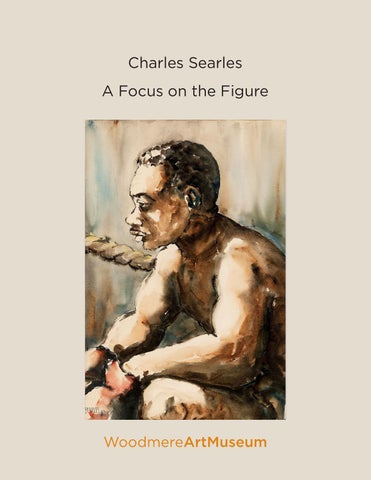
In this work, one of Searles’s earliest
Untitled (The Boxer) 1963 Ink and watercolor on paper
has eliminated the background and
watercolors, Searles’s boxer is at rest, gazing out toward the ring. The artist provides only the details necessary to inform the viewer of what is going on. He concerns himself with the fighter’s facial expression, something that is lacking in other images of city characters. Although
Woodmere Art Museum: Museum purchase, 2012
Searles himself was not a combative man, he is remembered to have said on multiple occasions, “Two things you learn when you grow up in Philly: how to dance and how to fight!”
7
8
CHARLES SEARLES American, 1937–2004
Searles rarely used ballpoint pen to
Untitled (Reclining Woman) 1964 Ink on paper
leaning woman stares directly at the
draw nudes, preferring India ink for the subtleties and flow it allowed. The viewer, confronting and acknowledging her sensuality. Because Searles employed a pen and ink, he could not create the soft, diluted shadows frequently seen in his nude studies. Instead, he
Collection of Kathleen Spicer
drew multiple lines, arranging them in a way that underscores the model’s draped garments. Her large, expressive eyes recall Searles’s intimate, personal portrayals of loved ones.
9
10
CHARLES SEARLES American, 1937–2004
This early charcoal drawing is a portrait
Portrait of Mary 1965 Charcoal on paper
Mary’s attire. Searles was interested in
Collection of Kathleen Spicer
even clearer in his “Dancer” series from
of Searles’s first wife, Mary. One of the most notable features of this work is fashion from a very early age, and he even made clothes for Mary and their children. His delight in design became the 1970s, as he began to pay special attention to patterning and textiles. In this piece however, he concentrates on how Mary’s apparel builds her character. As she sits in a three-quarter pose, her stylish sunglasses don’t allow the viewer to fully engage with her. This cool attitude could seem distant, but Searles has carefully included the details of her eyes behind the lenses’ reflection.
11
12
CHARLES SEARLES American, 1937–2004
This rapid sketch was done in the same
Untitled (Pool Player) 1965 Ink on paper
since that earlier work are evident. The
Collection of Kathleen Spicer
pen away from the paper in his rush to
medium as The Boxer (see page 4), but the stylistic leaps Searles has made lines create an outline, their tangled appearance evoking a sense of urgency. It’s almost as if he does not lift the capture the instant. The pool player has a much more focused gaze than the boxer, and fewer details lend his furrowed brow a concentrated energy.
13
14
CHARLES SEARLES American, 1937–2004
Searles’s youngest daughter, Charmaine,
Untitled (Charmaine in the Hospital) 1969 Ink on paper
depicts the small child in the hospital.
passed away at age eleven from a rare form of cancer. This quiet image Her sideways glance makes her appear innocent, perhaps not entirely aware of her illness. Her small frame is almost swallowed by her surroundings, in tender recognition of the vulnerability felt by
Collection of Kathleen Spicer
both father and daughter during this time. Despite the breather that rests on Charmaine’s chest and her clinical surroundings, this remains a touching and personal piece.
15
16
CHARLES SEARLES American, 1937–2004
In moving toward abstraction, Searles
Untitled (Sitting Man) 1969 Ink and watercolor on paper
powerful presence. Here a man is seated
began geometrizing features, simplifying human forms while maintaining them as a with his legs splayed out, one large hand resting on his thigh, and his head on the other. The exaggerated qualities are further abstracted in the way Searles depicts space. The strong diagonals
Collection of Kathleen Spicer
and broken lines do not depict natural, observed space. The artist increasingly dealt with matters of arranging figures from this point forward in his career. The clash of colors, inkblots, and thick strokes add movement to the work.
17
18
CHARLES SEARLES American, 1937–2004
Relaxed Traders 1972 Oil on canvas Collection of Esther and Stephen Hrabrick
19
20
CHARLES SEARLES American, 1937–2004
Untitled (Vanessa Doing the Dishes) 1977 Ink on paper Collection of Kathleen Spicer
21
22
CHARLES SEARLES American, 1937–2004
Searles’s travels to Africa in 1971 and 1972
Masked Nude #1 1982 Acrylic on paper
style. This nude’s coloring accentuates
Collection of Kathleen Spicer
emphasizes Searles’s African inspiration.
influenced his use of color, which became an integral and identifiable part of his those qualities: she is surrounded by patterns that make it difficult to determine her precise location. Her mask Her green body, with its careful shadowing and attention to detail, retains clearly studied anatomy. The figure continued to be important to Searles, as his most abstract work from late in his career still recalls human forms.
23
WORKS IN THE EXHIBITION CHARLES SEARLES
American, 1937-2004
Untitled (Vanessa Doing the Dishes), 1977 Ink on paper, 8 x 5 in.
Untitled (The Boxer), 1963
Collection of Kathleen Spicer
Ink and watercolor on paper, 21 7/8 x 14 7/8 in.
Masked Nude #1, 1982
Woodmere Art Museum: Museum purchase, 2012
Acrylic on paper, 19 3/4 x 14 in. Collection of Kathleen Spicer
Untitled (Reclining Woman), 1964 Ink on paper, 11 x 14 in. Collection of Kathleen Spicer Portrait of Mary, 1965 Charcoal on paper, 25 x 19 in. Collection of Kathleen Spicer Untitled (Pool Player), 1965 Ink on paper, 14 x 11 in. Gift of Kathleen Spicer Untitled (Charmaine in the Hospital), 1969 Ink on paper, 8 x 9 in. Collection of Kathleen Spicer Untitled (Sitting Man), 1969 Ink and watercolor on paper, 14 x 11 in. Collection of Kathleen Spicer Relaxed Traders, 1972 Oil on canvas, 66 x 66 in. Collection of Esther and Stephen Hrabrick 24
25
This exhibition was supported in part by the Pennsylvania Council on the Arts, a state agency funded by the Commonwealth of Pennsylvania, and the National Endowment for the Arts, a federal agency.
Š 2013 Woodmere Art Museum. All rights reserved. No part of this publication may be reproduced or transmitted in any form or by any means without written permission of the publisher. Photography by Rick Echelmeyer unless otherwise noted. Front cover: Untitled (Boxer), 1963, by Charles Searles (Woodmere Art Museum: Museum purchase, 2012)
9201 Germantown Avenue, Philadelphia, PA 19118 woodmereartmuseum.org