
Cambodia Night kicks our the jams
Page 6

100 teams on the roster
Back Page
![]()


Cambodia Night kicks our the jams
Page 6

100 teams on the roster
Back Page


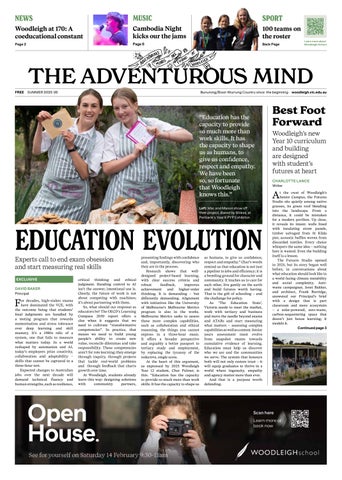
“Education has the capacity to provide so much more than work skills. It has the capacity to shape us as humans, to give us confidence, respect and empathy. We have been so, so fortunate that Woodleigh knows this.”
DAVID BAKER
Principal
For decades, high-stakes exams have dominated the VCE, with the outcome being that students’ final judgments are handled by a testing program that rewards memorisation and stress tolerance over deep learning and skill mastery. It’s a 1980s relic of a system, one that fails to measure what matters today. In a world reshaped by automation and AI, today’s employers prize creativity, collaboration and adaptability –skills that cannot be captured in a three-hour test.
Expected changes to Australian jobs over the next decade will demand technical fluency and human strengths, such as resilience,
critical thinking and ethical judgment. Handing control to AI isn’t the answer; intentional use is. Clearly, the future of work is not about competing with machines; it’s about partnering with them.
So, what should our response as educators be? The OECD’s Learning Compass 2030 report offers a clue when it suggests that we need to cultivate “transformative competencies”. In practice, that means we need to build young people’s ability to create new value, reconcile dilemmas and take responsibility. These competencies aren’t for rote learning; they emerge through inquiry, through projects that tackle real-world problems and through feedback that charts growth over time.
At Woodleigh, students already learn this way: designing solutions with community partners,
presenting findings with confidence and, importantly, discovering who they are in the process.
Research shows that welldesigned project-based learning, with clear success criteria and robust feedback, improves achievement and higher-order thinking. It is demanding – but differently demanding. Alignment with initiatives like the University of Melbourne’s Melbourne Metrics program is also in the works. Melbourne Metrics seeks to assess these more complex capabilities, such as collaboration and ethical reasoning, the things you cannot express in a three-hour exam. It offers a broader perspective and arguably a better passport to tertiary study and employment, by replacing the tyranny of the reductive, single score.
At the heart of this argument, as expressed by 2025 Woodleigh Year 12 student, Char Palmer, is this. “Education has the capacity to provide so much more than work skills. It has the capacity to shape us
as humans, to give us confidence, respect and empathy.” Char’s words remind us that education is not just a pipeline to jobs and efficiency; it is a breeding ground for character and community. It teaches us to care for each other, live gently on the earth and build futures worth having. That is the gift of schooling – and the challenge for policy.
As ‘The Education State’, Victoria needs to meet the market, work with tertiary and business and move the needle beyond exams and ATARs and start measuring what matters – assessing complex capabilities as well as content. Senior years assessment must evolve from snapshot exams towards cumulative evidence of learning. Education must help us discover who we are and the communities we serve. The system that honours both will not only restore trust – it will equip graduates to thrive in a world where ingenuity, empathy and agency matter more than ever.
And that is a purpose worth defending.
Woodleigh’s new Year 10 curriculum and building are designed with student’s futures at heart
CHARLOTTE LANCE Writer
At the crest of Woodleigh’s Senior Campus, the Futures Studio sits quietly among native grasses, its green roof blending into the landscape. From a distance, it could be mistaken for a modern pavilion. Up close, it reveals its intent: walls lined with insulating straw panels, timber salvaged from St Kilda pier, acoustic baffles woven from discarded textiles. Every choice whispers the same idea – nothing here is wasted. Even the building itself is a lesson.
The Futures Studio opened in 2025, but its story began well before, in conversations about what education should look like in a world facing climate instability and social complexity. Antiwaste campaigner, Joost Bakker, and architect, Frank Burridge, answered our Principal’s brief with a design that is part classroom and more ecosystem – a solar-powered, zero-waste, carbon-sequestering space that doesn’t just house learning; it models it.
Continued page 3


DAN LUKIES Director of Wellbeing
It’s often said you can spot a Woodleigh student anywhere – and neuroscience is beginning to explain why. Dr Mary Helen Immordino-Yang, Professor at the University of Southern California, asserts: “Wellbeing isn’t separate from academic success; it’s what makes it possible.”
At Woodleigh, wellbeing is not an add-on; it’s the foundation of every learning journey. Academic excellence is part of a bigger picture – one that includes emotional strength, ethical awareness and a sense of purpose. These aren’t luxuries; they’re essential for long-term fulfilment.
Science now validates what Woodleigh educators have long observed: when students feel meaning and connection in their learning, their brains respond powerfully. Neural networks become more integrated, enabling deeper thinking, stronger identity formation and a richer life.
role do I play in climate change?
These reflections help young people locate themselves within a larger narrative, shaping choices and fostering fulfilment. Central to this process is autobiographical memory – the “hat stand” upon which new learning hangs. When learning connects to values and experiences, the brain builds stronger pathways, accelerating growth.
This approach begins early. At Minimbah, Foundation to Year 2 students, connected to their school’s creek and landscape, investigated the school’s waste system and its impact. They asked the questions, why and what now?

“Ok, so which bin do we put all these bins in?”
Dr Immordino-Yang’s research shows emotional and intellectual growth are inseparable. This interplay is best understood through transcendent thinking – the ability to move beyond the immediate and reflect on broader moral, personal and societal implications. It’s not abstract philosophy; it’s measurable and linked to life satisfaction through longitudinal studies.
Transcendent thinking asks big, contextual questions: Why do some people have more opportunities than others? What
Rather than learning about a system and accepting it was failing, they pushed to change it. With teacher and community involvement, they removed 67 bins and installed a centralised waste station. One plastic bag replaces 67, the Kitchen Garden’s compost thrives and the students have actual agency over the systems they rely on. Wellbeing strengthens the “hat stand,” supporting expansive learning, resilience and motivation. By Year 11 and 12, Woodleigh students navigate stress, sustain motivation and align academic pursuits with personal values –skills that outlast exams.
So, what makes a Woodleigh student stand out? Dr ImmordinoYang joined us via Zoom as keynote speaker for our ReimaginED conference – and her insights affirmed what we see every day: wellbeing makes big thinking possible.
Ned and Kelly, two male emus with outlaw names, have ruled Woodleigh’s Brian Henderson Reserve for years. The reserve –a regenerated bushland sanctuary for indigenous flora and fauna – offers them space to stride and preen. Their feathered friendship has outlasted generations of students and this year, they featured in a short film about Australia’s most ridiculous military escapade, The Great Emu War of 1932.


ADAM LIDDIARD Director of Community Relations
In 1856, when a school opened in a small wooden hall behind St Paul’s Anglican Church in Frankston, Victoria was booming. Gold had transformed the colony; railways were stretching across the landscape and new settlements needed schools. St Paul’s did something unusual for independent schools of the time – teaching boys and girls together. Admittedly, it’s a decision made easier when the town’s population numbered only 40, but the principle has never wavered. Today, Woodleigh stands as Victoria’s oldest independent coeducational school, still convinced that shared learning is the best preparation for real life.
In the mid-1850s, Frankston was a fishing village on Bunurong/Boon Wurrung Country, home to the Mayone Balug clan. The railway’s arrival in 1882 turned it into a seaside escape for Melbourne’s middle class and later a commuter hub. Through those changes, the school adapted.
From church hall beginnings, it grew, moved, and reinvented itself – always in response to what young people needed at the time.
The most dramatic shift came in the 1970s. Australia was rethinking education, shaking off rigid hierarchies and rote learning. St Paul’s embraced that pioneering spirit and in 1972 it opened Minimbah in Frankston South – its name an Aboriginal word meaning “place of learning.” A few short years later, the school bought Woodleigh, a flower farm at Langwarrin South. Minimbah became St Paul’s Junior Campus, Woodleigh (keeping the farm name), the Senior. By 1999, the school took on the Woodleigh School name, adding a third campus in 2015 when Penbank joined the ranks.
The 1970s moves weren’t cosmetic. They signalled a change in philosophy: education should be expansive, not confined to four walls. Bushland campuses
gave space for outdoor learning, creativity and independence –ideas that sounded radical then but feel almost clairvoyant now. Today, Woodleigh talks about “Learning to Thrive,” a phrase that sums up its approach: relationships first, challenge embraced, learning connected to the real world.
Two threads run through its 170year story. First, coeducation is not a marketing line; it’s a conviction.
From day one, Woodleigh believed boys and girls should learn side by side – not in parallel, but together, preparing for the complexity of adulthood. Second, innovation is a habit. Whether it was questioning Victorian-era drill, rejecting midcentury conformity, or embracing global citizenship through Round Square, the school has kept moving.
The local backdrop matters too.
Frankston’s evolution – from fishing and orchards to light industry and now a cultural hub – mirrors the school’s own shifts. Both have faced the pressures of growth,

reflection as well as celebration, and Independent schools walk a tightrope of access and aspiration, and not every experiment succeeds. But Woodleigh’s through-line is clear: a belief that education is about more than marks. It’s about the 3Rs, Respect for Self, Respect for Others and Respect for Environment and it’s about character, curiosity, and community.
As 2026 approaches, Frankston will continue to evolve – and if history is any guide, Woodleigh will too. We’ve moved a long way
“Frankston’s evolution – from fishing and orchards to light industry and now a cultural hub – mirrors the school’s own shifts. Both have faced the pressures of growth, diversity and economic change. Both have had to balance tradition with reinvention.”
diversification and economic change. Both have had to balance tradition with reinvention.
The 1970s reforms at Woodleigh coincided with Australia’s broader transformation: multiculturalism, greater rights and representation for women and an emerging recognition of First Peoples’ cultures. Today, the school’s daily language includes acknowledgment of Bunurong/ Boon Wurrung Country – a quiet but telling marker of society’s progress.
Of course, anniversaries invite
from the days when early settlers paid one shilling each week to have their children receive a ‘sound moral education’ to counter the effects of ‘larrikinism’ after the Gold Rush. But we continue to progress – unafraid to reshape ourselves around the needs of our students.


“Why build a house or a classroom when you can create an ecosystem?”
Joost Bakker

Woodleigh’s new Futures Studio is a place where futures are made, not predicted
Continued from front page
Inside, Year 10 students take ownership through the Regenerative Futures Program (RFP). This isn’t a single subject, but a year-long progression woven around their core studies. In Term 1, the focus is on preparing for the week-long Hattah semi-desert Expedition. Away

from campus, closer to country, the routine of school is replaced by the slower discipline of campsites, shared decisions and long walks.
Students spend their week in the unique environment of the HattahKulkyne National Park, taking part in a program that builds resilience, independence and adaptability – qualities that are essential for success in life beyond school. One student described it as: “marking a moment where I became more selfreliant and conscious of the bigger picture in life. It was a challenge, but it showed me the shift from having things done for me to taking responsibility for myself.” Away from the comforts of home, students learn to navigate challenges, work collaboratively and develop practical skills that strengthen their confidence and self-awareness.
Equally important, the Hattah experience deepens students’ connection to nature and reinforces the values of sustainability and stewardship. In a world where
technology and urban living dominate, time spent in the bush provides perspective and balance, encouraging mindfulness and appreciation for the environment. These lessons extend far beyond the program, shaping students into thoughtful, responsible individuals who understand the importance of community and the natural world.
On their return from the Murray comes Enterprise and the Futures Project. Here ideas become ventures – and just like the real world, while some succeed, others can falter, but all are teachable moments. The Futures Project challenges students to engage with a pressing issue and devise a regenerative solution.
This year, one group launched the Woodleigh Swap Shop to tackle textile waste, while another reconditioned fishing gear they had recovered while diving, repairing and reselling it rather than leaving it to pollute our bays and oceans.
During the project months, the studio hums. Conversations spill
across tables, sketches layer over research notes and theses are debated and re-written. Students learn that sustainability isn’t a slogan but a system – messy, iterative, alive. They fail, recalibrate and try again.
By year’s end, their work culminates in an exhibition – more festival than assessment. Families and industry partners wander among posters and prototypes, evidence of a generation unwilling to wait for change.
When students leave the hill for VCE, they carry a habit of asking better questions, seeing connections and believing that repair is possible.
The Futures Studio and RFP don’t promise easy answers. They offer something more rare: the chance to practise hope – not as sentiment, but as action.


ADAM LIDDIARD
Director
To the untrained eye, Minimbah’s muchanticipated Kitchen Garden Concert might have looked like a recipe for disaster. An entertainment extravaganza, all catered, ticketed and coordinated by nine and 10-year-olds. But things aren’t always as they seem.
For weeks, Year 3 and 4 students poured their hearts into the event. Working in tight collaborative groups to make sure of every detail, from ticketing and food stalls to stage management and performance schedules.
Ticket options ranged from general admission entry to a limited VIP experience, complete with catering and comfy couch seating. Tacos, pasta, desserts and refreshing drinks all featured on the student-prepared menu – while performances from both Minimbah and Senior Campus students lit up the stage, delighting the crowd and adding vibrant energy to the evening.
And it paid off. Thanks to the support of the Woodleigh community, students raised nearly $3000 on the night, giving students a hands-on experience in budgeting, handling money and customer service.
Importantly, all proceeds are going toward a very special cause: a new greenhouse for Minimbah’s Kitchen Garden. A fitting result from a night that showcased not only the kids’ creativity and teamwork but also their commitment to real-world learning.

LISA COXON Director of Early Learning
For our youngest learners, there is a great sense of security in the familiar rhythms of home – siblings, songs, stories and, most of all, parents. Leaving that sanctuary for the first time is a big step. At Woodleigh, we make those first days matter by prioritising consistency, predictability and connection.
Up to 90 per cent of brain development occurs by age five, making the quality of early social and educational experiences critical. Secure attachments help children regulate their emotions and navigate social interactions with confidence. When our children feel seen and understood, they develop the emotional strength that will support their lifelong wellbeing and openness to learning.

“Generalisations exist about Aboriginal life that I now know are not true. I plan to speak out and challenge these stereotypes.”
Year 12 student Lia Salter on her experience at Ampilatwaja


DAISY BLACK
Year 12, 2026

Woodleigh’s small, experienced teams work with families to honour children’s routines, creating spaces that feel safe and familiar. Sometimes, it’s the smallest gestures that make the
“Outraged
that their noisy school disturbed the resident possum, students made ‘Shh! She’s sleeping’ signs.”
biggest difference – like singing a favourite song to ease the morning drop-off. Often, such tunes will become part of the group’s routine, transforming anxiety into belonging.
Once they feel secure, we see children begin their bold exploration.
Recently, our four-year-old students were ‘outraged’ that the school’s resident possum was being woken during the day by their own noisy school. They created ‘Shh! She’s sleeping’ signs and explained at assembly that possums are nocturnal, what that

means – and shush!
From the earliest days of Early Childhood, we nurture this curiosity, honouring children’s voices and building confidence. By offering the emotional security of home within school, we provide children with the best possible start for a lifetime of learning.
JAMES CLAPHAM Deputy Head of Minimbah Campus
In a world where notifications compete with novels and scrolling often replaces storytelling, the school library stands as a haven for focus, curiosity and imagination. Its mission is simple: to place new and exciting books into students’ hands and help them fall, deeply and lastingly, in love with reading. In the midst of increasingly politicised debates about how children should learn to read, we must ask an important question. Is teaching children to read enough? Surely, we must also create the conditions in which they
become readers, where they both want and choose to read.
A true reader doesn’t just decode letters and sounds; they seek meaning, develop empathy and learn to think critically, skills that stretch the mind. Literacy opens the door, but becoming a reader invites you to walk through, find a comfy spot and stay awhile. Here, every child has access to
“Stories demand sustained attention to words, ideas and emotions.”
the same shelves, the same stories and the same chance to discover magic.
More than a room full of books, the library quiets the digital noise, most of which is designed for speed and sameness. Stories demand sustained attention to words, ideas and emotions, expanding our understanding of what it means to be human.
In the library, attention is not something we lose; it is something we grow. Stories hold their power against digital noise and every time a child leaves the library clutching a book they cannot wait to start, we know that power is alive and well.
Over the past three years, Woodleigh’s Broadening Horizons Program has taken me far beyond the boundaries of my everyday life. Twice, I’ve travelled to remote Indigenous communities in the Northern Territory – Ampilatwatja (pronounced Um-bludder-witch) and Irrultja. These journeys are not school camps or excursions; they are immersive experiences that challenge assumptions, deepen understanding and support reconciliation.
From the moment we arrive, the Alyawarre people greet us with warmth and generosity. That openness dissolves nerves and sets the tone for a shared experience built on respect. Staying in the local school means we’re not just visitors – we become part of the rhythm of community life. Each morning, children knock at the door, faces pressed to the glass, eager to spend time with us. Their excitement speaks volumes about the strength of these connections.
Our days extend beyond classrooms, too. At the Health Centre, I saw how care in remote
communities is inseparable from trust and cultural understanding. Health here is holistic – physical wellbeing intertwined with respect for tradition. At the Arts Centre, I learned how painting preserves stories, strengthens identity and binds people to country.
This program is a two-way exchange. Alyawarre students visit Melbourne, experiencing our world as we experience theirs. Watching them see the ocean for the first time or laugh on a bus ride is profoundly moving. They are moments that remind us that reconciliation is not symbolic; it’s lived, shared and deeply felt.
Ampilatwatja taught me that happiness and gratitude are rooted in people, not possessions. Simple moments like playing chopsticks on a basketball court or laughing in a playground linger long after the trip ends. They shape how we think, act and engage with others.
Reconciliation is not a single act; it’s an ongoing process of listening, learning and building relationships. Programs like this are critical. They create advocates for inclusion and understanding – young people who carry these lessons into their communities and beyond.

“Every
artist, whether they’re an Archibald finalist or a Year 12 student, belongs in this exhibition.”
Willow and Lexi’s MYP project blossoms into a compassionate resource for families navigating mental illness.
How do you explain mental health to a child? For Year 9 students Willow and Lexi, the answer came through a picture book. What began as a Year 9 Middle Years Programme (MYP) Community Project – designed to make a meaningful impact –evolved into something deeply personal. ‘Mummy’s Cloudy Days’ is now a story with reach far beyond the classroom.
At its heart, the book explores love: quiet, sometimes messy, but always present. Willow’s illustrations use clouds as a metaphor for shifting emotions, changing colour and movement to reflect ‘Mummy’s’ feelings. It’s
Threads of Belonging is an exhibition for everyone
CHARLOTTE LANCE
Writer
This summer, Woodleigh’s Dame
Elisabeth Murdoch Gallery hosts Threads of Belonging, a bold new exhibition exploring how art can build connection and community.
Curated by artists Emma Cleine and Sophie Perez, the show responds to shrinking arts funding on the Mornington Peninsula with a radical idea: strip away hierarchy and let the work speak. Each piece is identical in size, sold at a single price and
a simple yet powerful device that helps young readers understand that even when life feels confusing, love remains constant.
Originally written for children aged 3–6, the book quickly proved to have broader appeal. After sharing it with local kindergartens, Willow and Lexi – and their teachers – recognised a gap in resources for families navigating the stresses of mental illness. Few picture books address this experience, and Mummy’s Cloudy Days invites safe, age-appropriate conversations about mental health.
Turning melancholic feelings into a hopeful narrative is an art in itself. Without being overwhelming

or frightening, the story offers compassion and optimism – an impressive achievement for two teenagers. For Willow and Lexi, this is more than a project; it’s a legacy. “If even one child feels seen and loved because of this book, it will all be worth it,” they say. Next step for these two? Well, they are currently investigating a publishing deal.

Above: Workshops are a feature of Woodleigh’s annual Arts Festival.
displayed anonymously. No names or status – just the thrill of discovery and a belief that creativity belongs to us all.
Proceeds will launch a resident artist bursary, bringing professional practitioners into classrooms and immersing students in realworld arts practice. More than 100 artists have already signed on, including Archibald Packing Room Prize winner Andrea Huelin and celebrated local painter Baden Croft.
The bursary program gives one artist $10,000 for a 10-day residency
at the school. The winning artist will take part in the Threads exhibition and work with students, leaving a lasting mark on the school’s arts culture and collection.
Woodleigh Art teacher Emma Cleine on Threads of Belonging 6–22 February 2026
There are no online previews, no early access – only the anticipation of opening day. On 6 February, visitors will queue at the gallery, peer through glass and choose with their hearts. Whether you’re contributing or collecting, Threads of Belonging invites you to pull a thread and join a movement that invests in artists and the culture they sustain.


“Performing has always given me a sense of connection and fulfilment that I’ve never found elsewhere.”
Year 12 student Milla Lee who played Roxie in Chicago Teen Edition
Dreams, schemes and the showbiz of 1920s Chicago; three sold-out performances of Chicago – Teen Edition dazzled audiences at Woodleigh’s Senior Campus
CHARLOTTE LANCE
Writer
Woodleigh’s production of Chicago – Teen Edition
doubled as a showcase of student leadership on and off the stage.
Up front, Year 12 student Milla Lee played Roxie Hart, bringing real fizz to the role. ‘It was a dream come true,’ she said, and believe it or not, ‘an escape from the pressures of Year 12.’ Aurelia Puleio brought a tiny-but-ferocious energy to Velma Kelly in her first musical. As Amos, Noah Boundy earned his affectionate ‘Mr Cellophane’ tag, playing Roxie’s overlooked husband


with bruised warmth. ‘The cast and crew were a second family,’ he said, calling the show a highlight of his final school year.
Matisse Spark (Year 11) commanded as Mama Morton. Jampa (Year 9) and Harry (Year 12) shared the role of Billy Flynn, with Harry leaning into the sleek patter and Jampa bringing courtroom showmanship.
Year 11 students, Ali G-M, and Year 12 student, Nina Kostka, created clear dance patterns that supported the storytelling. Tight ensemble work was a feature of the performances, with audiences

branding the show as ‘Broadway at Woodleigh!’ and ‘Beyond expectations for a school show.’
Such reviews weren’t a surprise given the talent of the live band (split evenly between students and staff) and stage direction by the 18-year-old veteran stage manager, Anika Gay, who had the school’s GSD Crew working beautifully on all AV cues.
Directed by Callum Barnes and Imogen Turner, with musical direction by Sue Fletcher, Chicago closed to roaring applause – plenty of razzle-dazzle delivered with wit, winks and heart.


ADAM LIDDIARD Director of Community Relations
For more than 15 years, Woodleigh School has nurtured a partnership with Chumkriel Language School (CLS) in Kampot, Cambodia, a grassroots organisation dedicated to providing English language skills and education to children from one of South-East Asia’s most disadvantaged communities.
Students from Years 10 and 11 have been travelling to Cambodia each December to teach classes and assist with the development of CLS, a collaboration that has come to define Woodleigh’s commitment to global citizenship.
This year marked a historic milestone. Our annual Cambodia Night music concert, featuring student bands and involving
“Continuing through the salt fields in the boiling heat, we learned about the long hours and minimal wages many Cambodians live with.”
– Charlotte, Year 10
students from Years 6 to 12, was nothing short of extraordinary, raising over $15,000 – the largest total ever for this program.
Beyond showcasing the huge talent and community spirit of our students, Cambodia Night proves that when we come together, we can create real change. All funds go toward directly supporting vital programs at CLS, funding
staffing, professional development, resources and maintenance programs at the school.
Through our partnership with CLS and its associated fundraising programs, Woodleigh students learn that education is not just a privilege – it’s a responsibility to share. Every dollar raised helps empower young people in Kampot to build brighter futures.
Thank you to everyone who contributed to this record-breaking effort. Together, we are making a genuine difference.
Did you know: Woodleigh Alumni regularly return to CLS to volunteer after finishing their studies at the school. This year, seven returned to CLS while backpacking through Asia.
Fill in the missing words below, then copy the circled letters in to the answer to reveal the mystery phrase!
When billionaires buy influence, democracy pays the price. Leadership must come from knowledge, not net worth.
POPPY MOLLET
Year 12
In 2007, the year I graduated high school, success was measured by whether you owned an iPhone. That sleek rectangle symbolised status, innovation, and a future within reach. Fast forward nearly two decades and success seems omnipresent – streaming through TikTok feeds, podcasts and motivational speeches. Search “how to be successful” and the answers rarely change: make money, gain power, be influential.
Sound familiar? Each semester, I ask my students what they want from life. Their answers echo the same refrain: wealth, power, influence. But here’s the idea I want to challenge – being rich should not mean having a greater say in how the world works.
“Votes?
Because while some Australians are juggling rent and HECS repayments, billionaires are buying billboards, shaping policy and drowning out voices –without a single vote cast in their favour. During the last federal election, I walked past Clive Palmer billboards plastered across two city blocks. While my cousin, a university student, was picking up extra shifts to cover rent. Palmer spent more than $60 million on advertising – more than all major parties combined. Did it win him a seat? No. But that wasn’t the point. His money bought airtime, attention, influence. And in politics, that’s often more powerful than votes.
Big money doesn’t just distort democracy – it protects private interests over public good. While most of us refresh rental listings with dread, billionaires dominate national conversations on talkback radio, in newspapers and through social media algorithms. They’re not leading for us. They’re leading for themselves.
And philanthropy? It’s not democracy. Yes, billionaires donate. Warren Buffett pledged 99% of his wealth. Dame Elisabeth Murdoch funded schools, The Arts and nursing scholarships. Admirable? Yes, but philanthropy is unelected, unaccountable and driven by personal interest – not public need.

Gina Rinehart can sponsor elite swimmers while opposing welfare. That’s branding, not leadership. The real cost of all this?
Inequality. Billionaires enjoy tax breaks and offshore loopholes while students pay 7% interest on HECS debt and young Australians can’t afford rent. Power protects profit; profit buys more power. It’s a cycle we must break.
Leadership should come from those who understand life without power – not those who purchase more of it. Real wealth is education, culture and community – not capital. So next time a billionaire tells you what’s best for your future, ask: do they even know what it’s like to live it?
This piece first appeared as a Year 12 Persuasive Writing piece from the perspective of a uni lecturer.
Peace and harmony
Did you know that living in a diverse community promotoes peace and inclusivity? Living in a diverse community can show you a new way of living, eating and even a new way of playing. All these things show us the power of understanding each other’s differences and create a peaceful community. If we did not have a diverse community, do you think that would promote peace?
Because I don’t think it would.
Ruby, Year 3
Terrifying, but exhilarating
I was falling. And the next thing I knew, I was swinging over the side of a hill. The giant swing was terrifying but also exhilarating… but mainly terrifying. When I was getting pulled up, I felt nervous and excited.
Charlie, Year 4
Reshaping worldviews
Bali changed me. It wasn’t just a trip – it reshaped how I see the world. On the first night I skipped the activity, overwhelmed by being away from Australia for the first time. Lying in bed, it hit me: I’m in Bali, no way home, no second chances. I woke up with a new mindset – and I’m so glad I did. From that moment, everything was incredible. Nusa Lembongan stood out: always wet, always muddy, always fun. The food was divine, the scenery breathtaking. You were never dry, which meant you could get dirty and that was the best part.


I’ve never felt so free.
To next year’s Year 6 class – and every class after – go. Be brave. Say yes. You’ll never, in a million years, regret the fun, the growth and the memories you’ll make.
Artie, Year 6
Where I belong I really enjoyed my time here as a Year 7. I loved going on Homestead camp. We made our own food and got to surf. I think anyone would be lucky to come. Sometimes it’s loud or crowded but I always know this is where I belong.
Freya, Year 7
Under the Milky Way
One of my favourite memories was sleeping under the stars on the second last night of camp. It was the first moment that I properly appreciated the beauty of the night stars. The grass was perfectly thick and bouncy, so we did not need mats, only tarps. The campsite was next to the river and the moonlight reflected off the water and created a stunning vista. The camp spot was incredible and was the perfect place to sleep before a long day of hiking.
Charlie, Year 9

JAMES L.
Year 8 Student
First of all, ChatGPT is an amazing learning tool. It can help you understand tricky topics like maths, science and even writing. If you’re stuck, it can explain things in a simple way, like a friendly tutor who’s always there to help.
Secondly, it saves time and reduces stress. Have you ever been sitting in class and had no idea where to start or what to do? You could type a small sentence or two into ChatGPT and it will give you a bunch of examples instantly. Instead of spending ages trying to figure out where to start an assignment,

but that’s
you learn. If you do not understand something, you can enter what you are doing and then it will simplify it for you. It’s not doing the understanding; it’s helping you to get there.
Finally, using technology like ChatGPT prepares us for the future. AI is becoming a big part of the world and learning how to use it responsibly is an important skill. Around 122 MILLION people use ChatGPT a day and I am one of them.
So, let’s not ban it. Let’s teach students how to use it wisely –because AI can make learning easier, smarter and way more fun.
PETER ALLSOP
Digital Technologies Teacher
Fears of plagiarism and the “death of homework surround AI, yet the real story is more hopeful. Already the conversation has shifted from “Has this student used AI?” to “How have they demonstrated analysis, design, and problemsolving?” It’s an approach that values process over product and recognises AI as a thinking tool. AI literacy means questioning accuracy, identifying sources and applying outputs with sound judgement. Teaching critical thinking alongside technical skills ensures students don’t just complete tasks – they innovate.


Woodleigh School star conquers Australian and European mountain biking circuits with fearless precision
BEN DAVENPORT
Director of Sport
In a year defined by grit and gravity, Mornington Peninsula local, Tilly Boadle, carved her name into the elite ranks of international mountain biking.
The Langwarrin South student stormed through 2025 with podium finishes across Australia and Europe, showcasing a rare blend of technical precision and fearless ambition.
Boadle’s season ignited at Crankworx Cairns, where she clinched gold in the Official Australian Whip-Off Championships, grabbing the judges with her audacious style. Her triumph didn’t end there –she powered to first place in the women’s U17 Downhill class, clocking a blistering run that left rivals in her wake.
From the tropics of Queensland, Tilly’s trajectory
soared to the storied slopes of Europe. At her first international, the iXS European Downhill Cup in Semmering, Austria, she emerged as the fastest U17 female rider, taming the notoriously treacherous Hirschkogel descent with surgical precision and poise under pressure.
A second international win at Les Arcs in France proved that Semmering was no fluke.
For Boadle, these accolades signal the rise of a rider whose commitment mirrors the ethos of Woodleigh’s adventurous spirit. As whispers of World Cup aspirations gather pace, one truth is clear: Tilly Boadle isn’t just riding trails – she’s blazing them.
Did you know: A whip-off is a mountain biking event where riders launch off a jump and “whip” their bike sideways in the air.


CHARLOTTE LANCE Writer
Aftera standout Australian Karting season, 15-year-old
Mathew Basso is already steering toward an ambitious 2026. He capped off the year with his first Formula Ford test at Wanneroo Motorsport Complex in Western Australia, guided by Brett from Fastlane Racing. Over 100 laps later, Basso was just half a second off the lap record – earning Brett’s praise: “That car has never gone
that fast without a tow.”
Off the track, Mathew joined Neil and the “Could Have Been Champions” team at 3RPP FM for a motorsport recap and a glimpse into his next chapter. First stop?
New Zealand, where he’ll make his international debut at Teretonga Park with Nigel Barclay’s Project Racing Team.
Balancing schoolwork and racing dreams, Mathew is a name to watch as he accelerates toward the future.
BEN DAVENPORT Director of Sport
In2025, Woodleigh reaffirmed its reputation as a top performer in the Southern Independent Schools (SIS) competition, combining breadth of participation with moments of brilliance. Across 38 SIS teams and three carnivals, our athletes delivered performances that showcased resilience, teamwork and individual talent.
The headline achievement came early in the year, when Woodleigh stormed to victory in the SIS Division B Swimming Carnival at MSAC – a dominant display that headlined our depth in the pool. Beyond the water, pennant wins rolled in across multiple codes, including undefeated runs in Senior Boys AFL and Junior Girls AFL, as well as wins in Intermediate Boys AFL, Junior Girls Netball, Senior Boys Basketball and Intermediate Boys Touch Rugby. These triumphs reflect not just skill, but the culture of commitment that defines Woodleigh sport.
Beyond SIS fixtures, Woodleigh’s Sailing team qualified for the Australian Secondary Schools Teams Racing Championship for the second consecutive year, while our Snow Sports athletes medalled at both state and national levels. Individually, The Class of 2025 shone on bigger stages while completing their VCE studies. Finn Jacobsen finished second in the Freeride World Tour Junior Ski Men series, Bridget Mauerhofer struck gold with Victoria’s U18 volleyball squad, and Nadia Serato claimed a podium at the Australian Interschool Equestrian Championships. While injuries affected his run, AFL prospect Sam Lewis continued to impress for the Stingrays in the Coates Talent League.
For a school where sport is not compulsory, 100 teams representing Woodleigh this year is nothing short of phenomenal.
